Discover winning approaches to foodservice, from AI-inspired menus to sweet bakery strategies.
FEATURES
26
The U.S. Convenience Store Count
The number of c-stores in the country declined slightly for the second year in a row.
30
Making a Menu With AI
Artificial intelligence is being widely used outside the c-store industry for menu and recipe development. Here’s why—and how.
38
Packaging for Snacking
The boundary between meals and snacking continues to blur, changing the role of foodservice packaging.
50
Setting the Bar
Adding a bar in c-stores is the ultimate tool for building dwell time.
58
The Industry’s Biggest ‘Thank You’
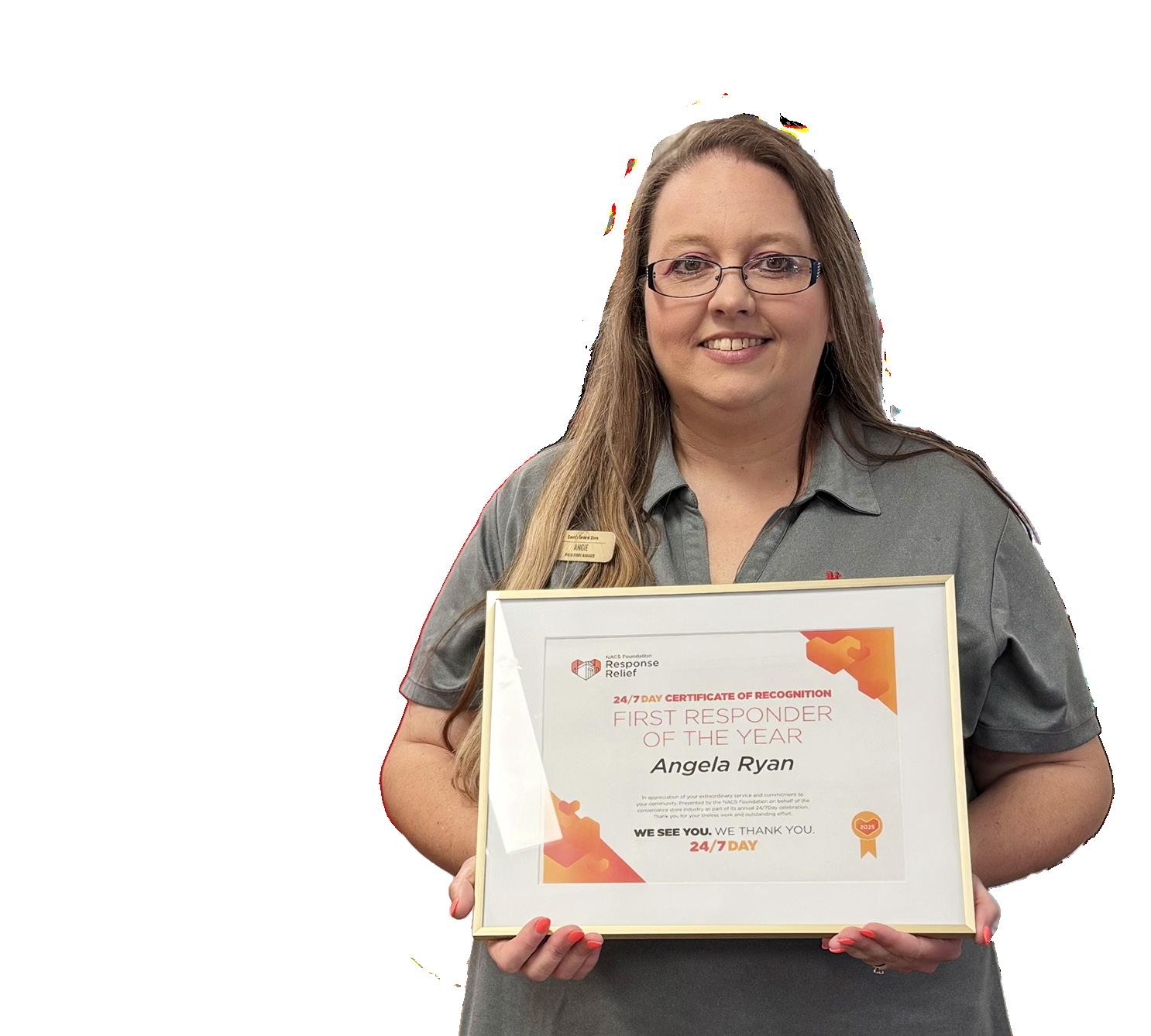
On 24/7 Day in July, celebrate your hometown heroes with gestures small and large.
ONTENTS
Serving Up a Winning Bakery Program
There’s more than one way to get a doughnut onto shelves, and success is all about the approach that’s right for the retailer.
65
Elevating Loss Prevention in Convenience Stores
AI is transforming the field, but that’s just part of the story as retailers lean into loss prevention strategies and solutions.
Subscribe to NACS Daily—an indispensable “quick read” of industry headlines and legislative and regulatory news, along with knowledge and resources from NACS, delivered to your inbox every weekday. Subscribe at www.convenience.org/NACSdaily
EDITORIAL
Jeff Lenard
VP of NACS Media & Strategic Communications (703) 518-4272 jlenard@convenience.org
TREASURER: Lonnie McQuirter, Director of Operations, 36 Lyn Refuel Station
OFFICERS: Chris Bambury, Bambury Inc.; Tom Brennan, Casey’s; Varish Goyal, Loop Neighborhood Markets; Charles McIlvaine, Coen Markets Inc.; Natalie Morhaus, RaceTrac Inc.; Travis Sheetz, Sheetz Inc.
GENERAL COUNSEL: Doug Kantor, NACS
MEMBERS: Lisa Blalock, BP North America Inc.; Brian Donaldson, Maxol Limited; Tony El-Nemr, Nouria Energy Corp.; Terry Gallagher, Gasamat Oil Corp./Smoker Friendly; Erin Graziosi, Robinson Oil Corp.; Raymond Huff, HJB Convenience Corp.
NACS SUPPLIER BOARD
SUPPLIER BOARD CHAIR: Bryan Morrow, Chobani & La Colombe
CHAIR-ELECT: Kevin LeMoyne, The Coca-Cola Co.
VICE CHAIRS: Mike Gilroy, Mars Wrigley; Jim Hughes, Supplying Demand Inc. dba Liquid Death; Danielle Holloway, Altria Group Distribution Co.
MEMBERS: Tony Battaglia, PMI U.S.; Ryan Calong; Jerry Cutler, InComm Payments; Jack Dickinson, Dover Fueling Solutions; Matt Domingo, Reynolds; Mark Falconi, Greenridge Naturals; Ramona Giderof, Diageo Beer; Adam Gryzbek, BIC Corp.; Kevin Kraft, Tropicana Brands; Jay Nelson, Excel Tire Gauge
(dba Russell’s); Mark Jordan, Refuel Operating Co.; Thomas Love, Love’s Travel Stops & Country Stores; Crystal Maggelet, Maverik Inc.; Rich Makin, Wawa Inc.; Brian McCarthy, Blarney Castle Oil Co.; Andrew Mitchell, Toot’n Totum Food Stores LLC; Jigar Patel, Fastime; Stanley Reynolds, 7-Eleven Inc.; Kristin Seabrook, Global Partners LP; Doug Yawberry, Weigel’s Stores Inc.; Scott Zietlow, Kwik Trip Inc.
PAST CHAIRS: Brian Hannasch, Alimentation Couche-Tard Inc.; Victor Paterno, Philippine Seven Corp.
SUPPLIER BOARD
REPRESENTATIVES: Bryan Morrow, Chobani & La Colombe; Kevin LeMoyne, The Coca-Cola Co.
LLC; Jordan Nicgorski, JUUL Labs; Nick Paich, TriggerPoint Media; Bria Troy, PepsiCo Inc.; Melissa Vonder Haar, iSEE Store Innovations LLC; Jason Zagaria, Primo Brands; Derek Zahajko, CAF Inc.; GENERAL COUNSEL: Doug Kantor, NACS
STAFF LIAISON: Bob Hughes, NACS
RETAIL BOARD REPRESENTATIVES: Tom Brennan, Casey’s; Scott Hartman, Rutter’s; Kevin Smartt, TXB
PAST CHAIRS: Vito Maurici, McLane Co. Inc.; David Charles, Cash Depot; Kevin Farley, Farley Retail Advisors
NACS Magazine (ISSN 1939-4780) is published monthly by the National Association of Convenience Stores (NACS), Alexandria, Virginia, USA.
Subscriptions are included in the dues paid by NACS member companies. Subscriptions are also available to qualified recipients. The publisher reserves the right to limit the number of free subscriptions and to set related qualifications criteria.
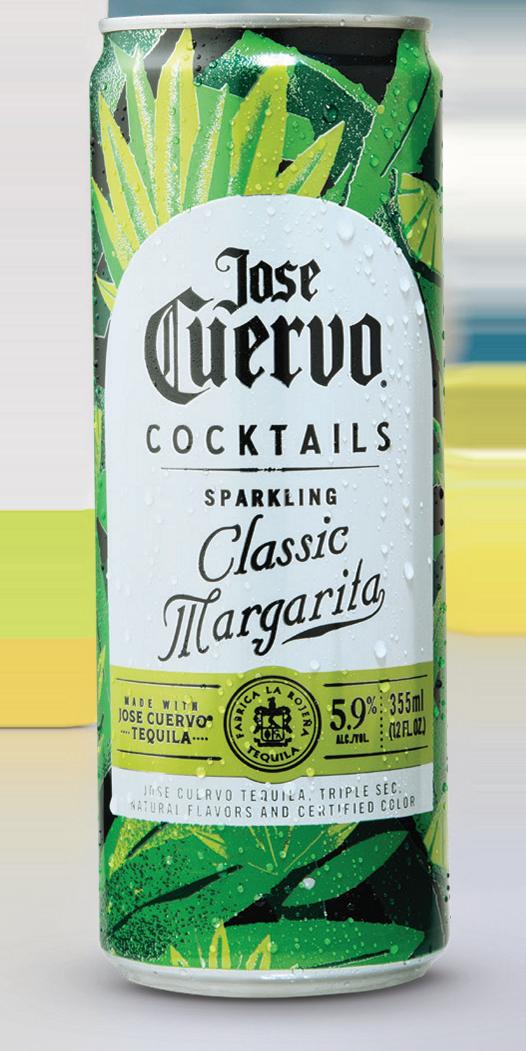
“Setting the Bar” in this issue looks at c-stores that are serving alcohol for on-site consumption.
Stretching the Definition
What’s a c-store?
I was at a terrific Cenex/Synergy Cooperative site a month ago that posed that question. At this rural location in the upper Midwest, a game scale in the parking lot was an amenity alongside an air machine. As I filled up my car, two snowmobiles rumbled up to nearby pumps.
Inside there was a wall of souvenirs; a wellstocked humidor; an old-fashioned ice-cream scoopery; a bait shop with all sorts of wriggling minnows to choose from; an extensive wine and liquor assortment, including numerous high-end bottles; and a small bar. (Not to mention friendly team members who were more than happy to answer all my questions.)
The bar is what most caught my attention. On this particularly chilly morning it was empty, but I can easily imagine it’s crowded during the summertime when the population swells with people renting cabins on the nearby lakes. Even empty, it spoke volumes about the kind of place I was in: A community hub, a place to meet other people, a single site that can take care of almost all your needs. As a consumer that would win
over my loyalty even if I never sat down and ordered a beer.
In this issue, “Setting the Bar” explores how five retailers have added on-site alcohol to their offer. Bars will probably never become ubiquitous in c-stores, but kudos to these retailers for stretching the definition of what a c-store is. Anna Bazhenova, who operates a c-store/speakeasy in New York City, gave author Terri Allan this terrific quote: “Some guys will even bring a date, and you can see the disappointment change to delight when they see the bar in the back.”
This issue also features the annual NACS/ NIQ TDLinx c-store count. The topline number: 151,975. That’s a very small decrease of 0.18%. Regional data tells a more dynamic story. Turn to page 26 to see the latest numbers, and check back next month for the Top 100 retailers.
Ben Nussbaum Editor-in-Chief, NACS Media
UP FRONT FACES OF THE INDUSTRY
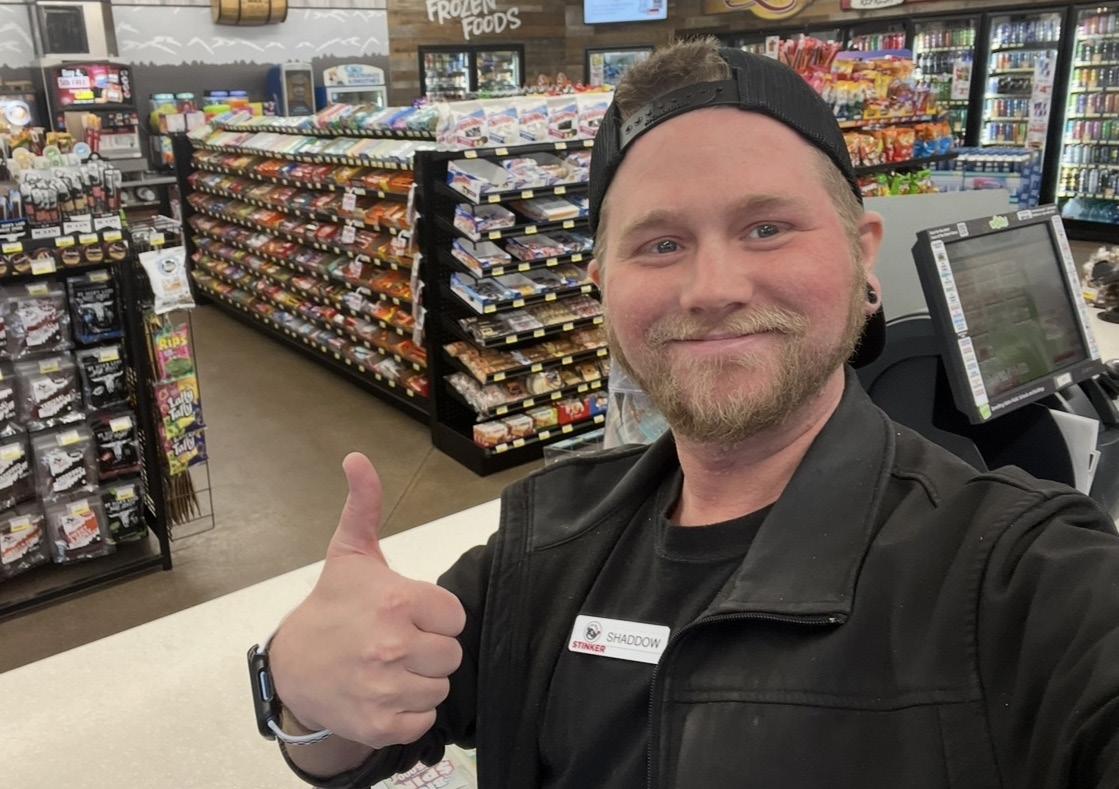
Putting People First
Prior to joining Stinker Stores as a manager at one of its Nampa, Idaho, locations, Shaddow Morrison worked in a treatment center for people coming off of drugs and alcohol.
“After three years of overnights, I was ready for something different,” he said.
His pivot kept him in a people-centric job—which is his favorite thing about working in convenience. “I started in a seasonal role, and was offered an assistant manager position three months in. It’s all about the people for me. That’s what keeps us growing and driving forward. When I come in to work, I make sure my employees are set up for success.”
He spoke with NACS about:
WHY HE LOVES WORKING IN CONVENIENCE
I love meeting different people from different walks of life. I also love learning new things. I’m no stranger to retail jobs, I’ve had plenty of retail experience, but it’s definitely been a big change since I’ve taken over the store manager role. I’m learning new things every step of the way, and it not only challenges me, but when I overcome those little things and constantly get more information, I feel even more comfortable in the job.
It’s a very hands-on job. I genuinely enjoy the tasks I get to do, like inventory control, making sure the store is running smoothly or setting goals. Retail jobs aren’t for everyone, but I have found great things to learn and great people to meet.
Shaddow Morrison, Stinker Stores
HIS FAVORITE THING ABOUT HIS JOB
It’s seeing growth in my people. That’s first and foremost to me, because then the business growth follows. I love seeing them train well, take in new information and be able to handle whatever I put in front of them. This job is also challenging, which in itself can be rewarding.
I have found a sense of family at Stinker, which really means a lot—it makes me so much more comfortable to come to work every day knowing I have so many people that I can reach out to and lean on.
A MEMORABLE MOMENT AT WORK
I have so many. But even just the other day, I had this really nice older lady come into the store who wanted to use our microwave. She was telling me about her day, which was going pretty rough, and we hit it off and had a great conversation. I wished her a better day, and offered to go out and help her fill up her gas or with anything else she needed. All my favorite moments are about our people and our regulars. My goal is to build more regulars here.
Strengthening Food Safety Standards
As the importance of foodservice in convenience grows, retailers’ foodservice programs are becoming more sophisticated and labor intensive. That means food safety continues to become even more essential, and teams at both the corporate and store levels need to have a solid grasp of food safety procedures and protocols.
Come to the 2026 NACS Food Safety Forum, April 13-14, 2026, in Schaumburg, Illinois, just outside of Chicago. The Forum is developed by convenience industry food safety, foodservice, quality assurance and risk management leaders, and is the only retail-focused event of its kind for the global convenience community.
Content focuses on four principles:
• Consumer safety: A session led by Jeremy Zenlea, vice president, health and safety, EG America, will cover how perceptions of the convenience industry shape whether customers believe “gas station food” is high quality and safe, and how the industry can raise the bar on food safety, build trust and strengthen its reputation.
The Forum will also provide guidance on how to mitigate risk from the Big Nine allergens through identifying, managing and communicating allergen information to customers.
• Clean and quality experiences: Understanding the top food safety risks is critical—everything from handwashing and sanitation to technology, allergens and leadership. Additionally, one session will share sanitation practices that focus on strategies to improve food safety, prevent cross-contamination and ensure food-safe working conditions in convenience stores.
• Protecting our brands: Two of the top five food safety risks can result in the most health inspection violations. Find out what you can do to protect public health and your teams. Participate in a mock civil trial that turns attendees into courtroom jurors of a fictional trial to better understand the potential for legal liability related to a foodborne outbreak.
• Empowering teams to do the right thing: Food safety starts at the top, and what begins at corporate carries throughout the entire operation. Participants will hear CEO perspectives on food safety from Jay Ellingson, chief scientific officer at Kwik Trip, and Scott Zietlow, CEO and president of Kwik Trip, who will share how leadership, culture and accountability shape food safety strategies across their organization—and how their approach drives trust, consistency and brand integrity.
Amy Costello, director, food safety and quality assurance at Casey’s General Stores, will also speak about how to build a culture of food safety throughout an entire organization— from HQ to the store level to the customer, including supply chain, production, storage and distribution. Visit convenience.org/FSF to register.
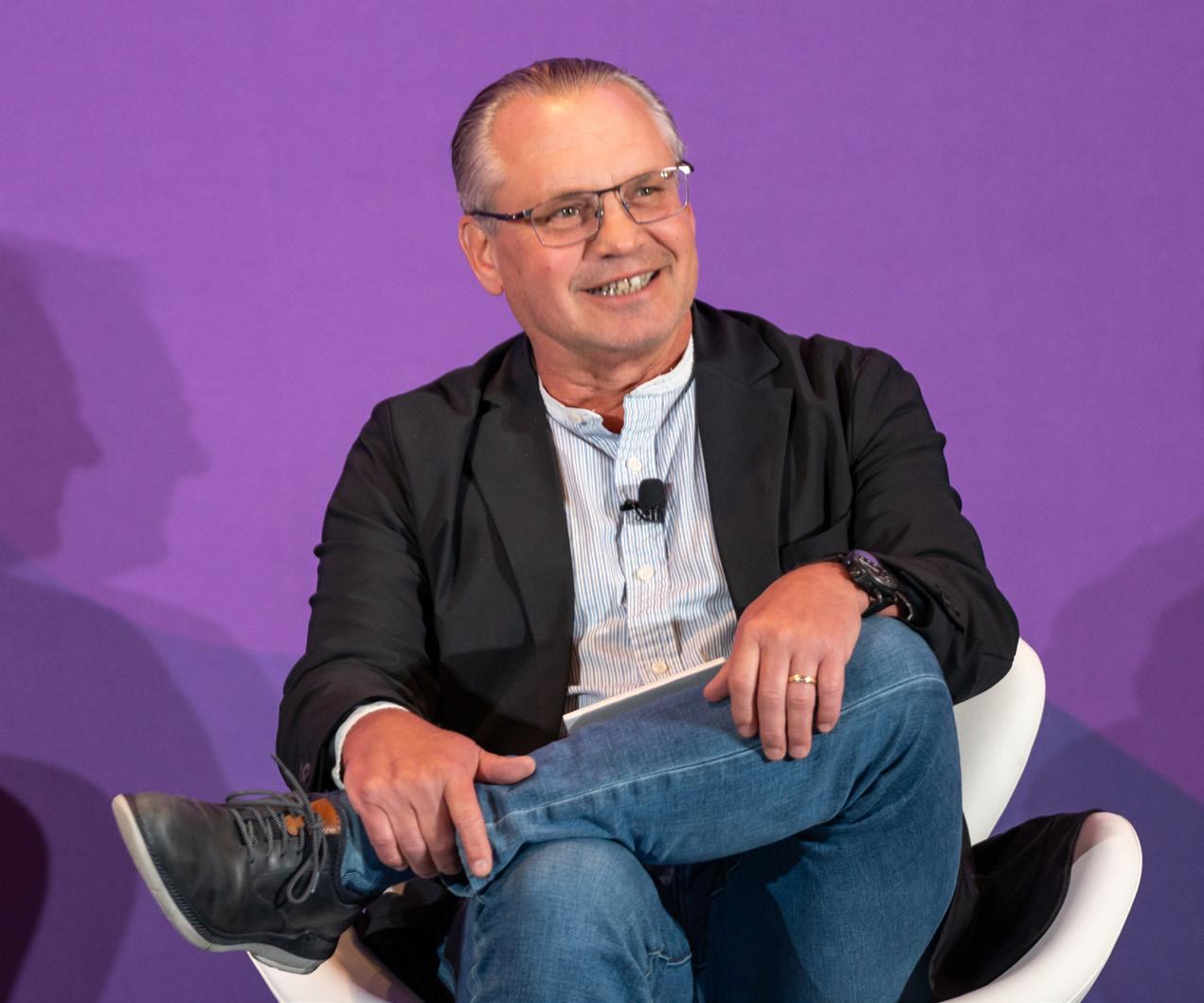
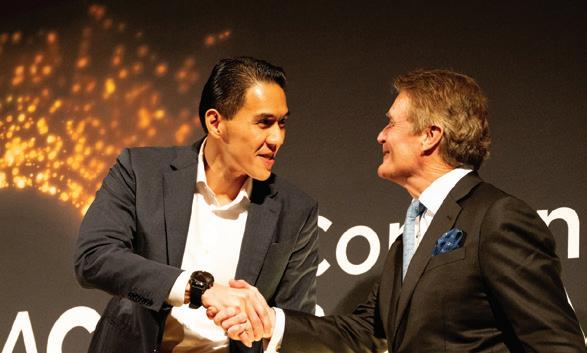
Scott Zietlow, CEO, president and chairman, Kwik Trip Inc. (left), will provide perspective on implementing effective food safety strategies throughout an organization during a CEO panel.
How Long Do Customers Stay in Your Store?
The answer for an average retailer is 3 minutes and 55 seconds. In 2025, NACS Research conducted a Dwell Time Observation Study to discover the convenience store customer’s average time spent inside the store.
“Dwell time is one of the crucial drivers of profitability in the convenience retail sector,” the NACS Research report stated. “Retail research consistently shows a positive correlation between longer dwell times and
increased sales, as extended visits provide retailers with more opportunities to engage shoppers through in-store displays, loyalty programs and organic browsing.”
Retailers need to strike the right balance between being a fast and convenient stop for customers and providing opportunities for them to linger and browse.
Some key findings from the study that retailers can strategize around include:
• The primary determinant of a customer’s dwell time was the type of item(s) purchased, with prepared fresh food accounting for the longest dwell time.
• The breakfast daypart had the highest average dwell time at 4 minutes and 12 seconds.
• Female customers typically spend more time in the store than men.
• Customers spent less time in the snacks and CPG sections than the prepared food and grab-andgo areas of the store.
• In the prepared food category, shoppers aged 25 and under spent the longest time browsing, with an average dwell time of 5 minutes and 47 seconds. This may be due to dietary preferences, health consciousness, novelty-seeking behavior or desire for customization.
6 Strategies for Reducing ICE Emissions
“Driving Insight: A Five-Year Synthesis of Combustion Emissions Research,” a report from the Transportation Energy Institute (TEI), synthesized findings from nine major studies between 2020-2024, offering a framework for policymakers, industry leaders and stakeholders seeking affordable, scalable and effective emissions reduction strategies for internal combustion engine (ICE) vehicles.
The report highlights six critical themes for achieving meaningful emissions reductions:
• Life cycle perspective: Strategies must consider full life cycle emissions for maximum environmental benefit at the lowest cost.
• Technology diversity: No single solution fits all; a portfolio approach tailored to specific use cases is essential.
“TEI has been evaluating options for reducing emissions for years, trying to help the market find solutions that benefit the environment, consumers and industry,” said John Eichberger, executive director of TEI. “Each report incorporated in this paper stands on its own, but together they present a much more comprehensive assessment of what it really takes to develop an effective strategy to reduce emissions and preserve access to affordable and reliable transportation energy.”
Calendar of Events
2026
MARCH
NACS Convenience Summit Asia
March 10-12 | Shanghai, China
NACS Human Resources Forum
March 16-18 | Galt House Hotel Louisville, Kentucky
NACS Day on the Hill
March 17-18 | Four Seasons Washington, D.C.
APRIL
• Policy alignment: Government frameworks should align business interests with environmental objectives.
• Solutions for existing fleets: Addressing solutions that apply to current vehicles is vital; relying solely on new vehicle turnover is slow and inefficient.
• Scalability and infrastructure: Solutions must be deployable at scale and account for infrastructure constraints.
• Affordability: Economic feasibility and total cost of ownership are fundamental to success.
Head to transportationenergy.org to view previous reports on a range of fuel topics, including EV charging infrastructure funding, driver behaviors, cost effective fleet emission reduction strategies, optimizing EV charging sites and biofuels.
NACS Food Safety Forum April 13-14 | Renaissance Schaumburg Convention Center Hotel Schaumburg, Illinois
NACS State of the Industry Summit April 14-16 | Renaissance Schaumburg Convention Center Hotel Schaumburg, Illinois
NACS Leadership for Success
April 27-May 1 | Hershey Lodge Hershey, Pennsylvania
JUNE
NACS Convenience Summit Europe June 16-18 | Hilton Warsaw City Warsaw, Poland
OCTOBER
NACS Show
October 6-9 | Las Vegas Convention Center Las Vegas, Nevada
For a full listing of events and information, visit www.convenience.org/events.
Driving Insight: A Five-Year Synthesis of Combustion Emissions Research
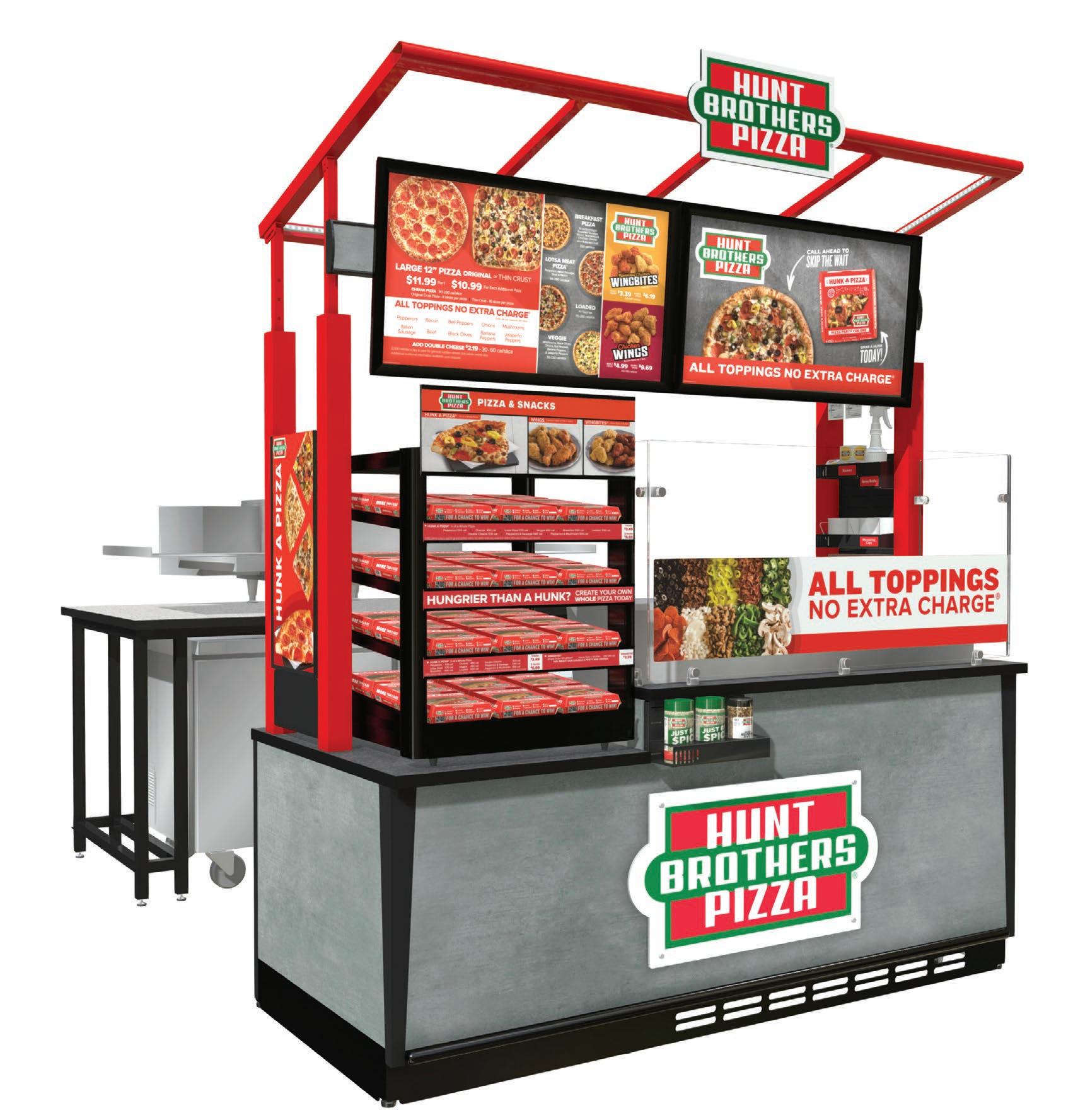
THE KEY INGREDIENT FOR SUCCESS IS
With over 30 years of experience in the c-store industry, Hunt Brothers® Pizza has perfected a program designed to maximize your profits. The only ingredient missing is you.
UP FRONT NACS NEWS
Member News
RETAILERS
TravelCenters of America, part of the BP portfolio, announced Jason Nordin as the next chief executive officer of TA. He previously spent 12 years at Pilot Company, where he served six years as chief operating officer. As COO, Jason oversaw more than 23,000 team members across more than 650 travel centers and quick-serve restaurants in the United States and Canada.
Mindy K. West , previously chief operating officer at Murphy USA, was named as the company’s next president and chief executive officer, effective January 1, 2026. She also became a member of Murphy USA’s board of directors on that date.
Refuel Operating Company promoted Monique Ravenel as vice president of foodservice, leading the entire foodservice team. She previously served as the company’s director of proprietary foods and QSR operations.
Sheetz announced the retirement of longtime employee and board member Ray Ryan Since joining the
board of directors in 2019, he has provided invaluable guidance and strategic insights, drawing on more than four decades of his dedicated work across various departments at Sheetz.
Dave Woodley has been appointed to Sheetz’s board of directors to succeed Ray Ryan. Woodley, who has worked for Sheetz since 1983, most recently served as executive vice president of marketing.
SUPPLIERS
Keurig Dr Pepper appointed Anthony DiSilvestro to chief financial officer. He will report to chief executive officer Tim Cofer and lead the company’s finance and technology organizations.
George Lagoudakis , previously SVP commercial finance at Keurig Dr Pepper, is taking on the company’s newly created role of deputy CFO. In this role, Lagoudakis will assume additional responsibility to ensure the successful separation and establishment of the future Beverage Co.
PepsiCo Inc. named Steve Schmitt as executive vice president and chief financial
officer. He joins PepsiCo from Walmart, where he served as executive vice president and chief financial officer for Walmart U.S., overseeing the finance function for Walmart’s multi-billion-dollar omnichannel U.S. organization and leading the core financial activities of Walmart’s largest business unit.
Jamie Caulfield , previously the PepsiCo CFO, assumed an advisory role in November and will assist with the transition through May 15, 2026, after which he will retire after a more than 30year career with the company.
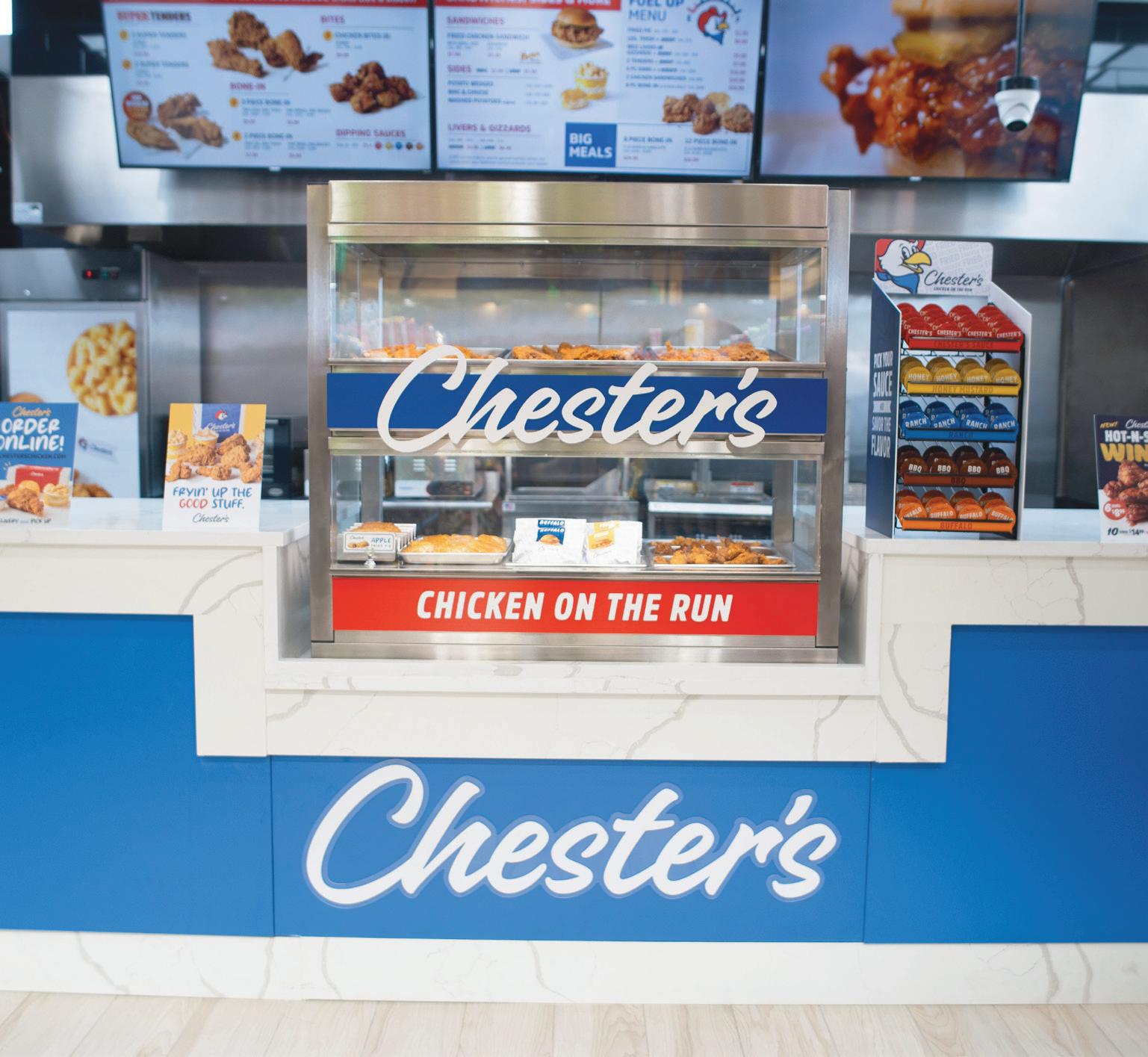
Chester’s Chicken appointed Kevin O’Connor as its new executive vice president, following the retirement of Bill Rice. O’Connor, who has partnered with Chester’s as a consultant since 2018, brings more than 20 years of leadership experience across the culinary and franchise industries.
Dave Woodley
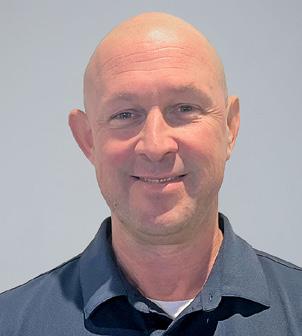
Jason Nordin
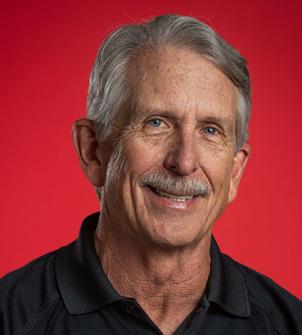
Kevin O’Connor
Ray Ryan
Steve Schmitt
UP FRONT NACS NEWS
New Members
NACS welcomes the following companies that joined the Association in November 2025. NACS membership is companywide, so we encourage employees of member companies to create a username by visiting convenience.org/create-login. All members receive access to the NACS Online Membership directory and the latest industry news, information and resources. For more information about NACS membership, visit convenience.org/membership.
NACS HUNTER CLUB
BRONZE
OneFabric Technologies dba LottoShield San Ramon, CA www.lottoshield.com
RETAILERS
Festi Essentials
Costa Mesa, CA www.festiessentials.com
Huck’s Market
Carmi, IL www.hucks.com
Sacramento 49er Travel Plaza Sacramento, CA www.sacramento49er.com
Cornbread Hemp Louisville, KY www.cornbreadhemp.com
G&A Robot North Vancouver, British Columbia, Canada www.garobot.com
HyGrow Xuzhou, Jiangsu, China www.hygrowcomposites.com
Kiva Brands Alameda, CA www.shopkivaconfections.com
Main Cleaning Solution Carmel, IN www.maincleaningsolution.com
Old World Provisions Troy, NY www.corporate. oldworldprovisions.com
Poseidon Resources LLC Kansas City, MO
PVM Nutritional Sciences Inc. Scottsdale, AZ www.braven.bar
RRR Trading LLC Kansas City, MO www.edpenergy.net
ScandiCal Las Vegas, NV www.scandical.com
T&S Brass and Bronze Works Inc. Travelers Rest, SC www.tsbrass.com
Taylor Farms Cashmere, WA www.crunchpak.com
United Marketing Inc. Marion, IN www.unitedmarketinginc.com
Spinks Family Foundation Awarded $1.8 Million in 2025
The foundation funds organizations focusing on education, children, food security, substance abuse and mental health.
The Spinks Family Foundation awarded over $1.8 million in donations to 154 local organizations in 2025, the company said. “This total includes the foundation’s monthly donations, grant awards, annual Spinx store campaigns and the annual Spinx Charity Classic Golf Tournament,” the retailer said in a press release.
The Spinks Family Foundation funds organizations that align with its mission in the areas of education, children, food security, substance abuse and mental health, the Spinx Company said.
One of the foundation’s major events is its annual golf tournament that benefits local charities. Beneficiaries are selected by the Spinks Family Foundation Board and serve a three-year term. The 2025 Spinx Charity Classic raised more than $120,000, which will be split evenly among this
year’s beneficiaries: American Red Cross, Gateway House Inc., Meals on Wheels, The Salvation Army and United Ministries.
Twice a year, Spinx also hosts month-long, instore fundraisers across its more than 90 retail locations. These campaigns invite customers to donate spare change at checkout to benefit the American Cancer Society and March of Dimes. This year, the company raised $237,640 for the American Cancer Society and $290,011 for March of Dimes.
“We are deeply committed to investing in the communities we call home and empowering the organizations that work tirelessly to serve those in need,” said Stewart Spinks, founder of Spinx. “This year’s grant recipients reflect a broad spectrum of causes that align with our mission of strengthening the fabric of our local communities.”
In The Community
Every year, the convenience retail industry dedicates billions of dollars to advancing the futures of individuals and families in our communities. The NACS Foundation unifies and builds on NACS members’ charitable efforts to amplify their work in communities across America and to share these powerful stories.
at www.conveniencecares.org
1 PARKER’S KITCHEN SUPPORTS EMERGENCY HOUSING
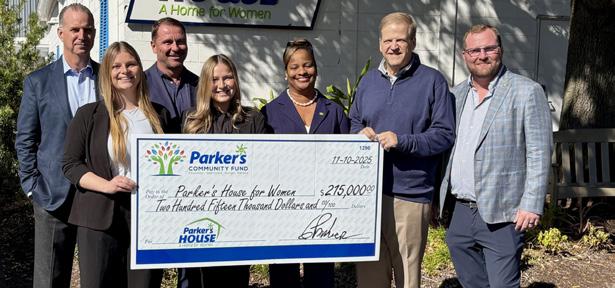
Parkers Kitchen presented a $215,000 round-up campaign check to Union Mission as part of the company’s campaign to benefit Parker’s House for Women. According to the company, Parker’s House for Women is the only emergency housing program located along the I-95 corridor between Florida and South Carolina that is dedicated solely to helping unaccompanied women experiencing homelessness and providing wraparound services for women in need.
2 QUICKCHEK HOSTS FREE FARMERS MARKET
QuickChek and professional football player Kayvon
Thibodeaux hosted a special event in Jersey City, New Jersey, that combined a free farmers market for local seniors with hands-on nutrition education for participating fifth graders.
The free farmers market, a collaboration between America’s Grow-a-Row and Team Walker, provided families with hundreds of pounds of locally grown fruits and vegetables.
3 MIRABITO RAISES $75,000 FOR AMERICAN CANCER SOCIETY
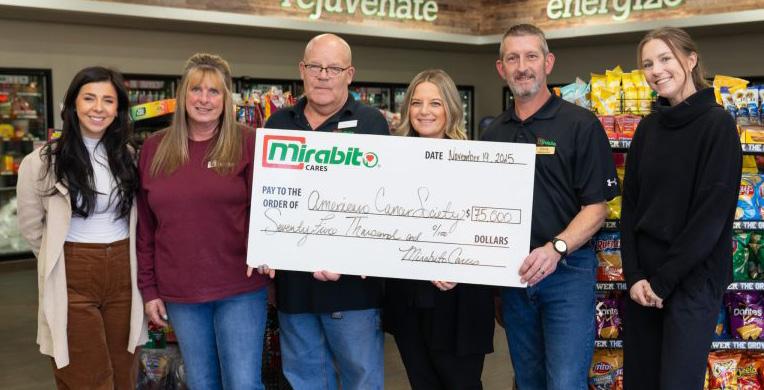
Mirabito Convenience Stores raised $75,000 for the American Cancer Society through customer round-up donations and a corporate contribution from Mirabito Cares during a campaign held in October.
The company said the proceeds will support “local patients and families through vital American Cancer Society programs, including nights at Hope Lodge during treatment and recovery, rides to medical appointments and access to trained cancer information specialists who provide 24/7 guidance and support.”
4 TXB SUPPORTS CHILD ADVOCACY NONPROFIT
TXB (Texas Born) hosted its 29th Annual Fishing and Golf Classic,
raising nearly $200,000 in donations for CASA, a child advocacy nonprofit benefiting children in foster care. The $200,000 adds to TXB’s total of $1,000,000 donated in support of CASA.
The event took place October 27-28 at Lake Texoma in North Texas, with the fishing tournament on the first day and the golf tournament on the second day.
5 MURPHY USA MAKES $1 MILLION DONATION
Murphy USA donated $1 million to United Way of Greater Union Country, a nonprofit in New Jersey.
Murphy USA said the gift “reflects the heart of our people. Thank you to our employees for continually showing up for their communities and embodying the spirit of giving that defines this season.”
6 TIGER FUEL SUPPORTS FAMILIES FACING PEDIATRIC CANCER
Tiger Fuel Company announced that with the help of its customers, it raised $10,000 for JackFest in October. JackFest is an event that supports families battling pediatric cancer and benefits the Ronald McDonald House Charities of Charlottesville, Virginia.
“We’re so proud to have supported this meaningful organization across all ten of our Market by Tiger locations. Thank you to all that played a role in this amazing initiative,” the company said.
Advocacy in Action: A Day on the Hill
‘Sharing your story gives lawmakers the chance to understand how their decisions affect your daily life.’
BY ESMERALDA OROZCO
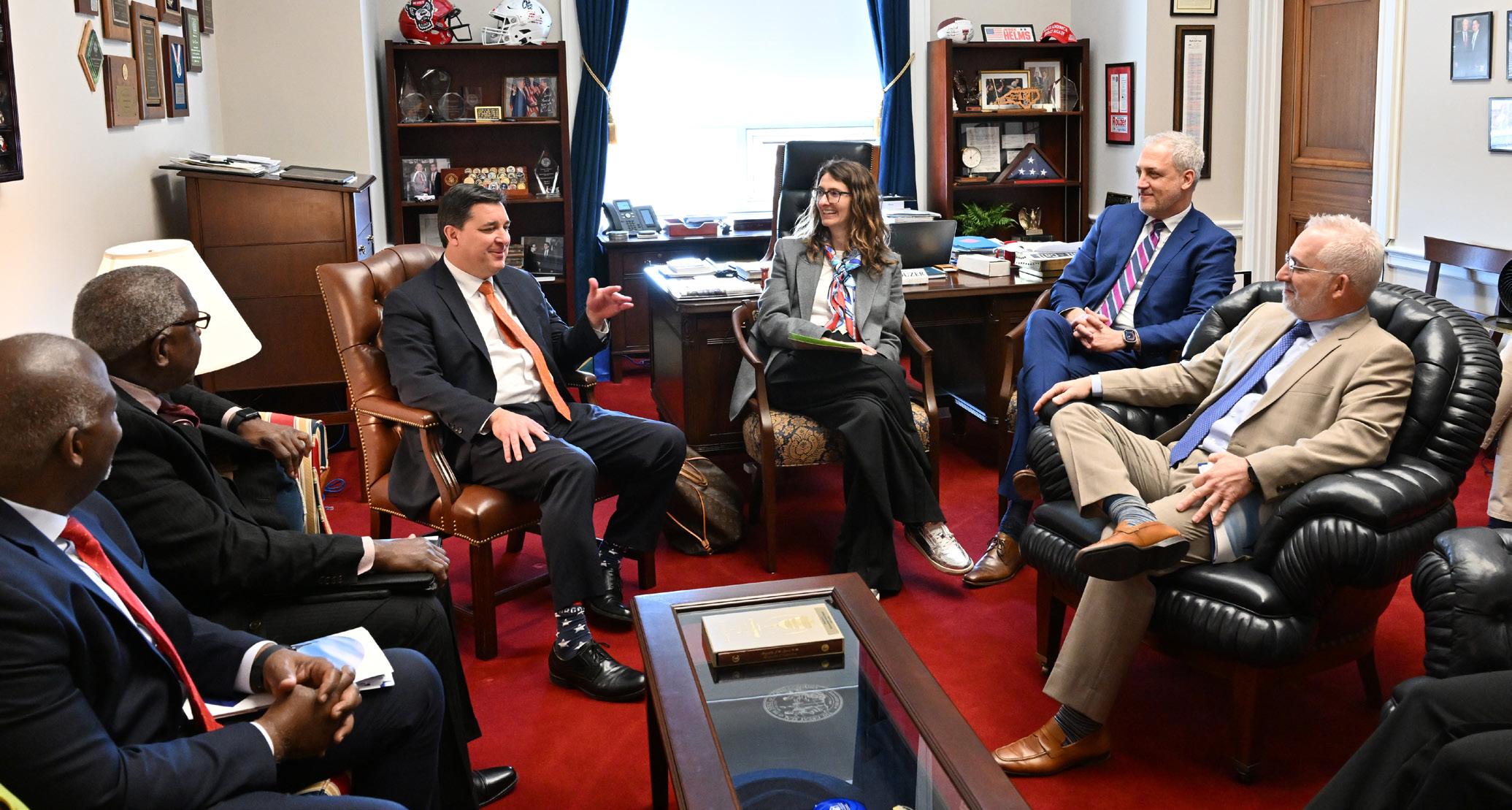
At NACS Day on the Hill, the convenience industry comes together to tell its story to elected officials in Washington, D.C. The event builds valuable, longlasting relationships and is an opportunity for NACS members to advocate directly on the issues most important to them.
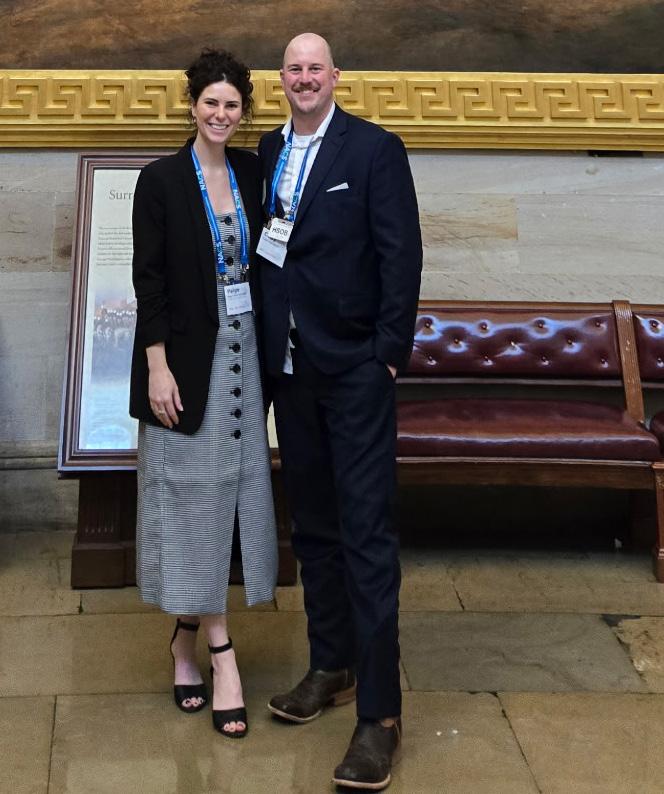
Last year, Paige FicklerCleveland, general manager at Fickler Oil Company and a member of the NACS Retail Engagement Committee, attended the event for the first time.
HOW FAMILIAR WERE YOU WITH THE ADVOCACY EFFORTS OF NACS BEFORE COMING TO DAY ON THE HILL?
My understanding was that NACS worked closely with large retailers on issues affecting the industry, but I didn’t fully understand how much they rely on retailers of all sizes to advocate for the issues key to our industry. Learning that my voice mattered just as much as anyone else’s was eye-opening.
Advocacy is for everyone. Your voice matters.
BEFORE ATTENDING, WHAT DID YOU EXPECT THE EXPERIENCE TO BE LIKE?
People told me that NACS Day on the Hill was one of NACS’ best events and rewarding. I trusted what I was being told, but at the
“If we don’t show up and share our stories, we do a disservice to ourselves and to the millions of people who rely on us,” said Paige Fickler-Cleveland, general manager at Fickler Oil Company (with her husband, Cody Cleveland, wholesale fuel manager at Fickler Oil Company).
same time, to be frank, I still expected the meetings and conversations to be somewhat stuffy. They weren’t at all. The experience was far more engaging than I expected.
HOW DID YOU PREPARE FOR SUCCESSFUL MEETINGS ON THE HILL?
NACS staff helped prepare attendees with briefing materials for the Hill meetings, and participants were also encouraged to bring statistics from their own businesses to share with legislators. With the help of our office accountant, I gathered data pertinent to the issues we were asked to cover and then made detailed notes to support me during meetings. The adage “proper planning prevents poor performance” has never failed me—so I planned and prepared for a successful Day on the Hill.
NACS Day on the Hill FAQs
Please consider attending this year’s NACS Day on the Hill on March 17-18, 2026. Whether you’re new to advocacy or simply ready to share your story, your participation matters. Your voice strengthens our industry’s voice in Washington, D.C. To learn more or to get involved, reach out to Esmeralda Orozco, NACS grassroots manager, at eorozco@convenience.org. For more informatioon visit convenience.org/ dayonthehill.
FOR FIRST-TIME ATTENDEES, IS PARTICIPATING A HEAVY LIFT?
Some prep work is important, but that mostly means gathering data from within your company so that you can share your story. The NACS government relations team schedules meetings, chooses the focus topics for the year, and holds recorded virtual briefings to help everyone prepare. There’s also an on-site briefing the day before the Hill meetings.
WHAT WILL THE FOCUS ISSUES BE FOR 2026?
The issues discussed during Congressional meetings are typically determined a month before Day on the Hill. The NACS team finalizes the issues based on legislation moving in Congress and key policy issues. Last year’s top issues were swipe fees and the Credit Card Competition Act, tax provisions that are key for the industry and SNAP restrictions.
HOW ARE THE MEETINGS SCHEDULED?
The NACS government relations team schedules meetings based on retailers’ geographic footprint and the key issues being discussed on the Hill. Groups of about three to seven people attend meetings together. The groups are created based on the locations retailers serve, and every group includes either a NACS team member or a previous participant with a deep understanding of the convenience retailing industry.
In 2025, over 150 attendees from more than 30 states were able to meet their representatives face-to-face and share their stories at NACS Day on the Hill.
WHAT
WAS IT LIKE WALKING INTO YOUR FIRST MEETING ON CAPITOL HILL?
It’s difficult for lawmakers, or anyone for that matter, to understand how their decisions may be impacting you until you give them an opportunity to empathize with your situation.
It was nerve-racking. It wasn’t until I had a chance to share my thoughts that I realized I was more nervous at the thought of speaking than “actually” speaking. NACS pairs participants with experienced advocates for each meeting. The NACS team members and the lobbyists I was paired with encouraged me to share my story throughout our meetings. By encouraging me to share, they helped me become more relaxed in each meeting I attended.
HOW
DO YOU THINK YOUR STORY HELPS LAWMAKERS UNDERSTAND THE REAL-WORLD IMPACT OF THEIR DECISIONS?
Sharing your story gives lawmakers the chance to understand how their decisions affect your everyday life. It’s difficult for lawmakers, or anyone else for that matter, to understand how their decisions may be impacting you
until you give them an opportunity to empathize with your situation. There is power in numbers. The more retailers who share their stories, the stronger and more relatable our stories become.
Change and growth never come from comfortable places. Advocacy is for everyone. Your voice matters.
WHY
DO YOU THINK IT’S IMPORTANT FOR PEOPLE IN THIS INDUSTRY TO SHARE THEIR STORIES IN D.C.?
Convenience is one of the largest industries in the country. If we don’t show up and share our stories, we do a disservice to ourselves and to the millions of people who rely on us. Our industry touches too many people for our voices not to be heard.
Esmeralda Orozco is the NACS grassroots manager. She can be reached at eorozco@ convenience.org.
INSIDE WASHINGTON
NACSPAC LIST
NACSPAC was created in 1979 by NACS as the entity through which the association can legally contribute funds to political candidates supportive of our industry’s issues. For more information about NACSPAC and how political action committees (PACs) work, go to www.convenience.org/nacspac. NACSPAC donors who made contributions in December 2025 are:
Daniel Alsaker Alsaker Corp dba Broadway
Chad Beck Core-Mark International
George Bennett Imperial Trading Company - S. Abraham & Sons Inc.
John Bertucci RowLogic LLC
Rick Brindle Strategic Growth Planning Specialists LLC
Dereck Budahl Moyle Petroleum Company
Chet Cadieux QuikTrip Corporation
Brad Call J&T Management
Spencer Cavalier Matrix Capital Markets Group Inc.
Philip Chamblee Mississippi Petroleum Marketers & Convenience Stores Association
Rick Derose TSN, a Bunzl company
Bhagdeep Dhaliwal Dhaliwal & Associates Inc.
Henry Dodge Dodge’s Stores
Brandon Duckett RaceTrac Inc.
William Englefield RedPrairie
Justin Erickson Harbor Wholesale Foods
Tiffany Fraley InConvenience Inc.
Jimmy Frangis PDI Technologies
Derek Gaskins BP International Ltd
Anne Gauthier St. Romain Oil Co. LLC
Christopher Gheysens Wawa Inc.
Brian Hannasch Alimentation CoucheTard Inc.
Matt Harris RaceTrac Inc.
Ryan Herrin Kellanova Away From Home
John Hill Utah Petroleum Marketers Association
Sonja Hubbard Yates Group Inc.
Cory Jackson Jacksons Food Stores Inc.
John Jackson Jacksons Food Stores Inc.
David Jaffer Jaffer Law, PC
Jeff Kahler Ready Training Online - RTO
Steve Larson The Convenience Group LLC
Jeff Larson The Convenience Group LLC
Leyton Lavigne Lavigne Oil Company
Jason Manning Jacksons Food Stores Inc.
Bill McCloskey Rmarts LLC
Johnny Milazzo Lard Oil Company Inc.
Bill Newcomb Newcomb Oil Co.
Duane Phillips Dandy Mini Marts Inc.
Angela Pimental RaceTrac Inc.
Robert Razowsky Rmarts LLC
Ryan Razowsky Rmarts LLC
Merlix Reynolds RaceTrac Inc.
Donald Rhoads The Convenience Group LLC
Eva Rigamonti Pilot Travel Centers LLC
Thomas Robinson Robinson Oil Corporation
Jonathan Shaer Altria Client Services LLC
Dan Shapiro Krispy Krunchy Foods LLC
Travis Sheetz Sheetz Inc.
William Stein Core-Mark International
Paul Suarez
Casey’s General Stores Inc.
Mary Szarmach Gasamat Oil Corp/ Smoker Friendly
Lynn Wallis Wallis Companies
Alicia West Altria Group Distribution Company
NUMBER OF CONVENIENCE STORES IN THE UNITED STATES IN 2025
151,975
WEST (region 6)
23,083 stores h 3
CENTRAL (region 5)
13,241 stores i 46
SOUTH CENTRAL (region 4)
24,644 stores h 105
Texas gained
88 locations, the most of any state.
Source: NACS/NIQ TDLinx Convenience Store Count
143 stores, the most of any state
In 2025, the number of sites that sell fuel increased h 768
The number of sites that don’t sell fuel decreased i 1,048
280 stores a decline of 0.18%
MIDWEST (region 3)
23,961 stores i 30 NORTHEAST (region 1)
30,424 stores i 360
SOUTHEAST (region 2)
36,622 stores h 48
Across the United States, there’s one c-store for every 2,257 people.
* The number of military convenience stores fell from 520 to 479, moving this category from E to D—accounting for more than half of the 910-store increase in D-size location count.
185 Stores
190 Stores
TOP 10 STATES WITH THE MOST STORES NUMBER
1 2 3 4 5 6 7 8 9 10
3,244 residents
1,890 residents
2,394 residents
SAME SPACE
n Increased facings from 99 to 121, a 22% increase*.
n Automatically billboards and faces product.
n Reduces losses from bag hook tearout.
n Cuts over 1 hour/day labor for restocking.
n Allows rear restocking and proper date rotation.
n Dramatically increases sales in the same space.
n Adjusts to accommodate various package widths.
Making a Menu With AI
Artificial intelligence is being used widely outside the c-store industry for menu and recipe development. Here’s why— and how.
BY AMANDA BALTAZAR
For four months this year, Next restaurant in Chicago is featuring a nine-course menu with each course contributed by a different chef. One of the chefs is a 33-year-old woman named Jill from Wisconsin who apprenticed with two living masters—and one who died in 1935.
This is all being done through AI—Jill, for example, is an AI invention. Prompts are entered and refined by the restaurant’s owner, acclaimed chef Grant Achatz.
Achatz is not alone in embracing AI. Chefs, food innovators, menu developers and more are finding inspiration in this tool and using it to their advantage to create menus and recipes.
What can’t AI do? It can’t understand human emotions, feelings or the taste and mouthfeel of food. It can’t offer authenticity. Menu developers and chefs
AI can be that sparring partner you throw ideas at. It's a starting point.
are using it carefully, then adding the human element, the craft of creation, to produce something meaningful.
So far, AI hasn’t made many inroads into convenience stores’ menus and recipe development—at least that we know of. But it’s contributing in the background. Rachel Saddler, senior manager of foodservice innovation at Tri Star Energy (Nashville, Tenn.) uses it as a brainstorming tool. “It helps me spot food trends, come up with new flavor ideas and explore different recipe options more quickly,” she said. “It helps me move ideas forward more efficiently.”
She began experimenting with it to help speed up menu development
and idea generation. It helps her see the broader picture, she said, “for exploring variations I might not have considered and for seeing how a recipe could work in different store settings.” It can help her get a head start on concepts before testing them in the kitchen, too.
Market research firm Datassential is seeing AI adopted for menu and recipe development, mostly as “a collaborative tool rather than a replacement for chefs,” said Samantha Des Jardins, content marketing manager. Operators, she said, “typically use AI as an idea accelerator and to brainstorm.”
AI: A CREATIVITY ACCELERATOR?
Dan Follese, founder of Food Trend Translator in Tallahassee, Fla., works with companies on their product development. AI “can help me think through unique ingredients. Or I ask it for concepts or flavor combinations—for salad dressings, for example. I would have spent four or five hours really thinking through those flavor combinations. It’s like having a sous chef, a partner.”
Follese cautions that he thoroughly tests everything AI offers him. “AI is not going to replace the culinary application work, but it’s going to give you great combinations you’re not familiar with,” said Follese.
Tiffany Poe, chef, educator, AI consultant and adjunct professor at the graduate school of the Culinary Institute of America in Hyde Park, N.Y., discovered AI in its early days. “My neurosynapses started to fire like they hadn’t since I was in my 20s,” she said. She started testing it out for flavor and menu ideas, she said, and “felt like I was finally creating the way I was intended to create.”
Poe believes the intersection of AI and the chef brain is “an uncharted area of discovery and ideation.” And she’s started to work with organizations like the Culinary Institute of America on how to use AI.
And we’re at a key time, she said. “If we don’t intersect at this point, it will bypass us. We’re in the exploratory stage. What are you going to do with this moment in history? Are you going to maximize it and be in the conversation or are you going to hide in the corner?”
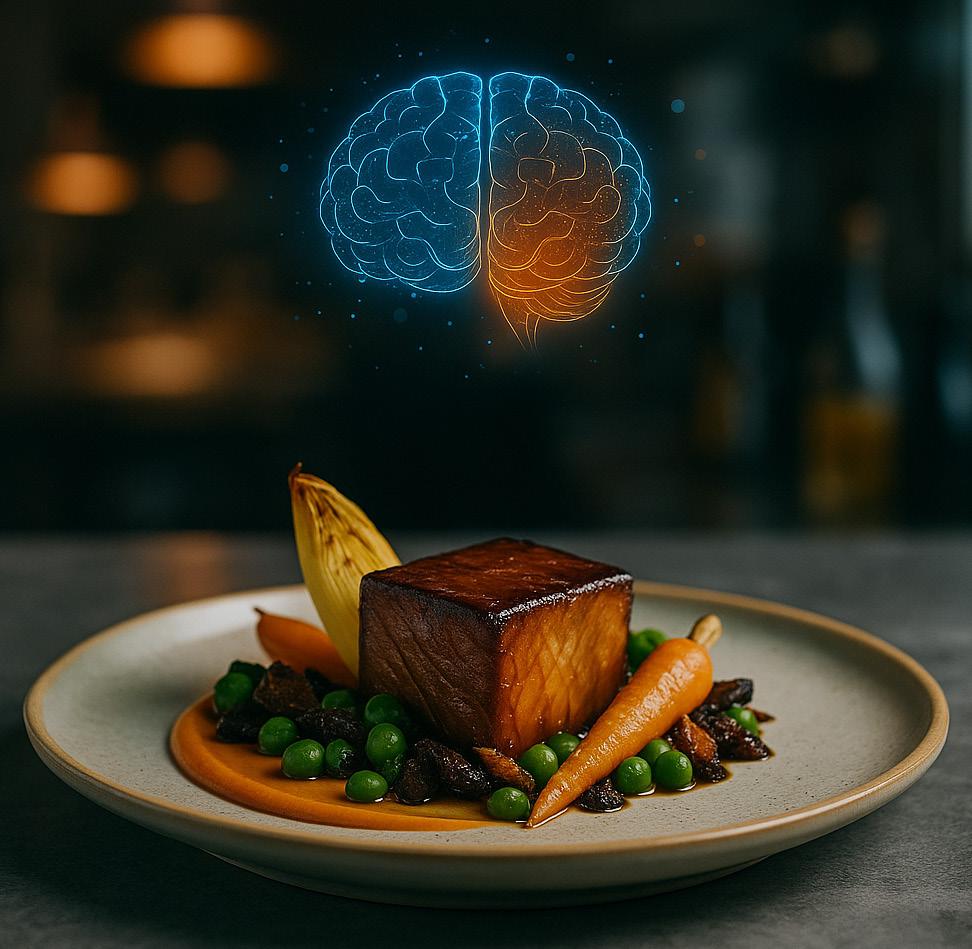
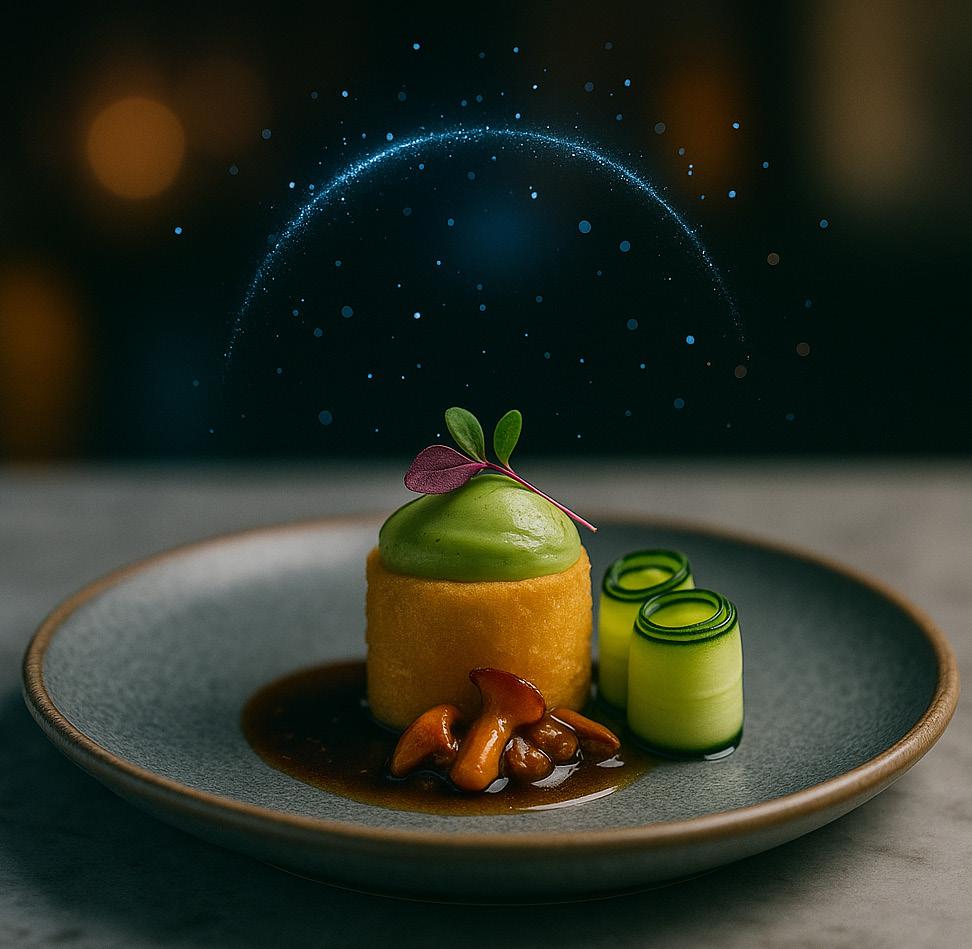
These images were created by chef and AI consultant Tifffany Poe. With AI, she said, “I was finally creating the way I was intended to create.”
AI, said Mike Kostyo, vice president of foodservice consultancy Menu Matters, Arlington, Vt., “can be that sparring partner you throw ideas at. It’s a starting point.”
AI can really push the envelope on new ideas because it’s “wildly imaginative,” he explained. “Sometimes staring down at that blank page in innovation is what’s hardest. At least you have something to work with that is incredibly creative.”
John Cramutola is creating a menu for a grab-and-go convenience facility at Saint Catherine’s Village, a continuing care retirement community in Madison, Miss.
Cramutola, corporate head of culinary for Cura Hospitality (Canonsburg, Pa.,) said “the more you dive into AI, the more you realize it can genuinely act as an assistant.”
He’s using it to look at which foods and flavors are trending in that specific region, because “every town in Mississippi has its own subculture.”
And he can get that information in an hour. Without AI, he said, he would look at restaurant menus in the town, search reviews, research what people enjoy doing in that area, read trade magazines and talk to other staff. In short, the work would take days.
It’s important, Cramutola said, to put in accurate prompts and to be really granular with requests. Using AI, he said, “allows for more creative thinking.” It also frees up time for creativity: “It’s like having an additional person who can do a lot of the admin tasks.”
Brandon LaVielle is the owner of Lavish Roots catering company in Burien, Wa., and is using AI to build a digital menu library. He has around 600 unique menus he’s created, categorized by regions of the world. He can ask AI to dive into this library to build a specific menu, such as Southeast Asian with French influences.
MINING DATA AND AI’S LIMITS
Cramutola also uses AI for organization and planning. For example, if he’s working on a catering event, it will give him a timeline that includes what he needs to do and when he needs to do it.
And LaVielle uses it to forecast. By putting in food prices and the standard industry markup, he can ask AI to generate an idea of what those costs will be in the next season. This is especially helpful for catered events, for which menus are written in advance.
It’s like having a sous chef, a partner.
Foodservice contractor Sodexo uses AI to help with seasonal planning and also delves into its own data, too. “AI is helping suggest possible dishes from current trends and insights from our individual brands, including menu reports, product and ingredient lists, and other intel about the brands,” said Lloyd Mann, vice president of culinary and global executive chef.
This reduces the time for the recipe development process significantly, he said, from three days to half a day. “Our team can then focus their time on actual preparation and optimization of those recipes. There’s no way around the human element—the actual recipe testing, tasting and enjoyment of food has to come from our people, and that cannot and will not change.”
“On a larger scale, organizations are using it to make sense of their massive amounts of data,” Kostyo pointed out, which can help when developing something new. AI “does such a great job of making sense of lots of data and information,” he said.
As we face a world where technology does more, what are the downsides?
AI “definitely has its limits,” said Tri Star’s Saddler. For example, she explained, it can’t replace hands-on culinary experience or human intuition about flavor, texture and customer preferences. “Sometimes the suggestions aren’t practical for realworld operations,” she said, “or don’t account for nuances like ingredient availability or equipment constraints.”
AI for Food Photography
Sydney Yocum is a research chef at Creative Food Solutions, a company that develops recipes for convenience stores, restaurants and manufacturers.
She mostly uses AI to generate visual imagery for clients “to illustrate the potential appearance of the product,” she said. Last year she even created AI images for a client exhibiting at the NACS Show because there wasn’t time for a photoshoot. She fed details into her AI engine based on the recipe she had created. With quite a bit of refining, it produced photos that looked accurate. “You have to be really descriptive,” she said.
She can even incorporate a client’s branding—colors, cups, etc.—into the visuals. “It makes it so real for them.”
Sodexo uses AI for photography, but for the back of house. It creates photo samples “that inform our plating and presentation, as well as portion control.” AI also provides ideas that Sodexo “can later use for real photography we are capturing for our customers,” said Lloyd Mann, vice president of culinary and global executive chef. This saves time when taking the actual photographs, he said, “because all the prep work has been done through the AI process.”
Sydney Yocum of Creative Food Solutions uses AI to create realistic food photography. “You have to be really descriptive,” she said.
You have to find out how much you can use it before it starts using you.
In the bigger picture, she’s concerned people might start to rely on it too much. “AI is a great tool, but it can’t replace human creativity, taste or knowing our customers and how our stores operate. There’s also a risk that if we lean on it too much, ideas could start feeling formulaic. The key is to use it as a helper, not a replacement.”
Work done by AI needs checking, said London Baker, regional wellness manager, Bay Area and Pacific Northwest for Bon Appetit foodservice management company. This is because of accuracy issues, especially with tasks that are highly complex. And learning how to use AI takes time. Users have to
properly prompt it for desired outcomes. “It takes time, experimentation and patience,” said Baker.
As for long-term implications, Baker has concerns about jobs in hospitality. AI-powered kiosks and coffee stations are already prevalent and replacing humans, he said. “Maintaining that human side is essential for our industry and other industries where creativity is highly valued. It’s going to be a challenge to see that AI enhances, but doesn’t replace, the human touch.”
Long term, Cramutola’s concerned about the effect on human brains. “My biggest concern is laziness. It’s very easy to ask whatever AI platform you’re using to do all the work for you. I could easily generate an entire menu based on prompts.”
However, he said, customers can sense a menu that’s created by a bot. “There’s no human creativity behind it. So you have to find out how much you can use it before it starts using you. But I have to do my due diligence and use my judgement as a professional.”
It’s important to keep in mind that consumers still want a human touch,
A Food Calculator at Your Fingertips
John Cramutola, corporate head of culinary for Cura Hospitality, uses AI for kitchen math, like how many cups of pears is equal to three pounds. “I could math it out; I have formulas and references … but I can do it instantly with AI,” he said.
Brandon LaVielle, the owner of Lavish Roots catering company, uses AI to create lists of every ingredient he’ll need for specific menus. Without AI, he would go ingredient by ingredient and calculate how much he needs of each one, but now AI does the work.
said Kostyo. “Consumers still prefer the food and beverage industry to prioritize human concepts. Food is a very emotional part of people’s lives and they value the work, knowledge, passion, heritage, etc. that goes into making a dish or product.”
No one can predict what the future will hold, but Datassential expects to see operators most open to using AI for technical, back-of-house tasks that directly support menu development— real-time inventory visibility, predictive equipment maintenance, waste reduction forecasting and dynamic menu optimization.
At the end of the day, said LaVielle, “if you’re not using AI, your competitors are getting an upper hand on you.”
Added Baker: “We need to embrace it because it’s coming—whether we want it to or not.”
Amanda Baltazar writes about retail, food and restaurants from an island in the soggy Pacific Northwest. She covers operations, design, marketing and trends for B2B publications.
AI can help LaVielle with yield testing too. For example, if he’s cooking a 25 pound brisket that typically has a 35% loss, AI can calculate much he needs to buy to serve 400 people.
LaVielle makes sure he doesn’t rely on AI too much. While he might use it to scale 150 recipes and save himself that time, if he’s in the kitchen he does kitchen math in an old-school manner, and teaches his staff members to do the same.
FOR SNACKING PACKAGING
FOR SNACKING PACKAGING
The boundary between meals and snacking continues to blur, changing the role of foodservice packaging.
BY LEAH ASH
Is it a snack or a meal? The answer may impact what sort of packing consumers prefer.
“About 20% of consumers snack three times a day or more, and as you might expect, Gen Z leads this trend. About a third of Gen Z snack every day and regularly replace their meals with snacks in general,” said Varchasvi Singh, senior analyst at Mintel, during a LinkedIn livestream event hosted by TC Transcontinental Packaging.
Snacking doesn’t just mean center-store staples. Singh noted that consumers are snacking on chicken or baked goods and adding coffee and other drinks.
“We’re having customers come to us and say, ‘Hey, we have this need—our consumers are asking for food on-the-go.’ So we’ve created packaging that works for those needs,” said Jessica Lanter, senior director of business development, TC Transcontinental Packaging.
“We’re continuing to create formats that support busy lifestyles, from single-serve options to eat-in packaging,” she said, highlighting snack packaging that’s made to fit into cupholders and pouches that are designed to keep food warm while also being easy to carry with a handle. The company
also developed dual-compartment bags that keep proteins and fruits or veggies separate, “which line up perfectly with modern snacking habits.”
Kurt Richars, director of market development and sustainability at Anchor Packaging, noted that retailers “may see demand shift from chicken sandwich combos to orders of chicken wings,” as consumers look for both smaller portions as well as options that are easy to both snack on now and save for later. “But the opportunity is to solve for something bigger—food quality and convenience.”
Innovation for snacking doesn’t just mean putting everything in smaller containers. Mark Medovitch, content manager at Inline Plastics, noted that flexibility in packaging is important for consumers and operators, citing a trend in customizable inserts. “These inserts allow a single container to support a wide range of applications, from snacks and meal components to fresh assortments.”
Multi-compartment designs can offer the same functionality as customizable inserts for operators. “Consumer demand for variety and portion separation in one package is continuing to grow,” he said, adding, “These formats support mix-and-match meals while maintaining food quality and presentation.”
Strength and rigidity also matter. Consumers’ No. 1 priority for foodservice packaging is leak and spill resistance, with 59% of consumers stating it’s their top concern, Natha Dempsey, president of the Foodservice Packaging Institute said, citing the Institute’s 2025 consumer perceptions survey.
Resealable and sturdy packaging allows people to snack in stages and safely put the package away without worrying about spills in a bag, car or workspace, Medovitch said. Richars agreed, noting that could mean offering a container that holds sauce separately for an item like chicken wings, which “not only preserves food quality longer, but also provides the convenience that a smaller container alone cannot.”
Similarly, both Inline Plastics and Anchor Packaging offer options that can hold dressings and toppings separately from salads to maintain freshness for consumers whenever they choose to eat their meal—whether that’s right away or hours down the line.
Medovitch shared that Inline Plastics is developing smaller, microwave-safe footprints designed for easy handling and reheating to also help retailers address customers looking to snack now and save some for later.
Finding the Right Approach for Meal Bundles
There’s been a rise in people picking up dinner to go from grocery and convenience stores, said Natha Dempsey of the Foodservice Packaging Institute, a notion echoed by Mark Medovitch at Inline Plastics.
“We’ve seen a rise in trays and platters, fueled by the trend of at-home entertaining where larger, shareable formats are in demand,” Medovitch said. He recommends that operators use a broader mix of container sizes and formats, rather than relying on a single universal package.
He suggested that retailers bundle food items in components, for example, using a larger, standardized container for the entrée and smaller containers for sides, sold together as a customizable bundle.
“The strategy allows consumers to choose their preferred combinations while allowing retailers to rely on a small, consistent family of packages,” Medovitch explained, adding that, “The result is flexibility for the customer without adding new labor steps, complicated assemblies or excess packaging SKUs.”
TC Transcontinental Packaging’s Jessica Lanter also noted that packaging can improve the online ordering experience for customers. “When someone orders ahead, they expect that pickup moment and the food to match the presentation they saw within the app. Prepacked curated bundles, such as a pickthree lunch option, makes it easy for the consumer to order and helps the retailer maintain their consistency and functionality,” she said.
WINNING with Bakery
There’s more than one way to get a doughnut onto shelves. Success is all about the approach that’s right for the retailer.
TBY STEVE HOLTZ
he approach each retailer takes to bakery becomes a key part of its identity—and approaches to a bakery program are as varied as the options in a bakery case.
At one extreme, Kwik Trip operates an advanced and wellrespected vertically integrated bakery program, with dozens of products—doughnuts, cookies, cinnamon rolls, bagels, muffins and more—produced in its 245,000-square-foot Sweets Bakery in La Crosse, Wisconsin.
On the other end, almost all convenience retailers embrace some type of packaged-bakery presence, stocking and promoting cookies, doughnuts and other sweet snacks from well-known suppliers, such as Mondelez International, Famous Amos, Pepperidge Farms, Entenmann’s, Hostess and others.
A HYBRID APPROACH
Somewhere in between is a combination of these methods. A retailer may bake some products in-house, thaw and serve fresh-frozen products from suppliers and also highlight packaged products.
This is how Global Partners operates, with some variety, across its multiple c-store brands.
“Our programs vary. We have different value propositions for our banners,” said Jac Moskalik, vice president of food, innovation and strategy at Global Partners, Waltham, Massachusetts.
As its name suggests, the company’s Alltown Fresh stores are all about fresh food products.
“At Alltown Fresh, bakery is a cornerstone,” Moskalik said, “and we’re going to be going much bigger in 2026, as we are with our other banners, because I firmly believe that bakery provides a halo of ‘fresh’ when you walk in the store.”
To brighten that halo, muffins are baked fresh in Alltown Fresh stores, while the newly reimagined Honey Farms stores—another of Global Partners’ retail brands—merchandises cinnamon rolls fresh out of the oven. The latter’s new store design was introduced last spring in Raynham, Massachusetts.
“The cinnamon rolls, when they’re baking, you can smell them in the parking lot. And that was done by design,” Moskalik said. “There’s nothing better than when you’re walking into a store and get that smell. [As a retailer,] you want that aroma of fresh-baked bread or fresh-baked cookies, anything that makes somebody gravitate over to the bakery case because so much of our sales are impulse sales in that category.”
As a complement to baked-in-house products, Global Partners also stocks a variety of as-goodas-fresh thaw-and-serve varieties. This is where
Sales Trends
supplier Rich Products plays, offering thaw-andserve options—cookies, muffins, doughnuts, brownies and more—or dough to be baked in stores. Rich’s also offers a turnkey solution that provides the merchandising, equipment and smallware that c-stores need for bakery programs.
“Fresh bakery items signal a commitment to quality and consistency,” said Elizabeth Sommer, customer marketing manager for Rich Products, Buffalo, New York. “This differentiation can be a powerful driver of repeat business and brand preference. Embracing a bakery program is more than just adding a new product category; it’s about creating a richer, more engaging retail experience that benefits both the customer and the bottom line.”
In particular, she said doughnut sales are predicted to grow 20% over the next four years.
Tasty Breads is yet another step removed from prepackaged bakery. It provides premade doughs— from cookies to pizza crust—that retailers finish in their in-store kitchens.
“We are mainly a private-label company,” said Marc Retondo, director of national accounts for
Both dollar and unit sales of fresh bakery items were down in c-stores through November 2025. Here’s how sales broke down in two key segments.
SOURCE: NIELSEN IQ
Getting Started
Focusing on the customers coming through the door—or the ones you’d want to patronize your stores—is key to defining a bakery program.
“There are a lot of great ways to build a bakery program,” said Jeff Keune, principal consultant for 4910 Consulting, noting baked-in-house, commissary and third-party programs.
To get started, “I would recommend thinking about the store trends and daypart traffic patterns,” said Keune, a former retailer/QSR leader who was instrumental in developing food programs for Thorntons, American Natural, Fazoli’s and others. “The greater the store traffic and transactions are in the morning, the more opportunity there is with a bakery program.”
Tapping that opportunity requires commitment and investment, said Elizabeth Sommer, customer marketing manager at Rich Products.
“The promise of fresh offerings and increased customer engagement is appealing, [but] operators must navigate a range of operational, financial and logistical hurdles to make the program successful,” she said. Three are key.
• Space and infrastructure
“Most convenience stores are designed for efficiency and not food production. Introducing a bakery program often requires rethinking the store layout, investing in equipment and ensuring compliance with food safety regulations. For stores without a kitchen or prep area, sourcing fresh baked goods from a commissary or thirdparty vendor becomes necessary—adding complexity to supply chain management.”
• Labor and training
“Baking, even at a basic level, requires skilled staff and consistent execution. Convenience stores typically operate with lean teams, and adding bakery duties can strain existing resources. Training employees to handle food preparation, maintain quality standards and manage inventory adds to the operational burden.”
• Product freshness and waste
“Bakery items have a short shelf life. Balancing supply and demand is critical. Overproduction leads to waste, while underproduction risks missed sales and disappointed customers. This requires careful forecasting and a deep understanding of customer behavior, which can be difficult to achieve in the early stages of a program.”
Keune said bakery is a driver of store traffic primarily in the morning, and he thinks of it as equivalent to a bag of chips at lunch time.
“Bakery is best leveraged as an add-on, as our guests generally want to get something substantial like a breakfast sandwich,” he said. “Bakery can be leveraged to complement that sandwich or coffee with something sweet.”
Sommers added, “The availability of fresh, readyto-eat options—especially in the morning or during afternoon snack hours—can turn a routine stop into a daily habit. This increased foot traffic often translates into higher overall basket sizes, especially when bakery items are paired with complementary products like coffee or juice.”
Chocolate Chip for the Win
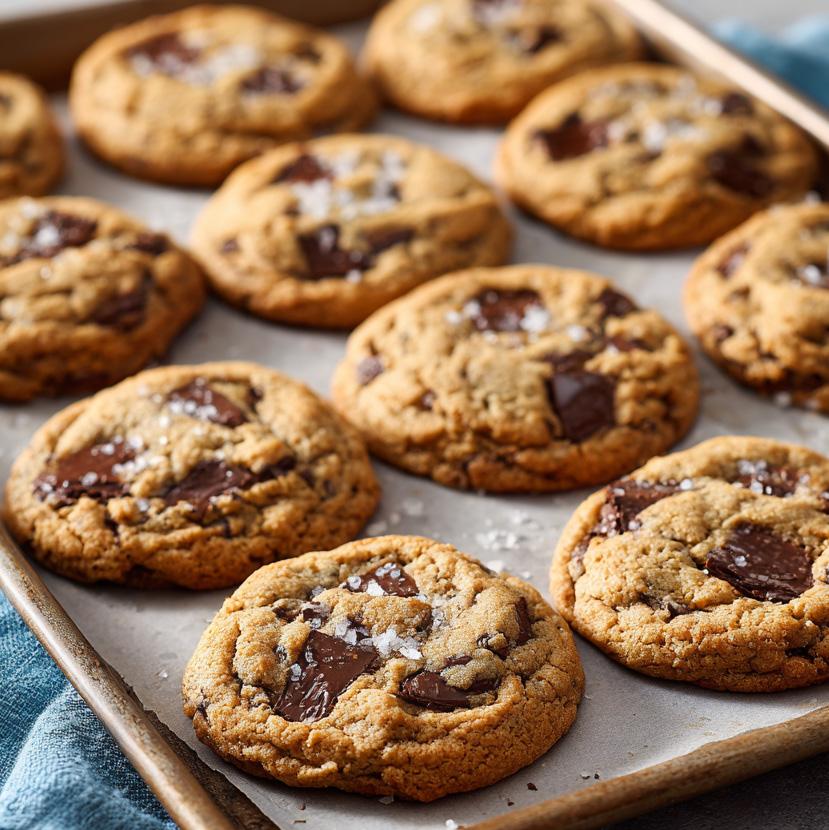
Just getting started in bakery? The chocolate chip cookie may be the best place to start. Multiple consumer surveys confirm chocolate chip is the most popular cookie flavor by a wide margin.
In a July 2025 survey by bakery company Tiff’s Treats, 82% of respondents chose chocolate chip as their favorite cookie, as well as the most top of mind, the most recognizable by smell and taste, and the “most classic.”
“Chocolate chip rules the world!” exclaimed Marc Retondo of Tasty Breads during the NACS Show in October. “Four basics typically rule a retailers’ sales: chocolate chip, oatmeal raisin, a sugar cookie and a fourth that may vary by region. It might be a peanut butter cookie or a white chocolate macadamia, for example. From there, they start getting a little more exotic.”
WHICH COOKIE IS THE FAVORITE?
“It’s always hard to compete in bakery, so you have to test the boundaries.”
Kwik Trip knows a thing or two about signature doughnuts. In its Sweets Bakery, the retailer can crank out, per minute, 240 cookies, 630 cake doughnuts or 400 of its famous Glazer doughnuts, often praised for their soft and airy bite and melt-inyour mouth consistency. Kwik Trip stores sell about 47 million of the Glazer doughnuts each year.
But the bakery doesn’t rest on its laurels. To make sure the category and its promotions stay fresh, it keeps a separate research and development team busy with thinking up limited-time variations of the doughnut and its other bakery products.
“They’re creating limited-time offer products for us all the time,” said Jamie Gay, director of Kwik Trip’s Sweets Bakery. “With our Dunker line, we typically do two [LTOs] a year to last six months each. We’ve done a cherry. We’ve done raspberry, lemon, pink lemonade, banana, multiple different flavors.
SOURCE: TIFF’S TREAT’S
Chicago-based Tasty Breads. “All you’ve got to do is pop [the dough] in the oven and you’ve got that aroma in your store, and nothing is better than that. That’s what sells bakery.”
“They are always working on ‘What’s the next thing?’ We have an LTO calendar, and if there are open slots, it’s our job to make sure that we get enough flavors out in front of the retail group so they can pick which one they want to come next. It’s similar with pretty much all the products we make.”
FRESH VERSUS PACKAGED
Part of Moskalik’s approach of having some products baked in-house—whether from scratch or frozen dough—is about embracing theater in stores.
SIGNATURE STYLE
Moskalik is currently working with a third-party vendor to create a signature doughnut for Alltown Fresh that stores can use as a calling card.
“It would be amazing to have a signature doughnut and other signature offerings,” she said.
I firmly believe that bakery provides a halo of ‘fresh’ when you walk in the store.
“Theater is when a chef comes out from behind a kitchen counter with a tray full of fresh-baked muffins,” she said. “He’s putting them in the bakery case. Customers may see us packaging fresh-baked cookies in the store. They know that we make them on site, and it makes the customer feel very good about that product; it’s trusted.”
Even if not everything is made from scratch, when looking at the food program overall, “the customer wants to know it was made there somehow.”
At the same time, Moskalik is also embracing packaged bakery products for Global Partners’ stores.
“Packaged sweet goods, there’s nothing wrong with that,” she said. “It’s just a totally different customer. You have to know who you want to talk to and why.”
FOODS TO FUEL FOODSERVICE
Connect with suppliers, brokers, and buyers for top c-store chains and major independents across North America.
FRESH PREPARED, READY-TO-EAT FOR CONVENIENCE
• Innovative grab-and-go products in dairy, deli, bakery
• New trends in fresh prepared, ready-to-eat, and packaged
• International flavors representing 40+ countries
• 10,000+ decision-makers doing business
• 3 days of programming with workshops, speakers, and networking
MAKE YOUR PLANS TO ATTEND!
Overall, a bakery program can be a wonderful business builder and leverage to grow check transactions.
Moskalik said Global Partners will “go big on packaged bakery” in 2026, stocking more two- to four-count packages to build basket size.
“We’re going after larger ticket rings within bakery,” she said. “For Honey Farms, we partnered with Commonwealth Kitchens out of Boston [to embrace more local brands]. They’re an incubator for new and emerging brands. We’re pretty excited about that. The local component will be fun.”
That matches the vibe Global Partners is going
for in Honey Farms stores, a feeling of being at home in your community.
“Our four pillars are fresh, local, community, and hospitality, and we try to support that from a foodservice perspective,” Moskalik said. “We go with a more nostalgic approach because we’re trying to attract Gen Z. So we have a melts program, with soups and salads and fresh sides. And there are [made-to-order items] in there, too, to add theater to the experience. Then we have a much bigger variety in that store of grab-and-go.”
Such moves into more packaged sweet snacks fits the current direction taken by Tate’s Bake Shop. The packaged-cookie manufacturer recently began targeting c-stores as customers and is finding it requires some innovation.
“Our No. 1 item—our 7-ounce package—works well [in convenience stores]. But we are evolving as we enter this space,” said Karyn Bahls, head of sales for Tate’s, Southampton, New York. “So we’re working on different pack sizes.”
Earning Bakery Stripes
Jamie Gay and Jac Moskalik both oversee bakery programs in their respective jobs, but the routes they took to those positions were very different.
Gay wasn’t focused on a role in food at all. In college, she studied to be an athletic trainer. While in school, she took a job at Kwik Trip in Wisconsin to make ends meet.
“I was summer help,” she said. “I started in the kitchens, and I worked there for 13 years, working my way up.”
The retailer’s training and leadership development programs led Gay in a completely different direction.
“I found my niche,” she said. “I [found that I] really, really like manufacturing. And by the time that I had graduated college, I was pretty sure that I wasn’t going to go into my field. So I stayed on [at KT] from there.”
Today, Gay holds the title of director of Sweets Bakery at Kwik Trip’s headquarters in La Crosse, Wisconsin.
Meanwhile, Moskalik long had her eye on a future in baking, beginning her career in the grocery channel and developing food and bakery programs for prominent retail suppliers before winding up in the convenience channel. Today, she is vice president of food, innovation and strategy at Global Partners LP.
“Bakery is one of my biggest passions, both personally and at work,” she said, confessing she bakes everyday and is particularly interested in cookie and cake decorating. “I prefer the baking style where there’s some sort of art.”
The company introduced 3.5-ounce, 1-ounce two-count and 1-ounce Tiny Tate’s packages to retailers during the NACS Show in October.
“We’re trying to drive that immediate consumption and make it more accessible to drive trial and find those items that work, and then expand that into the market,” Bahls said.
KEEPING IT FRESH
The short message from all those interviewed for this report was summed up by Sommers of Rich Products: “There is no one-size-fits-all approach [to bakery].”
“From a simple cookie display to a full-service pastry counter, the spectrum of possibilities allows for strategic customization,” she said. “At the most basic level, a bakery program might consist of prepackaged cookies or muffins—easy to stock, low-maintenance and ideal for stores just beginning to explore fresh food. These items require minimal labor and infrastructure, making them a smart entry point for operators looking to test demand without significant investment.”
Jeff Keune, a former retailer and current principal consultant for 4910 Consulting, said the opportunity only grows from there.
“If the stores have invested in ovens, I would recommend a simple platform that gets the product in frozen and bakes it off,” he said. “If the brand has a commissary, I suggest they look at adding bakery platforms to the commissary and structure it so that it complements the rest of the platform and can be delivered on the same schedule.”
This is what Keune did when he was chief marketing officer at Thorntons.
Why Vertically Integrate?
Having a vertically integrated bakery program gives a retailer several advantages, from being able to source their own ingredients to freedom of menu development and schedule control. For Jamie Gay of Kwik Trip, the No. 1 advantage is food safety.
“We have control of our product pretty much every step of the way,” she said. “When we make a product, we won’t sign it out until it hits a 24-hour hold. That way we can look at all of our paperwork. We can review anything that we may question, and everything is still in our control.”
And with its primary distribution center (a second one opened in November) right across the street from the Sweets Bakery, this hold time doesn’t delay delivery of the product to stores.
“If we want to, at any time, do further testing on a product before we send it out, we can tell them to put it on hold in their system [to give us time to take another look at it],” she said. “Food safety is paramount for us.”
“Overall, a bakery program can be a wonderful business builder and be leveraged to grow check transactions,” he concluded. “There are many good options, and the [retail] brand should do what is right for their business.”
“Thorntons had taken over a bakery and converted it to an owned-bakery platform, and it was very successful,” he said. “New products were introduced, and there was also the opportunity to leverage that space to deliver more than just bakery.”
Steve Holtz is a veteran c-store journalist with more than 20 years in the industry. He is currently president of Holtz Media Consulting and host of the Convenience Weekly podcast on Spotify. Reach him at Steve@HoltzMC.com.
Se ing e
On-site alcoholic beverage service in c-stores— in other words, adding a bar—is the ultimate tool for building dwell time.
BY TERRI ALLAN
Because it can sell beer and wine for on-site consumption—and has access to gaming licenses— Rutter’s is finding that one important future path may very well be in the operation of full-fledged bars.
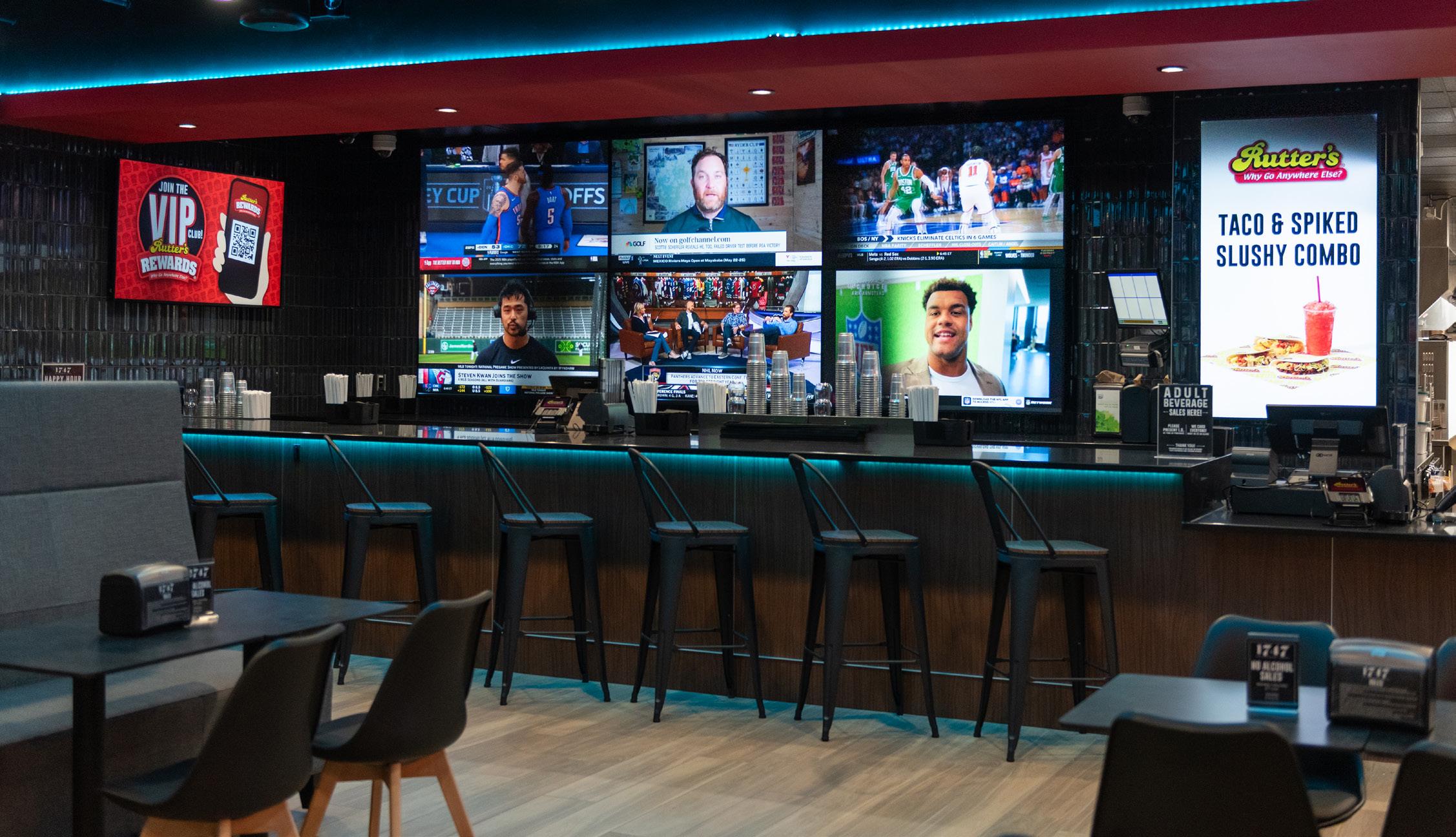
“As we worked on our next-generation prototypes, we thought, ‘We have great food; we can sell alcohol for on-premises consumption; we have gaming. They all go together, and we can make it more convenient than anyone else. Why shouldn’t we do a bar?’” said Chris Hartman, vice president of fuels, marketing and development for the York, Pennsylvania-based company. “We saw the opportunity for dwell time, a time for customers to be with friends, family or alone, depending on their situation.”
With those insights, Rutter’s opened its 1747 Bar & Lounge concept last year. It’s already four units strong, with more on the way.
Rutter’s isn’t the only c-store operator that sees opportunity in the hospitality business. Established retailers in markets around the country are also testing the waters. The ability
The ability to serve hard drinks ‘gives us the opportunity to drive the third daypart, the evening.’
to offer customers drinks to consume on site helps “to create an experience and to differentiate your store from other c-stores,” said Austin Burns, president and CEO of Paragon Solutions, a c-store design firm that worked with Rutter’s on 1747. “This industry is focused on getting in and getting out,” Burns said. “Now we’re saying, ‘Stay awhile.’ The longer you stay, the more you buy.”
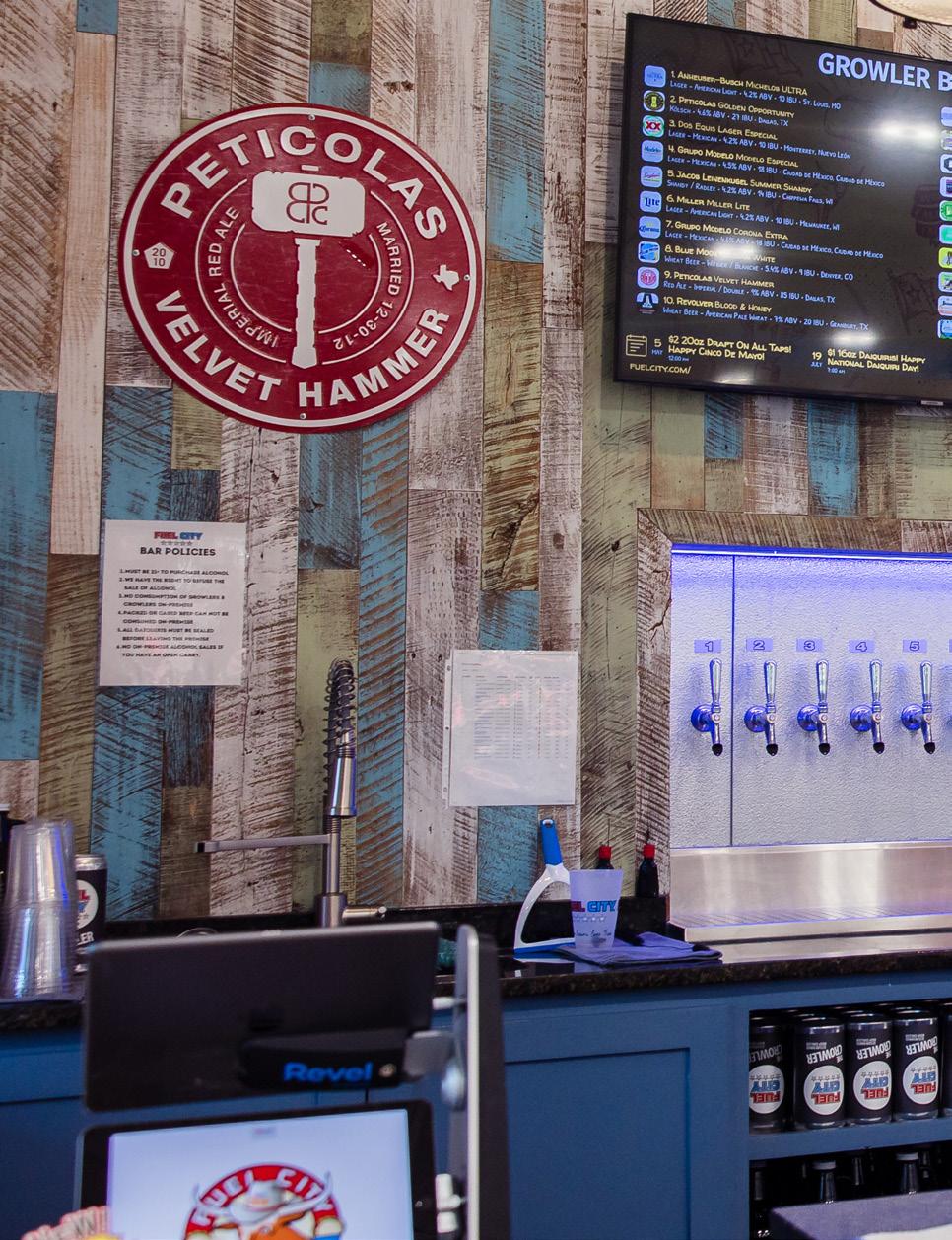
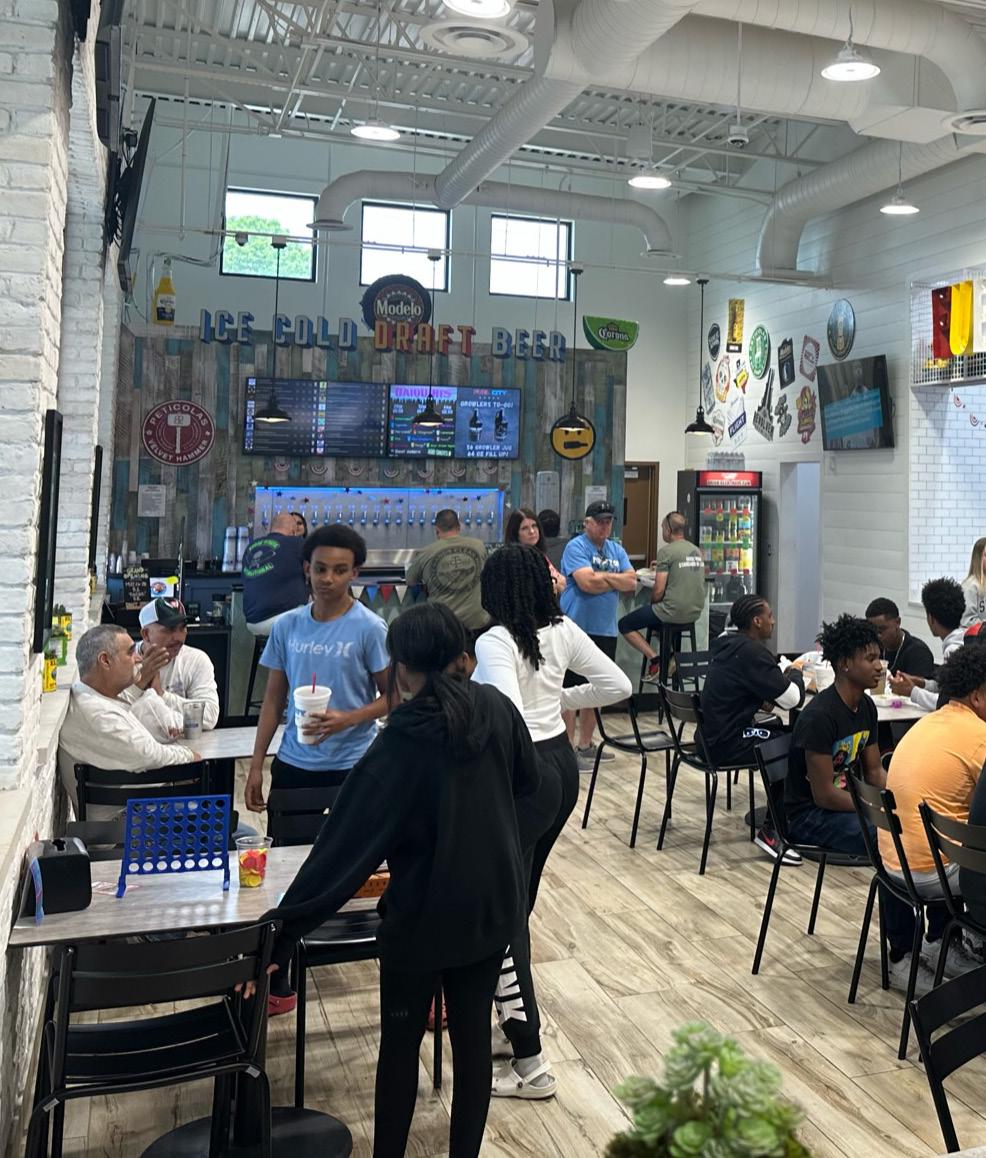
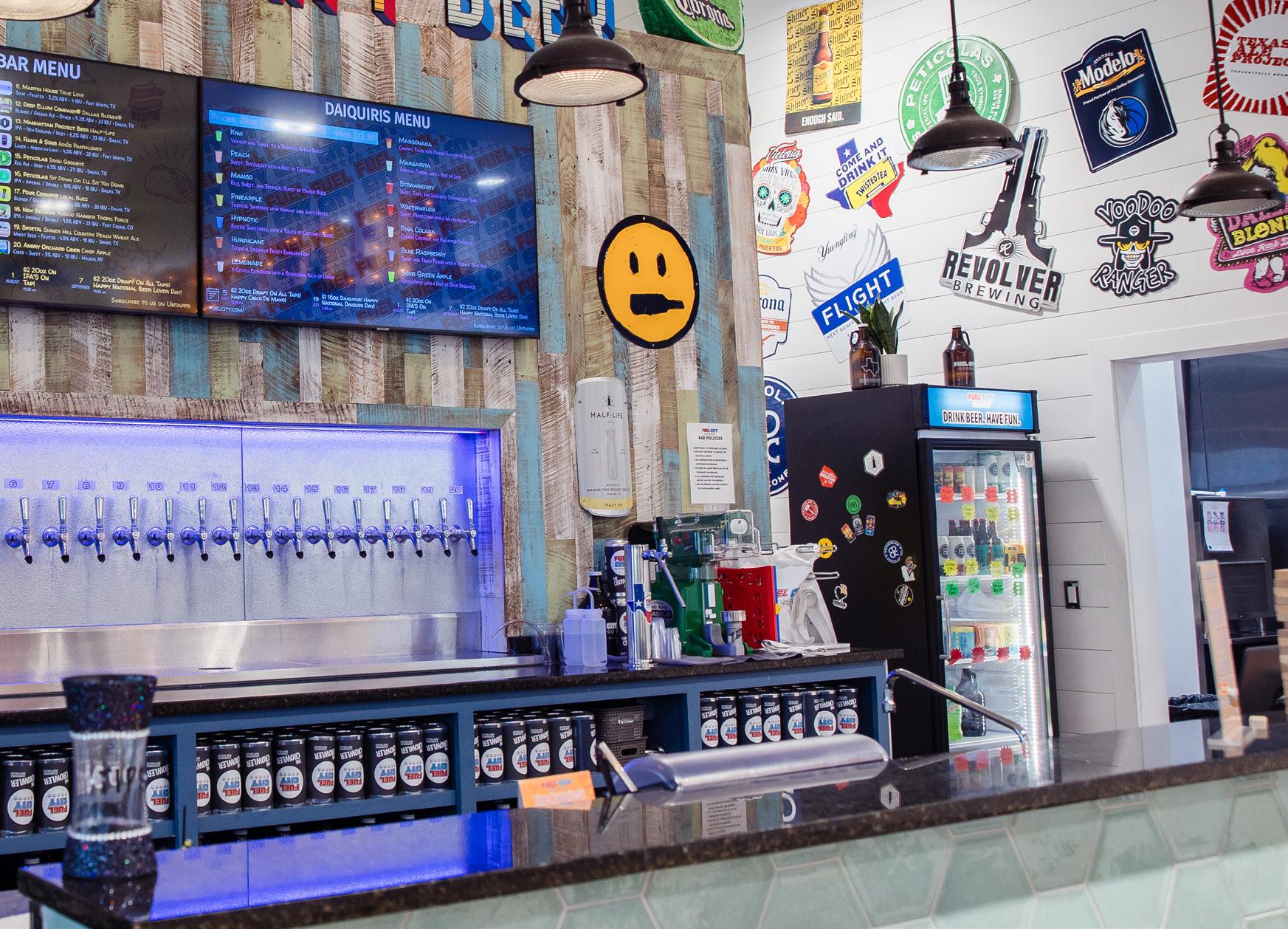
Add-on and impulse sales are one of several benefits of a c-store model with alcoholic-beverage service. According to Joseph Bickham, CEO and owner of Dallasbased Fuel City, where four of the retailer’s seven locations serve up wine-based daiquiris and beer for on-site consumption, “We’re able to sell customers other merchandise from the store,” such as fresh-baked desserts, thereby leading to higher-ring baskets.
Bickham and Hartman said the licensed beverage service is also helping their stores build dinnertime and evening traffic. “At Fuel City, we try to be an extraordinary business in an ordinary industry,” Bickham said. The ability to serve hard drinks “gives us the opportunity to drive the third daypart, the evening, when you don’t anticipate customers coming into a convenience store and dwelling for dinner.”
SURPRISING AND DELIGHTING
In some cases, c-store bars are so unexpected that customers do a double take when discovering them. The Little Shop in New York City was conceived as a c-store. But with 1,200 square feet, “We quickly realized we had a lot of space and decided to add a bar area,” said co-owner Anna Bazhenova. Opened in 2019 with a c-store in the front and a speakeasy-type bar in the back, the Little Shop has been a welcome addition to its South Street Seaport neighborhood.
“There was no general store in the area, so the community was very receptive,” said Bazhenova, a former advertising industry executive with no retail or restaurant experience prior to opening the Little Shop. “From tampons to Milky Ways, we carry it all.”
As for the bar, “it’s not a rowdy bar,” she said, and neighbors appreciate that the business is locally owned and its principals are active in the community. Among the bespoke cocktails offered are
the tequila-based Chilled Espresso and the gin-forward Purple Vesper, both $19. For guests interested in a snack, “We encourage them to shop the shop,” Bazhenova said, and the items—including the likes of cheese and charcuterie—are then plated and served.
Another c-store/speakeasy hybrid was unveiled in Lakeville, Minnesota, last year when The Wondrous Collective—a group of various restaurant concepts—added the Farmer’s Cellar speakeasy to its Farmer’s Grandson Eatery c-store. Recently featured in the NACS Ideas 2 Go video series, the Farmer’s Cellar is hidden behind an imposter cooler door, requiring visitors—much like speakeasy patrons 100 years ago—to seek and discover the cocktail bar.
“We’re having a blast with it and people are having fun discovering it,” owner Tony Donatell said on a recent episode of the NACS Convenience Matters podcast. The Farmer’s Cellar is gaining recognition for its drinks program, which features inventive cocktails mixed up by professional bartenders, said Donatell. He decided to add the speakeasy to the c-store due to his success with alcoholic beverages at other concepts and because
there weren’t any cocktail bars in the area. A cigar program may be added to complement the bar, he said.
David Barker, owner of Blowing Rock Market in Blowing Rock, North Carolina, credits the pandemic for transforming his once-traditional c-store into a haven where guests can sit near fire pits on the store’s patio with a glass of wine in hand and marvel at the surrounding mountain vista.
“When the pandemic hit and we were considered an essential business, it dawned on me that because we had outdoor seating on our patio, we could safely accommodate 100 people,” Barker said. “From 2020 to 2022, we had more business than we could handle.” The operation morphed so much into an on-premises venue that he “pulled the pumps off the property, and we’ve gone in another direction,” he said. In addition to a wide selection of wines available for purchase by the bottle or glass, Blowing Rock Market features a vast offering of local craft brews.
A MULTI-UNIT OPPORTUNITY
Rutter’s, meanwhile, is out to prove that a chain of c-stores with bars is possible. For
Fuel City, with locations around the Dallas-Fort Worth area, tries to “be an extraordinary business in an ordinary industry.” Offering alcoholic beverages has been a key part of unlocking the dinner daypart.
Rutter’s, which also has gaming licenses in Pennsylvania, is morphing from an in-and-outstop to a “place to go to hang out.”
about a decade, Rutter’s had been able to sell beer and wine for on- and off-premises consumption at its Pennsylvania stores thanks to its restaurant (or “R”) licenses.
The company put those licenses to good use last April with the opening of the first 1747—an 11,000-square-foot store, with 500-600 square feet dedicated to the bar—in Johnstown, Pennsylvania. The second 1747 location in the state, in Milton, opened in May. In the fall, the concept was expanded to Winchester, Virginia, followed by a fourth location in Berkeley Springs, West Virginia. (Only the Pennsylvania venues offer gaming.)
Three more units are planned to open this year, with more likely to come, Hartman said.
“It’s a unique concept, and we’re retraining customers on what a convenience store is,” Hartman said of 1747, named for the year the company was founded. “We’ve done this already with foodservice. Now, with 1747, Rutter’s is considered a place to go to hang out at, not just for convenience items.”
The Pennsylvania and Virginia 1747 locations serve beer, wine and canned cocktails, while the West Virginia store is licensed to sell full-strength cocktails, dispensed via a “smart bar” that doesn’t require a trained bartender, Hartman said. “We did a full ground-up revision to our
c-store design,” Hartman said of the 1747 prototype, with the bar, for example, in the rear of the store, close to the foodservice area, with table and gaming seating nearby. Numerous large-screen TVs for sports viewing adorn the walls.
So far, customer response has been “very positive,” Hartman said. “Our plans are to keep growing the concept and to continually evaluate and adjust to make sure we’re providing the customer with the experience that they want just as we do elsewhere in the store.”
Fuel City’s Wylie, Texas, store features a bar that, in addition to the daiquiris, serves up 20 draft brews from large and small brewers alike. Pours range in size from 16 ounces for on-site consumption to 64-ounce growlers to go. A digital menu board provides descriptions of the offerings. At the other three Fuel City locations that allow on-premise consumption, canned and bottled beer is featured, along with eight or nine flavors of daiquiris served from a dispensed beverage machine.
“We fully wanted to incorporate our dining room around the drinks offerings, including the availability of local smallbatch beers,” Bickham said of the Wylie store, which opened in 2022.
DATE NIGHT, WITH A TWIST
Customers are generally delighted to discover the ability to consume alcoholic drinks in c-stores, retailers say. “We’ve had quite a few daytime shoppers who’ve been coming in for a year and didn’t even know we had the bar, so they’ve been happily surprised,” said Bazhenova. “Some guys will even bring a date, and you can see the disappointment change to delight when they see the bar in the back.” The Little Shop also attracts repeat customers. “Because we have a reservation system, it’s not unusual to find someone who’s made 43 reservations,” she said.
Promotional support builds awareness of the venues and encourages visits. Carla Esparza, food and beverage director at Fuel City, said locations with on-site alcoholic beverage licenses promote events such as National Daiquiri Day with special pricing, while the Wylie store gets behind draft-beerrelated celebrations, such as National Stout Day and National IPA Day.
Rutter’s has begun partnering with beverage suppliers on tie-ins to large sporting events to “maximize exposure” of 1747, Hartman said. Last summer, for example, the Johnstown location partnered with Monster Beverage Corp. for a UFC Fight Night watch party, which featured tastings of Monster alcoholic and non-alcoholic beverages.
Despite the Little Shop co-owner’s background in advertising, all marketing support is via word of mouth. “One thing I learned in my previous business is that to attract customers, you have to have an interesting product,” Bazhenova said.
EXTRA RESPONSIBILITY
While c-store bars may spark curiosity and intrigue, challenges with the model can arise. Bazhenova and Hartman pointed to the need to hire and train the right staff for the operations.
“Even though everything is under one roof, we employ two different types of staff with two different kinds of skill sets,” Bazhenova said. Inventory management can also be a concern. “We need to stock two different kinds of inventory, with 3,000 SKUs in the front. While in the back, we’re creating products.”
Barker and Bickham agreed that an on-premises license to sell alcohol requires a heightened awareness of responsible service. With draft beer served at Fuel City’s Wylie store, it’s critical to monitor the quality of the product, Bickham said.
We’ve found that there’s a need from the customer, so it’s up to us to adapt and to continue to learn.
Burns of Paragon Solutions advises c-store operators considering expanding into on-premises licensed beverage service to consider recent trends in beer, wine and spirits. “Consumers are more healthconscious today,” he said. Whether the addition of a bar is part of a store expansion or a new build, “consider your brand,” he advised. “Understand the market. Understand the opportunity. Remember that you’re entering into a new business: the hospitality business.”
While the c-store/bar combination may not work at every Fuel City location due to space demands and legalities, Bickham said, “We’ll have an eye to incorporating the model at new locations because it’s been a good value-add.”
Rutter’s is equally bullish. “We’ve found that there’s a need from the customer, so it’s up to us to adapt and to continue to learn,” said Hartman. “We believe there’s a lot more room to run.”
Terri Allan is a New Jerseybased freelance writer, specializing in consumer products and retail channels. She can be reached at terri4beer@aol.com.
Drink in greater Profits
Royston helps you capitalize on the premium potential of self-serve beverage retailing with customized Hot and Cold Beverage Stations carefully designed to maximize ROI, encourage customer engagement, and reduce operating costs. Our American Made steel cabinet systems feature powder coat paint or laminate finishes and a host of robust countertop options for superior durability. Patented cup dispensers accommodate any size in a single opening, vertically or horizontally while built in features keep cups, lids, straws, creamers, stirrers and accessories neat and organized. Trusted by the biggest names in the industry for over 40 years, Royston helps you drink in greater profits. Visit roystonllc.com for more.
‘Thank You’ THE INDUSTRY’S BIGGEST
Nominations for this year’s First Responder of the Year award are due June 1, 2026. Visit conveniencecares.org to learn more.
On 24/7 Day in July, celebrate your hometown heroes with gestures small and large.
BY JOE BEETON
The annual NACS Foundation 24/7 Day, held each year on July 24, rang with cheers (and a few happy tears) in 2025 as three individuals learned they had been named the inaugural First Responders of the Year award recipients. A Red Cross volunteer with 55 years of service under his belt; a Casey’s store manager and volunteer firefighter who saved a customer’s life in the store; and a fuel driver who serves as the fire chief across multiple towns in Kansas showcased what being both a first responder and part of the convenience industry means.
At their local convenience stores, family members and colleagues gathered to surprise them while local TV crews broadcast the moment live. A Member of Congress even stopped by to offer appreciation.
“These kinds of stories really humanize the industry, the first responders and the communities they serve—putting faces to the profound meaning behind the 24/7 Day campaign,” said Kevin O’Connell, executive director of the NACS Foundation.
Interested in participating in 24/7 Day?
Contact NACS Foundation
Executive Director Kevin O’Connell at koconnell@ convenience.org.
The industry is gearing up for its eighth 24/7 Day in 2026. It’s a day to recognize and thank first responders, medical personnel and American Red Cross volunteers who work around the clock, 24/7, 365 days a year, to serve our communities and keep them safe. It also highlights the critical role convenience stores play supporting everyone who works around the clock.
RECOGNITION THAT HITS HOME
“For many of our customers, these first responders are the very people who stood with them in some of life’s hardest moments. They see their own stories reflected in the honorees,” said David Biery, a regional manager of Valor Oil. His father, Charles Biery, a 55-year veteran of the Red Cross from Florence, Kentucky, was named the NACS Foundation First Responder of the Year in 2025.
Biery described seeing his father getting that recognition as “nothing short of a pinnacle moment,” and said that the award did much more than celebrate his father’s legacy. “It reminded our entire organization why service matters and why we strive to carry that same standard into every interaction with our guests.”
Onstage at the 2025 NACS Show in Chicago—flanked by runners-up Angela Ryan and Kevin Umscheid—the elder Biery accepted a crystal trophy before an audience of nearly 5,000 people. In that moment, he said, he felt like a celebrity.
Across the country, more than 35,000 participating convenience store locations
celebrated first responders on 24/7 Day with gestures that showed their support. These ranged from a free cup of coffee or fountain drink for any credentialed public safety officer, healthcare worker or military service member; a donation of foodservice made to the local firehouse; supportive signage and digital campaigns; or other creative support that fit the community.
The celebration is personal for many in the industry.
“I was really grateful for 24/7 Day because it gave me the inspiration to think of a way to commemorate Edward ‘Chip’ Chidester, the volunteer assistant fire chief and Onvo team member who passed away due to injuries sustained in the line of duty,” said Harman Aulakh, vice president of marketing for Onvo. The company created a memorial that will be permanently displayed at the Onvo location in Harford, Pennsylvania, recognizing Chidester’s dedication and service, and served breakfast for the local fire department after the unveiling ceremony.
Other retailers show their appreciation throughout the entire year. “Every day, we rely on our first responders—community servants that risk their own safety to make sure our team members and customers are safe,” said Maurice Lamarche, vice president for The Market by Tiger Fuel. “That’s why The Market offer special discounts to first responders not just on 24/7 day, but every day.”
THE POWER OF PERSONAL STORIES
The story of Chip’s legacy was one of many that resonated deeply with community
Celebrating First Responders—and Convenience
Every July 24—24/7 Day—the NACS Foundation unites convenience stores across America to recognize first responders, medical personnel and American Red Cross volunteers who work around the clock, 24/7, to serve our communities to ensure people don’t face emergencies alone.
The annual event helps raise awareness and donations for the American Red Cross and spotlights our industry’s important role in supporting the communities we serve no matter the time of day. First responders are always on, and so are we.
“Convenience stores are community stores—more than 93% of Americans live within just 10 minutes of one. They serve as lifelines in times of crisis—offering first responders a place to assess emergency situations, recharge, reconnect and stay fueled,” said NACS Foundation Executive Director Kevin O’Connell. “Further, the 24/7 operations of convenience stores means that even outside of crisis, there are deep relationships between first responders and convenience professionals, and this celebration is a day to honor and celebrate that.”
200+
The number of earned media placements from 24/7 Day in 2025.
champions and event organizers. Of the 75 nominations NACS received for First Responder of the Year, several were submitted in memoriam—honoring individuals who not only shaped the lives of the people who nominated them, but also the communities they dedicated their own lives to protecting.
The stories of many other runners-up for First Responder of the Year struck the heartstrings of those working behind the scenes at NACS. Take Alejandro TreviñoGomez, for example. Shortly after finishing his first semester of firefighting training, Treviño-Gomez was able to provide resuscitation for his own mother until an ambulance arrived after she had a heart attack at home. His nominator called it a full-circle moment for a mother-son bond that began 19 years earlier, when Treviño-Gomez’s mother traveled to Guatemala to adopt him shortly after his birth.
Stories of brothers, sons and mothers were abundant among the nominations. “Strong, brave and amazing” were the words used to describe Alicia Dee of Shellsburg, Iowa, who works full time in addition to serving as a paramedic and raising six children.
Other stories highlighted specific incidences of grit. When Natasha Allen, an assistant supervisor at Metropolitan Emergency Communication Association (MECA), in Pine Bluff, Arkansas, faced “one of the most demoralizing situations a professional can endure—working without receiving a paycheck—she still showed up,” her nominator wrote. “Many people outside this profession will never understand the personal sacrifice dispatchers make every day.”
Matthew Dunaj was recognized for
his bravery not just on the frontlines as a Detroit firefighter, but as a mental health advocate. Dunaj speaks at conferences about the “machismo stigma” that discourages first responders from seeking help when struggling with PTSD from the job. “As his captain, I am very proud of his strength and perseverance in ridding the ideology that needing help is somehow a weakness,” his nominator wrote.
There were also some more lighthearted nominees that brought smiles to the faces of NACS staff—including Cooper, a two-year old goldendoodle who serves as the Glendale, California, fire department’s first-ever certified wellness canine. “K9 Cooper is more than just a dog, he’s a vital member of our first responder family,” Cooper’s nominator wrote.
“In a world where trauma, stress and burnout are all too common in emergency services, Cooper has become a lifeline for so many. His calming presence, unconditional love and innate ability to sense when someone is struggling make him an irreplaceable part of our wellness and peer support efforts.”
While the impact these individuals have on their communities is monumental, the nominations showcase only a fraction of the incredible people (and pups) across the U.S. who do this work every day, often quietly, humbly and behind the scenes. If you have a first responder in your area that’s deserving of recognition, nominate them for the next First Responder of the Year Award and celebrate them on 24/7 Day—and every day.
Joe Beeton is a contributor for NACS Media. His media career has focused on real estate development with an emphasis on retail.
Always On Means Always Appreciated
The business impact of 24/7 Day also reaches well beyond a single day in July. Coverage of awards ceremonies, in-store promotions and recognition of local heroes helped participating retailers boost brand visibility, with more than 200 earned media placements accumulating over a media cycle stretching nearly 75 days.
For the first time in 2025, NACS also awarded $5,000 in media storytelling grants to five retailers—Hops Shops, Onvo, Tiger Fuel (The Market), High’s and Fav Trip—to bring in photographers and videographers to tell their stories with professional-quality content.
TruAge is a smarter way to verify age, improve compliance, protect privacy and keep lines moving at the register. To enhance your responsible retailing experience, activate your free account today at mytruage.org/get-started.
AI is transforming the field, but that’s just part of the story as retailers lean into loss prevention strategies and solutions.
ELEV TING LOSS PREVENTION
BY BEN NUSSBAUM
When is the juice worth the squeeze? In simple terms, that’s the dilemma facing operators. What is the right amount of investment that reduces shrink, fraud and overall loss without creating cumbersome overhead?
More investment makes good business sense. That was a refrain at the NACS Loss Prevention and Safety Symposium that took place in December, with speakers highlighting how enhanced loss prevention is a net positive to organizations.
A few key reasons shared from the stage:
• Retailers often don’t realize the scope of their loss. Step one is to wrap your arms around the problem. “What’s the size of the prize?” asked Mark Stinde, vice president of asset protection, Casey’s General Stores.
• Controlling shrink can extend beyond employee theft. Stinde and Mike Suppe, director of asset protection, Casey’s, shared how the retailer has adopted a total loss framework that looks at all sources of loss, including foodservice waste and expired product, as well as losses within the supply chain.
Loop Neighborhood Market has more than 3,000 cameras across its Bay Area, Sacramento and Southern California locations. Reviewing each one to be sure it hadn’t been nudged, wasn’t blocked and wasn’t blurry was a timeconsuming chore. Loop integrated an AI system that sends notifications in these cases, according to Matthew Makarem, director of loss prevention and employee development at Loop, allowing for quick, efficient resolution.
Celebrate wins, celebrate them in a way that others can see, and always be prepared to tell your story—with data.
• A well-oiled loss prevention team, far from being a silo, works collaboratively across the entire organization, unearthing unexpected opportunities. A simple example: A computer vision system that’s installed primarily for loss prevention can flag when an employee isn’t in uniform or is missing a name tag.
“What I’ll say to the loss prevention professionals in the room is we hold the key to the future of AI in our organizations,” said Wes Pate, vice president, loss prevention and risk management, Refuel Operating Company. “We have our camera systems in our stores, we use a lot of other technology. If you’re not partnering with your IT folks, with your merchants, your operators, you’re probably behind.”
• Costs for technology innovations like AI-powered computer vision that may have been prohibitive in the past are dropping. Operators of all sizes can relook at their loss prevention toolkit and what investments make sense.
THINK BIG: TOTAL LOSS
Adrian Beck, a professor at the University of Leicester, is credited with creating
the concept of Total Retail Loss. As Beck explained it, the concept was a response to “the growing breadth and complexity of the retail landscape … putting stress on the applicability of traditional shrinkage definitions.”
For a traditional mom-and-pop corner store, total loss and traditional shrink could mean the same thing. But for a modern retailer, in Beck’s view, a different approach is needed—one that goes far beyond seeing loss prevention as catching bad guys. Two simple examples: Total loss could include the loss associated with selling an item at a reduced price because it’s damaged in transit or the loss of a sale when an item is out of stock.
Casey’s is using the total loss framework with impressive results. The retailer quickly found opportunities to apply a loss prevention mindset to foodservice, particularly spoilage. Overall, Casey’s divides total loss into four buckets: store, e-commerce, corporate and supply chain. Each of these is then broken into malicious and non-malicious categories. For example, in its total loss framework, bad debt isn’t just an accounting function. Instead it lies under the corporate/non-malicious category.
According to Stinde and Suppe, broadening the scope of loss prevention is a process of earning wins, communicating the wins and gaining trust across the organization.
AI: THE LOSS PREVENTION GAME CHANGER
Brian Gray, managing director, Accenture, listed specific areas where AI is changing loss prevention. Even if they aren’t practical now, they soon might be.
• AI surveillance and computer vision: Using existing cameras, AI can spot everything from safety violations to shoplifting to potential spill-and-slips in real time and send alerts immediately. (In the next section, read how Loop Neighborhood Market is using AI-enabled CCTV.)
• Real-time alerting and predictive analytics: Real-time alerting can be applied to everything from unusual flow rates on the forecourt to fuel-deliverydriver fatigue (i.e., a driver wears a device that identifies when he/she is sleepy). When it comes to predictive analytics, too much data and too few insights is a familiar
THIS IS IT! A global race to redefine retail, a search for the Smartest Store in the World, a competition like no other.
Being the Smartest Store in the World is the accolade where innovation, execution, impact, and future promise are fired with expertise, and the proof that your store and supply chain, above all others, are blazing a trail for retail transformation everywhere.
Who can enter? You can! It’s your chance to show what ‘smart’ truly means. Entries are open until 26 March 2026.
COMING SOON QUANTUM COMPUTING
Expect to hear a lot about quantum computing and quantum security in the coming years. In not-so-simple terms, quantum computers “harness the principles of entanglement and superposition to solve complex problems,” according to Accenture.
While traditional computers grind through calculations sequentially, quantum computers can perform a vast number at the same time. That means existing cybersecurity techniques won’t cut it if they ever face a quantumpowered bad actor.
The good news is that there are only a few hundred quantum computers in the world right now—there’s time to prepare.
problem but one that AI promises to ease. This is true in loss prevention and other areas of the operation.
• Biometrics and facial recognition: The technology isn’t perfect in retail applications yet … but check back soon.
While privacy concerns are real, “We’re starting to see a little bit of a pendulum swing,” Gray said. “I think a lot of people now are starting to come around to the fact this might make us all safer.”
• Voice analytics: Among the many applications for voice analytics, employee safety is one of them. These tools can identify when conversations turn hostile or aggressive, with remote monitoring automatically turned on.
• Physical AI and security: With agentic AI (“autonomous” AI agents that can accomplish specific goals, like finding and purchasing an airline ticket) already stealing some of generative AI’s thunder, what’s next? Physical AI could eventually mean human-like robots, and autonomous security robots are already in production.
AI IN ACTION TODAY
Matthew Makarem, director of loss prevention and employee development, Loop Neighborhood Market, shared how the California-based retailer is already using AI and other technology in a transformative way.
“AI isn’t in the future. AI is already here. And it’s here to stay,” Makarem said, while acknowledging that AI applications within c-stores are still not perfect.
Makarem encouraged attendees to investigate whether an AI-enabled CCTV surveillance system would work for their operation. Among the recommendations he had for a system: point-of-sale integration; the ability to capture audio, if permitted by your state; talk up/talk down capability; facial recognition capability; and the ability to store months of data.
He shared some successes Loop has had with its system:
• Credit card fraud detection: AI is fantastic at identifying patterns. “The days of manually scanning through transactions to uncover patterns of misuse are over,” Makarem said. Loop’s system flags suspicious patterns such as voids, refunds or “frequently seen credit
cards used for potential employee or even customer fraud,” Makarem said. This allows investigators to quickly zero in on the highest priorities.
• Flagging transactions with no customer present: According to Makarem, these transactions carry the highest risk of fraud. “This is an amazing tool,” he said. “If a refund is made, for example, without a customer present, the system automatically flags it and generates a report and a clip.” The entire process is speedy and streamlined.
• People detection: This capability “completely transforms our existing camera into an intelligent intrusion detection system,” Makarem said. The system detects people in the store when no one should be present or can be used to guard certain areas of the store (like a back door). A retailer can customize the details, but the system combines automatic elements—a flashing light, for example— and human elements, with someone at the store operations center or a store manager notified in real time to watch the feed and either escalating the response, including potentially contacting the police, or turning the alarm off.
• Panic buttons: Loop’s panic buttons, when pressed, instantly map to the nearest camera, giving the monitoring agent a real-time view as they potentially call law enforcement.
• An incident management system: The system automatically creates incidents when suspicious activity occurs and sends notifications to the proper people in the organization. All communication stays in the system—no emails. Having all the information in one place makes it easier to find patterns and see what problems recur where.
COMMUNICATE, COMMUNICATE, COMMUNICATE
A consistent theme from loss prevention professionals at the event: They are communicators.
Communication extends from the CEO to the frontline worker. The goal is to be heard but also to be strategic: For loss control to really become part of a company’s culture, it has to be something store teams want to
do. Bob Wright, loss control manager, Kwik Trip, shared that he’s proud when people on his team are in the field and store leaders are excited to see them.
A key part of communication is being a cheerleader for loss prevention. Celebrate wins, celebrate them in a way that others can see, and always be prepared to tell your story—with data.
Wright shared steps for how he built internal alignment around growing and refocusing Kwik Trip’s loss control team: • Self-scout: Take a 1,000-foot view of your current approach. “We would find external shrink and investigate it. We would find internal shrink and investigate it,” Wright
Fighting Human Trafficking
Convenience stores are the light that’s always on, the safe space at all hours of the day. That means this industry has a vital role in the fight against human trafficking.
Cheryl Csiky, executive director, In Our Backyard, shared her personal story of survival. It inspired her to work as an advocate for those who often don’t have a voice. In Our Backyard works closely with NACS and convenience retailers to place Freedom Stickers in restroom stalls. These stickers display the National Human Trafficking Hotline number and texting information that can offer a lifeline to people being trafficked.
The problem isn’t going away—far from it. Generative AI has added another level of complexity, and is being used for grooming or blackmailing children. It’s more important than ever to be part of the solution.
1 million the number of Freedom Stickers posted across all 50 states.
90% of consumers say that they think more favorably of convenience store jobs when they hear that the company is fighting human trafficking.
187 the number of missing children recovered by Convenience Stores Against Trafficking since 2009.
said. The team challenged itself to break out of that pattern and find a new way to help the company. Among the goals was finding ways to take burdens off other departments.
• Create the plan: Wright’s advice: Focus on ROI and understand that it might take several attempts. Incorporate all the feedback that you get. Ultimately, loss prevention is a team project across the entire company.
• Hire the right people and show wins: “You’d better have the right people, otherwise you’re going to sink fast,” Wright said. “We were lucky enough to get a lot of great applicants,” he said. The team started in areas that had higher shrink and new stores, meaning there was low-hanging fruit in terms of immediate successes that boosted the case for further investment.
• Measure: Data-driven results are a critical piece of achieving success and then storytelling around that success.
At the store level, Casey’s keeps loss prevention top of mind by making it a prominent part of how managers are evaluated. Data is also easily accessible to anyone at HQ through a Power BI dashboard. At the team member level, Casey’s gives challenge coins to frontline workers who have gone above and beyond when it comes to loss prevention. The team members are also recognized on LinkedIn.
Tim Hall, director of asset protection, 7-Eleven Inc., shared that the retailer focuses on short, animated videos for sales associates that are accessed through QR codes on posters at the store. The retailer tracks how many people are accessing the two-to-threeminute videos, and if anything is falling short.
Wright of Kwik Trip also emphasizes recognition, even if it’s just praising someone at a store meeting or giving them a small swag gift. If a store does particularly well, Wright’s team will roll up their sleeves and work shifts at the store, taking on tasks like cleaning the cooler. It’s all part of spreading a loss prevention mindset throughout the company.
Ben Nussbaum is the editor in chief of NACS Media. He can be reached at bnussbaum@ convenience.org.
Cool New Products Guide
This advertorial-style guide of services and packaging appears monthly and is an information-packed tour of ideas and approaches that can change how consumers view your store or choose your brand. It spotlights the newest thinking in convenience and fuel retailing and gives you an advance look at ways of staying in front of industry trends. Products are categorized the same way we organize the Cool New Products Preview Room at the NACS Show each year in October— New Design, New to the Industry, New Flavors, Health & Wellness, Green (EcoFriendly), New Services and New Technology Products are considered “new” this year if they’ve been introduced since October 2025. The products featured here also can be seen in the Cool New Products Discovery Center at www.convenience.org/coolnewproducts
Johnsonville Sausage Co.
Johnsonville® Ultimate Fajita Sausage Link
Turn Up the Fajita Sizzle
NEW TO THE INDUSTRY
Bring fajita-style sizzle to your roller grill with Johnsonville® Ultimate Fajita Sausage Link. Visible peppers and onions, plus authentic grill marks, drive craveable aroma and strong curb appeal at the point of purchase. With moderate heat designed for broad customer appeal, it’s an easy way to deliver bold flavor without limiting your audience. Fully cooked for quick prep and consistent, all-day operation, Ultimate Fajita Sausage helps you keep hot food fresh, fast, and profitable.
Proximo Spirits
Jose Cuervo® Sparkling Cocktails
Introducing Jose Cuervo® Sparkling Cocktails
Featuring 4 delicious, 5.9% ABV, award-winning flavors made with real tequila!
Better Magnets = Fast-Turns which = Fast Profits. Did You Know? More than 8 in 10 Households - 87 percent - have magnets on their refrigerator or some other metal surface, according to a recent CBS News Poll including more than half who keep five or more souvenir magnets on their fridge along with other metal surfaces (baking sheets) around the home. Why Better Magnets? 100% Made in USA and a Nationally Certified Women Owned Business (WBE) (WOSB) manufacturing. Our Soft-touch matte finish souvenir fridge magnets will out sell traditional laminate or mylar topped magnets GUARANTEED! Get started by calling us at 623.445.9978 or visiting our catalog with stock & officially licensed at BetterMagnets.com
What Will Be Different in 2026?
BY JEFF LENARD
As we pick up speed in 2026, what are the issues that will be important to fuels retailers and those serving them? NACS asked two leaders in the field to give their thoughts on what to expect: John Eichberger, executive director of the Transportation Energy Institute, and Denton Cinquegrana, chief oil analyst at OPIS.
Welcome to a new regular feature in NACS Magazine. Each month, this department will cover issues of relevance to fuels retailers, plus feature graphics and insights that can be shared with opinion leaders and consumers. Do you have a question or topic that you want NACS to cover in Fuels & Energy? Send a note to Jeff Lenard at jlenard@convenience.org.
Heading into 2026, should fuel retailers be thinking more about opportunities or threats? Why?
Denton Cinquegrana: Both—but right now it feels like the opportunities outweigh the threats. There will be opportunities for retailers to grow station counts as others look to exit the business. There is no question gallons are shrinking. Because the demand pie is only so big, expanding in size can guarantee that your piece of the pie does not shrink.
There are other opportunities, whether expanding fuel offerings, E15 for example, or putting in charging should incentives and grants make it worthwhile.
Market volatility presents both threats and opportunities. For example, there were just 62.15 cents that separated the high and low gasoline futures trades in 2025 (through December 5). Between 2014 and 2024, the average difference between high and low was $1.22 per gallon.
However, there is plenty of volatility throughout the day, and that could present opportunities for margin expansion if you are positioned in the market correctly.
John Eichberger: 2026 will likely be a different experience. For several years, margins have been strong and that has helped support the business. However, over the past few months more attention has been directed at the affordability of everyday essentials. Consumers have always been sensitive to gas prices, and although prices are nowhere near their peak for the year, they still represent a target for politicians seeking to defend their constituents against the high cost of living. This could put pressure on retailers to rethink their pricing strategies, which could begin to erode margins. I also don’t rule out highprofile investigations launched by the federal government to “expose” bad actors within industry and to ensure that consumer blame is directed at any stakeholders other than the government.
On another topic, the unrealistic push to transition the market to electric vehicles by 2032 has been put on the back burner. While I don’t believe the counterhype that electric vehicles are in full retreat, it is clear that automobile manufacturers have been given some breathing room to reevaluate their go-to-market strategy. For retailers, the relaxation of market expectations provides additional time to really develop a plan for serving EV drivers with charging services and in-store amenities that appeal to these drivers. It also gives them additional time to confer with their utility service providers and charge point operators to find technical solutions for charging that carry the greatest opportunity for profitability.
What are the big national or geopolitical issues that could affect the industry in 2026?
Cinquegrana: From a geopolitical perspective, Russia-Ukraine without any resolution or just a continuation of current standing could continue to create
62.2¢
Amount that separated the high and low gasoline futures trades in 2025
market volatility. The situation in Venezuela also should be watched closely. [Editor’s note: This interview was conducted before the U.S. military intervention in Venezuela.] The Middle East, for the time being, seems to be calm, but that could change at a moment’s notice.
Domestically, there is the potential for year-round E15, though that may ultimately end up being a 2027 thing. Midterm elections, interest rates, tariffs (though not necessarily fuel related) are all things to keep an eye on in 2026.
Eichberger: At the end of 2025, oil prices were hovering around $60 per barrel, which is not enough to encourage additional production and could be seen as a
DENTON CINQUEGRANA Chief Oil Analyst, OPIS
JOHN EICHBERGER Executive Director, Transportation Energy Institute
FUELS & ENERGY
One thing that has definitely changed is the global push to ‘address climate change at any cost.’
throughout the world seem to be recalibrating their approach to balance their environmental objectives with the central issues of affordability and accessibility to energy. Ensuring that people can afford and have access to enough energy for their daily lives seems to be taking a higher priority among leaders, which allows more time to thoughtfully consider how to best approach reducing emissions in ways that don’t impose unsustainable burdens on populations.
Okay, wave your magic wand. What do you want consumers to better understand about fueling?
signal that there is too much oil in the market. Globally, this could lead to different decisions from major producers who may try to encourage the market to trend towards higher prices. Of course, there also is the continued threat of geopolitical conflict, which typically affects oil prices.
Both of these conditions could result in higher prices but are stood up against the very real threat of an economic slowdown. How this all plays out is impossible to predict, but a consistent push and pull on the oil markets will likely continue. As go oil prices, so too go retail prices, with increasing prices pinching margins and decreasing prices supporting margins. Retailers need to remain astute to both national political conditions and consumer sentiment as well as commodity prices that are affected by events throughout the world.
One thing that has definitely changed is the global push to ‘address climate change at any cost.’ Leaders
Cinquegrana: I do think the consumer has become way more knowledgeable regarding retail gasoline despite the visceral relationship drivers have with gas prices. They now know the difference between winter- and summer-grade gasoline—that is a big one. I do see less of “they’re gouging us” when the price goes up, but there are still those who think that.
I think one thing we can talk more about—and I am always talking about it—is how efficient refineries are. Nothing goes to waste, and this is all done at very economical levels. Going back to your phrase “magic wand”… it’s not as simple as crude oil goes in, and gasoline comes out.
Eichberger: Consumers don’t want to pay too much for fuel, but they also want the fuel to be clean. I do believe that most consumers support lower emissions from the transportation sector, but they just don’t want to have to pay for it.
The liquid fuel being sold today is being produced with technologies that have reduced emissions, and most of it is being blended with renewable fuels that
As c-stores look to drive growth by maximizing their foodservice business, Structural Concepts can create a destination for fresh food with innovative display options that not only blend in with the store format but also offer cost-effective configurable turnkey solutions when merchandising strategies change over time.
Providing solutions aligned with the needs and interests of shoppers, ensuring consistency in the fresh food product, and delivering an enhanced experience.
LEARN MORE
structuralconcepts.com/markets/c-store
product info@structuralconcepts com
FUELS & ENERGY
Seasonal Transition and Gas Prices
Since the final implementation of the Clean Air Act Amendments in 2000, the seasonal transition to summer-blend fuel has caused gasoline prices to rise significantly from the first week in February to their seasonal peak, which most often occurs in mid-May. The average annual increase is 52 cents per gallon.
Note: The high of $1.56 in 2022 was related rising oil prices following the Russian invasion of Ukraine. The low of 1.1 cents in 2020 was related to significantly reduced demand because of the Covid pandemic.
Source: U.S. Energy Information Administration, Gasoline and Diesel Fuel Update
Midterm elections, interest rates, tariffs (though not necessarily fuel related) are all things to keep an eye on in 2026.
also have consistently become better for the environment. When this is combined with the improvement in emissions of vehicles and the increase in hybrid electric vehicles, the overall impact on transportation-related emissions is significant. Consumers should feel comfortable knowing that their new liquid-fueled combustion vehicles are much cleaner on a tailpipe- and lifecycle-basis than the ones they are replacing.
Last question: Do you have a bold prediction for what will be significantly different a year from now?
Cinquegrana: I think the bold prediction is that 2026 is going to look a lot like 2025. It is hard to find anyone that is bullish on oil right now, with predictions of prices averaging in the $50s for Brent and low $50s for West Texas Intermediate. That would obviously be good for the consumer in the form of lower gasoline prices. However, I think OPEC will ultimately defend $60 oil, which is not different from where it is now.
This year, the Dangote refinery in Nigeria will finally be ready for primetime and alter product flows in the Atlantic Basin. This added refining capacity will ultimately force a refinery—whether in Europe or the United States—to announce a closure.
Eichberger: In less than a year, the midterm elections will be over and the composition of the next Congress will be known. Leading up to that point, I suspect the arguments about energy policy and consumer affordability will be akin to political blood sport in which everyone will suffer to some degree. The political dynamics in Washington will provide a clear indication of how messy the following two years might be.
That said, convenience and fuel retailers typically outperform other channels during recessionary times, and it seems that is the direction the U.S. is currently heading. We know that even when the economy struggles, consumers still have to get around and they need fuel to do that. I suspect 2026 could be a challenging year, but from challenge comes opportunities, and this industry is one of the nimblest.
Jeff Lenard is vice president of NACS media and strategic communications. Over the past 26 years, he has conducted over 6,700 interviews with the media, most often around fuels-related issues.
Read an extended version of this Q&A online at
April 14-16, 2026 • Schaumburg, IL
The only industry event providing deeper insights into convenience and fuel retail financials, operations, category trends, and consumer behavior.
Everyone Said, ‘You’re Not Going to Make It’
After owning a crawfish farm for years, Mikey Stutes opened his first c-store, where he found success serving great Cajun fare.
BY AL HEBERT
You might think running a crawfish farm along with a distribution business would be enough to keep one person busy. Mikey Stutes thought there were enough hours in a day to also run a c-store.
So in 2019, he opened Mikey’s Seafood & Specialty Meats in Estherwood, Louisiana.
The store offers traditional c-store items, a meat market and great Cajun food—including crawfish supplied from his farm.
“A friend told me that I should open up a meat market,” Stutes said. At the same time, a lot of people were dubious about the
possibility of success in a town of around 630 people. “Everyone said ‘You’re not going to make it.’ Then Covid came,” Stutes said. “I didn’t have the money to do this. I was 28. I mortgaged my house. I had negative $200 in my account.” But then, things took off.
His vision of a one-stop destination with c-store items, great food sourced locally and a meat market was coming to life. There was just one more thing to do: “I bought my competition out in Estherwood in 2021. They had Krispy Krunchy Chicken and Hunt Brothers Pizza. When I bought the store, I got
Mikey Stutes (left) is known as the crawfish guy in Crowley, Louisiana.
A bestseller is rice and gravy—a meal that Stutes said is similar to what his customers moms made every day while they were growing up.
those contracts.” Both of those providers are still offered in the store alongside his homemade options. “We are really, really known for crawfish. You might say I’m the crawfish guy [in this area]. People know to call Mikey’s because we sell live crawfish and it comes from our own crawfish farms,” Stutes said.
Stutes figured out what his customers want for lunch after some tinkering with the menu: rice and gravy. “They want a cooked down, smothered meat,” he said, adding, “A lot of our customers are farmers, farm workers and laborers. They all appreciate a good home-cooked meal.” The focus on home-style food means his foodservice program is different than “anything that they could get down the road.”
Unlike other places that offer plate lunches in the area, Mikey’s Seafood & Specialty Meats serves them seven days a week. On Sundays, it’s all about barbecue.
“We offer half chicken, pork steak, baby back ribs or sausage plate lunch,” Stutes said. On the side, customers can choose from cowboy beans, rice dressing, potato salad, coleslaw and more. “People don’t get [coleslaw] a lot, but I love it,” he noted.
The store’s most popular barbecue meal is its chicken plate. Stutes said that for the barbecue chicken, employees will season and smoke the meat over hickory, after which they put on a basting sauce.
One interesting menu item is mac and cheese balls, which Stutes said he makes mainly for the kids. He also noted that he’s trying out a boudin mac and cheese meal on Saturdays, because “we get a lot of people asking for it. We’ll serve it with a pork chop.”
Stutes has his staff post a photo of the store’s plate lunches every day. “I notice if I don’t post, I have less business. A lot of people are successful because they have a Facebook and Instagram presence. It’s critical,” he explained. “I tell my employees that people eat with their eyes. I say, ‘Show them the color of the gravy. Get a good picture.’ If they post something I don’t like, I’ll call the store and have them take a new picture. I want people to see our posts and think they are professional.”
I tell my employees that people eat with their eyes.
A second Mikey’s Seafood & Specialty Meats opened in Crowley, Louisiana, in 2024. A popular meal the Crowley location serves is chicken tenders with cream cheese wrapped in bacon: “I do that for the kids,” Stutes said. He noted that he’s still trying to find a customer favorite at the store, like the rice and gravy in Estherwood. “It’s hard. Crowley is bigger. We have a bigger customer base. We have to figure out what customers want.”
In addition to the c-store, a restaurant, Allons Mangé, was built adjacent to the building in the back area. “It’s a Cajun seafood restaurant. The name essentially means, ‘Let’s go eat.’ We serve boiled seafood, rib eyes, a little bit of everything,” Stutes said.
“There’s a lot of competition in Crowley. It’s tougher, but we do a better job than other stores,” he explained.
As for what’s next, Stutes said he’s looking into adding fuel at both locations. “If I can service customers and get them what they want, they’ll come here. Now that I have people running my markets, I need to make sure they understand my vision. I am where I am because I make the right decision nine out of 10 times.”
Al Hebert is the Gas Station Gourmet, showcasing America’s hidden culinary treasures. Find him at GasStationGourmet.com.
Two Steady Categories Offer Stability
General merchandise and automotive products remain essential parts of the in-store offer.
BY TERRI ALLAN
$1,374
The average gross profit dollar contribution from general merchandise per store, per month.
Source: NACS State of the Industry Report® of 2024 Data
There’s something reassuring about product categories that remain relatively stable year after year. That’s certainly the case with the general merchandise and automotive categories.
“Consistency is a good thing,” said Emma Tainter, NACS research manager, analytics and programs, about the two in-store categories. They’re both small, but they contribute to store profitability. According to the NACS State of the Industry Report® of 2024 Data, both general merchandise and automotive products posted slight gains in sales in 2024.
Sales of general merchandise items in stores in 2024 increased an average of 5.1% to $2,898 per store, per month, up from $2,758 the year prior. With 99.3% of all c-stores selling general merchandise—which is comprised of numerous subcategories—category gross margin was 47.42%. “The general merchandise category is tracking steady,” said Tainter. “It’s been slow and steady.”
Michelle Howarton, director of merchandise at the 17-unit retailer
$576
The average gross profit dollar contribution from automotive products per store, per month.
Source: NACS State of the Industry Report® of 2024 Data
The Texan Stores, based in Yorktown, Texas, pointed to a number of benefits that general merchandise products provide retailers. “These items often complement core purchases and encourage add-ons,” while also helping to attract a diverse customer base, she said. Products such as locally made gift items and The Texan-branded wearables reinforce the chain’s image as a “destination for thoughtful, regionally inspired merchandise,” she said.
For automotive products, average per store, per month sales rose nearly 6% in 2024 to $1,146, up from $1,083 in 2023. Led by motor oil, automotive products are available in nearly all c-stores, with an average gross margin of 50.28%, according to the most recent State of the Industry Report.
CATEGORY CLOSE-UP GENERAL & AUTOMOTIVE MERCHANDISE
CSX, the engine behind category metrics and NACS State of the Industry data, provides current and customizable tools for financial and operational reporting and analysis in the convenience industry. Retailers can measure their company by any of the myriad metrics generated via our live database.
Contact Chris Rapanick at (703) 518–4253 or crapanick@convenience. org for a complimentary executive walkthrough.
HOW IMPULSIVE!
Telecommunications hardware pulled ahead of smoking accessories in 2024 to become the top general merchandise subcategory, with average monthly sales of $480 and a healthy gross margin of 56.47%. Among the products driving the performance of telecommunications hardware are prepaid phones and phone chargers, Tainter said. Average sales of smoking accessories, meanwhile, were relatively flat at $467.
Haven Cockerham, chief commercial officer, North America, for Shelton, Connecticut-based Bic, called the subcategory “resilient.” For its part, Bic is focusing on design refreshes and new products such as its EZ Load reloadable lighter and limited-edition offerings to “stand out on the shelf and fuel impulse purchases,” Cockerham said. The brand is also expanding its portfolio of cannabis-inspired designs that “reflect the evolving interests of adult consumers,” he said.
Seasonal merchandise experienced a slight uptick in sales in 2024. The subcategory is composed of seasonal décor as well as weather-related items such as salt for driveways and firewood. “Seasonal is a mix of discretionary and
necessity items,” Tainter said. The Texan curates a rotating selection of seasonal merchandise that “reflects both regional charm and timely relevance,” Howarton said, pointing to items such as decorative holiday and harvest-themed décor during the fall and winter and Americana items such as garden flags and beach accessories in the spring and summer.
Gifts, novelties and toys, meanwhile, saw a big jump in monthly sales in 2024, and some retailers are reporting a strong response to the items. Dani Cone, founder and CEO of Seattle-based Cone & Steiner, which has two locations in the city and another in Redmond, Washington,
General Merchandise Subcategory Data
Same-Firm Sample, Per Store, Per Month
Source: NACS State of the Industry Report® of 2024 Data
said that among her top-selling general merchandise items are scented candles and Seattle-themed souvenirs, such as magnets, pins and stickers. “Everyone loves stickers these days,” she said.
At The Texan, “Our gift assortment is designed to appeal to a wide range of customers, from locals to travelers,” said Howarton. Popular items include Texas-themed mugs, handcrafted soaps and lotions, and a “curated selection of toys that blend nostalgia, education and fun.” Plush toys also
perform well at The Texan, especially when placed near the checkout or in family-focused displays.
That comes as no surprise to Peter Olbrys, vice president, convenience/ gas and grocery, at Ty North America, marketer of Beanie Babies and Beanie Bouncers.
“C-stores have emerged as great locations for consumers to make that impulse purchase, such as a small toy,” Olbrys said, noting that 7-Eleven, Circle K and Casey’s are some of the retailers
that stock Ty products. Some c-stores are even creating toy sections within their stores, he said.
‘QUICK, AFFORDABLE SOLUTIONS’
At Tramway Market in Stateline, Nevada, one of the biggest general merchandise segments in the store is wearables, such as T-shirts, sweatshirts and hats, with sales peaking in the fall and spring seasons. “Tourists tend to arrive to the Lake Tahoe area
CATEGORY CLOSE-UP GENERAL & AUTOMOTIVE MERCHANDISE
Automotive Products Subcategory Data
Same-Firm Sample, Per Store, Per Month
Source: NACS State of the Industry Report® of 2024 Data
I personally love flowers, and I feel they make for an important visual outside the store.
with the appropriate clothing in the winter and summer,” said Lynette Stoudt, owner of the c-store, “but they don’t realize that it gets cool in the spring and fall.” As a result, they’re quick to flock to Tramway for Lake Tahoe-themed outerwear.
Products like inexpensive sunglasses make for great impulse buys in c-stores, said Al Underwood, owner of American Style Sunglasses, which supplies to c-stores around the country. Priced at $9.99 a pair, American Style Sunglasses are available in styles such as the one-piece “Atomic Shields” as well as classic “Mississippi Bluesman” and “Action Aviator” formats.
Sales of flowers, meanwhile, are both impulse-driven and planned. Cone & Steiner has been merchandising flowers since opening in 2014. “I personally love flowers, and I feel they make for an important visual outside the store,” Cone said. “It’s what I would like to see outside a corner store.” Still a small segment for the chain, flowers are sourced from a local produce distributor. The selection varies throughout the year. The bouquets are priced from less than
$25 to as much as $40 and sales peak around Valentine’s Day, Easter and Mother’s Day.
School and office supplies are yet another small general merchandise subcategory. But items such as pens, mechanical pencils and highlighters are “quick, affordable solutions that fit perfectly with the mission of the c-store channel,” Cockerham of Bic said. “Value and convenience are important to consumers right now.” Gel ink products, such as its Gelocity pens, are leading Bic’s growth.
Among the other miscellaneous items in the general merchandise category is fishing bait. Dan Beaudoin, owner, president and CEO of DMF Bait Co., said c-stores are a growing opportunity for live-bait sales because traditional bait shops are “dying off.” Moreover, for many fishing enthusiasts, live bait can be a “last-minute thought,” he said. “They’ll go to c-stores to buy fuel for their boats,” and then remember that they need bait. For that reason, the channel represents a great opportunity for DMF, which markets bait such as red worms and garlic-scented night crawlers. “We’re just scratching the
surface with c-stores,” Beaudoin said, adding that the company will soon introduce a tackle line for the channel.
EFFECTIVE MERCHANDISING
All automotive product subcategories posted sales gains in 2024, according to the NACS State of the Industry Report. In addition to motor oil, subcategories include other additives, antifreeze/coolants/window solvents, transmission and brake fluids, and car care. Stoudt said that while Tramway Market offers only basic automotive supplies, one product that it must keep on hand is tire chains ($100 a set). “Tourists often get up here and get stuck in the snow,” she said, “so it’s a must-have.”
Effective merchandising of both automotive and general merchandise products is critical to driving sales in c-stores. For toys such as plush items, Ty recommends that its display fixture
be placed in a high-visibility location, Olbrys said. Some c-stores even promote the availability of Beanie products at the pump. Similarly, Bic encourages retailers to “treat lighters and smoking accessories as an impulse-driven section, not a back-of-store commodity,” Cockerham said. Top-performing c-stores “keep the category front and center near checkout or alongside the tobacco set so it’s easy for shoppers to grab on the go,” he said.
For The Texan, promoting general merchandise items is a big priority. “While some customers come in with specific items in mind, the majority of our seasonal, gift, toy and wearable sales are impulse-driven,” Howarton said. “Strategic placement, compelling displays and bundling help convert browsing into buying.” The stores use what she called “immersive seasonal displays” near high-traffic areas, along
ADVERTISER INDEX
Altria Group Distribution Company Inside Front Cover AGDCTradeRelations@Altria.com www.altria.com www.tobaccoissues.com
with cross-merchandising of complementary items such as candles and holiday mugs, to get customers’ attention. During the holidays, the stores expand their toy section with themed endcaps, stocking-stuffer bins and gift bundles, she said.
While many c-stores today are leaning into sales of foodservice and beverages, Tainter said, “c-stores sell convenience.” So when it comes to general merchandise and automotive products, she said, “It’s important to carry these items so customers aren’t lost to Target.”
Terri Allan is a New Jersey-based freelance writer, specializing in consumer products and retail channels. She can be reached at terri4beer@aol.com.
Thank you to these advertisers who have demonstrated their support of the convenience and fuel retailing industry by investing in NACS Magazine.
International Dairy Deli Bakery Association 47 www.iddba.org
McLane Company, Inc. 15 (254) 771-7500 www.mclaneco.com
Mike’s Hot Honey 37 www.mikeshothoney.com
NACS Convenience Summit Asia 2026 33 www.convenience.org/events/GlobalEvents/Convenience-Summit-Asia
NACS Day on the Hill 2026 23 www.convenience.org/events/Day-On-the-Hill
NACS State of the Industry ® Survey 61 www.convenience.org/Research/Industry-Specific-Data-and-Research/ SOISurveys
NACS State of the Industry ® Summit 2026
www.convenience.org/events/SOI
Global Convenience: The Smartest Store 2026 67 www.globalconvenience.com/smart/home Hunt Brothers Pizza 13 www.huntbrotherspizza.com
(800) 367-3677 www.smna.com Polar King International Inc.
(866) 576-7645 www.polarking.com
PadL
www.portionpadl.com
Manufacturing
(636) 537-6800 www.gopremier.com
Spirits
(201) 204-1720 www.proximospirits.com
10 Years of In-Store Sales: Cigarettes and OTP
The cigarette category’s share of inside sales has fallen from 30.9% in 2015 to 18.8% in 2024. This decrease is driven by multiple factors, including lower tobacco use overall, the growth of foodservice, increased competition from vape shops and poly-usage, referring to customers who purchase both cigarettes and OTP.
As the Percent of Inside Sales Mix for Cigarettes Has Declined, OTP Has Grown
% of In-Store
Sales
7.6%
The year-overyear increase in OTP sales in 2024.
Cigarettes OTP
Cigarette category sales fell 3.3% in 2024, while gross margin increased from 13.01% to 13.76%.
5.8%
The OTP category’s contribution to in-store margin in 2024.
The latest OTP and cigarette category data will be presented at the annual NACS State of the Industry Summit, taking place April 14-16, 2026, in Schaumburg, Illinois. Register to attend at convenience.org/SOIsummit.