LACC WEATHER FORECAST WEDNESDAY
66/57
THURSDAY
70/57
FRIDAY
72/57
SATURDAY
75/61
SUNDAY
79/61
Collegian Los Angeles
Wednesday, May 25, 2016 Volume 176 Number 6
NEWS BRIEFS COMPILED BY COLLEGIAN STAFF
ASG TO HOST ANNUAL HEALTH FAIR Associated Student Government invites students to their annual spring health fair on May 26, 2016 from 10 a.m. to 2 p.m. in the Quad. Nidia Alvarez, ASG senator of health, safety and wellness will host the event.
ASTRONOMY CLUB BRINGS ROUNDABOUT PLUTO TALK Dr. William M. Owen Jr. will speak to LACC students and staff about his experience navigating robotic spacecraft to Pluto. The event will be hosted in the Sci-Tech Building on May 26, 2016 at 3:30 p.m.
ASG TO HOST BASKETBALL TOURNAMENT ASG will host a basketball tournament on May 27 from 8 a.m. to 10 p.m. in the Women’s Gym. There will be eight teams made up of co-ed teams that include students, faculty and staff who will be competing for the grand prize.
REHEARSAL ORCHESTRA NOW RECRUITING FOR FALL 2016 All musicians who are interested in being part of the LACC Rehearsal Orchestra are invited to audition. Auditions will occur in Clausen Hall, Room 220 every Monday and Wednesday through August and September. The positions available are all for string instrumentalists, winds and percussionists who will also have the opportunity to earn 1 unit of college credit. For further questions, students can contact Dr. Henderson at (323) 953-4000 ext. 2888 or by email henderll@lacitycollege.edu.
DANCE PERFORMANCE FREE FOR STUDENTS The Camino Theatre will host a dance show open to the public on May 26. The show is free and has open seating. Doors will open at 7:45 p.m.
EVENING CONCERT SERIES RUNS THROUGH MAY City College continues to host concerts from the Department of Music for spring 2016. The orchestra and wind ensemble will perform on May 25 and the jazz band will perform on May 26. All concerts start at 7 p.m. and admission is free.
CALIFORNIA PRIMARY ARRIVES ON JUNE 7 People who registered to vote by the May 23 deadline are eligible to vote in the upcoming California Presidential Primary Election on June 7. To find the nearest voting poll visit www.lavote.net/Locator/ and the polls will be open from 7 a.m. to 8 p.m.
INDEX Opinion
2-3
Campus Life
4-5
News
6-7
Arts & Entertainment
8
Scholarships
9
Sports
10
The Voice of Los Angeles City College Since 1929
BLAST FROM THE PAST: MUSICAL CAPTURES CULTURE Page 8
ARBORIST REPORT FINDS NO JUSTIFICATION FOR REMOVAL OF OLD EUCALYPTUS TREE BY SORINA SZAKACS
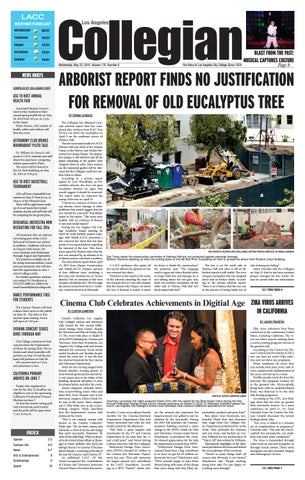
The Collegian has obtained a private arborist report that was completed after workers from B & J Tree Service cut down the eucalyptus on April 9 on the southeast corner of Holmes Hall. The tree was located south of LACC’s Holmes Hall and north of the Student Union, in the Harvey Lyle Decker Memorial Iris Garden Planter. The dedication plaque is still attached and all the plants remaining in the garden were chopped down to nubs. Some sources say the memorial garden will be relocated, but the Collegian could not confirm when or where. According to a private report signed by Leon Boroditsky, an ISA certified arborist, the river red gum eucalyptus showed no signs that would suggest it should be removed. The report states he inspected the stump of the tree on April 25. “I found no evidence of injury, decay, disease, insect damage or other problems that would suggest that the tree should be removed,” Boroditsky stated in the report. “The roots were healthy with no evidence of disease or necrosis (dead tissue).” During the Los Angeles City College Academic Senate meeting on April 28, Scott Burkett, project manager with BuildLACCD, presented a tree removal fact sheet that has four points of recommendations regarding the removal of the tree. This document signed by Burkett states that the tree was assessed by an arborist to be in distress and in a die-back condition. The only arborist report dated April 15, 2015 from Harper Construction and BuildLACCD contains pictures of four different trees, including a fern pine and chestnut tree in “severe distress,” but no mention of the river red gum eucalyptus tree. The five page document comes from Steve F. Andresen, Arborist Services in Riverside.
TOP PHOTO BY HECTOR LOPEZ/COLLEGIAN, BOTTOM PHOTOS COURTESY OF ANGELA BROOKS
Top: Trees inside the construction perimeter of Holmes Hall are not protected against potential damage. Bottom: Workers cleaning up after the cutting down of the old Red River Eucalyptus on April 9, across the street from Student Union Building. A LACC professor who spoke off the record offered his opinion on the tree removal fact sheet. “Nowhere in the report is the name of the arborist assessing the state of the red gum tree so I can only assume that the reason why Harper cut down the tree is because it makes it easier
for them to finish the construction,” the professor said. “The language used is vague and when Burkett refers to major limb loss and damage, he is not talking about the red gum tree, there was another eucalyptus, on the other side of Holmes Hall that suffered major limb loss.”
The tree is on the north side of Holmes Hall and what is left of the broken branch is still visible. The river red gum eucalyptus that was chopped down had no broken limbs. According to the private arborist report, “there is no evidence that the tree was in the process of losing limbs nor at
risk of dying nor failing.” Adam Marcello told the Collegian on May 23 that he has been assistant project manager for two weeks. He says he cannot offer any information SEE TREE PAGE 6
Cinema Club Celebrates Achievements in Digitial Age ZIKA VIRUS ARRIVES IN CALIFORNIA
BY CLINTON CAMERON Creative Collective, Los Angeles City College’s cinema and television club, hosted the first annual Hollywood Foreign Press Center Awards for Television and Film on Friday, May 13. The event took place in Studio B of the HFPA Building for Cinema and Television. More than 30 students, Los Angeles City College staff and friends attended the ceremony. Social media outlets Facebook and Youtube broadcasted the event live. It was the first live internet broadcast for the Cinema and Television Department. Attire for the evening ranged from formal tuxedos, evening gowns, to semi-formal sports jackets and slacks. A red carpet area in the lobby of the building attracted attendees to pose for photos before and after the event. Award categories included television, screenwriting, music video and short film. Irvin Thomas won in the television category, Edwin Frank Ortiz won in the music video category and V. Ellis Wade won in the screenwriting category. Wade described how the department’s cinema club produced the event. “This is our campus’ cinema club known as the Creative Collective,” Wade said. “We do both cinema and television — kind of on the side things that aren’t necessarily ‘classroom.’ It’s more of the club thing. What we decided to do is kind of pay tribute or [homage] to those students who [are] not taking Cinema I or Cinema 33 because there’s already a screening at the end of the year for Cinema I and Cinema 33.” An additional LACC All Star Award recognized the contributions of Cinema and Television Instructor Vincent Ybarra. He retires this semes-
BY JASON PISKOPUS
PHOTO BY CURTIS SABIR/COLLEGIAN
Annual Hollywood Foreign Press Center Awards ceremony on March 9 2016. DJ Robinson (middle) hosted the event. Los Angeles City College’s cinema and television club Creative Collective sponsored the event. ter after 11 years as an adjunct faculty member for the Cinema-Television Department. Department Chair Joni Varner presented him with the only faculty award for the afternoon. “He’s been a great support and cheerleader for the TV and Cinema Department in his time here for 11 and a half years,” said Varner during a phone interview with the Collegian. Hollywood Foreign Press Association (HFPA) donated $2 million to the Cinema and Television Department last year. Their gift represents the largest amount ever contributed to the LACC foundation. According to a 2015 “Variety” online arti-
cle, the amount also represents the largest amount ever gifted to any institution by the non-profit. During the 2015 Fall semester, the Communications Building received a name change to the HFPA Center for Film and Television. Cinema major Kenry Hutchinson co-produced the event. He showed appreciation for the help his department received from HFPA. “[Hollywood Foreign Press Association] [has] been a big contributor to us since we got the $2 million endowment last year,” Hutchinson said. “We’re actually happy to have them aboard along with some of the things that come along with that [like] op-
portunities, speakers and press time.” Bass player Sean Rzewnicki, keyboardist Wanil Kim and drummer Sam Angle from City College’s Music Department performed live at the event. They provided the entrance and exit music and backed up Carleen Williams for her performance of “Take it All,” also written by Williams. Hutchinson’s highlights of the afternoon provided an off screen and behind the scenes glimpse of the ceremony. “There’s so many things that’s off camera that obviously is not shown,” Hutchinson said. “People working, doing their jobs. I’m just happy everything came through.”
Zika virus infections have been confirmed in the continental United States, including California. The virus can infect anyone making them a carrier, putting pregnant women at the greatest risk. According to the Centers for Disease Control and Prevention (CDC), one can have an active Zika infection and not show any symptoms. When symptoms do occur they can include joint pain, fever, rash or even conjunctivitis (inflammation of the eyes), and last up to a week. Healthy people rarely die from the infection but pregnant women are at the greatest risk. Microcephaly, being born with an underdeveloped brain, was believed to be the only risk durimg pregnancy. According to the CDC, new findings show that the risks are greater than previously known. In a press conference on April 11, Dr. Anne Schuchat from the Centers for Disease Control discussed the newest findings about Zika. “The virus is linked to a broader set of complications in pregnancy,” Schuchat said. “Not just the microcephaly but prematurity, eye problems and some other conditions.” The virus is transmitted through a bite from an infected mosquito, or through sexual contact. These same mosquitos can also transmit dengue and chikungunya viruses.
SEE ZIKA PAGE 7
6
NEWS
Los Angeles Collegian — Wednesday, May 25, 2016
TREE FROM PAGE 1
STUDENTS, FACULTY CONDEMN DECISION TO CUT DOWN TREE MONROE STREET PLAZA- TREE REMOVAL FACT SHEET 1. 2.
Tree was assessed by an arborist to be in distress and in a dieback condition. Steps to remediate this condition could not be met, focusing on the drip line conditions of the tree the facts are: • Soil elevation loss because of the ADA ramp and corresponding walkways. • Eighty percent of the drip line is and would be hardscape not conductive to the drip line. • Major limb loss and damage was occurring • An underground electrical structure impaired the roots (root bound) in the memorial garden. • A new required storm water structure was to be installed in the area, further impairing the roots of the three.
because he has been an assistant project manager for only two weeks and has no access to how much money the removal cost, or if there was any arborist report submitted before the tree was chopped down. “I don’t have answers to any of these questions,” Marcello said. “If you would have told me in advance you were coming and what information you needed, I would have been able to pull these for you.” In a letter dated Jan. 5, 2016 signed by “Assistant Project Manager,” Adam Marcello writes that after consultation with the arborist, “Harper Con-
Building have special fencing or any other type of protection. Another point in the fact sheet presented to the Academic Senate states “an underground electrical structure impaired the roots (root bound) in the memorial garden.” However, according to Boroditsky’s report, “the roots were healthy with no evidence of disease or necrosis (dead tissue).” This was determined after he dug up the roots around the stump, referred to as a “root crown excavation.” The last two points of the fact sheet involve a design allowing for “ADA ramp and stair case and ... proper fire
The specific company, which took down this tree, was indeed hired by Harper Construction. As to the particulars of that tree removal you would have to contact them. And please be factual about this tree. It was not dead, but it was in extreme distress and dying. It had incurred what an arborist would call a “die-back” condition. The actions to alleviate this condition could never be met and so with new site construction occurring in this area the tree was removed. It should also be reported that the tree had dropped major limbs onto the handicap ramp about a year ago. Almost hitting some of the contractor workers nearby. These are the facts as I know them. - Scott Burkett, Project Manager BuildLACCD struction is concerned with the existing eucalyptus tree at the southeast corner of Holmes Hall.” Marcello attached pictures to the document showing “such a limb” that fell inside the construction perimeter fencing “causing extensive damage in the process.” The pictures could be misleading, because they don’t show the tree that was chopped down during spring break. Harper Construction hired Arborist Services last year and does not appear to have taken any of their recommendations. Year over year the appearance of the trees has deteriorated. The arborist recommended that trees shall have a border fence installed to keep the area under the trees clear of foot traffic and material storage. The Collegian photographers took pictures with trees inside the construction perimeter. More than one year after Andresen’s report, none of the trees around Holmes Hall and the Student Services
lane and ADA walking surfaces.” It is unclear why these could not be built in addition to accommodating the tree. Boroditsky says the information presented to the Senate suggests the tree was recommended for removal “as part of the design for Monroe Street Plaza” and not due to its condition. Original plans of the Holmes Hall remodeling project show the ADA ramp and staircase going around the tree and the memorial garden. So what happened to “greater accountability, to more transparency” BuildLACC has on the website under the “Accomplishments” heading? A professor present during the sensate session complained that the school is not at all transparent as the administration claim. “They cut the tree when everyone was on spring break, including faculty. That is not transparency.” The Collegian will continue to investigate the reasons behind the red gum eucalyptus tree cutting.
TOP PHOTOS COURTESY OF GEGHAM KHEKOYAN, BOTTOM PHOTO BY HECTOR LOPEZ/COLLEGIAN
Several species of birds lived on the branches of the old Red River Eucalyptus tree, which was cut down last month. Campus trees remain unprotected during construction outside the Student Services Building project on May 25, 2016.
LETTER THE EDITOR
The Trees of LACC BY SUSAN RYAN, ENGLISH DEPARTMENT INSTRUCTOR
E
very day I walk across the main quad and observe all the trees along the way to Franklin Hall. I enjoy watching the students play their guitars, sing, and generally hang out under the large Coral tree between Jefferson and Franklin Hall. I have noticed that this is one true gathering point on the campus—and there aren’t many. Why this place? Because of the tree, of course. It provides shade, temporary shelter from inclement weather, beauty, and the low wall around it provides a good place to sit. Human beings naturally gravitate toward these kinds of places. For some time this spring the Coral tree only had flowers on the lower half, and then the leaves started appearing. Presently it has leaves on just the lower portion of the tree, and with recent rains it is trying to leaf out in higher branches. However, this pattern indicates the tree is greatly distressed and in immediate danger of further decline. The problem, I have noted, is that the Coral tree stands in heavy clay soil that has not been broken up or amended (with organic material) for years. The clay soil is like cement and the tree is not getting sufficient water. Again, why haven’t the landscapers or gardeners addressed this? Who’s in charge? Who sees what really needs to be attended to (TREES!!), and what can easily and inexpensively be replanted later? As I walked by the Coral tree before spring break, some young Greenpeace advocates hailed me and wanted to discuss environmental degradation in this country and around the world. I was delighted to meet them on campus, but I asked them to step away from the Coral tree and take a look at the way this tree is dying. “This is our own local example of environmental neglect, and it’s painful to watch,” I told them. And I asked if they could help LACC, right here, right now. Perhaps however, we need to ask ourselves what we can do right here, right now in our own little
corner of the globe. I have also watched the trees and the activity in the triangular patch of open ground that is close to the Vermont entrance. While construction was going on, the two trees there-- a conifer and a poplar--were completely neglected and close to dying when the construction ended. With the great infusion of water for the new sod that was put down, the trees revived. However, the poplar had a lot of dead branches at the beginning of spring and did not seem to be leafing out as the season progressed. A week or two ago the tree was completely cut back. I feared it was going to be removed, but it still stands and with the rain we recently received, it seems to be coming back into leaf. However, this tree is also distressed and will need a lot of deep watering to make it through what promises to be another scorching summer. I wonder and doubt if the same individuals who have neglected to address the problems with the coral tree are going to shepherd the poplar through a hot summer. On Monday I was shocked to find that the perfectly healthy eucalyptus tree near Holmes Hall had been cut down. This was an old tree that had taken years to grow and was a refuge for cooper’s hawks. On a number of occasions I had noticed students and faculty stopping to observe or photograph the hawks. Now we are left with a sign displaying an architectural rendering of the very building that stands right behind it—kind of like the words “coffee cup” printed on the front of a coffee cup. We are also left with a denuded spot and more exposed concrete to absorb the heat and reflect it back during the long, hot summer. And since yesterday someone has placed a sign, a sort of gravestone, on the stump of the eucalyptus that asks, “Why was I killed?” Yes, I must echo, “Why was that tree killed?” I need an answer to that question too. Can we begin a campus-wide discussion about the condition of the landscape we live in every day? It’s important to me, to other faculty members, to the staff, and to the students. This is our home and it’s in sad shape. Shiny new buildings cannot disguise this fact.
If you’re interested in tree policy and helping the trees on campus contact Professor Joe Ryan at ryanjm@lacitycollege.edu.