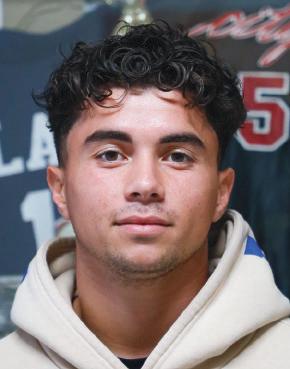
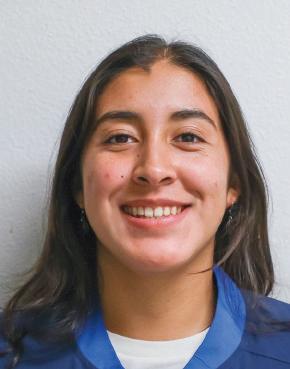
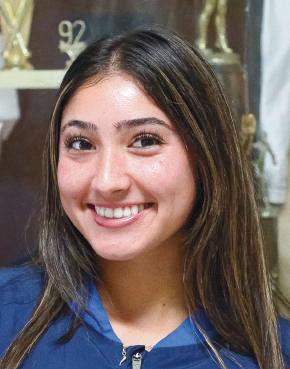
The first listener-supported radio station in the United States, KPFA 94.1 in Berkeley, granted internships to six L.A. City College journalism students this fall.
KPFA has been part of the Pacifica Network since 1949, a group of five independently-operated, non-commercial radio stations and 200 affiliated stations throughout California. KPFA is a grassroots community broadcast pioneer. KPFA’s News Director Lauren Schmitt led the first on-boarding session via Zoom on Oct. 24. During the meeting, she talked about her background in radio and the mission of listener-supported radio.
The Los Angeles cohort consists of six students from the Collegian who are required to devote 16 hours per week to the internship. City college students will receive a stipend during the internship from the Morris S. Smith Foundation, courtesy of Sterling Franklin in partnership with the Los Angeles City College Foundation.
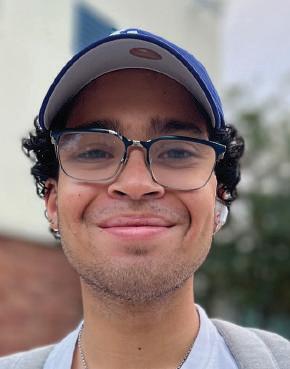
Students will create one story package each week, which will air during a daily news broadcast on KPFA. Schmitt asked cohort members what they want to get out of the internship experience. “This is way beyond anything I could think of to come to my journey at this point,” said Collegian Photo Editor Klen Torres. “I am dedicated to work to elevate the voices of people within the Latina community.”
Emily Gonzalez is a Collegian news reporter and social media editor with a background in accounting and a B.A. degree in finance.
“I realize that I want to be a journalist now,” Gonzalez said. “This is also a really great opportunity for me. I never thought I would be getting a radio internship at LACC.”
Students will receive extensive instruction on storytelling for radio broadcast, and then will be required to submit one story per week.
Students’ completed work can be picked up for wider distribution among the Pacifica Network stations.
BY ANDRE SOTO UNTIVEROS
In the heart of East Hollywood, Armenian bakeries, Salvadorian pupuserías and rent-controlled apartments share the block with luxury co-living high-rise complexes that dominate the immediate area. Gentrification has begun to take hold in the surrounding environs of Los Angeles City College.
SEE “GENTRIFICATION” PAGE 6
Disabled, Impaired Students Struggle Amid Construction
BY JEREMY CUENCA
Campus construction routes, along with elevators and automatic doors that are out of order, have caused inconveniences for some students with disabilities who attend Los Angeles City College this semester.
Students voiced their opinion and say campus construction, malfunctioning elevators and automatic doors have made it difficult to move around campus, leaving some unable to attend classes or campus events. Others say that it takes a bit longer to get to class because of the pathways that have been created
for accessibility.
Over a one-month period, the Collegian tested elevators and automatic doors in 15 buildings at LACC. The majority allowed disabled students access. However, at Jefferson and Franklin Hall on Sept. 25, two elevators did not work. In Jefferson Hall, the elevator stopped, and a student who was trapped inside repeatedly pressed the emergency button to get someone’s attention.
A student notified Communications Studies chair Sarah Crachiolo-Garcia, who teaches in the building. She called two Sheriff ’s office contacts and neither answered. She says she could
not leave a message because the voicemails were not set up.
On that same day, other students claimed they missed classes located on the second floor of Jefferson Hall because elevators were down in both Jefferson and Franklin Hall.
The result of facilities that are not working may cost students with physical disabilities, because they may miss classes when they cannot get access to the same areas as other students.
“So, the construction has been
Government Shutdown Disrupts CalFresh Benefits
BY ISIS MALONE
Rising costs of living and tuition have made food insecurity a pressing issue on college campuses.
CalFresh is a critical program that helps Californians who qualify to buy groceries every month.
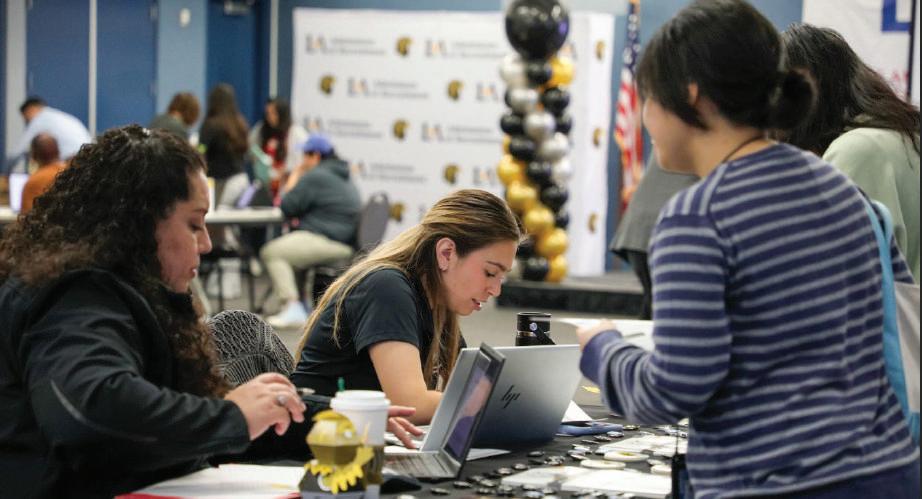
LACC has established dedicated resources to connect students with CalFresh. On campus, the support is available through the City Cares Network, Ready to Rise and the Fresh to Success program. Through their on-campus presence, application assistance and meetings with CalFresh workers, who can help students gather the necessary documents to apply, are offered at LACC. There is staff in the Student Services Building and Basic Needs Center who are available to provide in-person support.
Dr. Nune Mikayelyan is a student services specialist in the campus Economic Social Mobility and Innovation Department.
“Our mission is to remove barriers to academic achievement and to enable students to gain self-sufficiency by connecting students to resources, services and support,” Dr. Mikayelyan said. The services are more important now because of the government shutdown which lasted from Oct. 1
Voices: Campus Talks Student Housing Solutions
BY CARLA WILLIAMS
One hundred and fifty attendees gathered to tackle one of the largest challenges for college students today — finding affordable housing.
On Oct. 20, LACC President
Amanuel Gebru hosted a town hall meeting to discuss solutions for student housing needs. Attendees packed the Multipurpose Room of the Student Union where students, faculty and staff intermixed at small group tables. The aim of the workshop-style session was to build strategies for student housing projects.
“We know housing is critical to student success,” President Gebru said during his opening remarks.
“This conversation is about finding solutions together.”
LACC invited RSS Consulting — a firm that supports community college leadership in creating economic equity and empowerment for students — to help foster communication and collect feedback on housing concerns.
Regina Stanback Stroud, presidential appointee on the Advisory Council on Financial Capability for Young Americans for President Barack Obama and CEO of RSS Consulting, facilitated the workshop.
Participants reviewed insights from pre-town hall interviews and shared their perspectives throughout the session. In small groups, they ranked key insights and then presented their findings to the larger group to spark collaboration and solutions.
The town hall concluded with an open forum where participants shared personal experiences and challenges related to housing. President Gebru and Vice Chancellor Sata closed the meeting by encouraging attendees to reach out to rstroud@rssconsulting.org to continue the conversation.
PHOTO COURTESY OF ELIJAH MERRELL
PHOTO CREDIT: ELIJAH MERRELL/ UNSPLASH
PHOTO COURTESY OF CREATIVE COMMONS
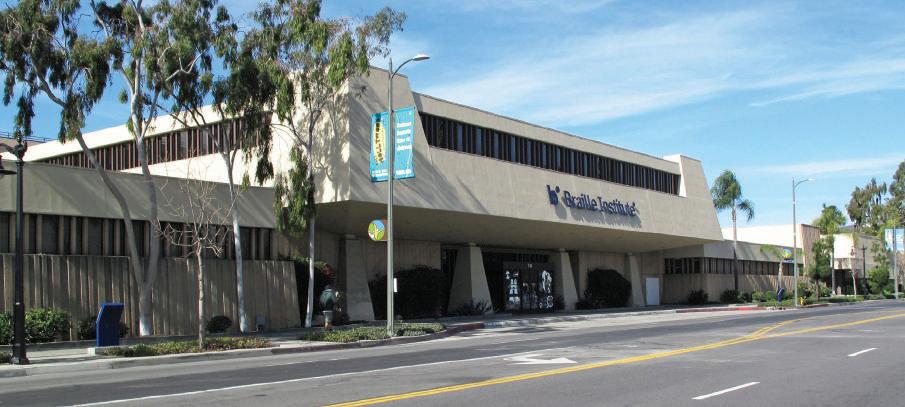
A representative from The Braille Institute of America, located just steps from Los Angeles City College, tells the Collegian they plan to train LACC campus ambassadors to guide visually impaired students through updated accessible routes.
Scan here to watch a video about gentrification in East Hollywood.
Fans Go Cold When Owners Fund ICE
For many fans of the Dodgers and Lakers, it is difficult to reconcile any form of love for Los Angeles teams when the owners sign checks that fund Immigration and Customs Enforcement.
Being a fan of both the Dodgers and the Lakers has always been part of the identity of many Angelenos.
become a double-edged sword. It stings to learn that Mark Walter, majority owner of both the Dodgers and the Lakers, has money invested in ICE.
In addition to his sports ventures, Walter is the CEO of financial services firm Guggenheim Partners, which has an estimated $12 million invested in the private company that runs ICE’s detention centers, according to The San Diego Voice & Viewpoint.
This is the agency that has separated families, detained immigrants and left a trail of pain through Latino communities. How can someone who profits from teams so deeply loved by Latino fans also support an organization that has caused so much suffering among those same fans?
The Dodgers and Lakers have always stood for unity in L.A. You’ll see fans of every background wearing blue with white, or purple and gold: Mexican, Salvadoran, Filipino, Black and white all celebrating side by side. We chant, we cry, we live and die with these teams.
or visits to school.
Entire families hide from cops just because of their ethnicity. Many minority communities have experienced the fear of suddenly having friends, family or parents taken away.
These owners seem to have no sense of empathy or awareness that sports are supposed to bring communities together. They should not fund systems that tear fans and their families apart.
Fans want to cheer on players such as Shohei Ohtani when he hits another home run for the Dodgers or LeBron James when he throws down a dunk for the Lakers. This is not about politics; it’s about people whose communities are being terrorized and their constitutional rights trampled. It should be about Los Angeles, the city that prides itself on diversity, for and of the communities that keep these teams alive.
When you are an owner or fund money into stock for a Los Angeles sports team, you should realize that the organization you are representing is more than just a brand.
For Latino fans, those teams gave L.A. natives a community to belong to and something to believe in. The city teams made minority communities feel seen in a city that often overlooks the people who built it.
The dedication to these teams has now
For someone growing up in L.A., those teams are not just sports franchises. They are a vital part of the city’s culture. Summer nights spent at Dodger Stadium, winter evenings watching the Lakers on TV — that feels like the city’s heartbeat.
But when those investments became public knowledge, coupled with the Dodgers’ reticence to speak out against ICE’s brutal actions in the city, it fractured that sense of unity. It is blood money from the top that is working against the very people who make the teams’ heartbeat so strong.
It is not realistic to expect every team owner to know the fear of your parents being taken away because of their status in the USA, just as it would be unrealistic for the owners to deny their privilege.
They will not know what it is like to grow up with parents of unknown status, who are only able to communicate in one language, depending on their own children to translate for doctors’ and dental appointments
Students Try to Stay Afloat, Survive Rent Squeeze
BY GRACE GUO
Sunshine, palm trees and unlimited ambition are hallmarks of Los Angeles. But none of that pays the rent.
For students, especially those of us without wealthy parents or a full-time salary, the housing market here feels like a monthly test of survival. When a “budget” studio in East Hollywood starts at around $1,700 a month, rooming with strangers is not just an option; it’s the only option.
The romantic idea of independence quickly turns into group chats with titles like “Looking for Roommate #4” and scrolling through rental listings like it’s a part-time job.
So how are students coping?
First, nearly everyone I know shares. Not in a casual, two-people-in-a-two-bedroom way, but in the living room-becomes-a-bedroom way. Privacy becomes a luxury, not a right.
IKEA curtains, foldable partitions and noise-canceling headphones have become essential survival tools. Somehow, people make it work. The arrangements may not be glamorous, but they do provide community. In a city this expensive, community is invaluable.
Second, students are cutting costs where they can. The $7 iced latte on the way to campus is replaced by a refillable tumbler and home-brewed coffee. The $12 sandwich between classes becomes meal-prepped noodles or rice bowls carried in backpacks. Textbooks are borrowed, shared or
sourced through library scans and group chats.
And yet, the burden remains. Working part-time jobs to afford rent means less time for studying, resting or simply having a life. Financial stress is not just an inconvenience; it is an academic barrier. When students are constantly worrying about next month’s rent, they cannot focus on learning or growth. The housing crisis is an education issue.
So, what can be done? Colleges and city officials need to stop treating student housing as an individual problem and start addressing it structurally. Colleges should invest in more affordable student housing, not luxury dorms with private gyms that only wealthy students can access.
Partnerships between schools and local developers can help create mixed-income housing models that keep rent within reach for students. Ultimately, housing should be viewed as a critical part of educational equity, ensuring that every student, regardless of income, has a safe and stable place to live while pursuing a degree.
Local policymakers should expand rent-stabilization protections and incentivize affordable housing near campuses. Public transportation improvements can also reduce dependence on expensive neighborhoods close to campuses.
Students are already doing everything they can. We budget, sacrifice, share spaces and build community resilience. But personal effort can only go so far when the system is stacked against us.
If Los Angeles values its students — the future artists, nurses, engineers and teachers of this city — then it must make it possible for us to live here.
Housing should not be a privilege. It should be a foundation. And right now, that foundation is cracking. It is time to repair it before more students slip through.
The teams, and the choices that owners make in running them, should be about those who fill up the sports stadiums, cheer at the top of their lungs, and paint their faces and bodies in team colors. It is the minority fans who fill the crowd of Figueroa’s streets to celebrate championships, and it is those fans who pass down the love and pride of their team to their children.
Minority communities such as ours in L.A. have proven our loyalty and have the right to know where the loyalties of our teams’ decision makers lie. There can be no respect for those who decide to bankroll ICE, an organization that hurts the very communities that bleed for this city and sportsmanship.
L.A. Deserves Safe, Staffed Metro System
BY DEANTHONY ESCALANTE
The L.A. Metro trains run throughout the city, from North Hollywood to Long Beach and from Santa Monica to Pomona. Over 200,000 riders share the Metro every day.
Last year, over 380 law enforcement officers ensured the safety of travelers daily, according to official data published by Metro in June 2024.
To increase the safety of Metro users, the organization promised last year to increase the number of ambassadors and intervention staff, according to a press release on June 28, 2024.
But announcing this promise is not enough. On Nov. 11, 2025, at 6:29 p.m., LAPD responded to a 911 call. A traveler reported that a person was “down on the Metro D Line tracks,” based on posts on Citizen, a safety and crime-tracking app.
Emergency Medical Services and LAPD arrived at the scene seven minutes later, according to Citizens.
The police established a post across the street from Westlake Station. It took EMS almost one hour to recover the body from the tracks, based on Citizen’s timeline and posts.
One major thing that is going through my head now is, “where was the security and staff personnel at this station?” Ideally, there are around three to six workers per train stop, including custodians and rotating ambassadors, in addition to the two to four security and law enforcement personnel.
What blows my mind is that there was nobody around to stop that person from getting on the tracks. Why was there nobody to keep an eye on the two ends of the Metro walkway?
I reckon that Metro fails its customers in terms of safety every
time something like this happens. Although the Metro has put out statements announcing plans to assist their riders and improve safety, there is evidence that the opposite is happening. As of this September, security incidents had increased 116% at Union Station and 67% at North Hollywood Station since the suspension of the tap-to-exit program in April, according to data presented at an L.A. Metro meeting and reported by KTLA. Drug usage on the Metro is openly visible and doesn’t seem to me to be going down. Personally, there have been times when I was on the train and would get off at a stop and fail to find even one Metro Ambassador or staff member to assist me. Just a couple of weeks ago, I had trouble using one of the Metro lines. I was desperately looking for someone to assist me. It took me almost 45 minutes to find someone.
If there are not enough workers at a station to assist someone who is actively looking for them, then how can they possibly do anything to discourage crime or prevent accidents on the tracks? An empty, unstaffed station is a recipe for disaster.
Los Angeles is a sprawling city with the tax base to fund a functional commuter rail system. I do not think that the decision-makers for the Metro system need to invent anything new; many cities all over the world have already figured out how to run similar public transit systems while keeping them safe and affordable.
There are plenty of reasons to want to increase Angelenos’ use of public transit. It is better for the environment, it can cut down on our notorious traffic, and it gives people more access to jobs, grocery stores and recreational opportunities. But the foundational step to improving ridership numbers is to improve safety. If the L.A. Metro system does not provide enough staff to make stations and the train cars themselves feel safe for riders, no other changes will matter.
IMAGE BY MATTIA MILLAN
OPINION & EDITORIAL
CITY VIEWS
BY
COMPILED
VANESSA KOLB
PHOTOS BY JEREMY CUENCA
“Yes and no, because as of right now, I do know they’re making a lot of AI stuff, like movies, and they're trying to use it for storyboarding and stuff like that. I see how it could be impactful for the industry. But it’s also affecting a lot of people’s jobs, and taking away a lot of people’s jobs, which is the huge negative part of it. I could also say it’s kind of impacting my education; it’s also helpful. If I need to answer a question, yes, I do Google, and then when the new Google AI is the first thing that pops up now, instead of actual websites, yes, that does help. But I’m also conflicted on it.”
“I do not use it because it’s not necessary. I’d rather just have a book and get the information for myself. Because artificial intelligence, it’s ridiculous. And it’s cheating. I don’t cheat on my wife. I have my daughters, and I don’t want to show them the wrong way to live life — doing those types of negative things. Because you have to take the incentive to do the correct thing, in order to persevere.”
“Um, yes and no. No, because at the end of it, we are still reliant on ourselves and our individual abilities to study and just be receptive with everything that we’re taking in the curriculum. But yes, because there are a lot of people who are using it to their own advantage and not letting people know that they’re using it, and still trying to gain the same merit as somebody who does not use it.”
“I’d say yeah. Just because I know a lot of jobs within the medical field are getting taken up by AI. I see this personally because I have an aunt who works in HR for a lot of medical companies and hospitals. And so, a lot of medical receptionist jobs are being taken out as we speak. But when it comes to down the line, probably not when it comes to becoming a doctor. But getting there is becoming a little bit more saturated just because of AI. It’s becoming easier to gain opportunities through AI.”
“I use it for my schooling to simplify an intense article with terms I don't quite understand just yet. I already get all my data, and I more so use AI to organize it. That’s the main way I use it. But artificial intelligence, I guess I like how it also takes the notes I take and makes study questions from that.
ICE Arrests Turn Bus Stops into Checkpoints
BY ISIS MALONE
The bus stop. It is supposed to be a place of transition, a brief pause between destinations. But for many in my community, it has become a source of fear. I cannot shake the discomfort I feel knowing that U.S. Immigration and Customs Enforcement is acting with the authority to conduct unjust stops and arrests right there on public transit, or at the stops themselves. It feels like being stalked by an ex who lingers in the shadows. The legal system is allowing it to happen, but it is obviously wrong.
I understand that ICE claims to be operating within the bounds of the law. I've considered the arguments about maintaining order and enforcing immigration statutes. But I believe that morality and legality are not always the same thing. The fact that something is legal does not necessarily make it right.
When I see a normal citizen
AI Cannot Have My Em Dashes
BY VANESSA KOLB
The em dash has been in use since the early days of the printing press in the 15th century. It predates Large Language Models by nearly 600 years.
LLMs like ChatGPT and Claude are made by training a model on datasets taken from human-made content. For image models, that means training it by feeding massive amounts of original human-made art into the model. For LLMs, it means giving the model vast amounts of material that was written by real humans.
In other words, the only reason that LLMs
use the em dash is that it was already a common feature of human writing. So why should we turn around and say that using a punctuation mark which has been a natural feature of human writing for 600 years is now a sure indicator that an LLM wrote something? On the forum/social media hybrid website Reddit, em dashes have come to be seen as a reason to immediately dismiss posts as fake or written by a bot. In school, overzealous use of the em dash might find a student having to show a paper’s revision history to prove that it’s their own work.
I hate that I now feel like I have to censor myself. I can’t use an em dash without worrying that my writing will be dismissed as AI. And I also have to wonder: if a punctuation mark can be ceded to the bots so quickly, what else will
we give up once AI can replicate it? What does it mean that we trained AI to imitate our human writing, and now that it has successfully learned to do so, we shame real humans for writing the same way they always have? Ultimately, I think people have seized onto the em dash as an easy way to identify AI writing because it is comforting to think that there is an easy way to tell. For now, it is still possible, but we are rapidly approaching the point where AI imitations of human art and writing are indistinguishable. It is not easy to confront the reality that our livelihoods, and even our creative endeavors, might be on the verge of being rendered obsolete — but trying to oversimplify the issue by dismissing anything with an em dash will not change the fact that we may soon have to compete with AI.
rushing to work or heading to the grocery store to buy a lotto ticket or a pack of Golden Oreos, I now can’t help but visualize them being snatched away from their loved ones, simply for waiting for a bus. Roots grow around my rib cage just thinking about it.
Every day I take the 204 and the 20 buses to school and I see the same woman, who frequently stops at Wilshire and Vermont to purchase gas cards for her daughter. Her name is Kendra Dorsey, and she described to me how she feels about this situation.
“It's awful. You hear these stories about kids seeing their family getting grabbed at the bus stop, you know, while doing their everyday routine. It makes you feel like there is no safe place and you can’t trust anyone. I haven’t seen this happen personally, but I worry. It makes my stomach turn,” she said.
This observation highlights the fact that the bus stop is a place we all share. Turning it into an enforcement zone just because it is allowed feels very cruel.
We must remind ourselves of what our country stands for.
Do we believe that legality is the only measure of what is acceptable, or are we a nation where
our humanity holds significant weight?
Discussing the legality of ICE’s actions is important, but it misses the social fallout that happens right there on the street. An arrest at a busy bus stop does not just happen in a bubble. It alarms the whole community, makes people stop trusting the police and throws trauma into the life of everyone who sees it. People just like Kendra Dorsey are worried about that.
We have to ask ourselves if a policy that spreads this much anxiety and angst into the social fabric of a city is really helping anyone, even if it is legal. A country is not just defined by the rules it enforces. It is also defined by how much empathy and fairness it shows to its most vulnerable citizens. We need to look at the full picture of these enforcement policies and push for approaches that respect both the law and the need to keep a humane environment for everyone who is just trying to live their life. At the end of the day, this is about more than just whether or not it is legal to detain someone at a bus stop. It is about what we value as a community and country.
GENESIS MYERS Film, Television and Electronic Media
KEVIN MENDEZ Child Development
SEBASTIAN ALZATE Spanish and Linguistics
ANAHI LIMA Biology
CAITLIN MCCARTUS Nursing
IMAGE BY MATTIA MILLAN
Rocks L.A. Trash Glam
BY BRETT BURCHARTZ
mmediately upon arriving at Permanent Records Roadhouse and ordering a drink at the bar, I am greeted by the sonic waves of a psychedelic band playing a set. They are not Lord Friday but act as an excellent primer. Permanent Records feels like the Double R Diner in “Twin Peaks” if it had a sibling that dropped out of school and moved down the coast to Glendale, old school ‘50s with checkerboard tiling and red leather dining booths with punk rock decor. An eclectic crowd of people all gathered around a neon lit stage as they bobbed their heads to the music. It is a sea of proper sonic hypnosis and an unspoken joy that must be felt in person. The record shop attached to Permanent Records was another highlight of the location. A short walk through the patio, it’s selections like an original pressing of Velvet Underground’s 1967 self-titled album with Nico, as well as other records like “Sticky Fingers” (with the original zipper), “Songs the Lord Taught Us,” and “Pieces of a Man.” The location is a music lover's paradise. The space represents itself with a Grim Reaper, but it is anything but death. Outside on the patio, people are commiserating and enjoying their time with each other. Band members Felix, Sloan, Pete, Josh, and Mama Lenz were all gathered around the merch table for their band. It had a smattering of cassettes, stickers, pins, and a few T-Shirts. Cassettes spun up the day before the show, and T-Shirts so recently fashioned that they hadn’t sold a single one yet. It shows passion for their art, which had hints of superstardom. Felix spoke nervously about the tour this show was kicking off and the troubles of planning it out.
“It was nerve wracking and difficult,” he said. “I want to work with a booking agent for the next one. But doing it this way gives the pride of a job well done.”
When Lord Friday’s set goes, they are surrounded by a sea of people. Cameras race to cover them for perfect angles. Once the
soundcheck ends and the music begins, people observe and listen through many classic songs of theirs like “Patent Leather,” “Sleeping Cutie,” and “Wallace and Vomit.”
They move through their setlist with all the care of an artist on canvas. They create a soundscape of wonder and power. Their murder music rips the air into raw energy in the tradition of punk rockers past, like the Cramps and Stooges with a queer flair.
Their unabashedly queer frontman entertains the audience endlessly between songs. There are stories about the origins of songs and jokes about him bottoming during sex. It adds a lurid appeal to the countercultural action of their rocking. Felix is magnetic and cannot help but draw the eyes of every member of the audience to him. A gay icon in the making. In one song amid a sea of limbs, the floor cleared, and cameras flashed. The music takes over entirely as people dance. Felix walked in it to bless the showgoers with his presence during a performance of “Hot for Preacher.” The music continues with this energy and an electric performance. One can’t help but tap their foot, bob their head, or otherwise move under the hypnotic psychic creation, a melding of punk rock, erotica and dollar-store kitsch. Lord Friday the 13th is a band that, while acting in the tradition of acts prior, makes their own unique mark on the soundscape of punk rock. They produce flanged tunes and roar ripping overdriven sounds that make it impossible not to dance. They close their set with the song “Big Mac,” which was an early wish for fame and of a life on the run after a crime of drunk driving. Like the lyrics of the song claim, you will be “Lovin It.” There is no band like Lord Friday on this earth. They are one of a kind; exist as a pure kitsch band for the masses.
PHOTOS BY BRETT BURCHARTZ
Top: Lord Friday performs at Permanent Records Roadhouse on Oct. 10, 2025.
Middle: Felix (vocalist) during mid-performance of "St. Judy," the band's song about gay icon
Judy Garland, on Oct. 10, 2025.
Lower: Felix (vocalist) and Sloane (guitarist) perform for a packed venue, at Permanent Records Roadhouse on Oct. 10, 2025.
Scan here to see more pictures from Lord Friday the 13th's concert.
Carolina Rivera Escamilla Tells Stories of Resilience
BY ERIKA RAMIREZ
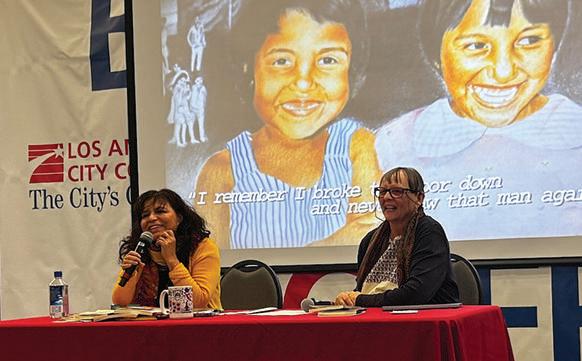
Salvadoran writer and cultural activist Carolina Rivera Escamilla joined the L.A. City College Book Program for a Q&A at the Student Union on Nov. 19, to discuss her book “Coming of Age in Central America.”
Rivera Escamilla spoke about her journey in Canada and Los Angeles after being exiled from her home country. Fifty copies of Escamilla’s book were given out for free to LACC students who attended the event.
Rivera Escamilla is a writer, poet, educator, actress, cultural activist and documentarian who also organizes community literary events. She spoke about her book, “Coming of Age in Central America,” which is a selection of short stories from “…after…,” a previous book.
Although these stories are fiction, they touch on the harsh realities of turbulent times. The stories confront the poverty, civil war, repression, loss of human rights, death and loss in 1980s El Salvador. “The civil war broke out in the 80s and when I talk about movements, I am talking about where students, workers, unions or all kind of union movements, it was about better pay, better education, and better human rights,” Escamilla says.
She was forced into exile after completing her secondary education. Initially she was welcomed in Canada and eventually joined her family in Los Angeles. Her
stories of economic struggles and war expose hardship.
“As a writer, I explore through my work ways to enrich themes of memory that touch on economic struggle, exile, immigration, violence, and war,” Escamilla says, “because these are themes that have accompanied [me] since I was a child.” She attended University of California, Los Angeles to complete her Bachelor of Arts in English literature with creative writing and Spanish literature. Through her writing, she delves into themes of trauma, resilience, coming of age and bringing Latin America to life for both Spanish and English-speaking readers. She wanted people to read these stories and experience culture through her lens.
Before the book event concluded, students lined up to prepare for a Q&A with the author. She answered questions about her life and her books and gave advice to future writers and to Latino students.
“You should never stop telling your story. Tell your story however you want whether it’s through theater, dancing, film, even in your phone where you have a lot of advantages,” Escamilla says, “take this phone, and tell your stories. My advice is, go ahead and do it. Don’t wait for anybody to tell you what to do.”
Carolina Rivera Escamilla’s books are available to purchase through her website carolinariveraescamilla.com, Barnes and Noble, and Amazon.
Joji’s Silent Return with Unexpected Single Drops
BY ERIKA RAMIREZ
lternative R&B singer Joji left fans guessing when he suddenly went inactive on social media for three years. His new single, “Pixelated Kisses,” dropped unexpectedly in mid-October.
Fans finally felt some relief, leaving behind their doubts about his return. The song was classic Joji, with his brooding lyrics and unique beats.
Before he became the melancholic artist that fans now adore, Joji was a YouTuber who posted absurd content under the name Filthy Frank. He was also post-
RALUCA TOPOR
BY
COMPILED
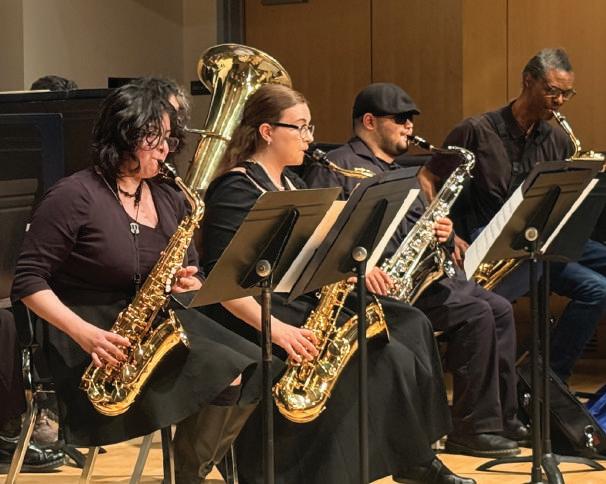
he Herb Alpert Music Department will present a series of free public concerts at the Alpert Recital Hall.
Months of preparation by student performers across jazz, classical, world and contemporary music will conclude the Fall semester in December.
Below is the schedule of upcoming concerts by student ensembles. All events will take place in the Alpert Recital Hall on the second floor of the music building. There is no admission fee, and all concerts are open to the public. The fall series began on Oct. 30, with the annual Faculty and Staff Concert. The remaining events feature student ensembles led by LACC faculty across multiple disciplines.
Jazz Combos, directed by professor Euro Zambrano — Tuesday, Dec. 2, from 1-3 p.m.
Classical Chamber Ensembles, directed by Dr. Christine Park and West African Drumming directed by professor Trevor Anderies — Thursday, Dec. 4, from 1-3 p.m. and 6-8 p.m.
ing comical music under another persona, Pink Guy. Even though he was all comedy and chaos, he was still an artist who wanted to bring more to the table, with his own music and sound.
Joji announced he would be leaving YouTube in late 2017 so he could move on to the next chapter of pursuing a music career. Around the same time, he released “Will He” with a music video. The EP “In Tongues” was the beginning of his music career beyond YouTube.
Joji released three studio albums, “Ballads 1,” “Nectar” and “Smithereens,” under the labels 88rising, 12Tone Music and Warner Records. Singles from each album, such as
“Slow Dancing in the Dark,” “Sanctuary” and “Glimpse of Us,” were instant hits because they encapsulated the feelings of longing, heartbreak and vulnerability that shape the signature Joji sound.
After his three-year hiatus, Joji dropped “Pixelated Kisses” on Oct. 14. Just one week after that, he released the singles “If It Only Gets Better” and “Past Won’t Leave My Bed.” He announced that his fourth studio album, “Piss In the Wind,” will be released on Feb. 5, 2026, under his own label, Palace Creek, which is distributed by Virgin Music. This album will be Joji’s comeback in the music scene and will give fans the validation they’ve been craving for years.
Jazz Band, directed by professor Trevor Anderies — Thursday, Dec. 4, from 6-8 p.m.
World Music: Brazilian Batucada directed by professor Kassandra Kocoshis, Balinese Gamelan directed by professor Caroline Reyes, Mariachi directed by professor Euro Zambrano — Monday, Dec. 8, from 3-5 p.m.
World Music Salsa Band, directed by professor Kassandra Kocoshis and professor Euro Zambrano — Tuesday, Dec. 9, from 6 – 8 p.m.
Pop Music Workshop, directed by Trevor Anderies — Wednesday, Dec. 10, from 1–3 p.m.
LACC Choir, directed by Dr. Irene Kim with Neil Windt on piano — Thursday, Dec. 11, from 6-8 p.m.
For directions to the Alpert Recital Hall and current campus access information, visit lacc.edu/about/map.
For updates on the concert calendar, visit the department’s website at lacc.edu/academics/pathways/pae/music-dept/calendar.
PHOTO BY ERIKA RAMIREZ
Carolina Rivera Escamilla (left) and Professor Genevieve Patthey (right) sit side by side to discuss Escamilla's book
"Coming of Age in America" at the Student Union on Nov. 19, 2025.
PHOTO COURTESY
Joji performs live at the El Rey Theatre on Wilshire Boulevard in Los Angeles in 2019. It was part of the Ballads 1 North American Tour, which was Joji's first concert tour in support of his debut album.
FROM “DISABLED STUDENTS” PAGE 1
ASG Takes Up Disabled Access Issue
affecting me because I have to go through the whole construction site to get to my class, and sometimes it takes me a while,” said Jose Velasquez Cardona, a student who uses a wheelchair.
He says construction detours have made his route to Jefferson Hall confusing and time-consuming.
“The first time it was a little difficult because I had to go all the way around from the Vermont entrance and there was no way to get in,” he told the Collegian. “I even ended up in the parking lot because I couldn’t find another entrance. I started asking around and people told me there was an elevator nearby to get to my class, which is in Jefferson Hall.”
Another student named Elayna Garcia, who is on the LACC soccer team, temporarily uses crutches for mobility. “Getting around on crutches takes a lot longer to get around and it makes it harder because of construction and also because of the cracked pavement which makes my crutches get stuck,” said Garcia.
The automatic front doors of the Student Union have also failed to operate. Collegian reporters confirmed that pressing the accessibility button produced only a brief clicking sound inside the door frame. The doors did not open on Sept. 4 and again on Oct. 9, though they were functioning on multiple days in the interim. This issue is especially concerning because most major campus events, including town halls, transfer fairs and award ceremonies happen in the Student Union.
Students with visual impairments who attend Los Angeles City College face difficulties when navigating the new pathways because they are now having to learn new routes.
The Collegian contacted the nearby Braille Institute regarding this story. Shortly before publication, Adri Torab, an orientation and mobility instructor at the Institute, informed the Collegian that they are planning to train LACC’s On-Campus Ambassadors to assist visually impaired students.
There is concern for disabled students' access inside student government.
The Associated Student Government (ASG) has introduced a bill urging the college to implement technology that will aid visually challenged students ASG Executive of Student Life Jonathan Jimenez, who is one of the students advocating for the bill, discussed it on Thursday, Nov. 7, at the weekly senate meeting.
“The reason for the bill is to implement tactile warnings and directional surfaces,” Jimenez said.
He added that auditory technology would help guide disabled students, so they would know which building they were entering.
“Yesterday, I found out that Valley or ELAC actually have this, so I’m surprised LACC doesn’t, especially since we’re so close to the Braille Center,” he said.
The bill passed unanimously in the ASG Senate and was moved forward to the president’s office and campus leadership. Another student senator advocating for the bill, Giovanna Gondim, presented it at a committee meeting with college administrators involved in accessibility planning on Nov. 10.
“I am fighting for it because I think all of us deserve to have our needs met and to be listened to, and to feel pride, you know, because sometimes they might feel like less for having to ask for help or having to always try to find someone to take them somewhere, and not everyone is kind,” said Gondim.
LACCD hosted the 11th annual Disability Summit at Los Angeles Southwest College to address awareness for student support.
“The one thing the district is doing well is that they are supporting," said Dean of Student Services at LASC Nedra Brown.
“And in order to support, you must understand. And so, their understanding is allowing them to give us, us being the nine colleges, the support that we need in order to help our students to be successful. And when you do that kind of support, it not only will help support a DSPS student, it blends into all of the students. So now you get a chance to have an almost a 100% radius of being successful in helping everyone.”
FOR THE RECORD
Gentrification, Taboo Subject?
Balancing progress, housing needs and reverence for the community is a complicated endeavor. From Santa Monica Boulevard to Virgil Avenue, longtime residents and newcomers alike say the recent changes clash with their culture, values and vision of what they want for their neighborhood.
Marta Escalante has lived in East Hollywood since 1997. Her family has built roots here. The 53-year-old Salvadoran immigrant and single mother rents a two-bedroom apartment just south of Vermont Avenue.
“I used to know everyone on this street and on this building. Now it's all strangers walking their dogs in yoga pants,” she said. “They don’t talk to you or say ‘good morning’ anymore, the tiendas are turning into matcha cafes. Everything has changed.”
Escalante is worried about the rising cost of living. Her rent has been raised twice in three years, since the building she lives in was sold. She has seen more eviction notices on her block as well.
“It almost feels like we’re being pushed away,” she said. “Out with the old and in with the new,
as they say.”
Not all locals share that sentiment. Some neighbors like Devin Marshall view the changes as necessary evolution. Marshall is 36 years old and moved to East Hollywood from Silver Lake in 2021.
“Let’s be honest, East Hollywood was neglected for years, if not decades,” he said. “Crime, poor infrastructure, underfunded schools. Now we’re getting the investment back into our community. I get that displacement is a real issue, but so is economic stagnation.”
The building manager for a number of properties throughout Los Angeles, Mitch Mardirosian, age 66, feels caught in the middle of it all.
“There’s nothing I can do about the rent prices, or the rent increase,” he said. “I myself have no control over it and only do as I’m told.”
One of his buildings is located just off of Melrose Avenue near campus. Sometimes Mardirosian has to deliver bad news there.
“Tenants think I’m the bad guy, but I’m just the one delivering the message,” he said. “I’ve seen
families who’ve lived here for decades get priced out in a year. It used to feel like a neighborhood back then, but now it feels like a portfolio.”
Newer voices in the neighborhood argue that the gentrification narrative can sometimes be too black and white.
Sasha Li is a 33-year-old first generation Chinese American and community organizer who moved from Koreatown five years ago.
“I chose this area because it felt diverse, and alive,” Li said. “I’m not some outsider with money … I work two jobs and still struggle to pay rent … We should be targeting the landlords and developers, not just people moving in.”
Policy decisions and market forces play a significant role in the fight for rent control and sorely needed affordable housing. Rising rents, the prevalence of short-term leases, pop-up boutique shops and vanishing community spaces all signal an economic shift is underway in East Hollywood. The question residents want answered is: Will the character and soul of the community survive the transition?
CHRISTMAS PARADE RETURNS TO HOLLYWOOD
BY LOU PRIMAVERA
The City of Los Angeles will host the 93rd annual Hollywood Christmas Parade on Sunday, Nov. 30, 2025, at 6 p.m.
Just like past years, the traditional parade will begin in the heart of Hollywood, on Hollywood Boulevard at Orange Drive and follow a U-shaped route. The festivities will travel east to Vine Street, turn south to Sunset Boulevard, and then head west back to Orange Drive.
City officials anticipate large crowds for the long running holiday tradition as it returns to Hollywood Boulevard. This year’s parade will showcase a lively mix of marching bands, dance groups, fun novelties, and special guest appearances. Fans can also look forward to performances and giant character balloons, including The Santa Grinch, Santa Garfield and Cat in the Hat.
Emmy Award nominated actor, producer, comedian and humanitarian Anthony Anderson will be honored with the Humanitarian Award at this year’s parade, supporting Marine Toys for Tots. Join-
A
ing the festivities, actor and Emmy winner Luke Wilson will take the spotlight as grand marshal. “I am thrilled to receive the Humanitarian Award for this year’s Hollywood Christmas Parade. It is a tremendous honor to have my charitable work recognized by such a respected organization in the Hollywood community,” An-
said. Since 1928 the Hollywood Christmas Parade has been a beloved holiday tradition for Angelenos and viewers across the country. Millions tune in each year to watch the broadcast on The CW Network, with the 2025 airing scheduled for Dec. 12. The parade will also be broadcast internationally.
Fills Gaps During Federal Shutdown
to Nov. 12 and caused a delay of SNAP benefits, which support an estimated 41 million Americans.
The absence of CalFresh benefits for qualifying low-income participants had the potential to be devastating.
There remains friction between people who are unconcerned and those who rely on government support. A recent post on Reddit touched on the shutdown on the social media platform.
“People that aren’t federal workers literally do not care about the shutdown and won’t until it affects them,” a user wrote.
Johanna Melgar attends L.A. City College and said the state was deploying people and resources to support residents. However, she still wanted the president to end the shutdown quickly.
“It’s terrible the government is doing this because a lot of people depend on SNAP, because it’s hard to get jobs due to how competitive the job market is,” she told the Collegian.
Local food assistance organizations have been forced to mobilize to meet the rising demand caused by the interruption of federal benefits. The loss of CalFresh benefits forced students to make choices that may compromise their education. A Cal State University Dominguez Hills student discussed some of the issues that can arise for those who need SNAP.
“Why is it expected that people using SNAP benefits only eat to survive?” said Laila Vaughn. “Why is it bad that they want food? People are acting like a snack is a luxury ... It should be a right to enjoy the food you eat, not just to tolerate it.”
Luiz C. is a student at Santa Monica College who qualifies for SNAP benefits. He shared his stress during the crisis. He received $250 per month before the government shutdown. It helped to support three other family members, including his brother, a three-time blood cancer survivor.
“Without it, we are struggling and doing different stuff to get extra money.”
In the Los Angeles area, students who face food insecurity can turn to resources such as The Los Angeles Regional food bank or LACC’s own pop up food pantry event, “Food for Thought,” Westside Food Bank or CSUDH’s Teddy Pantry.
To reach a representative at City Cares Network email caresnetwork@lacitycollege.edu
PHOTO COURTESY ELIJAH MERRELL
derson
In the Nov. 5 issue of the Collegian, the Los Angeles Dodgers Head Coach Dave Roberts stands atop a double-decker bus holding the 2025 World Series Trophy in a page eight photo. Collegian photographer Jorge Ponce captured the image, which was incorrectly attributed. We regret the error.
PHOTO BY LOUIS WHITE
stormtrooper takes to the red carpet on a makeshift speeder bike at the 91st Hollywood Christmas Parade.
SCHOLARSHIPS/FOOD BANKS
COMPLIED BY RIVER ROSS, JOHN WILLIAMSON, RALUCA
TOPOR AND ANDRE SOTO
SCHOLARSHIP AMERICA DREAM AWARD
Award Amount: Up to $10,000
Application Deadline: Dec. 9, 2025
Relevant Info: For students who have completed at least one year of college and are continuing; U.S. citizen/ PR/DACA; GPA ≥ 3.0; must demonstrate financial need and submit personal essays.
https://scholarshipamerica. org/scholarship/dreamaward/ Burger King Scholars Program
Award Amount: $1,000$60,000
Application Deadline: Dec. 15, 2025
Relevant Info: HS seniors or Burger King employees; GPA ≥ 2.0; must demonstrate financial need and community service/extracurriculars/work experience; essay typically required.
For creative thinkers ages 16–26 who are U.S. residents or dependent children of active-duty military. Students submit a video showcasing their passion—no GPA or essay required.
Jack Kent Cooke Foundation – Undergraduate Transfer Scholarship
Award Amount: Up to $55,000 per year
Application Deadline: Jan. 7, 2026
Relevant Info: For top community college students transferring to 4-year schools; strong academics, leadership and financial need; advising/ transfer support included.
https://www.jkcf.org/ourscholarships/undergraduatetransfer-scholarship/ “Mom to Scholar” Scholarship for Mothers
Award Amount: Application Deadline: Jan. 31, 2026
Relevant Info: For mothers (single or primary caregivers) enrolled or planning to enroll in a college or trade school.
Award Amount: $500$5,000 Application Deadline: Feb. 1, 2026
Relevant Info: U.S. artists ages 18–35; traditional/classical painting, drawing, design focus; submit up to six works; funds must support traditional art study.
Relevant Info: California need-based aid for UC/CSU/ community college students; helps reduce tuition and fees based on financial need.
https://www.csac.ca.gov/ middle-class-scholarship Hearthstone Housing Foundation Scholarship Award Amount: $5,000 Application Deadline: March 31, 2026
Relevant Info: Ages 15–25; residents of Hearthstone properties or nearby; full-time students; GPA min. 3.0 (HS) / 2.75 (college); financial need required.
https://www. hearthstonehousing.org/ scholarship
LACC “FOOD FOR THOUGHT” POP-
UP FOOD PANTRY
Location: Outside the Student Union Building
Hours: Thursday, 12:00 p.m. to 2:00 p.m.
Participants should bring their own bags
FSBC FIRST SOUTHERN CHURCH OF HOLLYWOOD FOOD PANTRY
1528 N Wilton Pl, Los Angeles, CA 90028
Phone: 323-466-9631
Website: https://www. fsbchollywood.org/ Food Pantry distribution hours: Monday, 10:00 am to 12:00 pm, Wednesday, 6:30 am to 8:30 pm Friday, 4:00 pm to 10:00 pm
Sunday, 9:00 am to 8:00 pm
FSBC First Southern Baptist Church of Hollywood provides groceries and basic staples
APLA FOOD BANK
611 S. KINGSLEY DR., LOS ANGELES, CA 91605
Phone: 213-201-1600
Website: https://aplahealth. org
Hours: Thursday, 10:30am4:00pm
APLA Health’s mission is to achieve health care equity and promote well-being for the LGBT and other underserved communities and people living with and affected by HIV. APLA Food Bank offers assistance to people with HIV/AIDS. They offer pre-bagged groceries to clients including fresh and frozen items. Please call for more information on eligibility and other program details.
WORLD HARVEST FOOD BANK
3100 VENICE BLVD, LOS ANGELES, CA 90019
Phone: 213-746-2227
Website: https:// worldharvestfoodbank.org
Hours: Monday - Friday, 8:00 am6:00 pm Saturday, 8:00 am - 3:00 pm The World Harvest Food
Bank distributes high quality foods and non-food essentials to nonprofit agencies that serve the hungry. Strengthen agencies directly responsible for distributing food and non-food items.
Monday - Friday, 10:00am12:00pm and 1:15pm - 3:30pm Requirements: Bring picture ID, SS card, proof of address, children's birth certificates, and proof of income.
PROPEL APP
SNAP recipients can view maps of food pantries and other resources as well as up-to-date information on their EBT funds by downloading the Propel app on their phones. Learn more: https://www.propel.app/
BARBARA LOTZA SCHOLARSHIP FOR FUTURE PHYSICS TEACHERS
Award Amount: Up to $3,000 annually Application Deadline: Dec. 1, 2025
Relevant Info: Must be enrolled in a college program to prepare for becoming a high school physics teacher. https://apps.aapt.org/Lotze/ BRYANT GLADNEY PARAMEDIC EDUCATION SCHOLARSHIP
Award Amount: $1,500
Application Deadline: Dec. 1, 2025
Relevant Info: For students attending a program to become a licensed paramedic. https://www. gladneyfoundation.org/ scholarship
E. RICHARD BOOSER SCHOLARSHIP AND JEANIE S. MCCOY SCHOLARSHIP
Award Amount: $4,500 -
$5,000 Application Deadline: Dec. 1, 2025
Relevant Info: For undergraduate science and engineering students with an interest in tribology research. The Jeanie S. McCoy award is for women. https://www.stle.org/ scholarships
SMART SCHOLARSHIP-FOR-SERVICE PROGRAM
Award Amount: Full tuition and stipend Application Deadline: Dec. 5, 2025
Relevant Info: For students pursuing a degree in a STEM field. Recipients receive full tuition, annual stipends and summer internships; must commit to a term of civilian employment with the DoD after graduation. https://www. smartscholarship.org/smart
EL CENTRO DE AYUDA
2130 E. 1st St., Suite 110, Los Angeles, CA 90033
Phone: 323-52-69301
Website: https:// elcentrodeayuda.org/ Hours: Mondays, 10:00 a.m. until supplies are gone
3731 Wilshire Blvd., Suite 460, Los Angeles, CA 90010
Website: https://laccnp.org/
Hours: Food pantry available daily
EL NIDO FAMILY CENTER
2069 W. Slauson Ave., Los Angeles, CA 90047
Phone: 323-998-0093
Website: http:// elnidofamilycenters.org/
Hours: Tuesdays 9:00 a.m.12:00 p.m. and 1:00 p.m. - 4:00 p.m., Food pantry available daily THE CHILDREN’S COLLECTIVE 915 W. Manchester Blvd, Los Angeles, CA 90044
Phone: 323-789-4717
Website: http://www. childrenscollective.org/ Hours: Tuesdays, 10:00 a.m. - 12:00 p.m.; Last Wednesday of the month, 5:00 p.m. - 7:00 p.m.
ALL PEOPLE’S COMMUNITY CENTER 822 E. 20th St., Los Angeles, CA 90011
Phone: 213-747-6357
Website: http://www. allpeoplescc.org/
Hours: Saturdays 9:30 a.m.12:00 p.m.
WEST ADAMS LEIMERT PARK
FAMILY SOURCE CENTER
4305 Degnan Blvd., Suite 105, Los Angeles, CA 90008 Phone: 323-991-5850
Grand theft of a concrete planer was reported in parking lot 4 on Nov. 2. A report was taken.
HELIOTROPE PARKING INCIDENT
A report was taken of an off-campus incident with a person the police described as a transient in a Heliotrope parking space.
STUDENT MISCONDUCT
A report was taken of student misconduct in the MLK Library on Nov. 12.
STUDENT MISCONDUCT
A report was taken of student conduct in the Student Union on Nov. 13.
Cal State L.A. to Recruit from Comm. Studies
BY EMILY GONZALEZ
Students who are interested in transferring to California State University Los Angeles have the opportunity to attend a meet and greet with the Chair of their Communication Studies Department, Dr. David Olsen, on Tuesday, Dec. 2, at 12:35 p.m.
The event will take place in Jef-
ferson Hall Room 217. Students can come and ask questions and learn about the communications program. Pizza and drinks will be provided for attendees.
Dr. Olsen will speak with students about the Communication Studies Department and its offerings. The Communication Studies major offers bachelor’s with options in Health Communication,
Organizational Communication, Mass Communication (Advertising and Public Relations) and Social Justice Communication.
These programs can prepare students for careers in social media, journalism, film and broadcast, advertising, public relations, marketing and community relations.
The department also offers a master’s in communications studies.
VETERANS DAY
Student organizations in the Department of Communication Studies Department include: Forensics, Speech and Debate Team, Lambda Pi Eta, Phi Kappa Phi, The Public Relations Student Society of America (PRSSA) and Colloquy Journal.
“Cal State L.A. is the top transfer school for COMM majors at LACC,” Dr. Olsen said in a recent email. He noted the close ties between the two schools, with many students and faculty members who have studied and taught at both LACC and Cal State L.A.
This meet and greet also serves as a follow-up to a previous Cal State L.A. transfer event. During that earlier gathering, over 400 students attended and approximately 250 were accepted into CSULA programs. The upcoming event will give students additional opportunities to ask questions, explore program details, and connect with faculty.
The Cal State L.A. Communication Studies Meet and Greet will be an informative and welcoming opportunity for all students planning to transfer. Faculty and staff encourage students to attend and take advantage of the chance to speak with Dr. Olsen about the transfer process. Don’t miss out on this event, come ask questions and enjoy free pizza.
Attendees
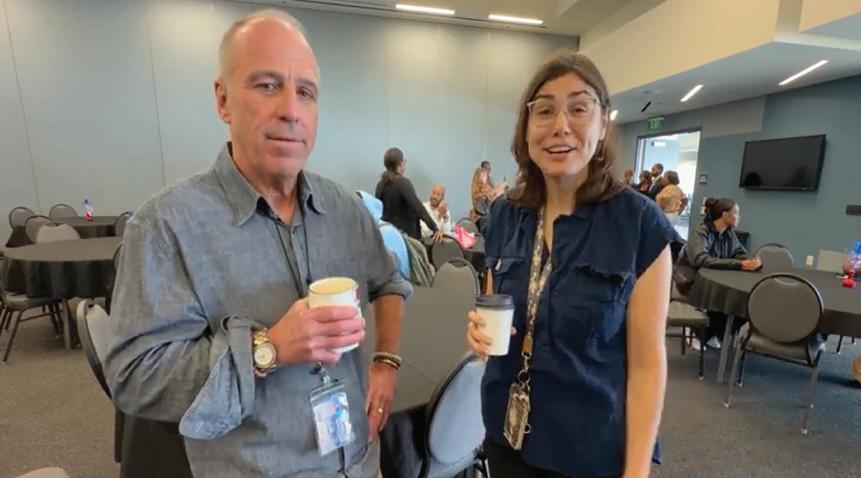
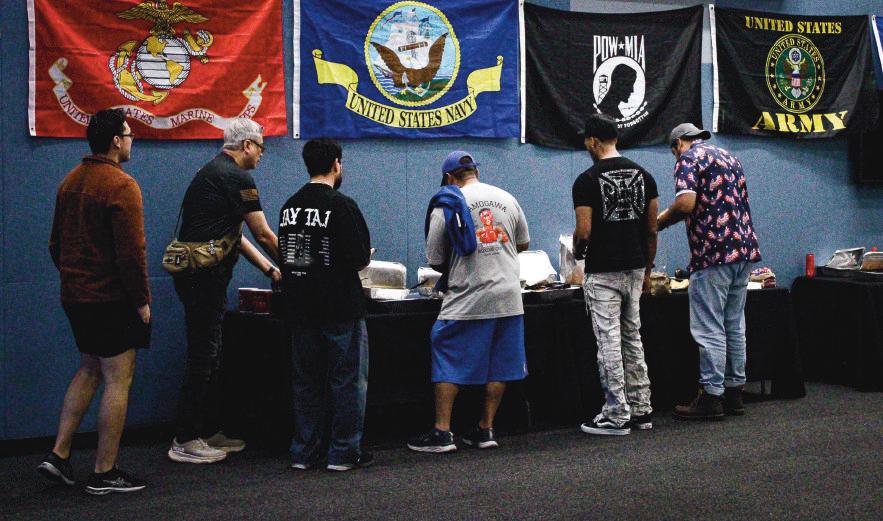
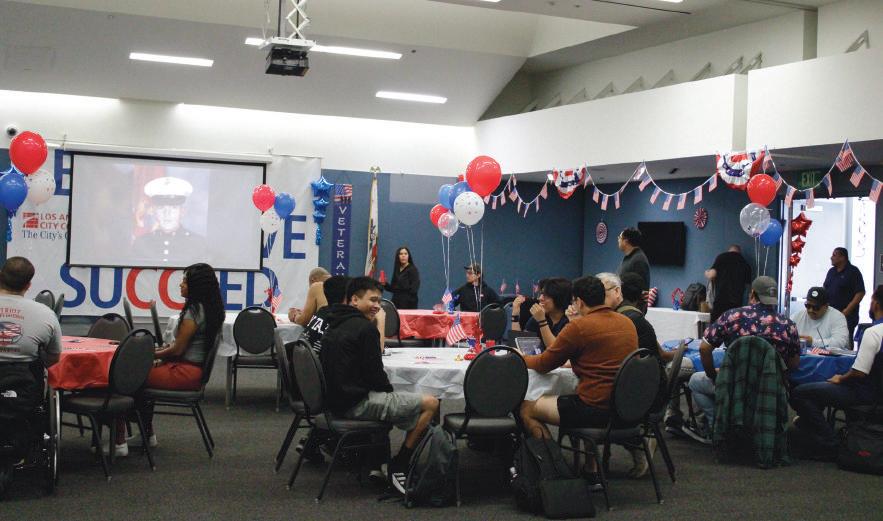
Lower: Red, white and blue balloons and banners create a festive atmosphere in the Multipurpose Room of the Student Union for a Veterans Day Celebration on Nov. 11, 2025.
DINE ON FREE THANKSGIVING MEAL
ASG and RESJC will host a Thanksgiving dinner giveaway to celebrate the Season of Sharing on Tuesday, Nov. 25, from 1-3 p.m., on the third floor of the Student Union Building. The holiday menu will include turkey potpie, side salad, cranberry sauce and more while the 200 meals last. LACC’s Dietetics Department is preparing the meals to support students during the holidays.
PHOTO BY DEANTHONY ESCALANTE
PHOTOS COURTESY OF LARISSA DALISAY
CAMPUS LIFE
Ready to Get Off Campus? Study
Abroad in 2026
AMY SHANK
LACC is proud to offer multiple opportunities for students to immerse themselves in a new culture while earning class credit through its 2026 study abroad programs.
The first is a three-week Spanish language program in Antigua, Guatemala during Winter of 2026. Students spend their mornings in immersive Spanish instruction and their afternoons exploring local history, food, and culture.
For more information, contact Prof. Ever Garcia at garciael@ laccd.edu.
In Spring of 2026, Anthropology Professor Brian Bartelt will lead a world-class field-program
based in San Jose, Costa Rica. This 15-day immersion takes students beyond the classroom to engage with local communities, environmental practices and cultural traditions in one of the most biodiverse regions on the planet. The experience culminates in a three-unit Anthropology course (Anthro 102: Human Ways of Life).
Apply by Dec. 19, 2025, to secure a spot. Scholarships and travel grants are available. For more information email Prof. Brian Bartelt at bartelba@lacitycollege.edu.
Students interested in global reporting can also apply to ieiMedia’s 2026 travel programs, which offer hands-on media training in eight countries in-
Thanksgiving 2025 Community Events
cluding France, Germany, Norway and Japan. Participants learn practical journalism and communications skills from award-winning instructors. Programs are open to all majors and accept applications on a rolling basis until spots are filled.
To attend a virtual info session or apply, visit ieimedia.com. Scholarships and grants are available.
From HBO to LACC: Joel Simon Talks Press Freedom Dec. 9
BY AMY SHANK
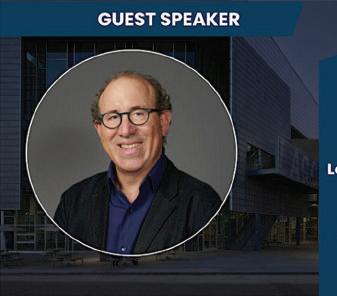
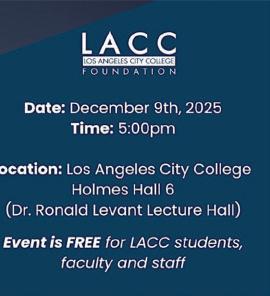
Students will get an inside look at the fight for global press freedom when journalist, author and free-speech advocate Joel Simon visits LACC on Monday, Dec. 9, for a free campus lecture.
Simon, whose work is featured in the Emmy-nominated HBO documentary “Endangered,” is one of the most influential voices in defending journalists worldwide. As the former executive director of the Committee to Protect Journalists (CPJ), he spent 15 years helping reporters under threat — launching CPJ’s
Emergencies Department, securing lifesaving support for at-risk journalists and working directly in global conflict zones. He now serves as a senior visiting fellow at Columbia University’s Knight First Amendment Institute and the Tow Center for Digital Journalism. A fluent Spanish speaker, Simon began his reporting career covering the Guatemalan conflict before spending a decade in Mexico reporting on the Zapatista uprising, political assassinations and environmental issues. His first book, “Endangered Mexico,” was named one of the Los Angeles Times’ “100 Best Books of the Year,”
and his most recent book, “The Infodemic,” examines how censorship and misinformation deepen global crises.
The event — part of the Nick Beck Investigative Journalism Lecture Series—will include a
Q&A and book signing. The first 40 students to arrive will receive a free copy of Simon’s latest book.
Visit https://tinyurl.com/ JSimon2025 to RSPV.
‘You Matter Here’: Senate Responds to Immigration Decision
BY AMY SHANK
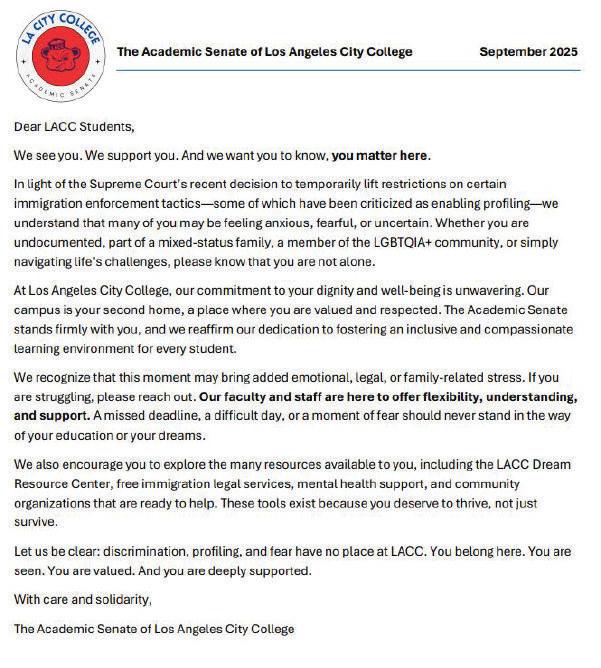
The Los Angeles City College Academic Senate has issued a public statement responding to the recent U.S. Supreme Court decision that temporarily lifted limits on ICE enforcement tactics — methods that critics say enable racial and identity-based profiling. The ruling allows federal agents to use factors such as race, language, job or location, including bus stops and workplaces, when conducting immigration enforcement. The decision has raised concerns across California campuses, particularly among undocumented and mixed-status students.
In its letter, the Academic Senate tells students: “We see you. We support you. And we want you to know, you matter here.”
The statement acknowledges that while many students may feel heightened fear or uncertainty following the ruling, the Senate remains committed to protecting students’ safety, dignity and access to education.
It encourages students to reach out for support and notes that faculty are prepared to offer understanding and flexibility. “A missed deadline, a difficult day or a moment of fear should never stand in the way of your education or your dreams,” the letter reads.
The letter states that discrimination and profiling “have no place at LACC,” reaffirming the college as a safe and welcoming environment regardless of immigration status, LGBTQIA+ identity or personal circumstances. It concludes by highlighting key campus resources — including
DON-A-MATRIX TAKES OVER WELLNESS DAY
BY LOU PRIMAVERA
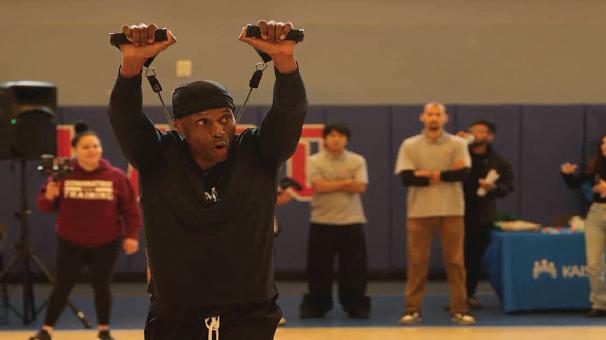
Students got the celebrity treatment last Thursday, Nov. 13, when they broke a sweat in the North Gym with DON-A-MATRIX Training during LACC’s Wellness Day. The event — part of LACC’s campuswide effort to promote health, balance and community — brought in Don “DB” Brooks, celebrity fitness trainer and creator of the DON-A-MATRIX Method. Brooks is known for working with the Kardashians,
Kanye West, Tyrese Gibson and professional athletes.
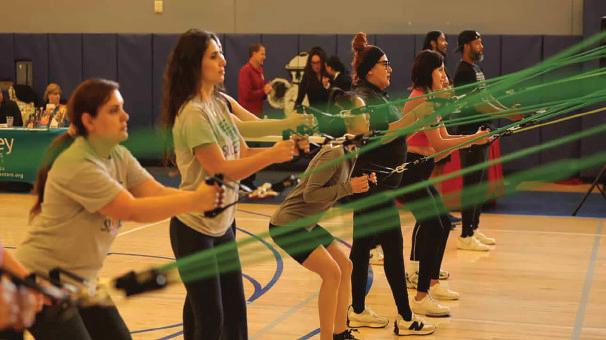
Those fortunate enough to snag a spot trained with the “Men’s Health 40 Most Popular Celebrity Fitness Gurus of All Time” honoree, following his signature resistance-band workout that became a global sensation for its mix of high-profile clients and mind–body discipline. The Wellness Day also featured a “half-time show” complete with a live DJ, free food and giveaways, making it one of the most high-energy events of the semester.
the Dream Resource Center, free immigration legal services, mental health support and designated undocumented-student advocates in each department.
Students can read the full statement, available in Armenian, Russian and Spanish, at lacc. edu/about/committees/academic-senate.
PHOTOS BY @LEESLENS_
Celebrity trainer DON-A-MATRIX was on campus to train students for a Wellness Day workout on Nov. 13 at the North Gym.
PHOTOS BY @LEESLENS_
The session pushes participants through high-energy drills designed to build strength, confidence and community on campus for Wellness Day on Nov. 13.
PHOTO BY FINE PHOTOGRAPHICS VIA UNSPLASH
The U.S. Supreme Court Justices' recent decision on immigration enforcement drew a public statement from the LACC Academic Senate.
PHOTO COURTESY OF HAAKON S. KROHN - OWN WORK, CC BY-SA 3.0, HTTPS://TINYURL.COM/BDRSNWHV
Monteverde Cloud Forest Reserve in Costa Rica.
Cubs Win Big
BY JORGE PONCE
City College has always been a place where students chase big dreams, but for years the campus felt incomplete without the sound of competition.
LACC has a long athletic history dating back to the 1930s, when the campus was known as Los Angeles Junior College and produced dominant basketball teams throughout the 1950s and 1960s. That legacy went quiet in 2009 when the college discontinued its sports programs. The silence ended in 2021, when LACC brought athletics back, restor-
SIDELINE PRESS:
ing a part of the school’s identity that many students and alumni had been waiting to see return. This season, that revival finally delivered its breakthrough moment.
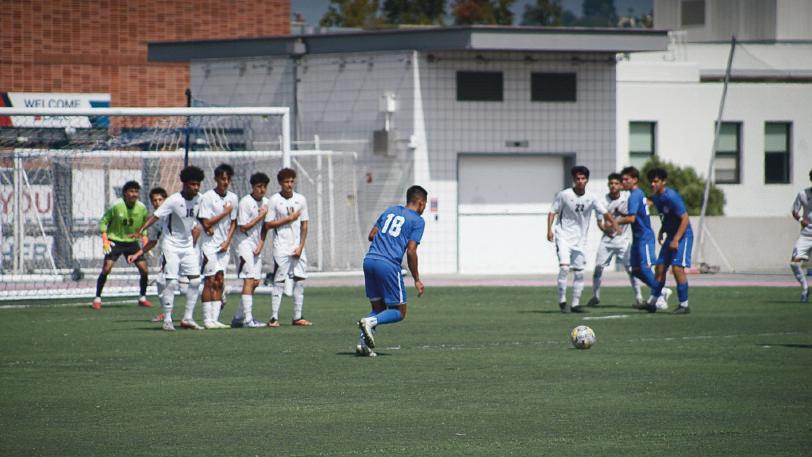
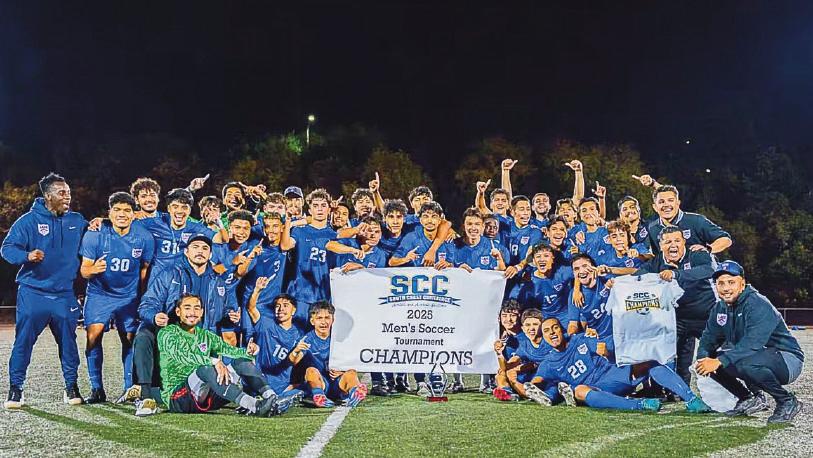
After a few years of rebuilding, the men’s soccer team captured the Conference Tournament Championship, the first major title since sports returned to campus. LACC defeated Mt. San Antonio College, 1-0 in a hardfought match that felt like the program’s long-awaited turning point.
“There definitely is pressure,” left winger Chris Morales said. “The school hasn’t gotten nothing and I’m glad that this year we can finally put something up there and hopefully for the next future years this makes a big impact for it.”
The win was more than a trophy. It signaled a new standard for LACC athletics. Nathan Aguilar, who plays left middle and left back, said he believes the championship will change the way the college promotes its athletes.
“I think for 100% it will, especially now that we’re being more recognized,” Aguilar said. “I think honestly our school is going to start posting more about sports, because now our sports are getting better over time and this is the time where they should be showing sports off more.”
For a campus with nearly a century of athletic history, one that once
stood among the most competitive junior college programs in the state, this title feels like both a return and a beginning.
“One thing I would want the Cubs to know is that it was just a lot of hard work,” said Daniel Rodriguez, center back No. 24. “Coming up to college or even just to play for the school, especially the summer training, which is nonstop conditioning, running, working out. Which was something I wasn’t really used to as their workout was completely different and more advanced.”
Rodriguez says even his communication skills improved in the process. He says the team talked on and off the field. Improving has always been part of their mindset. Four years ago, a member of the coaching staff had hope for the future.
“This is a very young reminiscent program that is trying to find its identity,” said Tupac Zapata, a member of the coaching staff in 2021. “We have a good generation of players, working their butts off, and hopefully we can win.”
If this championship is any sign, LACC may be stepping into one of the most promising eras in its modern sports history.
Kendrick Guzman contributed to this story.
Players from the women and men’s soccer teams reflect on the men's Southern Conference Championship win.
Do you think this championship will influence goals and expectations for you and the team?
“My expectation for the players next season is to come in with a really strong work ethic ... I think the players coming in next year need to have the expectation that they need to give it their all every single day in the classroom, outside the classroom, on the field, out the field.”
“Yes, 100%. I don’t think next year we're going to want to drop our level. If anything, we’ll want to get even better and just always keep increasing over the years.”
“Hopefully it can get me to the next season. I'm hoping to ride with these guys and hopefully to bounce out of here and go to a four-year.”
Do you think enough people know that the men's team won the confrence championship?
“No, I don’t think so, because since the sports program has been gone from the school for a very long time, it’s hard on all sports. People often don’t know that LACC has athletic programs in general, which feels a little bit of a slap to the face whenever people say that.”
“I would say yes and no. No, because as a junior college we are a small platform and often looked down upon or kind of pushed aside, but yes, because that's kind of like the new news around LACC. They have been posted on social media, the school newspaper, and the SEC website, and even [one of] my professor[s] had a picture of them on her whiteboard.”
“I feel like the school should ... put out their program ... maybe a bit more of exposure to it, so that way people know what support and stuff there is.”