The California Community College system enacted a policy in May that requires students pay enrollment fees within 48 hours of registration. Officials aim to combat a trend where AI bots fraudulently enroll in classes to steal financial aid. Through this, millions in financial aid has been diverted away from students with legitimate need.
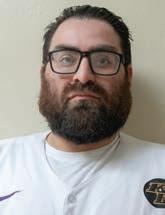
Cody Dellan, a second-year student at LACC had a strong reaction to the fee payment policy.
“It sucks,” Dellan said. “It is unnecessary and makes it harder for people.”
According to Insidehighered. com and reports obtained by Cal Matters, between September 2021 and January 2024, $5 million in federal aid was stolen.
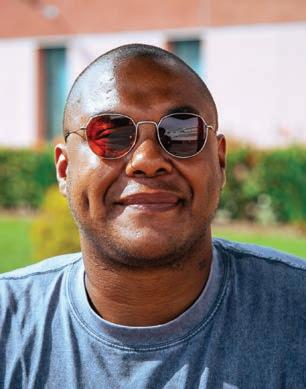
Vincent Harris, a first-year student, describes the fee policy as a "good thing.”
“People take advantage of the system,” Harris said. “Proper precautions need to be taken.”
The enrollment fee policy targets scam bots, but students late to pay for their classes are now facing unenrollment.
LACC’s Financial Aid Director
Pau Jansa said there are exceptions for students who are already receiving financial aid.
“One of the decisions is if a student is on financial aid, they get an exclusion code,” Jansa said. “In terms of these policies… they were excluded from being dropped. So they're not affected by the disenrollment process.”
Unsuspecting returning students may have found the deadline too strict.
“Returning students were more impacted,” Jansa said.
“[And] low-income students as well.”
Some community colleges are implementing new AI programs to detect scam bots, but not every college can afford a cyber gatekeeper nor the staff to manually sniff out bot applications. This leaves enrollment fees with strict deadlines as the default solution.
Jansa says there are safety nets in place for students in need of financial assistance.
Even students whose financial aid applications were still pending, Jansa says, were “excluded from being dropped.”
BY KLEN TORRES
estrictions that prevented President Donald Trump from using ICE (Immigration and Customs Enforcement) to target minorities for arrest or deportation were lifted by the Supreme Court with a 6-3 vote Sept. 8.
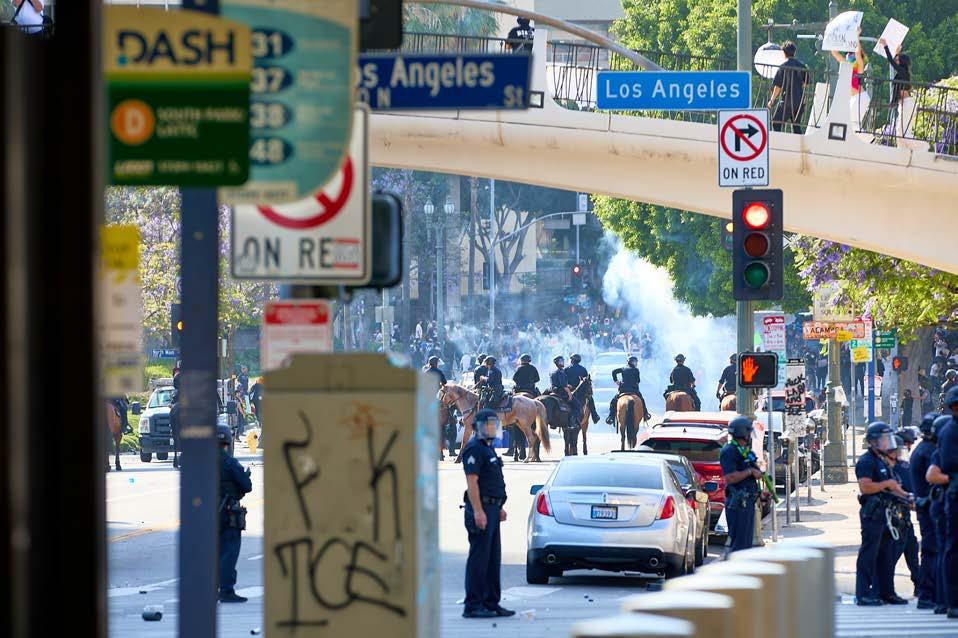
The court’s ruling allows the government to resume racial profiling in Los Angeles, a sanctuary city.
This decision from the Supreme Court makes it possible for
ICE to continue using four criteria to profile and detain suspected undocumented immigrants.
First, the apparent race or ethnicity of anyone who is stopped can be considered. Second, whether an individual speaks Spanish “or English with an accent” could also be a factor.
Third, ICE agents can consider the actual location where an individual may be found, like a carwash, construction site or bus stop. Fourth, ICE can weigh the kind of employment the person appears to have, whether it is day labor, construction, agricultural, childcare or janitorial work.
Supreme Court Justice Sonia Sotomayor expressed her dissenting opinion decisively.
“We should not have to live in a country where the government can seize anyone who looks Lati-
no, speaks Spanish and appears to work a low-wage job,” Sotomayor wrote. “Rather than stand idly by while our constitutional freedoms are lost, I dissent.”
Justices Ketanji Brown Jackson and Elena Kagan joined Sotomayor in dissent.
The decision made some L.A. City College students feel insecure. Maria, a child development major shared her concerns with The Collegian. (Maria’s real name has been withheld to protect her identity.)
“I feel scared at times just to go to work. Because I can be judged just because of my appearance,” Maria wrote in a letter to the newspaper on a crumpled piece of paper. “At times, I feel weird when they think I don’t speak Spanish. But I feel that nobody should be asking that type of
question: if you are undocumented?”
The Trump administration celebrated the decision as a “massive victory.” This means that the roving raids in Los Angeles by immigration officers can now resume.
In contrast, parts of the city have taken on a feeling of eerie quiet.
“This is a win for the safety of Californians and the rule of law,” DHS Assistant Secretary Tricia McLaughlin said on X. “ICE enforcement will not be slowed down and will continue to arrest and remove the murderers, rapists, gang members and other criminal aliens.”
Supreme Court Justice Brett Kavanaugh voted to have the restrictions on ICE removed.
COMPILED BY AMY SHANK
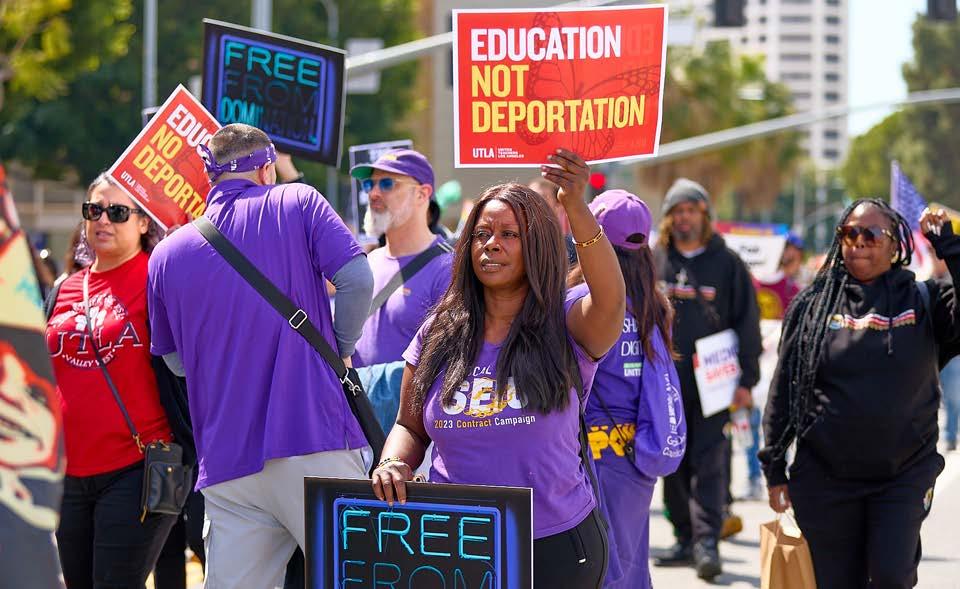
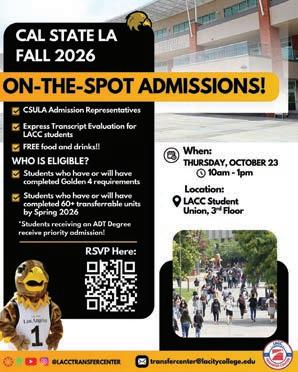
For the first time ever, Cal State L.A. will offer on-the-spot admissions to LACC students. You read that right: come to the third floor of the Student Union on Oct. 23, from 10 a.m. to 1 p.m.
Applicants will meet with a Cal State L.A. representative and could walk away with guaranteed admission. Students must RSVP. Use the link or QR code below. Complete a CSU application in the Student Services Building, at the Transfer Center on the second floor. Bring your transcripts to the event on Thursday, Oct. 23.
•RSVP LINK: https://tinyurl.com/ CSULAADMISSIONS.
Eligibility Requirements:
•Students must have 60 transferable units by the end of Spring 2026
•Completion or inprogress with Golden Four (A1, A2, A3, B4) courses
•Minimum: 2.0 GPA
The Student Voice of Los Angeles City College Since 1929
PHOTOS BY JUAN MENDOZA
OPINION & EDITORIAL
Soldiers Should Not Police American Streets
Tensions have been rising in America since Immigration and Customs Enforcement (ICE) raids intensified and President Donald Trump’s National Guard deployments began over the summer. I no longer feel that this is “the land of the free.” Sending armed forces and masked law enforcement into our cities is a direct threat to our people and our democracy. In June, as Angelenos protested ICE’s immigration raids, Trump deployed the National Guard and U.S. Marines to Los Angeles. The administration claimed the deployments were necessary to stop violent protesters and protect federal property. Both California Gov. Gavin Newsom and Los Angeles Mayor Karen Bass publicly criticized Trumps’s actions. They claimed the deployments were unnecessary and unconstitutional. Bass described the deployments as “a political stunt, a terrible misuse of taxpayers’ dollars” and likened the show of force to fearmonger-
Immigration Raids Destroy Families
BY JORGE PONCE
It is difficult to watch the immigration raids happening in our communities.
They are more than headlines or statistics. Behind the headlines there are people and families whose lives are being ripped apart. It is visible in minority communities such as Pico-Union. The fear is unimaginable: of being stopped and questioned, of being detained, of losing everything you have built. Many of the children are too young to understand why their parents are suddenly gone. They cannot understand the sudden emptiness of their homes, the silence that replaces their family’s voices in each room. That pain is devastating. The trauma of being suddenly separated from their parents will have lasting, negative impacts on these children’s mental and emotional development.
ing. She argued that local law enforcement could have — and mostly did — handle the situation on their own.
The estimated cost to taxpayers for this unnecessary deployment was about $134 million, according to the Pentagon. On Sept. 2, 2025, a federal court ruled that the Trump administration’s June deployment of troops to Los Angeles was illegal. By then, the administration had already decided to deploy the National Guard, supposedly to help lower crime rates in Washington, D.C. They also announced plans to send troops to Chicago, despite objections from Illinois Gov. J.B. Pritzker.
There are legal and philosophical reasons why America has long drawn a line between the military and domestic policing.
Legally, the Posse Comitatus Act of 1878 bars the Army and Air Force from participating in law enforcement unless explicitly permitted by Congress or the Constitution; Title 10 of the U.S. Code applies the same restrictions on the Navy and Marine Corps. Once the National Guard is called in to act as federal troops, as they were in L.A., the Title 10 restrictions legally apply to the Guard as well. This differs from their more common use as state forces under the control of a state governor; in that capacity it is not unusual for the Guard to assist law enforcement.
Why is it philosophically so important to separate federal troops from domestic law enforcement? Right at our country’s inception, our founders wanted to ensure that the military would not encroach on civilian control. Many of the grievances that led to the American Revolution were against abuses by the British military.
The military answers to the executive branch. While our police may have room for improvement, they theoretically answer to the communities they serve. When policing is left to the military, then their priorities will be those of the executive branch
rather than the communities served — making their actions more susceptible to political whims.
The principle of military and law enforcement separation has even made its way into our pop culture. At the risk of sounding flippant, the idea is well-captured by a character in the scifi classic Battlestar Galactica: “There’s a reason you separate military and the police. One fights the enemies of the state, the other serves and protects the people. When the military becomes both, then the enemies of the state tend to become the people.”
The Trump administration continues to announce plans to send the National Guard to even more cities, including Memphis and New Orleans. They claim these deployments will reduce high crime rates, but people in Washington, D.C., have reported that the Guard doesn’t go to the neighborhoods that really do need help managing crime. Instead, people report seeing National Guard troops enabling ICE, quietly protecting unthreatened federal buildings and assisting with landscaping.
The administration has suggested that its actions may be justified by the Insurrection Act, which allows presidents to use troops in emergencies. But this law is broad and vague, granting the president discretion to decide what constitutes an “insurrection.” Deploying the National Guard for nonviolent protests and neighborhood policing only serves to get Americans acclimated to living in a militarized environment.
Our leaders must fight Trump’s temptation to use the military as a tool for political theater. Keeping the military out of civilian law enforcement protects democracy. It ensures that our armed forces defend the nation against external threats, not against their fellow citizens. The more we blur this line, the closer we move toward authoritarian government.
The Supreme Court has now decided that Immigration and Customs Enforcement may continue to profile people in Los Angeles based on race and on other characteristics that are usually off-limits for law enforcement profiling. Anyone who may appear to be a minority immigrant, of any age, gender or condition has become an open target. These raids do not make our communities safer. They spread panic, break up families, and make people feel that no matter how hard they work, they can still be viewed as disposable. Fear takes over. Immigrants contribute to every corner of this country, building our neighborhoods, caring for children, running businesses, keeping our communities alive. And yet, the country they came to in search of the American Dream will punish them for simply living and trying to provide for themselves and their families. That is not justice. That is persecution.
targets. Reforming policies will work better than raids to keep families together and to promote both safety and economic success. Communities thrive when people feel safe, not when they live in constant fear. Every time a family is torn apart, every time a child wakes up to an empty home, a piece of our collective humanity is gone.
Immigrant families are resilient and are always willing to sacrifice and work tirelessly for their loved ones. I have seen the dreams they carry for their children — dreams of safety, stability and opportunity. Those dreams are being shattered overnight by raids that rip kinship apart without any hesitation. We should choose compassion over punishment for those who have become open political
It is not about politics; it’s about the people. People just like my immigrant parents, who came here to pursue the American Dream. Minority communities should not be viewed as criminals simply for wanting a better life. Until there is real compassion for humanity, the immigration policies of this country will fail every person affected by these raids. I write this not just as an observer, but as someone who sees the faces of fear and pain in the communities of individuals who are viewed as other or less than. It is written as a reminder that the cost of the constant invasion is more than sensationalized headlines; it’s lasting trauma, loss of trust in the American Dream and broken families. We must demand that local and national politicians change regulations and find policy solutions that work for everyone. Future generations depend on it.
LETTER FROM THE EDITOR
In this moment in American history, journalists are vital. Our responsibility is to inform the public with accuracy, context and well-researched sources. We take this seriously.
Today, reporters face more physical and professional risks than they have in decades. Individuals are being arrested or targeted for speaking out. Latenight TV talk show hosts are losing platforms over political jokes. In a time when integrity is being tested, The Collegian stands firm. Our promise to our readers is simple: We will report the truth without compromise.
For 96 years, The Collegian has been “the student voice of Los Angeles City College.” Since 1929, we have provided our community with journalism rooted in curiosity and accountability. Our commitment is to unflinching, fact-based news reporting that serves the students of Los Angeles City College and holds space for voices that might otherwise be erased. This is the work—because an informed campus is a stronger campus, and a free press is essential to democracy.
AMY SHANK
ILLUSTRATION BY MATTIA MILLAN
OPINION & EDITORIAL
CITY VIEWS
“Sadly, this is my first time hearing about that, and I think it's horrible that they can be profiled based on these things. Racial profiling is horrible in general, and I totally disagree with it.”
“I think that the justification upon our First Amendment versus our third Amendment has a lot to tie in with what's going on constitutionally against people of color, and how we are able to express ourselves and be able to express speech and express thought. And so it hurts to see that our government wants to take down our amendments and use them against us. I really don't have a political stance on this, but I definitely can say that our justice system is out of order right now, and we just need to find some way to clean up the mess.”
BY DAVE MARTIN
I never thought I would live to see the day that America would start to remind me of Nazi Germany. But that is exactly what is happening. Take a look around. Only the willfully blind could miss what is going on. Every day, it seems that more and more of our freedoms — freedoms that men fought and died for — are being taken away. People are being snatched off the streets of our cities. We have detention centers that resemble something close to concentration camps being set up all over the nation, where people are forced to live in appalling conditions. This should recall to all of us what hap-
“Yeah, I have heard of that actually. And I feel like it's obviously really racist and it just doesn't make sense for people in the government to be making those kind of decisions. Like, have we not learned anything in all these years of the U.S. history? I just think it doesn't it doesn't make sense, and I don't even know how they're getting away with it. And, yeah, it's really scary, actually, as a person of color.”
pened in Nazi Germany.
After Hitler was appointed chancellor of Germany, he didn’t want just some of the pie; he wanted all of it. And he was going to do whatever it took to get that power. On March 23, 1933, under pressure from Hitler and the Nazi Party, the German government passed what is called the Enabling Act. This allowed him to enact laws without the approval of Parliament. Under this act, people’s rights and freedoms were all but stripped away. Sound familiar?
Right now, this presidential administration is making similar use of executive orders to act without congressional approval, trampling on people’s constitutional rights and shrugging it off as if it were nothing. Lady Liberty’s torch, which once shone so brightly, welcoming immigrants from around the globe with the promise of freedom and a better life, has been all but snuffed out.
Since the creation of U.S. Immigra-
“Yes, I have heard about that Supreme Court decision. I think it is a step backwards from what the Civil Rights movement and other anti-racist legislation has done.”
tion and Customs Enforcement (ICE) in March 2003, many lives have been ruined. More than 200 people have died while being held in ICE custody, according to researchers at the University of Southern California. I don’t believe it’s an exaggeration to say that ICE’s current actions are starting to resemble those of the Gestapo or the SS, two brutal organizations that enforced the Nazi regime’s policies with terror, repression and genocide. And all of that happened because the men involved in those hellish organizations were carrying out the orders of their sadistic leader.
ICE’s thugs will now have access to the personal data of 79 million Medicaid enrollees, including home addresses and ethnicities, in order to track down those who may not be living here legally according to a June 17, 2025, report from The Associated Press. I believe this is a clear violation of people’s
“I think it's a disgrace, that it's racially profiling a group of people that are already marginalized and I think that's just wrong and inhumane. People are humans and we have rights, and what this administration has been doing and everything going on with the ICE raids is just…there are no words for this terribleness.”
constitutional rights. But the current administration doesn’t seem to care about such rights.
Not only does ICE go after illegal immigrants, but it ensnares people who have a legal right to be here too. Since the people being targeted are ethnic minority groups, it looks to me like an attempt at ethnic cleansing. Hitler murdered six million Jews because he claimed they weren’t true Germans. Right now, the very same thing is happening. People, even those who have the legal right to be here, are being uprooted and deported all because of bigoted views. It has been said that those who forget the past are doomed to repeat it. We are now caught up in events that have already taken place in the past, because we have forgotten the lessons of that past. It’s sad. Very sad. We have let a tyrant take control of our country, and now we are paying the price.
ART BY MATTIA MILLAN
TAUHID PRICE RADIOLOGY
TAYLOR DEVOUS PRE-NURSING
NAOMY ALLIED HEALTH
JUSTIN VASQUEZ FILM
WALTER GARAY THEATER
ARTS & ENTERTAINMENT
BY WILLIAM TORRES
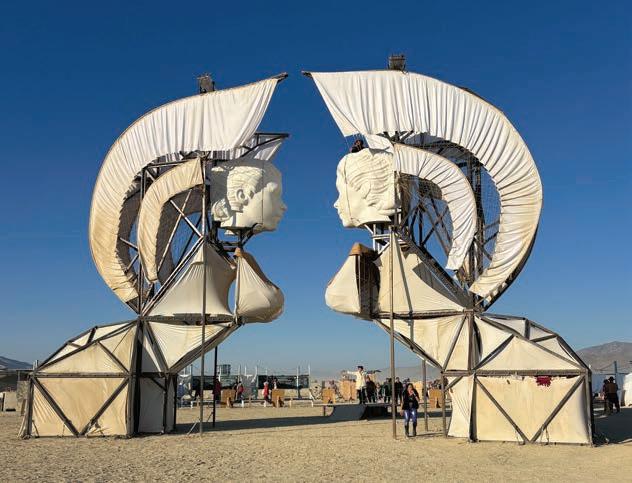
n alternate universe of joy, creativity and dust springs to life every year at the end of August when artists from around the globe gather in Black Rock City, Nevada, to create the utopia called Burning Man.
When you tell an average person about Burning Man, their automatic assumption is of an orgy of drugs, sex and loud music. While that exists in Black Rock City, Burning Man is more.
Andrew Chou, a United Airlines flight attendant, has attended Burning Man for three years in a row. He says it is the only time of year he feels like he belongs.
“I am surrounded by people who give freely — gifts, food, love and air — without expecting anything in return,” he said.
“For one week, [I] get to exist in a place where belonging isn’t earned, it is given, and being yourself is not strange, it is celebrated.”
For eight days, 70,000 Burners (the name given to Burning Man attendees) endure the harsh desert environment.
Temperatures can push 100 degrees, which makes riding a bicycle around the festival unbearable. There is no running water or electrical power available anywhere, and PortaPotties become every Burner’s best friend.
Burning Man is not staged at a five-star luxury resort. Yet tens of thousands of people from around the world, including major artists and architects, converge to transform the Nevada desert into a countercultural phenomenon.
Ben Romberger waited 19 hours in line to get in.
“I got in line at 11 a.m. on Saturday and stayed until 6 a.m. [Sunday],” Romberger said.
“This year was the longest I have waited to get into Burning Man, but we made the best of it.”
He and fellow Burners in line partied for hours into the night.
“While we were in line, people were getting out of their cars and RVs to walk around and hang with other Burners,” he said.
“Some of the bigger RVs had a DJ on top of their roof, playing some music. It was all part of the Burning Man experience.”
Patience was not the only virtue Burners needed. This year was also a test of nature. The
festival kicked off with 70 mph winds across Black Rock City.
The high winds ushered in two days of pouring rain, creating a total “whiteout” — a term Burners use to describe intense storms that reduce visibility to nearly zero.
The festival closed temporarily. It forced people to wait until the storm passed for the gate to reopen. Because of the rain, there was no more dust for the rest of the week.
The heavy winds destroyed major camps like “Orgy Dorm” and “Comfort and Joy,” both queer orgy camps. “Comfort and Joy” soon reopened after the storm, while “Orgy Dorm” remained closed for the week.
These were the exact same conditions as the famed 2023, “Mud Burn,” with most people stuck in their RVs or helping Burners camping out in tents.
Leroy Vook, known as Smash by fellow Burners, took in three stragglers trying to get their belongings out of the tent before they got covered in mud.
"With the wind, rain, and mud, it feels like we had three Burns in one," Smash said.
In the real world, people would write a scathing Yelp review, saying they never want to
return to the festival again. But Burning Man has its own unique charm. Burners must trust whatever nature provides in the desert, roll with the punches and continue to make the best of it.
The city came to life on Wednesday. Large-scale installations, which define the landscape and the collective experience, were on grand display throughout the playa.
Renowned DJs like John Summit and Benny Benassi mixed their sets, while celebrities like Emma Watson and Channing Tatum roamed as if they were just another person on the playa.
At the end of the festival, Burners ignited a giant 75-foot wooden figure, "The Man," and burned it to the ground.
All 70,000 Burners watched in astonishment. After, most spectators danced the night away until morning, then caught one of the most beautiful sunrises in the world.
Just as quickly as Burning Man went up, it came down.
One of the core tenets of Burning Man is Leave No Trace, which means leave no evidence of the 70,000 people in the middle of the desert, who had the time of their lives.
BY WILLIAM TORRES
Officials from the Pershing County Police Department in Nevada are investigating the death of a Burning Man festivalgoer, Vadim Kruglov, 37, after he was found lying in a pool of blood on Aug. 30.
Police have no suspect in custody for the Russian national’s murder. Police say Kruglov’s body was discovered at the event’s campsite “obviously deceased,” according to Sheriff Jerry Allen of Pershing County. Kruglov’s body was taken to the Washoe County Regional Medical Examiner’s Office where he was identified by his fingerprints.
“Mr. Kruglov was from Russia and came all the way to the U.S. to experience Burning Man for the first time,” according to the sheriff’s statement.
Deputies responded around 9:14 p.m. on Aug. 30, to a report of a man on the ground at the event’s campsite. The report came as the festival’s towering “Man” effigy began to burn. At press time, no suspect has been identified in Kruglov’s death, and motive remains unknown.
Strangers Deliver Baby Girl at Festival
While police searched for a murderer, a new life began at the Burning Man festival. A woman who did not know she was pregnant gave birth to a premature baby girl named Aurora in her RV early Wednesday morning, according to KBTX News. First responders transported her to a Reno hospital where doctors treated her in the neonatal intensive care unit. Authorities say the baby weighed 3 pounds, 9.6 ounces and measured 16.5 inches.
PHOTOS BY WILLIAM TORRES
ARTS & ENTERTAINMENT
BY EMILY GONZALEZ
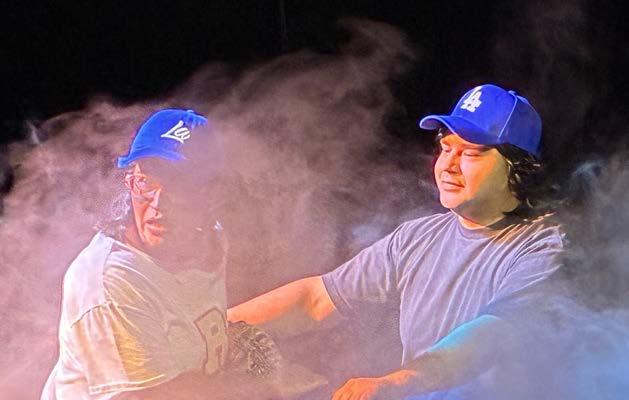
asa 0101 Theatre in Boyle Heights celebrates its 25th anniversary this year at the same time "Fernandomania" opened a play that marks the contributions of the legendary L.A. Dodgers' pitcher Fernando Valenzuela.
He was the most successful pitcher from Mexico in Major League Baseball history, and he changed the lives of Angelenos.
The production explores how Valenzuela’s rise shaped both baseball history and the cultural pride of Los Angeles’ Latino community.
For Casa 0101 founding director Josefina López, co-writer of "Real Women Have Curves," Valenzuela’s story is personal.
“For a lot of us, Fernando Valenzuela is a connection to our father and listening to the radio. Listening to the Dodger games with our cars,” López said. “It was also like a celebration of Latino men in this community, especially at a time when Latinos were being villainized. We're being vilified and made up to be the bad guys."
Valenzuela arrived in Los Angeles in 1980 and quickly became a sensation. His success helped soften the bitter history of Chavez Ravine, the Mexican American neighborhood that was cleared in the 1950s for public housing that was never built. Instead, the land was sold to the Dodgers, and Dodger Stadium was built on the site in 1962, leaving many evicted and displaced families, making them very sad to leave their community. The eviction brought lasting
scars.
For the community, the stadium symbolized betrayal and loss, as their homes were literally bulldozed. When Valenzuela showed up and became a superstar for the Dodgers in 1981, Mexican American fans felt like one of their own had finally “taken back” Dodger Stadium.
“Fernando himself was, like, an idol, role model, a person that we can relate to,” said Edward Navarrete, the actor who portrayed Valenzuela in the play.
“Mexican Americans and Mexicans started to tune in … when at times we thought we couldn’t see ourselves.”
While Valenzuela did not erase the history of evictions, his presence gave dignity and pride to people who had felt erased from that land.
Chavez Ravine was a vibrant, predominantly Mexican American community. Residents of the neighborhoods of Palo Verde, La Loma, and Bishop, who had built strong cultural communities because of housing discrimination elsewhere, were displaced. When the public housing project was canceled, the land was eventually sold to Walter O'Malley, owner of the Brooklyn Dodgers. The remaining families were forced out.
Ignacio Gonzalez is one of the writers of "Fernandomania," a series of 12 short plays about Latino families in the 1980s and ’90s who bonded around the pitcher’s rise.
“He became an icon back in a time when going viral was not that easy,” Gonzalez said. That celebration, he added, felt like reclaiming space.
“It was kind of like we’re taking back the land even though we’re not ignoring the history that happened.”
BY ERIKA RAMIREZ
"Demon Slayer" or Kimetsu No Yaiba in Japanese, became a successful anime since it aired in the U.S. in 2019, with only three seasons and two movies.
When the news broke that the Infinity Castle arc was set to be released in three movies every two years, the anticipation became heavy. Nobody could wait, as this is the final arc that will conclude the series. The anime has been riveting since its release because of its loveable characters, great story, and the amazing animation by the studio, Ufotable.
Crunchyroll streaming service promoted an early screening premiere of the "Demon Slayer" movie, released at the TCL Chinese Theater on Hollywood Boulevard on Sept
9. The English voice actors who helped bring the anime to life included Channing Tatum and the Japanese voice actor for the main character, Tanjiro Kamado, Natsuki Hanae.
Fans excitedly waited for pictures and a chance to talk to the voice actors. It showed how much this anime created a community, whether you are an anime fan or not. It just became such an influence across the world.
Ufotable producers did a good job on the animation with their intricate details of the breathing techniques and the background scenery. It captured the essence of the anime. It is amazing how much anime has come in decades where we get to see such a big time series going to the big screen, where fans can come together and enjoy with one another.
HISPANIC CELEBRATION MONTH
JOURNALISM PROGRAM
BY AMY SHANK
ontroversy abounds in the late-night talk-show landscape following recent moves of the Trump administration against prominent hosts Jimmy Kimmel and Stephen Colbert, raising concerns over political pressure on media and free speech. On Sept. 17, 2025, ABC suspended “Jimmy Kimmel Live!” after the show’s namesake made remarks about the killing of conservative activist Charlie Kirk.
“The MAGA gang is desperately trying to characterize this kid who murdered Charlie Kirk as anything other than them, and doing everything they can to score political points from it,” Kimmel said.
“Last Wednesday, we made the decision to suspend production on the show to avoid further inflaming a tense situation at an emotional moment for our country,” a spokesperson for the Walt Disney Company, which owns ABC, said in a statement to CNN. “It is a decision we made because we felt some of the comments were ill-timed and thus insensitive. We have spent the last days having thoughtful conversations with Jimmy, and after those conversations, we reached the decision to return the show on Tuesday.”
BY ANGELA JOHNSON
The Department of Communication Studies is the new home for the 96-year-old journalism program at L.A. City College. The change went into effect this semester, Fall 2025.
The journalism program, which includes public relations, is now under the umbrella of Communication Studies headed by Professor Sarah Crachiolo-Garcia, the department chairperson.
“The Communication Studies department is excited to work
with Journalism,” Crachiolo-Garcia said via email.
Among the 13 courses offered by communication studies, fundamentals like public speaking, critical thinking, forensics and communication and new media can significantly enhance journalism students' basic skill set.
Anticipating the digital revolution, LACC merged Fine Arts with Media Arts (consisting of photography and journalism) to create the Visual and Media Arts Department (VAMA) in 2016. By merging three disciplines
under one roof, they expanded course offerings that aligned with the digital media shift that was underway.
Daniel Marlos, retired photography professor, and former chair of the Media Arts department, considered that to be a positive move.
“By combining with the Fine Arts department we could share resources as well as have more power as a larger department,” Marlos said.
Now LACC is moving forward by adding journalism to the Com-
munication Studies department.
“The communications merger makes sense,” Marlos said.
L.A. City College is keeping up with nationally-acclaimed universities that recognize the symbiotic relationship between communication and journalism.
The University of Oregon School of Journalism and Mass Communication rests among the top 100 journalism schools in the country and shared Columbia Scholastic 2025 Gold Crown Award honors with the Collegian Times magazine.
The comments drew sharp backlash from conservative media outlets and affiliates, especially Nexstar Media Group and Sinclair Broadcast Group, which pulled the show from several of their stations. Regulatory pressure from the Federal Communications Commission also followed.
Loud protests from Kimmel’s supporters hit hard as well. Billions of dollars in losses, reports of users canceling their subscriptions to Disney’s streaming service, and a fall in Disney stock by 1-2% have investors wary, according to Deadline (deadline. com)
As of Sept. 23, ABC has gone back on their decision.
In July CBS announced the cancellation of “The Late Show with Stephen Colbert.” It is set to end in May 2026. The decision came shortly after Colbert criticized a $16 million settlement between CBS’s parent company, Paramount Global, and President Trump. Colbert called the settlement a “big fat bribe.”
“Should the government have a role [in late night television]? Mostly no,” said Professor Rick Morris of Northwestern University’s School of Communication. “Because we have the First Amendment, and the First Amendment protects speech in this country from government intervention.”
Following Kimmel’s cancellation, celebrities and artists, including Tom Hanks, Meryl Streep and Jennifer Aniston, signed an open letter, organized by the ACLU, in support of Kimmel.
Student journalists Jeremy Cuenca, Vanessa Kolb, Emily Gonzalez and Carla Williams accept the L.A. Press Club Award for Best Student Newspaper in the Southern California region on June 22, 2025 at the Millennium Biltmore Hotel in Downtown L.A.
PHOTO COURTESY WHITE HOUSE
BRIEFS”
PHOTO BY JUAN MENDOZA
CAMPUS LIFE
BY RALUCA TOPOR
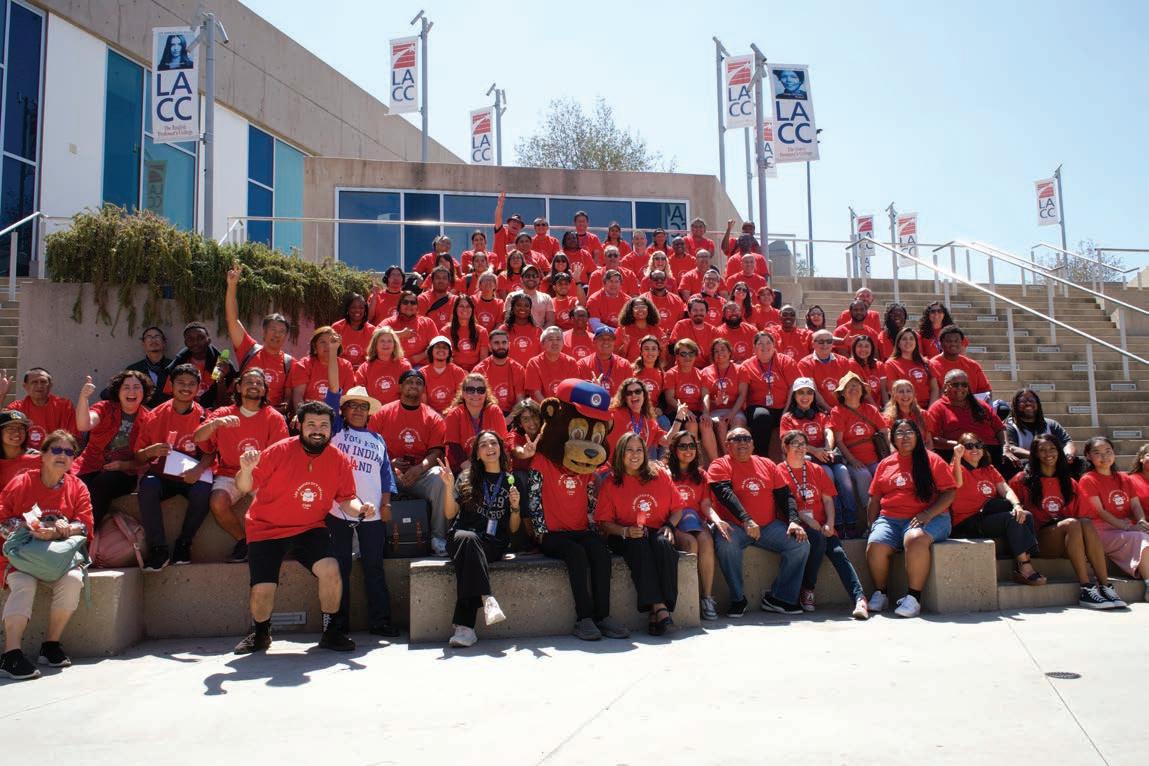
ore than 100 students and staff attended a midday celebration to mark the 96th Founder’s Day of Los Angeles City College on Sept. 9 in front of the Student Union Building.
Students waited in line to receive bright red T-shirts and ice cream from Associated Student Government members. LACC mascot Cubby drew a crowd as students approached him for hugs and a fun picture moment.
The event honored LACC’s nearly century-long role as a cornerstone of education and community in Los Angeles. The college offers more than 100
REPORTERS NOTEBOOK
BY DOREEN SANCHEZ
llow me to start by acknowledging that I am writing on ancestorial lands of First Nations, diverse groups of Indigenous peoples of North America, that thrived through their traditional way of harvesting and living in unison with the elements of life, water, fire, wind and earth. They should not be forgotten as the college community observes 96 years on Founders Day. I asked my professor if a Land Acknowledgement was included at Founders Day since LACC stands on the ancestral land of the Tongva, also known as Gabrielino and other First Nations from the Los Angeles Basin to Southern Channel Islands.
My professor and fellow classmates thought it was a good question and encouraged me to attend Founders Day to see for myself.
I arrived at the event a few minutes before it began. I scanned the space selected for the celebration. I asked a person with college credentials hanging from her neck if I could speak to the coordinator.
I met Dean Alvarez of Student Life. I introduced myself and told him that I was a student journalist, and I had a few questions about Founders Day.
It is understood that Los Angeles County recognizes that it occupies lands originally and still inhabited by Chumash,
Tongva, Tatavism, Serrano, Kizh and other tribes as well.
I explained to Dean Alverez that when I attended a meeting at the Board of Commissioners recently, they conducted a Land Acknowledgement prior to starting the meeting. Furthermore, I knew a Chumash Spiritual welcoming song, and I offered to sing it. He said he had been considering Land Acknowledgement for future events more appropriate. He gave me his email address and indicated that he wanted to have a conversation regarding land acknowledgement at a future event.
I explained to Dean Alvarez that I have watched buildings being demolished all around us here on campus and nothing has been done to acknowledge the historical sites with any respect to the years of students dreams and wishes; let alone the cultural depths of what it means to be good stewards of the lands.
Later, I put on my Tee-shirt with the logo that read: “You’re Standing on Native Land.”
I struggled within myself because I wanted to start singing after the group picture was taken. I chose not to sing the Chumash Welcoming Spiritual I know, but I still wonder what would have happened if I just would have started singing. I compromised my inner thoughts with chanting "Ice Out Los Angeles” and ‘Viva La Raza” holding my fist lifted proud.
academic and vocational programs for over 27 degrees and majors. LACC attracts students from across 70 countries, according to the college website.
The college’s 18th president, Dr. Amanuel Gebru kicked off the celebration.
“Today is our 96th birthday,” he said. “We’re excited to represent the community, our past, our future, [and] all the good things LACC does for our students. Our faculty and staff are phenomenal. We call ourselves the city’s college because we serve the city of L.A., and we’re proud."
For some students, Founder’s Day was an unexpected highlight. A second-year psychology student said he stumbled upon the celebration on his way to class. He reflected on the support he received during his first year, when navigating college life was
especially difficult.
“First year was a bit challenging and luckily there were people who told me about different resources,” he said. “L.A. City has so much to offer. Now it’s smoother sailing.”
With its 100th anniversary now on the horizon, Founder’s Day serves as both a reminder of LACC’s legacy and a preview of celebrations to come. In its 96th year, the celebration continues to strengthen the bond between generations of Los Angeles City College students and the community.
“It's so cool to see everyone united with a common cause,” said Angela Li, president of ASG. “To spread awareness, to make a more beautiful community, and improve the academic achievements of our students and school.”
PHOTO BY JEREMY CUENCA
PHOTO BY BEATRICE ALCALA
BY JUAN MENDOZA
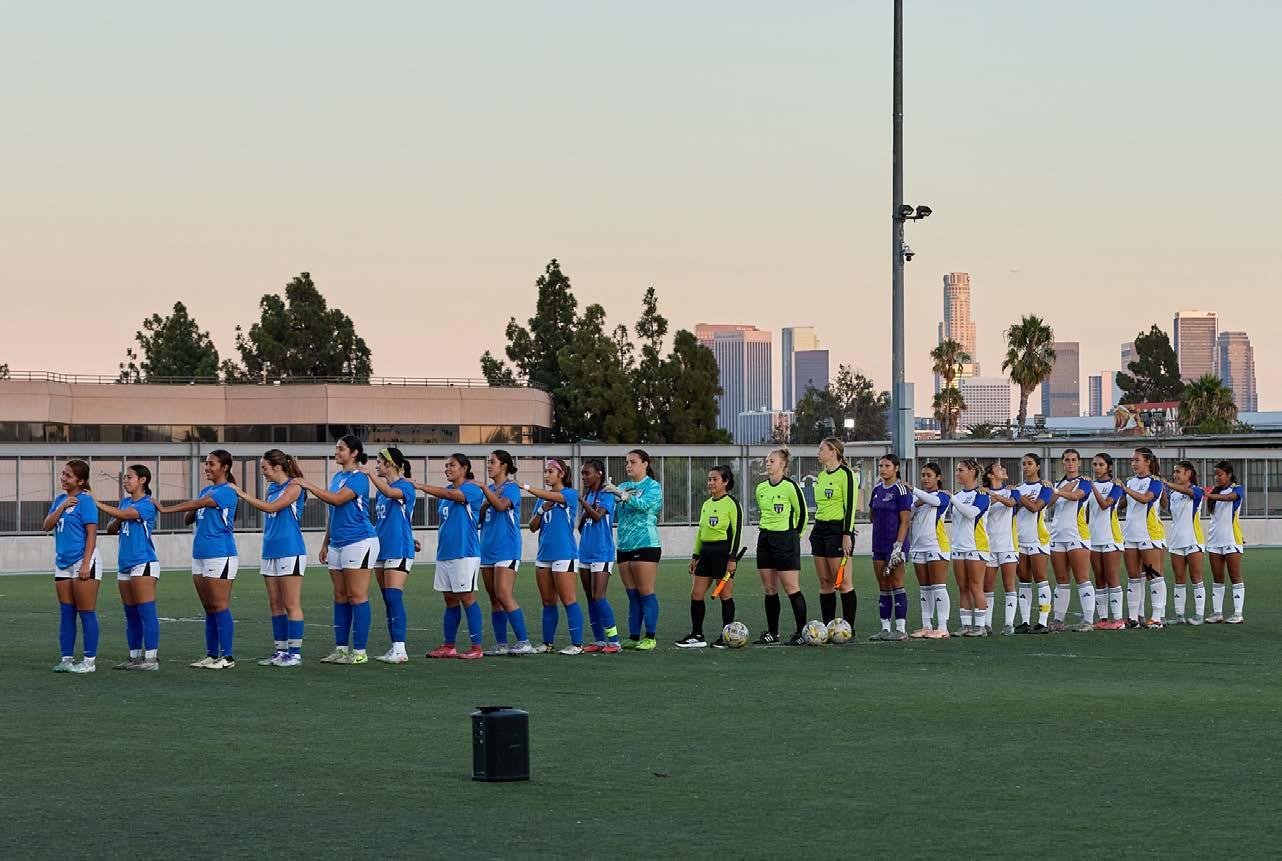
he Lady Cubs soccer team traveled to Lancaster on Sept. 19, for a tough match against the Marauders, the women’s soccer team from Antelope Valley College (AVC).
Being away from home was a disadvantage, and the Lady Cubs lost to AVC with a 3-1 final score in favor of the Marauders.
However, the Lady Cubs are learning and improving from the loss, using it as a growth opportunity. They continue to prepare for their upcoming games on the full Fall 2025 schedule, according to their social account.
The LACC official athletics site has listed games from last August and September and posted an overall win-loss-tie record (1-4-2) for the season. However, for the California Community College Athletic Association, this information is not officially published.
The season is still in its early stages, and the Lady Cubs are actively competing and gaining momentum. Some social media followers say that the team is resilient, has high morale, and focuses on development.
Team spirit and sports mindset is positive.
The team is active and focused on growth and improvement, demonstrating a positive team spirit.
As seen in one of their posts, “Better each day. Go Cubs!”
Over the season, she’s already racked up several service aces, including 3 in a match against Pierce College and 9 against Compton College in a recent game demonstrating her ability to score directly from the serve.
PHOTO BY JUAN MENDOZA
PHOTO BY JORGE PONCE
The Lady Cubs volleyball team bears down during a challenging month after the El Camino Warriors handed LACC a loss at home on Sept. 19, 2025. Abigail de Los Angeles (#14) looks for opportunity to set up plays or attack in the game against the Warriors.