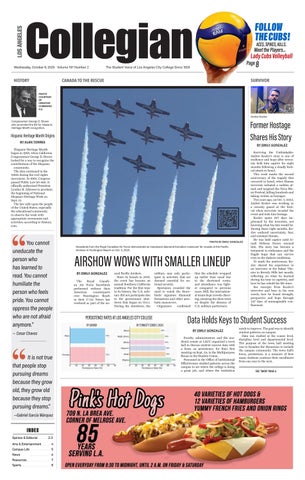
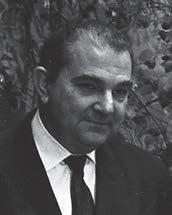
Hispanic Heritage Month began in 1968, when California Congressman George E. Brown looked for a way to recognize the contributions of the Hispanic community.
The idea continued in the 1960s during the civil rights movement. In 1968, Congress passed Public Law 90-498. It officially authorized President Lyndon B. Johnson to proclaim the beginning of National Hispanic Heritage Week on Sept. 15.
The law calls upon the people of the United States, especially the educational community, to observe the week with appropriate ceremonies and activities, according to History. com.
PHOTO BY EMILY GONZALEZ
BY EMILY GONZALEZ
The Royal Canadian Air Force Snowbirds performed without their American counterparts over Huntington Beach in their C-114 Tutors last weekend as part of the annual Pacific Airshow. Since its launch in 2016, the event has become an annual Southern California tradition. For the first time in its history, the U.S. military did not participate due to the government shutdown that began on Oct.1. During the shutdown, the military may only participate in activities that are deemed essential for national security.
Spectators crowded the sand to watch the Snowbirds’ signature diamond formations and other aerobatic maneuvers.
Organizers confirmed that the schedule wrapped up earlier than usual due to the shortened roster, and attendance was lighter compared to previous years. Still, the international teams kept crowds cheering, ensuring the show went on despite the absence of U.S. military performers.
BY EMILY GONZALEZ
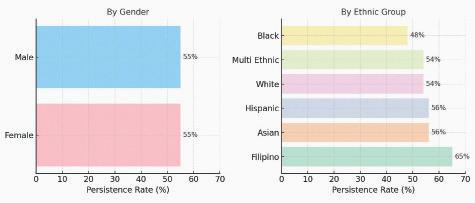
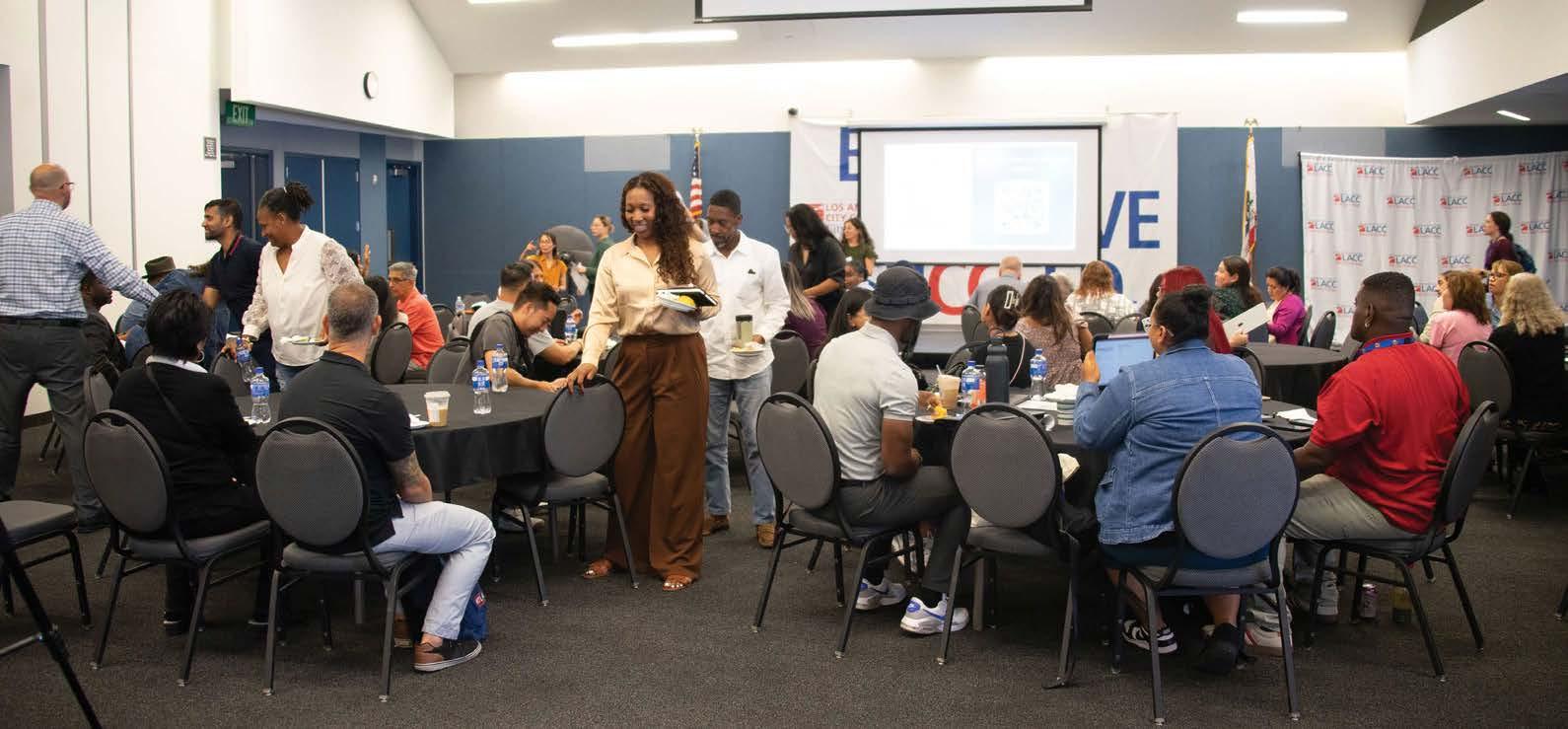
Faculty, administrators and the academic senate at LACC organized a town hall to discuss student success data with a focus on persistence, for their first meeting on Sept. 24, in the Multipurpose Room in the Student Union.
Personnel in the Office of Institutional Effectiveness studied patterns across the campus to see where the college is doing a great job, and where the institution
BY EMILY GONZALEZ
Surviving the Unthinkable:
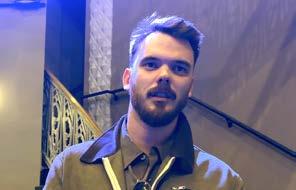
Andrei Kozlov’s story is one of resilience and hope after terrorists held him captive for eight months following a deadly festival attack in Israel.
This week marks the second anniversary of the tragedy that occurred in Israel, when Hamas terrorists initiated a sudden attack and targeted the Nova Music Festival, killing hundreds and taking victims as hostages.
Two years ago, on Oct. 7, 2023, Andrei Kozlov was working as a security guard at the festival when terrorists invaded the event and took him hostage.
Kozlov spent 247 days imprisoned by the terrorists, not knowing what his fate would be.
During those eight months, Kozlov endured uncertainty, fear, and constant threats.
He was held captive until Israeli Defense Forces rescued him. His story has become a testament to endurance and the fragile hope that can survive even in the darkest conditions.
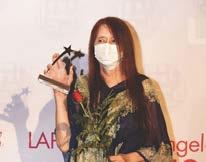
To mark the anniversary, Kozlov shared his experience in an interview at the Saban Theater in Beverly Hills last month, reflecting on what he learned during his time in captivity, and how he has rebuilt his life since.
See excerpts from Kozlov’s interview and hear in his own words, how he found strength, perspective and hope through 247 days of unimaginable confinement.
needs to improve. The goal was to identify student patterns on campus.
Data was studied at the course level, discipline level and departmental level. The purpose of the town hall meeting was to broaden the discussion to include the campus community. The town hall’s focus, persistence, is a measure of how many students continue their enrollment from one year to the next.
“DATA” PAGE 6
The Student Voice of Los Angeles City College Since 1929
PHOTO
HISTORY CANADA TO THE RESCUE SURVIVOR
Los Angeles Collegian - Wednesday, October 8, 2025
EDITORIAL
Hate Has No Place in Our America
OPINION & EDITORIAL
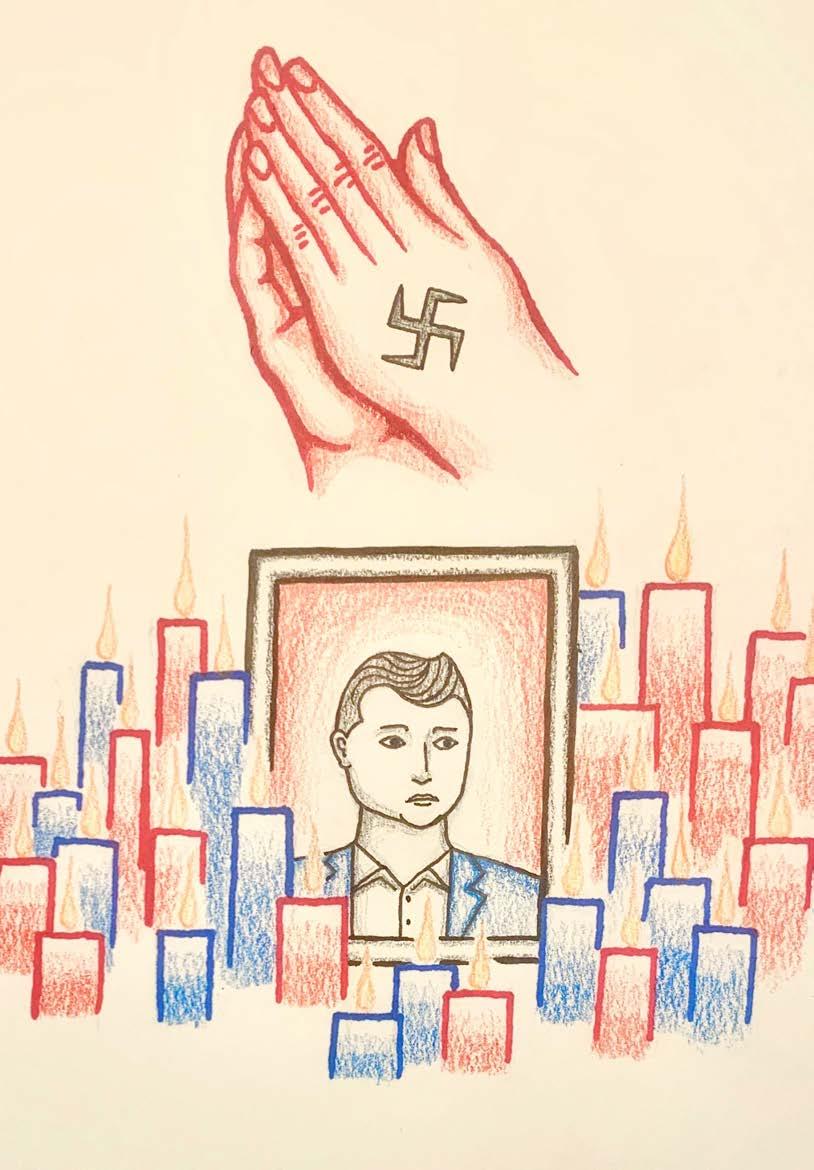
Thousands gathered recently at the Huntington Beach Pier to remember the life of conservative activist Charlie Kirk. Whatever you think about Kirk, vigils are meant to be spaces of peace, prayer and solidarity. Instead, hate showed its face in public on that day, unashamed, organized and loud.
The event drew extremists from the neo-Nazi groups Patriot Front and SoCal Active Club, who marched into the vigil chanting “White man fight back!” and set up a sign that declared “Crush the Left!” They handed out flyers urging people to “get involved today,” attempting to use a moment of grief as a platform for recruitment. They even handed flyers to children.
It is upsetting to see these white supremacist groups active, marching and recruiting, a reminder that hate still motivates people in our country. We can’t control what others do, but we can choose how we respond. We can refuse to normalize hate, speak up when we see injustice, and act with kindness and dignity in our communities. We can insist that it is not OK for hate groups to march into our public spaces and recruit the next generation.
Some in the crowd stood by and watched or remained silent, while others objected to their presence. It was a relief to see videos of some people at the vigil who did not accept these hate groups and told them to leave.
One marcher, addressing the crowd through a megaphone, said: “They killed Charlie Kirk because he loved Jesus Christ. They killed Charlie Kirk because he proclaimed that Christ is King. God bless Huntington Beach.”
It is appalling to see these groups attempt to exploit people’s religious beliefs by misusing faith to promote hate. God should not be used as a rallying cry to dehumanize others.
Their intentions were not to spread the Gospel or to promote mercy or loving one’s neighbors — in fact, they are doing the opposite of Jesus’ teachings. Those teachings are not about hate. They are about love for every person, of
Tylenol Misinformation Harms Autistic People, Pregnant Women
BY ERIKA RAMIREZ
President Donald Trump and Health Secretary Robert F. Kennedy Jr. continue to ignore the science and choose their own explanations for the spike in autism diagnoses over the past 20 years. At a Sept. 22 press conference, they claimed that acetaminophen, the active ingredient in Tylenol, causes autism.
Telling the public that acetaminophen causes autism is incorrect and irresponsible, and it harms both autistic individuals and pregnant women. It frames autistic people as mistakes to be prevented or cured, and it revives a cruel and false notion that mothers of autistic children have somehow failed or done something wrong to cause their child’s diagnosis. It also adds uncertainty and stress for pregnant women during an already stressful time.
Trump warned pregnant women not to take the drug despite its status as the only medication that is widely recommended for treating fevers and pain during pregnancy. He did not address the fact that fevers during pregnancy have been proven to cause
a higher risk of miscarriage, stillbirth and numerous birth defects.
While researchers have not found a causal link between acetaminophen and autism, there are some factors like parental age, illness during pregnancy and genetic factors that can make it more likely both that acetaminophen will be used during pregnancy and that a child will be diagnosed with autism. This correlation is what initially suggested a connection between the medication and autism.
But when scientists at Drexel University collaborated with Swedish researchers to look at siblings born to the same mother, where acetaminophen was used during one pregnancy but not the other, the results showed no association between acetaminophen use and autism diagnoses — indicating that the medication does not cause autism.
This aligns with what is already known about autism. “We have known there’s a big genetic component, and that genetics account for about 80 percent of the identifiable causes of autism,” said Judith S. Miller, an associate professor at the Center for Autism Research at Children’s Hospital of Philadelphia. We also know that the rise in autism diagnoses is largely because of increased awareness and an expanded definition of who can be diagnosed.
Even if, hypothetically, there actually was a connection between Tylenol and autism, that should not justify choosing to accept the well-known risks of leaving fevers untreated during pregnancy. Telling pregnant women that they can’t take Tylenol for a fever because their child might be autistic implies that it would be better to risk a miscarriage or having a child born with neural tube or heart defects than to have an autistic child. This implication is cruel and devalues autistic lives.
The mental and physical harm this will cause to pregnant people is also completely inexcusable. Our government should not be giving women confusing information during an already stressful time where getting the facts correct is so important. They should not be adding yet another way to shame mothers for being anything less than perfect.
No matter how you put it, these attempts to find ways to prevent and cure autism cause damage to the autism community even further. While there is more awareness, it is still being stigmatized.
Many autistic individuals are living in fear because of this administration. Even though the Trump administration wants to find a cure to erase autistic people, the autism community continues to stand strong.
every race.
Hate has no place — not in Huntington Beach, not on our campuses, not in our country. To be clear, the right to free speech protects expression; it does not grant a license to threaten or intimidate.
Let us not become people who blend in and accept hate as the norm. This is not about left versus right. It is about whether we, as a society, will tolerate hate parading as patriotism.
The City of Huntington Beach issued an official statement. The mayor’s office expressed condolences and praised residents for exercising their First Amendment rights “peacefully and respectfully.”
The statement said the city “reiterates its firm condemnation of dangerous political rhetoric,” but did not mention the white supremacists that were there. It did not directly acknowledge that neo-Nazis marched through the memorial, passed out recruitment flyers and shouted racist chants.
It is painful to see this take place here without the city’s full acknowledgment of the gravity of the situation. The majority of Huntington Beach residents surely oppose such hatred. But it raises the question of whether or not people of color can feel safe enjoying something as simple as a walk on the beach. Does being in this community mean facing exclusion from people who share the views of these white supremacist groups?
What do we do in response? Let’s look at what is happening on the ground and refuse to consent to people promoting hatred. We have to speak it plainly; hate will not win. Let us be kind and accepting of one another. Our future can be one where we stand shoulder to shoulder not in chants of division, but in defense of dignity. Where a vigil is not a place of manipulation. Where people have the courage to defend all of their neighbors by opposing hate groups wherever they try to gain a foothold.
If we do not speak, hate will. And if hate becomes the loudest voice, it will become the norm. That’s not a future we should accept.
IMAGE BY MATTIA MILLAN
OPINION & EDITORIAL
CITY VIEWS
A Visual Representation of The World As We Know It
"I think Trump trying to send the California National Guard into another state and territory is an infringement upon not only California's right to self-preservation, but also Oregon’s right to their own borders, because they have their own National Guard and their own troops dedicated for things that are deemed a statewide emergency. And as far as we know, and as far as we've been told, there is no such emergency happening in Oregon."
America’s Darkest Hour
BY JACK COOK
Since President Donald Trump took office for the second time on Jan. 20, 2025, America has experienced its darkest hour. Sweeping Immigration and Customs Enforcement raids in cities such as Los Angeles and Chicago have intensified, while groceries, rent and other basic costs have remained unmanageably high. Americans are expressing concern, and Trump’s approval rating is starting to slip among his own voters.
I am optimistic that this dark time will not last as long as many people fear. While Trump’s policies and executive orders have caused significant damage, the public backlash and voter dissent may lead to rapid political changes heading into the 2026 midterm elections.
Within the first year of the presidency, the Trump administration has enacted anti-immigration laws and stances with appalling consequences. One of the most disturbing elements of these raids is that, by profiling people based on perceived race, they have temporarily detained
"I think it's not necessary, because I think their government should be in control of what happens in their state."
"I think it's just a distraction to just prevent any accountability in the administration. Especially with the Epstein files and any other wrongdoings in the administration, all their distractions are from wanting to take text dollars and do budget cuts just to benefit the 1%."
"I haven't heard of Trump doing that, but I think that's stupid. I think he shouldn't be doing that. I think he should be keeping California's National Guard in California, and he shouldn't be sending troops everywhere. I know he's trying to make L.A. a military zone. And I feel like that is the most stupid thing that he could be doing. And I feel like it's a matter of time before he gets impeached or something."
"It brings a lot of stress and anxiety thinking about this stuff happening in many different cities. What can we honestly plan for our future, seeing how this world is changing, in new ways every day — and frightening ways."
Won’t Last for Long A Visual Representation of The World As We
citizens and legal immigrants.
The majority of the people who have been arrested are not violent criminals. The tactics deployed by ICE have caused considerable outrage, leading many observers to make drastic comparisons of ICE to secret police in Nazi Germany or the Soviet Union under Stalin.
In response, Trump’s approval ratings started to drop over the summer. Most reputable polls show his job approval rating in the low 40s or high 30s. That’s about the same approval rating that Trump had going into the 2018 midterms, which saw record voter turnout and a Democratic flip of the U.S. House.
Trump’s largest drop in support has been among 18- to 34-yearolds who voted for him in 2024. Pew Research found that from February to August, his approval rating among that group dropped from 94% to 69%.
Trump’s approval ratings are also dropping among Latino men, some of whom have been directly affected by ICE raids. A recent poll from Politico showed that Trump’s support amongst Latinos has fallen by 20 points.
One of the main reasons voters cited for choosing Trump in 2024 was inflation and the cost of living. But prices have stayed high, and tariffs are expected to raise them even higher. The issue
BY ISIS MALONE
What just happened in Nepal is not a chaotic uprising, but a necessary revolution that should serve as a stark warning to corrupt regimes everywhere.
The world should be paying attention, because this story isn’t just about a tiny country. It is about the devastating cost of a government that refuses to listen to its citizens, and it should make us question our own complacency.
Nepal’s Gen Z youth just orchestrated a lightning-fast social revolution. They did this because they believed that their government was actively robbing them of their
of grocery prices constitutes a major stress on the lives of more than half of Americans.
These two issues intersect: the immigration raids can also affect the price of fruits and vegetables. An estimated 42% of crop farm workers don’t have legal work authorization in the U.S. So the raids by ICE are not only a disturbing civil rights issue; they also can affect agricultural employment and thus will raise prices in the food supply chain.
Considering the damage that the administration’s policies and decisions have caused, it is not at all surprising that we’re now starting to see some of Trump’s supporters defect in polls. The very issues they elected him to resolve have not been fixed, and may have even worsened in the first months of his administration.
In the 2026 midterm elections next year, I think that that a massive change in government may happen at the ballot box. Trump’s request to Texas Republicans to redraw the state’s congressional map is evidence that Republican leaders are worried about this possibility. While America may be in its darkest hour; I’m optimistic that it won’t last long. Americans are seeing what a second Trump term looks like, and they have a say in what comes next.
Gen Z Forces Change in Nepal
future. The unemployment rate for those aged 15-29 in Nepal is incredibly high at about 20%.
While they struggle, the children of politicians — so-called Nepo Babies — live in luxury and go online to flaunt their wealth. They have been essentially showing off the money their parents extracted from the poor.
The Nepali government announced a ban of major social media platforms in early September. Gen Z immediately responded to the ban with protests that channeled their anger about corruption and the lack of economic opportunity.
Government security forces and police responded violently by firing live rounds into the crowds and killing at least 60 protesters.
But the violence didn’t stop Gen Z. In less than a week, they overthrew a two-party system that had become a corrupt, unmovable monolith. After the fighting quieted down, they put a “One
Piece” flag on a burning parliament building to symbolize their freedom.
The revolution was successful because they literally had nothing left to lose against a government that never listened anyway. They gave up their convenience and safety to demonstrate that they would no longer be pacified into submission.
Nepal’s corrupt leaders were forced to resign and even fled their homes via helicopter. The youth also demonstrated a stunning capacity for organizing and rebuilding.
On the messaging app Discord, they selected Sushila Karki, a respected former Chief Justice known for fighting corruption, as the new interim prime minister until elections are held. They overthrew and restored order in under a week without sacrificing their national unity.
This sparks a critical question in America, a country with greater political tension than ever
before. The real parallel between Nepal and America is this: rising inequality and the gross concentration of wealth among the ultra-wealthy. The top 1% of wealthiest households now hold about one-third of our country’s wealth.
Young Americans face soaring costs for housing, education and other basics while they watch the ultra-rich get richer. When polled, Gen Z tells researchers they want a government that actually solves problems, not one that treats youth engagement as a threat. Like the youth in Nepal, American Gen Z isn’t powerless. Nepal has set an example for us all. It reminds us that when a government fundamentally breaks the trust of its people, especially its youth, it shouldn't be surprised when the reins of power are forcefully taken back. We should pay attention before our own values, too, become lost to complacency.
INK STYLE
ALEXANDER NUNES
CRISTOPHER ORTIZ
AISANI WASHINGTON
LAMYEAA ALAM KENNY QUITERIO
IMAGE BY MATTIA MILLAN
PHOTOS BY BEATRICE ALCALA
COMPILED BY VANESSA KOLB
ARTS & ENTERTAINMENT
PREVIEW
BY CARLA WILLIAMS
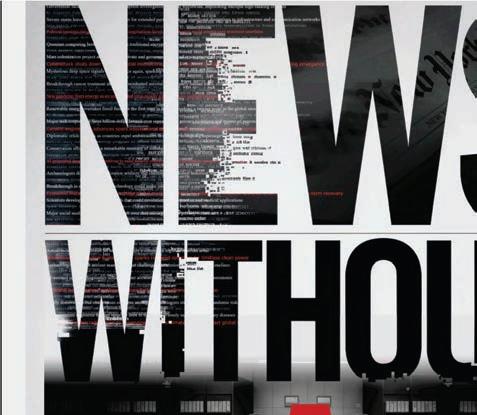
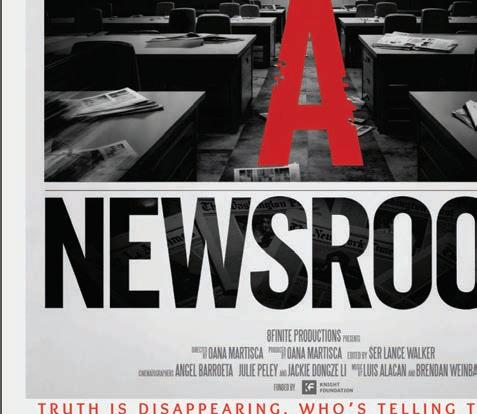
his documentary discusses the story of American journalism—how it grew, became powerful, and now is sadly fading away.
It focuses on the Miami Herald newspaper and is told through the memories of longtime reporters, editors, and critics, like Lizette Alvarez, Alberto Barguen, and Maggie Steber. It is not just about newspapers, but it’s also about the importance of the free press and its duty to help communities stay informed.
At the start, the movie shows how newsrooms used to be exciting places to learn.
Journalist Ira Rosen says, “I would never have been as successful as I've been in my career, had I not been working in an office.”
This means that being around other journalists in person helped people learn faster and work better together. Now, with fewer real newsrooms, that way of learning is disappearing.
The film also explains that journalism isn’t just another job—it’s a mission.
“Journalism is one of those jobs that's not just a job, it's a calling,” said Columnist Leonard Pitts, Jr. Reporters see it as their duty to find out the truth and share it, even when it’s hard or dangerous. They remind us that journalism’s purpose is to “find out what is real, what the truth is.”
Viewers get to see how reporters covered big moments
in history, like the Kennedy assassination, the civil rights movement, the opioid crisis, and the Boston church scandal. Journalists often exposed problems when other groups failed. But today, this type of serious reporting is harder to do because newspapers are losing money, and big companies are cutting jobs. One person in the movie even warns, “High-end journalism is dying in America.” Still, the documentary does not just look back with sadness. It also talks about today’s world, where anyone can share news online. This means there are more voices, but also more confusion, since it is harder to know what’s true.
In the end, the film is both a goodbye to the old days and a challenge for the future. It reminds us that real journalism is necessary for democracy. However, there is a poignant caveat from columnist Leonard Pitts, Jr.
“Democracy is, as they say, not a spectator sport," Pitts says. "It's a participatory thing. And to participate effectively, you've gotta be educated, and you've gotta have some sort of, you know, sense of what's going on around you in the world. And increasingly, large numbers of the American people are not -- they don't fit that description.”
“News Without A Newsroom,” will premier tonight at 5 p.m., in the Cinepolis Luxury Cinemas, in Inglewood, California, during the Film Festival at Hollywood Park. Get your tickets at www. NewsWithoutANewsroom.com.
BY LOU PRIMAVERA
ony Mucci is an emerging writer and director from New York City, known for his visually driven work in music videos for artists like Justin Bieber, Juice WRLD and Drake.
Now, the film festival circuit is focused on his artistry, as Mucci establishes himself as a gifted filmmaker with a clear and confident creative vision.
Mucci co-wrote "Money Talk$" with actor and producer David Mazouz. The Oscar-qualified short recently won "Best Producer" at HollyShorts and made a strong impression at the Tribeca Film Festival earlier this year. It is set in New York in 1981. The film follows a $100 bill as it passes between strangers and connects their lives through an unseen chain of consequence.
The film has all the elements to keep viewers engaged for its 30-minute runtime. Mucci and Mazouz expertly capture the gritty atmosphere of Reagan-era New York, as it immerses the audience
in the lives of the main characters. The $100 bill serves as a powerful link. It almost becomes a character itself as it moves between hands and guides the story through different worlds.
The film highlights the complex relationship between money and people. The combination of its time and concept makes it compelling.
The film sets its tone early as Francesca Scorsese plays a damsel in distress, who rides in a cab with an arrogant driver played by George DeNoto. As he speeds through the city, a $100 bill flies out the window. A grandmother finds it and later gives it to her grandson, Benji, for his birthday. As a kid would, he spends it at a corner toy store where the clerk, played by Mazouz, quietly pockets the bill.
Mazouz is soon revealed to be involved with drugs and in debt. A thug corners him in an alley and knocks out his teeth in a brutal New York '80s style pistol-whipping where Mazouz’s acting comes to life on screen.
Week 1: Slashers Unleashed
10/1- The Funhouse
10/2- Candyman
10/3- Friday the 13th Part 3 (3D)
10/4- A Nightmare on Elm St
10/5- Scream
10/6- The Strangers
10/7- Wes Craven’s New Nightmare
Week 2: Fangs, Fur, & Fear
10/8- From Dusk Til Dawn
10/9- An American Werewolf in London
10/10- IT
10/11- Army of Darkness
The bill then drifts into the underworld, moving from a dealer to a sex worker before landing with Cleopatra, an exotic dancer played by Zolee Griggs who does a great job displaying her vulnerability. Detached and unmoved by the money tossed her way, she receives an unwanted pep talk from the club owner, played by Bo Dietl.
The story later circles back to the cab driver, now on foot, who scoffs at a homeless veteran and tells him to “get a job.” Cleopatra overhears and quietly hands the man the $100 bill. In the final scene, she returns home to her son, Benji, who had unknowingly spent that same bill earlier. With a hint of irony, she says, “Wait, don’t tell me you blew all the money Grandma gave you on these toys.”
The plot is strong and original, but what makes the film stand out are its themes of duality and human nature, revealed through the bill’s turbulent journey across the city. In one of the last scenes, the narrator, Benjamin Franklin,
breaks the fourth wall and comes to life during a close-up of the bill. These final moments delivered through Franklin’s narration really highlight Mazouz and Mucci’s vision and genius. Franklin’s narration sharpens as the film nears its end, coinciding with Cleopatra’s return to her apartment.
“I find it curious that an industrious person should give charity, for a penny saved is a penny earned. Nothing reveals character quite like money. It’s what you do that determines who you are, so why give charity?" Franklin remarks.
“Well, when you are good to others, you are best to yourself.”
His final words help close the film: “Remember, happiness is fleeting, and the mark you leave on others just might live forever.” Mucci and Mazouz’s "Money Talk$" captures New York at its worst, delivers an entertaining ride and, in a feat difficult for any director to pull off, ends by adding a wholesome touch to a gritty story.
Week 4: Monster Mash
10/12- Sleepy Hallow
10/13- Silver Bullet 10/14- Creepshow
Week 3: Unholy Forces
10/15- Prince of Darkness
10/16- Final Destination
10/17- Hereditary
10/18- The Exorcist
10/19- The VVitch
10/20- Tales of the Crypt: Demon Knight 10/21- Event Horizon
10/22- The Invisible Man
10/23- The Wolfman
10/24- Dracula
10/25- Frankenstein
10/26- Creature from the Black Lagoon
10/27- The Mummy
10/28- Bride of Frankenstein
Week 5: The Dammed & the Doomed
10/29- The Ring
10/30- Rosemary’s Baby
10/31- Halloween III: Season of the Witch
CAMPUS LIFE 5
BY JORGE PONCE
hen I think about Hispanic Heritage, I see it as so much more than just a celebration. It’s a rich narrative that stretches back for centuries and keeps evolving every day. It’s really about the people, their challenges, their triumphs and the culture that has influenced our communities and shaped the history of this country.
Hispanic Heritage has its roots in blended cultures. From the Indigenous civilizations that built great empires long before the Europeans arrived, to the Spanish and African influences that came later, our heritage weaves together a story of survival and creativity. The languages, foods, music and traditions all carry fragments of those histories. Folklórico dancers and mariachi
music reveal a culture created from generations of resilience. In 1988, Hispanic Heritage Month was extended to run from Sept. 15 to Oct. 15. Those dates
mark the independence celebrations of several Latin American countries including Mexico, Chile and Costa Rica. They remind us how interconnected our histories
are across borders. Hispanic Heritage isn't simply a month on the calendar. It’s about holding onto family stories, the recipes passed down
through generations, and the values of hard work and community. It’s also about honoring the leaders and everyday heroes - activists who stood up for civil rights,
farmworkers who demanded fair treatment, artists who brought our voices into the spotlight.
The history of Hispanic Heritage is still unfolding. Each generation adds their own chapter. Whether in education, politics, sports or the arts, Latinos are continually influencing American identity. Hispanic Heritage celebrations in classrooms, universities and communities give me a sense of pride knowing it’s not just facts in a textbook— it’s living history.
It lives in the dishes shared during family reunions; in the music and dance forms descending centuries; in stories of lore passed from parent to child to grandchild. It resides in the values of sacrifice, discipline and community. It is seen every day through the success of Latinos across all realms— politics, sports, academia and culture.
Hispanic Heritage Month is a time for students to think critically about issues of identity, history and community pride. Honoring Hispanic Heritage keeps our story alive. We cherish the traditions and make sure the next generation understands they are a part of something powerful, beautiful. It is a reminder that this legacy is not simply about paying homage to the past, but creating the future.
Each generation writes new chapters of a story that reflects the evolving nature of the broader American experience.
BY KLEN TORRES
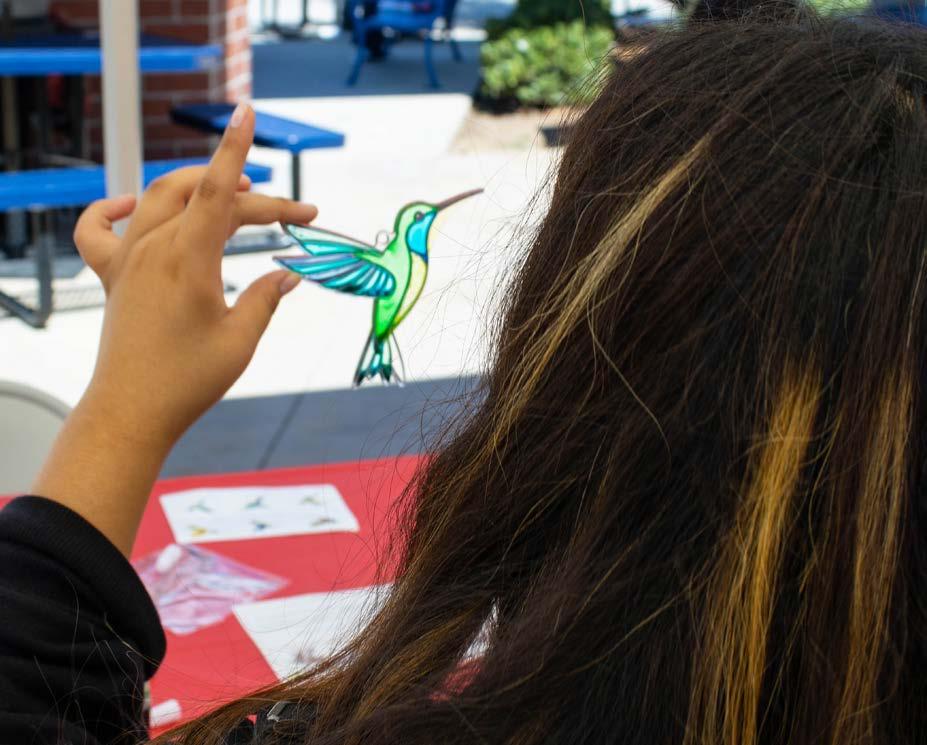
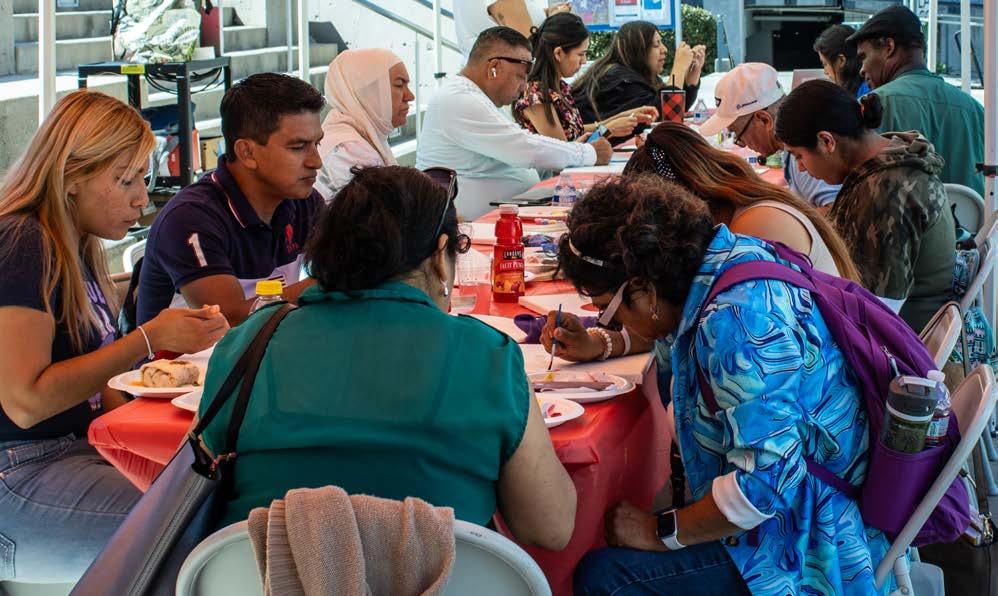
ttendees from all different backgrounds came together for the “Express Your Roots: Hispanic Heritage Craft Shop” to mark Hispanic Heritage Month during a sunny campus gathering at Los Angeles City College on Oct. 1.
The event, meant to honor culture and the community, invited students to get artistic with handmade ceramic flowers, multicolored beads, watercolors and crystal hummingbirds.
One student, who had returned to LACC after 12 years, praised the college and said it has prospered. She thanked LACC for the chance to relax and celebrate.
Students lined up for an opportunity to participate. They waited their turn to take a seat at one of the long banquet tables draped in red tablecloths. Once seated, they told stories about how the colors used by Frida Kahlo had a place in their living room as they grew up. One film major remembered how his aunt created needlepoint when he was a child, as he painted small ceramic flowers.
The event also served as a safe space for participants to reflect and think about what it means to be of Latin descent. Some students painted abstract images on canvas while they shared personal stories.
COMPILED BY AMY SHANK
Los Angeles City College will host the following events to celebrate Hispanic Heritage Month. All events are free and open to students. Directions to campus and access information are available at lacc.edu/about/map.
Intergenerational Wisdom in Di cult Times with Dr. Cesar Cruz ursday, Oct. 9, 12:45 p.m. — HH 6
UndocuScholar Week of Action
Faculty & Sta “Meet the DRC” Monday, Oct. 13, 10-11:30 a.m. —
SSB 272
“In Los Angeles, it’s easy to see it all around you, but then you don’t really see people who look like you in movies and TV shows,” said Administrative Assistant Kathy Mesa who works in the counseling department. “So it’s interesting because you see it around you in real life but then you don’t see it on TV. So, I feel there should be more representation.”
For an entire month, L.A. City College observes Hispanic Heritage Month. The college is a Hispanic serving Institution meant to “create an opportunity for Latino students to receive a higher education and graduate through effective strategies,” according to the National College Attainment Network.
Oct. 13-17 include more programs that support undocumented students with workshops like “Know Your Rights and Safety,” “Pathways to Citizenship,” and “Navigating International and Domestic Travel as a Non-Citizen.”
For more information on the workshops and other resources, visit the Dream Resource Center on the second floor of the Student Services Building and ask for a DRC counselor at the counseling window. Hispanic Heritage Month is a celebration that goes beyond lively music, great food, and togetherness. It’s about honoring the lived experience of millions of people whose roots run deep in this land long before colonization and the signing of treaties. It’s a moment to acknowledge both struggles and resilience that have shaped the community across generations.
CARECEN Pathways to Citizenship, Oct. 15, 3 p.m. — Virtual via tinyurl. com/pathcitizen
CARECEN Know Your Rights and Safety Planning, Oct. 16, 12:30-1:30 p.m. — Virtual via tinyurl.com/ kyrplans
CARECEN Navigating International and Domestic Travel as a NonCitizen, Oct. 17, 2 p.m. — Virtual via tinyurl.com/travel725
Celebrating Cuentos with Conchas and Co ee
Tuesday, Oct. 14, 12:45 p.m. — SU Stairs
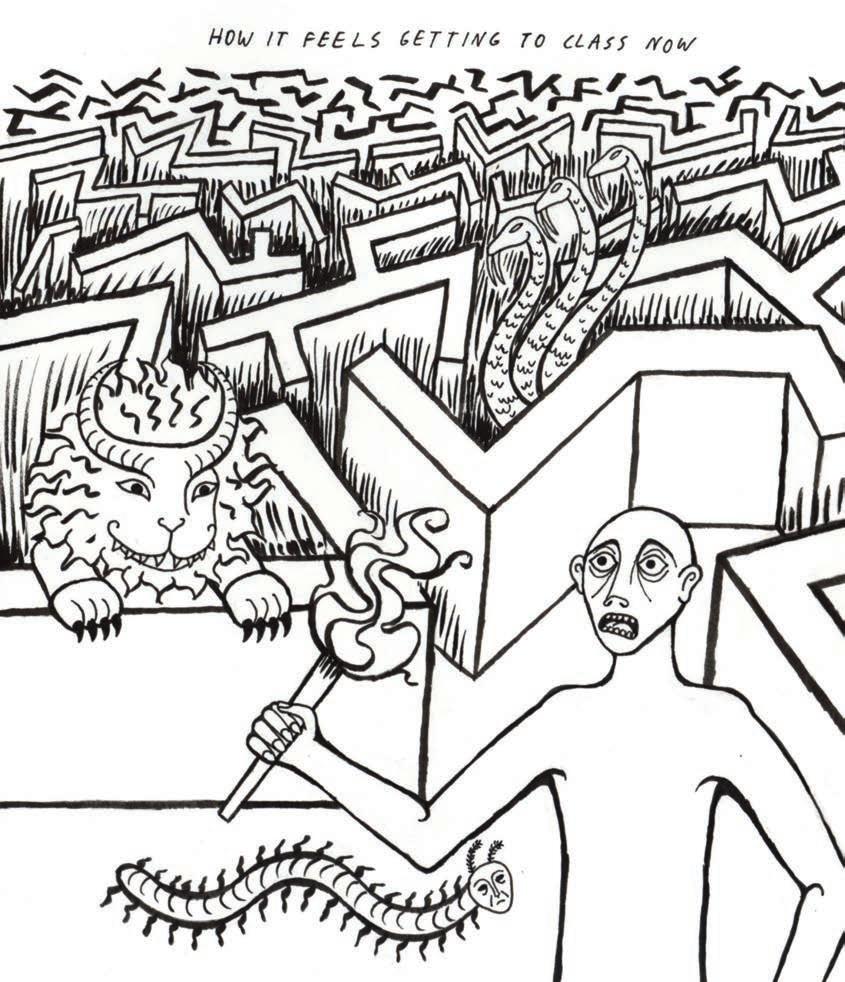
ILLUSTRATION BY JORGE PONCE WITH A.I.
PHOTO BY KLEN TORRES
PHOTO BY KLEN TORRES
“So this time, it was focused on persistence and it's primarily because that tends to be our weakest metric,” said Anna Le, the academic senate president. “Other metrics that will be looked at in the future meetings will be transfer rates, enrollment, and completion in terms of awards.”
The commission responsible for accreditation of the community colleges in California requires institutions like LACC to collect, analyze and report on persistence and other data. It is part of the criteria for the Accrediting Commission for Community and Junior Colleges (ACCJC).
Every year, colleges use this data to track progress and support student success. Colleges submit data every year to
ACCJC about persistence, retention, course completion, and completion of degrees, according to the accrediting commission. Member colleges produce data on persistence every year.
Vice President of Academic Affairs Sobia Khan says colleagues from the Office of Institutional Effectiveness and the Academic Senate have opened up to help faculty and staff in all areas to learn about persistence.
“We learned that persistence matters, the ultimate goal is building a culture that makes data informed decisions,” Dr. Khan said.
Organizers of the meeting admit that persistence is a weak metric for Los Angeles City College, however noncredit data emerged as a strength.
Noncredit data demonstrated 95% of LACC students persisted and had a 75% increase in enrollment from 20212022.
In degrees and certificates, associate degrees have increased 12% since 2021-2022, but noncredit rose 95% for the same period.
Professor of Noncredit and Adult Education Kimberly Guppy says good service and addressing student needs can lead to success and above all, word of mouth is important.
“It is important for the community to share resources that have helped them and for new students to know the resources available to them,” Guppy said.
While most students continue their studies each year, many do not. The American Council of Education (ACE) reports that across community colleges, financial pressures, family responsibilities, and lack of academic support are key reasons students drop out of classes.
Other contributing factors are work responsibilities that conflict with their studies and make it difficult for students to stay enrolled.
Doreen Sanchez contributed to this story.
“Continue the flexibility, encourage completion of certificate and evening courses.” Guppy says you have to let students know they matter, and that students’ goals are the essence of this campus.
PHOTO BY JORGE PONCE
COMPILED BY KELIYAH WILLIAMS
PHOTOS BY COLLEGIAN STAFF
RESOURCES
Scholarships
Gives one student (high school or college) $40,000 to help with expenses, no essay required.
Winner determined by random drawing and notified by e-mail.
Requirements:
Must be a high school or college student, or looking to attend college or graduate school in the next year
Must have U.S. citizenship of valid Visa/U.S. Passport
Only one (1) entry allowed per person/email address/household
Requirements: Must be of Hispanic heritage and a U.S. citizen, permanent legal resident, or DACA recipient
Plan to enroll full-time at a four-year institution
Minimum 3.0 GPA for high school students or a 2.5 GPA for college students
https://www.hsf.net/ scholarship
Provides Up to $25,000 scholarships to selected students.
Requirements: Must be undergraduate students
Plan to enroll in an accredited two- or four-year college, university, or technical/ vocational school
Minimum GPA of 3.0
Must demonstrate financial need
Must be involved in community service activities to be eligible for this award
Recommendation by a teacher, coach, community leader, or mentor required
https://www.chick-fil-a.com/ community-scholars
eQuality Scholarships: Offers scholarships for LGBTQ+ and ally students in Northern and Central California who are enrolled in community college and plan to transfer.
Requirements:
Demonstrate service to the lesbian/gay/bisexual/ transgender (LGBT+) community Plan to attend an accredited U.S. post-secondary institution (college, university, or trade school) for the first time in 2025 https://www. equalityscholarship.org/
Available to students who plan to transfer from a California community college to a four-year university.
Requirements:
Must be a California resident or meet AB540 eligibility criteria
Need to demonstrate financial Income and assets must fall below certain thresholds
Must maintain Satisfactory Academic Progress (SAP) as defined by your institution
Must be enrolled or planning to enroll at least half-time in a program leading to an undergraduate degree or certificate
Cannot be in default on any student loan
Additional requirements remain for certain specific programs https://www.csac.ca.gov/ california-student-opportunityand-access-program-cal-soap
Available to high school seniors and community college students pursuing a degree in computer science or a related field. Includes a paid internship opportunity.
Requirements:
Provide a copy of the most recently filed 1040 tax document for your parent(s) or guardian
Required to submit short essays and a letter of recommendation
Minimum 2.3 cumulative GPA on a 4.0 scale
Plan to attain a bachelor's degree in computer science, software engineering, computer engineering, or another computer science-related field from an accredited 4-year college or a 2-year college with plans to transfer
Must complete or be currently enrolled in a high school or dual-degree course in computer science or engineering
Must demonstrate financial need to support your college education
Authorized to work in the U.S https://www. amazonfutureengineer.com/ scholarships
Offers scholarships to high school seniors and employees of
Burger King restaurants to assist with higher education expenses, including those at community colleges.
Requirements:
Must be a U.S. citizen, Canadian citizen, permanent resident, or DACA student
Must be a high school senior or team member
Planning to enroll full-time in the upcoming academic year at an accredited college, university, or vocational-technical school
Minimum cumulative high school GPA of 2.0 (or the equivalent)
Must demonstrate a clear need for financial assistance
Evidence of community service, extracurricular activities, and/or work experience is required
Essay is often a required part of the application process
This scholarship is for community college students with disabilities, with a preference for students who plan to transfer to a four-year university.
Requirements:
Must be a high school senior, graduate, or current undergraduate with an identified disability
Minimum 3.0 GPA
Must demonstrate financial need and an aptitude for leadership
Plan to enroll or be enrolled in an accredited U.S. college or university
Submission of essay required https://scholarshipamerica. org/scholarship/ pwdscholarship/
Scholarship America Dream
Award: Offers scholarship is for students who have completed some college coursework and are continuing their studies
Requirements:
Must be a U.S. citizen, permanent resident, or DACA recipient, and be enrolled in or Planning to enroll or be enrolled in an associate or bachelor’s degree program in the U.S. for at least one year
Minimum 3.0 GPA
Must demonstrate financial need
Personal essays required https://scholarshipamerica. org/scholarship/dreamaward/
Scholarship search engines
Fastweb: Online database that helps students search for scholarships based on a personal profile.
Offers a variety of scholarships, many that are available to community college students.
BY DOREEN SANCHEZ
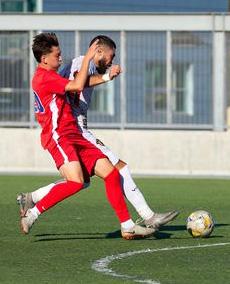
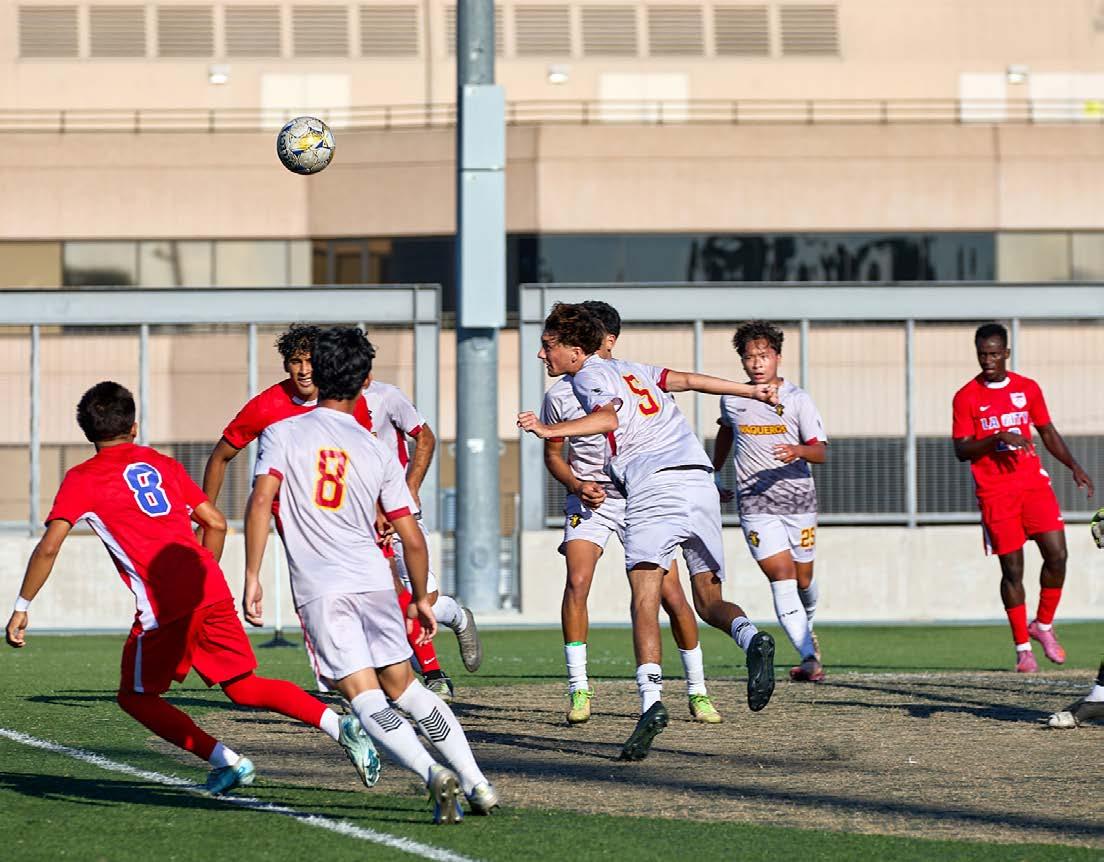
Soccer Coach Javier Aguiniga Campos is a scholar and an athlete. He attended Mountain View High School, where he graduated valedictorian of his class in 2003.
He has coached at LACC for the last five years. The head coach is proud of the academic accomplishments of his team, and the rate at which they transfer. Half of his players transfer to four-year colleges.
Coach Aguiniga Campos would like to
encourage the campus community to support the team and follow the Cubs.
"Sports has only been back on campus for the last five years," the coach told the Collegian.
“And it would be great to have more student support by attending the game."
A new squad of cheerleaders should help lift team spirit among fans and players. Coach Aguiniga Campos is an alumnus of UCLA. Fans can learn more about the coach by following this link to the L.A. City College Athletics page.
NASCAR geared up in 1948 and became the biggest motorsport auto racing form in the United States.
Cars are custom built and heavily modified for racing with large spoilers, roof flaps, roll cages, composite body panels and safety features. Tracks have safer barriers to replace hard concrete walls which in the past were known to cause serious wrecks and even death.
Drivers also wear head and neck devices to protect them from injury in a collision or in case of fire to prevent burns.
NASCAR has 36 races in a season, along with two exhibition races. The first 26 races form part of the reg¬¬ular season. The top 16 in points make the playoffs, and the final 10 races form part of the playoffs that run in a four-round format.
After three races, the bottom four in points are eliminated. It is then down to 12. After three more races, it's down to eight. Ultimately, four drivers are left to compete for a championship. The finale happens at Phoenix Raceway, in Avondale, Ariz., where the first-place finisher takes the championship. Earning a win during a regular season locks contenders into the playoffs, and the remaining spots are earned by running consistently and hav-
ing strong results.
There are different types of flags used during a race. Some of these are straightforward like the green and checkered flag when a driver wins and crosses the finish line at race's end. However, a few others familiar to spectators include the yellow, red, and black flags. Yellow is displayed for a small crash or incident. Drivers must slow down and get back to the line and follow the pace car while the incident is cleaned up. Red and black flags are for more serious incidents like weather, or a huge wreck when a red flag is thrown. In that case, the race is fully stopped, and every car must come to a halt. A black flag happens when a driver has broken a rule and must come down to pit road.
NASCAR’s best tracks are the historic ones that have been in the sport since its inception and have crown jewels which are special races that are treated and seen as a Superbowl, or an NBA All Star game. NASCAR races are typically scheduled for Sunday afternoons. For special occasions, they are organized on Saturday nights.
Races run on separate channels but primarily on Fox Sports and NBC. Blocks of NASCAR races also appear on Amazon Prime and TNT Sports. NASCAR is something different and can be a ton of fun for anyone looking for something different.
PHOTOS BY JUAN MENDOZA
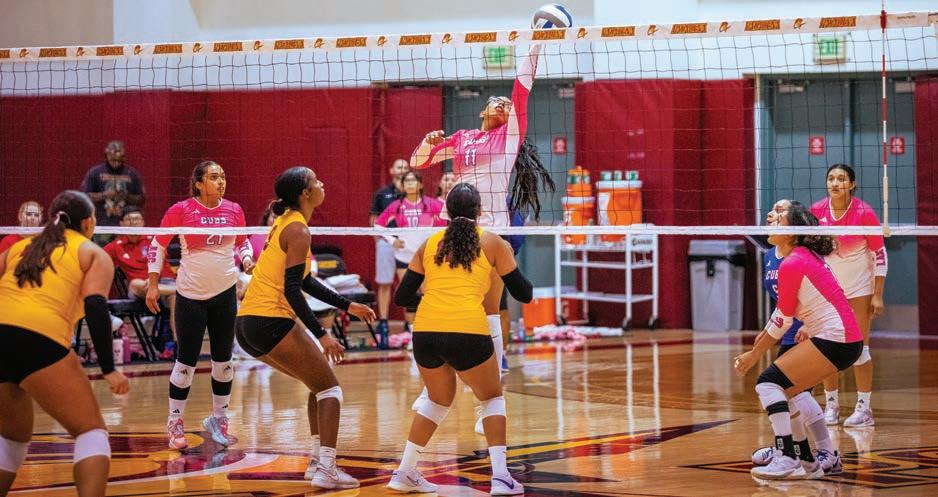
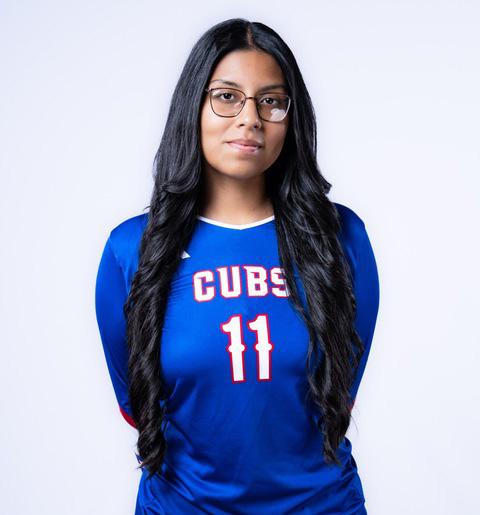
Meet Brenda Rodriguez who dons number 11 for the Cubs.
sophomore from Boyle Heights attended Sacred Heart of Jesus High School.