4
2017 Freedom Festival
Los Angeles Collegian Wednesday, October 18, 2017
Art and photography come into focus under the expert eye of Peter Merts whose workshop showed a different side of prisoners and prison life during the two-day Freedom Festival.
PETER MERTS CREATES PHOTOS OF REDEMPTION 1
V
By Tessa Flores
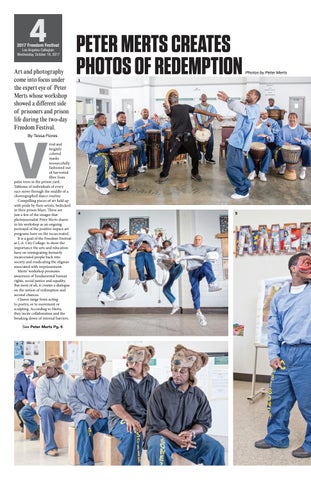
ivid and brightly colored masks resourcefully fashioned out of harvested fiber from palm trees in the prison yard. Tableaus of individuals of every race move through the middle of a choreographed dance routine. Compelling pieces of art held up with pride by their artists, bedecked in their prison blues. These are just a few of the images that photojournalist Peter Merts shares in his workshop as an ongoing portrayal of the positive impact art programs have on the incarcerated. It is a goal of the Freedom Festival at L.A. City College: to show the importance the arts and education have on reintegrating formerly incarcerated people back into society and eradicating the stigmas associated with imprisonment. Merts’ workshop promotes awareness of fundamental human rights, social justice and equality. But most of all, it creates a dialogue on the notion of redemption and second chances. Classes range from acting to poetry, or to movement or sculpting. According to Merts, they incite collaboration and the breaking down of internal barriers. See Peter Merts Pg. 6
7
4
5
Photos by Peter Merts
2
3
5
2017 Freedom Festival
Los Angeles Collegian Wednesday, October 18, 2017
6
6
8
2017 Freedom Festival
Los Angeles Collegian Wednesday, October 18, 2017
From Peter Merts Pg. 4
9
MERTS CHALLENGES STEREOTYPES PEOPLE FORM ABOUT PRISONERS
Merts has photographed inmates in prisons across California since 2002. In August of 2012, he collaborated on a book with Larry Brewster, a professor of public administration and former dean at the University of San Francisco. The book is entitled “Paths of Discovery: Art Practice and Its Impact in California Prisons,” and it provides an intimate look at how important art programs are to the self-improvement and evolution of these individuals. He initially began his photographic journey as a sort of fly on the wall. Then he gradually started engaging with the inmates and incorporating the human with the art. He got the idea to act as a kind of liaison between the inmate and the outside world. He created an online archive for their art and the photos he was taking. This platform made everything he was doing available to the loved ones of those in prison, and even became a way to promote funding for more programs. The result, in Merts’ opinion, was pivotal. Instead of hard exteriors, he was getting real people staring back at him through the lens. People emoting pride, self worth and vulnerability. “At that point I felt validated by their appreciation and openness and willingness to share their art with me,” Merts said. “A lot of it was intense and personal material.” Merts says he was motivated to break down the misconceptions and challenge the stereotypes people have about those in prison. “These are redeemable people,” he said. “They are human. All they need is a little nurturing and I wanted to show that.” His works depict how art classes created compassion, dignity, support and friendship among each other. The discipline of an artistic process instilled in many of these individuals the skills and healthy self-expression that they didn’t have before incarceration. Marquis, who was previously incarcerated but is now a trainee at Homeboy Industries, attended the workshop. He says he personally benefited from these programs. “The background where we come from, we weren’t used to these things,” she said. “We are guarded and protective of our emotions and feelings. To get to see this is amazing. I’ve come a long way and I’m doing better than I ever have before and it’s because of what these classes did for me.” A fellow trainee who chose to keep his name
private agreed. “I appreciate his photos,” the returning citizen said. “Those art classes were the only time I could share my progress with my loved ones. And that’s who you’re thinking about everyday in there.” Homeboy Industries has been training formerly incarcerated individuals and reformed gang members in the Los Angeles area since 1988. Cherrele Lenoire has been a part of Homeboy Industries for eight months. “I’m working on myself,” Cherrele said. “I’m staying positive and we’re all human and we make mistakes.” Mario Escalante, a counselor at L.A. City College is one of the organizers of the Freedom Festival. He spoke in favor of the education programs in prisons and says he has witnessed the improvements and positive outcomes first hand. Escalante says he was incarcerated and a former gang member for most of his formative years. He saw the need to educate those in jail, especially the youth, in order to bring about any kind of change. “Education is key,” Escalante said. “I didn’t have a high school degree and being in a gang was my life. I knew things needed to change when my best friend was murdered when I was only 23.” Fast forward several years later, and Escalante is a member of the “Break It to Make It” program and a counselor at LACC where he provides support and a wide variety of resources to the formerly incarcerated. Escalante says a lot of the young people who leave prison come out with a GPA of 3.6 or higher and have made vast improvements in their lives. They have the desire and have gained the skill set to become contributing members of society. “If the streets didn’t break me, I knew school wouldn’t either,” Escalante said. The message that Peter Merts offers in his works is a clear one. It depicts his advocacy for those in prison who are just finding their voice through art, and it shows the transformative effect of these programs. He shows the possibility of a life after prison and demands acceptance and forgiveness rather than discrimination. “It just confirms my faith in humans,” he said. “I wanted to bring a little humanity back to the world with my photography, and I hope that I did that.”
Photos by Peter Merts Photo 1 – Drumming instructor Wilfred Mark leads his students at Salinas Valley State Prison in June 2005. Photo 2 – A female inmate at the California Institute for Women has makeup applied to her face during an acting class hosted by Los Angeles-based theater company The Actors’ Gang in March 2014. Photo 3 – The Actors’ Gang started The Prison Project in 2006 in response to California’s high recidivism rate. During their acting exercises, inmates gather in a circle, wear white makeup and improvise scenes as characters from the commedia dell’arte tradition. Photo 4 – Members of the “Artistic Ensemble” are frozen mid-air while performing “Faultline” at the San Quentin Prison on Nov. 20, 2015. The Artistic Ensemble is a “rigorous, creative practice” at San Quentin Prison whose participants explore the intersections poverty, violence, power and incarceration as they hone their artistic skills. Photo 5 – An inmate at Pelican Bay Prison gets into character during an acting class in March 2016. The class is lead by Zuzka Sabata and Janessa Johnsrude of Dell’Arte International School of Physical Theatre in Humbolt County. Photo 6 – The Actors’ Gang conducts weekly and seven-day intensive programs inside the California prison system, a weekly re-entry program in the community and a program in juvenile facilities. “We’ve seen this approach transform prison yards,” said Sabra Williams, director of The Prison Project at the Los Angeles Hope Festival earlier this year. “We’ve seen it bring down barriers of race and separation, and that has happened through the courage of these people picking up the tools that we’ve offered them and using those tools to transform their emotional lives.” Photo 7 – Students in the Applause Demo Project at the Substance Abuse Treatment Facility and Sate Prison in Corcoran perform in the original play “ALL ABOARD” written by Deborah Tobola from student writings. The project measures the impact of creating and performing live theater on inmates about to reenter society. Photo 8 – Women happily pose for a photo for “Dance at Central Women’s Facility” on June 5, 2017. Additional photos of the dance session can be found on PeterMerts.com in an album titled “Dance at Central Women’s Facility - 2017 June.” attire for “Dance at Central Women’s Facility “ on June 5, 2017. Additional photos of the dance session can be found on PeterMerts.com in an album titled “Dance at Central Women’s Facility - 2017 June.”