Collegian Los Angeles
Wednesday, October 3,February 2018 Volume 181Volume Number Wednesday, 28, 2018 1802 Number 1
The Voice of Los Angeles City College Since 1929
LACC’s intramural football kicks off SEE PAGE 10
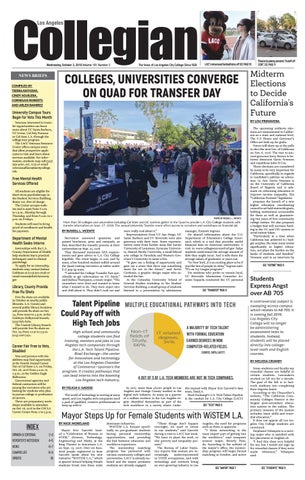
COLLEGES, UNIVERSITIES CONVERGE ON QUAD FOR TRANSFER DAY
NEWS BRIEFS COMPILED BY TIERRA AKIYOSHI, CINDY AGUILERA, CORNELIUS ROBERTS AND ARLEN RAMIREZ
University Campus Tours Begin for Vets This Month
Free Mental Health Services Offered All students are eligible for short-term psychotherapy in the Student Services Building, Room 120, free of charge. The Center accepts walkins and is open from 8 a.m. to 7 p.m., Monday through Thursday, and from 8 a.m. to 2 p.m. on Fridays.
Department of Mental Health Seeks Interns Internships with the L.A. County Department of Health help students learn practical techniques used in clinical psychology. To apply for an internship, students may contact Joshua Goldman at (213) 972-7036 or email exams@dmh.lacounty. gov
Library, County Provide Free Flu Shots Free flu shots are available in October at nearby public libraries. L.A. County and several public library locations will provide flu shots on Oct. 24, from noon to 4 p.m. at the Goldwyn Hollywood branch, (323) 856-8260. The Central Library branch will provide free flu shots on Oct. 25, from 12:30 to 3 p.m. (213) 228-7272.
Career Fair Free to Vets, Disabled Vets and persons with disabilities may find opportunity at the Fourth Annual Career Fair at Cal State L.A. on Friday, Oct. 26, 2018 from 9 a.m. to 2 p.m., in the Golden Eagle Ballrooms. Government agencies and federal contractors will be among the recruiters who are looking for students who plan to pursue college or professional careers. There are preparatory workshops available to attendees on Oct. 16, 2018 in the CSULA Career Center from 2 to 3 p.m.
Opinion & Editorial
2-3
reporter’s notebook
4-5
News
6-7
Campus Life
8-9
Sports
PHOTO BY RUSSELL L. VICENTE
BY RUSSELL L. VICENTE Recruiters answered questions and passed brochures, pens and notepads, as they described the transfer process at their universities on Sept. 27, 2108 They discussed minimum GPA requirements and gave advice to L.A. City College hopefuls. The event began 10 a.m. and by noon, a few hundred student milled around the Quad visiting recruiters at tables under E-Z pop up tents. “I attended the College Transfer Fair specifically to get information on UC Davis,” said Joshua Thompson, a music major. “The counselors were kind and wanted to know what I wanted to do. They were super nice and chill about it. They didn’t rush me and
Talent Pipeline Could Pay off with High Tech Jobs High school and community college students can find training, mentors and jobs in Los Angeles tech companies through the L.A. Tech Talent Pipeline. Bixel Exchange—the center for innovation and technology at the Los Angeles Chamber of Commerce—sponsors the program. It creates pathways that can lead interns into the booming Los Angeles tech industry. BY FELICIA V. GADDIS The world of technology is moving at warp speed, and Los Angeles tech companies need a pool of qualified, creative professionals to keep up with it.
10
were really cool about it.” Representatives from UC San Diego, UC Santa Barbara and UC Riverside were also generous with their time. Some representatives came from farther away like Xavier University of Louisiana, Syracuse University, Hawaii Pacific University, a small liberal arts college in Honolulu and Western Governor’s University to name a few. “It gave me a feeling of opportunity and gave me a sense that there was something more for me in the future,” said Kevin Cardenas, a graphic design major who attended the fair. At the Columbia University School of General Studies workshop in the Student Services Building, a small group of students listened to a presentation by admissions
manager, Emmett Ingram. He shared information about the U.S. Department of Education’s College Scorecard, which is a tool that provides useful financial data on American universities. A visit to www.collegescorecard.ed.gov helps students understand the average amount of debt they might incur. And it tells them the average salary of graduates 10 years out. “In New York, it’s an exciting place to be if you like lots of people in cities,” Ingram said. “It’s an Ivy League program.” For students who prefer to remain local, UC Riverside Admissions Counselor Ernesto Esqueda conducted the UC personal SEE “TRANSFER” PAGE 6
Multiple Educational Pathways into Tech
A majority of tech talent with formal education earned degrees in non computer-related fields. Source: data.lacity.
Mayor Eric Garcetti hosted a “Celebration of Women in STEM,” (Science, Technology, Engineering and Math), at the Bing Theater in downtown L.A. on Sept. 15, 2018. Over six hundred people registered to hear Garcetti speak about his new initiative “WiSTEM L.A.,” which is geared toward helping female students break into these male
The upcoming midterm elections are monumental to California on a state and national level, The U.S House and Governor’s Office are both up for grabs. Voters will show up at the polls to elect the next Gov. of California on Nov. 6, 2018. The race to succeed governor Jerry Brown is between democrat Gavin Newsom and republican John H Cox. These elections are considered by many to be very important for California, specifically in regards to candidate’s policies on education. Lt. Gov. Gavin Newsom is on the University of California Board of Regents and is adamant on reforming education to improve income inequality. His “California Promise” legislation proposes the launch of a new higher education coordinating council to set bold statewide goals, holding institutions accountable for them as well as guaranteeing two years of free community college tuition. He also proposes a budget that will increase funding in the UC and CSU system to avoid tuition hikes. “Particularly at a time when California has achieved 6.1 budget surplus, the state must invest significantly in higher education, not place the burden on the backs of students and families” Newsom said in an interview by SEE “VOTING” PAGE 6
Students Express Angst over AB 705 A controversial subject is sweeping across campus which relates to AB 705. It is coming fall 2019. Los Angeles City College will no longer be administering assessment tests to students. Instead, students will be placed directly into collegelevel math and English courses. BY MELISSA CRUMBY
4 out of 5 of L.A. tech members are not in tech companies. In 2017, more than 48,000 people in Los Angeles and Orange County worked in the digital tech industry. As many as a quarter of a million workers in the Los Angeles region identified themselves as part of the tech workforce in a survey where Linke-
dIn teamed with Mayor Eric Garcetti’s data team, DataLA. Bixel Exchange’s L.A. Tech Talent Pipeline is the conduit for L.A. City College (LACC) SEE “TECH” PAGE 6
Mayor Steps Up for Female Students with WiSTEM L.A. BY NICK MORELAND
INDEX
Midterm Elections to Decide California’s Future BY LOU PRIMAVERA
Veterans interested in transfer opportunities can learn more about UC Santa Barbara, UC Irvine, Cal Poly Pomona or Cal State L.A. through the college tour program. The LACC Veterans Resource Center offers campus tours that allow prospective applicants to visit and learn about services available. For information, students may call (323) 953-4000, ext. 2125 or email veteransaffairs@lacitycollege. edu
Students will need to bring proof of enrollment and health fee payment.
Theatre Academy presents “AutoPLAY 2018”, SEE PAGE 9
dominant industries. WiSTEM L.A. focuses specifically on pre-graduate students having personal mentorship opportunities, and providing the link between education and workforce experience. The mentorship matching program has partnered with various community colleges and universities. LACC is already onboard and the mayor promises students are already engaged.
“These things don’t happen overnight, we need to invest in our students,” said Garcetti during a visit to LACC last week. “We have to plant the seed, or else poverty and inequality persists.” The Bureau of Labor Statistics reports that women are increasingly underrepresented in STEM occupations, and with technology and sciences being an ever-growing industry in Los
Angeles, the need for programs such as these is apparent. “I think networking is the most import part of getting into the workforce,” said computer science major, Beverly Pineda. According to the website of the mayor’s office, the mentorship program will begin formal matching in October, and active
SEE “MAYOR” PAGE 7
Some students and faculty say remedial classes are helpful to certain students. Lawmakers worked on AB 705 for a decade. The goal of the bill is to fasttrack students into completing their degrees faster. According to the Chancellor’s website, “The California Community Colleges District is the largest post-secondary education system in the nation. The primary mission of the system includes: basic skills and remedial education.” It does not appear all Los Angeles City College students are convinced. Stephanie Velasquez is a nursing major who is satisfied with her placement in English 28. “I find this class very helpful for me, but I would not sign up for remedial classes if they were made voluntary,” Velasquez said.
SEE “STUDENTS” PAGE 6
2
OPINION & EDITORIAL
Los Angeles Collegian — Wednesday, October 3, 2018
TEXTBOOK PRICES ARE TOO HIGH
Editorial
By BriaN LoVato The fall 2018 semester has begun at LACC, and students, including myself, have started purchasing our books. Thus, we are reminded of how ridiculously pricey they are. My first day going to the bookstore, I bought two books at a cost of $205. The next day, my textbook purchases equaled $212. That’s more than $400, and I still need to buy more books. By the time I’m finished I will have spent over $800 for textbooks this semester. That exuberant amount makes me ask the question: Why are the prices of textbooks so high? From what professors have told me, the publishers like to make a new edition of the book each year. They also add a little more information and move around the chapters in subsequent editions and these adjustments to textbooks annual cost students big in the long run . Most students have no choice but to purchase these books in order to keep up in their classes. Additionally, some textbooks have codes for online access where more information is provided but that access
expires after one use. The College Board suggests students should budget about $1,200 a year for textbooks. That’s a lot of money in addition to tuition -- an amount that can easily make the average student go into debt. It is such a big issue that there are experts that help and provide tips to students on how to manage debt. The cost of books should not be pricey to the extent that it is; this deprives and constraints students’ learning ability.
Prices for textbooks need to decrease. Publishers should stop stealing money from students pockets. It is not necessary to release a new book every year. I have had a few professors that refuse to use the new textbooks and request old used textbooks instead, and we do just fine. If there is any new important information that comes up about the subject the professor is always on top of it and informs the class. Textbooks should be released
“THE COLLEGE BOARD SUGGESTS STUDENTS SHOULD BUDGET ABOUT $1,200 A YEAR FOR TEXTBOOKS. THAT’S A LOT OF MONEY IN ADDITION TO TUITION -- AN AMOUNT THAT CAN EASILY MAKE THE AVERAGE STUDENT GO INTO DEBT.” every few years to collect more information instead of just releasing a new version every year with only a few new facts. This would give
students the ability to buy and sell used textbooks, and it would make more books available to students at a more affordable price.
Fast Food Is Physically, Fiscally Unhealthy By LesLey MeLeNDez
ILLUSTRATION BY BRIAN Z. GOMEZ/COLLEGIAN
BEYOND THE MIDTERM ELECTIONS:
Students Must Be Proactive
R
equiring elected officials to be accountable to their constituents is not only basic, it’s become increasingly important. With the upcoming midterms elections this Nov. 6th, simply checking a box or pulling a lever for most voters means everything will be alright. And it won’t. Much more is needed on both ends; specifically, once representatives are elected, voters have to remain engaged with them and vice versa. Students must be heard and the midterm election is just one way. There are countless examples of corruption, scandals and greed that permeate our political landscape, the Kava. Too often there is no accountability for elected public officials and in this way, most voters have been fooled into giving their power away. If constituents elect people to represent their interests in Congress (and locally as well), do people consistently remind them exactly what their interests are? And when those representatives craft policy, co-sponsor legislation, make speeches and cast votes in committees, are constituents informed every step of the way? Does the public at least check in on them to see what they have done after the fact? Sadly, the answer is no. Most wait until they hear something outrageous that was done or not done by the elected official. Then they react to the news. Yes, LACC is full of students. Yes, those students are busy with other things in addition to being stu-
dents –such as parents, spouses and workers – that impacts their time. But if the student populous is serious about the overall impact of political decisions on their lives, simply voting and going back to whatever it is you were doing cannot happen. Requiring elected officials to be accountable to their constituents is not only basic, it’s sorely lacking. The people must do better. We must demand accountability from elected officials. what is meant is making that phone call or sending that email consistently – say, once a month perhaps – asking the status of the bill threatening to slash financial aid at community colleges. Making that phone call or sending that email – say, twice a month – reminding your representative what slashing financial aid will mean to your life and how they better not vote in support of it. Planning your schedule so that, perhaps, one day out of the month you miss a class, but instead of lounging somewhere you show up at a representative’s doorstep to ask them if they got your phone calls and emails. You get the idea that’s being conveyed here. It’s important that elected representatives also get the idea. Do your part to help them out. Corporations understand the necessity of staying engaged with elected representatives. The people, have to do a better job of proving that they understand that necessity too. Representatives derive their power from the people. The people give it to them. Representatives need to be reminded that the people can take it back.
WHERE CAN ANXIOUS STUDENTS GO ON CAMPUS By ciNDy aGUiLera Anxiety is a monster that riddles your mind with negative and unpleasant thoughts and is often followed by physical manifestations like sweating and rapid heart palpitations. When you are immersed in anxi-
ety, you feel as if you’re isolated on an island of fear and uncertainty. If you do not manage anxiety in its beginning stages, you can definitely count on it spiraling out of control. Students deal with anxiety every day due to school, work and family life. In fact, according to the Anxiety and Depression Association of America, 40 million U.S adults suffer from anxiety and 75 percent of them experience anxiety by the age of 22. Unfortunately, only 36.9 percent of those receive treatment. Most students deal with con-
stant stress and pressure from professors, peers and families, not to mention having a full-time job like I do. Anxiety can make you feel overwhelmed and helpless. Important activities like sleeping and eating suddenly go on the back burner as they become inconvenient to your schedule. With all these stressors in our lives there must be a place where students with anxiety can find refuge. Fortunately, our school provides a haven located in the Student Services Building: the Student Health and Wellness Center. Any student
There is no doubt fast food is one of the most beloved types of mass-produced goods that has blessed humanity. It is cheap and convenient, which is mainly why many franchises like McDonald’s or Jack-in-the-Box decide to open up shop in public hot spots or near other places of business. Schools are a perfect area for the aforementioned food chains as their main customers would be the students. Your average college student is usually perceived as one who is mostly busy with eyes deep in books, studying into the night -self-taught insomniacs. Most if not half of college students may end up with some sort of debt that forces extremely strict budgeting. The student life can be very demanding for some considering deadlines and time management. In other cases, some may not have
the access to nutritious produce due to monetary issues, or they lack of transportation due to living in a “food desert” (places lacking in fresh, affordable produce and other foods). This is what makes fast food chains so profitable around schools, as it offers students a temporary and hasty solution. Yet, while these foods offer fast and affordable meals the true cost of these less time-consuming products is in terms of health. These gluttony gladiators also occupy spaces that could potentially have been healthier food alternatives offering the same amount of convenience but not risking health. To allow such an abundance of unhealthy marketing in one concentrated area is greatly foolish to me. There is no reason to have the area surrounding LACC filled with multiple, separate branded fast food chains that may force unhealthy dieting.
Unfortunately, to ask for healthier alternatives would be a long shot as this is more of a city/community matter. We can’t change what’s outside but we can change from within. An idea to combat such a situation could be that a cafeteria be built on the campus of LACC. It would be a place where students have the ability to make healthier choices. The menu could be created via a survey taken by students and staff members considering healthy options. If students are not eating right, they are not thinking right. In addition to providing healthier eating options for LACC students, monies spent making corporations richer would be directly invested back into LACC every time a healthy food option was ordered. Now that makes both good health and financial sense if you ask me.
Why Should I Pay When I Can’t Even Park? By Victoria Lee The fall 2018 semester has begun at LACC, and students, including myself, have started purchasing our books. Thus, we are reminded of how ridiculously pricey they are. My first day going to the bookstore, I bought two books at a cost of $205. The next day, my textbook purchases equaled $212. That’s more than $400, and I still need to buy more books. By the time I’m finished I will have spent over $800 for textbooks this semester. That exuberant amount makes me ask the question: Why are the prices of textwho has paid their health fee can receive services through the center. I just found out about the Wellness Center’s existence this semester. I decided to pay them a visit and upon entering the isolated corner of the building I realized it was not only extremely quiet but weirdly pristine. This told me that the traffic of students coming in and out of the Wellness Center is not existent. Now if such a great service exists on campus, why don’t more students take advantage of it? I asked the nurse sitting behind the halfway open glass window about any student outreach or events they hold on campus. Nonchalantly she explained that there is a health fair in the spring and that is when they participate and
books so high? From what professors have told me, the publishers like to make a new edition of the book each year. They also add a little more information and move around the chapters in subsequent editions and these adjustments to textbooks annual cost students big in the long run. Most students have no choice but to purchase these books in order to keep up in their classes. Additionally, some textbooks have codes for online access where more information is provided but that access expires after one use. The College Board suggests students should budget about $1,200 a year for textbooks. That’s a lot of money in addition to tuition -- an amount that can easily make the average student go into debt. It is such a big issue that there are experts that help and provide tips to students on how to manage
debt. The cost of books should not be pricey to the extent that it is; this deprives and constraints students & learning ability. Prices for textbooks need to decrease. Publishers should stop stealing money from students pockets. It is not necessary to release a new book every year. I have had a few professors that refuse to use the new textbooks and request old used textbooks instead, and we do just fine. If there is any new important information that comes up about the subject the professor is always on top of it and informs the class. Textbooks should be released every few years to collect more information instead of just releasing a new version every year with only a few new facts. This would give students the ability to buy and sell used textbooks, and it would make more books available to students at a more affordable price.
“THE WELLNESS AND STABILITY OF OUR STUDENTS IS VITAL.” meet students. I have a huge problem with this. An event once a year is not enough to reach a large mass of 20,000 students. Of course the Wellness Center has pamphlets, motivation posters and free condoms, but as previously mentioned, it seems the students are not visiting the Wellness Center because either they do not know it is there or they fear seeking help. As a public health clinic, the Student Wellness Center should hold workshops, trainings and classes for students where they get guid-
ance and counseling for anxiety and depression. They have to put more effort into reaching out to students because clearly many students are apprehensive about seeking help. A stronger presence can encourage students to seek out these possibly life-saving resources. The wellness and stability of our students is vital. Without a healthy and flourishing student body, our campus ceases to exist, and for that to happen at the hands of depression and anxiety would be simply unacceptable.
OPINION & EDITORIAL
Los Angeles Collegian — Wednesday, October 3, 2018
3
COMPILED BY Chris Argueta PHOTOS BY Kaitlyn Kimble
November’s midterm elections will mark a turning point in American history, regardless of the results. What does the upcoming election mean to you? How will it impact you personally?
CESAR GARCIA Studio Arts Major
ANGELA LOAISIEA Business Admin. Major
ANDREW PINO Film Major
DANNY BROOKE Music Major
“I think the results will affect everybody ... I hope a lot of people actually vote this time, because the last few times a lot of people don’t vote. I see a lot of people saying their vote doesn’t matter ... My brother didn’t vote last time because he said, “Yeah my vote doesn’t matter.” Yeah that’s not how it works. I get he was talking about the Electoral College but still every vote matters.
“We need to change, because we need some people to understand that everybody likes to work like immigrants. Because this country is [built by] immigrants. We need somebody to understand to love the people. We want [them] to work with everybody, because we are USA. [They’re] cutting too many things and separating families. That’s terrible. I’m Democrat, so I want them to win.”
“Well, I haven’t done too much research, however I do plan on voting and I do plan on doing a lot research before I vote. I did read about the Education Reform, which was presented by Betsy Devos, and how it would affect public schools and how it would not be beneficial to public schools, therefore I would vote against that. I have friends who are passionate about this.”
“I think it’s just important that healthcare be maintain in California and people that receive disability benefits will not be cut off ... All the things Obama did many years ago are still in affect. It would just depend on if the Republicans are gonna help the people who need help. I think in general, it’s the Democrats who help the people that need the most help.”
Ink Style: A VISUAL REPRESENTATION OF THE WORLD AS WE KNOW IT
ILLUSTRATION BY NATALIA ZEPEDA/COLLEGIAN
Los Angeles Collegian
For all submissions including letters to the editor and publicity releases, send materials to Collegian offices located in Chemistry Building, Room 207, or email: losangeles.collegian@gmail.com.
The Voice of Los Angeles City College Since 1929 Los Angeles City College Visual & Media Arts Department
855 N. Vermont Ave. Los Angeles, CA 90029
EDITOR-IN-CHIEF Jason Piskopus
OPINIONS & EDITORIAL EDITOR Thandisizwe Chimurenga
LAYOUT EDITOR
GRAPHIC DESIGNERS
PHOTOGRAPHERS
MULTIMEDIA PRODUCER
REPORTERS
To advertise in the Collegian, direct all insertion orders and questions to: pr.collegian@gmail.com.
323.953.4000 ext. 2831 losangeles.collegian@gmail.com
Issues of our award-winning newspaper and magazine are instantly available to our readers on issuu.com/collegianwired. facebook.com/CollegianWired @CollegianWired CollegianWired.tumblr.com
SPORTS EDITOR Will Pennington
NEXT ISSUE: October 17, 2018 EDITORIAL DEADLINE: October 14, 2018
ILLUSTRATORS
ADVISER
The college newspaper is published as a learning experience, offered under the college journalism instructional program. The editorial and advertising materials published herein, including any opinions expressed, are the responsibility of the student newspaper staff.
Under appropriate state and federal court decisions, these materials are free from prior restraint by virtue of the First Amendment to the United States Constitution. Accordingly, materials published herein, including any opinions expressed, should not be
youtube.com/CollegianWired
interpreted as the position of the Los Angeles Community College District, Los Angeles City College, or any officer or employee thereof. Collegian ©2017. No material may be reprinted without the express written permission of the Los Angeles Collegian.
4
Los Angeles Collegian — Wednesday, October 3, 2018
REPORTER’S NOTEBOOK
Escape From the Default World BURNING MAN: WORLD’S WILDEST, MOST SURREAL FESTIVAL. BY WILLIAM BENJAMIN TORRES 1)Photo Credit: William Benjamin Torres. Opulent Temple Camp has been a staple of the Burning Man Electric Dance Music for many years. Opulent Temple draws thousands of burners to dance their brains off with top of notch sound systems and spectacular lights. 2)Photo Credit: William Benjamin Torres. A group of burners, who partied the night away, waited for the sunrise on Friday, Aug. 31. They all belong to a music camp called “Crossroads” 3)Photo Credit: William Benjamin Torres. This Years Burning Man temple was called, “Galaxia.” It was design by Arthur Mamou- Mani! The temple is known as spiritual space that offers serenity. Regardless of anyones religion, beliefs, or creed, everyone is welcome. 4) Photo Credit: William Benjamin Torres. The iconic 75 ft. tall wooden man was burned on Saturday, September 2. A huge display of spectacular firework were displayed during burn of the man. 5)Photo Credit: William Benjamin Torres. A robot giving birth to triplets was just one of a hundred of art structures displayed at Black Rock City, NV. 6) Photo Credit: Erin Desmond. “Listen” is an art installation created by Erin Desmond, and Aaron Fowler. It is a 14-footlong geodesic human heart shape dome that was displayed in the middle of the desert for one week. 7) Photo Credit: Erin Desmond. “Listen” was an anatomical heart that is made up from different type speakers. Once you’re inside the art installation, you place the monitor around your heart and the speaker will project the heart beat out to the festival.
Burning Man is the wildest, most surreal festival in the world. Every year in the end of August, spectators around the globe come to Black Rock This euphoric universe is called “Burning Man”. For eight days, or longer, 70,000 ‘burners’ endure the harsh environment of living in the desert. The temperature in the desert can reach up to 100 degrees, making it unbearable to ride your bicycle around the festival. Dust storms with 30 mph winds force every burner to wear goggles and bandanas to prevent the white sands from entering their lungs and eyes. There is no running water or power available at any part of the festival, and porta-potties (portable public toilets) would become every burner’s best friend.
and architects-- transform the Nevada desert into a countercultural phenomenon. “Burning Man is Disneyland in reverse … Woodstock turned inside out,” said co-founder Larry Harvey to the San Francisco Chronicles in 1996. “It is anything you want it to be.” This year, Burning Man’s theme was called, “I, Robot.” Named for Isaac which featured a number of gigantic creative art installations that were displayed all around the desert. Elizabeth Preger, a 2007 alumni and worker at LACC helped build one of the coolest arts installations in the playa called “Listen.” “’Listen’ is a 14-foot geodesic dome with an armature up above that looks like anatomical heart, but its skin is made with different types of speakers,” Preger said. “Listen” was, an anatomical heart covered with speakers and LED lights. Burners can also go inside the art installation. Once inside, the geodesic dome is
heartbeat through all of the speakers. “You can put a feudal monitor on your heart beat and then the heart beat actually gets pumped out into the skin of the piece,” Preger said. “Your heartbeats become the heartbeats of this massive heart.” Multiple people can go inside the piece with different heartbeats coming out of the speakers all at the same time. Only at Burning Man can a unique piece like “Listen” can come to life and be
“virgins”. Like many virgins, Burning Man is a real eye opener. All the dust, music
and I would ask myself, ‘Why did we do this,’” Preger said. “You are so dusty and
For 32 years, burners have been guided by 10 principles, including: radical behind. With these 10 principles, every burner would wear eye-popping costumes, activities the Playa (named after the white sand in Black Rock City) has to offer-including the “orgy dome.” burns to the ground, and all 70,000 burners watch with astonishment. After “The morning to view one of the most beautiful sunrises in the world. Just as quickly as the city was built, it is quickly taken apart. Three days after the festival ends, there shouldn’t be any trace or evidence that 70,000 people were in the middle of the desert, having the time of their lives.
REPORTER’S NOTEBOOK
Los Angeles Collegian — Wednesday, October 3, 2018
BURNING MAN IS DISNEYLAND IN REVERSE... WOODSTOCK TURNED INSIDE OUT.”
-LARRY HARVEY CO-FOUNDER OF BURNING MAN
5
6
NEWS
Los Angeles Collegian — Wednesday, October 3, 2018 “VOTING” FROM PAGE 1
“TRANSFER” FROM PAGE 1
MIDTERMS COULD DECIDE STATE’S COURSE FORWARD Ed-source, June 2018 Newsom is running against John Cox, a republican venture capitalist from San Diego who is endorsed by President Trump. Cox supports the privatization of education rhetoric, expansion of charter schools and has announced vague plans to make higher education more affordable, reducing costs of 4-year universities by appointing regents that will curtail costs in the UC and CSU system. “We need to get that money into the classroom,” Cox said in an interview with Ed-source, in June of 2018. “We need to give our children and our parents the education they deserve. And that includes building more charters, giving parents a choice, and encouraging homeschooling,” Cox’s policy on education is not as clear as Newsom’s, but it is clear his privatization of education rhetoric matches controversial Secretary of Education, Betsy DeVos, and the Trump administration. Many students on campus registered to vote because of the importance of the upcoming election. “I registered to vote on campus and plan to vote for Gavin Newsom because he seems to care about college students and seems to want to help the working class,” LACC student, Miguel Garcia said. The U.S House of Representative midterm elections for California’s 25th District will be on Nov. 6 as well. Incumbent Steve Knight (R) will face non-profit executive Katie Hill (D). The House of Representatives’ 25th district seat which represents northern Los Angeles is up for grabs in this monumental election. Incumbent Steve Knight (R-CA) is facing democrat, nonprofit executive Katie Hill, who is looking to flip the long-term Republican seat. “Because California always votes democrat, the election for
governor is just as important as the House of Representatives because both elections effect Los Angeles residents directly.It would benefit students more if Katie Hill represented California” LACC student, Jennifer Marina said. Katie Hill is supportive of a path to citizenship for Dreamers, has an agenda to reform a broken immigration system and is adamant about creating avenues for students such as work programs to help pay for college without accumulating debt. “Let’s say you were born into a poor family and you’re never going to be able to take $40,000 or $100,000 out in loans, what kind of opportunities can we provide for you, if you are willing to work,” Hill said in an Elle interview, June 2017. Steve Knight’s views are more allied with the Trump administration, and he has been criticized in the past for ignoring constituents demands on many issues such as education and gun reform. After Trump’s announcement last fall that DACA might end, Knight called for “A thorough and thoughtful review” of the likely effects of such a change” according to a Los Angeles Daily News editorial, March 6, 2018. He has been very open about Trump’s legislation to slash DACA and has been endorsed by Trump. “He’ll Make California Great Again,” Trump tweeted last May. “Because California always votes democrat, the mayoral election is just as important as theHouse because both elections effect Los Angeles directly. It would benefit students more if Katie Hill represented California,” LACC student Jennifer Marina said. Although California is largely considered a blue state, the 25th district has been red for over 20 years. Many experts predict a change if people show up at the polls to vote.
POLICE WIRE
COMPILED BY JASON PISKOPUS Campus Crime Report Sept. 17, 2018, time unknown: Disturbance reported in El Camino Theatre. LAPD Crime Report Sept. 14, 2018, 4:00 p.m.: A theft occurred on the 900 block of North Mariposa Ave. Sept. 15, 2018, 1:00 p.m.: A grand theft auto occurred on the 800 block of North Vermont Ave.
PHOTO BY BEATRICE ALCALA
COLLEGE TRANSFER FAIR PROVIDES ENCOURAGEMENT, DIRECTION FOR POTENTIAL TRANSFERS Insight: Tips & Strategies workshop, which provided guidance on how to get accepted into the UC System. More information is
Sept. 21, 2018, 8:00 p.m.: A burglary occurred on the 900 block of North Mariposa Ave. Sept. 22, 2018, 2:00 a.m.: A theft occurred on the 700 block of North Normandie Ave. Sept. 22, 2018, 8:00 p.m.: A theft from vehicle occurred on the corner of Lexington Ave and Berendo St. Sept. 23, 2018, 1:05 p.m.: A robbery occurred on the 1600 block of North Vermont Ave. Sept. 23, 2018, 8:30 p.m.: A theft occurred on the 1100 block of North Berendo St. Sept. 23, 2018, 11:00 p.m.: A grand theft auto occurred on the corner of Clinton St. and New Hampshire Ave.
tions, make sure you answer the question by not going off topic, be clear and comprehensible and use concrete examples,” Esqueda
wrote to the Collegian, “You have a unique personal experience and many accomplishments and we want to hear about them!”
“STUDENTS” FROM PAGE 1
TECH TALENT PIPELINE RECRUITMENT BEGINS AT HIGH SCHOOLS, COMMUNITY COLLEGES students interested in tech careers. “We are intersectoral, though tech is our main focus,” said Emily Alonso, manager for the L.A. Tech Talent Pipeline. “The program got started back in 2014 … It came out of a consortia of community colleges called L.A. High Tech … it was nine community colleges and 30 high schools to really think about tech career pathways and how you can implement work-based learning opportunities.” The goal the of L.A. Tech Talent Pipeline is to helps schools and employers synchronize their efforts so that schools are producing students with all of the skills needed for the rapidly changing Los Angeles tech scene. “And so we partnered with LinkedIn, we actually published a report last year, specifically around the IT workforce and the specific needs here in Los Angeles -- and it’s different here than in other places,” Alonso said. “So we’ve gotten those occupations now, and LinkedIn’s provided us with the skill set that’s necessary and now we’re looking to employers in our network.” They currently work with over 60 tech employers in three main pathways: IT or support services, software development, which encompasses software engineering and web development; and design in the digital visual arts (DVMA). However, the fastest growing career path in Los Angeles today is User Experience (UX) Design. According to the Interaction
Sept. 17, 2018, 9:18 p.m.: Aggravated assault occurred on the 4600 block of Santa Monica Blvd. Sept. 21, 2018, 8:00 p.m.: A burglary occurred on the 900 block of North Kenmore Ave.
available at Admission.univesityofcalifornia.edu “Students, when responding to the UC Personal Insight Ques-
Design Foundation, a global non-profit educational initiative, UX Design is the process of acquiring and integrating a product including aspects of branding, design, usability and function. It combines what were once thought of as separate disciplines – visual design, usability, psychology, sociology and aesthetics – to create a unified, holistic experience for the end user. “If you look at User Experience, a growing industry, it’s actually one of the top ranked occupations here in L.A. right now …It’s really about getting integrated into design thinking,” Alonso said. The L.A. Tech Talent Pipeline provides students with access to leading industry speakers, internships, workshops and meetand-greet opportunities that allow students to make vital connections and gain experience. On July 13, the program sponsored the Hulu Design Panel at the company’s offices in Santa Monica. Participants got a chance to hear designers and engineers share their experiences and give advice to hopefuls. According to Josh Nelson, director of product design at Hulu, the line between design and computer engineering has blurred. Nelson started out as a programmer and transitioned into design after studying fine art in Italy and graphic design at the Art Center in Pasadena. “We [designers and engineers] work together as a team,” Nelson said. An app called Headspace offers
a happier, healthier life through meditation. The tech company hosted a luncheon for L.A. Tech Talent students at their Santa Monica offices last August. “I feel like they’ve [design and tech] always been interconnected, right? … But I do feel like what’s more important now is that we’re realizing … how close that relationship is,” said Dion Fulwood, Frontend Engineer at Headspace. Fulwood suggested that design students become familiar with coding and engineering, to make communication easier. “[Take] a general assembly class … in you know frontend development, not necessarily going to a full bootcamp, but just having that baseline understanding so if I tell you, ‘this is not going to be an issue’…you’ll have an understanding,” Fulwood said. “You’ll have enough of that knowledge to go, ‘oh, ok. I totally get that,’ you know what I’m saying? You can also call me [on it] when I’m b-sing. You’ll be like, ‘Naw, I know how that works and you can absolutely do that. Do it.’ You know what I’m saying?” Last summer, Bixel Exchange’s L.A. Tech Talent Pipeline partnered with Snap, Inc. to launch the Snap Design Academy, a hands-on, paid 100-hour design training course for 20 Los Angeles City College students. Samantha Sanchez currently has an internship at Bixel and is one of only 20 students who participated in the program. “I used to go to Los Angeles Trade Technical College, and I
just recently transferred to USC. I ended up actually applying to the Snap Design Academy which is fully funded by Bixel,” Sanchez said. “I got to make some really cool Snapchat filters.” For Lindsay Cowan, a recruiter at Headspace, it isn’t always about whether you already have experience in the exact technology they’re looking for. For her, it’s about your passion. “I don’t necessarily look for you to know specific technologies … I just look for passion and drive,” Cowan said. “Because if somebody is driven, they’ll pick things up quickly as opposed to someone who’s not driven and just does what they’re asked. I prefer people that step outside the box a little bit and push the boundaries of what their normal job responsibilities are.” Two of the most important things for students who are interested in tech careers to remember is to start looking for work experience early—as early as possible. “We work on a high school to community college pipeline,” Alonso said. “So as soon as you can, start. Even if it’s not getting an internship. But can you go to Headspace? Can you go to these different companies? Can you make connections?” The ultimate goal of Bixel Exchange and the L.A. Tech Talent Pipeline is to supply students from all walks of life access to and integrated into the tech culture. “That’s so important,” Alonso said.
“TECH” FROM PAGE 1
STUDENT SUCCESS SCORECARD SUGGESTS INCOMING STUDENTS UNPREPARED City offers plenty of tutoring and extra help for students in the form of volunteers, faculty and student tutors. Tutoring centers such as the Pi Shoppe, the Writing Center and the Supplemental Instruction (SI) program are available for students to get the extra help. The traffic between each tutoring center is fairly high. According to the Student Success Scorecard, 85 percent of incoming college students are unprepared for college-level work in math, and 70 percent are unprepared for college-level English. Some say the assumption that all students can succeed at the same level is not realistic. “I believe 50 percent of the students at this campus belong in junior high school, although we do have some students that
can be helped,” said John Spruill, who is part of the mathematics department, math lab monitor and former Professor. “I believe we will lose half of our students if they put them into college-level classes, absolutely.” SI is located in the Life Sciences Building on the second floor. This program is three-years old and designed to help students who are enrolled in basic skills courses acquire the skills they need to succeed. There is a room for math and one across the hall for English. By the second week of the semester, according to the tracking system, about 100 students had already used the program. The tutors are embedded in the classes. They sit within the classrooms to better learn the curriculum.
The college is going to continue in this direction with tutors now that the bill is in effect, and most basic skills courses will be voluntary with no college units earned. Roberto Tejada is a PI Shoppe tutor and physics major who feels that students will risk taking classes that they may not be prepared for. “As a tutor, students come to us from a broad spectrum of classes: math, chemistry or physics,” Tejada said. “I think very few students will take the support classes and most will take the risk of going straight into a college-level class, at least that’s what I would have done. I wouldn’t have wanted to start and get no credit.” Students aren’t the only ones who disagree with this bill. It
has hit home for LACC SI Coordinator and English Professor, Thi Thi Ma. She came to the United States from Vietnam, where she explained there are not many options for schooling. She says she can relate to students here who need basic skills. Ma had English language instruction in her native languages, Vietnamese and Chinese, and very few basic math skills. “I personally benefited from the basic skills courses. Without all the basic skills and without that option I could have just entered 101 and made it somehow, but I would not have the foundation I have now without the basic skills,” Professor Ma said. “The state is basically saying you’re in here and if you don’t do well, you’ll fail.”
NEWS
Los Angeles Collegian — Wednesday, October 3, 2018
7
“MAYOR” FROM PAGE 1
WISTEM TO PAIR STUDENTS, MENTORS FOR A YEAR mentorship in November. The WiSTEM L.A. mentorship program uses a web-based platform called Introdeck. Mentors will be matched with their protégés for one year, and will be expected to keep in touch on a monthly basis. This is the pilot year for the program. LACC also has its own STEM Pathways program which is available to all students regardless of gender. STEM Pathways offers faculty mentoring, undergraduate research activities, internships, book loan programs and more. Although Pathways is available to all students, its faculty and coordinators understand the importance of having programs specifically for women and minorities. “As a whole, I think there is this very universal understanding that women tend to be under-represented in the STEM areas,” said Eddie Galeana, a STEM Pathways program technician and coordinator. “It sounds like a lot of the WiSTEM program’s focus aligns with what we are trying to achieve here, and how we’re trying to impact women in STEM.” LACC’s STEM Pathways program is partnered with the National Institute for Women in Trade Technology and Science,
in an effort to focus their attention on the completion and enrollment of women in the STEM areas. While Pathways’ primary function is to assist students with their educational goals, WiSTEM is meant to provide the resources to get a foot in the door, and use what a student learned in school as a professional. “A lot of people go to college, and they’re like ‘OK I’m taking all these classes, I’m doing what I need to do,’ [then they graduate] and they’re like, ‘now what do I do?’ You have to be preparing yourself for those next steps,” said chemistry major Khala Harvey. Harvey also works with the STEM Pathways program as a student tutor and assigned mentor. She had already heard about the WiSTEM L.A. initiative, and plans to use its programs. WiSTEM L.A. is still fairly new and may take some time to have a noticeable effect on female representation in the Los Angeles STEM industries. This program sets an example for all schools and industries in our country to work harder toward equality and representation We’re proud of our [LACC] partnership.” Mayor Garcetti said.
WHILE WOMEN SUFFER FROM LOST OPPORTUNITY, THE TECHNOLOGY INDUSTRY SUFFERS FROM LOST INGENUITY. WISTEM IS DESIGNED TO CLOSE THE GENDER GAP IN ONE OF OUR CITY’S FASTEST GROWING INDUSTRIES. “ -MAYOR ERIC GARCETTI AT THE CELEBRATION OF WOMEN IN STEM EVENT
Pell Grant Awaits President’s Signature Increased funding is in store for students in fiscal year 2019. On Sept. 26, the House of Representatives approved a spending bill that includes one full year of funding for Pell Grants, the most popular federal financial aid program, as well as other programs that assist a variety of students. The appropriations package is the second one in two years to increase Department of Education funding despite attempts by the Trump Administration to cut funding. The maximum Pell Grant award now stands at $6,195, an increase of $100. Federal TRIO and GEAR UP programs designed to assist lowincome and first-generation college students received increases of $50 million and $10 million. Grants to assist adult learners with basic education services were increased by $25 million.
PHOTO BY FELICIA V. GADDIS
Scholarships American Bullion Scholarship Award: $500 Deadline: Oct. 31, 2018 Eligibility: Applicant must be a currently enrolled, fulltime undergraduate student at an accredited college or university within the United States. Winners will be asked to provide a valid student ID, transcript, or other proof of enrollment before receiving their winnings. This scholarship is not open to graduate students or high school students entering college.
Applicant must be a legal resident of the United States or hold a valid U.S. student visa. Scholarship essay must be a minimum of 500 words, maximum of 1,000 words. One submission per person, per year. Winners will have their name and essay featured on the American Bullion website and social media pages. To apply visit, https://www. americanbullion.com/about/ scholarship/
Active Life, Tackle Your Weakness Scholarship Award: $1,000 Deadline: Oct. 31, 2018 Eligibility: Current high school or college students age 15 years or older. This scholarship encourages students to identify and take action to improve a weakness and begin to transform it into a strength. To apply visit, http:// www.getupgetactive.org/active-life-weakness/ I Heart My School Scholarship Award: $1,000
Deadline: Oct. 31, 2018 Eligibility: We love our school and want to find out why you love yours. It could be an awesome teacher, a great neighborhood near campus, or that weekly concert on the square. You tell us! To win, describe 5 great things you love but most people don’t know about your school. Your piece should be no more than 1000 words, but you can include up to 5 related pictures (only your own pictures, please) To apply visit, https://www. abodo.com/scholarship
8
Campus Life
Los Angeles Collegian — Wednesday, October 3, 2018
Club Rush Extravaganza
Photos by Kaitlyn Kimble/Collegian
Left: An election sign-up booth is set up in the Quad for students to register for the upcoming elections. Representatives help students register to vote on Monday, Sept. 24, 2018. Right: U.S. Navy representatives come to the Quad to recruit students. Recruiters are looking for the next generation of military personnel on Monday, Sept. 24, 2018.
A
By Christopher Argueta
ssociated Student Government sponsored the FAll 2018 Club Rush, which took place from Sept. 24 to 26 in the Quad. Many clubs were present to try and get as many new members as possible. Clubs ranging from the Chemistry Club to the Dance Club and even the D’Munch Club were all there showing school spirit to gather more members for their respective clubs. The Quad may have seen a bit more emptier this year, but activities were not sparse. The Chess Club played a game of chess with two feet tall pieces. Chemistry Club put on a lab demonstration with real live chemicals to create reactions. The D’Munch Club, who organizes cooking contests, had freshly baked cookies. Cub pride was seen across the Quad. For first-year students, it was nice to see a lovely environment. “It’s cool to see people and their clubs out here trying to get as much people to join them as possible,” Arthur Zairo, Kinesiology major, had to say. “I might end up joining the Fitness Club and the Astro Club.” One crucial element about Club Rush that did stand out was the sense of emptiness in the Quad. Only around 12 clubs were present throughout the event and there did not seem to be many students roaming. Club Rush is early enough that students can join for the rest of the semester but late enough to know their own schedules and which clubs work best for them. There are still clubs in the process of being chartered and while there is no concrete list of clubs available, ASG has assured in the weeks
to come a final list will be available in the Student Union building and online. Perhaps interest from students is low which can be the reason for such a low turnout. “I will say that maybe the interest is slightly different this semester, but also it is the first day, ” said Jemere Calhoun, Vice President of ASG. Another factor that could be the reason for such a low turnout is the conflicting schedules students may have with Club Rush. “It’s just like people today were in class and tomorrow will be a little bit different because some students have classes on Monday and no classes on Tuesday. I hope we have more people tomorrow,” said Elias Geronimo de Leon, Senator of Finance for ASG. With no list, or even a temporary list of clubs available, students are left to wonder if these are all the clubs available at LACC. This raises the question: what does this mean that LACC has so few clubs? To start off, many students questioned can’t join a club due to scheduling conflicts. Many of the clubs that were seen have their meetings either in the middle of the day or on Tuesdays and Thursdays. If clubs were meeting on a more convenient time or day, perhaps attendance for clubs would be higher. That being said, there are more ways students can be involved with clubs and attend a meeting is not always mandatory “You don’t have to go to a meeting to be active in the club--most clubs do more than just meetings. If a club’s meeting time doesn’t align with yours, get in contact with the advisor, get in contact with the president or with the executive board of the club,” Calhoun said. “Find ways to be more involved, ask them ‘Is
there anything more I can do?’ Just communicate, there’s a bunch of different ways to be involved.” Also, clubs are not a thing of the past. Clubs are how students get active within their schools, whether it be community colleges or even universities. Both UCLA and Cal State LA offer more than 100 clubs each. It’s understandable that a community college would not have the same amount of clubs as these universities. Other colleges in the LACCD also have a similar problem with their clubs. Regardless, joining a club should be fun and offers more opportunities. Two of the best reasons for joining a club are to have fun and to get extracurricular on your college transcript. First getting to meet new people who enjoy the same things you do is great. Just as great as meeting new people in a club you never thought you would join or had no interest in joining before. Second, joining a club looks great on college applications. Having many extracurricular activities gives you a boost when applying to universities. Extracurricular shows these universities that you can handle the school while also participating in outside activities. “When you’re trying to transfer, and you’re trying to get into certain schools, [the schools] want to know what have you done,” Calhoun said. “Who are the people you’ve tried to help, and when you put ‘I was apart of this club and we did this and this,’ it looks good on your transcript when you’re trying to transfer.” If there is a club on campus that even sparks your interest, join it. College is a time to find yourself, and you may not know what you like and dislike. Stop by ASG in the Student Union building to pick up a list of clubs.
Phi Theta Kappa Honors Society talks to potential new members. Students are encouraged to sign up for honors on Monday, Sept. 24, 2018.
The Forever Jung Psychology Club is present at Club Rush, Monday Sept. 24, 2018. Student members are eager to recruit new members.
Photo Professor Gives Crash Course in Darkroom Techniques for Annenberg
Staff from the Annenberg Space for photography arrived at L.A. City College on a mission: to learn how to better educate visitors to their exhibit on various photography techniques. By Jordan Rodriguez
Photos by Jordan Rodriguez/collegian
Top: Professor Marlos showing Annenberg staff the chemicals needed to develop photogenic paper. Bottom: Assistant Lobeereet teaching helping staff understand the print development process.
Staff from the Annenberg Space for photography arrived at L.A. City College on a mission: to learn how to better educate visitors to their exhibit on various photography techniques. By Jordan Rodriguez Staff from the Annenberg Space for Photography participated in a workshop to learn darkroom fundamentals on Monday, Sept. 24, 2018. The Visual and Media Arts department Vice Chair Daniel Marlos spearheaded the workshop along with the assistance of photography students Adeline Zee and Lobeereet Gill. Annenberg Space for Photography is described as a destination that dedicates its space to both digital and print photography in a comfortable and intimate environment. Robert Plantier, the guest manager at Annenberg, brought his guest service team to L.A. City College to help enlighten his staff as many of Annenberg’s guests sometimes have photo related questions.
“Because at the Annenberg Space for Photography, it’s all in the name. But all we do is exclusively showcase photography works,” Plantier said. “So every now and again, people ask for the techniques being used and I thought it would be a great idea to have some of our team members have some hands on experience so they can speak about that with our guest.” The staff began learning the basic fundamentals of dark room photography through such information as the chemicals used in the darkroom, and how the light sensitive papers can imprint an image using light from print machine. “This is our first darkroom workshop. I have attended another workshop with Noé Montes who also knows the instructor,” Annenberg staff member Vanessa Shaw said. “But that was based more around photography and film in general, but we didn’t get to do any darkroom like this before.” The staff seemed really eager to get to work and were given the task of making photograms. A photogram is a photographic image made without a camera by
placing objects on top the surface of a light-sensitive material--such as photographic paper--and then exposing it to light. The usual result is a negative shadow image that shows variations in the tone by the object’s transparency. “I hope to gain a lot of insight in regard to how film development works, also, knowledge on how photographers do the process of preparing film, and having the inspiration and information as well to differentiate analog and digital,” said staff member Rafael Antonio Sanchez. Once given the materials to develop their photograms, the attendees then proceeded to begin printing using their own objects they provided to make their own distinctive photograms. “I saw this really cool dinosaur in a water bottle, so you get the light reflection, from the bottle of water,” Gill said. “And I’ve seen some other stuff like plants, which I always love, and some movement, and I think the more they do it the more experimental they’ll get--it’s really cool.” Annenberg has their staff attend these workshops every time their exhibit has no current shows on
display, or as they call it their dark season. After around two hours of trial and error in the darkroom, the staff finally had some prints they were excited to see in the light which they could dry and take home. “I hope they enjoy what they are learning today, and they will become interested in learning darkroom because it is an amazing skill,” Zee said. “I am just hoping they do a great job and they are gonna love it so much, and they will want to come back and want learn as it’s a great thing to know.” The Annenberg Space for Photography staff were content and thankful for the workshop and truly appreciated the knowledge imparted to them by Professor Marlos. The staff were able to take their photograms with them and proceeded to share their work with one another. “I wanted to give the staff a true appreciation of the analog darkroom process,” Marlos said. “In lieu of a personal fee for conducting the workshop, I requested that the money go toward the Henry Walton Memorial Scholarship fund that provides scholarships for photography majors.”
CAMPUS LIFE
Los Angeles Collegian — Wednesday, October 3, 2018
9
Food Court Frenzy By Angel Johnson Members of the Associated Student Government have been fighting for a food court on campus for a while, and a solution to this problem is closer than it has ever been. Last September, members of the ASG came together to create a cafeteria resolution. The initial resolution was presented to the Board of Trustees on December 11, 2017. Last year, $16 million was released to Los Angeles City College from the Board of Trustees of the Los Angeles Community College District. Dr. John al-Amin represented ASG during the meeting. The ASG requested 10 percent of the released funds, which is roughly $1.6 million, to construct a cafeteria for the school and asked for support from all stakeholders, but were turned down with a vote of 4-5. Former ASG President Bryant Woodert and Senator of Enterprise and Commerce James Ingram have been going back and forth with the LACCD in regards to funding the campus with a cafeteria. “The student government has
been fighting for this for about three years,” Woodert said. ASG has been doing everything in their power to provide students with meals. Many students are forced to go to fast food restaurants around campus to get a meal. A lot of the restaurants around the school have minimal to no healthy options as far as meal choices. It is even harder for students who are vegetarian or vegan to find a meal in between classes. “A lot of times I go to the food truck, but I’d prefer a healthier option at an affordable price,” said LACC student Jeffery Magenheimer. On February 23, 2018, the LACCD had an Implementation Update Meeting where one of the main priority projects for LACC was an upgrade on the student food court at an estimated cost of $520,000. Tully’s Coffee Shop has been closed in preparation to demolish and build the cafeteria. Although the originally expected opening day of the cafeteria was originally sometime in Fall of 2018, there are plans for a food court to be opened on campus no later than Spring 2019, according to Barbara Vasquez, a member of
the Facilities Planning Committee. When the second motion was made by Vasquez, all members of the board approved with a vote 9-0. “We’re working with Pacific Dining right now to get the area prepped so that they can start serving hot food in the Student Union,” said LACC president Dr. Mary Gallagher. Pacific Dining management is a catering business that provides food services to college campuses, corporate offices and smaller venues. “We have some very exciting developments with regard to food services at Los Angeles City College but details are still undecided as to the direction of food services” said Richard McMahon, founder and CEO of Pacific Dining Food Service Management. Pacific Dining offers vegetarian and vegan options for meals, but it would depend on the menu that is selected and the school’s budget for those meals. Until the food court is officially open, ASG is giving out free food to students in front of the Student Union Building every Monday at 11:00 a.m. through the fall semester.
PHOTO COURTESY OF JASMINE JERNIGAN
‘AutoPLAY 2018’ Drives Viewers to Quad By KimBerly Fisher
PHOTO BY KIMBERLY FISHER/COLLEGIAN
“AutoPLAY 2018” is still revving in the Quad through Saturday. It is the opening production from the LACC Theatre Academy and director Leslie Ferriera. Students may have noticed an unusual site in the Los Angeles City College Quad over the last week. Fifteen cars mark the spot where the first production of the semester by the LACC Theatre Academy is taking place, and where you get to hop in for the experience. The show has 15 original works penned by the actors and all happening inside the vehicles. “The site-specific nature of it,” Ferreira says,” is to get the theatre out of the theatre and put the theatre at the heart of the campus.” Each play lasts 10 minutes and the audience is inside the vehicles. After the first play ends, the “car hops” usher the viewers to the next
automobile for a completely different experience. The genres include drama, thriller, farce or comedy, even fantasy. “In the course of an hour, five of the 15 entertaining and evocative stories are experienced,” Ferriera says. “Thusly, creating a more intimate experience for the audience by bringing the action right in front of you.” It is a completely different approach to the magic of live theatre in bringing the audience so close to the performance. The cast members interviewed all had very interesting perspectives and clearly a lot of passion for the project. Larry Robinson is an actor and playwright in “AutoPLAY 2018” who explained his take on the show. “It’s about car culture. It’s about the transient nature of us as human beings,” Robinson says. “And it’s about these moments that we take for granted.”
Robinson also mentioned how much Los Angeles is a “car city” and how society often checks out from other human beings. He says that placing the audience members in such tight circumstances forces them to pay attention. “It’s very exciting and very creative,” says Jullian Engin, another of the actor/playwrights in the show. “It’s very bold. It’s not something I’ve ever heard of,” he said. “I’m glad to be a part of it” An adventurous undertaking for sure, and something that sounds definitely worth experiencing. Seats are very limited as there are only two audience members per car. It is highly recommended to purchase tickets in advance through the LACC college website at lacitycollege.edu. The production runs through Saturday, Oct. 6 with various showtimes from 3 p.m. to 7 pm.
Bixel Exchange Brings Talent Pipeline to L.A. High School and community college students can find training, mentors and jobs in Los Angeles tech companies through the L.A. Tech Talent Pipeline. Bixel Exchange— the center for innovation and technology at the Los Angeles Chamber of Commerce—sponsors the program. It creates pathways that can lead interns into the booming Los Angeles tech industry. By FeliCiA V. gAddis The world of technology is moving at warp speed, and Los Angeles tech companies need a pool of qualified, creative professionals to keep up with it. In 2017, more than 48,000 people in Los Angeles and Orange County worked in the digital tech industry. As many as a quarter of a million workers in the Los Angeles region identified themselves as part of the tech workforce in a survey where LinkedIn teamed with Mayor Eric Garcetti’s data team, DataLA. Bixel Exchange’s L.A. Tech Talent Pipeline is the conduit for L.A. City College (LACC) students interested in tech careers. “We are intersectoral, though tech is our main focus,” said Emily Alonso, manager for the L.A. Tech Talent Pipeline. “The program got started back in 2014 … It came out of a consortia of community colleges called L.A. High Tech … it was nine community colleges and 30 high schools to really think about tech career pathways and how you can implement workbased learning opportunities.”
The goal the of L.A. Tech Talent Pipeline is to helps schools and employers synchronize their efforts so that schools are producing students with all of the skills needed for the rapidly changing Los Angeles tech scene. “And so we partnered with LinkedIn, we actually published a report last year, specifically around the IT workforce and the specific needs here in Los Angeles -- and it’s different here than in other places,” Alonso said. “So we’ve gotten those occupations now, and LinkedIn’s provided us with the skill set that’s necessary and now we’re looking to employers in our network.” They currently work with over 60 tech employers in three main pathways: IT or support services, software development, which encompasses software engineering and web development; and design in the digital visual arts (DVMA). However, the fastest growing career path in Los Angeles today is User Experience (UX) Design. According to the Interaction Design Foundation, a global non-profit educational initiative, UX Design is the process of ac-
quiring and integrating a product including aspects of branding, design, usability and function. It combines what were once thought of as separate disciplines – visual design, usability, psychology, sociology and aesthetics – to create a unified, holistic experience for the end user. “If you look at User Experience, a growing industry, it’s actually one of the top ranked occupations here in L.A. right now …It’s really about getting integrated into design thinking,” Alonso said. The L.A. Tech Talent Pipeline provides students with access to leading industry speakers, internships, workshops and meet-andgreet opportunities that allow students to make vital connections and gain experience. On July 13, the program sponsored the Hulu Design Panel at the company’s offices in Santa Monica. Participants got a chance to hear designers and engineers share their experiences and give advice to hopefuls. According to Josh Nelson, director of product design at Hulu, the line between design and computer engineering has blurred.
Nelson started out as a programmer and transitioned into design after studying fine art in Italy and graphic design at the Art Center in Pasadena. “We [designers and engineers] work together as a team,” Nelson said. An app called Headspace offers a happier, healthier life through meditation. The tech company hosted a luncheon for L.A. Tech Talent students at their Santa Monica offices last August. “I feel like they’ve [design and tech] always been interconnected, right? … But I do feel like what’s more important now is that we’re realizing … how close that relationship is,” said Dion Fulwood, Frontend Engineer at Headspace. Fulwood suggested that design students become familiar with coding and engineering, to make communication easier. “[Take] a general assembly class … in you know frontend development, not necessarily going to a full bootcamp, but just having that baseline understanding so if I tell you, ‘this is not going to be an issue’…you’ll have an understanding,” Fulwood said. “You’ll have
enough of that knowledge to go, ‘oh, ok. I totally get that,’ you know what I’m saying? You can also call me [on it] when I’m b-s-ing. You’ll be like, ‘Naw, I know how that works and you can absolutely do that. Do it.’ You know what I’m saying?” Last summer, Bixel Exchange’s L.A. Tech Talent Pipeline partnered with Snap, Inc. to launch the Snap Design Academy, a hands-on, paid 100-hour design training course for 20 Los Angeles City College students. Samantha Sanchez currently has an internship at Bixel and is one of only 20 students who participated in the program. “I used to go to Los Angeles Trade Technical College, and I just recently transferred to USC. I ended up actually applying to the Snap Design Academy which is fully funded by Bixel,” Sanchez said. “I got to make some really cool Snapchat filters.” For Lindsay Cowan, a recruiter at Headspace, it isn’t always about whether you already have experience in the exact technology they’re looking for. For her, it’s about your passion.
“I don’t necessarily look for you to know specific technologies … I just look for passion and drive,” Cowan said. “Because if somebody is driven, they’ll pick things up quickly as opposed to someone who’s not driven and just does what they’re asked. I prefer people that step outside the box a little bit and push the boundaries of what their normal job responsibilities are.” Two of the most important things for students who are interested in tech careers to remember is to start looking for work experience early—as early as possible. “We work on a high school to community college pipeline,” Alonso said. “So as soon as you can, start. Even if it’s not getting an internship. But can you go to Headspace? Can you go to these different companies? Can you make connections?” The ultimate goal of Bixel Exchange and the L.A. Tech Talent Pipeline is to supply students from all walks of life access to and integrated into the tech culture. “That’s so important,” Alonso said.
HAVE AN OPINION? A STORY IDEA? email: losangeles.collegian@gmail.com
10
SPORTS
Los Angeles Collegian — Wednesday, October 3, 2018
1
FOOTBALL
IS BACK WITH INTRAMURAL KICKOFF EVENT
Students Learn Rules and Take Part in Friendly Scrimmage
2
3
P
BY: WILL PENNINGTON
rospective student athletes knelt as the September sun beat down onto the artificial turf of the LACC soccer field. In the middle of the small crowd, Nathan Polzin the head of LA Sports Net explained the intramural flag-football league’s rules to those assembled. Most of the rules should be familiar to even casual football fans, but as Polzin explained the guidelines, several stood out as particularly unique or interesting. The first thing that anyone should realize is that no-one is wearing helmets, or shoulder pads. LACC’s intramural football is strictly noncontact. This goes beyond tackling to mean that no blocking is allowed in a traditional sense. Secondly, most might notice that instead of the traditional 11 participants per side, only seven players can take the field at any time for a given team. By eliminating the down-lineman and decluttering the field, LA Sports Nets rules promise to make the game more exciting while encouraging everyone to be an active participant. Perhaps the most interesting rules are a trio that could be referred to as “The Gender Rules” which specify that each of LACC’s six intramural football teams must have at least three women on the roster. The rules go on to state that at any given time, at least two women must be on the field per team. The final gender rule is Polzin calls gender play and it focuses on the need for the women to be involved, not merely present. According to the rule book, a woman must be the recipient of a pass at least every third play. Practically what this means is that in any given stretch, if a pass is completed to a man twice in a row, the next pass must by rule be intended for a female receiver. In this case, the third play would be designated a “gender play” in which only the eligible female receivers would be allowed to cross the line of scrimmage. This rule is intended to provide a bit of fairness across the league and make sure that students stay involved regardless of gender or sexual identity. There is only one problem, there weren’t enough women. Of the approximately 25 students who took part in the Intramural football event on Friday, there were only two women total, not even enough to field a team per LA Sports Nets league rules. Many of the female spectators said they had signed up to take part in league play, but for a variety of reasons were not on the field Friday afternoon. In light of the demographic restrictions, the gender rules were temporarily suspended for the scrimmage that was part of the kick-off event. Following Polzin’s exposition, the players were divided randomly into teams. The yellow-flagged-team kicked off to the team wearing red flags, and immediately an illegal block was called against the red team. After the penalty yardage was assessed, the red team lined up on offense with ASG vice president Jemere Calhoun at quarterback. Calhoun dropped back and let the ball fly. As the ball hung into the air, yellow defenders were able to intercept the pass and took the ball deep into the red team’s territory. Following an incomplete pass on the opening play, the Jonathan Hernandez, the yellow team quarterback was able to connect on a short touchdown pass that put them up 6-0. The yellow team then failed to convert on the PAT. The red team got the ball back after fumbling the kickoff, and following two incomplete passes, Calhoun threw another interception. Most of the rest of the first half was uneventful, and the yellow team took their six point lead into the half. The second half featured a flurry of touchdowns late by both sides, the red team was able to tag the lead late in the second half thanks to a touchdown run by Tony Gatica who took over at quarterback for parts of the second half. The yellow team ultimately came out on top with a final score of 18-14. Their success was thanks in large part to the dynamic duo of quarterback Tony Gatica and Daniel Chachanashvili who lined up at every offensive position. After the game Calhoun spoke with Collegian, saying that he wasn’t worried about the three interceptions. Calhoun said the kickoff event was just about getting comfortable. “Some of those were just bad throws” Calhoun said laughing. Calhoun will be the captain of the ASG intramural team, and promised a plethora of trick plays to come in league play. Registration remains open for intramural football. Everyone, especially women, are encouraged to sign up soon. In order to compete in the league playoffs, students must compete in a minimum two games for their team during the regular season.
4
5
6
PHOTOS BY WILL PENNINGTON
1. LACC mascot Cubby hangs out with students. They participated in the intramural kickoff event on. Friday, Sept. 28, 2018. 2. Tony Gatica runs for a touchdown. The red team takes a late lead on Friday, Sept. 28, 2018. 3. Yellow team players look on as the red team mounts a late comeback on Friday, Sept. 28, 2018. . Intramural football kicks off at 1 p.m. every Tuesday and Friday. 4. Tony Gatica’s pass falls incomplete during the intramural game on Friday, Sept. 28, 2018. Students interested in joining intramural sports can sign up on LACC’s website under Office of Student Life. 5. Daniel Chachanasvili finds room to run following a crucial reception during the intramural face-off on Friday, Sept. 28, 2018. Students interested in joining intramural sports can sign up on LACC’s website under Office of Student Life. 6. Jonathan Hernandez of the yellow team runs for hardearned yardage. The yellow team won the game with an 18 to 14 victory over the red team on Friday, Sept. 28, 2018.