Legal Aid coalition organized to oppose government cutbacks CBA to provide administrative and meeting room support for front-line groups
ccess to Legal Aid services has significantly eroded in British Columbia, due to many years of insufficient funding. However, the severe funding limitations imposed by the provincial government this year have made the situation even more critical.
The BC Branch of the Canadian Bar Association believes that reduced Legal Aid services throughout the province, and stricter
election. At that time, the board-w hich was concerned about the continuing deficit of the society-voted not to accept any new legal aid cases.
"We needed some legislation that would allow us to take action if something similar to this happened again," Dosanjh said. "The trustee amendment would only be used in exceptional situations and would ensure continuity of access to justice for legal aid clients in the event the society discontinued services eligibility requirements, have now put at risk the principle of "Justice for All." Because of this, the CBA is joining with others to urge the government again."
The AG responds
See Letters to the Editor Page 28
to change its Legal Aid funding policies
In addition to concerns about the fiscal crisis in Legal Aid, many members of the Bar are also concerned about legislation introduced recently in the legislature that would allow the government to appoint a Trustee to take over the administration of the Legal Services Society board, at the government's discretion The legislation, included in Bill 51, the Miscellaneous Statutes Amendment Act (No. 3), 199 7, states:
"The Lieutenant Governor in Council may appoint an official trustee to manage the property and conduct the affairs of the society if, in the opinion of the Lieutenant Governor in Council, the appointment is in the public interest and is required to ensure continued and effective delivery of legal aid."
Attorney General Ujjal Dosanjh has stated that the legislation was introduced partly in response to a decision in the spring of last year by the LSS board, shortly before the provincial
As well, Dosanjh said the legislation had al so been made necessary by a recent auditor general's management review of the Legal Services Society.
"The amendments are needed to make the society more consistent with other governmentfunded agencies," he said .
Despite the Attorney General' s jusitifications for the legislation, there is concern in the Bar that the legisiation threatens the independence of the Legal Services Society Board because it empowers the government to intervene at will in the operations of the society if it is unhappy with actions taken by the board.
The people suffering most from the lack of Legal Aid funding are those it was established to help: men and women who do not have the financial re so urces to purcha se legal representation. In recognition of the need to provide a strong voice for those who need access to Legal Aid, a broad coalition of human services
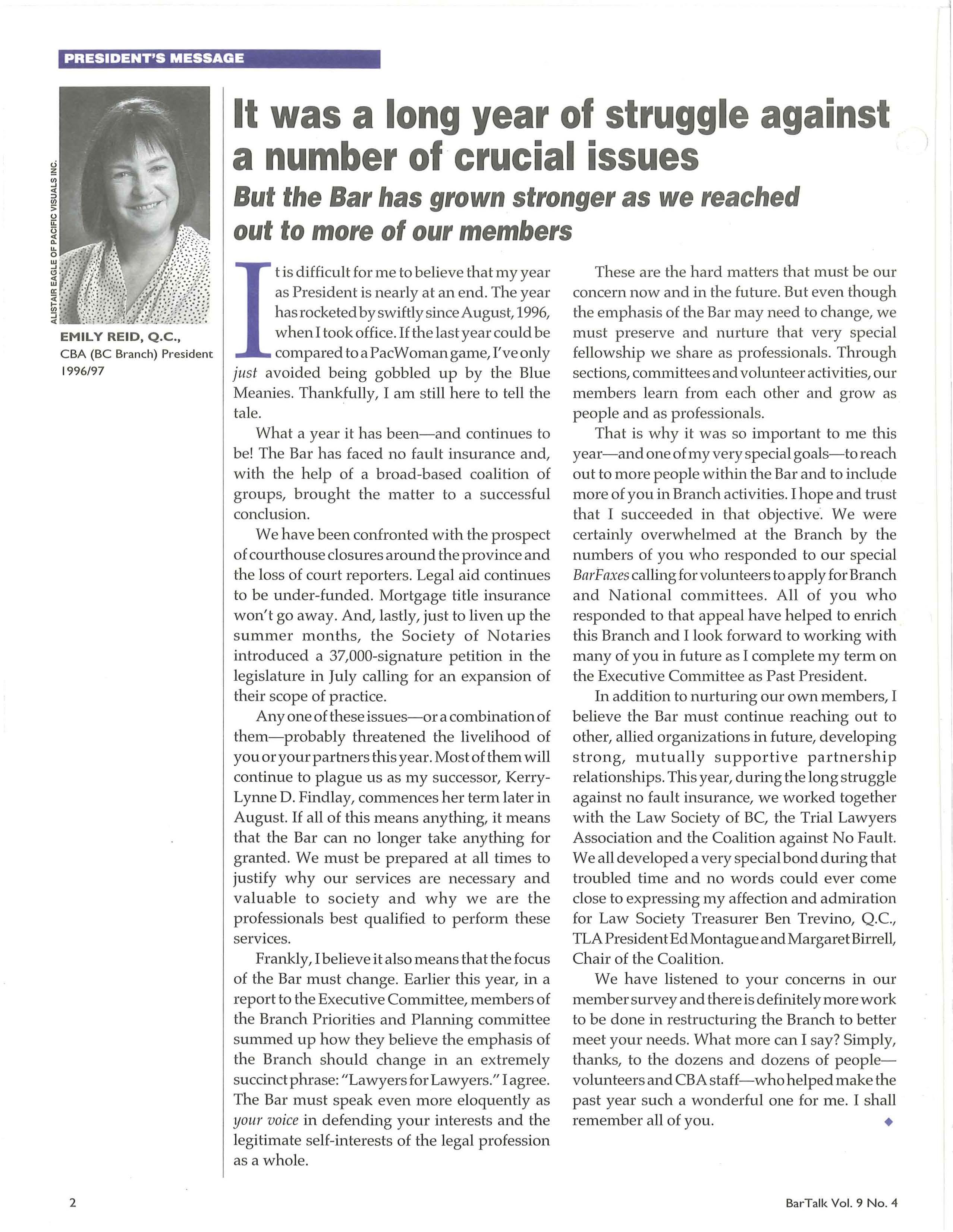
EMILY REID, Q.C.,
CBA (BC Branch) Pre s ident
1996/97
It
was a long year of struggle against a number of crucial issues
But the Bar has grown stronger as we reached out to more of our members
Itis difficult for me to believe that my year as President is nearly at an end. The year ha s rocketed by swiftly since August, 1996, when I took office. If the la st year could b e compared to a PacWomangame, I've only just avoided being gobbled up by the Blue Meanies. Thankfully, I am still here to tell the tale.
What a year it has be en-and continues to be! The Bar has faced no fault insurance and, with the help of a broad-ba sed coalition of groups, brought the matter to a successful conclusion.
We have been confronted with the prospect of courthouse closures around the province and the loss of court reporters. Legal aid continues to be under-funded. Mortgage title insurance won't go away And, lastly, just to liven up the summer months, the Society of Notaries introduced a 37,000-signature petition in the legislature in July calling for an expansion of their scope of practice.
Any one of these issues-or a combination of them-probably threatened the livelihood of you or your partners this year. Most of them will continue to plague us as my successor, KerryLynne D. Findlay, commences her term later in August. If all of this means anything, it means that the Bar can no longer take anything for granted. We must be prepared at all times to justify why our services are necessary and valuable to society and why we are the professionals best qualified to perform these services.
Frankly, I believe it also means that the focus of the Bar must change. Earlier this year, in a report to the Executive Committee, members of the Branch Priorities and Planning committee summed up how they believe the emphasis of the Branch should change in an extremely succinct phrase: "Lawyers for Lawyers." I agree. The Bar must speak even more eloquently as your vo ice in defending your interests and the legitimate self-interests of the legal profession as a whole.
These are the hard matters that must be our concern now and in the future. But even though the emphasis of the Bar may need to change, we must preserve and nurture that very special fellowship we share as professionals. Through sections, committees and volunteer activities, our member s learn from each other and grow as people and as professionals.
That is why it was so important to me this year-and one of my very s pecial goals-to reach out to more people within the Bar and to include more of you in Branch activities. I hope and trust that I succeeded in that objective We were certainly overwhelmed at the Branch by the numbers of you who responded to our special Bm·Fnxes calling for volunteers to apply for Branch and National committees All of you who responded to that appeal have helped to enrich this Branch and I look forward to working with many of you in fuhue as I complete my term on the Executive Committee as Past Pr esi dent.
In addition to nurturing our own members, I believe the Bar must continue reaching out to other, allied organizations in future, developing strong, mutually supportive partnership relationship s. This year, during the long struggle against no fault insurance, we worked together with the Law Society of BC, the Trial Lawyers Association and the Coalition against No Fault. We all developed a very special bond during that troubled time and no words could ever come close to expressing my affection and admiration for Law Society Treasurer Ben Trevino, Q.C., TLA President Ed Montague and Margaret Birrell, Chair of the Coalition.
We have listened to your concerns in our member survey and there is definitely more work to be done in restructuring the Branch to better meet your need s. What more can I say? Simply, thank s, to the dozens and dozens of peoplevolunteers and CBA staff-who helped make the past year such a wonderful one for me. I shall remember all of you. +
Rule 18A: A View From the Bench
Some difficulties in applying this summary trial procedure
r. Justice John C. Bouck addressed Civil Litigation Subsection members on the pro's and con's of applications under Rule 18A, the summary trial procedure which was first introduced in the Supreme Court rules in 1983. He commented on its use and made suggestions for reform, providing details of how a good written brief should be designed for a Rule 18A application.
The original intention of Rule 18A was twofold: First, to deal withrelativelyminorcases early in the process so that fewer cases would be "bumped" on the day of trial. Second, to free up the trial list in order to try more "important" litigation in the customary way. In Mr. Justice Bouck's opinion Rule 18A has produced questionable efficiencies .
CO M PLEX ISSUES
More and more Rule 18Amotions are coming before the Court that deal with complex issues. Others often involve matters that carry substantial economic consequences. They take a good deal of judge time to hear and decide. After a hearing and consideration by the judge many are nonetheless referred to the trial list for trial in the ordinary way. Judge time is wasted because the case remains in the system awaiting a future trial.
Mr. Justice Bouck noted that on the occasional complicated matter a "brave and energetic" judge will invest the necessary time to sort out the essential facts from the voluminous affidavits and apply the law . Often the Court of Appeal will later decide the action was not an appropriate one for resolution by way of Rule 18A. In such cases the time spent by the trial judge has been for nought.
TRYING THE CASE TWICE
The Rule often gives the parties a chance to try the case twice; once when the matter is
dismissed but referred to the trial list and again when it comes on for trial in the ordinary way. Now and then one or both parties pursue a Rule 18A application as a test run for the actual trial.
AFFIDAVIT EVIDENCE
Most affidavits are framed in the words of coun s el as interpreted from the words of the deponent. Hence they may or may not contain the words that the witness would have used if examined under oath at a normal trial. Besides that, a Rule 18A judge is denied the opportunity of weighing the evidence based upon the demeanour of the deponent. It is very difficult to assess the credibility of a witness by an examination of his or her testimony ina transcript. Affidavit evidence is even less revealing. It is a further step removed from the transcript since the words of the witness are filtered through the drafter of the affidavit.
Many Rule 18A affidavits include questionably admissible evidence There is no practical way of preventing the parties from filing affidavits containing such evidence.
All of these defects and others make many judges wary of granting a judgment under Rule 18A. Trying to digest the facts from voluminous material and sort out the often contradictory affidavits is a challenge. 18A(3) tends to ignore these realities. Consequently Mr. Justice Bouck says many judges approach such applications with a great deal of scepticism.
RULE 18A(1 ):
DISPOSING OF INDIVIDUAL ISSUES
This subrule which allows a judge to decide an issue based on the evidence set out in the affidavit is of doubtful value in Mr. Justice Bouck's opinion. Most judges are reluctant to decide an isolated issue on a Rule 18A application
cross/sections
Have you completed and returned your 1997-98 Section Enrollment form to the BC Branch office?
Enrollment packages were mailed to all CBA membe r s in July . If you have not received yours, p lease contact the office and one will be faxed to you Section activity begins again in September, with 64 Sections planning meetings and interesting agendas for the coming year Keep a breast of current developments of the law and hear worthwhile practice tips Attend meetings where members practicing in your area share their experiences and knowledge Register now'
cross/sections welcomes news from any CBA section If you 've got a story to tell, call Fran Hodgkins at 687-3404 or 1-888-687-3404 if you ' re outside the Lower Mainland
Applying Rule 18A
Continued from page 3
because it may conflict with the decision of the trial judge.
CHANGES IN RULE 18A S I NCE JUNE 1995
Mr. Justice Bouck feels that the changes to Rule 18A which were introduced in July of 1996 are also of questionable benefit. For e xa mple , Rule 18A(8) allows a party to apply for dismissal of an application on the basis that the is sue s raised are not suitable for dispo s ition under the Rule or on the basis that the rule will not assist in the resolution of the proceeding This often requires the judge to hear the entire application. If the judge then decides that the application is suitable for disposition under the Rule then the matter may be referred to another judge to review the material and hear the arguments again
Rule 18A(10) allows a judge to give preliminary directions before the hearing of a Rule 18A application Apart f r om orders requiring cross examination on affidavits Mr Justice Bouck has not heard of any judge making orders under this subrule. It seems that most parties do not want to bear the expense of such an application.
Rule 18A(l3) allows a judge to make many orders if Rule 18A relief is refused This can range from fixing a date for the close of pleadings to limiting the length of evid e nce given by a witness in chief at a future trial. Mr. Justice Bouck has never made an order under this subrule Most judges are reluctant to make these orders in advance of the trial without knowing a great deal about the issues. The Rule and the system do not provide a practical way for educating a judge on the matters necessary to make such orders.
WRITTEN BR I EFS
The Supreme Court Rules, including Rule 18A, do not require counsel to produce written briefs except where the time estimate exceeds two hours. Many counsel restrict their Rule 18A time estimate, according to Mr. Justice Bouck, to exactly two hours or less in order to avoid the requirement for a written brief Without the discipline of a written brief, oral arguments tend to be unfocussed, disorganized and forgettable. Oral submissions take up too much court time, preventing judges from processing the case load more efficiently. With properly drawn briefs,
Mr. Justice Bouck estimates that oral argument time could be reduced by 50 per cent and significant judge time could be made available
SUGGESTED REFORMS TO RULE 18A
If the Court could give a firm trial date within twelve months after the filing of the Writ, Rule 18A would likely be unnecessary. However, thi s is unlikely to change in Vancouver, Victoria or New We s tminster. That being so Mr . Justice Bouck suggests three main re forms to make the system run more efficiently under Rule 18A:
1. A requirement for written briefs on all rule 18A applications;
2 . A requirement that all parties make a good faith effort to file a joint statement of contested and non-contested facts;
3 . A requirement that if the parties are unable to agree to such a joint s tatement then each party must file a separate statement of contested and non-contested fact s.
SUITABLE AND NON-SUITABLE CLAIMS FOR RULE 18A APPLICATIONS
Do contentious facts preclude a Rule 18A application? The answer to this is, in Mr Justice Bouck's words "a definitive maybe " Case law supports both sides of the argument. Sometimes a judge will grant relief under Rule 18A where the facts are in contention and sometime s not. It all depends upon the nature of the ca s e and the degree of conflict in the affidavit material.
Case law does not list the type of disputes that . are most suitable for a Rule 18A application. Rather, the cases mention the types of disputes that are least suitable . They include instances where :
1. A party brings on a Rule 18A application shortly before trial.
2 . The applicant has not replied to a demand for a list of documents under Rule 26.
3. The issue is hypothetical or moot.
4. The respondent has not had sufficient time to complete necessary pre-trial procedures
5. The crucial issue is who said what to whom.
6. The material is in the form of a mass of disorganized facts.
7 The affidavit evidence of the applicant is based upon information and belief.
8 There are serious conflicts in the evidence and inadequate pleadings.
9 . There is an allegation of fraud and there has been no examination for discovery or production of documents.
10. The accuracy, reliability and weight of the evidence concerning the issue of causation can only be contested at a conventional trial and there are factual overlaps underlying various claims and defences in a consolidated action.
CONCLUSION
Rule 18A has its good and bad points. Some say it affords an early answer to a claim where the result would be the same after a wait of 2 or more years for a normal trial.
On the other hand, others say too much valuable court time is wasted when Rule 18A applications are dismissed In effect, the parties get two trials. Opponents argue that deciding a
case without actually seeing a witness is fundamentally wrong. They also contend there would be no need for the Rule if the Court adopted a modern system of case management that could give earlier and certain trial dates.
Whatever the criticism, Rule 18A will be with us for some time. Mr. Justice Bouck reminds us that it is important to remember that the Rule is a marked departure from the way most cases are tried. Many judges are cautious in granting relief under the Rule for fear of doing an injustice Consequently, those who seek a remedy under Rule 18A may carry a burden of proving their entitlement to a "greater certainty." +
Writing briefs for a Rule 18A Application
Mr. Justice Bouck's suggestions for a more successful application
Here is a suggested outline for a brief designed for a Rule 18A application. In most instances the brief should be no more than 15 pages.
1. INTRODUCTION
This division of the brief should introduce the reader to the subject matter in a summary way. It should answer the five fundamental questions that apply to any story: Who? What? Where? When? Why?
Example : Mary Jones was injured in a motor vehicle accident on Friday the 12th day of September, 1992 The accident occurred at 6th Avenue and Granville Street, Vancouver, B C. She alleges the defendant, Sam Smith, was negligent when he struck her with his car while she was crossing 12th A venue in the crosswalk. Both liability and damages are in issue.
Ms. Jones only suffered soft tissue injuries. She fully recovered two months after the accident. As to liability, the issue is whether Ms. Jones ran or walked onto the crosswalk.
2. FACTS
In this part the writer should summarily set out in numbered paragraphs and chronological order the facts relied upon as they come from the affidavit material or other evidence.
Counsel should refer to exact paragraphs of the affidavits, discovery answers etc. for the source of the alleged fact. Counsel should also list the facts that are in dispute.
3.1SSUES
Here the writer should define the issues in dispute in point form. E.G.
a) Was the defendant wholly or partly to blame for the accident?
b) If the blame should be apportioned, what is the appropriate division of blame?
c) What amount of damages is the plaintiff entitled to recover for the injuries she sustained?
4.ANALYSIS
In this division, the writer should analyse the issues in the order set out in Part 3 above. Any references to case law should state the correct citation and the exact page in the case where the relevant legal principle can be found. Where appropriate, the brief should quote the legal principle word for word.
5. REMEDY
Here the writer should set out the exact remedy requested including the wording of the order that should follow. Where applicable, counsel should articulate the amount or the range of damages for each class of damages, etc. +
LAW FOUNDATION GRADUATE FELLOWSHIPS, 1998-1999
The Law Foundation of BC awards up to four graduate fellowships of $12,500 each on an annual basis The next deadline for applications is January 5, 1998 for the 1998/99 academic year To be eligible, an applicant must be pursuing full-time graduate studies in law or a law-related area at a recognized university in Canada , United States , or abroad. Applicants must be residents of British Columbia , or graduates of a BC law school, or members of the BC Bar The Law Foundation Graduate Fellowship is not available for the graduate program at UBC as the Law Foundation makes a separate grant to this program
Please contact the Law Foundation at 1340-605 Robson Street , Vancouver , BC , V6B 5J3 or call [604] 688-2337 for an application form.
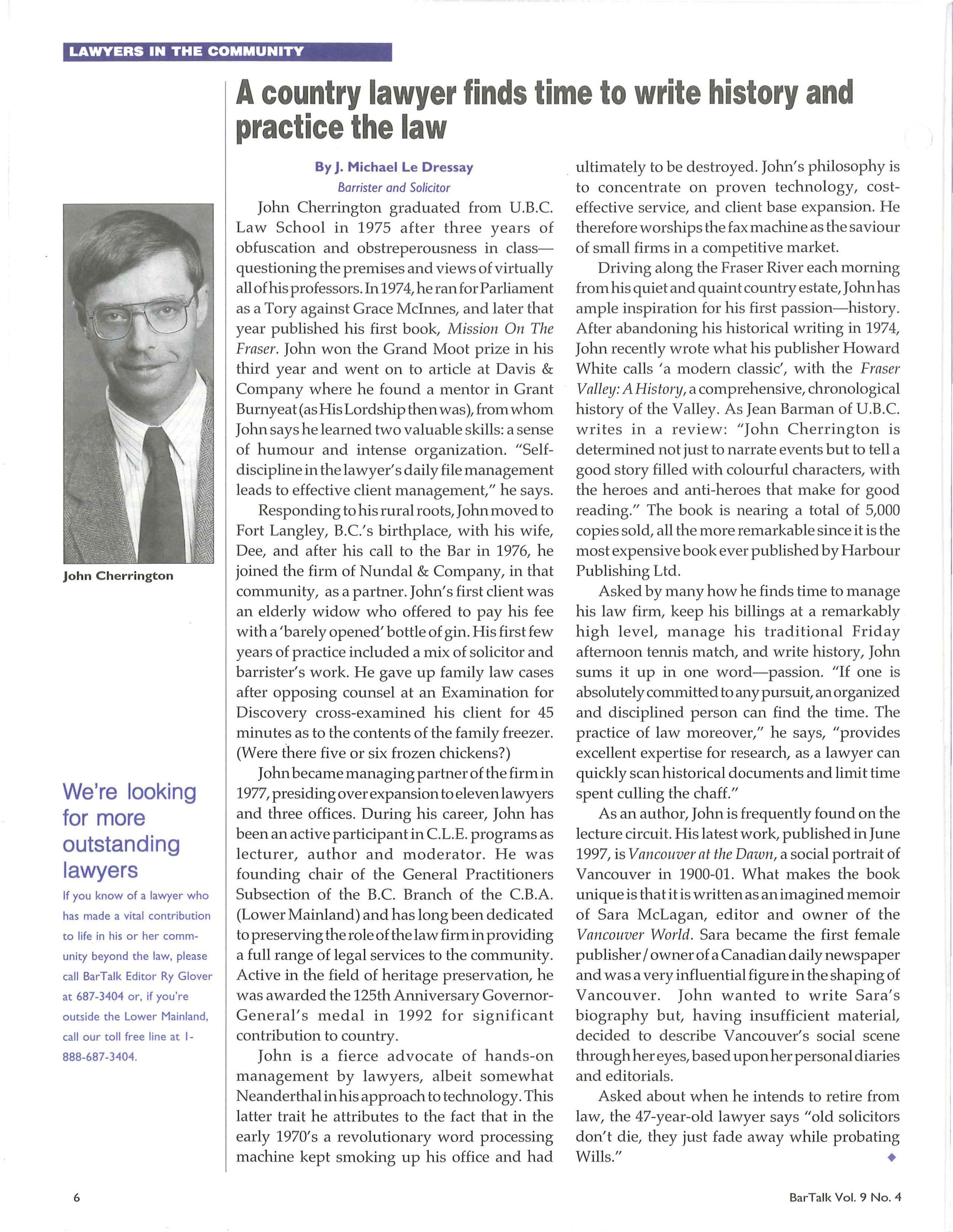
john Cherrington
We're looking for more outstanding lawyers
If you know of a lawyer who has made a vital contribution to life in his or her community beyond the law , please call BarTalk Editor Ry Glover at 687-3404 or, if you're outside the Lower Mainland, call our toll free line at 1888-687-3404.
A country lawyer finds time to write history and practice the law
By J. Michael Le Dressay Barrister and So li citor
John Ch err ington graduated from U.B .C. Law School in 19 75 after thre e years of obfuscation and obstreperou s ness in clas sque stioning the premise s and views of virtually all of hi s profe ssors. In 1974, he ran for Parliament as a To ry against Grace Mcinnes, and later that year publishe d his first book, Mission On The Fra se r. John won the Grand Moot prize in his third year and went on to article at Davis & Company where he found a mento r in Grant Burnyea t (a s Hi s Lordship then was), from whom John says he learne d two valuable s kill s: a se nse of humour and intense organization "Se lfdi s cipline in the lawy er's dail y file management lead s to effective client management," he says. Re sp onding to his rural roots, Jolm mov e d to Fort Langley, B.C.'s birthplace, with his wife, Dee, and after his call to the Bar in 1976, he joined the firm of Nw1dal & Company, in that community, as a partner. John's first client was an elderly widow who offered to pay his fee with a 'barely opened' bottle of gin. His first few years of practice included a mix of solicitor and barrister's work. He gave up family law cases after opposing counsel at an Examination for Discovery cross-examined his client for 45 minutes as to the contents of the family free ze r. (Were there five or six frozen chickens?)
John became managing partner of the firm in 1977, presiding over expansion to eleven lawyers and three offices. During his career, John has been an active participant in C.L.E . programs as lecturer , author and moderator. He was founding chair of the General Practitioners
Subsection of the B.C. Branch of the C.B.A. (Lower Mainland) and has long been dedicated to preserving the role of the law firm in providing a full range of legal services to the community. Active in the field of heritage preservation, he was awarded the 125th Armiversary GovernorGeneral 's medal in 1992 for significant contribution to country.
John is a fierce advocate of hand s- on management by lawyers, albeit so mewhat Neanderthalinhis approach to tedmolo gy. This latter trait he attributes to the fact that in the early 1970's a revolutionary word processing machine kept smoking up his office and had
. ultimately to be de s troyed. John's philosophy is to concentrate on proven technology, costeffective serv ic e, and client base expansion. He therefore worships the fax machine as the saviour of small firm s in a competitive market.
Driving along the Fraser River each morning from hi s quiet and quaint country estate, John h as ample inspiration for hi s fir s t pa ss ion- hi s to ry. After abandoning his hi s torical writing in 1974, John recently wrote what his publish er Howard White call s 'a modern classic', with th e Fm se r Valley: A History , a comprehensive, chronological history of th e Valley. As Jean Barman of U B.C. writes in a rev iew : "John Cherrington i s determined not just to narrate events but to t ell a good story filled with colourful cha ra cters, with the heroes and anti-heroes that make for goo d reading." The book is nearing a total of 5, 000 copie s sold, all the more remarkable since it is the most expen s ive book ever published by Harbour Publishing Ltd
Asked by many how he finds time to manage his law firm , keep his billings at a remarkably high level, manage his traditional Friday afternoon tennis match, and write history, John sums it up in one word-passion. "If one is absolutely committed to any pursuit, an organized and disciplined person can find the time. The practice of law moreover," he says, "provides excellent expertise for research, as a lawyer can quickly scan historical documents and limit time spent culling the chaff."
As an author, John is frequently found on the lecture circuit. His latest work, published in June 1997, is Vancouver at the Dawn, a social portrait of Vancouver in 1900-01. What makes the book unique is that it is written as an imagined memoir of Sara McLagan, editor and owner of the Vancouver World. Sara became the first female publisher I owner of a Canadian daily newspaper and was a very influential figure in the shaping of Vancouver. John wanted to write Sara's biography but, having insufficient material, decided to describe Vancouver' s social s cene through her eyes, based upon her personal diarie s and editorials.
Asked about when he intends to retire from law, the 47-year-old lawyer says "old solicitors don't die, they just fade away while probating Wills." +
Applying the rule of law in a province of many different cultures
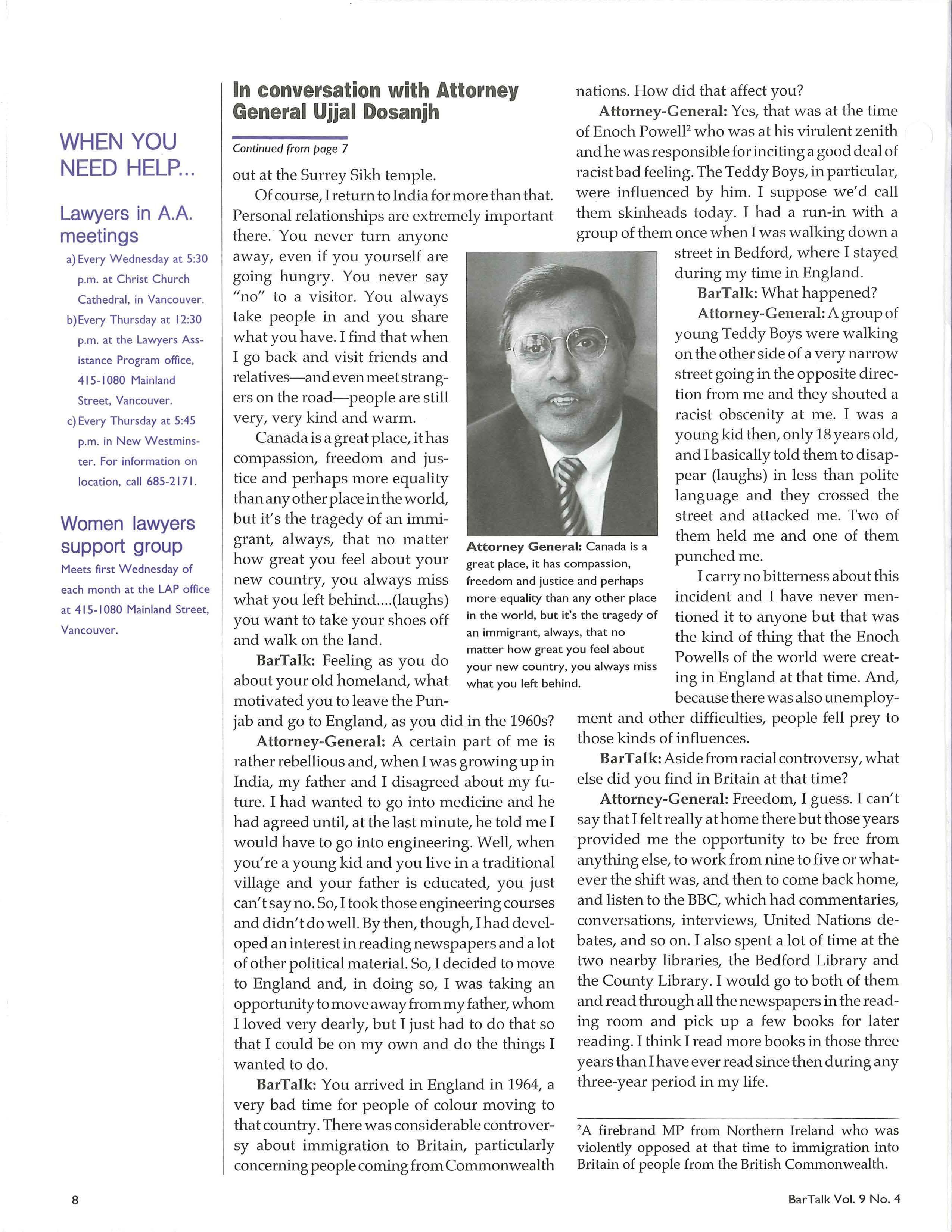
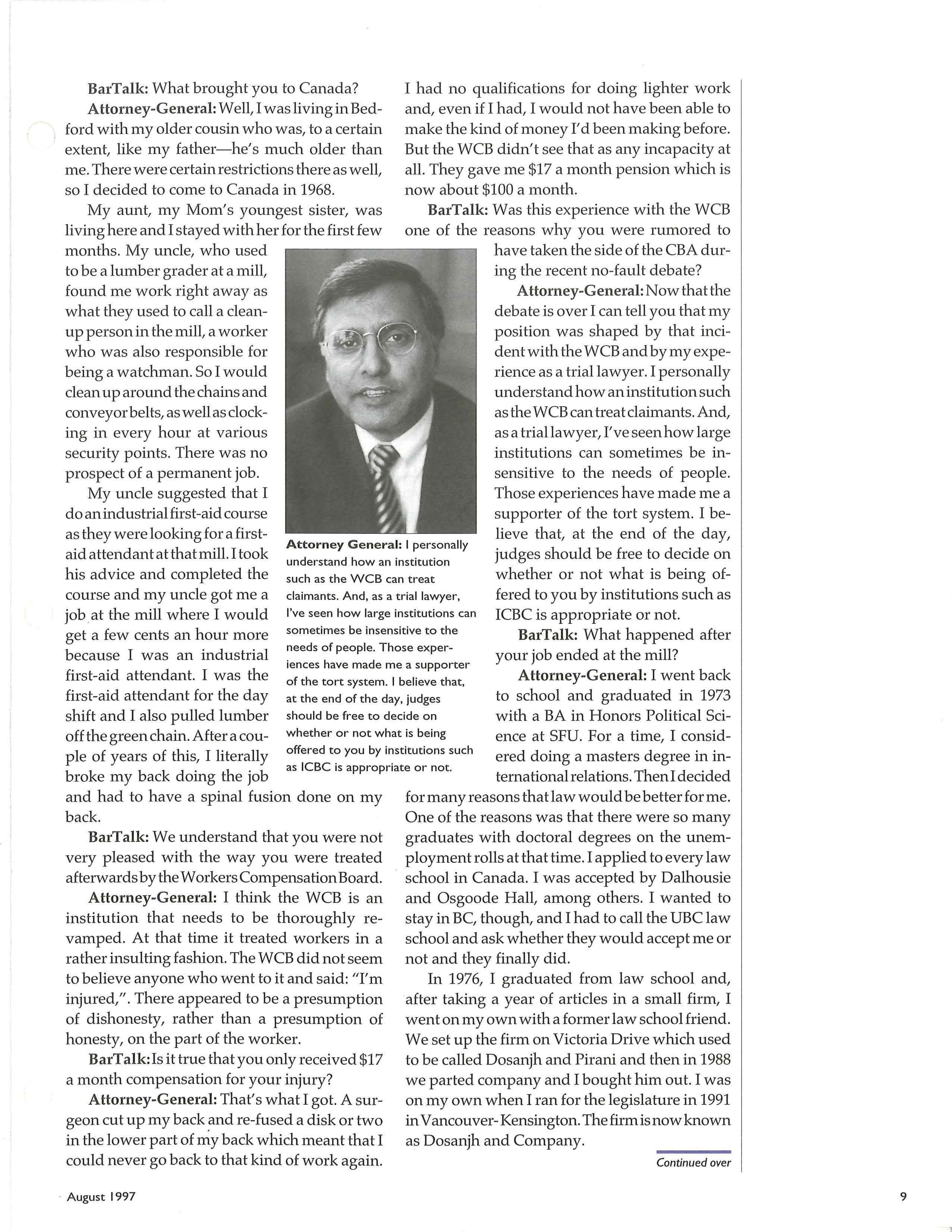
T h e Honourab l e Ujjal Dosanj h has brought h i s un i que experience as a member of an ethnic m i nority to the office of the Attorney General
BarTalk: Mr Attorney, you have been politically active during much of your life. How did you first become politically involved? Was it in the Punjab, where you were born? In England, where you stayed for some time during the 1960's? Or later, in Canada?
Attorney - General: I come from a very political family in India. My maternal grandfather spent many years in British jails fighting for the independence of the country. His uncle, his father's brother, was living in Canada early in the century and left to fight for the freedom of India in 1914, right after the Komagatu Maru left Canada. 1 He was, in fact, mentioned in some intelligence despatches sent from here to British India recommending that authorities should be on the
BarTalk: When you return to your village in the Punjab, what are the changes that are most obvious to you today?
Attorney-General: When I was a kid we used to have a kerosene lamp and either my brother or I would wipe the chimney clean every evening, taking turns and filling it with kerosene oil so that it would be ready for study at night, which my father would oversee as a teacher Towards the end of my stay in India in the late 1950's and early 1960s, electricity was brought into our region. Now in my village you'll see villagers with satellite dishes, there are telephones, a hospital nearby, and three or four schoo ls. It's a big village, with about 5,000 or 6,000 people.
BarTalk: How do you feel
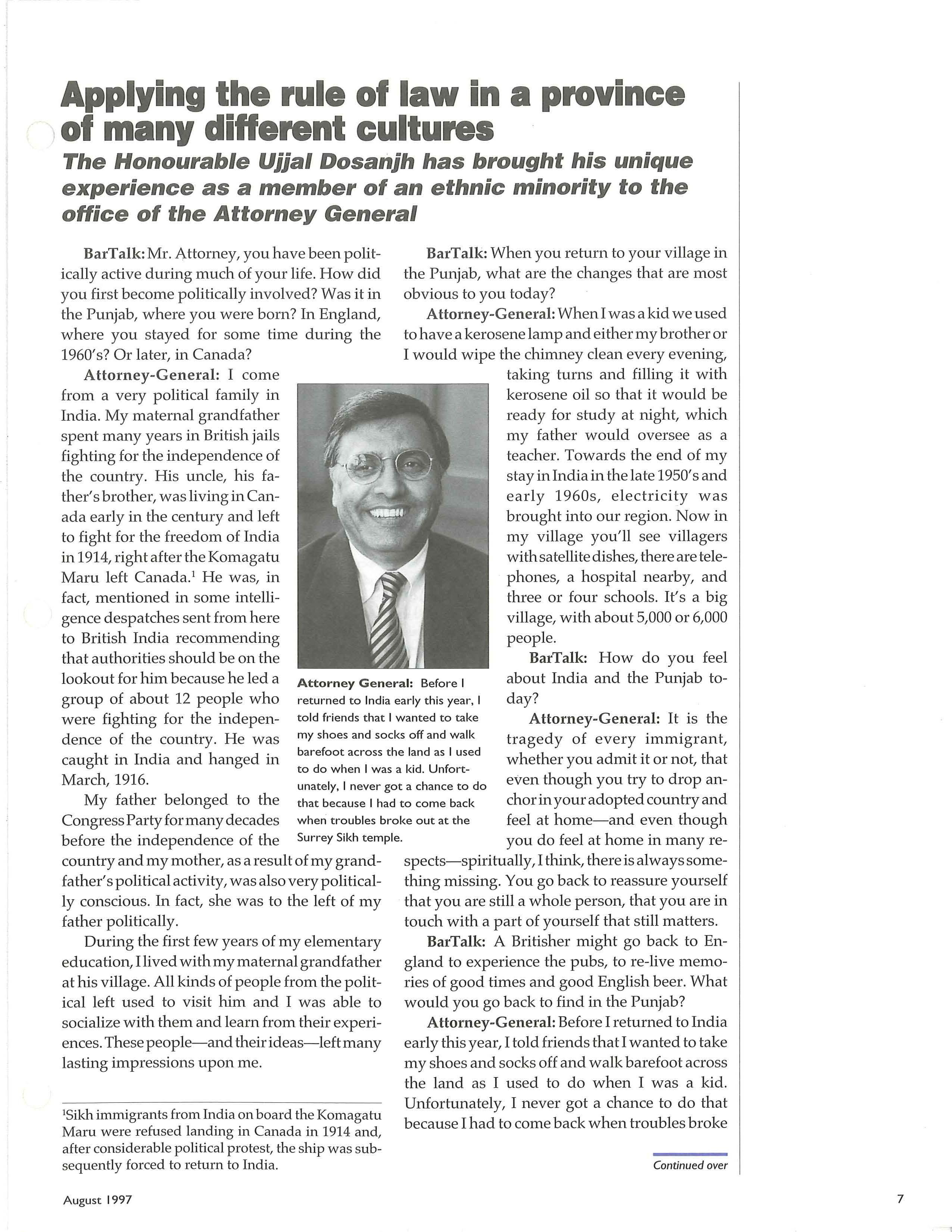
lookout for him because he led a Attorney General: Before 1 about India and the Punjab togroup of about 12 people who returned to India early this year, I day? were fighting for the indepen- to ld friends that I wanted to take
Attorney-General: It is the dence of the country. He was my shoes and socks off and walk tragedy of every immigrant, barefoot across the land as I used caught in India and hanged in whether you admit it or not, that to do when I was a kid UnfortMarch, 1916. unately, 1 never got a chance to do even though you try to drop an-
My father belonged to the that because 1 had to come back chor in your adopted country and CongressPartyformanydecades when troubles broke out at the feel at home-and even though before the independence of the Surrey Sikh temple. you do feel at home in many recountry and my mother, as a result of my grand- spects-spiritually, I think, there is always somefather's political activity, was also very political- thing missing. You go back to reassure yourself ly conscious. In fact, she was to the left of my that you are still a whole person, that you are in father politically. touch with a part of yourself that still matters.
During the first few years of my elementary BarTalk: A Britisher might go back to Eneducation,Ilivedwithmymaternalgrandfather gland to experience the pubs, to re-live memoat his village. All kinds of people from the polit- ries of good times and good English beer . What ical left used to visit him and I was able to would you go back to find in the Punjab? socialize with them and learn from their experi-
Attorney-General: Before I returned to India ences . These people-and theirideas-leftmany early this year, I told friends that I wanted to take lasting impressions upon me. my shoes and socks off and walk barefoot across
1Sikh immigrants from India on board the Komagatu Maru were refused landing in Canada in 1914 and, after considerable political protest, the ship was subsequently forced to return to India.
the land as I used to do when I was a kid. Unfortunately, I never got a chance to do that because I had to come back when troubles broke
WHEN YOU NEED HELP...
Lawyers in A.A. meetings
a) Every Wednesday at 5:30 p.m. at Christ Church Cathedral, in Vancouver.
b) Every Thursday at 12:30 p m at the Lawyers Assistance Program office, 4 15-I 080 Ma inland Street, Vancouver
c) Every Thursday at 5 :45 p m in New Westminster. For information on location, call 685-2171.
Women lawyers support group
Meets fi r st Wednesday of each month at the LAP office at 4 15- I080 Mainland Street, Vancouver.
In conversation with Attorney General Ujjal Dosanjh
Continued from page 7 out at the Surrey Sikh temple . Of course, I return to India fo r more than that. Personal relationships are extremely important
nations. How did that affect you?
Attorney-General: Yes, that was at the time of Enoch PowelF who was at his virulent zenith and he was responsible for inciting a good deal of racist bad feeling The Teddy Boys, in particular, were influenced by him. I suppose we'd call them skinheads today. I had a run -in with a group of them once when I was walking down a there You never turn anyone away, even if you yourself are going hungry You neve r say "no" to a visitor. You always take people in a nd you share what you have. I find that when I go back and visit friends and relatives-and even meet strangers on the road-people are still very, very kind and warm.
Canada is a great place, it has compassion, freedom and justice and perhaps more equality than any other place in the world, but it's the tragedy of an immigrant, always, that no matter
Attorney General: Canada is a how great you feel about your great p lace, it has compass ion, new country, you always miss freedom and just ice and perhaps what you left behind (laughs) more equa lity than any other place you want to take your shoes off in the wor ld , but it's the tragedy of and walk on the land . an imm igrant, a lways, that no matter h ow great you feel abo u t
BarTalk: Feeling as you do
street in Bedford, where I stayed
during my time in England.
BarTalk: What happened?
Att orney -General: A group of young Teddy Boys were walking on the other side of a very narrow street going in the opposite direction from me and they shouted a racist obscenity at me I was a young kid then, only 18 years old, and I basically told them to disappear (laughs) in less than polite language and they crossed the street and attacked me Two of them held me and one of them punched me.
I carry no bitterness about this incident and I have never mentioned it to anyone but that was the kind of thing that the Enoch Powells of the world were creatyo u r new country, you a lways m iss what you left be hi nd. ing in England at that time. And, about your old homeland, what motivated you to leave the Punjab and go to England, as you did in the 1960s?
Attorney-General: A certain part of me is rather rebellious and, when I was growing up in India, my father and I disagreed about my future. I had wanted to go into medicine and he had agreed until, at the last minute, he told me I would have to go into engineering . Well, when you're a young kid and you live in a traditional village and your father is educated, you just can't say no. So, I took those engineering courses and didn't do well. By then, though, I had developed an interest in reading newspapers and a lot of other political material. So, I decided to move to England and, in doing so, I was taking an opportunity to move away from my father, whom I loved very dearly, but I just had to do that so that I could be on my own and do the things I wanted to do.
BarTalk: You arrived in England in 1964, a very bad time for people of colour moving to that country. There was considerable controversy about immigration to Britain, particularly concerning people coming from Commonwealth
because there was also unemployment and other difficulties, people fell prey to those kinds of influences.
BarTalk: Aside from racial controversy, what else did you find in Britain at that time?
Attorney-General: Freedom, I guess. I can't say that I felt really at home there but those years provided me the opportunity to be free from anything else, to work from nine to five or whatever the shift was, and then to come back home, and listen to the BBC, which had commentaries, conversations, interviews, United Nations debates, and so on. I also spent a lot of time at the two nearby libraries, the Bedford Library and the County Library. I would go to both of them and read through all the newspapers in the reading room and pick up a few books for later reading. I think I read more books in those three years than I have ever read since then during any three-year period in my life .
2A firebrand MP from Northern Ireland who was violently opposed at that time to immigration into Britain of people from the British Commonwealth
BarTalk: What brought you to Canada?
Attorney-General: Well, I was living in Bedford with my older cousin who was, to a certain extent, like my father-he's much older than me. There were certain restrictions there as well, so I decided to come to Canada in 1968.
My aunt, my Mom's youngest sister, was living here and I stayed with her for the first few months. My uncle, who used to be a lumber grader at a mill, found me work right away as what they used to call a cleanup person in the mill, a worker who was also responsible for being a watchman. So I would clean up around the chains and conveyor belts, as well as clocking in every hour at various security points There was no prospect of a permanent job.
I had no qualifications for doing lighter work and, even if I had, I would not have been able to make the kind of money I'd been making before. But the WCB didn't see that as any incapacity at all. They gave me $17 a month pension which is now about $100 a month.
BarTalk: Was this experience with the WCB one of the reasons why you were rumored to have taken the side of the CBA during the recent no -fault debate?
My uncle suggested that I do an industrial first -aid course as they were looking for a firstaid attendant atthatmill. I took Attorney Genera l: I personally
understand how an institution his advice and completed the s u ch as the W CB can treat course and my uncle got me a cla imants And, as a tr ia l lawyer, job at the mill where I would I've seen how large institutio ns can get a few cents an hour more somet imes be insensit ive to the because I was an industrial needs of people. Those experiences have made me a supporter first-aid attendant. I was the
Attorney-General: Now that the debate is over I can tell you that my position was shaped by that incident with the WCB and by my experience as a trial lawyer. I personally understand how an institution such as the WCB can treat claimants. And, as a triallawyer, I've seen how large institutions can sometimes be insensitive to the needs of people. Those experiences have made me a supporter of the tort system . I believe that, at the end of the day, judges should be free to decide on whether or not what is being offered to you by institutions such as ICBC is appropriate or not.
BarTalk: What happened after your job ended at the mill? of the tort system. I believe that, first-aid attendant for the day at the end of the day, judges shift and I also pulled lumber should be free to decide on offthegreenchain.Afteracou- whether or not w hat is being
Attorney-General: I went back to school and graduated in 1973 with a BA in Honors Political Sciple of years of this, I literally offered to you by institutions such as ICBC is appropriate or not.
ence at SFU. For a time, I considered doing a masters degree in international relations. Then I decided broke my back doing the job and had to have a spinal fusion done on my back.
BarTalk: We understand that you were not very pleased with the way you were treated afterwards by theW orkers Compensation Board.
Attorney-General: I think the WCB is an institution that needs to be thoroughly revamped. At that time it treated workers in a rather insulting fashion. The WCB did not seem to believe anyone who went to it and said: "I'm injured,". There appeared to be a presumption of dishonesty, rather than a presumption of honesty, on the part of the worker.
BarTalk:Is it true that you only received $17 a month compensation for your injury?
Attorney-General: That's what I got. A surgeon cut up my back and re-fused a disk or two in the lower part of my back which meant that I could never go back to that kind of work again
for many reasons that law would be better for me. One of the reasons was that there were so many graduates with doctoral degrees on the unemployment rolls at that time. I applied to every law school in Canada. I was accepted by Dalhousie and Osgoode Hall, among others. I wanted to stay in BC, though, and I had to call the UBC law school and ask whether they would accept me or not and they finally did.
In 1976, I graduated from law school and, after taking a year of articles in a small firm, I went on my own with a former law school friend. We set up the firm on Victoria Drive which used to be called Dosanjh and Pirani and then in 1988 we parted company and I bought him out. I was on my own when I ran for the legislature in 1991 in Vancouver- Kensington. The firm is now known as Dosanjh and Company.
Continued over
In conversat ion with Attorney Genera l Ujjal Dosanjh
Continued from page 9
BarTalk: In the early 1980s there was a great deal of violence in the Sikh community 3 • How was it that you became embroiled in that violence?
Attorney-General: My interest in that issue arose first out of a principle that one should never attempt to divide people based on religion. Second, my experience with the Teddy Boys in England had shown me that we should attempt to deal with issues in a rational way, not in ways that provoke irrational responses in others-as I had done by responding as I had to their insult. I also felt that we, as an Indo-Canadian community, had already suffered enough We have a hundred years of existence in this
being silenced As I was walking through the community, living day to day, people would come up to me and say "Is anybody going to say anything? Are you going to say something?" I felt that some of our fundamental freedoms were being suffocated by a group of fanatics and that, since no -one else was speaking out, I should. I was a public person, I had run for office, I was a lawyer and I was concerned about these issues . I felt that if I didn't speak out at that time I would forever live in shame .
Those were my motivations to speak out. The catalyst was a violent protest in August of that year. It happened in West Vancouver on India's Independence Day. That was a violent scene, and the police had to be called out, including the police helicopter I felt very, very ashamed and embarrassed . I never used to go to the Indian Independence country and we only got the right to vote in 1947 and the right to practice in the professions in the 1950s. I felt that if we began to build walls within the community itself, all of the gains that we had made as an ethnic community would go down the drain, we would have to suffer some setbacks in some areas.
"I was very nearly killed early in 1985, because of my opposition to the violence . As I left Day celebrations and that year was no exception. I was, in fact, sitting in bed, stricken with a bad back. But that day, after watching the violent demonstration on the 6 o'clock TV news, I decided to attend the evening reception at the Indian consulate as a gesture of defiance against the fanatmy law office, I was attacked in the parking lot and beaten severely with a crowbar . I was probably saved from death only because my partner intervened ."
I had run in 1979 for the NDP provincially and again in 1983 and I was concerned about the kind of impact the violence in India was already having in my community before 1983 . So I went to India in December 1983 and in January 1984, I met separately with Indira Ghandi, the moderate leader of the Sikhs, and the firebrand who finally caused all of the problems. From each of them, I tried to get a sense of what they were doing and tried to convey to them, on behalf of myself and other Indo-Canadians, that we wanted India to solve its own problems peacefully because events in India were already having an impact abroad, in Canada and elsewhere . The situation in Canada in June, 1984, was very bad . There was violence, threats, hit-lists had been made, broadcasters and writers were
3 Much of the violence involved Sikh agitation for a separate homeland of Khalistan. It eventually led to the occupation of the Sikh Golden Temple at Amritsar by the Indian army and the subsequent assassination of Indian Premie r Indira Ghandi.
ics involved in the demonstration.
I went with cane in hand, because of my back. When I arrived a number of people asked me if anybody was going to say anything. The question was asked most pointedly by Nancy Knickerbocker, a reporter for The Vancouver Sun I decided from that day on that I was going to speak out publicly against violence on the Canadian soil and against people being divided against each other based on religious differences.
A week later, I called a press conference at my law office and it was widely covered. In retrospect, this was a turning point for me as my actions changed my life considerably. In fact, I was very nearly killed early in 1985, because of my opposition to the violence. As I left my law office, I was attacked in the parking lot and beaten severely with a crowbar. I was probably saved from death only because my partner intervened.
In any case, when I spoke out at the press conference, I said the issue was not an IndoCanadian issue or a Sikh issue but a Canadian issue, that we were dealing with violence on
Canadiansoil.AsCanadians,ourfreedomswere
Attorney-General: We have a lot of work to being threatened by a handful of fanatics who do. If current trends were to continue and we were also Canadian, using an issue that was continued to deal with them in the same ways 15,000 miles away. and not change, the government would have to
In fact, the government of the day shameful- build more jails and more courthouses in some ly treated this as a foreign issue despite the fact areas while courthouses in other areas would go that Canadian broadcasters, Canadian writers, unused. The government would end up spendandCanadiansactiveinpol- ..-------------------, ingapproximately$1.5billion itics were being threatened "Obviously, the natives in in the next 10 to 15 years in byahandfuloffanaticswho BC have long-standing griev- capital expenditures. And werealsoCanadians.Iwrote ances . There have been historic then operational expenses to Prime Minister Brian Mulroney that I was afraid there would be violence in the community and that something should be done. injustices and they have to be wouldcostmillionsmoredurdealt with. But that's a separate ing the same time period. issue and involvement in native Because of this, I believe land claims does not exempt thejusticesystemmustberadanyone from the full force of ically reformed over the next the Charter or the Criminal few years. With respect to
However, the federal government only paid attention to this issue after the Air India tragedyinJuneo£1985. Then they realized that this was a problem much larger than they thought. But even at that time, even though the vast majority of people on that tragic flight were Canadians, Prime Minister Mulroney sent a telegram of condolences to the Prime
Code of Canada. There were criminal justice issues, I want to see justice brought back into communities, more attention paid to victims, more use of diversion for non-violent offenders as well as mentallydisordered offenders. There should be a greater spectrum of resources available.
some arguments as to whether the Criminal Code of Canada applied in the Gustafsen Lake situation. I said then and I am prepared to say now that the Criminal Code of Canada is like the constitution of the country . It applies to every inch of Canad ian territory."
On the civil side, we need to reduce the flow of civil cases through the courts, there should be more mediation Minister of India. In effect, our government refused to own a problem that existed on Canadian soil, which had been created by Canadian fanatics.
BarTalk: Would you say that your response to the Gustafsen Lake crisis in 1995 reflected your earlier experience dealing with the violence in the Sikh community?
Attorney-General: Basically, I suppose, yes. I believed that all Canadian citizens should live within the law, respecting the rights and liberties of others . Obviously the natives in BC have long-standing grievances. There have been historic injustices and they have to be dealt with. But that's a separate issue and involvement in native land claims does not exempt anyone from the full force of the Charter or the Criminal Code of Canada. There were some arguments as to whether the Criminal Code of Canada applied in the Gustafsen Lake situation. I said then and I am prepared to say now that the Criminal Code of Canada is like the constitution of the country. It applies to every inch of Canadian territory.
BarTalk: As Attorney-General of the province of British Columbia, what is your mission?
available and there should be more alternative dispute resolution in whatever form that might be a<:ceptable to people I believe that only cases that cannot be resolved through these processes should end up in court.
We might consider raising the limit in small claims court from $10,000 to $20,000. That would increase the workload for the provincial court but these courts are doing a good job. They are resolving many cases before them without trials. Even in child protection cases they are resolving many cases without trials. We need to move further in that direction so that people in communities can feel that justice is accessible, affordable, efficient and speedy
BarTalk: Thank you very much for taking the time to talk with us +
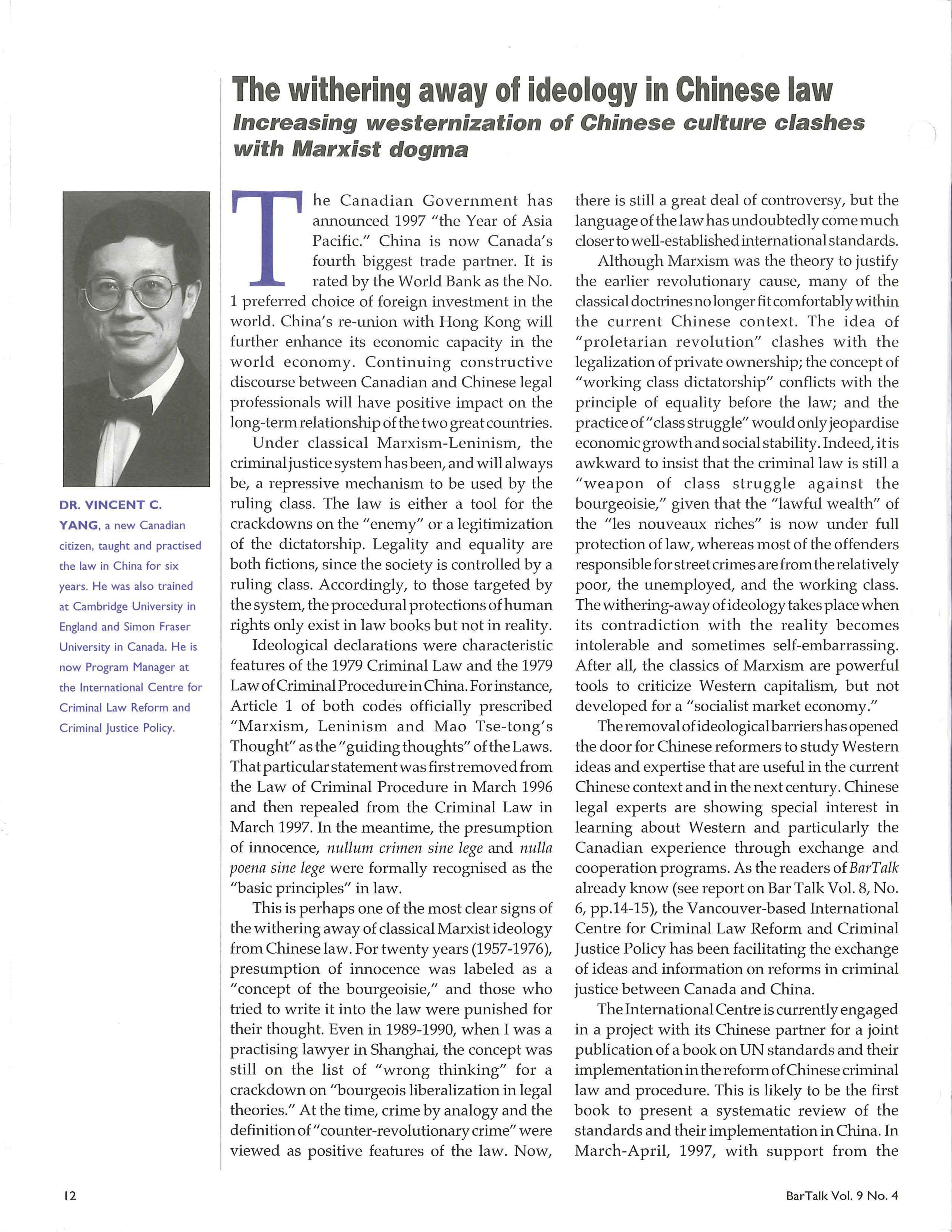
DR. VINCENT C.
YANG, a new Canadian citizen , taught and practised the law in China for six years He was also trained at Cambridge University in England and Simon Fraser University in Canada He is now Program Manager at the International Centre for Criminal Law Reform and Criminal Justice Policy.
The withering away of ideology in Chinese law Increas i ng westernization of Chinese culture clashes with Marxist dogma
he Canadian Government has announced 199 7 "the Year of Asia Pacific." China is now Canada's fourth biggest trade partner. It is rated by the World Bank as the No. 1 preferred choice of foreign investment in the world . China's re-union with Hong Kong will further enhance its economic capacity in the world economy. Continuing constructive discourse between Canadian and Chinese legal professionals will have positive impact on the long-term relationship of the two great countries.
Under classical Marxism-Leninism, the criminal justice system has been, and will always be, a repressive mechanism to be used by the ruling class. The law is either a tool for the crackdowns on the "enemy" or a legitimization of the dictatorship. Legality and equality are both fictions, since the society is controlled by a ruling class Accordingly, to those targeted by the system, the procedural protections of human rights only exist in law books but not in reality. Ideological declarations were characteristic features of the 1979 Criminal Law and the 1979 Law of Criminal Procedure in China. For instance, Article 1 of both codes officially prescribed "Marxism, Leninism and Mao Tse-tong' s Thought" as the" guiding thoughts" of the Laws. That particular statement was first removed from the Law of Criminal Procedure in March 1996 and then repealed from the Criminal Law in March 1997. In the meantime, the presumption of innocence, nullum crimen sine lege and nulla poena sine lege were formally recognised as the "basic principles" in law.
This is perhaps one of the most clear signs of the withering away of classical Marxist ideology from Chinese law. For twenty years (1957-1976), presumption of innocence was labeled as a "concept of the bourgeoisie," and those who tried to write it into the law were punished for their thought. Even in 1989-1990, when I was a practising lawyer in Shanghai, the concept was still on the list of "wrong thinking" for a crackdown on "bourgeois liberalization in legal theories." At the time, crime by analogy and the definition of" counter-revolutionary crime" were viewed as positive features of the law. Now,
there is still a great deal of controversy, but the language of the law has undoubtedly come much closer to well -established international standards.
Although Marxism was the theory to justify the earlier revolutionmy cause, many of the classical doctrines no longer fit comfortably within the current Chinese context. The idea of "proletarian revolution" clashes with the legalization of private ownership; the concept of "working class dictatorship" conflicts with the principle of equality before the law; and the practice of" class struggle" would only jeopardise economic growth and social stability. Indeed, it is awkward to insist that the criminal law is still a "weapon of class struggle against the bourgeoisie/' given that the "lawful wealth" of the "les nouveaux riches" is now under full protection of law, whereas most of the offenders responsible for street crimes are from the relatively poor, the unemployed, and the working class. The withering-away of ideology takes place when its contradiction with the reality becomes intolerable and sometimes self-embarrassing. After all, the classics of Marxism are powerful tools to criticize Western capitalism, but not developed for a "socialist market economy."
The removal of ideological barriers has opened the door for Chinese reformers to study Western ideas and expertise that are useful in the current Chinese context and in the next century. Chinese legal experts are showing special interest in learning about Western and particularly the Canadian experience through exchange and cooperation programs. As the readers of BarTalk already know (see report on Bar Talk Vol. 8, No. 6, pp.14-15), the Vancouver-based International Centre for Criminal Law Reform and Criminal Justice Policy has been facilitating the exchange of ideas and information on reforms in criminal justice between Canada and China.
The International Centre is currently engaged in a project with its Chinese partner for a joint publication of a book on UN standards and their implementation in the reform of Chinese criminal law and procedure. This is likely to be the first book to present a systematic review of the standards and their implementation in China. In March-April, 1997, with support from the
Canadian International Development Agency, the International Centre hosted a three-member delegation of senior Chinese legal experts to conduct research on Canadian experience in implementing these standards.
This kind ofideology is irreconcilable with the underlying concepts of UN criminal justice standards. Therefore, what we see in the opening of discussions on UN standards in China is a shift in official ideology. After almost fifty years of struggle and debate, China has finally passed the ideological barriers in its criminal law reform. Improving the procedural protection of human rights has gradually become a theme of reform in criminal justice.
For example, the Chinese Government has recently approved the establishment of a National Legal Aid Centre and a Legal Aid Foundation. The country is now seeking to learn about legal aid systems from other countries, because
Gordon Bisaro passes away
legal aid is required under the 1996 Law of Criminal Procedure to ensure the right to counsel and a fair trial for the poor. In this area, Canada has a well developed system and varied experience During the visit in March-April, the Chinese delegates were able to share the Canadian experience of legal aid, including the division of financial responsibilities of the federal and provincial governments and the various models of legal aid in the provinces . In addition, both Mr. Daniel Prefontaine, Q.C., Executive Director of the International Centre, and Paul Brantingham, Professor of Criminology from Simon Fraser University and a well-known expert of legal aid, discussed with the delegates both the advantages and difficulties in the Canadian system. The International Centre is now continuing the discussion with China's National Legal Aid Centre for legislative and policy development in the area of legal aid. +
Former member of CBA Provincial Council will be deeply missed
By A. Barry Oland
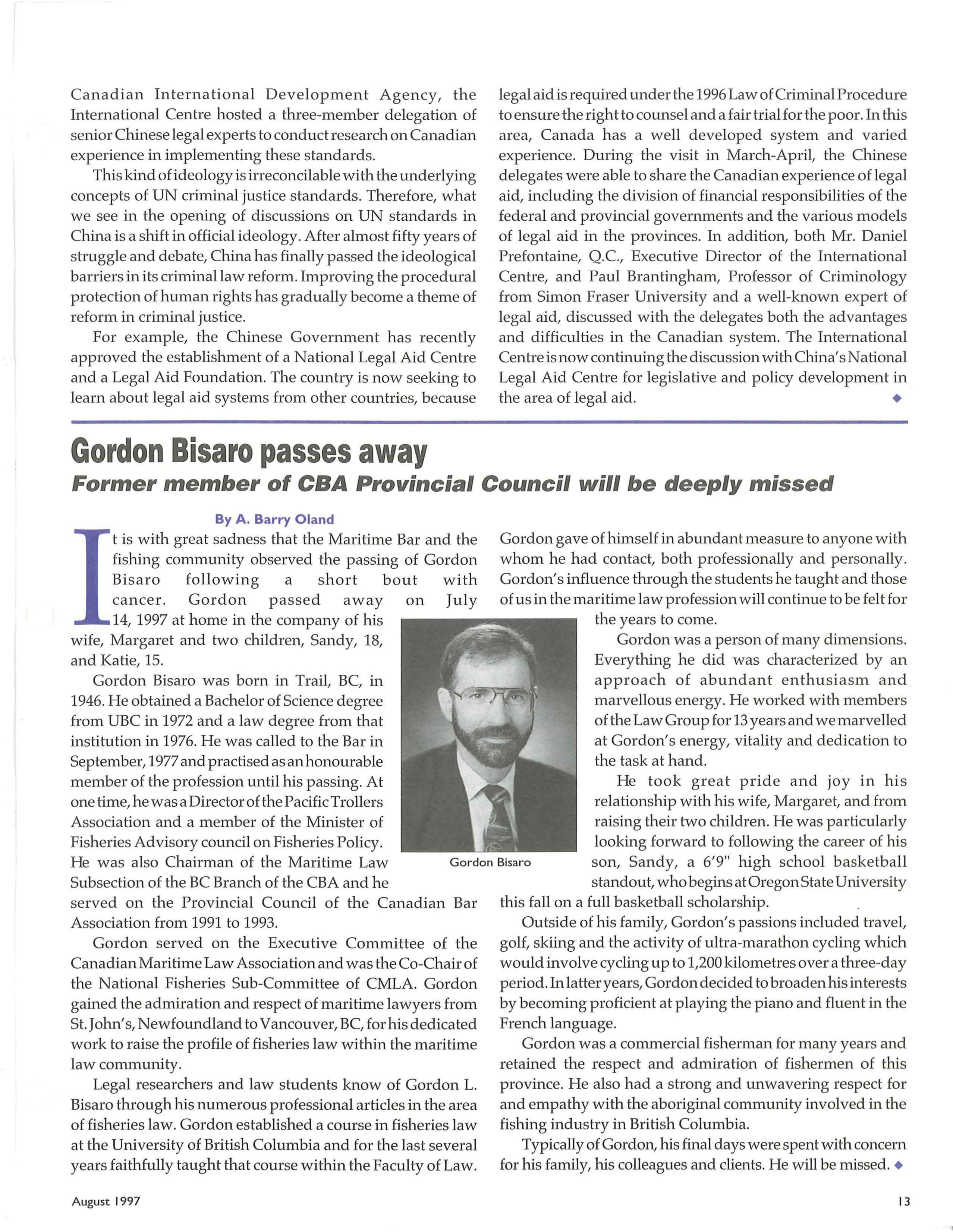
tis with great sadness that the Maritime Bar and the fishing community observed the passing of Gordon Bisaro following a short bout with cancer. Gordon passed away on July 14, 1997 at home in the company of his wife, Margaret and two children, Sandy, 18, and Katie, 15.
Gordon Bisaro was born in Trail, BC, in 1946. He obtained a Bachelor of Science degree from UBC in 1972 and a law degree from that institution in 1976. He was called to the Bar in September, 1977 and practised as an honourable member of the profession until his passing. At one time, he was a Director of the Pacific Trollers Association and a member of the Minister of Fisheries Advisory council on Fisheries Policy. He was also Chairman of the Maritime Law Subsection of the BC Branch of the CBA and he
Gordon gave of himself in abundant measure to anyone with whom he had contact, both professionally and personally. Gordon's influence through the students he taught and those of us in the maritime law profession will continue to be felt for the years to come.
Gordon was a person of many dimensions. Everything he did was characterized by an approach of abundant enthusiasm and marvellous energy. He worked with members of the Law Group for 13 years and we marvelled at Gordon's energy, vitality and dedication to the task at hand
He took great pride and joy in his relationship with his wife, Margaret, and from raising their two children. He was particularly looking forward to following the career of his son, Sandy, a 6'9" high school basketball standout, who begins at Oregon State University served on the Provincial Council of the Canadian Bar Association from 1991 to 1993.
Gordon served on the Executive Committee of the Canadian Maritime Law Association and was the Co-Chair of the National Fisheries Sub-Committee of CMLA. Gordon gained the admiration and respect of maritime lawyers from St.John's, Newfoundland to Vancouver, BC, for his dedicated work to raise the profile of fisheries law within the maritime law community.
Legal researchers and law students know of Gordon L. Bisaro through his numerous professional articles in the area of fisheries law. Gordon established a course in fisheries law at the University of British Columbia and for the last several years faithfully taught that course within the Faculty of Law.
this fall on a full basketball scholarship.
Outside of his family, Gordon's passions included travel, golf, skiing and the activity of ultra-marathon cycling which would involve cycling up to 1,200 kilometres over a three-day period. In latter years, Gordon decided to broaden his interests by becoming proficient at playing the piano and fluent in the French language.
Gordon was a commercial fisherman for many years and retained the respect and admiration of fishermen of this province. He also had a strong and unwavering respect for and empathy with the aboriginal community involved in the fishing industry in British Columbia.
Typically of Gordon, his final days were spent with concern for his family, his colleagues and clients. He will be missed. +
Gordon Bisaro
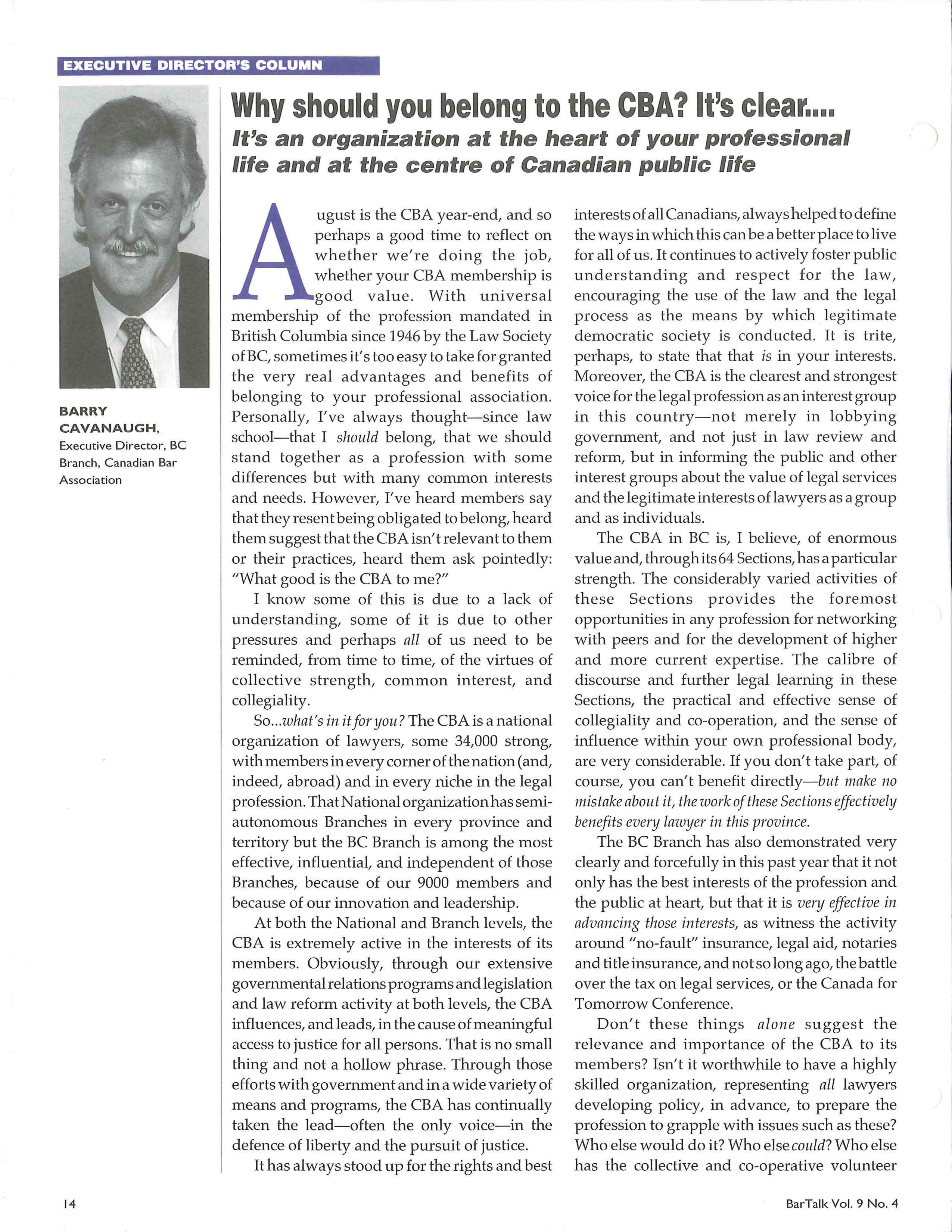
BARRY C AVANAUGH , Executive D irector, BC Branch, Ca nad ian Bar Associat ion
Why should you belong to the CBA? It's clear....
It 's an organization at the heart of your professional life and at the centre of Canadian public life
ugust is the CBA year -end, and so perhaps a good time to reflect on whether we're doing the job, whether your CBA membership is good value . With universal membership of the profession mandated in British Columbia since 1946 by the Law Society of BC, sometimes it's too easy to take for granted the very real advantages and benefits of belonging to your professional association. Personally, I've always thought-since law school-that I should belong, that we should stand together as a profession with some differences but with many common interests and needs. However, I've heard members say that they resent being obligated to belong, heard them suggest that the CBA isn ' t relevant to them or their practices, heard them ask pointedly: "What good is the CBA to me?"
I know some of this is due to a lack of understanding, some of it is due to other pressures and perhaps all of us need to be reminded, from time to time, of the virtues of collective strength, common interest, and collegiality.
So ... what's in it for you? The CBA is a national organization of lawyers, some 34,000 strong, with members in every corner of the nation (and, indeed, abroad) and in every niche in the legal profession. That National organization has semiautonomous Branches in every province and territory but the BC Branch is among the most effective, influential, and independent of those Branches, because of our 9000 members and because of our innovation and leadership .
At both the National and Branch levels, the CBA is extremely active in the interests of its members. Obviously, through our extensive governmental re lations programs and legislation and law reform activity at both levels, the CBA influences, and leads, in the cause of meaningful access to justice for all persons. That is no small thing and not a hollow phrase. Through those efforts with government and in a wide variety of means and programs, the CBA has continually taken the lead-often the only voice-in the defence of liberty and the pursuit of justice. It has always stood up for the rights and best
interests of all Canadians, always helped to define the ways in which this can be a better place to live for all of us. It continues to actively foster public understanding and respect for the law, encouraging the use of the law and the legal process as the means by which legitimate democratic society is conducted. It is trite, perhaps, to state that that is in your interests. Moreover, the CBA is the clearest and strongest voice for the legal profession as an interest group in this country-not merely in lobbying government, and not just in law review and reform, but in informing the public and other interest groups about the value of legal services and the legitimate interests of lawyers as a group and as individuals.
The CBA in BC is, I believe, of enormous value and, through its 64 Sections, has a particular strength The considerably varied activities of these Sections provides the foremost opportunities in any profession for networking with peers and for the development of higher and more current expertise. The calibre of discourse and further legal learning in these Sections, the practical and effective sense of collegiality and co-operation, and the sense of influence within your own professional body, are very considerable. If you don't take part, of course, you can't benefit directly-but make no mistake about it, the work of these Sections effectively benefits even; lawyer in this province.
The BC Branch has also demonstrated very clearly and forcefully in this past year that it not only has the best interests of the profession and the public at heart, but that it is very effective in advancing those interests, as witness the activity around "no-fault" insurance, legal aid, notaries and title insurance, and not so long ago, the battle over the tax on legal services, or the Canada for Tomorrow Conference
Don't these things alone suggest the relevance and importance of the CBA to its members? Isn't it worthwhile to have a highly skilled organization, representing all lawyers developing policy, in advance, to prepare the profession to grapple with issues such as these? Who else would do it? Who else could? Who else has the collective and co-operative volunteer
resources, or the will? Say what you like-we need to work together.
Is it relevant and worthwhile for the Bar to have input on judicial appointments, and even on the process of those appointments? The CBA has led the way for many years, and without it, it is doubtful the Bar would have any meaningful input on the topic. Is it useful to operate such programs as Lawyer Referral, where the public can call with a problem, without any plan to call a lawyer, and be sent out to a lawyer to get help? A great many people have been aided who wouldn't have been, and a great many new clients have been added to firm rosters throughout the province just this year, because of that work in the Branch . Information has always been one of the most critical needs of an effective lawyer. All CBA members receive both our National magazine and a learned journal on a regular basis, and they speak for themselves . Every lawyer in BC also receives BarTalk-a vitally informative tool for lawyers-just take a look at the past few issues, in "PracticeTalk", "Section Talk", in "Legislative Update", and numerous other articles. Consider all the current information that comes out regularly in BarFax and Issues Alerts. What about the opportunities for further legal education in Section papers, and in the newsletters of the National Sections?
The CBA, particularly in BC, has a long and solid history of initiating and supporting other programs for the good of its members. The Canadian Bar Insurance Association, the Lawyers' Assistance Program, even our own C.L.E. Society are all examples. They all started with heavy CBA involvement and some are even direct offshoots. There are many more, and now the Branch has created and is actively supporting a Benevolent Society for lawyers and their families. How else, one wonders, would we have these things, but for the CBA?
Lawyers in BC can access advice and assistance from more experienced peers in a wide array of practice areas, through the CBA' s Practice Advisory Panels. We have the use of our own Directory, the finest product on the market, providing valuable and current information at the lowest possible cost. As well, we have the collective power of our numbers to benefit us by leveraging some of the best rates possible on high quality goods ·and services for our members-from faxes to home mortgages, from RRSP management to hotels and car rentals,
a myriad of services. Every year, CBA members save millions of dollars and get untold advantages through our Member Services.
The Branch has a small staff and many great volunteers-that's how it's done-people actively engaged in pursuing the best interest of each lawyer in BC. Lawyers get big results for a small investment. The CBA fee this year totalled approximately $339, including a Branch Levy. Of that total, the national organization receives about $23 0, and the Branch gets about $109. That's for "regular" members. Those with less than five years at the Bar get a significant reduction in fees. Interestingly, ina recent survey of professional and occupational organizations, the CBA's fees were among the very lowest in the country. And it's deductible! Talk about bang for the buck!
Obviously, much more could be said about the value of the CBA. There are many more aspects to a complex and effective organization that has advanced lawyers' interests for over 101 years-but the case is already made . And as to universality, even if you're not interested in the power of our numbers, working together, even if you don't believe that the work ofthe CBA, or it's influence, matters a great deal, why should any benefit from the work of others, without some participation?
This is a great organization, and members can take pride in belonging And still, we're working on it. Still, we seek to improve. We want to be more accessible, as witness the toll-free number, and voice-mail, as witness the founding of more and more Sections outside the lower mainland, as witness the frequency of Council meetings and the bringing together of Local and County Bars to discuss mutual issues We want to be more effective, and responsive, and we asked you how to do so, in our Member Survey. We're reorganizing our structure, to be more responsive and efficient. Nothing is sacred, as we continually examine how we can better serve you.
All in all, at this year-end, lawyers in BC have a right to be convinced of the very real value of the CBA in their professional, public and personal lives. Relevant? You Bet! Effective? No doubt! That's what's in it for you.
CAA OFFERS DISCOUNT FOR CBA MEMBERS
CBA members can enjoy discounts of up to 25 per cent on fees for membership in the Canadian Automobile Association. If you're interested , the number to call is 1-800-341-2226
New CAA or BCAA members can call anytime and should ask to be put on the CBA CORPORATE account Current CAA or BCAA members should ONLY call once they have received their renewal notice in the ma!l-usually one month before their membership expires-and ask to be transferred to the CBA CORPORATE accounting.
As a CBA member, the amount of discount you enjoy will depend upon the plan you choose and whether you are a new member or a renewal.
By Joanne Power Manage r Registrar Program
If you have any interesting or unusual quest ions or comments about th is column, p lease write directly to :
JOANN
E
POWER Manager, Registrar Programs
Law Courts, 850 Burdett Ave. Victoria , B C. V6W IB5
INTERNET: jpower@ galaxy gov.bc.ca or Fax: 250-387-3061
QAre funds held in court required to be paid directly to a Trustee in bankruptcy?
AIn Vancouver, the cashier will notify the other party of the Trustee's application. If there is no objection, the funds will be paid to the Trustee. In all other registries, funds held in court may be claimed by the Tru s tee on application to court.
GARNISHMENT, ATTACHMENT AND PENSION DIVERSION A CT
QHow does a judgment creditor issue a garnishing proceeding against a federal government employee?
AAn amendment to the Garnishment, Attachment and Pension Diversion Act of Canada came into effect May 1, 1997. The creditor must prepare an affidavit in support of a garnishing order after judgment. The garnishing order will identify the garnishee as "Her Majesty the Queen in right of Canada".
A federal form called a garnishment application must be prepared by the creditor <;md served together with the garnishing order and a copy of the judgment or order which forms the basis for the garnishing order. If a creditor is uncertain whether a specific department is subject to the provisions of the federal Act, or wishes to obtain the garnishment application, the creditor should contact the Federal Garnishment Registry at (604) 666-2061 for advice.
LEGAL PROFESSION ACT, S.87(5) & (7)
QWhat is the procedure to follow on an application to increase a member's remuneration under a contingent fee
agreement in excess of limits set out by the benchers in the Legal Profession Act?
AThe Court Registry will set a time and place for this application to be hea r d by a Supreme Court Judge. In most locations, this will be done by the "trial coordinator".
The application is in private If either the solicitor or the client requests that the application be kept confidential, then the registry must ensure that the records are confidential and that no person other than the solicitor or the client or a person
autho r i z ed by eithe r ma y search the record s absent a court order . In Victoria, following the hearing , the clerk is given a sealed envelope fo r s torage . We file these applications with our Privacy Act applications, which follow the same procedure
PATIENTS PROPERTY, ACT, S.1 5
Q
Can an attorney sign a bond on behalf of a committee?
A The bonding company will determine whom they allow to s ign a bond As long as the bond is the proper format, the amounts are correct, and the bond is issued by an authorized bonding company, w e need look no further.
R ule 41 (18)
Q
If a Registrar settles an order after a trial of the proceeding, must the order be put before the Judge for approval?
AIf the order cannot be settled by the Registrar, Rule 41(18) contemplates that the Registrar will refer the draft order to the Judge, who may in any event review and vary a settled order (Rule 41(21)) Otherwise, there is no reason why the Judge needs to approve it before entry.
Rule 42(8) & ( 12)
Q
In a foreclosure proceeding, may a writ of possession be issued when a party fails to deliver up vacant possession of the
property?
ABecause a writ of possession is a fairly drastic remedy, registry staff should proceed with caution and ensure that the order allows for its issuance.
Firstly, a distinction must be made between Orders Absolute and orders approving sales Unless the order approving sale specifically provides for issuance of a Writ of Possession if the property is not vacated, the party seeking vacant possession should apply to court. This is because Rule 42(8) requires registry staff to ensure that there are no conditions, express or implied, in an order before issuing a Writ of Possession. On the other hand, an Order Absolute is unconditional and a Writ of Possession may be issued.
Rule 42(34)
QIf a debtor fails to obey an examiner's order for payment by instalments, what is the creditor's option?
A42(34):
" ,the creditor may issue out of the registry a notice of motion for committal in Form 52, on filing an affidavit showing that the default has occurred, and subrules (24) and (25 ) apply.
Notice to the Profession
Appe ndix C, Sc hedule I, Item 30
QWhen would we charge the $40.00 fee for payment into or out of court under Item 30?
AEithe
r pursuant to statute or by court order. The latter may require payment into and out of court without Items 1, 7, and 11 applying.
An example would be a payment in pursuant to section 20(4) of the Builders Lien Act. +
Amendments to the Rules regarding Matrimonial Proceedings
Subcommittee of the Rules Revision Committee has drawn a new set of Rules and Forms to replace present Rules 60 and 60B. The present Rules provide for three methods of instituting a matrimonial proceeding, where one would do Most of the changes proposed are in the nature of simply cleaning up and consolidating the old Rules by removing redundant or conflicting sections.
The chief feature of the changes is that all matrimonial proceedings, divorce included, will be commenced and carried on under one set of Rules and one form of process.
Some of the other highlights are set out below.
1. Unless specified to the contrary, the Rules of Court will apply to matrimonial actions.
2. Claimsrelatedorconnected with any of the relief sought in the matrimonial action may be joined. For instance, if a writ has been issued simply with respect to claims made under the Family Relations Act, a claim for divorce may be added later or claimed by way of counter-claim
3. Like the initial action itself, a later claim for corollary relief in a divorce proceeding s hall be brought by writ and statement of claim.
4. Where an application to vary, rescind or suspend an Order is brought by notice of
motion and no s tep has been tak e n in the proceeding for one year, the respondent must be personally serve d.
5. Where it is alleged that there is a breakdown of the marriage by reason that the respondent has committed adultery, the name of any other person involved shall not be set out unless relief is claimed against such person
6. A new proposed form for the statement of claim is divided into parts. The plaintiff shall complete such parts as are necessary in accordance with the instruction s which accompany the form.
7. The form is aimed at ensuring that all the necessary information, and no unnecessary information, is included in the pleadings. With standardization, it should be clear to counsel and to the Bench what the issues are .
CBA members who wish a copy of this Notice to the Profes s ion, the new draft Rule 60, together with the Form s and Table of Concordance can be obtained from the Vancouver office of the CBA, lOth Floor, 845 Cambie Street, or call 687-3404 (or 1-888- 6873404, if you're calling from outside the Lower Mainland). Copies can also be obtained from your local courthouse library or on the Internet at www.courts.gov.bc.ca.
Comments are solicited by November 30, 1997, not only relating to the draft Rule s but also to any amendments to the Rule s, which may improve and simplify the conduct of matrimonial proceedings. +
CBA Member Discounts on clothing at Goldman & Son
Another great service has been added to the CBA Member Services roster
Starting September I, 1997, the popular Goldman and Son men's clothing store in the Pacific Centre mall , Vancouver , which has been a successful clothing store for 50 years , will offer a 15 per cent discount on regu lar priced store merchandise to CBA members who produce a business card or CBA member card. Not only will CBA members enjoy the benefit of this clothing discount, they will also enjoy the very special persona li zed serv ice that many Vancouver lawyers already appreciate when shopping at Goldman and Son
Law in a changing Asia
The 15th annual LAWASIA Conference, sponsored by the Law Association for Asia and the Pacific, will be held August 26-3 I at the Philippine International Convention Center , Manila, Philippines. A discount fare is available through Phil ippine Ai r lines for all conference delegates For more information or to register , contact the Conference Secretariat: Philippine Exhibition Services Organization (P.E.S.O.), Inc.
Unit 1205 The Centerpoint Julia Vargas Ave. cor.
Garnet St , Ortigas Center
Pasig City, 1600 Phi lippines
Tel: (632) 633-6557 to 60
Fax: (632) 633-6589
Revenue from tax on legal services and federal transfers is more than budget for Legal Aid services
Continued from page I
agencies, community groups and lawyers has been formed. With administrative and meeting support provided by th e BC Branch of the Canadian Bar Association, this group has had two meeting s and formed a Ste er ing Committee to guide future efforts.
One of the coalition's key concerns is the fact that the provincial government, through federal transfer payments and a tax on l egal services, collects more money for Legal Aid serv ices than it pays out. At a time w h en it
becoming harder to
qualify for Legal Aid
because the government
refuses to allocate more funding.
money to the program, the PST in legal services is estimated to bring in $72 million per year. On top of that, federal government transfer payments for Legal Aid are estimated to be approximately $20 million . These two sources of revenue combined are more than the government is paying out.
The Bar is particularly concerned that money from the PST was supposed to have been transferred to Legal Aid, funding that program . When Mr Clark rose in the BC legislature to introduce the tax, in Bill 8, Social Service Tax Amendment, he said: " when we chose to look at revenue sources to pay for (Legal Aid), we thought that a ta x on legal services was a fair and appropr iate way to do it." (Hansard, May 27, 1993).
The most recent in a series of cutbacks to Legal Aid services occurred last February, in response to a capping of government funding at $81.5 million; $9 million less than th e Legal Services Society required to maintain existing services . In addition, the Society must use a portion of funding over the next five years to eliminate its accumulated deficit. Cuts introduced in February-and approved by the provincial government as" acceptable" reductions in Legal Aid services-included :
in the disqualification of approxim a tely 3,000 clients
• elimination of the income fle x test for emergency famil y cases
• e limination of financial eligibility exception s for complex criminal cases
• elimination of l egal aid covera ge for changing maintenance orders
• e limination of legal aid coverag e in changes to custody or access ord ers except where risk of harm to the applicant or children is corroborated by written evidence from a health care
• reduced financial eligibility levels, resulting professional
• reducing tariff fees to lawyers by an additional5 per cent, on top of the existing holdbacks of 12 per cent for immigration cases, 10 per cent for criminal cases and 5 per cent for family cases
• a further 10 per cent reduction in head office programs and services
• block contracting of certain kinds of cases at reduced cost, removing choice of counsel for the clients
Lawyers who are providing Legal Aid services are frustrated by the combination of low tariffs, holdbacks, cuts in services and delays in payment . Remuneration for Legal Aid cases ranges between 25 to 35 per cent of their value in private payment situations. Payment delays of up to 90 days are common-a neces sa ry tactic of the Legal Services Society, to manage ongoing cash flow problems.
"We are definitely reaching a crisis point, both in terms of providing access to services for those who need them, and providing adequate compensation for those who provide the services," said David Griffiths, former Chair of the Association of Legal Aid Lawyers "We have said as a society that everyone must be able to stand equal before the law, regardless of income or other factors . To do that requires a financial commitment from society as a whole-not just lawyers, who are already contributing through significantly reduced fees for Legal Aid cases." +
CBA BC Branch Executive Dire cto r Barry i s
Cavanaugh and Legal Aid Committee Chair Doug
Robinson, Q C. , presided at a recent meeting of
groups concerned about the crisis in Legal Aid
Co-Cha ir, Amer ican Bar Assoc iat ion's "Techshow 98" at Chicago, March 2628, 1998
How to find the help you need when you need it the most
If you reach out for help you'll probably find it's a lot closer than you think
right and early your secretary comes in and hands you the incoming correspondence file. Your head aches from the lingering effects of your hangover that wasn't quite settled by the aspirin you took this morning. Your hand starts to shake just a little when you pull out more than one letter threatening collection proceedings on past-due
"Waf I feel good, I knew that I wouldn't of I feel good, I knew that I wouldn't of accounts. You glance at the calendar and realise that Friday is pay-day as well as the day your home So good, so good, I got you .. "
Words and mus ic by James Brown. mortgage payment comes out of your personal
account, which is perilously low as well
You go and check the funds in trust, and find that there are no more amounts that can be validly billed and transferred to your general account. All your existing files don't have a shadow of a chance in producing any revenue in the next few days. You also know that you have stated to clients that you have done things on their files that haven't even been started yet. You return to your office and hang your head in your hands. How did things get this way anyway?
David]. Bilinsky is a partner at Lakes Straith & Bilinsky and a principal of Integral Management Inc . He can be reached on the internet at integral@direct.ca .
Sounds too far fetched? Or perhaps cuts a little too close to the quick? For some of us, jus t making it through a day takes everything we've got. The pressures and demands of the practice of law can encourage some to turn to liquid solace or to take out memberships in the white powder bar. Others take more drastic measures, such as withdrawing funds from trust accounts and defrauding clients. Less dramatically, many of us are feeling trapped in the biggest rut of our lives, and feeling increasingly unable to do anything about it.
When we are overwhelmed by feelings such as these, we are likely to take a very dim view of suggestions by friends that our problems could be the result of a "bad attitude" that might easily be set right by one of the legions of self-help manuals now available. A change of attitude may indeed be required for change, but for most people it does not come easily . Indeed, the most basic of attitudinal changes-that we need at times to reach out for help-can represent a profound shift in consciousness for many lawyers, who tend toward the "rugged individualist" end of the psychological spectrum But" soldiering on" and not seeking assistance in extremely difficult situations will, in all likelihood, only make matters worse.
So, when you've reached the decision that you do need assistance, here are some resources, people and approaches that can help and make a difference : Interlock Employee and Family Assistance Society: Phone: (604) 431-8200 . For crisis counselling. This service is confidential (it is totally separate from the Law Society) and free (your Law Society membership covers the cost of this program). Psychologists are adept at handling personal difficulties and at providing insights into the resolution ofinh actable personal situations, family concerns, substance abuse or work-related and career concerns.
Lawyers Assistance Program: Phone : (604) 685-2171 or toll free: (888) 685-2171. LAP is a confidential, independent network of lawyers helping other lawyers in areas of alcohol and drug problems, stress, anxiety and depression They have a video outlining their services which you can access by calling the numbers above.
Continued over
Do everything you ca n-then take a break
Continued from page I 7
Benchers: These individuals offer peer advice and assistance When you are caught in a tight situation (ethical or professionally) or want to discuss a problem file with a senior member of the bar, or want to vet a proposed course of action, or you want to simply seek advice from a senior member of the bar, calling a Bencher is time well spent. See page 71 of the CBA's B.C. Lawyers Directory for a complete listing of Benchers and their contact numbers.
Practice Advison; Panels: The CBA administers panels of volunteer lawyers who are willing to discuss substantive and practice management issues with members of the Bar. See page 19 of the CBA B.C. Lawyers Directory for a complete listing of these panels, the members therein and contact numbers
Your colleagues: Simply calling a trusted friend can help turn the tide or release some of the anxiety and angst. Your colleagues can provide resources, take problem files off your hands, offer to mediate disputes with clients and generally help release the pressure. After all, a friend in need is a friend indeed.
Psychologists: If you want to seek your own counsellor, there are many trained and skilled psychologists practising in the Province. See your yellow pages under Psychologists or call the British Columbia Psychological Association that offers a public referral service at (604) 730-0522.
Take things a step at a time: By breaking complex problems down into discrete tasks, you can help prevent matters from appearing overwhelming. By taking a crises situation apart, you are using the strategy "divide and conquer" to your best advantage.
Call the insurer: Phone : (604) 682-8911. If matters appear to seem that a possible claim may be made against you, call PLI now. They are skilled at fix and repair . Moreover, it is much better that you notify them of a claim now and be entitled to the coverage that you have paid for than doing nothing and possibly losing the coverage (which will really make things worse!) . They are also willing to answer telephone enquiries by lawyers to discuss possible claims and situations.
Call the Law Society (yes, the Law Society!): Phone: (604) 669-2533 or (800) 903-5300. They have faced all types of problems before (I once had a law professor who said there is really nothing new under the sun). The Law Society does really want to see all lawyers practice well. They have resources and people that they can call upon to assist you in handling problems, in putting things back to rights and in putting in place the systems that you need to practice well Ian Doddington offers assistance in Practice Management, and Felicia Folk is the Practice Standards Advisor. All communications with Felicia Folk are strictly confidential except in the area of trust fund shortages. Furthermore, the Law Society has established Gail H. Forsythe, phone (604)
687-23 44 as the Discrimination Ombudsperson for per s on s who wish to discus s possible sexual discrimination issue s .
Talk to your bank: If it is a financial crises, it is better to bring your banker on board to start working on a solution than having him or her be part of the problem. Restructuring your debt and professional practice may be necessary in the short term to ensure that you will have a long term. Do s o before he or she is forced to take action that is adverse to your mutual interests.
Be proactive: Most of u s can see trouble coming from a long way off. Don't take the o s trich approach. If trouble is coming your way, head it off at the pass
Get some ex ercise: This may sound trite and in fact is probably the last thing on your mind when the alligators are snapping, but often taking some time to burn off the adrenaline and anxiety can leave you with a clearer head and renewed energy. It is no secret that physical movement relaxes the mind and frees it of unnece s sary anxiety, and pumps needed oxygen into the brain
Get your goals in order: Develop a budget and set your billing and collection and expense goals. Determine your cash needs now to be able to meet them in the future. Call your accountant to help you set up the fiscal plan for your practice
Prioritise: Work from a to-do list, and develop the selfdiscipline to follow it. Do what needs to be done today and avoid the time-wasters and other distractionary things in your practice Leave time for the good stuff
Only take on work that is motivating to you: Files that don ' t light your fire are going to sit, sit and sit. If that is the case, you are deriving no revenue from them, no pleasure from them and in fact, you run the risk of wasting time having to deal with complaints from the client as to why things are not being done. Save your energy for the files that will produce good revenues for you and that are personally satisfying. If you have to take on other work to keep the wolves from the door, at least make it short-term files with a quick payoff that offer a real benefit to you in handling the file quickly.
Finally, when you have done everything you can to deal with your crisis by reaching out for help, take a break. See a movie or a friend or go out to dinner with your spouse Reward yourself in some way for your courage in seeking help. And when you have time for quiet reflection, recall that attitude is not one thing, it is EVERYTHING. Resolve, therefore, to pay more attention to how you cope with the world in future For starters, you might adopt one of the key strategies of Alcoholics Anonymous: "Live one day at a time." In considering plans for the future, try if possible to make your avocation your vocation, as recommended by Dr Hans Selye, the noted Canadian researcher on stress.
If you must stay ina practice that is personally unsatisfying, poor paying and unmotivating-at least for the foreseeable future-then a change of attitude is even more important. Otherwise, resentment and anger may bring the cycle of
desperation full circle once again. As impossible as it may seem, no less than a person than Albert Einstein stated: "In the middle of difficulty lies opportunity". Look for the factor that will make the difference for you.
No one truly wants to be miserable, except for a few poor miscreants. We can turn to exterior coping habits (booze and "sex, drugs and rock and roll") that have their own longerterm costs, or we can seek to change the environment within
and around us There are lessons to be learned from people who not only survived but overcame situations of being in concentration camps and being kidnapped by terrorist groups. If these people could develop coping mechanism s in their extreme situations, then they present a powerful precedent and challenge for the rest of us to find ways to feel good about what we do.
•
Grants totalling $6,253,853, were approved in March and June by Law Foundation of BC
RENEWAL FUNDING FOR THE FOLLOWING PROGRAMS WAS APPROVED
Active Support Against Poverty (Prince George)
(Legal Advocacy Program 97 /98) :
$47,600
Battered Women's Support Services (Legal Advocacy Program): $42,508
BC Branch, Canadian Bar Association (Dial-a-Law 97 /98) : $126,075 (Lawyer Referral 97 I 98): $93,580 (Law Week 1997): $5,000
BC Civil Liberties Association (Operating 97 /98): $122,088
BC Courthouse Library Society (Operating 1998): $2,050,200
British Columbia Law Institute (Operating 97 /98): $127,500
BC Public Interest Advocacy Centre (Operating 97 /98): $467,500
Community Legal Assistance Society (Operating 97 /98): $595,000
Continuing Legal Education Society (Professional Legal Training Course 97 I 98): $212,500
End Legislated Poverty
(FLA Wline Public Legal Education Newsletter and WorkingGroup97 /98): $17,759
Golden Family Center
(Legal Advocacy Project 97 I 98): $46,382
Law Foundation Graduate Fellowships (Support for graduate legal work by 4 BC lawyers or graduate law students):
$50,000
MOSAIC
(Paralegal Advocacy Program 97 /98):
$57,035
Nelson District Community Resources Society
(Legal Advocacy Project 97 I 98): $95,786
North Island Advocacy Coalition Society (Campbell River)
(Legal Advocacy Program 97 /98):
$76,930
Public Legal Education Society
(Operating 97 /98): $238,500
Tenants' Rights Action Coalition
(Legal Advocacy Project 97 /98): $198,737
Together Against Poverty Society (Victoria)
(Legal Advocacy Program 97 I 98): $45,000
University of Saskatchewan (Native Law Centre--Program of Legal Studies and Publications 97 /98) : $9,350
University of Victoria, Faculty of Law (Law Centre Clinical Program 97 /98): $174,930
Vancouver Mental Patients' Association Society (Court Services Project 97 /98): $40,913
West Coast Domestic Workers Association (Legal Advocacy Project 97 /98): $96,630
West Coast Environmental Law Association
(Operating 97 I 98 and Environmental Dispute Resolution Fund): $641,750
West Coast Legal Education and Action Fund Association (Operating 97 /98): $90,000
Yellow Page advertisements of Public Legal Information services: $64,600
FUNDINGWAS APPROVED FOR FOUR ONE-TIME CIVIL JUSTICE LAW REFORM PROJECTS:
BC International Commercial Arbitration Centre (Trial Overflow Programme) : $65,000
British Columbia Supreme Court (New Westminster Family Law Project Evaluation): $60,000
British Columbia Supreme Court and the Ministry of Attorney General
(Management of Civil Litigation Project/ Evaluation): $50,000
Legal Services Society and a Consortium of Advocacy Groups (POVNET: An Electronic Legal Information Network): $100,000
FUNDINGWAS APPROVED FOR 15 NEW LEGAL PROJECTS:
Abbotsford Community Services Society (Seasonal Workers' Legal Information Project): $15,000
Advocacy Outreach Society (Salmon Arm)
(Welfare Rights and Advocacy Workshops) : $5,060
BC Association for Community Living (Provincial Advocacy Network): $11,382
BC Persons with AIDS Society (Advocacy Program): $10,242
Canadian Bar Association (Working Group on Racial Equality in the Legal Profession): $7,000
Castle gar & District Community Services Society (Volunteer Advocacy Program): $11,311
Family Services of Greater Vancouver (Legal Information and Referral Outreach to Battered Women): $15,000
Immigrant Services Society (Iranian Immigrant's Youth and Parent Legal Information Program): $10,000
John Howard Society of the Lower Mainland of BC
(Partners of Prisoners Forum): $2,600
Kamioops and District Elizabeth Fry Society (Volunteer Courtworker Program) : $6,750
Law Courts Education Society of BC (LEGALPIX Training Workshop Pilot Project): $10,000
Organizational Committee for the Establishment of the National Organization on Civil Justice Reform (Canadian Forum on Civil Justice): $10,000
Terrace and Community Services Society (Legal Resource Materials): $655
Union of BC Indian Chiefs (Native Articling Student Program):$15,000
J. Gary Cohen, Q.C. Member , Executive Committee, BC Branch, Canadian Bar Association, Past-President of the Fraser Valley Bar Association , Past-Chair of the Westminster Family Law Section and is a family law practitioner in North Delta.
Guest columnists welcome
If you'd like to comment on recent developments in the law or legislation , we'd like to hear from you Please call BarTalk Editor Ry Glover at 687-3404 or , if you're outside the Lower Mainland , call our toll fre e line at 1-888687-3404
New federal child support guidelines are a step in the right direction-but
don't go far enough
ew fed era l Child Support Guidelines were introduc ed in May this year and I, for one, believe that this is at lea s t a s mall step toward reducing conflict in family cases a nd creating a better sys tem for determining child s upport in thi s country. Unfortunately, there are many more steps to go before we achieve a
Some courts moved to increase support orders more rapidly than others. It was common knowledge among family law lawyers that the amount of child support one obtained was often more dependent on which level of court and which judge within that court made the order.
Law makers felt they had a better way of determining child s upport.
Child support guidesystem that provides consistent, predictable and adequate child support while at the same time reducing conflict.
Since the 1960s, the separation and divorce rate in Canada has soared. During the decades that followed, equality concepts led to the widely held (and unfortunately untrue) belief that women, who had spent much
"The implementation of child support guidelines has already resulted in lower net child lines are a good idea in principal but how effective they are depends upon the kind of system that i s implemented . During the 1980s, under pres s me from the federal government, guidelines were introduced into every state in the United States. However, each state was left to
support orders for many applicants Why is this so? Simply because the amounts stipulated in the guidelines do not realistically reflect the costs of raising children."
L-----------------' develop its own form of of their lives at home raising children, could easily retrain and enter the work force with an ability to earn comparable wages to their husbands. Time-limited spousal support orders became the norm. For a number of reasons, many of which are obvious, these divorced women would usually leave the marriage with custody of their children . Their child support orders were often woefully insufficient.
The result of all of these factors coming together for an extended period of time was that our regime of family law created an entire generation of poor moms with children. This phenomenon-of divorce raising the man's standard of living while impoverishing women with children-became obvious to social scientists and, not long after, to the family law courts and the law makers.
In very short order the courts began making larger child support awards. Unfortunately, the speed with which this change occurred led to wide discrepancies such as one worker paying $50 or $100 per month per child while the worker next to him (earning the same amount and having the same number of children) would be paying $400 or $500 per month per child or even more.
guidelines and no consistency developed there Before discussing the shortfalls, it is important to note what is good about child support guidelines in general. The intent is exce llent: to create a system that allows everyone involved to plug a number of variables into a table (or in the more complex versions, into a computer) in order to calculate predictable amounts for child support, for people at all income levels, with any number of children.
If this objective could be achieved, it would be possible to reduce the costly, combative, and often lengthy disputes that have characterized battles over child support payments in our court system. The idea has not been so much to "level the playing field" as it has been to eliminate this particular playing field entirely. Proponents of child support guidelines tell us that, ideally, the determination of child support should become an administrative, rather than judicial, procedure. Canada's new guidelines will bring about a marked improvement in the process of setting child support in the simple child support fact pattern situation. For example, advising your client as to the amount of child support he or she will pay or receive will be easy if the custodial parent is not incurring any guideline-allowable
extraordinary expenses and the support payor:
1. has a salaried position;
2. supports no new or previous families;
3. will not suffer undue hardship from the payment of child support for any of the reasons set out in the guidelines or added by the courts; and 4. is strictly an access parent.
In these situations, determining child support should be a "slam dunk." In all other cases, including those where the payor is self-employed, we might as well have the old system back.
It is true that the current guidelines attempt to deal with defining income of the self-employed, the effects and splitting of support obligations between new and previous families, shared and split custody, undue hardship and extraordinary expenses. But all of these provisions are new, not well understood and bound to be litigated for some time before they are capable of generating any consistency.
Child support guidelines are supposed to address three issues: consistency, predictability and adequacy of child support awards. Our new child support guidelines will provide predictably and consistency of child support payments in simple child support fact pattern situations. But many argue that they fail to provide adequately for children. The implementation of child support guidelines has already resulted in lower net child support orders for many applicants. Why is this so? Simply because the amounts stipulated in the guidelines do not realistically reflect the costs of raising children if the payor is in a lower income bracket.
In 1991 and 1992 the Canada-wide committee working on creating child support guidelines issued two discussion papers. They proposed to set the child support guideline amounts by using available data, processed through various models which compare the spending patterns of families with children to those of families without children in order to determine the costs of raising children.
A subcommittee of the Westminster Family Law Section of the BC Branch of the CBA delivered the BC position in reply to those two papers. That reply, co-authored by Kathryn Ferriss and myself, contained the following among its recommendations:
"The guidelines should be based on the actual cost of raising children. This will require extensive cross-Canada surveys and studies, as the data currently available is not sufficient. It is inappropriate to use data available from current sources interpreted through models that compare families with children to families without children as the basis for the child support guidelines."
I am sure that we were not alone in this recommendation. Others also urged the government to follow what appears to be, on the surface at least, nothing more than common sense advice. The cost of such research may have deterred the government from this course of action. Nonetheless, because no such research was undertaken, we are left with guidelines
that do not accurately reflect the costs of raising children.
Another problem with our new guidelines is that they ignore the recipient's income. The child support guideline amounts are set out in tables. The only two factors needed to look up the amount of child support payable are the number of children and the gross income of the payor.
In the simple child support fact pattern situation, a millionaire custodial parent will receive the exact same amount of child support as a pauper if their ex-spouses have the same income and they have the same number of children. As a result-and in order to boost inadequate child support awards-the courts are now commonly ordering spousal support in cases where spousal support would not previously have been awarded.
Spousal support has been an ever-evolving area of family law and now child support guidelines have thrown a new wrinkle into that very difficult area.
There are other problems that lurk in our new child support guidelines to trap the unwary family law lawyer or in-person litigant. One of these is in the area of claims for extraordinary expenses. The guidelines allow the custodial parent to ask the court to order the non-custodial parent to share in the cost of certain of the children's extraordinary expenses but only the "net" cost of those expenses. The method of sharing is easy, those net costs are to be divided between the parents in proportion to their respective incomes. But the determination of the net costs is not simple. In order to determine the net cost of daycare, which is tax deductible, one must be able to calculate the after-tax cost of it.
Another difficulty in the guidelines is in the area of claims for undue hardship. The court may be asked to set an amount of child support that is different from the amount provided in the guidelines if the guideline amount would cause undue hardship. However, the court is not supposed to depart from the guideline amount, even in cases of undue hardship, without first comparing the standards of living of the payor's and the recipient's households. The test for determining standards of living is very complex and poorly understood. Further, it seems to require that both of the litigants' new spouses divulge their private financial information.
One of the primary goals of the new guidelines was to reduce litigation. In simple cases (which may well be the majority of cases) this goal will be met. Introduce any of the many factors which allow one to depart from the amounts set out in the guidelines and there will be no lack of demand on lawyers and courts to sort out the many disputes that will inevitably arise.
The moral of this little tale? Family law has long been in a state of flux, is in a state of flux today and will continue to be in a state of flux into the foreseeable future. No one should dabble in family law. This is an area of practice where only those who are committed to it should dare to tread. +
CBA Executive Committee for 1997/98
These are your oHicers for the next Association year
t the last CBA Provincial Council meeting on June 14, Kerry-Lynne D. Findlay was elected president and Douglas Robinson, Q.C. was elected vice president-both by acclamation. Two new officers were elected for the upcoming association year, which begins August 27, 1997. They were Mayland McKimm and Kenneth J. Sarnecki.
Gregory Steele was elected Branch SecretaryTreasurer. However, following that meeting, Steele tendered his resignation to the Executive Committee and it was regretfully accepted. Under the Branch constitution and bylaws, a new election for the position of Secret-
D.
ary- Treasurer will be held at the next meeting of the Provincial Council to be held September 13, 1997.
EMILY REID, Q.C.
Pres i dent (Past-President for 1997/98)
Emily Reid is Senior Counsel in the Criminal Section of the Vancouver Regional Office of Justice Canada and prosecutes in serious matters on behalf of the federal government.
She has been active in the Canadian Bar Association for a number of years and was elected to the Presidency for 1996 I 97, having served on the Executive Committee since 1992. Currently also a Bencher of the Law Society of BC, Ms Reid has served as chair and member of a number of national and BC committees of the CBA, including the Gender Equality Committee and the Membership Committee and also served as a member of the board and the executive of the Legal Services Society of BC.
Ms. Reid is a graduate of UBC (B.A. Honours) and Queen's University (M.A., LL.B.) and was called to the Bar in 1975. She is a former Co-Chair of the Justice Canada United Way campaign and an active volunteer on several community efforts.
KERRY-LYNNE D. FINDLAY
Pres i dent-El ect
Kerry, as she is known to her friends, graduated from UBC Faculty of Law in 1978 after earlier graduating with a BA with Honours in History and Political Science in 1975. She was called to the Bar in 1979. She has served in a
number of capacities in both provincial and national CBA committees. She was first elected to the BC Provincial Council and the National CBA Council in 1987 and has served on both ever since. From 1989 to 1991, she served on the National Task Force on Canadian Court Reform, chaired by the Hon. Mr. Justice Peter Seaton.
She served as National Chair of the Constitutional Law Section hom 1989 to 1991 and as Provincial Chair hom 1988 to 1989. She has served on the Editorial Board of The National (CBA magazine) since 1994.
Kerry was first elected to the BC Branch Executive Committee in 1991 and served as a member until 1994. In 1995, she was elected Secretary I Treasurer, in 1996, Vice- President, and in 1997, she was elected Branch President for the 1997-98 year. While on the Branch executive, Kerry has served as Co-Chair of the Planning and Priorities committee, Section Coordinator, liaison to the Law Society of BC, Chair of the Communications Committee, Chair of the Winter Convention Committee, Executive Committee liaison to the Legislation and Law Reform Committee and a variety of other committees.
She is also active in a number of community groups and organizations. She served as Chair of the Vancouver City Planning Commission from 1987 to 1989 and was on the national executive of the Federation of Junior Leagues of Canada from 1988 to 1989. In 1988, she was a nominee for the YWCA Women of Distinction award for Community Service in recognition of her service
Branch Executive Comm ittee (from left) : Douglas Robinson, Q.C. (Vice President), Emi ly Reid, Q C. (President), Margaret Ostrowski (Officer), Kenneth J. Sarnecki (Officer), KerryLynne
in a variety of capacities in numerous organizations including the Rotary Club of Vancouver, West Coast LEAF, UBC Alumni Association, the University Women's Club, The Canadian Club, and many others . Kerry joined the firm of Watson Goepel Maledy in March, 1996 after previously serving as a partner at Connell Lightbody for five years.
DOUGLAS F. ROBINSON, Q.C.
Vice-President El ect
Doug graduated from UBC with a Bachelor of Commerce degree in 1971 and a Bachelor of Laws degree in 1972. He was called to the BC Bar in 1973 and appointed a Queen's Counsel in 1997.
He served on the executive of the Vancouver Bar Association from 1980 to 1982 and was elected to two terms as member for Vancouver County of the BC Branch Provincial Council from 1992 to 1996. He was first elected to the Branch Executive Committee in 1992 and again in 1994, serving until 1995. In 1996, he was elected Secretary I Treasurer of the BC Branch. He is currently Chair of the Branch Legal Aid Subcommittee and Chair of the Membership Committee .
Doug also served as a member of the task force on Court Delays (National), the BC Branch liaison on the Dickson National Task Force on Judicial Delays and was Chair of the BC Branch Working Group with respect to the Systems of Civil Justice Task Force. He is a member of the organizational committee of theN ational Forum for Civil Justice.
He serves as a director on the boards of several private companies and is a director of Foundation Inc. (the funding arm of the Vancouver-Richmond Association for Mentally Handicapped People). He is also active in a variety of community groups, clubs and associations.
From 1979 to the present, Doug has practiced as a Litigation Partner with the Vancouver firm of Lawson Lundell Lawson & Mcintosh.
J. GARY COHEN, Q.C. Officer
Gary was called to the Bar in 1982, has served as a member of the Provincial Council of the BC Branch and has been a member of the Executive Committee of the BC Branch since 1996. He is Past President of the Fraser Valley Bar Association and also served as Chair of the Family Law Section (Westminster) and as Co-Chair of the Gender Equality Committee of the BC Branch.
He is also a past member of both the National Awards Committee and the National Family Law Section
Gary has taught a number of CLE courses in family law and has authored and co-authored several legal papers, including two discussion papers on Child Support Guidelines, written on behalf of the BC Branch. He is a Certified Family Law Mediator.
At the present time, Gary is a partner in the firm of Cohen Fraser in Delta.
D. MAYLAND MCKIMM Offi cer
Mayland was born in Calgary in 1957 and graduated from the University of Toronto in 1979 with an Honours Bachelor of Arts degree. In 1983, he graduated from the The Northwestern School of Law at Lewis and Clark College, in Portland, Oregon, with a Juris Doctor degree. He has served as a member of the BC Branch Provincial Council from 1992 until the present and was elected to the Executive Committee in 1997.
Mayland served as Chair of the Young Lawyers Section from 1986 to 1988 and as Chair of the Criminal (Victoria) Section from 1988 to 1990 . From 1996 to the present he has also served as representative to the Policy and Planning Council for the Legal Services Society.
He has recently established his own law firm, Mayland McKimm & Associates .
KENNETH J. SARNECKI Officer
Ken has spent his entire professional life serving the law-in several different capacities . From 1970 to 1979, he was a member of the Royal Canadian Mounted Police where he was awarded a Commanding Officers commendation for outstanding investigative ability in a particular homicide situation . While attending law school, in the summers of 1980 to 1982, Ken worked as an immigration officer in Windsor, Ontario. In 1982, he graduated from the Faculty of Law at the University of Windsor.
He served for two terms as President of the Kelowna Bar Association, from 1988 to 1990, and as Vice President of the KBA from 1987 to 1988. He has also served as a member of the Branch Provincial Council from 1992 to 1997.
At the present time, Ken is one of eight partners in Salloum Doak, Barristers & Solicitors, inKelowna.
JEFF SCOUTEN
Chair, Notaries
Committee, Canadian Bar Association, BC Branch
Branch Executive for 1997/98
Continued from page 25
M ARGARET V. OSTROW SKI Officer
Margaret has served in two professional careers: psychology and the law. She has a B.Sc . (Honours) from the University of Toronto and a M.A. from the University of Western Ontario. She graduated from the Faculty of Law at UBC in 1979. She has been a Registered Psychologist in BC since 1977.
She has had much experience assisting with other professional bodies : she has been a member of the bylaws committee of the BC Psychological Association, a member of the governing board of the Association of Professional Engineers and Geoscientists and served as the Chair of the Board of Dental Technicians and Denturists.
Margaret i s a past chair, secretary and treasurer of the General Practitioners (Lower Mainland) Section and was elected to Provincial . Council in 1995. She was elected to the Executive Committee of the BC Branch in 1996 and has since served as Co-Chair of the Planning and Priorities Committee and as Chair of the BarTalk Editorial Board. She is the executive representative on the Law Society Title Insurance Committee and the bar representative on the Law Courts Education Society. She is chair of the Unclaimed Personal Property Committee.
She has also served on the legal committee of LEAF, lectured for the People' s Law School and CLE and ha s been very active in other community groups and organizations
She is presently a sole practitioner with a wills and estates practice. •
Notaries launch new initiative to influence public and government
t' s hard to practise law these days without feeling under siege. The Bar's recent success in the battle over no-fault, while a victory to savour, is for some of us only a brief reprieve in a larger and neverending struggle . Criminal and family lawyers still have to cope with the shrinking legal aid dollar. Conveyancing lawyers now face the new
message has a decidedly "anti-lawyer" edge to it. They say lawyers have used their power and influence to pressure the government into preserving their monopoly. "Why is Premier Clark protecting a small group of powerful lawyers from fair competition?" they ask.
These attacks by the Notaries leave the Bar, as usual, in a dilemma. How are we to speak up for lawyers and the public interest in the delivery of threat of title insurance. And then, just when we thought we could let our guard down, along come the notariesagain.
Notaries, as many members will have noticed, have recently stepped up their drive for statutory power to incorporate
competent legal services without being drawn into a public relations battle that may impair, rather than improve, the Bar's fragile image? No matter what we do, it seems, we risk being portrayed as a Goliath battling a plucky David
"No matter what we do, it seems, we risk being portrayed as a Goliath battling a plucky David or an elephant stomping a hapless mouse So we must tread carefully." or an elephant stomping a hapless mouse. So we must tread carefully. companies and probate "simple" estates. Their latest public relations blitz has included a series of radio ads and at least one talk show appearance on CKNW. In mid-July, Notaries presented a 37,000 -name petition in support of their cause in the BC legislature .
TheN otaries recent campaign recycles many of the sarne themes that we have heard before. They say the public's "freedom of choice" is at stake. They argue that Notaries are "accessible" when lawyers often aren't. But this time their
Both the Law Society and the CBA have been vigilant in dealing with the latest assault by the Notaries. At a recent meeting ofthe Benchers, the Attorney General assured those present that there are no legislative changes pending or being considered that would alter the notaries' current powers. In addition, Law Society Treasurer Ben Trevino, Q.C., appeared on the Rafe Mair show, in rebuttal to an appearance by Notaries Secretary Stan Nichol, to explain the Bar's position . Mr.
Trevino and our Branch President Emily Reid, Q C., have also both written to the Attorney General and to Liberal Justice Critic Geoff Plant, reiterating the Bar's opposition to the Notaries' drive for increased powers. They have also asked that the Law Society and the CBA be notified if new policy i s being considered in this area by either the current goverrunent or the Opposition Liberal caucus.
Beyond this, the Bar has consistently taken a somewhat higher road in approaching the issue of the marketing of lawrelated services, including those provided by the Notaries. In 1995 and 1996, the CBA and the Law Society jointly undertook an 18-month public awareness pilot
in the competent hands of the Law Society' s new Public Affairs Manager, Elizabeth Cordeau, and Caroline Nevin, a communications and goverrunent relations consultant who has been recently engaged by the CBA.
As to the results of the pilot project, a few clear lessons emerged that are worth noting at this stage:
• Client satisfaction is built on the perception of tasks being completed on time, smoothly and without problems, at a reasonable cost, and on the lawyer being organi zed and able to communicate effectively . These are the benchmarks by which clients judge us and compare us with our competitors.
• The public appears to perceive project inKelowna. The objectives of this campaign were to:
• Measure how such a campaign can affect public attitudes about the advantages of using the services of lawyers as opposed to non - lawyer service providers and, therefore , determine whether such a campaign can influence the public's willingness to hire lawyers as opposed to other providers of legal services
" .. .in his interview on the Rafe Mair show, Stan Nichol made no
attempt to claim that the services of notaries are cheaper than lawyers. Instead , in response to a direct question from Mair about fee differences between the two, Nichol said: 'I think the fees in
• ·Provide the public with general information about lawyers and the legal profession, including the different roles played by lawyers in the various work most parts of the province are fairly comparable.' If the notaries admit that, the public should know it too." they undertake on behalf of clients.
• Expand business opportunities for lawyers and increase public confidence in the legal profession by encouraging lawyers to follow business practices which result in better service to clients
The project began in 1995 with an exploration of how people base their decision to hire lawyers, what they view as lawyers' strengths and the key components of client satisfaction This was followed by an intense six-month advertising and public relations campaign that included 30second and 60-second TV ads, radio and newspaper ads and a Talking Yellow Pages advertisement. Two client relations seminars were also offered during the course of the project, and "Client Care Kits" including a series of plain language client brochures were made available to all Kelowna lawyers to assist them in better servicing their clients. The project concluded in December of 1996.
The CBA and the Law Society are studying the results of the pilot now and will be making recommendations in the future for how the measures that proved effective there might be applied province-wide Completion of this final phase of the pilot has been delayed somewhat by the recent departures from the Branch of public relations consultant Margot White and Bill Bachop, who served briefly with the Branch after a longer stint as Public Affairs Manager of the Law Society of BC. Both were intimately involved in the planning and execution of the project. The final phase of the project will be
notaries as being generally cheaper than lawyers. Lawyers must therefore look for ways to get the message across that the cost of their services is competitive with notaries, with the added benefit of the lawyer's broader spectrum of knowledge. Interestingly, in his interview on the Rafe Mair show , Stan Nichol made no attempt to claim that the services of notaries are cheaper than lawyers. Instead, in response to a direct question from Mair about fee differences between the two, Nichol said: "I think
the fees in most parts of the province are fairly comparable " If the notaries admit that, the public should know it too .
• One key factor that leads clients to hire a lawyer is confidence that the job will be done competently, particularly when the client perceives the matter to be complicated This suggests that our edge in training and expertise over notaries is an important asset in promoting the value of our services It also suggests that we are on the right track in stressing to the public the hidden complications of matters that appear "simple" on the surface.
The jury is still out on whether large-scale institutional advertising on behalf of lawyers is worth the price and has any appreciable effect on the public's buying behaviour. To be effective, it appears such advertising would have to take place over a long period of time to overcome well-entrenched consumer misperceptions.
The Kelowna pilot project offers us some valuable insights into how our clients see us and how we can play to our strengths, collectively and individually, in promoting ourselves to those who would hire us. Through it, we will all be better equipped to compete, fairly and cleanly. •
Letters to the Editor Legal Aid is the chief issue of concern
To the Editor:
• Parent education sessions to inform Re: Legal Aid separating or divorcing parents of alternatives to With one of the highest per capita costs in Canada litigation will be implemented province-wide. forourjusticesystem, the provincial government Such programs in other jurisdictions have has had to make difficult fiscal decisions, and lowered litigation rates. legal aid funding is no exception.
• Familyjusticecounsellorswillgivepriority
The provincial government had a to mediation for legal aid clients. responsibility to act on behalf ofta xpayers while • Separating couples will be able to receive attemptingtopreservetheprinciplesunderlying assistance from child support clerks when legal aid. Had we not
determining child taken responsible "I recognize these measures place a support payments. action now, the hardship on lawyers. I am assured that LSS The provincial threat to legal aid in • fully intends to honour its commitment to government will contthe future would inue to work with LSS pay members of the private bar for services only intensify to achieve costrendered. I recognize these hardships but Legal aid costs effective delivery of have been going • as an elected representative and member legal aid to serve the through the roof in of Cabinet, I had to make some hard greatest number of British Columbia. decisions on behalf of all British Columbians. people in need. It From 1988 I 89 to • I believe that in the long run we have taken should be remem1996/97, the cost of the necessary steps to ensure the survival bered too that BC legal aid to the • of legal aid in British Columbia." provides access to province rose 300 Ujjal Dosanjh legal aid for more per cent. Even with Attorney General types of legal probthe cap on the LSS lems that most other budget for this fiscal
Canadian jurisdictyear, British Columbia still has the highest per ions, especially in family law. capital spending among the provinces on legal I recognize these measures place a hardship aid. on lawyers. I am assured that LSS fully intends to
While it is true that the provincial tax on legal honour its commitment to pay members of the services, along with federal legal aid payments, private bar for services rendered I recognize total more than the current LSS budget, it is these hardships but as an elected representative important to recognize that the federal andmemberofCabinet,Ihadtomakesomehard government transfer payment cuts to the decisions on behalf of all British Columbians. I province have had a cumulative impact of more believe that in the long run we have taken the than $2 billion since the tax was introduced. In necessary steps to ensure the survival oflegal aid addition, becausethefederalgovernmentcapped in British Columbia. its legal aid contribution to BC in 1991, its Yours Sincerely, contribution has fallen from 50 per cent of our Ujjal Dosanjh costs to 18 per cent. BC is still reeling from those Attorney General cuts, and we have had to apply serious fiscal restraints all across government. Every government-funded service shares this reality.
Controlling costs must be done in a way that protects legal aid clients as much as possible. As part of extensive reforms now underway to the justice system, the provincial government is introducing initiatives that will reduce the legal aid caseload through early intervention. Examples of such initiatives are :
To the Editor: Re: Legal Aid
I write in response to the excellent column by our Executive Director in a recent issue of BarTalk and subsequent discussion about the Legal Services Society. We as a profession have been noticeably silent as of late regarding the pathetic state of affairs at the Legal Services Society. As Barry pointed out, the government is once again
(for which read "still") holding a strangle hold hours they canbillonafile, to name butoneofthe on the funding of the Society . more obvious problems with the family tariff.
To support this obvious proposition it has As Barry so eloquently pointed out, come to my attention that they have now tabled government has the responsibility to adequately a Bill 51: The Miscellaneous Statutes Amendment fund the Legal Services Society so they can fulfill Act Thisinsidiousproposalisinresponsetolast their statutory mandate. This has been year's action of the LSS Board whereby they acknowledged time and time again over the threatened to refuse to continue referrals unless years by successive administrations and yet, in they were adequately
spite of numerous funded The board quite studies, high profile "At a time when the volume of properly took the • commissions and years position that without prosecutions is increasing, to some of experience, we must adequate financial extent because of public pressures for · once again try to explain support they could not law and order, the demands on the to yet another governfulfill their statutory • Society have once again placed the ment the necessity in a mandate Bill 51 in- financial burden on the shoulders of the free and democratic eludes a provision that private bar. Recent policy decisions, societyofajusticesystem would allow the impos- including a total financial fee reduction that is not unfairly ition of a Trustee (for • balanced against the and a policy of witholding payments of whichreadgovernment poor and disenfranchhack) to replace the accounts for 90 days, plus innumerable ised. board if they don't act, examples of "administrative" tinkering, The cost of justice is resign, or, in reality, are creating unconscionable problems notcheap.Justicecannot don'tdoastheyaretold • for lawyers who are providing the best and should not be This approach under- legal representation possible." bureaucratized, but this mines the statutory Terry La Liberte, Q.C. is where we are heading independence of the Past President, BC Branch, CBA in British Columbia. board and further Provincial court judges illustrates the inherent
are being treated like conflict in a system where the prosecutor civil servants. Crown counsel have been forced (Attorney General) has control of the resources to organize to achieve adequate working of the defense conditions and all the while mindless bureaucrats
At a time when the volume of prosecutions is increasing, to some extent because of public pressures for law and order, the demands on the Society have once again placed the financial burden on the shoulders of the private bar. Recent policy decisions, including a total financial fee reduction and a policy of witholding payments of accounts for 90 days, plus innumerable examples of "administrative" tinkering, are creating unconscionable problems for lawyers who are providing the best legal representation possible.
Many changes to the criminal tariff of fees discourage the high level of practice that has been provided as a matter of course in British Columbia. These are over and beyond the usual accounting type of concerns that everyone faces. There seems to be a concerted effort to discourage a private lawyer from even considering taking on a case. Farnily counsel have even more difficult problems representing clients when they are limited to unrealistic caps on the number of
with little or no know ledge of what the courts are all about continue to fiddle with the administration of justice without consultation with the Bench or the Bar, or anyone in the know, all in the name of fiscal expediency.
We as lawyers and judges know better and have a duty to express our concerns about Legal Aid, the demise of court reporters, no fault insurance schemes and whatever other silliness the government bureaucrats have planned which undermine the independence of the justice system. I am extremely pleased with Mr. Cavanaugh's comments regarding Legal Aid, especially since he is speaking as one with a great deal of practical experience in the area, as both an administrator and practitioner.
Yours Truly,
Terry LaLiberte, Q.C. Past President, BC Branch, CBA
Le tt ers to the Editor
Continued from page 29
To the Editor:
Unfortunately, this also means that many of Re: Legal Aid them will be responsible for overdue interest In the April 10, 1997 Special Bulletin of the being charged on their accounts-not just from BarF ax, there was an item of interest to us about us, but from everyone the impact of cuts by the Legal Services Society. We admit that our interest rates are high, We felt that we needed to respond to you to let however, they are competitive with others in the youknowhowitaffectsusaswellasthemembers industry. Then, with the ever-increasing of the legal profession . government disbursements in litigation, and the We have a number of clients who do a lot of long delay in obtaining reimbursements from Legal Services work, we disburse funds to our clients, we need this interest to cover our government registries on their behalf and we interest and bank charges. However, this also charge them our fee As a result of the delay in results in an increased cost for your members. the Legal Services payment practices, many of We want our interest rates to be a deterrent our clients are also behind on their payments to for our clients. Bank financing is a much better us. and cheaper way for our clients to finance their
Over the 15 years I :
practice. We are not in a have been with West "I even had one client, in jest, request : position,nordowewant Coast, I have seen an that we report them to the Law Society, . to do this for them. increasingpercentageof hoping that this would be an avenue to : However, we realize lawyers with overdue apply pressure to the Legal Services : that many of them do accounts over 60 days, : not have bank financing many with accounts Society It seems a bit harsh to us but for their practices, so over 90 days. Many of should we ever receive this type of they use us these clients had been request formally, we would consider it. We felt it was prompt payers in the We do not wish to create any problems necessary to forward past We have been for our clients so we are reluctant to our comments to you advised by many of investigate this any further." about the experiences them that this is greatly
Ruth lwaschuk. we know our clients are due to the slow Manager, Accounting Services having with these payments by Legal West Coast Title Search Ltd. . cutbacks. After all, the Services. Last Thursday, : staff cuts at head office we received another
must have a great letter from a client indicating that "It is now impact on the ability to review, approve and pay going on over two months since we have seen our clients for their work. Your members are anyreceivablescominginfromtheLegalServices suffering and so are we! Society Therefore, our cash flow is Sincerely, suffering .. .please bear with us ."
Ruth Iwaschuk, I even had one client, in jest, request that we Manager, Accounting Services report them to the Law Society, hoping that this West Coast Title Search Ltd. would be an avenue to apply pressure to the Legal Services Society It seems a bit harsh to us but should we ever receive this type of request formally, we would consider it. We do not wish to create any problems for our clients so we are reluctant to investigate this any further. We believe this becomes a compounding issue to our clients. They have many accounts that need to be paid, and when Legal Services finally makes a payment on their accounts, they must juggle the funds and spread them around.
Ann McLean
This feature is a continuing part of the Branch Legislation and Law Reform program. If you'd like to become involved with this program, contact Ann Mclean at 250-598-2860 or by e-mail at amclean@bccba org
You wil l see a reference in some cases to the number of the Bill when it was introduced in the House. This number may be different from the chapter number of the new Act which is quoted after the title of the Act and which is the proper citation for the Act. The Bill Number has been given to you to make it easier for you to note up the Bills you may have in your library. Every effort is made to ensure the accuracy of the information provided to you in this article but the inform ation should not be relied upon. Lawyers should refer to the specific legislative or regu latory provision.
ACTS IN FORCE
British Columbia Neurotrauma Fund ContributionAct, S.B.C. 199 7, c.3, (BillS), requires the Attorney General to make an annual grant from the Victim Surcharge Special Account to the British Columbia Neurotrauma Fund established by the Rick Hansen Man in Motion Foundation sections 1-4 of the Act in force July 1, 1997
British Columbia Railway Act, R.S.B.C. 1996, c.36, allows the corporation to make grants in place of local government taxes section 1 of the Supplement to the Act in fo rce June 27, 1997
Budget Measures Implementation Act, 1997, S B.C. 1997, c.4, (Bill2), amends the
(a)Agricultural Credit Act, R.S.B.C. 1996, c.9, eliminating the Agricultural Land Development Fund Special Account;
(b)Assessment Authority Act, R.S.B.C.1996, c.21, requiring the BC Assessment Authority to pay the costs of operating the appeals of property assessments;
(c) Financial Administration Act, R.S.B.C. 1996, c.138, changing provisions relating to disclosure of staff utilization and providing for deduction of management fees from money that must be paid into the Provincial Treasury Operations Special Account;
(d)Fire Services Act, R .S .B.C. 1996, c.144, clarifying the type of insurance which is subject to tax under the Act;
(e) Gra z ing Enhancement Special Account Act, R.S B.C. 1996, c.175, extending the sunset provision to March 31, 2005;
(f) Hotel Room Tax Act, R.S.B.C. 1996, c .2 07, allowing the director to make assessments for overpaid refunds ;
(g) Industrial Development Incentive Act, R.S.B.C. 1996, c.221, increasing the funding cap of the Industrial Incentive Fund to $450 million;
(h)Insurance Premium Tax Act, R.S.B.C. 1996, c 232, extending the time limit for appeals to the minister and courts;
.
(i) Local Government Grant s Act, R.S .B.C. 1996, c .275, removing the obligation of the provincial government to pay annual unconditional grants to municipaliti es, and providing that the minister may be given authority to se t conditions on grants;
(j) Loggin g Tax Act, R.S .B .C. 1996, c. 277, extending the time limit for appeals to the minister and cou r ts;
(k)Mining Tax Act, R.S.B.C. 1996, c.295, extending the time limit for appeals to the minister and courts;
(I) Motor Fuel Tax Act, R.S B.C. 1996, c.317, providing an exemption from tax on alcohol based fuel and compressed natural gas used to propel a motor vehicle, clarifying the ta x rate on fuel used by certain engines used to pump oil through pipes, providing for a refund of tax for fuel used by a family farm vehicle being operated internationally in certain circumstances and allowing the director to make assessments for overpaid refunds;
(m) Municipal Act, R.S.B.C. 1996, c.323, restricting the property tax exemption for land and improvements used for abating pollution;
(n)Property Transfer Tax Act, R.S.B.C. 1996, c 378, exempting the transfer of a family farm from a parent to a family farm corporation as defined;
(o) Public Service Labour Relations Act, R.S.B.C. 1996, c.388, providing that employees in the office of the Chief Investment Officer are not employees covered by the Act;
(p )Shelter Aid for Elderly Renters Act, R.S.B.C. 1996, c.424, enabling the transfer of the program to the BC Housing Management Commission;
(q) Social Service Tax Act, R.S.B C. 1996, c .43 1, increasing the minimum refundable amount from $1 to $10 and allowing the director to make assessments for overpaid refunds;
(r) South More s by Implementation Account Act, R.S.B.C.1996, c.435 , eliminating the Forestry Compensation Account;
Legislative Update
Continued from poge 2 I
(s) Taxation (Rural Area) Act, R.S. B. C. 1996, c.448, restricting the property tax exemption for land and improvements used for abating pollution;
(t) Tobacco Tax Act, R.S.B.C. 1996, c.452, increasing the loose tobacco tax rate and allowing the director to make assessments for overpaid refunds;
(u)Vancouver Charter, S.B.C. 1953, c.55, restricting the property tax exemption for land and improvements used for abating pollution;
and makes transitional provision for the recovery of assessment appeal costs for the 1997-98 fiscal year, payment of certain costs of promoting and improving highway safety by ICBC to the Ministry of Transportation and Highways and transfer of the book assets of the Shelter for the Aid of Elderly Renters program to the BC Housing Management Commission.
sections 1, 2, 5, 7, 10, 26, and 37-39 of the Act in force May 26, 1997; section 6 of the Act in force January 1, 1997; sections 23, 33 and 36 of the Act in force January 1, 1997; sections 27 and 28 of the Act in force March 3, 1997; sections 8, 9, 11, 16, 17, 20-22, 24, 25, 29-31, 34 and 35 of the Act in force March 26, 1997; section 32 of the Act in force March 31, 1997; sections 3, 4, 12- 15, 18 and 19 of the Act in force April1, 1997
Corporation Capital TaxAmendmentAct,1997, S B.C. 1997, c.6, (Bill3), amends the Corporation Capital Tax Act,R.S.B.C. 1996, c.73, changing the definition of "loans and advances" and clarifying which loans and advances are eligible for an investment allowance, harmonizing provisions with generally accepted accounting principles, providing that non-resident corporations owning real property are deemed to have a permanent establishment on that land and extending the appeal periods.
section16 of the Act in force March 26, 1997; balance of the Act in force April1, 1997
Reports A vai/able
STRATEGIC REFORMS OF BRITISH
COLUMBIA'S JUSTICE SYSTEM
AN OVERVIEW OF GOALS, STRATEGIES AND CURRENT INITIATIVES
Source: Ministry of Attorney General Communications. Fax requests to Maureen Hodgetts (250) 356-9037.
Correction Amendment Act, 1997, S.B.C. 1997, c.7, (Bill 4), amends the Correction Act, R.S B.C. 1996, c.74, making changes to permit the transfer of commwuty probation and custodial services for youth from the Ministry of Attorney General to the Ministry of Children and Families and makes consequential amendments to the Attorney General Act, Child, Family and Communihj Service Act, Communihj Care Facility Act, Mental Health Act, Victims of Crime Act and Young Offenders (British Columbia) Act. in force July 11, 1997
Food Donor Encouragement Act, S.B.C. 1997, c.8, (Bill 10), limits the liability of a person who donates food or distributes donated food to those circumstances where the donated food was unfit for human consumption and the person intended to injure the recipient of the food or acted recklessly in donating or distributing the food in force May 26, 1997
Forest Act, R.S B.C. 1996, c.l57, is amended, authorizing the minister to enter into agreements to allow persons to carry out innovative forestry practices for the purpose of improving the productivity of the forestry resource.
section 1 of the Supplement to the Act in force June 18, 1997
Manufactured Home Act, R.S.B.C. 1996, c.280, facilitates remote electronic processing of transport permit applications and electronic verification that taxes have been paid.
sections 2, 4 and 5(a) and (b) of the Supplement to the Act in force June 30, 1997
Offence AmendmentAct,1997, S.B.C. 1997, c.10, (Bill 7), amends the Offence Act, R.S.B.C. 1996, c.338, enabling the implementation of the victim surcharge levy, by providing that a violation ticket must include the amount of the victim surcharge levy as well as the fine to be paid and providing that only the fine portion of a ticketed amount may be disputed. The act also amends the Victims of Crime Act, R.S.B.C. 1996, c.478, deleting the provisions which exempted fines under the Young Offenders (British Columbia) Act from the victim surcharge levy and allowed a court to exempt a person from paying the levy in cases of undue hardship.
sections 1 -15 and 27-29 of the Act in force July 1, 1997
Tourism British Columbia Act, S.B.C. 1997, c.13, (Bill 9), establishes a Crown corporation called Tourism British Columbia, to promote develop-
ment and growth in the tourism industry, to increase revenue and employment in that industry throughout BC and to increase the economic benefits generated by the indushy. Members of the board of directors are to be appointed by cabinet, however at least 10 of the 15 board members must be individuals recommended by the board as representatives of the tourism industry. The Hotel Room Tax Act, R.S.B.C. 1996, c.207 is amended to provide that 20.625% of the existing hotel room tax (1.65% out of 8%) will be used by the govemment to raise revenue for the corporation's purposes. Consequential amendments are made to the Financial Information Act, and Freedom ofinformation and Protection of Privacy Act.
Act, except sections 22-24 in force April1, 1997; sections 22 - 24 (amendments to the Hotel Room Tax Act) may be brought into force by regulation effective April1, 1997, on request by resolution of the corporation
Victims of Crime Act, R.S.B.C. 1996, c.478, provides that offenders must pay a victim surcharge levy when they pay fines under the Offence Act and other prescribed enactments . section 1 of the Supplement to the Act (as amended by the Offence Amendment Act, 1997, S.B.C. 1997, c.10), in force July 1, 1997
REGULATIONS TO NOTE
Parole Act, B.C. Reg. 61193, the Parole Act Regulation is amended, providing that for review of the case of an inmate, information to be considered by the board must be provided to the imna te and adding provisions relating to review without a hearing to cancel or change a condition of day parole or full parole.
B.C. Reg. 192197 effective June 12, 1997
Securities Act, B.C. Reg . 477195, the Registration Transfer Rules, B.C. Reg. 479 I 95, the Securities Rules, B.C. Reg 497195, the Rule Making Procedure Regulation and B.C. Reg. 478 I 95, the Securities Regulation are revised and superceded.
B.C. Regs. 193/ 97 and 194/97 effective June 12, 1997; B.C. Regs. 195/97 and 196/97 effective June 17, 1997
Victims of Crime Act, B.C. Reg. 214197, the Victim Surcharge Levy Regulation is made, providing that fines imposed under every B.C. enactment are subject to the victim surcharge levy and that the levy is an additional 15% of the amount of the fine.
effective July 1, 1997
NEW BILLS TO NOTE
At the time of preparing this article, (July 11, 1997 ), the following bills had received first reading but had not yet received royal assent.
Builders Lien Act, (Bill 38), repeals The Builders Lien Act, R.S.B.C. 1996, c.41, and provides a lien for payment of money owed to contractors, subcontractors, workers and material suppliers The billinh·oduces multiple levels of holdback, whereby all persons making payment under a contract or subcontract retain a holdback of 10 % of the value of the work or material provided or 10% of payment made on account. No holdback may be retained from a worker, material supplier, architect or engineer. Money received to pay for work or materials related to the project are subject to a trust in favour of subcontractors, material suppliers and workers. The bill provides the priorities for the distribution of holdback funds to claimants and allows for early release of holdback funds in the case of completed subcontracts. Lien claimants have 45 days to file a lien and the holdback period is 55 days. The time at which these periods begin is set out in the bill. Filing procedures have been amended. Lien claims may be removed from an owner's title through payment into court. Purchasers of homes may retain a holdback from the seller to discharge liens which may be filed after the sale is completed. Many other changes from the previous act have been made. Transitional provision is made for projects which are under way when the act comes into force. Consequential amendments are made to the Condominium Act, Expropriation Act, Land Title Act, Property Transfer Tax Act and Repairers Lien Act. The act will be brought into force by regulation.
Family Maintenance Enforcement Amendment Act, 1997, (Bill 32), amends the Family Maintenance Enforcement Act, R.S.B.C. 1996, c.12, changing the definition of "spouse" to include same gender marriages and providing for additional enforcement methods including providing for enforcement of the maintenance debt against a closely held corporation in certain circumstances, refusing to issue or renew a driver's licence to a defaulting debtor in certain circumstances and allowing a maintenance order to be disclosed to a credit reporting agency in prescribed circumstances. The act will be brought into force by regulation.
Continued over
CAA OFFERS DISCOUNT FOR CBA MEMBERS
CBA members can enjoy discounts of up to 25 per cent on fees for membership in the Canadian Automobile Association If you ' re interested , the number to call is 1·800·341-2226.
New CAA or BCAA members can call anytime and should ask to be put on the CBA CORPORATE account Current CAA or BCAA members should ONLY call once they have received their renewal notice in the mail-usually one month before their membership expires-and ask to be transferred to the CBA CORPORATE accounting.
As a CBA member, the amount of discount you enjoy will depend upon the plan you choose and whether you are a new member or a renewal.
Legislative Update
Continued from page 25
Family Relations Amendment Act, 1997, (Bill 31), amends the Family Relations Act, R.S.B.C. 1996, c.128,
(a) changing the definitions of "spouse" and "parent" to include same gender relationships and providing that spouses who are not married to each other may make a marriage or separation type of agreement to have Part 5 - "Matrimonial Property" and Part 6- "Division of Pension Entitlement" apply to them,
(b) providing for the adoption by regulation of child support guidelines and providing that except in certain cases, child maintenance orders, consent orders and to the extent possible, interim child maintenance orders and variation orders will follow those guidelines and providing that child support has priority in package maintenance orders,
Branch Committee makes Submission on Unclaimed Intangible Property
A Special Committee of the Branch, chaired by Executive Member Margaret Ostrowski and with members Allan Lester of the Banking Law Section, Diana Lowe of the Poverty Law Section and James Leith of the Business Law Section recently made a submission to the Ministry of Finance and Corporate Relations on the Legislative Discussion Paper "New Approaches to Unclaimed Intangible Property Administration in British Columbia".
Thanks to Members for Legislation and Law Reform Work
The Legislation and Law Reform Committee would like to acknowledge the very great assistance provided by the following members: Kieran Bridge, Arthur Close, Mark Davies, Neil de Gelder, Greg DelBigio, Dale Doan, Ian Donaldson, David Donohoe, Bob Gill, Werner Heinrich, Donna Iverson, Michael Kale£, Garry Kehler, Robert Kopstein, Allan Lester, Diana Lowe, Mayland McKimm, Allan Parker, Marina Pratchett, Eugene Raponi, Alan Robertson, Siobhan Sams, Paul Scambler, Howard Shapray, Catherine Warren and Carolyn Weiler.
(c) clarifying some of the provisions relating to division of pension entitlement, and
(d)providing that information disclosed to a family court counsellor may be provided to a research project in a form that does not disclose personal information, and requiring that information about the assets or income of a respondent in a maintenance proceeding be disclosed
The act will be brought into force by regulation.
Miscellaneous Statutes Amendment Act, 1997, (Bill22), includes amendments to
(a) Court Order Enforcement Act, R.S.B.C. 1996, c.78, establishing types of personal property which are exempt from seizure or sale, providing that a debtor's principal residence is exempt from seizure or sale if the amount of equity is below an amount to be set by regulation and authorizing cabinet to make regulations to add classes of personal property that are exempt from seizure and allowing different exempt amounts to be set for different persons or different classes of persons. These amendments will be brought into force by regulation .
(b)Small Claims Act, R S.B.C. 1996, c.430, providing that appeals for which notice of appeal is filed in the Supreme Court Registry on or after September 1, 1997, may only be taken from orders made in small claims court by a judge after a trial, and providing that an appeal is to be a hearing on the record based on alleged errors of fact or law, rather than a new trial. After the bill receives royal assent, the amendments will come into force on September 1, 1997.
Tobacco Damages RecovenJ Act, (Bill 37), provides an individual or a class of individuals or the government with the authority to bring an action against a tobacco manufacturer to collect health care and other costs resulting from disease caused by exposure to a tobacco product and requiring that such an action include a claim for recovery of the cost of health care benefits. A certificate of the minister setting out the cost of past and future health care resulting from tobacco related disease is conclusive evidence of that cost. A court may admit as evidence statistical or epidemiological information based on acceptable studies. No limitation period applies to actions commenced on or before December 31, 1998. Liability of several defendants may be based on contribution to the risk, where the
plaintiff is unable to establish which defendant manufacturer caused or contributed to the disease. Where liability of manufacturers is otherwise established, the defendants are jointly and severally liable for damages, but have the right to bring an action for contribution. The act will be brought into force by regulation.
Traffic Safettj Statutes Amendment Act, 1997, (Bill41), amends the
(b) Offence Act, R.S.B.C.1996, c.338, authorizing violation tickets to be in elec tronic or paper format, enabling the use of photoradar, providing that a ticket must contain a statement setting out the consequences of failing to appear at a hearing to dispute or of not responding to the ticket;
(c) Insurance (Motor Vehicle) Act,R.S.B.C.1996, c.231, providing that there will be no coverage in certain cases of injury or death
caused by acts of violence or in stolen vehicles, authorizing regulations respecting mediation in motor vehicle actions, with consequential amendments to the Court Rules Act, permitting rules to be made regarding th e mediation process; authorizing regulations to require an insured to reimburse ICBC for some of the payment made by ICBC for damage caused by the insured and precluding insurers from offering indemnity insurance to cover this payment; with respect to accidents occmring after June 17, 1997, providing that recovery of past income loss resulting from an accident is to be paid on a net basis and providing how awards for past income loss are to be apportioned if more than one defendant is at fault for the lo ss; and requiring that a court grant a structured award in certain cases.
Some provisions will come into force on royal assent, others by regulation. •
Help support the Law for the Future Fund
One billable hour from every member
The Law for the Future Fund is calling on every member of the CBA to contribute one billable hour to the Hourglass Campaign.
Since 1984, the Law for the Future Fund has helped finance more than 35 innovative and timely research projects, dealing with issues such as the independence of administrative tribunals, law and ethics in health care allocation, recodification of the Criminal Code, gender and racial equality, and the Systems of Civil Justice Task Force.
To make your contribution, please complete this pledge card, cut it out and return it with your cheque, VISA or Mastercard number to the CBA at 50 O'Connor Street, Suite 902, Ottawa, Ontario, K I P 6L2. You will receive an official receipt in the mail.
Your support makes a difference.
Hourglass Campaign Pledge
Yes, I support the Law for the Future Fund's Hourglass Campaign.
My gift is:$._____ Date: _____
Signature: ______________
The above gift is to be held by the Canadian Bar Law for the Future Fund for a period of not less than I 0 years
Payment:
Enclosed is a cheque payable to the Canadian Bar Law for the Future Fund
Name: ______________
Address: _____________
Please return to: Canadian Bar Association 902-50 O'Connor,
BarTalk is published by the British Columbia Branch of the Canadian Bar Association, lOth Floor
845 Cambie Street Vancouver, BC
V6B 5T3
TEL: (604) 687-3404
TOLL FREE: In BC, outside the Lower Mainland:
1-888-687- 3404
FAX: (604) 669-9601
• BarTalk Editor: RY GLOVER, Director of Communications 687-3404 rglover@bccba.org
• Legislation & Law Reform Officer: ANN MCLEAN (Victoria) (250) 598-2860 amclean@bccba.org
This publication is intended for information purposes only and the information contained herein should not be applied to specific fact circumstances without the advice of counsel.
The BC Branch of the Canadian Bar Association represents over 8,600 lawyers within British Columbia and is dedicated to improve and promote access to justice, to review legislation, initiate law reform measures and advance and improve the administration of justice.
Golf tourney nets more than $5,000 for Branch Benevolent Society
his year's golf tournament, a joint affair sponsored by the BC Branch of the CBA and the Vancouver Bar Association, was a smashing success
About 130 golfers showed up for the scramble tourney and helped to raise more than$5,000 toward the CBA (B.C.) Benevolent Society.
Speakers at the event included Chief Justice Bryan Williams, Branch President Emily Reid, Q.C., Branch Past President
Terry LaLiberte, Q .C., who is also the current Chair, CBA (BC Branch) of the Benevolent Society and Alan Ross, on behalf of the VBA. Master of Ceremonies was Branch Executive Director Barry Cavanaugh.
every year. As s uch, it was the first annual joint CBA-VBA golf tournament and some of the enthusiastic participants are hoping that both groups will sponsor another joint tournament next year.
Hotels and local busine sses donated more than 100 prizes which fetched top dollars during an auction held after the tournament. The auction prizes included a trip for two to Puerto Vallarto, a five-day family vacation at Silver Star Mountain
The CBA (B.C.) Benevolent Society has been set up to assist lawyers and their families who require financial aid due to unforeseen circumstances.
The CBA would like to thank the many corporate sponsors for their support and encouragement. Thanks are also extended to the many volw1teers and staff who helped to make the event a success . •
The tournament, held at Vancouver's University Golf Club, was held on Thursday, June 26, piggy-backing on the VBA's previous annual golf tourney, which has been · traditionally scheduled for that Thursday of and some very special golf putters. Other prizes were raffled off.
Last chance for member discounts on sale of directories
It's that time of year again-time to make s ure you take advantage of a great discount price for the 1998 BC Lawyers Telephone, Fax & Services Directon;.
If you order your directory before the end of August, you'll pay only $20 for one of the most valuable practice management tools you can buy . And, if you order more than 10 directories by the same date, you'll receive a discount of 10 per cent, per unit, on top of the special price. Directory order forms were se nt out recently to a ll members of the Bar. But if you've lost or misplaced yours, don't worry. Just phone the CBA office at 687-3404 or 1-888 -687-34 04 if you live outside the Lower Mainland. We'll make sure that you get a new order form ASAP.
Remember, don't accept imitations! The CBA Branch directory is the original and greatest lawyers' directory for British Columbia! It's jampacked with all the information you need to contact everyone who matters in BC's legal community. You'll find information about the Branch, Sections, Practice Advisory Panels, Provincial Council, second language listings, and lots of other valuable information. This year, as an added bonus, the directory will contain personal fax numbers and firm web sites.
Last year, the Branch sold out all copies of this popular directory, with more than 13,000 copies printed. Make sure you get the copies you need-and take advantage of this great discount -by ordering now!
•
Members of the first place team at the tournament all hailed from the firm of Devlin Jensen They are (from left):
Tom Deutsch, Peter McDermick , Kathleen Lark in and Patrick Devlin