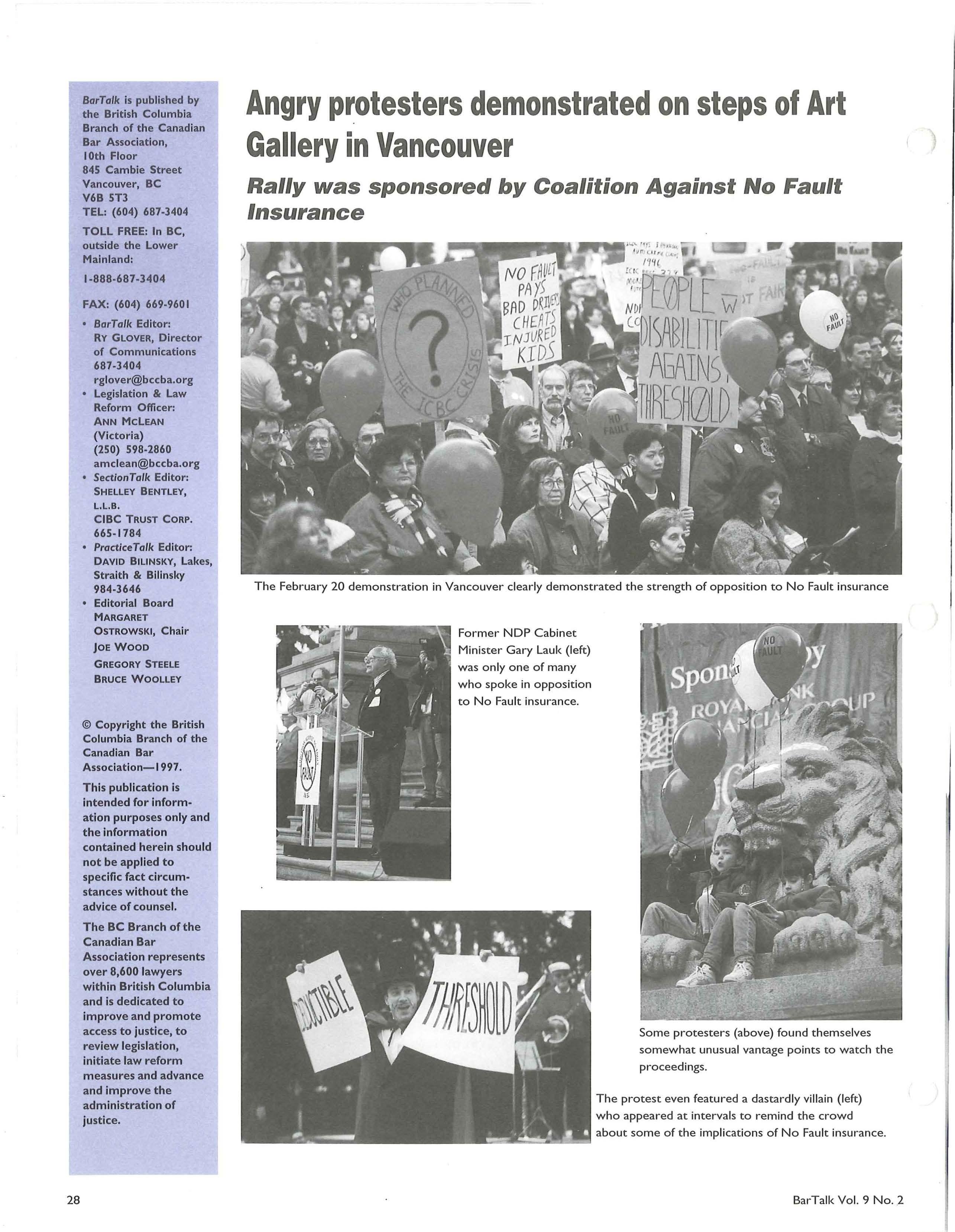
Opposition to No Fault insurance loud and clear at Town Hall meetings Debate now
moves into the political arena
Hundreds of people s howed up to express opposition to any form of No Fault insurance atTownHallmeetings sponsored by the Bar across the province in recent weeks
"At all the meetings we held, not one single person stood up to speak in favour of No Fault insurance," said Greg Steele, one of the Branch's spokespeople at the meetings. "We may have won the public's support on this issue and we can only hope the government will eventually listen ."
The debate on automobile insurance has
the provincial government, held hearing s behind closed doors A report by the commis s ion, recommending either a modified or full No Fault system, was released by Finance Mini s ter Andrew Petter in early March . At the time, he promised todeliver legislation to reform auto insurance within a few weeks .
Emily Reid, Q C., President ofthe B C. Branch, said the Town Hall meetings show British Columbians are concerned over the proposals to change the province's existing auto insurance system and replace it with some type of No Fault insurance. She said the reaction of the hundreds of British Columbians moved into the political arena with a pledge by the Liberal Opposition of an allout fight should the provincial government bring in No
Fault legislation
" ... the reaction of the hundreds of British who have turned out for the meetings indicates widespread support of our present Columbians who have turned out for the meetings indicates widespread support of our present system " system.
"We will be loud and clear in speaking out against No Fault," promised Liberal spokesperson Geoff Plant, the MLA for Richmond-Steveston .
Plant' s comment came as he and fellow Liberal MLAs Linda Reid, (Richmond-East) and Doug Symons , (Richmond-Centre) attended a Richmond Town Hall meeting on No Fault sponsored by the B.C. Branch of the Canadian Bar Association.
The Richmond event was the latest in a series of public meetings sponsored by the CBA across the province in locations like Kamloops, Kelowna, Nanaimo, Prince George and Victoria.
The CBA began the Town Hall sessions after the Allen Commission, a review team set up by
The CBA's position is that changing the existing auto insurance system will not result in long-term control of insurance costs and that the key to such controls lies in changing driver behaviour through sweeping-and tough-tr a ffic s afety initiatives. The CBA, in a report released last fall, also recommended the use of alternate dispute resolution measures to reduce court costs.
The CBA has also pointed out that implementation of No Fault means accident v ictims will lose their right to take court action while innocent victims of traffic crashes will receive less compensation in o r der that reckless drivers who speed and drive while drunk will get increased benefits. +
EMILY REID, Q.C.,
CBA (BC Branch) President 1996/97
Outcome of No Fault battle remains uncertain
But British Columbians know what they want
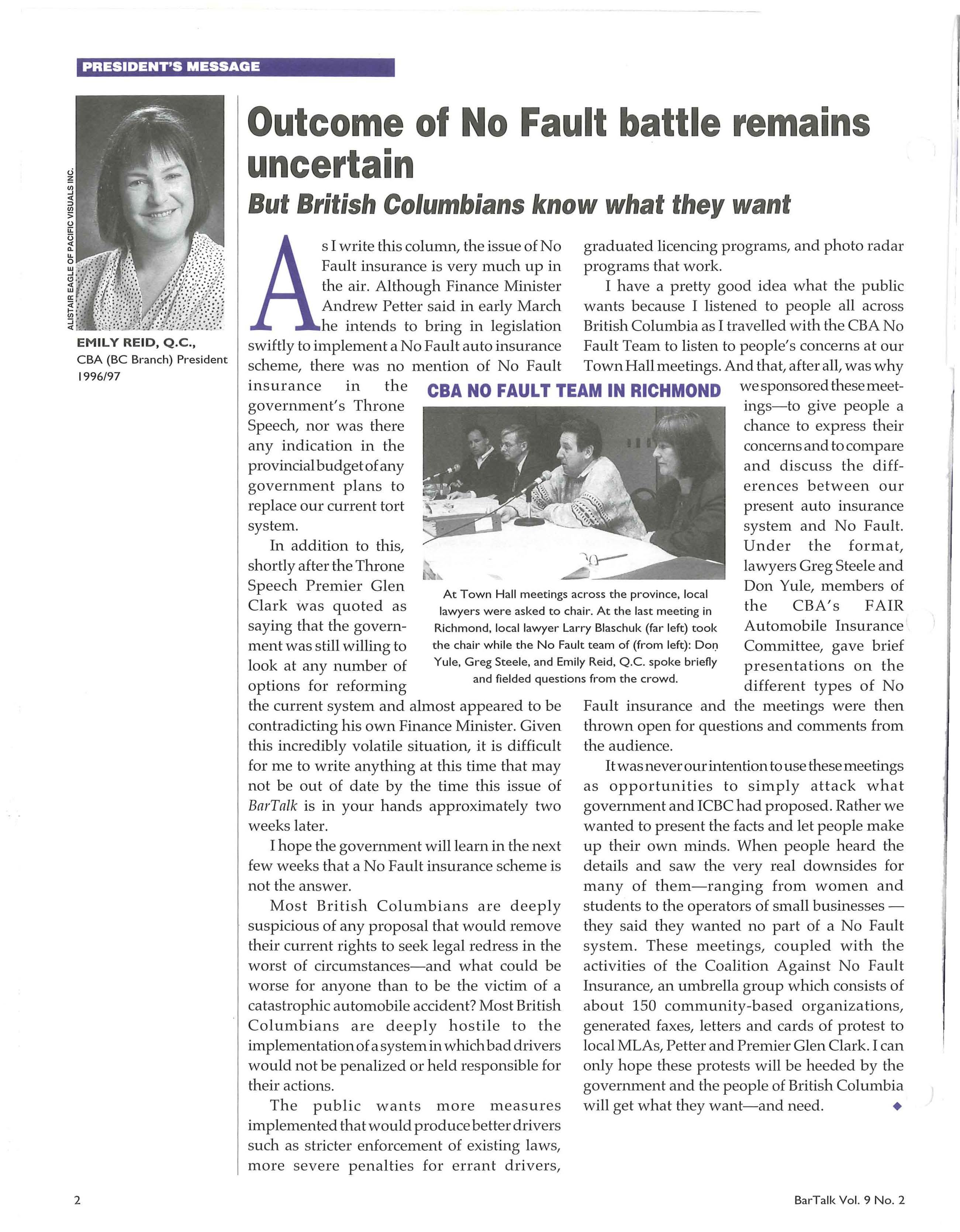
s I write this column, the issue of No graduated licencing programs, and photo radar Fault insurance is very much up in programs that work. the air. Although Finance Minister I have a pretty good idea what the public Andrew Petter said in early March wants because I listened to people all across he intends to bring in legislation British Columbia as I travelled with the CBA No swiftly to implement a No Fault auto insurance Fault Team to listen to people's concerns at our scheme, there was no mention of No Fault TownHallmeetings.Andthat,afterall,waswhy insurance in the CBA NO FAULT TEAM IN RICHMOND wesponsoredthesemeetgovernment's Throne ings-to give people a Speech, nor was there chance to express their any indication in the concerns and to compare provincialbudgetofany and discuss the cliffgovernment plans to erences between our replace our current tort present auto insurance system . system and No Fault.
In addition to this, Under the format, shortly after the Throne lawyers Greg Steele and Speech Premier Glen Don Yule, members of At Town Hall meetings across the province, local Clark was quoted as lawyers were asked to chair. At the last meeting in the CBA' S FAIR saying that the govern- Richmond, local lawyer Larry Blaschuk (far left) took Automobile Insurance ment was still willing to the chair wh il e the No Fault team of (from left): Don Committee, gave brief look at any number of Yule, Greg Steele, and Emily Reid, Q.C. spoke briefly presentations on the f f and fielded questions from the crowd ff f options or re orming di erent types o No the current system and almost appeared to be Fault insurance and the meetings were then contradicting his own Finance Minister. Given thrown open for questions and comments from this incredibly volatile situation, it is difficult the audience. for me to write anything at this time that may ltwasneverourintention to use these meetings not be out of date by the time this issue of as opportunities to simply attack what BarTnik is in your hands approximately two government and ICBC had proposed. Rather we weeks later. wanted to present the facts and let people make
I hope the government will learn in the next up their own minds . When people heard the few weeks that a No Fault insurance scheme is details and saw the very real downsides for not the answer. many of them-ranging from women and
Most British Columbians are deeply students to the operators of small businessessuspicious of any proposal that would remove they said they wanted no part of a No Fault their current rights to seek legal redress in the system. These meetings, coupled with the worst of circumstances-and what could be activities of the Coalition Against No Fault worse for anyone than to be the victim of a Insurance, an umbrella group which consists of catastrophic automobile accident? Most British about 150 community-based organizations, Columbians are deeply hostile to the generated faxes, letters and cards of protest to implementation of a system in which bad drivers local MLAs, Petter and Premier Glen Clark. I can would not be penalized or held responsible for only hope these protests will be heeded by the their actions. government and the people of British Columbia
The public wants more measures will get what they want-and need + implemented that would produce better drivers such as stricter enforcement of existing laws, more severe penalties for errant drivers,
Parental Mobility Disputes
Is the only relevant question the best interests of the child?
adam Justice Mary Ellen Boyd recently delivered a paper to Vancouver Family Law Subsection members on the topic of mobility disputes in child custody and access cases.
Madam Justice Boyd believes that the most difficult family cases before the courts are those in which mobility is an issue. The family has usually endured the divorce, separation agreement negotiation or custody battle. The family is then faced with a second round of litigation as a result of the impending move. They have already been through a great deal. Further, the parent opposed to the move is usually highly involved with access and is interested in the preservation of the parent-child relationship.
Until the late 1980's, the presumption existed that the custodial parent could move without the permission of the non-custodial parent, in the absence of a specific agreement to the contrary In the late 1980's this presumption began to wane . In 1985 a new divorce act came into force pursuant to which "the best interests of the children" were to be considered. Under the old legislation the language used was "paramount interest". This difference in language was stressed by the Court inAppleby v. Appleby and in Johnson v. Johnson
In the landmark 1990 case of Carter v Brooks the Ontario Court of Appeal squelched the presumption in favour of the custodial parent. The Court indicated that the preferable route would be to balance the factors in each case The factors to consider included the existing custody order or agreement, the incidents of custody, the well-being of a new family unit resulting from the custodial parent remarrying, the nature of the relationship between the child and the access parent, the reason for the move, the distance of
the move, the views of the child, how severely access would be affected by the financial resources of the access parent, and the willingness of the custody-seeking parent to facilitate contact between the chilc:l and the access parent. This case caused a great deal of confusion because the language used in Morden, J.'s decision seems to imply a presumption in favour of the custodial parent. This very language was relied upon by the B.C. Court of Appeal in Levesque v . Lapointe (1993) to support the existence of a custodial parent's presumptive right.
The custodial parent continued to receive support in MacGyver v. Richards (1995, Ont. C. A) in which Abella, J.A. writes the majority decision in a strong judgment which contradicts Carter in allowing the custodial parent to make the decision as to whether to relocate. Abella, J.A., describes a "facilitative rehabilitative model" where the custodial parent bears a disproportionate share of the responsibility and therefore should be given deference with respect to decision-making powers, unless there is substantial evidence of that parent's decisions impairing the child 's best interests. She articulates her belief that courts should respect the rehabilitative recovery process of the separated family in the face of change stating (at p. 572) : "The scales used to weigh a child's best interests are not evenly balanced between two parents when one is an occasional and the other is a constant presence."
It was upon this confusing backdrop that Gordon v. Goertz (1996, Supreme Court of Canada) was decided . At trial the mother had custody of the child and the father asked the Court for a restraining order to prevent her from moving to Australia. By the time the case reached the S.C.C. the facts had changed significantly. The mother and child had moved to Australia . The mother
cross/sections
In just two years since it ' s formation , the Women Rainmakers Section has exceeded an enrollment of 300 members The success of the first Women Rainmakers Directory, designed in part as a marketing tool. has resulted in a second edition , recently completed and listing 113 of their Section members by practice area. To enroll in this active Section , call the Branch office
cross/sections is a new feature dedicated to section news. We welcome news from any CBA section Call Fran Hodgkins at 687 -3404 or 1888-687-3404 if you ' re outside the Lower Mainland
Parental mobility disputes
Continued from page 3 would not return to Canada and therefore the court would have to remove custody from the mother in order for the child to remain in Canada. Madam Justice McLachlin establishes a two stepmodel for analysis of the cases on parental mobility issues. However, the case does not put to rest the legal presumption McLachlin, J states that the two extremes in case law are not irreconcilable. According to the two-step inquiry model, the first step in an application for a variation order requires the party seeking the change to establish that a material change in circumstances has occurred. This change must be a change in the condition, means, needs or circumstances of the child, which materially affects the child. The second step is for both parties to show where the child's best interests lie. The minority judgment revives the MacGyver reasoning; "(t)he emphasis should be ... on deferring to the decision-making responsibilities of the custodial parent, unless there is substantial evidence that those decisions impair the child's, not the access parent's, long-term well-being."
Although legal commentators believe that Goertz has not resolved the conflict in the law, Madam Justice Boyd believes there has been a resolution. In cases following Goertz in Alberta and B.C. there has been strict adherence to the principles set out. In Woodhouse v. Woodhouse
(June, 1996) the Ontario Court of Appeal put to rest the notion that th ere is a presumption in favour of the custodial parent, but the minority felt that the presumption should be maintained. In Woods v. Woods the Manitoba Court of Appeal took the position that the rights of the custodial parent should be supported, as to an exclusive focus being on the best interests of the child.
In summarizing, Madam Justice Boyd noted that Goert z ha s set up a flexible model to be u sed in parental mobility cases. The thr es hold must be overcome by the custodial parent. It is not enough for the custodial parent to present a set of circumstances that offer a possible opportunity in the new locale. There must be genuine change in circumstances. It is at this point that the judge must embark on a fresh inqui ry where both parties bear the onus to show what is in the best interests of the child. Although the current order or agreement will be given some weight, it will be only one factor in a number to consider. Unilateral moves by the custodial parent should therefore not be made without a great deal of consideration. Goert z seems to indicate that this type of situation will not be tolerated.
Finally, Madam Justice Boyd believes that interim orders will likely not be granted in parental mobility cases. The parties will have to wait until a full trial of the matter. It may be possible to deal with the matter at an early date through an early intervention hearing. +
DUE DILIGENCE IN COMMERCIAL LENDING TRANSACTIONS
How many times have you questioned yourself when working on a commercial lending transaction about the right searches to perform?
The age-old problem of doing a really careful job versus charging a reasonable fee and making a reasonable profit rears its ugly head. What follows is a synopsis of what a group of your colleagues think. A due diligence search list was prepared by Scott Perrin of Russell and DuMoulin and edited after lively debate amongst Banking Subsection members. The participants discussed due diligence in connection with a particular person or entity and grouped the searches into the following categories: searches which should always be conducted, searches which could be conducted after seeking instructions from the client and searches which are conducted only in special circumstances.
The following list is for transactions which are routine in substance and in magnitude.
DUE DILIGENCE APPLICABLETO ALL PERSONS/ ENTITIES
Always:
• Personal Property Registry Debtor Name Search(es) re personal property security interests (and possibly re real property rents and statutory liens)
• Bank of Canada s. 427 search( es ), if granting security over inventory, or if a fisherman, farmer, forestry producer or aquaculturist
• federal insolvency search
• out-of-province searches (if applicable)
• if collateral is being purchased, B.C. Online corporate search against vendor
• if collateral is held in trust, appropriate due
diligence re th e tru s tee, including review of trust declaration
Seek Instructions:
• s elected statutory lien s earches, if g r anting s ecurity;
• Corporation Capital Tax (if applicable)
• Social Services Ta x (if a vendor)
• Workers ' Compensation Board (if there are employees)
• Employment Standards (if employees)
• Payroll Deductions (if employees)
• CST (if a vendor)
• if collateral is being purchased, additional due diligence re the v e ndor
Rarely- Only in Special Circumstances
• Bailiff search( es)
• PPSA section 18 demands
• Court Registry search( es)
Additional Due Diligence re Corporations
• B.C. Online Co r porate Registry search
• B.C. Companies Office search
• certificate of incorporation/ amalgamation I continuance I EPR
• certificate of name change
• memorandum (as altered)
• articles (as amended)
• if a successor, appropriate due diligence re predecessors
• certified copy of authorizing resolutions
• officer ' s certificate
• legal opinion from the corporation' s couns e l
A dditional Due Diligence re Partnerships (gene ra l and limited)
• B.C. Online Corporate Registry search
• B.C. Companies Office
• Partnership Act name declaration
• Certificate of Limited Partnership (as amended)
• certificates of name change
• Records Office/Minute Book
• partnership agreement (and all amendments)
• identity of partners
• certified copies of authorizing resolutions and officer's certificate re partnership or each partner, if applicable
• due diligence re each partner
• legal opinion from the partnership's counsel
Additional Due Diligence Applicable re Individuals
• certificates of independent legal advice re possibility of duress, elderly, English as a second language, if appropriate
• if personal property security is being granted, certificate re past and present names, nicknames, aliases and business names, as well as copies of birth certificate, driver's licence, passport, marriage certificate
• Family Relations Act certificate re no triggering event +
Change of hours of operation in Provincial Court
Reg istries
Effective April 1, 1997, all Provincial Court registries in British Columbia have been open to the public from 9:00 a m. to 4:00 p m. on business days. These are the same hours which Supreme Court registries are open.
Outside entrances to cou r thouses have only been open during these hours in locations where it is not feasible to lock up the court registry without closing the building Otherwise, the outer doors of courthouses have been open between 8:30 a.m. and 4:30 p.m.
Provincial Court registry staff will continue to answer telephone inquires from the public and from lawyers between 8:30 a.m . and 4:30 p.m. Limited access to court registries by police, lawyers and other persons will be provided
before 9:00 a.m. and after 4:00 p .m . for purposes which include:
• Registry Justices of the Peace will continue to be available before 9:00a.m. and after 4 p.m to conduct bail hearings, issue search warrants and conduct other duties;
• Post-court processing, such as releasing prisoners, reading probation orders, interviewing sureties, and filing/picking up Family Court or Small Claims documents after a court appearance;
• Access to persons in custody by their lawyers .
Some court locations where the entire facility is closed before 9:00a.m and after 4:00p.m may allow access to the building in additional special circumstances •
UPCOMING:
CBA National Section Meetings
Environmental Law: April 26-27 , Toronto
Aboriginal Law: April 26-27, Calgary Health Law: April 26-27 , Ottawa
Administrative Law: May 3 I, Ottaw a Family Law: May 2-3 , Saskatoon
Constitutional & Human Rights Law : May 24, Ottawa
If you have any issue you would like discussed at the above National Section meetings or if you require further information, please contact the corresponding BC Branch Section Chair or contact Branch Section Coordinator Fran Hodgkins by phoning 687-3404 or toll free 1-888-687-3404 if you're calling from outside the Lower Mainland.
Shapeup, Corporate Style
The National Spring Conference of the C a nadian Corporate Counsel Association will be held at the W e stin Hotel , Calgary, April 21 & 22 , 1997. Conference theme is " Greater Performance with Fewer Resources"
Feature luncheon speakers will be J. P. Bryan , President and CEO of Gulf Canada Resources , Ltd. and The Right Honourable Joe C lark, former Prime Minister of Canada
For more information and to reg ister, contact the CCCA at 20 Toronto St. Suite 300 , Toronto , Ontario, MSC 2B8.
Te l: (4 16) 869-0522, Fax: (4 16) 869-0946.
The E- Mail address is : ccca@globa lserve.net
Qualified interpreters need more support from members of the Bar
As fellow professionals they ask for your understanding
DEAR
EDITOR: Canada is truly a multicultural society. In BC about 17 per cent of the population is from an ethnic minority. Many of these people require interpretation when they appear before the courts and the justice system. Therefore, the need for interpretation services has not only dramatically risen but will increase in the future.
As a practicing professional interpreter and translator for more than 20 years, I am concerned about a number of issues related to how we, as professionals, are treated by our fellow professionals in the Bar.
I have found, unfortunately, that there tends to be a general feeling among some people in the legal delivery system that interpreters are a dime a dozen and that one can be found at very short notice. We too, as professionals, would like to manage our precious time to our advantage. Advanced notice helps us to achieve that . However, some lawyers leave the preparation of their cases to the last days before the trial and ask for only a specific hour or a certain date or want documents translated in 24 hours so they'll be ready first thing the following morning .
When any interpreter is cornered into such a tight time frame, he or she may lose the assignment. The lawyer may find someone else better able to fit his or her schedule or they might send a document to a translation agency with no guarantee that the translator at the other end is a professional. These translators may be able to deal with simple assignments, but many do not have formal education, nor have they studied or passed the legal component and terminology exams as required for certified interpreters.
After years of struggle on our part, the Ministry of the Attorney General did finally make a distinction between certified and uncertified interpreters and issued a directive to court registries to use non-certified interpreters only when a certified interpreter was unavailable . Unfortunately, this policy is not always followed. Many times, when asked to arrange for an interpreter, a clerical secretary at court or working for a lawyer will call an
agency rather than search for a qualified professional. Instead, they should be instructed to use the directory of the Society of Translators and Interpreters of BC that lists all certified interpreters and translators. Alternatively, a list of certified translators is printed in theBC Lawyers Telephone, Fax & Services Directory, starting on page 127.
I am also troubled by the method of payment for our service For example, some lawyers book an interpreter and, if the client does not show up for half an hour, the interpreter is dismissed empty-handed or is paid $12 .50 for the half an hour The explanation? Legal Aid does not pay if the lawyer did not work with a client. The interpreter may have set aside several hours of time to deal with the case and is left without much to show for it. Some lawyers tell the interpreters that they can't pay them for the case till after Legal Aid pays them . We interpreters don't care how lawyers get reimbursed. If we are booked for an assignment, we should be paidand preferably within 60 days.
Isn't police work closely intertwined with the legal profession? Once a statement of fact on a declaration is written and signed it will be used in court against the accused Who is writing these declarations for you? Why don't lawyers insist that a professional interpreter be used at the scene of the crime? This is an area where we need your backing We would deeply appreciate the Bar helping and advocating the need for Certified Professional Interpreters.
Thank you for allowing me to express these opinions in your professional newsletter.
Sincerely,
Dr Shukrieh R. Merlet, Certified Translator and Interpreter by The Society of Translators and Interpreters of BC Attorney General, Accredited Int erpr eter by Canada Immigration and the Refugee Board
Settling civil justice disputes in British Columbia Provincial Court
L.ean
and efficient, the
system has many advantages, according to Chief Judge Robert Metzger
BarTalk: Last summer the Canadian Bar Association released the Task Force R eport on Systems ofCivil Justice . It recommended a number of comprehensive changes to the civil justice system in Canada's higher courts. Does the provincial court in British Columbia have a similar document-or blueprint-that it's following as a guide to reform of civil justice within its jurisdiction?
Chief Judge Robert Metzger: We have already implemented many reforms similar to those that the Canadian Bar proposed and, frankly, we're doing more than what is already proposed in that report.
BarTalk: Was there a trigger for your reforms?
do. But we succeeded. We were able to prepare them for this new role. Once we had accomplished that-and Associate Chief Judge Dennis Schmidt deserves much of the credit as does former Chief Judge William Diebolt-the system began to work. Judges actually enjoyed the mediation process and began to consider it as part of their daily routine.
BarTalk: I understand judges were very much involved in the process of reform
Chief Judge Robert Metzger: Yes, in fact, I think one of the most unique aspects of the reform process was the way judges were involved in actually suggesting reforms. The process started after the HughesAccess to Justice report was released in 1988. Over the
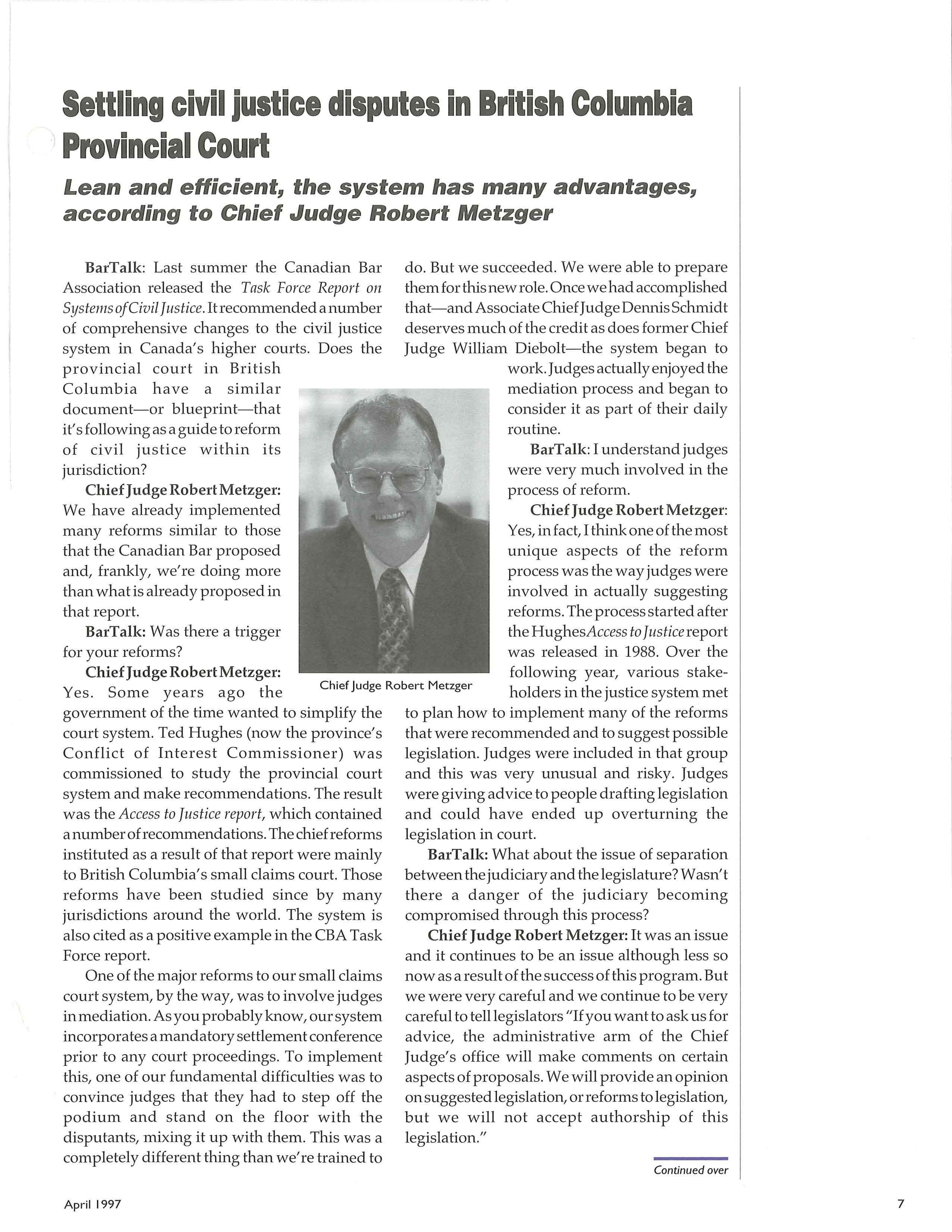
Chief Judge Robert Metzger: Yes. Some years ago the Chief Judge Robert Metzger
government of the time wanted to simplify the court system. Ted Hughes (now the province's Conflict of Interest Commissioner) was commissioned to study the provincial court system and make recommendations. The result was the Access to Justice report, which contained a number of recommendations. The chief reforms instituted as a result of that report were mainly to British Columbia's small claims court. Those reforms have been studied since by many jurisdictions around the world. The system is also cited as a positive example in the CBA Task Force report.
One of the major reforms to our small claims court system, by the way, was to involve judges in mediation. As you probably know, our system incorporates a mandatory settlement conference prior to any court proceedings. To implement this, one of our fundamental difficulties was to convince judges that they had to step off the podium and stand on the floor with the disputants, mixing it up with them. This was a completely different thing than we're trained to
following year, various stakeholders in the justice system met to plan how to implement many of the reforms that were recommended and to suggest possible legislation Judges were included in that group and this was very unusual and risky. Judges were giving advice to people drafting legislation and could have ended up overturning the legislation in court.
BarTalk: What about the issue of separation between the judiciary and the legislature? Wasn't there a danger of the judiciary becoming compromised through this process?
Chief Judge Robert Metzger: It was an issue and it continues to be an issue although less so now as a result of the success of this program. But we were very careful and we continue to be very careful to telllegisla tors "If you want to ask us for advice, the administrative arm of the Chief Judge's office will make comments on certain aspects of proposals. We will provide an opinion on suggested legislation, orreforms to legislation, but we will not accept authorship of this legislation."
In conversation with Chief Judge Robert Metzger
Continued from page 7
Despite th e risks, it was important for the judici ary to be involved. Had we not been involved in this-and very actively involved! don't think it would have evolved the way it did. For example, it was necessaq for the judiciary to say: "Yes, we will commit to becoming mediators " Nobody could have told us to do that. If the government had said: "Okay, from now on, jud ges, we want you to be mediators," it simply never wou ld have happened.
understand ourselves from a litigant's point of view . What was at stake for them? And then we had to say : "Okay, now that we understand THEIR point of view a little better, how can we solve their problems?"
We tried to find ways of levelling the playing field so that with evety single rule that we drafted, we asked the question: "Does this rule create an advantage for either the lay litigant or the lawyer?" And I think-if I look back at the cases that I've conducted in that courtI would say that we successfully achieved that objective; we did leve l the playing field without giving an advantage to lawyers or lay litigants.
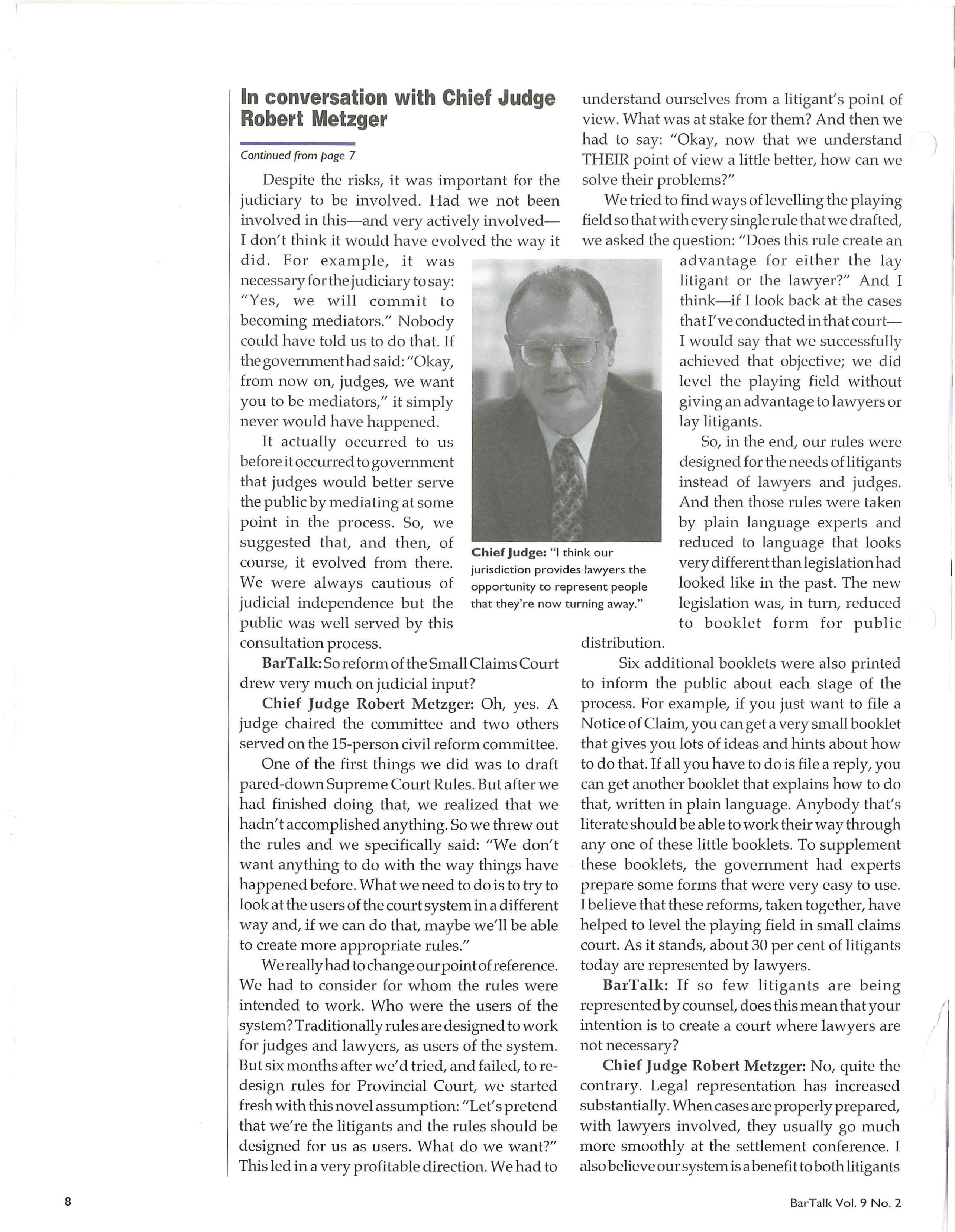
It actually occurred to us before it occurred to govenunent that judges would better serve the public by mediating at some point in the process. So, we suggested that, and then, of Ch ief Judge: "I think our course, it evolved from there jur isd ict ion provides lawyers the
We were always cautious of opportunity to re present people judicial independence but the that they're now turning away." public was well served by this consultation process.
BarTalk: So reform of the Small Claims Court drew very much on judicial input?
Chief Judge Robert Metzger: Oh, yes. A judge chaired the committee and two others served on the 15-person civil reform committee.
One of the first things we did was to draft pared-down Supreme Court Rules. But after we had finished doing that, we realized that we hadn't accomplished anything. So we threw out the rules and we specifically said: "We don't want anything to do with the way things have happened before What we need to do is to try to look at the users of the court system in a different way and, if we can do th a t, maybe we'll be able to create more appropriate rules."
We really had to change om point ofreference. We had to consider for whom the rules were intended to work. Who were the users of the system? Traditionally rules are designed to work for judges and lawyers, as users of the system. But six months after we'd tried, and failed, toredesign rules for Provincial Court, we started fresh with this novel assumption: "Let's pretend that we're the liti gants and the rules should be designed for us as users What do we want?"
This le d in a very profitable direction. We had to
distribution.
So, in the end, our rules were designed for the needs of litigants instead of law yers and judges. And then those rules were taken by plain language experts and reduced to language that look s very different than legislation had looked like in the past. The new legislation was, in turn, reduced to booklet form for public
Six additional booklets were also printed to inform the public about each stage of th e process. For exa mpl e, if you just want to file a Notice of Claim, you can get a very small booklet that gives you lots of ideas and hints about how to do that. If all you have to do is file a reply, you can get another booklet that explains how to do that, written in plain languag e. Anybody that's literate should be able to work their way through any one of these littl e booklets. To supplement thes e booklets, the gove rnment had experts prepare some forms that were very easy to use I believe that these reforms, taken together, have helped to le ve l the playing field in small claims court. As it s tands, about 30 per cent of litigant s today are represented b y lawyers.
BarTalk: If so few litigant s are being represented by counsel, does this mean th at your intention is to create a court where lawyers are not necessary?
Chief Judge Robert Metzger: No, quite the contrary. Legal representation has increased subs tantially. When cases are properly prepared, with lawy ers involved, they usually go much more smoothly at the se ttlem ent conference. I also believe our system is a benefit to both litigants
AND their lawyers because lawyers can more accurately predict how much it will cost them to fight a case. If someone comes to you, as a lawyer, and says, "I've got a problem with my roofer, how much is it going to cost me?" You can say with certainty that it's going to cost a maximum of, perhaps, fifteen hundred dollars in small claims court. You can do that because you know that the lawyer on the other side can't keep your client for discoveries for three days, or bring seven motions, and the trial isn't going to take four days. You will know all the steps that have to be taken because of the way the court is supervised by the judiciary and, further, that the case will not be ground down into a settlement because one side has more money than another.
People need to have that kind of certainty about court
oppose that. There's a theory that there may be a constitutional problem with raising the limit. Some people argue that small claims jurisdiction should be based on inflation applied against the sum of $50 in 1867, which was the court jurisdiction at that time . Depending on the index used, that would raise the limit to about fourteen thousand dollars today. Other people claim that inflation is only one factor in the constitutional argument. Others claim there is no constitutional block.
BarTalk: There is a view that mediation should not be mandatory. Chief Judge Robert Metzger:
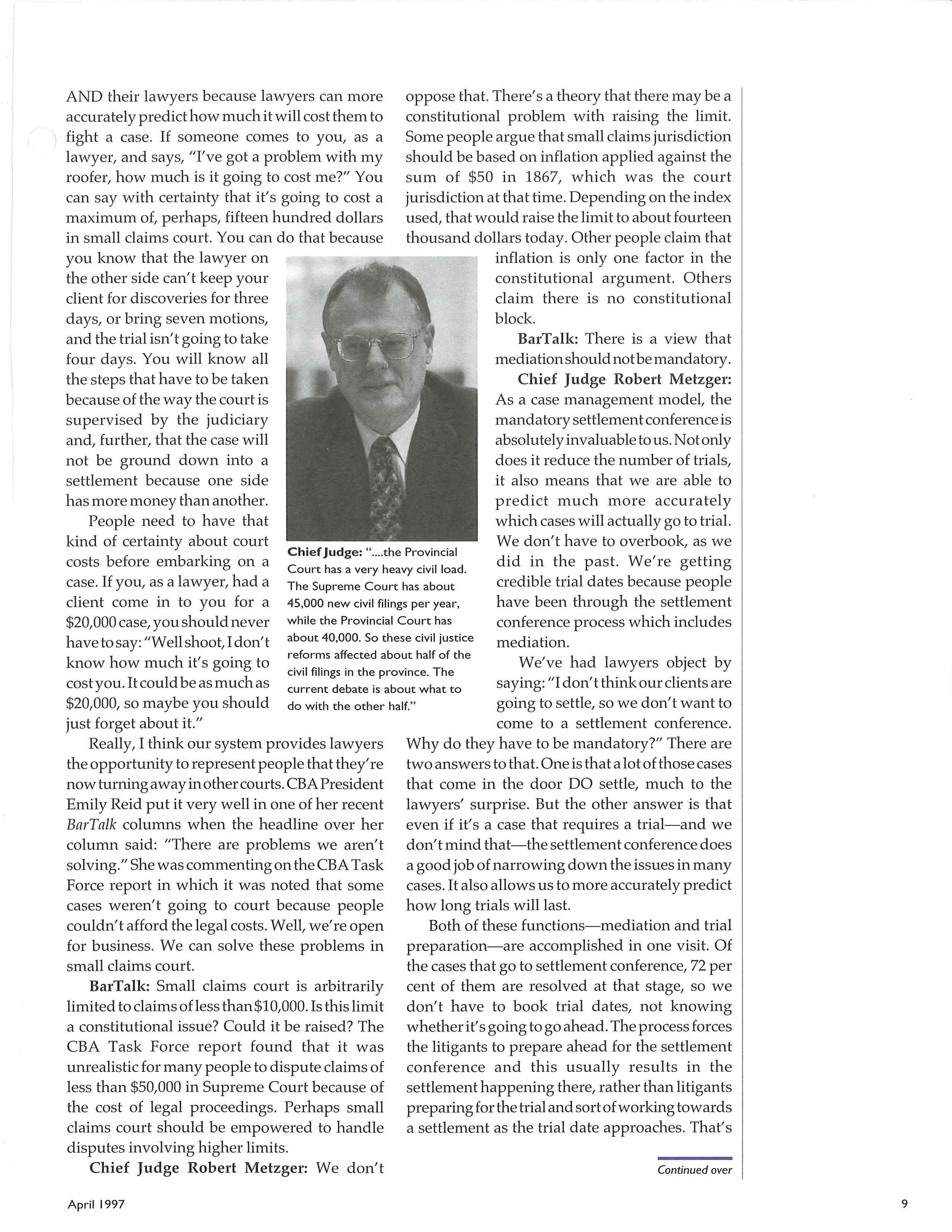
Chief Judge: " the Provincial costs before embarking on a Court has a very heavy civil load.
case. If you, as a lawyer, had a The Supreme Court has about client come in to you for a 45,000 new civil filings per year, $20,000case, you should never while the Provincial Court has have to say: "Well shoot, I don't about 40,000. So these civil justice reforms affected about half of the know how much it's going to civil filings in the province. The costyou.ltcould be asmuchas current debate is about what to
As a case management model, the mandatory settlement conference is absolutely invaluable to us. Not only does it reduce the number of trials, it also means that we are able to predict much more accurately which cases will actually go to trial. We don't have to overbook, as we did in the past. We're getting credible trial dates because people have been through the settlement conference process which includes mediation.
We've had lawyers object by saying: "I don't think our clients are going to settle, so we don't want to come to a settlement conference. $20,000, so maybe you should do with the other half." just forget about it."
Really, I think our system provides lawyers the opportunity to represent people that they're now turning away in other courts. CBA President Emily Reid put it very well in one of her recent BarTalk columns when the headline over her column said: "There are problems we aren't solving ." She was commenting on the CBA Task Force report in which it was noted that some cases weren't going to court because people couldn't afford the legal costs. Well, we're open for business. We can solve these problems in small claims court.
BarTalk: Small claims court is arbitrarily limited to claimsofless than$10,000. Is this limit a constitutional issue? Could it be raised? The CBA Task Force report found that it was unrealistic for many people to dispute claims of less than $50,000 in Supreme Court because of the cost of legal proceedings. Perhaps small claims court should be empowered to handle disputes involving higher limits.
Chief Judge Robert Metzger: We don't
Why do they have to be mandatory?" There are two answers to that. One is that a lot of those cases that come in the door DO settle, much to the lawyers' surprise. But the other answer is that even if it's a case that requires a trial-and we don't mind that-the settlement conference does a good job of narrowing down the issues in many cases.lt also allows us to more accurately predict how long trials will last.
Both of these functions-mediation and trial preparation-are accomplished in one visit. Of the cases that go to settlement conference, 72 per cent of them are resolved at that stage, so we don't have to book trial dates, not knowing whether it's going to go ahead. The process forces the litigants to prepare ahead for the settlement conference and this usually results in the settlement happening there, rather than litigants preparing for the trial and sort of working towards a settlement as the trial date approaches. That's
In conversation with Chief Judge Robert Metzger
Continued from page 9
pretty much the approach that was also recommended in the CBA' a Task Force report on civil justice
BarTalk: The Provincial Court is a busy criminal and family court. Why have you spent so much effort on the civil side?
Chief Judge Robert Metzger: In fact the Provincial Court has a very heavy civil load. The Supreme Court has about 45,000 new civil filings per year, while the Provincial Court has about 40,000. So these civil justice reforms affected about half of the civil filings in the province. The current debate is about what to do with the other half.
BarTalk: Has this experience in small claims assisted you in other areas, like family or criminal?
Chief Judge Robert Metzger: Yes Since June 1996 Provincial Court Judges have been
mediating every child protection case in the province. The impetus was the Gave Report and the process for getting there was much the same, however much quicker as barriers had already been broken by the success of the small claims process.
The success rate in mediating child protection is higher than in small claims . Many cases of child protection are a result of poverty, substance abuse and inadequate parenting skills. Support for these problems and plans of care are more easily resolved around a table than in a trial. We have mediated over 1,200 child protection ca ses in the last eight months.
Restorative justice is a concept now actively considered across Canada in criminal law . BC Provincial Court Judges are well positioned now to understand and give effect to ideas like victimoffender reconciliation, should those programs be realized in the criminal courts .
BarTalk: We'll look forward to seeing how you deal with these issues in future. Thanks for taking the time to talk to us. +
Unclaimed Property Changes Considered
Administration of unclaimed intangible property by a provincial government office is considered in a discussion paper recently released by the Ministry of Finance and Corporate Relations. The paper, "Unclaimed Intangible Property Administration in British Columbia: A Legislation Discussion Paper" suggests that business and financial organizations could be required to transfer unclaimed intangible property to the government, generally after five years during which there had been no communication with the owner.
The government would establish an Unclaimed Property Office, which would provide a central place for owners to search and which would attempt to locate the rightful owners of the property. A special account would be established to receive unclaimed funds and a balance sufficient to pay approved claims would be maintained Funds in excess of this amount would be h·ansferred to the government's general account.
Intangible property which may be unclaimed includes money , shares, bonds, dividend s, int e rest, salary cheques, bonuses, travellers ' cheques, trust funds and insurance proceeds.
Chartered banks governed by the Bank Act of Canada would not be subject to the legislation being considered Currently the businesses and financial institutions which hold unclaimed property are responsible for administration pursuant to the Unclaimed Mon ey Act and 12 other provincial statutes. For example, unclaimed trust funds are governed by s.95 of the Legal Profession Act, which provides that if a lawyer has been unable to locate the owner of unclaimed trust funds, the money is transferred to the Law Society. If no claim is made against the Law Society for ten years after the money is received by the Society, the owner can no longer make a claim and the funds are transferred to the Law Foundation.
The proposals in the discussion paper are similar to those in many US states, Ontario, Queb ec and Prince Edward Island The government invites comments on the discussion paper until May 30, 1997. Copies of the paper may be obtained from the Ministry of Finance and Corporate Relations, Communications Branch . Phone (250) 356-5975; Internet address: http:/ /www.fin.gov.bc.ca/ ocg.htm +
Profession to aid the Law Courts Education Society
Government cutbacks threaten many of its programs
embers of the legal profession are taking action to support the Law Courts Education Society in the face of a dramatic cut in its provincial government funding. A fundraising committee has been struck and a fundraising target of $250,000 has been set for 1997.
This initiative is being developed in response to a reduction in the Society's funding from the Ministry of Attorney General by more than 50 per cent-to $200,000 for 1997-98 . This comes after a similar reduction in the Ministry's funding last year and means that the Society has suffered core funding reductions from the Ministry of 65 per cent over the past two years.
The work of the Law Courts Education Society enjoys the support of the judiciary, the Bar, court services branch and educational and multicultural communities. It maintains a vital two-way bridge between the court system and the public.
Over the past eight years,
as possible to actually see it being done in the courtroom so that they will have personal experience as a basis for deciding what to believe-and what not to believe."
The Society has an international reputation in the field of public legal education. It has twice won the U.S. National Association for Court Administration 'Justice Achievement Award,' the organization's highest award for public service, in competition with jurisdictions all over the United States. Interest in the Society's work has come from South Africa, Australia, England, New Zealand and Germany, as well as all over North America.
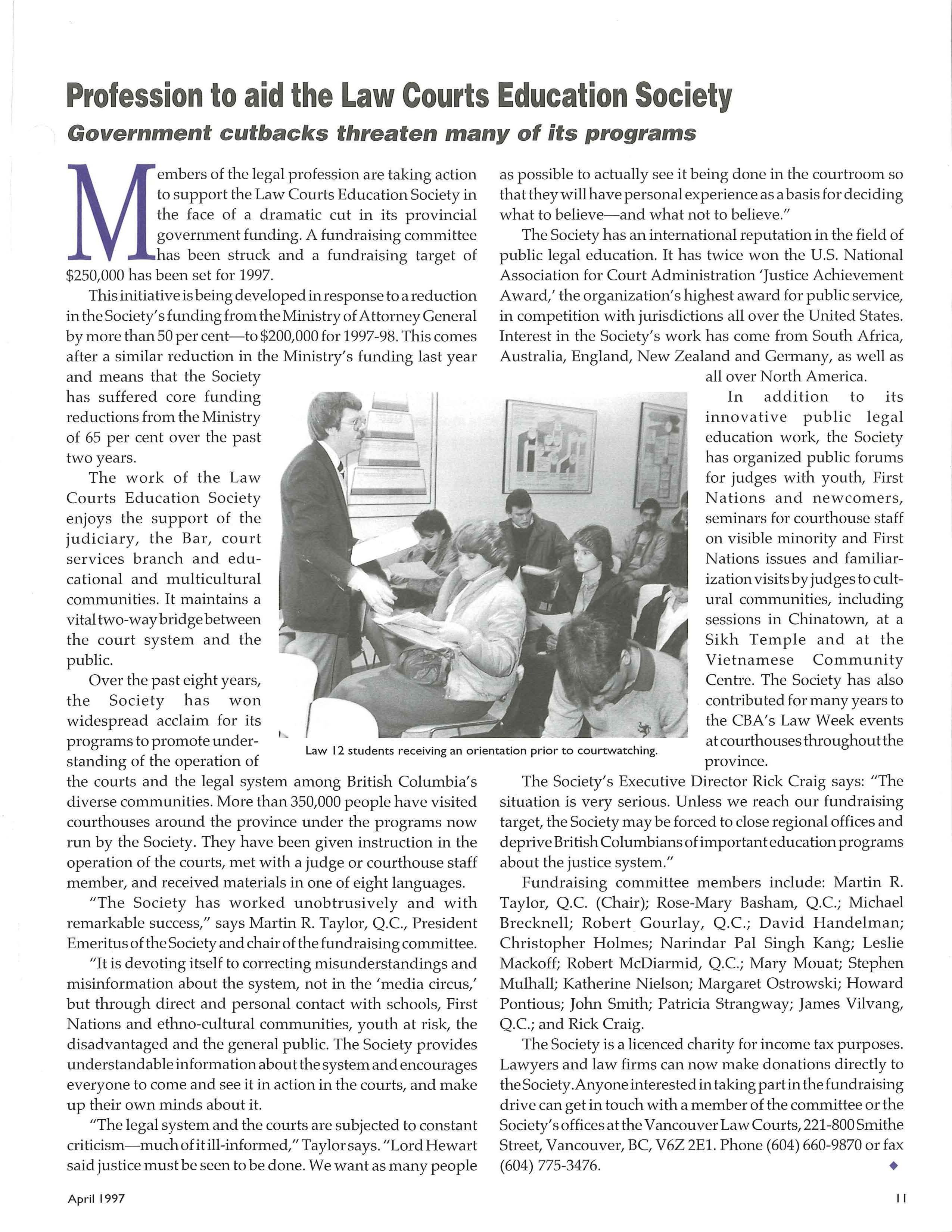
the Society has won widespread acclaim for its programs to promote understanding of the operation of Law 12 students receiving an orientation prior to courtwatching.
the courts and the legal system among British Columbia's diverse communities. More than 350,000 people have visited courthouses around the province under the programs now run by the Society. They have been given instruction in the operation of the courts, met with a judge or courthouse staff member, and received materials in one of eight languages.
"The Society has worked unobtrusively and with remarkable success," says Martin R. Taylor, Q.C., President Emeritus of the Society and chair of the fundraising committee.
"It is devoting itself to correcting misunderstandings and misinformation about the system, not in the 'media circus,' but through direct and personal contact with schools, First Nations and ethno-cultural communities, you th at risk, the disadvantaged and the general public. The Society provides understandable information about the system and encourages everyone to come and see it in action in the courts, and make up their own minds about it.
"The legal system and the courts are subjected to constant criticism-much ofit ill-informed," Taylor says "Lord Hew art said justice must be seen to be done . We want as many people
In addition to its innovative public legal education work, the Society has organized public forums for judges with youth, First Nations and newcomers, seminars for courthouse staff on visible minority and First Nations issues and familiarization visits by judges to cultural communities, including sessions in Chinatown, at a Sikh Temple and at the Vietnamese Community Centre. The Society has also contributed for many years to the CBA's Law Week events at courthouses throughout the province.
The Society's Executive Director Rick Craig says: "The situation is very serious. Unless we reach our fundraising target, the Society may be forced to close regional offices and deprive British Columbians of important education programs about the justice system."
Fundraising committee members include: Martin R. Taylor, Q C. (Chair); Rose-Mary Basham, Q.C.; Michael Brecknell; Robert Gourlay, Q.C.; David Handelman; Christopher Holmes; Narindar Pal Singh Kang; Leslie Macko££; Robert McDiarmid, Q C.; Mary Mouat; Stephen Mulhall; Katherine Nielson; Margaret Ostrowski; Howard Pontious; John Smith; Patricia Strangway; James Vilvang, Q.C.; and Rick Craig.
The Society is a licenced charity for income tax purposes. Lawyers and law firms can now make donations directly to the Society Anyone interested in taking part in the fundraising drive can get in touch with a member of the committee or the Society's offices at the Vancouver Law Courts, 221 -800 Smithe Street, Vancouver, BC, V6Z 2El. Phone (604) 660-9870 or fax (604) 775-3476. •
By Joanne Power Manager Registrar Program
If you have any interesting or unusual questions or comments about this column, please write directly to:
JOANNE POWER Manager, Registrar Programs Law Courts, 850 Burdett Ave. Victoria, B.C. V6W IB5
INTERNET: jpower@ galaxy.gov.bc.ca or Fax: 250-387-3061
ADOPTION ACT
QCould you please give me an overview of the changes to adoption procedure under the new Adoption Act?
AThe revised Adoption Act was proclaimed effective November 4, 1996 The following changes apply to procedures in the Court Regishy
• New forms are set out in the Adoption Regulations.
• The consent forms set out in the regulation are now in affidavit form . The affidavit is the only document required (two affidavits in support of consent are no longer required).
• Additional information about the birth parents from the adoptive parents must be set out in Form 5 - "birth parent expenses affidavit".
• The material must contain a report of a "younger child's views" relating to a child who is at least 7 years of age and less than 12 years.
• The post-placement report filed by the director of adoptions or an adoption agency must be confirmed by written certificate if completed 3 months prior to the date of hearing of the application.
• One or two adults may apply to adopt and the two applicants need not be legally married.
• One adult may apply to become a parent of a child with a birth parent.
• Any applicant must have been resident in British Columbia continuously for 6 months immediately preceding the application to the court.
• The definition of birth father has changed-see section 13(2 )(a)- (f) ofthe Act.
ADOPTION ACT
QIf the adoption package presented to the registry was completed prior to November 4, 1996, may the registry process the
application under the old Act even though the director of adoption may have signed the post-placement report after November 4, 1996?
AA transitional provision in the new Act, section 95, applies to this situation.
COURT ORDER, ENFORCEMENT ACT
S.11(1) & (2)
QWhat documents should be filed in an application to the Registrar pursuant to s. I I (I) and (2) of theCourt Order Enforcement
Act?
AThis subsection determines at what point funds held by the garnishee can be "caught".
s. 11(1) "Service of a copy of an order that debts, obligations or liabilities owing, payable or accruing due to the defendant, judgment debtor or person liable to satisfy the judgment or order shall be attached or notice of it to the garnishee in a manner the judge or registrar directs, shall bind the debts, obligations or liabilities in his hands from the time of service or notice."
This subsection sets out the method of serving the garnishing order:
s. 11(2) "A copy ofthe garnishing order shall be served at once, or within a time as allowed by the judge or registrar by memorandum endorsed on the order, on the defendant, judgment debtor or person liable to satisfy the judgment or order, and no order shall be made for payment to the plaintiff or judgment creditor of money paid into court by the garnishee, as provided in section 23, until service of the copy has been proved by affidavit filed."
The judgment creditor should file a notice of motion and affidavit in support of the application. The order, if granted, could be endorsed on the garnishing order itself and signed by the Registrar.
DIVORCE ACT,
S 8(2)(n)
QCan a party proceed with a petition where the ground for divorce is a one-year separation and reconciliation occurred
after the date of filing?
AThe party could amend the petition with the new date of separation if the reconciliation is longer than 90 days. They could then apply for the divorce when section 8(2)(a) of the Divorce Act has been complied with: "8(2) Breakdown of a marriage is
established only if (a) the spo uses have lived separate and apart for at least one year immediately preceding the determination of the divorce proceeding and were living separate and apart at the commencement of the proceeding; " It is up to the Court to decide whether to accept the amended petition
SUPREME COURT ACT, S. 8, COUNTY BOUNDARY ACT, S. 5, RULE 44(14)
Q
What are the Judicial Districts set out in statute as required by Rule 44( 14)?
A Section 8(1) of the Supreme Court Act states: "The counties as defined by the County Boundary Act constitute judicial district and " The counties are set out in (a) through to (h) and their boundaries are described in the County Boundary Act.
WILLS VARIATION ACT & RULE 41(16)
QCan a Wills Variation Act application be dismissed by a Registrar's consent order?
AYes, as long as the requirements set out in Rule 41(16) are complied with.
rules, retain it and all filed copies of it, and refer it to the court and the court may, after a summary hearing as the court direct s, make an ord er under subrule (24)." If the registrar considers that Rule 19(24) could be applicable, he or she must refer the matter to a judge upon accepting the documents for filing.
Rule 24
QCan a claim be amended after a default judgment has been issued in an action?
ANo, the court would be functus. The party could appl y to set aside the default judgment, and then, if the application is granted, proceed to amend the initiating document.
Appendix C, Schedule I, Item 20
QWhat is the effect of the increases to probate fees in those estates for which probate either has been applied for but not
granted or where probate has been granted but there are assets not yet disclosed or valued?
AAppendix C Schedule I
Q
Once a claim under the Woodworker Lien Act has been filed and the applicant has paid the required fee of $200, is a further
A fee payable for issuance of the Writ of Attachment?
There is currently no fee chargeable for a Writ of Attachment.
Rule 19(25)
QWhat should we as Registrars do when someone commences a proceeding against God, or the King, etc.?
A
File the documents, but note the provisions of Rule 19(25): "Where on the filing of a document a registrar considers that the whole or any part of an endorsement, pleading, petition or other document could be the subject of an order under subrule (24), the registrar may, notwithstanding any other provision of these
The increases to probate fees effective April 1st, 1997 only affect those estates having a value of more than $50,000 The new fees increase the fee charged under Item 20 only onestateshavingavalueofmorethan$50,000 to $14 per $1,000 from $6 per $1,000. However, if probate is applied for prior to April 1st and assets are later valued or disclosed*, the applicable rate is the rate in effect at the time probate was applied for. The practice in most registries is to date stamp the back of the praecipe attached to the application for probate. It is thi s date which will determine the probate fees in effect.
*Re : Estate of Henry, 26. C.P.C. (3d) 144
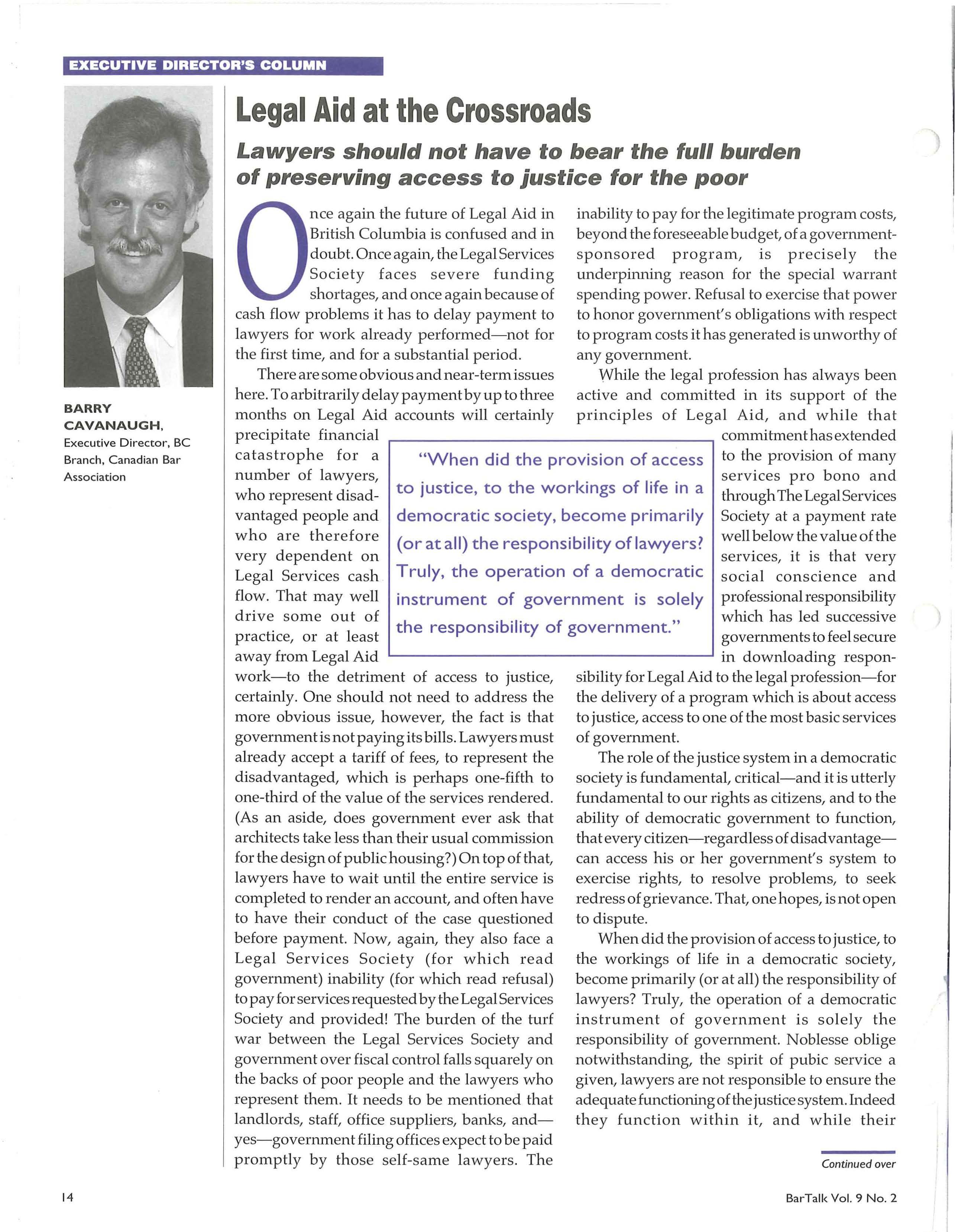
BARRY CAVANAUGH, Execut ive Director, BC Branch, Canadian Bar Association
Legal Aid at the Crossroads
Lawyers shou l d not have to bear the full burden of preservi ng access to justice for the poor
nee again the future of Legal Aid in British Columbia is confused and in doubt. Once again, the Le g al Services Soci e ty faces severe funding shortage s, and once again because of cash flow problems it ha s to delay payment to lawyer s for work already performed-not for the first time, and for a substantial period . There are some obvious and near-term issues here. To arbitrarily delay payment by up to tlu ee months on Legal Aid accounts will certainly
inability to pay for the le g itimat e program costs, be y ond the for e seeable budget, of a governm entsponsored program, is precisely the underpinnin g reason for the s p e cial w a rrant spending power. Refu s al to e xer ci s e that po w e r to honor government' s obligations with respect to program co s ts it ha s generated i s unworthy of any government.
cornmitmenthasextended
"When did the provision of access to the provision of many services pro bono and tlu ough The Legal Services Society at a payment rate well below the value of the services, it is that very social conscience and professional responsibility which has led successive to justice, to the workings of life in a democratic society, become primarily (or at all) the responsibility of lawyers? Truly, the operation of a democratic
While the legal profession has always been active and committed in its support of the principles of Legal Aid, and while that precipitate financial catastrophe for a number of lawyers, who represent disadvantaged people and who are therefore very dependent on Legal Services cash flow. That may well drive some out of
sibility for Legal Aid to the legal profession-for the delivery of a program which is about access to justice, access to one of the most basic services of government.
The role of the justice system in a democratic society is fundamental , critical-and it is utterly fundamental to our rights as citizens, and to the ability of democratic government to function, that every citizen-regardless of disadvantagecan access his or her government's system to exercise rights, to resolve problems, to seek redress of grievance. Th a t, one hopes, is not open to dispute.
When did the provision of access to justice, to the workings of life in a democratic society, b e come primarily (or at all) the responsibility of lawyers? Truly, the operation of a democratic instrument of government is solely the responsibility of government. Noblesse oblige notwithstanding, the s pirit of pubic service a given, lawyers are not responsible to ensure the adequate functioning of the justice system. Indeed they function within it, and while their
practice, or at least away from Legal Aid instrument of government is solely the responsibility of government." governments to feel secure L---------------------------------------1 in downloading responwork-to the detriment of access to justice, certainly. One should not need to address the more obvious issue, however, the fact is that government is not paying its bills . Lawyers must already accept a tariff of fees, to represent the disadvantaged, which is perhaps one-fifth to one-third of the value of the services rendered. (As an aside, does government ever ask that architects take less than their usual commission for the design of public housing?) On top of that, lawyers have to wait until the entire service is completed to render an account, and often have to have their conduct of the case questioned before payment. Now, again, they also face a Legal Services Society (for which read government) inability (for which read refusal) to pay for services requested by the Legal Services Society and provided! The burden of the turf war between the Legal Services Society and government over fiscal control fall s squarely on the backs of poor people and the lawyers who represent them It needs to be mentioned that landlords, staff, office suppliers, banks, andyes-government filing offices expect to be paid promptly by those self-same lawyers. The
effectiveness and participation are critical to its operation, they cannot be expected (nor should they be permitted) to substitute for government.
If govermnent creates a program-and there is no denying the absolute need of a Legal Aid program-it must bear the cost of that program. Justice may cost money-surely that is not a revelation; however, if one accepts the premise that redress of grievances through the justice system (rather than with axes or guns) is desirable and contributes to the functioning of our society, and if one accepts that as a fundamental democratic premise we must all have meaningful access to that process, how is it then acceptable to put some finite limit on cost? Demand, and thus cost, is predictable. Electing to limit costs in such a program is easy, politically-the poor are voiceless, the accused person in a criminal rna tter is unpopular-they're soft targets. In the long run, however, there will be a high cost to pay in the effective exclusion of large blocks of our
Family Law Conference II
public from participation in the processes which affect them most directly .
Lawyers are not the problem here. True, The Legal Services Society budget expends a high proportion on payments to lawyers; however, the services come cheap. Average" cost per case" levels are low in The Legal Services Society, and what government gets from lawyers is a bargain indeed. The problem is volume-and that is a reflection of social problems (not the "fault" of the poor) and of the complexity of our daily systems of life-including complexity imposed by increasing governmental regulation.
Lawyers must stand up and be counted on this issue. Legal Aid is important, and it needs to be effective. It needs to be adequately funded. Government, and the public, need to understand the crucial significance of this issue. Our treatment of Legal Aid is a weathervane for our attitude about the workings of our most fundamental democratic processes. •
Learn the latest in family practice issues
The Continuing Legal Education Society of B C. is holding its second major Family Law Conference on July 10 and 11, 1997.
As at the first conference, you will hear about all the major issues in family practice today: the latest on pensions, tax issues, child and spousal maintenance, custody and access, parental mobility, international child abduction, mediation, domestic violence, case management, inter jurisdictional divorce, separation and estate planning and court jurisdiction.
Stay on top of all the changes, hear practice tips, discuss social policy issues and obtain invaluable articles, precedents and resources . It is also a wonderful way to get to know your colleagues outside of the courtroom.
The Conference is being co-ordinated by Barbara Nelson, Q.C. and Jim Schuman. The chairs for the major sessions include Jack Aaron, Thomas G. Anderson, Rose-Mary Basham, Patricia M. Bond, Michael J. Brecknell and M. Jerry McHale, Nancy Cameron and Phyllis Kenney, Sally Campbell and Deborah L. Zutter, Edwin G. Kroft and E. Michael McMahon, Georgialee A Lang, Heidi Mason and Gordon B. MacRae. They are lining up a faculty of some
of the most experienced and talented lawyers and judges in family law in the province.
For more information, please call CLE's Customer Service Department at (604) 893-2162 or toll-free at 1-800-663-0437. •
Adult Guardianship Legislation Update ·
The B.C. government has not yet set a date for implementation of the adult guardianship legislation. The Minister of Health and the Attorney General have asked Tim Stevenson, MLA, to recommend a schedule for proclamation of the legislation, keeping in mind that implementation is to be done as cost-effectively as possible. Dr . John Hogarth has been retained as a technical expert to aid Mr. Stevenson. The work of the various implementation subcommittees is on hold pending receipt of Mr. Stevenson's report. The Branch's Legislation and Law Reform Committee will provide readers with further information on implementation as it becomes available.
•
Mediation workshops upcoming in Vancouver
Simon Fraser Un iversity at Harbour Centre is pleased to present the Harva r d Mediation Workshop to be held July 23-27, 1997 and the Advanced Mediation Workshop, October 2-5, 1997. This is a ra r e opportunity to attend workshops led by acknowledged e x perts in this fie ld. The Mediation Workshop is the same one (taught by the same faculty) that Harvard Law School offers through its Program of Instruction for Lawyers at the university in Cambridge, Massachusetts. It's the first time it is being offered in Vancouver
Please note that enro ll ment in both workshops is li mited to allow full and active participation Ear ly registrat ion is recommended as these workshops have been oversubscribed eac h time they have been offered elsew h ere
Please call ll lean Madrid, Di r ector, Profess ional Programs, at (604) 29 1-5084 for further details.
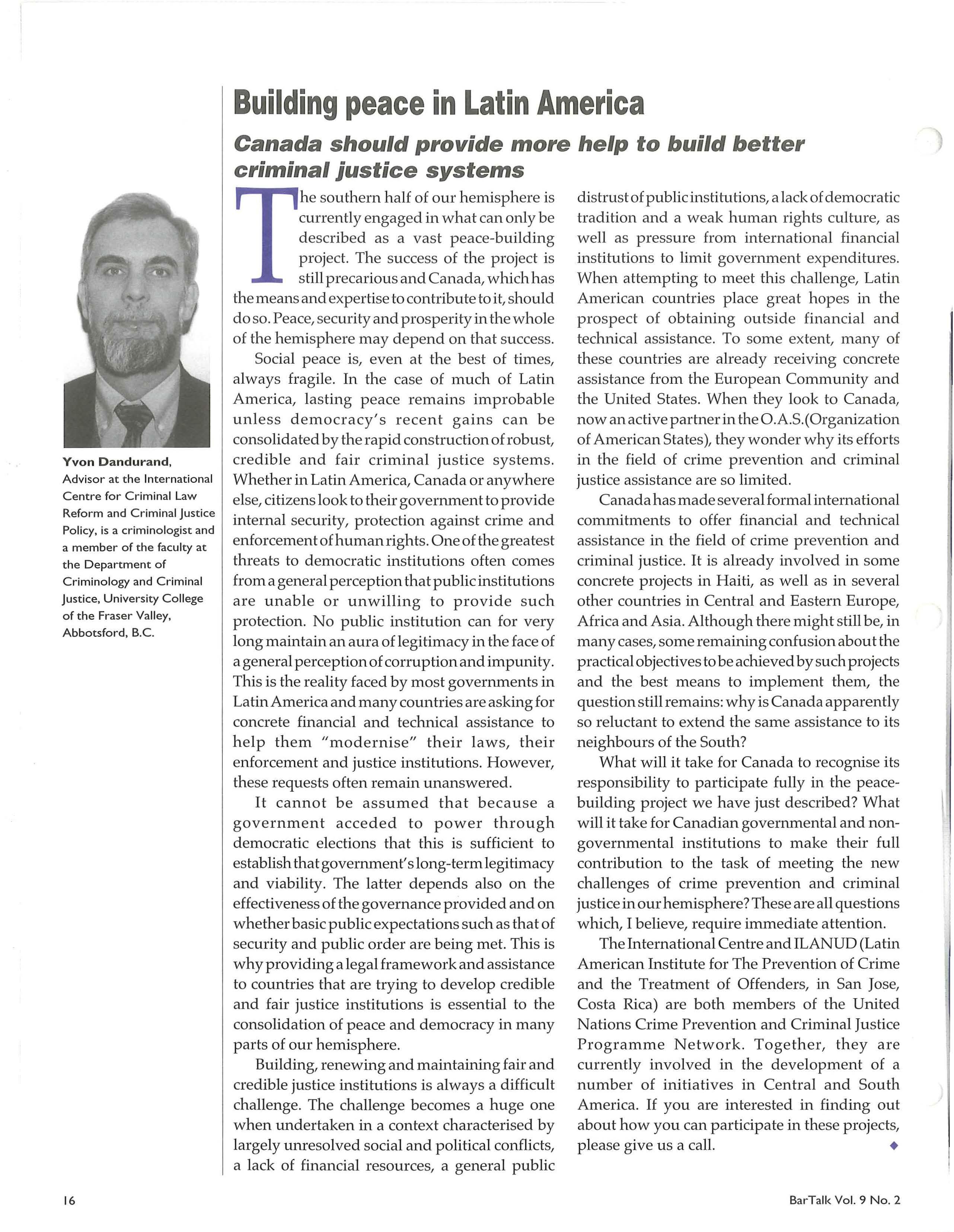
Yvon
Dandurand , Advisor at the International Centre for Criminal Law Reform and Criminal Justice Policy, is a criminologist and a member of the faculty at the Department of Criminology and Criminal Justice, University College of the Fraser Valley, Abbotsford , B C.
Building peace in Latin America
Canada should provide more help to build better criminal justice systems
he southern half of our hemisphere is currently engaged in what can only be described as a vast peace -building project. The success of the proj e ct is still precarious and Canada, which has the means and expertise to contribute to it, should do so. Peace, sec urity and prosperity in the whole of the hemisphere may depend on that success.
Social peace is, even at the best of times, always fragile. In the case of much of Latin America, lasting peace remains improbable unless democracy's recent gains can be consolidated by the rapid construction of robust, credible and fair criminal justice systems Whether in Latin America, Canada or anywhere else, citizens look to their governmen t to provide internal security, protection against crime and enforcement of human rights One of the greatest threats to democratic institutions often comes from a general perception that public institutions are unable or unwilling to provide such protection. No public institution can for very long maintain an aura of legitimacy in the face of a general perception of corruption and impunity. This is the reality faced by most governments in Latin America and many countries are asking for concrete financial and technical assistance to help them "modernise" their laws, their enforcement and justice institutions. However, these requests often remain unanswered.
It cannot be assumed that because a government acceded to power through democratic elections that this is sufficient to establish that government's long-term legitimacy and viability The latter depends also on the effectiveness of the governance provided and on whether basic public expectations such as that of security and public order are being met. This is why providing a legal framework and assistance to countries that are tr ying to develop credible and fair justice institutions is essential to the consolidation of peace and democracy in many parts of our hemisphere.
Building, renewing and maintaining fair and credible justice institutions is always a difficult challenge . The challenge becomes a huge one when undertaken in a context characterised by largely unresolved social and political conflicts, a lack of financial resources, a general public
distrust of public institutions, a lack of democratic tradition and a weak human rights culture, as well as pressure from international financial in sti tutions to limit government expe nditure s. When attempting to meet this challenge, Latin American countries place great hopes in the prospect of obtaining outside financial and technical assistance. To some ex tent, man y of these countries are already receiving concrete assistance from the European Community and the United States. When they look to Canada, now an active partner in the 0 .A.S. (Organi za tion of American States), they wonder why its efforts in the field of crime prevention and criminal justice assistance are so limited.
Canada has made several formal international commitments to offer financial and technical assistance in the field of crime prevention and criminal justice. It is already involved in some concrete projects in Haiti , as well as in several other countries in Central and Eastern Europe, Africa and Asia. Although there might still be, in many cases, some remaining confusion about the practical objectives to be achieved by such projects and the best means to implement them, the question still remains: why is Canada apparently so reluctant to extend the same assistance to its neighbours of the South?
What will it take for Canada to recognise its responsibility to participate fully in the peacebuilding project we have ju st described? What will it take for Canadian governmental and nongovernmental institutions to make their full contribution to the task of meeting the new challenges of crime prevention and criminal justice in our hemisphere? These are all questions which, I believe, require immediate attention.
The International Centre and ILANUD (Latin American Institute for The Prevention of Crime and the Treatment of Offenders, in San Jose, Costa Rica) are both members of the United Nations Crime Prevention and Criminal Justice Programme Network. Together, they are currently involved in the development of a number of initiatives in Central and South America. If you are intereste d in finding out about how you can participate in these projects, please give us a call. +
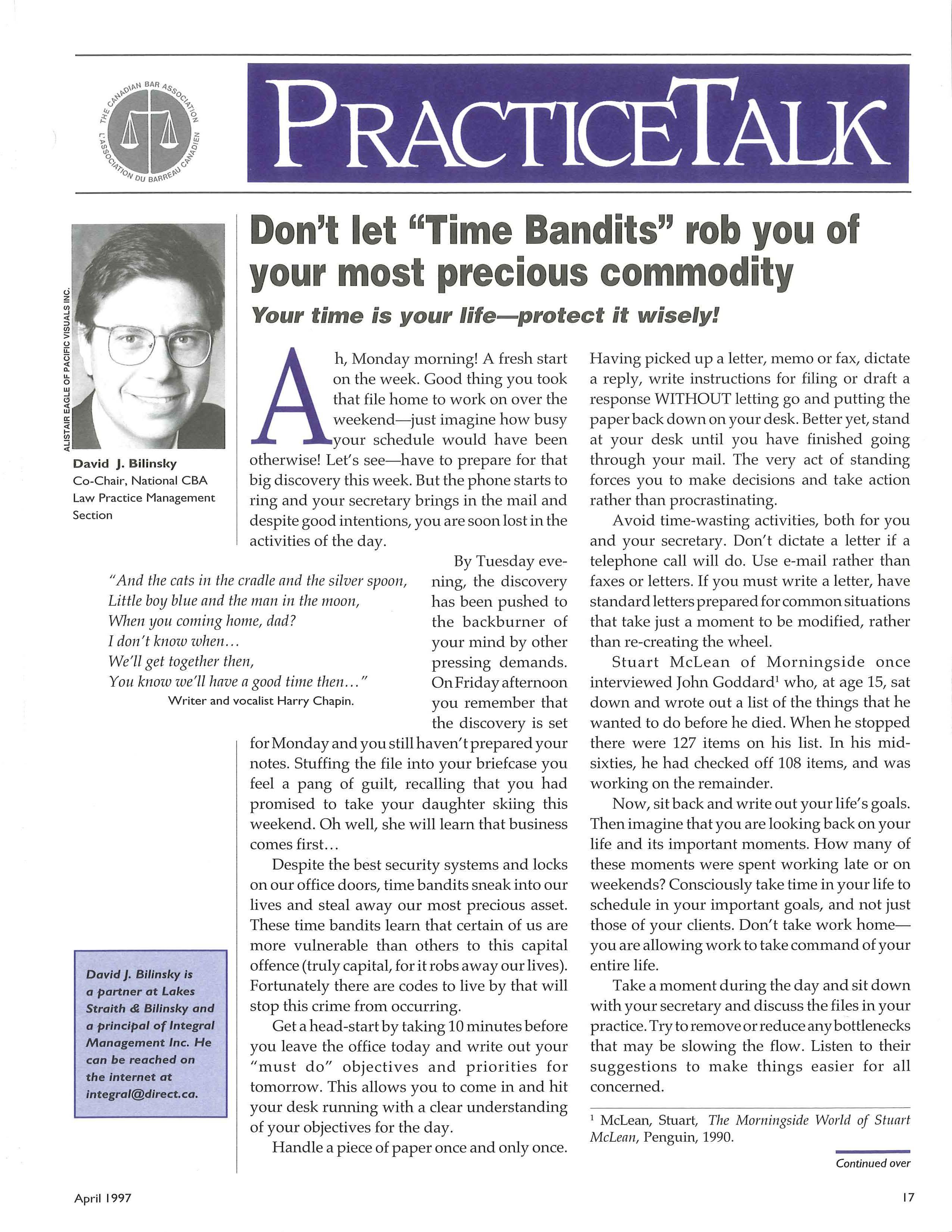
David J. Bilinsky Co-Cha ir, Nat iona l CBA Law Practice Management Section
Don't let "Time Bandits" rob you of your most precious commodity
Your t i me is your lite-protect it wisely!
h, Monday morning! A fresh start on the week. Good thing you took that file home to work on over the weekend-just imagine how busy your schedule would have been otherwise! Let's see-have to prepare for that big discovery this week. But the phone starts to ring and your secretary brings in the mail and despite good intentions, you are soon lost in the activities of the day.
"And the cats in the cradle and the silver spoon, Little boy blue and the man in the moon,
Having picked up a letter, memo or fa x, dictate a reply, write instructions for filing or draft a response WITHOUT letting go and putting the paper back down on your desk. Better yet, stand at your desk until you have finished going through your mail. The very act of standing forces you to make decisions and take action rather than procrastinating.
By Tuesday evening, the discovery has been pushed to the backburner of your mind by other pressing demands On Friday afternoon you remember that When you coming home, dad?
I don't know when We'll get together then, You know we ' ll haven good time then " Writer and vocalist Harry Chap in.
the discovery is set for Monday and you still haven't prepared your notes. Stuffing the file into your briefcase you feel a pang of guilt, recalling that you had promised to take your daughter skiing this weekend. Oh well, she will learn that business comes first
A void time-wasting activities , both for you and your secretary Don't dictate a letter if a telephone call will do. Use e-mail rather than faxes or letters If you must write a letter, have standard letters prepared for common situations that take just a moment to be modified, rather than re-creating the wheel.
Stuart McLean of Morningside once interviewed John Goddard 1 who, at age 15, sat down and wrote out a list of the things that he wanted to do before he died. When he stopped there were 127 items on his list. In his midsixties, he had checked off 108 items, and was working on the remainder.
David J. Bilinsky is o partner at lakes
Stroi t h & Bilinsky and o principal of Integral Management Inc . He con be reached on the internet at integrol@direct. c o .
Despite the best security systems and locks on our office doors, time bandits sneak into our lives and steal away our most precious asset. These time bandits learn that certain of us are more vulnerable than others to this capital offence (truly capitat for it robs away our lives) . Fortunately there are codes to live by that will stop this crime from occurring.
Get a head-start by taking 10 minutes before you leave the office today and write out your "must do" objectives and priorities for tomorrow . This allows you to come in and hit your desk running with a clear understanding of your objectives for the day.
Handle a piece of paper once and only once
Now, sit back and write out your life's goals. Then imagine that you are looking back on your life and its important moments . How many of these moments were spent working late or on weekends? Consciously take time in your life to schedule in your important goals, and not just those of your clients Don't take work homeyou are allowing work to take command of your entire life.
Take a moment during the day and sit down with your secretary and discuss the files in your practice. Try to remove or reduce any bottlenecks that may be slowing the flow. Listen to their suggestions to make things easier for all concerned.
1 McLean, Stuart, The Morningside World of Stuart McLean, Penguin, 1990.
Come One Come All!
See how hot new technology is changing the practice of law!
A joint meeting of The Law Practice Management Section , The North Shore Bar Assocation and the Computer Law Section will be held on Tues May 27, 1997 at 7 :00 P M at The Lonsdale Quay Hotel , 123 Car r ie Cates Court, North Vancouver (north terminus of the Seabus)
The featured speaker will be Mr Michael Jimmerson , author , speaker , attorney and Past Co-Chair of the A.B A. ' s award-winning TECHSHOW , the profession's prem ier legal technology conference, speaking on "The Transformation of Law Practice through technology " Mr Jimmerson ' s knowledge and experience in this area is unequa ll ed , and we a[lticipate that this meeting will be heavily attended A LEGAL TECHNOLOGY EXPO will also be he ld, starting at 5 p m ., where you will be able to touch and experience products and services available today and speak with the vendors prior to the business program TO RESERVE YOUR SPOT contact Christopher Doll at Bradbrooke Crawford & Green , 980-8571 for further details
Know what is important to you- and make sure there's time for it
Continued from page I 7
Recall that activities can be divided into five categories 2 : Important and Urgent, Important but not Urgent, Urgent but not Important, Busy Work and Waste of Time Important and Urgent matters get solved. Urgent but not Important activities clamour for attention, but don't deserve the time they get. Busy Work and Waste of Time are just that-the sooner you forget these, the better It is the Important but not Urgent activities that deserve attention, but usually get lost in the shuffle. Create a "to-do someday" list and review that list regularly After all, on this list you will probably find such things as going on that trip to Europe with your spouse, or taking up fly-fishing or windsurfing or writing that book. This is the stuff that memories are made of Get a Personal Information Manager (PIM), such as Amicus Attorney or Lotus' Organizer'97, for your desktop computer and start using it. These programs assist you in a number of ways. You can create To-Do lists and lists of clients and telephone numbers so you only need look in only one place for address information. They will also help you to track calls and enable you to create an electronic calendar.
When you do dictate a letter, file a pleading, or delegate a task, automatically create a followup entry to check if a response has been produced This keeps the simmer on and prevents matters from going cold. Moreover, you will develop a reputation in the office for being on top of things.
Delegate, delegate, delegate. Use the office staff to your best advantage. Refer out files that do not capture your full energy and enthusiasm . Have others do as much on a file as they legally and ethically can. Free up your time and energy for important tasks and files.
Someone once said that life was a series of interruptions interrupted by interruptions. Take time to concentrate Block off times to work on matters, close your door, put your phone on" do not disturb" and put your shoulder to the wheel. When the allotted time is over, take your calls, and deal with matters knowing that you have used your time effectively.
Give yourself a reward for completing a task on your "to-do" list. Get up, take a short walk, grab a coffee, or even just give yourself a mental
2 Edwin C. Bliss, Getting Things Done, Bantam Books, 1977 and reprinted many, many times since
"way to go" prize. Recall that you attract more bees with honey than with vinegar
The most important time-saving tool is liberal use of the word "No". If you refuse to allow others to take control of your time, you will have kept the time saved for your own use .
Since none of us know just how much time we have left, each of us can benefit from using our time to best advantage Hopefully, that includes those good times spent watching our little ones take their first bicycle ride or snowplow turn. +
Dave's Top 10 Internet Site s
1. http: I I www .legis.acjnet.org I AC]Net I index_en.html
Access to Justice Network. The primary purpose of this site is to give Canadian citizens access to Canadian federal and provincial statutes, regulations and legislative information.
2. http: I I canada .justice.gc .ca I Publications I CCDL I index_en.html
This publication is intended to be a guide to the leading cases decided under the Canadian Charter of Rights and Freedoms . It does not attempt to explain, analyze or criticize the decisions that have been digested, but instead seeks to set out, in respect of each of the Charter's provisions, the relevant portions of the principal judgements in which the provision has been interpreted and applied The appendices contain extracts from decisions dealing with general principles of interpretation and a waiver of rights, together with lists of the provisions of federal statutes that have been judicially considered under the Charter.
3 . http: I I www .acjnet.org I resource I prime.htrnl
Access to Justice Network references for BC including:
Bills, Consolidated Statutes of British Columbia, Bylaws-Nanaimo, Bylaws- Victoria, Bylaws-North Vancouver, Debates of the Legislative Assembly (Hansard), Legislative Proceedings, Legislature Today, Order in Council and Ministerial Order Resumes, Order of the Day, Progress of Bills-List Format, Progress of Bills-Table Format, Provisions in Force, Votes and Proceedings.
There are links to other Provinces and Territories as well.
4. http:/ /www.collegehill.com :80/ilpnews/
This is the home page for the Internet Legal Practice Newsletter. The January, 1997 issue contains four excellent articles on Internet legal research, choosing the right level of Internet access for your law firm or court, and issues to consider when seeking to protect your client's intellectual property on the Internet.
This page contains links to information and resources relevant to the study of Artificial Intelligence and Law
6. http:/ /www.lectlaw.com/
If you haven't visited this site yet, run, don't walk as it deserves a visit. There is NOTHING on the net like the 'lectric law library
7. http:/ /www.lawguru.com/
Check out Lawguru .com, the Home Page of the Law Offices of Eslamboly & Barlavi in Los Angeles, California. This is the mother of home pages for law firms on the net!
8. http:/ /www.legalonline.com./
Here is a publication that does not merely deliver a li st of law-related Web sites, but in their words, that tells you which are worth your time, which will help you in your profession. It is a US publication, and we will have to wait to see if they include Canadian home pages in their material.
They have instituted a new rating system for legal home pages on the net. They state that they will analyze and evaluate them, so you don't have to waste your time. The best of the bunch will earn legal.online's five-star rating Legalonline will evalua t e a site in each of five categories and then award a star for excellence in any one. The best sites, the five-star sites, will excel in each of these ways:
• Overall usefulness to legal professionals
• Content
• Design and presentation
• Accessibility and ease of use
• Innovation
In each issue of legal. online, they state they will rate the sites they visit and recap the ones that rate five stars .
9. http:/ /www.internetlawyer.com/ tillive.htm
This is the net version of The Internet Lawyer. The January, 1997, issue contained links to medical sites on the net, a review of legal home pages (but not rated!) and other juicy tidbits.
10.http:/ /www.europa.eu.int/cj/en/ index.htm
This is the home page for the European Court of Justice. From their home page, they have not yet activated access to their recent decisions, but this appears to be in the works. There is other interesting information about the court.
Happy surfing until we meet again! +
Revised Statutes of British Columbia 1996
The Revised Statutes of British Columbia 1996 are about to replace their 1979 counterparts.
The Office of Legislative Counsel has prepared a complete revision on the province's public Acts to reflect the laws as of December 31, 1996 The revision was approved by the Select Standing Committee of the House on Parliamentary Reform, Ethical Conduct, Standing Orders and Private Bills on February 28, 1997 and signed by the Lieutenant Governor on March 4 . The official copy is now deposited with the Clerk of the Legislative Assembly.
Legislative Counsel anticipates the Revised Statut es of British Columbia 1996 will come into force on April21 , 1997.
In addition to the standard section renumbering, key objectives for the 1996 revision were:
• To use a consistent gender-neutral style
• To improve statute format using plain language principles, and
• To replace archaic and unnecessarily legalistic language with modern terms. The revision process has been under way for just over five years. During this time, user groups have been consulted on the revision content and format. Legislative Counsel particularly wish to thank the CBA Sections that assisted by reviewing revision drafts .
Crown Publications is taking advance orders for the 1996 Revised Statutes (bound, loose-leaf or electronic format). They can be contacted at (250) 386-4636.
Sick of trying to keep up with Windows 95, 97 and who knows what in future? Here's one lawyer who advises that you stay on the "trailing edge".
By james Spears
his is a comfort letter to a typical law office computer user from an old hacker. The message: Don't feel left behind by teclmology. Wait for the year 2000. Since 1972 I have used computers, daily, as word processors. Since 1984 I have used spreadsheets, databases and disk transcripts and e-mail. And, since 1986 I have used every version of Windows except NT, and two versions of OS I 2. In the law office, I use plain old DOS. At home, I play with OS2 and Windows 95. Most of my clients still give me disk information in DOS formats, usually WordPerfect.
And although I covet my ancient e-mail address, I don't publish it because I don't want to take that extra 10-20 minutes a day to check it, dispose of junk e-mait and process it.
"We trailing edge types are working in real law offices. We write letters, agreements and trial briefs . We do not draw
Publication, in my view, obliges a lawyer to check that e-mail address once or twice a day for the rest of his or her pretty pictures; surfing the net ranks up there with watching TV." career. E.g.: "But I sent a message to you on e-mail that my car accident was 23 months ago. I didn't know th at you changed your Internet provider two months ago."
If you think putting your name on a 10-year office lease is a commitment, think about publishing your e-mail address. Y may want to wait until the Internet sorts itself out. By using DOS, you have temporarily given up the ability to own and occupy a Website. (Don't ask about Websites: they are TV commercials running very, very slowly.)
And then there's money and training time. Take an office with 5lawyers and 10 staff with 15 computers. If you are on the trailing edge, you probably have a few old 286 machines ($200 value) and a mixture of 386 and 486 machines.($300 to $600 plus the hard drives). You have a network that is five years old with some new hard drives plugged in. Memory is becoming cheaper and cheaper, and the re-sale value of these machines is laughable. The cost of training should equal the cost of the new machines.
Your old machines all run WordPerfect 5.1 or
other word processing programs at fast speeds, in DOS, assuming you work from a hard drive. Your network is by far the slowest component. It will remain slow in Windows.
Your minimum requirements for running Windows 95 plus some commercial software are fast 486 or 586 (Pentium) machines with 16 megs of RAM. Some say you can get away with 8 megs. That's roughly $2,000 x 15 or $30,000, plus the new network rwming Windows NT or similar Windows.
For that price you get a system that will run programs much, much slower than the DOS you presently have. Many users say Windows is easier to learn . I say it is easier to learn if you don't type, but how many law firms hire secretaries who don't type?
We trailing edge types are working in real law offices. We write letters, agreements and trial briefs. We do not draw pretty pictures; surfing the net ranks up there with watching TV. Such useful programs as B.C. Online, QuikLaw and CD-ROMS of the Statutes of B.C. all run faster in DOS than in Windows, but run well either way With a simple DOS program such as WordPerfect Shell (used by many law offices for years) you can run 10 or more programs in (small "w") windows at speeds many, many, times faster than Windows with a capital "W."
I must admit, I hit a brick wall recently Carswell published data that could only be used in Windows: a CD-ROM of the Statutes of Canada. Because my office machine only had 4 megs of RAM and was only a fast 486, the program would not operate on my machine without serious re-configuration. Even when operating, frustrating waits of in excess of 3 minutes were encountered. A competitor, Qualisult, also published the same information in Windows in a different format, but because the program used "ASCII" files, it worked slightly better with 2minute access times in my Windows environment. I switched the software to DOS, and here is an extract from my report to Qualisult: "My DOS version required re-indexing the data but the result is that access time to text is now less than five seconds, as opposed to 110+ seconds in Windows."
The lesson learned is that through the hype of Microsoft, and not the needs of users, software manufacturers are forgetting the DOS users. This is a marketing scheme and is not userdriven. Last time I checked, DOS users are still in the majority in law offices, but this may change. Given that Microsoft is essentially a monopoly, and must sell a new product each year, you can bet that in the year 2000 Microsoft will be saying that Windows 95 is so old as to be unusable. Microsoft will be correct. With a sufficiently
powerful machine, Windows 95 is better than Windows 3.1. Wait until 2000 and it may be as good as DOS.
My last citation is the Court of Appeal. The court will accept disk tran s cripts and factums, but only in WordPerfect 5.1, DOS version . The reason is that like many law offices, the Court of Appeal has no budget for Windows.
PS. The Court of Appeal has an Internet address of "www .courts.gov.bc.ca" for recent judgements. +
Beware the trap of Select and Ultimate Term Life Insurance
By John Sealey, CLU, C.H.F.C., FLMI, RHU, CFP
Marketing Director of The Canadian Bar Insurance Association
How many times have you seen ads offering life insurance at seemingly impossible low,low rates for renewable, term life insurance? Most lawyers carry a fair chunk of renewable term life insurance with the two most common types being those which renew at a higher premium either every five or 10 years with coverage terminating at age 65 or 70 or so. It's temporary insurance for temporary needs and can be used, in the event of your premature death, to retire debts, provide an income for a surviving fanuly and cover higher education costs
So when you receive one of these mailing pieces and you compare your premiums to the advertised rates, in many cases, the advertised rates will be better. Why? There are a number of reasons. The termination age of the advertised policy may be earlier than yours. The coverage may be renewable at a higher premium each year rather than every five or 10 years. But the worst, and usually, the most common reason is that the advertiser is marketing term life insurance with" select and ultimate" rates versus "blended" rates.
The problem with, and the reason why, "select and ultimate" rates are so attractive at any given age is that in order to get these rates, you must re-qualify medically at each renewal. This means that you must go through new medicals, blood tests, etc. every five or 10 years in order to avail yourself of these "select" rates. What you don't find out is that if you fail to re-qualify for the "select" rates, you will end up paying the
"ultimate" rates guaranteed in the back of your policy. These "ultimate" rates are usually calculated to take into consideration that the majority of lives paying them are either substandard or uninsurable risks. As you can imagine, the premiums being charged are substantial.
Let's take a look at just how different" select" versus "ultimate" rates are. Let's take a 41-yearold male, non-smoker, applying for $500,000 coverage on a 10-year renewable term basis. If he were tore-qualify medically at age 51 and age 61, his annual premiums would be $799 .50, $1859.50 and $4,449.50 respectively, but let's assume that somewhere between 41 and 51 our applicant's health changed and he could no longer qualify for the "select" rates. His premium at 41 would be the same $799.50, however, instead of the "select" rate of $1,859 .50 at age 51, he would be forced to pay the "ultimate" rate of $3,119.50. At age 61, he would be paying $9,429.50 per year, more than double the "select" rate of $4,449.50 . So, just how much has he "saved" by going for the low introductory price? Don't get yourself in a situation where, because of ill health, you can no longer afford to carry the coverage.
The CBIA's rates are "blended." This means that, if you were renewing your coverage after being insured for 25 years, you will pay th e same rate as the 51-year-old buying it for the first time. It might cost a little more at the beginning, but it could save you a lot in the long run. Before you run out and jump at the "best" price, look at the costs that might be lurking behind it.
The Canadian Bar Insurance Association is a not-for-profit organization providing insurance to members of Canada's legal profession. +
Now a CBA supplier
On February I, 1997, Avis Rent -a- Car became an official CBA supplier of auto renta l services with an exclusive package of benefits for members.
Our package includes a benchmark rate for CBA members including, in most loc ations, unlimited mileage on a ll ca r classes for daily, weekly, weekend and monthly rentals in Canada. As well, discounts are available on international rates in the U S., Europe and world-wide.
By calling toll free , 1-800TRY-AVIS (879-2847) and quoting the CBA Avis Worldwide Discount (AWD) number (C 136400) members can access the reservation system Avis offers service at all major Canadian airports and 170 locations in communities across Canada
Copyright Legislation and Access to the Law
Maureen B. McCormick Chief Librarian and Executive Officer
B
C. Courthouse Library Society
Bill C-32, An Act to Amend the Copyri ght Act, has been amended by the Standing Committee on Canadian Heritage to which it was referred and may or may not receive third reading before the session ends. The bill includes some exceptions, including that of" fair dealing" when copying is done by individuals for the purpose of research or private study, as well as copying done by libraries for collection management purposes.
However, neither the original statut e nor this amendment includes any exceptions for copying of authorities for submission to courts or tribunals, as requested by the Federation of Law Societies in its Brief to the Committee In fact, the legislation requires that all libraries providing an information service that includes the preparation of photocopied excerpts, whether for private study, research or for use in a judicial process, enter into an agreement with a copyright
collective (CanCopy) which grants licenses and sets the royalties to be paid As legal publishers have asserted copyright on published law reports, the collective will seek the payment of royalties on judicial decisions photocopied for u s e in the courts . As libraries everywhere are contending with a combination of decreasing revenues and increasing prices for information materials, the additional expense of royalty payments to the publishers will have to be passed on to the users, in the form of increased service charges As the Federation stated in its brief, this "will represent a significant additional cost to Canadians who require access to laws, whether on their own or with the assistance of a lawyer."
The Report of the Canadian Bar Association Task Force on Systems of Civil Justice states that "the law must be comprehensible, and additional s teps must be taken to make it more accessible to the public and to lawyers." The new legislation will not make this easier. +
Help support the Law for the Future Fund
One billable hour from every member
The Law for the Future Fund is calling on every member of the CBA to contribute one billable hour to the Hourglass Campaign .
Since 1984, the Law for the Future Fund has helped finance more than 35 innovative and timely research projects, dealing with issues such as the independence of administrative tribunals, law and ethics in health care allocation, recodification of the Criminal Code, gender and racial equality, and the Systems of Civil Justice Task Force.
To make your contribution, please complete this pledge card, cut it out and return it with your cheque, VISA or Mastercard number to the CBA at 50 O'Connor Street, Suite 902, Ottawa, Ontario, KIP 6L2. You will receive an official receipt in the mai l.
Your support makes a difference.
Hourglass Campaign Pledge
Yes, I support the Law for the Future Fund's Hourglass Campaign.
My gift is:$_____
Date: _____
Signature: ______________
The above gift is to be held by the Canadian Bar Law for the Future Fund for a period of not less than I0 years.
Payment:
Enclosed is a cheque payable to the Canadian Bar Association.
VISA D MASTERCARD Card# _______ Exp. _____
Name: ______________
Address: _____________
Please return to: Canadian Bar Association 902-50 O'Connor, Ottawa ON KIP 6L2
BARTALK EDITORIAL BOARD CREATED
New team brings variety of legal backgrounds to task
e wish to introduce ourselves as the members of the newly formed BarTalk Editorial Board. We are: Margaret Ostrowski as Chair, Greg Steele, Joe Wood and Bruce Woolley The CBA Executive felt that an Editorial Board could provide additional views on the many issues that are presently affecting our profession. Ry Glover at the CBA Branch Office will continue as Editor. Our recent CBA members survey has reported that the majority of our members rank the quality of BarTalk as good or excellent and the new Board aims to improve on those commendable results.
BarTalk is our CBA bi-monthly publication that communicates with the entire mem-
bership. It keeps US
We are also hoping to publish guest editorials to bring fresh commentary on our profession.
The Board comes to this task from a variety of backgrounds: Margaret Ostrowski is a sole practi honer estates lawyer who has been a member of the governing body of two other professional associations She has been a member of Provincial Council for several years, an elected member for Vancouver County and now serves on the CBA Executive. Greg Steele practices civil litigation at the firm of Steele & Company. He has been Chair of the Legislation and Law Reform Committee of the B . C. Branch since 1992, an elected member of Pro-
vincial Council for Vancouver County since 1994 and a member of the Executive Committee since 1995. Joe Wood is a general updated on important Wood, Bruce Woolley, Greg Steele and Margaret issues affecting our Ostrowski. profession and activities w1dertaken by the Executive, Provincial Council and the many committees and representatives on our behalf. As a Board, we will be providing input on content and features of the regular publication and we will be experimenting with some of our own ideas to make the publication more interactive, relevant and personal.
For instance, we will be initiating a Letters to the Editor column in the June publication. Please feel free to write to us with comments on any of the features of Bm·Talk or on any CBA professional issues. In addition, the CBA values its volunteers and many of them put in hours and days of work on our behalf. In every publication, we will be highlighting the volunteers of one of our many committees or Bar appointments .
litigator at Blake, Cassels and Graydon. He is a former Judge of the Supreme Court (1983 to 1989) and the Court of Appeal (1989 to 1996).
Bruce Woolley practices at Stikeman El-
"As a Board, we will be providing input on content and features of the regular publication and we will be experimenting with some of our own ideas to make the publication more interactive, relevant and personal."
liott and is also a Visiting Assistant Professor at the U.B.C. Law Faculty . He has been a member of Provincial and National Councils, a Director of CLE, and is currently a Bencher . Please call any member of the Board with any ideas you have. We want to hear from you. •
BarTalk Editorial Board members are (from left): Joe
The Law Reform Commission of British Columbia may have closed its doors but its work will cont inue
,.. he provincial government ceased funding the La w Reform Commission as of March 31, 1997. However, on April 1st, the British Columbi a Law Institute officially opened its doors at its new offices in the Law Society Building, 845 Cambie. For its fir s t year of operation, the new Institute has been financed by a $127,500 grant from the Law Foundation of BC and by a grant of office s pace equivalent to $20,000 by th e Law Society of BC.
The BC Branch of the Canadian Bar A ssociation contributed a grant of $10,000 for research projects This was joined by grants of $4,800 e ach by The Vancouver Bar Association and The Advocate
The new Institute was formally incorporated in January The acting Executive Director is
Courthouse s to remain open
Th e provincial government has decided to keep the Chilliwack and Maple Ridge Courthouses open until it conducts a review to determine where to base a regional justice centre for the Fraser Valle y.
"We lis t ened carefully to proposals from the ma y ors of Chilliwack and Maple Ridge ," said Attorney General Ujjal Dosanjh. "They made a convincing case for keeping their communities' courthouses open on an interim basis until our review in two years."
The government's decision followed an earlier agreement with the City of Richmond that will keep adult criminal court services in the municipality while still meeting the provincial government's reform goals
"Like the Richmond agreement, Chilliwack and Maple Ridge came up with constructive and creative proposals that met our reform criteria for an affordable and efficient justice system," Dosanjh said.
In February, the government announced the closure of 11 courthouses throughout BC, Including those in Chilliwack and Maple Ridge, as part of a major re-structuring of the province ' s justice system +
Arthur Close, Q.C., formerly Chair of the Law Reform Commission, and a founding memb e r of the Institute. Oth e r founding memb e rs wer e : Gregory St e ele (Chair of th e BC Branch Legislation & Law Reform Committee and a member of the Branch executive), Tom Anderson, Gordon Turiff (past executive memb er of the BC Branch), and the Honourable Martin Taylor, Q C.
Those appointed to the Institute board on behalf of the BC Branch were Dougla s Robinson, Q C., BC Branch Secretary-Treasurer, and Ann McLean, the Branch Legi s lation and Law Reform Officer Repre senting the universities will be D r Albert J. (Bertie) McClean, D e an Emeritus of the UBC Law School, and Profe s sor Jame s Cassell, Associate Dean of the Univer s ity of Victoria Law School. Appointed by the Law Society of BC were Sholton Hebenton, Q.C., and Professor Jam e s Macintyre. The board will also soon be joined by two appointment s (still to be named) from the Attorney General's ministr y. Dr. McClean will serve as Chair of the new board.
A s ked what the purpose of the new Institute will be, Close answered:
"An initial concern was to ensure that the legacy of the Law Reform Commis s ion would not be lost. When the commission ceased operations there was a significant body of work in progress and we hop e to bring at lea s t some of that to completion. The Institute also wants to take on new law reform projects and explore new ways of making them work. Essentially, though, the objectives ofthe new Institute remain the same as those of the Law Reform Commission: to improve and modernize the laws of the province for the benefit of all its citizens.
"These objectives need to be pursued whe ther government is prepared to assume a major role or not. In other places, government plays a much less prominent part. In Alberta, for example, the work of law reform ha s been carried on for 25 years by the Alberta Law Reform In s titute which is funded jointly by the governm ent of Alberta , the Alberta Law Foundation and the University of Alberta." +
You will see a reference in some cases to the number of the Bill when it was introduced in the House. This number may be different from the chapter number of the new Act which is quoted after the title of the Act and which is the proper citation for the Act. The Bill Number has been given to you to make it easier for you to note up the Bills you nwy have in your library.
Evety effort is made to ensure the accuracy of the information provided to you in this article but the information should not be relied upon. Lawyers should refer to the specific legislat ive or regulatOI)' provision.
ACTS I N FORCE
Family Maintenance Enforcement Amendment Act, 1994, S B.C. 1994, c.36, amends the Family Maintenance Enforcement Act, S.B .C. 1988, c .3, providing for the payment by the debtor of interest on arrears of maintenance and makes consequential amendments to the Family Relations Act the part of section 1(c) that enacts paragraph (i) of the definition of "maintenance"; section 11; the part of section 17(e) that enacts s.20(9)(d) and the part ofsection 2 6 that enacts s 29(d) of the Family Maintenance Enforcement Act and section 36 in force January 1, 1997
Forest Statutes Amendment Act, 1996, S.B.C.1996, c.11, (Bill7), amends the Forest Act, R.S.B.C. 1979, c.140, enabling a regulation to require the holders of replaceable contracts who enter into a subcontract, including a replacement subcontract, to do so only by means of a replaceable subcontract.
section 18 of the Act in force November 14, 1996
ManufacturedHomeAmendmentAct, 1994, S B C. 1994, c.9, amends the Manufactured Home Act, R.S.B.C. 1979, c.281, allowing for searches by name of owner or serial number of manufactured home as well as by registration number.
the part ofsection5 enacting s.24(1)(a) and (b) of the Manufactured Home Act in force January 24, 1997
Motor Vehicle Amendment Act, 1996, S B C.1996, c.14, (Bill9), amends theMotor Vehicle Act, R.S.B.C. 1979, c.288, providing for the transfer of many of the functions of the Motor Vehicle Branch to ICBC, including vehicle registration, licensing and records, driver testing, driver license administration, AirCare, violation ticket administration and fines collection and makes consequential amendments to the Commercial Transport Act, Election Act, Highway Scenic Improvement Act, Insurance Corporation Act, Insurance (Motor Vehicle) Act, Motor Carrier Act, Motor Vehicle Amendment Act (No. 2) , 1987, Motor Vehicle Amendment Act' 1992, Motor Vehicle Amendment Act, 1995, Offence Act and Sheriff Act
part of section 1, sections 2 and 3, part of section 4, sections 5 - 30, pa r t of section 31, sectio n s 3 438 and sections 45- 81 in force Novembe r 18, 1996 (see B.C. Reg. 319/96 for details)
Motor Vehicle Amendment Act (No. 2), 1996, S.B C. 1996, c.15, (Bill10), amends the (a) Motor Vehicle Act, R.S B C. 19 79, c.288, requiring that a report be made to the superintendent when a vehicle becomes an irreparable or salvage vehicle and requiring the superintendent to refuse to issue a license or plates for such a vehicle, and
(b) Motor Vehicle Act, Motor Vehicle Amendment Act, 1995, S.B.C. 1995, c.28, and Offence Act, R.S B.C.1979, c.305, making changes consequential to the transfer of functions from the Motor Vehicle Branch to ICBC.
part of section 30, part of section 32, section 33, part of section 34 and section 35 of the Act in force November 18, 1996 (see B.C. Reg 320196 for details); sections 1, 3 and 29 of the Act in force February 1, 1997
Waste ManagementAmendmentAct, 1993, S.B.C. 1993, c. 25, amends the Waste Management Act, S.B.C. 1982, c.41, providing a more comprehensive process for managing contaminated sites and establishing liability for remediation. In order to identify contaminated sites, certain persons will be required to provide a site profile and a manager may require a site investigation A site registry will be established, in which information relating to a site will be recorded and made available to the public. A manager may make a determination that a site is contaminated. Persons who are liable to remediate a site are specified, including current and past owners. "Owner" includes a person who is in possession of, has the right of control of, occupies or controls the use of the property Some exemptions are specified Liabi l ity is absolute, retroactive and joint and several and applies despite the fact that introduction of the contaminating substance
Legislative Update
Continued from poge 2 I into the environment was in compliance with legislation and permits which were in effect at the time of introduction. The minister may appoint a panel to allocate liability . A manager may determine that a person is a minor contributor. Various remediation options will be evaluated and permanent remediation solutions will be favoured. A manager may issue an approval in principle, conditional certificates of compliance and certificates of compliance. Some aspects of the remediation process may be delegated to municipalities upon agreement. A lien for recovery of remediation co s ts may be registered at the Land Title Office, with priority over most other claims. Consequential amendments are
Reports Ava il ab l e
made to the Islands Trust Act, Land Title Act, Min es Act, Municipal Act, Petroleum and Natural Gas Act, Property Law Act, and Vancouv er Charter in force Aprill, 1997
REGULATIONS TO NOTE
Court Rules Act, B C. Reg 221 I 90, the Supreme Court Rules is amended (a) adding Rule 65, "Vancouver Chambers Pilot Project Rule" and adding the applicable forms to Appendix A, setting out the applications in the Vancouver regi stry to which the Rule applies, documents to be filed and served by the parties and setting dates and times. The Rule applies to applications heard after
The Legislation and Law Reform Committee has received a copy of the following reports from the B.C. government. Copies may be obtained from the source noted.
CONTAMINATED SITES
INFORMATION
Source: Environmental Remediation and Integrated Pest Management Branch. BC Environment- (250) 387-4441 ; Internet Addre ss : http :// www .e nv .gov. bc ca/epd/epdpa/iwhc/ cshome/ html
REPORT OF THE B.C.
CHILDREN'S COMMISSIONER
Source: Children 's Commi ss ion Office , (250) 356-0831 ; Internet Address: http:// www .qp.gov . bc.ca/child_report ;
BRITISH COLUMBIA FOREST SERVICE
OPERATIONAL PLANNING REVIEW
Source: Pamela Bishop , Ministry of Forests Public Affairs Branch . (250) 387-8489; e-mail: pjbishop@ mforO l.for.gov bc ca
BC'S NEW ADOPTION ACT N EWSLETTERS
1. Access to Infonnation and Pri vacy; 2. Th e Child; 3. Birth Par ent s; 4 Adoptive Par en t s
Source: Adoption Division , Mini s try of Children and Families , Parliament Buildings, VictoIia , B.C. V8V 1X4.
UNCLAIMED INTANGIBLE PROPERTY
ADMINISTRATION IN B.C. DISCUSSION PAPER
Deadlin e for written co mments Ma y 30, 199 7
Source: Ministry of Finance and Corporate Relations, Communications Branch (250) 3565975; Internet address: http: / /www.fin gov bc ca/ocg.htm
REPORTTOTHE ATTORNEY GENERAL ON B.C.'S LIQUOR POLICIES by Tex Enemark
Source: Ministry of Attorney General , Communications and Education Division , 1Oth floor , 1001 Douglas St., Victoria Fax: (250) 356-9037.
REPORT ON GAMING IN BRITISH COLUMBIA
Source: Lotteries Advisory Committee , 3rd floor , 712 Yates St. , Victoria , V8V 1X4
Tel: (250) 387-0757
AUTOMOBILE INSURANCE REVIEW
Source: Ministry of Fin ance and Corporate Relation s, #105-617 Government St. Victoria , BC , V8V 1X4
Tel: 250-387-3347 Fax: 250-356-2822
February 1, 1997 and before February 1, 1998, but does not apply if the document by which the application is set for hearing is filed before February 1, 1997;
B.C. Reg. 357/ 96 effective Februan; 1, 1997 (b) increasing probate fees under Item 20 of Schedule 1 of Appendix C to $6 for every $1,000 value or part thereof greater than $25,000 up to $50,000 and $14 for every $1,000 value or part thereof over $50,000
B.C. Reg. 30/97 effective April1, 1997
Family Maintenance Enforcement Act, B.C. Reg. 346 I 88, the Family Maintenance Enforcement Act Regulation is amended, providing for the calculation of interest payable on arrears and exemption from interest on arrears during any period that the debtor receives income assistance and setting out limits on enforcement of interest.
B.C. Reg. 358196 effective January 1, 1997
Income Tax Act; Income Tax Amendment Act, 1996, B.C. Reg. 346196, the Income Tax Small Business Tax Holiday Regulation is made, providing that businesses providing legal or notary public, medical practitioner, health practitioner, veterinarian or accounting services are ineligible for the two-year tax holiday for new small businesses provided for under s.7 3 of the Income Tnx Act.
effective May 1, 1996
Securities Act, B.C. Reg. 479 I 95, the Securities Rules are amended and National Instruments 13-101 entitled "System for Electronic Document Analysis and Retrieval (SEDAR)" and 14101"Definitions" are made as rules of the Commission.
Waste Management Act, B.C. Reg . 269 I 95, the Contaminated Sites Fees Regulation is repealed and B C. Reg. 375196, the Contaminated Sites Regulation is made, dealing with site profiles, the site registry, fees, contaminated site definition and determination, remediation standards, liability, contaminated soil relocation, remediation plan approval and completion, approval of protocols by the director, allocation panel procedures, a manager's powers relating to public
consultation and review, independent remediation procedures, site investigations, orphan sites, the requirement for professional statements and transitional provisions.
effective April], 1997 •
New Dispute Resolution Office Established
The Director of the Ministry of Attomey General's new Dispute Resolution Office made a presentation to Provincial Council at its December meeting. Jerry McHale said that the government has established the central office to implement its altemate dispute resolution policy, and to support such programs in the civil justice system and courts. The Office will not provide mediation or arbitration services directly, but will facilitate the use of altemate dispute resolution methods where appropriate.
Initially the Office will concentrate on developing proposals for consultation in two areas: (1) B.C. Supreme Court civil cases other than family, and (2) family cases in Provincial Court and Supreme Court. The Office is presently exploring service delivery models and is researching a variety of issues including standards and qualifications for neutrals. The Office has reviewed various reports including the CBA's Systems of Civil Justice Task Force Report and its work will be informed by this and similar reports.
Options to be explored with the Bar and the Judiciary are both voluntmy and mandatory early mediation, point of entry information progratns, incentives to early resolution and enhm1ced access to ADR processes generally. Parent education and em·ly intervention will likely to be patt of the Office's initiatives in family law cases. The Office will also coordinate its work with initiatives being undertaken within the court system by the Judiciary. ADR in criminal cases, such as the increased use of diversion, is being coordinated tluough the Minishy's Criminal Justice Brm1ch. •
Candidates needed
The CBA is seeking candidates for its National Standing Committees for 1997-1998. All CBA members are eligible to apply for these positions. For information and an application form, please contact your Branch or the National Office at 1800-267-8860. Deadline for applications is April 18, 1997. Applications must be submitted to your Branch. •
BarTalk is published by the British Columbia Branch of the Canadian Bar Association, lOth Floor 845 Cambie Street Vancouver, BC V6B 5T3
TEL: (604) 687-3404
TOLL FREE: In BC, outside the Lower Mainland: 1-888-687-3404
FAX: (604) 669-9601
• BarTalk Editor: RY GLOVER, Director of Communications 687-3404 rglover@bccba.org
• Legislation & Law Reform Officer: ANN McLEAN (Victoria) (250) 598-2860 amclean@bccba.org
This publication is intended for information purposes only and the information contained herein shou ld not be applied to specific fact circum· stances without the advice of counse l
The BC Branch ofthe Canadian Bar Association represents over 8,600 lawyers within British Columbia and is dedicated to improve and promote access to justice, to review legislation, initiate law reform measures and advance and improve the administration of justice.
Angry protesters demonstrated on steps of Art Ga ll ery in Vancouver
Ra ll y was sponsored by Coalition Against No Fault Insurance
Some protesters (above) found themselves somewhat unusual vantage points to watch the proceedings
T h e protest even featured a dastardly vill ain (left) who appeared at intervals to remind the crowd about some of the imp lications of No Fault insurance
The February 20 demo n stration in Vancouver clear ly demonstrated t he strength of opposition to No Fau lt insurance
Former NDP Cabinet Minister Gary Lauk (left) was on ly one of many who spoke in oppos it ion to No Fau lt insurance