Former CBA president appointed new Chief Justice of BC Supreme Court
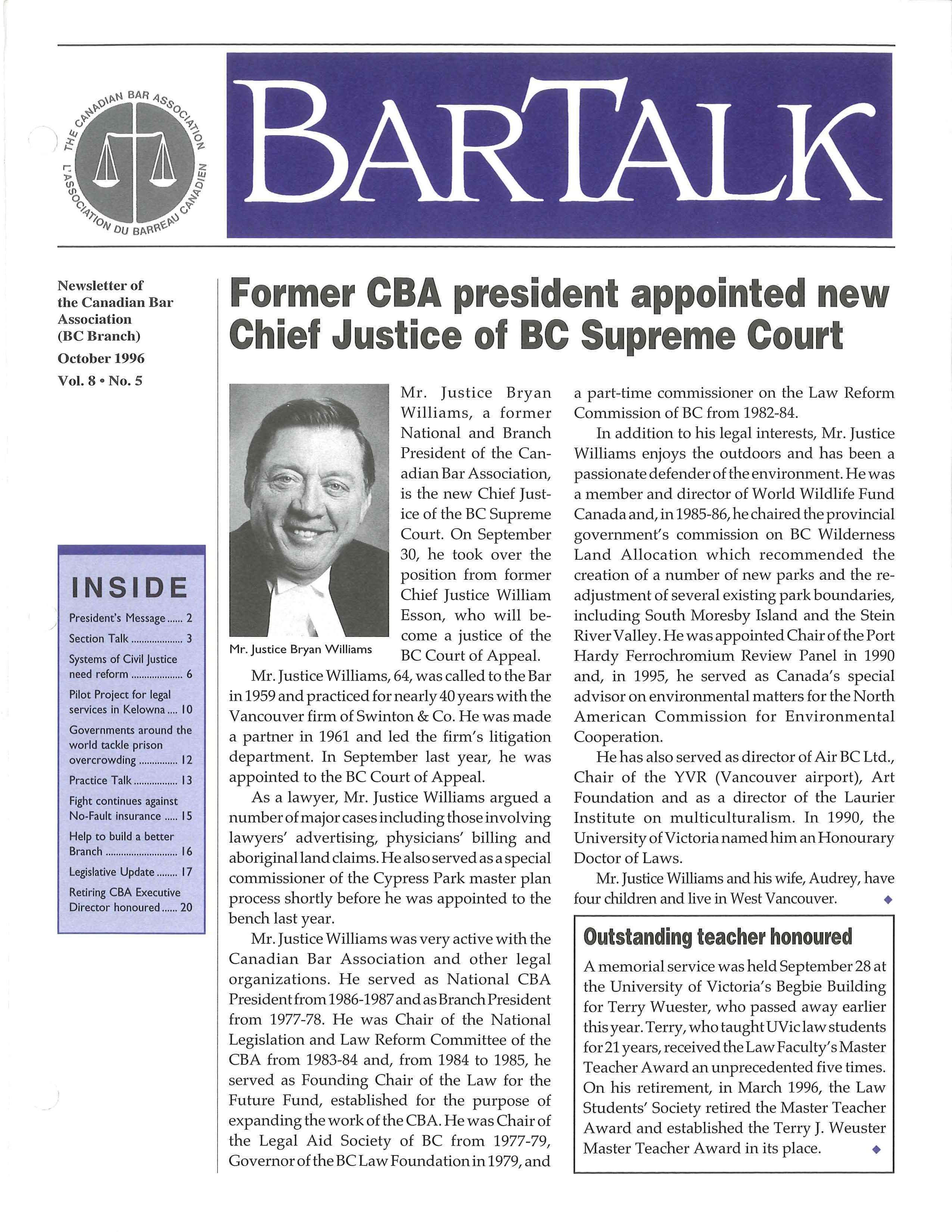
Mr. Justice Bryan Williams
Mr. Justice Bryan Williams, a former National and Branch President of the Cana dian Ba r Association, is the new Chief Justice of the BC Supreme Court. On September 30, he took over the position from former Chief Justice William Esson, who will become a justice of the BC Court of Appeal.
Mr Justice Williams, 64, was called to the Bar in 1959 and practiced for nearly 40 years with the Vancouver firm of Swinton & Co He was made a partner in 1961 and led the firm's litigation department. In September last year, he was appointed to the BC Court of Appeal.
As a lawyer, Mr. Justice Williams argued a number of major cases including those involving lawyers' advertising, physicians ' billing and aboriginal land claims He also served as a special commissioner of the Cypress Park master plan process shortly before he was appointed to the bench last year.
Mr. Justice Williams was very active with the Canadian Bar Association and other legal organizations He served as National CBA President from 1986-1987 and as Branch President from 19 77- 78. He was Chair of the National Legislation and Law Reform Committee of th e CBA from 1983-84 and, from 1984 to 1985, he served as Founding Chair of the Law for the Future Fund, established for the purpose of expanding the work of the CBA. He was Chair of the Legal Aid Society of BC from 1977 - 79, Go v ernor of the BC Law Foundation in 19 79, and
a part-time commi s sioner on the Law Reform Commission of BC from 198 2-8 4 . In addition to his legal inte r est s, Mr. Justice Williams enjoys the outdoors and ha s been a pa s sionate defender of the environment. He was a membe r and director of World Wildlife Fund Canada and, in 1985-86, he chaired the provinci al government's commi s sion on BC Wilderne ss Land Allocation which recommended th e cr eation of a number of new parks and the readjustment of several existing park boundaries, including South Moresby Island and the Stein River Valley . He was appointed Chair of the Port Hardy Ferrochromium Review Panel in 1990 and, in 1995, he served as Canada's special advisor on environmental matters for the North American Commission for Environmental Cooperation .
He has also served as director of Air BC Ltd., Chair of the YVR (Vancouver airport), Art Foundation and as a director of the Laurier Institute on multiculturalism. In 1990, the Univer s ity of Victoria named him an Honourary Doctor of Law s
Mr. Justice Williams and his wife, Audr ey, have four children and live in West Vancouver •
Outstand ing teacher honoured
A memorial service was held September 28 at the University of Victoria's Be g bie Building for Terry Wuester, who passed awa y earlier this y ear. Ter r y, who taught UVic law students for 21 years, received the Law Faculty' s Master Teacher Award an unprecedented five times On his retirement, in March 1996, the Law Students ' Society retired the Master Teacher Award and e s tablished the Terry J Weuster Maste r Teache r Award in it s place . +
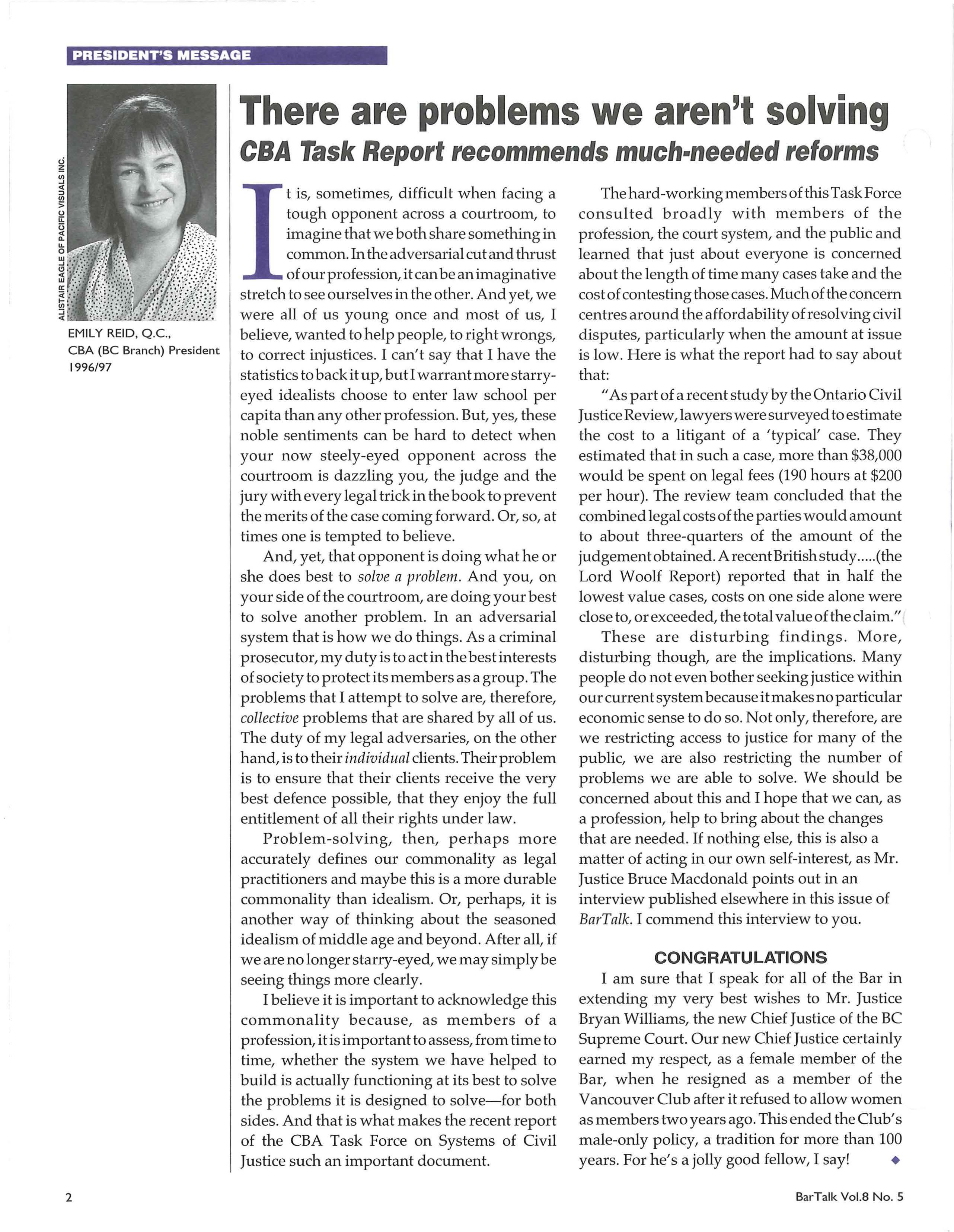
There are problems we aren't solving CBA Task Report recommends much-needed reforms
t is, sometimes, difficult when facing a tough opponent acros s a courtroom, to imagine that we both share something in common In the ad versarial cut and thru s t of our profe s sion, it can be an imaginative stretch to s ee ourselves in the other. And yet, we were all of u s y oung onc e and mo s t of u s, I believe, wanted to help people, to right wrong s, to correct inju s tice s. I can't say that I have the statistics to back it up, but I warrant more s tarryeyed idealists choose to enter law school per capita than an y other profes s ion. But, yes, the s e noble sentiments can b e hard to detect when your now steely-eyed opponent acro s s the courtroom is dazzling you, the judge and the jury with every legal trick in the book to prevent the merits of the case coming forward. Or, s o, at times one is tempted to believe .
And, yet, that opponent is doing what he or she does best to solve a probl em. And you, on your side of the courtroom, are doing your best to solve another problem . In an adv e r s arial s ystem that is how we do things. As a criminal prosecutor, my duty is to actin the best interests of society to protect its members as a group . The problems that I attempt to s olve are, therefore, collective problems that are shared by all of us . The duty of my legal adversaries, on the other hand, is to their individual clients. Their problem is to ensure that their clients receive the very best defence possible, that they enjoy the full entitlement of all their rights under law.
Problem-solving, then, perhaps more accurately defines our commonality as legal practitioners and maybe this is a more durable commonality than idealism. Or, perhaps, it is another way of thinking about the seasoned idealism of middle age and beyond After all, if we are no longer starry-eyed, we may simply be seeing things more clearly
I believe it is important to acknowledge this commonality because, as members of a profession, it is important to assess, from time to time, whether the system we have helped to build is actually functioning at its best to solve the problems it is designed to solve-for both sides. And that is what makes the recent report of the CBA Task Force on Systems of Civil Justice such an important document.
The hard-working members of this Task Forc e consulted broadl y with members of the profe ss ion, the cou r t sys tem, and the public and learned that just about everyone is concerned about the length of time many ca s es take and th e cost of contesting tho se cases Much of the concern centre s around the affordability of res ol v ing civil di s pute s, particularl y when the amount at is s u e is low . Here is what the report had to s ay about that:
"As part of a r e cent s tudy by the Onta r io Civil Justic e Review, lawyer s were surve yed to estimate the cost to a liti ga nt of a ' typical' case The y estimated that in s uch a case, mor e than $38, 000 would be spent on legal fees (190 hours at $200 per hour) . The revi e w team conclud ed that the combine d legal cost s of the partie s w ould amount to about three-quarter s of the amount of the judgement obtained . A recent Britishstudy ..... (the Lord Woolf Report) reported that in half the lowe s t v alue case s, costs on one side alone were close to, or exceeded, the total value of the claim. "
These are disturbing findings . More, disturbing though, are the implications. Many people do not even bother seeking justice within our current system because it make s no particular economic sense to do so Not only, therefore, are we restricting access to justice for many of the public, we are also restricting the number of problems we are able to solve. We should be concerned about thi s and I hope that we can, as a profession, help to bring about the changes that are needed. If nothing else, this i s also a matter of acting in our own self-interest, as Mr. Justice Bruce Macdonald points out in an interview published elsewhere in this issue of BarTalk I commend this interview to you
CONGRATULATIONS
I am sure that I speak for all of the Bar in extending my very best wishe s to Mr Justice Bry a n William s, the new Chief Ju s tice of the BC Supreme Court. Our new Chief Justice certainly earned my re s pect, as a female member of the Bar, when he resigned as a member of the Vancouver Club after it refused to allow women as members two year s ago This ended the Club's male -only policy, a tradition for more than 100 years For he's a jolly good fellow, I say! +
A quick quiz about Guardianship Law
Test your knowledge in this confusing legal area
In a recent Wills and Trusts Subsection meeting ManJ Hamilton and Catherine Branch discussed the complex law of guardianship. TheJj provided these answers to questions commonly arising in practice. Could you advise your client about them?
QUI Z
1. THE FACTS: Parents are joint guardians; A has sole custody while B has access .
Q: Who has guardianship when the first joint guardian dies?
A: When the first joint guardian dies he or she has no rights to give away. Only the surviving parent has the ability to pass on guardianship. Therefore, if A dies B becomes the sole guardian with full custody. If B dies A remains the custodian.
2. THE FACTS: Parents have joint custody but there is no Order or agreement with respect to guardianship.
Q: Who has guardianship and who can appoint the guardian by will?
A: According to s .27 (4) of theFamily Relations Act( "FRA") the person with custody is the guardian; therefore, joint custodians are joint guardians and so only the survivor can give guardianship by will
3.THEFACTS:Ahassolecustody.Bhasaccess.
Q: Does either parent have the right to appoint a guardian by will?
A:Only A can giveaway guardianship rights by will. Sees. 27(4) FRA
4(a). THE FACTS: A & Bare married and have separated but there is no order with respect to guardianship. A has day-to-day control of the child.
Q: Who has guardianship of the estate and of the person of the child?
A: A & Bare joint guardians of the estate and A is sole guardian of the person. see s .27(2) of the FRA
4(b) . THE FACTS: Would there be any difference in the answer to question 4(a) if A & B were not married but were joint guardians?
A:No.
INTRODU CT ION
Almost all BC wills involving minor children appoint guardians. Almost all separation agreements and divorce orders in BC involving minors state who will have custody and sometimes who will have guardianship . There has been no reconciliation, statutory or otherwise, between testamentary practice and law and family practice and law in the naming of caregivers for minor children. The evolution of the concepts of custody and guardianship in family law has not been paralleled in testamentary law. Mary Hamilton and Catherine Branch highlighted the complexity and confusion now prevailing in the naming of caregivers in wills . They went on to discuss the meaning of the terms custody and guardianship in BC family law and concluded with a review of the recommendations of the General Practitioners Subcommittee for law reform in this area.
HISTORICAL BACKGROUND
At common law the natural guardian of an infant is guardian only of the infant's person and not of the infant ' s estate. The Tenures Abolition Act(1660) expanded the powers of a guardian over an infant's estate by creating a statutory right to appoint by will aguardianofone ' sinfantchildren. The effect of this Act was to give a father, whose guardianship was limited to the person of the child, the power to appoint a guardian of the estate of the child. As a result, the statutory guardian enjoyed greater powers than the natural guardian or parent.
The Tenures Abolition Act (1660) remains law
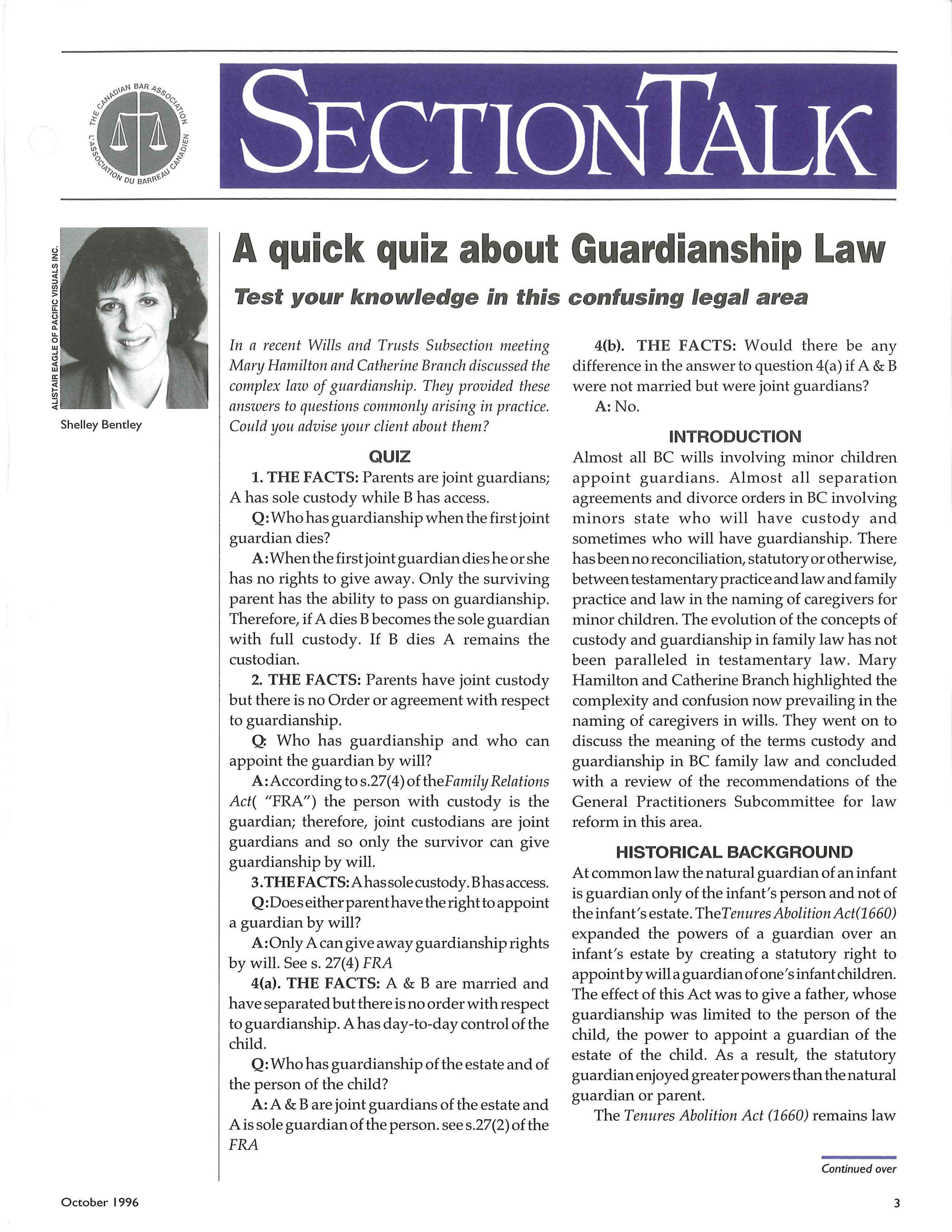
Shelley Bentley
Judgement on Nuremberg
Don't miss this important symposium marking 50 years since the trial of major war criminals before the Military Tribunal at Nuremberg.
Organized by the Vancouver Holocaust Education Centre and the Centre for Education, Law & Society, Faculty of Education, Simon Fraser University, this two-day event on October 19 and 20, 1996, will feature a keynote address by Dr Irwin Cotler, Professor of Law , McGill University and author of Nuremberg, 45 years later: The Struggle Against Injustice in Our Time Dr Cotler will speak on "Nuremberg, the Holoc aust and Human Rights: The Moral-Juridical Legacy 50 Years Later".
Other speakers at the symposium will include Robert Conot, author of justice at Nuremberg , D a na Urban , Prosecutor, formerly of the Intern ational Criminal Tribuna l for the former Yugloslavia at the Hague , and Madame Justice Rosalie Abella, Justice , Ontario Court of Appeal.
For more information, or to register, contact the Vancouver Holoc aust Centre Society by phoning (604) 264-0499 or fax 264-0497. You may also enquire by sending an E-Mail to holedctr@cyberstore.ca
A quiz on guardianship
Continued from page 3 in BC and has never been formally repealed even though its provisions have been modified by statute including s.25 of the FRA which provides:
25(1) "A guardian is both guardian of the person of the child and guardian of the estate of the child ."
Therefore the distinction between the powers of a natural guardian and one appointed under the Tenures Abolition Act (1660) has been eliminated.
Section 25 of the FRA goes on to read:
25(2) "Subject to this Act, a guardian of the estate of a child has all powers over the estate of the child as a guardian appointed by will or otherwise had on May 19, 1917 in England under Acts 12, Charles the Second, chapter 24, and 49 and 50 Victoria, chapter 27, section 4."
Section 25(3) parallels subsection (2) with respect to guardianship of the person. The legislative formula adopted in the FRA to govern guardianship is therefore confusing. Few guardians have a copy of the Tenures Abolition Act (1660) readily at hand or know what it means.
FAMILY LAW GUARDIANSHIP IN BC
In addition to the issue of the powers of guardianship the FRA contains a host of rules governing who may exercise the rights of a guardian.
Family Law Agreement
A parent cannot appoint a guardian inter vivos other than the other parent of the child. Separated parents can agree, in writing, that one, the other, or both of them shall be guardians of their children.( s.28 FRA)
Court Order
A Court can appoint a guardian if the following requirements are met:
a) Where a child is over the age of 12 years, the Court requires the written consent of the child;
b) where someone other than the parent of the child is applying for guardianship the Court requires the parents ' written consent; and c) the present and prospective guardians must be notified of the application and they are entitled to be heard by the Court.
The Court may dispense with con se nt a nd with notice where circumstances warrant. In the conte x t of a custody order, where a Court does not s pecifically mention guardianship, guardianship will follow custody if:
A. an order for divorce, separation or nullity of marriage is made;
B. no order for guardianship is made ; and
C. an order for custody is made
The paramount consideration for the Court when makin g s uch an order is the best interest s of the child .
Absence of
Agreement or Court Order
In the absence of an agreement or a Court order, guardianship is governed by section 27 of the FRA. A summary of the rules follows;
1. So long as the child's natural parents live together, they are joint guardians It doe s not matter whether or not they are married .
2. If a child's parents are separated but they; i) were married during the child'slife or 10 months prior to the child's birth; or ii) were joint guardians before they separa ted , they are joint guardians of the child's property The custodial parent is the sole guardian of the child's person . (see FRA ss.27(2),(3),(5))
3. On divorce, judicial separation or a decree of nullity, a person granted sole custody is the sole guardian . (s.27(4) FRA)
4. Otherwise the mother is the sole guardian of the child. (s.27(5) FRA)
Where there are gaps in the legislation, and only to that extent, the gaps may be filled by the parens patriae jurisdiction of the Supreme Court.
TESTAMENTARY GUARDIANSHIP IN BC
Section 29 of the FRA provides for the appointment of testamentary guardians It provides that on the death of a parent who is a joint guardian with the other parent, the surviving parent is sole guardian of the child. Section 29(2) provides that a non-guardian parent does not automatically become guardian when the guardian parent dies, only if the Court so orders Section 40 of the Infants Act is a modern codification of the principles setout in the Tenur es Abolition Act (1660).
s.40(1) " A parent may appoint, by deed if under age, otherwise by deed or will, a guardian to act in his or her place on his or her death as guardian of an
infant child under 19 years.
(2) Where either parent dies, the surviving parent may by will transfer part or all of his or her rights and duties to custody, control and management of their infant child's property, but not the infant's services and earnings, to a suitable person."
Even though it is clear that s 40 of the Infants Act allows a parent to appoint a guardian by his or her will, ss. 23 and 30 of the FRA give the Court the ultimate ability to appoint or remove a guardian on application, regardless of what the will says.
CROWN GUARDIANSHIP
If there is no surviving guardian and either no guardian is appointed by will or the appointed guardian cannot or will not act, the Public Trustee will be guardian of the estate of the child and the Director of Child, Family and Community Services will be guardian of the person of the child. Any other person may apply, under s.30 of the FRA to appoint a different guardian.
POWERS OF GUARDIANS
The legislated powers of a guardian are found in theTenuresAbolitionAct(1660)which provides that a guardian may:
• action against anyone who takes a child;
• recover for damages for child's use and benefit;
• may take into custody for use of childprofits of all land belonging to the child;
• take into custody and manage goods, chattels and personal estate of child; and
• bring actions related to personal property or profits of real property.
What powers does a guardian have in dealing with the property of an infant?
Without legal title to the property of their wards, guardians require a court order to deal with it in a binding fashion. The Infants Act has a number of provisions which address the power of a guardian to contract on behalf of an infant; most make provision for the guardian to obtain court approval before contracting on an infant's behalf. For example, under s.38 of theinfants Act infants are to be served with court proceedings through their parent or guardian. From the time of service the party served acts as guardian ad litem and "shall promptly attend to the infant 's interests and do the things necessary to protect his interests." However, the guardian cannot settle a litigation matter without the approval of a
supervisory body. This may be the Public Trustee or the Court.
POLICY ISSUES
In the matrimonial context there is an uncertain relationship between custody and guardianship of children This is one of the reasons why the Testamentary Custody & Guardianship Subcommittee of the General Practitioners Section of the Canadian Bar Association has concluded that reform of the law is necessary.
At law, guardianship is intended to encompass all of the rights, duties and responsibilities of a parent. Guardians have the right to be consulted on matters relating to the child's religious upbringing, educational programs, athletics and recreational activities, health care( excluding emergency health care) as well as significant changes in the special enviromnent of the child. However, as a matter of practice, custody, when divided from guardianship, takes away many of the meaningful guardianship rights.
There is no definition of custody in theFRA or Divorce Act but it is generally accepted that custody includes:
a) almost all of the rights incidental to guardianship of the person of the child, and b) physical control over the child.
There can be joint custody and guardianship arrangements where joint parenting is the intention. However, where there is a sole custodyjoint guardianship arrangement this is generally not intended to be joint parenting. In those cases, an award of sole custody removes the incidents of guardianship from the joint guardian. The custodial parent becomes the one who makes the day to day decisions for the child and only on larger fundamental issues such as education and religion does the joint guardian have any voice. Even then, in practice, the guardian's opinions can be overlooked.
CONCLUSION
When dealing with clients it is critical to determine which rights you are dealing with. You must not only determine the legal structure of the rights (ie. the legal distribution of custody and guardianship rights) but also make inquiries into the practice of the parents. Do they conduct their relationship such that guardianship has some meaning? You must know the details of the rights your client has before you can determine the rights he or she can give away by testamentary disposition. +
The Task Force
The Systems of Civil Justice Task Force worked for more than 17 months on the 150-page report that was presented at the CBA Annual Meeting and Commonwealth Law Conference held in Vancouver last August. The report's chief finding was that , although the vast majority of civil justice cases are settled out of court, settlement takes much too long The Chair of the Task Force was Eleanore Cronk Honourary Chair was the Right Hon Brian Dickson
CBA Task Force ident ifies opportunities for reform in Canad ian civil justice system
Task Force member Mr. Just i ce Bruce Macdonald d i scusses recommendations of the report
BarTalk: First, our thanks for agreeing to this interview . We appreciate bein g able to talk with someone from the judiciary who participated in this Task Force
The final report really identified some very serious problems In Ontario and Quebec, for exampl e, the report s ay s appellants face extremely long delays. The situation in Ontario is particularly acute. There, the delay from notice of appeal to resolution is reported anecdotally to be three to five years, and it continues to lengthen. This is a long time to take for disputes to be re s olved. But many of the rules and procedures of the civil ju s tice system that can cause delays like these have evolved through tradition and precedent in a profession that values these highly .
i s recogni z ed b y the Ta sk Force as a model for other province s to follow.
BarTalk: What do you think ar e the mo s t important recommendation s in the repo r t?
Mr. Justice Macdonald : It's hard to single out a n y recommendation s in particular. In s tead, I'd like to focu s on five are a s that I think represent the main thrust of the report.
1. E ARLY SETT L E MENT
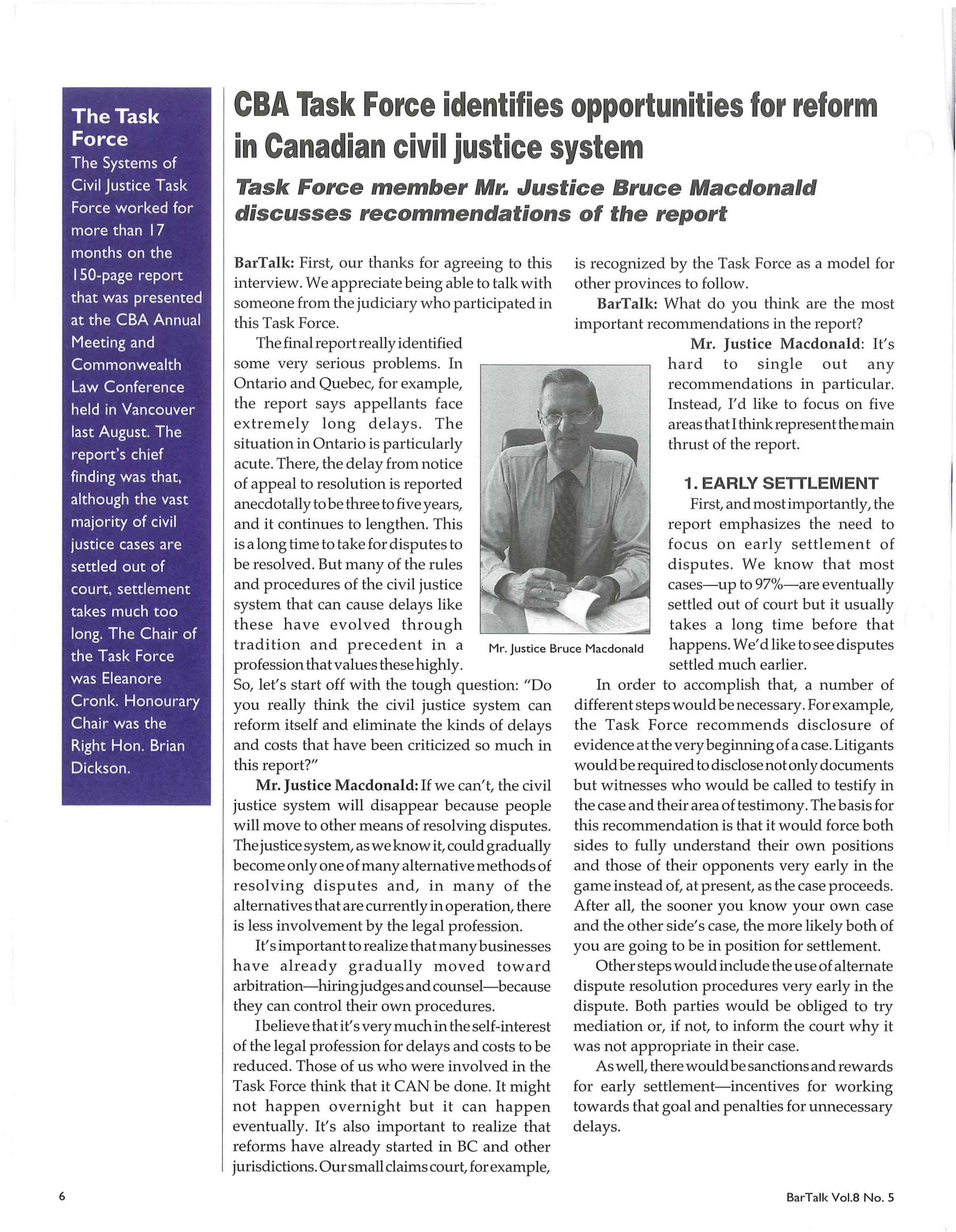
Mr Justice Bruce Macdonald
So, let's start off with the tough question: "Do you really think the civil justice system can reform itself and eliminate the kinds of delays and costs that have been criticized so much in this report?"
Mr. Justice Macdonald: If we can't, the civil justice system will disappear because people will move to other means of resolving dispute s. The justice system, as we know it, could gradually become only one of many alternative methods of resolving disputes and, in many of the alternatives that are currently in operation, there is less involvement by the legal profession . It's important to realize that many businesses have already gradually moved toward arbitration-hiring judges and counsel-because they can control their own procedures.
I believe thatit' s very much in the self-interest of the legal profession for delays and costs to be reduced. Those of us who were involved in the Task Force think that it CAN be done. It might not happen overnight but it can happen eventually. It's also important to realize that reforms have already started in BC and other jurisdictions Our small claims court, for example,
First, and mo s t importantly, the report emphasizes the need to focus on earl y settlement of di s putes We know that most cases-up to 97 %-are eventually settled out of court but it usuall y takes a long time before that happens We'd like to se e dispute s settled much earlier.
In order to accomplish that, a number of different s teps would b e necessary. For example, the Task Force recommends disclosure of evidence at the very beginning of a case. Litigants would be required to disclose not only documents but witnesses who would be called to testify in the case and their area of testimony. The basis for this recommendation i s that it would force both sides to fully understand their own position s and those of their opponents very early in the game instead of, at present, as the case proceeds After alt the sooner you know your own case and the other side ' s case, the more likely both of you are going to be in po s ition for settlement.
Other steps would include the use of alternate dispute resolution procedures very earl y in the dispute. Both parties would be obliged to try mediation or, if not to inform the court why it was not appropriate in their case.
As welt there would be sanctions and rewards for early settlement-incentives for working towards that goal and penalties for unnecessary delays.
2. PROPORTIONALITY OF PROCEDURE
The next major area of reform is what the report describes as "proportionality." We believe that the rules and procedures adopted for any case should be proportional to the issues. For example, the Task Force recommends that the jurisdiction of small claims courts across Canada should be increased to $10,000, as it is in BC. In some provinces, Small Claims Court is still limited to cases below $1,000 or $1,500.
There are other differences that distinguish the BC small claims court. Here, we have fulltime judges adjudicating cases. In many provinces, cases are judged on a volunteer basis by lawyers . Also, in BC, there is a mandatory pre-trial settlement conference during which approximately 70 per cent of the cases are resolved.
Naturally, we were not able to implement these changes in BC without some major changes. One of the more significant challenges was making it through the transition period after the financial limit was increased from $3,000 to $10,000 some years ago. The caseload suddenly increased about four-fold. It was necessary to increase the numbers of provincial court judges to handle this increased caseload and, of course, they had to be trained in mediation.
There had been an expectation that there would be a transfer of cases from Supreme Court to Small Claims Court with this reform. Interestingly, however, thatdidn'thappen. Thenumberofcases in Small Claims Court increased with no decrease in the numbers still being handled in Supreme Court. That told everyone that there had been a lot ofcasesbetween$3,000and$10,000thatthesystem had previously not been handling. For disputes involving those kinds of sums, the superior court system was obviously too expensive This reform, therefore, has helped to improve access to justice for many people.
It's important to note that, although people can still represent themselves in small claims court, the proportion of cases represented by lawyers has increased. About half of the parties in small claims court are represented by lawyers at the present time.
BarTalk: $10,000 is beginning to seem a small sum these days. Why not require Small Claims Court for cases up to $50,000?
Mr. Justice Macdonald: There are constitutional reasons that make that difficult and if it were not for this, we probably would
have recommended a small claims jurisdiction of $50,000 instead of $10,000. But we knew that would have created a constitutional roadblock. So, for cases over $10,000 and up to $50,000, the Task Force recommends a simplified, expedited procedure closer to small claims procedure but not exactly the same. For example, in these cases, there would be limited oral discovery or none and very limited right to use expert evidence . Remember, in Small Claims Court, there is no discovery at all.
3. A MULTI -TRACK CIVIL JUSTICE SYSTEM
At the present time, the single focus of the civil justice system is the trial as the ultimate dispute resolution mechanism. Although there are undoubtedly many cases for which a trial is still the most appropriate way to resolve disputes, there are also many others for which different dispute resolution methods are better. These should be recognized, as much as possible, from the very beginning . There should be different rules, procedures and methods for different types of cases, as we have just discussed in the case of Small Claims Court and other cases less than $50,000. Most importantly, though, it should be the Court-not the parties and their lawyers-which controls the timing of cases as they move through the system In more complex cases, a case management system should be implemented. Cases should be time-ruled, with a series of deadlines through the litigation. This would require a greater involvement by judges in managing cases. And, of course, one of the big criticisms about judges today is that they're not tough enough in managing cases. They are too willing to grant delays when requested to do so. So that would have to change
But there really has to be a change in the legal culture as a whole. Lawyers should not be focusing, as they do today, on the trial date as the date they need to know their case. Instead, it would be up to the Court to focus the parties on a much earlier date by such means as requiring discovery within 60 days of an action or insisting that expert's reports must be served at least three months before trial. This would force both parties to know their cases and their witnesses at a much earlier date than the trial date.
In some cases, alternate dispute resolution
Board Member wanted
The Learning Disabilities Association of BC, South Vancouver Island Chapter, is seek ing a volunteer Board member This is an active working board. Duties would include one board meeting per month (third Tuesdays) of approximately 2 'h hours and some committee work An interest in working on the fundraising committee is desirable If you ' re interested in volunteer ing , please call Carleen Crook , Carole Hathaway or Joce Town ley in Victoria at 386-951 I
Mr. Justice Bruce Macdonald in conversat ion
Continued from page 7
processes would be mandatory before parties would be allowed to move forward through the court system. There would be an obligation to at least consider, if not apply, ADR and if one party chose not to try it, a judge would have to be convinced why it was not appropriate in a particular case.
BarT a lk: Couldn't mandatory ADR cause even more delays?
I realize that there are dangers in any reforms. The danger of imposing mandatory ADR is that another step would be added to the proceedings and we should be on our guard against any reforms that add yet another layer of complexity to an already complex system. But, generally , there has to be a greater emphasis on dispute resolution as the service provided by the courtsthrough many different methods-rather than trials and adversarial di s pute as the only way of resolving disputes through the civil justice system.
BarTalk: But isn't there much to be said for trials as a way of concentrating on the resolution of disputes? Dr. Samuel Johnson once said that: "The prospect of hanging powerfully concentrates a man's mind." Couldn't the same be said about the imminence of court proceedings as an incentive to concentrate the minds of parties in a dispute?
Mr. Justice Macdonald: Well, yes, it's true that many cases are settled on the courthouse steps. But that happens very late in the process . We would like to see cases settled much earlier . There's tremendous waste and delay involv ed-for all concemed-when settlement comes much later in disputes. We'd simply like to see people "concentrate their minds" a lot earlier in the game.
BarTalk: The report also recommends a much greater emphasis on a "user friendly" sort of court system. How do you see that being implemented?
Mr. Justice Macdonald: We really do believe that the public needs to be more involved in the court system and to have a better understanding of how it operates and how it can serve them. So we're recommending public orientation services in every courthouse where people can get the information that they need. The se might be electronic kiosks that answer basic questions or staff trained to provide information . Basically,
we'r e recommendin g mor e point-of - ent ry info r mation.
W e 're al s o recommending simplified form s and language, again like the BC Small Claims Court. Es s entially, we're recommending what the Ta s k Force describe s as a mo r e "transpa r ent" s ystem, one that' s more open to the public and more unde rs tandable The public ought to have a window into what goe s on in the sy s tem . And they should have a greate r involvement in the system as well. There should be la y representation in court admini s trative bodi e s, for ex ample, just as there are now lay benche r s . Remember, we now take lay bencher s pretty much for granted as an es s ential part of our professional regulatory system But there was a time when they didn't exist and there was considerable fuss and controversy when they were first proposed.
4. STANDARD CO U RT IN FOR M ATI ON M A N AGE M E NT S Y STE M S S H O U LD BE IM P L E M E NTED
We were absolutely shocked to discover that nobody could tell u s what the civil justice system costs to operate at the present time Partly, that's because of the different jurisdictions involvedfederal, territorial and provincial-all with different budgets and different responsibilities The federal government pays for judges and prosecutors, and the province pays for courthouse services. But even that is too simplistic because the provincial budget, for example, may be divided among three or four sectors. But what this means is that no-one can sit down and figure out what a day in court actually costs the taxpayer. We think that has to be done.
We believe that a standard information list should be designed for the civil justice system that could provide answers to such questions as: " How many actions are started;" or "How long does it take to finish cases?" Each province and territory should s tart to collect this kind of standard information and then we'll be able to know what we' r e doing If we wanted to implement reforms on a test basis, for example, we'd be able to compare those reforms against how the system currently operates . As well, we'd be able to compare the performance of civil justice systems in different jurisdictions. We know that there will be resistance to implementing this kind of standardized data sharing. One Chief Justice, for example, may not want the performance of his court to be compared to another. But I believe these reforms are absolutely
necessary if the justice system is to justify the money and budgets it requires from the various levels of government.
5. A NATIONAL ORGANIZATION SHOULD BE ESTABLISHED TO CONTINUE CIVIL JUSTICE REFORM
We are concerned that, unless a national organization is established to carry on the work of the Task Force, the impetus of our work
might die. We believe that Canada needs an institute or organization of some kind that will continue to collect information and share information about court reforms with all the levels of government involved. We believe this organization should include all parties currently involved in the justice system such as the judiciary, the Bar, the government, legal educators and the public-but that no single group would be able to call the shots. •
The extended Case Management Pilot Project in BC
An example of the reforms suggested by the Task Force is the Extended Case Management Pilot Project initiated about two years ago by the Supreme Court in British Columbia.
Trial judges were appointed as "case managers" with responsibility for a case from beginning to end. The object of the pilot project was to find out, among other objectives, whether this form of case management would actually result in fewer delays and fewer cases ending up in court. The results of the project will certainly help to determine whether this particular recommendation of the Systems for Justice Task Force is workable and effective.
The project, which got under way in April, 1995,involved lOvolunteerjudgesoutofabout 50 judges in Vancouver. Each of the volunteer judges was assigned about 50 cases. "The crucial difference in the case management system," said Mr. Justice Macdonald, "was that from day one, the trial judge was handling the case.
"With this kind of system in place, we wanted to find out if there would be any measurable effect on the numbers of interlocutory applications, the time it took to dispose of these applications, whether the length of the trial exceeded the original estimate, etc.," said Mr. Justice Macdonald. "We are just now in the process of doing an analysis of the results of the project and so we don't have anything really definite.
"Also, the Trial Lawyers Association, the Law Society and the CBA are doing a survey of everyone who has been involved in the project. We won't see the survey itself but we will get the results of the survey. I'm hoping for a report by January or February.
"I'm also expecting a second stage of the pilot project because of some problems that
came up during the first stage. One of the major difficulties in implementing the system, for example, was that we did not allow for project cases in the rota. So, quite often, when a case involved in the pilot project came up for trial, the judge had been assigned to Prince Rupert or Cranbrook, or some other venue, and this caused all sorts of administrative problems that required us to find another judge to try the case at the last minute. That can be avoided by proper rota anticipation and, in the next pilot, that's what will be done."
BarTalk: If you don't have the survey results, can you at least give us a hint of what you think the final report will contain? Did you participate as one of the judges in the pilot project?
Mr. Justice Macdonald: Yes, I did and, although my impressions are purely personal, it did seem to me that there were fewer interlocutory applications, that no-one wan ted to appear obstructionist, that everyone was a perfect gentlemen or lady representing their client. No-one was unreasonable. Disputes over documents were resolved more quickly Counsel realized that I would be handling the case from beginning to end and I think it really affected how they behaved in court. I think counsel also appreciated the difference. I've had some letters from counsel who settled saying that it's a great idea and that we should make sure it continues.
What's your opinion?
We'd like to hear your opinion about the recommendations of the CBA Task Force report and hope to print a sampling of your views in the next edition of BarTalk. If you're interested, please call Director of Communications Ry Glover at 6873404.
•
"My second impression is that far more pilot project cases will be finished at the end of 18 months and that there will be fewer adjournments of trial dates. Counsel will either settle or go to trial on the dates originally set so that delay is reduced. But until I see the statistical analysis of this project, these conclusions are speculative.
"Crash" tactics were rejected as instant solutions to the challenges facing lawyers in the market for legal solutions. Instead, it was recognized that a sustained effort would be required over time to maintain and build on the results of the pilot.
Public awareness campaign aims to boost use of legal services in Kelowna
CBA and Law Society join forces in Pilot Project
Last year Kelowna and its community of lawyers was selected as the locale for a 12month, $76,000 pilot public awareness project designed and funded by the BC Branch of the Canadian Bar Association and the Law Society ofBC.
The objectives of the pilot are to:
• Measure the impact of a proactive public awareness campaign on the public's willingness to hire lawyers as opposed to other providers of legal services, and on the level of public awareness of the advantages of using the services of lawyers as opposed to non-lawyer service providers
• Providethepublicwithgeneralinformation about lawyers and the legal profession, including the different roles played by lawyers in the various kinds of legal work they undertake on behalf of their clients.
• Expand business opportunities for the legal profession and increase public confidence in lawyers by encouraging them to follow business practices which result in better service to clients.
The program strategy was built around the findings of baseline market research conducted in the fall of 1995 with consumers and lawyers I law firms in Kelowna. A focus group study was also held with client referral sources, including realtors, bankers and accountants.
The program relies on global methods of creating awareness, such as advertising, combined with more personal public relations
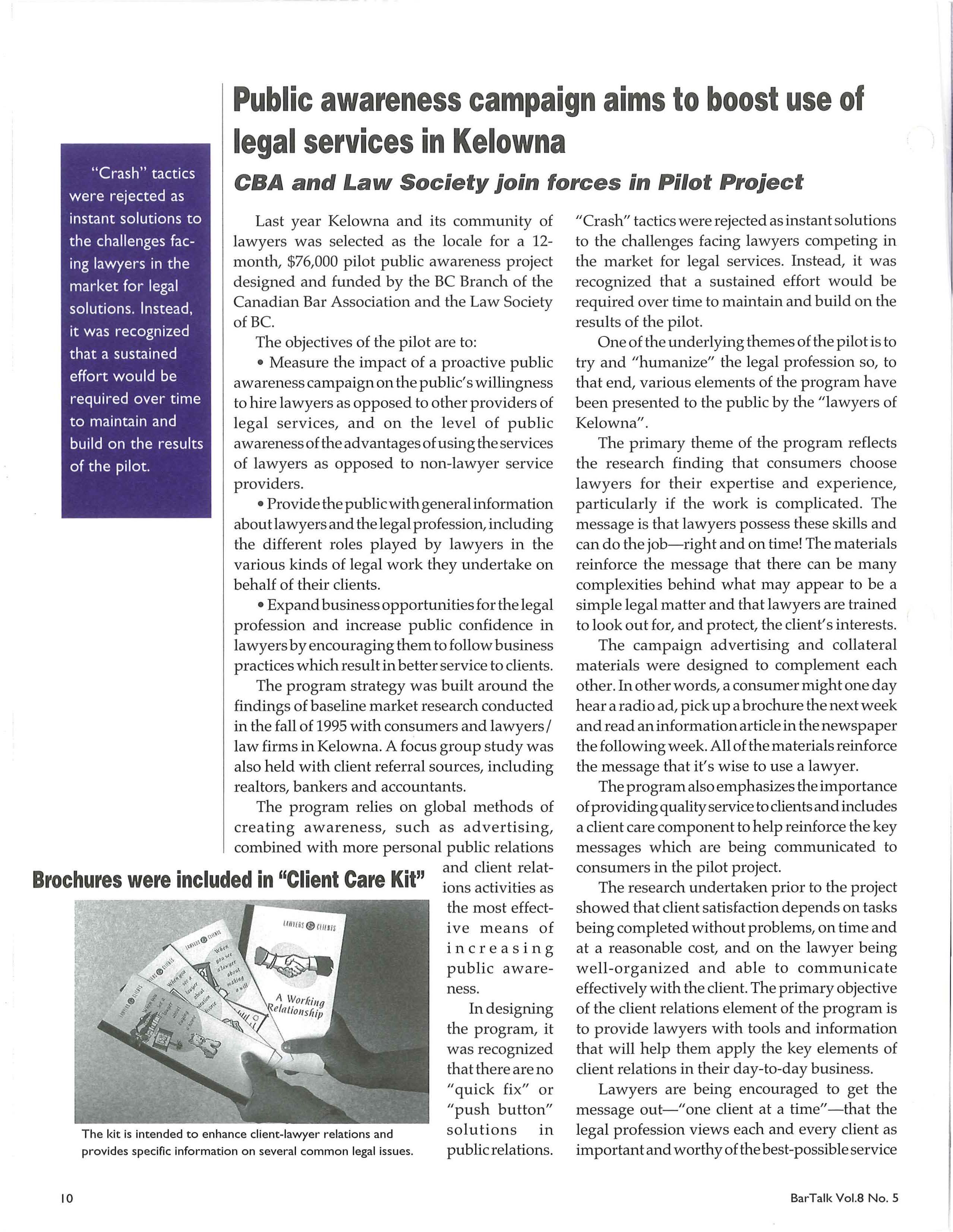
Brochures were included in "Client Care Kit" and client relations activities as the most effective means of increasing public awareness.
In designing the program, it was recognized that there are no "quick fix" or "push button" solutions in public relations .
"Crash" tactics were rejected as instant solutions to the challenges facing lawyers competing in the market for legal services. Instead, it was recognized that a sustained effort would be required over time to maintain and build on the results of the pilot.
One of the underlying themes of the pilot is to try and "humanize" the legal profession so, to that end, various elements of the program have been presented to the public by the "lawyers of Kelowna" . The primary theme of the program reflects the research finding that consumers choose lawyers for their expertise and experience, particularly if the work is complicated The message is that lawyers possess these skills and can do the job-right and on time! The materials reinforce the message that there can be many complexities behind what may appear to be a simple legal matter and that lawyers are trained to look out for, and protect, the client's interests .
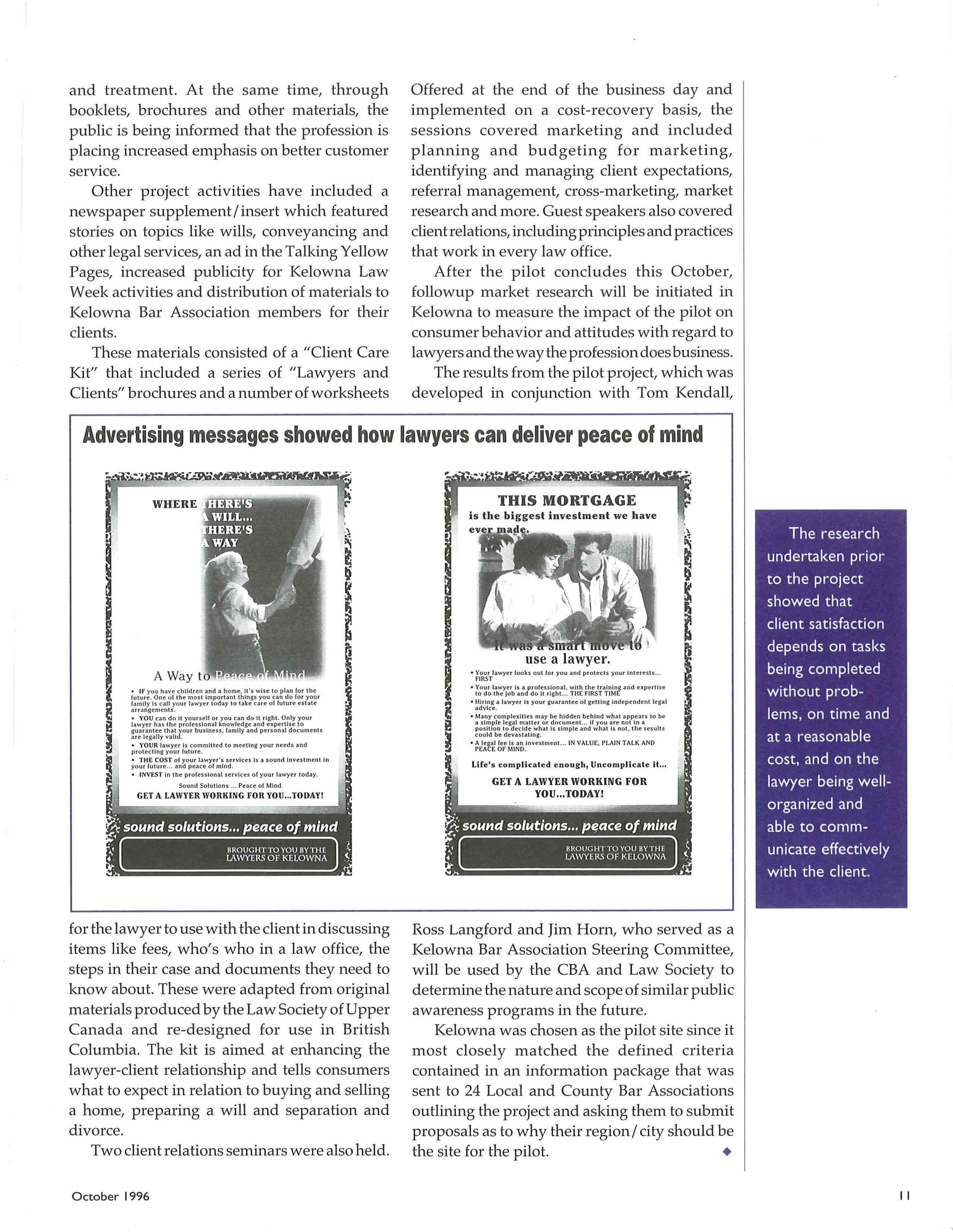
The campaign advertising and collateral materials were designed to complement each other. In other words, a consumer might one day hear a radio ad, pick up a brochure the next week and read an information article in the newspaper the following week. All of the materials reinforce the message that it's wise to use a lawyer.
The program also emphasizes the importance of providing quality service to clients and includes a client care component to help reinforce the key messages which are being communicated to consumers in the pilot project.
The research undertaken prior to the project showed that client satisfaction depends on tasks being completed without problems, on time and at a reasonable cost, and on the lawyer being well-organized and able to communicate effectively with the client. The primary objective of the client relations element of the program is to provide lawyers with tools and information that will help them apply the key elements of client relations in their day-to-day business.
Lawyers are being encouraged to get the message out-"one client at a time"-that the legal profession views each and every client as important and worthy of the best-possible service
and treatment. At the same time, through booklets, brochures and other materials, the public is being informed that the profession is placing increased emphasis on better customer service.
Other project activities have included a newspaper supplement/ insert which featured stories on topics like wills, conveyancing and other legal services, an ad in the Talking Yellow Pages, increased publicity for Kelowna Law Week activities and distribution of materials to Kelowna Bar Association members for their clients.
These materials consisted of a "Client Care Kit" that included a series of "Lawyers and Clients" brochures and a number of worksheets
Offered at the end of the business day and implemented on a cost-recovery basis, the sessions covered marketing and included planning and budgeting for marketing, identifying and managing client expectations, referral management, cross-marketing, market research and more. Guest speakers also covered client relations, including principles and practices that work in every law office
After the pilot concludes this October, followup market research will be initiated in Kelowna to measure the impact of the pilot on consumer behavior and attitudes with regard to lawyers and the way the profession does business.
The results from the pilot project, which was developed in conjunction with Tom Kendall,
Advertising messages showed how lawyers can deliver peace of mind
for the lawyer to use with the client in discussing items like fees, who's who in a law office, the steps in their case and documents they need to know about. These were adapted from original materials produced by the Law Society of Upper Canada and re-designed for use in British Columbia The kit is aimed at enhancing the lawyer-client relationship and tells consumers what to expect in relation to buying and selling a home, preparing a will and separation and divorce.
Two client relations seminars were also held
Ross Langford and Jim Horn, who served as a Kelowna Bar Association Steering Committee, will be used by the CBA and Law Society to determine the nature and scope of similar public awareness programs in the future
Kelowna was chosen as the pilot site since it most closely matched the defined criteria contained in an information package that was sent to 24 Local and County Bar Associations outlining the project and asking them to submit proposals as to why their region/ city should be the site for the pilot.
The research undertaken prior to the project showed that cl ient satisfaction depends on tasks being completed without problems, on time and at a reasonable cost, and on the lawyer being wellorganized and able to com municate effectively with the client .
BROUGHT TO YOU BY THE LAWYERS OF KELOWNt\
Brian Tkachuk, Senior Associate, International Centre for Criminal Law Reform and Criminal Justice Policy
Lawyers and Students available for employment
If you're considering hiring a lawyer or a student lawyer for your firm, why not consult the Employment Registry maintained by the BC Branch of the CBA! A number of good people are currently listed who are looking for employment. If you'd like to advertise for help in the registry, please fax a 1-page ad to Fiona at our office (669-960 I) , mail it to us at our offices- IOth Floor-845 Cambie, Vancouver, BC, V6B 5T3-or call Fiona at 687-3404 and she'll send you one or our employment forms which you can fill out and send back to us later
Governments around the world are tackling overcrowding in prisons
,... he fundamental problems facing criminal justice systems around the world are very similar. There is an over-reliance on the criminal justice system and, particularly, incarceration to deal with some basic societal problems There is also a general increase in the public's overall fear of crime and a public perception, in most jurisdictions, that sentencing, correctional and release decisions are not responsive to community expectations
In many instances, the response by authorities to address this public anger and distrust has been to legislate changes, such as minimum and mandatory prison sentences, in order to
improved criminal justice systems while at the same time contributing to peace, justice, democracy and respect for human rights. This commitment to seek change is reflected by the numerous requests for assistance that have been directed to us here at the Centre
It is because of this willingness and desire to bring about change that the International Centre for Criminal Law Reform and Criminal Justice Policy, in cooperation with the Correctional Service of Canada and other Canadian and international partners, has developed a program of work which will facilitate change in relation to sentencing and corrections
The initiative builds on existing international and curtail some of the discretionary authority possessed by decisionmakers such as judges, correctional and parole board officials
The net result of these
"In many countries, these problems have contributed to situations where even the most basic human rights of prisoners cannot possibly be protected."
regional cooperation and promotes enhanced forms of collaboration between jurisdictions. Respect for humanrights principles and democratic values is emphasized throughout. It factors is extreme prison overcrowding and an overall deterioration of prison conditions. This, together with the lack of credible pre-trial and post-sentence community alternatives, presents insurmountable problems for many correctional agencies that are forced to house offenders who need not be incarcerated. These offenders, who could be dealt with more effectively through other viable options in the community, only increase the burden on the correctional system's already stretched financial and human resources. In many countries, these problems have contributed to situations where even the most basic human rights of prisoners cannot possibly be protected
All is not doom and gloom. Presently there is not only the recognition of need, but also a very clear willingness on the part of correctional and other criminal justice officials around the world to address these problems. There is also growing recognition that international cooperation is an essential part of any solution. Developing nations have come forth to discuss the essential values, principles and strategies which will inspire the development of policies and practices leading to
is based on the use of information exchange and other forms of mutual assistance, and is designed so that best practices in sentencing and corrections can be identified, assessed and transferred between jurisdictions to the reciprocal advantage of all. Mechanisms for cooperation include joint technical assistance projects, development of databanks, newsletters, symposia, conferences and working groups .
New ideas and suggestions are critical to the success of the Centre so if you'd like more information or, perhaps, an opportunity to become involved, do get in touch with me at the Centre by calling (604) 822-9567. I'd like to hear from individuals or representatives of organizations
Brian Tkachuk, Senior Associate at the International Centre for Criminal Law Reform and Criminal Justice Policy, is on exchange assignment from the Correctional Service of Canada with whom his career spans the past 23 years . •
David J. Bilinsky
Past-Cha ir , BC Branch Law Practice Management Section
When the going gets tough-the tough take a break It 's
good tor you AND your practice to smell the roses
onday morning You drag yourself into your office, and pause to look around. You feel a dead weight descend onto your shoulders dragging down your spirit and taking away your smile You look at the pile of unanswered telephone call me ss age s on your de s k, and the stack of correspond e nce lying in the IN tray. Is this the way it was supposed to be? Where are the promises of the good life? Is it matter.
"It's mind over matter Which way do I go
And do I trust myself enough To journey alone
And do I know which way to tum If I'll tum at all
Breakin' Down, words and music by Susan Aglukark, Kelita Haverland, Bill Candy and Chad lrsch ick.
all worth it? How did I get into this rut?
If this describes yourself, stop for a moment and ask yourself
why are you practicing law? While financial and I've travelled down this road before This time it's my call." familial responsibilities require you to bring home a sufficient income to
meet your needs, they do not require you to continue to practice in a manner that is detrimental to your psychological and physical well-being Moreover, you are NOT doing your partners, associates, spouse and children any favours if your present practice of law leads to burnout, substance abuse, a divorce or dysfunctional family,
David J. Bilinsky is o partner at Lakes Stroith & Bilinsky, and is Post-Choir of the Low Practice Management Section, BC Branch, and con be reached on the internet at lntegrol@direct co.
In a similar fashion, Dr. Hans Selye, the noted stress physician, had a simple prescription for life: Make your avocation your vocation
Each of these statements really says the s ame thing : namely that you should be spending your working life dealing in matters and is sues that are important to you In this way, you have a reason and a de s ire to jump to your work, for you feel that you are undertaking meaningful, valuable work that matters. Find out what "turns your crank"
This does not take away from your dispassionate professional judgment: I truly believe that good plaintiff personal injury lawyers, for example, strongly identify with their injured clients and feel a heartfelt need to right their wrongs and seek justice . Therefore, if you are unhappy in your present practice of law, one alternative is to look for an area that does "speak to you" and go after it.
" ... you are NOT doing your partners , associates, spouse and children any favours if your present practice of law leads to burnout, substance abuse, a divorce or dysfunctional family, stress, dissatisfaction, disaffection and health problems."
stress, dissatisfaction, disaffection and health problems.
What can we do about this, you ask? For starters, no one is chained to their desk. There are limitless alternatives to your present situation Each of us can decide when and how to change . I once took a photography course where the instructor said that you cannot take a really effective photograph unless you identify with and have strong feelings for the subject
What about real life, you say? At the recent Commonwealth Law Conference in Vancouver, one of the speakers made the excellent
point that prior to undertaking your life's dream, you should subject it to the fire test of whether or not it has the potential of being financially viable. He then went on and used an example that if practicing ballet law is really your interest, this is all very well, but such a practice is probably not a good idea. However, a short while later a gentleman from England stood up and
CALL FOR SUBMISSIONS
WORKING GROUP ON RACIAL EQUALITY IN THE LEGAL PROFESSION
The Canadian Bar Assoc iation has established a national task force to inquire into and make recommendations on solutions and guidelines to address racial equality in the legal profession The Working Group w ill be accepting written submissions unt il early January , 1997. Please send submissions to the Project Director, marked "Confidentia l"
The Working Group has prepared a consu ltation paper which out lines some concerns and sets a framework for discussions For a copy of the consu ltation paper, the Working Group ' s terms of reference, or any othe r information, please contact:
TINA HEAD PROJECT DIRECTOR
CBA Working Group on Racial Equality in the Legal Profession
50 O'Connor St , Suite 902
Ottawa , ON KIP 6L2
Tel: 1-800-267-8860 or (613) 237-2925 , ext. I 12 Fax: (613) 237 -0185
E-Mail : HEADT@CBA.ORG
It's YOUR life- search for the keys to your own satisfaction
Continued from page 15 announced at the microphone that he was the ballet lawyer for London, as well as the opera lawyer. My point is that we simply cannot state unequivocally that any particular practice area will not work, because the practice of law itself is continually evolving. What may be required is a small scale trial run, which leaves you with a financial and social safety net. After all, Ms. Frizzle of the children's Magic Schoolbus stories says "Take Risks! Make Mistakes! You never know until you try."
Furthermore, perhaps your life's path leads elsewhere than the practice of law. There are many areas of endeavour where legal skills and training are assets. You may need to consider actively looking for an alternate career.
In this context, what suggestions have been put forward for moving ahead and solving the dissatisfaction crisis?
NETTALK
Hot Spots on the Net for BC Lawyers!
This is a new service: a sampling of internet sites of interest to BC Lawyers:
Check out the Consolidated Statutes of BC, searchable as a FOLIO infobase: http: I I bbs.qp.gov.bc.ca/ folio_ ws.htrn
And the Supreme and Court of Appeal decisions since January 1996: http: I I www.courts.gov.bc.ca/
Searchable Canada Wide telephone I address directory including postal codes: http: I I canada41l.sympatico.ca I
Continuing Legal Education Society ofBC home page: http:/ /www .cle.bc.ca / index2.htrn
Judith Bowers Q.C. law page-a great sour ce of legal related material: http: I I www .law ubc .ca I links I bowers I bowers.htrnl
Supreme Court of Canada searchable decisions from 1993: http:/ I www.droit.umontreal.ca/SCC.htrnl
Counsel Network 's home page listing job openings for la wyers: the Coun se l Network. http:/ /www .headhunt.com/
BC Government job openings: http: I I bbs.qp gov .bc.ca /jobs/
• Assess your current situation: are environmental factors to blame? Would a different firm, different partners or geographical location solve some or all of the problems?
• Is the difficulty too long work hours? If your firm cannot be convinced to cut back its demands, again perhaps a new firm or further staff or greater investment in technology (such as voice recognition software) could help to lift the burden. Recall that few of us have more than 56 really productive hours in a day anyway Staying for 10-12 is truly an exercise in diminishing returns and increasing frustration.
• Toodemandingclients?Ifyoucan'teducate your clients on reasonable expectations and levels of performance, then ask yourself if these clients are worth it. A tough call, but one worth it in the long run.
• You love your job, but it is the work you can't stand? Perhaps you need to be left alone to practice law and have others in your firm take over administration and other details. Recall that each person should be used to their best potential-foisting administrative details on someone not inclined or interested in them only breeds frustration No one said a law practice was a democracy anyway.
• Can you blend outside interests and law? I recently met a physician who sets aside time and money to race cars. He has reached a balance between what he ought to do and what he wants to do, and accommodates a bit of both.
• How about going in-house, or into a government or an administrative position? The BC Government on its home page on the Internet posts job openings and locations (http: I I bbs.qp.gov.bc.ca/jobs/) So does the Counsel Network. (http:/ /www.headhunt.com/)
• Can you work a rotating sabbatical into your partnership? These extended vacations can be used to regenerate the spirit and increase motivation.
• Take a time management course. Many of the faults of the practice of law have their origin in prioritization and the balance between urgent but unimportant matters (which are time robbers) and non-urgent but highly important ones (such as marketing that new and interesting practice area). It is the latter that are often ignored and lead to the sense of frustration of never having enough time in a day. +
Branch and Trial Lawyers continue to fight no-fault insurance
The BC Branch Fair Automobile Insurance Committee and the Trial Lawyers Association of BC are working hard to convince the provincial government and ICBC that a move to no-fault auto insurance is a bad idea.
While there have been areas of overlap in the activities of the Branch Committee and the Trial Lawyers, each organization has been pursuing a different focus.
On September 30, 1996, the Branch Executive Committee met with Attorney General Ujjal Dosanjh to discuss alternative strategies that would enable the government to achieve significant cost savings in the court system without implementing a no-fault insurance system. During the past month, the Branch Fair Automobile Insurance Committee has been developing a number of proposals for presentation to government and it is likely that these recommendations, once approved by the Executive Committee, will form the core of a report to be delivered to the Attorney General and to Finance Minister Andrew Petter later this month
"There is a perception within government that no-fault insurance would save the Attorney General's ministry millions of dollars by removing automobile insurance litigation from the court system," explained past BC Branch CBA President John Waddell, who worked with the committee in preparing the recommendations. "We want to counter this perception by demonstrating that there are other ways to realize significant savings ."
The Trial Lawyers, on the other hand, have been energetically reaching out to the many other individuals and groups who would be significantly affected by any changes in the automobile insurance scheme in BC. They have also been aggressively scrutinizing both the position of ICBC on the no-fault issue and the financialinformation that the Corporation is relying on to advance its case in favour of a no-fault scheme.
Prior to the Branch meeting with the Attorney General, representatives of the Branch and the TLABC met with management from ICBC to discuss their concerns about the possible imposition of no-fault insurance by the government. Unfortunately, the meeting left many from the Bar unsatisfied and suspicious about ICBC's intentions .
Following the meeting TLABC President James J. Murphy said: "At this meeting, ICBC President Tom Thompson indicated that different options were being considered to control costs and lower premiums but that no recommendations for a no-fault insurance system have been made.
"He noted that ICBC is now preparing a report on these options to present to Cabinet by October. Pursuant to the Freedom of Information Act, TLABC requested disclosure of ICBC's implementation plans for no-fault auto insurance. ICBC' s response was to withhold or delete most of the specific information and important documents under section
13 and 17 of the FOI Act.
"We are currently appealing ICBC' s response to our FOI request. the documents received to date indicate that ICBC has conducted extensive research on three options: pure nofault, threshold no-fault, and what appears to be a form of choice no-fault. TLABC also received a response from the Ministry of Employment and Investment on September 19, 1996, pursuant to a disclosure request. The Ministry, likewise, withheld many documents, or deleted much specific information. We will also appeal the Ministry's response to our FOI request.
"We believe that ICBC is pushing hard to table legislation on no-fault insurance as early as the middle of October From ICBC and the Ministry's response of withholding information so far, we believe that major changes with the auto insurance system may occur without public consultation."
Although the same meeting with ICBC also left Branch representatives concerned about government and ICBC intentions, Waddell said a decision was made by the Committee to offer both the Attorney General's Ministry and the Ministry of Finance positive alternatives that would help to reduce costs. To this end, the Fair Automobile Insurance Committee worked hard to develop creative recommendations .
"Our Branch Committee considered the recommendation of the CBA National Task Force on Systems of Civil Justice, the conclusions of ICBC' s Cost I Benefit Analysis regarding the use of mediation in settling injury claims prepared in July of 1995, has reviewed and approved the ADR Project Proposal prepared by the Ministry of the Attorney General, Community Justice Branch, prepared in October of 1995 and looked at reports on the issue of automobile insurance prepared by the Alberta, Manitoba and Nova Scotia Branches of the CBA. We were also encouraged by the conclusions of the No-Fault Insurance Committee of the Law Society of British Columbia released in September which find that our existing system remains the one which best serves the public interest," Waddell said.
"The recommendations we will deliver to the Attorney General, are aimed at both the Attorney General's Ministry and ICBC. They are capable of being implemented immediately and are preoccupied with the promotion of the early resolution of disputes and the treatment of litigation and trials as a last resort. They also place the legal profession in a prominent position of encouraging, implementing and facilitating the use of mediations and arbitrations in personal injury matters as well as other forms of litigation. Not only will these initiatives relieve pressure on the court system, they will further a broader process of altering the way in which our society resolves disputes in a more positive and satisfying manner." •
BARRY CAVANAUGH, Executive Director , BC Branch, Canadian Bar Association
Thanks for the Calories
On behalf of the At Home Dinner Committee for the joint 1996 CBA Annual Meeting & Commonwealth Law Conference, Committee Chair Moyra Dhaliwal thanks everyone who acted as hosts for the "at home" dinners on the evening of August 27, 1996 More than 1,0 00 delegates to the conference were able to participate in the program The generosity of those who acted as hosts was very much appreciated.
We need your help to build a better Branch
n the short time that I've been with the Branch, it' s become evident to me that the CBA offices in BC are an astonishingly active place. We have a membership of more than8,000 with a section emollment of about 13,000 in 61 sections. The services we provide to the Bar-and, indeed , to the public on behalf of the Bar-have grown dramatically during the space of a very few years
Fortunately, we have a gifted and hardworking staff, led by a substantial and very committed body of volunteer members of the Bar. Our staff cope exceedingly well with a very significant, and growing, level of activity. In the midst of all this, I'm discovering that I have a good deal to learn. As someone who's come to this post from practice, I see h·emendous potential and real value for the profession in the work of the Branch, and I'm very pleased to become part of it.
Although the path blazed by Bob Smethurst, during his nine years as Executive Director, has made my task less onerous, the challenge of emulating his level of service and accomplishments is daunting. I am especially grateful to Bob for his mentorship in the transition .
As the "new kid on the block," I am learning daily . It's a steep learning curve but I'm beginning to grasp the work of the Branch and the forward vision it has developed to serve the profession in BC. It's clear that the Bar faces some significant issues including Legal Aid, the reform of civil justice, the role of the notary, and "No-Fault" insurance Some of these issues have already become of immediate concern
I hope I can be of some value to the Branch in assisting it to grapple with these issues and in helping with the policy development process. Major issues, such as I've noted, have a farreaching impact on both the public and the Bar, making it even more necessmy that we work together to understand the issues fully, develop our positions, and, as one profession, labour diligently to make our voice heard .
The CBA can speak for lawyers uniquely well, in those matters where to do so is appropriate. This, however, requires the active involvement of every lawyer in BC in the work of the CBA as we face a future which may
threaten our profession in ways which are now difficult even to anticipate. The old adage, " United we stand, divided we fall ," ma y seem a cliche, but at this time I believe it is apt.
Of course, part of my role is to provid e a dvic e to the Executive and Council. That advice is always better if it is informed by a se n se of th e opinions and priorities of the members. That's why I welcome your views on s uch topic s as the Branch's role in legislative advocacy, our role vis-a-vis the Local and County Bar Associations, and Branch support for Sections. As you know, we provide a wide range of services and benefit s directly to the membership. In fact, if my own experience reflects yours, you might be surprised to discover the full extent of all the services and benefits available to you from the Branch Nonetheless, these still might not be meeting your particular needs.
Our staff has some ideas for possible improvements but, frankly, I'd like to know what you think. Are we in touch with your needs? Can you suggest improvements we can make to Member Services? Are there new benefits or services we can offer which would be of help to you? What use can we make, for the whole Bar, of such technologies as the Internet, and what role should the Branch take? Do we communicate with you effectively?
We will be looking at all these issues and many more during the coming months. We want to know what we can do for you and, by meeting your needs, position the Branch as a relevant and effective resource for the Bar in BC. The point of my message is simply that, as my predecessor's motto says, "We are here to serve you" I hope that you will find me accessible and responsive and that you will let me know what you're thinking about how we serve you. So .... write, fax, E-Mail, connect!
It's good to be part of this organization. You have-we have-reason to be proud because the BC Branch is a national and even an international leader, inman y respects . I hope I can play a useful part in supporting that leadership But I'll only know how well I have succeeded by hearing fromyou +
Ann Mclean
You will see a reference in some cases to the number of the Bill when it was introduced in the House. This number may be different from the chapter number of the new Act which is quoted after the title of the Act and which is the proper citation for the Act. The Bill Number has been given to you to make it easier for you to note up the Bills you may have in your library.
Every effort is made to ensure the accuracy of the information provided to you in this article but the information should not be relied upon . Lawyers should refer to the specific legislative or regulatory provision.
(a) College and Institute Act, R.S.B.C. 1979, c.53, allowing the board of a college or institute to makeagrantinlieuoftaxestoamunicipality,
(b)Home Owner Grant Act, S B C. 1980, c.18, increasing the net taxable residential value threshold from $475,000 to $525,000,
(c) Industrial Development Incentive Act, S.B.C. 1985, c.43, increasing the funding cap of the fund from $300 million to $400 million,
(d)InstituteofTechnology Act, R.S B C.1979, c.199, allowing the board of an institute to make a grant in lieu of taxes to a municipality,
(e) MunicipalAct,R.S .B.C.1979, c.290, providing for regulations exempting improvements at community airports from property taxes,
(f) Open Learning Agency, S.B.C. 1987, c.62, allowing the board to make a grant in lieu of taxes to a municipality,
(g)ProperhJ Transfer Tax Act, S.B.C. 1987, c.15, providing that taxable transactions on the same land entered into by associated corporations within 6 months of each other will be valued for taxation purposes as one transaction, increasing the threshold for the first time home buyers' tax exemption, and increasing the amount by which the eligible indebtedness may be repaid in the first 12 months,
(h)Social Service Tax Act, R.S.B.C. 1979, c.388, providing for an exemption from tax for prototypes in certain circumstances,
(i) Special Accounts Appropriation and Control Act, S.B .C. 1988, c.26, broadening the purposes for which money may be paid out of the Habitat Conservation Fund,
(j) Universihj Act, R.S.B.C. 1979, c419, allowing the board of a university to make a grant in lieu of taxes to a municipality, and
(k) Wildlife Act, S B C. 1982, c 57, establishing the Habitat Conservation Trust Fund, using the money currently going to the Habitat Conservation Fund .
section 2 of the Act (Home Owner Grant Act) in force January 1, 1996; sections 11 -18 (Property Transfer Tax Act and Social Service Tax Act) in force May 1, 1996; section19 (Special Accounts) in force March 31, 1988; sections 2 0 and 22 (Special Accounts and Wildlife Act) in force April1, 1996; sections 1, 3, 4, 9, 10, and 21 of the Act in force July 30, 1996
Electoral Boundaries Commission Amendment Act, 1996, S.B.C. 1996, c 18, (Bill19), amends the Electoral Boundaries Commission Act, S B.C. 1989, c.65, authorizing the Commission to make proposals to increase the number of electoral districts up to a maximum of 81 and setting out the factors to be taken into consideration by the Commission.
in force August 15, 1996
Forest Statutes Amendment Act, 1996, S.B C. 1996, c.ll, (Bill 7), amends the (a) Forest Act, R.S.B C. 1979, c 140, permitting the extension of the term of a nonreplaceable forest license if the allowable annual cut is reduced, providing for innovative forestry practice agreements, and providing more comprehensive timber salvage provisions,
(b) Forest Practices CodeofBritish Columbia, S.B.C. 1994, c.41, clarifying the provisions relating to road deactivation, making it an offence to tamper with a seizure notice, and clarifying several other provisions of the Act, and
(c) Range Act, R.S.B C. 1979, c.355, providing that a suspended Range Act agreement will only be reinstated if the agreement holder is complying with the Forest Practices Code as well as the Range Act and the Livestock Act.
sections 1-8, 10-16, 19, 22-30, and 33 of the Act in force July 30, 1996; section 21 of the Act in force June 15, 1995; section 31 of the Act in force June 15, 1996 and section 32 of the Act in force December 15, 1995
Thanks for supporting literacy
The BC Branch of the CBA gratefully acknowledges the generous support of the firms and individuals below whose support of the Branch Golf Tournament this year helped to support literacy in British Columbia:
• Adams & Phelps Reporting
• Beaver Stamp Works Ltd.
• BSG Computers
• Canadian Bar Insurance Association
• Corporate Couriers Ltd
• Deloitte & Touche , Management Consultants Empress Hotel, Victoria
• Facs Record Centre
• Four Seasons Hotel, Vancouver Hotel Vancouver Jardine Rolfe Limited
• Landis Hotel, Vancouver Metropolitan Hotel , Vancouver Midland Walwyn
• National Trust
• The Pinnacles, Silver Star Mountain , Vernon
• ProGroup Sales & Leasing Inc
• Rogers' Chocolates Ltd
• Water Houseboat Vacations, Sicamous
• Wedgewood Hotel, Vancouver
• Western Legal Publications Ltd.
• Weste r n Pacific Security Group Ltd
Legislative Update
Continued from page I 7
Health Statutes Amendment Act, 1995, S.B.C. 1995, c.26, amends the Evidence Act, R.S.B.C. 1979, c.116, deleting a reference consequential to the repeal of the Nurses (Licensed Practical) Act, R.S.B .C. 1979, c.300
section 4(a) of the Act in force August 16, 1996
Income Tax Amendment Act, 1996, S.B.C. 1996, c.12, (Bill4) , amends the Income Tax Act, R.S.B C. 1979, c.190, reducing the personal income tax rate as a percentage of basic federal tax limited in effect for taxpayers in the highest tax bracket, reducing the small business tax rate, establishing a 2 year tax holiday for small businesses and allowing the minister to enter into informationsharing agreements with other Canadian governments and agencies for the purpose of administering tax and social benefit programs.
sections 1 and 2 of the Act in force January I, 1996, section 3 of the Act in force July 1, 1996, section4 of the Act in force May 1, 1996; sections 5 and 6 of the Act in force July 30, 1996
Income Tax Amendment Act (No.2), 1996, S.B.C. 1996, c.3, (Bill 6), amends the Income Tax Act, R.S.B.C. 1979, c.190, repealing the child portion of the sales tax credit, establishing the BC Family Bonus which provides families with incomes of up to$18,000withamaximum bonus of$103 per child per month and some families with higher incomes with a partial bonus and providing for information sharing between ministries
section] of the Act in force January 1, 1996; sections 2 and 8 of the Act in force July 1, 1996
Miscellaneous Statutes Amendment Act, 1995, S.B.C. 1995, c.ll, (a) amends theO.ffenceAct, R.S.B.C.1979, c.305, transferring the authority to establish fine amounts for violation tickets from the Attorney General to the Lieutenant Governor in Council, on the advice of the Attorney General, who in turn must consult the Chief Judge of the Provincial Court, and (b)repeals s.43(a), (b), (d), (e) and (f) of the Miscellaneous Statutes Amendment Act (No . 2), 1988, S B C. 1988, c.46, consequential to amendments made to the Pacific National Exhibition Incorporation Act, S.B C.1973, c 66, made elsewhere in the Act.
section 22 of the Act in force July 15, 1996; sections 24-26 and the portion of section 27 that enacts s.121.1(3) and (4) of the Offence Act in force August 9, 1996
Miscellaneous Statutes Amendment Act, 1996, S.B.C. 1996, c 13, (Bill17), amends the (a) Employee In vestmen t Act, S.B C. 1989, c.24, reducing the amount that must be paid into an investment protection account from 40% to 30% of the consideration received for the sale of the shares and reducing the tax credit available from 20% to 15 % of the amount paid for the purchase of shares,
(b) T rade D ev elopment Corporation Act, S.B.C. 1989, c.17, providing for a current reduction in the number of directors and the eventual dissolution by regulation of the Trade Development Corporation, and
(c) Vancouver Island Natural Gas Pipeline Act, S.B.C. 1989, c.83, expanding the definition of "local distribution utility ", permitting cabinet to give additional directions to the British Columbia Utilities Commission and confirming the validity of a Special Direction previously given to the Commission, and allows elections for newly created amalgamated school districts to be conducted during the general local elections in 1996 and makes consequential and housekeeping amendments to the Freedom of Information and Protection of Privaet; Act.
sections 4-7, 22, 23, 25 and 28 of the Act in force July 30, 1996; sections 26 and 27 of the Act in force December 12, 1995; section 29 of the Act in force July 1, 1996
Motor Vehicle Amendment Act, 1995,S.B .C.1995, c.28, amends theMotor Vehicle Act, R.S.B.C.1979, c 288, and the Offence Act, R.S.B C. 1979, c.305, authorizing the use of photo radar cameras, providing for the mailing of violation tickets and the options available to the recipient of a ticket. section 4, except the portion that enacts s. 76.1 (7) of the Motor Vehicle Act; section14; section 15, except the portion that enacts s.14(4.2) of the Offence Act; sections 16 and 17; section 18, except the portion that enacts s.14(7.1)(c), (7.2) and (7.3) of the Offence Act; sections 19 and 24; section 25, except the portion that enacts s.14.2(2.1)(b) and (d)(ii) of the Offence Act and sections 26 and 29 of the Act in force July 19, 1996
Motor Vehicle Amendment Act (No. 2), 1996, S.B.C. 1996, c.15, (Bill10), amends the (a)Motor Vehicle Act, R.S B.C. 1979, c.288, enabling the use of the new digital driver's license format, enabling the practical administration of the photo radar provisiOns, and clarifying that municipalities may make by-laws respecting parking zones for persons with disabilities,
(b)Motor Vehicle Amendment Act, 1995, S.B.C. 1995, c.28, expanding on the provisions relating to suspension of licenses and vehicle impoundment, and
(c) Offence Act, R.S.B.C. 1979, c.305, providing that a certificate of failure to pay a fine may be filed with the Provincial Court and enforced, as well as with the Supreme Court, and enabling the processing of photo radar tickets, and makes consequential amendments to the Commercial Transport Act.
sections 2, 7-10, 13-21, 27 and 28(a) of the Act in force July 30, 1996; sections 5, 6(a) and (c), 12(a), 22(a) and (c), 23(a), (c), (d) and (e), 24 and 25 of the Act in force August 1, 1996
Municipal Affairs and Housing Statutes Amendment Act, 1996, S.B.C. 1996, c 16, (BillS), amends the
(a) Greater Vancouver Sewerage and Drainage District Act, S.B.C. 1956, c.59, giving the District sinking fund authority and authority to impose development cost charges for sewerage facilities equivalent to the authority of municipalities,
(b)Municipal Finance Authority Act, R.S.B.C. 1979, c.292, increasing the number of members of the trustees, and
(c) Municipalities Enabling and Validating Act (No 2), S.B.C. 1990, c.61, validating certain actions of local authorities and providing for the determination of a majority in a referendum on neighbourhood constituencies, and makes consequential amendments to the Municipal Act. in force July 30, 1996
Tax and Consumer Rate Free z e Act, S.B.C. 1996, c.17, (Bill 3), imposes a freeze on hydro rates, auto insurance premiums, tuition fees and specified taxes for the periods set out.
in force January 1, 1996; expires December 31, 2000
REGULATIONS TO NOTE
Forest Land Reserve Act, B.C. Reg. 222196, the Forest Land Reserve Practices Regulation is made, setting out the additional uses which are permitted on forest reserve land other than Crown land or Crown licence land and providing for aspects of the application procedure.
effective August 9, 1996
Guaranteed Available Income for Ne e d Act, B.C. Reg. 479 I 76, the Guaranteed Available Income for Need Regulation is amended as a result of the implementation of the Youth Works and B.C. Family Bonus programs.
B.C. Reg. 184196 effective July 19, 1996; B.C. Reg. 203196 effective August 1, 1996
Land Title Act, B.C. Reg. 334179, the Land Title Act Regulation is amended as to fees charged for certain services.
B.C. Reg. 214196 effective August 1, 1996
Motor Vehicle Act, B.C. Reg. 26/58, the Motor Vehicle Act Regulations is amended, providing rules for the use of high occupancy lanes.
B.C. Reg. 215/96 effective August 1, 1996
OffenceAct, B.C. Reg. 223 I 96, the Violation Ticket Administration and Fines Regulation is made and B.C. Reg. 423190, the Violation Ticket Administration Regulation and B.C. Reg. 4341 90, the Violation Ticket Fines Regulation are repealed. B.C. Reg. 223 I 96 is amended to provide for photo radar tickets.
B.C. Reg. 223/96 effective August 9, 1996; B.C. Reg. 228/96 effective August 14, 1996
GOVERNMENTWEBSITES
Legislative provisions in force are described at the B.C. government's website http:// www.legis.gov.bc.ca/procs/procs.htm.This site lists all legislation (new Acts, amendments, repeals, consequential amendments) passed during the 1992 through 1996 Sessions of the Legislature which are now in force. The site is updated regularly as further provisions are brought into force.
Allocation of statutory responsibility by Ministry is available at the BC government's website http://www .legis.gov .bc.ca/procs/ allacts.htm. This site lists current public statutes (or portions of statutes) and responsible Ministries.
Run for Kids with Disabilities
If you'd like to enjoy a different kind of charity running event, you might be interested in the 1996 Trimark Westcoast Briefchase , sponsored by the Lions Society of BC to be held Thursday , October 17, 1996 , starting at 6:30 p m. About 500 corporatelyclad partic ipants will join in the 2 5 kilometre run , starting at the Robson Square Conference Centre Note: Business apparel is required-above the waist
Reg istrations for the event are now be ing accepted for teams of five Entry forms are ava il ab le at all Vancouver branches of the Bank of Montrea l and at the Bentall Centre Athletic Club. The fee is $ 175 per team. All participants will receive a pair of complimentary joe Boxer boxer s horts, an invitation to the Post Event party an d an official briefchase briefcase.
A ll proceeds support the Lions Society of BC and ch ildren with disabilities around the province
For more information, or to register a team, call 8731865.
BarTalk is published by the British Columbia Branch of the Canadian Bar Association, lOth Floor 845 Cambie Street Vancouver, BC V6B 5Tl
TEL: (604) 687-3404
FAX: (604) 669-9601
• BarTalk Editor: RY GLOVER DIRECTOR OF COMMUNICATIONS 687-3404
rglover@bccba org
• Legislation & Law Reform Officer: ANN MCLEAN (Victoria) 598-2860 amclean@bccba.org
This publication is intended for information purposes only and the information contained herein should not be applied to specific fact circumstances without the advice of counsel.
The BC Branch of the Canadian Bar Association represents over 8,500 lawyers within British Columbia.
The BC Branch is dedicated to improve and promote access to justice, to review legislation, initiate law reform measures and advance and improve the administration of justice.
On behalf of the profession, the BC Branch works to improve and promote knowledge, skills, ethical standards and well - being of members of the legal profession and promotes the interests of its members.
Retiring Branch Executive Director presented with top CBA award at Commonwealth Conference
n a brief ceremony that crowned a career devoted to the law , the Canadian Bar Association and public service, retiring BC Branch Executive Director Robert Smethurst, Q C., was presented with the CBA President's Award at the As s ociation Annual Meeting and Commonwealth Law Confe rence held in Vancouver in August. Making the presentation was outgoing CBA National President Gordon Proudfoot.
several Manitoba Bar Association committees including the Legislation Committee, a member of the Manitoba Law Reform Commission and served 22 years on the Uniform Law Conference of Canada, including one year as President. He was al s o one of the founding member s of the Canadian Condominium Institute and later founded the Manitoba Chapter of the sa me organi za tion. He was appointed Queen's Counsel in 1968.
Past recipients of the CBA's most distinguished award have included the Honourable Emmett Hall, L'honorable Jules Deschene, the Right Honourable Brian Dickson, the Honourable Bertha Outgo ing CBA National President Gordon Proudfoot presented Robert Smethurst, Q.C., with the President's Award at the CBA
Bob becam e active in the CBA in 1949. He served as President of both the Manitoba Bar Association in 1969-70 and, subsequently, the separately constituted Manitoba Branch of the CBA. He was also very active with the Canadian Bar Wilson, and L. Yves Annual Meeting and Commonwealth Law Conference held in Insurance AssocFortier, C. C., Q.C. In Vancouver this year making the presentation, Proudfoot cited Smethurst's long service to the Bar and his contributions to a variety of public organizations.
Smethurst, known throughout the Bar as, simply, "Bob" will retire effective October 1st this year. He will continue to serve for a short period afterward as Assistant Executive Director to provide a transition period for his successor, Barry Cavanaugh
Born in Calgary, Bob completed his law degree at the University of Manitoba and was called to the Bar there in 1953 He served as managing partner of D' Arcy and Deacon for 17 years, overseeing the firm's growth from six to 20 lawyers. His legal career included the drafting of the Manitoba Condominium Act and then most of the condominium forms used by the legal profession and real estate agents in Manitoba As well, he handled the only two thalidomide cases in Manitoba and won the largest pretrial settlement for these cases ever negotiated in Canada at the time. He was Chair of
iation and served as president of that organization from 1983-85
He also served as the Manitoba Pre s ident and National President of the Victorian Order of Nurses. As well, he served on a special Manitoba committee whose work led to the passage of legislation for compensating crime victims. In 1986, Manitoba recognized his significant contributions by appointing him Provost of the Order of the Buffalo Hunt, the highest award for a citizenofthatprovince. Bob moved to British Columbia in 1987 and has served nine years as Executive Director of the BC Branch In his spare time, Bob sings with a barber shop chorus group known as the Gentlemen of Fortune. He is also an enthusiastic traveller, golfer and enjoys ballroom dancing.
He and his wife Carol Ann are looking forward to retirement in Arbutus Ridge on Vancouver Island where, among other activities, Bob plans to scan the heavens with a new astronomic telescope presented to him by Branch staff at a recent retirement celebration. He also plans to remain active in the Branch section for Senior Lawyers, a section which he initiated . +