CBA prepares to defend tort system against no-fault insurance challenge
By John Waddell President, BC Branch , Canadian Bar Association
o many of our members who do not practice in the area of personal injury law, the recent rise to prominence of the issue of no-fault insurance may come as a surprise. In fact, the BC Branch of the Canadian Bar Association has
There s more on this important issue on pages 8 & 9 and in the enclosed report by the Trial Lawyers Association. public if we offer government and the Corporation assistance and solutions
For the CBA, it is difficult to ascertain an immediately appropriate position, given that no clear option for no-fault has been put forward We also recognize that the problems and challenges facing both government and the Insurance Corporation of BC are immediate, significant and complex. We can only help to achieve the goal of an equitable automobile scheme that can be offered as cheaply as possible to members of the been alert to the prospect of no-fault schemes for a number of years. The Branch has two committees in place which have maintained a vigil on this issue. One is the
Fair Auto Insurance Committee, Chaired by Don Yule of Vancouver; the other, our ICBC Liaison Committee, Chaired by Vince Orchard, also of Vancouver. Of late, Don Yule, Branch Public Affairs Consultant Margot White and Ry Glover, Director of Communications for the Branch, have been very busy working with the Trial Lawyers Association ofBC, other CBA Provincial Branches and ICBC representatives, gathering information and maintaining lines of communications.
To date, the Branch has chosen to maintain a low profile, leaving it to the Trial Lawyers Association of BC to mobilize the energies of our mutual members to address the subject in the public forum. Elsewhere in this issue, you will find an article by Jim Murphy, President of the Trial Lawyers of BC. Also, background information from the Trial Lawyers regarding the merit of no-fault insurance has been enclosed with this edition of BarTalk This information is provided to educate our members on the merits of the tort system and the experience of other jurisdictions where no-fault schemes are in place.
Both plaintiff and defence counsel in personal injury matters provide essential legal advice and, in the case of plaintiffs' counsel, ensure access to justice to many who would otherwise not have the will, nor the resources, to deal with a government insurer. Having worked with Workers' Compensation Board claimants and plaintiffs in motor vehicle accident claims, I have some understanding of what access to justice means to persons in those circumstances. It means having the ability to seek remedies in a way which expresses a person's individual suffering and the often significant impact on their personal family and working lives . One of the most compelling arguments against the WCB or absolute no-fault systems is that they dehumanize the people they seek to benefit. The resulting bitterness and cynicism that follows is profound. Any government, or Crown Corporation, that implements such a system runs the risk of being the focus of that bitterness and cynicism. It is the obligation of our Provincial
A plaint against the dying of the light
In which our Presi dent bids all a fond farewell
am going to mi ss bein g President. I have g r own accustomed to the fawning adulation of otherwise stolid member s of the Bar. Likewise, the m a ny opportunities for featherbedding and self-promotion make the return to more cloistered employment a daunting prospect. Is this how Iddi Amin felt as the mantel of power was torn from him and he fled to a di s tant, more
profession g rew . We are a privileged lot, to be sure, but w e are impos s ible to de s cr ib e in gene ralities . Louts, dangerou s lunatics, geniu se s and working s tiffs-I m e t, and enjoyed, them all.
A s a small-firm p r actitione r, I wa s a llowed the oppo r tunity to grapple w ith i s sues r anging from justice r eform to national unity. From the labour of others, I was able to particip a te in our Branch symposium: "Canada/ Quebecignominious existence? One wonders.
I had fun, worked my tail off, and saw parts of the Province (Wells, New We s tminster) , and the country (Yellowknife) that, in my ignorance, I might have otherwise scorned. I was praised, berated and,
"In the various counties of the Perspectives and Strategie s" and to take part in the first court s ession to be held in 70 years in the Richfield Court Hou s e, the oldest standing Court Hou s e in British Columbia . These
Province, I met lawyers from every conceivable type of lifestyle and practice. Strangely, the more lawyers I met, the greater my affection and respect for the profession grew." most cruelly, ignored. I attended meetings too numerous to recall without my eyes rolling events will always remain highlights of my memory of a professional life.
back into my head. I suffered the soulless comfort of hotel room s and wake -up calls. Hands braced against both inside walls of the tail of the float plane, I sweated out every second of many a windblown, mid -winter flight between Victoria and Vancouv e r. I may have trembled, but I never screamed out loud.
In the variou s counties of the Province, I met lawyers from every conceiv a ble type of life s tyle and practice. Strangely, the more lawyers I met, the greater my affection and respect for the
As importantly, my year a s President allowed me to work closely with Robert Smethurst, Q .C. , our retiring Branch Executive Director. Many of you will have read Parker MacCarthy's tribute to Bob in a recent edition of Th e Advocate If you haven't, please do so. For me, it was a unique opportunity to further a friendship with a man 24 years my senior whom I consider a role model and a mentor It is a rare experience to know an individual of Bob's professional stature and experience who unfailingly exhibits humility and practices the lost art of being a gentleman. There is much to learn from Bob's career as a lawyer and even more to gain from his example as a human being. He leaves his post with abilities and virtues intact and the enduring respect and affection of the organized Bar assured. We should all be so fortunate.
The role of the Pres ident of the BC Branch of the CBA is an important one. Remarkably, it is a position more respected by people outside the profession than within. For all our hand-w ringing over our image oflawye rs, it i s comforting to know that our As s ociation retains a prominent, and valued, pos ition in th e ey es of the public. That realization, and the many s ati sfying experiences I have had as President, leave me proud to be a lawyer, and a member of the CBA. •
John Waddell , CBA (BC Branch) Presid e nt 1995/96.
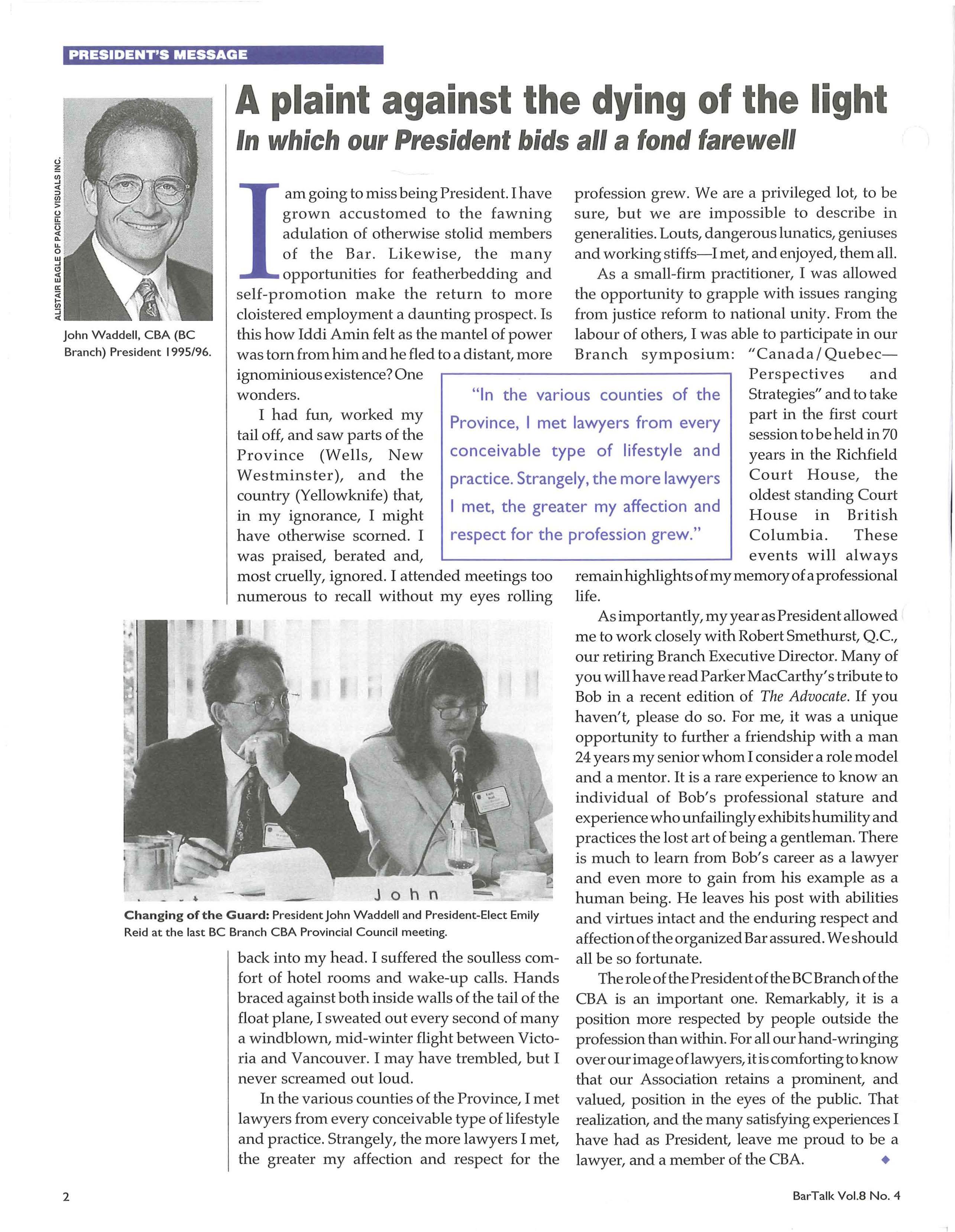
C hanging ofthe Guard: President john Waddell and President- Elect Emily Reid at the last BC Branch CBA Provincial Council meeting.
Sweeping child support changes slated for implementation May, 1997
The Federal Government introduced the "New Child Support Package" on March 6, 1996 as part of their Budget paper. This "Package" included changes in four key areas:
• First, child support paid under orders or agreements made on or after May 1, 1997 will no longer be taxed as income to the recipient, or be tax deductible for the payer;
• Second, Federal Child Support Guidelines (the "Guidelines") will be introduced to help parents, lawyers and judges set fair and consistent child support awards in divorce cases. The Guidelines take the new tax rules into account;
• Third, the Government will introduce a wide range of measures to help enforcement agencies ensure that support is paid in full and on time;
• Fourth, the maximum level of the Working Income Supplement of the Child Tax Benefit will be increased from $500 per year to $750 in July 1997 and to $1,000 in July 1998.
During a recent meeting of the New Westminster Family Law Section, Jack Hittrich, Legislative Liaison for the Section, introduced the details of the Guidelines, which the Federal Government plans to implement at the same time as the well-publicized tax changes on May 1, 1997. These Guidelines have far-reaching implications not only for those who will be required by law to adhere to them but also for all who pay and receive child support.
Background to the Guidelines
Recognizing the need for fundamental change, federal provincial and territorial officials have worked together through the Federal I Provincial/Territorial Family Law Committee (the "Committee") to develop a coordinated approach to child support reforms. The Committee found that the current method of determining child support awards is viewed as
subjective, arbitrary and unfair. To help parents, lawyers and judge s set fair and consistent child support awards, the government will introduce child support guidelines in amendments to the Divorce Act, 1985 These federal Guidelines will apply when a child support order is made in a divorce proceeding Although they will not apply in cases of separation or when parents are not married-these situations are governed by provincial or territorial family law-the federal government is working closely with the provinces to encourage them to adopt guidelines in their own jurisdictions. By making the system more predictable and offering a simpler means to update awards, the government believes the introduction of the Guidelines will lower legal costs for parents as well as legal aid and court costs for governments.
Elements of the Guidelines
The Guidelines have three main elements :
• child support payment schedules;
• rules to adjust the award to reflect four types of special child-related expenses; and
• rules to adjust the award in cases of undue hardship.
Presumptive Application of the Guidelines
Courts will be required to award the amount set out in the Child Support Payment Schedule, plus allowable special expenses, unless the court makes a written finding that the award causes undue hardship to either parent or to the child . The Guidelines will not be mandatory for support awards that are negotiated out-of-court. However, they will provide guidance to parents as well as the courts-which are responsible for assessing whether reasonable arrangements have been made for the children's support.
Child Support Payment Schedules
These Schedules show the basic amount that the
Shelley Bentley
Vancouver Bar Association to host "September Social"
The Vancouver Bar Association will host a "September Social" on September 12 , 1996, from 4:30 p.m. until 8 :30 p.m. at the Law Courts Inn.
Members of the Vancouver Bar and Judiciary are all invited to help kick off the new trial season.
The event is free, with food being provided and a cash bar.
For more information, contact Louis J. Zivot at 6917443.
Cross-Cultural dispute resolution in the Asia Pacific
The Asia Pacific Foundation of Canada is sponsoring a forum and workshop on cross-cultural dispute resolution at the Waterfront Hotel, Vancouver, on August 24, 1996
Using case studies, this program will examine key elements of disputes involving different Asia Pacific trading partners, examine how disputes emerge, how negotiations are conducted and the processes and institutions for dispute mediation and resolution.
For more information, contact the Asia Pacific Foundation of Canada, 666999 Canada Place, Vancouver BC V6C 3E I. Tel: 684-5986
Fax: 681-1370 or E-Mail: rainfo@apfc.apfnet.org.
Child support changes
Continued from page 3
support-paying parent should pay according to his or her income and the number of children.
"Income" will be defined broadly in the Guidelines, but the income of a new partner or spouse will be relevant only if the court is asked to make a determination of undue hardship.
The Schedule amounts are fixed by a formula that calculates the appropriate amount of support in light of economic data on average expenditures on children across different income levels.
of living as the custodial parent because they live in the same household;
• because spending on children is not fixed, but varies with both parents' incomes, the contribution of the support-paying parent can be set independently of the income of the custodial parent. This allows the child to benefit from increases in the custodial parent's standard ofliving, and recognizes that the support-paying parent will not have a greater capacity to pay support if the custodial parent suffers a drop in income;
The formula reserves a By making the system more
basic amount of income for the payer's selfsupport, and adjusts for the impact of federal and provincial income taxes. There are separate tables for each province to take differences in provincial income tax rates into account. The Schedules for each province and
predictable and offering a simpler means to update awards, the government believes the introduction of the Guidelines will lower legal costs for parents as well as legal aid and court costs for govern-
• the custodial parent will also contribute to the children in relation to his or her own means. The custodial parent is expected to contribute an amount similar to what a supportpayingparentwithasimilar income would be required to pay.
In the Committee's view this new approach to setting child support payments improves upon the existing system in three fundment. territory were released with the March 6, 1996 Budget. Examples from the B.C. Schedule include:
1996 annual gross income One child
$30,001
$50,001
$70,001
$80,001
$100,001
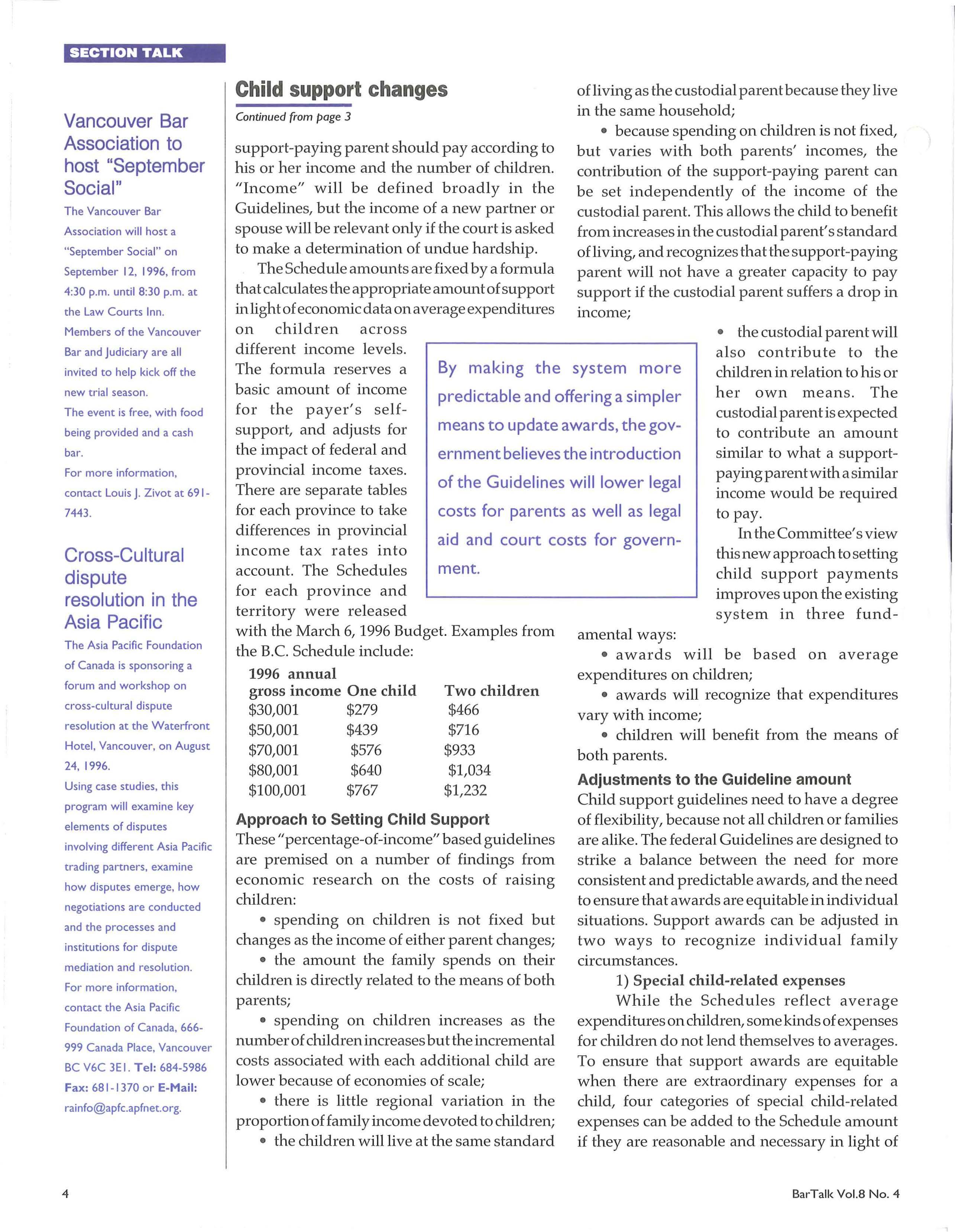
$279
$439
$576
$640
$767
Two children
$466
$716
$933
$1,034
$1,232
Approach to Setting Child Support
These "percentage-of-income" based guidelines are premised on a number of findings from economic research on the costs of raising children:
• spending on children is not fixed but changes as the income of either parent changes;
• the amount the family spends on their children is directly related to the means of both parents;
• spending on children increases as the number of children increases but the incremental costs associated with each additional child are lower because of economies of scale;
• there is little regional variation in the proportion of family income devoted to children;
• the children will live at the same standard
amental ways:
• awards will be based on average expenditures on children;
• awards will recognize that expenditures vary with income;
• children will benefit from the means of both parents.
Adjustments to the Guideline amount
Child support guidelines need to have a degree of flexibility, because not all children or families are alike. The federal Guidelines are designed to strike a balance between the need for more consistent and predictable awards, and the need to ensure that awards are equitable in individual situations . Support awards can be adjusted in two ways to recognize individual family circumstances.
1) Special child-related expenses
While the Schedules reflect average expenditures on children, some kinds of expenses for children do not lend themselves to averages. To ensure that support awards are equitable when there are extraordinary expenses for a child, four categories of special child-related expenses can be added to the Schedule amount if they are reasonable and necessary in light of
the needs of the children and the means of the parents:
• net child care expenses for children who are not in full-time school, or for whom extraordinary arrangements are required;
• medical and health-related expenses over $200 per year per child that are not covered by provincial or territorial health insurance plans;
• educational expenses for primary, secondary or post-secondary education, or for an educational program that meets a child's particular needs; and
• extraordinary expenses for extracurricular activities that allow a child to pursue a special interest or talent, or attend a specialized program.
When appropriate, the support-paying parent's contribution to these special expenses will be added to the Schedule amount.
2) Undue hardship
A court will be able to award more or less than the Schedule amount plus allowable special expenses if this total amount causes "undue hardship" to either parent or to the child. The party pleading undue hardship will usually have to show that he or she has a lower standard of living than the other party. The situations which might justify a finding of undue hardship are not limited to, but could include:
• an unusually high level of debt, reasonably incurred to support the family or earn a living;
• significant access expenses, such as travel or accommodation costs; and
• obligations for the support of other children, or spousal support obligations.
To help ensure consistency, the court will be required to give written reasons for ordering child support that is more or less than the amount set out in the Guidelines.
Adjustments for Special Custody Arrangements
The Guidelines will provide a method for adjusting the support amount in cases of split custody (when each parent had custody of one or more children of the marriage) and shared custody (when parents share custody of the child fully and equally).
Application to Existing Child Support
The new Guidelines will apply to new orders for child support made under the Divorce Act, 1985, and orders that change existing child support orders, made after the date that the Guidelines come into force. This means that if neither parent seeks a change to their existing support order, then the order will not be affected by either the
Guidelines or the tax change. However, either parent will be able to apply to a court to have their child support award varied to reflect the Guidelines and the new tax rules . Implementation and Review of Guidelines
Justice Canada will establish an Advisory Committee to assist it with the implementation of the Guidelines. The Federal Government has promised to monitor and evaluate the operation of the Guidelines over the first four years after they come into force. Input from parents, mediators, lawyers and judges will be requested. +
CLE ON THE WORLD WIDE WEB
The Gateway to Internet Resources for B.C. Lawyers
Welcome to http:/ /www.cle.bc.ca . The new CLE world wide web site brings you easy access and almost instant notification of important changes in law and practice. Visit CLE' s web site to help you keep up with new case law, communicate with other lawyers, share questions and answers on substantive legal issues, and conduct research.
CLE's web site features Case Digests, Superior Court Directions, Legal Resources on the Internet, Statutes, Discussion Group, Upcoming CLE Courses, Publications Catalogue, and more.
Special offer to B.C.lawyers only. Everything you need to get connected-FREE! Through a special arrangement with Dowco, a leading Internet service provider, CLE is pleased to offer B.C. lawyers the best deal on Internet access available anywhere! (Access offered is through a Vancouver telephone number. Local access in Abbottsford, Courtenay I Comox, Kelowna, Prince George and Victoria available this fall.)
Call Customer Service now at 893-2162 or 1800-663-0437 and ask for your FREE CLE Internet startup kit. Offer includes free connection, first month free, free software (including Netscape and Eudora) and the lowest monthly access fees you'll find anywhere.
To improve CLE's service to their customers and volunteers, most CLE staff now have Internet e-mail addresses. Watch for your CLE mail for a complete list of addresses or visit our web site. If you have any suggestions for improving CLE' s site or have some ideas you'd like to pass along to them, e-mail at cleweb@cle bc.ca or directly from their web site at www.cle.bc.ca.
QUALITY LEATHER GOODS AVAILABLE AT MEMBER
DISCOUNT PRICES
As a new service to its members , the BC Branch of the CBA is offering a full line of executive leather goods through the firm of Hugh Rose Agencies of Vancouver. These first -class leather goods are designed with lawyers in mind and are offered with a one-year warranty against manufacturing defects
Member services Chair Bruce Woolley purchased the very first leather case offered for sale and has been extremely pleased with his purchase "It's durable, very high quality and looks great," he said. "I would recommend it to any lawyer or to anyone considering a gift for a lawyer, student lawyer approaching graduation , or a lawyer who has been called " More information about the full range of these leather goods has recently been sent to you in an exclusive member services mailing.
For more immediate information , ca ll the Branch at 687-3404
Ret irement beckons for CBA Executive Director Bob Smethurst, Q.C.
New cha ll enges await in the future
ithin a very short time I shall cease being your Executive Director and enter that very different and, I believe, exciting phase of life known as retirement . My replacement, Barry Cavanaugh, is now learning the ropes as your Assistant Executive Director and will formally take over my role on October 1st this year. I extend to him-and all of you-the very best of wishes and good fortune for the future.
Now, when one nears the end of one journey and contemplates the beginning of a new one, it is customary to reflect upon the path just taken. And so, belonging as I do to a profession steeped in tradition and precedent, I shall do the same.
It has been a grand and wonderful journey, filled with satisfactions both great and small, people who have deeply enriched my life and situations that have challenged my wit and character every step of the way. I would like to put paid, however, to that
that year
attempting to organize lawyers is akin to "herding cats." Rather, I have found that it is more like being a travel guide for a group made up of ladies and gentlemen who hail from La Mancha. As such, my greate s t challenge has been in keeping the members focused on one windmill at a time. Even i£1 were to concede that, in my more exasperated
moments, there have been times when "herding cats" seems to have been an appropriate metaphor for my job, I would still maintain that I find that a great deal more stimulating than herding sheep .
I have been in your service for a great many years now, both as an elected member of the Bar and as a member of CBA staff. My experience began in the executive of the Manitoba Branch in the late 1950's and continued in British Columbia throughout the 1980s and 90s. It surprises me now to realize that I have been Executive Director ofthis Branch for over nine years . Time has, indeed, passed very quickly
Several have asked me whether
our profession and its place within Canadian society has changed significantly during my lifetime. I can state without hesitation that the profession, and the society that it serves, has indeed
c h a n g e d profoundly and that the proliferation of even more lawyer jokes today than existed during what used to be known as my "salad days" is symptomatic of this change. Society has become devilishly complicated today as, every year, our legislators add yet more rules and regulations to govern our individual and collective lives. I
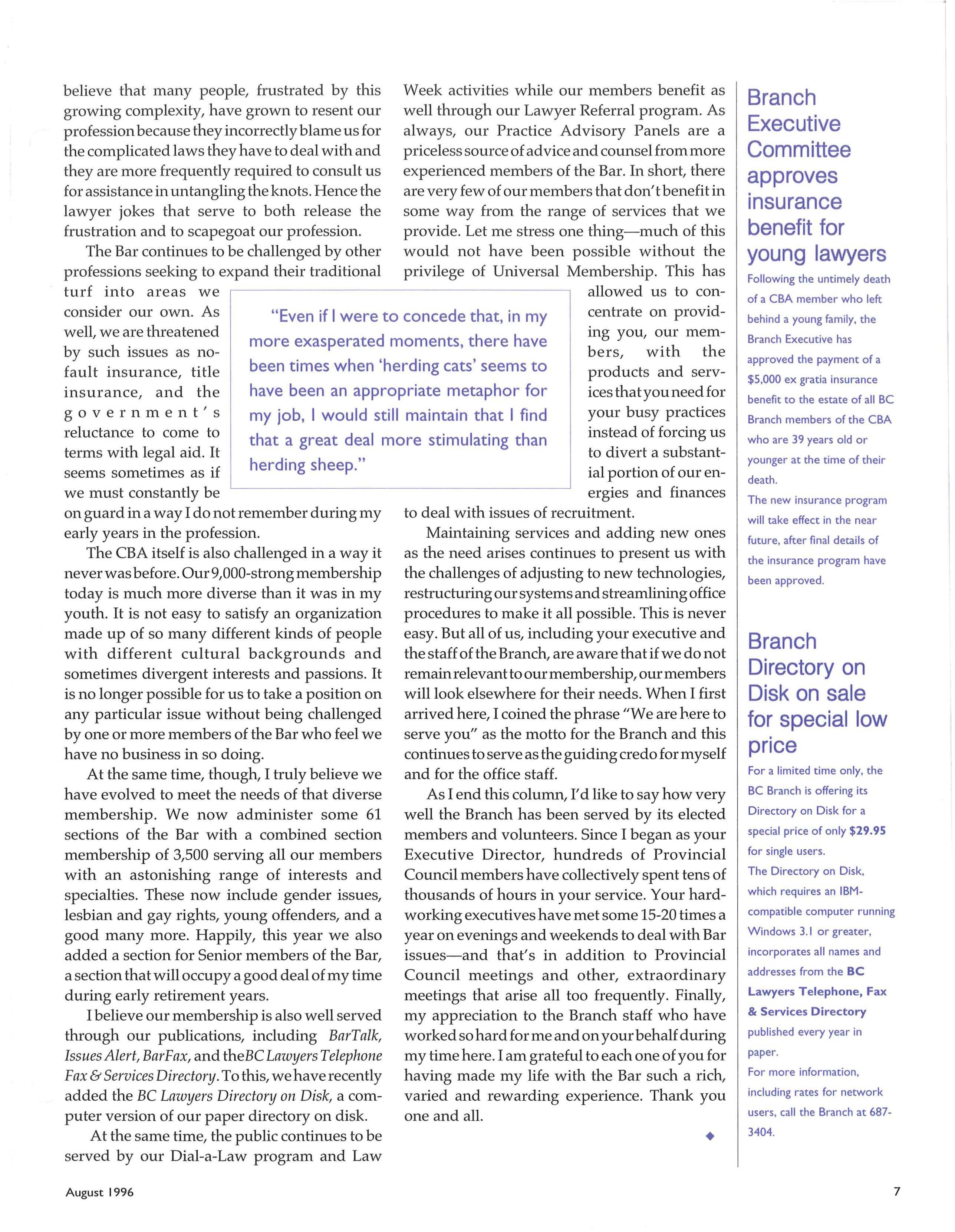
At the last BC Branch CBA Provincial Council meeting, President
John Waddell presented retiring Executive Director Robert Smethurst, QC, with an original caricature published earlier this infamous maxim
in The Advocate.
believe that many people, frustrated by this growing complexity, have grown to resent our profession because they incorrectly blame us for the complicated laws they have to deal with and they are more frequently required to consult us for assistance in untangling the knots. Hence the lawyer jokes that serve to both release the frustration and to scapegoat our profession.
The Bar continues to be challenged by other professions seeking to expand their traditional turf into areas we
"Even if I were to concede that, in my centrate on providing you, our members, with the products and services that you need for your busy practices instead of forcing us to divert a substant-
Week activities while our members benefit as well through our Lawyer Referral program. As always, our Practice Advisory Panels are a priceless source of advice and counsel from more experienced members of the Bar In short, there are very few of our members that don't benefit in some way from the range of services that we provide. Let me stress one thing-much of this would not have been possible without the privilege of Universal Membership. This has allowed us to conconsider our own. As well, we are threatened by such issues as nofault insurance, title insurance, and the government's reluctance to come to terms with legal aid. It seems sometimes as if we must constantly be
to deal with issues of recruitment.
more exasperated moments, there have been times when 'herding cats' seems to have been an appropriate metaphor for my job, I would still maintain that I find that a great deal more stimulating than herding sheep." ial portion of our energies and finances on guard in a way I do not remember during my early years in the profession.
The CBA itself is also challenged in a way it never was before Our 9,000-strongmembership today is much more diverse than it was in my youth. It is not easy to satisfy an organization made up of so many different kinds of people with different cultural backgrounds and sometimes divergent interests and passions. It is no longer possible for us to take a position on any particular issue without being challenged by one or more members of the Bar who feel we have no business in so doing .
At the same time, though, I truly believe we have evolved to meet the needs of that diverse membership. We now administer some 61 sections of the Bar with a combined section membership of 3,500 serving all our members with an astonishing range of interests and specialties. These now include gender issues, lesbian and gay rights, young offenders, and a good many more. Happily, this year we also added a section for Senior members of the Bar, a section that will occupy a good deal of my time during early retirement years.
I believe our membership is also well served through our publications, including BarTalk, Issues Alert, BarFax, and theBC Lawyers Telephone Fax & Services Directory To this, we have recently added the BC Lawyers Directon; on Disk, a computer version of our paper directory on disk.
At the same time, the public continues to be served by our Dial-a-Law program and Law
Maintaining services and adding new ones as the need arises continues to present us with the challenges of adjusting to new technologies, restructuring our systems and streamlining office procedures to make it all possible. This is never easy. But all of us, including your executive and the staff of the Branch, are aware that if we do not remain relevant to our membership, our members will look elsewhere for their needs When I first arrived here, I coined the phrase "We are here to serve you" as the motto for the Branch and this continues to serve as the guiding credo for myself and for the office staff .
As I end this column, I'd like to say how very well the Branch has been served by its elected members and volunteers. Since I began as your Executive Director, hundreds of Provincial Council members have collectively spent tens of thousands of hours in your service. Your hardworking executives have met some 15-20 times a year on evenings and weekends to deal with Bar issues-and that's in addition to Provincial Council meetings and other, extraordinary meetings that arise all too frequently. Finally, my appreciation to the Branch staff who have worked so hard for me and on your behalf during my time here. I am grateful to each one of you for having made my life with the Bar such a rich, varied and rewarding experience. Thank you one and all .
•
Branch Executive Committee approves insurance benefit for young lawyers
Following the untimely death of a CBA member who left behind a young family, the Branch Executive has approved the payment of a $5,000 ex gratia insurance benefit to the estate of all BC Branch members of the CBA who are 39 years old or younger at the time of their death.
The new insurance program will take effect in the near future, after final details of the insurance program have been approved
Branch Directory on Disk on sale for special low price
For a limited time only, the BC Branch is offering its Directory on Disk for a special price of only $29.95 for sing le users
The Directory on Disk, which requires an IBMcompatible computer runn ing Windows 3.1 or greater, incorporates all names and addresses from the BC Lawyers Telephone, Fax & Services Directory published every year in paper
For more information, including rates for network users, call the Branch at 6873404
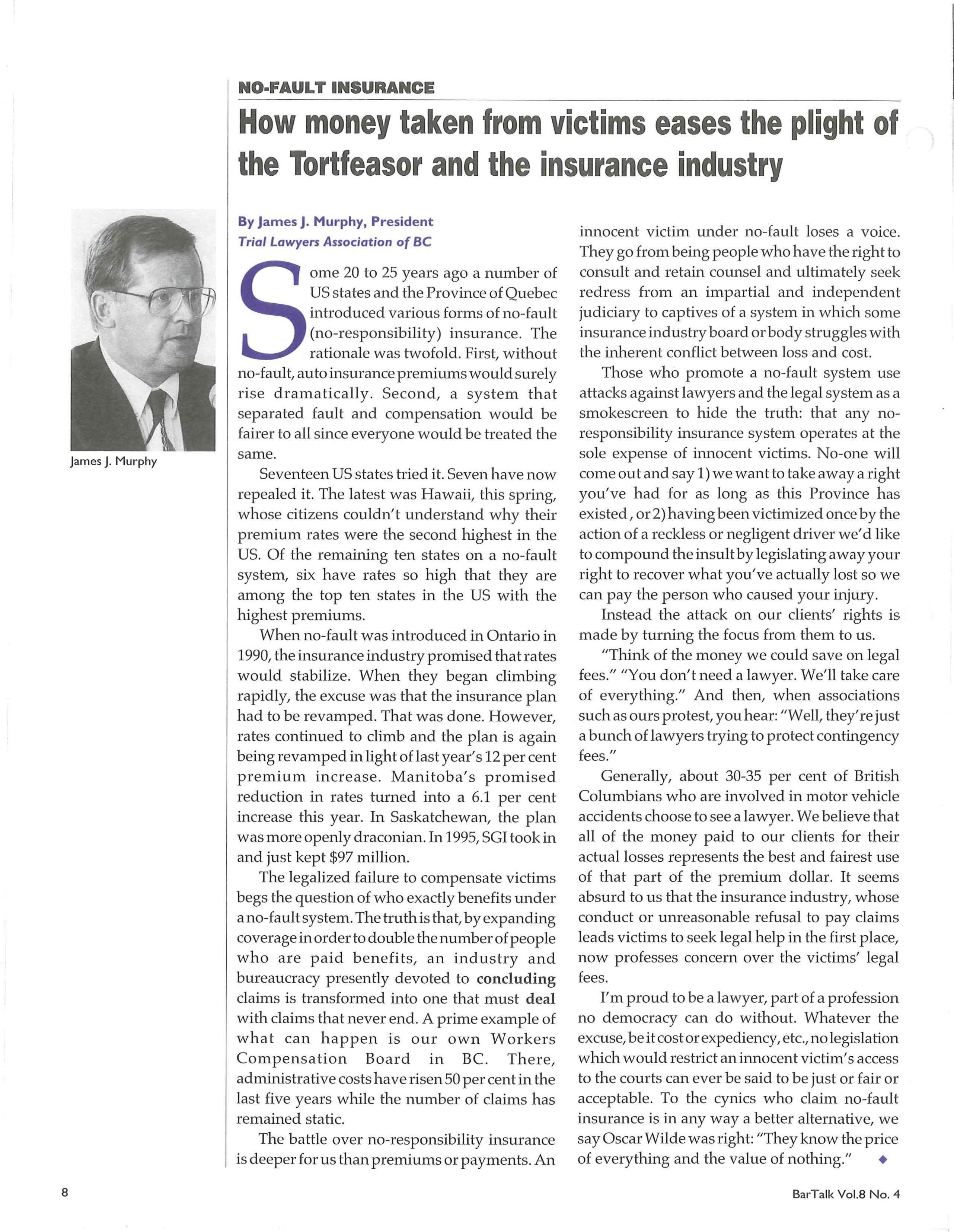
James J Murphy
How money taken from victims eases the plight of the Tortfeasor and the insurance industry
By James J. Murphy, President Trial Lawyers Association of BC
orne 20 to 25 years ago a number of US states and the Province of Quebec introduced various forms of no-fault (no-responsibility) insurance. The rationale was twofold. First, without no-fault, auto insurance premiums would surely rise dramatically. Second, a system that separated fault and compensation would be fairer to all since everyone would be treated the same.
Seventeen US states tried it. Seven have now repealed it. The latest was Hawaii, this spring, whose citizens couldn't understand why their premium rates were the second highest in the US. Of the remaining ten states on a no-fault system, six have rates so high that they are among the top ten states in the US with the highest premiums.
When no-fault was introduced in Ontario in 1990, the insurance industry promised that rates would stabilize. When they began climbing rapidly, the excuse was that the insurance plan had to be revamped That was done. However, rates continued to climb and the plan is again being revamped in light of last year's 12 per cent premium increase. Manitoba's promised reduction in rates turned into a 6.1 per cent increase this year. In Saskatchewan, the plan was more openly draconian. In 1995, SGI took in and just kept $97 million.
The legalized failure to compensate victims begs the question of who exactly benefits under a no-fault system The truth is that, by expanding coverage in order to double the number of people who are paid benefits, an industry and bureaucracy presently devoted to concluding claims is transformed into one that must deal with claims that never end. A prime example of what can happen is our own Workers Compensation Board in BC. There, adminish·ative costs have risen 50 per cent in the last five years while the number of claims has remained static.
The battle over no-responsibility insurance is deeper for us than premiums or payments. An
innocent victim under no-fault loses a voice. They go from being people who have the right to consult and retain counsel and ultimately seek redress from an impartial and independent judiciary to captives of a system in which some insurance industry board or body struggles with the inherent conflict between loss and cost.
Those who promote a no-fault system use attacks against lawyers and the legal system as a smokescreen to hide the truth: that any noresponsibility insurance system operates at the sole expense of innocent victims No-one will come out and say 1)we want to take away a right you've had for as long as this Province has existed, or 2) having been victimized once by the action of a reckless or negligent driver we'd like to compound the insult by legislating away your right to recover what you've actually lost so we can pay the person who caused your injury. Instead the attack on our clients' rights is made by turning the focus from them to us.
"Think of the money we could save on legal fees." "You don't need a lawyer. We'll take care of everything." And then, when associations such as ours protest, you hear: "Well, they're just a bw1ch of lawyers trying to protect contingency fees."
Generally, about 30-35 per cent of British Columbians who are involved in motor vehicle accidents choose to see a lawyer. We believe that all of the money paid to our clients for their actual los ses represents the best and fairest use of that part of the premium dollar. It seems absurd to us that the insurance industry, whose conduct or unreasonable refusal to pay claims leads victims to seek legal help in the first place, now professes concern over the victims' le gal fees.
I'm proud to be a lawyer, part of a profession no democracy can do without. Whatever the excuse, be it cost or expediency, etc., no legislation which wou ld restrict an innocent victim's access to the courts can ever be said to be just or fair or acceptable. To the cynics who claim no-fault insurance is in any way a better alternative, we say Oscar Wilde was right: "They know the price of everything and the value of nothing." +
Lawyers should not be used as scapegoats in order to promote no-fault insurance
Continued (rom page I
Government, the Insurance Corporation of BC, the organized Bar, and other organizations which influence the provision of automobile insurance to the public to work together to find solutions.
As President, I have conveyed to the Attorney-General in person, and to the Minister of Finance by correspondence, that there is a common interest in the organized Bar to ensure that:
1. The Bar participates in the meaningful development of solutions, utilizing the resources of our Legislation and Law Reform Committee, our various Sections and our Fair Automobile Insurance Committee;
2. Any proposed changes to the existing, combined tort I no-fault system occur only after meaningful consultation with all interested parties, including the organized Bar; and
3. The legal profession not be used as a scapegoat in any communications package
developed by government or the Insurance Corporation of British Columbia.
This issue is one which should concern all lawyers in British Columbia. Every one of us suffers when lawyers in any area of practice are publiclymalignedorunfairlycriticized. We need look no further than recent cartoons and letters to the editor which have portrayed resistance to a no -fault scheme as nothing more than selfinterested protectionism on the part of lawyers. We all know that that portrayal is wrong and that the problems facing government and the Insurance Corporation of British Columbia deserve a more careful and sophisticated analysis than simplistic lawyer-bashing. A no-fault insurance scheme necessarily involves the elimination of legal rights. Every lawyer must carefully analyze, and be prepared to resist, any interference with access to justice which is unfair and unwarranted. We trust you agree. +
The Great Hawaiian Escape and Go lf Tournament
If you're interested in a great holiday and golfing package next year in Hawaii, why not join our Executive Director Robert Smethurst, Q.C. and his wife, Carol Ann, in the Great Hawaiian Escape and Golf Tournament?
Bob's looking for some people to help celebrate his upcoming retirement and he's put together a wonderful package, with accommoat the luxurious Poipu Kai Resort or the even more luxurious Hyatt Regency Kauai on the beautiful garden island ofKauai, in the Poipu Beach area . The holiday is planned for April8 -15, 1997
The holiday package is designed for golfers and non-golfers and priced accordingly. Accommodation, air fare, a welcoming reception, a closing banquet and airline departure taxes are included in the prices for both. For only $1,600 (Cdn. ), golfers will enjoy
three rounds of golf (1 practice round and two in the tournament) at the World Famous Poipu Bay Resort course, site of the PGA Grand Slam of Golf. Non-golfers will pay only $1,100 (Cdn ).
The tournament will be structured for both the serious and casual golfer. Shared electric golf carts, prizes and surprise gifts for every golfer are included in the package price. Holidayers will also be able to enjoy swimming at one of the several swimming pools atthe resort, play tennis, or try excellent bodysurfing and snorkelling at one of the two beaches nearby
To receive further details about this package, just complete the Reply Card included with this BarTalk. Fax or mail it to Bob at the Branch, or phone . We'll be happy to send along some brochures and accommodation information . Don't delay! Accommodation is limited and we're expecting a great deal of interest. +
Amendment proposed to divide Nanaimo Country into electoral districts
Notice is hereby given of a motion to amend Section 15 of the CBA BC Branch bylaws to divide Nanaimo County into four electoral districts , namely:
• The Cowichan Valley Regional District and the Capital Regional District
• The Nanaimo Regional District and the Albern if Clayoquot Regional District
• The Powell River Regional District and the areas lying south of Oyster Bay in Comox/Strathcona Regional District
• The Mount Waddington Regional District and the areas lying north of Oyster Bay in Comox/Strathcona Regional District
For Branch electoral purposes each district shall respectively elect I, 2, I , and I members to the Provincial Council of the Branch R. G QC Executive Diredor
By
Joanne Power Manager Registrar Program
If you have any interesting or unusual questions or comments about this column, please write directly to:
JOANNE POWER Manager, Registrar Programs
Law Courts, 850 Burdett Ave.
Victoria, B.C. V6W I BS
INTERNET:
jpower@ galaxy gov bc.ca@gems or Fax: 387-3061
Part 12, s s 102-111
QWhat is an order of the Employment Standards Tribunal?
AThe Employment Standards Tribunal issues orders on appeals of Determinations. (See Issue #22 of the Registrar's Newsletter for an interpretation of a "Determination".) Like Determinations, these orders may be filed in a Supreme Court Registry. The orders are enforceable in the same manner as judgments of the Supreme Court in favour of the Director for the recovery of a debt in the amount stated in the order.
Most orders are based on a written decision issued by the Employment Standards Tribunal. The Employment Standards Tribunal does not issue a separate order . An order may confirm, vary or cancel the Determination under appeal.
Rule I (5) & (8)
QCan court documents be filed in a registry other than where the proceeding was first commenced? (Note: not applicable to Motions which are covered by Rule 44( 16 ), (18) &( 19)*
ARule 1(5) states:
"The object of these rules is to secure the just, speedy and inexpensive determination of every proceeding on its merits."
Rule 1(8) "registry" states: "registry" means the office of the court in which the proceeding was commenced or is pending "
These rules support the common sense position that the answer is no, unless the file is physically located in another registry. An example would be a file transferred to Revelstoke from Kelowna for hearing of a motion pursuant to Rule 44(16) Counsel may wish to file affidavits in Revelstoke for the convenience of both the court and the parties involved.
*See also "Newsletter" tab at pp. Supreme Court Registrar's Handbook
Rule41
AOrdinaril y garnishingorders, writsofseizure and sale, certificates, etc will only be issued at the counter when a copy of the entered order is available Where the order has not been entered, counsel should be referred to the District Registrar District Registrars should be extremely cautious in issuing any execution proceedings unless either the clerk's notes or the reasons for judgment set out the order clearly . (See Access Mortgage Group Ltd. v Denis, (1984) 56 B.C.L.R. 255)
Rule64(7)
QCan a registrar use a signature stamp on a court document?
A A signature stamp cannot be used on the original document as this requires the signature of the Registrar. A signature stamp could however be used on copies of the original document.
Rule 13
Q
How do you serve an appointment pursuant to theLegal Profession Act on a client outside British Columbia?
AAn appointment should be served in accordance with Rule 13: "Service of an originating process or other documentation on a person outside B.C. may be effected without order .. ." The appointment would have to be endorsed pursuant to Rule 13(2)
CORRECTION
Please note that, in the June issue of BarTalk, there were several errors printed in the answer to one of the questions, dealing with the Court Order Interest Act. We apologize for these errors and print the correct answer to the question below. Revisions have been noted in boldface type.
Rule41(14)(c)
COURT ORDER INTEREST ACT 35-37, s. 7 (2 )
QCan we issue process for enforcement such as garnishing orders, writs of seizure and sale, certificates, etc. when the order has been pronounced, but has not been entered?
QFrom what date does interest accrue on an amount awarded under a Certificate of Costs?
AThis question was recently canvassed by Madam Justice Boyd: Syed v Randhawa (Unreported 1996, Vancouver Registry No. C917885, specifically at page 5) :
"In this case, while there is no sum certain of money payable until such time as the taxation hearing is concluded and a certificate of costs issued by the Registr a r, I am sati s fied that by virtue of the combined effect of Rule
41(1 4 )(c) and section 7(2) of the Court Ord er Int erest Act, costs are payable upon pronouncement of the judgment and interest accrues from the date of the judgement and not from the date of taxa tion unle ss th e court specifically provides that interest shall not r un until some later date ... In effect, a taxation of costs is a formality in the nature of th e entry of an order ... " +
Don 't miss the business and social opportunity of th e year
T im e i s running o ut to reg i ster for the Commonwea lth l. a w Conferen ce
For the first time ever, the Commonwealth Law Conference is convening in Canada Hosted by the Canadian Bar Association in Vancouver from Aug. 25 to 29, the meeting will bring together thousands of delegates from all 52 member states of the British Commonwealth It is also attracting plenty of people from nonCommonwealth countries-Americans, of course, as well as many continental Europeans.
As in previous reunions of the Commonwealth Law Conference, the focus again will be on the continuing challenge of defending and promoting human rights around the world But this year, there'll also be a new interest and attention paid to issues of international trade, particularly around the Pacific Rim.
For Canadian lawyers and legal experts, the substantive programs will deliver something for everybody.
The plenary speakers alone are worth the price of admis sion: Opening the conference is Canadian historian, writer and broadcaster Michael lgnatieff, who will talk about the role oflawyers in supporting democratic institutions during periods of social unrest and reform. Penelope Leach, a world renowned authority on children, will cast a critical eye on the place rese r ved for children and families in Western cultures. And Dr. Edward de Bono, a leading expert on creative thinking, will share his insights on problem-solving and converting challenge into opportunity.
CLE, or the continuing legal education program, may be the single most powerful drawing card for Canadian delegates. A series
of practice-management cours es, delivered by leading experts from Canada, the United States, the United Kingdom and Malaysia, will reveal the latest techniques for enhancing the smooth and profitable workings of your law office. Other sessions will be tailored to the particular needs and interests of lawyers in family, criminal and commercial practices.
Or, head on over to the trade centre, where dozens of exhibitors will demonstrate the l a test in tools and technology for the legal profession. Whether y ou want to see your law library on CD ROM, or learn how to explore and exploit the limitless potential of the Internet, you can find it at the Trade Show . While there, drop by the Xerox Business Centre, where courtesy phones from BC Tel, and computers from IBM, let you stay in instant contact with your office.
The opening gala at GM Place will feature a casual dinner, followed by exciting entertainment of the cabaret and revue theatre genre that has become so popular in the city.
The following three evenings will offer a terrific variety of receptions and dining opportunities For a small extra charge, the closing dinner dance will be held at HMCS Discovery naval base in Stanley Park, with it's breathtaking view over the city's night skyline And, as a final bonus, catch the world premiere of The Paisley Snail, a film telling the true story of Donaghue v Stevenson, the most famous case in English common law.
For registration information, please contact Margery Tenute at 1 (800) 267-8860, ext. 157 +
Your help is still needed for the Commonwealth Conference
Volunteers are still needed for this year ' s Canadian Bar Association Annual Meeting and I Ith Commonwealth Conference in Vancouver. You can help in a number of different ways To assist in general tasks , including greeting guests at the airport and helping out at registration desks , contact Jim Vilvang at 661-9216.
Members of local sports organizations and clubs are also needed to sponsor recreational athletic events, like golf foursomes or tennis dates for conference visitors. If you can help, please call BC Branch Executive Director Robert Smethurst, Q.C. , at 687-3404.
About 5-10 "Liaison Officers" are still needed for the conference to greet international and special guests at the airport, drive them to their hotels and help out in other ways. To volunteer , please call either William Skelly, Carman Overholt or Anjili I. Bahadoorsingh. All can be reached at 683-691 I. Finally, a highlight of the conference will be the tradition a l Monday evening law firm receptions to be held Mond ay, August 26 , 1996 if you'd lik e to volunteer your law firm as a host for thi s reception , or other events , ca ll Terry La Libert e at 669-8808
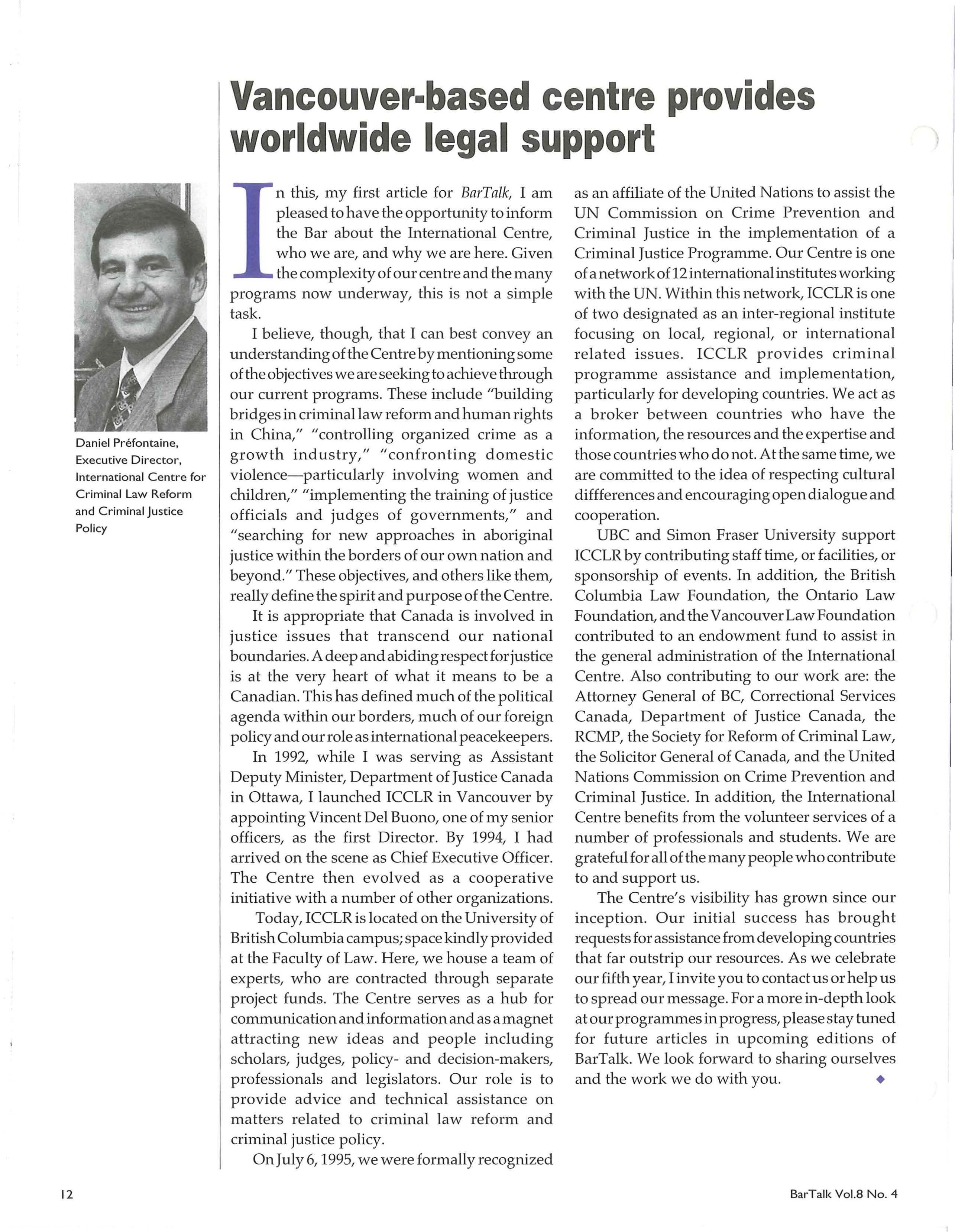
Daniel Prefontaine, Executive Director, International Centre for Criminal Law Reform and Criminal Justice Policy
Vancouver-based centre provides worldwide legal support
n this, my first article for BarTalk, I am pleased to have the opportunity to inform the Bar about the International Centre, who we are, and why we are here. Given the complexity of our centre and the many programs now underway, this is not a simple task.
I believe, though, that I can best convey an understanding of the Centre by mentioning some of the objectives we are seeking to achieve through our current programs. These include "building bridges in criminal law reform and human rights in China," "controlling organized crime as a growth industry," "confronting domestic violence-particularly involving women and children," "implementing the training of justice officials and judges of governments," and "searching for new approaches in aboriginal justice within the borders of our own nation and beyond." These objectives, and others like them, really define the spirit and purpose of the Centre.
It is appropriate that Canada is involved in justice issues that transcend our national boundaries. A deep and abiding respect for justice is at the very heart of what it means to be a Canadian. This has defined much of the political agenda within our borders, much of our foreign policy and our role as international peacekeepers
In 1992, while I was serving as Assistant Deputy Minister, Department of Justice Canada in Ottawa, I launched ICCLR in Vancouver by appointing Vincent Del Buono, one of my senior officers, as the first Director. By 1994, I had arrived on the scene as Chief Executive Officer. The Centre then evolved as a cooperative initiative with a number of other organizations.
Today, ICCLR is located on the University of British Columbia campus; space kindly provided at the Faculty of Law. Here, we house a team of experts, who are contracted through separate project funds . The Centre serves as a hub for communication and information and as a magnet attracting new ideas and people including scholars, judges, policy- and decision-makers, professionals and legislators. Our role is to provide advice and technical assistance on matters related to criminal law reform and criminal justice policy.
On July 6,1995, we were formally recognized
as an affiliate of the United Nations to assist the UN Commission on Crime Prevention and Criminal Justice in the implementation of a Criminal Justice Programme. Our Centre is one of a network of 12 international institutes working with the UN. Within this network, ICCLR is one of two designated as an inter-regional institute focusing on local, regional, or international related issues. ICCLR provides criminal programme assistance and implementation, particularly for developing countries. We act as a broker between countries who have the information, the resources and the expertise and those countries who do not. At the same time, we are committed to the idea of respecting cultural diffferences and encouraging open dialogue and cooperation.
UBC and Simon Fraser University support ICCLR by contributing staff time, or facilities, or sponsorship of events. In addition, the British Columbia Law Foundation, the Ontario Law Foundation, and the Vancouver Law Foundation contributed to an endowment fund to assist in the general administration of the International Centre. Also contributing to our work are: the Attorney General of BC, Correctional Services Canada, Department of Justice Canada, the RCMP, the Society for Reform of Criminal Law, the Solicitor General of Canada, and the United Nations Commission on Crime Prevention and Criminal Justice. In addition, the International Centre benefits from the volunteer services of a number of professionals and students. We are grateful for all of the many people who contribute to and support us.
The Centre's visibility has grown since our inception. Our initial success has brought requests for assistance from developing countries that far outstrip our resources. As we celebrate our fifth year, I invite you to contact us or help us to spread our message For a more in-depth look at om· programmes in progress, please stay tuned for future articles in upcoming editions of BarTalk. We look forward to sharing ourselves and the work we do with you +
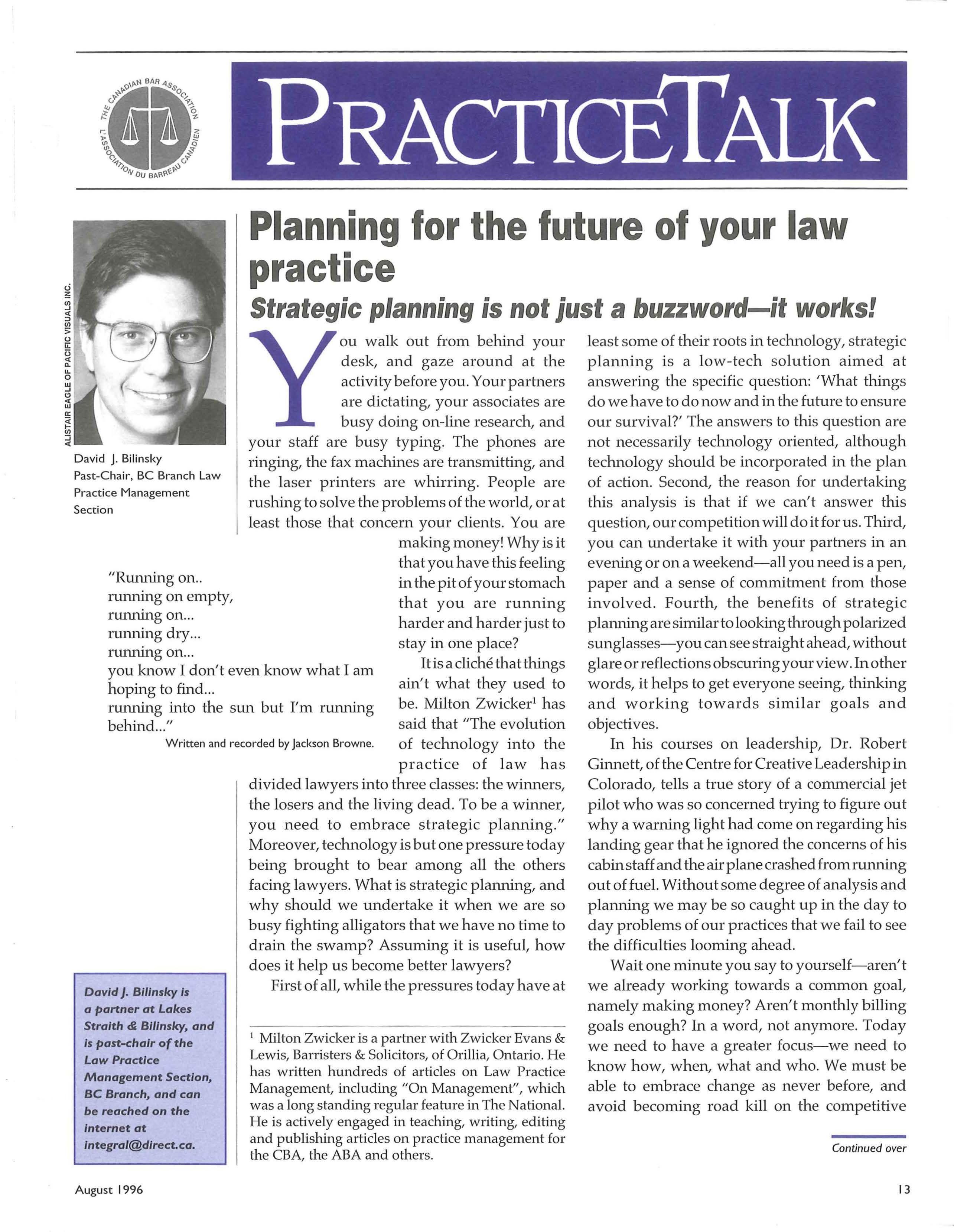
David J. Bilinsky Past-Chair, BC Branch Law Practice Management Section
"Rwmingon rwming on empty, rwming on ... nmning dry .. . rwmingon
Planning for the future of your law practice
Strategic planning is not just a buzzword-it works!
ou walk out from behind your desk, and gaze around at the activity before you. Your partners are dictating, your as sociates are busy doing on-line research, and your staff are busy typing. The phones are ringing, the fax machines are h ansmitting, and the laser printers are whirring. People are rushing to solve the problems of the world, or at least those that concern your clients. You are making money! Why is it that you have this feeling in the pit of your stomach that you are running harder and harder just to stay in one place?
you know I don't even know what I am hoping to find
rwming into the sw1 but I'm rwming behind "
Written and recorded by Jackson Browne
David J. Bilinsky is a partner at Lakes Straith & Bi/insky, and is past-chair of the Law Practice Management Section, BC Branch, and can be reached on the internet at integral@dlrect.ca.
It is a cliche that things ain't what they used to be. Milton Zwicker1 has said that "The evolution of technology into the practice of law has
divided lawyers into three classes : the winners, the losers and the living dead. To be a winner, you need to embrace strategic planning." Moreover, technology is but one pressure today being brought to bear among all the others facing lawyers. What is strategic planning, and why should we undertake it when we are so busy fighting alligators that we have no time to drain the swamp? Assuming it is useful, how does it help us become better lawyers?
First of all, while the pressures today have at
1 Milton Zwicker is a partner with Zwicker Evans & Lewis, Barristers & Solicitors, of Orillia, Ontario. He has written hundreds of articles on Law Practice Management, including "On Management", which was a long standing regular feature in The National. He is actively engaged in teaching, writing, editing and publishing articles on practice management for the CBA, the ABA and others
least some of their roots in technology, s trategic planning is a low-tech solution aimed at answering the specific question: ' What things do we have to do now and in the future to ens ure our s urvival?' The answer s to this qu e stion are not necessarily technology oriented, although technology should be incorporated in the plan of action. Second, the reason for undertaking this analysis is that if we can't answer this question, our competition will do it for us. Third, you can undertake it with your partners in an evening or on a weekend-all you need is a pen, paper and a sense of commitment from those involved Fourth, the benefits of strategic planning are similar to looking through polarized sunglasses-you can see straight ahead, without glare or reflections obscuring your view In other words, it helps to get everyone seeing, thinking and working towards similar goals and objectives.
In his courses on leadership, Dr. Robert Ginnett, of the Centre for Creative Leadership in Colorado, tells a true story of a commercial jet pilot who was so concerned trying to figure out why a warning light had come on regarding his landing gear that he ignored the concerns of his cabin staff and the air plane crashed from running out of fuel. Without some degree of analysis and planning we may be so caught up in the day to day problems of our practices that we fail to see the difficulties looming ahead
Wait one minute you say to yourself-aren't we already working towards a common goal, namely making money? Aren't monthly billing goals enough? In a word, not anymore. Today we need to have a greater focus-we need to know how, when, what and who. We must be able to embrace change as never before, and avoid becoming road kill on the competitive
Special Health Law section meeting
A special meeting of the Health Law sect ion will be held Monday , August 26 at I p m. in Room 15, Vancouver Trade and Convention Centre, Vancouver
The speaker will be Pran Manga , PhD, a health economist with the University of Ottawa
Dr Manga will summarize the cha ll enges in health care that many Commonwealth countries are experiencing
This presentation is part of the special business meeting the National Hea lth Law Section is hold ing in conjunction w ith the CBA's annual meeting and the I Ith Commonwea lth law Conference However, th is presentation is free to a ll sect ion members, whether or not they have registered for the conference.
For mo r e info r mat ion or to reg ister , contact George K Bryce at 8 72- 1773.
Deve lop a strategic plan to bu ild for the future
Continued from page 15 highway of life.
How do we undertake a strategic plan? Hold a retreat with your partners (and associates if desired) and devote a few hours to contemplating your future. Here are some suggestions for starting on your plan :
• Start by developing a focus-a vision, a mission. This is a touchstone for the purpose of the firm. It embraces more than monetary objectives. Career satisfaction, client satisfaction, personal and professional integrity, growth, camaraderie, geographical reach, substantive practice areas, social change-all of these and more can be the source for the guiding principles for your firm . Talk among your partners, come to a consensus, write it down and distribute it to your staff-let them know that THIS is why were are here doing what we do and why you are asking them to join you in the battle. Group
High Court decisions to be available on the Internet
VANCOUVER: Beginning August 1, 1996, the current year's decisions of the Court of Appeal for British Columbia and the Supreme Court of British Columbia will be available on the Internet for public viewing and copying for non-commercial use The web site address is www.courts.gov.bc.ca
British Columbia is the first province to make its superior courts' reasons for judgement available on the Internet. The web site has been developed with the cooperation and assistance of the Ministry of the Attorney General of British Columbia to ensure the widest possible distribution of these reasons for judgement.
The Superior Courts' web site will include both written and oral reasons of the Court of Appeal and written reasons of the Supreme Court. The current years' reasons for judgement will be available. The web site will be updated daily with judgements as they are released by the courts.
Technical enquiries about the web site should be directed to Nino Stroppa, Manager of Systems Support, Vancouver Law Courts. Phone: (604) 775-1234 Fax: (604) 775-0761.
pride and a team approach will conquer mountains.
• Determine your core competencies and ask if they will carry you into the future If they are threatened, consider changing your areas of practice or bringing in new associates and partners to create new opportunities. Consider what are your firm's weaknesses and how you can overcome them.
• Where do you see the firm and yourself within your firm in the next 1 to 5 to 10 years? Outline the goals of the firm in the short, medium and long term. Look to your vision and incorporate your focus. Set objectives for financial performance, for areas of practice, for incorporating technology, for appropriate use of staff and associates and other resources, for the culture of the firm ( how should it feel to work there?), for the growth of the firm, for bringing up new partners and searching for associates, for the reach of the firm either geographically or otherwise, and the like. These objectives will give you an idea of where the goal posts lie and what it will take to reach them.
• Take the vision and the goals and translate them into concrete strategies. Michael Porter of Harvard Business School has outlined four generic business strategies that we can draw on: Differentiation, Focused Differentiation, Cost Leadership and Cost Focus. Differentiation is the full service law firm-margins must be higher here to be able to offer such a large selection of full services to the client. Focused Differentiation is specializing in select areas-you narrow your focus to provide depth of service and knowledge. Cost Leadership provides cost-sensitive (commodity) services to a broad market. Here you seek to provide a broad range of services at a lower cost than your competition. Here you have as little customization in your work as possible and the concern is to keep your costs as low as possible. Cost Focus is similar but the range of practice areas are further narrowed allowing greater efficiencies in the area(s) of practice.
• Each of us must decide which business strategy we will pursue. The danger is to try to go outside of your chosen or suitable strategy. For example, if your firm is a cost focus or focused differentiation firm, then taking on a file outside of your chosen areas of practice will lead
to a disproportionate amount of resources being drawn from other files. This will lead to a disruption in the business flows, a probable reduction in cash flow and anxiety among the lawyers and staff as they grapple with unfamiliar terri tory. Better to refer the file out in the expectation of the favour being returned in the future.
• Once your strategies are outlined, decide w ho will be responsible for each and what role everyone will play in reaching your objectives. Without specific delegation, your plan "floats" and no one takes ownership of the objectives. Be sure that each person taking part of the plan ha s the necessary delegated authority to reach their objectives. Responsibility and authority can be a powerful combination. Too much or too little of each leads to burnout or a dictatorship.
• Set criteria for evaluation of your goals. Have specific measurable goal posts. Whenever, make evaluations quantitative rather than qualitative, as this reduces uncertainty and potential for disagreement.
• Lastly, set a specific time to sit down and evaluate your progress. Determine how you are progressing and what need s to be changed and modified. Discard unworkable parts and set new objectives and goals. Continue to change, for the plan is a method of incorporating change within your practice in a way to meet your firmwise goals.
• Use the strategic plan as a touchstone to solve problems in the firm. Successful firms do not allow problems to linger, they deal with them. Your plan will allow you to take a step backward, reflect on the problem and select a solution consistent with your overall vision, goals and objectives. The decision making is cleaner and easier and your partners and staff can come to count on consistent and prompt decisions.
• Your strategic plan should offer you the opportunity to come into the office each day and hit that highway oflife running flat out, knowing that you are on the road that you have selected and that your staff and partners are all pulling for you.
• AttheCBAAnnualMeetingin Vancouver in August, Austin Anderson of AndersonBoyer Group Inc., one of the foremost authorities on legal strategic planning will be speaking, as will Milton Zwicker and others. Call the CBA and come to the party.
• CLE has launched a new law practice
manual called "Managing Your Law Firm", which deals with most practice and management issues facing lawyers in B.C. today .It ha s been written and edited by British Columbians and is an invaluable resource to every person in practice today. Call CLE for further details. +
Legislative Update
By Ann Mclean
ACTS IN FORCE
Consumer Protection Statutes Amendment Act, 1993, S.B.C. 1993, c.39, amends the Motor D ealer Act, R.S.B.C. 1979, c.287, providing that one of the types of security that can be required of a motor dealer is a letter of credit and providing that the registrar may alter the terms of registration section 17 of the Act in force June 14, 1996
Foreign Money Claims Act, S.B.C. 1990, c.18, provides that if a court considers that the person in whose favour an order for payment is to be made will be more exactly compensated if all or part of the money payable is measured in a foreign currency, the court shall order that the money payable be the amount of Canadian currency needed to purchase the equivalent amount of the foreign currency calculated on the last banking day before payment is made under the order. Provision is made for interest under the Court Order Interest Act and a consequential amendment is made to the Court Order Enforcement Act. in force August 1, 1996
REGULATIONS TO NOTE
Foreign Money Claims Act, B.C. Reg 165/ 96, the Foreign Money ClaimsRegulationis made, providing for the method of calculating interest accruing on a foreign money judgment under Part 1 or 2 of the Court Order Interest Act.
effective August 1, 1996
Every effort is made to ensure the accuracy of the information provided to you in this article but the information should not be relied upon. Lawyers should refer to the specific legislative or regulatory provision.
Judgement on Nuremberg
A symposium
The Holocaust Education Society, in conjunction with the Centre for Education, Law & Society of Simon Fraser University, are organizing this symposium for October 19 and 20th this year
On Saturday, October 19, Irw in Cotler, Professor of Law at McGill Un iversity, will make the keynote address, on the subject: "Nuremberg, the Holocaust and Human Rights."
On Sunday, beginning at 8 :30 a.m., there will be a full-day symposium in the Labatt Theatre, Simon Fraser University at Harbour Centre. Speakers will include Madame Justice Rosalie Abella, Ontario Court of Appeal; William Fen r ick and Dana U r ban, Prosecutors, International Criminal Tribunal for the former Yugoslavia; and closing remarks by the Honourable Ujjal Dosanjh, Attorney General of BC.
To register, o r for more information, please call (604) 264-0499 or fax (604) 2640497.
The Honourable William Arthur Esson, Chief Justice of the Supreme Court of British Columbia
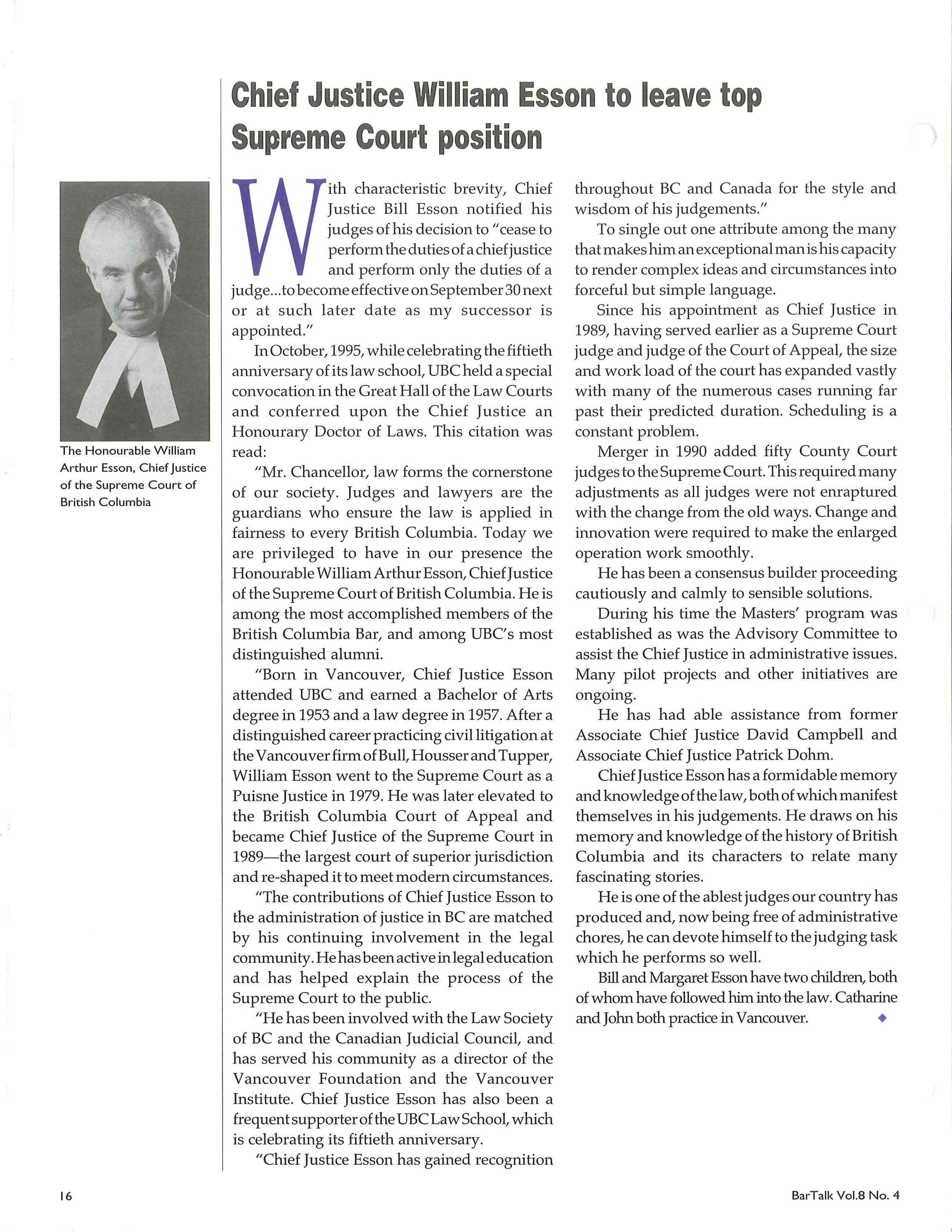
Chief Justice William Esson to leave top Supreme Court pos ition
ith characteristic brevity, Chief Justice Bill Esson notified his judges of his decision to "cease to perform the duties of a chief justice and perform only the duties of a judge to become effective on September 30 next or at such later date as my successor is appointed."
In October, 1995, while celebrating the fiftieth anniversary of its law school, UBC held a special convocation in the Great Hall of the Law Courts and conferred upon the Chief Justice an Honourary Doctor of Laws. This citation was read:
"Mr. Chancellor, law forms the cornerstone of our society. Judges and lawyers are the guardians who ensure the law is applied in fairness to every British Columbia. Today we are privileged to have in our presence the Honourable William Arthur Esson, Chief Justice of the Supreme Court of British Columbia He is among the most accomplished members of the British Columbia Bar, and among UBC' s most distinguished alumni.
"Born in Vancouver, Chief Justice Esson attended UBC and earned a Bachelor of Arts degree in 1953 and a law degree in 1957 After a distinguished career practicing civil litigation at the Vancouver firm of Bull, Hausser and Tupper, William Esson went to the Supreme Court as a Puisne Justice in 1979 . He was later elevated to the British Columbia Court of Appeal and became Chief Justice of the Supreme Court in 1989-the largest court of superior jurisdiction and re-shaped it to meet modern circumstances.
"The contributions of Chief Justice Esson to the administration of justice in BC are matched by his continuing involvement in the legal community. He has been active in legal education and has helped explain the process of the Supreme Court to the public.
"He has been involved with the Law Society of BC and the Canadian Judicial Council, and has served his community as a director of the Vancouver Foundation and the Vancouver Institute . Chief Justice Esson has also been a frequent supporter of the UBC Law School, which is celebrating its fiftieth anniversary .
"Chief Justice Esson has gained recognition
throughout BC and Canada for the style and wisdom of his judgements."
To single out one attribute among the many thatmakeshimanexceptionalmanishiscapacity to render complex ideas and circumstances into forceful but simple language.
Since his appointment as Chief Justice in 1989, having served earlier as a Supreme Court judge and judge of the Court of Appeal, the size and work load of the court has expanded vastly with many of the numerous cases running far past their predicted duration. Scheduling is a constant problem
Merger in 1990 added fifty County Court judges to the Supreme Court. This required many adjustments as all judges were not enraptured with the change from the old ways Change and innovation were required to make the enlarged operation work smoothly.
He has been a consensus builder proceeding cautiously and calmly to sensible solutions.
During his time the Masters' program was established as was the Advisory Committee to assist the Chief Justice in administrative issues. Many pilot projects and other initiatives are ongoing.
He has had able assistance from former Associate Chief Justice David Campbell and Associate Chief Justice Patrick Dohrn .
Chief Justice Esson has a formidable memory and knowledge of the law, both of which manifest themselves in his judgements. He draws on his memory and knowledge of the history of British Columbia and its characters to relate many fascinating stories.
He is one of the ablest judges our country has produced and, now being free of administrative chores, he can devote himself to the judging task which he performs so well.
Bill and Margaret Esson have two children, both of whom have followed him into the law. Catharine and John both practice in Vancouver.
Mentors sought for university law students
With the generous support of the BC Branch of the Canadian Bar Association, the Faculties of Law at UBC and UVic launched Mentor Programs during the 1995/96 academic year. The separate programs matched over 230 law students with legal professionals . the Mentor lawyers volunteered their time to meet with the students to answer questions and provide information about their professional activities and experiences. The goal was to help students w1derstand the range of opportunites available to them and the practice of law.
For the 1996/97 Mentor Program the UVic Law Students' Society and UBC Law Students' Association are joining forces with the Canadian Bar Association to launch a joint UBC/UVic Mentor Program. The joint program will make better use of financial and mentor resources. The law schools are currently recruiting mentors to match with students in late September. all legal professionals interested in becoming mentors, including those who volunteered their time last year, are encouraged to contact the Faculty of Law at either university. With almost 700 students to match, legal professionals
working in all areas (busines s, government, academia, judiciary, private firms, politics, interest groups and alternative dispute resolution) are urged to become involved. The time commitment is minimal. Mentors will meet s tudents at a Canadian Bar Associationsponsored reception and a two-hour individual meeting. Itis hop e d that the students and mentors will develop continuing relationships.
Two receptions have be e n scheduled to introduce students to their mentors. The Victoria receptions will be held on Tuesday, October 22 at 5:00 p.m. at the Faculty of Law in Victoria. The Vancouver reception has been scheduled for Thursday, October 17 at 5:30 p.m . at the Law Courts Inn in Vancouver.
The 1996 I 97 Mentor Program is being coordinated by the UBC Mentor Program Committee Chair, Blair Jordan and the UVic L.S.S Vice President (External), Lesley Ruzicka. Persons interested in becoming Mentors should contact Lesley at (604) 721-8159 or lesleyr@uvic.ca OR Blair at (604) 540-6096 or bjordan @unixg .ub c.ca.
Thank you for your support! +
Women Ra inm akers Section makes Canad ian
The Women Rainmakers Section of the BC Branch of the CBA is the first of its kind in Canada. In existence for only a year, it has grown by leaps and bounds to, at last count, approximately 250 members of the Section (including a few male members).
The mandate of this Section is to assist both men and women in acquiring the business development and marketing skills necessary in building and maintaining a successful practice. Programs for last year's meetings consisted of a panel of in-house counsel who described how they choose outside counsel, what it takes to maintain a good relationship with in-house counsel and what marketing initiatives they do and not appreciate, a "Networking" workshop presented by Sue Blair of MacMillan Vance Consulting, which included tips on how to "work a room" and a presentation by Roy Williams of Strategic Counsel on "Developing a Personal Marketing Plan". Next year's programs are in the planning stage and promise to be equally practical and helpful.
The Section plans to invite members of

history
another professional group to at least one meeting per year. This past year the Section invited women accountants to join them in a program consisting of a panel of women business leaders who discussed what they look for in professional advisors and what marketing strategies are effective from their perspective This meeting was extremely well attended (close to 100 in total) and the women accountants were delighted to have been invited.
The Section also publishes a Women Rainmakers Directory. Last year over 100 members paid $15 to have their name and a brief description of themselves included. The description includes year of call and areas of practice. Those included in the Directory are listed alphabetically and cross-referenced under practice areas. Only members of this Section may be included in the Directory. However, non-members may purchase a copy of the Directory for $15 by contacting Pe1my Ettinger at Fra ser & Beatty (443-7122) and Judith Downes of Bull Housser & Tupper (641 -4837) •
LSAP NEEDS VOLUNTEER LAWYERS
The Law Students' Legal Advice Program is currently looking for lawyers to volunteer to supervise our students at our clinics throughout the Lower Mainland.
Our clinics operate Monday through Thursday in the evenings, most from 7 to 9 p.m Our supervising lawyers assist our students in giving summary advice to our clients and help to teach the students how to deal with them.
The lawyers have no direct contact with our clients If you are interested in helping us out , or would like more information, please contact Stephanie Cordina , Operations Office, by phone at 822-5791 or by fax at 8221661.
Second World Congress on Family Law and the Rights of Children & Youth
At this conference , scheduled from June 3-7, 1997 at the Hyatt Regency Hotel in San Francisco, experts from around the world will address a variety of critical issues facing children and families in more than I00 sessions. Issues will include :
• Children in a violent world
• Family law, family forms and family functions
• The effects of poverty
• Health issues for families and children
• The impact of culture and education
Several Canadians are involved in the organizing committees for the conference including Mr Justice John VanDuzer (Fax: 416-967 -0560), Professor Kathleen Mahoney (Fax: 403282-8325) , Mr. Justice Emile Kruzick (Fax: 416-362-1465) , on behalf of the Fami ly Law Section of the Canadian Bar Association, and Glenn Rivard, of the Department of Justice, Ottawa (Fax: 613941-4122) The government of Canada has contr ibuted to the Congress on behalf of the CBA, to allow the CBA to play a role in organizing the Congress
If you would like to participate in the conference, we would welcome your ideas for workshops or your suggestions for speakers , including yourse lf or others
Letter to the President Re : Large firms have their say
Dear Mr. Waddell,
It was most encouraging to see your "President's Message" (BarTalk Vol. 8, No. 3, June 1996) It shows an increa sing awareness on the part of the Canadian Bar Association, BC Branch, that or g anizations and firm s which employ lar g e numbers of lawyers have been largely overlooked with r e spect to past agend as of th e BC Branch What wa s missing from your message wa s an apparent understanding of the "hidde n " large firm s
I speak of governm e nt employees and employees of independent s ocieties, of which I am one. It has often been my impression that we have been largel y overlooked by the CBA, BC Branch We do not earn the large dollars, nor do we have the high profiles of many of the large firms to which you referred in your message. We have rarely, if ever, been asked for our opinion with respect to the focus of the BC Branch and its se rvice priorities In fact, when the CBA deals with a s ociety s uch as the Legal Services Society, where I am employed, it deals largely with the Board of Directors who, while well versed in the needs of its staff lawyers, has as its primary objective the cost-effective delivery of legal services in the province of Briti s h Columbia.
When the CBA was meeting with representatives of the Ministry of the Attorney General during the election forum it seems clear that issues such as job security for staff lawyers, staff-based delivery of legal aid services, and other issues near and dear to the hearts of employees of the Legal Services Society, and others, were overlooked . It is extremely frustrating to try to communicate to our colleagues the importance of the work that we do . Working with and representing poor people is a difficult challenge. Doing so, for what many of the individuals with whom you s poke from the large firm s would characterize as "low pay," makes it even more difficult for u s to claim entitlement to the credibility we feel we de s erve. The work that we do is extremely valuable. I couldn't agree more with the large firms' position that "the CBA should be a voice for the profess ion, not of, the profe ss ion " Because you repre s ent all of the lawyers in this province, it would be wrong of
y ou to take a political position that stands eithe r for or against staff delivery of criminal, family, immigration and poverty law service s. It is a tried and test e d approach to delive r ing legal se r vices in province s s uch as Manitoba and Sa s katchewan For the CBA to get in v olved in the "political a genda" of s pecial interests groups in the Bar would, in my s ubmi ss ion, be detrimental to the balance which we have sou g ht to maintain with our colleagu es in the priv a te bar
If we had been asked, I believe that we would have supported the position of the larger fi r m s. I, too, reject the involvement of the CBA in matter s which have s ignificant political overtones ; it would be most helpful if the CBA would strive to communicate more directly with individual membe r s of our organiz ation and, if appropriate, do so by plebescite or referenda; the CBA should indeed focus on professional development progams and member products and services that are likely to be useful and beneficial to those of us who are employed by societie s and government; and I, too, confirm that it is my belief the CBA continues to provide a useful contribution, both nationally and provinci a lly, through section activity I regularly attendsectionmeetingsandfind them to be most productive, both from networking and educational perspectives.
I do not speak for the Legal Services Society when I write to you in this capacity I s peak for myself as a barrister and solicitor and as an employee of an organization that has attempted to balance the needs of many special interest groups . I would appreciate hearing CBA's "public position" on your hidden members It is my fervent hope that the CBA, BC Branch, does not pay lip service to its support of all of its members in the interest of placating those which are mo s t visible.
Very Truly Yours,
Paulah Dauns
Grants approved by the Law Foundation of BC
At their meeting on June 15, 1996, the Board of Governors approved the following grants
totalling $3,557,703:
Funding was approved for 8 new legal projects:
B.C. Fetal Alcohol Syndrome Resource Society
Legal Manual: $51,095
Cowichan Valley Community Living Association
Support for a conference to examine legal and justice issues related to fetal alcohol syndrome: $9,000
Law Courts Education Society of B.C.
Courtlink Program-a legal education project for youth: $37,500
Simon Fraser University, Faculty of Education
The Law Connection-an electronic legal information magazine for teachers and students: $50,000
University of B.C., Faculty of Law
Legal projects undertaken by faculty and students: $25,000
University of Victoria, Institute for Dispute Resolution
Revision of a public legal education video on family mediation: $15,000
University of Victoria, Faculty of Law
Legal projects undertaken by faculty and students: $25,000
Vancouver Holocaust Education Centre
Nuremberg 50 Years Later-a symposium on war crimes and models of justice: $15,000
Renewal funding for the following 11 programs was also approved:
Active Support Against Poverty (Prince George)
Legal Advocacy Program 96/97: $56,000
B.C. Branch, Canadian Bar Association
Dial-a-Law 96/97: $152,905
Lawyer Referral 96 I 97: $101,900
B.C. Courthouse Library Society
Operating Grant 1997: $2,412,000
Law Reform Commission of B.C.
Operating Grant 96/97: $150,000
MOSAIC
Paralegal Advocacy Program 96/97 : $67,100
Port Alberni Women's Resources Society
Legal Advocacy Project-final grant: $12,670
Together Against Poverty Society (Victoria)
Legal Advocacy Program 96/97 : $42,599
University of Victoria, Faculty of Law, Law Centre Clinical Program
Operating Grant 96/97: $205,801
Special Grant for Judicial Reviews of Corrections' decisions : $5,000
Vancouver Mental Patients' Association Society
Court Services Project 96/97: $48,133 Yellow Page Ads
Advertisement of various public legal information services: $76,000
Please contact the Law Foundation at 6882337 for further information about the application process. The next deadline for submission of applications is August 26, 1996.
CORRECTION
Please note that in the June, 1996, issue of BarTalk the amount of a grant made for a "Professional Legal Training Course" sponsored by the Continuing Legal Education Society was in error. The story stated that the grant was $700,000. The grant was, in fact, $250,000.
Law Foundation Graduate Fellowships, 1997·1998
The Law Foundation of BC awards up to five graduate fellowships of $12,500 each on an annual basis The next deadline for application is January 6, 1997 for the 1997/98 academic year .
To be eligible, an applicant must be pursuing full-time graduate studies in law or a law-related area at a recognized university in Canada, United States, or abroad. The Law foundation Graduate Fellowship is not available for the graduate program at UBC as the Law Foundation makes a separate grant to this program. Applicants must be residents of British Columbia, or graduates of a BC law school, or members of the BC Bar.
Please contact the Law Foundation at 1340605 Robson Street, Vancouver, BC, V6B 5J3 or call (604) 688-2337 for an application form
BarTalk is published by the British Columbia Branch of the Canadian Bar Association, lOth Floor
845 Camble Street Vancouver, BC V6B 5Tl
TEL: (604) 687-3404
FAX: (604) 669-960 I
• BorTalk Editor: RY GLOVER DIRECTOR OF COMMUNICATIONS 687-3404 rglover@bccba.org
• Legislation &. Law Reform Officer: ANN MclEAN (Victoria) 598-1860 amclean@bccba.org
• Section Talk Editor: 5HELL£Y BENTLEY, LLB. CIBC TRUST CORP . 665-1784
• PracticeTalk Editor: DAVID BIUNSKY, Lakes, Stralth &. Billnsky 984· 3646
@ Copyright the British Columbia Branch of the Canadian Bar Assoclatlon--1996.
This publication is intended for information purposes only and the information contained herein should not be applied to specific fact circumstancesYrlthoutthe advice of counsel.
The BC Branch of the Canadian Bar Association represents over 7,600 lawyers Yrlthin British Columbia.
The BC Branch is dedicated to improve and promote access to justice, to review legislation, initiate law reform measures and advance and improve the administration of justice.
On behalf of the profession, the BC Branch works to improve and promote knowledge, skills, ethical standards and well-being of members of the legal profession and promotes the Interests of Its members.
Annual convention of the Car iboo Bar Asssociation was an historic occasion
he Cariboo Bar Association held its annual Convention at Wells/Barkerville, BC, from June 20 through 23 this year, in conjunction with the historical sitting of the Supreme Court at the Richfield Court House
The Cariboo Bar is the last county Bar Association to hold an annual convention.
The protocol is that the South Cariboo hosts the convention every four years, the North Cariboo (Dawson Creek and Fort st . John, etc ) every four years and every second year, Prince George hosts.
When the South Cariboo' s turn came to organize the convention, the role has, since at least 1977, fallen to Williams Lake.
Reports say that the last time the convention was held in Quesnel was
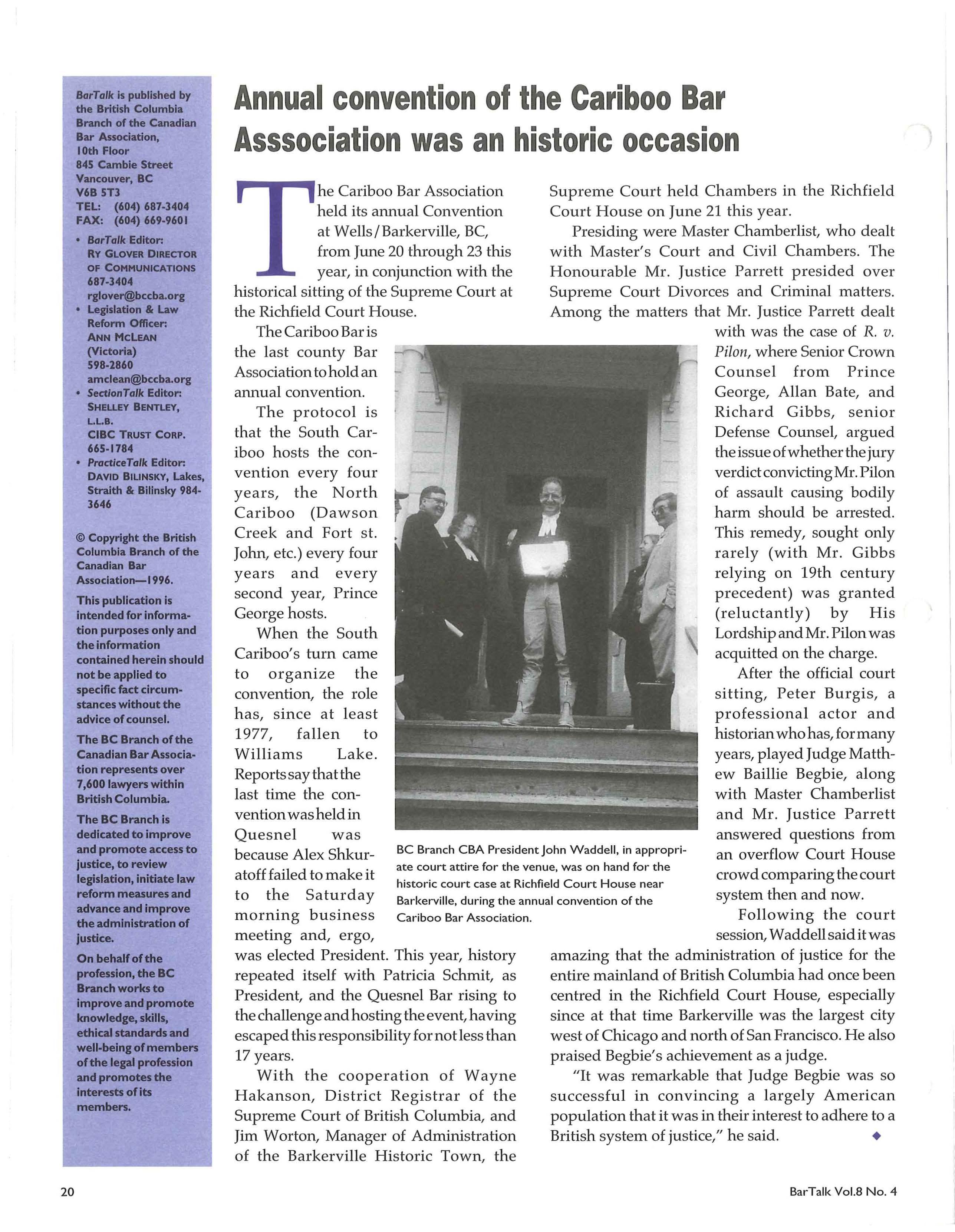
Supreme Court held Chambers in the Richfield Court House on June 21 this year
Presiding were Master Chamberlist, who dealt with Master's Court and Civil Chambers. The Honourable Mr. Justice Parrett presided over Supreme Court Divorces and Criminal matters. Among the matters that Mr . Justice Parrett dealt with was the case of R. v Pilon, where Senior Crown Counsel from Prince George, Allan Bate, and Richard Gibbs, senior Defense Counsel, argued the issue of whether the jury verdict convicting Mr. Pilon of assault causing bodily harm should be arrested This remedy, sought only rarely (with Mr. Gibbs relying on 19th century precedent) was granted (reluctantly) by His Lordship and Mr . Pilon was acquitted on the charge.
After the official court sitting, Peter Burgis, a professional actor and historian who has, for many years, played Judge Matthew Baillie Begbie, along with Master Chamberlist because Alex
atoff failed to make it
to the SaturdaY Barkervi
during the
of the morning business
and Mr. Justice Parrett answered questions from an overflow Court House crowd comparing the court system then and now
Following the court meeting and, ergo, was elected President. This year, history repeated itself with Patricia Schmit, as President, and the Quesnel Bar rising to the challenge and hosting the event, having escaped this responsibility for not less than 17 years
With the cooperation of Wayne Hakanson, District Registrar of the Supreme Court of British Columbia, and Jim Worton, Manager of Administration of the Barkerville Historic Town, the
session, Waddellsaiditwas amazing that the administration of justice for the entire mainland of British Columbia had once been centred in the Richfield Court House, especially since at that time Barkerville was the largest city west of Chicago and north of San Francisco He also praised Begbie's achievement as a judge.
"It was remarkable that Judge Begbie was so successful in convincing a largely American population that it was in their interest to adhere to a British system of justice," he said.
Shkur- BC Branc h CBA Presi d e nt John Wadde ll , in app