Mortgage Title Insurance program continues to grow
and Law Society of SC work together on joint concerns
The legal profession is responding on two fronts amid reports that more financial institutions involved in residential mortgage transactions have signed up for a title insurance program introduced last year in British Columbia.
The arrival of title insurance in British Columbia-the program uses new technology and techniques in the area of
could affect more than a third of the Bar's membership in the province.
SPECIAL REPORT
Branch Member Survey
See Pages 17-20
The increased acceptance of title insurance indicates competition in the field of residential mortgages is only going to get stiffer.
In 1996, First American Title Insurance Company signed up Canada Trust and since then, says, Gordon Alteman, First American's Pacific Region Director; the company has added Mutual Trust (the residential mortgage division of The Mutual Group), Surrey Metro Savings credit union and Household Realty.
Alteman declined to discuss specifics but did confirm that discussions are continuing with other financial institutions Other sources indicated that one and possibly two banks are also being wooed
With the value of lawyers' fees in residential real estate practice running to about $75 million ammally and statistics showing that more than 2500 members in BC do residential real estate work, the competition posed by the arrival of First American in this important practice area
the profession meets the competition head-on.
Spurred by the prospect of increased erosion of its h·aditional market share in real
Pinning down how many lawyers have been affected by title insurance to date is difficult. No one as yet has hard on how many lawyers have lost or are losing business as a result of title insurance. But at the rate institutions seem to be signing up, it seems inevitable things will only get tougher unless real estate law-triggered concern within the legal profession because it effectively cuts lawyers out of the real estate loop.
estate business, the profession has moved to examine the issue of technological change and is also seeking changes in legislation in order to protect the interests of borrowers or consumers.
The first initiative involves a review process involving a $40,000 study and the use of a consultant to do a feasibility evaluation of conveyancing technology. The review is a joint initiative of the CBA' s Real Property Section and the Law Society of BC' s Title Insurance Committee A tender call closed May 23 and it's expected that a consultant will be hired and work underway shortly after.
In tandem with the technology study, the CBA and LSBC committees are also working on revisions to the Practice Checklists Manual with a view to both developments in the law and cost efficiency, standard undertakings, standard (minimal) notes to adjustments, standard
Member survey indicates that most of you are satisfied
But more of you still need to be included in Branch activities
At the risk of being overtaken by events that none of us can anticipate, this column will NOT be about "No Fault"auto insurance. Although this has been an important fight for the Bar-and although it is still unresolved as we go to pressthere are a great many other matters that should be of concern to us. And one of the most important of these is the future of your professional association .
Early this year, in January and February, the firm of Campbell, Goodell Traynor Consultants Ltd conducted a phone poll of 600 of our members to determine how well you believe we ' re doing our job. I would like, by the way, to thank all of you who participated in this survey and took the time to respond to the many questions Your input was critical. It will be invaluable forme and your executive in planning for the future. You'll see more details about this survey on pages 17-20 of this BarTalk.
As for the re s ults of the survey, I am very pleased that most of you are, on the whole, pleased with the benefits and services provided by your Branch. I was deeply gratified to discover such a high level of satisfaction
Otherwise, the survey very clearly indicated what you liked and do not like about the services delivered by the Branch. In general, you like the Directory, BarTalk, Bar Fax and Section Activities. You ' re notve1y enthusiastic--or you don't know a great deal-about Midwinter Meetings, Diala-Law and Law Week.
I think the distinction between what you say you like and your know ledge ofBranch services and events is an important one-and one that we must address. For example, I happen to believe that our Practice Advisory Panels p r ogram is one of the Branch's most valuable services. These panels include lawyers from a variety of specialities who have volunteered to provide help to fellow members free of charge.
On one occasion, when faced with a media interview, I myself took advantage of this service and was greatly assisted by Kim Floeck of the
Wills & Estates Practice Advisory Panel. This service costs the Branch very little to administer and provides you with a great source of expert help, when you need it.
Unfortunately, according to the survey, a whopping 54 per cent of you knew very little or nothing about this service. I can't help but believe that, if more of you knew about these panels, more of you would take advantage of them
Similarly, 35 per cent of you indicated that you knew little or nothing about our Legislation and Law Reform program. Yet I know, from many members who've spoken to me, that Ann McLean's Legislative Update is one of Bm·Talk 's most valued features-and that feature is part of our Legislation and Law Reform program . So we've discovered that we must not only provide excellent services but we must also adequately promote and identify them, if you are to value them or even simply take advantage of them. We shall do so
We shall also continue in our efforts to involve more of you in Branch activities. Since becoming president, one of my very special ambitions has been to "open up" the Branch to a greater number and variety of people. To this end, earlier this year we sent out two special issues of BarFa x asking for volunteers to serve on committees associated with the Branch and National CBA or with outside organizations related to the justice system
I am very pleased to report that your response was positive and enthusiastic. To our call for volunteers to serve on Branch committees and other local justice organiz ations, we received 80 replies, complete with curricula vitae. And 53 of you volunteered to serve on National CBA committees . Best of all, CBA Executive Assistant Barb Murphy reported that nearly all of those who replied were unknown to her. Fresh blood and welcome! Our Branch stands the best chance of a healthy future by drawing on the widest possible pool of our membership . I wish all of you the best of luck in the nomination process.
The Twelve Deadly Sins or.... Speeding your desk order divorce through the process
The Honourable Mr Justice Preston and the Honourable Madam Justice Allan recently addressed the New Westminster Family Section about how to avoid having your client's desk order divorce race through the Divorce Registry at a snail's pace. What follows is the Honourable Judges' list of the twelve deadly desk order divorce sins;
1. Orders Awarding So le Custody but Joint Guardianship Judges are divided on the issue of whether to refuse to split custody and guardianship on the basis of the principles set out in Anson v. Anson (1987), 10 B.C.L.R. (2d) 357 (S .C.) or to permit such a split either on principled grounds or on the basis that its "feel good" effects upon the non-custodial parent justify any legal dichotomy. Counsel understandably recognise the psychological value of the label "joint guardianship" in reassuring the spouse who may see himself or herself as "losing" custody that he or she can play a real participatory role in the ongoing development of the children . Presumably, this enhances counsel's ability to resolve a certain number of custody disputes in a relatively amicable fashion. However, in a social climate in which orders are increasingly the subject of enforcement by police officers, precision respecting the rights conferred by an order is often critical.
Master Joyce has developed a model form of order for joint guardianship when one party is granted sole custody. No single form of order will be appropriate in all circumstances. However, if this definition accords with the parties' wishes, its incorporation in the desk order will avoid rejection because custody and guardianship are split. Master Joyce's model order reads:
"the parties shall share joint guardianship of the child Joint guardianship shall for the purposes of this order be defined as follows:
(1) the parents are to be joint guardians of the estate of the child;
(2) in the event of the death of either parent, the remaining parent will be the sole guardian of the person of the child;
(3) the custodial parent, who has the primary responsibility for the day-to-day care of the child, will have the obligation to advise the other parent of any matters of a significant nature affecting the child;
(4) the custodial parent will have the obligation to discuss with the other parent any significant decisions which have to be made concerning the child, including significant decisions concerning the health (except emergency decisions), education, religious instruction and general welfare of the child;
(5) the parent who does not have custody will have the obligation to discuss the foregoing issues with the custodial parent and each parent shall have the obligation to try to reach agreement on those major decisions;
(6) in the event that the parents cannot reach agreement with respect to any major decision despite their best efforts the custodial parent shall have the right to make such decision;
(7) the non-custodial parent shall have the right, under s.32 of the Family Relations Act, to seek a review of any decision which that parent considers contrary to the best interests of the child;
(8) each parent will have the right to obtain information concerning the child directly from third parties, including teachers, counsellors, medical professionals and third party care-givers.
2. Discrepancy Between the Relief Sought in the Petition and the Order
The relief claimed in the Petition must be disposed of somehow. It can be granted, withdrawn, settled dismissed or adjourned. There are three ways of
cross/sections
Section activity for the 1996-97 year concludes at the end of June To date
61 Br anch Sections have held 335 meetings and produced 214 sets of minutes Approximately 3,600 members have enrolled to receive notices only or notices and minutes of at least three Sections A new Women Rainmakers Section in Victoria was approved at the last Provincial Council meeting and will be listed on the 1997-98 BC Branch enrollment forms which will be mailed out in july to the complete membership Watch for it 1
cross/sections is a new feature dedicated to section news We welcome news from any CBA section Call Fran Hodgkins at 687-3404 or 1888-687 -3404 if you ' re outside the Lower Mainland
The Twelve Deadly Sins
Continued from page 3
dealing with the abandonment of the corollary relief claimed in the Petition:
• dismissal by consent in the order;
• abandonment by praecipe filed by the Petitioner;
• abandonment by letter to the Regi s try signed by the Petitioner or his or her counsel.
3 Ad j o urn ment of t he Coro ll ary Re li ef
Adjournment of the corollary relief is a two -step process. The judge must satisfy himself or her s elf, pursuant to section 49, that it is appropriate to divide the proceeding and deal with the divorce separately from the corollary relief.
A desk order divorce will generally not be granted and the other relief adjourned unless material filed indicates that the other party consents to it or, at a very minimum, is aware of it and does not oppose it. Even where it is clear that both pa r ties consent to the splitting of the relief, the material must generally provide some reason for granting a divorce and adjourning the balance of the relief Remarriage plans of one or both of the parties is one obvious reason for dividing the relief. Another good reason is where the other party's whereabouts are unknown.
Often a draft order contains a clause adjourning corollary relief for no apparent reason. For example, where the parties have, since the filing of the Petition claiming Family Relations Act relief, executed a separation agreement or minutes of settlement purpo r ting to settle all outstanding issues, itis inappropriate to seek an order which suggests on the face of it that there are issues remaining unresolved
4. Re stri ction s on th e O blig ation to Pay
C hild S upport
Agreements or orders regarding child support must be at least as generous as the Divorce Act . Many draft orders which a r e submitted inappropriately restrict the child maintenance obligation.Forexample,anagreementproviding for support for the child as long as he or she lives with the custodial parent does not allow for attendance away from home for seconda r y education and, accordingly, it is unacceptable
Problems frequently arise from using the following type of precedent for the definition of the child maintenance obligation in the separation agreement:
"The Respondent will pay maintenance to
the Petitione r fo r the support of the child, Johnnie Doe, in the sum of $500 per month commencing January 1, 1997 and continuing until the occurrence of the fi r st of the following events: The child
a) marrie s,
b) cea se s to live with th e Petitioner, c) attains the age of 21 years,
d) become s self-supporting.
If thi s wording is used in the sepa r ation ag r eement then when the time comes to appl y for a desk orde r divo r ce the paying s pouse will be confronted with the effect of Practice Direction #7 which impo ses a g reater obligation than he or she bargained for. That spouse may not be willing to cooperate
5. U ne nfo rceab le Prov is ions
Some counsel wish to incorporate the provi sion s of the separation agreement into the order . Thi s is a difficult ta s k undertaken at the draft e r' s peril. The wording of many terms of the separ a tion agreement s def y translation into enforceable orde rs. A p r ovi sion such as the following will re s ult in rejection of a d r aft orde r : "THIS COURT FURTHER ORDERS that the parties undertake to attempt at all times to exert their best efforts to cooperate in maximizing the best interests of the child."
Inclusion of only the mo s t important provisions of the separation agreement in the order, or reliance on the s eparation agreement separately, is usually the best route to an order that will avoid rejection . A separation agreement can always be filed as an order of the Court if enforcement becomes a problem .
6. Th e R is k of Judici a lly Abo li s hin g T hird
Pa rty Rig ht s
Usually the provisions that r isk rejection on this ground are those that deal with property and debts. An example of a provision which inappropriately expresses a property interest is: "THIS COURT ORDERS that all right, title and interest in and to the matrimonial home situate at 1234 West Avenue in Vancouver shall vest in the wife absolutely."
The obvious question is whether the mortgagee might be judicially removed from title. An order that the hu sband convey his interest in the matrimonial home to the wife is appropriate.
The following order is frequently sought with respect to payment of debts:
"THIS COURT DECLARES that the
Respondent sha ll be solely responsible for payment of the $50,000 personal loan from the Willingdon Branch of the Bank of Montreal."
The order should read that "as between the parties, the Respondent shall be responsible for the payment of the indebtedness."
7. Defects in the Affidavit of Service
A surprising number of desk order divorces are rejected because of a defect in the affidavit of service. The most commonly rejected phrases used in affidavits are:
"The person served admitted that he was the Respondent and the proper party to be served."
"The person served produced a drivers licence# 123456 which bore his photograph."
Practice Direction #3, Part II sets out the requirements for the identification of the party:
"Where the affidavit of service does not have a photograph of the Respondent spouse as an exhibit, it is insufficient proof of service for the process server merely to depose that the person served admitted he was the Respondent and the proper person to be served. Some means of identification must be shown in addition to the simple admission, e g., "that the person produced aBC Driver's Licence #123456 in the name of (the Respondent) and the photograph thereon was a good likeness of the person I served."
8. Orders for Divorces "Forthwith"
In many cases "forthwith" orders are rejected as inappropriate. When counsel submit an applicationfor a "forthwith" orderunders.12(2) of the Divorce Act, it would be prudent to submit an alternative form of order in the usual form so that rejection and the resulting delay do not compound an already difficult situation. A letter should accompany the material making it clear that the alternative order is submitted in case the "forthwith" order is not appropriate.
Re-marriage as a reason for urgency is often refused by the judge dealing with the desk order divorce unless the wife is pregnant.
9. References to Other Documents in the Child Support Fact Sheet
It is inappropriate to fill out sections of the Child Support Fact Sheet with the words "see Petitioner's property and financial statement" where, for example, the form requires that the Petitioner's income and expenses be set out.
10. Use of Grounds Other than Living Separate and Apart for at Least a Year
Section 8(2) of the Divorce Act sets out alternate
grounds for divorce: adultery and physical or mental cruelty. Unless there is compelling independent evidence, usually from a medical practitioner, it is unlikely that the Petitioner can establish cruelty as a ground for divorce. Where the marriage is of a very short duration, a Petition based upon allegations of adultery or uncorroborated allegations of cruelty is not likely to be successfully processed as a desk order divorce.
11. Miscellaneous Contents of Orders
Other common reasons for rejection are :
a) Frequently orders for child maintenance are expressed to be made under the "Divorce Act (Family Relations Act) or otherwise at law".
The order must specify the enactment pursuant to which the maintenance is being granted.
b) Orders must not include provisions for retroactive maintenance.
c) If the order grants joint custody it should specify the primary residence of the children.
12. The Notice Issue
Desk orders specifying maintenance or other relief of which adequate notice has not been given in the Petition will not be granted. Where the Petition does not specify the amount of maintenance claimed but the order does, qr where the corollary relief sought in the order differs from that claimed in the Petition, the order will only be made by consent.
COPIES AVAILABLE
For a full copy of the 16-page paper from which this report has been abridged should contact Fran Hodgkins at the B C. Branch, C. B A. office. +
What does "Per Stirpes" REALLY mean anyway?
Mary Hamilton addressed the Wills and Trusts Subsection with some eye opening comments about the use of the term "per stirpes". Her remarks centred on the case of Hamel Estate, (1995) 9 E.T. R. (2d) 315 (B.C.S.C.), a decision of Mr. Justice Meiklem. In Mary's opinion this case demonstrates why even professional drafters of wills, such as solicitors, should stay away from the term "per stirpes", even if we believe we know what it means. Quite often the Court may re-interpret it in a different fashion than our
The problem with "Per Stirpes "
Continued from poge 7 client's instructions.
In this particular case the deceased died at the age of 93 leaving five children all alive, 13 grandchildren and 33 great-grandchildren . The deceased died with a will drawn by a solicitor in which the residue was dealt with as follows:
"Hold residue in trust for my issue alive at my death in e qual shares per stirpes "
There was also a clause providing that each share for such issue be held in trust until that issue reached the age of 19 The question to be asked was; Was the residue to be divided among the deceased's five children or among the entire group of 51?
Mr. Justice Meiklem reviewed the two lines of cases. In the Ontario decision of Re :
Ha rri ngton Es ta te (Ont. CA. , 1986) the Court concluded that " issue per s tirpes" meant the children and issue of any deceased children. The other line of ca ses 'which followed Re:Linkl ate r Estate (B.C.C.A. , 1967) interpreted the phrase "equally per stirpes among my issue then alive" to mean all descendants in all degrees and not to the children only
Mr. Justice Meiklem found that the term "per stirpes" u s ed in the will of the decea s ed had to be con s trued to benefit a ll the te s tator ' s de s cendants who were alive at her death in equal ·sh ar es Therefor e the e s tate was to be divided equally among the 5 1 beneficiaries. Cost s of the application were awarded to all of the parties.
Thi s cases raises an important practice point. Will drafters should use PLAIN LANGUAGE to say what they mean. By using the term per stirpe s one may end up with an undesired result. •
Two new programs introduced by Canadian Bar Insurance Association
The Canadian Bar Insurance Association is pleased to announce the introduction of Two New Insurance Programs : Individual Extended Health Care and Permanent Life Insurance
Responding to the needs of Canada's legal profession, the Canadian Bar Insurance Association recently announced the introduction of two new insurance plans. The first, an Individual Extended Health Care Plan, has long been awaited by sole practitioners and others whose practices couldn't qualify for group insurance benefits. This is a medically · underwritten plan which provides coverage for Private Hospital Rooms, Prescription Drugs, Major Services such as Ambulance, Nursing, Hearing and Foot Care, as well as the services of other Health Care Practitioners, and some limited Out of Province coverages. The plan will feature a "drug card" which will allow the insured to purchase prescription drugs simply by presenting the card to a participating pharmacy and paying the coinsurance amount. Coverage is available exclusively to CBA members, their spouses and dependent children at a very affordable price.
In addition to the Individual EHC program, the CBIA has also developed, in conjunction with Aetna Canada, a Guaranteed P e rmanent Life Insurance Plan. Available exclusively to members of the legal profession, their employees
and spouses, this very competitively priced level premium individual life insurance plan is designed to provide a benefit at death regardless of when if occurs. It has been designed so that the policy is fully paid up at age 65 or after 20 years, whichever is later At this point, Cash Surrender Values are available should you decide to surrender your coverage. An excellent estate planning tool, permanent life insurance coverage helps you to preserve your estate by providing cash at death so that your estate can pay its taxes instead of having to liquidate stocks, sell cottages or dispose of other valuable assets.
For more information, please contact: Eric B. Mass, CFP, CLU, CHFC orSamuelJ Esaw, CLU Ph: (604) 688-8790 Fax: (604) 688-8106 •
Promote loca l events through BarF ax
If your local Bar association has an event you ' d like to publicize, you might be able to take advantage of a targeted Ba rFax for your area. With the help of the Branch's sophisticated database system, we can target communities throughout the province to notify members of upcoming events.
To see whether you qualify, call Branch Director of Communications Ry Glover. •
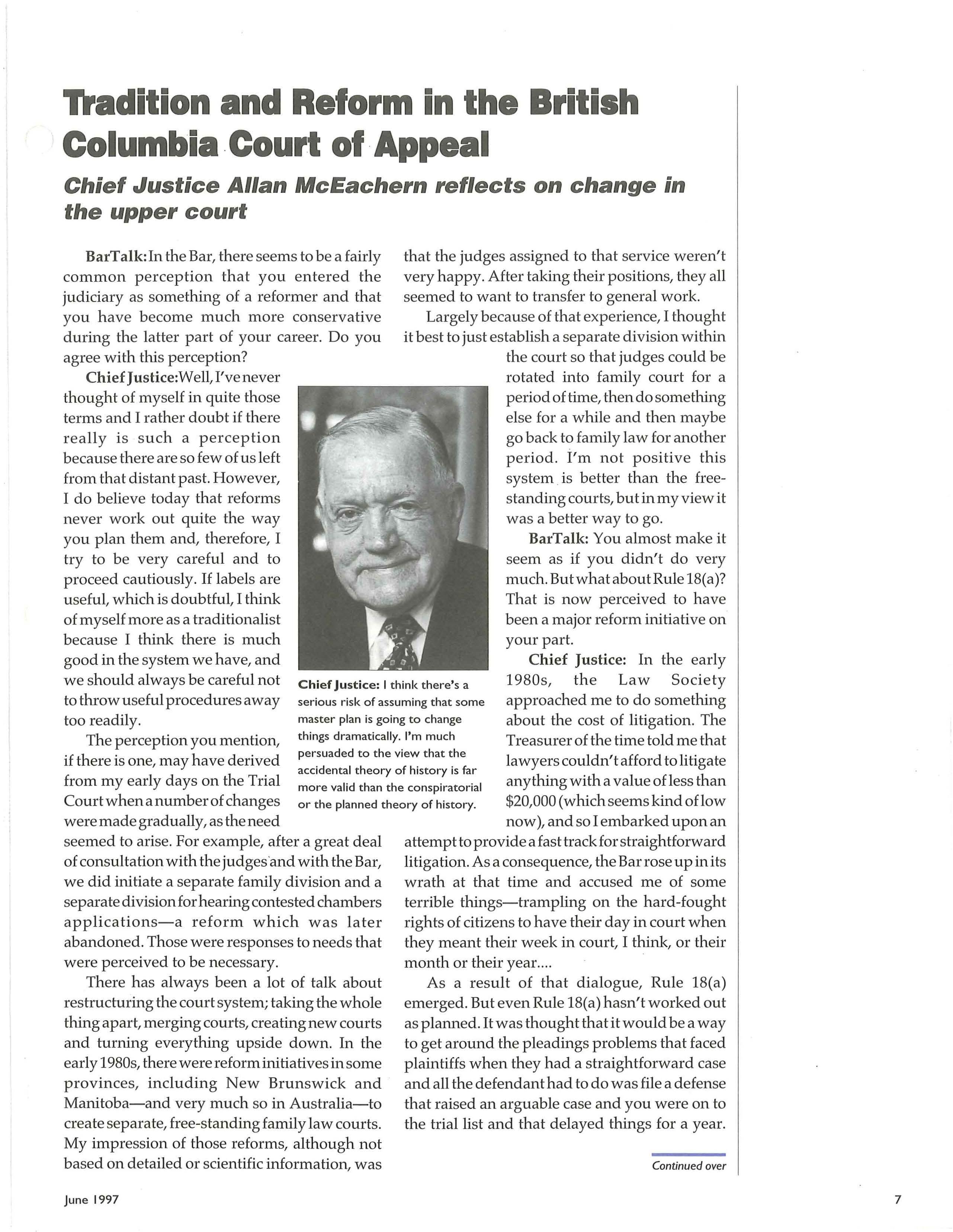
Tradition and Reform in the British Columbia .Court of ·Appeal
Chief Justice Allan McEachern reflects on change in the upper court
BarTalk: In the Bar, there seems to be a fairly common perception that you entered the judiciary as something of a reformer and that y ou have become much more conservative during the latter part of yo ur career. Do you agree with this perception?
ChiefJustice:Well,I'venever thought of myself in quite those terms and I rather doubt if there really is s uch a perception because there are so few of us left from that distant past. However, I do believe today that reforms never work out quite the way you plan them and, therefore, I try to be very careful and to proceed cautiously. If labels are useful, which is doubtful, I think of myself more as a traditionalist because I think there is much good in the system we have, and
that the judges assigned to that service weren't very happy. After taking their positions, they all seemed to want to transfer to general work.
Largely because of that experience, I thought it best to ju s t establish a separate division within the court so that judges could be rotated into family court for a period of time, then do something e l se for a while and then maybe go back to family law for anoth er period. i'm not positive this system is better than the freestanding courts, butinmyviewit was a better way to go.
BarTalk: You almost make it seem as if you didn't do very much . But what about Rule 18(a)? That is now perceived to have been a major reform initiative on your part.
we should always be careful not Ch ie f Justice: 1think there's a
to throw useful procedures away too readily.
serious r isk of assuming that some master plan is going to change things dramatically I'm much
The perception you mention, h h pe rsuaded to the view that the if t ere is one, may ave derived accidental theory of hi story is far from my early days on the Trial more valid than the conspiratorial Courtwhenanumberofchanges or the planned theory of history were made gradually, as the need seemed to arise For example, after a great deal of consultation with thejudges ·and with the Bar, we did initiate a separate family division and a separate division for hearing contested chambers applications-a reform which was later abandoned. Those were responses to needs that were perceived to be necessary .
There has always been a lot of talk about restructuring the court system; taking the whole thing apart, merging courts, creating new courts and turning everything upside down. In the early 1980s, there were reform initiatives in some provinces, including New Brunswick and Manitoba-and very much so in Australia-to create separate, free-standing family law courts. My impression of those reforms, although not based on detailed or scientific information, was
Chief Justice: In the early 1980s, the Law Society approached me to do something about the cost of litigation. The Treasurer of the time told me that lawyers couldn't afford to litigate anything with a value of less than $20,000 (which seems kind oflow
now), and so I embarked upon an attemptto provide a fast track for straightforward litigation. As a consequence, the Bar rose up in its wrath at that time and accused me of some terrible things-trampling on the hard-fought rights of citizens to have their day in court when they meant their week in court, I think, or their month or their year.
As a result of that dialogue, Rule 18(a) emerged. But even Rule 18( a) hasn't worked out as planned It was thought that it would be a way to get around the pleadings problems that faced plaintiffs when they had a straightforward case and all the defend an t had to do was file a defense that raised an arguable case and you were on to the trial list and that delayed things for a year.
In conversation with Chief Justice Allan McEachern
Continued from poge 7
Rule 18(a) was thought to be the answer to that arid while I'm not the father of Rule 18(a), I may be the grandfather because my initial initiatives,
compare with the situation in British Columbia?
Chief Justice: It's really a question of how you're calculating the waiting period. If you calculate it from the date of the notice of appeal or the trial judgment, it's well over a year, which is far too long. But if you are calculating it from the time when the factum is filed, it's five to six months . The main cause of delay in appeals is taken at the request of the Bar, were to provide some vehicle to move these straightforward cases along more expeditiously.
Whatwehavefound, though, is that 18( a) has not been confined to the rather narrow cases that we had in mind when it was initiated . It's now used in major litigation and it seems that about half of the cases are now decided under Rule 18(a). I'm not sure that it's always suitable for major litigation, but on balance it's been a very positive step, I think. It has saved a lot of delay and a lot of expense and gets some classes of cases tried very quickly.
But these reforms were incremental and they were not the result of any reforming zeal. I think there's a serious risk of
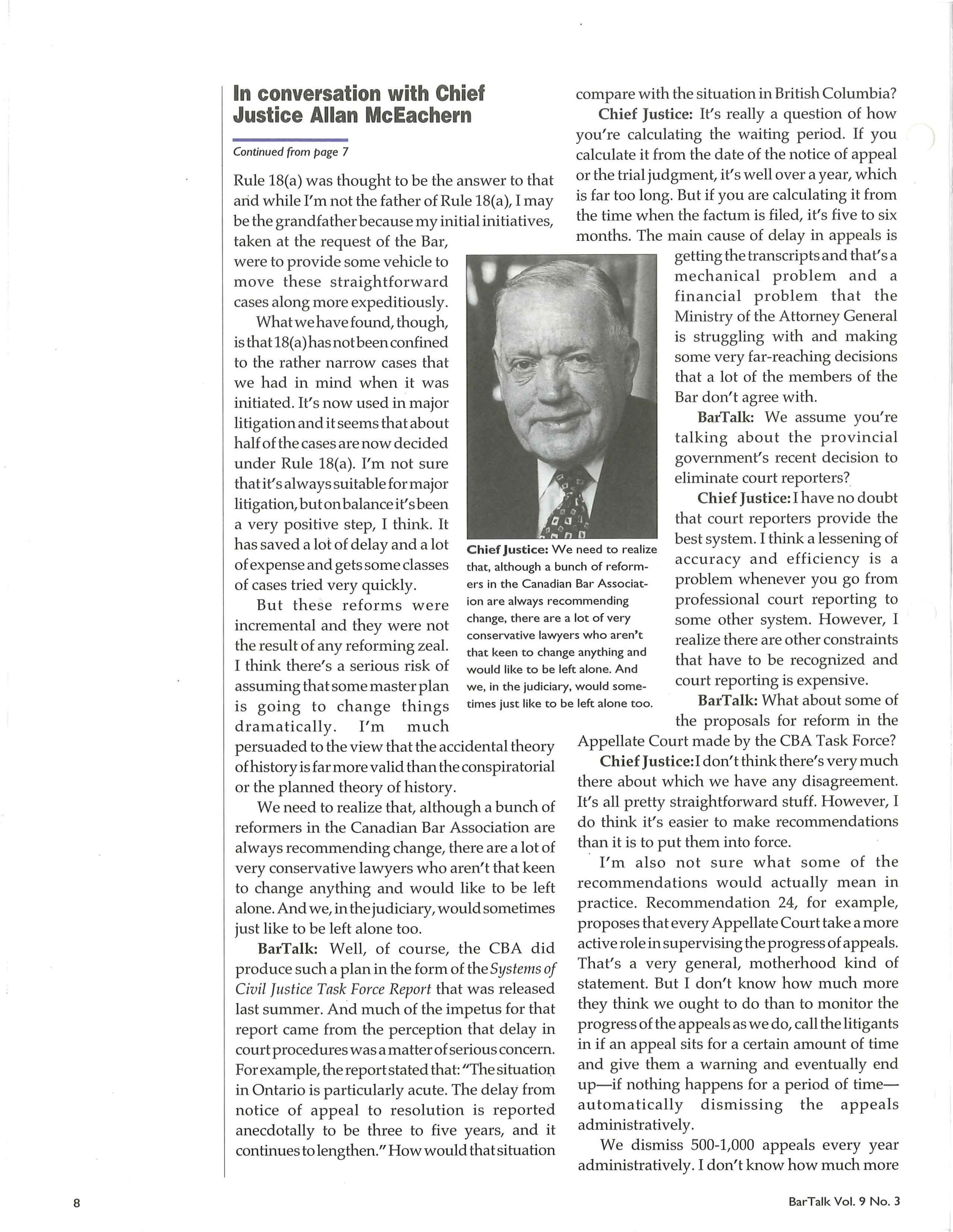
ion are always recommending change, there are a lot of very conservative lawyers who aren't that keen to change anyth ing and would like to be left a lone And assumingthatsomemasterplan we, in the jud iciary, wou ld someis going to change things t imes just like to be left a lone too.
getting the transcripts and that's a mechanical problem and a financial problem that the Ministry of the Attorney General is struggling with and making some very far-reaching decisions that a lot of the members of the Bar don't agree with.
BarTalk: We assume you're talking about the provincial government's recent decision to eliminate court reporters?
Chief Justice: I have no doubt that court reporters provide the
Chief Justice: W e need to rea lize best system. I think a lessening of accuracy and efficiency is a that, a lthoug h a bu n c h of reformproblem whenever you go from professional court reporting to some other system. However, I realize there are other constraints that have to be recognized and court reporting is expensive. ers in the Canad ian Bar Associat-
BarTalk: What about some of the proposals for reform in the Appellate Court made by the CBA Task Force? dramatically. I'm much persuaded to the view that the accidental theory ofhistory is far more valid than the conspiratorial or the planned theory of history.
We need to realize that, although a bunch of reformers in the Canadian Bar Association are always recommending change, there are a lot of very conservative lawyers who aren't that keen to change anything and would like to be left alone. And we, in the judiciary, would sometimes just like to be left alone too.
BarTalk: Well, of course, the CBA did produce such a plan in the form of the Systems of Civil Justice Task Force Report that was released last summer. And much of the impetus for that report came from the perception that delay in court procedures was a matter of serious concern. For example, the report stated that: "The situation in Ontario is particularly acute . The delay from notice of appeal to resolution is reported anecdotally to be three to five years, and it continues to lengthen " How would that situation
Chief Justice: I don't think there's very much there about which we have any disagreement. It's all pretty straightforward stuff. However, I do think it's easier to make recommendations than it is to put them into force.
I'm also not sure what some of the recommendations would actually mean in practice. Recommendation 24, for example, proposes that every Appellate Court take a more active role in supervising the progress of appeals. That's a very general, motherhood kind of statement. But I don ' t know how much more they think we ought to do than to monitor the progress of the appeals as we do, call the litigants in if an appeal sits for a certain amount of time and give them a warning and eventually end up-if nothing happens for a period of timeautomatically dismissing the appeals administratively.
We dismiss 500-1,000 appeals every year administratively. I don't know how much more
active than that we ought to be-especially since certain senior lawyers in this province take great offense when any of their appeals are put on any inactive list. They say: "Why should you assume that because we haven't filed our factums that we're not aggressively pursuing this matter with our friend to try and arrange a compromise? Why do you stick your nose into something that's not causing you any trouble?"
I have considerable sympathy for that response. The court, however, is only reacting to the criticisms we're getting that some appeals are long-delayed . I think the view is that we ought to be pushing the lawyers along more than we do. I think, though, that if you asked a representative group of lawyers about this issue they would say that we're active enough in the
why don't the judges recognize this and why don't they recognize that?"
I merely wanted to remind people making those kinds of statements, and the public, that judicial decisions are not made according to the whims of individual judges. We are expected to apply the law. We hear people who should know better complaining about a "dumb" decision without even considering whether it was a decision that the law requires. For example, there was quite an interesting debate recently about the release of an accused on bail. Thedebatethatwentonoutside the judiciary and outside the legal profession didn't pay any attention at all to what the Criminal Code lays down about bail.
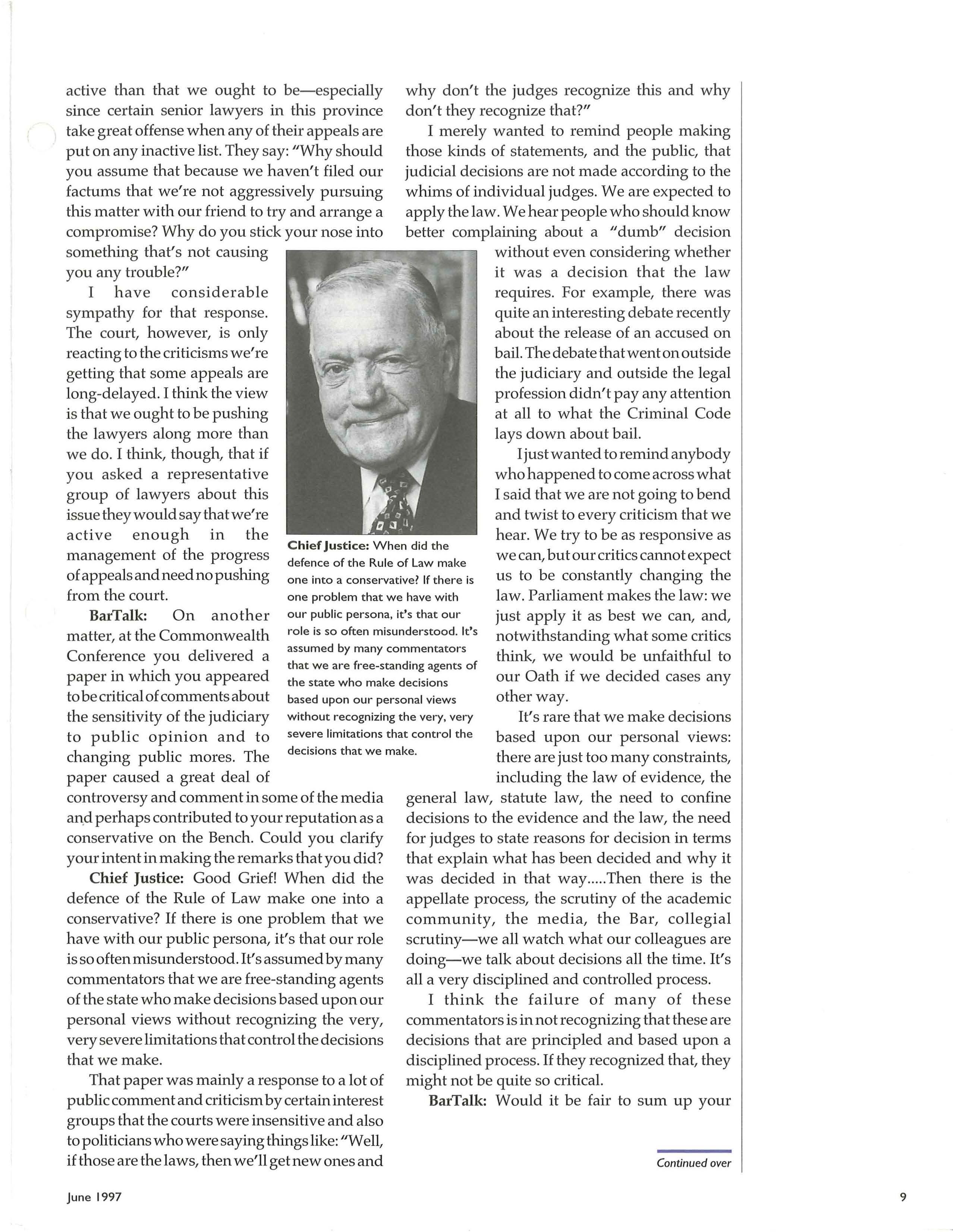
Chief Justice: When did the management of the progress defence of the Ru le of Law make
I just wanted to remind anybody who happened to come across what I said that we are not going to bend and twist to every criticism that we hear . We try to be as responsive as we can, but our critics cannot expect us to be constantly changing the law. Parliament makes the law: we just apply it as best we can, and, notwithstanding what some critics think, we would be unfaithful to our Oath if we decided cases any other way of appeals and need no pushing one into a conservative? If there is from the court. one problem that we have w ith
BarTalk: On another our public persona, it's that our matter, at the Commonwealth ro le is so often misunderstood. It's d I assumed by many commentators Conference you e ivered a that we are free-standing agents of paper in which you appeared the state who make decisions to be critical of comments about based upon our personal views the sensitivity of the judiciary without recogn izing the very, very to public opinion and to severe limitations that control the changing public mores. The decisions that we make
It's rare that we make decisions based upon our personal views: there are just too many constraints, including the law of evidence, the paper caused a great deal of controversy and comment in some of the media an.d perhaps contributed to your reputation as a conservative on the Bench. Could you clarify your intent in making the remarks that you did?
Chief Justice: Good Grief! When did the defence of the Rule of Law make one into a conservative? If there is one problem that we have with our public persona, it's that our role is so often misunderstood . It's assumed by many commentators that we are free-standing agents of the state who make decisions based upon our personal views without recognizing the very, very severe limitations that control the decisions that we make.
That paper was mainly a response to a lot of public comment and criticism by certain interest groups that the courts were insensitive and also to politicians who were saying things like: "Well, if those are the laws, then we'll get new ones and
general law, statute law, the need to confine decisions to the evidence and the law, the need for judges to state reasons for decision in terms that explain what has been decided and why it was decided in that way Then there is the appellate process, the scrutiny of the academic community, the media, the Bar, collegial scrutiny-we all watch what our colleagues are doing-we talk about decisions all the time. It's all a very disciplined and controlled process.
I think the failure of many of these commentators is in not recognizing that these are decisions that are principled and based upon a disciplined process . If they recognized that, they might not be quite so critical.
BarTalk: Would it be fair to sum up your
In conversation with Chief Just ice Allan McEachern
Continued from page 9
comments at that time by saying that you were concerned that the independence of the judiciary might be threatened by this kind of public and political pressure?
Chief Justice: Yes, but, it's more than that. It's not a question about whether we are protected from pressure or that our independence be preserved. Our independence is not threatened in any way that I see as long as we stand firm and say: "We will apply the law as we see it." My only response to that kind of criticism is that it is often based upon a misunderstanding of what our process is and a failure to recognize that ours is a disciplined process and not based upon personal views or personal predilections or attitudes about one kind of case as against other kinds of cases
BarTalk: What about other reforms that are, perhaps, simpler and based more upon the human aspects of the judiciary? There have been suggestions, for example, that judges should be appointed to a fixed term to the Bench, instead of life. Some say that a fixed term would encourage the recruitment of younger lawyers to the Bench It would also allow judges to return to active private practice earlier in their lives.
Chief Justice: I think fixed terms would be a very dangerous development that would destabilize the Bench. Good judicial material would not accept such a term because they would not know what would happen to them when their term was up, and everyone cannot just pick up his or her practice where they left off. Moreover, independence would be at risk if judges were thought to be making friendly decisions in hope of re-appointment. Others might welcome appointment for a fixed term for the wrong reasons, such as resume enhancement, and others might not have the commitment that we expect of our judges now. I'm still of the view that when you go on the Bench it should be for the rest of your professional life or up to age 75. I don't want to stop somebody from having a professional life after 75, but I think that the judiciary is and should be a stable institution. I don't think there should be comings and goings I think that one should stay as long as one can comfortably and competently continue to do the job. I recognize that there may be individual
circumstance s where a judge would feel that he or she has been in the job long enough and wants to move on. I can't question that or di s agree with it. From the institutional point of view, I do believe that when lawyers join the Bench, they should do s o with the expectation that they are making a career decision that will last until retirement.
I realize that some people think 10 years is enough. The judges of the Supreme Court of Canada, for example, have obtained an amendment to the Judge's Act to permit them to leave on pension after 10 year s on that Bench and 15 years of judicial service They think 10 years is enough for some of them . That's not to say that they're all going to leave after 10 years- they just want that option. But I'd rather not comment on the Supreme Court of Canada . Also, don't forget there's a small problem of the Constitution There is no provision for fixed judicial terms in Canada except mandatory retirement at age 75. That's a detail that the reformers should not overlook.
BarTalk: We can certainly understand the need for stability on the Bench. However, we are concerned that some very worthy people may balk at making a lifelong commitment to the Bench. After all, it's a very serious decision, almost like taking religious orders Perhaps we'd attract more of the better and brightest if people felt there was a limit to their term
Chief Justice: I do not accept for a moment that you would get better and brighter people with a fixed term. You would lose more than you would get. I agree that life changes when you join the Bench-there are differences-but I don't think that life changes all that much, unless you want it to change One can become a hermit or a hermitess, or whatever the correct term is, but one is not obliged to do so. I don't think our children suffer from it, but our spouses may find it more restrictive than we do. Speaking for myself, though, I think that generations of judges have created a bit of a myth about the monastic life that they have to lead, I just don't think it's necessarily true, although some may choose to make it so.
BarTalk :Your comments about judicial terms might provide further ammunition for those who would label you a conservative. However, there is one area in which we believe you are perceived by many to be a fervent reformer. You have been a very aggressive proponent of increased computer technology and the Internet. Arguably, the Court of Appeal has led the way in this
direction. Why have you supported this new technology so enthusiastically?
Chief Justice: There is an enormous amount of paper involved in the judicial process. I don't think we should aspire to be like some American courts which claim to be evolving quickly into paperless courthouses. But when you look at the transcripts in a long trial and realize how little of it is used on an appeal and how much of it can be summarized in a few excerpts, you realize what a terrible waste there is. The computer and other electronic means of management make it possible to reduce that to a very, very marked degree and I haven't any doubt at all that the computer will be an enormous aid to reducing cost and hastening litigation along.
But it's a slow process . In the World Wars, it was said that a convoy only moves at the speed of the slowest ship. We have to get the Bar up to speed because until the Bar is computerized entirely, we'll have to run a dual system. I think we have to get out in front as much as we can and try to drag the Bar along with us. Some parts of the Bar are ahead of us, but most of the Bar is astern of us and I have every expectation that just the ordinary progress that goes on in the world will lead the Bar to recognize the need to become computerized and to take advantage of these new opportunities. We're not going to be a paperless courthouse, but I've said a few times that we should be a less papered courthouse.
BarTalk: We understand that you are concerned about the level of staffing in your court today.
Chief Justice: We have a logistical problem. I'm rapidly losing my supernumerary judges. I had 12 of them at one time and I'm down to seven now, I think, and I'm going to lose four more in the next couple of years. I just got two new regular judges who replaced the equivalent of four supernumerary judges.
Our complement is pretty well fixed and I don't think it's going to be increased much. I think the government believes we ought to streamline the process before we add many more new judges and therefore the few of us who are left behind are going to have to deal with whatever caseload comes along. I have to say this, though, that recently there's been a drop in the number of filings in the trial court and to a lesser extent in our Chambers work. That's explained by increased filing fees and by Rule 65 in the Supreme Court, which has reduced - temporarily at least- the number of
chamber applications and a major part of our work comes from chamber decisions including of course, all of those Rule 18(1) applications.
So, maybe our caseload won't increase and maybe our complement will be sufficient. That remains an unfolding mystery.
BarTalk: You are now 71 and in four years time will retire. What would you most like to be remembered for when you are no longer active on the Bench?
Chief Justice: I saw something the other day on the Internet about Oliver Wendell Holmes who said that we shouldn't expect too much and if at the end of our career three or four people say, "Well done," that's about as much as we should hope for. I don't think that we should expect to be remembered for anything in particular.
This job is a very attractive one, it has many, many advantages and it's an enormous opportunity for an interesting life. I've been particularly fortunate because I had 28 years of practice, busy practice, and now I've had 18 years on the Bench. That's two complete careers.
When I think: "Okay, now what do I want to be remembered for in practice?" I can't think of anything in particular. I had some satisfied clients and I had some dissatisfied clients. As for my experience on the Bench, well, the time has gone very quickly. But it's been a very satisfying and interesting way to spend my life. How can you ask for anything more than that?
BarTalk: Would you care to say anything to young lawyers who are just beginning their careers?
Chief Justice: I heard the other day that the universe will only unfold as it should if it was folded correctly in the first place. Well, I think the universe is properly folded, the students who are coming out are getting a great education and if they just keep working as hard as lawyers have always worked, the good ones will succeed and take the place of the good ones who have gone before them
BarTalk: Thank you very much for taking the time to talk with us. We've enjoyed it very much. •
Mortgage scheme grow ing
Continued from page I
retainer I search reporting letters to purchases and publishing guidelines to the profession that would set out the advantages of standardized practices and the risk entailed in failing to meet these standards.
The second initiative-undertaken by the Law Society-is a request to the provincial government to change the Consumer Protection Act and the Land Title Act in order to protect
Leg islat ive protect ion suggested for mortgage transact ions
The provincial government has been asked to change two laws to help protect consumers in residential mortgage transactions.
The proposed amendments to the Consumer Protection Act and the Land Title Act would ensure that borrowers who are at risk of being unduly influenced by others with different interests in residential mortgage transactions get legal advice.
Up until the introduction last year in BC of title insurance, such protection was traditionally available to BC consumers.
In most secondary financing mortgage transactions, both lenders and borrowers are represented by lawyers and therefore get legal advice . However, in title insured transactions, lenders buy title insurance to protect certain of their rights under the mortgages but borrowers, on the other hand, do not receive legal advice or protection under lenders' insurance.
The proposed changes would effectively protect borrowers in residential secondary financings without enacting sweeping legislative and regulatory requirements to cover the issuance of title insurance in the province. Many institutional lenders already make sure that borrowers who they consider to be vulnerable get legal advice on their transactions and the proposed changes would not impair the ability of institutions to prepare their own mortgages, which are documents for security on loans.
The bid by the Law Society of BC to change the laws stems from the practice requiring lenders in title insured transactions to require borrowers to sign a "Mortgagor's Acknowledgment". In this document, records that the lenders recommend legal advice (but the borrower declined) and notes that the borrower's interests are not protected.
Because lenders offe r costs savings only to those borrowers who decide not to take legal advice, there is considerable pressure for the borrower to sign the acknowledgment and not seek the advice of a lawyer, thus creating a power imbalance between the lending institutions and the borrowers. +
consumers who may be at risk in residential mortgage transactions. (See accompanying sidebar article )
The title insurance policies that lenders buy protect their interests, not those of the borrower, raising the issue of consumer protection as an area of concern to the Bar. Title insurance covers losses incurred by lenders r esulting from title defect problems, including losses due to forgery or fraud and defects which would have been discovered had an up -to - date survey been conducted prior to a mortgage loan being made.
The net result of the program is the elimination of the role traditionally played by lawyers, whose role in title insurance is merely to serve as a witness to the borrower's signature, thus meeting the requirements of the Land Title Act that mortgages be witnessed by "officers" before being registered.
The lawyers do not give legal advice whereas prior to the introduction of title insurance, borrowers in mortgage transactions in the vast majority of cases did get legal advice on their transactions.
Tony Spagnuolo, a member of the CBA' s Title Insurance Committee, says members of the profession who want to stay competitive and retain market share have to seriously look at taking advantage of new technology and new techniques.
"The ultimate goal must be to develop an interacticve conveyancing practice technology and software system in order to help lawyers stay at the forefront of real estate practice in the province, " Spagnuolo says.
While such systems may be expensive to develop and implement, if set up properly, documents can be processed and registered and loan proceeds made available within a matter of hours.
Technology is already an integral part of real estate law in Ontario, where the LPIC (the Lawyers' Professionallndemnity Company) has developed the TitlePlus program which includes template software for standard conveyancing documents, electronic checklists which must be completed before title defect insurance will issue, electronic links with lenders and in the future, land registrie s and training for lawyers and their staffs.
However, while the Ontario program will be evaluated, there's no indication whether any of its elements will lend themselves to use or adaptation here in BC
Law Courts Education Society's Fundraising Drive
Sponsors offered public relations opportunities
Law firms and individuals can now support public legal education and at the same time gain significant public relations opportunities for themselves by supporting the Law Courts Education Society's "Campaign 97. " This province-wide fundraising drive was launched after the Society's government funding was cut by approximately two-thirds.
Martin Taylor, Q.C., chair of the fundraising committee, says: "Firms and individuals can demonstrate their support of public legal education in this province by sponsoring one or more of our seven donor recognition opportunities."
General sponsors will have their support recognized in the tens of thousands of Society courtlists and general Society information handouts. Sponsors of specific programs will have their support prominently featured in that program's materials. For example, a sponsor can choose to support the printing and distribution of information on the justice system in any of eight languages to the Chinese, South
Asian, Hispanic, Polish, Korean, Persian, Arabic or Vietnamese communities.
Another option is for firms to sponsor threeday "Courtlink" sessions for either youth at risk or immigrant youth. These are local community events that help local youth understand how the justice system works; they include many publicity opportunities.
Sponsors can also choose to support educational rna terials or courtw a tching activities for adults and youth learning English as a second language. Or they can choose to support courtwatching sessions for up to 10 high school and elementary school classes in their local areas.
The Society's information is distributed to thousands of households arumally. Over the years, the Society staff have worked with more than 400,000 British Columbians
Tax receipts are available for all sponsorships . To obtain a copy of the Society's Donor Recognition Opportunities, contact Executive Director Rick Craig at (604) 660-9870 or by fax at (604) 775-3476 .
Arbitrators needed for proposed trial overflow program
The British Columbia International Commercial Arbitration Centre is looking for lawyers to act as arbitrators in cases bumped from the courts in a proposed newTrial Overflow Program. The purpose of the program, according to Centre Executive Director Peter Grove, is to provide efficient and less costly arbitration alternatives to civil litigants who cannot proceed with trials on their assigned court date due to lack of court facilities. The program will operate as follows:
• The Centre will act as the Secretariat to a "Roster Committee", made up of representatives of all interested sectors, administering a Roster of arbitrators who meet certain criteria. The Roster will be open to all arbitrators who meet specified criteria . The Committee will be responsible for the policy and management of decisions affecting the composition of the roster.
• The Centre will monitor the availability of arbitrators on a weekly basis;
• The Centre will keep informed on the trial schedule of the Courts;
• Requests for arbitration are to be made to the Centre which will immediately provide a standard form of
arbitration agreement, a list of available arbitrators, their qualifications, available meeting rooms and facilities. The clients and counsel will list the arbitrators in order of preference and the Centre will make the appointment. Requests can be made by phone or to a representative of the Centre who may be available in the Court house
The BC Government established the Centre in 1986 to provide the arbitration infrastructure set out in the Commercial ArbitrationAct and thelnternationnl Commercial ArbitrationAct. The Centre is one of the leading institutions in Canada providing a full range of neutral alternative dispute resolution services, both binding and non-binding. It provides information and referral without charge and administers arbitrations and mediations on a fee for service basis.
Lawyers who meet the minimum qualification of ten years at the bar and ten paid and completed arbitrations and who would like to be considered for the Roster of Arbitrators may obtain further information about the program by phoning 604 -684-2821 or faxing: 604 -6411250. In the event that the Program proceeds, those who have indicated an interest will be contacted . +
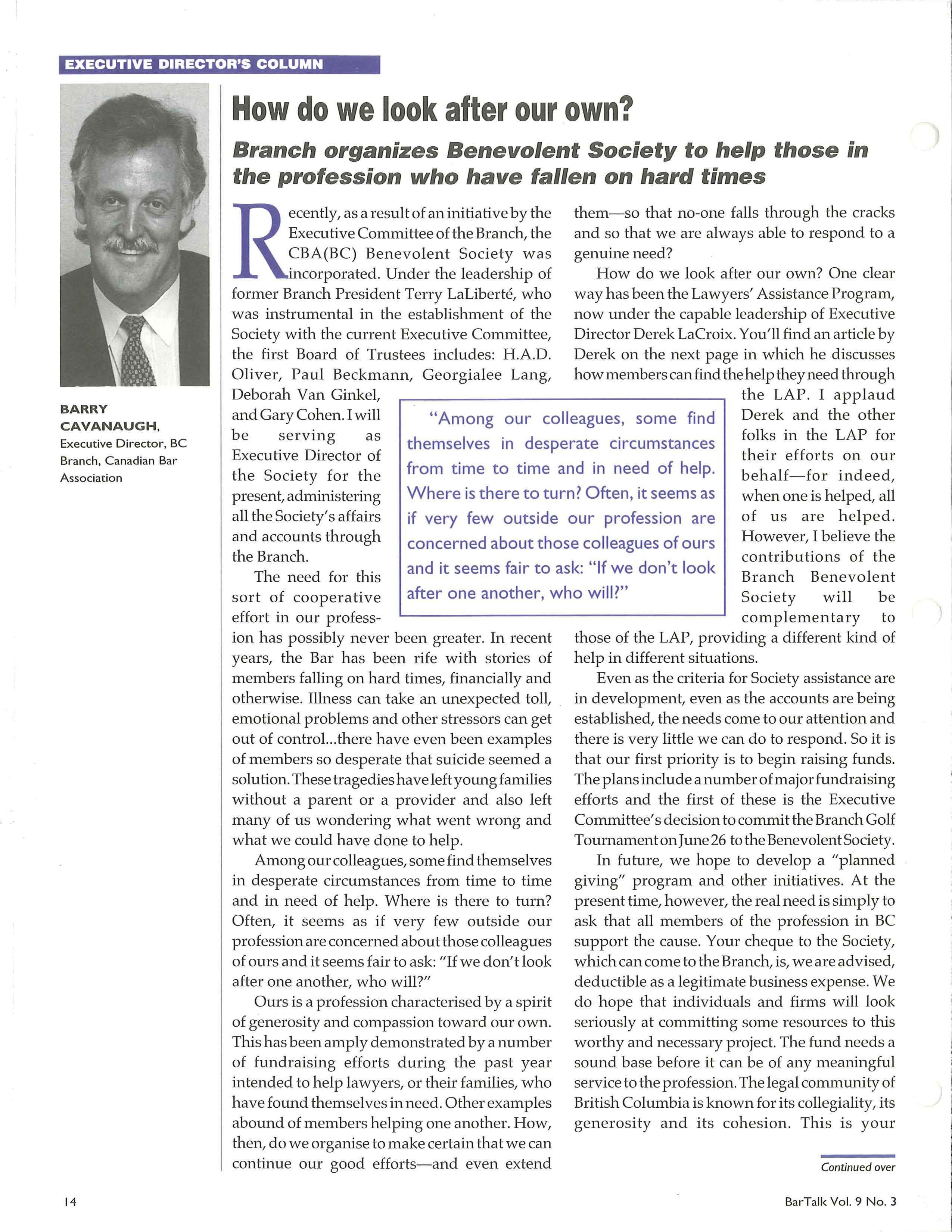
BARRY CAVANAUGH,
Execut ive Director, BC
Branc h , Canadian Bar Association
Ho w do we look after our own?
Branch organizes Benevo l ent Soc i ety to he lp those in t h e profess i on who have fa llen on hard t i mes
lliently, as a result of an initiative by the xecutive Committee of the Branch, the BA(BC) Benevolent Society was corporated Under the leadership of former Branch President Terry LaLiberte, who was instrumental in the establishment of the Society with the current Executive Committee, the first Board of Trustees includes: H.A.D. Oliver, Paul Beckmann, Deborah Van Ginkel, Georgialee Lang,
and Gary Cohen. I will be serving as Executive Director of the Society for the present, administering all the Society's affairs and accounts through the Branch.
them-so that no-one falls through the cracks and so that we are always able to respond to a genuine need?
How do we look after our own? One clear way has been the Lawyers' Assistance Program, now under the capable leadership of Executive Director Derek LaCroix . You'll find an article by Derek on the next page in which he discusses how members can find the help they need through
"Among our colleagues, some find themselves in desperate circumstances from time to time and in need of help.
Where is there to turn? Often, it seems as if very few outside our profession are
The need for this sort of cooperative effort in our professconcerned about those colleagues of ours and it seems fair to ask: "If we don't look after one another, who will?"
ion has possibly never been greater. In recent years, the Bar has been rife with stories of members falling on hard times, financially and otherwise. Illness can take an unexpected toll, emotional problems and other stressors can get out of control... there have even been examples of members so desperate that suicide seemed a solution. These tragedies have left young families without a parent or a provider and also left many of us wondering what went wrong and what we could have done to help .
Among our colleagues, some find themselves in desperate circumstances from time to time and in need of help . Where is there to turn? Often, it seems as if very few outside our profession are concerned about those colleagues of ours and it seems fair to ask: "If we don't look after one another, who will?"
Ours is a profession characterised by a spirit of generosity and compassion toward our own. This has been amply demonstrated by a number of fundraising effort s during the past year intended to help lawyers, or their families, who have found themselves in need . Other examples abound of members helping one another. How, then, do we organise to make certain that we can continue our good efforts-and even extend
the LAP. I applaud Derek and the other folks in the LAP for their efforts on our behalf-for indeed, when one is helped, all of us are helped. However, I believe the contributions of the Branch Benevolent Society will be
complementary to those of the LAP, providing a different kind of help in different situations.
Even as the criteria for Society assistance are in development, even as the accounts are being established, the needs come to our attention and there is very little we can do to respond. So it is that our first priority is to begin raising funds. The plans include a number of major fundraising efforts and the first of these is the Executive Committee's decision to commit the Branch Golf Tournament onJ une 26 to the Benevolent Society.
In future, we hope to develop a "planned giving" program and other initiatives At the present time, however, the real need is simply to ask that all members of the profession in BC support the cause. Your cheque to the Society, which can come to the Branch, is, we are advised, deductible as a legitimate business expense . We do hope that individuals and firms will look seriously at committing some resources to this worthy and necessary project. The fund needs a sound base before it can be of any meaningful service to the profession The legal community of British Columbia is known for its collegiality, its generosity and its cohesion. This is your
opportunity to demonstrate that we are, indeed, united in concern for our own.
Finally, on another matter, the Branch is continuing its efforts to improve service to you. Following up on our recent installation of a toll free number, we shall soon be adding voice mail. I promise that we shall choose a system which will never leave you lost in an endless voice mail
"loop." For those who prefer human interaction, a real operator shall always be close at hand, ready to assist. But the new system will incorporate many improvements, including the capacity to direct after-hours calls to specific staff and department members. You'll always know that we've received your calls and I promise that we'll call you back! +
New Executive Director joins Lawyers Assistance Program
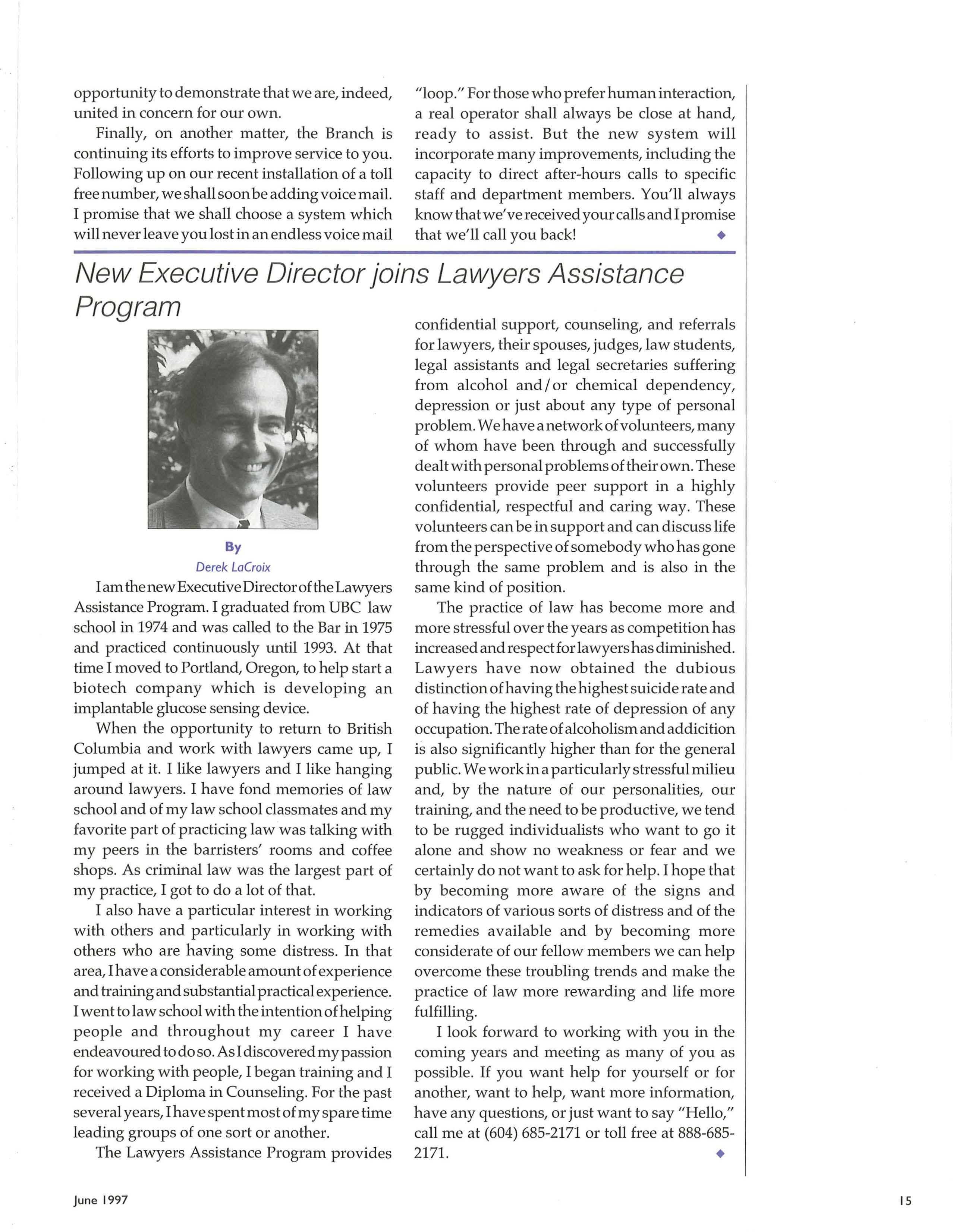
By Derek LaCroix
I am the new Executive Director of the Lawyers Assistance Program. I graduated from UBC law school in 1974 and was called to the Bar in 1975 and practiced continuously until 1993. At that time I moved to Portland, Oregon, to help start a biotech company which is developing an implantable glucose sensing device.
When the opportunity to return to British Columbia and work with lawyers came up, I jumped at it. I like lawyers and I like hanging around lawyers. I have fond memories of law school and of my law school classmates and my favorite part of practicing law was talking with my peers in the barristers' rooms and coffee shops. As criminal law was the largest part of my practice, I got to do a lot of that.
I also have a particular interest in working with others and particularly in working with others who are having some distress. In that area, I have a considerable amount of experience and training and substantial practical experience. I went to law school with the intention of helping people and throughout my career I have endeavoured to do so. As I discovered my passion for working with people, I began training and I received a Diploma in Counseling. For the past several years, I have spent most of my spare time leading groups of one sort or another.
The Lawyers Assistance Program provides
confidential support, counseling, and referrals for lawyers, their spouses, judges, law students, legal assistants and legal secretaries suffering from alcohol and/ or chemical dependency, depression or just about any type of personal problem. We have a network of volunteers, many of whom have been through and successfully dealt with personal problems of their own. These volunteers provide peer support in a highly confidential, respectful and caring way. These volunteers can be in support and can discuss life from the perspective of somebody who has gone through the same problem and is also in the same kind of position.
The practice of law has become more and more stressful over the years as competition has increased and respect for lawyers has diminished. Lawyers have now obtained the dubious distinction of having the highest suicide rate and of having the highest rate of depression of any occupation. The rate of alcoholism and addicition is also significantly higher than for the general public We work in a particularly stressful milieu and, by the nature of our personalities, our training, and the need to be productive, we tend to be rugged individualists who want to go it alone and show no weakness or fear and we certainly do not want to ask for help. I hope that by becoming more aware of the signs and indicators of various sorts of distress and of the remedies available and by becoming more considerate of our fellow members we can help overcome these troubling trends and make the practice of law more rewarding and life more fulfilling.
I look forward to working with you in the coming years and meeting as many of you as possible. If you want help for yourself or for another, want to help, want more information, have any questions, or just want to say "Hello," call me at (604) 685-2171 or toll free at 888-6852171. •
New Improved Provincial Court rules effective June 15, 1997
By Administrative Judge Ross Tweedale
The Provincial Court Small Claims Rules have undergone the most substantial revision since their introduction in 1991 The aim of the changes is to enhance the just, speedy, inexpensive and simple procedure in BC Provincial Court civil cases. Here are the highlights:
T he Se ttl e me nt C onf e re nce
• The parties must now bring all relevant documents and reports to the conference. The previous wording only required the party to bring all documents and reports that the party was going to rely on at trial. Problems arose because lay people often did not bring essential documents that needed to be disclosed. A further settlement conference then had to be held. The aim of the new rule is to have both the mediation and pre -trial discovery process take place more effectively
• Rule 7(14) expands the authority of the settlement conference judge to order production of documents and records, whether a party chooses to rely on them at trial or not.
• The judge may also now dismiss a claim, counterclaim, reply or third party notice if it is frivolous or an abuse of the court's process.
• The remedies for failure to comply with a disclosure order are now particularized.
• A simple procedure is mandated for failure to comply with a settlement agreement. In summary, the agreement is cancelled and the claimant may file a payment order after filing an affidavit of non-compliance. The rule is intended to eliminate or minimize a party having to return to court to get another order when the other party fails to carry out a settlement.
Transfer to Supreme Court
• Previously, matters could only be transferred from Supreme Court to Provincial Court. New Rule 7.1 allows the transfer of claims to Supreme Court where the monetary outcome of a claim may exceed $10,000. Lawyers may want to advise their clients to initiate the claim in Provincial Court, knowing that if further evidence shows the monetary outcome may exceed $10,000 that the judge must transfer the case. The issue of the limitation period for commencing an action does not then arise. That is because the case is transferred instead of being withdrawn and a new action begun in Supreme Court.
• The transfer may be considered on application at any time, at the settlement conference or, least desirably, at trial.
Multiple
claims
• New Rule 7 1 also establishes the right to hold one trial with multiple causes of action, even though the total monetary outcome of all the claims is likely to exceed $10,000.
Off e r to Se ttl e
• New Rule 10.1 provides an incentive for parties to file and accept formal offers to settle. It will likely be helpful initially for the judge to raise this at the settlement conference, especially in cases where one party refuses a reasonable settlement offer.
• The trial judge may order a party who rejected an offer to settle, to pay a penalty of costs to the other party. The amount, up to 20 per cent of the offer, is added to or may offset a judgment.
• A formal offer must be made within 30 days of the completed settlement conference . This is to build on the momentum of the settlement conference (A party may apply to a judge to extend the time for making a formal offer .)
Adjournm e nt s
• Rule 17 confirms the requirement that trials cannot be adjourned by consent, except with the permission of a judge This is for reasons of case management. The rule also provides adjournment criteria.
Naming th e Right Pa rty
• A current Registrar of Companies search will be needed when filing a claim, counterclaim or third party notice against a company or a society, to ensure the correct name and address is used.
• An expanded version of the Civil Rules for Small Claims (including a subject and forms index) and the Small Claims Manual used by court registries can be obtained from Crown Publications at (250) 386-4686
Appeals
• Legislation has been introduced to amend the Small Claims Act . Effective for all appeals filed on or after September 1, 1997, the appeal will be based on the record from the Provincial Court trial, on questions of fact and law. This replaces the current appeal process which consists of a new trial in Supreme Court.
Special Thanks
Thanks go to the Provincial Court Small Claims Rules Committee for their work on these rule changes A lot of time has been spent and careful thought given to the many suggestions for Rules changes.The members of the committee are : Nathan Smith, lawyer, Vancouver, nominated by the Trial Lawyers Association and member of the BC Supreme Court Rules Committee;Sandra Sajko, Senior Policy Analyst and Doris St. Germain, Senior Policy Analyst, both of the Ministry of the Attorney General, Victoria; Claire Reilly, Senior Legislative Counsel, Victoria; W. E. (Bill) Grandage, Manager, Provincial Court ofBC, Robson Square; and myself.
Thanks also to Chief Judge Metzger and Associate Chief Judge Schmidt for entrusting this work to the Committee and for approval of the rules changes . +
Member survey reveals Branch strengths and weaknesses
C l ear results demonstrate what you like and don ' t l i ke about CBA programs
Early this year, the BC Branch of the CBA commissioned the firm of Campbell Goodell Consultant s Ltd. to conduct a random phone s urve y of the membership of the Branch Between January 30
and February 5, 199 7, th e firm conducted 600 interviews with memb e r s. The results we re revealing , clear enough to s e rve a s the basis for futur e Branch planning
Sa mplin g
It wa s also considered importantto ensure that a repres entati v e sample ofthemember shipwa s polled To this end, r es pondents were cho sen at random fr om a li s t provided b y the CBA. Al so, quotas were es t a bli s h e d to
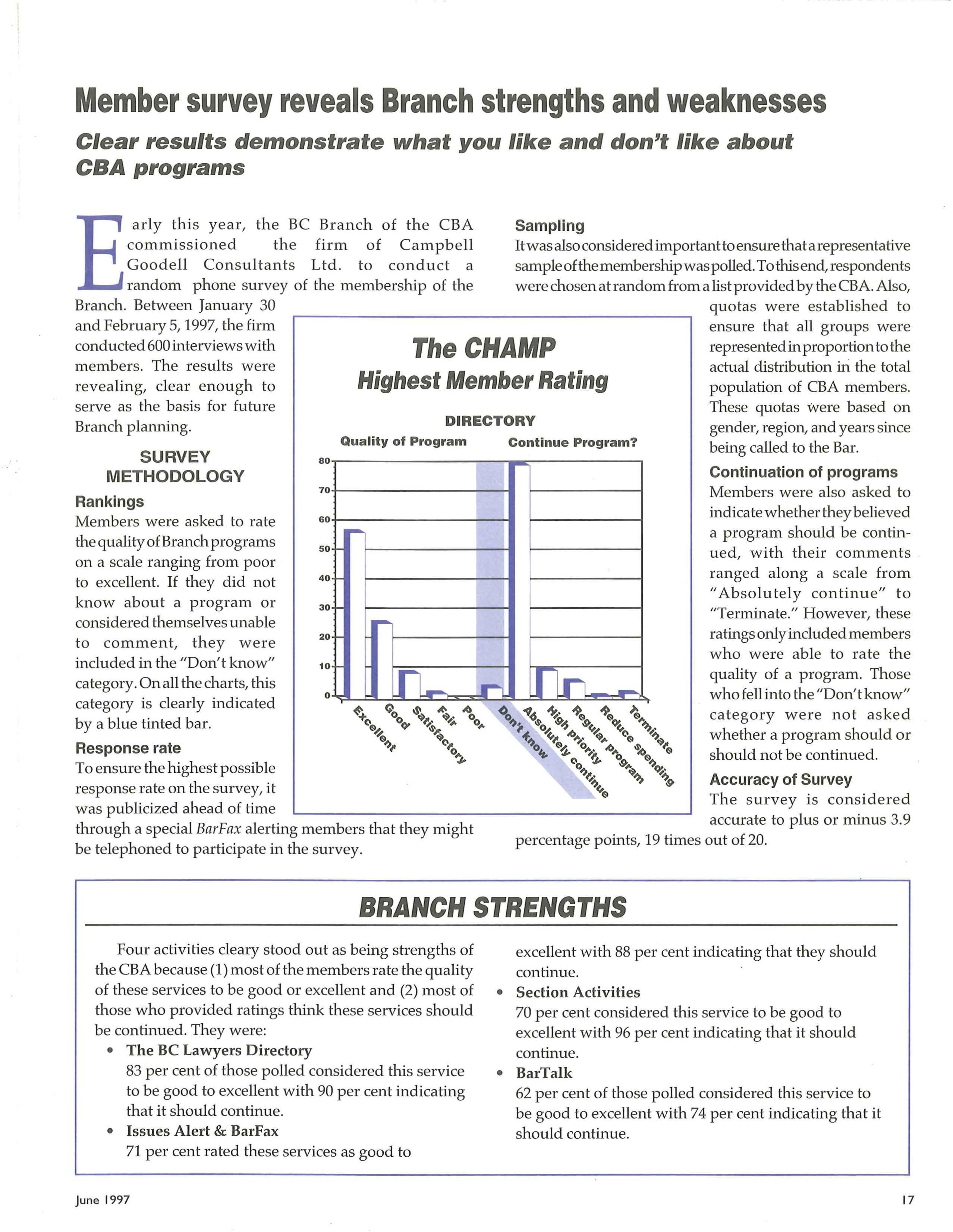
The CHAMP
Highest Member Rating
Ra n king s
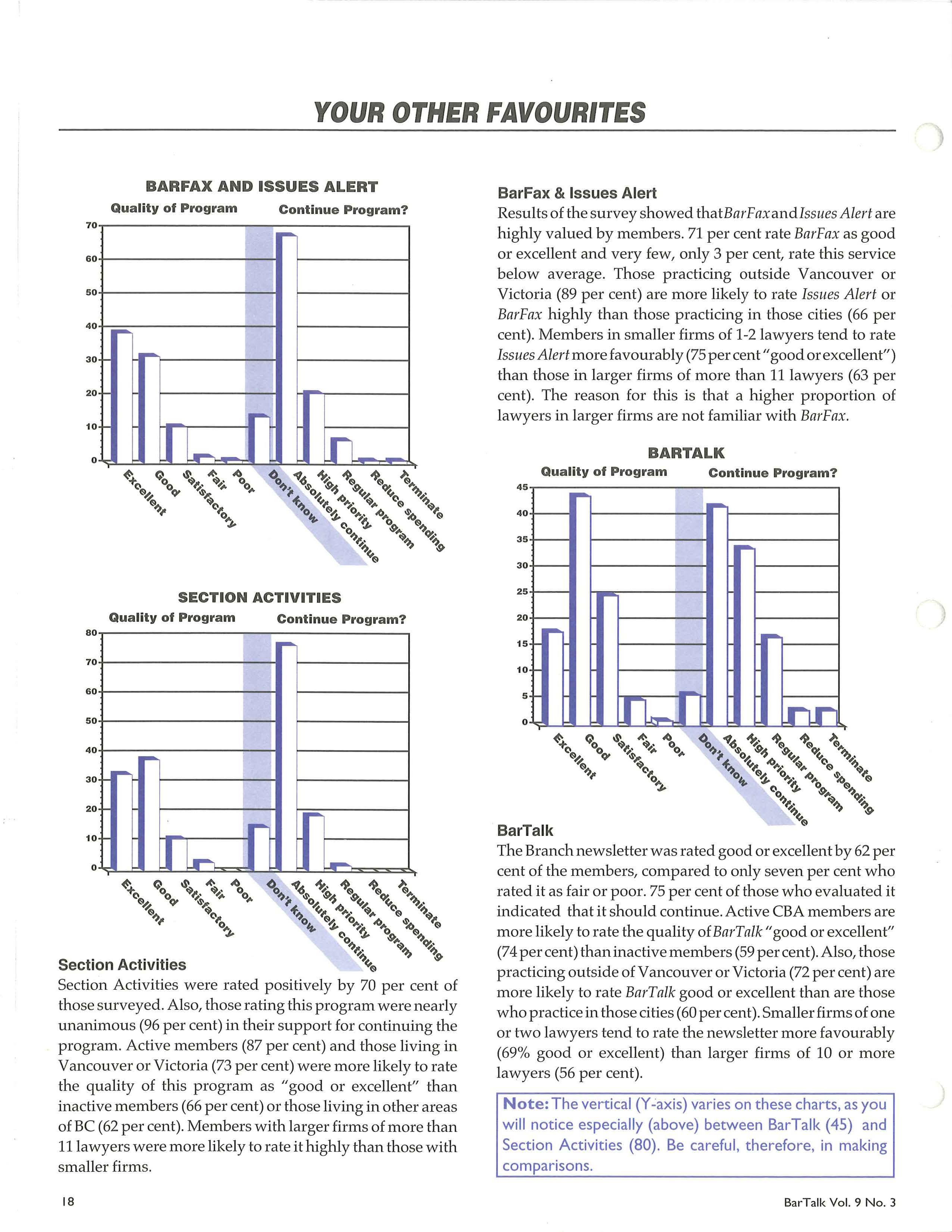
Member s were asked to r ate the quality ofBranch programs on a scale ranging from poor to excellent. If they did not know about a program or consid e red themselve s unable to comment , they wer e included in the "Don't know" category. On all the charts, thi s category is clearly indicated by a blue tinted bar.
Respons e rate
To ensure the highest possibl e response rate on the survey, it wa s publicized ahead of time
through a special BarFa x al e rting members that they might be te lephoned to participate in the s urvey
en s ure that all g roup s w e re repre sented in proportion to the actual distribution mthe total population of CBA memb er s . These quotas were ba se d on gender, region, and y ear s since being called to the Bar
Co ntinu a tion of pro gr a m s Members were al so as ked to indicate whether the y b e li ev ed a program s hould be continued, with their comment s ranged along a s cale from "Absolutel y continue" to "Terminate. " However, the se ratings only included memb er s who were able to rate the quality of a prog r am Tho se who fell into the "Don' t know " category we r e not a s ked whether a progr a m should or should not be continued.
Accuracy of Survey
The surve y i s con s idered accurate to plu s or minus 3 9 percentage points, 19 time s out of 20.
BRANCH STRENGTHS
Four activities deary stood out as being strength s of the CBA because (1) most of the members rate the quality of these services to be good or excellent and (2) mo s t of tho se who provided ratings think these services should be continued . They were :
• The BC Lawyers Directory
83 per cent of tho s e polled con s idered this service to be good to excellent with 90 per cent indicating that it should continue
• Issues Alert & BarFax
71 per cent rated these services as good to
excellent with 88 per cent indicating that they should continue.
• Section Activities
70 per cent con sidere d thi s service to be good to e xcellent with 96 per cent indicating that it should continue
• BarTalk
62 per cent of tho s e poll e d considered thi s se rvice to be good to excellent with 74 per cent indicating that it should continue .
YOUR OTHER FAVOURITES
Ba r Fax & Iss u es A lert
Results of the survey showed thatBarFa x andissu es Alert are highly valued by members. 71 per cent rate Bm·Fax as good or excellent and very few, only 3 per cent, rate this se r vice below average. Those practicing outside Vancouver or Victoria (89 per cent) are more likely to rate Is su es Ale r t or BarFax highly than those practicing in those cities (66 per cent) Members in s maller firms of 1-2lawyers tend to rate Issues Alert more favourably (75 per cent" good or excellent") than those in larger firms of more than 11 lawyers (63 per cent). The reason for this is that a higher proportion of lawyers in larger firms are not familiar with Bm Fa x.
BARTALK
Section Activities were rated positively by 70 per cent of tho s e surveyed . Also, those rating this program were nearly unanimous (96 per cent) in their support for continuing the program Active members (87 per cent) and those living in Vancouver or Victoria (73 per cent) were more likely to rate the quality of thi s program as "good or excellent" than inactive members (66 pe r cent) or those living in other area s ofBC (62 per cent). Members with larger firms of more than 11lawyers were more likely to rate it highly than those with smaller firms.
B arTalk
The Branch newsletter was rated good or e xcellent by 62 per cent of the members, compared to only seven per cent who rated it as fair or poor. 75 per cent of those who evaluated it indicated that it should continue. Active CBA members are more likely to rate the quality of BarTalk "good or excellent" (74 per cent) than inactive members (59 per cent). Also , those practicing outside of Vancouver or Victoria (72 per cent) are more likely to rate BarTalk good or excellent than are those who practice in those cities (60 per cent). Smaller firms of one or two lawyers tend to rate the newsletter more favourably (69 % good or excellent) than larger firms of 10 or more lawyers (56 per cent).
Note: The vertical (Y varies on these charts, as you will notice especially (above) between BarTalk (45) and Section Activities (80). Be careful, therefore, in making comparisons.
BRANCH OPPORTUNITIES
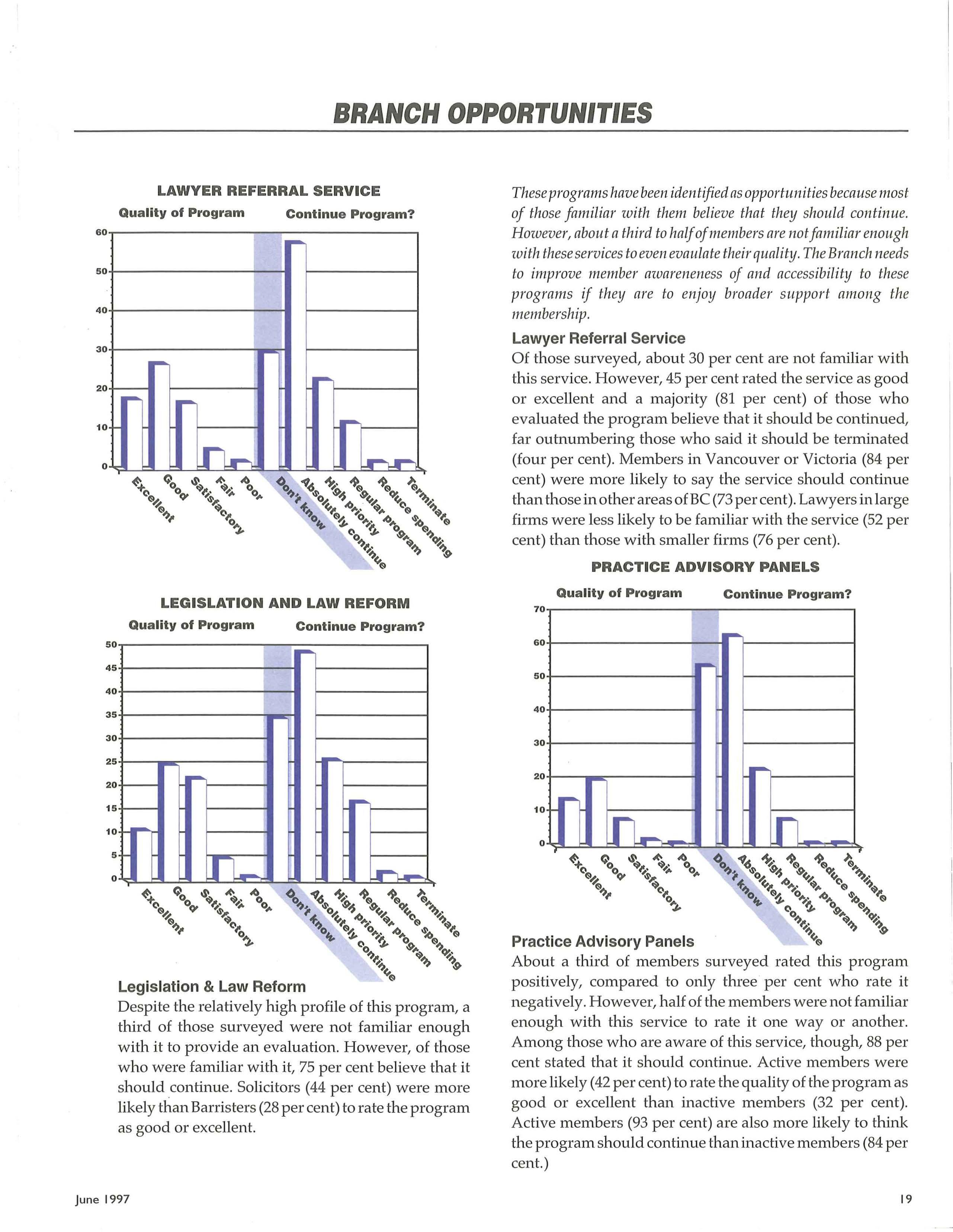
These programs have been identified as opportunities because most of those familiar with them believe that they should continue . How eve r, about a third to half of members are not familiar enough with these services to eve n evaulate th eir quality The Branch needs to improve member awareneness of and accessibility to the se programs if they are to enjoy broader support among th e membership
Lawyer
Referral Ser vi ce
Of those surveyed, about 30 per cent are not familiar with thi s service. However, 45 per cent rated the service as good or excellent and a majority (81 per cent) of those who eva luated the program believe that it should be continued, far outnumbering those who said it should be terminated (four per cent) Members in Vancouver or Victoria (84 per cent) were more likely to say the service should continue than those in other areas of BC (73 per cent) Lawyers in large firm s were less likely to be familiar with the serv ice (52 per cent) than those with smaller firms (76 per cent).
PRACTICE ADVISORY PANELS
of Program Continue Program?
LEGISLATION AND LAW REFORM
Legislation & Law Reform
Despite the relatively high profile of this program, a third of those surveyed were not familiar enough with it to provide an evaluation. However, of those who were familiar with it, 75 per cent believe that it should continue. Solicitors (44 per cent) were more likely than Barristers (28 per cent) to rate the program as good or excellent.
Practice Advisory Panels
About a third of members surveyed rated this program positively, compared to only three per cent who rate it negatively. However, half of the members were not familiar enough with thi s service to rate it one way or another. Among those who are aware of this service, though, 88 per cent stated that it should continue Active members were more likely (42 per cent) to rate the quality of the program as good or excellent than inactive members (32 per cent). Active members (93 per cent) are also more likely to think the program should continue than inactive members (84 per cent.)
BRANCH WEAKNESSES
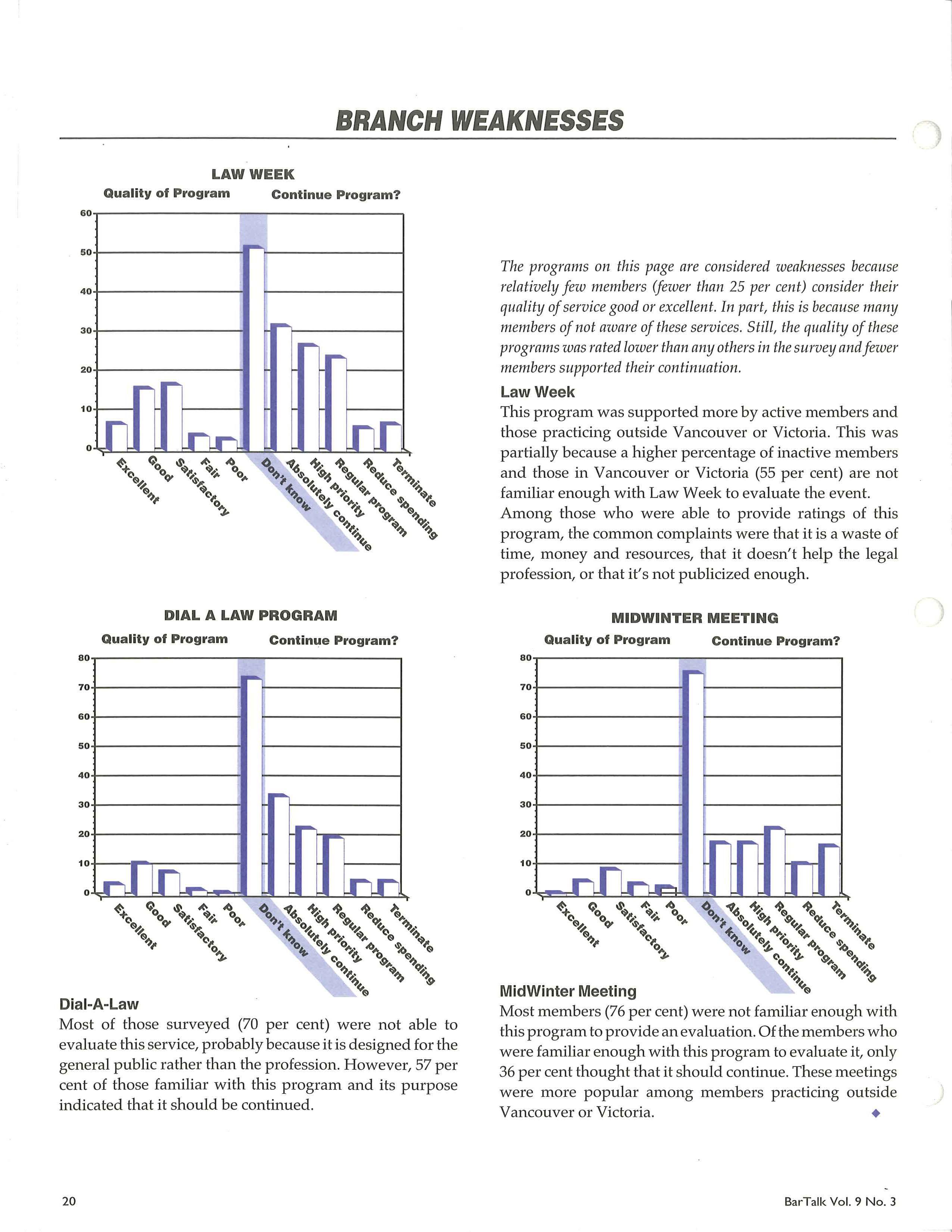
Most of those surveyed (70 per cent) were not able to evaluate this service, probably because it is designed for the general public rather than the profession . However, 57 per cent of those familiar with this program and its purpose indicated that it should be continued.
The programs on this page are considered weaknesses becau se relatively few members (fewer than 25 per cent) consider thei r quality of service good or excellent. In pa rt, this is because many members of not aware of these services Still, the qualih; of these programs was rated lower than any others in the survey and fewer members supported their continuation.
Law W ee k
This program was supported more by active members and those practicing outside Vancouver or Victoria. This was partially because a higher percentage of inactive members and those in Vancouver or Victoria (55 per cent) are not familiar enough with Law Week to evaluate the event. Among those who were able to provide ratings of this program, the common complaints were that it is a waste of time, money and resources, that it doesn't help the legal profession, or that it's not publicized enough.
MIDW I NTER MEET I NG
MidWinte r Mee ting
Most members (76 per cent) were not familiar enough with this program to provide an evaluation. Of the members who were familiar enough with this program to evaluate it, only 36 per cent thought that it should continue. These meetings were more popular among members practicing outside Vancouver or Victoria +
Survey results will assist Branch Planning and Priorities Committee
By Kerry-Lynne D. Findlay
Vice President, BC Branch, Canadian Bar Association
The Planning and Priorities Committee of the Branch is mandated to advise the Executive on long-term planning issues affecting Branch activities and structure and to suggest priorities for action. This year, the Committee is co-chaired by Kerry-Lynne D Find la y, Vice-President, and Margaret Ostrowski, Executive Officer. The membership includes Merrill Leckie, Q.C., a Past President of the Branch, John Third, Ravi Hira, Moyra Dahliwal, Georgialee Lang, and Executive Director, Barry Cavanaugh. Don Rose also joined us for part of the year, and Craig Goebel (Communications Committee Chair) provided input at one of our brainstorming sessions.
The P&P Committee has found the Campbell Goodel Traynor Consultants Ltd. survey to be a very valuable tool in assessing Branch functions and programs. The survey has provided a window on the membership, which has greatly assisted the task of determining the relative value of CBA BC activities. Together with a Communications Committee review of Branch programs completed last year, we have been
able to understand what CBA members value most and where the CBA BC should be placing sustained or increased emphasis in the years ahead. There is a definite message that has been sent-the CBA BC should be an organization by lawyers, for lawyers.
The profession is under siege as never before and members are looking for us to maintain and enhance section activity, emphasize government relations efforts, and keep going with the vast majority of the programs we already have in place. On the other hand, a few current activities are not seen as providing a direct benefit to the membership sufficient to justify the volunteer staff and staff efforts, and the expense, they require.
The P&P Committee has aggressively analyzed what the Branch is doing and will be joining the Executive and Senior Staff at their Plaruung Retreat in June. It is the Committee's job to make recommendations to the Executive which have a lasting effect on the approaches to be taken in assessing future projects and current ones. The Committee's considered opinions will keep us focused and well prepared as we close this century and face, no doubt, a new age of challenges •
National CBA survey also indicates member satisifaction
The results of a national CBA member survey are expected to be published shortly in an upcoming edition of The National.
In an interview with BarTnik, national CBA President Russell Lusk shared some of the preliminary findings of the survey with us and said he waspleasantly surprised by the results, which indicated a very high approval rating
"This survey was conducted among members and non-members," Lusk said." And not only was I surprised by the favorable conclusions of our members but I was similarly-if not more surprised-by the responses from our non-members
"Amongst members, across the country 82 per cent said we were either doing a good or very good job and 60 per cent of non-members said the same thing. That's very gratifying
"However, one of the things that recurs
throughout the survey is our need to improve communication. I think this is true both at the Branch levels across the country and at the National level, although probably more so at the national level."
Despite these findings, Lusk said he was confident that, in future, communications between members and the CBA would be dramatically improved through the use of the Internet.
"We think the Internet has tremendous potential as a communications vehicle for our members, members of the profession across the country and , eventually, for the public and our members across Canada," he said
Because the survey showed a much higher than expected level of computer usage among members, Lusk said the Internet was already a valuable medium of conununication for many. •
BCAA Discount negotiated by Member Services Committee
The Member Services Committee of the BC Branch of the CBA has been successful in obtaining a considerable discount in BC Automobile Association memberships for our members
The discount is 25 per cent off the cost of yearly membership and you can take advantage of this great offer even if you currently enjoy membership in the BCAA. Here ' s how :
I Call the number below at least one month before your membership expires 2. Call 1-800-268-3750, Local 3289 and ask to have your current coverage transferred to the CBA account.
3. Be prepared to provide your current account and membership numbers. You will be given the address to send your cheque or payment to at the Corporate Accounts Section Your payment will be transferred to the BCAA on your behalf. CBA members who are not currently BCAA members can simply call the number above and request a new CBA member account
Dr. Allan Castle Director of the Proceeds of Cr ime and Corruption project at the International Centre for Crimina l Law Reform and Criminal justice Policy, is on assignment from his post as Assistant D irector of the Institute of International Relations at UBC.
Vancouver-based Centre develops program to combat money-laundering in the Pacific Rim
As a response to the growth of organized criminal activities in the Pacific Rim, Vancouver's International Centre for Criminal Law Reform and Criminal Justice Policy (ICCLR) is developing a multiyear project to address the problem of moneylaundering in the region, and of the corrupt practices which facilitate this activity.
For Canada, and for British Columbia in particular, the growing links between North America and Asia signal a new era of opportunity-one of seemingly limitless potential. The gradual liberalization of Asian societies, booming regional economies, and new communications technologies have shrunk the Pacific and made it the most vibrant region in the global economy.
Unfortunately, these same "globalizing" developments have provided similar ad vantages to those operating outside the law. In particular, organized crime has seized the initiative with activities extending far beyond the well-known phenomenon of drug-trafficking to include the large-scale theft and smuggling of automobiles, sex tourism, banking and securities fraud, the illegal trade in armaments, and the smuggling of illegal migrants. The less tangible crime of corruption also continues unabated, greatly restricting the capacity of states to combat these activities.
One common thread which binds these criminal activities is the necessity of reintroducing illegally derived funds into the global economy. Accordingly, the United Nations, through the "Naples Declaration" and other statements and resolutions on organized transnational crime, has repeatedly stressed the need to augment enforcement and prosecution strategies with measures to hinder the laundering of the proceeds of crime.
In response, as one of thirteen institutes and centres worldwide formally affiliated with the UN Commission on Crime Prevention and Criminal Justice, and in cooperation with UBC' s Institute of International Relations, ICCLR is developing within its work on organized crime a project on Money Laundering and Associated Corrupt Practices in the Pacific Rim: Practical Measures. The focus will be on suggesting realistic,
regionally-specific measures to expedite the implementation of UN standards and norms on money-laundering in the region. The project will also examine corrupt practices in government and the private sector which facilitate the laundering of illicit funds.
The project has four concrete goals First, this summer ICCLR plans to commence the compilation of a database of regional antilaundering legislative measures, successfu l practices, existing bilateral and multilateral instruments, and re levant research and data, in cooperation with other regional UN Program Network institutes and other organizations.
Second, the International Centre proposes to organize a regional workshop involving legal, policing, professional, and academic experts, as well as UN and governmental representatives, to be held in 1999 ICCLR hopes to have the support of other UN Program Network institutes in running sub-regional preparatory meetings, and earlier this month held productive discussions with representatives of a number of them.
Third, from the workshop and from ongoing research, ICCLR will produce a compendium of recommendations and a series of regular background materials concerning practical measures for the implementation of UN standards and norms on money-laundering within the context of the Pacific Rim . These materials will be made broadly available to a national, regional, and international audience.
Fourth, the recommendations, information and expertise developed as a result of these activities will guide the International Centre in developing bilateral programs of technical assistance and advisory services for requesting states .Activities of such a program may include training programs for key officials, information or persmmel exchanges, and comparative studies to assist states in formulating joint strategies to prevent and control the trans-national flow of the proceeds of crime.
The International Centre welcomes inquiries from interested groups or individuals regarding the content, development and support for the project. If you would like more information, please contact us at (604) 822-9875. •
David J. B ilinsky Co -Chair, Nationa l CBA Law Practice Management Sect ion
"Mon ey, it's a crime.
Consider wisely how to share the profits in your firm
Choose what meets your needs from a variety of profi t-sharing models
Nothing so divides partnerships, friendships and relation s hips a s the issue of sharing profits, except for perhaps, not having any profits in the fir s t place . Law firms, alas, are no different from other businesses with multiple owners. Given that the recent tax s eason has so focused our attention on matters financial, thi s appears to be a good time to examine the issue of
Share it fairly but don't take a slice of my pie.
Money , so they say partnership compensation formulas. Is th e root of all evil today . "
profits. The e xact means taken in deciding the division of profits is not known, as there aren' t any precise logical paths or explicit decision method s u sed Typically, however, the partner s look at the financial statements, the billings/ collections I write-off's of each partner, the file s I work genera ted I brought in by each partner, the expertise and seniority of each partner, the time I effort devoted to management is s ues and the pro-bono I community I marketing efforts of each person, among others
The strengths of a Rough Justice System are as follows :
There are four
Written by Roger Waters, recorded by Pink Floyd flavours of law firm
compensation formulas in common use today They are called the Subjective (Rough Justice) System, the Lockstep or equal sharing System, the Objective (Performance) System and Mixed Systems. Each system has its own effect(s) on the behaviour and motivation of the persons within its umbrella . However, one point is clearwhatever the system, the persons caught thereunder undoubtedly modify their behaviour to maximize their personal return therein. This can only be expected Problems arise when personal interests conflict with a firm's best interests.
• It should promote teamwork, a s all parties share as a team.
• It should help develop high-paying specialisation
• It takes into account many variables.
• By rewarding partners with desired attributes, the firm and the partners benefit PROVIDED there is firm-wide feedback regarding those positive attributes .
The principle drawbacks of such a system are as follows:
• It requires a high level of trust in the compensation committee.
• It may be political.
David J. Billnsky is a partner at Lakes Stralth & Bilinsky and a principal of Integral Management Inc He can be reached on the internet at integral@dlrect. ca.
Accordingly,letus examine the four principal compensation systems and their expected intended and unintended consequences
THE SUBJECTIVE (ROUGH JUSTICE) SYSTEM
This system operates by having the partners (either jointly or through a compensation committee) review the performance of each partner and subjectively determine the share of
• It may diminish the development of new practice areas with low initial payoffs
THE LOCK-STEP SYSTEM:
Under this system, all partners with roughly the same seniority are paid the same amount. Most times, a ceiling is established that once reached, all lawyers therein are treated equally. The strengths of such a system are as follows:
• It is understood by everyone.
Choose a method of sharing profits that works for your firm
Continued from page I 7
• It can promote teamwork for clients and for files, as the firm's culture is noncompetitive .
• It is politically neutral.
The principle drawbacks of such a system are:
• There is no encouragement of effort, hard work or success.
• It can have a negative effect on morale
• There is no encouragement of specialisation or entrepreneurship.
THE OBJECTIVE (PERFORMANCE) SYSTEM:
The most common example of this system is the Hale & Dorr Formula system, which was promulgated by this Boston firm. In this case, such variables mentioned aforesaid in the Rough Justice System are explicitly determined, together with such others as the firm deems desirable, and then worked into a mathematical formula. Afterwards, the division of profits then becomes a simple application of the formula. To work this system, weights must be assigned between 0.0 and 1.0 to each variable, with the total of the
SHARING BY THE NUMBERS
THE OBJECTIVE SYSTEM
weights equalling 1.0. To take a simplistic situation, assume a firm decided that collections are 3 times more important than new file generation, with all other factors excluded. Then the formula and the calculation of profit-sharing would be as shown in the box titled "Sharing by the Numbers"
Of course, if the partners had chosen to include more or different variables, then the results would be different. The point is that they are rewarded according to their pre-determined criteria, and accordingly, the firm will be driven by those criteria.
The strengths of this system are:
• It is understood by all, unless it i s unduly complex!
• The firm's goals can be aligned by the selection of the variables and their weights.
• It should encourage entrepreneurship if the variables are so aligned.
The principle weaknesses of this system are:
• It may reduce team effort and promote gamesmanship for clients and files.
• It may reduce the development of new speciality areas, if aligned for a short-term, profit focus.
• If weights I variables are badly chosen, then the firm's focus and
.75 x (partners collections)+ .25 x (partner file generations)=% of firm's profits direction will be adversely affected. total firm co ll ections total firm file generations
D : ( 75 (40000) + 25 (25)) X 100000 = $36,250.00. 100000 100
TOTAL: $100,000.00
The last system is the Mixed System This is a catch-all category. In this category are systems which attempt to combine the strengths of the three systems and alleviate their drawbacks. Examples are an objective I subjective system, where the results of a Hale-Dorr formula are used for a certain percentage of the profits, with the balance distributed on solely subjective grounds. Here the firm retains some flexibility to adjust for real or perceived injustices arising from the strict application of a mathematical formula.
Whatever the system in use in your firm, examine it carefully to
make sure that its Pavlovian effect is the one desired when considering the strategic direction of the firm, the long-term viability and continuity of the firm and your firm's culture After all, you don't want a dissatisfied someone moving to "Grab that cash with both hands and make a stash."
The author wishes to acknowledge and thank Steven Campbell, C.A., of the firm of Nelligan, Power of Ottawa, Ontario, and the Canadian Bar Association, for the use of Steve's materials on Compensation and Profit Distribution prepared for the CBA' s Law Office Management Training Session, Shanghai, China, April, 1977. Any errors or omissions are solely the responsibility of the author. +
Dave's Top 10 Internet Sites
Anti- Virus programs. There are many out there, but I personally use and rely on McAfee's anti-virus system. To be effective, download the software, and then update the data files (about every 6 weeks or so). If you STILL believe that you can't contract a virus, I recently received a disk of a transcript from a reputable Court Reporter that was infected with the Word Concept virus. Run, don't walk, to: http: I I www.mcafee.com
2. For those interested in keeping up on the Journal of the Society for Computers and Law in the UK called Computers and Law, the journal is now online at http:/ I www.scl.org.
3. The BRIDGES Web site is the handiwork of some Internet techies from the ABA who have joined with their counterparts from the American Institute of CPAs to launch a series of joint ventures that use very innovative Web site software. The site software permits visitors to edit and create Web pages without needing to know htrnl. This gives everyone who visits a "hands-on" opportqnity to participate in various projects and programs. Check out the site at: http:/ /www.c2.com:8000/
Please note: this address is just a bit different: there is a colon between com and 8000
4. Worried about security on the Net? Did you know that every site that you visit on the Net has the ability to track who is visiting them? As well, allegedly there are programs that can trace where YOU have been on the Net (important if you are doing research on an important file!). There is a solution: The Anonymizer is here! This site states that you can surf anonymously thru them! This site strips out information personal to you and allows you to visit sites without leaving a footprint (or cookie, as it is known) behind. http: I I www .anonymizer com/ open.htrnl
5. What is a cookie, you say? Check out http: I I www.pgp.com/products/PGPcookie.cgiforinforrnationon PGP' s cookie cutter and otherinformationregarding privacy and security on the net. PGP stands for Pretty Good
Security-Phil Zimmerman has invented a security system for exchanging emails on the net using a public and a private "key" -your public key is freely available in order for people to send you an email and your private key is used to decode the message. By using these two keys your emails are scrambled. Apparently this security system is about as good as it gets currently on the Net.
6. Have a look at what other courts are putting up on the Web. This is a court in Virginia (WISE county-what else?) that is using JAVA on their very interesting website: http: I I www.courtbar.org
7. Interested in issues related to or examples of domain names that are alleged to infringe with trademarks? Law Journal Extra has information in it's Internet Law site. Law Journal Extra is at http:/ /www.ljx.com They have a couple of articles discussing the issue, as well as copies of the complaints in the Ticketrnaster v.Microsoft case, and theW ashington Post v. Total News case. These are the only two cases that I have seen claiming trademark infringement. There are also a few articles in the Trademark Law sectionunder practice areas.
8 The free weekly Supreme Court international Bulletin (SCiB) will now publish decisions of the Bundesverfassungsgericht (the German Federal Constitutional Court). Summaries will be in both German and English with links to full-text judgments in German SCiB currently includes decisions of the US Supreme Court, the Canadian Supreme Court, the UK House of Lords, the Australian High Court and the South African Constitutional Court in one Bulletin. Subscribers may choose between HTML and text versions Archive :
http: I I www.farislaw com/ archive.html Web Subscription:
http:/ /www.farislaw com/
9. PC Week is online (are you surprized?) and in this issue is an article on "push" technologies on the web:
http: I I www8 zdnet.com/ pcweek/ news I 0512 I 12deliv.htrnl
10.All of these Top 10 site references are archived at: http : / / www.lsandb.com/ top10feb97 .htrn These links are maintained as hypertext links, which may make finding them somewhat easier than typing in cryptic URL references. Unfortunately, archive links on the Net may disappear, move around or expire, as sites are updated, changes, moved to different servers, etc. However, I will endeavour to keep these references as up to date as possible Happy surfing until we meet again! +
Letters to the Editor
It's your chance to REALLY have the final say!
To the Editor:
Re:Thanks
I have ju s t read the late s t edition of Section Talk and I want to commend the CBA and theBarTalk Editorial Board, which is obviou sly up and running with a fir s t-rate publication.
I al so want to personally commend Emily Reid, Q.C. , and the Executive of the CBA for the s ubstantial commitment in terms of time and mone y in support of the Coalition Agains t No Fault's fight against the dismantling of the tort s ystem in this province.
The public town hall meetings held throughout the province have been a gr e at s ucce ss
I wish personally to te ll you th a t the hard work and commitment displayed by the Executive of the BC Branch of the CBA, with Emily as president, have greatly enhanced the morale of both the TLABC and the members of the Coalition Against No Fault. We are proud of the strong stand you have taken on this issue and I know that my views are shared by a great number of our colleagues
Keep up the good work.
Yours very truly, Kenneth A. Price
Editor, The Verdict Trial Lawyers Association of British Columbia
To the Editor:
Re: Unprosecuted Appeals
1. I was recently in front of Mr. Justice Hinds resurrecting an appeal which had fallen onto the inactive list. With the assistance of opposing counsel, the appeal was reactivated and I was saved from a negligence suit.
2 . In the course of argument, Ju s tice Hinds said that he wanted the "local bar" informed that the reactivating of an appeal might well not occur if the appeal is on the inactive li s t for more than 180 days [see Court of Appeal A ct, section 25 (4)] . Justice Hinds asked that I advise the profession of the recent (February 19, 1997) decision of Mr. Justice Esson in Wilson v. Wilson, Vancouver Registry CA017885, wherein Ju s tice Esson refused to reinstate an appeal once it had passed 180 days on the inactive list.
3 I think that the message th a t Justice Hinds was attempting to send was that once an appeal hit s the inactive list, coun s el should move promptly to r eactivate the appeal and that once the 180 day limit has passed, the appeal may well not be reactivated because the delay ha s been inordinate . Our days of grace are over.
4. I have copies of the Rea s ons for those counsel who a r e s o retrograde a s to not b e on the Internet or sub scribe to Quicklaw .
Thank you.
Yours v e ry truly,
Robert M. Moffat
To the Editor:
Re:DOS
Thank you for the article which appeared in the April, 1997, BarTalk on page 20, r e garding " DOS is best." This particular point of view confirms my personal concerns that there is inconclusive evidence that Windows technology will generate cost s aving s proportionate to the direct co s t to lawyers arising from acquisition of the technology and its implementation.
For example, last year we were advised by our computer consultants that replacement of our entire computer system with Windows would result in about five per cent savings in efficiency after all installation and staff training was complete.
Affordability of the practice of law ha s been a much debated topic in our ongoing efforts to make this profession more inclusive and more compatible with a reasonable lifestyle. In order to achieve both of these goals, it has been stressed over and over again that the burdens of practice, including financial ones, cannot be too onerous or the practice of law will simply exclude those less able to practice long hours on a high-volume basis. As a result, it appears to me that it is important that the profession take a stand to advocate that computerized legal materials continue to be available in the DOS format.
The article states that currently DOS is still the primary software used in the majority of law offices. Therefore, I am most concerned about the recent news that the new version of the statutes would only be available in the Windows format, as well as several similar notices I have
received in the last few months with respect to of25yearsand,duringthose25years,Ihavedone other software. considerable legal services work, including being
In a telephone callto Les Johnson, ofthe Queens area director for approximately six years. Printer, I questioned the decision not to produce a I have now come to the point where I find it DOS version of the statutes. He cited the reason most difficult to operate my office and continue that last year's sales were "pitiful" in DOS, being to accept Legal Services Society referrals for either approximately six DOS sales to every 1,000 criminal or family law, inasmuch as the time Windows sales. I am not certain if this is the result spent much exceeds the tariff. I am a sole of widespread usage in government agencies, as practitioner and, although I operate in a small he advised that a great many of the sales had been community in the interior of British Columbia, I to the Ministry of the Attorney General. haveneverbeensuccessfulinhavingmyoverhead
I asked Mr. Johnson if it might be possible that less than 50 per cent of my gross and my usualfee he was missing most of the potential DOS sales as in connection with legal services is $150 an hour. the cost of the electronic version is quite high and I simply cannot, in the face of the present cuts, the cost of the updates even more so. I suggested continue to operate at the reduced rates, wherein thatinordertomarkettheDOSversioneffectively, I am to be paid $72 an hour for a family law there had to be a commitment that the cost of the matter, andsustainafurtherreductionforcrirninal updates would not exceed that
matters on a block-payment oftheupdatestothehardcopies On Legal Aid: basis . andthattherebeacomrnitment "I have now come to the Idonotspeakfortheother to maintain the DOS format point where I find it most lawyers in this particular itself. Mr Johnson was quite difficult to operate my office community,butitiswithsome interested in these suggestions and continue to accept Legal regret that I must advise that I and was planning to pass them Services Society referrals for am going to have to reduce the on to his colleagues in the either criminal or family law, numberofreferralsthatlwould marketing department. inasmuch as the time spent havetaken,asicannotcontinue
I urge the CBA, BC Branch, much exceeds the tariff 1 to reach into my own limited totakeastand with the Queens simply cannot , in the face of resources in order to fund the Printer and other legal the present cuts , continue to Legal Services Society. It is my publishers to ensure that the operate at the reduced firm belief that over the years, DOS format continues in rates ... .." the solicitors and lawyers who production for some years to have done work for Legal come, with this policy possibly to be reviewed in Services Society have made a vast contribution, the year 2000. not only in time but also in money, towards this
I would appreciate the thoughts of the organization. But, quite frankly, it has to stop. Executive on this point. Thank you for your It would seem to me thatthe most appropriate consideration and assistance approach would be that the mandate for the Yours Truly, Legal Services Society for services to be presented Kathryn A. Berge, Q C. to the public must be altered, or the funding must be increased to meet the amended mandate. I To the Editor: simply cannot continue with the present mandate Re: "LSS slashes budget April10) once again" (Bm -Fax, and the lack of funding, with each year there
The special bulletin referred to above has been in my office for some little time andi have struggled with whether or not I should reply in person or through the Salmon Arm Bar Association. We have had a meeting of the Salmon Arm Bar Association and I understand a letter will be coming from the Bar in connection with our views re the Legal Services Society present position.
I wish to put in my own personal view in connection with the matter, and just as brief background, I have been in practice for in excess
being a decrease for what is laughingly called a "holdback." I am sure we will never see any more of these funds and it might be more appropriate for Legal Services Society to simply admit that they have cut the basic rates.
I could go on and on in connection with this matter but, as a matter of a lawyer practising in a community of slightly under 15,000 people, it is going to have a dramatic effect upon those who rely upon Legal Services Society for legal services.
Le tt e rs to the Ed itor
Continued from page 2 I
It is my belief that the net result is that the files that are to be referred will go out of town, which will be a further difficulty for those of limited means; but I am simply not prepared at this point to continue to supply to the Legal Services Society the services I have provide in the past, since it is providing me with no income and I am paying what is purported to be a governmentfunded services I thank you for your time in reading this letter
Yours Very Truly, H R. Bartlett
To the Editor:
in the Advocate and other learned law journals. Please send your donations to "Connell Lightbody (R.H Guile Fund)" to my attention at: P.O. Box 11161, Royal Centre, 1900-1055 W. Georgia St. Vancouver, BC, V6E 4J2. You will receive a tax receipt directly from the currentlybeing-established Law Courts Inn Foundation.
Yours Very Truly, Walley P Lightbody, Q C.
To the Editor: Re: Flood Assistance
It has recently come to my attention that a number of CBA members across the country have expressed a strong desire to donate to a fund for our members in Manitoba who have lost their homes in the flood.
Re: Robert H . Guile, Q.C. Memorial Award On the Manitoba Floods
I can tell you that at least a dozen of for Humour and the Law
The late Robert H. Guile, Q.C. was not
"I can tell you that at least a dozen of our members have suffered damage and in many cases, entire homes and contents have been ruined or substantially damour members have suffered damage and in many cases, entire homes and contents have been only an outstanding aged. Flood insurance is not available in barristerbutpossessed ruined or of a marvellous sense the Red River Valley. substantia 11 y ofhumourandsuperb
damaged. Flood flair for the written word . It is fitting, therefore, insurance is not available in the Red River Valley. that there be some lasting recognition of these I am not writing to ask you to take an active talents. role in soliciting funds from your members.
Because our late confrere was a graduate of However; I can advise, for those who are the UBC Faculty of Law it is also fitting that the interested, that we have set up a special trust award should be bestowed upon a worthy UBC fund for CBA members in our province who law student candidate. We intend to establish a have suffered loss of their homes and property. fund to finance that award. Each candidate will Could you pass along to anyone interested in submit an original literary work of any your Bran<;:h that cheques can be sent to the description but somehow related to the law, not Manitoba Bar Association Office, 219 Kennedy to exceed 2,500 words. Bob would have said St., Winnipeg, MB R3C 158, payable to the shorter was better. Manitoba Bar Association-Flood Relief. Once As you know, Bob was a Past Treasurer of the the extent of the damage is known, we will be Law Society. More importantly, he was also a paying the proceeds of the fund out to our founder and Past President ofS.M .A.L.L. (Societe members. Midgette/ Alliance of Little Lawyers). The Thereare,ofcourse,avarietyofothergroups physical height of the candidate will, therefore, who are collecting funds for flood victims be a consideration. generally, including the Canadian Red Cross, Major consideration will be given for the C::BC Morningside, etc If your members wish to content of the work. Bob was an actor, poet, a give to those organizations, they are certainly humorist, an adventurer and a lover of the rule welcome to do so. If you require any further of law. Therefore, all of these elements will be information, please don't hesitate to give me a considered in the final selection In short, the call. literary work should reflect the "Spirit of Guile". Yours Truly, The winning candidate will be called upon to Garth H. Smorang, Q. C. read his or her work at the Law Courts Inn at an President, Manitoba Bar Association. appropriate time . We expect it will be published
Ann McLean
This feature is a continuing part of the Branch Legislation and Law Reform program If you ' d like to become involved with this program , contact Ann McLean at 250-598-2860 or by e-mail at amclean@bccba. erg
You will see a reference in some cases to the number of the Bill when it was introduced in the House This number may be different from the chapter number of the new Act which is quoted after the title of the Act and which is the proper citation for the Act The Bill Number has been given to you to make it easier for you to note up the Bills you may have in your library Every effort is made to ensure the accuracy of the information provided to you in this article but the information should not be relied upon Lawyers should refer to the specific legislative or regulatory provision .
ACTS IN FORCE
BC Benefits (Appeals) Act, S.B C. 1996, c.4, (R.S.B.C. 1996, c.25, s.1 of the Supplement), provides an appeal system for appeals made under the BC Benefits (Child Care) Act, BC Benefits (Youth Works) Act and Disabilihj Benefits Program Act. paragraphs (a), (c) and (d) of the definition of "designated Act" in section I of the Act in force March 31, 1997; amendments to the Revised Statutes in force April21, 1997
BC Benefits (Child Care) Act, S.B.C. 1996, c.5, (R.S.B.C. 1996, c.26, Supplement) establishes the Provincial Child Care Council to make recomto the minister about child care, profor grants to organizations that provide child care and for child care subsidies to eligible low income families to enable training or employment and allows the minister to enter into information-sharing agreements with other governments and agencies for the purpose of administering tax and social benefit programs. in force March 31, 1997; Supplement to the Revised Act in force April21, 1997
BC Benefits (IncomeAssistance)Act, S.B .C.1996, c.6, (R.S.B.C. 1996, c.27, sections 1 - 5 of the Supplement) authorizes the payment of income assistance and benefits, hardship assistance and funding for training programs as well as financial assistance for programs or services which the purposes of the Act. The Act provides that where one member of a couple is 1924 years old and the other is 25 or over, the member may be referred to an employability program under the BC Benefits (Youth Works) Act. Consequential amendments are made to theCommunihJ Care Facility Act,(R.S.B.C. 1996, c.60, s 1 5 of the Supplement), Criminal Injury Compensatwn Act, (R.S.B.C. 1996, c.85, s.1 of the Supplement), Debtor Assistance Act, Evidence Act, (R.S.B.C. 1996, c.124; s.2 of the Supplement) and Hospital Act, (R.S.B.C. 1996, c.200, s.9(b) of the Supplement)
sections 4(b) and (c), 7, 9(l)(e), ll(l)(c),para-
graph (a) of the definition of"recipient" in section14, sections 31-34, the portion of section 35 that enacts section 68(l)(d) - (j) of the Evidence Act and section 47 of the Act, in force March 31, 1997; amendments to the Revised Statutes in force April21, 1997
BC Benefits (Youth Works)Act, S.B.C. 1996, c.7, (R.S.B .C.1996, c.28, Supplement) establishes the Youth Works Program, whereby applicable people aged 19 to 24 will not receive welfare, but will receive support and shelter allowances and provided they participate in employability programs or meet other requirements. in force March 31, 1997; Supplement to the Revised Act in force Apri/21, 1997
Budget Measures Implementation Act, 1996, S.B.C. 1996, c.9, amends the Motor Fuel Ta x Act, S.B.C. 1985, c.76, (R.S .B.C. 1996, c.317, s. 2- 6 of the Supplement) reducing the tax payable on gasoline and diesel fuel and increasing the tax rate for the additional tax for "transportation infrastructure construction".
sections 5 • 8 of the Act in force April!, 1997; amendments to the Revised Statutes in force Apri/21, 1997
Disabilitt; Benefits Program Act, S.B.C. 1996, c.lO, (R.S.B.C. 1996, c.97, Supplement) provides for the payment of disability allowances and benefits to persons with disabilities. The minister is authorized to enter into information-sharing agreements with other governments and agencies for the purpose of administering tax, immigration and social benefit programs. Consequential amendments are made to the Home Owner Grant Act, (R.S.B.C.1996, c 194, s 1- 5 and 7 of the Supplement), Land Tax Deferment Act, (R.S.B C. 1996, c.249, s.1 of the Supplement), Motor Fuel Tax Act, (R.S.B.C. 1996, c.317, s.l of the Supplement) and Social Service Tax Act, (R.S.B.C. 1996, c.431, s.1 of the Supplement).
in force March 31, 1997; amendments to the Revised Statutes in force Apri/21, 1997
Legislative Update
Continued from page 2 I
Job ProtectionAmendmentAct, 1997, S.B.C.1997, c.2, (Bi116), amends the Job Protection Act, S.B C. 1991, c.4, (R.S.B.C. 1996, c.240), extending the date for repeal of the Act to any time on or after April 12, 1999 as set by regulation and makes consequential amendments to the Forest Act, S.B C. 1979, c.140 (R.S B.C. 1996, c.157). in force Aprilll, I997
The Legislation and Law Reform Committee has received a copy of the following reports from the B.C. government. Copies may be obtained from the source noted.
·1996 ANNUAL REPORT OFTHE CHILD, YOUTH AND FAMILY ADVOCATE
Source: Office of the Child, Youth and Family Advocate- Vancouver 775-3203; 1-800-476-3933; Internet: http: I I advokids.org
PAMPHLET AND WALLET-CARD PUBLIC INFORMATION ON CRIMINAL HARASSMENT (STALKING)
Source: Ministry of Women's Equality, (Fax: (250) 953-4529; Internet: http: I I www.weq.gov.bc.ca) or Ministry of Attorney General, (Fax: (250) 356-9037)
THE BC FISHERIES STRATEGY DISCUSSION PAPER
DEADLINE FOR COMMENTS JUNE 30, 1997
Source: The BC Fisheries Secretariat; Phone (250) 387-3190; Fax: (250) 387-3291; Local Government Agent offices
and 9 (a), (d) and (e) of the Supplement) providing a definition of "practitioner" that includes medical practitioners, dentists and registered members of prescribed health professions, making consequential amendments throughout the Act and replacing references to "medical appeal boards" with "hospital appeal boards" to whom practitioners may appeal certain board of management decisions and makes consequential and housekeeping amendments to the Freedom of Information and Protection of Privacy Act (R.S.B.C. 1996, c.165, s .1(h) of the Supplement) and the Hospital Insurance Act (R.S B.C. 1996, c.204, s.7 of the Supplement).
sections 8, 9 and II - I6 of the Miscellaneous Stahttes Amendment Act, I996 in force April IS, I997; amendments to the Revised Statutes in force April2I, I997
MotorVehicleAct, R.S.B.C.1996, c.318, is amended, providing for a 90-day administrative driving prohibition for any driver who fails a blood test or refuses to provide a breath sample, providing for vehicle impoundment for prohibited and unlicensed drivers for 30 days on the first offence and 60 days for subsequent offences within two years, and providing for the transfer of many of the functions of the Motor Vehicle Branch to ICBC.
section 22(a), 23- 28, 3I - 43, section 30, except the portion that enacts s I04.2(I)(a) and (b), (2), (3) and S(a) and (b) of the Motor Vehicle Act, section 46(b) except the portion that enacts s.2I0(3.I)U) of the Motor Vehicle Act, and section 46(c) of the Supplement to the Act in force May 5, I997
Statute Revision Act, Revised Statutes of British Columbia, 1996 in force April21, I997
REGULATIONS TO NOTE
1996 ANNUAL REPORT OFTHE OMBUDSMAN
Source: Office of the Ombudsman, Victoria250-387 -5855; 1-800-567-3247; Internet: http: I I www.ombud.gov.bc.ca.
BC Benefits (Child Care) Act, B.C. Reg. 74197, the Child Care Regulation is made, providing for who qualifies for a child care subsidy, amount of subsidy, changes of circumstance, reconsideration of decisions and transition provisions. effective March 3I, I997
BC Benefits (Income Assistance) Act, B.C. Reg. 75 I 97, the Income Assistance Regulation is made and is amended by B.C. Reg. 76197 B.C. Reg.
272196, the BC Benefits (Income Assistance) Regulations is repealed. The new regulation provides for who qualifies and how much is provided, employment related programs and · benefits, other benefits, hardship assistance, reconsideration and appeals and general transition provisions. B.C. Reg. 115197, the Forms Regulation is made and B.C. Reg. 273196, the Application for Benefits Regulation is repealed
B.C. Reg. 75/97 effective March 31, 1997, s.7 of B.C. Reg. 76/ 97 (repayment of security deposits) effective August 1, 1997, balance of B.C. Reg. 761 97 effective March 31, 1997; B.C. Reg. 115/ 97 effective April I, 1997
BCBenefits (Youth Works)Act, B.C. Reg. 77197, the Youth Works Regulation is made and is amended by B.C. Reg . 78197. The regulation provides for who qualifies and how much is provided, employability programs and benefits, other benefits, reconsideration and appeals and general transition provisions. B.C. Reg. 116 I 97, the Forms Regulation is made.
B.C. Reg. 77197 effective March 31, 1997, s.6 of B.C. Reg. 78/ 97 (repayment of security deposits) effective August 1, 1997, balance of B.C. Reg. 78 / 97 effective March 31, 1997; B.C. Reg. 116/97 effective April I, 1997
Consumer Protection Act, B.C. Reg. 147197, the Travel Club Regulation is made, adding travel clubs to the definition of "contract for future services" in s 1 of the Act.
effective April17, 1997
Court Rules Act, B.C. Reg. 261193, the Small Claims Rules are amended (see separate story this issue on page 16.)
B.C. Reg. 148/97 effective June 15, 1997
Court Rules Act, B.C. Reg. 221 I 90, the Supreme Court Rules are amended, inter alia as to
(a) Rule 4, providing that certain documents must contain the address for delivery of the party by whom or on whose behalf a document is filed and consolidating rules relating to the address for delivery in other rules,
(b) Rule 11, providing for service by delivery,
(c) Rule 12, providing rules for substituted service at a residence or by mail without an order,
(d) Rule 14, providing for entering an
appearance to an appeal and Rule 49, providing that a person who intends to oppose an appeal must enter an appearance,
(e) Rule 39, deleting the provisions relating to the case management program and providing that a trial certificate may not be filed more than 30 days before the scheduled trial date,
(f) Rule 40, providing that only a current director, officer, partner, employee or agent may be called or subpoenaed and allowing the court to make an order as to costs or any other order it thinks just if an adverse party refuses to comply,
(g) Rule 53, providing for reference of a matter by a master to a judge and reference of a matter by the registrar to a judge or master,
(h) Rule 57, allowing the master to give directions during an assessment of costs by the registrar and adding a provision for assessment of sheriff's fees,
(i) Rule 60, providing that a restraining order under s.37 or 38 of the Family Relations Act must be in Form 119B and adding Form 119B,
(j) Rule 64, providing that in a proceeding under the Child, Family and Community Service Act, a registry file may only be searched by a party, a party's lawyer or a person authorized by them, and making consequential amendments to many Forms.
B.C. Reg. 165197 effective July 1, 1997
Disabilittj Benefits Program Act, B.C. Reg 79 I 97, the Disability Benefits Program Regulation is made and is amended by B.C. Reg. 80197. The regulation provides for who qualifies and how much is provided, benefits, reconsideration and appeals and general transition provisions. B.C. Reg. 117197, the Forms Regulation is made.
B.C. Reg. 79 / 97 effective March 31, 1997, s.2 of B.C. Reg. 80/97 (repayment of security deposits) effective August 1, 1997, balance of B.C. Reg. 801 97 effective March 31, 1997; B.C. Reg. 117/97 effective April I, 1997
Land (Spouse Protection) Act, B.C. Reg. 85197, the Forms Regulation is made, consequential to
SarTa/k Is published by the British Columbia Branch of the Canadian Bar Association, lOth Floor
845 Camble Street Vancouver, BC V6B 5Tl
TEL: (604) 687-3404
TOLL FRE E: In BC, outside the Lower Mainland: 1-888-687-3404
FAX: (604) 669-9601
• BarTa/k Edito r: RY GLOVER, Director of Communications 687 -3404 rglover@bccba.org
• Legislation & Law Reform Officer: ANN McLEAN (Victoria) (250) 598-2860 amclean@bccba.org
• Section Ta l k Editor: SHELLEY BENTLEY, L.L.B. CIBC TRUST CORP. 665-1784
• Practice Talk Editor: DAVID BIUNSKY, Lakes, Straith & Billnsky 984-3646
• Editorial Board
MARGARET OSTROWSKI, Chair jOE WOOD GREGORY STEELE BRUCE WOOLLEY
This publication is intended for information purposes only and the information contained herein should not be applied to specific fact circumstances without the advice of counsel.
The BC Branch of the Canadian Bar Association represents over 8,600 lawyers within British Columbia and is dedicated to improve and promote access to justice, to review legislation, initiate law reform measures and advance and improve the administration of justice.
Legislative Update
Continued from page 2 I
the removal of the forms from the Act in the Revised Statutes.
effective April21, 1997
Land Title Act, B.C. Reg. 334/79, the Land Title Act Regulation is amended, increasing fees for certain services.
B.C. Reg. 150/ 97 effective May 7, 1997
Motor Vehicle Act, B.C. Reg. 26/58, the Motor Vehicle Act Regulations are amended adding Division 43, "Administrative Driv ing Prohibition and Vehicle Impoundment Programs".
B.C. Reg. 160/ 97 effective May 5, 1997
NEW BILLS TO NOTE
The foll o wing bill received first reading on May 1, 1997, but at the time of preparing this summary (May 9, 1997), the bill had not progressed to second reading
Police Amendment Act, 1997, (Bill16), amends the Police Act, R.S.B.C. 1996, c.367, establishing a new process for pub lic complaints against mu-
nicipal police forces, replacing the BC Police Commission with a police complaint commissioner to be appointed by and reporting to the legislature The bill establishes a new structure to oversee designated policing units and designated law enforcement-units, aboriginal policing units and security guards. It transfers police oversight duties and other duties currently carried out by the BC Police Commission, except those dealing with complaints; to the Director of Police Services, Ministry of Attorney General. It confirms responsibility for reciprocal police assistance, but requires that the policing agency that requests assistance will be responsible for the costs of the assistance. The bill authorizes regulations setting standards for the use of force by municipal police. Consequential amendments are made t o the Commercial Transport Act, Correction Act, Crimina l Records Review Act, Fire Services Act, Freedom oflnformat ion and Protection of Privacy Act, Health Act, Highway Act, Horse Racing Tax Act, Justice Administration Act, Land Act, Livestock Public Sale Act, Mental Health Act, Motor Carrier Act, Motor Vehicle Act, Municipal Act, Offence Act, Prevention of Cruelty to Animals Act, Pr ivate Investigators and Securihj Agencies Act, Vancouver Charter, Victims of Crime Act and Wildlife Act. The act will be brought into force b y regulation. +
Law Day-all the usual suspects showed up
Taking care ofthe CrimeStoppers booth were (from left): Cst. Linda Malcolm , Mr . Harry Caine and Sgt. David Baker.
including some members of the Judiciary
Mr Justice Grant Burnyeat (left) and Chief Judge Robert Metzger of the Provincial Court take a break during the festivities.
Kids had a wonderful chance to indulge in some motorcycle fantasies , thanks to the Vancouver Police Department Law Day was held in Vancouver on Apri l 13