Canadian Mining Journal | December/January 2025-26
GLOBAL MINING TRENDS THAT ARE BECOMING THE NEW NORMAL
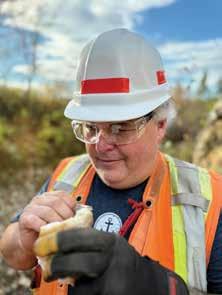
QUEENSWAY UP CLOSE: How New Found Gold builds community trust
A NEW MINING ORDER: Why 2026 will be a pivot year
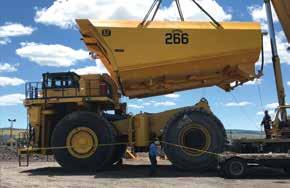
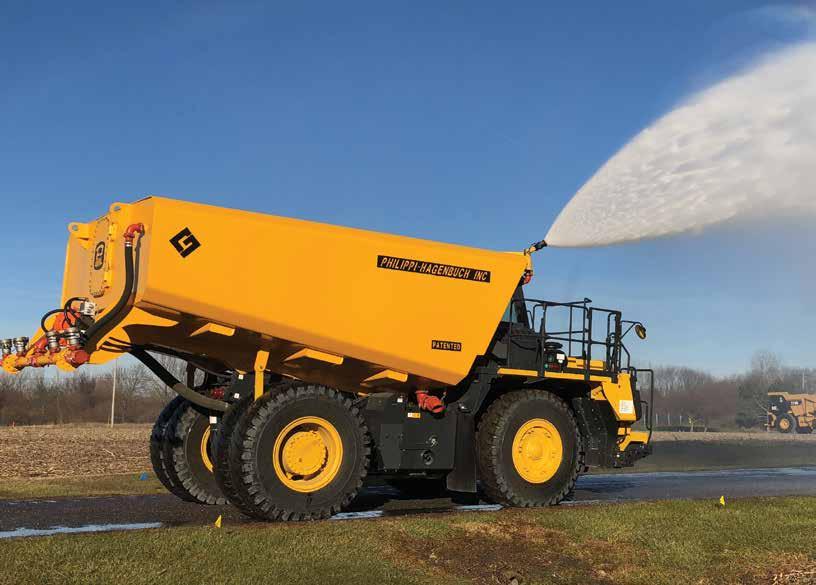
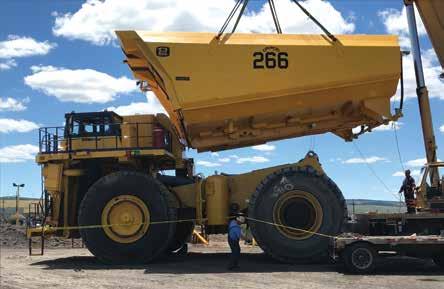
HAULAGE REINVENTED: EXTENDING FLEET LIFE THE SMART WAY
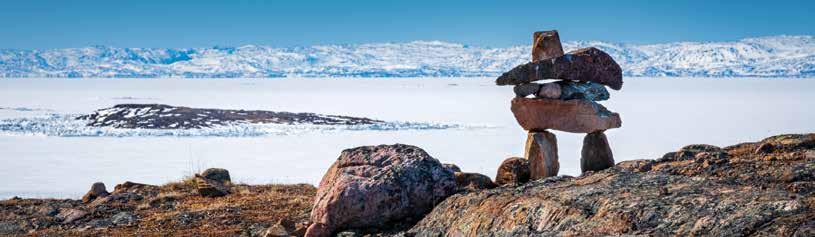
HOW LANGUAGE IS RESHAPING NUNAVUT MINING
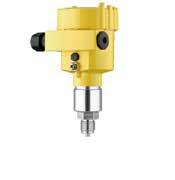
Pressure measurement for your process?
Leave it to us!
Our technologies offer everything you need for process, hydrostatic, and differential pressure for mining. Around the world, VEGA pressure solutions stand for proven reliability and trend-setting innovation. Our pressure measurement solutions go beyond just efficient, optimised processes – they provide you with peace of mind, knowing that you’ve chosen the best technology available.
Everything is possible. With VEGA.
FEATURES
INTERNATIONAL MINING AND CEO INTERVIEWS
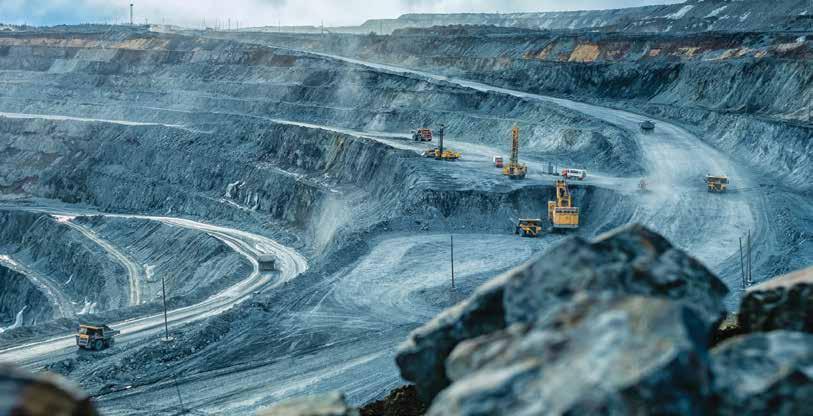
11 Global mining trends that are becoming the new normal.
Uranium to SMRs: Eagle Energy Metals eyes Project Manhattan 2.0
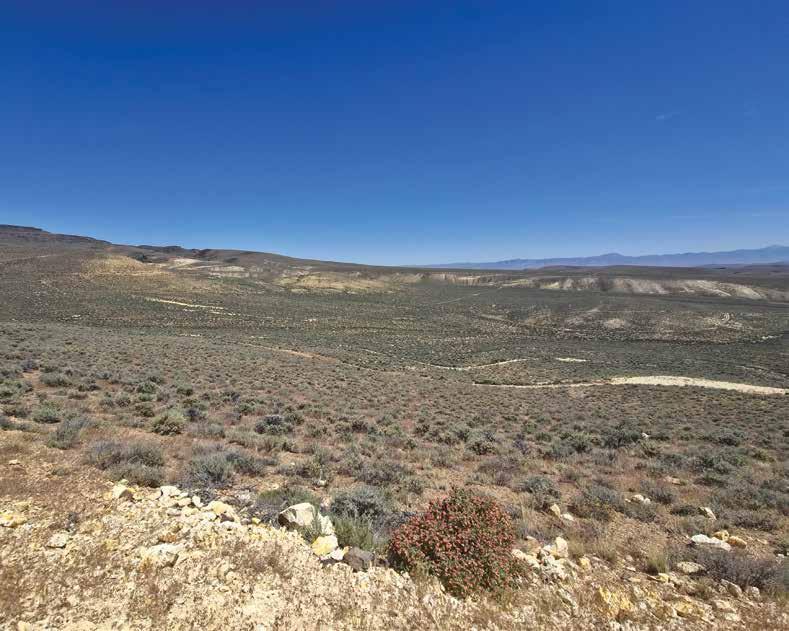
The Alaska giant: NOVAGOLD readies Donlin for its defining decade.
Mining in B.C.: More mines join federal fast-tracking program: PART 1.
Inside New Found Gold’s approach to a social licence
Nunavut: Language inclusion and translation as strategic ESG tools.
MAINTENANCE, TECHNOLOGY, AND AUTOMATION
The right equipment investments can help mining operations
The role of AI agents in modern mineral exploration and processing.
Sensors, resilience, and automation: Lessons for the modern mining site.
Shake off winter woes: Caring for processing equipment through the winter.
A new mining order: Canada and the world brace for selective megadeals and strategic repositioning in 2026.
Updates from across the mining ecosystem.
Canadian Mining Journal Launches new YouTube channel with exclusive visit to New Found Gold’s Queensway Project. 36
www.canadianminingjournal.com
Tamer Elbokl, PhD
TA new mining order: Canada and the world brace for selective megadeals and strategic repositioning in 2026
he Mining Association of Canada (MAC) welcomed the federal government’s 2025 budget, saying it includes measures that will strengthen the country’s mining industry and spur investment in critical minerals. MAC said the budget aligns with several of its recommendations and reflects commitments made in the Liberals’ 2025 election platform. A key item is a $2-billion, five-year allocation to Natural Resources Canada beginning in 2026-27 to create a Critical Minerals Sovereign Fund, which would provide strategic support for critical-minerals projects and companies.
The policy backdrop comes as the mining sector undergoes notable consolidation, with companies adjusting portfolios in response to shifting regulatory expectations, geopolitical pressures, and volatile commodity markets. The most consequential transaction under review is the proposed US$50-billion merger between Anglo American and Teck Resources. Although global in scale, the deal carries significant implications for Canada, where federal authorities have launched a national-security review under the Investment Canada Act. The scrutiny reflects Ottawa’s heightened focus on critical-minerals ownership.
Moreover, consolidation is reshaping the North American precious-metals landscape. Coeur Mining’s agreement to acquire New Gold Inc., announced in November 2025, would fold New Gold’s Canadian operations into a broader, multi-jurisdictional platform. The deal underscores a growing preference for cross-border combinations that prioritize cash-flow stability, operational synergies, and exposure to multiple metals rather than high-risk bets on single jurisdictions or commodities.
Smaller but strategically important deals are also influencing the sector. Uncertainty surrounding permitting timelines, geopolitical tensions, and global trade disruptions has prompted many Canadian miners to pursue joint ventures, partnerships, and targeted acquisitions that provide scale without excessive leverage. This has made 2025 less a year of megadeals and more one of deliberate repositioning, with companies prioritizing high-quality assets, strong regulatory footing, and diversified metal exposure.
Internationally, the merger-and-acquisition (M&A) pipeline heading into 2026 is one of the strongest the industry has seen in years. After two active dealmaking cycles in 2024 and 2025, another round of consolidation is emerging across copper, gold, lithium, and other critical minerals. Alongside the Anglo-Teck proposal, several significant transactions are advancing toward possible completion next year. Dundee Precious Metals’ planned US$1.25-billion acquisition of Adriatic Metals would give the Canadian miner control of the high-grade Vareš silver-zinc project in Bosnia and Herzegovina. In West Africa, Perseus Mining’s bid for Predictive Discovery reflects fierce competition for long-life, district-scale gold deposits that can anchor future production profiles.
Producers with global portfolios are also preparing for strategic realignments. BHP and Rio Tinto are expected to pursue targeted, multi-billion-dollar deals focused on copper, lithium, and other metals central to energy transition. Stabilizing lithium prices are also setting the stage for further consolidation among developers and mid-tier producers.
As policy frameworks evolve and competition for critical minerals intensifies, 2026 is shaping up to be a defining year for M&A deals.
Finally, our team wishes our readers Happy Holidays and a Happy New Year! Our next edition is February/March (PDAC 2026), which will feature our annual review on the state of mining in Ontario, the Ontario Mining Association’s annual address, and a look at the new technology and innovations. Relevant editorial contributions can be sent directly to the Editor in Chief no later than Feb. 4th, 2026.
President, The Northern Miner Group Anthony Vaccaro
Established 1882
Canadian Mining Journal provides articles and information of practical use to those who work in the technical, administrative and supervisory aspects of exploration, mining and processing in the Canadian mineral exploration and mining industry. Canadian Mining Journal (ISSN 0008-4492) is published nine times a year by The Northern Miner Group. TNM is located at 69 Yonge St., Ste. 200, Toronto, ON M5E 1K3. Phone (416) 510-6891.
Legal deposit: National Library, Ottawa. Printed in Canada. All rights reserved. The contents of this magazine are protected by copyright and may be used only for your personal non-commercial purposes. All other rights are reserved and commercial use is prohibited. To make use of any of this material you must first obtain the permission of the owner of the copyright. For further information please contact Robert Seagraves at 416-510-6891.
Subscriptions – Canada: $51.95 per year; $81.50 for two years. USA: US$64.95 per year. Foreign: US$77.95 per year. Single copies: Canada $10; USA and foreign: US$10. Canadian subscribers must add HST and Provincial tax where necessary. HST registration # 809744071RT001.
From time to time we make our subscription list available to select companies and organizations whose product or service may interest you. If you do not wish your contact information to be made available, please contact us via one of the following methods: Phone: 1-888-502-3456 ext 3; E-mail: amein@northernminergroup.com
Mail to: Allison Mein, 69 Yonge St., Ste. 200, Toronto, ON M5E 1K3 We acknowledge the financial support of the Government of Canada.
Canada’s federal government has cleared Anglo American’s proposed combination with Teck Resources national security grounds, The Globe and Mail reported, citing an unidentified person familiar with the matter.
Ottawa’s initial 45-day review period elapsed without an extension, which means that the transaction has been cleared on national security grounds by default, the newspaper said.
• PROJECT PUSH | Feds unveil second wave of mining and energy projects
Prime Minister Mark Carney announced a new batch of infrastructure and resource development projects recently, marking the second phase of the government’s economic strategy. The initiative aims to diversify Canada’s trade relationships and boost domestic self-sufficiency.
At the heart of the plan is a focus on mining and energy development. The government is pushing forward with several major mining projects. These include the Northwest Critical Conservation Corridor in British Columbia and Yukon, which aims to unlock vast critical mineral deposits while creating a massive conservation area.
In Ontario, Canada Nickel’s Crawford project is set to produce low-carbon nickel for batteries and steel. Quebec will see the development of Nouveau Monde Graphite’s Matawinie Mine, providing graphite for defense and battery applications. In New Brunswick, Northcliff Resources’ Sisson Mine will produce tungsten for steel and industrial use.
The plan also emphasized energy development, with projects like the Ksi Lisims LNG facility in British Columbia taking center stage. Led by the Nisga’a Nation, it’s slated to become Canada’s second-largest LNG facility.
•
SPACE MINING | Fleet Space, ExLabs team up to probe metal-rich nearearth asteroid
Fleet Space Technologies, Australia’s leading space exploration company, has signed a memorandum of understanding with ExLabs to send its offworld exploration systems to survey asteroid Apophis as part of ExLabs’ ApophisExL mission, planned for launch in 2028. The collaboration aims to push asteroid science, strengthen planetarydefence capabilities and help build the infrastructure for a sustainable spaceresources economy.
• PIPELINE PACT | New pipeline agreement: Carney and Smith unite for B.C. resource development
Prime Minister Mark Carney and Alberta Premier Danielle Smith have signed a memorandum of understanding (MOU) to advance an oil pipeline project to the West Coast. The agreement includes potential adjustments to the West Coast tanker ban if the project gains national interest status and emphasizes Indigenous co-ownership and economic benefits
Alberta plans to impose a carbon price of $130 per tonne by April 1, exceeding federal standards, while Ottawa will suspend clean electricity regulations in the province until a new carbon pricing agreement is finalized. The pipeline project is linked to the Pathways Alliance carbon capture initiative, with both expected to be developed together.
Carney hailed the signing as a pivotal moment for Canada’s industrial landscape, but acknowledged the need for collaboration with British Columbia and local First Nations to proceed. While Smith asserted the MOU does not grant B.C. or Indigenous groups a veto, she highlighted the necessity for their involvement in ownership and consultation.
• DRILLING RESULTS | New Found Gold confirms at surface highgrade core at Queensway
New Found Gold reported channel sampling results from the Iceberg excavation in the AFZ Core at its 100%-owned Queensway gold project in Newfoundland and Labrador. Highlighted nearsurface channel intervals (channel thicknesses; quotations unchanged) include: 64.8 g/t gold over 6.71 metres (IB-25-01-10)”; 23.9 g/t gold over 15.12 metres (IB-25-01-16); 113 g/t gold over 2.99 metres (IB-25-01-18); 47.4 g/t gold over 7.36 metres (IB-25-01-40); 23.0 g/t gold over 13.74 metres (IB-25-01-08); and 117 g/t gold over 2.16 metres (IB-25-01-07), which form part of the 185 metres continuous surface section.
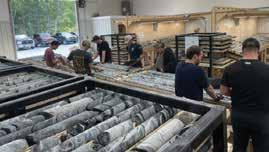
Core shack at Queensway Gold Project. CREDIT: NEW FOUND GOLD
• NEW TECHNOLOGY | Maestro unveils Duetto Analytics to reduce downtime and improve equipment reliability
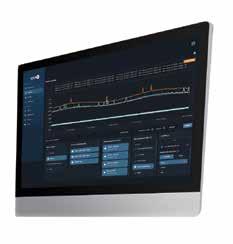
Maestro Digital Mine has introduced Duetto Analytics, a centralized diagnostic software platform built to help mines save time, prevent stoppages, and maintain production continuity. By consolidating airflow, gas, particulate, and environmental data into a single interface, Duetto gives teams faster visibility into sensor health, calibration status, and alarm history across their network. Mines using the platform report significant time savings during blast-clearance workflows, where multi-sensor trending helps supervisors verify re-entry conditions more quickly and with greater confidence. Early detection of underperforming or defective instrumentation also reduces ventilation delays and unexpected production interruptions tied to unreliable readings. Duetto’s predictive maintenance tools flag developing issues before they escalate, enabling crews to intervene earlier and avoid costly slowdowns. Customizable dashboards allow operations, engineering, and maintenance teams to focus on the assets most critical to safety and throughput. Available virtually or as an industrial appliance, Duetto enhances diagnostics inside the process control network while working alongside existing SCADA systems.
• MINING ICON | Sudbury-born mining labour icon Leo Gerard dies aged 78
Leo W. Gerard, a Sudbury native and former international president of the United Steelworkers (UCW), died at 78. The United Steelworkers noted Gerard was the union’s longest-serving president, leading the organization for more than 18 years before retiring in 2019. The union said his career in labour began at age 18 at a nickel smelter in Sudbury and spanned more than five decades with numerous leadership roles.
Screenshot of Duetto Analytics software.
Leo Gerard passed away at 78 recently.
By Tamer Elbokl,
Canadian Mining Journal Launches new YouTube channel with exclusive visit to New Found Gold’s Queensway Project
Canadian Min’s new YouTube channel — your source for
in-depth coverage of Canada’s mining industry, from exclusive site visits and executive interviews to the latest in-
sights on exploration, innovation, and investment trends. Subscribe to stay connected with the people and projects shaping mining’s future.
Join Canadian Mining Journal’s Editor-in-Chief, Dr. Tamer Elbokl, on an exclusive site visit to New Found Gold’s Queensway Project near Gander, Newfoundland. In this series of videos, we take you behind the scenes of one of Canada’s most talked-about gold exploration sites — where record-grade discoveries are reshaping expectations for the island’s gold potential.
From core-shack tours and drilling updates to conversations with CEO Keith Boyle and COO Robert Assabgui, this visit captures the scale, energy and optimism driving New Found Gold’s vision. Watch as CMJ highlights how the company is advancing resource development, community engagement, and technical innovation at Queensway — one of the most exciting projects in Atlantic Canada’s mining story.
Link to the first teaser trailer: https://youtu.be/7R0JcRsiKho?si=l4nU-Tz3Ca3HTCJH
Keith Boyle, CEO and Director of New Found Gold waiving a Blue Jays banner with a meme at the company’s offices in Gander, NL. CREDIT: TAMER ELBOKL
Global mining trends that are becoming the new normal
As the importance of developing mining resources increases and the capital costs associated with doing so not only increase, but evolve in complexity, keeping up with global trends is not easy. In this article, we present some observations from the multi-disciplinary, international global mining team at Dentons. On the front end, we are seeing the world of structuring international mining transactions becoming more complex. On the back end, because of that increasing complexity, we are seeing disputes arise more often and increasing in complexity.
Transactions
The mining sector is undergoing dramatic consolidation. From January 2024 to mid-2025, mining companies announced or closed 18 deals over $1 billion, totaling approximately $47 billion. While mining M&A has always been cyclical, the past 18 months have marked a major shift in both the scale and frequency of large transactions. But unlike earlier deal activity driven by optimism about rising commodity prices, this one is being fueled by sharper pressures: geopolitical uncertainty, trade disputes, rising costs, supply gaps, strategic urgency and the accelerating shift toward clean energy. Companies are not speculating — they are securing future output, cash flow, and critical materials in a world that is changing fast.
TREND #1: BUY BABY BUY. THREE MAJOR FORCES ARE PUSHING MINING COMPANIES TO BUY RATHER THAN BUILD
The energy transition and copper’s critical role: The clean energy transition has made copper the most strategic metal of the decade. According to the International Energy Agency (IEA), the share of total demand for copper and rare earth elements (REEs) will rise significantly over the next two decades to over 40% in a projected scenario that meets the Paris Agreement goals, driven by copper’s role in clean technologies like electric vehicles and storage, wind turbines, solar PV, electricity networks, and hydropower and bioenergy. While gold may bring resilience and balance sheet strength, copper brings relevance and strategic leverage. Every part of the energy transition — from EVs and solar panels to transmission lines — relies on copper. This supply crunch is triggering intense competition for mining assets with the following:
Rising project costs, but borrowing is relatively attractive: Major miners entered 2024 with record cash reserves. At the same time, falling interest rates reopened the debt market, allowing mining companies to borrow at rates below 5%. That matters because new mining projects are getting much more expensive. The result? This makes M&A a faster, less expensive, more certain, and lower-risk
By
way to secure mineral resources than building new mines, and low-cost funding provides the sector with the capacity to do it.
Reshaping portfolios for the future: Miners are actively restructuring — selling off older, carbon-intensive or non-core assets and reinvesting in future-facing materials. Acquiring existing mining assets, especially those already in production, offers a way around these risks — especially for public mining companies that are under pressure to demonstrate near-term growth to their shareholders. As a result, M&A offers a faster, less risky, and often more cost-effective and certain path to resource expansion.
TREND #2: DIVEST-TO-INVEST — SELLING TO FUND THE PIVOT
Some of the largest mining transactions have been motivated by actual or proposed strategic exits involving the sale of older or carbon-intensive assets to fund critical mineral, future-facing investments:
South32 / Golden Energy and Resources / M Resources (August 2024): US$1.65 billion divestiture of South32’s Illawarra Metallurgical Coal mine to fund its zinc expansion in Arizona.
TREND #3: GEOGRAPHIES OF GROWTH — LATIN AMERICA AND AFRICA
Latin America remains the epicentre of copper deal-making. S&P Global’s 2024 World Exploration Trends study shows Latin America again attracted the largest share of global metals-exploration spending — US$3.38 billion, up 2% year-over-year — even when iron-ore and coal projects are left out. Copper remains the dominant driver of Latin American transactions, with the 2024 BHP & Lundin Mining joint venture (JV) deal in Chile and Argentina serving as the marquee example. But that budget is also resulting in other headline mining M&A leading to Latin America being responsible for 17% of global megadeal value.
Meanwhile, Africa is the fastest-rising arena. Supported by government roll-out of the African Green Minerals Strategy and national beneficiation mandates, the continent is quickly emerging as one of the prime targets for the development of new mines to meet the demand for copper, lithium, and others. The 2023-2024 period saw a 32.4% increase in lithium exploration allocations and a 23.6% increase in copper exploration allocations for the continent.
The bottom line is that while North America and Australia still log more billion-dollar closings, Latin America offers the deepest copper pipeline, while Africa delivers the fastest growth and favourable policy momentum, making both regions pivotal to the next wave of energy-transition mining M&A.
TREND #4: JOINT VENTURES — SHARING RISK, SPEEDING UP RESULTS Where outright acquisitions are not possible or practical, compa-
Michael Schafler, Greg McNab, José Ignacio Morán, and John Mollard
INTERNATIONAL MINING
nies are teaming up through in-district partnerships. Joint ventures are the rising stars of the megadeal landscape. JV structures enable miners to share infrastructure, split costs, achieve operational efficiencies, access in-country expertise, and navigate tricky regulatory or political environments together.
These structures are gaining traction, as companies are looking to get complex projects off the ground quickly and collaboratively, particularly in regions with underdeveloped infrastructure. JVs in mining are evolving from traditional investment vehicles into strategic governance tools that address regulatory, environmental, and social complexity. Globally, JVs account for over 40% of production among the ten largest mining operations, underscoring their central role in complex, large-scale projects.
In Chile, a top global copper producer and rising lithium powerhouse, this evolution is particularly evident. New JV structures increasingly involve state-owned enterprises, Indigenous communities, and multinationals, creating hybrid models of governance designed to align profitability with long-term sustainability.
Disputes
TREND #5: ROYALTY DISPUTES
Royalty rights, like net smelter royalties, are often conferred on a JV partner at a very early, pre-production stage. Ownership rights subsequently change hands, the royalty right is not clearly identified in assignment agreements, years go by and the mine eventually goes into production. The holder of the right eventually takes notice and asks to be paid. This basic fact pattern has repeated itself many times over the years and has given rise to both arbitration and court proceedings. As more royalty stream companies emerge, the potential for more disputes has become heightened.
TREND #6: LONG TERM SUPPLY CONTRACTS NO LONGER ECONOMICAL
This is one of the larger sources of disputes and applies equally to long-term supply contracts as it does to royalty agreements. As a result of more volatile markets over the past two decades, supply contracts in mining are being negotiated for shorter terms, often including complex price review mechanisms within the terms of the contract. These mechanisms tend to take averages from several indices over a quote period to specify a price per unit, which is then discounted across the duration of the contract.
Market conditions provide strong motivation to proceed to arbitration, where the average price becomes favourable to one party and not the other.
Relatedly, for truly long-term supply contracts or longer-term royalty arrangements, sometimes an index or benchmark on which the contracted pricing mechanism depends disappears or merges into another, requiring the parties to find a suitable alternative, which often requires arbitration. The same applies where the agreed index ceases to be the appropriate index for the parties, which may happen for a variety of reasons.
TREND #7: COMMERCIAL DISPUTES
Sometimes, parties will disagree over the interpretation of a commitment to deliver or purchase a specified amount and
whether that commitment is binding. When the prices of minerals fluctuate, as they have recently, parties may have an interest in changing their commitments.
These contracts typically specify supply in three ways:
• The mine sells the buyer a specified quantity;
• The mine sells the buyer a specified percentage of yearly production; or
• The mine sells the buyer a minimum quantity, and the buyer has the option to purchase more if yearly production allows it.
Directly related to disputes of quantity, sometimes the contract has terms specifying a quantum owed where a mine fails to provide or a purchaser fails to purchase their commitment under the contract.
This also applies to quality disputes, when the purity of a metal, or the proportion of metal in an ore shipment, falls below a certain threshold specified in the contract.
Disputes under this topic are generally less factually complex, since there is no need to determine pricing and use valuation experts. However, it may be more legally complex given the treatment of liquidated damages by courts in the past.
Without a specific clause outlining the rights and thresholds required for a buyer to refuse a shipment, there is an open question as to whether a buyer may refuse a shipment of ore for falling below a certain specification. The question becomes more complicated where the contract includes a complex pricing mechanism that accounts for the purity of the product.
This is a specialized area that has its own case law/statutory framework. Given that most mines exist in remote areas, often on other continents, the transport of products is a necessity of the industry.
TREND #8: DISPUTES INVOLVING GOVERNMENTS
When a government nationalizes or expropriates a mine, that often results in a direct taking under law, meaning that compensation is due. Under some laws, there is also an avenue where the government engages in de facto expropriation, or a constructive taking, which has been litigated in the context of mineral rights.
The legal issue of whether compensation is due may depend on whether there is direct or indirect expropriation, either under the laws of that jurisdiction or based on a relevant treaty. In recent years, such treaty-based disputes, and international arbitrations, have significantly increased.
State–Investor arbitration remains a cornerstone mechanism for resolving disputes in the mining industry. The number and proportion of cases involving extractive activities and energy supply have risen sharply in recent years, accounting for over half of all new filings in 2024. A significant share of these disputes stems from mining operations, with cases involving critical minerals increasing notably. Both trends underscore the disruptive impact of the global energy transition on mining activities and national resource policies.
The most frequent causes of these disputes include abrupt regulatory changes, direct or indirect expropriations, disagreements over the renewal or termination of mining concessions, unilateral alterations to tax stability agreements, and the impo-
sition of environmental or social restrictions that disrupt ongoing operations. Bilateral Investment Treaties (BITs) and Investor–State Investment Agreements remain the primary legal instruments invoked by investors seeking protection against measures perceived as arbitrary or discriminatory.
A prominent recent example is the arbitration between Barrick Gold Corporation and the Republic of Mali, initiated by Barrick in early 2025 over disputes related to the Loulo-Gounkoto gold mine. The conflict stems from amendments to Mali’s Mining Code and focuses on the interpretation and enforcement of tax and royalty obligations as well as fiscal stability clauses embedded in the investment agreements. Barrick contended that Mali’s actions — including the suspension of gold exports and the placement of the mine under temporary state administration — constituted a substantial breach of the Mining Conventions between Barrick’s subsidiaries and the Malian State.
The dispute escalated dramatically in December 2024, when Malian authorities issued an arrest warrant for Barrick CEO Mark Bristow, alleging violations of the revised fiscal regime. Shortly thereafter, Barrick offered to pay US$370 million as part of ongoing settlement discussions. In mid-2025, the Malian government took control of the Loulo-Gounkoto mine, appointing former minister Soumana Makadji as state administrator. By October 2025, operations had resumed under state management without Barrick’s consent — an unprecedented development in international mining disputes.
The Barrick versus Mali case epitomizes a broader global trend: the growing tension between resource-rich states, which
seek greater economic participation and sovereign control over their natural resources, and international mining companies, which demand legal certainty and regulatory stability. This tension has intensified the ongoing debate over the modernization of investment protection mechanisms, spurring efforts to design clauses that better balance state sovereignty and sustainable development goals with investor expectations.
Conclusion
The global mining sector is entering a period of structural change. Consolidation, shifting capital strategies, and evolving forms of dispute resolution are reshaping how companies operate and invest. As the energy transition accelerates and geopolitical factors continue to influence access to resources, these trends are likely to define the industry’s direction for years to come.
Michael Schafler is a partner in Dentons’ Toronto office. He is a member of Denton’s global arbitration steering group and previously co-led both the global and national litigation and dispute resolution groups.
Greg McNab is a partner in the Dentons’ Corporate group and serves as Canada co-chair for Dentons’ mining group.
José Ignacio Morán is a partner in Dentons’ Santiago office. He is the global mining & natural resources sector leader and a member of the ESG LAC committee.
John Mollard is a partner in Dentons’ Melbourne office, working closely with lawyers across all mainland capital cities. He leads the China Australia collaboration group.
More mines join federal fast-tracking program: PART 1
The federal government’s announcement could hardly have been designed to quicken the pulse of Canadian mining. Created in August 2025 under the Building Canada Act, the new Major Projects Office (MPO) promised to streamline the project approvals process for LNG development in western Canada, nuclear in Ontario, and in Montreal, shipping.
Almost an afterthought, two mines were added to the fold — Foran’s McIlvenna Bay copper mine in Saskatchewan and Newmont’s Red Chris Copper Mine in B.C. for having met the MPO’s key selection criteria for projects already underway.
McIlvenna Bay is near completion and is scheduled to begin operation in 2026. Red Chris Mine represents $60 billion in opportunities for “critical minerals development, clean power transmission, and Indigenous project leadership,” Ottawa said. Work there has been ongoing for more than a decade.
In October, Ottawa and Ontario went further by promising to pony up $3 billion to support construction of four small modular reactors (SMRs) at Ontario’s Darlington New Nuclear Project. Mining’s second win came in November when Ottawa lowered to 50% the eligibility for the clean technology manufacturing investment credit.
According to Photinie Koutsavlis, vice-president, economic affairs and climate change, for the Mining Association of Canada, the previous 90% production threshold restricted eligibility to companies mining a single qualifying mineral such as copper, lithium, or cobalt.
“It was not possible for most Canadian projects to reach that threshold of 90% because our geology is polymetallic. Copper, for example, comes with gold, with silver, and zinc,” said Koutsavlis, who vigorously lobbied for the change this past year. “We could not be more pleased by Ottawa’s decision,” Koutsavlis said in November.
That month, Northcliff Resources learned its proposed Sisson tungsten and molybdenum mine project had also passed muster at the MPO. Ottawa previously awarded the New Brunswick project $8.2 million for a feasibility study, this after the U.S. War Department awarded the company $20.7 million in May.
Also tagged for inclusion in MPO’s fast-tracking program was the Crawford nickel project just north of Timmins, Ontario, and one of the largest nickel deposits in the world.
The MPO also coordinates financing for major projects, linking proponents with federal programs, such as the Canada Infrastructure Bank and the Indigenous Loan Guarantee Program. Consultation with Indigenous peoples is also a central criterion for inclusion in the program.
McIlvenna Bay: Why is copper critical now?
Situated in East-Central Saskatchewan in one of Canada’s richest mineral belts, the McIlvenna Bay Project, Ottawa’s initial announcement said, will supply copper “to strengthen Canada’s position as a global supplier of critical minerals for clean energy and advanced manufacturing.”
The copper will be smelted in Quebec and is expected to be the first net-zero copper project in Canada aimed at supplying battery metals for anything electrical (e.g. grid upgrades and zero-emission vehicles). According to Koutsavlis, it cannot come
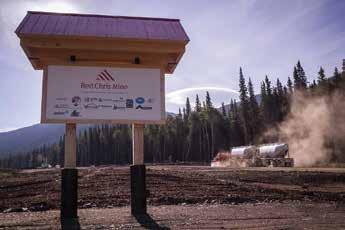
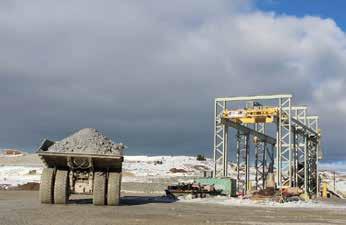
Highway 37 road access to the Red Chris Project. CREDIT: IMPERIAL
Discover Saskatchewan a global mining leader
Saskatchewan is Canada’s top region for mining investment thanks to its world-class resources, attractive incentives, and trusted geoscience data.
Learn why investors are making Saskatchewan their top choice.
too soon, citing a 20% decline in Canadian copper production.
“Canada has lost its place in copper production globally,” she said. Foran’s vice-president of capital markets and external affairs, Jonathan French, does not disagree. “Over the last decade, we have definitely declined and just as importantly it has been impacting downstream. We have had smelters also shut down in Canada,” he said.
One of the most recent is the July 2023 shutdown of Flin Flon’s Triple 7 smelter;
owner Hubday Minerals opting for an agreement with a Japanese company to do more mineral exploration west of the city. “If we want to build a self-sustaining economy, we need to be investing in those projects,” said French.
One advantage which led the MPO to put McIlvenna Bay Copper Project on the fast-track list was Foran’s completion of its permitting process, which, along with financing and execution, is a major risk in new mines development. Hence Foran’s decision several years
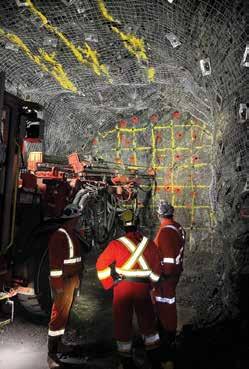
BEV jumbo drilling at McIlvenna Bay Project.
ago to forego open pit mining because of the time and effort required to obtain permits for this mine type.
Once full permitting was completed, almost simultaneously Foran struck a collaboration agreement with the Peter Ballantyne Cree Nation. “If you do not have a social license you do not have a business,” French noted. Its FID announced in July 2024 and already 64% complete, McIlvenna Bay Copper Project is expected to finish construction by mid-2026.
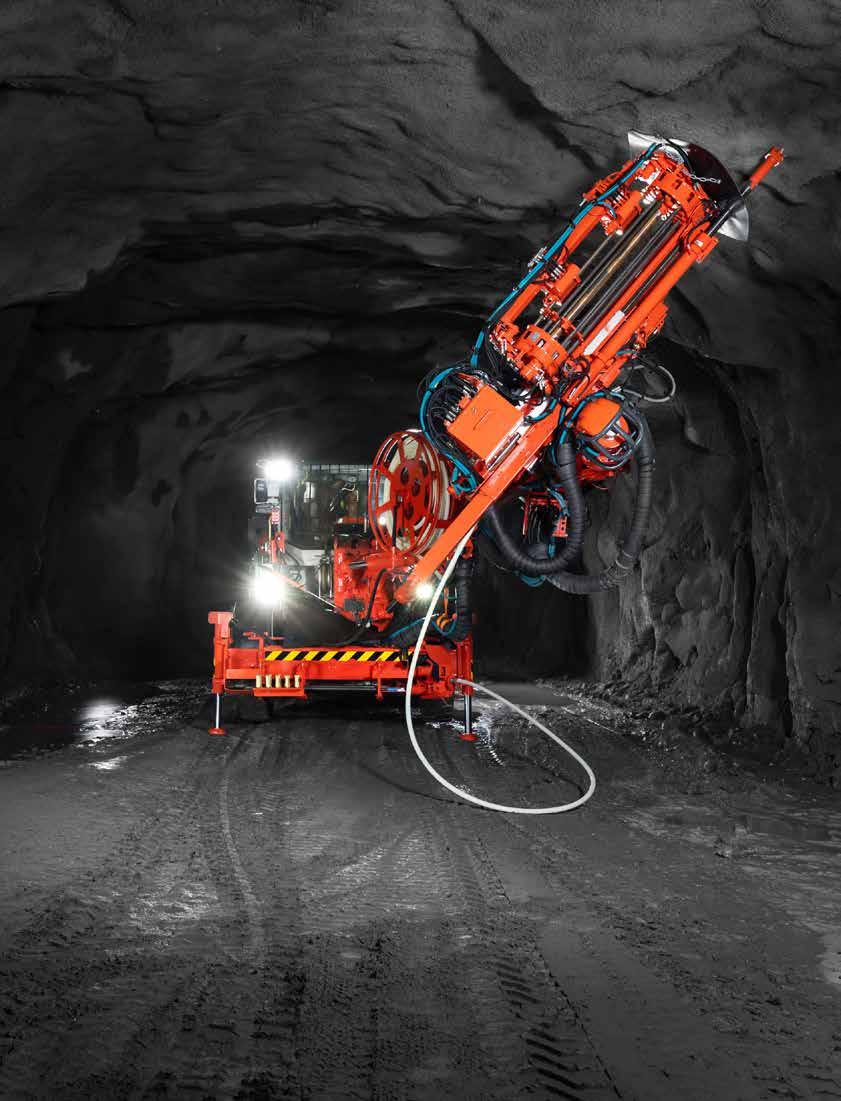
Supporting this is a large fleet of equipment aimed at both block and underground mine development, said French. “The exciting thing about McIlvenna Bay is the use of underground battery electric vehicle fleets like Sandvik electric scoops and trucks, as well as bolters and jumbos,” French explained.
On the labour side, approximately 800 staff are on site, which is close to peak construction numbers. This will be reduced to just over half that number once the mine’s operation is in full swing next year.
“But the real beauty of its Phase One underground operation is a deposit that starts about 20 to 25 metres below surface. We have done the decline; we are over 200 metres deep from surface, so we are already in the ore body,” said French.
Investment decisions await everyone
Along with Agnico Eagle, Foran’s largest shareholder at just
over 28% is Fairfax Financial, supplemented in May 2025 with an investment by the Canada Growth Fund. That fund along with the clean technology manufacturing investment credit is one of the few tools Ottawa has to compete with the U.S. Inflation Reduction Act under Joe Biden and now with Trump’s regressive tariff assault on Canadian metal industries.
More than tariffs impeding Canadian mining and the economy overall is how badly Canada is dwarfed by the U.S. government’s aggressive equity investments strategy. Notable are stakes by the U.S. in MP Materials’ auto magnets production (including a U.S. loan and price guarantee), Lithium America, and Critical Minerals Corp.
In Canada, it was Quebec that got into government investment in mining first, notably $965 million in 2018 in Nemaska Lithium, a 50% stake that was matched by Rio Tinto and intended to build up the battery industry. This was followed by a more recent provincial injection into the project of $150 million.
Meantime, Investissement Quebec also invested in Nouveau Monde Graphite Inc. to support the Matawinnie open pit mine and a battery material plant in Bécancour. The Canada Growth Fund brought the total federal-provincial investment there to $50 million in Dec. 2024. That project is envisioned as the largest fully integrated natural graphite facility in North America.
The Canada Growth Fund has also taken out a 10% stake in Foran’s McIlvenna Bay Copper Project. But for all the fund’s worthy investment there and in Quebec, it “has been slow out of the gate,” says Koutsavlis. On a positive note, she added,
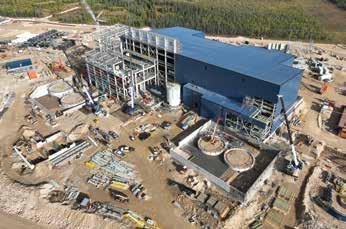
The crusher at the Red Chris Mine. CREDIT: IMPERIAL
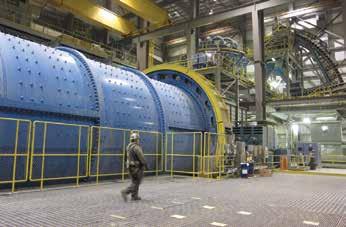
The grinding mill at Red Chris Project. CREDIT: IMPERIAL METALS
MINING IN CANADA: MINING IN BRITISH COLOUMBIA
“They are now building their own capacity as a team to better assess and also develop their internal knowledge of the mining sector.”
The Red Chris story
The impulse for investment continues to be felt not by government but primarily by private industry, including Newmont Gold. Following a 2010 Supreme Court ruling in favour of development, Red Chris copper and gold mine today is operated as a joint venture between Newmont (a 70% ownership stake) and Imperial Metals, which acquired the property in 2007.
Spurred on by diamond drilling between 2007 and 2012, rich veins of copper and gold discovered at a depth of one km led to a $634 million project opening in 2015. Estimates put copper production at approximately 11 million t/y, with gold production expected over a 28-year mine life.
In 2020, highlights from drilling by Newcrest Mining at the mine’s east zone included 276 metres of 3.3 g/t gold and 1.7% copper from a downhole depth of 684 metres. It also revealed 0.54% copper from 570 metres and 0.46% copper from 458 metres. Enough for Newmont to closely follow further drill programs and acquire Newcrest in 2023 in a $16.8 billion deal to expand the copper operation into 2025.
While easily outshined in size in Canada by Hubday Minerals, Yamana Gold, and B2Gold, the MPO included Newmont’s Red Chris mine’s plan to transition from its current open pit copper operation to a large scale, underground block cave mine.
This could not have come at a better time following the rescue of three miners below surface at Red Chris in summer 2025 and B.C. government fines for repeatedly failing to monitor ground water at the site — this at a time when the MPO had only signaled its possible inclusion in the fast-track infrastructure programs.
According to Koutsavlis, the company is seeking to amend its provincial environmental assessment certificate to transition from open pit to a large-scale underground block-cave mine. Assuming it passes that hurdle and affirms an FID, the site and processing plant could boost Canada’s overall copper input by 15%.
As part of the proposed Northwest Critical Conservation Corridor, Newmont’s expansion is also expected to extend the lifespan of the mine by over a decade, putting the peak construction workforce at 1,800 and cutting greenhouse gas (GHG) emissions by over 70% once in operation.
The Indigenous factor
Newmont’s consideration for the MPO fast-tracking designation was bolstered by another key criterion: under the Declaration on the Rights of Indigenous Peoples Act, a co-management partnership with B.C.’s Tahltan Nation ensures local Indigenous peoples not only benefit materially from the mine but also have a significant say in how the expansion project proceeds.
“That approach ensures Indigenous consent is central to the process, extends the mine’s life, boosts Canada’s copper output, and sets the stage for a final investment decision by Newmont,”
said Koutsavlis.
The mine is located 80 km south of Dease Lake, B.C., in the traditional territory of the Tahltan First Nation, which is no stranger to strategic partnerships. It earlier joined with engineering company Allnorth to provide engineering, design, and construction services in northwestern B.C.’s mining and infrastructure sectors.
Newmont, like other mining companies, is looking at projects around the world for a global portfolio. They assess properties against the jurisdiction they are in, the regulatory environment, and political stability.
According to Koutsavlis, the way Canada demonstrates its appeal on taxation and other factors will be critical in any company’s final decision, including Newmont’s. “Let’s get these projects permitted but getting them financed and built is the most important part,” French added.
French noted that a “one project, one review” and the amended tax credit are fine, but it is about getting private capital involved. And if the government can support these projects so a company only must raise 80% or 90% of the capital instead of 100%, that makes even those smaller differentials palatable for investors.
Always in the background: China
China is fiercely competing for the global nickel market. Ontario’s Energy and Mines Minister Stephen Lecce called the Crawford Nickel Project “very important” for that reason, to disrupt China’s monopolization of the sector.
“We have got the highest-grade nickel, a business operation that represents 1,000 permit jobs, 3,000 construction jobs, a 40year operation with billions of dollars of gain to Canada’s economy. So, we certainly would hope it will be prioritized on that list,” said Lecce.
For all the fanfare, Ottawa hoped its fast-tracking process would garner — and done so quite successfully — within days of the three new mine announcements the feds declared it will take a more circumspect approach unveiling new entrants to the program. No more large block, single-day announcements; more likely single winner selections “every couple of months” made from the MPO.
Koutsavlis concluded, “We have had five mining projects to date. The MPO will be assessed on the successes of these projects under its program.” “How many get to an approved FID and to construction will be the litmus test for the MPO capacity to assist critical minerals development in this country,” she added.
“The government is listening, and putting these policies into effect can be significant for the industry,” noted French.
David Godkin is a Canadian freelance mining writer.
INSIDE NEW FOUND GOLD’S APPROACH TO A SOCIAL LICENCE AT THE QUEENSWAY PROJECT
During a site visit to New Found Gold Corp.’s Queensway Gold Project near Gander, Canadian Mining Journal spoke with Jared Saunders, the company’s vice-president of sustainability, about how New Found Gold is working to strengthen community relationships and ensure transparent, efficient permitting, as it advances one of Canada’s most promising exploration projects.
New Found Gold completes Maritime takeover
New Found Gold Corp. and Maritime Resources Corp. announced on Nov. 13, 2025 that they have completed their previously announced plan of arrangement, whereby New Found
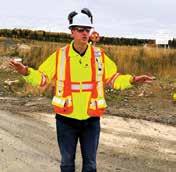
At New Found Gold’s Queensway Project near Gander, vicepresident of sustainability Jared Saunders explains how early engagement with Indigenous and local partners is helping the company build trust, streamline permitting, and set a new standard for community collaboration in Newfoundland’s mining sector.
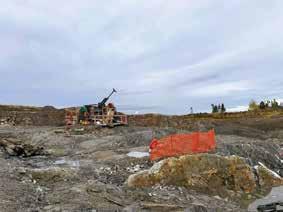
Drilling in progress. Recently, New Found Gold confirmed high-grade gold mineralization over broad widths from the Keats zone initial grade control drilling at the Queensway Gold Project: 219 g/t Au over 9.35 m from 19.00 m and 160 g/t Au over 10.30 m from 15.80 m.
Gold has acquired all outstanding shares of Maritime Resources — effectively creating a multi-asset Canadian gold producer. Under the terms of the deal, Maritime shareholders received 0.75 of a New Found Gold share for each share held, leaving the combined company with roughly 69% of its equity owned by legacy New Found Gold investors and 31% by former Maritime shareholders. The transaction brings together the highgrade, near-term producing Hammerdown Gold Project with the 100%-owned Queensway Gold Project in Newfoundland
New Found Gold’s geologists at the Queensway Gold Project.
not only on drill results — more than 600,000 metres of drilling completed since 2020 — but on the company’s ability to build relationships that will last beyond exploration. That includes regularly meeting with municipal leaders, Indigenous communities, and local residents to explain exploration plans, timelines, and permitting steps.
“Some of our smaller communities do not have the expertise in how to handle the more advanced permitting processes that we are going through,” he said. “So, we go in and explain to them what they will be asked to review as part of the process — explain the permitting process even before we start —
so they can answer questions in one-onone settings and learn.”
That open dialogue, Saunders said, helps reduce uncertainty and builds confidence on all sides once regulators begin their formal review. The company also engages early with provincial departments, such as the Water Resources Division and the Environmental Assessment Agency, to present project concepts and identify potential concerns before applications are filed.
“We go to them and say, ‘This is the project we would like to do. Here is what we are thinking about doing. Do you have any concerns with this aspect or that aspect?’” Saunders explained. “That way we can manage those before the formal permitting process even really starts. When it gets in front of them for review, it is ready for them. They know what is coming and understand how we are going to mitigate certain things.”
New Found Gold’s transparent approach to permitting reflects its broader philosophy as a company. Headquartered in Vancouver, the firm holds a 100% interest in the Queensway Gold Project and is advancing a 70,000-metre drill program in 2025. Earlier this year, it published its first mineral resource estimate followed by a positive preliminary economic assessment (PEA) in July, highlighting the project’s strong development potential.
The company also emphasizes environmental stewardship, community partnerships, and ethical governance.
Saunders said these priorities are “fundamental to maintaining social licence and ensuring that when we build, we do so responsibly.”
“It just helps everyone,” he added. “It is less work for them and less work for us overall. So, we are actively out in the community engaging all of our key stakeholders.”
As New Found Gold continues exploration and prepares for potential development, Saunders said the company’s focus will remain on openness, dialogue, and long-term trust.
“We are really out there to make sure people are informed,” he said. “And if they do have a concern, we help them understand how we are mitigating those concerns — before we even start to get shovels in the ground,” he concluded.
This article is based on a CMJ video interview recorded at New Found Gold’s offices in Gander, Newfoundland and Labrador. The video can be found here: https://www.youtube.com/watch?v=d_ Yjgg32SuM
QUICK. DURABLE.
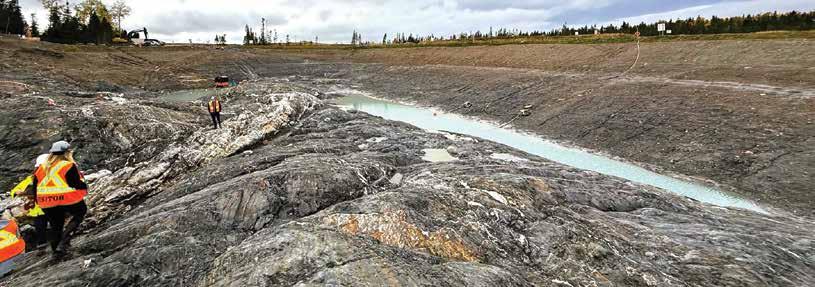
Strategically located on the Trans-Canada Highway, 15 km west of Gander, the project is divided by Gander Lake into Queensway North and Queensway South. CREDIT: TAMER ELBOKL
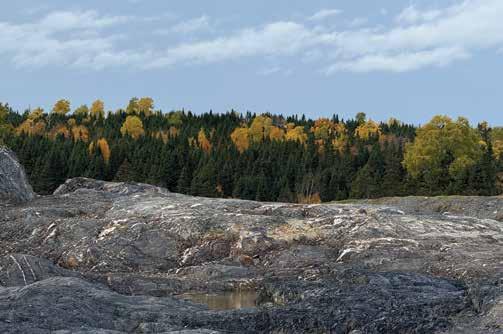
Prospecting did not begin in the Queensway area until the late 1980s when the first gold showing was recorded. CREDIT: TAMER ELBOKL
By Andrew Parker
The right equipment investments can help mining operations lower maintenance costs
Mining operations strive to be safe, efficient, and productive, but they often allocate up to 50% of their annual budget to equipment maintenance to keep things running. How can operations run smoothly to actualize lofty production goals if you are constantly throwing money at repairs?
Considering the constant dust, heat, toxic substances, and crowded spaces at mining sites, operating conditions pose a significant challenge from initial mineral extraction to the byproduct handling. With all these factors during each stage of the process, unplanned downtime is costly and potentially catastrophic for an operation.
Reducing maintenance costs through equipment standardization
For mining engineers, maintenance managers, and operations managers, there is constant pressure to keep heavy material moving consistently and keep the site safe. This is an ongoing challenge given the dense composition and abrasive nature of common metals such as copper, zinc, lead, nickel, uranium, and iron ore.
Additionally, the tailings left over after the metals are separated from the rock pose another material handling challenge. These byproducts are often mixed into a slurry and pumped into storage facilities. Not only does this process demand maximum uptime from the equipment, but the material transfer of tailings is also delicate because of the presence of chemical residues, trace quantities of heavy metals, and sulfide minerals, which can threaten non-compliance with various agencies. This means teams must strike a balance between the following:
• Equipment maintenance and performance.
• Minimizing production losses while navigating increasingly higher output goals.
• Ensuring strict compliance with OSHA, MSHA, and other regulations while answering increased demand.
With operational considerations such as these, scalable equipment that can handle large and expanding capacities of rough materials with minimal maintenance can be money-makers in
a mining operation. What is a good way to achieve this? Standardize your equipment.
Cheap equipment creates more problems down the road
Sometimes maintenance managers and engineers look for cheap equipment replacements from a mishmash of manufacturers.
The danger with that approach is, best-case scenario, it becomes just a replacement rather than an improvement. You can expect the same problems at some point. And the same expenses.
The harsh reality is that cheaper equipment may lead to even more maintenance issues, especially if the equipment is an off-the-shelf option, piecemealed together, or misapplied to the specific material and conditions.
Instead, a more efficient strategy for upgrades or replacements would be to standardize the equipment. Maintenance, repair, and operations (MRO) procedures become more effective when utilizing heavy-duty machines from the same manufacturer, streamlining the maintenance process and improving output. This means more revenue in your pocket because less time and resources are spent on maintenance and repairs.
Vetting manufacturers for the right material transfer equipment
The key to improving productivity and saving on potentially avoidable maintenance expenses is to invest in the right material handling equipment from the start. That means bulk material handling equipment specifically designed for the material characteristics and quantities required for your site. Because of the critical demand for reliable capital equipment,
Constant dust, heat, toxic substances, and crowded spaces pose significant challenges for material handling equipment, and unplanned downtime is potentially catastrophic for an operation. CREDIT: CDM SYSTEM
Scalable equipment that can handle large and expanding capacities of rough materials with minimal maintenance can be a real profit generator for a mining operation. CREDIT: CDM SYSTEMS
Standardized equipment built for mining environments and materials can shrink maintenance expenses and improve production.
look for the following characteristics from a manufacturer:
A proven track record: Prioritize manufacturers with a demonstrated history of supplying reliable equipment that meets the application’s requirements. References from other operations are invaluable.
Durable components:
The durability of every component is important — motors, gearboxes, bearings, troughs, and much more — in extending the equipment’s lifespan and minimizing its maintenance.
Expert consultation and engineering: Although it may cost more upfront, custom-made equipment for your site offers better lifetime value. Find a manufacturer that helps you through the spec process and does not tighten a single bolt until they know precisely what you need the machine to do.
Designed for maintainability (DFM): The equipment should be designed with scalability and ease of maintenance in mind. This means easy access to lubrication points, replaceable wear parts that can be quickly swapped out, and standardized components.
To summarize, mining companies often spend 30% to 50% of their annual budgets on equipment maintenance, underscoring the need for reliable, durable material handling equipment to minimize downtime and expensive repairs. Operations can mitigate high maintenance costs by standardizing their heavyduty equipment, such as conveyors, bucket elevators, stacker-reclaimers, and apron feeders. These pieces of capital equipment are the primary drivers of productivity in mining operations and are costly when they are forced to shut down. Finally, working with a reputable manufacturer to design and build bulk material handling equipment tailored to your specific material and jobsite conditions can go a long way in helping to reduce maintenance costs and improve production in the long run.
Andrew Parker is president of CDM Systems, Inc. He has more than 20 years of experience in the bulk material handling industry. He oversees operations, including conveyor design and development. To learn more, visit cdmsys.com/consulting.
Bulk material handling equipment specifically designed for the material characteristics and quantities required for your site is key to improving productivity and saving on potentially avoidable maintenance expenses.
The role of AI agents in modern mineral exploration and processing
Global demand for critical minerals is accelerating, with the International Energy Agency (IEA) projecting a sixfold increase in global demand for critical minerals by 2050, making the search for new deposits and efficient extraction of them one of mining’s most pressing priorities. Traditional exploration and processing rely on experts who require years of geological knowledge, extensive field campaigns, and costly, often speculative drilling.
Hyperspectral imagery is becoming increasingly recognized as a strategic tool for unlocking unprecedented levels of geological insight; however, the sheer scale and complexity of the data have historically made it difficult and costly to leverage. In recent years, artificial intelligence (AI) has begun to play a transformative role in that process. Data and images that once required months of interpretation by specialized experts can now be analyzed in seconds. A new generation of AI-driven systems trained on geological and environmental data can now ingest the spectral signatures of minerals, vegetation, and soils and identify areas of interest in seconds.
The introduction of new AI agents now means that this expert skill is accessible to even more individuals, even those without a specialized background or training. Anyone can now simply load a hyperspectral image on a platform, ask an AI agent questions in plain language, and watch as it performs deep analysis and runs background research to deliver insights without the need for manual analysis and expert interpretation, enabling domain-expert answers on demand.
Understanding hyperspectral imaging
Traditional cameras capture just three-color bands: red, green, and blue. Hyperspectral sensors, by contrast, record hundreds of narrow spectral bands across a wide range of both visible and invisible wavelengths. Each material on Earth interacts with light differently, reflecting and absorbing specific wave-
lengths that form a unique spectral signature that is captured in hyperspectral imagery. By analyzing these signatures, it is possible to determine a material’s composition with extraordinary precision.
This technique has long been utilized in research and defense, but it has only recently become practical for industrial applications. Advances in data compression, cloud computing, and AI-driven interpretation now allow hyperspectral datasets to be processed almost instantaneously. This, combined with the growing number of Earth-observation (EO) satellites equipped with hyperspectral sensors and the increasing availability of data from companies like SpecTIR and Planet Labs, is ushering in an era of unprecedented geological visibility.
Why satellite proliferation creates opportunity
A decade ago, only a handful of satellites capable of capturing hyperspectral imagery orbited the Earth. Today, the number of these continues to surge thanks to both national agencies and private companies. These sensors collect terabytes of data daily, covering minerals, vegetation, water, and even atmospheric gases.
This expanding data supply poses its own challenge: interpretation. Simply storing and processing these volumes is difficult enough; extracting meaningful insights requires new analytical methods. AI agents help bridge that gap by automating background research, applying domain-specific models, and delivering insights.
But AI is not a replacement for the scientific process; our team at Metaspectral believes that it should instead be a tool to structure and accelerate it. It is essential to thoroughly document and clearly outline the logic, providing relevant references and datasets used as supporting material. This transparency is essential, especially when the use of AI agents is so new; it is important not to operate with black-box analysis.
From data to discovery: AI in mineral exploration
Locating ore bodies has traditionally involved labour-intensive fieldwork, sampling, and expert interpretation that can take months or years before drilling can even begin. With AI analysis of hyperspectral imaging, geologists can now pinpoint mineral alteration zones with precision before even setting foot in the region.
To illustrate, consider the following example, which shows an area in Yerington, Nevada, a region renowned for its copper deposits
It is now possible to input hyperspectral imagery, such as this, alongside mineralogical data from the site, and simply ask an AI agent, “Where should I look in this image to find copper?” The AI agent can then complete a step-by-step analysis based
Hyperspectral satellite image and Metaspectral Clarity AI agent analysis.
on established geological principles.
In this example, it identifies the following two key patterns typical of large porphyry copper systems:
• A phyllic zone rich in illite (indicating intense hydrothermal alteration), and
• A surrounding propylitic zone containing chlorite (signifying cooler, peripheral conditions).
By mapping these features and calculating their thermal gradients, AI delineates the most favourable zones for copper mineralization. These AI-generated targets corresponded closely with the Ann Mason copper deposit, which is already documented in the district.
This example illustrates an important point: AI is not replacing geologists. Rather, it is augmenting their capacity to explore larger areas, test more hypotheses, and focus resources where the data shows the strongest evidence for potential mineral deposits.
Efficiency and accuracy in ore processing
Once a deposit is found, a different challenge emerges: efficiently characterizing and processing the ore. Conventional sampling techniques analyze small, discrete points along an ore stream, offering only limited snapshots of composition. Hyperspectral sensors, however, can continuously scan ore on conveyor belts, capturing complete data for every fragment.
AI platforms and now AI agents can interpret this visual data in real-time to determine ore grade, mineral composition, and the presence of impurities. This enables instant feedback to mill operators, ensuring that only material of sufficient quality is processed, resulting in reduced environmental impact and improved yield, lower energy consumption, and better overall operations.
New AI technology can perform these analyses at industrial speeds, analyzing gigabits of information per second. This benefit also extends beyond operational performance: continuous, non-destructive analysis also reduces human exposure to hazardous materials, thereby significantly improving worker safety.
Environmental and climate applications
Mining operations today are under growing pressure to demon-
strate environmental responsibility. Hyperspectral imaging provides a powerful means of monitoring environmental impact with unprecedented precision, both during and after extraction. Now, even subtle environmental changes can be detected remotely.
Examples include the following:
• Monitoring acid-mine drainage by identifying sulfate and iron-oxide signatures in nearby soils and waterways.
• Tracking vegetation recovery after reclamation through changes in chlorophyll absorption bands.
• Detecting dust or contamination plumes that may affect local ecosystems.
AI-driven analysis enhances these capabilities by comparing satellite scenes and quantifying the evolution of conditions over time. With the growing availability of hyperspectral satellites from both government and commercial operators, this approach could enable continuous environmental oversight of mining regions worldwide.
This approach can even provide early warnings of potential failures, such as tailings dam leakage or soil instability, allowing for proactive mitigation. In an era of growing environmental accountability, technologies like these may soon become standard practice across the industry.
Toward a more sustainable mining future
The mining industry’s next phase of innovation will likely focus on precision, utilizing data to extract more value with less environmental impact. Hyperspectral imaging, paired with AI, aligns perfectly with that vision. It enables smarter exploration, cleaner processing, and more rigorous environmental monitoring, all of which are essential components of the industry’s shift toward sustainability.
Sustainable critical minerals extraction to power clean energy
This matters especially in the context of critical minerals, which are a key material for the development and operation of clean technologies growing in usage worldwide. As global demand for copper, nickel, lithium, and rare earth elements accelerates, the ability to find and extract these materials responsibly is a crucial aspect that will contribute to a cleaner future and shape both industrial competitiveness and climate progress. AI agents can play an increasingly significant role in realizing a more sustainable future. By narrowing exploration targets, hyperspectral AI can help reduce the environmental footprint associated with the discovery process. By improving ore characterization, it can help optimize resource use and reduce waste.
Mining has always depended on our capacity to interpret the world beneath our feet. The combination of hyperspectral imaging and AI, facilitated by the implementation of AI agents, makes this capability accessible to a broader range of end users worldwide.
This means that anyone, with or without technical expertise in hyperspectral data, can detect chemical fingerprints, track changes over time, and make more informed decisions from exploration to reclamation.
Francis Doumet is the CEO and co-founder of Metaspectral.
Ann-Mason deposit: Metaspectral Clarity AI agent. CREDIT: METASPECTRAL
By Tamer Elbokl,
Uranium to SMRs:
y Metals eyes Project Manhattan 2.0 as nuclear demand surges
Eagle Energy Metals is positioning itself at the centre of America’s nuclear resurgence as it works to advance the Aurora and Cordex uranium projects while developing proprietary small modular reactor (SMR) technology. The company, which plans to merge through a SPAC to become the first U.S.-based uranium resource developer with an integrated SMR platform, is pitching a vertically integrated model aimed at rebuilding domestic uranium supply and meeting soaring power demand from artificial intelligence (AI), data centres, electrification, and defense. In this interview with the Canadian Mining Journal, CEO Mark Mukhija outlines how the company is allocating capital across mining and nuclear development, its view of the federal policies reshaping the sector, and how the Aurora project could anchor a supply chain increasingly seen as a national-security priority.
Q: WITH EAGLE ENERGY METALS AIMING TO MERGE VIA SPAC AND BECOME THE FIRST DOMESTIC URANIUM-RESOURCE COMPANY WITH SMR CAPABILITY, HOW DO YOU PRIORITIZE CAPITAL ALLOCATION BETWEEN ADVANCING THE AURORA/CORDEX URANIUM
PROJECTS AND DEVELOPING YOUR PROPRIETARY SMR TECHNOLOGY? WHAT ARE YOUR INTERNAL HURDLES OR GATING FACTORS ON EACH SIDE?
A: Eagle Energy Metals is strategically allocating proceeds to advance our dual mission of strengthening domestic uranium supply and developing next-generation SMR technology, with planned uses, including (i) corporate and public company costs, (ii) advancement of the mining work program, (iii) initial SMR Phase 1 development, and (iv) transaction expenses. Proceeds are being directed toward advancing the uranium project through early technical and prefeasibility-stage work, including recent metallurgical optimization testing that delivered high uranium recoveries and lower processing costs, while concurrently funding early-stage SMR concept development and validation. Currently, the focus is on moving Aurora project forward because the mining work program is what anchors Eagle’s resource base and supports the longer-term nuclear opportunity. SMR concept validation is happening in parallel, but the mining side is the near-term driver.
Q: GIVEN THE STRUCTURAL SUPPLY DEFICIT IN URA-
Aurora site. CREDIT: EAGLE ENERGY METALS
SPAC, or special purpose acquisition company, is essentially a publicly listed shell company created to merge with or acquire a private company and take it public.
NIUM AND THE HEAVY U.S. DEPENDENCE ON IMPORTS, HOW DO YOU SEE EAGLE ENERGY METALS’ ROLE IN RESHAPING THE U.S. URANIUM SUPPLY CHAIN — AND WHAT ARE YOUR BIGGEST NEAR-TERM RISKS? CAN YOU EXPLAIN HOW FEDERAL INCENTIVES AND/OR EXECUTIVE ORDERS CAN OR CANNOT OFFSET THOSE RISKS?
A: The U.S. still imports most of its uranium, so our company has a significant opportunity to help rebuild a domestic supply chain through the Aurora project. Aurora represents the largest mineable measured and indicated uranium deposit in the U.S., positioning the company to play a central role in restoring domestic uranium independence. The 2025 Executive Orders are aimed at speeding up reactor approvals. They streamline NRC approvals and invoke the Defense Production Act to prioritize U.S. uranium supply, which directly benefits projects like Aurora located on BLM land (land managed by the U.S. Bureau of Land Management, a federal agency under the Department of the Interior) in an agreement state.
The main near-term challenges are ones you would expect, such as permitting, environmental reviews, and infrastructure, but because Aurora sits on BLM land, federal initiatives such as the Fast 41 program can directly benefit our project.
Q: YOU HAVE CALLED THIS ERA A “PROJECT MANHATTAN 2.0” FOR URANIUM. FROM YOUR PERSPECTIVE, WHAT SCALE/PACE OF DEPLOYMENT IS NECESSARY TO MEET DEMAND FROM AI, DATA CENTERS, ELECTRIFICATION, AND DEFENSE APPLICATIONS?
A: Global electricity demand is projected to nearly triple by 2050, driven largely by AI, cryptocurrencies, and data-center expansion. Nuclear remains one of the few energy sources that can reliably meet this kind of around-the-clock power demand. We can no longer decouple AI from national security, and with power being the bottleneck for AI advancement, we are in a “Project
Manhattan 2.0” moment where we need to generate as much power as we can to remain competitive with other nations.
Q: AURORA ASSET IS DESCRIBED AS LOW-RISK, NEAR-SURFACE WITH SIGNIFICANT DRILLING ALREADY DONE. WHAT ARE YOUR PLANS FOR DE-RISKING FURTHER (E.G., GEOTECHNICAL, METALLURGICAL, HYDROLOGY, ENVIRONMENTAL BASELINE), AND WHAT IS YOUR INTENDED PATHWAY TO PREFEASIBILITY AND THEN PRODUCTION?
A: The Aurora project has been defined by roughly 600 drill holes, so the team already has a strong foundation to build on. Recent metallurgical optimization results show uranium recoveries in the high-80% range with lower processing costs, further validating the project’s quality and economics. Moving forward, we plan to conduct step-out and infill drilling along with exploration drilling at the Cordex deposit to potentially expand our resource base. We would also drill holes for metallurgical test work, hydrogeology, and geotechnical studies, which will all feed into a prefeasibility study. We aim to commence prefeasibility work by the end of 2026 with completion of a prefeasibility study by 2027, followed by a definitive feasibility study commencing in 2028, leading into construction and commissioning. We have started cultural studies and began the process of engaging consultants for the baseline environmental studies.
Q: FINALLY, IN TERMS OF VERTICAL INTEGRATION AND STRATEGIC OPTIONALITY, DO YOU ENVISION EAGLE ENERGY METALS LICENSING ITS SMR DESIGNS, DEPLOYING REACTORS AT YOUR OWN MINES, OR OFFERING REACTOR + URANIUM BUNDLES TO CUSTOMERS (E.G., DATACENTERS AND REMOTE COMMUNITIES)? WHAT IS YOUR GO-TO-MARKET MODEL?
A: Eagle Energy Metals has the unique strategic advantage of having a fuel supply along with SMR technology. The SMR technology can be deployed across a wide range of applications, including remote communities, mine sites, disaster relief, and military applications. We can also deliver turnkey solutions for data centers and remote communities by providing “reactor + uranium” or “power as a service” packages. Because we control upstream uranium production, we can guarantee a U.S. fuel source and potential long-term price stability.
There is also an opportunity to license and co-develop our reactor with U.S. partners to expand capacity.
At later stages, we can operate as an independent power producer by owning and managing our SMR units under longterm offtake contracts or selling clean baseload power directly into regional grids or microgrids serving AI data centers, military bases, or industrial applications.
CEO Mark Mukhija.
THE ALASKA GIANT:
NOVAGOLD readies Donlin for its defining decade
NOVAGOLD is entering a pivotal new phase as it advances the Donlin Gold Project toward a construction decision, buoyed by strong 2025 drill results, a strengthened treasury, and a series of regulatory wins that have reduced uncertainty around one of North America’s largest undeveloped gold deposits. The company was recently accepted into the federal FAST-41 permitting program, giving Donlin a clearer and more predictable federal timeline, while a November decision by the Alaska Supreme Court upheld key water rights and the right-ofway for the state-controlled segment of the planned natural gas pipeline — two major validations of the project’s path forward. With roughly 40 million ounces in measured and indicated resources, continued high-grade drill intercepts, and a bankable feasibility study (BFS) set to kick off before year-end, NOVAGOLD is positioning Donlin as a generational, long-life asset in a stable jurisdiction at a time when gold prices and investor interest in large-scale U.S. projects remain strong. Against this backdrop, Canadian Mining Journal sat down with CEO Greg Lang (GL) to discuss the company’s progress, the latest drill results, and what lies ahead as Donlin moves closer to development.
CMJ: AS A CONVERSATION STARTER, PLEASE TALK TO US BRIEFLY ABOUT THE HISTORY OF NOVAGOLD, AND TELL US HOW YOU BECAME CEO.
GL: I will start with the recent history of NOVAGOLD. The company was founded about 25 years ago and was a successful junior exploration company. Its two main assets were the Donlin Gold Project in Alaska and the Galore Creek Project in British Columbia. I joined NOVAGOLD in 2012, around the same time as our chairman and largest shareholder, Dr. Thomas S. Kaplan. Together, we set about restructuring the company. We believed that assets in great jurisdictions would ultimately command a premium, so we transformed NOVAGOLD into a pure-play company focused on the Donlin Gold Project. After completing the restructuring in 2012, we moved forward with permitting, which we successfully completed. That brings us to today. The modern history of the company is focused on great assets in great places — like what we have in Alaska. We believe that jurisdictional safety, exemplified by stable and mining-friendly regions such as Alaska, is becoming one of the key investment criteria in the mining industry as the world becomes increasingly complex. My background is in operations. I was a long-time Barrick em-
ployee, running their Australian business for five years, and immediately before joining NOVAGOLD, I was President of Barrick Mining Corporation’s North American business for eight years. In that role, I was involved with the Donlin Gold Project. I was ready for a change and was introduced to Dr. Kaplan by a mutual acquaintance in the industry. We shared a similar vision for Donlin Gold and the future direction we wanted to take the company, whereby we reached an arrangement: he would take on the role of chairman, and I would leave Barrick to become CEO of NOVAGOLD.
Mark Bristow, former CEO of Barrick, (left) and Greg Lang, CEO of NOVAGOLD, at the Donlin Gold Project site in Alaska.
CREDIT: BARRICK GOLD
CMJ: THE LATEST DRILL PROGRAM HAS CONFIRMED CONSISTENT, HIGH-GRADE MINERALIZATION. WHAT DO THESE RESULTS MEAN FOR DONLIN GOLD’S OVERALL RESOURCE POTENTIAL AND ITS STANDING AMONG GLOBAL DEVELOPMENT PROJECTS?
GL: We recently reported results from the 2025 drill program at Donlin Gold, which consisted of approximately 18,000 metres of drilling, designed to advance three principal objectives critical to the project’s development.
First, we conducted tight-spaced drilling — almost like a blast hole pattern — within the ore zones. This approach was specifically intended to provide the mining engineers with high-resolution data to refine future mine planning. The results were highly encouraging, confirming the continuity of high-grade mineralization over short intervals and reinforcing confidence in the consistency of the ore body.
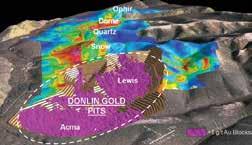
Second, around the two known ore bodies, ACMA and Lewis, there are about 6 million ounces of inferred material. We focused on converting a portion of the inferred resources to measured and indicated categories. This step is essential for enhancing the robustness of the resource model and increasing confidence in the mineral inventory. Additionally, we targeted sparsely drilled areas of the pit to better define the mineralization and potentially expand the resource base.
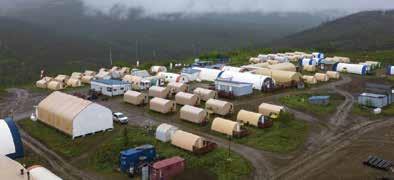
The camp at the Donlin Gold Project in Alaska. CREDIT: NOVAGOLD RESOURCES
Third, we conducted geotechnical work, drilling holes in the pit to support the ultimate pit slope designs, and along what will be the access road connecting the mine site with the port on the Kuskokwim River. These holes are instrumental in informing the design of the pit slopes and supporting broader infrastructure planning. This work directly contributes to the engineering activities underway as part of the BFS, a critical milestone in advancing Donlin Gold toward a construction decision.
The program was very successful. Although Donlin Gold is modeled as a 2.25 g/t deposit, the intercepts averaged almost 4.0 g/t of gold.
As in previous years, drilling revealed more intrusive dikes than were originally modeled, which is consistent with our evolving understanding of the deposit’s geology. These intrusives, particularly when intersecting key fault structures, tend to yield exceptionally high grades — sometimes approaching one oz./t. Such intercepts are not only geologically significant but also economically impactful, as they enhance the overall grade and value of the resource.
Each drill campaign continues to add to the mineral inventory, and the data from this year’s program will be incorporated into the updated geologic model. This refined model will ultimately form the basis for the BFS, helping to shape the development of potentially one of America’s largest and most significant gold mines.
CMJ: HOW DO THE NEW RESULTS CONTRIBUTE TO RESOURCE CONVERSION AND GEOTECHNICAL WORK, AND WHAT ROLE WILL THEY PLAY IN SHAPING THE UPCOMING BFS?
GL: We are currently incorporating the latest drill results into
our geologic model, which will inform the updated BFS. While it is a bit premature to state the exact impact on resources, the results are certainly positive. With approximately 40 million ounces of gold in measured and indicated resources. At an average grade that remains among the highest for open-pit gold projects globally, we are confident that Donlin Gold has the scale and quality needed to support the next phase of development.
CMJ: NOVAGOLD EXPECTS TO SELECT AN ENGINEERING FIRM FOR THE BFS IN THE COMING MONTHS. WHAT CRITERIA ARE YOU USING TO MAKE THAT CHOICE, AND HOW WILL IT INFLUENCE THE PROJECT’S TIMELINE?
GL: Shortly after we announced the completion of our transaction with Paulson Advisers LLC, we agreed it was time to advance Donlin Gold by updating the BFS and move toward a potential construction decision. After the transaction closed, we moved quickly to develop and issue a formal request for proposal (RFP) to select a lead engineering firm.
Given the scale and complexity of Donlin Gold, we were highly selective in who we invited to bid. Our goal is to identify a lead engineering firm not only capable of delivering a
INTERNATIONAL MINING: CEO INTERVIEW
high-quality BFS, but also equipped to carry through with detailed engineering, procurement, and ultimately, construction management of the mine. While many companies are qualified to complete a BFS, we prioritized those that would be accountable for the outcome and had the depth and experience to support Donlin Gold’s long-term development.
The RFPs were issued in the third quarter and received in the fourth quarter. We anticipate awarding the work before the end of the year. While cost is certainly a factor, we are equally focused on the strength of each company’s proposed team, their track record, project schedule, and overall alignment with our development strategy. We have narrowed the field to firms that we know can meet the high standards required for a project of this magnitude.
CMJ: WHAT ARE THE KEY MILESTONES INVESTORS AND STAKEHOLDERS SHOULD WATCH FOR BEFORE THE END OF 2025 AS DONLIN GOLD MOVES CLOSER TO DEVELOPMENT?
GL: Several important catalysts are on the horizon for NOVAGOLD and the Donlin Gold Project. First and foremost is the anticipated award of the BFS. Once the contract is awarded, we will be able to provide guidance on project schedule and cost. This will be a pivotal milestone in advancing Donlin Gold toward a construction decision.
In addition, we are designing a district-wide exploration program to evaluate the broader potential of the Donlin Gold land package. This initiative reflects our belief that Donlin Gold is not only a worldclass deposit but also part of a highly prospective gold district.
Combined with our strong financial position — $125 million in cash and term deposits as of August 31, 2025 — NOVAGOLD is wellequipped to fund its share of upcoming development activities. These milestones represent meaningful progress toward unlocking the value of Donlin Gold and positioning it as one of the largest and highest-grade open-pit gold mines in the U.S.
CMJ: HOW DO YOU BALANCE THE EXCITEMENT AROUND THESE DRILL RESULTS WITH THE NEED TO MANAGE COSTS, TIMELINES, AND COMMUNITY EXPECTATIONS RESPONSIBLY?
GL: Donlin Gold is truly a generational asset — few gold mines go into production with a projected 30-year mine life and the scale to produce over a million ounces annually. That long-term potential brings both excitement and responsibility. Our approach is grounded in disciplined project management, strong partnerships, and a deep commitment to the communities we serve.
Donlin Gold is located on private land owned by two Alaska Native corporations: Calista Corporation, which owns the mineral rights, and The Kuskokwim Corporation (TKC), which owns the surface rights. We have life-of-mine agreements in place with both, and their support has been instrumental throughout the permitting process at both the federal and state levels. These corporations are not just stakeholders; they both have a vested interest in the success of Donlin Gold.
Donlin Gold is in one of the most economically challenged regions of Alaska, where few other large-scale opportunities exist. That is why we have prioritized local hiring and community en-
gagement from the outset. This year alone, we welcomed employees from 22 local villages across the Yukon-Kuskokwim (Y-K) region. These individuals are not only skilled workers; they are also the best ambassadors for the project. The jobs Donlin Gold provides are well-paying and meaningful, and they represent a vital source of economic stability for families and communities.
We take social license seriously. We engage actively with over 60 villages in the Y-K region, and we are planning training programs to prepare local residents for future employment at the project. We recognize that industrial-scale mining is new to many in the Y-K region, and workforce development is a cornerstone of our long-term strategy. As we advance the project, we remain focused on managing costs and timelines.
CMJ: HOW DO YOU SEE THE COMPANY IN THE NEXT FIVE YEARS?
GL: I am incredibly proud of where NOVAGOLD is today. We have a new partner in Paulson who is fully aligned with our long-term vision for Donlin Gold, we are entering a pivotal phase of development with strong alignment and momentum. We have completed federal permitting and are nearing the finish line on state-level permitting. We have a strong treasury with $125 million in cash and term deposits — enough to see us through the responsible completion of the BFS.
Donlin Gold is a generational asset, and we have always believed that no mine should be built before its time. We have taken a disciplined approach to development, ensuring that the project is technically sound, economically viable, and socially responsible. With gold prices at record highs and a supportive environment for financing, I believe we have positioned the company well for this moment.
We are grateful to have been recently accepted into the FAST41 program, a federal initiative that enhances transparency, accountability, and predictability in the federal permitting process. Established in 2015, FAST-41 ensures that permitting timelines are clearly defined, publicly available, and coordinated among federal agencies, while maintaining every existing environmental safeguard and regulatory requirement. This designation is expected to result in a more efficient permitting timeline and reflects the strategic importance of Donlin Gold as a responsible and key economic development project in Alaska.
And in November, we welcomed the Alaska Supreme Court’s decision affirming both the project’s water rights permits for the mine and the Department of Natural Resources’ approval of the State’s ROW for the state-owned lands portion of the proposed 316-mile natural gas pipeline. The ruling validates the State of Alaska’s thorough review process and reinforces that the project can move forward in a manner that safeguards the lands, waters, and communities of the Y-K and southcentral regions.
Over the next five years, I see NOVAGOLD transitioning from a developer to a builder. We will be focused on executing the BFS, finalizing engineering and procurement strategies, and preparing for a construction decision. Just as importantly, we will continue deepening our engagement with Alaska Native Corporations and the communities in the Y-K region, ensuring that Donlin Gold delivers lasting benefits for generations to come.
BRINE MANAGEMENT
Protecting Mine Value, Compliance, and Closure Certainty
Reverse osmosis (RO) brine treatment is often dismissed because of its association with costly zero-liquid discharge (ZLD) systems, but current regulatory pressures and the growing reliance on RO make brine management a strategic necessity.
Mines that treat brine as an afterthought risk major unplanned expenses, compliance failures, and long-term operational constraints. Investing in brine management now directly protects financial performance, regulatory certainty, and ESG credibility. Poorly managed brine can cause scaling and corrosion in reclaim systems, limit water-treatment capacity, introduce compliance risks if recycled to the feed source, and degrade existing treatment infrastructure. These issues increase operating costs, disrupt production, and complicate closure planning. In an industry where water is both a key asset and a major liability, effective brine management is essential to preserving mine value.
THE PROBLEM : A Growing Liability
Traditional disposal options—surface discharge, evaporation ponds, hauling, or deep-well injection—are increasingly unavailable due to stricter regulations, geography, or unsustainable costs. As a result,
many sites return RO brine to the treatment feed source, such as a tailings facility or open pit. Over time, this recycled brine alters feed chemistry, driving up treatment costs and making compliance harder to maintain. During closure, when RO is often required to dewater stored water, unmanaged brine can force a mine into purchasing an emergency ZLD system—often at a cost not captured in closure budgets.
THE BRINE MANAGEMENT
PLAYBOOK: A Strategic Investment
The first decision is whether RO is truly required. If it is, brine management must be integrated into the mine’s water strategy from the outset. Successful mines follow a structured path:
• Characterize brine quality to understand environmental and operational risks.
• Engage regulators early to identify viable regional disposal pathways.
• Conduct feasibility analyses to evaluate life-cycle costs and avoid reactive spending.
• Optimize RO systems to minimize brine volumes and extend treatment capacity
This planning avoids late-stage surprises and ensures treatment infrastructure remains efficient and compliant throughout the mine’s life.
BRIDGING THE GAP:
Lower Costs Through Technology
ZLD has historically been expensive be-
cause of thermal evaporator/crystallizer systems. While traditional RO has been limited by scaling and osmotic pressure, modern commercial solutions—advanced water chemistry, innovative membrane design, and novel system configurations—have significantly increased RO recovery rates. With proper pretreatment and brine conditioning, RO can now concentrate solutions to ~200,000 mg/L total dissolved solids (TDS), compared to ~70,000 mg/L previously. Since full ZLD requires >300,000 mg/L, extending RO performance dramatically reduces the required thermal load, cutting both capital and operating costs by orders of magnitude.
IMPLICATIONS : A Competitive Advantage
As RO capabilities expand and treatment costs decline, proactive brine management offers clear strategic benefits:
• Lower long-term treatment and closure costs
• Reduced environmental and regulatory risk
• Increased operational resilience
• Stronger ESG and stakeholder confidence
Now is the optimal time for mines to invest in brine management—before regulatory, operational, and financial pressures turn manageable challenges into costly crises.
For more information visit www.linkan.com, your international experts in water treatment.
Sensors, resilience, and automation: Lessons for the modern mining site
The German Technology Day showcased how industrial technology leaders are responding to the realities of heavy industries. For mining in particular, the themes were clear: stricter safety and environmental standards, costly downtime, and the challenge of keeping remote, harsh sites running reliably. Measurement and automation are central to tackling these issues. But success not only depends on what products exist, but also on how well they are integrated into day-to-day mining operations.
State of the mining industry: Key pain points Canadian mines are under pressure on the following fronts:
• Tailings and slurry management: Regulators and communities are demanding safer containment, with failures carrying catastrophic reputational and financial consequences.
• Downtime and maintenance costs: An ABB survey found unplanned downtime costs Canadian industry an average of $242,000 per hour. In mining, equipment breakdowns lead to roughly 23 hours of lost production per month per machine. That adds up quickly across an operation.
• Harsh and remote conditions: From extreme cold and freeze–thaw cycles to abrasive slurries, mines need equipment that can withstand stress, while crews often have limited access to perform maintenance.
• Digital and regulatory expectations: Investors, regulators, and communities expect real-time monitoring and transparent reporting. Environmental performance is now core to operational strategy, not a side issue.
Attributes that matter
What stood out at German Technology Day was less about specific devices and more about the qualities that define successful mining technology:
• Durability against vibration, dust, cold, and moisture.
• Precision even in dense, dirty, or abrasive media.
• Integration into existing digital systems with standardized interfaces and remote connectivity.
• Low maintenance design to minimize site visits and service.
• Real-time monitoring and alerts that enable predictive maintenance and rapid safety response.
Companies like JUMO showcased these attributes, emphasizing that careful engineering — from robust housings to smart digital interfaces — is what separates lab-ready devices from solutions that perform year after year in a tailings pond or pump station.
Applications in mining operations
For mine site managers and operations leads, these technology attributes connect directly to the following high-stakes applications:
• Tailings ponds and slurry tanks: Reliable level and pressure monitoring prevents overflows, protects communities, and supports compliance.
• Pipelines and pumps: Flow and pressure monitoring detect leaks early, protect equipment, and reduce costly energy waste.
• Filtration and process control: Continuous monitoring ensures filters and circulation systems function correctly, preventing expensive blockages or failures.
• Safety and risk detection: Automated monitoring reduces reliance on manual inspections in hazardous or remote areas, providing early warnings before small problems escalate.
Broader implications for workflow and strategy
Adopting robust sensing and automation is not only about installing hardware. It reshapes operations as follows:
• Mines can shift from reactive repairs to predictive maintenance
• Manual inspections in dangerous areas can be replaced by remote, automated checks.
• Data-driven decision-making becomes central to daily site management.
• ESG and compliance teams gain traceable environmental data to demonstrate safe operations and regulatory adherence.
As project managers and integrators, our clients rely on us to ensure that selected systems are not only fit on paper but also proven in the field — durable, maintainable, and genuinely useful. With experience in remote, cold, and high-risk conditions, they understand how to bridge the gap between technology suppliers and operational realities.
Looking ahead
German Technology Day reinforced a critical point: the future of mining depends not only on new technologies, but also on how effectively they are applied. Over the next 5 to 10 years, the mines that succeed will be those that embed reliable sensing and automation into their core operations — not as bolt-on extras, but as foundational tools.
These mines will see reduced downtime, safer operations, better environmental performance, and ultimately, stronger cost control. For operators, that means asking vendors tough questions about durability, integration, and lifecycle cost. For integrators like us, it means delivering systems that do not just measure conditions — they help keep Canada’s mines productive, compliant, and sustainable in some of the world’s toughest environments.
Sara Fernandez is CEO of Elevated Project Management, where she leads the selection, deployment, and integration of sensor, automation, and connectivity solutions in mining and industrial operations.
Shake off winter woes
Caring for processing equipment through the winter
While vibrating screens are built for the harsh conditions in which they are used, there are best practices to ensure they continue to perform despite the season. Whether your plant shuts down for the winter or you continue to operate throughout, winterizing and preventative maintenance best practices will help ensure equipment longevity and maximum performance, in addition to making the most of any scheduled winter downtime. Not doing so could mean expensive breakdowns and repairs down the road.
Get winterizing
If you shut your plant down for the winter, as is the case for many operations in cold climates, proper winterizing is essential to a smooth and successful spring startup. Operations should winterize equipment when temperatures are regularly below freezing. The wash plant is the first place to start. Make sure to drain all
CREDIT: HAVER & BOECKER NIAGARA
Whether your plant shuts down for the winter or you continue to operate throughout, winterizing and preventative maintenance best practices will help ensure equipment longevity and maximum performance.
CREDIT: HAVER & BOECKER NIAGARA
the water lines on the rinse screen to prevent freezing that could damage or burst pipes. Do the same thing with dedicated washing systems. Draining is usually as simple as allowing the water to flow out of the equipment, though crews can be more thorough by blowing out the lines and pump with dry air.
Next, flush vibrating screen lines with grease to remove contaminants from the bearings and slingers. Though it would be beneficial to cover a vibrating screen for the winter, it simply is not feasible for most operations. However, action should be taken to protect screen media from the elements and decrease the potential for rust and deterioration that could weaken the screen media. Move any extra screen media or components that may be on the ground nearby to a space out of the elements. The media could be covered with a tarp or placed in a storage container.
Best practices for operating during winter
Although vibrating screens do not require a lot of extra attention during the winter, a little TLC can go a long way. Just like with a car, operations should allow the equipment to run for about 10 minutes before use to warm up the system. If temperatures are below –10ºC (14 F), then standard grease should be replaced with a grease that can handle the lower digits, such as EP1.
Monitor and remove snow and ice buildup and clear the area around the screen before beginning for the day to maintain proper operation. Though unlikely, the weight of significant ice on the machine could affect the equipment’s balance and performance.
CANADIAN WINTER MAINTENANCE: SCREENS
Making use of winter downtime
Whether it is regular scheduled downtime or the equipment is shut down for the season, winter is a great opportunity to fully inspect equipment, train workers, and make any changes that might improve performance and component longevity.
The best value is to partner with the equipment OEM for a service visit and inspection. As the manufacturer, they know what to look for and can give valuable insight on how to improve processes and increase productivity. OEMs often set up a regular service schedule where they visit the operation, evaluate equipment performance, and provide recommendations. Certain OEMs will perform the complete analysis all while the equipment is in operation, thereby increasing the operation’s uptime.
plate or twisting that will affect the machine’s longevity. These systems measure machine stroke and other vibration data to determine the equipment’s health. Abnormalities in the data can help pinpoint problems so that they can be addressed quickly to avoid downtime.
Work with the technician to check for any damage or otherwise visibly broken components on the vibrating screen. Listen while the equipment is running for unusual noises, such as loose tension rails. Also, look for broken or excessively worn screen media. The screen media scrap pile can be a great place to identify common problems and diagnose how to fix them. For example, broken wires might indicate a need for a more durable media. Shiny hooks could indicate improper and loose installation, resulting in the screen media moving back and forth. Pegged or blinded media may mean a need for more open area, tapered openings or a different type of screen media.
Upon completion of the visual inspection, an OEM certified service technician can often provide recommendations to improve machine performance and minimize unscheduled downtime. The recommendations could range from polyurethane liners for tension rails or cross beams to improve durability, to alternative screen media to address specific screening issues. They will also point out any parts or repairs needed.
BRAKE SYSTEMS INC
OEM-certified service technicians from some OEMs will start with a vibration analysis on the vibrating screen to look for problems easily missed by the human eye, such as a hairline crack in the side
BRAKE SYSTEMS INC
It is also important to use components from the original equipment manufacturer. Though fabricated parts are cheaper, there is no way to guarantee they are built to the exact OEM specifications. A tension rail that is even a millimeter off can cause early screen media breakage and other component failures over time.
BRAKE SYSTEMS INC
The offseason also provides a great opportunity to focus on inventory management and training. Talk to an OEM or certified dealer about refresher training on screen media installation and maintenance. Proper installation improves longevity and uptime and therefore increases profits.
Stay proactive
The best way to take advantage of winter downtime is to partner with the equipment OEM for a service visit and inspection. CREDIT: HAVER & BOECKER NIAGARA
The dead of winter is a tough time for both workers and equipment. Whether halting production for the year or trudging through the snowy season, maintenance and proper storage is critical for maximum performance over the winter and into the spring.
Talk to a trusted processing equipment manufacturer for best practices for winterizing and operating throughout the winter. Nothing beats having an expert look over the machines and taking the guesswork out of deciding what will allow the process to run at its maximum potential. The result could mean a productive winter and peace of mind.
Wilm Schulz is the head of Haver & Boecker Niagara’s North American service team as
Upgrade to One-Component
NO measuring , waste, or toxic
Safe to view videos: https://vimeo.com/282732075 | https://Imatech.com.au/materials/rubber-repair/
Retains flexibility ● Long-lasting
Melta Mini and Pro guns. Rentals are available.
Save the Belt – Upgrade to the Only One-Part Are you interested but unsure? Ask for a complimentary
Mini and Melta Pro models for small & large belt repairs 115/1/60 or 230/1/50.
Mini and Melta Pro models for small & large belt repairs 115/1/60 or 230/1/50.
No mixing, no more waste and unlim. shelf life.
No mixing, no more waste and unlim. shelf life.
Permanently repair belt edges, long rips, holes, cover and gouge damage. Ask how.
Permanently repair long rips, belt edge, holes, cover, gouge damage – ask how.
Mini and Melta Pro models for small & large belt repairs 115/1/60 or 230/1/50.
Repair damaged belt covers, edges and holes. Remains 70 duro = flexibility & will not crack. Thermal bond ensures outstanding adhesion.
No mixing, more unlim.
Secure elevator buckets.
Repair damaged belt covers, edges and holes. Remains 70 duro = flexibility & will not crack. Thermal bond ensures outstanding adhesion.
Checkout these safe https:// videos: https://vimeo.com/282732075
Immediate benefits and savings with RubbaFIX® vs. conventional two-component polyurethane
1. ELIMINATE time required to precisely measure properly mixed, the waste after every task is completed
Permanently repair long rips, belt edge, holes, cover, gouge damage – ask how.
2. SIMPLE: Just top-up gun with rubber pucks, re
RubbaFIX® Unique Advantages and Benefits … Not Available with any Two-Part Polyurethane Kits:
3. EASY: Not necessary to clean applicator gun after
Unique advantages of RubbaFIX®
By covering Super Screw® fasteners, prevent scrapers from catching/damaging edge of uneven belt steps. With scrapers
• No longer a need to mix and
• Simply add rubber pucks to applicator machine with heated hose for the largest repairs or to applicator gun for small patch repairs, apply hot extrusion to preheated damaged areas, let cool and buff for a flat, smooth surface.
SAFER TO USE: No toxic fumes – refer to the 5. FAST: Dries quickly – ready to buff and use in only
• Simply add rubber pucks to
• Unique thermal bond ensures outstanding adhesion to rubber and Nitrile solid-woven belting and much more.
• Repaired areas remain permanent 70-durometer … will not harden or crack … can be reworked if area is redamaged.
• Safe for personnel. Unlike polyurethane, no toxic fumes.
SUPERIOR ADHESION to rubber, PVC, metal,
• If belting is damaged all the
Unique advantages of RubbaFIX® 1 component system – not available with any 2-component
• FRAS certified. Fire-resistant and anti-static for underground mines and critical locations.
Permanently repair long rips, belt edge, holes, cover, gouge damage – ask how. By covering Super Screw® fasteners, prevent scrapers from catching/damaging edge of uneven belt steps.
• No need to ever clean applicator machine. Leave unused rubber, ready for the next task.
• RubbaFIX® rubber remains can be reworked by reheating
• No longer a need to mix and never any wastage. Unlimited shelf life, even when opened.
• If belting is damaged all the way through, add re inforced fabric sheets be tween the
• Belt scrapers will now remove carryback more effectively. Ask about the SSP-770 Ceramic Belt Cleaners®.
• Ready to buff and return to service in only 30 minutes, even less by applying ice cold water.
• Superior adhesion to rubber
• Simply add rubber pucks to the applicator gun, heat and apply to the preheated areas
Unique advantages of RubbaFIX® 1 component system – not available with any
• No longer a need to mix and never any wastage. Unlimited shelf life, even when
• 2SP will equip Your Team with applicator and rubber and know-how and provide bilingual training and support.
• FRAS certified. Fire-resistant
• NO toxic fumes, unlike polyur
• Simply add rubber pucks to the applicator gun, heat and apply to the preheated
• Ready to buff and return to
• RubbaFIX® rubber remains a flexible 70 durometer long after application, will not harden can be reworked by reheating at any time.
REMAINS FLEXIBLE: Will not harden after time Some of the many cost-effective and reliable 1. Belt conveyors – short & full-length rip, patch, Approved for SSP-770 Ceramic Belt Cleaners® 2. Tank linings. 3. Pulley 4. Ball mill rubber liner bars. 5. Rubber
• If belting is damaged all the way through, add re inforced fabric sheets be tween
• NO need to ever clean the
• Superior adhesion to rubber belting, Nitrile so lid-woven belting, metals, fiberglass and
• NO toxic fumes, unlike polyurethane – refer to the MSDS.
• Ready to buff and return to service in only 30 minutes.
• Repairs to all type of conveyor rubber-lined pumps, impellers, rubber conveyor rollers; non-structural,
• RubbaFIX® rubber remains a flexible 70 durometer long after application, will can be reworked by reheating at any time.
• FRAS certified. Fire-resistant and anti-static for underground mines a nd critical locations.
Prompt shipment of rubber puck stock and Black and white rubber puck stock is available in 10kg Applicator Guns: MELTA-Mini® (daily tasks) & MELTA
• Unlike cold patches and bulky sharp scrapers do not get caught
• Superior adhesion to rubber belting, Nitrile so lid-woven belting, metals, fiberglass
• Approved for operation w/SSP-770
• NO need to ever clean the applicator gun – just le ave any unused rubber and you are
• NO toxic fumes, unlike polyurethane – refer to the MSDS.
• FRAS certified. Fire-resistant and anti-static for underground mines a nd critical
• Repairs to all type of conveyor belts; chute and ho pper linings; ball mill rubber liner bars;
• Fill the open void area above This provides an extra protective Safe
Melta Mini and Melta Pro applicator models for patch and large belt repairs. 115/1/60 and 230/1/50
Exclusive Master Distributor Canada, Lower Sub-Sahara and many Countries.
Permanently
By Josh Swank
A new lease on life
Considerations for converting an inefficient haul truck into an efficient water truck
Over time, equipment wears and tends to slow down as its hours increase. It is bound to happen to every machine, and when equipment becomes less efficient, so does an operation. When it comes to off-highway haul trucks, there are alternatives to getting rid of the truck entirely through an auction or trading toward another piece of equipment. Instead, an operation can repurpose the haul truck to extend its useful life and find new efficiency for the machine by converting it from a material hauler in a primary fleet to a water truck. Converting an aging haul truck to a water truck not only lengthens its operating life but also transforms it into a highly productive asset for essential dust control jobs to reduce the expense associated with keeping dust below required thresholds, extending its circle of life and aiding in sustainability goals.
With the right water tank, operations can rest assured they will turn an aging, less-productive material hauler into a highly efficient water truck for years to come. First, it is important to understand why a truck can continue to haul water after it has reached the end of its useful life hauling material.
More life
Converting
CREDIT: PHILIPPI-HAGENBUCH
One of the main reasons that haul trucks can have an extended life as a water truck is the reduced overall burden on the vehicle. Filling a water tank is significantly easier on a truck, causing much less impact than loading a dump body with large rocks and other heavy materials. Production hours play a part, as well. Trucks designated for material hauling accumulate around 8,000 hours per year and, as they approach the 50,000hour mark, they become less efficient from years of heavy-duty hauling. Water trucks, on the other hand, typically accumulate 2,000 to 3,000 hours per year as the everyday demands on the truck are not as high.
Loading a truck with water instead of hard materials combined with fewer operational hours is a recipe for much-extended truck life. If the machine is still in decent shape when converted to a water truck, it is reasonable to expect the truck to comfortably surpass 50,000 service hours. The third part of the longer-life equation is opting for a water tank that is engineered and constructed for longevity. Water tanks built with the most durable steel available — 450 Brinell — allow for
a haul truck to a water truck not only lengthens the truck’s operating life, but it also turns an inefficient material hauler into a highly productive asset for dust control.
minimal maintenance and the toughness to last for years to come. With durable steel and meticulous engineering, some water tanks can last for more than 25 years. Additional design considerations will maximize the water tank’s efficiency in its new role in dust control.
Importance of design
Dust control is a necessary process that must be managed daily, and the proper water tank solution helps operations be as efficient as possible to minimize the associated cost. From a casual perspective, it might seem like a water tank is a water tank, without much in the way of design differences between them. However, it is crucial to be mindful of tank design when converting a haul truck to a water truck.
Rounded water tanks are the most common and certainly get the job done, but not without hurdles. The curved sides raise the water’s centre of gravity, making the truck less stable when nav-
igating haul roads. The absence of corners, edges, and obstructions to slow the water’s momentum also contributes to water churning, posing a safety risk for the driver and anyone nearby, since the water can shift the center of gravity and make the truck unstable. To mitigate instability, operators often avoid completely filling the tanks, meaning more frequent refills, and increased downtime and fuel consumption to travel back to the water source. Alternatively, water tanks with a square design minimize churning and have a larger capacity by not rounding off the sides of the
tank. They also offer enhanced safety features for more stable operation.
Water tanks’ internal baffling plays a critical role in impacting safety and efficiency. Baffles within the tank help minimize water surging during movement. Nearly all water tanks feature baffles, but many have large holes cut out to allow maintenance personnel access to the tank’s compartments. These openings allow water to surge between compartments which increases the risk of the truck tipping or getting into another type of accident.
To minimize surging and increase sta-
MINE CONSTRUCTION AND MAINTENANCE
Noah Rain Builders…tackling extreme conditions in remote locations, overcoming tough terrain and weather to build essential infrastructure safely and efficiently. Effectively and efficiently maintain operational mines to ensure smooth flow of production and operations.
www.noahrainbuilders.com
MAINTENANCE: HAUL TRUCKS
A water tank’s internal baffling plays a critical role that impacts safety and efficiency. Baffles within the tank help minimize water surging while driving, and full-sized interior and exterior access doors allow for easy maintenance.
CREDIT: PHILIPPI-HAGENBUCH
bility, some tanks are designed with water control systems that utilize baffling running from floor to ceiling and along the complete length and width of the tank to fully compartmentalize the water. Within the outer components, some manufacturers also install side-surge stabilizers along the walls to prevent water from rolling or churning.
For ease of maintenance, look for a water tank that incorporates both baffle doors and external doors. When the tank is empty and needs service, external doors allow technicians easy access to the inside of the tank and provide fresh air and natural light throughout the tank. Baffle doors allow technicians to easily walk through without the need to crouch during maintenance, and provide access to multiple compartments, minimizing their work in confined spaces. Water tanks with elements to increase safety both while operating and during maintenance are key factors an operation should take into account when considering water truck conversion.
Additional aspects to note are efficiency-enhancing features and ease of use. To optimize productivity, look for a water tank that can spray the entire width of a haul road in one pass. Some offer in-cab analog controls that give operators precise and simplified water control with the ability to utilize any or all spray heads simultaneously. The addition of a remote-controlled water cannon opens the door for other applications, such as spraying stockpiles or washdowns.
The conversion process
tank is on-site, as the process can take less than two days.
First, the installer removes the old truck body and — in some cases — may have to also remove hoist cylinders. They then place the water tank onto the chassis, shim it, and tighten the water tank. Finally, they replace the control box in the cab and hook up electrical. Now, the operation is ready to efficiently tackle dust control with their “new” water truck.
This installation can be completed by the operation at their location, by the manufacturer, or by hiring a dealer or other third party. If an operation wants to install the water tank themselves but is not sure about some aspects of the process, they should consider partnering with a manufacturer who will assist them and be there for the installation process to lend a hand and provide instruction whenever necessary.
A long-term solution
The decision has been made to retire an off-highway haul truck into a water truck. So, now what? Some manufacturers custom engineer each solution, which can take some time but guarantees the best-fitting water tank and addresses specific operational needs. Operations need not worry about lengthy installation when the
Though no longer optimal for productively hauling material, converting aging haul trucks to water trucks can give the machines a new lease on life and provide a pathway to a safer and more efficient solution for dust control. So, rather than retiring that used truck, consider alternatives and the opportunity to continue to use an existing asset in a new role in the support equipment fleet.
Josh Swank is the chief growth officer at Philippi-Hagenbuch.
There are water tanks in use today that have been operating for 25 years. Water tanks built with the most durable steel available — 450 Brinell — allow for minimal maintenance and the toughness to last for years to come. CREDIT: PHILIPPI-HAGENBUCH
When the water tank is ready to be put on the truck, the installation process can be completed in less than two days. CREDIT: PHILIPPI-HAGENBUCH
By Felicia Bratu
Language inclusion and translation as strategic ESG tools
In 2004, the United Nations introduced the “Who Cares Wins” initiative, formally launching the Environmental, Social, and Governance (ESG) framework — a means to align financial markets with sustainable development. Since then, ESG has become a global standard for measuring responsible business conduct. Its purpose is clear: create accountability and ensure businesses contribute to sustainable development while avoiding harm, such as environmental destruction, human rights violations, or corruption.
ESG IN CANADA
In Canada, ESG performance is increasingly intertwined with a crucial topic: Indigenous language inclusion. There are more than 70 Indigenous languages spoken by First Nations, Métis, and Inuit peoples, each carrying unique knowledge systems and worldviews. In mining regions from Nunavut to northern Québec, languages such as Inuktitut, Cree, and Dene remain vital for Elders, hunters, and knowledge keepers, whose insights shape environmental stewardship and community well-being.
ESG and Indigenous language translation
When engagement with Indigenous communities happens only in English or French, critical knowledge risks being excluded. As a result, accuracy and depth of impact assessments are limited, and relationships are strained, thus undermining a company’s social license to operate.
Recognizing this, Canada passed the Indigenous Languages Act in 2019. The aim is to preserve, promote, and revitalize Indigenous languages, while supporting Indigenous peoples in their efforts to reclaim, maintain, and strengthen them. For businesses, this legislation signals that language inclusion has moved beyond cultural respect to be a strategic responsibility.
ENVIRONMENTAL (E): SHARED UNDERSTANDING AND STEWARDSHIP
Environmental initiatives succeed when companies and communities work together. Translation helps align perspectives on environmental values, which may differ across cultural and linguistic lines.
Clarity in environmental reports
Transparent communication of environmental impact assessments (EIAs) and monitoring reports are paramount for fostering trust and ensuring the well-being of communities. By translating these complex documents into accessible language, residents can gain a comprehensive understanding of potential environmental risks associated with mining operations. This includes direct impacts on air, water, and land, as well as the socio-economic effects and long-term ecological consequences.
Integrating Indigenous knowledge
Indigenous ecological knowledge (often expressed in local languages) becomes accessible to regulators and engineers, enriching project planning.
For example, in the Eeyou Istchee territory of northern Québec, Cree land-users identified key factors influencing moose habitat quality, including climate, habitat features, and hunting activities. Their insights led to the development of fuzzy cognitive maps that informed forestry practices and wildlife-habitat models, ensuring that Indigenous knowledge was integrated into environmental planning and management.
Transparency through multilingual communication
Clear bilingual or trilingual updates, whether in English, French, and an Indigenous language, build transparency and reinforce shared stewardship of land, water, and wildlife. This kind of communication also prevents misinformation and fosters collective accountability for environmental protection.
SOCIAL (S): BUILDING TRUST AND SAFETY
Language is central to cultural identity and social connection. By investing in translation and interpretation, companies create opportunities for genuine dialogue with communities. This is particularly important in Indigenous engagement, where trust is built through both actions and respect for language.
Worker health and safety
Translating health and safety materials ensures that Indigenous workers clearly understand procedures and reduces risks in emergency situations. Clear, culturally appropriate communication saves lives.
Social license
Respecting language rights demonstrates cultural awareness and fosters trust. Translating training materials and job postings can help reach out and retain staff who might otherwise have felt excluded, while also showing the community that the company was serious about reconciliation.
Participation in consultations
Language inclusion makes consultations genuinely participatory, allowing Elders, hunters, and knowledge keepers to engage on equal footing.
Proponents and their consultants must consider whether knowledge holders will be speaking in their Indigenous language and, if so, arrange for qualified interpretation and translation. Some Indigenous words cannot be easily translated into English or French, as they carry cultural and contextual meanings essential for transmitting knowledge. Translation should therefore go beyond one-word equivalents, including descrip-
MINING IN CANADA: NUNAVUT
tions of terms and context provided by interpreters or translators chosen by the Indigenous community.
These practices not only preserve knowledge but also apply to regulatory hearings, where Indigenous participants may wish to speak in their own language.
GOVERNANCE (G): COMPLIANCE AND ACCOUNTABILITY
Clear communication is at the heart of good governance. Translation ensures that key information is accessible and transparent, supporting ethical business practices.
Evidence of consultation
Translation provides documented evidence of meaningful consultation, helping companies comply with legal and regulatory requirements. Regulators are increasingly seeking evidence that com-
sultation results translated into local languages demonstrate accountability and openness.
Informed decision-making
Stakeholders can fully understand and respond to corporate plans, making governance processes more democratic when information is effectively translated.
Risk management
Translations reduce misunderstandings, thus helping to prevent conflicts, legal challenges, and reputational harm.
Accountability to investors
Publishing reports and commitments in Indigenous languages signals accountability and boosts credibility with ESG-focused investors. This transparency shows that a company’s ESG claims are backed by genuine community engagement.
particularly concerning the integration of Inuit Qaujimajatuqangit (IQ) and the adequacy of Inuktitut translations. The Kivalliq Inuit Association and Nunavut Tunngavik Inc. criticized the draft EIS for its insufficient incorporation of traditional knowledge and the limited scope of Inuktitut translation. They argued that the translated sections were overly summarized, thereby hindering community members’ ability to engage thoroughly with the content.
This feedback highlights the importance of comprehensive and culturally sensitive translations in ensuring that communities can fully understand and participate in environmental assessments.
WHY LANGUAGE INCLUSION AND TRANSLATION MATTER IN MINING NOW
Language inclusion transforms abstract ESG goals into the following tangible
A meeting where an Elder feels heard. A worker who can follow a procedure
An environmental plan enriched by Indigenous knowledge.
Each of these moments builds trust and resilience, while reducing risks for
Language is more than words. In mining, it serves as a foundation for responsibility, respect, and resilience — and is one of the most effective tools for advancing ESG goals.
In the era of ESG-driven accountability, businesses have an opportunity to recognize that language is not a barrier. By investing in translation and language inclusion, ESG performance can be enhanced, and a deeper respect for the voices and worldviews of the communities they impact can be demonstrated.
Felicia Bratu is the operations manager of Wintranslation, in charge of quality delivery and client satisfaction. As a veteran who has worked in many roles at the company since 2003, Felicia oversees almost every aspect of the company’s operations, from recruitment to project management to localization engineering.
How high can silver fly?
The price of silver plunged 7% to $48 last month, marking the first real hiccup in a relentless rally that culminated with a nominal all-time high above $54.
Since that healthy correction, the white metal has reacquainted itself with $49 and now appears to be entering a period of high-level consolidation before the next leg-up.
In the meantime, it is possible that silver’s volatility exposes investors to some short-term downside, with a moderate Fibonacci retracement toward $43 not entirely out of the question.
However, with the gold-silver ratio still historically high, and with many of the catalysts behind silver’s surge beyond $50 still in play, most investors remain squarely focused on silver’s upside.
To understand the degree to which silver could outperform, we first need to ascertain the extent to which it is undervalued, overvalued, or fairly valued relative to historical bull cycles.
Fiat currencies are an extremely poor measuring stick for this task because of their inability to hold purchasing power, so gold remains the optimal lens to apply when valuing the silver price.
Historically, silver’s value relative to gold has been 7:1 — a ratio which is ironically proportionate to 2024 gold and silver mine production — and even hit lows of 2:1 in Ancient Egyptian times.
More recently, the gold silver ratio (GSR) has averaged 68.83 since 2000, 60.11 since 1970, and 52.08 since 1900. At today’s $4,105 gold price (at the time of writing this article), that equates to a silver price between $60 and $79.
Assuming the gold price stays around $4,105, this means that silver could rise a further 23% to 62% from today’s price of around $48.62. That is, if today’s GSR of 85.4 reverted to its historical mean of 52 to 68.
To some, a 23% to 62% increase may seem conservative. And frankly, it is, since it assumes that the GSR will not go lower than 52 — an endgame that we, and Tavi Costa, rate as highly unlikely.
“Gold bull cycles do not typically peak with the gold-to-silver ratio as high as 85. For perspective: In 1980, the ratio fell below 20. In 2011, it dropped to 30 before gold peaked a few months later. Given the scale of today’s economic imbalances, a sharp contraction in the gold-to-silver ratio toward historic lows is highly likely, in my view,” Tavi Costa, Crescat Capital.
Put simply, the closing act of a gold bull market has historically seen a rapid compression of the GSR, to levels ranging between 45 and 14 — the latter being the all-time low from January 1980.
Admittedly, an anomaly came in March 2020, when the GSR soared to a record 124.04. From this peak to its cycle lows of 69.54 in August 2020, the GSR shed approximately 54.5 points.
For reference, the GSR peaked at 107.23 in April 2025 and has since fallen approximately 22 points to 85. So, if we see a similar drop in the GSR today as we did in 2020, there is still an-
CREDIT: INGOLDWETRUST REPORT
PRECIOUS METALS
other more than 30 points to go.
In other words, the most recent silver bull market indicates that the GSR’s reversion in today’s cycle is far from complete. And by extension, that means much of silver’s upside may lie ahead.
Speaking of upside, if we assume that gold stays at $4,105, a 20 to 30 GSR would translate to a $137 to $205 silver price, implying an additional 182% to 322% upside from today’s $48.62 level.
If we take it a step further, the GSR returning to its 1980 low of 14 at a gold price of $4,105 would imply a $293 silver price — a staggering almost 503% increase from today’s $48.62 price.
Arguably, a decline in the GSR to historically low levels would render silver overvalued versus gold. That said, a $293 silver price starts to look cheap, when adjusting for “shadow” inflation.
Indeed, as the exceptional chart from Incrementum illustrates, silver’s all-time high in 1980, when adjusted for real inflation numbers from Shadowstats, comes in at approximately $1400.
Shadowstats inflation diverges from official U.S. CPI data because it reconstructs inflation using pre-1990s government methodologies, before “revisions” diluted how price growth is measured.
In essence, it shows what inflation would look like if measured the same way it was in 1980, revealing that today’s asset prices are not nearly as overvalued as they appear under official CPI.
Importantly, us drawing on this data is not to say that silver is going to $1400 tomorrow. Rather, we do it to contextualize how cheap silver remains in an era of chronic monetary debasement.
Still, even if we adjust for the more conservative, albeit inaccurate, official CPI figures, silver’s 1980 all-time high comes in at approximately $150, which is roughly three times where we are at 45 years later.
Ultimately, whether silver reaches $151, let alone the lofty heights of $1400, the reality is that $48 silver is still a whole lot better than the $20 to $25 price we were stuck with for the past decade.
As a result, most of the silver majors and mid-tiers are booking a cool approximately 60% profit margin already, with the industry average AISC expected to be around $19 in 2025.
In this sense, the handful of primary silver miners that exist in today’s market do not need the silver price to go above $50 to turn a profit. In fact, they would even be fine at $30 to $35. Naturally, we find ourselves in a sweet spot for silver stocks, where share prices are starting to reflect higher metal prices, but have not yet priced in the leveraged effect of future cash flows.
Ted Butler is a senior analyst for The Silver Advisor and The Gold Advisor. A slightly modified version of this article was published elsewhere.
“ACCURATE
Mine Reader.
Predict ventilation equipment maintenance requirements for uninterrupted operation.
Duetto Analytics™
Duetto Analytics™ is an intelligent diagnostics and analytics platform, built to unify your IIoT data into one actionable interface. Operating securely within your process control network, Duetto delivers real-time visibility, advanced trending, and predictive maintenance tools – giving operations teams greater control and fewer surprises.
Battery powered cable bolter
Discover Sandvik DS422iE, the world’s first battery-electric cable bolter. Zero emissions tramming, drilling and grouting on battery power. Go Electric. Go Sandvik.