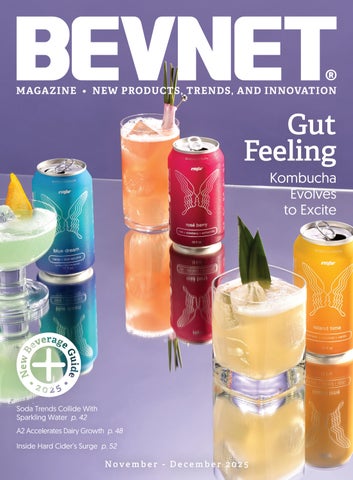
MAGAZINE • NEW PRODUCTS, TRENDS, AND INNOVATION
Gut Feeling Kombucha Evolves to Excite
Soda Trends Collide With Sparkling Water p. 42 A2 Accelerates Dairy Growth p. 48 Inside Hard Cider’s Surge p. 52
November - December 2025
Contents • November – December 2025 • Volume 23 - No. 6
36
42
48
52
Columns
Event Coverage
6 First Drop Hemp’s Hazy Future
34 NACS 2025 Review
8 Publisher’s Toast Entrepreneurs Welcome
Features
10 Gerry’s Insights At the Beverage Playground
36 Kombucha/Probiotics Kombucha Plots Comeback (with Brand News)
Departments 14 Bevscape/NOSHscape/Brewscape Keurig Dr Pepper Invests $7B Behind Coffee, Recess Raises $30 Million; Justin’s Carve-Out; Boston Beer Promotes Phil Hodges
42 Sparkling Water Innovation Flows from CSDs (with Brand News)
26 New Products Stiller’s, Lucky Energy, Cann, Koia
52 Cider Inside Hard Cider’s Surge
48 Dairy A2’s Impact
30 Channel Check Spotlight on Hard Seltzer 98 Promo Parade Noah Kahan & Culture Pop Soda Announce Partnership
Special Section 57 New Beverage Guide
Follow Us Online:
x.com/bevnet
instagram.com/bevnet
www.bevnet.com/magazine/subscribe
BevNET Magazine (ISSN 2165-6061, USPS 24-552) is published bi-monthly by BevNET.com, Inc. 65 Chapel Street Newton, MA 02458. Periodicals postage paid at Boston, MA and additional mailing offices. POSTMASTER: Please send address changes to BevNET Magazine, Subscriber Services, 65 Chapel Street Newton, MA 02458 Cover Photo Credit: RMBR
5
The First Drop By Jeffrey Klineman
Keeping the Hemp Loophole Open Shouldn’t Hang the Hash Sellers Why did Mitch McConnell do it? Some say it was the bourbon companies, others a misunderstanding of the ramifications of the original bill. Maybe he did it because he was sick of Rand Paul. At this point, any explanation for the decision by the senior senator from Kentucky to torpedo the same industry he helped launch back in 2018 is moot. The big question is, what comes next? Will all parties – the spirits companies, the cannabis lobby, the beer distributors, the manufacturers and the anti-drug warriors, those interest groups competing to influence the sale of hemp-based THC products – be able to find a path forward in the year they’ve got left before Nov. 12, 2026, when the industry fades away like Brigadoon? Is there a Hemp Farmer’s Almanac? Is there a photo of Mitch McConnell in there? If social media is to be believed, among the farmers in his home state, he’s gone from Johnny Appleseed to Johnny Dangerously, from folk hero to public enemy #1. So, here’s the problem with tarring McConnell, though – anyone who has a sense of what should be vs. the cold reality of what is would never have relied so heavily on something that Sen. Slippery McTurtle helped foster. But they couldn’t help themselves: once would-be cannabis entrepreneurs realized McConnell had opened a loophole for hemp-based THC drinks in the original 2018 Farm Bill, the checkered flag had been waved, and the racers didn’t really care who got run over. That’s why I’m still of two minds about the explosive growth of hemp-based D9 THC cannabevs that we’ve seen under the Farm Bill, and wonder, even if there’s a regulatory solution that can be found for the hemp lobby, whether that’s the right - or fair - thing to do. Here’s my thinking: We keep hearing that the Delta-9 THC molecule is the same regardless of the source, whether it’s homegrown outdoor sativa or industrial-grade hemp, and at base, like many, I’m all for legalizing that molecule. But I would argue that the rush to get hemp-based D9 products out onto the market has, in many ways, sold out the people who have spent years doing the hard work on behalf of that molecule. Not only did that rush create a lot of inferior products, it did so while turning a blind eye toward the rest of the cannabis industry. That has created infighting in the pro-legalization community at a time when the usual interests – booze manufacturers – either want to buy 6 2025 6 BEVNET BEVNET MAGAZINE MAGAZINE •– November/December JANUARY/FEBRUARY 2018
it out or bury it. Looking at the 30-year history of the dispensary movement in the U.S., you see a state-by-state campaign that evolved from medical usage to recreational, with careful attention and regulation freeing risk-takers to enter the business – even though the federal government won’t bless their actions. The divide between federal prohibition and state legalization leaves marijuana pioneers burdened by high security costs, a paucity of banking options, incredibly high tax rates and risk-driven interest rates, along with no federal bankruptcy protection. The hard work to establish legalization has also led to a variety of corrective social and criminal justice measures, including the expungement from criminal records of many small offenses that were unequally enforced against minority communities. The growth of legalization movements has brought recreational use to 24 states, and medical use to 40. Decriminalization and rescheduling of marijuana was being actively discussed by both U.S. presidential candidates in 2024 – one of the few areas of semi-agreement between the two campaigns. They blazed the trail, and it hasn’t been easy. Simultaneously, though, under the federal legislation that allowed for hemp beverages to grow, a lot of brands – particularly the ones that have looked to beverages as the untapped growth engine for mainstream cannabis use – decided that they couldn’t wait any longer. Like so many craft brewing operations using Kentucky hemp instead of Oregon hops, dozens of brands have either started up with hemp-based drinkables, switched to them from a marijuana-based extraction, or come up with a split formula program that places hemp drinks where they are allowed, and marijuana derived THC beverages in dispensaries. It’s understandable: that 2018 Farm Bill – the .3 percent by weight loophole – created a federally legal, DTC-friendly spigot for all manner of hemp-based THC products, one unburdened by the same tax and regulation hurdles that marijuana businesses face, and a much deeper bench of retail targets, from liquor stores to gas stations, bars to breweries, Target stores to community co-op grocers. Instead of dispensaries – with their security guards, multiple ID checks, and video cameras – some of the states where hemp beverages initially popped up didn’t even have age requirements on the books around the purchase of intoxicating products. With so little oversight, is it any wonder that the hemp-
based brand economy grew so fast – but also that it resulted in a lot of products being rushed to market with low quality control, inconsistent effects, and little consumer education? It’s salt in the wound of the marijuana folks, who have had to go about it the hard way, sure – and they’ve reacted pretty quickly, pushing states with established dispensary channels like California, Massachusetts, and Colorado to force hemp companies to work under the same regulations as the rest of the cannabis businesses. Equally risky, the hemp businesses poked the bear. States that have been very unfriendly to cannabis businesses like Texas, Tennessee, Kentucky and more have been some of the most fertile areas for the sale of intoxicating hemp products. Beyond that, those brands have been brazen enough in their customer come-ons product-wise that they’ve made it pretty easy for kids to score candy-flavored edibles from gas station clerks who just don’t know better. Not everyone’s a bad actor, of course, but it’s not exactly a great look for an industry that wants to be taken seriously to play dumb around the idea that THC-infused Nerds and Sour Patch Kids might be consumed by kids - intentionally or unintentionally - when they’re picked up at some Waco convenience store. Texas used that as the reasoning for an attempted statewide ban, which revealed another fault line: the hemp beverage business has proven too valuable to local beer wholesalers, who are facing tough times as their main product has started to decline. Which brings us to the strange bedfellows part of the column: the split in the THC molecule has also had a trippy effect in the beer business, where wholesalers and craft brewers are relying on hemp drinks to replace lost sales, while big brewers and spirits companies are fighting to set rules for the entire industry, although it’s clear they’d be happy to kill off the business if they can’t marry it. I am trying hard not to judge the cannabis-native brands who went along with the move into hemp, with its much deeper bench of retail targets, rather than stick with a dispensary channel that considers a low-dose beer analog a cute novelty next to much higher margin pre-rolls and 100-milligram brownies. Once the door was open, it was a matter of survival – even OG edibles brand Kiva has started down the hemp highway, after all. But at the same time, they must have known that the states they were growing up in weren’t going to stand for hemp intrusions when they had spent so much money, time, and civic energy permitting and erecting state-sanctioned marijuana industries. So is the McConnell rule really a betrayal? It depends on how you look at it – but unless the hemp interests recognize they need to include their fellow THC travelers in whatever kind of long range structures they want to put in place at a federal level, unless they put what are likely to be millions in lobbying graft to work on a system that creates some kind of reasonable footing for the recreational cannabis sellers of the world, I, for one, have a tough time summoning warm feelings for them. The Farm Bill loophole shouldn’t be a noose for the dispensary business. 7
Publisher Toast
By Barry Nathanson
www.bevnet.com/magazine
Barry J. Nathanson Publisher bnathanson@bevnet.com Jeffrey Klineman Editor-in-Chief jklineman@bevnet.com Martín Caballero Managing Editor mcaballero@bevnet.com Monica Watrous Managing Editor, Nosh mwatrous@bevnet.com Justin Kendall Editor, Brewbound jkendall@bevnet.com Adrianne DeLuca Assistant Managing Editor, Newsletters adeluca@bevnet.com Lukas Southard Senior Reporter lsouthard@bevnet.com Brad Avery Senior Reporter bavery@bevnet.com Zoe Licata Senior Reporter, Brewbound zlicata@bevnet.com Shauna Golden Reporter sgolden@bevnet.com
Sales & Ad Operations
John McKenna Director of Sales jmckenna@bevnet.com Adam Stern Senior Account Specialist astern@bevnet.com John Fischer Senior Account Executive jfischer@bevnet.com Lou Calamaras National Account Executive lcalamaras@bevnet.com Jon Landis Business Development Manager jlandis@bevnet.com Colin Sughrue Digital Campaign Coordinator csughrue@bevnet.com
Star Turn for Beverages I’ve been around the beverage industry for a long, long time now. It is an industry that is ever evolving and reinventing itself. The route from launch to success in the marketplace has no set formula. It has seen newly-created categories and trends, packaging innovations, new and exciting product formulations, evolution in routes to market and to the consumer, and always incredible new marketing entreaties. There is no limit to the difficulties in taking a beverage to market. Yet, with all the ways and steps to launch a brand, there is no aspect more crucial than raising capital. The capability and speed to go from idea to actualization is almost always dictated by the funding available to the founder. We are all well aware of the high failure rate in the beverage industry. Money isn’t the only thing that can stave off failure, but without it there’s no chance of success. 8 BEVNET MAGAZINE • November/December 2025
Art & Production
So, who are the investors? Banks, institutional funds, rich friends and friends of friends and friends of rich uncles. But over the last few years I’ve seen another, exciting source of funding, one that brings high visibility and excitement, join the beverage fray: celebrities, including athletes, entertainers, and those people who are “famous for being famous.” I find it refreshing and exciting to see this trend. As a rule, they are guided by “they know what they don’t know” which is a good thing. They can leave the day-to-day of beverage marketing to the pros, yet are often involved in a way that has no real downside. If they bring visibility to the brands, so much the better. They give the financial backing to keep the companies alive, and add the sparkle that all you beverage entrepreneurs deserve, as I will always think of you as stars in your own right.
Aaron Willette Design Manager
BevNET.com, Inc.
John Craven CEO / Founder / Editorial Director jcraven@bevnet.com
Headquarters 65 Chapel Street Newton, MA 02458 617-231-8800
Publisher’s Office 1120 Ave. of the Americas, Fourth Floor New York, NY 10036 646-619-1180
Subscriptions For fastest service, please visit: www.bevnet.com/magazine/subscribe email: magazinesupport@bevnet.com
Do Your Part: Please Recycle This Magazine
Gerry’s Insights
By Gerry Khermouch
The Renegade Theory of Beverage Innovation Here in New York, off the coast of Lower Manhattan, the feds sold us a longtime Coast Guard base called Governors Island that had become surplus to requirements for about a dollar. It’s a glorious spot, just minutes away by ferry but semi-barren across its 150 acres, in the most charming way for our hyperdeveloped city. It boasts panoramic harbor views, a waterside oyster-and-beer bar, a sprawling outdoor taco emporium, a jerk chicken truck and a Threes Brewing beer garden. There’s glamping, to raise dough from the city’s high rollers, and festivals like early editions of Governors Ball and lately Porch Stomp, with acoustic bands playing all over the Admiral’s Row stretch of officers’ Victorian houses from back in the day. On my many visits there, I’ve been fascinated by its playground dichotomy. There’s a state-of-the-art, ergonomically fine-tuned Hammock Grove Play Area that features all the latest in rope climbing structures. Your own neighborhood’s probably got one too. Then there’s The Yard “adventure playground,” which is their name for what’s basically a junkyard. It’s “stewarded by trained playworkers,” according to the island’s website, which suggests the site as an appropriate spot “for young people ages 5 to 19.” (Really, 19? Is this a veiled invitation to pot consumption?) There’s also a family play area there for kids under 5. It’s totally renegade, the kind of playground you’d expect Keith Richards to design. Can you guess which of the two is more popular than the other? On my visits, it’s never been a contest: The Yard, of course. What does this have to do with beverages? To me, it captures a fundamental paradox in innovation: you can produce a new product that checks all the boxes of the prevailing trends, but that can be a demerit as much as it’s an advantage. God bless that 10 BEVNET MAGAZINE • November/December 2025
mysterious consumer who isn’t satisfied with products that just deliver a comprehensive matrix of benefits but wants something more, even if it’s something she can’t define in a focus group. Caffeine (energy), protein, gut health or just plain refreshment? Sugar or no sugar? Plastic or cans? Product developers can make their choices as to which mixture of these elements will deliver the targeted consumer, but there’s a certain je ne sais quoi that’s also an integral element of successful beverage launches. That may be a reason the strategics, awash in consumer “insights” and minute retail sales data, so often fail to hit the mark. They carefully design the entries to check all the right boxes, but in a soulless way that consumers can see right through. The marketing mechanics are totally transparent. It’s kind of like comparing a strait-laced achiever with a motorcycle outlaw: the achiever likely is a better choice to marry, but life sure will be more exciting with the other guy. And when I say strategics, even the more agile among them can struggle with this. Take Monster Beverage. Feeling it needed a play in the natural/female space, a few years ago it designed a new brand called True North that had an exemplary ingredient list and was nakedly clear about the aspirational buttons it intended to push, right down to the compass rose on the front panel. It didn’t get far. More recently Monster’s getting ready to go out with a new Alani challenger called FLRT. Though the details aren’t out as of this writing, I worry that it comes across as the kind of condescending chick drink that a roomful of (mostly male) marketers would assemble trying to score with that demo. By the same token, when Pepsi’s Mountain Dew brand appropriates the dirty soda trend with a packaged Cream Soda extension, does that actually fight the dirty
soda dynamic by locking it within a permanent recipe? Isn’t the glory of dirty soda that consumers improvise the most unlikely flavor combos to see what works? By contrast, attend the New Beverage Showdown at BevNet Live, and many of the entries will exude an unpolished freshness that gives them an inherent appeal, even if further refinements will be needed along the way, as the judges are only too happy to point out. I realize this is not a startlingly acute psychological insight. There are plenty of references to this phenomenon in other realms: the notion of swing in jazz, duende in Spanish poetry. Hard to explain but you know when it’s there. And there’s a key problem with this analysis too: it’s hard to take out what the lesson is if you’re a marketer at a sizable CPG. Intentionally make one element a bit off-key, the way oriental rug makers include a “Persian flaw” in recognition that, unlike God, they’re not perfect? Since I’m roaming pretty far afield, I’ll filch another lesson from urban planning. Theorists like Kevin Lynch have noted how the ever-compelling charm of New York’s Greenwich Village stems from the way its tangle of narrow streets is kept from being unpleasantly disorienting by being bounded by major avenues, with distant skyscrapers also helping to orient pedestrians. In product development, you want the equivalent of those winding streets to intrigue the shopper, but you also need to bound the concept with branding and positioning that’s clear about what the beverage is trying to do. I find this lesson continually reinforced to me in my daily life.
In Riverside Park, there’s an area that drew kids who were practicing this emerging French pastime called parkour. It’s a slowmotion discipline where you find ways to traverse a series of urban obstacles like bollards and benches and railings through balance, agility and strength. From my perch at a nearby beer bar, I’ve had ample opportunity to observe this nascent sport while recognizing, even three beers in, that it’s not one I need to be participating in. Concrete is hard. Funny thing happened. In an effort to enforce decorum while not stunting these kids’ enthusiasm, the Parks Department decided to design a parkour-specific site not far away where the kids could strut their stuff, just like the city tries to shunt skateboarders from the courthouse steps to local skateparks. At first, I didn’t realize that’s what the padded Tinkertoy-like space was. It just seemed to be an oddball setup where exercise enthusiasts contorted themselves on the unusual geometry or tots climbed it, like in The Yard on Governors Island. Then I noticed the sign carrying detailed depictions of the parkour maneuvers required to navigate the space. You won’t be surprised to hear that I’ve never seen the space used by any actual parkour kids. They’ve moved on to other locales or activities. Just as with CPGs, by the time Parks reacted to the trend, it already had a foot out the door. Longtime beverage-watcher Gerry Khermouch is executive editor of Beverage Business Insights, a twice-weekly e-newsletter covering the nonalcoholic beverage sector.
11
Bevscape
The Latest Beverage Brand News
Keurig Dr Pepper Invests $7B Behind Coffee, Refreshment Bevs Revamp Keurig Dr Pepper (KDP) announced $7 billion in new investment and offered nervous investors a confident appraisal of its much-scruitinized plan to separate its coffee and refreshment beverage businesses, while acknowledging and addressing market concerns. Since it was revealed via its $18 billion acquisition of JDE Peet’s in August, KDP’s forthcoming breakup has sparked a stock decline while drawing questions over the two new companies’ financial structure, leadership and future timeline. Speaking at NASDAQ headquarters in New York City in October, KDP’s executive team, headed by board chair Bob Gamgort took turns addressing an audience of investors and analysts before hosting a Q&A session. “We heard your feedback, we certainly noted the market reaction, and that made it really clear to us that we needed a day like today to better explain the strategy and thought process behind it,” Gamgort said. Per KDP execs, cutting its coffee business loose via the Peet’s acquisition isn’t a rejection of the core strategic philosophy, but rather a voluntary strategic choice to improve the overall company. Gamgort noted the initial combination, dating back to 2018, intended to “take two sub-scale beverage companies who were solely focused on North America… to create a beverage challenger at scale.” Since then, explained CEO Tim Cofer, the refreshment beverage segment has strengthened considerably, but coffee has not, particularly “relative to our global competitors that can leverage broader advantages in technology and sourcing” that “can participate across the entire global category.” The two companies could still function under one roof, Gamgort claimed, but the “global opportunity” in coffee “requires a very different management mindset.” JDE Peet’s represented one of the few potentially acquirable coffee companies with the kind of global reach KDP was searching for: it’s already large and profitable, bringing in $11 billion in net sales and nearly $2 billion in adjusted EBITDA. It also sports a robust portfolio of regional brands across Europe and in Brazil, including names that over-index with younger consumers. “This is a good business,” said Cofer. “Its got iconic brands. Its got significant capabilities. Yet it’s also true that it’s a business with significant value creation poten-
14 BEVNET MAGAZINE • November/December 2025
tial that has yet to be fully realized.” As the revamped Keurig business gets underway, strategy will center around four pillars: driving household penetration, growing premium coffee, scaling cold coffee solutions and the future of Keurig’s at-home brewer systems. In terms of innovation, the company is planning to launch its first owned premium brand, the Keurig Coffee Collective, which will boast “distinctively delicious blends” in “elevated packaging,” along with 30% more coffee per K-Cup. There’s also high hopes for the Keurig Alta brewer, powered by new aluminumfree, plastic-free round pods. Once completed, the deal will see coffee net sales more than triple to $16 billion annually, making it the second largest coffee company on the planet and the top coffee buyer worldwide. The acquisition plan is also targeting 500 million Euros in savings through 2032, with around half being reinvested in the business. There will also be plant closures, two of which have been confirmed thus far. Speaking during the Q&A session, an exec said that a recent visit to JDE Peet’s headquarters in the Netherlands helped “improve confidence in our synergies, both on a revenue basis in terms of the growth opportunities,” particularly brewer system innovation, cost structure and economics. The company has established a Transformation Management Office — led by a newly appointed Chief Transformation and Supply Chain Officer, Roger Johnson — to guide teams on both sides of the business with the aim of closing the deal in mid-2026 and being “ready to separate” by the end of that year. He’ll be tasked with establishing optimal operating models, executing integration, and driving cost synergy capture. That includes maintenance of capital for each company upon going independent, itself a point of concern for some investors when the deal was first revealed, execs acknowledged on the call. In response, KDP is making a $4 billion investment in a newly created coffee manufacturing joint venture co-led by Apollo and KKR, of which it will retain a controlling interest and operational control. KDP is also investing $3 billion in convertible stock in the Beverage Co., also co-led by Apollo and KKR. Both companies are projected to generate cash, with Beverage coming in at $6 billion over the next three years,
and Coffee set to produce more than $5 billion. The exact dividend at each company will be determined closer to separation. With those transactions, management will nominate Brian Driscoll, chairman of Acosta Group, for election to its Board of Directors at its next annual meeting. The separation process will be “milestone-based,” and while there is a time frame in mind, the deal will also depend on certain factors including synergies, balance sheet readiness, favorable market conditions and the appointment of an independent board of directors and “experienced leadership team” for each standalone company, with recruitment being led by a third-party firm. It’s a subtle but pointed shift from the August announcement, which stated the separation would be complete by the end of 2026. The leadership piece is of special note in coffee: on the call, KDP confirmed that CFO Sudhanshu Priyadarshi will not be stepping in to lead the Global Coffee Co. as CEO, as previously announced. Instead, KDP’s board is running an internal and external search for the role. Cofer, meanwhile, is still on track to be the Beverage Co.’s next CEO. Once separated from the coffee business, KDP’s Beverage division is expected to benefit from a singular focus, said Eric Gorli, President of US Refreshment Beverages. “There is definitely a different culture for a fast-moving, soft drink-centric, DSD-centric organization versus warehouse model. I think the amplification of that and just how we go about creating the company’s culture coupled with the management team’s focus will probably be the biggest underpinnings. That said, we’ve got a playbook that’s working, and you know, I would expect to see more of the same.” The company also left the door open for “future optionality” as it matures independently. “As you continue to advance a scaled brand portfolio, with many different categories of participation to strengthen that DSD muscle, there could be options down the road that present themselves around ownership in different levers of the business: brands, distribution, etc.,” said Gorli. “So we’ll take a step at a time, but I do think an option like that longer term is enhanced.” The company has been aggressive in revamping its DSD system over the last six years, during which it made 30 acquisitions. Portfolio expansion has been motivated in part by generating additional scale for DSD operations, according to Cofer. The company is also plotting growth around liquid beverage enhancers and powders through its acquisition of Dyla Brands earlier this year. “We do have a consistent and proven track record of creating value in beverages,” said Cofer. “We create vibrant businesses through a playbook that works, we have deep insights that underpin our conviction in this deal, and we have a clear plan to deliver on its promise. At the same time, we’re listening and we are adjusting as and when needed, and this leadership team has the confidence, it has the experience to successfully carry out this transaction, but we also have the wisdom. We have the willingness to stay flexible in our approach.”
15
Bevscape
Lucky Energy Closes $25M Round, Prepares For Innovation It takes more than luck to raise over $65 million in two years. In November, Lucky Energy landed $25 million in a Series B round led by Paine Schwartz Partners, with former leaders from Suja Juice, James Brennan and Bob DeBorde, joining Lucky’s board. The round included follow-on investment from existing investors as well as new backers North Fifth Services, LLC, Sequel, and Joyance Partners, among others. William Ford, CEO of global PE firm General Atlantic, and Florida Panthers owner and Virtu Financial founder Vincent J. Viola also contributed to the round. “The idea was that we wanted to build the team with power and authority, the best we could get in the business,” Lucky Energy founder and CEO Richard Laver told BevNET. The new capital comes after Lucky closed a $14.2 million Series A1 round in March and brings its funding total to $63 million. Already, the energy drink maker is planning a follow-on Series B1 in early 2026, driven by the “$50 million demand” for this new fundraising opportunity, the company reported. Along with former Red Bull North America CEO Dan Ginsberg, Brennan and DeBorde bring veteran brand-building experience and the ability to “execute, build onto additional rounds and move companies to profitability,” Laver said. Lucky is targeting the third quarter of 2027 to hit profitability. In just two years, Lucky has moved quickly to fill a void in independent distributor portfolios as emerging brands like C4 and GHOST have moved into strategic distribution, Laver said. “There was an opening in DSD for a differentiated product that has fewer ingredients and storytelling that resonated with consumers.” Now available in over 15,000 retail locations, including Albertsons, Circle K and QuikTrip, Lucky is preparing to go
national with Walmart, Sheetz and Cumberland Farms in December. “From day one, almost everything about this business was engineered,” Laver said, referencing the company’s ability to raise multiple eight-figure investment rounds in short succession. “The only thing that was not engineered was I thought retailers would come on quicker than they did.” After an April 2024 rebrand, Lucky has seen an uptick in consumer and retailer demand as the brand’s identity has shifted to emphasize Laver’s personal story of survival and resilience. Laver reported that 40% of Lucky’s consumers are women. The brand is leaning into social media discussions around jitter-free “energy soda,” while also looking to the future with new flavor and format innovation to broaden its appeal among more demographics. The brand is preparing to launch a “low-weight, energy product” that is expected to disrupt the category further, Laver said
Monster Touts Female-Focused Energy Innovation As Q3 Sales Pass $2B Monster Beverage Corp. continued to gain ground in Q3, and plans to use that momentum to release a slate of new innovation – including female-oriented brand FLRT – early next year. Net sales were up 16.8% in the quarter to $2.2 billion, with Monster Energy enoying a 17.7% sales spike. Year-to-date net sales rose 8.5% to $6.16 billion. Monster CEO Hilton Schlosberg used the occasion in November to tee up next year’s new releases, headlined by a late Q1 launch for FLRT in select channels. Complementing Monster’s Reign Storm line, FLRT is positioned as a zero-sugar, female-focused brand debuting in four flavors: Strawberry Fling, Guava Lava, Berry Tempting and Sunset Squeeze. “Innovation remains central to our long-term growth strategy,” said Monster CEO Hilton Schlosberg in a statement. “We are excited about our 2025 fall new product offerings and our robust slate of planned new product offerings for 2026, including the upcoming launch of FLRT, our female-focused brand, late in the first quarter, which we plan to initially debut in four flavors.” Female-centric energy drinks have been a rising trend over the last three years, highlighted by significant growth for brands like Celsius-owned Alani Nu, Gorgie and Bloom. Other releases on the calendar include Monster Energy Ul16 BEVNET MAGAZINE • November/December 2025
tra Punk Punch in March, and Full Throttle Red Apple and NOS Grand Prix Guava in April. The brand’s presence continued to grow internationally in Q3: net sales to customers outside the U.S. increased 23.3% in the quarter to $937.1 million, up from $760 million in the same period last year. Schlosberg cited internal consumer research in Western Europe that indicated 25% of Monster consumers over the last 12 months are new to the category, with rising coffee prices sparking a shift in caffeine preferences. Monster’s Alcohol Brands segment – comprising various craft beers, flavored malt beverages and hard seltzers – suffered a 17% drop to $33 million for the quarter, down from $39.8 million for the same period last year. However more innovation is on the way, including the first subline for The Beast, a spirit-based RTD and two new beer brands. The impact of tariffs was mixed: while fees on imported flavors and concentrates had a “modest impact,” tariffs had a “significant” influence on Midwest premium for aluminum cans. The company confirmed it is increasing prices, but declined to specify how much. That comes after a 5% increase last year.
Bevscape
Recess Raises $30 Million in CAVU-led B Round, Adds Kyle Thomas From C4 Recess Drinks closed a $30 million series B round led by CAVU and other repeat investors in late October. Kyle Thomas, who joined C4 in 2021 and has led the growth of its sales team in beverage as Chief Commercial Officer, will be joining Witte as Recess’ co-CEO and President. Witte cited Thomas’ leadership and development of platform brands, a long-time argument the founder has made around Recess, as one of the main reasons for the hire. Thomas has helped build both Nutrabolt – which went from a fitness supplement company to a leader in the energy drink space with C4 – and sparkling beverage maker Topo Chico at Coca-Cola Co. into brands with successful extensions into a variety of formats and categories. Similarly, Recess has expanded in both the mocktail space and “mood” functionality, as well as its earlier hemp-based, CBD and adaptogen drinks. It’s now in about 15,000 stores, according to the company, with 95% of sales in its mocktail and mood varieties, according to Witte. “I’ve been looking at Recess as a platform for about 7 years,” said Recess CEO and founder Ben Witte. ”Early trouble that the brand faced when it went to market as a CBD brand – the overall category faced massive setbacks in the face of regulatory inconsistencies – “turned out to be the best possible thing that could have happened to us” as it led to development of the Mood and mocktail varieties, he said. Now, Thomas will be in position to lead a brand with recent Mocktails approvals in Albertson’s and Target as a national brand, as well as some Trader Joe’s stores. Mood has also received strong consideration in many of those accounts. “Recess is at the forefront of what I believe will become one of the next major beverage spaces — functional relaxation beverages and alcohol alternatives” Thomas said. “I am incredibly excited to partner with Ben to help fulfill the incredible potential that the Recess brand and business has.” Witte stressed that the next six months will let the brand build “infrastructure” in sales and marketing to grow much more quickly; current velocities have been supported in retail with very little marketing or trade spend – just 9% to date, he said. “I’ve always taken a long term view here,” he added. “This is working, it’s a big idea, there’s a lot more places we can extend into from a channel view.” To bolster the team, several other new sales hires have come on board, including DSD specialist Ryan McAulay as SVP of field sales and distribution, a role similar to the one he held at Liquid Death. The investment is CAVU’s first beverage placement since Poppi, Witte noted. Other existing investors taking part in the round include Midnight Ventures, Rocana, Torch Capital and Doehler Ventures, as well as Atlantic Records CEO Craig Kallman, KAS Venture Partners and Vanquish. The CAVU team lauded Witte for building a “counterweight” to “the $25 billion-plus energy drink market in the U.S. built on stimulation.” “Recess isn’t about powering through the day — it’s about being more mindful within it,” said Jared Jacobs, a partner at CAVU. “We’re thrilled to partner with Ben and the team to help scale Recess from category pioneer to the definitive household name in modern relaxation.” For more stories, check out Bevnet.com
17
Noshscape
The Latest Food Brand News
TreeHouse Foods Acquired In $2.9 Billion Deal One of North America’s largest private label food and beverage manufacturers is set to become a private company. TreeHouse Foods will be acquired by an independently managed investment subsidiary of Investindustrial VIII in an all cash transaction for a total enterprise value of $2.9 billion, the companies announced Nov. 10. Investindustrial VIII is part of a European group of investment, holding and advisory companies with €17 billion of raised fund capital. Under terms of the deal, Illinois-based TreeHouse Foods shareholders will receive $22.50 per share in cash for each share of common stock owned at closing, representing a 38% premium to the company’s closing share price on Sept. 26, 2025, the last full trading day prior to market speculation around a transaction. The transaction has been unanimously approved by the TreeHouse Foods board of directors and is expected to close in the first quarter of next year, subject to the satisfaction of regulatory approvals and other customary closing conditions. JANA Partners, which owns 10% of TreeHouse Foods common stock, entered into an agreement to vote in favor of the deal at a special meeting of shareholders. Once the sale is completed, TreeHouse Foods common stock will no longer be listed on the New York Stock Exchange. TreeHouse Foods produces crackers, non-dairy creamer, pickles, refrigerated dough, broths and stocks, hot cereal, pretzels, in-store bakery items, griddle, cookies, cheese and pudding, powdered beverages and other blends, coffee, tea, and unique candy products. It has a total of more than 85 manufacturing facilities and employs a workforce of more than 16,000. The company will operate independently within Investindustrial’s portfolio. “We are confident in the long-term growth opportunities in private brands and the categories where TreeHouse Foods
operates, as well as the company’s ability to build on its strong foundation of leadership. We look forward to working closely with the TreeHouse Foods leadership team and employees to drive its long-term success,” said Andrea C. Bonomi, chairman of the Industrial Advisory Board of Investindustrial, in a statement. Steve Oakland, chairman, chief executive and president of TreeHouse Foods, added, “TreeHouse Foods has been executing a strategy to become a focused snacking and beverage private brand leader with depth in categories, attractive long-term prospects and an agile operating model. Our agreement with Investindustrial, a leading European investor with a strong track record in food manufacturing and related sectors, will provide shareholders with immediate cash value, at a substantial premium.” Goldman Sachs & Co. LLC serves as financial advisor to TreeHouse Foods, and Jones Day is serving as legal counsel. Lazard, RBC Capital Markets and Deutsche Bank act as financial advisors to Investindustrial. RBC Capital Markets, Deutsche Bank and KKR Capital Markets provided Investindustrial with financing support for the transaction. Skadden, Arps, Slate, Meagher & Flom LLP served as legal advisor to Investindustrial on the acquisition, with Paul, Weiss, Rifkind, Wharton & Garrison LLP serving as financing legal counsel. In 2022, Investindustrial acquired TreeHouse Foods’ Meal Preparation business for $950 million. In its third-quarter financial report, TreeHouse Foods posted net sales of $840.3 million, up 0.1% from $840.3 million in the prior-year period, and net loss of $265.8 million, which compared with a net loss of $3.4 million the year before. The result was attributed to the negative impact of planned margin management actions and broader macroeconomic consumption trends that was partly offset by supply chain savings initiatives, the Harris Tea acquisition and cost reduction activities.
Oddball Lands $2M As It Enters Whole Foods Jelly snack brand Oddball raised a $2 million seed round led by Springdale Ventures, as it expands its retail footprint and prepares for innovation. The plant-based jelly brand will use the funding to support its launch into nearly 180 Whole Foods Stores in three regions (Northeast, Southern California, and Southwest). Springdale Ventures, an earlystage investment firm founded by Genevieve Gilbreath and Dan Graham, has invested previously in insurgent food brands like Goodles, Feastables and FitJoy. Oddball is part of the firm’s Fund II, which includes Khloud Protein Popcorn, Bloxsnacks and The Absorption Company, among others. Oddball is currently sold in about 500 locations and online. The zerosugar, fruit jelly snack is available in four varieties: Grape, Pink Grapefruit, Double Berry and Mango. The snack 18 BEVNET MAGAZINE • November/December 2025
comes in 2.75 oz. cups and are sold in retail for $3.59 per two-pack. Launched at the beginning of the year, Oddball has been a passion project for founder and CEO Sophia Cheng since 2022. Cheng, who previously served as strategy director at Estée Lauder, sought to connect to her roots growing up in Singapore and Hong Kong where jelly snacks were a common childhood treat. Her goal was to create a better-for-you version of Jell-O using plant-based ingredient agar, instead of animal-derived gelatin. The brand is expecting to double its retail footprint as it heads into 2026 with its Whole Foods partnership. Piggybacking off its success in Sprouts Farmers Market, Oddball is putting resources to its retail expansion. “We’re not in the same era of 2019 to 2021,” Cheng said in a statement.
“Meta ads aren’t as efficient as they once were, and shoppers are returning to stores. For our category, discovery happens in the aisle.” In addition to bringing Oddball to new markets and retailers, the brand is planning innovation with its new funding. Oddball is taking a familiar approach to reworking nostalgic childhood snacks for a modern, health-conscious consumers, similar to Goodpop and JonnyPops in the popsicle set and Flings, Glonuts and Legendary Foods taking on toaster pastries and donuts. “Oddball is designed for families and kids who snack often, but want something fun, clean, and made from real fruit. As parents look for betterfor-you options, we’re seeing that momentum reflected on shelves — and retailers like Whole Foods are catching on fast,” Cheng said.
Noshscape
Mid-Day Squares to Triple Production Capacity, Preps Non-Chocolate Innovation With its U.S. expansion in motion, Canadian confections manufacturer Mid-Day Squares is planning to triple the output capacity of its Montreal production facility over the next year. According to co-founder and co-CEO Nick Saltarelli, Mid-Day Squares received a debt deal investment from the Canadian federal government and the provincial government of Quebec to help finance a facility expansion, which could bring the plant from around $75 million in product output to upwards of $300 million in output. The brand is nationally distributed in the U.S. to Target, Costco, Walmart, Albertsons and others, and demand has been rapidly rising as the company sets a goal of achieving $100 million in revenue over the next 2 1/2 years. However, Saltarelli said the business has been “teetering on our execution plan in the U.S.” due to its limited production capacity. “We’ve just been balancing what partnerships do we take on at the right time so that we don’t put ourselves in a cash crunch position and that we grow methodically,” Saltarelli said. “And now is go time.” Mid-Day Squares’ facility currently employs 52 people, and Saltarelli said the expansion should create about 10 new jobs once complete. The expansion will be finalized and online within the next 12 months, he added. “We’ve tailored all of the demand backwards from those drop points, so we still have demand that we can put in the current production facility, and so that will get us through the next 12 months,” he said. “And then that new capacity unlocks for us, so that we can continue to launch a lot of these major retailers that are yet to come.” The expansion is getting underway as Mid-Day Squares prepares to launch its first non-chocolate innovation in January, with an official announcement likely to come in the next two to three weeks. Saltarelli declined to say what the new product will be, but noted it is in the confections category and has a “super nostalgic platform.” The need to find a non-chocolate line extension came about as the rising price of cocoa – rising roughly fourfold over the last two years, Saltarelli said – has weighed on the company’s bottom line. “It opened our eyes that we have an over-reliance on a commodity like cocoa,” he said. “We kind of locked ourselves in a room with the team for almost three months going back and forth on how we take this tailwind and turn it into a massive headwind. “So this is a huge moment for the brand, because we are moving beyond chocolate and really focusing on the Mid-Day platform.” 19
Noshscape
Inside the Justin’s Deal: Predicting Its Future Under Forward Consumer Partners Nut butter and confection company Justin’s will soon return to private ownership, a move that incoming CEO Peter Burns – who previously served as CEO from 2014 to 2016 – believes will “unlock the true potential of the brand.” Private equity firm Forward Consumer Partners purchased a 51% stake in Justin’s from Hormel, with the CPG giant retaining the remaining 49%. Forward declined to disclose the financial terms of the transaction. Founded in 2004 by entrepreneur Justin Gold, Justin’s was purchased by Hormel in 2016 for approximately $286 million to grow its portfolio of protein-rich products. Under Hormel’s ownership, the brand expanded its offerings to include a full range of almond and peanut butters, as well as new varieties of peanut butter cups and almond butter cups. “Hormel has elevated the brand since we sold it in 2016, launching extensions and confections. Essentially, [this transaction with Forward] is about unlocking the true potential of the brand and giving it focus and priority,” Burns told Nosh. “If we can do that in association with our partnership with Hormel, that’ll be great. There are a lot of things we can learn and leverage from our relationship.” “Justin’s is a beautiful brand with a remarkably strong latent brand equity. It was a very small brand within a much bigger portfolio at Hormel, and so over the course of the roughly 10 years that Hormel owned it, resources inevitably were diverted to other parts of that portfolio and Justin’s didn’t get the focus it can and will under private ownership,” echoed Brandon Staub, partner at Forward Consumer Partners. Once the transaction closes (expected in December), the biggest near-term priority is “executing a flawless carve-out from Hormel,” according to Staub. Justin’s is currently “entirely intertwined” within the broader Hormel infrastructure, including IT systems, financial reporting and supply chains. “We’ve surrounded ourselves with excellent third-party service providers who are going to be our arms and legs, helping us execute [the carveout] alongside the [Forward] management team,” said Staub. “It’s going to be hard work and take some time. We have set relatively tempered expectations together 20 BEVNET MAGAZINE • November/December 2025
with the management team as to the financial performance and step change we’ll see in 2026.” Burns shared a similar sentiment, stating, “The first thing that we have to do is stand up Justin’s as an independent company. Getting the knowledge transfer, getting our hands on the brand and building our own infrastructure will take time. Once we have our feet on the ground, that’s the point when we start to build the innovation platform.” Part of that knowledge transfer will come from another resource from Justin’s early days, or more aptly put, the source: Justin Gold. Gold will be returning to the brand while also continuing to serve as chief innovation officer at Rudi’s (where he’s an investor), which, incidentally, recently launched a collaboration with Justin’s on its line of frozen “PB&J Sandos.” “This gives me a chance to work with both sides of the organizations to make sure that we’re maximizing the potential for those products,” Gold said. “I can’t think of this ever really happening before. It feels really good for me because it doesn’t feel like I’m splitting myself in two; it feels like these things are unified.” Though the process is complex, the Forward team is confident that Justin’s will become a fully independent and “truly standalone” business in the next 6 to 12 months, at which point there will no longer be linkages with Hormel across any functional areas. Additionally, Justin’s is opening up a new headquarters in Boulder, Colo. During this transition period, one of the biggest priorities for the Justin’s team is to emphasize quality and ensure there is no customer interruption,
according to Burns. “The first thing we need to do is fix the business and this requires a lot of discipline and focus,” Gold said. Gold will consult on how to fix “quality and distribution concerns” and recapture lost ACV, while also looking ahead to update the brand and innovate its portfolio. “There are some places that Rudi’s can win, that Justin’s really doesn’t have a strength in and there are places where Justin’s can win where Rudi’s doesn’t have a strength,” he said. “It’s a really fun opportunity for me to go find things that can work at Rudi’s or work at Justin’s or work together.” Once the “pick and shovel work” of the carve-out is complete and the brand establishes a solid foundation, Justin’s will double down on marketing, innovation, and consumer awareness. During the nine years that Justin’s was under Hormel’s ownership, the food and beverage landscape – and the world itself – underwent significant changes, per Burns. He pointed to Amazon’s purchase of Whole Foods, the rise of the club channel and the influence of content creators on Instagram and TikTok. “The first time around, Justin’s didn’t have a club presence, a c-store presence, or an international presence. You think about that today and go, ‘Those are areas of green field. How do we get to them?’ That’ll be our focus as we stand up Justin’s,” said Burns. The potential for product innovation with the brand is “limitless,” according to both Staub and Burns. That includes extensions in the nut butter and confection categories, as well as a potential expansion into “snackfections.” “We’re thinking about how we want to bring this brand to life in the public’s eye and what the optimal portfolio mix is between peanut butter, almond butter, confection and snackfections,” said Staub. “Justin will have great insight as to what should work based on his deep experience of having built the brand, and Peter is a fantastic leader who is strategic and very strong operationally.” He continued, “This is an archetypal Forward investment. We see tremendous opportunity for Justin’s. We’re going to get this to a stand-alone and then you’re going to see Justin’s out in the world in a way that you haven’t before.” For more stories, check out nosh.com
Brewscape
The Latest Craft Beer Brand News
Rhinegeist Enters THC Beverages with Fuzzy Bones
Molson Coors CEO: Taking $3.6B Goodwill Impairment a Way to ‘Check Ourselves’
Amid murky times for THC beverages, Ohio’s largest craft brewery, Rhinegeist, is wading into the intoxicating hemp beverage category with Fuzzy Bones. Fuzzy Bones is a line of non-alcoholic sparkling beverages made with real juice and infused with hempderived delta-9 THC. The line will begin with three flavors – Blood Orange + Tangerine; Lemon Blueberry; and Blackberry Hibiscus – each 5 mg of THC and sold in 12 oz. slim can 4-packs. Each offering also contains 10 mg of either cannabinol (CBG) or cannabidiol (CBN), depending on the flavor. “As the largest craft brewer in the state of Ohio, we recognize that there is some legitimacy, credibility and weight that we can offer by acknowledging that we want to participate in this category,” Rhinegeist CEO Adam Bankovich told Brewbound. “We’re also very appreciative of all the efforts that are ongoing to create regulation, which we are fully supportive of.” Fuzzy Bones is the product of two years of research and study. Packaging bears the Rhinegeist name and “skull drop” logo, trading on the brand equity that the craft brewery has built over the last 12 years. THC-infused beverages present a “meaningful” opportunity for Rhinegeist’s overall business, Bankovich said. “This is something we believe is going to be a very real, very materially contributing component of our business going forward,” he said. “Everything that we’ve read, everything we’ve studied, everything the industry is talking about, acknowledges that this product category is one that will be here to stay. “This does solve a true need state and a different occasion for consumers,” he continued, adding that from “Cali sober” drinkers, to those looking to moderate consumption, THC beverages are becoming a “true every day presence in people’s lives.” Fuzzy Bones is now available in Rhinegeist’s Cincinnati taproom for onsite consumption and togo sales to 21+ consumers at an $18.99 price point, which will also be the suggested retail price in retailers, Bankovich said. The brand will soon be available for direct-to-consumer shipping in states where legally permitted, with a $22.99 (plus shipping) price point per 4-pack. Rhinegeist is also exploring subscribe-and-save and bundling options, Bankovich added. The company is in active negotiations with distributors to carry Fuzzy Bones, including in states where Rhinegeist’s beer is not yet distributed, Bankovich said. Rhinegeist’s existing nine-state footprint includes Ohio, Indiana, Kentucky, Pennsylvania, Tennessee, Michigan, West Virginia, Wisconsin and Illinois. “I don’t believe we’ve talked to any distributor yet who doesn’t acknowledge the impact this category is having and that it is a category that is likely here to stay,” Bankovich said.
Molson Coors’ Q3 financial performance brought expected declines as the beer giant and others in the industry continue to tackle macroeconomic headwinds and soft beer trends. But what brought some surprise to analysts in the company’s latest earnings release, was a nearly $3.65 billion non-cash goodwill impairment charge in the quarter. $77.5 million of that charge was “attributable to noncontrolling interests.” On a call with investors and analysts following the release, Molson Coors CEO and president Rahul Goyal said the impairment charge was due to a “number of factors,” including the company’s 2025 performance and outlook, discount rates, risk premium and valuation multiples. In evaluating the company, he noted that Molson Coors needs to “check ourselves to make sure we’re thinking of the business in a prudent way,” and “the impairment is a function of that.” “We can get this business back to top and bottom [line] growth,” he added. “We think we are very undervalued in the context of our market cap right now.” Molson Coors has an $8.1 billion market capitalization. Additionally, the company took a $273.9 million intangible impairment loss in the quarter, credited in part to its Staropramen and Blue Run Spirits brands. $75.3 million of that loss was credited to Blue Run, which Molson Coors acquired a majority stake in for $78 million ($65 million cash) in 2023. Goyal’s leadership run has started off with a bang, including the restructuring and realignment of Molson Coors’ Americas business unit, the departure of chief commercial officer Michelle St. Jacques, and the elimination of 400 salaried positions in the Americas division – equivalent to about 9% of the division’s headcount. “I want to assure you that we are moving with a sense of urgency and with a clear purpose,” Goyal said.
22 BEVNET MAGAZINE • November/December 2025
New Belgium to Test New RTDs, Add Bell’s Two Hearted Stubby Bottle, Take Oberon Light Year-Round A pair of new ready-to-drink (RTD) offerings are coming from New Belgium in 2026, including Kirin’s top-selling canned cocktail and a vodka cocktail with a “subtle nod” to the Voodoo Ranger franchise. As part of their incubator approach to test, learn and prove new launches, New Belgium will bring parent company Kirin’s Hyoketsu vodka soda to the U.S. The 5.8% ABV vodka RTD inspired by the chuhai cocktail will be available in two flavors – Pineapple and Strawberry – beginning in March. Hawaii and Tampa, Florida, will be the first test markets. In addition to Hyoketsu, New Belgium will launch Vandal Cocktails, a 10% ABV vodka-based RTD focused on the convenience channel. Arizona, Nevada, New Mexico and Ohio will get Vandal first. The first flavors out of the gate include Blue Razz, Cherry Limeade and Citrus Charge. Each can includes two vodka shots. “Lots of our convenience store chains are really excited about this one,” Dye Yonushonis said. The package features a masked bandit-style doppelganger of the Voodoo Ranger. New Belgium is taking the learnings from launching hard refresher brand LightStrike this year and applying them to Hyoketsu and Vandal. Among those lessons was that scale in RTD offerings doesn’t come overnight, Dye Yonushonis said. “It’s either bought or built,” she continued, citing BeatBox, Carbliss and Surfside as successful examples that have “built region by region, channel by channel, step by step, adjusting along the way.”
Brewscape
Boston Beer Q3 2025: Angry Orchard, Sun Cruiser Gains Can’t Offset Losses Boston Beer’s transformation from a craft brewer to an adult beverage company, which began in earnest about a decade ago, is looking like an even better bet as traditional beer’s declines outpace those of the beyond beer segment. Traditional beer has declined about 5.5% in 2025, founder, chairman and CEO Jim Koch said during a call with investors and analysts to discuss the company’s third quarter. By comparison, the category’s non-traditional segments – hard cider, hard seltzer, flavored malt beverages (FMB), and other ready-to-drink (RTD) offerings – appear to be down “maybe 1% or 2%,” he said. “Think of us as having a bias towards growth,” Koch said. “That is how we look at the world. We believe that we should be growing our revenue. As a company, we are heavily weighted away from traditional beer towards what people call beyond beer. I like to call it a fourth category because it’s not just beyond beer, it’s beyond liquor, beyond wine.” Koch’s optimism came after an expectedly tough quarter. Boston Beer’s shipments (sales to wholesalers) declined 13.7% and depletions (sales to retailers) declined 3%. Net revenue declined 11.2%, to $537.5 million. Beyond beer offerings now account for 85% of the company’s volume, driven by its largest brands, Twisted Tea and Truly Hard Seltzer. For the first three quarters of 2025 (data ending October 5), both have declined in dollar sales and volume in Circanatracked multi-outlet grocery, mass retail and convenience stores (MULO+C): Twisted Tea, dollars -5%, volume -6.9%; Truly, dollars -14.4%, volume -16.2%. The losses of both Twisted Tea and Truly – the category’s No. 10 and No. 14 largest brand families, respectively – have outpaced their segments’ declines. FMBs, to which Twisted Tea belongs, have declined 3% in dollars and 5.3% in volume year-to-date (YTD) through October 5. Hard seltzer has declined 5.1% in dollars and 7.8% in volume. Twisted Tea’s declines “surprised us,” Koch told the analysts. The company had expected 7% dollar sales growth in 2025. The twin problems plaguing Twisted Tea are a loss of shelf space to spirits-based RTDs, including vodka-based teas, and excessive prices, he said. Included in the set of space-stealing vodka-based teas is Boston Beer’s Sun Cruiser, the hard tea and lemonade brand the company launched last year. The company estimates 20% of Twisted Tea’s losses can be attributed to this group, but any share that Sun
Cruiser has picked up “is revenue and gross margin accretive for us,” due to the brand’s higher price point, Koch said. To combat softness in sales of Twisted Tea 12-packs, which the company said were priced higher than Constellation Brands’ Modelo Especial and Anheuser-Busch InBev’s Stella Artois at some retailers, Boston Beer is trialing 16 oz. can 4-packs priced at $10 and below in certain markets. Twisted Tea Light (4% ABV) and Twisted Tea Extreme (8% ABV) have each gained shelf space. Boston Beer is adding an Extreme variety pack early next year, which may include Twisted Tea Extreme Long Island Iced Tea, which was unveiled earlier this month at the National Association of Convenience Stores (NACS) annual trade show, according to a Goldman Sachs report. The higher ABV line also includes Extreme Lemon and Extreme Blue Raz. In its sophomore year, Sun Cruiser has become the fourth-largest spirits-based RTD brand, Koch said. After reaching national distribution in early 2025, the brand has gained large-scale chain placements and tripled its points of distribution. Sun Cruiser is the leading vodka-based tea and lemonade RTD in the on-premise, according to NIQ data cited by Koch. To build Sun Cruiser’s momentum, Boston Beer is rolling out 19.2 oz. single-serve cans nationwide in early 2026 after a New England trial and sponsoring sports and music venues. The 19.2s will replace 24 oz. resealable cans. “We believe Sun Cruiser will be the next iconic brand for our company and an important growth contributor for the beyond beer category,” Koch said. “We are focused on building the brand’s distribution, displays and retail promotion while investing in media and key sponsorships that keep the brand relevant throughout the four seasons of the year.” Angry Orchard hard cider returned to growth in 2025, “driven by a higher level of focus across the organization, including increased investment and new sponsorships,” Koch said. YTD through October 5, dollar sales of flagship Angry Orchard Crisp have increased 3.1% and volume increased 2.1%, which accelerated to +7% and +6.5%, respectively, in the last 12 weeks (L12W). The brand is gaining momentum going into Q4. In the oneweek period ending October 12, Angry Orchard recorded double-digit growth in dollar sales (+16.5%) and volume (+13.1%), according to Circana. A spooky-season boost could be attributed to Angry Orchard’s seasonal programming featuring Jason Voorhees, the fictional killer in the popular Friday the 13th movie franchise.
Boston Beer Promotes Phil Hodges to Chief Operating Officer Boston Beer Company’s chief supply chain officer (CSCO) Phil Hodges has been promoted to chief operating officer, effective immediately. Hodges’ new responsibilities include overseeing “day-to-day operations across all functions” and “continuing to improve execution and implementation [of] the company’s previously announced brand building and margin enhancement initiatives,” according to a release.
He will report directly to Koch, who retains his role as CEO – a position he took in August with former CEO Michael Spillane’s departure from the company. Koch’s primary focus will remain on “high-impact areas, includ-
ing the company’s innovation pipeline, wholesaler relations, brand investment strategy and talent and culture.” Hodges has served as CSCO since May 2023, after a year of consulting for the company. His resume includes stints at Carlsberg, Kraft Foods and Mondelez. The role of CSCO will be passed to Phil Savastano, who has been with the company since March 2024, leading operations for Samuel Adams’ Pennsylvania brewery. 23
Brewscape
Voodoo Ranger’s 2026 Plan: Sweet Ride IPA, G-Force 11% ABV Singles; Plus, Invincible & Borderlands Partnerships New Belgium Brewing has big plans for Voodoo Ranger in 2026, from two new IPAs to partnerships with two of the biggest TV and video game releases of the year. The goal is to bring new consumers into the Voodoo Ranger franchise through new products and partnerships that energize its core portfolio. New Belgium’s big Voodoo Ranger bets for next year include: • Sweet Ride, a 6.5% ABV IPA targeted to the grocery channel; • And G-Force, an 11% ABV IPA in 19.2 oz. singleserve cans for convenience. Both new items were revealed during New Belgium’s distributor meeting in September in Fort Collins, Colorado. The expectations for Sweet Ride are big. New Belgium VP of marketing Dave Knospe predicted Sweet Ride will be “the biggest craft launch of the year.” Sweet Ride will roll out in the spring, first in the Voodoo Ranger Hoppy Pack to 30,000 points of distribution to drive consumer trial, as well as on draft. Individual 6-packs will follow. Starting in the Hoppy Pack will put Sweet Ride in front of core Voodoo Ranger drinkers while also bringing new energy to the pack to help reverse trends after a tough 2025 due to lost distribution as Walmart eliminated rotator packs. Hoppy Pack is the No. 1 IPA variety pack in NIQ-tracked retailers. “We’re pumped on this thing because we think this is going to solve a huge problem within the category, in multipacks, in everyday drinkability,” Knospe said. Knospe described Sweet Ride as a “crushable,” “bright, crisp, lightly fruit-flavored IPA” with some “bitterness to round it out.” Those attributes fit what New Belgium’s research and the Harris Poll showed Generation Z drinkers are seeking: fruity, sweet and lighter profiles. New Belgium also views the 5% to 8% ABV range of beer – which makes up 70% of craft’s volume – as ripe for disruption. Knospe pointed to a lack of breakthrough brands in that space over the last five years. “Of the top 20 brands in everyday drinkability, none of them are new within the last five years,” he explained. “In the craft sense, usually the top brands are new brands. They pop up, they go through the sophomore slump, they get discontinued. They do it again. That’s the cycle. None of the top 20 in this entire space are considered even remotely new. “This is what the category needs, innovation that is built to attract new drinkers into craft and get this category healthy once again, build something for today’s consumer, not the consumer of 2010,” Knospe said. Meanwhile, G-Force is aimed at building on Voodoo Ranger’s dominance of craft singles in convenience and building on the 24% share of craft single dollars held by top brands Voodoo Ranger Imperial IPA and Juice Force. Kiron Chakraborty, director of core brands Voodoo Ranger, described G-Force as a “supercharged juicy IPA” set to arrive in February. “This isn’t just another SKU,” he said. “It is built to thrive 24 BEVNET MAGAZINE • November/December 2025
in convenience.” G-Force is expected to build on the success of Imperial, Juice Force and Tropic Force. New Belgium is hoping it has its next big things with Sweet Ride and G-Force in 2026, while also energizing its core offerings. “We have to attract the next wave of drinkers through Sweet Ride, but we also have to do it with what we have in our portfolio today,” Knospe said. Beyond Sweet Ride and G-Force, New Belgium is launching a partnership with Amazon’s Invincible, the animated superhero series voiced by Mark Hamill, Walton Goggins, Steven Yuen and Gillian Jacobs that has amassed 6.6 billion views and is big with 21- to 34-year-olds. Invincible vs. Voodoo Ranger will be a limited-edition Blood Orange IPA in the Hoppy variety pack that will be available for summer – ahead of Invicible’s first video game release. “We are committed to adding energy to our existing portfolio,” Knospe said of Hoppy Pack. “We’re going to feature Invincible and bring in a whole new wave of drinkers that may not have even considered a craft beer before.” The gamer community factors heavily into Voodoo Ranger’s plans. Voodoo Ranger will go even bigger than ever before into gaming in 2026 with Borderland 4, which is running a $100 million ad campaign and is expected to be among the biggest video game releases of next year. The game will be cross-promoted on Voodoo Ranger IPA 6-packs. “This younger generation, almost all of them consider themselves to be gamers,” Knospe said, noting that 70% of gamers average eight hours a week playing. “It’s bigger than Hollywood now, and these people are loyal to the brands that sponsor their favorite games and their favorite streamers,” he added.
Brewscape
BeatBox Parent Co. to Add Chillitas FMB Line in 2026 Targeted to 2nd Generation Latinos The founders of BeatBox are hoping 2026 will bring them their second hit brand aimed at a new generation of consumers. BeatBox parent company Future Proof -- which was the subject of rumors of a sale to AB-InBev as of press time -- will launch Chillitas in February, a new-to-world, flavored malt beverage (FMB) outside of the company’s flagship party punch brand. Chillitas will target second-generation Latino consumers, who make up 20% of the U.S. population and are expected to grow to 33% by 2030, BeatBox co-founder and chief marketing and experience officer Brad Schultz and SVP of global marketing Zech Francis told Brewbound. What Chillitas is not is a chelada, Schultz and Francis stressed. “We don’t have any tomato in it, which we think is a big competitive advantage for us,” Francis said. “We don’t have beer in it because, frankly, look at the macro trends with what’s happening in beer. There are a lot of consumers that feel like beer is not aligned with where they are as consumers. “There is this Chelada shopper who doesn’t want the beer and tomato,” Schultz added. “They want something light.” Schultz sees an opportunity to create a new product at the “magical intersection” of cheladas, FMBs and hard seltzers with an elevated ABV at 8.1%. Available in four flavors – Chili Mango, Wild Paloma, Pica Piña and Sandia Loca – Chillitas will be sold in 19.2 oz. singleserve cans that feature “Spanglish” text (a mix of Spanish and English). Although Chillitas will not trade on BeatBox’s brand equity, the reputation has carried over with retailers and distributors, leading to early adoption, Schultz said. The new product will roll out in eight states – Arizona, California, Colorado, Illinois, Nevada, New Mexico, Oklahoma and Texas – with retailers such as Vallarta, Cardenas Markets, Superior Grocers, Circle K and HEB on board. “We feel pretty confident within the first few months of launch, this will get into 30,000 to 40,000 accounts, pretty much immediately after launch,” Francis said. In a fall 2026 Phase Two, Chillitas is expected to add 20 states. Schultz and Francis also see an on-premise opportunity for Chillitas with Tajin chamoy rim dressings as a ritual similar to adding an orange slice to a Blue Moon or a lime to a Corona. The idea for Chillitas has been marinating for years. As BeatBox leaned into being a leading flavored alcohol producer, the company zeroed in on Tajin, chamoy, sweet, salty, spicy flavors that extended beyond cheladas into traditional CPG products such as popcorn, chips and sorbets. However, the right opportunity didn’t fully emerge until around eight months ago. A small team began working on what would become Chillitas, partnering with “The Drip Committee,” a group of around 25 Latino influencers who met monthly to help shape the liquid and branding while also offering weekly feedback by text. “They have a voice, but right now, we’re just using the brain power to validate what we’re building,” Schultz said. “And come launch, they’re going to be launch partners.” For more stories, check out brewbound.com 25
New Products
ENERGY
The Newest Beverage Options
Red Bull’s 2025 Holiday Edition features a blend of Fuji apple and ginger flavors, available in full-sugar and sugar-free varieties. The autumn-themed drink can be found in 8.4 oz. and 12 oz. formats. For more information, visit redbull.com.
Soda brand Bear Maple is getting ready for Thanksgiving with a Cran-Raspberry flavor launch. CEO Brian Bethke said the 12 oz. beverage aims to be “crisp, refreshing [with] just the right balance of tart and sweet.” The flavor can be found on Amazon for $39 per 12-pack. For more information go to drinkbearmaple.com.
Anheuser-Busch and Dana White-backed Phorm Energy released a limited-time variety to honor Veterans Day, Honor. Educate. Unite. A portion of the proceeds for the cherry slush flavor will support the Folds of Honor nonprofit scholarship organization. For more information, visit phormenergy.com.
Actor and comedian Ben Stiller is jumping into the soda game with Stiller’s, a new brand of better-for-you craft sodas containing 30 calories and “No Fake Stuff” in each 12 oz. can. For more information, visit stillerssoda.com.
A year and a half since launching, energy drink maker Huxley has refreshed its packaging. The brand’s 3-SKU (Strawberry, Tangerine and Mango) juice-based energy drinks contain 100mg of electrolytes, 90mg of caffeine and 5 grams of sugar, as well as the benefits of l-theanine derived from cascara. The updated branding simplifies front-of-label callouts and adds color and transparency to flavor varieties. For more information, visit drinkhuxley.com. Lucky Energy is teaming up with influencer Brittany Cartwright for its latest flavor: Raw in Hail. The limited edition strawberry lemonade flavored energy drink contains 200 mg of caffeine per 12 oz. can along with maca, ginseng, beta-alanine, and taurine. The flavor is available direct-to-consumer at luckybevco.com for $28.99 per 12-pack.
CSDs Coca-Cola is getting festive with its seasonal variety, Holiday Creamy Vanilla. Available in 12-packs of 12 oz. cans, and individual 20 oz. and 2-liter bottles, the LTO is part of Coke’s campaign to “Refresh Your Holidays.” For more information, visit coca-cola.com. Amazon Prime’s hit show Fallout returns in December and Jones Soda Co. is partnering up again on its popular video game-inspired flavors. The 12-can Vault-Tec Supply Pack launched into Costco Northeast locations with four bottles each of the Sunset Sarsaparilla, Nuka-Cola Quantum and Nuka-Grape varieties, along with a magnetized bottle opener and three collectible bottle caps. For more information, visit jonessoda.com.
26 BEVNET MAGAZINE • November/December 2025
CANNABIS Intoxicating hemp brand Cann has added sage to its seasonal LTO cranberry variety. Cranberry Sage is available in the brand’s microdosed 2mg THC, 5mg Hi-Boy and 2mg Roadie packet formats. For more information, visit drinkcann.com. Cannabis technology company Mfused has launched a cannabis-infused lemonade beverage Super Fog Burzt. The new dispensary channel product will launch in Washington state recreational cannabis retailers, with New York and Arizona following. The seven flavors (Baja Blazed, Blu Razz, Früt Punch, Lemon Loopz, Galactic Grape, Wild Watermelon and Swirly Temple) are 100mg THC per 12 oz. bottle with a 6ml dosing cap for “controlled consumption.” For more information, visit mfused.com. Jones Soda has expanded its Mary Jones hemp-derived THC drinks with Zero Sugar options. The zero-calorie line comes in 12 oz. sleek cans and have 10mg of THC, available in Cola, Root Beer and Berry Lemonade. For more information, visit gomaryjones.com.
NON-ALC Adult non-alcoholic (ANA) cocktail brand Mockly unveiled its new can design and flavor names as it launches a new Citron Café Noir variety. The cold brew-based drink blends cocoa, fennel and lemon as an ANA espresso martini. Mockly is returning to its 8.4 oz. cans, reinforcing the brand’s identity as “cocktail adjacent” beverages. For more information, visit drinkmockly.com.
New Products
As the moderation movement mixes with wellness trends, brands like Mingle Mocktails are rising to meet the moment through innovation: in this case, it’s a new line called Mood. Available in two flavors, Berry Lemon Bliss and Serene Citrus Spritz, the 30-calorie drinks’ featured ingredients (lion’s mane, ashwagandha, and L-theanine) are designed to calm, support focus, and promote balance. There’s more info on this release at minglemocktails.com. Adult non-alcoholic Italian Spritz brand Ghia’s latest flavor is Blood Orange, described as “a collision of our signature bitter apéritif and sun-ripened blood orange.” Available in 8.4 oz. cans, each drink is made with juice concentrates and botanical extracts. For more information visit drinkghia.com.
RTD Cocktails Rapper Future dropped a new release: Roué, a brand co-founded with Ohza founder Ryan Ayotte. The debut lineup includes two winebased RTDs, Ruby Passion and Lemon Lust (8% ABV, $14.99 per 4-pack), that blend natural fruit juice with a sleek glass bottle. For more information, visit drinkroue.com. California’s Roseade USA is popping off with a new variety 6-pack (including Original, Pineapple, Strawberry Lemonade) and a massive retail rollout in California. A 750ml bottle of Original Roseade Spritzer is also hitting shelves. For more information, visit roseadeusa.com. Subourbon Life continues its daytime bourbon cocktail lineup with two new flavors – Bourbon Piña Colada and Bourbon Espresso Martini – both 5% ABV. Made with six-year Kentucky bourbon and all-natural ingredients, the brand aims to make America’s signature spirit accessible for any occasion. Visit subourbonlife.com for more information.
DAIRY/ALT-DAIRY It won’t turn you into a wizard, but Coffee mate’s line of Harry Potter branded creamers are looking to cast a charm over your morning coffee. Taking inspiration from the children’s series’ creamy fictional beverage, the cobranded lineup includes Butterbeer and Butterbeer Zero Sugar flavored creamers, as well
28 BEVNET MAGAZINE • November/December 2025
as a Butterbeer cold foam – which to our nonmagical taste buds comes across as a blend of sweet butterscotch, cream and caramel. The creamers will roll out to retail in January at $4.49 per 28 oz. bottle and cold foam canisters will sell for $5.49 each. For more information visit goodnes.com/coffeemate. Danone North America’s Too Good & Co. is introducing a line of Coffee Creamers available in Sweet Cream, Roasted Vanilla and seasonal Lavender varieties. Inspired by TikTok’s #HomeCafe and #CoffeeTok communities, the creamers aim to elevate the athome coffee occasion with premium ingredients and lower sugar; 25.4 oz. bottles will launch in retail this month at $5.99 each. Visit heytoogoodandco.com for more details. MALK is getting into the holiday spirit with the return of its limited edition almond Holiday Nog. Made with just five ingredients – organic almonds, maple syrup and nutmeg extract as well as Himalayan pink salt and filtered water – the 28 oz. multiserve bottles are back in stock in Whole Foods stores. For more information visit malkorganics.com.
PROTEIN With GLP-1 being a major CPG trend, it’s no surprise to see new brands like Todo attempting to capture consumers’ attention. Available in four flavors, Todo offers a blend of 26 grams of protein with 6 grams of prebiotic fiber per 12 oz. can to support satiety and provide sustained energy. To learn more, visit drink-todo.com. The expanding sparkling protein drink set has a new addition: Shaklee, which boasts 40 grams of “next-generation” grass-fed whey protein per 12 oz. can, with zero sugar and no artificial sweeteners or flavors. There’s more details at us.shaklee.com. Koia is extending its Elite Protein line with Coffee and Cookies ‘N Creme flavors, launching this month in Target stores across the country. The Elite line launched earlier this year in Whole Foods and the new flavors contain 32 grams of plant-sourced protein, 4 grams of organic cane sugar, avocado oil and 6 grams of fiber. For more information, visit drinkkoia.com.
Channel Check
What’s Hot and What’s Not
Spotlight Category Beer-Centric Seltzer
Looks like White Claw has found its level, and that level is about $2 billion. As the category slows (look at the -4.5 points of overall decline) the OG brand is sitting pretty. The erstwhile top challenger, Boston Beer’s Truly is skidding out, and the rest of the category has bit players in big systems (Topo Chico) with only one brand moving through the pack (Happy Dad). Still, hard seltzers have been an important catalyst, validating the notion that there is opportunity on beer shelves for everything from RTD cocktails to NAs of all stripes.
Beer-Centric Seltzer Brand
Dollar Sales
Change vs. Year Earlier
White Claw Hard Seltzer
$2,012,487,367
1.2%
Truly
$529,648,827
-14.5%
Topo Chico Hard Seltzer
$141,341,466
-6.8%
Happy Dad Hard Seltzer
$70,289,781
20.3%
Bud Light Seltzer
$54,299,990
-39.5%
Vizzy Hard Seltzer
$34,370,468
-44.9%
Michelob Seltzer
$33,562,755
-18.1%
Lone River Hard Seltzer
$26,537,859
-13.0%
Vista Bay Hard Seltzer
$22,593,298
15.7%
Press
$10,703,289
-17.4%
Modelo Hard Seltzer
$9,667,143
21.1%
Spindrift Spiked
$9,355,638
28.3%
Karbach Hard Seltzer
$8,856,835
-13.6%
Smirnoff Seltzer
$5,743,634
4.3%
Boulevard Quirk Spiked & Sparkling
$4,765,870
-4.2%
San Juan Seltzer
$4,699,575
-26.1%
Ashland Hard Seltzer
$4,309,622
-8.2%
Boulevard Quirk Hard Seltzer
$3,724,586
-16.7%
603 Hard Seltzer
$2,608,733
-1.2%
Nectar Hard Seltzer
$1,716,928
42.4%
SOURCE: Circana OmniMarket™️ Shared BWS - 52 Weeks Ending 10-05-25
Topline Category Volume Sports Drinks
$13,112,106,793
0.6%
Energy Drinks
$26,425,046,816
12.2%
Bottled Juices
$9,320,025,126
-0.6%
Tea/Coffee
$8,385,171,878
-2.1%
Bottled Water
$30,145,677,294
2.1%
Liquid Drink Enhancers
$532,303,297
-3.9%
SOURCE: Circana OmniMarket™️ Shared BWS - 52 Weeks Ending 10-5-25
30 BEVNET MAGAZINE • November/December 2025
Channel Check
RTD Tea
RTD Coffee
Brand
Dollar Sales
Change vs. Year Earlier
Brand
Dollar Sales
Change vs. Year Earlier
Arizona
$998,756,507
-1.1%
Starbucks
$98,673,677
-11.0%
Pure Leaf
$993,864,314
-2.1%
La Colombe
$68,797,814
165.6%
Gold Peak
$644,542,432
3.2%
Private Label
$39,065,969
-1.2%
Brisk
$442,356,010
-4.0%
High Brew
$10,598,596
16.6%
Lipton
$441,175,837
-10.1%
Bones Coffee Co
$5,275,280
16.0%
Snapple
$352,489,847
-6.9%
Wandering Bear
$5,058,436
199.2%
Guayaki
$235,991,517
18.9%
Rise
$4,742,296
-32.0%
Monster
$191,539,855
0.2%
Pop & Bottle
$3,069,274
-35.0%
Liquid Death
$90,054,083
16.5%
Java House
$1,867,268
465.9%
Private Label
$89,336,547
10.5%
Illy
$1,569,055
16.7%
Dollar Sales
Change vs. Year Earlier
Bottled Flavored Water
Bottled Still Water
Brand
Dollar Sales
Change vs. Year Earlier
Glaceau
$1,126,145,993
0.5%
Brand Private Label
$7,059,956,782
1.7%
Propel
$891,065,973
12.3%
Glaceau
$1,501,130,098
6.0%
Bai
$255,705,714
59.6%
Poland Spring
$1,053,803,678
-1.7%
Hint
$160,341,661
-8.6%
Aquafina
$934,818,216
-17.1%
Private Label
$117,581,589
6.2%
Pure Life
$850,497,778
2.6%
Splash
$71,747,521
-8.4%
Dasani
$697,663,335
-12.1%
Capri Sun
$54,533,140
-21.7%
Deer Park
$637,842,084
0.5%
Tum E Yummies
$53,940,499
-3.3%
Fiji
$567,433,841
-4.6%
Lemon Perfect
$32,608,725
-21.4%
Ozarka
$537,026,677
1.5%
Karma
$30,773,939
-11.5%
Essentia
$529,625,565
-2.1%
SOURCE: Circana OmniMarket™️ Shared BWS - 52 Weeks Ending 10-5-25
32 BEVNET MAGAZINE • November/December 2025
Channel Check
Energy Drinks
Imports
Brand
Dollar Sales
Change vs. Year Earlier
Brand
Dollar Sales
Change vs. Year Earlier
Red Bull
$9,279,560,849
13.4%
Modelo
$5,097,195,714
-1.0%
Monster
$6,714,726,560
10.1%
Corona
$3,062,470,906
-2.1%
Celsius
$2,804,107,411
4.2%
Heineken
$770,518,025
-9.1%
Alani
$1,508,045,289
104.6%
Pacifico
$494,480,726
18.5%
C4
$832,602,251
11.0%
Dos Equis XX
$389,135,845
-7.3%
Ghost
$785,773,316
21.2%
Stella Artois
$347,958,608
-7.0%
Rockstar
$633,096,105
-11.1%
Guinness
$179,962,288
2.4%
Reign
$614,039,798
-6.1%
Labatt
$140,221,503
-6.0%
Nos
$516,979,967
1.0%
Victoria
$135,278,219
36.9%
Bang
$369,561,115
9.4%
Tecate
$89,079,544
-13.1%
Dollar Sales
Change vs. Year Earlier
Brand
Dollar Sales
Change vs. Year Earlier
Gatorade
$7,463,886,493
-1.2%
New Belgium
$544,355,026
-2.8%
Bodyarmor
$1,390,707,964
0.4%
Sierra Nevada
$325,759,535
0.2%
Powerade
$1,311,527,377
3.8%
Blue Moon
$284,687,226
-6.5%
Electrolit
$688,304,021
30.8%
Samuel Adams
$182,599,751
-7.1%
Prime
$270,567,647
-54.8%
Lagunitas
$132,403,695
-5.2%
Private Label
$184,903,680
15.3%
Shiner
$113,753,917
-8.1%
Biolyte
$29,991,456
-10.8%
Goose Island
$105,804,608
7.8%
Mas + By Messi
$16,803,575
504.0%
Bells
$105,643,073
-1.4%
Suerox
$12,299,604
7.7%
Founders
$101,659,100
-3.6%
Unwell
$10,486,683
-
Elysian
$98,338,771
1.4%
Sports Drinks Brand
Craft Beer
SOURCE: Circana OmniMarket™️ Shared BWS - 52 Weeks Ending 10-5-25
33
Event Coverage
By BevNET Staff
NACS Review The future of soda and proliferation of protein were two of the hot topics at this year’s National Association of Convenience Stores (NACS) trade show in November, with major brands like Pepsi, Coca-Cola and Keurig Dr Pepper (KDP) showcasing category innovation. “This NACS feels different,” Pepsi North America president Mike Del Pozzo told attendees at a pre-show reception in Chicago. In brief remarks, Del Pozzo backed the company’s boldness; this year’s embrace of innovation and “flexibility” is centered around long-term gains, or a “next chapter” for the company. At the event, all eyes were on Pepsi Prebiotic Cola, the much-heralded innovation from Pepsi’s flagship line. Despite the functional positioning (3 grams of fiber) and the addition of stevia, the new drink still looks and tastes much like the original formula. The line is available in just two SKUs, Original and Cherry Vanilla. Bloom, the female-leaning supplement brand, has quickly captured a foothold in RTD, first with Sparkling Energy last year (now passed 100 million cans sold, per the company) and most recently with its very on-trend fiber soda Bloom Pop. The brand is planning to speed up the pace of innovation next year, CEO Greg LaVecchia told BevNET at NACS, with at least five new SKUs for each of its RTD lines, or one per quarter, with a combination of LTOs and permanent additions. The early signs are positive: Bloom’s first seasonal SKU, Crisp Apple, released in September, has already become its best-selling flavor, he said. Nutrabolt-owned Bloom shared an early tease of next year’s products at the show: in Sparkling Energy, it is doing another seasonal limited release with the pink lemonade-leaning Summer Splash. For Bloom Pop, it’s going deeper into classic soda fountain flavors in January 2026 with Root Beer Float (3 grams of fiber) and in May with red-white-and-blue Rocket Blast (4 grams of fiber), the latter timed to arrive ahead of the 250th anniversary of American independence on July 4. Both Bloom RTDs have thus far moved mainly through the club and mass retailers where its supplements took off, including Walmart and Costco. Now Bloom is expecting the aforementioned new flavors to open a path into c-stores, where brands like Alani Nu have earned consumer attention through a fluid pipeline of new flavor innovation and LTOs. C4’s innovation track, meanwhile, features a few subtle shifts. The brand was a pioneer in bringing popular candy and confectionery licenses into the energy space, but now it’s moving towards pop culture with the November release of a Godzilla tie-in (Sour Blue Razzilla) for its Ultimate Energy 34 BEVNET MAGAZINE • November/December 2025
line. That’s complemented by two additions to the core Performance Energy portfolio: Cereal Killer, available now, and Mango Fuego in January 2026. As Nutrabolt’s RTD plays scale, it helps that each has ample runway to expand within its core audience: for C4, it’s sports performance and pre-workout, including its Ultimate sub-line that pushes into category-peak 300mg caffeine per 16 oz. can. There’s little bleed over from that proposition to Bloom, which slots in 180mg natural caffeine per 12 oz. slim can alongside prebiotic fiber and apple cider vinegar in its energy drinks. Elsewhere, Coca-Cola was eager to emphasize creating “value” for c-store consumers by bringing its 7.5 oz. minicans from grocery store multi-packs into convenience graband-go coolers. Starting in January 2026, the mini-cans will join the 16 oz. cans, the 20 oz. and the 24 oz. plastic bottles in the company’s “four-package strategy” for convenience. Coke also showcased the return of Mr. PiBB (ditching the PiBB Xtra original name) with a new can design and a
Event Coverage
spicier formulation that leans into the trend toward spicy-sweet, or ‘swicy’, flavors. Mr. PiBB is returning in both full-sugar and zero-sugar varieties, with 30% more caffeine than its previous incarnation. Against the backdrop of dirty soda’s rise, Coke is also expanding the Cherry Coke line with a new Cherry Float flavor and Diet Coke Cherry. Not afraid to add more energy to the lineup, Coke is introducing a BodyArmor Flash IV with caffeine. Launching in Q1 2026, the hydration-with-energy sports drink will have 2200 milligrams of electrolytes and 95 milligrams of caffeine. Previously announced, enhanced water innovation Power Water was also sampled at NACS. For Chobani, nearly two years after its acquisition of La Colombe, the company is staying focused on scale and customer acquisition as it continues to carve out a space for its single-serve cold brew coffees in retail – with convenience firmly in its crosshairs. At Chobani’s NACS booth, Jamie McGeehin, VP of commercial strategy and development for La Colombe, said the company’s goals for 2026 are still gaining distribution and driving trial, while 2027 is slated to be a big “innovation year.” Sampling efforts are a key piece of this strategy, she said, while establishing the brand’s presence in major
chains like QuikTrip, Casey’s and Wawa helps the business to utilize their resources for trial-driving programs. Bill Solomon, director of convenience at La Colombe, said he believes most retailers haven’t given single-serve coffee the chance the category deserves to thrive, but that’s starting to change even as the coffee category hazs struggled in dollar sales with topheavy declines stemming from Starbucks’ recent sales slumps. “It’s spot on with the consumer from a health standpoint, a caloric standpoint and so forth, and it has a great indulgent taste to it,” Solomon said. “And [retailers are] beginning to give that a shot now.”
35
GUT CHECK Can Kombucha Reclaim Its Edge Amid the Digestive Health Boom? by Shauna Golden
Just a few years ago, kombucha was on the doorstep of the mainstream, establishing a relatively strong foothold in the broader functional beverage category. Consumer interest in digestive health has continued to rise, but kombucha’s growth has stagnated as newer, trendier, and more affordable gut health-focused options have cropped up. According to market research firm Circana, sales in the refrigerated kombucha category slipped 0.2% year-over-year to $756 million in the 52-week period ended October 5. Together, GT’s and Health-Ade hold more than half of the category share in MULO and c-store accounts. In the shelfstable kombucha category, sales in the same period fell 17.3% to $12 million. “There’s way more competition in the category with modern sodas and other functional beverages that have come out over the last few years, so [kombucha] is facing headwinds,” said Sally Lyons Wyatt, global EVP and chief advisor of Consumer Goods and Foodservice Insights at Circana. “However, I think getting in with the right value proposition and delivering on what consumers are looking for is the opportunity, whether you’re looking at refrigerated or shelf-stable.” Howard Telford, head of soft drinks at Euromonitor International, shared a similar sentiment. “There are a number of reasons for this, but my thesis would be that as a category, [kombucha] has been the victim of some of the growth we’ve seen in prebiotics rather than probiotics, and the explosion of fiber claims we’ve seen across food and beverage,” said Telford, adding that the fastest-growing category claim in 2024 in Euromonitor’s tracked categories was digestive health in soft drinks. Despite the slowdown, a number of brands and retailers are confident there is still a “massive” opportunity in kombucha. From positioning as a non-alcoholic social beverage to selling at sporting events and music festivals, there are a variety of ways kombucha makers are attempting to reach a broader audience and lift the category’s household penetration – which currently stands at roughly 15%. “There’s been a bit of a plateau for the kombucha market. Reigniting the excitement for the category can be a challenge,” said Kiara Tomirotti, co-founder of Chicago-based RMBR (formerly Komunity Kombucha). “I think the big key players have been winning in the space too long and there needs to be a new national brand that is exciting that comes into the space, or even multiple brands, similar to the craft [beer] movement.” What will it take to return the category to growth? What are the value propositions consumers are looking for? And how can brands be the catalysts of a potential resurgence?
RE-EDUCATING THE CONSUMER
Excitement over digestion isn’t the problem. Eighty-four percent of Americans have become more interested in products that support gut health over the past few years, according to a recent survey from Danone North America. While the rise of prebiotic sodas like Olipop and Poppi has contributed to this interest, their placement alongside refrigerated kombucha has, in some cases, led to consumer confusion and share loss. “From a consumer standpoint, I think they can get a little confused thinking that these sodas belong in the kombucha category if they’re in the same fridge,” Tomirotti said. “I’m seeing the kombucha category really having to innovate and evolve so [it’s] able to stand on [its] own and continue to grow in that market.” “The buyers at [major chains] are putting these pasteurized, shelf-stable [prebiotic sodas] 36 BEVNET MAGAZINE • November/December 2025
Photo credit: RMBR
Better Booch relaunched Live Soda with new packaging earlier this year, and the brand has since become the fastest-growing product in that category in the natural channel, according to Better Bouch co-founder Trey Lockerbie. In the past 52 weeks, it has grown to #2 by velocity, trailing only Olipop. “When we play in the soda category, we’re still bringing health benefits to the table, which is a huge differentiator. When we looked at the market, we saw that a lot of the top brands aren’t organic and don’t have probiotics or postbiotics,” Lockerbie said. “Live Soda maintains Better Booch’s core values and beliefs when it comes to gut health.”
BROADENING USE OCCASIONS
in refrigerated coolers and taking away space from kombucha,” echoed Vinnie Pavan, cofounder of San Diego’s Babe Kombucha. Not all consumers – especially newcomers to the digestive health category – understand the difference between pre- and probiotics. Raw, unpasteurized kombucha contains live probiotics that, when consumed in adequate amounts, can help create a more diverse microbiome to support digestion and immunity. Comparatively, prebiotic fiber – like the kind found in many “modern sodas” – may help feed the good bacteria in the gut, depending on the amount. But what’s easy to understand is the form factor around prebiotic sodas. Rather than introducing a new attribute to a familiar product, kombucha has long been an island unto itself, balancing an emerging functionality with its own flavor, texture, and other sensory differences from better known product types. For many consumers, that means that kombucha remains something more exotic than a soda – although that exoticism has many converts at this point. One of the easiest places to educate consumers is through branding and marketing campaigns. GT’s, which commands a 42.6% market share, is celebrating its 30th anniversary with a new packaging refresh for its SYNERGY line, which founder GT Dave said is intended to “reinforce what kombucha should be – real, raw and alive.” “This is our anthem to the marketplace and to consumers of what makes authentic kombucha undeniably different from other packaged food and beverages. We believe this message is more important than ever,” Dave told BevNET via email. GT’s has chosen not to participate in the prebiotic soda trend, though Dave says he “respects what [the category] has achieved in such a short period of time.” Instead, the company will continue building its ALIVE and AUGA DE KEFIR products, its own versions of the category which support balanced mood and nourished hydration, respectively. Elsewhere, kombucha makers like Health-Ade and Better Booch have introduced CSD products to directly compete against prebiotic soda brands while educating consumers. In 2023, California-based Better Booch acquired the assets of fellow fermented drink maker Live Beverages. Better Booch repositioned Live from a kombucha brand to a betterfor-you soda brand to better fit the brand’s ethos. The company has maintained a raw, unpasteurized kombucha base for the product while adding in Native+, a blend of pre-, proand postbiotics aimed at supporting digestion, immunity and brain function. Native+ has also been incorporated into the company’s flagship kombucha products.
While kombucha has evolved from a niche health drink into more of a lifestyle beverage, thanks in part to increased availability in mainstream outlets and more approachable flavors designed to appeal to everyday palates, legacy and mainstream brands alike are still working to reach a broader audience. Founded in 2019 as Komunity Kombucha, RMBR (which stands for real memories, better rituals) has positioned its kombucha as a nonalcoholic social beverage. Its beverages are crafted with green tea, dry herbs and botanicals to provide a “more mild and enjoyable experience,” with flavors like Lavender Bliss, Hibiscus Punch, Island Time and Rosé Berry. “We really set out to normalize the consumption of kombucha in social settings and put it in the perspective of more of a lifestyle beverage. Kombucha has a bad rep and we want people to perceive it in a higher standard and consume it on a more regular basis,” said Joseph. After proving out its value proposition in the foodservice channel (cafes, restaurants and coffee shops), RMBR landed its first grocery store partnership with Mariano’s in 2023. Today, the brand is available in nearly 1,000 stores across 16 states. To capture its target audience of Millennials and Gen Z, the brand participates in in-person events and collaborates with other brands that have strong communities overlapping with its target demographic, such as outerwear 37
company Arc’teryx. From a social media perspective, the company has benefited from organic content, including social media star Alix Earle’s review of the brand’s Blue Dream SKU, which she purchased herself at Erewhon. Health-Ade, the No. 2 refrigerated kombucha brand in the U.S., has also benefited from partnerships that bring kombucha beyond the store shelf. Earlier this year, the brand expanded its partnership with the Los Angeles Dodgers for the 2025 season, including a limited edition Dodgers-themed can for its Pink Lady Apple flavor. Health-Ade has also partnered with celebrities like Ryan Seacrest, who became a brand advocate and investor in 2023. “It’s about mainstreaming and demystifying kombucha and bringing in new audiences in unexpected ways, like showing up at a baseball stadium,” said Molly White, CMO of Generous Brands, which acquired Health-Ade from private equity firms First Bev and Manna Tree Partners earlier this year. “In 2024, Health-Ade more than doubled in-stadium kombucha sales and grew its Hispanic shopper base by 45%.” Under the previous ownership of First Bev and Manna Tree, Health-Ade completed a packaging refresh in 2021 that sought to make the brand more fun and approachable. That decision has proven fruitful; the brand’s retail sales are approaching $250 million annually, and its products are available in 65,000 outlets nationwide. “Functionality to consumers is serious in and of itself, so the refresh moved the brand to a bright-colored ombre design accompanied by the tagline ‘bubbly probiotic health beverage.’ Additionally, we updated the consumer-facing messaging on our website to present the science-backed topic of gut health in a fun way,” said Bob Nakasone, managing director of First Bev.
FINDING SPACE IN RETAIL
As with any beverage category, shelf space for kombucha in retail is finite, especially in independent grocery stores. Given that two giants dominate the category, what opportunities exist for emerging brands? Year-to-date, Calif.-based grocery chain Jimbo’s has sold over 100,000 units of kombucha across its four stores, eclipsing the functional category by nearly double the units, according to Jason Murrell, director of center store. While the retailer has reduced overall shelf space for the kombucha, it can flex the real estate for innovative brands that catch its eye. “Kombucha, though declining in market penetration, still plays a huge role in our stores. There are so many customers that are locked in on the benefits it provides, the simplicity and quality of the ingredients [and] the superior unique flavor profile that only kombucha can provide,” Murell told BevNET via email. Last year, Jimbo’s pulled GT’s main product line – which had been a store staple for over 20 years – from its shelves after discovering the company was adjusting its ingredient deck from 99% organic (“certified organic”) to 94% (“certified with organic ingredients”). The removal of GT’s and the subsequent increase of available space enabled the retailer to pivot to focus on smaller brands in the kombucha category. For Massachusetts-based Cambridge Naturals, which has stocked kombucha for roughly two decades, providing shelf space for smaller, emerging brands is also in its DNA. “It’s our [mission] to support as many local, emerging, unique brands as possible. We’re always looking to differentiate our selection
by having those items that you can’t find everywhere and creating customer excitement around those products,” said Emily Kanter, coowner and CEO of Cambridge Naturals. Beyond retail, a number of brands – including Better Booch, Babe Beverages and RMBR – have also found success in foodservice. While it has since gotten more and more adoption in traditional grocery stores, big box retailers and conventional chains, food service is where Better Booch “cut its teeth in the early days” and is still “very much a key focus,” according to Lockerbie. The brand has a lot of popularity in high-end coffee shops, where food-savvy consumers are “very particular” about the quality and tastes of products. “I think they recognize the superiority in craftsmanship and I think beyond that, people are looking for the science that we’re bringing to the table,” said Lockerbie. For California-based Babe Beverages, which started off as a kombucha tasting room in 2007, food service is “really moving.” According to Pavan, the brand has sold $1 million worth of product to two major customers in the channel. “Our mission is to expand the horizon of kombucha and show consumers that it’s possible to make a product that is truly alive and still tastes good. If we do that, and we get into more retailers, then I think we’re doing our part in the segment well,” he said, adding that the brand has gained interest from new retailers after winning Best Tasting Kombucha in the mixed fruit category at the World Kombucha Awards.
WHERE DO FUTURE OPPORTUNITIES LIE?
While those in the space are hopeful that kombucha can return to growth, some are adapting by expanding their portfolio to include new formats or products in adjacent categories. “I’ve lived through the hyper-growth years and the mid-cycle growth years that we’re in now. I remain excited about the category and digestive health. There’s obviously a lot of competition in beverage and beyond. I think the [kombucha] category needs to play a bigger role in grabbing its share of digestive health,” said Nakasone. “To me, the prolonged decline over the past few years really just points to the opportunity for innovation, perhaps even within the kombucha category,” said Murrell. “I think that innovation will most likely take place away from kombucha, as we are seeing significant lift in other functional beverage categories, but I truly believe that innovation lies within simple, clean ingredients in new forms that customers haven’t even heard of.”
Refrigerated Kombucha Brand
Dollar Sales
Change vs. Year Earlier
Humm
$4,017,326
77.1%
Liquid Remedy
$3,788,642
8414.9%
Remedy Kombucha
$2,445,778
-67.0%
Health Ade
$400,125
129.1%
Tapuat
$367,277
-12.1%
Private Label
$218,509
93.0%
Remedy
$169,297
-71.4%
Buddhas Brew Kombucha
$137,446
-11.7%
Koe
$87,654
-93.1%
$70,817
92.8%
Komunity Kombucha
SOURCE: Circana OmniMarket™️ Shared BWS - 52 Weeks Ending 10-05-25
38 BEVNET MAGAZINE • November/December 2025
Brand News
Kombucha
Generous Brands, a Butterfly portfolio company and a leader in premium refrigerated beverages offering the Bolthouse Farms, Evolution Fresh and SAMBAZON brands, acquired Health-Ade, a fast-growing leader and innovator in kombucha tea beverages, from private equity firms First Bev and Manna Tree Partners, who will continue on as minority shareholders in Generous Brands.
Temple Lifestyle Brands, parent company of Thirsty Buddha and one of Canada’s fastestgrowing health and wellness companies, is proud to announce the acquisition of Rise Kombucha, the country’s leading kombucha brand. This strategic union brings together two powerhouse Canadian beverage names and accelerates Temple’s mission to build a category-defining platform in functional beverages.
For three decades, GT's Living Foods (GTLF), has led a movement—one rooted in the belief that real, living foods have the power to nourish, heal, and transform lives. Now, as the brand celebrates 30 years, it is taking the next step in its journey: welcoming Jon Clancy as its firstever President to help bring the power of living foods to even more people. Clancy, a long-time champion of natural, perishable foods, joins GTLF with nearly 20 years of expertise in bringing fresh, whole ingredients to scale.
In a market increasingly driven by performance, purity, and personalization, BioAthletic is making a bold debut. The California-based brand launched its NSF Certified for Sport Probiotic Sports Hydration Powder with Kombucha Extract, a first-of-its-kind functional hydration product combining clinically supported probiotics with performance electrolytes and key micronutrients. Designed for elite athletes, fitness enthusiasts, and health-driven consumers alike, the powder delivers targeted hydration and recovery support—without the sugar spikes or artificial ingredients found in traditional sports drinks.
Culture Pop Soda, the probiotic soda brand known for its real, simple ingredients and slightly sweet taste, has teamed up with Grammy-nominated musician Noah Kahan to launch a partnership centered around being refreshingly real — from Noah's authentic storytelling to Culture Pop's taste and ingredients. The multi-year partnership launched this fall with a social series featuring Noah's signature humor and small-town storytelling, while highlighting Culture Pop's real-ingredient approach to soda. Humm Kombucha announced that Humm Probiome, its latest innovation in functional kombucha, is now available at Whole Foods Market stores nationwide. Crafted with 10 billion probiotics, 250 mg of L-theanine, and zinc for immune support, Humm Probiome delivers next-level gut health benefits in a refreshingly delicious, low-sugar format. Each 16 oz. bottle features a unique gut health system with three clinically studied probiotic strains formulated to support digestion, immune function, and everyday stress. In an impressive showcase of innovation and quality, Babe Kombucha’s Hawaiian POG flavor has been awarded the Gold Medal in the category of Best Tasting Kombucha with Mix of Fruits at the prestigious World Kombucha Awards held in Spain. This remarkable achievement comes after nearly nine years of dedication and passion in the kombucha industry.
40 BEVNET MAGAZINE • November/December 2025
Karma Water, a pioneer in functional wellness beverages, is poised to disrupt the rapidly expanding stick pack market with the launch of its new Karma Probiotic Stick Packs and Karma Energy Stick Packs. This strategic expansion into the on-the-go format underscores Karma Water's commitment to providing innovative and convenient solutions for health-conscious consumers. Karma Probiotic Stick Packs: Fueling Gut Health On-the-Go Karma Probiotic Stick Packs feature 2 billion active cultures of patented BC30® probiotic per serving, promoting optimal digestive and immune function – a 10x increase compared to typical yogurt offerings. One Living expanded its portfolio with the launch of Organic Mango & Lime Kombucha. This lightly sparkling, tropical addition joins One Living’s growing range of high-quality, naturally fermented kombuchas, reinforcing the brand’s commitment to holistic well-being through gut health support. Better Booch has announced the return of its seasonal Pineapple Spice Tapache kombucha flavor, which features tasting notes of pineapple, cinnamon and Pu’er tea. The limited edition flavor is available on the brand’s direct-to-consumer website and at select retailers, including Whole Foods Market, Lassens, Mother’s Market & Kitchen, Bristol Farms and Erewhon.
FIZZ FACTOR How Soda’s Resurgence is Helping Bring Flavor, Focus to Sparkling Water By Martin Caballero
42 BEVNET MAGAZINE • November/December 2025
has understandably been Talking Rain’s biggest focus for this Do Bubbles year, backed by a “Breaking Bad” themed TV campaign starring of the show’s former stars, Anna Gunn. The arrival of Lisa by Any Other one Holcomb as VP of Brand in April has helped drive momentum behind expansion efforts. Name Taste But Popwell’s release has perhaps overshadowed another year of steady, consistent growth from Sparkling Ice; despite Just as Sweet? contracting 4% year-over-year through November 5, according After the last several years, it’s a fair question for beverage industry observers to ask. Amidst growing worries around sugar consumption, the past two decades have witnessed a slow march towards ubiquity for sparkling water: with consumers actively seeking soda alternatives, category giants like La Croix, Spindrift and Sparkling Ice surged to meet the demand. As the category commoditized and private label jumped to the forefront, the initial wave of innovation subsided and, similar to coffee, retail sets coalesced around a handful of dependably popular fruit flavors. But in recent years the sparkling refreshment space has evolved; now awash with better-for-you and functional products – think prebiotic sodas, carbonated relaxation drinks, lightly caffeinated and zero-sugar options, to name a few – consumers aren’t grading flavor on a curve. Big flavors, including those traditionally reserved for soft drinks, are in high demand, and if you can deliver, drinkers don’t seem to mind what you call it. Those conditions have opened the door for long-established sparkling water brands to expand, while also giving them more leeway to innovate and excite consumers with their core products. Today, almost all the top names in sparkling water are also dabbling in nextgen CSDs, but that doesn’t mean they’re abandoning their roots. Rather, buoyed by soda’s rehabilitated public image, sparkling water is taking advantage of the moment.
Sparkling Gains Fuel Soda Dreams Having enjoyed a front-row seat to the evolution of carbonated soft drinks over the past decade, Sparkling Ice is changing with the times. In February, the Washington-based company joined the prebiotic soda gold rush with the release of Popwell, billed as the category’s “first cold-crafted, full flavor entrant.” The 12 oz. can release
to data from Circana, the brand still leads the flavored sparkling category with over $971 million in sales, good for an 18% share. That includes soda-style lines like Sparkling Ice Caffeine, which has leaned into classic flavors like Cherry Cola in 16 oz. cans, an exclusive launch at convenience chain Casey’s from September. The January appointment of Chelsea Sobran as Talking Rain’s first-ever VP of Convenience marked a step in that direction. After introducing Emmy Award-winning actor Annie Murphy as its Chief Flavor Officer last year, Sparkling Ice has sought to keep that momentum rolling in 2025. Murphy returned as the face of the brand’s “Anything But Subtle” campaign this year, focusing mainly on Sparkling Ice Caffeine, but it’s been the brand’s collaboration with iconic candy Starbucks that has had the real staying power. According to Talking Rain, the company shipped 2.4 million cases of the initial four flavors from January through March 2024, with full-year projections for the line increasing over 300% by April. Two new flavors, Fruit Punch and Watermelon, were released as part of the brand’s 12-count Starburst “Red Pack” in January. This year the brand dipped into collaborations with Sun Pacific’s Cuties brand for a limited release of two flavors, Mandarin and Orange Cream, in 10-packs of 7.5 oz. mini cans. “If there’s one thing that ties all of Talking Rain’s newest Sparkling Ice flavors together, it’s nostalgia. Comforting, nostalgic flavors are having a major moment in food and beverage right now,” said Lisa Holcomb, Talking Rain’s VP of Brand. With modern soda providing a more natural path towards new revenue sources, that has also eased the pressure to play in hard seltzers, particularly as that category’s popularity has cooled from its peak at the turn of the decade. Sparkling Ice quietly discontinued its alcoholic Spiked line in 12 oz. cans, untangling multiple layers of organizational complexity in the process. It was a similar story at Spindrift, which sunset its Spiked extension in August after roughly four years on the market, citing “substantial resources and time due to the unique route to market, dedicated manufacturing requirements and necessary regulatory compliance.” Now under the ownership of San Francisco-based private investment group Gryphon Investors, the Massachusetts-based brand returned to its CSD roots in January with Spindrift SODA, launching in 12 oz. cans in five flavors. Meanwhile Spindrift’s sparkling waters have continued to produce strong numbers across retail channels. According to Nielsen data (including xAOC + Convenience and Amazon), Spindrift is up 30% over the 52 weeks ended October 28, and its volume increase of 27.3% during that period dwarfs total
By Martin Caballero
Photo credit: Spindrift
43
category gains (2.5%). The company is at over $343 million for the year, per Nielsen, but CEO Dave Burwick has projected sales to pass $400 million by the end of 2025. And yet household penetration is only around 5%, suggesting plenty of room left to grow. That trajectory has encouraged Spindrift to go further in emphasizing its use of real ingredients: this year’s new releases included Yuzu Mandarin – an online exclusive that inspired a collaboration with the award-winning Momofuku Noodle Bar in New York City – and Cranberry Punch, the latter being a limited seasonal SKU this fall. The sodas and sparkling waters are each playing a distinct role across Spindrift’s two-pronged portfolio, explained Burwick and co-founder Bill Creelman during an appearance on the Taste Radio podcast in April. “We were able to kind of see where those categories overlap, where the retailers overlap and then where they’re different,” said Creelman. “There’s still particularly the ‘with food’ occasion [that] in our opinion is probably better suited for a more intense flavor [of soda].”
Bubbling Up from the Border The complementary, parallel tracks for sparkling water and soda can be seen coming up from the Southern border. Mineragua, a division of Mexicanowned beverage giant Novamex, has a long-established presence in the sparkling water category through its imported line in glass bottles. But while its better-known sister brand Jarritos dabbles in zero-sugar innovation of its own, Mineragua is being positioned for its first big change in years with the introduction of Mineragua Mas. Launched in October, the 12.5 oz. glass bottle line, sold in 24-packs, leans into traditional Latin flavors across its three SKUs (Mandarin, Guava and Mango Passion), achieved through the addition of cane sugar. The new line may provide a breakout moment for Mineragua; despite a packaging revamp aimed at broadening its reach in 2021, the brand’s glass bottles and branding have limited its shelf presence to Latin food stores or aisles at grocery. Launching Mineragua Mas is an intentional investment in better-for-you
44 BEVNET MAGAZINE • November/December 2025
refreshment, and a chance to highlight “the authentic flavors and heritage that define Novamex” outside of the Jarritos brand. “Mineragua Más lives within the flavored sparkling mineral water category, offering a unique middle ground that is lighter than a soda but more flavorful and satisfying than traditional sparkling water,” said Jazhen Gonzalez, Brand Manager at Mineragua. “Its lightly sweetened profile delivers the crisp refreshment people want from sparkling water, while also providing a healthier option for those moments when consumers crave something fun and flavorful without committing to a full-sugar beverage.” Like Spindrift, Mineragua is also considering where the sparkling water line can most effectively support its sister soda brand. While Jarritos has become a staple of taco trucks and Mexican eateries, Mineragua Mas debuted at Latin specialty grocery chain Northgate Supermarket in California, and has since widened to select Food For Less stores in Northern California as of this month. “We’re taking a measured, communityfirst approach, building excitement where Mineragua has deep roots before scaling to
additional regions,” said Gonzalez. There’s reason to believe in that strategy: see Coca-Cola’s stewardship of Topo Chico, during which it has dialed up innovation, including in alcohol, while leaving the brand’s long-standing identity in place. The Mexican mineral water brand is a high performer within Coke’s non-CSD sparkling portfolio, with additions to its juice-sweetened Topo Chico Sabores line (Raspberry with Lemon and Tropical Mango) arriving this spring, and another, Passion Fruit, hitting shelves this February.
Nonflavored Seltzer
Flavored Seltzer
Brand
Dollar Sales
Change vs. Year Earlier
Brand
Dollar Sales
Change vs. Year Earlier -4.0%
Sanpellegrino
$475,992,520
7.8%
Sparkling Ice
$971,898,087
Topo Chico
$340,548,346
10.0%
Private Label
$960,272,262
6.0%
Maison Perrier
$212,642,400
98.4%
La Croix
$635,792,333
-3.2%
Private Label
$201,374,239
19.7%
Spindrift
$428,614,878
27.5%
La Croix
$59,079,601
12.1%
Polar
$395,219,468
3.3%
Polar
$48,558,456
16.9%
Bubly
$363,819,938
-8.1%
Jarritos
$47,951,981
12.4%
Waterloo
$330,466,819
23.9%
Saratoga
$45,688,462
87.0%
Topo Chico
$227,530,821
31.8%
Liquid Death
$35,438,680
-16.4%
Bubbl R
$216,450,483
37.1%
Vintage
$18,316,946
-4.6%
Liquid Death
$168,790,898
39.4%
Canada Dry
$15,954,059
-0.1%
Clearly Canadian
$108,367,334
40.0%
Schweppes
$10,388,261
-8.2%
Maison Perrier
$105,723,638
132.9%
Perrier
$9,910,149
-92.3%
Sanpellegrino
$75,889,195
20.5%
The Mountain Valley
$7,495,208
47.8%
Penafiel
$29,086,040
47.9%
Gerolsteiner
$6,798,101
5.9%
Canada Dry
$23,753,486
-2.0%
Hals New York
$5,852,919
38.5%
Schweppes
$23,597,527
-14.3%
Poland Spring
$3,359,359
-4.9%
Recess
$19,446,381
131.3%
Penafiel
$3,277,048
49.9%
Chi Forest
$19,124,384
-5.4%
Syfo
$2,503,356
-4.7%
Poland Spring
$18,341,606
-9.3%
Lagunitas
$2,282,916
-29.4%
Hals New York
$12,147,540
31.2%
SOURCE: Circana OmniMarket™️ Shared BWS - 52 Weeks Ending 10-05-25
Brand News Polar Seltzer has unveiled its 2025 winter lineup, which includes five limited edition flavors: Brown Sugar Clementine, Dance of the Plum Fairy, Blackberry Snowflake, Spiced Pear Cider and Blood Orange Cranberry. Spindrift Beverage Co., the only major sparkling water brand made with real squeezed fruit, introduced a bold new seasonal flavor: Spindrift Cranberry Punch. Alongside the launch, Spindrift is also bringing back one of its most requested fan favorites, Spindrift Cranberry Raspberry. Both limited-time offerings stay true to the brand’s ethos: proudly made the hard way, with real fruit, 0g added sugar, and never from concentrate. HOP WTR’s limited-edition Spiced Apple flavor brings a festive twist to the brand’s sparkling hop water lineup. Packaged in a 12 oz. mattefinish can with a cheerful winter design and “Hoppy Holidays” messaging, this seasonal release captures the cozy feeling of the holidays while staying true to the brand’s zero-calorie, zero-sugar, zero-alcohol formula. Crafted with citra, amarillo, mosaic and azacca hops, plus reishi mushroom and L-theanine, it’s designed to refresh while offering a functional edge. Liquid Death, the healthy beverage platform and one of the fastest-growing non-alcoholic brands, announced its new distribution agreements with Sunset Distributing, a Southern California subsidiary of Hand Family Companies, and with Pacific Northwest distributors: The Odom Corporation, Bigfoot Beverages, and Summit Beverage Distribution Co. These agreements strengthen Liquid Death’s presence along the West Coast as it scales to meet rapidly growing consumer demand. As consumers continue to crave nostalgic flavors, Talking Rain Beverage Company gives them a blast from the past with its new Sparkling Ice Caffeine Cherry Cola. The zero-sugar refreshment is perfectly caffeinated with 70mg of caffeine, an ideal “pick-me-up” to shake off a mid-day slump. And for a limited time, the new sparkling water flavor will be available exclusively at Casey’s. Madison Square Garden Entertainment Corp. announced an expanded partnership with Waterloo Sparkling Water, naming the brand known for its authentic flavors and lively carbonation the Official Sparkling Water Partner of The Chicago Theatre. Through this partnership, guests can now enjoy refreshing Wa46 BEVNET MAGAZINE • November/December 2025
Sparkling Water terloo Sparkling Water products at all bars throughout The Chicago Theatre. Additionally, Waterloo and The Chicago Theatre have created a specialty mixed drink featuring Waterloo Blackberry Lemonade – the Waterloo Whip – that is available exclusively at The Chicago Theatre. Sparkling water brand Aura Bora, known for its creative can designs and botanical-infused flavors, was acquired by New York-based investor and brand collective Next In Natural. Under the terms of the deal, Aura Bora cofounder and CEO Paul Voge stayed on board to focus on product innovation, while Next in Natural CEO Jeff Lichtenstein will serve as Chairman of the Board. Canada’s most iconic beverage is making a triumphant return. In its first advertising campaign since 1991, Clearly Canadian is Back—with some star power and a nod to its pure Canadian heritage and values. Internationally acclaimed singer-songwriter Shania Twain channels her inner treasure hunter in a high-energy chase to claim Canada’s other national treasure—Clearly Canadian. With action-hero stunts, perfect timing, and signature charm, she brings the hunt to life in a way only Shania can. The spot includes a catchy jingle that’s sure to stick with viewers long after it ends. Sanpellegrino, the iconic premium Italian sparkling beverage brand, introduced its latest creation, Sanpellegrino CIAO! – a new line of flavored sparkling waters with real fruit juices inspired by Italy’s zest for life. Inspired by Sicily’s time-honored tradition of blending sparkling water with citrus juice and a touch of salt to enhance flavor, the beverage line features four delicious flavors: Peach, Blood Orange, Lime, and Cherry. Each 11.15 fl. oz. can is expertly crafted with real fruit juices, a pinch of Sicilian salt, contains 10 calories or less, and has 0g added sugars. Splash Refresher brought the sparkle to hydration with the launch of its “Besties” campaign, featuring Hollywood’s favorite comedic duo, and real-life BFFs, Anna Kendrick and Rebel Wilson. In celebration of the launch of Splash Refresher Sparkling Beverage, a new line of lightly sweet, bold, bubbly hydration with zero sugar and full flavor, “Besties” pays tribute to the power of female friendship wrapped in the actresses’ signature humor.
Taste & Nutrition Drive Consumers Back to Dairy by Way of A2/A2 By: Adrianne DeLuca
Consumers want multiple benefits – natural, clean label, sustainable, high-protein – packed conveniently into a single consumption occasion. Those demands have turned interest back on traditional dairy, leading plant-based milks to decelerate and novel formats like A2/A2 to ascend. The market for A2/A2 dairy, an easier-to-digest iteration of cow’s milk, has been gaining momentum in the U.S. since 2018, when (aptly-named!) The A2 Milk Company put marketing behind the science. But the dairy format’s acceleration over the past year comes amid heightened demand for minimally-processed, highprotein functional products. “Today, the shift in awareness is unmistakable,” said Celeste Bennett, general manager of Ohio-based Snowville Creamery, an early adopter of A2/A2 that now produces an array of products including milk, yogurt, crème fraîche and cheeses. A2/A2 claims are now showing up in fluid milk, yogurt, cheese, ice cream and even RTD lattes sold throughout the U.S. New products are being spearheaded as upstart CPG brands partner with local, small A2/A2 dairy farms to carve out some share in the traditionally complex and corporate-run supply chain. 48 BEVNET MAGAZINE • November/December 2025
With about 36% of the American population sensitive to dairy consumption, the A2/A2 dairy space appears to be poised to change the category’s consumption habits with its premium, natural and gut-friendly attributes. The form hurdles the organoleptic barriers facing plant-based alternatives, and appeals to consumers looking for minimally-processed, high-protein products. “Consumers are far more intentional about the protein they choose, especially those who want the nutritional density of real dairy but are seeking an easier-on-the-gut experience,” said Bennett. “This is where A2/A2 has real traction. People aren’t just buying into a trend – they’re looking for something that delivers the benefits of high-quality dairy protein without the digestive discomfort they’ve come to believe is inevitable.”
WHAT IS A2/A2?
Milk proteins are composed of both whey and casein, the latter of which contributes about 80% of the protein contents of cow’s milk and is made up of beta-casein. There are two forms of beta-casein – A1 and A2 – the combination of which are determined entirely by the cow’s genes. Photo credit: Snowville Creamery
The majority of commercially available milk is sourced from Holstein cows, a breed popular for its classic black-and-white look. Valued for their higher milk output; Holsteins typically produce A1/A1 and A1/A2 dominant milk. Heritage breeds such as Jersey, Guernsey, Normande, and Brown Swiss cows are known for having a higher chance of producing A2/A2 --as well as sheep, goats, yaks and donkeys. Unlike most novel CPG trends, A2/A2 is not necessarily an innovation, but the result of genetic mutations in milk proteins. A2/A2 milk can only be created by sourcing from a cow with the proper genetics and cannot be achieved via processing. In the late 1990s, The A2 Milk Company’s eventual co-founder, Dr. Corran McLachlan, discovered the distinction in milk’s protein makeup. Less than a decade later, his startup began to grow across Australia and New Zealand. Now the company is the largest mainstream supplier of the milk format, and claims it has become one of the fastest-growing premium milk brands in the country, with revenue increasing 8.2% in 2024. California-based Alexandre Family Farms has also played an integral role in popularizing A2/A2 milk beyond the carton by supplying milk to U.S. CPG brands such as latte brand Laurel’s, Alec’s Ice Cream and Once Upon A Farm. By supplying A2/A2 milk to early adopters, the dairy was able to jumpstart awareness and build its own namesake brand, which is now sold at Whole Foods stores across the country. Though new formats and uses for A2/A2 milk are coming from the startup space, and no major dairy brand has introduced A2/A2 liquid dairy products yet, private label brands have a growing piece of market share. Costco’s Kirkland brand and Ahold Delhaize’s Nature’s Promise have been selling A2/A2 milk cartons for a few years and this year, Trader Joe’s added its own organic, A2/A2 private label product. But if Big Milk wants to get into this new market, it would require farmers to cull and replace entire herds, a financially and ethically risky endeavor. National milk marketing cooperative The Dairy Farmers of America declined to comment for this story.
CONSTRAINTS ON COWS
Like any perishable, agriculture-reliant supply chain, the complexity of sourcing puts a natural cap on how fast the sector can scale up. Brands like RTD coffee brand Laurel’s originally sourced solely from Alexandre Family Farms. While the Alexandres have been working to expand their supply by helping neighboring farms transition to A2/A2 production and regenerative practices, they have reached a limit for new CPG brand partners. Laurel’s began retooling its own sourcing network after a manufacturing shift to the East Coast. Isabel Washington, Laurel’s founder and CEO, said she began looking for new dairy suppliers located in closer proximity to the new facility, noting the process of finding an A2/A2 dairy supplier large enough and with the right capabilities was painstaking. The brand is now sourcing from a small farm in Virginia and is in conversion with another farmer in the region. She said that the company had to make some investments up front in order to help the farm reach a commercial scale, including helping its current supplier source, recycle and create a sanitation plan for
the totes that are used to transport the milk between the farm and processing plants. Factor in a cold chain sourcing network, and the A2/A2 latte business truly isn’t for the “faint of heart”, Washington emphasized. “I've cried countless times over [the dairy supply chain],” she said. “We've lost thousands of dollars on it. It's a Goliath, for sure.”
AWARENESS AND PREMIUMS
But here's the upside: at a moment when Big Food and Big Beverage are facing the forces of the MAHA movement, the natural, minimally processed tenets of A2/A2 could be a boon for local dairy businesses and be the organic marketing boost A2/A2 has been looking for. “From a positioning standpoint, A2/A2 remains a premium attribute, but it’s no longer an obscure one,” said Bennett. “The conversation has shifted from introducing the concept to explaining Snowville’s long-standing commitment to it and how it aligns with our broader values around transparency, animal welfare, and product quality. Being an early mover gives us credibility in a category that continues to grow in visibility and consumer relevance.” According to Snowville Creamery, customers are willing to pay between 14% to 18% more for the brand’s A2/A2 milkbased products. Alexandre Family Farms has reported similar premiums, noting that consumers are willing to pay about 10% to 12% on top of the price of organic milk. However, Laurel’s has worked to bring its pricing down to parity with its dairy and plant-based latte competitors; that strategy is largely due to shelf dynamics in the coffee set. Laurel’s first launched at $4.99 per can at Whole Foods, but eventually dropped its price to $3.99, closer in line with shelf neighbors La Colombe ($3.99), Equator ($3.99) and Pop and Bottle ($3.49). “We were not really getting the trial that we should have… It is tough to be at a premium price point and not have the brand awareness and be putting all that money into marketing,” said Washington, explaining that after margins and markups,
49
the brand really only lost about 15 cents per can after the price cut. Differentiated product types also help draw consumers in and convince them the premium is worth it. Washington noted that after Culture Cups, a probiotic-infused, single serve innovation A2/A2 dairybased product from Alec’s Ice Cream, “blew up on TikTok,” awareness for A2/A2 has skyrocketed. “The people who know about A2 [milk] appreciate the fact that it's A2/A2, but there are a lot of people who are just happy that a real source of dairy is being used without all of the additives, the protein, the adaptogens, and all of those other things,” Washington said.
A2/A2 dairy production has already proliferated across local dairy producing economies. The smallhold farmers raising A2/A2 producing cows often follow regenerative and organic practices as well, layering in natural sustainability alongside the milk’s functional benefits. Regional suppliers and cooperatives are beginning to gain traction at retail with their own brands, including Snowville Creamery (sold in select Kroger and Whole Foods regions), New York-based Family Farmstead (sold in select Whole Foods regions), Colorado-based Grazeful Dairy (sold at select Weis Markets and Target stores) and Virginia-based Homestead Creamery (sold in select Kroger stores), among others. “The supply chain has also caught up to the demand,” Bennett said. “What once required cumbersome milk testing can now be managed proactively at the herd level through genetics,” Bennett explained. “That shift has made sourcing more reliable, more scalable, and ultimately more accessible. It has allowed producers like Snowville to offer A2/A2 consistently – and to
do so with the transparency and integrity consumers expect from companies in this space.” As consumer demand for natural, high-protein products rise alongside A2/A2 awareness, could the promises of natural, gut-friendly dairy be enough to overtake conventional counterparts? Not necessarily, according to Washington. While the brand’s cans front-of-pack “happy tummy coffee” callout doesn’t dissuade purchasers, she is not convinced that A2 dairy is all that's needed to convince all consumers to keep coming back. “I don’t know why the hundreds of cans that are sold every day at Whole Foods are sold, but as we're thinking about telling our investment story, we're focusing more on flavors and flavor innovation,” Washington explained. “I'm surprised that nothing else has come to market with A2 dairy in coffee nonetheless.” Washington said that Laurel’s will always use A2/A2 dairy. One the side of the can is a blurb to support A2 awareness, explaining that this form “allows people to consume dairy, again,” but beyond that it aims to use its other attributes, and those naturally bolted-on to A2/A2 dairy, as leverage. This notion was validated after Washington spoke with an investor who had recently led the funding round of another A2focused brand earlier this year. Washington said the investor emphasized that the use of A2/A2 was not the primary reason they backed the company, but rather the other attributes, like its flavors and regenerative organic status. “I still think it's an important attribute, and I still think awareness and excitement in the category is growing,” Washington said. “I don't think it's gonna be what lasts. We will never get rid of it, but it's not gonna be our strongest differentiator forever.”
WHITE DAIRY MILK
RTD MILK/MILK SUBSTITUES
MARKET OPPORTUNITIES
Brand
Dollar Sales
Change vs. Year Earlier
Brand
Dollar Sales
Change vs. Year Earlier
Private Label
$9,729,617,718
2.5%
Nestle
$324,242,026
-8.5%
Hood
$1,281,257,977
5.7%
Private Label
$180,159,602
-17.0%
Fairlife
$959,117,116
28.3%
Horizon
$120,673,097
-11.0%
Horizon
$714,957,158
2.1%
Fairlife
$100,253,200
14.3%
Organic Valley
$316,371,896
20.4%
Califia
$46,514,868
2.4%
Prairie Farms
$310,609,036
-6.3%
Good 2 Grow
$21,482,376
13.5%
Hiland
$188,912,622
-0.2%
Parmalat
$20,816,707
7.0%
Kemps
$106,357,961
3.1%
Lala
$13,830,475
-2.9%
Borden
$103,664,532
-11.5%
Spylt
$12,231,991
554.8%
A2 Milk
$101,269,725
30.3%
Rice Dream
$10,579,616
-2.6%
SOURCE: Circana OmniMarket™️ Shared BWS - 52 Weeks Ending 10-05-25
50 BEVNET MAGAZINE • November/December 2025
SOURCE: Circana OmniMarket™️ Shared BWS - 52 Weeks Ending 10-05-25
A Beacon Within the Storm: HARD CIDER CONTINUES TO FIND GROWTH ON BEV-ALC’S BUMPY SEAS By Zoe Licata
The approaching New Year’s Day can’t come soon enough for many in beverage-alcohol. The industry would be happy to forget 2025 and move onto a potentially stronger 2026. But within a sea of lackluster scans, rising supply costs and a swell of macroeconomic headwinds, one small, but mighty segment has found growth: Hard cider. Hard cider has had a year of major milestones, including record-breaking months for leading craft brands, and a return to growth for large player Angry Orchard. Year-to-date (YTD) through November 2, hard cider dollar sales (+1.9%) and volume (+1.7%) are both in the black in Circana-tracked off-premise channels. The segment is one of only three beer segments to record growth YTD, along with domestic super premium (dollar sales +2.9%, volume +2.8%) and non-alcoholic [NA] (dollar sales +22.3%, volume +24.1%). That growth comes as the total beer category is down 3% in dollar sales and 4.6% in volume YTD, driven by another soft summer. Cider’s growth story over the past two years has been led by regional brands, which overtook national brands for the dominant share of cider sales in 2023. But as regional brands helped buoy the segment in consumers’ minds, national brands, led by Boston Beer Company’s Angry Orchard, have also started to rebound. Angry Orchard ended 2024 with dollar sales (-3.8%) and volume (-6.3%) both in decline in NIQ-tracked off-premise channels, according to data shared by 3 Tier Beverages (data ending December 28, 2024). Now, the brands’ trends have 52 BEVNET MAGAZINE • November/December 2025
completely flipped, with dollar sales (+5.6%) and volume (+5.1%) both in the black YTD through November 1. Angry Orchard’s rebound hasn’t been from an explosive new strategy. Instead, Boston Beer has made several small tweaks to return to consumers’ baskets. There’s a new campaign, “Don’t Get Angry, Get Orchard,” new limited edition and single-serve packages, and a focus on the convenience channel – Angry Orchard’s strongest channel in YoY growth this year. Angry Orchard Crisp – the cider brand’s flagship offering – is now a top 50 beer brand in c-stores (dollar sales +4%, volume -2.7% YTD) and No. 32 in grocery (dollar sales +2.3%, volume +1.2%). The offering is the 39th largest beer brand in total Circana-tracked off-premise channels, with dollar sales up 3.4% and volume up 2.5% YTD. In spite of hard cider’s growth, the segment is still the smallest within beer, with 1.12% share of category dollar sales and 0.71% share of volume YTD. However, that share is growing. “We were and are such underdogs, less than 5% of the size of the beer category,” Bauman’s Cider founder Christine Walter said in an August interview. “It’s easy to see the total pie as small and each of us as fighting to get a bigger piece of it. But I know that the pie could be much bigger, and that without strong leadership, we would never realize that potential.” That leadership includes American Cider Association (ACA) CEO Monica Cohen, who took the role in January. In her first in-person address to members during February’s CiderCon event, Cohen said she believes “it’s cider’s time.” Photo credit: Angry Orchard
Her goals for her first year include: • Making sure members are “able to keep your lights on and grow your business;” • To be present at Capitol Hill and fight “for things that make it easier for you to do business,” including eliminating laws that “don’t make sense;” • And “tell the stories of cideries” to fellow bev-alc industry members and consumers. “My journey to the stage today has taught me the possibilities of cider,” Cohen said. “It’s vast, it’s diverse – I had no idea. Now I know, and as the leader of the ACA, I’m going to make sure everybody else knows too.” Cohen will address members again in Providence, Rhode Island next February, during the 16th annual CiderCon (February 2-5, 2026). Below are other highlights from cider’s year so far:
Schilling Cider Records ‘Best Month Ever’ During National Cider Month
National Cider Month returned this October, marking the sixth annual celebration of hard cider, with on- and off-premise activations meant to promote and expand the segment. National Cider Month is brand-agnostic, with 215 participating cideries, but it is spearheaded by Washingtonbased Schilling Cider, which recorded its “best month ever” this year, CCO Eric Phillips shared. The month didn’t benefit just Schilling. In the last week of October (data ending Nov. 2), hard cider recorded its second best week of sales, behind the week of July 4, according to Phillips. For the four-week period ending November 2, hard cider led alcoholic beer growth in Circana-tracked channels, with dollar sales up 4.9%, to nearly $128 million in sales, and volume up 5.3%. In the same period, total beer dollar sales were down 4.5% and volume fell 5.8%, marking an acceleration in declines compared to YTD figures. The contrasting trends helped cider claim 2.1% share of beer dollars in October, according to Phillips. Angry Orchard also recorded a notable boost, with dollar sales (+15.9%) and volume (+19%) both up double-digits in the four-week period. This year’s cider growth was made possible by support across all three tiers, according to Phillips, who noted that this year had strong new participation from retailers outside of cider’s strongest market (the Pacific Northwest), including California and Colorado. One of the most vocal supporters of the campaign is national retailer Whole Foods Market, which has led retail support for National Cider Month since 2023, when the campaign started having a more national reach. “It is so exciting to see how much National Cider Month is allowing new consumers to discover and learn about cider,” said Smanatha Fletcher, Whole Foods senior category merchant, adult beverage. “Cider has not always garnered the attention that longtime cider consumers and producers knew that it warranted.
“Being from the south, cider was not part of my initial beverage experience, either through family or social tradition,” she continued. “This may be surprising to those who are from cider producing regions, but not everyone knows how or when to drink cider. National Cider Month provides that spotlight and reason to explore this delicious beverage.” Hard cider sales at Whole Foods are up 1.3% YTD, while volume sales have increased nearly 3%, according to Fletcher. For National Cider Month this year, the retailer created promotions around 127 SKUs from 62 cider brands, mixing both national and regional offerings. “Whole Foods Market has supported National Cider Month since the beginning, so what’s also exciting for us is that we are now seeing other retailers not only increase the number of cider options they carry, but we’re also seeing them lean into and embrace the full branding of October as National Cider Month,” Fletcher said. “As consumers become more intentional with learning about what they consume – where product is made, how the product is made and/or philanthropic missions of who makes the product, cider is the underdog that has been here all along,” she continued. “It’s the product consumers didn’t know they wanted – with high quality, natural flavor and gluten free as just a few of the traits that get their time to shine during National Cider Month.”
2 Towns Celebrates 15th Year with National Milestone
Fifteen years after launching Oregon-based 2 Towns Ciderhouse, founders Aaron Sarnoff-Wood and Lee Larsen have grown the company to be the second largest cider brand in grocery nationwide, with their products available in 19 states. The duo “didn’t start this company to be a national player,” with the focus on the two towns where the founders lived – Corvallis and Eugene (hence the cidery’s name) – hoping to bring “top-shelf quality” cider to their communities “at an everyday price,” making cider “an accessible luxury for the masses,” Sarnoff-Wood said. “Both of us had spent some time in Europe and really fell in love with cider as a cultural element in Spain, France and England,” Sarnoff-Wood said. “And getting back to the States, we saw the U.S. was treating cider very different. It was kind of a near-beer, sweet beverage for people that didn't like beer, and we thought that there was so much more to offer in the cider category than that.” 2 Towns focused on growth where it “made sense,” eventually becoming the first craft cider brand to pass Boston Beer Company’s dominating national brand Angry Orchard in dollar sales in any state, hitting the milestone in Oregon around 2016, according to Sarnoff-Wood. The cidery’s core West Coast markets continue to be the drivers of growth for the company, with the Northwest and California primarily contributing to 2 Town’s early 2025 milestone of becoming the second best-selling cidery in grocery. “It'll happen where and when it makes sense for us to grow, but our priority isn't to try to take over the world,” Sarnoff-Wood said. “When we see an opportunity to enter a new space, we like to work with partners there. We like to be a community partner, 53
a member of that region, wherever we're going. And so we want to be intentional when we make the decision to go to new places.” 2 Towns increased total dollar sales +5.4% and volume +6% in NIQtracked off-premise channels in 2024, according to data shared by 3 Tier Beverages. This year, the cidery has accelerated growth, with dollar sales up 9.8% and volume up 10.4% YTD, through November 1. 2 Towns’ growth comes as the cider industry draws more attention from beer industry members hoping to capitalize on the potential opportunities the segment could bring to a struggling category. In 2023, the Brewers Association welcomed cideries to pour at the Great American Beer Festival (GABF) for the first time, followed by the addition of hard cider awards at GABF in 2024. 2 Towns came away with the most awards out of any participating cidery at the 2024 festival, and was named Cidermaker of the Year. “As a cider producer, I wasn't really sure what to expect,” Sarnoff-Wood said. “I've been to GABF before as a participant, tasting beers and enjoying the time, and I think it was really an important step for just the acknowledgement of cider as a legitimate category to be included at GABF. “It's been a long time in the making, and certainly some of the current trends in the market have not been kind to craft beer,” he added. “And it's forced a lot of folks to look over and see cider as a legitimate category as we're still seeing some pretty nice performance when domestics and craft are both down pretty substantially.”
A Familiar Name Gets (Back) Into the Hard Cider Biz
In its 157-year history, Martinelli’s has become a staple in many U.S. households; from its squat 10 oz. apple juices that fit conveniently into kids’ lunch boxes, to its green sparkling cider bottles that allow consumers of all ages to toast and celebrate without booze. But the company realized it had a problem: Consumers were forgetting about the brand. After consumers grew up, Martinelli’s became more of a memory or nostalgic reminder of their childhood, and a brand they wouldn’t reach for again until they had kids themselves. And then the cycle would begin again. Enter Martinelli’s 1868 Hard Cider. Martinelli’s launched the hard cider at the end of 2024 exclusively in California. The offering is available in three 5.7% ABV flavors – 1868, Mango and Berry Blush – as well as an 8% ABV Imperial 1868, packaged in 12 oz. can 6- and 12-packs. “If you look at the life cycle of our consumers, many people know us until they’re kind of in their high school years, and then they become college age and [in their] 20s before they start having kids, and people forget about us,” president and CEO Gun Ruder said. “Then they start having kids and we’re back in people’s minds. “[Hard cider] is an opportunity to bring something interesting and new to young adults that knew our brand, loved our brand, and now they’re seeing it again in a different space that may be 54 BEVNET MAGAZINE • November/December 2025
of more interest to them as they enter their 20s and beyond,” he continued. 1868 Hard Cider technically marks Martinelli’s return to bev-alc, as the company was founded as a hard cider company in the same year it’s named for. It eventually was forced to move away from bev-alc ahead of Prohibition, and focused its portfolio on NA sparking and still apple juice. Martinelli’s has brought hard cider back a few times in limited batches, as recently as 2018, when bottled hard cider was available to celebrate the company’s 150th anniversary. But this marks the company’s first return of hard cider as a permanent piece of its portfolio. Martinelli’s is a national brand. However, 1868 is only available in its home state of California, for now. The company is being intentional about expanding at first, as it sees how consumers respond to the brand, Ruder said. Martinelli’s has about 95% of the NA sparkling cider market in the Golden State, according to Ruder. California is also one of the largest states for hard cider consumption and production, along with states in the Pacific Northwest and Northeast. “We were fortunate that it was a sizable market,” Ruder said. “We’re fortunate that it’s a market that our brand is very distinctive [in], so the value proposition that we’re developing should play here first and foremost. And if we can develop the skills and grow to market capabilities, which we have done for California and we’re successful here, that will provide a strong foundation to expand.” Once a value proposition is fully established in California, Martinelli’s will begin to explore other markets, such as the rest of the West Coast and the Northeast.
Cider Brand
Dollar Sales
Change vs. Year Earlier
Angry Orchard
$169,606,485
2.7%
Bold Rock
$38,823,509
5.9%
2 Towns
$32,645,986
9.5%
Schilling Cider
$29,300,658
7.6%
Blakes
$20,388,147
24.8%
Incline Cider
$16,628,244
17.2%
Golden State Cider
$16,473,815
6.9%
Wicked Grove Cider
$15,712,818
30.6%
Downeast Cider
$14,668,334
-8.9%
Juneshine Hard Kombucha
$12,179,662
-23.6%
Austin Eastciders
$10,916,392
-5.5%
Ciderboys
$8,544,094
-14.0%
Boochcraft
$8,230,181
-2.6%
Beak & Skiff
$7,036,618
11.8%
Portland Cider
$6,253,582
5.5%
SOURCE: Circana OmniMarket™️ Shared BWS - 52 Weeks Ending 10-05-25
C
onsumers are holding their hands tighter in their pockets as multitudinous economic headwinds blow, while in tandem brands grapple with elevated production costs. Volume sales are proving stubbornly weak across the wider beverage industry - yet despite that, there are categories proving to be not just resilient but beacons of well above average growth. In a year where it feels negativity can dominate, what’s the secret sauce that’s energizing consumers to push the boat out?
Keep on Buzzing
KEEP ON GROWING As we hurtle into the latter half of the 2020s and economic uncertainty continues, what can we learn from categories and brands that continue to outpace the industry average? By Mark Murphy
58 BEVNET MAGAZINE • November/December 2025
It’s already a $26.5 billion industry, according to market research firm Circana for the 52 weeks ending October 29 2025, but the energy drinks set is showing no signs of reaching saturation. Dollar sales are up 12.2% during that period, and unit sales also up a healthy 9.5%. What’s driving demand? “Caffeine consumption does not seem to be slowing down at any type of pace,” says Greg LaVecchia, CEO, Bloom Nutrition. “Even if you are a budget conscious consumer, the reality is that almost everybody has $2.25 or $2.50 they can spare on a can of an energy drink to make themselves that much more productive. It’s also economically a better decision to buy a can of our energy drink than to go to your favorite coffee shop.” Despite only launching its line of wellness-focused energy drinks in July 2024, Bloom has quickly captured an impressive market share (dollar sales of just over $196 million for the year per Circana’s report). At first glance, Bloom Sparkling Energy looks less like a traditional can of energy drink and more like a modern soda (as Walmart recently anointed its refreshed beverage aisle set), which in turn is attracting a new demographic to the segment. “Our beverage is by far majority female,” says LaVecchia. “We’re tapping into nostalgia, and we’re tapping into seasonal moments. Our crisp apple, for example, we blew through 15 million cans, which just tapped into that autumnal foliage, kind of poke[ing] the stick at the pumpkin spice.” Rather than taking on category leaders at their own game Bloom is angling at a consumer base that would otherwise find itself at a coffee shop in the morning, refilling a branded cup before walking to the office. It’s not resting on its wellness laurels either: each can packs in prebiotic fiber, and extracts of ginseng root, lychee fruit extract and green tea leaves. The overall mix is creating a resonance with consumers looking for not just a great tasting drink, and not just a drink with a wellness angle, but also a brand with a vision that aligns with their lifestyle. It’s not just Bloom finding new space to fill for the energy drinks category. “Energy continues to be the engine room of soft drinks,” says Howard Telford, Senior Global Insight Manager: Soft Drinks at Euromonitor. “I think the performance this year took some people by surprise. The reason is that the category keeps evolving. Growth now comes from flavour innovation, new segmentation and lifestyle appeal rather than more caffeine. Energy has moved from
New Beverages • Editorial Feature
being a subculture to a lifestyle and is bringing new consumers to the category.” It’s clear that energy drinks will continue to boom as brands increasingly integrate better-for-you learnings in their philosophies, opening up the market to a previously alienated consumer base. Value will be a key driver over the next 12-24 months, notes a recent Mintel report, something LaVecchia credits Bloom’s success with: “I’ve almost never seen something amongst our consumers on social media even discussing our price, because I think they think that it’s justified for the quality of the product.”
Reimagining Weight Control
Weight control too is finding favor with emergent brands as legacy names either struggle to hold onto their sales and volumes figures or slip in the face of an evolving consumer mindset. The driver, notes Telford, isn’t reinvention but innovation: “We are seeing a shift from ‘less’ (i.e. reduced sugar and better-for-you 1.0) to ‘enough’ – enough protein, enough energy, enough nourishment to get through the day.” That change, in turn, has charged up the $12.6 billion weight control beverage category with a 14.6% dollar sales jump - and an almost identical 14.5% unit sales jump, an outlier in the beverage industry overall, where dollar sale increases have been far outstripping volume sales increases. It is, however, a difficult category to define - one where decades-old brands are pushed up against newcomers targeting consumers in a very different manner. How does one square peg a round hole? “That category really makes me scratch my head, just because there’s so much overlap with protein drinks,” says Paige Leyden, Director, Food & Drink - Americas, Mintel. “But protein drinks, inherently, are more supplemental, while the point of this category is to replace meals.” Adding GLP-1 drugs into the mix, the cat amongst the pigeons if ever there was one, and it creates a bubbling, intriguing set. A recent Mintel report notes that “Brands that combine functional nutrition with empathetic support, addressing both physical and emotional needs, are building deeper trust and loyalty,” giving an indication of where consumers are likely to shift over the coming year.
Juicy Numbers
In the wider refrigerated juices/drinks market, itself worth over $8.7 billion in MULO dollar sales for the 52 weeks ending October 29 2025 per Circana, there’s plenty to be said for the dominance of incumbents - but innovation is snapping at the heels and bringing in new consumers to one of the largest shelves in grocery. San Diego, CA-based Sol-ti has never been afraid to focus on its wellness credentials in unexpected ways. In addition to expected badges such as USDA Organic and specific SKUs aimed at specific functions (its Lemon Lime SuperAde is hydration focused and includes 500mg of electrolytes and 21mg of vitamin C), Sol-ti uses glass bottles across its entire range. Its patented UV light filtration system supplants high heat pasteurization, resulting in a higher nutrient content. It’s a high bar, so why are consumers jumping?
“Consumers are coming to this category, looking for solutions, looking for something that brings them that wellness benefit, but also fits into their lifestyle and into their schedule,” says Shawn Hamilton, Chief Commercial Officer, Sol-ti. Yet by initial design or not, value remains a core component of Sol-ti’s proposition. “From an economic perspective, if you’re looking to part with your dollars that value and then they’re looking for someone that’s giving back to them,” says Hamilton. “We’re also bottling in a menu glass, and we’re using a metal Ropp cap. So we’re, we’re removing plastic from the system, and we’re offering this really high quality packaging at a relatively approachable price.” In the $1.7 billion refrigerated fruit drink category (up 6.6% in dollar sales year-on-year - yet virtually flat in unit sales with a 0.5% increase), Sol-ti has experienced a 9.1% dollar sales and 6.9% unit sales increase according to Circana data for the 52 weeks ending October 29 2025.
Retail Tales
Value, of course, needs to pass through every point in the supply chain - suppliers, manufacturers, brands and ultimately retailers. How can brands ensure consumers get their product at a great price, when there’s so many moving parts? Relationships are key, especially when it reaches retail. “We work a lot with our retailers so that we can offer discounts,” says Hamilton, of Sol-ti. “At Publix when Sol-ti is on BOGO, it’s very, very popular, or when we can extend those discounts to the consumer, that’s where really a lot of our marketing dollars go toward passing that value onto the consumer. I think it makes sense that you get this premium quality product, premium packaging, and then generally approachable price points.” For Telford, of Euromonitor, retailers embracing these multifaceted brands that offer many talking points to consumers is a no-brainer. “Retailers are drawn to these products because they deliver both value and clarity at shelf,” says Telford. “They want stories that are simple to communicate: hydration, focus, gut health, recovery. Value is still critical, but it now means value with a benefit rather than the lowest price.”
Wait, it’s Almost 2026?!
Layden, of Mintel, sounds a note of caution. “I think it’s going to be very hard for new brands to enter this space right now, unless they kind of hit on either some of those core demographic needs or just the value proposition.” As 2026 dawns, what can brands do to continue growth? Leyden has advice: “My gut response is to keep doing what they’re doing, but to still take an empathetic approach. Brands that really exercise transparency will always be that North Star. If there are any price increases because of either tariffs or whatever else is going on, having the transparency show, ‘Okay, if my packaging costs went up, this is why this product is what it is,’ and not just brushing it under the rug.” Telford notes several talking points, amongst them flavor, credibility, clarity and accessibility. But top of the list is personality: “Discovery now happens on TikTok and in gym coolers, not in the vitamin aisle. Brands that tell their story clearly and feel part of a lifestyle win attention.” 59
Brand Listings Grown by us. Picked by hand. Pressed by us. 100% Honeycrisp!
BALL IS LIFE - Scientifically Formulated Sports Drink
1911 Established
BALLISLIFE Drink LLC
Grown and pressed in our orchard, our Honeycrisp Hard Cider is delightfully crisp, subtly sweet, and a pure, unmistakable taste of 1911 Established!
BALL IS LIFE is more than a sports drink— it’s the culture. Powered by Beet Juice, B-vitamins, Electrolytes, Nootropics & Organic Cane Sugar. With 30M+ loyal fans and 100M+ daily engagements, it moves crowds, drives shelf turns, and owns the court.
Ándale Energy to Re-Launch Spring 2026 with New Flavors and Hydration
Besa Debuts 8% ABV Wine-Based Hard Seltzer with Love Island Edition
Andale Energy Drink Ándale Energy is re-launching with timeless taste and fresh innovation. Experience our signature Tamarindo, plus bold new Mango and Jamaica flavors! Explore a brand new hydration line, crafted for everyday energía and unstoppable, allday refreshment
Water Kids Actually Wanna Drink A New Wave LLC
60 BEVNET MAGAZINE • November/December 2025
ALO 100% Not-from-Concentrate Juices with Real Fruit Pulp ALO Drink (by SPI West Port)
Besa Australia Pty Ltd Besa’s Passionfruit Hard Seltzer is bold, tropical, and made with premium Australian wine. 2.1 standard drinks, no added sugar, low calorie, and no malt liquor. Available in singles, 4-packs, and 24-packs across Australia. Crack open and crack on. Oomee Matcha: Redefining Matcha with Seabiotics Aqua Theon Inc
Brand Listings Globally Sourced, Award-Winning Luxury Wine In Cans Archer Roose Wines
Area 51 - Otherworldly Energy Area 51 Energy
New Ardor Sparkling Energy Drinks with Organic Juice Ardor Energy
Be LOVE™ Electrolyte Drink Be LOVE™
Be LOVE™ is an electrolyte drink for anytime hydration – clean, balanced, and easy to sip all day – designed to support every lifestyle. Made with zero calories, sugar, artificial ingredients or colors, Be LOVE™’s clean formulation features an optimized ratio of electrolytes that enables us to sip anytime throughout the day, and aligns with our wellness goals. Be LOVE™ helps us stay hydrated so we can move, feel and be our best. When we’re hydrated, we may experience improved: radiant skin, muscle recovery, physical activity, better digestion, mental clarity. Flavors include Orange Blossom, Citrus Zest, and Berry Bliss, priced at $36 for a 12-pack on Amazon. In partnership with GivePower, Every Be LOVE™ can sold helps provide ten people in need with access to safe drinking water for one day.
61
Brand Listings BeatBox Changes the Game with Shaquille O’Neal BeatBox Beverages
Quench Your Thirst For Freedom. BigD Energy Drink
After a year of wins alongside investor, Shaquille O’Neal, The Original Party Punch and fastestgrowing RTD brand in the country has no plans to slow down. Shaq’s exclusive Blueberry Lemonade launched in March and the new flavor quickly became a breakout hit and one of 7-Eleven’s fastest-growing items. From ESPN’s Pat McAfee Show to Access Hollywood, the launch sparked cultural conversation with massive media coverage and social media engagement. What started as an MBA project turned Shark Tank star, BeatBox continues to expand its wins alongside its skus. In 2024, BeatBox was named one of AdAge’s Hottest Brands, and in 2025 won the Wine Enthusiast’s RTD of the Year Wine Star Awards. The brand also began U.K. distribution with Red Star Brands expanding its global reach. Sampled by over 8 million at 75+ music festivals, the flavor became an instant favorite. Consistently performing in the top 5 best-selling flavors, BeatBox has continued to evolve the line, which is now available as a 4-pack and the popular party-ready 3-liter. As BeatBox heads into 2026, the brand will continue to build its momentum by expanding their partnership with Shaquille O’Neal. Together, they’re exploring new ways for everyone to know they’re invited to the BeatBox party. VIP iDig L90D ending 10/31/25 Besa Hard Seltzer’s New Healthier, Lower Calorie, 0g Sugar Formula
Bodhi Bubbles Sparkling Adaptogenic Bliss
Besa Wines, Inc.
Bodhi Bubbles Bevereages
Besa Hard Seltzer’s better-for-you formula has 0g added sugar, 100 calories, and 5% ABV. Made with premium wine, not malt liquor. Newest Watermelon release joins Peach and Fruit Punch in variety 12-packs, new singleflavor 4-packs, and single cans. Big Country Organic Brewing Co. Adventure Pack Organic Hard Seltzer
Bodhi Bubbles is a sparkling adaptogenic beverage blending botanicals like Kanna, Tulsi, and Lion’s Mane for calm, clarity, and connection. A mindful alternative to alcohol, it delivers calm presence you can feel and joy you can sip. Taste Bliss Bones Coffee Company New RTD Lattes
Big Country Organic Brewing Co
Bones Coffee Company
The Adventure Pack features four organic hard seltzer flavors— Jalapeño Strawberry, Guava Limeade, Cherry Orange, and Blueberry Lemonade. Made with Fair Trade cane sugar and 4x filtered for a clean, crisp taste. 4% alc/vol, 80 calories, 0g sugar
Bones Coffee Company new RTD Lattes are crafted for the way you live today: now with 50% less sugar, fewer calories, 7g of protein, and 200mg of caffeine in every creamy, craveable can.
62 BEVNET MAGAZINE • November/December 2025
Flavor, Fun & Innovation Bobabeverage Innovations LLC
Brand Listings Lush, lively, and lovingly crafted: Gigi's Garden
Cann: Microdosed social tonics
Browne Family Vineyards
Cann Cann’s social tonics are microdosed to provide a light buzz without the hangover. Less than 35 calories, crafted with allnatural ingredients, and award winning flavors.
Inspired by the elegance and enduring spirit of Elizabeth “Gigi” Pierce, our collection of 1L wines celebrates the magic of shared experiences, and life’s simple pleasures. Enjoy our Sauvignon Blanc Pinot Gris, Red Blend, and Rosé (coming soon!). Make Everyday Epic with Do Epic Sh*t
Dude Wow Cocktails Premium Bloody Mary Mixes
Browne Family Vineyards
Dude Wow Cocktails Get ready for a flavor explosion with DUDE WOW's Bold Premium Bloody Mary Mix! Our Award-Winning mixes are made from all natural ingredients. Perfection from the bottle and with one sip your customers will be shouting, "DUDE WOW!"
We believe epic moments deserve to be celebrated.? Celebrate every epic moment with 'Do Epic Sh*t Brut, Cabernet Sauvignon, Sauvignon Blanc, and more, because life's too short not to savor the epic-ness with every sip. Bulkhead Energy. Fuel for Heroes.
El Jefe Energy: Fuel for the Fearless
Bulkhead Energy
El Jefe Energy
Crafted for those whose mission requires their unbreakable best. Bulkhead® is the go-to energizer for military, first responders, and essential workers of all professions. featuring Brainsteam™, our exclusive nootropic blend
El Jefe Energy is Fuel for The Fearless: created for those who don’t wait for opportunities—they create them. Every detail, from the fierce design to the crafted taste, was built around one idea: lead with presence.
New! Meet the First and Only Calimocho in a Can
Clean Simple Eats’ Innovative Clear Protein Soda Clean Simple Eats
Award-Winning THC Beverages for a Feel-Good Glow
CALIMOCHO by Little Sun Born from two of the world’s favorite flavors, wine and soda. Little Sun delivers the perfect mix of juicy fruit notes and caramelized fizz. Flavorful enough to crave, refreshing enough to keep sipping. 5% ABV, 120 Calories, 100% delicious. 64 BEVNET MAGAZINE • November/December 2025
Gigli Gigli crafts award-winning, ready-to-drink THC beverages—from cocktails to seltzers—for adults who want the fun without the fallout. Made with real juice, low calories, and bold flavor, Gigli delivers the social joy of a cocktail and a feelgood glow
Consumers are seeking protein-forward products and easy ways to meet their daily goals, and Clean Simple Eats’ Clear Protein Soda delivers them a refreshing innovation in the functional beverage space. It wasn’t created to chase a wellness trend; it was made to fill a gap. It’s fun, functional and refreshingly different from what’s currently on the market, offering a clean-label alternative to traditional sodas and sugary drinks. Each can contains 20 grams of grass-fed whey protein isolate with no added sugars or artificial ingredients, featuring a reduced-lactose formula created for gentler digestion. It’s a convenient way to increase protein intake without compromising on taste or ingredient integrity. Clean Simple Eats formulates their products with community feedback and consumer demand at the forefront. This addition to their beverage lineup reinforces their ability to shine in a saturated category with a protein-packed soda that offers both nutrition and great flavor.
No Added Sugar, All Flavor! Cove Soda
Brand Listings Darling Drinks – Premium Non-Alcoholic Beer Darling Drinks
Sparkling Icelandic Marine Collagen Wellness Drink DOTTIR, LLC
Dayzed & Infused Dayzed Tonics
Drink H20 - one truckload funds one international well w charity water DRINK H2O
Dayzed & Infused | Reimagining Social Experiences At Dayzed Beverages, we’re reshaping how people connect, celebrate, and unwind. Based in the heart of the Appalachian Mountains, we craft innovative beverages that blend functional mushrooms, adaptogens, botanicals, with pure mountain water. Dayzed is here to a create a better for you experience. The perfect companion for your day off / everyday! 65
Brand Listings New ZERO Sugar Green Monké Flavor! Green Monké
Fuel Your Day with Coffee Packed with Collagen and Protein Healthee USA
LOVE - Think it While You Drink it H2Om Water with Intention
See What All the Buzz is About! Hectare’s
66 BEVNET MAGAZINE • November/December 2025
Brand Listings GoddessJUNO : FUNCTIONAL + THC Premium Social Elixirs
Hippie Water | Lightly Sparkling THC Drink Made with Real Fruit Juice
GoddessJUNO Social THC Elixir
Hippie Water Hippie Water is a lightly sparkling THC beverage made with real Italian fruit juice. This better-for-you alternative to alcohol lets you customize your vibe for a relaxing, blissful buzz without the next-day hangover. Sip, chill, and find your flow.
Premium bar-quality ingredients, real fruit and botanicals, over a bright kombucha lift. Micro-dosed + L-Theanine + Green Tea. Under 40 calories. Relaxed. Social. Uplifted. No sugar overload. No hangover. Cheers to Great Nights and Good Mornings. heywell function-forward sparkling water
Jocko Fuel’s Protein Drinks boast 30G Grass-fed Protein + No Sucralose Jocko Fuel
Honeypop: Green Bee's Take on Modern Soda
heywell Corporation Fizz with benefits. heywell's line of function-forward sparkling waters taste as good as they make you feel. Blending adaptogens, antioxidants, electrolytes and organic caffeine, we’re your all-day ally for energy, focus, calm, immunity & hydration. THC-Infused, Non-Alcoholic Beverage Highpour
68 BEVNET MAGAZINE • November/December 2025
Honeypop by Green Bee Honeypop is a prebiotic soda powered by honey, a naturally sustainable prebiotic that feeds beneficial gut bacteria. Bold, bright flavors with 5g sugar and 3g fiber per can deliver gut-friendly refreshment that’s naturally better.
Deep Hydration for Skin & Cellular Health Jove Wellness
Brand Listings Drink in Dazzling Color: House Wine Cans House Wine
LEVL Beverages Inc.
House Wine believes great wine should be fun, welcoming, and easy to enjoy. Our colorful new lineup brings a splash of color and fun to every sip, reflecting House Wine's commitment to inclusivity, convenience, and quality.
Made with pure water, real fruit, functional adaptogens, and all-natural electrolytes, LEVL supports hydration, recovery, and mind + body balance. USDA Organic. Noncarbonated. Caffeinefree. 25 calories. 2g natural sugar. 0 added sugar.
Lake Hour’s Premium Non-Carbonated Vodka Iced Teas
Just Sweet Enough Just Ice Tea
LEVL - Functional Hydration Beverage (USDA Organic)
KA-EX® - The World’s First Fast-Acting Cortisol Stress Reducer KA-EX®
Vacation in a Bottle! Unapologetically Delicious & Consciously Crafted
Lake Hour
LinkUp Rum Punch®
Meet Lake Hour’s new Vodka Iced Teas made with real brewed tea, fruit juice, premium vodka, and just the right touch of sweetness. Non-carbonated and gluten-free, they come in bold flavors like Earl Grey, Green Tea, Raspberry Tea, and Blackberry Tea.
An all-new, readyto-drink, bottled cocktail espousing an authentically bold, bespoke taste of the tropics. Glutenfree, all-natural, and meticulously handcrafted at 20% ABV. Elevate your bar & drinking standards! #MindfulConsumption
Fast-Growing Functional Juice on Amazon, Powered by Ancient Remedies Karviva Wellness Beverages
69
Brand Listings Lady Bird Soda - Flavor First, Made With Prebiotics Lady Bird Soda
5-Time Award Winner: Looper D9 Soda Pop! LOOPER
Longbottom & Co. premium tomato juice and Bloody Mary mix Longbottom & Co.
Luba Libations - Zero Proof Cocktails Luba Libations, Inc
Longbottom & Co. makes the world’s finest Bloody Mary mix, reimagining the classic cocktail with real ingredients, freshness, and flavor. Founded in London and expanding throughout the U.S., Longbottom uses freshly pressed tomatoes, never from concentrate, juiced within hours of harvest and blended with real horseradish, lemon, and scotch bonnet for natural depth and spice. The result is a clean-label, chef-quality mix that delivers bar-standard consistency in a convenient single-serve can, free from preservatives or artificial enhancers. Longbottom’s commitment to quality earned it a 2025 KeHE TrendFinder Golden Ticket, recognizing innovation and momentum in the premium mixer space. The brand was selected for freshness, ingredient integrity, and category leadership. Already the tomato juice of choice for major international airlines, carriers have quickly seen what foodservice and retailers will see when they switch to Longbottom: fresh ingredients sell more drinks. One airline reports a 38% uplift in premium vodka sales and 45% uplift in tomato juice versus their previous supplier. Longbottom continues to freshen up the mixer shelf with better-for-you, real-ingredient beverages. Available via Amazon, select retailers, and leading hospitality partners. 70 BEVNET MAGAZINE • November/December 2025
Brand Listings Loonen: Spring Sourced Water, Free of PFAS, BPA, and Microplastics
Bold, Functional Beverages Powered by Mushrooms
Loonen
Melting Forest
Sourced from Palomar Mountain in California, Loonen water is purified to remove contaminants and is third-party tested from spring to bottle. Certified free from PFAS, BPA, and microplastics. Available in Still and Sparkling.
Melting Forest crafts bold, mushroompowered drinks for stress relief, clean energy, and mental clarity. Enjoy sparkling beverages, instant coffee, or matcha—all vegan, gluten-free, and made in the USA with organic mushrooms and adaptogens.
America's first & only VODKA PROTEIN WATER
Muze THC + CBG Seltzer | Real Fruit, Agave, Vitamins. Good Vibes Only Muze
MixMix THC Stick Packs, The Drink Mix You Can Feel
Mate Beverage
MixMix
Mate! is America's first and ONLY, Vodka Protein Water. 8G of Pea Protein, 4.5% by Vodka and ZERO Carbonation. Gluten & Dairy Free, Vegan and only 2 added grams of sugar, it comes in four great flavours - Lime & Mint, Pineapple, Peach and Watermelon.
Tastes amazing and feels even better. MixMix is a convenient, naturally flavored low-dose THC drink mix with less than 15 calories and under 4 g of sugar. Mix it your way, just add to any 6–8 oz drink and enjoy wherever the good times take you.
Introducing Monin’s Sugar Free Coconut and Sugar Free Lavender Syrup Monin
Montauk Iced Tea's & Lemonades Starting At 5 Calories! Montauk Iced Tea
Origami Sake
Montauk Iced Tea is a refreshing line of coastal-inspired beverages brewed with real tea, natural flavors, and a touch of sweetness. Born in New York, our teas capture the laid-back beach spirit with a focus on clean ingredients & smooth taste!
Zero, it’s all the same ingredients minus the alcohol-producing yeast, making it an ideal option for those seeking a naturally sweet, non-alcoholic alternative to traditional sake. Zero boasts a delightful sweetness complimented with deep umami.
OLIPOP Prebiotic Soda - Start Here for Holiday Cheer
72 BEVNET MAGAZINE • November/December 2025
Origami Sake Introduces Zero, its NonAlcoholic Sake
Sunset: Paulaner's Famous Cola with Orange
OLIPOP
Paulaner Sunset
Finally a new kind of soda that's delicious, refreshing, and actually good for you. 2-5g Sugar. Supports Digestive Health. Real Ingredients. Backed by Science.
Sunset is Germany’s favorite soda (known as Spezi over there) —now available in the US for the first time. It is a naturally flavored orange cola and manufactured by Paulaner Brewery in Munich, still with the original recipe and design from 1974.
Brand Listings All New Neuro Sleep Powders and Neuro Sleek Cans Neurobrands LLC
Oliver Winery. Real Fruit. Real Flavor. No Rules. Oliver Winery
We’re not afraid to have our heads in the clouds. What started as a hobby back in the 1960s has grown Oliver Winery into one of the largest wineries in the U.S. We are also a world-class destination, ranked among Travel + Leisure’s top 25 wineries to visit in the U.S.
Nixie Organic Zero Sugar Soda Now in 4 Packs Nixie Beverage Company
H2O POWER — Electrolytes + Energy ONILI BUSINESS DEVELOPMENT.
High-performance athletes have long avoided mainstream energy drinks because they failed to deliver real benefits — relying instead on sugar and taurine. That’s why, in 2020, H2O POWER was born: a functional beverage that combines energy, hydration, and essential vitamins to fuel those who demand performance without compromise. In a market saturated with sugary drinks and artificial ingredients, we offer a powerful, modern alternative — pure power, no filters.
74 BEVNET MAGAZINE • November/December 2025
Brand Listings ‘Outlaw Light’ America’s New Light Beer Outlaw Light
Genesis Infused - Hemp Derived Beverages PG Fire, LLC
75
Brand Listings Introducing Premium Ready-to-Drink Non-Alcoholic Cocktails for Retail Plaid Circus NA Spirits
Positive Energy – Clean Energy with Electrolytes, Vitamins & Zinc Positive Beverage, LLC
Positive Hydration - Crush Negativity Naturally with Vitamins, Electrolytes & Calcium Positive Beverage, LLC
PuraSoda®. Just 13g or less of pure cane sugar with no stevia. Pura Beverage Company
76 BEVNET MAGAZINE • November/December 2025
Brand Listings Jolt. Positioned to lead a new era of innovation in the soda category. REDCON1
Platinum915® CannaShots: Alcohol-Free & THC Infused in Classic Spirits Platinum915® Dainty, Delicious, & Discreet! Platinum915® CannaShots are the first RTD, alcohol-free, hemp-derived, 20 mg D9 THC shots in classic spirit flavors: Bourbon, Rum, Tequila & Vodka. Crafted with nanoemulsion for smooth enjoyment. Black & Veteran-owned! Proxies Non-Alcoholic Dry Cider — Crisp, complex, and entirely new.
Rekt: The Drink of Crypto. Rekt Brands Inc.
Rambler Cranberry. The Flavor of the Season! Rambler Sparkling Water Rambler Sparkling Water’s Cranberry is back and available for a limited time only this holiday season. A naturally flavored sparkling mineral water with calcium, magnesium and potassium. And the perfect level of carbonation. Best served ice cold! In a Glass By Itself: Rare Brew Zero Proof Sparkling Tea
Proxies
RARE BREW
The non-alc cider BevNet calls “one of the most convincing alcohol free products that we’ve sampled." Fresh apple meshes with white flowers and French oak for layers of complex flavor and a crisp finish featuring notes of brioche and tart apple skin.
Sparkling teas that drink like a celebration. Zero sugar. Zero alcohol. Nothing fake. Glutenfree, yeast-free, and inclusive. The superior social fuel. Now available in bottles and kegs.
Welcome To The Revelre Social Club Revelre
77
Brand Listings THC never tasted so good Señorita THC Margaritas
RMBR's Adaptogenic Green Tea Kombucha
Your Customers Want More than Mocktails Sentia Spirits
SG REVIVE - ELEVATED WELLNESS - Where Sports Drink Meets Wellness Shot
RMBR Bevs Inc.
SG REVIVE DRINK LLC
RMBR kombucha is the sparkling green tea even kombuchahaters love. Bold flavor, zero vinegar funk, and functional ingredients that actually taste good.
SG REVIVE is Elevated Wellness—not ‘better for you,’ actually good for you. With protein, collagen, nootropics, electrolytes, turmeric & vitamins. Fueled by the Super Girl Series Festivals and 28 TV networks, it empowers women & drives shelf turns.
Saint James Iced Tea joins forces with Juicy Couture in New Flavor
ShineWater: Insanely delicious, all natural, 0 sugar, and electrolytes
Saint James Iced Tea
ShineWater
Iced tea, but make it fashion. This limitededition flavor blends juicy peach with a nod to velour’s golden era. Brewed with organic Assam black tea, fruit, and plant-based sweetener for a crisp, focused boost. Rejoice with Iced Tea As It Should Be.
ShineWater, a vibrant explosion of bright, bold fruit flavors in every sip. The flavors come together for a refreshing, full bodied taste that's anything but ordinary. No sugar, no caffeine, no bubbles - just pure, bright, flavorful bliss in a can!
78 BEVNET MAGAZINE • November/December 2025
Snazzy: 1st RTD Cocktail That Lets Your Liquor Be Your Flavor Snazzy Beverages, Inc.
Brand Listings New Ciderboys NA Ciders Stevens Point Brewery
Sparkling Shrubs - America's Original Functional Beverage, Made Modern
Tama Tea: Lightly Sparkling. Unsweetened. 5 ingredients or less. Tama Tea
Snow Monkey Unveils Green Tea Sake Remix
Shrubbly, LLC
Snow Monkey
Thirst quenching flavor and function from modern Sparkling Shrubs. Real pressed organic fruit and herbs. No powders. No artificial or nonnutritive sweeteners. Alcohol and caffeine free. Low calories and low/no sugar. Lightly sparkling. Shelf stable.
This isn’t the tea you know—it’s green tea with tempo: chilled, charged, and ready to move. Spiked with bright fruit and a saké base that sets the pace, it’s brewed for wherever the rhythm takes you. Not Traditional. Not Sorry.
Drink Your Skincare - Sparkling Energy with Skincare Benefits
SpikedAde Introduces Vodka-Based Enhanced Beverage Line
Skinergy
SpikedAde
Welcome to Delicious Skincare. Skinergy blends Marine Collagen Peptides, Organic Green Tea Caffeine, and Zero Sugar to deliver focus, energy, and radiant skin. More than a drink, it’s a daily ritual to power your body and nourish your beauty.
SpikedAde brings the familiarity of functional hydration to the growing RTD space with a vodkabased twist. Zero sugar, 100 calories, and non-carbonated, it’s designed for fun, active lifestyles - the sports-like drink of your social life. Darty on.
80 BEVNET MAGAZINE • November/December 2025
Straightaway's New Gold Negroni Cocktail
Good Game by T-Pain: Mood + Focus + Energy
Straightaway Cocktails
Thrown LLC dba Nappy Boy Dranks
For this Gold Negroni rendition, house-blended gin pairs beautifully with our Accompani Mari Gold Amaro and Dry Vermouth. The result is softer than a traditional Negroni's profile with shining citrus and a gentle bitterness.
T-Pain knows what it takes to perform at his best. That’s why he created Good Game - a clean, no-crash energy shot that keeps you locked in and ready for whatever’s next. 0 sugar, 0 calories, 0 niacin. Flavor that customers & fans crave!
Throne Sport Coffee Premium-Charged Lattes & Cold Brews Throne SPORT COFFEE Designed for active adults & athletes, our better-for-you coffees are naturally sweetened, boast 150mg of natural caffeine, & have functional benefits. Our Lattes have 10g of protein, while our Cold Brews are low calorie, low sugar and dairy free.
Twisted Alchemy 100% Cold-Pressed Pomegranate Juice Twisted Alchemy Twisted Alchemy 100% Cold-Pressed Pomegranate Juice is made from seven deluxe, farm-fresh pomegranates and nothing else. No added sugar, no preservatives, no concentrates. Each bottle is crafted to elevate your favorite recipes in the kitchen or bar.
Brand Listings Good Game by T-Pain: Clean Energy That Works as Hard as You Do Thrown LLC dba Nappy Boy Dranks
Wet Hydration Functional Wellness and Protein Water Wet Hydration
Created by Grammy Award–winning artist and entrepreneur T-Pain, Good Game is built for people who need mood, focus & energy that lasts. Each 2 oz shot delivers smooth, steady energy with zero sugar, zero calories, and no crash. Good Game is powered by premium nootropics that help sharpen focus and support mental clarity. Caffeine and L-Theanine work together to create alertness without the jittery edge. AlphaGPC supports brain function and concentration. The result is clean, balanced energy you can actually feel.
Functional hydration, elevated. From early mornings to late nights, Wet Hydration delivers Wellness Water and Protein Water crafted for every moment. Clean ingredients, purposeful function, and smooth, refreshing taste. Zero sugar. Zero bubbles. Sustainable.
Unlike other shots, Good Game contains no niacin, so there’s no harsh flush or uncomfortable spike. Every ingredient is selected for purpose and performance. Good Game was built for the people who never coast - first responders, busy parents, creators, and professionals who keep showing up. When the moment calls for focus that lasts, reach for the shot that tastes delicious, hits clean and stays smooth. www.NappyBoyDranks.com Contact your Acosta Representative Valley Isle Kombucha | The Taste You’ve Been Searching For.® Valley Isle Kombucha
Yerba Madre 15.5oz cans Yerba Madre
81
Brand Listings Wild Blood Premium Coconut Water Wild Blood Wild Blood is premium coconut water harvested exclusively from coconuts of the Ben Tre region in Vietnam, available in both sparkling and still varieties. Edgy, alternative branding with hand-drawn dark fantasy artwork sets Wild Blood apart.
Wims! Pocket-Tonic Portable THC Drink Mixers Wims! Turn any drink into an edible! Just snap, squeeze, and stir. Small enough to fit in your pocket, Wims delivers a balanced buzz that compliments however and wherever you socialize. Comes in 3 fantastical flavors (well, one is technically unflavored) XL Energy Drink - Sugarfree Mango XL Energy Drink Corp XL Sugarfree Mango is a carbonated energy drink with a mango flavor aiming to give an exotic and fruity taste geared towards people who want the energy drink effect but either wish to avoid added sugar or reduce calorie intake.
82 BEVNET MAGAZINE • November/December 2025
Supplier & Services Listings Save Money and the Environment AstraPouch
Custom Flavor House Beck Flavors
Switching to Astrapouch® from glass containers saves our customers an average of 30% on packaging costs. Our pouches and Bag-in-Box options also provide up to an 80% reduction in carbon footprint compared to glass, plastic bottles, and paper bottles. Please contact us to learn more about how we can help your company achieve these savings and environmental benefits.
The Beck Flavors family provides the ultimate strategic partnership for our customers, offering innovative and quality custom flavor solutions. From concept to commercialization, Beck’s flavor chemists, application technologists, and marketing experts will collaborate with you to create a highly customized flavor solution that’s tailored to the unique needs of your brand. Good. Better. BECK
Creative + Production Agency Bacon & Eggs Creative
The BevSource Advantage BevSource
Hey there you big beverage decision maker. BuzzBallz trusted us to create and produce their wild TV commercials...twice. Big feeling campaigns, done on not-so-big budgets. They later got acquired. Are we the agency solely responsible for their meteoric rise and eventual acquisition? Who’s to say for certain? But if you want to test the theory, you know where to find us.
BevSource is trusted by entrepreneurs & established brands to commercialize their beverages. Our product development & commercialization knowledge, manufacturing relationships & global sourcing capabilities provide the expertise your brand needs to succeed. Whether you’re looking for ingredients & packaging, or need support with development, regulatory, pilot production or more, we can help.
Ingredient Systems Simplified Balchem Corporation
84 BEVNET MAGAZINE • November/December 2025
In-Stock Packaging, Custom Solutions & Value Added Services Berlin Packaging
Liquid Botanical Extracts Bio-Botanica, Inc.
Investment Banking - Beverages Carter Morse & Goodrich
Trusted by leading beverage brands, BioBotanica offers high-quality liquid and powdered botanical extracts. Our made-to-order ingredients are crafted using our proprietary Bio-Chelated® cold-extraction process for purity, consistency, and formulation flexibility. Explore our beverageready ingredient portfolio.
Investment banking advisory services for Founder and family-owned beverage companies since 1987. CMG is a fully licensed FINRA Broker/Dealer focused on Divestitures, Mergers & Acquisitions, Joint Ventures, Corporate Valuations, Debt & Equity Capital Markets. Our Beverage deal team has completed over 100 transactions (all categories) in North America, Latin America, Europe and Africa.
Investment Banking - Beverages Carter Morse & Goodrich
Bringing Ideas to Life. Doehler North America
Fully licensed Broker-Dealer advisory firm specializing in lower middle market companies across the value chain in Beverages; including water, coffee, soft drinks, beer, wine, and spirits. Over 100 beverage transactions completed. Advisory services include M&A, divestitures, capital markets (debt/equity), joint ventures, and valuations. Call or e-mail to schedule a free, confidential consultation.
Döhler is a global producer, marketer and provider of technology-driven natural ingredients, ingredient systems and integrated solutions for the food, beverage and nutrition industry. Our comprehensive portfolio includes natural flavors, colors from natural sources, end-to-end solutions and more. Sustainable by nature, Döhler helps to nourish the world better: Good for people – Good for planet.®
Supplier & Services Listings Beverage Flavors & Innovation Blue Pacific Flavors
Aluminum Beverage Cans - Digital Print, Sleeves, Brites & Printed CanSource LLC
Ingredient Sourcing Simplified Farbest Brands
Flavors are our Forté Forté Flavors
Farbest Brands can help you meet the demand for clean-label ingredients with a full range of high-quality dairy and plant proteins, gum acacia, lecithin, vitamins, sweeteners, natural colors, as well as USDA-certified organic, and NON-GMO Project Verified ingredients No matter your budget, application, or label claim we guide you to the ingredients that are right for you.
Team up with Forté and let us help you create a flavor that compliments your unique beverage and vision to perfection! With our deep flavor knowledge and unwavering passion for excellence, our flavorists are ready to collaborate with you to bring your flavor ideas to life. Let’s join forces and transform your beverage dream into a flavorful reality!
Flavor Dynamics, Inc. Flavor Dynamics, Inc.
EXBERRY® Plant-Based Colors GNT USA, LLC
Flavor Dynamics is the perfect choice for your beverage flavors. Our team is guided by a commitment to creating, superior quality products. Our "AA" BRC audit grade represents our commitment to food safety and quality assurance. We offer clean label requirements, including Organic, Non GMO, Natural, Gluten free and Vegan. Our team is up to the challenge.
EXBERRY® by GNT creates vibrant, plant-based colors for food and beverages, made from fruits, vegetables, and plants without chemical solvents. Non-GMO, vegan, kosher, and halal certified, with organic options available, our technical experts provide end-to-end support, from color matching to scale-up, ensuring sustainable and high-quality results.
Beverage Flavor Experts Flavorcan International Inc.
Gotham -Grow your Brand in NYC Gotham DSD
Elevate your beverages taste with Flavorcan. 35+ years of flavor innovation expertise, a diverse flavor portfolio, and customized solutions that will make your brand stand out. Let's embark on a journey of flavor innovation together, and create beverages that will not only quench thirst but also excite taste buds and capture hearts. Contact us today to explore the endless possibilities.
Gotham DSD (Direct Store Delivery) provides a Dedicated Sales Team, Delivery Trucks and Warehouse to get your brand accelerated into the NYC marketplace. Gotham DSD succeeds by working with only a few select food and beverage brands at a time. With limited brands to manage, we can focus on executing the needs of each brand while giving each brand the ability to grow.
Custom Beverage Development Flavorman
Natural Health and Wellness Hidell International
Have a great idea for a beverage? Flavorman can help you bring it to life. Own your custom formula and benefit from value-added services and resources designed for your success—everything from R&D and shelf life testing, to regulatory assistance, pre-production planning, and more. With over 30 years in the business, Flavorman is the best partner to help you change what the world is drinking.
Hidell International is a 59 year old, global Bottled Water and Beverage Consultancy. The company specializes in identifying water resources, completing hydrogeological investigations and developing health and wellness ingredient formulations for beverage clients. We have specialized in collagen and energy based products. 85
Supplier & Services Listings Beverage Packaging and Custom Supply Chain Solutions Gamer Packaging, Inc.
Your Beverage, Our Legacy. Krier Beverage
Ingredient Supplier IFPC
Co-Create What’s Next Kerry
Leave Your Competition in the Cold Lanxess Corporation
Over the last two generations, our family-owned company has grown from a sugar supplier to a one-stop ingredient shop. We have 14 distribution centers across the country and manufacture custom ingredient systems at our SQF-certified facility, Aviator. From functional ingredients to custom blends, we have what you need to create successful products.
Emerging brands move fast — your partner should too. Kerry’s New Beverage Ventures team helps founders go from idea to shelf with breakthrough flavor, modulation and masking expertise, and full formulation support. From clean label sodas to functional coffee, we co-create what’s next in taste and beverage innovation. Let’s bring your vision to life.
Mobile Canning Solutions Iron Heart Canning Co
Flavor & Taste Solutions McCormick Flavor Solutions
Looking to safeguard the quality and shelf-life of your beverage and eliminate chilled chain distribution needs? LANXESS Corporation offers two unique and innovative technologies, Velcorin® and Nagardo®, which provide microbiological protection in a wide variety of beverages. Velcorin® (Dimethyl Dicarbonate) is a cold sterilization agent that kills microorganisms during production, resulting in cleaner and more stable beverages. Benefits of Velcorin® include: • No impact on sensory profile • Clean label solution • Compatibility with all types of common packaging • Cost-effective • Application-specific advice and services from Velcorin® team Nagardo® (Dacryopinax Spathularia) is a natural guardian that protects against beverage spoilage to secure and prolong shelf life.
IHC is your solution to guide you through the canning process! With over 250 MILLION cans filled to date, IHC offers unmatched Experience and Expertise. We service the Eastern US and deliver Quality you can count on – Guaranteed seams, All beverage types, All can sizes, Materials sourcing, & Co-Packaging Partners – whatever your situation we can get your product canned. IHC is your one stop shop!
Consumers today want it all—you’re balancing the demands of great taste, supply chain challenges, regulatory hurdles and consumer acceptance. The experts at McCormick Flavor Solutions can help. From ideation to launch, we can create a seamless, winning path for you. Design, develop and scale up using our Beverage Innovation Studio in Geneva, IL or Hunt Valley, MD.
86 BEVNET MAGAZINE • November/December 2025
Benefits of Nagardo® include: • Achieve natural & consumer friendly claims • Efficient control of a broad range of spoilage organisms • No impact on sensory profile • Broad application in a variety of beverages • Easy integration into production process • Application-specific advice and services from Nagardo® team LANXESS Corporation hopes to conveniently meet all of your microbiological protection needs with our widely applicable technologies and services. For more information on Velcorin®, please visit Velcorin.com For more information on Nagardo®, please visit Nagardo.com
Supplier & Services Listings Flavor it... Naturally. Mother Murphy's Flavors
Beverage Ingredient Blends Pathfinder Ingredients
Beverages today must quench thirst while being healthy, energizing, and exciting. Our flavors are available in natural, natural and artificial, and artificial formulations. Our commitment to high standards has made us an industry leader in regulatory compliance. Whether you're developing a Dry Mix Beverage, RTD, TTB, Coffee, or Tea, Mother Murphy's Flavors is your premier flavor partner.
Pathfinder paves the way for commercial beverage makers, offering specialist ingredient blends for alcoholic and functional drinks producers. With small to bulk packaging options available, we work with our partners to develop and supply ingredient blends to help grow your business. From Hard Soda to Hydration, Gin to Gut Health, Pathfinder provides solutions across diverse categories.
Nutrient-Rich Powder Blends NutriFusion
Beverage & Food Development PTM Food
GrandFusion® micronutrient-rich, concentrated powder blends are sourced from fruits and vegetables that add natural vitamins and minerals to beverages (and food, nutraceuticals and pet food), elevating nutritional profiles and increasing marketability. Free of synthetics and additives, GrandFusion is used in shakes, drink mixes, protein drinks, energy drinks, tea and coffee, smoothies and more.
PTM Food is your premier product development & manufacturing support firm. Our wide range of expertise, development, and creativity achieves an exciting point of difference between your product and competitors. We work hard to uncover key industry insights, developing products that have a competitive edge. Whether your project is simple or a complex one, we’re your team!
The Next Evolution Of Matcha MATCHA.COM
88 BEVNET MAGAZINE • November/December 2025
NEXIRA - Global Leader in Natural Ingredients NEXIRA
Sustainable Packaging That Stands Out On The Shelf PakTech
Supplier & Services Listings Perfectly Smooth Flax for Beverages Pizzey Ingredients
Versatile, Efficient, and Swift Beverage Packaging Premier Packaging
90 BEVNET MAGAZINE • November/December 2025
Warehousing and Variety Packs RAD Packaging
Fruit & Vegetable Ingredients Stiebs
RAD Packaging, located in the Los Angeles area, specializes in variety pack solutions for alcoholic and non-alcoholic beverages. We offer tailored repacking services, scalable warehousing, and streamlined logistics to meet your unique needs. Trust RAD to deliver efficient and reliable solutions for your beverage brand's success.
Stiebs, since 2005, has been devoted to sourcing, processing & delivering the world's finest plant-based products. We offer a full line of fruit & vegetable based ingredients as Single Strength Juice, Juice Concentrates, Purees and IQF Cubes. From the beginning stages of product development to delivering an on-going supply of premium natural products, our team is here to help you succeed.
Synergistic Ingredients Scientific Living. Inc.
Stevia never tasted so good TasteMod2
Scientific Living is a premium ingredient solutions provider serving beverage and nutraceutical innovators. Since 2009, we’ve delivered science-backed functional ingredients in probiotics, postbiotics, mushroom extracts, cognitive, longevity and specialty GRAS ingredients supported by research and clinical studies. Which functional ingredients are you considering for your brands?
Lingering aftertastes from high-intensity natural and artificial sweeteners have held back real consumer adoption for years. TasteMod² is our new Flavour with Modifying Properties (FMP) that modifies the unpleasant aftertastes of sweeteners like stevia, aspartame and AceK - so your customers get full flavour, without using sugar! Request a free sample and try it in your drinks!
Mastering the Craft of Flavoring Sovereign Flavors Inc.
Supplier & Services Listings Custom Flavors for New and Innovative Beverages T. Hasegawa
ThreeStone Solutions | Strategic Finance & Fractional CFO Services ThreeStone Solutions
Real Fruit not Natural Flavors Traina Foods
Purely Better Ingredients Vibrant Ingredients
From our family ranch in California's Central Valley, Traina Foods grows, sun dries & packs premium fruits & tomatoes for Ingredients. Our sun drying process is one of the most sustainable forms of food preservation. Diced, double diced, granules & powders add intense flavors, or steep them into brews, teas, & other beverages. Replace "natural flavors" with Real Fruit on your ingredient statement!
We produce natural, clean label food & beverage ingredients at scale—from cold brew coffee and tea extracts to functional nutrition and custom beverage solutions. Our patented brewing and extraction technologies ensure consistent quality, bold flavor, and regulatory-ready compliance, batch after batch. We deliver custom solutions with speed, precision and supply chain reliability.
Natural Extracts and Solutions Treatt
Expert Beverage Consultant Winding Road Beverage
Treatt delivers natural, clean-label ingredients that bring flavor and function to life. From sugar reduction to citrus, tea, botanicals, and coffee, our extracts help brands craft bold, balanced, and on-trend beverages. Explore how our solutions enhance taste, mouthfeel, and aroma.
Formulation, Operations & Facility Planning 20+ yr beverage expert (CIA grad, Brewmaster) offers full-service consulting from concept to commercialization. Get expert help (PCQI Certified) with: Formulation (beer, soda, tea, coffee, energy, RTDs, functional), Supply Chain & Sourcing, Co-Packer Mgmt, & full Facility Planning. We spec equipment, manage CapEx, design layouts, & implement automation.
Liquid & Powder Development All Types Incl. Nutritional & Supplemented Trisolutions Consulting Inc.
DISCOVER THE ADVANTAGE OF LIQUID DEVELOPMENT EXPERTISE & EXPERIENCE In the competitive world of beverages, the value of experience cannot be overstated. Trisolutions offers a unique advantage: 6 Food Scientists, each working only on beverages, 3 senior consultants, each with over 30 years of hands-on experience in the beverage industry. Our in-house lab & network of equally experienced specialists has a wealth of knowledge & proven success in creating, formulating, managing, & launching prominent beverage brands. PARTNER WITH PROVEN BEVERAGE CONSULTANTS Our experts bring strategic insight, risk mitigation, & tailored solutions to every stage of beverage development. With deep industry knowledge & a vast network, we help you innovate, move efficiently, & avoid costly missteps. From ideation to shelf, we’ve launched hundreds of successful brands across all beverage types; alcoholic, energy, health, supplemented, canned coffee, mocktails, protein, soft drinks, fibre drinks, powders & more. WHY CHOOSE US? • Strategic foresight & risk management • Custom solutions & operational efficiency • Access top-tier industry connections • Mentorship for long-term success • Proven Results: • Built new divisions for major brands • Lead Coca-Cola facility to global #1 in QA • Drove RTD category leadership in US & Canada • Reversed major brand declines in US & Canada CRM@TRISOLUTIONS.CA 91
Supplier & Services Listings Beverage Premix Solutions TWG Health and Nutrition
Functional & Nutritional Ingredients Vitacyclix, div of MORRE-TEC
92 BEVNET MAGAZINE • November/December 2025
Packaging that Sticks Zion Packaging
Company Contact Information
COMPANY
CONTACT NAME
CITY
STATE
PHONE NUMBER
WEB SITE
1911 Established
Pearson Constantino
LaFayette
NY
(914) 844-1204
1911established.com
A New Wave LLC
Shelly Garg
Scottsdale
AZ
(561) 523-1499
wave-kids.com
ALO Drink (by SPI West Port)
ALO Drink
South San Francisco
CA
(650) 616-7777
alodrink.com
Andale Energy Drink
Philo Biane
Bakersfield
CA
(909) 224-0724
andaleenergy.com
Aqua Theon Inc
Ryan Raish
Carlsbad
CA
(714) 875-4446
oomee.life
Archer Roose Wines
Brendan Kost
Boston
MA
-
archerroose.com
Ardor Energy
Allison Wilson
Napa
CA
(503) 332-0456
ardorenergy.com
Area 51 Energy
Garrett Quigley
Fort Worth
TX
(907) 312-3490
drinkarea51.com
AstraPouch
Michael Mrozak
Middlesex
NY
(585) 299-9899
Astrapouch.com
Bacon & Eggs Creative
Kia Zomorrodi
Los Angeles
CA
(858) 356-7057
baconandeggscreative.com
Balchem Corporation
-
Montvale
NJ
-
balchem.com
BALLISLIFE Drink LLC
Ben Schubert
Montreal
CA
(514) 451-0950
ballislife.com
Bay Cities
Rachel Kaye
Pico Rivera
CA
(818) 292-6117
bay-cities.com
™
Be LOVE
-
-
TX
-
drink.love
BeatBox Beverages
Makenna Poole
Austin
TX
-
beatboxbeverages.com
Beck Flavors
Nick Palank
Maryland Heights
MO
(314) 878-7522
beckflavors.com
Berlin Packaging
Berlin Packaging
-
-
(800) 223-7546
berlinpackaging.com
Besa Australia Pty Ltd
Amelia Cohen-Smith
Melbourne
CA
(213) 648-7146
drinkbesa.com.au
Besa Wines, Inc.
Amelia Cohen-Smith
Los Angeles
CA
(213) 648-7146
drinkbesa.com
BevSource
-
Saint Paul
MN
(866) 956-4608
bevsource.com
Big Country Organic Brewing Co
Ryan Shramek
Austin
TX
(512) 921-9227
enjoybigcountry.com
BigD Energy Drink
Reid Anderson
Sheridan
WY
(307) 533-7431
bigdenergydrink.com
Bio-Botanica, Inc.
Jason Katsoris
Hauppauge
NY
(631) 231-5522
bio-botanica.com
Blue Pacific Flavors
Roya Sayyah, Lori Banks-Keller
City of Industry
CA
(626) 934-0099
bluepacificflavors.com
Boba Beverage Innovations LLC
Melissa Dinapoli
Rhome
TX
(973) 809-9703
bobabeverage.com
Bodhi Bubbles Bevereages
David Buchanan
Spanish Fork
UT
(801) 210-9049
bodhibubbles.com
Bones Coffee Company
Melissa Migliore
Coral Springs
FL
(239) 292-1628
bonescoffee.com
Browne Family Vineyards
Erin Fogarty
Walla Walla
WA
(530) 306-2392
brownefamilyvineyards.com/gigis-garden
Bulkhead Energy
Kathryn Roter
Chula Vista
CA
(424) 903-5534
Bulkheadenergy.com
Calimocho by Little Sun
Sunny Rohner
Los Angeles
CA
(949) 412-9314
drinklittlesun.com
Cann
Danielle Nicoll
Venice
CA
(860) 912-0465
drinkcann.com
CanSource LLC
Robert Renfro
Longmont
CO
(870) 329-4990
cansource.com
Carter Morse & Goodrich
Ross Colbert
Southport
CT
(203) 203-0057
cartermorse.com
-
-
-
-
cleansimpleeats.com
Clean Simple Eats Cove Soda
John Wahl
Halifax
-
(925) 209-1006
www.covesoda.com
Darling Drinks
Pritesh Velankar
Chicago
IL
(703) 473-2226
darlingdrinks.com
Dayzed Tonics
Joseph Meehan
Deep Gap
NC
(908) 848-7757
drinkdayzed.com
Doehler North America
Kristy Ellenson
Cartersville
GA
(470) 334-9858
doehler.com
Dottir, LLC
Reed Koehler
-
-
-
drinkdottir.com
DRINK H2O
Shane Beidler
Athol
ID
(208) 518-0859
anyonethirsty.com
Dude Wow Cocktails
Brandon Igdalsky
Winter Garden
FL
(689) 500-9134
dudewowcocktails.com
Ryan Marsh
-
CA
(818) 262-2200
eljefe.com
El Jefe Energy Farbest Brands
Betty Maslin
Park Ridge
NJ
(201) 746-8539
arbest.com
Flavor Dynamics, Inc.
Colleen Roberts
South Plainfield
NJ
(908) 822-8855
FlavorDynamics.com
Flavorcan International Inc.
Mario Moreno
Toronto
-
(416) 321-2124
flavorcan.ca
Flavorman
Creighton Benoit
Louisville
KY
(502) 289-5549
flavorman.com
Forté Flavors
Janet Guzman
Valencia
CA
(818) 307-4062
forteflavors.com
-
Minneapolis
MN
(612) 788-4444
gamerpackaging.com
Gamer Packaging, Inc. Gigli GNT USA, LLC GoddessJUNO Social THC Elixir
Riley Hardel
Eden Praire
MN
(507) 461-2159
gigli.com
Jeannette O'Brien
Dallas
NC
(704) 469-5555
exberry.com/en/
Jenn Alviani
Sparta
NJ
(973) 997-9894
www.GoddessJUNO.com
94 BEVNET MAGAZINE • November/December 2025
Company Contact Information
COMPANY
CONTACT NAME
CITY
STATE
PHONE NUMBER
WEB SITE
Gotham DSD
Trent Moffat
Long Island City
NY
(877) 931-3030
www.gothamdsd.com
Green Monké
Jennifer Lockwood
Toronto
-
(416) 709-4678
greenmonkehemp.com
H2Om Water with Intention
Lex Lang
Studio City
CA
(818) 761-5288
www.h2omwater.com
Imelda Veharanta
Rancho Cucamonga
CA
(626) 574-1719
healtheeusa.com
Hectare's
Jason Wade
Louisville
KY
(502) 802-9949
hectares.com
heywell Corporation
Ashley Selman
Hinsdale
IL
(303) 589-3196
livingheywell.com
Hidell International
henry hidell
Accord
MA
(781) 749-8040
hidellinternational.com
Highpour
Lee Fenner
Austin
TX
(512) 702-7008
highpour.com
Hippie Water
Jessica Blais
-
CO
(303) 815-4411
shop.hippiewater.com
Honeypop by Green Bee
Chris Kinkade
Brunswick
ME
(800) 494-0802
drinkhoneypop.com
House Wine
Erin Fogarty
Seattle
WA
-
originalhousewine.com
IFPC
Mathew Brady
Fenton
MO
(800) 227-8427
ifpc.com
Iron Heart Canning Co
Brian Casse
-
NH
(973) 342-1388
ironheartcanning.com
Island Luxury
Spencer Attle
-
-
(305) 491-4888
-
Jocko Fuel
phil mero
Jay
ME
(612) 963-0852
jockofuel.com
Jove Wellness
Barbara Hoard
Boca Raton
FL
(954) 857-3913
drinkjove.com
Just Ice Tea
Shireen Husain
-
-
-
justicetea.com
KA-EX®
Bryan Hansen
Ladera Ranch
CA
(949) 304-3396
ka-ex.com
Karviva Wellness Beverages
Angela Zeng
St. Louis
MO
(312) 285-8113
karviva.com
Healthee USA
Kerry
Shawn Gerstenkorn
Beloit
WI
(608) 201-5470
view.ceros.com/kerry/new-beverage-ventures
Krier Bevearge
Nicole Depies
-
-
(920) 994-2469
krierbeverage.com
Lady Bird Soda
Drew Lusk
Austin
TX
(512) 992-7268
www.drinkladybird.com
Lake Hour
Claire Wardlaw
-
-
-
lakehour.com
Lanxess Corporation
Veronica Aboujaoude
Pittsburgh
PA
(817) 357-5851
Velcorin.com
LEVL Beverages Inc.
Matthew Kemper
Corona Del Mar
CA
(559) 930-8160
drinklevl.com
LinkUp Rum Punch
Customer Service
New York
NY
(212) 739-7350
linkuprumpunch.com
Longbottom & Co.
Scot devine
St Albans
-
(447) 957-3819
drinklongbottom.com
Loonen
Arlen Mossgrove
San Francisco
CA
(907) 320-0346
Loonen.com
LOOPER
Nathan Tagalag
Anaheim
CA
(310) 561-0213
drink.looperverse.com
Nic Trapani
Sturgeon Bay
WI
(920) 507-5822
drinkluba.com
®
Luba Libations, Inc MATCHA.COM
Nick
-
-
(520) 273-2110
bulk.matcha.com
Mate Beverage
Christopher Wolstenholme
Kennesaw
GA
(678) 552-3844
drinkmatebeverage.com
McCormick Flavor Solutions
Chloe Morris
Hunt Valley
MD
-
mccormickfona.com
Melting Forest
Sean McDonald
-
-
(951) 444-7332
meltingforest.com
MixMix
Allison Disney
Chicago
IL
(312) 248-3082
getmixmix.com
Monin
Kim Gabriel
-
-
(727) 223-8414
monin.us
Montauk Iced Tea
Aaron Dzigas
Riverhead
NY
(631) 283-7770
montaukbev.com
Mother Murphy's Flavors
Michael Oden
Greensboro
NC
(800) 849-1277
mothermurphys.com
Muze
Shirley Xu-Weldon
Bloomfield
CT
(347) 724-7735
drinkmuze.com
Neurobrands LLC
Kaye Nagle-Wood
Sherman Oaks
CA
(720) 400-0903
drinkneuro.com
Franck Gillet
-
-
(908) 707-9400
nexira.com
-
-
MA
-
drinknixie.com
Nexira Nixie Beverage Company NutriFusion
-
Naples
FL
-
nutrifusion.com
OLIPOP
Leah Dockstader
-
-
(949) 525-3698
drinkolipop.com
Oliver Winery
Cherri Prince
Bloomington
IN
(812) 935-9245
oliverwinery.com
ONILI Business Development
Omar Estrada
Aguascalientes
-
(524) 498-9451
onili.mx
Origami Sake
Matt Bell
Hot Springs
AR
(501) 445-8863
drinkorigami.com
Outlaw Light
Victor Wise
Nashville
TN
(206) 612-3379
outlawbeer.com
PakTech
-
-
-
(541) 461-5000
PakTech-opi.com
Pathfinder Ingredients
Will Jackson
Ellesmere Port
-
+447765476662___
pathfinder-uk.co
Paulaner Sunset
Anton Haupt
Venice
CA
(424) 413-6635
paulaner-sunset.com
95
Company Contact Information
COMPANY
CONTACT NAME
CITY
STATE
PHONE NUMBER
WEB SITE
PG Fire, LLC
Priscilla Wynn
Cherry Hill Township
NJ
(609) 238-6371
genesisinfused.com pizzeyingredients.com
Pizzey Ingredients
Mary Ekman
-
-
(651) 797-3168
Plaid Circus NA Spirits
Plaid Circus Sales
Los Angeles
CA
-
plaidcircus.com
Platinum915®
Elijah Davis, MBA
Dallas-Fort Worth
TX
(855) 752-8915
platinum915.com PositiveBeverage.com
Positive Beverage, LLC
James Harris
Newport Beach
CA
(424) 203-3302
Proxies
Charlie Friedmann
Toronto
DE
-
drinkproxies.com
PTM Food
Don Rodgers
Wall Township
NJ
(888) 736-6339
ptmfood.com
Pura Beverage Company
Andrew Ford
Chicago
IL
(443) 980-9409
drinkpura.co
RAD Packaging
Alexander Said
San Fernando
CA
(661) 992-2252
radpackaging.com
Rambler Sparkling Water
Dave Mead
Austin
TX
(512) 657-2726
ramblersparklingwater.com
Rare Brew
Joshua Mitchell
Indianapolis
IN
(317) 918-1335
rarebrew.com
REDCON1
Redcon1 Sales Team
Boca Raton
FL
-
redcon1.com
Rekt Brands Inc.
Ovie Faruq
Wilmington
DE
(447) 385-8127
rekt.com
Revelre
Tavia Blount
San Francisco
CA
(304) 677-3490
revelresocialclub.com
RMBR Bevs Inc.
Jack Joseph
Chicago
IL
(847) 903-0764
drinkrmbr.com
Saint James Iced Tea
-
-
-
-
saintjamesicedtea.com
Scientific Living. Inc.
Michelle Li
Irvine
CA
(949) 608-0802
www.scientificliving.com
Señorita THC Margaritas
-
Chicago
IL
-
senoritadrinks.com
Jenn Pray
Hemel Hempstead
-
+4407557235590__
us.sentiaspirits.com
SG REVIVE DRINK LLC
Ben Schubert
Montreal
-
(514) 451-0950
sgrevive.com
ShineWater
Michele Zurvalec
Bay City
MI
(989) 245-2879
shinewater.com
Sentia Spirits
Shrubbly, LLC
Matthew Sayre
Hinesburg
VT
(802) 343-6482
shrubbly.com
Alda Karen Hjaltalin Lopez
Mount Olive
NJ
(646) 689-2341
drinkskinergy.com
Snazzy Beverages, Inc.
David Peterson
San Francisco
CA
(650) 319-5055
snazzybeverages.com
Snow Monkey
David Knight
Hot Springs
AR
(408) 410-4396
drinksnowmonkey.com
Sovereign Flavors Inc.
David Ames
Santa Ana
CA
(714) 437-1996
sovereignflavors.com
SpikedAde
Lisa Lee
-
NJ
-
spikedade.com
Stevens Point Brewery
Bryan Wygert
Stevens Point
WI
(414) 916-4085
ciderboys.com
Stiebs
Brad Drumhiller
Madera
CA
(559) 661-0031
stiebs.com
Straightaway Cocktails
Laura Heavey
Portland
OR
(914) 907-0762
straightawaycocktails.com
T. Hasegawa
Breanna Jackson
Cerritos
CA
(714) 736-7128
thasegawa.com
Tama Tea
Kelly Struble
Wilmington
NC
-
tamatea.com
TasteMod2
Jonathan Stott
Leeds
-
+441134654601___
tastemod2.com
ThreeStone Solutions
Felicia Gallagher
Estero
FL
(772) 485-9676
threestonesolutions.com
Throne Sport Coffee
Melissa Segal
Stamford
CT
(914) 309-7325
sportcoffee.com
Thrown LLC dba Nappy Boy Dranks
Jason Tucker
Roswell
GA
(770) 800-6572
nappyboydranks.com
Traina Foods
Tony Varni
Patterson
CA
(209) 892-5472
trainadriedfruit.com
Treatt
Emma Bowles
Lakeland
FL
+441284702500___
treatt.com
Trisolutions Consulting Inc.
Chris Pfeifer
Vancouver
-
(604) 240-6478
trisolutions.ca
TWG Health and Nutrition
Mike Lawrence
Lafayette
LA
(337) 783-3096
twghealthandnutrition.com
-
Wilmette
IL
-
Bryan Willard
Kihei
HI
(808) 727-0117
valleyislekombucha.com
Skinergy
Twisted Alchemy Valley Isle Kombucha Vibrant Ingredients
twistedalchemy.com
Kelsey Anderson
-
-
(224) 330-5932
vibrantingredients.com
Maria Jewelyn Mendoza
-
-
(908) 922-4409
morretec.com
Wet Hydration
Lindsey Tate
Henderson
NV
(714) 907-2418
wethydration.com
Wild Blood
Taylor Ellison
Austin
TX
(832) 465-9364
wildblood.com
Wims!
Lauren Miller
Greensboro
NC
(336) 314-1763
wims.world
Winding Road Beverage
Gregg Spickler
Selma
TX
(210) 392-4058
windingroadbeverage.com
XL Energy Drink Corp
Maja Leitner
New York
NY
(212) 594-3080
xl-energy.com
Yerba Madre
Leo Yang
Los Angeles
CA
(310) 803-0520
yerbamadre.com
Zion Packaging
Gary Martin
Corona
CA
(949) 842-1458
zionpack.com
Vitacyclix, div of MORRE-TEC
96 BEVNET MAGAZINE • November/December 2025
Promo Parade
Industry Promotions & Events
Noah Kahan & Culture Pop Soda Announce Partnership
Culture Pop Soda, the probiotic soda brand known for its real, simple ingredients and slightly sweet taste, has teamed up with Grammy-nominated musician Noah Kahan to launch a partnership centered around being refreshingly real — from Kahan’s authentic storytelling to Culture Pop’s taste and ingredients. The multi-year partnership launched this fall with a social series featuring Kahan’s signature humor and small-town storytelling, while highlighting Culture Pop’s real-ingredient approach to soda. The series includes unfiltered takes on everything from songwriting to stomach problems. “Those other brands taste way too sweet,” Kahan riffs in one of the campaign’s videos. “Culture Pop is good - and good for you. They do something those other brands don’t do.” — perfectly capturing the heart (and taste) of the partnership. Known for multi-platinum hit songs like Stick Season and Dial Drunk, Kahan has built a loyal fanbase by embracing imperfection with honesty and heart — a spirit that mirrors Culture Pop’s approach to soda-making: crafted with real fruit juice, no artificial sweeteners or refined sugar, and live probiotics for gut health. “Noah represents everything Culture Pop stands for — he’s authentic and he’s real in a refreshing way,” said Tom First, Founder & CEO of Culture Pop Soda. “He’s built a community by being himself, and that’s exactly what we’re doing with soda — making something real and doing soda in a completely different way.”
98 BEVNET MAGAZINE • November/December 2025
ZOA Energy Launches Dwanta’s Holiday Punch with Its Biggest Giveaway Yet ZOA Energy, the better-for-you energy drink co-founded by Dwayne “The Rock” Johnson, Dany Garcia, Dave Rienzi and John Shulman, is kicking off the holidays with the return of its limited-time flavor, Dwanta’s Holiday Punch. This year’s release comes with a fresh twist: a new animated short bringing fans into the story and a holiday giveaway offering the chance to win a free 12pack—or even a lifetime supply of ZOA Energy. The flavor features a blend of cranberry and citrus and is packed with electrolytes and caffeine to power shopping trips, late-night wrapping sessions and every moment in between. New this year, ZOA debuts a short film titled “Dwanta’s Lost Can,” developed in partnership with Seven Bucks Marketing. The short introduces a spirited new chapter in the Dwanta story, as cans of Holiday Punch go missing on their mission to deliver good energy across the country. “Here comes Dwanta Claus, here comes Dwanta Claus, right down Dwanta Claus lane!” said Johnson. “So excited about this super fun initiative, reminding us not to take it all too seriously, have some fun and keep the good energy flowing during the holidays. Can’t wait to see which awesome ZOA Energy drinker finds the runaway cans to win the lifetime supply of ZOA!” Fans nationwide can visit the link below to “find” lost cans for a chance to win the grand prize: a lifetime supply of ZOA Energy*. The giveaway also offers a chance to win a free 12-pack of Dwanta’s Holiday Punch.