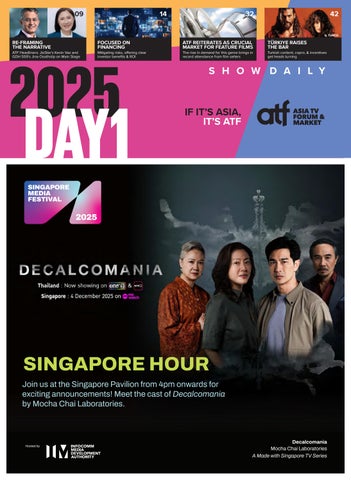
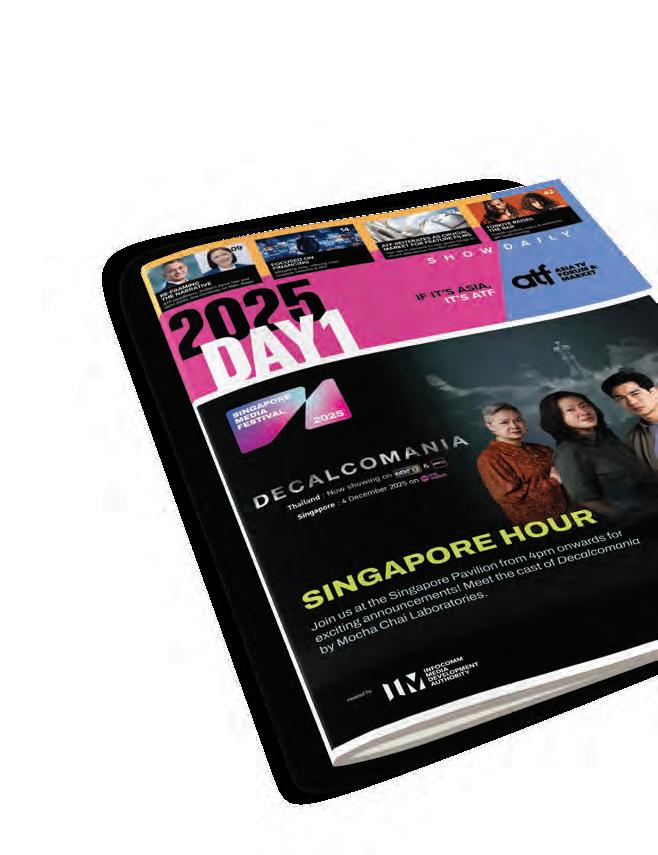
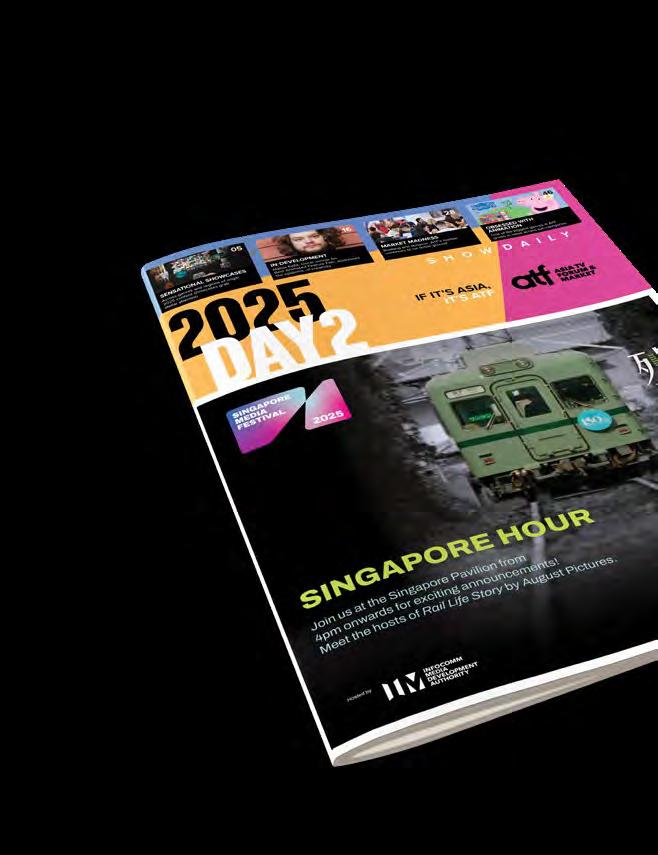
p.02 Exclusives Before the Market p.03 What’s Up Today! (Dec 3)
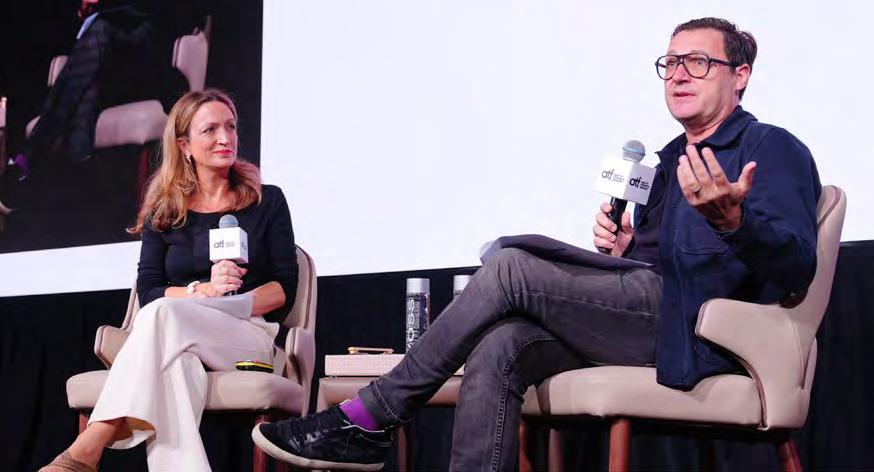
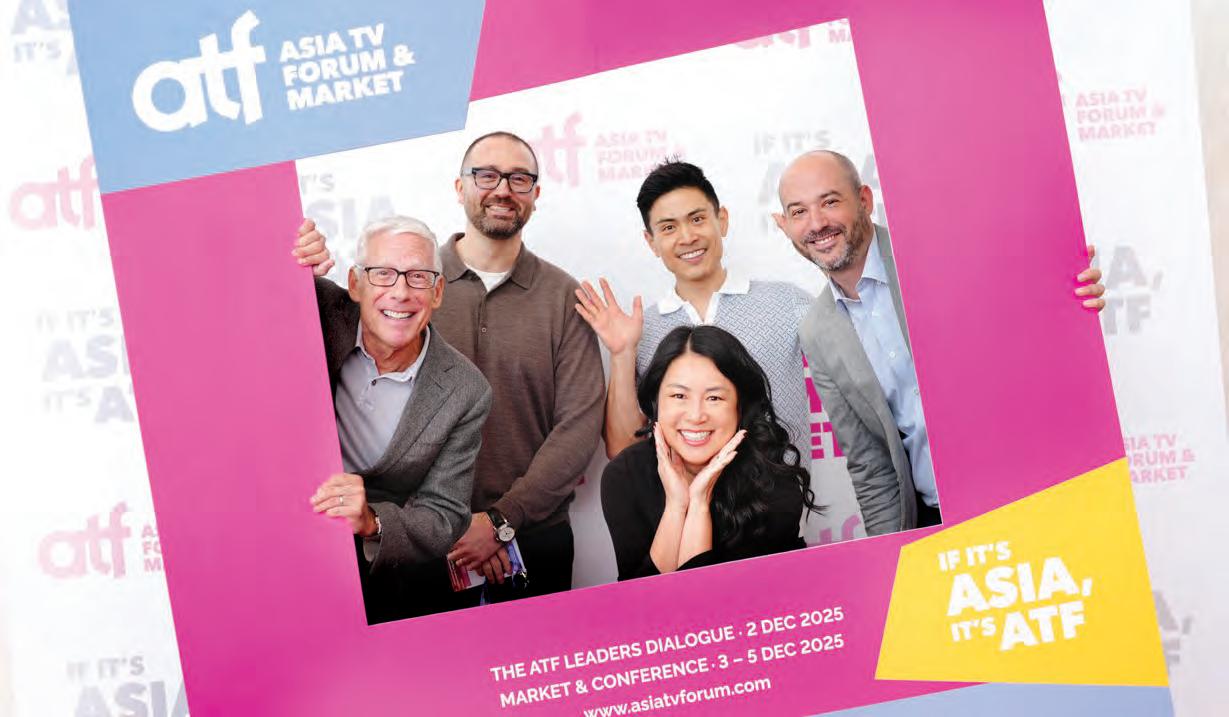
p.08 Leaders Dialogue— Explosion of Leaders Takes Flight
p.26
ATF In-Development Club presents ATF x TTB Animation Lab 2025 p.30
The Plethora of Profiles @ ATF 2025 Feature Films in Demand
p.42
The Plethora of Profiles @ ATF 2025 Turkish Content Takeover
p.48
The Plethora of Profiles @ ATF 2025 The Macro of Micro-Dramas
p.52
New Buyers @ ATF this Year
Dear Industry Friends,
ATF celebrated its Silver Jubilee last year with record attendance and an unforgettable rooftop party, in a region surging ahead with the rise of Asian content. As we begin the next chapter with confidence, we look forward to strengthening our partnerships with you, so that ATF continues to stay relevant to your needs.
As new business models and revenue streams reshape the industry, we continue to evolve. Our diverse attendee mix, editorial approach, and event experiences are crafted to inspire learning, build meaningful connections, and deliver insights both for Asians and from the Asian perspective.
This year, the conference unites leaders from telecommunications, financing, research and production companies to share data, discuss funding and monetization models, and dive into the world of micro dramas—the ultra-short, snackable format of vertical storytelling. We’re also pleased to see the market’s continued growth, now welcoming professionals from more than 60 countries and regions, featuring new exhibitors and platforms from as far as Africa and South America.
By popular demand, our rooftop opening party returns! Expect great conversations, stunning views, and networking that’s as fun as it is Instagram-worthy.
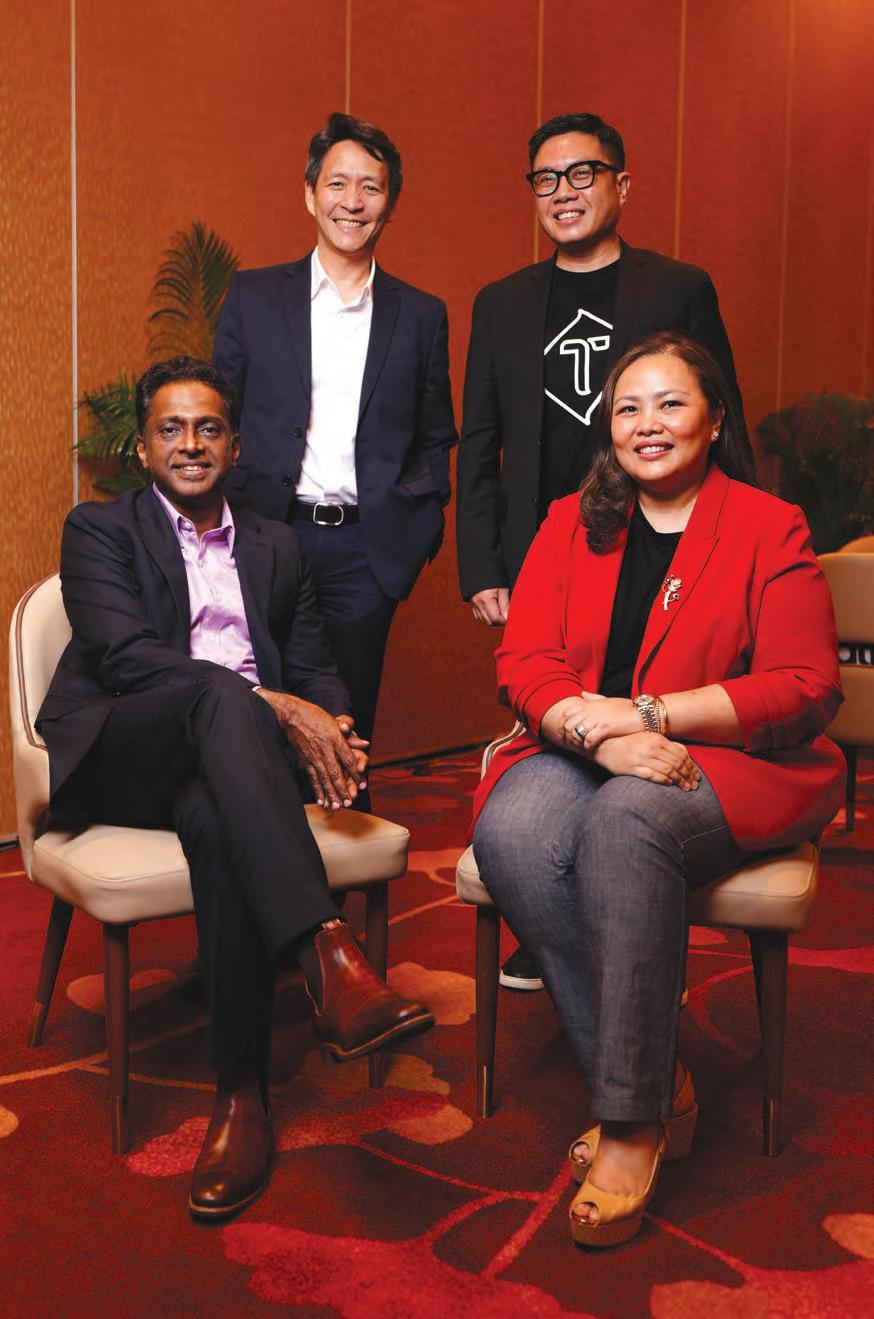
Yeow Hui Leng Group Project Director, Asia TV Forum & Market RX
exclusives before the market
The Europe-India Connection
ZDF Studios and VR Films have signed a deal to relicense over 100 hours of content to India, including the series Victor Lessard, Agatha Christie’s Hjerson, and Standing Tall. VR Films is seeing a good amount of appetite for high end European crime dramas and thrillers, and are looking to acquire more from ZDF Studios, including Spanish/German co-pro Weiss and Morales, ZDF Original The Shadow and Young Adult thriller Love Sucks.
VR Films will also create its own originals for the Indian market, and ZDF Studios is looking to become their co-pro partner on this venture—by supplying remake rights to some of their series
Brands Step into the Writers’ Room US MicroDrama Heads to Asia
V47 Entertainment is pioneering a new era of brand-led creative development. Focusing on the idea that brands now co-create IP, not just sponsor it, it follows the recent announcement of VIRTUE Asia’s launch of V47 Entertainment, a new branded entertainment studio created in partnership with Goldfinch International—the financing, production and creative-ecosystem division of the UK-based Goldfinch Group. The collaboration aims to unlock next-generation storytelling, scale regional IP, and connect brands to the fastest-growing audiences across Asia, MENA and beyond.
“Brands are now stepping into the development phase alongside creators, shaping IP from the very beginning so stories can travel further, resonate deeper, and stay commercially strong. It’s essentially what platforms have been doing for years—building IPs with producers for their audiences and clients’ audiences— except this time we’re removing the extra layers and creating a more direct, agile path for world-building and financing,” said Justin Deimen, Managing Partner of Goldfinch International.
ReelShort has entered a multi-year strategic partnership with AR aimed at accelerating the expansion of ReelShort’s content and platform throughout APAC. Under this agreement, AR will serve as the exclusive agency responsible for broadening the reach and accessibility of ReelShort’s innovative micro dramas across this rapidly growing market.
Analyst Exclusive The State of Scripted Commissioning in APAC
SENSATIONAL SHOWCASE
CLUB PRESENTS
@ Main Stage @ Connect+ @ Main Stage
Brand Consistency: The Hidden Driver of Global Monetization
Scott McCarthy, Vice President, DreamWorks
Reshaping Global Storytelling and IP
• Shilpa Bisaria, VP, Global Corporate Strategy & Head of Emerging Tech Accelerator, Warner Bros. Discovery
• Matty Lin, Global Business Solutions, Bytedance | TikTok
• M. Selçuk Yavuzkanat, Deputy Director General of Cinema, Ministry of Culture and Tourism, Republic of Türkiye 10:30 AM 3:00 PM 1:30 PM 3:30 PM 4:00 PM 4:30 PM
Showcase Shanghai K-Content & Format Showcase
Unifying Your Content, Marketing With AI 11:00 AM 2:00 PM 3:00 PM 5:00 PM 6:00 PM
The Show Begins: Unboxing Linmon 2026— 2027 Upcoming Slates
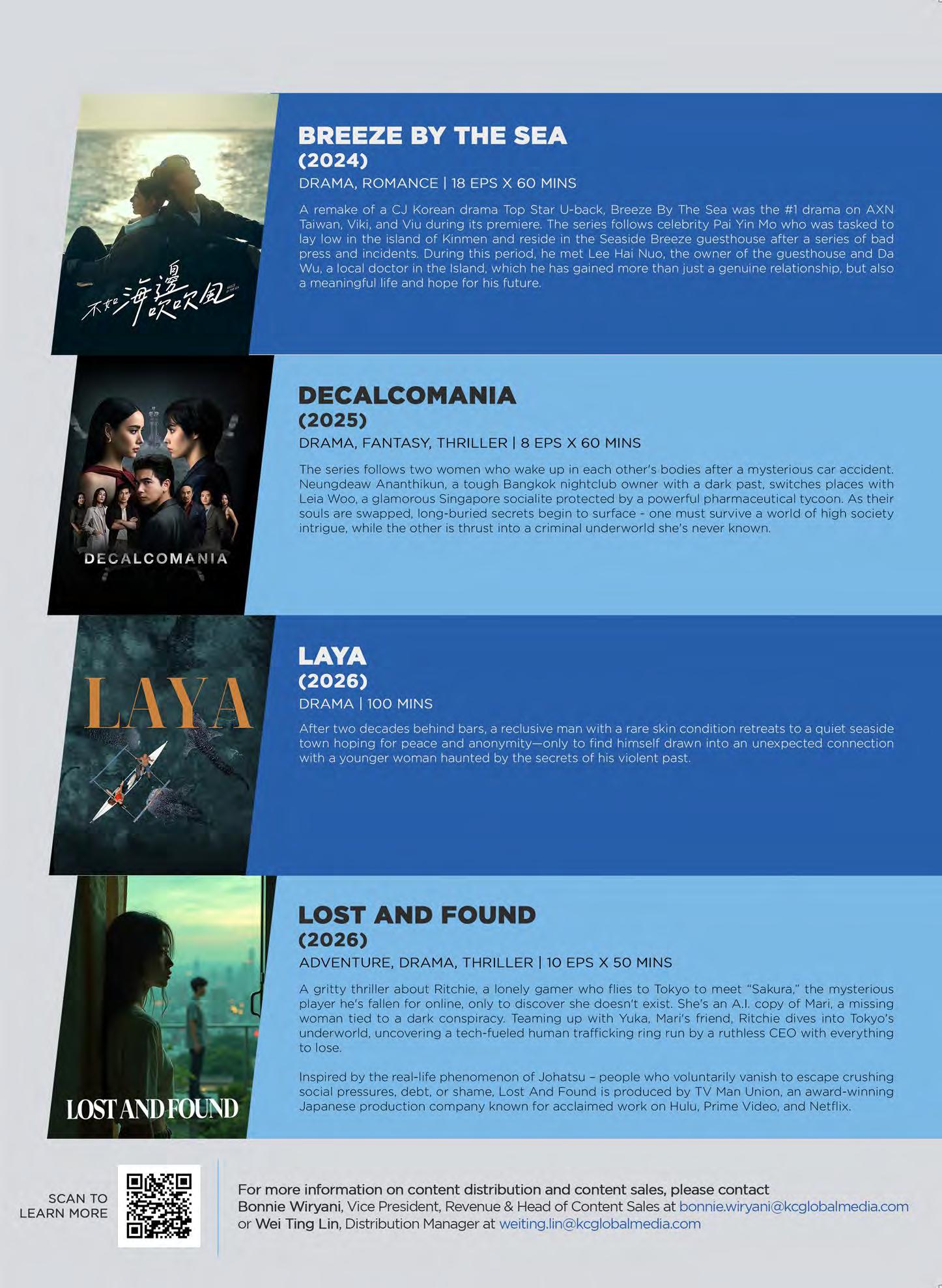
KC Global Media Distribution Content Showcase Your Gateway to World-Class Content
• Nickson Fong, Director/Producer (Academy Award Winner for Scientific & Technical Achievement)
• Alicia Hannah-Kim, Actor
• Todd Terrazas, Co-Founder & CEO, FBRC.ai
Small Budget, Big Wins
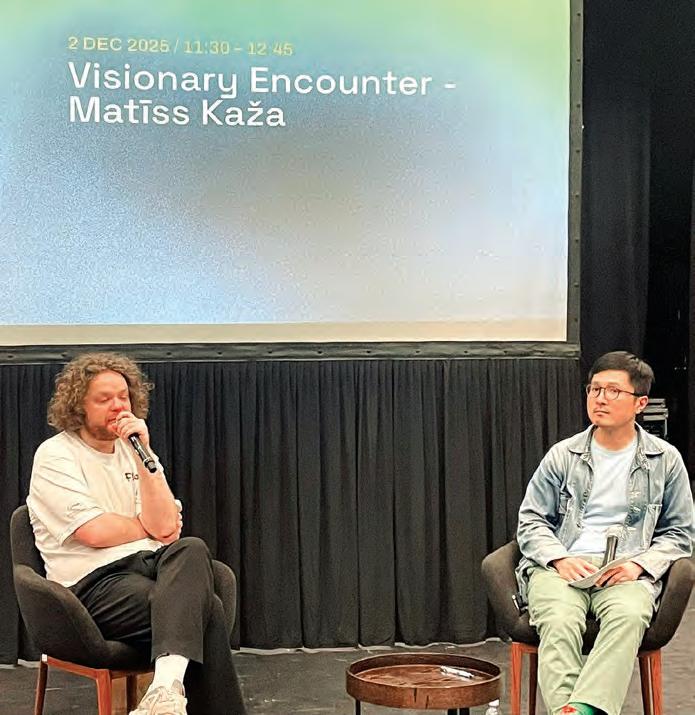
Matiss Kaža, Oscar Winner for Best Feature Film—Animation
Pieces of the Production Puzzle—A Co-Production Program
Fireside Chat + Producers’ Networking
• Alex Sutherland, Founder, AZ Celtic Films
2:00 PM 4:00 PM 4:00 PM 8:30 PM
Ed Ludlow, Senior Analyst, Ampere Analysis Busan Global Content Pavilion: Connecting
|
Party in the Sky! @ LAVO On the 57th floor! Networking at new heights—literally.
conference
Straddling the Fence is the Future in Media and Entertainment
While many believe that streaming will be the downfall of traditional TV, Tony Gunnarsson, Senior Principal Analyst of TV, Video & Advertising at Omdia, has more moderate expectations.
ACCORDING TO TONY, THE NEAR FUTURE OF THE MEDIA AND ENTERTAINMENT INDUSTRY WILL SEE GRADUAL CHANGES THAT MAKE BALANCED STRATEGIES BOTH SENSIBLE AND PROFITABLE.
Beginning with general trends, he shared that the industry would see an overall growth of 7.1% over the next five years, from US$1.03 trillion to US$1.1 trillion – over 70% of which would derive from online video and traditional TV. While all sectors would remain steady, Tony noted that revenue from games would exceed that of traditional TV by 2030.
Tony also pointed out that social media revenue would become a specific key growth sector. This prediction stems from the vast share that advertisements provide to the revenue of streaming – this share sits at 64% now but is expected to jump to 72% by 2030. Of this figure, an entire half derives from social media alone, highlighting social media’s burgeoning value.
WHILE SVOD USED TO CHAMPION THE STREAMING MOVEMENT WITHIN THE INDUSTRY, TONY WARNED THAT THE SECTOR IS ALREADY SEEING A DRASTIC SLOW-DOWN THAT IS OBSCURED BY THE BOOST IT CURRENTLY ENJOYS FROM HYBRID SVOD ADVERTISEMENT TIERS THAT MANY COMPANIES HAVE STARTED TO EMPLOY.
Tony Gunnarsson | Senior Principal Analyst, TV, Video & Advertising Omdia
While SVOD used to champion the streaming movement within the industry, Tony warned that the sector is already seeing a drastic slow-down that is obscured by the boost it currently enjoys from hybrid SVOD advertisement tiers that many companies have started to employ. While SVOD will no longer be the golden child it was, and will remain largely subscription-reliant, Tony stressed that it will remain a key product alongside pay TV. On the same note, Tony predicted that traditional TV and streaming would be neck-on-neck by 2030.
Tony further observed that interest in the micro-drama sector has risen, and while it would be an area for
growth alongside FAST, both would only occupy a minor share of the overall industry. Despite the apparent prominence of some new minor sectors, Tony predicted that current trends will remain stable since there are no new services, formats, or technologies that will materially change current trends at present –even AI, despite its hype, is unlikely to become a key driver. In closing, he highlighted the ambiguous relationship between social media and premium content – whether they are complements or competitors could dictate the direction of a new trend.
CJ ENM and TVING Challenge Global Giants in K-Content
CJ ENM and TVING have joined hands in the ambitious plan to become the top destination for Korean content globally, according to Seo Jangho, EVP of CJ ENM and CEO of Content Waave and Julie Choi, CEO of TVING. However, the duo predict that the journey to the top will be fraught with challenges, the biggest of which is going toe-totoe with large streaming services, like Netflix, that have a strong catalogue of Korean content and a well-established global presence.
They shared that Korean content also faces especially high production costs compared to other types of content and demands creative solutions to diversify revenue streams beyond the usual licensing and advertisement fees. When asked if the rising popularity of Chinese content would be a threat in this regard, Jangho answered that
India isn’t the Next Big Market, It is the Market
With 1.4 billion population and the world’s biggest consumer market, what does it take to capture the imaginations of India’s population?
According to Kevin Vaz, CEO of JioStar, the answer may lie in a content ecosystem that combines all under one roof.
JioStar, the newly merged behemoth formed from Reliance’s media assets, JioCinema and Disney+ Hotstar is now commanding unprecedented dominance across TV, streaming and sports.
“Most street teaming platforms chase one strategy. They go deep (into local content), or they go broad, or they go after international franchises.” Kaz shared.
“We’ve done something no other platform has achieved. We got all under one roof with unprecedented scale.”
After merger, JioStar became the world’s largest single-country streaming platform with 300 million subscribers, 400 million monthly active users and record-breaking 61 million concurrent viewers. Its ecosystem accounts for 35% market share in India.
And still, it’s still operating nowhere near full capacity. TV penetration is only 70%, ad-spend ratios remain far below global benchmarks, and yet consumption already dwarfs most markets.
Jiostar’s strategy to move forward is simple and unapologetic: hyper-local storytelling at massive scale, every major Hollywood studio under one roof, cricket that the entire nation watches, and aggressive innovation in AI, shorts, connected TV and multi-angle sports viewing.
they were confident that Korean content could compete with a higher quality of production.
So far, CJ ENM and TVING’s game plan for global conquest has methodically progressed with regional expansion into Latin America, India, as well as consolidation of their presence in markets like Southeast Asia and Japan.
Julie also commented that an effective approach would be going beyond the intrinsic merits of Korean content by innovating their storytelling with novel concepts, which Jangho elaborated on by sharing the concept of “finding the familiar within the unfamiliar” – essentially embedding relatable elements in novel settings and vice versa.
Kevin Vaz CEO JioStar
(L-R) Jangho Seo, EVP, CJ ENM / CEO, Content Wavve, Janine Stein, Editorial Director, ContentAsia (moderator), Julie Choi, CEO, TVING
Brands Are Moving From Ads to Culture, and APAC is Leading the Charge
K7 Media’s Clare Thompson opened the session with the global picture, outlining how brands are shifting spend from interruption to storytelling. Experiential marketing is now “worth
about $82 billion worldwide,” native advertising sits at “about 108 billion globally,” and creator-led branded content continues to surge across APAC, especially in India and Japan. Dentsu APAC Chief Strategy Officer Clay Schouest explained what’s driving CMOs toward this shift, one of which is that brands no longer want “the logo at the end of the show or oneoff sponsorships. What they want is a creative partnership.”
Clay continues, “Premium attention is much harder to earn from traditional means, and branded entertainment is a great solution for that.” He believes
APAC HAS HIT A CULTURAL TIPPING POINT PROPELLED BY K-CONTENT, ANIME, MICRO-DRAMA, GAMING AND MORE.
“So producers, I think, need to pitch a system, not just a show, and explain why their idea builds a brand, not just how it fits into your fixed-in format. His advice is three-part succinct. “Start building story worlds,” “bring in the creators, bring in the fandoms,” and “stop pitching it as an add-on.”
Looking ahead, Clay predicts five shifts: Brands acting like studios,
commissioning IP and operating as multi-format producers; cross-fandom storytelling becoming standard; multi-platform IP engines replacing single-fromat projects; smarter measurement, unlocking more investment and lastly; APAC being the export hub of global branded entertainment.
(L-R) Clare Thompson, Non-Executive Director, K7 Media (Moderator); Clay M. Schouest, Chief Strategy Officer, APAC, Dentsu
conference
Financing in Fractions is Helping Money Flow
“The demand is there, the creators are there; what’s missing in the middle is the money,” said Jon Gosier, Founder and CEO of FilmHedge. According to Jon, the biggest barrier in the production of media is often the risk involved in financing the production – investors understandably balk at the nebulous risk behind the often complicated production process. This risk, he said, may have become more daunting in recent years. It derives from drastic changes in the film and media industry, including the fracturing of people’s attention across platforms, the resulting increase in distribution complexity, and the fall in predictability and reliability of pre-sales as a stream of guaranteed revenue.
As a result, studios have become increasingly conservative and prefer to acquire existing IPs instead of financing risky new productions.
ACCORDING TO JON, THIS HAS FURTHER DECAPITALISED THE MARKET AND MADE THE STATUS QUO, WHERE MOST FUNDING COMES FROM INSTITUTIONS LIKE NETWORKS AND STUDIOS, UNTENABLE.
As such, he believes that the answer lies outside of the industry – in places like private funds and individual investors. To encourage investment from these parties, Jon advocated for the creation of structures that mitigate risk and increase the level of transparency with investments.
Some such solutions already exist, he said, and can differ based on whether they’re techdriven or data-driven. Percent is a company that turns production financing into an asset that individuals and institutions can own shares of, letting more parties invest sums that suit their financial position and risk appetite – an example of financing in fractions. Screenpoints is another company that provides a platform for producers to commodify the repute of having produced a movie by selling movie credits to investors –arguably a win-win.
Meanwhile, Largo.ai is a company that quantifies the risk of filmmaking, a creative endeavour that often defies quantification,
by running a prospective production through an AI model that performs content tests, audience predictions, and simulated focus groups, predicting its profitability. This, Jon said, resolves the unpredictability of presales and increases investors’ willingness by converting a seemingly qualitative risk into a quantitative one.
FilmHedge, Jon’s company, goes one step further – it performs a similar predictive assessment and provides a loan for production based on this figure, including any tax rebates a production would enjoy from government subsidies. “This combination of tech, data, and credit makes film finance more bankable to investors who otherwise wouldn’t be interested,” he said in closing.
Asia’s Creative Boom Needs New Capital and New Mindsets
“If you are expecting aggressive returns, it’s really your fault,” declared Bing Chen, Executive Chairman and CEO of Gold House, injecting a jolt of candour into the post-lunch financiers panel on 2 December 2025. Moderated by Sophia Yen, Partner at Manatt, Phelps & Phillips, LLP, the five-person session tackled the hard truths behind Asia’s next wave of content financing.
For Bing, strong projects strike a balance across four calibrations: “what is hedgably commercial… what’s critically acclaimed… what’s culturally significant… and what’s a good character.” On whether he’s seeing more ROE-driven investors emerging in Asia, he framed it as a generational shift: “We definitely think this is a generational shift… but I do find an increasing trend among… the scions who have organised their family offices… who appreciate the soft power of cultural capital.”
Phil McKenzie, Co-Founder of Goldfinch, brought the indie financier’s lens. Having deployed “close to $300 million across more than 300 productions,” Goldfinch is now building a first-of-its-kind debt fund for the Middle East and Asia. But applying Western-style lending models to Asia demands flexibility. “Wherever
you’re lending and whoever you’re lending to… it’s about the producer,” he said. With most Asian financing stacks still heavily equity-led, Phil emphasised restructuring around presales, MGs, tax credits and rebates: “whatever collateral’s available.” The real unlock, he added, is “bringing all these parties together as harmoniously as possible.”
On the risk-mitigation front, Steve Berman, EVP of Film Finances Inc, explained why completion bonds remain rare in the region. A bond guarantees a film “will be completed on time and on budget,” offering security to lenders. But in Asia, he said, “either
the producers don’t want it… or the financiers don’t demand it,” making it as much a cultural gap as a procedural one.
Finally, Bennett Pozil, EVP of East West Bank — which financed Crouching Tiger, Hidden Dragon — described how lending models shift across borders. “We’re kind of like water. We just flow,” he said, outlining recourse-heavy Chinese frameworks, hybrid models across Asia, and the need for governments to bolster financing through tax credits and subsidies.
The takeaway was clear: Asia can leapfrog, but only if creativity, capital, infrastructure and policy modernise in tandem.
(L-R) Bennett Pozil, EVP, East West Bank; Phil McKenzie, Co-Founder, Goldfinch; Sophia Yen, Partner, Manatt, Phelps & Phillips, LLP (Moderator); Bing Chen, Executive Chairman, CEO, and Co-Founder, Gold House; Steve Berman, EVP, Film Finances Inc
special HOW TO COMPETE WITH STREAMING TITANS? LEVERAGE GLOBAL INTEREST FOR LOCAL CONTENT
What do boys’ love (BL) dramas, horror shows, and romantic comedies have in common?
They are the Thai content genres that have become a global talking point. “These genres have universal emotional appeal but are uniquely expressed through Thai creativity and charm,” explained Sang Ho Lee, Head of International Business, Mono Streaming Company Limited.
“We’ve observed strong international interest in our Thai BL content because of its emotional sincerity and fresh storytelling,” noted Sang Ho. “The growing global appetite for Thai content has created a positive cultural effect,” as he’s seen how audiences are “becoming more curious about Thailand in terms of its lifestyle, values, and creativity.”
“This global exposure also encourages more investment, co-productions, and creative exchange.”
He attributes the success to “how Thai creators have mastered the art of combining local authenticity with universal emotion, making the content both relatable and distinctly Thai.”
This is a critical factor in enabling local streaming platforms like Monomax to compete with international titans like Netflix and Disney+ for audience attention and market share. “Monomax’s strength lies in its deep understanding of local tastes and viewing behavior,” revealed Sang Ho, so that they can “curate and create original content that truly reflects Thai culture, humor, and emotions that resonate deeply with our audience.”
Sang Ho also shared that
“FLEXIBILITY AND PARTNERSHIPS ARE KEY TO SUSTAINABILITY.”
They’ve implemented this approach by collaborating with international partners and partnering with online personalities and groups.
Working with global partners allows Monomax to “expand the reach of Thai content beyond local borders while sharing production resources and expertise,” during which “collaborations with influencers and fan communities have proven to be powerful
tools for engagement, especially for youthoriented and genre content,” he said.
At the same time, they also have to adapt to evolving consumer behaviour. “Many viewers are selective but loyal when they find content that speaks to them,” said Sang Ho. “That’s why Monomax continues to focus on quality storytelling and authenticity.”
Creative projects require creative talent, and Thailand has risen to meet this rising demand. “The industry has made impressive strides in both storytelling and production quality,” he said. But he also sees the need
to nurture skilled production at all levels of production. That’s why “we believe in building a strong ecosystem where writers, directors, and technical crews can thrive and innovate.”
This has sustained Monomax’s direction to “actively work with both established creators and emerging talents, supporting projects that elevate Thai storytelling to international standards,” said Sang Ho.
Ultimately, this ensures Monomax’s “content remains distinctive in an increasingly crowded space.”
Sang Ho Lee Head of International Business Mono Streaming Company Limited
conference
WeTV’s Aggressive Global Expansion is Paying Off
WeTV has seen astounding success in Southeast Asia as its investment in local productions and partnerships yield regional returns. Jeff Han, VP of Tencent Video, the parent company of WeTV, shared that many of WeTV’s originals have seen widespread success in not only their country of production, but neighbouring countries in the region. Top Form is one of their best forming series and exemplifies their deep collaboration with each market’s culture – the BL series was a joint production between Chinese and Thai production studios based on an IP from Japan and was recognised as the top performing Thai original series in 2025.
WeTV’s gradual curation of a highly localised library is also reflected in the slew of original drama series that it produced with
Indonesian partners, many of which performed comparably well with Top Form. However, Jeff also stressed a focus on proliferating Chinese content alongside successful local productions. WeTV also carries a large amount of premium Chinese original content that increases the global presence of both Chinese talents and Chinese productions.
Jeff further promoted the use of a holistic approach when deploying IPs, citing WeTV’s organisation of offline experiences like fan meets, premiere nights, and watch parties to accompany the release of IPs. WeTV has also employed the use of AI to increase the value of their productions in areas such as script editing in drama creation, animation, as well as overall end-to-end project management.
Astro’s Next Chapter: UniverseBuilding and a Content Flywheel
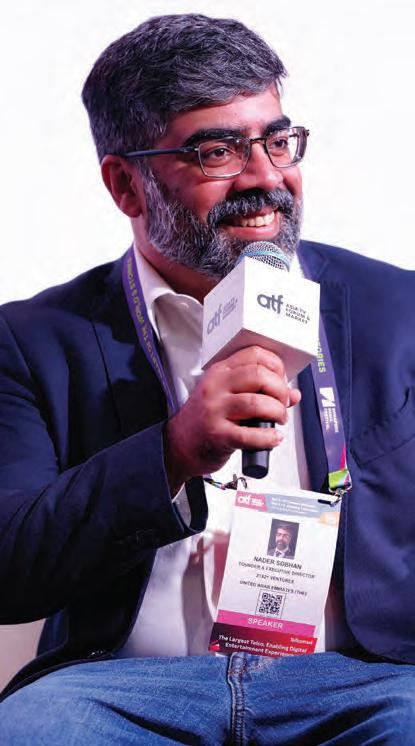
Astro is building universes. In a rapid-fire session moderated by Nader Sobhan, Astro’s Chief Content Officer Agnes Rozario unpacked how 2025 marked a strategic pivot towards deeper local IP creation, full-funnel monetisation and long-arc franchise thinking.
A key unlock was shifting from one-off shiny-floor shows to multi-layered IP ecosystems. Agnes spotlighted Big Stage Alpha, which didn’t stop at a finale. “We created a show where we own the audition process… we created a boy band… we created hit music… and spinoff content that we can operate on TikTok.” The result: Malaysia’s first locally produced song hitting No. 1 on Spotify for five weeks. “It all starts off with the show… and then an idea to make that work so much harder for us.”
Looking ahead, Astro is doubling down on genres that travel across Southeast Asia, such as “horror… animation… and action,” alongside an expanding slate of Malaysian film franchises. The goal for 2026: scale quality, exportability and collaboration. “Content is everything… a flywheel that keeps edifying itself,” Agnes said.
Her priorities for the year ahead are clear: deeper IP universes, cross-border partnerships, and turning Astro into “the creative hub” that attracts top regional talent. “We’ve got to keep doing sexy things,” she grinned.
Jeff Han VP Tencent Video
Agnes Rozario CCO Astro
Healthy Partnerships Make For Healthy Business
According to Isaac Bess, Global Head of Distribution Partnerships at TikTok, social media may be headed in a positive direction that maximises user experience and makes social media a safer space. Speaking on his experience from a key leadership position in TikTok, Isaac shared that, for him, professional relationships in the industry as a representative of TikTok were hard-earned and are treasured. When asked about his priorities in partnership negotiations, Isaac said that, despite the adage about compromise and frustration, negotiations should aim for a happy compromise. The key to that is understanding the priorities of each stakeholder, including oneself, and having a good measure of candour as well as a desire for a long-term working relationship.
In doing so, partnerships are able to achieve the best value for both parties and, most importantly, provide the best experience for their users. As an example, Isaac pointed out the development of a standardised user data format to help industry partners safeguard users from fraud and inappropriate content. Besides building good rapport, Isaac emphasized the approach of moving fast and testing the impact of a partnership rigorously to quickly find out if a partnership is successful and adapt otherwise. The ultimate aim that benefits all partners and users, he said, is to make the creation and consumption of content seamless.
When Two Worlds Meet in One Remake
Jina Osothsilp, CEO of GDH 559 takes a more transcendental and philosophical view of movie remakes than most. For her, a remake of a Thai IP is a rare chance for a cultural treasure to be touched by the creative process more than once and, in doing so, share Thai culture with the rest of the world through the lens of another culture’s creatives.
The remake process also plays an unexpectedly crucial part in Jina’s hopes for Thailand’s film industry. She believes that when Thai creatives get involved in the remake process with others from the international film industry, they learn how to respect the different creative and work processes of other cultures and earn Thailand a name for successful collaborations.
Jina’s hope is that Thai creatives build on these experiences and turn Thailand into a hub for filmmaking on the level of Hollywood.
On the other side of the coin, Jina emphasized the value of remaking foreign IPs with a Thai spin to show the world how well-loved IPs would look through a uniquely Thai lens. GDH 559’s upcoming remake of the Hollywood hit, 50 First Dates, will be released next year with a recognisably Thai spin – Drew Barrymore’s original amnesiac female lead will now become an amnesiac male lead.
Isaac Bess Global Head of Distribution Partnerships TikTok
Jina Osothsilp CEO GDH 559
The Industry’s Shake-Up Is Coming From Micro-Dramas and AI
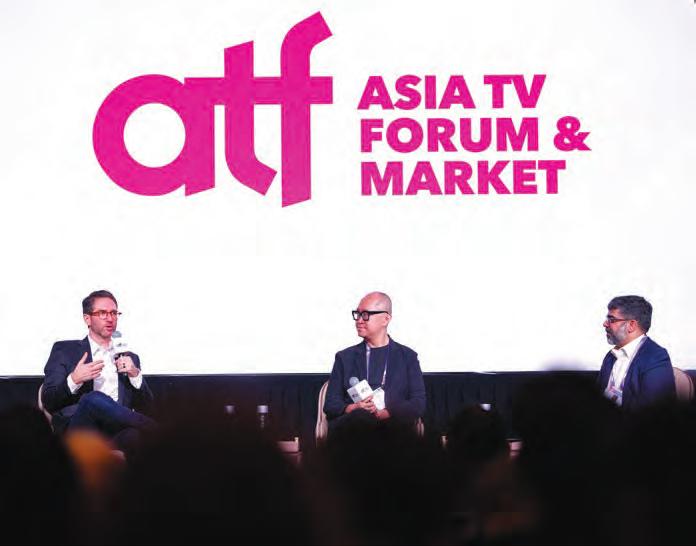
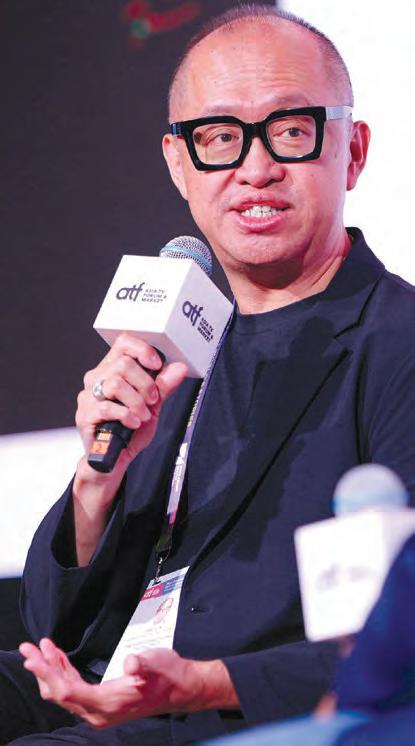
At ATF 2025’s “Just One Thing” segment, Eric Lin, GM of Damai Entertainment (formerly Alibaba Pictures), and Max Michael, Founder of M3 Global Strategy, weighed in on where investment, content and audience behaviour are heading next.
Eric opened with the stat that electrified the room: China’s biggest hit this year, Ne Zha 2, did “1.5 billion RMB… 200 million US dollars” in a single territory, which is a reminder that “the market is huge… the audience is still here.” But he was direct about the other side of the
coin, where producers are “always playing catch-up” to fast-changing tastes.
Max highlighted why Chinese films still struggle to travel. “Historically, we have not really seen Chinese content travel… whereas Korea has spent the last 35 years figuring out how to reach global audiences.” But that’s shifting. Global streamers made foreign-language viewing frictionless, allowing creators to “think a lot differently about their content.”
Looking ahead, both expect two major forces to reshape the market.
“(The fact that) we can translate things instantaneously–I think that that’s something really exciting. That technology allow us to cross borders and cross audiences in a way never before,” Michael enthused.
Then there’s Micro-dramas, which he noted have already ballooned from “a billion and a quarter… to $3 billion” in the US. He adds, “It’s surpassing the Chinese box office.”
Their unanimous advice for 2026: embrace new formats, embrace AI, and build for global reach from day one.
(L-R) Nader Sobhan, Executive Director, 21x21.ventures (Moderator); Max Michael, Founder, M3 Global Strategy; Eric Lin, GM, Damai Entertainment (formerly Alibaba Pictures)
The Slow Case Of FAST adoption in Asia
At ATF’s packed session on content distribution, industry leaders took a hard, honest look at FAST (Free AdSupported Streaming TV) in Asia and why its growth still lags far behind the US and Europe.
Moderated by Brendan Wu, CoFounder & CEO of SeaOvers, the panel brought together Joe Chang (ByteDance), Alexandre Bac (Canal+ Distribution), Felix To (i-CABLE Communications), James Ross (Lightning International), and Rex Ching (myTV SUPER).
The consensus is that FAST has huge potential, but Asia cannot simply copypaste Western models.
Bac explained that the US market hit a perfect storm, “with the price of subscriptions being higher and higher” and the surge of SVOE. These led to viewers’ demand for a “lean-back experience”, and FAST offered exactly that. “Thousands of genre and singleIP channels (are) now available in the US alone,” said Ross, with Europe following around “two or three years behind.”
Unlike the West, Asia’s media landscape is fragmented technologically, linguistically and infrastructurally. “Different countries, different cities may have different challenges,” Chang noted.
Yet the appetite is clear. According to Ching, myTV SUPER’s first FAST channels showed “user numbers increase 70%” with strong time spent, though retention still trails. Local FAST channels consistently outperform foreign ones, reinforcing a simple truth that localised content is the way to go.
To pointed out the biggest shared challenge:
“MANY OF US HAVE BEEN FORCED INTO YOUTUBE AS THE OVERSEAS MONETISATION CHANNEL… WE ALL NEED AN ALTERNATIVE.”
FAST could be the answer, since it’s a lower-barrier way to expand globally without surrendering control.
Ching sees room for “golden sports events” and nostalgia-driven “heritage content” that act as powerful audience magnets. Ross added that evergreen genres such as music, news, and classic Asian dramas perform strongly when properly localised. They “expect some good success” for a recently launched content on Japanese samurai and ninja, which is of interest right across Asia but “hasn’t really been exposed very much.”
Majority of speakers agreed that AI can unlock what FAST needs. Chang outlined how AI can upscale decadesold archives “to 4K,” automate subtitling, voice dubbing, and even lipsyncing to slash localisation costs.
FAST will grow in Asia but only when it becomes local-first, AI-enabled, easy to discover, and purpose-built for fragmented markets. As To put it, “FAST… has all the right ambitions. Now we just have to find the right path for this region.”
Pros and Cons of Content as a Non-Connectivity Service
A congregation of telco experts discussed content as a non-connectivity service and concluded that with the right conditions, content can be well placed. The speakers included Derrick Heng, CMO of Telkomsel, Pratthana Leelapanang, CEO of AIS, Roche Vandenberghe, CMO of Globe Telecom, and moderator Manoj Menon, Founder of Twimbit. The discussion comes on the back of a growing trend of telcos maximising value of existing infrastructure by diversifying into revenue streams adjacent to their core business of telecommunications. For some, content is a tantalising option.
Derrick was the strongest proponent of content – for Derrick, it had a justifiably good ROI and benefitted their core business by driving engagement and increasing customer retention. However, his main reason for championing content is more idealistic than material – “We feel that it’s beyond just economics or ROI,” he said, adding that content development was also about improving the lives of people and innovating.
Pratthana, on the other hand, held a more pragmatic approach – personally developing content as a telco is not as cost effective as collaborating with existing content creators to acquire content, while investing in marketing and distribution. For him, there are superior non-connectivity options to explore, such as entertainment and live sports – both of which are profitable enough in their own rights to exist as complete enterprises. In fact, Pratthana espoused the use of non-connectivity services mainly in an ancillary role to their core services. He alluded to the fact that only 30% of Thai phone users have 5G subscriptions, while only half of all Thai households had fibre broadband, as an indication of the significant space for growth for core telco services in Thailand.
Roche shared Pratthana’s view of content’s excellent ancillary role, but differed in her assessment of nonconnectivity services in a holistic capacity to form an ecosystem of services that both generates revenue and retains customers.
As for measuring success in diversifying from a telco’s core business with a three-year horizon, Derrick shared that his measure of success would be transforming Telkomsel into an everyday companion for positivity, while Pratthana envisioned AIS
becoming a “real digital distribution network, triple in size”. Roche’s aim was to have realised the aforementioned ecosystem of services with a high level of relevance and personalisation for customers within three years.
Micro drama is a US$10-billion industry, and companies are going where the money is. At ATF 2025’s final session of Day 1, moderator Anne Chan brought together platform leaders, producers, and investors to dissect what’s working, what’s next, and how AI will accelerate everything. Speakers included Dabin Chung (Bamboo Network), Enoch Chen (COL), Marcus Zhang (Hony Capital), and Lesley Simpson (Telkomsel).
On use of AI, COL’s Enoch was unequivocal. “AI is not an afterthought or optional. It’s at the heart of our strategy.” COL already uses AI to brainstorm storylines, pressure-test ideas, smooth production workflows and even generate “the first few episodes… just to test if the story will stick.” The company has even rebuilt an entire blockbuster using AI-driven actor conversion, something “impossible without huge costs” before.
For 2026, Enoch predicts deeper experimentation across live-action, animation and hybrid AI content: “We’re going to use AI a lot more… maybe 5% or 10%, but across more genres.”
In Korea, Dabin highlights that they merged Korean emotional depth with China’s industrialised micro drama system. Their hybrid formats use AIdriven CG and VFX to polish anything from unscripted dating to scriptedreality blends.
Further inland, Marcus has had a front-row seat to the industry’s seismic growth. “2025 is the year micro drama became a global phenomenon,” he said, noting that Chinese companies still hold the top positions internationally thanks to scale, supply chain, and ruthless competition. But he sees a new cohort emerging in Southeast Asia, India, and even Hollywood-backed startups. Still, he’s blunt when it comes to investing in micro drama. “One hit is not impressive. You need a system, whether you have a data-driven
performance…understanding the traffic and how accounting gets made.”
In Indonesia, Lesley revealed why Telkomsel was the first mover in the region. “Attention spans are getting shorter every day,” and Indonesians were already consuming huge volumes of short videos. Telkomsel manually educated users island by island to build the habit and it’s paying off. Certain partners have jumped “from outside the top 10 to top three” in Telkomsel’s data traffic.
Monetisation remains tricky, but bundling with telco data, coins systems and telco-based identity verification is unlocking scale.
Regardless of challenges, industry leads are clamouring for this new slice of micro drama pie. As Marcus succinctly put it, “I look forward to a fierce competition.”
(Anti-clockwise) Marcus Zhang, Partner, Technology & Cultural Innovation Department, Hony Capital; Dabin Chung, CEO, Bamboo Network; Lesley Simpson, Vice President, Digital Lifestyle, Telkomsel; Anne Chan, Co-Founder & CEO, AR Asia Productions (Moderator); Enoch Chen, CTO, COL
in-development
THE ATF X TTB LAB 2025 BRINGS WISDOM FROM REGIONAL PROFILES TO GLOBAL, AWARD-WINNING FIGURES
From Solo Vision to International Triumph:
The Remarkable Journey of “Flow” and Latvian Animation
The animated film Flow stands as a testament to the transformative power of collaboration and innovation within the Latvian animation industry. Initially, a solo endeavour by Ginz Zilbalotis with his film Away, the journey to Flow marked a significant evolution, requiring a team, enhanced technical expertise and substantial financing.
This shift was spearheaded by Ginz’s partnership with Matīss Kaža, who joined first as a co-writer and later took on the role of producer, leveraging his experience to navigate the complexities of international co-production.
Flow’s financing journey was multifaceted, involving public funding from Latvia’s National Film Center and international partnerships with France and Belgium. The project overcame scepticism, particularly from German funders wary of its unique, dialogue-free narrative and unclear target audience. Yet, Flow defied expectations, achieving critical acclaim and commercial success, including topping Disney Plus in Germany. This success cemented Latvia’s potential as an emerging animation hub in the Baltics.
Latvia’s rich animation heritage spans generations and techniques, from 2D to stop motion, yet formal animation education remains in its infancy.
THE SUCCESS OF FLOW HAS CATALYSED DEVELOPMENTS IN THIS AREA, PROMISING A NEW ERA FOR LATVIAN ANIMATION.
The production’s small, multidisciplinary team adapted diverse skills and worked closely in a collaborative environment, utilising open-source tools like Blender to achieve artistic excellence.
Ultimately, Flow exemplifies how visionary storytelling, technical innovation, and strategic international collaboration can elevate a small nation’s cinematic voice onto the global stage, inspiring future creators to pursue authentic and boundary-pushing animation.
Catch Matīss Kaža in a Q&A session at 4pm @ ATF Connect+ (Room: Peony 4511—4512)
in-development
Within the Lab, A Luncheon
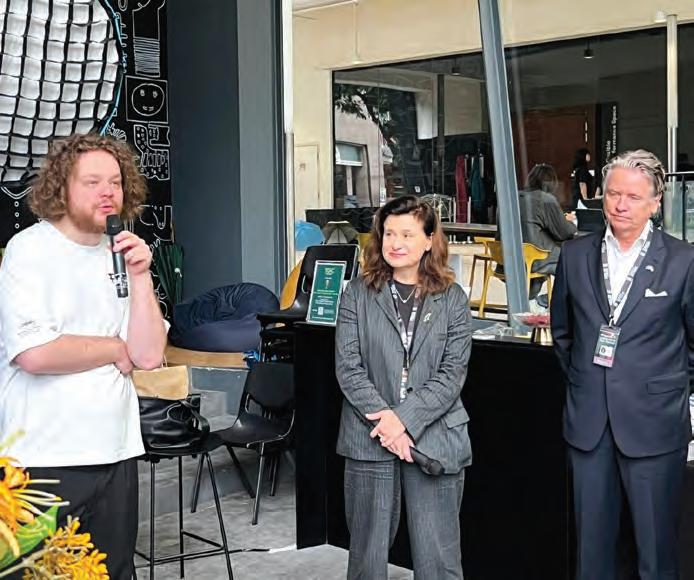
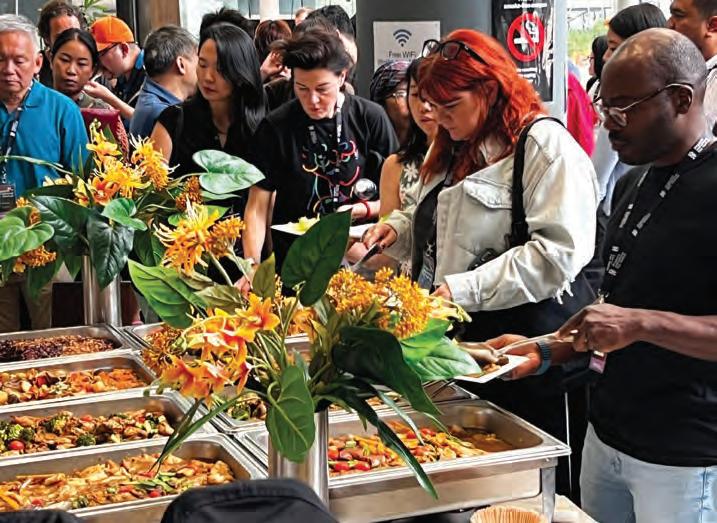
The 36th Singapore International Film Festival co-hosted an industry luncheon with the National Film Centre of Latvia at the Flexible Performance Space of LASALLE College of the Arts. It was a part of Industry Days–SGIFF’s knowledge-building platform designed for film professionals from Southeast Asia and beyond.
The luncheon brought together filmmakers, producers and industry decision-makers for an afternoon of networking and exchange. The session was anchored by the presence of Academy-award winning director and animator Matīss Kaža, best known for co-writing and producing the animated feature film “Flow”. Dita Rietuma, the director of the National Film Centre of Latvia, spoke briefly about Kaža’s next project. “We’re a tiny country of 1.8 million, but we’re super happy that we’re some kind of animation superpower, thanks to ‘Flow’.” Expressing excitement, she continued, “Of course, we’re waiting for the next film by Matīss, which our film centre is financially backing. He has told us it will take four years, and they’re still looking for some kind of investment. It would be around $5 million.”
“It’s lovely to see so many animation professionals in one place here,” Kaža smiled, in a white “Flow” T-shirt. “Everyone was so curious and open-minded, and asked such wonderful and well-versed questions in the morning session. But now, I’m curious to find out, what is “Grandma’s Banana Cake”, referring to the dessert on display. With that, the luncheon began.
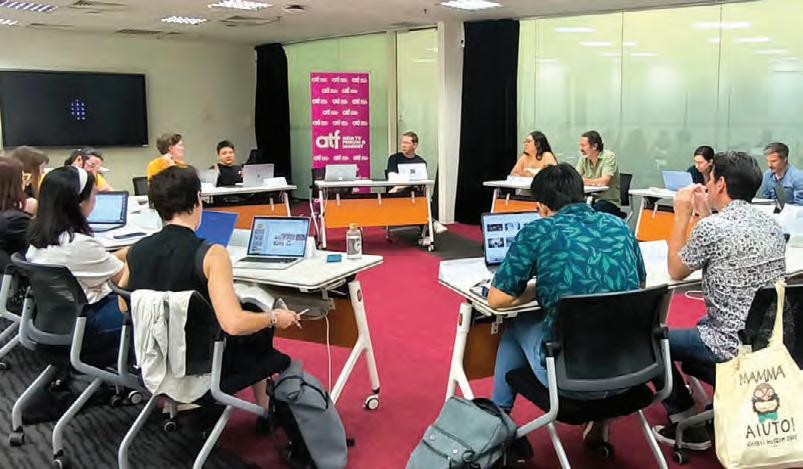
Lab loving—Participants explore everything from narrative structure and character arcs to dialogue, pacing, and worldbuilding, pushing participants out of routine thinking and into new mental spaces, helping them see challenges and opportunities from unexpected angles.
SHIFTING GEARS FOR REGIONAL REACH
MARKETS THAT ONCE RELIED ON LEGACY BROADCASTERS ARE NOW SPLINTERED ACROSS PLATFORMS, LANGUAGES, AND AUDIENCES.
For TVBI Company Limited, this fragmentation has created opportunities and has provided room to manoeuvre, said Visky Lam, Senior Marketing Manager. It also requires a more adaptive strategy built on flexible, partnership-led dealmaking that could service buyers seeking multi-format IP, tailored versions and cross-territory rollouts.
Visky Lam Senior Marketing Manager TVBI Company Limited
“We are strategically expanding our reach by focusing on several areas: deepening our presence in key territories such as Indonesia, the Philippines, and Myanmar; actively pursuing opportunities in Spanish and Arabic-speaking regions where we have not previously been exposed—and exploring new business models and content types to engage untapped market segments, including IP licensing,” she added.
That shift dovetails with a broader repositioning effort to transition “from a traditional distributor into a global content partner and IP hub,” Visky noted. “TVBI finds ATF’s concentrated and diverse environment particularly appealing for future engagement, as it efficiently brings together a broad spectrum of industry talent and decision-makers from around the world, creating an ideal platform for forging new partnerships and gaining immediate market insights,” she said.
NEW INCENTIVES, NEW AMBITIONS: FINAS CHARTS ITS NEXT PHASE
Malaysia’s biggest opportunity lay in scaling its regional footprint, and the National Film Development Corporation Malaysia (FINAS) arrived at ATF positioning itself to capitalise on it. Chairman Dato’ Hans Isaac said the agency’s renewed focus on cross-border collaboration, streamlined funding access and stronger incentive pathways have become central to Malaysia’s next phase of creativeeconomy growth.
“FINAS IS FOCUSING ON MARKET EXPANSION, CAPABILITY DEVELOPMENT AND INDUSTRY RECOVERY THROUGH TARGETED PROGRAMMES,”
Dato’ Hans noted, emphasising that incentives such as FIMI (Film In Malaysia Incentive) and rising international production interest were expected to open more pathways for employment, collaboration and long-term business growth.
A co-production TV fund has been developed to strengthen regional cooperation and
shared investment across ASEAN, as the agency seeks to expand Malaysian storytelling abroad. Improved financial accessibility was also part of the overhaul. “FINAS is improving financial accessibility through streamlined processes, clearer guidelines and enhanced engagement with producers,” he explained.
Ultimately, success would be measured in reach, co-productions and investor confidence. “The strong response at MIPCOM and the more than US$63 million in production value attracted through FIMI reflect clear market trust,”
Dato’ Hans said, positioning Malaysia for a more assertive role in ASEAN’s
creative future.
“Since FINAS first joined ATF in 2012, our participation has evolved alongside the growth of Malaysia’s creative economy,” he added. Stronger national policies and leadership have widened the country’s capacity to collaborate, with ATF continuing to serve as an important platform for Malaysia to strengthen its international presence and partnerships.
Dato’ Hans Isaac Chairman National Film Development Corporation Malaysia (FINAS)
AN INSPIRATION THAT BOOSTS NHK INTO THE FUTURE
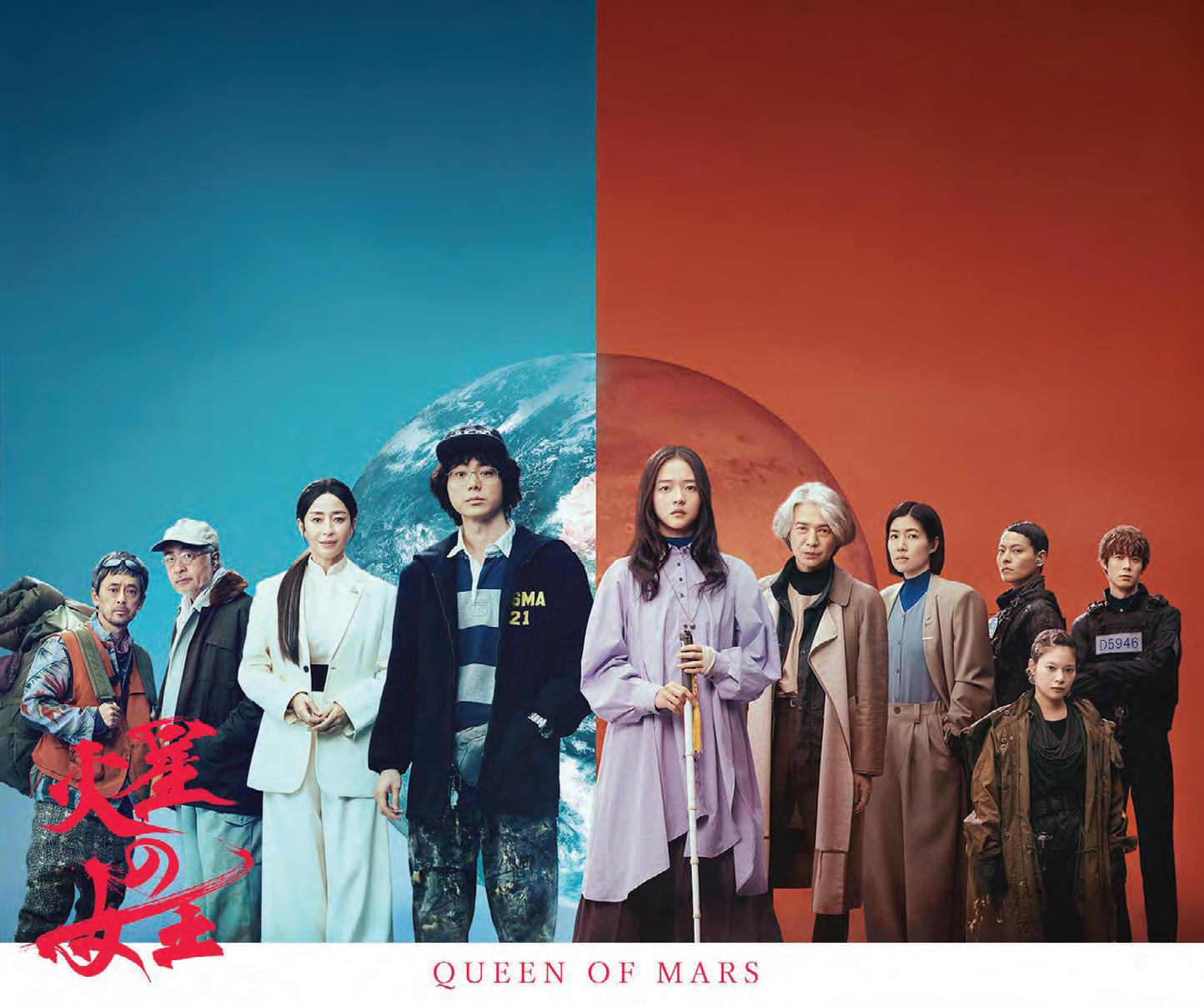
NHK celebrates the 100th year of broadcasting in Japan by launching the sci-fi drama Queen of Mars. This ambitious series offers a grand sense of scale, stunningly realistic visuals, and richly layered storytelling, featuring an international ensemble of acclaimed actors and visionary creators.
HIGHLIGHTS
• A realistic portrayal of life on Earth and Mars, set 100 years in the future
• A collaboration between NHK’s drama team, science experts, and space specialists
• Inspired by an original work by one of Japan’s leading science fiction authors, Satoshi Ogawa
• A fresh take on Mars migration paired with a romance bridging two worlds
• Led by Taiwanese rising talent Suri Lin and Japan’s Masaki Suda, with an international cast from Japan, Korea, China, India, and more
• A gripping blend of scifi mystery and political suspense
“The sense of wonder of humans living on Mars, the thrill of first contact with an unknown object, and the universal theme of identity among pioneering settlers can resonate with people of any country,” said Takegoro Nishimura, Chief Director of Queen of Mars, Drama Productions, NHK.
“Most importantly, the audience will experience the sense of distance between loved ones separated by planets. The speed of light—something humans cannot surpass—creates significant delays in communication across planets. We believe that the drama created by this time lag is both grounded in everyday experience and evokes a sense of universal empathy.”
Inclusivity shapes the vision of Queen of Mars. The series imagines a future where people from diverse ethnic backgrounds speak their native languages, connected through real-time translation devices.
“Inclusivity isn’t just for Earth—it reaches across the solar system,” says director Takegoro. This commitment to diversity extends to the cast, featuring actors from a wide range of linguistic and cultural origins.
A powerful example is the protagonist, Lili E1102—a visually impaired heroine portrayed by Taiwanese actress Suri Lin. Takegoro praises her as ‘a true queen of overwhelming talent,’ bringing fresh energy to the project with an extraordinary gift for creating and embodying a character with remarkable depth.
Queen of Mars pushes the boundaries of sci-fi realism with its stunning portrayal of the Red Planet. To capture Mars authentically, NHK undertook extensive research into how the planet has been depicted in past works. Filming spanned locations in Japan and abroad, with landscapes meticulously transformed into Martian terrain by NHK’s art team. Hollywood cinematographer Takuro Ishizaka captured these scenes with breathtaking precision, and VFX legend Katsurō Onoue, celebrated for his work on Godzilla and Ultraman, enhanced the footage with cutting-edge effects that make Mars feel both alien and authentic.
Beyond its stunning visuals and cutting-edge VFX, Queen of Mars asks what might change and what might endure a century from now. At its core, the story explores timeless human truths: parental love, the experience of encountering the unknown, and the quiet courage to face invisible fears. This powerful blend of epic sci-fi spectacle and deep human drama is what makes Queen of Mars unforgettable.
feature film
INDONESIAN CONTENT BUOYED BY THIRST FOR NOVEL CONTENT
Vimal Mukhi, Distribution, Sales & Acquisition Manager at PT Tripar Multivision Plus Tbk, shared that the company’s core strategy lies in taking Indonesian storytelling to the world in new ways. Vimal explained that in addition to relationship building, a top priority was to reach international buyers through film and television. “Film is one of the fastest and most powerful ways for people to understand each other’s cultures,” he said, noting that authentic local stories had strong global resonance.
Over the past three years, Vimal observed a marked transformation in buyer behaviour across Asia and APAC.
THE MARKET HAS BECOME FASTERMOVING AND MORE COMPETITIVE, WITH BUYERS ACTIVELY SEEKING ORIGINAL IDEAS AND FRESH FORMATS.
“Buyers are looking for content that’s out of the box—stories that haven’t been told before,” he said. The industry’s growing appetite for innovation has opened new opportunities for Indonesian producers to stand out on the regional and global stage, but only if they can find the novel angle that is sought.
Looking ahead, Vimal views new formats such as micro-dramas and vertical storytelling as the next frontier. With audiences consuming more short-form content, Tripar Multivision Plus has already begun developing productions in these emerging formats. For Vimal, embracing innovation while staying true to Indonesia’s identity remains key to sustained success in a rapidly evolving industry.
RIDING
THE TIKTOK EFFECT
For Chen Zhiang, General Manager at Zhejiang Xiuming Film Co., Ltd, the disruptor of recent years wasn’t a platform merger or a streaming boom—it was a popular social media app. “The biggest surprise of the past three years has been the global adoption of TikTok,” he said.
“TIKTOK HAS PERMEATED INTO THE DAILY LIVES OF AUDIENCES, AND THE BREADTH OF ACTORS HAS UNDERGONE A TRANSFORMATIVE CHANGE. SELF-MEDIA INFLUENCERS HAVE TAKEN ON THE ROLE OF A NEW GENERATION OF ACTORS.”
He observed that the transformation redefines everything from casting to distribution. In a landscape where visibility matters as much as craft, influencers blur the lines between performer and brand. It also reshapes conversations around brand building, content creation and audience reach, with material now expected to travel at the speed of a scroll.
For Chen Zhiang, micro-scale storytelling represents the next wave of creative capital that is personal, aspirational, and built for mobile-first audiences. “The best IP I discovered recently is a new entertainer named Wang Yueyi from China,” he said. “Her works share daily outfits and travel styles, presenting high-quality visual preferences through careful framing and shooting.”
As a first-time participant at ATF, Chen Zhiang is quick to connect the dots across markets. “I have found that Hong Kong and Taiwan are still the best performing arts markets in Asia,” he said, whilst also recognising Singapore as an important
MANDARIN MOTION PICTURES BLENDS LOCAL RESONANCE WITH GLOBAL REACH
Playing a dual role as both producer and distributor can be a lucrative and successful strategy, according to Alexis Reybet-Degat, Head of International TV Series and Library Film Sales at SND – M6 Group.
ALEXIS EXPLAINED THAT ENGAGING EARLY IN PROJECTS AS A PRODUCER OR CO-PRODUCER ALLOWS DEEP INVOLVEMENT, FROM CONCEPT TO INTERNATIONAL RELEASE, THUS ENABLING THE COMPANY TO TAILOR STRATEGIES FOR EACH MARKET.
One benefit includes identifying whether a title works best as a readymade acquisition or as a candidate for local adaptation.
Across APAC, Alexis noted that SND continues to see strong results in established markets such as Japan, South Korea, and China. Genres with universal appeal — notably animation, action, and horror — performed consistently well, reflecting the region’s appetite for highconcept storytelling. At the same time, local remakes have become an increasingly powerful driver of growth. The new TV series My Wife Is a Spy, for instance, has already generated substantial remake interest across Asia.
Alexis describes Asia as one of the most dynamic regions in the global entertainment industry, with mature and emerging markets alike contributing to its momentum. The variety of broadcasters,
Like merchants braving the Silk Road on camels, Mandarin Motion Pictures has found great success in bringing local culture from various communities to the global stage. Alvina Wong, Executive Director of Mandarin Motion Pictures Limited, shared how this success stemmed from finding both the right balance and the most appealing angle to blend local storytelling with international palatability.
THIS APPROACH, SHE SAID, WAS STRENGTHENED BY CLOSE ATTENTION TO AUDIENCE INSIGHTS AND FLEXIBILITY IN DEAL STRUCTURES — AN ESSENTIAL STRATEGY AMID RAPIDLY EVOLVING DISTRIBUTION MODELS.
Over the past three years, Alvina observed a marked change in buyer behaviour across Asia – they had become more selective, favouring local content that carried strong cultural identity and long-term franchise potential. “There’s now a stronger emphasis on stories that build lasting value rather than one-off hits,” she noted.
At the same time, Asian and APAC buyers had grown more open to innovation. Alvina described an increasing appetite for bold storytelling, fresh formats, and adaptable intellectual property — all of which had opened new pathways for regional and
distributors, and platforms across the region creates fertile ground for partnerships and experimentation.
Attending ATF for the first time, Alexis sees the event as a vital opportunity to deepen relationships and explore new collaborations— particularly as Asia’s creative and commercial influence continues to expand worldwide.
Reflecting on recent editions of ATF, Alvina said the event had
Alexis Reybet-Degat Head of International TV Series and Library Film Sales SND – M6 Group
A MATTER OF PRECISION OVER EXPANSION
“Sustainable growth now requires selective evolution,” said Simonetta Polese, Head of Sales at TVCO S.r.l.,
HAVING OBSERVED HOW DISTRIBUTORS AND BUYERS ARE NAVIGATING A SHARPER, DATALED REALITY WHERE GROWTH COMES FROM CHOOSING WHEN TO PIVOT, NOT JUST HOW FAST.
The shift is most visible in the quiet recalibration of traditional roles.
For the company, it is an approach anchored in core expertise while layering on other components from curated co-productions to analytics-driven licensing. “We stay rights-
SCALING UP THE FRIGHT FACTOR
The numbers and screams have spoken. “[The] horror genre has been our most successful,” said Muhammad Hananto, President Director of NANT Entertainment. He pointed to a slate that included The Sacred Riana: Beginning, The Sacred Riana 2, and Kamu Harus Mati markets across new territories to distribute or sell our content/feature film.”
THAT GENRE STRENGTH GAVE NANT A SOLID FOOTHOLD IN BOTH INDONESIA AND MALAYSIA, BUT HANANTO WAS CLEAR THAT THE NEXT PHASE REQUIRED LOOKING OUTWARD.
“We only had buyers from the Southeast Asian market recently,” he said. “Therefore, we joined ATF [this year] to expand in new
At ATF, Hananto is keen to meet with other producers and buyers to explore coproduction opportunities and content partnerships. For a studio that built its reputation on local chills, the next act will be about making horror travel, expanding its fright factor and its footprint across new markets.
led, but add value through packaging, data-driven windowing, and financing bridges with producers.” She explained that collaboration should serve a clear purpose. “Co-producing only when it de-risks, secures pre-buys, or unlocks strategic partners in target regions,” she added.
Across Asia-Pacific, the region’s performance shapes the company’s focus. According to Simonetta , Southeast Asia— led by the Philippines, Malaysia, Indonesia, and Singapore—have emerged as a hub for consistent TV placements across genres. Australia and New Zealand punch above their weight on documentaries and premium scripted, while India thrives on family and faith-driven fare.
“Taiwan and Hong Kong respond to genre films and upscale docs when localised with strong marketing assets, [while] Korea and Japan are strategic for curated premium scripted content where local partners coposition marketing and localisation to meet high audience expectations,” she said.
Simonetta Polese Head of Sales TVCO S.r.l
Muhammad Hananto President Director NANT Entertainment
GDP: THE SECRET SAUCE FOR SUCCESSFUL INTERNATIONAL CO-PRODUCTIONS
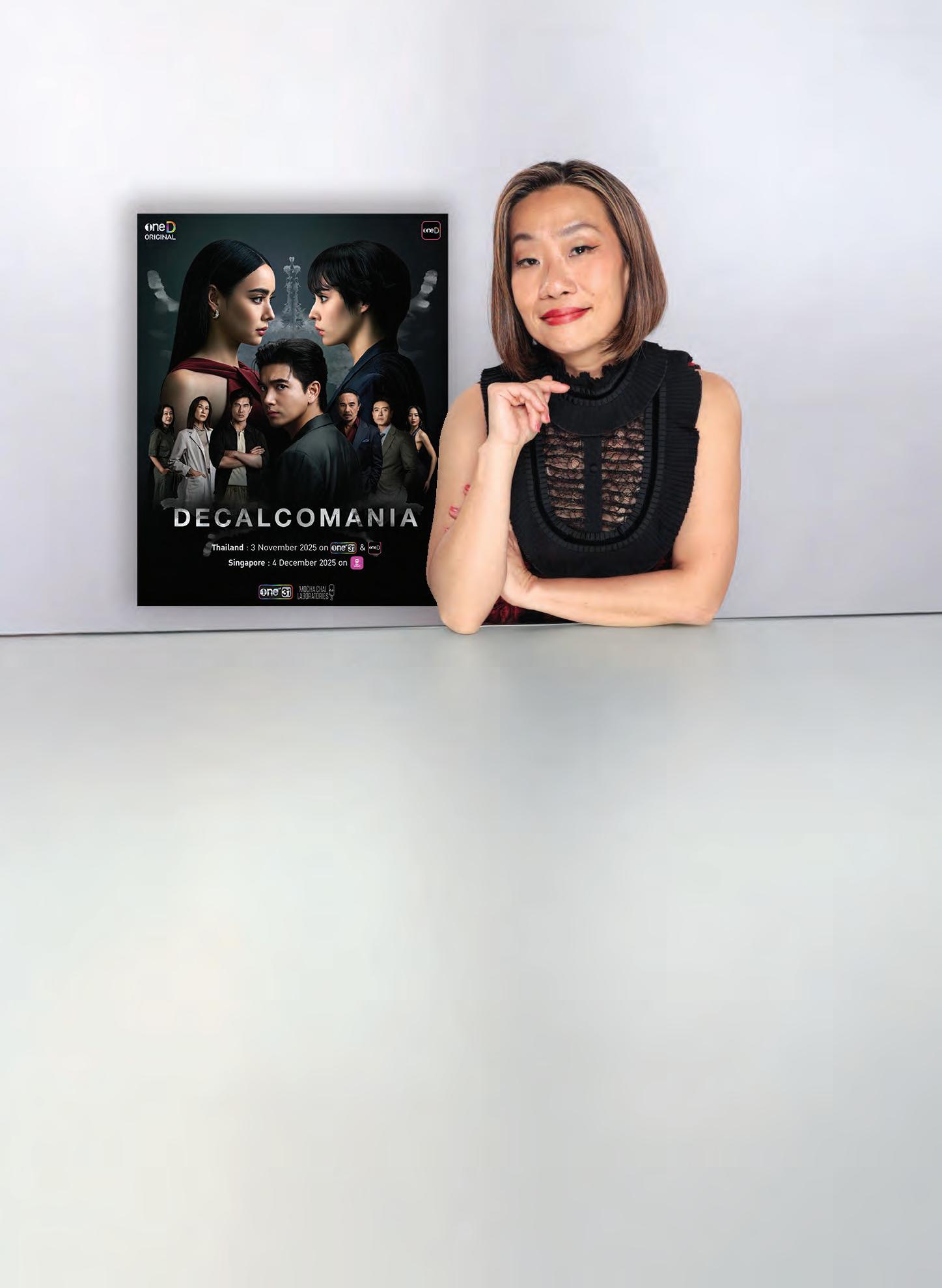
“In any international co-production, trust and chemistry matter far more than budgets,” said Michelle Chang, Co-Founder, Mocha Chai Laboratories.
“No one wants to embark on a multi-year collaboration with someone they don’t like or trust,” she elaborated, explaining that “these partnerships often span at least three years, so choosing the right partner is crucial.”
“I rely heavily on instinct and experience when selecting collaborators”, said Michelle, drawing upon her experience from Mocha Chai Laboratories’ three international coproductions in the last four years. “But over time, I’ve developed a few ‘litmus tests’ to guide me.”
She outlined her GDP (Gratitude, Diversity, and Partnership)—three qualities that are required for successful international coproductions.
“The first quality I look for in a foreign producer is their willingness to stay the course when challenges arise,” she said. This is a person who is willing to solve problems, rather than walk away or assign blame. She iterated that partnerships are more than just contracts. They are based on mutual respect, shared ambition, and the courage to venture into | the unknown.
“The second quality is mutual respect and genuine appreciation for each other’s cultures,” Michelle shared. The diversity of teams, locations and cultural perspectives often create an “X factor.”
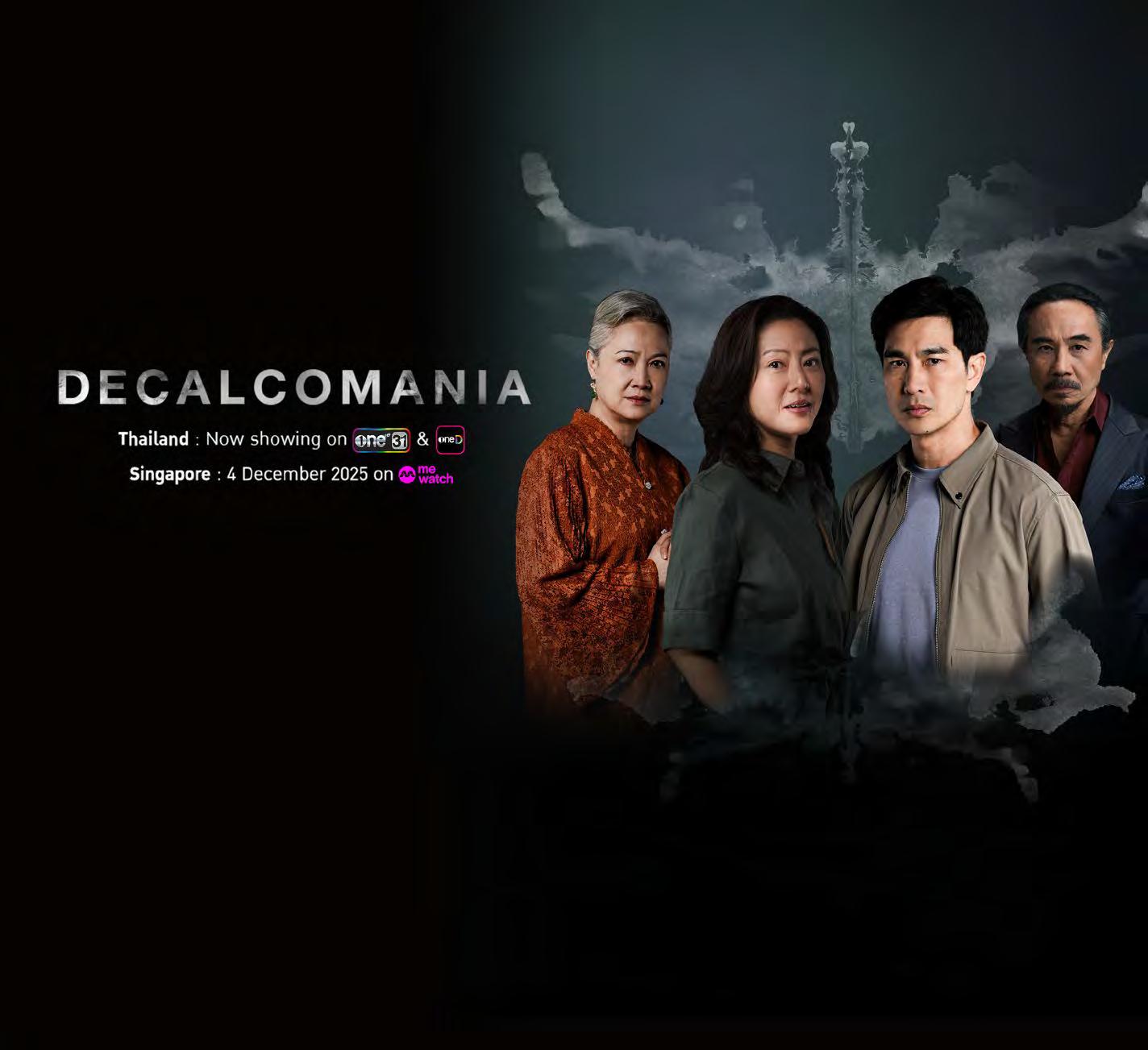
A resonating hit in this quality is embodied in the new mystery thriller, Decalcomonia. It is the first co-production between Singaporebased Mocha Chai Laboratories and Thai-based ONE31. “Its narrative unfolds across both Singapore and Thailand, weaving elements from both cultures into the storyline.”
“DESPITE THE LANGUAGE BARRIERS, WE OVERCAME EVERY CHALLENGE BECAUSE WE SHARED ONE VISION,” SAID THE DECALCOMANIA PRODUCER. “TO MAKE OUR FIRST INTERNATIONAL CO-PRODUCTION A SUCCESS.”
The final quality is open-mindedness. “Many of us claim to be open yet hesitate to step out of our comfort zones or embrace new ways of doing things. But in co-productions, openness is essential,” she stated.
“It’s how we learn, adapt, and grow together.”
Gratitude, diversity, and partnership. For Michelle, these three qualities are the cornerstones of international co-production success. It guides her decisions, because if she sees growth in the GDP of a co-production, “then it’s a relationship worth nurturing.”
“It is a long game I am pursuing, not a oneand-done.”
Michelle Chang Co-Founder Mocha Chai Laboratories & Producer of Decalcomania
feature film
A BALANCING ACT OF SCALE AND SPECIFICITY EVERGREEN GENRES, EVOLVING DISTRIBUTION RULES
For Michael Wong, Chief Marketing Officer at Xiaowu Bros., staying competitive in the region means balancing efficiency with cultural precision. ”Japan and South Korea have great potential, but high cultural barriers require careful balancing of investment and ROI,” he said, noting premium storytelling in these territories continue to deliver top-tier revenues.
In India, Indonesia, and Malaysia, the company has relied on high viewership as the foundation for revenue, having achieved what Michael describes as a “sustainable cycle from traffic to income.”
HE POINTED OUT INDONESIA, THAILAND AND VIETNAM AS GROWTH MARKETS FOR CHINESELANGUAGE CONTENT AND REGIONAL COLLABORATIONS, WHILE HONG KONG, TAIWAN, SINGAPORE, AND MALAYSIA REMAIN ESTABLISHED ANCHORS.
The balance of scale and specificity also defines how distributors are adapting to shifting content flows. “We remain focused on core distribution, but are strengthening our competitiveness through multilingual localisation, content repackaging, and diversified distribution strategies (FAST, social, and app),” he said.
If there’s a common thread across these markets, it’s creative boldness. “Every year, we are pleasantly surprised by the innovative content of exhibitors from
Distributors are recalibrating their business models to sustain visibility and value across an increasingly fragmented ecosystem.
For Rome-based Filmexport Group, this means focussing on a “multi-window” release approach across linear and non-linear platforms to maximise exposure and monetisation, whilst maintaining traditional licensing.
“The distribution landscape has transformed due to the dominance of global streamers. Minimum guarantees have become more performance-based, with many preferring revenue-sharing models tied to viewership metrics,” said Andrea Di Girolamo, Head of International Sales and Acquisitions.
Andrea observed that the shift toward data-driven deal structures has amplified genre programming. Horror, erotic and classic titles, considered the company’s reliable performers, have benefitted from renewed global demand, particularly as audiences seek out distinctive alternatives to mainstream fare. These categories have also shown flexibility across hybrid release strategies, spanning streamers to physical formats.
“Strong emotional storytelling has proven to travel well across markets like Korea, Japan, and Southeast Asia. We’ll continue investing in these genres, alongside others like western, [and] comedy,” Andrea said. While Japan and Korea are the strongest performing markets, the company has also seen exciting growth in India, both in terms of consumption volume and creative collaboration potential.
“WE BELIEVE THAT EACH MARKET HAS DISTINCT AUDIENCE BEHAVIORS, SO LOCALISATION IS SOMETHING WE ARE FOCUSING ON,” HE ADDED.
Michael Wong CMO Xiaowu Bros.
Andrea Di Girolamo Head of International Sales and Acquisitions Filmexport Group
FRAMING ITALY FOR ASIAN SCREENS
Italian boutique studio K+ leans on genre balance and market agility to navigate Asia’s evolving film landscape. Noir, romance and comedy lead its scripted slate while arts, music and sports drive unscripted success.
“APAC BUYERS’ APPETITE IS ALWAYS PRESENT BUT [IT IS] MORE ATTENTIVE DUE TO THE MARKET’S CONTINUOUS SHIFT,”
said Niccolò Tubini, Junior Manager of International Sales and Co-productions, noting the pronounced rise of streaming and hybrid financing models.
Niccolò pointed to Malaysia, Singapore and South Korea as the company’s key territories.
feature film
The company stays connected with regional ongoings by attending business markets and events. “FILMART and ACFM are traditionally the places to be. At ATF, there’s a momentum going on,” he noted.
It was precisely at ATF, he added, where conversations around innovative financing and distribution opened new lines of dialogue with partners seeking quality over volume. Asian buyers are increasingly receptive to
Italian stories with universal appeal, which he describes as a blend of “intensity and lightness” that mirrors K+’s slate of European sophistication and global sensibility.
CHARACTER-DRIVEN IP FINDS ITS REGIONAL EDGE
Italian company Lux Vide S.p.A navigates Asia by leaning into data-driven deals and character-led IP. “In the past three years, digital platforms have reshaped distribution with flexible, performance-based deals,” said Cecilia Tosti, International Sales Executive. “Minimum guarantees are now based on audience data and viewing trends, rather than estimates. Commissions reflect local content demand.”
MARKET SHIFTS
CALL FOR FAR MORE GRANULAR AUDIENCE STRATEGIES, ESPECIALLY ACROSS A REGION DEFINED BY FRAGMENTATION.
“Reaching audiences across Asia requires platform-specific strategies and a deep understanding of regional habits,” Cecilia added. She noted that localisation and adaptability have become essential as platforms tune their slates to local sensibilities.
The success of the company’s recent IP, Blanca, a high-concept cop show anchored by a charismatic female lead, reinforces its belief that emotional specificity could travel just as effectively as high-concept spectacle. “Audiences have connected deeply with the protagonist’s resilience and authenticity,” Cecilia noted. “This kind of character-driven storytelling is central to our strategy, and we plan to continue investing in similar formats.”
Japan remains Lux Vide’s most important Asian territory, but the company continues to look outward. For Cecilia, ATF has become a useful gauge of where the regional market is heading. “Discovering emerging trends and innovative formats has sparked new ideas around distribution strategies,” she said, particularly those IPs “that can be successfully adapted across multiple territories” and scaled into international franchises.
Niccolò Tubini
Jr. Manager, International Sales and Coproductions K+
Cecilia Tosti International Sales Executive Lux Vide S.p.A.
feature film
NEW METRICS DRIVE ACQUISITIONS IN ASIA
Transacting in a region that is increasingly data-led, New Regency’s remit has shifted from traditional sales cycles to far more adaptive deal-making. “Buyers have become more data-driven and selective, with a stronger mandate for local content,” said Ben Bishop, VP of International Sales (Asia Pacific & Canada), noting that domestic productions were improving rapidly while remaining costeffective. Streamers and broadcasters are now evaluating US and UK titles on audience engagement, not just brand recognition.
Ben added that the shift also extends to creative deal making and license terms. “We’re focused on identifying new buyers as the landscape continues to evolve.
WE’RE LOOKING
AT FLEXIBILITY
IN DEAL STRUCTURES, WINDOWING STRATEGIES, AND AT TIMES A MORE NON-TRADITIONAL LICENSING APPROACH,”
Ben further offered. He added that reliable materials delivery, marketing support, and clear communication are key to closing sales and sustaining meaningful partnerships.
Even though Ben noted decreasing budgets and content saturation remains key challenges, he sees opportunity existing for titles with standout appeal. “Buyers are increasingly open to new, high-quality content that can stand out on already crowded platforms,” said Ben, pointing out the growing
appetite for premium, character-driven film and TV, particularly content that travels well or features recognisable talent.
BL FUELS ASIA’S LGBTQ+ CONTENT MARKET
The Boys’ Love (BL) genre has emerged as the breakout force within LGBTQ+ content, and Portico Media’s LGBTQ+ focused streamer GagaOOLala is doubling down on its momentum across Asia.
Licensing manager Janet Liu said no other genre matched its performance across both consumer viewership and international sales. “I would say the most successful genre is BL genre right now,” she noted. “No matter the performance on our platform or for international deals, which includes all the format feature films, series and short films.”
While the core buyer base remains mostly unchanged, interest in Boys’ Love and Girls’ Love titles has grown quickly enough to sustain further production. Consumer
THESE MARKETS,
JANET SAID, SHOW THE HIGHEST APPETITE FOR LGBTQ+ STORIES AND “A GROWING OPENNESS TO DIVERSE CONTENT”.
demand is strongest in Japan, the Philippines, Taiwan, and Thailand, with South Korea and the wider Southeast Asian region close behind.
For Janet, ATF has shifted from an annual marketplace to a “strategic compass,” guiding earlier development involvement, multi-territory co-productions and exclusive hybrid formats–all of which helps reinforce the platform’s positioning within the LGBTQ+ content space.
Ben Bishop VP, International Sales (Asia Pacific and Canada) New Regency
Janet Liu Licensing Manager Portico Media Co., Ltd.
UPFRONT COLLABORATION FOR DOWNSTREAM PAYOFF NEW REVENUE PATHWAYS DRIVE NEXT-PHASE GROWTH
“The most significant transformation in the Asian film and television industry has been the rise of hybrid distribution models–combining streaming-first releases with targeted theatrical runs or festival premieres,” said Lo Chun-Han, General Manager of Taiwan’s Mirror Fiction and its production arm, Mirror Entertainment. Minimum guarantees have shifted from fixed sums to tiered structures tied to viewership performance, with commissions becoming more flexible, particularly for pan-Asian content.
Market-wise, Chun-Han views Asia as an interconnected arena rather than isolated territories. “Ensuring audience reach is no longer just about platform placement or theatrical scheduling,” he explained, positioning the company’s “one source, multi-use” approach as a data-led method for sequencing releases across platforms and cinema windows.
He stressed the importance for stories to be designed from the very beginning with multi-market potential in mind.
“RATHER THAN WAITING UNTIL A PROJECT IS COMPLETED TO START DISCUSSIONS, IT’S FAR MORE VALUABLE TO ESTABLISH PARTNERSHIPS DURING THE EARLY STAGES OF IP DEVELOPMENT,”
Chun-Han said.
Its strongest results come from literature-forward, character-centric dramas. The company’s standout IP, Port of Lies, succeeded because “it combines emotional authenticity resonating with both local and international audiences,” he added.
“Because we invest heavily in the early-stage development of these literary properties, our stories are already well-grounded in field research, psychological depth,
Titles that cut through the clutter are those with personality and purpose, according to Sophie Shi, Head of Studios at EST N8.
“I prioritise stories with a strong identity–a distinctive voice, cross-border potential, and clear audience positioning,” she said, adding that resonance come from projects able to travel globally without losing the specificity of authentic Asian storytelling.
That focus shaped the company’s expansion moves as it pushed Asian cinema further into North America through theatrical releases, including the Indonesian horror film Pabrik Gula (‘Sugar Mill’). Alongside distribution, the team rolls out cash flow financing for productions built around tax incentives and began developing merchandise infrastructures to give independent films wider and more sustainable revenue routes.
On the sales side, Head of Sales Cathy Ni observed an industry still in motion. “The market has been constantly evolving–in terms of which markets buyers attend, the types of films they acquire, and the scale of productions they pursue,” she said, pointing to shifting policies, postpandemic dynamics and fluctuating audience tastes.
THE UNPREDICTABLE ENVIRONMENT MADE IT VITAL TO REMAIN ACTIVE ACROSS MAJOR MARKETS AND PRIORITISE “MEANINGFUL, IN-DEPTH CONVERSATIONS WITH BUYERS BEYOND SIMPLE EMAIL EXCHANGES,” SHE ADDED.
When asked whether Asia was becoming more experimental, Cathy kept the focus on audience fit rather than trends. “‘New content’ can mean many things–from fresh genres to new formats–and openness really depends on each platform and audience,” she said, stressing that what matters is ensuring each film reaches the viewers it was built for.
Lo Chun-Han General Manager Mirror Entertainment & COO, Mirror Fiction
Sophie Shi Head of Studios EST N8
Cathy Ni Head of Sales
turkish content
TURKISH DRAMA SEES ASIAN BOOM THROUGH LICENSING TO LOCALISING
Buyers across Asia are adopting more sophisticated content strategies as the region’s media ecosystem continues to diversify. According to Yasemin Keskin, Sales Manager, MENA, APAC & Global Inflight Entertainment Distribution at Kanal D International, the post-Covid rise of digital platforms has been a key factor reshaping licensing models across the region.
“There’s growing interest in both finished content and adaptation rights for Turkish dramas. As a result, we’re seeing expanded opportunities across new markets, and our licensing strategies are adapting to meet this demand,” she said.
Buyers are increasingly seeking flexibility to maximise content value across windows.
“THERE IS NOW A STRONG DEMAND FOR BROADER RIGHTS PACKAGES THAT ALLOW THEM TO MONETISE TITLES, NOT ONLY ON TRADITIONAL TV BUT ALSO ACROSS DIGITAL, AVOD, SVOD, AND EMERGING PLATFORMS,”
Yasemin explained.
The appetite for adaptation rights has also surged. “Asian broadcasters and platforms increasingly want to create their
own local versions of proven Turkish dramas, using our storylines while adding their own cast and cultural nuances,” she added. Titles such as Fatmagül Love, and Three Sisters illustrate universal themes and character-driven narratives continue to resonate across cultures.
As digital platforms redefine viewing behaviour and, in turn, licensing
structures, Yasemin said Kanal D International is curating its content development around projects with high production values and emotionally engaging narratives. “These qualities have enabled our series to maintain strong traction in the region,” she said.
Yasemin Keskin Sales Manager (MENA, APAC & Global Inflight Entertainment Distribution) Kanal D International
ALL THE DRAMA OVER DATA
Buyers across Asia are leaning into data-driven decision-making and flexible deal structures as digital consumption reshapes viewing habits. “It’s a shift toward flexibility and data-driven choices rather than pure instinct,” said Ebubekir Talha Erdogan, Sales & Business Development Manager of MediaHub, who observed that the region’s market dynamics demanded more precision and adaptability than ever before.
“UNDERSTANDING AUDIENCE TRENDS, TRACKING PERFORMANCE, AND ENSURING TITLES FIT BOTH LINEAR AND DIGITAL PLATFORMS IS CRITICAL,”
he said, adding that quick delivery, transparent deals, and knowledge of regional regulations are also essential in building smarter, faster and more sustainable partnerships.
Buyers in Asia have also grown more selective, focusing on shorter formats and measurable engagement before committing to acquisitions. “They’re looking for stories with global appeal but easy local adaptation, plus more cost-efficient licensing or co-production opportunities,” Ebubekir pointed out.
He highlighted that regional partners in Indonesia, India and the Philippines continued to demonstrate agility. “The ones who stand out are those blending smart marketing with quick localisation and strong cross-platform launches–consistently keeping viewers engaged even as habits shift to mobile-first and on-demand viewing.”
On the content front, Turkish dramas remain popular in Asia, but Ebubekir noted a strong audience interest in global Turkish docu-series and shorter, stylish content. “That mix lets us work with broadcasters, streamers, and niche platforms alike,” he said. “Combined with
turkish content
METRICS DRIVE BUYING ACROSS ASIA
Data has increasingly been guiding the decisions of buyers seeking to stand out in an ever-crowded marketplace. According to Mustafa Ilbeyli, Director of Advertising & Sales at Turkish Radio Television Corporation, this shift has redefined how partnerships are built and how content is valued.
“Buyers in Asia have become more precise and data-driven in their decisions.
THEY ARE SEEKING TITLES THAT NOT ONLY DELIVER STRONG RATINGS BUT ALSO OFFER UNIQUE POSITIONING WITHIN A CROWDED MARKETPLACE,” HE SAID.
That data-driven precision has gone hand in hand with a stronger focus on storytelling that resonates both locally and internationally. “We see rising interest in stories that combine local relevance with international storytelling standards, and content that adapts easily to multi-platform consumption habits,” he added.
Scripted dramas, factual series and high-quality children’s shows continued to perform strongly, with their universal themes of family, hope and identity striking a chord across regions. Mustafa also noted the growing appetite among buyers to reinterpret such stories within their own cultural contexts.
“Aside from nurturing partnerships, our main focus lies in delivering versatile and compelling content that truly connects with audiences,”
he said, qualifying that while the data mattered, buyers should prioritise substance over short-term trends to stay ahead. “The partners we value most are those who consistently invest in strong narratives, cultivate loyal audiences, and think strategically about long-term growth,” he added.
STREAMING SHIFTS REWRITE ASIA’S CONTENT ECONOMICS
The region’s buyers, once defined by territorial windows and linear schedules, now operate in a landscape driven by immediacy, data and cross-platform fluidity. For Asia’s content economy, this convergence of mobility, storytelling and market intelligence signals not just evolution but a structural reset.
“THE SHIFT TOWARD STREAMING AND MOBILE-FIRST CONSUMPTION IS TRANSFORMING CONTENT WINDOWS, AUDIENCE BEHAVIOUR, AND REVENUE MODELS,”
said Gamze Besler, Sales Manager (CIS, Baltics, Asia Pacific) at Calinos Entertainment. “Compared to a decade ago, we see notable shifts. Markets like India, South Korea, China, Indonesia continue to focus on local production reflecting the region’s creative growth. At the same time, buyers are increasingly seeking premium international content that can complement local stories and resonate with diverse, global-minded audiences,” he added.
As content strategies diversify, the opportunity lay in strategic alliances and a dual approach consisting of ready-made series that travelled easily, alongside format sales for local adaptations. Drama, romance and action continue to headline demand, yet buying patterns are gradually evolving. Gamze noted that while Asian buyers remain more selective compared to other regions, some are becoming more open to fresh narratives and innovative formats.
In response, the company has expanded their focus on format sales for local adaptations, which have shown strong momentum across Asia as buyers increasingly look for proven IPs and collaborative partnerships, complementing its core slate of ready-made content.
Gamze Besler Sales Manager (CIS, the Baltics, Asia Pacific) Calinos Entertainment
turkish content
GLOBAL AGENCY: GLOBALLY APPEALING CONTENT THROUGH STRONG LOCAL COLLABORATION
“Global appeal with local relevance,” said Işıl Türkşen, Sales Director for Asia and the Baltics at Global Agency, as she reflected on how shifting buyer preferences and creative collaboration had shaped the company’s recent success. Işıl believes that over the past three years, Asian buyers have become far more selective and strategic, seeking emotionally rich stories with cultural depth. Titles such as Dynasty of Love and A Mother’s Oath exemplified this balance and resonated strongly with regional audiences.
FOR IŞIL, THE COMPANY’S STRONGEST OPPORTUNITIES LAY IN DEEP PARTNERSHIPS RATHER THAN TRANSACTIONAL DEALS.
and co-development. Through projects like A Mother’s Oath, Global Agency blends universal themes with distinct local flavours — a formula that has helped build emotional connections across borders.
Drama remains the agency’s best-performing genre, driven by stories centred on family, loyalty, and love. However, Işıl emphasised that success depends on more than strong storytelling. “Beyond pricing, we prioritise quality, creativity, and adaptability,” she said.
Marketing support and transparency also play crucial roles, as buyers increasingly value partners who understand audience behaviour and offer flexible, tailored solutions.
Looking ahead, Işıl identified innovation, trust, and consistency as the pillars of Global Agency’s continued growth. By pushing creative boundaries while maintaining reliability, the company positioned itself as a global storyteller ready to meet the evolving demands of modern audiences.
GLOBAL REACH THROUGH EMOTIONDRIVEN TURKISH STORYTELLING
Ekin Koyuncu Karaman, Global Distribution & Partnership Director at OGM Universe, shared how the company has focused on combining creative integrity with strategic growth to expand Turkish drama’s global footprint. As the distribution arm of OGM Pictures, Ekin explained that the company’s priorities are curating quality content and maintaining brand trust in a fast-changing international market.
Among OGM Universe’s most soughtafter titles were Reborn, The Fall of the King, Deep in Love, and Lost in Love—each distinguished by emotional realism and visual sophistication. Lost in Love earned two honours at the 2025 Premios PRODU Awards, further boosting its regional appeal.
Ekin also emphasised that LONG-TERM SUCCESS COMES FROM PARTNERSHIPS GROUNDED IN SHARED CREATIVE VALUES RATHER THAN TRENDS.
Ekin noted that since both Asian and Turkish cultures value themes such as family, sacrifice, and redemption, Turkish dramas naturally resonate in the region. As such, despite buyers becoming more discerning, Turkish drama continues to do well. There has also been rising demand for female-led narratives and multi-generational sagas, reflecting broader shifts in audience tastes. For OGM Universe, global expansion is not just about entering new markets, but about building lasting cultural connections through powerful, emotionally resonant storytelling.
Işıl Türkşen Sales Director (Asia & the Baltics) Global Agency
Ekin Koyuncu Karaman
turkish content
VOD PLATFORMS: THE SWIFTEST HORSE FOR NOW
VOD platforms have emerged as Raya Distribution’s most dynamic partners, according to Iryna Bakaliuk, Sales Manager for Eastern Europe, CIS, CEE, MENA, North Africa, and APAC at Raya Distribution. While traditional Free TV and Pay TV channels once formed the backbone of the company’s client base, the rise of streaming has reshaped its business model. Notably, the company’s catalogue has been strategically adapted to meet this demand, leading to stronger collaborations and greater reach across Asia.
Iryna also pointed out that buyers across Asia have become far more selective and discerning, moving beyond the once-dominant appetite for Turkish dramas to focus on stories that resonate with local cultural sensibilities.
THE SURGE OF DIGITAL PLATFORMS HAS TRANSFORMED ACQUISITION DYNAMICS AS WELL, WITH DECISIONS MADE MORE SWIFTLY AND FLEXIBILITY BECOMING A CENTRAL EXPECTATION.
Additionally, Iryna explained the need for licensing models to grow more versatile. Rights were no longer confined to single territories; instead, content could be distributed across multiple platforms with increased emphasis on digital and adaptation rights–opening the door to more creative, long-term partnerships.
On the increasing popularity of micro-dramas as a medium, Iryna stated that more study is needed before it can be adopted as a major part of their strategy. Meanwhile, Raya Distribution will continue playing to its core strength: high-quality, long-form Turkish dramas and mini-series that continue to perform strongly across Asia’s evolving entertainment landscape.
Iryna Bakaliuk Sales Manager
(Eastern Europe, CIS, CEE, MENA, North Africa, and APAC) Raya Distribution
TURKISH
CONTENT’S GAMBIT FOR MEDIA SUPREMACY
Inter Medya’s biggest strength, according to Pelin Koray, Senior Sales, Acquisition and Strategy Manager at Inter Medya, lies in its adaptability and diversity. With the launch of its first vertical drama and documentary slate, the company’s catalogue of Turkish content has grown from beyond traditional drama to include documentaries, films, and unscripted formats.
This expansion, said Pelin, is Inter Medya’s bid to continue expanding into new territories in a market where viewing habits have evolved dramatically, with buyers shifting from traditional TV licensing to digital-first strategies.
THE RAPID EXPANSION OF VOD SERVICES AND STREAMING PLATFORMS HAS TRANSFORMED THE MARKET, CREATING MORE OPPORTUNITIES–BUT ALSO MORE COMPETITION–THAN EVER BEFORE.
Pelin, however, remains optimistic. “While there have been minor shifts depending on the period or season, Turkish content consistently performs strongly,” Pelin pointed out.
Long-running drama series, however, remains Inter Medya’s strongest-performing genre. Turkish dramas, Pelin said, continue to resonate deeply with audiences worldwide due to their universal emotional appeal and rich storytelling. “The DNA of Turkish dramas connects across cultures,” she observed, adding that demand for this genre showed no signs of slowing, particularly as new territories continued to embrace Turkish content.
Pelin emphasised that beyond pricing, emotionally engaging storytelling is key to success. Whether through long-form series, miniseries, or new short-form vertical dramas, Turkish producers strive to craft stories that transcend cultural boundaries.
Pelin Koray Senior Sales, Acquisition and Strategy Manager Inter Medya
turkish content
THE LONG GAME BEHIND TURKISH DRAMA’S STAYING POWER
Turkish drama continues to hold its ground in Asia, but the rules of engagement have shifted as buyers shift from volume-driven acquisition to sharper, data-led curation. “Buyers in Asia have become more selective and more data-driven, carefully choosing titles that are the absolute best for their audience … [they] are also better acquainted with Turkish dramas than before,” said Salmi Gambarova, Senior Sales Manager at MADD Entertainment.
One noticeable development is the rising interest in formats, with more platforms looking to localise Turkish stories rather than simply licence them. Rights negotiations were also adapting just as quickly.
“THERE IS CERTAINLY A DEMAND FOR MORE FLEXIBILITY IN TERMS, COMBINING DIFFERENT BUSINESS MODELS AND COMING UP WITH NEW WAYS THAT ADAPT TO CHANGES IN TERRITORIES AND MEDIA. A MORE TAILORED APPROACH THAT REFLECTS
PLATFORM—SPECIFIC NEEDS ESPECIALLY WITH DIGITAL RIGHTS,”
Salmi said.
Despite the increasing complexity, Salmi noted that the fundamentals of doing business remain unchanged. “Long-term partnerships, rights protection, and better visibility for our content remain top priorities,” she qualified. With hundreds of hours of new Turkish content produced each year, she stressed that Asia still holds significant untapped potential; one that requires committed partners and robust marketing support to unlock fully.
“Our favourite buyers are those who have consistently come back for more Turkish dramas—and who have given our titles the visibility required to truly perform,” Salmi said. These partners treat Turkish drama as a long-tail asset, backed by strategic scheduling and meaningful performance data, she added.
Senior Sales Manager
MADD Entertainment
THE FUTURE IS HISTORY: TURKISH DRAMAS NEWS
Turkish historical dramas have become the new workhorse of ATV, according to Muge Akar, Head of Sales at ATV. “While family dramas and contemporary emotional stories remain strong performers, historical productions have become a defining strength for us,” Muge said, adding that the historical drama genre has become one of their best-selling genres and is still seeing strong growth.
THIS, MUGE EXPLAINED, COULD BE ATTRIBUTED TO THE GENRE’S EXCELLENT ABILITY TO CONVEY UNIVERSAL THEMES SUCH AS LOVE, LOYALTY, AND DESTINY THROUGH THE LENS OF TURKISH HERITAGE.
Yet, despite its new-found promise, the genre faces some of the same challenges as its peers. Buyers have become increasingly strategic and selective in recent years, said Muge. Fortunately, ATV hasn’t put all its eggs into one basket; while historical dramas continue to thrive–especially in markets drawn to visually rich, period-based narratives–Muge pointed out that family-oriented series also remain strong performers across Asia.
Building enduring partnerships throughout the region has also helped ATV’s push for historical dramas. South Korea, in particular, has become one of the company’s newest and most dynamic markets, marking a creative bridge between Turkish and Asian storytelling traditions. She also hinted at an upcoming deal with a new territory, reflecting ATV’s continued expansion strategy.
Beyond pricing, ATV prioritises content alignment and storytelling quality, ensuring that every title matches each broadcaster’s tone and audience profile. By delivering trusted, emotionally resonant
Muge Akar Head of Sales ATV
@ 4.30pm Dec 3
Venue: ATF Connect+ (L4, Peony 4511—4512)
atf in-development club presents the official magazine for
PIECES OF THE PRODUCTION PUZZLE
A CO-PRODUCTION PROGRAM
fireside chat
DISCOVER TÜRKIYE: STORIES, INCENTIVES, LOCATIONS
A gold standard in production services that offer technological and skilled human resources, Türkiye ups the ante in its film shooting locations and shooting opportunities. Don’t miss this intimate discussion that will give unique and valuable insights producers will need in today’s formidable landscape.
Alex Sutherland Founder, AZ Celtic Films
M. Selçuk Yavuzkanat Deputy Director General of Cinema, Ministry of Culture and Tourism, Republic of Türkiye (Moderator)
networking session CLÖSE ENCÖUNTERS
By Invitation only—Open to producers, decision makers, and financiers (Limited vacancies, subject to accreditation)
micro-drama
MICRO-DRAMA, MACRO VARIETY: TOKAI TELEVISION
With over 50 years of drama production experience, Tokai Television has built its reputation on creative diversity—from human and comedy dramas to horror, detective, and soap opera series—alongside entertainment formats such as travel and cultural programmes.
Toshiyuki Yasuda, Digital Business Department Manager at Tokai Television Broadcasting Co., Ltd., explained that Tokai Television’s success has been a result of both this wide catalogue, as well as the originality of each offering.
HOWEVER, WITH ORIGINALITY BEING
A KEY QUALITY, THE POSSIBILITY OF PLAGIARISM IN THE INDUSTRY CAN HAVE SERIOUS REPERCUSSIONS.
Yasuda shared that the company’s measures against inadvertently committing plagiarism include collaborating only with trusted production partners who are transparent about creative references, rights clearance, and similarity checks. Each project is also reviewed internally by the broadcaster’s Programming Management Department to ensure full compliance and creative integrity.
On a wider scale, Tokai Television’s business model focuses on domestic and international content sales, with both dramas and factual entertainment finding audiences across multiple platforms. Toshiyuki noted that the company measures success through viewership and sales performance, with platforms typically driving greater exposure than standalone apps.
He also believes that micro-dramas are not a passing trend but a natural extension of Japan’s storytelling tradition. However, he cautioned that sustained popularity depends on producers maintaining high standards through content that remains culturally
relevant and engaging.
Tokai Television’s top IPs at
MICRO-DRAMAS HAVE BECOME A BIG DEAL
Hana Kim, Chief Strategy Officer of Playtown, believes that microdramas are no passing fad and are already an integral part of the industry. “Micro-dramas have become a new storytelling language shaped by mobile audiences. Viewers now seek emotional depth in shorter formats,” she elaborates. With more than five million YouTube subscribers, Playtown has developed an instinctive understanding of what audiences want—using that data-driven insight to produce shortform dramas that combine cinematic quality with genuine emotional connection.
Additionally, rather than relying on a single model, Playtown has built success through collaborative and adaptive production strategies. The studio creates interactive FMV-style content, partnered with global brands entering Korea, and delivers localised storytelling that resonates with both domestic and international viewers.
According to Hana, Playtown’s content is also entirely developed in-house, ensuring full copyright ownership and originality. The company’s creative team focuses on crafting stories that feel fresh and emotionally grounded, while closely tracking international trends to maintain authenticity and global appeal.
WHEN MEASURING PERFORMANCE, HANA EMPHASISED THE IMPORTANCE OF VIEWER ENGAGEMENT OVER RAW NUMBERS.
The company regularly analyses watch duration and feedback to gauge the real emotional impact of its series—most of which rank among the top titles on major platforms.
Playhouse’s offerings at ATF 2025 include: Love Teenager which revolves around first love; Somehow We Live Together, a story about three women and a man sharing a house; and An Office Full of Women, a humorous yet heartfelt story about a man joining a company where every employee is female.
Staff of Playtown
MICRO-DRAMA MAGIC
MIXTURE—COMMERCE,
CULTURE & AI
Zhejiang Zhongchuang Huashi Cultural Development, a leader in China’s fast-growing micro-drama sector, has taken big steps on the global market. Jiang Kelin, Chairman of Zhejiang Zhongchuang Huashi Cultural Development, shared how the company has gained traction on international platforms by combining commercial strength with cultural storytelling. To Kelin, the micro-drama series, Her Trajectory is exemplary of their success—it ranks among Tencent Video’s top five revenue-sharing titles in China and is distributed in over 10 countries. With versions in eight languages on platforms such as Viki and YouTube, the series demonstrates how short-form content could achieve sustained cross-cultural appeal.
Kelin explained that the originality of a company’s IP is a key part of its success. To this end, Zhejiang Zhongchuang Huashi has implemented a comprehensive protection process, supported by AI-generated content research, algorithmic creativity checks, and blockchain-based copyright recording—all to ensure they do not inadvertently commit plagiarism. According to Kelin, this ensures the highest standards of originality and compliance for each of their productions.
ADDITIONALLY, THE COMPANY’S BUSINESS STRATEGY EXTENDS BEYOND TRADITIONAL LICENSING.
Through a collaborative model between their content and related industries, the company has developed IPs like Tiny Little Gods and Lucky Cat and Happy Fish into cultural tourism experiences, driving both consumer engagement and regional economic growth.
For Kelin, micro-dramas are here to stay and form part of a balanced ecosystem alongside long-form dramas. At ATF 2025, the company will be showcasing preschool animation
THE UNBEATABLE ALLOY OF LONGFORM & SHORT-FORM
In an industry that pits long-form media against short-form media, Guo Jingyu, Founder, Chairman and CEO of G.H.Y Culture & Media (Singapore), bucks the trend by synergising both.
“Our business model has never been singular,” he said, describing the company’s approach of building matrixes around successful IPs by using long-form storytelling for the main story and short-form storytelling for the side stories.
“SHORT-FORM CONTENT DELIVERS FASTER PACING AND FLEXIBLE PERSPECTIVES FOR SIDE STORIES, CATERING TO FRAGMENTED VIEWING HABITS WHILE GENERATING BUZZ, TRAFFIC, AND EXTENDING THE IP’S LIFECYCLE,”
he added, emphasizing the critical role of short-form content.
The matrix continues into real life—the company’s series Strange Tales of Tang Dynasty III: To Chang’an was accompanied by VR immersive experiences in over 30 locations across China and a musical tour, The Mandala – Strange Tales of Tang Dynasty. An external collaboration through a branded series, Spicy Breakthrough: Unsolved Mysteries, further boosted both content and product sales.
This synergistic philosophy is reflected in Jingyu’s metrics of success—cultural impact, emotional connection, and the long-tail value of an IP. As an example, he considers the societal discussions sparked by the series Sisterhood on women’s independence to be an indication of success in cultural impact and emotional connection. To create lasting IP value, Jingyu advocates cultivating a loyal fanbase for IPs that achieve significant reach on mainstream platforms. “Platforms for breadth, communities for depth,” he said, specifying the use of apps for deep engagement with core fans.
Jingyu also believes that the micro-drama medium is intrinsic to widespread mobile internet usage and will become an industry staple, thus meriting serious consideration for any company going forward.
G.H.Y Culture & Media’s biggest offerings at ATF 2025 include the Strange Tales of Tang Dynasty The Ferryman; and The Deity’s Journey
G.H.Y
Jiang Kelin Chairman Zhejiang Zhongchuang Huashi Cultural Development Co., Ltd
Guo Jingyu Founder, Chairman & CEO
Culture & Media (Singapore)
AUDIENCES AND CLIENTS— TWO SIDES OF THE SAME COIN?
“Reach is but a vanity metric if it doesn’t convert.”
Jacqui Lim, Chief Commercial Officer, Mediacorp, spoke about the national broadcaster’s position in today’s evolving media landscape. The key to turning reach into sales comes from data—using it both as a mirror, to reflect on what has worked, but also as a map to chart the course ahead.
“Our recent partnership with StarHub, which unites both companies’ ad inventories and layers StarHub’s firstparty data onto ours, enables sharper targeting and reduces audience duplication,” explained Jacqui of their client approach.
However, she observed similarities between the advertisers and viewers of today. “Audience behaviour and client expectations are two sides of the same coin,” she noted. “Consumers today are fluid—moving seamlessly between screens, platforms, and real-world experiences.”
“And clients expect that same agility.”
As a result, advertisers no longer make “pure” inventory buys. “Advertisers are now gravitating towards 360-degree multi-modal solutions that involve bespoke content ideas and production,” revealed Jacqui.
Jacqui Lim Chief Commercial Officer Mediacorp
“FOR EVERY DOLLAR SPENT, THERE IS NOW A MUCH HIGHER EXPECTATION OF GUARANTEED RETURN.”
In order to meet this elevated expectation, Mediacorp has had to pivot. Gone are the days of simply selling ad spots. Now, it’s about “orchestrating an ecosystem that connects content, data, and commerce.” That’s evident in the new storytelling formats that Mediacorp has embraced. “We moved quickly into vertical, short-form content, leading the charge with micro-dramas across genres on TikTok and YouTube,” she said.
Jacqui shared three ways that Mediacorp has met audiences where they are. Their digital-first initiatives include microdramas like On The Line, which saw 12 million views in 4 weeks. They also use their network of celebrities to drive shoppable moments for advertisers. And finally, they utilise large-scale events like Cloud 9, with 5 million social video views, to digitally amplify on-ground energy for increased engagement.
“LEGACY AND HERITAGE ARE FOUNDATIONAL STRENGTHS WE NEED TO BUILD UPON AS THE WORLD AND MARKET TAKES ON A NEW SHAPE,”
But Mediacorp has not forgotten its roots. stated Jacqui. The broadcaster’s strength lies in multi-modal to social-first IPs, a diverse roster of personalities, and an omnichannel network. “Our ‘pivot’ isn’t about moving away from that heritage.”
“It’s about leveraging that trust while transforming how we engage audiences and partners alike.”
new buyers
NOMINJINSEO ROHIT NHUNG ENKHBOLDLEEGUPTA VU
“ “ “ “
We prioritize strong storytelling, originality, and alignment with current trends— elements that make a title truly stand out.”
I WANT
• Feature Film—Action/ Adventure
• Feature Film—Comedy
I really enjoy working with sellers who are passionate about their content and know their titles well. It’s even better when they’re flexible, easy to talk to, and quick to follow up.”
• Ser ies—Sci-Fi/Fantasy I WANT
• Ser ies—Romance
• Ser ies—Historical Period Drama
REGIONS OF INTEREST
East Asia, Southeast Asia, Oceania, Americas, Europe
At Reeloid, India’s International Vertical Drama App, we are open with all genres, preferably thrillers, emotional, inspirations stories, as long as we can hook our audience to leave them at a cliff hanger every 30 seconds.”
• Mobis ode/ Webisode—Comedy I WANT
REGIONS OF INTEREST
East Asia, Americas
• Micr o-drama—Romance
• Micr o-drama— Historical Period Drama
• Micr o-drama— Sci-Fi/Fantasy
REGIONS OF INTEREST
East Asia, South Asia, Southeast Asia, Middle East, Africa
Our preferred mode of forming meaningful relationships with sellers is transparent, flexible, and co-creative partnerships.”
I WANT
• Ser ies—Romance
• Ser ies—Sci-Fi/Fantasy
• Anime
REGIONS OF INTEREST
Southeast Asia
new buyers
new buyers
HYUNMIN SAI MILAN DAVE KIMABISHEKKOSORICULMER
“
I value sellers who combine market insight with a long-term view of partnership. The best partners are those who prioritize trust, are proactive in sharing knowledge, and focus on creating sustainable growth together rather than short-term gains.”
I WANT
• Ser ies—Romance
• Feature Film—Romance
REGIONS OF INTEREST
South Asia, Southeast Asia, Middle East, Oceania, Americas, Europe
“ “ “
In a time where everything is clamouring for your attention, the sellers could help by fine tuning the pitches to the requirements to help teams focus time, energy and quick decision-making, while leaving enough room for some maverick buys.”
Whenever possible, I’m looking for one-onone meetings where both parties can find solutions that will benefit them most.”
I WANT
• N ews—News
REGIONS OF INTEREST
East Asia, South Asia, Southeast Asia, Central Asia, Middle East, Africa, Europe
Revenue sharing models are always welcome, however we are also quite open to acting as a production partner for other licensees.”
I WANT
• Branded Entertainment
• Micr o-drama— Telenovelas/Soap
• Micr o-drama—Romance
REGIONS OF INTEREST
Southeast Asia, Middle East
new buyers
GUNAWAN RYAN HANNAYINGFEI
“ “ “ “
Prioritise clients who are professional, transparent, creative, punctual, and committed to quality and continuity of cooperation.”
I WANT
• Feature Film—Action/ Adventure
• Ser ies—Action/ Adventure
One way (of encouraging me to buy more) is for the seller to understand the current programming mix across our platform(s) and how their content could help complement our film portfolio and help improve the customer experience.”
• Minis eries—Action/ Adventure I WANT
REGIONS OF INTEREST
East Asia, South Asia, Southeast Asia, Central Asia, Middle East, Americas, Europe
• Feature Film—Thriller
• Feature film—Action/ Adventure
I love talking in person whenever i can—it’s the best way to connect and get to know each other. I like keeping things open, sharing feedback both ways and staying in touch beyond just one deal.”
• Feature Film— Sci-Fi/Fantasy I WANT
REGIONS OF INTEREST
East Asia, Southeast Asia
• Feature Film—Action/ Adventure
With a long-term vision and shared values in entertainment and education, we are looking for content distributors to buy finished animation series. We are also looking into working with animation studios for IP development and co-production.”
• Ser ies—Crime Investigation I WANT
REGIONS OF INTEREST
East Asia, Americas
• Pr e-School— Animation—Series
• Kids (A ges 7 & up) — Animation—Series
REGIONS OF INTEREST
Southeast Asia, Americas, Europe
new buyers
“ “ “ “
I’m encouraged when sellers present clear information on the film’s target audience, marketing potential, and performance metrics from festivals or previous markets.”
I WANT
• Feature Film—Horror
• Feature Film—Action/ Adventure
REGIONS OF INTEREST
East Asia, Southeast Asia
(Sellers can encourage me to buy more) with digestible, organised digital materials and clear expectations of what you are looking for.”
I WANT
• Feature Film—Thriller
• Ser ies—Thriller
• Anime
REGIONS OF INTEREST
East Asia, South Asia, Southeast Asia, Oceania, Americas, Europe
(The best kind of seller I like to buy from are) partners who have well known IP, ready-made channels or hours of content to build out a channel offering.”
I WANT
• Feature Film—Comedy
• Feature film—Action/ Adventure
• N ews—News
REGIONS OF INTEREST
Southeast Asia, Oceania
(Sellers can encourage me to consider buying by proving) it travels in Vietnam—bring data, clear rights, fast localisation and a partner-ready marketing plan.”
I WANT
• Minis eries—Film
• Anime
• I Ps
REGIONS OF INTEREST
East Asia, Southeast Asia, Oceania, Americas, Europe
new buyers
“ “ “ “
(Sellers that are the best kind I like to buy from are those who) have a good understanding of the content.”
I WANT
• Ser ies—Romance
• Ser ies—Comedy
REGIONS OF INTEREST
East Asia, Southeast Asia
The best partners are data-aware but led by creativity, and they are genuinely excited about the opportunity to co-create and localise their content, seeing it as a way to build a deeper, more meaningful connection with the vibrant Bengali audience. This shared excitement for exploration is key.”
I WANT
• Feature Film— Action/Adventure
• Ser ies—Historical Period Drama
• Feature Film— Sci-Fi/Fantasy
REGIONS OF INTEREST
East Asia, South Asia, Middle East
(Sellers can encourage me to consider buying by bringing) titles with clear Vietnam/APAC potential, rights flexibility and ready localisation, backed by benchmarks, and a concrete co-marketing plan with competitive terms.”
I WANT
• I Ps
• Anime
We’re looking for partners who are open to new opportunities and want to bring their content to a massive new market. We’re interested in compelling stories and strong IP that will resonate with a large, digital-first audience.”
• Feature Film—Family I WANT
• Micr o-drama—Thriller
REGIONS OF INTEREST
East Asia, Southeast Asia, Oceania, Americas, Europe
REGIONS OF INTEREST
East Asia, South Asia, Middle East
“A FUN AND VISUALLY-STUNNING SERIES - STREAM IT”
#1 PRIME VIDEO US TOP TEN PRIME VIDEO IN 17 COUNTRIES
STARRING JESSE WILLIAMS (GREY’S ANATOMY)
DIRECTED BY EMMY AWARD-WINNER ADAM BERNSTEIN (BREAKING BAD)
6 x 1 HOUR
A MISSING GIRL, ELITE GUESTS AND A FORMER U.S. MARINE WITH A UNIQUE SKILLSET