In Farm Bureau
Apply now for boot camp The American Farm Bureau Federation is now accepting applications for its 10th Women’s Communications Boot Camp class, July 12-15 in Washington, D.C. The three-day, intensive training is open to all women who are Farm Bureau members. The program focuses on enhancing communication and leadership skills and includes targeted training in the areas of public speaking, media relations, messaging and advocacy. Fifteen women will be selected to participate in this year’s program, which is sponsored by the American Farm Bureau Women’s League Committee. Interested applicants should contact Harry Willems at harry.willems@arfb.com for details or call 501-228-1247. The deadline for submissions is May 10. All applicants will be notified of their status by June 1. Outreach grants launched The American Farm Bureau Foundation for Agriculture has launched this year’s My
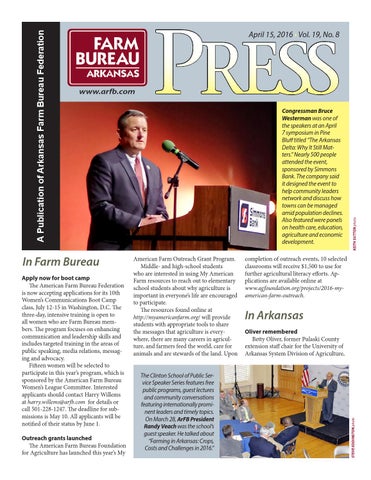
Congressman Bruce Westerman was one of the speakers at an April 7 symposium in Pine Bluff titled “The Arkansas Delta: Why It Still Matters.” Nearly 500 people attended the event, sponsored by Simmons Bank. The company said it designed the event to help community leaders network and discuss how towns can be managed amid population declines. Also featured were panels on health care, education, agriculture and economic development. American Farm Outreach Grant Program. Middle- and high-school students who are interested in using My American Farm resources to reach out to elementary school students about why agriculture is important in everyone’s life are encouraged to participate. The resources found online at http://myamericanfarm.org/ will provide students with appropriate tools to share the messages that agriculture is everywhere, there are many careers in agriculture, and farmers feed the world, care for animals and are stewards of the land. Upon The Clinton School of Public Service Speaker Series features free public programs, guest lectures and community conversations featuring internationally prominent leaders and timely topics. On March 28, ArFB President Randy Veach was the school’s guest speaker. He talked about “Farming in Arkansas: Crops, Costs and Challenges in 2016.”
KEITH SUTTON photo
www.arfb.com
completion of outreach events, 10 selected classrooms will receive $1,500 to use for further agricultural literacy efforts. Applications are available online at www.agfoundation.org/projects/2016-myamerican-farm-outreach.
In Arkansas Oliver remembered Betty Oliver, former Pulaski County extension staff chair for the University of Arkansas System Division of Agriculture,
STEVE EDDINGTON photo
A Publication of Arkansas Farm Bureau Federation
April 15, 2016 • Vol. 19, No. 8
STEVE EDDINGTON photo
DREW CO. FB photo
The University of Arkansas at Monticello Student Nurses’ Association partnered with the Drew Co. FB Women’s Committee for the Farmers Feeding America Project. Nursing students (l to r) Vivianna Carter, Nicole Munnerlyn, LaKala Lambert and Teah Streeter used Farm Bureau funds to purchase and distribute food to individuals March 4 at the Immanuel Baptist Food Pantry.
On March 29, ArFB President Randy Veach (left) and American Farm Bureau Federation President Zippy Duvall appeared with host Laura Monteverdi on the “THV11 This Morning” television program. The Farm Bureau leaders gave viewers a preview of ArFB’s first Farm Policy Summit and discussed challenges facing the agriculture industry.
the passing of Betty Oliver,” said Mark Cochran, vice president-agriculture for the University of Arkansas. “For decades, she was truly an icon and a role model for our extension mission. Her contributions to the state and the extension homemakers clubs are legendary. She will be greatly missed and fondly remembered. The state has lost a true leader.” Being inducted into the Arkansas Agricultural Hall of Fame in 2003 was just one of a long list of recognitions Oliver received during her career. These included the
National Association of Extension Home Economists Distinguished Service Award, the National Florence Hall Award, Epsilon Sigma Phi Distinguished Service Award, Gamma Sigma Delta Merit Award and the John W. White Outstanding Extension Educator Award. Oliver also won the Arkansas Extension Home Economists Award for Television Communications three times. She served as president of the state Association of Extension Home Economists in 1970, president of the Arkansas Women’s Committee on Public Affairs in 1978 and chairman of the National Professional Improvement committee of National Extension Home Economists, 1984-85. Oliver was also a member of the First Baptist Church of Little Rock, the Little Rock Chamber of Commerce Agriculture Committee, the Arkansas State Fair board of directors and the Arkansas Agiculture Hall of Fame Committee.
KEITH SUTTON photo
JACKSON CO. FB photo
is being remembered as an icon of extension work and a giant in Arkansas agriculture who touched thousands of lives. She died April 8 at age 79. Oliver began her career with the Cooperative Extension Service (CES) in 1958 after graduating from Ouachita Baptist University, where last year, she was elected to the school’s board of trustees. She started as an assistant home demonstration agent in Miller County and, over the decades, worked her way to Pulaski County extension staff chair. After “retiring” from that position in 1991, she worked at the extension service headquarters in Little Rock as volunteer coordinator in Family and Consumer Sciences. “There are no words to fully describe the depth and breadth of Betty’s influence and contributions to Arkansas,” said Anne Sortor, CES’s associate director for Family and Consumer Science and 4-H/Youth Development. “What she gave to her colleagues and constituents, she gave from her heart. We will miss Betty deeply.” “Betty was a giant in extension and in Arkansas agriculture. This is an enormous loss to us and to Arkansas,” said Tony Windham, head of the CES. “In her nearly 60 years of service to Arkansas, she not only touched, but she also changed for the better, the lives of thousands of Arkansans. In so many ways, Betty was the embodiment of our extension mission in Arkansas.” “We are greatly saddened to learn of
Carey Robertson (right), a member of the Jackson Co. FB board and Women’s Committee, recently visited schools in Newport and Tuckerman to share information about hatching ducks with young students. In this class, she demonstrated how to “candle” the birds’ eggs to determine if they are fertile and developing correctly after being in an incubator.
Arkansas producers responding to U.S. Department of Agriculture surveys indicate they plan to plant about 57 percent more cotton than they did in 2015, rebounding from a record-low 210,000 acres, according to a report from the National Agricultural Statistics Service. Farmers plan to plant 330,000 acres, just 5,000 acres shy of the total cotton acreage in 2014.
Specialty crop grants The Arkansas Agriculture Department is now accepting applications for funding through the U.S. Department of Agriculture’s Specialty Crop Block Grant Program. Grants administered through the program will help fund opportunities to enhance Arkansas’ industry for specialty crops, which include fruits, vegetables, floriculture and nuts. Eligible applicants include nonprofit organizations; local, state and federal government entities; for-profit organiza-
ST. FRANCIS CO. FB photo
2016 FFA scholarship The Arkansas Soybean Promotion Board invites all FFA high school seniors in the state to participate in the 2016 Ag Career Essay Contest for a chance to win a scholarship. To enter the contest, FFA members are required to interview an agricultural professional in the soybean industry and
KEITH SUTTON photo
tions; and colleges and universities. To be eligible, projects must solely enhance the competitiveness of an Arkansas specialty crop, and they must benefit a specialty crop segment as a whole. Proposals may include projects such as research, promotion, marketing, nutrition, food safety/security, education, increased knowledge and consumption, improved efficiency and reduced costs of distribution systems, conservation, product development, good agricultural practices, good handling practices and good manufacturing practices. “Specialty crops are an important aspect and a growing segment of Arkansas’ agriculture industry. The Specialty Crop Block Grant Program ultimately benefits Arkansas specialty crop producers and allows for continued growth,” said Arkansas Agriculture Secretary Wes Ward. Arkansas’s allocation for fiscal year 2016 will be approximately $294,000. Applications must be submitted to the Arkansas Agriculture Department by May 4. Additional guidelines and instructions on completing and submitting an application are available at www.aad.arkansas.gov.
Following dinner on the first day of ArFB’s recent Farm Policy Summit, attendees toured Farm Bureau Center in Little Rock, including the newly renovated Production Hub. Graphic support coordinator Vickie Benson (left) discussed the hub’s printing capabilities with (l to r) Farm Bureau leaders Donna Bemis, Benita Drew, Jason Drew and Tracey Bemis, and Leo Miranda with the U.S. Fish & Wildlife Service. submit an essay demonstrating what they learned from the interview. The essay must include the background of the professional, how they became involved in the agricultural industry, how long they have been in the industry, what led them to working with soybeans and how their work allows them to give back to the world. Winning essays from last year can be viewed at www.themiraclebean. com/2015-ffa-scholarship-winners. A $750 scholarship will be given to one winner from each of the three FFA districts: Northwest, Eastern and Southern. Essays must be emailed to arkansassoybeans@gmail.com by 5 p.m. May 13 to be eligible to win. For more information, visit www.themiraclebean.com/2016-ffascholarship.
Elsewhere During the second week of March, in celebration of Dr. Seuss Week, Holly Loewer with the St. Francis Co. FB Women’s Committee visited PalestineWheatley Elementary where she read “Green Eggs and Ham” to one of the kindergarten classes. Loewer read to students in other classes and at Stewart Elementary as well.
Ag safety info A new initiative provides a clearinghouse of information for agricultural educators who seek safety resources and training programs aimed toward youth. The Safety in Agriculture for Youth project home page, http://extension.org/say, includes many different curricula, programs, projects and activities that together have a common purpose of increasing safety and health knowledge and reduc-
ing hazard and risk exposure to youths on farms and ranches. All educational resources located on the SAY Clearinghouse are aligned to the 2015 Agriculture, Food and Natural Resources standards. The clearinghouse also includes a search-engine feature that allows users to search for a curriculum or resource by a specific topic. Monarch conservation The Monarch Collaborative, a group comprised of industry stakeholders, is dedicated to preserving the monarch butterfly and its habitat. The goal of the group is to keep the monarch from being listed as an endangered species and to keep butterflies at the forefront of landowners’ minds. Ryan Yates, American Farm Bureau Federation’s representative in the coalition, explained that the group is looking for opportunities to engage with farmers and ranchers and the ag industry to promote conservation of the monarch butterfly. “The more we’re talking about butterflies and butterfly conservation, the more effective we’re going to be in promoting the long-term success in recovering the species,” Yates said. For more information on preserving monarch populations and habitats, visit www.keystone.org and search Monarch Collaborative. Editor Keith Sutton
keith.sutton@arfb.com
In the Market As of April 13, 2016 USDA report mixed for crops Soybean prices posted new highs in the new crop contract following the latest U.S. Department of Agriculture report April 12. Since March 1, soybean prices have increased 77 cents as prices rallied off 2016 lows near $8.70 to highs near $9.50. This gain equates to a more than $100-milliondollar increase in the value of Arkansas soybeans. Gains in this market have been driven by strengthening product markets and prospects for fewer acres. Since the Planting Intentions report at the end of March, soybeans have seen gains of 30 cents while corn prices are down some 14 cents from pre-report levels. This has widened the corn/soybean ratio from 2.36 to 2.53, which favors additional soybean plantings. All this is occurring as the USDA forecasts global stocks-to-use to remain at more than 25 percent in 2016 compared to 22.4 percent just two years ago. As for the U.S. balance sheet, the USDA lowered soybean stocks some 15 million bushels to 445 million bushels after exports were raised by an equal amount. While soybeans continue to get bullish support, the market remains ripe for a correction, which would have an objective near $9.18 or a 50-percent retracement of recent gains. Another bearish USDA report on Tuesday is likely to keep pressure on prices until new acreage estimates are released in June. For the time being, corn is likely to remain focused on bearish fundamentals and continue to have difficulty maintaining rallies. Tuesday’s mostly bearish USDA report forecasts global corn supplies up almost 2 MMT from last month at 208.91 MMT. The numbers for the U.S. were not much better as stocks were increased 25 million bushels to 1.862 billion bushels. Particularly bad for the market was the increase in stocks that came from lower domestic feed demand, instead of exports. Most expect exports to be revised lower and carry-over increased in future reports, which adds to the bearish outlook for 2016 of larger acreage and lackluster domestic demand.
Record soybean imports China imported 6.1 MMT of soybeans during March, easily a record for the month, a 35-percent increase from February and a 36-percent rise from year-ago, according to preliminary customs data. Attractive hog-breeding margins, as well as the availability of newly harvested South American supplies, were behind the increase. The country’s overall exports in March were up 11.5 percent on the year, the first increase since June and well above expectations. Beef prices surge Boxed beef prices posted strong gains April 12, with Choice up $2.86 and Select $2.59 higher, upping the chances that feedlots will not be forced to accept lower cash prices this week, despite higher show-list numbers. April live cattle are in line with last week’s cash trade that ranged mostly from $133 to $134 on the Southern Plains, but deferred months continue to lag the cash market, as has been the trend. More soybeans in China China hopes to boost soybean production to 19 MMT by the year 2020, according to targets published by the ag ministry April 13. This would be a 60-percent increase from 2015’s 12 MMT crop. This comes as the ministry works to meet rising protein demand for food and as the country is attempting to reduce corn acreage and stocks. Commodities/CFTC bill The Senate Agriculture Committee released a draft bill April 11 to reauthorize the Commodity Futures Trading Commission (CFTC) through fiscal 2019, with provisions that the panel’s ranking Democrat said second-guesses the financial watchdog agency. Chairman Pat Roberts (R-Kan.) said he will take the draft bill into the committee markup scheduled for April 14 without a bipartisan agreement and see whether he has the votes to move it. Roberts said the legislation addresses some of the basic concerns he has about regulations that the commission has issued under the 2010 Dodd-Frank financial regulatory overhaul. The draft proposes exemptions from CFTC regulations for non-financial companies. Chinese pork and beef imports to rise this year A U.S. ag attaché says China’s 2016
pork production will likely dip from 2015 levels, noting that while feed prices are expected to decline, many swine operators do not have access to capital to expand herds. As a result, the post says the nation’s imports will likely climb 300,000 MT from 2015 levels to 1.3 MMT. “Import demand is supported by Chinese pork processors utilizing lowercost imports to produce products for the domestic market,” the post explains. The attaché also said it expects 2016 beef imports to climb 87,000 MT from year-ago levels to 750,000 MT. The post explains that “domestic production will be unable to satisfy increasing domestic demand,” adding that “Australia will likely remain the main supplier.” Brazil takes steps to ease corn prices for livestock producers In March, Brazil’s government announced it will sell public corn stocks, and it proposed lowering import taxes on the grain in an attempt to ease prices that have climbed near record levels, squeezing the livestock sector. The country’s ag ministry coordinator of grains said Brazil will sell 160,000 MT of corn from government stockpiles at the local market price to small livestock producers, focusing on northeast and southern areas of the country, without providing a schedule for the sales. Brazil’s ag minister proposed ending import taxes known as the PIS/Cofins on corn shipments, which traders estimate could cut import prices by around 10 percent. Meanwhile, the pork and poultry sectors say they have booked 500,000 MT in corn imports from Argentina and Paraguay for April through May delivery.
CONTACT • Matt King 501-228-1297, matt.king@arfb.com.