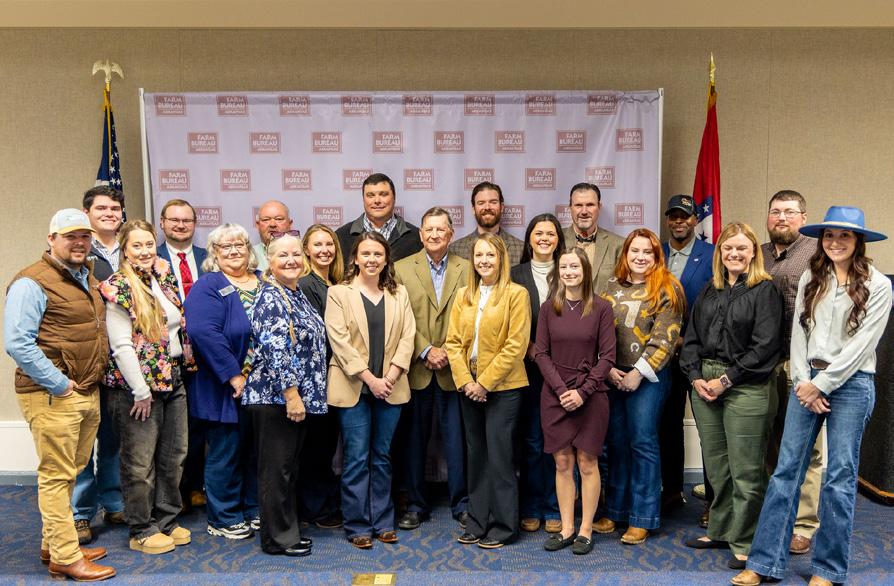
During the convention’s business session, Arkansas Farm Bureau delegates elected new leadership and established key policy priorities for the coming year. Dan Wright of Waldron was re-elected president, and Magen Allen of Bismarck was elected vice president, becoming the first woman to serve as an officer of Arkansas Farm Bureau.
“I’m sincerely grateful to our members for their trust to serve as a leader for this organization,” Allen said. “I look forward to working with our president and state board as we strengthen and support Arkansas agriculture and its rural communities.”
Voting delegates also re-elected seven board members to two-year terms. They are Sherry Felts, Joiner; Bob Shofner, Centerton; Jon Carroll, Moro; Joe Thrash, Houston; Terry Laster, Strong; Chase Groves, Garland City; and Jack Evans of Lonoke. The voting delegates also approved policies addressing transportation, infrastructure, energy, labor, school food programs, nutrient management and private property rights.
|
was re-elected as Arkansas Farm Bureau’s president and Magen Allen
of Bismarck was elected as the new vice president for the agriculture advocacy organization. Both were elected during Farm Bureau’s state convention at the Hot Springs Convention Center. Board action later resulted in the reelection of Terry Dabbs (right) of Stuttgart as secretary/treasurer, his third term in that role.
91st Annual Arkansas Farm Bureau Convention, Page 2
Farm Aid and Farmer Bridge Payments, Page 3
ArFB Selects Leaders
Dan Wright (left) of Waldron
(center)
91ST ANNUAL ARKANSAS FARM BUREAU CONVENTION
The 91st Annual Arkansas Farm Bureau (ArFB) Convention in Hot Springs brought together members and stakeholders for a three-day celebration of agriculture and grassroots leadership. President Dan Wright highlighted ArFB’s progress in advocacy, innovation and leadership development while addressing challenges such as rising input costs and market pressures. Keynote speaker Clint Bruce, a former Navy SEAL and NFL linebacker, inspired attendees with lessons on perseverance, discipline and purpose.
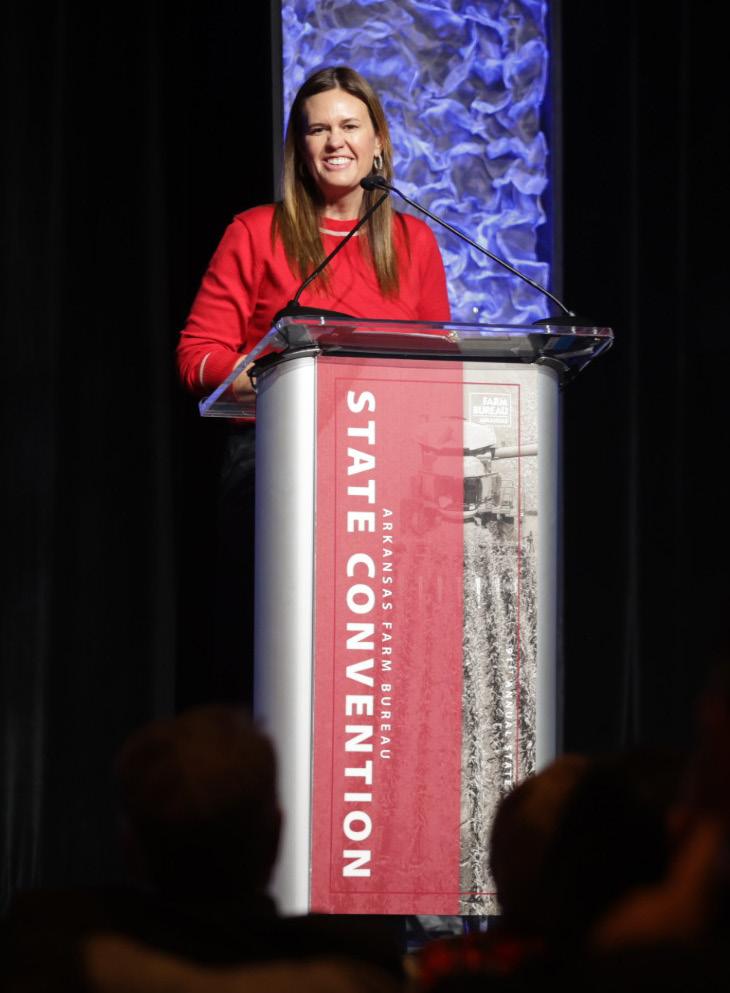
Gov. Sarah Huckabee Sanders also joined the event and praised Arkansas farmers, ranchers and foresters for their resilience and reaffirmed her administration’s support for the industry. A joint agriculture session connected producers and legislators to discuss key policy issues affecting rural Arkansas, emphasizing the importance of collaboration.
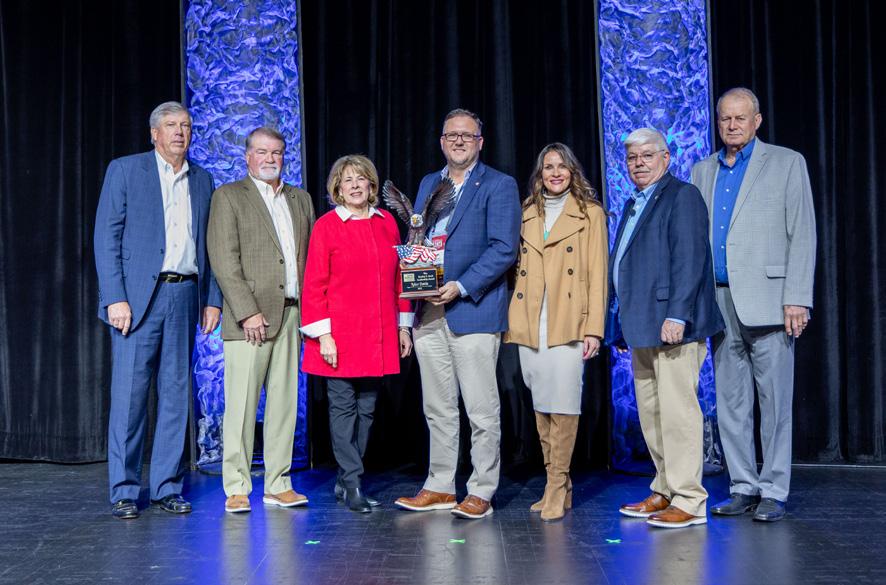
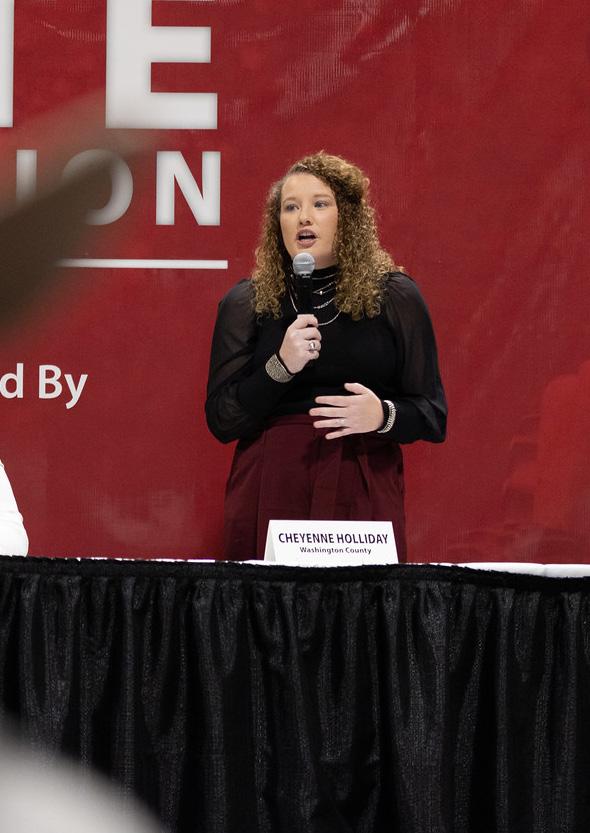
Several individuals and counties were honored for outstanding service and leadership. White County earned the President’s Award as the top county Farm Bureau, and Madison County was recognized for membership retention and its Women’s Leadership Committee. Sue Billiot of Sharp County received the Diamond Award from the Women’s Leadership Committee; Cheyenne Holliday of Washington County won the Young Farmers & Ranchers Discussion Meet. The inaugural Arkansas Grassroots Leadership class and Stanley E. Reed Leadership Award recipient Tyler Davis were also recognized for their commitment to advancing Arkansas agriculture.
See more photos of the 91st Annual Arkansas Farm Bureau Convention in the award album and event album on ArFB’s Flickr page
The Women’s Leadership Committee from Madison County Farm Bureau was named the Outstanding County Women’s Program for 2025.
inaugural Arkansas
ArFB President Dan Wright addressed attendees during his keynote on day one.
the 91st Annual
Tyler Davis (center) was presented the Stanley E. Reed Leadership Award.
The
Grassroots Leadership class was recognized during
Arkansas Farm Bureau Convention
Cheyenne Holliday of Washington County won the Young Farmers & Ranchers Discussion Meet.
Clint Bruce, a former Navy SEAL and NFL linebacker, inspired attendees during his keynote.
Gov. Sarah Huckabee Sanders joined the event and spoke to the challenges in agriculture.
FARM AID AND FARMER BRIDGE ASSISTANCE: WHAT WE KNOW
The Trump administration has announced a $12 billion farm aid package to help farmers facing financial strain from low commodity prices, reduced export demand and ongoing trade pressures. Elevated input costs have added additional pressure, prompting strong calls from lawmakers and farm organizations for immediate federal relief. The package includes up to $11 billion in one-time payments through the United States Department of Agriculture’s (USDA) new Farmer Bridge Assistance (FBA) program, with additional funds reserved for crops not covered under FBA. The program is designed to provide short-term relief as farmers continue to navigate weak markets and delayed purchasing from key trading partners. While this support is welcome news, it will not fully bridge the financial gap many producers are experiencing. Significant challenges remain for farmers across the country.
Farmers with an adjusted gross income average below $900,000 for the 2022–2024 tax years will be eligible to participate. Producers must submit acreage reporting data to USDA by Dec. 19 to determine their payment amount. USDA will release specific payment rates by the end of the month. Distribution of funds is expected no later than February 2026, though payments may arrive sooner depending on administrative timelines. Members are encouraged to prepare required acreage documentation now and watch for USDA’s forthcoming enrollment instructions.
Not all details are available at this time, but some things to note:
• Eligible crops include cotton, rice, soybeans, corn, wheat (including winter wheat planted in 2024 and harvested in 2025), sorghum, peanuts, crambe, canola, sunflower, barley, chickpeas, lentils, oats, peas, wheat, canola, crambe, flax, mustard, rapeseed, safflower and sesame.
• The payments will be made on certified planted acres, not base, and farmers are urged to ensure their 2025 acreage reporting is correct no later than 4 p.m. central time on Dec. 19.
• Prevented Planted acres will not be included in the program.
• Per acre payments for each crop will be announced by the end of December.
• A payment limit of $155,000 per actively engaged owner will apply, and will be separate from payment limits on other programs like PLC and ARC for the 2025 crop year.
• An adjusted gross income limit of $900,000 does apply.
• Payments will be subject to income taxes for the 2026 tax year.
• $1 billion will be reserved for specialty crop producers. USDA is gathering data-payments will be sectorspecific and based on documented losses.
• Payments are expected to be received by Feb. 28, 2026.
STATEMENT FROM ARFB PRESIDENT DAN WRIGHT
While we appreciate the administration for this assistance, the scope of this problem far exceeds the $12 billion announced today.
“For the past three years many row crop, specialty crop and timber producers have operated at a loss. A program that provides roughly $50 an acre will not save the thousands of family farms that will go bankrupt before the end of the year.
“We urge Congress to consider providing additional relief before the next crop year, beyond the Farmer Bridge Assistance program.
“Arkansas currently leads the nation in Chapter 12 farm bankruptcies, never a statistic you want to see. We must take care of our farmers and ranchers who ensure Americans have a safe and reliable food supply.”
MARKET NEWS
as of December 10, 2025
Contact Brandy Carroll brandy.carroll@arfb.com
Tyler Oxner tyler.oxner@arfb.com
Rice
Rice futures continue to be pressured by abundant global supplies and relatively soft demand. In the December WASDE, the total U.S. supply and domestic use estimates were unchanged. Imports were reduced by 1 million/cwt, but that was offset by a 2 million/cwt reduction in rough rice exports, resulting in a 1 million/cwt increase in ending stocks. The projected average onfarm price for all rice was lowered by $1.10 to $11.60/cwt, and the projected long-grain on-farm price was lowered by $1/cwt and is now pegged at $10.50/cwt. We could still see that number move lower, as January futures have traded as low as $9.83 in recent days.
Cotton
March cotton futures look to have bottomed for the time being, building on support at the contract low of 63.11 cents. The market needs to close above resistance at 65 cents to begin to build any upside momentum, though. The monthly WASDE increased the production estimate by 1% to 14.3 million bales on higher yields across the Southeast and delta. Mill use was reduced by 100,000 to 1.6 million bales, the
lowest in nearly 150 years. Ending stocks are now projected at 4.5 million bales, which is a stocks-touse ratio of 32.6%. The projected season average on-farm price was reduced to 60 cents/lb.
Corn
This month’s WASDE report surprised the market by cutting U.S. corn ending stocks 125 million bushels to 2.029 billion, about 95 million below expectations. Exports were raised another 125 million to a record 3.2 billion, while ethanol and feed demand were unchanged. Global stocks were trimmed just over 2 mmt to 279.2 mmt. South American estimates held steady; Ukraine was lowered 3 mmt and the EU raised 1 mmt. Market reaction to the bullish news was positive but gains were capped by continued weakness in soybean, wheat and crude oil futures. The most active contract, March, needs to close back above $4.50 to build more upward momentum.
Soybean
U.S. soybeans figures were largely uneventful as ending stocks were unchanged at 290 million bushels, nearly matching expectations and marking the fifth straight December WASDE with no revisions. Global stocks inched 0.4 mmt higher to 122.4 mmt. USDA made no adjustments to South American production or Chinese import projections. Soybean futures slid after the report and are now considered significantly oversold on shortterm momentum indicators but show no signs of bottoming yet.
The market may be due for some type of correction, but it is likely to be short-lived.
Wheat
U.S. wheat ending stocks stayed at 901 million bushels, slightly above expectations. Hard red spring stocks were raised 5 million bushels while white wheat stocks were lowered by 5 million. Globally, production rose 9 mmt to 837.8 mmt, with increases across multiple exporters, pushing world stocks 3.5 mmt higher to 274.9 mmt. Prices settled slightly lower on most contracts following the report.
Livestock and Poultry
In the monthly WASDE, USDA raised the forecast for 2025 beef and poultry production and lowered the pork production estimate. For 2026, beef production estimates were increased due to higher cattle weights, and the broiler production estimate was also raised based upon recent production data. The pork production estimate for 2026 was unchanged, but The Quarterly Hogs and Pigs report, to be released later this month, will provide estimates on the pig crop and farrowing intentions. Cattle price estimates were lowered for both 2025 and 2026 based on recent data and reduced slaughter capacity expected in 2026. Hog prices are also expected to be lower based on recent prices.