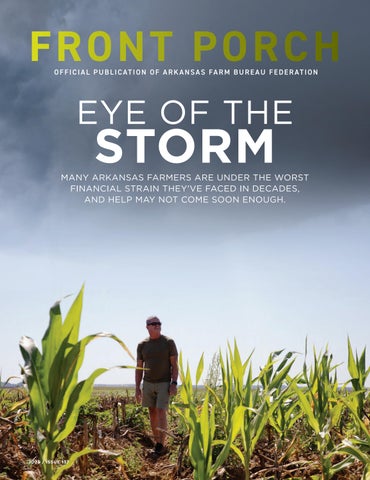
Front Porch | Issue 137

Page 1


FRONT PORCH

OFFICIAL PUBLICATION OF ARKANSAS FARM BUREAU FEDERATION

EYE OF THE STORM

MANY ARKANSAS FARMERS ARE UNDER THE WORST FINANCIAL STRAIN THEY'VE FACED IN DECADES, AND HELP MAY NOT COME SOON ENOUGH.

At Farm Bureau Bank®, relationships come first. We’re proud to stand alongside the farmers, families, agencies, and businesses that keep our communities thriving in The Natural State. Your local Market Manager, Rachel, and our dedicated teams take the time to understand your goals — so whether you’re running an operation, leading a Farm Bureau Organization or other local non-profit, or planning for the future, you’ll always have a trusted partner by your side. Farm Bureau Bank is full-service banking, built on trust, and tailored to you.

• Equipment & Land Loans

• Commercial Real Estate Loans — Owner Occupied & Investment Real Estate

• Operating Lines of Credit

• Working Capital Term Loans

• Business Accounts & Treasury Services

CONTENTS

FRONT PORCH

5 / My View From the Front Porch

Dan Wright

7 / Serving Farmers, Serving You

Jarrod Yates

8 / Cover Story:

Perfect Storm in the Delta Can Arkansas farmers weather the toughest financial pressure faced in decades?

17 / The Standard of Stewardship

Meet the Young Farmers and Ranchers Award Winners

21 / A Day in the Life of a Rural Sheriff's Deputy

Garland County's John Wright says heroic actions are just part of the job

28 / A View From the Counties

Outreach and education across Arkansas

32 / Taste Arkansas

Stopping at the Dogwood Hills Guest Farm

34 / Delta Child

Talya Tate Boerner

On the cover: Davis Bell was a soybean and corn farmer in Des Arc. He got out of the industry earlier this year due to financial pressures.

MY VIEW FROM THE FRONT PORCH

As I look back on the past year serving as your Arkansas Farm Bureau president, I’m reminded again that adversity is often our greatest teacher. Agriculture has never been an easy profession, but that’s part of what makes it such a calling. Every challenge brings lessons that shape us into better farmers, stronger families and more determined advocates for the future of rural Arkansas.

Agriculture continues to change, sometimes faster than we’d like. Markets swing, policies shift and the weather keeps us humble. Yet through it all, one thing remains steady: the resilience of Arkansas farmers and ranchers. From the Delta row crops to the mountain pastures and pine timberlands, our people keep finding ways to adapt, to produce and to persevere.

Arkansas agriculture is built on three major segments: row crops (including fruits and vegetables), livestock and timber. Each plays a vital role in our state’s economy, and each faces its own unique challenges.

Our livestock producers, especially cattlemen, know what it means to ride the highs and lows of the market. For years, low cattle prices and high input costs squeezed profits and tested patience. Recently, though, cattle prices have reached record highs, bringing long-awaited relief and allowing many ranchers to reinvest in their operations. Still, there’s that lingering question — how long will it last?

If consumer beef prices climb too far, demand could fall. A disease outbreak or a processing disruption could also throw the market into turmoil. Every cattleman knows that when prices are strong, it’s wise to prepare for leaner days ahead. That’s a lesson this industry has learned time and again, success in agriculture depends on managing the good times just as carefully as the hard ones.

The timber industry tells a different story. Arkansas holds about 19 million acres of forest — half our state’s total area — yet our timber markets remain sluggish. Oversupply has flooded the market, driving prices down and discouraging harvest. The experts report that our forests are growing faster than we can cut them, and that imbalance carries both economic and environmental risks.

When we harvest too little, forests grow overly dense, making them vulnerable to wildfire, pests and disease. But cutting too aggressively would harm the long-term health of our timberlands. Achieving balance is key, but that’s easier said than done. Global trade, tariffs and shifts in housing demand all affect timber values, and most of those factors are far beyond the control of our local producers.

Meanwhile, row crop farmers continue to face some of the steepest challenges. Corn, soybeans, cotton, rice and specialty crops like fruits and vegetables have all felt the sting of high input costs, volatile markets and trade uncertainty. Federal reference

prices have lagged behind real-world production costs for years. Though long-overdue adjustments are finally being made, they’ll take time to make a real difference in the field.

Trade remains a major concern. A single tariff dispute or export ban can erase profits overnight. And for those growing specialty crops, labor is becoming a breaking point. We can’t harvest what we can’t pick, and finding dependable workers is harder every year. Labor reform must remain a top priority if we want American agriculture to remain competitive and sustainable.

Through all this, one message shines bright: tough times make us better. Every generation of farmers has weathered its own share of storms, literal and figurative, and come out stronger on the other side. Hardship builds resilience. It pushes us to innovate, to work smarter and to appreciate the blessings that come when the rain finally falls after a long dry spell.

Farm Bureau’s role is to make sure no farmer stands alone in that struggle. Whether it’s advocating for a fair farm bill, pushing for better trade policy, supporting healthcare and broadband in rural areas, or investing in leadership development, our organization exists to make Arkansas agriculture stronger and more sustainable.

As I look to the year ahead, I’m filled with gratitude for the trust you’ve placed in me, for the teamwork of our county leaders and for the unwavering spirit of our farm families. Agriculture will always face challenges, but with faith, hard work and unity, there’s nothing we can’t overcome.

FRONT PORCH

Official membership publication of Arkansas Farm Bureau Federation mailed to roughly 170,000 member families.

SUBSCRIPTIONS

Included in membership dues

ARKANSAS FARM BUREAU OFFICERS:

President / Dan Wright, Waldron

Vice President / Mike Freeze, Little Rock

Secretary/Treasurer / Terry Dabbs, Stuttgart

Executive Vice President / Jarrod Yates, Benton

DIRECTORS:

Magen Allen, Bismarck

Jon Carroll, Moro

Brad Doyle, Weiner

Jack Evans, Carlisle

Sherry Felts, Joiner

Chase Groves, Garland City

Jason Henson, Mount Judea

Terry Laster, Strong

Caleb Plyler, Hope

Bob Shofner, Centerton

Dana Stewart, Judsonia

Joe Thrash, Houston

Mark Williams, Lavaca

EX OFFICIO

Nita Cooper, Everton

Sara Beth Johnson, Hickory Plains

Justin Story, Cauthron

Stewart Warner, West Memphis

Executive Editor / Steve Eddington

Contributing Writers / Shaylee Wallace Barber, Justin Rotton, Talya Tate Boerner, Caitlan Butler

ADVERTISING

Contact Chad Hooten at Arkansas Farm Bureau for advertising rates chad.hooten@arfb.com (501) 228-1274

Front Porch (USPS 019-879) is published quarterly by the Arkansas Farm Bureau Federation 10720 Kanis Rd., Little Rock, AR 72211

Periodicals Postage paid at Little Rock, AR

POSTMASTER: Send address changes to Rhonda Whitley at rhonda.whitley@arfb.com

Front Porch • P.O. Box 31 • Little Rock, AR 72203

Please provide membership number Issue #137

Publisher assumes no responsibility for any errors or omissions. All rights reserved. Reproduction without permission is prohibited.

The Arkansas Farm Bureau Federation reserves the right to accept or reject all advertising requests.

WARMS YOU UP WITH EVERY BITE

MINDFUL IN THE FIELDS

SUPPORTING FARMERS’ MENTAL HEALTH IN ARKANSAS

Farming has always demanded physical, mental and spiritual strength. Arkansas farmers and ranchers know what it means to work through challenges: unpredictable weather, fluctuating markets, rising input costs and long days that often turn into long nights.

But while we’re quick to talk about equipment breakdowns or crop conditions, we don’t talk nearly enough about something just as important, our mental health.

Across rural Arkansas, stress and anxiety are quietly affecting more farmers and ranchers than we realize. The weight of financial uncertainty, family pressures and the never-ending demands of the job can take a real toll. Too often, we push through it, telling ourselves to “tough it out” — because that’s what farmers do.

But being strong doesn’t mean being silent. At Arkansas Farm Bureau, we believe that taking care of your mental health is just as vital as taking care of your land, your livestock or your family. Mindfulness — the simple act of paying attention to our thoughts, emotions and the world around us — can make a powerful difference.

Mindfulness in farming doesn’t have to mean sitting still or meditating. It can mean noticing when stress is building up and giving yourself permission to slow down, talk with a friend or take a break. It can mean checking in on your neighbor who hasn’t been around as much, or asking a simple “how are you doing?”

Farming communities thrive when we look out for one another, and mental health is no exception. Being mindful of our own well-being — and that of others — can save lives. Warning signs such as isolation, exhaustion, irritability or hopelessness should never be ignored. A short conversation, a visit over coffee or a word of encouragement can open the door for someone who’s struggling in silence.

Arkansas Farm Bureau is working to break the stigma surrounding mental health in agriculture.

Through partnerships with rural health organizations and educational outreach, we’re helping connect farmers and their families with

the resources they need, from crisis lines to counseling services that understand the unique pressures of farm life. Those resources are here to help, and there’s no shame in using them.

The truth is, a healthy farm starts with a healthy farmer. As we move through another season of hard work and long days, let’s all commit to being mindful of our limits, our needs and each other. Because the heart of Arkansas agriculture isn’t just the land we till; it’s the people who tend it.

So, take a moment to breathe, to connect and to care. Our communities, our families and our future depend on it.

A PERFECT STORM

IS

RAGING IN THE DELTA

Arkansas is facing a farming crisis, and help might not come soon enough

Across Arkansas, family farmers are facing the worst financial storm they've had to weather in decades. One fourthgeneration farmer's story is just the tip of the iceberg, but demonstrates the hard choices farmers around the state were faced with in 2025.

In June 2024, Davis Bell was farming about 4,000 acres of soybeans and corn. He worked with his sons, owned about half his land and had been following in his father’s footsteps as a fourth-generation farmer for 47 years.

But by the second week of July 2024, it began to dawn on Bell that his kitchen-table math wasn’t adding up. Input costs had been rising since 2020, and he’d faced a loss in 2023 that his insurance didn’t fully cover, so the budget was tight.

“My son said, ‘Dad, you need to put a number down on a piece of paper and decide that when you lose that amount, you’re going to stop.’ I thought that was a very wise statement from a 43-year-old guy,” Bell recalls. “I put a number down and I thought, ‘There’s no way — I haven’t lost that much money in a lifetime of farming.’”

Bell had been farming long enough to recall the 1980s farm crisis, when more than 11,000 farmers left the Delta and an estimated 300,000 family farms defaulted on loans nationwide. He knew what a challenging year looked like, but farm operations were running smoothly and it was shaping up to be a good harvest.

That fall, Bell found out he was right about one of his bets.

“We had the best crop I’ve ever cut in my life. We had the highest yields ever, did a good job marketing it,” he said.

“And we lost the most money I’ve ever lost in one year.”

This spring, Bell exited the agriculture industry, turning his leased and owned land over to other farmers.

“We were going to meet that number we put on the paper — probably exceed it,” Bell said. “At the end of June 2024, getting out of farming was never on my radar.”

THE STATE OF THE FARM ECONOMY

BELL’S STORY ISN’T UNIQUE. Farmers are feeling the pressure, largely driven by increasingly high input costs and low demand for their crops.

“When you look at prices received for the crop versus the prices paid for inputs, you’re looking at a 47% gap,” said Hunter Biram, an agricultural economist with the University of Arkansas System Division of Agriculture. “This is going to mark the second consecutive year of decline in crop revenues in a time when cash expenses have remained relatively unchanged.”

According to the U.S. Department of Agriculture, farm revenues in Arkansas have steadily dropped from $13.9 billion in 2022 to $12.6 billion in 2024, a more than 10% decline. The numbers won’t be updated until October 2026, but the outlook isn’t good.

Davis Bell was a fourth-generation corn and soybean farmer for 47 years. He left the industry this year, after financial pressures became too great to continue.

A PERFECT STORM

“CROP REVENUES ARE PROJECTED to decline by nearly $500 million in 2025 just in Arkansas,” Biram said.

The USDA forecasts a $6.1 billion loss nationwide.

There are several factors contributing to the ongoing decline in cash receipts. Biram said as farms of all types have become more efficient, their increased yields have actually resulted in an oversupply.

“Increased production hasn’t been met with increased demand. Farmers are really good at what they do; they consistently produce higher yields, they’re very productive, very efficient. We’ve seen that across the board with all our crops,” he said.

According to the USDA, the agricultural trade deficit reached $28.6 billion in the first half of 2025. The agency forecasts a nearly $6 billion decline in soybean exports in fiscal 2026 (which started Oct. 1 this year), compared to 2024. President Donald Trump said in late October that China has agreed to purchase 12 million metric tons of U.S. soybeans, though the government shutdown had stalled that as of this writing.

Trade tensions — particularly with China, the country’s No. 1 trading partner in 2024 — haven’t helped matters.

“No doubt that the trade and tariffs, the trade war, has exacerbated this situation. We get a lot of inputs from other countries — the farmer is paying that tariff,” said Greg Cole, president and CEO of AgHeritage Farm Credit Service, the largest ag lender in the U.S.

Taken together, these factors have put farmers in a financial situation comparable to those faced in the 1980s crisis.

RISING RISK

COLE HAS BEEN with AgHeritage for 41 years, and saw the 1980s farm crisis firsthand. He said back then, farmers faced a “negative trifecta” of financial pressures.

“You had the erosion of the balance sheet due to operational losses, equipment devaluation and land depreciation,” Cole recalled.

Today’s crisis is a little different. Land values have skyrocketed since the COVID pandemic. From 2024 to 2025, farm real estate value increased by 3.4% in Arkansas; since 2021, it’s grown 18%, according to USDA data.

The other pressures, however — equipment losing value and operational losses — are definitely present today, Cole said. In fact, many farmers in Arkansas have faced losses several years in a row. AgHeritage serves farmers in 24 Arkansas counties, and Cole said 40% of their clients lost money in 2022, 50% in 2023 and 70% in 2024.

“And that’s with record yields,” Cole said in October. “When you consider the yields are average, at best, and the

high input costs, we could still see 60-70% that lose money this year.”

A few years ago, a loss could be weathered thanks to low interest rates; farmers were still able to borrow for the next year’s crop, even after a disappointing harvest.

“We’re in an average interest rate environment, but it seems awfully high because we came off a historic low. But a lot of farmers had built their debt structure around that low rate,” Cole said. “Their debt on their balance sheet has been increasing, and with elevated interest rates, that makes servicing that debt more problematic.”

The multiyear losses, combined with depreciating equipment values, are especially damaging for young farmers, who haven’t yet built equity in their farms, and for those who rent their land.

“Traditionally, farmers have a bad year, then two or three good years and they come in and refinance their debt. With these multiple year losses, that doesn’t work,” Cole said.

Cole said that while ag lenders like AgHeritage and community banks are trying to work with farmers, there’s only so much they can do.

“In the farm credit system, it’s our mission to work with farmers in good times and not so good times,” he said. “But the numbers are the numbers, and in order to lend to a business, it’s got to have equity and a workable plan.”

But as Bell’s story illustrates, the current pressures are not limited to those groups; even generational farms — particularly row crop farms — are against the wall.

THE ROW CROP PROBLEM

IN 1988, a farmer in Arkansas could sell a bushel of soybeans for $7.55, a hundredweight (CWT) of rice for $6.90, a pound of cotton for $0.64 and a bushel of corn for $2.31. In today’s dollars, that’s $20.35/bushel of soybeans, $18.60/CWT of rice, $1.72/lb of cotton and $6.23/bushel of corn.

Compare that to the actual prices farmers can get today: $10/bushel of soybeans, $13.50/CWT of rice, $0.63/lb of cotton and $4.40/bushel of corn.

Input costs weren’t near what they are today, either. In 1988, it cost $65.78 to plant an acre of soybeans; in its 2025/26 crop enterprise budget tool, the University of Arkansas Extension estimates costs of $617.83 per acre for soybeans.

“Twenty years ago, there were probably 10-20 options to purchase fertilizer from. Now, about 80% of world fertilizer trade is controlled by three companies,” Bell said. “It’s the same with seeds. Used to, you could buy them at the local co-op; now, you’ve got to buy from two or three major seed companies. Chemicals are the same way.

“It’s gotten to where these big corporations have so much

WE HAD THE BEST CROP I’VE EVER CUT IN MY LIFE.

WE HAD THE HIGHEST YIELDS EVER, DID A GOOD JOB MARKETING IT. ... AND WE LOST THE MOST MONEY I’VE EVER LOST IN ONE YEAR.”

— FARMER DAVIS BELL

control. They have such a big pocketbook that they can hold out and say, ‘We’re not going to back down on the price.’ And I don’t have any other choices,” he added.

Some of the volatility in input costs is related to global affairs — the Russia-Ukraine War has strained fertilizer supplies, and much of the production of such products is related to the cost of natural gas, which fluctuates for a number of reasons. But research shows a lack of competition among organizations that offer farm inputs is also at play.

According to a report by researchers at Texas A&M University, as of 2018, four firms accounted for more than 60% of seed sales globally, and approximately 75% of domestic nitrogen fertilizer production. Those four firms — DowDupont, Chemchina, Bayer and BASF — are also responsible for 100% of potash and phosphate fertilizer production in the U.S.

In July 2025, ground beef hit a record high of $6.25 per pound nationally, and live cattle prices were up 27% over 2024, according to AgAmerica, another ag lender. The University of Arkansas Extension in April reported a 75% increase in steer calf prices in 2025 compared to 2019-2023, as well as an approximately 52% increase in the price of slaughtered steer.

Meanwhile, poultry prices are also up; in February, the UA Extension reported a 5% increase in the national average price for chickens, and egg prices reached a record $6.23 per dozen the same month.

BY THE NUMBERS:

DIRECT PAYMENTS IN CASH AND AS PERCENTAGE OF NET INCOME

2024 | $256M payments representing 8% net income

2023 | $509M payments representing 15% net income

2022 | $460M payments representing 11.5% net income

2021 | $700M payments representing 25% net income

2020 | $1B payments representing 90% net income

Source: USDA, Farm Income and Wealth Statistics

“This success is partly attributed to the rising cost of beef in supermarkets; as beef prices increase, demand for poultry tends to improve, benefitting poultry production,” said Dan Wright, Arkansas Farm Bureau president and a poultry producer.

COMMODITY PRICES 1988 VS. 2024

Soybeans

Rice

Cotton

Corn

Farms became more efficient in the past couple of decades thanks to technological advances allowing for precision agriculture. Yields have trended upward since at least the 1950s, but there is a cost. Since the 1990s, the cost of farming equipment has risen dramatically, outpacing inflation. According to Ag Terrain, a financial analysis service of AgCountry Farm Credit Services, the price of a new 200-horsepower tractor has risen 287% in that time frame, compared to 139% increase in inflation generally.

$7.55/bu (worth $20.35 in 2025) in 1988;

$10/bu in 2024

$6.90/CWT (worth $18.60 in 2025) in 1988;

$13.50/CWT in 2024

$0.64/lb (worth $1.72in 2025) in 1988;

$0.63/lb in 2024

$2.31/bu in 2988 (worth $6.23in 2025);

$4.40/bu in 2024

Source: USDA, National Agricultural Statistics Service

“A $100,000 combine I purchased in the 1980s now costs $750,000,” said Rich Hillman, a rice farmer and president of Riceland Foods (he also previously served as president of the Arkansas Farm Bureau). “The commodities need to go up in the same ratio as the cost of equipment, and now that’s out of whack.”

“BULL” MARKET

ARKANSAS’ LIVESTOCK and poultry producers, while in a more stable situation than row crop farmers, are also feeling price pressures.

Biram, at the UA Extension, said much of the livestock price increases are due to tight cattle inventories nationwide. A drought through the start of the 2020s drove farmers to liquidate some of their herds, leading to a tight supply with no change in demand.

“If cattle operations could sell cows now, they would be receiving more revenue; but most have already sold what they plan to sell,” Biram said. “So the question is now: When and how do we rebuild the cattle herd?”

But that’s not the whole story. Prices may be up, but so are costs.

“Livestock and poultry farmers are not immune to the same problems affecting the row crop farmers,” Wright said. “The costs associated with labor, equipment parts, fertilizer for pastures, animal health products, feed, fuel and utilities continue to climb.”

Feed prices are up 20% since 2020. With high prices available for beef, farmers are incentivized to sell cows instead of retaining them for breeding.

And along with the high input costs, ranchers and poultry producers also have to contend with disease control and

“IF AN UPDATED FARM BILL HAD BEEN IN PLACE — EVEN AS RECENTLY AS LAST YEAR — ARKANSAS FARMERS WOULD BE IN A MUCH STRONGER POSITION.”
— ARKANSAS FARM BUREAU PRESIDENT DAN WRIGHT

prevention, which has been particularly challenging in the 2020s.

In 2022, Arkansas experienced its first outbreak of highly pathogenic avian influenza, or bird flu, and another outbreak started in December 2024. Nationally, according to the UA Extension, more than 129 million birds have been affected, including 617 commercial poultry flocks and 748 backyard or hobby flocks.

According to the USDA, cattle herds are expected to grow steadily through 2034, as is broiler chicken production, a good trend for ranchers and producers. The market will experience ups and downs related to supply and demand — but any number of factors could disrupt the market any time.

THE MISSING FARM BILL

ARKANSAS FARMERS say the most critical causal factor of their current challenges is Congress’ ongoing inability to pass an updated farm bill.

“The last farm bill was signed in 2018 and utilized cost

figures from 2012,” said Arkansas Farm Bureau’s Wright. “The farm bill provides essential crop safety nets for farmers; it should have been renewed in 2023. Instead, it has been repeatedly extended without substantial updates.”

The farm bill, actually a legislative package, is enormously impactful — not just for farmers, but for rural development, national food security and environmental conservation.

And a lot has happened since 2018 that’s impacted the costs of and demand for agricultural products: several large-scale wars, the COVID-19 pandemic and associated supply chain and inflationary pressures, and changes in the White House.

“If an updated farm bill had been in place — even as recently as last year — Arkansas farmers would be in a much stronger position,” Wright said. “While trade issues may persist, an updated farm bill would at least offer reliable support to safeguard their livelihoods.”

The farm bill sets the reference prices on commodities. If market prices for a certain commodity are lower than the reference prices, the federal government will pay the difference to farmers. According to USDA data, from 2022 to 2024,

Arkansas farmers will lose hundreds of dollars per acre this year for their corn, rice and soybean crops, even with near-record crop yields.

A PERFECT STORM

direct payments to farmers constituted, 11.5% of farmers’ annual income.

Earlier this year, Congress passed a legislative package known as the “One Big Beautiful Bill.” The bill raises reference prices for major commodities 10-21% and sets a structure in place to raise reference prices 0.5% annually (on a compounded basis) starting in 2031.

“Reference prices are crucial, because they serve as triggers for crop insurance programs, helping farmers protect their investments in crop production,” Wright said.

But, critically, the new reference prices won’t kick in until fall of 2026, leaving farmers in the lurch until the new protections become available.

“The timing of the payments could make all the difference,” the UA Extension’s Biram said.

THE HUMAN COST AND RURAL RIPPLE EFFECTS

IN 2023, four farms in Arkansas filed for bankruptcy. In 2024, that number jumped to 25. The UA Extension estimates 2540% of farms in Arkansas could close or declare bankruptcy in 2025.

“When farmers and ranchers experience financial hardship and limited cash flow, the entire community is affected,” said Wright. “The ripple effects of agricultural decline extend far beyond the farm, affecting every aspect of rural life and contributing to the erosion of vibrant, close-knit communities.”

The way Bell sees it, the loss of a family farm represents the loss of a way of life.

“Once we lose this infrastructure, we can’t ever bring it back,” he said. “I have a 12-year-old grandson — all he’s ever wanted to do is farm. Ten years from now, when he graduates college … the way things are going, it’ll cost him $12-15 million just to buy equipment. He’s not going to have the equity to do that.”

Agriculture is Arkansas’s largest industry, representing 14.2% of the state’s economic output, per the UA Extension. Farms won’t cease to exist as farmers exit the industry, but farmland will be consolidated into a few hands, which can impact consumers.

“We’ve seen it in other countries — the price of their food goes up,” Riceland’s Hillman said.

In 2024, U.S. consumers spent about 10.4% of their disposable personal incomes on food. But, according to the USDA, in low-income countries across the world, food could account for 30-50% of a person’s income.

“If federal assistance does not provide relief, young families — who represent the future of the agricultural industry — may be forced to seek employment outside of their farms,” Wright said. “This shift threatens the stability of our food supply and compromises the security of the nation, as it reduces the number of individuals willing and able to produce the food necessary for our survival.”

Biram said the closure of family farms across Arkansas has led to population declines — and resultant declines in tax collections and school funding — in rural areas.

“I fear that the rural economy is going to cease,” he said. “We’re seeing a lot of these rural communities dry up.”

WHAT IT WILL TAKE

IN THE SHORT-TERM, Arkansas producers need cash — and fast. Already, farmers across the state are in talks with their lenders, accountants and attorneys to figure budgets for 2026.

Arkansas Farm Bureau officials have been active in talks with the state’s congressional delegation seeking solutions. Wright said local officials are advocating for a short-term relief package that will support row and specialty crop farmers.

“Such a package is critical, not only for maintaining the viability of farms across the state, but also for protecting national security,” through control over the domestic food supply, Wright said.

Wright said sorting out trade tensions should also be a priority.

“Arkansas farmers are requesting lawmakers prioritize the negotiation and implementation of major trade deals,” he said. “Expanding market access and establishing reliable customers for Arkansas agricultural products is essential to the economic sustainability of local farms.”

Bell said it’s also important for the non-farming Arkansans to understand the outsize role farmers play in their lives. From affordable food to the rural development provisions in the Farm Bill, the way of life Arkansans enjoy is tied intimately to agricultural production.

“When I got out of college, I met a journalist who had been covering Washington for many years. I remember asking him, ‘Do politicians really understand how important agriculture is?’” Bell recalls. “He said, ‘Yes — as long as we can keep the food dollar low, people will buy and keep the economy going.’ That’s what keeps it going; all of this extra money people have to spend – if they had to spend it all on food, we wouldn’t have a lot of the things we have in Western culture.”

But it’s not just about money or even tradition. Years of hardship have weighed on the Arkansas farmer. According to the U.S. Centers for Disease Control, approximately 48 farmers per 100,000 died by suicide in 2021.

Wright said he leaned on his faith during the challenges he faced on his poultry farm in the ’80s. He hopes the same will drive Arkansas producers forward through these financial hardships.

“With unwavering trust in God and the power of prayer, we found the strength to persevere until conditions improved,” Wright said. “Based on my journey, I firmly believe the struggles Arkansas farmers face today will ultimately shape them into stronger and more resilient producers in the years ahead.”

THE STANDARD OF STEWARDSHIP

Arkansas Farm Bureau Recognizes 2025 Top Young Farmers and Ranchers

Farmers and ranchers across the nation continue to face daily challenges in growing and producing safe and abundant food. While some may shy away from the hard work farming demands, individuals in each generation rise to meet the call of stewarding the land and feeding the world.

That’s why the Young Farmers and Ranchers (YF&R) awards matter.

These awards not only honor success; they shine a spotlight on what the future looks like. But more than recognition, these awards challenge every Arkansan in agriculture to look forward and plant not just for today, but for the generations ahead.

The YF&R Achievement Award celebrates full-time

producers whose operations reflect leadership, growth and risk. The Excellence in Agriculture Award honors those whose primary income remains off the farm, but whose commitment to innovation and influence in agriculture remains central in their daily lives.

These awards and their respective recipients reinforce there’s more than one path to crafting a lasting agricultural legacy.

This year, that torch is passed to two families who embody more than productivity: Dalton and Skiver Dilldine of Blytheville (Mississippi County) and Reed Kelley of Saltillo (Faulkner County).

Their stories are not about what’s been done, but about what’s yet to be built.

Dalton and Skiver Dilldine farm nearly 6,000 acres of cotton, rice, soybeans and wheat.

YF&R ACHIEVEMENT AWARD DALTON AND SKIVER DILLDINE

DALTON AND SKIVER DILLDINE were named winners of the YF&R Achievement Award, which recognizes young farmers and ranchers in Arkansas who excel in their operations and exhibit outstanding leadership. The award is designed for an individual or couple in full-time production agriculture with the majority of their income being subject to production risks.

With the YF&R Achievement Award, the Dilldines received a $35,000 prize sponsored by Southern Farm Bureau Casualty Company and a trip to the 2026 American Farm Bureau Convention in Anaheim, Calif. to compete for the national award.

Farming nearly 6,000 acres of cotton, rice, corn, soybeans and wheat, the Dilldines have woven their lives into Arkansas soil, carrying on the legacy of their 99-year farm operation.

Dalton and Skiver Dilldine welcomed a daughter, Daphne, in June.
Dalton and Skiver Dilldine were announced as the 2025 YF&R Achievement Award winners at the 2025 Arkansas Farm Bureau Officers and Leaders Conference. Pictured are Dalton and Skiver Dilldine, holding their daughter Daphne. The Dilldines received a $35,000 prize sponsored by Southern Farm Bureau Casualty Company and a trip to the 2026 American Farm Bureau Convention in Anaheim, Calif., to compete for the national award.

With his father’s passing in 2010, the future of the family farm felt uncertain. Dalton says perseverance through school and starting his own farm paid off, along with the help of a trusted employee.

Now, their work extends beyond the field: in 2022, they acquired a commercial grain facility and transformed it into an efficient storage operation.

“We have a really good team. I couldn’t farm without them. This award has to go to somebody, but it’s not just me and Skiver; it’s our whole operation,” said Dalton.

While Skiver didn’t grow up in agriculture, she now embraces the farm life, including its challenges and callings. She credits her hard work to her family, and sees that as the true definition of what agriculture is about.

“The reward of harvest, the reward of getting the seed in the ground, the reward of seeing a plant come up… it’s so worth it,” said Skiver.

Their operation is robust, their scale significant, but what defines them is what they are building. They see their farm not just as family legacy, but as a responsibility to the future, which now includes their young daughter, Daphne, who they welcomed to the farm in June.

“I’m excited. I’m looking forward to the future, for her to ride around with me and to see what she adds to our farm. Whatever she wants to do — if she wants to farm, she’ll be farming,” said Dalton.

“We are excited to have a new partner and new adventures and to see what farm life brings with a kiddo,” added Skiver.

As they look ahead, their goals are clear: adopt technology, improve processes and leave a legacy that’s more than land. Their story hums with quiet, hopeful promise through new tools, better decisions and a heart for what comes next. As the Dilldines look forward, they reflect not just on annual yields, but a generational yield, and what their children can inherit in stewardship, vision and care.

Reed Kelley was announced as the 2025 YF&R Excellence in Agriculture Award winner at the 2025 Arkansas Farm Bureau Officers and Leaders Conference. Pictured with Kelley are his wife Sarah, their daughter Evie and son Grant. As winner of the Excellence in Agriculture Award, Kelley received an $11,000 prize sponsored by Arkansas Farm Bureau Mutual Insurance Company and a trip to the 2026 American Farm Bureau Convention to compete for the national award.

YF&R EXCELLENCE IN AGRICULTURE AWARD REED KELLEY

REED KELLEY RECEIVED the YF&R Excellence in Agriculture Award, which recognizes the accomplishments of individuals or couples who earn the majority of their income through offfarm efforts, but who are involved in farming and Arkansas Farm Bureau. Contestants are evaluated on their understanding of agricultural issues, as well as leadership, achievements and involvement in Arkansas Farm Bureau and other organizations.

The Excellence in Agriculture Award is sponsored by Arkansas Farm Bureau Mutual Insurance Company. As winner of the Excellence in Agriculture Award, Kelley received an $11,000 prize and a trip to the 2026 American Farm Bureau Convention to compete for the national award.

now grown, with hopes to continue to expand in the future.

At Big and Rich Cattle Company, Reed and his wife, Sarah, have reimagined what success means. Their shift from cow-calf operations into wholesale marketing demonstrates a willingness to adapt and evolve.

The couple has recently made strides to increase genetic quality and acreage and look forward to growing the farm. Their work in refining genetics, expanding acreage and identifying new markets shows that agriculture is never static, but requires flexibility and ingenuity to grow in all circumstances. Reed says the Excellence in Agriculture Award will help his family do just that.

“I’m absolutely thrilled. This goes a long way in expanding the farm,” said Reed. “I’m just very honored to be included in this group.”

But Reed and his wife Sarah’s influence reaches beyond this award and their pastures. Reed is a high school agricultural education teacher in Conway, and

Reed Kelley, pictured with daughter Evie, says Big and Rich Cattle Company started from humble beginnings and has

Sarah is a mother-baby nurse, rotating departments to take care of patients where she is needed. These roles root them in community and ground them through service to others.

“I found my interest and love of farming as a little kid,” said Reed. “I want to give kids that same feeling I got, the chance to find something they’re good at and shine in it.”

With humble beginnings, the Kelleys began Big and Rich Cattle Company as a small cowcalf operation. In 2020, they began raising beef for direct-toconsumer marketing. Since then, they have provided beef to a variety of customers, including school culinary programs and donations to a local youth ranch.

Beef sales have opened new doors for them, allowing them to now focus on genetic improvements within their herd and operation expansion, and Reed says family is at the heart of this goal.

“My kids have a few years until they’re able to start showing, and if they choose to, we’ll be ready,” said Reed. “I’ve got about three years to get the genetics improved in our herd to be ready for them.”

Reed and Sarah have a two-year-old daughter, Evie, and an infant son, Grant.

For the Kelleys, every fence mended, every herd improved, every student inspired, is part of what they hope to build. They see themselves as stewards of soil, cattle, their family and their community. Their work is not about short-term results, but slow, intentional growth for the future of their family and their community.

These standards of stewardship walk with young farmers and ranchers daily, traveling the furrows, treading the barns and influencing the decisions young farmers and ranchers make every day.

In Arkansas agriculture, setting a standard means living with purpose, caring for the land, investing in family and building something for those who will follow.

Congratulations to Dalton and Skiver Dilldine and Reed Kelley. These young farmers and ranchers carry more than awards; they carry the future. May many follow.

Reed and Sarah Kelley welcomed a son, Grant, this year.

A DAY IN THE LIFE

of Rural Sheriff’s Deputy John Wright

Story and photography by JUSTIN

A CAREER IN LAW ENFORCEMENT can be challenging, dangerous and mentally draining. But Garland County Sheriff’s Deputy John Wright says those challenges are just part of the job.

ARKANSAS FARM
Garland County Deputy John Wright coordinates with dispatch while responding to a call.

A DAY IN THE LIFE OF RURAL SHERIFF’S DEPUTY JOHN WRIGHT

Wright starts his day at 3:45 a.m., preparing his uniform and making sure the gear needed is functional and ready.

“Part of how we look and project ourselves goes into how people treat us, so I take that very seriously,” he said.

Once at the office, there’s a shift meeting to go over responsibilities and goals for the day. After that, Wright is on the clock, taking calls as early as 5:30 a.m. And once the calls begin, no two days are the same.

As his 12-hour shift begins, Wright transports an inmate picked up on a warrant to the Garland County Detention Center.

“You can have days where there’s not a lot going on, and days when you’re running from call to call,” he said.

Wright is in his second year as a deputy. For several years, he was a professor of criminal justice at the University of Cincinnati. His wife, who is from Little Rock, brought him to Arkansas, where he decided it was time to leave his academic career and find more meaningful work.

“It was time for me to leave academia and that insanity and enjoy the streets and work in this insanity,” he explained.

From a young age, Wright was exposed to law enforcement. His father, also a deputy, suffered a lifechanging injury while chasing an escapee. Wright learned early in his career the dangers this profession can bring.

“When the fight happened, I remember him coming home beaten up and his clothes torn,” he recalled.

Deputy Wright was awarded the Medal of Valor for rescuing a man from his car before it was engulfed in flames, as illustrated in this dashcam video.
From traffic stops to life-saving calls, no day is the same for Deputy Wright. Above, he responds to a report of bullet hole damage found at a local business.

A DAY IN THE LIFE OF RURAL SHERIFF’S DEPUTY JOHN WRIGHT

AN EXPERIENCE LIKE THAT could deter a child from following in their father’s footsteps. But for Wright, it only deepened his desire to enter the field.

Wright said the profession allows him to help people in many ways. His commitment to service was witnessed as he transported an inmate to jail, responded to a business that found bullet holes in its building over a weekend, and conducted traffic stops. There are many layers to serving the community of Garland County.

“Sometimes we help people by listening, sometimes by giving them order and structure in a moment when they need it,” he explained. “Multiple people have told me the best thing that happened to them was when they got arrested.”

Wright strives to make every interaction a positive one, demonstrating professionalism and compassion as each call presents a different challenge.

“Sometimes that’s solving conflict so no one gets arrested. Sometimes it’s assisting those involved in motor vehicle accidents. Sometimes it’s arresting someone where it betters the lives of those around them,” he said.

Working in law enforcement can, at times, be a thankless job. However, Wright recently received the Garland County Sheriff’s Office Medal of Valor — the highest recognition an officer can receive — for his heroic actions pulling a man from his car before it was engulfed in flames.

But it was the day before that incident that truly demonstrates the emotional extremes that come with law enforcement.

“The night before, I responded to a call about an infant who wasn’t breathing,” Wright said. “I escorted them to the hospital and tried chest compressions. The doctors at CHI St. Vincent did everything they could, but the baby had passed.”

The next day Wright was back on shift — heartbroken, but with a job to do. While still processing the tragedy, he spotted a speeding car and began pursuit down a treacherous road. As he came upon a sharp curve, he saw that the car had run off the road and struck a tree. Instincts kicking in, Wright left the pain of the night before behind and sprang into action.

“I did not expect to find him alive,” he recalled.

Realizing the driver was disoriented and seeing smoke coming from the still-running engine, Wright cut the driver loose from his seat belt and began pulling him from the car.

“I could smell gasoline and radiator fluid. There were small fires on the front left and back right of the vehicle,” he said.

Knowing it was only a matter of time before the car was engulfed, Wright worked quickly.

“There was a moment where I thought the car was going to blow up, and I hoped it didn’t burn my face off.”

Moments later, a bystander who had stopped to help began shouting, “Fire! Fire! Fire!” Wright immediately dragged the driver to safety.

“I think it was very kind of the sheriff to recognize my efforts, but that was just what I was supposed to do. That’s why I signed up,” he said.

Reflecting on that day, Wright said one the greatest parts of his job is knowing he’s made a difference.

After working many years in higher education, Deputy Wright left academia to find more meaningful work in law enforcement.
Deputy Wright is awarded the Medal of Valor for his life-saving actions.

A DAY IN THE LIFE OF RURAL

“Our deputies are heroes, and they take risks so civilians don’t have to,” he said. “I’ve seen deputies pay to have someone’s vehicle towed or help buy them food. Being part of that is a real honor.”

For Wright, moving from academia to the streets has proven fruitful, and he appreciates the community’s support.

“We are always here, we are always available. When people are faced with a problem of any sort, they can call us, and we’ll do our best to treat them professionally and compassionately,” he said.

And he noted the community’s support for the Garland County Sheriff’s Office.

“We are very appreciative. Our gear is excellent, our vehicles are top-notch, and the support goes both ways,”

Wright said.

The work of a sheriff’s deputy includes many long days and nights, and many small encounters the public may not realize are instrumental in keeping the community safe.

“This is a hard job,” Wright said while summing up his two-year journey into a new career. Coming from the professoriate, where you only had to worry about paper cuts, this is hard work — there’s a grind to it. You’re dealing with very aggressive people and people on their worst days.

“But it’s a necessary job. We’re a line of accountability that every civilization has, and without it, things get a lot worse.”

Deputy Wright takes pride in serving the community. “Our deputies are heroes, and they take risks so civilians don’t have to,” he says.

County

A VIEW FROM THE COUNTIES

HERE IS A QUICK LOOK at some of the activities of county Farm Bureaus across Arkansas. Their work is to 1) advocate the interests of agriculture in the public arena; 2) disseminate information concerning the value and importance of agriculture; and 3) provide products and services that improve the quality of life for its members.

Back to School

It’s back to school time with Jefferson County Farm Bureau (JCFB) at Gandy Elementary in White Hall. Susan

presented school supplies to Principal Lakendra Lovelady and classroom teachers Shelley

and

alongside

Ariana

and Harper are retired teachers representing the JCFB Women’s Leadership Committee and the Jefferson County Reading Council.

Bitely (left)
Peyton,
Sims
Daneen Higgins,
Roxanne Harper (right). Bitely

Farmer for a Day

Members of the Clinton High School Family Career and Community Leaders of America helped Van Buren County Farm Bureau set up its Farmer for a Day barn at the Van Buren County Fair.

Classroom Donation

Sevier County Farm Bureau Women’s Leadership Committee presented a $400 check to McKenzie Seymour to help stock her classroom with supplies. Seymour is a first-year ag teacher at Horatio High School. Pictured (from left) are committee member Vernichia Davis, Seymour and committee member Elizabeth Walker.

Ag in the Classroom

Marion County Farm Bureau Women’s Committee donated copies and teaching guides of the children’s book “The Soil in Jackie’s Garden” to Flippin Elementary School. Pictured are Marion County Farm Bureau Women’s Committee Chair Cheryl Blasdel (left) and Flippin Elementary School Librarian Susie Rook.

County Fair Field Trip

Johnson County Farm Bureau Women’s Leadership Committee, with the help of Johnson County 4-H and the Johnson County Junior Fair Board, taught Clarksville kindergarteners about where food comes from on a field trip to the county fair.

School Supply Delivery

Sharp County Farm Bureau Women’s Leadership Committee delivered school supplies to Cave City Elementary and Cherokee Elementary.

Campus Food Pantry Donation

The Hempstead County Farm Bureau Women’s Leadership Committee recently donated items to the Beryl Henry Upper Elementary food pantry to support students facing food insecurity. Pictured (from left) are committee member Mindy Lockhart, food pantry sponsor Arianna Leeper, and committee member and food pantry sponsor Grace Turner.

Back to School Prep

The Searcy County Farm Bureau Women’s Leadership Committee stuffed bags for the Searcy County Fair. The goodie bags were given to students visiting the fair.

The Arkansas Farm Bureau Foundation is a 501(c)(3) nonprofit fundraising arm of Arkansas Farm Bureau. The mission of the Arkansas Farm Bureau Foundation is to further understanding of agricultural and rural issues, and to support the agriculture and rural community through financial support for education, research, litigation and disaster relief.

TASTE ARKANSAS

Dogwood Hills Guest Farm AN OZARK MOUNTAIN DESTINATION

FOR MANY, THE HOLIDAYS bring a quiet longing for rest, the gathering of loved ones and the nostalgia of times past. It’s a time when families open their homes for hosting, with full tables and busy kitchens.

This holiday season, whether you’re looking for a quiet getaway that feels like home, or simply searching for a delicious recipe to warm and wow your loved ones, look no further than Dogwood Hills Guest Farm.

After moving from New Jersey in 2007, Ruth Pepler and her daughter Grace created Dogwood Hills Guest Farm, settling in just north of Marshall, in the small town of Harriet. This unique stop on the Arkansas Farm Trail offers an array of experiences for visitors, including pasta making classes, wool needle felting classes, farm tours, morning farm experiences, on-site farm store shopping and more.

Grace credits her time in 4-H as the inspiration for many of the farm’s offerings, and moving to Arkansas provided the land and space for the variety of animals they raise.

Guests who choose to stay in the fully equipped farmhouse can enjoy a three bedroom, two bath retreat with plenty of room for the entire family. After stargazing at the certified Dark Sky property, join the Peplers for daily farm chores. Start the morning by milking the cows and collecting eggs, then head inside for a delicious made-from-scratch country breakfast.

The farm has many animals to interact with and learn from, including cows, donkeys, goats, sheep, ducks and geese. At Dogwood Hills, they pride themselves on their farm-to-table focus. They grow hydroponic barley fodder for the cows. Some of the milk is used to make cheese, which is available for purchase on the farm, along with other products.

One delicious dish you might enjoy while visiting Dogwood Hills is their ricotta cheesecake. Ruth says while it’s not the New York style cheesecake many are used to, it’s perfect to serve to your guests for breakfast. You can even customize your ricotta cheesecake for the holidays by adding spices and flavors like cinnamon or vanilla bean.

“It’s a favorite for breakfast before chores. Not too sweet, creamy, custardy and the perfect lift before milking in the morning,” says Ruth. “On our dairy farm there is always a bounty of milk. We make a lot of ricotta to use in the Loft! This is a simple recipe you can make with homemade or store-bought ricotta. The flavor can easily be changed to suit your taste. Lemon, almond and vanilla are easy to swap out. You can also add three tablespoons of flour, gluten-free or all purpose, to set it a little firmer.”

Whether you choose to book a stay, drop by for a visit, order some of their delicious holiday baked goods or try your own hand at ricotta cheesecake, this recipe is sure to warm the heart (and fill the stomach) of any guest this holiday season. You can learn more about Dogwood Hills, Ruth and her family by visiting thefarmex.com.

DOGWOOD HILLS RICOTTA CHEESECAKE

INGREDIENTS

• 21/3 cup of ricotta cheese

• 11/4 cup of powdered sugar

• 3 large eggs

• 2 tsp vanilla, lemon or almond extract

INSTRUCTIONS

• In a food processor, pulse the ricotta until smooth. Add eggs, sugar and extract and pulse again.

• Pour into an 8” springform pan that has been lined with parchment paper and wrapped with foil.

• Place on a cookie sheet and put in a 350-degree oven and bake for 70-80 minutes. It will move slightly like jello when shaken.

• Remove from oven and cool completely.

• Chill for at least 2 hours or overnight.

• Unmold from springform and serve.

WANT TO LEARN HOW TO MAKE A RICOTTA CHEESECAKE DIRECTLY FROM RUTH? CHECK OUT DOGWOOD HILLS YOUTUBE CHANNEL HERE:

ODE TO THE CAFETERIA

Isaw a vintage photo of Luby’s Cafeteria the other day — the one located at the Indian Mall in Jonesboro. That sepia-toned photo instantly stopped my mindless Facebook scrolling.

It’s gone now — Luby’s, the Indian Mall, all of it — and just viewing that photo brought a pang of nostalgia. Progress always brings a bit of loss, doesn’t it?

Once upon a time, eating lunch at a cafeteria was a real treat. A proper cafeteria, like the one at Goldsmith’s in Memphis, was worlds more sophisticated than a church potluck at Brinkley Chapel. In my eight-year-old mind, there was something very grown-up about walking through the line and scooting a plastic tray along the rails, the food offerings arranged in such an orderly way. So many choices!

First came the salads. Although a salad was mostly a taste bud teaser, health class taught me that it was an essential component of a well-balanced meal. I opted for a basic green salad with French dressing. Clearly, French was the most glamorous of dressings because it was named after an entire fashionable country.

If Nana was with us (and she usually was), she chose either the carrot and raisin salad or the salad made with three types of beans. Both were wildly disgusting in my view, and I vowed to never choose either of those salads, even when I grew to be a very old lady.

The hot entrée was the basis for all other selections and, thereby, a consequential decision. At home, my sister and I just typically ate whatever Momma whipped up for supper, but at a cafeteria, I was in control of the food that landed on my tray. Fried fish or fried chicken. Hamburger steak swimming in brown gravy. Turkey and dressing were available even during the summer! What an astonishing thing — to see the actual food before making such an important decision. Whoever thought of that idea was a genius.

The variety of side dishes gave me much to contemplate. Even the broccoli spears looked tasty, swimming in cheese sauce, but I would never gamble with a selection that wasn’t tried and true. So, I always chose macaroni and cheese, with the top layer baked to a crusty finish, and green beans cooked with bits of onion and bacon.

Of course, there was no wrong choice when it came to the bread category. The warm rolls and freshly baked cornbread were both accompanied by little pats of soft butter.

Yes, a girl could get mighty hungry while pushing a tray of food toward the lady who ran the cash register. The closer Momma got to paying for our meal, the slower the line seemed to move. I attributed this slowdown to the abundant

dessert choices. Everyone paused to admire the slices of cake, bowls of pudding and assorted pies, some with meringue and some with fancy braided lattice. Even the jiggly squares of Jell-O looked excited to be included in such an impressive dessert lineup.

Once, I heard two ladies debating whether the cherry cheesecake was worth the calories. I sighed louder than I intended, but it helped steer them toward the right decision. As Nana liked to say, “Life is too short to skip dessert.”

One thing was for sure — eating at a cafeteria meant we were enjoying a family adventure — a trip to Memphis in late summer for back-to-school shopping or a visit to the Enchanted Forest at Christmastime. And what a treat it must have been for Momma and Nana, who were typically tasked with cooking three meals a day for their ravenous and exhausted farmer husbands!

There were two exceptions to the thrill of lunching at a cafeteria: 1) the school cafeteria and 2) a hospital cafeteria.

Don’t get me wrong, our school cafeteria offered excellent food. Vegetable soup. Homemade pizza. Every Friday, we had fish sticks and a wedge of cheese that was so popular, kids began trading it like currency. Every dish was cooked and served by some of the kindest ladies in Keiser (which probably added to the food’s overall tastiness).

Even so, I didn't view eating at school to be a special treat because it never marked a family adventure. Instead, it was more like home base during a game of Hide-and-Seek. Or the Free Parking space in Monopoly. It was merely a place to regroup after mind-numbing math class and before the torture of dodgeball during P.E.

And then there was hospital food. Eating at a hospital cafeteria was the opposite of a celebratory meal. We were not only visiting a sick relative or friend, but we were also hanging around long enough to get good and hungry. Somehow, lunch eaten in a hospital cafeteria always tasted bland and smelled of chicken broth, reflecting the sad situation that had brought us there in the first place.

But let’s not dwell on the exceptions. Instead, let’s remember those cafeterias that left us feeling contentment on a level no other restaurant could.

I imagine there may still be a handful of family cafeterias scattered throughout Arkansas, but I can’t name one. Can you?

If I could travel back in time and relive one of those family meals at Luby’s or Goldsmith’s, I would do it in a snap. I would get all my favorite dishes and have a large slice of cherry pie for dessert. With ice cream, of course.

I might even try the three-bean salad.

Talya Tate Boerner, a fourth-generation Arkansas farm girl, has been published in Arkansas Review, Ponder Review and Writer’s Digest.
DELTA CHILD

1 Available on the purchase or lease of an eligible new 2024/2025/2026 model year Ford Maverick®, Ranger®, F-150, Super Duty® or F-150 Lightning®. Not available on any other Ford or Lincoln vehicles, or F-150 Raptor®, F-150 Raptor R™, Ranger Raptor or F-650® and F-750® Super Duty. Vehicle eligibility may change at any time. Available to U.S. residents only. Place a new retail order or take new retail delivery from an authorized Ford Dealer’s stock by 1/05/26. Limit of five purchases or leases per household during the program offer (PGM# 32524). Offer subject to dealer participation. May not be used/combined with most other Ford private offers. See an authorized Ford Dealer, or go to http://www.fordrecognizesu.com, for complete details and eligibility (PGM# 32524). Due to high demand and global supply chain constraints, some models, trims, and features may not be available or may be subject to change. Check with your local dealer for current information. Offer subject to confirmation of eligibility.

2 Available on the purchase of an eligible 2020-2026MY Ford Blue Advantage Gold, EV (F-150 Lightning only), or Blue Certified, Ford Maverick, Ranger, F-150, Super Duty or F-150 Lightning with under 80,000 miles. Not available on any other Ford or Lincoln vehicles, or F-150 Raptor, F-150 Raptor R, Ranger Raptor or F-650 and F-750 Super Duty. Vehicle eligibility may change at any time. Available to U.S. residents only. Take delivery from an authorized Ford Dealer’s stock by 1/5/2026. Limit of five purchases per household during the program offer (PGM# 32678). Offer subject to dealer participation. May not be used/combined with most other private Ford offers. See an authorized Ford Dealer, or go to http://www.fordrecognizesu.com, for complete details and eligibility (PGM# 32678). Due to high demand and global supply chain constraints, some models, trims, and features may not be available or may be subject to change. Check with your local Ford Dealer for current information. Offer subject to confirmation of eligibility.

Turn static files into dynamic content formats.

Create a flipbook
Issuu converts static files into: digital portfolios, online yearbooks, online catalogs, digital photo albums and more. Sign up and create your flipbook.