Arkansas Farm Bureau President Dan Wright sent a letter to United States Department of Agriculture Sec. Brooke Rollins and Deputy Sec. Stephen Vading about the urgent needs of farmers in Arkansas.
“We are grateful for your work in securing assistance through the Farmer Bridge Assistance Program. Your efforts provided meaningful relief for Arkansas farmers during a critical time.
While the Farmer Bridge Assistance Program was an important first step, it is unfortunately not sufficient to stabilize farm operations or restore confidence heading into the 2026 growing season. Arkansas producers are currently meeting with lenders to determine whether they can move forward as the economic pressures facing our state’s agricultural and rural communities continue to intensify.
Farm failures and bankruptcies are rising across agriculture-dependent regions, including Arkansas. Producers continue to face volatile markets, unpredictable weather, rising input costs, high interest rates, and increasing global competition—challenges that are especially acute for Arkansas row crops.
Although recent Congressional and Administration action provided critical assistance, many Arkansas farmers remain financially vulnerable. Without additional, timely economic support, producers will be forced to make planting and financing decisions under extreme uncertainty, risking further farm closures and long-term harm to our rural economy.
We were very disappointed to hear that the additional agriculture assistance package developed by Senators John Boozman and John Hoeven were not included in the 2026 fiscal year appropriation measure. This proposal represents a targeted response to the ongoing farm economy crisis and would provide some needed certainty for Arkansas producers.
We respectfully urge this Administration, the U.S. Department of Agriculture and Congressional leadership to develop and implement additional, well-timed economic relief for American farmers, including those here in Arkansas, as soon as possible. Our producers—and the rural communities they sustain—are at a critical juncture. Without further targeted support, the economic damage to Arkansas agriculture could become lasting and irreparable.”
Counties Celebrate Farm Bureau Week Page 2
From Field to Kickoff: Where Super Bowl Food Begins, Page 3
Scan the QR code to access direct links referenced in each article.
ARFB CELEBRATES FARM BUREAU WEEK
Farm Bureau Week takes place the first week of Feb. each year. The week is utilized as a time to celebrate the accomplishments, community contributions, membership efforts and hard work of the county Farm Bureaus.
Farm Bureau Week Proclamation | Washington County Judge Patrick Deakins signed a Farm Bureau Week Proclamation. Pictured left to right: Sandy Perry, Kevin Jones, Michael Weaver, Kristi Weaver, Washington County Judge Patrick Deakins, David Daniel, Lonnie Horn, Brian Weaver, Chad Puryear, Vince Massanelli, Steve Hignight, Stacy Cheevers and Michael Stewart, Jr.
Fighting Food Insecurity | As part of their Farm Bureau Week celebration, Stone County Farm Bureau visited Timbo, Rural Special and Mountain View FFA classes with meat sticks.
Community Activities for All | Mary Lyn (right), Activity Director at the Cave City Nursing Home accepting activity sheets from Betty Carter
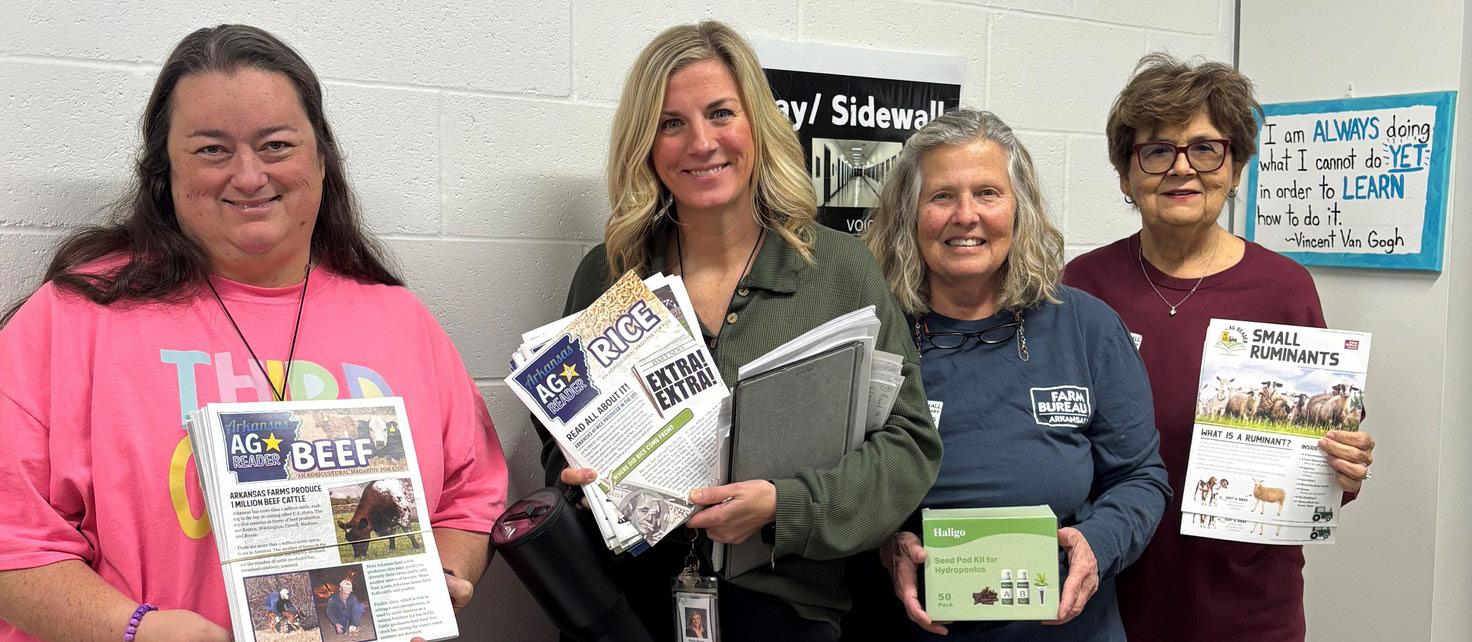
Agriculture Education Presentation | Searcy County Farm Bureau Women’s Leadership Committee Co-Chairs JoDee Hayes (center-right) and Phyllis Clark (right) inspire learning with gifts of agriculture literature and an aerogarden to third-grade teachers Loni Kelley (left) and Kayla Harris (center-left)), cultivating a love for agriculture in young minds.
Community Food Drive | Prairie County Farm Bureau hosted a Fill the Ford Food Drive for it’s local schools’ backpack program, collecting non-perishables to send home with students and fight local food insecurity.
Fighting Food Insecurity | Lonoke County Farm Bureau provided “Casey & Friends Coloring & Activity” books to members for their children and grandchildren to enjoy. Pictured is member service representative Kayla Joyner.
(left) and Karen Bates (center) with Sharp County Farm Bureau Women’s Committee.
FROM FIELD TO KICKOFF: WHERE SUPER BOWL FOODS BEGIN
Americans will once again come together this Super Bowl Sunday, not just to cheer on their teams, but to enjoy classic game day foods. From buffalo wings and pizza to chips, queso, guacamole and salsa, farmers and ranchers across the country supply the ingredients that end up on millions of watch party tables.
But, strong consumer demand does not guarantee strong farm margins. Across livestock, field crops and specialty crops, rising costs for labor, energy, inputs and financing have outpaced prices paid to farmers, leaving many producers facing tight or negative margins even as grocery shelves remain full.
Super Bowl demand highlights how production constraints shape food sourcing. Exports help support farm prices for commodities like dairy, corn and wheat, while the spike in Super Bowl demand for foods like salsa and guacamole exposes the cost, seasonal, labor and regulatory pressures that limit U.S. tomato and avocado production and increase reliance on imports during peak consumption periods.
For consumers, the Super Bowl represents the abundance of the U.S. food system. For farmers, it highlights the scale and coordination required to supply a single day of peak food demand, even as many farmers face rising costs, tight margins and growing uncertainty. Here’s a closer look at where some Super Bowl favorites come from and the challenges facing the farmers behind them.
From the Farm to the Watch Party
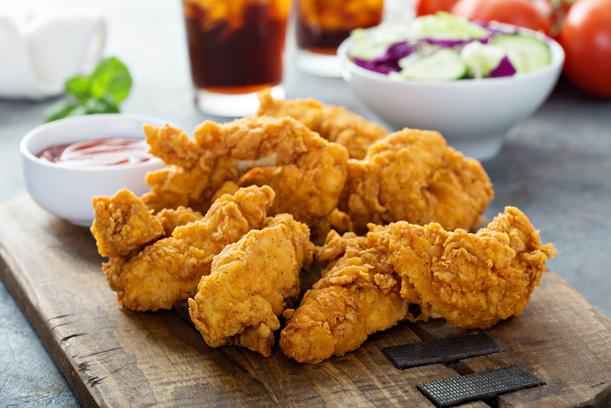
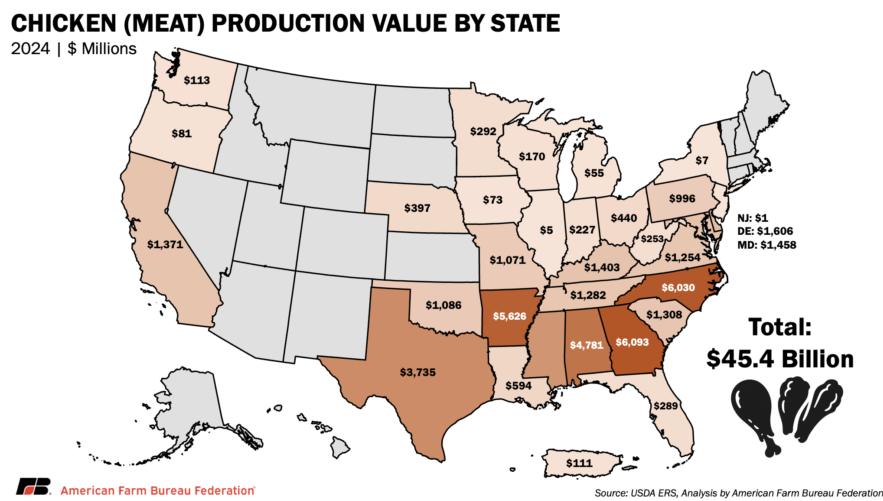
Chicken Wings: Few foods are more strongly associated with the Super Bowl than chicken wings. Americans are expected to eat well over a billion wings during Super Bowl weekend, supplied by poultry farmers concentrated across the Southeast and parts of the Midwest. States including Georgia, Alabama, Arkansas and North Carolina consistently rank among the nation’s top chicken-producing states. In 2024, farm-level poultry receipts totaled about $45.4 billion, making poultry one of the most valuable segments of U.S. agriculture. While demand for wings remains strong, poultry growers operate in a highly consolidated, contract-based system. Most farmers do not own the birds they raise and receive a set payment for growing them, limiting their ability to benefit when wholesale or retail prices rise. At the same time, growers typically finance and own their own poultry houses, often investing $1 million or more in specialized buildings and equipment, while also shouldering ongoing costs for energy, labor, biosecurity and disease management. Even on one of the biggest food consumption days of the year, strong consumer demand does not necessarily translate into stronger margins at the farm level. Read more about where classic SuperBowl foods come from online.
MARKET NEWS
as of February 4, 2026
Contact
Brandy Carroll brandy.carroll@arfb.com
Tyler Oxner tyler.oxner@arfb.com
Corn
Corn prices have traded largely sideways for several months, with the market caught in a tug of war between the opposing fundamentals of large supplies and strong demand. While USDA’s January reports increased estimates for both U.S. and global production, the broader global supply and demand picture remains relatively tight, particularly outside of China. Continued growth in global usage could eventually prompt China’s return as a major importer, a development that would significantly alter the balance of the world market. From a technical perspective, corn appears to have established a short-term bottom the day after the crop report, which is a constructive signal. The March contract now faces immediate resistance at the 20-day moving average near $4.29, a level it has failed to close above since January 9, the session ahead of the January 12 WASDE release.
Soybeans
Soybean export sales to China remain uncertain. Official USDA weekly data indicates purchases of 9.6 million metric tons, while market sources suggest China has secured the full 12 million metric tons included in the agreement. Either way, current commitments remain well below last year’s levels. With the agreed volume potentially fulfilled and Brazil’s harvest accelerating, any additional Chinese buying would provide meaningful upside support for prices. Technically, March soybean futures recently struggled at the 200-day moving average near $10.69, marking a disappointing setback after
posting two closes above that level last week. Beyond the 200-day average, the 100-day and 50-day moving averages clustered just above $10.80 represent another layer of resistance that bulls will need to overcome.
Wheat
Since Jan. 2, March Chicago wheat futures have rallied from $5.01 to $5.44, while March Kansas City futures have climbed from $5.03 to $5.50 since December 17. By recent historical standards, this represents a meaningful move higher. It is important to note that the rally began from historically depressed price levels and key psychological and technical support zones, which are likely to remain intact. Fundamental news in the wheat market has been limited, with ongoing uncertainty surrounding U.S. winter wheat conditions. A warm stretch from mid-December through mid-January was followed by a period of harsh cold across much of the Plains, leaving crop conditions a key variable to monitor moving forward.
Rice
The long-term downtrend in rice futures appears to be over for the time being, with clear chart signals that the market has found its bottom. March futures are now testing resistance at $11.25, while May has resistance at $11.50. With rice prices so low, the market has begun to worry about the potential size of the 2026 crop. We have seen an uptick in export sales totals, which is also providing some support. However, the global rice supply is still burdensome, with India, Thailand and Vietnam all competing for export markets. Recent USDA reports have provided somewhat bullish news for prices. The annual production report pegged harvested acres at 2.74 million, down 20,000 acres from the previous projection. The net result of the report was a 3.6 million cwt reduction in projected ending stocks. The all-rice expected average on farm price was increased 20 cents to $11.80, while the projected long-grain price was unchanged at $10.50.
Cotton
Despite the fact that recent USDA reports have been somewhat bullish for the market, cotton futures have again moved to new lows. Old crop March is now below 62.50 cents, leaving open the possibility of a retest of the continuation low of 61.35 cents set in November. In early January, export sales were impressive but have tapered off. In the January Annual Production Report, USDA lowered the 2025 crop estimate to 13.918 million bales, down 350,000 bales from the December estimate. The reduction was due to an 8% drop in average yields due to lower yields in the Delta and larger harvested acreage in the Southwest. The WASDE report was mostly unchanged otherwise, resulting in a 300,000 bale reduction in projected ending stocks and an increase of a penny in the expected on-farm average price, which is now pegged at 61 cents/lb.
Livestock
Cattle futures have seen support from firm cash markets and bullish news in the January cattle on Feed report, which confirmed that feedlot inventory is tightening. The total herd was pegged at 99.6% of the year-ago total. Technically, the charts look toppy, but with futures trading at a discount to current cash prices, the downside will likely be limited.
April hog futures are in position to challenge their recent high above $97. The market had begun trading mostly sideways after a steep rally that begin in November, but have posted sharp gains this week. Futures are trading at a steep premium to cash prices, and that could add downward pressure to the market. Pork demand is solid with the composite pork cutout value running 5% above the 5-year average.