JANUARY 9, 2026 | VOLUME 29 | ISSUE 1
Farm Bureau Press FARMER BRIDGE ASSISTANCE PROGRAM
A PEEK INSIDE
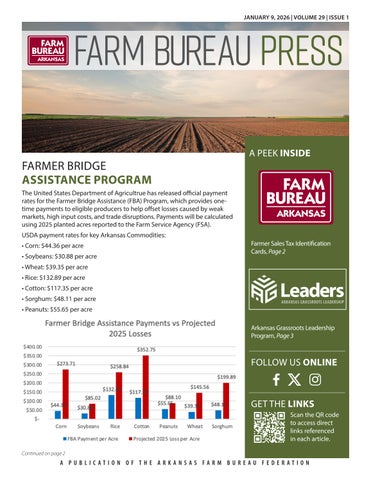
The United States Department of Agricultrue has released official payment rates for the Farmer Bridge Assistance (FBA) Program, which provides onetime payments to eligible producers to help offset losses caused by weak markets, high input costs, and trade disruptions. Payments will be calculated using 2025 planted acres reported to the Farm Service Agency (FSA). USDA payment rates for key Arkansas Commodities: • Corn: $44.36 per acre • Soybeans: $30.88 per acre
Farmer Sales Tax Identification Cards, Page 2
• Wheat: $39.35 per acre • Rice: $132.89 per acre • Cotton: $117.35 per acre • Sorghum: $48.11 per acre • Peanuts: $55.65 per acre Arkansas Grassroots Leadership Program, Page 3
FOLLOW US ONLINE
GET THE LINKS Scan the QR code to access direct links referenced in each article. Continued on page 2
A PUBLICATION OF THE ARKANSAS FARM BUREAU FEDERATION
FARMER BRIDGE ASSISTANCE PROGRAM Continued from page 1
For example, a 1,000-acre rice farm eligible for the program at the USDA rate of $132.89 per acre would receive approximately $132,890 in a one-time FBA payment. Based on Arkansas Farm Bureau and University of Arkansas System Division of Agriculture Extension estimates, many Arkansas farmers are operating at negative margins. While the Farmer Bridge Assistance payment will not make producers whole, it will help offset a portion of losses and may be critical in allowing farmers to remain in operation and continue producing crops for the 2026 season. Specialty Crops $1 billion of the $12 billion assistance package is reserved for specialty crops, with payment rates and eligibility details still under development. Additional Details • Payments are based on 2025 planted acres, USDA cost-of-production data, and current market conditions. • Double-cropped acres are eligible; prevent-plant acres are not. • Crop insurance participation is not required for FBA eligibility, though USDA encourages producers to consider available risk management tools. Find more information on the program and eligibility at the USDA FSA website.
FARMER SALES TAX IDENTIFICATION CARDS The creation of a farmer sales tax identification card to help facilitate the application of farmer sales tax exemptions and to prevent fraud was an Arkansas Farm Bureau priority during the 2025 legislative session. A bill to create the cards, sponsored by Rep. DeAnn Vaught and Sen. Tyler Dees, became Act 621 of 2025. Beginning Jan. 2, farmers will be able to log in to the Arkansas Taxpayer Access Point to apply for their exemption card. The application will require three years of tax documents or, for young and beginning farmers, the completion of a three-year business plan form that will be found on the website. The application fee is $20 and each card is valid for 8 years. The renewal fee will be $10. The cards are not mandatory. Current business relationships can continue with existing exemption certificates, and new business relationships can be established using exemption certificates or the new farmer sales tax exemption card. The card will be accepted by businesses as proof that purchases of tangible property, specified digital products, digital codes, and taxable services are exempt from sales and use taxes when they are purchased for business purposes.
2
A PUBLICATION OF THE ARKANSAS FARM BUREAU FEDERATION
ARKANSAS GRASSROOTS LEADERSHIP PROGRAM
AMERICAN FARM BUREAU WOMEN IN AG STUDY
The Arkansas Grassroots Leadership program identifies and provides training and resources for potential county Farm Bureau leaders, introduces them to all aspects of the organization and connects them with current Farm Bureau leaders to ensure their success. The two-year program will offer leadership opportunities at the county, state and national level. For more details and to register, contact your county president or district director or visit here.
American Farm Bureau Federation’s Women’s Leadership Program has partnered with a team of researchers to launch the National Women in Agriculture Study, which will be open through March 31, 2026.
If you are interested in learning more about Farm Bureau, benefitting from leadership development training and amplifying your voice by becoming part of the state’s largest agriculture advocacy organization, sign up for one of the seven regional meetings that will take place this spring. 2026 Regional Meetings: PARAGOULD | Jan. 22 Greene Co. Farm Bureau MT. HOME | Feb. 11 Baxter Co. Farm Bureau DEWITT | Feb. 23 Arkansas Co. Farm Bureau TEXARKANA | Feb. 26 Miller Co. Farm Bureau
FAYETTEVILLE | March 12 Washington Co. Farm Bureau
This nationwide initiative will explore women’s leadership and involvement in agriculture, identify barriers and opportunities, and provide actionable insights to strengthen engagement and support systems across the U.S. agricultural sector — from production and agribusiness to advocacy, education, and entrepreneurship. The survey is open to individuals ages 18 and older in the U.S. and Puerto Rico who have an interest in or involvement with agriculture, including those working in production agriculture, agribusiness, education, advocacy, or related fields. Perspectives from both women and men are welcomed. The survey can be found here.
EL DORADO | March 17 Union Co. Farm Bureau CONWAY | April 1 Faulkner Co. Farm Bureau
ARKANSAS AG IN THE CLASSROOM OUTSTANDING TEACHER AWARD The Arkansas Ag in the Classroom Outstanding Teacher Award recognizes an outstanding teacher in Arkansas who incorporates agricultural themes into non-agricultural curricula. If you know a teacher who uses agriculture in the classroom, please encourage them to apply for the award. Teachers can self-nominate, or be nominated by fellow teachers, principals, superintendents, or nominated by a county Farm Bureau leader.
ARKANSAS
The winning teacher will be awarded a monetary prize, an iPad Air tablet and a trip to the National Ag in the Classroom Conference June 23-26, 2026, in Providence, Rhode Island. The winning teacher will also be recognized at the Arkansas Farm Bureau Annual Convention in Hot Springs in December. Don’t miss out on the opportunity to recognize an outstanding teacher. The use of agriculture in teachers’ classrooms is also a celebration of the efforts of their respective county Farm Bureau. The application deadline is March 6, 2026. More information and nomination forms are available here. A PUBLICATION OF THE ARKANSAS FARM BUREAU FEDERATION
3
MARKET NEWS as of January 8, 2026 Contact Brandy Carroll
support for March corn is seen around $4.35, with resistance in the $4.50 to $4.55 range. Looking ahead into early 2026, corn prices are expected to remain largely rangebound unless USDA data or demand trends force a repricing.
Rice The rice market had rough year, having lost 31.9% of its value during 2025. Nearby futures made an eight-year low on a front-month basis in late December. However, it is possible this market is finally establishing a bottom, with March futures closing above previous resistance at $10. World supplies have been burdensome, and competition from Asia made it difficult to sell the large 2024 crop, with carryover stocks ballooning over the past two years. The market is beginning to question the size of the 2026 crop, though, given the current situation and outlook for rice, and that could bolster prices. Rice farmers will receive the largest per-acre payment from USDA’s bridge program – $132.89 per acre.
Soybeans The soybean complex continues to struggle, with futures resuming their decline after only a brief bounce late in December. The selloff intensified into the new year, breaking short-term technical support levels. Despite the continued weakness, there are signs the market may be nearing exhaustion. Open interest has collapsed sharply, a technical signal often associated with large speculative liquidation rather than the start of a new downtrend. Importantly, March soybean futures have continued to hold the $10.35 to $10.40 support zone. Given the magnitude and speed of the recent decline, this is viewed as a year-end speculator washout rather than a continuation of December’s bearish momentum. While fundamental challenges remain, including demand uncertainty, technical conditions suggest downside risk may be becoming more limited in the near term.
Corn March corn futures continue to drift sideways, extending a rangebound pattern that has persisted for nearly four months. With little fresh fundamental news ahead of Monday’s USDA January Crop Production and December Stocks reports, the market appears content to wait for direction. Current trade expectations point to a modest decline in U.S. corn yields of roughly two bushels per acre to an estimated, yet still record, 184 bpa. Production could fall by approximately 200 million bushels as a result of lateseason dryness in portions of the Corn Belt. From a technical perspective, the broader trend remains upward, though prices are testing key support zones. A failure to hold support could invite downside pressure, though that is not our base-case expectation. Near-term
Wheat Wheat markets reacted midweek to rising concerns about Plains weather, as record high temperatures and expanding dryness pressured crop conditions. Several state-level goodto-excellent ratings declined, and drought coverage across winter wheat areas has now expanded to roughly 40%. Chicago March wheat continues to respect major technical support near $5.04. Although prices briefly slipped below this level late last week, futures rebounded to close above support, preserving the broader structure. Kansas City wheat remains comparatively stronger, with major support established at $5.03 on December 17 and prices holding well above that level. Weather developments will remain a key driver for wheat markets in the weeks ahead.
brandy.carroll@arfb.com
Tyler Oxner
tyler.oxner@arfb.com
4
A PUBLICATION OF THE ARKANSAS FARM BUREAU FEDERATION
Cotton Cotton futures remain under heavy pressure from weak demand. The trade deal with China did not include cotton, and they remain mostly out of the U.S. cotton market. Vietnam has led purchases, but without demand from China, the market remains near contract lows. Crude oil prices under $60 a barrel result in cheaper competition from synthetics, which could also limit demand for cotton. March futures made a new two-month high on Tuesday at 65.76 cents, but the market turned lower by the close. USDA announced last week that farmers who planted cotton in 2025 will be eligible for payments of $117.35 per acre. We are still six weeks away from our first estimates for the 2026 crop, but after three years of economic losses on cotton acres, farmers are likely to look for other options. Cattle After a record-breaking year, live and feeder cattle futures prices trended mostly sideways for the last few weeks of 2025. However, futures began 2026 with a bang, posting sharp gains and breaking through key chart resistance suggesting that another leg up is possible. Reports of new New World Screwworm cases in northern Mexico provided support, especially since it will likely mean that the ban on cattle imports from Mexico will remain in place. Hogs Lean hog futures have displayed bearish chart action in recent days, breaking out of the sharp uptrend that began in November. The December USDA inventory report showed largerthan-expected supplies of hogs on Dec. 1, suggesting ample supplies and further price pressure in the first quarter of 2026. However, supplies are projected to decline into the spring and summer months.
EDITOR Shaylee Wallace Barber shaylee@arfb.com