GROUP PUBLISHER AND VICE PRESIDENT OF SALES Martin McAnulty mmcanulty@annexbusinessmedia.com
CEO Scott Jamieson sjamieson@annexbusinessmedia.com
WINGS MAGAZINE
P.O. Box 530, 105 Donly Dr. S., Simcoe, ON N3Y 4N5 Tel: 519-428-3471 Fax: 519-429-3094 Toll Free: 1-888-599-2228
PUBLICATION MAIL AGREEMENT #40065710
Published six times per year (Jan/Feb, Mar/Ap, May/Jun, Jul/Aug, Sep/Oct, Nov/Dec) by Annex Business Media
SUBSCRIPTION RATES
Canada – 1 Year $35.19 CDN; 2 Years $61.71 CDN (plus GST - #867172652RT0001)
USA – 1 Year $80.07 CDN
International – 1 Year $92.31 CDN
Occasionally, Wings magazine will mail information on behalf of industry-related groups whose products and services we believe may be of interest to you. If you prefer not to receive this information, please contact our circulation department in any of the four ways listed above.
All advertising is subject to the publisher’s approval. Such approval does not imply any endorsement of the products or services advertised. Publisher reserves the right to refuse advertising that does not meet the standards of the publication.
Annex Business Media brands focused on Canadian aviation and aerospace include Wings, Helicopters and UAV Canada, as well as the Careers in Aviation Expo and Directory, Aerial Firefighting Guide and the MRO Directory. Annex is the publishing partner of Canadian Owners and Pilots Association, providing essential news and market content through COPA Flight, COPAnational.org and Canadianplanetrade.ca.
By Jon Robinson
Keeping pace with global defence
New Canadian policy hinged to Arctic sovereignty and global commitments
Canadian Forces Base Trenton served as backdrop for Prime Minister Justin Trudeau on April 8 to introduce the Our North, Strong and Free policy that aims to allocate $73 billion in defence spending over the next 20 years. The policy hinges on Arctic sovereignty in a renewed vision for Canada’s military to support the North as the country faces issues like climate change and increasingly aggressive foes.
Our North adds to the Strong, Secure, Engaged (SSE) policy introduced in 2017, and reorganized in 2018 under the Defence Investment Plan, with its own 20-year horizon. SSE was built to meet more than 200 Canadian Armed Forces (CAF) objectives, driven by an initial 10-year increase in defence cash spending from $18.9 billion in 2016/17 to $32.7 billion in 2026/27. Based on the SSE alone, Canada’s total defence spending over the next 20 years was projected to reach $553 billion on a cash basis. By 2024/25, defence spending in Canada under SSE was projected to reach 1.4 per cent of GDP, falling short of the two per cent target set by NATO. As Paul Mitchell points out in his article All flash, no bang (page 38), even with the new $73 billion earmarked for Our North, Canada’s defence spending would only reach 1.76 per cent by 2029/2030. The numbers are staggering as the lure of a growing global military industrial complex faces geopolitical instability becomes a prime focus of OEMs building programs for ground, air, sea and space. In the last week of April, commander of the Canadian Armed Forces Space Division, Brig.-Gen. Michael Adamson, outlined, that for the first time, the national defence committee is studying the military’s role in defending space. Adamson noted the space
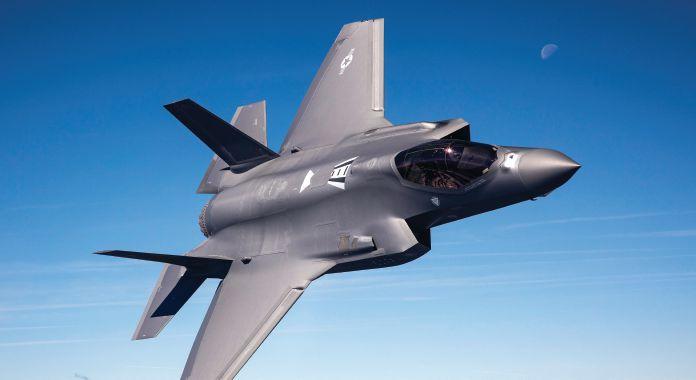
A late 2023 government report outlines how Canada’s F-35s will cost $73.9 billion over 30 years.
division is primarily focused on how to protect critical infrastructure here on Earth, because the military is now so dependent on space. This can be seen in many SSE priority projects for improved sensors and control, including the acquisition of Tactical Integrated Command, Control and Communications, radio cryptography, and other necessary systems (Tic3Air), as well as upgraded air navigation management and control systems (MFATM); space-based development projects like the RADARSAT constellation mission; medium earth orbit search and rescue (MEOSAR); defence enhanced surveillance from Space (DESS-P); and Surveillance of Space 2 (SofS 2).
The RCAF in terms of spending allocation is the biggest benefactor of SSE among all branches of the CAF, highlighted by
TOP DATA BURSTS… in this issue
1. Overture is being designed to carry up to 80 passengers at Mach 1.7. P.8. 2. The Airbus Racer demonstrator is targeting a 400 km/h cruise speed. P. 10. 3. Elevate Aviation was one of eight AME women’s teams compete at MRO Americas. P.12. 4. Around 20 per cent of the world’s largest airports are privatized. P.14. 5. Our North policy aims to allocate $73 billion in defence spending over 20 years. P.38
procurement of a new strategic transport aircraft and 88 Lockheed Martin F-35 Lightning II fighter jets. In late 2023, beyond the $19.8 billion in total acquisition costs, the parliamentary budget officer estimated Canada will pay $73.9 billion to buy, fly and maintain its new fleet of F-35 fighter jets over 30 years.
Our North aims to allocate $8.1 billion in spending over the next five years and it will also significantly boost the RCAF, most notably with $18.4 billion for new tactical helicopters to replace the CH-146 Griffon fleet and $307 million for early warning aircraft. The new helicopters represent the largest planned expenditure, well ahead of the second largest at $9.5 billion earmarked for artillery ammunition production and stockpiling. The government is also committing to explore options like ground-based air defence, surveillance and strike drones, and ways to enable the new Arctic and offshore patrol ships to operate helicopters at sea.
The CAF pegs its responsibility as covering an area greater than 15 million square kilometres. Statistics from the Department of National Defence (DND) indicate approximately 600,000 aircraft enter and exit Canadian air-space annually, among some 4.3 million total flights, including 90,000 transpolar flights. As Brigadier-General Michel Lalumière noted in 2018 at AIAC’s Canadian Aerospace Summit, Canada’s defence and security depends on air power. | W
Actually Enjoy Work
ON THE FLY
THE LEAD GREECE AND CROATIA SIGN DEALS FOR DE HAVILLAND 515
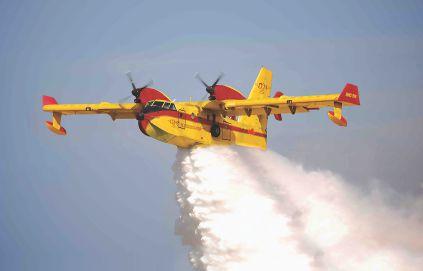
Canadian Commercial Corporation signed two government-to-government contracts for the sale of DHC-515 FIREFIGHTER aircraft to Greece and Croatia. Building on the foundation of Canadair CL-215 and CL-415 aircraft, the DHC-515 is a new purpose-built aerial firefighting aircraft manufactured by De Havilland Canada. Greece, through its Ministry of Climate Crisis and Civil Protection, will acquire seven DHC-515 aircraft, as well as spare parts, training, and support.
Canadian Commercial Corporation (CCC) states the contract is the result of ongoing cooperation between CCC, DHC, the European Union’s Civil Protection Mechanism (rescEU) and its Member States to supply the EU with Canadianmade firefighting aircraft. The Hellenic Air Force of Greece currently operates CL-215 and CL-415 aircraft.
CCC also reached a deal with the Ministry of the Interior of Croatia for the sale of two DHC-515 aircraft, along with spare parts, training, and maintenance support. Croatia currently operates six CL-415 aircraft and will increase its aerial firefighting program by one-third with the acquisition
of these two new DHC-515 aircraft. “This is a major common achievement, which also proves that only by joining our forces at national, European and global levels, we can efficiently respond to the devastating consequences of climate change, such as wildfires, all with a view to ensuring the safety of our citizens,” said Davor Božinović, Deputy Prime Minister and Minister of Interior of Croatia.
COMMERICAL
FIRST FLIGHT FOR BOOM XB-1 DEMONSTRATOR
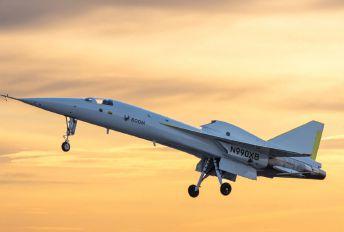
Boom Supersonic on March 22 announced the successful flight of its XB-1 demonstrator, described by the company as the world’s first independently developed supersonic jet, at the Mojave Air & Space Port in Mojave, California. The inaugural flight marks what Boom notes as a major milestone toward the return of supersonic travel, with XB-1 providing the foundation for Boom’s supersonic airliner, Overture.
Boom states XB-1 met all of its test objectives, including safely and successfully achieving an altitude of 7,120 feet and speeds up to 238 knots (273 mph). While XB-1 was in the air, the team performed an initial assessment of the aircraft’s handling qualities, including airspeed checks with the T-38 chase aircraft, and assessing the aircraft’s stability in the landing attitude (at a high angle of attack).
Now that XB-1 has successfully completed its first flight, the Boom team will systematically expand the flight envelope to confirm its performance and handling
qualities through and beyond Mach 1. When XB-1 is ready for its first supersonic flight, Test Pilot Tristan “Geppetto” Brandenberg will be at the controls. Overture has 130 orders and pre-orders from American Airlines, United Airlines, and Japan Airlines.
HARBOUR AIR SIGNS LOI FOR 50 MAGNI650 ELECTRIC ENGINES
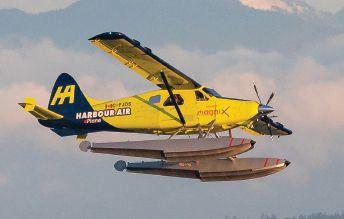
magniX and Harbour Air ratified a Letter of Intent for 50 magni650 electric engines to be used for Harbour Air’s fleet, beginning with the De Havilland DHC-2 Beaver in 2026, and for third- party conversions. In December 2019, magniX and Harbour Air made claimed a world-first when the eBeaver, a DHC-2 Beaver retrofitted with a magniX electric engine, made its first flight. The prototype eBeaver has flown 78 flights in preparation for the certification of the aircraft. magniX has also powered Eviation’s all-electric commuter airplane, Alice, and the world’s largest hydrogenelectric aircraft, and Universal Hydrogen’s retrofitted De Havilland Dash 8.
magniX is a subsidiary of the Clermont Group, an international conglomerate headquartered in Singapore. Harbour Air is described as North America’s largest seaplane airline. Founded in 1982 with two seaplanes, Harbour Air now holds a fleet of 45 aircraft, 300 daily scheduled flights, tours, adventure packages, and private flights. With 12 scheduled destinations connecting downtown Vancouver, Victoria, Seattle , Nanaimo, Tofino, Whistler, Vancouver Airport/Richmond, Sechelt, Salt Spring Island, Powell River and Comox, B.C. Harbour Air transports around 500,000 passengers every year.
De Havilland Aircraft of Canada launched its DHC-515 FIREFIGHTER production program, formerly the CL-515 program, in 2022.
The XB-1 demonstrator takes off on its inaugural flight. Overture, its successor, is being designed to carry 64 to 80 passengers at Mach 1.7.
The prototype eBeaver has flown 78 flights in preparation for the certification of the aircraft.
AIR CANADA TO UPGRADE A320 FLEET AVIONICS
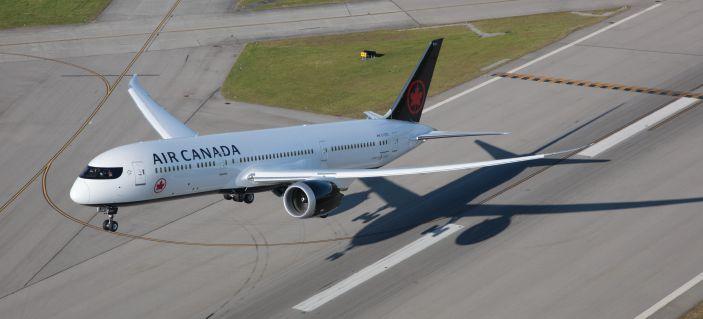
Airbus at MRO Americas in Chicago signed an agreement with Air Canada for what it describes as a major cockpit and avionics system upgrade package for the airline’s A320 Family of in-service aircraft. The multi-year upgrade program includes Enhanced Electronic Instrument System (EEIS2), Head Up Display (HUD) and many other avionics functions built by Thales and other suppliers, but integrated by Airbus. The upgrades will be installed on up to 76 aircraft.
“These key enhancements to the avionics on our Airbus A320 family will result in a modernized flight deck environment consistent with our other fleets, as well as additional capabilities comparable to the latest generation of aircraft, such as the A321XLR that Air Canada will be introducing to its fleet,” said Murray Strom, Senior Vice President, Flight Operations and Maintenance at Air Canada.
Airbus explains the HUD upgrade will improve situational awareness and bring better airport accessibility in the event of bad weather conditions. EEIS2 displays offer much higher reliability, explains Airbus, and enable new function displays with high resolution LCD screens and features.
Airbus notes the upgrades to the SBAS Landing System (SLS), FMS Landing System (FLS) and GBAS Landing System (GLS) will also contribute to faster and greater airport accessibility.
HAYES TO LEAD AIRBUS IN NORTH AMERICA
Robin Hayes, former CEO of JetBlue Airways, is set to become CEO of Airbus Americas Inc. on June 3, 2024, after the retirement of Jeffrey Knittel, who has led the operation since 2018. Knittel will remain with Airbus through a transition period. Hayes brings 35 years of aerospace leadership to Airbus having served in a series of senior executive roles at British Airways over the course of a 19-year tenure, and JetBlue, where he was CEO for nine years. From 2020 to 2022, Hayes was Chair of the IATA’s Board of Governors.
Hayes will lead the commercial aircraft business and will have responsibility for coordination among the company’s helicopters, space and defense businesses in North America. The region has more than 10,000 Airbus employees across 50 sites. Additionally, Airbus notes it spends US$15 billion annually with over 2,000 U.S. suppliers.
AIRPORTS
CAE DEAL WITH NAV CANADA TO TRAIN AIR TRAFFIC CONTROLLERS
NAV Canada and CAE signed a first-ofits-kind agreement in Canada to increase training capacity for air traffic services professionals. CAE instructors will deliver initial training for Flight Service Specialists and Air Traffic Controllers using NAV Canada’s curriculum. The first classes will begin in the fall of 2024 at a new purpose-built facility on CAE’s campus in Montreal. Described as the world’s largest aviation training provider, CAE said it is uniquely positioned to work with NAV Canada, noted as the secondlargest Air Navigation Service Provider worldwide, to help ensure the safety and efficiency of the air traffic system.
“CAE understands the importance of effective workforce development and the challenges posed by the increased demand for highly skilled people throughout the aviation sector,” said Marc Parent, CAE’s CEO. NAV Canada aims to build a pipeline of air traffic services professionals by recruiting more than 500 additional students by 2028 who will be trained by CAE. NAV Canada’s current Flight Information Regions (FIR) school delivery is ongoing with full force and continues to offer all specialties and on-the-job training.
GTAA OUTLINES DECADE-PLUS-LONG PEARSON PLAN
The Greater Toronto Airports Authority in April outlined a significant capital investment plan under the name of Long term Investment in Facilities and Terminals (LIFT), noting it has initiated discussions with design and construction companies on the procurement, planning and vision of the program. LIFT is a plan spanning more than a decade, noted the Greater Toronto Airports Authority (GTAA), investing billions of dollars into Toronto Pearson’s facility through several construction programs aimed at preparing Canada’s largest airport for the future. Pearson executives launched the first phase of a procurement process at an industry forum for 700 participants from design, construction, and technology industry companies. Toronto Pearson states it has been meeting passenger needs by deploying extraordinary resources to many of its aged assets and facilities, which is not a sustainable solution with passenger traffic expected to grow to approximately 65 million annually by the early 2030s – a figure that takes the airport beyond its 45 million passengers in 2023.
The GTAA said the first program of LIFT will focus on modernizing airport assets like high-speed taxi lanes, airfield electric lighting and control system, interim terminal facilities, and investments in power generation to advance toward net-zero targets. “Through LIFT, we will deliver a world-class passenger experience, integrate smart architecture, unlock the digital potential in air travel, and advance towards a net-zero future,” said Deborah Flint, CEO, GTAA.
Airbus explains Air Canada’s HUD upgrade will improve situational awareness and bring better airport accessibility in the event of bad weather.
Deborah Flint in mid-2022 at a ground-breaking for a rehab of Pearson’s second busiest runway, 06L/24R.
ARRESTS MADE IN GOLD HEIST AT TORONTO PEARSON AIRPORT
Peel Regional Police and agencies from the United States in April made a series of arrests in a heist of gold worth more than $20 million from Toronto Pearson International Airport. Just over a year ago, on April 17, 2023, at 3:56 pm a flight landed at Pearson from Zurich, Switzerland, with a cargo containing 6,600 bars of .9999 per cent pure gold, weighing 400 kilograms, in addition to $2.5 million in foreign currency. Shortly after landing, it was offloaded and transported to a separate location at the airport.
On April 18, 2023, at 2:43, Peel Regional Police (PRP) received a report that the cargo was missing. The case crossed borders with the PRP working collaboratively with the Philadelphia Field Division of the Bureau of Alcohol, Tobacco, Firearms, and Explosives (ATF). The U.S. agency arrested one individual in the United States who had 65 illegal firearms in his possession, two of which had been modified to have fully automatic capabilities. Five of the 65 handguns are known as ‘ghost guns,’ meaning that they were not serialized and, therefore, untraceable.
PRP investigators also seized one kilogram of gold worth approximately $89,000.00, believed to be from the theft, smelting equipment, and approximately $434,000 in Canadian currency. PRP has identified and charged or issued warrants for nine individuals with over 19 charges, including two people who at one point were employed by Air Canada.
HELICOPTERS
FIRST FLIGHT FOR AIRBUS RACER DEMONSTRATOR
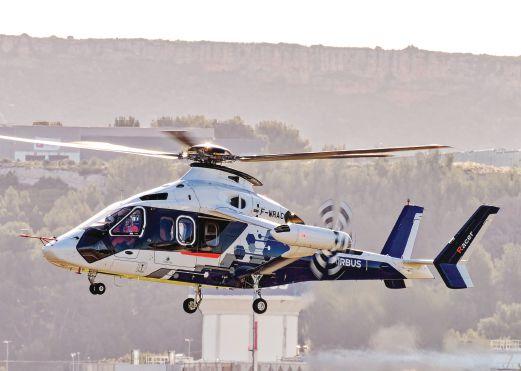
Airbus Helicopters’ Racer demonstrator, developed in the framework of the European Research Clean Sky 2 project, performed its first flight, in Marignane, France in late April. The aircraft flew for about 30 minutes. Airbus explains this program milestone launches a flight campaign that will take two years and aim to progressively open the aircraft’s flight envelope and demonstrate its high-speed capabilities.
Optimized for a cruise speed of more than 400 km/h, Airbus explains the Racer demonstrator aims to achieve the best tradeoff between speed, cost-efficiency, and mission performance. The Racer also targets a fuel consumption reduction of around 20 per cent, when compared to current generation helicopters of the same class, based on to aerodynamic optimization and an eco-mode propulsion system. Developed with Safran Helicopter Engines, the hybrid-electrical eco-mode system allows one of the two Aneto-1X engines to be paused while in cruise flight, thus contributing to cutting CO2 emissions.
The Racer builds upon the aerodynamic configuration validated by the Airbus Helicopters X3 technology demonstrator which, back in 2013, broke the speed record by reaching 472 km/h.
BELL MEXICO DELIVERS 800TH COMMERCIAL AIRCRAFT CABIN
Bell Textron announced at a defence show in Chile that Bell Mexico delivered the 800th commercial aircraft cabin to Bell Canada Commercial Assembly and Delivery Centre for aircraft assembly. This news comes nearly a year after Bell Mexico celebrated its 15year operational anniversary. “The 800th cabin milestone is a testament to not only Bell’s commitment to our customers, but also to our facilities that work together to ensure a cohesive pipeline of creating top-of-the-line products to vigilantly assembling it, all at Bell-owned and operated facilities,” said Danny Maldonado, chief commercial officer, Bell.
In 2010, Bell opened its manufacturing facility in Chihuahua, Mexico, formally known as Bell Mexico. Since its inception, Bell Mexico has manufactured cabins and fuselages, as well as electrical harnesses and components, instrument panels, firewalls, bulkheads, floors, and other structural components for the Bell 206L4, Bell 407, Bell 429, and Bell 412 platform. Bell supports more than 850 operators and nearly 1,400 commercial aircraft in service across Latin America.
Airbus explains Racer holds 90 patents and is being developed by 40 partners representing 13 countries as a high-speed demonstrater with an eco-mode system and a low operational acoustic footprint.
BLACKCOMB ADDS POWERLINE TRAINING FACILITY IN PEMBERTON
Blackcomb Helicopters introduced its Powerline Training Facility as an addition to its Advanced Training Center. The company explains the purpose-built training facility, in Pemberton, BC, reflects its commitment to utility operations, offering a controlled and safe environment where crew can improve their abilities. Located at its base at Pemberton Airport (CYPS), the Powerline Training Facility, according to Blackcomb Helicopters, was built to replicate the intricacies of existing utility systems.
The training facility includes: A double circuit, 138KV monopole with five structures; self-supporting lattice tower; single circuit, 230KV H-frame with 4 structures; practice H-frame structure; and two culverts for pole sets. The training offered at the facility covers a range of exercises for pilots, hoist technicians, and linemen
BUSINESS AVIATION
GULFSTREAM G700 EARNS FAA CERTIFICATION
Gulfstream Aerospace on March 29 announced its new G700 received FAA type certification, which also confirmed two new
performance improvements, including: a balanced field length takeoff distance of 5,995 feet/1,827 meters and a landing distance of 3,150 ft/960 m (standard ISA day, sea level), both shorter than originally anticipated. In September 2023, Gulfstream announced G700 performance enhancements for range, speed and cabin altitude. The aircraft’s range increased to 7,750 nautical miles/14,353 kilometres at Mach 0.85 or 6,650 nm/12,316 km at Mach 0.90, gaining 250 nm/463 km at both speeds over original projections. The G700’s maximum operating speed increased from Mach 0.925 to Mach 0.935, making it the fastest in the Gulfstream fleet. Gulfstream notes the G700 cabin also features what it describes as whisper-quiet noise levels. | W
CANADIAN AVIATION CONFERENCE AND TRADESHOW 2024
A major Industry Networking Event not to be missed!
TUESDAY, NOVEMBER 5 TO THURSDAY, NOVEMBER 7 WESTIN BAYSHORE HOTEL, VANCOUVER, BC
ATAC’s Canadian Aviation Conference and Tradeshow is the premier national gathering offering Canada’s best networking, learning, and sales opportunity for operators, suppliers, and government stakeholders involved in commercial aviation and flight training in Canada. For more information contact: tradeshow@atac.ca www.atac.ca
Gulfstream in late 2023 introduced a series of performance enhancements in range, speed and cabin altitude for the new G700.
By Kendra Kincade |
Elevating the MRO field
How Canadian Aircraft Maintenance Engineers are instituting change
Women just don’t want to be in aviation; if they did, they would already be here. This is a perspective I have encountered many times while working to promote dynamic careers in aviation to women over the last decade. However, I could not disagree more with this statement, and I want to explain why.
We (Elevate Aviation) have been promoting aviation to women since 2014 and have reached thousands of people across Canada. The number one thing that comes up from young women is not a disinterest in the industry, but a question: “Why haven’t we heard of these careers before?” We have been working hard to answer that question for women and girls across Canada, so they will begin to see aviation as an option when making career choices.
The specific career I want to highlight here is that of an Aircraft Maintenance Engineer (AME). Most of us in the industry are well aware that aviation needs more Aircraft Maintenance Engineers and mountains of research proves it.
According to Oliver Wyman, a global leader in management consulting, “While the possibility of an aviation mechanics shortage has been discussed for years... there is a shortfall of somewhere between 12,000 and 18,000 aviation maintenance workers [in 2023 in North America]. The imbalance between supply and demand will persist and even worsen over the next 10 years. It is likely to result in fewer flights and delays and cancellations; or airlines having to compensate by keeping more spare aircraft and parts on hand.”
For someone who loves to fly, like myself and the millions of other people who fly annually, this is a bleak outlook.
Unfortunately, we are well past the critical time when it is necessary to keep up with demand. What is currently being done to attract people into the industry is not enough. We need to collaborate to attract more people into this sector, including looking outside the norm and doing more to recruit a diverse range of people, keeping in mind that diversity means more than gender.
Diversity programs also need to embrace means race, nationality, ethnicity, religion, sexuality, age, physical abilities, and socioeconomic backgrounds.
So how do we do that? I’ve heard people say women wouldn’t like aircraft maintenance and, to be honest, there was a time when this was also my belief. But slowly, so slowly that you almost can’t see it, this is changing. Aircraft Maintenance Engineers being labelled as the domain of men is a notion rooted in outdated beliefs rather than today’s understanding of diverse possibilities.
At Elevate Aviation one of our initiatives to bridge this gap is our Aircraft Service
Technician (AST) foundational training program. Students come in for nine weeks of classroom training, hands-on learning, and on-the-job training with partner companies, who, in several cases, have become their employers.
“I learned so much. I really liked the onthe-job training,” shares AST graduate Xiao Me. “You are in class for five weeks and you learn something, and then on the job, you get to see how they work, how they connect, and how to read schematics. You learn so much, it’s amazing.”
This AST course is free of charge, open to everyone to apply, and – perhaps my favourite part – anyone who comes in the door is
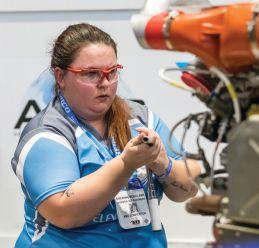
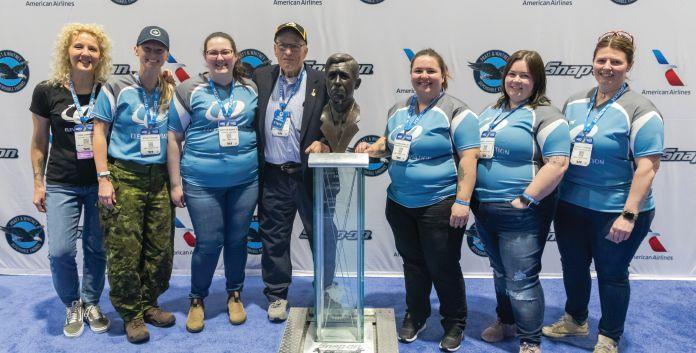
MRO Americas hosted 90 maintenance teams, including Elevate Aviation and seven other women’s teams.
Team Elevate’s Crystalle Laamanen from Great Slave Helicopters and Rebecca Roseborough of Oceanside.
trained in diversity, inclusion and civility in the workplace to help break down barriers that women face when they enter a field that is sitting at two to three per cent female.
As discussions intensify globally around the AME shortage, It is critical that we highlight the women who are already in this industry to attract more women and demonstrate what a rewarding career it can be for them. Another initiative at Elevate Aviation to showcase female AMEs is our Elevate Aviation team which participates in AME competitions twice a year, including one south of the border.
The Aerospace Maintenance Council hosts the Aerospace Maintenance Competition (AMC) annually. After a few variations of the event, the AMC was officially born in 2016 and this year welcomed a record 90 teams to the competition, which now takes place at MRO Americas, the largest gathering of the aviation maintenance community in the world. The AMC recognizes and celebrates the aviation maintenance technician, and the knowledge and skill required to maintain safe, airworthy aircraft, worldwide.
This year's event took place in Chicago at the McCormick Place Convention Center. Set up on the MRO Americas exhibition floor, the AMC provides an opportunity for current and future maintenance professionals to showcase their abilities and see how they stack up against peers. The 90 teams with five members each competed in one of six categories: Commercial aviation, general aviation, space, education, military, and repair and manufacturing. There were 27 competitive events ranging from fuel tank entry precautions to an exam on human factors.
A growing excitement about this competition is the number of women who are attending. Elevate Aviation in 2018 attended as the first all-woman team from Canada, one of three all-women teams competing alongside Boeing and Pratt and Whitney. We have proudly attended every year since (with 2020 and 2021 events being canceled due to COVID-19). The women not only love the experience it brings them, but they are also skilled competitors. While many of the teams in the competition spend time practicing throughout the year as co-workers, the Elevate Aviation team meet one another for the first time when they arrive to compete at the Canadian competition prior to heading to the U.S.
Notable accomplishments at AMC include Cassandra Hepp winning the Charles E. Taylor Professional AMT Award in 2022 and Crystalle Laamanen winning the strongest grip in the torque competition from Canada (Elevate Aviation and a team from Alberta called the Gear Goddesses) and six from organizations such as the Aviation Institute of Maintenance, Tarrant College, Cape Cod Community College, American Airlines, Pratt and Whitney, and American Airlines.
“Entering a team in this competition is important to help spread the word about our industry. Not only will it show women and underrepresented groups that these jobs are available, but also that they are capable of becoming AMEs,” says Crystalle Laamanen of team Elevate Aviation. “It helps to spread knowledge of our industry and to grow it as a whole. We need to strengthen the foundation of the aircraft maintenance industry. Taking part in events such as these helps do that one step at a time.”
“I went into trades right out of High School. I knew I wanted a job that was hands-on work, not at a desk in an office.” Shyanna Cerney, a student at the Cape Cod Community College proudly explains.
AMC events span over two days and feature teams not only from the United States but this year competitors arrived from Canada, Mexico, Puerto Rico and even Australia. The teams come from a range of sectors like airlines, colleges and other maintenance institutes and various branches of the military.
There are multiple reasons to join in on this event. AMEs often feel unseen and unappreciated. Ryan Shepard, the CEO of
Victory Lane Aviation, a small AME and flight school located in North Carolina states the reason he brought his employees back to compete for the second year. “For us, it’s difficult because we are a smaller company and to pull five of our top people away is tough financially as a company. But we do it because so often in our field they’re working long hours, long weeks, and they don’t feel appreciated. They don’t realize that they are part of a much larger community and to bring them here so they get to see the sheer magnitude of how many mechanics are out there is such an encouragement for them and that’s really the main reason we are here.”
The AMEs are certainly not hidden away at the AMC competition. They are shining bright and showing off their skill and, by doing so, attracting talent of all genders into aircraft maintenance. Seeing women at this competition, whether it’s in person, on social media, or witnessing the growth from just one all-female team to now eight, it’s truly inspiring. These women are not just competing; they’re having fun and showing everyone that they are meant to be in this profession. The more women we see entering the field, the more others will be encouraged to join them. It’s funny how perceptions can change over time.
Aircraft Maintenance Engineering isn’t just for the guys; it’s for anyone who loves a challenge, enjoys getting their hands dirty, and finds genuine satisfaction in accomplishing something tangible. Who knows, maybe someone reading this article and seeing photos of women in these roles will think, “Hey, that could be me!” And you know what? That’s something we can all benefit from as passengers. More diversity means more innovation and better service for everyone. | W
Kendra Kincade is the Executive Director of Elevate Aviation.
By David Carr |
A road less travelled
Should major airports follow the privatization route of Air Canada
Brian Mulroney altered the course of air transport in Canada; irrevocably and for the better with the privatization of Air Canada and commercialization of Canadian airports. Mulroney, who passed away in February, oversaw the sell-off of approximately one-third of Canada’s bloated portfolio of crown-owned enterprises, including Canadair, de Havilland and Petro Canada. He put the privatization of the Canadian National Railway on track.
Like free trade with the U.S., Mulroney was not an early convert to privatization. He likely recognized, as The New York Times did in 1988 when the Air Canada IPO was announced that, “selling state-owned companies can be very controversial in a country accustomed to the Government as an entrepreneur.”
Air Canada was fully privatized by 1989. British Prime Minister Margaret Thatcher had produced a pioneering template for airport privatization in 1987 by selling off the British Airports Authority, including London Heathrow and Gatwick. Still, Mulroney took a more pragmatic and watered down approach with airports. Perhaps because the government first had to unstick airports from the most centralized management structure in the developed world. In the early 1990s, all runways still led to Ottawa.
Air transport has rebounded to a pre-COVID peak. But more passengers will not be enough for Canadian airports to climb out of the financial hole the pandemic pushed them down. The industry took an estimated $5.5 billion revenue hit and piled on $3.2 billion in added debt. Hampering capacity to take on additional debt to cover a growing backlog of capital projects. Many cancelled or deferred during COVID. Inflation and high interest rates only compound the problem.
Cash-strapped Ottawa cancelling airport rents is a nonstarter. Leaving airports with three options to generate capital: Sharply increase user charges, including airport improvement fees; lobby Ottawa for money it doesn’t have for an infrastructure modernization package similar to the almost US$1 billion the Biden administration is spending on U.S. airport infrastructure; or open
Approximately 20 per cent of the world’s largest airports are now privatized.
the door to private investment.
Two of the options were on display in April when Aéroports de Montréal (ADM) and Greater Toronto Airport Authority (GTAA) announced multi-billion-dollar expansions and upgrades at Trudeau and Pearson airports within one week of each other. Expect more announcements as airports shift into growth mode, which makes how they will pay for these projects relevant.
GTAA is planning “moderate” increases to Pearson’s $35 airport improvement fee, already more than five times greater than what is charged at competing border airports in the U.S. ADM is proposing the road less travelled. ADM chief executive Yves Beauchamp opened the door to private capital once the first phase of construction is complete by 2028. “New financial tools will be necessary,” he told the Chamber of Commerce of Metropolitan Montreal. Michel Leblanc, chief executive of the Montreal chamber of commerce was blunter still. “If we are not able to change the way airports finance themselves, we will eventually hit a wall,” he told Canadian Press Private equity in the management of airports is taking off. According to the CD Howe Institute, approximately 20 per cent of the world’s largest airports are privatized, with one quarter of those using a
private equity model, including Heathrow, Aéroports de Paris and Sydney, Australia. Canada pension funds are onboard. CAPA – Centre for Aviation reports Australian and Canadian pension funds are among the world’s biggest airport investors. The Ontario Teachers Pension Plan has a subsidiary, Ontario Airports Investments, to oversee its airport investments.
“Is it necessary for governments to maintain the operation of [infrastructure assets] once completed, even through arm’s-length organizations,” former finance minister Bill Morneau asks in his book Where to From Here: A Path to Canadian Prosperity
As finance minister, Morneau led an early charge to privatize airports and seaports to attract more institutional investors. The initiative ultimately fell short, but there are early signs that a rethink is underway.
In April’s budget, the government appointed former Bank of Canada governor Stephen Poloz to chair a working group to find opportunities to attract Canada’s largest pension funds to invest more at home, which should include the sale of airports.
Poloz doesn’t have to go far for research. In 2016, Ottawa hired Credit Suisse (now part of UBS Group) to analyze the privatization of Canada’s busiest airports, including Pearson, Vancouver and Trudeau. The contents of that report remain a guarded secret. | W
David Carr is a former editor of Wings and Helicopters magazines.
By John Gradek |
Developing Canadian airlines
What Lynx Air’s failure tells us about the state of commercial aviation
Lynx Air is the latest in a long line of low-cost airlines to fail in Canada. The airline ceased operations on Feb. 26, four days after announcing it had entered creditor protection. Over the last 30 years, carriers such as Canada 3000, Nationair, Greyhound Air, Roots Air and SkyService have all succumbed to some form of financial duress and have disappeared from the Canadian discount carrier scene.
The closure of Lynx provides us with an opportune time to review the state of Canadian commercial air travel and identify the challenges and opportunities Canada has in maintaining, and possibly improving, the sustainability of the sector.
For several weeks in early 2024, speculation was rampant that a merger between Flair Airlines and Lynx was close. This would have meant Canadian air travellers seeking low airfares would face an uncertain future with one fewer ultra-low-cost carrier. The circumstances surrounding the financial state of Lynx – a private company not required to publicly disclose its operating and financial performance – were cited as the principal drivers of the situation.
One would normally expect the firm that was rumoured to be acquiring Lynx to be able to address any and all financial considerations of the merger. But Flair seemed to have financial and legal issues of its own, ranging from corporate governance to finances. The merger failed to be consummated and numerous claims contained in Lynx court documents pointed to the need to repay one of Lynx’s shareholders’ debt.
In short, there were two financially weak airlines attempting to consolidate, with neither having sufficient financial strength to complete the merger. Lynx prepared its bankruptcy filing in short order, as it was also experiencing significant financial stress.
Airline entrepreneurs that launch discount carriers are driven by the belief that the success of their airlines is closely tied to their ability to attract a substantial number of passengers. They aim to stimulate travel demand and maintain their competitive stance in the markets they serve.
A common element among most of these entrepreneurial-focused airlines has been
to use pricing as a key tactic for market stimulation and capture.
Throughout most of 2022 and early 2023, Lynx and Flair were price leaders in North America, sometimes by significant margins. They primarily competed with one another, introducing new services across Canada and the U.S., creating demand. But this price competition did not create enough revenue to generate even marginal profitability. The established airline duopoly in Canada – Air Canada and WestJet – did not actively respond to these price initiatives, as they were occupied with rebuilding their capacities following COVID-related layoffs.
In the fall of 2023, after the absorption of Swoop and Sunwing into the WestJet family, both WestJet and Air Canada undertook a number of pricing actions. They began offering competitive routes overlapping with Flair and Lynx, which narrowed the price gap among Canadian carriers.
The countdown had begun on the longevity of discount carriers. Lynx ran out of time and money in February 2024. The pricing actions undertaken in fall 2023 seem to point to very specific initiatives designed to lessen the attraction of discount carriers. Despite the power of frequent flyer reward programs and the inclusion of travel elements that are considered ancillary to discount carrier fare offerings, the fear of a recession has significantly lessened the demand for air travel in Canada. Corresponding pricing actions have followed.
The pricing allure of discount carriers faded rapidly and forced them to further reduce airfares to maintain their position in the marketplace. The Canadian government
has steadfastly maintained its belief that the air carrier marketplace should be free of oversight and that carrier survivability is best judged by air travellers themselves.
The time might now be ripe to consider a new regime for managing pricing behaviour among airlines that are pricing below a profitable return. There is also a need to address the actions of WestJet and Air Canada, which have been engaging in aggressive pricing actions aimed at undermining discount carrier sustainability.
An ever-increasing number of potential amendments to the Canadian commercial air travel model have been suggested, most notably those that look to the creation of a civil aviation agency similar to the U.S. Federal Aviation Administration and the U.K. Civil Aviation Authority. This would separate the commercial oversight from the regulatory actions, both of which are currently administered by Transport Canada.
Another opportunity would be to create a regulated airfare pricing regime that would establish floor pricing for discount carriers, as well as pricing limits for larger scheduled carriers competing with discount carriers. This would allow discount carriers the breathing room to offer fares without threat from aggressive pricing actions. The lessons of discount carriers’ failures and the subsequent angst felt by both air travellers and airline staff must be recognized. | W
This article was originally published by The Conversation. John Gradek is a Faculty Lecturer and Academic Program Co-ordinator, Supply Network and Aviation Management, McGill University.
LAST AIRCRAFT LEAVES BUTTONVILLE
BY PHIL LIGHTSTONE
November 30, 2024, saw the closure of the Toronto Buttonville Municipal Airport (CYKZ) after 61 years of operation. Fred F. Gillies was the operator of Buttonville Airport and Gillies Flying Service starting in 1953 until he retired in 1958. Buttonville began to really grow as a grass airstrip in 1953 when Leggat Aviation moved its operations from Barker Field in Toronto. The airstrip became an official airport in 1962. The airport is in the community and former police village of Buttonville, Ontario, which is named for settler John Button. Part of the airport property is located on land once held by Button.
In 2009, the Sifton family, then owners of the airport, announced their plans to redevelop the airport among a mixed use of residential, commercial and retail interests. In 2010, the airport announced that a joint real estate venture had purchased the airport property. The past 13 years saw a roller coaster ride for airport tenants with closure plans being discussed and then shelved to a then yet to be determined future date. During 2023, tenants saw airport improvements being made by the operator, suggesting that the airport had three to five more years before closure.
The closure announcement on May 31, 2023, along with a hard date, was unexpected but
not surprising for many. The runways were closed in mid-November 2023 with the airport’s operating certificated handed back to Transport Canada at the end of November. In an email from the airport, management reports: “While the terminal and offices will be open until the end, we are recommending that your final departure from the field should be between October 31 and November 15, 2023”.
At the end of November, there was a single aircraft left at Buttonville, an abandoned Beechcraft B19 Musketeer. Leslie Ng, a flight instructor with Canadian Flyers provided ab initio flight instruction for the owners of the aircraft. Based upon the weight of one of the
student pilots and to maintain the aircraft within its flight envelope (Centre of Gravity and Maximum Take Off Weight), the aircraft had to be flown at one half fuel tanks with lead weights in the baggage compartment. In the summer of 2022, after a few training flights, Ng never heard back from the student pilots.
For the management of the airport to meet their obligations to the airport owners, the Musketeer was required to be removed from the airport. Communications with the aircraft owners, which started in June 2023, went unanswered. This led management to initiate legal proceedings to eventually have the aircraft removed from the airport property.
In January of 2024, Nick Bartzis, Director of STS Group, purchased the aircraft. Physically moving the aircraft required a crane to lift it over a fence and
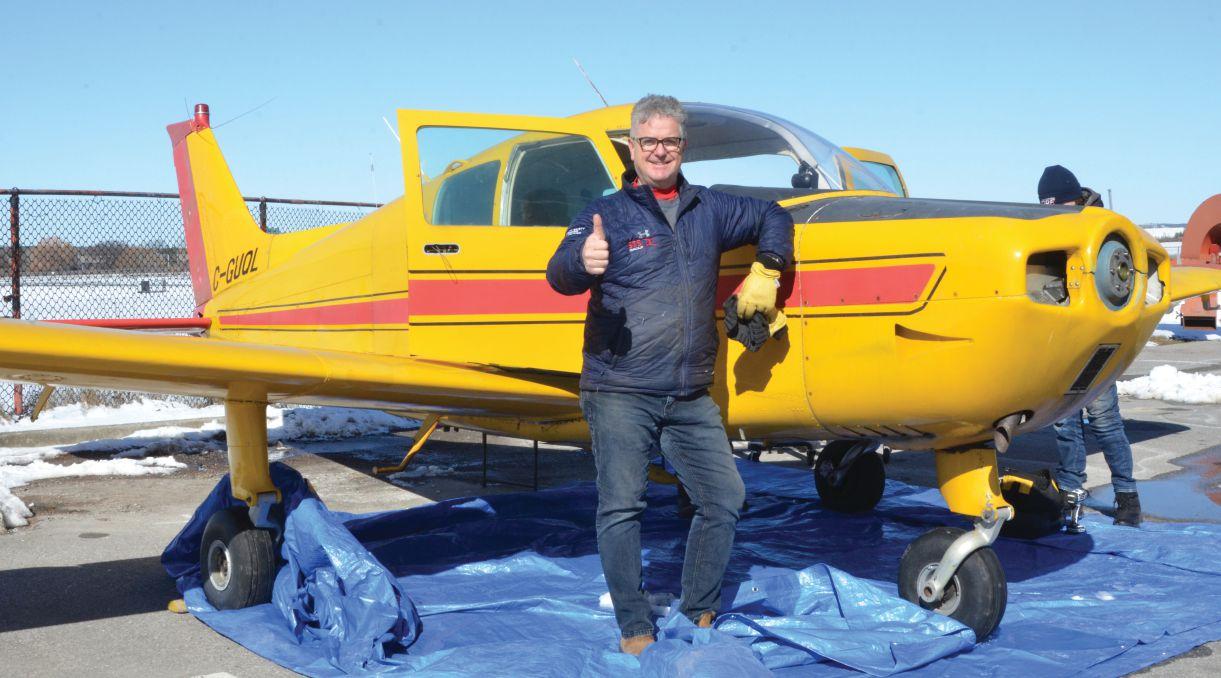
Day two of Nick Bertzis preparing his newly acquired Beechcraft Musketeer to be trailered from Buttonville to Kawartha Lakes Municipal Airport.
into a parking lot. The logistics of this effort were not for the faint of heart. It included negotiations with the airport owner regarding the amount of liability insurance required to facilitate the aircraft’s move off the property. Bartzis’ dream was to move the aircraft to the Kawartha Lakes Municipal Airport (CNF4) and, in conjunction with Canadian Flyers, bring the aircraft back to an airworthy state with the goal of using the aircraft for IFR flight training.
Bartzis’ vision to refurbish the B19 included: new paint; new interior; new avionics; new glass panel; engine removal and inspection; propeller balancing; overhauling or replacing any time sensitive components; and ensuring that all components were airworthy. Essentially turning the aircraft into a 1976 brand new aircraft. Bartzis’ back of the napkin budget to accomplish the transformation of the aircraft could easily surpass $180,000.
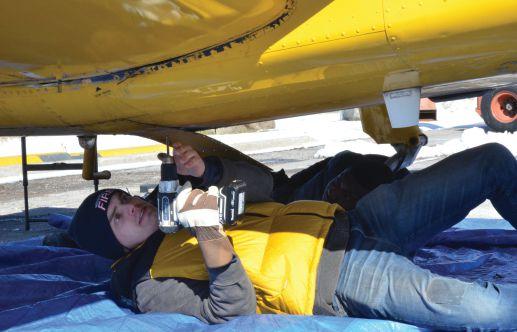
Removing the aircraft from the airport and parking lot was a herculean effort. On March 22, 2024, the aircraft’s flattened tires were filled with air (interestingly, they held air) and it was pulled across the ramp and down the taxiway to an awaiting crane. The aircraft was placed onto a slung and gingerly lifted by the crane. Bartzis reports that the crane rental was approximately $1,000 for the day. Once the Beech was off the airport property and in the parking lot, Matthew Meck began preparing the aircraft for the work to be conducted on the weekend.
On Sunday morning, 11 people gathered to help with preparing the aircraft to be loaded onto a truck, for transportation to CNF4. As it turns out, the Beech is built like a Sherman Tank. After 32 person-hours of labour, the two wings were separated from the aircraft. Another 10 hours of labour was required to remove the horizontal stabilizer and elevator. This was required to fit the fuselage into the truck. Supplemental Type Certificate approved tires were used to support the fuselage while it was in the parking lot. With a lot of tools, ingenuity and muscle energy, the aircraft was moved into the truck shortly after 6:00 pm and began its two-hour journey to CNF4. The team drove to CNF4, following the truck, to remove the aircraft and place it in its temporary location at its new home in Lindsay. Certainly, a very long day for those participating in saving the Beech.
One issue that Bartzis faced was the lack of the Journey Log and the Technical Logs. He was approached by individuals claiming to have access to the logs, but the logs never materialized. After a sober look at the costs and risk of bringing a logbook-less certified aircraft back to flying status, the economic risk was too great. Once in Lindsay, Bartzis removed the cowls and with a sober look at the engine compartment, fuselage and wings determined that there were more issues with the aircraft than originally expected.
Earlier in the process, Bartzis was approached by a salvage broker and their conversation concluded with Bartzis selling the
aircraft. The salvage broker then trailered it back into the Greater Toronto Area to Oshawa Executive Airport (CYOO). Allegedly the aircraft has been sold to an American buyer.
“It would have taken at least two years to bring the aircraft back to flying condition,” says Bartzis. “I would have two years of costs but no fun of flight. I believe that this aircraft project is more suitable to an AME who has the time and resources to bring the aircraft back to flying condition with an economic model that makes sense. I have re-vectored my dream and I’m now pursuing an amphibious aircraft.” The point by Bartzis is that you need to understand your mission and financial resources before jumping into aircraft ownership.
Sadly, Bartzis was not able to realize his dream of bringing the Beach back to flying condition, but perhaps the next carekeeper will realize the dream and bring this aircraft back to flying condition.
As of April 2024, the Buttonville airport property has yet to see any re-development activities. While the runways are closed (XXX), the terminal building, hangars and NAV Canada control tower still stand. With more than 250 aircraft displaced from CYKZ, business operators, aircraft owners and transient aircraft have moved on. With the experiences and memories of operating in and out of Buttonville becoming a distant memory, but not entirely lost.
On March 25, 2024, with Bombardier leaving for a new facility at Pearson (CYYZ), Toronto Downsview (CYZD) has also been closed in the area. The closure of historic airports like Downsview and Buttonville sends a clear message about the importance of aviation infrastructure to municipal, provincial and federal governments.
“Of the 10 original airports first built in Toronto, only two survive,” reports Ken Swartz of the Canadian Aviation Historical Association. With De Havilland Aircraft building a long series of iconic aircraft in Downsview, this national aviation historical site will soon be lost to developer’s bulldozers for all of time. | W
Matthew Meck removing countless screws, nuts, bolts and access panels to prepare the Musketeer for wing removal in a parking lot adjacent to Buttonville.
The aircraft market insider
Levaero Aviation supporting your mission
By David Carr
Buying a private airplane is one of the most significant investments a customer will make. In a buyer-beware environment, the best market intelligence and guidance will pay dividends over the long run. Levaero Aviation is a leader in the Canadian corporate aviation market.
The process of purchasing a corporate aircraft is more complex than the purchase of other big-ticket items such as a house. Even then, most buyers would not consider entering the market without the advice of a professional and experienced real estate broker. Buying an aircraft is no different.
“First and foremost, buying an airplane is an investment into your business or personal life, affording you more effective use of your time,” says Stan Kuliavas, Vice President of Sales and Business Development at Levaero Aviation, one of Canada’s largest aircraft brokerages with 26 years of experience buying and selling aircraft around the world. “It requires the same meticulous, strategic approach that goes into making any capital investment.”
Kuliavas says, that even for the most hardened decision maker, there is an emo -
tional aspect to acquiring an aircraft and much to take into consideration. Doing online research early in the process can help, but only to a point. Answers to difficult questions need a level of market expertise that the internet will not provide. “Often, a potential customer doesn’t yet know what they don’t know, especially first-time buyers,” he adds.
There are basic steps to purchasing a corporate aircraft, including: 1) Understanding your travel needs and establishing a budget; 2) Sourcing various aircraft make and model options, with early due diligence on those aircraft; 3) Submitting an offer, along with negotiation of price and terms; and 4) A formal Aircraft Purchase Agreement, an in-depth inspection of the aircraft, and addressing legal and regulatory items.
This is just the tip of the iceberg. Below the surface sits a lengthy checklist of considerations specific to each situation. Get one wrong and the buyer could be locked into an expensive piece of machinery that is not fully fit for their purpose.
“It all comes down to the broker,” Kuliavas says. “Behind every professional broker is a team of experts that will locate
the right aircraft anywhere in the world, skilled negotiators who understand the market and will secure the best deal possible, and connections to a network of external professionals who will work through due diligence, regulatory filings and risk mitigation.”
Finding the right broker should be the first weighty decision for a buyer to make. But where to look? Accreditation is key, Kuliavas says: “This is an unregulated industry. The buyer needs to insure themselves by choosing a broker that is experienced, reputable, and adheres to the highest global standards.”
Levaero is one of an exclusive number of top brokers worldwide that is an accredited member of the prestigious International Aircraft Dealers Association (IADA), a self-regulating body made up of 17 per cent of the world’s brokers, who account for close to 50 per cent of all previously owned aircraft transactions. This provides Levaero’s customers full confidence they are dealing with a reputable broker that can access the widest range of listed and ‘offmarket’ aircraft options.
Beginning with the pandemic, the number of aircraft transactions occurring
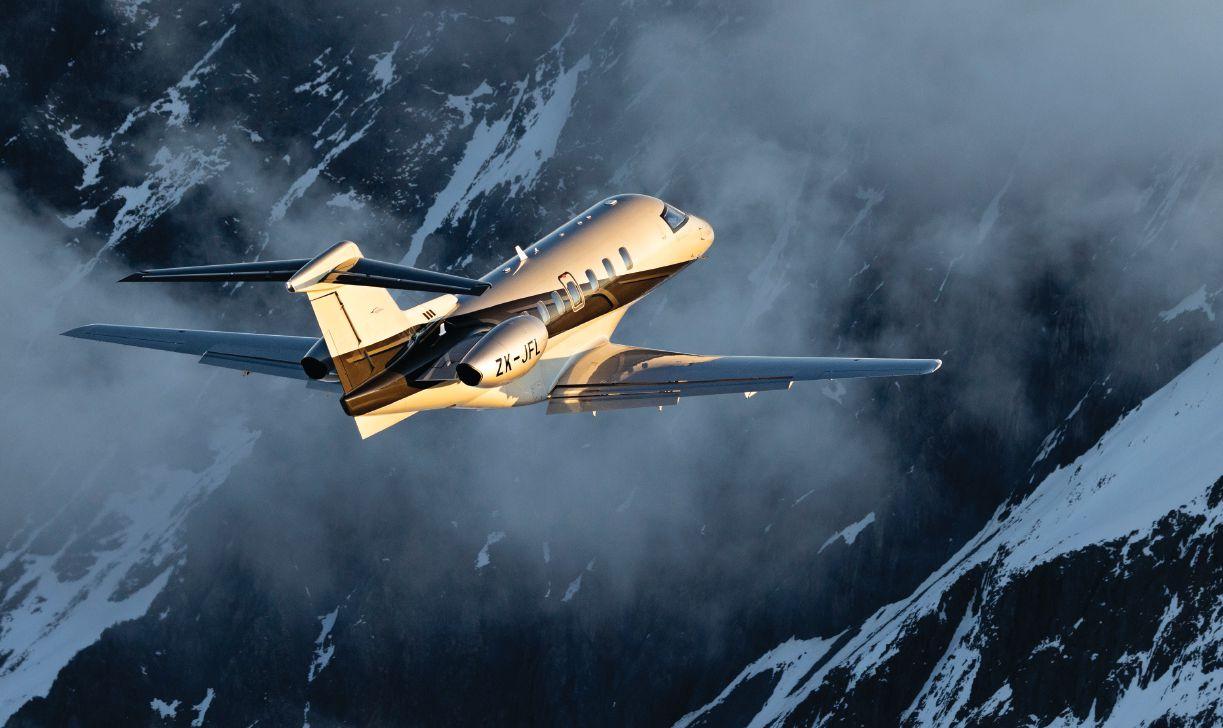
Soaring through Monument Valley, the Pilatus PC-12 NGX holds advanced avionics, cabin design, and the PT6 E-Series engine.
off-market increased significantly, meaning, that without the right broker, a customer may never know about their ideal aircraft option.
Travel needs and setting a budget
The versatile Pilatus PC-12 single-engine turboprop is one of the world’s mostpopular, entry-level aircraft. As the exclusive Pilatus dealer in Canada, Levaero holds a wealth of experience working with first-time customers.
“It doesn’t matter whether this is your first time, or if you are a seasoned buyer looking to upgrade your aircraft, the bottom line is that an aircraft is a tool,” Kuliavas says. “It will not only make your current travel more efficient, but it will allow you to access those destinations that have been put on the side burner because they are inconvenient to reach; or require multiple airline connections – potentially adding days to a trip. The right aircraft allows you to maximize the efficiency of your time.”
Sourcing the right airplane
In addition to its team of aircraft brokers boasting more than 75 years of combined aircraft acquisition and sales experience, Levaero has internal expert market analysts who actively track various
aircraft markets to understand not only what is listed and what is coming to market, but also to offer a unique understanding of market trends, pricing patterns, and opportunities not available elsewhere. In 2023, Levaero released Canada’s first-ever market intelligence report, focusing solely on the Canadian aviation market, including trends in aircraft ownership, detailed analysis of market activity and pricing trends. The 2024 edition of the market report was released in May.
Letter of intent
Once a selection of aircraft has been evaluated, and a preferred unit settled on, a Letter of Intent (LOI) is sent to the seller. This document sets out terms and conditions of a buyer’s offer, including arrangements for prepurchase inspection, among other items.
Price negotiation
“We live in a market where sellers are free to ask whatever they want for their aircraft. But that is all it is, an ask,” Kuliavas says, as a skilled aircraft negotiator of more than 18 years. “Our team works with proprietary real-time market data to understand comparable transactions, along with make and model trends, so that
our customers are armed with the information they need to make good-value purchase decisions.”
Aircraft purchase agreement and delivery
“The Aircraft Purchase Agreement (APA) is the document governing your aircraft transaction. It should always be reviewed by a lawyer with aviation expertise, as there can be legal nuances unique to aircraft transactions,” Kuliavas says. “An aviation escrow service is often used as a neutral third-party to handle the financial and documentation requirements. This is especially the case with cross-border transactions. We are sourcing aircraft from around the world, and that can bring with it various challenges.”
For a customer-focused broker like Levaero, the final step of aircraft acquisition is just the beginning of a long journey. “We always look at an aircraft purchase as part of a long-term relationship and not a one-off transaction,” Kuliavas says. “Throughout the course of their ownership, customers will have questions or may be looking for added support. We are here to help them navigate all aspects of aircraft ownership and we are big proponents in building long-term relationships.”
Pilatus extended the payload-range of its PC-24 Super Versatile Jet to 2,000 nautical miles (3,704 kilometres) with six passengers..
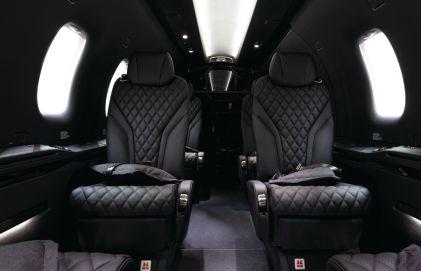
A cabin interior of the new Pilatus PC-12 NGX.
EMBRACING THE RCAF CENTENARY
CELEBRATING 100 YEARS OF MILITARY FLIGHT AND INFRASTRUCTURE
BY PHIL LIGHTSTONE
April 1, 2024, marked the 100th anniversary of the Royal Canadian Air Force.
The Centennial milestone allows the Royal Canadian Air Force (RCAF) to honour its distinct heritage, recognize its people and generate excitement for its bright future. This is an opportunity to fuel internal and external support in the RCAF that instills pride, while creating an enduring legacy that propels the institution forward into its next century of service.
Canada’s Air Force will be showcased in a past, present and future context throughout the year with a focus on highlighting contributions to national safety
and security, international peace and global stability. When formed in 1924 Canada’s Air Force had 62 permanent members.
The RCAF provides Canadians with air defence, maritime patrol, search and rescue, air mobility and sustainment, aerospace control and space capabilities to support operations at home and abroad. The RCAF provides security at home through NORAD and working with NATO allies and partners to maintain peace and stability across the globe.
The RCAF’s current fleet of 24 different aircraft types are split into various roles, including: Air demonstration; fighter; maritime aviation; search
and rescue; tactical aviation (helicopters); trainers; and transport.
“Less than a century ago, at the dawn of the aviation age, early, kite-like aircraft quickly developed into powerful, indispensable weapons,” wrote Hugh Halliday of the Canadian War Museum, as a backgrounder about Canadian military history. “The impetus was the First World War (1914-1918), which broke out only a decade after the first controlled flight by a powered machine. During that conflict an estimated 22,800 Canadians joined the British flying services. Some of them, like William Bishop, William Barker, and Raymond Collishaw, were among the top-scoring aces of the war and became household names.
“Ultimately, the government created a Canadian Air Force in 1920 as part of the peacetime
military establishment,” continued Halliday in his historic dispatch. “At first, members served on only a part-time basis but, by 1924, it had evolved into a small, permanent professional organization, the Royal Canadian Air Force (RCAF). The new RCAF trained sporadically for war, conducting exercises with warships and militia units, applying First World War tactics.
“The Armstrong-Whitworth Atlas army cooperation aircraft acquired in 1927, for example, was certainly more powerful than types developed in 19141918, but its crews practiced the same skills of artillery spotting and short-range reconnaissance that had been the essence of First World War air power,” continued Halliday. “Among their most common tasks was to take young militia officers up for short flights, to show them how readily ground troops could be
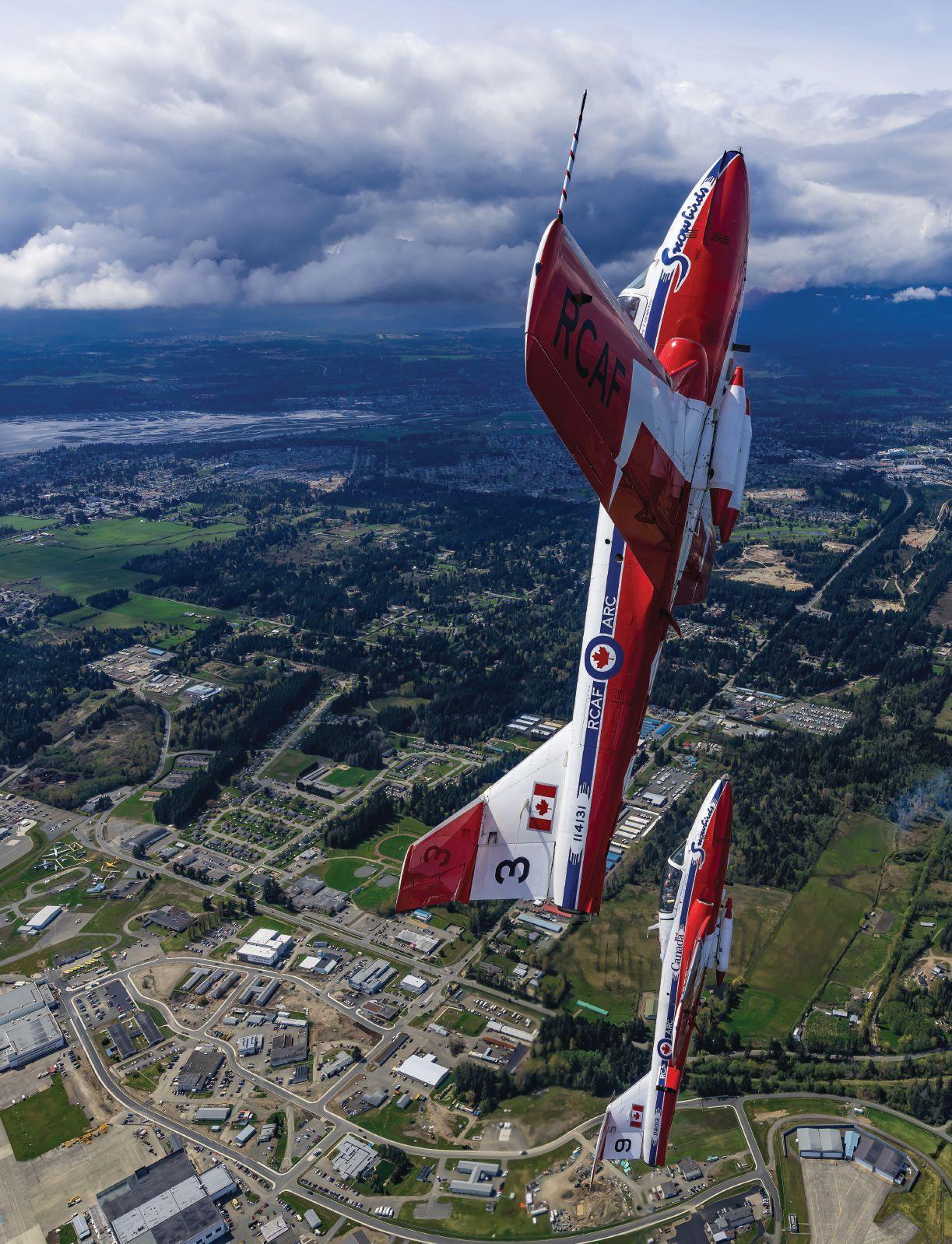
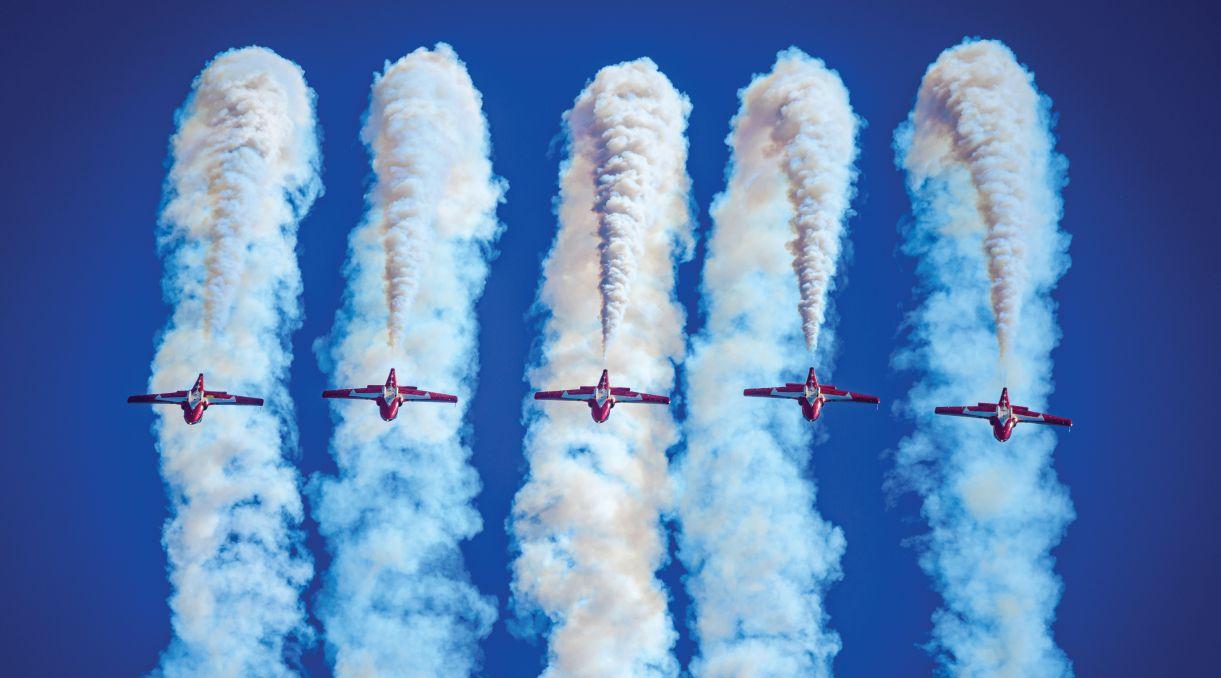
Five Royal Canadian Air Force CT-114 Tutors from The Snowbirds perform on August 13, 2023, in Abbotsford, British Columbia.
located from the air and to instill in them the need to camouflage their units from observation and attack.”
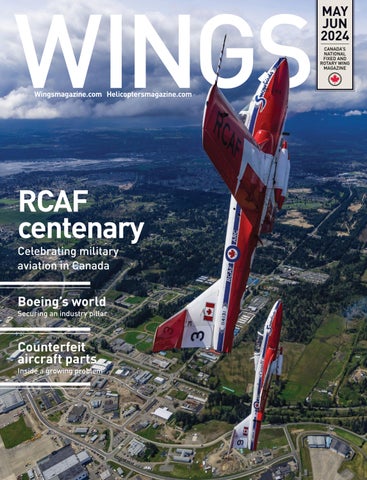
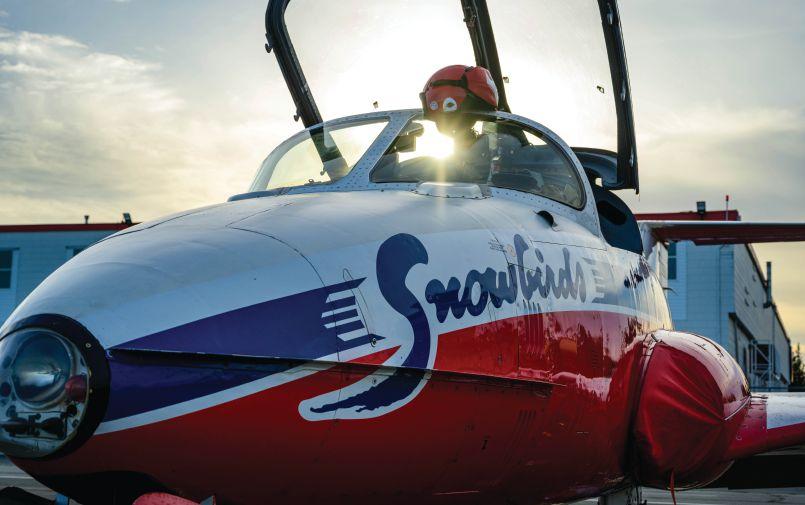
The tip of the sword from the public’s perspective is Canada’s Snowbirds, formed in 1971. The Snowbirds are part of 431 Air Demonstration Squadron and have become a Canadian icon. Pilots, technicians (aviation, avionics, aircraft structure and supply), mobile support operators, resource management support clerks, an engineering officer, a logistics officer and a public affairs officer representing all three elements (Army, Navy and Air Force), work as a team to bring thrilling performances to the Canadian public.
Serving as ambassadors of the Canadian Armed Forces (CAF), The Snowbirds demonstrate a high level of skill, professionalism, teamwork, discipline and dedication inherent in the men and women of the CAF.
The RCAF’s 431 Squadron has flown a variety of aircraft over the past 100 years, including: Vickers Wellington, HandleyPage Halifax, Avro Lancaster, Canadair (North American) F-86 Sabre,CF-18, and the CT-114 Tutor. You might be wondering how the team got its name. A Name the Team contest was held at the local base elementary school in June of 1971. Doug Farmer, a Grade 6 student was the winner. Farmer was able to join the team on a media ride at BC’s Abbotsford Airshow in 2000.
The RCAF has been working quite hard for the past four years with the creation of a small but mighty team, focusing on the centennial. Celebration events include: Gaming and e-sports; the RCAF run; air shows; RCAF centennial symposium; illuminations; trees of heroes; the RCAF Ball; eclipse Canada; and Winterlude to name a few. Checkout the RCAF’s Centennial event page for an up-to-date schedule (rcaf2024arc.ca/ events-landing).
The RCAF will be participating in a variety of municipal, provincial and federal events, including local air shows, aerospace museums and other events. The desire to contribute to the celebrations spread through the RCAF, with Sgt Mark Shum, an image technician in Ottawa, designing a poster recognizing the RCAF’s personnel in 2023. This unique aircraft mosaic features every aircraft silhouette to have been flown by the RCAF. The aircraft silhouettes are in formation to represent a maple leaf. Sgt Shum was not part of the Centennial team but felt compelled to create this unique peace of artwork.
Master Corporal Kevin Kelly, stationed in Bagotville, QB, created a design for the RCAF Centennial CF-18 Demo Jet Paint Scheme competition. His winning design
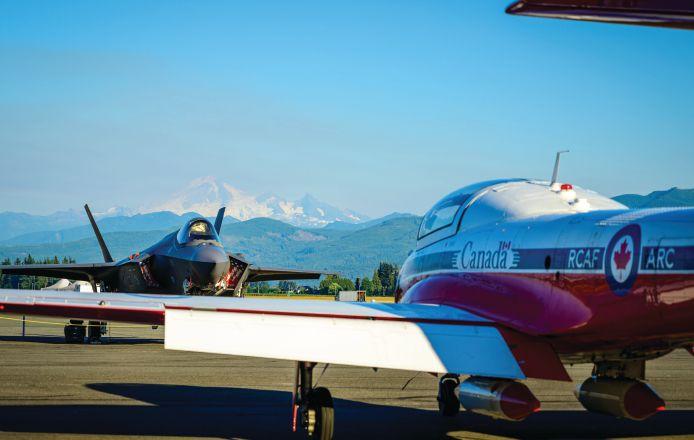
A United States Air Force Lockheed Martin F-35 Lightning II and RCAF CT-114 Tutor parked in Abbotsford.
Mechanics from 431 Squardron work on a CT-114 Tutor at the 2023 London Air Show.
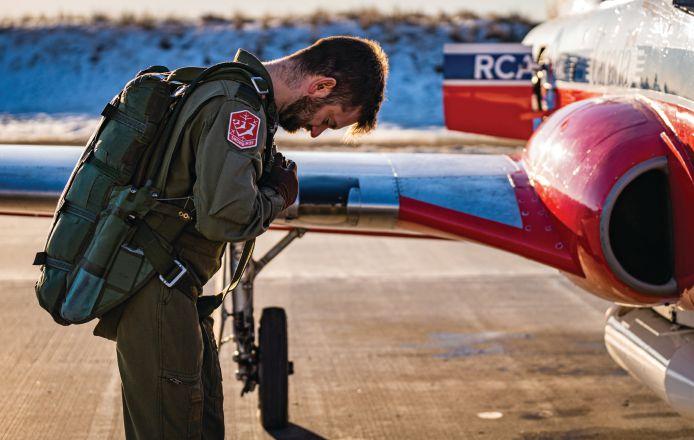
Preparing for flight at 15 Wing Moose Jaw, Saskatchewan, where The Snowbirds (431 Squardron) are based.
incorporates four themes: Air power, personnel, innovation and technology, and history and heritage. Air Power is depicted through highlighting the RCAF’s six mandates on the left V-Stab, symbolizing aerobatics, fighters, maritime aviation, search and rescue, tactical aircraft and transport. Each role is illustrated by the silhouette of a corresponding aircraft. Personnel are presented as silhouettes, a non-commissioned member, an officer, and a pilot are displayed allowing admirers to choose the gender and nationality of the person depicted so that everyone can identify within the RCAF.
Innovation and Technology is a central theme of the design and is represented in the top view image which includes a design that features gears, a binary pattern and electronic circuits, emphasizing the significance of these technologies for the operation of RCAF aircraft. The binary numbers indicate “RCAF 2024” and “ARC 2024”, an excellent design suggestion from Major Michael Kallio.
History and Heritage was designed with the assistance of RCAF Centennial Historian, Major Mathias Joost (Retired), with aircraft silhouettes on the right V-Stab including the Starfighter, Sabre, North Star and Lancaster.
businesses, cities and landmarks across the world were to be illuminated in Air Force Blue to celebrate the occasion. In commemoration of the women and men who have, and continue to, serve Canada both at home and abroad, and in recognition of the positive impact that the RCAF has had worldwide, the RCAF invited Canadians to join in by illuminating their residence, place of work, or elsewhere in blue to show support. People were asked to share a picture on social media using the hashtags #RCAF100 and #100YearsOfFlyingBlue. One of the goals was to break a Guinness World Record for the most landmarks illuminated within 24 hours. The RCAF is currently in the process of validating its record attempt.
Colonel Maggie Jacula, RCAF 2024 Campaign Manager, was dedicated to managing the RCAF’s Centennial activities for the past three and one half years with a team consisting of nine staff inclusive of the RCAF’s Canadian Moral and Welfare Services.
“Our team, while small is mighty, planning, supporting and delivering a variety of activities mission critical to the build-up to April 1, 2024, and the celebrations taking place during the reset of the year,” Colonel Jacula reports. “We really want people to know about the proud history of the RCAF,
Reach your Aviation Goals
Learn from the Experts
For over 35 years, AeroCourse has been a leader in advanced aviation training in Canada. We provide advanced aviation training and develop and publish manuals and workbooks both hard copy and digital to assist pilots gain the knowledge they require for their IFR and ATPL. We offer IFR and ATPL seminars, IFR online courses, and hold specific advanced aviation courses inconjunction with airlines, colleges and flight schools. Our instructors are professional pilots and flight examiners with thousands of hours experience. We pride ourselves on high quality materials and training.
The skills, dedication and expertice of our instructors set them apart. They have an incredible knowledge base and have broad expeience, flying for Canada’s top airlines. They are dynamic and enthusiastic. Having exceptional instructors, ensures a productive learning environment and contributes to our student’s success
involved in air and space in Canada. A lot of times when you think of the Air Force, you think of airplanes and pilots. Without a doubt, airplanes and pilots are very important to the Air Force, but in order to achieve our missions, there are so many other trades that are involved.”
The team is collaborating with Canadian Geographic to help produce a documentary, entitled Wings of Honour, highlighting 100 years of Canadian flight, including interviews with Major Dee Brasseur, one of Canada’s first female fighter pilots (Jane Foster was the other). The documentary will air on CPAC on July 1, 2024. The partnership with Canadian Geographic began in 2021, by leveraging existing RCAF events.
Currently the RCAF has: 11,668 men and women serving in the Regular Force; 2,004 Reserve Force members; 15 wings; 38 flying squadrons; and 23 non-flying squadrons. The number of pilots and aircrew is on a need-to-know basis. It’s a bit challenging to document who has the most hours in the air. However, Major Bruno Paulhus, as a navigator, has flown 9,625 hours on the CC-130, anecdotally there are aircrews with 10,000 hours. It is important to note that fighter and rotary-wing aircraft hours will be lower than medium-heavy transport and maritime patrol aircraft.
CANADA’S TOP FBO SURVEY NOW OPEN
Vote for your favourite Fixed Base Operator in the 2024 edition of Canada’s Top FBO program. Voting in the annual survey program continues until July 10, 2024. The survey results also provide the program with the Top Three FBOs by region and the country’s Rising Star, recognizing one operation that received the highest number of votes, year over year, among all others. The survey also asks questions to discover what FBO and aircraft attributes matter most customers.
vote today
REBUILDING AN AVIATION INSTITUTION
HOW BOEING IS MOVING FORWARD TO HOLD ITS POSITION IN THE WORLD OF COMMERCIAL AIRLINES
BY DAVID CARR
The sun is setting on Dave Calhoun’s time as chief executive at Boeing. After years of trying to shift the culture at Boeing and restore its reputation as a world beating engineering firm, Calhoun announced he would be stepping down in January as part of a larger management shakeup. He is in favour of an internal
succession. But whoever is hired, the todo list is long and challenging, perhaps most notably including the launch of a new airplane and restoring confidence in the brand.
For Boeing, however, the hits keep coming. A second whistleblower, a Boeing engineer, has cast doubt on the structural integrity of Boeing 777 and 787 jets. Boeing
was swift to push back. David Koenig of The Associated Press reported how two Boeing engineering executives went into detail to describe how panels are fitted together, particularly on the 787 Dreamliner, suggesting the 787’s carbon-composite skin is nearly impervious to metal fatigue that weakens conventional aluminum fuselages.
The 787 has been tested through 165,000 flight cycles with no signs of composite airframe fatigue. There are 1,100 Boeing 787s operating globally since the airplane entered service in 2012. The most worked 787 in service has accumulated 16,500 flight cycles over 12 years.
But frustration with Boeing has boiled over since the Alaska Airlines incident in January, where four missing bolts caused a panel door to blow out from the fuselage. Since then, Boeing has been under the microscope, including investigations by the Federal Aviation Administration (FAA) and U.S. Congress, and angered airline executives saying the quiet bits out loud.
On April 24, Boeing reported its first quarter results highlighted by news it lost US$355 million on falling revenue, which
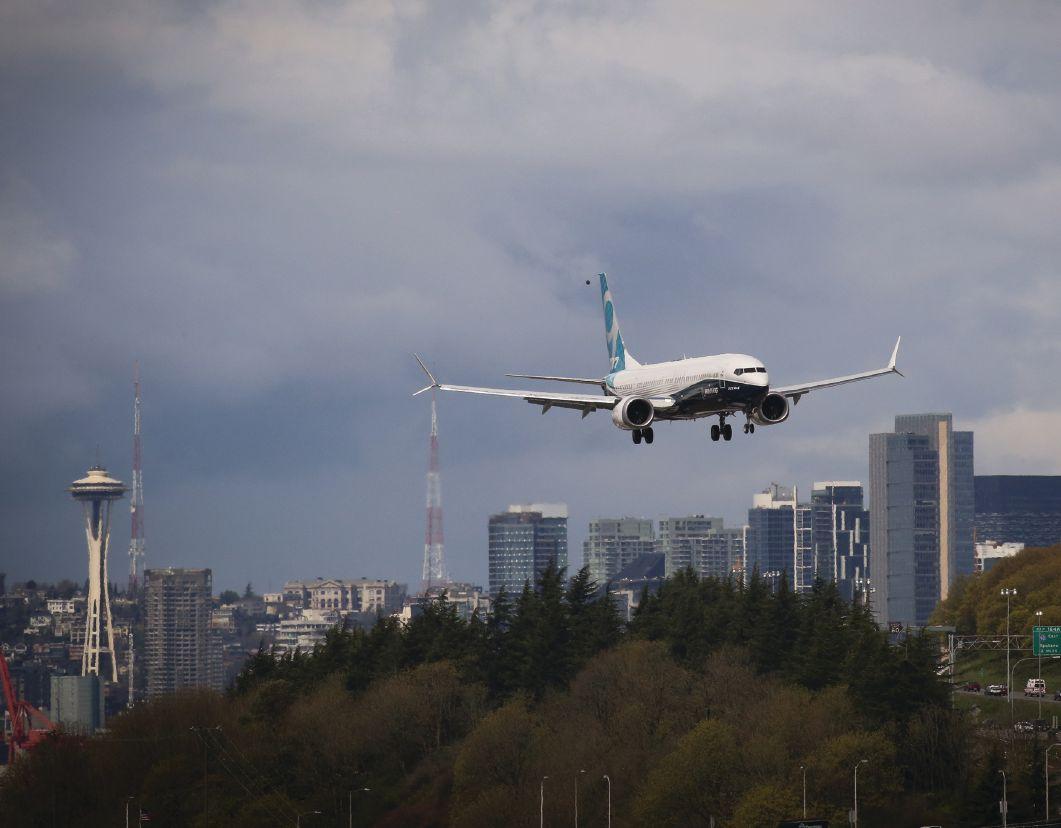
The Boeing 737 MAX 9 completed its first flight on April 13, 2017, in the skies above Puget Sound. The plane on its maiden flight is seen here landing in Seattle.
PHOTO:
promoted Calhoun to note the company is focused on fixing manufacturing issues, not the financial results. Koenig referred to a memo from Calhoun to employees: “Although we report firstquarter financial results today, our focus remains on the sweeping actions we are taking following the Alaska Airlines Flight 1282 accident,” Calhoun told employees in a memo Wednesday.
Meanwhile, the clock ticks down on the 90-days the FAA gave Boeing at the end of February to address “systemic quality control issues”. The regulator has also limited 737 production to 38 aircraft a month. Boeing has slowed production further as it focuses on quality, sapping cash flow and forcing stretched airlines to cancel routes, reduce frequencies and, in limited cases, pull out of markets altogether.
In the first quarter earnings call, which many analysts felt was better than expected, despite the revenue loss, Boeing did not expect 737 MAX production to stabilize before the third quarter.
2024 A ward
To be awarded at ATAC'S 90th Canadian Aviation Conference and Tradeshow Vancouver - Nov. 5 to Nov. 7, 2024
e Award recognizes and honours a ight instructor, either xed or rotary wing, who has made a signi cant contribution to safety in Canada, also having demonstrated superior teaching skills.
Jane & Rikki Abramson established this Award in 2003 through Air Transport Association of Canada, and will personally present this year’s award. e recipient’s name will be engraved on the prestigious perpetual trophy and entered in the associated logbook, both on permanent display in the Canada Aviation & Space Museum in Ottawa.
e Award is Generously Sponsored By:
DCAM
Nominations can be made at any time throughout the year, prior to the deadline of September 14th, 2024
For entry requirements contact Jane Abramson, Founder & National Administrator
Email:
janeabramson@videotron.ca
www.dcamaward.com
The company believes that its 787 production, which has been plagued by the same supplier issues that have impacted Airbus, will return to five aircraft per month later this year and that Boeing will have “largely delivered” its inventory of 737 and 787 jets by the end of the year, which will be a welcome boost to cash flow. Boeing financial results exceeded analysts expectations, but the earnings report has also highlighted a widening gulf with rival Airbus.
In January, United Airlines chief executive Scott Kirby sent shock waves across Boeing, describing the grounding of the 737 Max 9 as the “straw that broke the camel’s back.” A three-week grounding of the Max 9 cost United, the largest operators of the type, US$200 million. Stan Deal, CEO of Boeing’s commercial airplanes division, apologized for the Max 9 grounding in a statement: “We have let down our airline customers and are deeply sorry for the significant disruption to them, their employees and their passengers. We are taking action on a comprehensive plan to bring these airplanes safely back to service and to improve our quality and delivery performance.”
Kirby also announced that United Airlines has removed the long-delayed Max 10 out of its 2025 planning cycle. (The 737 Max 7, the smallest airplane in the Max family is also in certification limbo due to de-icing issues.)
The Max 10, which has also been ordered by WestJet, is the largest variant in the 737 Max family. The aircraft, which was expected to enter service with United in 2020 will likely not be certified before 2025. United has stabilized fleet deliveries between 2025 by converting some of its Max 10 order to the smaller Max 9, and will lease 35 Airbus A321neos.
The aircraft manufacturing duopoly between Boeing and Airbus and full order books for narrowbody jets gives the new chief executive of Boeing time to manoeuvre. Airlines have no place else to go. But a strategy based on Airbus-can’t-build-airplanesfast-enough is not sustainable. There were reports Airbus was searching for delivery slots to support a United order should the airline cancel the Max 10 outright. That appears less likely. United has an option to restore Max 9 orders to the Max 10 once the variant is certified.
It is clear that Boeing needs to get a jump on Airbus by introducing a new mid-market airplane sooner rather than later. Speculation is on a 250-seat replacement for an ageing global fleet of 757, 767 and A310 airplanes. This addition would provide Boeing with a direct competitor to the Airbus A321neo, which has been outselling the Max 10 at a ratio of about five to one.
Calhoun has pegged the cost of a new airliner program at US$50 billion, while industry watchers have put the price tag closer to US$30 billion. Of course, this is still an eye-watering amount for a cash-strapped company with production and certification problems. Boeing is also in talks to re-acquire and integrate its
PHOTO: BOEING
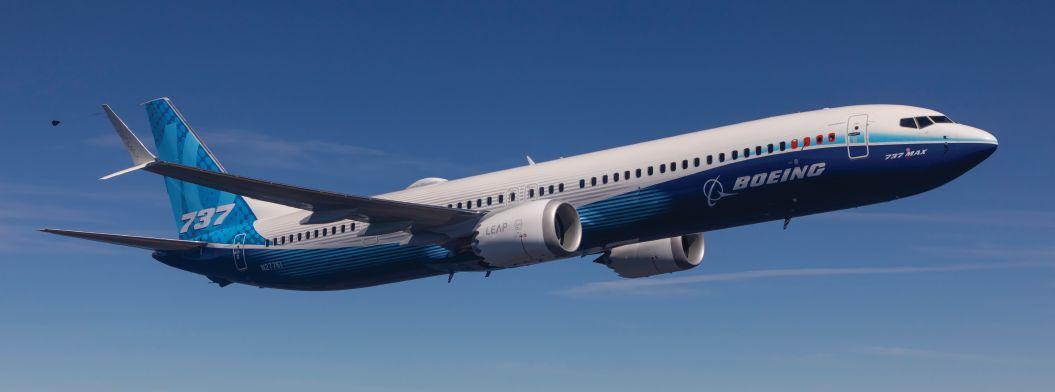
The 737-10, the largest member of the 737 Max family, aims to provide operators with more capacity and the best per-seat economics of any single-aisle airplane.
To Take Flight
The Bombardier Centre for Aerospace and Aviation at Downsview Campus is a dedicated training ground for aerospace and aviation mechanics. With focused courses, cutting-edge equipment and industry professionals guiding our programs, your aircraft are always in good hands with a Centennial College graduate.
troubled supplier, Wichita-based Spirit AeroSystems, which it spun off in 2005. A deal is expected to be reached in Q2.
It has been reported that Boeing will need free cash flow of at least US$10 billion a year, a target it does not expect to reach until 2025 or 2026 at the earliest and will require production of 50 737s and 10 787s a month.
There are also concerns that if launched
too early, the new airplane will eat into 737 sales, especially for the Max 10, or whether Boeing, which has not launched a new airplane since the 787 in 2004 has the engineering and institutional knowledge to bring a clean-sheet design to market. It is one of the reasons why some in the industry are calling for the next chief executive to have a background in engineering. Enter Japan? Despite the setback of the
Mitsubishi SpaceJet regional airliner, the Japanese government intends to break out of its role as tier one suppliers for programs such as the 777 and 787, a build a home-grown airliner for the growing narrowbody. In March, the Japanese Aircraft Development Corporation (JADC) announced plans to collaborate with the private sector on a next-generation passenger aircraft, which would enter service around 2035.
The US$27 billion project will study new propulsion technologies such as hydrogen fueled engines, which are unlikely to be available by the time Boeing needs to launch a mid-market jet, but it will certainly be incorporated into a future 737 replacement. It is an ambitious strategy, and Japan plans to lean heavily on the missteps made in the development of the SpaceJet.
Still, a more incremental approach might be called for. Japan is open to a partnership with a foreign manufacturer; and Boeing was reported to have been working with JADC on the original midmarket airplane.
Japan is not the only country Boeing and Airbus will have to keep an eye on. China’s COMAC C919 narrowbody jet was on display at the recent Singapore Air Show, whereas any version of the Max was notably absent. Commercial aviation is a long game. The C919 and its heavy reliance on western technologies, including engines and avionics, is not in the same arena as the A320 and Max family.
But China is further along than Airbus was 55 years at the 1969 edition of the Paris Air Show, where the pan-European manufacturer was dismissed as another European state vanity project. China will have not poured US$78 billion to build a domestic airliner industry and stop at a first generation C919.
Under new management, 2025 should be a watershed year for Boeing, as deliveries of the Max and 787 ramp up, and much needed cash starts to flow back to the manufacturer. A highlight for the year will be first deliveries of the 777-9, the first and largest of the 777x family of new generation widebody jets, although there is already speculation that the date might be pushed back to early 2026.
The 777 is seen as a long-haul game changer, identifiable by its cutting-edge, all-composite wing that features folding wing tips that enable improved efficiency in the air and a shorter wing span at airports on the ground. Boeing has orders for 435 of the 777x, including 205 from launch customer Emirates. After years of playing catch up, Boeing may finally be able to look forward. | W
The Boeing 777X is the latest series of the long-range, wide-body, twin-engine jetliners in the 777 family. Its introduction is planned for 2025, but analysts speculate it could be pushed to 2026.
Vision
Mission
Notre
Notre
COUNTERFEIT AIRCRAFT PARTS
EFFORTS RAMP UP TO GAIN CONTROL OF A GROWING PROBLEM IN AVIATION
BY PHIL LIGHTSTONE
The implications of installing counterfeit aircraft parts onto aircraft could be life threatening. Sadly, unscrupulous bad actors, motivated by greed, are willing to do unscrupulous things while chasing high-margin dollars. The problem has many elements: Counterfeit parts, like buying a Rolex knockoff watch for pennies on the dollar; forged paperwork (like Form 8130-3); used components purported to be new; Original Equipment Manufacturer (OEM) components installed without Federal Aviation Administration (FAA) paperwork; and used OEM parts returned to the OEM under warranty, but in fact are no longer under warranty.
The most high-profile accident involving fake parts occurred on Sept. 8, 1989, when Partnair Flight 394 carrying 55 people from Oslo to Hamburg crashed into the sea. Investigators determined that three counterfeit bolts and sleeves where installed, which were incorrectly heat-treated during their manufacturing. The bolts caused the tail section of the Convair CV-580 turboprop to vibrate violently and eventually tear loose, causing the vertical fin and fuselage to separate. The counterfeit bolts and sleeves had excessive wear, causing the tail to vibrate for the previous 16 flights and the accident flight. An outcome of the tragedy was the U.S. introducing reforms in the aviation parts industry and more aggressively pursuing prosecutions leading to over 150 criminal convictions and US$47 million in restitutions and fines.
The aviation industry relies on the honesty and trust of the supply chain participants. However, the adage of Trust but Verify ensures that discrepancies caused by bad actors are caught before the parts or components are installed on an airframe. Since 2010, major OEMs have seen that some bad actors have used rotable parts repair and overhaul facilities to launder suspect parts. OEMs and the FAA have been working together to deal with these challenges both from a regulatory and enforcement perspective. Embargoed countries have forced Russian airlines to find spare parts on the black market or from grounded aircraft.
Based on analysis of customs records, Reuters reported: “All told, at least US$1.2 billion worth of aircraft parts flowed to Russian airlines from May last year – when most U.S. and European trade curbs and export bans over Ukraine were in force – to the end of June this year (2023).” With OEMs and the FAA cooperating, some supply company’s business licenses have been revoked.
Transport Canada (TC), FAA and European Union Aviation Safety Agency (EASA) are all aware of this problem, with bad actors using different schemes to cheat the system. The FAA has setup a Suspected Unapproved Parts (SUP) program and website (faa.gov/aircraft/ safety/programs/sups), which has been tracking SUP since 1996 and is using FAA Form 8120-11.
In 2002, TC issued alert AL2002—01, advising all owners, operators, maintenance shops and parts distributors of the possibility
of agencies trafficking in unapproved parts. TC had received information from the Italian Civil Aviation Authority, Ente Nazionale per l'Aviazione (ENAC), that Panaviation s.r.l., an unapproved organization based in Rome, has supplied aeronautical parts worldwide, that may have been altered and/ or with their history misrepresented. ENAC has advised TC that any part originating with Panaviation should be considered unairworthy. Canadian Aviation Regulations (CARs) require that aeronautical products conform to their design standard, have proper certification, and be in a safe condition for use.
TC strongly recommends that the Canadian aviation community should inspect their aircraft records, parts receiving records and/or parts inventories to determine if parts originated from Panaviation have been received or installed. TC advises that it has been reported that Panaviation is commercially linked with other unapproved organizations distributing parts from Italy, allegedly New Tech Italia and New Tech Aerospace. If any parts linked to these organizations are found installed on an aircraft, appropriate action should be taken in relation to the safety implications associated to their operation. If these parts are found in existing parts inventories, TC recommends
that they be quarantined until a determination can be made regarding their eligibility for installation. TC advises that these parts have been sold by Panaviation to various entities in the United States and Europe.
EASA encourages the reporting of any information concerning discovery of subject parts. EASA was tasked with the establishment of a mandatory reporting system, based upon Article 4(4) of regulation 376/2014 of the European Parliament. Regulation 2015/1018 requires that “the use of products, components or materials, from unknown, suspect origin, or unserviceable critical components (SUP)” must be reported.
A reported SUP case may not be resolved by EASA and the National Aviation Authorities mainly due to the lack of required information: a SUP with an allegedly forged EASA Form 1 comes from a non-EU maintenance organization, supplier or distributor and it is difficult to obtain feedback from the local aviation safety authority; the origin of the SUP is impossible to determine; an allegedly forged EASA Form 1 has been sent to a potential buyer of a part (not in the supply chain yet) for pre-assessment, indicating that an SUP case might exist for the concerned part; and a part was unlawfully removed, e.g. from a maintenance
facility, and it can be expected that it will appear on the market with forged documentation or untraceable history.
The goal of SUP information provided by operators and repair stations to EASA’s reporting website is to raise awareness within the European aviation industry of SUPs which they might encounter. In addition to mandatory reporting required under local airworthiness regulations, EASA requests that operators report direct via the ECCAIRS reporting portal (e2.aviationreporting.eu/reporting).
As an example, EASA has become aware of an unapproved part with a forged FAA Form 8130-3.
An Italian approved maintenance organization received from a supplier a new DUKES Pump Fuel Booster with P/N 4140-00-17 (P/N CESSNA C291504-0101) and the related authorized release certificate FAA Form 8130-3 with Form Tracking Number 1534369 dated 20-Apr-2018. The FAA-approved aircraft manufacturer, that supposedly had issued the authorized release certificate, has confirmed that the FAA Form 8130-3 certificate provided with this part is not an authentic document.
Bloomberg’s investigative journalists have been reporting on a case starting in the spring of 2023, when engineers at TAP
Presented by
Air Portugal’s maintenance subsidiary found a replaced damper with signs of wear in a CFM56 turbine engine. The paperwork had identified the part as new from Safran SA, the manufacturer of the engine. Safran determined that the paperwork had been forged. The signature was not of a Safran employee and the purchase order numbers were not in their system. Since October 2023, Safran and General Electric have found more than 90 other certificates that have been falsified, with fake parts found in 126 engines.
These parts are linked to a London UK distributor, AOG Technics Ltd. While engineers are trained to spot components of dubious origin, “it’s always shocking when we have one in front of our eyes,” a person familiar with the revelation, who asked not to be identified, told Bloomberg, as shared in its report entitled Ghost in the Machine. “In some cases, AOG allegedly sold refurbished used parts with paperwork claiming they were brand-new, potentially netting huge profits in the process. And the company may have done so by exploiting what critics say is a decades-old blind spot in the aviation regulatory system” reported Bloomberg. GE and Safran are litigating AOG in a London UK court. The CFM International engine-making partners have sought a court order for the documents relating to every single sale of products. AOG produced the records on October 4,2023, providing CFM new potential leads. EASA said that it has no regulatory power to investigate AOG as suppliers are not regulated.
EASA has implemented a system to track and report on counterfeit aircraft parts, with accompanying forged documentation. Aircraft owners, operators, maintenance organizations and distributors are requested to inspect their records to determine whether aircraft or engine parts have been obtained from AOG Technics, either directly or indirectly. For each part obtained, contact the approved organization identified on the Authorized Release Certificate or ARC (e.g. FAA 8130-3 or EASA Form 1) to
verify the origin of the certificate. If the approved organization attests that the ARC did not originate from their organization, then any affected parts should be quarantined to prevent installation until a determination can be made regarding their eligibility for installation. If a part with a falsified, ARC is already installed, then it is recommended that the part be replaced with an approved part.
The FAA will issue Unapproved Parts Notification circulars (UPN) which can be found at faa.gov/aircraft/safety/programs/sups/upn.
The latest UPN number 2024-AAE-EHL-20230608-303 documents “Articles manufactured and/or distributed by Southern Aero, LLC, for installation on Franklin Aircraft Engines, articles such as cylinder liners, valve springs, piston rings, hardware for cylinders and overhaul gasket kits. Information discovered during an FAA Suspected Unapproved Parts (SUP) investigation revealed that between June 2010 and present, Southern Aero, LLC, produced and sold numerous articles for installation on Franklin Aircraft Engines without the approval and authorization of the FAA and FAA design holder.”
The FAA UPN further states: “FAA regulations require that typecertificated products conform to their type design. The FAA encourages aircraft owners, operators, manufacturers, maintenance organizations, and parts suppliers and distributors to inspect their aircraft and/or aircraft parts inventory for any articles produced and/or sold by Southern Aero, LLC. If these articles are found in existing inventory or installed in an FAA type-certificated aircraft, the FAA recommends that they be quarantined to prevent installation or use until a determination can be made regarding their eligibility for installation or replaced with FAA-approved articles.”
In a general aviation (GA) context, the problem of using uncertified aircraft parts and components takes on a different complexion. With some GA aircraft dating back to the 1940s, 50s and 60s, some parts are no longer manufactured and the OEM no longer in business. For owner operators who need a part which is deemed unobtainable, the owner working may choose to use an uncertified part. John Leggat, Vice President, Leggat Aviation Ltd, reports: “Some owners may choose to purchase undocumented aviation parts from sources like e-Bay or salvage yards.
APPLICANT MUST MEET THE FOLLOWING:
• A valid M1 or M2
faulty systems to determine a course of rectification
• Track and plan maintenance activities, and coordinate with Dispatch
• Maintain aircraft records using computerized tracking system
• Supervise junior engineers and apprentices, as required
• Ensure all paperwork for assigned tasks is complete and accurate before submitting
• Ensure all maintenance alerts and memos are read, understood and complied with
•
• Carry out the applicable elementary servicing release of an aircraft as authorized to do so by their individual Shop Certification Authority (SCA)
“Upon review, the two parts appear to be identical, however, without paperwork, understanding the history of the part (i.e. hours in service, when it was removed and the aircraft it was removed from) will be challenging and the part is not eligible for installation on a certified aircraft,” continued Leggat. “Should the part be installed, the owner bears the responsibility and the Certificate of Airworthiness for the aircraft is not valid. Realistically these aircraft should be moved to the owner-maintenance category, removing the responsibilities of airworthy certification for all.”
In the U.S., shady tree A&Ps have no regulatory obligation to use certified and traceable parts. The FARs 43.13-a and -b describe how an A&P will perform maintenance, alteration or preventative maintenance on an aircraft and does not specify the use of certified aircraft parts. FARs 43.13(c) discusses the obligations of air carriers operating under the provisions Part 121 or 135 and Part 129 operators. Mike Busch, CEO of Savvy Aviation Inc., reports: “A&Ps providing services may choose to only use certified parts to ensure that they are not carrying contingent liability, thereby pushing responsibility for the part to the supplier. An A&P can use an uncertified shop to create or repair a part, under their supervision, but again, the A&P will hold the liability, which is something they are usually not keen about.”
It is challenging to determine just how widespread is the contamination of aircraft with counterfeit parts and documentation. A determination of a counterfeit part may occur during routine maintenance when purported new parts are seen with excessive wear. This requires that the AMEs (or A&Ps) have eagle eyes and have been educated on this issue of counterfeit parts. With millions of parts in a modern jetliner, finding counterfeits is like finding a needle in a haystack. The outcome, however, can be obviously deadly. | W
NAVIGATING THE BUDGET LANDSCAPE: IMPACTS ON AVIATION
The aviation industry cringes when a new budget is tabled. Over the past twenty years we have come to expect a multitude of measures, including new fees and charges, and little or no support, or even reprieve, for the Canadian air transport industry.
Last year’s budget announced increases of 33% in the ATSC that just came into effect this May 1. This went largely uncommented as it was old news. Smuggled on the back pages of the 2023 Budget Implementation Act was an amendment to the Passenger Protection Law which did not undergo valid consultation before being legislated. The result is that the CTA is now stuck with a legislative framework that was not thoughtfully drafted and void of sound knowledge or real concern as to its impact on the air transport industry and the cost of flying in Canada. Serious issues that require knowledgeable consideration and stakeholder consultation shouldn’t be dealt with through omnibus budget implementation acts as they are too often overlooked or cast aside in the rush to get the budget passed.
Surprisingly, this year’s budget had some good news for the aviation community in that the government committed to “invest at least $500 million in biofuels production under its green infrastructure investment stream”. We praise that effort. We are encouraged by this initiative in that the Government seems to have heard ATAC’s and other aviation associations calling for concrete measures if SAF goals of 10% by 2030 and 100% by 2050 are to be met. Of course, details of how much of that $500 million will target Sustainable Aviation Fuel remains to be determined. The price of SAF must be commercially viable or subsidized if the Government expects air operators to use it.
We look forward to more specific information on SAF investments. What kind of incentives are being considered? Will the federal government introduce SAF incentives to stimulate production investment in Canada and to allow Canada’s biofuels industries to compete against the US. SAF incentives are a critical element of a robust and comprehensive sustainable aviation policy to be further developed jointly by government and industry. As uncertainty over future revenues from renewable fuels production remains a high barrier to investment, a revenue certainty mechanism has to be introduced to reassure investors for a defined period of time, to drive investment in SAF production in Canada and to provide a transparent way to close the price gap.
The budget implementation act will most likely contain
important additional information and, hopefully, no unpleasant surprises. Budget language and announcement are one thing, ensuing action and its timing can be quite another.
The budget announcement is an encouraging start, but it is a modest first step considering the many urgent needs of our industry. Serious investments must be made to support the northern airport infrastructure, something that has been demanded for decades. Government investment is necessary as the user-pay model policy applied to this country’s aviation is not a viable option in the north with its sparse population, large land mass and unforgiving weather conditions. In the north and remote regions economic development and connectivity to Canada depend on weather reporting, published approaches, appropriate runway surfaces, including resurfacing, lighting and fencing. These essential infrastructure elements are often deficient in our northern and remote areas and will affect essential service levels.
The skilled labour shortage is at a crisis level in this country. Student visas and work permits for foreigners wishing to come to Canada for flight or AME training and possible employment need to be made available to help stem the skilled shortages in aviation. Our industry is heading towards major disruptions of air service if foreign aviation students are blocked or limited. Flight cancellations due to a shortage of maintenance personnel or flight crews are already everyday occurrences and will worsen. It is incomprehensible that blanket policies are applied across sectors without recognizing critical shortages.
Government loan guarantees for flight training, reasonable Air Passenger Protection regulations that don’t threaten the viability of regional air service, 5G radio frequency standards and necessary protections for aircraft operations that don’t threaten aviation safety in Canada, are major issues. The aviation industry demands immediate attention and action to avoid reaching a point where we will have to seriously cut air services to Canadians.
ATAC and its Members have been calling for governmentindustry collaboration to address these issues that make the air transport industry extremely vulnerable. The Transport Minister must champion our collective effort and rally other key departments to join in maintaining safe, world-leading and sustainable air transport services in Canada. ATAC and its Members have solutions to offer and are offering their full cooperation to the Government to address these major challenges.
John McKenna President and CEO
Air Transport Association of Canada
SEPTEMBER 7, 2024
Holiday Inn Burlington Hotel and Conference Centre
The one-day Canadian General Aviation Conference is designed to provide General Aviation pilots and aircraft owners, as well as flying enthusiasts and aspiring aviators, with access to leading suppliers and organizations of the sector, showcasing their newest technologies and services under one roof.
The Canadian government’s recent defence policy update, Our North: Strong and Free, was released in April with considerable fanfare. Promised for a year, the delay seemed to indicate the Liberal government’s budgetary pressures given the ballooning deficit. In the end, it was more heat than light and was less of an update to address a worsening international security environment than a simple restatement of traditional approaches to Canada’s defence. Announced by a joint team of the prime minister, deputy prime minister and both the defence and veterans affairs ministers – with a backdrop framed by Royal Canadian Air Force aircraft at CFB Trenton – the government went to considerable effort to portray this policy as a marked change in direction for Canada.
In particular, the update squarely focuses on Canada’s North. Previous policies – like Brian Mulroney’s 1987 white paper, Challenge and Commitment, and Stephen Harper’s 2008 Canada First Defence Strategy – had strong Arctic themes, but this one puts the emphasis right in the title. Within the Department of National Defence, hopes were high that the government might announce something major, perhaps even a commitment to replace the Navy’s four Victoria-class submarines.
Prime Minister Justin Trudeau’s admission last year that Canada would never meet its promised NATO commitment to spend two per cent of its GDP on defence has caused that pressure to intensify. Certainly, the numbers announced look impressive: $8.1 billion in the next five years and $73 billion over 20 years. However, even these figures are not enough to push Canada beyond 1.76 per cent, and then only by 2029/30.
Deputy Prime Minister Chrystia Freeland’s remarks during the official release of the policy were especially noteworthy given her statement in 2017, as minister of global affairs, when she announced to Parliament: “To rely solely on the U.S. security umbrella would make us a client state. And although we have an incredibly good relationship with our American friends and neighbours, such a dependence would not be in Canada’s interest. That is why doing our fair share is
clearly necessary. It is why our commitment to NORAD, and to our strategic relationship with the United States, is so critical. It is by pulling our weight in this partnership, and in all our international partnerships, that we, in fact, have weight.”
And yet, despite the advances made in 2017’s Strong, Secure and Engaged policy update, Canada’s allies have complained it’s failing to pull its weight – most vocally former U.S. president Donald Trump, but others as well. Freeland reiterated her 2017 words at the CFB Trenton event
But the 20-year timeline of the new policy, and the fact that so many of the proposed investments are “to be explored,” give considerable cause for concern about whether Canada has truly decided to pull its weight.
The update continues to emphasize the same bland and unspecific priorities of past white papers: Canada, continental defence and contributions to international peace and security. At a moment when, as Trudeau once put it, “the world needs more Canada,” the country’s defence strategy fails to articulate any of the hard choices facing a middle power with a tiny military in a world of spiralling threats. A bolder policy might have decided to do less with more.
The update perpetuates Canada’s antiquated “fire-proof house” mentality. In 1924, Liberal politician Raoul Dandurand
famously said “Canada is a fire-proof house, far removed from flammable materials,” putting into words Canada’s approach to defence since 1867. Simply put, three oceans and a superpower sufficiently shield us from having to concern ourselves with national security.
How else to explain the federal government’s apparent acceptance that the ongoing personnel crisis racking the Canadian Armed Forces will not be fully addressed until the next decade? Only by assuming that geography continues to provide Canada sanctuary from military conflict.
Canada also appears to be emulating something like the infamous “10-year rule” that permitted Britain to underfund its military apparatus in the build-up to the Second World War. Military strategy has often been an afterthought in Canada. It is a result of Canada’s “client” status, at first to Great Britain and then to the U.S. In lieu of independent thinking, we have defaulted to the direction provided by London, Washington, the UN and NATO. But the old certainties of the British and American empires or the much-vaunted rules-based international order are all fading fast. | W
This article was originally published by The Conversation. Paul T. Mitchell is a Professor of Defence Studies at Canadian Forces College.
The Our North policy introduced at CFB Trenton by a team of federal heavyweights includes $18.4 billion for new tactical helicopters to replace the Canadian Armed Forces’ CH-146 Griffon fleet.