The prospect of new penalties and rules for airlines
Around
Canadian Jeremy Hansen picked for Artemis II Air passenger rights redo
the moon
DAVID CARR
GORDON OSINSKI
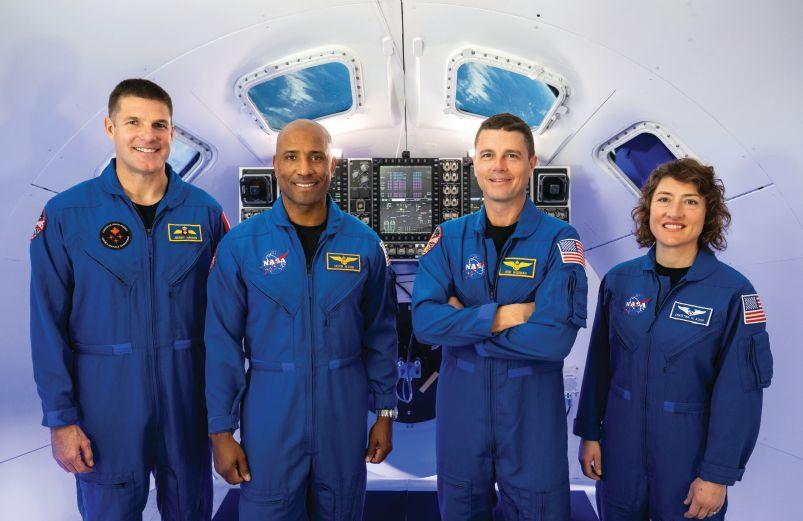
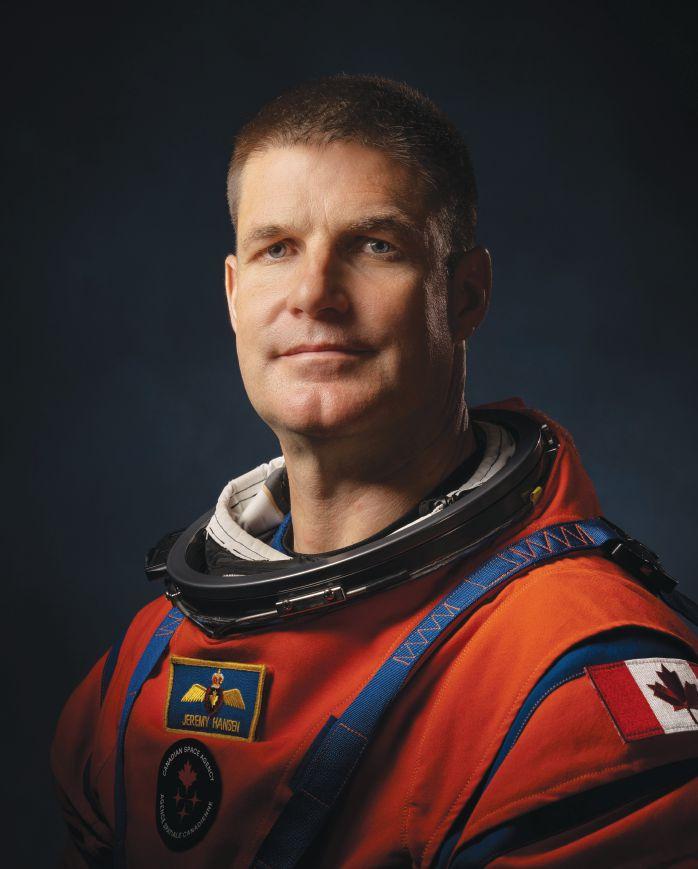
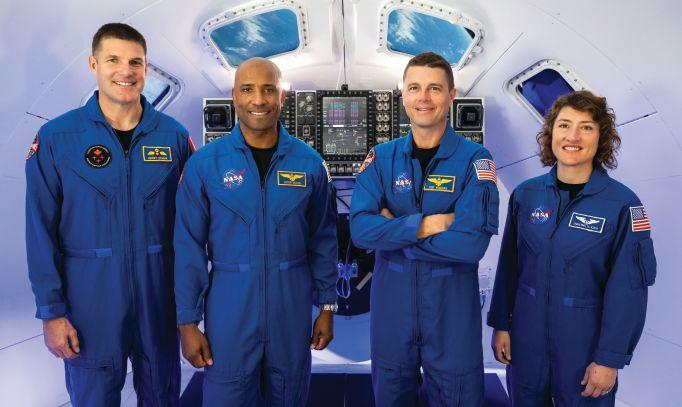
CSA astronaut and RCAF fighter pilot Jeremy Hansen (left) and NASA astronauts Victor Glover, Reid Wiseman and Christina Koch will venture around the Moon on Artemis II in 2024.
Police take delivery
Airbus H145. P.11. Ebassair’s new FBO terminal near Miami. P. 20
Stay in Touch with Aviation News SUBSCRIBE Online TODAY
READER SERVICE
Print and digital subscription inquires or changes, please contact Serina Dingeldein, Audience Development Manager Tel: (416) 510-5124 Fax: (416) 510-6875 sdingeldein@annexbusinessmedia.com
Mail: 111 Gordon Baker Rd., Suite 400, Toronto, ON M2H 3R1
EDITOR
Jon Robinson jrobinson@annexbusinessmedia.com 647-448-6188
FLIGHT DECK
Candelaria Bergero, David Carr, Steve Davis, Scott Henderson, Kendra Kincade, Phil Lightstone, Lorenzo Marandola, Carroll McCormick, Gordon Osinski, Steven Sitcoff
NATIONAL ACCOUNT MANAGER Mena Miu mmiu@annexbusinessmedia.com • 416-510-6749
GROUP PUBLISHER AND VICE PRESIDENT OF SALES Martin McAnulty mmcanulty@annexbusinessmedia.com
PRESIDENT/COO Scott Jamieson sjamieson@annexbusinessmedia.com
WINGS MAGAZINE
P.O. Box 530, 105 Donly Dr. S., Simcoe, ON N3Y 4N5 Tel: 519-428-3471 Fax: 519-429-3094 Toll Free: 1-888-599-2228
Printed in Canada ISSN 0701-1369
PUBLICATION MAIL AGREEMENT #40065710
Published six times per year (Jan/Feb, Mar/Ap, May/Jun, Jul/Aug, Sep/Oct, Nov/Dec) by Annex Business Media
SUBSCRIPTION RATES
Canada – 1 Year $ 34.50 (plus GST - #867172652RT0001)
USA – 1yr -$ 78.50 CDN (USD $60.50) International – 1yr - $90.50 CDN (USD $69.50) Occasionally, Wings magazine will mail information on behalf of industry-related groups whose products and services we believe may be of interest to you. If you prefer not to receive this information, please contact our circulation department in any of the four ways listed above.
All advertising is subject to the publisher’s approval. Such approval does not imply any endorsement of the products or services advertised. Publisher reserves the right to refuse advertising that does not meet the standards of the publication.
By Jon Robinson |
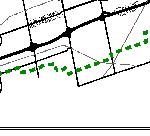
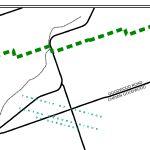
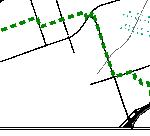
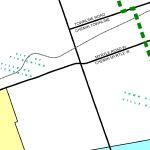
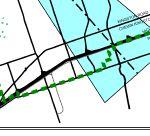
The Pickering Lands
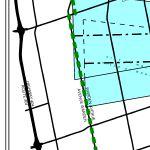
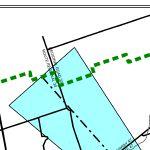
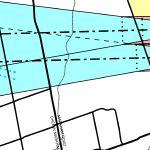
Omar Alghabra, Canada’s Minister of Transport, on April 18 made a somewhat quiet announcement, relative to its potential impact on Canadian aviation, that Transport Canada issued a Request for Proposals to hire an aviation professional services contractor to help the department analyze current and future airport supply and demand in Southern Ontario. This move is seen as a first step toward making a final decision about building an airport on the Pickering Lands, which has been under assessment since 1972.
Transport Canada (TC) will then post a second RFP to engage a third-party contractor to undertake the study and consultation. The government describes this analysis as a first step toward making a final decision to address the future of the Pickering Lands.
Southern Ontario is Canada’s most populous area, with Greater Toronto (GTA) alone home to more than 6.3 million people – “This is why the Government needs to assess the requirement for additional airport capacity in the region.” Even with the ongoing saga of Buttonville Airport’s potential closure, which seems less certain each year, with a decision that largely rests with real estate power Fairview Cadillac, the government could still easily move toward supporting a Pickering Lands airport. The business community certainly would approve the move, with less land available at GTA airports.
Transport Canada added a disclaimer on April 18: “We have no intention to proceed with building an airport on the Pickering Lands in the near term and the conclusions of the study could lead, for example, to a determination that an airport on the Pickering Lands is not required.” But at least the process to make a decision is underway.
KPMG completed its three-year Pickering Lands Aviation Sector Analysis in 2019 to protect land for the potential development of a new airport site in the gta.
“Today is the beginning of a process to analyze the future of the Southern Ontario airport system,” said Alghabra. “This work will also bring us closer to making a final decision on the Pickering Lands.”
One of the hurdles for building the Pickering Lands airport rests with dozens of agricultural leases in the area. In 1972, Ottawa acquired 75 km2 of land, 56 kilometers northeast of downtown Toronto to develop a new airport. In 1975, this plan was put on hold in favour of expanding existing airports. Properties on the Pickering Lands have been leased to residential, farm and commercial tenants since then. There are now around 172 agricultural, 64 residential
TOP DATA BURSTS… in this issue
1. Pratt reached one billion flight hours on its engines since 1928. P. 8. 2. Artemis II is set to take humans to the moon for the first time in more than 50 years. P. 18. 3. A medium-sized U.S. airport may see 200 to 300 BA or GA aircraft per week. P. 20 4. United plans to power 50,000 flights per year with ethanol-based SAF by 2028. P.24. 5. M1’s new engine covers saved a customer $4 million in MRO costs per year. P.30
Transport initiates study for decision on new Southern Ontario airport
and 48 commercial leases within the Pickering Lands. Ottawa in April 2015 com pleted the transfer of approxi mately 19.1 km2 of the Pickering Lands to Parks Canada to create Rouge National Urban Park. This transfer hints another potential hurdle for the airport, as Rouge Valley is now a very politically and environmentally important area.
The agricultural leases within the Pickering Lands are held tightly at a relative steal of $120/year per workable acre. All agricultural leases effective April 1, 2018, have 10year terms at the same leasing rate. A Needs Assessment Study released in 2011 predicted an additional airport would be needed in the GTA between 2027 and 2037 and confirmed that the Pickering Lands would be an ideal location. The data used for the 2011 study dates back to 2010 which is why Ottawa moved to update the information.
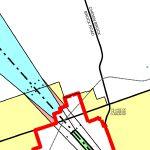
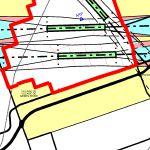
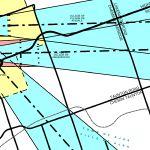
Transport Canada had earlier determined that only a portion of the lands would be required for a future airport and in 2016 began to update the Pickering Airport Site Zoning Regulations (PASZRs) to protect a smaller airport site. This was done to ensure land use and development adjacent to and in the vicinity of the airport site does not interfere with safe aircraft operations. KPMG completed its Pickering Lands Aviation Sector Analysis in 2019 and now the government appears ready to arrive at a much-needed decision. | W
To Take Flight
The Bombardier Centre for Aerospace and Aviation at Downsview Campus is a dedicated training ground for aerospace and aviation mechanics. With focused courses, cutting-edge equipment and industry professionals guiding our programs, your aircraft are always in good hands with a Centennial College graduate.
ON THE FLY
such engine with a dual-channel integrated electronic propeller and engine control system in general aviation. P&WC notes the PT6 is also the only turboprop engine in the world to be approved for single-engine instrument flight rules (SEIFR) in commercial passenger flights in Europe, North America, New Zealand and Australia.
THE LEAD
PRATT & WHITNEY CANADA CELEBRATES ONE BILLION FLYING HOURS
Pratt & Whitney Canada in March celebrated one billion flying hours since the formation of the company nearly 100 years ago, in 1928. Pratt & Whitney Canada (P&WC) engines power missions across a diverse portfolio, including business, general, regional and helicopter aviation, as well as auxiliary power units. Over this time, more than 110,000 engines have been produced, with more than 66,000 currently in service with some 16,000 customers. “Every second, a P&WC-powered aircraft takes off or lands somewhere on the planet,” said Maria Della Posta, President, Pratt & Whitney Canada.
The PT6 engine family is also celebrating 60 years in 2023, with more than 64,000 produced since its introduction in 1963. It powers over 155 different aviation applications and alone has reached 500 million flying hours. “Today’s PT6 is up to four times more powerful, has a 50 per cent better power-to-weight ratio and up to 20 per cent better specific fuel consumption compared to the original engine.”
The PT6 engine’s technological evolution is embodied in the PT6 E-Series, the first
COMMERCIAL
AIRBUS FACILITY IN CHINA DELIVERS FIRST A321NEO
Airbus delivered its first A321neo aircraft assembled at the Final Assembly Line Asia (FAL Tianjin) to China’s Juneyao Air. The aircraft is powered by Pratt GTF engines and features 207 seats, eight in Business and 199 in Economy class. Inaugurated in 2008, FAL Tianjin was the first Airbus commercial aircraft assembly line outside Europe. It has four A320 Family final assembly facilities around the world, also including, Germany, France and the United States.
The WestJet Group completed its acquisition of Sunwing Vacations and Sunwing Airlines, which was originally announced in March 2022. Initially, the airlines will continue as independent operations, explains WestJet, with the goal of positioning Sunwing as an instrumental pillar of group. The addition of Sunwing brings 18 Boeing 737s and 2,000 employees to WestJet. The newly combined tour operator businesses, comprised of WestJet Vacations and Sunwing Vacations, will be
headquartered in Toronto and will continue to operate a Montreal office.
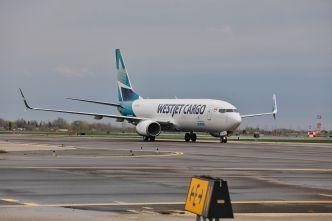
WestJet Cargo received Transport Canada’s approval and certification of its first four 737-800 Boeing Converted Freighters, equipped with CFM56-7B engines. WestJet Cargo and the GTA Group aimed to put three freighters into service in late April 2023. The fourth of WestJet Cargo’s dedicated freighters is expected to join the accompanying fleet later this year, following the completion of its conversion.The dedicated WestJet Cargo freighters will initially be focused on North America, serving Calgary, Halifax, Toronto, Vancouver, Los Angeles and Miami. WestJet Cargo’s dedicated freighter routes will also connect to the bellies of WestJet’s passenger fleet.
LYNX ADDS SERVICE FROM VANCOUVER TO MONTREAL
Low-cost carrier Lynx Air, headquartered in Calgary, plans to expand its domestic network with the introduction of service between Montreal and Vancouver beginning June 23, 2023. Lynx will offer six flights per week between Montreal Trudeau International (YUL) and Vancouver International (YVR). The airline recently announced services from Montreal to Calgary and to St John’s scheduled to begin on June 5, 2023. With the addition of Vancouver services, the airline will be operating more than 6,400 seats to and from Montreal.
“Historically Montreal and Quebec have been under-served by low-cost carriers and Lynx Air aims to change that,” said said Merren McArthur, CEO of Lynx. The airline is prepareing to expand its fleet to nine new Boeing 737 aircraft over the coming months. By Summer 2023, Lynx plans to serve 16 destinations across North America with more than 240 flights per week, equaling more than 45,000 seats.
SAUDI ARABIA PLACES ORDER FOR UP TO 121 PLANES FROM BOEING
Saudi Arabian Airlines reached a deal with Boeing to grow its long-haul fleet with up to 49 787 Dreamliners, which includes an
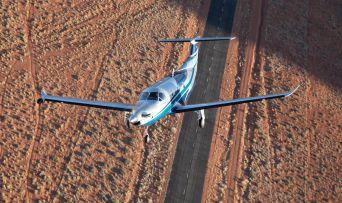
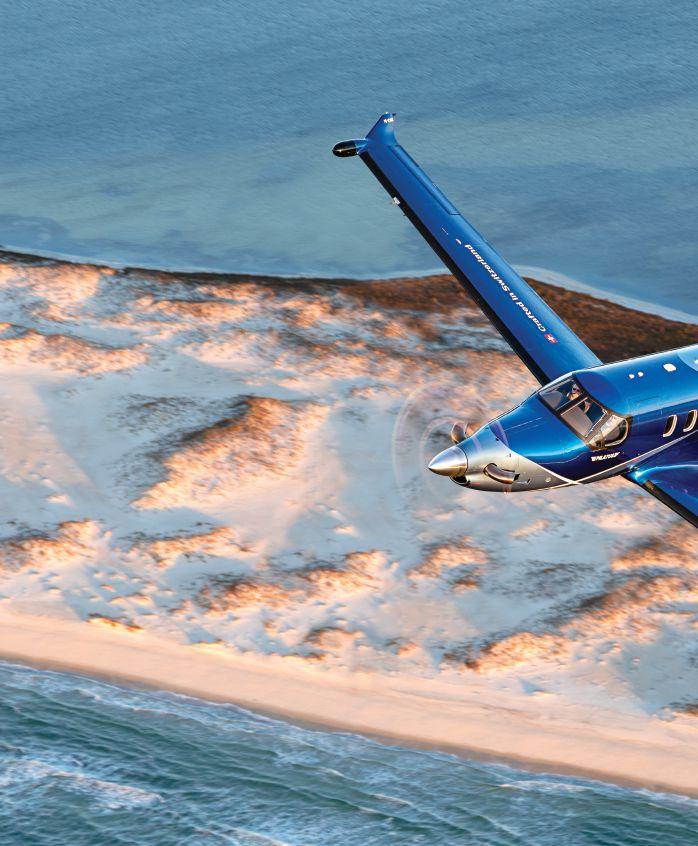
The Pilatus PC-12 NGX leverages the PT6E-67XP turboprop engine for single-lever operation, higher speeds and faster climb, in addition to a range of maintenance benefits. (Photo: Pilatus Aircraft).
WestJet plans to initially run four 737-800 Boeing Converted Freighters for its cargo expansion.
Riyadh Air.
order for 39 with a further 10 options, both 787-9 and 787-10 models. The national flag-carrier notes the agreement is part of Saudi Arabia’s strategic plan to transform the country into a global aviation hub. In total, Saudi Arabian carriers on the same day announced their intent to purchase up to 121 787 Dreamliners in what will be the fifth largest commercial order by value in Boeing’s history. Boeing notes the deal will support the country’s goal of serving 330 million passengers and attracting 100 million visitors annually by 2030.
The order for Boeing 787s will be divided between Saudi Arabian Airlines (SAA) and a planned new airline called Riyadh Air, which Saudi officials introduced in March. SAA currently operates more than 50 Boeing airplanes on its long-haul network, including the 777300ER (Extended Range) and 787-9 and 787-10. The airplane maker and airline have worked together for more than 75 years. Since revenue service began in 2011, Boeing notes the 787 family has launched more than 350 new nonstop routes around the world, including about 50 new routes since 2020.
CHORUS LAUNCHES CYGNET AVIATION ACADEMY
Chorus Aviation launched Cygnet Aviation Academy, based in Kingston, Ontario, describing it as a first-of-its-kind pilot academy in Canada in terms of providing flight training with direct access to career opportunities. Cygnet, in collaboration with CAE, is designed to provide a 20-month program on modern aircraft, flight training devices, and full flight simulators, allowing cadets to
earn an Integrated Airline Transport Pilot License (IATPL) and acquire an airlinespecific type rating.
Cygnet Aviation is led by President Lynne McMullen who has more than 25 years of experience in flight training related positions, including as a flight instructor and pilot examiner, as well as a leadership role with the Seneca College School of Aviation. Designed for individuals with little to no flight experience, successful cadets will spend 18 months at Cygnet and then transfer to a CAE training facility to complete their type rating.
MILITARY
IMP AEROSPACE TO UPGRADE CORMORANTS
Wings_April-May-2023.pdf 1 2023-04-21 12:23 PM
IMP Aerospace received a significant subcontract for the Cormorant Mid-Life Upgrade Project to upgrade Canada’s CH-149 Cormorant fleet, which plays a critical role in the country’s Search and Rescue (SAR) operations. The fleet has been providing service to Canada since 2001. A $1.2 billion contract was awarded in December 2022 to Leonardo U.K. Ltd. for the Cormorant
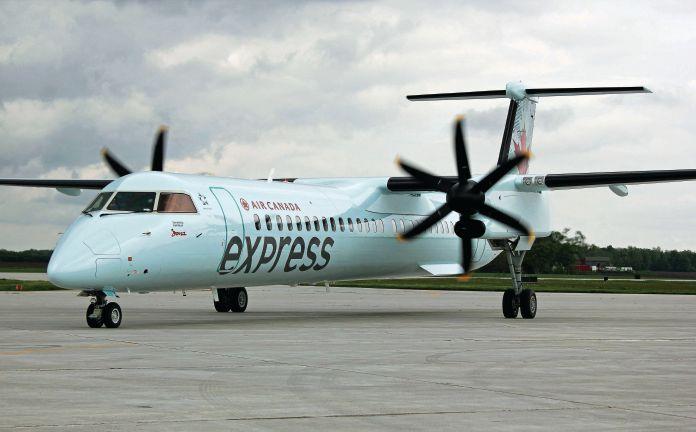
Jazz Aviation’s next generation Q400 aircraft prepares for takeoff.
Boeing's fifth largest commercial order by value will be divided between Saudi Arabia's flag carrier, Saudia, and a new airline called
Mid-Life Upgrade (CMLU) Project to update the existing fleet to the most advanced version of the Leonardo helicopter, which includes acquiring additional airframes/ parts, as well as the purchase of three new aircraft. The fleet size will grow from 13 to 16 aircraft. IMP Aerospace and Defence will undertake the upgrade of 13 in-service AW101/CH-149 Cormorant Search and Rescue (SAR) helicopters at its facility in Halifax, Nova Scotia. The first three helicopters will be completed at Leonardo’s UK facilities.
AIRPORTS
TRAFFIC DOUBLES AT NANAIMO AIRPORT
Passenger traffic at Nanaimo Airport nearly doubled over the last year as air travel continued to rebound after the pandemic. Approximately 340,000 people went through the gates of YCD in 2022, which
compares with 193,425 in 2021. YCD projects 440,000 passengers will fly in and out of Nanaimo in 2023, which would bring passenger totals to 90 per cent of the airport’s pre-pandemic record.
“We are hoping for a full recovery by 2024,” said Dave Devana, CEO, Nanaimo Airport, who notes the airport is exploring expanded domestic route options in B.C. with regional carriers. WestJet runs a direct flight from YCD to Edmonton that was launched last year. YCD will complete its runway rehabilitation project in 2023 with grooving of the surface. It’s also completing the design for an SSLAR lighting system for improved landing conditions.
ELECTRIC PROPULSION
HORIZON CAVORITE X5 WIND TUNNEL TESTS
Horizon Aircraft completed initial transition flight testing of its Cavorite X5
prototype, at 50 per cent scale, in the ACE Climatic Wind Tunnel. It explored forward speeds of up to almost 100 kilometres per hour, measuring aerodynamic forces, control authority, and mechanical system function with the wings open at varying fan speeds. Horizon anticipates the fullscale aircraft will be ready for flight testing in 2025.
GENERAL AVIATION
COPA SAFETY FUNDING
Bill Blair, Federal Minister of Emergency Preparedness, on April 20 announced $558,903 in funding for the Canadian Owners and Pilots Association (COPA) Flight Safety Foundation for a three-year project to enhance pilot training and its accessibility online. "Through funding this important project, the Government of Canada is helping provide recreational pilots with essential tools for their safety
and will help lead to safer conditions for aviators across Canada,” said Blair.
The COPA Aviation Academy is being designed to provide pilots with 24/7 access to necessary safety and search and rescue training, in a bilingual format, at no financial cost to pilots. COPA explains the new online learning portal will provide invaluable data and insights into pilot safety training knowledge gaps. The funding, from Public Safety Canada's Search and Rescue New Initiatives Fund (SAR NIF), will also support COPA in introducing safety courses that help pilots maintain licenses and stay current on best practices.
HELICOPTERS
ATHERTON NAMED CEO OF BELL TEXTRON
Lisa Atherton is set to become President and CEO of the Bell Textron, effective April 28, 2023. Atherton, most recently the chief
of the U.S. Air Force Academy and served eight years at the air force’s Air Combat Command’s Directorate of Requirements.
YORK POLICE UNVEIL NEW HELICOPTER
operating officer of Bell, succeeds Mitch Snyder, who will be retiring after more than seven years as Bell’s CEO. Atherton served as CEO of Textron Systems from 2017 until January 2023 when she was named COO at Bell. She joined Textron Defense Systems in 2007 and, in 2013, transitioned to Bell. Atherton is a graduate
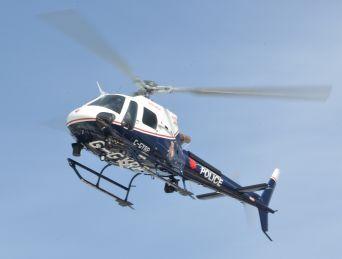
York Regional Police of Greater Toronto is retiring its Eurocopter EC120 after taking delivery of an Airbus H125 helicopter. Its EC120 has flown more than 20,000 hours since 2002 and, according to a report by Wings contributor Phil Lighstone, holds an operational speed of 120 knots and 2.5 hours of endurance. Lightstone explains the new H125, based upon the police services configuration, sports a 900 HP engine, cruises at 140 knots and holds 4.5 hours of endurance. The H125’s endurance improves when loitering. Purchased at approximately $7.2 million, the new Airbus aircraft, Air2, complements Durham Region’s Air1 helicopter.| W
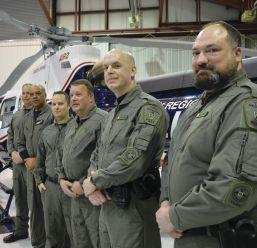
York Regional Police opted to upgrade to an Airbus H125 from its current EC120, which the force has operated since 2002.
By David Carr |
Missing the mark on air rights
Ottawa moves to expand passenger rights and tighten compensation rules
The Liberals dabbled in air transport in the current budget. It provided $1.8 billion to the Canadian Air Transport Security Authority (CATSA) to ease airport screening wait times and enhance security measures. Paid for with a whopping 32.85 per cent increase in passenger security charges. $76 million to the Canadian Transportation Agency (CTA) so it can continue its limited service, but with more staff. $5.2 million for Transport Canada to collect and analyze air-sector performance data so that Ottawa can further micro-manage the industry
As of late April, the budget had not yet passed. But more micro-managing was already on the way.
The government passed an air passenger bill of rights in 2019. Then transport minister Marc Garneau called the bill “world leading.” Four years and one pandemic later, Canada’s world leader is back in the shop being overhauled. Transport Minister Omar Alghabra was in front of the cameras recently, re-announcing that the fix was in the works. It was a somewhat wobbly performance given that key pieces of the updated bill, such as how passengers are compensated for mountains of lost luggage, are yet to be decided. But the take away was clear. It is the airline that sells the ticket and, therefore, the airline is accountable for what goes wrong along the way. It is flawed logic.
It was a faulty luggage belt at Pearson International Airport’s terminal three that broke down in December’s extreme holiday cold, causing bags to pile up for days leaving passengers without their belongings. Likewise, it is sometimes an airport that does not have a spare bridge that forces an airplane to sit on the tarmac for hours. Nothing that a bit of take-charge inspiration and a mobile stair case could not fix, surely. As noted in an earlier column, air transport is a delicate balance of arrivals and departures traffic, and transfers. Ottawa, through agencies such as CATSA and the Canada Border Services Agency has a role to play in not gumming up the works. That did not happen last summer, contributing to the overall traffic meltdown. A point the transport minister would prefer we forget.
Alghabra’s bill places emphasis on airlines to say why a passenger is not entitled to compensation.
Millions more Canadians get stuck in traffic or endure appalling conditions on buses or light rail every year than are inconvenienced by airlines. Almost daily. Where are their government champions? Air travel has always been about time, but so is commuting. It is true that when airlines delay or cancel a flight they are disrupting a big-ticket event (often a family vacation) and not a daily routine. But is the time spent in an airport departure lounge by a traveller whose flight to Florida is locked in an endless cycle of delays more valuable than a frustrated commuter stranded at an unploughed transit stop, watching bus after bus whip by?
Admittedly, there is an apples and oranges side to this argument. Air transport is federally regulated while highways, commuter networks and local transit are provincial and municipal run. The point is, if all are treated shabbily, why is the smallest band of travellers (compared with drivers and transit users) up for special treatment. Especially at a time when much of Canada’s broader transportation infrastructure is breaking down around us, and is largely met with indifference by those in charge, including Alghabra. Case in point, when VIA Rail left passengers
on a Montréal – Toronto train stranded for up to 18 hours on Christmas Eve, the transport minister, who is directly responsible for the Crown Corporation, failed to pick up the telephone and rip into VIA’s chief executive. Such was Alghabra’s compassion for passengers suffering unbearable conditions, including backed up toilets, when they are customers on his network.
Alghabra’s rush to announce bill proposes placing the emphasis on airlines to say why a passenger is not entitled to compensation, increasing penalties for airline violations ten-fold and further micro-managing the industry, such as restricting airlines to 30 days to resolve a customer complaint (the current CTA backlog is 18 months) and introducing special treatment rules such as free food on flights delayed by a snow storm. Worse, there is a potential disconnect between the compensation Alghabra wants to put back in consumer’s pockets, and the shift to an ultra-low-cost, bare bones environment. Gimmicks like an air passenger bill of rights are often a knee-jerk reaction to negative news stories and the impulse of government to be seen to be doing something. Which is why they rarely work. The ‘world leading’ 2019 air passenger bill of rights is proof of that. But bureaucratic tinkering comes with a price, and airline passengers will be the ones paying. | W
By Scott Henderson |
On the artificial intelligence curve
Drone operators are becoming leaders of industrial AI application
Watching an idea or technology spread around the world is fascinating.
Artificial Intelligence (AI) isn’t new, nor is its application by the drone industry, but it is now reaching a massive, mainstream audience. According to a report by Swiss bank UBS, ChatGPT and its AI Chatbot launched at the end of 2022 have become the fastest growing consumer app in history. Two months after launch the product hit 100 million users in January.
ChatGPT is a generative AI chatbot that uses various AI algorithms to find and generate accurate content like human conversation. Primary uses include customer service, language translation and knowledge management among what seems to be an endless possibility of economic impact. As AI adapts to its newfound consumer popularity, the drone industry has been applying AI to provide unparalleled levels of innovation for years now. AI is revolutionizing the capabilities of drones, increasing efficiency, safety and versatility.
At its most basic level, AI enables autonomous flight and improved navigation as algorithms enable drones to fly and make decisions on the data collected by sensors, resulting more efficient flight paths. Sensors and cameras identify and avoid obstacles enabling drones to fly and navigate without human intervention. With AI, drones make decisions and take actions autonomously, reducing the risks of human error.
At the extreme, and very topical as we approach Wildfire season, using AI deep learning object detection models for fire recognition with autonomous drones, maps the fire area and sends data to firefighters vastly improving monitoring and most important, early detection. The ability of drones to provide real-time analysis with AI analyzing collected data to identify and respond to situations more quickly is a gamechanger. Programmed algorithms that enable drones to identify specific objects more accurately, like heat signatures, and track them over long distances, have vastly improved surveillance and security services.
Providing cost-effective, real-time data from a variety of sensors and cameras
Farmers optimize crop yield with AI analyzed data collected on soil moisture and plant health.
attached to drones is rapidly transforming many industries. In many cases, this data was extremely difficult or impossible to obtain before drones and AI. Farmers are optimizing crop yields with AI analyzed data collected on soil moisture and plant health.
In construction, drones equipped with LiDAR sensors and AI-analysis are providing real-time information to identify safety hazards, make better decisions on resource allocations and accurately monitor progress. Drones equipped with thermal sensors that identify hot spots on power lines allow energy companies to repair potential issues before a crisis erupts.
It is easy to agree that using AI algorithms to analyze data captured by drones is a good thing when it improves the efficiency of search and rescue operations, but where is caution needed? One, AI is an engine not an oracle and it is only as good as the data it is fed. Size does matter and the larger the dataset the better. As AI programs rely on data collected by sensors it must be accurate to avoid misinterpretations and errors. Two, beware of hackers, internet connected drones are vulnerable to cyberattacks.
Three, the vastly improved surveillance
and data-collection functions of AI-powered drones are creating new ethical and legal concerns surrounding privacy. Last and most important are safety issues. The combined technologies of AI, drones and sensors are increasing safety each year, but accidents and collisions happen during malfunctions. As drones are used more in areas with large population densities, the consequences of an AI induced malfunction increase.
Safety is paramount and aviation is highly regulated for good reason. The overwhelming increases in efficiency, significant costdecreases, and the tenfold improvements in surveillance and security are all major incentives to ensure that services provided by drone data collection and AI analysis reach the highest safety standards.
Near-future developments include swarm drone technology, using groups of AI-connected drones for a range of applications. Mapping and surveying tasks are achieving higher levels of accuracy as drones become more precise and are leading to new ways of providing efficiencies. Reducing energy consumption is now easier as AI optimizes the flight path of drones.
The interactions and collaborations between humans and new technologies test the creativity of engineers, inventors and Mother Necessity. Aviation business will prosper as AI and drones work together. | W
FROM TIP-TO-TAIL, STANDARDAERO IS DEDICATED TO KEEP YOU FLYING
ENGINES
• GE T700/CT7
• Pratt & Whitney Canada PT6T & PW200
• Rolls-Royce M250 & RR300
• Safran Arriel 1 & 2
AIRFRAMES
• Airbus H120/EC120, H125/AS350, AS355, EC135, H130/EC130, H215/AS332
• Bell B204/205, B206, B212/412, B214, B407, B427, B222/230/430, UH-1 series
DYNAMIC COMPONENTS
• Airbus H125/AS350, H130/EC130
FUEL SYSTEMS
• Crash-Resistant Fuel Tank
AVIONICS
• StableLight 4-Axis AutoPilot
• ADS-B
• Glass cockpit
www.standardaero.com/heli
Turnkey Aircraft Acquisition and Service
The growth and reach of Levaero Aviation
By David Carr
The Covid pandemic has boosted demand for seats on private airplanes. Business executives want the flexibility of private flying and to escape the crush of commercial air transport or being tied to an airline schedule. But as new demand makes the supply of aircraft for charter less predictable, more Canadian businesses are considering becoming first-time airplane buyers. It is a market condition ripe for Levaero Aviation, a turnkey business aviation solutions provider with a team of experienced sales professionals in aircraft acquisition, providing critical expertise for both seasoned buyers and new entrants.
It is a matter of supply and demand says Stan Kuliavas, Vice President of Sales and Business Development at Levaero. “The charter model is based on an airplane owner making the aircraft available for charter when they are not using it. That’s where the inventory comes from. Owners are using their aircraft more these days than in previous years, which has reduced the availability of charter aircraft at a time when demand has never been greater.” Having a charter flight pulled at the last minute because the owner suddenly needs their airplane is not uncommon. Then where do you turn?
More Canadian chief executives are turning to Levaero for its aircraft knowledge, built on 26 years in the industry, customer support and a direct pipeline to the types of airplanes that fit the profile of private flying in Canada, which includes rugged terrain, shorter runways and hops to remote destinations.
“Canada has always been a country dominated by turboprops and light jets,” says Kuliavas. Of the 1,294 private aircraft registered in Canada, almost 57 per cent are turboprops, according to Levaero’s 2022 market analysis. The company is the exclusive Canadian dealer for two of the turboprop and light jet sector’s top
The Pilatus PC-12 NGX – with 80 delivered in 2022 – boasts a maximum cruise of 290 knots, a roomy flat-floor interior, large cargo door, in-flight accessible baggage area, a private flushing lavatory, and the latest Pratt & Whitney Canada PT6E-67XP engine.
performers; the Swiss-built Pilatus PC-12 and PC-24, respectively. Often nicknamed the Swiss Army knife of airplanes, both types are among the most versatile in their field.
“The PC-12 and PC-24 are two of the most in-demand aircraft in the world. The PC-24 jet is not a niche airplane. It’s equally a corporate transport, great medevac, cargo and law enforcement airplane.” As of April, there were 110 PC-12s and seven PC-24s operating in Canada. Levaero recently delivered a PC-12 NGX to a customer at Toronto’s Billy Bishop Airport. The newest of the PC12 family, the NGX is an advanced turboprop with design features typically found on larger, more expensive business jets. The residual value of a Pilatus aircraft also remains strong. “If a Pilatus customer wants to part ways with their aircraft, there is a much larger buying market for the airplane,” Kuliavas adds.
While Pilatus accounts for a large chunk of Levaero’s business, the company is plugged into the larger global aircraft resale industry. Levaero is a member of the International Aircraft Dealers Association (IADA). It is an exclusive club consisting of the top 12 per cent of the world’s experts who handle 48 per cent of used business aircraft sales. Everything from an entry-level turboprop to an ultra-long-range Bombardier Global 7500. By dollar volume, IADA dealers buy and sell more aircraft than the rest of the world’s dealers combined. Kuliavas was recently named Chair of IADA’s international committee.
For first-time customers and current operators looking
to either upgrade an airplane or transition to a jet, this is an optimal time to buy. Aircraft inventory remains tight, but prices have started to normalize. “People are hanging onto their airplanes longer, so there are less airplanes on the market to buy,” Kuliavas says. He also cautioned against misinterpreting the headlines. “Used business jet inventory is up 40 per cent but that’s not painting a full picture. Inventory may be up 40 per cent but it’s from all-time lows. You need to look behind the numbers.” Complicating the picture further are original equipment manufacturers struggling to keep pace with orders and reporting two--year backlogs. As a result, owners hold onto their airplanes even longer, putting upward pressure on price.
Ownership is not for everyone and charter remains a great option for customers who fly less and cannot justify the capital outlay of ownership. But as flying hours pile up and charter bills pour in, it is perhaps time to consider the switch from renter to owner. There is no set trigger according to Kuliavas: “If there is a magic onesize-fits-all formula, I don’t know about it. One hundred to 150 flying hours a year is one threshold, but there are so many other factors such as personal and corporate security, flexibility, control over the environment and ‘Wow, why am I paying so much to rent when I could spend a little more and own my airplane and not worry about cancelled trips.’”
When that threshold is crossed, Levaero is on the ground with a complete package of services, including needs evaluation, assistance with financing, pre-purchase
inspections, pilot training and aircraft management. This involves working closely with charter operations to ensure the customer is maximizing the full value of the airplane. “We believe our experience of aircraft acquisitions and sales to be unmatched in Canada,” says Kuliavas, who has been buying and selling airplanes for more than 17 years. “First-time buyers naturally have the most questions, and we also understand the questions that they don’t know to ask.”
The first rule of connecting a customer with the right airplane goes further than assessing what destinations they are chartering to today, but what locations would you like to access with your own aircraft at your disposal? Kuliavas calls it the 80/20 rule. “No one airplane is going to be a perfect fit for all missions. About 20 per cent are typically outlying types of flights. We will find the airplane that fits 80 per cent of your flying requirement very well, and suggest alternative arrangements for the rest,” he says. “We have a wealth of unique experience in hand holding and having those initial conversations from when they acquire their first airplane to when they upgrade their aircraft over time.” Which is why approximately 50 per cent of Levaero’s business is with repeat customers.
Levaero recently expanded its maintenance and aircraft sales department with an 18,000-square-foot hangar at the fast-growing Collingwood Regional Airport in southern Ontario. The company has always provided aircraft maintenance for Canada’s Pilatus operators and other aircraft from its base in Thunder Bay, minimizing the time a customers’ airplane spends in the shop. (Levaero has one of the largest inventories of Pilatus aircraft parts outside of Switzerland.) Collingwood is a natural fit. “Our customer base is growing in the region,” Kuliavas says. “We opened the Collingwood facility last October and it’s already doing substantial business.”
Levaero’s turnkey business model is built on anticipating a customer’s needs and having an industryleading network in place to support them. Including taking the guesswork out for first-time buyers. “Customers want the efficiency and convenience that comes with owning a corporate aircraft. They want a business aircraft. They don’t want to be in the aircraft business. That’s our job and we are exceptional at it.” Kuliavas says. “We help our customers acquire whatever aircraft is appropriate to their mission and we are here to support them along the way.”
Levaero Aviation is Canada’s exclusive distributor of Pilatus aircraft, including the PC-24 Super Versatile Jet which is expected to reach its 200th delivery milestone in 2023.
FLY US AROUND THE MOON
CSA ASTRONAUT JEREMY HANSEN WILL BE AMONG THE NEXT HUMANS TO FLY TO THE MOON
BY GORDON OSINSKI
On April 3, NASA announced the crew for Artemis II, which will see astronauts spending up to three weeks on a flyby trip to the moon in 2024. This mission will be the first time in more than 50 years that humans will visit the moon – or leave low Earth orbit – since Apollo 17 in 1972. And a Canadian will be onboard this
milestone mission, astronaut Jeremy Hansen, a former RCAF fighter pilot.
I am a professor, an explorer and a planetary geologist. For the past decade, I have been helping to train astronauts from Canada and the United States in geology, including Hansen. I am also the principal investigator for the Canadian Lunar Rover Mission.
Building on the success of Artemis I
Following the success of Artemis I in late 2022, Artemis II is the next mission in the Artemis program – and the precursor to sending humans back to the surface of the moon.
Scheduled to launch in late 2024, Artemis II will achieve several firsts: It will be the first time humans will fly in NASA’s Orion spacecraft and the first mission to take humans beyond low Earth orbit since Apollo 17.
After the launch of Artemis II, the four astronauts on the mission will spend a few days in a high Earth orbit, which is over 30,000 kilometres farther out than the orbit of the International Space Station (ISS). There, they will check out all the systems before the Orion spacecraft fires its main engine to take it to the moon for a flyby before returning to Earth.
While not identical in design, Artemis II aims to achieve what Apollo 8 did in 1968, which is to make sure everything works in preparation for Artemis III, which will take humans back to the surface of the moon.
The importance of having a Canadian circle the moon
For many of us, the very fact that the Artemis II crew has been announced is exciting enough as it brings us one step closer to the return of humans to the moon.
But for Canada, this will go down as one of the biggest moments in our space program’s history with Canadian Space Agency (CSA) astronaut Hansen on board. This will make Canada only the second country in the world, after the U.S., to send a human to deep space.
Col. Hansen was born in London, ON, and raised on a farm a few kilometres north. After graduating from high school, he attended the Royal Military College of Canada in Kingston, where he earned a bachelor of science in space science and then a master of science in physics. He then joined the Canadian Armed Forces in 1994 where he became a CF-18 fighter pilot.
In 2009, Hansen was one of two recruits selected by the CSA. The other was David Saint-Jacques, who spent six months onboard the ISS over 2008 and 2009.
Not only will Hansen be the first ever Canadian to venture into deep space, he will be doing so on his first ever spaceflight!
Canadian technology in space
These are exciting times for Canada in terms of lunar exploration. As announced in November last year, the Canadian Lunar Rover Mission will be the first ever Canadian-led mission to the surface of another planetary body.
With a launch planned for 2026, our
Canadian Jeremy Hansen is set to make his first flight to space as a mission specialist on Artemis II.
team is making significant progress toward finalizing the design of the rover and its scientific instruments. We are also identifying a shortlist of potential landing sites around the South Pole of the moon.
We won’t have to wait three years, however, for the first Canadian technology to reach the lunar surface.
In early April, the HAKUTO-R Mission 1 spacecraft successfully went into orbit around the moon after 100 days in space. Onboard the lunar lander scheduled for touchdown in late April are two Canadian payloads funded by the CSA’s Lunar Exploration Accelerator Program: The MoonNet deep learning software from Mission Control Space Services in Ottawa; and an AI-enabled 360-degree camera from Canadensys Aerospace, based in Bolton, ON.
In case you missed it, the CSA received funding for the next phase of the Lunar Exploration Accelerator Program in the recent federal budget, ensuring that these opportunities for Canadian companies and universities to send technologies to the moon will continue.
In another budget surprise, the government also committed $1.2 billion over 13 years to develop a lunar utility vehicle to assist astronauts on the moon.
Lunar research, terrestrial benefits
As we wait for Artemis II, space agencies are focusing research on how to sustain human presence on the lunar surface. To do so will require innovative solutions to keep astronauts alive and
healthy on the lunar surface for up to months at a time.
The surface of the moon is far more extreme than Earth, of course, with no atmosphere and temperatures dropping to a staggering -200 C. However, there are some similarities that remote, isolated communities here on
Earth face on a day-to-day basis, particularly in northern Canada.
A major part of keeping astronauts healthy is feeding them. They could survive on vacuum-sealed meals brought from Earth, of course, but in the long run, this is not sustainable.
Recognizing the similarities of producing food in remote and harsh environments both here on Earth and in space, NASA and the CSA launched the Deep Space Food Challenge to develop new innovative food production technologies. The hope is that by figuring out how to grow food on the moon, the technologies can also be used here on Earth to address growing food shortages.
Now that the Artemis II crew has been announced, they will be spending every minute of their available time preparing for the mission. For Hansen, this will entail learning the hundreds of different systems on the Orion spacecraft.
Hopefully, it will also include a geology refresher so that he can better understand what he sees as he flies around the moon. | W
This article was originally published by The Conversation. Gordon Osinski is a Professor in Earth and Planetary Science, Western University.
From left, CSA astronaut Jeremy Hansen and NASA astronauts Victor Glover, Reid Wiseman, and Christina Koch were announced Monday, April 3, as the four astronauts who will venture around the Moon on Artemis II.
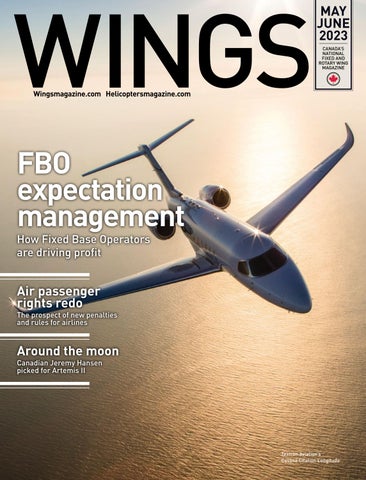
FBO EXPECTATION MANAGEMENT
HOW FIXED BASE DELIVERABLES DRIVE LASTING LOYALTY AND PROFIT
BY PHIL LIGHTSTONE
The quality of a Fixed Base Operator’s facilities and services can found on a sliding scale from Five Star amenities to a trailer equipped with vending machines. Aircrew, aircraft owners and passenger bar of expectation will be set by FBO’s that deliver a Five Star rating. FBO Expectation Management (FEM) is very much a two-headed coin. FEM should be viewed from both the FBO’s and customer’s perspective. With both perspectives balanced, all parties win when the coin is tossed. However, both parties must have reasonably set their expectations. In any customer facing role, staff hiring and training practices sets the stage for the customer experience.
The bulk of interactions between FBO personnel, aircrew and passengers are pleasant resulting in a positive experience. However, as with most customer service focused industries, there are the odd exceptions where either party might be having a bad day and may have unreasonable expectations. Financial expectations of fuel discounts and waived landing fees should be managed before the aircrew departs their home base for the destination airport. For those individuals who do not do their homework, with unmanaged
expectations, the idea of paying a bit more is untenable and can result in that individual crossing a line during the interaction. This puts the FBO staff into the position of trying to keep a positive attitude during an interaction with a rude individual, while deescalating the conversation.
Anthony Norejko, President of the Canadian Business Aviation Association (CBAA), reminds us that schedulers and dispatchers are often making the FBO selection decision. With a focus toward optimizing fuel pricing, these back-office personnel may be influenced by air crew’s experiences, but with fuel price transparency through contracted rate uploads into their scheduling tools, FBOs are creating relationships with these decision makers.
The folks at Banyan Air Service at Fort Lauderdale Executive (KFXE), led by Don Campion, puts customer service at the top of their deliverables list. Campion created Banyan in 1979 with a focus on managing quality and customer expectations in their FBO and MRO services, and Jet Runway Café. Banyan’s FBO lobby reminds you more of a Five Star hotel and less like a typical FBO. The FBO lobby has an energy created by the FBO staff, aircrew and
Banyan Air Service at Fort Lauderdale Executive (KFXE), led by Don Campion, puts customer service at the top of the deliverables list.
GOOD TO GO.
Vision | To be globally recognized as a superior provider of aviation maintenance by being a forward-looking employer. Notre Vision | Être reconnu mondialement comme un fournisseur supérieur de maintenance aéronautique en étant un employeur tourné vers l’avenir.
passengers. A stone’s throw from the FBO is Banyan’s Pilot Shop, a 5,000-squarefoot showroom packed with the latest in pilot supplies and two fully featured flight simulators installed in the cockpit of a Gulfstream II corporate jet fuselage. My wife, while sitting in the shade on Banyan’s ramp, was asked by three different Banyan staff if she would like a bottle of ice-cold water. Although my wife is not hard to please, this level of attention to detail was something that resonated with her.
Campion focuses on Employee Empowerment allowing the staff, or as he calls them “Teammates”, to make decisions without the need to escalate to the senior leadership, using “what’s good for the customer” as a guiding principle. This begins at the recruiting and hiring process, creating a team dynamic which weeds out those not passionate about excellence. Campion’s approach is based upon the notion that focusing on the customer experience, and not price, will yield loyal customers and therefor ultimately improve revenue and profitability. He is essentially using company culture as a competitive advantage. “At Banyan we strive to be more than just another aviation company, not only by what we provide our customers, but also by what we give back,” says Campion. For the past 12 years, Banyan has led the rebuilding of a hospital and nursing college in the bush of Nigeria (egbehospital.org).
From an FBO’s perspective, the diversity, quality and cost of services is proportional to the business activity at that specific airport and FBO. Geography plays a factor in creating a differentiator. During a layover in Savanna (KSAB), Signature Flight Support had a wonderful FBO environment, with helpful front-line staff. Walking out to the crew car area, I saw six Signature fleet cars (same models, painted with Signature logos). Compared to the Canadian context, the norm of airport transportation at many FBOs is Uber. But some Canadian FBOs have crew cars for itinerant air crews and passengers to use. Million Air at the Toronto Buttonville Municipal Airport (CYKZ) has one Mercedes and one minivan for aircrew use. For corporate pilots waiting on their passenger’s return from a business trip in Greater Toronto, access to an aircrew car can take them to great restaurants.
Front line ramp staff training is critical to ensure that an aircraft is properly serviced, fueled, towed, hangared and tied down. I have found many line staff struggling with the fuel caps and fueling port on the Commander that I fly. While the Commander’s fuel system is somewhat unique to the General Aviation fleet, asking the pilot for help during refueling not only makes the flight line staff look like a hero, but also prevents
damage to the fueling system. As a result, I prefer to be at the aircraft when it’s fueled, ensuring that a small mistake does not ground the aircraft. From an aircraft owner’s perspective, it is about getting the big things right, like ensuring the aircraft is not misfueled.
My previous aircraft was a turbocharged Commander with the words “Turbo Commander” on the side of the fuselage. While on a trip, I had to correct a flightline individual before he fueled the aircraft with JetA. He honestly thought that “Turbo” meant turbo prop versus turbocharged. That would have been a costly mistake. While most FBOs do a great job of keeping fuel orders straight, mistakes can and do happen.
As for pilots, sometimes it’s not feasible to stand around waiting for the fuel truck to ensure the right fuel is being poured into the aircraft tanks. FuelTape from Aircraft Spruce ($10.70) is a highly durable, weatherproof masking tape that clearly indicates to the fueler which grade of fuel must be used. Simply tear off a piece and stick it over the fuel caps and you have a low-cost, reliable system to keep your tanks safe. FuelTape is available in both 100LL and Jet A versions.
But it’s also the little things, which illustrate a sense of detail. For example, placing a fueling wing mat over the wing and fueling inlet helps protect the aircraft’s paint from wear and tear caused when the linemen place the fueler’s hose on the wing. Well run FBOs will ensure that their trucks are equipped with fueling mats at the beginning of each shift.
From a passenger and aircrew perspective, having well trained staff to help with getting the user’s technologies (iPads, laptops, etc.) attached to the FBO’s secure WiFi environment helps eliminate IT created
frustration. Little things such as a quite comfy room, coffee, high-speed internet, and a home theatre environment, allows aircrews to have an enjoyable home-awayfrom-home experience.
From an FBO’s perspective, Gateway Aviation located at Windsor Airport (CYQG) has been in operation for less than three years. Being the new kids on the block, in a small market, Gateway is using customer service as a differentiator. Essentially creating an atmosphere of a home away from home for aircraft owners, passengers and aircrews.
“The vast majority of the time, we’re dealing with satisfy clients and I strongly believe it stems from our line crew and CSRs dedication to delivering an outstanding elite experience to our customers,” says Gateway’s Mike Hogan.
Gateway’s management style trickles down to the front-line staff who are spring loaded to listen to the comments and questions of their customers. Keeping clients satisfied is their main goal. As an example, one customer mentioned that they’d like to see a wider selection of tea. A week later, Gateway had sourced and purchased a selection of high-quality teas. To help manage their customers’ financial expectations amidst inflation rates, they ensure that catering orders are set up in advance, allowing the customer to manage both the menu and cost. Gateway Aviation Windsor is proving how employee customer service training leads to a successful FBO business plan.
There are many things which are outside of the control of the FBO, such as weather delaying flights; catering provided by third parties; municipal owned airport knowledge; construction projects impacting the FBO’s environment; internet and telecommunication provider outages and services;
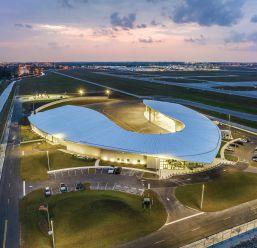
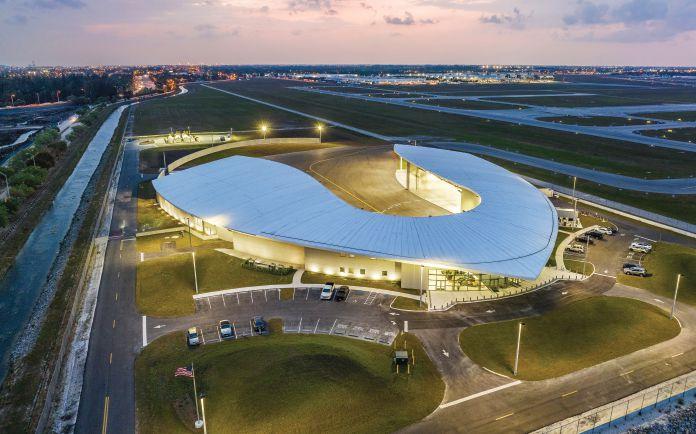
Embassair recently built a new FBO terminal at KOPF designed by French architect Jacques Rougerie.
pandemic impacted staffing; and even the implementation of an FBO’s ownership exit strategy. Well-run FBOs have backup strategies in place to deal with outages which impact aircrew and passengers, helping to smooth out speed bumps.
Setting the quality assurance and customer satisfaction bar high is not only a reflection of the management style of the FBO’s senior leaders but also the economic realities of the marketplace in which they are situated. While not all airports are created equal, the level of aircraft activity can vary greatly. A medium-sized U.S. airport, for example, may see 200 to 300 aircraft per week as compared to a Canadian airport seeing 20 to 30 aircraft. Volume and velocity will drive topline revenue, changing both the profitability levels and return on investment (ROI), but hopefully not impacting customer service.
Embassair of Miami-Opa Locka Executive Airport (KOPF) has built a new FBO
terminal building and hangers. The terminal designed by Jacques Rougerie, a world-renowned French architect, looks like a bird in full flight and was designed with a focus on passenger security, confidentiality and privacy. This boutique FBO is focusing on a limited number of patrons, essentially Very VIPs. With 25 hand-picked customer focused staff (growing to 50 by the third quarter), expectations are set beginning with greeting the aircraft. The incoming aircraft is marshaled onto the ramp or hangar by traditional FBO staff, but it is also immediately meet by a member of the concierge staff, beginning a unique experience for the aircrew and passengers alike.
Confidentiality and privacy of the passengers is maintained throughout their stay at the FBO, based upon the design of the facility, beginning with a U.S. Customs and Border Protection office in the FBO.
With Embassair focusing on a small number of customers,
it has implemented a training program which endeavors to ensure that the staff understand their corporate goals and the delivery of a higher quality of customer engagement than the norm, inclusive of customer surveys delivered on each customer engagement.
Volume and velocity drive topline revenue, but hopefully not customer service.
“We want to offer the finest door-to-door service for both business and leisure travelers, providing best-in-class concierge services, modern architectural designs that incorporate the latest technologies, and the highest standards of safety and security,” says Frank Devaux, Embassair’s founder. “Embassair’s FBO is one of the
most innovative terminals in the world and a true work of art. It is based on Embassair’s values of innovation, luxury and security.”
Expectation management is the fine art of balancing experience, temperaments, process, personalities and training, while operating in the constraints of financial realities and staffing availabilities. The freedom of flight inherently allows FBO interactions to be compared with an eye to the competition both at a specific airport and afar. As compared to flying the airlines, BA, GA and charter operators provide an opportunity for FBOs to deliver products and services to their customers, inclusive of passengers, in an environment completely different from the average airline-focused terminal. Delivering a higher level of customer engagement in a quality environment will drive more corporations and passengers to consider BA, GA and charters, with the result of increasing economic activity. | W
NET ZERO FLIGHT POTENTIAL
FUTURE OF FLIGHT IN A NET ZERO CARBON WORLD: NINE SCENARIOS AND LOTS OF SUSTAINABLE AVIATION FUEL
BY CANDELARIA BERGERO AND STEVE DAVIS
Several major airlines have pledged to reach net-zero carbon emissions by midcentury to fight climate change. It’s an ambitious goal that will require an enormous ramp-up in sustainable aviation fuels, but that alone won’t be enough, our latest research shows.
The idea of jetliners running solely on fuel made from used cooking oil from restaurants or corn stalks might seem futuristic, but it’s not that far away. Airlines are already experimenting with sustainable aviation fuels (SAF), including biofuels made from agriculture residues, trees, corn and used cooking oil, and synthetic fuels made with captured carbon and green hydrogen.
United Airlines, which has been using a blend of used oil or waste fat and fossil fuels on some flights from Los Angeles and Amsterdam, recently announced plans to power 50,000 flights a year between its Chicago and Denver hubs using ethanol-based SAF by 2028. United also launched a US$100 million fund in February with Air Canada, Boeing, GE Aerospace, JPMorgan Chase and Honeywell to invest in SAF startups to expand the industry.
In a new study, we examined different options for aviation to reach net-zero emissions. The bottom line: Replacing fossil jet fuel with SAF will be crucial, but the industry will still need to invest in direct-air carbon capture and storage to offset emissions that can’t be cut. Each pathway has important trade-offs and hurdles.
SCENARIOS FOR THE FUTURE
Before the pandemic, in 2019, aviation accounted for about 3.1 per cent of total global carbon dioxide emissions from fossil fuel combustion, and the number of passenger miles traveled each year was rising. If aviation emissions were a country, that would make it the sixth-largest emitter, closely following Japan.
In addition to releasing carbon emissions, burning jet fuel produces soot and water vapour, known as contrails, that contribute to warming, and these are not avoided by switching to sustainable aviation fuels. Aviation is also one of the hardest-to-decarbonize sectors of the economy. Small electric and hydrogen-powered planes are being developed, but long-haul flights with lots of passengers are likely decades away.
We developed and analyzed nine scenarios spanning a range of projected passenger and freight demand, energy intensity and carbon intensity of aviation to explore how the industry might get to net-zero emissions by 2050. We found that as much as 19.8 exajoules of SAF could be needed for the entire sector to reach net-zero CO2 emissions. With other efficiency improvements, that could be reduced to as little as 3 exajoules. To put that into context, 3 exajoules is almost equivalent to all biofuels produced in 2019 and far surpasses the 0.005 exajoules of bio-based jet fuel produced in 2019. An exajoule is a measure of energy.
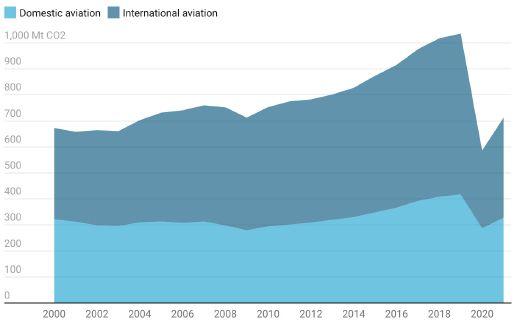
Carbon dioxide emissions from domestic and international flights were rising until the pandemic began in 2020 and demand dropped. Emissions have since begun to rebound.
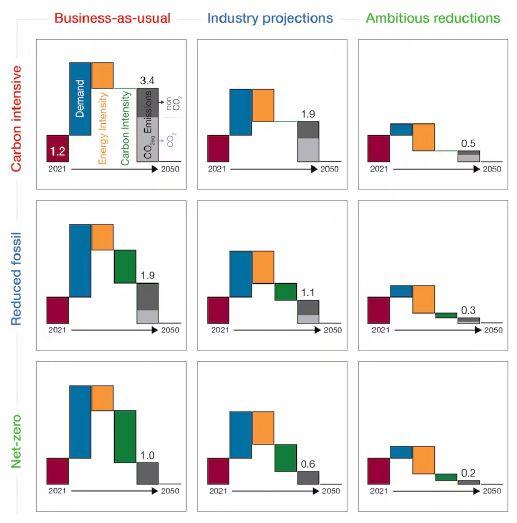
Nine scenarios illustrate how much carbon offsets would be required to reach net-zero emissions, depending on choices made about demand and energy and carbon intensity. Each starts with 2021’s emissions (1.2 gigatons of carbon dioxide equivalent). With rising demand and no improvement in carbon intensity, a large amount of carbon capture will be necessary. Less fossil fuel use and slower demand growth reduce offset needs.
Flying less and improving airplanes’ energy efficiency, such as using more efficient glide landings that allow airlines to approach an airport with engines at near idle, can help reduce the amount of fuel needed. But even in our rosiest scenarios – where demand grows at 1% per year, compared to the historical average of 4%,
ATAC’s Canadian Aviation Conference and Tradeshow is the premier national gathering offering Canada’s best networking, learning, and sales opportunity for operators, suppliers, and government stakeholders involved in commercial aviation and flight training in Canada.
TUESDAY, NOVEMBER 14 TO THURSDAY, NOVEMBER 16
FAIRMONT QUEEN ELIZABETH HOTEL MONTREAL, QC
For more information contact: Debbie Simpson, Tradeshow Manager 613-884-7728 tradeshow@atac.ca www.atac.ca
FLY WITH CONFIDENCE.
A ward
To be awarded at ATAC's 2023 Canadian Aviation Conference and Tradeshow, Nov. 14 to Nov.16, 2023 - Montreal, Qc.
e Award recognizes and honours a ight instructor, either xed or rotary wing, who has made a signi cant contribution to safety in Canada, also having demonstrated superior teaching skills.
Jane & Rikki Abramson established this Award in 2003 through Air Transport Association of Canada, and will personally present this year’s award. e recipient’s name will be engraved on the prestigious perpetual trophy and entered in the associated logbook, both on permanent display in the Canada Aviation & Space Museum in Ottawa.
e Award is Generously Sponsored By: Nominations can be made at any time throughout the year, prior to the deadline of September 14th, 2023 For entry requirements contact Jane Abramson, Founder & National Administrator Email: janeabramson@videotron.ca
www.dcamaward.com
and energy efficiency improves by 4% per year rather than 1% – aviation would still need about 3 exajoules of sustainable aviation fuels.
WHY OFFSETS ARE STILL NECESSARY
A rapid expansion in biofuel SAF is easier said than done. It could require as much as 1.2 million square miles (300 million hectares) of dedicated land to grow crops to turn into fuel – roughly 19% of global cropland today.
Another challenge is cost. The global average price of fossil jet fuel is about US$3 per gallon ($0.80 per litre), while the cost to produce bio-based jet fuels is often twice as much. The cheapest, HEFA, which uses fats, oils and greases, ranges in cost from $2.95 to $8.67 per gallon ($0.78 to $2.29 per litre), but it depends on the availability of waste oil.
Fischer-Tropsch biofuels, produced by a chemical reaction that converts carbon monoxide and hydrogen into liquid hydrocarbons, range from $3.79 to $8.71 per gallon ($1 to $2.30 per litre). And synthetic fuels are from $4.92 to $17.79 per gallon ($1.30 to $4.70 per litre).
Realistically, reaching net-zero emissions will likely also rely on carbon dioxide removal. In a future with similar airline use
as today, as much as 3.4 gigatons of carbon dioxide would have to be captured from the air and locked away – pumped underground, for example – for aviation to reach net-zero. That could cost trillions of dollars.
For these offsets to be effective, the carbon removal would also have to follow a robust eligibility criteria and be effectively permanent. This is not happening today in airline offsetting programs, where airlines are mostly buying cheap, nonpermanent offsets, such as those involving forest conservation and management projects.
Some caveats apply to our findings, which could increase the need for offsets even more. Our assessment assumes SAF to be net-zero carbon emissions. However, the feedstocks for these fuels currently have life-cycle emissions, including from fertilizer, farming and transportation. The American Society for Testing Materials also currently has a maximum blend limit: up to 50% sustainable fuels can be blended into conventional jet fuel for aviation in the U.S., though airlines have been testing 100% blends in Europe.
HOW TO OVERCOME FINAL HURDLES
To meet the climate goals the world has set, emissions in all sectors must decrease – including aviation.
While reductions in demand would help reduce reliance on sustainable aviation fuels, it’s more likely that more and more people will fly in the future, as more people become wealthier. Efficiency improvements will help decrease the amount of energy needed to power aviation, but it won’t eliminate it.
Scaling up sustainable aviation fuel production could decrease its costs. Quotas, such as those introduced in the European Union’s Fit for 55 plan, subsidies and tax credits, like those in the U.S. Inflation Reduction Act signed in 2022, and a carbon tax or other price on carbon, can all help achieve this.
Additionally, given the role that capturing carbon from the atmosphere will play in achieving net-zero emissions, a more robust accounting system is needed internationally to ensure that the offsets are compensating for aviation’s non-CO2 impacts. If these hurdles are overcome, aviation could achieve net-zero emissions by 2050. | W
This article was originally published by The Conversation. Candelaria Bergero is a Ph.D. Student in Earth System Science, University of California, Irvine, and Steve Davis is a Professor of Earth System Science, University of California, Irvine.
BOOK NOW
RHYME NOR REASON
In this post-pandemic period, Canada’s aviation industry has been struck by another curse that is causing great havoc on the sector’s recovery efforts. That is Transport Canada’s unwillingness to venture out of Tower C to discover first-hand the impact of some of its regulations, the poor state of the department’s level of service, and the inability to see reason in industry’s request for regulatory reprieve in these times of dire human resources shortages.
The timing of some compliance deadlines and the refusal to allow tolerances to facilitate a smooth and workable implementation timeline is unacceptable given the many challenges facing industry. We rely on the Minister to challenge his department and impose a new approach, not one where the industry’s plea for tolerance or temporary reprieve is seen as an obstruction or as a disguised refusal to comply.
FLIGHT AND DUTY TIME
ATAC wrote to the Minister in November asking that the implementation deadline for compliance to the new Fatigue Risk Management regulation for the 703 and 704 operators be pushed back by 18 months beyond December 12, 2022, the date originally set by the department. We received a perfunctory response from the department, suggesting the same dismissive attitude unfortunately too often displayed when faced with constructive feedback from operators.
The labour shortage is a huge problem requiring all parties to work together towards a solution. The Government must acknowledge that the very existence of smaller regional carriers is threatened by the challenge of holding on to the few experienced pilots available as the demand far exceeds the supply of available qualified pilots. There could not be any worse timing for imposing regulations that exacerbate the biggest threat that our industry has faced outside the pandemic. To impose a new regulation at this time that requires an overnight increase of 30% of pilots required to offer the same level of service suggests a total disregard for sustained air services to Canada’s remote regions.
Once again, we ask that Tower C accept the reality facing our industry and the threat to the continued delivery of service to Canadians, especially in remote regions. Undoubtedly, Transport Canada will blame industry for the cut in service, totally dismissing the role it plays in setting our working environment.
ATAC Operators have given numerous examples of cases where Fatigue Risk Management Regulations need to include a minimal
level of tolerance if they are to be practical, operationally and financially. The suggested Fatigue Risk Management System, the usual Transport Canada go-to answer, has been amply proven to be impractical and impossible to implement except for perhaps Canada’s largest carrier.
PASSENGER PROTECTION IS EVERYONE’S RESPONSIBILITY
Minister Alghabra announced in February that he will be tabling legislative and regulatory amendments to the Air Passenger Protection Regulations (APPR). Industry certainly agrees that some amendments are very much needed if requests for compensation are to become user friendly rather than a burden to all stakeholders.
Why is the air transport industry held to standards no other industry or government service is ever expected to meet? What other industry is penalized to such extremes for delay or cancellation of service? The delays for air operators to settle a passenger request for compensation are ridiculously short, especially considering that passenger requests can be filed up to twelve months after the flight. Oddly enough, the CTA allows itself 18 months to manage a request for compensation, Clearly, the Government is holding the commercial air transport industry to levels of service it doesn’t begin to hold itself to.
Changes are needed to enhance the accountability and the shared responsibility of all parties dealing with passenger services, not simply the carriers. Amendments need to propose a model where all share in the responsibility, including the passenger, the carriers and all others involved in managing or impacting air travel in Canada, including airports, CATSA, NAV Canada, or ground service providers. Also, amendments to the APPR should aim to make their application simple and practical for both the passenger and the service providers.
It must not be forgotten that the air carriers’ number one concern is the safety of passengers. Considering that over 160 million people travel by air annually in Canada, and that in no instances of the Holiday Season disruptions of service cited was the safety of passengers threatened, it could be concluded that this industry did an excellent job in very difficult circumstances.
ATAC and all of industry stand ready to work with the Government to reach a workable consensus that would improve the passenger experience in Canada.
John McKenna President and CEO
Transport Association of Canada
By Lorenzo Marandola |
From the ground up
M1 Composites celebrates 10 years as it grows through
innovation
On the tip of the nose, radomes are vulnerable to bird strikes, hail damage, lightning, and static discharge. They protect highly sensitive radar antennas from weather and improve aerodynamic loading. Though highly important to aircraft structure, radomes are often overlooked. The slightest changes to their physical characteristics can adversely affect aircraft performance.
Ensuring optimal radome performance is crucial to flight safety and performance.
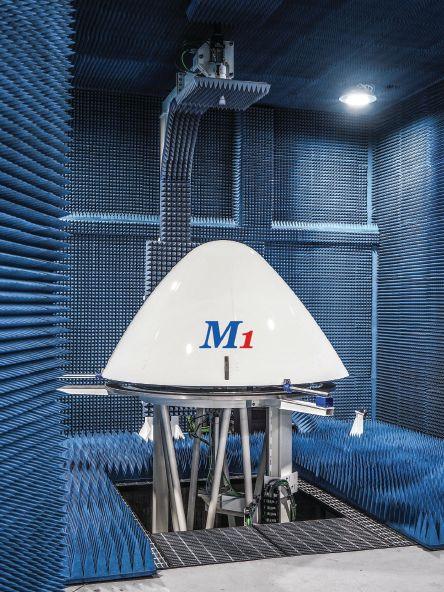
M1 Composites, based in Laval, Quebec, has long been repairing radomes. In 2022, it took a major leap forward and opened its new indoor Compact Radome Test Range (CRTR) to conduct transmissivity testing of weather radomes.
Housed in an 82,000-square-foot facility, the test range is a spherical near-field testing facility that ensures that the aircraft's weather radar system is functioning optimally. The CRTR is the only one of its kind in Canada and one of only a handful in the world.
M1 can test military and commercial weather radomes 24/7/365 regardless of weather and provide the quickest turnaround time to all of its customers.
Another key development in M1’s product range are its new engine covers. These covers are unlike any other on the market today. Developed and produced to protect the thousands of aircraft and engines grounded at the height of the pandemic, M1’s engineers worked side-by-side with one of its largest airline customers to find a solution. The result? A highly durable, lightweight and transportable engine cover that requires only two technicians to install in under five minutes per engine. Its ease of use – no ladders or scaffolding required –ensures fast installation and the prevention of falls from heights.
When not in use, these engine covers can be carried in the cargo bay for use in off-base operations and in all inclement and adverse conditions. Made of a highstrength synthetic fabric, the cover protects
M1 Composites in 2022 opened its CRTR site for transmissivity testing of weather randomes.
and prevents corrosion and premature degradation of engine lips, parts and components. This new engine cover saved that initial customer $4 million annually in engine MRO costs.
This unique cover has already gained acceptance across the industry and aircraft types, including Boeing 737 MAX, 777, 787, Airbus A220, A320 and A330. M1 has since been awarded a contract by a major airline to provide these engine covers for an entire fleet. It is a testament to the quality of M1’s products, solutions and attention to changing customer needs.
Evolving with the changing needs of customers is at heart of M1’s mission. The success of its new CRTR and engine cover
are just some examples of M1’s commitment to research and development. Led by experienced engineers in search of cutting-edge technologies or improving tried, tested and true ones, M1 is a Transport Canada Approved Maintenance Organization (AMO) and Design Approval Organization (DAO) specializing in advanced composites and sheet metal structures.
M1’s push in engineering innovation and business growth has not gone unnoticed in the industry. In 2021, it was awarded the MACH 5 accreditation by AeroMontreal for continuous improvement.
In 2022, M1 Composites celebrated its tenth anniversary and the company continues to grow its unique market position and product portfolio. It is a leader in the repair of radomes, nacelles, flight control surfaces, and other structural elements for both commercial and military aircraft.
M1 has set its sights on innovation to expand and grow with the ever-changing needs of aviation industry, exemplified by CRTR and engine cover investments. The Canadian company is grounded in its commitment to provide innovative products and solutions to all its global customers. Innovation is not just a passive marketing term here. It is at the very heart of what M1 Composites does everyday. | W
Lorenzo Marandola is President of M1 Composites Technology in Montreal, Canada. He is a licenced member of the Order of Engineers of Québec with almost 30 years of experience in engineering design, analysis, production, testing and management.