Pearson runway rehab, Air Canada buys more Airbus, KF Aeroflyer
12 ALTERNATIVE APPROACH
Foreign ownership rules and Flair Airlines
14 DRONE WORKS
Retail giants step up BVLOS delivery
15 POSITION REPORT
Canada needs a new defence strategy
34 ATAC REPORT
High frequency rail in Canada 35 Marketplace
38 ON FINAL Canadian Women in Aviation growth
FEATURES
16 NOT YET CLEARED FOR TAKEOFF
New draft Luxury Tax legislation continues to raise concerns for the Canadian aviation industry BY
STEVEN SITCOFF
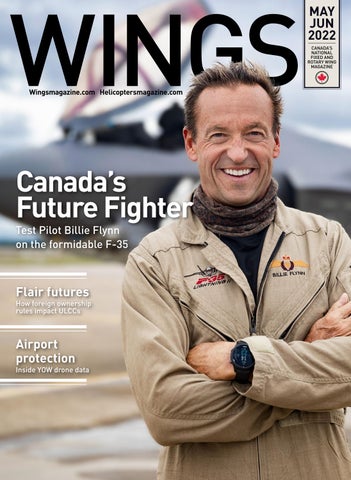
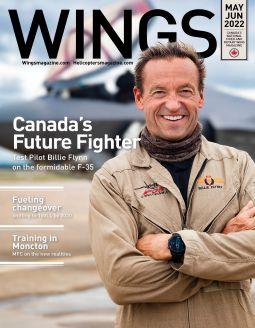
20 CANADA’S FUTURE FIGHTER
How the Canadian Armed Forces and Royal Canadian Air Force can best integrate the formidable F-35 BY
JON ROBINSON
24 100LL FUEL ALTERNATIVES
The aviation industry continues its work toward a more environmentally progressive future BY PHIL LIGHTSTONE
26 CLEARING THE AIR
Winnipeg’s Cypher Environmental is working with innovate dust palliatives to control unpaved runways
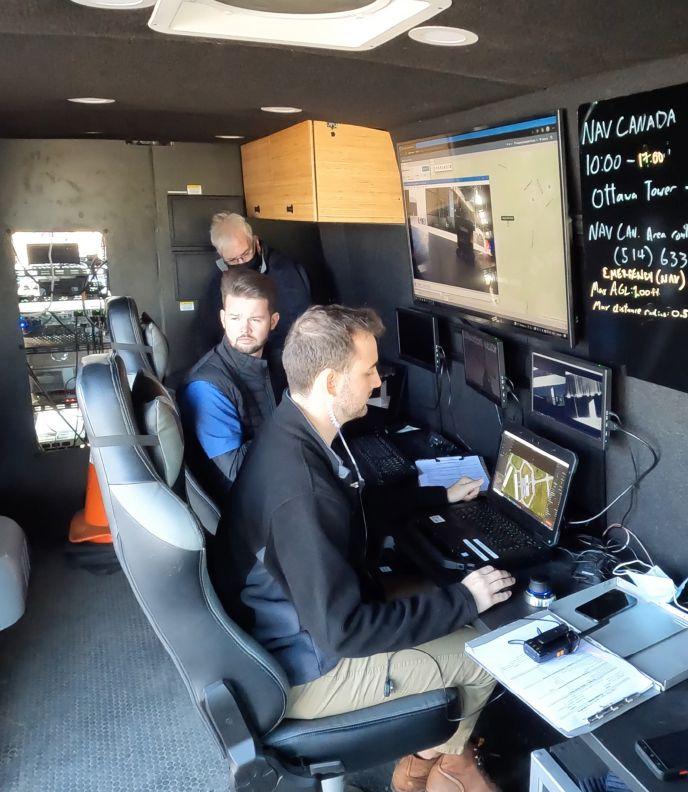
YOW drone detection program reveals surprising data during the final days of Ottawa protests
SIMMIE
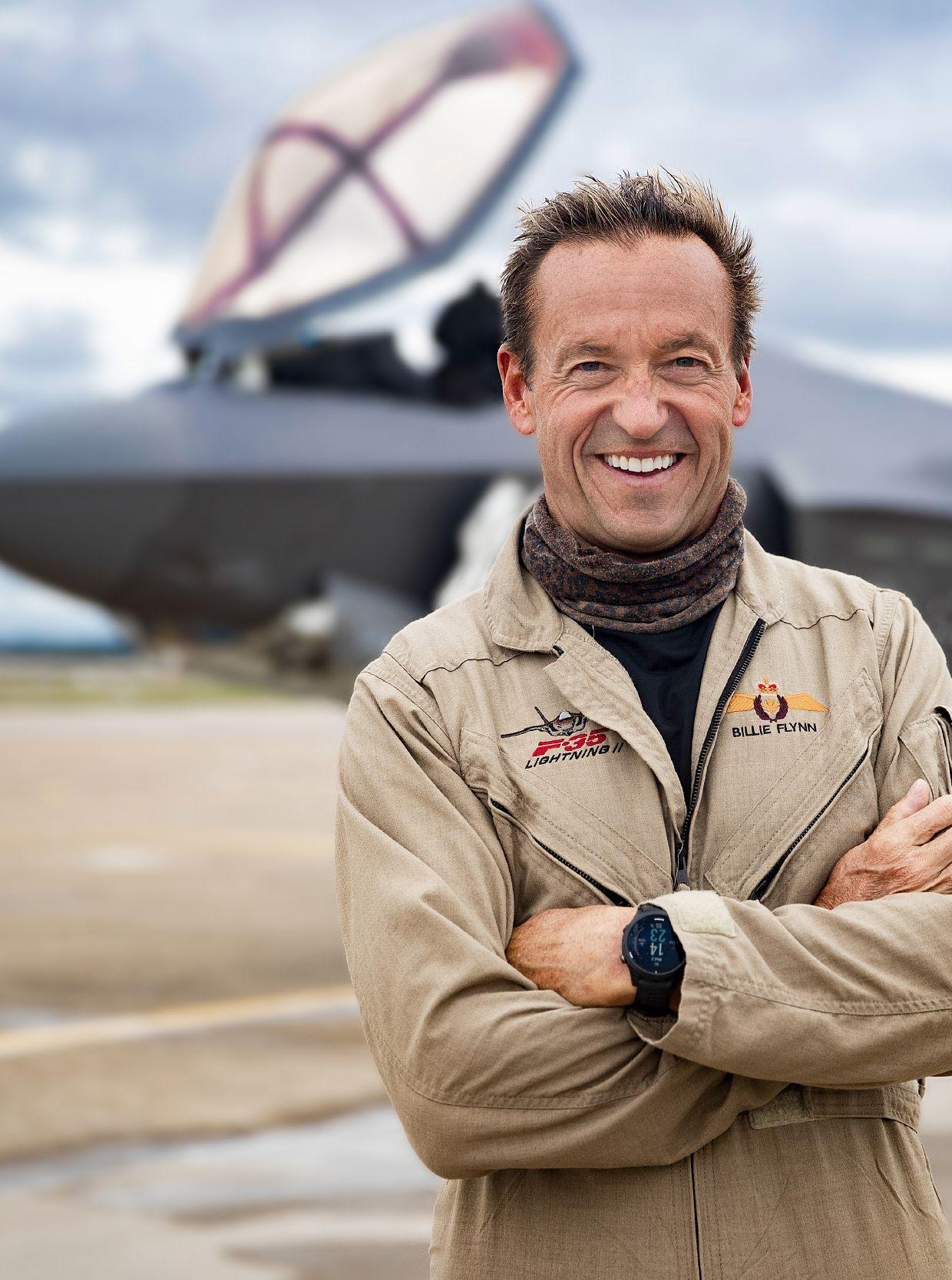
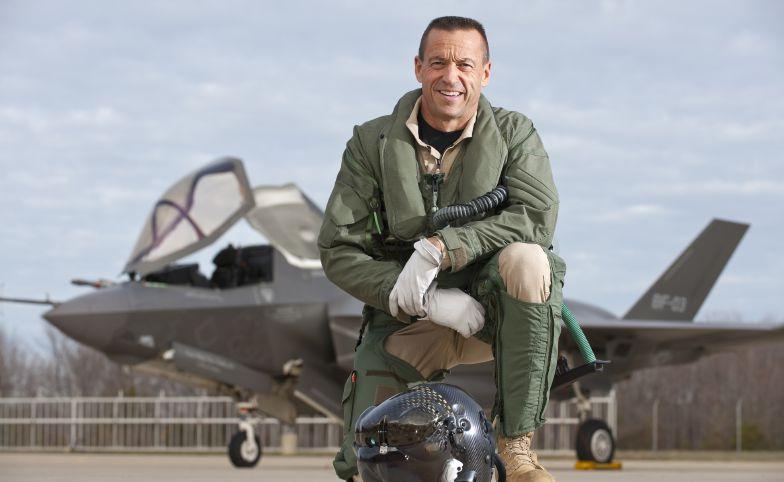
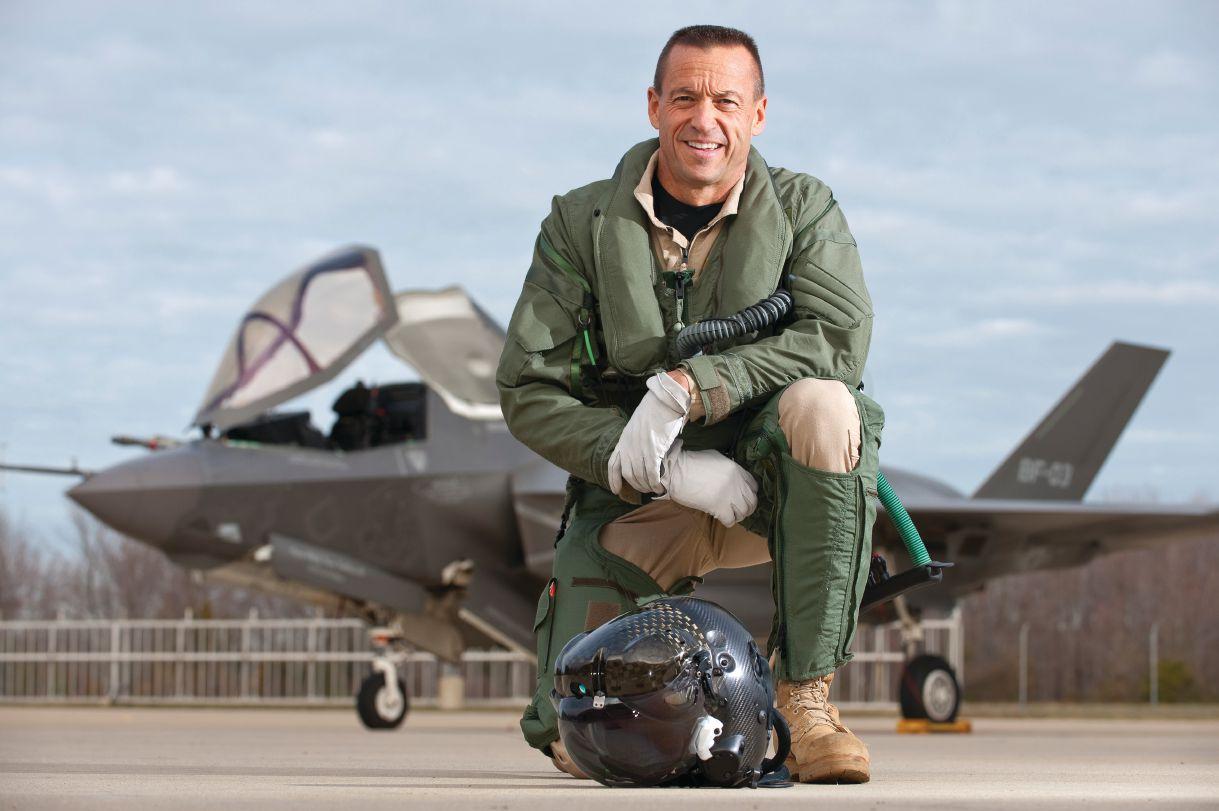
Billie Flynn, pictured in front of tail number BF-3, has flown more than 80 aircraft over his 35-year plus career, including more than 10 years as an F-35 test pilot.
Stay in Touch with Aviation News SUBSCRIBE Online TODAY
READER SERVICE
Print and digital subscription inquires or changes, please contact Serina Dingeldein, Audience Development Manager Tel: (416) 510-5124 Fax: (416) 510-6875 sdingeldein@annexbusinessmedia.com
Mail: 111 Gordon Baker Rd., Suite 400, Toronto, ON M2H 3R1
EDITOR
Jon Robinson jrobinson@annexbusinessmedia.com 647-448-6188
FLIGHT DECK
David Carr, Scott Henderson, Kendra Kincade, Phil Lightstone Carroll McCormick, Scott Simmie, Steven Sitcoff, Srdjan Vucetic, Nisha Venkatesh
NATIONAL ACCOUNT MANAGER Mena Miu mmiu@annexbusinessmedia.com • 416-510-6749
GROUP PUBLISHER AND VICE PRESIDENT OF SALES Martin McAnulty mmcanulty@annexbusinessmedia.com
CHIEF OPERATING OFFICER Scott Jamieson sjamieson@annexbusinessmedia.com
WINGS MAGAZINE
P.O. Box 530, 105 Donly Dr. S., Simcoe, ON N3Y 4N5 Tel: 519-428-3471 Fax: 519-429-3094 Toll Free: 1-888-599-2228
Printed in Canada ISSN 0701-1369
PUBLICATION MAIL AGREEMENT #40065710
Published six times per year (Jan/Feb, Mar/Ap, May/Jun, Jul/Aug, Sep/Oct, Nov/Dec) by Annex Business Media
SUBSCRIPTION RATES
Canada – 1 Year $ 34.50 (plus GST - #867172652RT0001) USA – 1yr -$ 78.50 CDN (USD $60.50) International – 1yr - $90.50 CDN (USD $69.50) Occasionally, Wings magazine will mail information on behalf of industry-related groups whose products and services we believe may be of interest to you. If you prefer not to receive this information, please contact our circulation department in any of the four ways listed above.
All advertising is subject to the publisher’s approval. Such approval does not imply any endorsement of the products or services advertised. Publisher reserves the right to refuse advertising that does not meet the standards of the publication.
Find stability with a career in aviation at the WestJet Group.
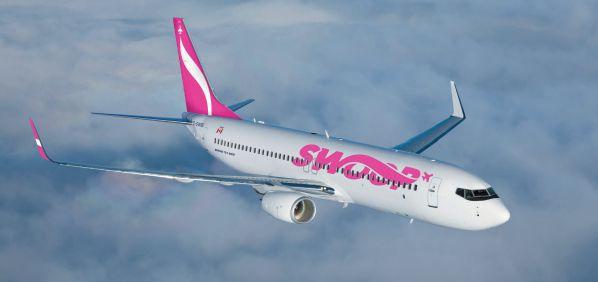
At the WestJet Group, WestJet, WestJet Encore and Swoop, you’ll discover opportunities to grow your roots with established and respected airlines. We offer an exciting career with stability and development. Under our wing, you can count on flexible scheduling and a competitive savings plan to set you up for the long-haul.
If you’re ready to elevate your aviation career in a diverse and inclusive work environment— come fly with us:
• Swoop Direct Entry Captains and First Officers
• Encore First Officers
• Licensed Airline Maintenance Engineers
See these and more opportunities at westjet.com/greatjobs
By Jon Robinson |
Appropriately cautious practices
The demand for used aircraft remains high, but it might have peaked
The International Aircraft Dealer Association on April 11 released its 2022 First Quarter Market Report showing the bull market for preowned business aircraft continued in the first quarter of 2022. Members of the International Aircraft Dealers Association (IADA) closed 288 deals from January through March, compared to 213 transactions in the same period in 2022, a 35 per cent increase.
IADA began monthly tracking of preowned sales metrics for business aircraft in April 2020 as a result of the volatile market conditions caused by the COVID-19 pandemic and subsequent economic measures to support people and businesses. Central banks around the world began to implement higher interest rates in an effort to slow down soaring inflation. In late April, Statistics Canada reported the annual rate of inflation hit 6.7 per cent in March, the fastest year-over-year increase in the consumer price index since January 1991.
Many have argued governments moved too slow in applying interest rate hikes to control inflation and supply shortages, but, of course, the world continues to face unprecedented shocks to its economic and social systems. “We live in tumultuous times. Despite that, the aviation field continues to show extraordinary strength. Global demand is very high. Much like the fourth quarter of 2021, that demand is married to constrained inventory levels,” said Wayne Starling, Executive Director, IADA, in releasing the report.
Transaction volume by its member dealers tend to reflect the overall health of the used aircraft market, explains IADA, because its dealers buy and sell more aircraft by dollar volume than the rest of the world’s dealers combined. During the first quarter of 2022, IADA explains its members
ARGUS reports that the North American market recorded more than 321,000 flights in March 2022, representing a year over year gain of 18.2 per cent.
entered into 223 acquisition agreements, had been exclusively retained to sell 155 aircraft, had 259 aircraft under contract, and saw only 45 deals fall apart.
AirSprint, Canada’s leading provider of fractional jet ownership, in April released a white paper, called Buying a Private Jet, designed to give private jet buyers insight into the complete purchasing process. The white paper highlights a range of statistics about the improving business environment for aviation. Citing analysts from ARGUS’ TRAQPak division, the North American market recorded more than 321,000 flights in March 2022, representing a yearly gain of 18.2 per cent over the same month last year.
JetNet in its monthly iQ Pulse report outlines more details of the record levels of
TOP DATA BURSTS… in this issue
1. Ottawa estimates the Luxury Tax will raise $120 million annually. P. 16 2. EAGLE aims to help transition piston engine aircraft to lead free fuels by 2030. P. 24 3. Canada-wide, there were 944 airports with unpaved runways in 2013. P. 28 4. YOW’s Drone Detection Project revealed a spike of 59 drone flights as the police were clearing Ottawa protestors. P. 30 5. CWIA was started in 1991 by 30 volunteers. P. 38
transaction activity for private and business aircraft, with orders for new aircraft for production slots in 2023 and even 2024 now amongst the deals being negotiated. The report’s author, Rolland Vincent, described the environment as what at least feels to be a Golden Age of Demand, but that real-world pressures on individuals and their organizations to perform have also clearly intensified.
Beyond the concerns of being able to meet industry expectations, JetNet explains aircraft brokers and dealers continue to strain to find flyable hardware for buyers, as prices and valuations test new highs. The research outlet addresses the continuing economic and social fallout of the war in Ukraine, again amid surging inflation, and new pressures on aerospace supply chains, particularly for highly valued aerospace titanium. Vincent also points to the staggering jump in Brent crude prices, which reached US$133 per barrel on March 8, 2022, up 96 per cent year over year.
In its iQ Pulse report, JetNet forecasts there will be 1,100 new fixed-wing turbine deliveries in 2022, for general and business aviation, up just five to six per cent year over year when compared with GAMA’s 2021 actual shipments report. Vincent explains that while new aircraft demand remains robust by almost any prior-year standard, labour shortages, supply chain pressures, and appropriately cautious management practices are tempering any significant increases in production. | W
Eve Storm President
ON THE FLY
THE LEAD
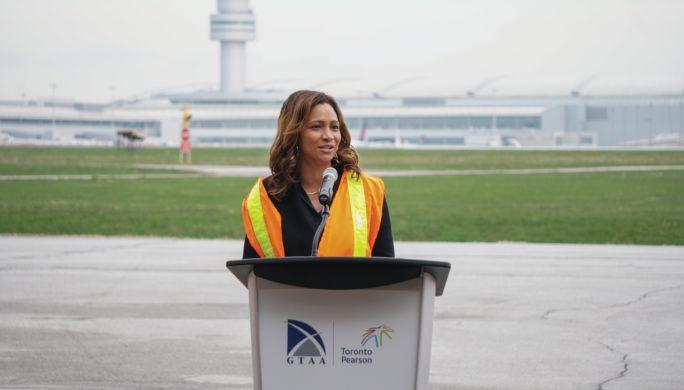
PEARSON BREAKS GROUND ON 06L/24R REHABILITATION
Deborah Flint, CEO of Greater Toronto Airports Authority, on the morning of April 25 welcomed Omar Alghabra, Canada’s Minister of Transport, to Toronto Pearson for a ground-breaking ceremony to mark one of the largest runway rehabilitation projects in the airport’s history. The construction project is being led by Dufferin Construction.
Runway 06L/24R, Pearson’s secondbusiest runway, will be temporarily closed to late fall for a complete rehabilitation. The Greater Toronto Airports Authority (GTAA) explains modern innovation and advanced planning will allow Pearson to complete the project in eight months, and with a more sustainable approach.
First built in the 1960s, GTAA explains this three-kilometer runway requires a complete rehabilitation due to the wearing down of its concrete sub-structure because of weather conditions, use and time. This project will extend the life of the runway by 30 years and enhance the safety of the runway. The project will include the
use of recycled materials and upgrades to 1,800 LED lights, GTAA notes, which will help enhance safety and reduce its carbon footprint.
COMMERCIAL
AIR CANADA SINGLE DAY PASSENGER LOAD EXCEEDS 100,000
Air Canada for the first time in more than two years has flown more than 100,000 customers in a single day as passenger loads and travel continue to rebound from the COVID-19 pandemic. The last time Air Canada carried more than 100,000 customers in one day was March 13, 2020. The World Health Organization
declared the COVID-19 outbreak as a Public Health Emergency of International Concern on January, 30, 2020, and as a pandemic on March 11. 2020.
During the pandemic, Air Canada passenger loads fell as low as 2,175 on April 23, 2020. Prior to the pandemic, Air Canada in 2019 carried on average nearly 150,000 people daily and its single-day, passenger-load record was 187,000 customers on August 16, 2019.
LYNX AIR LAUNCHES MAIDEN VOYAGE
Lynx Air, Canada's newest Ultra Low Cost Carrier, made its first commercial flight on April 7 on a route from Calgary to Vancouver. Lynx currently operates a fleet of three brand-new Boeing 737 aircraft. The airline's next flight destination was reached on April 11 with an inaugural Calgary-Toronto flight. It added Kelowna to its network starting April 15, Winnipeg on April 19 and was set to reach Victoria starting May 12.
The airline plans to add two more aircraft to its fleet in the coming months, allowing it to further expand its network in the lead up to summer, including flights to and from Hamilton, Halifax and St. John's at the end of June and Edmonton at the end of July. Lynx aims to operate 148 flights per week coast to coast across Canada by this summer, which equates to more than 27,000 seats per week. It announced plans to present one-way fares start from $39. “Lynx is on a mission to make air travel accessible to all Canadians,” said CEO Merren McArthur.
Deborah Flint, CEO of Greater Toronto Airports Authority, describes one of Toronto Pearson’s largest infrastructure projects in recent years.
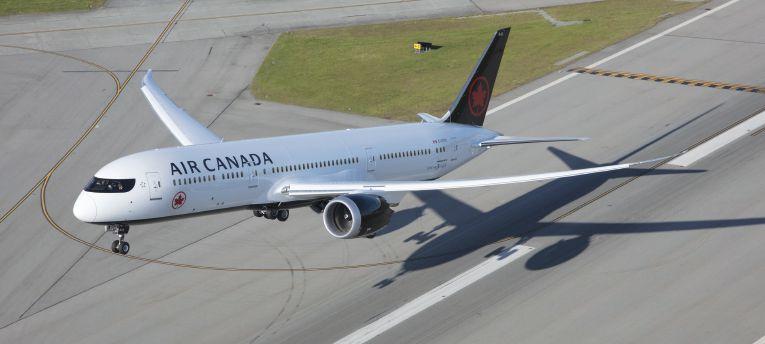
Air Canada on April 15, 2022, flew more than 100,000 customers in a single day for the first time since early in the pandemic.
AIR CANADA GETTING 26 A321XLR AIRCRAFT
Air Canada is acquiring 26 extra-long range (XLR) versions of the Airbus A321neo aircraft. Deliveries are to begin in the first quarter of 2024 with the final aircraft to arrive in the first quarter of 2027. Fifteen of the aircraft will be leased from Air Lease Corporation, five will be leased from AerCap and six are being acquired under a purchase agreement with Airbus S.A.S. that includes purchase rights to acquire an additional 14 of the aircraft between 2027 and 2030.
Air Canada's A321XLRs will accommodate 182 passengers in a configuration of 14 lie-flat and 168 economy seats. With a range of approximately 8,700 kilometres and an ability to fly up to 11 hours, the A321XLR can operate non-stop anywhere across North America and, pending Transport Canada approval for overseas operations, also fly transatlantic missions.
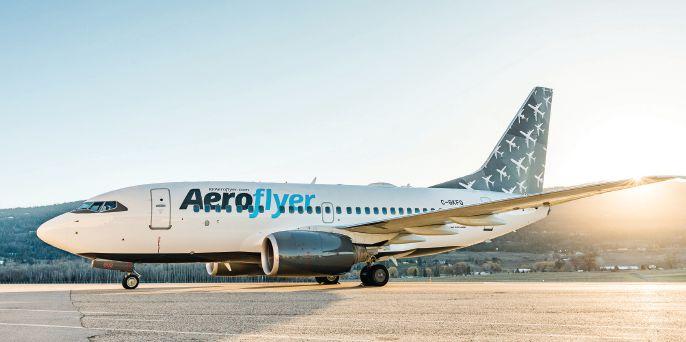
KF AEROSPACE LAUNCHES AEROFLYER CHARTER
KF Aerospace on April 11 introduced new passenger air charter services, called KF Aeroflyer, targeting the leisure, tourism and work force transportation markets. Based in Western Canada, Aeroflyer will provide domestic and international charter programs using a fleet of B737NG aircraft.
KF Aerospace is Canada’s largest commercial aircraft maintenance provider and an air operator with nearly 50 years of flying experience in passenger and cargo charters. The company notes its Aeroflyer Charter Operations Team holds
40 years of expertise with charter aviation programs. The Aeroflyer narrow-body fleet of B737NG aircraft will include a range of onboard services like custom catering and wireless in-flight entertainment powered by Bluebox Aviation Systems.
With aircraft currently based in Kelowna and Calgary, Aeroflyer will be positioning for growth beyond Western Canada. “In the coming months we plan to expand our fleet across the country to support national and international customers,” says Charter Operations Manager, Nick Samuel. “We’re excited to provide the market with nimble, responsive and highly efficient charter solutions.”
BUSINESS AVIATION
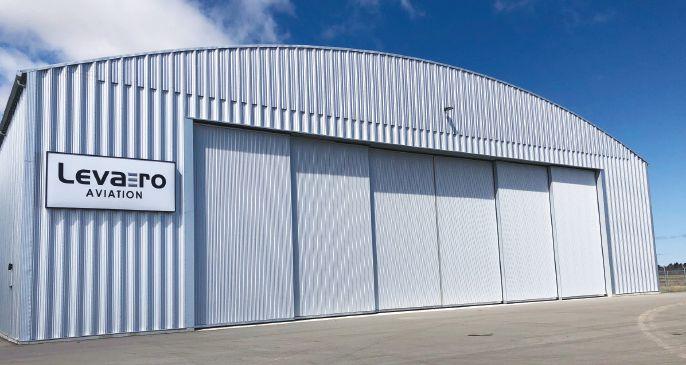
LEVAERO OPENS COLLINGWOOD FACILITY
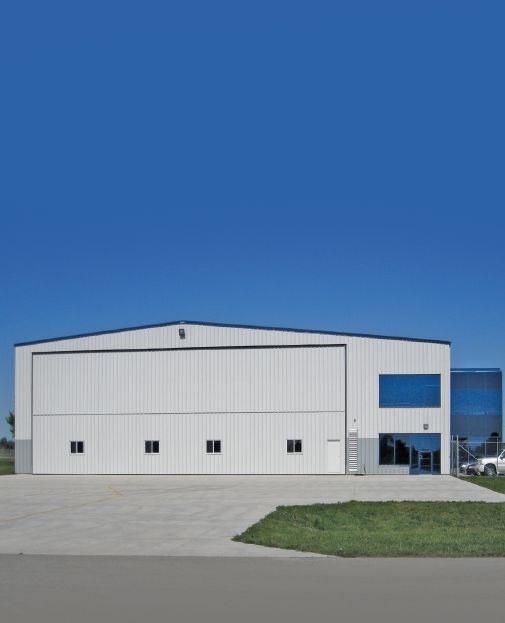
Levaero Aviation on April 25 announced the opening of a new base at Collingwood Regional Airport, CNY3, featuring a new 18,000-square-foot hangar complex that will serve as an additional site for Levaero’s maintenance and aircraft sales departments.
Headquartered in Thunder Bay, Ont., with a national sales office in Toronto, and now the base in Collingwood, Ont., Levaero is the exclusive Pilatus Aircraft Sales
& Service Centre in Canada.
“We are excited to officially welcome Levaero Aviation to CNY3. Our relationship has grown over the years, and we are delighted to be home to their latest expansion,” said Geordie Dalglish, President of the Collingwood Regional Airport. “Their presence will support employment in the region, and further expand the draw of our airport.”
Levaero describes the new base as a natural fit for its Ontario expansion, with Collingwood serving as the heart of one of the fastest growing regions in the province. The CNY3 airport is under new ownership and undergoing significant capital investment and expansion.
“Our new facility at the Collingwood Airport is the latest in our expansion plans to support our growing customer base,” said Stan Kuliavas, Vice President of Sales, Levaero. “As the first major OEM authorized dealer and IADA accredited broker located at the airport, we look forward to serving our existing customers in the region, as well as assisting others with their aviation needs.”
TEXTRON ACQUIRES PIPISTREL
Textron on April 18 completed its acquisition of Pipistrel d.o.o, Pipistrel Vertical Solutions d.o.o. and Pipistrel Italia S.R.L., known collectively as Pipistrel. Under the terms of the transaction, Textron purchased Pipistrel for a cash price of approximately €218 million ($375 million in Canadian funds). Pipistrel’s founder and CEO, Ivo Boscarol, will remain a minority shareholder of Pipistrel with an approximately 10 per cent interest for a two-year period. The cash purchase price includes the amount for which his minority interest will be purchased at the end of the two-year period.
Textron notes Pipistrel’s Velis Electro is the world’s first, and currently only, electric aircraft to receive full type-certification from the European Union Aviation Safety Agency (EASA). Pipistrel, which offers a family of gliders and light aircraft with both electric and combustion engines, has
Levaero becomes the first major OEM authorized dealer and IADA accredited broker located at CNY3.
delivered more than 2,500 light aircraft worldwide since its founding in 1989. It also has both hybrid and electric propulsion models under development. Pipistrel is now part of Textron’s newest business segment, Textron eAviation, which will pursue what Textron describes as a longterm strategy to offer a family of sustainable aircraft for urban air mobility, general aviation, cargo and special mission roles.
DAHER EXHIBITS FIRST PRODUCTION TBM 960
Daher on April 5 at the Sun ‘n Fun Aerospace Expo in Lakeland, Florida, unveiled the newest version of its TBM pressurized single turboprop aircraft family, the TBM 960, which incorporates Pratt & Whitney Canada’s PT6E-66XT engine and a fully digital e-throttle. The aircraft also includes what Daher describes as a digitally controlled cabin that incorporates an allnew environmental control system, LED
ambience lighting and electrically dimmable windows.
The TBM 960 has been certified by the European Union Aviation Safety Agency and the certification process with the U.S. Federal Aviation Administration is currently underway. Deliveries of the TBM 960, which joins the existing TBM 910 model, are set to begin in the first half of 2022.
The TBM 960 retains the high speed of Daher’s TBM family, explains the company, while enabling lower fuel consumption. At Daher’s recommended cruise setting of 308 kts, the fuel consumption is only 57 U.S. gallons per hour, which is a 10 per cent fuel economy compared to the maximum cruise
setting, for more sustainability. Daher explains the heart of this latest TBM version is the intelligent PT6E-66XT powerplant and Hartzell Propeller’s fiveblade Raptor composite propeller, both of which are linked to the dual-channel digital Engine and Propeller Electronic Control System (EPECS).
SAFRAN NAMED ENGINE PARTNER FOR DIAMOND EDA40 ELECTRIC AIRPLANE
Diamond Aircraft reached an agreement for its all-electric training aircraft, eDA40, to be integrated with an ENGINeUS electric motor developed by Safran Electrical & Power. The eDA40 is a derivative of the existing and certified DA40 platform. Diamond Aircraft expects the eDA40 will become the first EASA/FAA Part 23 certified electric airplane with Direct Current (DC) fast charging – capable of turning around a
Daher exhibited its first production TBM 960 airplane at the Sun ‘n Fun Aerospace Expo in Lakeland, Florida.
PHOTO:
depleted aircraft in under 20 minutes.
Total flight time of the eDA40, which was first unveiled as Diamond development program in October 2021, is expected to be up to 90 minutes as the battery technologies evolve. The eDA40 is expected to reduce operating costs by up to 40 per cent when compared to traditional piston aircraft.
Expecting certification in mid-2023, the ENGINeUS 100, which will equip the eDA40, delivers 130 kW maximum at takeoff power and features a fully integrated motor controller within the machine. Basic EASA certification for the eDA40 is expected at the end of 2023 or early 2024.
HELICOPTERS
BLACKCOMB ACQUIRES ELBOW RIVER
Blackcomb Helicopters is expanding to Alberta with the purchase of Elbow River Helicopters, a long-standing helicopter
operator based at Springbank Airport near Calgary, Alberta. The acquisition adds two additional 212 machines to the Blackcomb fleet, including a 212 HLP BLR DF Engine Machine. Blackcomb explains this addition increases its ability to serve the company’s growing utility operation customers in Alberta and in Southeast British Columbia. All Elbow River employees were offered employment with Blackcomb Helicopters.
Blackcomb also explains the base at Springbank Airport, which includes component overhaul tooling and capabilities, will become a major focus for its medium helicopter fleet maintenance.
The transaction closed March 31, 2022, and future operations will take place under
the existing Blackcomb Helicopters Aircraft Maintenance Organization (AMO) and Aircraft Operating Certificate (OC). Torrie Chartier will be staying on as Blackcomb’s Regional Manager with Derrick Shillington as Blackcomb’s Chief Engineer – Bell Aircraft, and Bruce Holloway, founder, serving in an advisory role.
Founded in Whistler, British Columbia and operating for over 30 years, Blackcomb Helicopters is one of the country’s leading tour and heli-services operators, which includes its unique position of operating 100 per cent carbon neutral. Blackcomb operates from bases at Vancouver International Airport, in Whistler, Pemberton, Squamish, Sechelt, Lillooet, Terrace, and now Springbank, Alberta. | W
CANADIAN AVIATION CONFERENCE & TRADESHOW 2022
A major Industry Networking Event not to be missed!
ATAC’s Canadian Aviation Conference and Tradeshow is the premier national gathering offering Canada’s best networking, learning, and sales opportunity for operators, suppliers, and government stakeholders involved in commercial aviation and flight training in Canada.
TUESDAY, NOVEMBER 15 TO THURSDAY, NOVEMBER 17
WESTIN BAYSHORE HOTEL, VANCOUVER, BC
Blackcomb Helicopters in January 2019 became the first full-service helicopter operator in the world to offset 100 per cent of its carbon footprint.
By David Carr |
A low cost future with Flair
How foreign ownership rules are impacting ULCC growth
in Canada
The Canadian government’s official line is it wants a robust, ultra-low-cost airline sector, with room for energetic new entrants. But does it really? The Canadian Transportation Agency’s (CTA) singling out Edmonton-based Flair Airlines over foreign ownership suggests otherwise. The issue is how much of Flair is controlled by Miami-based 777 Partners, a 25 per cent stakeholder in the Edmonton-based airline, lender and lessor of six of Flair’s Boeing 737 Max jets. The question is… so what?
Unlike the U.S. and Europe, breaking into the Canadian marketplace as an UltraLow-cost Carrier (ULCC) start-up has been a tough nut to crack. Largely due to the size and dominance of Air Canada, WestJet, their discount subsidiaries Rouge and Swoop, and foreign ownership regulations that have been relaxed in recent years, but fail to go far enough to nurture a competitive ULCC sector in the country.
That is because the market has changed dramatically since WestJet rose up to successfully challenge the dominance of the Air Canada/Canadian Airlines merger. You can no longer build up a national airline in drips and drabs with a handful of ageing airplanes. That’s a formula to be picked off (legitimately) by the established players route by route.
Flair has been around since 2005, but it’s current incarnation as a ULCC since 2017 qualifies it as a start-up. With the arrival of Stephen Jones, a former executive of Wizz Air, one of Europe’s largest and fastest growing ULCC’s, as chief executive, Flair may be considered a restart, with Wizz as its growth model.
Jones’ blueprint is to aggressively emerge from two years of COVID-hell with more domestic and transborder routes and a fleet of airplanes that could grow to 50 by 2026.
“It’s not difficult. It’s been done around the world. I don’t know why it hasn’t happened in Canada, but we are about to change that,” Jones told CTV News back in 2021. Perhaps he now has a clearer understanding of why. Canadian foreign ownership rules block access to the deep pockets of a company like 777 Partners needed for a low-cost to scale up to compete against Air Canada and WestJet.
Canada allows for 49 per cent of an airline
Flair has been around since 2005, but its current incarnation as an Ultra Low-cost Carrier since 2017 qualifies it as a start-up.
to be foreign-owned, but a single person or entity is capped at 25 per cent. On the surface, Flair is in compliance.
The CTA is more concerned about what is below the surface, however, including a high interest loan reported to be US$129 million, aircraft leases and an American presence on the board giving 777 Partners control of Flair that is out of proportion with its 25 per cent holding.
Foreign ownership rules can be a fluid game. The original 25 per cent ownership limit for Canadian Airlines in the 1987 National Transportation Act (since increased to 49 per cent) was decided upon for no other reason than that was the U.S. limit.
Consider the treatment of Flair in 2022 versus the early 1990s when regulatory hoops were jumped through to allow American Airlines to buy 33 per cent of Canadian Airlines in a deal where the Dallasbased carrier would provide administrative services, including accounting and data processing.
The difference speaks to the cozy relationship the CTA has with established carriers; Canadian was a wounded bird that the government of the day would not let go bankrupt (hence the eventual forced marriage with Air Canada) while Flair is the cheeky upstart. And not for the first time.
In 2016, the CTA challenged deep
discounter New Leaf on whether it required an operator’s licence to brand and sell tickets on aircraft flown by Flair. (Flair took over New Leaf in June 2017)
Flair has scrambled to reduce its dependence on 777 Partners against the risk of losing its operating licence. Jones does not see it coming to that, but has requested an 18-month extension to refinance its debt, built up largely during COVID, when the airline did not have access to other revenue sources to remain afloat.
Part of the restructuring could include an IPO. Competitors object to the extension claiming the need for a level playing field. Assuming it has always been level for upstarts.
Canada’s air transport industry is set for a post-COVID shakeup, including WestJet’s acquisition of Sunwing and Porter Airlines national expansion with a fleet of Embraer 195-E2 jets. Canada placed more restrictions on airlines during the pandemic than any other developed economy.
Airlines struggled to survive here over the past two years and now must be given runway to recover and thrive. Flair needs to be granted an extension and Ottawa (an equity stakeholder in Air Canada) should to take the next 18 months to do away with half measures and get serious about a regulatory framework to support a competitive ULCC sector.| W
David Carr is a former long-time editor of Wings and Helicopters magazines.
By Scott Henderson |
Giants launch drone delivery in North America
The competition for BVLOS drone delivery becomes fast and fierce
Retail behemoth Walmart and its drone services partner DroneUp launched their first multi-site commercial drone delivery operation from drone airport Hubs in three locations in Northwest Arkansas in November. Each Walmart location has been delivering items to Walmart customers by air in less than 30 minutes, with drone service offered 12 hours a day, seven days a week. Walmart has now completed hundreds of safe drone deliveries at each location.
Google subsidiary, Wing, was recently written up in the Wall Street Journal and also Forbes magazine for its drone delivery services launched in April for Walgreens, the second largest pharmacy store chain in the United States. Wing is planning expansion to other cities following the pilot program in Dallas-Fort Worth. It also operates commercial drone services in Finland and has completed 200,000 deliveries in Australia.
Walmart versus Google is like King Kong versus Godzilla with Mothra (Amazon) waiting in the wings. Amazon’s Prime Air drone delivery services suffered a setback last June when a serious crash raised the interest of federal regulators, but the online giant is ramping up testing with locations in Texas and California.
Watching the clash of industry giants is fascinating as they compete for the North American market. According to the Global Opportunity Analysis and Industry Forecast, 2021–2030, by Allied Market Research, the global commercial drone industry is expected to grow from $2.7 billion in 2020, to $21.6 billion by 2030. North America is a sizable market, and these global companies have successful case studies from other countries.
“Teaming up with Walmart to launch three delivery Hubs marks a significant leap forward in the broader use of UAS to provide last-mile consumer delivery services and supply chain efficiency options,” said Tom Walker, CEO of DroneUp. “Eventually, we’re going to have a hub and spoke type network where heavy lift drones will move between delivery hubs, and then smaller
DroneUp in late 2021 launched drone airport hubs with Walmart, which took a sizeable investment into the drone delivery operation.
drones will distribute items doing that last mile delivery.”
Ninety per cent of the U.S. population lives within 10 miles of a Walmart giving it a geographic advantage when competing for the last mile delivery market. It already has significant infrastructure with its thousands of stores stocked with the top 100 mostpurchased items.
Google subsidiary, Wing proclaimed 2021 as the year that drone delivery took off in Australia as there more than 140,000 deliveries in 2021, an increase of more than 600 per cent over 2020.
In the first two months of 2022, Wing surpassed 30,000. It had its busiest week ever, with more than 1,000 deliveries in a single day (one delivery every 25 seconds). All time, it has completed 200,000 commercial deliveries across its global markets and has experience.
As these Titans clash one thing is certain,
the ability to recruit and train staff will be key. Federal aviation agencies are now providing approvals for Beyond Line of Sight operations and there isn’t actually that many BVLOS pilots, as it is a new category. DroneUp has been flying new employees into the drone airport hubs for a training initiative on drones and delivery operations to keep up with the increasing demand for pilots.
Schools providing drone training are now introducing new courses on beyond the line-of-sight drone piloting. The ability to navigate the regulatory landscape will be an essential skill to meet aviation regulations, processes and health and safety standards.
The drone market is divided into hardware, software, and services, with services representing more than 83 per cent of the market. As the giants compete for market share, there is room for smaller and midsize operators. Watching the global market grow for the commercial drone market will be interesting but is this the year drone delivery takes off in North America as it did last year in Australia? | W
Scott Henderson is a tech influencer, drone columnist, and technology writer.
PHOTO: WALMART
| By Srdjan Vucetic
Time for a strategic vision
More defence funding in wake of Canada’s F-35 about-face
The Canadian government recently announced its decision to enter negotiations with aerospace giant Lockheed Martin to buy 88 F-35 fighter jets. The $19-billion contract is separate from $8 billion in additional funding for defence that Finance Minister Chrystia Freeland unveiled in the 2022 federal budget.
This is the second time Ottawa has chosen the stealthy aircraft. In 2010, the governing Conservatives said the F-35 was the only choice for the Royal Canadian Air Force. The opposition disagreed and the warplane became an issue in successive federal elections. This history is what makes the recent announcement so embarrassing for the Liberal government. Campaigning to unseat the Conservatives in 2015, the Liberals criticized the sole-sourcing of the F-35 as unfair and misguided. They were wrong.
In 1997, the U.S. government asked a few of its allies to participate in co-developing and co-producing a fighter jet that would become the F-35, and Canada agreed. The deal was unusual, but its logic made sense. Why not work with its biggest economic and security partner while also giving Canadian aerospace firms opportunities to win contracts in what is sometimes referred to as the “the arms deal of the century?” The current lifetime cost estimate of $1.6 trillion makes it the most expensive weapon system ever built and puts it on equal footing with the entire outstanding U.S. federal student loan debt and the Build Back Better plan.
In 2017, the Trudeau government launched what it called an “open and transparent” competition for fighter jets. Designed to rigorously assess bids on elements of capability, cost and economic benefits, this process eventually came down to just two warplanes – the F-35 and Sweden’s Saab Gripen. This all but guaranteed the F-35’s win. The last non-American fighter to enter the Royal Canadian Air Force was the Vampire in 1948, manufactured by the British company de Havilland.
As a general rule, Canada’s military wants platforms offering seamless or advanced interoperability with U.S. forces – not compatibility or basic interoperability that would have been the case with the Swedish jet. The fact that the F-35 is yet to lose a competition is due both to the program’s size and U.S.
Had the Conservative plan survived, Royal Canadian Air Force pilots would be much closer to flying the new jet.
influence. The more air forces that buy it –Canada’s decision brings that number to 18 – the lower its operational and other costs.
Citing security concerns about the aircraft’s design details, the U.S. government is requesting every F-35 customer remove all 5G equipment made by China’s Huawei from their networks in the coming years. Those failing to comply will likely be removed from the program. Something similar happened to Turkey in 2019 after its government decided to buy a Russian missile defence system.
The strings attached to F-35 purchases have prompted some to call the fighter jet program “America’s One Belt, One Road” – a tongue-in-cheek reference to China’s tendency to strong-arm smaller states. In Canadian politics, however, those strings
are largely immaterial because dependence on the U.S. and its military has long been a huge net benefit.
But what about today, with the ongoing Russian invasion of Ukraine, a rising China and a radicalized U.S. Republican Party? These developments are troubling, but the fundamentals of Canada’s defence are not shifting dramatically. Ottawa is expected to add capacity to its Norad and NATO commitments, and it means investing in the new aircraft. But Trudeau’s topsy-turvy relationship with the F-35 will continue to be mocked. Had the Conservative plan survived the end of the Harper government, RCAF pilots would now be much closer to flying the new jet.
Instead, until at least 2025 – when the first new F-35s are expected to arrive – they will have to rely on an aging CF-18 fighter force, plus the equally aging, used F/A-18s the Liberals acquired in 2019 from Australia as a stop-gap measure. Some taxpayer money might have been saved, too, had the government bought the F-35s 12 years ago.
The principal challenge for the federal government is assessing new threats in totality and improving Canada’s own ability, without being overly reliant on the U.S. This requires aligning goals and commitments with limited resources. A comprehensive review of the defence, security, diplomatic and development issues facing Canada would be a step in the right direction. One way for the Liberals to atone for their contributions to Canada’s fighter jet replacement farce would be to put forth a strategic vision for the country – sooner rather than later. | W
Srdjan Vucetic is an Associate Professor, Graduate School of Public and International Affairs, University of Ottawa. This article was orginally published by The Conversation.
NOT YET CLEARED FOR TAKEOFF
THE RELEASE OF DRAFT LUXURY TAX LEGISLATION CONTINUES TO RAISE SERIOUS CONCERNS FOR THE CANADIAN AVIATION INDUSTRY
BY STEVEN SITCOFF
On March 11, 2022, the federal Department of Finance released draft legislative proposals to implement the proposed Luxury Tax. First the good news: the Luxury Tax would be applicable only from September 1, 2022, and would not be retroactive to January 1, 2022 (as was previously the concern). Now the bad news: Pretty much everything else.
The Luxury Tax, which was introduced in the 2021 federal Budget, proposes to add a tax calculated as the lesser of 20 percent of the value above the latter price thresholds or 10 percent of the full value of the vehicle for cars and aircraft priced at $100,000 or more, and boats priced at $250,000 or more.
The following transactions in respect of an aircraft exceeding the applicable $100,000 threshold will generally be subject to the Luxury Tax (unless a specific exemption otherwise applies):
1. The sale of an aircraft, or a part interest therein (i.e., fractional sales can be subject to the Luxury Tax);
2. The importation of an aircraft into Canada;
3. The lease of an aircraft; and
4. After-sale improvements to an aircraft made within one year of acquisition (other than repairs).
Threshold for the application of the Luxury Tax
The presumed intent for the minimum price thresholds that limit the application of the Luxury Tax is to provide a safe harbour so as to exempt a reasonable range of vehicles from the ambit of the Luxury Tax. While the thresholds of $100,000 for cars and $250,000 for boats may arguably bear some relation to the range of such vehicles sold in the market, the same cannot be said for aircraft. Bearing in mind that the price threshold is not indexed to inflation and that aircraft transactions in Canada are frequently priced in U.S. dollars, the $100,000 limit is something of a moving target.
In any event, such considerations are more of a theoretical than a practical concern, as the starting price for new aircraft is typically closer to $1 million. If the intent of imposing a constraining
threshold is to provide a genuine safe harbour for aircraft, the threshold should instead be set closer to $5 million. Moreover, while the Luxury Tax would not apply to aircraft manufactured before 2019, it would have been more effective to draft a grandfathering clause that excludes aircraft manufactured outside of a specific number of years preceding the year of acquisition, since the 2019 limit will effectively become meaningless with the passage of time.
Consequences for vendors and lessors
Canadian vendors and lessors of aircraft will generally be liable for the Luxury Tax (and, presumably, they will pass that cost on to their clients). Where an aircraft is instead imported into Canada (aside from certain temporary importations), the importer will generally be responsible for the Luxury Tax. A key exception to the application of the Luxury Tax to sales and importations will be where an exemption certificate is available (discussed below).
The registration regime in respect of the Luxury Tax previously announced for vendors will allow for the deferral of the Luxury Tax on importations and acquisitions of inventory until a sale is ultimately made to a non-registrant purchaser. Additional reporting and other compliance obligations would apply to vendors, in addition to some particularly harsh penalties for omissions and compliance failures (described below). As such, vendors should take the time to familiarize themselves with these obligations and ensure that proper internal systems are put in place.
A lessor will be responsible for the Luxury Tax (unless an exemption otherwise applies) at the time that it makes an aircraft available under a lease based on the “retail value” of the aircraft, which presents two challenges for the lessor from a cash flow perspective. First, the Luxury Tax is based on the full value of the aircraft, rather than the value of the leasing contract. Second, the lessor will need to decide whether they are willing to finance the recoupment of the Luxury Tax from their client by including a charge with the periodic lease payments rather than in a single upfront payment.
One important change in the draft legislation from earlier proposals settles previous concerns over the prospect of retroactivity. The earlier proposals were based on an effective start date of January 1, 2022, for the Luxury Tax. However, the draft legislation has a revised effective date of September 1, 2022. Moreover, aircraft delivered after that date under contracts made prior to April 20,
2021, (i.e., prior to the announcement of the Luxury Tax) will generally remain exempt from the Luxury Tax.
Previously announced exceptions from the Luxury Tax for certain qualifying users (e.g., governments, police departments, fire departments) or qualifying flights (e.g., air ambulance service, aerial firefighting) remain accounted for in the draft legislation.
Unfortunately, the exception for charters is still limited to charters sold by the seat to individuals who deal with all owners of the aircraft at arm’s length.
Given that the industry generally operates charters by the plane rather than by the seat, this exception will likely prove to be largely illusory.
Consequences for fractional aircraft sales
Based on the draft legislation, it will be difficult to qualify for an exemption certificate in the case of fractional aircraft sales. In particular, where there is a sale to multiple purchasers, the Luxury Tax applies unless an exemption certificate applies in respect of each purchaser and at the time of sale. However,
efficiency, reliability and high residual value make it the star in any flight department. With this kind of momentum, its value is in no hurry to slow down.
pilatus-aircraft.com
Stan Kuliavas, Vice President of Sales | sales@levaero.com
| 905-672-2000
given that these programs typically sell part interests in a particular aircraft over a period of time, rather than at a single moment, it will be difficult to meet the latter criteria in many if not most instances.
Exemption for qualified commercial uses
A key concern relating to the Luxury Tax is that it would apply to the acquisition of an aircraft for genuine commercial purposes, such as a company in the resource industry that requires an aircraft to transport its employees to remote job sites that are not served by commercial airlines. The news release from the Department of Finance that announced the draft legislation on March 11, 2022, purports to address this issue as follows: “Relief for aircraft is proposed to be expanded to take into account qualifying flights that are conducted in the course of a business with a reasonable expectation of profit”. Unfortunately, the draft legislation will still be too restrictive in many circumstances, as it does not go far enough to account for the manner in which aircraft operations are generally conducted.
The Luxury Tax is proposed not to apply to a sale, importation or lease provided that the aircraft constitutes a “qualifying subject aircraft” (defined below). Prior to the closing of the sale transaction, a purchaser would need to prepare an exemption certificate in prescribed form setting out certain information, along with a declaration as to the aircraft constituting a “qualifying subject aircraft” at that time, to be provided to the vendor to keep in its records. By contrast, in order for the importation of an aircraft to be exempt from the Luxury Tax, the importer would first need to file an application with the Canada Revenue Agency by providing similar information in prescribed form in order to obtain a special import certificate. While the delay for processing the latter application is not known, it would be prudent to expect that the process of obtaining a special import certificate might be somewhat time consuming. In the case of a lease, it is uncertain what (if anything) might be required for the lessor to confirm that the aircraft is a “qualifying subject aircraft”, as there is no specific requirement in the draft legislation for a certificate or other declaration. In broad terms, an aircraft will qualify as a “qualifying subject aircraft” if at least 90% of the proportionate use of the aircraft over the preceding year (or, in the case of a newly-acquired aircraft, the use that is reasonably anticipated throughout the first year of ownership) is in the course of “qualifying flights” which originate or terminate in Canada and which are conducted in the course of a business carried on by the “owner” for a reasonable expectation of profit, and other than for the leisure, recreation,
sport or other enjoyment of an “owner”, the guest of an “owner”, or a lessee. However, there are a number of concerns with this proposed definition, in particular:
1. While the draft legislation includes dozens of defined terms, a glaring omission is what constitutes an “owner”, namely whether this refers to the direct legal owner of the aircraft or perhaps it has a more expansive scope which would include an indirect owner (such as the shareholder of an intermediate holding company). This is especially important since, in practice, aircraft are generally owned in a separate entity from other business operations for risk management purposes. Therefore, unless the aircraft entity were to carry on its own independent business activity (i.e., as distinct from the business of any related entity), this exception would generally be inapplicable.
2. The draft legislation might disqualify a particular flight from being a “qualifying flight” based on the mere presence of an “owner” or lessee on that flight, irrespective of whether it is conducted on arm’s length commercial terms and with the owner or lessee paying market charter rates.
Anti-avoidance rules
The draft legislation includes a broad range of anti-avoidance measures, including the following:
1. (1) It is clear that the application of the Luxury Tax cannot be circumvented by simply registering the aircraft in a foreign jurisdiction unless the aircraft is otherwise exempt (e.g., it is a “qualifying subject aircraft”). First, the use in Canada of an aircraft that is owned by an “owner” is generally subject to the Luxury Tax. Second, in making an importation of an aircraft into Canada subject to the Luxury Tax, the draft legislation specifically references the Customs Act, which takes a broad approach as to what constitutes an importation.
2. Transactions conducted between persons not dealing at arm’s length or for nominal consideration are deemed to take place at the fair market value of the aircraft.
3. The transfer of ownership of an aircraft by means other than a sale and which is delivered or made available in Canada is deemed to be a sale and thus subject to the Luxury Tax.
4. In addition to the various specific antiavoidance rules, the draft legislation includes a general anti-avoidance rule under which a transaction (or series of transactions) that is considered to be an “avoidance transaction” (i.e., one that results in a reduction, avoidance or deferral of the tax that would have otherwise
applied) will have the tax consequences redetermined as is considered reasonable in the circumstances.
Penalties and offences
The draft legislation sets out a number of potential civil penalties and, notably, criminal offences, that apply in a variety of circumstances, such as in respect of a failure to file a return or to comply with a demand or order, filing of false or deceptive statements, and to intentional avoidance of the Luxury Tax. This liability can extend to purchasers and vendors of an aircraft, as well as to other persons who may be implicated in an offence.
Also noteworthy is that a vendor that knows or “ought to have known” that a purchaser’s declaration as to being exempt is false will be jointly and severally, or solidarily, liable with the purchaser for a penalty equal to 150 per cent of the tax. Accordingly, it would be prudent for vendors to take steps to demonstrate that they exercised an appropriate level of due diligence in such circumstances (such as requiring such purchasers to sign a carefully worded attestation document).
Takeaways
While some of the concerns raised by the draft legislation might be unintentional and thus capable of being remedied through drafting revisions, there is a broader concern that the Luxury Tax would, nonetheless, generally apply to the acquisition of aircraft for legitimate commercial purposes. Furthermore, it is important to recognize the harsh impact that the Luxury Tax, if enacted, would have on jobs and businesses in the Canadian aviation industry, not to mention hindering Canada’s ability to attract direct foreign investment.
While the federal government has estimated that the Luxury Tax would raise $120 million annually from acquisitions of cars, boats and aircraft, it should be noted that the Canadian aviation industry represents some 47,000 jobs and $12.1 billion of direct, indirect and induced economic activity. Moreover, the mere threat of the Luxury Tax has already been directly responsible for the cancellation of hundreds of millions of dollars in aviation transactions. As such, the potential long-term impact that the Luxury Tax will have on the Canadian aviation industry in particular and, more generally, on the Canadian economy, must not be overlooked.
A further consultation period on the draft legislation closed on April 11, 2022. It is strongly encouraged that members of the Canadian aviation industry convey to their Member of Parliament the detrimental impact that the Luxury Tax, if enacted, would have on their business and on the people they employ. | W
CANADA’S FUTURE
HOW THE CANADIAN ARMED FORCES CAN BEST INTEGRATE THE FORMIDABLE F-35
BY JON ROBINSON
The Canadian government in March 2022 began the finalization phase of the Future Fighter Capability Program to purchase 88 F-35 Lightning II fighter jets through prime contractor Lockheed Martin and the United States government. The parties will now need months of negotiation on key contractual elements like when and where aircraft are to be delivered, pilot and maintainer training, logistics, and a final price tag – estimated to be worth $19 billion.
Lockheed will appear introspective of its F-35 award until a final stamp of approval, but so ends a decade-plus saga in the competition to replace Canada’s ageing CF-188
Hornet fleet. The F-35 is not just the most significant investment in the Royal Canadian Air Force (RCAF) in more than 30 years, this fighter jet will completely change how the Canadian Armed Forces (CAF) operates for the next four or five decades.
Former Lockheed Martin F-35 Senior Test Pilot Billie Flynn believes Canada must immediately pivot to integrate the F-35 into the CAF. “Fifth-gen marks a revolutionary step for the RCAF and the globalization of this platform, its interoperability, is a key enabler for multi-domain operations,” he explains. Canada’s selection of the F-35 as its Future Fighter actually marks, to the month, 20 years since Flynn elected to move out of flying for the Eurofighter development team and begin a commitment to the F-35 program.
“I always knew this aircraft had the potential to be a franchise program, much like the F-16 was or the F-4 before that, but I also realized how incredibly difficult it would be to test and develop the F-35,” Flynn says. “The pressure on our test teams, essentially seven days a week, year after year, was unyielding.”
Flynn points to the professionalism of fellow test pilots and engineers from Lockheed whole built the F-35 program as safely and successfully as it was done. This same level of dedication now squarely falls onto the shoulders of the Canadian government to push through hurdles exacerbated by delay. From obtaining the needed “read in” security clearances for a new structure of RCAF leadership to selling the F-35 to the public, Flynn explains Canada might have actually stumbled forward into a perfect time for integrating this “data-gathering spaceship”. Flynn started flying for Lockheed’s F-35 development program shortly after its third variant, the F-35C, took to the skies in 2010 – preceded by the first flight of the F-35B (STOVL variant) in 2008 and the program’s first flight in 2006 with the F-35 Lightning II AA-1. “I flew the B and C models at 1.6 Mach… at high-end speeds for most of the testing that was done in that regime,” he says, “and it was just so impressive, so fast, in those aircraft – full of bombs and missiles, aggressively maneuvering the airplane and clearing out the envelope.”
After 23 years with the Royal Canadian AIr Force, Test Pilot Billie Flynn flew the F-35 for Lochheed Martin for a decade in addition to seven years on the F-16.
FIGHTER
When he retired as a Test Pilot from Lockheed in September 2021, Flynn estimates he had roughly the same amount of time in each F-35 variant, even if the C model – beefed up for aircraft carrier operations – was his favourite. “It turns like you’re carving a snowboard in powder at Whistler,” Flynn says. Before flying the F-35, he spent seven years with Lockheed as an F-16 Experimental Test Pilot and, from 1999 to 2003, flew the Eurofighter Typhoon during its prototype program.
Before becoming one of the world’s most revered Test Pilots, Flynn spent 23 years with the RCAF. He was the first Canadian pipeliner pilot to be selected to fly RCAF’s newly acquired fourth-generation CF-18 Hornet, which he would then primarily operate out of Cold Lake, Alberta, and Baden-Soellingen, Germany, as well from Aviano Air Base in Italy during combat. Before retiring from the RCAF in 1999 as Lieutenant Colonel, Flynn commanded the Balkan Rats during Operation Allied Force, flying 25 combat missions in the CF-18 over Kosovo and Serbia.
“For me, flying fighters was all-consuming… up at five o'clock in the morning every workday for 35-plus years. I had this routine to keep myself prepared and safe to fly each day,” Flynn says. He believes he has broken an addition to speed since retiring from active flying, but he continues to help to train test pilots at the International Test Pilot School in London, Ont., and by working with ICE Leadership as a strategic advisor with subject matter expertise in fifth-generation technology and the F-35’s growing global franchise of air power.
As of April 2022, more than 780 F-35 aircraft had been delivered, accounting for more than 500,000 flight hours. This fleet also includes more than 1,630 F-35 Lightning II pilots and 11,890 maintainers of the aircraft. Among the 14 Air Force services flying the F-35, accounting for more than 291,000 sorties, seven countries have used the F-35 in operational missions, with nine countries total operating the aircraft on home soil. The F-35 has now been activated at 25 of 43 bases and on nine of 19 ships, for a total of 34 current activations.
“This is a brilliant win for the RCAF and it averted what would have been disastrous for Canadian industry if the government had abandoned the F-35 program,” Flynn says. A July 2021 article by Lee Berthiaume of Canadian Press notes Canada quietly made another annual payment to remain a partner of the F-35 Joint Production Office, which it joined in 1997, bringing its total investment in the fighter’s development to $786 million. Berthiaume also notes Canadian companies have secured more than $2.5 billion in production and maintenance contracts related to the stealth fighter over that time. More than 100 Canadian companies contribute to the F-35 production chain and this value will only expand under Industrial Technological Benefits obligations of the Future Fighter award.
“The F-35 sparing mindset is completely different than what we did with older airplanes, when we just bought tires and engines, stockpiling enough spare parts to keep our fleets in the air,” Flynn explains. “The mindset for F-35 is a lot like UPS, FedEx and DHL where we share a logistics
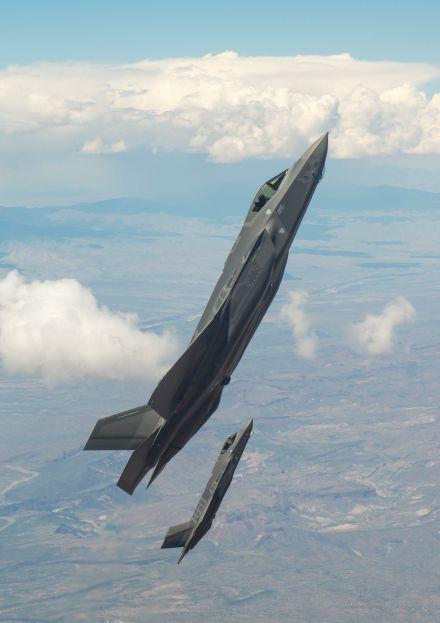
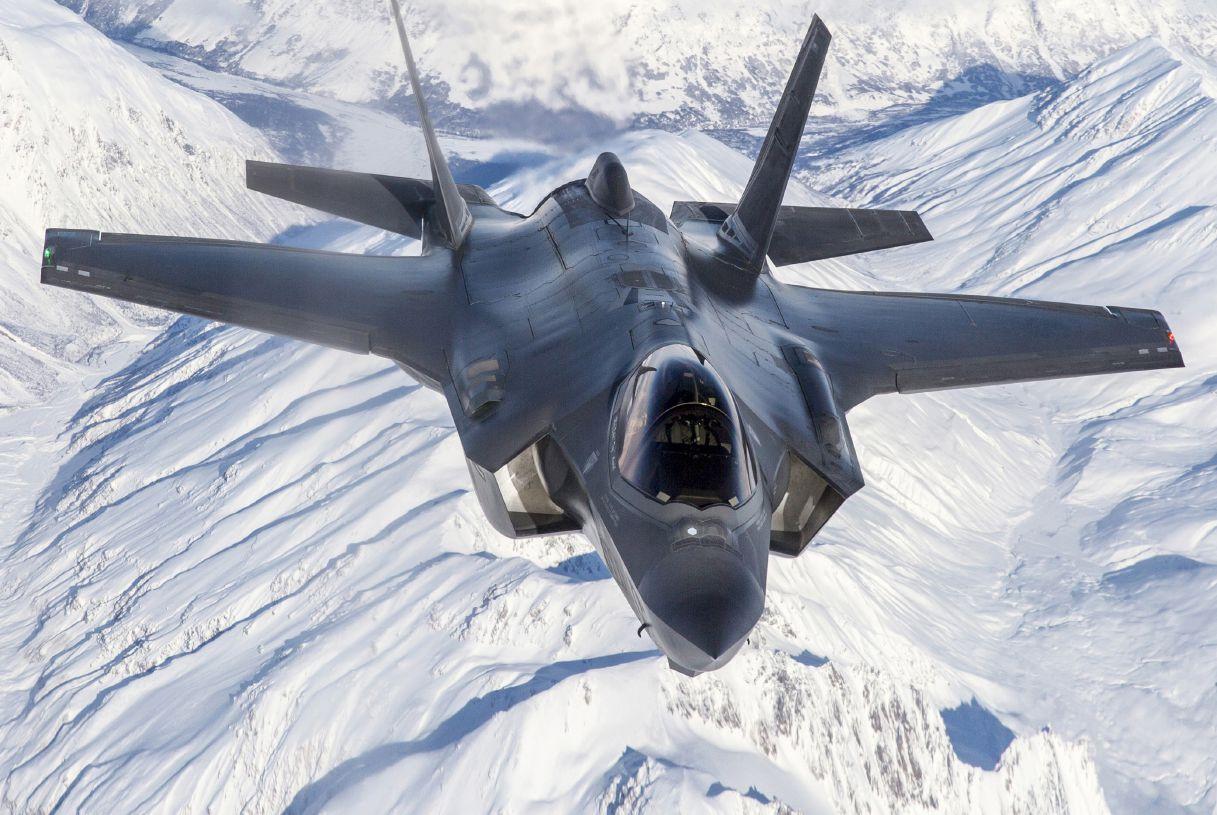
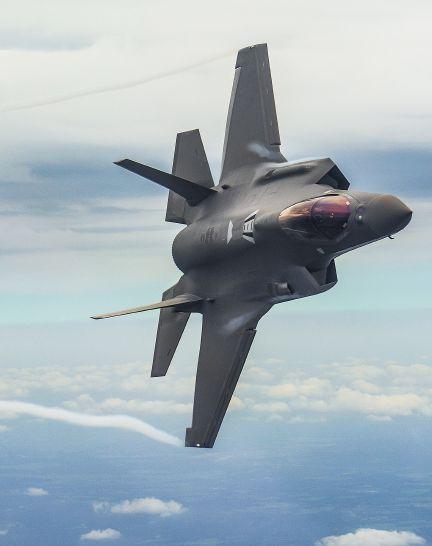
The Lockheed Martin F-35 is a true fifth-generation fighter characterized by its stealth and sensor fusion led lethality.
network amongst partner nations.”
Flynn believes Canada needs to immediately stop all work and funding for the second phase of the Hornet Extension Program, HEP 2. He notes there is nothing in the capability of HEP 2 upgrade path that helps lead the CAF to the fifth-generation F-35, pointing to historical examples of unrealized CF-5 and T-33 upgrades.
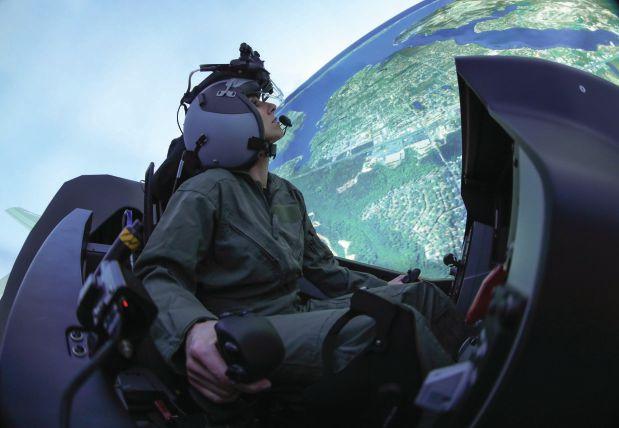
In terms of F-35 maintenance, as of April, there are now 38 of 68 component repair activations that are currently planned out to 2027. In terms of man hours per flight hour, the F-35A has decreased from an expected requirement of nine hours to 5.8 hours. Since 2015, the cost per flight hour, as it relates to Lockheed’s owned portion of the F-35, has been reduced by 45 per cent. The price of the aircraft itself has dropped from well over $125 million to below $80 million. “There is an advantage to being late to this F-35 game, and that is that we can lean on the lessons learned by our USAF and NATO partners,” Flynn says. “At Luke Air Force Base, there is a mature F-35 training program that will teach pilots not just how to fly this aircraft but how to master the new mission sets.” This includes new roles the F-35 is capable of that Canadians cannot fly now. “It will teach Canadians about how to manage the cyber capabilities and extremely high security levels of the F-35.”
Flynn highlights the need for the CAF to immediately transform its approach to cyber warfare when integrating the F-35, particularly with ground installations that support the aircraft. Work on constructing the installations has started in CFB Cold Lake and CFB Bagotville (even before the F-35 was selected) for the CAF to essentially manage what Flynn labels as a spy plane. “Every part of F-35 operates at a level of cyber protection of security which is an order of magnitude more complex than the Canadian military has ever had to deal with,” he says. Security clearances will impact
everyone from pilots to building custodians.
“You have to – at all costs – protect the aircraft from the cyber threats. China and Russia are decades behind the F-35 and this technology overall. Their only way to catch up is to steal it from us,” Flynn explains. “You can be certain that the U.S. government will ensure that the installations in Canada and the management of everything related to F-35 is done as demanded.”
Flynn continues to explain other countries can copy the look of a stealth fighter, but there is no way for them to match the capabilities of the F-35 or F-22, largely based on 40-plus years of Lockheed developing stealth aircraft, tracing back to the F-117 Nighthawk (first flight 1981). The F-35 takes stealth a step further still and marries it with sensor fusion. Flynn explains: “The sense of impunity and omnipotence that comes with flying an F-35 in a combat type environment, where you know that you see everything, and you know that they don't see you, it is like playing football when one team is invisible, and the other team isn’t. You learn quickly that it is not a fair fight and you don’t ever want it to be fair again.”
Flynn describes how war is changing by pointing to Russia’s invasion of Ukraine and the high-end fight, with Canada maybe now seeing why we have to arm our military for the Russian or even Chinese threats. “Canadians now appreciate what we have been told for years but ignored, that Russia is a real threat in the Arctic. They have reenergized, rejuvenated their Arctic bases. They can launch bombers from Russian territory and fire into North America with impunity right now. And Canadians realize that we need a NORAD capability to protect continental North America.”
Flynn explains this is another example of how Canada might have stumbled forward with its late F-35 selection, allowing the country to lean on the U.S.-led NORAD concept of operations because they are so far ahead. There are now 14 Air Force services deploying the F-35 to learn from, including the likes of Northern climate countries like Norway and Finland, which recently selected the F-35. There are 54 F-35A aircraft now based at Eielson AFB in Fairbanks, Alaska, which will be key to aiding the RCAF on operations in the Arctic. Canada will focus its stealth fighter investment on the F-35A variant with a drag chute option to operate on shorter and icy runways.
“The F-35 is the most survivable, most effective and most lethal fighter that flies in the world today. It has become the world standard for fighter aviation and how it will change in the decades to come pushing advanced technologies,” Flynn says. “In the case of Canada, the F-35 will help us protect our coastlines and the Arctic, to be an integral part of the global network of fifthgeneration fighters and, most importantly,
to keep our men and women who fly it safe every single time. It has 40 years or more of life ahead of it.”
While legacy aircraft like the F-18 were used to shoot down cruise missiles, Flynn explains F-35 pilots will be trained to shoot down bombers before they can ever fire against Canadian interests. “We will not be training to shoot down the arrows, we will be shooting to kill the archers. That is what our future is.” Flynn notes this future will also incorporate armed unmanned vehicles with an F-35, will communicate with both ground and space assets, and will enable true multi-domain operations. “We will fire weapons that do not just go supersonic, but rather six times the speed of sound – hypersonic weapons. We will adapt to those in the F-35. War as we know it will change dramatically in the four to five decades to come of the F-35’s life and it will grow and adapt with the combat needs.”
Flynn estimates there are only 50 combat-ready CF-18 fighter pilots in the RCAF of the 150 pilots needed for the program. “F-35 pilots – fifth-generation pilots – are clearly a different generation than the one I grew up in,” Flynn says. “They consume and process information differently. They have an appetite for the level of knowledge that is given to them in a cockpit of an F-35... All they will know is 8.6 million lines of software code presenting everything in the world that happen 360 degrees around them on their cockpit screens and helmetmounted displays as they fly.
“The situational awareness they possess is light years more sophisticated than any of us fourth-gen pilots can imagine,” continues Flynn. “Flying the aircraft isn’t the secret of F-35. Mastering the global situational awareness, controlling the battlespace, surviving in the highest threat environments in the world, and being as lethal as the F-35 can be, that is the secret.”
As for earlier criticisms that the F-35 is not a dogfighting aircraft, it was Flynn who put much of that discussion to rest by orchestrating the first F-35 demonstration at the Paris Air Show in June of 2017. “We ended the conversation forever about how maneuverable an F 35 was and whether it could dogfight or not. We created a maneuver called the Pedal Turn where we spiral down in front of the crowd at 50 degrees angle of attack, yawing at 50 degrees per second like a helicopter, which is essentially slower than even an F-18 can fly,” Flynn says.
The power of air shows cannot be understated, particularly when it comes to selling the Canadian public on the F-35 program, which is a story best told by RCAF fighter pilots. “It’s going to be hugely exciting for people to now go to Toronto on Labour Day weekend and see the F-35 perform, or at Abbotsford or London air shows, because it’s ours now.”
world-leading aircrew training expertise. made in canada. skyalyne.ca/fact
100LL FUEL ALTERNATIVES
HOW THE AVIATION INDUSTRY CONTINUES ITS WORK TOWARD A BRIGHTER FUTURE
BY PHIL LIGHTSTONE
The past decade as seen a lot of research and development in the search for a replacement to 100LL aviation fuel. There is no doubt that the environmental impact of high lead concentrations in fuel is bad for our environment, people and aircraft engines. 100LL was developed in the 1970s, before engineers and business pioneers were tuned into the impacts to the environment. As of December 31, 2021, there are 37,073 aircraft on Transport Canada’s aircraft registry, with 34,903 aircraft weighting under 12,500 lbs, most burning 100LL aviation fuel. Research
indicates there are over five million people living near airports in the U.S. 100LL aviation fuel has a maximum of 0.56 grams of lead per litre (2.12 grams per US gallon).
The Environmental Protection Agency (EPA) has long been concerned about the impact of lead in fuels as noted by a ban in automotive fuel in 1996. Empirical studies conclude that lead, when consumed by human beings, has a number of detrimental health factors. In 1975 Canada banned lead from being used in water pipes and the U.S. banned lead paint in 1978 (paints manufactured in Canada could contain as much as 50 per cent lead). Leaded gasoline was officially
removed from the Canadian market in December 1990. Lead poisoning can be easily overlooked as it can happen if a person is exposed to very high levels over a short period of time. The Department of Health and Human Services, EPA and the International Agency for Research on Cancer have determined that lead is probably cancer-causing in humans.
The National Academies of Sciences, Engineering and Medicine’s research indicates: that almost two thirds of lead emissions are from piston engine aircraft, representing 350 tons of lead emissions; 180 millions gallons of 100LL is consumed annually in the U.S.; with 222,609 piston aircraft on the FAA registry. Its key messages include: “A lead mitigation strategy depending on an unleaded drop-in fuel has a high degree of uncertainty of success; Instead, a multi-pronged approach is required; near and mid-term mitigations can reduce lead emissions; and other longer-term technical developments have the potential for much larger impacts.”
Brand new aircraft are affordable, if you have deep pockets and long arms or form a partnership with like-minded pilots. The 2023 rates for new aircraft are: Cessna 172 at US$375,000; Cessna 182 at US$600,000; and Beechcraft Bonanza G36 at US$999,000, all of which burn 100LL. Diamond’s diesel equipped DA40NG aircraft retails at US$524,000 (plus options and taxes). For most pilot/owners, upgrading their legacy Cessna 172 or Piper Cherokee to a newer diesel equipped aircraft is financially unaffordable.
The FAA has been studying the 100LL alternative fuel problem with technical working groups over the years. These include: Unleaded Avgas Transition Aviation Rulemaking Committee (UAT ARC); Eliminate Aviation Gasoline Lead Emissions (EAGLE); and Piston Aviation Fuels Initiative (PAFI). The FAA UAT ARC final report was released in February 2012. The current unleaded fuels which the FAA have approved through the STC process include: 82UL, UL91, UL94, GAMI 100UL, Swift Fuels 100R (STC under development). Automotive gasoline used for aviation includes Petersen Aviation and the Experimental Aircraft Association (EAA). Ethanol fuel for aviation which has never been commercialized include Baylor University STC and AGE-85.
In 2021, the FAA established the EAGLE working group, with the goal of a collaboration between aviation, regulators and petroleum groups to laying out a clear plan to transition piston engine aircraft to lead free aviation fuels by the end of 2030. EAGLE is focused on an industry-government partnership to expand and accelerate actions and policies necessary to develop and deliver a replacement for the current 100LL fuel without compromising existing aviation
Shell Oil’s Perdido deepwater platform in the Gulf of Mexico.
infrastructure systems, safety and the economic and broader public benefits of GA. Jack J. Pelton, CEO of EAA: “Securing a lead-free future for aviation fuel is a formidable challenge, but the aviation community has faced and met previous challenges with ingenuity and imagination. Our goal is to solve the complex issues surrounding leadfree aviation fuels with innovations that ensure safety, as well as reliability, marketplace availability, and continue to provide the countless benefits of general and recreational aviation to our nation and the world.”
For over a decade, General Aviation Modifications Inc. (GAMI) has been working on a G100UL replacement. In July 2021, GAMI announced at AirVenture that the FAA approved a Supplemental Type Certificate (STC) authorizing the use of G100UL. GAMI elected to follow the well-established FAA Approved Model List (AML) STC process whereby the FAA issues the initial STCs with an AML for specific aircraft and engines, and then progressively expands the scope of that AML based on additional testing and data. GAMI’s current AML has over 600 engines models from popular manufacturers like Continental, Franklin, Lycoming, and Pratt & Witney, among others.
GAMI is now working with the FAA to extend the STC to all piston engines and airframes. As of April, with all of the certification work completed, according to Tim Roehl, President, GAMI, “while waiting on the final FAA signatures on our all-encompassing G100UL STC, the FAA has elected to bring the STC to a technical advisory board for review. This has the appearances of delaying our STC to facilitate funding goals of the FAA’s EAGLE project and allowing 100LL fuel usage to be extended to 2030.”
GAMI has partnered with Avfuel Corp., a global supplier of aviation fuel and services, to work through the logistics of distributing their G100UL aviation gas. Avfuel is establishing a supply chain to responsibly bring G100UL avgas to market on a commercial scale. Together, GAMI and Avfuel have committed to a process that will ensure G100UL aviation gas is available to all legitimate distributors and vendors on an equitable basis in terms of access and economics.
Shell Oil in December 2013 announced it had developed an unleaded 100 octane fuel, with an expectation to submit the fuel to the FAA for testing by 2015 or 2016. No further information was published by Shell, which noted: “Aviation engines present many unique challenges to the development of Avgas and as such there is yet no firm date to replace Avgas 100LL, but there can be little doubt that eventually Leaded Avgas will be withdrawn from use. However, this does not seem likely until suitable fully developed alternatives are available; a situation that is likely to be several years into the future.”
Philips 66 and Afton Chemical have
collaborated to create UL100, which is compatible with 100LL and the 100LL distribution network. The product is able to service the entire GA fleet while minimizing cost increases. UL100 replaces lead with a new manganese based additive. Preliminary testing of UL100 shows equivalent octane and detonation performance compared to 100LL. Testing will continue to demonstrate performance in more demanding engines. Philips 66 is expecting to deliver the fuel to the aviation marketplace in 2025/2026. Their UL100 is currently in testing with the FAA. Philips reports: “The EPA completed a study on lead emissions from aircraft using leaded aviation gasoline in the United States. The study measured ambient air levels of lead along runways of 17 airports. Using this data, we have estimated that by replacing the 100LL with UL100 containing MMT, manganese emissions would be roughly 80 to 90 per cent lower than lead emissions. From a regulatory perspective, the average emissions of manganese from these airports would be orders of magnitude lower than the Agency for Toxic Substances and Disease Registry (ATSDR) minimum risk level, which is the same health-based reference concentration EPA currently uses to assess the risks of inhaled manganese.”
For those Cessna and Beechcraft owners whose engines are approaching or at Time Before Overhaul (TBO), they might consider replacing their 100LL piston engine with a turbine or diesel engine. Soloy Aviation Solutions (www.soloy.com) offers a diesel conversion for Cessna 182s and turbine conversion for Beech Bonanza A36 and Cessna 206/207 aircraft. The turbine conversion increases the TBO from 2,000 hours to 3,500, while delivering more horsepower (450 SHP), utilizing a Rolls-Royce turbine. Soloy offers diesel conversion kits for Cessna 182s using SMA Engines (a division of Safran) products. The 230 HP diesel kit is US$200,000
and the 260 HP kit is US$240,000 (plus taxes, shipping and installation). In 2020, Safran sold SMA Engine to Röder Praezision Group GmbH (a German company). Soloy is in contract negotiations with Röder with the goal of reducing its acquisition costs. David Stauffer, CEO, Soloy Aviation Solution, explains: “We believe the SMA Aero Engines GmbH SR305-230E/260E engine is a perfect solution for many light general aviation fixed wing platforms currently using leaded fuel. We thought the Soloy C182Ci conversion, with our improvements, would attract more users of this efficient Jet-A burning powerplant.
“It was for these reasons Soloy initially entered an agreement with SMA/SAFRAN to develop changes that would increase the quality of the installation kit which improves the reliability, improve the ramp appeal and open up the operating envelope,” Stauffer continues. “Soloy planned to leverage its 50 years of engine conversion kit development and production by refining the installation process and improving the installation experience. This would give confidence to operators so they might take a closer look at what this engine conversion kit has to offer”.
The path to unleaded aviation grade fuels to replace 100LL has many obstacles: time associated with the FAA’s certification process and the conversion; refinery ramp up; and airport fuel infrastructure upgrade costs. With over 250,000 piston engine aircraft operating in North America, the cost to migrate legacy aircraft engine and fuel systems to diesel or turbine engines is not a financially viable solution (for the owners and Canadian flight schools). Canadian flight schools do not have the economic business models to support the replacement or upgrades of their legacy aircraft fleets. Regulators need to complete the evaluation and certification process in a timely manner, using fuel alternatives available today. | W
Timothy Roehl, President of General Aviation Modifications Inc., and George Braly, Head of Engineering, in the lab testing their new G100LL fuel.
CLEARING THE AIR
ARE WE OVERDUE TO TRY OTHER DUST PALLIATIVES ON UNPAVED RUNWAYS?
BY CARROLL MCCORMICK
This summer the 5,400-foot runway in Sanirajak (formerly Hall Beach) on Mellville Peninsula will receive a dust control treatment developed by Winnipeg-based Cypher Environmental. This Cypher first for a Canadian airport may help overcome what the company argues is an unjustified impediment to considering its product to control runway dust and flying gravel.
Transport Canada, arbiter of most things in Canadian aviation other than air traffic control, offers guidance on runway dust control in Section 8.3 of Advisory Circular (AC) 300-004 – Unpaved Runway Surfaces. The AC “is provided for information and guidance purposes. It describes an example of acceptable means, but not the only means, of demonstrating compliance with regulations and standards.” Calcium chloride and other salt-based materials are not to be used, because they can damage aircraft. Certain asphalt types are acceptable and may be diluted with water. Other, non-corrosive
“dust palliatives,” may also be used.
Dig a little deeper, however, and Transport Canada acknowledges that there are no regulations or standards for Section 8.3 to comply to. “Transport Canada has no specific regulation related to runway dust control suppressant,” other than that, “... chemicals that may have harmful effects on aircraft or pavements are not to be used on the movement area of an aerodrome certified as airport.”
To prove that their products are aircraft-safe, vendors like Cypher and Canton, Ohio-based Midwest Industrial Supply, which makes a dust palliative called EK35, may cite that they are certified to Boeing #D6-17487 Revision T (Airport Approved).
AC 300-004 notwithstanding, dust palliatives in Canada seem not to be chosen solely on their merits; rather, to qualify, they follow a specification borrowed from Alaska, according to Todd Burns, CEO and founder of Cypher Environmental. “All the provinces adopted the specifications, which includes EK35 as the only approved
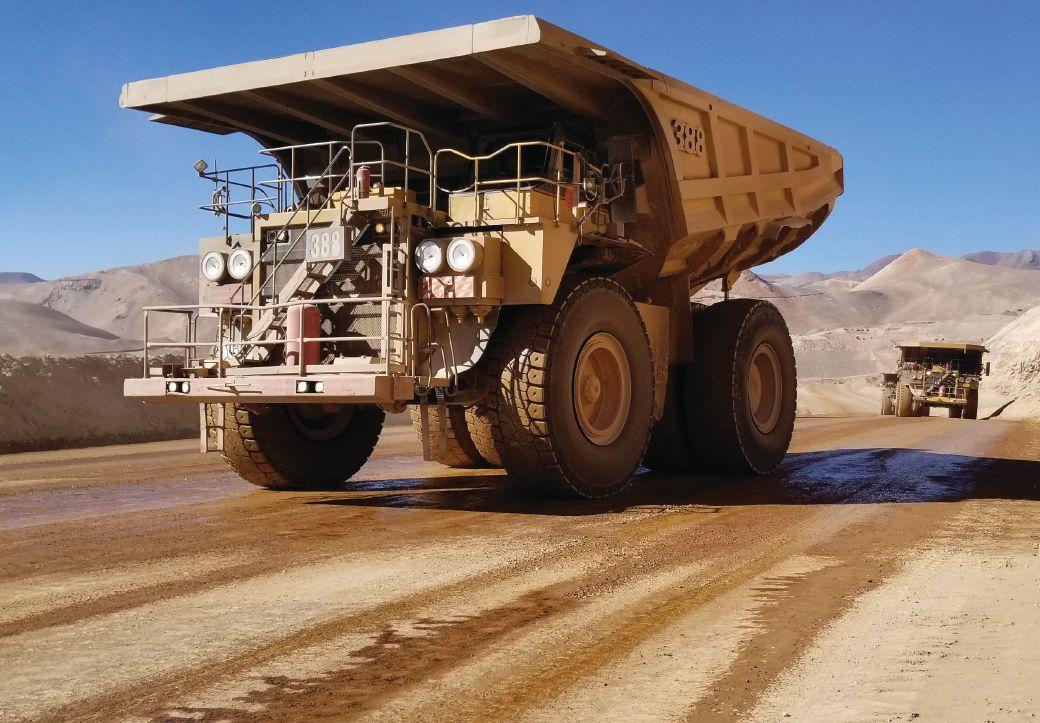
Cypher Environmental’s dust suppressant handles the punishment of mining trucks. This year it will be applied for the first time on an unpaved runway in northern Canada.
CUSTOMIZED MRO SOLUTIONS TO KEEP YOU FLYING
ENGINES
• GE T700/CT7
• LHTEC CTS800
• Pratt & Whitney Canada PT6T & PW200
• Rolls-Royce M250 & RR300
• Safran Arriel 1 & 2
AIRFRAMES
• Airbus H120/EC120, H125/AS350, AS355, EC135, H130/EC130, H215/AS332
• Bell B204/205, B206, B212/412, B214, B407, B427, B222/230/430, UH-1 series
• Sikorsky S-76, S-61
DYNAMIC COMPONENTS
• Airbus H125/AS350, H130/EC130
FUEL SYSTEMS
• CRFT
AVIONICS
• AutoPilot
• ADS-B
• Glass cockpit
product. The only concern they have with water is that... the product must be ready-to-use. Our products are specifically designed to be concentrated to reduce the environmental impact [greenhouse gasses] and cost of shipping to remote locations.”
This requirement that a dust suppressant must be ready straight out of the jug, as it were, meant that, for example, Cypher did not qualify for a 2019 runway dust suppression contract issued by Manitoba Infrastructure, Northern Airports and Marine Operations for the Red Sucker Lake Airport. “The product must be capable of being applied over a prepared gravel surface without the use of water, other than that needed to bring the surface to optimum moisture content,” reads the Request For Quotation.
EK35 comes ready to use. Cypher’s product, called DUSTBLOKR, is delivered as a concentrate, at about half the volume of
EK35, mixed with water on site, and then applied.
Cypher notes that the successful bid for the Red Sucker Lake project was $275,255.78 for EK35, but its own bid for DUST/ BLOKR was $125,273.40. Burns also notes that Cypher’s successful bid for the Sanirajak runway treatment came in at about half of the price of the EK35 bid. Are buyers paying a stiff premium simply because a bidder meets a no-water requirement that appears to have nothing to do with a dust palliative’s effectiveness or ease of use?
According to an October 30, 2020, policy primer issued under the letterhead of the North American and Arctic Defence and Security Network, 11 airports in the Yukon Territory, the Northwest Territories, and Nunavut have paved runways. The other 75 runways up there are unpaved. Canada-wide, there were 944 airports with unpaved runways as of 2013, according to IndexMundi.
Is there a message here for those paying the bills? And is the cost of dust palliatives under the current rules discouraging airports from using them when needed, or at all?
“There is not a uniform schedule of treating or maintaining unpaved runways throughout Northern Canada,” says Gary Bell, President and CEO of Calm Air International LP. It has scheduled passenger service into eight Nunavut communities and cargo service to eight others. “The dust is actually not our issue (albeit no one wants dust on passengers and aircraft), it is the stones that kick up and damage the aircraft and propellors. Taxiways and aprons are less of an issue as the aircraft is going slower but can also be a greater issue as this is where you have a lot of turning around.”
Unpaved runways develop defects such as frost heave, loss of material, segregation (“... the accumulation on the runway surface of loose, non-cohesive aggregates lacking in fines ...”) rutting, surface and subsurface drainage issues, roughness, and vegetation, according to the Transport Canada Advisory Circular 300-004, Unpaved Runway Surfaces.
“Potholes and washboarding are indeed a huge problem,” Bell confirms.
Based on its use in 40 countries (including in Canada) on public roads and mining operations, Cypher is confident that DUST/ BLOKR’s track record in successfully addressing these very problems, particularly impressive where heavy trucks operate, will transfer well to runways.
“As DUST/BLOKR is able to withstand heavy mine traffic and extreme weather conditions, we are confident in extrapolating its superior performance to runway applications,” says Diana Nicholson, Director of Engineering, Cypher.
Despite the headwinds, Cypher’s bona fides are bringing it ever closer to Canadian runways: Nunavut and the Northwest Territories have authorized DUST/BLOKR for use on their roads. Cypher’s product is on several public roads and haul roads in provinces such as Manitoba, Saskatchewan and British Columbia. Cypher has established a solid presence at several Canadian mining sites, including Baffinland. The hamlet of Pond Inlet is one of many in Canada’s North that has used DUST/BLOKR, with more expressing interest, according to Burns. The Trudeau Airport used DUST/BLOKR on a dirt road a few years ago, as did the Bangalore International Airport in 2020. And a Canadian mine is close to a decision about extending its use of DUST/BLOKR to its airstrip, according to Burns.
Burns is in touch with the Standards Council of Canada about developing new dust palliative specifications and has approached the Rural Manitoba Economic Development Corporation (RMED) for help. “My observation in what I think is happening with [Burns] is that the technology is evolving faster than what the traditional procurement [product] adoption is,” says Margo Cathcart, CEO, RMED.
The aviation community should closely follow the Sanirajak runway project. | W
An aircraft kicking up a huge cloud of dust on an unpaved Canadian Arctic runway.
THE FUTURE OF AEROSPACE AND AVIATION
The Bombardier Centre for Aerospace and Aviation at Downsview Campus is a dedicated training ground for aerospace and aviation mechanics. With focused courses, cutting-edge equipment and industry professionals guiding our programs, your aircraft are always in good hands with a Centennial College graduate. centennialcollege.ca
RPAS AIRPORT PROTECTION
YOW DRONE DETECTION PROGRAM REVEALS SURPRISING DATA DURING THE FINAL DAYS OF OTTAWA PROTESTS
BY SCOTT SIMMIE
Scores of drone flights took place in restricted airspace –what you might think of as a no-fly zone – over Parliament Hill in Ottawa during the police operation to clear anti-vaccine mandate protests in February of 2022. While some of those flights were carried out by law enforcement, most flights were illegal and in violation of Transport Canada regulations.
Data collected by the Ottawa International Airport Authority’s (YOW) Drone Detection Pilot Project reveals an incredible spike in flights – a total of 59 – during the days when police were actively clearing protestors from the site.
“In an average month, you’d probably see half a dozen flights (in that same area),” says Michael Beaudette, Ottawa International Airport’s Vice President for Security, Emergency Management and Customer Transportation.
A total of 27 different drones carried out those 59 flights over a period of four days. Of those, 25 flights exceeded 400 feet above ground level (Transport Canada’s limit, except in special circumstances), with some flying more than 1,500 feet AGL. Eleven flights took place during hours of darkness at night – though that’s not a violation of regulations providing the drone is using lights that allow the pilot to maintain Visual Line of Sight and orientation.
While a number of those flights were likely curious hobbyists either ignorant of or willfully ignoring regulations, it’s believed at least some were likely piloted by protestors or supporters seeking to gain intelligence of police movements.
“The majority of those drones were not police or first responder drones,” says Beaudette. “Some of them could have been looky-loos – just trying to see – or it could have been people wanting to know where the police were forming up.”
Restricted airspace
The airspace above Parliament Hill, as well as 24 Sussex Drive and Rideau Hall, is restricted to all aircraft – crewed and uncrewed – unless special authorization is obtained. In terms of drones, only law enforcement or other first responders would have legal permission to fly except in special circumstances.
The data was obtained by Ottawa International Airport as part of a broader pilot project aimed at understanding drone traffic in proximity of the airport and developing protocols for aviation safety in the drone era. InDro Robotics is one of the partners in this project, providing key technology used in drone detection.
Transport Canada regulations prohibit the operation of small RPAS within 5.6 kilometres of airports and 1.9 kilometres from helipads, except for pilots holding an advanced certification. Airspace permission is also required. (Drones weighing less than 250 grams are a different case, and we’ll touch on that shortly.)
How the drones were detected
The airport uses two different types of technology for drone detection. The first is a micro-Doppler Radar in conjunction with an automated camera. The system, called Obsidian, comes from the British firm QinetiQ. Its high frequency (9-12 GHz) radar can detect the spinning of propellers on a drone anywhere within a two-kilometre range of the airport. Once detected, a camera automatically zeros in on the drone.
The second system has been supplied for the trials by InDro Robotics. It’s capable of capturing data from drones manufactured by DJI, which account for approximately 75 per cent of all consumer drones.
“Our system electronically ‘interrogates’ each device within its range,” explains InDro CEO Philip Reece. “We can triangulate the drone’s position – and on many models we’re able to also detect the type and serial number of the drone, its takeoff point, flight path, current GPS position and altitude. In addition, we can see where the pilot associated with that drone is located. With this data, YOW can quickly determine whether or not a given drone poses a threat to civil aviation.”
InDro Robotics employees operating a Mobile Command Centre positioned in Ottawa as part of the company's drone detection program with Ottawa International Airport.
The 2022 Aerial Firefighting Directory, presented by Wings, Helicopters and UAV Canada, features key suppliers of aircraft, equipment and services for the aerial firefighting sector. The Directory also includes details on more than 120 rotary- and fixedwing operators involved in emergency forestry services, as well key North American agencies and associations for the sector. view directory
2022 RPAS Directory
The 2022 Remotely Piloted Aerial Systems Directory highlights leading commercial operations providing drone services across the country, listed by province. The Directory, produced by Wings, Helicopters and UAV Canada, also focuses on operations that provide basic and advanced drone pilot training, as well as details of primary support organizations for Canada’s RPAS sector.
The system was intended to pick up any flights within a 15-kilometre radius of YOW, but the range has proved far greater.
“When we turned it on, we realized our expectations were far exceeded,” says Beaudette. “We were getting hits 40 kilometres plus. It’s really done the heavy lifting for the drone detection project. You can identify where the pilot is, where the drone is, and where they are in real time within 15 or 20 seconds.”
Data collected during the police operation to clear the protest reveals the bulk of the flights were carried out by DJI Mini 2 drones – very small machines that weigh just under 250 grams and which do not require a Transport Canada Remotely Piloted Aircraft System (RPAS) Certificate to operate. Microdrones like these are not prohibited from operation near airports or in controlled airspace if operated safely, but cannot gain access to the restricted airspace near Parliament without prior permission.
So. What started this project?
The 2018 Gatwick Airport drone incident prompted many airports to take a closer look at the potential threat posed by drones. About 1,000 flights were cancelled between December 19 and 21 following reports of two drones being sighted near the runway. Some 140,000 passengers were affected.
The incident remains controversial, because there was never any clear physical evidence that drones had indeed posed a threat. Two people were wrongfully charged, released, and later received a settlement.
What cannot be denied, however, is that the highly disruptive incident was a massive wake-up call to airports worldwide.
With an ever-growing number of drones in the air, the question of drone detection and potential mitigation became a pressing topic. If a drone detection system had been in place at Gatwick, it would have had concrete data as to whether there was truly a drone threat or not.
A Blue Ribbon Task Force was launched by the Association for Uncrewed Vehicle Systems International (AUVSI) in conjunction with regulators and airport representatives. YOW President and CEO Mark Laroche was a member of the Task Force along with representatives of the Federal Aviation Administration (FAA) and NAV Canada.
Gatwick, then, was the catalyst that prompted YOW to start taking a very deep look at the issue.
“We wanted to be able to help shape a national drone response protocol for airports, so that we didn’t run into a situation like Gatwick, where we would have to shut down,” says Beaudette. “We didn’t even know if it’s a
Reach your Aviation Goals
For over 30 years, AeroCourse has been a leader in advanced aviation training in Canada. We provide aviation ground school seminars and courses for advanced training along with publishing manuals and workbooks. The courses include IFR and ATPL seminars, online courses, and advanced aviation courses with flight colleges, schools and airlines. Our instructors are professional pilots and flight examiners with thousands of hours experience. We pride ourselves on providing exceptional materials and training.
problem. We had to get some baseline data, some situational awareness. So we (decided to) focus on drone detection… to identify if it was even a threat.”
DJI, to its credit, has geofencing software that prevents its products from taking off in the immediate vicinity of major airports unless the pilot confirms on the app they have permission to do so. And while that’s useful, the geofencing is highly localized and cannot always prevent a pilot from putting a drone into the takeoff or landing path of an aircraft.
“What causes us concern is when they’re in the flight path,” says Beaudette. In the fall of 2019, YOW began its pilot project.
Surprising data
With the InDro and QinetiQ systems up and running, the data started coming in. It was something of a shock. “This opened our eyes,” says Beaudette. “We had no idea of the drone activity that was taking place.”
There were a lot of drone flights taking place close to YOW.
“In March of 2021, our program detected and reported on 101 drone flights within that 5.6-kilometre radius,” said CEO Mark Laroche in a news release. “April’s numbers were even higher at 167. A number of these were flown during hours of darkness and some exceeding altitudes of 1,600 feet.”
Every month, YOW crunches the data into a comprehensive report sent to Transport Canada, NAV Canada, InDro Robotics and other stakeholders. The report from May of 2021 reveals a steep increase in the number of flights.
The monthly report from this period states: “Detecting and identifying ‘drones of concern’ operating in the vicinity of the Ottawa Airport remains one of our primary objectives. This month, there were 19 such drones of concern within the YOW 5.6 km zone. These include drones that flew during hours of darkness, or were over 250 grams and flew over 400 ft. Of these 19 flights, there were 11 unique Drone IDs.”
Because the system can capture drones from even farther afield, other interesting data has emerged during the course of the pilot project.
“We started tracking other locations –Parliament Hill, Gatineau Airport,” says Beaudette. “And we were very surprised to see drones flying at all hours of the day and night and at high altitudes.”
These weren’t just hobby flights. Unusual activity was detected around certain embassies in Ottawa, with the same drones making repeated trips. There were drones flying close to the CHEO and Civic hospital Helipads used
by helicopters with the air ambulance service Ornge. There were drones apparently peering into high-rise windows, PeepingTom style, and others that appeared to be involved with offering intelligence to people carrying out Break & Enters. (Beaudette says police were notified in some of these instances.)
As part of the Pilot Project, YOW worked with its partners – including NAV Canada, Transport Canada and InDro Robotics – for some real-world exercises. One such test involved determining the accuracy of the detection system.
A drone was flown from the E.Y. Centre, a massive exhibition/convention facility very close to the airport. When the data captured by the detection system was overlaid with the actual flight log, they were identical. Not only that, but the YOW data precisely identified the location of the pilot.
“We could actually tell which stall in the parking lot (the pilot was standing in),” says Beaudette.
Mitigation and regulation
Detection is one thing, but drone mitigation is quite something else. There are systems capable of jamming the Command and Control signal between the drone and the controller (including systems from Bravo
Zulu Secure – part of the InDro group of companies.
But such systems are not in cards for YOW or other airports in Canada. Quite simply, Transport Canada and Industry Canada (which regulates radio spectrum frequencies) prohibit them in this country except in extraordinary circumstances.
“First and foremost, a drone – like any other airplane – is considered an aircraft,” says Beaudette. “And so Transport Canada has restrictions: Nobody has the authority to interfere with the flight of that aircraft. So you won’t see airports with jammers or other kinetic solutions to that unless they have the proper authority.”
Plus, he emphasizes, the Drone Detection Pilot Project is focused on drone detection. It’s a data-gathering exercise to help formulate protocols, provide useful information for regulators, and alert airport authorities immediately if a drone poses a threat to a flight path. YOW is not the drone police; its primary interest is in ensuring the safety of aircraft using the facility.
“If we can detect something, we may be able to mitigate it by rerouting aircraft, delaying aircraft, or we can locate the pilot,” says Beaudette.
Thankfully, despite many flights violating the 5.6 kilometre radius, YOW has not
encountered a drone that posed a serious threat since the program began. Should that occur, it does have protocols in place to ensure civil aviation safety. Plus, of course, Transport Canada has the option of imposing heavy fines on pilots who put aircraft at risk or are flying without a Remotely Piloted Aircraft Certificate. And with the detection system in place, locating an offending pilot would not be difficult.
Ultimately, the biggest piece of the puzzle is around education. Some pilots simply don’t know the rules and unwittingly violate them – an excuse that won’t help them much if facing a fine. YOW has found, for example, that pilots often fly from nearby neighborhoods or golf courses without realizing they’re impinging on that 5.6 kilometre zone.
There’s also the issue of confusion around piloting sub-250 gram drones. Because they do not require an RPAS certificate or registration, many believe the rules somehow don’t apply to them. Yet the over-arching meaning of the regulations is clear: They must not be flown in an unsafe manner. And that includes near airports.
“We actually had a case where we found a drone that crash-landed inside the (airport) fence,” says Beaudette. “We’re still the proud owners of that drone.” | W
HIGH FREQUENCY RAIL IN CANADA
The Federal Government is once again talking about developing a better rail system in Canada. Having realized that a High-Speed Rail system in this country is not financially realistic given our land mass and the relatively small population, the Government is now talking about the option of High Frequency Rail.
The “Request for Expressions of Interest on High Frequency Rail” issued in March by the Government of Canada reiterates the decades-old arguments that High-Speed Rail proponents have put forward in past attempts at fulfilling this unrealistic Canadian political dream.
This billion-dollar ten-year project using public funds would shoulder Canadians not only with a huge long-term debt, but the inevitable and very significant on-going operational deficits as evidenced by the current VIA Rail taxpayer financed subsidies.
The Government’s eagerness to massively support a rail transportation system is to the detriment of other modes, in this case the aviation industry. In 2019, the last year before the pandemic, taxpayers supported VIA Rail in the order of $281 million in operational funding and another $268 million in capital funding. The operational funding alone amounts to a 42% subsidy of each of the roughly two million tickets sold. Total government financial support climbed in 2020 to $669 million. Keep in mind that not only does the Government marginally support the commercial aviation industry, but it also imposes on aviation well over $1 billion a year in special fees, rent and taxes that no other transportation mode is burdened with.
Shamelessly, the Government largely ignored regional air carriers during the pandemic, a sector that carries many more passengers than those travelling by rail, and in many cases provides a unique and vital link to remote regions with the rest of the country and the world.
Past government feasibility studies on developing a new rail system in Canada stated that it could only be financially selfsustainable on certain high-volume corridors if the airlines agreed not to compete on these high yield routes. What legal substance can possibly induce the authors of such studies to imagine that the airline sector would agree to give up high yield routes to help support operations of a competing financially unsustainable sector already financed by taxpayers?
The shorter travel time of High Frequency Rail boasted by the Government does not warrant a financial commitment of
such magnitude to be imposed on generations to come. The ambitious predictions of increased annual trips, trip frequency, and seat capacity, are not supported by tangible data. The increase in operating costs and upkeep of any publicly funded operation will likely at least equal the potential revenue increase from growth in demand.
As for the environmental protection argument, expected reductions in GHG emissions by rail travel are now rightfully being questioned by scientists when comparing rail operations to the more efficient aircraft now in use and even more so for those planned for use in the near future. Has the very significant environmental impact to the land from the construction of a dedicated rail line, not to mention the huge green space expropriation that building this line would require, been adequately taken into consideration?
There isn’t a single rapid intercity transit system in the world that is financially self sufficient, even in densely populated countries in Asia and Europe where train travel is inbred in consumer travel habits. The idea that building the system will in itself generate the highly optimistic increase in demand is an illusion.
High Frequency Rail sounds like a developing country’s expensive compromise to High-Speed Rail. Once completed, this project would already be outdated by new technology and would soon require an additional disproportionate injection of capital to modernize it and make it appealing to the next generation.
We certainly support greater multimodal transport in Canada. The consumer and taxpayer could benefit largely from a multimodal system that is based on a greater complementarity of the existing modes of transport. This would add to the efficiency and efficacy of our transport system. There are also many other short-term solutions that the Government should consider if its objective is to reduce GHG emissions, such as investing in better commuter rail systems across the country, increasing the charging network nationally and a subsidy to encourage the purchase of electric automobiles, and of course focus on helping to modernize the regional air transport system in Canada.
Our country cannot afford projects that are not grounded on our socio-economic reality. Rather than announcing studies on electorally attractive projects, should the Government not be presenting a national transportation plan with a vision that integrates all modes of transportation in Canada?
By Nisha Venkatesh |
Breaking through the isolation
How CWIA helps women in aviation connect and grow
Taking off without a crew is impossible. And yet so many women in aviation find themselves without one. This is where Canadian Women in Aviation (CWIA) comes in – as a community that connects women to their crew from across aviation and Canada to make it easier to reach new heights.
Born in 1991 and volunteer-run, CWIA started as 30 women who sought a connection to a sisterhood that would understand the highs and lows of their unique experiences. By bringing this small, but mighty, group together, they started a tradition that continues to this day. Their legacy has grown into a large and active community of women who get together for a 3 1/2 day conference to connect, celebrate and create progress. The CWIA Conference offers a diverse line-up of compelling speakers, engaging tours that take you behind the scenes of aviation and ends with a gala that is always an evening to remember. The 2022 CWIA Conference will take place from June 22 to 25 and is hosted, in-person, in Edmonton, AB. (Tickets can be purchased at cwia.ca.)
“We’ve tailored this year’s conference, Superheroes in Aviation, to deliver high-impact workshops, networking and mentorship opportunities, and fun social events,” says Iris Dias, one of CWIA’s two co-chairs.
“This year’s attendees can expect the same creative touch at the conference that they’ve seen from us over the past two years.”
The CWIA Conference has consistently grown in attendance and star-power. Its 2019 event in Ottawa was the largest the group had held, and featured Canadian aviation legends like Retired Major Dee Brasseur and Karen McCrimmon. It set the stage for a bigger and bolder CWIA Conference in 2021 for the organization’s 30th anniversary. Then the industry faced its greatest challenge yet. Surprisingly, it was during this time that CWIA experienced unprecedented growth. With the 2021 conference at risk, the planning committee revisited CWIA’s roots in connecting women to a sisterhood – this time, in a digital space.
“Women in aviation had never been this isolated. And a sense of closeness and optimism was desperately needed,” says Dias.
“We’re so proud that this has been CWIA’s most diverse volunteer team to date, and
As the industry faced its greatest challenge, cwia experienced unprecedented growth and returned to its roots.
when we had to rethink everything, we came up with novel ways to bring people together – everything from dance classes to monthly socials.”
These new programs continue to draw in aviation legends. Rosella Bjornson occasionally drops in for CWIA Circles – a monthly virtual hang out that’s popular with both longstanding and new members alike because of its casual approach to swapping stories and advice.
During this time, CWIA also became a community where women came together to bring their passion projects to life. An enduring success story can be seen in Approaching Finals, which is a community of support for women in flight training, created by women in flight training, who craved a sense of community. Led by four young women of colour, Approaching Finals is one-of-a-kind in its approach to inclusive programming and has expanded CWIA’s reach into flying clubs and collegiate aviation programs across the country.
The crown jewel of CWIA’s digital programs is the CWIA Symposium. The community’s first virtual three-day conference was held in October 2021. More than 300 people attended the event, which featured
more than 40 hours of talks, panels and workshops that included Keynote Conversations with aviation heavyhitters like Tamara Vrooman, CEO Vancouver Airports Authority, Jo-Anne Tabobandung, Dean of Aviation at First Nations Technical Institute, and Tonya Yearwood, Founder of The Black Aviation Professionals Network.
“I wasn’t expecting to actually connect with anyone over a virtual conference. But not only did I meet a lot of accomplished women from across Canada, I met the woman who inspired me to pursue a career in aviation during a Networking Circles,” said one attendee in providing feedback after the Symposium.
With planning for the 2022 Conference well underway, the co-chairs are looking forward to replicating the success of the virtual Symposium. They are most excited to see the community in person again after three long years.
“We’re embracing our partnerships in 2022,” says Dias, “NLAF has been a longstanding CWIA partner, and this year we’re collaborating on our gala which promises to be a spectacular close to the conference. We’re also forging new partnerships, working with WinSETT to provide workshop content catered to women.” | W
Nisha Venkatesh is Co-chair of CWIA and a Communication Electronics Engineering Officer with the Royal Canadian Air Force.
LET’S FLY MORE.
We take efficiency and luxury as seriously as you do. Have your passengers experience aviation as it was meant to be with the comfort of more space, while maximizing your savings and time. Fly fast. Fly farther. Burn less fuel.
Experience the DA62.
THE WORLD IS BEAUTIFUL PLACE
Keeping it that way is at the centre of all we do. That’s why, with our unwavering commitment to decarbonisation, Airbus is paving the way for sustainable aerospace. Today, our technological developments are already helping to safeguard our precious planet. Discover more about how we’re leading the journey, shaping a brighter future for generations to come.