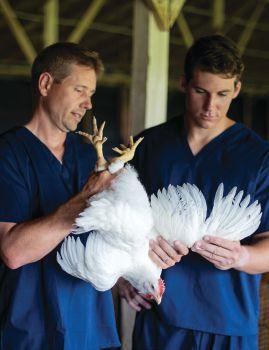
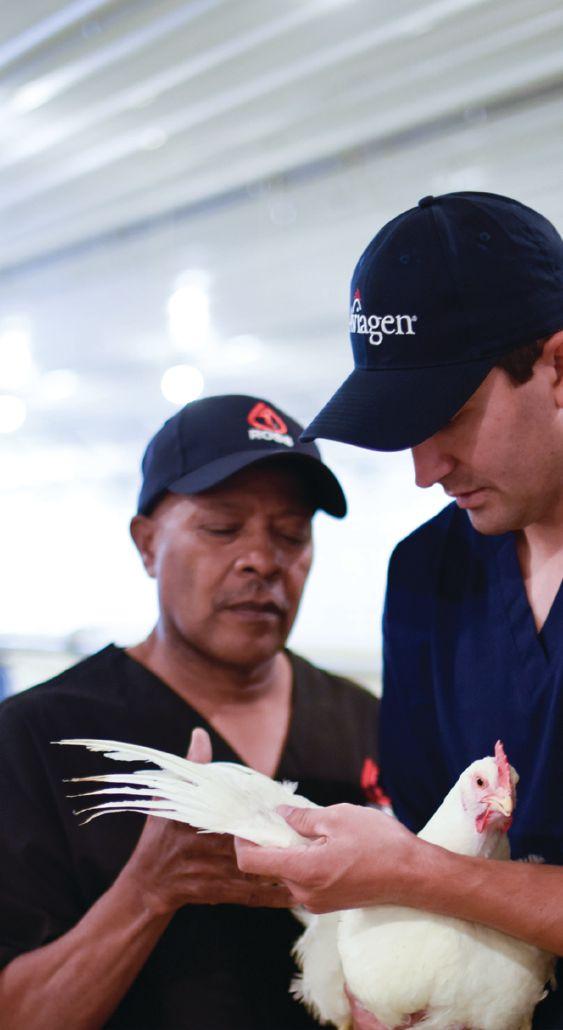
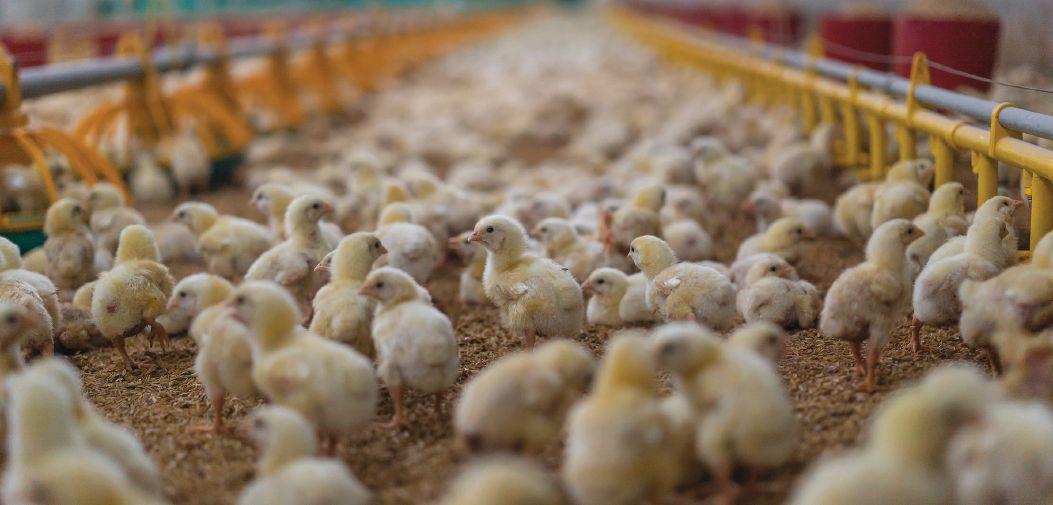
Global reach and a local touch that spans 6 continents. People with know-how and advice that champion customer success. Our team of dedicated and experienced people will help grow your business. Let us show you at aviagen.com.
Aviagen is happy to congratulate Canadian Poultry’s Top 4 Under 40 award winners. Aviagen is committed to the Canadian poultry industry and to encouraging its future leaders.
TOP 4 UNDER 40
This spring, Canadian Poultry launched our second annual Top 4 Under 40 program, an initiative designed to recognize young poultry leaders.
This year, we expanded the program to include one up-and-coming industry support professional – whether that’d be a veterinarian, nutritionist, geneticist, or another important position.
We were once again truly blown away by the incredible submissions we received.
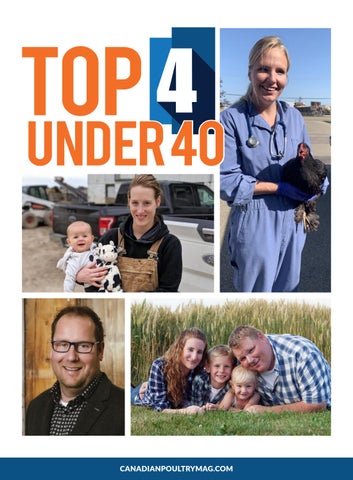
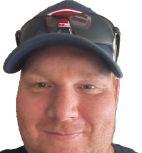
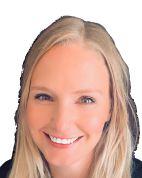
The following four young poultry professionals were selected as part of this year’s program: David Arand, turkey farmer, Atwood, Ont.; Dr. Teryn Girard, veterinarian, Prairie Livestock Veterinarians, Red Deer, Alta.; Emma Rutherford, broiler farmer, Woodstock/Embro, Ont.; and Conrad Vanessen, egg farmer, Egg Farmers of Alberta director, Coaldale, Alta.
Arand unexpectedly took over the family pig farm at a young age after his father tragically passed away. He then converted it into a successful turkey farm.
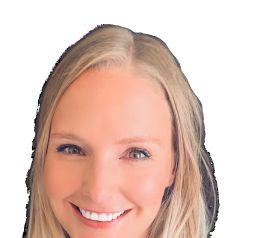
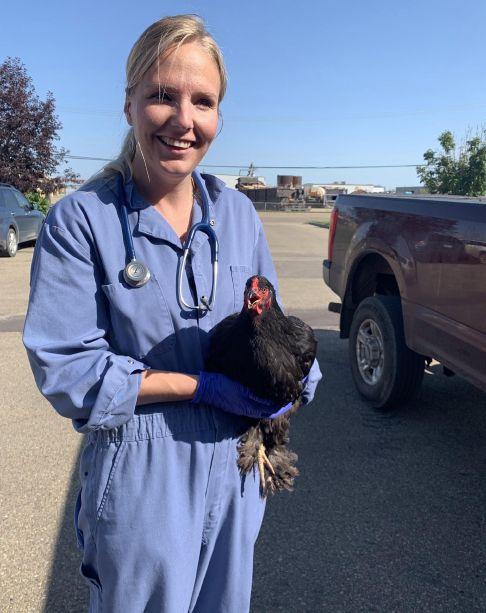
Girard is a poultry vet, educator and more who’s recently helped her industry respond to the avian influenza pandemic.
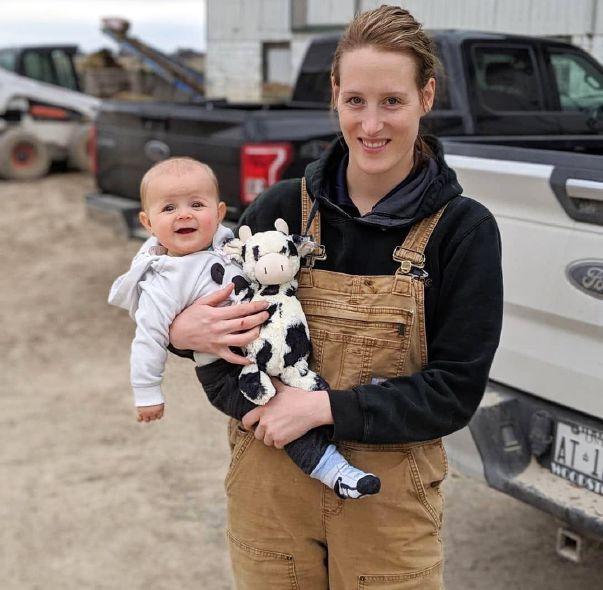
Rutherford balances running broiler and dairy farm. She does this all the while working as a dental hygienist and raising two young children.
And Vanessen quickly went from egg farming newbie to industry leader and a passionate advocate for future-proofing farms.
Our full podcast interviews with each farmer are available at canadianpoultrymag. com/podcasts. Now, in the pages ahead you can read highlights from each discussion.•
Presented by
4
David Arand
From tragedy to triumph
After taking over the family pig farm, he converted it into a turkey operation.
6 10
Dr. Teryn Girard
Living her dream
From poultry vet to educator and more, she is an invaluable asset to her industry.
8
Emma Rutherford Ultimate multitasker
Dental hygienist runs broiler and dairy farms while raising two young children.
Conrad Vanessen Rapid rise
He quickly went from egg farming newbie to industry leader and advocate.
Q&A with David Arand
To hear our full interview with David, visit canadianpoultrymag.com
FROM TRAGEDY TO TRIUMPH
When David Arand unexpectedly took over the family farm at a young age, he converted it into a successful turkey farm.
By Brett Ruffell
David Arand, a turkey farmer from Atwood, Ont., has been running his family’s farm since the young age of 22 after his father passed away in a tragic farm accident. He has since transitioned the farm from pigs to turkey production. Along the way he’s adopted many innovative management practices and technologies. He’s also a passionate educator and goes the extra mile for his community. We spoke to him about overcoming tragedy, embracing innovation and his love for turkeys.
Can you start by telling us a little bit about your farming background?
So, I grew up on actually a hog farm, just south of Donegal with my mom and dad and I have two older sisters and one older brother and a younger sister. And we did farrow-to-finish in the pigs for 30 some odd
years. And grew crops and stuff along with it.
You had to suddenly take over the farm after your father’s tragic passing. What was it like taking you over the farm at such a young age?
It sucked. I won’t lie to you. It sucked. When I was 22 my dad died. It was tough to be thrown into it. It was nice that I worked hand in hand with my dad. I knew a lot of the day-to-day stuff. But we had cows and I didn’t have a whole lot to do with that because I was always in the pig barn. It was nice that I could spend as much time with him as I did. But yeah, it was tough. The only thing I can say is I had the great fortune of being surrounded by industry people that care about my success as much as I did. There were a lot of questions asked and, if they didn’t know the answers, they found out the answers.
Your father never had a chance to show you the business side. How did you pick that up?
I never did well in school. I was one of those guys that, you know, when it came to school, I just couldn’t care less. I was that guy that always looked out the window and the teacher always said, “Hey, you’re never going to make a living looking out a window.” So, you know, I didn’t really get the business side until till my dad was gone. Mom ran the business, and she was kind of like, “Dave, you know you’ve got to learn this. You’ve got to take this over.” So, it was more of a hands on, thrown into it kind of deal. I learned the hard way firsthand, right away. I guess it’s sink or swim.
Why don’t you switch from hogs to turkey production?
Two years after dad died, mom came to me and said, “Dave, I know you want to take over. What do you want to do? Do you want to stay in pigs?” And pigs were at an 11-year low and the government actually came along and was offering a buyout to limit sow numbers in Ontario. I had a wife and a little kid just born and we’re sitting there wondering, “Do we stay in pigs?” And I was actually reading one of your magazines. And, you know, thought chickens didn’t make sense financially for me. So, I was reading and there was a guy in there talking about turkeys. I’m like, that sounds really cool. That sounds like something a little different. I’m gonna look into that. And it kind of spiraled from there. I called
David Arand is a turkey farmer from Atwood, Ont.
my feed rep. I got talking to him about it. He put me in touch with the pullet suppliers. What happened was I took the money from the sale buyout and I renovated old pig barns. And I bought my first turkey quota. And that’s what got me in the door.
What is the state of your turkey farm now?
We have four barns. We have 800,000 kgs. It’s split up between hen and tom production. So, in the old pig barns we grow five kg hens and broiler hens and in the two new barns we grow 16 kg toms. Our hens go to Exceldor in Hanover and our toms go to Hayter’s out of Dashwood.
Looking back, are you glad you switched over to turkeys?
Yes, I’m very happy we switched over to turkeys. It gives me some family time. When I was growing up as a kid, if you wanted to spend time with mom and dad, you had to be in the barn with mom and dad. You know, there wasn’t a lot of time for other stuff. And I find now with the turkeys, I have time for that. I still like the pigs. But as far as financial wise and workload, I am a lot happier with turkeys.
Can you tell me a few of the interesting management practices you’ve used in your barn?
So, from what I’m told, I’m one of the few guys that bed with straw in the brooder barn. Most guys use shavings or straw pellets. When we first got into turkeys, we started with shavings too. It worked. But the birds were never comfortable. They were always piling because they were always cold. And I could never seem to get them to spread out.
And these shavings cost a lot of money. I have all this straw because we grow a fair bit of wheat. So, I thought why don’t we try bedding half this barn with straw and we’ll start them on shavings and do the other half of the barn with straw. So that’s what we did. And again, you know, we had piling issues and stuff and the birds were never happy.
And then I let them out of a ring. In the old barn we brooded in rings. So, we let them out of the ring and they’d all run to the straw. And as soon as they got to the straw, they were comfortable. They were happy. They were better birds once they got to the straw. So, I’m like well maybe we should try brooding on straw and see how this works.
So, we started brooding on straw and our piling issues went away instantly. The birds are much happier. They were a lot more comfortable. I don’t know what it is about the straw but I just know the birds like it better than the shavings. Straw comes with its own challenges. But I think the birds are just happier. The good outweighs the bad as far as I’m concerned when bedding with straw. •
CONGRATULATIONS
Q&A with Dr. Teryn Girard
To hear our full interview with Teryn, visit canadianpoultrymag.com
LIVING HER DREAM
From poultry vet to educator and more, Dr. Teryn Girard is an invaluable asset to her industry.
By Brett Ruffell
Dr. Teryn Girard is a poultry vet from Red Deer, Alta. She was the first poultry vet to join Prairie Livestock Veterinarians, where she’s developed a growing commercial clientele. She’s also a vet with Cargill Animal Nutrition. In her role, she’s been an asset in helping to deal with both the pandemic and the avian influenza outbreak. She’s also developed important educational tools for producers, including small flock owners. And she volunteers her time to support youth who are interested in poultry. We spoke with her about building a poultry vet business in the midst of a pandemic, her role in handling the avian influenza outbreak and the importance of educating small flock owners.
To start, can you tell us how you got into poultry?
I mean, it’s a pretty convoluted path with a lot of mentorship. So, I originally just graduated with a biology degree quite a few years ago and I didn’t know what I wanted to do. I worked in retail and I worked in sales for a bit. And then I took off traveling with my now husband. And while we traveled, I figured out that I wanted to be a veterinarian just through working on a farm and some different sanctuaries. So, I came back to Alberta. We moved in with my parents and I went to the University of Alberta just to see if I could get into vet school. And I quickly met doctors Frank Robinson and Martin Zuidhof and that was kind of the beginning of everything. They introduced me to the poultry community, and I fell in love immediately. Everybody that I met was really welcoming and really passionate about poultry.
So, while I was working on getting into vet school, I decided to start a master’s of poultry etiology with application to animal welfare, which essentially is poultry behaviour. And the first time I applied for vet school, I didn’t get in. And then the second time I applied I got in, but I was halfway through my master’s. So, I ended up actually deferring that school for a year to finish up this master’s. And that master’s was really foundational in networking with people in the industry and getting to know the community that I really rely on now.
I went to vet school at the University of Calgary. And I wasn’t sure that I wanted to be a poultry veterinarian immediately. I was interested in cattle and I was interested in small animals, but they didn’t have that community that I had met at the University of Alberta. And so eventually, just when I graduated, I decided to go into poultry. And I haven’t
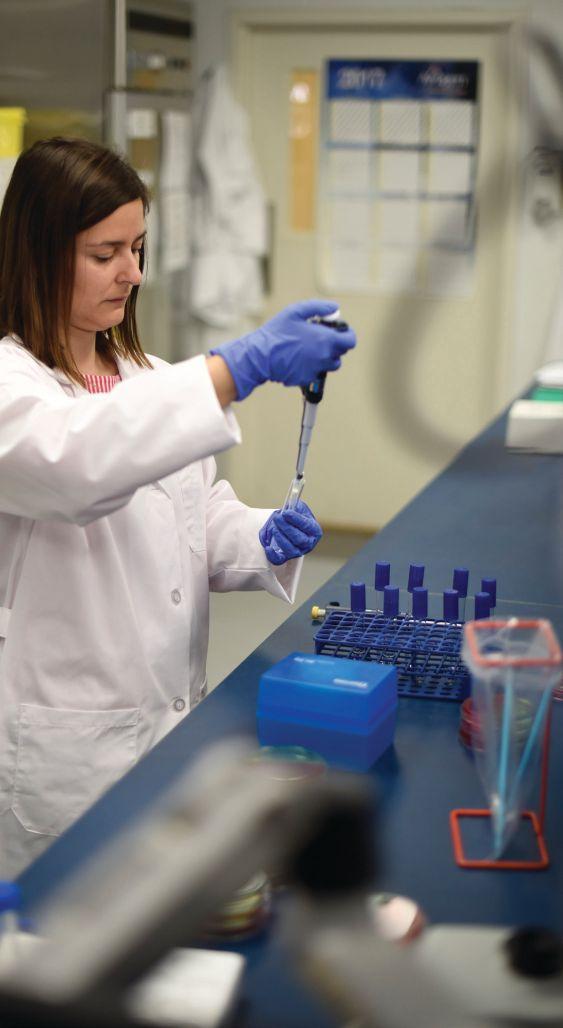
Dr. Teryn Girard is a poultry vet with Prairie Livestock Veterinarians and Cargill Animal Nutrition.
looked back since. It’s been really incredible.
So, now I’m here. I work for Prairie Livestock Veterinarians in the clinic and then I’m also the veterinarian for Cargill in Western Canada.
What do you do in those two different roles?
Basically, live the dream – or live my dream. I do a ton of field work, getting a good feel for the barns and what the birds are doing. The work with Cargill has made me really fortunate because I get to really focus on preventative care. So, looking at the birds week to week or every two weeks, or during problem periods and trying to catch issues early. And that helps us reduce antimicrobial usage and focus more on optimizing barn management.
My work with Prairie Livestock also mirrors a lot of that. We built a
poultry team really quickly. I’ve been with Prairie for almost two years now. When I started with them, they were called Prairie Swine Health Services. They didn’t have poultry. And since then, we added a poultry chapter and grew a poultry team. It’s just fantastic. So, on that side, we do more emergency work. The team has really focused on small flock medicine and management.
And outside of that then also just being a part of a few committees like the Western Poultry Conference committee, the Poultry Service Industry Workshop committee, working with the Western Canadian Animal Health Network that we call WeCAHN, which is an agile educational program for both veterinarians and producers. And then we get a lot of student internships through Prairie Livestock as well. So that’s really fun, having student tagalongs and then I also every year do some guest lectures for both the University of Calgary vet school and the University of Alberta ag program.
You’ve also played a big role in helping the industry respond to avian influenza. Can you talk a little bit about that? That was a nightmare, to be honest. Again, that was kind of a learn as you go. So unfortunately, a few of our clients had avian influenza in their barns. And so, we had to develop a really fluid protocol for Prairie
so that when we got a phone call saying, “While, I may have AI,” then we could get the ball rolling really quickly. At that point, when they’re worried about having avian influenza, my goal is to get them a diagnosis as quick as possible, whether it’s positive or negative.
I eventually joined the Alberta Poultry Industry Emergency Management Team, and acted as a vet role for that team. But there are a lot of other vets in there that played a massive role as well. And so, during the avian influenza outbreak, we would meet every day with updates from producers.
And then eventually as I started to learn what I could do to support the producers, I started working with producers to get their standard operating procedures completed, to start thinking ahead so that they could start preparing for the next step just to speed up their process so they could get birds into their barns sooner.
I think the one thing that I learned from the avian influenza outbreak was that the producers are going through so much that if we can play any role to just support the transition of each step of going through the dry clean, the wet clean, the disinfection, the testing, done that may take a little bit of load off of their back.
And then the other role that I played through the avian influenza outbreak was like a media role. •
GIRARD
Q&A with Emma Rutherford
To hear our full interview with Emma, visit canadianpoultrymag.com
ULTIMATE MULTITASKER
Emma Rutherford runs broiler and dairy farms all the while working as a dental hygienist and raising two young children.
By Brett Ruffell
Emma Rutherford of Woodstock, Ont., wears many hats. She’s a broiler and dairy farmer, a dental hygienist and mother of two young children. On her broiler farm, which she’s run since 2016, she’s led several initiatives that have improved flock health, results and profitability. We spoke to Rutherford about onfarm projects she’s led, managing a team and finding balance.
Can you start by talking a bit about your poultry background?
When I was around 10, that was when my parents built the two-storey broiler barn. So, all of us kids grew up there doing chicken chores. And then in 2016, my husband and I started to run our own broiler firm, about 10 minutes away from the home farm. And then we also started milking cows in a tie stall through the new entrant program. And the tie stall barn was right next door to the home poultry farm that I grew up on.
So, at the end of 2021, we’d done a lot of changes with our family succession planning. We did a little bit of rearranging and switched properties with my brothers. So now, my husband and I live at the home farms. We run the poultry farm here and the dairy barn, and then we still run that the smaller tie stall barn and my brother was able to run
“I think when you’re just focusing on the animal welfare part of the operation, there are a lot of similarities between broilers and dairy.”
the two other broiler farms a couple roads over. It’s made it a bit easier because now everything’s all and under one area for us.
You’ve employed several strategies on the farm to improve bird health. Can you talk about some of those?
At the other barn, I noticed a big improvement with mortality when we installed the acid chlorine water treatment system. So, that that helped a lot. We used to only do four hours of darkness at night and then when we grew a 3.8 kilo bird, we went all the way up to 10 hours and just that alone helps a lot with leg issues.
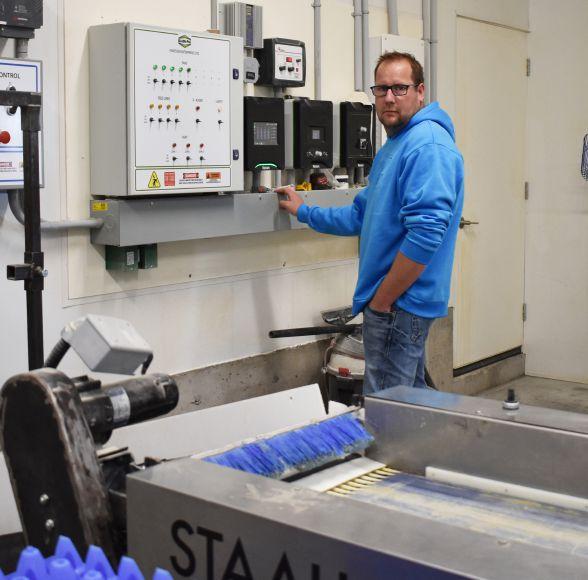
I talked to my feed rep a lot and the vet a lot and also other poultry farmers. It’s nice to bounce ideas off other poultry farmers to see what everybody else is doing. We also put a Genius box in recently. So, the automation I think has improved everything a lot – the air quality; the litter quality; being able to run the barn without physically being there.
When I first came here, there must have been 15 different boxes controlling 15 different things. So, it was a bit overwhelming. And then some of them were kind of starting to break down. And so, we thought it was a good time to invest in the Genius control. And it’s helped a lot. The very next crop, the litter was drier and the humidity control had improved a lot. So, I think it’s a good investment if you can do it.
In Ontario, your farm was one of the early adopters of modular loading. Can you talk a little bit about that experience and the role you played?
We kind of hummed and hawed because we had the propane tanks on one side and the feed bins on the other side. And anyways, we, yeah, we put it on the heater side. And then we had to do some laneway clearing, because they need a lot of space for the trucks to load the chickens in. So, just you had to reinforce the flooring a lot more. And we consulted with the construction worker we had for that a lot, too. He was actually a poultry farmer, the guy we worked with. So, he had done his own barn already. He knew how to do it properly – just make sure you have proper reinforcements.
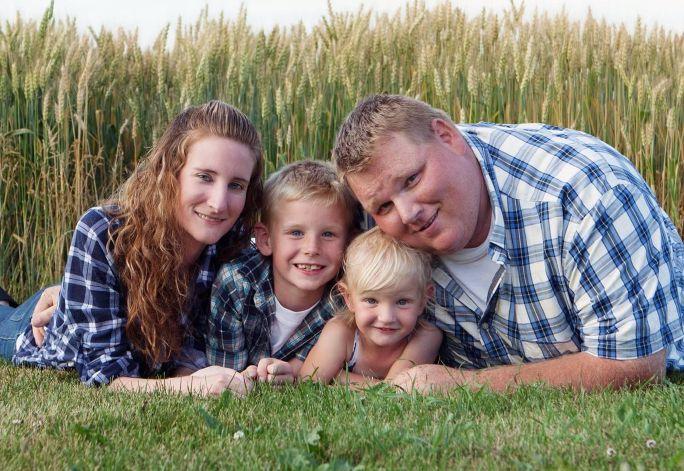
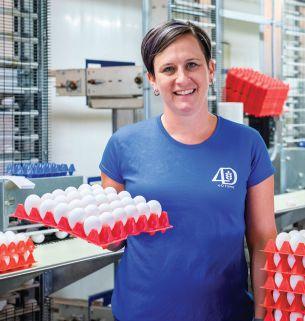
Emma Rutherford is a broiler and dairy farmer from Woodstock, Ont.
You eventually hired a group of employees. What are the keys to being an effective barn staff manager?
I think giving employees a little more responsibility slowly, as time goes on, is beneficial. I think if you rely too heavily on them, or also not enough, you wouldn’t have the results or the flexibility you could potentially have.
I think also, for me, with other jobs, being an employee, I really liked it when employers would explain why I was doing a certain task and not just say, “Oh, you have to do this.” I think explaining the reason behind things is important because I think your employee is going to care more, and they’re going to also remember stuff better when they understand why you’re doing a certain thing.
And then always making sure that your employee feels appreciated and acknowledged when they’re doing really good job. When I do chicken chores now and I get the same numbers that our employee does, it tells me he’s doing a really good job with culling the birds properly.
You oversee both a broiler farm and a dairy operation. How do the two compare?
I think when you’re just focusing on the animal welfare part of the operation, there are a lot of similarities between the broiler and the dairy.
Just very basic similarities like dry bedding and good air quality and proper ventilation.
But in the bigger picture, I think there is a lot more variability in the fine tuning that goes into the dairy operation. For us specifically, my husband works as a dairy feed specialist. So, he’s constantly adjusting the ration on a daily basis. Whereas for the poultry we rely heavily on our feed specialist to properly balance the chickens’ diet.
My husband and I have discussed the possibility of doing on-farm feed manufacturing, just simply because we have three broiler farms and two dairy farms within my family, plus my husband’s off-farm job. It might make sense for us down the road.
You’re a dental hygienist and you also have two kids. So, from a work-life balance perspective, how do you manage?
We have a soon-to-be four year old, two year old and I’m expecting number three in September. So right now, what works well with us is splitting the operation. My husband runs the dairy and I run the poultry. The poultry’s flexibility has allowed me to care for the kids on top of that. Come September, my husband will have to help with the poultry side a bit more. But I think having a very reliable employee has helped us a lot. We also have very good family support on both sides. •
To hear our full interview with Conrad, visit canadianpoultrymag.com
RAPID RISE
Conrad Vanessen quickly went from egg farming newbie to industry leader.
By Brett Ruffell
He’s one of Egg Farmers of Alberta’s (EFA) recent new entrant farmers, a current director and past chair of EFA’s board of directors and an alumni of Egg Farmers of Canada’s (EFC) Young Farmers Program. Indeed, Conrad Vanessen of Coaldale, Alta., has had a rapid rise to become one of the Alberta egg industry’s most influential young leaders. As both a director and member of EFA’s Egg Ambassador team, the free-run egg producer is eager to speak to the public about modern egg farming. We spoke to him about new entrant programs, future-proofing egg farming, and educating the public.
Could you start by telling us just a little bit about your poultry farming background?
So, it’s pretty short. I’m a first-generation egg farmer. I started farming here in southern Alberta in 2011, I believe. And I got into the egg business in 2014. So, I hadn’t spent a whole lot of time with chickens or in
layer barns. It was literally just I seen in an article that the Egg Farmers of Alberta was running a new entrant program. And I thought, why not apply? Why not try it? It’s a good way to diversify the farm. It’s a good opportunity to get into supply management, which is something that I kind of always wanted to do. Growing up, you always heard lots about it – about the stability of it and the guaranteed income and stuff like that. So, we applied, and I guess we lucked out. I got selected in 2014 and got into egg production in 2015. And we have been going ever since. I built a free-run facility. I started off with 5,000 hens and we’ve since grown that up to 20,000 now.
What’s it like managing a free-run barn?
It’s all that I’ve ever done. So of course, to me, I think it’s normal. When you talk to other people, they always think it’s a lot more work and stuff like that. Which I guess I could probably see if I had come from different facilities before but for me it’s all I’ve ever known. There’s a little bit more work involved. You’ve got to do your walkthroughs. You’ve got to really manage your birds, making sure that everything was going well. Because if you’re missing something, whether that’s with lighting, whether that’s with ventilation, whether that’s within your feed, a small problem could become a big problem in a hurry. And especially in a free-run barn. So, it just requires more to manage. And you learn every year.
You’re a champion for future proofing egg farms. Can you talk a little bit about that, and how you’ve tried to raise awareness around that?
Times are changing and people are changing. Consumers are getting more and more removed from being connected to farms. Thirty years ago, everybody had somewhat of a connection to a farm. and that’s getting less and less. So, as we get farther and farther away with the people that are eating our eggs having a connection to an actual farm, I think it’s important that we’re always out there being advocates for our industry, talking about what we do and building trust. I think that one of the key things is we’ve got to build trust with the consumers – with the people that ultimately buy our product. And then that way, over time, that will pay us back with them trusting us when things change, or when we go through tough patches.
But then we’re also in a good industry with supply management where we do have the opportunities to spend money on sustainability research to make sure that we’re leaders when it comes to all those
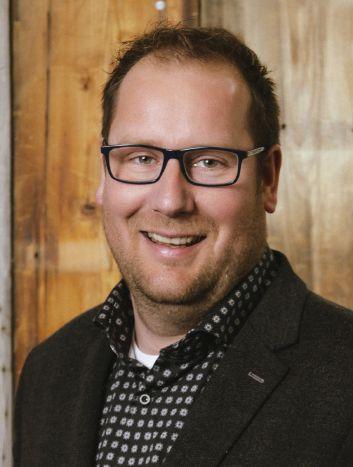
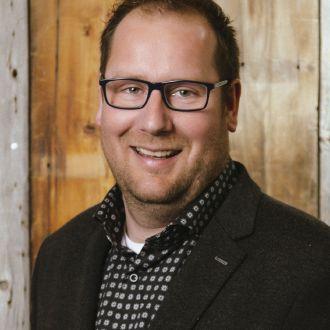
Conrad Vanessen became an egg producer through Alberta’s new entrant program and is now also Egg Farmers of Alberta’s vice chair.
things; to make sure that we have the best practices, we have the best farms and we’re being as efficient as possible. And if we must make some of those changes as investments on our farm, you know, we can afford to do that. And we can. We can move forward to make sure that we’re doing our part to be as environmentally friendly as possible and to be as sustainable as possible.
Early on, you became an advocate for improving the new entrant program. Why did you make that a priority?
It’s how I got into the egg industry. So, I felt that once I went through the program, once we got set up and once we’d seen the limitations of what the existing program here in Alberta had, I thought I could bring forward some good ideas and good recommendations so that we could enhance it a little bit more. Let’s try and make the program adaptable to so that we can keep these farmers around and so that they can continue to grow and become second-, third-, fourth-generation farms as well. For the new people that are going to come in after us down the road, hopefully they’ll have less headaches.
Not many other industries can say that they have new entrant programs. In Alberta, since I became a new egg farmer, we’ve had more than a dozen new entrants, and many of those have been first-genera-
tion egg farmers like myself. So, I felt it’s a good story to tell, it doesn’t happen in many industries, and especially not in supply management. So, I really wanted to make sure that we had something in place that we could be proud of moving forward and something that we could use to show that new people can come in and make a living.
What enhancements have they made to the program since you started working with the board?
Since I’ve been on the board, we’ve gone through a couple of changes a couple of times where they’ve revamped the program. Now, there’s guaranteed leases that go along with that for as long as you want to be an egg farmer. The whole application process has changed quite a bit. Because when I applied, it was literally just a one page, fill out the paper, send it in, if you get awarded, you get awarded. Now since you get more now, there are a little bit more requirements on the paper side of things upfront to make sure that there’s the financing and where you’re going to build, and you have the land and you have places for the manure and stuff like that. So, that’s changed a bunch as well. But yeah, there’ve been some really positive changes made. And I’m hoping that this is going to be a program that’s going to work well for future generations.
Q&A with Conrad Vanessen
To hear our full interview with Conrad, visit canadianpoultrymag.com
What steps have you taken to future proof your own barn?
I like technology, right? Everything is run through our phones. Everything is run on computers. You can take all your information that you’re getting every single day. You can look at all your trends and see if there’s blips in anything. Someday down the road, I think, as more of these programs evolve – Egg Farmers of Canada has the NEST program, for example. As more of this data starts to get collected from different farms with different housing types, we’re going to be able to benchmark farmers against farmers, but also be able to tell stories of what we’re doing, you know, how efficient we are with, let’s say, our water or feed additives or all our circular economy, whether that’s our manure going back onto the land and the nutritional value that we’re getting out of it. So, I think it’s still something that’s just starting to happen. And we’re starting to move in that direction, more and more, but I think that the future is definitely exciting on that front.
You’re also involved with Egg Farmers of Alberta’s ambassador program. Can you talk a little bit about that, and some of the most impactful things you’ve taken part in?
I think one of the nicest things is probably when I went and talked to a 4-H group of young people. The questions that they had. The interests
that they had. Just the curiosity about eggs, about chickens, about all those things, it gives you the most sense of satisfaction when you go to an event like that and people are so willing to not only hear you but are not afraid to ask the questions. So, I think that’s what makes the whole program exciting is talking to the people and getting their feedback.
What is it about working in poultry that inspires you?
It’s a good living but it’s also an industry where we’re producing food that’s going directly to people’s plates. That egg that leaves my cool room every Thursday is probably going to be on a grocery store shelf within a week to 10 days or in somebody’s kitchen. So, to know that I’m that intricately involved in the production businesses – I think that’s inspiring. It’s rewarding, absolutely. And then knowing that there’s opportunities that are going to come along and challenges that are going to come along and to be able to be part of the industry and be part of the answers or to help conquer the problems and have that voice as a farmer, I think that’s also part of why I like doing what I do so much – working together to capitalize on the opportunities and solve the problems and work towards being as efficient as possible and as sustainable as possible. And making sure that we’ve built the trust with consumers. There’s a whole bunch of things that make this industry so fun to work in. •
OCT. 18, 2022
10:00AM MT / 12:00PM ET
INSPIRE | LEARN | LEAD | CONNECT
Register for this free, virtual mentorship-style event with some of the most influential female leaders in Canadian agriculture.
Hear from the 2022 Influential Women in Canadian Agriculture program and other industry trailblazers on important topics such as leadership, balance, and communication.
Join Lana Shaw, Megz Reynolds, Valerie Carney, Heather Watson, Lisa Mumm and more for an afternoon of interactive discussions as they share their experience, offer guidance and discuss their journey in agriculture.