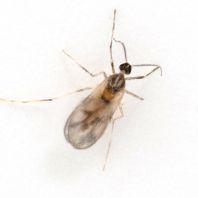
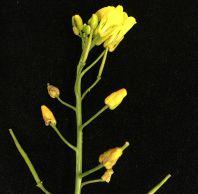
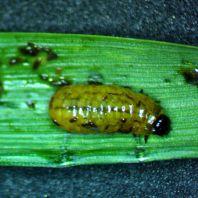
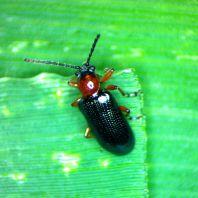
The FMC What’s Bugging You? Program is back by popular demand and it’s so easy to qualify.
Here’s how it works:
Purchase two 10L jugs or more of Pounce® 384EC insecticide or four 1.587 KG jugs or more of Carbine® insecticide and you will receive a $100/jug rebate on all purchases of Coragen® MaX insecticide.
Scan to save your crops and get cash back!
Published as part of Top Crop Manager, April 2025, by:
Annex Publishing & Printing Inc.
PO Box 530, 105 Donly Drive South, Simcoe, ON N3Y 4N5 Canada
Tel: (519) 429-3966
Fax: (519) 429-3094
Kaitlin Berger
WESTERN FIELD
Bruce Barker
NATIONAL ACCOUNT MANAGER
Quinton Moorehead
NATIONAL ACCOUNT MANAGER
Reena Uppal
GROUP PUBLISHER
Michelle Bertholet
CEO Scott Jamieson
Canada’s original technical crop production magazine, The Western edition of Top Crop Manager, is published nine times a year. To be sure of your copies, either mail, fax or e-mail your name and full postal address to Top Crop Manager, or subscribe at topcropmanager.com. There is no charge for qualified readers.
All rights reserved. Opinions expressed in this magazine are not necessarily those of the editor or the publisher. No liability is assumed for errors or omissions. All advertising is subject to the publisher’s approval. Such approval does not imply any endorsement of the products or services advertised. Publisher reserves the right to refuse advertising that does not meet the standards of the publication.
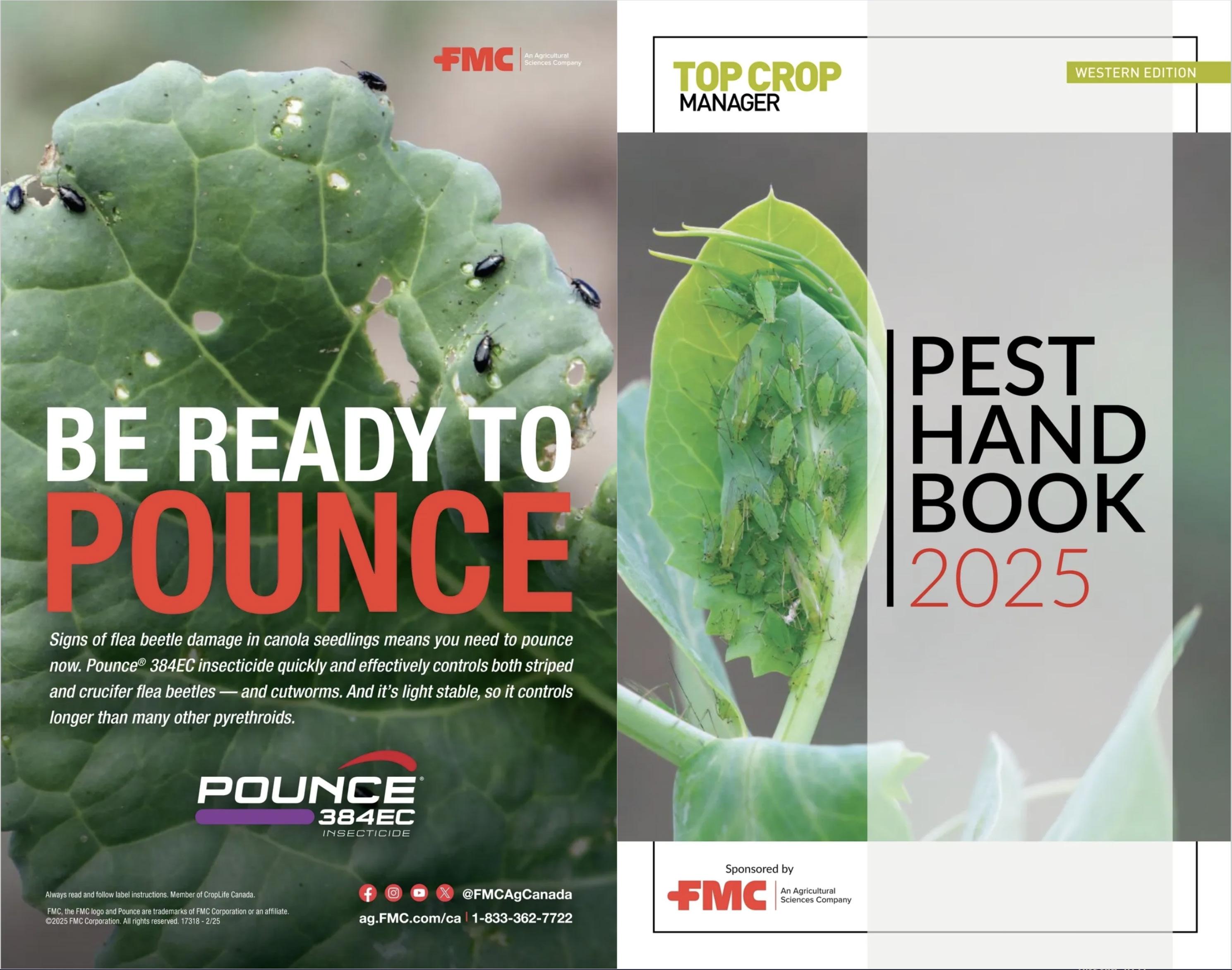
Welcome to the second edition of Top Crop Manager’s Insect Pest Guide, a resource designed to assist field crop producers in western Canada with identifying and managing key insect pests throughout the growing season.
For chemical control options and application methods, please refer to a provincial crop protection guide for assistance in making control decisions. Feel free to scan the QR code to download this resource as a PDF on your mobile or tablet to view when without internet service. You can also bookmark the issue for quick reference within a browser.
Top Crop Manager thanks the numerous agronomists, consultants and entomologists who contributed to this guide. We do our best to ensure accuracy, but in case of any discrepancies, please refer to your provincial crop protection guide or consult an agronomist or entomologist within your growing region.
Cultural Control volunteer hosts and plant spring grains early when possible to reduce colony development.
Biological
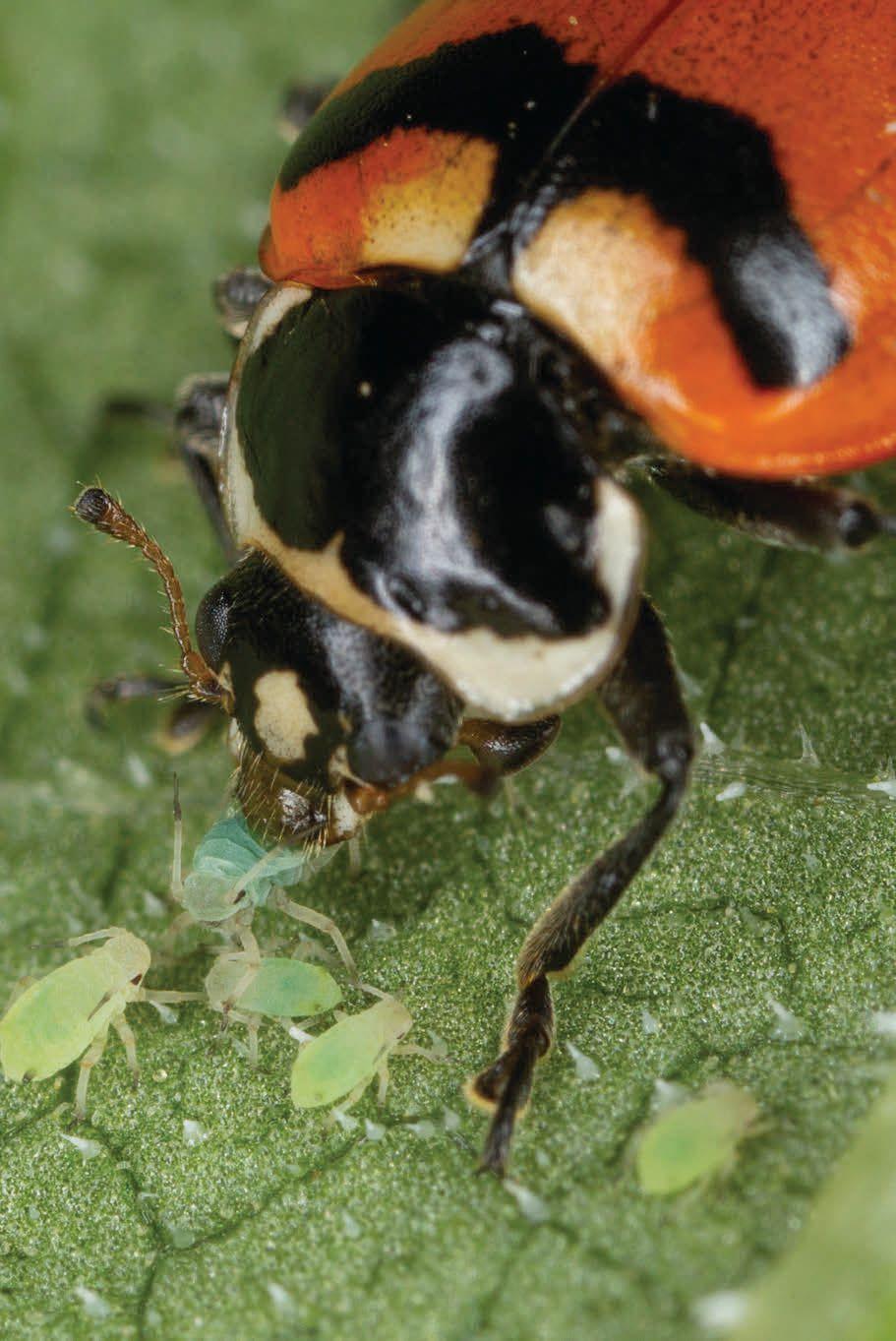
Beneficials such as lady beetles, green lacewings, and parasitic wasps are natural enemies and can help suppress aphid populations.
Chemical
Insecticide treatments are available but may be detrimental to natural enemies of the aphid. Before applying an insecticide, consider if the population is above threshold, if the crop is infected prior to soft dough, what the natural enemy population is like, and other stressors such as precipitation or drought.
SCOUTING AND MONITORING
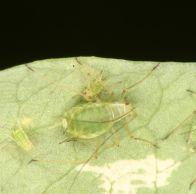
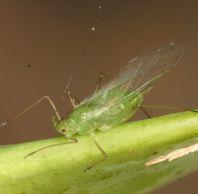
Corn leaf aphid: Before soft dough, calculate the average number of aphids on 20 random tillers at five sites across the field. When counting, note predators, parasitized aphid mummies or aphids killed by fungi.
FEEDING DAMAGE
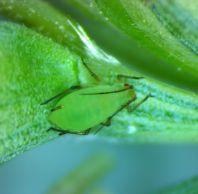
Corn leaf aphids suck sap from plants, causing stunted growth, curled leaves and reduced yield. Honeydew excretion can promote sooty mould growth, reducing photosynthesis. Adult and nymph Russian wheat aphids suck sap from leaves causing streaks between veins. Prevents normal unrolling, bleached heads and poorly formed grain.
ECONOMIC THRESHOLDS
Corn leaf aphid: In grains, the threshold is 12 to 15 aphids/ stem prior to soft dough. Treatment after early dough is not cost-effective. In field corn, 50 per cent of corn plants have more than 100 aphids/plant during tassel emergence. Russian wheat aphid: In winter cereals, the threshold is 15 to 20 per cent of seedlings infested after Oct. 1. In spring cereals, 10 to 15 per cent of seedlings, or 15 to 20 per cent of plants at boot stage.
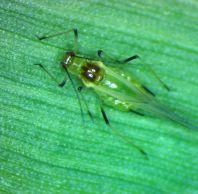
Nymph Damage
Works smarter, harder, longer.
Carbine® insecticide hits aphids hard with fast, selective, long-lasting control. This isn’t your typical insecticide that takes out the good guys with the bad. Carbine® insecticide leaves many important beneficials* to continue the fight. It’s a smart solution with a novel, Group 29 mode of action that zeroes in on aphids to stop feeding quickly and then brings residual protection to help keep the crop safe.
Effective, selective aphid control. *When applied at label rates. In line with Integrated Pest Management and Good Agricultural Practices, insecticide applications should be made when pollinators are not foraging to avoid unnecessary exposure. Always read and follow label instructions. Member of CropLife Canada. FMC and the FMC logo are trademarks of FMC Corporation or an affiliate.
Photo Credit: Dan Johnson, Faculty, Geography and Environment Department, University of Lethbridge
Biological Green lacewings, spiders and general predatory insects may reduce populations.
Chemical
Several insecticides are registered for aster leafhopper control, but without an established economic threshold, spraying is unlikely to be economical and could have an impact on beneficial insects.
SCOUTING AND MONITORING
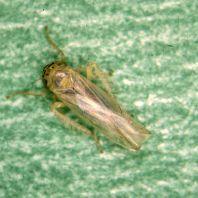
Leafhoppers can be monitored with sticky traps and sweep nets between late May to mid-August.
FEEDING DAMAGE
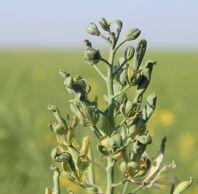
Aster leafhoppers are a carrier of aster yellows phytoplasma, which causes aster yellows disease. Aster leafhopper feeding does not cause the damage to plants but the infection of aster yellows phytoplasma produces negative effects on the crop. The disease will cause misshapen and shriveled seeds that are non-harvestable. Infected plants have malformed flowers, a purple tinge and pods are seedless, bladder-like structures.
ECONOMIC THRESHOLDS
None established.
If aster yellows symptoms are observed in the field, applying insecticide to field crops will not yield an economic return, as the crop is already infected.
Aster yellows disease
Images courtesy:
Whitney Cranshaw, Colorado State University, Bugwood.org and Saskatchewan Ministry of Agriculture
THE RIGHT INSECT CONTROL, RIGHT WHEN YOU NEED IT
You know insects are coming. You don’t always know which type, how bad or exactly when. FMC Canada offers a full insecticide portfolio to protect your valuable crops against a wide variety of pests.
Cultural Alternate with non-host crops. Mechanical damage by means of fall cultivation on soils not susceptible to erosion can kill pupae. Early maturing canola may limit significant infestation unless the adult moth flight is early. Effectively control preferred host weeds, such as lamb’s quarters.
Biological
Ichneumonid wasps (Banchus flavescens) and Athrycia cinerea, a tachinid fly, are effective parasites of bertha armyworms. A nuclear polyhedrosis virus also attacks the pest. The effect of these natural enemies is seen a year or two after an outbreak.
Chemical
An insecticide application made once the economic threshold is reached should suffice. Use proper water volume for adequate coverage and avoid application before the crop has finished blooming. If this is not possible, select the safest insecticide and apply during the evening to reach larvae while actively feeding and to help protect honeybees.
SCOUTING AND MONITORING
Follow provincial monitoring programs to find high risk regions. Crop damage generally occurs late July to late August. Scout fields during canola’s early pod stage (5.1-5.2) by surveying 10-15 spots, 50 meters apart. Shake plants to dislodge larvae and count larvae in a 0.25 m² area for density. Calculate the total larvae per square metre.
FEEDING DAMAGE
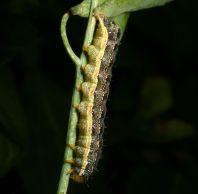
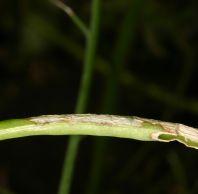
In canola, larvae debark pods, chew through to eat the seeds or can entirely consume pods when populations are high. Stripped pods may shatter prematurely, and crops can look white in colour. In flax, flowers and developing bolls are cut.
ECONOMIC THRESHOLDS
The economic threshold will vary with the treatment cost, application method and current value of the crop. Tables are available on government websites indicating the larval density at which an insecticide application would be warranted in canola.
Hosts: Canola, brown and wild mustard (larval host)
SCOUTING AND MONITORING
Use sweep net sampling when canola is in the bud through flowering stages. At 10 sites within the field, including field edges, count the number of weevils found within 10 180-degree sweeps.
FEEDING DAMAGE
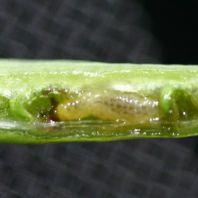
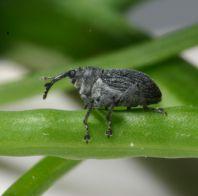
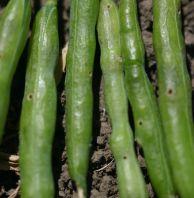
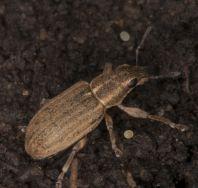
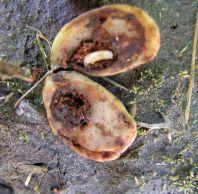
Females lay eggs in canola and brown mustard pods. The larvae feed on developing seeds causing infested pods to shatter or become distorted as the undamaged seeds mature. As the weevil emerges from a pod – the exit holes left allow fungal infections to set in and further reduce yield. Adults feed on developing flower buds, causing bud-blasting and can also be found feeding on pods in late canola crops.
ECONOMIC THRESHOLDS
Depending on the current crop value, the threshold would be two to three or three to four adults per sweep. A price of $8.00 per bushel or beyond would warrant an application upon finding two adult weevils per sweep. Boot stage: One or more larvae per flag leaf.
MANAGEMENT
Cultural
Earlier flowering canola varieties planted as a trap crop around the field perimeter may encourage a concentration of adults for a more efficient insecticide application if the threshold is reached.
Biological
There is limited effect from natural enemies on the cabbage seedpod weevil population in Western Canada. However, the Microctonus melanopus wasp parasitizes adult weevils and the Trichomalis perfectus wasp will attack larvae within the pods.
Chemical
There are available insecticides registered to use in canola, mustard and rapeseed. If the threshold is reached, make the first treatment when 70% of plants have three to 10 open flowers. This will reduce egg laying in new pods. Be sure to spray in the evening to minimize any injury to bees and other beneficials.
Larvae
Damaged pods
Adult
Canola Flower Midge
Contarinia brassicola (Diptera: Cecidomyiidae - gall midges)
Hosts: Canola
MANAGEMENT
Cultural
Researchers have found evidence that canola flower midge larvae can remain in the soil for at least two years. Extending crop rotations to allow for multiple years between canola crops may help reduce infestations.
Biological
Two parasitic wasps (Inostemma spp. and Gastrancistrus spp.) attack canola flower midge larvae, are widespread across the Prairies and may help to reduce population levels.
Chemical
No products registered. Larvae are completely protected while feeding inside the flowers and/ or pods. Targeting adults as a method of control is not feasible and would be detrimental to the parasitic wasps and other beneficial insects in the field. Seed treatments have been found to have no effect on reducing larval feeding damage.
SCOUTING AND MONITORING
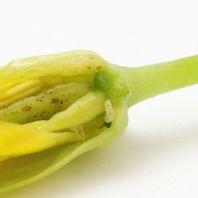
Take note of unopened (galled) flowers during flowering. Gently dissect damaged flowers to search for the yellow midge larvae. Larvae of canola flower midge will “jump” by coiling their ends together and releasing in a springlike action. Galled flowers are easily spotted amongst developing pods at the end of flowering, but larvae may have already exited the flowers by this time.
FEEDING DAMAGE
Larva feed inside developing canola flowers, halting flower development. Affected (galled) flowers remain unopened with fused petals and scarring on internal flower parts. There have also been reports of larvae being found inside canola pods; these occurrences are being researched.
ECONOMIC THRESHOLDS
None established, but it is not believed to cause widespread economic damage.
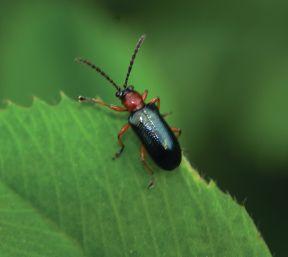
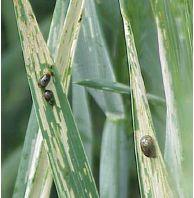
Just prior to boot stage, examine 10-20 plants at five sites, following a “W” pattern starting at a field margin. Calculate average number of eggs (if seen) and larvae per stem. Larvae appear slug-like and cover their bodies in fecal matter. Larvae can often be first noticed by streaks left on a person’s pants while walking through a fieldthese streaks are the fecal coats of the larvae rubbing off.
FEEDING DAMAGE
Larvae feed on upper surface of leaves, causing strips of damage. Crop yield and quality can be affected if flag leaf is damaged, but yield losses are highly variable and often negligible. Adults also feed on upper leaf surfaces but economic injury is from the larvae. Wheat, barley and oats are the most common host crops.
ECONOMIC THRESHOLDS
Pre-boot stage: Three or more eggs or larvae per stem before flag leaf emergence. Boot stage: One or more larvae per flag leaf.
MANAGEMENT
Cultural
Ensure optimal crop development to reduce impact of larval feeding.
Biological
Tetrastichus julis is an introduced parasitoid that has successfully kept populations below economic levels. CLB management efforts should be focused on maintaining this parasitoid. Dissect mature CLB larvae to search for the presence of the small yellowish parasitoid larvae. T. julis prevents full development of CLB larvae into beetles but does not stop larval feeding. Lady beetles and damsel bugs also feed on CLB larvae.
Chemical
Apply registered products only if necessary. If leaf damage is observed, ensure larvae are present before spraying, otherwise they may have dropped to the ground and will not be killed by the insecticide. If T. julis is present, leave up to one acre unsprayed in two corners next to shelterbelts and/ or water bodies to provide nectar sources and habitat for the parasitoid.
CEREAL
Cutworms
Army cutworm Euxoa auxiliaris (Grote)
Pale western cutworm Agrotis orthogonia (Morrison)
Later seeded crops may avoid larvae feeding but must be balanced off with the agronomic advantages of seeding early. Uncultivated fields in the summer and fall are less attractive to egg-laying females. If reseeding, cultivate the field to destroy green material and wait 10 days before reseeding.
Biological
Several species of parasitoids and predatory insects attack eggs and larvae. Parasitoid wasps include braconid and ichneumonid species that lay their eggs in early-instar larvae. Encyrtid wasps lay their eggs in cutworm eggs. Parasitoid flies mainly include bombyliid and tachinid species. Ground beetles (Coleoptera: Carabidae) are important predators and the many species may attack eggs, early- and late-instar larvae and pupae of cutworms. Bacteria, fungi, nematodes and viruses can also cause mortality.
Chemical
Foliar insecticide application should be done in the late evening when larvae start to feed. Apply only to the infested areas to help preserve beneficials. Larvae are controlled by contacting insecticidal residue on the soil surface or when they consume treated leaves.
SCOUTING AND MONITORING
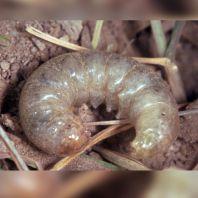
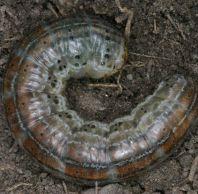
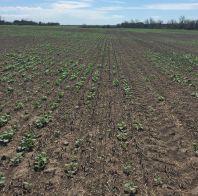
During crop emergence, look for thinning or bare areas of the field. Scout in the early morning or evening for cutworms feeding above-ground. At 10 sites in a field, count larvae in the top 2.5 cm (1 in.) of topsoil in a 0.1 m2 (1 ft2) area.
FEEDING DAMAGE
Pale western and Redbacked cutworm larvae sever plants just below the soil surface and pull them underground to eat the seedlings. Army cutworm feed above ground at night by chewing holes in leaves and eventually eat the entire leaf. Later in the season, army cutworm larvae move up plants to feed on panicles and flowers, and cut off awns and kernels.
ECONOMIC THRESHOLDS
Cereals - Army cutworm and Redbacked cutworm: five to six larvae/m2
Pale western cutworm: three to four larvae/m2 Canola, Flax - Army cutworm: None established Pale western cutworm and Redbacked cutworm: four to five larvae/m2
Peas - Pale western cutworm and Redbacked cutworm: two to three larvae/m2
Pale western cutworm larvae Damage Redbacked adult
Images courtesy: Frank Peairs, Colorado State University, Bugwood.org; Mike Dolinski and Saskatchewan Ministry of Agriculture
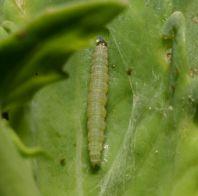
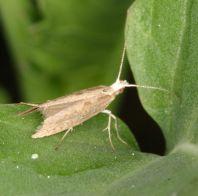
Diamondback moth adults are carried on winds originating from the southern United States. Pheromone traps can be set up to detect when the moths arrive in the spring; updates on arrival can be found on provincial websites. Scout fields in July and August by pulling up plants in one square foot and shaking or gently banging plants on a clean surface to dislodge the larvae from the plant to count them. Repeat in a minimum of five locations in the field.
FEEDING DAMAGE
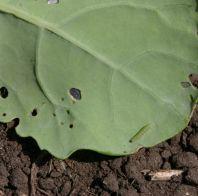
Larvae feed between leaf veins, creating a window-pane look. As the crop matures, larvae move upwards in the canopy to feed on the pods where the majority of economic damage occurs. Pods that have been fed on will desiccate more quickly, resulting in yield loss. This pest cycles through multiple generations in a single growing season. The earlier they arrive, the greater the potential for crop damage.
ECONOMIC THRESHOLDS
Vegetative to flowering stage: 100-150 larvae/m2 (10-15 larvae/ft2)
Late flower to pod stage: 200 to 300 larvae/m2 (20-30 larvae/ft2)
MANAGEMENT
Cultural
Control volunteer canola and cruciferous weeds as these plants are potential food hosts for newly migrated populations.
Biological
Six parasitic wasps attack diamondback moth. Diadegma insulare, Microplitus plutellae, Diolcogaster claritibia and Cotesia plutellae attack the larvae, Diadromus subtilicornis attacks the prepupal and pupal, and Trichogramma praetiosum attacks the eggs. Predators such as green lacewing larvae, damsel bugs, ground beetles, and spiders will consume diamondback moth larvae.
Chemical
A single, well-timed insecticide application should suffice if control is warranted. Chlorantraniliprole is not harmful to the parasitic wasps or to bees; all other insecticides registered for diamondback moth will also negatively affect beneficial insects.
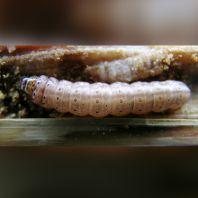
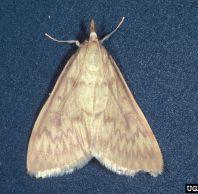
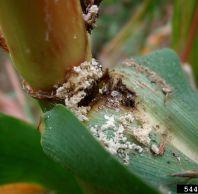
Larvae Damage Adult
English Grain Aphid
Sitobion avenae (Hemiptera: Aphididae)
Hosts: Wheat, barley, oats, rye, canary seed
MANAGEMENT
Cultural Cultural control methods have not been developed.
Biological
Fungal pathogens, lady beetles, green lacewings, and parasitic wasps are natural enemies and can help suppress aphid populations.
Chemical Insecticide treatments are available but may be detrimental to natural enemies of the aphid. Before applying an insecticide, consider if the population is above the economic threshold, at what stage the crop is at, the natural enemy population and other stressors such as precipitation or drought.
SCOUTING AND MONITORING
Before soft dough, calculate the average number of aphids on 20 random tillers at five sites across the field. When counting, note predators, parasitized aphid mummies or aphids killed by fungi.
FEEDING DAMAGE
Feeding damage typically manifests as yellowing, stunted growth and distorted leaves. Aphids extract sap, weakening plant tissue and reducing photosynthesis. Infested plants may exhibit curled or twisted leaves, especially in early growth. The presence of honeydew, a sticky substance excreted by aphids promotes sooty mold growth. In the spring, colonies will feed on developing kernels, causing them to shrivel.
ECONOMIC THRESHOLDS
In small grains, the threshold is 12-15 aphids/stem prior to soft dough. Treatment after early dough is not cost-effective.
In canary seed, the nominal threshold prior to the soft dough stage is 10 to 20 aphids on 50% of the stems.
Nymph
Adult
Images courtesy: Mike Dolinski
European Corn Borer
Ostrinia nubilalis (Hübner)
Hosts: Sweet, grain and silage corn, potatoes, beans and sugar beets.
SCOUTING AND MONITORING
Pheromone traps can be used to guide scouting activities. Based on these traps, or beginning in early July, examine 10 plants for egg masses and young larvae, and repeat at 10 locations in a field.
FEEDING DAMAGE
Larvae cause the most damage, with young larvae causing window pane and shot hole damage on leaves. Older larvae feed within the stalks and ear shanks, impacting nutrient flow resulting in stalk breakage and the development of smaller cobs. Larvae also feed on kernels and cobs. Adults feed on flower nectar.
ECONOMIC THRESHOLDS
When 50 per cent of dryland corn plants show shot-holing, economic loss can occur. Manitoba Agriculture has a worksheet for thresholds that takes grain prices and control costs into account.
MANAGEMENT
Cultural
Chisel tillage or moldboard plowing in the fall or spring can reduce larvae and pupae populations, but soil and moisture conservation impacts should be considered. Seeding date does not impact populations. Consider using Bt resistant corn.
Biological
There are many natural enemies but they may not provide adequate population control in outbreaks. Lady beetle adults and larvae, syrphid or hover fly larvae and green lacewing larvae feed on European corn borer larvae. Minute pirate bugs feed on European corn borer eggs. Red-winged blackbirds consume larvae, but can damage standing corn. Crows will eat overwintering larvae found in cornstalks.
Chemical
Foliar insecticides target larvae on plant surfaces before they burrow into the corn stalk. Chemical control is not effective once the larvae have entered the stalks, and application at this time could impact beneficials.
Larvae Damage
Adult
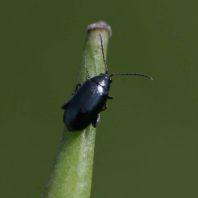
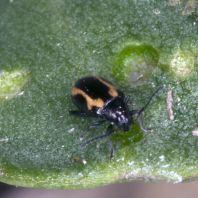
Flea Beetle
Crucifer flea beetle, Phyllotreta cruciferae
Striped flea beetle, Phyllotreta striolata
(Coleoptera: Chrysomelidae - leaf beetles)
Hosts: Canola, mustard
MANAGEMENT
Cultural
Ensure seeding rate is high enough to achieve adequate plant stand density. Increase seeding rate under unfavourable establishment conditions. Keep cruciferous weed species under control. Less damage occurs in zerotillage fields compared to conventional tillage fields.
Biological
Many predators and parasitoids attack flea beetles and may contribute to population reductions, but their immediate impact during the susceptible seedling stage is limited. The flower beetle Collops vittatus, carabid beetles, big-eyed bugs, damsel bugs, field crickets, lacewing larvae and spiders all feed on flea beetles.
Chemical
Choose appropriate insecticide seed treatment for anticipated pressure when ordering canola seed. Foliar insecticides can be applied if necessary during the early growth stages. However, foliar insecticides are non-selective and may kill natural enemies of other crop pests in canola.
SCOUTING AND MONITORING
Scout fields as canola emerges in the spring, paying attention to the field margins where flea beetles begin to move in from overwintering sites. Visually estimate the percentage of leaf feeding damage, as well as stem damage. Check several plants at 10-20 locations in the field, averaging the plant damage for the field. Continue monitoring until canola has reached the third or fourth leaf stage, or feeding activity stops.
FEEDING DAMAGE
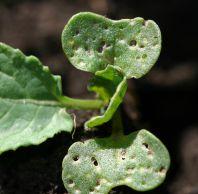
Adults feed on cotyledons and first and second true leaves of canola, creating “shot-holes” in the leaves. Stem-feeding on canola seedlings can occur under rainy, and/or cool conditions, which can lead to the stem breaking or plant wilting. Second generation adults that appear in late summer can feed on canola pods and cause premature ripening under very high populations. Larvae feed on the roots of host plants but do not cause economic damage.
ECONOMIC THRESHOLDS
The action threshold is 25% leaf damage on cotyledons and adults are continuing to feed. Hot, dry conditions may require a lower threshold due to plants being under more stress and because flea beetles feed more actively under these conditions.
Images courtesy: Mike Dolinski and Canola Council of Canada
So Much Power. So Little Effort.
Coragen® MaX insecticide provides fast, selective, extended control* of grasshoppers, bertha armyworms, diamondback moth and cutworms, in a convenient, concentrated formulation. It also works with beneficials** for a one-two punch that keeps the fight going long after you’ve left the field.
Controlling damaging insect pests doesn’t have to be a heavy lift.
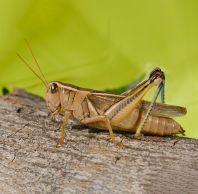
Grasshoppers
Packard: Melanoplus packardii Scudder
Clearwinged: Camnula pellucida Scudder
Migratory: Melanoplus sanguinipes (Fabricius)
Two-striped: Melanoplus bivittatus (Say)
Hosts: Canola, cereals, corn, pulses, soybeans
Two-striped adult
MANAGEMENT
Cultural
Damage
Early seeded, vigorously growing crops may tolerate feeding better than later seeded crops. Higher seeding rates, especially around field edges, can help to compensate for lost seedlings.
Biological
The pathogenic fungus
Entomophthora grylli Fresenius and the microsporidian parasite Nosema locustae
Canning can infect and kill grasshoppers. Ground beetles, field crickets, larvae of some species of blister beetles and bee flies eat grasshopper eggs. Grasshopper nymphs and adults are eaten by spiders, robber flies and some wasps, and are sometimes parasitized by sarcophagid and tachinid flies. Horsehair worms sometimes parasitize grasshoppers.
Chemical
When possible, treat the field borders to prevent grasshoppers from moving into the field. Target applications when the majority of grasshoppers are in the 3rd and 4th nymph stages when lower insecticide rates can be used.
SCOUTING AND MONITORING
Scout starting at field margins where grasshoppers typically move in from headlands and ditches. Sample at least 20 sites throughout the field, and count the number of nymphs in a 0.1 m2 (1 ft2) area at each site.
FEEDING DAMAGE
There are many species of grasshoppers that are not of economic concern. The main species of concern include the packard, clearwinged, migratory and two-striped. Grasshopper nymphs and adults feed on host plants and can completely defoliate the hosts. Damage is usually most severe in dry environmental conditions that favour grasshopper development.
ECONOMIC THRESHOLDS
Cereals: Nymphs: 30 to 40/m2 (3 to 4/ft2)
Fifth instar and adult: 10 to 12/m2 (1 to 1.2/ft2)
Canola: Nominal threshold of 7 to 12/m2 (0.7 to 1.2/ft2)
Lentil: 2/m2 (0.2/ft2) during flowering and podding
Flax: 2/m2 (0.2/ft2) at green boll stage
Soybean: Nominal threshold is if the defoliation exceeds 30% during pre-bloom (i.e., vegetative) stages; 15% from bloom to pod-fill; or 25% from pod fill to maturity (unless pod feeding is observed).
Images courtesy: Joseph Berger, Bugwood.org and Howard F. Schwartz, Colorado State University, Bugwood.org
Lygus Bug
Lygus spp. (Hemiptera: Miridae - plant bugs)
Hosts: Alfalfa, canola, lentil, potatoes
SCOUTING AND MONITORING
Scout when temperature is at least 15 C and sunny, when lygus are most active. Canola: At end of flowering and early podding, take 10 sweeps (180 degrees) at 10 sites in the field. Faba bean: At flowering to early pod stage, take 25 sweeps at five to ten sites in the field. For both crops, count 3rd instar nymphs and larger (black spots on their backs and developing wing pads) and adults at each site. Exclude early instar nymphs from the count.
FEEDING DAMAGE
Lygus preferentially feed on nutrient-rich buds and flowers by piercing the plant tissue and sucking the plant sap, causing flower abortion. Large lygus nymphs can also pierce through the pod and feed on the developing seed, resulting in shriveled seeds and reduced yield in canola and brown spots and downgraded quality in faba bean.
ECONOMIC THRESHOLDS
Canola: Greater than 30 lygus per 10 sweeps at the early pod stage, regardless of crop price (Cárcamo, et al., 2023). Less than 17 lygus per 10 sweeps at this stage can stimulate the canola to compensate for lygus feeding by producing more buds.
Faba bean: Preliminary research suggests a nominal threshold to prevent downgrading is as few as five to 10 lygus per 10 sweeps at early pod stage but thresholds have not been determined in all provinces.
MANAGEMENT
Cultural
Early seeding of faba beans in order to get the crop as advanced in maturity as possible may help to avoid the migration of lygus from newly swathed canola fields. Early seeding of canola can also reduce the risk of having large nymphs and adults at the time when the crop is vulnerable (soft, immature seeds).
Biological
Three native parasitic wasps (Peristenus spp.) attack early instar lygus nymphs. Green lacewing larvae, damsel bugs and spiders all feed on lygus bugs.
Chemical
Canola: A single insecticide application at end of flowering (90%+ bloom has been complete) or early podding should prevent yield loss when thresholds are surpassed.
Faba bean: Insecticide treatments are available in faba beans, but the crop relies heavily on pollinators for seed set. Take this into consideration when making management decisions and avoid spraying during the daytime.
Pea Aphid
Acyrthosiphon pisum (Hemiptera: Aphididae)
Hosts: Field pea, alfalfa, lentil, faba beans
MANAGEMENT
Cultural
Early seeding may avoid high populations during flowing and early pod stages. A uniform plant stand will make for easier scouting and spraying (if necessary).
Biological
Fungal pathogens, lady beetles, syrphid fly larvae, green lacewing, snakefly, damsel bugs and parasitic wasps such as Aphidius ervi are natural enemies and can help suppress aphid populations.
Chemical
If the economic threshold is exceeded, a single application of insecticide when young pods are visible on 50% of plants will protect the crop against yield loss and be cost-effective. Research has shown applying an insecticide as pods are first formed will better protect pea yield as the protection lasts through the two stages where peas are most sensitive to aphid damage.
SCOUTING AND MONITORING
Monitor crops as they start to flower and scout regularly as aphid populations grow extremely fast. Once 50-70% of plants are in flower, conduct five 180 degree sweeps in five locations within the field. Determine the average number of aphids per sweep. Monitor for migration to nearby lentils.
FEEDING DAMAGE
Aphids will cause damage by sucking plant sap. Infested plants may exhibit yellow leaves and stunted growth. Adults and nymphs found feeding during flowering or early pod stage may reduce seed size and formation. They can also transmit pea seed-borne mosaic virus, further damaging crops. On alfalfa, pea aphid feeds on stems and newly expanding leaves.
ECONOMIC THRESHOLDS
Peas - 2 to 3 aphids per plant in top 20 cm of plant or nine to 12 per sweep.
Faba beans - 34 to 50 aphids per main branch. This provides a lead time of seven days before populations are likely to exceed the economic injury level.
Lentils - 30 to 40 aphids per 180 degree sweep, with few natural enemies present, and if numbers do not decline over two days.
Seed alfalfa - In Alberta, 100 to 200 per 90 degree sweep. In Saskatchewan and Manitoba, 100-200 per 180 degree sweep on dryland moisture-stressed crops, or until mid-August.
Images courtesy: Mike Dolinski
Feeding adults
Winged adult
Adults and nymphs
Pea Leaf Weevil
Sitona lineatus Linnaeus
Hosts: Field peas, faba beans.
SCOUTING AND MONITORING
Scout the last week of May and early June for leaf feeding from emergence until the sixth node stage. Pay close attention to the clam leaf at the top of the plant where notching indicates that the adults are still actively feeding. Assess 10 plants at five sites within the field. Surveys are conducted each year to monitor the spread of the pest.
FEEDING DAMAGE
Larvae feed below ground on nitrogen-fixing nodules resulting in poor nitrogen fixation and plant growth, and low yield. Adults feed above ground on leaves causing tell-tale notching. Adult feeding does not cause economic loss.
ECONOMIC THRESHOLDS
The economic threshold for peas is when 30% of the plants have notches on the clam leaf. There is no economic threshold for faba beans, but research is being done to understand the impact of pea leaf weevil on faba beans.
MANAGEMENT
Cultural
Early seeded crops are attractive to pea leaf weevil, but early seeded crops are generally higher yielding. Reduce tillage and no-till fields are less attractive to the pest. The effectiveness of crop rotation is limited because the adults are strong fliers. Trap cropping around the field margins by seeding the outside of the field 10 days earlier attract adults that can be targeted with a foliar spray. Intercropping with a cereal crop makes it more difficult for adult weevils to find their host.
Biological
Ground beetles and rove beetles feed on pea leaf weevil eggs.
Chemical
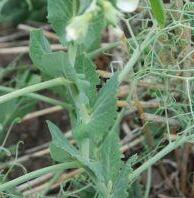
Insecticidal seed treatment is the most effective control option. Foliage feeding is reduced, egg-laying is delayed, fewer eggs are laid, and fewer larvae survive when eating nodules on treated plants. Foliar insecticide application is less effective, and most research has found that it does not prevent yield loss.
Larvae
Leaf notching
Adult
Seedcorn Maggot
Delia platura (Diptera: Anthomyiidae - flies)
Hosts: Canola, beans, corn, soybeans, pea
MANAGEMENT
Cultural
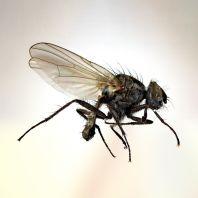
Rotate with non-host crops, increase seeding rates and, if feasible, implement spring and/or fall tillage to reduce emergence by exposing puparia to predators.
Biological
Several predators and parasitoid species attack all root maggot life stages and provide the protection against root maggot damage, including ground beetles, rove beetles (Aleochara bilineata Gyllenhaal) and nematodes that attack the larvae. Fungal pathogens also help to suppress populations.
Chemical
Seed treatments are available for use on corn, soybeans, peas and beans.
SCOUTING AND MONITORING
Using yellow sticky cards or sweep nets, scout for adult root maggots from mid to late May.
FEEDING DAMAGE
Larvae cause damage by feeding on germinating seeds and damaged tap roots of their preferred host crops. Damage worsens during cool weather and wet soil conditions.
ECONOMIC THRESHOLDS
None established.
Image courtesy: John Gavloski, Manitoba Ag; Pest and Diseases Image Library, Bugwood.org and Howard F. Schwartz, Colorado State University, Bugwood.org
Soybean Aphid
Aphis glycines (Hemiptera: Aphididae)
Hosts: Soybeans
SCOUTING AND MONITORING
Monitor for soybean aphids weekly from R1 (beginning bloom) to R5 (beginning pod). Count the number of aphids per plant on at least six plants in five random areas of the field excluding borders and hot spots. Count soybean aphids on leaves in the mid-canopy, stems and pods. Scout weekly to see if populations are increasing.
FEEDING DAMAGE
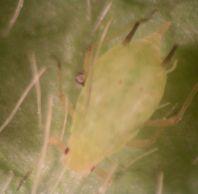
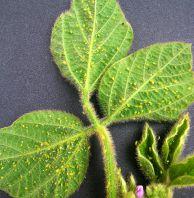
Soybeans aphids are a vector for soybean mosaic virus. Feeding produces honeydew excretion which can promote sooty mold growth. When feeding happens on the undersides of leaves, plants may exhibit yellow leaves that may curl or wilt. Feeding during early reproductive stages can result in less pod formation, reduced seed size, and reduced seed quality.
MANAGEMENT
Cultural
Cultural control methods have not been developed.
Biological
Fungal pathogens, Asian lady beetle, syrphid fly larvae, green lacewing, snakefly and parasitic wasps such as Aphidius ervi are natural enemies and can help suppress aphid populations.
Chemical
When the economic threshold is met, a foliar insecticide application should be made within seven days to 10 days to prevent economic injury. Refer to the product label and follow guidelines to protect honeybees if soybean fields are flowering.
ECONOMIC THRESHOLDS
The economic threshold is a minimum of 250 aphids per plant during R1 to R5 stages, and the populations are increasing. Economic loss can occur when populations reach 674 aphids per plant. Exclude aphid mummies caused by parasitic wasps or aphids that are fuzzy and pink, white or tan in colour as they are infected by a fungal pathogen enemy.
Twospotted Spider Mite
Tetranychus urticae
Hosts: Corn, soybean, dry beans, alfalfa
MANAGEMENT
Cultural Optimum irrigation and fertilization can be beneficial, and timely harvests can help minimize the impact.
Biological Spider mites are fed on by green lacewings, predatory mites, and suppressed by a fungal pathogen, Neozygites floridana, that causes death within five days.
Chemical
If plants are beginning to appear bronze in colour and mites are plentiful, consider an insecticide application. Border or spot sprays can be sufficient, however second applications are sometimes necessary to kill any recently hatched eggs. Avoid using products that kill natural enemies and avoid spraying during times where mite natural enemies may be active.
SCOUTING AND MONITORING
In dry springs and hot summer days, scout host crops weekly starting along field edges where mites may have overwintered. Look for yellowing plants that appear speckled and check under the leaves. Tap leaves against a white sheet of paper – yellow, brown or black spots that move across the paper may be mites. When crushed, they leave a reddish-brown spot.
FEEDING DAMAGE
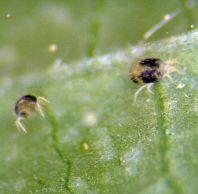
Adults and nymphs will feed on the underside of leaves causing stippling or yellowing of leaves. These miteinfested leaves may be covered with webbing. Leaves dry up and drop off the plant from the bottom up. Infestations move in from the field edge. Populations will increase rapidly during prolonged hot, dry weather causing some farmers to mistake mite symptoms for drought. Dust that drifts into alfalfa fields can cause an influx of spider mites.
ECONOMIC THRESHOLDS
No specific threshold levels have been established.
Day,
Wheat Midge
Sitodiplosis mosellana
Hosts: Winter, spring and durum wheat, triticale and spring rye
SCOUTING AND MONITORING
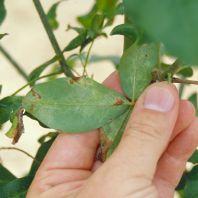
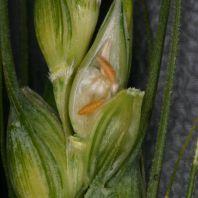
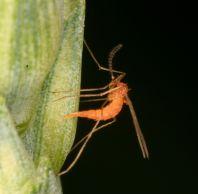
Use Wheat Midge Survey maps to assess regional risk. Regularly monitor fields between heading and flowering. Scout for wheat midge after 8:30 p.m. with low wind speeds less than 10 kph and temperatures above 15 C. This is when female midge are active. Count the number of wheat midge on four to five wheat heads at four to five sites in a field.
FEEDING DAMAGE
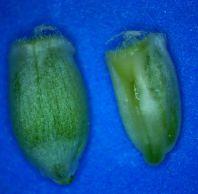
Larvae feed on developing kernels. This can result in aborted or damaged kernels resulting in a loss of seed quality and yield. The Canadian Grain Commission limits wheat midge damage in No. 1 CWRS to two per cent and No. 2 CWRS to eight per cent, before grade is affected. For amber durum, damage tolerances are two per cent for No. 1 CWAD and eight per cent for No. 2 CWAD.
ECONOMIC THRESHOLDS
To prevent yield loss, the economic threshold is one adult midge per four to five heads. To prevent grade loss, an average of one adult midge per eight to 10 wheat heads is the threshold.
MANAGEMENT
Cultural
Avoid tight wheat rotations. Reduced damage has been seen with higher seeding rates and earlier planting. Consider using varietal blend wheat midge resistant varieties. midgetolerantwheat.ca
Biological
Two introduced parasitic wasps can help to reduce the frequency of infestations. Estimates of parasitism in Saskatchewan have ranged from zero to 100 per cent from Macroglenes penetrans (Kirby) and Platygaster turberosula (Kieffer).
Chemical
Foliar insecticide applications are registered in Canada for wheat midge control. Timing depends on the product, but spraying after flowering is not recommended and can put parasitoids at risk.
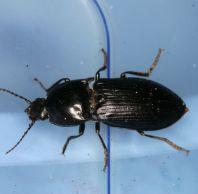
Avoid planting back-to-back wheat or other host crops. Use solid-stemmed wheat varieties. Broadleaf crops are non-host options. Oats are toxic to wheat stem sawfly and can be planted as a cereal option. Barley is not a preferred host crop. Early swathing in order to capture infested stems before they fall can reduce yield losses. Shallow tillage post-harvest can kill larvae but is not recommended because of negative impacts on parasitoids, soil erosion and soil moisture.
Biological
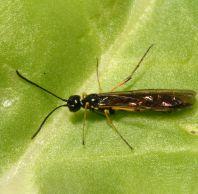
Nine species of parasitic wasps attack wheat stem sawfly, with Bracon cephi being the primary and Bracon lissogaster being the secondary species. The parasitoid adults emerge the following year. Since the parasitoids overwinter in stems, harvest cutting heights of at least six inches will help to preserve the parasitic wasp in order to reduce future wheat stem sawfly populations.
Chemical
No chemicals are registered for wheat stem sawfly.
SCOUTING AND MONITORING
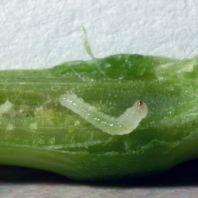
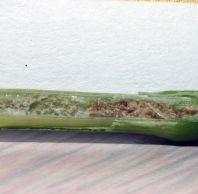
Count the percentage of cut stems in one metre of crop row at five to ten places along crop margin to assess risk for next year. A sweep net can help determine presence of adults in late June into July. The need for early swathing can be assessed by splitting stems to confirm presence of larvae. If parasitoid larvae are found (another larva attached to the wheat stem sawfly larva), the need for early swathing is reduced. Provincial survey and risk maps are available online to help make management decisions.
FEEDING DAMAGE
Spring wheat and durum are the primary host crops. The larva feeds on the developing pith inside of the plant stem, reducing crop yield and quality. As the plant matures, the larva moves to the base of the stem and cuts a V-shaped notch in the stem. These notched stems are prone to breakage and falling, making the grain unharvestable.
ECONOMIC THRESHOLDS
Management strategies should be used if 10-15% of the previous year’s crop is cut by wheat stem sawfly. Wheat crops with more than 15% of stems infested, could benefit from early swathing once the crop drops below 40% moisture content.
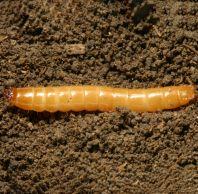
Baits (potato seed pieces, balls made from pre-soaked corn, wheat or oatmeal) can be buried under the soil two to three weeks before planting. After two weeks, baits can be examined for the presence of wireworms. Note that competition from nearby food plants can lessen the number of wireworms recovered in the baits.
FEEDING DAMAGE
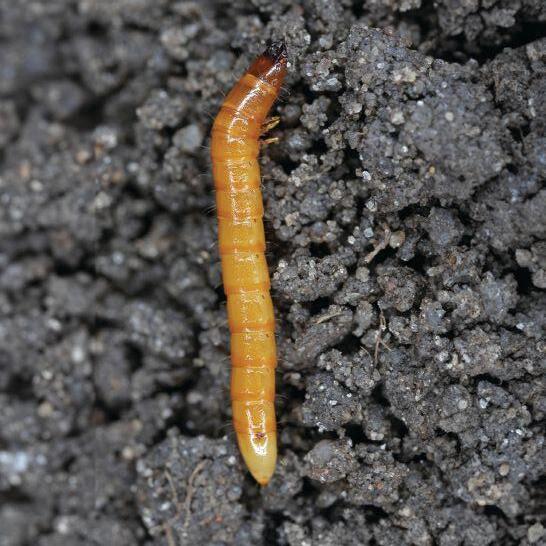
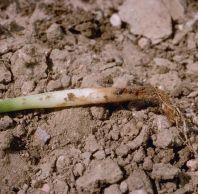
Wireworms are attracted to the germinating seeds of host crops such as cereals, corn and pulses. Wireworms feed on the below-ground plant parts including seeds, roots and stems; underground stem-feeding on young seedlings causes the stems to appear shredded. Crop emergence is reduced and stands become thinned. In root and tuber crops, wireworms create tunnels and disfigure the produce.
ECONOMIC THRESHOLDS
None established.
MANAGEMENT
Cultural
Ensure fast emergence and quick crop development through best seeding practices (seed source, seeding rate, seeding depth, etc.). Avoiding continuous cereal crop rotations may lessen the build-up of wireworms in a field. If fields are in summer fallow, keep free of green growth in June and July to starve newly hatched larvae.
Biological
Ground beetles, rove beetles and stiletto fly larvae are all predators of wireworms. A fungus can infect and kill wireworms.
Chemical
Seed treatments can help reduce damage from wireworm feeding and/ or reduce wireworm populations. There is no in-season rescue treatment for wireworms. Foliar insecticides are not effective since wireworms live completely underground and click beetles are very mobile.
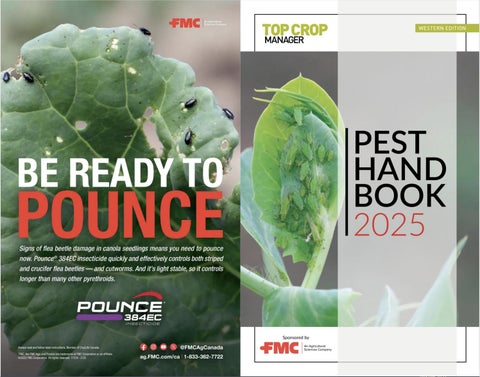
POUNCE BE READY TO
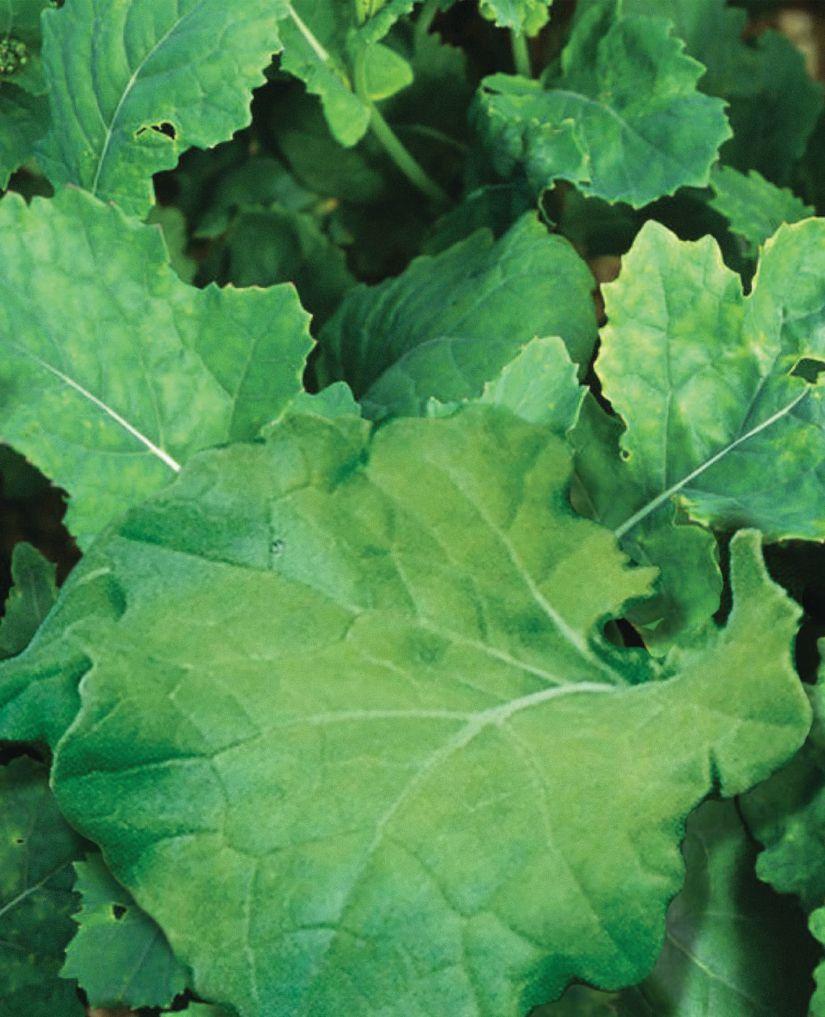
Signs of flea beetle damage in canola seedlings means you need to pounce now. Pounce ® 384EC insecticide quickly and effectively controls both striped and crucifer flea beetles — and cutworms. And it’s light stable, so it controls longer than many other pyrethroids.