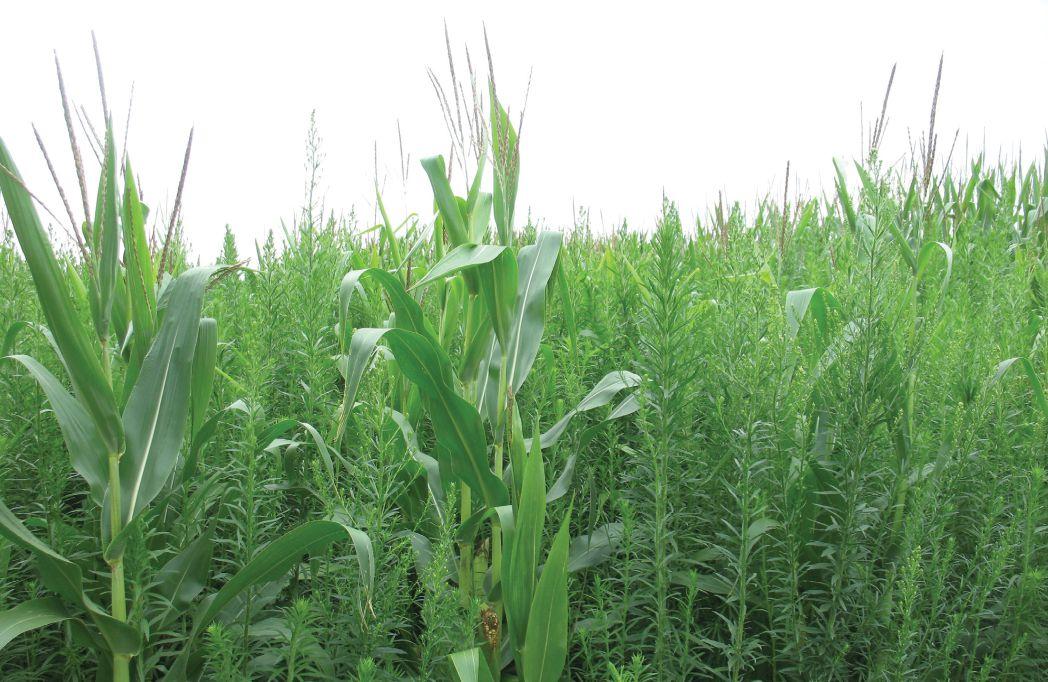
Winning the battle with weeds has never been more essential to maximize your crop’s potential from start to finish; and now winning has never been easier with new corn herbicides from Bayer.
Corvus™ herbicide for field and seed corn delivers powerful fast-acting broad-spectrum control of both broadleaf and grass weeds. It features a onetwo punch of highly effective active ingredients (Group 2 and Group 27), along with flexibility in application timing and tank mixing allowing for application at the time you want, the way you want while precisely targeting the weeds you need to control.
Laudis® herbicide for field and sweet corn provides fast acting post-emergence control of broadleaf weeds and excellent crop safety. Take control of tough glyphosate-resistant biotypes like Canada fleabane, giant ragweed and waterhemp.
With options like this leading the charge, 2022 is shaping up to be your best crop year yet. Use the information in this Weed Control Guide as a reference to the best solutions that keep weeds in check and deliver a strong yield potential.
The Bayer team is proud to sponsor this guide and is here to help you with your crop management decisions at any time
Let’s work together to make 2022 your best crop year yet!
Top Crop Manager would like to thank Bayer for sponsoring this year’s Weed Control Guide. Through their support, we are able to publish this information guide to assist our readers with their weed management decisions.
All tucked in for the night. Not a weed in sight.
New Corvus™ herbicide provides outstanding control of a broad spectrum of broadleaf and grass weeds including glyphosate-resistant weeds. Flexibility in application timing, including pre-plant incorporated, and tank mix options allows you to apply at the time you want, the way you want while precisely targeting the weeds you need to control. Ask about new Corvus herbicide. Give the crop you love a good (weed free) night’s sleep. And a great start to a great harvest.
By Julienne Isaacs
TOP CROP
Published as part of Top Crop Manager, February 2022, by: Annex Publishing & Printing Inc. PO Box 530, 105 Donly Drive South, Simcoe, ON N3Y 4N5 Canada Tel: (519) 429-3966 Fax: (519) 429-3094
EDITOR | Alex Barnard
WESTERN FIELD EDITOR | Bruce Barker
NATIONAL ACCOUNT MANAGER | Quinton Moorehead
EDITORIAL DIRECTOR, AGRICULTURE | Stefanie Croley
GROUP PUBLISHER | Michelle Allison
COO | Scott Jamieson
Charts compiled by Mike Strang and Jennifer Strang Canada’s original technical crop production magazine, The Western edition of Top Crop Manager, is published nine times a year. To be sure of your copies, either mail, fax or e-mail your name and full postal address to Top Crop Manager, or subscribe at topcropmanager.com. There is no charge for qualified readers.
Weed management is a complex part of crop production that never leaves a grower’s mind. With new threats and new forms of resistance constantly emerging, decisions can become overwhelming. To simplify the process, we’re pleased to bring you another edition of the Weed Control Guide for Eastern Canada, in which we’ve listed products available (as of publication time) in alphabetical order for corn, soybean, cereal and canola crops.
The information herein primarily comes directly from chemical companies themselves. However, growers should always double-check provincial guidelines and product labels to avoid errors. Furthermore, the ratings provided in the tables should be used as a guide when selecting herbicides. Herbicide-tolerant varieties are listed in red, and the overall format allows you to compare options for grassy and broadleaf weed products. Once you’ve selected your choices, be sure to compare tank-mixes to best address the range of weeds in your fields.
The ratings provided in the tables should be used as a guide when selecting herbicides. It is important to remember that actual control can vary greatly depending on a number of factors, including soil type, moisture conditions, weed pressure and size, and environment.
Also, products can sometimes become antagonistic and will therefore be less effective on a particular weed when used in combination, compared to when it’s used separately. Each year, new products are introduced to the market while others are withdrawn. We have done our best to include all registered products in this guide, but as new products are introduced, we recommend readers make notes in their copy.
@TopCropMag /topcropmanager
Top Crop Manager is grateful to the numerous weed management specialists for their assistance and helpful suggestions compiled in Top Crop Manager’s Weed Control Guide.
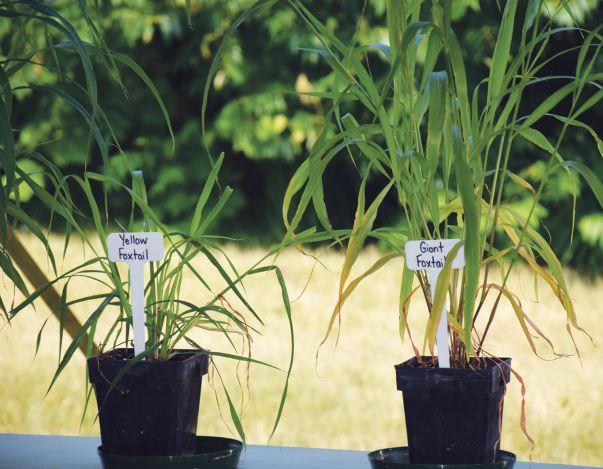
Giant foxtail and yellow foxtail shown at Southwest Crop Diagnostic Days in 2018.
PHOTO BY TOP CROP MANAGER.
WEED CONTROL GUIDE 2022
CORN PRODUCTS
WEED CONTROL GUIDE 2022
BROADLEAF WEEDS PERENNIAL
WEED CONTROL GUIDE 2022
CORN PRODUCTS
WEED CONTROL GUIDE 2022
A WEED BY ANY OTHER NAME
Checking in on the status of GR Canada fleabane.
by Julienne Isaacs
Across the U.S. border, a weed called horseweed troubles growers across the Eastern seaboard. Further west, the same weed is called marestail. Cross back into Canada: it’s Canada fleabane from coast to coast.
Whatever you call it, wherever you are, it’s a headache for field crop producers. The bright-green weed is a competitive annual that can produce up to one million seeds per plant, which can then spread hundreds of kilometres from the parent plant. In 2010, the first glyphosate-resistant (GR) biotype was identified in Ontario. Little more than a decade later, multiple-herbicide-resistant Canada fleabane has been documented across the province.
Every 10 years, University of Guelph weed management specialist Mike Cowbrough conducts a survey of certified crop advisers (CCAs) to get an idea of the frequency of problem weeds in Ontario, as well as a ranking of how difficult they are to control.
In 2015, Cowbrough noticed that Canada fleabane, which wasn’t on CCAs’ radar in 2005, had moved into a top position – 10 years later. A 2015 study by the Grain Farmers of Ontario also found that Canada fleabane was the number one weed management issue in the province.
This past fall, Cowbrough collected samples of Canada fleabane from multiple fields in the Guelph, Ont., area. One hundred per cent of those samples were glyphosate-resistant.
“If you’re seeing Canada fleabane plants in a soybean field at harvest time and it’s the only species, there’s a high probability that it’s glyphosate-resistant. If you have fleabane in Ontario, it’s safe to assume it’s glyphosate-resistant,” he says.
Chemical control options
Peter Sikkema, a professor of field crop weed management at the University of Guelph’s Ridgetown campus, has spent his career studying hard-to-control weeds like GR Canada fleabane.
In a recent study, Sikkema looked at control options for GR Canada fleabane in soybeans. He says it’s critical for producers to be aware that if they don’t have near-perfect control of resistant Canada fleabane on the day they seed Identity Preserved or Roundup Ready soybeans, “you’ll be behind the eight-ball all season,” because there are no effective post-emergence herbicide options.
It’s important to note that this applies to identity preserved (IP) and Roundup Ready (RR) soybeans, not RR2 Xtend soybeans or Enlist E3 soybeans, for which there are still some postemergence options, Sikkema says.
“There are only eight post-emergence broadleaf herbicide options in IP or RR soybeans, and those eight herbicides do not pro -
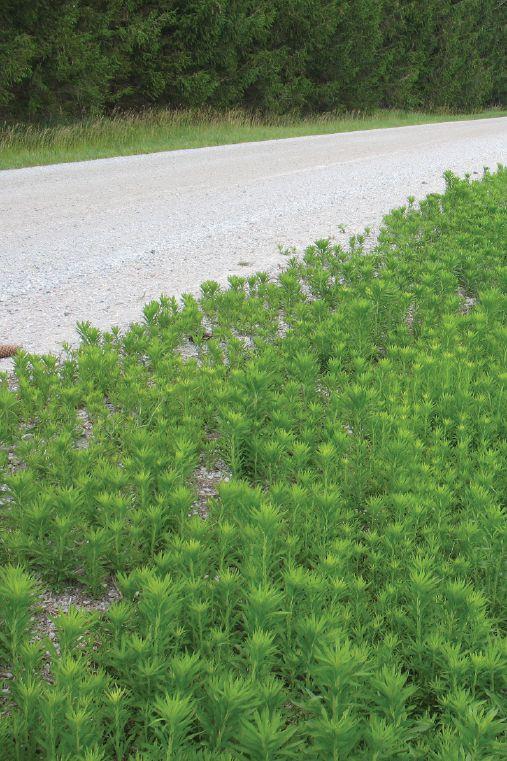
ABOVE: Researchers say glyphosate-resistant Canada fleabane, shown here in Kent County, Ont., will remain a continual threat to Ontario farmers well into the future.
vide acceptable control of GR Canada fleabane.”
A three-way tank mix applied preplant is the best option for IP and RR soybeans, he says. The three-way tank mix of glyphosate (Roundup, Group 9) plus saflufenacil (Eragon, Group 14) plus metribuzin (Sencor, Group 5) has provided the most consistent control in Ontario trials.
In RR2 Xtend soybeans, dicamba plus saflufenacil provides excellent control of GR Canada fleabane, while in E3 soybean a
Continued on page 18
We hate weeds as much as you love your corn.
New Laudis® herbicide provides outstanding control of tough broadleaf weeds.
Serious corn growers demand serious weed control. New Laudis herbicide delivers on all fronts. It provides fast acting broadleaf weed control, including tough to control glyphosate-resistant weeds, such as Canada fleabane, giant ragweed, and waterhemp. Laudis also offers excellent crop safety on field corn and sweet corn, with favourable rotation intervals for soybeans, potatoes, spring wheat and winter wheat. Ask your retailer about new Laudis herbicide.
WEED CONTROL GUIDE 2022
SOYBEANS PRODUCTS
CleanStart Plus [Aim +
Diligent (Classic + flumioxazin) + glyphosates
WEED CONTROL GUIDE 2022
BROADLEAF WEEDS
buckwheat, wild cocklebur fleabane, Canada lady’s thumb lamb’s quarters mustards nightshades pigweeds ragweed, common ragweed, giant
PERENNIAL WEEDS
WEED CONTROL GUIDE 2022
SOYBEANS PRODUCTS
WEED CONTROL GUIDE 2022
WEED CONTROL GUIDE 2022
CEREALS
buckwheat, wild cocklebur chickweed, common corn spurry fleabane, Canada hempnettle lady’s thumb lamb’s quarters mustards nightshades pigweeds ragweed, common ragweed, giant shepherd’s purse stinkweed velvetleaf bindweed chickweed, mouseeared curled dock dandelion field horsetail ground ivy (creeping charlie) mallow milkweed nutsedge plantains quackgrass sowthistle thistle, Canada vetches
WEED CONTROL GUIDE 2022
CEREALS
POST-EMERGENCE TANK-MIXES
buckwheat, wild cocklebur chickweed, common corn spurry fleabane, Canada hempnettle Lady’s thumb lamb’s quarters mustards nightshades pigweeds ragweed, common ragweed, giant shepherd’s purse stinkweed velvetleaf bindweed chickweed, mouseeared curled dock dandelion field horsetail ground ivy (creeping charlie) mallow milkweed nutsedge plantains quackgrass sowthistle thistle, Canada vetches
tankmix of 2,4-D and glyphosate (Enlist Duo, Group 4 and 9) plus saflufenacil has provided excellent control, according to Sikkema.
Cultural control options
Sikkema says non-chemical control options are an important complement to herbicides for GR Canada fleabane.
Aggressive tillage is one such option because it disrupts seed viability and emergence, but control can be variable.
Cover crops have a significant place in controlling GR Canada fleabane, particularly after winter wheat combining, he says. In one recent study, cover crops were planted a few days after wheat was harvested in late July; the cover crop provided “very good suppression of Canada fleabane the following spring in corn without any herbicide,” Sikkema says – however, producers will still need to apply a herbicide for complete control of GR Canada fleabane in corn.
Cowbrough says cultural control starts with ensuring fertility is adequate to ensure crops are growing to their fullest potential. Fall weed control is also extremely important, he says, because once winter wheat is harvested there’s an opportunity for Canada fleabane to set seed in the autumn.
In a recent study Cowbrough collaborated on with University of Guelph plant scientists Clarence Swanton and Francois Tardif, a cereal rye cover crop was used as part of an integrated weed management strategy that included tillage and herbicides.
“The cereal rye exudes allelopathic chemicals that inhibit the germination of fleabane, and even if those chemicals aren’t at a high enough level to stop germination, they reduce the size of fleabane [plants], which goes back to basic weed/herbicide interaction where smaller weeds are easier to kill,” he explains. “It’s not a panacea, but it reduces the population and makes it smaller, which in turn makes the chemistries work better.”
If you’re seeing Canada fleabane plants in a soybean field at harvest time and it’s the only species, there’s a high probability that it’s glyphosate-resistant.
Both Sikkema and Cowbrough point to the necessity of an integrated weed management approach in controlling GR Canada fleabane.
A few years ago, Sikkema took a photo along a side road in Kent County, Ont. The photo shows a mass of green Canada fleabane across the ditch and up to the road – what he calls a “monoculture of GR Canada fleabane.”
Sikkema says, “I think there’s a continual source of GR Canada fleabane seed going forward and Ontario farmers are going to have to manage this weed indefinitely into the future.”
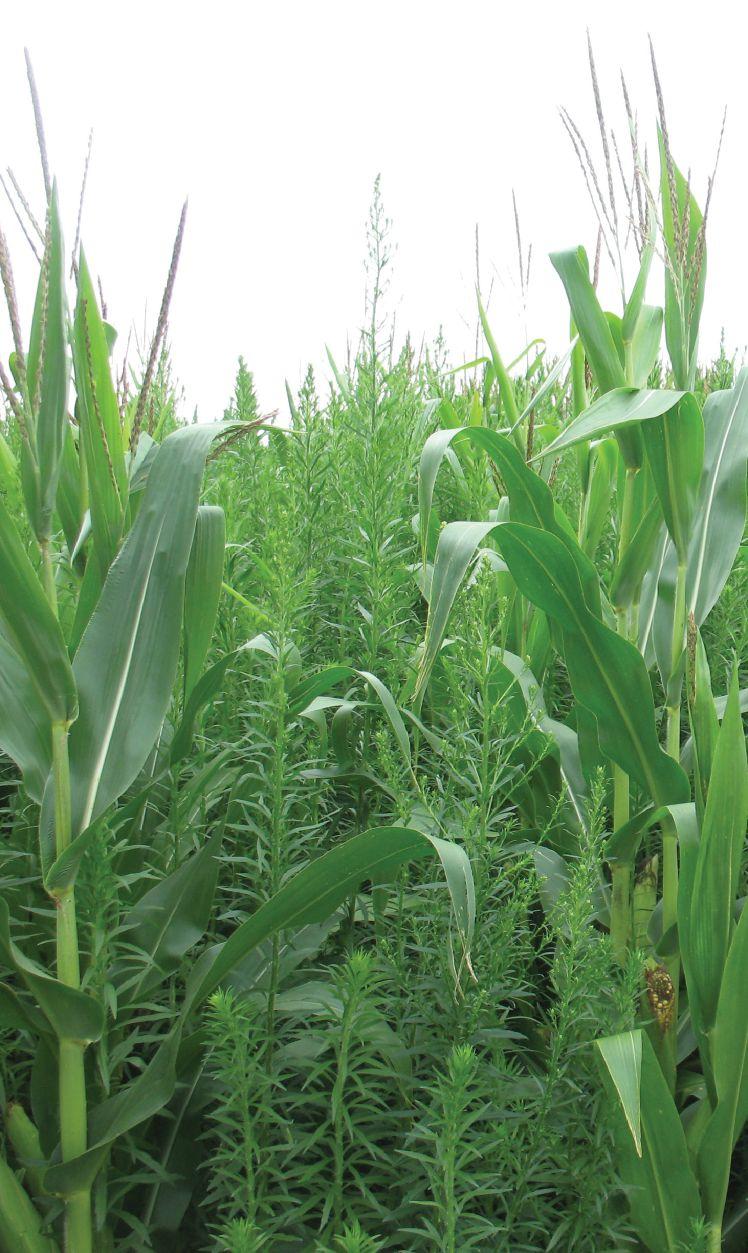
Glyphosate-resistant Canada fleabane in corn.
Grow to greatness with the most trusted dicamba herbicides. 1
Roundup Xtend® and XtendiMax® herbicides with VaporGrip® Technology are speci cally designed to work with your Roundup Ready® Xtend Crop System to give you exceptional control over a broad spectrum of weeds for greater yields and cleaner elds. Unlock the full potential of your Roundup Ready 2 Xtend® or Xtend ex® soybeans and grow a great crop year after year.
12020 BPI Report – East Spring Herbicides. Bayer is a member of Excellence Through Stewardship® (ETS). Bayer products are commercialized in accordance with ETS Product Launch Stewardship Guidance, and in compliance with Bayer’s Policy for Commercialization of Biotechnology-Derived Plant Products in Commodity Crops. These products have been approved for import into key export markets with functioning regulatory systems. Any crop or material produced from these products can only be exported to, or used, processed or sold in countries where all necessary regulatory approvals have been granted. It is a violation of national and international law to move material containing biotech traits across boundaries into nations where import is not permitted. Growers should talk to their grain handler or product purchaser to con rm their buying position for these products. Excellence Through Stewardship® is a registered trademark of Excellence Through Stewardship.
BROADLEAF GROUPS 4, 6, 27 When it comes to controlling broadleaf weeds, we are always up to the challenge. With three powerful herbicide Groups, In nity® FX herbicide is the best way to take out over 27 different broadleaf weeds, including one of the worst: Canada eabane. Use In nity FX so