Introducing the all-new and innovative Pioneer 700 and Pioneer 700-4 Side-by-Sides from Honda. The Pioneer 700 carries two people, and the Pioneer 700-4 features the Industry’s first convertible seating designed for two, three or four. Learn more at honda.ca
TOP CROP
MANAGER
Markets and Marketing Weed ManageMent tillage and planting
12 | The legend of the lone oat What does the future hold for oats?
By Amy Petherick
16 | Canada fleabane blowing on the wind
Ontario soybean growers face fast-moving GR Canada fleabane
By John Dietz
20 | Judging the field by its cover Vertical technology blurs tillage camps boundaries By Amy Petherick
Considering clubroot By Carolyn King
5 8 18 pests and diseases
Weed ManageMent
Corn secrets revealed By John Dietz
Cereals
The right quality for the right end-use By Carolyn King
22 24 FertilitY and nUtrients Winning solutions By Jeanine Moyer
Weed ManageMent Green weed control By John Dietz
4 28 FrOM tHe editOr The bigger picture By Stefanie Croley, Associate Editor
BUsiness ManageMent
Incorporation: now, later or never? By Paul Vaillancourt
readers will find numerous references to pesticide and fertility applications, methods, timing and rates in the pages of top Crop Manager. We encourage growers to check product registration status and consult with provincial recommendations and product labels for complete instructions.
Photo
Stefanie Croley | aSSoCiate eDitor
the bigger picture
Isometimes describe myself as a landed immigrant in my small town. I wasn’t born and raised here, but I have lived in this particular part of rural southern Ontario for nearly a decade. I don’t have a background or education in agriculture, but farms surround my home. Tractors – not commuters – cause traffic jams on the country roads. We shop locally from farmers markets and roadside stands and I can point out the farms where my butcher sources his meat. I feel rooted in the community and, quite frankly, I wouldn’t want it any other way.
So, when I was appointed associate editor of Top Crop Manager East (as well as editor of Potatoes in Canada and Drainage Contractor), the role seemed a natural fit. agriculture has already embedded itself in my daily life. I’ve been part of the editorial team at several other annex Business Media (the parent company of Top Crop Manager) publications, with industries ranging from fire fighting to retail baking, and my foray into agriculture was inevitable.
as a journalist, my eyes and ears are always open in hopes of making a new connection from one person or industry to the next. In journalism school, we’re taught to find common ground with the people we reach in order to gain mutual respect, trust and understanding. a trade journalist’s role is to inform and provide resources to the reader. Over the course of the past few months, I’ve participated in field days, attended crop diagnostic days, and visited farms and demo plots, trying to learn all I can about the ag world and find that common ground between us so that I can do my job better and, in turn, help you do your job better.
It hasn’t been very long, but I’m already seeing similarities between agriculture and some of the other industries I’ve worked in, for example, fire fighting. On the small scale, farmers and firefighters share, among other things, a love of pickup trucks and big machinery – whether it be a new water tanker or a new combine. On the large scale, both groups are concerned for the future of their careers and their industries, wondering when the right time to retire is and what will happen if the next generation doesn’t want to follow in their footsteps.
These concerns were apparent at Farm Management Canada’s annual roundtable in Ottawa in June. We’re all guilty of becoming so wrapped up in the day-to-day that we often forget about the big picture. It was clear that attendees of the roundtable got a reality check that day. One farmer pointed out in casual conversation that someone taught him how to work the fields, spray the crops and use the equipment, but his long-term planning and business management skills were never honed. as the conversation continued, it was agreed many farmers don’t take the time to seek out employee management or financial planning advice.
We’re addressing queries like this in a new back-page column by paul Vaillancourt, a senior executive financial consultant at Investors Group Financial Services in Ottawa. Vaillancourt, who specializes in services for farms and small businesses, spoke at the roundtable, covering several topics in a short period of time, and we’re excited to have him expand on these tips as our back-page columnist. You can check out his first column on page 30.
The contents of Vaillancourt’s column are different from what you regularly see in our pages, but Top Crop Manager’s mandate hasn’t changed. We’re still Canada’s source for crop production and technology research, and we’re still aiming to help you consider the bigger picture and better manage your farm, on and off the field.
TO CIRCULATION
P.O. Box 530, Simcoe, ON N3Y 4N5 e-mail: subscribe@topcropmanager.com Printed in Canada ISSN 1717-452X
Top Crop Manager West - 8 issuesFebruary, March, Mid-March, April, June, October, November and December - 1 Year - $45.00 CDN plus tax
Top Crop Manager East - 7 issuesFebruary, March, April, August, October, November and December - 1 Year - $45.00 CDN plus tax
Specialty Edition - Potatoes in Canada - February1 Year - $16 CDN plus tax All of the above - $80 CDN plus tax Occasionally, Top Crop Manager will mail information on behalf of industryrelated groups whose products and services we believe may be of interest to you. If you prefer not to receive this information, please contact our circulation department in any of the four ways listed above.
www.topcropmanager.com
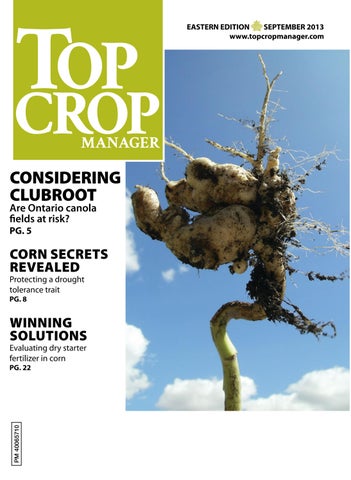
c oNSideri Ng clubroot
Could this devastating disease strike Ontario canola fields?
by Carolyn King
Clubroot is a major disease of canola in alberta and a worry for growers in Saskatchewan and Manitoba. What are the chances that it could become a problem in Ontario canola? and what advances in clubroot management could help Ontario growers if the disease does threaten their canola crops?
Clubroot is caused by a soil-borne organism called Plasmodiophora brassicae. It affects cruciferous crops, such as canola, mustard, cauliflower and cabbage, and cruciferous weeds like stinkweed. Ten years ago, clubroot was discovered in a canola field near edmonton. That was the first time the disease had been found in a commercial canola field in Canada. at that time, a small survey found the pathogen in a handful of canola fields in the edmonton area. Within a few years, clubroot had become a serious problem in alberta canola, especially in the region around edmonton, and caused devastating yield losses in severely infested fields.
The clubroot pathogen has also been detected in Saskatchewan and Manitoba, but so far it has not caused serious disease problems in canola in those provinces. In Quebec, clubroot first appeared in canola fields in 1997. according to information on the Ontario Ministry of agriculture and Food’s website, there have been no reported cases of clubroot in Ontario canola.
To infect a crop, the pathogen requires moist conditions. It likes temperatures between approximately 20 and 25 C; temperatures below 17 C inhibit its development. It does better in acidic soils
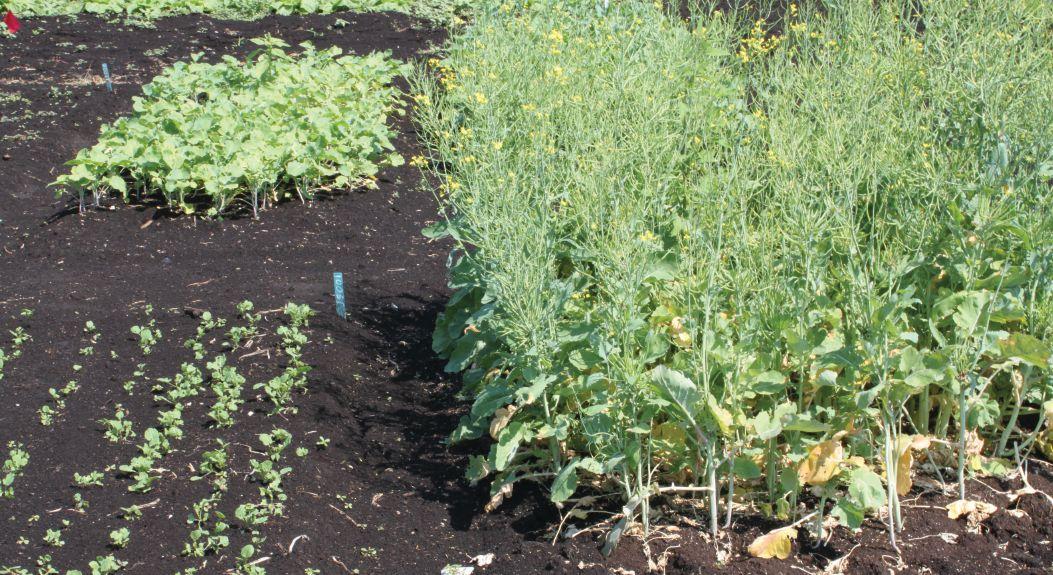
tOp: in a University of guelph trial where canola was seeded at two-week intervals, early seeded canola had much lower clubroot severity than canola seeded when the soil was warmer.
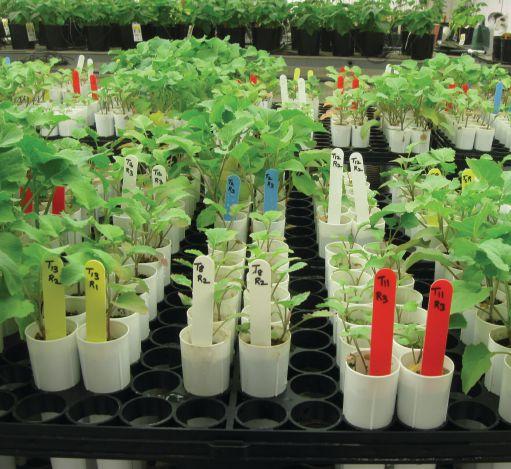
Middle: in one of its growth room trials with canola, the University of guelph researchers evaluated the effect of soil type on clubroot infection and the activity of bio-fungicides.
than in alkaline soils. The earlier an infection occurs during the growth of a susceptible plant, the greater the yield loss will be.
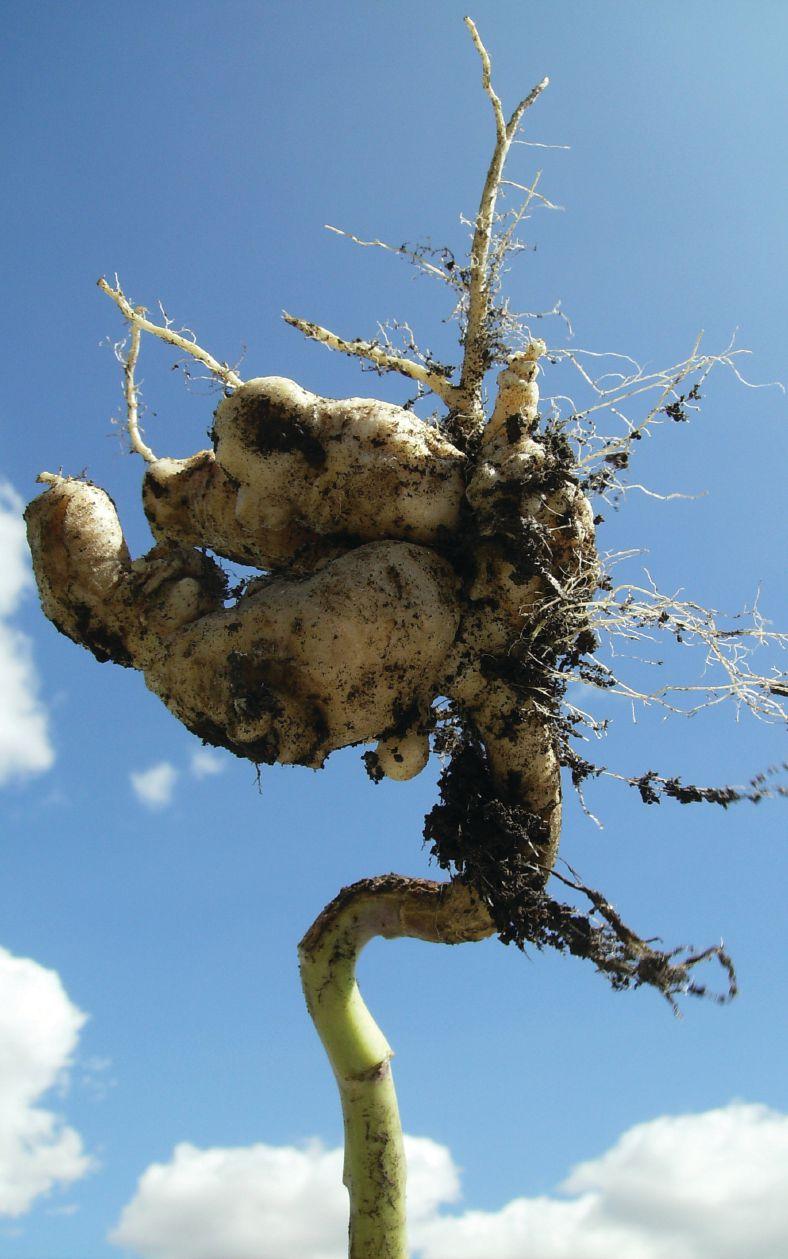
The pathogen infects plant roots, causing irregular swellings. “The pathogen hijacks the plants’ ability to use their roots correctly,” explains Clint Jurke, the Canola Council of Canada’s agronomy specialist for western Saskatchewan. “It uses their roots to reproduce, so the roots can’t move nutrients and water into the top parts of the plant. as a result, the plant ends up having yield loss and looking drought stricken.”
Ontario situation
In Ontario, clubroot has been found in localized areas in cruciferous vegetable crops. “For vegetable growers, clubroot is found in areas in and around the Holland Marsh, areas south of Guelph, and many other small pockets throughout the province,” explains Dr. Mary Ruth McDonald, a plant pathologist at the University of Guelph.
However, she adds, “no one has really done a survey looking for clubroot in Ontario since the 1960s and 1970s. So we only know where it is because it has shown up as a problem on a susceptible crop.”
Why isn’t clubroot causing problems in Ontario canola? “In the last five or six years as I’ve been doing work on clubroot on canola, in conjunction with my research on cruciferous vegetable crops, I’ve been asking myself that same question,” notes McDonald. She thinks three factors in combination are helping to keep clubroot at bay in Ontario canola.
One factor is that the strain, or pathotype, of Plasmodiophora brassicae that appears to be most common in Ontario isn’t a fan of canola. pathotypes are types of a pathogen that are identified based on which particular crops they attack.
at least five clubroot pathotypes occur in alberta – pathotypes 2, 3, 5, 6 and 8. “The pathotype causing all of the problems in alberta is pathotype 3. It is very virulent and causes high levels of disease on canola. The pathotype found in Ontario in surveys in the late 1960s is pathotype 6. There have been two or three surveys since then looking at small numbers of infected crops, and on vegetables they always find pathotype 6,” says McDonald.
She has tested canola cultivars in soils infested with pathotype 6. “We found that many of the cultivars, even ones that are highly susceptible to pathotype 3 in alberta, are either resistant or partially resistant to pathotype 6. If we get extremely high concentrations of pathotype 6 in the soil, then we get some disease on canola, but it’s much less than a grower in alberta would see.”
McDonald notes, “You’d only get those extremely high levels of the pathogen if you grew a susceptible crop year after year in the same field.
“So I think another reason we’re not seeing clubroot as a problem in Ontario canola, is that canola is rotated quite a bit. Canola acreage in Ontario is increasing, but it is nothing compared to canola acreage in alberta. and alberta growers sometimes are tempted to grow canola after canola or they have very short canola rotations. In Ontario, because canola is not a major crop, it is a lot easier to rotate out of it.”
a third factor is that many soils in southern Ontario tend to be somewhat alkaline. She says, “Our research over the last few years confirms that if the soil has high pH, less clubroot will develop on a susceptible crop. However, even with a high pH, if you have good soil moisture and the temperatures that are best for disease development, you can still get reasonable amounts of disease. So the general high pH is probably playing a role, although it might be
Preventing and managing clubroot in canola
Asingle infected canola root can produce billions of resting spores. Each resting spore is very tiny – about 0.004 millimetres in diameter. “The resting spore is smaller than particles of soil. Essentially, wherever soil travels, this pathogen has been travelling,” says Clint Jurke with the Canola Council of Canada. “Soil movement is the big culprit in the spread of this disease.”
Given the pathogen’s 20-year survival period, preventing the disease from arriving in a field is very important.
“We’re encouraging growers in Western Canada to do risk assessments of where the pathogen might come onto their land. That might be from purchasing used farm equipment that hasn’t been sanitized, or hiring custom operators that haven’t sanitized their equipment, or purchasing manure, seed potatoes or hay. Anything that could be moving soil to their field is a risk, including recreational vehicles, utilities vehicles, construction equipment and even livestock,” says Jurke.
“After growers have done a risk assessment], they can either restrict that type of risk from happening or they can start sanitizing equipment.”
Sanitizing large field equipment is time consuming. He outlines how it’s done: “If you’re in a known clubroot-infested field, then before you leave that field, you park on the side near the entry point. First you physically remove any soil on the equipment, using a scraper or something to knock off the soil clumps. That will remove 90 to 95 per cent of the soil, so you’re removing 90 to 95 per cent of the risk. If you want to get to 99 per cent risk reduction, then you wash the equipment with a
pressure washer. That takes a couple of hours to do as well. If you want to get to 99.999 per cent, then after pressure washing, you can spend a couple of hours bleaching the equipment, but bleach is corrosive and it’s not easy to apply.”
Scouting is a key practice for clubroot prevention and management. The easy way to scout for clubroot is to look for patches of wilted, yellowed and stunted plants. If you find such patches, check a few of the affected plants to see if they have clubbed roots.
But that’s not the best way to scout for the disease. Jurke explains, “When there’s a patch like that, it means the pathogen has probably been in that field for a couple of canola crop rotations. In the meantime the farmer has probably been dragging his equipment over that soil and moving the pathogen around.”
So the Canola Council advises growers to start scouting early – before they have infested patches. “The best places to scout are in a field’s entry and exit points because that’s usually where the disease is introduced first. If canola plants are growing there, look for really small galls on their roots; there won’t be any above-ground wilting at that point,” he says.
“Even better would be to take a few soil samples of the top one or two inches of soil within about 10 or 15 metres of the field entry point. You can send the samples to a lab for a polymerase chain reaction (PCR) test to see if the pathogen’s DNA is present in the soil. It costs a little bit of money to do that, but it gives a more precise indication of whether or not the clubroot pathogen is present.”
a smaller role, in keeping clubroot at lower levels.”
She concludes, “as long as Ontario canola growers continue to follow long crop rotations, they probably have many years ahead where they don’t have to worry about clubroot.”
learnings from research and experience
The 2003 finding of clubroot in alberta canola spurred Canadian research on this disease. “Clubroot researchers in Canada have now moved into a leadership role internationally. We are doing way more high quality clubroot research than any other jurisdiction in the world,” says Jurke.
Recent research and breeding advances, plus the experiences of agronomists and growers on the prairies, have helped the Canola Council develop guidelines for managing this disease.
“Plasmodiophora brassicae is kind of like a fungus but not really. It’s the ‘not really’ that makes it tougher to control than most of the fungi because topical fungicides don’t work with this disease,” explains Jurke.
“But what makes clubroot especially tough to control is that the resting spore phase of P. brassicae allows the pathogen to survive for a long time. Studies in other countries indicate the resting spore can survive up to 20 years in the soil. So unless canola growers are on a 20-year crop rotation, once clubroot is present in the soil, they probably aren’t going to be getting rid of it anytime soon.”
if you do find clubroot in canola
Fortunately, clubroot-resistant canola varieties are now available. “Clubroot resistance is by far our single best weapon for managing this disease in Western Canada. I’ve seen fields where the disease completely wiped out a canola crop because it was a susceptible variety. Then a couple of years later, the farmer planted a resistant variety on that same soil and got a 55-bushel yield off of it,” says Jurke.
“But we want to protect that resistance so we’re strongly encouraging growers to use rotation. The resistant varieties can break down if we overuse them. For instance, if you choose one variety and use it in a tight rotation, you are putting pressure on that resistance to be overcome by the pathogen.” He suggests using a fouryear rotation with resistant varieties.
“The clubroot-resistant canola varieties are resistant to that very dangerous pathotype 3,” says McDonald,t. “From our trials, those varieties are also resistant to pathotype 6. So if the worst-case scenario developed and the organism in Ontario mutated to become
pathotype 3 or that pathotype got introduced or something, then Ontario growers could use clubroot-resistant canola lines.” as well, she says some seed companies have developed clubroot-resistant vegetables, such as cabbage, cauliflower and Brussels sprouts. another valuable finding from McDonald’s research is that pathotype 3 is able to outcompete and overwhelm pathotype 6. Under contained, controlled environment conditions, she tested canola with various combinations of pathotypes 3 and 6. “Basically, pathotype 3 just takes over and causes as much disease as if it were there all by itself. So it is important that pathotype 3 is not introduced into our soils in Ontario.”
Several other practices can also help manage clubroot in canola. For instance, early seeding helps delay the disease. “In colder soils the pathogen is not as active. If the plants can get to the three- or four-leaf stage before the pathogen becomes active, then you’ve saved yourself three or four weeks of potential yield loss. So early seeding won’t eliminate infection, but it could reduce it if you’re growing a susceptible variety on infested soil,” explains Jurke.
Sanitizing also helps. “If farmers have clubroot on their farm or it’s in their area, then we encourage them to think about how to sanitize within their farming operation. perhaps for their high-risk fields, they might sanitize their equipment before leaving the field,” he says. “However, it’s a tough one to do because the cost of sanitation is huge. To properly sanitize a tractor and a cultivator takes a minimum of six hours work, and in that six hours, a farmer could have seeded or sprayed one or two fields.”
In addition, the Canola Council recommends using cleaned and treated seed because the cleaning and treating process eliminates the pathogen on the seed. It also suggests reducing tillage, if possible, to reduce the amount of soil that’s moved around. and it encourages growers to develop a clubroot management plan, so they’ll be ready if they do find the disease.
The Canola Council has also found a few things that don’t work very well, at least in Western Canada’s canola crops. “The fungicides used in vegetable crops are not an effective way of managing clubroot in canola out here. It’s just too costly to apply a $1,200/acre product,” says Jurke.
“Seed treatments are good for reducing the pathogen on the seed, but seed treatments don’t have enough horsepower to control the pathogen that’s already in the soil.
“For the pathotypes that we deal with in Western Canada, liming the soil is not an option, because this pathogen seems to do as well in high pH soil as it does in low pH soil,” he adds. “and, although boron does a really good job of killing the pathogen, it’s only effective at rates that are toxic to canola plants.”
For now, McDonald’s key tips for Ontario canola growers are to use crop rotation. If the disease does become a problem, use clubrootresistant varieties.
“Whether growers are in alberta or Ontario, there are many good reasons to follow good crop rotations, with at least two years out of canola and longer would be better,” she emphasizes. “even if you don’t have clubroot, a longer rotation increases yields and plant health. and if there is a risk of clubroot [or if you’re using clubroot-resistant varieties], it is really important to practise crop rotation and other methods to keep the pathogen levels low.”
Canola plants infected with clubroot look drought stricken.
Photo courtesy of c lint Jurke/ c anola c ouncil of c anada.
c or N Secret S reve A led
Earliest weed control protects drought tolerance trait.
by John Dietz
New traits that protect corn yields during drought are an important advance. But what happens to yield if there isn’t a drought? What happens if delayed weed control puts stress on the emerging crop?
University of Guelph professor Clarence Swanton asked himself those questions in 2010 while new drought tolerance traits were in testing programs.
With co-operation from Syngenta, he put together a research program conducted by graduate student andrew Reid that answered the questions in 2012. It also provided a new insight into the nature of corn.
“This the first study to link weed management with novel trait expression,” Swanton says.
They were natural questions for the professor of plant science. early in his career, Swanton focused on describing the outcome of crop and weed competition. More recently, he pinpointed the earliest responses to weed competition. His study, published in 2010, showed that yield potential is reduced if a corn coleoptile is shaded in the first day of emergence. Biologically, it adjusts the growth pattern to avoid the shade of any nearby weed. Internally, from that point forward, some yield potential is lost and not recoverable.
“plants that expressed classic shade avoidance characteristics set fewer kernels per plant and partitioned less biomass to the developing ear,” Swanton wrote about the study in the Journal of Weed Research. “Shade avoidance also doubled the plant-to-plant variability in these yield parameters (i.e., kernel number and harvest index) without affecting the mean or frequency distribution of shoot biomass at maturity.”
In short, for an emerging crop, the change in light quality caused by nearby weeds is a form of stress with permanent impact on yield.
stress stretches asi
Very dry growing conditions can also be a form of stress. Other corn research has shown that a water deficit can cause yield loss up to eight per cent of the potential, per day, when it occurs during the flowering period.
plant breeders have been using both traditional selection processes and direct genetic modification to develop lines of corn with more tolerance to drought stress.
as Swanton’s team of plant scientists began to examine new traits for drought tolerance from commercial breeding programs,
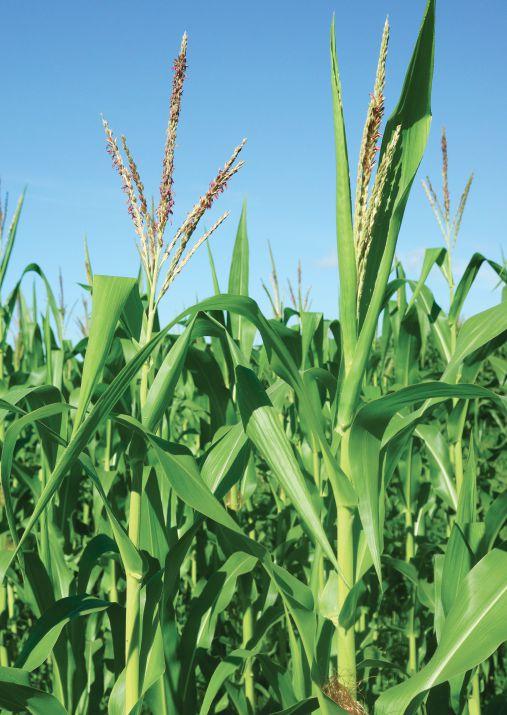
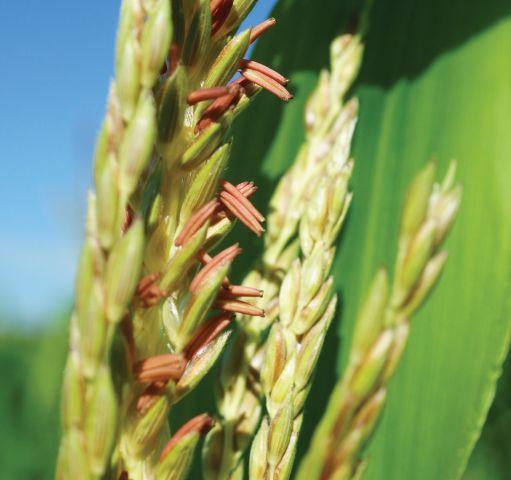
this corn is in the anthesis-silking interval (asi). silk is emerging along the stalks. above, anthers are emerging from the tassels. the time difference between these asi events has a big impact on yield.
questions emerged. From their previous work, they knew that shade avoidance is the first plant response to its environment, beginning on the day the coleoptile breaks ground.
“Knowing that the simple presence of a weed at corn emergence can influence the root structure of a corn plant, we wanted to test whether there was a chance you could lose the benefit of this novel trait in drought-tolerant plants, if you delayed your weed control,” he says.
In the scientific literature behind drought tolerance for
MODERN FARMING.
Resistant and hard-to-control weeds impact the way you farm, your yields, your bottom line. They impact your future.
Introducing Enlist™ — a new weed control system featuring Enlist Duo™ herbicide plus innovative traits that provide tolerance in Enlist corn and soybeans. It’s a highly effective solution to modern weed control challenges.
Only Enlist Duo™ herbicide, featuring Colex-D™ Technology, includes glyphosate and 2,4-D choline for exceptional performance on hard-to-control weeds plus two modes of action for superior resistance management.
corn, Swanton noted that drought tolerance is closely tied to the reproductive interval in corn, known as the anthesis-silking interval ( a SI).
Under normal growing conditions, about 50 per cent of the tassels (silk) emerge within three to four days after the anthers emerge. If stress stretches out that interval a few days, the plant loses non-recoverable yield potential. But, under similar stress conditions, drought-tolerant lines are able to maintain a nearnormal a SI.
Without waiting for drought conditions, Swanton proposed
to test whether stress from weed competition could influence the a SI.
His University of Guelph project received two nearly identical lines of corn from Syngenta. Field studies began in 2011 at Ridgetown and continued in 2012 at Woodstock. One hybrid was from the agrisure artesian technology; the other was a near-isoline without the drought-tolerant technology.
The agrisure artesian hybrid carried the genetics to maintain its yield longer in very dry conditions. It also had a shorter aSI.
Swanton obtained three site years of detailed data from the two locations. The team had tried seven different timings for weed control, monitored environmental conditions and made note of timing in growth stages.
the answers
So, to answer the first question about what happens to yield when there isn’t a drought, Swanton says, “We found that if you delay weed control, you lengthen the a SI period in both drought-tolerant and non-drought tolerant hybrids.”
and in answer to the second question – what happens if delayed weed control puts stress on the emerging crop? – he says, “We found that yield losses occurred with each delay in weed control timing, but no yield differences were observed between the two hybrids. This suggests that there was no additional physiological cost associated with the drought-tolerant traits.”
The drought-tolerance trait would not become a yieldingreducing burden if drought conditions did not occur.
Delaying weed control lengthened the a SI, reduced plant
silking begins as soon as one silk pokes out of the end of the cob initiate. silk is receptive to pollen as soon as it emerges.
height, biomass accumulation, leaf tip numbers, kernel numbers and grain yield for both hybrids. The drought-tolerant hybrid had a shorter a SI, lower kernel number and higher kernel weight than the non-drought-tolerant hybrid.
“We argued that if you delayed your weed control, particularly in the drought-tolerant one and increased this aSI period, you would lose some benefit of the technology,” Swanton says. “The take-home for the grower is that, if I am interested in having this novel technology, I need to be aware that the way I manage weeds can potentially influence the effectiveness of the trait.”
He says, “Weed control timing can influence the length of aSI, which is an important drought-tolerant trait. To fully benefit from a novel trait, be aware that early season weed control is very important. any weed competition, from the day the corn coleoptile breaks ground, will rapidly reduce yield and may limit the effectiveness of drought-tolerance traits.”
The biochemistry is such that, it would apply to any corn anywhere. In theory, it may apply for trait expression in other crops such as canola and soybeans.
“The principle of early season weed control is important across all cropping systems. Corn is the lead for novel trait expression. If you need the novel trait to be present, it’s probably relevant in canola and soybeans, as well,” he says.
t he lege N d of the loN e oAt
What does the future hold for oats?
by amy petherick
In the fight for acreage in eastern Canada, the odds seem stacked against the future of oats as a viable cash crop. But although oats may be down, they’re certainly not out.
While Canadian oat production increased by more than 20 per cent between the 1991 and 2011 census, eastern Canada’s contribution to national production fell from 16 per cent to just 10 per cent in the same period.
naturally, some question the future of oats in the east, especially as the commodity prices of other cash crops consistently blow oats out of the water. But those who love to see a good oat growing in the cooler regions of this part of the country remain optimistic about the cash crop’s future for several reasons. Martin Harry, a founding member of the now-defunct Oats and Barley Council of Ontario and eastern marketing manager for SeCan, has to admit straight oats are more of a niche crop today than they have been in the past. But he hasn’t thrown in the towel by any means.
“I feel now that if we’re going to keep oats and barley being grown in eastern Canada, we have to manage them as forages,”
says Harry. “Oats aren’t necessarily dead, they’re just adapting and changing.”
While small grain acreage has trended down, mixed grains have seen less of a decline than oats or barley alone. Harry says many of the farmers requesting new oat varieties aren’t looking for standalone grain, but the best combinations with barley, peas, and some triticale instead. With more farmers opting to grow oats as a forage or cover crop, the industry partly sidesteps the growing issue of disease management. In the few places where farmers still grow oats for grain, Harry says the crop has to be managed much more carefully, and at a higher cost, than in the past.
“Oats have to be sprayed with a fungicide because, by the time we come up with new resistant rust varieties and get them through seed production, resistance has already broken down,” explains Harry. “There’s no check off on oats, so there’s no funding source
aBOVe: Commodity prices of other cash crops are surpassing oats, but oats aren’t necessarily dead, according to Martin Harry, eastern marketing manager for seCan.
Photo
and the rust strains are changing so fast it is hard to keep up.”
In new Liskeard, farmers have taken it upon themselves to start conducting some of their own variety research.
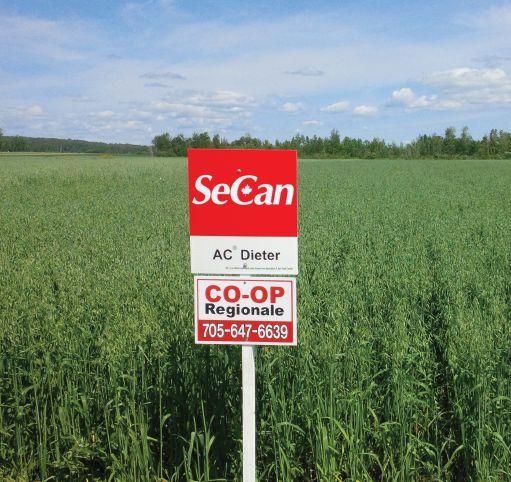
Terry phillips, a certified crop advisor for Temiskaming ag Centre, grew 30 acres of food-grade seed oats in 2013 and is involved in some plot trials. phillips says prescott, by C&M Seeds, used to be the preferred variety in the area, but it produced such a high proportion of pin oats that they’d have 30 per cent dockage after cleaning. Deiter, by SeCan, is the new variety of choice, though they’re looking at Quebec’s darling, nice by elite Seeds, a new variety that Quaker Oats is particularly interested in called Morrison, as well as a new variety called Riley, from C&M Seeds. establishing a preferred variety for the 15,000 to 20,000 acres grown in the area is a big part of the reason Quaker Oats named the Temiskaming farmer’s co-operative as one of two top eastern Canada suppliers in 2012.
“To me it was really simple: if we grow a whole bunch of oats of the same kind, there should be efficiency,” phillips explains.
“We tried to promote a variety to have a critical mass and the first year I think we had 1,500 tonnes, so Quaker blocked us out a delivery period and their mill efficiencies went to a high 90 per cent.”
phillips says they’ve found that by clipping and cleaning their oats, they gain yield to their final product, especially if it’s all the same variety and most growers start off with at least two tonnes per acre. after devastating results from this year’s canola crop, phillips is anticipating an even greater increase in oat crop acreage next year. “The big advantage of oats is that they’re very low cost of production relative to wheat,” says phillips. “every other crop we’re increasing nitrogen to push yield but it’s always a challenge to keep oats standing and that’s by cutting back on nitrogen.”
phillips says most guys in his area will only apply 35 pounds per acre of actual nitrogen and many are also starting to use a little less than a full application of Folicur just prior to heading as cheap insurance against crown rust. These practices are generally in line with industry best practices, although peter Johnson, cereal specialist for the Ontario Ministry of agriculture and Food (OMaF), recommends two fungicide applications since most areas are experiencing higher disease pressure than farmers in the new Liskeard region have seen yet.
“You really have to be a committed grower to grow oats for
human consumption and horses,” says peter Johnson, who adds the real potential for most farmers is to use oats as a cover crop. “There’s no better soil conditions to plant into than after an oat crop,” he says.
In a changing climate, water retention will become increasingly important and Johnson says preliminary work done by amber Hallen and adam Hayes, also of OM a F, demonstrated that an oat cover crop allows water to infiltrate soil three times faster than a field with no cover crop. “To me that shows the amazing value of that oat root system,” says Johnson. “also it’s great in terms of adding high levels of organic matter to the soil and the other real beauty of oats as a cover crop is really, seed is quite cheap.
“If you’re going to use it as a cover crop, understand that you have to manage it in terms of what you do with it in the fall,” says Johnson. even as a cover crop, oats still need at least 30 pounds of nitrogen but not extra seed (70 pounds per acre seems to be lots). planted aug. 1 and left until nov. 1, plants will become very stemmy and too difficult for soil microbes to effectively break down, leading to colder and wetter spring soils. Johnson says the additional organic matter contributed in this case would compare to plowing down a 100-bushel-per-acre wheat crop. But sacrificing a little of that organic matter with a bit more management will pay off better in the long run. “It may mean that when the oats get to be knee high, you go out there and you chop them, let them regrow, then spray off that second growth so that we keep it leafy material that breaks down rapidly,” says Johnson. “We get 80 to 90 per cent of the organic matter benefit and we don’t beat up our next corn crop.”
Johnson likes that oats don’t present the same-side effects other cover crops do, such as hosting soybean cyst nematode, plugging tiles, or becoming future weed problems. He foresees oats as a part of every conceivable future cover crop blend. at this point, only one thing seems certain: no one’s seen the last of this versatile small grain in eastern Canada just yet.
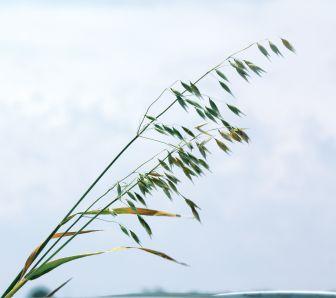
Oats are growing and changing, says Martin Harry, and are best managed as forages.
dieter, by seCan, is the variety of choice at the temiskaming ag Centre in Ontario, where terry phillips has found that clipping and cleaning the oats results in a higher yield of the final product.
Photo B y a my Petherick.
Photo
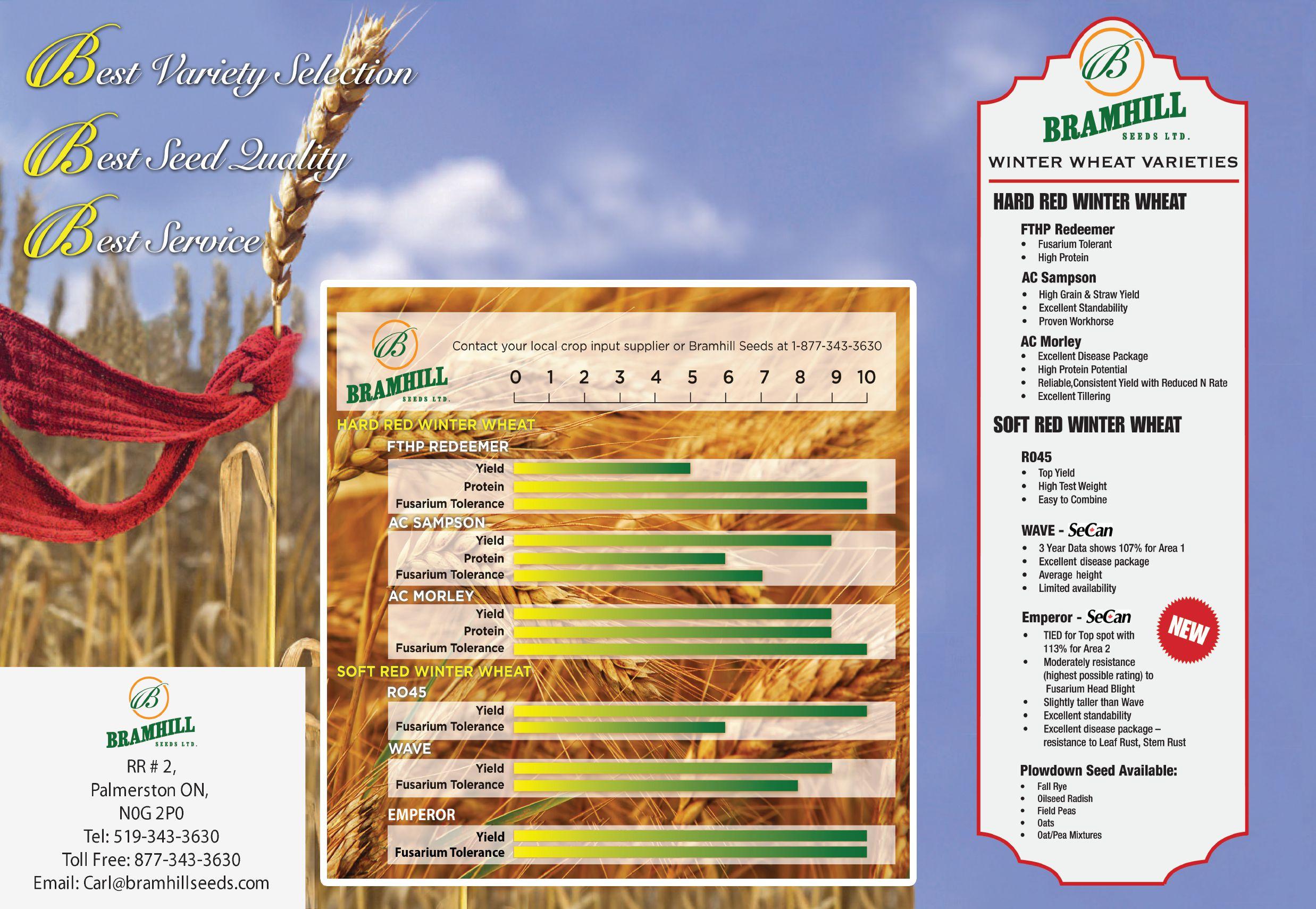
• Great Winter Survival
• Performs well on all soil types
• Short variety with great standability
• Good overall disease package
• Fits well on all soil types
• Excellent Winter Survival
• Great Leaf Disease Tolerance
• Excellent straw volume with standability
• Proven Performance
• Good Fusarium tolerance
• Medium-tall variety with good standability
• Great Yield and Quality
• #1 yielding Hard Red
• Responds to management
• Shorter with great straw strength
• Performs best on loam soil types
• Excellent Winter Survival
• Excellent Straw Volume
• 107 Yield Index in Area 2 (Midwestern Ontario)
• 113 Yield Index in Area 1 (Southwest Ontario)
• Mid - Tall Variety, Awned Heads
• Top Yields Combined with Premium Pricing
• Great Leaf Disease Tolerance
• Good Fusarium Tolerance
• Fall Delivery or ON FARM Program
cANA dA fle A bAN e b lowi Ng
oN the wi N d
Ontario soybean growers face fast-moving GR Canada fleabane.
by John Dietz
An ignored little roadside weed, Canada fleabane, has defeated Roundup in the southwest corner and is quickly spreading northeast.
Ontario farmers can manage it in corn and in cereals, but they will have a challenge with glyphosate-resistant (GR) Canada fleabane in soybeans.
“It’s a real challenge in soybeans because the post-emergence herbicides we have for soybeans aren’t particularly good on GR Canada fleabane,” says peter Sikkema, professor, field crop weed management, at the University of Guelph Ridgetown campus.
a fresh photo of Canada fleabane, a familiar but harmless weed, arrived in Sikkema’s e-mail in the summer of 2010. an ag retailer in essex County was asking him to confirm the identification.
“I replied that it looked like Canada fleabane, why did you ask? The ag retailer replied, we put on twice the rate of glyphosate and it’s still healthy,” Sikkema recalls.
That fall, seeds were collected and screened in the greenhouse for glyphosate resistance. His team identified eight fields with GR Canada fleabane in the southwestern county, near Windsor.
“Based on seed collections in 2010, 2011 and 2012, we now know there are at least 155 fields with GR Canada fleabane in eight counties,” he says. “It moved more quickly than I would have anticipated. It started in the southwestern tip of the province and is progressively moving east and north. It has reached east to niagara County and north to Huron County.”
He adds that in 19 of the 155 fields identified by the end of last year, Canada fleabane was resistant to both glyphosate and the Group 2 herbicide cloransulam-methyl (FirstRate).
“Your two best postemergence herbicides don’t work anymore,” Sikkema says.
The little resistant weed is quickly becoming a more widespread problem than the first resistant weed: giant ragweed. Over time, it is expected it will be found in a wider geographic area in the province.
Unlike ragweed, seed of Canada fleabane is designed to be airborne.
like a dandelion
Canada fleabane seed is like a dandelion seed, says Chris Snip, an agris Cooperative crop sales specialist in Cottam, Ont.
“It’s very light. If a guy’s got it, it will blow out the back of a combine and go wherever the wind blows,” Snip says. “Combines work as great planters for it. If one goes through a combine, the next year you end up with a patch as wide as
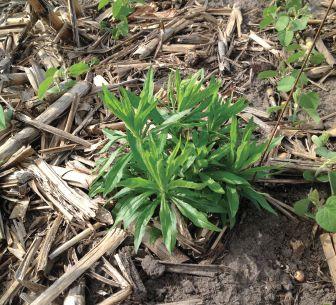
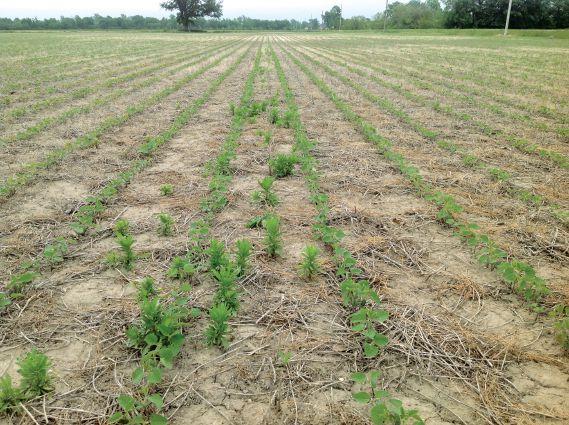
<leFt: an accidental “check” strip from the burndown with no fleabane on either side.
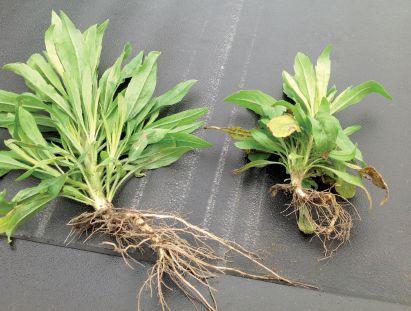
BOttOM: Bent roots are visible on these fleabane escapes after a vertical tillage machine was used.
<leFt: regrowth after a glyphosate application.
the combine will spread.”
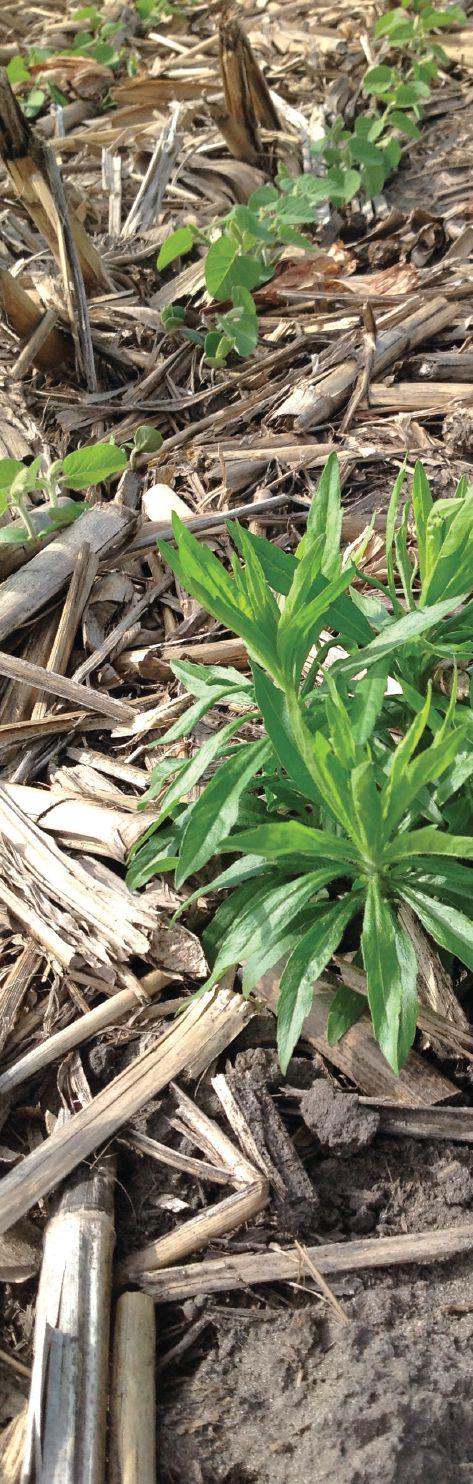
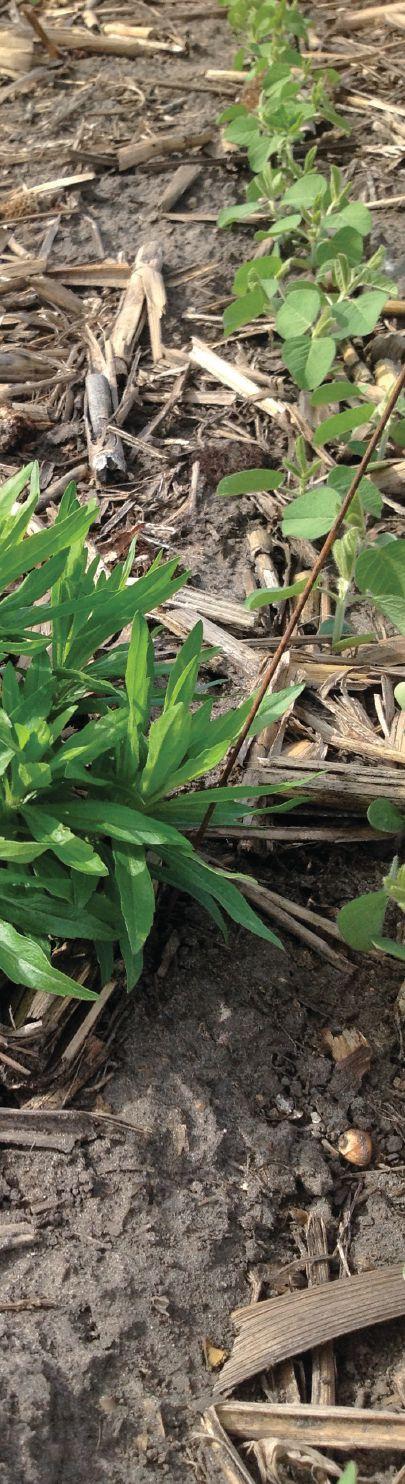
Canada fleabane starts as a small rosette, like a dandelion. Then it bolts upward. at maturity it stands taller than soybeans. It will look similar to goldenrod at that point, loaded with fluff and seed.
It’s always been along roadsides and fencerows, but not as a prominent crop weed, according to Snip. It germinates in any month that the ground isn’t frozen solid.
“It becomes more of a field weed with no-till. Tillage kills it quite easily. If a guy goes through it and tills the soil, very few survive, if any,” Snip says.
It migrated into fields, and soybeans, with the widespread use of no-till and widespread dependence on glyphosate plus Group 2 herbicides. “pretty well every farmer has it now on at least one field,” Snip says.
Larger patches have begun to develop as GR fleabane escapes control.
“You can experience at least 50 per cent yield loss in those areas, and 10 to 20 per cent yield loss would not be uncommon in an infested field,” he adds.
“It can get very thick. There’s up to 500,000 seeds from one plant, so it can make a mess. Last week, I went into the thickest stand I have ever seen with 2,4-D, and it was only stunned. We couldn’t control it with our burndown. It was only a couple inches tall, but it was like a carpet. I was just flabbergasted,” Snip says.
Control options
The crop advisor says soybean growers have three basic options if they have GR Canada fleabane: tillage, a pre-emerge burndown or a post-emerge treatment with a new product. producers are reverting to using some secondary tillage today to try to manage some of their weed problems.
“a lot of vertical tillage machines have been purchased in the area in the past couple years,” notes Snip. “Those don’t completely remove the fleabane as much as a cultivator.”
ahead of planting, some growers are using a 2,4-D ester for burndown, mixed with glyphosate. It works, but planting must be delayed seven to 10 days.
another option is a new Group 14 herbicide from BaSF, eragon, which is doing very well. “eragon uses the Kixor molecule that BaSF launched a few years ago,” Snip says. “We have to mix it with glyphosate and lay it on top. We do need good coverage and high water volume. We do need to get that product on every growing point of the fleabane. It’s not 100 per cent control but it does work quite well.”
COntinUed On page 21
Photo courtesy of r ichard a nderson, B asf
Photos
t he right quA lity for the right e N d-u Se
Two
tools for evaluating wheat flour could benefit the whole value chain.
by Carolyn King
We’ve all heard the sayings about the importance of using the right tool for the right job. Improvements to two tools could mean that we’ll have the right tools to ensure the right wheat flour quality for the right end-use, and that would benefit Ontario wheat breeders, growers, millers and processors.
Dr. Koushik Seetharaman, cereals chair in the Department of Food Science at the University of Guelph, is leading the research to improve the two tools. The Glutopeak is a new technique that Seetharaman’s research team has optimized. Solvent retention capacity testing is an old method that the researchers hope to make more reliable and repeatable.
Measuring gluten quality
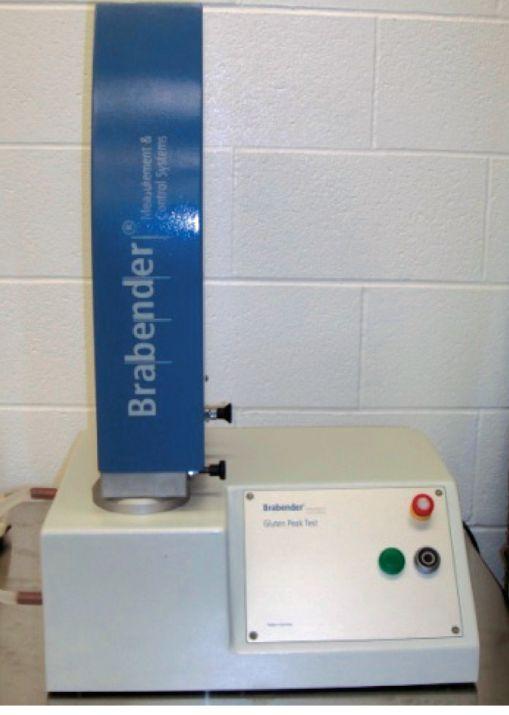
The Glutopeak is an instrument developed by German company Brabender GmbH. Gluten is a unique protein in wheat that develops when a dough is made, and gluten protein characteristics greatly affect a flour’s suitability for various products.
“The Glutopeak uses a very small amount of sample and gives a result in about five minutes or less. Basically, the instrument stirs the sample [of flour mixed with a solvent] at a really high speed.” The gluten resists being stirred and the Glutopeak records the pattern of resistance, which produces “a curve that can be interpreted to assess the quality of the gluten, and therefore the quality of the flour,” says Seetharaman.
“Compared to all other flour quality analysis techniques, some of which require large samples and some of which are time consuming, this one can actually determine quality differences. That is what is unique and interesting about the Glutopeak.”
Seetharaman explains that those other tests actually measure gluten quantity, which his research team has determined is not the same as gluten quality. For instance, two flours each with 10 per cent protein content might perform quite differently from each other when baked in a specific product.
Seetharaman’s research team has been working on several aspects related to the Glutopeak’s performance. He says, “When we started two or three years ago, the instrument was a prototype, so we have helped the company refine it in terms of various mechanical and software-related issues. Then we have developed a standardized procedure that everybody can use – whether you’re a breeder, a miller, a processor or a researcher. We’ve also done tests using the machine to understand what it is that we are measuring,
so the machine is also an interesting research tool to understand [the fundamental characteristics of different gluten proteins].”
The Glutopeak became commercially available in October 2012, and the researchers are now validating the instrument’s performance and their standardized procedure. To do that, they are running tests at several labs to check if all the labs get the same results with the same samples.
predicting functionality
Solvent retention capacity (SRC) tests measure various attri-
Photo courtesy of the u niversity of Guel P h.
the glutopeak evaluates gluten quality, a key factor in a flour’s suitability for different products.
butes related to gluten, starch and sugar characteristics to predict how a flour will function in specific end-uses. Like the Glutopeak, SRC testing is fairly rapid and requires only a small sample size. However, one of its main drawbacks is the potential for human error.
“The test is manually done, so you can get different numbers depending on who does it,” Seetharaman notes. “SRC is extensively used by only a few companies. Typically each company has its own database and its own person who does the test, and they create an internal standard for which SRC values are good or not good for their product.”
although SRC testing hasn’t been very popular, Seetharaman says a recent survey indicates that export markets are beginning to use the method to measure wheat quality. So the researchers are working on procedures to make SRC results more repeatable.
Currently, the research team is sending flour samples to different labs for SRC testing. Then the team collects the results, determines the variability between the labs, and looks for ways to further improve consistency in the results.
Some researchers are also attempting to develop a mechanical version of SRC testing as a way to minimize the impact of human error on the results.
plenty of practical applications
Since Seetharaman became cereals chair in 2007, a cornerstone of the cereal research program has been consideration of the needs of the entire wheat value chain in Ontario. every six months the researchers get together with stakeholders all along the value chain to present their latest research, discuss any issues the stakeholders might have, and work out how to resolve those issues. “I think we have done a really good job of having conversations across the value chain and not just independent conversations with each of the stakeholders,” he says.
In the Glutopeak and SRC research, input from agencies like the Grain Farmers of Ontario as well as wheat breeding and wheat processing companies helps ensure the final results will have the potential to benefit the whole value chain.
For breeders, the fact that both tests require only small sample sizes means that breeders could start testing for quality attributes quite early in their breeding programs, when only a few plants are available for testing. This could help speed up progress in developing varieties tailored to specific end-uses.
Seetharaman’s research team is also investigating the possibility of including the Glutopeak and SRC tests as part of the Ontario Cereal Crop Committee’s variety registration process. The committee already uses measures like protein content to determine if a variety should be recommended for registration. Since the Glutopeak and SRC tests could be better predictors of end-use quality, using these tests could increase registration of Ontario wheats designed for specialty markets.
These specialty wheats could benefit farmers, giving them more defined markets for their wheats. In addition, these varieties could be segregated and marketed through identity-preserved channels, so farmers could get a better price for them.
“However, for this opportunity to open up, the miller or the elevator would need to be educated to understand that paying for or segregating wheat based on percentage of protein is not the best approach,” notes Seetharaman. “a quality parameter would be a better way to price wheat.”
For instance, his research team’s Glutopeak work has shown
that the differences between soft and hard wheat are not just related to per cent protein. “Typically soft wheat has low protein and hard wheat has high protein, but that by itself is not the reason why soft wheat functions differently from hard wheat. It is how the gluten actually is folded and what conformation it has, and how it actually interacts, that appear to be different between hard and soft wheat,” he says.
according to Seetharaman, millers and processors could also benefit from the improved tools. “Right now, millers blend flours to get a certain per cent protein. With Glutopeak, they could blend to achieve a certain quality, and they could deliver that quality to a processor. and the processor would have the opportunity to look at those values and see which values are best suited to the kind of product they make.
“We have worked with two or three companies to show that this test reduces variability in their incoming flour, reduces waste in manufacturing, and improves consistency of their products.”
next steps
Once the procedures and protocols are validated for the Gluto peak and SRC testing, the researchers hope to establish benchmark values for the tests – what values are good for bread and what values are good for cookies, for example.
Because environmental conditions can influence protein in wheat crops, the researchers are currently testing hundreds of samples of Ontario wheats collected in 2010, 2011 and 2012. They will be correlating such factors as wheat variety, growing conditions and crop management practices with flour performance in different end-uses. This analysis should provide a comprehensive database for using Glutopeak and SRC testing for predicting end-use quality.
as well, this analysis is pointing to some interesting relationships between protein quality and crop management practices, such as fungicide, nitrogen or sulphur applications. So in the future, wheat growers might be able to fine-tune their production practices to achieve specific quality characteristics required by specific buyers.
The benchmarked values would provide a great starting place for uses all along the value chain, to advance wheat breeding, variety registration, flour blending, and processing.
agriculture and agri-Food Canada is providing funding through the Canadian agricultural adaptation program for Seetharaman’s Glutopeak and SRC research. additional funding has been provided by aDM, Brabender and the Ontario Cereals Industry Research Council.
canada’s Source of crop production & technology available online
Farmers will go to war over tillage. ask one man to put down his plow, or tell a no-tiller to pick one up, and calls for blood are sure to follow.
perhaps that’s a slight exaggeration, but there’s no denying that a barb aimed at views on the act of tilling hits many farmers pretty close to the heart. Conventional and no-tillers alike have both enjoyed their golden ages, but vertical tillage technology is casting a shadow of doubt that either extreme is undeniably superior or progressive.
The goal of true vertical tillage is to get the right combination of air and moisture into topsoil at the right time of the season and doesn’t necessarily move much actual soil to do that. But at this year’s Southwest agricultural Conference, OMaFRa’s Greg Stewart announced his favourite piece of vertical tillage equipment right now is an offset disc. Following up on that point, Stewart says that in past trials, disc results quite often did really well compared to other tillage options. But back then, he says, they also presented a number of problems. They were a little more prone to smear, didn’t operate level, and needed to be followed in another pass with a cultivator because they didn’t come with harrows.
“The vertical tillage revolution has essentially taken the bad things of a disc and fixed them,” Stewart says. “They took a little angle off the blades so they didn’t throw as much, they made the frames heavier so they rode a little more level, and they put good sets of harrows on the back.”
Stewart says that the core message today is still the same that it was in 1972. Farmers need to create a soil environment that can produce good yields and be protected from erosion. every tillage pass breaks down soil structure, even as material is incorporated, so whoever makes the fewest passes, wins. Science continues to prove residue cover remains key in fighting soil erosion but also in ensuring good emergence. The threat of erosion is greatest in May and
good residue cover can reduce the compaction caused by rain. But Stewart says the days when one tillage system was magically better than another system are behind us. no matter what they use, he says, farmers who don’t have the right amount of residue cover aren’t really in the game in terms of protecting the soil.
“If you want to be progressive, the ultimate goal is 30 per cent residue cover on the ground, all the time, to protect it from wind and water erosion,” says Stewart. “I don’t care if you’re no till, conservational till, vertical till or placebo till. Use whatever tools are out to get there however you can get there.”
Mark Van Veen, one of the tillage specialists working for Salford Farm Machinery, gets excited when debating tillage philosophies and agrees that there are many different ways to prepare a seed bed correctly. He says any system can work and be environmentally friendly as well, as long as farmers give thought to what they’re doing.
“When you work dirt, you excite the system, and you break down organic matter to some degree,” he says. “The flip side of that is, usually when you’re doing some sort of tillage pass, you’re also incorporating residue and in those cases you’re speeding the system up so it’s not a total negative.”
Fighting to incorporate and manage residue is one of the big factors behind a recent trend to abandon no till for more conventional options, Van Veen theorizes. He has seen plow and secondary tillage sales go up dramatically in the last year or two. But he thinks farmers need to look for some happy mediums rather than jumping to extremes. He still thinks no till is a fantastic system if you can manage the cold wet springs and keep a density layer from forming over time, since that compaction seems to stall out the soil’s ability to digest residues. Van Veen says he personally thinks breaking that layer up
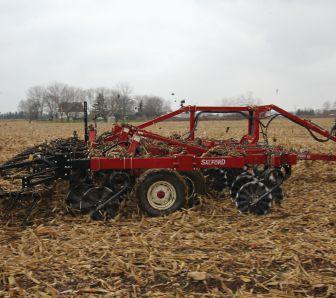
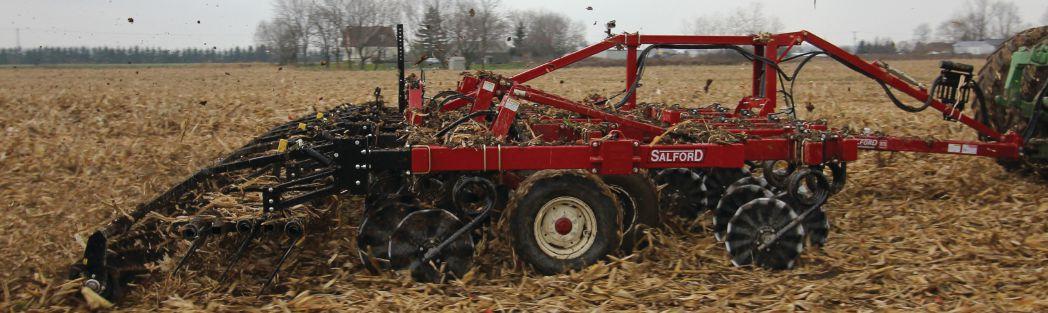
aBOVe: Coulter-style tools, like salford’s i-1100 rts, move very little dirt and work with the soil rather than against it, according to Mark Van Veen.
could be done with cover crops or by mechanical means. But he likes the Salford’s Independent series with the I-1100 RTS for the job because the blades are individually mounted on coil springs and work quickly by producing a jackhammer effect that reduces soil density while conditioning residue.
Van Veen says that Salford’s I-1100 RTS is an example of a tool that can be considered true vertical tillage, which can really complement a pre-existing no-till environment. Van Veen personally thinks these coulter-style tools, which move very little dirt, work with the soil rather than against it to provide an ideal seed environment.
“Vertical tools allow us to do things we haven’t been able to do in the past. Where vertical till really shines, is that you can warm up the soil, get that digestion power sped up in the spring, then get planters into the field a week ahead, giving yourself bigger yields because you’re planting earlier into ideal conditions.”
as many no-tillers are well aware, soil is already a dynamic entity, with several microbes and organisms already happily living in layers, and has a large stomach for crop residue. The less those layers are disturbed, the less you disturb those organisms. Like all tillage before it, vertical tillage helps those organisms breathe.
“Where you add a little more air, all those bacteria and other little critters just go to town and that provides an ideal environment for your seedlings as well because, contrary to popular opinion, it’s actually water vapour that makes a seed germinate,” he says. “Discs blend pretty deep into the profile and you’ve really got to know what you’re doing to do that without totally destroying the life of the soil.”
For those who want some vertical tillage but also want to see some soil move, there are hybrid implements that, again, really don’t fit into the traditional tillage divisions. One new hybrid would be amazone’s Catros implement. It’s partly a disc but also partly a packer. Opt for a few other features and it’s even harder to label according to Sam abourjeily, who has been the eastern Canada sales manager with amazone for seven years. He says true vertical tillage doesn’t perform well in wet conditions, so while a portion of the design of the Catros is vertical, the machine still works well immediately after harvest as
cANAdA fleAbANe. . .
COntinUed FrOM page 17
Late-emerging GR fleabane can be managed in soybeans with a fourth option, a Group 2 herbicide called FirstRate.
“Some fleabane is glyphosate and Group 2 resistant, so the FirstRate won’t touch it. and, there’s no way to know about that ahead of spraying,” Snip says. “about 70 per cent of the time, I’ve been getting good control in the crop with FirstRate, but I don’t make any promises. We try, and see what happens.”
Costs per acre differ among the options. The 2,4-D ester will likely cost $4 to $5 per acre; eragon is likely to cost $7 to $8 an acre. FirstRate is likely in the $15 range.
an old pSII Group 5 inhibitor, Metribuzin, also is showing some success according to Snip. Metribuzin can be sprayed as part of the pre-plant burndown. Several growers are helping to determine rates that will give acceptable control in an optimal range for the product, with safety for the crop ahead.
The GR fleabane also is getting into corn in southwest Ontario. Growers can use a dicamba-based herbicide (Banvel, Distinct or Marksman) in corn as their first choice to control the weed, but there are other options for control and many restricted application areas where growers can’t use dicamba or 2,4-D.
tillage was intended. It’s quickly being adopted in Quebec and Ontario, and abourjeily says it’s much more versatile than conventional tillage.
“By going at a 10 degree angle with your first pass in the fall, immediately after any harvest, you are maintaining your field level and are starting a faster decomposition of the residues, so that when spring arrives, you can work straight, faster and with less residues,” he said. “Your purpose for the second pass, in the spring, which would be with the same machine, is to open up the ground early in the season, warm it up faster and start planting immediately after.”
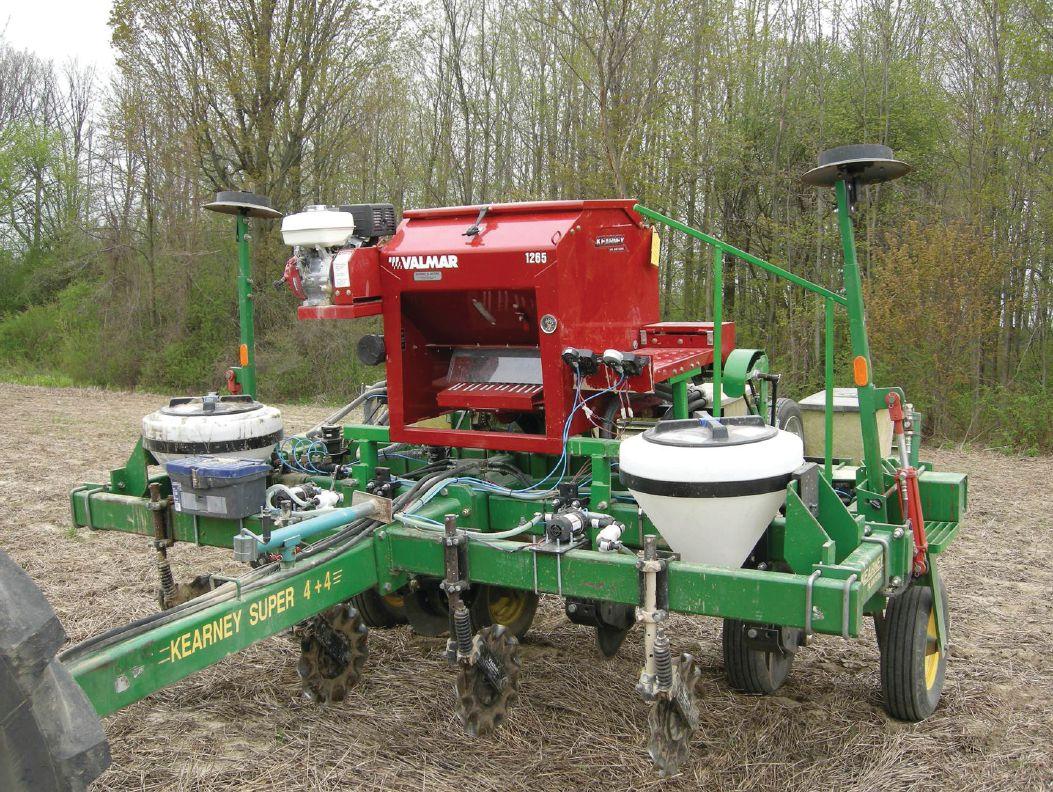
Instead of truly vertical discs, the Catros has two rows of discs slightly angled in opposite directions so that residue is processed and incorporated at the same time. The packer wedges the leftover pieces into the ground, for more soil surface contact, and helps to take advantage of a longer decomposition season. The first pass smooths field imperfections and processes residue like primary tillage, but a second 10 to 16 kilometres-per-hour shallow pass replaces secondary tillage. abourjeily says it can further save conventional passes because it can be attached directly behind a liquid manure tank for incorporation purposes. He says it also has been turned into a seed drill, of sorts, by some farmers.
“We can propose, as a convenience option, to install on the Catros machine a small grains seeder to broadcast mixtures of grass-seeds along in the fall,” said abourjeily. “So while you’re tilling the ground in the fall you can cover the field, with the radishes or mustards recommended by agronomists, at the same time, and hence reduce the overall needs for chemical fertilizers.”
Stewart says seeding fall cover crops all in one pass is a slick idea he could get behind. and he thinks any piece of equipment that can effectively replace a number of pieces a farmer is working with will earn attention. as far as he’s concerned, there’s considerable merit in no longer judging a field by the system it’s been ascribed to; judging the field by its cover will do.
For more seeding and chemical information, visit www.topcropmanager.com.
They must observe a two-mile-wide buffer zone for these products around greenhouses and vineyards.
Sikkema is testing out other options, too.
“The options we have for managing GR Canada fleabane are fairly limited, but we have an extensive research program looking for new ways to manage this weed in soybean,” he says.
“eragon, Integrity, Broadstrike or Sencor have given us the best results to date, but those are preliminary results that we need to confirm this year.
“We’re also doing a lot of research with the enlist Duo from Dow agroSciences, in enlist corn to manage GR Canada fleabane.
“and, we are looking at how to manage multiple-resistant Canada fleabane, and what to do if you have both glyphosateresistant biotypes in the same field. There are lots of questions. We hope to have new recommendations in place for the 2014 crop.”
Visit the seed/chemical section of www.topcropmanager.com for more weed management research.
w i NN i Ng S olutioNS
The advantages of applying dry starter fertilizer to corn shouldn’t be overlooked.
by Jeanine Moyer
New planter equipment designs and the slow process of refilling fertilizer have reduced the popularity of applying dry starter fertilizer to corn ground, but at what cost to yields and potential economic returns?
Though it’s become more challenging to get starter fertilizer to the field while planting corn, growers need to ask themselves if they are willing to forgo the potential yield loss connected with those additional nutrients.
“Dry starter fertilizer is like an insurance plan on fields and in areas where soil levels are low in specific nutrients,” says Greg Stewart, corn industry program lead with the Ontario Ministry of agriculture, Food and Rural affairs. He has seen the effects of reduced dry starter fertilizer application across the province and has conducted his own field test plots to determine ideal rates and the best application methods for starter fertilizer in corn.
Make the right management decision
Stewart poses two important questions to growers when discussing the importance of dry starter fertilizer in corn – is it worth the overall
investment in equipment to apply dry starter fertilizer when planting, and what field conditions warrant investments in the appropriate fertilizer application equipment? The determining factors to both these questions depend on an individual grower’s situation, but the answer, in Stewart’s opinion, should be yes, it’s worth the investment in the right equipment to apply dry starter fertilizer when planting, and regular soil tests should help justify the investment.
It really comes down to leaving money on the table, or in this case, in the field, he says. Soil tests will determine if and where additional nutrients are needed within a field, and if those tests are low and starter fertilizer is not applied, growers can expect to take a hit on their resulting yields. “and at record corn prices, any bushels lost to field management decisions can really add up in dollar figures.”
test for soil k levels
according to Stewart, the impact of dry starter fertilizer comes down
aBOVe: greg stewart has found that applying dry starter fertilizer has consistently increased yield potential and helped sustain appropriate soil nutrient levels.
Photo
to three influencing factors – soil test levels of phosphorus (p) and potassium (K), the intensity of tillage, and the soil structure, or tilth, of fields. He recommends growers consider these factors in their field management strategies when making decisions about starter fertilizer in corn. and as the availability of corn planters offering dry fertilizer application capacity becomes scarce, Stewart says growers should look at alternative equipment attachments and be more diligent about soil testing to make sure their soil nutrients aren’t being neglected. He also says K is being pulled out of the soil faster than ever because it is directly linked to yield performance. and with yields increasing year after year, K loss is becoming an issue in many fields. “Higher yields means maintaining appropriate K soil levels is more important than ever and studies have shown yields will take a significant hit if K is overlooked.”
Field trials have clearly demonstrated that low K soil tests respond to starter fertilizer, creating a significant advantage for growers in increased yields and crop uniformity. applying starter fertilizer with nitrogen (n) and p to soils with a K deficiency won’t do much either if the soil doesn’t receive the nutrient it needs most. “If you pay no attention to slipping soil K values, you may be throwing your nitrogen and phosphorus starter money down the drain.”
dry starter fertilizer application
For some growers, applying dry starter fertilizer just isn’t an option on their planters. If this is the case, Stewart urges considering the trade-offs of an investment in retrofitting equipment with the lost yield potential from soil nutrient deficiencies. Liquid starter fertilizer is another option to applying the recommended fertilizer. Though Stewart admits it’s better than not applying any at all, he points out
that if K levels are low enough, liquid starter fertilizer application won’t likely provide enough K to address potential yield loss. If liquid starter fertilizer application is a grower’s only option, Stewart recommends using fertilizers with higher K levels.
In fields or areas where dry starter fertilizer is not an option, Stewart recommends liquid starter fertilizer application rates of 6-24-6 or 2-20-18. He says these rates could provide some economic payback, but if soil tests show low K levels, broadcasting 200 pounds of starter fertilizer with higher levels of K first, before relying on the little bit of K available in liquid starter fertilizer systems, would a better option.
“If your field tests are coming back with low nutrient results you need to make some management decisions,” he says. “It’s nearly impossible to compete with the yield advantages seen with dry starter fertilizer application in corn seed beds.” His field trial results have shown dry starter fertilizer application rates of 5-20-20 at 200 pounds to be “clearly winning solutions.”
Field management strategies are important for the maintenance of soil sustainability, yield potential and providing a healthy return from crops. Dry starter fertilizer application in corn has repeatedly been shown to increase yield potential and sustain appropriate soil nutrient levels. and while investments in soil tests, appropriate starter fertilizer application equipment or liquid starter fertilizer application may be significant, the trade-offs in lost yield potential could be higher. “Don’t discount dry starter fertilizer in corn,” says Stewart. “Because any investment, large or small, will pay off in bushels and healthier soils.”
looking for more fertility articles? Visit www.topcropmanager.com.
Make e very Drop Count
in the W ee D e SC ape S Battle W ith t eeJet
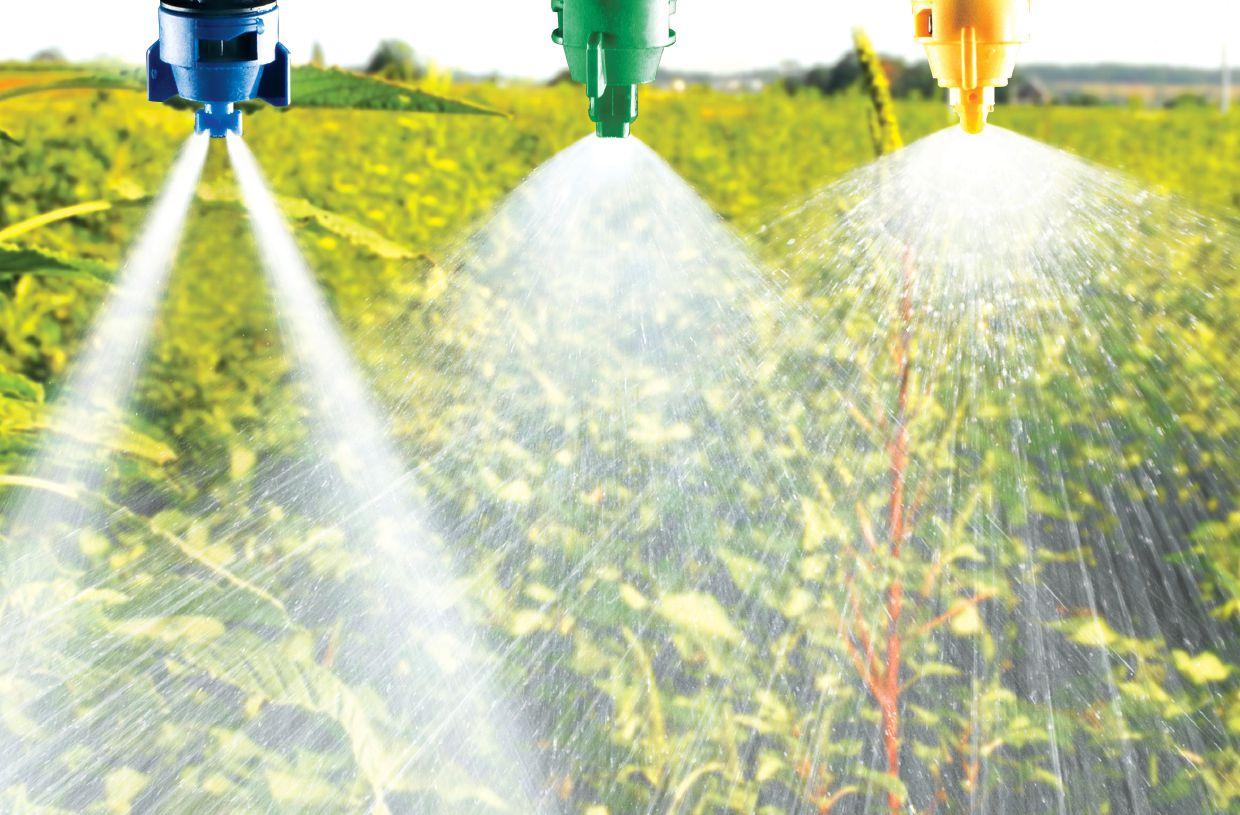
Thorough spray coverage is critical when trying to control herbicide resistant weeds like pigweed or waterhemp and TeeJet spray tips provide the superior coverage and drift control you need. After you’ve chosen your herbicide, consider these options:
• Turbo TeeJet® (TT) and Turbo TwinJet® (TTJ60) tips produce medium to coarse droplets for thorough coverage when spraying contact herbicides like glufosinate
• AIXR, Turbo TeeJet Induction (TTI) and Air Induction Turbo TwinJet (AITTJ60) tips produce larger droplets for improved drift control and are ideal for systemic herbicides like glyphosate, 2, 4-D and dicamba
Download the SpraySelect tip Selection Mobile app for apple and android today!
Weed ManageMent
g ree N weed coN trol
If fine herbicide sprays give better coverage, imagine what even smaller formulations could do.
by John Dietz
At the scale of an atomic microscope it has become possible to package molecules that, in water, won’t clump up but will disperse evenly. What if that could be done with the active ingredients in weed control products?
Well, we don’t know yet for sure, but there’s a bright light coming out of some lab doors in Ontario.
Vive Crop protection, a Toronto-based formulation company, has succeeded in packing molecule-sized active ingredients into a basic, chemically neutral, polymer particle that it calls allosperse. It has initial positive results in the first greenhouse growth room trial at the University of Guelph, conducted by Dr. Clarence Swanton in 2012.
“They [Vive Crop protection] asked if we could test a couple of their formulations early in 2012, so we did,” says Swanton, a senior weed scientist at the University of Guelph. “They had been working with some pesticides, and had found some activ-
ity with pesticides, but they had not been able to find a response to herbicide.”
Swanton describes the polymer allosperse as like very, very small honeycomb with places to attach herbicide molecules.
The first University of Guelph product test, in early 2012, was with fenoxaprop-p-ethyl, a herbicide used to control certain annual and perennial grassy weeds. It is used in cereals (mainly wheat), feed, forage crops, ryegrass for seed and turfgrass.
Swanton tested the allosperse formulation in the university growth chambers on green foxtail, corn and oat. He used a wide
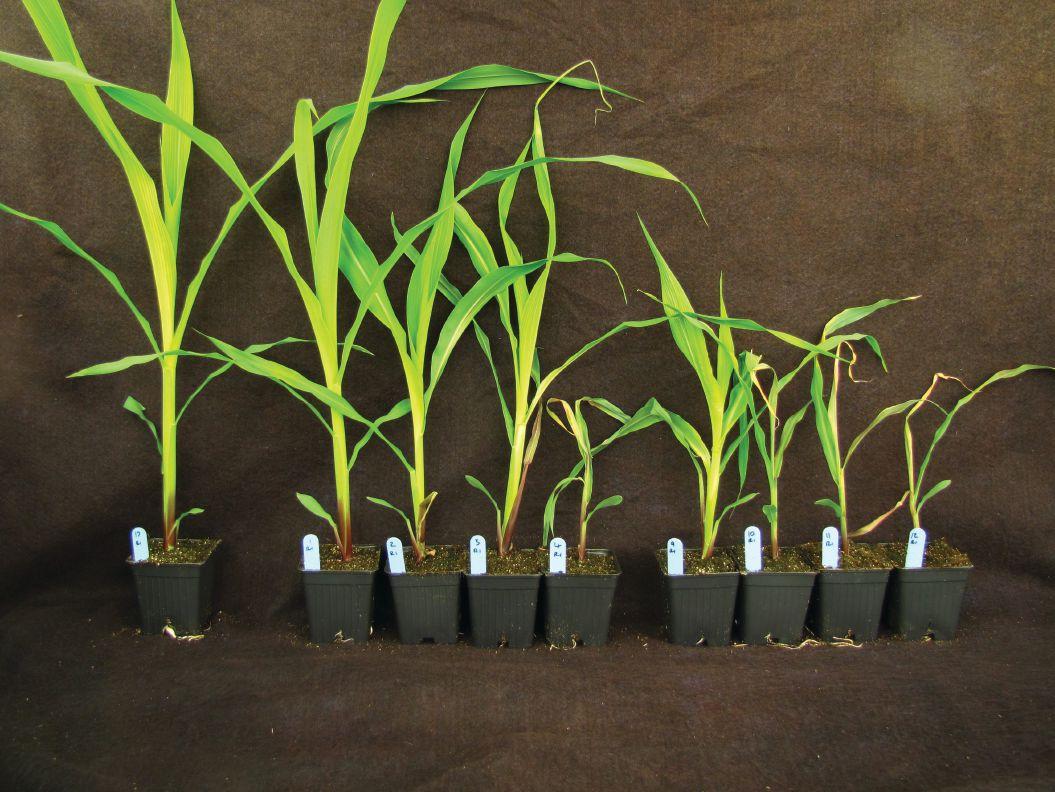
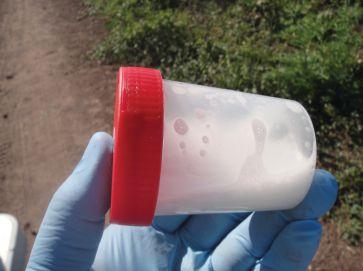
tOp: Volunteer corn seedlings’ responses to a Vive herbicide formulation (from left to right). the first plant was not treated. plants 2 to 5 were treated with the commercial formulation. plants 6 to 9 were treated at the same rate with the super-fine, solvent-free Vive formulation. inset: the super-small formulation of allosperse polymers and an insecticide active ingredient are shown in this vial.
Photo
Photo
You’ll never find a Pioneer sales rep with their feet up in an office somewhere. More often than not they’re the person standing right next to you discussing the weather, your soil conditions and your challenges – because, after all, they’re
living with them too. This dedication and unique level of expertise helps our reps recommend the right product for each of your acres every year. Talk to your local Pioneer sales rep or visit pioneer.com for more information.
Our experts are grown locally visit
range of doses for the testing, and applied it with water at recommended field rates. In the ideal growing conditions, the initial results were encouraging. a follow-up trial in field conditions is planned for 2013.
The three species represent three levels of susceptibility to the herbicide in its traditional formulation. Green foxtail is highly susceptible. Corn has moderate susceptibility and oat is moderately tolerant.
“We found that we were able to quite substantially reduce the GR-50 value in the highly susceptible green foxtail and in the moderately susceptible corn,” Swanton says. “The GR-50 value is the required dose to control half of the population. We reduced that in our greenhouse study by about 50 per cent.”
Meanwhile, the response in the tolerant oat population remained at about the same value that it shows when exposed to the commercial formulation.
Ultimately, Swanton says, the goal of the project is to get a formulation that will penetrate the leaf cuticle and membrane, and do it in a more efficient way.
“The other part is that no solvents are required in the formulation. all of a sudden, you take the whole solvent chemistry and the toxicology associated with it, and you remove that from the equation. In my mind, that’s huge,” he notes. “There’d be two benefits from eliminating solvents. First, the formulated compounds would presumably be more economical if I don’t have to put solvent in and if I don’t have to ship solvent. Then, if we could reduce the toxicology in the environment, that would be a very positive
step forward, and suppliers still could achieve good levels of profitability.”
according to Vive Crop protection C e O Keith Thomas, allosperse is a unique delivery mechanism for herbicides, insecticides and fungicides.
“Our polymer particles are super small and they are able to hold active pesticide ingredients. Our final crop protection formulations, with the ingredients, are larger. They can be photographed with an electron microscope in a size that’s one step larger than nanotechnology.”
“allosperse can be modified to incorporate a range of molecule sizes. We can produce allosperse-based pre-mix products with multiple active ingredients, though our first products will likely be solo products designed to be tank-mixed with other active. a large potential benefit of our technology is the ability to reduce the amount of active ingredient,” Thomas says.
according to Thomas, the company continues its research, including working on products that target both specialty crops as well as major row crops. “We are currently developing products based on both patented and off-patent active ingredients. For patented active ingredients, we are working with the patent-holder to develop new and improved versions.”
Trait Stewardship Responsibilities Notice to Farmers
Monsanto Company is a member of Excellence Through Stewardship® (ETS). Monsanto products are commercialized in accordance with ETS Product Launch Stewardship Guidance, and in compliance with Monsanto’s Policy for Commercialization of Biotechnology-Derived Plant Products in Commodity Crops. This product has been approved for import into key export markets with functioning regulatory systems. Any crop or material produced from this product can only be exported to, or used, processed or sold in countries where all necessary regulatory approvals have been granted. It is a violation of national and international law to move material containing biotech traits across boundaries into nations where import is not permitted. Growers should talk to their grain handler or product purchaser to confirm their buying position for this product. Excellence Through Stewardship® is a registered trademark of Excellence Through Stewardship.
ALWAYS READ AND FOLLOW PESTICIDE LABEL DIRECTIONS.
Senior exeCutive finanCial ConSultant inveStorS GrouP finanCial ServiCeS inC | Paul vaillanCourt
iNcorpor
AtioN
: Now, l Ater or N ever?
If you’re like most unincorporated small farming businesses, you’re likely contemplating these thorny questions: Should I incorporate? If so, when’s the best time? If not, why not? The simple answer is: Incorporation is always good because it delivers terrific tax benefits while creditor-proofing my personal finances. But, like all simple answers, this one is much too simplistic. Whether or not to incorporate raises a number of issues, including the length of time you’ve been in business, your personal cash flow needs and the personal and corporate tax rates in your province. Here is a closer look at how these issues might affect your decision.
Cash flow and you
If you need all of the profits from your farming business to support your personal cash flow needs, incorporation may not be for you. The cost of setting up and maintaining the corporation could outweigh the tax benefits. But when your financial position allows you to retain some of your business profits inside the company, incorporation could deliver significant tax savings. The money retained in the company can be used to grow the operations or invest in other non-related investments.
taxing questions and answers
When it comes to taxes, incorporation can be tricky. If you’re in the initial stages, it’s usually advisable not to incorporate because losses incurred by an incorporated business can’t flow through to shareholders. You’re better off being able to use those losses personally against other income. Once your business becomes profitable, incorporation can provide tax advantages.
If your business earns active business income (income earned as a direct result of the farming operation as opposed to passive income earned, for example, by holding other investments through the corporation), you may gain an immediate tax break (in some provinces) and the opportunity to defer part of your tax payment.
a Canadian controlled private corporation’s active business income is taxed at a relatively low combined federal/provincial rate of 12 to 19 per cent, depending on the province in which you’re doing business. In most provinces, the lower rate is applied federally on the first $500,000 of active business income, with the exception of Manitoba and nova Scotia, where the lower rate may be applied on the first $400,000. even though shareholders must pay a second level of tax once the after tax income is paid out as dividends, this second level of tax is applied only when the dividends are paid. So you can control when you pay these taxes by choosing to declare dividends in years when your personal taxable income is lower. Incorporation also allows you to take advantage of income splitting to reduce taxes. If your spouse or adult children are shareholders in your corporation, any dividends they receive will usually
be taxed in their hands. Your corporation can also employ your family members as long as their remuneration is reasonable for the work performed. You can defer certain expenses as well, such as employee bonuses. In order to be deductible in the year by the corporation, it must actually be paid to you no later than six months after the end of the year.
Creditor-proofing personal assets
Incorporation can limit your liability because corporate assets and personal assets are kept separate and corporate creditors can only go after assets owned by the corporation. But incorporation may not protect you from all creditors: banks and other corporate suppliers often require small business owners to personally guarantee any liabilities and directors of a corporation may be liable for many types of unpaid debts.
a corporation can continue to exist indefinitely.
estate planning
The life of an unincorporated business usually ends with the life of its proprietor. But a corporation can continue to exist indefinitely, which is why corporations are often used for estate planning purposes. It is important to take steps so that after your death the business remains profitable with sound management provided by family members or others.
If after assessing the pros and cons, you’re leaning toward incorporation, you still have a few important decisions to make:
• Who will be the shareholders? You may choose to make family members shareholders for income splitting purposes, but the ability to issue shares to family members is limited in certain corporate structures.
• Who will be on the board of directors? Directors have exposure to many different types of liabilities, so becoming a director is not a decision to be taken lightly.
• Who should be the officers? These are the people entitled to sign documents on behalf of the corporation. They must be chosen with care and with an eye to the future direction of your business.
This is a general source of information only. It is not intended to provide personalized tax, legal or investment advice, and is not intended as a solicitation to purchase securities. Paul Vaillancourt is solely responsible for its content. For more information on this topic or any other financial matter, please contact an Investors Group Consultant.
Phosphate Fertilizer Efficiency
■ Seed-placed liquid orthophosphate
Immediately available in cold soils
Faster emergence; Larger root mass
Higher yields
■ NPK analysis with micronutrients
A complete starter fertilizer
■ Convenient low rate liquid
Easy set-up on large planters
For over 25 years, Case IH Magnum™ series tractors have powered through the toughest conditions with less fuel, hours and stress. Our Selective Catalytic Reduction (SCR) technology and our Diesel Saver™ Automatic Productivity Management (APM) system ensure that you won’t sacrifice power for fuel efficiency. And with a proven engine and simple emissions control system, you’ll have more uptime between each service. Combined with a suspended cab, intuitive controls and an integrated AFS Pro 700 control center, Magnum series tractors won’t just make your operation productive, but efficient. For more information, visit your Case IH dealer or www.caseih.com/magnumtcme913