A new hard red spring wheat variety for Eastern Canada.
PG. 8
AG RECYCLING PROGRAMS
TAKE OFF
Pesticide recycling programs show high recovery rates.
PG. 6
Maximum flexibility and cost e ectiveness
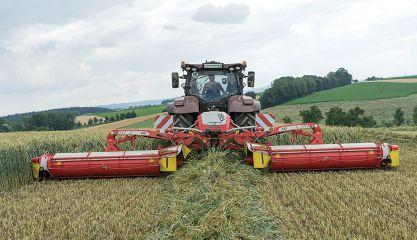
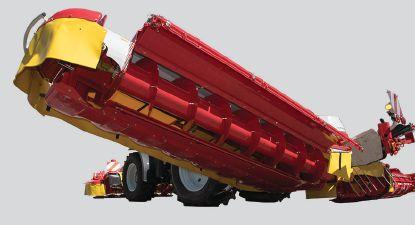
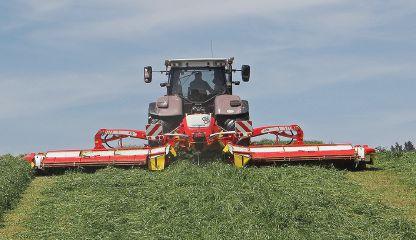
NOVACAT A10 CROSS FLOW – Swath merging without conditioner
20% lower power requirement compared to conveyor belt systems.
Quicker drying – cross flow auger turns the flow of forage.
Intelligent mowing – single-side wide placement reduces the number of passes and saves time.
Wide spread placement – for a more intensive drying e ect.
NOVACAT A10 CF received “Machine of the Year 2019” at SIMA 2019.
For more information, please call 450-372-5595. www.poettinger.ca
TOP CROP
MANAGER
ISSUES AND ENVIRONMENT
6 | Agricultural recycling programs taking off
Cleanfarms’ programs show high recovery rates, but more needs to be done. by Julienne
Isaacs
FROM THE EDITOR
4 Embracing Farmer 4.0 by Stefanie Croley
PLANT BREEDING
CEREALS
8 | Building better wheat
Developing a new hard red spring wheat variety tailored for Eastern Canada. by Mark Halsall
18 Breeding for more efficient phosphorus use in winter wheat by Stephanie Gordon ISSUES AND ENVIRONMENT
ON THE WEB
PLANT BREEDING
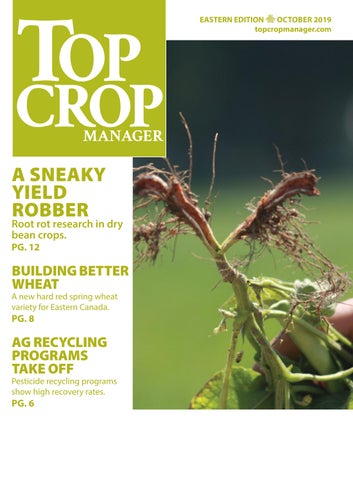
12 | A sneaky yield robber
Root rot research tackles this ornery foe of dry bean crops. by Carolyn King
20 Supporting stewardship in Ontario by Julienne Isaacs ISSUES AND ENVIRONMENT
22 Operation Pollinator on Ontario farms by Carolyn King
INPUTS: THE PODCAST BY TOP CROP MANAGER
Join us biweekly for conversations about relevant research, best production practices and everything in between.
Stay tuned to
Readers will find
Manager. We encourage growers to check product
labels for complete instructions.
PHOTO
STEFANIE CROLEY | EDITOR
EMBRACING FARMER 4.0
The world population will reach 9.7 billion people by the year 2050, according to a June 2019 report from the United Nations Department of Economic and Social Affairs. With a number that high, the agriculture industry will, without question, play an even larger role in sustaining and supporting the world’s people and economy. But is the industry prepared to take on such a huge responsibility? When it comes to Canada, economists and researchers say the answer to that question is “no.”
That’s according to Farmer 4.0, a report released by RBC in September 2019, which argues that with the correct skillset (i.e. the adoption of more technology), agricultural GDP could reach $51 billion, making the industry “more productive than auto manufacturing and aerospace combined.” But before that happens, Canadian farmers have lots of work to do.
The report details the three technological revolutions that Canadian agriculture has seen over the last century: the boom of the seed and fertilizer industries in the early 1900s, tractor advancement in the 1950s, and developments in software and crop genetics some 20 to 30 years later. But today, the fourth revolution is data-driven, and the farmer of the future – or Farmer 4.0 – will be innovative, highly skilled and forward thinking.
The challenge, however, lies in the centre of the crossroads Canadian farmers are currently facing. Some of the report’s findings aren’t shocking – specifically the skills and labour shortage in the industry (for example, by 2025, one in four farmers will be 65 or older, and fewer young people than ever are joining the sector). Those demographics, combined with the changing skills required to succeed in agriculture means the industry leaders of the future will look quite different than they have in the past. Going forward, farm owners and operators – what the report refers to as the “deciders” – will need to be sharp thinkers, with strong digital and leadership skills. Those who service farm equipment – the “enablers” – will need software knowledge and technological expertise in order to keep up with smart machinery. And more jobs will be available for the “specialists” – the scientists and geneticists, who play an equally important role.
These are solid recommendations, but I’d argue that Canadian producers are already on the right track. Nearly half of agriculture workers under 40 have a post-secondary education, and enrolment in such programs has increased by 29 per cent in the last decade. Furthermore, as we like to report about, Canadian crop scientists are making great strides in plant breeding, soil fertility and crop management research to help you make better decisions on your farm.
A lot of this seems like big-picture talk, but the onus is on you right now to make small changes to keep the momentum going. Seek out new learning opportunities, collaborate with your peers, and promote the benefits of agriculture to your neighbours. Perhaps most importantly, approach change with an open mind. If we’re going to keep feeding a growing population, we have to embrace the whole range of solutions.
TOP CROP
OCTOBER 2019, VOL. 45, NO. 11
EDITORIAL DIRECTOR, AGRICULTURE
Stefanie Croley • 888.599.2228 ext. 277 C – 226.931.4949 scroley@annexbusinessmedia.com
ASSOCIATE EDITOR Stephanie Gordon • 416-510-5116 C – 437-688-6107 sgordon@annexbusinessmedia.com
ASSOCIATE EDITOR Jennifer Paige • 416-305-4840 jpaige@annexbusinessmedia.com
rthava@annexbusinessmedia.com Tel: 416.442.5600 ext. 3555 Fax: 416.510.6875 or 416.442.2191 Mail: 111 Gordon Baker Rd., Suite 400, Toronto, ON M2H 3R1
SUBSCRIPTION RATES Top Crop
LEAD THE FIELD.
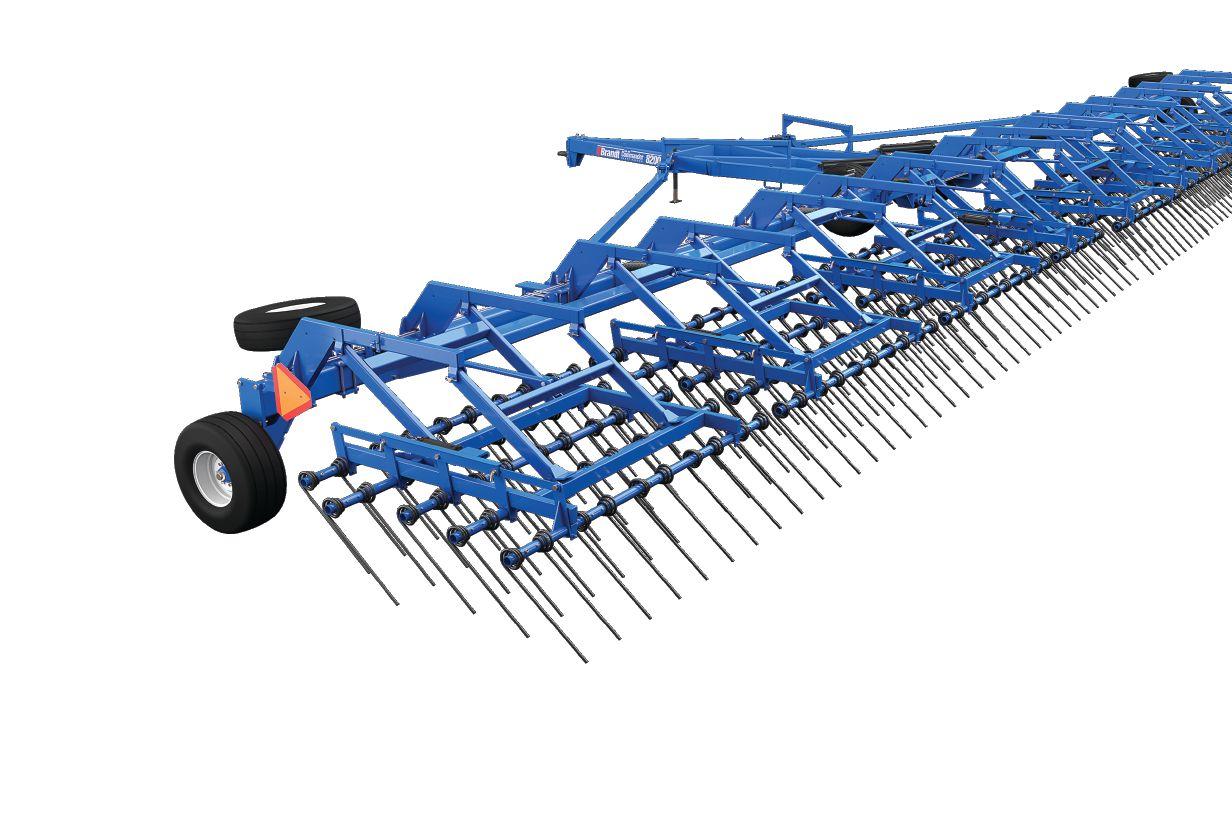
Farming is a competitive business. You’ve got to have tough, reliable equipment like Brandt’s Contour Commander heavy harrows if you want to Lead the Field. Rugged and designed to deliver perfect seedbed preparation, even in non-uniform terrain, Brandt heavy harrows always produce the ideal field finish. Easy-to-use and adjustable from your tractor cab, the Contour Commander delivers optimal results every time.
The result? You get smooth, trouble-free seeding and enjoy years of worryfree productivity from Brandt. That’s Powerful Value. Delivered.
AGRICULTURAL RECYCLING PROGRAMS TAKING OFF
Cleanfarms’ programs show high recovery rates, but industry experts say more needs to be done.
by Julienne Isaacs
Single-use plastics hit the news in June 2019 after the federal government announced a nation-wide ban on some products—but agricultural waste products such as grain bags, pesticide and fertilizer containers, seed containers and bale wrap and twine were not included in the ban, says Barry Friesen, general manager of Cleanfarms, a national non-profit dedicated to environmental stewardship.
Last year, Cleanfarms managed 4,500 tonnes of material across the country, and plastics – including single-use plastics –made up the bulk of this material, writes Friesen on the organization’s website. “It is estimated that 40,000 tonnes of agricultural plastics are used each year in Canada, which means we managed just over 10 per cent of what was generated.”
Though their volumes increase annually across the country, there are few municipal recycling options available for these products, some of which are considered hazardous waste due to chemical or seed residues.
Added to this, most manufacturers of agricultural products are not required to provide end-of-life management plans for packaging. Most of these materials end up in landfills, or are burned or buried, Friesen explains.
Nevertheless, Canadian farmers have more options than ever before for agricultural recycling, and Friesen says there are many positive signs that the industry is poised to make improvements to agricultural waste management.
Last year Cleanfarms saw recovery rates of about 65 per cent across the country on containers, and an overall increase in volume of 14 per cent. Friesen attributes this success to increasing awareness about plastic waste and litter and the organization’s new programming.
“Farmers who weren’t participating in the past are now,” Fries-
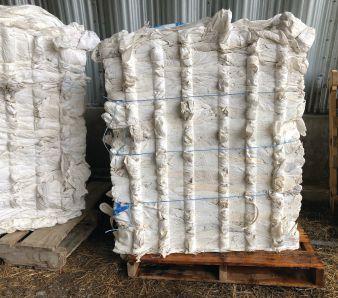
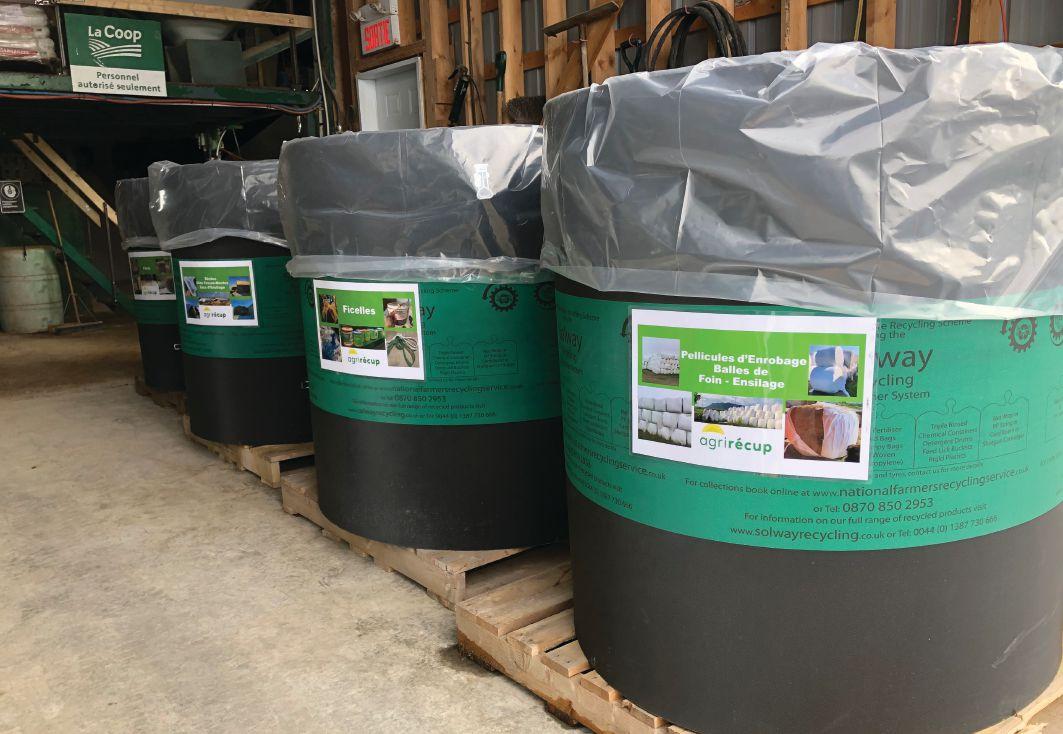
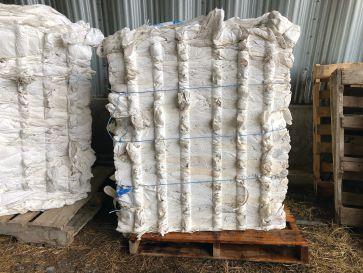
TOP: Barrels specially designed for agricultural plastics recovery. Each barrel is used for a different type of plastic.
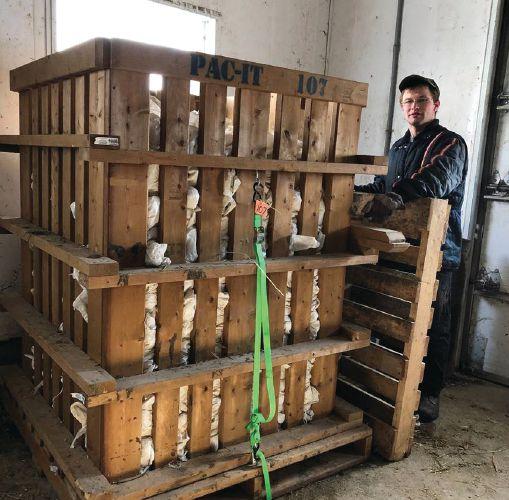
INSET: Didier Ruel, one of the pilot project participants, stands next to a Pack It wooden press.
PHOTOS
en says. “As we add more programs, farmers say, ‘Now that I recycle this, I may as well do everything.’ A rising tide lifts all boats.”
In Eastern Canada, Cleanfarms’ programing continues to expand, and last year saw an increase in recycling volumes of nearly 10 per cent, Friesen says.
In Quebec, where programming is newer, Cleanfarms’ programs have seen almost the same levels of return as in Ontario. “We’re very cautious about this – one year is a statistic, three years is a trend – but in Quebec the volumes have gone up every year since 2010.”
Permanent programs
Cleanfarms currently offers four permanent programs in Ontario, Quebec and the Maritimes.
The non-profit’s small container recycling program collects fertilizer and pesticide bottles up to 23 litres, including 20-litre pails. Producers bring these containers back to ag retailer locations for collection.
Cleanfarms also offers a bulk container program for single-use containers over 23 litres, which includes pesticide containers and some fertilizer containers.
The third program is the unwanted and obsolete pesticide and animal health collection program, which is offered in every province every three years; this year’s collection in Eastern Canada is in Ontario and Newfoundland. This program collects obsolete pesticides, medications, vials and tubes for disposal via high-temperature incineration. Volumes tend to be small, Friesen says, but these materials are considered hazardous waste and would otherwise be dumped in the landfill.
The fourth program, offered across Eastern Canada, is Cleanfarms’ seed and pesticide bag program. Farmers bring these bags – sizes run anywhere from 50 pound seed bags to 1,000 kg supersacks – back to ag retailers for collection.
“The difference in this program versus the container program is that there are a lot more farm dealers in the seed business,” Friesen says. “We don’t have current recycling options for them
so we manage them via waste-energy. There’s a lot of crisis in the plastics industry right now, but ideally we want to move our supersacks into plastic recycling facilities.”
There’s a fifth permanent program in Quebec: Friesen says the fertilizer industry has asked Cleanfarms to collect their bags –primarily supersacks – at ag retailers.
Most of the major fertilizer companies have jumped on the recycling bandwagon, but not all, Friesen says. “There are fertilizer companies that haven’t signed on but we would encourage them to do so because we can run a more efficient program working together.”
On the crop protection side, agricultural waste management is “pretty well looked after,” Friesen says. But Cleanfarms has identified other gaps. On the animal health side of things, stewardship has a way to go in capturing these materials, he says.
“Some private sector folks are doing collection of bale wrap but nobody is doing twine. This material is being disposed of through on-farm burning or in municipal landfills. This is something that needs to be managed very, very soon.”
Saint-Hyacinthe pilot
This is one of the reasons Cleanfarms has invested in a new pilot program in the RMC of the Maskoutains in the Saint-Hyacinthe region in Quebec.
Two-thirds of Canada’s dairy production happens in Ontario and Quebec. The Saint-Hyacinthe region alone generates 350 tonnes of plastics annually, including bale wrap, silage bags, tarp, netting and twine, says Christine Lajeunesse, eastern region business manager for Cleanfarms.
The pilot program, a collaborative effort between Cleanfarms, the RMC and the Union of Agricultural Producers in the regions of Maskoutains Valley and North East Maskoutains, aims to measure producers’ attitudes toward recycling, do on-site characterization of plastic types and current disposal methods, and test different collection methods, Lajeunesse says.
New methods being tested in the region include large barrels on-farm or at ag retailers where plastics can be separately disposed of in appropriate barrels, as well as a “Pack It” wooden press developed by an Ontario farmer named Lynn Leavitt that helps farmers to efficiently press and store plastics for collection.
“Farmers in the region currently don’t have an option to recycle their plastics and are eager to have a permanent option,” she says.
But many other municipal regions have also communicated a desire to work with Cleanfarms to manage agricultural waste, she adds.
Friesen counts this as another sign the industry is moving in the right direction. Change is inevitable, he says. “This has to happen –there are literally dozens and dozens of stewardship programs that exist already and they’re coming to agriculture too.”
But it’s a credit to farmers that Cleanfarms’ programs have been so successful, he adds. “I’d like to thank them for their participation,” he says. “We know that farmers are some of the first stewards of the earth and it’s a testament to their tenacity and caring for the environment that we have had a 65 per cent recovery rate in our program. Other voluntary programs, and most regulated programs, don’t get those kinds of results.”
More programs are coming, Friesen says, and farmers without programs should ask their grower groups to get involved.
“Together we can make sure their farms are clean.”
Using a Pack It wooden press, one of the pilot project farmers made almost perfect bales.
BUILDING BETTER WHEAT
Developing a new hard red spring wheat variety tailored for Eastern Canada.
by Mark Halsall
Andrew Burt, research scientist with Agriculture and Agri-Food Canada (AAFC), dedicated a number of years in Manitoba looking at ways to improve spring wheat varieties in Western Canada. In 2018, the wheat breeding specialist returned to Ontario and now sets his sights on making hard red spring wheat a more profitable crop for eastern Canadian grain growers.
“It was a really interesting shift moving from Western Canada to Eastern Canada,” says Burt, who now works at AAFC’s Ottawa Research and Development Centre after a four-year stint at the Brandon Research and Development Centre. “It’s a smaller pool in some ways, but there’s a lot of room for us to make a real impact on growers in their fields and to bring benefits to them.”
Burt is currently leading an AAFC research project aimed at developing hard red spring wheat germplasm and new varieties that are well-adapted to growing conditions in Ontario, Quebec and the Maritime provinces, with an emphasis on improved yield, disease resistance and bread-making quality.
He is working with other AAFC researchers in Ottawa and at the Charlottetown Research and Development Centre. The project, which started last year and is slated to end in 2023, is being funded by industry groups as part of the Canadian Wheat Research Coalition through the Canadian Agricultural Partnership.
Burt says his program has already produced one high-yielding hard red spring wheat line with good
Fusarium head blight resistance, some powdery mildew resistance and decent milling quality.
Burt’s team is focusing on traditional breeding but they’re also incorporating molecular breeding strategies. “It’s mostly a conventional breeding program, but we’re trying to implement more marker assisted selection into it,” Burt says.
“I think [molecular breeding techniques] are extremely efficient to use when we can implement them. It’s a matter of having the facilities and the trained personnel to implement them in a large way across the program,” he adds.
“I guess that’s one of the advantages of Ag Canada system. We can use expertise across the department, not just within our smaller program. I’m hoping to increase the implementation of marker screening in my program in the next two to three years.”
As part of the project, Burt’s team is seeking ways to enhance resistance to the two most important diseases affecting spring wheat in Eastern Canada —
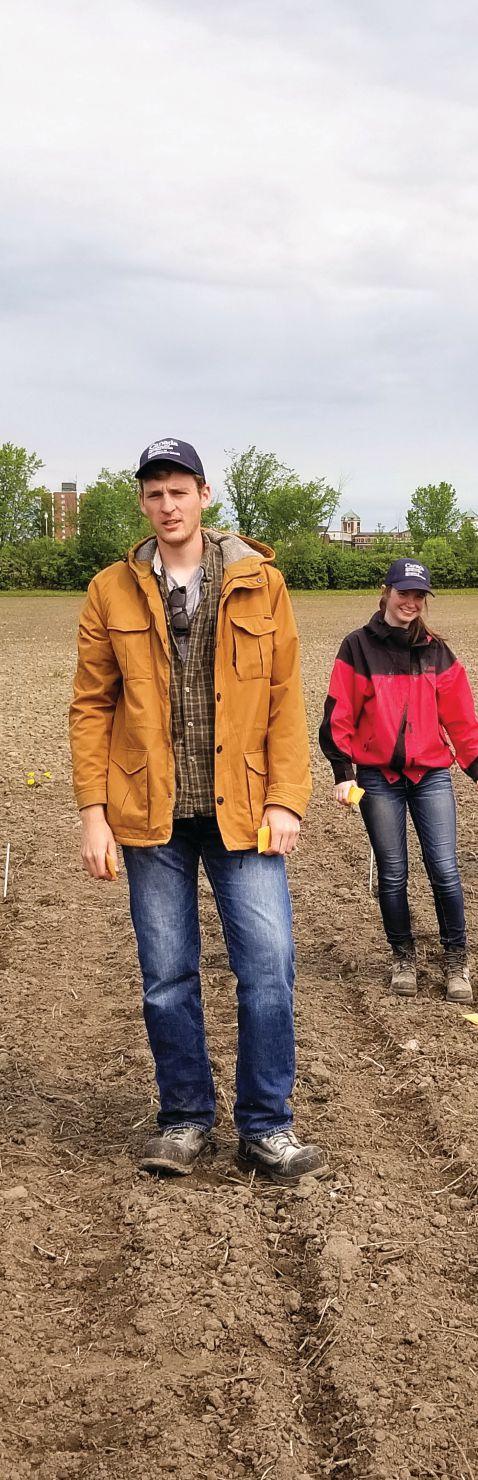
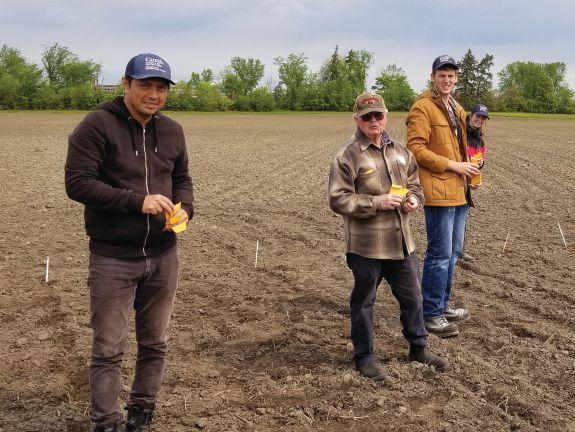
<LEFT: AAFC researchers aim to develop hard red spring wheat germplasm and new varieties that are well-adapted to growing conditions in Ontario, Quebec and the Maritime provinces.
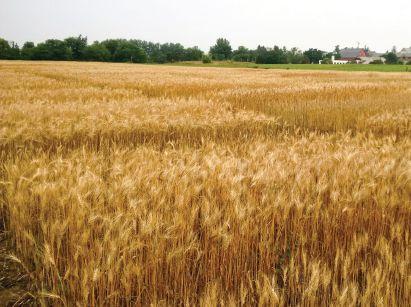
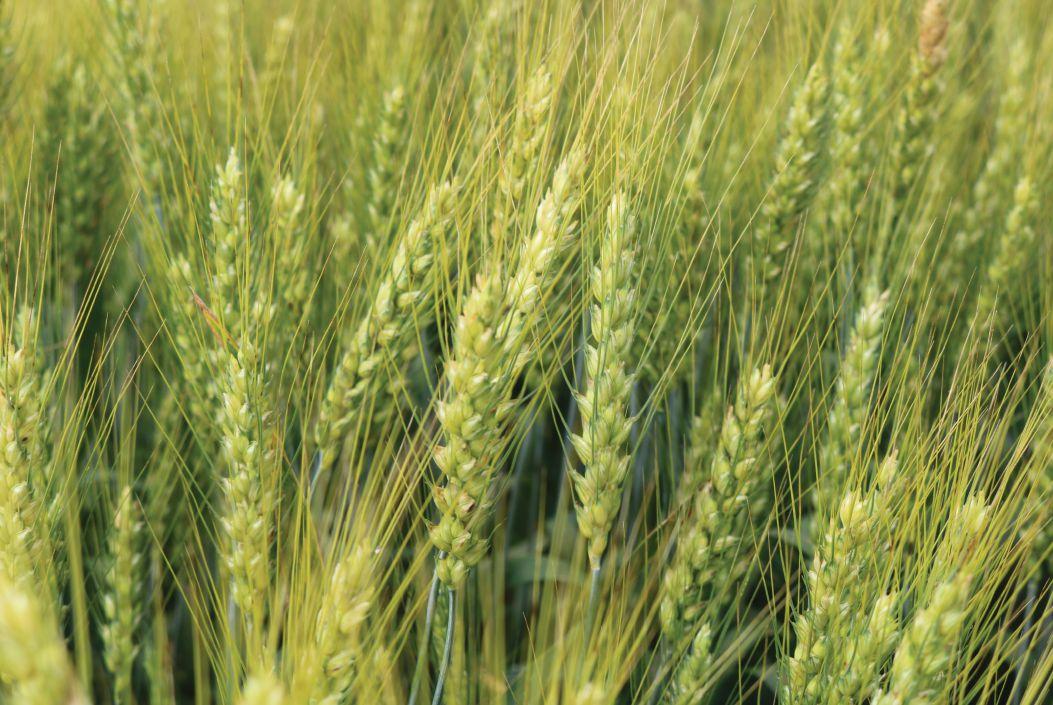
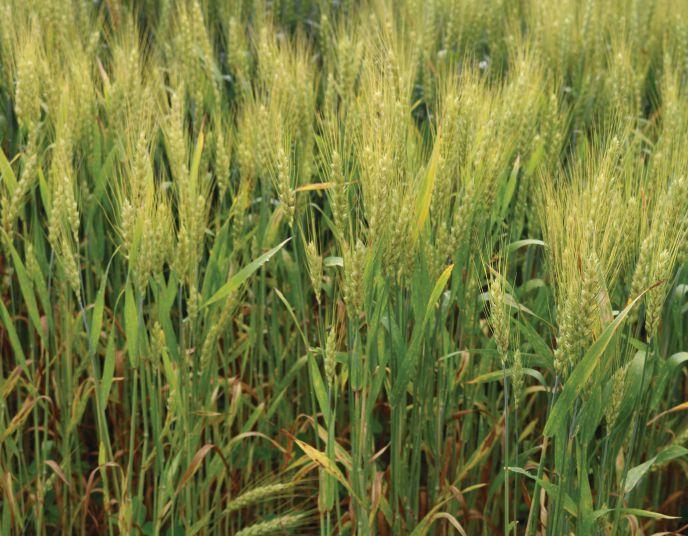
BOTTOM: A hard red spring wheat crop at Agriculture and Agri-Food Canada’s Central Experimental Farm in Ottawa in 2018.
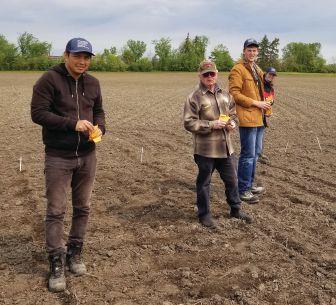
<LEFT: Researchers hand planting hard red spring wheat hills at
Fusarium head blight and powdery mildew.
“Fusarium head blight is the largest concern of eastern Canadian growers. It is a very broad region, but Fusarium head blight is priority across the area,” Burt says, adding that Fusarium head blight pressure is generally higher in the east than it is in Western Canada.
There are a lot more acres of spring wheat planted in the Prairies than Eastern Canada, Burt says, and many more resources dedicated to fighting Fusarium head blight as a result. He’s aiming to take advantage of gains made by breeders there by incorporating Western spring wheat material in his Fusarium head blight resistant lines.
However, it’s a different story for powdery mildew. Burt says that because powdery mildew isn’t really a serious threat to spring wheat crops on the Prairies, there is typically no resistance to that disease in Western Canadian material and unfortunately there will be less incorporation with Western Canadian material in that department.
Burt notes Quebec has the majority of the spring wheat acreage in Eastern Canada, and that there’s a lot of interest there in developing local supply lines of hard red spring wheat with improved milling quality.
“One of the big priorities I have is to improve the quality of the material coming out of my program for the milling and baking industries, similar to what the Western Canadian bread wheats are targeting,” he says. Burt adds his program has already produced one high-yielding hard red spring wheat line with good Fusarium head blight resistance, some powdery mildew resistance and decent milling quality.
The variety, which doesn’t have a name yet, was supported for registration in Ontario last year and there are plans to pursue registration elsewhere in Eastern Canada. “We’re going to bring it forward in Quebec and the Maritimes this year and hopefully put it up for tender next winter,” he says. In addition, his team has another new line going into registration trials this year that is a semi-dwarf variety with good Fusarium head blight resistance.
“Canadian Agriculture Canada material in Eastern Canada has historically been quite tall. A lot of growers here are interested in straw yield, so bringing out semi-dwarf lines that are shorter stature but retain decent straw yield is a priority for me,” he says.
Burt notes several more hard red spring wheat varieties are also in the works, with two that could be ready for registration support in 2020 and another three in 2021.
“The registration trials themselves will probably winnow down those numbers. Indeed, I think it’s in the growers’ interest too that only the best possible varieties coming out of our program get marketed,” he says. “I’m not interested in bringing out three okay lines a year. I’d rather put out one really good one every year or every other year.”
AAFC’s Central Experimental Farm in Ottawa in 2019.
CANADA.
Your better beans are here.
SOYB EA NS
Better genetics. Better yields. Better for your community. Introducing Enlist E3™ soybeans, a more advanced seed with the highest yield potential and a robust herbicide tolerance. Pair it with Enlist Duo™, part of the Enlist™ weed control system, for a better low drift, near-zero volatility solution.
Enlist E3™ soybeans are now available for 2020 planting. Talk to your local seed supplier.
Simply Better Soybeans. Learn more at enlistcanada.ca
Advancing Modern Farming
The Enlist™ weed control system will change how you think about weed management in soybeans. Farmers can NOW purchase Enlist E3™ soybean varieties and take control of resistant and hardto-control weeds.
INTRODUCING THE ENLIST™ WEED CONTROL SYSTEM
The Enlist weed control system will help growers meet the challenge of farming today, and in the future.
Key Benefits of the Enlist weed control system:
• Provides robust crop tolerance to Enlist Duo™, a new herbicide featuring glyphosate and new 2,4-D choline, containing Colex-D™ Technology
• Enables the use of a multi-mode of action herbicide approach against hard-to-control and resistant weeds.
• Includes a stewardship initiative to promote responsible use and sustain long-term performance
ENLIST E3 SOYBEANS
Enlist E3 soybeans provide elite, high yielding soybean genetics and industry leading multi-mode of action herbicide tolerance.
• Enlist E3 soybeans provide robust herbicide tolerance to 2, 4-D, glyphosate and glufosinate
Enlist Duo herbicide can be used in Enlist E3 soybeans with confidence as a pre-emergent or post-emergent herbicide
• Enlist E3 soybeans provide an alternate glyphosate tolerance trait source
• A multi-mode of action program approach is recommended to minimize the potential for the development of resistant weeds. This includes the use of residuals and complementary effective modes of action for pre-emergent and in-crop weed control
• Enlist E3 soybeans are not tolerant to dicamba
ENLIST DUO™ HERBICIDE
Enlist Duo herbicide, a proprietary blend of glyphosate and 2,4-D choline, contains Colex-D™ Technology. Enlist Duo has two modes of action to provide exceptional weed control and herbicide resistance management.
WHAT GOES INTO IT
2,4-D choline with Colex-D Technology Latest formulation science Proprietary manufacturing process
WHAT IT DELIVERS
Near zero volatility
Minimized potential for physical drift Low odour Improved handling characteristics
KEY WEEDS CONTROLLED BY ENLIST DUO
Enlist Duo controls more than 70 weeds, including the toughest to control. Here’s a snapshot of some of the most important.
WEEDS CONTROLLED
Grass Weed Species
• Barnyard grass
• Crabgrass Fall panicum
• Green foxtail Quack grass
• Volunteer barley
• Bluebur
• Volunteer wheat
• Wild oats Wild proso millet
• Yellow foxtail And many more…
Broadleaf Weed Species
• Hemp-nettle
• Buckwheat, tartary & wild Canada fleabane*
• Canada thistle Chickweed
• Cocklebur
• Common ragweed*
• Corn spurry
• Dandelion Eastern black nightshade Field horsetail
• Flixweed
• Giant ragweed*
• Kochia*
• Lady’s-thumb Lamb’s-quarters
• Morning glory Palmer Amaranth
• Red root pigweed
• Smartweed
• Sow thistle
• Velvetleaf Vetch
• Volunteer canola*
• Waterhemp
• And many more…
*Including biotypes resistant to glyphosate and ALS modes of action
A SNEAKY YIELD ROBBER
Root rot research tackles this ornery foe of dry bean crops.
by Carolyn King
Root rot is the number one fungal disease in dry bean, no question about it,” says Chris Gillard, an associate professor of dry bean agronomy and pest management at the University of Guelph’s Ridgetown Campus. As a result, Ontario researchers are working on ways to fight this toughto-control disease.
“Root rot affects at least a small percentage of the dry bean plants in every field in every year, and in some years, the impacts are dramatically worse. The problem is, the disease is happening below ground for the first while, so it is a hidden pest. People don’t realize a problem is starting in the roots.”
“Yield reductions from root rot in dry bean are typically reported to be between about 10 and 33 per cent. But it may be that the disease only affects a portion of a field, perhaps an area that is a little more low lying and wet,” notes Jamie Larsen, the dry bean breeder with Agriculture and Agri-Food Canada (AAFC) at Harrow.
Gillard explains that a complex of several pathogens can cause the disease in dry bean. In Ontario, the main pathogens are Fusarium and Rhizoctonia. “Fusarium causes roughly three-quarters of the problem and Rhizoctonia about one quarter. Both pathogens are present in most bean fields, but Fusarium is much more common than Rhizoctonia, within a field and between fields.”
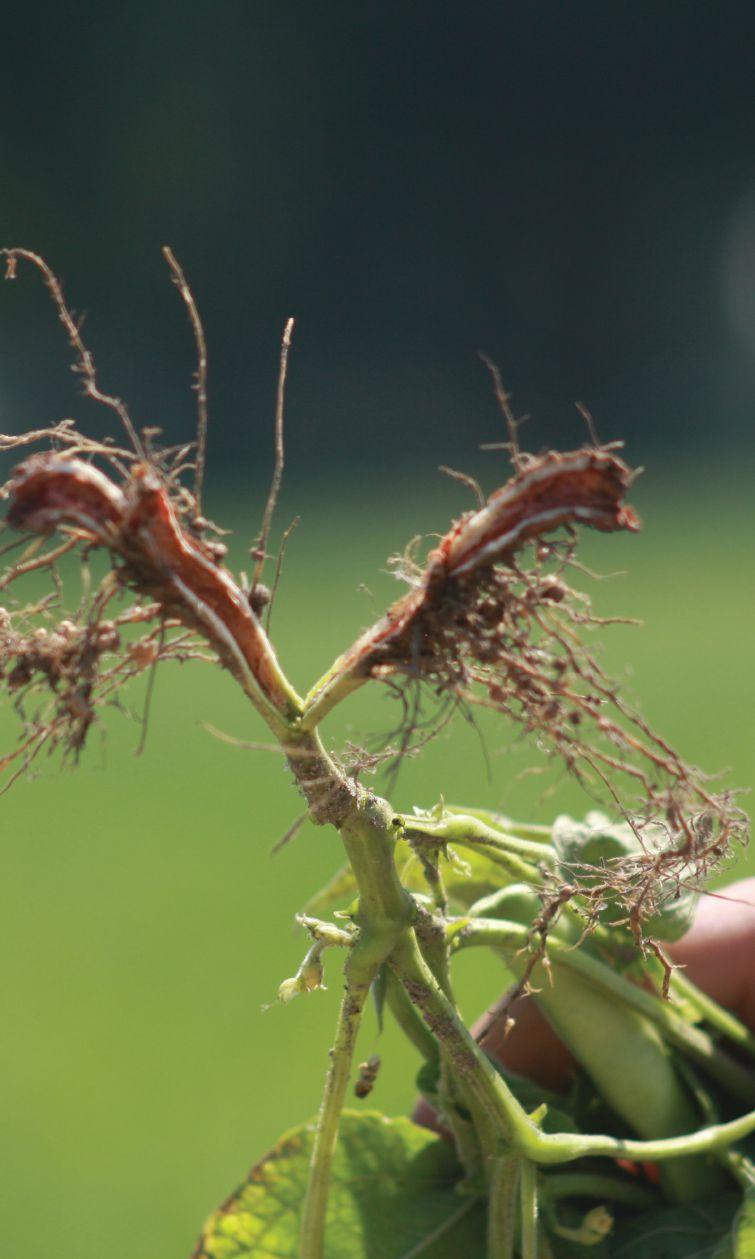
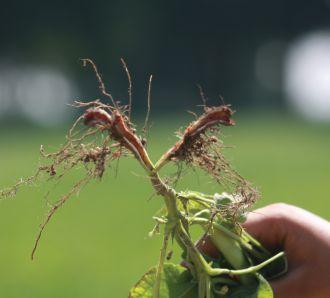
Below-ground symptoms of root rot may include reddish-brown lesions on the roots and root death. Above-ground symptoms may include seedling death, stunting, wilting, yellowing of lower leaves and poor pod filling.
“Root rots can reduce plant stands and decrease plant vigour, causing stunting and slower crop development,” Gillard says. “Cool, wet weather just after planting promotes the initial infection of the plant. Typically, the pathogens don’t kill the plant right off, although they can. Usually, they damage and stunt the root system, but you don’t notice the problem until the weather turns hot and dry in July and August. Then the plant really needs its roots to pump up water to keep the plant healthy and growing, but it doesn’t have the root system to do that. People call Fusarium and Rhizoctonia ‘dry rots’
because the damage to the plant becomes very evident when the weather turns dry.”
He notes, “Soil compaction, poor drainage, and lack of tiling all increase root rot problems. Short rotations with too many bean crops also favour the disease. The pathogens live in the soil from year to year, and their populations will increase over time if you grow susceptible crops more frequently in your rotation.”
Unfortunately, there is no silver bullet for root rot. Gillard says, “There is no product in a jug that is going to solve all your root rot problems. Seed treatments help protect the plants for the first few weeks. After that, you need good crop management, including a whole laundry list of practices: good crop rotations, good soil health, high organic matter, and good drainage. If you’ve got a healthy, productive, well-managed soil with minimal compaction, you will have a lot less problems with root rot.”
Larsen adds, “From what we have seen, no dry bean lines in Ontario are resistant to root rot. Some lines have lower levels of the disease, but just marginally lower. For instance, some of the black beans in our testing seem to have a little less root rot, but we’re not sure exactly why.”
Seed treatment evaluations
Gillard’s research group conducts root rot seed treatment trials every year, which include both standard seed treatments and the latest products on the market. This work is providing a long-term dataset on the efficacy of these products, for the use of bean growers and agronomists. Current funders of this research include the Ontario Bean Growers (OBG) and AAFC through the Canadian Agricultural Partnership (CAP).
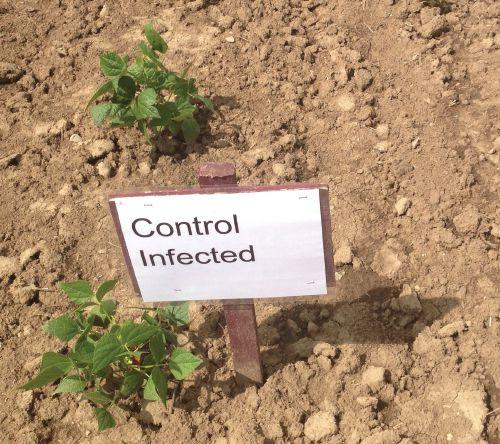
In these trials, all the plots, including the control plots, are inoculated with a root rot pathogen. One set of plots is inoculated with two different rates of Fusarium, and the other set with two
ABOVE: Hybrids exhibit different reactions to Goss’s wilt, with brown plants severely affected.
different rates of Rhizoctonia. The inoculum is placed in the seed furrow so the pathogen can potentially attack as soon as the seed starts to germinate.
“The soil at the testing site already has a native root rot pressure, and we add extra disease pressure by inoculating our trials. We want high disease pressure because dry bean is remarkably plastic when it comes to plant stands,” he explains. “In separate plant population/ row width studies, we have found that we can reduce dry bean plant stands by 40 per cent and not get a yield impact, all other things being equal. So we have to apply enough disease pressure to reduce the stand of the infected control by at least half, because we know it will take a 50 per cent reduction in the stand to give a yield impact at the end of the day.”
For these trials, Gillard’s group uses small, two-row plots, where each row is two metres long. “We know exactly how many seeds we put in the ground, so we have highly accurate stand counts and plant vigour data, which are crucial for seed treatment studies.”
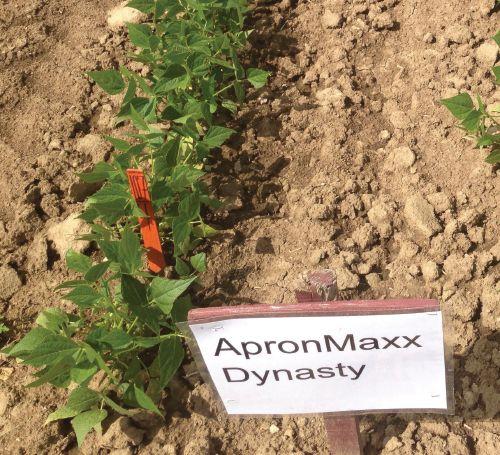
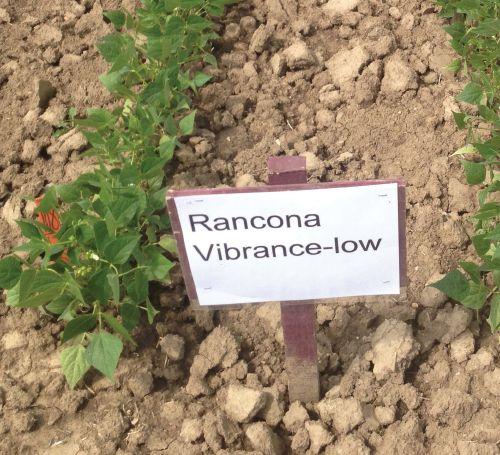
The trials reflect the treatment practices commonly used by bean growers. “Dry bean production in Canada is almost 100 per cent certified seed use, and it is not uncommon to see four- or five- or six-way combinations of seed treatments on dry bean seed. Everybody is using Cruiser Maxx Bean, a seed treatment that has been used on dry beans for about 15 years. [This product includes the fungicides Maxim (fludioxonil) and Apron (metalaxyl) and the insecticide Cruiser (thiamethoxam).] And almost everybody has Dynasty (azoxystrobin), which is based on our research showing its effectiveness on anthracnose, a seed-borne fungal pest. Some seed lots also have the fungicide Vibrance (sedaxane). Rancona (ipconazole) was
Farmers: safely dispose of unwanted or obsolete agricultural
Take them to the following locations on the dates noted
ONTARIO
9 a.m. to 4 p.m.
AILSA CRAIG
September 24
Hensall District Co-op 519-232-4449
BRADFORD September 24 Bradford Cooperative Storage 905-775-3317
BRODHAGEN September 26
Hoegy’s Farm Supply Ltd 519-345-2941
COBDEN September 25
MacEwen 613-646-2519
COBOURG October 1
Northumberland Grain Cobourg 519-839-4861
COTTAM September 30 Agris Cooperative 519-839-4861
Courtland September 26 Courtland Agromart 519-688-2151
DRAYTON September 25 FS Partners 519-638-3026
GLENCOE September 25 Agris Co-operatives Ltd 519-287-3434
HANOVER October 1 Sprucedale Agromart 519-364-4070
HARRISTON September 27 North Wellington Co-op 519-338-2331
HICKSON September 27 Oxford Agropro Ltd 519-462-2721
JORDAN STATION September 27 Vineland Growers Co-operative Ltd 905-562-4133
LINDSAY October 1 Alliance Agri-Turf 705-324-7761
LUCKNOW September 24
Lucknow District Co-operative Inc 519-529-7953
just registered in Canada for the 2018 crop year, and is now added to some seed lots.”
In Gillard’s trials, the seeds in the control plots only have a Cruiser treatment, while all the others have seed treatments that include fungicides. “We start with a basic treatment of Cruiser Maxx Bean, and then add other products and look at the additive effect. For instance, we would look at the effect of adding Dynasty to the Cruiser Maxx Bean, or Vibrance on top of Dynasty to the Cruiser Maxx Bean, and so on. We get up to six- or seven-way combinations.”
He notes, “We don’t get a lot of new seed treatment products coming in, but when we do get new products, we add them into the mix to see what additive effect they provide. We also test products that are registered in Canada on other pulse crops, like EverGol Energy (penflufen, prothioconazole and metalaxyl) and Insure Pulse (pyraclostrobin, fluxapyroxad and metalaxyl). Since such products are already registered for other pulse crops, it wouldn’t be hard to add dry bean to that list, if we see some benefit on dry bean.”
The detailed trial results are available online in Gillard’s annual research reports. He summarizes, “[In years when conditions favour root rot], the effect of seed treatments can be huge. In other years, you can’t really tell the treatments apart from the control. This year was a good example of that. Planting was delayed due to the cool, wet spring, but after we finally planted, the weather turned hot and dry, which reduces the threat from root rots. So the plant stand differences between the untreated and treated plots were relatively small and differences in plant vigour disappeared quickly.
“In a year with good conditions for root rot, we typically see a difference between fungicidal seed treatments and no fungicidal
MELANCTHON September 30 Holmes AgroRedickville 519-925-3138
MILLGROVE September 20 Holmes Agro –Flamborough 905-659-0073
PAIN COURT September 27 Thompsons Limited Pain Court 519-354-5900
RIDGETOWN September 23 South West Ag Partners 519-674-5491
SCOTLAND September 25 Scotland Agromart 519-446-2218
SELBY September 26 TCO Agromart Ltd (Napanee/Selby) 613-354-4424
ST-ISIDORE September 20 La Coop Unifrontière 613-524-2828
STOUFFVILLE September 23 St Lawrence Grains & Farm Supply 905-640-2260
THORNLOE September 23
Temiskaming Ag Centre 705-647-6639
VERNER September 24 Co-op Regionale de Nipissing-Sudbury 705-594-1268
WALLACEBURG October 1 SouthWest Agromart 519-627-1491
WINCHESTER September 30 Agri-Partners Crop Centre Ltd 613-774-2209
WYOMING September 26 Wanstead Farmers Co-op 519-845-3301
NORTHERN ONTARIO
10 a.m. to 3 p.m.
EMO September 9-20 Emo Feed Service 807-482-2017
SLATE RIVER
September 10-20
Thunder Bay Coop 807-475-5190
NEWFOUNDLAND 10 a.m. to 3 p.m.
FOXTRAP October 15
Department of Transportation and Works Depot
LEWISPORTE October 16
Department of Transportation and Works Depot
DEER LAKE
October 17
Department of Transportation and Works Depot
seed treatment up to 30 to 35 days out from planting. By that point, plant vigour and health generally recover, but the stand loss doesn’t recover, and of course, the plants can rapidly go backwards if the weather turns dry.”
Gillard also says, “We don’t always see a response from the addon products, but we typically see more consistent results as we add more products. So we may not see an increase in emergence when we add Vibrance to the seed, but when we do see a response it is a positive response.”
Typically, for about the first 10 days to two weeks after planting, the seed treatments will bring the pathogen populations down to the levels in the non-inoculated soil. He notes, “You can only expect seed treatments to really protect the plant for about 14 to 21 days. By that time, the root system has grown beyond the zone of influence of the seed treatment and the seed treatment itself is breaking down.”
Several of Gillard’s other research studies also have related to root rot. For instance, his research group recently completed a study looking at the effect of soil health on dry bean growth and development. “The single biggest factor that we measured that had the biggest impact on crop growth was soil compaction, which doesn’t come as a surprise.”
His group has also conducted several nitrogen fertilizer studies. Fertilizer may improve the yield in a field affected by root rot, but it doesn’t treat the disease. Gillard says, “A lot of growers use nitrogen to help combat root rot, but we only measured a significant yield response about half the time or less. We get a response to nitrogen fertilizer up to about 50 kilograms per hectare; there is not a benefit to going higher than that.”
Seeking root rot resistance
Larsen, who started as AAFC-Harrow’s dry bean breeder in 2018, includes root rot as one of the disease resistance priorities in his breeding program. He says, “Dry bean varieties with stronger root rot resistance would improve yields and provide greater yield stability and predictability. They might also allow growers to expand their bean production back into certain fields that have had problems with root rot in the past.”
However, developing root rot-resistant varieties is an uphill battle. “Resistance to root rot in dry bean is a quantitative trait, meaning that lots of genes are involved. Some genes may provide a little more resistance than others, but we don’t know which ones. To develop a line that is truly resistant – to get all those root rot resistance genes together in a package that also meets the class, quality and yield guidelines and has everything else growers look for – is challenging.”
AAFC-Harrow’s root rot nursery provides the root rot ratings for Ontario dry bean varieties. Larsen says, “We run the registration performance trials and also test some of the advanced lines from our breeding program and the University of Guelph’s breeding program.”
This nursery has been operating since 1979. At that time, the soils were inoculated with three root rot species: Fusarium solani, Rhizoctonia solani, and Pythium ultimum. Since then, the nursery has had continuous dry bean production, with no crop rotation, to ensure high levels of inoculum in the soil. Also, irrigation is applied to the plots to promote the disease. A few years ago, Debra McLaren, a research scientist at AAFC-Brandon, tested samples from the nursery and found those three pathogens are still present in the soil at significant levels and still causing the disease in dry bean plants.
Gillard’s trials show seed treatments can make a huge difference when conditions really favour root rot.
PHOTOS COURTESY OF CHRIS GILLARD.
Larsen has examined the varietal data from the nursery for 2009 to 2018. “We found no trend at all towards improved root rot resistance in the varieties tested over that time period.” This underscores how difficult it is to improve root rot resistance. The data also showed that root rot symptoms occur every year, but they are more severe in some years, which is likely tied to year-to-year differences in soil moisture and temperature.
He is currently working with Owen Wally, the pulse pathologist at AAFC-Harrow, on a major project to improve disease resistance in dry bean. The project includes: studies on bacterial blights (common bacterial blight, bacterial brown spot and halo blight); Harrow’s ongoing operation of nurseries for root rot, white mould and common bacterial blight; and development of molecular markers to screen for disease resistance genes and development of dry bean lines with improved disease resistance. This research is funded by OBG and AAFC through CAP.
“Work by dry bean breeders to develop root rot-resistant lines goes back into the 1980s,” Larsen notes. “Several lines classified as being resistant have been developed, and some of those lines have been incorporated into our breeding program, and sometimes we see lines with reduced symptoms resulting from using those lines as parents. Our plan is to ramp up that work.”
For example, in the past, the nursery planted dry beans in long rows and then selected five plants randomly to rate for disease levels. Now Larsen and Wally are using hill plots, which make the plant distribution more compact, so the researchers have more space for testing more dry bean plants. They will also be putting a greater focus on testing the offspring of lines with root rot-resistant parents.
Wally and Larsen are also trying to develop more efficient ways
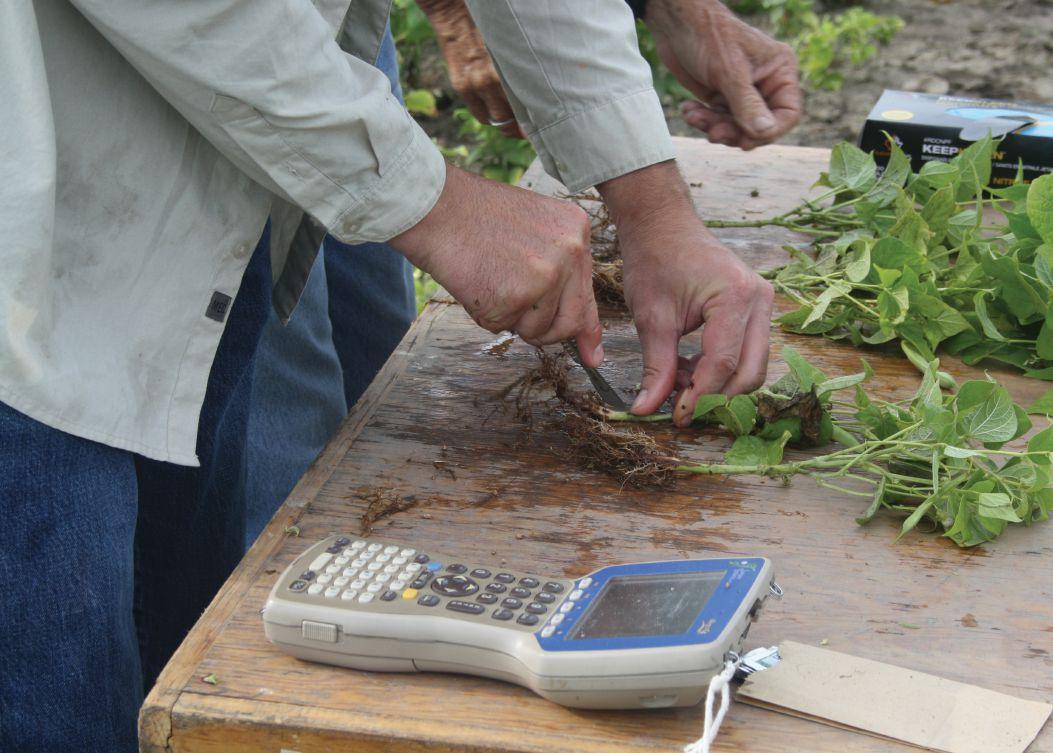
to rate very large numbers of plants for resistance to root rot. “Currently, root rot screening is a lot of work. You have to grow the plants in the field, dig them up, wash the roots, and slice every single plant individually with a scalpel, in order to do the disease rating. Obviously, as you have more breeding material, that becomes a much more daunting task,” Larsen explains.
“We will continue to do the root rot rating that way, but we will also be exploring other possible methods. For instance, we are going to try using canopy temperature to screen for root rot. We suspect that plants where the roots have been damaged by root rot might have a higher canopy temperature because they can’t draw as much moisture out of the soil, so they won’t be transpiring as much and therefore their canopy will be hotter.”
Larsen and Wally have started some preliminary work on this approach. They will be experimenting with various ways to measure the canopy temperature, such as using a drone with an infrared (heat sensing) camera and using infrared thermometer guns. And they will be collecting data to see if canopy heat is related to root rot levels and if measuring the canopy temperature might offer an efficient, accurate way to quickly screen a lot of breeding material.
The researchers are also planning to try a protocol developed at North Dakota State University for laboratory screening of dry bean lines for root rot. Larsen notes, “This protocol involves inoculating the seedlings with a root rot pathogen just as the seedlings are coming out of the ground in that hook stage. This early inoculation allows you to screen material very early so you don’t have to wait many weeks until the plant is fully grown.”
When conditions favour root rot, this disease can be a tough enemy for dry bean growers. Ongoing research is working to find more effective strategies to help growers fight back.
Root rot screening currently requires slicing the roots by hand. Larsen and Wally will be looking for more efficient screening methods.
PHOTO
SOIL AND WATER
TOWARDS HEALTHIER SOILS
Assessing cropping systems in the Maritimes to enhance soil productivity and resiliency.
by Carolyn King
An ambitious project is providing comprehensive information on soil physical, biological and chemical properties for agricultural producers in Nova Scotia and Prince Edward Island, and developing tools to help these producers make more informed decisions on how to enhance their soil health and productivity.
“Producers have always been interested in their soil health,” notes Derek Lynch of Dalhousie University who is co-leading this project with his colleague David Burton. “There is a lot of interest in this project and the development of a regionally relevant soil health framework and tools.”
Lynch explains that, across North America, agricultural scientists and others are using soil health frameworks for monitoring and measuring the effects of different practices on soil properties. That’s because soil health is such a crucial issue – for agriculture, for rural landscapes and for climate change. Healthy soils perform vital functions like nutrient retention and cycling, water infiltration and storage, and suppression of crop diseases, weeds and insect pests. These functions not only support healthier crops, but also enable the landscape to better tolerate extreme weather conditions and help reduce greenhouse gas emissions.
However, soil health frameworks aren’t one-size-fits-all. For instance, the priority of particular soil health issues tends to vary from region to region. In one region, soil compaction might be the most pressing concern. In another region, it might be soil-borne crop diseases. In yet another, it might be low soil nutrient levels.
So Lynch and Burton are working to develop a soil health framework that is specific to P.E.I. and Nova Scotia.
“In some ways, the Atlantic region is particularly prone to risks of soil quality degradation because of the combination of shallow, coarse-textured soils and sloped land,” Lynch says. “As well, some agricultural sectors here have fairly intensive production. These intensive systems are part of an overall trend across eastern Canada of having fewer acres in forage and pasture production, and more acres in short rotations and low-residue crops. Potato production is a classic example in the Maritimes but it isn’t the only example.”
The project, which runs from 2016 to 2021, aims to assess the effects of different cropping systems, management practices and soil types on soil health, soil carbon storage capacity, and soil nitrogen supply. The project is collecting soil health data from farm fields and research plots across the region, analyzing the samples, building a database, and conducting multiple studies that are approaching soil health considerations from different angles.
“Soil health, soil carbon storage capacity, and soil nitrogen supply are closely related to each other. But some project aspects are primarily focused on soil carbon, which I’m leading, and some aspects are primarily focused on soil nitrogen supply, which Dr. Burton is leading.
Soil health is the umbrella that links the two,” Lynch explains.
He highlights a few examples of the project’s studies. “With soil carbon, for example, we’re looking at existing models that say the potential for soil carbon storage is enhanced as silt and clay content goes up, and we’re asking: do those models apply to our primarily coarse-textured soils? Or is the potential for soil carbon storage in this region much more driven by dynamic properties [which are affected by agricultural practices] rather than inherent properties [like soil texture]?
“Another example of what we’re looking at is: how low can we go with soil carbon? Soil carbon is declining in certain cropping sectors here, so is there a tipping point below which we get a wider impact on soil health?
The project will develop tools to answer growers’ questions like: would adding soybeans to my rotation add enough residue to enhance my soil’s health?
TOP CROP
MANAGER
BREEDING FOR MORE EFFICIENT PHOSPHORUS USE IN WINTER WHEAT
Two
hundred winter wheat lines will be put to the test to breed more efficient varieties in the future.
by Stephanie Gordon
AUniversity of Guelph research study is looking into breeding for phosphorus use efficiency (PUE) in winter wheat and is currently starting the second stage of its research.
Phosphorus (P) is the second most limiting nutrient in wheat production and commercial phosphorus fertilizers can be costly. Phosphorus runoff also causes eutrophication of important water sources, such as Lake Erie. All of these facts combined became the motivators for the PUE study.
Kaitlyn Sjonnesen is a graduate student at the University of Guelph currently working on the PUE study. The project’s main goal is to develop tools and strategies for breeding phosphorus use efficiency in winter wheat. By uncovering tools to breed varieties that perform well under phosphorus deficient conditions, the study results can help boost wheat production, reduce input costs, and minimize phosphorus’ impact on the environment.
“There has been relatively little work done in wheat in this area, which is why we are not only aiming to study the genetic
basis for traits associated with PUE, but we are studying the heritability of these traits and assessing their feasibility for selection,” Sjonnesen says.
The study used 200 lines of winter wheat, which represent the historic and geographic diversity of winter wheat grown in Canada. In each field experiment at the Elora Research Station in Elora, Ont., each line was grown under low phosphorus conditions and adequate phosphorus conditions. The adequate phosphorus conditions were created by applying a treatment of mono-ammonium phosphate to a phosphorus deficient field.
Within the two phosphorus scenarios, Sjonnesen explained they hope to see variation in the performance of the winter wheat lines from winter survival to yield components. An observable difference among wheat lines will allow the team to run a genome wide association study (GWAS) to uncover
ABOVE: The second stage of the project will study the panel of 200 wheat lines for traits that are associated with superior phosphorus uptake efficiency.
PHOTO BY STEPHANIE GORDON.
genetic regions associated with phosphorus use efficiency.
Overall, the experiment hopes to identify wheat lines that perform well in phosphorus deficient conditions. Then, through closer analysis, the team can identify traits that are related to PUE and determine the genetic basis for good PUE.
Early results
The study is still in the middle of its first year of field experiments, but there have been some promising observations. “So far, we have evaluated the Elora Research Station field for winter survival and days to heading,” Sjonnesen starts. “No firm analysis has been run yet, but we are excited to see that there is prominent variation in how the lines respond to the phosphorus treatments.”
In some lines, heading in the low phosphorus plots was not delayed when compared to the adequate phosphorus plots. However, in other lines, heading was delayed by several days.
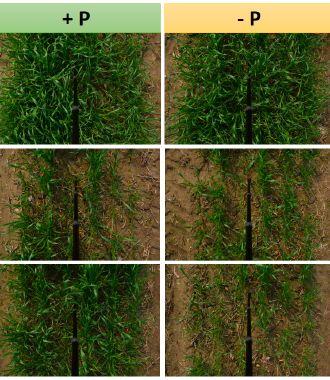
When comparing winter wheat in terms of winter survival, there was some variation between lines. Sjonnesen shared images of three different winter wheat lines at the University of Guelph’s Wheat Breeding Field Day. In the images, the first wheat line showed good performance in low and adequate P conditions. The first line demonstrates good PUE and had overall good winter survival compared to other lines, so in conclusion, it’s a desirable line.
The second wheat line performed the same in low and adequate P conditions, but it demonstrated poor winter survival. So while the second winter wheat line could have good PUE (no noticeable difference in performance in low and adequate P conditions), its poor winter survival performance doesn’t make it a desirable line.
The third wheat line showed good survival in adequate P conditions, but poor survival in low P conditions. The considerable difference in performance means the line has poor PUE in the context of winter survival. However, the varied response among lines is good because the variation will help the team detect genomic regions that are responsible for PUE during the GWAS stage of the project.
“While we’re getting a glimpse of [variation in lines] now, we will have to wait until additional replications are complete before we can draw conclusions,” Sjonnesen says. “More replications are important, especially considering the winter and spring we had.”
The second stage of the project
The second stage of the project will study the panel of 200 wheat lines for key root traits that are known to be associated with superior phosphorus uptake efficiency.
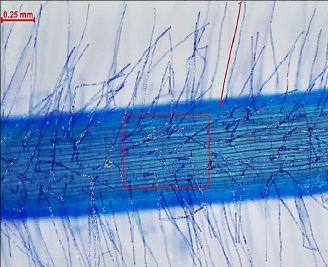
“Understandably this is a challenge, especially with imitating field conditions,” Sjonnesen starts. “We are currently working on our protocol to efficiently grow and assess all 200 lines. The traits we are particularly interested in are seminal root growth angle, root hair length
and root hair density.”
To study the traits of interest, the team will image the roots and then use software to measure the traits of interest. The phenotypic data – for the full panel of 200 wheat lines – will be included in the GWAS analysis to uncover genomic regions associated with these traits.
The team is continuing the study and in the process of running analysis on harvest data collected over the summer. The project team plans to plant another field in Elora, as well as a second location nearby in Belwood, Ont., in the fall. “I’ll be hoping along with anyone else planting winter wheat that we’ll have a more favourable winter than last year,” Sjonnesen adds.
Once the study is completed, breeders can use the results to better breed winter wheat varieties that perform well under phosphorus deficient conditions and have better phosphorus use efficiency.
The varied response among wheat lines in +P and -P conditions will help the team better identify genomic regions that are responsible for good phosphorus use efficiency.
This magnified root image shows the quality and magnification of images that will be used to measure root hair traits.
PHOTO BY STEPHANIE GORDON.
SUPPORTING STEWARDSHIP IN ONTARIO
Producers can take advantage of available funding to implement more sustainable improvements on the farm.
by Julienne Isaacs
The Canadian Agricultural Partnership program is once again supporting Ontario farmers looking to enhance environmental stewardship on the farm.
The program, which began in 2018, is a five-year partnership between the federal, provincial and territorial governments to boost Canada’s agribusiness sectors. Projects are supported under three main categories: economic development, protection and assurance and environmental stewardship.
The latter category supports projects related to water quality and soil health, with recognized co-benefits to pollinator habitat and climate change.
Environmental stewardship project categories include nutrient management and soil health planning, cover crops, riparian buffer strips, windbreaks and wind strips, fragile land retirement, adding organic amendments to soil, and equipment modifications to reduce soil compaction, among others. Costshare typically ranges from 40 to 50 per cent for each project. A full list of project categories is available via the Ontario Soil and Crop Improvement Association (OSCIA) website.
Funding is allocated based on merit. This represents an improvement over the firstcome, first-serve model, especially for programs of this scale, says Warren Schneckenburger, a Morrisburg, Ont. farmer and third vice-president of OSCIA.
Schneckenburger’s operation has been approved for several Partnership projects in the past. On the last intake, Schneckenburger received project funding to upgrade the tires on his fertilizer cart to very high flexion (VF) radials, which reduced soil compaction by nearly half on his operation, he says.
In the Partnership’s very first intake in Ontario, Schneckenburger applied for cost share funding to help finance cover crop
seed. In another intake, he modified a selfpropelled fertilizer sprayer, adding a spinner spreader capable of broadcast-planting a cereal rye cover crop.
He says producers typically see less than 50 per cent matching through the Partnership program, so producers do make a significant up-front investment to cover projects.
But Schneckenburger says it’s in their best interests to instigate environmental stewardship projects when funding is available. “I believe it is well worth any producer’s time in Ontario,” he says. “On my operation, it’s been worth our time to participate in Partnership programming.”
and fertilizer equipment. This year, Haerle went through the same application process to improve his cover crop application tools. Cost share allocation for each of the two projects was about 40 per cent, he says.
“So over a two-year time span we put multiple things in place on our farm that we wouldn’t have done as quickly without the funding,” he says.
He’s midway through a third project replanting trees on sensitive land; this project was eligible for a 50 per cent cost share. “This project gives us a good incentive to get trees on those areas that are too wet or shouldn’t be farmed or are dead corners,” he says.
“Over a two-year time span we put multiple things in place on our farm that we wouldn’t have done as quickly without the funding.”
It’s not always easy to evaluate the immediate benefits—when, for example, the goals have to do with reducing erosion, improving soil health or boosting water quality. But Schneckenburger says he’s measurably improved soil compaction on his operation via the VF radial tire project.
When it comes to cover cropping on his farm, Schneckenburger says the sprayer modification has paid off in time and efficiency: he can plant up to 750 acres a day. “This year we covered all of our corn land and did that without working crazy hours.”
Markus Haerle, who farms near St. Isidore in Eastern Ontario, is the chair of Grain Farmers of Ontario. He applied for the first round of Partnership program funding in 2018 to add variable rate application systems on his operation’s planters
Partnership funding does require some paperwork and a lengthy application process, but Haerle and Schneckenburger say it’s worth it.
Karen Jacobs, program coordinator for OSCIA, says applications are accepted during a given intake window, and all projects receive a decision letter on the same day.
“Don’t get too discouraged by the application process,” Haerle urges. “Usually you get a response within a few weeks. Time spent on the application shouldn’t be a reason not to apply.
“It’s time that we as farmers step up and get engaged within those programs because they showcase the fact that farmers are doing positive things for the environment, and they show society that we are giving something back,” he says.
OPERATION POLLINATOR ON ONTARIO FARMS
Growers are helping bees and butterflies – and soil health, crop production, biodiversity and landscape sustainability.
by Carolyn King
Acollaborative, on-farm program to help pollinators has now expanded from Western Canada into Ontario. Launched in spring 2018, the Ontario program was already fully subscribed by April for the year. With sites dotted across the province, Operation Pollinator’s On-Farm Program is creating a buzz as growers convert lower productivity areas on their farms into bee and butterfly havens.
“Operation Pollinator is a Syngenta program focused on research and partnerships to promote the health and well-being of bees and other pollinators. The program’s mandate is to support activities that enhance biodiversity, habitat and other practical initiatives that can contribute to healthy pollinator populations,” explains Paul Hoekstra, senior stewardship and policy manager with Syngenta Canada.
In Canada, Operation Pollinator includes off-farm components – such as partnerships with academic institutions and an initiative with more than 60 golf courses – and its On-Farm Program.
Multiple benefits
To implement the On-Farm Program, Syngenta is partnering with the Soil Conservation Council of Canada (SCCC) and provincial delivery agents. The program’s goal is to establish and maintain pollinator-friendly habitat, study and learn from these sites, and enhance biodiversity for the benefit of the larger ecosystem.
“Research has shown that conservation efforts such as the creation of habitat are key to maintaining and increasing pollinator populations,” Hoekstra says. In agricultural landscapes, these insects pollinate many fruit, vegetable and oilseed crops, as well as plants that provide food for wildlife. In addition, pollinator habitat can also be habitat for insects that are natural enemies of crop pests.
“To enrol in the program, growers agree to convert one to two acres of land that they consider to be of lower productivity to a dedicated Operation Pollinator site,” he explains. “They are provided
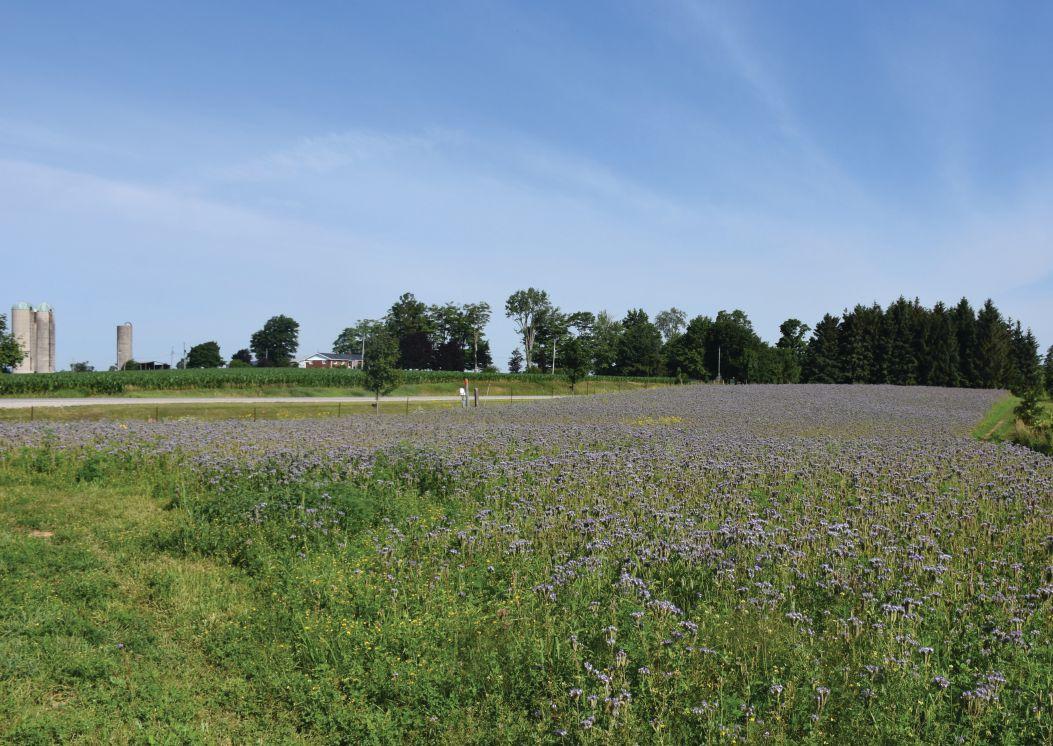
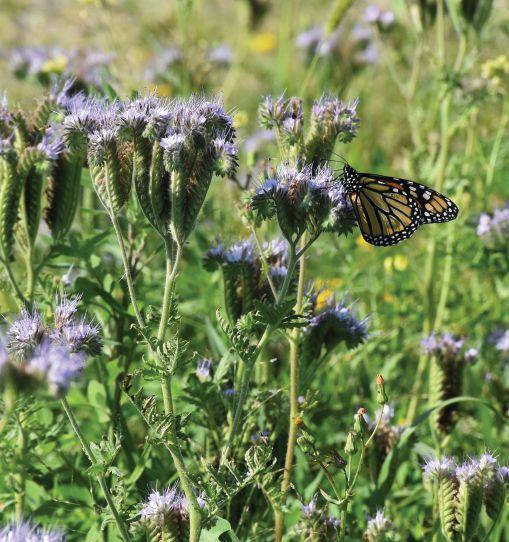
ABOVE: The Hutchesons’ Operation Pollinator site, with its beautiful purple-flowered phacelia, attracted the interest of neighbours.
with a commercial-grade seed mix that supports habitat and forage for bees and other pollinators. And the growers are given some agronomic information, some small financial assistance to support site preparation and maintenance, and signage for the site.”
The seed mix is tailored to provide high-quality nutrition to pollinators. It is mainly composed of long-flowering perennial plants so the sites offer an ongoing source of pollen and nectar. As well, the mix is designed to enhance soil health; it provides cover to prevent soil erosion, adds organic matter to the soil, and feeds the soil microbial community. For instance, the mix includes legumes, which not only fix their own nitrogen but also have protein-dense pollen that helps in bee development.
Hoekstra notes, “It takes a number of years for the sites to become fully established so we are encouraging farmers to work with our provincial partners to help ensure these areas are maintained for this purpose.”
SCCC partnered with Syngenta for the On-Farm Program because it aligned with their mandate of soil health and conservation. “The program targets lands that are less desirable for regular crop production, and those lands usually need more protection from erosion. There is also a benefit in terms of removing carbon from the atmosphere,” SCCC executive director Jim Tokarchuk explains.
“The program struck us as being really consistent with improving and sustaining the agricultural landscape. In our view, the agricultural landscape is not just about raising livestock and crops. Many other people and many other species use that same landscape. This program really brings in a lot of other aspects of use on the landscape.”
First the west, now Ontario
Operation Pollinator’s On-Farm Program was launched in Western Canada in April 2017. The provincial delivery partners, which helped sign up participants, were the Agriculture Research and Extension Council of Alberta, Saskatchewan Soil Conservation Association and Manitoba Conservation Districts Association.
“We’re very pleased with the strong interest and uptake in the program,” Hoekstra says. “The response has been extremely positive with great feedback. The program was fully enrolled, with 100 farmers in Western Canada: 38 in Alberta, 28 in Saskatchewan and 34 in Manitoba.”
Tokarchuk notes, “Weather-wise, the program in Western Canada has had some challenges. A number of places on the Prairies in the last couple of years have been very dry, so a few sites had difficulty establishing the plant stand. But we had very good results in most of the Prairies. We have seen some really brilliant examples of ravishing stands of flowers.”
The Ontario delivery partner is the Ontario Soil and Crop Improvement Association (OSCIA). “Syngenta approached OSCIA to work on Operation Pollinator because of our vast network of member producers and our experience in cost-shared program delivery across the province,” explains Angela Straathof, OSCIA program director.
“And we saw the opportunity to bring more environmentally focused education and research opportunities to Ontario producers. This is also an opportunity to work with SCCC and Syngenta, and to expand our program repertoire into experience with pollinators. Producers and the public are becoming increasingly curious about the risks and risk mitigation for pollinators.”
A better cover crop in Grand Valley
“On our farm every year we plant cover crops. So when we learned about Operation Pollinator, we thought this would be a great opportunity for us to do what we were going to do anyway but would have the added benefit of providing habitat for bees and helping the bee and butterfly populations,” says Stacy Thompson.
On the Thompsons’ farm, which is in Grand Valley, they grow corn, soybeans, winter wheat and alfalfa, plus a cover crop. They also do some custom meat packages for a small clientele base.
One of her responsibilities on the farm is to look after a six-acre field for vegetable production. Each year, she plants vegetables on two acres and a cover crop on the other four acres. In 2018, she planted two acres of the cover crop area to the pollinator seed mix. Those two acres are next to the banks of the Grand River, which runs through their farm.
“Initially, I thought the seed mix was going to be a bunch of different flowers, but in fact it was clovers and different types of grasses. So I didn’t think it was going to be anything too magnificent. But I drove down there one day with the ATV, and it was just amazing – I could not believe how many bees and butterflies were there,” she says.
Thompson has really enjoyed taking part in the program. She hopes it will continue so other farmers can participate.
A honey of a site near Ingersoll
The Ontario participants come from a wide range of commodity groups. In 2018, the program enrolled 31 producers, a few of whom had more than one site. The 33 sites encompassed a total of 50 acres. Despite the dry summer, many of the sites had good germination and growth.
Syngenta and OSCIA are continuing the Ontario program in 2019, with 20 new producers and 34 additional acres enrolled. OSCIA got helpful feedback from the 2018 participants on how to improve the program for 2019. For example, some growers asked for more information on seeding and site preparation. Also, the seed mix shipments were delivered in May or June, and some growers with the later deliveries had difficulty getting good germination, given the dry conditions. A few of the growers decided to wait until 2019 to plant their seed mix on their site. So, OSCIA will be sending out the seed shipments a bit earlier, and those shipments will include more information on seedbed preparation and seeding rates.
Straathof adds, “The most exciting change for 2019 is that we’ll have a 100 per cent Ontario native seed mix that will also emphasize monarch butterfly breeding. This will be provided in partnership with St. Williams Nursery and the Pollinator Partnership.”
For producers who participate in Operation Pollinator, she sees both direct and indirect benefits, including the seed mix, the $100 per acre payment to help offset site establishment costs, and the potential for greater crop pollination.
Tokarchuk points to another direct benefit: “The program has also allowed some producers to take some less productive land out of production, which has lowered their costs a little or reduced other problems. For instance, some of the sites are oddshaped areas where it is difficult to turn machinery or where equipment gets stuck.”
However, he says, “I think the biggest benefit that I saw as I visited some of the farms is a pride of stewardship in many participants. The program has helped foster the stewardship ethic that so many farmers across Canada have.”
“I saw the ad in the paper about Operation Pollinator, and I had a little chunk of land that was kind of a nuisance to get to, and my daughter and my grandson had beehives right beside it. So I thought it would be a good thing for both of them,” explains Bryan Hutcheson, who grows corn and soybeans on his farm north of Ingersoll.
First, Hutcheson made sure the site was properly prepared. “It was a family effort and it was well worthwhile.” He worked the soil a couple of times, then his daughter and granddaughter picked all the rocks off, and he rolled the soil. He hired someone to plant the seed mix because he didn’t have the right equipment.
“I had it planted on about May 3 or 4, so we had a good catch of clover and phacelia. It grew well and looked nice, and all the neighbours wondered what the heck the phacelia was – it’s a purple flower with a nice, sweet smell,” he notes. The Hutchesons live just a mile from town on a main road so the pollinator site was noticed by lots of people and made great conversation for both rural and town people discussing bees.
“When they harvested the honey this fall, you could almost taste the phacelia, with the fragrance of it in the honey. It’s a real nice, light honey with a good flavour,” he says. They cut the site for hay at the end of September, and he is anticipating a good crop again in the spring.
Hutcheson adds, “I’d like to see them continue the program if at all possible. I think it’s got potential, and it kept the neighbours interested in what was going on. I had a couple of other people asking me about it, so I told them about the program.”
Making a difference
“We could probably have had many, many more sites across Canada, but we wanted to establish beachheads, so to speak – people who were committed and motivated. We were after the dedicated few who would keep this program alive in their local areas. I think we’ve been pretty successful doing that,” Tokarchuk says.
He adds, “After nearly 40 years in this business, I know that those kinds of producer-to-producer conversations are often the most effective way of getting a message delivered.”
Syngenta’s preliminary research shows the Operation Pollinator’s On-Farm Program sites can make a difference in pollinator populations.
PHOTO COURTESY OF MARIA RAMIREZ GIRALDO/OSCIA
Syngenta wants to see whether the program is making a difference to pollinator populations so it initiated a multi-year monitoring program in Western Canada in 2018. The company is working with biologists who specialize in projects like conducting nature surveys and ecological monitoring. They waited until 2018 to start the study so the plant cover on the sites would have more time to develop and mature.
They monitored 15 Operation Pollinator sites across the three Prairie provinces to assess the effects of the sites with respect to insect diversity and abundance. Although 2018 was just the first year of the study, Hoekstra is encouraged by the results so far.
He highlights some of the initial findings: “We found that the Operation Pollinator sites have had a positive effect on the number and diversity of bees and butterflies compared to the control locations. For example, we have seen two to three times the number of bees and butterflies in the Operation Pollinator sites compared to the control areas.”
He adds, “One really interesting finding was that two species of interest – the monarch butterfly in Manitoba and the yellow-banded bumblebee in Alberta – were only found in Operation Pollinator sites and not in the control sites during the monitoring period.”
Syngenta would like to study the effects over time as the pollinator sites further mature, so they will be monitoring again in 2019. Then they will evaluate whether to continue the study in 2020.
“By focusing on creating natural areas for bees and other pollinating insects, Operation Pollinator offers a practical and meaningful way to improve biodiversity on the farm and to refocus lower productivity land towards the establishment of habitat for bees and pollinating insects,” Hoekstra says.
“One of the major things we’ve seen from the program is that there is a tremendous appetite in the farming community in the area of biodiversity and the health of bees and other pollinators. The program has brought together individual farmers and organizations that are interested in creating habitat on the farm for pollinators and other wildlife.”
He emphasizes, “Operation Pollinator’s On-Farm Program really has been successful because of our partnerships with SCCC, the provincial delivery agents and, of course, the farmers themselves.”
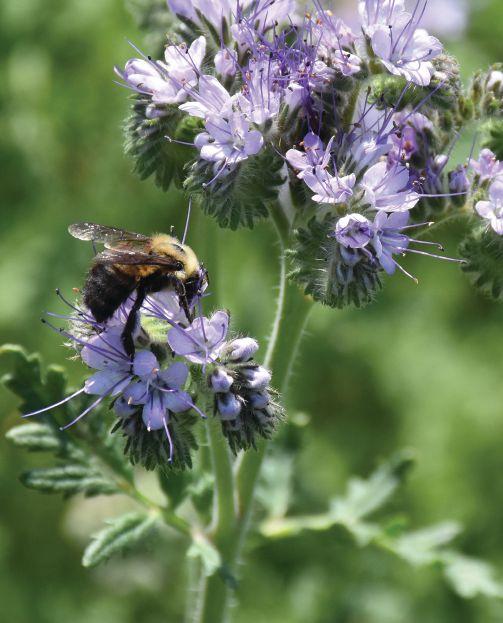
Phacelia is one of the many pollinator-friendly plants in the seed mix that the Hutchesons grew.
PHOTO COURTESY OF MARIA RAMIREZ GIRALDO/OSCIA.
TOWARDS HEALTHIER SOILS
Continued from page 16
“On soil nitrogen supply, we’re looking at whether we can come up with a better understanding of what drives seasonal nitrogen supply from soils in the region. If we could do that, that would really be a breakthrough because then you could adjust fertilizer nitrogen recommendations and develop a decision support tool for producers.”
Data on diverse systems
“This is really a partnership project, with funding through Agriculture and Agri-Food Canada’s Agricultural Greenhouse Gas Program (AGGP), and a collaboration with two regional partners and the agricultural community,” Lynch notes.
To help in building the soil health database, PEIDAF and Perennia identify possible farms to be sampled and they make the initial contacts with the producers. Then for each participating farm, Burton and Lynch’s project team works with the producer to choose a representative field to be sampled.
The project team is using the Cornell Soil Health Assessment Framework as a starting point, adjusting that framework’s sampling and analysis procedures to meet the region’s needs. The team is using about a dozen different soil health parameters, which provide a comprehensive evaluation of soil physical, biological and nutrient/chemical properties.
“Our aim is to develop a database using those comprehensive tests across different agricultural sectors, different farms, and different research plots in Nova Scotia and P.E.I.,” Lynch explains.
So, samples are being collected from across the region’s diverse
that data relative to their peer group, so a vegetable producer’s data is compared with the average for all the vegetable producers in the region, and relative to the average for all types of cropping systems in the region,” Lynch says.
He adds, “Some of these parameters, like water stable aggregation and soil respiration, are new to producers. So we explain how the parameters are measured and what they mean.”
Some initial findings and next steps
“The data we have collected so far supports some previous research in the region showing that, in some cropping systems, soil organic matter is low and declining. On the majority of fields, it is less than three per cent and often significantly lower than that particularly for more intensive, low-residue cropping systems like potato and intensive vegetable production,” Lynch notes.
“We are also finding that as the frequency of those intensive, lowresidue crops in the rotation goes up to 20 or 30 per cent or more, the organic matter levels and many of the other soil health parameters – such as soil aggregate stability, soil respiration, and nitrogen supplying ability – tend to be declining. Grain cropping systems tend to be intermediate. And as pastures and forages are more frequent in the rotation, the soil health parameters tend to increase.”
In 2019, the project team will be continuing the soil sampling, lab analyses, database development, and information sharing with producers. And they will continue their soil health studies, such as the work on a soil carbon tipping point and regional drivers for soil carbon storage and soil nitrogen supply, as well as various other studies.
“The project aims to assess the effects of different cropping systems, management practices and soil types on soil health, soil carbon storage capacity, and soil nitrogen supply.”
cropping systems. He says, “In Atlantic Canada, we have everything from intensive vegetable and potato production, to grain production, to low-bush blueberry and vineyards, to forages and pasture.”
As well, the sampling locations include sites with conventional production practices and sites where beneficial management practices (BMPs), like cover crops and no-till, are used. Lynch says, “We don’t want to just look at where we are at currently in terms of soil health. We also want to look at the effects of BMPs and which soil health parameter may respond to a specific BMP.”
The number of sampling sites varies from year to year. Over the past three field seasons, the project team has collected over 1,300 samples.
The samples are analyzed at the Atlantic Soil Health Lab. This unique research lab was launched at Dalhousie University in 2017 as part of the project. Each sample’s soil data and field history data are entered into the database, resulting in a powerful resource for soil health research and tool development.
The project team shares the key findings with the participating producers. “We provide the data for their own field, and we present
For example, some of the research is identifying which particular soil health parameters are the most meaningful, sensitive and robust measurements for P.E.I. and Nova Scotia conditions. That information could allow the researchers to obtain regionally relevant data with fewer types of measurements. A related study is taking a detailed look at the different fractions of active soil carbon (as opposed to stored soil carbon) and seeing how well each fraction might correlate with improvements in soil health. Some upcoming research, to be conducted once sufficient fields with different BMPs are sampled, will aim to identify which specific BMPs offer the greatest soil health benefits. In addition, the project’s database will be supporting tool development and other activities by PEIDAF and Perennia.
The project team will be starting a new study in 2019 to determine which cropping options tend to provide a net addition of soil organic matter and which ones tend to deplete it. This study’s goal is to develop a tool to help producers in making decisions about changes to their rotations. Lynch explains, “For example, if I lengthen my rotation by adding this grain crop, what is the net change in the organic matter level? Or if I grow soybeans instead of potatoes, as is happening quite widely in the region, will the soybeans provide sufficient residue to tip the balance towards a net enhancement of soil organic matter and soil health?”
Although improving soil health and productivity in the Atlantic region presents significant challenges, especially in intensive, low-residue crop production systems, the project’s findings and tools will provide practical information for producers. And Lynch notes, “Producers are very innovative in fine-tuning their cropping systems.”
You’re the kind who sweats the small stuff. Because you know it makes a big difference. You do your research and challenge the status quo. You value brighter thinking and fresher ideas to stay ahead. And, you know what’s right for you, because it’s your business.
To see how CLAAS could help you save time in the field and make more money, visit claas.com.