Stewardship is essential as Bt resistance develops in corn rootworm populations.
PG. 8
INSECTICIDES THAT ENLIVEN INSECTS
A surprising phenomenon with implications for agriculture
PG. 10
PERENNIAL GRAIN
A new crop may enhance soils and provide food benefits
PG. 16
TOP CROP
MANAGER
CANOLA PESTS AND DISEASES
5 | Sulphur fertilizer for canola and alfalfa Research backing updates to sulphur application recommendations for Ontario producers.
By Trudy Kelly Forsythe
10 | Insecticide applications that enliven insects
A surprising phenomenon with implications for agriculture. By Carolyn King
16 | Crop future: perennial grain
This crop could enhance soils and provide human and livestock food.
By Rosalie I. Tennison
8 Protecting Bt corn By Julienne Isaacs
THE EDITOR 4 Stewards of Canadian ag By Brandi Cowen
BREEDING 14 Biofuels breakthrough By Julienne Isaacs
AND NUTRIENTS
18 Soil N reserves: are they richer than you think? By Julienne Isaacs SOIL AND WATER
20 Investigating soil bacterial and fungal communities By Trudy Kelly Forsythe WEED MANAGEMENT
22 Weed recovery after burial by soil By John Dietz
24 Optimum canola seeding dates and rates By Carolyn King
SPECIAL SECTION
TRAITS AND STEWARDSHIP GUIDE 2016
Our annual Traits and Stewardship Guide has been updated again with the latest corn and soybean hybrids for the coming year. View the guide starting on page 27 of this issue.
Readers will find numerous references to pesticide and fertility applications, methods, timing and rates in the pages of Top Crop Manager. We encourage growers to check product registration status and consult with provincial recommendations and product labels for complete instructions.
PHOTO COURTESY OF DOUG CATTANI.
PHOTO COURTESY OF JOHN LAUZON.
BRANDI COWEN | EDITOR
STEWARDS OF CANADIAN AG
Within days of starting in my new role at Top Crop Manager, one thing became apparent: individuals in this industry are deeply committed to stewardship of the resources that contribute to Canada’s success in agriculture.
In the short time I’ve been with the Top Crop Manager team, my inbox has filled up with media releases, newsletters and event invitations highlighting the hard work poured into preserving and improving the country’s agricultural productivity – and with good reason. Agriculture is an important sector of the national economy. According to Agriculture and Agri-Food Canada (AAFC), in 2014 the industry employed more than 2.1 million Canadians and accounted for one in eight jobs. It’s little wonder growers, researchers, governments and companies of all sizes are exploring best practices that will allow producers to farm profitably while safeguarding precious natural resources, such as soil and water, for future generations.
On Feb. 16, 2017, individuals, families, companies, academics and all levels of government will have a unique platform to share stories of their stewardship efforts with Canadians. The industry has declared this date “Canada’s Agriculture Day” and, according to a press release, it will be “a time to celebrate and draw a closer connection between Canadians, our food and the people who produce it.” What better time to boast about successful projects and innovative trials aimed at growing crops as efficiently, profitably and sustainably as possible?
This edition of Top Crop Manger does just that, rounding up some of the latest research on stewardship issues confronting Eastern Canadian producers.
In our cover story on page 8, Jocelyn Smith, a research associate in field crop pest management at the University of Guelph’s Ridgetown Campus, reminds growers of the importance of good Bt corn management. Bt corn has never been as valuable to Eastern Canadian growers as it is today: in 2015, 89 per cent of Eastern Canada’s corn acres were planted to Bt hybrids. Stewardship of this valuable technology is key to avoiding resistance.
The status of your soil health is an important factor in the success of your crop, and a new project at the University of Guelph is using recent and older data to examine the link between soil biodiversity and soil health. Kari Dunfield, an associate professor at the university who’s leading the project, says she’s often asked how producers can keep their soil – an important part of a sustainable farm – in tip-top shape. The ongoing project is using a variety of cover crops to determine the real effect cover cropping has on soil health, and you can read more about it on page 20.
A nd rounding out the issue is our annual Traits and Stewardship Guide. Our resource guides are part of our mandate at Top Crop Manager: to provide you with the most up-todate information to help you make decisions that will grow your bottom line. Found in the back of the magazine, the Traits and Stewardship Guide offers information about new corn and soybean hybrids available for the coming year.
A s you flip through this issue, take some time to reflect on stewardship in your own operations and new practices that may enable you to work more effectively, more efficiently, and more sustainably. I hope to meet many of you in the months ahead and I look forward to hearing your ideas.
Crop Manager West – 9 issues February, March, Mid-March, April, June, September, October, November and December – 1 Year - $45.95 Cdn. plus tax
Crop Manager East – 7 issues February, March, April, September, October, November and December – 1 Year - $45.95 Cdn. plus tax
in Canada – 1 issue Spring – 1 Year $16.50 Cdn. plus tax All of the above - $80.00 Cdn. plus tax
SULPHUR FERTILIZER FOR CANOLA AND ALFALFA CROPS
Research backing updates to sulphur application recommendations for Ontario producers.
by Trudy Kelly Forsythe
Tightening restrictions on emissions from coalgenerated energy appear to be having a diverse effect on Ontario’s crops.
That’s because the mineral release during the decomposition of soil organic matter and deposits from the atmosphere generated primarily by industrial coal burning are what historically met southern Ontario’s sulphur requirements for crops. Environment Canada data indicates deposition of sulphates in southern Ontario has decreased from 33 kilograms per hectare in 1990 to 10 kilograms per hectare in 2010, and the tightening of restrictions on emissions is behind the decreased deposition.
Sulphur is essential for crops, helping with protein synthesis and ensuring maximum growth rates. And some crops, like alfalfa and canola, have significantly higher sulphur requirements than other crops. Because yearly sulphur deposition rates are no longer meeting the needs of the crops, agronomists and researchers believe those with especially high sulphur requirements may benefit from sulphur application.
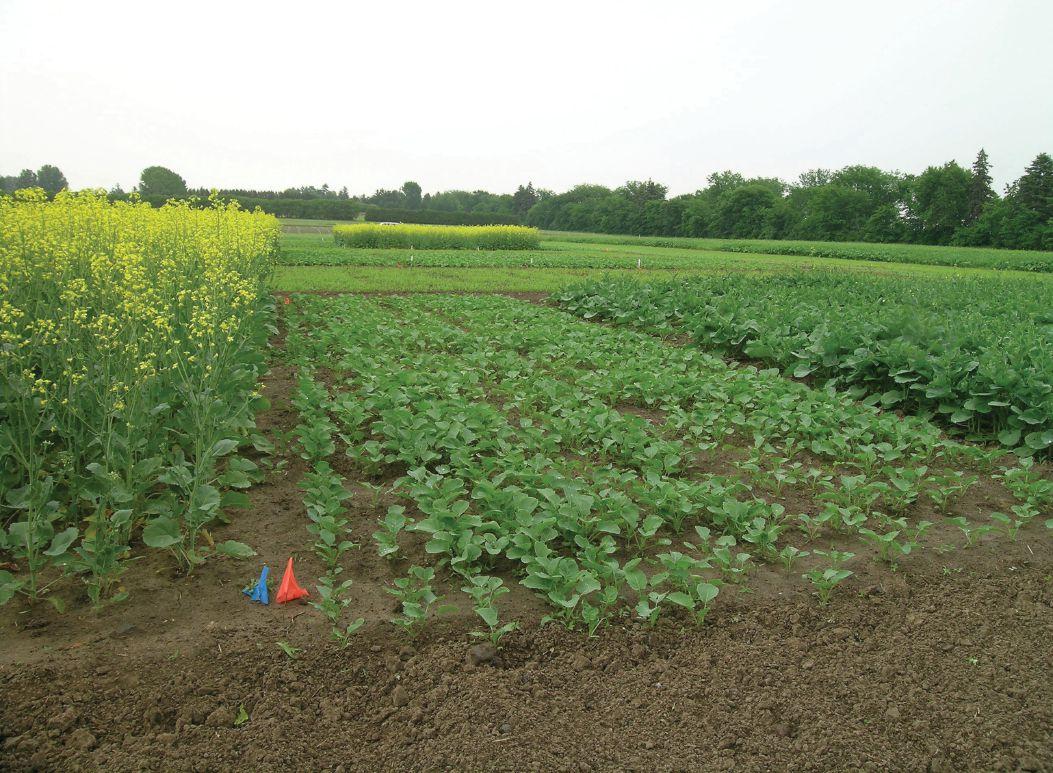
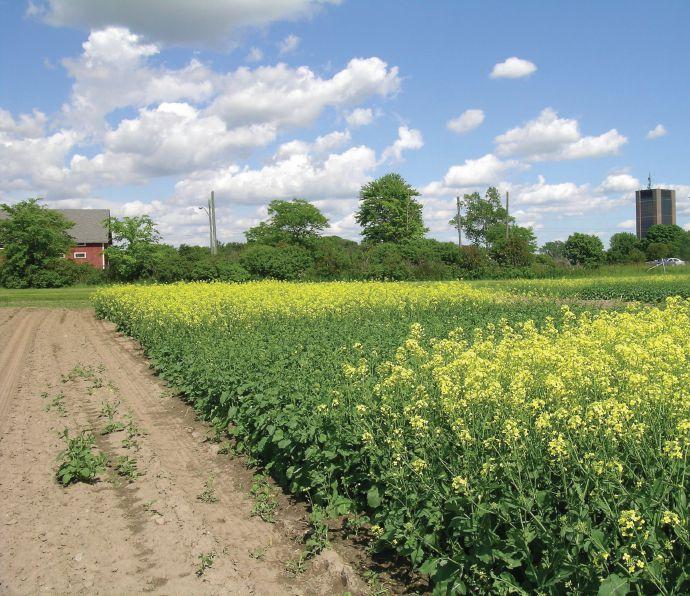
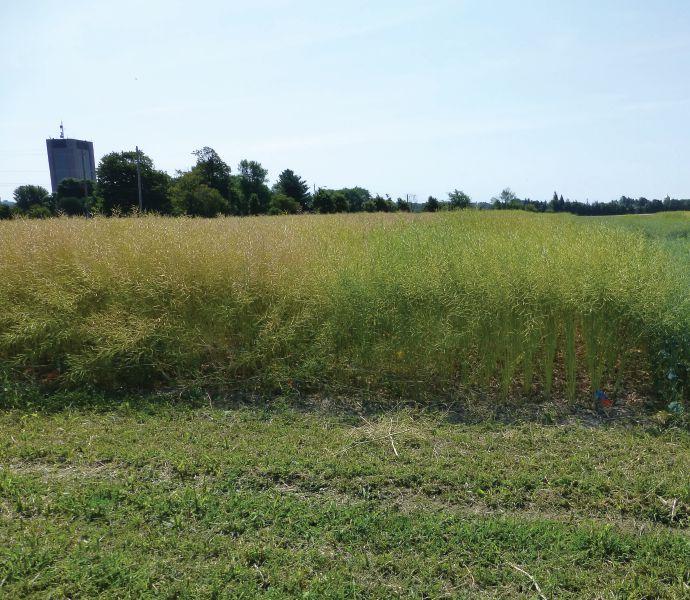
PHOTOS COURTESY OF JOHN LAUZON.
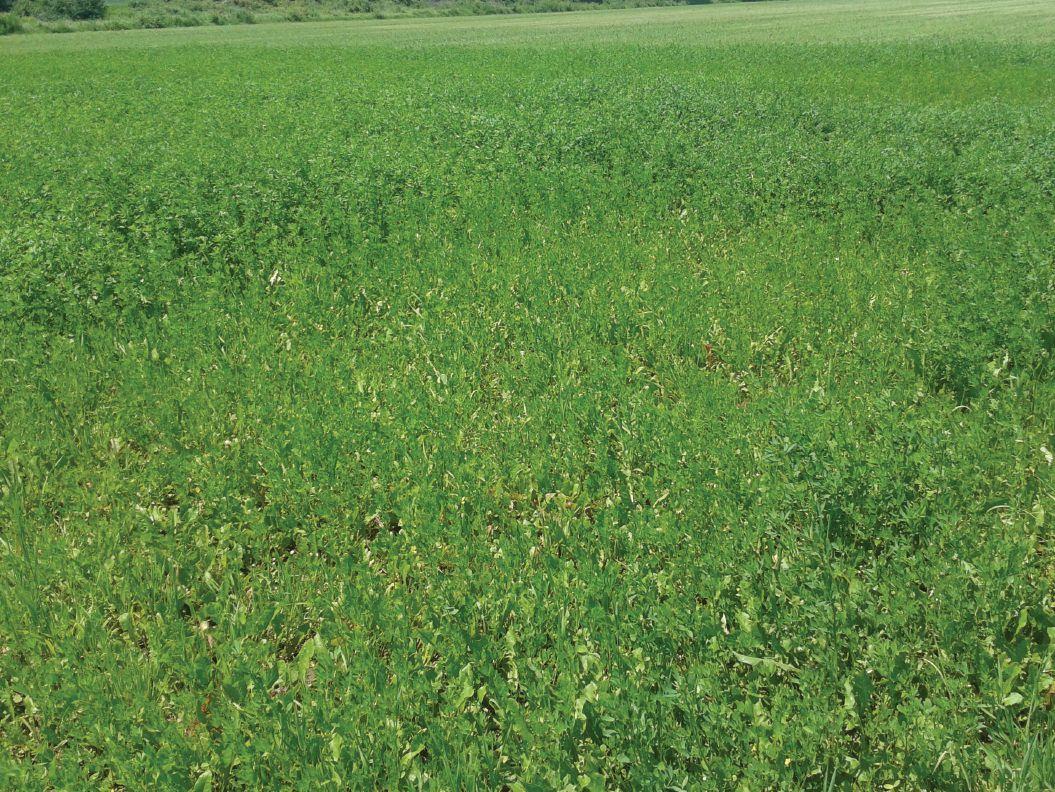
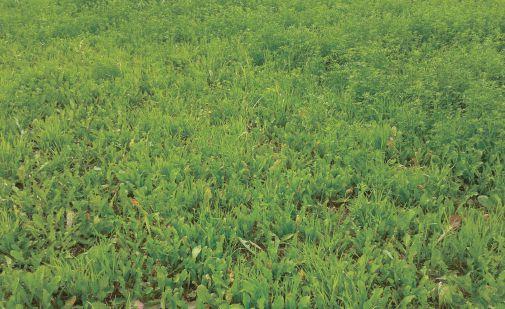
TOP: Low sulphur in foreground (mostly dandelions) and sulphur added to the left at third cut.
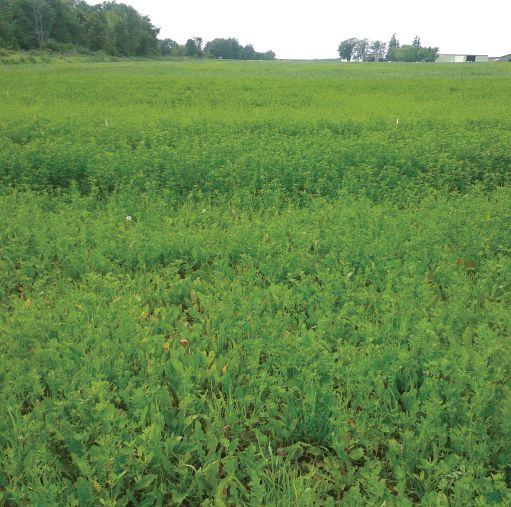
MIDDLE: Close up of low sulphur indicating a near lack of alfalfa without added sulphur at third cut.
Supporting this theory is evidence from a research trial conducted in 2012 that revealed forage yields doubled and protein content increased by 39 per cent over the control when sulphur was applied in the spring, even though tissue levels were 0.21 per cent, just below the critical level of 0.22 per cent recommended by the Ontario Ministry of Agriculture, Food and Rural Affairs (OMFARA). The Wisconsin critical level is 0.26 per cent. In mixed stands only, the alfalfa responded to increasing sulphur and the grass yield remained unchanged, resulting in the corresponding increases in protein.
One challenge facing Ontario growers is that OMAFRA publications do not currently list sulphur application recommendations; in the past, additions were not required. To assist with changing that, researchers at the University of Guelph recently examined the response sulphur fertilizer application has on yield and quality in alfalfa hay and canola seed, two crops where sulphur response is likely.
The three-year project, funded by OMAFRA, the Ontario Forage Council and Ontario Canola Growers, expanded ongoing trials in canola and alfalfa to allow precise determination of the critical tissue levels of sulphur, determine the maximum economic rate of sulphur fertilization, and determine which soil and/or crop sampling methodology provides the most accurate determination of crop sulphur status.
The project
John Lauzon, an associate professor at the University of Guelph who led the project, explains he and his team, including graduate student Greta Haupt and former OMAFRA staff Brian Hall and Bonnie Ball, conducted 10 alfalfa and 11 canola sulphur-response trials in southern Ontario from 2013 to 2015.
“All of the alfalfa sites evaluated sulphur response from both potassium sulphate and elemental sulphur, and five of the sites also included a range of potassium sulphate rates to determine the most economic rate of sulphur application,” Lauzon says.
“For canola, all sites received rates of sulphur application.”
The researchers harvested the alfalfa hay two to three times in each growing season to attain a weight yield per hectare measurement, and took samples from each plot for each cut to monitor total sulphur uptake and removal by the crop. They harvested canola once it reached maturity and determined seed samples yield. Then for both crops, they were able to analyze yield increases caused by sulphur application.
Lauzon and his team found yield response to applied sulphur at six of 10 alfalfa sites and four of 11 canola sites. They saw the greatest response of up to four times the biomass in alfalfa on mid-textured soils. A coarse-texture site with low organic matter had no response.
“Although there has been no work done in Ontario to develop a sulphur soil test procedure that works on our soils, soil sulphur was assessed using a calcium phosphate extraction procedure,” Lauzon says. “The responsive sites, however, could not be identified by the soil test level.
“In addition, plant available sulphur is easily leachable from soils, similar to nitrate, and much of the natural availability in soils comes from decomposition of soil organic matter,” he adds. “As such, it is generally assumed that responses would be more likely on low organic matter and sandy soils.”
No evidence of this could be found in the trials conducted, however, although Lauzon says more trials are required to test this in Ontario. The team concluded it is possible that, although sulphur deposition has decreased, variability in deposition may play a role in which sites respond.
Overall though, the results from this project demonstrate sulphur is commonly required in Ontario on alfalfa and canola.
More research needed
Lauzon stresses that the results of the study show no clear way of assessing which sites may require added sulphur and the researchers recommend further work be done to determine
Low sulphur in foreground (mostly dandelions) and sulphur added in plot behind at third cut.
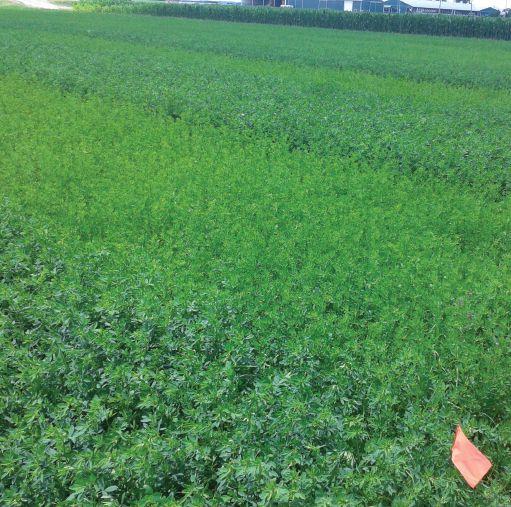
Farm Smart demonstration area strips with and without added sulphur.
suitable measures.
“Although the soil test procedure used did not indicate the responsive sites, it is possible that other procedures may be more predictive under Ontario conditions,” Lauzon says. “Continued effort should also be completed to monitor deposition rates as the trends in the rates seen are still decreasing.
“This could result in responses becoming more common in Ontario for canola and alfalfa as well as other crops,” he adds. “Peter Johnson has done some work with winter wheat and has found some responsive sites but did not find any responses on corn. The number of responding sites and the range of crops responding may increase if deposition rates continue to decrease.”
Next steps
OMAFRA staff are now taking the information from this project to growers and industry through presentations and reports, and the Ontario Soil Management Research and Services Committee will discuss the new sulphur fertilizer recommendations and whether to include them in OMAFRA publications.
The researchers also recommend further work to: assess and develop sulphur soil testing procedures for efficacy under Ontario conditions; continue monitoring sulphur deposition rates to determine spatial patterns in Ontario and determine if deposition continues to be reduced; determine sulphur availability and management of manure sulphur; develop management strategies for sulphur such as source, application method and rate timing; and monitor and test other crops.
For more on canola, visit topcropmanager.com.
Credit ® Xtreme is a patented glyphosate formulation containing Dual-Salt Technology™ . Its high-load formulation provides excellent GM crop safety, fast and complete control of troublesome weeds, and exceptional compatibility with phenoxy herbicides, even in hard water.
PROTECTING BT CORN
Stewardship is essential as Bt resistance develops in corn rootworm populations.
by Julienne Isaacs
Bt corn has been on the market in Canada for over a decade; last year, Bt corn hybrids were planted on 3.1 million acres across the country.
The technology is incredibly, and increasingly, valuable to Eastern Canadian growers, where 2,035,000 of the total 2,295,000 acres of corn were planted to Bt hybrids in 2015. But the ever-present risk of the development of insect resistance to the technology is keeping the industry on its toes.
While resistance hasn’t yet developed in European corn borer (ECB) populations in North America, reduced susceptibility has been noted in some populations of corn rootworm, according to Jocelyn Smith, a research associate in field crop pest management at the University of Guelph’s Ridgetown Campus.
But resistance can be delayed with proper management. In Canada, stewardship of Bt technology takes the form of insect resistance management (IRM) plans, which chiefly involve maintaining refuges to delay the development of resistant insect populations.
Stewardship also entails rotation of traits in the field, as well as the use of stacked traits.
“The most important thing we can do with this issue is educate growers more about the risks they’re taking if they continuously use traits for rootworm,” Smith says. “Their sheer numbers and biology give them advantage.”
This is a message familiar to Eastern Canadian corn producers, and they’ve taken it to heart. The Canadian Corn Pest Coalition (CCPC) – made up of academics (such as University of Guelph researchers), the Canadian Food Inspection Agency (CFIA), the provincial ministries of agriculture, and industry representatives – has been conducting surveys on insect resistance management compliance since the late 1990s.
Until 2012, those surveys were conducted in alternating years with CFIA IRM compliance surveys, but that year, stewardship compliance rates were so high CFIA discontinued them unless “in future, industry practice shifts from using blended refuge.”
But the CCPC’s bi-annual survey continues. “The increase in compliance with refuge area requirements from 2013 to 2015 occurred in all three provinces and now stands at 91 per cent in Ontario, 90 per cent in Quebec and 91 per cent in Manitoba,” the 2015 report concluded.
According to the same report, compliance tended to be higher in the 35 to 44 age category, but lower among producers
who believed stewardship requirements to be “only somewhat important.” In addition, the report indicates awareness of stewardship requirements has declined since 2013, particularly in Ontario; compliance was also lower among those who believed they did not understand requirements.
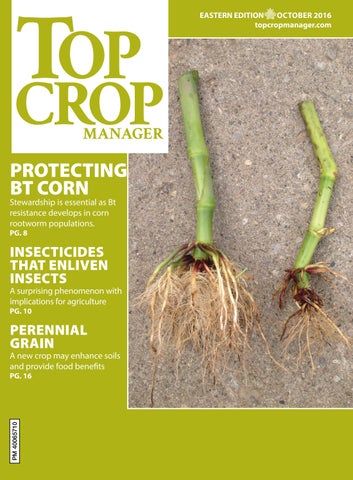
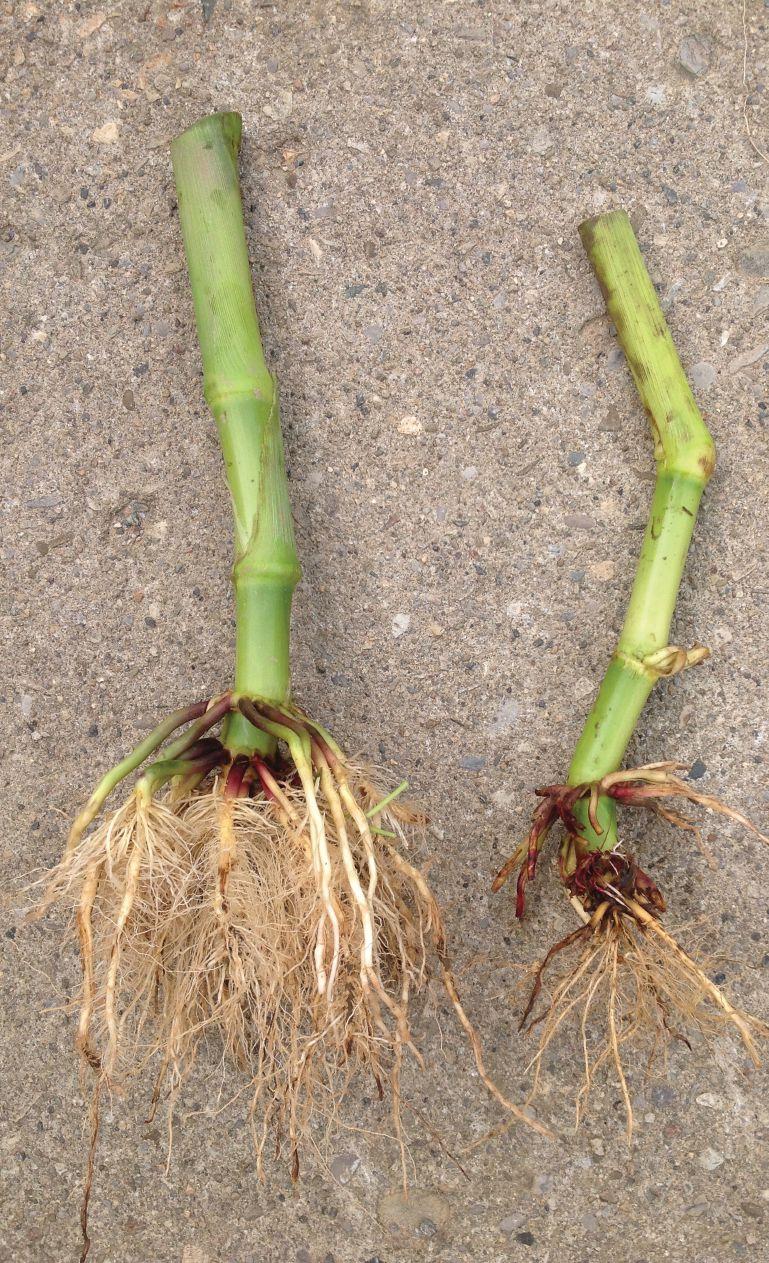
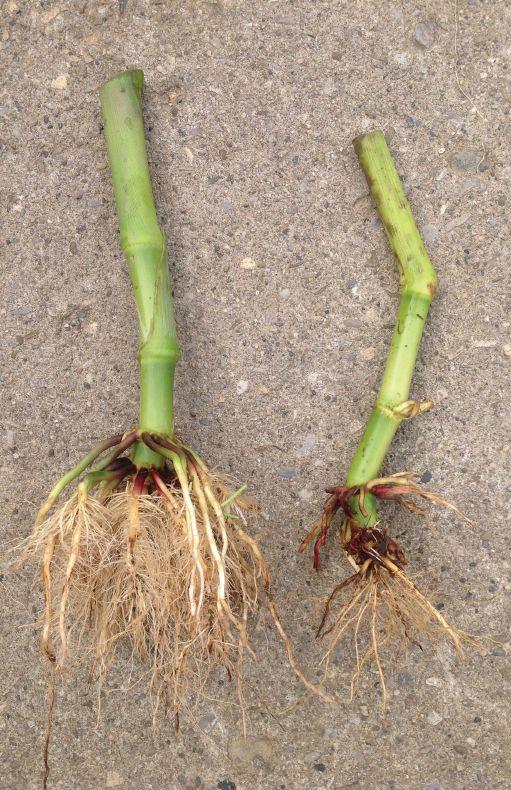
Bt corn is valuable technology to growers, but insect resistance is an ever-present risk, as shown here in these corn roots damaged by corn rootworm (left: SmartStax Bt corn; right: non-Bt corn).
PHOTOS
Bt corn can delay resistance, according
“There are currently three traits available for corn rootworm control,” she says. “Where we have growers with longterm use of two of those traits on their own (not in a stacked product), we’ve started to notice some shifts in susceptibility when we test those populations in the lab.”
This doesn’t necessarily mean producers can see resistance developing in the field, but it’s still a red flag.
“We need to focus on informing continuous corn growers that the three-year limit is important,” Smith says. “We may have had a situation where a grower has used a single trait for years and it’s compromised, so then when they use the stack there’s only one viable trait remaining against the pest.”
Smith also emphasizes monitoring as a key aspect of stewardship. “If you are growing corn on corn, scout your corn late in the season and if there’s less than one beetle per plant you might be able to get away without using transgenics,” she says. “You might be able to hold off on using some of the technology in the following year.”
More education needed Cindy Pearson, national manager of the CFIA’s Plant Biosafety Office, says the onus is on companies marketing Bt products to educate producers regarding the need for delaying resistance and how refuges work.
“IRM plans are the responsibility of the company to whom the Bt corn product has been authorized, and CFIA receives specific reports from companies that
detail their various activities on that front,” Pearson says.
The survey notes refuge-in-a-bag (RIB) hybrids, which contain the required percentage of refuge seed, resulted in significantly higher compliance rates after their market introduction several years ago. The market has also changed with the introduction of stacked hybrids with multiple Bt traits or modes of action against the insect pests.
BT CORN: A BRIEF HISTORY
Bt (which stands for Bacillus thuringiensis) is a spore-forming bacterium that produces crystal proteins proven to be toxic to many species of insects that consume it. Shigetane Ishiwatari, a Japanese biologist, first discovered the toxin in 1901. Ishiwatari isolated the bacteria while he was investigating the cause of sotto disease, a sudden collapse disease occurring in silkworms at the time.
Originally called Bacillus sotto, the bacteria was renamed Bacillus thuringiensis some 10 years later, after it was rediscovered by Ernst Berliner. Berliner isolated the bacteria as the cause of death of the Mediterranean flour moth. He first reported the existence
of a crystal within Bt in 1915, but the activity of the crystal wasn’t discovered until years later, according to the University of California San Diego.
Bt was first used as a pesticide in 1920, and France commercialized Sporine, used primarily to kill flour moths, in 1938.
In 1956, three researchers found the parasporal crystal, which provided the main insecticidal activity against moths. This discovery brought increased interest in the crystal structure, biochemistry and general mode of action of Bt, and prompted more research on it.
Bt was first used commercially in the United States in 1958, and was registered
Smith also recommends rotating management options — in other words, soil insecticides and Bt traits.
“And again in season, keep an eye on the pest situation in the crop. For ECB and rootworm, you need to monitor whether they are being controlled by the Bt hybrids or not. If they are not, you need to notify the CCPC and the trait provider,” she says.
As long as they use Bt technology, producers are on notice to use it well. Resistance is in nobody’s interest except the insects.
as a pesticide by 1961.
Thanks to advancements in molecular biology, moving the gene that encodes the toxic crystals into a plant became reality: scientists could replicate the gene in Bt that encoded for the toxin and place it into a plant. Corn was the first genetically engineered plant and was registered with the United States Environmental Protection Agency in 1995.
For an up-to-date list of corn traits registered for use in Canada, refer to our annual Traits and Stewardship Guide, which starts on page 27. As always, be sure to check with your seed dealer for more information.
Proper management and stewardship of
to Jocelyn Smith.
INSECTICIDE APPLICATIONS THAT ENLIVEN INSECTS
A surprising phenomenon with implications for agriculture.
by Carolyn King
What doesn’t kill a bug sometimes makes it stronger…or bigger, or longer lived, or able to lay lots and lots of eggs. This biological phenomenon is called “hormesis.” It is an area of growing interest for entomologists, including those who study the effects of insecticides on insects. And it has important implications for agriculture.
Hormesis refers to an organism’s response to a stressor, where a low dose of the stressor causes a stimulating effect, like increased reproduction, and a high dose is very damaging or lethal. In the case of an insect, stressors could include things like insecticides, temperatures outside of the insect’s comfort range, insufficient food, and insufficient oxygen. But hormetic responses are not limited to insects. They have been observed in many, many organisms, ranging from microbes and plants to humans.
How hormesis actually works isn’t completely understood. “Probably the most commonly cited general theory is the idea of overcompensation. Systems that affect growth and reproduction [in insects and other organisms] are self-regulating and work on feedback mechanisms. So any sort of disturbance to those processes can result in the system trying to correct and overcompensate for it,” explains Chris Cutler, an associate professor with the department of environmental sciences in Dalhousie University’s faculty of agriculture.
For instance, let’s say an insect is exposed to a low dose of a poison that causes its reproductive system to go slightly out of whack. According to the overcompensation theory, its reproductive system will attempt to counteract the problem but will temporarily overshoot its response, leading to higher reproduction. “In a general sense, I think that is kind of how hormesis operates, but we still have a lot of the nuts and bolts to figure out,” Cutler says.
He explains that hormetic responses have evolved over millions of years as mechanisms for organisms to deal with low amounts of stress. So hormesis has always been around. However, it’s only recently that scientists have been identifying such responses as an actual phenomenon. “I think in the past, researchers would often look at [a hormetic] result and say ‘that’s weird’ or ‘that’s an outlier,’ and not really have a word to describe it. Those types of papers have gotten lost in the literature decades ago, but you can find them if you look hard enough,” he notes.
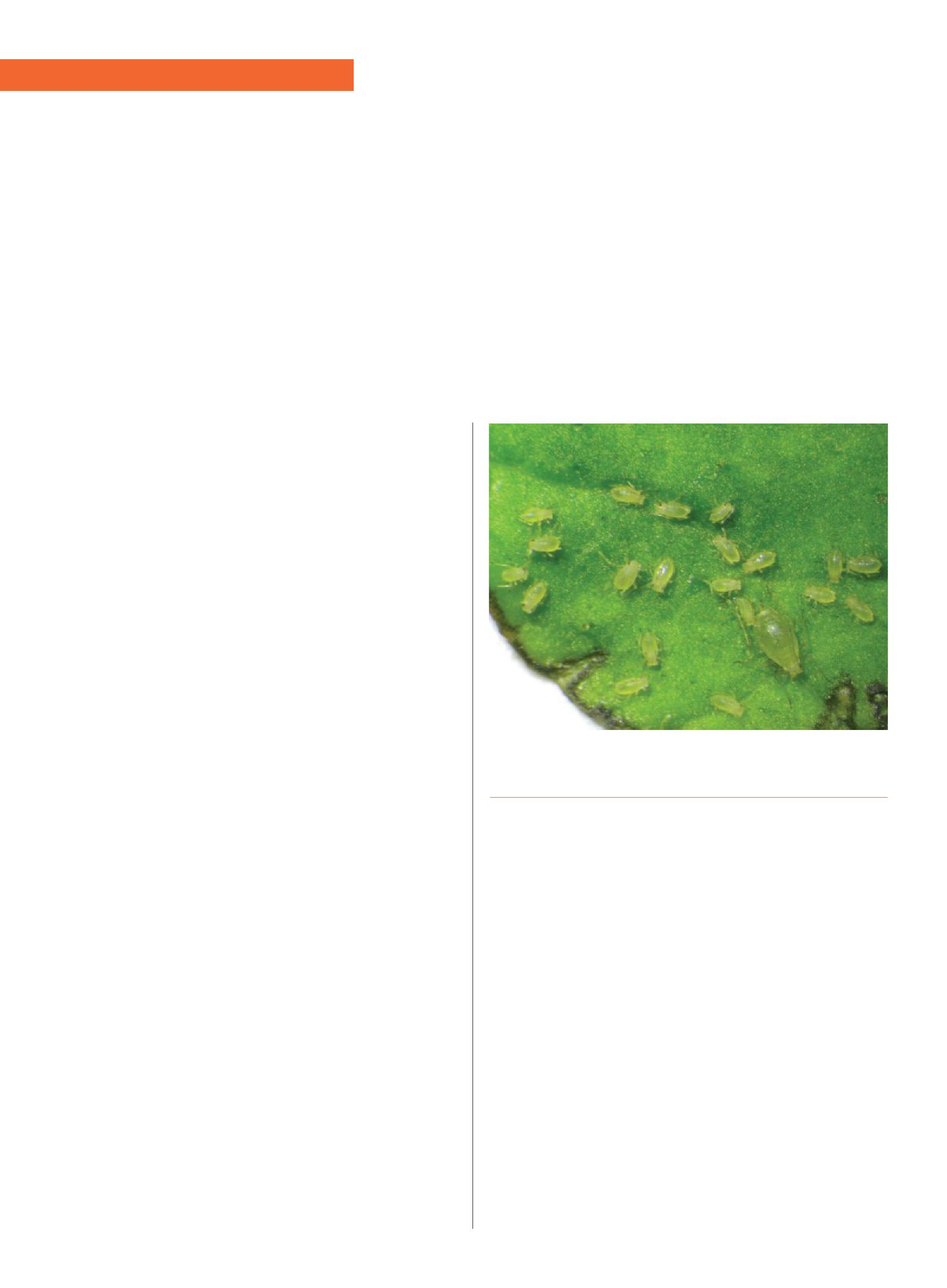
Experiments with green peach aphids by Cutler’s lab show hormetic effects. For example, when the aphids are exposed to low doses of imidacloprid, their numbers go way up.
“We’ve documented incidents of hormesis in all sorts of insects, dozens of species across many different families and orders of insects, exposed to many different types of stress, whether it’s an insecticide stress, nutritional stress, temperature stress, radiation stress. So hormesis occurs widely and the concept is now pretty well accepted by researchers, and people are really starting to catch on to the idea.”
Cutler began his research on hormesis completely by accident. “I did my PhD research at the University of Guelph and was working with the Colorado potato beetle. In one of my experiments with an insect growth regulator, which is a more selective or more friendly type of insecticide, I was exposing eggs to the insecticide. I was expecting deleterious effects, like smaller eggs, eggs that wouldn’t hatch, and that type of thing. But in one experiment, I saw that at the low dose the survival and weight of the larvae were higher than in the control. At first I thought I’d got the concentrations mixed up or something. So I repeated the experiment a couple of times and got the same result. And I stumbled on this idea of hormesis, which at that time [about a decade ago] had not garnered much attention at all in insect circles.”
At present, the hormesis research at Cutler’s lab focuses
PHOTO COURTESY OF CHRISTOPHER CUTLER.
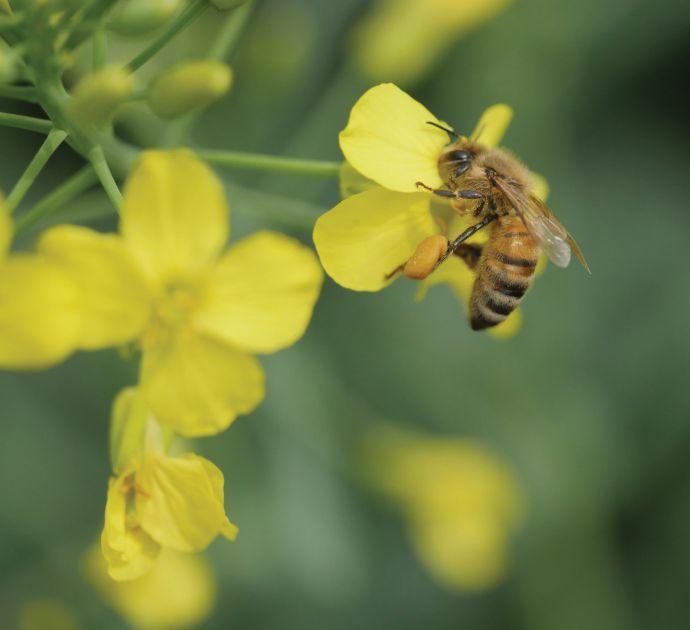
Although pesticides are an important risk factor for bees, Cutler is also investigating the possibility that low doses of insecticide might help stimulate the bees’ longevity, learning and memory.
mainly on insecticide-induced responses of various insects to various insecticides. “We’ve been using green peach aphid as a model. It is a widespread insect pest occurring all over the world, attacking lots of different crops, and insecticide resistance is a big problem in that insect,” he notes.
For example, he and his lab have been looking at how this aphid responds to imidacloprid, a commonly used neonicotinoid sold under various trade names, such as Admire. Their research shows that when the aphid is exposed to low doses of imidacloprid, the aphid’s reproductive output goes way up. Cutler says, “We’ve shown this in laboratory and greenhouse experiments where, after a few weeks, the population of the aphids on a plant can double due to exposure to the insecticide that is supposed to kill them.”
In a field situation, many different factors can lead to less-than-lethal doses of insecticide. “Insecticides break down over time. Sunlight will break them down. They are subject to microbial degradation. They are subject to wash-off by the rain. Also, drift can occur, so you may be trying to apply a high dose but the
wind takes it so you get a low dose on the plant. And you have canopy effects when you spray so you don’t get as high a dose under the leaves or further down the plant,” Cutler explains.
“So inevitably you’re going to get insects that are exposed to these sublethal doses. And some of these low doses could be hormetic.”
Cutler sees many possible implications of hormesis for agriculture. One obvious one is that insecticide-induced hormesis could make a pest problem even worse by causing pest resurgences and secondary pest outbreaks. Pest resurgence is when the population of an insecticide-treated pest increases rapidly to even higher numbers than before the insecticide was applied. A secondary pest outbreak refers to a rapid population increase in a pest species that had been less important than the target species until the insecticide was applied.
Pest resurgences and outbreaks are often assumed to be due to the harmful effects of the insecticide on the pest’s natural enemies (the predators and parasitoids that attack it). But that assumption isn’t necessarily correct in all cases.
Cutler explains, “There have been experiments that have excluded that possibility and shown the outbreak in the field – whether it’s due to aphids or thrips or leafhoppers – is directly due to stimulation from the insecticide.”
The degree to which insecticideinduced hormesis is contributing to pest resurgences and outbreaks in agricultural fields is not yet known. However, it has been documented in many field situations.
Insecticide-induced pest resurgences and outbreaks could clearly have serious impacts on susceptible crops, and could prompt farmers to apply more insecticides, raising their input costs and increasing the risks of insecticide resistance and negative impacts on the environment.
On the other hand, hormesis has positive implications for businesses that rear insects. “Insect rearing is a billion-dollar industry. Insects are reared for a lot of different purposes – for use in research, food for pets, food for people. Honeybees are reared for honey and pollination,” Cutler notes. “I think we can probably harness some of these hormetic principles for rearing these beneficial insects. It has been shown, for instance, that when you are rearing insects like Caribbean fruit flies for sterile insect release (SIR) programs, if you deprive them of oxygen for an hour, that mild stress can prime them to become better at finding mates, become better at emerging, have lower mortality and longer life spans. So this type of preconditioning hormesis can improve the performance of those insects later in life.”
In his current research, Cutler is delving into a number of different aspects of insecticide-induced hormesis, with the help of funding from the Natural Sciences and Engineering Research Council of Canada.
“One of the things we’re doing is looking at this idea of priming, so can mild exposure to one stress condition the insect to deal [more effectively] with subsequent stresses later in life or in subsequent generations? We’re looking at that in aphids.”
Cutler and his lab are also examining the possibility that hormesis may be contributing to insecticide resistance. “We’re looking at a couple of different angles there. We want to see if exposures to low doses of insecticide that may cause hormesis also induce the insect to produce more detoxification enzymes. When you
and I or insects are exposed to poisons, we have enzymes that break down those poisons. So, if the insect is exposed to mild doses of insecticide, do we see more of those enzymes?” he says.
“[Another insecticide resistance angle] we’re looking at is whether exposure to mild doses of insecticide can increase mutations in insects. One of the main causes for mutations in organisms is stress. So we want to see if, for instance, hormetic stress that can cause increases in reproduction can also cause increases in mutations in insects such as aphids, and can some of these mutations be for insecticide resistance?”
Cutler is also investigating insecticide-induced hormesis in bees. He does a lot of research on bees and pesticides, so he’s well aware that pesticides are an important risk factor for bees. But he wondered whether insecticide-induced hormesis might occur in bees since it has been found in so many other insects. He recently published a paper identifying evidence in the literature that low doses of insecticide stimulate longevity, learning and memory of bees. Now he’ll be pursuing that idea in his own experiments.
What you can do
Although there is still much to learn about hormesis, especially under field conditions, Cutler offers a few suggestions for practices that could help reduce the risk of insecticide-induced hormesis on your farm.
One practice is to keep an eye on the pest population after pesticide applications. “I suspect that rapidly reproducing pests like aphids, leafhoppers and mites are more prone to outbreaks and resurgences from hormesis, although this has yet to be tested.
This might be particularly true for insecticides that degrade to sublethal concentrations more quickly or for systemic insecticides (seed treatments) that work against early season pests but will be at sublethal amounts for most insects after a few weeks.”
Second, minimize drift and ensure good plant coverage when spraying insecticides. “This will minimize exposure of the pests to sublethal concentrations that might induce hormetic responses to stimulate their population growth.”
This
type of preconditioning hormesis can improve the performance of insects later in life.
And third, avoid cutting insecticide rates below those recommended on the label. “As many growers will know, cutting rates is usually problematic because it can ‘encourage’ development of insecticide resistance while increasing the chances of suboptimal pest control. At the same time, exposure to these lower sublethal concentrations could stimulate reproduction of certain pests, possibly creating a double-whammy for the grower.”
For more on pests and diseases, visit topcropmanager.com.
PLANT BREEDING BIOFUELS BREAKTHROUGH
A new project has potential applications for oilseeds and biofuels.
by Julienne Isaacs
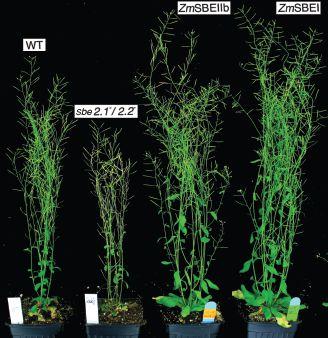
Fushan Liu never expected the sight that greeted him last year in his lab at the University of Guelph: arabidopsis plants grown two and a half times their normal size.
As a postdoc at the University of Guelph’s College of Biological Science, Liu had been working on a project transforming starch branching enzymes (SBEs) from maize into arabidopsis plants. For weeks, he’d been analyzing the interesting effects of the maize SBEs on the arabidopsis plants’ starch pathways. Then one day he realized the plants he’d been working on had grown much larger than the control plants. Not only that, but there were also far more seedpods, and their leaf and root systems were bigger, too.
“That was the beginning – I saw a really big arabidopsis plant and thought, let’s take a picture. Something has happened biologically,” Liu says.
He showed the photo to his supervisors, Guelph professors Michael Emes and Ian Tetlow.
“We’d found some interesting effects on the starch, and had done all sorts of measurements,” Emes echoes. “And then one day we stood back and looked at the plants, and we finally saw the wood for the trees. We saw these plants were really different.”
A healthy plant from a typical arabidopsis line normally bears about 11,000 seeds; the new plants bore 50,000 seeds per plant – a more than 400-per-cent increase in seed production.
“The plants were bigger, the leaves were bigger, there were more stems, there was more flowering and more seed,” Emes says. “It’s not just that there were a lot more seeds, there was a lot more of everything.
Total seed oil production per plant (x103)
Oilseed number per plant (x103)
Wild type (WT) arabidopsis plants, the mutant and the mutants complemented with either ZmSBEIIb or ZmSBEI, showing (top) the total amount of oil produced per plant and (bottom) the oilseed number per plant.
“It was one of those serendipitous events in science. If you’d asked me to produce a plant with more seeds I would have said you couldn’t get there from here,” he adds.
Liu’s focus had been on trying to analyze how the SBEs’ functions changed in arabidopsis leaves, but after this discovery his focus changed to studying the impact on seed yield and biomass,
comparing transformed plants with wildtype arabidopsis plants. Importantly, the quality of the oil remained the same as for the non-transgenic plants.
The team published their findings this spring in the Arabidopsis is not a starch crop, but an oilseed genetically similar to canola, so the obvious application of the finding is in breeding higher-yielding oilseed crops for
biofuels. Emes and Tetlow have already begun preliminary work with canola, but also foresee potential applications in camelina, soybeans and other crops.
While the dramatic increase in seed production might not occur as easily in canola as in arabidopsis, Liu says even a tenth of the effect would still mean an increase of 40 per cent – a substantial impact on yield.
“This is orders of magnitude different than conventional breeding,” Emes says.
But what, exactly, is going on in the plants?
The good times are here
Emes has a theory that the starch metabolism in the transformants has improved the plants’ ability to grow and reproduce.
The team is working on two lines using two starch genes from maize. In one of the new lines, there is a massive increase of starch in the leaves, which the plant breaks down overnight. In the other line, there is a bigger impact on yield; there is still an increase in starch in the leaves, but it doesn’t all break down at night, leaving a carbohydrate reserve.
“We know that carbohydrates, during seed development, come from the leaf through the vascular system and into the reproductive system. These are important to flower development and what’s called embryo abortion – the plant makes a kind of ‘decision’ on whether or not to produce seeds,” Emes explains. “Flower and seed production is limited by the supply of carbohydrates. So these plants are now saying, ‘The good times are here, let’s go for it.’ ”
Emes suspects that the wild type arabidopsis plant has an endogenous mechanism that constrains growth because it’s genetically evolved to always keep something in reserve. But in the transgenic plants, the brakes have been taken off.
If the scientists can crack the code on the maize SBEs’ effect on oilseeds, Emes sees potential applications for feedstock and oil for human consumption, as well as biofuels. He is currently seeking public and private funding to continue the project in canola.
Liu, now a regulatory scientist for the J.R. Simplot Company, says much more work is required to improve seed quality as well as yield in future breeding projects. “If you want to improve
quality, if you want to improve omega-3 fatty acid or other special fatty acid content, for now I don’t have any insight on how you can improve those things, from this study,” he says. “At least, from the analysis of the arabidopsis you don’t see a change in these properties – you just get higher yields.”
But Liu is optimistic about the future applications of his work. “Genes are so powerful,” he says. “One small change could be a potential opportunity for dramatically improving crops.”
KNOW. GROW. www.topcropmanager.com
Agriculture is our way of life too
Meet Jen
With a lifetime of experience in ag, Jen helps Canadian producers build their dreams. Like everyone on your FCC team, Jen knows your industry and she’ll get to know you.
1-800-387-3232 fcc.ca
CROP FUTURE: PERENNIAL GRAIN
This new crop is at least a decade away from enhancing soils and providing human and livestock food.
by Rosalie I. Tennison
When the title of “bread basket of the world” was coined, settlers were breaking up long established prairie and plowing down the perennial grasses that made the soil rich. Today, researchers in Canada and the United States are looking to re-establish perennial wheatgrass as a means for soil recovery and food production. Collected from Siberia, perennial wheatgrass could, when adapted and bred for consistent North American production values, be the next grain crop to sweep across the land.
Of numerous iterations of wheatgrass, the most promising and the closest to field production is Kernza, developed by The Land Institute in Kansas. Now under examination in Western Canada for adaptation to this climate and growing conditions, Kernza is a new class of grain that will eventually spawn varieties for all growing regions in Canada. But growers need patience because it could be a decade before the first variety is perfected and seed is available.
“We are narrowing down our germplasm and will be harvesting plots this year,” says Doug Cattani, the lead researcher working with Kernza in Canada. The University of Manitoba plant scientist adds there is a lot to learn about Kernza production besides developing varieties adapted to the Canadian growing system.
Ideally, a perennial grain would be left in the field similar to forage for a number of years. The heads would be harvested annually, but the crop would continue to grow. It’s not known how many crops can be harvested before production decreases when the field can be turned into forage for a year or two.
“Perennial wheat has deep roots that can reach deep moisture,” explains Jamie Larsen of Agriculture and Agri-Food Canada in Lethbridge, Alta. “It might work well in less productive areas to
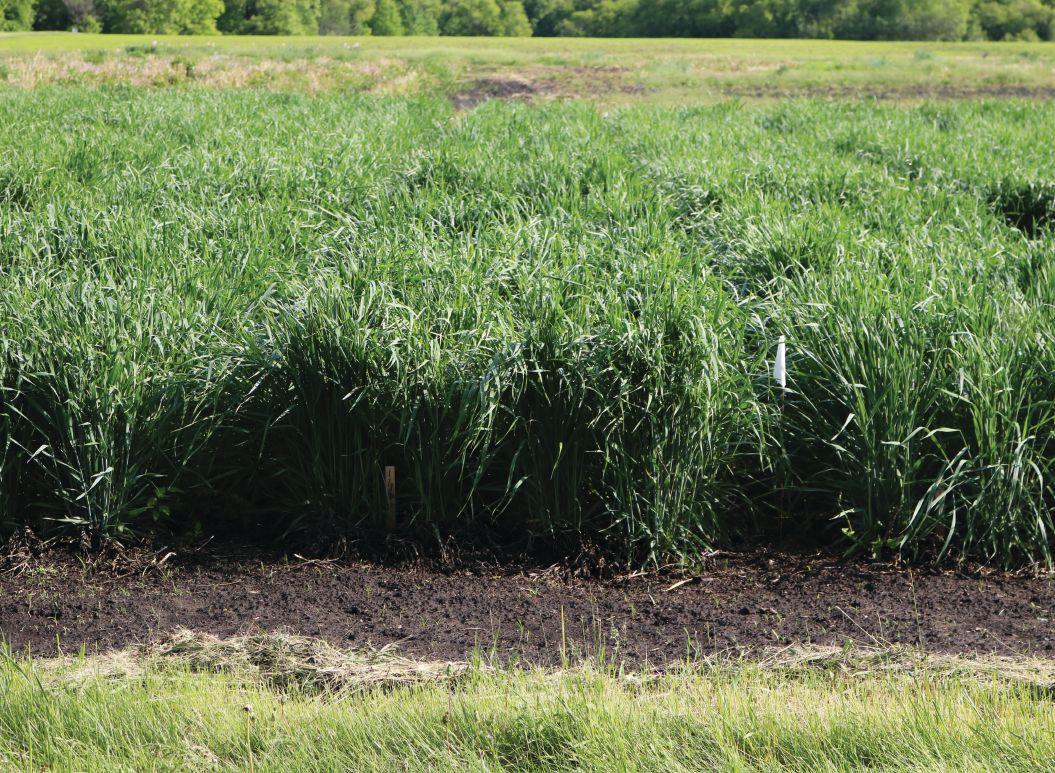
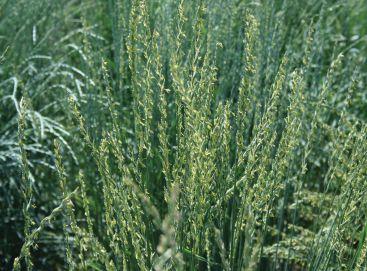
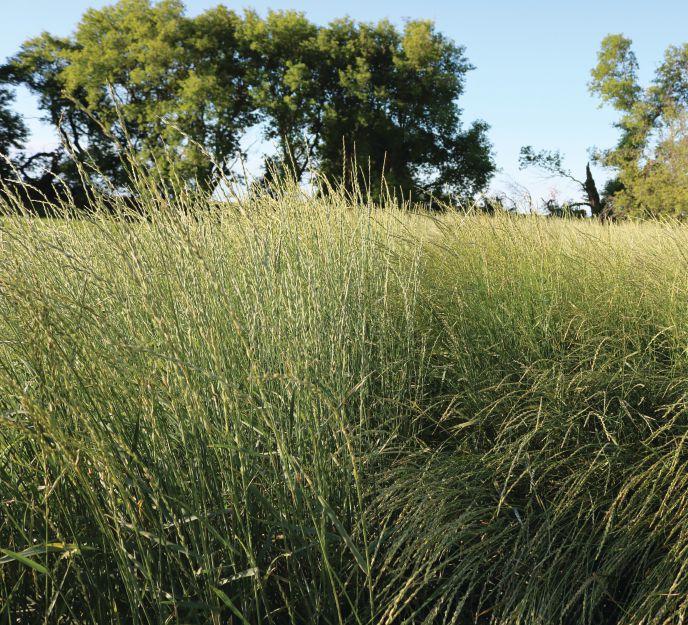
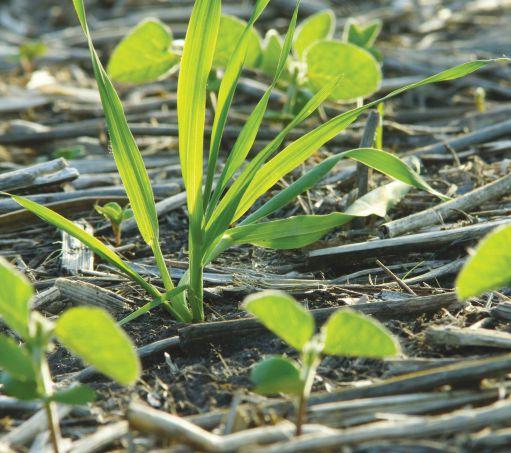
TOP: Intermediate wheatgrass plants on June 1, 2016. INSET: Intermediate wheatgrass flowering.
PHOTOS
reduce erosion and build up the soil. Or it could be planted along a stream to protect the area, but there would be a crop as well. Typically, it is also disease resistant and it will compete strongly with weeds.” While it is in the field, it will be useful to break up weed and disease cycles while also replenishing the soil.
“From a seed industry perspective, I think this could look like a model similar to forage crops,” suggests Ellen Sparry, genetics and general manager for C & M Seeds in Palmerston, Ont. “I can see this potentially having a fit for soil recovery and for drier areas.” From a seed standpoint, she says, end use and production would have to match the annual wheat varieties that growers currently rely on.
This is where Cattani is focusing his attention. He is selecting and crossing to get Kernza varieties that are welladapted to Canada’s growing areas, that have consistent quality and yield year after year, and which offer all the benefits promised by annual crops.
“We need to work out the system,” Cattani admits. “What do we need to do to get it ready for the following year? We can harvest it and cut it back, but what happens if we cut it right to the ground? We need to look at post-harvest management to see if we can get a consistent second and third crop.”
Larsen says perennial grain crops will mine moisture and nutrients lower in the soil strata because they put down a long root system. However, he adds, there may still be a need to add nutrients. But how much?
“You will get better drainage, better soil health, access to nutrients that are below the access of annual crops,” Cattani continues. “There’s a host of benefits that could accrue for future crops when perennial grains are included in the rotation and we want to be able to maximize the yield every year. But we’re still in the initial stages of development and we are at least 10 to 15 years away from a variety with a known production package to give producers.”
Nevertheless, Sparry believes it is good for growers to know about Kernza and to begin thinking about how it could fit in their operations. “From a seed standpoint, it would market similar to forage,” she suggests.
“Certainly, this will fit in any operation,”
Larsen adds. There are also many potential uses for Kernza, he says, from basic livestock feed to bread-making. A company in the United States has also incorporated Kernza into beer production.
Unlike current crops that have been tweaked over time and continue to be improved, Kernza and other perennial grain crops need to be perfected before they enter the field, from production recommendations to management advice to end use requirements. Cattani reports there is an issue with kernel shattering in some Kernza varieties and he is working on selections to minimize that while also looking at yield potential and field readiness.
As Cattani prepared to harvest his plots of Kernza in August, he considered the best methods to accomplish the task and how to prepare the plots for production in 2017.
“We’d like to get three seed yields per crop no matter what the growing conditions are each year,” Cattani says.
For his part, Larsen would like growers to learn about Kernza and other wheatgrass prospects. He suggests they need to consider how and where these new grain crops could fit into their operations. Those with experience
with forage will have a good idea how Kernza can be managed, but there will still be some adjustments they will have to make to ensure continued success for both human consumption and possible grazing for livestock. The researchers believe it would be ideal if the two could be accomplished simultaneously each year, but, again, that possibility still needs to be examined.
When something as promising as Kernza comes along, it’s difficult to wait until there is seed and a complete set of recommendations to ensure success in the field. Research in both the United States and Canada suggests Kernza is the closest to field readiness of the perennial grains. In the near future, when perennial grain is in a rotation, it could be possible to recover soil to the standard early settlers flocked to the untouched prairie to get. It may have taken 100 years to undo the value in those untouched soils across Canada, but within a decade a solution to revisit those heady days of early crop production could be field-ready.
Intermediate wheatgrass at late-flowering stage on July 14, 2016.
SOIL N RESERVES: ARE THEY RICHER THAN YOU THINK?
by Julienne Isaacs
As recently as four to five years ago, Ontario corn producers were still applying 85 per cent of their nitrogen (N) fertilizer pre-plant, according to Ian McDonald, the crop innovations specialist with the Ontario Ministry of Agriculture, Food and Rural Affairs (OMAFRA).
But natural pools of nitrogen have plenty to offer, and McDonald believes if producers don’t wait to soil test or judge the impact of weather on the crop’s early development, they might be missing an opportunity for improved N management.
Back in 2001, McDonald and OMAFRA’s then-corn specialist Greg Stewart decided to evaluate levels of organic N across Ontario’s soil zones. “Most N went down as urea or urea ammonium nitrate (UAN) applied on bare ground before the corn was planted. We wanted to raise awareness of how much organic N was available from the natural pool across Ontario,” he says.
OMAFRA’s corn N soil survey was born, in which Stewart and colleagues annually sampled between 75 and 100 different sites, evaluating available organic N in natural pools by soil type, geography and cropping history.
“We did that on an annual basis in the hopes of better understanding how the natural pool was mineralized, and to give people other options than throwing all the N up front. Pre-plant N application works from a time perspective but doesn’t give producers much opportunity to use management thinking to customize the rates based on a sound knowledge of the year’s yield potential,” McDonald says.
This year, the survey morphed into the “N Sentinel Project,” a three-year Grain Farmers of Ontario and Growing Forward 2 sponsored effort designed to improve current tools for estimating N fertilizer requirements. Instead of visiting dozens of sites the team focused their analyses on 23 dedicated sites across clay-loam, loam and sandy soil zones.
“In the past, we were just haphazardly going out and sampling fields across the province and it wasn’t a very organized or targeted process,” McDonald says. “It was a one shot-in-thedark per year analysis, and we felt that although it was giving us generalities, it wasn’t able to answer the important questions that needed to be answered on an annual basis.”
What are those questions? The researchers are mostly interested in discovering the impact of weather patterns on the mineralization of the natural N pool each year, as well as the effects of previous cropping practices, temperature, moisture and soil type on background N levels.
Targeted analysis
Three sites are located in eastern Ontario, two in central Ontario, and eight between London and Guelph; the rest are scattered to the west, with the furthest located at Dresden. Eight of the sites are maintained by the University of Guelph as part of a number of the Ontario Corn Performance Trials. The other sites are maintained by farmer co-operators.
Sites are established with zero N (max 30 pounds of N per acre) in a starter band and a full-rate non-yield limiting commercial N rate. Each site is sampled four times per year
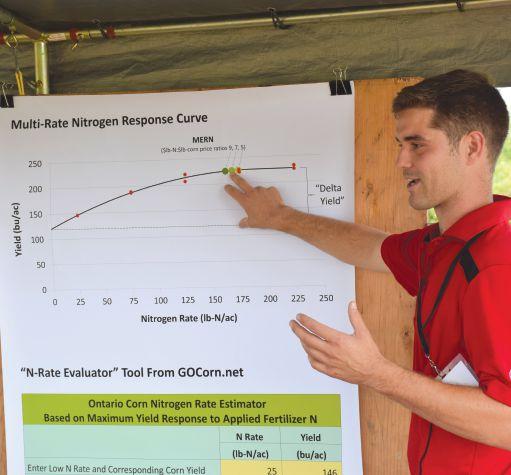
Ben Rosser, corn specialist at OMAFRA (shown here at the 2016 Southwest Crop Diagnostic Days in Ridgetown, Ont.) is part of a project to gauge the impact of weather on N mineralization.
PHOTO BY STEFANIE CROLEY.
between May 1 and July 1, and has its own weather station installed by Weather Innovations Network, which processes local weather data and hosts results on a dedicated website.
All sites, McDonald says, will have two replicates of the zero and full N treatments harvested for yield at maturity. “This will allow a calculation of the delta yield for each location that measures yield response to N rate,” he says. “This will also provide a [maximum economic rate of nitrogen] MERN for each site and a calibration of the [pre-sidedress nitrogen test] PSNT taken at the mid-June sample timing.”
In the previous soil N survey, he notes, there was no correlation to crop yield and thus no way of determining whether the PSNT taken to generate the survey was in the ballpark of predicting what the crop needed for economic yield.
“We know more of the background on these sites — previous management, previous rotations, etcetera, that might influence soil nitrogen levels,” says Ben Rosser, OMAFRA’s corn specialist.
“We have more info being generated on each site than in the past,” McDonald agrees.
In 2015, the corn survey generated surprising results: soil N levels were “considerably higher” than previous years’ data, due to an unusually dry spring.
“The higher-than-usual average soil nitrate levels observed in this year’s survey suggest that fertilizer N requirements in 2015 may be less than the rates generally needed in most years,” the team’s field crop report suggested, while cautioning that producers should confirm fertilizer N requirements on a fieldby-field basis.
“In 2016, the results were closer to normal, or maybe just above,” Rosser says. While the season began with cooler than normal temperatures, it warmed up by June.
“With an overall average of 11.2 [parts per million] ppm in 2016, soil nitrate levels tended to be average or slightly above average relative to the five previous survey years (20112015), while slightly lower than 2015 values, which were well above normal,” states the team’s 2016 field crop report, before recommending normal N application practices.
But recommendations should never be taken as holy writ, the authors again caution: “Soil nitrate values are highly influenced by the environment and agronomic practices. For instance, if you are in an area which has received significantly more rainfall than other parts of the province, you may have also experienced more loss than is reflected in these results.
“The only way to know soil nitrate concentrations on your own farm is to pull soil nitrates from your own fields.”
McDonald believes producers are beginning to realize the value of managing N application more tightly, thanks to their use of Internet and social media resources promoting the practice — and the genetics they’re employing.
“The biggest change that’s occurred is that the genetic potential of new hybrids has really increased, and with that, producers are understanding how important nitrogen management is to achieving that yield potential,” he says.
Visit topcropmanager.com for more updates on fertility and nutrients.
NATURE’S DESIGN
Optimize® ST
Pre-treat your soybean seed and treat yourself to a better performing crop. Optimize® ST is a dual-action inoculant that combines a specially selected Bradyrhizobium japonicum inoculant with LCO (lipochitooligosaccharide) technology to enhance nitrogen fixation through better nodule formation. Increased nitrogen availability supports root and shoot growth – providing greater yield potential for your crop.
Driving the Bottom Line
#bottomline
AND WATER
INVESTIGATING SOIL BACTERIAL AND FUNGAL COMMUNITIES
Exploring the link between soil biodiversity and soil health.
by Trudy Kelly Forsythe
Researchers at the University of Guelph are looking at the connection between soil biodiversity and soil health using new research, along with data collected from a long-term cover crop trial dating back to 2008.
“We are looking specifically at soil health,” explains research lead Kari Dunfield, an associate professor at the University of Guelph and a Canada research chair in environmental microbiology of agro-ecosystems.
Attention to soil health has increased in recent years as producers look for ways to decrease inputs and increase quality and yields.
“We’re talking about soil health a lot in agriculture, and farmers often ask me ‘Is my soil healthy?’ ‘What can I do to keep my soil healthy?’ ” Dunfield says. “However, it’s hard to measure that so what we need to do is measure indicators. If there’s less erosion or more fertility, can we say that’s a healthy soil?”
And, while the researchers know soil microbes are important, they don’t know if greater soil diversity is actually healthier.
“Healthy soil does better under certain conditions like drought and disease pressures, but the science linking soil health to soil microbes is not there,” Dunfield says. “We don’t know if a more diverse soil is a healthier soil.”
So, the researchers are looking at that in conjunction with research Laura van Eerd, an associate professor at the University of Guelph who specializes in nitrogen fertility and cover crops, is doing in Ridgetown involving the impact cover crops have on soil health.
“In Ontario, we are not entirely clear what cover crops are actually doing for the system,” Dunfield says. “They might help with erosion but we don’t see a huge spike in microorganisms. We’re adding on to Laura’s research and looking at the bacterial and fungal community of those systems.”
The project
Funded by the Ontario Ministry of Agriculture, Food and Rural Affairs (OMAFRA), the project began in 2015 and involves planting rotation vegetable crops at Ridgetown during the growing season.
“The cash crop this year is tomatoes,” Dunfield says. “At the end of the year, we’ll
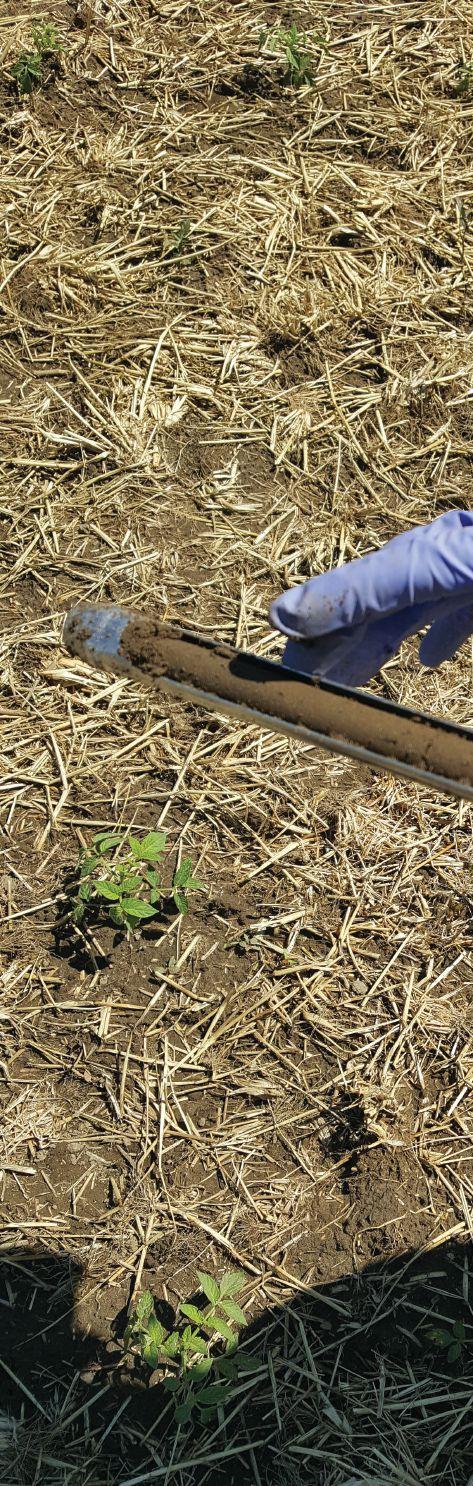
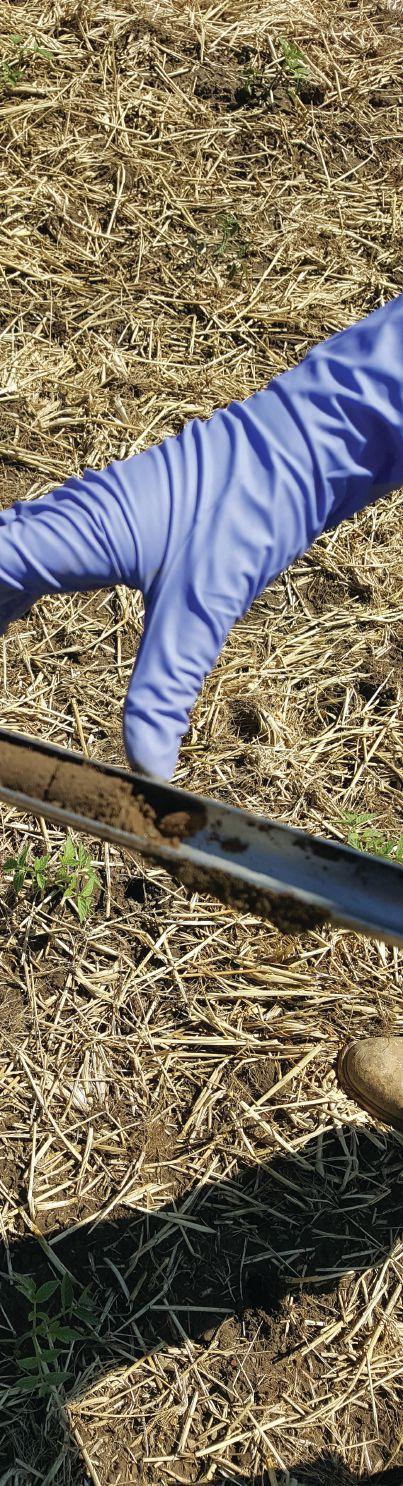
<LEFT: A soil sample from which researchers will look at the soil bacterial and fungal communities and quantify them as part of a study at the University of Guelph looking at the connection between soil biodiversity and soil health.
put in five cover crops.”
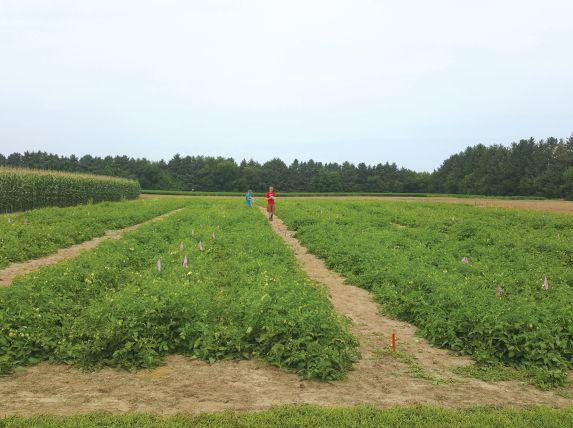
<LEFT: The tomato research plot from which soil samples were taken to quantify the microbial communities.
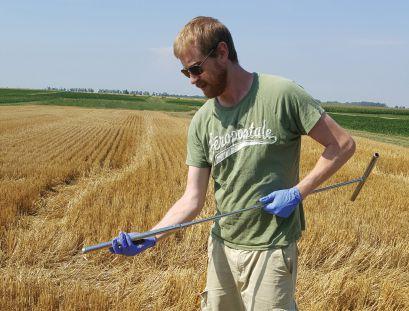
BOTTOM: Graduate student John Drummelsmith examines a soil sample to look at the soil bacterial and fungal communities and quantify them as part of the study.
Then, five or six times throughout the year, the researchers take soil from the system and graduate student John Drummelsmith extracts the DNA to look at the soil bacterial and fungal communities and quantify them. This data, Dunfield says, will tell them if fungal and bacterial communities are going up or down depending on the cover crop.
“Some people suggest in healthy bacterial-fungal ratios, fungi should be higher,” she says. “We’re going to look at that using DNA, next generation sequencing. This tells us what bacteria and fungi are there.”
Or, in other words, what the diversity of the system is. Because of van Eerd’s project, Dunfield and Drummelsmith have yield and soil measurements as well, so they will be able to see if the communities are shifting and if there is indeed a link to the soil.
“So we can say yes, more soil diversity is related to cropping systems that produce higher yields,” Dunfield says.
Preliminary findings
Dunfield and her team began sampling in October 2015. This year, they took samples in May, June and August and plan to take a couple more this fall. Early findings show there is indeed some difference in microbial communities under different cover crops.
“We saw an increase in bacterial population with the radish and rye combination cover crop,” Dunfield says. She adds that a couple – oat cover crop and radish and rye cover crop – increased fungal populations. “That’s compared to a no cover crop situation.”
She points out the cash crop had already been harvested for the October 2015 sampling event. More recent sampling should answer the question, “Do we see the same changes when the cash crop is there or is it transient with crop gone?”
More research to come
The researchers recently received additional funding from the Grain Farmers of Ontario to expand the project to more than one site.
“We started in one soil system and this will allow us to expand into other systems to see if we find the same results,” Dunfield says. “We are planning, in next field season, to
CONTINUED ON PAGE 26
PHOTO COURTESY OF JOHN DRUMMELSMITH.
PHOTO COURTESY OF BRUCE COLE.
PHOTO COURTESY OF JOHN DRUMMELSMITH.
WEED RECOVERY AFTER BURIAL BY SOIL
This could be a growing problem for Ontario growers.
by John Dietz
hrowing some dirt over the new seedling weeds in your rows isn’t necessarily the end of the story. They could come back, depending on the weed, the tool and the approach you take, according to two weed scientists.
Mechanical weed control, using some form of tillage, still has an important role in weed control in Eastern Canada. Generally, though, it isn’t getting much attention from weed science – as compared to research with herbicides.
South of Lake Ontario, Charles Mohler, a senior weed research associate at Cornell University in Ithaca, N.Y., recently completed semi-basic ecological research on the ability of five annual weed seedlings to recover from burial.
That work has some direct implications for shallow tillage in rows after planting for growers in Ontario and Eastern Canada, says Mike Cowbrough, the field crops weed management specialist with the Ontario Ministry of Agriculture, Food and Rural Affairs, in Guelph, Ont.
Most Ontario corn still has some tillage for weed control, although the form can vary, Cowbrough says.
“Tillage is very much crop specific. The majority of corn has either a single pass or double pass. The vast majority of wheat acres are notill, and soybeans probably fall somewhere in the middle for weed control,” he says.
As for the weeds, common lamb’s-quarter is the most significant annual weed in Ontario, being both abundant and very competitive. Pigweeds (redroot and green), common ragweed, green, yellow and giant foxtails and velvetleaf also are common annuals. Among perennial weeds, perennial sowthistle is most abundant, he says.
“There’s no question that tillage is a critical component of weed management. However, species react in different ways, so the best strategy varies with the weed species,” Cowbrough says.
Basic science
In mid-state New York, with agricultural climate and soils similar to Ontario, Mohler chose to investigate how well five species could recover from burial. The five were common lamb’s-quarters, Powell amaranth (or green pigweed), velvetleaf, giant foxtail and barnyard grass.
Greenhouse experiments began in 2006 and ended with field experiments in 2013.
Farmers have three basic ways to kill a seedling weed with tillage: burial, dismemberment and uprooting.
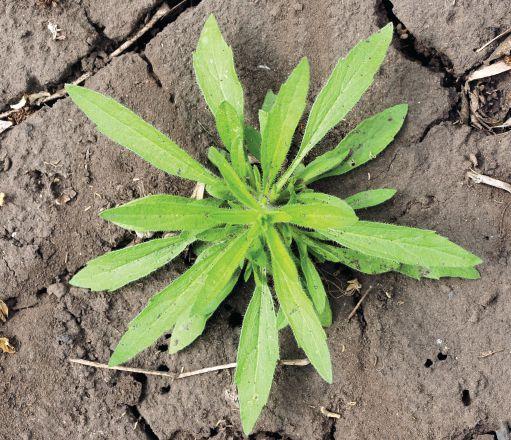
Tillage can be an effective way of controlling certain weeds, but some can eventually recover and grow again.
In practice, however, burial may not work out. The trials in New York, with more than 35,000 weed seedlings, revealed:
• Recovery often exceeds 50 per cent if a small portion of a seedling is left exposed.
• Recovery from complete burial (by two centimetres of soil) ranges from zero to 24 per cent, but recovery greater than five per cent is rare.
• No seedlings recover from four cm of complete burial.
• Large-seeded species tend to recover from complete burial better than small-seeded species.
• If the soil remains dry after burial, the recovery rate is low or may even be zero.
• Small seedlings are easier to kill by burial, with less soil.
In a controlled greenhouse setting, weed seedbeds were watered daily at first. After burial, some received no water; some were watered immediately after burial and some had daily watering for up to two weeks.
“In one experiment, we got re-emergence of seven seedlings out of thousands that were buried. In another experiment, we watered every day and something like 12 per cent of the velvetleaf re-emerged. Recovery of other species was lower,” Mohler says.
Mohler says, “Burying seedlings is a very effective way to kill them, but you’ve got to get them completely buried. When we cultivate corn or soybean, we throw four or five inches of soil into the row. You can bury some pretty good-sized seedlings with that much soil.”
PHOTOS BY JOHN DIETZ.
Among the five weeds, generally, velvetleaf was the most successful at recovery.
The final experiment purposely left a small, consistent fraction of leaf area exposed while burying the rest of the seedling, including the growing point, with two cm of soil.
Despite almost complete burial, more than 35 per cent of seedlings recovered in every species. In most cases, more than 50 per cent recovered. Velvetleaf and giant foxtail recovery was 60 to 80 per cent.
That’s the basic science.
Mohler says, “I try to teach, don’t run through a field without thinking about what you’re doing. You need to target the kind of damage you’re trying to inflict. That depends on the soil conditions, the weather conditions, what your implement can do and how you set it up to use it.”
Applied science
In practice, Cowbrough says, effective tillage needs strategy as well as complete weed burial.
First, there’s a need to distinguish perennial from annual weed control. In-crop tillage is better suited for annual weeds in most cases.
Cowbrough says, “Doing a shallow primary tillage pass in spring on dandelions is good eye-candy for a couple weeks, but that’s all.
For effective perennial weed control, you really have to get rid of the entire root or the plants can grow back.”
Some annuals, such as eastern black nightshade, germinate very late. Those weeds arise too late for effective in-crop tillage.
Canada fleabane is a common annual weed in Ontario and often glyphosate-resistant.
“Tillage is very good at controlling Canada fleabane, if it is aggressive and early. It has to be effective enough to knock the soil off the roots so the fleabane has zero chance of recovery,” Cowbrough says.
The second point is about timing. Secondary roots develop as the fleabane gets beyond seedling stage.
“Secondary roots hold soil, too. Tillage may uproot the plant but it can eventually recover and grow again as long as it has some secondary roots holding onto soil,” he says.
For ragweed control, there are strategy variations. For an infestation of common ragweed, the best strategy is complete burial.
“You want to bury the common ragweed seed. The deeper you bury it, the less likely it is to germinate,” he says.
But giant ragweed is different, including glyphosate-resistant giant ragweed.
“The best strategy is to leave the seed of giant ragweed on the surface in a no-till environment,” Cowbrough says. “That seed is prone to predation and degradation, and it’s unable to germinate without a bit of disturbance along with moisture and light. Tillage is not an asset for managing that species of ragweed.”
However, if conditions were right and last year’s giant ragweed seed got what it needed, it is likely to be up very early and in huge numbers of seedlings ahead of planting.
If you go in with a tillage implement to knock down those giant ragweed seedlings ahead of planting, it is just as effective as a chemical burndown.
Generally, Cowbrough says, tillage tools can be pretty effective at weed management if they are used appropriately.
In the days after a burndown, light disturbance may be enough for burying and controlling weed seedlings that emerge.
The disc hiller can bury more advanced weeds ahead of planting.
And, after crop emergence, a treatment with the sweeps on a row crop cultivator can throw a lot of soil within the rows to bury and destroy seedling annuals.
To wrap it all up, Cowbrough offers this advice:
• Determine the one or two most prominent species to control.
• Pick the tillage tool that’s best for that job. No one tool will address all the situations.
• If there’s opportunity, adjust the tool to its best advantages.
Trait Stewardship Responsibilities Notice to Farmers
Charles Mohler at Cornell University in New York recently completed a study investigating how well five weed species could recover from burial.
OPTIMUM CANOLA SEEDING DATES AND RATES
Site-specific recommendations for Eastern Canada.
by Carolyn King
Seeding date and seeding rate can have a big influence on canola yields and quality. The challenge is to get them both just right – a date that’s not too early and not too late, and a rate that’s not too low and not too high. Now a project has determined optimum seeding dates and rates for locations across Eastern Canada.
The project had its origins back in 2009 when the Growing Forward 1 program identified canola as a research priority because of the great potential for expanding canola production in Eastern Canada. Canadian opportunities were emerging for canola’s use in biodiesel because federal and provincial governments were setting requirements for Canadian diesel fuel to contain a portion of biodiesel. At about the same time, a major oilseed crushing plant was opening near Trois-Rivières, Que., providing a closer buyer for canola growers in Quebec and the Maritimes. And Eastern Canadian crop growers were becoming interested in canola as a higher value alternative to some of the cereal crops commonly grown in their rotations.
“[Good agronomic information is essential to advance adoption of any crop.] And some of the first questions that farmers who are thinking about a new crop alternative would ask are: When should we seed this crop, and at what population density?” says Bao-Luo Ma, a senior research scientist specializing in crop physiology with Agriculture and Agri-Food Canada’s (AAFC) Ottawa Research and Development Centre (RDC).
To answer those two important questions for canola growers in Eastern Canada, Ma initiated the project in 2011. The objectives were to examine the effects of canola seeding date and rate on seed yields, oil yields and other factors, and to develop a model for estimating optimum seeding dates for locations in Eastern Canada.
The project involved field experiments at seven locations:
ABOVE: The project compared early, intermediate and late seeding dates and several seeding rates for canola at this Ottawa site and six other locations across Eastern Canada.
Harrington, P.E.I.; Canning, N.S.; Fredericton, N.B.; Saint-Augustin-de-Desmaures, Que.; Sainte-Anne-de-Bellevue, Que.; Ottawa; and Guelph, Ont. To carry out the research, Ma collaborated with many researchers: Hong Zhao, a visiting scientist; Zhiming Zheng at AAFCOttawa RDC; Aaron Mills at AAFCCharlottetown RDC; Claude Caldwell at Dalhousie University; Peter Scott at the New Brunswick Department of Agriculture, Aquaculture and Fisheries; Anne Vanasse at Laval University; Donald Smith at McGill University; and Hugh Earl at the University of Guelph.
In 2011 and 2012 at each site, the plot treatments compared early, intermediate, and late seeding dates. The actual seeding dates depended on local weather conditions and site accessibility. At most of the sites, three seeding rates were compared: 2.5, five and 7.5 kilograms per hectare (kg/ha). A fourth seeding rate of 10 kg/ha was included at Guelph. At all the sites, the experiments used the same canola hybrid: InVigor 5440.
The project team measured such factors as plant stand, branches per plant, pods per plant, seeds per pod, 1,000-seed weight, seed yield, and seed oil and protein concentrations.
The model was developed using the
data collected in 2011 and 2012. Then Ma led a two-year field experiment at Ottawa RDC in 2013 and 2014 to collect additional data for verifying the model. This experiment compared four seeding dates and three seeding rates.
The project was funded by the Eastern Canada Oilseeds Development Alliance and AAFC through the Developing Innovative Agri-Products program of Growing Forward 1, and the Canola Council of Canada and AAFC through the AgriInnovation Program of Growing Forward 2.
Key results
“The number one finding from this project is that optimum seeding date is important for optimizing yields and it is site-specific,” Ma says.
Based on the project’s data, the optimum canola seeding dates are: Ottawa, April 24; Guelph, April 26; SainteAnne-de-Bellevue, April 26; Canning, April 29; Saint-Augustin-de-Desmaures, May 11; and Harrington, May 25.
The optimum dates for SaintAugustin-de-Desmaures and Harrington were relatively late in the spring. At SaintAugustin-de-Desmaures, that was because of the area’s high risk of flea beetle damage earlier in the spring.
At Harrington, it was because of the cold spring weather. (No optimum seeding date was determined for Fredericton because of field inaccessibility issues.)
“The timely or optimum seeding date of a crop is very critical because you want to maximize utilization of the natural resources like light, water and temperature,” Ma explains.
“If you plant too early, the crop will face cold stress and may take much longer to germinate and emerge, and the seedlings will be weaker and more vulnerable to attacks by insects like flea beetles.” So for optimum crop growth, growing conditions following seeding of canola need to be warm enough to promote good stand establishment.
However, if you seed too late, canola yields and quality may be reduced. Ma says, “Canola is a cool-season crop. When growing canola in Eastern Canada, you may have the risk of very high temperatures and sometimes drought stress at flowering time. For the flowering canola crop this is very critical. Temperatures above 29 C will cause flower abortion, there will be not enough pollen for pollination, and yields will be lower.” Earlier seeding gives the crop a better chance of avoiding heat and drought stress during flowering.
Ma notes earlier seeding also tends to give the plant more time for foliage development, resulting in more branches, more pods and heavier seeds.
As well, research has shown early seeding tends to result in higher oil content in canola seed. “So even in a year when the yield is no different whether you seed one week or two weeks earlier or later, the chances are you will get a higher seed oil concentration in the early-seeded canola compared to the later-seeded canola,” he explains.
The field experiments showed some exceptions to this general rule about higher oil levels with early seeding, Ma says. “For example, in one year at [Sainte-Anne-de-Bellevue], later seeding sometimes resulted in higher seed oil concentrations than early seeding. We think that was because in that particular year, the early-seeded plots suffered greatly from flea beetle damage.” The flea beetles damaged the main growing point on some canola plants. Some of those plants were able to eventually recover and produce additional branches.
Earlier seeding tends to result in higher seed yields and higher oil content in canola seed.
“The seeds on these later branches matured later than the seeds on the main stem of the later-planted crop. So in that particular environment, early seeding did not produce seeds with a higher oil concentration.”
The project’s other key finding is that a seeding rate of about five kg/ha is optimum for most situations in Eastern Canada.
The results showed raising the seeding rate from 2.5 to five kg/ha usually increased the seed yield for early-seeded canola. However, further seeding rate increases above five kg/ha did not increase yield.
Canola can usually reach its yield potential with a range of seeding rates because the plants will compensate for differing seeding rates by changing the number of branches and number of seeds they produce. However, very low and very high seeding rates are not recommended.
“If you plant too many seeds that will not be economic [because of the seed costs for the producer] and because the plants will compensate by producing fewer branches and fewer seeds,” Ma explains.
“On the other hand, if the seeding rate is too low, [the crop yield] will suffer due to insufficient plant density.” And even if the crop is able to produce enough extra branches and seeds to compensate for a very low seeding rate, the extra seeds set on the branches may not be ready for harvest at the same time as the seeds on the main stems of the plants.
However, Ma notes that if growers are seeding canola during cold conditions, a slightly higher seeding rate would tend to provide better yields. In that situation, the higher rate can help compensate for the poorer germination and emergence, and weaker seedlings that can result from the cold seedbed.
Another important project result is the model developed to estimate the optimum seeding date. For most of the project sites, the model was able to
INVESTIGATING SOIL BACTERIAL AND FUNGAL COMMUNITIES
Continued from page 21
expand to multiple field sites to expand the analysis.”
For sustainability
Research into soil biodiversity and health is vital as the agriculture sector works to create agriculture systems that are sustainable by maintaining yields with the least inputs and that also help the environment. The ever-increasing demand on Ontario’s agricultural sector to provide plant biomass in the form of crops for food, animal
grain and even biofuels makes this challenging, but producers are interested in trying cover crops and changing microbial communities in soil.
The researchers believe information on soil biodiversity will show the importance of selected management options such as cover crops, reduced tillage and crop rotations in improving soil health and in sustaining crop productivity.
“We understand this is a farm and people need to maintain their yield,”
accurately estimate the seeding date with the potential to reach maximum seed yields. In this model, the optimum seeding date is a function of the location’s 30year average (1982 to 2012) daily minimum air temperature in April and May.
Canola growers in Eastern Canada can use the seeding date for the location in Ma’s study that is closest to their own farm or use Ma’s equation to estimate their optimum seeding date, and then seed at a rate of about five kg/ha.
Dunfield says. “We’re looking for the most sustainable, environmentally ultimate good to achieve that.
“But, right now, there is no tool to measure biological indicators,” she adds. “No one knows what part of biology is important. We need a good way to measure biology in soil and determine what we need there to have healthy soil. We need the research and data to show if a farmer grows this cover crop, this is what it does to the soil.”
Earlier seeding gives canola crops a better chance of avoiding heat and drought stress during flowering.
TRAITS AND STEWARDSHIP GUIDE 2016
Somewhere in the pattern of what is considered predictable about farming – the yearly routine of planting, fertilizing, spraying and harvesting –the seed and traits industries continue to demand growers update their educations to meet constantly changing requirements.
With each new growing season, there are more corn and soybean hybrids in the fields and on the horizon. These hybrids embody traits and innovations that are intended to provide greater protection, reduce a grower’s risk and add value to the bottom line.
The agriculture industry is constantly working; innovating and creating to ensure product demand can be met when farmers call for it. But the onus is on producers to make decisions to ensure the best results.
This kind of forward thinking reflects our philosophy at Top Crop Manager . With a wealth of new technologies emerging, we do our best to help you make smart decisions to prepare for the coming year, and we are happy to once again provide our annual Traits and Stewardship Guide.
Besides being a resource, the guide is an annual reflection of how the industry continues to change. Our goal is to ensure our readers are aware of research being done now that will potentially change the way they farm. By highlighting new technologies, we strive to help producers stay ahead of the curve and we’re proud to be able to give early adopters the information they need to plan ahead.
The information herein is intended to assist in making decisions and going forward, but for a better idea of what will work for you, we recommend you talk with your seed dealer for more information.
Reach for Wolf Trax Zinc DDP ®, the nutrient tool that is field-proven by corn growers like you.
With our patented EvenCoat™ Technology, Wolf Trax Zinc DDP coats onto your N-P-K fertilizer blend, delivering blanket-like distribution across the field. Plus our innovative PlantActiv™ Formulation ensures the zinc is available early, when corn needs it most.
Have your dealer customize your fertilizer blend with Wolf Trax Zinc DDP, and see how the right zinc can boost your corn crop and the bottom line.