TOP CROP MANAGER
Hig H Yield
Corn
What would it take to hit 300?
PG. 6
T H e Bes T of BoTH Worlds Tillage and Soil Conservation PG. 13 f orages s T ill a g ood Be T
Corn
What would it take to hit 300?
PG. 6
T H e Bes T of BoTH Worlds Tillage and Soil Conservation PG. 13 f orages s T ill a g ood Be T
Only HiStick® N/T inoculant and HiCoat® N/T S225 preinoculant are BioStacked®. The BioStacked® system unleashes multiple beneficial organisms for greater plant vigour and more root biomass – bumping your soybean yields up 1.5 bu/ac to 2.5 bu/ac more than non-inoculated soybeans.
Will that be HiStick® N/T or HiCoat® N/T S225? Either way, you’re getting BioStacked®, with all the yield benefits of Canada’s #1 soybean inoculant.
I apply my HiStick® N/T prior to planting. I like the flexibility.

I order my seed treated with HiCoat® N/T S225. I like the convenience.
AAFC
Carolyn King
Carolyn King
Jeanine Moyer


September 14 marked the day that federal, provincial and territorial Ministers of agriculture reached an agreement on growing Forward 2. The new five-year agreement will come into effect next april and will focus on innovation, competitiveness and market development. This seems like a huge win for agriculture in Canada, but is it really as good as it seems? Have the worries of farmers across the country that the Business risk Management (BrM) programs will be cut and severely reduced come to fruition?
growing Forward 2 will include $3 billion in funding over the next five years.
The key highlights:
• a 50 per cent increase in cost-shared investments in non-BrM strategic initiatives
• a suite of BrM programs to protect against severe market volatility and disasters:
o improved negative margin coverage in agriStability;
o lower program fees for agriStability
o increased contribution allowance into agriInvest accounts to manage risk
• greater flexibility for provinces and territories to tailor programs to local needs
• increased opportunity for provinces and territories to invest in environmental initiatives and on-farm water infrastructure
In light of the agreement, federal agriculture Minister gerry ritz says, “growing Forward 2 will help drive economic growth and long-term prosperity through agricultural innovation and market development, while also ensuring governments continue to share the risk of severe market volatility and disasters.”
What he doesn’t mention is that $445 million dollars will be saved by the federal and provincial/territorial governments by reducing agriStability coverage from 85 to 70 percent of a producer’s reference margin and by also reducing matching government contributions under agriInvest from 1.5 to one percent of producers’ total allowable net sales.
I understand that cost-cutting measures in these tough economic times are a necessity. But cutting back on programs that are already being accused of not hitting the mark will only increase the discord. and doing it after much of north america was hit by major, weather-related crop losses is not justified.
It was a difficult decision for provincial and territorial leaders to have to make. agreeing to the new policy and signing on the dotted line meant gaining access to new monies and investments in innovation and market development, but it also meant agreeing to the aforementioned cuts that may cause significant losses in tough years. That is not what constituents sent them to Whitehorse to do. overall, I think the good has outweighed the bad in this new framework and, in the long run, farmers are going to benefit. Time will tell.
If you are interested in more discussion on regulations, please turn to nate Stevens’ opinion piece on page 26 of this issue, where he considers how regulations can be good or bad for farmers. I look forward to continuing the conversation online…
OctOber 2012, vOl. 38, nO. 12
eDItOr Sara Avoledo savoledo@annexweb.com
ASSOcIAte eDItOr David Manly dmanly@annexweb.com
eAStern SAleS MAnAGer Steve McCabe • 519.400.0332 smccabe@annexweb.com
WeStern SAleS MAnAGer Kevin Yaworsky • 403.304.9822 kyaworsky@annexweb.com
AccOunt cOOrDInAtOr Alice Chen • 905-713-4369 achen@annexweb.com
MeDIA DeSIGner Katerina Maevska
GrOuP PublISHer Diane Kleer dkleer@annexweb.com
PreSIDent Michael Fredericks mfredericks@annexweb.com
PUBLICATION MAIL AGREEMENT #40065710 return unDelIverAble cAnADIAn ADDreSSeS tO cIrculAtIOn DePt P.O. Box 530, Simcoe, ON N3Y 4N5 e-mail: subscribe@topcropmagazine.com
Printed in canada ISSN 1717-452X
cIrculAtIOn e-mail: subscribe@topcropmagazine.com Tel.: 866.790.6070 ext. 202 Fax: 877.624.1940 Mail: P.O. Box 530, Simcoe, ON N3Y 4N5
SubScrIPtIOn rAteS Top Crop Manager West - 8 issuesFebruary, March, Mid-March, April, June, October, November and December - 1 Year - $44.25 Cdn. plus tax Top Crop Manager East - 7 issuesFebruary, March, April, August, October, November and December - 1 Year - $44.25 Cdn. plus tax Specialty Edition - Potatoes in Canada - February1 Year - $8.57 Cdn. plus tax
of the above - $76.19 Cdn.
www.topcropmanager.com

Case IH Advanced Farming Systems is dedicated to helping producers be ready. AFS delivers an integrated, less complex precision farming solution, built right in to our equipment using a single display across machines. Built on open architecture, AFS can interface with your existing equipment, no matter what color it is. And our specialists in the field, AFS Support Center engineers and AFS Academy trainers, are there to help you maximize your operation’s potential and keep you rolling 24/7/365. Visit an AFS Certified Dealer or go to caseih.com/AFS to learn more.
Agronomists + growers are testing the possibilities.
by Carolyn King
We know it’s possible for corn in o ntario to yield over 300 bushels per acre under special conditions. For instance, o ntario growers have produced 300+ bushels on single acres in yield contests. and in 2010, four hybrids yielded over 300 bu/ac at one site in the small plots of the o ntario Corn Committee ( o CC) Hybrid Corn performance Trials. But what would it take for high-yielding corn fields that today produce 200+ bu/ac to routinely reach 300+ bu/ac?
It’s an intriguing question that has researchers, agronomists and corn growers discussing and testing the possibilities, including an on-farm study that is now underway.
learning from the trends
o ne way to figure out how to further increase yields is to look at how we’ve got to where we are. a s growers know, corn yields in o ntario have been trending upwards for many decades. The average yield is now about 150 bu/ac. In the last five years, many growers have had fields yielding over 200 bu/ac.
“Three things influence where we’re at in terms of corn yield: genetics, environment – especially the weather – and agronomics. But to try to fine-tune comments around those things is very difficult,” says g reg Stewart, corn industry program lead with the o ntario Ministry of a griculture, Food and rural affairs. He notes that each of those factors is continually changing and they all interact with each other, so it’s difficult to separate out their relative importance and to determine which particular changes in each factor are the most important.
Looking at the agronomic component, Stewart says: “Most growers have improved their agronomics around corn planting by planting earlier or planting into more uniform seed beds and/or using better planters with precision seed placement. That has contributed to yield increases, although you can argue about how much.” o ther practices, such as fungicide applications and higher plant densities, have also helped, but he suspects their contributions to the yield trend have been relatively small.
In fact, according to Stewart, the evidence shows agronomics has played only a small part in yield trend. For instance, the agronomic practices in the


<lEFT: Comparing two examples of input levels and corn yields
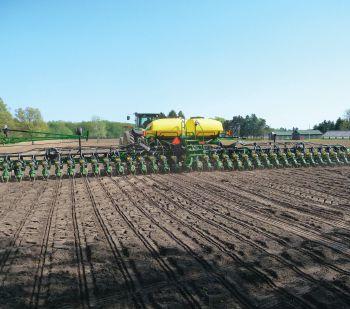
<lEFT: One of the 300+ Bushel Initiative cooperators planting his corn crop: The participants are comparing their usual practices with a set of higher-input practices.
o CC trials have changed very little over the last 20 years, while yields have climbed significantly.
To figure out whether genetics or the environment is the most important factor, Stewart examined o CC trial data for the hybrid northrup King 3030Bt over a nineyear period. “Strangely enough, that hybrid’s yields increased during that time. Since the agronomics and genetics stayed the same, you’d have to credit that increase to better environment, better weather,” he says. “So, what percentage of the yield does the weatherman get credit for versus the corn breeder?”
Dr. Bill Deen, an agronomy researcher at the University of g uelph, notes the corn yield trend line for the last 10 years has been much steeper than the trend line for previous decades. Whether the steeper line is a temporary blip or the start of a new trend, he is curious about which factors might have caused the greater yield increases in the last five or six years.
Deen thinks improvements in genetics and management, such as better planter performance and more uniform tillage, have contributed in part to that steeper line, but changes in weather patterns might be very important. He speculates that analysis of weather data might show trends over the last half-decade such as possibly warmer temperatures in august and September, warmer nighttime temperatures, earlier springs, and/or changes in rainfall patterns.
When Stewart looks at the last five or six years, he notes several years with some of the highest total heat units on record. Like Deen, he would be interested in seeing the results of a detailed analysis of such weather characteristics as nighttime temperatures. But Stewart also thinks another factor in the steeper trend line may be the effect of increasing adoption of hybrids with e uropean corn borer protection.
although Deen expects genetics and management will continue to improve incrementally, he’s not sure if those advances will be enough to get today’s 200-bushel fields to 300 bushels. However, one management area he thinks might offer a real opportunity for further improvement is soil quality.
Soil quality is important for things like nutrient and moisture uptake by the roots and soil moisture retention. a s well, Deen says, “There are some classic studies demonstrating that, even if moisture and nutrients are non-limiting, yield is still increased if a corn plant has a well-developed, fibrous root system. Why that is, we’re not sure. But soil quality promotes that rooting pattern.”
e xamples of practices that improve soil quality include crop rotation, cover crops, and controlled traffic systems to reduce compaction.
There’s a lot of debate about what input levels, especially nitrogen ( n ) levels, are needed for higher corn yields. although Deen has data from one of his current research sites showing an economic response to quite high n rates in 2010 and 2011, his past research and many other studies show that n rates significantly above the recommended rates don’t necessarily pay.
“The whole idea around increasing inputs will be an interesting one to wrestle with,” says Stewart. “ nitrogen is hugely controversial. The nitrogen recommendation systems for most of the states in the U.S. have now taken yield goal out of the equation. For instance, the Iowa State University Corn nitrogen r ate Calculator doesn’t ask how many bushels per acre you
think your field can generate. It asks whether the previous crop was corn or soybeans, and what the prices are for nitrogen and corn. Then it tells you the average optimum n rate [for the maximum return to n ]. In o ntario, our nitrogen calculator still has a yield expectation component. So if your expected yield is 300 bu/ac, then our calculator would ask you to apply a lot more n than if the expected yield is 180.”
High-tech package for higher yields
Dr. Fred Below, a crop physiologist at the University of Illinois, has spent much of his career evaluating different options to enhance corn yields. Like Deen and Stewart, he sees environment, genetics and management as the key factors in improving yields, but he’s willing to put some numbers on how much each contributes.

Based on research in Illinois, Below has developed a tool called “The Seven Wonders of the Corn Yield World” to help farmers and agricultural professionals evaluate corn management options. “o ur Seven Wonders are those factors each year that can have a big, positive impact on corn yield,” he explains. “It’s a catchy deal that farmers can relate to.”
The tool first identifies three essential prerequisites for good corn production: good weed and insect control; drainage; and proper pH and adequate phosphorus ( p ) and potassium (K). Then, assuming those basic criteria are met, the tool ranks the top factors affecting corn yields, expressing their relative value in bushels per acre.
The most important is the weather (70+ bu), followed by nitrogen (70 bu), hybrid selection (50 bu), previous crop (25), plant population (20), tillage (15) and a catch-all category
called growth regulators that includes such practices as fungicide applications (10).
So, the idea is, if all seven factors are optimized, a farmer would get 260 bu/ac. To go from 260 to 300 bu/ac, the farmer would need better prerequisites.
Below has taken this concept a step further. “Using our knowledge of how individual factors impact corn yields, we’ve put together a high-tech package where we try to optimize as many of those factors [as possible] at the same time in the same place.”
He explains, “Basically our high-yield package is feeding and protecting a higher population of the best genetics.” The package has five components: improved soil fertility, including additional p, sulphur and zinc; a triple-stack hybrid; side-dressing with an extra 60 lb./ac of n over a base n rate of 180 lb./ac, with
InVigor growers are just like other growers. Every day, they’re up before sunrise and work until everything gets done. Because when you love something this much, it’s not just a job. It’s everything.
InVigor growers might be just like every other grower, but the same can’t be said about their canola. InVigor consistently delivers early season vigor, high stress tolerance and superior yield. This year, grow with confidence.
the side-dressed n in a form that is designed to reduce n loss to the environment; a high plant population of 45,000 plants/acre; and a fungicide application, such as Headline, for plant health and harvestability benefits.
a key finding from Below’s research is that the components of the high-tech system work together. “We’ve found a synergistic effect of combining the individual factors -- the combined effect is much bigger than you’d expect based on the individual value of those things one at a time.”
Below has come very close to reaching 300 bu/ac on some of his high-tech plots. “I’ve sometimes had a single plot in a treatment go a little over 300 bushels, but I’ve haven’t had a replicated treatment reach 300 bushels. However, I’ve been in the high 290s and I’ve routinely seen some 250s and 260s. I largely blame the weather, of course, when I don’t reach 300! and it usually is the weather, in all honesty.”
Does the high-tech package pay on-farm?
“It’s a very difficult question to answer because the value of the grain changes daily and the price of the inputs tends to change often as well,” says Below. “To buy more seed and apply more fertilizer and protect it all with a fungicide, it’s not a cheap endeavour. I’d say usually you’d need to produce somewhere in the range of 30 extra bushels to be able to pay for it. But that’s not a hard and fast answer because, for instance, if grain is $7, then the high-tech package almost always pays.”
“With this study, we wanted to look at recent advances in traits and genetics, farmers’ practices, and equipment a bit more closely to see if we could push yields even further,” says Ken Currah, central market development agronomist with pride Seeds. “We’re hoping to develop a standard set of recommendations that could be tweaked slightly for each grower’s situation, so we can say here’s how to make the best potential out of growing our product.”
In 2011, the initiative involved about a dozen field-scale sites with growers in eight counties in o ntario. all the sites were high-yielding fields, with 200+ bushel expected corn yields.
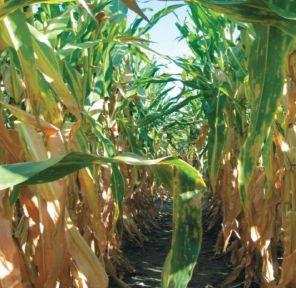
Looking ahead, Below says, “I think we’ll be seeing 300 bu/ac as fairly routine in the next five to 10 years due to technology advances. That includes biotechnology – better genetics, better protection, ultimately droughttolerant hybrids – and better fertilizer and application technologies, and better protection technologies. If you combine all those together, there’s a huge payoff down the road.”
The sites included a range of soil types, but all had proper pH levels and adequate to abundant p and K. Many of the co-operating growers also routinely apply other nutrients such as sulphur and magnesium. The growers each have their own approach to n applications; for instance, some use a single application and others use split applications. all sites included some type of tillage. at most sites, the previous crop was winter wheat or soybean, except one that was second-year corn. The growers are using pride’s top-of-theline hybrids with key trait combinations and treatments. at each site, the growers used their own equipment and their standard practices. Then on a 10-acre portion of their field, they used a set of higher-input practices: higher seeding rates, higher n rates, and a Headline fungicide application. Ba SF is cosponsoring the initiative with pride Seeds.
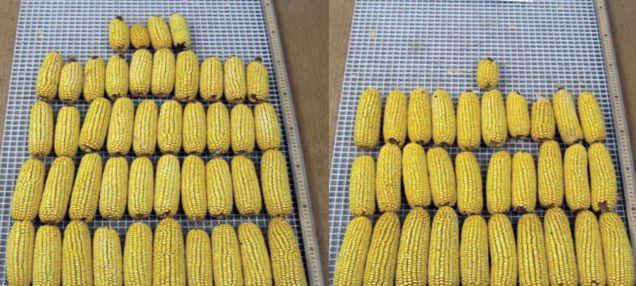
ABOVE: Yields from Below’s high-tech package plots (left) are roughly 50 bushels/ acre higher than yields from the plots where Illinois corn growers’ standard practices used.
In the 10-acre test area, the target plant populations were 10 to 20 percent above the grower’s standard rate. For nitrogen, the grower’s standard rate, usually about 160 to 180 lb./ac, was compared to a higher rate of 200 to 220 lb./ac and a very high rate of 250+ lb./ac. Headline was applied at tassel emergence in the 10-acre test area.
for 300+ on high-yielding Ontario
To see if higher-input practices would make economic sense for high-yielding corn fields in o ntario, pride Seeds launched its 300+ Bushel Initiative in 2011.
In 2011, much of o ntario’s corn-growing region had a prolonged, cool, wet spring that resulted in very late planting. But that was followed by good growing conditions in most regions, and many areas were frost-free right to the end of o ctober.

“I’m really excited about what the future is in agriculture as a whole.
I think more than ever it’s got to be run with a business plan and a sharp pencil.”



– Doug Seland, Alberta


Canadian agriculture is a modern, vibrant and diverse industry, filled with forward-thinking people who love what they do. But for our industry to reach its full potential this has to be better understood by the general public and, most importantly, by our industry itself.
The story of Canadian agriculture is one of success, promise, challenge and determination. And the greatest storytellers are the 2.2 million Canadians who live it every day. Be proud. Champion our industry.
Share your story, hear others and learn more at AgricultureMoreThanEver.ca
The scientists of the Applied Bean Genomics and Bioproducts Project are doing something that’s never been done before in Canada.
by agriculture and agri-Food Canada
Beans are considered the most important food legume in the world – high in protein, fibre, complex carbohydrates and vitamins. However, for all of their value, very little genomic information is available about dry beans. This information is necessary to do everything from making beans hardier and healthier to finding new uses for bean proteins. Scientists at a griculture and a gri-Food Canada are about to change that and in the process, they’re discovering a wealth of agricultural, health and business opportunities.
Working with universities in g uelph, London and Windsor and various bean industry partners, the scientists of the applied Bean g enomics and Bioproducts project are sequencing the entire bean genome – something that’s never been done before in Canada.
This sequence information will be used to develop molecular markers for:
• enhancing disease resistance in beans (specifically, resistance to common bacterial blight, a major disease of beans worldwide)
• promoting human health properties in beans such as cancer-fighting antioxidants
• creating bioproduct applications from dry bean proteins (for example, creating biodegradable, dissolvable pouches from bean proteins that can be used in packaging dry food)
o verall, this work will benefit farmers by minimizing crop losses through developing beans that are more disease resistant, as well as by increasing their profits through developing healthier beans for consumers and finding new bioproduct uses for beans. It’s estimated that common bacterial blight can cause up to 40 per cent yield loss. Sequencing the dry bean genome will help scientists develop new tools that can significantly improve the efficiency of plant breeding efforts in developing new bean varieties with improved disease resistance; this is known to be the most environmentally friendly approach in controlling plant diseases and is expected to lead into economic benefits for the industry.
By studying the phenylpropanoid pathway in beans, scientists
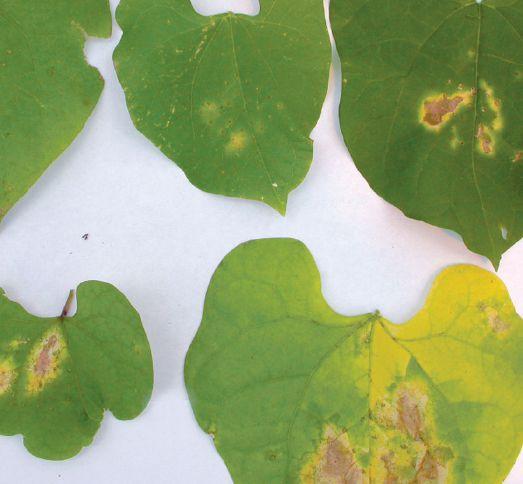
would be able to access many compounds that possess valuable nutraceutical properties. a s beans are low in fat and a source of low glycemic index carbohydrates, increasing the levels of these antioxidants would make for greater consumer appeal. novel bioproduct applications promise to add exciting new opportunities on many levels. Bean protein-based films would be extracted from p haseolus, which, unlike soybean or wheat proteins, are not allergenic. The films can be used to create different shapes for food packaging (e.g., dry soups, sugar, flavour packs), bandaging and capsule manufacturing, and will dissolve in boiling water. Derived from sustainable sources (culls of bean cleaning operations) and completely biodegradable, they are a safe, healthy, environmentally friendly option consumers will appreciate.
Looking for a compromise between tillage and soil conservation.
by Blair andrews
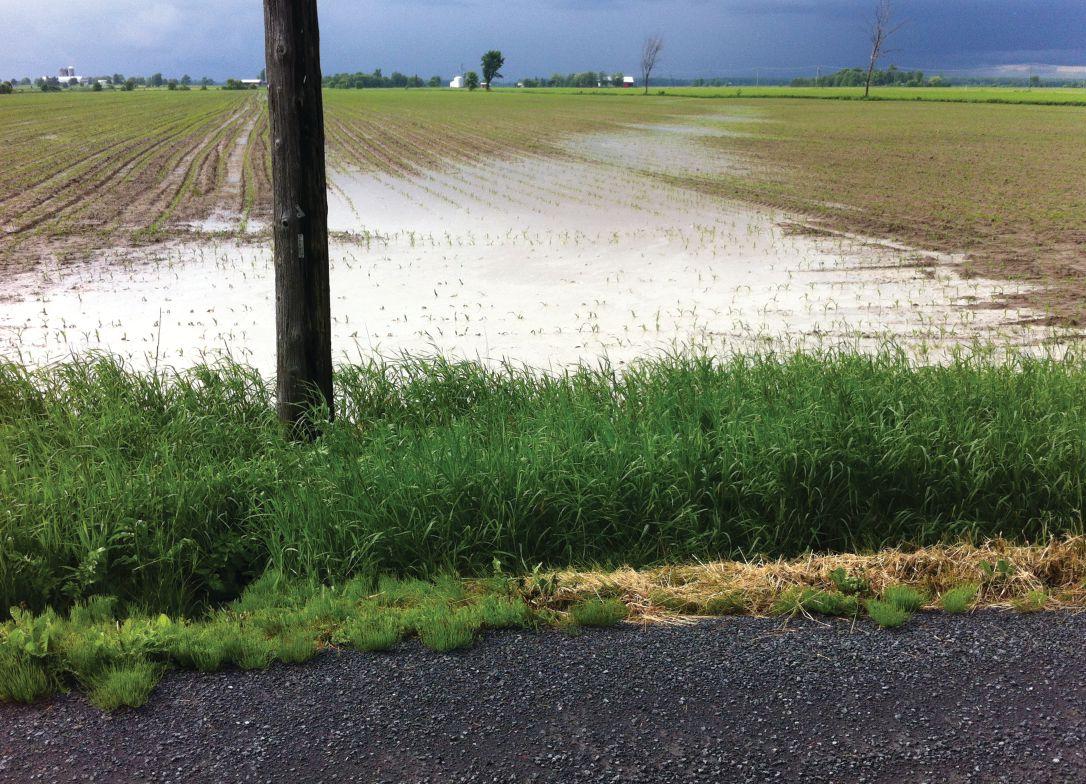
Ashift in the landscape is occurring as farmers are increasing tillage in the wake of high commodity prices.
With the view that reduced tillage practices carry a yield drag, some producers are reverting to more aggressive methods to capture as many bushels per acre as possible. The move, which increases the risk of soil erosion, is raising concerns and renewing calls to strike a balance between finding an adequate level of tillage to benefit the crops and leaving enough residues to protect the soil.
While tillage practices aren’t extensively tracked across the province, g reg Stewart, corn specialist with the o ntario Ministry of a griculture, Food and rural a ffairs, says most people in the agriculture business would agree that there has been a significant shift to more tillage, especially when planting soybeans after corn.
“We have quite a range of tillage options,” notes Stewart. “In some areas, the mouldboard plough is back into those cornstalks in a big way and, in some cases, what used to be known
as no-till, is vertical till or some other type of till.”
In addition to the shift to more tillage, instances of soil erosion, caused by rain or high winds, are becoming more noticeable, too. With dry conditions and high winds in the spring of 2012, peter Johnson, o M a F ra cereals specialist, says windstorms were causing “brownouts” that were as dangerous as whiteouts in winter snowstorms.
“There were more stretches of highway where people nearly had to pull off the road than we’ve seen since the 1980s, and that is not a good-news scenario for agriculture,” says Johnson.
There is more behind the shift to increased tillage than just the higher commodity prices. Stewart says other factors
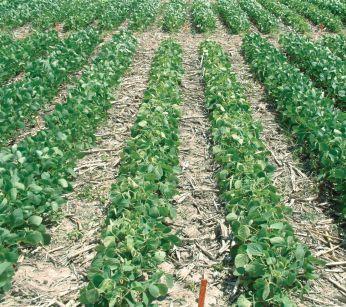
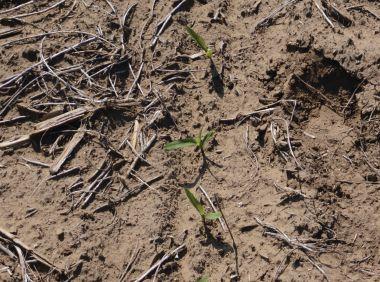
Corn growing after being planted into 30 per cent soybean residue.
include the agronomic advantages of planting corn and soybeans earlier and consolidation in the industry that has led to farmers having to plant bigger acreages. “I think those things add up to a real push to simplify operations, and to simply operations, tillage often gets put into play,” says Stewart. a nother factor is the residue from higher-yielding corn. r ecalling research done in the 1990s, Johnson says the yield loss in no-till soybeans after corn was approximately one or two bushels per acre. With corn yields at 120 bu/ac and soybean prices at $7/bu, he says, the economics are more palatable for notill. But the outlook is different when dealing with yields of 200 bu/ac. While he doesn’t subscribe to the theory that newer genetics are making it more difficult to break down the corn residues, Johnson says this perception plays into the move toward more tillage.
leave a ground cover of at least 30 percent residue. This is significant in terms of reducing erosion potential.
“If you have 200-bushel corn trash, it’s a totally different impact in the spring when you’re looking at trying to no-till into that much residue compared with 120-bushel corn trash,” notes Johnson. Moreover, the greater residue makes it more difficult to plant soybeans in early May for those using no-till or reduced tillage. Horst Bohner, oMaFra soybean specialist, says it creates a more stressful environment for the seedling, especially in a year when the spring is cold and wet. “Tillage can really get the root established faster because the ground is a little warmer and it’s just a better environment for the early growth, and that can make quite a difference,” says Bohner.
Conserving the soil a mid the move to more tillage, there are other farmers who are staying the course with no-till and reduced tillage. Shawn Mc r ae of Bainsville, o nt., is heeding the lessons learned by his father and grandfather, who adopted reduced tillage in the 1980s. The 1994 graduate of the University of g uelph, who says he has never operated a
mouldboard plough, sees many parallels between today’s agricultural boom and the one that occurred in the early 1970s.
“Technology advanced rapidly on several different fronts: We saw hybrid grain corn production in our area go from nothing to being a major crop,” says Mc r ae. “We had atrazine, cheap nitrogen and diesel fuel, and tractors that went from 50 horsepower to 200 horsepower . . . throw in the boom in commodity prices and you had a pretty good recipe for rapid expansion.”
For Mc r ae, one of the more significant aspects of reduced tillage is improving the quality of water on the farm. “It’s not solely based on my consideration for the environment and being a conscientious steward; it’s about how I measure soil loss from our farm,” he says.
If Mc r ae can’t see it in the water, then he knows he is not losing soil. Besides reducing soil erosion, he says, the benefits of reduced tillage include improved crop health, improved drainage, better nutrient availability and less fuel consumption.
a s for yields, Mc r ae, who grows oats, barley, corn, soybeans and dry beans, doesn’t think he is giving up much by reducing tillage. “We have the same ups and downs, given the variability of the seasons, but I’m right in the thick of things when it comes to absolute yield, and I know that I’m doing it at a fraction of the costs,” says Mc r ae.
Blake Vince, who farms in Southwestern o ntario near Merlin, shares a similar story of growing up with the adoption of no-till. a lthough he has done his share of tillage using disc rippers, soil savers, vertical tillage tools, etc., Vince is quick to point out that he has never ploughed an acre using a mouldboard plough. noting that the farm does not have an abundant amount of topsoil on the heavy Brookston clay, he strives for maximum residue cover to retain soil and water to improve the soil structure.
“I’m an advocate for soil health,” says Vince. “If [soil] is our biggest investment and gives us our biggest annual return, then why are we not more careful with how we manage it?”
a proponent of planting cover crops, his go-to is red clover, underseeded in wheat. By growing cover crops and using less tillage, Vince is seeing more earthworm activity and im -
One Bag Industry leading genetics
One Bag Automatic Refuge Compliance
One Bag Broad spectrum insect control
One Company Experience the Advantage
Ask for the one bag solution with PRIDE and PRIDE G2 hybrids. Increase your in 2013.

proved water filtration in the heavy, clay soil. “ o n a big rain event, you don’t have ponding, you have less crusting after planting and you have a dramatic reduction in fuel costs,” he says of the benefits.
In addition to the increased earthworm activity, which is an indication of good soil health, Vince is also encouraged by the sight of mushrooms growing in the field. “There are so many microorganisms living in the soil that are not visible to the naked eye but with mushrooms growing that is a visual indicator of increased soil health,” adds Vince. “It is unlikely that you’ll find those in a conventional field because you’ve disturbed all that mycelia, which are below the soil surface and act to degrade the soil residue.”
In an effort to strike the balance be -
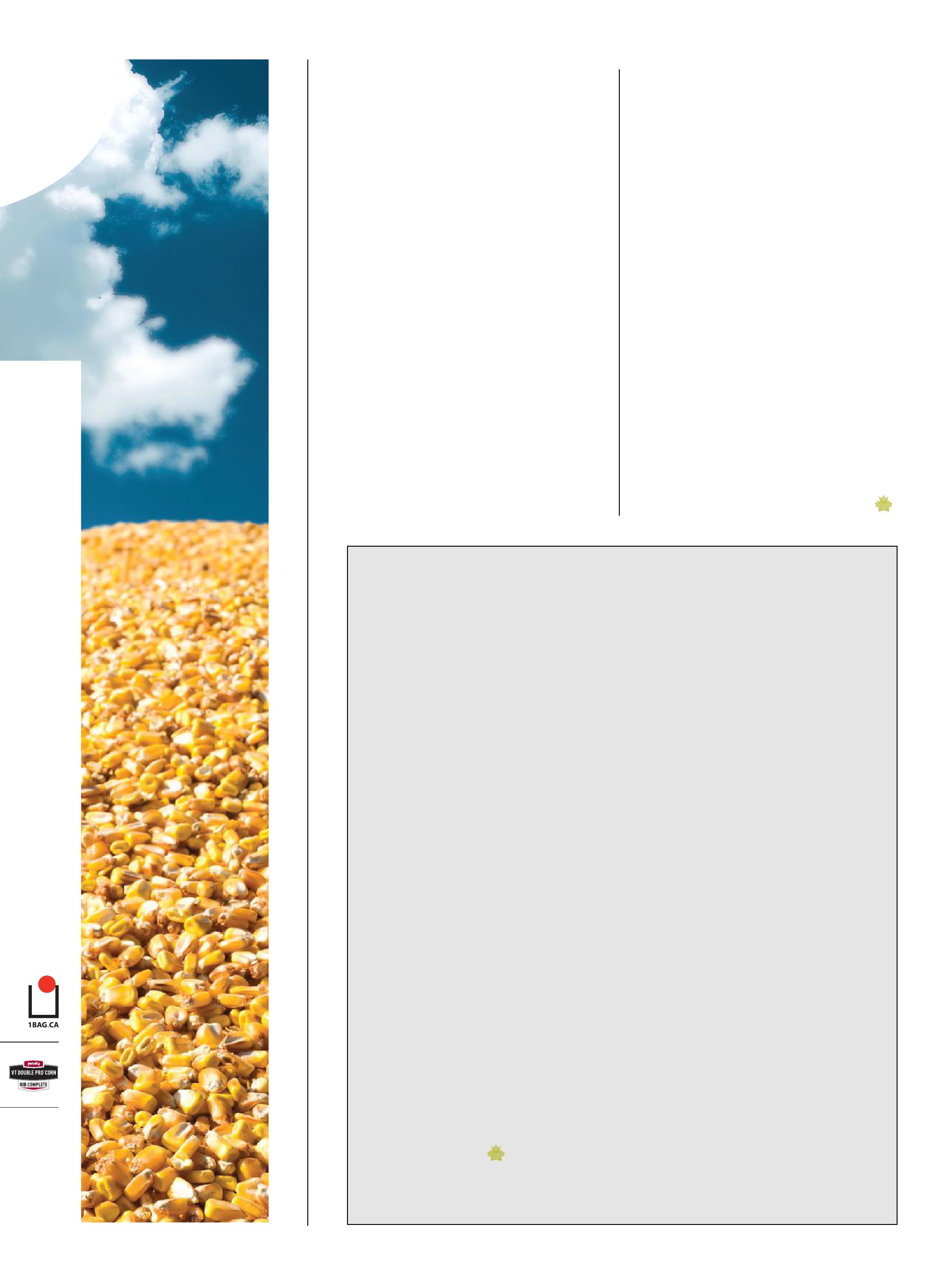
tween the shift to increased tillage and the need for soil conservation, g reg Stewart and his colleagues are recommending a compromise: Leaving a ground cover of at least 30 percent residue. “Whether those plants are dead or alive, you can do something significant in terms of reducing erosion potential,” says Stewart.
r ather than advocate one system over another, he suggests blending the good parts of various practices into one system that will provide residue, produce reliable yields and make the most of planting efficiencies.
Stewart concludes that it should be easier to leave residues, considering advances in seed treatments, better stress tolerance in hybrids, innovations in machinery and planter modifications. “When we look around the landscape, in fact, we’re going the other way. That is particularly troublesome,” he says.
CONTINuED FROM PAGE 10
Due to the poor spring weather, stand establishment was highly variable, and it was impossible to evaluate the effect of plant population in 2011.
The results were positive for the higher n rates. “The higher n rates provided a positive return on investment at all locations, averaging about $70/acre compared to the grower’s standard nitrogen rate. and even the very high n rates had a positive return,” says Currah. “The 2011 results suggest that, for highyielding fields, nitrogen rates could be increased by about 10 to 20 percent.”
The fungicide application also had a positive return at every site. “The benefit ranged from 6 to 30+ bushels,” notes Currah. He adds, “In research studies, [fungicide application] doesn’t pay every time, but in our case it did. That is interesting because our sites were high-yield potential fields put into aggressive management. I think there’s a correlation, that if we use Headline to keep the plant healthy in a high-yielding environment where it has been fed and managed aggressively, there is a higher opportunity for payback with a fungicide.”
He emphasizes, “all these inputs dovetail together. We have growers who ask us about plant population – ‘Should I try planting 36,000 instead of 32,000?’ My first question to them is, ‘What are you going to do to help those extra 4,000 seeds along? are you going to fertilizer more, use fungicide?’”
For 2012, the initiative again involves about a dozen growers and follows similar methods. With the growing season getting off to a much better start than in 2011, Currah is looking forward to seeing the results.
He adds, “It would be great if we had a 300-bushel field in this Initiative, but it is maybe more satisfying if we could show our customers how to get from 210 to 260, than if we get the guy with the really sweet 260-bushel soil from 260 to 301.”

by Karen Daynard
Forages are a good choice for crop rotations with many economic and environmental benefits, according to a new report, by the ontario Forage Council. not only can forages bring a similar net return to corn, but also they can improve soil structure, reduce soil erosion, increase biodiversity and help minimize resistant weeds, according to the report.
The report, funded by the Farm Innovation program (FIp), documents the many benefits of including forages in a crop rotation. as laid out in the report, forages are often dropped out of crop rotations because of today’s high prices for commodities such as corn and soybeans. However, hay prices have also risen to historic levels due to high demand and reduced supply in the United States and globally.
The report, written by Doug Yungblut, of Yungblut and associates, showed that on “an annual basis it costs roughly half as much to produce an acre of hay as it does to produce corn on that same land ($242 versus $539). With a hay yield of 3.5 tonnes, the current net return can be similar to a 160-bushel corn crop. See figure 1 below.
When looking at other benefits, the report showed that forages also bring improvements in areas such as soil quality and health, reductions in herbicide resistant weeds, and increased carbon sequestration. Depending on the legume level, a hay crop can contribute up to $70 worth of nitrogen to a following corn crop. even after the forage crop is removed, the benefits to soil quality can last for several years.
Fritz Trautsmandorff of Dunlea Farms near Jerseyville, ontario, believes that ‘’having forages in my crop rotation as compared to just growing row crops is like driving a four- wheel aTV versus a threewheeler. The inclusion of forages makes a much more stable rotation that works better for me and my farm in the long run.”
Soil stability, porosity and organic matter all improve with the introduction of forages into a crop rotation. The tendency is for crusting and compaction to decrease whereas drainage, capacity to hold water and root growth increase.
Weed reduction is another benefit of forage crops because they are cut frequently before the plants go to seed. established forages can generally outcompete weeds and prevent the development of plants after germination.
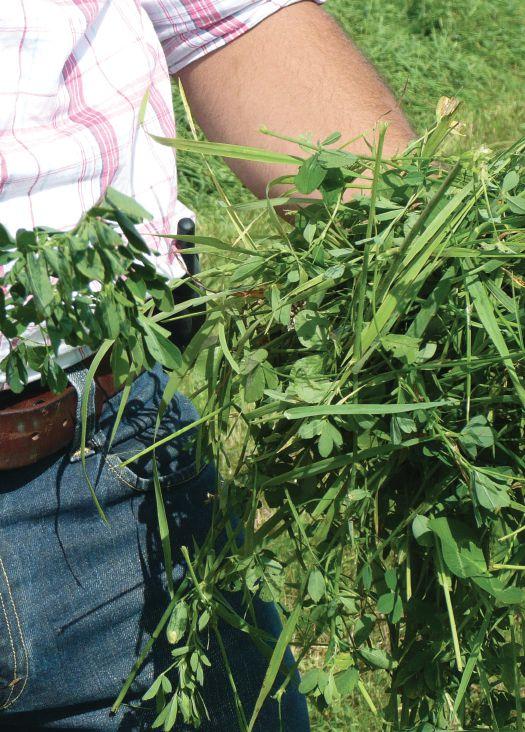
Forages bring improvements in soil quality and health, among other factors.
Forage crops also serve as a reservoir for bees and other beneficial insects that pollinate crops such as canola. They also improve a farm’s biodiversity and are critical to many Species at risk. a study by the International Hemp association, which assessed 21 major crops more than 25 different criteria defining ecologically friendliness, determined that alfalfa was the most biodiversity- friendly of all the crops.
Calculated net returns for corn and alfalfa (per acre)*
For a full copy of the report, visit the o ntario Forage Council’s website at http://ontarioforagecouncil.com.
another relatively unrealized benefit of forages is the huge market opportunity for hay exports. Canada exports between 400,000 and 700,000 tonnes of hay and other forms of forage per year to Japan, the United States and Korea. China is also a rapidly growing market, as is the Middle e ast.
Fthe 2012 OMAFRA crop budgets.
They are for illustration purposes and reflect market conditions as of January 2012.
*Slightly different criteria are used for each crop. A zero in a column indicates that no value was calculated for that line for that crop.
**Establishment year costs less hay sales that year, divided by four
The report also cited sources that showed corn yields can increase from five to 20 percent following a forage crop. In today’s market, that can be worth an additional $48 to $192, not including benefits recognized in the second year of corn.
In o ntario, most of the hay crop is sold to dairymen and horse owners within the province and throughout the eastern United States. Critical factors to establish before growing hay include plant species, stage of maturity at harvest and end use, as horses and dairy cattle have very differing quality and nutritional specifications. a major exporter of hay to the United States, Don rowntree of Via pax Ltd. in g eorgetown, o ntario, emphasizes that consistent quality of hay is vital for exports. “When competing with nice green hay from irrigated areas like nebraska, even a few bales of hay that are off quality in appearance can cause the rejection of an entire load.”
The size and type of bale produced and sold are also important. While farmers prefer to produce large square or round bales, as they’re easier and faster to handle, the vast majority of horse customers are not equipped to handle their large size. Trautsmandorff is one farmer who has solved this problem by installing equipment that converts large square bales to small squares, thus meeting the needs of his horse customers.
The bottom line is that forage crops can give returns that are competitive with other cash crops even with today’s high commodity prices. Furthermore, the benefits to soil structure, water retention, and improved nitrogen availability, although more difficult to quantify, are invaluable. o pportunities abound for farmers looking to serve specialized niche markets for dairy and horse farms.
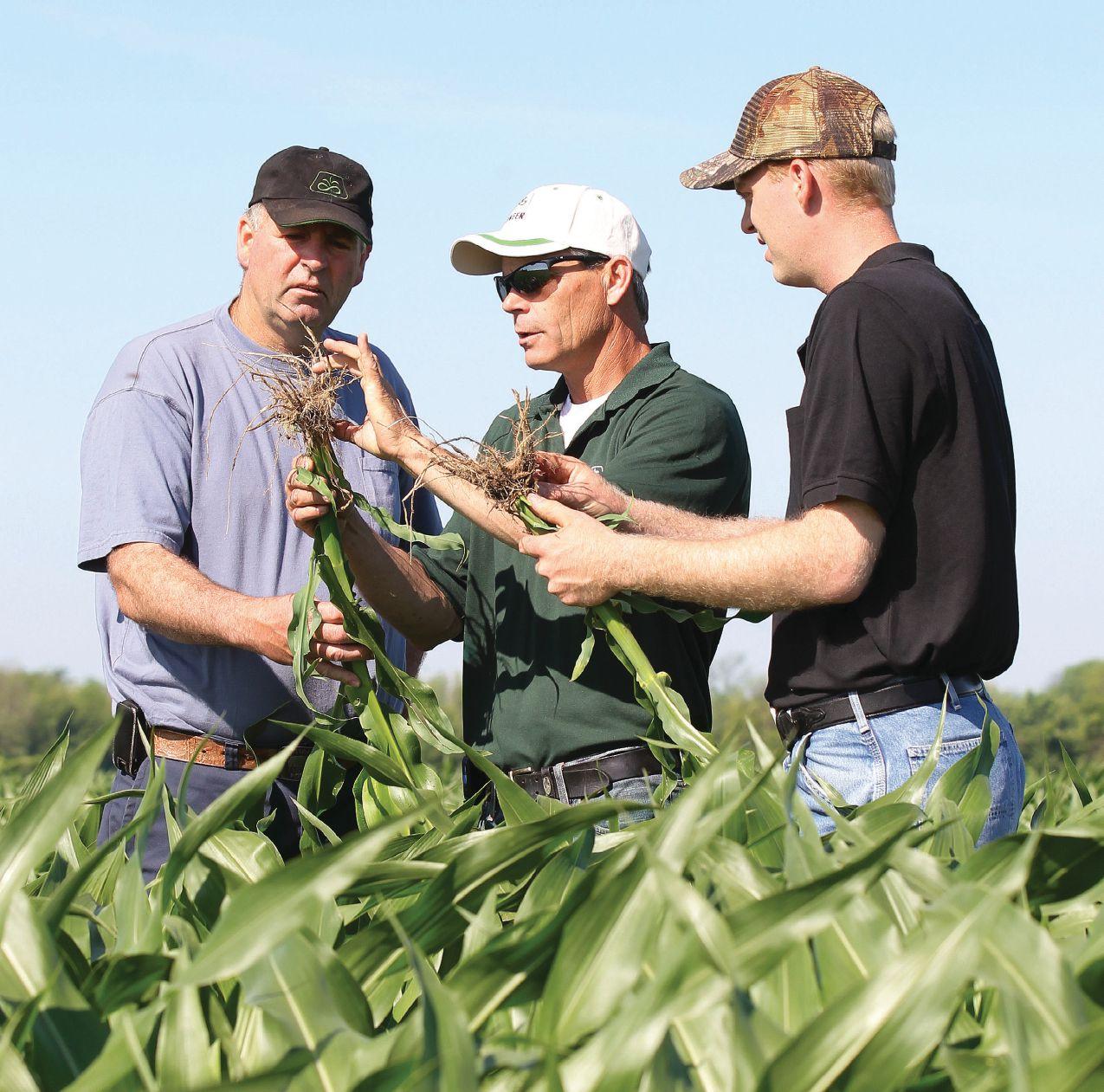





Pioneer rep Neil Rose set-up IMPACT™ research trials with customers Ron and Daniel Verbeek.

Because of you, Pioneer ® brand seed is planted on twice as many farms and twice as many corn and soybean acres as any other seed brand in Canada. But we don’t take our leadership role for granted. And seasons like this show why. We believe that leadership means consistent performance even under the most challenging conditions. That’s why we’ve taken product testing and evaluation to a whole new level. We’re confident our products will perform in your local environment because we’ve tested them in 200 IMPACT™ research trials across Ontario and Quebec before they ever make it to our line-up.
More consistent performance. Pioneer is here.











by Carolyn King
Delays can happen to anyone. equipment breakdowns, prolonged rainy weather, late flushes of weeds, large acreages that have to be covered in a brief window of time – a range of reasons can push a grower into a late application.
“That’s just the reality of life,” says Dr. peter Sikkema, a weed management researcher at the University of guelph’s ridgetown Campus. That reality prompted Sikkema to lead a three-year study to examine the effects of late applications of burndown and postemergence herbicides on soybeans.
“We wanted to provide information for ontario farmers, so if they do need to do a late application, they’ll know which herbicides are going to be the safest and which ones have a greater potential for crop injury and yield loss in soybeans,” he explains.
Sikkema conducted the trials collaboratively with Dr. rob nurse, a weed scientist with agriculture and agri-Food Canada (aaFC). The trials were carried out at three locations: the ridgetown Cam-
pus’s research stations near ridgetown and exeter, ontario, and aaFC’s research centre near Harrow. grain Farmers of ontario and the agricultural adaptation Council provided funding for the study.
The post-emergence herbicide trials involved roundup applied on roundup ready soybeans, and pursuit, Classic, pinnacle, Firstrate, reflex, Basagran Forte and assure for use on identity-preserved (non-genetically modified) soybeans.
The herbicides were applied between the fifth trifoliate leaf stage and early flowering. “Controlling weeds after the third trifoli-
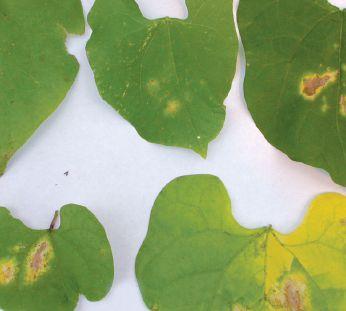
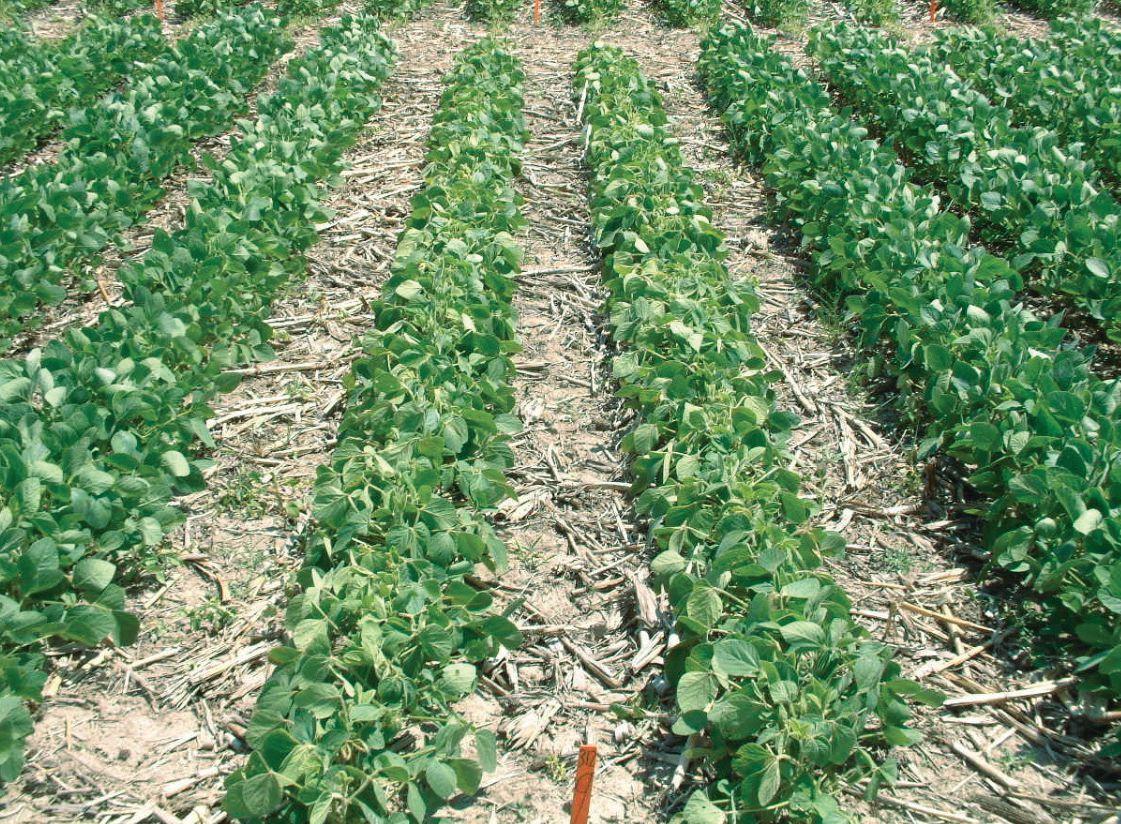
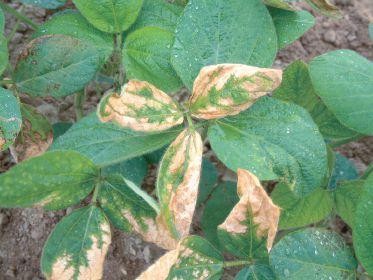
TOP: Sikkema’s research shows some leaf burn with late applications of Basagran or Reflex, but the IP soybean crop recovered quickly.
INSET: Of the herbicides tested in Sikkema’s late application trials, Pinnacle and Pursuit caused the most injury to IP soybeans. For instance, they caused significant stunting of the plants.
ate stage is late in the traditional sense of Dr. Clarence Swanton’s research over 25 years ago showing that the critical weed-free period for soybeans is between the first and third trifoliate stage,” explains Mike Cowbrough, weed management program lead with the ontario Ministry of agriculture, Food and rural affairs (oMaFra).
He notes, “although later herbicide applications may not necessarily provide much of a yield benefit, growers might want to go in late either because the weeds emerged during the critical period and haven’t been controlled, or they are concerned about returning weed seed back to the soil.” Some weed species can produce tens of thousands to hundreds of thousands of seeds per plant, so controlling them before they go to seed can be pretty important.
Sikkema’s research team applied the herbicides at the manufacturer’s highest labelled rate and at twice that rate. He explains, “We do this research at the 1X and 2X rates. The 2X rate simulates a spray overlap in the field. It doesn’t matter how accurate a farmer is, there are going to be some spots in the field where they drive too close or they don’t shut off the boom quite quickly enough when they get to the headland.”
The results of the trials showed the safest options in terms of crop injury and yield loss were roundup in roundup ready soybeans, and assure for grassy weed control in identity-preserved (Ip) soybeans. Sikkema says, “If a grower has grass escapes in his identity-preserved soybeans, I would tell him that assure is a relatively safe herbicide to use. and if he was growing roundup ready soybeans, I would be quite comfortable that, as long as he applied roundup at label rates, he wouldn’t incur any yield loss.”
among the six post-emergence broadleaf herbicides for Ip soybeans, Basagran and reflex caused the least amount of visible crop injury. “although we had leaf burn after application with Basagran or reflex, that injury tended to be quite transient. The new leaves that developed after application were not affected, and the crop recovered quite quickly,” Sikkema notes.
Classic and Firstrate caused an intermediate level of injury. He says, “We saw injury shortly after application, but the soybeans recovered, and by four weeks after application crop injury was less than 10 percent.”
pinnacle and pursuit were the most injurious. For instance, at four weeks after application, visible crop injury was greater than 10 percent for pursuit at the double rate and for pinnacle at the single and double rates. These two herbicides also caused significant stunting of the soybean plants.
as well, pinnacle and pursuit caused the greatest yield losses. “With pinnacle and pursuit, we had [at least] five percent yield loss. With the other herbicides, the yield loss was less than five percent, and in many cases there was no yield loss,” notes Sikkema.
So if growers need to do a late herbicide application for broadleaf weed control in Ip soybeans, Sikkema advises, “Do not use pinnacle
or pursuit because they are too injurious and there is potential for yield loss. You could use Classic and Firstrate; you may get some injury shortly after application but in most situations the soybeans will recover and there won’t be any yield impact. The two safest options are Basagran and reflex, but they are probably not as hardhitting on the weeds.”
“The labels of these products allow you to apply them in many cases close to flowering. But peter’s research has identified a couple of products that, when you apply them at that stage as specified on the label, cause reductions in yield,” says Cowbrough.
He adds, “I think this research probably has the most value if you are debating which product to control the spectrum of weeds you have in your field. Let’s say your main targeted weed is pigweed that has escaped in [Ip] soybeans. You have three or four different products that you could use, and they are all in relatively the same price range. [With the information from this study] you can steer away from the more injurious products.”
In the burndown delay studies, Sikkema’s research team applied 1 litre/acre of glyphosate at two weeks before seeding roundup ready soybeans, one week before seeding, one day before seeding, one week after seeding, two weeks after seeding, and three weeks after seeding.
“our results indicate growers have some flexibility in the timing of burndown in soybeans,” says Sikkema. “For example, where we applied the burndown two weeks before seeding, the yield was 54 bu/ac, and where we applied it one week after seeding, the yield was 53 bu/ ac. So we really didn’t see an appreciable effect on soybean yield even with delaying burndown up to one week after seeding.”
With greater delays in burndown timing, soybean yield decreases were more noticeable. The yields dropped to 52 bu/ac where the burndown was two weeks after seeding and 49 bu/ac where the burndown was three weeks after seeding.
although the trial data showed the yield impacts were small for delaying the burndown up to one week after seeding, that doesn’t mean it’s a great idea to wait until then to do your burndown. Sikkema emphasizes, “My distinct preference is that you apply your burndown before seeding. even though there is a fair bit of flexibility in terms of when you get it on, for a multitude of reasons it’s really good weed management and good crop management to get that burndown on first, and then plant your soybeans, and then put on whatever in-crop application you need.”
Some of the many reasons it’s better to apply the burndown before seeding are that weeds are easier to control when they’re smaller, and if you control the weeds earlier, they have less time to remove nutrients from the soil. also, glyphosate needs time to adequately translocate through weed plants, especially perennial weeds, to control them before the crop starts growing.
An Ontario business is combining new technologies to boost yields using less fertilizer.
by Blair andrews
An ontario crop business is the first in Canada to adopt a unique system for late-season applications of nitrogen on corn and soybeans. By using the greenSeeker technology and the Y-Drop system, which is attached to a high-clearance sprayer, good Crop Services Ltd. of new Hamburg is finding a way to apply the right amount of fertilizer at the right time and in the right place.
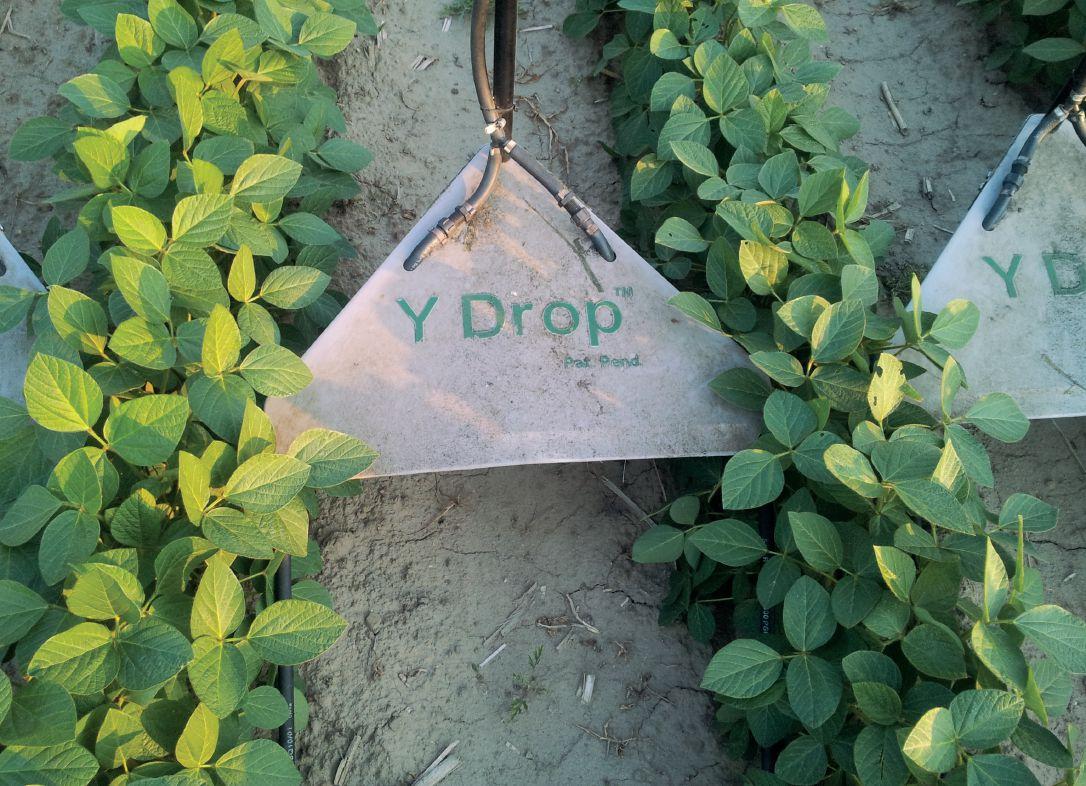
It’s the placement of the product that makes it far superior to what’s on the market,” says company owner Don good of the Y-Drop system. Developed in Iowa, the Y-Drop is a tool that can place any liquid product within two or three inches of a crop row. good adopted the Y-Drop to complement the greenSeeker for variable rate applications. The greenSeeker system from Trimble agriculture uses optical sensors with an integrated application system to measure crop status and variably apply the crop’s nitrogen (n) requirements. The purpose is to reduce fertilizer costs while boosting crop yields. Whereas other precision agricultural methods rely on historical information or mapping
to make the nitrogen recommendation, this technology operates in real time, allowing the operators to make variable-rate applications on the go.
The sensor uses light-emitting diodes to generate red and near-infrared (nIr) light. The light is reflected off of the crop and measured by a photodiode at the front of the sensor head. red light is absorbed by plant chlorophyll and healthy plants absorb more red light and reflect larger amounts of nIr than those that are unhealthy. The reflectance values are used to calculate the normalized Difference Vegetation Index (nDVI), which is an indirect measurement of the crop’s aboveground growth. By comparing the nDVI of the crop being evaluated to that of an n-rich strip in the field, the technology can be used to re-
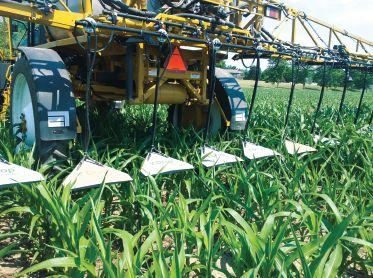
TOP: The Y-Drop system in conjunction with the Greenseeker technology applies the right amount of product, at the right time and at the right location.
INSET: The Y-Drop systems places nitrogen close to the roots of the plant.
spond to field variability.
as the applicator moves across the field, a built-in microprocessor analyzes the nDVI readings and determines the n requirements that are needed to meet full yield potential. predetermined algorithms calculate the amount of n required. The information is relayed to the rate controller to provide variable-rate n application in real time as the applicator moves across the field.
With the greenSeeker, good was able to achieve one of the three rs of precision agriculture: placing the right amount. However, he was looking for a way to improve the other two – the right time and the right place – for late-season applications.
paul raymer, precision ag specialist with the Farm office in Tavistock (a Trimble dealer), says the problem was related to the nozzle system on good’s high-clearance sprayers. “They had no way to go through 30inch corn rows when they had 20-inch nozzle spacing on their sprayer,” says raymer. “They created their own system last year but they weren’t really happy with it.”
good says they made some brackets and used drop pipes to place the n between the rows. “It wasn’t bad but it wasn’t that stable,” recalls good. “We were going to change that, and paul came across the Y-Drop. It is definitely the better way to go.”
Dan Muff, Ceo of Y-Drop LLC in Iowa, says the system can fertilize any row crop at various stages of the plant’s development. In corn, it can fertilize from knee-high to tassel. For soybeans, it can be used at V2, V3 or higher, up to r2-and-a-half.
The system was designed with four things in mind – using the right product, at the right time, in the right place, and the right amount.
“and that goes back to plant nutrient uptake and what stages of
growth do plants take up nutrients,” says Muff.
Besides boosting yields through additional nutrition, Muff says the system has environmental benefits.
“Because we’re placing the right amount in the right place at the right time, we can be very frugal with our fertilization and create higher yields with less fertilization by placing it where it needs to be,” says Muff.
When combined with the greenSeeker technology, he says, Y-Drop has the capacity to put the nutrients alongside the plant while the greenSeeker has the capacity to read the plants while the operator drives through the field. The rates of application can then be changed based on the nutrient needs of the plant.
raymer concurs, saying the combination of the technologies provides an efficient way to “spoon-feed” nitrogen to the plants. “We’re spatially optimizing nitrogen placement based on what the greenSeeker is seeing on a vigour level,” says raymer. “It pushes out a prescribed rate, and now we’re going to the next level of opportunity with the Y-Drop where we have a better placement of the product.”
raymer says placing nitrogen beside the row is particularly beneficial in dry conditions, as were experienced this past summer. “When we have heavy dews, that dew will drip off the plant and into the soil around the root zone in what is called the ‘wet zone.’ and if nitrogen is placed beside the plant, and the wet zone is large enough, it spreads out two or three inches,” explains “raymer. “That’s going to help saturate that nitrogen in the root zone, as opposed to the roots trying to reach out for it in the centre of the row.”
CONTINuED ON PAGE 25
OMAFRA weed specialist Mike Cowbrough offers effective management tips for growers on reducing volunteer cereals and perennial weeds.
by Jeanine Moyer
Volunteer cereals have many growers scratching their heads these days. even those using the best field management practices are seeing volunteer wheat pop up in the spring, and sometimes two or three years after wheat has been planted in fields.
“not only is volunteer wheat competitive, but if it isn’t controlled in the fall, it significantly delays seed bed preparation in the spring,” says Mike Cowbrough, weed management field crops program lead with the ontario Ministry of agriculture, Food and rural affairs, who explains that studies have shown even a modest density of 20,000 volunteer wheat plants per acre, when left uncontrolled, can result in corn yield losses of five per cent in ontario fields.
Traditionally, the answer to volunteer wheat was simple – manage it in the fall with glyphosate and the problem was solved. More recently though, growers have noticed that some volunteer wheat keeps reap-
pearing, sometimes even in a soybean field that last had winter wheat in it two season ago. “While we can’t be certain, seed dormancy caused by a variety of factors like soil type or winter weather, is likely the reason we are seeing volunteer wheat germination the next spring,” says Cowbrough. “and regardless of the reason for occurrence, issues with volunteer wheat are pretty easy to comprehend in that if it isn’t managed it can rob yield or make for a poor seed bed. Cowbrough explains that, “unfortunately, there doesn’t seem to be any herbicide that we could apply in the fall to offer residual control of volunteer winter wheat, so follow-up management in the spring would be needed.”
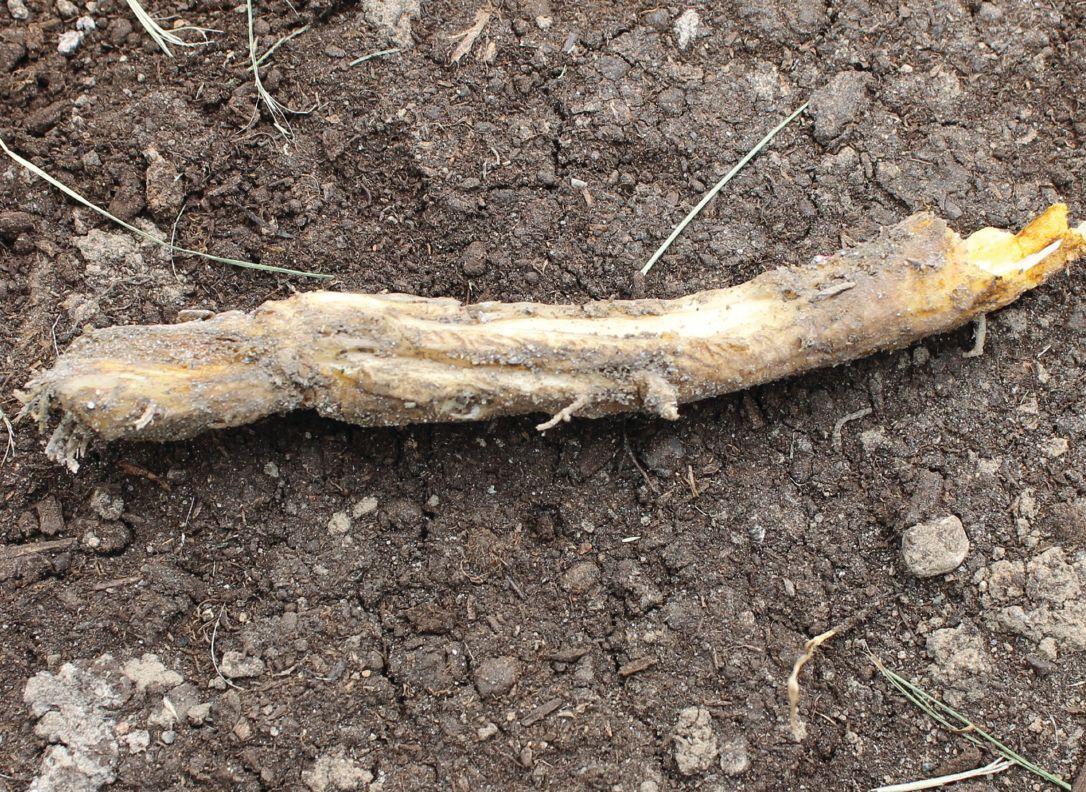
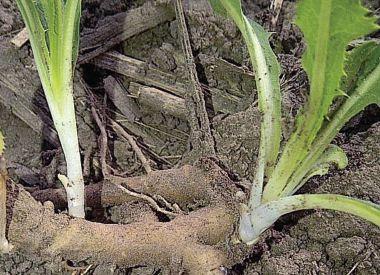
TOP: Perennial weeds have a period of dormancy, or inactivity after tillage making glyphosate application during this stage ineffective. The root of this sow thistle shown three days after a vertical tillage pass illustrates the weed’s dormancy stage. INSET: Regrowth of the same sow thistle root, shown 14 days after tillage. New growth indicates the end of the dormancy period and weeds will be responsive to glyphosate.

“Vertical tillage and secondary tillage tools won’t completely control volunteer wheat and perennial weeds,” says Cowbrough, as he has observed such tillage equipment to kill only about fifty percent of a volunteer wheat stand. “a mouldboard plough will take care of perennial weeds, or volunteer wheat in the fall,” explains Cowbrough. “But for most growers who no longer plough, they rely on a combination of tillage and glyphosate to manage weeds and crop residue in their fields.” recently, a few growers have complained to Cowbrough that glyphosate wasn’t working on volunteer cereals and other perennial weeds when they applied either right before or right after their vertical tillage pass. “They weren’t getting good results from what is normally a very effective herbicide,” says Cowbrough, who explains the poor control wasn’t a result of an incorrect herbicide rate or resistant plants; rather, it was the progression of glyphosate application and tillage. For example, when the field was worked and glyphosate was applied within 48 hours of the tillage pass, volunteer wheat and perennial sow thistle control was almost non-existent.
Temporary plant dormancy, or a form of it, explains why glyphosate applied shortly before or after a tillage pass won’t kill the cereals or perennial weeds. “plants are great at acclimatizing themselves,” says Cowbrough, explaining that plants will go into a period of dormancy after they are broken up from tillage. and after the dormancy period, the plant’s response to these situations is to acclimatize itself and start growing again, but this can take several days (photo 1). Cowbrough speaks from experience when he says it’s a waste of time and resources to go back into the field after tillage and spray the field too soon before regrowth because plants are unresponsive during the dormancy period (photo 2).
CONTINuED FROM PAGE 23
echoing raymer’s comments, Don good says “It slides through the corn, just slithering between the rows in perfect motion without damaging the crops.”
He is also testing it on four plots of soybeans, planted in 30inch rows. The system is being used to apply potassium thiosulphate (0-0-25-17). good is also using it on a plot where he applied nitrogen to the beans.
“normally, we do not grow 30-inch soybeans and we’re not sure if our hybrids are going to be adaptable yet,” says good. “But when we can put more of the potash on at a critical time between the r4 and r6 stages of growth, we feel that there is a real advantage to that.”
So far, good says, they can see a physical difference in the beans and he looks forward to the yield results at harvest. In the meantime, he has been impressed with the combination of the greenSeeker and the Y-Drop.
“It’s very interesting because the greenseeker is scanning the crop for where more n is needed,” says good. “and the beauty of the Y-Drop is that it places it right beside the row.”
admitting he had reservations at first, good says the technologies are a good fit for his company’s mission of custom applications, which is to help farmers become more profitable. “If we can give them something of benefit that is economically worth it, then we put it on accordingly. and if you don’t need it, we don’t put it on,” says good.
Cowbrough’s field management recommendation is to combine glyphosate application with tillage in a way that maximizes weed control and best prepares the soil for next spring. For example, summer annuals often germinate and set seed the quickest after cereal harvest; therefore, a tillage pass prior to when these weeds start flowering will not only inhibit seed production, but also will stimulate more consistent germination of volunteer wheat. glyphosate can then be applied in late September or into october to address perennial weeds.
growers who choose to till the ground first should wait seven to 10 days before spraying glyphosate, or until signs of growth on the plants that have escaped the tillage pass are visible. Tillage alone will not kill the plant, but will injure it enough to reduce the uptake and movement of glyphosate within the plant. and if glyphosate is applied too soon, or before the injured plants have started to regrow, glyphosate application will not be effective.
If glyphosate is applied first, followed by tillage, growers should consult label recommendations for waiting periods. For example, a waiting period of one day between glyphosate application and tillage is recommended for small annual weeds, three days for grasses and seven days for larger weeds, biennial and perennial weeds. Waiting periods are important because tillage is most effective when plants have come out of their shock, or dormancy period, caused by glyphosate application.
Tillage can have a significant impact on glyphosate performance in fall field management. although there will always be some unexplained cereal regrowth, or volunteer wheat each spring, effective field management in the fall – including recommended waiting periods between glyphosate application and tillage – can reduce these incidences and the resulting frustrations they cause.
Monsanto Company is a member of Excellence Through StewardshipSM (ETS). Monsanto products are commercialized in accordance with ETS Product Launch Stewardship Guidance, and in compliance with Monsanto’s Policy for Commercialization of Biotechnology-Derived Plant Products in Commodity Crops. This product has been approved for import into key export markets with functioning regulatory systems. Any crop or material produced from this product can only be exported to, or used, processed or sold in countries where all necessary regulatory approvals have been granted. It is a violation of national and international law to move material containing biotech traits across boundaries into nations where import is not permitted. Growers should talk to their grain handler or product purchaser to confirm their buying position for this product. Excellence Through StewardshipSM is a service mark of Excellence Through Stewardship. ALWAYS READ AND FOLLOW PESTICIDE LABEL DIRECTIONS. Roundup Ready® crops contain genes that confer tolerance to glyphosate, the active ingredient in Roundup® agricultural herbicides. Roundup® agricultural herbicides will kill crops that are not tolerant to glyphosate. Acceleron® seed treatment technology for corn is a combination of four separate individually-registered products, which together contain the active ingredients metalaxyl, trifloxystrobin, ipconazole, and clothianidin. Acceleron®, Acceleron and Design®, DEKALB®, DEKALB and Design®, Genuity®, Genuity and Design®, Genuity Icons, Roundup®, Roundup Ready®, Roundup Ready 2 Technology and Design®, Roundup Ready 2 Yield®, RIB Complete and Design™, RIB Complete™, SmartStax®, SmartStax and Design®, VT Double PRO™, VT Triple PRO™ and YieldGard VT Triple® are trademarks of Monsanto Technology LLC, Monsanto Canada, Inc. licensee. LibertyLink® and the Water Droplet Design are trademarks of Bayer. Used under license. Herculex® is a registered trademark of Dow AgroSciences LLC. Used under license. Respect the Refuge and Design is a registered trademark of the Canadian Seed Trade Association. Used under license. (3701-MON-E-12)

interim manager, director for Policy develoPment, chriStian farmerS federation of ontario | nate StevenS
Farmers have to deal with the good and the bad.
Farmers deal with rules and regulations every day. as businessmen, significant resource users and stewards of the land, farmers need regulations to succeed in some areas and have to deal with limitations in others. There are good and bad regulations that exist in all areas of business, and the approach taken by the regulator can make all the difference between an onerous regulation that imposes unnecessary costs and an outcome-based regulation that allows farmers, as businessmen, to find the best solution for their operations.
There are rules that farmers appreciate and wouldn’t do without. Some of them are so intrinsic to business that they are often taken for granted. Standardized weights and measures are essential to farm businesses. Consistently receiving the market price for a bushel of corn is essential to making a living. Consistently receiving a tonne of nitrogen is essential to managing costs, maximizing efficient resource use and managing soil quality in the best way possible.
product quality and food safety standards are essential to accessing markets through standards, whether you are a largescale producer exporting a bulk commodity or a small-scale producer focused on a niche product. This isn’t to imply that some of them don’t feel onerous at times or perhaps involve a heavy paperwork burden. However, if we look internationally, Canadian products are trusted to be of high quality, nutritious and safe. In ontario, we have leveraged the quality of the food produced to the extent that we now have the second largest food manufacturing hub in north america. The local food movement hinges on safe, nutritious product, whether it is fruits and vegetables, or wheat for a local bakery. none of this could be achieved without having trustworthy and significant regulations.
Businesses need to be able to continue to viably operate while striving to meet environmental and social objectives. In ontario, laws and regulations related to water quality and management have exploded over the last decade. The nutrient Management act to govern nutrient application on land, the Clean Water act to protect source water, the Water resources act to monitor water use by certain users including some farmers, the Lake Simcoe protection act to deal with issues in a specific body of water, and very soon the great Lakes protection act. all of these acts have the potential to impact farmers in different ways, and as responsible citizens they must meet these challenges. Yet, this can be a frustrating process when regulators allow for only one “correct solution.” Farmers need an outcome-based approach to achieve effective and efficient solutions. every farm is a little different, and while there is plenty of common ground out there, what will work for one farm may not for another.
none of this could be achieved without having trustworthy regulations.
Beyond regulating the business environment, farmers and government are required to tackle a variety of other initiatives driven by public concern. government has a multi-stage process of bringing any group into line with these new priorities. The first step is education and consciousness-raising with a goal of voluntary compliance. The second is cost-share programming to provide farms with a helping hand. Inevitably there are a portion of those impacted who choose not to be educated and choose not to take advantage of cost-share programming, and for those the only answer is to regulate them.
Farmers and other stakeholders in the agri-food sector in ontario are dealing with what feels like a flood of regulation over the last decade. Yet it is rarely the intent of an act that is the issue, but rather the approach taken by the eventual regulations that stem from the act. Few can disagree with the principle of citizens of a developed country being able to turn on their municipal water and have it be safe to drink. Few can disagree with the principle of doing what we can to protect and preserve endangered species. Yet, the laws and the regulations that flow from them need to take a triple-bottom-line approach.
Farmers need flexible options to meet the goals of the regulations, rather than following the line-by-line wording of the regulation. When dealing with the environment, there are often many valid means of varying costs that reach the desired outcome. Farmers need to have the choice to utilize two or three low-cost “tools” or be forced to use a single solution that may cost far more than all the others combined with no tangible improvement.
The ontario government appears to be interested in making progress on some of these issues. The open for Business initiative is an effort to streamline regulations and make them smarter. There is a commitment under this initiative to examine new regulations through the lens of economic impact in order to find the most efficient way to reach the desired outcome. Time will tell if this initiative will result in a meaningful change in the approach to regulations. regulation is a necessary part of modern society. Without it, there would not be a trustworthy means for businesses to exchange goods. Without it, there would not be appropriate limits on resource use and environmental impact. Yet, many regulations are not written from a triple-bottom-line approach that allows for the most cost-efficient means of achieving positive results. It is inevitable that new concerns and new regulations are in the future for farmers, and it is up to individuals and their representatives to government to ensure that farmers have a full toolbox available to them to meet these challenges in the most effective way possible.