Assessing variable seeding rates for dry edible beans
PG. 24
TOP CROP
MANAGER
12 | Protecting the Great Lakes with cover crops
Cover crops can reduce N leaching and enhance system productivity. by
Julienne Isaacs
| A springboard for oat improvement
advances for even better oat varieties. by Carolyn King
TILLAGE AND
24 | Lower inputs, higher returns?
Assessing variable seeding rates for dry edible beans. by Carolyn King
Best strip tillage and fertilizer options for corn by Carolyn King
Julienne Isaacs
ON THE WEB
Join
A returning threat: soybean cyst nematode by John Dietz
STEPHANIE GORDON | ASSOCIATE EDITOR
ROTATION, ROTATION, ROTATION
Picture this: on one side of a field is a thriving pea crop, and on the other, a pea crop that is clearly struggling. I recently stumbled upon an image like this shared by Tyler Burns (@windypopfarm) on Twitter. The left side of the pea field was yellowish in colour, recording a yield of 38 bushels per acre (bu/ac), while the right side was green and recorded 80 bu/ac. The left side had grown peas four years prior and the right side – the higher-yielding side – had never grown peas.
Burns, who farms near Kandahar, Sask., attributes the difference in yield to aphanomyces. A relatively new root rot, there are very limited options available besides a six to eightyear rotation to manage the disease. A four-year rotation is not enough, and like in the above example, can result in a significance yield hit.
The significance of aphanomyces is that there are limited management options available besides rotation – which makes it a good example of why rotation is so important. It’s not as severe as the example of ginseng, which can’t be grown on the same ground again – even 50 years later – because of replant disease. In general, crop rotation is important no matter what disease pressure you’re facing.
There are many factors that contribute to a crop rotation decision: maintaining a level of diversity, nutrient management, herbicide carryover concerns, disease concerns, weed concerns, herbicide-resistance considerations, and so on. For some of these concerns, rotation makes all the difference. But there are other decision factors that come into play that defy facts.
In a Financial Post column entitled, “Why it’s so hard for Canadian farmers to quit growing canola – even amid blockages from China,” author Toban Dyck shared another factor that influences crop rotation: memories. His farm hasn’t grown edible beans since a poor crop “left an indelible impression on the farm’s memory.” He doesn’t downplay the role of science, but instead creates space for “stories, anecdotes, experiences and gut feelings” to enter the rotation discussion.
A wet spring, a late harvest, a good year, a bad year – these memories crop up during rotation planning. Maybe they sway you away from corn or to crops with earlier harvests so you can get your winter wheat in, or maybe they don’t make an impact at all.
This prompted me to ask Burns if he was turned off from growing peas again after a poor crop. He says he isn’t, and that he will continue going peas but with a longer rotation instead. On the other side, there could be many producers out there who will never add a particular crop into the rotation for reasons that go beyond agronomy and instead are grounded in the memory of an unforgettable year.
Experience is an invaluable asset to have when choosing rotations. I hope as you plan ahead, you find the research included in this issue to be helpful. Whether it’s better understanding optimum winter wheat seeding dates (page 5) to reducing nitrogen losses with cover crops (page 12), these stories shouldn’t dictate how you make decisions, but add to your arsenal of resources.
TOP CROP
EDITORIAL DIRECTOR, AGRICULTURE
Stefanie Croley • 888.599.2228 ext. 277 C – 226.931.4949 scroley@annexbusinessmedia.com
ASSOCIATE EDITOR Stephanie Gordon • 416-510-5116 C – 437-688-6107 sgordon@annexbusinessmedia.com
ASSOCIATE EDITOR Jennifer Paige • 416-305-4840 jpaige@annexbusinessmedia.com
416.442.5600 ext. 3555 Fax: 416.510.6875 or 416.442.2191 Mail: 111 Gordon Baker Rd., Suite 400, Toronto, ON M2H 3R1 SUBSCRIPTION RATES
CEREALS
TAKING FALL PLANTING CONDITIONS IN STRIDE
A fresh look at planting dates and other tips for winter wheat seeding.
by Carolyn King
Ontario’s new map of optimum winter wheat planting dates offers a great opportunity for Joanna Follings, cereals specialist, to review the recommendations for planting dates as well as seeding depths, plant populations, and other key considerations for successful winter wheat seeding.
Early, late or on time
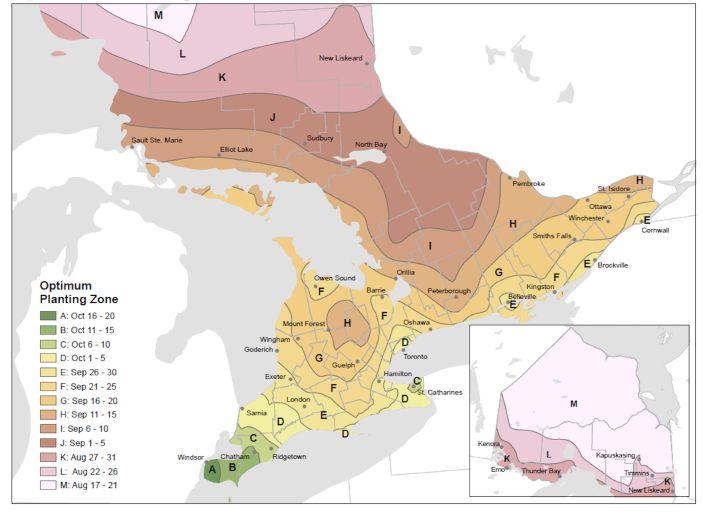
The new planting date map, released early in 2019, is an updated guide to help winter wheat growers across the province in making planting date decisions. The map was created using a formula developed by Andy Bootsma with Agriculture and Agri-Food Canada. It is based on more recent Ontario field trial and climate data than the old map.
“The new map is more detailed than the old one,” notes Follings, who is with the Ontario Ministry of Agriculture, Food and Rural Affairs (OMAFRA). “So producers are able to more accurately determine their planting date range. For example, the optimum planting date for Chatham-Kent and Essex on the old
map was Oct. 10 or later. The new map breaks that area up into three zones with the ranges: Oct. 6 to 10, Oct. 11 to 15, and Oct. 16 to 20.”
Planting winter wheat outside of your optimum date range will increase the chance of yield reductions. The specific risks differ depending on whether you are planting very early or very late. Follings reviews the risks and explains how to minimize those risks.
“Some growers, especially if they have unseeded acres where they weren’t able to plant a corn or soybean crop this year [because of the poor spring weather], might want to start planting their winter wheat very early on those acres to make sure they get all their wheat planted. Generally speaking, we recommend planting no earlier than 10 to 14 days prior to your optimum planting date,” she says.
“With planting early, we tend to see an increased risk of snow
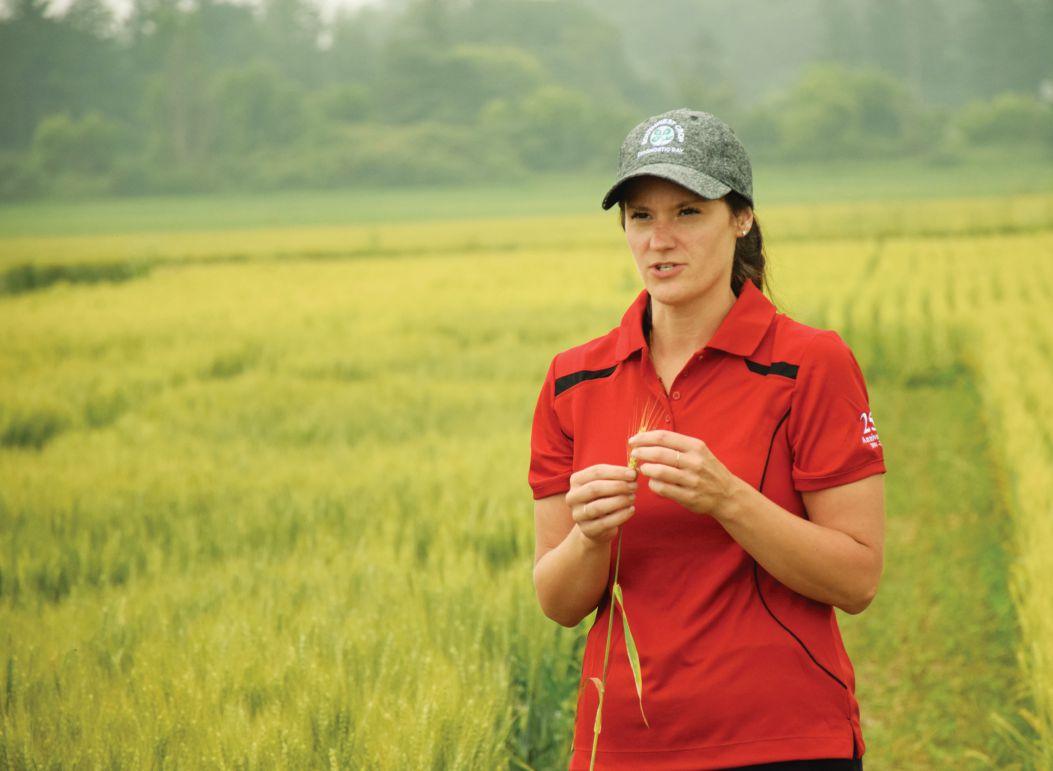
ABOVE: Joanna Follings says planting early increases the risk of snow mould, lodging, take-all and barley yellow dwarf virus.
PHOTO BY TOP CROP MANAGER.
mould, lodging, barley yellow dwarf virus, as well as take-all. So if you are going to plant more than 10 days prior to your optimum date, then be sure to drop your seeding rates by about 25 per cent. That will help mitigate some of the risks from early planting.”
With late planting, the main risk is not getting enough growing degree days to enable the wheat to get properly established before the snow flies. “It takes 80 growing degree days for wheat seed to germinate and another 50 growing degree days for the wheat to emerge, for every inch of seeding depth. So if you are planting at a depth of an inch, it takes 130 growing degree days in total for the crop to germinate and emerge,” Follings explains.
“If the weather is cool and the forecast predicts falling temperatures, then you probably won’t get the heat needed. So the seed will not be able to get out of the ground and tiller and get a good root system developed before winter.”
There’s no specific date that is always too late for successful winter wheat seeding. “Growers need to really pay attention to the temperature and the weather forecast to help decide when it is too late to plant.”
She recommends, “If you are planting after your optimum date, then increase your seeding rate by 200,000 seeds per
week. That will help with the fact that there will likely be reduced tillering before winter.”
Tips for timely planting
For the many Ontario growers who plant winter wheat after soybean, Follings has some suggestions to help get wheat planted before the weather turns too chilly.
“Of course, we can’t completely control when soybeans are going to be har-
vested, but we can control our preparedness. So my suggestion would be to get your seeding equipment out of the shed and ensure it is in good working order and calibrated, and to make sure you have your seed and fertilizer ready to go. Then when your soybeans are coming off, you will be ready to follow the combine with the drill and get the wheat planted as soon as possible,” she says. “You also want to make sure that you are spreading
GROWING WINTER WHEAT AFTER A BAD SEASON
Ontario saw poor winter wheat survival in 2019, in part because of wet weather in the fall and spring. The wet spring also delayed soybean planting, which delayed soybean harvest and shortened the window available for winter wheat planting. In the inaugural episode of Inputs: The Podcast by Top Crop Manager, Joanna Follings discussed the season Ontario had and some considerations for a good winter wheat crop. Here are the highlights:
What were some of the yields seen for winter wheat in Ontario this year?
Growers were really anticipating pretty low yields, but we’re seeing much better yields than we could’ve anticipated. For the early planted wheat we’re getting anywhere from 80 to 100 plus bushels per acre (bu/ac), and in the later-planted wheat we’re getting some ranging in the 60 to 70 bu/ac mark. But in some
instances we are getting yields as low as 30 bu/ac, and that’s unfortunate for some of those areas, but all in all, growers are pretty happy with what they got.
How do 2019’s yields compare with other years?
Our provincial average is currently at 84 bu/ac, so in many instances we are at or above that number, except for some of the later-planted wheat, which was slightly below that number. The overall average in 2019 might be lower than what we typically see, but still not too far off.
Ideal seeding date?
For most of Ontario the optimal seeding date is generally from mid- to lateSeptember. In northern Ontario, we want to be as early as late August, so August 31 for the north. Whereas if you go into the deep south of Ontario, particularly in Essex County, it’s early to mid-October,
October 10 being the optimal timing for the deep southwest.
Ideal seeding rate?
It can depend on seed size, but generally not too much. Typically we’re targeting 1.6 million seeds per acre.
Ideal seeding depth?
Seeding depth is also extremely important. With winter wheat, we want to be targeting a one-inch seeding depth. We’ve had some instances where we were checking out some different features on a drill and we ended up seeding at a half of an inch and lost all the wheat in our half-inch plot. So targeting that one-inch seeding depth really helps with winter survival.
To hear more from this interview, listen to the full episode online at www.topcropmanager.com/podcasts.
The new map for optimum planting dates for winter wheat was developed in partnership wih Weather Innovations Consulting LP.
all the soybean residue evenly as the soybeans are coming off.”
She also notes, “If you are not going to be planting winter wheat in all of your soybean fields, then I suggest that, if possible, you first harvest the fields intended for wheat. And if you have some earlier maturing crops, such as edible beans or canola, perhaps you could target those fields for winter wheat.”
What if it’s too late for winter wheat?
“If you aren’t able to get your winter wheat planted, then spring cereals are another great crop option especially if you are trying to keep a cereal in your rotation. [For instance,] a spring cereal could work well for livestock producers if they can’t get their winter wheat planted,” Follings says.
Frost seeding your spring cereal could be a good choice if you get the right weather conditions. In frost seeding, you plant very early in the spring after the snow has melted but when the soil has a light frost to support the tractor.
She notes, “Frost-seeded spring cereals have been shown to do quite well in Ontario. That’s because, the earlier you plant spring cereals, the more likely you are to miss the hot weather that often comes during pollination. So you can get pretty good yields with frost seeding.”
Other planting tips
“We generally recommend that cereals be planted at a depth of one inch. I know it can be challenging for producers to achieve that depth with some of the drills out there. But you need to avoid planting too shallow because that will increase your risk of winterkill and lower wheat yields. So, if you need to target a depth of 1.25 to 1.5 inches to get that one-inch depth, then do that,” Follings says.
To achieve the recommended plant populations, she says, “We advise targeting 1.4 to 1.8 million seeds per acre when you are seeding winter wheat at the optimum date. And as I said, drop your rate if you are seeding earlier and bump up your rate if you are seeding later.”
Starter fertilizer is also important. She notes, “Ontario research has shown that for both the sufficiency approach and the build-and-maintain approach to fertilizer applications, utilizing a phosphorus-containing starter fertilizer increases yields through the promotion of root development and uniform emergence. So consider applying a starter fertilizer based on your soil test.”
“If waiting a day means planting into better conditions, then wait a day. Wheat doesn’t like wet feet, so plant when conditions are right.”
As well, she says if early-season seedling diseases are a concern in your field, you might consider a fungicide seed treatment. “That could help reduce the disease risks associated with things like having a lot of cereals in your rotation or planting wheat after barley.”
Follings concludes, “At the end of the day, winter wheat seeding is really about being prepared to take the fall in stride, about keeping an eye on the forecast to help estimate your potential growing degree days, and about making sure you are planting when conditions are fit. If conditions are a bit wet but the forecast is pretty decent and if waiting a day means planting into better conditions, then wait a day. I can’t emphasize that enough. Wheat doesn’t like wet feet, so plant when the conditions are right.
218_083_Range_CAN_8,58x12,70_DG_0[1].pdf 1 2019-02-20 11:10 AM
“We don’t have control of Mother Nature, so take things as they come and adjust accordingly whenever possible.”
LOOKING BEYOND THE HORIZON
such as agriculture, construction, and OTR, as well as transport and agro-industrial applications.
Planting conditions make more of an impact than planting date, Folling says, so plant when the conditions are right.
SOYBEANS
BUILDING A BETTER SOYBEAN
Developing new soybean varieties with enhanced yield, disease resistance and end-use qualities.
by Mark Halsall
Anew research initiative at the University of Guelph (U of G) in Ontario is aimed at producing new food grade, non-GM soybean varieties that are high yielding, disease resistant and possess improved food qualities sought out by end-users, such as increased protein content for soymilk and tofu products.
The $1.2 million initiative started in 2018 and is funded with federal dollars and by industry partners, including the Grain Growers of Ontario and Canadian certified seed supplier SeCan. The five-year project wraps up in 2023.
Istvan Rajcan, a professor at the U of G, is leading the research team. He says the Grain Farmers of Ontario encouraged the university’s breeding program to take on this project due to its excellent track record in releasing promising new soybean varieties for the Canadian market.
“Our breeding program is dynamic and keeps churning out new cultivars,” Rajcan says. “Every year we develop and release between three and five new cultivars.”
The new cultivars produced under the current program will
be tailored for short- and medium-season soybean growing areas of Canada, namely Ontario, Quebec and southern Manitoba.
Rajcan notes that the focus is on food-grade, non-genetically modified (GM) varieties because of the sizeable number of acres being grown to food-grade soybeans in Eastern Canada.
“Unlike in the U.S., where much of the main growing area is grown to GM soybeans, a significant portion of soybeans grown in Canada are of the non-GM, food-grade variety,” he says. “In Canada, primarily in the provinces of Quebec and Ontario, between 25 and 30 per cent of the total acreage of soybeans every year is non-GM food grade.”
The U of G researchers are utilizing conventional breeding methods, such as single seed descent, as well as genomic techniques and molecular tools, such as marker-assisted selection techniques, to develop the new cultivars.
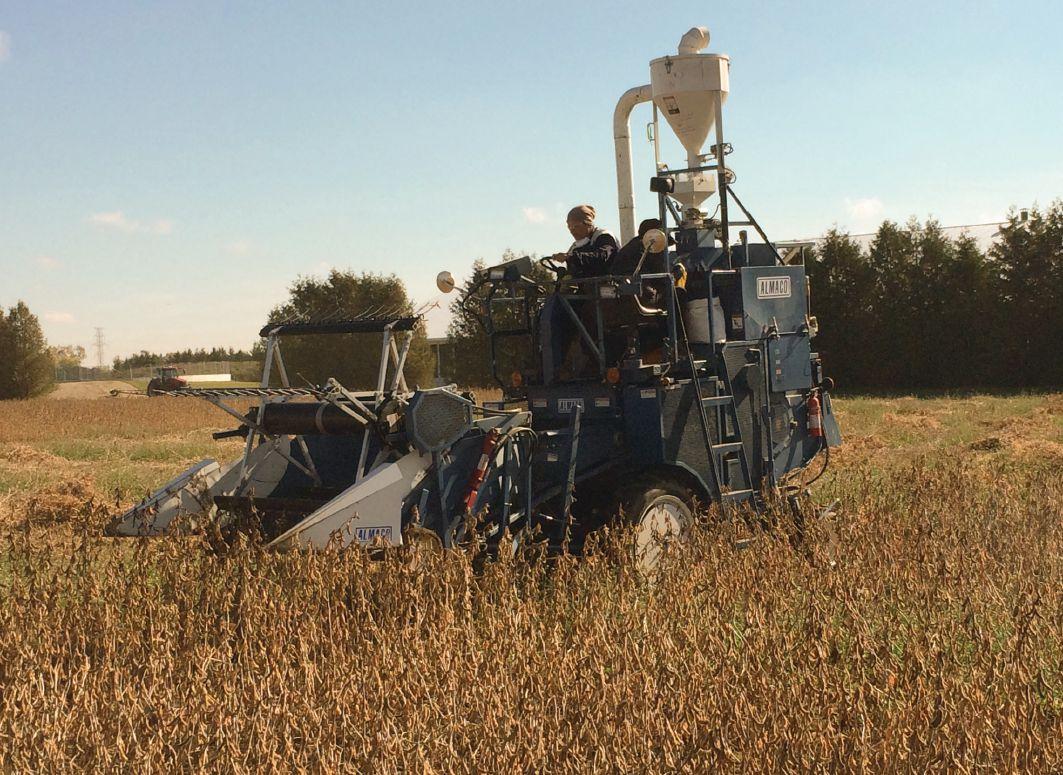
TOP: Combine harvesting of soybean yield plots at the Elora Research Station in Elora, Ont.
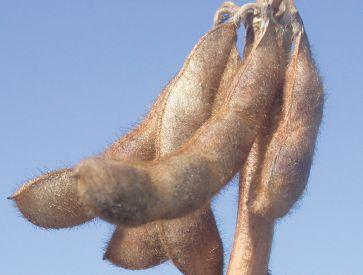
INSET: Cluster of soybean pods with up to four seeds, one of the selection targets for soybean breeders at the University of Guelph.
One of their primary objectives is enhancing yield, and this is being done by incorporating alleles, which are versions of a gene, from elite, commercially successful cultivars from Canada and the United States as well as China, the centre of origin and diversity of soybean. The result, Rajcan says, is a bigger and more diverse gene pool that the breeders have to work with, especially due to the vastly underutilized Chinese germplasm.
“If we keep making crosses using all elite, high-yielding parents from Canada, over time, you may end up crossing similar with similar. The essence of success in plant breeding, however, is genetic variation,” Rajcan says.
“To prevent that, you’re always looking out for new alleles that would increase yield by five or 10 per cent or whatever amount that may be, which are currently not present in the Canadian gene pool.
Rajcan says by utilizing Chinese varieties, his team is able to reap the benefits of genetic variation to increase yield and to improve other traits as well.
“We are using genomic selection to select among populations for traits such as high yield using a large number of markers,” he says “That helps us make selections and cull individuals out of the populations that don’t have a chance of producing high yield. So, it helps us make the program more efficient.”
The U of G breeders are also aiming to develop output traits that enhance the value and market opportunities for soybean food items. For products like tofu, soymilk and miso, for example, this means adjusting properties like sucrose and protein content and boosting levels of substances like soyasaponin and isoflavones that provide health benefits.
“For tofu, a higher percentage of protein and larger seed is preferred, so we are making selections within our breeding populations for new cultivars that have those characteristics,” Rajcan says. “For soy milk, the preference is for higher than average protein and high sucrose to make it a bit sweeter. The high sucrose is also important for miso producers in Japan.”
Enhancing genetic resistance to soybean cyst nematode (SCN) and white mould is another key goal for the U of G breeding team.
Rajcan says SCN is most damaging disease of soybeans in worldwide and is now present in a large part of Ontario. He adds that SCN is a growing problem in southern Quebec as well.
“We don’t really have a choice whether to work on SCN resistance or not,” Rajcan says. “Many times, we are not even able to actually find a commercial seed partner to release the cultivars to unless the cultivar has a resistance in it.”
Rajcan says his team is utilizing new sources of resistance beyond the common source of resistance – the PI 88788 gene –that most soybean breeders across North America have been using. The U of G researchers are using a different SCN resistance source, PI 437654, to diversify the genetic resistance to SCN.
“Many of the races of soybean cyst nematode are now are able to overcome the PI 88788 resistance gene and cause damage to the soybean crop,” says Rajcan. “So, if we don’t use additional alternative sources of resistance, the protection that the original resistance source was providing will no longer be there.”
According to Rajcan, the program is also targeting white mould because the pathogen – the third most damaging disease of soybean behind SCN and Phytophthora root rot – is on the rise in Ontario and Quebec.
He notes that unlocking the key to white mould resistance has been challenging for soybean breeders.
“It’s been an elusive disease to work on because there is no such thing as complete resistance to white mould. There’s only partial resistance,” Rajcan says. “When a cultivar has partial resistance, it is a result of many genes instead of just one or two major genes, so that creates difficulty in developing new soybean cultivars that are resistant to white mold.”
Rajcan points out that not all the varieties released through his program will share the same traits.
“Most of the cultivars that we are developing are high yielding, but not all of them will have these same characteristics,” he says. “There will be cultivars with a package of traits that is good for certain final products and there are other varieties that would be good for different food grade uses but also including industrial bioproducts.”
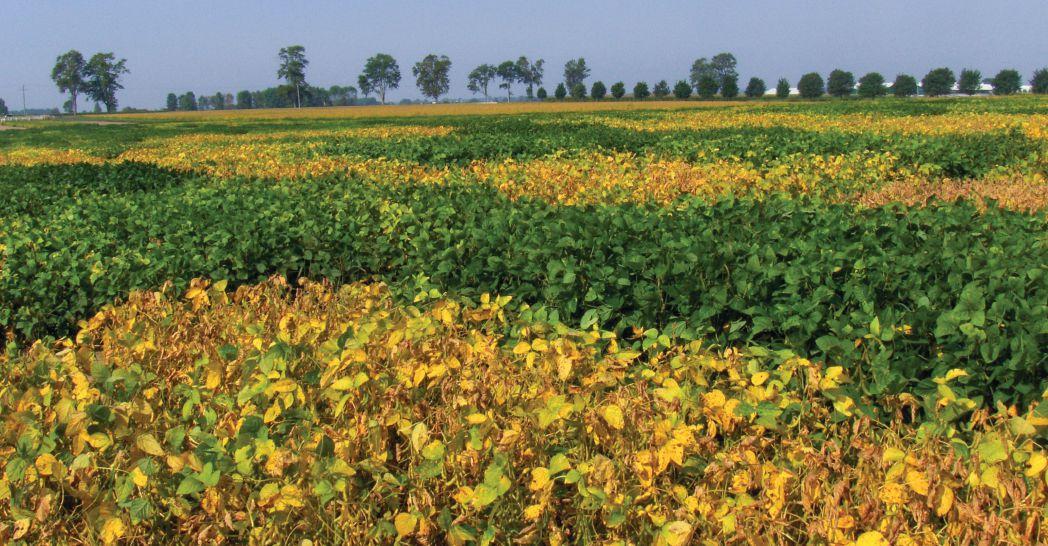
Soybeans at different states of maturity at the Woodstock Research Station in Woodstock, Ont. Soybean maturity is one of the selection targets for soybean breeders at the University of Guelph.
PHOTO COURTESY OF ROBERT BRUCE.
Fertilization to improve crop quality
Jeff Schoenau | Professor of Soil Fertility/Professional Agrologist
University of Saskatchewan
Investigating PGRs
Sheri Strydhorst | Agronomy Research Scientist
Alberta Agriculture and Forestry
Amy Mangin | PhD Student
University of Manitoba
Insect threats and beneficials
Tyler Wist | Research Scientist, Field Crop Entomology
Agriculture and Agri-Food Canada Saskatoon Research and Development Centre
Evaluating root rot and other pulse diseases
Syama Chatterton | Plant Pathologist
Agriculture and Agri-Food Canada Lethbridge Research and Development Centre
The future of neonics
John Gavloski | Entomologist
Manitoba Agriculture
Smart farming and a glimpse into the future
Joy Agnew | Director of Applied Research
Olds College Centre for Innovation
Maximizing fungicide use
Tom Wolf | Spray Application Specialist
Agrimetrix Research and Training
Tackling clubroot: disease updates, reducing risk and practical management
Dan Orchard | Agronomy Specialist
Canola Council of Canada
Curtis Henkelmann | Farmer
Alberta
PROTECTING THE GREAT LAKES WITH COVER CROPS
Cover crops can reduce N leaching and enhance system productivity.
by Julienne Isaacs
Anew study out of Harrow Research Station has shown that the use of cover crops can dramatically reduce nitrogen (N) losses via leaching and enhance system productivity.
The study, which began in 2014, is led by Agriculture and Agri-Food Canada (AAFC) research scientist Xueming Yang and supported by AAFC’s Organic Science Cluster 3 program and the Grain Farmers of Ontario.
“My background is in soil science, looking for ways to enhance soil and environmental quality using the best farming practices,” Yang says. “This study targets a common rotation in southwestern Ontario around Lake Erie, winter wheat-corn-soy, because these systems can contribute to N leaching.”
“Substantial nitrate contamination of surface and ground waters is well-known in the region and agricultural soils are a major source of nitrates,” Yang says.
Approximately 95 per cent of residual soil N, mainly nitrates remaining in the soil at the end of the growing season, can be lost
into waterways from the region’s sandy soils through over-winter leaching, eventually reaching the Great Lakes and widening anoxic zones.
In particular, it’s the winter wheat years that can most damaging. Winter wheat is harvested in mid- to late-July, and the soil is typically left bare after harvest, meaning more mineral N will be released from the decomposition of soil organic matter, further increasing residual soil N levels on those fields before the over-winter leaching period – and increasing the amount of nitrate loss.
Yang’s study, which is ongoing, looks at the potential for leguminous cover crops to help absorb excess N in the soil and contribute N nutrients to the following year’s corn crop.
There’s another reason why legume cover crops represent an elegant solution. In Canada, organic grain production doesn’t yet meet demand, but farmers transitioning from conventional to organic production must refrain from the use of chemical fertilizers,
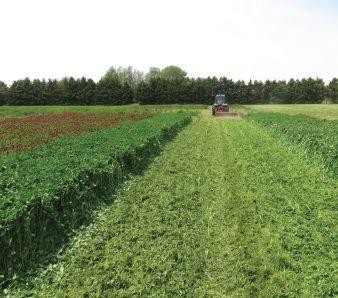
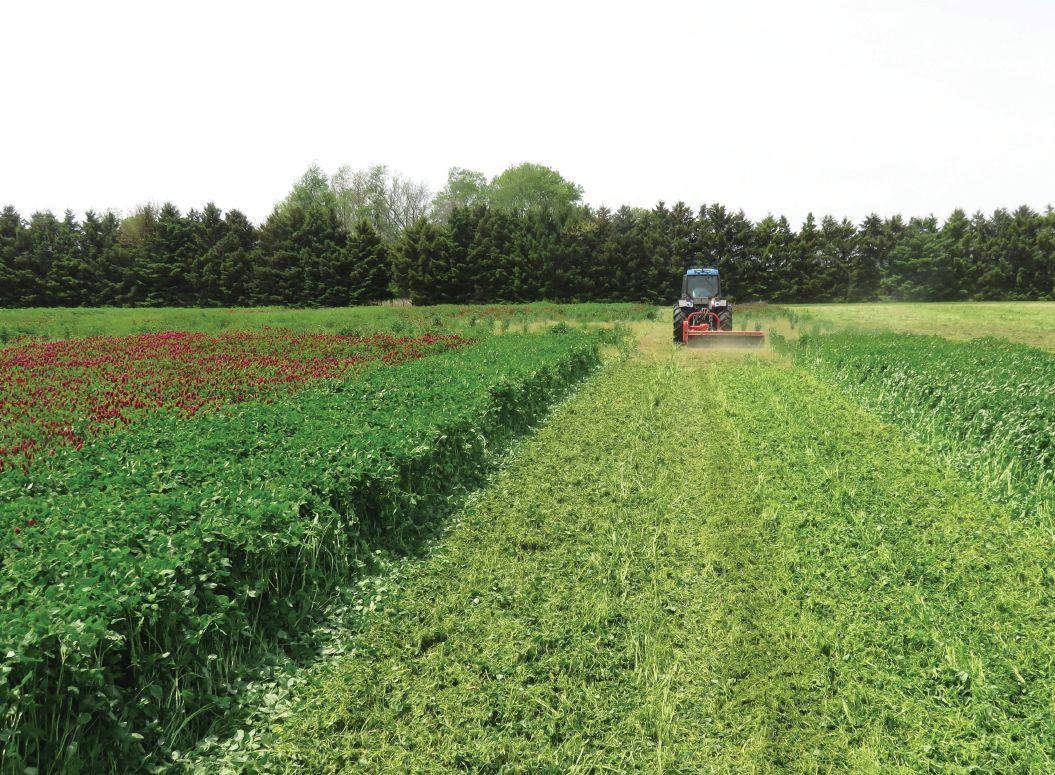
ABOVE: Terminating red clover before planting corn.
Yang says, which deters some farmers from making the switch.
While yields – particularly those of corn and other high-value crops – necessarily take a hit without chemical fertilizer, leguminous cover crops can provide a good source of N for the following year’s corn crop in rotation, mitigating losses and making the transition more feasible, Yang says.
Study design
Study plots were established at Harrow Research Station on a site previously planted to corn, winter wheat, soybean or white bean and alfalfa in rotation for at least six years treated with conventional fertilizers.
Yang’s team consulted with nearby organic farmers running similar production systems and selected red clover, crimson clover and hairy vetch for this study. “All three are legumes and winter hardy,” Yang notes.
Cover crop treatments were arranged in a randomized complete block design with four replications.
Two controls with no cover crops included one under conventional management with synthetic fertilizer and one without synthetic fertilizer. The legume cover crops were the primary source of N for the cover crop plots.
Soil cores were collected from each treatment and used to measure soil water content, soil dry bulk density and residual soil mineral N. The team also compared residual soil N between the control plots and the cover crop plots, Yang says.
Results and considerations for farmers
The team’s results were promising on all counts.
“Comparatively, the amounts of soil residual N subject to leaching loss from the cover crop treatments were really low, about 60 kg per hectare less than the conventional treatments,” says Yang. “So, since up to 99 per cent of residual soil N leaches during the winter from the study soil, from the N conservation standpoint, the use of cover crops really can reduce leaching.”
On the system productivity side, Yang’s results were equally positive. Yang says conventional producers considering transitioning to
organic production face some tough choices in terms of meeting crop N nutrient demands.
Organic producers are confined to the use of certified organic amendments such as livestock manures or green manures, but access to livestock manures can vary depending on the region.
“Your yields typically will be reduced significantly if crop N needs cannot be met,” Yang says.
Surprisingly, however, the study found that yield losses in the cover crop treatments were small from vetch and red clover treatments compared to the controls – “about five per cent less than conventional,” he says.
Significantly, the use of leguminous cover crops doubled corn grain yield compared to the treatments without cover crops and synthetic fertilizers.
“We want first to let farmers know that this kind of leguminous cover crop after winter wheat can contribute N – not as much as conventional, but it can supply an adequate amount of N for the following year’s corn,” Yang says.
But not all cover crops are created equal. Yang’s study found that of the three, hairy vetch proved the most profitable choice, as it provided higher aboveground biomass as well as N accumulation –more than 20 per cent better than red clover and 50 per cent better than crimson clover.
Even though all three cover crops are considered winter hardy, severe winter damage was noted some years in the crimson clover, which had impacts on biomass and N accumulation.
The three-year average cover crop biomass C was highest for hairy vetch, followed by red clover, and lowest for crimson clover before planting corn. Overall, hairy vetch outperformed both red clover and crimson clover in biomass C and N accumulation.
“Wherever possible, we recommend the use of cover crops instead of leaving the land bare, particularly after wheat harvest,” says Yang. “I recommend using hairy vetch, because it not only provides good land cover and sufficient N for the following crop, but it’s also easy to manage in-field in terms of ground-cover establishment, weed suppression and termination before planting the following crop,” Yang concludes.
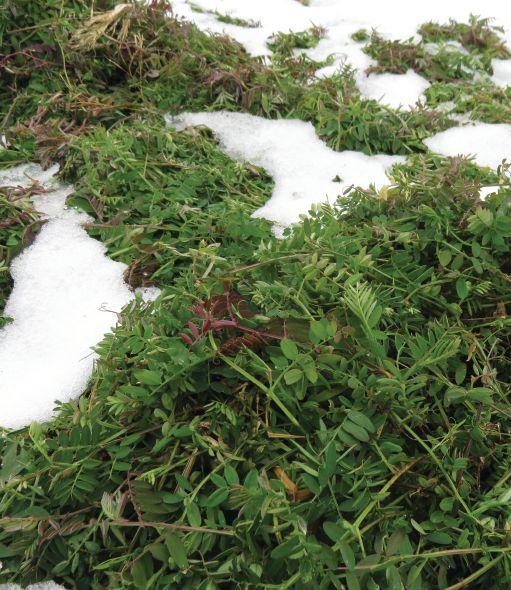
Hairy vetch field in December.
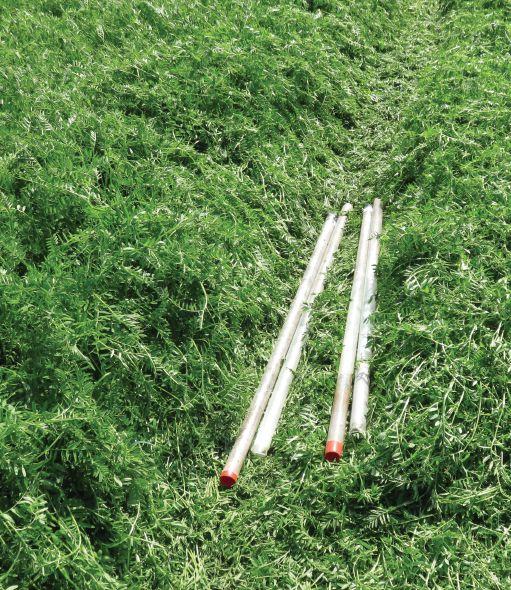
Field of hairy vetch before termination for planting corn.
FROM LANDFILL TO LONG-TERM SOIL HEALTH?
Organic amendments could capture carbon and improve soil health.
by Julienne Isaacs
Anew study will look at the impact of biobased residues on soil health and greenhouse gas emissions in Quebec and Ontario.
The study, which began in May 2018, compares three different organic soil amendments (composted food waste, hydrolyzed biosolids and liquid anaerobic digestate) and an inorganic fertilizer control, looking at their effects on soil health, carbon sequestration, and greenhouse gas mitigation in a maizesoybean-wheat rotation under present and future climatic conditions in Quebec and Ontario.
“Our interest in this project is to use available organic amendments to improve soil health but also to divert these organic materials from landfills,” explains Maren Oelbermann, a professor at Waterloo’s School of Environment, Resources and Sustainability, and the study’s co-lead.
“For example, the Waterloo Region wants to be solid waste free by 2023. This solid waste can be recycled back into the soil. This will contribute to the circular economy,” she says.
“With a continually growing population and more waste, it makes no sense to place the solid waste into landfills. It makes more sense to revert it back to the soil where it can be used as a fertilizer or contribute to soil fertility and help build organic matter.”
In Quebec, producers who sequester carbon may be eligible to participate in Quebec’s Cap-and-Trade (C&T) system for Greenhouse Gas Emissions Allowances (in French, the Système de plafonnement et d’échange de droits d’émission de gaz à effet de serre du Québec [SPEDE] program), says Joann Whalen, a professor in McGill University’s department of natural resource science and Oelbermann’s co-lead on the study.
“This work aims to identify management practices that increase soil carbon sequestration and reduce greenhouse gas emissions, which are related to the economic cost-benefit analysis and opportunities for agricultural producers to participate in carbon markets,” Whalen says.
The joint MAPAQ/OMAFRA project launched in May 2018 in collaboration with industry partners Lystek, which is contributing Lystegro biosolids biofertilizer, Bio-En Power, which is contributing anaerobic digestate, and AIM Environmental, which is providing composted food waste.
Oelbermann says there have been no recent studies on anaero -
ABOVE: The project looks at management practices that improve soil’s ability to capture carbon and store carbon dioxide.
bic digestate or composted food waste, and few studies have been undertaken to investigate the impacts of all three products on soil health and GHG emissions.
Study design and initial results
In Ontario, one set of field plots is located at Elora Research Station; in Quebec, the plots are located at the Macdonald campus. All plots are replicated experiments that include four fertilizer
treatments: composted food waste, hydrolyzed biosolid and liquid anaerobic digestate, as well as a standard mineral fertilizer control. There’s also a zero treatment with no fertilizer.
Whalen’s team is responsible for the study’s economic analysis, which includes the collection of yield data, GHG emissions, and the prediction of soil and crop responses under various climate-change scenarios. Whalen will also assess the economic feasibility of organic soil amendments to sustain soil and crop productivity.
“We are collecting data that will allow producers to determine the carbon sequestration potential of conventionally fertilized crops versus crops that receive bio-based fertilizers. We will then calculate the market value of the carbon payment using the net present value approach,” she says.
As part of their economic analysis, Whalen’s team will take into consideration the cost of collecting and processing organic amendments, as well as hauling and application costs.
“We calculate the ability of each organic amendment to reduce N fertilizer requirements, which will lower N2O emissions, and valorize the organic C inputs, which will mitigate CO2 and CH4 emissions while promoting soil health,” Whalen explains.
The team will then develop a farm-scale optimization model for crop and livestock operations in Quebec and Ontario, she says.
Based on the first year of data, the team has not found significant differences in carbon dioxide, methane and N2O emissions among any of the treatments, says Oelbermann.
However, the composted food waste had a significantly lower nitrate and ammonium content than the other treatments followed
by the biosolid treatment. “This could signal lower potential runoff or loss of nitrogen,” she says.
The team also observed some differences in water infiltration rate, with “significantly” lower rates in the conventionally fertilized plot as well as the biosolids plot. “This may be due to differences in the porosity of the organic amendment, but this did not affect bulk density – there were no significant differences in bulk density among the treatments,” she says.
Other soil health parameters, Oelbermann says, showed no differences at the zero to 10 cm depth, but microbial biomass carbon was significantly greater in the composted food waste treatment, while microbial biomass N was significantly greater in the conventional treatment.
In Quebec, Whalen says corn yield was similar among treatments, but plots receiving anaerobic digestate saw 30 per cent lower CO2 emissions and 61 per cent lower N2O emissions during the growing season than the inorganic fertilized plots. “We also noted an elevated N2O emission in plots receiving hydrolyzed biosolids,” she adds.
“For year one we conclude that the addition of biosolids, anaerobic digestate and composted food waste had no negative effects on soil when compared to standard farming practices,” Oelbermann says. “The biobased residues also did not significantly influence GHG emissions nor crop yield among treatments.”
Whalen says biobased residues are widely believed to be difficult to use on farms, but Quebec producers should be aware that it could be profitable to use biobased residues on their farms, particularly if they are eligible to receive credit payments under the province’s C&T program.
A SPRINGBOARD FOR OAT IMPROVEMENT
Genomic advances for even better oat varieties.
by Carolyn King
When people think about oats, their first thoughts might go to simple foods like oatmeal. However, oat is anything but simple on a genomic level. Its huge, complicated genome makes developing genomic tools for improved oat breeding really challenging.
Fortunately, Nick Tinker and his research group at Agriculture and Agri-Food Canada (AAFC) in Ottawa are equal to the challenge.
Their research ranges from a leading-edge method for rapidly screening thousands of oat breeding lines for many genetic traits at once, to international collaborations in the essential efforts towards sequencing the oat genome. The ultimate goal of their work is to spur the development of even better oat varieties.
Oat lags a bit behind other crops in the development of genomic resources. In particular, unlike every other major crop and most minor crops, oat still lacks a high-quality complete genome sequence, called a reference genome. Tinker explains that there are two reasons for this lag.
The first reason is that the oat genome is unusually complex. “Its genome is very large, almost four times as big as the human genome. Also, it is a triple genome because oat evolved from three different wild relatives with smaller, simpler genomes that have glommed together. So sequencing oat’s genome is like doing three large, complicated jigsaw puzzles at the same time with the pieces of all three puzzles mixed together in a single box. So we need to take extra precautions to make sure we’re not assembling one of those puzzles, or sub-genomes, using pieces from another one.”
A further addition to the complexity is that oat has greater genomic variability between varieties, in comparison to most other crop species. He says, “That is partly because having those three genomes lets oat tolerate rearrangements among its chromosomes. So those three puzzles may look quite different from one oat variety to the next. This has made chromosome mapping very difficult.”
The second reason for the lag is funding constraints. “Oat is important worldwide, but almost everywhere it is less important than crops like corn, soybean, wheat and canola, so oat tends to get less funding. But because of the oat genome’s complexity, sequencing it is very expensive. So, within every country there is not enough funding to do big oat genomics projects, which is why international collaboration is so crucial.”
On the road to a reference genome
A good reference genome would enable oat researchers to better understand things like how different genes affect different processes in the plant and to develop more genomic tools for oat breeding.
Tinker and his group have been instrumental in building the foundation
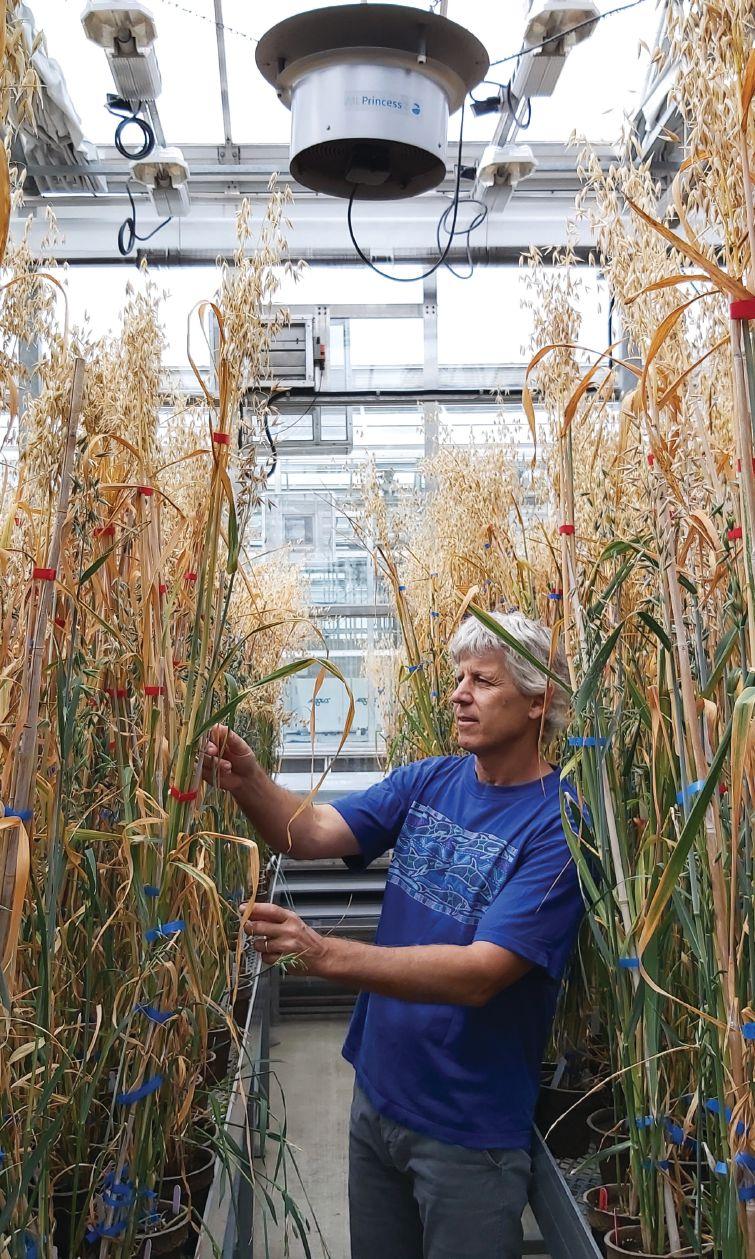
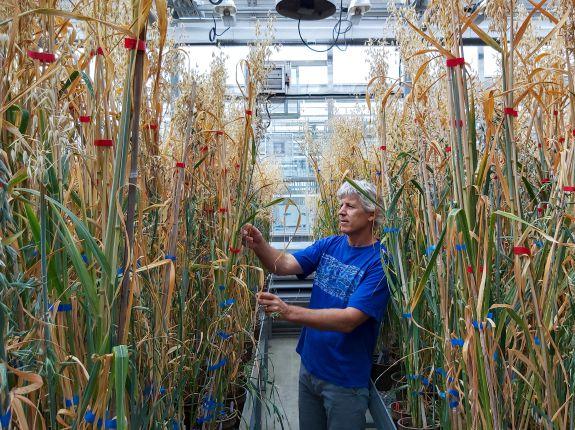
LEFT: Nick Tinker studies oat genomics with the ultimate goal of spurring the development of even better oat varieties.
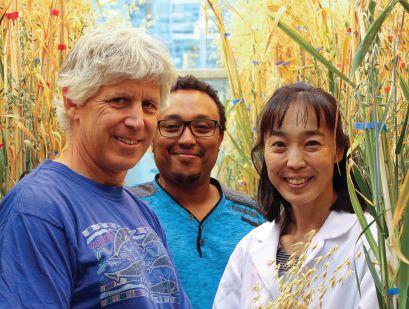
BOTTOM: Tinker (left) with two members of his research group, Wubishet Bekele (centre) and Asuka Itaya (right).
<LEFT: This oat genetic diversity experiment conducted by Tinker’s group illustrates the high degree of variability between different oat varieties.
needed to create an oat reference genome. In particular, four years ago, Tinker led an international initiative in the critical task of creating a really good map of the oat chromosomes, called a consensus map.
A chromosome map uses a set of DNA markers, which are like road signs, to put the genes in order. A consensus map is the best estimate of the average order of those road signs, based on many different maps. Figuring out this average is especially difficult in oat because of its greater genomic variability.
“Creation of the oat consensus map required participation from the international community because we needed to merge a lot of different maps from different oat varieties to determine which parts of the map were always the same, and which parts varied among varieties,” notes Tinker.
“The consensus map is a prerequisite for the complete genome sequence because you need those road signs when you’re doing the DNA sequence to help put all of the sequence into the correct order. And the map is still very useful even when you have a sequence.”
This consensus map is a major advance. “Without this map, we would be completely lost. Now almost every new oat genomics study done around the world depends on this map,” he says.
“The map also allows us to reinterpret older work. For example, let’s say somebody had mapped a rust resistance gene and all they knew was that the gene is linked to one other genetic marker. Now we can put it onto the complete map. And when we do that, we might discover that two rust genes that we thought were different are probably the same gene. Or now that we know where the gene is on the map, we can see that it is linked to a gene affecting oat quality, so we know it will be difficult to add that resistance gene without affecting quality.”
Before that road map could be made, all those road signs had to be created. And that’s another area where Tinker and his group have made substantial scientific contributions. They led the development of two technologies that provide inexpensive ways to put a whole lot of road signs on the road map at once. The resulting high-density set of road signs was key in building the consensus map.
Getting closer: draft genomes
Although there isn’t yet a reference genome for cultivated oat (Avena sativa), there are some draft genomes.
PHOTOS COURTESY OF AAFC.
A Swedish consortium owns one of the drafts. This may be the most complete draft, but it isn’t publicly available for other scientists to see and freely use.
Another draft was produced by one of Tinker’s collaborators, a researcher from the University of North Carolina. Tinker notes, “This draft has been publicly available for a couple of years. However, it was done using an older technology that wasn’t able to properly separate the three sub-genomes, so it has a lot of limitations.”
A researcher at Aberystwyth University, another of Tinker’s collaborators, has created a draft sequence for red oat (a sub-species of Avena sativa). Red oat is cultivated in other parts of the world, but not in Canada. It is another triple-genome oat and is closely related to the white-seeded Avena sativa that we cultivate here. Its sequence will soon be publicly available and will help with efforts to sequence white oat and understand oat’s genetic diversity.
Tinker and his group were part of a collaborative effort led by a group at Brigham Young University that very recently completed reference sequences for Avena atlantica and Avena eriantha. These wild relatives’ genomes represent two of the three sub-genomes in Avena sativa. These two smaller genomes will also help with assembling the full genome sequence of Avena sativa
Going wild
“Perhaps the project that was the most fun recently has been sorting out which parts of the oat genome came from each of its three wild ancestors,” Tinker says. “But I truly believe this work has longterm importance.”
Oat has about 30 wild relatives. These species are an amazing source of genetic diversity for traits like disease resistance to improve cultivated oat varieties. At present, a trait from a wild relative is brought into oat by making a cross between the wild relative and a cultivated oat line. “With those crosses, you get mostly garbage [because the wild plant has so many traits that are undesirable for crop production]. So you have to do a lot of selection [and backcrossing] to bring just that one gene from the wild relative into your crop,” he explains.
“However, many people believe we will soon be able to move desirable genes routinely from wild relatives into oat through gene editing – editing the genome of cultivated oat to look like the wild relative in the target genetic region. That is being done in other species, but we haven’t accepted gene editing in oat. I don’t know when that might happen, but we need to do the basic science to prepare for that possibility so that gene editing in oat will be safe and efficient if it happens.”
A revolutionary advance
“Almost all my focus right now is on genomic selection, which is a way of selecting several different complex traits at once using models developed from thousands of genetic markers,” Tinker notes.
Genomic selection is a significant leap beyond marker-assisted selection where a genetic marker is used to identify breeding lines that have a specific gene associated with a particular trait. Those single markers are useful tools for some traits; for instance, resistance to certain diseases can depend on a single gene. However, traits like yield and quality are controlled by hundreds of genes.
Tinker outlines how a genomic selection model is created. “In genomic selection, you have a training population – a set of different oat lines that are part of your breeding program. You do a really careful evaluation in multiple environments of how those different oat lines perform [with respect to traits like yield, quality, disease resistance and so on]. You also measure all of the genetic markers in those same oat lines. Then you build a correlation between the markers and the traits of interest.”
Certain patterns of markers will end up being statistically associated with certain traits. Then you can use that statistical model to predict how other lines will perform.
“Let’s say you have another population of oat lines, perhaps a much larger population that you can’t afford to grow out in multiple plots and multiple environments. However, you can do the genetic marker assays on them, which right now only cost about $20 per oat line, and that cost is rapidly coming down.” So, using an oat line’s array of markers, the model can predict how that oat
Oat has about 30 wild relatives which are great sources for genetic diversity but also include a lot of traits that are undesirable for crop production.
PHOTO BY STEPHANIE GORDON.
line will perform relative to the traits of interest, in a normal year in the target environment.
“Genomic selection is a revolutionary concept,” says Tinker. Until genomic selection, the only practical way for breeders to evaluate thousands of plants in the early stages of their breeding work has been to look at how the plants perform in plots at their own research location. Only after the breeding materials have gone through several selection stages to narrow down the number of lines is it practical to start evaluating the lines at multiple sites. So the early selections in a breeding program can be strongly influenced by the breeder’s experience in visually evaluating plants and by whatever weather conditions happen to occur at the breeder’s site during the selection process.
In addition, some traits can’t be determined by visually assessing the plants in the field. For instance, costly lab analyses are needed to assess most quality characteristics. As a result, quality is not usually evaluated during the early breeding stages.
So, genomic selection offers a method to evaluate thousands of early-stage breeding lines that is potentially more accurate than the traditional visual assessments.
Tinker and his group have already developed genomic selection models for oat and conducted some pilot studies. Now they are working on a full-scale genomic breeding study with AAFC oat breeders Weikai Yan in Ottawa and Jennifer Mitchell Fetch in Brandon.
Tinker says, “The breeders are more excited by genomic selection than they ever were about marker-assisted selection. Breeders don’t usually want to go to all of the trouble of doing DNA work if all they are doing is selecting one gene out of thousands of genes. Now we are actually selecting those thousands of genes.”
Mitchell Fetch and Yan are so interested in this approach that they have actually converted part of their breeding programs to genomic selection. Tinker notes, “Breeders have pipelines that take 10 years from making a cross to producing a variety. So they are justifiably cautious about making any change that might affect that pipeline. This study is the first time these two excellent breeders have directly risked part of their breeding pipeline on genomics technologies, and that says a lot.”
So far, this approach looks promising. “We have only been doing the genomic selection study for three years, but this work has already put some good oat lines into advanced stages of testing. I expect some of these lines will become varieties in the next few years. We are keeping track of the average performance of the genomic selection lines versus the visually selected lines, and we see promising improvement already. But the real test will come when the lines are grown in registration tests and especially when farmers start to grow them.”
Looking ahead
In the next few years, Tinker is hoping to undertake a number of studies that have the potential to increase scientific understanding of oat’s genome and to help breeders make even greater progress in oat improvement.
“First of all, I am ready to ‘throw my back’ into developing and using a high-quality oat genome sequence. I will continue working with collaborators who have draft sequences. And I hope to secure funding for developing a new Canadian-led sequence because of the benefits of having a reference sequence that is especially relevant to Canadian oat lines.”
Another area of interest is the concept of estimating whole genomes from partial data. He explains, “Once we have one good oat
reference genome, we can partially sequence a representative set of oat varieties, and create a database of common sub-sequences. From there, we can estimate the entire sequence of an oat variety using just a set of marker data.”
As well, he would like to collaborate on the development of an oat pan-genome. A pan-genome is the entire gene set for multiple varieties of a species, including the genes that are present in all the varieties and the genes that are present in only some varieties. An oat pan-genome could shed light on aspects of the oat genome that are otherwise very difficult or impossible to detect and may allow more targeted oat improvement in future.
Tinker is clearly passionate about oat genomics, enjoying the scientific challenges, the synergy of working with the highly collaborative international oat community, and the real opportunity to help Canadian farmers by contributing to the development of better and better oat varieties.
AAFC funds Tinker’s long-term research such as his genome sequencing activities. His more applied research, like his genomic selection study, is funded by an AAFC partnership with the Canadian Field Crop Research Alliance (CFCRA) through the Canadian Agricultural Partnership (CAP) AgriScience Program. The CFCRA is comprised of several provincial producer groups and industry partners. CFCRA members specifically supporting the oat genomic selection studies include: Atlantic Grains Council; Producteurs de grains du Quebec; Grain Farmers of Ontario; Prairie Oat Growers Association; SeCan; and FP Genetics. Additional industry funders beyond the core CFCRA members supporting the genomic selection study include oat millers from across Canada.
Trait Stewardship Responsibilities Notice to Farmers
Monsanto Company is a member of Excellence Through Stewardship® (ETS). Monsanto products are commercialized in accordance with ETS Product Launch Stewardship Guidance, and in compliance with Monsanto’s Policy for Commercialization of Biotechnology-Derived Plant Products in Commodity Crops. These products have been approved for import into key export markets with functioning regulatory systems. Any crop or material produced from these products can only be exported to, or used, processed or sold in countries where all necessary regulatory approvals have been granted. It is a violation of national and international law to move material containing biotech traits across boundaries into nations where import is not permitted. Growers should talk to their grain handler or product purchaser to confirm their buying position for these products. Excellence Through Stewardship® is a registered trademark of Excellence Through Stewardship.
ALWAYS READ AND FOLLOW PESTICIDE LABEL DIRECTIONS. Roundup Ready® Technology contains genes that confer tolerance to glyphosate. Roundup Ready® 2 Technology contains genes that confer tolerance to glyphosate. Roundup Ready 2 Xtend® soybeans contains genes that confer tolerance to glyphosate and dicamba. LibertyLink® Technology contains genes that confer tolerance to glufosinate. Glyphosate will kill crops that are not tolerant to glyphosate. Dicamba will kill crops that are not tolerant to dicamba. Glufosinate will kill crops that are not tolerant to glufosinate. Contact your local crop protection dealer or call the technical support line at 1-800-667-4944 for recommended Roundup Ready® Xtend Crop System weed control programs. Insect control technology provided by Vip3A is utilized under license from Syngenta Crop Protection AG.
FOR CORN, EACH ACCELERON® SEED APPLIED SOLUTIONS OFFERING is a combination of separate individually registered products containing the active ingredients: STANDARD offering for corn without SmartStax® Technology: fluoxastrobin, prothioconazole, metalaxyl and clothianidin. STANDARD plus DuPont Lumivia® offering for corn: fluoxastrobin, prothioconazole, metalaxyl and cyantraniliprole. STANDARD plus Poncho®/VOTiVO® offering for corn with SmartStax® Technology: fluoxastrobin, prothioconazole, metalaxyl, clothianidin and Bacillus firmus I-1582. COMPLETE offering for corn with SmartStax® Technology: metalaxyl, clothianidin; prothioconazole and fluoxastrobin at rates that suppress additional diseases. COMPLETE plus Poncho®/ VOTiVO® offering for corn with SmartStax® Technology: metalaxyl, clothianidin, Bacillus firmus I-1582; prothioconazole and fluoxastrobin at rates that suppress additional diseases. COMPLETE plus DuPont™ Lumivia® offering for corn: metalaxyl, cyantraniliaprole, prothioconazole and fluoxastrobin at rates that suppress additional diseases. Class of 2019 and 2020 base genetics are treated with BioRise™ 360 seed treatment. FOR SOYBEANS, EACH ACCELERON® SEED APPLIED SOLUTIONS OFFERING is a combination of separate individually registered products containing the active ingredients: BASIC: prothioconazole, penflufen and metalaxyl. STANDARD: prothioconazole, penflufen, metalaxyl and imidacloprid. STANDARD plus Fortenza®: prothioconazole, penflufen, metalaxyl and cyantraniliprole. FOR CANOLA seed treatment offerings can include: Prosper® EverGol® seed treatment containing the active ingredients clothianidin, penflufen, metalaxyl and trifloxystrobin. Fortenza® Advanced seed treatement consisting of Fortenza Seed Treatment insecticide containing the active ingredient cyantraniliprole and Rascendo® Seed Treatment insecticide containing the active ingredient sulfoxaflor. Helix® Vibrance® seed treatment containing the active ingredients thiamethoxam, difenoconazole, metalaxyl-M, fludioxonil and sedaxane. Jumpstart® XL inoculant containing the active ingredient penicillium bilaiae.
Which practices are best for increasing corn yields and reducing phosphorus losses?
by Carolyn King
Corn growers often have questions around fertilizer placement with strip tillage like: How does strip tillplaced fertilizer compare with a conventional tillage system where the fertilizer is broadcast and then incorporated? Does it matter whether the strip till/fertilizer operation takes place in the fall or the spring? Which system produces the highest corn yields? Which system is best at minimizing soil erosion and nutrient losses?
Corn specialist Ben Rosser is leading a three-year project to find some answers to these questions.
He explains that strip till has the potential to offer some of the benefits of no-till along with some of the benefits of conventional till. In strip till, you are only tilling about a third of the field, just the rows where you will be planting corn. So the rest of the field has a crop residue cover to protect soil quality and minimize soil and nutrient losses. The strips tend to be warmer and drier than a no-till field, which can help the crop get off to a better start. Strip till may have lower fuel costs compared to a conventional till system. And strip till can be a good option for applying fertilizer.
“Strip tillage gives you the ability to incorporate fertilizer right into the strip, while also using a conservation tillage system. No-till has a lot going for it, but one drawback is that you are almost stuck with broadcasting fertilizer that you can’t band with the planter,” says Rosser, who is with the Ontario Ministry of Agriculture, Food and Rural Affairs (OMAFRA).
In a broadcast fertilizer system – whether it is conventional till or no-till – the fertilizer feeds not only the crop but also the weeds in between the crop rows. With broadcast-and-incorporated fertilizer in a conventional tillage system, the whole field is at risk of soil erosion and loss of soil-attached nutrients. And a no-till broadcast fertilizer system leaves the fertilizer on the field’s surface, with the potential for runoff to carry the dissolved nutrients into nearby water bodies.
Rosser’s project is focusing on phosphorus losses under various tillage/fertilizer systems because excessive phosphorus levels in water bodies can result in serious water quality problems such as algae blooms.
Upswing in strip till uptake
“Commercial strip tillers have been around since the early 1990s,” Rosser notes. “OMAFRA has been investigating strip tillage for a number of years, and University of Guelph researchers have been investigating it for at least 20 years.” Although studies have shown that strip tillage can work for corn production, he says the majority
of corn acres in Ontario are still under conventional tillage.
However according to Rosser, strip tillage adoption is growing in the province. “In the last five or 10 years, there has been a fairly big increase in the number of corn acres that are strip tilled and a lot of interest from growers.”
He sees a couple of reasons for this increased uptake. “One thing is that many crop producers now have GPS and autosteer on their tractors, whereas few if any producers did 20 years ago. Being able to stay in straight lines and to plant into the strips that you have already made really make strip tillage go a lot better.
“The other thing is that a wider array of equipment companies
OMAFRA’s Ben Rosser is conducting a study to evaluate strip tillage and fertilizer timing and placement options for corn production.
are making strip tillers these days. The machines are more sophisticated and may do a better job in creating a well-tilled, residuecleared strip that you can plant into, compared to some of the first strip till equipment available 20-plus years ago.”
From what Rosser has seen, whether strip tillage is done in the spring or the fall depends on the grower’s specific situation. “There are benefits to both systems. One of the benefits of fall strip till is the potential to reduce your spring workload. For instance, some growers strip till in the fall and then stale-seed the strips in the spring, so they don’t have tillage to slow them up in the spring,” he says. One advantage with spring strip till is that the strips have less time to be at risk of erosion than fall-tilled strips.
“However, for most growers, I think the biggest factor in the choice between spring and fall strip till could be soil texture. Growers on heavier soils tend to do strip till in the fall because they are worried about the risk in the spring of bringing wet, lumpy soil to the soil surface and the difficulty in making a good seedbed out of that. Growers with loamy to sandy soils could probably do either fall or spring strip tillage; the ones that we have talked with or worked with tend to lean more towards doing spring strips.”
Comparing strip till/fertilizer options
The aim of Rosser’s project is to assess the effects of various tillage/ fertilizer timing and placement options on corn yields and phosphorus losses.
The project, which runs from fall 2018 to December 2021, is taking place at four sites. Two are at the University of Guelph’s Elora Research Station, with one site on cereal residue and the other on soybean residue. The third site is at Drumbo with an on-farm co-operator, and the fourth is at the Perth County Soil and Crop Improvement Association’s demonstration farm at Bornholm.
Two of the project’s main treatments are focusing on a fall versus spring strip tillage comparison: a) fall strip till-placed fertilizer, with corn planted into the stale strips in the spring; and b) spring strip till-placed fertilizer, with corn planted within 24 hours after strip tilling (so the seedbed doesn’t get too dry).
The other two main treatments are comparing fall fertilizer placement options: a) strip till-placed fertilizer; and b) broadcast fertilizer incorporated with conventional tillage.
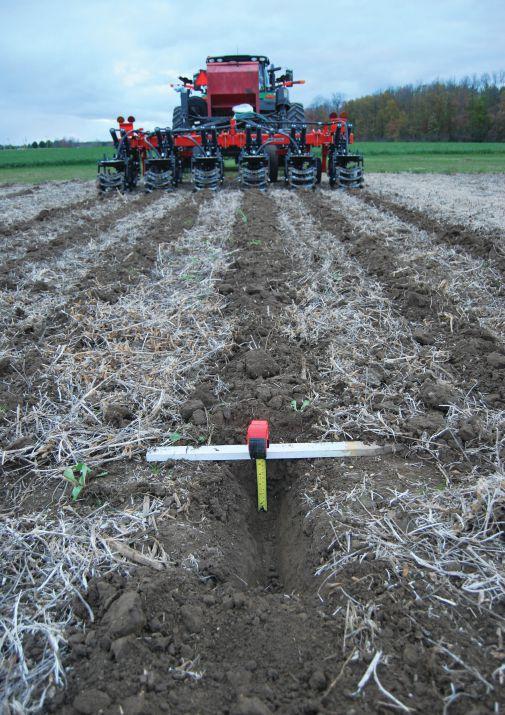
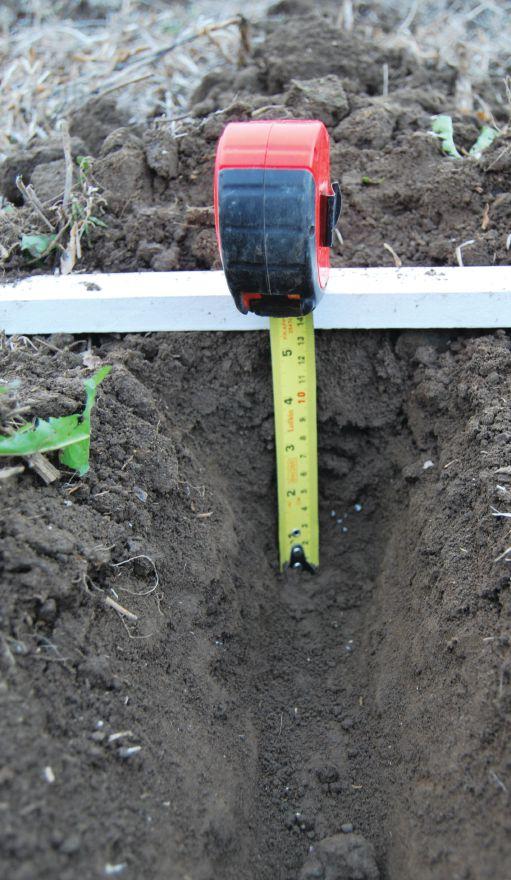
In these four treatments, Rosser is applying 60 pounds of phosphorus and 60 pounds of potassium per acre, which are the corn crop replacement levels for these two nutrients. The strip tiller applies the fertilizer in a band at a depth of 4 inches.
“Then, where I can fit it in, I am also looking at the yield response to planter-placed starter fertilizer in place of strip till-placed fertilizer,” Rosser says. For these starter treatments, the planter applies 60 pounds of phosphorus and 60 pounds of potassium per acre in a 2 x 2 band (2 inches over and 2 inches down from the seed) into strips that have no strip-till placed fertilizer.
These starter treatments are building on some earlier OMAFRA research. “My predecessor Greg Stewart did a fair amount of strip till fertility work. Some of the early strip tiller designs had shanktype fertilizer units where the fertilizer goes down the shank of the strip tiller. In his work, Greg showed that if the fertilizer is deep-placed to the bottom of that shank [6 inches deep], it is good from a fertility perspective, but you may lose the starter fertilizer capability because the fertilizer may be too deep for the plants to access it early in the season when they really need it. Greg’s work showed there was a still need to apply starter fertilizer with the planter under that scenario, when soil test levels were low.”
Rosser’s project is using a strip tiller with a fertilizer delivery system that can be adjusted independent of the shank depth, which allows shallower fertilizer placement.
Rosser and his team are measuring corn yields from the different treatments, and they are capturing the surface runoff from the treatments to determine the phosphorus levels in the runoff.
“This fall we’ll get our first set of yield results. I won’t be making any big conclusions from one year’s results, but perhaps we’ll get an early indication if there is consistency across our trials,” he says.
He hopes the project will help answer questions from growers who are already strip tilling and from growers who are considering strip tillage but want to know more about fertilizer placement to get the most out of a strip till system.
Rosser says, “We’re optimistic on strip till; we like the benefits it offers. So our goal is to do what we can to help figure the system out and provide more information for growers to have more success.”
This is a Grain Farmers of Ontario-funded project with matching funds through the Canadian Agricultural Partnership, a federal-provincial-territorial initiative. The Agricultural Adaptation Council assists in the delivery of the Partnership in Ontario.
In the field trials, the strip tiller is applying the fertilizer at a depth of about four inches.
A RETURNING THREAT
Now is the time to sample for soybean cyst nematode populations.
by John Dietz
Post-harvest, for some, is an urgent and important time for determining soybean cyst nematode (SCN) populations.
Albert Tenuta, field crop pathologist with Ontario’s Ministry of Agriculture, Food and Rural Affairs (OMAFRA), doesn’t mince words on this subject. The situation in Ontario has seriously changed. Cautiously, he adds, there is also potentially great news on the horizon.
“It’s imperative that producers soil sample, find out if they have SCN, find out the population numbers, and start managing them,” Tenuta says. “The biggest new development is the SCN population increases on the 88788 source of resistance. That’s a big issue. In areas of the U.S. Midwest, 80 to 90 per cent of fields have nematode that are adapted to 88788, and they’re now the majority in many of those fields. As a result, growers there are seeing a lot more yield loss.”
Ontario scientists have recently learned that 30 to 40 per cent of fields already have a resistant nematode in the field population, but the numbers still are very low. The good news has two prongs. One, wise action now can help Ontario avoid the threat on the doorstep. We know more about the nematode today than 20 years ago, have new tools and an organized effort to confront it, head-on. Secondly, genetic science may help in the longer term. Soybean breeders have a replacement gene that can hold nematodes at bay, with one Ontario-developed line developed close to commercial release. And, gene editing, the newest tool in the box, may come to the aid of the industry.
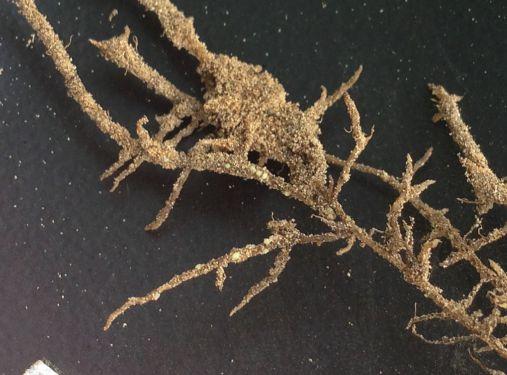
Canada’s first soybean cyst nematode was identified in Ontario in 1988. By that time, it probably had been present for 20 years or more, Tenuta says. “It does its business below ground and goes along undiagnosed until it’s very obvious due to above-ground symptoms. Then you have probably 25 per cent yield loss, or more,” he says.
It happened in the same area that was first hit in 1988 – from Guelph over to Windsor. Growers weren’t aware that SCN was even in some of those fields in 2019, until they called for advice and went out to look at the roots, Tenuta says.
Varieties with the ‘SCN-resistant’ label have been highly successful since the mid-1990s. “They’re proven successful, almost too successful. Now we’re starting to see some of that resistance breaking down,” he says. Ninety-five percent of genetic resistance to SCN attack comes from a wild soybean (Glycine soja) known as plant introduction (PI) 88788. “It is the cornerstone of nearly all SCN-resistant varieties, public or private, in North America,” Tenuta continues. About five per cent of commercial varieties use resistance from a second source (PI 548402), known as Peking. The problem, according to Tenuta, is that “there’s no such thing as a totally immune variety.” SCN enters the plant by attaching eggcarrying cysts to the fine root hairs of soybeans and some other species.
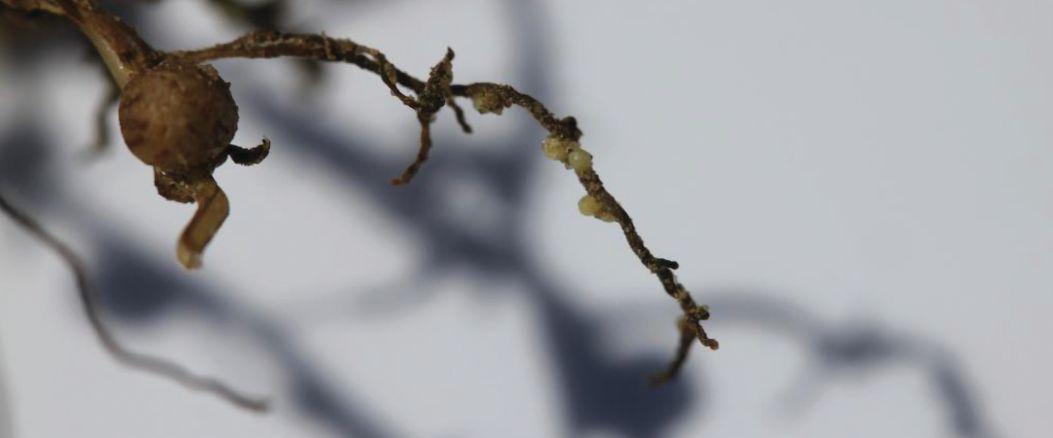
On resistant varieties, the nematode’s ability to reproduce is much lower, by a factor of 90 per cent or more. However, it doesn’t take many survivors to keep the nematode population at a low level and ready to increase. In the growing season, a new generation of nematodes can emerge once a month. The female cysts carry up to 250 eggs and can persist up to 12 years, waiting for vulnerable roots. Compared to susceptible soybeans, the roots of a 95 per cent resistant variety still can be invaded. Some SCN reproduction is happening on the PI 88788 and on the Peking-based varieties. That’s the problem; under selection pressure, the population is able to shift.
ABOVE: The female cysts carry up to 250 eggs and can persist up to 12 years, waiting for vulnerable roots.
Above 2,000 to 5,000 eggs, you start to see SCN symptoms, depending on the year and the growing conditions.
“Over time, the effectiveness of that source of resistance starts to decline. Then you see more visual symptoms and more yield loss,” Tenuta shares. “Plants are only a foot to 18 inches tall, they’re not filling the rows, and yields are down to 17 to 25 bushels. Yield losses are 50 per cent or greater. That’s because the SCN population in those fields has shifted.”
Management solutions
Today, soybean growers in Eastern Canada can assume they have some level of SCN in every field. To manage it, Tenuta explains, they need to measure the population at least every four to six years to know what it is and how it is changing. From that base, they can rotate soybean varieties and rotate crops to keep the SCN under control. Seed treatments are a third line of attack.
In a lab, eggs can be counted. Lab equipment is needed to detect the eggs, which are equivalent to the size of the period at the end of this sentence. If there are 1,000 to 2,000 eggs in a 100-gram soil sample, the population is starting to build. If the sample comes back negative, it doesn’t mean the field doesn’t have SCN – it just means the number is below the detection level.
“Numbers below 2,000 are easily manageable with the resistant varieties and crop rotation. A three- to four-crop rotation is better than a corn-soybean rotation. The more diversity, the better,” he says. Above 2,000 to 5,000 eggs, you start to see symptoms, depending on the year and growing conditions. The more stress, the more likely you are to see symptoms and yield loss.
Yield loss can be a symptom of an SCN problem, and it often is overlooked, Tenuta says. Long term soybean yield averages should be increasing because the genetics are getting better and the equipment for managing the crop is getting better. If you’re not seeing the average increase, or if you actually are seeing a decline in your averages, that needs to be addressed. Often, it’s a good sign of the SCN problem.
Most soil labs doing fertility work will do the SCN count, if you ask. Cost range is approximately $25 to $35 per sample. The service has been available for decades, but Tenuta says it is underutilized: “Every field in the province should be sampled for SCN.”
Peak population time is in the fall after harvest. It’s the best time to take a soil sample, allowing time to make plans and select a new resistant variety. If the soil sample analysis indicates you need to reduce the SCN population, think about taking more samples to determine the variability. You may be able to divide the field
into some SCN management zones with different varieties or other control strategies.
Rotation – keeping the nematode off balance – is the heart of a good management plan. Setting back the SCN population in a field is opposite to the classic management that compromised PI 88788 resistance in the first place. It is opposite to continuous cropping with one variety. Instead, it starves the nematode population by rotations.
Public and private breeders have made crosses, scrambled genetics, and then made selections leading to new varieties with improved characteristics including SCN resistance. Breeders know they may all get the same “SCN Resistant” label on the shelf, but each cross is slightly different in its resistance. Sharp management can use that difference – by selecting similar varieties from different crosses or breeding programs – to keep pressure on the entire nematode population without selecting favorites.
A diverse group of university researchers, extension specialists and ag companies in the U.S. and Canada now share their expertise in a coordinated way through thescncoalition.org. The site includes a list of labs, research summaries, tools, news, and answers to common questions.
Along with colleagues in the U.S., Tenuta is researching cover crops for managing SCN. “Roots of canola, brassica, green manures, ryegrass and oats can allow nematodes to break dormancy without allowing them to reproduce. That can lower the population. On the other hand, legume cover crops like clover or peas act as hosts for SCN. There are benefits from cover crops for soil tilth and soil health, but we have to be careful. Risks could be associated with cover crops, too, and in many cases, we need a lot more information,” he says.
New SCN resistance found
One exciting prospect is the possible introduction of Ontario’s first line of soybeans with a third form of SCN resistance. Food-grade soybean breeder and geneticist Milad Eskandari has been leading the traditional breeding program at the University of Guelph Ridgetown campus since 2013. He is the first public soybean breeder in Canada to use PI 437584 or Hartwig genetics, as well as Peking and PI 88788 sources.
Until now, Hartwig has been on the sidelines in breeding programs. The original Hartwig genetics has problems, especially in yield and bean size. Eskandari has patiently made the crosses, done the sorting, and now after five years, believes he has a cross with commercial potential for food-grade soybeans. “Hartwig is the most reliable and best source of SCN resistance at this time. It is resistant to almost all the known types of SCN,” Eskandari explains.
SeCan is the main sponsor and has put one Hartwig-based line into four official performance variety trials in Ontario. Yield results were expected to be ready in November for the sponsor. If a Hartwig-type variety is approved by SeCan, developing the seed supply for commercial grower seed would take at least two growing seasons. If neither is released, more are in the pipeline now that program is underway.
“Now that we’re started, every single year after 2020 we will be having new Hartwig cultivars,” Eskandari says. “I am excited. Our farmers are dealing with a problem that will stay with them. It takes time and it’s not easy to develop a source of resistance.”
For now, Tenuta suggests, do the soil samples as soon as possible and then check out what’s new on The SCN Coalition website and watch for new SCN-resistant varieties from Ontario breeders.
LOWER INPUTS, HIGHER RETURNS?
Assessing variable seeding rates for dry edible beans.
by Carolyn King
Could reducing the seeding rate in the most productive zones of a dry bean field result in better economic returns for this high-cost crop? A field-scale project is underway in Ontario to answer this question.
“Dry bean seed is expensive, so if we can reduce the seeding rate and not negatively impact yield or harvestability, then producers can make more money,” says Meghan Moran, the canola and edible bean specialist with the Ontario Ministry of Agriculture, Food and Rural Affairs (OMAFRA).
“And we are hoping there might be other benefits. We know a thicker crop stand increases the chances of white mould, so maybe a thinner stand in the most productive parts of a field, where we typically have high yields and lots of growth, would have reduced issues with white mould.”
So lower seeding rates in the high-yielding zones could potentially save money on seed costs and fungicide inputs while maintaining or improving dry bean yield and quality.
“Some dry bean growers, dealers and agronomists have stated that there could be better returns on investment for variable rate dry
beans compared to soybeans or corn, based on some initial results from fields where they were using variable seeding rates,” she notes.
“While dry bean seeding rates in general are fairly well established for Ontario, there is not a lot of data on how low you can go with the seeding rate and still be profitable. So we don’t have good information on what rates growers should be looking at for precision farming.”
The project’s field trials are taking place in three cranberry bean fields and three white bean fields each year for three years, starting in 2018. The trials are comparing different seeding rates in the different production zones of the fields, and evaluating the effects of the rates on crop yields, disease levels and economic returns.
“This is a farmer-led project,” says Moran. “A lot of the ideas came from the Ontario Bean Growers (OBG) Board. And of course the farmer co-operators are crucial. They are carrying out all the field operations using their own equipment, and they have parts of
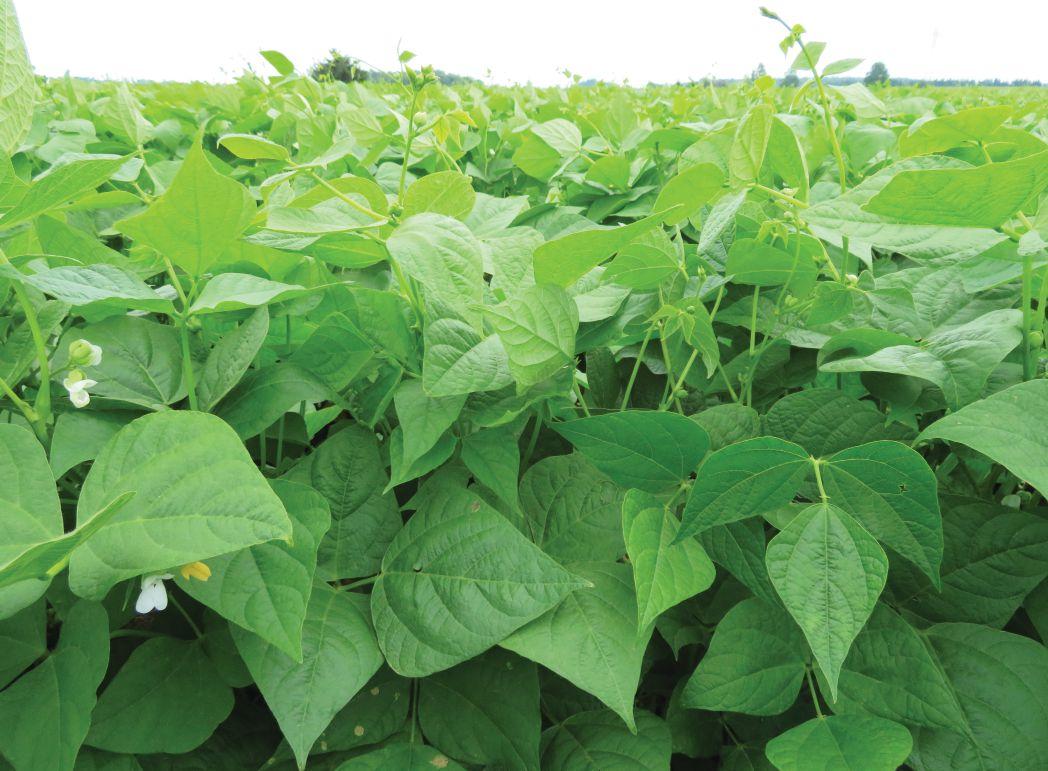
ABOVE: A field-scale project is looking at the effects of variable seeding rates on yields and economic returns for dry beans.
PHOTOS
their bean fields planted at very low rates. And I also have to thank Greg Kitching with Premier Equipment in Elmira, who is providing significant technical support.”
One of the project’s objectives is to develop yield response curves for the different zones of the fields. So the seeding rates range from very low to slightly higher than the standard rate.
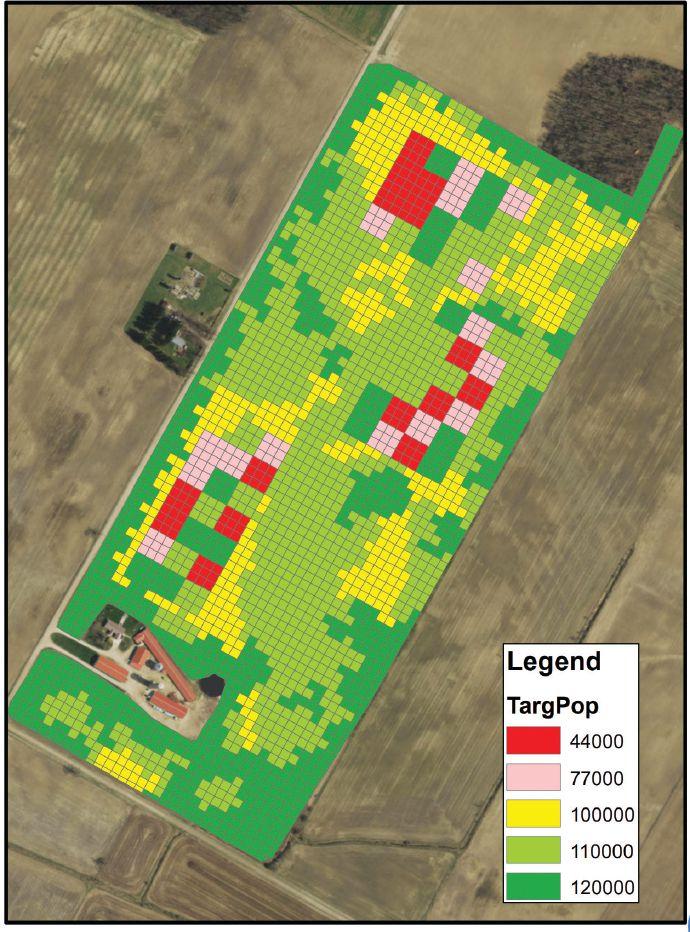
All the co-operators in the white bean trials use 30-inch row spacings, and the seeding rate treatments for their trials are: 44,000; 77,000; 110,000; and 120,000 seeds per acre.
For the cranberry bean trials, which are also on 30-inch rows, the seeding rates are: 30,000; 52,500; 68,000; and 82,500 seeds per acre.
The high-, medium- and low-yielding zones of the each field are determined based on the historical dry bean yield patterns in the field.
Premier Crop Systems, a precision agriculture company, creates the seeding rate prescriptions for the replicated plots in each field. Moran explains, “Our trials look like small-plot trials but on a larger scale. Each plot is about half an acre. Premier’s seeding rate prescription has five replications of each of our seeding rates in the high-yielding parts of the field, five reps in the average-yielding parts of the field, and five in the low-yielding parts. So each field has a total of 60 plots. The co-operators just plug the prescription into their planter, and the plots are seeded automatically.”
The co-operators apply all other crop inputs at a blanket rate; nothing else is applied at a variable rate.
Moran is collecting the data on crop growth and health. “For crop emergence, the planter data tells us how many seeds they put down, and then I do stand counts so I have the actual plant population. And from there I can determine the per cent emergence,” she says. “I also walk the fields to do ratings on white mould, although some fields didn’t have any white mould last year or this year, and I look at lodging.”
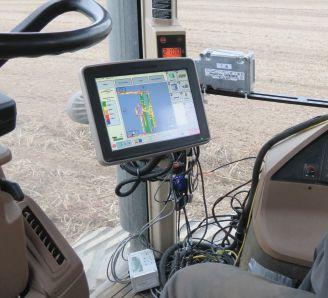
A SoilOptix sensor maps soil organic matter, pH, texture and many other soil parameters across each field.
The co-operators harvest the fields, and Moran gets the yield data for each plot from the yield monitors on the combines.
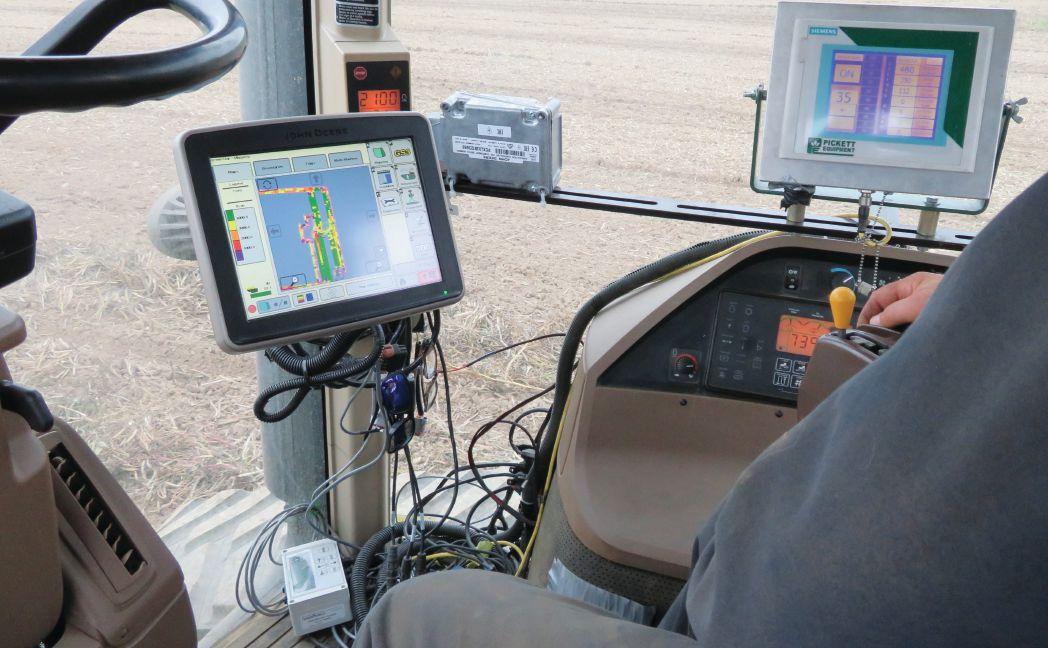
“The project’s other important objective is to demonstrate and validate the use of a yield monitor for large-seeded bean combines,” she explains. “Because the
large beans are delicate, they are harvested using specialized equipment. The growers in this project are using Pickett combines, which haven’t historically had yield monitors. So we are creating yield maps of largeseeded beans for the first time in Ontario.”
Greentronics, an Elmira, Ont.-based company, developed this yield monitor.
“Two of our co-operators have purchased these yield monitors. This is what is allowing us to do the project because they are now able to get the yields off those fieldscale trials.”
She adds, “Having a yield monitor is a significant advance. It helps producers to better understand what kind of yield variability they have across their fields, and it gives them an opportunity to confidently refine their best management practices.”
Preliminary
highlights from Year 1
Moran has conducted some analysis of the data collected in 2018, a year with challenges for the quality of dry beans, but strong yields.
“For the white bean trials, crop emergence was one of the more interesting things. Generally, we saw rates of emergence at 80 per cent and above in the best parts of the fields. But emergence rates were frequently below 80 per cent in the historically average- or low-yielding zones,” she notes.
“In the historically low-yielding zones, the soil is probably tougher. When we used a really low seeding rate in those zones, emergence dropped drastically, down to 60 per cent or less in some cases. Beans sort of push together to come out of the soil, so with fewer seeds it seems to be even
The yield data for each plot is obtained from the yield monitors on the co-operators’ combines.
“I ran some rough economics, using seed costs and bean prices, and I found that adding an extra 10,000 seeds per acre in the poorest parts of the field didn’t really pay.”
harder for them to get out of tough ground, which makes sense.”
The white bean trials include three different varieties, and these emergence results were true for all three.
“The white bean yields were most stable at the standard seeding rate, which for 30-inch white beans is 110,000 seeds per acre. If we went lower than that rate and sometimes if we went higher there was a lot more yield variability,” Moran says.
“So there is a good reason why 110,000 seeds is the standard, recommended rate. And it is possible that, after three years, we could conclude that there is less risk in using the standard blanket rate than using a variable rate. But we’ll have to wait and see.”
Increasing the white bean seeding rates above 110,000 seeds in the low-yielding zones of the field did not provide an economic benefit. “I ran some rough economics, using seed costs and bean prices, and I found that adding an extra 10,000 seeds
per acre in the poorest parts of the fields didn’t really pay.”
The rate of 77,000 seeds per acre was often sufficient in the high-yielding zones of the white bean fields. She notes, “That rate yielded similar to the standard rate in the best parts of the fields. From what I’ve heard, around 75,000 to 77,000 seeds is about the lowest rate used by growers who are already doing variable rate seeding.”
Moran points out the 2018 white bean results are a good reminder that a planter’s seeding rate will not necessarily match the actual plant population, and that decisions on variable seeding rates will need to consider the expected rate of emergence in the different parts of the field.
Interestingly, the cranberry bean trials in 2018 had good emergence across the fields, and the yields generally declined as the plant populations decreased.
“From my rough look at the economics, factoring in the seed costs and bean prices, it
seemed that the savings from the lower seeding rates were more valuable in cranberry beans than in white beans,” Moran says.
“Cranberry bean seed can be up to three times the cost of white bean seed. So I think the economic assessment will be particularly important with the cranberry bean data. Those seed cost savings with cranberry beans may be worth it, but we’ll have to retrain ourselves to focus on gross revenue rather than just straight yield.”
As Moran continues her analysis of the project’s data, she will also be looking at the effects of the different soil characteristics on emergence and yields in white beans and cranberry beans.
This project will provide much-needed information to help Ontario dry bean growers with seeding rate decisions in precision farming operations. Moran notes that the project’s findings could be useful in other ways too. “[For example,] in 2019, Ontario had tough spring weather so a lot of dry bean growers had poor emergence, down around 40,000 plants per acre, and they didn’t know whether to replant or not. I think the data from our trials will be helpful for those types of replant decisions.”
This research is funded by OBG with matching funds through the Canadian Agricultural Partnership, a federal-provincial-territorial initiative. The Agricultural Adaptation Council assists in the delivery of the Partnership in Ontario.
One of the seeding rate prescriptions for the project’s replicated field plots.