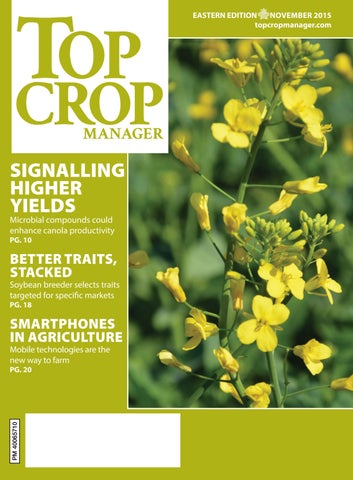
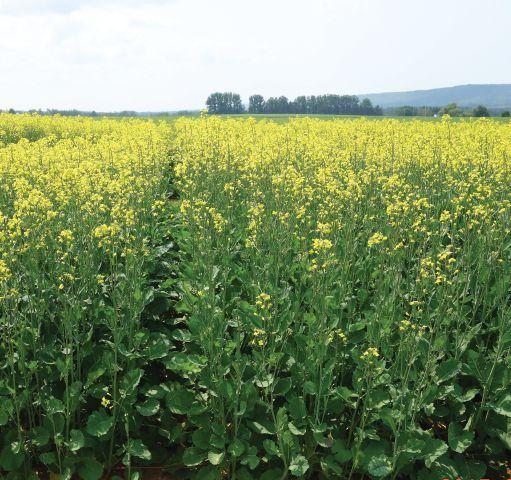
Microbial compounds could enhance canola productivity
PG. 10
Better trait S , Stacked
Soybean breeder selects traits targeted for specific markets
PG. 18
Smartphone S
in agriculture
Mobile technologies are the new way to farm
PG. 20
Dow Seeds brings you our best traits, genetics and seed performance. But it doesn’t end there. We’re committed to doing what’s right and treating you right. We’ve added more agronomists to the team and we’ll only recommend products that will perform for you, on your farm. It’s customers first, always.
I work for Dow AgroSciences. I am Dow Seeds.
TOP CROP
Carolyn King
John Dietz
Photo by Janet Kanters.
Photo by John Dietz.
LIANNE APPLEBY | ASSOCIATE EDITOR
STrong hAndS, ASTuTe mindS
Ayear ago, when I was asked to cover the Top Crop Manager east portfolio, my first editorial signed off by saying I looked forward to working for such innovative thinkers who I was told read the magazine. over the past 12 months, however, I really was privileged to meet researchers and producers alike who, quite frankly, are much more than just innovative. I met and spoke with people who are genuinely concerned with not only maintaining a viable business themselves, but with the future sustainability of their sector. I crossed paths with producers who make it a priority to engage in continual learning, and still others who adopt new technologies early on, in order to stay ahead of the curve. after many of my conversations, it wasn’t uncommon for me to walk away thinking, “there’s a forward-thinker” or “I’m going to hear that name a lot in the future.”
It’s fitting then, that as I sign off on my duties with Top Crop Manager, it coincides very well with the nomination deadline for the ontario agricultural Hall of Fame. The ontario agricultural Hall of Fame association (oaHFa) makes it their mission to acknowledge, record and preserve the contributions made by leaders to the growth and development of ontario’s agriculture and agri-food industry. although october 31 was the 2015 deadline, I challenge you to take the next year to consider someone you know who deserves a nomination for their lifetime efforts to grow and better the industry.
While the oaHFa tends to honour those who have made a long-term contribution to agriculture, at the other end of the spectrum, there is Canada’s outstanding Young Farmer (CoYF) award. The mission here is to discover, celebrate and recognize progress and excellence in Canadian agriculture. each year, CoYF recognizes young farmers who exemplify excellence in their profession, through progress made during their farming career; maximum utilization of soil, water and energy conservation practices; their crop and livestock production history; farm financial and management practices; and contributions to the well-being of the community, province and nation.
This year’s ontario regional winners were pork producers amy and Mike Cronin of Bluevale, ont., and they’ll be headed to the 2015 national recognition event later this month.
Both of these recognition programs are an excellent reminder of the leaders within our industry. The word “agriculture” typically conjures images of laborious work, but there is now much more to producing food than the act of undertaking chores and fieldwork. The physical aspect of farming is complemented more and more with innovative and entrepreneurial intellect, a desire to farm sustainably and a passion for bettering the industry.
That bodes well for a strong, vibrant agriculture industry in years to come.
Returning editor
Stefanie Croley has returned from maternity leave and will be returning as editor of Top Crop Manager (eastern edition) beginning with the December issue. Lianne appleby returns full-time to her role as digital editor of agannex for all of annex Business Media’s agricultural publications, as well as other cross-market projects.
Top Crop Manager West - 9 issues - February, March, Mid-March, April, June, September, October, November and December - 1 Year - $45.00 Cdn. plus tax
Top Crop Manager East - 7 issuesFebruary, March, April, September, October, November and December - 1 Year - $45.00 Cdn. plus tax
Potatoes in Canada - 2 issues - Spring and Summer 1 Year - $16.00 CDN plus tax
All of the above - $80.00 Cdn. plus tax
Occasionally, Top Crop Manager will mail information on behalf of industryrelated groups whose products and services we believe may be of interest to you. If you prefer not to receive this information, please contact our circulation department in any of the four ways listed above.
All advertising is subject to the publisher’s approval. Such approval does not imply any endorsement of the products or services advertised. Publisher reserves the right to refuse advertising that does not meet the standards of the publication. topcropmanager.com
n ew help from A nC ien T gr A in S
Testing microbial inoculants and sprays for control of Fusarium in corn and wheat.
by Carolyn King
Researchers at the University of guelph are tapping into some ancient grains to see if their endophytes – microbes that live inside plants without causing disease – can help our modern crops. Manish raizada and his lab have already found several endophytes that can control the fungal pathogen Fusarium graminearum in laboratory and greenhouse trials. now they are testing these endophytes in field trials as a step toward possibly developing commercial biocontrol products.
raizada is an associate professor in the university’s department of plant agriculture, and his research group has been studying endophytes since about 2007. They are adding to the growing body of endophyte research going on around the world, which is finding certain endophytes are able to promote plant growth by performing such functions as controlling plant pathogens, producing plant hormones and making nutrients available to the plant.
Two of raizada’s phD students have built a large collection of
endophytes as a foundation for the lab’s further research, including the current anti-Fusarium endophyte work. To isolate endophytes from a plant, researchers sterilize the surface of the seeds, roots or shoots, and then culture the microbes from within the samples. The two students sampled mainly grain species and lines that have had to fight off pathogens without help from commercial fungicides.
“a former phD student in my lab, David Johnston-Monje, isolated endophytes from 14 genotypes of corn from Central america, Mexico, Canada and the U.S. Those genotypes included three groups of corn: wild relatives of corn; Mexican landraces [traditional varieties] and a Canadian First nations landrace from Quebec; and modern inbreds and hybrids,” raizada explains. “The wild species obviously don’t grow with the use of fungicides, and
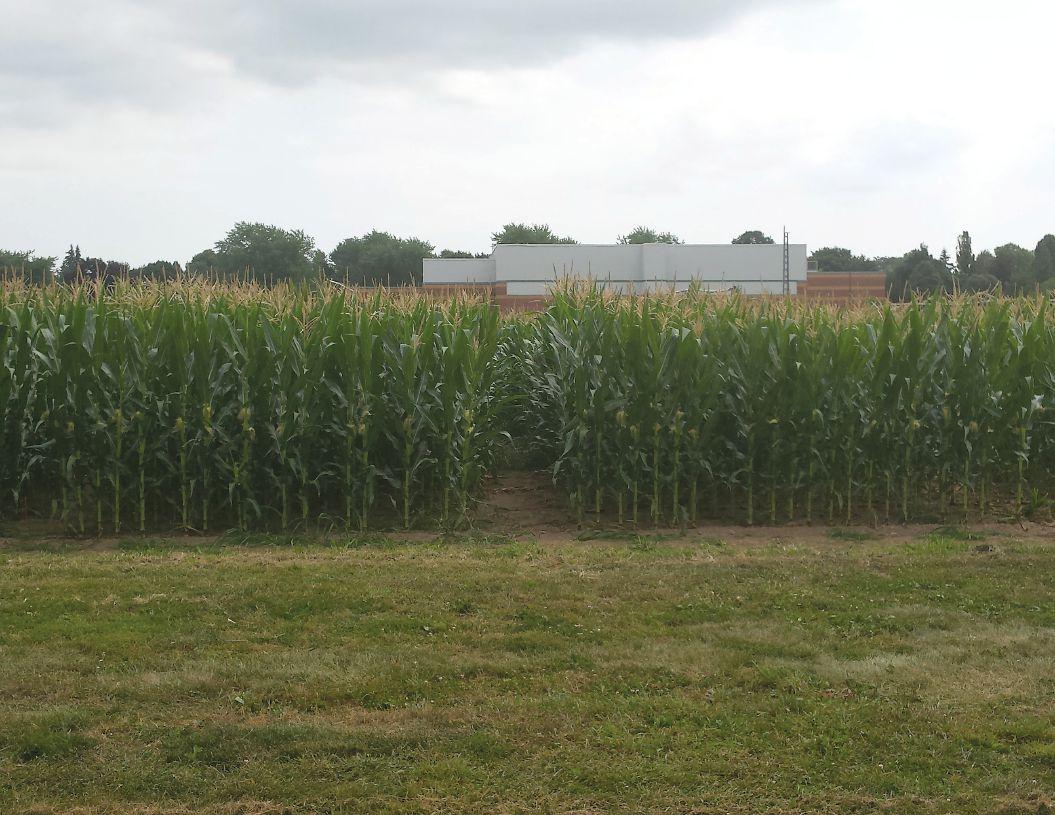
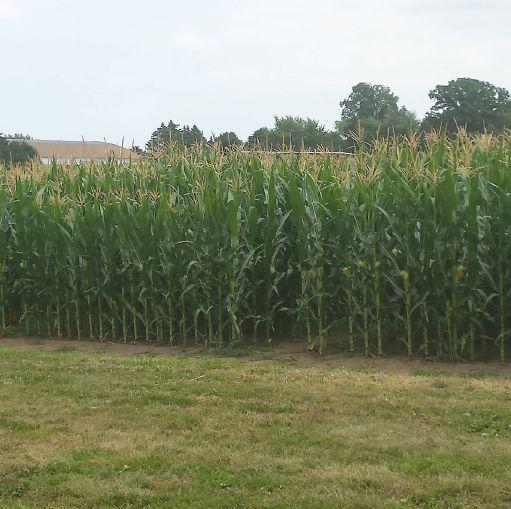
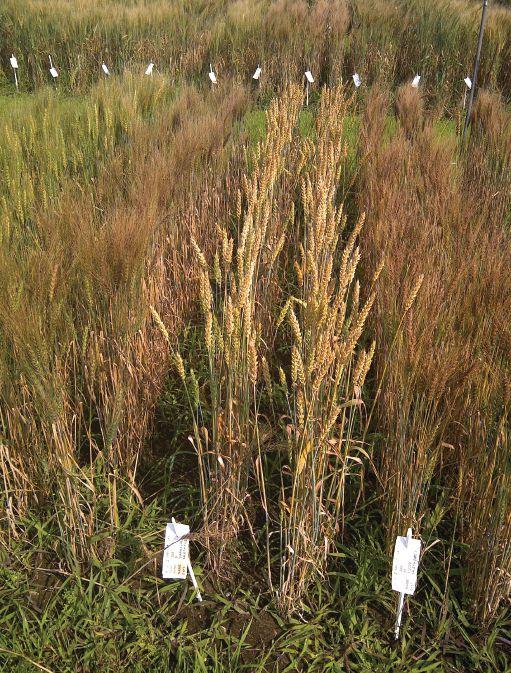
aBOVE: Field trials are underway at the University of guelph to assess the effects of the five microbes for controlling Fusarium in corn hybrids and wheat varieties.
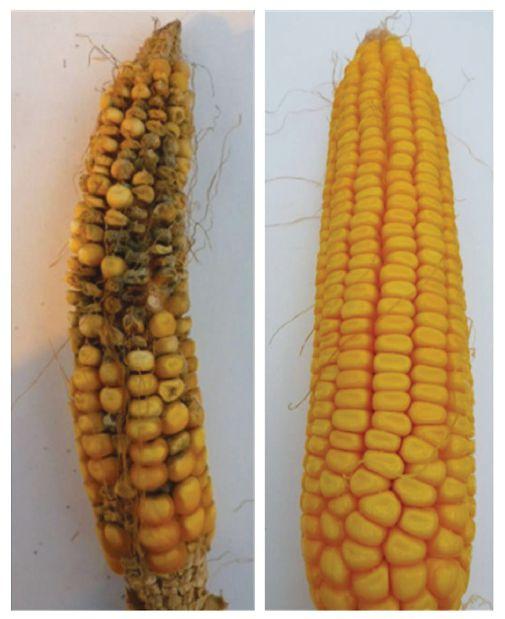
in greenhouse trials, the researchers found treatments with certain plant bacteria were very effective in controlling Fusarium infection. Cob on right is Fusarium only while the cob on the left is Fusarium plus an endophyte.
farmers who are growing the traditional varieties are not usually using pesticides and fungicides. So we thought we might be able to capture endophytes that help combat fungal pathogens from those lines.”
phD student Walaa Mousa isolated endophytes from finger millet. “Finger millet is an ancient ethiopian crop. It is widely grown in africa and South asia. It is really valued by subsistence farmers because it is reported to be very resistant to a lot of pathogens,” raizada says.
in these replicated greenhouse trials, each of the five endophytes was able to control the pathogen.
as a result of the work by Johnston-Monje and Mousa, raizada’s lab now has a collection of over 250 cereal endophytes. Most are bacteria and a few are fungi.
raizada and Mousa suspected finger millet might have antiFusarium endophytes. “Unlike a lot of cereal crops, finger millet is not susceptible to Fusarium graminearum. That is surprising given there is some evidence that Fusarium pathogens evolved in africa,” raizada notes. “So we hypothesized: what if finger millet and its endophytes co-evolved with Fusarium, so there was a three-way co-evolution, and finger millet selected for endophytes that could combat Fusarium?”
Fusarium graminearum and its sexual stage, Gibberella zeae, cause tough-to-control diseases in many cereals, including
Fusarium head blight in wheat and Gibberella ear rot in corn. These costly diseases reduce grain yield, grade and quality, and can produce mycotoxins, such as deoxynivalenol (Don), that limit the grain’s end-use.
Mousa tested all the endophytes in the lab’s collection by putting each one in a petri dish with Fusarium graminearum . She found a handful of endophytes that could suppress the pathogen; some were from corn and some from finger millet, and most were bacteria.
Then she and Charles Shearer, who is now a Master’s student in raizada’s lab, conducted greenhouse trials with five of the endophytes that controlled the pathogen in the lab. They applied the endophytes to wheat and corn as a seed coating or as a spray. The spray was applied on the corn silks at silking time and on the wheat heads at heading time. They used an ontario corn hybrid and an ontario wheat variety that are moderately susceptible to Fusarium graminearum after the endophytes were applied, the plants were exposed to the pathogen.
In these replicated greenhouse trials, each of the five endophytes was able to control the pathogen, and one of the endophytes worked so well the treated plants didn’t show any symptoms at all of a Fusarium graminearum infection.
For raizada, the most exciting results from the greenhouse trials were the endophytes’ remarkable effectiveness in reducing Don levels, which were analyzed by Victor Limay-rios, a research associate at the university’s ridgetown Campus. “at harvest, for whatever reason, all the samples had low Don levels, even the ones that hadn’t been treated with endophytes. Then Walaa stored the seeds for 14 months at room temperature; under those conditions, Fusarium is still active,” raizada explains. “When Victor tested those stored seeds, he found that the Don mycotoxin levels were extremely high in the corn and wheat samples that had been exposed to Fusarium, but not treated with the endophytes. In contrast, the seeds that had been exposed to Fusarium and treated with the endophytes had very low Don levels, well below
Photo courtesy of r aiza D a Laboratory.
Photo courtesy of
as a result of the work by Johnston-Monje and Mousa, Raizada’s lab now has a collection of more than 250 cereal endophytes. Most are bacteria and a few are fungi.
the acceptable level of Don mycotoxins, which is about 1 to 3 ppm, depending on which regulations and which conditions are involved.”
In corn, all five endophytes reduced the amount of Don to well below 0.1 ppm. In wheat, two of the endophytes reduced the Don levels to below 0.1 ppm; the other three significantly decreased Don levels but not to such a low level.
Field trials underway
In June 2015, raizada’s lab received approval from the Canadian government to do field trials with the five endophytes. Shearer is heading up these two-year trials, which are taking place at the ridgetown Campus. He is collaborating with Limay-rios and art Schaafsma, a professor at ridgetown who is a leading expert in Fusarium
In a field setting, endophyte applications face a couple of key challenges. one is that they may be outcompeted by microbes in the environment, so they might not even be able to colonize the plant. The other issue is how varying weather conditions might affect the endophytes.
The field trials are comparing the five endophytes in seed treatments and in-crop sprays on corn and wheat. although a seed treatment would likely be the easiest for growers, raizada thinks it might not be the most effective option because the endophytes might be outcompeted by soil microbes. However, the researchers are trying various ways to try to get around that problem.
Shearer is comparing different timings for the spray applications: at the same time as another product, like nitrogen fertilizer, is applied; or at the time of silking or heading. In addition, he’s testing the endophytes individually and as a cocktail of all the endophytes together.
The trials are comparing moderately susceptible and very susceptible cultivars of corn and wheat. The researchers will be assessing Fusarium graminearum symptoms on the ears and heads and measuring Don levels in the seeds. They will also be sampling different tissues from the treated plants to determine which tissues in the plant are being colonized by the endophytes. and they’ll be watching to see if perhaps the endophytes have other growth-promoting effects on the plants, such as controlling other pathogens or enhancing root growth.
In 2016, the researchers will complete the field trials and analyze the results.
down the road
once they’ve analyzed the field trial data, the researchers will decide on their next steps. For instance, they might investigate whether the endophytes work well in combination with a fungicide. “of course, we’re hoping an endophyte alone will work really well, but let’s say that either a fungicide alone or an endophyte alone does not provide effective control of the pathogen. Maybe the two together might,” raizada says.
If one or more of the endophytes seem to have commercial potential for controlling Fusarium graminearum, then raizada’s lab will collaborate with a company, and that company will undertake the necessary tests regarding human and ecosystem safety and so on, to develop commercial biocontrol products.
Looking at the bigger picture, raizada sees exciting times ahead for endophytes in agriculture. according to raizada, when his lab first started working on endophytes, agricultural input companies were showing only moderate interest in such research. But since
then, companies like Monsanto and Syngenta have been investing more and more into microbial products like biocontrol products and biofertilizers. “The large seed companies are now looking at endophytes and other microbes as a new frontier. Within a few years, I think growers will increasingly see microbe-based products coated onto their seeds or available as sprays.”
He adds, “Where I see the best opportunity is with microbes that have multiple functions. perhaps a microbe that has anti-Fusarium activity is also able to combat other pathogens and also has some other activity. For example, we are intensively studying microbes that can stimulate root growth when the soil is waterlogged in the spring. If the soil is waterlogged in the spring, the roots don’t grow, and then if you have a hot period, the plants don’t do well because they never developed a good root system.”
Multi-functional endophytes are a key research area for raizada’s lab. The researchers have screened the endophytes in their collection for several functions such as phosphorus solubilization and root growth stimulation, in addition to Fusarium control, and they’ve already found some with multiple functions.
raizada is also looking forward to many interesting discoveries about the intriguing world of endophytes. For example, his lab has studied in great detail the relationship between a fungal endophyte species and yew trees, and has developed a step-by-step picture of how this endophyte helps the tree fight pathogens. “When a tree branches, it creates cracks, and yew trees hyperbranch; they are always branching and always creating bark cracks. This endophyte swarms to the crack, that wound site, and then it releases a fungicide in fatty bodies. So it’s no different than if you have a cut and you apply a Band-aid with antibiotics in it. The fatty barrier is similar to a plastic Band-aid barrier, and it’s laced with a fungicide. It is amazing.”
He adds, “I think every endophyte has a fascinating story. and any individual plant has hundreds of species of endophytes. So I think there will be many years ahead of interesting discoveries to be made and some really fascinating biotech applications.”
Photo
graduate student Charles shearer is comparing seed treatments and in-crop sprays of the five microbes.
hA rne SSing benefiC iA l S oil fungi
Mycorrhiza
fungi have many benefits including improved soil structure, better water holding capacity and erosion resistance.
by Helen Lammers-Helps
Three decades ago researchers at the University of guelph established the importance of mycorrhiza fungi in the soil for nutrient uptake. Today researchers continue to fine-tune this research to help farmers further exploit the benefits of these beneficial fungi.
While there are important implications for nutrient uptake, the benefits don’t stop there. These plant-fungi associations can also help combat the adverse effects of drought, nutrient deficiency, disease and climate change.
it’s best for farmers to promote growth of mycorrhiza through management practices.
In the 1980s Murray Miller and his team at the University of guelph wanted to understand how no-till corn got access to phosphorus in no-till systems. “They put together a picture that in the absence of tillage, arbuscular mycorrhiza fungi remain intact over winter and the new crop obtains phosphorus through the pre-existing network of fungal hyphae,” explains Mike goss, professor emeritus with the University of guelph.
These arbuscular mycorrhizae fungi form mutually beneficial associations with living plant roots. The mycorrhizae fungi have long, thread-like branches of cytoplasm called hyphae. one tip of the hyphae enters the plant root while the other explores the soil matrix, thereby substantially increasing the volume of soil accessible to the plant. The plant supplies sugars to the mycorrhizae and, in return, the mycorrhizae enhance the plant’s ability to take up important nutrients from the soil. The effect is significant, goss says.
goss’s research has focused on how to exploit the native soil mycorrhizae fungus for the benefit of agriculture. Working with soybeans, goss’s research showed that when soybean plants were colonized with both mycorrhizae and rhizobia, the nodules on the soybean plant roots were bigger and the soybean plants were able to fix more nitrogen. His research showed the effect was greatest when the soil wasn’t disturbed. The presence of the existing fungal mycelium in the undisturbed soil resulted in earlier colonization, he says.
goss says it is believed that a diverse mycorrhiza fungi community, made up of many different fungal species, will be more resilient to changes in environmental conditions such as drought or disease pressure. The mycorrhiza fungi have many benefits on soil health including improved soil structure, water holding capacity and resistance to erosion.
Most recently, g oss has been comparing mycorrhizae populations and diversity in wheat under no-till and conventional tillage in portugal. Following harvest, soil samples were taken randomly from wheat fields, one of which had undergone conventional tillage and one of which had not been tilled for the past nine years. after isolating the D na from these samples, a computer software program identified all the different mycorrhiza fungi species found in each field. Then g oss and his team created a family tree, which showed how the fungi were related to each other.
The study showed that the diversity of mycorrhizal fungi communities was greater in the no-till field compared to the conventionally tilled field. Tillage makes the formation of mycorrhizas dependent on spores present in the soil rather than on the extraradical mycelium of pre-existing mycorrhiza.
There are three ways that mycorrhizal fungus colonization occurs: through spores, extra-radical hyphae and hyphae from colonized root fragments. runner hyphae from a well-developed extraradical mycelium are quicker to initiate colonization in a new host than the others, goss explains. In his research, the pre-existing extra-radicle mycelia were more effective in supporting shoot growth in wheat.
at present, it’s not practical to inoculate fields with beneficial mycorrhizae, so it’s best for farmers to promote growth of mycorrhiza through management practices. The mycorrhiza diversity can be affected by several factors including tillage, soil nutrient levels, crop rotation, cover crops, weed populations, and the presence of bacteria or other fungi.
It is clear that tillage disrupts the extra-radicle mycelium of the fungi so less tillage is better, goss says, adding it is not yet known how much tillage would be tolerable without causing negative consequences. “Zone tillage, or tillage that just scratches the soil surface would probably be okay, but further research is needed.”
goss’s preliminary work shows that intact extra-radicle mycelium in undisturbed soil gives more effective protection from soilborne diseases.
Crop selection will also impact the growth of mycorrhiza. In g oss’s research, when wheat followed a crop that doesn’t form associations with mycorrhiza fungi, the wheat crop grew poorly compared to wheat that followed a crop that had been colonized by the extra-radical mycelium. g oss’s research also showed differences in the diversity of mycorrhiza colonization with different cover crops. “Certain cropping sequences will be more beneficial so farmers should try to select crops carefully,” g oss says.
SignA lling higher yield S
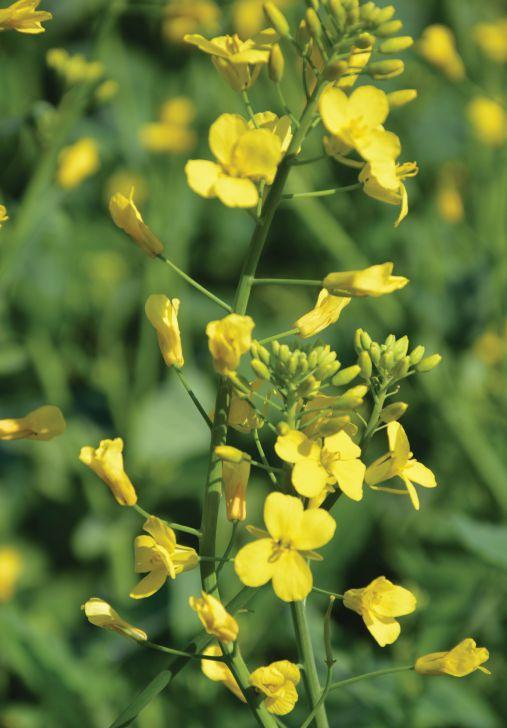
Microbial compounds could enhance canola productivity.
by Carolyn King
Could compounds produced by root bacteria offer a practical, low-cost way to boost canola yields when the crop faces environmental stress? a five-year project at Mcgill University is working on the answer to that question.
over the past few decades, research has brought about a revolution in our understanding of the importance of the relationships between plants and microbes. It turns out plants have evolved close and complex relationships with the community of microbes that live in and around them.
“When plants are growing in a field, they are never without microbes. So you really need to consider the plant and its associated microbes,” explains Donald Smith, a professor in Mcgill’s plant science department who is leading the project. “a plant growing in a field isn’t really an individual; it is a community.”
It also turns out a plant’s microbial community is pretty important to whether the plant is healthy or unhealthy. Some of the microbial species in these plant-microbe communities have evolved to work with certain plant species, so both the plant and the microbe benefit. These beneficial microbes can promote plant growth in various ways such as making nutrients available to the plant, producing plant hormones, suppressing plant pathogens, and improving the plant’s ability to withstand stresses like drought and cold.
another research advance in recent years has been the discovery by Smith and other scientists that a plant and its microbes communicate with each other by releasing biochemical, “signal compounds.” Smith outlines a classic example of the use of such signal compounds – when a legume species communicates with its associated species of nitrogen-fixing rhizobia bacteria. “The legume plant produces a set of compounds that the bacteria recognize, and in response, the bacteria produce a set of compounds that the plant recognizes. These compounds trigger changes in each other’s gene expression patterns and those kinds of things.” Those changes in the plant and the bacteria initiate the symbiotic, mutuallybeneficial nitrogen-fixation process.
Smith’s current project with canola grew out of his extensive research on signal compounds. He says, “I started out working on the legume-rhizobia interaction, and we were eventually able to show that the signals the bacteria produce back to the legumes do act as a signal and allow the symbiosis to go ahead. But we also discovered quite accidentally that the signals also have a way of promoting plant growth, particularly when some stress is present. When we realized that, we tested the compounds on many other types of plants, and found they work on a lot of other plants, not just on legumes.”
The signal compounds released by rhizobia bacteria are called lipo-chitooligosaccharides, or LCos. The researchers in Smith’s
lab have done quite a bit of work with an LCo from radyrhizobium japonicum, a rhizobia bacterium associated with soybeans. They have patented this compound for its growth stimulation activity, and it has been commercialized for various crops.
Smith’s research team has also been investigating whether other types of plant-associated bacteria produce signal compounds that promote plant growth. They discovered one such compound in a strain of the bacterium Bacillus thuringiensis. They have named the compound thuricin 17 and have patented it. It is now being licensed for commercial use.
“Bacillus strains are very common on plant roots; if you isolate bacteria from plant roots, you almost always get acillus types,” Smith explains. “Whether they all produce thuricin 17 is a good question. I suspect not, but some of them may produce it or other
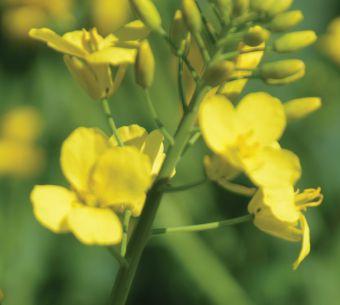
Researchers at Mcgill University are testing two growthpromoting microbial compounds to see if they consistently improve canola yields.
Photo by Janet Kanters.
compounds that cause these kinds of growth-promoting effects.”
although the two signal compounds have been widely tested on many crops and in many areas, very little testing had been done with canola until Smith started this research. He led an initial two-year project (from april 2011 to March 2013) to explore the potential of these two compounds for promoting growth in canola and found some promising results. His current project builds on that initial work, with further experiments to look for the most effective ways to use the compounds in canola production.
Smith points out canola is somewhat unusual in terms of its symbiotic microbial relationships. “Canola has its own set of bacteria that are associated with the roots, but it doesn’t have the two classically studied plant-microbe associations – the legumerhizobia relationship and the relationships that most plants have with mycorrhizal fungi [which help plants capture nutrients from the soil]. So this research project could give us a new, direct way to manage aspects of plant-microbe interactions with canola.”
His current project, now in its third year, involves controlled environment studies and field trials at Mcgill’s agronomy research Centre near Montreal, and it includes several components.
one component is determining how applications of the two compounds influence canola growth under various stress conditions. “From our previous research, we know the effects of these compounds are much larger when there is stress. generally plants growing in a field are at least somewhat stressed. For instance, if the growing temperature is perfect during the day, then it is probably going to be too cold at night,” Smith says. another component is comparing the effects of the compounds applied as seed treatments or as one or more foliar spray applications. The researchers are assessing which options produce the best canola performance and looking into related questions like whether it would make sense to apply the compounds as a tank mix with another product, such as an herbicide.
Smith suspects a seed treatment would help a canola crop get off to a good start in the spring. “We’ve done some work with seed germination at low temperatures because when you plant a crop in the spring, especially on the Canadian prairies, there is always the risk of cool temperatures. The seed treatment could help quite a lot in that situation.”
Similarly, a foliar application might help the crop deal with weather stress a little later in the growing season. He says, “For instance, canola doesn’t like hot weather; if the temperature rises up into the high 20s when canola is flowering, that can lead to abortion or sterility. If spraying the compound would help the plant deal with heat stress, then it could improve yields.”
The results so far indicate that applying either of these signal compounds tends to improve canola’s germination, growth and yield potential under some conditions. as has been found with other crop types, the compounds’ level of effectiveness on canola varies with the weather conditions. Smith says, “These compounds interact with the weather, so the exact effect in any given year is hard to predict. It depends on if there’s weather stress and when it comes during crop development – that can have a huge impact on how large the effect of these compounds is.”
another aspect of the project involves testing the two compounds on different canola genotypes. “For example, it might work well on certain genotypes and not very well on others, or perhaps it works reasonably well on all of them but with some minor variability,” he notes.
The project also includes an investigation of the mechanisms underlying canola’s responses to the two compounds. Smith says, “That is a big question. We’ve done some work on that in Arabidopsis, which is a plant in the mustard family and reasonably closely related to canola. What we see with Arabidopsis is a lot of responses related to energy metabolism that is up-regulated when the plants are treated with these signals.”
So far, their research suggests that, as in Arabidopsis, the signal compounds are likely promoting growth in canola by stimulating some pathways related to energy metabolism.
This possible effect on energy metabolism makes sense given that compounds have their greatest effects when a plant is under stress. That’s because stress usually disrupts a plant’s energy pathways. So the compounds could be helping the plant to keep its energy pathways running at a good level when the plant is coping with stress.
Smith’s lab is currently digging deeper to understand the exact biochemical mechanisms occurring in the canola plant as it responds to the thuricin 17 and LCo treatments.
Smith thinks the two signal compounds have potential to be practical options for canola growers. “These compounds are applied at really low concentrations, so they would be inexpensive inputs, perhaps a few dollars per hectare. generally with canola, getting it established and getting a nice, even crop stand up to about the three-leaf stage is key. If the compounds really help with that consistently, then this could potentially set canola growers up for increased returns over time.”
Trait Stewardship Responsibilities Notice to Farmers
Monsanto Company is a member of Excellence Through Stewardship® (ETS). Monsanto products are commercialized in accordance with ETS Product Launch Stewardship Guidance, and in compliance with Monsanto’s Policy for Commercialization of Biotechnology-Derived Plant Products in Commodity Crops. Commercialized products have been approved for import into key export markets with functioning regulatory systems. Any crop or material produced from this product can only be exported to, or used, processed or sold in countries where all necessary regulatory approvals have been granted. It is a violation of national and international law to move material containing biotech traits across boundaries into nations where import is not permitted. Growers should talk to their grain handler or product purchaser to confirm their buying position for this product. Excellence Through Stewardship® is a registered trademark of Excellence Through Stewardship.
ALWAYS READ AND FOLLOW PESTICIDE LABEL DIRECTIONS. Roundup Ready® crops contain genes that confer tolerance to glyphosate, the active ingredient in Roundup® brand agricultural herbicides. Roundup® brand agricultural herbicides will kill crops that are not tolerant to glyphosate. Acceleron® seed treatment technology for canola contains the active ingredients difenoconazole, metalaxyl (M and S isomers), fludioxonil and thiamethoxam. Acceleron® seed treatment technology for canola plus Vibrance® is a combination of two separate individually-registered products, which together contain the active ingredients difenoconazole, metalaxyl (M and S isomers), fludioxonil, thiamethoxam, and sedaxane. Acceleron® seed treatment technology for corn (fungicides and insecticide) is a combination of four separate individually-registered products, which together contain the active ingredients metalaxyl, trifloxystrobin, ipconazole, and clothianidin. Acceleron® seed treatment technology for corn (fungicides only) is a combination of three separate individually-registered products, which together contain the active ingredients metalaxyl, trifloxystrobin and ipconazole. Acceleron® seed treatment technology for corn with Poncho®/VoTivo™ (fungicides, insecticide and nematicide) is a combination of five separate individually-registered products, which together contain the active ingredients metalaxyl, trifloxystrobin, ipconazole, clothianidin and Bacillus firmus strain I-1582. Acceleron® seed treatment technology for soybeans (fungicides and insecticide) is a combination of four separate individually registered products, which together contain the active ingredients fluxapyroxad, pyraclostrobin, metalaxyl and imidacloprid. Acceleron® seed treatment technology for soybeans (fungicides only) is a combination of three separate individually registered products, which together contain the active ingredients fluxapyroxad, pyraclostrobin and metalaxyl. Acceleron and Design®, Acceleron®, DEKALB and Design®, DEKALB®, Genuity and Design®, Genuity®, JumpStart®, RIB Complete and Design®, RIB Complete® Roundup Ready 2 Technology and Design®, Roundup Ready 2 Yield®, Roundup Ready®, Roundup Transorb®, Roundup WeatherMAX®, Roundup®, SmartStax and Design®, SmartStax®, Transorb®, VT Double PRO®, and VT Triple PRO® are registered trademarks of Monsanto Technology LLC, Used under license. Vibrance® and Fortenza® are registered trademarks of a Syngenta group company. LibertyLink® and the Water Droplet Design are trademarks of Bayer. Used under license. Herculex® is a registered trademark of Dow AgroSciences LLC. Used under license. Poncho® and Votivo™ are trademarks of Bayer. Used under license. All other trademarks are the property of their respective owners.
C A nol A m A king ST ride S in eAST ern C A nA dA
Plenty of research studies will likely lead to more acreage being grown in future.
by Treena Hein
Canola is a booming crop in Canada. Canola oil is the second most widely used oil (behind soybean oil) in north america’s food industry, and for good reason: it offers healthy omega-6 and omega-3 fatty acids, a high smoke point and neutral flavour. and for the past two decades, highly stable high-oleic canola oil has offered additional benefits – an even higher smoke point, as well as better stability for longer-term use in deep fryers.
Dow agroscience and Cargill are both now developing higholeic canola oil that’s lower in saturated fat. The saturated fat content of this canola oil is presently between seven and eight per cent, but new varieties will possess around four per cent. In addition, these two firms, along with nuseed, are also each developing canola varieties with oil that will contain much higher amounts of omega-3 fatty acids, which play an important role in things like heart and brain health, child development and inflammation management. projections show global demand for
omega-3 oils will outstrip the production that can be sustainably supplied by wild fish, so an alternative land-based source of longchain omega-3 oil will be critical.
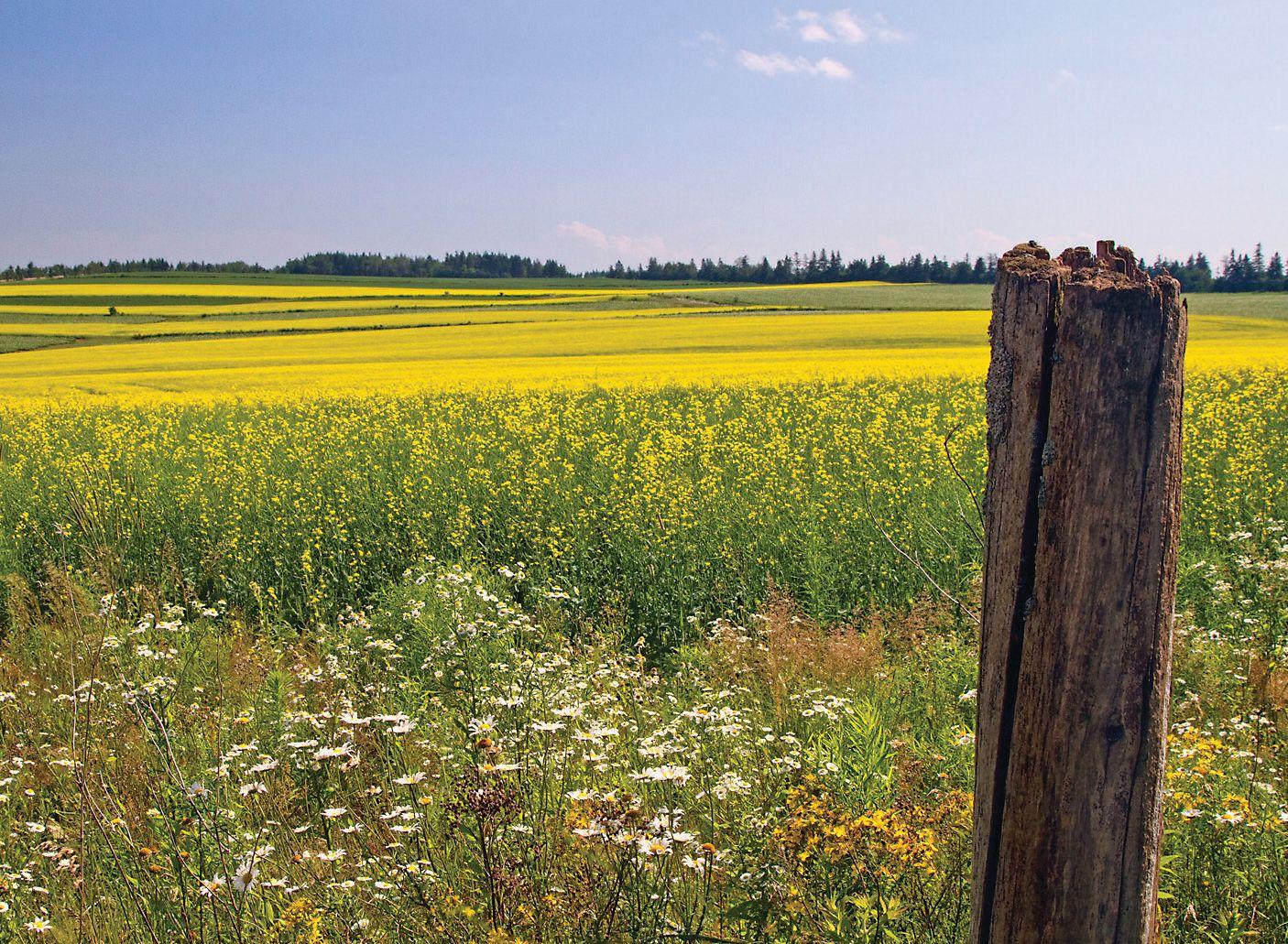
While acreage of canola is substantial in Canada’s prairie provinces and fairly steady in ontario, acreage of canola in the Maritimes has dropped in recent years. In 2013, there were 1,106 acres of canola grown in prince edward Island. This number has dropped to only 776 acres in 2014, with fewer than 700 acres estimated for 2015. However, Danny Doyle, a spokesperson for the prince edward Island Department of agriculture and Fisheries, says there is canola research planned. He notes farmers in that province would like to see non- gMo varieties with good clubroot resistance and yield potentials of one metric ton per acre.
TOP: While acreage of canola is substantial in Canada’s Prairie provinces and fairly steady in Ontario, acreage of canola in the Maritimes (PEi pictured) has dropped in recent years.
Photo
DALE KITCHENS HAS CALLUSES ON HIS HANDS AND DELO
While most people are sleeping, Dale is plowing in some of the harshest possible conditions known to farming. And he uses one brand for his engines, gears, transmission and joints: Delo® with ISOSYN® Technology. “Nothing is more brutal on equipment than West Texas sand and heat.” To learn more about how Delo protects equipment for your tough jobs, visit ChevronDelo.com
Delo user since 1978
Dale Kitchens from The Edge of Farming
new Brunswick’s canola acreage has also drastically dropped in recent years. In 2011, the province grew 10,000 acres of the crop; in 2012, that number dropped to 7,500, then to 6,000 in 2014, and in 2015, only 2,000 acres of canola were grown in new Brunswick. peter Scott, a crop specialist in the new Brunswick Department of agriculture, says acreage has shrunk because the forward contract price of canola has dropped off, and a fair amount of clubroot infection in 2014 caused farmers to pause. “It’s always a concern how canola fits a potato rotation,” he adds. “Some growers were producing hybrid canola seed from 2000 to 2005, but some saw potatoes following canola with reduced yields. The thinking is that nitrogen is being tied up to break down the canola residue, and this starves potatoes at a critical time.”
as for nova Scotia, commercial canola acreage is presently nothing, says Doug MacDonald, scientific officer for the Cereal and oilseed research group in the faculty of agriculture at Dalhousie University in Halifax. “There is only a very small acreage grown by a handful of people,” he notes, “which is crushed in their own small presses for sale at farmers markets or for their own biodiesel.”
However, a great deal of canola research is underway in nova Scotia. Scientists in the province have been conducting ontario spring canola variety tests since 2005 (winter canola tests were also done over several years but were discontinued due to limited interest). “The spring canola yields in our small plot tests have averaged approximately 2.7 tons per hectare over the past four seasons,” notes MacDonald. “Winter canola yields have been similar and occasionally better when winter survival is good, which varies greatly from year to year. Complete winterkill is common with the current genotypes available. There is also the concern, with spring or winter canola, of disease buildup – particularly sclerotinia, which can infect some crops used in rotation with canola such as soybeans and potatoes.”
There is also the concern, with spring or winter canola, of disease buildup –particularly sclerotinia.
There is also ongoing canola research headed by prince edward Island-based eastern Canadian oilseed Development alliance (eCoDa), a five-year, $6.7-million canola and soybean research project launched in 2013. It involves researchers in ontario, Quebec and the Maritimes and is funded through agriculture and agriFood Canada and industry partners. “one project involves winter canola variety evaluation, seeding dates and rates,” explains MacDonald. Jan Holmes, eCoDa project manager, says early results showed the varieties of winter canola in the trial had a difficult time surviving, but there may be other varieties that can survive the eastern Canadian winters, and more evaluation is occurring. a second eCoDa project is looking at canola nutrient management; particularly the response of various hybrids to nitrogen, nitrogen/sulphur and boron. MacDonald says the results will help scientists identify nutrient deficiency levels and develop improved guidelines for site-specific management. preliminary results show at as n rates were increased, early flowering, plant biomass, height and leaf area all increased as well. “For all site-years, branch and seed numbers also increased with increasing n, sometimes significantly,” says Holmes, “but sidedressed n did not affect yield. Soil sulphur availability and sulphur mineralization potential must be
considered for site-specific sulphur recommendations.”
The development of effective integrated pest management (IpM) practices for swede midge is also in the works. So far, results show that early and middle pesticide applications are more effective than later ones, but the effect of applications was variable. IpM strategies for the control of other insect pests of canola (flea beetle, pollen beetle and cabbage seedpod weevil) are also being created.
Yet another canola study is focusing on how such factors as crop rotation, nutrient management, planting date and plant density affect the incidence and severity of diseases like stem rot and blackleg. a different project involves determining the effect of fungicides, biological agents, marine bioproducts and combination treatments for the control of these diseases. Further experiments will show the effects of plant population on stress tolerance and seed quality of spring canola, and how canola can best be integrated in a potato cropping system.
“We’re also conducting field trials with best formulations of signal compounds,” Holmes explains, “and have found so far that signal compounds LCo and thuricin at extremely low concentrations slightly increased yield in winter canola. Full study results have the potential to lead to the development of new products, which, in turn, will lead to increased yields.”
even though it will take more time for the full results of these studies to become available, Holmes believes canola is already economically competitive with small-grain cereals. “It’s a high-value crop that can be useful in rotation with potatoes, corn and soybean,” she says. “Canola is a viable crop option for eastern Canadian growers, even Maritimes growers who must transport the seed to Quebec for crushing.”
Eastern Canada’s canola crops have declined in recent years, but several projects including nutrient management (shown here) to integrated pest management are underway across the region.
Photo
We used to call it HiStick Pro. Now we call it Nodulator Pro. (Soybean growers just call it great.)
Nodulator® PRO (formerly known as HiStick® PRO) with Integral® biofungicide is the only preinoculant system that’s Biostacked®. It has a more active strain of rhizobium, and thanks to the benefits of Integral, it delivers suppression of fusarium and rhizoctonia1. Nodulator PRO also offers a low application volume and a 60 day on-seed survival. It even helps deliver at the end of the season with up to 6% more yield2 than the competition. So why not “Biostack” the odds in your favour? Visit agsolutions.ca/nodulatorpro or contact AgSolutions® Customer Care at 1-877-371-BASF (2273) for more info. 1
b iologiCA l ACT ivi T y key
To S oil produ CT ivi T y
Mineral and trace element content in foods could be related to soil microbes.
by Helen Lammers-Helps
Australian soil ecologist, Christine Jones, has been recognized internationally for her work with farmers and ranchers implementing land management practices that enhance soil biological activity and productivity. In 2015, the International Year of Soils, Jones was on a world-wide speaking tour that included several stops in Canada and the U.S.
Jones says several comprehensive research studies have shown that today’s fruits, vegetables and meats are substantially lower in minerals and trace elements such as copper, calcium, iron, magnesium and potassium than they were 70 years ago. She asks: “How is it that we are using more and more high analysis fertilizer in conventional farming, but getting fewer and fewer nutrients in our food?”
This decline in nutrients is not seen in foods grown on biologically active soil, Jones says. Most “deficiencies” in plants are due to conditions not being conducive to nutrient uptake. “It is becoming increasingly recognized that the addition of inorganic elements to correct these so-called deficiencies is an inefficient practice,” she notes, adding that too much of the nitrogen fertilizer being applied is ending up in runoff water and causing poor water quality. “Sixty
to 90 per cent of nitrogen applied to the soil is wasted.”
Jones says we should be focusing on the biological cause of the dysfunction, which is usually microbial in nature. “nutrient deficiencies are usually due to the depletion or absence of important functional groups of soil microbes.”
The solution is to create soil conditions that promote the growth of a diverse and active microbial community. research has shown 85 to 90 per cent of nutrient acquisition by plants is aided by soil microbes, so agriculture’s success depends on “appropriate microbe management.” In simple terms, microbes need something to eat and somewhere to live, Jones explains. “Most microbes that are involved in nutrient acquisition are plant-dependent and rely on the carbon compounds exuded by the roots of actively growing green plants.”
aBOVE: attendees of a field day in Oyen, alta., learned of Christine Jones’s research during her Canadian tour. “The difference between monoculture and polyculture is impressive, to say the least,” Jones says.
Jones, a soil ecologist from australia, believes producers and researchers alike should be concerned with the biological cause of lower mineral and trace elements in fruits, vegetables and meats – which is usually microbial in nature.
according to Jones, 90 per cent of microbes found in soil are living in close proximity to plant roots. every plant exudes different carbon compounds that feed different types of microbes so it’s essential to have different types of plants growing for as much of the year as possible. “If there is only one type of crop, then you will only feed a portion of the soil community,” she notes.
Mycorrhizae, a type of fungi that live in association with plant roots, function as an extended root system for the plant, allowing the plant to access nutrients from a much larger volume of soil. Mycorrhizal fungi provide a major highway in terms of transporting carbon from plants to soil. These beneficial fungi form symbiotic relationships with 80 to 90 per cent of all land plants. The plants supply sugars produced during photosynthesis to the fungal partner and the fungi effectively increase the surface area of the plant’s roots.
Jones says the impact of the mycorrhizae is significant. The thread-like branches of one single mycorrhizal fungus can be as large as a football field. plant root exudates are composed of thousands of different kinds of chemicals, each plant producing a unique blend of sugars, enzymes, phenols, amino acids, auxins, gibberellins and other compounds. These vary over time and have differential effects on soil microbes and hence on plant nutrient uptake and soil structure.
researchers have seen that neighbouring plants, even different species, can be connected through a mutual fungal network, known as a common mycorrhizal network. There is increasing evidence that plants and soil microbes communicate with each other via these networks.
The key, Jones says, is to maximize photosynthesis. “everything that lives in the soil, the trillions of organisms, must ultimately get their energy from the sun. photosynthesis is the process whereby light energy is captured and transformed to biochemical energy by green plants. photosynthesis sustains most of the life on earth. We are all running on light energy.”
Indeed, photosynthesis is the base of the pyramid of life, Jones emphasizes. “green plants capture sunlight and carbon dioxide, making carbon compounds that build soil. Fertile topsoil is a product of photosynthesis and microbial resynthesis.”
The roots of growing plants provide the “conduit for carbon”
Research has shown 85 to 90 per cent of nutrient acquisition by plants is aided by soil microbes. For this reason, Jones says agriculture’s success depends on “appropriate microbe management.”
between atmosphere and soil. Multi-species cover crops and companion plants maximize the carbon flow, sustaining the microbes that mediate nutrient uptake and modify soil structure, Jones explains.
In addition to aiding nutrient acquisition, soil microbes have many other positive benefits for soil health. These include improved soil structure, improved water holding capacity and drought tolerance, and better resistance to erosion.
Life in the soil provides the glues that enable soil particles to stick together into pea-sized lumps called aggregates. The spaces between the aggregates allow soil moisture to infiltrate more easily and moisture absorbed into soil aggregates is protected from evaporation so that the soil remains moister for longer following rain or irrigation.
Unfortunately with modern farming practices, many of the microbes important for soil and plant function have gone missing, Jones says. However, there are several management practices that farmers can follow to enhance soil biological activity.
enhancing the diversity of plants grown will enhance the diversity of soil microbial communities, Jones says. She recommends farmers have an actively growing crop or ground cover for as much of the year as possible, grow multi-species cover crops and seed companion crops along with their main crops.
She also recommends avoiding aggressive tillage. repeated and/or aggressive tillage increases the susceptibility of the soil to erosion, depletes soil carbon and organic nitrogen, and is highly detrimental to beneficial soil microbes as well as invertebrates such as earthworms.
Jones advises farmers to avoid the overuse of chemical fertilizers and pesticides. For example, 80 per cent of phosphorus fertilizer becomes adsorbed to the soil particles as iron or aluminum phosphates soon after application. Microbes are needed to make these forms available to plants. The application of phosphorus fertilizer can actually reduce root growth and colonization by mycorrhizal fungi. Instead of applying phosphorus fertilizers, Jones says it’s more effective to stimulate microbial populations in order to access the phosphorus already present in the soil.
However, Jones warns that farmers need to allow a transitional period to convert from a chemically intensive system to a biologically active system. “It takes time for soil microbial populations to become re-established,” she says.
b e TT er T r A i TS , STAC ked
A soybean breeding company is selecting multiple traits targeted for food, feed and oil markets.
by Carolyn King
Over the years, Canadian soybean growers have earned the reputation of producing some of the best identitypreserved (Ip) non- gMo soybeans in the world. one of the reasons for this reputation, according to eric gagnon, research and development manager at Sevita genetics, “has been our decision as an industry to invest in research and development and continuously develop new and better varieties for Canadian farmers to grow.”
gagnon is leading a project that is a good example of this ongoing effort. The project is using molecular markers to screen breeding material for diverse traits, and selecting the most promising lines to develop new non- gMo varieties targeted to soybean food, feed and oil market demands.
“There has been substantial investment in research to develop new genetics that will enhance the quality and productivity of Ip non- gMo soybeans grown by Canadian farmers. This project aims to build on existing research and commercialize it to benefit Canadian farmers and the food-grade soybean industry in general,” he explains. “our hope is that the use of molecular markers as tools for selection will differentiate Canadian Ip non- gMo soybeans even more in the market place.”
a molecular marker, or Dna marker, is a short sequence of Dna associated with a particular trait. researchers use these markers to quickly screen germplasm in the lab for the desired traits, making their breeding efforts more efficient and effective.
The project, which runs from 2013 to 2018, involves screening a lot of breeding lines, so using markers is a big help. gagnon says, “at this point, we are screening a few hundred lines for each trait, but as the material becomes more and more promising with each round of backcrossing, we could easily reach thousands, even tens of thousands of lines to be screened each year.”
The project team has obtained germplasm through various exchanges of breeding material with other breeding programs and gene banks. also, a few of the gene sources are the result of Sevita’s past collaborations with agriculture and agri-Food Canada (aaFC) at Harrow and ottawa under the Developing Innovative agri-products, a growing Forward 1 program.
“Many of the target genes in this project have been characterized, the markers have been developed and published, and now it’s up to breeding programs to backcross these traits into highyielding genetics,” gagnon explains.
“The first step is to breed these traits into a genetic background that is adapted to Canadian growing conditions. When that’s done, it is a matter of using these markers to assist in stacking complementary traits together in high-yielding varieties, doing yield assessments on the developed lines and testing whether they are markedly different from existing varieties. Hopefully we
will develop varieties that will be completely distinct from any other variety on the market.”
The markers used in this project have been verified in-house by Sevita genetics’ senior research scientist Zhiyong Zhang in collaboration with Trent University. Sevita genetics’ breeders are crossing promising lines at Inkerman, ont., and its molecular marker team is conducting the screening at Saint-Cesaire, Que.
“We are screening for food traits that will enhance the flavour and processing quality of food-grade soybeans grown by Canadian farmers. We are also screening for traits associated with yield, disease and insect pest resistance, [and for traits that will benefit the feed industry],” gagnon says.
For example, they are screening for lipoxygenase, which is a type of enzyme. “Lipoxygenase breaks down long-chain fatty acids causing a ‘beany flavour’ in soymilk and tofu when processed,” he explains. “We currently use molecular markers to identify varieties without lipoxygenase so they do not have a beany flavour.”
The fatty acid composition of soybean oil is another area of interest. The project team is using markers to develop varieties with high levels of oleic acid. This heart-healthy fatty acid has a natural
Photo courtesy of Pro
a project to use dNa markers to select traits for the food, feed and oil markets is part of sevita’s ongoing work to develop improved soybean varieties.
stability, which helps food products to maintain their freshness. as well, the team is looking for low-phytate soybean lines, which are important for animal feed, especially swine rations. gagnon says, “phytate is an anti-nutritional in soybean that ties up available phosphorus in the digestive tracts of animals. Varieties with lower levels of phytate mean more phosphorus is available for digestion.” That’s good for the animal. and it’s also good for the environment – if the animal digests more of the phosphorus in its ration, then less phosphorus goes into its manure, which helps reduce the risk to water quality.
phytate levels are also a consideration in tofu production. “phytate acts as a buffer for coagulant used in the tofu production process. reducing phytate in soybean could also reduce the amount of coagulant needed in tofu production and provide a tofu with a more consistent firmness,” gagnon notes.
The project team is also using markers to identify soybean lines that are better for making firm tofu, based on the ratio between two types of soy proteins.
In addition, the team is interested in soybean lines with low levels of trypsin inhibitors. He explains, “Trypsin inhibitors are another anti-nutritional component in soybean and inactivate the digestive enzyme trypsin in the stomachs of animals. Varieties with reduced trypsin inhibitor levels will also benefit the food and feed industry.”
on the agronomic side, the team is using markers to assist in the development of elite Canadian varieties that have resistance to important soybean pests like soybean cyst nematode and aphids. gagnon is pleased with how the project is going so far. “We have already made an impressive amount of progress in breeding these traits into adapted Canadian varieties. Some of the lines containing traits of interest are already in yield trials this year and are being compared to varieties already on the market. The material has improved dramatically with the use of molecular markers, and we look forward to the results this fall. We have also begun to stack traits together to further develop lines with multiple traits of interest.”
Growing today means carefully considering every input – including advice. Our agriculture banking specialists know the challenges and rewards of working the land. Talk to one of our agriculture banking specialists today.
C A b moni Tor S ver Su S
Sm A rT phone S
Ag apps make mobile technology the new way to farm.
by John Dietz
At ag Days 2015 in Brandon, Man., an ontario farmer told listeners: “a tablet is so much more useful than all those monitors in tractor cabs.” When he isn’t farming, peter gredig is one of three principals operating a company that develops Internet applications for mobile technology.
Since it was formed in 2010, agnition Inc. has been producing mobile technology on request, for farming. It also has a few products of its own. The best known is ScoutDoc, a gpS-enabled field scouting application with cloud-based data storage.
gredig is a big believer in what he calls a “mobile mindset” for handling everyday problems. Literally, it’s a different way of thinking.
Carrying his smartphone and tablet computer is as vital, and comfortable, as putting on his trousers and boots. The mobile communication tools don’t stay in the cab, like dog-eared notebooks. In fact, they’ve replaced the notebook.
It’s one thing to have a smartphone on the hip or in the cab; it’s another thing to make use of its real potential. “Suppose you’re in a field and have an employee five miles away. You have a problem with a piece of equipment and need to do something. What would you do, get on the phone?”
“our kids would FaceTime immediately. They would go to FaceTime and say, ‘Here’s what I’m seeing or this is what I’m hearing. What do I do?’ at the other end, you hear it and see it. That’s communication power,” gredig says.
FaceTime, along with a gpS location sensor, camera, email, messaging and Internet service, came along in the smartphone package – probably four or five years ago. now there are ag apps to add to the mobile technology.
The typical ag app, gredig explains, uses the original smartphone functions and integrates them with one or more databases.
agnition has built a few apps for farming, but the market is exploding. a few should be on every farm smartphone.
“one of our goals as a company is to build apps that allow producers to do their tasks easily, so they’re not doing a long Internet search. We try to provide tools to make it a 30-second process to go through management decisions,” he says.
That mindset is very far removed from the traditional idea. The old-school method was (or is) to check email and do a quick Internet search in the morning over coffee, then go out to work. “I don’t do that anymore,” gredig says. “That’s another thing young people do differently. They understand that the tools, the smartphone and tablet, dictate when and where they get their information, their entertainment, the resources they want, so it’s on their hip. Farmers should be this way, too.
That may mean using FaceTime to answer a question about a button on a monitor, or a weed, but it may mean using an app when there’s an issue.
gredig uses a new Holland 8770 tractor. He’s downloaded a new Holland app called MyShed after he got the app, he punched in the serial numbers for all his new Holland equipment. “It knows exactly what products I have. If I’m in the field and decide that my 8770 needs a fuel gauge, I can pull up a schematic diagram, select the component or the part, check to see if it’s in inventory and order it. It’s really easy to look at parts diagrams, keep track of parts you’ve ordered and do maintenance records,” he says.
Instead of using a notebook, when he notices a weed infestation
aBOVE: Peter gredig says farmers need to learn about the true capabilities of their mobile device and stop considering them only as phones.
Photo by John Dietz.
WHY ATTEND THE 2016 weed summit?
To gain a better understanding of herbicide resistance issues across Canada and around the world.
Our goal is to ensure participants walk away with a clear understanding on specific actions they can take to help minimize the devastating impact of herbicide resistance on agricultural productivity in Canada.
Some topics that will be discusSed are:
• A global overview of herbicide resistance
• State of weed resistance in Western Canada and future outlook
• Managing herbicide resistant wild oat on the Prairies
• Distribution and control of glyphosate-resistant weeds in Ontario
• The role of pre-emergent herbicides, and tank-mixes and integrated weed management
• Implementing harvest weed seed control (HWSC) methods in Canada
TOP
g ood yield S ST em from good S oil he A lT h
Experts weigh in on tillage, cover crops, rotation and more.
by Treena Hein
Over the past two decades, ontario farmers have been doing less tillage, resulting in reduced water, wind and tillage erosion, and better general soil health. recently, however, many growers are reverting back to tillage, especially after corn and before soybeans.
according to adam Hayes, ontario Ministry of agriculture, Food and rural affairs (oMaFra) field crops soil management specialist, fewer farmers are growing wheat and other cereals in the rotation. “a two-crop rotation of corn-soybeans is becoming more common, [but] this doesn’t support soil life very well.”
In any given year there can be challenges with no till or minimum till as with any tillage system, and the impact depends on the year, in Hayes’s view.
no matter what degree of tillage growers use, Hayes says they need to be conscious of having at least half their soil covered over the winter, using cover crops, residue or a winter cereal crop. “In the spring, a minimum 30 per cent cover after planting is essential to prevent soil erosion,” he notes. “In addition, putting aside the fact that we’ve had several wet springs recently, in years where it’s a bit drier, cover on fields helps soil retain moisture.”
Hayes has been doing trials with cover crops planted after winter cereals to try and get a handle on how much biomass they produce. “at this point, we still encourage farmers to interseed red clover with winter wheat, but if you haven’t had great success with that, there are many cover crops that will cover the soil and provide many other benefits,” he says.
is minimum till sufficient?
on the subject of minimum till versus no till, Hayes believes minimum till done right can protect the soil very well from erosion and keep it healthy and productive, if there is a good rotation and organic matter is added. “But I like no till because there is very little soil disturbance, and the increase in organic matter is greater,” he says. “With no till, the earthworms are pulling the residue into the soil, crop roots aren’t being disturbed and the organic matter is broken down more slowly. But if 100 per cent no till is not going to work for somebody, I’m open to a minimum of tillage if the soil is kept covered.”
Hayes says there are many reasons farmers don’t want to try less tillage. Some just want to stay with what they have always done. often the concerns are not justified. Minimum or no till (done right) can produce the most economical yields. “To encourage a farmer to try no-till or minimum till, I will point out the benefits, and also point out the provincial trials,” he says. “There have been a lot of studies and to be frank, it’s not a focus anymore as the results have been replicated many times. oMaFra soybean specialist Horst Bohner has proven that no till is the best way to go with the bottom line for soybeans. Former oMaFra wheat specialist peter Johnson also [likes] no till for winter wheat and former oMaFra corn specialist greg Stewart [feels] strip till was a good option for corn.”
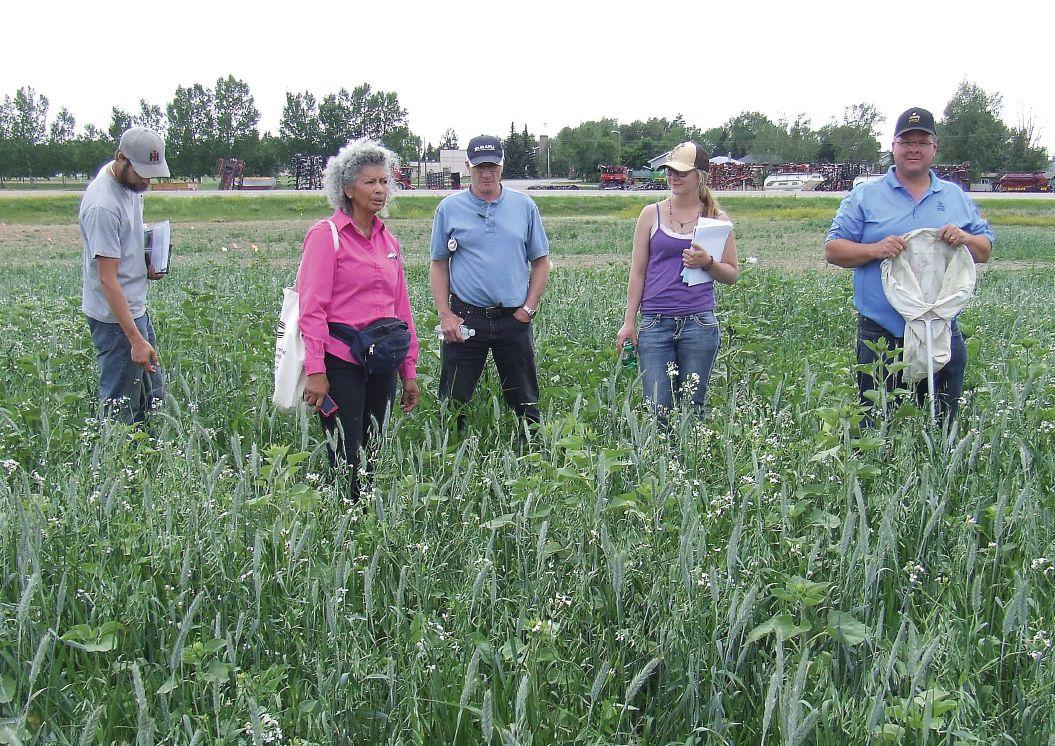
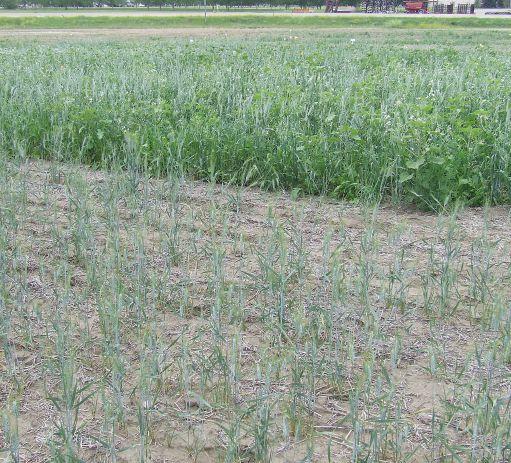
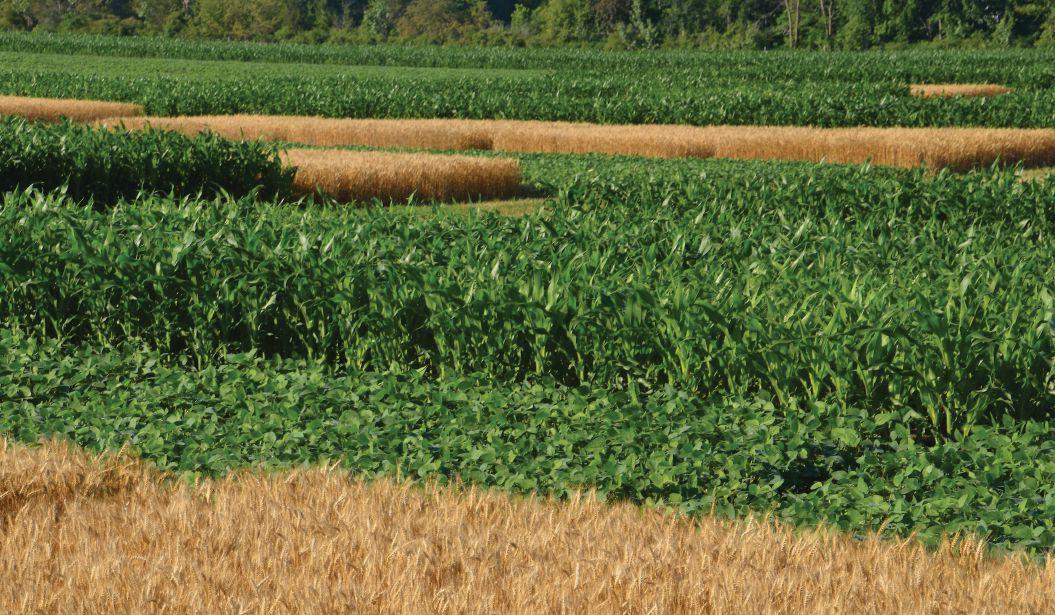
aBOVE: a panorama of the long-term trial at Ridgetown showing wheat that is close to maturity.
Hayes also points out the risk of erosion to farmers who haven’t yet tried reduced tillage. “Tillage increases the loss of organic matter and nutrients,” he says. We need to keep our soils in place and keep phosphorus in place. There is more and more pressure on growers to reduce phosphorus going into streams and rivers and then into the great Lakes. There have been algal blooms a couple of times in the last few years and that’s a very bad thing.”
Hayes encourages farmers to try no till or minimum till on 25 to 50 acres, and to find a mentor in the vicinity. “Try it in the best-drained fields, fields with good fertility and to do it within a good rotation.”
Expanding rotation
along with tillage, new ontario research has found short crop rotations to negatively impact soil health and crop productivity. “The most common crop rotation in the U.S. Midwest is currently a corn-soybean rotation, and crop rotations in ontario are following the same trend,” says Dave Hooker, a field crop agronomist and assistant professor at the University of guelph, ridgetown Campus. Hooker lists many reasons for shorter rotations, including technological innovations, economies of scale and government policies, but says most decisions on crop rotation are based in the short term. “However, long-term effects need to be factored into the decision, and until just recently, little information was known on the impact of short crop rotations on crop productivity,” he notes. “The long-term trials at elora and ridgetown have quantified the negative impact of short rotations and intensive tillage, and much of the impact is directly related to differences in soil health.” at both the ridgetown and elora sites (two different soil types and environments), Hooker, along with Bill Deen and Laura Van eerd, found that soil health tended to be the poorest in corn-soybean rotations, and similar to continuous corn or soybeans. “although corn and soybean yields were relatively high or ‘satisfactory’ in the corn-soybean rotation, they tended to be much lower than yields in more complex rotations,” he says. “When wheat was included in the rotation, corn and soybean yields were five to 10 per cent higher, and the crops were more resilient during periods of excessively wet or dry weather.”
Hooker says analysis of the ridgetown soil data with Laura Van eerd also shows higher soil health scores where wheat was grown in rotation (compared to a corn-soybean or continuous corn or soybean system). “Soil response to cropping practices tend to be gradual,” Hooker notes
Hooker adds many growers make crop rotation decisions based on crop performance only, but that he and his colleagues are trying to encourage growers to perform an enterprise analysis using a multi-year systems approach. “Many growers do not credit the wheat enterprise with higher returns in the corn and soybean years,” he says. “When the wheat enterprise is credited with the higher returns in corn and soybean, the profitability of the wheat enterprise is much more competitive with soybean and corn.”
Hooker says reliance of nitrogen (n) fertilizer is less for corn following wheat alone (no red clover), and that n for corn can be reduced further by 70 kg n/ha if the wheat is underseeded to red clover. He says all of these “perks” for corn (and soybean) need to be credited to the wheat enterprise, because they would not exist without wheat. Hooker adds the inclusion of wheat also allows the opportunity for planting cover crops in the rotation, whereas limited opportunities exist for cover crop inputs in a corn-soybean rotation.
Hayes strongly believes if two-crop rotation use continues on a farm, soil health will decline significantly on those fields. “Smart farmers are putting together the pieces and seeing it for themselves,” he says. “If you are doing corn-soybean rotation, and you move to including cereals in a three-crop rotation, soil health gets better. It gets better still when you go to a six-year rotation and add a perennial crop like hay for a few years. It’s better still when you use minimum till or no till, and better yet when you add a cover crop after soybeans or cereals. The addition of organic material from manure and/or compost (grain bin waste, livestock and poultry bedding) will also improve nutrient cycling and soil health.”
“Try to do all that you can to improve your soil,” he concludes. “Long-term yields depend on it.”
CA b moni Tor S ver Su S Sm
CONTiNUEd FROM PagE 20
that needs attention, he opens up the ScoutDoc app. It already knows which field he’s in and brings it up on the screen. He does “pindrop” to mark the exact point, takes a picture of what he sees and writes a note that is tagged to the pindrop. Months later, he can flip through notes on ScoutDoc to locate issues and deal with them.
at another level, new ag apps are making some cab monitors obsolete. a dedicated monitor in a tractor – built ruggedly for one thing – can cost thousands of dollars. a tablet computer, for $500, can do the work of hundreds of traditional monitors. If you need rugged casing for a tablet, that’s available.
The new mindset really is moving toward “cloud” computing – moving all the bits of data onto enormous digital server farms that are accessible instantly and wherever there is an Internet connection. “What really makes the phone and tablet
A rT phone S
a whole new level of power is that I can place any information I like on the cloud, from my desktop. Whether it’s a spreadsheet, field records, pictures, music or contact information. once it’s on the cloud, I have access to it anywhere in the world on any device in the world as long as I can remember my password and have an Internet connection. That converts the tractor cab into a virtual office.”
Here’s the thought process needed, according to gredig: one, I want to do XYZ. Two, can I do it with my tablet or smartphone? Three, can I get an app to do it?
“once you have that mindset, you will be amazed at what is available. The last place I want to be is in an office. If I do this mobile, I can avoid the office.”
w hAT ’ S new wi T h
S oybe A n Seed S ?
New seed treatments are here and more are coming, allowing growers more options for profitability and sustainability of their operations.
by Treena Hein
Providing a boost for soybean plants through seed treatments has been a strong area of focus for companies for many years now, and 2015 is no different. Syngenta’s seedcare technical lead, Chris Denys, says the future for seed treatments in the Canadian marketplace looks very good.
“Seed treatments protect the seed and seedlings, ensuring that plants get off to a healthy, vigorous start, which ultimately translates into yield and quality improvements,” Denys explains. “This has been, and remains, the most important benefit of seed treatments. Simply put, our customers invest a lot in their seed and they want to do everything possible to help ensure that those seeds realize their full potential. Beyond that, growers increasingly look to seed treatment technology for other things that contribute to the profitability and sustainability of their farm operations.”
In his view, this includes optimizing seeding rates (due to improved plant stand), minimizing the need for replants, extending the application window for in-season pesticide applications when
needed, supporting earlier planting practices and complementing trait technology to manage pests. He says as the complexity of farming increases, whether that is a function of volatility in commodity prices, increasing farm size, climate change or any other number of factors, crop farmers look to technologies like seed treatments to help ensure their success.
Derrick rozdeba, marketing communications lead at Bayer CropScience, agrees. He says growers are continually looking for new and improved innovations like insecticide options and alternatives for ontario (where neonic seed treatments usage is currently critically restricted on corn and soybeans), management of soybean cyst nematode (SCn) or sudden death syndrome (SDS), and options for glyphosate-resistant weeds and fungicides for white mold management, to name a few.
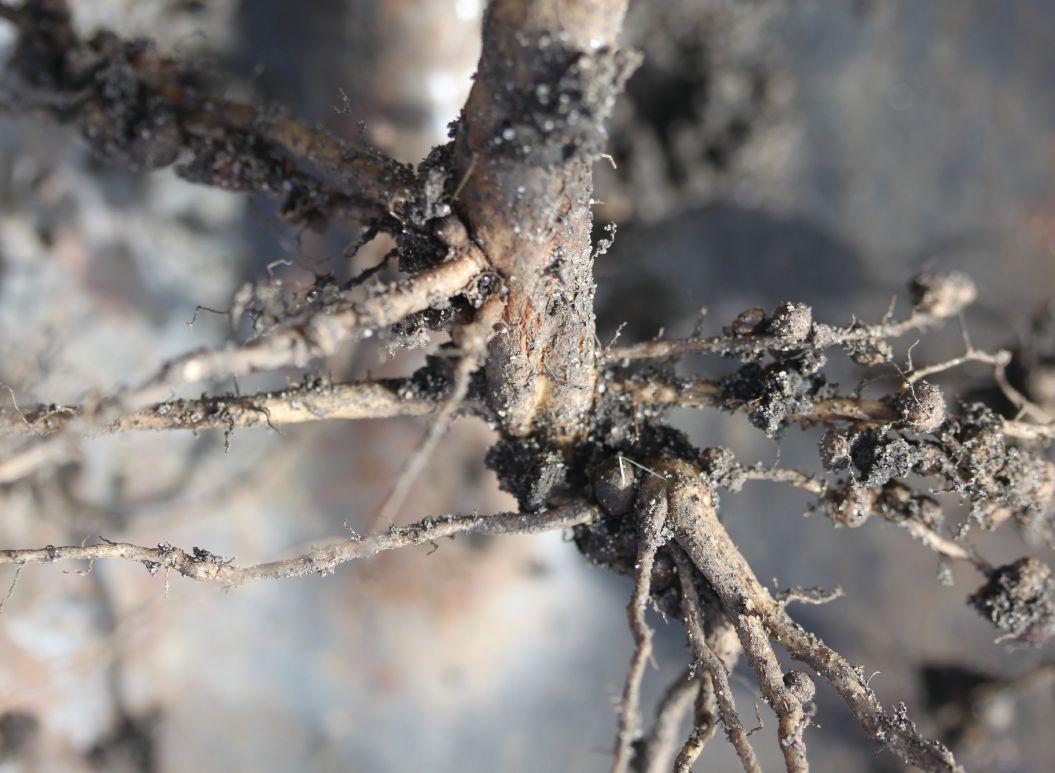
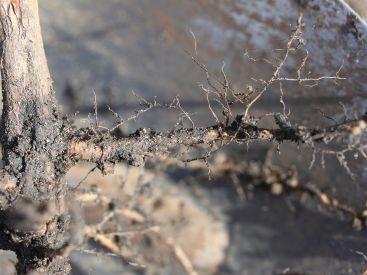
TOP: an image taken using a macro lens. The small white dots on the roots are soybean cyst nematode.
Photos courtesy of c hris Denys, s yn G enta.
What’s new
Syngenta recently brought two new seed treatment technologies to market in eastern Canada, and more are on the way. released in mid-June, Clariva pn is described as an innovative biological seed treatment for SCn management. Horst Bohner, ontario Ministry of agriculture, Food and rural affairs (oMaFra) soybean specialist, says SCn continues to spread across ontario, so Clariva pn will be a helpful tool for growers.
“Clariva pn treated soybean seeds will take current SCn management programs to the next level by reducing SCn feeding and reproduction,” Denys says. “Clariva pn contains the Pasteuria nishizawae bacteria as its active ingredient.” When Clariva pn treated seed is planted, the bacterial spores are released into the soil and establish a protective zone around the young soybean plant’s roots. Clariva pn is compatible with, and can be ordered along with, Syngenta’s Cruiser Maxx Vibrance Beans and Vibrance Maxx seed treatments.
Fortenza is Syngenta’s other new offering in eastern Canada, described as a new alternative class of insecticide chemistry in corn that provides early-season insect control of european chafer, wireworm and cutworm. It is combined with Maxim Quattro seed treatment to provide control of several seed-borne and soilborne pathogens including Fusarium, pythium, rhizoctonia and aspergillus and penicillium fungi.
Bayer CropScience is working on a new system called Balance gT Soybean performance System, with regulatory approval pending. It aims to provide exceptional performance coupled with outstanding weed control. “Balance gT soybeans will be tolerant to both glyphosate and isoxaflutole, the active ingredient in new Balance Bean herbicide and ConvergeFlexx for corn,” rozdeba explains. “These two chemistries will ensure protection against a variety of weeds.”
When released, Balance will be the first step in a foundational system that will grow to include a triple-stacked herbicide tolerant soybean. rozdeba says the first of these additional stacks will provide tolerance in soybeans to glyphosate, Balance Bean and glufosinate, the chemistry found in Liberty, and will enable growers to harness three modes of action on one soybean.
We’re concerned that arbitrary reductions on the amount of neonic treated seed planted is not supported by science.
Bayer CropScience is also hoping to introduce a new seed treatment in 2018 (pending registration) called iLevo, for control of SDS in soybeans. “This is a very exciting new chemistry and a growing issue in ontario,” rozdeba says.
BaSF Canada will also launch a new soybean inoculant in the fall of 2015 to the eastern Canadian market. “The new nodulator pro 225 will increase yield potential for growers up to eight per cent compared to competitor products,” notes ariel gohlke, inoculants brand manager. “Unlike other soybean inoculants on the market, nodulator pro 225 features a unique-to-BaSF 532C strain of nitrogen fixing rhizobium that was developed for the Canadian market, and a second rhizo-bacteria (B. subtilus) that suppresses disease, promotes root growth and nodulation and improves overall root health.”
Neonic issues
In Denys’ view, neonicotinoid seed treatment technology remains extremely important to agriculture across Canada, both within ontario and in other provinces. “For example, one of the most frequently cited examples of both the importance and success of this technology is in the production of canola on approximately 20 million acres in Western Canada, which could not be achieved without the use of this technology,” he notes. “and, it is well documented that the use of this technology on a bee-attractive crop such as canola works well for both farmers and crop production, and beekeepers and honey production.”
Denys notes that in the past decade, the number of honeybees in Canada has reached near-record levels, with the majority of colonies in Western Canada, where canola has become one of the most important crops. The health of hives in Western Canada remains high as these two parts of the agriculture sector work side-by-side, he says. “Here in ontario, we’re concerned that arbitrary reductions on the amount of neonic treated seed planted is not supported by science,” Denys explains. “recent reports from both the Canadian Standing Senate Committee on agriculture and Forestry and the White House pollinator Health Task Force in the U.S., for example, have recommended markedly different approaches to dealing with bee health. Furthermore, such a move undermines the competitiveness of ontario farmers and puts them at a disadvantage relative to farmers in other jurisdictions in Canada, the U.S. and elsewhere that continue to have regular access to this technology.”
rozdeba agrees that neonic seed treatments are still an important market outside ontario. He says growers still have the option to use seed treatments as a valuable protection tool on the 40 per cent of Canadian soybeans grown outside of ontario.
Plant comparison from syngenta research plot. Clariva pn on the left and the control on the right, with differences in the root mass and plant colour.
DISCOVER COMFORT, PRODUCTIVITY AND QUALITY FROM THE WORLD’S MOST POWERFUL COMBINE.
COMFORT. All-new Harvest Suite™ Ultra cab with 68 ft2 glass and acres of space for unsurpassed visibility and operating ergonomy.
PRODUCTIVITY Largest ever 410 bu. grain tank, 4 bu./sec unloading speed and a 34 ft. folding auger with pivoting spout for greater unloading flexibility.
QUALITY. Unique Twin Rotor™ threshing system delivers unmatched grain quality,10% higher capacity with Twin Pitch technology and crop-accelerating Dynamic Feed Roll™ for even higher throughput.
POWER. Mighty Cursor ECOBlue™ HI-eSCR engines for Tier 4B compliance and 10% fuel savings. Up to 653 hp on the new CR10.90 Elevation, the world’s most powerful combine.
meeTing loCAl demAnd
Eastern Canadian research helps producers supply local milling companies with high-quality product.
by Trudy Kelly Forsythe
Research from agriculture and agri-Food Canada (aaFC) is destined to help producers in eastern Canada produce high quality, hard red winter wheat suitable for bread production or for blending with other wheat varieties, such as western hard red spring wheat, to supply local milling companies.
“Local producers are challenged to access this market due to western production of hard wheat even though, at times, local mills have trouble accessing enough hard wheat for their operations,” says gavin Humphreys, a research scientist with aaFC’s winter wheat breeding and genetics program, who is building on research conducted by r adhey pandeya from 1992 to 2012 and Judith Frégeau-ried from 2012 to 2014.
Frégeau-ried submitted the original hard red winter wheat research proposal to the Canadian Wheat Breeding research Cluster because it was discerned that while there was adequate research and breeding in soft winter wheat, there was a need for breeding in hard red winter wheat.
“aaFC was well placed to take on this activity because there is an active hard red winter wheat program in Western Canada from which we have sourced some of our initial germplasm and parents for crossing,” Humphreys says. “and the size of eastern hard red winter wheat production is presently too small for private plant breeding companies to invest very much, if at all, in the breeding of hard red winter wheat.
“For example, Dow agroSciences has recently mothballed their breeding efforts in hard red winter wheat for ontario.”
The current program led by Humphreys is supported through the wheat cluster with funding from grain Farmers of ontario, Western grains research Foundation and aaFC. It involves three components: breeding, disease screening and lab work.
Breeding
The winter wheat breeding program focuses on hard red winter wheat although, Humphreys says, there is some work on soft red winter because it is the most important class of winter wheat grown in eastern Canada. He runs a modified pedigreed program with all facets of a standard wheat breeding program including crosses, early generation populations, later generation yield testing, and registration testing and breeder seed production.
disease screening
The researchers conduct one of the largest publicly funded Fusarium head blight (FHB) screening nurseries for winter cereals in Canada at the eastern Cereal and oilseed research Centre (eCorC). There, the nursery screens material for winter wheat
Breeding for improved resistance to FHB is an important objective of the ECORC winter wheat program. The middle two rows pictured here contain hard red winter wheat with high resistance to FHB bordered by rows of hard red winter wheat that are susceptible to FHB.
breeders in Lethbridge, alta.; Winnipeg, Man.; all ontario winter wheat breeders through the oCCC Winter Wheat performance and orthogonal trials and the aaFC ottawa program.
“In addition to the field screening, in collaboration with Dr. Barbara Blackwell at eCorC, we can screen promising new winter wheat lines for their mycotoxin levels,” Humphreys says. “It is critical that we know not only the Fusarium head blight disease symptom but also the mycotoxin levels because lines with low Fusarium head blight symptoms can sometimes still have high mycotoxin.
“nowadays, producers are being graded by both Fusarium damaged kernels and mycotoxin levels in their harvested grain,”
w eed m A nAgemen T
wi T h herbiC ide S
“The art of spraying well” is all about adhering to the basics, and adjusting to new findings.
by Treena Hein
Spraying herbicides well is both an art and a science. But it’s also mostly a matter of always doing certain things and never doing others, according to Mike Cowbrough, weed management field crops lead at the ontario Ministry of agriculture, Food and rural affairs (oMaFra), and Steven Johns, agronomic sales rep with Syngenta Canada.
So how do farmers improve weed control success through spraying well? Let’s first look at mixing. Cowbrough points out that successful tank mix compatibility is all about starting with a clean tank and making sure products are mixed efficiently. “Some products are easy to foam, like glyphosate and water, and if you add a de-foaming agent prior to adding the glyphosate, that will take care of it,” he says. “also, always make sure your inductor is full so it’s not drawing air, and minimize agitation.”
More serious issues with gelling and clogging of spray lines seem to occur often with eC herbicides and a dry granular product. “Do a jar test if there is any doubt,” advises Cowbrough. “Mix up a little batch in a pint jar that’s the equivalent measurement to what you’d apply to an acre. I once mixed 2,4-D amine and Sencor DF, for example, in a jar test and didn’t let Sencor dissolve well enough first, so I got a coarse white precipitate in the jar that was hard to flush away. It would be exponentially worse to clean up in a sprayer.”
Johns advises those using a new tank mix to ask the retailer to double-check about things like mixing order. “Surfactants can
also be added to make products compatible,” he says. “Many products that contain atrazine don’t ‘like’ to be mixed with glyphosate, but if you add a non-ionic surfactant, you can make them very compatible.” He reminds farmers to pay attention to the general mixing rules: add wettables, powders, granules, then agitate, then liquids, flowables, and eCs, followed by true solutions.
“all of us are in a hurry at springtime, and we have to slow down and remember that these products were never designed to mix with each other, so we need to mix one thing at a time, and give it time,” he notes. “With dry flowables, put them through the inductor to smash them and then they’ll get suspended well in solution. Temperature and water volume are also very important.”
Cowbrough agrees. He notes that low water volumes can have a very negative influence on how well high-volume dry granular flowable herbicides dissolve. He advises using high water volumes if you want to have complete dissolving, and prevent product sedimentation in the first place. “With any flowables or wettables, you should have valves on your boom sections, and flush your system well,” Johns adds. “I’d also like to stress that you should never leave a partial tank sitting around unapplied,
TOP: More serious issues with gelling and clogging of spray lines seem to occur often with EC herbicides and a dry granular product. “do a jar test if there is any doubt,” advises Cowbrough.
unless you have the spare time to agitate it every hour or two until you want to finish applying it. If you let stuff sit in sprayers for any length of time, sedimentation can occur. So, go ahead and finish spraying even if it’s raining. and also remember, never put products into jugs that aren’t correctly labelled.”
Cowbrough also makes the point that products might not fully dissolve in acidic or alkaline water. He says studies done at purdue University in the U.S. showed that the efficacy of eragon was found to be reduced in acidic water, for example. “The price of litmus paper is cheap, so testing your water is worth it,” he notes.
application advice
Last year, Cowbrough and his colleagues conducted weed surveys across the province in six counties and found that six weed species were predominant. Canada fleabane and giant ragweed are at the top of the list, but so is lamb’s-quarters. “It’s a species that we get asked about in terms of whether it’s herbicide-resistant,” he notes. “But that’s not going on and yet it seems to be resistant. So, what is it?”
Johns notes that to answer that, we need to take a close look at application. “Soil application is different than contact post-emergence application, but with lamb’s-quarters or giant ragweed, we advise using a higher water volume post-emergence,” he says. “You are spending a lot of money on herbicides, so make sure they work. Don’t skimp and you’ll get much better droplet dispersion and much better results.”
Cowbrough’s survey results also revealed the fact that what is being reported as lamb’s-quarters might actually be fig-leaved goosefoot. “So, make sure to do good scouting,” Cowbrough advises. “and make sure you are trying to spray when the lamb’squarters are small, at the eight-leaf stage. When you apply herbicides at this stage, control is excellent.” at medium size (three to four inches tall), glyphosate efficacy with lamb’s-quarters is still
Meeting local demand
Continued from page 28
he continues. “Therefore, new varieties need not only to have low Fusarium head blight symptoms to protect the yield but the harvest grain must be low in Fusariun damaged kernels as well as mycotoxin to protect the grade.”
Laboratory work
Within the laboratory component, the researchers run a wheat, doubled haploid program which produces genetically pure lines skipping over the traditional eight to 10 generations of self-pollination. Last winter, in Humphreys’ first winter wheat double haploid production season, they generated over 800 winter wheat, doubled haploid breeding lines.
“This resource will be used in concert with molecular markers in
excellent, but the efficacy of Basagran and pinnacle falls off. at six to eight inches tall, Basagran and pinnacle are not effective on lamb’s-quarters at all, Cowbrough notes, and glyphosate cannot do well because there is too much calcium in the leaves. He adds that if weeds are at a high density, they can shade and protect each other; so again, getting them when they are small is very important.
So, size matters, but so does time of day. Cowbrough says different time-of-day herbicide applications on velvetleaf and lamb’s-quarters were recently compared by peter Sikkema, a crop scientist at the University of guelph (ridgetown). Sikkema found that control of velvetleaf is much better if spraying is conducted between 9 a.m. and 6 p.m. Johns points out that earlier than 9 a.m. and later than 6 p.m., dew can interfere with efficacy, so make sure the field is dry. Time of day also affects leaf orientation. For velvetleaf in particular, the leaves drop as the sun goes down, so spraying later in the evening is not recommended. The efficacy of glyphosate and other herbicides can also be reduced by soil and dust on weed surfaces.
“also keep in mind that a thick crop canopy appears to serve the same function of another residual herbicide application,” Cowbrough notes. “Less sunlight getting through means fewer weed seeds germinate. So, use whatever seeding rates and whatever row space you wish, but don’t ignore fertility.” He says studies have shown that soybean canopy closure is much quicker with the use of both a pre- and post-emergent herbicide program. “But we know that less than 20 per cent of glyphosate-tolerant soybeans receive a pre-emergent herbicide application,” he says. “That’s something to think about.”
For more on weed management, visit topcropmanager.com
the winter wheat breeding program to screen parents and doubled haploid lines for molecular markers linked to desirable traits such as plant height, leaf rust, stem rust and powdery mildew resistance,” Humphreys says. “In this we can produce double haploid populations that are pre-selected for the desired traits.”
Moving forward
Humphreys says the research is really just getting started because the hard red winter wheat program is new at eCorC. In addition to FHB resistance, which the researchers can select in their FHB screening nursery, Humphreys’ program will look to develop varieties with both high grain yield and high harvest index
through the development of shorter strawed varieties.
This research will have benefits over supplying the local milling companies with high quality winter wheat. Winter wheat is also an important component in crop rotation, but Humphreys says producers are challenged due to the lower yields and value of wheat compared to soybeans or corn.
Grow. www.topcropmanager.com
Nu-Trax™ P+ fertilizer puts you in charge of delivering the nutrition your crops need for a strong start. It features the right blend of phosphorus, zinc and other nutrients essential for early season growth. And because Nu-Trax P+ coats onto your dry fertilizer you are placing, these nutrients close to the rooting zone where young plants can easily access them, when they are needed most.
Take control of your crop’s early season nutrition with Nu-Trax P+ and visit .