Growing today for tomorrow. Farming, the biggest job on earth.
The population is increasing, but farmland isn’t. So the pressure is on for farmers to maximize yields and produce high-quality crops to meet the needs of a growing planet. This is why BASF is working with farmers to create chemistry that will increase the yield and quality of crops. With help from BASF, it’s in the farmers’ hands.
To learn more about BASF’s commitment to sustainable agriculture, check out our videos at agsolutions.ca/sustainability
TOP CROP
MANAGER
5 | The next great crop innovation?
Hybrid wheat varieties are being developed in europe.
By Rosalie I. Tennison
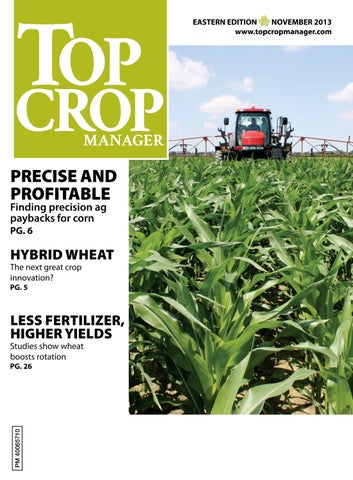
precise and profitable By Blair Andrews
AND NUTRIENTS
Updating p and K strategies By Carolyn King
12 | Proactive protection producers must be on the lookout for Bt resistance to corn rootworm. By Treena Hein
Spreading the ’net By Treena Hein 6 14
AND NUTRIENTS revising n guidelines for wheat By Treena Hein
PULSES
Improving dry bean varieties By Rebeca Kuropatwa
• EASTERN
Soil
www.AgAnnex.com
26 | Less fertilizer, bigger corn and soybean yields
Long-term studies show wheat gives a real boost to a rotation.
By Carolyn King
MANAGEMENT retirement planning By Paul Vaillancourt 18 30 34
MARKETS AND MARKETING
38 FROM THE EDITOR Untapped potential By Stefanie Croley, Associate Editor
Photo
Photo
Stefanie Croley | aSSoCiate eDitor
UNTAppEd pOTENTiAl
Areport released by re/Max in September stated Canadian farmland values are reaching record levels in 2013, with bare, cash-cropping land continuing to be the most sought after.
“The primary drivers in the market continue to be end-users – established farm operators expanding existing operations,” said elton ash, regional executive vice-president of re/Max in Western Canada, in the report. “Be it cash-cropper or livestock farmer, the economies of scale continue to support expansion. There are many buyers waiting in the wings, but momentum is hampered to some extent by a shortage of farmland listings.”
That last sentence of the report stood out to me, especially after hearing a presentation at the ag Media Summit in Buffalo, n.Y., in august. on the International newsmakers panel, Michael Dwyer, director of the global policy analysis division at Foreign agricultural Service/USDa, spoke on factors affecting global agricultural markets over the next 10 years.
In his presentation, Dwyer showed a map of potential availability of uncultivated land with data from World Bank. He pointed out that there are 446 million hectares (or 1.1 billion acres) of uncultivated land globally.
The map provided a breakdown of the uncultivated land, including 123 million hectares available in Latin america and the Caribbean, 202 million hectares in Sub-Saharan africa and 14 million hectares in east and South asia. The United States and Canada were grey areas, with no significant portion of uncultivated land. So, when I read the re/Max report, I wasn’t surprised. a shortage of farmland listings is accurate indeed.
as Dwyer pointed out, strong growth in global food, feed, (bio)fuel and fibre demand will keep agricultural commodity prices high over the next decade. However, the World Bank data means that much of the new demand will be centred in asia, with most new import demand coming from developing country markets. “High commodity prices and production gains should help the total profitability of agriculture,” he said, concluding, “If this is the case, this should continue attracting new investment into the sector, i.e., land and new technologies.”
This all sounds great, but with a lack of farmland to develop, Canadian producers are limited by what they can invest in. The solution to this predicament is simple in my mind: why not further reap the benefits of what we already have?
Shortly after returning from the ag Media Summit, I attended a precision ag workshop presented by the Innovative Farmers association of ontario where speaker Tim norris proposed the same thing, suggesting there could be untapped potential in the land you already grow your crops on.
at the workshop, very few people raised their hands when norris asked who was using any precision cropping strategies or techniques, a response I found very interesting but not surprising. Investing time and money in new technology is risky. It was promising, though, to see so many people interested in learning something new.
as norris demonstrated that day, and as he and Jason Van Maanen, an agronomy specialist from Chatham, ont., shared in a story on page 6, the use of precision ag tools will provide payback, but finding the right combination of techniques that works to meet your own needs is important.
Canada may be lacking uncultivated land, but that doesn’t mean the land we already have is tapped out. rather than investing in more land, perhaps it’s time to consider investing in other means to help increase yield and revenue.
CANADIAN ADDRESSES TO CIRCULATION DEPT. P.O. Box 530, Simcoe, ON N3Y 4N5 e-mail: subscribe@topcropmanager.com Printed in Canada ISSN 1717-452X CIRCULATION e-mail:subscribe@topcropmanager.com Tel.: 866.790.6070 ext. 202 Fax: 877.624.1940 Mail: P.O. Box 530, Simcoe, ON N3Y 4N5
SUBSCRIPTION RATES
Top Crop Manager West - 8 issuesFebruary, March, Mid-March, April, June, October, November and December - 1 Year - $45.00 CDN plus tax
Top Crop Manager East - 7 issuesFebruary, March, April, August, October, November and December - 1 Year - $45.00 CDN plus tax
Specialty Edition - Potatoes in Canada - February1 Year - $16 CDN plus tax
All
iS hy BR id wh EAT T h E NE x T g REAT c ROp i NNOVAT iON ?
Long desired in the cropping industry, hybrid wheat varieties are being developed in Europe.
by rosalie I. Tennison
Advances in wheat technology have not kept pace with corn and soybeans due to the cereal’s complicated genetic profile. However, that could change within a decade as plant breeders are closer than ever to perfecting hybrid wheat. researchers in europe are starting to solve the puzzle and success seems likely after many years of research, investment, and effort.
“It’s not easy to develop hybrid wheat,” admits Dr. Stefan Bruns, commercial director for KWS Cereals Division of germany. The company currently has hybrid rye varieties that are being grown in test plots in portage La prairie, Man., and Saskatoon, Sask., to determine if they are hardy enough for the Canadian growing climate. But, wheat is proving, as always, to be more challenging.
“Because wheat is self-pollinating, it needs a system to ensure crosspollination between pure lines to create hybrids, and we need an efficient seed production system,” he says.
growers understand many of the challenges facing wheat breeders, but they are hopeful success will happen soon for both financial
and altruistic reasons. Hybrid wheat, like most hybrid food crops, would have better yield, which means an increase in the food supply for a growing world population. In addition, with hybrid varieties, more wheat could be grown on the same amount of arable land, a commodity that is shrinking. growers could also expect better financial returns through increased yields even with higher expected seed costs over conventional varieties.
“High yielding varieties will be the first wave of any advancement in hybrid technology,” says Todd Hyra, SeCan business manager in Winnipeg. “But, right now hybrids are not producing on a predictable scale.”
Despite the advances that KWS has made in recent years, Bruns says varieties will not be available soon because, once available, an efficient seed production system needs to be in place. as well,
CONTINUED ON PAGE 11
ABOVE: Dr. Stefan Bruns of KWS Cereals Division examines wheat near Palmerston, Ont.
pRE ci SE AN d
pROfi TAB l E
Finding precision ag paybacks for corn.
by Blair andrews
The growth of precision agriculture, with its array of new electronic devices, has given farmers some powerful tools to get more out of every acre on their farm.
With big investments required, questions are being raised over how quickly these electronic guidance devices for gathering data and controlling equipment will pay off.
For Tim norris, a 17-year veteran of precision agriculture from ohio, crop sensors for variable rate nitrogen and individual row clutches for seeding top his list of technologies with the best payback for corn growers.
The Ceo of ag Info Tech recently shared his experiences with a Canadian audience at a precision cropping workshop near Hamilton, ont., which was organized by the Innovative Farmers association of ontario.
He highlighted how a $21,500 (USD) system that uses infrared crop sensors for variable rate nitrogen applications can have a payback in one to 2.5 years: The sensors send infrared light
down to the crop in real time. The healthy plants will absorb more of the light. The sensors measure the amount of light that is reflected back and assign a number. The sensors also send out a different form of infrared light that measures the biomass of the plant. The combination of the numbers produces an nDVI (normalized Difference Vegetation Index) reading. The system then compares this reading to an nDVI reading of corn in an n-rich strip. Using algorithms from land grant universities and guidelines set up by the operator, a nitrogen recommendation is made.
“We’re assuming that the best corn is equal to the corn in the n-rich strip and does not need any additional n, so we’re not putting it on there,” says norris.
In on-farm tests that compared a side-dressing strategy using crop
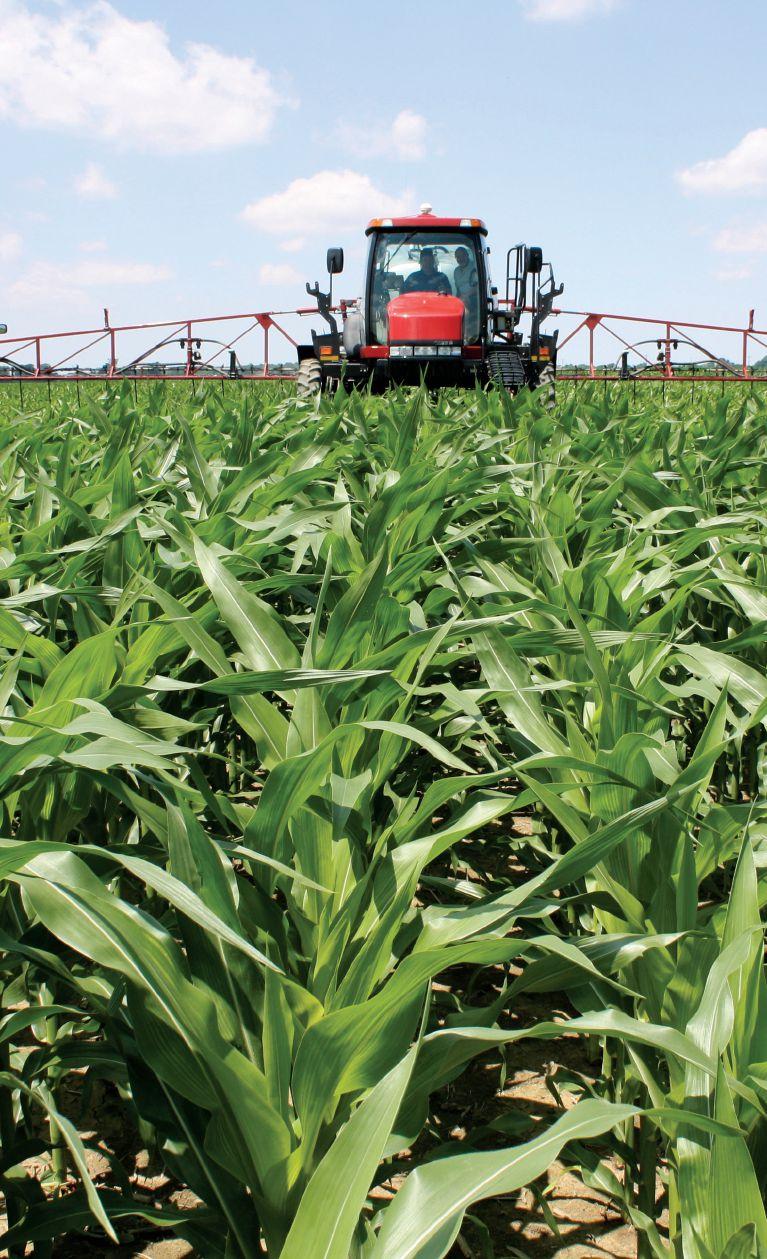
ABOVE: A Case sprayer, equipped with Ag Leader Integra display and the OptRX crop sensor system, moves through a corn field near Delaware, Ohio. The sprayer is varying the rate of 28 per cent nitrogen on corn at the V7 growth stage.
Resistant and hard-to-control weeds impact the way you farm, your yields, your bottom line. They impact your future.
Introducing Enlist™ — a new weed control system featuring Enlist Duo™ herbicide plus innovative traits that provide tolerance in Enlist corn and soybeans. It’s a highly effective solution to modern weed control challenges.
Only Enlist Duo™ herbicide, featuring Colex-D™ Technology, includes glyphosate and 2,4-D choline for exceptional performance on hard-to-control weeds plus two modes of action for superior resistance management.
sensors with straight rate applications, the average return showed the system with the sensors had an average advantage of $49.62 per acre in 2010 and 2011.
norris is quick to point out that these were wet springs and denitrification was present. In 2012, it was so dry that some crops did not receive rain after the nitrogen was applied for the n-rich strip. as a result, the n-rich strip appeared similar to the non-rich strip. “We had to lie to the sensors to get them to work,” norris says. although they used more n than applying a straight rate, the average payback was $28.19. With 500 acres of corn (at $6.00 per bushel) and an advantage of $49.62, the $24,810 total more than pays for the $21,500 system in one year. With a $20 advantage, or $10,000, the payback is 2.5 years.
It should be noted that a high-clearance sprayer was used for the side-dressing applications because norris found the sensors work better after the V7 stage of corn. This strategy also gives a farmer a wider window to apply the n
as a result, costs for using a high-clearance sprayer, if a farmer doesn’t have one, should be deducted from norris’ numbers.
Row clutches
Individual row clutches give farmers the ability to shut off individual rows on the planter. The display will shut off the appropriate rows when the planter is in an area that has already been planted or is in a “no-apply zone,” such as a waterway.
according to norris, individual row clutches offer several benefits, including seed savings, a yield increase in corn from not double planting and time saved by efficiently moving through the headlands.
“It speeds up the planter operation by being able to plant the headland at pretty much the normal speed,” he says.
He developed a payback calculator using data from growers to demonstrate the savings of a high-end precision ag system for planting alone. For example, on a 500-acre farm of corn, the system saved $25.33 per acre, with the biggest saving of $17.85 an acre coming from the yield increase from not double planting. norris was figuring a 20 per cent yield reduction in areas that would have been double planted.
The resulting savings, based on $5.00 per bushel corn, was $12,665. With that figure, the return on investment for a $31,400 system that includes display, auto steer, auto swath, a gpS accuracy upgrade, clutch control and row clutches for the planter would be 2.48 years.
Variable rate potash
When looking at precision cropping for corn, greg Stewart, corn specialist for the ontario Ministry of agriculture and Food, says input controls for varying the rates of potash, nitrogen and seeds are drawing the most interest.
While farmers have adopted the idea of using yield mapping and doing soil sampling to identify areas of variability in their fields, there is some hesitation to take the data to the next level.
“Instead of applying a targeted rate of potash for every field or for every spot in a field, many producers are still broadcasting an average rate of K across much of their operation,” says Stewart. “In some ways, we need to have the needle move first towards fields being tested and treated individually based on soil K test levels and
The accuracy of the row shutoff is displayed on an angled headland (left). When the row shutoff was deactivated, an overlap of planting occurred on the headland (right).
Photos courtesy of Jason v an m aanen.
then move to precision ag approaches for site-specific applications within management zones.”
Stewart says research in ontario suggests that variable rate potash has a much higher chance of being successful than variable rate phosphorus.
“our variable rate p data would say the odds of making variable rate p do much for you are pretty slim because we can’t get broadcast p to do much for us,” notes Stewart. “So variable rate K is still something we’re chasing.”
Variable rate seeding
Jason Van Maanen, an agronomy specialist with Veritas Farm Management in Chatham, ont., has been crunching numbers to demonstrate the payback of variable rate seeding for corn.
The concept is to push the populations higher in the high-yielding areas and back off in lower-yielding areas such as sandy knolls.
Van Maanen’s work involves comparing a variable rate strip to high, medium and low populations.
“any one of those can do well, but the variable rate strip tends to be either the most profitable or a close second,” says Van Maanen of his field trials.
While it is not always the winner, the variable rate seeding comes out on top when averaging the fields. In the average of three fields, the variable rate seeding produced a net revenue that was $72 per acre more than the low population (32,000), $18 more than the medium (34,000) and $61.46 than the high (36,000).
Van Maanen’s advice to growers is to try variable seeding in their own situations to see if it works, especially if they already have the
equipment. Some have hesitated because they’re worried it won’t work or it will slow them down. But, he advises, “If you set it up right, it won’t take any more time than what you’re already doing.” as precision ag continues to grow, people are already investing in the equipment as the new machinery is equipped with monitors and the technology to perform variable rate applications. Van Maanen says it’s not matter of getting one item to pay, but of using several precision ag tools together to see the return. He cited crop imagery, yield maps, variable rate nutrients and variable rate seeding as examples.
“What variable rate technology allows you to do is to understand variability, point by point in a field, and then manage each of those areas specific to their properties,” he says. “To really max out your return on your precision ag investment – the equipment and technology are there – you just need to utilize it.”
iS
hyBRid whEAT ThE NExT gREAT cROp iNNOVATiON?
CONTINUED FROM PAGE 5
varieties developed in europe have to be adaptable to north america, hence the western Canadian test sites. “We will not be able to offer a hybrid for at least the next 10 years because we need the right varieties with clear advantages against conventional varieties in order to be successful.
other companies have indicated they are also working on developing hybrid wheat and it appears they are within a five-to 10-year window for development, according to ellen Sparry, genetics manager for C & M Seeds in palmerston, ont. “I think it will likely take up to a decade before we see any hybrid varieties commercially available in Canada,” she says. The advantages hybrid wheat offers growers are improved yield, improved vigour and more stability in stressful growing conditions, she explains.
“You can’t just develop a hybrid variety: you have to develop a good hybrid to ensure commercial success,” Sparry says. “everyone – from the grower, the seed and grain partners to the miller and baker – has to get what they want. once the hybrid system is perfected, there could be some potential to tailor varieties to meet specific end-use requirements. For now, development will focus on the needs of the entire industry.”
“a lot depends on the attributes of the product,” explains Hyra.
“There may not be an identity preserved aspect to it. right now, the primary goal for hybrids is to get more production per unit area.”
Bruns agrees that one big challenge is creating highly competitive “hybrids” with a good working seed production system, especially with all the known challenges like flower synchronization between male and female, and males with high pollen production. Many breeders have been working to develop hybrid wheat since the 1960s and Bruns believes the investment in developing wheat hybrids will increase in the next few years.
“I am confident it will happen,” says Hyra of the imminent development of hybrid wheat. “But, it has to make sense in the eyes of growers. If you get a 10 or 15 per cent yield kick, that would be great, but if it isn’t consistent, it may not be worth the added cost. The production environment is also a consideration – a 10 or 20 per cent yield boost on a 100 bu/ac crop is significant, but the impact is reduced if the area can only produce a 30 bu/ac crop.”
Sparry sees pluses for the wheat industry in Canada, from seed growers to wheat producers to end users, when hybrid wheat is finally perfected. However, the entire industry must continue to wait, despite the promise of current breeding programs, for the inevitable breakthrough to happen.
pROAc T i VE pROTE c T iON
Producers must be on the lookout for Bt resistance to corn rootworm.
by Treena Hein
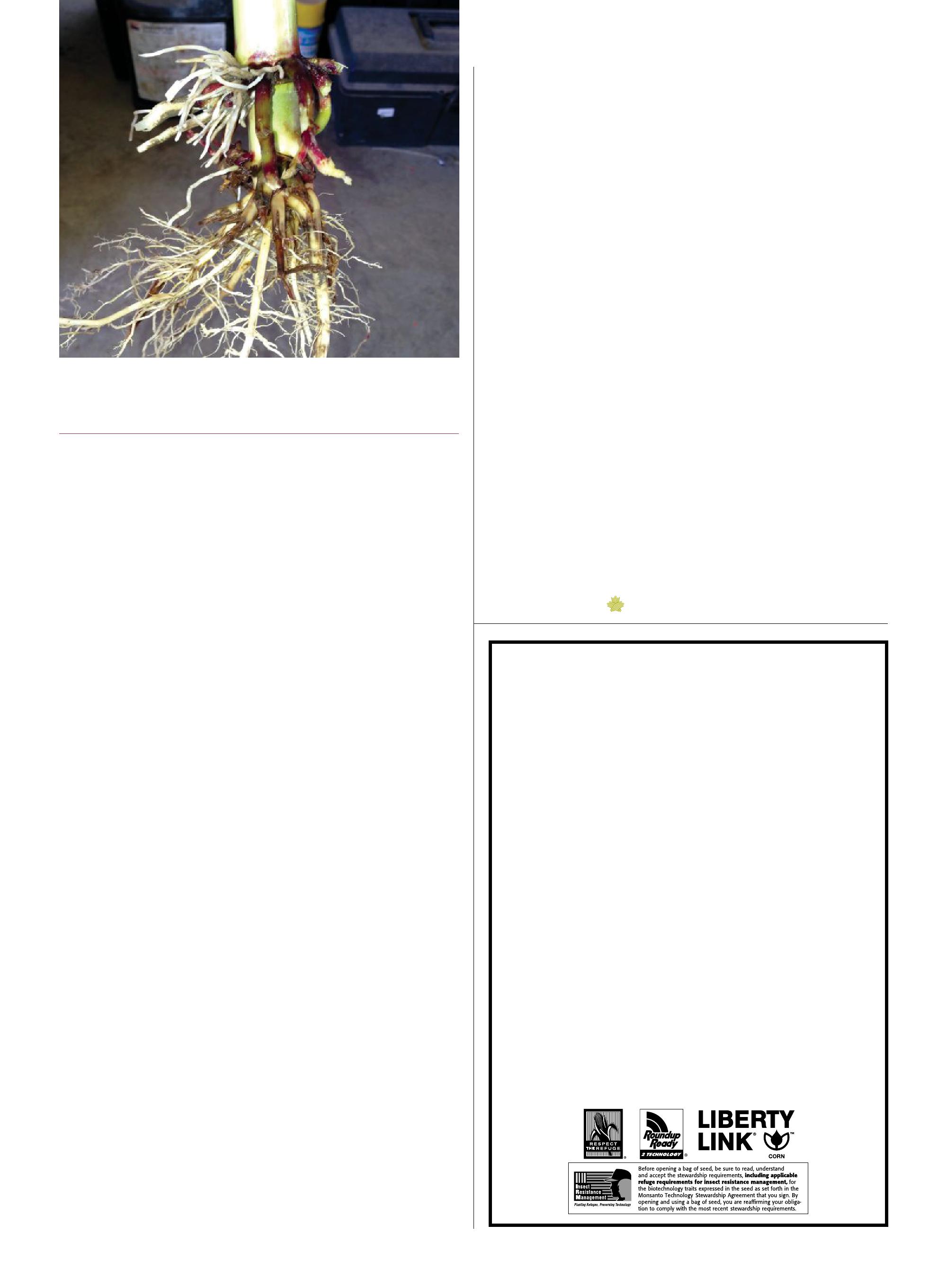
Bt resistance to corn rootworm in the central U.S. corn belt is a very serious issue. researchers believe that early identification and elimination of point sources – fields that have resistance occurring – by using crop rotation and other practices will help to slow the development of resistance in the eastern corn belt, which includes ontario.
The first Bt toxin for corn rootworm control, Cry3Bb1, was incorporated in several products such as Yieldgard rootworm in 2003, and later in Yieldgard plus, VT Triple and genuity VT Triplepro. It was also included in genuity SmartStax and refuge advanced products with Cry34/35ab1, as well as refuge-in-a-bag (rIB) seed mixtures. “resistance problems with Cry3Bb1 – fields that showed excessive root damage and lodging – were first reported in 2009,” says Dr. Chris DiFonzo, professor in the department of entomology at Michigan State University, who frequently collaborates with her ontario Ministry of agriculture and Food (oMaF) and University of guelph counterparts. “That year in southern Minnesota and eastern Iowa, more than 30,000 acres were affected and that greatly increased in 2011 and 2012. resistance is now suspected in several other U.S. states as well.”
Managing insect pest resistance to transgenic crops through best stewardship practices is a key focus of the Canadian Corn pest Coalition (CCpC, www.cornpest.ca), says Dr. art Schaafsma, a professor of crop protection at the University of guelph and current CCpC chair. The CCpC comprises a number of stakeholders representing producers, seed trade, trait providers, government extension and research, regulators and academics. Tracey Baute, oMaF entomology field crops program lead, and Jocelyn Smith, phD candidate and research associate with Schaafsma, both serve on its executive. The development of corn rootworm resistance to Bt corn in ontario is a potential serious threat that was identified by this group during its annual meeting in February. DiFonzo was invited to join Baute for a presentation on this issue at the Southwest Crop Diagnostic Days in July in ridgetown, ont.
Corn rootworm resistance to Bt is believed to have developed independently in several fields in the U.S. Midwest corn belt. “and although the eastern corn belt differs in important ways from the central U.S. – there is greater crop and landscape diversity, more crop rotation, less irrigated corn and smaller farm sizes – we can assume there is similar potential for rootworms to develop Bt resistance in continuous corn fields here,” DiFonzo notes. “While only a handful of rootworm Bt resistance problems have been reported
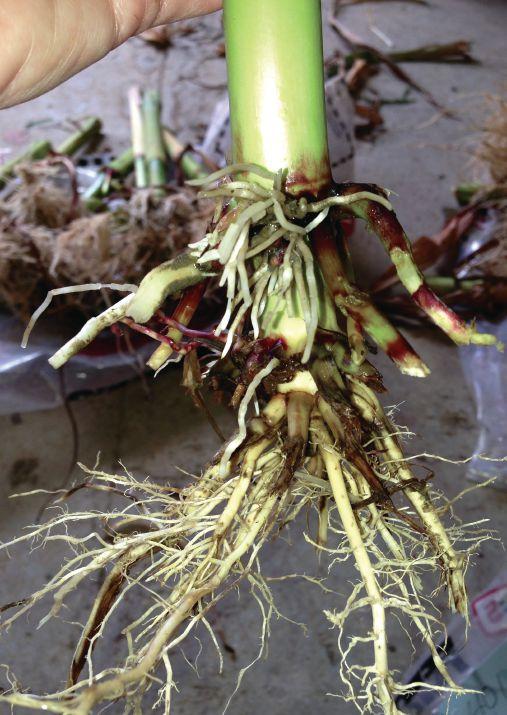
Farms with continuous corn production and fields planted to the same Bt year after year are most at risk for developing resistant rootworm populations, and should be scouted during the field season.
in Indiana, Michigan, new York, pennsylvania and ohio, so far, we must all take our roles in slowing the spread very seriously.”
Schaafsma says that while there have been no confirmed cases of resistance reported in ontario, the CCpC has come together to support a research project headed by University of guelph Masters student andrea Hitchon. It includes grower education and awareness, resistance monitoring, reporting and mitigation, with personnel from within ontario and the adjacent great Lakes states working together.
Photos courtesy of Jocelyn s mith.
DiFonzo doesn’t recommend using a soil insecticide on top of a Bt hybrid, as research has shown little or no yield benefit, and doing so may mask a problem with a Bt hybrid.
early identification and elimination of point source fields by crop rotation are the keys to slowing the development and movement of resistance. “given the speed with which Cry3Bb1 resistance evolved and spread in the west, we must take a strict, proactive approach here, and rotate when a problem is first detected,” Schaafsma explains. “We need to preserve the usefulness of Cry3Bb1 and other Bt rootworm control products as long as possible.”
Farms with continuous corn production and fields planted to the same Bt year after year are most at risk for developing resistant rootworm populations. “These fields must be targeted for scouting during the field season,” Schaafsma notes. You will likely see a large number of beetles in the field, possibly leaf feeding and damaging silks, resulting in poor pollination.
“Large adult populations alone do not indicate resistance, but problem fields in the Central corn belt do tend to have these,” DiFonzo explains. “You might also notice unexpected lodging and root damage that cannot be explained by an agronomic or environmental problem, or the presence of another root-feeding pest.”
Schaafsma says if you suspect a problem, the next step is to immediately contact oMaF or ridgetown and the seed provider, so that the location can be examined and sampled.
a key point in determining whether or not a rootworm infestation is likely due to the presence of Bt resistant rootworm populations is to confirm that plants are indeed expressing Bt toxin, DiFonzo explains. “This is done by grinding and testing leaf tissue, but for final confirmation of resistance, the beetles need to be collected for egg laying.” eggs are then held under cold conditions for several months before they hatch, and larvae are placed on Bt plants in a greenhouse to determine survival compared to a susceptible lab population. The Bt toxin might be present in all corn cells or just the green tissue (called Bt expression). If the beetle pressure and damage is high, Bt is present in plants and there is no other explanation for the failure of the hybrid, resistance is likely being demonstrated.
Here are other steps from DiFonzo, Baute, Schaafsma and Smith:
1. Check all nearby at-risk fields this year
If resistance is suspected in one field, it may also be occurring in similarly managed, nearby corn fields. Scout these nearby fields immediately (look for lodging, dig up the roots) and report any suspected problems, as you did for the original field.
2. Rotate next year
all rootworm eggs that hatch the following year will die if corn is not present, so rotation is the single most effective way to reduce the spread of resistance. In fields where resistance is suspected, rotate in any other crop but corn. If this cannot be accomplished on-farm, work with a neighbour to trade fields for a season. The goal is to eliminate point sources. as a precaution, you should also rotate nearby continuous corn fields. If this cannot be done, these fields should be monitored closely the following year, and rotated after.
3.
Eliminate volunteer corn next year
For rotation to be effective, there must be early and complete control of volunteer corn next year. Work with your circle of agricultural professionals to develop an herbicide program for the next season to make sure corn is not present.
DiFonzo adds that use of a soil insecticide on top of a Bt hybrid is not recommended by entomologists. “research trials in several U.S. states show little or no yield benefit from applying soil insecticides to Bt corn,” she says. “Insecticides may also mask a problem with the Bt hybrid.” Smith says soil insecticides on top of Bt traits may also mask indicators of resistance development in the rootworm population.
Smith says other recommendations include avoiding reliance on single trait Bt products for rootworm control and rotating Bt traits and/or using hybrids with pyramided or stacked rootworm traits. “also ensure that resistance management strategies are followed. p lant a refuge as required, or use refuge-inthe-bag products.”
Trait Stewardship Responsibilities Notice to Farmers
Monsanto Company is a member of Excellence Through Stewardship® (ETS). Monsanto products are commercialized in accordance with ETS Product Launch Stewardship Guidance, and in compliance with Monsanto’s Policy for Commercialization of Biotechnology-Derived Plant Products in Commodity Crops. This product has been approved for import into key export markets with functioning regulatory systems. Any crop or material produced from this product can only be exported to, or used, processed or sold in countries where all necessary regulatory approvals have been granted. It is a violation of national and international law to move material containing biotech traits across boundaries into nations where import is not permitted. Growers should talk to their grain handler or product purchaser to confirm their buying position for this product. Excellence Through Stewardship® is a registered trademark of Excellence Through Stewardship.
ALWAYS READ AND FOLLOW PESTICIDE LABEL DIRECTIONS.
A long-term study aims to answer some crucial questions for growers.
by Carolyn King
Ontario’s current phosphorus (p) and potassium (K) fertilizer recommendations for corn, soybean and wheat were developed in the 1970s. are those recommendations out of date? If so, is that limiting crop yield potential? The answers to those questions could have important implications for growers. now, a long-term field study is underway to find the answers.
The study was prompted by several trends and concerns. “over the last number of years, crop yields have been increasing, and with that you have more crop removal [of nutrients from the soil],” says Horst Bohner, provincial soybean specialist with the ontario Ministry of agriculture and Food (oMaF) and Ministry of rural affairs (Mra).
“It’s also clear that soil test values of phosphorus and potassium are declining. [For example,] depending on which survey you look at, about one out of five fields in ontario is deficient in potassium, and it could be even higher,” says Bohner. “So you start to wonder
when is this problem going to be rectified. Then the question is: how does it impact the bottom line? Because of course phosphorus and potassium are fundamental nutrients in terms of yield, especially potassium for soybeans and corn.
“and another aspect is that, when the original yield response curves were created, yields were much lower and it’s possible that cultivars’ use of nutrients was different. So you wonder if it’s the same scenario now as it was in 1975.”
Bohner is collaborating on this study with peter Johnson and greg Stewart from oMaF and Mra, and Dr. Dave Hooker from the University of guelph, ridgetown Campus.
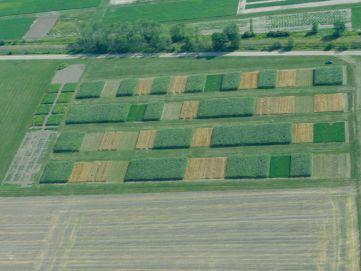
TOP: Researchers want to find out if significant yield potential is remaining untapped because of low potassium and phosphorus levels in the soil.
INSET: The aim of this long-term fertility study is to ensure phosphorus and potassium recommendations for corn, soybeans and wheat meet today’s needs.
Photos courtesy of horst B ohner.
With locally bred, high-yielding, glyphosate-tolerant and IP varieties from NK ® . Our Canadian breeders access the best soybean genetics in the world, rigorously
and technologies, including Genuity ® Roundup Ready 2 Yield ®, to develop varieties
to your farm. So the moment your Syngenta soybean seed enters the soil, you’ve set yourself up for success.
Johnson, who is the provincial cereals specialist, outlines another factor that is leading the researchers to wonder if the p and K recommendations might be out of date. “Back in the 1970s, the equilibrium soil test – the soil test value you would end up at, based on how much the crops removed versus the fertilizer recommendations we were making – would have been a soil test phosphorus of 13 parts per million (ppm) and a soil test potash of about 110 ppm,” he says. Those happen to be the breakpoint soil tests, where if your soil test phosphorus is above 13, then large phosphorus applications don’t show much [yield response]. Similarly with potassium, 110 ppm is where [the yield response to potassium applications] starts to level off.
“But if you use today’s crop yields, the equilibrium soil test is 7 ppm for p and 70 ppm for K. That’s much lower than a 13 and a 110,” adds Johnson. “Does that mean we need much higher fertilizer recommendations so we at least maintain a 13 and a 110? or are our recommendations still valid because, even at a seven for phosphorus, if I apply the right amount of phosphorus in the right placement at planting time, I can still get 240-bushel corn? We simply don’t know the answer.”
Study setup
The study involves a three-year rotation with corn, soybean and winter wheat, multiple fertilizer treatments, and at least three sites. The first corn and soybean plots were seeded in spring 2012, and the first wheat plots were seeded in fall 2012. each site will have all three crops growing every year. The three sites are at elora (with a loam soil), Bornholm (with clay loam to silty clay loam soil) and ridgetown (with a clay loam soil).
all the sites have low soil test values for p and K. Within each site, the researchers are establishing four blocks, each with a different background level of p and K. on one block, they will leave the soil at those low soil test levels. on a second block, they’ll broadcast p fertilizer over several years to build up the soil test p to an adequate level, but they won’t broadcast any K. on a third block, they’ll broadcast K to reach an adequate K level, but they won’t broadcast any p and on the fourth block, they’ll broadcast p and K to raise both to adequate levels. once the second, third and fourth blocks have the correct soil test levels, the researchers will maintain those levels. across all four blocks, the researchers are applying several starter fertilizer treatments. These treatments include liquid and dry formulations, in-furrow and two-by-two placement (two inches to the side and two inches below the seed), various rates, and various proportions of nitrogen, phosphorus and potassium.
The study design will allow the researchers to determine the best p and K fertilizer strategies for today’s crops when soil test p and K levels are deficient and when these levels are adequate.
The researchers hope to run the study for at least 10 years because it will take three or four years just to build up the soil test p and K levels to where they want them. although long-term agricultural research funding is becoming increasingly rare, grain Farmers of ontario and the oMaF and Mra – University of guelph partnership have stepped up as primary sponsors to get the project going. Johnson says, “I really thank grain Farmers of ontario for supporting this project. Long-term research, like research on crop rotations and long-term fertility studies, is a very critical part of having the right answers in the future.”
A tale of two approaches
In effect, the study is comparing two approaches to fertilizer man-
agement: the sufficiency approach, and the build-and-maintain approach.
oMaF recommendations from the 1970s are based on the sufficiency approach. This approach involves maximizing the economic return in a given year. “If I have a soil test of 6 ppm for phosphorus and if I follow those recommendations, then I apply phosphorus to the point where, when I spend $1 on phosphorus, I get at least $1.01 back. But if I spend a $1 on phosphorus and I only get $1 back, I stop applying phosphorus because that is no longer putting money in my pocket,” says Johnson. “It’s called the sufficiency approach because theoretically that is sufficient fertilizer to maximize my economic return this year.”
Bohner adds, “With the sufficiency approach, you’re not trying to take the soil nutrient levels anywhere. You’re simply applying enough nutrients to satisfy that given crop.”
as ontario growers have seen, the sufficiency approach can produce good results. However, factors such as high fertilizer costs and/or low crop prices may mean that soil test levels drop quite low before much fertilizer is recommended.
The build-and-maintain approach aims to ensure soil nutrients are at adequate levels. “In the build-and-maintain approach, when you start out with any new field, you take a soil test and determine what the nutrient levels are. Then you build the soil test levels to a place where it’s very unlikely that you would ever take a yield hit [due to low nutrient levels],” notes Bohner. “So over maybe three or five years, depending on what you can afford, you broadcast the nutrients to build up to those soil test levels. Then every year or once in the crop rotation, you re-test to see what the nutrient levels are doing. If they are going down, you put some more nutrients on to replace what is being removed by the crops.”
Based on plenty of good research data, the researchers are aiming for about 20 ppm for soil test p and about 120 ppm for soil test K as the adequate levels in the study’s build-and-maintain plots. Johnson explains, “Based on the science, if you have 13 ppm for p and 110 ppm for K, you should be in pretty good shape. But there’s always soil variability across a field. So, if the average phosphorus level for the field is about 20 ppm, then likely everywhere in the field will be at or above 13 ppm.”
opinions differ somewhat on what the exact numbers for soil test p and K should be, and the researchers might decide to aim for slightly different numbers during the course of this study. “With a lot of these soils, there are unavailable forms of especially phosphorus but also somewhat with potassium, which will eventually become available. So it’s a little difficult to predict exactly what the right soil test levels are,” says Bohner.
Results so far
obviously it’s very early in the study to start drawing conclusions, especially since the researchers are still in the process of building up the soil test p and K levels for the build-and-maintain plots. However, there are some interesting preliminary results.
For the 2012 corn and soybean plots, the highest yields tended to be where both a starter fertilizer and broadcast p plus K were applied. The starter fertilizers tended to produce larger yield responses than the broadcast fertilizers.
“For soybeans, I think the way this is going to shake out is that potassium will be the main driver in terms of an economic response,
THEY HAVE ARRIVED
Introducing the all-new and innovative Pioneer side-by-side lineup from Honda. The Pioneer 700 carries two people, and the Pioneer 700-4 features the Industry’s first convertible seating designed for two, three or four. Learn more about Pioneer and the full lineup of accessories at honda.ca
*Pioneer 700-4 shown with accessories.
R EV i Si Ng N g U idE li NES f OR wh EAT
The latest results from multi-year trials that involve fall and spring applications.
by Treena Hein
It’s high time that nitrogen recommendations were updated for wheat, as the current suggested rates are based on research conducted 20 years ago. So says cereal specialist peter Johnson with the ontario Ministry of agriculture and Food.
“What’s currently recommended may not be sufficient because so much has changed over the last two decades,” notes Johnson. “Yield potential has increased significantly since then through changes in production practices, including better genetics, fungicides and growth regulators.”
For the past three years, Johnson has been leading a study to evaluate the Maximum economic rate of nitrogen (Mer-n) under current crop management regimes. The research team involves summer assistants; technician Shane McClure of the Middlesex Soil and Crop Improvement association; statistician Ken Janovicek; and University of guelph researchers Dr. David Hooker, Scott Jay and gerald Backx. Financial support is being provided by agriculture and agri-Food Canada, with assistance from the grain Farmers of ontario, ontario Soil and Crop
Improvement association and industry. as part of the study, the research team applied multiple rates of nitrogen (n) to generate n response curves and determine Mer-n. “additional treatments were included at selected sites to evaluate the impact of fall nitrogen on wheat yield and economic return,” says Johnson. “Measurements done at harvest included yield, moisture, test weight, 1,000 kernel weight and protein. We also conducted post-harvest soil nitrate tests to determine if higher n rates increased fall residual soil-n.” Johnson notes that this could have been an environmental concern had residual nitrogen increased significantly.
as expected, yields increased dramatically with the addition of n. “There was a whopping 23-bushel gain from 0 n to 60 n,” Johnson says. “additional n continued to increase yield.” There was a 6.7 bushel per acre (bu/ac) gain from 60 n to 90 n, a 6.1 bu/
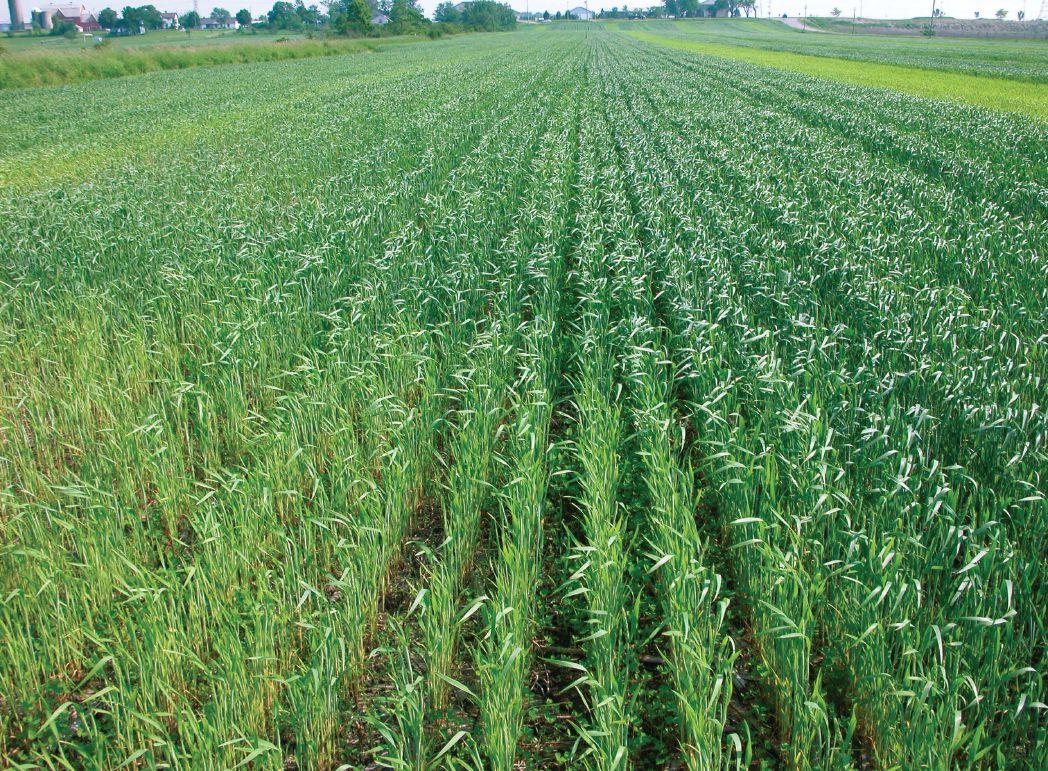
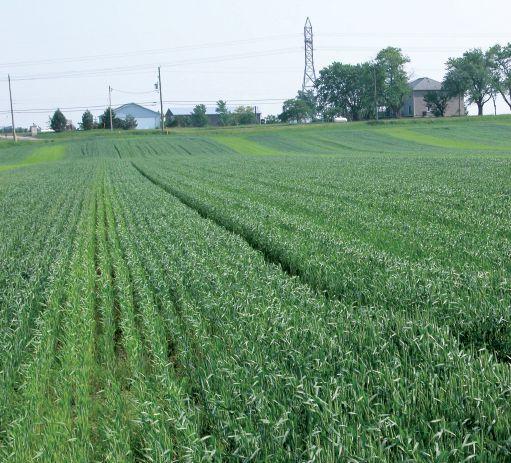
ABOVE: Fields from a multi-year study evaluating the ‘Maximum Economic Rate of Nitrogen’ (MER-N) under current crop management regimes, spearheaded by OMAF’s cereal specialist Peter Johnson.
Additional treatments were included at selected sites to evaluate the impact of fall nitrogen on wheat yield and economic return. Measurements done at harvest included yield, moisture, test weight, 1,000 kernel weight and protein.
ac from 90 n to 120 n, and an average 2.7 bu/ac was gained from 120 n to 150 n. “Further analysis reveals that only four of 26 sites reached Mer-n at 90 n, and surprisingly, over 60 per cent of the sites had Mer-n of 150 n or greater.”
In terms of economics, Johnson and his team found that using urea at $600/tonne ($0.59/pound of actual n), with soft red wheat at $6.34/bushel means that 2.8 bushels of wheat are required to cover the cost of 30 units of n ($0.59/lb X 30 lb = $17.75/$6.34/bushel = 2.8 bushels). “at these values there is a clear financial return, on average, up to 120 n, with 150 n breaking even,” he notes. “We found that 10 of the 26 sites had a significant financial gain at 150 n. Five other locations showed a slight financial gain to 150 n but the additional returns were not significant (less than $7 per acre).”
only five sites had a maximum economic nitrogen rate below 120 n. “It is an interesting point that of these five sites, four of them did not receive any fungicides,” Johnson explains. “The sites without any fungicide actually reached a maximum yield with 120 n and only saw a slight economic return with adding more than 90 n.” However, the sites with fungicide tell a completely different story. at these sites, there was a substantial yield increase of 7.1 bushels between 90 and 120 n. This supports other recent research results showing an interaction between nitrogen and fungicides, Johnson says. an additional 4.1 bushels was gained by increasing to 150 n
Four of the six sites without fungicide reached Mer-n at 90 n. The other two sites achieved Mer-n at 120 n. “only one of the 20 sites with fungicide required less than 120 n to reach Mer-n,” says Johnson. “This site had biosolids applied, reached a maximum yield at 60 n, and Mer-n was 0. Clearly the biosolids supplied sufficient n.” This site showed a potential negative impact of excess n, and lodging in the 150 n strips resulted in a loss of 6.2 bu/ac.
Fall versus spring, protein levels and more Fall-applied n had no significant impact on yield, moisture, test weight, 1,000 kernel weight or protein. “There was a 2.6 bu/ac advantage from 30 n in the fall with 90 n in the spring, versus 90 n spring only,” explains Johnson. “However, when the full
120 n is spring applied, there is a 6.8 bu/ac gain over 90 n only. “Calculating this, it quickly becomes apparent that fall n does not pay.” even less gain was seen with the 30+120 n treatment. Johnson said these results, added to the fact that fall nitrogen applications are a potential environmental concern, indicate that no one should apply fall n
With an increase in n rates, protein levels in the grain rose as well. “There were no differences in protein levels between 0 and 60 n, as yield increases were so large that all additional n went to yield, rather than protein,” notes Johnson. “as n rates were increased further, protein levels consistently increased by 0.4 per cent for every additional 30 units of n.” protein levels increased by 1.2 per cent from 60 to 150 n. The impact of this increase depends on the market being targeted, Johnson explains. He says some domestic users prefer low protein soft wheat, while other markets and export buyers prefer high protein. In general, increased protein levels would fit the majority of market opportunities somewhat better, but there’s no price premium associated with higher protein.
“overall, these results show that there’s a great opportunity to increase wheat yields with additional n,” Johnson says. “The data also confirms other results indicating an interaction between n and fungicides. If no fungicide is applied, responses to additional n are minimal and fit the older n rate recommendations very well. If fungicides are applied, responses to n become much more significant, and new n recommendations are in order.”
While lodging has long been thought to be a major issue at high n rates, these studies don’t show it as a problem. “We warn growers, however, to proceed with caution as they increase n rates,” Johnson says. “Where lodging has not been an issue in the past several years, it’s important that growers place two test strips of an additional 30 lb n/ac to see if these results are repeated on their farm.”
The team applied multiple rates to generate nitrogen response curves and determine MER-N.
It’s timetotellthe realstory
Never has Canadian agriculture mattered more to Canada and the world Ours is a modern and vibrant industry, a leading employer in our country and a major driver of our economy The Canadian agri-food industry provides safe, high-quality food to millions – at home and around the world Yet despite all this, we’re often misunderstood.
Research shows that while Canadians see agriculture as an essential industry, many don’t see it as progressive or vibrant To reach our full potential, we need to clear up the misunderstandings – to enhance consumer trust, attract more capital,
accelerate innovation and grow our talent pool
Canadians need to hear more positive talk about agriculture Industry players deserve to blow their own horns a little, to say out loud that they’re proud of what they do. To celebrate their successes. That’s the story of agriculture that needs to be told – today, more than ever
It has to start with each of us Be an agvocate and join the conversation at AgMoreThanEver ca
It’s time to tell the real story
35 Almost 1 in 8 Canadian ag and agri-food jobs are in of corn today than to grow an acre 1990
25,000
50,000 fewer gallons of water It takes in farm operators are under the age of
#1 canola producer of in the WORLD
25 billion contributes almost to the Canadian economy BEEF The INDUSTRY annually $
5-part magnet $1 (5" x 7") get
Ball cap $10
When
T-shirt $5
Wear
Be an AGvocate
Speak up, speak positively
Those of us involved in agriculture love what we do and we want the best for our industry We know why agriculture is important to Canada and the world, and that it provides a lifestyle that can’t be beat But we tend to be a humble group, so others may not hear this message
We need to remember: image matters What we say about agriculture influences how people view our industry Share your passion and optimism for agriculture and let it shine through everything you say and do – being an agvocate is that easy Agvocates look for opportunities to talk about what’s going well in agriculture They fill in information gaps, help dispel myths and learn more about the industry Image is critical to our future, and fortunately we have a very positive story that we can tell So let’s tell it
• Get young people excited There are jobs –great jobs There’s farming of course, but many more options from science and sales to processing and manufacturing
• Speak positively. Investment tends to flow to progressive industries that have a promising future
• Inform consumers we’re capable business managers and stewards of the land, driven to produce safe, high-quality food using sustainable methods
Our image matters – in fact, it has never mattered more Tell the world why you love agriculture and what the industry means to you. We’re counting on you to tell the real, positive story of Canadian agriculture
Speak up. Speak positively.
Our industry needs more agvocates
To reach its full potential, agriculture needs everyone in the industry to speak up and speak positively
Agriculture More Than Ever is an industry-driven cause to improve perceptions and create positive dialogue about Canadian ag Together we can share the facts and stories about this vibrant and modern industry, and tell the world why we love what we do
It’s up to all of us to be agvocates and it’s easier than you think –visit AgMoreThanEver.ca and find out how you can get involved.
lESS f ERT iliz ER ,
B igg ER yi E ld S
Long-term studies show wheat gives a real boost to corn-soybean rotations.
by Carolyn King
Adding winter wheat to your corn-soybean rotation increases corn and soybean yields and reduces reliance on fertilizer nitrogen. Those benefits are thanks mostly to improved soil quality that develops in rotations with wheat.
These advantages are clearly demonstrated in the findings from long-term crop rotations at elora and ridgetown. The two studies have somewhat different research designs, but the value of rotations that include wheat is clear.
Dr. Bill Deen from the University of guelph is leading the rotational study at elora. established in 1980 on silt-loam soil, this study includes eight rotations: continuous corn (CCCC); continuous alfalfa (aaaa); corn-corn-alfalfa-alfalfa (CCaa); corn-cornsoybean-soybean (CCSS); corn-corn-soybean-wheat (CCSW); corn-corn-soybean-wheat underseeded to red clover (CCSWrc); corn-corn-oats-barley (CCoB); and corn-corn-oats underseeded to red clover-barley underseeded to red clover (CCorcBrc). all of
these rotations include two tillage treatments: no till and conventional till.
Dr. Dave Hooker, from the University of guelph’s ridgetown Campus, is leading the ridgetown study, which was started in 1995 by Doug Young of ridgetown Campus. This site has a clay-loam soil. Its rotations include continuous corn (CC), corn-soybean (CS), continuous soybean (SS), soybean-wheat (SW), corn-soybean-wheat (CSW), and corn-soybean-wheat underseeded to red clover (CSWrc). The underseeded treatments are a recent addition for which there are three years of data. For each rotation, there are
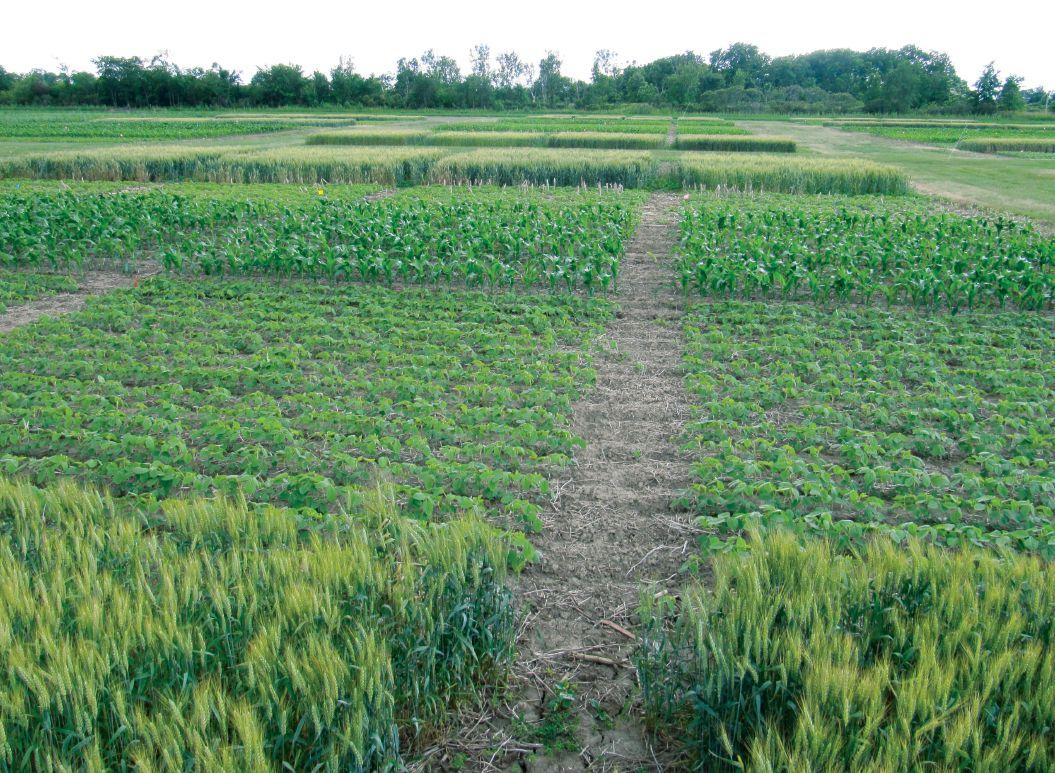
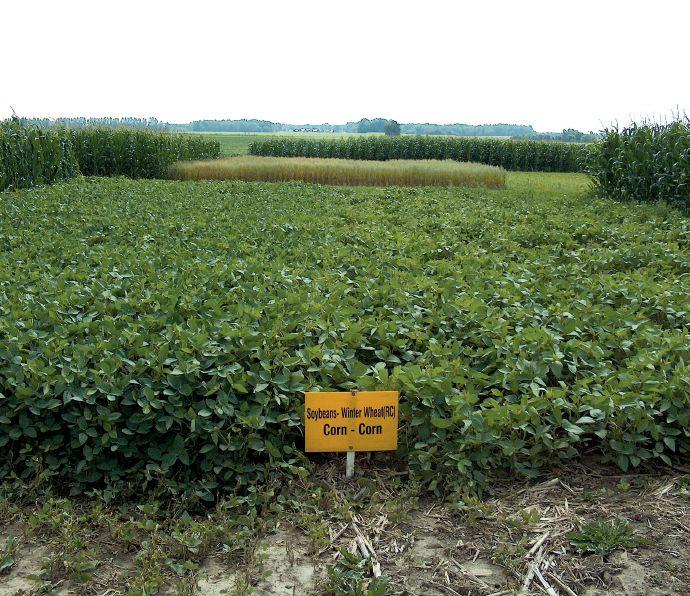
TOP: In the Ridgetown crop rotation study, when wheat was added to a corn-soybean rotation, corn yields were higher and required less fertilizer nitrogen.
INSET: At Elora, when wheat or wheat plus red clover was added to a rotation with corn and soybeans, the yields of corn and soybeans increased, even though the nitrogen rate was kept the same.
We hate to lose. That’s why we continually research and test our products in thousands of local trials. This effort ensures that only our topperforming products ever make it onto our line-up and into your fields. To some, this may seem like overkill.
But we can’t help it. After all, proven performance is just one of the reasons why Pioneer® brand seed is planted on twice as many corn and soybean acres as any other brand in Canada. Talk to your local Pioneer sales rep or visit pioneer.com for more information.
two tillage systems: 1) no-till for soybean and wheat, and fall strip till for corn; and 2) a conventional till treatment.
In the elora study, all the rotations use the same nitrogen (n) rate. The rate is intended to be non-limiting, so it’s typically about 150 kilograms of nitrogen per hectare, applied as a side-dress.
“at elora we’ve found that when we have wheat, or wheat plus red clover, or alfalfa in a rotation – essentially when we make the rotation more complex –our yield potential for corn increases. So we get higher corn yields with the same nitrogen rate when we have a more diverse rotation,” explains Deen.
In the ridgetown study, the corn plots include four nitrogen treatments: 0, 60, 120, and 180 kg/ha of applied nitrogen. So Hooker can calculate the optimum economic rates of nitrogen for corn yields in the different rotations.
Based on the three years of data, wheat or wheat underseeded to red clover has a strong yield benefit for corn. The CSWrc corn yields were about 10 bu/ac higher than corn yields in the CSW rotation, and about 30 bu/ac higher than the corn yields in the CS rotation. Soybean yields were consistently 4 to 6 bu/ac higher in a CSW rotation compared to those in a CS rotation.
Those higher corn yields in the CSW
and CSWrc rotations required less applied nitrogen.
For the ridgetown data averaged over the three years and across the tillage treatments, the optimum economic rates for nitrogen fertilizer on corn were as follows: 110 kg n/ha for CSWrc; 130 kg n/ha for CSW; and 155 kg n/ha for CS. and for CC, the optimum nitrogen rate was higher than 180 kg/ha, the maximum nitrogen rate used in the study.
So, to maximize corn yields in the CC or CS rotations, you have to apply quite a bit more nitrogen than you do in the CSW and CSWrc rotations.
another interesting aspect of the ridgetown fertilizer data is the corn yield with no applied nitrogen. “In the corn-soybean rotation, when we apply no nitrogen, our five-year average corn yield is 95 bu/ ac. But in the corn-soybean-wheat rotation with no nitrogen applied, our corn yield is 135 bu/ac. So there’s a 40-bushel yield difference due to rotation alone,” says Hooker. “and it is all credited to the better soil structure that wheat produces in the rotation.”
Better soil, better yields, better nitrogen use
“There is evidence in the literature in general that rotation complexity is associated with higher yields and with better
soil quality. We see that at the elora trial,” notes Deen.
“our continuous corn and corn-soybean rotations tend to be associated with poorer soil structure and poorer average corn yields… The corn-corn-soybeansoybean rotation is the treatment with the poorest soil structure by a number of measures, the lowest soil organic matter and the lowest corn yields.”
The CCSS rotation has the poorest soil structure because soybeans produce the lowest amounts of organic matter of all the crops grown at elora. “It’s the addition of organic matter that determines the soil structural properties that we desire,” Deen emphasizes.
a higher soil organic matter content promotes the formation of small, stable soil aggregates, contributing to a welldrained, porous soil with good moistureholding capacity. also, this improved soil structure makes it easier for roots to move through the soil to access water and nutrients, including nitrogen. These conditions all help the crop plants to be healthier, less stressed and more productive.
The elora data demonstrate that the highest organic matter levels tend to be associated with the more complex rotations. one reason for that is the wheat in some of these more complex rotations. Wheat’s fibrous root system contributes a substantial amount of organic matter to the soil. In addition, having winter wheat in the rotation allows growers to underseed red clover. red clover is a great source of organic matter for the soil. It’s also efficient at fixing nitrogen, providing about 45 to 82 kg/ha of nitrogen as a plowdown crop, depending on conditions.
“probably more importantly, if you have wheat or wheat with red clover in the rotation, it elevates the productivity of all the other crops in the rotation, which also adds organic matter. So the whole rotation becomes more productive in terms of organic matter returns to the system,” says Deen.
Similarly, in the ridgetown study, the CS rotation has the lowest soil organic matter and the poorest soil structure, while the rotations that include wheat have much better soil quality characteristics.
“In the corn-soybean-wheat system, the soil has a higher proportion of finer, more stable aggregates, producing a better structured soil with higher amounts of organic matter, compared to rotations without wheat. Wheat has a deep, fibrous root
The Elora long-term crop rotation study demonstrated that adding wheat or wheat with red clover to the rotation increased the productivity of all the other crops in the rotation.
Photo courtesy of Bill Deen.
system which helps build soil structure compared to soils where wheat is not grown, such as a corn-soybean rotation,” explains Hooker.
This improved soil structure increases the corn and soybean yields in the CSW rotation. as well, it makes the corn in this rotation less reliant on nitrogen fertilizer. With better soil structure, the corn develops a better root system that is better able to seek out nutrients already in the soil, and the improved soil moisture and aeration conditions make for a healthier plant able to take better advantage of the available nitrogen.
“The soil structure is so much better that the crop doesn’t need as much nitrogen fertilizer to produce high yields,” says Hooker.
The elora data also show that other diverse rotations also provide similar types of benefits. For example, replacing the two years of soybean in the CCSS rotation with oats and barley, for the CCoB and CCorcBrc rotations, resulted in a very good boost to corn yields.
Deen also points out that the improved soil structure helps to increase corn yields in dry years and wet years. “In a droughty year, a soil with good soil structure holds more water. In addition, the corn plant’s root exploration of the soil is better, so the plant can access more water. as a result corn yields will be better.”
In a year with above-average rainfall, a soil with poor structure is more likely to become saturated, which can reduce crop health, performance and yields. as well, nitrogen is lost more readily from a saturated soil. “So if you have a good rotation, you’ll have good soil structure, your crop will be happier, and you’ll lose less nitrogen out of that system,” says Deen.
Credit wheat for yield boosts
Hooker emphasizes that growers should give credit where credit is due when it comes to wheat in the rotation. “a lot of growers look at corn, soybean and wheat crops individually, as if they are not influenced by one another. But the increased corn and soybean yields [in the corn-soybean-wheat rotation] should be credited to the wheat enterprise. We’re encouraging growers to use that approach to make decisions on whether to grow wheat or not,” says Hooker.
Similarly, when you’re deciding whether to include red clover, he recommends including the extra yield benefit – as well as the nitrogen credit – that red clover provides. Hooker notes, “In the [ontario Ministry of agriculture and Food] agronomy guide, the nitrogen credit with a good crop of red clover is around 80 kg/ha. although there is no corn yield increase for red clover included in the agronomy guide, our data show quite consistently a 10-bu/ac increase when red clover is included.”
He adds, “The economics are really in favour of wheat because without wheat in the rotation we couldn’t underseed to red clover.
So the whole system relies heavily on wheat in the rotation.”
overall, a more diverse rotation that includes crops like wheat with deep, fibrous root systems will promote better soil quality, which contributes to higher yields of both corn and soybean, with less reliance on fertilizer nitrogen.
For more on fertility and nutrients, visit the agronomy section of www.topcropmanager.com.
Optimize
To find out more about how to implement a successful weed management strategy for your farm visit www.rrwms.ca.
The solution takes all of us.
iM pROV i Ng dRy
BEAN VAR i ET i ES
AAFC and University of Guelph join forces in bean breeding program.
by rebeca Kuropatwa
Agriculture and agri-Food Canada (aaFC) and the University of guelph continue to collaborate to develop high-quality, high-yielding and disease-resistant cultivars of dry beans.
The aaFC/University of guelph Bean Breeding program was established in 2008 with the merging of the two pre-existing breeding programs, with southwestern ontario as the target area. Dr. ali navabi, research scientist with aaFC’s greenhouse and processing Crops research Centre, has been leading the program while working for aaFC as a dry bean breeder.
The breeding program’s objectives are defined by the program, based on the needs of the industry. It has various stakeholders – from growers and seed companies to processors, consumers and buyers – in the value chain who express what they are looking for in the variety.
“There are some agronomic traits we know growers are very interested in, like varieties with high yield, reasonable maturity time, and really good canopy architecture, so they can harvest the beans directly,” says navabi. processors and consumers look for different traits, so the program looks at different parts of the value chain.
The ultimate goal, navabi says, is having a variety with as many of those desired traits as possible. These traits can include anything from agronomics (i.e., high yield, maturity and canopy architecture) to resistance to diseases and pests (tolerance/resistance to common bacterial blight, anthracnose, white mould, root rot and soybean cyst nematode, for example) and nitrogen use efficiency
and fixation (with varieties being as independent as possible of fertilizers). end user traits, such as cooking, canning and composition, are also considered.
In the program, beans are grown on thousands of plots annually. “It’s a wide genetic diversity that creates true crossing,” explains
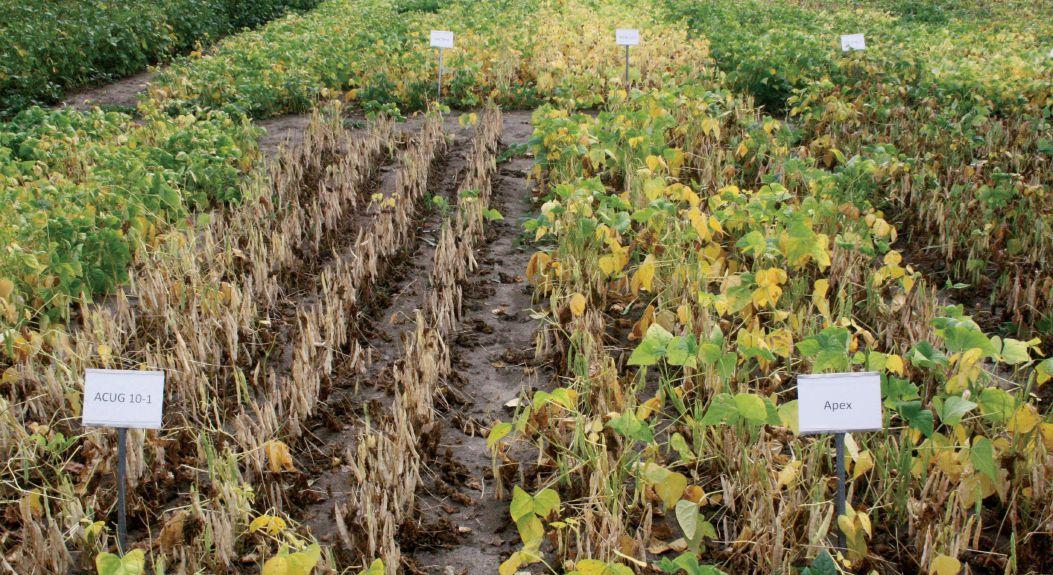
TOP: Apex, on the right, is a full season, high-yielding variety with CBB resistance. ACUG 10-1 (a.k.a. “Bolt”), on the left, carries high levels of resistance to Race 73 of anthracnose, but does not show resistance to common bacterial blight.
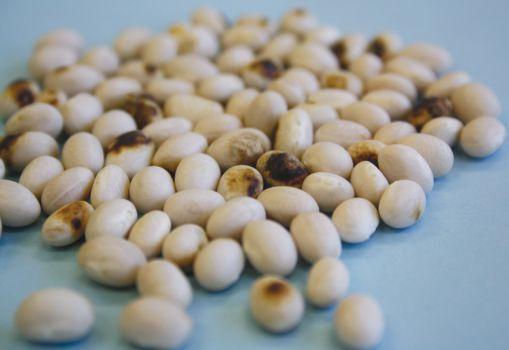
MIDDLE: Anthracnose-infected seeds of susceptible navy beans.
Photos courtesy of Dr. a li
navabi. “over the years, we make selections after selections and improve the breeding population, from which we extract new varieties.
“We also test the beans in the field and greenhouse with a technique based on Dna (i.e., genetic/molecular) markers, which predicts the presence of certain genes we’re interested in.”
each year, navabi and the team select between 10 and 12 varieties for registration trials. once the varieties are registered, a commercialization committee offers them for commercialization to bean growers or seed companies.
When it comes to the desired traits, navabi says, the biotics stand out as a moving target because they keep evolving, as in the case of anthracnose and common bacterial blight – major diseases that attack bean crops in ontario – reducing yield and quality. according to navabi, the technique of targeting common blight resistance began in the 1980s. “It’s very common in the new navy bean varieties now to have resistant to common bacterial blight, but in other classes, we still have a ways to go,” he says.
Common bacterial blight resistance became available first in oaX rex, released by the University of guelph back in 2000. This was followed by a second variety, rexeter, in 2007-08.
new varieties were released last year, including Mist, a highyielding variety with high levels of nitrogen fixation (another program objective) and resistance to common bacterial blight, and apex, another high-yielding, high-quality bean with resistance to common bacterial blight.
In 2003, a new race of anthracnose, race 73, cropped up in ontario – a race nearly all navy beans were susceptible to.
“Three years ago, a new research project was initiated on anthracnose, including screening a wide array of bean varieties for resistance to anthracnose, identifying sources of resistance existing in our material and then advancing our breeding program and developing navy beans resistant to the prevalent race of anthracnose,” says navabi.
Since 2008, navabi and his team have been screening materials for resistance to race 73. In 2012, they released a variety, known as Bolt, which carries high levels of resistance to race 73 of anthracnose but does not show resistance to common bacterial blight.
“our challenge now is combining these two disease resistances in the same variety,” says navabi. “We want a variety that carries resistance to not only common bacterial blight but also to anthracnose, as well as to bean common mosaic virus (i.e., multiple diseases resistance).”
In the ontario registration system, navabi and team now have a candidate to be registered as a variety that is resistant to all three of these diseases. “We’re hoping to release it in the near future,” he says. “It has very high yield and high canning quality. This variety has a code name for now and will get a name once it’s registered.”
other varieties released by the program include Yeti, a white kidney bean, Dynasty, a high-yielding, dark red kidney bean, and Infernal, a light red kidney bean.
In the kidney bean market class, resistance to common bacterial blight is not common.
“our program has a new line we have in the registration system, which is a dark red kidney bean with moderate resistance to common bacterial blight,” says navabi.
The program has also begun incorporating other genes of resistance to anthracnose, which is expected to result in more durable resistance to the disease.
ontario beans have seen a 63 per cent yield increase since 1910, due to improved agronomic practices and varieties.
rather than phosphorus,” says Bohner. “The other thing on the soybean front is that it seems, if your soil test is low, it doesn’t make much difference to soybean yields whether you broadcast the nutrients or apply them through the planter in a 2x2 band.
“For corn, phosphorus and potash are important. also, applying p and K in a starter band is more important for corn than soybeans,” he adds.
The winter wheat plots are also generating some “cool results” in 2013, says Johnson. “I don’t have everything summarized, but it was pretty clear at the elora site that on the plots where we shorted the wheat crop for potash, it had a significant
impact on ‘crinkling down,’ or stem breakage after maturity, but not much impact on yield. I’m not sure that will carry through [the rest of the study], but it’s one of the things that is really intriguing.”
For now, Bohner advises growers: “Be sure to soil test on a regular basis, and check if the levels of phosphorus and potassium are slipping. Those are the big soil test results to watch in terms of yield impact, especially potassium for soybeans. I think we are leaving significant yield potential untapped in ontario because we’re not applying enough potassium. That is really the overall message so far.”
SpREA di Ng
T
h E ’ NET
Using online tools to your advantage.
by Treena Hein
The Internet is an incredibly powerful tool for accomplishing all kinds of tasks, not least among them accessing information from websites that lets you do a better job at farming. Social media tools such as Twitter, Facebook and blogs (along with long-established tools such as e-mail) also are now commonly used to find and share answers, access grain prices, and conduct direct marketing – but also to do less obvious things like alert other growers in the area about a pest outbreak, or even notify neighbours ahead of time about spraying.
Dr. ataharul Chowdhury has found that Twitter and Facebook are the most used social media tools/platforms in Canada’s agriculture industry after looking at more than 300 cases. “YouTube and blogs are the next most-used tools,” notes the federally funded post-doctoral research fellow in the University of guelph’s School of environmental Design and rural Development. “The use of social media tools has increased dramatically in the last year or two,” he notes.
Chowdhury says Twitter and Facebook are mostly used by farmers to receive disseminated information. He’s gearing up this year to study Web 2.0 platforms and tools (such as Internet forums, but also things like Twitter) where dialogue and interaction between farmers and other ag-sector players is the focus (Web 2.0 is a term used to describe websites that use more advanced technology, allowing users to interact with one another). Where magazines, association newsletters and blast e-mails are one-way information dumps, tools like forums and Twitter go beyond, to information sharing.
“It’s clear that Web 2.0 tools offer a chance to participate in collective learning environments and to add to the knowledge base out there, but we’d like to know if the entire community – agri-food producers, rural entrepreneurs, scientists, volunteers
ABOVE: The University of Guelph’s Dr. Ataharul Chowdhury has found that the use of social media in agriculture has increased over the last few years, with Facebook and Twitter the most used platforms.
Photo courtesy of the u niversity of Guel
and public servants – are interacting more effectively than they did before ‘Web 2.0’ was created.” Chowdhury says. The intent of his research is to look at how conventional information flows, such as live presentations at field days, are being reinvented to go further – to help connect people who are interested in the topic partake in additional discussion or build on the knowledge given during the presentation to solve real problems on the ground.
Survey says . . .
The ontario Ministry of agriculture and Food (oMaF) conducted an online survey in early 2012 regarding usage of web browsing and social media tools and the attitudes of those in the ag sector towards them. a total of 439 individuals responded, including farmers, farm employees, agri-students and agri-business personnel. The survey revealed that the vast majority (84 per cent) of those who took part had used social media in the past year, and 73 per cent of the survey participants found social networking sites important to their work.
Similarly to Chowdhury’s studies, the survey found that “Twitter was the most commonly used social media application for agriculture-related purposes, such as the sharing and capturing of knowledge and information, professional networking and marketing.” However, oMaF states, “Facebook was one of the least-used applications for agriculture-related purposes, but the most used for personal networking amongst the survey respondents.”
There is business potential in this fact, however: almost 90 per cent of social media users indicated they would be “more likely to buy/use specific agri-product/service after a positive (personal) review on social media.”
Chowdhury agrees there is potential here (and acknowledges that a few oMaF initiatives now encourage ag producers to harness social media for market opportunities), but makes a critical judgment about actual benefit. We need to explore the role of social media in building trusting relationships, he says, and look at how it can reduce multiple layers of bureaucracy so that problems can be solved and “hands-on” benefits can be realized.
Challenges to use
“Social media is still in an early, exploratory phase,” Chowdhury explains. “There are relatively modest opportunities for use right now.” Some of the oMaF survey respondents agree, pointing to a
lack of agriculture-specific smartphone apps. Chowdhury has been able to catalogue only a few apps available to the Canadian ag and rural communities, and these are most often associated with marketing. For example, in the Caledon/Dufferin County area (known as the Headwaters region), there is a project looking at how mobile apps can help support tourists who visit for recreational activities and special occasions, such as the 2015 panam games.
More important than the lack of apps, say the oMaF survey results, is the lack of social media use by those in government departments. The survey report suggests oMaF and service agencies should develop a policy to adopt social media as a communication strategy. Chowdhury agrees with this action, but further stresses the importance of moving beyond information dissemination to action.
In addition to limited social media opportunities, there are also important limitations to the fuller use of the available tools. Chowdhury notes limitations such as conflicting perceptions among users about the way a tool can be used, various perceived risks in employing a tool, and concerns over how using a given tool might affect a person’s credibility. The tools also have to appear to worth a person’s time and energy. “There is a lack of individual-organizational-system level confidence for using and developing appropriate social media applications,” Chowdhury concludes. people need to feel secure and confident about the use of tools, or they will avoid their use.
When asked how organizations such as ontario Federation of agriculture or oMaF could remove limitations to greater social media use (beyond making social media tools part of their official communication strategy), Chowdhury puts the focus on intention. “Making sure that an organization disseminates information, but then engages the users in commenting on this information, is essential for mobilizing knowledge,” he notes. It can be as simple as offering staff or clients a prize for the best comment, similar to “the letter of the day” used by some CBC radio programs. Moving forward, Chowdhury says, organizations also must be ready to receive and act on feedback relating to social media strategies, not all of which might be positive.
For more marketing tips, visit the business and policy section of www.topcropmanager.com.
Senior exeCutive finanCial ConSultant inveStorS GrouP finanCial ServiCeS inC. | Paul r vaillanCourt CfP, Clu, CHS, CPCa
R ET i REMENT pl ANN i Ng
You are operating a successful farm, yet you deserve to enjoy retirement. perhaps you’re uncertain how to remove yourself from the operation and ensure that it remains viable. What are your options if another family member takes over or if you sell to someone else?
It is never too early to plan for your retirement and make decisions about the future of your farm. good retirement planning requires lead time to allow for plenty of discussions with your spouse and family, to seek the advice of professionals and to evaluate all of your options.
The first step in your retirement planning is to think about your goals. This might sound easy, but it is quite challenging and it can take some time to get it right. Your farm is most likely the greatest asset that you own. ensure you make the right decisions for you and your family and that you’ll be comfortable in retirement.
Transferring ownership to the next generation
If you’re thinking about keeping the farm as a family farm, you need to decide how to transfer the ownership to your child or children. In many cases, not all of the children have an interest in the farming operations and you will want to determine how to be fair to everyone concerned.
as a certified financial planner, I often sound out strategies with clients to help them realize that what is considered fair and equitable may not necessarily be equal. There is a significant difference, but it does come down to your goals and retirement needs.
• How important is it that the farm remains intact and transferred to the farming child or children?
• What is the standard of living and potential of the non-farming children?
• What is the fair market value of the farm assets, the farm debts and the non-farm assets taking into account the effects of taxation?
• What contribution has the farming child (or children) made relative to the actual remuneration and other benefits he/she has received?
• What cash flow is available from the farm that can help to equalize the distribution?
• What are the financial resources of the farming children to assist in funding the fair and equitable distribution to the non-farming children?
• How will you finance the transition, ensuring that you have sufficient funds in your retirement and that the farming child is not overburdened with excessive debt?
• If there is more than one child interested in farming, how do you ensure that all parties continue to collaborate by using a buy-sell agreement?
once these questions are answered, a farm transfer plan can be
put in place with the right purchase option that will give you financial security during retirement, provide the farming children with the assurances that they will acquire the farm and maintain harmony with the non-farming children by providing for them in a fair manner. Your plan should consider tax implications, fair financial compensation to farming/non-farming children and the funding of a portion of that compensation, if possible, through life insurance.
Selling to a third party
If none of the children has shown an interest in acquiring the family farm, the only option available is to sell the farm to a third party and use the after-tax proceeds to fund your retirement. at first glance, this succession plan may seem easy, but it has its own set of issues.
Before you consider this option, you will want to do your homework and make sure that you have the right business structure in place to maximize your capital gains exemptions and pay the least amount of tax possible.
as you are nearing your retirement, you need to find the right buyer. Your candidate may be an employee within your operations who has expressed their intentions, or a contact through your network. Depending on your farm structure, you will either be selling the inventory or selling the shares and quota. as a sole proprietor, the sale of your farm is included as personal income. If you’re incorporated, selling the shares or qualified farm property might be preferable for tax reasons. Taking advantage of the $750,000 capital gains exemption is possible but requires forethought to ensure that you comply with the tax rules. Furthermore, if there are exemptions available to parents and children, then the tax liability can be reduced further.
Your ideal retirement plan is a process that will take time and it is certainly not a one-time event. Careful consideration is necessary, as you will want to balance the family’s wishes while choosing the option that gives you financial stability and security in your retirement. review your plan annually to ensure that you’re on track and make any adjustments as situations arise. as your full retirement plan will include estate and tax planning, you should obtain professional advice from your financial planner, tax specialist/accountant and lawyer.
Insurance products and services distributed through I.G. Insurance Services Inc. Insurance license sponsored by The Great-West Life Assurance Company. This is a general source of information only. It is not intended to provide personalized tax, legal or investment advice, and is not intended as a solicitation to purchase securities. Paul Vaillancourt is solely responsible for its content. For more information on this topic or any other financial matter, please contact an Investors Group Consultant.
Introducing the new Case IH 5-series Early Riser® planters. Often imitated, our Early Riser planter has gone beyond picket fence stands to deliver yield impacting photocopy plants. That’s because instead of introducing fancy gadgets, we focused on what matters most: Your land. Specifically, how the right agronomic design at planting can make a difference at harvest. From good soil-to-seed contact and proper depth, to accurate spacing and uniform soil pressure, our planters are engineered with just one thing in mind — higher yield. Now that’s something that can’t be duplicated. Learn more about Early Riser planters by visiting your Case IH dealer or go to www.caseih.com/earlyriser5tcme1113
Vibrant plants collect more sunshine.
Crops thrive with Cruiser Maxx® Vibrance®. When the Vigor Trigger ® effect meets Rooting Power ™, you get enhanced crop establishment from stronger, faster-growing plants, above and below the ground. It also protects your soybeans against a broad range of insects and diseases and delivers best-in-class Rhizoctonia control.