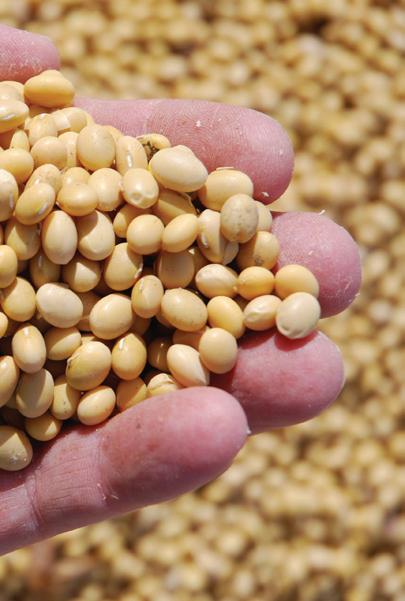
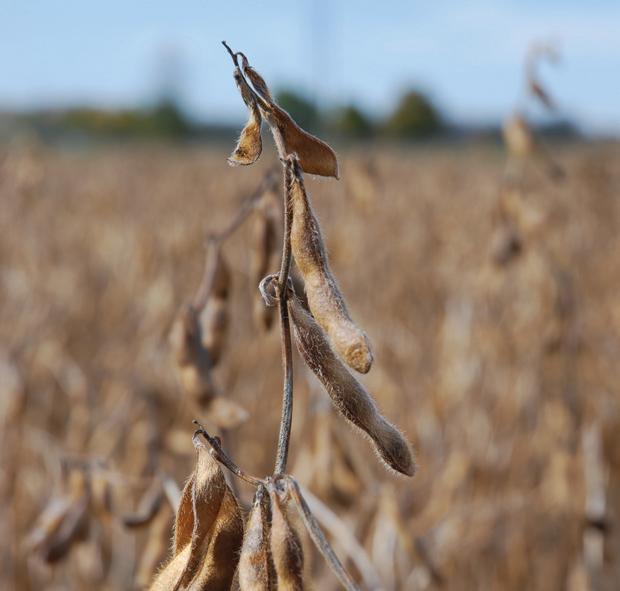
BioStacked ® with multiple biologicals to stimulate greater growth and nodule development.
Designed for performance in Canadian growing conditions, combines specially selected rhizobial strains that fix nitrogen
Bacillus subtilis – the organism behind Nodulating Trigger for greater nodule biomass, faster canopy closure and higher
It’s the soundest investment you’ll make all Ask your local dealer for HiStick ® N/T Inoculant soybeans – and watch your returns stack up.
inoculant greater root conditions, HiStick® N/T nitrogen and ™ technology –higher yield. season. Inoculant for up.
Which one is glyphosate-tolerant?
They both are. You’ve known one for over nine years. Now let us introduce you to the other. Discover a new choice in GT (glyphosate-tolerant) corn from NK.® Get the results you need plus the protection you want against pests with more traits like Corn Borer, LibertyLink,® Rootworm, and Triple and Quad stacks. For more information contact your NK dealer, call 1-800-756-SEED or visit nkcanada.com today. The results you need. The freedom to choose.
Kevin Yaworsky • 403.304.9822 kyaworsky@annexweb.com
CONTRIBUTORS
Blair Andrews
Treena Hein
ASSOCIATE PUBLISHER
Kelly Dundas • 519.280.5534 kdundas@annexweb.com
SALES ASSISTANT
Barbara Comer • 519.429.5176 bcomer@annexweb.com
PRODUCTION ARTIST
Gerry Wiebe gwiebe@annexweb.com
VP PUBLISHING
Diane Kleer dkleer@annexweb.com
PRESIDENT
Michael Fredericks mfredericks@annexweb.com
PUBLICATION MAIL AGREEMENT #40065710
RETURN UNDELIVERABLE CANADIAN
ADDRESSES TO CIRCULATION DEPT.
P.O. Box 530, Simcoe, ON N3Y 4N5 email: mweiler@annexweb.com
Printed in Canada ISSN 1717-452X
CIRCULATION
e-mail: mweiler@annexweb.com
Tel.: 866.790.6070 ext. 211 Fax: 877.624.1940
Mail: P.O. Box 530, Simcoe, ON N3Y 4N5
SUBSCRIPTION RATES
Top Crop Manager West - 7 issuesJanuary, February, March, April, July, November and December - 1 Year - $50.00 Cdn.
Top Crop Manager East - 7 issues - January, February, March, April, August, October and November - 1 Year - $50.00 Cdn.
Specialty Edition - Potatoe in CanadaFebruary - 1 Year - $9.00 Cdn.
of the above - 15 issues - $80.00 Cdn.
Too busy for the financial times
Some things never seem to change.
Take the news. It is almost always bad, negative or just downright pessimistic.
In the autumn of 2008, the news of the day is preaching doom and despair, the result of a global economic crisis borne of some very poor management decisions by mortgage holders in the US. In spite of the actions of those few “bad apples,” we have all heard the panicked warnings of the money-lenders and financial watchdogs. They write of the depth and scope of a recession that is forecast to strike Canada in 2009, and of course, the media are rife with up-to-theminute reports of catastrophic downturns on the Dow or the TSX, while recoveries are usually downplayed or buried on back pages.
Yet the frustrating part is that it is hard to know whether to be scared about this pending economic disaster, be moderately concerned about its overall impact, or to just keep punching away, day in, day out, like we always do.
Projections and warnings of selloffs can be made but it makes one wonder if it only applies to those with money to invest? Or does this begin to reach everyone at one level or another, regardless of their bluechip investments – or lack, thereof?
Unfortunately, talk of hard times on the global marketplace may attempt to shift the focus from what is most important in the world of agriculture: the harvest. Investment portfolios may rise and fall, but the simple truth for those who work the land is that those crops that have been sewn must now be reaped. The markets may plummet, then stagger back to some level of equilibrium, but when the weather presents that window of opportunity to combine that crop, there is little else that matters.
Some things never seem to change.
Despite global economic concerns, or concerns of a more domestic economic nature, farming must continue
its cycle of seed and harvest. And it is difficult to clearly identify whether that is a testament to its longstanding tradition or just an inevitable fact of farming life. News of food shortages and markets that are spiralling may come and go – and often do. But the crops must be planted, cared for and then harvested. Farming continues, in deference to and in spite of what Tokyo or London has to say.
In many ways, that is good news in this time of economic upheaval and uncertainty, much like “the sun will rise again tomorrow.”
As with farming, Top Crop Manager continues with its task of pulling together a solid lineup of stories to help you with the business of farming. In our annual Seed Focus issue, we have collected a series of stories from our correspondents as well as some researchers that targets everything from the need for certified seed to disease resistance to end-use applications. It is an informative array that, like always, is intended to help you enhance your bottom line, and serve as a valuable resource.
No matter what the world financial picture provides, Top Crop Manager continues to plant those seeds of interest, and harvest the ideas, and make them available to you.
Farming is constant and consistent, and that is how we strive to do business, as well. n
Ralph Pearce Editor
www.topcropmanager.com
• Highest quality liquid starter fertilizers
• Quality, precision placement, seed safe
• Low impurities
• Low salt
• True solution N-P-K
• Orthophosphate (available phosphorus)
• Highly soluble
ALPINE liquid starters have a neutral pH and are low in both salt index and impurities. These features of our liquid starters enable the product to be placed directly with the seed at planting time. Placement with the seed enables the available phosphorus to be taken up at the critical early stages of growth to maximize yield potential.
ALPINE liquid starters contain a minimum 80% of their phosphates in the available orthophosphate form.
Orthophosphate is immediately available to the plant during the critical early stages of growth. Plant can only take up phosphorus in the orthophosphate form.
Increasing the use of certified seed a ‘win-win-win’ situation
by Treena Hein
Canadian Seed Trade Association proposes a tax credit to cover certified seed costs for growers.
Aproposed tax credit that will cover the cost of certified seed for growers is a “win-win” for all, according to Patty Townsend, vicepresident of the Canadian Seed Trade Association (CSTA). “It’s a great step forward for the consumer, for the farmer, the government and the seed sector.”
According to Townsend, the tax credit will make the farmer indifferent to buying certified seed. In 2008, about 30 percent of Canadian farmers purchase certified seed, with the others using binrun to save money. With this tax credit in place, farmers will be able to claim 155 percent of the cost of seed as an expense for income tax purposes, which offsets the additional costs of buying certified seed.
Townsend says, “That 30 percent of farmers who buy certified seed now are paying for all of the benefits that other producers and all Canadians derive from the innovation delivered by certified seed sales. This tax credit will allow the cost of innovation to be shared across the entire tax base, from coast to coast to coast.”
John Cowan, manager at Hyland Seeds, adds, “The rationale is that it’s not just farmers who benefit from new seed development, it’s the general public as well. If we spread that cost from the less than 30 percent of farmers to the entire population of Canada, we’re talking pennies per individual. If the general public were asked if it would like to support good quality bread, cookies, pasta, cereals, the staples of our diet, through breeding programs for a matter of pennies a year per person, they would say yes.”
Benefits of certified seed sales
Dave Townsend, crop manager with Syngenta Seeds Canada, says the most obvious benefit of more farmers using certified seed is more and better varieties to choose from. “Because of the use of bin run, we’re not seeing as many wheat
and conventional soybean varieties being developed,” he says. “Our company starts at 5000 to 10,000 soybean plants and narrows it down to eventually get one new product to market. There’s a lot of expense involved.”
Cowan says, “I certainly understand that a farmer views certified seed as expensive. The price wasn’t this high 10 or even six years ago, but as certified seed use has gone down, it’s become more expensive because there are basically fewer individuals paying for the development and maintenance of new varieties. We’ve gone from more than 70 percent of Ontario farmers using certified seed in 2004 to less than 30 percent now. When I compare that to Western Canada, it’s less than 16 percent.” He adds, “Corresponding to this, all the seed development research in the West is government-funded. There is no
private research taking place.” Cowan notes there have been numerous new winter wheat variety introductions in Eastern Canada, but “it’s been over four years since there was a winter wheat variety registered in the West.”
The argument that new and improved varieties of seed will be produced elsewhere no matter how much certified seed is purchased here is not one that Cowan views as legitimate. “That’s not necessarily the case,” he says. “And, if it comes from somewhere else, it may not be adaptable to our soils, weather, disease spectrum or other unique growing conditions.”
Dave Townsend also points out that bin-run seed is far from free. “Treatment has to be put on the seed, the seed must be cleaned, and germination tests are often done. The cost is not that much different. It is cheaper, but in the long
Benefits of crop innovation supported by certified seed sales
(source: Canadian Seed Trade Association):
• Since 1993, plant breeding and research have provided yield increases of 59 percent in corn, 62 percent in Ontario winter wheat and 27 percent in canola.
• New varieties with improved disease and pest resistance have reduced agriculture’s global environmental impact. For example, the use of pesticides has been reduced by 224 million kg of active ingredient since 1996.
• Plant breeding delivers a healthier diet to consumers with reduced trans-fats and saturated fats, and increased Omega-3 fatty acids and anti-oxidants.
Reliance on bin-run seed has become more of an issue in the wheat industry.
run, it’s not.” He adds, “And of course, certified seed has a risk-assurance program with it to make sure there’s a crop, and all the support staff to go with that is provided.”
According to the CSTA, “Surveys indicate that most farmers recognize that certified seed is superior. Certified seed assures clean seed, varietal purity, guaranteed quality backed by accredited testers and graders, increased investment in new genetics for productivity, reduced input costs and access to new markets.” Dave Townsend adds that “long-term studies have shown a 1.5 to 2.0 bushel yield difference with certified seed versus bin-run on conventional soybean.”
Preparing the tax credit
Patty Townsend says her association, in collaboration with researchers and legal experts, has done extensive work to generate the research and analysis needed to support passing the tax credit into law as quickly as possible. “Our 125 seed company members have paid for all of it,” she notes.
In terms of research, the CSTA had the George Morris Centre, based in Guelph, Ont., and a trade law firm study how the proposed tax credit would fit with World Trade Organization regulations. Patty Townsend says, “They found that while the tax credit is an Amber subsidy, it is not likely countervailable, and given current notifications, it fits in Canada’s total allowable spending on Amber support.”
Another GMC study indicates the tax revenue coming in from boosted certified seed sales could actually balance out any taxes lost to government with this tax credit. Patty Townsend says, “If the use of certified seed in general moved to 50 percent up from the present 30 percent, the government would forgo $89.5 million in taxes from farmers with this new tax credit in place.”
But a GMC study found that the increased returns to farmers and the handling system that resulted from the introduction of as few as eight new seed varieties, would generate about $61 million in tax revenue for government. It almost balances it out with only eight new varieties. She adds, “Government would also benefit from reduced draw on safety nets programs. Certified seed is recognized as an input that lowers risk by some provincial governments, and by countries around the world.”
Cowan sees other government benefits as well. “There would be increased employment for individuals in the seed product development, production and sales industries. There would be increased income for farmers involved in seed production as well as the ancillary business that work with the seed industry. This would generate tax dollars for the government and assist in off setting the tax credit to farmers.”
In the political realm, Townsend says “We met with the Minister of Agriculture, the Senate Committee on Agriculture and Forestry and the Minister of Finance. We’re now working within the election campaign. We have written letters from our association to the leaders, and prepared material for our member companies to use with their local candidates.” She adds, “We have support from the Canadian Seed Growers, some crop advisors, the Canadian Association of Agri-Retailers, and the National Cattle Feeders Association, and we continue to work with others to get more industry partners on board.”
Townsend hopes the newly elected government will act quickly to make the tax credit a reality. “We’ve done of all of our homework on this.” n
Plant hormones: they are not just for horticulture anymore
Pby Heather Hager, PhD
Grain crop performance may benefit from hormone manipulation.
lant hormones have long been used in horticultural applications for plant propagation and fruiting control, as well as in agriculture for weed and fungus control. Researchers are now looking to plant hormones to provide the next advances in improved crop growth and yields.
Plant hormones are signalling molecules that are produced within the plant to control plant growth and responses to the environment. The better-known classes of plant hormones are abscisic acid, auxins, cytokinins, ethylene and gibberellins, which are involved in various processes such as cell division and growth, stress responses, dormancy, flowering, fruiting and senescence. Plant hormones occur naturally in all plants, algae and some fungi, and elicit responses at extremely low concentrations.
Current research on plant hormones for use in crops such as wheat, corn, soybean, and others, falls into three general categories related to different mechanisms of plant growth: the application of hormone treatments to improve growth, genetic modifications to protect plants against stress, and genetic modifications to improve seed filling. These methods can affect final yields in different ways.
Hormone treatments can improve specific aspects of growth Dr. Alexander Pavlista, professor of agronomy and horticulture at the University of Nebraska, studies the use of hormone treatments to improve the early growth of winter wheat. In Nebraska, as in Ontario and other similar areas, the optimal planting date for winter wheat is early to mid-September to allow enough growth before winter. However, fall crops such as potato, sugar beet and soybean in Ontario, are not harvested until early October. To achieve increases in wheat seedling height, Pavlista is testing the use of gibberellins, particularly gibberellic acid, or GA3, which is the most active of the gibberellins and promotes longitudinal cell growth. By applying small amounts of GA3 (125B1000 ppm) to wheat seeds, Pavlista found that seedlings from treated seeds grew taller faster than their untreated counterparts for both a semi-dwarf and a standard variety of wheat. He is currently in the third year of field trials. “What we discovered is that we promote the height growth of the plant and that we gain two weeks. In other words, the GA-treated plants that are planted in early October are the same size as the untreated plants that are planted in mid-September. We still find a little of that effect in height in March, but it disappears by May.” He notes that by May, there are no differences in height, biomass, yield or lodging between plants from treated and untreated seeds. “We figure that the GA3 goes away after three to four weeks. The plants have their own natural mechanism for controlling the amount of hormone that is in the plant, and all of a sudden, you’ve
plant BreedIng
thrown at it a whole bunch of hormone, and so the feedback mechanism kicks in to destroy it. So it’s a short window of effect,” says Pavlista. In addition, there is no effect on non-target species because it is only the seeds that are treated prior to planting.
In a sort of reverse process, Pavlista also examines whether compounds that inhibit the synthesis of gibberellins can reduce wheat lodging. These are applied in May to reduce the height of the plant, which is especially important for irrigated wheat. “Just before the wheat really shoots up, you want to add something that will block the natural gibberellin from acting at full force.” As a result, the plants are shorter and less susceptible to being knocked over by the wind. Pavlista notes that there is also a potential for yield increases, but whether they are related to more complete harvests of standing than of lodged wheat, to a shift in resources from stem growth to grain filling, or to a combination of these, is still in question.
Because of the short window of effect of plant hormone treatments, their use to improve crop yields in the field has limited applications. In some cases, the hormones must be applied to a very specific site on the plant to achieve the desired result. The timing and rate of application is critical, especially since what you are doing is manipulating what’s
inside the plant,” says Pavlista.
But what if there were a way to temporarily extend the life of a plant hormone so that it is resistant to natural breakdown by the plant, but still maintains its biological activity? This is the research focus of Dr. Sue Abrams, chemist with the National Research Council of Canada. Abrams works with abscisic acid (ABA), a hormone that is involved in seed germination and plant responses to environmental stress such as drought. “ABA is involved in closing the stomata, or pores, on the leaves of plants so that water isn’t lost. “We’ve been making chemical versions of the plant hormone that can be applied to plants to make the plant close the stomata for longer, making it drought tolerant,” says Abrams.
Normally, plant enzymes inactivate ABA by adding an oxygen atom to a specific site on the ABA molecule, explains Abrams. The chemical versions, or ABA analogues, are built like a normal ABA molecule and are recognized by the plant, but have a minor alteration that prevents the addition of oxygen. Treatment with such an ABA analogue could allow the plant to conserve water temporarily and survive a drought. However, this also temporarily prevents the plant from absorbing the carbon dioxide it needs to grow. Says Abrams, “It’s not going to grow, but it’s not going to die, either.”
Gene modification can alter plant responses to stress hormones
Another way to achieve the effect produced by external hormone application is to genetically alter how plants perceive their own hormones in response to external cues such as environmental stress. For example, in the late 1990s, a gene mutation was discovered in the plant Arabidopsis that made it much more sensitive to an increase in its ABA and much more drought tolerant. The mutation completely prevented the expression of the gene, but unfortunately had other negative effects on the plant. “What we found in subsequent research is that you don’t have to completely knock out the function of that one gene,” says Dr. Malcolm Devine, vice president of food crops and commercialization for Performance Plants in Saskatoon. “If you can go in there and just reduce the expression of that gene so that it’s only operating at maybe 20 percent capacity, the plant will grow and behave normally, but will have the one desired effect of that mutation, that is, it will be more tolerant of drought.”
Researchers at Performance Plants have modified the expression of this same gene in canola and other species. Several years of field tests showed that the mutated canola produced better yields under drought conditions than did normal canola.
One advantage of this method is that it involves the manipulation of a gene that
Herbicides
or hormones?
Some widely used agricultural chemicals that are commonly considered to be herbicides are actually plant hormones. “Certainly, the one that comes to mind the quickest for most people is auxins. A synthetic auxin like 2,4-D is used in weed control,” says Dr. Alexander Pavlista, professor of agronomy and horticulture at the University of Nebraska. Pavlista very quickly discounted the use of auxins in his attempts to increase wheat height growth: “The problem with auxins is that they do stimulate growth, but they stimulate growth in all directions.” In fact, this is the premise behind the action of the synthetic auxin 2,4-D: it causes unrestricted growth that eventually causes the treated plant to die.
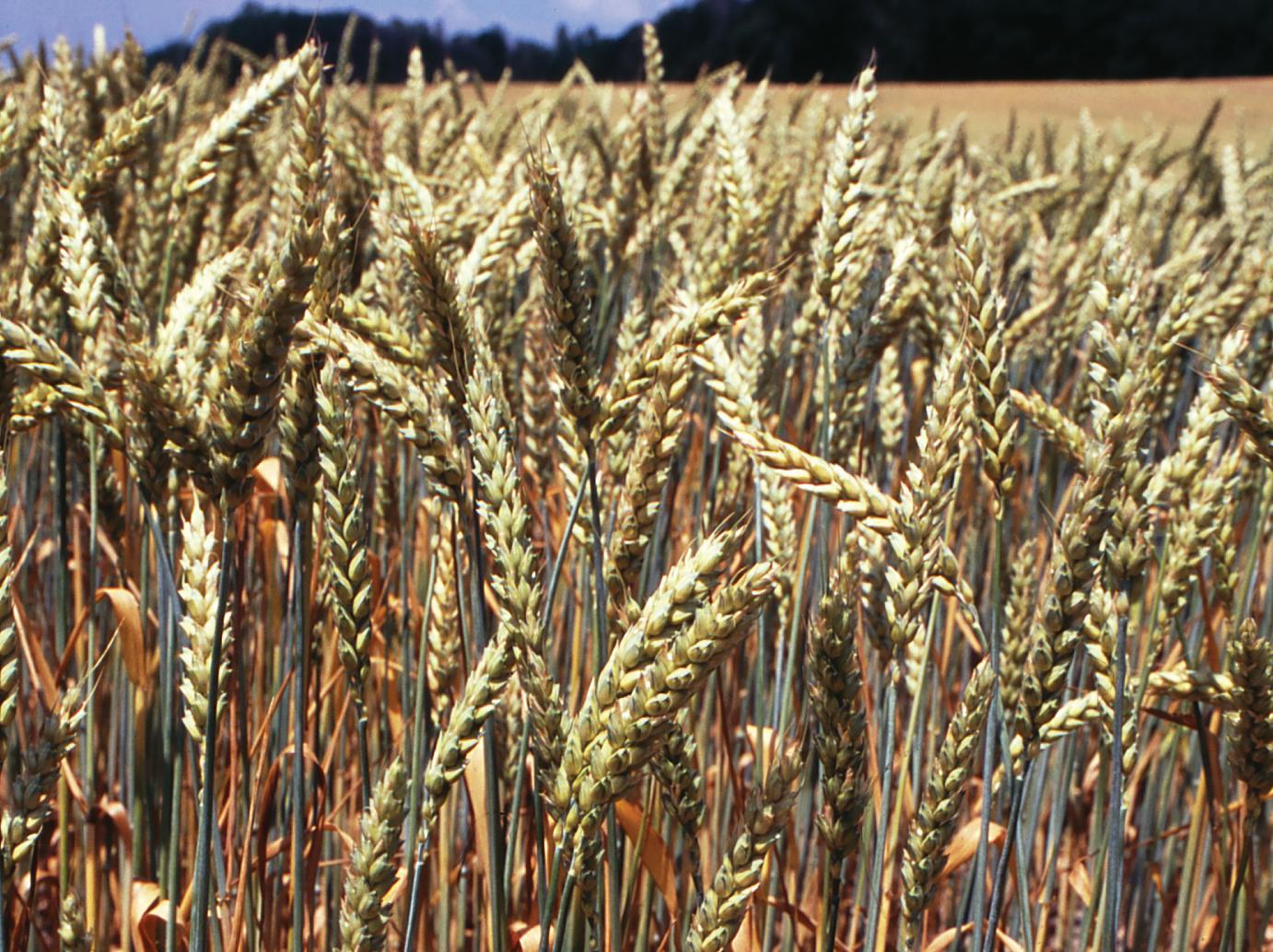
Research is attempting to identify the use of plant hormones to limit lodging potential in wheat.
Company on the move
INCREASE YIELD AND PROFITS
THROUGH TECHNOLOGY AND GENETICS
GENETICS AND
TECHNOLOGY
LEAD TO HIGHER PROFITS IN CORN
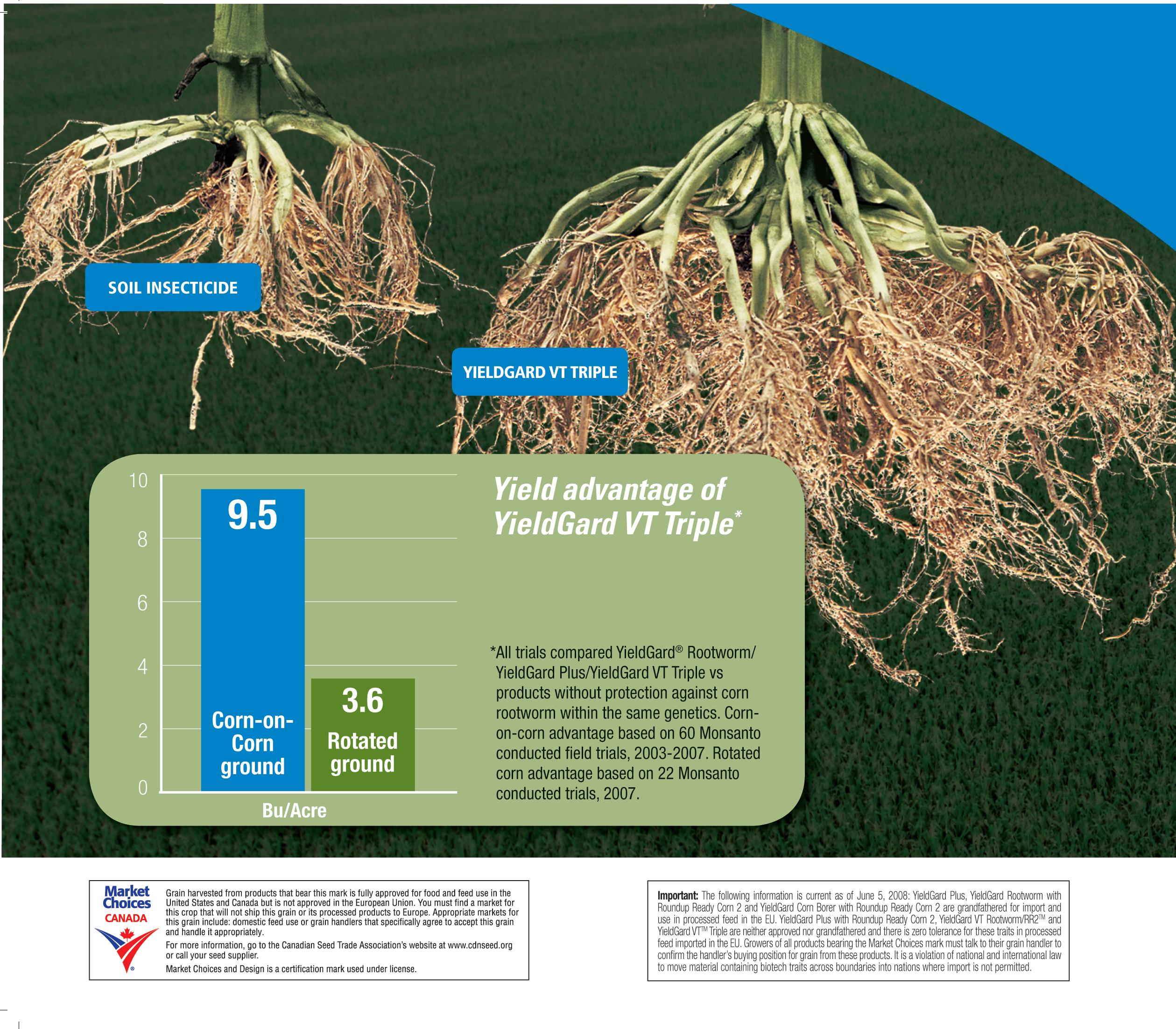
Maximizing yield potential will be critical to ensuring profitability in 2009. “What experience has shown the last few years is that the fastest way to increasing profitability in corn production is by investing in the best available genetics and seed technologies to maximize yield,” notes Fred Sinclair, Manager of Product Development and Agronomy with Pride Seeds. “The leaders in this category are PRIDE G3 hybrids that combine best in class genetics with the YieldGard VT Triple trait system and Poncho 250.” Sinclair says YieldGard VT Triple provides complete inside out protection against a range of insect pests together with the Roundup Ready crop safety yield advantage.
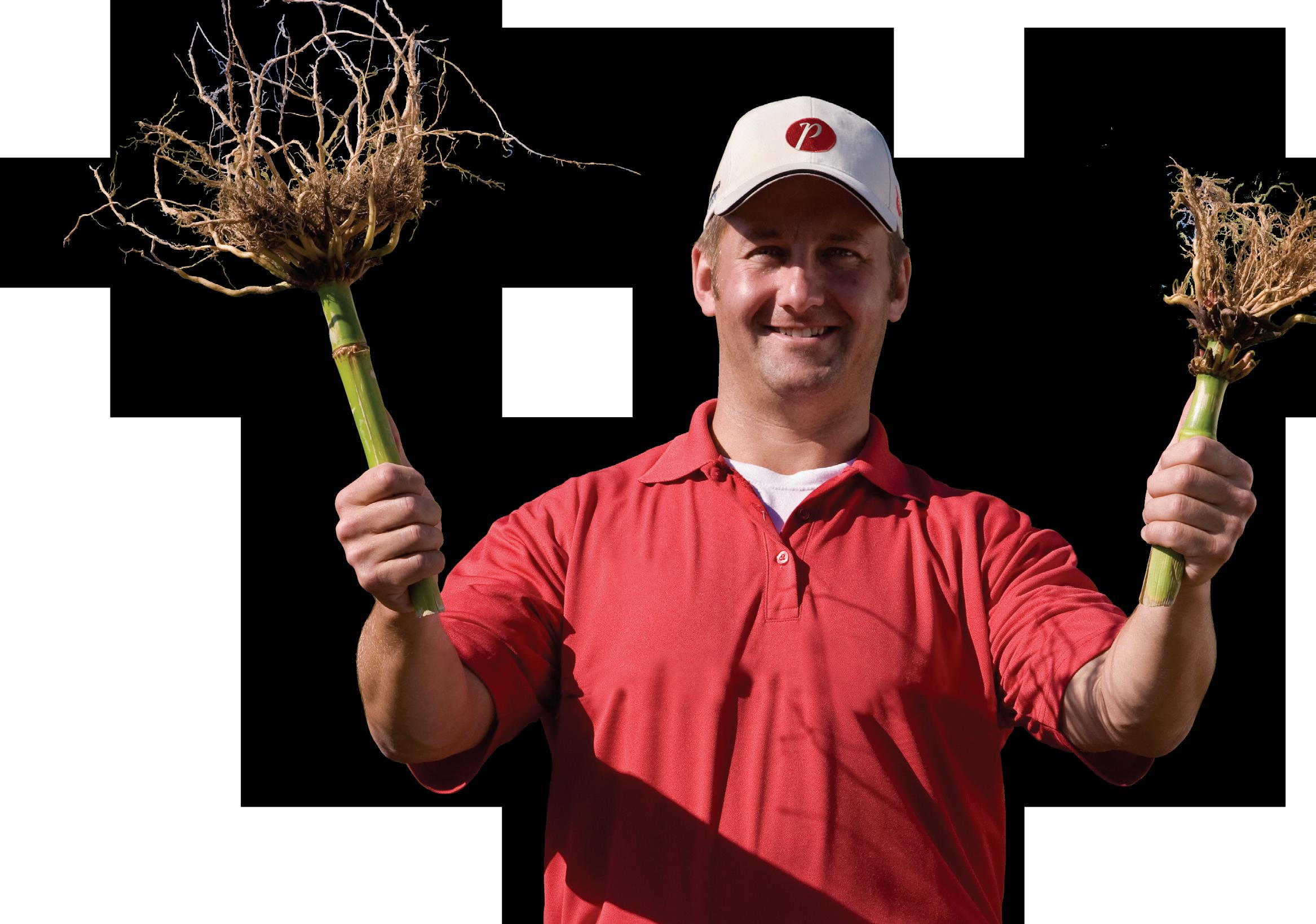
WHAT ROOT DIGS TELL US
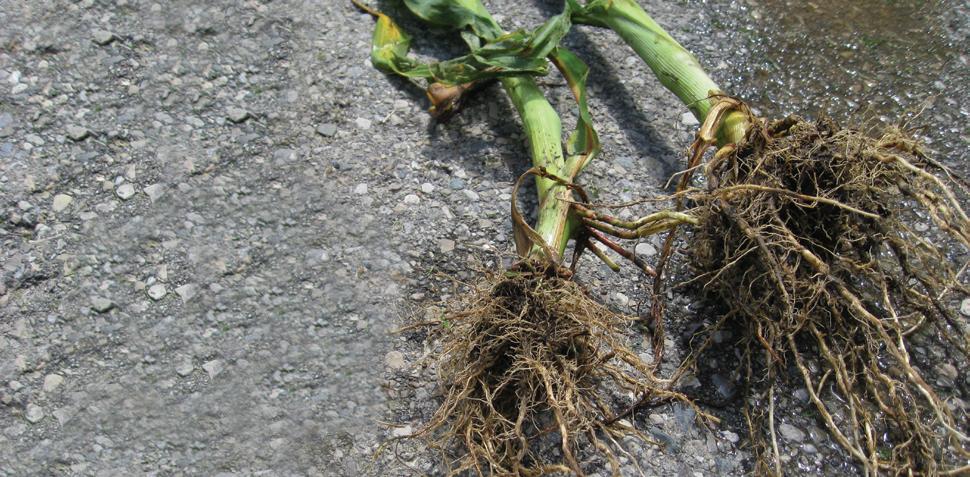
Pride Seeds’ Agronomist Jon Klapwyk says root digs provide an excellent means of seeing what is happening underground and an understanding of root growth differences between technology options.
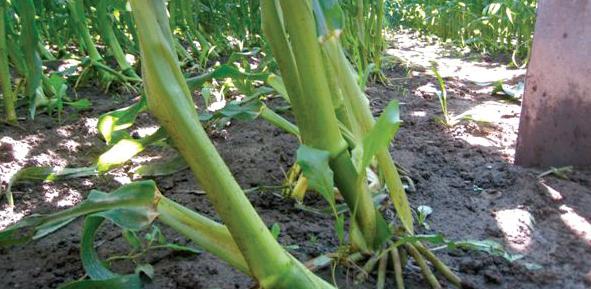
A walk into the field will show the advantage of PRIDE G3 hybrids. Where present, the effect of rootworm larvae pruning the root systems of non-rootworm protected corn can result in lodged and “goosenecked” plants as seen in many fields in 2008. Corn plants that are lodged or “goosenecked” can turn harvest into a nightmare and ultimately have a large impact on yield potential.
protected corn shows considerable lodging from rootworm pruning causing a nightmare at harvest and an impact on yield potential.
“Yield and standability is determined in large part by the strength of the root system that supplies the moisture and nutrients needed by the plant to produce yield and stalk strength.” explains Klapwyk. Pride G3 hybrids produce plants with healthy and deep root systems that provide the plant with added strength especially under stressful conditions.
Pride G3 hybrids have the advantage of a healthier root and stalk resulting in easier harvest and higher yield potential.
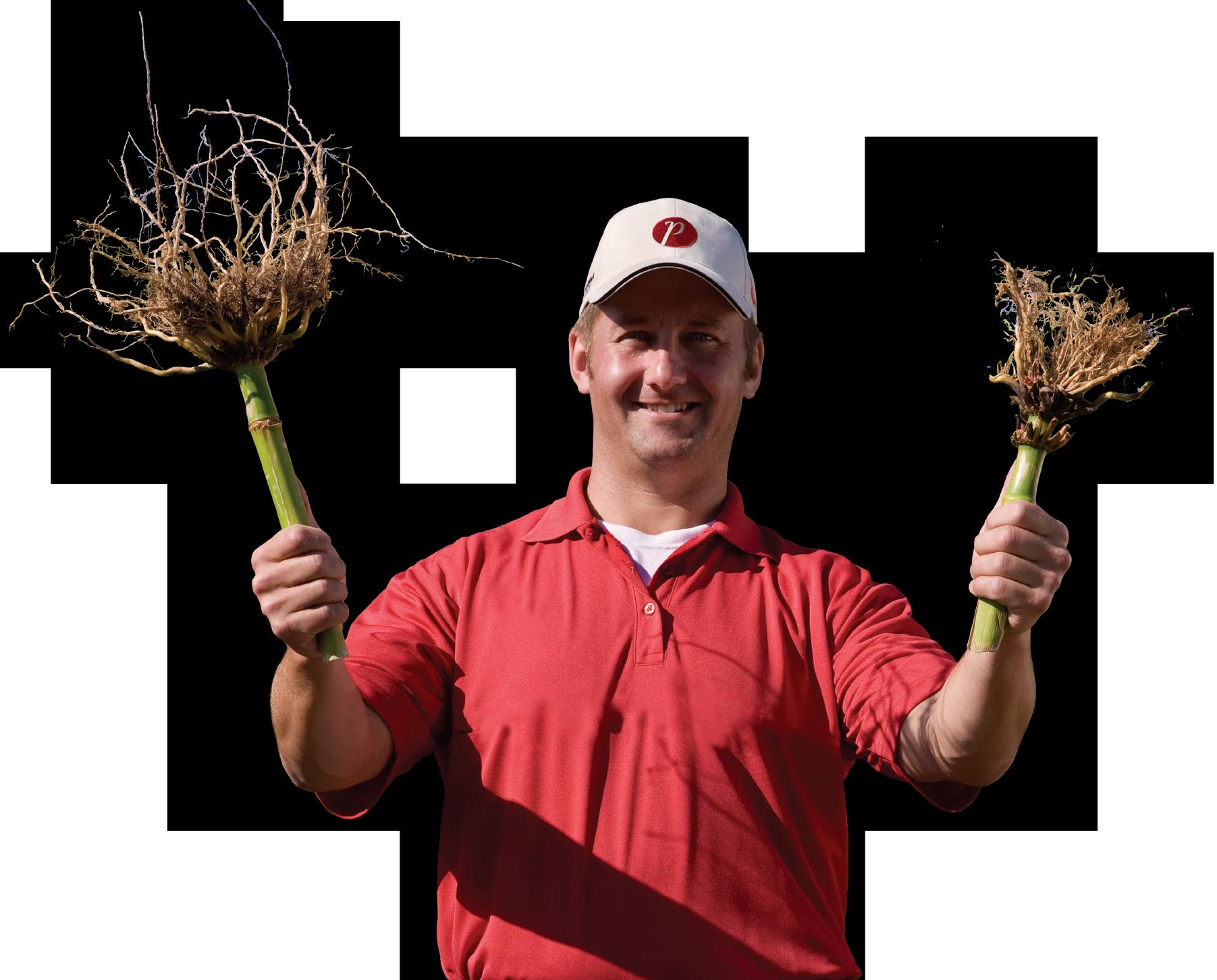
A root dig reveals the impact rootworm feeding can have on the root mass, stalk and ultimately yield potential. Rootworm protected Pride G3 hybrid (on right) has healthier root and stalk.
Non-rootworm
Increase your Yield and Profit potential with Pride Seeds, featuring Pride G3 hybrids:
1. Best in class genetics.*
2. Complete above and below ground, inside out insect protection with YieldGard VT Triple TM and Poncho 250.
3. The Roundup Ready® crop safety yield advantage
Better Roots, Stronger Plants...
THE ADVANTAGE IN FIRST YEAR CORN
“Our root digs continue to impress upon us the advantage Pride G3 hybrids are giving producers,” says Klapwyk. “We are seeing it especially against double stacked BtRR hybrids with either low or high rate seed treatments in corn on corn situations, but also differences in first year corn where yield data has shown Pride G3 hybrids deliver an average 3.6 bushel advantage.”
PRIDE GENETICS MAKE A 5 PLUS BUSHEL DIFFERENCE
On top of the YieldGard VT3 yield advantage, Sinclair says the base genetics used with any trait system can make a big difference. Here is where Pride shines according to the agronomist. In summarizing primarily third party and provincial trials, Pride hybrids are showing a 5 plus bushel average advantage across all maturities and technology options when compared to competitor hybrids in the same maturity.
OVER 20 NEW CORN HYBRIDS FOR 2009 FEATURING PRIDE G3
“Once again this year we are offering producers a range of new hybrids that offer a yield boost by combining maturity leading genetics with the best in available technology options, including industry leading PRIDE G3 hybrids,” says Stephen Denys, Vice President of Sales and Marketing with Pride Seeds.
“Our goal with these introductions is to meet the expanding demand for hybrids with the most advanced technology traits which means, in particular, YieldGard VT Triple technology,” notes Denys. “Add this to the 5 bushel advantage that Pride Seeds’ genetics are providing on average across all maturities and it is a winning combination for increasing not only yield, but yield consistency.”
you go.
*The evidence is proof positive. Pride hybrids provide an average 5 bu/acre advantage across all technology options and in all maturities across Canada. Experience the Pride Seeds difference on your farm.
is normally in the plant, rather than the introduction of a foreign gene. “We’re not putting in a bacterial gene or even a gene from another plant species,” explains Devine. Rather than waiting for a natural mutation to occur and then breeding to emphasize that trait, as in standard plant breeding programs, the initial mutation is engineered using specific methods. “The plant isn’t making any new protein at all. In fact, it’s making less of a protein that’s already in it,” says Devine.
The trait is now licensed to seed companies to develop it for commercial release. The first release is expected in 2011 or 2012 for corn.
Gene modification may alter seed filling directly
The alteration of hormonal responses to stress ultimately has only an indirect effect on yield. Another approach is to affect yield directly at the seed filling stage by altering the plant’s hormonal response to regular developmental cues. Since 1994, Dr. Neil Emery, a professor at Trent University, has been doing leading-edge research on seed filling and cytokinins, which promote cell divi-
sion. Emery says that the objective is to get the plant to produce the hormone at the right time and the right place. “The overall way of looking at how a cytokinin acts is that it increases the ability of a cell to draw assimilates into it,” explains Emery. “If you dump it on the entire plant, it’s increasing the ability of every cell, so they’re all fighting amongst each other to get the same stuff.” The timing is also specific. “There’s a cell division phase during embryo development and there’s a cell filling stage when the seeds fill. You want to get them when they’re making their cells so that the more cells they make, the more potential they have for a large seed.”
This stage is very short, approximately four to 10 days after fertilization. This combination of factors makes external hormone application difficult. Emery is looking to identify a gene promoter that is normally activated at the cell division stage and to attach it to a cytokinin gene. The promoter would then turn on cytokinin production at the desired stage of embryo development. This research is not yet been applied, although Emery is working with industry partners to
develop potential applications.
Plant hormone uses expected
The plant hormone approach to improving crop performance and yield seems a fresh perspective on an old problem. One might presume that the consumer response to plant hormone-related genetic modifications would be more accepting than that to previous types of modification because they do not involve the introduction of genes from other species, but rather the alteration of genes that are already in the plant. But this remains to be seen.
Despite the challenges involved, the benefits could be great. For one, plant hormones may be an alternative to high additional nutrient inputs because they seem to redistribute the resources that the plant already has to different areas of the plant; for example, from height growth to seed filling, or to allow better retention of resources like stomatal closure to conserve water. In terms of the effects of plant hormones in the diet, “You eat them every time you eat a salad,” says Pavlista. “They are ubiquitous.” n
WE’RE NOT AHEAD OF OUR TIME. JUST EVERYONE ELSE’S.
Principles of allocating funds across nutrients
by T. Scott Murrell and Tom W. Bruulsema*
TFarmers, advisers need basic principles of crop response.
he situation: A farmer does not have enough money to purchase all of the supplemental nutrients needed by crops on the farm. He or she asks for guidance on how best to spend the money that is available. The challenge is to combine nutrients to reap the maximum possible benefit from their application, recognizing that when all needed nutrients cannot be purchased, overall production and profit will be compromised.
Allocating funds to one nutrient
Let’s first consider the case where one nutrient is needed, but the total recommended quantity cannot be afforded. To reduce the total fertilizer bill, we need to allocate fertilizer to where it is needed most in the field. Areas of greatest need are those where crop responses are expected to be the largest. Figure 1 demonstrates the concept. In this figure, the large curve on the left is a conceptual model of crop response to soil nutrient supply. As the soil supply of a nutrient increases, crop yield increases until the soil becomes sufficient. Beyond this sufficient level, yield does not increase.
Figure 1. A conceptual model of crop response to soil nutrient supply. Also shown are model crop responses to nutrient additions for A) low, B) medium, and C) high soil nutrient supplies. The shaded areas below the curves in A) and B) show the range in short-term economically optimum rates (EOR) based on various crop and nutrient prices.
Agriculture is regaining its rightful place at the forefront of technology, and the T6000 Series is leading the charge.
The innovative Horizon™ cab provides 63 square feet of glass for more visibility and is ultraquiet with a hushed 70 dba. And the new engine features Power Management and Power Boost that help you maintain peak performance during PTO and transport applications. Join the technological revolution and visit your dealer or newholland.com/na. T6000 Engine
Horizon™ Cab
FertIlIty and nutrIents
Next we examine how a crop is expected to respond to nutrient additions for each of the three soil nutrient supplies. These three expected responses are shown on the right side of the figure.
The top graph (A) shows that when a soil has a low supply of a nutrient, the yield attained with no additional supplement (where the curve intersects the vertical axis) is low (the same as point A on the larger graph to the left). However, adding more of the nutrient results in a large crop response. Because the response is so great, the short-term economically optimum rate (EOR) does not change much as prices vary, shown in the shaded area under the curve.
In the second case (B), where the nutrient level in the soil is at a medium level, the yield without a supplemental application is higher, reflecting the greater soil supply (the same as point B on the larger graph to the left). As a supplement of the nutrient is added, the crop still responds, but not as much as where soil supplies are lower. Most of the response occurs with the first few increments of nutrient added. The more subdued response leads to a greater sensitivity of the EOR to fluctuating prices (the shaded region under the curve). When the nutrient price is higher relative to the crop price, only lower rates are justified. However, when nutrient price is lower relative to the crop price, higher rates are needed.
The third and final graph (C) demonstrates that when the soil already has an adequate supply of the nutrient, further additions do not increase yield. In this case, the EOR is zero, regardless of economic conditions.
The concepts of crop response to a single nutrient result in the following guidance:
• Allocate much of the nutrient to more responsive areas. More responsive areas are not very sensitive to price fluctuations. Examples of more responsive areas are:
P and K: areas with low soil test levels
N: areas that are coarser textured and/or have low organic matter contents
N: areas where corn has not been planted after a legume crop
• Apply some of the nutrient to less responsive areas as well. Most of the crop response occurs with the first few units of added nutrient. Reductions are economically justified when nutrient prices are more expensive relative to crop prices. Examples of less responsive areas include:
P and K: areas with medium soil test levels
N: finer-textured soils and/or areas with higher organic matter contents
N: areas where corn is planted after a legume crop
Allocating funds across two or more nutrients
When more than one nutrient needs to be supplemented to a crop, the nutrients can interact to produce greater crop response than any particular nutrient applied alone. A conceptual example of how two nutrients interact is provided in Figure 2. The levels of each nutrient are represented by the two axes, with greater nutrient levels to either the right or toward the top. The curves shown on the graph represent single yield levels, labelled low, medium, or high. They are akin to contours on a map. Looking at one curve demonstrates that there are several combinations of Nutrient 1 and Nutrient 2 that can result in a single yield level. Although not shown because of complexity, the concept extends to interactions of three or more nutrients.
Each curve has three parts: 1) the vertical part, which reflects the yield level attained from higher levels of Nutrient 2 but lower levels of Nutrient 1; the horizontal part, which shows the yield level possible with higher levels of Nutrient 1 but lower levels of Nutrient 2; and 3) the curved portion (the elbow) which represents the same yield level derived from more balanced levels of both nutrients.
Because there are several combinations of both nutrients that can produce the same yield, there is some flexibility in how we combine the nutrients to attain a given yield, based upon nutrient price. In the upper right of Figure 2, we see that both nutrients must be present at higher levels to attain high yield. However, there is flexibility in the latter units added. Point A is the case where adding a unit of Nutrient 2 is cheaper than adding a unit of Nutrient 1. In such a case, the desired high yield can by achieved if the last few units of added nutrients are allocated more toward Nutrient 2 than Nutrient 1. In other words, we add more of the less expensive nutrient. Conversely, if a unit of Nutrient 1 were cheaper (point B), then more of it should be added instead.
Figure 2. A conceptual model of the interaction of two nutrients on crop yield. Each curve represents a single yield level, indicated as low, medium, or high (adapted from Figure 2-4 on p. 99 in Black, 1993). The axis shows how various combinations of each nutrient can produce the same yield (one curve) or different yields (moving from one curve to another). Points in upper right show that A) higher levels of Nutrient 2 compared to Nutrient 1 are justified when an increment of Nutrient 2 is cheaper, and B) higher levels of Nutrient 1 compared to Nutrient 2 are justified when an increment of Nutrient 1 is cheaper.
Figure 2 also provides insight into how university recommendations may need to be adjusted when considering nutrient interactions. First, we need to recognize that university recommendations are generally based upon experiments that change the level of only one nutrient, while keeping the levels of all other nutrients non-limiting. For instance, if Nutrient 1 were the focus of such research, the resulting recommended supply would likely be that associated with point A, since the level of Nutrient 2 is non-limiting there. However, if a decision is made to reduce the level of Nutrient 2 because of economics, the recommended amount of Nutrient 1 becomes too low to attain high yield. So we see that it can actually take more than the recommended rate of a nutrient when other nutrients are limiting. This result demonstrates that while
Game-changing performance.
Pioneer® brand corn hybrids are changing the way the game is played, with yield and agronomic performance that is serving notice to the competition.
The lineup includes:
38N88
2700 heat units – Hot new rookie on the team
38M58
2800 heat units – Proven high scorer
37V63 ^
2950 heat units – Top new talent packed with technology
35F40
3200 heat units – Star performer with lots of skill
Put a breakthrough Pioneer hybrid on your team this year. Ask your sales representative to help you select the best hybrid for your individual fields.
Herculex® insect protection by Dow AgroSciences and Pioneer Hi-Bred.
®, TM Herculex and the HX logo are trademarks of Dow AgroSciences LLC. LibertyLink and the Water Droplet logo are trademarks of Bayer.
® Roundup Ready is a registered trademark used under license from Monsanto Company.
^ See product label for provisions on this mark. Market Choices is a certification mark used under license.
nutrients can interact in beneficial ways, they can also interact in detrimental ways when they become limiting.
How much, if any, yield reduction occurs by reducing the supply of Nutrient 1 or Nutrient 2 depends upon where you start on a particular yield curve. If we reduce the supply of Nutrient 2 when it is high on the vertical part of the yield curve, no significant yield reduction will occur until we start to move toward the elbow. The same holds true for Nutrient 1 if we are far to the right on the horizontal part of the yield curve. The more horizontal or more vertical parts of a yield curve therefore convey some concept of risk management, as shown in Figure 3. At higher than needed levels, there is room for error in the management of either nutrient and for the uncertainty involved in predicting nutrient needs for any one growing season. However, when the levels of both are more balanced (the elbow region), reducing one or both nutrients necessarily results in lower yield.
more than one nutrient, cut back on the nutrients that are more expensive per unit;
• If you have to cut back on one or more needed nutrients that have higher per unit costs, add as much of the less expensive nutrients as you can. The required rate of those less expensive nutrients may become higher than typically recommended if the reductions in other nutrients adversely affect yield;
• Try to apply at least some of all nutrients that are in short supply in the soil to make use of the positive interactive effects.
P and K placement depends on rate
Although not a formal part of the theory of allocating funds across nutrients, the way in which nutrient rate and placement are interrelated is important to consider when reducing rates. The concept of how these two factors interact is shown in Figure 4. The two curves in this figure show how yield responds to the percent of the potential rooting volume fertilized with a nutrient. The assumption is that the soil itself does not contain a sufficient level of the nutrient, so a crop response is expected. The lower dotted line shows that response to a low rate of a nutrient is maximized when a relatively low volume of soil is fertilized. Conversely, when a higher rate is applied, crop response is maximized when a greater volume of soil is fertilized. The crop response to the lower rate confined to a smaller volume of soil is less than that associated with a higher rate distributed over a greater volume of soil.
The practical implications of this theory are as follows:
• If only a low rate of a needed nutrient can be afforded, consider banding it and placing it strategically. Roots should be able to intercept it early in their development, but the nutrient should be placed far enough from the seed to minimize any possibilities of damage.
• If a higher nutrient rate can be applied, consider banding part of it strategically and broadcasting and incorporating the rest to fertilize a greater soil volume. n
The concepts of nutrient interactions lead to the following guidance:
• Examine rates of nutrients typically used. Cut back on any that are in excess of crop need;
• When considering cutting back on the last few units of
Dr. Scott Murrell (smurrell@ipni.net) is IPNI Northcentral Region Director, located at West Lafayette, Ind. Dr. Bruulsema is IPNI Northeast Region Director, located at Guelph, Ont. Reprinted from Better Crops with Plant Food, with permission of International Plant Nutrition Institute.
Figure 3. The conceptual model described in Figure 2 with risk assessments imposed.
Figure 4. A conceptual model of the interaction of nutrient rate with placement upon crop yield (adapted from Anghinoni and Barber, 1980).
Direct seeding equipment provides fertilizer placement options to achieve good fertilizer use efficiency.
Photo courtesy of Bruce Barker
New pest-resistant crop advances from unique partnership
Resulting corn and soybean will contain insecticidal proteins in the tissues.
New insect-resistant corn and cyst-nematode resistant soybean varieties are the goal of a research and development partnership between Syngenta Biotechnology Inc. and Athenix Corp., announced earlier
in 2008. Dr. Roger Kemble, head of Crop Genetics Research at Syngenta, says, “The gene leads identified by Athenix, combined with our expertise in transformation and transgenic crop development, will build on our long-term program to offer more competitive choices to growers.”
The collaboration will result in corn and soybean plants with tissues that will
contain toxins lethal to many pests. In the case of corn insects, the pests will essentially take one bite and die. These insects include many from the lepidopteran (moth) group, such as European corn borer, corn earworm, fall armyworm, black cutworm, western bean cutworm and sugar cane borer. Several corn rootworm species are also targeted.
In soybeans, the research aims to
plant BreedIng
produce plants resistant to soybean cyst nematode. Typically, the nematode invades the root through the spaces between the cells and establishes a feeding cell or cyst, which protects it from the natural defences of the plant. Kemble says it is much more difficult to kill these pests than those that simply feed on leaf, ear or root tissue in corn.
Stages of the process
The entire research program has been planned by a combined team made up of equal numbers of scientists from Syngenta and Athenix. Stages of the program are then carried forward by team
members at each company, according to their areas of scientific expertise.
The process begins at Athenix. Geneticists there are using a novel and proprietary method of identifying bacterial genes that result in toxin production known as the MiDAS Gene Delivery System. Some of the bacteria used belong to the genus Bacillus (of which Bacillus thuringensis is one). They produce toxins which, when ingested by the insect pest, perforate the insect gut wall, causing internal lysing or bursting, and death.
The MiDAS system is a faster, more flexible and more efficient procedure of identifying genes than the standard
Since 2007, soybean cyst nematode has been moving further east across Ontario.
plant BreedIng
method. Traditionally, geneticists have discovered bacterial toxin gene sequences by taking individual bacterial colonies and testing the entire colony for its ability to produce a toxin that kills a given target insect. Geneticists identify the toxin and then work to find the gene sequence that results in the production of the toxin. “However, using this traditional method, scientists don’t discover all the useful toxin-producing genes the bacteria may have to offer,” says Kemble. “It’s also very time intensive.”
MiDAS is quite different. This approach has Athenix geneticists starting with the DNA genome of several Bacillus species that they have mapped already from their collection of 22,000 microbial strains. They check these genomes for sequences that are similar to sequences already known to be responsible for toxin production. In the next step, geneticists cut out and insert the target gene sequence into a different bacterial strain to ensure the desired toxin is produced.
Kemble says MiDAS has allowed the identification of a whole collection of related toxins capable of killing insect pests, some of which would have taken a long time to discover and some of which would perhaps have never been discovered otherwise. “This technology enables scientists to discover gene leads which have proven elusive for years, and this will substantially strengthen Syngenta’s long-term pipeline of products,” he says.
Plant transformation
Once Athenix has identified bacterial gene sequences that are confirmed to result in the production of a desired toxin, Syngenta geneticists begin the process of transformation, where the genes are inserted into plants. Kemble says this part of the process is quite complex. “Each gene sequence is different,” he notes. “You never know how it’s going to behave. You want the toxin to be toxic to the pest but not to non-target organisms. Some of these toxins have a toxic breadth that is too great.”
In addition, he says “Sometimes these genes don’t result in the production of enough toxin. In that case, we try to increase expression of the gene.” Kemble likens this process of narrowing down these genes to a funnel. “There are many candidate genes and only the very best end up being used,” he says.
Kemble notes there are two approaches to transforming corn. “There are very few inbreds that can be transformed,” he says.
“One type is relatively easy to transform and is used widely in laboratory experiments, but its agronomic characteristics are unfavourable.”
The other approach is to find an elite corn inbred with superior growing characteristics that is able to be transformed. This was accomplished by a dedicated Syngenta team which examined dozens of elite hybrid lines and found one that can be transformed routinely. Other inbreds and hybrids are then bred from this line to carry the toxinproducing trait.
The process of creating a commercially available hybrid of toxin-containing corn takes about eight years from first discovering a toxin gene, says Kemble. “From bacterial gene identification to transformed corn, it’s about one year. This is followed by testing the crop on insect species to ensure that the insects you want to be killed die from eating the leaf or root tissue and those you don’t want to be killed don’t die. We also ensure nothing deleterious happens to the plants. There is also the regulatory approval process.”
Under the terms of the agreement, Syngenta can license these “gene transformation events” through further collaborations.
Spraying versus growing future toxin-containing corn hybrids
The benefits of growers using a crop that carries a toxin in its tissues versus spraying a toxin on crops are twofold,
according to Kemble. “A spray is active at the time of application and for a time afterward,” he says. “The toxin-carrying corn is economical as the toxin is always there and provides season-long protection.”
Secondly, the transformed corn contains genes that result in the production of at least two toxins with different modes of action that kill the same insect through gut lysing. “The chances of resistance to these two different modes of action are very low,” says Kemble.
Other toxin R&D
When an insect eats a Bt protein, the protein is activated by very specific gut enzymes and becomes a toxin. The toxin then binds to a protein in the wall of the gut called a receptor. When the toxin binds the receptor, it causes the formation of holes in the gut that cause the gut lysing. Many of the Bt toxins currently available bind to the same or similar gut receptors in the target insect so researchers are looking for toxins that work in a different way. “Many people have been looking for over a decade now for microbial toxins that kill insects in different ways, Kemble says. “There have been some advances, but no commercial products to date.”
Syngenta has, however, produced hybrids with vegetative insecticidal proteins technology (VIP), which works in a different way than other Bt toxins currently on the market. These VIPs are produced by bacteria during the vegetative or growth stage of their life cycle, where Bt toxin proteins are produced during the sporulation stage of the cycle. The VIP technology will be commercially available within the next couple of years. “The advantage of having two or more different toxins that kill target insects in different ways is that it will be extremely unlikely that resistance would develop,” says Kemble. Preventing resistance will help protect the technology for use long into the future.
Syngenta also formed a partnership with Chromatin, Inc. in October of 2007, which gives Syngenta the rights to use Chromatin’s “gene stacking technology” for trait genes in corn and soybeans. This technology potentially offers Syngenta a new method to develop stacked gene products with a higher number of traits than is currently possible. It could speed the time from development to commercialization of stacked trait products, which help growers meet multiple challenges. n
Corn rootworm is just one of the species of lepidopteran researchers are hoping to control with new applications.
Crop ManageMent
Managing traits in corn by
Planting decisions simpler or more complex?
New waves of corn hybrids packed with multiple traits are creating excitement about increased yield potential and improved crop quality in the years ahead. The optimism regarding these new hybrids, however, is being tempered by concern that some of the traits, notably those for insect control, may be coming down the pipeline before researchers and growers can get a handle on how to properly manage them.
In recent years, double-stacked, triple-stacked and even quadruple-stacked hybrids have been available in the North American market. And that is only the beginning. Within two years, the major seed companies expect to launch hybrids that will have multiple genes for herbicide tolerance and protection from insects in one seed. While seed industry officials concede that the wealth of traits may lead to confusion and questions about the need to have all these modes of action in one package, they say the end result will make planting corn easier and more convenient. Furthermore, the companies are working toward reducing and even eliminating the need to plant a separate refuge area.
Improvements in crop breeding efficiency and the subsequent new generation of insect protection led to the triple- and
Blair Andrews
quad-stacking of the traits, spawning new names and jargon in the process. These stacked traits from Monsanto are known as YieldGard VT Triple. Bob Thirlwall, a Dekalb field agronomist based in southwestern Ontario, says the VT stands for the Vector stack-Transformation technology. “It’s a more precise process of inserting the genes into the plant,” explains Thirlwall. “We have the Roundup Ready trait and the rootworm trait on the same inbred line, and that is crossed with the YieldGard trait for corn borer to get the VT triple.”
At Syngenta Seeds, a similar line is marketed under the name Agrisure. Dave Townsend, crop manager, says they also launched triple-stacked hybrids that added the corn rootworm trait and combined it with corn borer protection and Liberty Link herbicide tolerance traits. Taking it a step further, Syngenta launched the Agrisure 3000 GT Quad Stack, where AGT refers to glyphosate tolerance. “So it’s a full quad stack,” says Townsend. “Two herbicide traits and two insecticide traits.”
While stacking these traits at different levels may appear to be a game of one-upmanship for the companies, the industry contends that the new hybrids offer convenience, higher quality and increased yield potential. “It simplifies things if guys are growing corn after corn,” notes Thirlwall. “The YieldGard VT triple stack hybrid offers in-plant rootworm protection, as most growers don’t have insecticide boxes on their planters anymore. It’s just a much simpler process of planting; put the seed in the planter and go.”
Thirlwall says Dekalb’s field-scale trials on 22 sites have demonstrated a yield kick from the VT triple-stacked hybrids, even on first-year corn ground. The results showed an average increase of 3.6 bushels per acre on first-year corn ground over
Seed companies are working to provide a complete package of traits within a hybrid, including herbicide tolerance and pest resistance.
Our corn hybrids help you rise above
At Hyland we’re building leading corn hybrids that rise above the competition – on farm and in Ontario trials. And we take it up another notch by stacking a full-range of technology traits to give you hybrids that take corn performance to new heights on your farm. And our plans don’t stop there. We’re a local, independent company committed to agriculture. From developing leading varieties across a range of crops to creating market opportunities and helping ensure farmers are recognized for their contributions, Hyland is building with you. Visit www.hylandseeds.com or contact your Hyland seeds representative at 1-800-265-7403. Circle 12 on reader reply card
Crop ManageMent
the double-stacked hybrids. The VT triple-stacked hybrids also produced a bigger root mass in conditions of drought stress. “So the theory is we can extract moisture from farther out in the soil profile,” adds Thirlwall.
Dave Townsend agrees that the root system is more vigorous, suspecting that the result has more to do with the conversion process than simply adding the rootworm trait. “When we are converting the rootworm trait, we make sure that we select parents that have the same or better roots. The result is the potential for increased yield,” says Townsend.
Plans are in the works, possibly as early as 2010, to have even more traits working in one seed. Monsanto and Dow AgroSciences have submitted SmartStax for approval in the US. Touted as the first ever eight-gene-stacked combination in corn, the product contains multiple genes that are effective against both lepidopteron and corn rootworm pests, as well as two choices of herbicide tolerance.
In the interest of keeping track, the technologies are outlined as follows:
Dow AgroSciences’ HerculexRM I and Herculex RW technologies; Monsanto’s YieldGard VT Rootworm/RR2™ and YieldGard VT PRO™ technologies; and two weed control systems, Roundup ReadyRM and Liberty LinkRM
The multiple modes of action are designed to control both above and below ground pests, thereby reducing the need to plant refuge acres for pest resistance. Farmers in the northern Corn Belt, including Canada, currently are required to plant a 20 percent refuge of corn that does not use Bt technology near corn acres using the in-plant technology. However, Monsanto has submitted a request for regulatory approval to reduce the refuge requirements for SmartStax, contending that the multiple modes of action decrease the probability that insects will develop resistance to the technology.
If the need for planting a separate refuge can be reduced, what about the possibility of eliminating that step altogether?
That is the theory behind Pioneer Hi-Bred’s new insect protection system, OptimumRM AcreMax™. Planned for 2010, pending regulatory approval, the products are described as providing a “built-in” refuge.
The first phase, called Optimum AcreMax 1, will see a combination of a base hybrid with the Herculex XTRA trait and that same base hybrid with the Herculex I trait in the same bag. This approach would reduce the need to plant a separate rootworm refuge.
As soon as 2012, Pioneer could launch the second phase by introducing OptimumRM AcreMax™ 2 insect protection. This next phase combines the YieldGardRM Corn Borer gene with HerculexRM XTRA to provide two modes of action for above ground pests. The addition is aimed at extending the “builtin” refuge strategy to include corn borer and allow growers to meet all of their refuge requirements with a single product (pending regulatory approval). “All of the products that are being developed by the players are designed to reduce the amount of acres that are dedicated to insect sensitive hybrids, and therefore, make the planting of corn acreage for growers that much easier,” says Dave Harwood, technical services manager for Pioneer Hi-Bred, who adds that increased productivity, more convenience and extended durability of the technologies are the most salient points of combining all the corn traits. Harwood also speculates that refuge compliance will improve if the planting process becomes easier. “The approach we have in development will allow growers to plant their entire
acreage to an insect-protected product that has built-in refuge, so that the grower can just plant a product on their acreage and, in doing that, satisfy the refuge requirement.”
Harwood concedes that the different approaches of the competing companies may seem strange and confusing. It could also be a point for regulators to consider.
Syngenta plans to enter this game of multiple modes of action with VIP Broad Lep, denoting broad protection against the lepidopteran species. “So combined with the corn borer trait and rootworm trait, it also provides superior control of earworm, armyworm and cutworm, it gets everything except wireworm,” says Dave Townsend.
As he looks ahead to the planting strategies two to three years from now, Townsend says the refuge area for corn borer will likely be reduced to five percent. However, he admits he is nervous about corn rootworm, wondering if two traits will be sufficient. He is also concerned about an overuse of the rootworm trait that could possibly lead to the pest developing a resistance to the technology. “It’s not a high dose trait, and the history of rootworm is that they get resistance so easily.”
Townsend is not alone in expressing concern about the rootworm’s ability to develop resistance. Tracey Baute, field crops entomologist with the Ontario Ministry of Agriculture, Food and Rural Affairs, calls the corn borer traits in the SmartStax awesome, but the ones for rootworm, she says, are not. “The corn borer trait is completely novel from what is already registered and used. And it is high dose,” says Baute, echoing Townsend’s comment. “However, for rootworm it’s different.
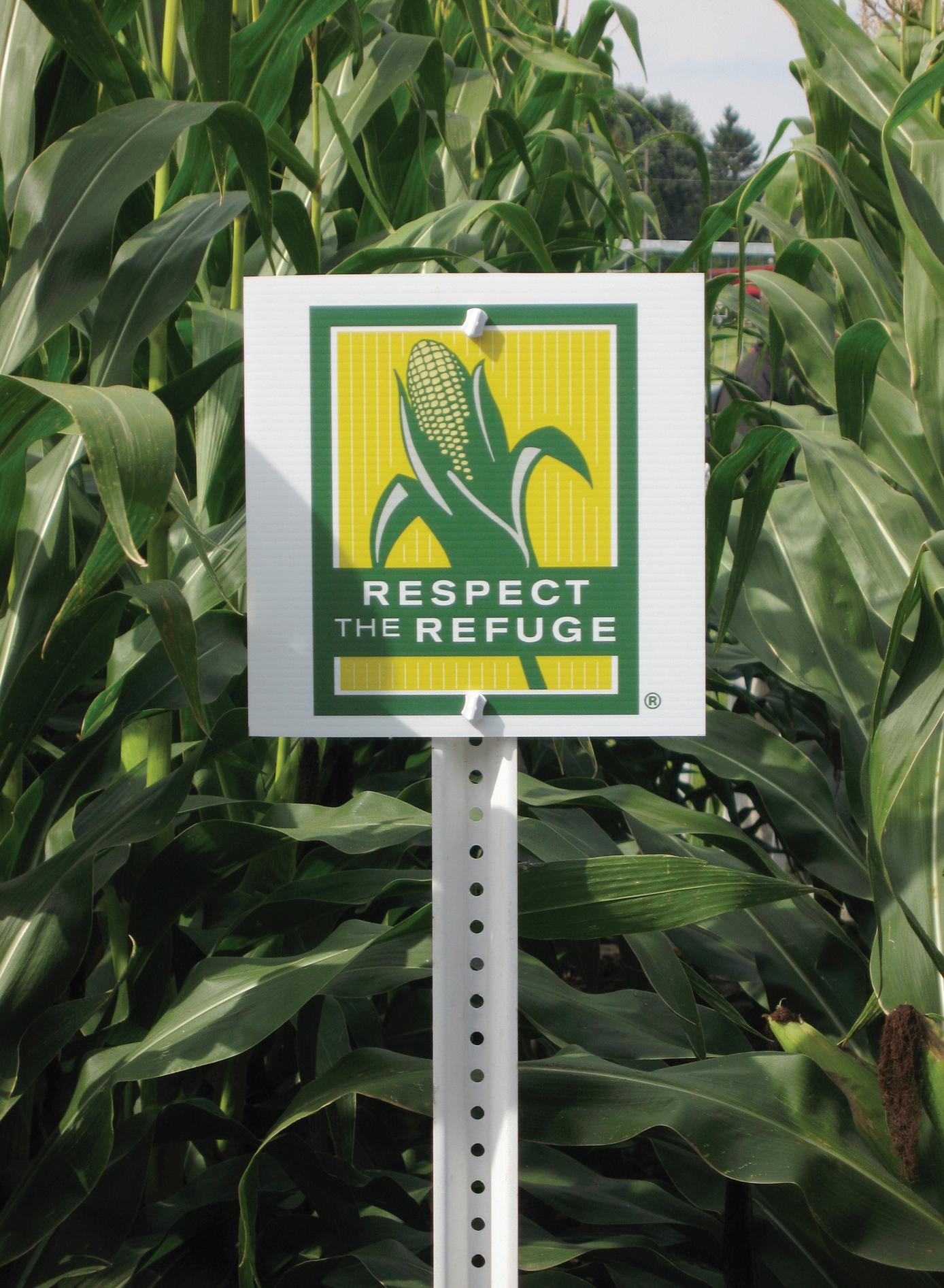
Until technology provides a solution, growers are asked to comply with the sign and maintain their refuge crops.
They are placing the same traits together in the SmartStax that are already registered.”
The fact that rootworm has been exposed previously to these traits actually increases the risk of the pest developing resistance, says Baute. “Given how large a population of rootworm you can have in one field, even if 98 percent are controlled by the traits, the two percent that survive could mean hundreds of individuals emerging.”
Refuge is another issue. Baute says a refuge area needs to be easily accessible to the rootworms because of how little they move around. “By lowering it to five percent, if that is in a block form and at only one end of the field, that five percent is going to be very inaccessible to the rootworm to find and mate with individuals from there,” explains Baute. “And work being done by the scientific community is showing that the ‘refuge in the bag’ may not be the way to go either since they are going to be moving too easily when feeding from a non-Bt plant to a Bt plant, potentially reducing the dose they consume.”
Baute respects that growers want to reduce the refuge size for economic reasons, but she is concerned that the reduction could compromise the long-term sustainability of the technology. She adds that the Canadian Corn Pest Coalition is working on resistance management recommendations for SmartStax in Canada that will be submitted to the Canadian Food Inspection Agency. However, Baute believes much more research needs to be done on rootworm resistance management. “The real issue is that these products are now coming out in the marketplace very quickly before the university and public researchers have time to figure out what the best approach will be for resistance management.”
While the jury is still out on reduced refuges, it appears certain that the triple stacked traits with the multiple modes of action will eventually replace the single and double-stacked traits. Dave Harwood says the move is similar to the way to auto manufacturers offer standard model types and packages. “As things play out, these may be the only product types that we sell,” says Harwood. “We most likely will not offer the non-built-in refuge along with the built-in because that would be more confusing for our customers.”
And once these new seed platforms are in place, even more traits will be built into the corn hybrids of the future. With the goal of increasing production to meet the growing demand for food and fuel, the research pipelines are focused on delivering traits for drought-resistance, nitrogen use efficiency, cold tolerance and end-use traits, such as high-amylase corn, that would help the crop produce more ethanol.
As both excitement and concern greet the new generation of corn hybrids, industry officials are quick to point out that a few foundational aspects will be important in the near term. For one, growers are still being urged to “Respect the Refuge,” and follow the current 20 percent requirements. Bob Thirlwall says this standard procedure has not changed with the introduction of the double-stacked and triple-stacked traits. And while the refuge strategies may change in two or three years, Thirlwall and others agree that the need to select the right hybrids will continue to be a critical decision. “The corn borer trait is a given at this point, growers want corn borer resistance, and we’re finding that over half the growers in eastern Canada are using Roundup Ready as well,” says Thirlwall, noting that hybrid selection comes down to finding the best agronomics, based on soil management practices. n
Test for SDS in soybeans simple, but a long time coming
by Ralph Pearce
AIts
accuracy is what makes it popular.
phids, bean leaf beetles, soybean cyst nematode and phytophthora root rot have been on the minds of most soybean growers for much of the past five years. In researching solutions to these and other pests and diseases, the critical factor in getting the best science into the hands of growers seems to be time. Where sudden death syndrome (SDS) in soybeans is concerned, time is no longer a limiting factor in the chase to impart genetic resistance to the disease in existing varieties.
Dr. David Lightfoot, a biotechnologist at Southern Illinois University-Carbondale, has devised a relatively inexpensive and highly accurate bioassay or test that detects resistance or susceptibility to SDS in soybean varieties. “The tests have a very high success rate for identifying the susceptibles, and it does very well at detecting moderate resistance,” says Lightfoot, adding that such consistency enables researchers and breeders to do more in shorter time frames to build SDS resistance in soybean lines.
It is the consistency of the results that sets it apart from similar research programs. The challenge in researching things like drought or flood tolerance is that the right conditions are not always present or are hard to simulate in a field setting. The SIUC greenhouse assay’s accuracy, however, has been confirmed, both by patent examiners and United States Department of Agriculture (USDA) reviewers. Its cost of about $15 (US) per test makes it even more attractive. “It’s passed every test that’s been thrown at it,” says Lightfoot, noting that other tests, based on the SIUC model have been developed that can be better for a particular type of germplasm. However, those tests are limited to specific temperatures and the use of determinant southern
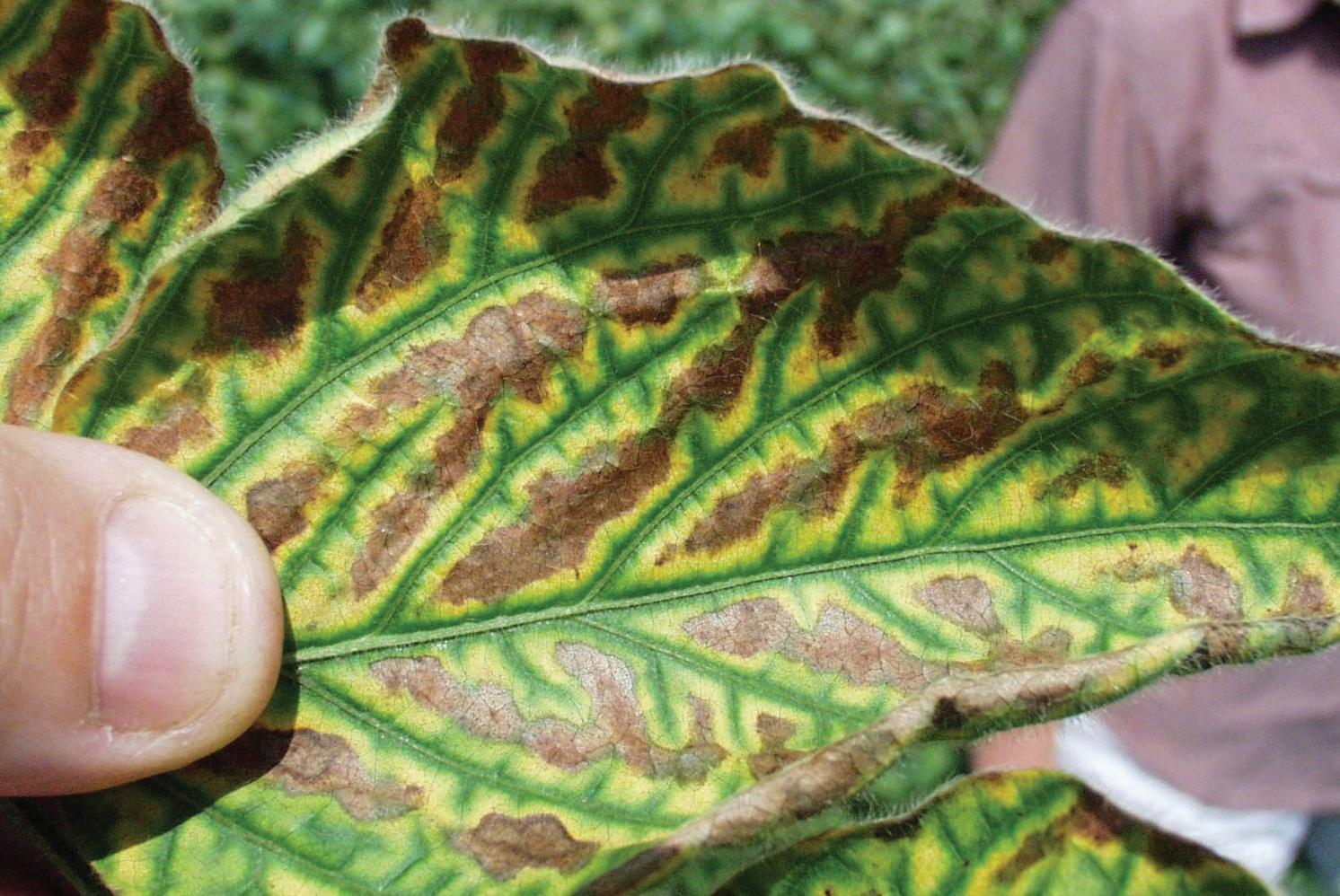
The most striking symptom of SDS in soybeans includes the discoloration of the leaves.
NEWforthe 2009Plantingseason
pests and dIseases pests and dIseases
varieties versus indeterminant northern soybean varieties.
Serendipity strikes again
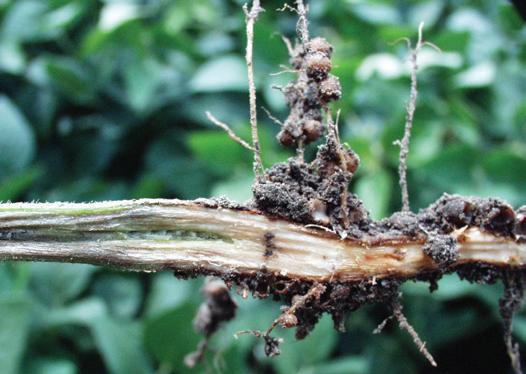
By weakening the stem and roots in soybeans, sudden death syndrome is one more disease challenging soybean growers.
Photos courtesy of alBert tenuta oMafra
Lightfoot developed the test with the help of colleagues Dr. Khalid Meksem and Dr. Paul Gibson, who is now retired. It followed an almost inadvertent discovery of the behaviour of inoculum on seeds and soils. “It could sort of identify a very resistant plant from a very susceptible one,” explains Lightfoot. “But when we applied it to cultivars, we obtained what we identified as a complete waste in terms of its usefulness, because it didn’t agree with our field data.”
At that point, the trio tried to determine what was wrong with the assay, and found the level of inoculum in the soil was inconsistent during various stages of the growing season. “It comes in in the spring and it’s dilute, and then it builds through the growing season and produces SDS when soybean is flowering,” says Lightfoot.
The group then decided they had to grow the fungus in a medium that mimicked a winter soil in Illinois. “We used a clay substitute, a sand substitute and some corn meal to represent the rotting corn plant from the year before, and fairly low temperature incubation of about 22 C,” says Lightfoot. “Then we used low inoculation concentrations of that growth to replicate the low concentration in the spring, and found a much lower concentration than any pathologist would have used as a sensible amount. And when we lined up the data from the field with this new greenhouse assay, the correlation was into the high 80s.”
The assay also provided a stark separation between resistant and susceptible soybean varieties.
Patent process lengthy
In 1996, Lightfoot began the process of patenting the discovery. The patent examiner, however, determined there were actually four areas of invention, and advised him to first secure the molecular markers used in identifying the resistance genes. That patent was issued in 2000, and after another seven years, the greenhouse assay patent was issued, as well. “The nice thing is that there are more patents to come out of that initial submission, which the patent examiner has identified as being inventive and novel,” details Lightfoot. “We can look forward to a couple of more patents on positional plotting of genes and identification of proteins and polypeptides underlying resistance, so it’s the gift that keeps on giving.”
With the patents secure, SIUC can also recoup some of the costs of the research, but more importantly, other universities and laboratories can access the rights to use the assay to further research in SDS resistance and susceptibility. Dr. Istvan Rajcan of the University of Guelph and Dr. Vaino Poysa from Agriculture and Agri-Food Canada are two Canadian researchers who are licensed to use this test. And the timing and geography of the disease is critical. According to projections by Dr. X. B. Yang at Iowa State University and Dr. Harald Scherm at the University of Georgia, SDS is better suited to northern soils and climatic conditions. n
Developing a test for fusarium in corn
Researcher used 2006 corn crop as guide.
The 2006 corn crop in southwestern Ontario may be one that growers and livestock producers would like to forget because of the high levels of ear moulds and mycotoxins. It is providing researchers with an opportunity to gain a better understanding of the complexities of fusarium.
Following that growing season, the Canadian Seed Trade Association agreed to release corn samples from the Ontario Corn Performance Trials for use in a fusarium research project at the University of Guelph, Ridgetown Campus. The researchers, led by Dr. Art Schaafsma, are developing reliable mycotoxin detection tests that will benefit several segments of the industry, from plant breeders to end-users of corn.
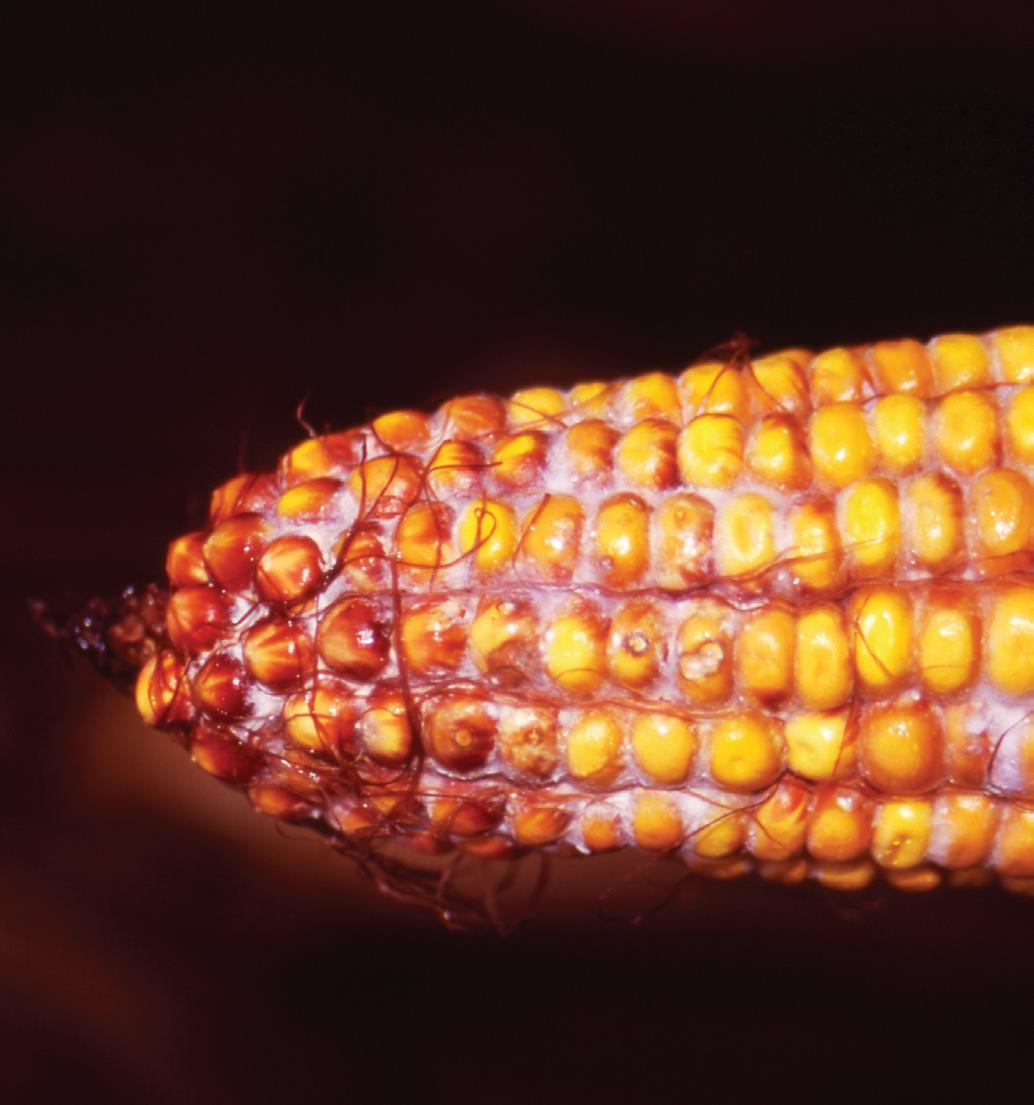
Fusarium in corn, which causes gibberella ear rot, can hurt yield and quality but also seriously affect the quality and nutritive value of livestock feed.
Gibberella zeae is the most common and important ear mould in Ontario. It is the sexual reproductive stage of Fusarium graminearum. The fungus also infects small grains such as wheat, where it causes Fusarium Head Blight. Not only does Gibberella ear rot raise economic concerns because of potential yield and quality losses, there is also the anxiety over the ability of Gibberella zeae and Fusarium graminearum to produce damaging mycotoxins, most notably deoxynivalenol (vomitoxin or DON) and zearalenone. The appearance of the substances in the crop can create livestock feed and food
pests and dIseases
safety problems and serious economic consequences.
Dr. Victor Limay-Rios, a research associate, who is developing the tests, says that because of the potential risk to the food supply, measures have been set up in different countries to monitor and control mycotoxin levels. Furthermore, the limits of these substances in traded goods are becoming more restrictive. “Countries have different guidelines and different limits for toxins, using these as a non-tariff barrier to trade,” says Limay-Rios.
Ethanol production from corn is also playing a role in the need for a reliable test. During the production process, one-third of the grain is used to produce ethanol, another third produces carbon dioxide and the other third produces distillers dried grains with solubles (DDGS). However, the fermentation process in an ethanol plant does not destroy mycotoxins that may be present. In fact, Dr. Limay-Rios says the mycotoxins are condensed by a factor of three: if the corn contains 1 part per million (ppm) of a mycotoxin, the DDGS produced from that corn will contain approximately 3 ppm. While DON is mild compared to other toxins, feed containing a small amount can adversely affect weight gain of the animals. For adult pigs, calves, lactating cows and lambs, along with a few other species, the recommended maximum level is 1 ppm. For young pigs, the accepted level is lower at 0.5 ppm. For cattle, adult sheep and poultry, the maximum level is higher at 5 ppm.
Is fusarium in corn an increasing problem in Ontario? Dave Harwood, technical services manager for Pioneer HiBred, says that is challenging statement to qualify. “It’s a problem every year in pockets, and to the extent to which those pockets expand or how extensive it is in any given year varies,” explains Harwood. “What we saw in 2006 in the corn crop was far more than in pockets and widespread throughout much of southwestern Ontario. A year severe as that one was probably 20 years before that.”
Harwood says another challenge is screening hybrids for their reaction to fusarium. In order to make genetic improvements, Harwood says the disease has to be reliably exposed to the crop, which is not easy to do with fusarium. “With many diseases, you can do that artificially, and quite reliably, and it really reflects what goes on in the real world,”
says Harwood. “But with Gibberella ear rot, that’s not the case. The artificial infestations often create a reaction that is not predictive of the real world.”
Dr. Limay-Rios concurs with Harwood’s assertion. He recalls a study in which researchers put vomitoxin in the animal feed and compared the results with feed that was naturally contaminated at the same level. “The effect on the animal was dramatic in the natural case, which means that vomitoxin or DON alone cannot explain why,” says Limay-Rios, who adds that there are masked mycotoxins that are not being properly identified.
Identifying all these mycotoxins is one key objective of the project, which Limay-Rios breaks into two main parts. In the first, the researchers are trying to develop a laboratory method that uses liquid chromatography mass spectrometry (LC-MS) to simultaneously detect chemically diverse mycotoxins in a single sample preparation.
The second part involves developing a near infrared (NIR) spectrometry technique for a simple, rapid and costeffective estimate of DON in wheat and corn grain using LC-MS as a wet chemical reference method. NIR is a correlative technique in which reference data
is regressed against spectral data for future predictions of DON. NIR is routinely used on grains delivered to elevator terminals to estimate moisture contents and quality characteristics where results are obtained within minutes. “If we develop an NIR calibration equation that could be introduced in their existing machine, we can potentially estimate DON level in the grain sample in real-time,” says Limay-Rios. “So that has huge potential.”
Limay-Rios says the test is still at the experimental stage of development in wheat and soon they will be expanding to corn, estimating that it would take at least two years before it would be commercially validated. According to Harwood, the development of an accurate analytical technique would be welcome because another challenge presented by Gibberella ear rot is that the grain could have clear evidence of mould, but the DON levels are relatively low or vice versa. “It would be useful in everything from screening hybrids to grain at point of delivery and purchase,” says Harwood. “It’s the level of vomitoxin that is the issue, so having a test, rather than relying on visual assessment of the grain, would be highly preferred.” n
Research into detecting fusarium could help all facets of the grains and oilseeds sector, from production in the field to point of delivery and purchase.
FertIlIty and nutrIents
Saving money through tweaking inputs
Wise decisions are based on good information.
The high cost of inputs in 2008 has shocked many growers, especially corn producers. But because strong returns on commodities were expected at harvest, farmers have not risked lower bushel counts by making significant input cutbacks in order to save money.
Small reductions in fertilizer inputs are being achieved, however, by producers who manage their soil very closely. The ability to do this will become even more important in 2009, say experts, when prices of both inputs and crops are likely to be just as high, if not higher.
Fred Sinclair, manager of product development for Pride Seeds, says, “I think we’re going into a time period where farmers can tweak inputs just a little bit, or some maybe a lot, and that’s going to help with the shell shock of higher expenses to trade off for the higher commodities.”
Sinclair also stresses that each farm is a case of its own. “Cropping is really different now than it was seven years ago where there’d be a lot of common things,” he says. “It seems now everyone has a different way of planting, tillage practices and fertility.”
Importance of testing
No matter the specific cropping practices used, any attempt by producers to tweak inputs should begin with proper soil testing. Greg Stewart, corn industry program lead for the Ontario Ministry of Agriculture, Food and Rural Affairs, says, “I would think that it would be foolhardy to make any sort of cost shaving decisions for P and K without really having a good handle on your soil test level on a field by field basis. It would be the first thing a farmer would want to do when he sees sky-high P and K costs.”
Sinclair agrees strongly that soil tests are worth the time and effort: “The return is greater than the cost.” He says “It’s probably a time period where growers almost want to protect what they’re investing in, where you want maintain, and then maybe build certain fields. You
don’t have to build your overall program for fertility.” He adds, “To maintain, you need a report card. That soil test is one component. By using that soil test, you can start to pencil in and say, ‘Okay, here is where I can maybe save a little, this is where I have to add a little’ and at the end of the day, not over-fertilize or overspend, but not lose yield at the same time.”
When growers who have traditionally broadcast P and K at reasonably high levels see their soil test results, Stewart says they may find that they can take the opportunity to “live off” of what they have applied during previous years. However, he adds, “For those people who have new land, rented land or for those people who have shaved it fairly close to the bone in previous years and do not have high phosphorus or potash soil test levels, they’re going to have to continue to meet the minimum needs of the crop and it’s probably going to cost them a fair bit more.”
OMAFRA recommends soil testing every three years, a practice Stewart estimates is being used by about 50 per cent of growers. This may be due to the time needed to do the tests, says Stewart. He also suggests some farmers may not think they need a soil check if they have been applying the same fertility package for years and are convinced that is what the crop takes out of the soil.
To help closely manage nitrogen, Stewart advises examination “on a field
by field, rotation by rotation, hopefully Calculator by Calculator approach.” He is referring to OMAFRA’s ‘Ontario Nitrogen Calculator’ (available at www. gocorn.net since 2006). The program is based on analysis of more than 600 siteyears of corn yield measurements in response to rates of applied nitrogen. The calculator is site-specific, and factors in target yield, soil texture, previous crop, heat units and timing. Stewart says the dataset, which is the largest in the Ontario corn belt, also accounts for the price ratio between estimated corn profits and nitrogen costs for the current year.
Leanne Freitag, an agronomist with Cargill, says that in addition to soil testing, scouting fields and good record keeping are very important ways to manage inputs. “If you’re not out there, you don’t know what you’re missing,” she advises. “If you are scouting your fields on a regular basis, you see which weeds are there and the size of weeds. Then you can time herbicide applications more accurately, as well as the product and rate you’re spraying.” That means costs are minimized and benefits are maximized.
In addition, Freitag notes scouting is also integral to picking up on pests and diseases that could be robbing yield. “Every year we see different pests that are a problem,” she says. In 2008, for example, Freitag has observed higher bean leaf beetle populations in new areas and an armyworm outbreak in wheat.
Maximizing yields at harvest begins with soil sampling in the spring, at least once every three years, to determine exact levels of P and K.
HOW MUCH DOES INEFFICIENCY DRAIN FROM YOUR CROP?
When you’re working the eld, every skip or overlap drains time, fuel, and inputs from your bottom line. But Trimble precision ag technology can put a stop to it. And we’ve made it easier and more affordable than you might think. The fact is, nobody knows more about guidance technology than Trimble, and nobody has more ways to help you farm more ef ciently, more productively and more pro tably. So the real question is, can you afford to go with anything less? To nd a Trimble dealer, visit www.trimble.com/agriculture or call 800-865-7438.
FertIlIty and nutrIents
Despite higher input costs, OMAFRA’s Greg Stewart notes fuel expenses account for less money than expected, and have less of an impact than drying costs or the price of nitrogen.
As fields are scouted, the information gathered should be added to producer records. Freitag says good record keeping helps growers keep track of problem weeds, soil insects, and other issues, which will help when planning input needs such as seed and chemicals for the following year. “It’s better to have a plan in place well ahead of time and change it,” she says, “than to not have a plan at all.”
Working with a crop consultant can help maximize input returns and ensure crops are being managed in the most effective way possible. Companies offer myriad services, from record keeping to scouting and beyond.
Other management factors
When asked if high input costs might result in reduced rotation in the next few seasons, Stewart says, “All commodity prices have been relatively strong and I don’t get a sense in the countryside that there’s a real big appetite for trying to swing one way or the other. The classic Ontario corn-soy-winter wheat rotation I think is still very much the backbone of most cropping operations.” Sinclair agrees, adding, “Commodity prices look good the next couple of seasons, actually encouraging that the majority of people will follow their rotations.”
Stewart does concede that “certainly when input prices go very high, it does favour soybean over corn.” He also does not believe that high input costs will cause many growers to attempt to save fuel money by using reduced till or no-till practices. “The diesel fuel fraction of the total cropping budget is quite small in comparison to inputs,” he says. Farmers may feel that they are spending a lot on fuel these days, but “if they sit down and look at their total budgets,” says Stewart, “it’s still a smaller fraction and it can swing more wildly and have less impact than, say, the price of drying the corn or the price of nitrogen.” n
New herbicide first for cereals in two decades
by Blair Andrews
Active ingredient impairs plant’s growth abilities.
Early results are encouraging so far for a new mode of action for broadleaf weed control in winter wheat and other cereals. Ontario researchers have been putting Infinityrm herbicide from Bayer CropScience to the test as part of a broader evaluation of cereal crop herbicides.
The active ingredient in Infinity is pyrasulfotole, a Group 27 herbicide, combined with bromoxynil, a Group 6 herbicide. Greg Good, portfolio manager for row crops with Bayer CropScience, says Infinity is the first new mode of action to be developed for the cereal market in North America for 20 years. “The big thing is they have a synergetic effect when they work together, and that’s really seen on the weeds as it is very fast-acting,” he says. Good goes on to say that Infinity controls many tough broadleaf weeds, including Group 2 resistant weeds.
Infinity is also touted as being very safe on all wheat and barley varieties when applied from the first-leaf stage up to the emergence of the flag leaf. It includes a Bayer CropScience
Breaking new ground.
Pioneer Hi-Bred is breaking new ground in every field of the seed business. We’ve asked our best research people to dig deep for results that will meet the next decade’s toughest market and cropping challenges. And they are delivering.
The Accelerated Yield Technology (AYT TM ) system, a breakthrough molecular breeding technology developed by Pioneer, will further boost the yield potential and improve the agronomic characteristics of Pioneer® brand soybeans. How much? We predict yield increases of 40% in the next decade!
Pioneer Hi-Bred. We’re breaking new ground where it matters most:
In your fields.
Weed ManageMent
proprietary safe-ner, which works by accelerating the metabolism of the herbicide in the crop but not in susceptible weed species. Once absorbed by the foliage, pyrasulfotole moves through the weed, working in three different ways at the same time to control broadleaf weeds.
The first action stops the weed’s ability to generate an adequate supply of energy. The second action restricts vitamin E production, which protects the weed’s biological membranes against oxidative stresses. The third action prevents carotenoid production, restricting the weed’s protection against ultraviolet rays and excessive light. As a result, the chlorophyll is destroyed, and the plant turns white and dies.
Extensive testing showing positive results
The pyrasulfotole molecule was discovered in Bayer CropScience labs in Frankfurt, Germany through a program aimed at discovering new modes of action. It has been field tested in North
The cumulative effect of blocking nutrients in the weed destroys the chlorophyll, causing the leaves to whiten prior to the plant dying.
America since 2000. Mike Cowbrough, weed management specialist with the Ontario Ministry of Agriculture, Food and Rural Affairs, says a nationwide registration allowed the product to move quickly into the Canadian marketplace in 2007. While Cowbrough says the introduction was positive, a potential downside for eastern growers was that the bulk of the field research was done in western Canada.
Cowbrough, along with University of Guelph researchers Dr. Francois Tardif and Dr. Peter Sikkema, are putting Infinity to the test as a part of a side-by-side evaluation of cereal crop herbicides in 2008. Not only was it an opportunity to study Infinity’s efficacy in Ontario’s environment, the cold days of early May, including a few when there was frost, but it provided an excellent chance to evaluate it from a crop safety perspective. Cowbrough says Infinity seemed to live up to its billing as it fared well under the harsh conditions. “All herbicides caused some sort of crop injury when they were sprayed under adverse conditions, but certainly Infinity was one of the safer options in this year of looking at it from that perspective,” explains Cowbrough.
As for weed control or suppression, Infinity exceeded expectations on certain species, with Cowbrough noting he was pleasantly surprised by its activity on dandelions, as well as chickweed. “In terms of general, annual broadleaf weeds, it does a pretty good job,” he says, addding that the new mode of action performed as well as the standard treatments that are in the marketplace, including Refine, Bromoyxnil/MCPA and Dichlorprop/2,4-D.
Cowbrough points out that whenever a product performs well on certain weeds, it may allow weaker ones to surface. In Infinity’s case, the speedwell family of weeds, which are not on Infinity’s label, emerged. Cowbrough says there are five to six different speedwells in Ontario. These are winter annual weeds with small leaves that, according to Cowbrough, escape fairly well.
Another area of Cowbrough’s work revolves around growth room research on herbicides. He uses this work to help find answers to questions producers and agronomists have about some of so-called oddball species of weeds that show up in cereal fields. “Growth room work has its challenges because it is not under field conditions,” concedes Cowbrough. “But the positive is that if a product is not going to control weeds in the growth room, it isn’t going to control weeds out in the fields.”
In Cowbrough’s growth room, he tested Infinity on nonlabelled weeds like tufted vetch, field violet and wild carrot species, which Infinity did not control.
Cowbrough’s overall assessment of Infinity in its first year is positive, saying it was a good performer in terms of crop safety and efficacy on the common weeds in Ontario, despite the fact that non-labelled weeds such as speedwells and other obscure weeds are not controlled. He looks forward to analyzing how Infinity and other herbicides perform under different conditions, adding that it takes three to five years to get a good view of a product. And he and others watching Infinity’s progress will have that opportunity because the University of Guelph research trials are being conducted during the course of several years.
Meanwhile, growers considering Infinity as a weed control option should be aware that it is not to be used on underseeded legumes. Also, Infinity does not have any tank mixes registered at this time for eastern Canada. n
On my farm, I choose yield. I choose DEKALB® .
GARY
DEBORGER – FOREST, ONTARIO
Why my seed choice is DEKALB. Yield. Yield. Yield. With DEKALB, we get proven performance on our operation, on our soil types. We’ve been successful with DEKALB products here. Do your own trials. That’s what sold us.
My DEKALB corn: DKC 48-79, DKC 50 series, DKC 52-63
My DEKALB soybeans: 31-52R
Food versus fuel: the real story
The
real causes of the global food crisis B and where biofuel crops fit into the picture.
In 2008, the food versus fuel debate raged to new heights. Corn farmers around the world were blamed for profiteering while the rest of the world suffered unprecedented food prices increases, as well as food shortage issues in some regions.
Dr. Gordon Surgeoner, president of Ontario Agri-Food Technologies, based in Guelph, Ont., is a bit weary of reading and hearing unfounded statements in the media about the role biofuels plays in the burgeoning food crisis. “The debate is healthy, but it should be based on valid information. Corn prices have dropped approximately 30 percent since the highs of July 2008, and the US is still producing about seven billion gallons of ethanol per year. The roles of high oil prices and speculators are now obvious.”
In April 2008, many political and academic leaders weighed in on the debate.
Surgeoner says British Prime Minister Gordon Brown called for an “investigation of whether the conversion of agricultural land from food to biofuel production is contributing to rising food prices.” In the same month, Time magazine stated, “Politicians and Big Business are pushing biofuels like corn-based ethanol as alternatives to oil. All they’re really doing is driving up food prices and making global warming worse – and you’re paying for it.”
Surgeoner also points to the comments made during April 2008 by Dr. Ian Lee, Masters of Business Administration (MBA) director of the Sprott School of Business at Carleton University. Commenting to The Canadian Press about the federal government’s investment in production of biofuels made from agricultural products traditionally used as part of the food chain, Lee said “It’s got to go down as one of the dumbest decisions ever.”
Why food is costing more
Surgeoner says the escalating world food prices are due to a complex set of factors that have little to do with growing crops to produce fuel. “The cost of transportation and growing food, pesticides, running machinery, fertilizer,
by Treena Hein
Concerns about prices for corn being driven by energy demands have been replaced with a better understanding of the role of speculators.
seed, has gone up mainly because of higher fuel prices, which makes food more expensive,” he says. “Fuel costs have also increased what it costs to process and store food.”
Oil prices have escalated primarily because of increased demand from developing nations. In addition, as stock mar-
kets plummet in concert with the value of mortgage-based assets, investors and speculators have abandoned stocks, and sought out other opportunities like oil, precious metals, and grains and oilseeds. These commodities therefore have experienced a price increase, like anything in demand would. Surgeoner notes that, in
ONTARIO SOYBEAN
GROWERS
ONTARIO SOYBEAN GROWERS
Ontario AgriCentre, Suite 201 • 100 Stone Road W. • Guelph, Ontario • N1G 5L3
Grower Requested Own Use (GROU) program available for farmers
AGCare (Agricultural Groups Concerned About Resources and the Environment) is vigilant on the issue of crop input costs for our farmers, versus what growers pay who are located south of the Canada-US border. According to a recent survey by the University of Guelph at Ridgetown, Ontario farmers pay, on average, 59 percent more than farmers in nearby States on the most common pesticide products.
AGCare is the environmental voice of Ontario’s 45,000 field and horticultural crop growers. Ontario Soybean Growers has been a member since AGCare was formed 20 years ago, and today numbers among AGCare’s 17 member groups. The results of AGCare’s proactive role can be seen in the success of Ontario’s Grower Pesticide Safety training and certification, and the Environmental Farm Plan program.
The PMRA launched the Grower Requested Own Use (GROU) program in 2007 to replace its predecessor, the Own Use Import (OUI) program. GROU allows farmers to import the US version of a crop protection product registered in Canada for their own use, should that product be available in the US for a lower price than here at home.
Crop protection products must be approved by the PMRA for inclusion in the GROU program before they are eligible to be brought across the border. Right now, there are 12 products on the GROU list. The PMRA has asked for nominations for additional products, to expand the list for next year’s growing season. AGCare has submitted a list of its member groups’ requested products to PMRA.
The AGCare Board believes that Ontario farmers should have access to agricultural inputs at prices that are competitive with what our southern neighbours pay. AGCare has been working with the federal Pest Management Regulatory Agency (PMRA) to allow freer movement of key crop protection products between Canada and the US. This helps to increase price discipline for input suppliers, and promote awareness of the need for competitive pricing.
For the GROU program to succeed, there will have to be enough products available for import, and growers must make use of the program. Growers must apply to PMRA for a GROU import certificate for each product they wish to import.
A GROU how-to guide for farmers will soon be available on AGCare’s website: www.agcare.org.
Online GROU information from the PMRA can be found at: http://www.pmra-arla.gc.ca/ english/appregis/grou/grou_imp-e.html.
Industry neWs
addition, “the public failed to recognize that the seven billion gallons of ethanol produced in the US reduced gas prices by four to 10 cents per litre.” He says people should also remember that the technology continues to develop, with higher corn yields and more ethanol being produced per bushel.
The demand for oil, in turn, has exacerbated food price escalation, “which has greatly contributed to inflationary pressures in unstable nations already exhibiting unsustainable food policies,” notes Surgeoner. “Governments of countries such as Indonesia, Bangladesh, Nigeria and the Philippines, as well as those of Egypt, Vietnam and Venezuela, have imposed export restrictions and bans so that they are seen as taking action in the face of rising rice and grain prices, which only encourages hoarding and stockpiling rather than expanded production.”
In their quest for political survival, these governments try to keep their citizens calm and hang on to power by subsidizing food prices, keeping them artificially low, which discourages
The Farms.com Yield Data Center is your one-stop shop for Ontario corn and soybean yield information. The Farms.com Yield Data Center allows Ontario corn and soybean growers to access valuable yield information from numerous sources to help them select the right hybrids and varieties for 2009. At www.YieldData.Farms.com growers can access weigh wagon and research plot yield results from seed companies collected throughout the fall. They can also connect to the provincial performance trials for corn and soybeans and see the results of interesting eld scale projects conducted by various government research and grower organizations across the province.
Since 2000, world soybean acreage has increased by 21 percent, which again counters inaccurate information about corn markets.
Ontario Wheat Producers’ Marketing Board
100 Stone Rd West, Suite 201, Guelph, Ontario N1G 5L3
Tel: 519-767-6537 Fax: 519-767-9713 www ontariowheatboard com
OWPMB CONNECTS WITH THE INDUSTRY
The overall purpose of the Ontario Wheat Producers’ Marketing Board is to add value to Ontario wheat producers by increasing returns The best interest of wheat producers are at the centre of our decision making. But in order to effectively serve wheat producers, it is important that the OWPMB stays current and involved with the rest of the wheat industry
The board is involved with all levels of industry: elevators, millers, researchers, seed companies, terminals, input providers, government and exporters Every year, these stakeholders are invited to the Wheat Industry Symposium to discuss pertinent issues currently facing the industry
Planning for this year’s symposium is well underway and the focus is on grading The quality issues in this year’s crop have brought the challenges in wheat grading to the forefront The symposium will feature a panel discussion on the issue including a representative from the Canadian Grain Commission, a grain merchandiser and a country elevator operator along with other speakers
The symposium gives the OWPMB an opportunity to connect with the industry, support and maximize value chain innovation and industry cooperation Look for articles in the January edition of ONWheat magazine reporting on the issues presented at the symposium and how they impact producers.
Currently 14,000 O ntario producers include wheat in their crop rotation and the long-term picture shows steadily increasing acreage Within North America, Ontario is the only wheat growing jurisdiction that can make this unique claim As producers are aggressively planting more wheat as soon as other crops are harvested, it is clear that wheat works in Ontario
We sell 700,000 tonnes of wheat to domestic flour, feed, and seed industries and an additional 400,000 tonnes is exported to the nearby US
The popularity of wheat in Ontario is the result of several factors Producers in Ontario have lots of options when it comes to wheat In most parts of the province producers not only have varietal choices, but can choose which class of wheat works best with their time and crop management
Support from a world class research and extension network also assists in the popularity of Ontario wheat The Ontario Ministry of Agriculture, Food and Rural Affairs, Agriculture and Agri-Food Canada along with the University of Guelph and private companies mean that producers do not have to look far for good advice and cutting edge research
This research and extension combined with the great genetics available to producers have resulted in incredible yield advances that are predicted to increase even more. These advances are unique to Ontario as many other wheat growing jurisdictions have seen stagnant yields and decreasing acres Aside from a few places in the US with irrigation, Ontario has the highest wheat yields in all of North America
Our yields combined with our acreage and the quality of wheat we produce prove that Ontario wheat works
The 2008 crop year has brought a host of challenges for Ontario wheat producers in terms of managing the quality of their crop. This year’s wet weather meant that disease was rampant and as a result, quality was often poor. Luckily, there are many courses of action wheat producers can take to ensure that they manage their wheat quality properly. First, it is important to know what you have. The ability to grade your own wheat eliminates surprises at the elevator and provides producers with more options. The Canadian Grain Commission (CGC) offers one-day grading courses for producers wishing to learn more
Secondly, it is important to understand the market demands in grading All three destinations for milling quality wheat – domestic mills, nearby US and overseas ports – have slightly different requirements so the official CGC grade may not directly link with the market value For wheat destined for domestic markets, moisture, falling number, bushel weight, protein, and DON levels are the most important Wheat sold to American markets is focused on the US standard, not the CGC grade Finally, export markets look at the CGC grade along with DON levels, falling number, protein and gluten
Along with knowing the market, it is also important to understand your contract, if you have forward contracted your wheat If you know that you are not going to be able to meet the quality conditions agreed upon, contact your buyer as soon as the issue is identified and they can work with you to develop a solution
When wheat quality is poor, consider storing your wheat until market conditions are more favourable It takes more time for poor quality wheat to make it through the system, therefore producers may benefit from storing their wheat, exploring their options and selling at a later date
Finally, it is important to understand your rights If you disagree with a grade given by an elevator, producers always have the option of appealing to the Canadian Grain Commission
Industry neWs
farmers in these regions from expanding production. These policies do not work, says Surgeoner. Farmers have tried to ship their crops across borders, and riots have occurred as a result of food shortages in many of these countries. At the same time, demand for food, and for higher quality food, is constantly rising. “Each second, we add three people to planet Earth,” says Surgeoner.
“Current world population is 6.8 billion and increasing by 80 million per year. Every two seconds, we also add approximately three people to the middle class, which amounts to approximately 50 million new middle-class citizens per year. These people have increased demand for more, and better, foods.”
Analyzing the arguments
Surgeoner identifies two main arguments that are used to blame increased biofuel production for high food prices. “Some argue that the price of oilseed and food grains like wheat and rice is rising because acreage planted for corn is expanding at the expense of these crops, and there is less of them to fill demand,” he says. However, data from the Foreign Agricultural Service of the US Department of Agriculture shows that while world corn acreage has increased 15 percent since 2000, world barley acreage increased four percent in that same time frame. World oilseed acreage has risen by 11 percent and world soybean acreage is up by 21 percent. Wheat has stayed steady while world rice acreage is now at a record high of 381 million acres (154.3 million hectares), up 1.7 per cent since 2000. “So most crop acreages are increasing, not just corn,” says Surgeoner. “In
addition, rice is a staple consumed by half of the world’s people and rice and corn do not compete for the same acreage.”
There is also the argument that corn is being diverted to make ethanol, away from using corn as livestock feed, which has caused beef and pork prices to rise. “However, when corn is used to make ethanol,” says Surgeoner, “all that is actually happening is that instead of feeding the whole corn kernel, we are merely feeding one third of it as dry distillers grains with solubles (DDGs), a 30 percent protein feed byproduct, and producing carbon dioxide to enhance greenhouse production.”
Surgeoner concludes: “The arguments that biofuels cause food inflation are overstated. Government investments in biofuels are not ‘wrong-headed,’ as Dr. Ian Lee asserts. They have not been major factors in beef or pork price increases in Canada, have had little impact on world food production or supplies, have not distorted world acreages planted to food grains or oilseeds, and have not caused world food price inflation.”
Instead, he says, “World food price
inflation has been caused by oil price escalation and speculation which has put inflationary pressure especially on those unstable nations already at risk because of their unsustainable food subsidy policies.” Surgeoner says solutions to the food crisis include educating women in developing countries about birth control, investing in food productivity, increasing the amount of freely traded food and condemning corrupt leaders. He says, “We should also reduce our individual ecological footprints and find alternatives to fossil fuels to minimize climate change.”
Commenting on the Canadian farmer’s perspective, Steve Kell, a grain merchant at Parrish & Heimbecker, says, “Farmers have been told, ‘If it’s not going for food, you can’t sell it,’ but it’s not good to have just one market for your product. Farmers deserve to always have a market for their products. There are only a few markets for flour, only a few flour mills, but there are many ethanol companies and more are springing up. There are new players and that makes the market a more stable place.” n
BUYING CORNNOW
Sell your corn directly to GreenField Ethanol. Competitive prices, contract flexibility and no hassles.
Ca n ad a’s l e ading e thanol pr od u cer is n ow bu yi ng
corn di r ectly f r om lo cal farm e rs f or it s fa cil ities in Jo hnst own , Chatham and Tiver to n, On tari o.
Ontario Buy Dire ct Pr ogr am
Ca l l us to ll fr e e at 1- 8 88 -4 71- 366 1 or vis it www. gr ee nf i eld e th a no l. com to g et the la test co rn bids and le a rn about our co n tracti n g altern a tiv es.