Weed control in glyphosateand dicamba-resistant soybean PG. 26
When weeds invade, strike back hard with DuPont™ Canopy® PRO pre-emergence herbicide for glyphosate-tolerant and IP soybeans, including Roundup Ready 2 Xtend™. Two modes of action, and broad-spectrum residual activity, slay your toughest weeds, including glyphosate-resistant Canada fleabane, velvetleaf, dandelion and annual sow thistle. Save up to $7.50/acre with the DuPont Head Start Program when you order before March 31, 2018.
Ask your retailer about Canopy® PRO today. For more information, call the Solutions Center at 1-800-667-3852 or visit canopypro.dupont.ca
TOP CROP
MANAGER
5 | Integrated weed management Herbicides are just one of many tools growers can turn to.
By Ross H. McKenzie PhD, P. Ag.
| Inoculate for higher yields
Increase yield by 10 to 20 bushels.
Trudy Kelly Forsythe
MANAGEMENT 24 | Fall weed control to minimize competition
No such thing as one-size-fits-all for weeds. By
Julienne Isaacs
Limiting seed treatment escapes By Madeleine Baerg
ON THE WEB
PROVINCE OF ONTARIO PARTNERS WITH U OF G TO ADVANCE AG SECTOR Ontario has entered into a new agreement with the University of Guelph for up to 10 years that will support the growth and competitiveness of Ontario’s agri-food sector, create jobs and further solidify the province’s position as a global leader in agri-food education, research and innovation. For more news, visit topcropmanager.com/news
Readers will find numerous references to pesticide and fertility applications, methods, timing and rates in the pages of Top Crop Manager. We encourage growers to check product registration status and consult with provincial recommendations and product labels for complete instructions.
PHOTO COURTESY OF TOP CROP MANAGER.
JENNIFER PAIGE | ASSOCIATE EDITOR
BITING THE DUST
As Canada’s crop fields begin to fade from winter and spring begins to emerge, farmers across the country will soon be getting back into their fields, eager for the coming growing season.
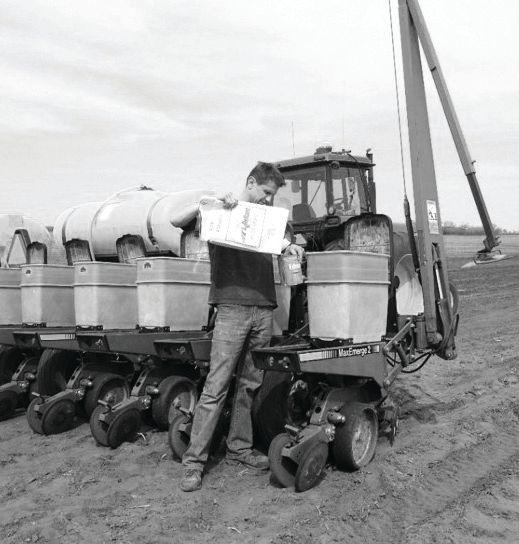
With seeding just around the corner, my inbox has once again been filled with numerous headlines surrounding seeding, environmental safety and seed treatments.
And while no producer denies the importance of seed treatments in modern-day agriculture, they have become a topic of discussion on a global scale. Health Canada has implemented legislation to govern the sale and use of certain treated seeds, and across the globe there have been full bans related to pesticide drift.
In the March issue of Top Crop Manager, we explore what the current research says about chemical escapes, to what degree seed treatments stay where they are planted, and what producers can consider to help minimize drifting during planting.
In the article “Limiting seed treatment chemical escapes,” University of Guelph researcher Art Schaafsma says local legislation isn’t doing enough to solve the problem of seed treatment pesticide drift, and the focus should be more on limiting drift as opposed to restricting the use of this technology. “Legislation would not be necessary at all if farmers and equipment manufacturers made basic adjustments to planters,” Schaafsma says.
Pesticide dust is very fine and can travel long distances via wind. So how can we better manage this dust at planting? Check out Schaafsma’s recommendations on page 17.
The Guide to Treated Seed Stewardship, created and published by the Canadian Seed Growers’ Association and the Canadian Seed Trade Association, provides a number of additional recommendations for producers looking to avoid dust generations at planting:
• Consider choosing seed coated with a finishing polymer to bind seed treatments to the seed, to further reduce dust.
• Handle seed bags with care during transport, loading and unloading in order to reduce abrasion, dust generation and spillage.
• Do not load or clean planting equipment near bee colonies or pollinator foraging areas.
• Pour seeds carefully and do not shake dust or loose material from the bottom of the seed bag.
• When turning on the planter, avoid engaging the system near bee colonies or foraging areas.
• Use deflector equipment, where appropriate, to direct exhaust to ground level and reduce the off field movement of seed dust.
• Clean and maintain planting equipment. Use a vacuum to remove seed and dust from the planter, including the fan housing and hopper. Do not use compressed air.
As the industry continues to strengthen the science behind its tools, including seed treatments, Top Crop Manager will be here to provide our readers with the latest research and scientific findings, as well as a number of tips and reminders to ensure the best outcomes.
Wishing you all a prosperous start to the growing season!
CIRCULATION email: rthava@annexbusinessmedia.com Tel: 416.442.5600 ext. 3555 Fax: 416.510.6875 or 416.442.2191 Mail: 111 Gordon Baker Rd., Suite 400, Toronto, ON M2H 3R1
SUBSCRIPTION RATES
Top Crop Manager West – 9 issues Feb, Mar, Mid-Mar, Apr, June, Sept, Oct, Nov and Dec – 1 Year - $47.50 Cdn. plus tax
Top Crop Manager East – 7 issues Feb, Mar, Apr, Sept, Oct, Nov and Dec – 1 Year - $47.50 Cdn. plus tax
Potatoes in Canada – 1 issue Spring – 1 Year $17.00 Cdn.
Occasionally, Top Crop Manager will mail information on behalf of industry related groups whose products and services we believe may be of interest to you. If you prefer not to receive this information, please contact our circulation department in any
INTEGRATED WEED MANAGEMENT
Herbicides are just one of many tools growers can turn to for effective weed control.
by Ross H. McKenzie PhD, P. Ag.
Herbicides have become very important for weed control. However, frequent and repeated use of the same herbicide groups has gradually resulted in development of herbicide-resistant weeds to the point that resistance has become a very serious problem for many Prairie farmers. When herbicide resistance is a relatively minor problem, growers tend to pay less attention to managing it than they should. Once resistance starts affecting a major weed or a major herbicide used on the farm, then growers pay more attention to the herbicide group number on the label. Often it is only then that growers realize how important it is to rotate herbicides based on group number.
For each herbicide used on your farm, be sure you are aware of and understand the mode of action. This is the way a herbicide controls susceptible plants. Specifically, it is how the plant processes are affected by the herbicide – which biological process or enzyme in the plant the herbicide interrupts, and how this affects normal plant growth and development. In some cases, the mode of action may be a general description of the injury symptoms
observed on susceptible plants. Each mode of action has a unique herbicide group number.
When growers are over-reliant on a single herbicide active ingredient or mode of action, it results in increased selection pressure on a weed population, eventually selecting for resistant individuals. Over time, the resistant weeds multiply to become dominant weeds in the field. The result is that the over-used herbicide is no longer effective for weed control.
Simply rotating herbicide active ingredients is not enough to prevent the development of herbicide-resistant weeds. Rotating herbicides based on modes of action is necessary to prevent or delay development of herbicide-resistant weeds. For each herbicide used, be sure to pay attention to the mode of action (herbicide group number).
Rotating herbicide active ingredients means more than just rotating herbicide brands. Products with different names, or
ABOVE: For each field, identify which weeds are present and the relative populations of each weed.
from different companies, may have the same mode of action and herbicide group number. Growers must take great care to ensure that changing from one herbicide manufacturer to another doesn’t result in a continued application of herbicides with the same mode of action.
As I mentioned, each mode of action has a different herbicide group number. Different herbicides with the same chemical group number may not control the same weeds. Products may have a combination of herbicide chemistries or registered tank-mix combinations that allow them to control additional weeds, but if the group number is the same, the basic herbicide chemistry is the same and repeated frequent use will result in increased risk for developing herbicide resistance.
Each provincial department of agriculture provides detailed information on herbicide group classification by mode of action, which lists the herbicide groups (chemical family), active ingredients and the herbicide product names in which the active ingredients are found. The information is available on department websites and crop protection publications. For more information on herbicide group numbers and herbicide rotation, contact your provincial crop specialist or ag information centre. Herbicide companies and private agronomists are also excellent sources of planning information.
Integrated weed management
In Western Canada, growers who have consistently used best integrated weed management practices have fewer herbicide-resistant
weed issues on their farms. This is a very important observation. What these farmers are doing differently to avoid the development of weed resistance versus other farmers, is that most are using a combination of integrated weed management to try to combine chemical, cultural, mechanical, biological or other practices in a proactive cropping system to enhance long-term sustainable crop production.
Some key integrated practices to review for your farm are summarized below.
Weed assessments in all fields
Identify all weeds present on your farm. For each field, assess which weeds are present and their relative populations. Determine the biology and life cycle of each weed (e.g. annual, biennial or perennial).
If any herbicide resistant weeds have been identified in your fields, determine the group number of the resistance and note all herbicide products with that group number, and restrict use.
Assess the herbicides at risk on your farm
For each field, determine the number of applications of each herbicide group in the past 10 years (or more, if possible).
Identify any herbicides that have been frequently, or over-used on your farm. Are any of theses herbicides in the moderate- or high-risk groups for developing resistance (Groups 1, 2, 3, or 8)?
Develop a plan to avoid applications of frequently and overused herbicides in the future.
“If
Crop rotation
Use at least a four-year crop rotation including cereal, oilseed and pulse crops to disrupt weed growth and life cycles. More diverse rotations also allow a wider range of herbicide groups to be used.
Using both winter wheat and spring wheat (or other winter crops) with different life cycles in a diverse crop rotation helps disrupt the life cycles of weeds and therefore can aid in weed control. Keep in mind that winter annual weeds can become a greater problem if the frequency of winter crops in the rotation increases.
Simply rotating herbicide active ingredients is not enough to prevent the development of herbicideresistant weeds. Rotating herbicides based on modes of action is necessary to prevent or delay development of herbicide-resistant
weeds.
Hand-weeding
Removal of weeds by hand may be useful for removing small weed patches or weeds that are hard to control. This is very labour-intensive but it can help prevent a serious problem from spreading.
Long-term crop rotations that include annual crops and perennial forage crops in the rotation are ideal. Forages are excellent for competing with weeds and interrupting weed life cycles. Forage crops are also very beneficial to improve soil quality and build soil organic matter.
Seed sources
Be sure to use seed that is free of weed seed. Ensuring seed is meticulously cleaned is very important to prevent importing new weed species onto your farm.
Using certified seed is a very good practice to consider, but be aware of the types of weed seeds in the certified seed. Check the certificate of analysis, which shows any weed seeds present.
Using high-quality seed is also important. Test your seed for germination and vigour – plump seed is often more vigorous and competitive.
Seed and seeding
Seed each crop as early as is reasonable to give the crop a head start over weeds.
Review the seeding rates you use for each crop. Consider shifting to a slightly higher seeding rate to increase crop competition with weeds. Also consider using seeding equipment with a seedrow spacing as narrow as is reasonable to be more competitive with weeds.
Seed each crop as shallow as is reasonable for rapid germination and emergence.
Place fertilizer with seed or near seed at safe rates to give crops easy access to nutrients and promote healthy, vigorous plant growth.
Tillage
Zero tillage will minimize weed seed incorporation into soil, which is a good aid to assist with cultural weed control.
Normally I am a strong proponent of zero tillage and direct seeding, but occasionally there is a time and place for tillage for weed control. In situations where considerable weed pressure occurs, tillage may be appropriate for weed control, but always keep in mind the importance of soil conservation!
Cropping frequency
Ideally, continuous cropping is best for effective weed competition. Summerfallow has been used for weed control, but in my opinion it should only be used as a means of last resort. Summerfallow is not desirable from a soil health or quality standpoint.
Control weeds early with herbicides
Extensive research in Western Canada has shown yields of most crops are optimized when weeds are removed earlier with herbicides versus later. For example, to optimize yield, it is generally recommended that when weed populations require control, canola should be sprayed at the two-leaf stage, pea at the two-node stage and cereal crops at the three-leaf stage.
Rotate herbicide use by group number
This is critical: Rotating herbicide use must be done by herbicide group number. Simply rotating herbicides within the same group number is not herbicide rotation. Herbicides within the same group have the same mode of action. Therefore, herbicides must be rotated based on group number.
Utilize herbicide mixtures
A herbicide mixture is more effective in delaying development of herbicide resistance when the less resistance-prone herbicide controls a similar spectrum of weeds as the more prone herbicide. Both herbicides should have similar persistence to control the same weed flushes, but the two mixed herbicides must have different modes of action.
Use of herbicide-resistant crops
Planting a herbicide-resistant crop like canola has become a common technique for managing Group 1- and 2-resistant grassy and broadleaf weeds. Varieties with stacked traits provide a different mechanism for resistant weed control.
Weed seed management at harvest
At harvest, consider using a chaff wagon to collect weed seeds blown out the back of the combine and prevent spreading weeds back onto the field. In other regions of the world, some farmers collect seeds out of the back of the combine and use a machine to pulverize the seeds before distributing the residue back on the land.
These are just some of the practices to consider in order to improve integrated weed management on your farm. Herbicides will continue to be the dominant method to control weeds, but keep in mind the importance of preventing new weeds from being imported onto your farm and the various cultural practices you can utilize for weed management.
To keep herbicide resistance in check, Prairie farmers must use the highest possible level of integrated weed management. The challenge is to encourage all Prairie farmers to become very conscientious of using multiple control practices to manage weeds on their fields.
EASTERN CANADA AND HERBICIDE RESISTANCE
Top Crop Manager partnered with Bramm Research for a Herbicide Use Survey and 468 people responded from across the country. Here are some of the results from Eastern Canada.
In Eastern Canada, 97% of the respondents were from Ontario, while the remaining responses came from Quebec (3%) anhd Nova Scotia (1%).h
28% had suspected resistant weeds
37% had confirmed resistant weeds*
45% of respondents are “extremely concerned” about the level of herbicide resistance on their farms.
85% listed their primary occupation as involved directly with a farm.
“On a field-byfield basis, I vary weed management practices, including herbicide use.”
50% strongly agree**
Which crops did you manage on your farm in 2017?
20% Forages
75% Wheat said crop scouting is the most helpful tool in detecting and managing HR weeds.
86% felt private company investment into the discovery of new herbicide modes of action would be most helpful to manage HR weeds.
72% say overreliance on a herbicide with a single mode of action has contributed to HR weeds. The top 5 weeds targeted for control in 2017: #1Lamb’s-quarters
#1 practice used to manage herbicide resistance in Eastern Canada is rotatingh crops.
*does not include responses for weeds with multiple resistances. **out of 86% total respondents.
FARMING HAS ALWAYS BEEN A SERIES OF RISKS. LOSING HALF YOUR NITROGEN DOESN’T HAVE TO BE ONE OF THEM.
When commodity prices decline, making smart decisions about your nitrogen investment is more critical than ever. AGROTAIN® nitrogen stabilizer protects your nitrogen, keeping it available to your plants to maximize performance and optimize yield potential. In fact, in corn trials conducted over a three-year period, AGROTAIN® stabilizer increased yield an average of 20 bushels an acre compared to untreated urea.* To see how much you can earn, try our grower calculator at agrotain.com and start growing smarter.
* Based on data collected from 2010-2013 in trials where nitrogen loss was the limiting factor. Actual results may vary based on a number of factors, including environmental conditions.
CONTROLLING CANADA FLEABANE IN SOYBEAN
Glyphosate-resistant Canada fleabane is all over Ontario. What are your options for control?
by Julienne Isaacs
According to Peter Sikkema, professor of field crop weed management at University of Guelph’s Ridgetown Campus, glyphosate-resistant Canada fleabane was first found in eight fields in Ontario’s Essex County in 2010.
Glyphosate-resistant Canada fleabane is very difficult to control in soybean: studies have shown it emerges 11 out of 12 months of the year in southern Ontario – skipping only January.
For producers with multiple-resistant fleabane, Sikkema says, there are no post-emergence herbicide options for control in soybean. (Turn to page 20 for more on Canada fleabane.)
But those producers with glyphosate-resistant Canada fleabane still have a few chemical options.
At the top of this list, Sikkema says, is use of a preplant burndown. “The best is glyphosate plus Eragon (saflufenacil, Group 14) plus Sencor (metribuzin, Group 5). In our studies, this tankmix provided 95 per cent control, which I think is acceptable,” he says.
If producers are growing Roundup Ready Xtend soybeans, they can use a preplant burndown of Roundup Xtend.
The best option for post-emergent control is FirstRate (cloransulam-methyl), a Group 2 herbicide that’s registered for pre- and post-emergence in soybean. But for producers with multiple resistant Canada fleabane, this herbicide will not be effective.
Tank-mixes
“Preplant burndown herbicides can’t be used on their own because they did not provide acceptable control in our trials,” Sikkema says.
A study led by Sikkema’s graduate student, Holly Byker in 2011 and 2012, found that burndown applications of Roundup plus saflufenacil (Eragon) provided the most consistent control of
Canada fleabane, but even this tank mix did not provide acceptable control in all situations.
A study led by another graduate student, Christopher Budd, in 2014 and 2015, built on that research and found that the most efficacious tank mix for the control of glyphosate-resistant Canada fleabane was glyphosate plus saflufenacil plus metribuzin applied pre-plant in Ontario.
An additional study conducted at the University of Guelph Ridgetown Campus set out to determine the dose response of glyphosate-resistant Canada fleabane to Sencor in a tank mixture with Roundup applied preplant. Based on eight field experiments conducted between 2013 and 2015, the study found that that the highest label rate of metribuzin (1,120 grams of active ingredient or g a.i. per hectare) tank-mixed with glyphosate (900 g a.i. per hectare) does not always provide consistent control of the weed.
The metribuzin rate required to achieve 95 per cent control of glyphosate-resistant Canada fleabane was 1,720 g a.i. per hectare at four weeks after application and 2,237 g a.i. per hectare at eight weeks after application.
The 2014/2015 study also found that improved control of glyphosate resistant Canada fleabane was obtained when glyphosate plus saflufenacil when applications were made during daytime hours.
“Just altering your herbicide application timing during the day had an impact on glyphosate-resistant Canada fleabane control and soybean yield,” Sikkema says. But because of the risk of offsite movement of herbicide via drift, producers need to be cautious when considering daytime application.
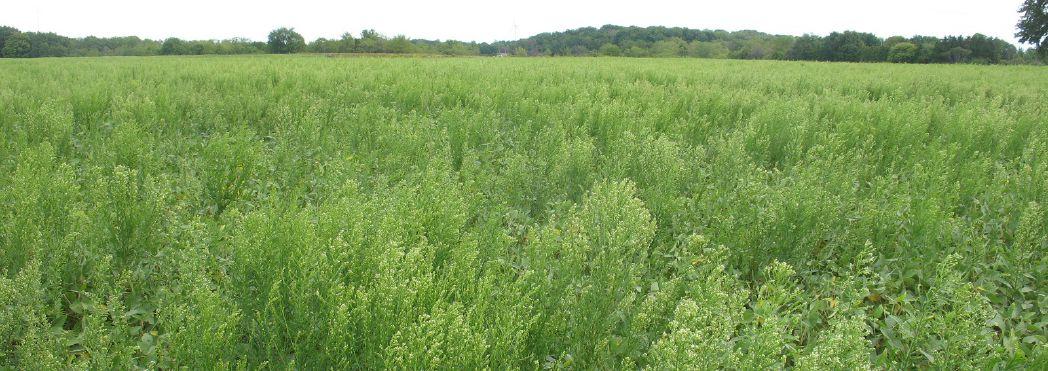
ABOVE: A field in Ontario with probable GR Canada fleabane.
Weeds don’t hesitate getting into your field. Neither should you.
Stay ahead of weeds with critical early-season control. Ensuring your crops begin weed-free contributes a lot to your yield and overall profit potential. Protect them right from the start with new Zidua™ SC herbicide. Registered for use in corn and soybeans, it provides residual activity to help manage susceptible germinating weed seedlings before or soon after they emerge from the soil. And thanks to its Group 15 chemistry, Zidua SC also helps manage the rising problem of tough, resistant weeds, including pigweed and waterhemp. Visit agsolutions.ca/ZiduaSC/east, and waste weeds, not time.
Always read and follow label directions.
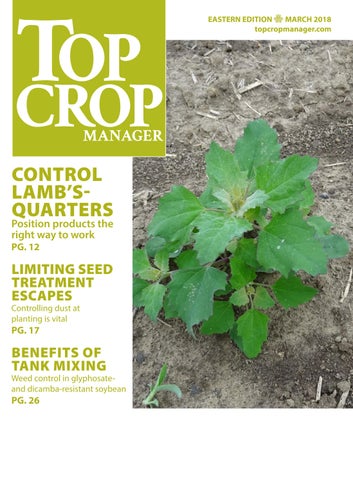
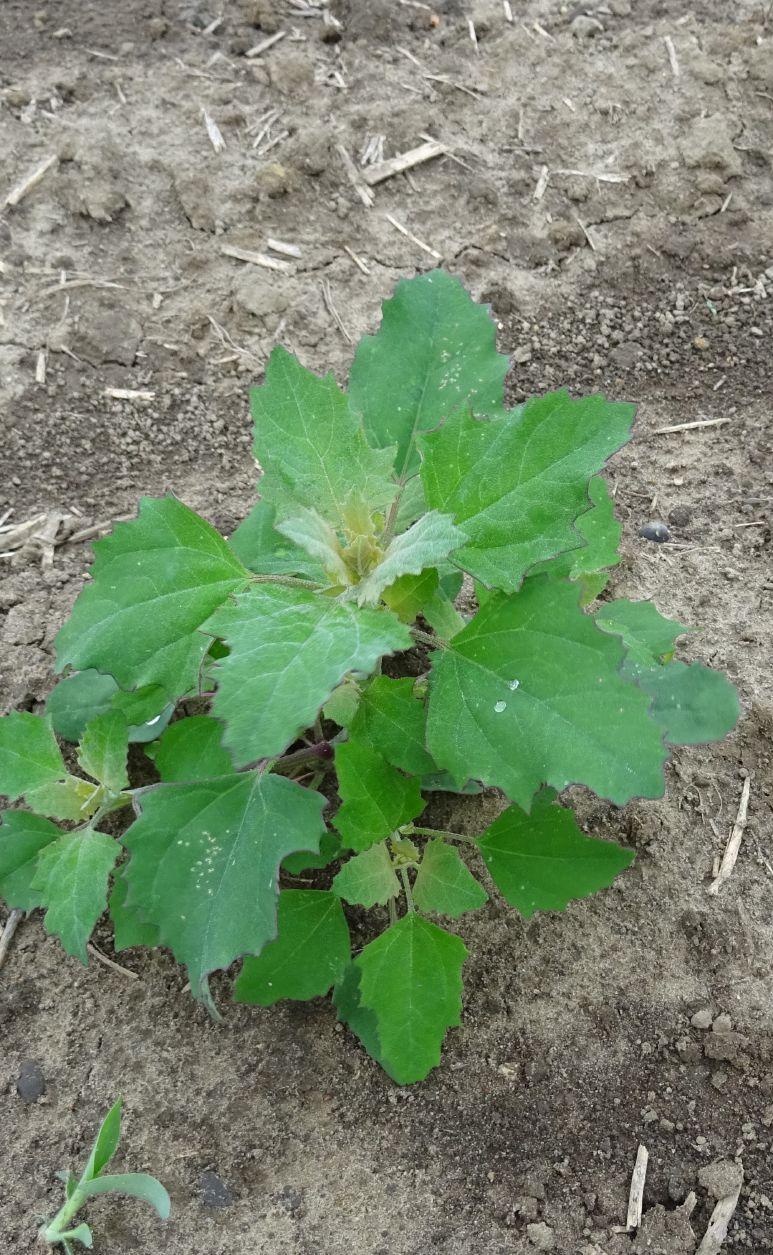
SOLVING THE PROBLEM OF LAMB’S-QUARTERS
This weed has been around for a long time, but it still presents a puzzle for control.
by Julienne Isaacs
In 2016, a survey conducted by the University of Guelph’s Ridgetown Campus found that producers believe lamb’squarters to be their “worst weed” overall across Ontario.
David Bilyea, a technician at Ridgetown, authored the survey and sent it to about 1,000 producers; 300 or so responded.
Though he would have liked to see more data, the survey results are interesting, says Bilyea, because they reflect producers’ experience on all types of agricultural operations: tilled and notill, horticultural and field crops.
Mike Cowbrough, weed management (field crops) program lead for the Ontario Ministry of Agriculture, Food and Rural Affairs (OMAFRA), co-ordinated a similar survey in 2014 that found that lamb’s-quarters was one of the most prominent weeds found in corn and soybean fields.
He’s the author of the newly released Problem Weed Guide for Ontario Crops (Volume 1), which cites research conducted by the University of Guelph’s department of plant agriculture, as well as
other peer reviewed studies and offers management strategies for 19 weed species.
In a chapter dedicated to lamb’s-quarters, Cowbrough writes that although the weed is often identified as one of the most problematic in Ontario, there are many herbicides registered for use against it.
“It’s safe to say there is an arsenal of products available to farmers but our focus should be on putting them in a position to work well,” Cowbrough writes.
Cowbrough says the use of post-emergent herbicides in lamb’s-quarters results in imperfect control if producers wait until the majority of weeds are up to make one application. Use of soil-applied pre-emergence herbicides as well as post-emergent herbicides can result in much better control.
ABOVE: Ontario has populations of lamb’s-quarters that are resistant to Group 5 herbicides and Group 2 herbicides.
The size of the plant at application matters, as well as the time of application. Studies show plants should be less than 10 centimetres (cm) tall at application of glyphosate; control is most consistent when plants are 2.5 cm tall, and the best control happens when applications are made before 6 a.m. and after 9 p.m.
Resistance
Ontario currently has populations of lamb’s-quarters that are resistant to Group 5 and Group 2 herbicides. There are no confirmed cases of glyphosate-resistant lamb’s-quarters in Canada, but a variance in levels of control amongst different populations has been noted in the United States.
In the weed guide, Cowbrough writes that dicamba-resistant lamb’s-quarters has been found in New Zealand, and the introduction of dicamba-tolerant soybean cultivars such as Roundup Ready 2 Xtend has the potential to increase use of dicamba in field crops and select for dicamba resistant populations in the province.
According to François Tardif, a professor at the University of Guelph’s department of plant agriculture, lamb’s-quarters can be
considered one of the most underestimated weeds in Ontario.
“It is on many herbicide labels, farmers have good tools to control it, yet, whenever we look at escapes later in the season, more often than not, it is lamb’s-quarters,” he says. “There is something about this weed that makes it hard to get, and it is not only resistance.”
Tardif has studied resistance in a variety of weed species, and he says lamb’s-quarters behaves differently in terms of resistance. With pigweeds, nightshades and foxtails, he says, the strike rate as far as resistance is concerned is about 90 per cent, meaning that when farmers see escapes they are likely resistant weeds. But with lamb’s quarters, the strike rate is only about 50 per cent.
“This means that when farmer report escapes, resistance is only half the cases; the other cases are plants surviving for unknown reasons. While unknown, these reasons are real, it is just that we don’t know what they are.”
Until those reasons are known and better controls are introduced, producers will be contending with lamb’s quarters, so they shouldn’t underestimate it.
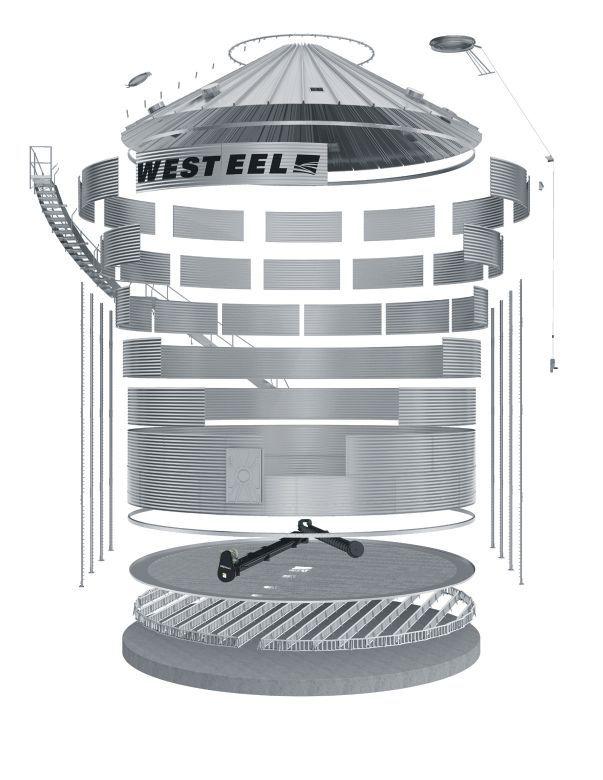
QUALITY TOP TO BOTTOM
ADVANCED CONTINUOUS ROOF ANGLE
15" ROUND GALVANIZED ROOF VENTS
SPIRAL STAIRCASE
WALK-IN-DOOR
EASYFLOW2 U-TROUGH UNLOAD SYSTEM
24" - 36" WIDE FILL CAP WITH REMOTE OPENER
4" WIDE CORRUGATION WITH G115 GALVANIZED STEEL
VARIABLE SECTION STIFFENERS (VSS)
CONTINUOUS BOTTOM RING ANGLE
LOCK-N-LOAD FLOOR SYSTEM
INOCULATE FOR HIGHER YIELDS
Inoculating – a best management practice for many farmers – can increase a soybean crop’s yield by 10 to 20 bushels. Here’s an explanation on how the process works, and why driving fertility uptake can also drive up yields.
BY Trudy Kelly Forsythe
All plants need nitrogen. While healthy bacteria can occur naturally in the soil, especially in fields that have grown nitrogen-fixing crops like soybeans in the past, sometimes nature requires a little help for increased production.
“Stand establishment is the first hurdle in laying a foundation for top yield potential,” says Ken Currah, business representative for south-central Ontario with BASF Canada. “Once a soybean crop has established itself, fertility uptake becomes a major factor in driving high yield potential.”
Inoculants can help.
“Soybean inoculant facilitates the capture of nitrogen fertility – the nitrogen-fixation process – for the plant,” Currah says, explaining that soybeans generally remove approximately 3.8 pounds of nitrogen per bushel of yield. “Half, or better of this requirement, is via nitrogen-fixation from the atmosphere and the remainder from soil fertility.”
More importantly, soybeans need that atmospheric nitrogen made available to them because they can’t survive off of soil-available nitrogen alone. If they are forced to do so, it can result in significant yield loss.
AN INSURANCE POLICY
Horst Bohner, provincial soybean specialist with the Ontario Ministry of Agriculture, Food and Rural Affairs (OMAFRA), says that if producers don’t inoculate, he estimates they will see a yield loss of 10 to 15 bushels per acre, depending on the amount of soil nitrogen in the field in first-time soybean fields. In fields with a history of soybeans, Bohner has found a 1.25-bushels-per-acre yield gain to inoculating. As a result, OMAFRA recommends soybean producers invest in inoculants every year.
Currah considers true virgin soybean ground a soil that hasn’t had soybeans planted in it for at least 20 years. He does admit he considers soils that have been without a soybean crop for eight-plus years at risk for nodulation failures, particularly if they are soils with higher-than-normal potential to make soil nitrogen frequently available. This can include soils with high organic matter because of a history of manure applications.
“Inoculants are considered insurance in a production system,” Currah says. “Technically, a field with continuous soybeans will have a high naturally occurring population of bacteria for nodulation. However, the developing soybean root has to intercept these bacteria and this can delay nodulation past a time critical to the soybean plant.”
Seed-placed or seed-applied inoculant insures that the soybean plants set nodules in conjunction with the reproductive stages of the crop, when the nitrogen fertility is most needed.
FULL COVERAGE IS IMPORTANT
How much inoculant a producer applies will depend on the product and factors such as if the product has an extender or if the seed is also treated with insecticide or fungicide. Bohner says there have been trials established to see if large rates of inoculant would have an impact but it didn’t provide significantly more yield. It’s best to follow the recommended rates on the product label.
What’s most important is getting full coverage on the seed. “It really is a numbers game,” Bohner says. “You want to get lots of bacteria on each seed.”
He never recommends cutting the rate in half to save input costs. “If you’re going to bother, put it on full-rate. It’s worth chasing that bushel, sometimes two in history fields.”
Currah recommends an inoculant product with a high load of rhizobia in terms of per seed unit treated.
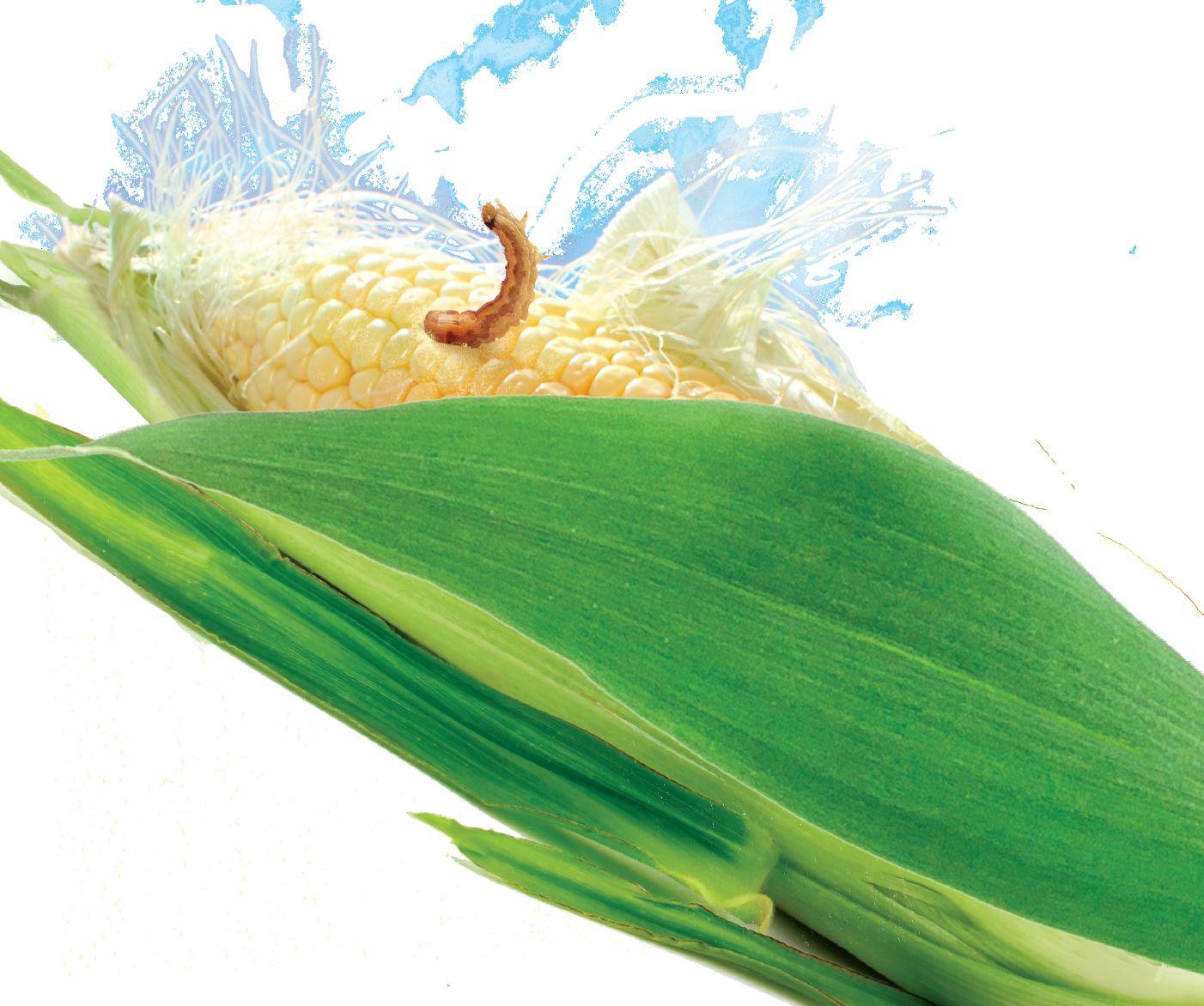
WHACK WESTERN BEAN CUTWORM
Western bean cutworm doesn’t stand a chance with the fast and effective control of Delegate™. Its unique Group 5 chemistry provides contact and residual control of western bean cutworm to help ensure a high-quality corn crop at harvest. This year, bring the hammer down on WBC with Delegate.
HOW YOUR INOCULANT WORKS
Inoculants provide legume crops with a specific type of bacteria, known as rhizobia, which form a symbiotic relationship with the plant. It’s a win-win situation that provides the plant with the nitrogen it requires to grow and the bacteria with a safe place to live and the sugars they require for growth.
As the roots grow through the soil, certain chemical signals are given off by the growing roots, which will trigger the bacteria that have been placed in the soil to infect the tiny root hairs that are being formed.
Through a complex chemical conversation, the root hair will engulf the bacteria, and eventually form a nodule, which is a bump on the root that contains a population of these bacteria in the middle. A win for the bacteria!
This population of bacteria then brings in nitrogen gas from the air, creating the form of nitrogen the plant needs to grow. A win for the plant – and the farmer!
“From there, the next criteria revolve around preferred handling and delivery methods of the inoculant to the soybean seed, or the furrow,” Currah says. “This will dictate whether the producer goes with a liquid or dry inoculant carrier media, and if they will apply themselves on-farm or in-field.”
TO DOUBLE UP, OR NOT
Another common question is if they should double inoculate, which is the practice of using two different products to inoculate seeds. Bohner says yes in first time fields – it’s added insurance of success.
“Producers who apply two products to cover all bases don’t seem to run into problems.”
Currah says there are situations where he recommends a double-rate inoculant program that includes high-load rhizobia products that include Bacillus subtilus, additional bacteria that acts as a growth promoter. But, he says, in these instances, producers should ensure the application methods do not cause plantability issues.
DRY, WET OR PRE-TREATED?
Whether a producer opts for dry or liquid application comes down to producer preference. The market has made a huge swing towards seed that is pre-inoculated by the seed company or seed dealer, thanks to extended-life formulations of inoculant products.
“Peat and liquid only survive on seed a couple hours or days and it can be inconvenient to have to put on when you want to get out on the field planting,” says Bohner. “Pre-inoculated seed treated in the warehouse by seed companies survives 90 days, or even longer, depending on the product.”
OMAFRA and the University of Guelph tested pre-inoculants and found they work similar to on-farm applications in terms of efficacy.
“Extender technology does work while in storage,” says Bohner. “It comes down to cost verses the benefits for the producer to decide if they do it themselves or not.”
For on-farm applied inoculants, the producer has to decide if they go with liquid or dry peat products.
“Each has its merits,” says Currah. “Liquids are generally applied in a spray or up an auger for mixing. This makes for even coverage but there’s the stigma of not being able to see that coverage visibly with the eye.
“With peat products you can see the coverage and evaluate the job, and make tweaks to your system accordingly,” Currah adds. “However, obtaining even coverage can be a challenge, especially for the producers that still handle bagged product and have to mix in the planter box.”
IDENTIFYING A PROBLEM
Generally, when a nodulation problem occurs in soybeans it results in a pale-green look to the crop foliage. When this occurs, a timely application of commercial nitrogen is recommended – 60 to 80 pounds of urea has worked for Currah in the past.
“However, this is an added expense that certainly exceeds even the highest inoculant cost,” Currah says. “Quite often, when nitrogen-deficient soybeans are diagnosed due to nodulation failures, it’s too late to rescue the full yield potential with a foliar nitrogen application.”
THE FINAL WORD
Inoculant is a vital best management practice in soybeans. Returns are modest but very consistent at one to 1.5 bushels per acre in fields with a history of soybeans. More importantly, inoculants provide insurance against delayed nodulation or a complete nodulation failure.
Cool conditions in the spring cause very poor nodulation in late August.
LIMITING SEED TREATMENT CHEMICAL ESCAPES
Managing dust at planting is vital to limiting chemical escape and non-target effects, according to a new University of Guelph study.
BY Madeleine Baerg
Aseed treatment is a vital and effective product, so long as it stays on the seeds where it can do its work. When it is released into the surrounding environment, however, it can cause significant political and environmental concern.
In July 2015, Ontario rolled out strict new regulations governing the sale and use of neonicotinoid-treated seed in an effort to limit non-target effects. University of Guelph researcher Art Schaafsma says legislation does nothing to solve the underlying problem of seed treatment pesticide drift, an issue that extends far beyond just neonicotinoids. Equally important, he notes legislation would not be necessary at all if farmers and equipment manufacturers made basic adjustments to planters.
“If everything stayed on seed and went in the ground and there was no exhaust, we wouldn’t be having a discussion about chemical escape,” Schaafsma says, who is the lead researcher on a three-year study into chemical escapes. “What we confirmed in the study is that 90 per cent or more of non-target exposure to seed treatment chemicals comes from dust abraded from the seed. We have a seed treatment pesticide drift problem, not limited to neonicotinoids.”
While farmers and politicians may disagree on the impacts of neonics on pollinators and other insects, there is no question that the seed treatment chemicals do not always stay where they should. According to Schaafsma’s research across multiple fields, as much as to 2.4 grams per hectare (g/ha) of clothianidin, and in extreme cases, almost 13 per cent of the seed treatment applied – was collected from commercial pneumatic planter exhaust. Because pesticide dust is a very fine particulate, it can travel long distances via wind, spreading its non-target effects over vast swaths of land.
“We’re finding neonics at low concentrations virtually everywhere. Take a soil sample, even in a conservation area where no one has ever applied it, and it’s there. There is no surface water – ditches, streams, puddles – where it doesn’t exist. That’s disconcerting,” Schaafsma says. “How did it get there? It all tends to trace back to the exhaust of planters.”
Researchers generally agree that pesticide dust occurs due to two causes: seed-to-seed friction from seeds jostling together prior to planting, and abrasion caused by anti-clumping talc. Inadvertently, Schaafsma and his team identified a third, even more significant cause of pesticide dust: field dust.
Schaafsma and his team studied a new anti-bridging compound (a replacement for talc) that was waxier to reduce abrasion. “In the lab, it looked very good, we were getting a 95 per cent or more reduction in pesticide dust. But then we took it out to the field and were surprised with how much less effective it was. Instead of a 95 per cent reduction, it was more in the order of 35 to 50 per cent.”
At first, the researchers could not understand why pesticide dust increased so markedly in field conditions. Then, they realized a key difference between lab and field. As a planter moves through a dry field, it stirs up clouds of dust from the ground. As the seed meter vacuum draws in the grit-filled air, seed coats are aggressively abraded.
The team looked at lubricant options to minimize rubbing, and at ways to make the treatment coating hardier and more able to withstand abrasion. Schaafsma says strides are being made on both of these fronts,
thanks to efforts by multiple chemical companies. However, those improvements do not address the issue of field dust.
“You can try to use a better lubricant, you can try to develop a better seed treatment, but the other thing that really needs to be resolved is what do you do about the dust? You have to deal with the dust stirred up in the field,” Schaafsma continues.
In fact, the research team found that minimizing field dust contact with treated seeds is not all that difficult. Simply putting the air intake system up higher, in a forward position on the machine and adding a simple air intake filtration system means significantly cleaner air is pulled into the machine. Less grit into the system means much less chemical out the other side: 98 per cent less chemical, in fact, according to Schaafsma’s study.
“There are a number of different ways to deal with [field] dust going in and [chemical] dust coming out. These take time and money but they are very feasible,” Schaafsma says. “For an investment probably in the order of
a couple thousand dollars upfront and maybe a couple hundred dollars a year in filters, it would be possible to make changes to a planter to virtually eliminate pesticide dust.”
With no immediate incentive plan to upgrade equipment, many growers will balk at the suggestion of another production cost. However, not proactively stepping up may bear heavier consequences.
“Even if I didn’t think it was an issue [myself], there are enough forces at play that argue chemical escapes are an issue. Pressure is going to come from the public. Rather than wait for the next legislative fist, we as agriculturalists should take the initiative.”
Other than proactively negating the need for legislated limitations, Schaafsma says there is another key reason to better manage chemical escapes.
“If you use neonicotinoids as the case study, enough chemical escaped from the seed to cause non-target effects. I don’t think it’s acceptable for me to be planting corn seed and to be blowing pesticide
dust into the air needlessly. If there is a reasonable tool to mitigate that, we should use it.”
While farmers have an important role to play in minimizing seed treatment dust, Schaafsma says government might do well to rethink both its method and its intended outcomes surrounding chemical escape control.
“If, in fact, we agree that pesticide coming out of vacuum planters is a concern – and that’s the first debate one must have – then the way to deal with it is by limiting emissions. If you created a rule to restrict emissions from exhaust, that seems more sensible than trying to restrict where those chemicals can be used.”
DO EQUIPMENT AND CHEMICAL COMPANIES HOLD THE SOLUTION TO SEED TREATMENT ESCAPES?
Multiple companies are stepping forward with chemical and equipment improvements designed to minimize chemical escapes, but not everyone views the efforts as sufficient.
Bayer Crop Science recently unveiled
Bigger Picture
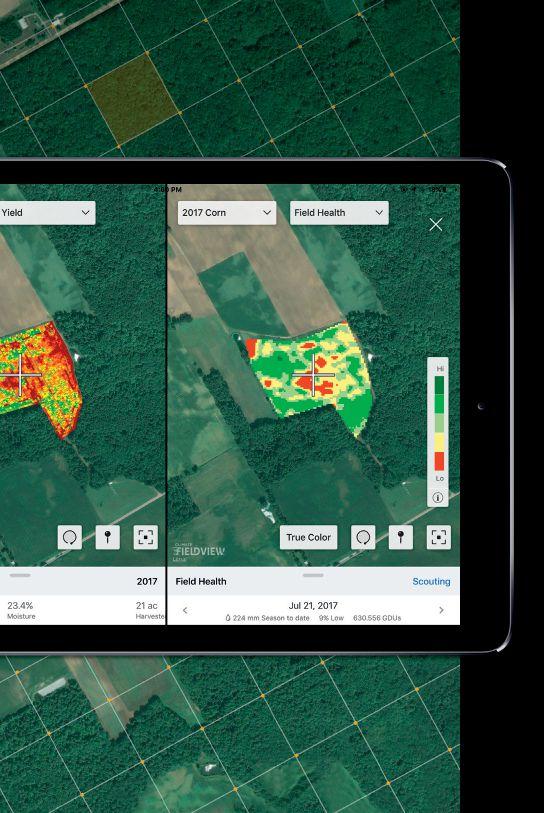
Let Your Data Drive You
No two farms are the same. Your farm is as unique as you. Climate FieldView™ is an integrated digital platform that allows you to easily aggregate your field data in one easy to use software application. Simplify field data management. Climate FieldView is your data partner to support the decisions you make every day.
Get started today at ClimateFieldView.ca
a prototype cyclone called SweepAir that reportedly cleans as much as 99 per cent of emissions from exhaust air. Syngenta reports the after-market dust deflectors it trialled with growers in 2014, 2016 and 2017, which European trials show can reduce off-field dust movement by 50 to 90 per cent, had “overwhelmingly positive” reviews from producers.
“Our multi-year project, which involved 80 farmers and 100,000 planted acres, showed dust deflectors resulted in no documented reduction
Evidence of these important steps forward, he says, can be seen in two Pest Management Regulatory Agency (PMRA) reports. The first states that incidents involving honeybees dropped 80 per cent during 2014, two years before regulations for neonicotinoids came into effect. The second, more recent report shows that seed treatments, including neonicotinoids, are safe when used to label recommendations.
“These are first steps. There are certain things we’re looking at…including
any real change. It would take emissions regulations to change that.”
He points out that equipment manufacturers “independently and reluctantly” came up with a new ISO engineering standard for new equipment that includes directing exhaust towards the ground and reducing exhaust air velocity. While this deflection does successfully direct dust towards the soil surface, the exhaust remains dirty.
In fact, Schaafsma says, “there are no data to support whether the technology
KEEPING CANADA FLEABANE OUT OF FIELDS
Outlining best practices to stay ahead of Ontario farmers’ number one weed-management concern.
by Madeleine Baerg
From Ontario’s Essex County to Glengarry County (located 800 kilometres away), glyphosate resistant (GR) Canada fleabane is wreaking havoc on valuable crop fields. The most economically significant GR weed, GR fleabane is both challenging and expensive to manage. The problem is only getting worse: not only has it spread to 30 counties in Ontario inside of eight seasons, but it now has multiple resistance [glyphosate (Group 9) and FirstRate (Group 2)] in at least 23 counties. A team of researchers from the University of Guelph’s Ridgetown Campus have spent the past seven growing seasons trying to determine best management practices to tackle the tenacious weed.
“It has spread very quickly across southern Ontario, far faster than other glyphosate resistant weed species in the province,” says Peter Sikkema, a professor in field crop weed management and the lead researcher of the University of Guelph study. “I wish I could say that I predicted that it would spread so quickly, but I did not. It moved far faster than I would have expected.”
According to a survey completed by Stratus this past year, 25 per cent of Ontario farmers in resistant-prone areas reported resistant populations on their farms. While the survey did not ask individual farmers to report what percentage of their acres were affected or to what degree, there is no question that resistant fleabane is cutting into profits for a large number of producers.
Sikkema and his team conducted their research on some of the hardest-hit fields. In those fields, he reports average yield loss was 65 per cent in corn and 71 per cent in soybean. But losses can be even worse: in 2014, Sikkema conducted research in a soybean field that suffered 99 per cent yield loss and a corn field that suffered 98 per cent loss.
“That’s certainly a worst-case scenario, but those are real numbers taken from real farms. While not everyone is going to have that
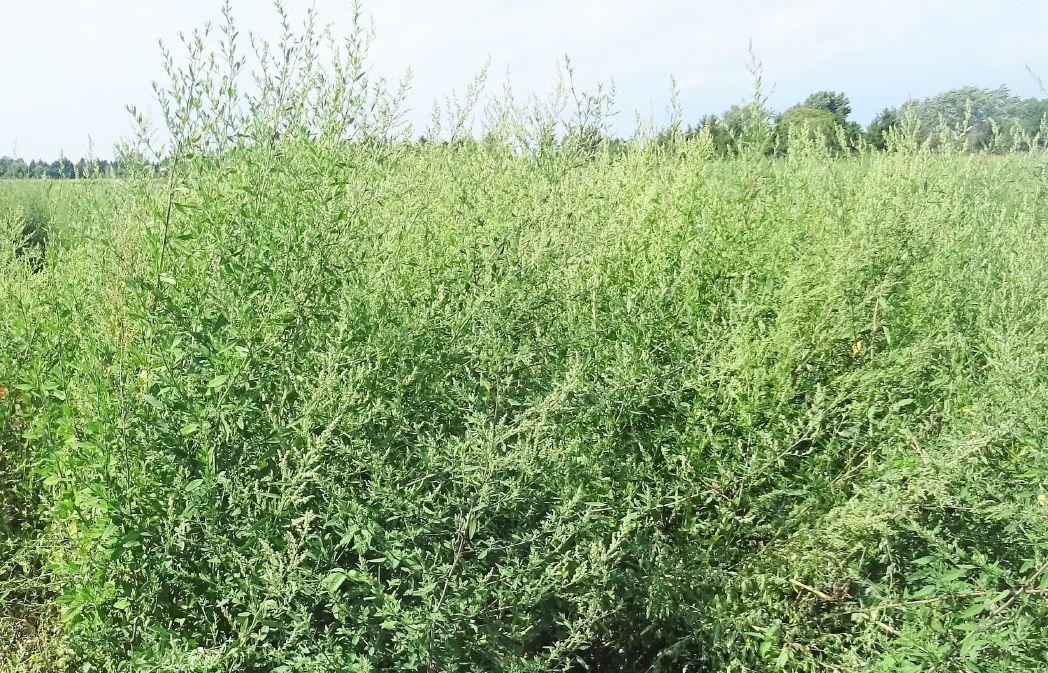
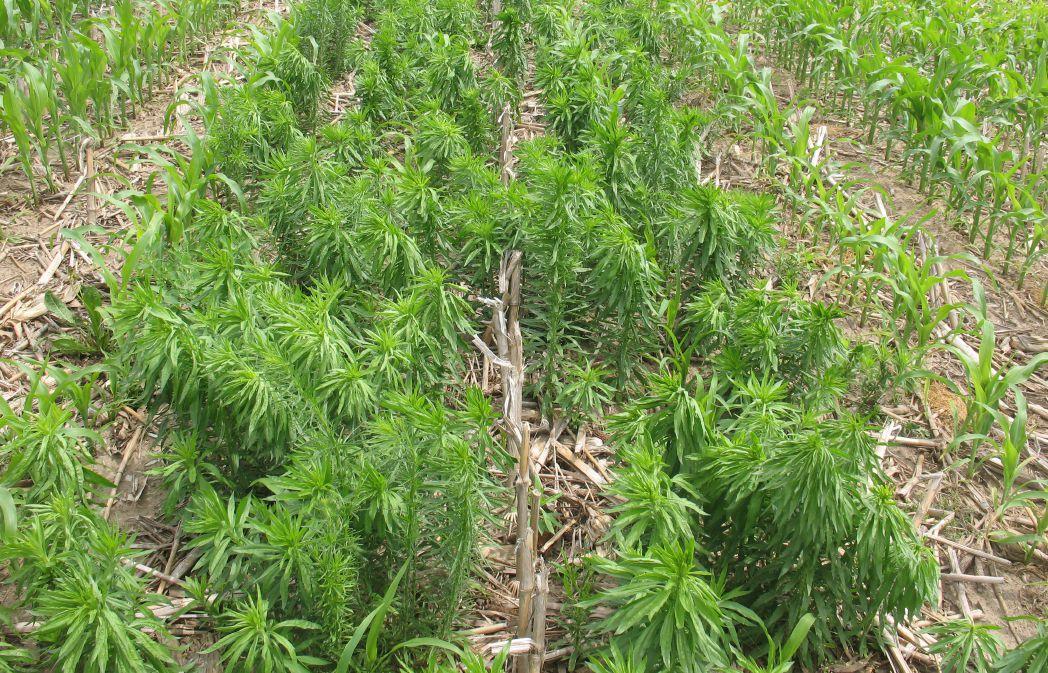
ABOVE: A weedy check plot in Sikkema’s study: Canada fleabane in corn.
LIGHT ’EM UP
Infinity® herbicide is designed to strike fear in the toughest broadleaf weeds in your cereal crops –especially Canada fleabane. Its unique Group 27 mode of action and wide window of application makes Infinity a key herbicide resistance tool, ensuring the profitability of your farm today and for years to come.
level of infestation, it does reflect how bad it can be,” he says.
Minimizing corn losses
To minimize corn yield losses due to GR Canada fleabane interference, farmers need to achieve 90 to 100 per cent control of GR fleabane. In Sikkema’s research, four of eight pre-plant options accomplished this target: Banvel provided 90 per cent control; Callisto plus atrazine provided 91 per cent; Integrity provided 92 per cent and Marksman provided 95 per cent. The success rate of products applied post-emergence fell significantly. Just four of 13 total options achieved acceptable control: Pardner plus atrazine and Distinct controlled GR Canada fleabane 91 per cent, while Banvel and Marksman provided 96 per cent control.
In Enlist corn, a two-pass program of an effective preplant herbicide followed by Enlist Duo applied post-emergence achieved complete or near complete control.
The good news, Sikkema says, is that GR fleabane can be well managed in corn in Ontario using various herbicide groups. The bad news, of course, is that weed management costs will increase, cutting into net returns to farmers.
Not-so-good news for soybeans
The team tested all 29 broadleaf herbicides registered for use in soybeans in Ontario, including pre-plant, pre-emergence, and postemergent options. Not a single one consistently provided acceptable control.
The post-emergence options were the most disappointing. “With the exception of dicamba in Xtend soybean, we found that none of the post-emergent options even provided more than 50 per cent control,” Sikkema says. “What this means is that GR fleabane absolutely has to be controlled before soybeans emerge from the ground.”
A Roundup plus Eragon tank-mix serves as the backbone for managing GR Canada fleabane in soybean. However, on its own it is inconsistent, providing 90 per cent control only about 50 per cent of the time.
“If I advise Ontario producers to use Roundup plus Eragon, I will be right half the time and wrong half the time. That’s a terrible position to be in,” Sikkema says.
To bump up control, he suggests a three-way tank mix. In his studies, Roundup plus Eragon plus 2,4-D achieved 92 per cent control while Roundup plus Eragon plus Sencor captured top position with 97 per cent control.
As an interesting aside, Sikkema’s studies showed maximum weed control occurred when herbicide was applied mid-afternoon –control dropped by at least 10 per cent when herbicide was applied late in the evening or in the early morning.
This past year, Ontario farmers gained the option of using Roundup Ready Xtend soybeans. Sikkema’s studies showed 97 per cent control with dicamba applied pre-plant in Roundup Ready Xtend soybean. While dicamba resistance is a big win for producers, keep in mind that there are no silver bullets in agriculture.
“In a corn-soybean rotation, I want to stress that we are putting a lot of pressure on the Group 4 (dicamba)-based herbicides,” Sikkema says. “When you look at herbicides that are soil-applied or applied post-emergently in corn crops, yes we have a number of options. On the surface it looks like there are lots of different modes of action, but in reality, it’s the Group 4’s that are doing all the heavy lifting.”
Therefore, he stresses the importance of growers including other herbicide groups in their long-term weed management program. The single best way is to have a diverse crop rotation with multiple herbicide modes of action over time.
“Every farm is different. Every farm has different options in terms of what they can include in rotation. In southwestern Ontario, quite a few farms add vegetable crops into rotations; others add dry beans. Some have beef or dairy so they can add forages into the rotation. Anything that introduces diversity into the weed management program is a real positive,” Sikkema says.
He also suggests incorporating winter wheat into long-term crop rotation, as that crop gives growers the option of applying Infinity (Group 6 plus 27).
Limiting fleabane emergence
Canada fleabane can emerge virtually every month of the year. It has a high rate of overwintering success as a winter annual or it can appear as an annual in early spring despite a farmer’s best fall burndown efforts. Once a single resistant plant begins growing in a field, its ability to self-pollinate and its high seed production (up to one million seeds per plant) means a significant resistant population can appear from seemingly nowhere.
Cover crops can help control GR fleabane by limiting late summer and fall emergence and establishment. In Sikkema’s studies, a cover crop sown after winter wheat harvest suppressed GR Canada fleabane 43 to 75 per cent in corn grown the following growing season.
“It’s not perfect but it’s another tactic in a long-term weed management strategy,” he says.
Growers not yet tackling GR fleabane should not make the mistake of sitting idly by. With resistant fleabane now growing in ditches and parks, along stream banks and in highway medians, the seedbank is huge.
Seeds are built to be carried long distance in the wind. Though studies show 99 per cent of seeds fall within 100 metres of the parent plant, seeds can travel as far as 500 kilometres under ideal conditions. As such, scouting is a huge priority for resistant fleabane.
Farmers need to be scouting all their fields. Scouting early and on an ongoing basis is especially the case in soybean, since a farmer needs to know before the soybean emerges whether they have resistant fleabane in their field.
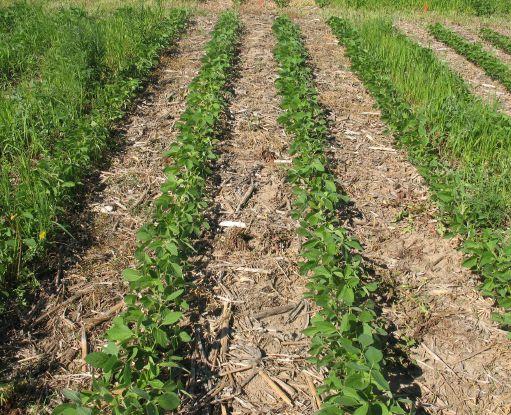
A plot of soybeans where no herbicide was applied.
EASY STREET
Introducing new DuPont™ Destra™ IS corn herbicide.
New DuPont™ Destra™ IS post-emergence corn herbicide delivers unsurpassed convenience and exibility, making weed control hassle free. With two modes of action and a user-friendly dry formulation, it is the perfect glyphosate tank-mix partner for one-pass broad-spectrum knockdown and residual control. Destra™ IS provides excellent crop safety even for short season areas.
Save up to $3.00/acre with the DuPont Head Start Program when you early order before March 31, 2018.
Speak to your local retailer, call the Solutions Center at 1-800-667-3852 or visit destrais.dupont.ca
FALL WEED CONTROL: KNOW YOUR SPECTRUM
There’s no one-size-fits-all for winter annual and perennial weed control.
by Julienne Isaacs
Last April, Real Agriculture agronomist Peter Johnson tweeted a photo of winter wheat seedlings surrounded by a tangle of chickweed. “Chickweed in wheat needs to be controlled in fall! Shepherds purse, stinkweed same. Too much spring competition!” he wrote.
Annual weeds get most of the buzz when producers are talking about weed control, but winter annual and perennial weeds shouldn’t be underestimated, Johnson says.
“Producers worry about controlling spring annual weeds,” he says. “But when you look at perennial weeds or winter annual weeds, that’s where the really big yield losses hit in winter wheat.”
Weeds that are present in fields in the earliest days of spring, such as shepherd’s purse, chickweed, dandelion and fleabane, are the ones producers should be worrying about in wheat, he says.
But Ontario producers aren’t just seeing issues with perennial and winter annual weeds in winter wheat.
“I probably had 20 calls this fall from producers that went into their corn fields thinking they had good weed control and found patches of perennial sow thistle,” he says. “It’s much more difficult to control in the spring than in the fall.”
There’s no one-size-fits-all solution for weed control. Though most winter annual and perennial weeds are best controlled in the fall, there are some that are better controlled in the spring.
Weed control is a long-term game, according to Johnson, and the best way to play it is to have a good handle on the weed spectrum in individual fields.
“On my own farm, the biggest weeds I fight with are dandelion and fleabane. Those have the biggest impact on my winter wheat crop,” he says. “For me, chickweed is rarely an issue but it could become an issue. It’s all of them, but it’s not all of them in every field.”
Know your weeds
Winter annual weeds germinate late in the year, when temperatures begin to cool and even after the first frost; they survive the winter and compete with winter wheat. Weeds in the mustard family, such as shepherd’s purse, stinkweed and volunteer canola, are examples of winter annual weeds. Agriculture and Agri-Food Canada (AAFC) recommends fall herbicide application from mid-October to freeze-up, and in the spring when application won’t harm crops.
Perennial weeds generally grow best during the warm growing season and thus are best controlled in the early fall just prior to harvest. A notable exception is dandelion, which grows best in cool fall conditions, meaning it should be controlled following harvest.
Other examples of perennial weeds include foxtail barley, Canada thistle and quackgrass.
Mike Cowbrough, head of weed management (field crops) for the Ontario Ministry of Agriculture, Food and Rural Affairs (OMAFRA), says herbicides work differently depending on the time of year. In the fall, carbohydrates are translocated to the underground perennating plant structures and the herbicide moves downward with the carbohydrates, resulting in good control of perennial weeds. In contrast, in the spring, carbohydrates are mobilized from the underground plant structures and move upward; herbicides target new growth but fail to offer much root control.
“As a general rule, the species that benefit the most from fall management are perennial weeds,” he says. “There’s tonnes of data on dandelion that shows if you control them in the fall versus the
PHOTO COURTESY OF TOP CROP MANAGER..
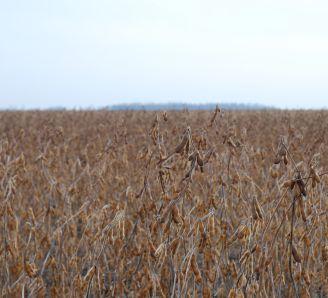
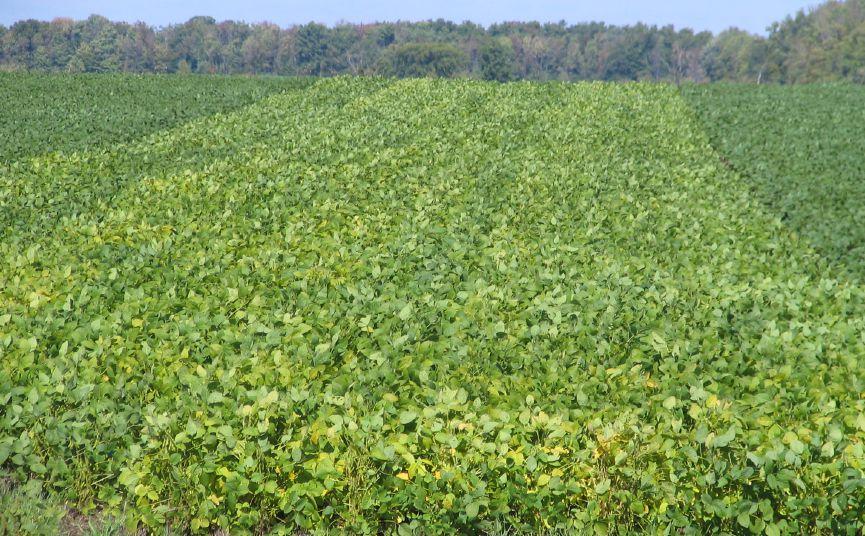
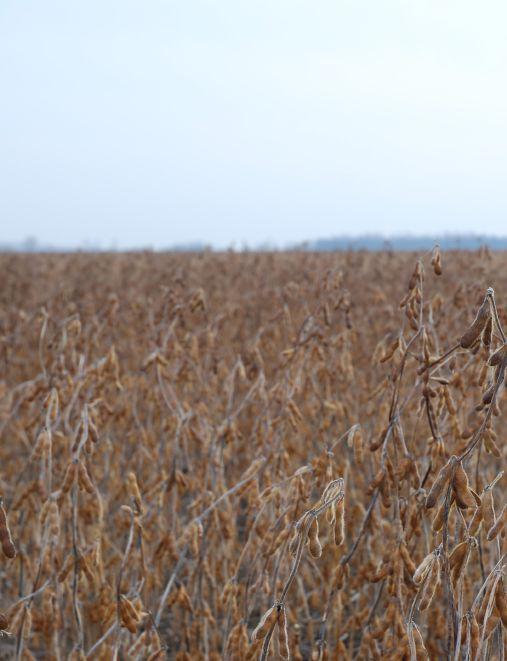
ABOVE: A soybean field before harvest.
spring, you get 20 per cent better control.”
When producers are unable to manage weeds like dandelion, field bindweed or Canada thistle in the fall, these weeds go green into the fall and come up green in the spring, and are harder to control in the spring.
Peter Sikkema, a professor in weed management for field crops at the University of Guelph’s Ridgetown campus, says dandelion is the most common perennial weed requiring fall control. “There have been a number of studies completed on dandelion control, and the majority of them indicate that you get better control with fall application than if you spray in the spring,” he says.
When it comes to winter annuals, Sikkema says that if producers have chickweed or glyphosate-resistant Canada fleabane in a field where they plan to plant winter wheat, a fall weed control program is a good idea. Herbicides can be applied either preplant or after winter wheat emergence in the fall. However, 2,4-D should not be applied after winter wheat emergence in the fall due to the risk of severe crop injury and yield loss, he says.
“If you’ve underseeded your wheat to red clover it is easier to control in the fall versus in the spring,” he says. “But in terms of fall weed management, it’s always going to be field and crop specific.”
Tillage guidelines
Cowbrough is beginning the second year of a two-year study with University of Guelph professor Francois Tardif looking at tillage for managing glyphosate resistant weed species like Canada fleabane.
“In terms of fall weed control, usually you’re looking at glyphosate application, but that doesn’t work for fleabane,” he
explains. “So, you’re looking at tillage, which helps bury the seed and small seedlings.”
Canada fleabane seed has little to no dormancy, he says, which means it will germinate if it hits soil that is warm enough.
“With most weeds, maybe five per cent of the seed falls down and germinates in the first year, but the rest is dormant for a few years. That’s how these weeds become persistent,” he says. “But fleabane won’t germinate at depths greater than 0.5 inches.”
A second aspect of the study compares the effectiveness of tillage versus vertical tillage, a lower-impact form of tillage that breaks up some residue but doesn’t bury all of it.
Cowbrough says tillage is suitable for “worst-case scenarios” like some farmers’ fields where the researchers found four million fleabane seedlings per acre, but vertical tillage could actually make matters worse.
“Even if you take out 90 per cent of that population with vertical tillage, you’re left with a significant number of seedlings,” he says. “If we didn’t do further management to that site, the following spring the remaining plants actually grew bigger and more branched out than if we’d left it alone in the fall. If you’re going to use tillage to manage resistant species you need aggressive tillage. You don’t get 100 per cent control with less aggressive tillage.”
At sites with more reasonable population densities, perhaps tens of thousands of plants per acre, vertical tillage was much more effective, says Cowbrough.
But the first line of defense against aggressive weed species is herbicides – and the producer’s best chance of deploying these effectively is to know what they’re dealing with.
SHIPPING SUPPLY SPECIALISTS
THE BATTLE AGAINST GR WEEDS CONTINUES
Researchers examine effectiveness of dicamba for control in glyphosate- and dicamba-resistant soybean.
by Trudy Kelly Forsythe
With the introduction of Monsanto’s glyphosateand dicamba-resistant soybean into the Canadian market in 2017, producers may be wondering if there is any benefit to tank-mixing the two herbicides for weed control. It’s an apt question given the development of glyphosate-resistant weeds such as giant ragweed, common ragweed, Canada fleabane and waterhemp.
With support from the Grain Farmers of Ontario and Growing Forward 2 funding, researchers from the University of Guelph worked with several agricultural products companies to conduct six field trials at three locations in southwestern Ontario in 2014 and 2015.
The goal was to determine if there was a benefit to including dicamba with a post-emergence application of glyphosate at two application timings for the control of non-glyphosate resistant weeds in Roundup Ready 2 Xtend soybean.
For that study, Peter Sikkema, a professor of field crop weed management at the University of Guelph’s Ridgetown campus, says there was a small improvement in broadleaf weed control when dicamba was added to glyphosate applied post-emergence for the control of broadleaf weeds.
For example, at eight weeks after application, the addition of dicamba to glyphosate improved the control of redroot pigweed to four per cent, common ragweed one per cent, lamb’squarters three per cent, and lady’s thumb two per cent. There was no improvement in the control of barnyard grass or green foxtail when dicamba was added to glyphosate.
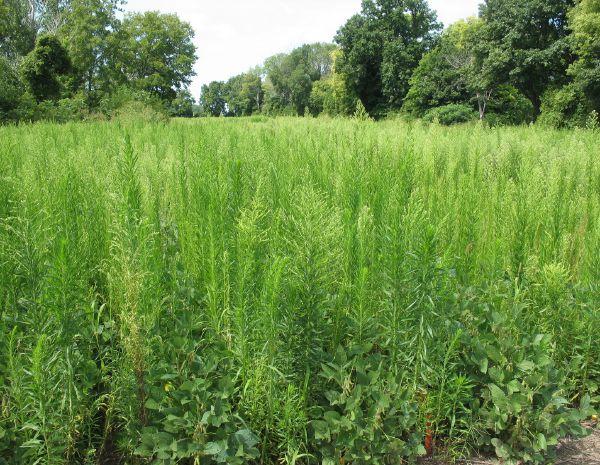
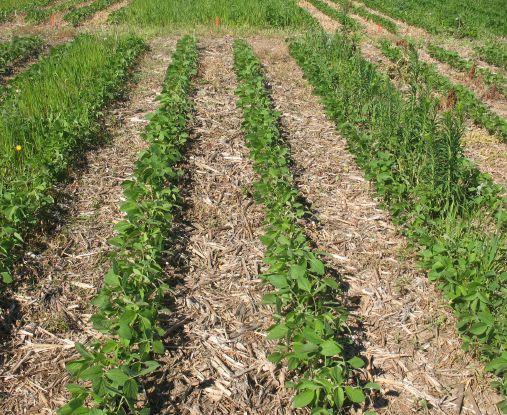
ABOVE: Plot shows glyphosate-resistant Canada fleabane control with Xtendimax applied in the burndown.
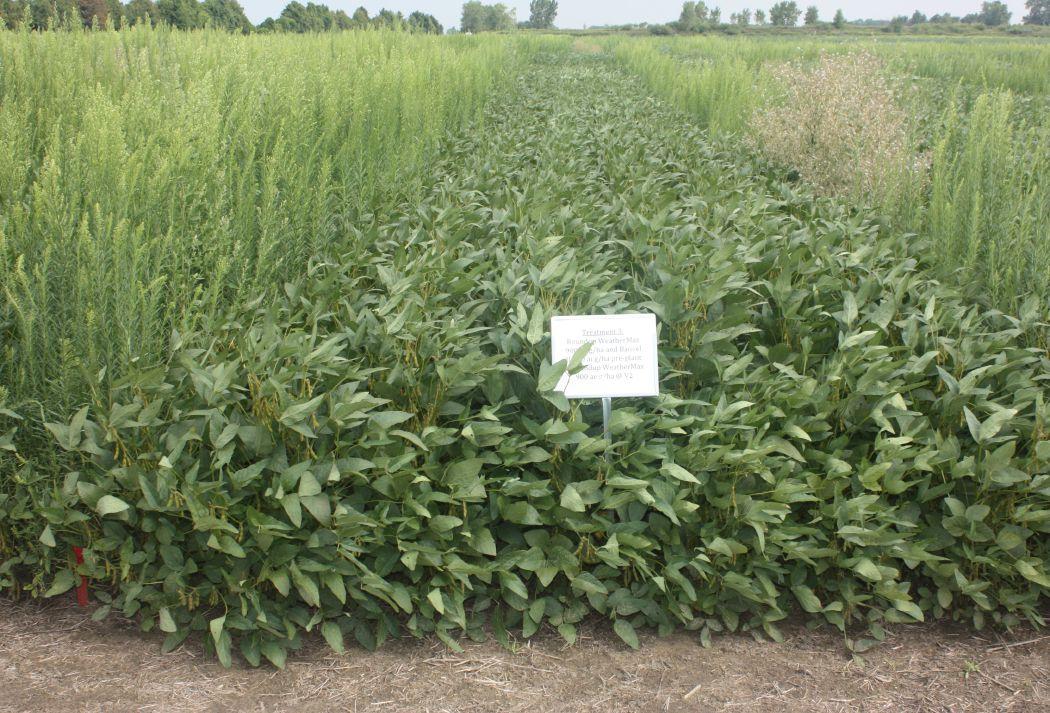
Dicamba-resistant soybean plots showing control of glyphosate-resistant ragweed. The sequential application of glyphosate plus dicamba (preplant followed by post-emergence) was the most effective treatment in Sikkema’s study.
Valuable tool
Sikkema believes that the strategic and judicious use of dicamba has a place for weed management in soybean. “I think this is valuable technology that will be of benefit to Ontario soybean producers to address specific weed management challenges,” he says.
Research projects conducted between 2010 and 2017 that looked at the use of dicamba to control glyphosate-resistant giant ragweed, common ragweed and Canada fleabane in dicamba-resistant soybean certainly indicate this.
The first project took place in 2010 and 2011 on farms near Windsor and Belle River, Ont. Researchers established field trials to evaluate the effectiveness of glyphosate and glyphosate-plusdicamba tank mixes for controlling glyphosate-resistant giant ragweed in dicamba-resistant soybean.
Treatments included glyphosate and dicamba applied
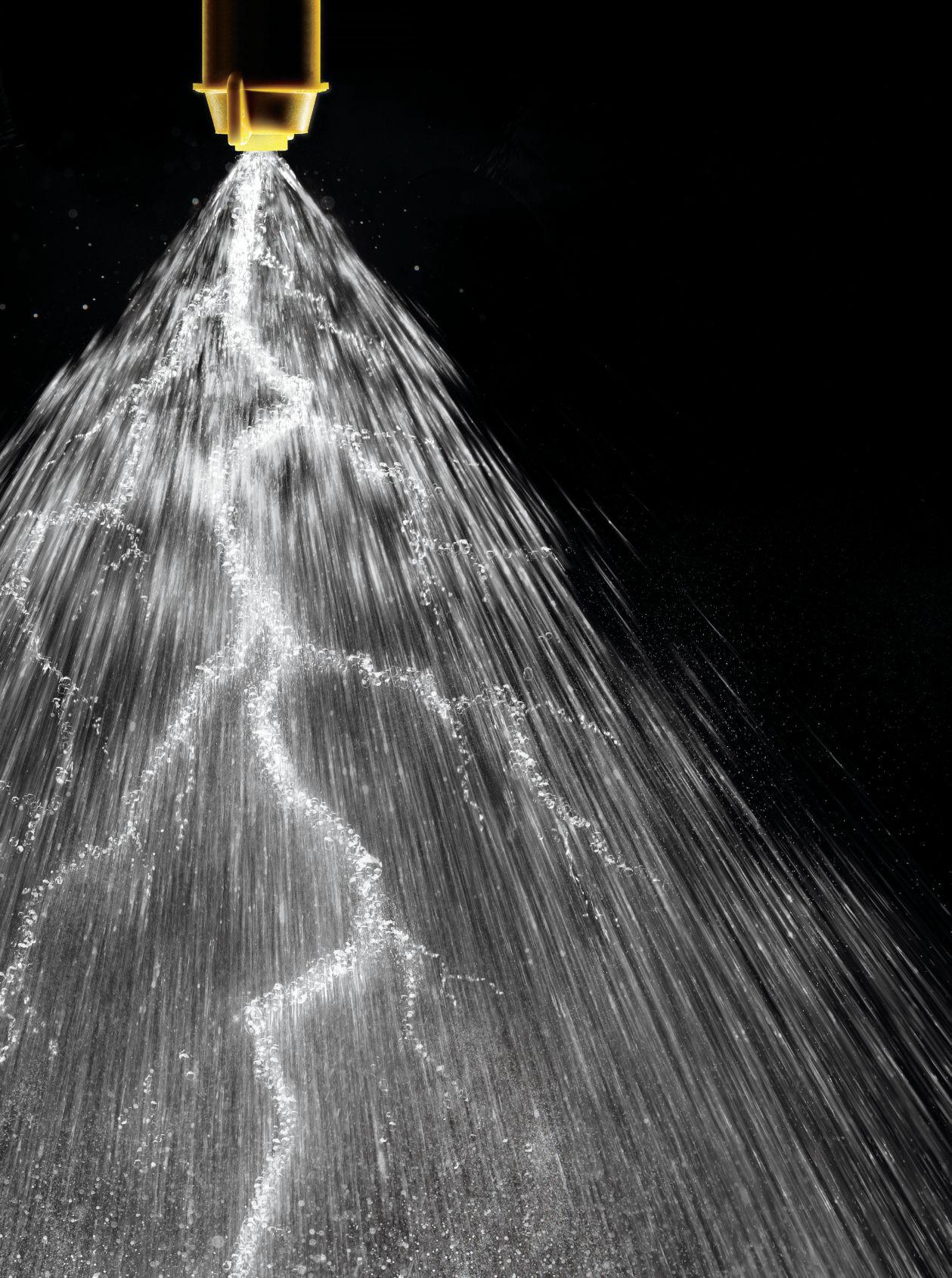
TIPS FOR APPLYING DICAMBA
Herbicide-resistant crops have increased productivity by decreasing the production costs of tilling. They also reduce the use of pesticides and allow for more flexible weed control application timing. Over-reliance on a single mode of action has also led to the development of glyphosate-resistant weeds causing producers to turn to dicamba, an effective herbicide for controlling many broadleaf weed species.
Adam Pfeffer, Technology Development Manager for Monsanto Canada Inc., gives the following advice for applying dicamba to Xtend soybean crops:
USE STANDARD PROTECTION
While there are no additional personal safety concerns, producers should still use the standard protection of gloves and goggles as they do with applications of
pre-plant, post-emergence, or sequentially in various combinations. At eight weeks after application, glyphosate plus dicamba applied pre-plant, post-emergence or sequentially, controlled glyphosate-resistant giant ragweed 87 to 100 per cent, 78 to 100 per cent and 100 per cent, respectively. This study concluded that the pre-plant application of glyphosate plus dicamba was more effective than a post-emergence application. The sequential application of glyphosate plus dicamba (preplant followed by postemergence) was the most effective.
Glyphosate plus dicamba applied pre-plant followed by glyphosate plus dicamba applied post-emergence consistently provided 100 per cent control of glyphosate-resistant giant ragweed in dicamba-resistant soybean, which was correlated with the highest soybean yield. The conclusion reached by the researchers is that using dicamba in dicamba-resistant soybean can provide
other herbicides and follow the label.
APPLY EARLY
“We push early application and we credit this practice with reducing the number of off-target movement situations we’ve had across Canada,” says Pfeffer, recommending the time to apply dicamba is the first time they drive through the field with a herbicide application. “In a no-till situation, it would be in the burn-down scenario. We want to utilize the residual broadleaf control to reduce early weed emergence and minimize crop competition; it is also the best time to control glyphosate resistant weeds such as Canada Fleabane.”
FOLLOW APPLICATION REQUIREMENTS
Following the application requirements on the product’s label is the key to
success for growers.
“Spray droplet size is really important,” says Pfeffer. “It’s the first step to take to reduce physical spray drift. You want to get to larger droplet size to control where the product is going; we recommend an ultra-coarse spray quality for all applications that include dicamba.”
FINAL TIPS
Pfeffer wraps up with a second, effective mode of action if you’re targeting glyphosate-resistant weeds such as Canada fleabane since dicamba is the only effective chemistry.
Finally, a triple rinse spray system cleaning with a commercial cleaner is important before moving to sensitive crops, always be aware of the surrounding area and do not apply when sensitive crops are downwind.
PHOTOS
Every weed species is different and weed management is weed-species specific. The secret is to know what weeds you have in each individual field and match the weed management program to that weed spectrum.
effective control of glyphosate-resistant giant ragweed in Ontario.
The second project involved numerous field trials over a seven-year period
on farms in Essex and Kent counties, again in Ontario. This project specifically evaluated the use of dicamba in dicambaresistant soybean for the control of
glyphosate-resistant Canada fleabane.
In this study, the researchers applied dicamba pre-plant, post-emergence and sequentially in dicamba-resistant soybean. Preplant application of dicamba provided 80 to 100 per cent control of glyphosate-resistant Canada fleabane eight weeks after application. Similar to the giant ragweed study, there was improved control with the sequential application of glyphosate plus dicamba. In addition, with the preplant application of glyphosate plus dicamba, there was improved control as the rate was increased from 300 to 600 grams per hectare.
“Every weed species is different and weed management is weed-species specific,” Sikkema says. “The secret is to know what weeds you have in each individual field and match the weed management program to that weed spectrum. I can’t stress that enough.”
Words of caution
Sikkema stresses that Ontario soybean producers should apply dicamba in glyphosate/dicamba-resistant soybean early in the season, preferably before sensitive crops are up in adjacent fields, to minimize injury to sensitive crops due to off-site movement of dicamba.
The easy way to manage your farm.
Analyze your data. Plan your strategy. Then track your performance. AgExpert Field gives you the details you need to know to make the best business decisions.
It’s all new. And seriously easy to use. Get it now and see.
fcc.ca/AgExpertField
Long-term stewardship of the product is also vital to keep herbicide resistance in check. Adam Pfeffer, technology development manager for Monsanto Canada Inc., says anytime producers attack with a single mode of action, weeds will eventually develop resistance.
“We have a long history of developing herbicide resistance in Canada starting back in the ’50s with 2-4,D-resistant wild carrot,” he says. “Dicamba is a great tool in the toolbox. It complements glyphosate well, but when producers are targeting glyphosate-resistant weeds they should think of additional effective modes of action other than just dicamba.”
“We haven’t had a new, novel herbicide mode of action in over 20 years and there are no new unique modes of action in the pipeline,” Pfeffer adds. “We have to maintain long-term durability of the tools we have today otherwise we may hit a wall where there will be no other options. Farmers dealing with multiple resistant waterhemp and palmer amaranth populations in the U.S. are approaching this point with many modes of action no longer available.”
BUILD A STRONGER SOYBEAN PROGRAM
Getting weeds out of the way early in the season will set up your soybeans for stronger performance, better yields and a better bottom line. Nufarm’s portfolio of weed solutions provides the options you need to build a Soybeans for Success Program for both pre-seed and in-crop applications.
BIGGER YIELDS
Extensive trials1 have shown a 4-9 bu./ac. yield gain when you use a pre-emergent herbicide before a post glyphosate application, compared to only using a post-emergent application of glyphosate.
REDUCE THE COMPETITION
Keep your soybeans clean by reducing weed competition during the critical weed-free period from VE to V3.*
STRONGER STEWARDSHIP
Using multiple modes of action makes for a stronger stewardship plan – reducing the risk of weeds developing resistance to glyphosate and dicamba, and helping to protect the integrity of traits like Roundup Ready 2 Xtend ® soybeans.
SOYBEANS FOR SUCCESS DECISION GUIDE
PRE-SEED HERBICIDE
Pre-seed application of
In-crop application of
Multiple Mode of Action defense strategy
Improved control of nightshade, waterhemp, mustard, pigweed
Longer residual control of fleabane
PRODUCT USE MATRIX
If glyphosateresistant fleabane is present
If glyphosateresistant ragweed is present
If glyphosateresistant common waterhemp is present
When insects like Western bean cutworm start to invade your corn, you need proven performance. Use Coragen® insecticide for extended residual and fast acting control of key insects. Enjoy the flexibility of multiple tank-mix partners and application timing - hot or cool temperatures. Best of all, Coragen® is easy on beneficials and pollinators* Mission accomplished
Questions? Ask your retailer, call 1-833-362-7722 or visit FMCcrop.ca.