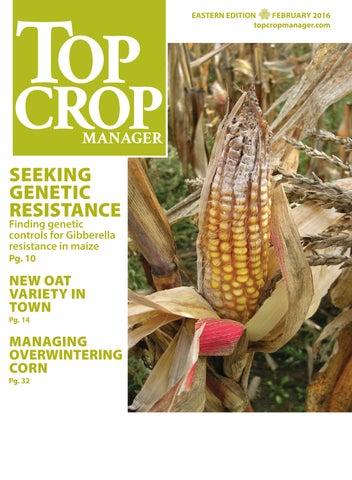
Finding genetic controls for Gibberella resistance in maize
Pg. 10
NEW OAT VARIETY IN TO WN
Pg. 14
MANAGING OVERWINTERING CORN
Pg. 32
Save up to $1 an acre with the 2016 Kixor Herbicide Offer.
No matter what soybean system you use, we have you covered. The Kixor® portfolio of herbicides* offers rapid weed burndown with early season control of key weeds. And thanks to the 2016 Kixor Herbicide Offer, you can also save on every acre when you purchase Optill®, Integrity® or Eragon® LQ for use in herbicide-tolerant soybeans. Visit agsolutions.ca/KixorOffer/ad to learn more.
*Herbicides should be stored in cool, dry, locked, well-ventilated areas separate from
Always read and follow label directions. AgSolutions is a registered trade-mark of
TOP CROP
MANAGER
5 | Sensing soil variations
Optimizing the use of soil sensors for mapping Ontario fields.
By Carolyn King
10 | Seeking genetic resistance
New methods to find genetic controls for Gibberella resistance in maize.
By Julienne Isaacs
32 | Managing overwintering corn
Strategies for reducing yield loss associated with spring-harvested corn in Ontario. By Helen Lammers-Helps
Stefanie Croley,
ON THE WEB
Once considered a weed, camelina is gaining popularity in some parts of the United States as a soil-protecting winter cover crop. Additionally, its seed contains highquality oil for use in cooking and as biodiesel, offering a renewable alternative to imported petroleum.
STEFANIE CROLEY | EDITOR
It wouldn’t be winter without two things: conference season and talking about the weather. At the beginning of January I travelled down the road just a little way to Ridgetown, Ont., for the annual Southwest Agricultural Conference. Having missed the event in 2015, I was especially looking forward to the opportunity to network and learn at this year’s conference, and, as usual, it didn’t disappoint. The session rooms were jam-packed and the hallways buzzed with excitement over topics ranging from the Toronto Maple Leafs to record-breaking corn yields in Georgia. But year after year, one topic that never fails to come up in conversation is weather: past, present and future.
Weather during the 2015 growing season was variable across the province, with some extreme differences from region to region. Overall, it was a good year for growers, with aboveaverage yields in most of the province. Many areas saw a very late frost, a wet spring and an unseasonably warm and dry fall that continued with mild temperatures at the end of the year and into the early days of 2016. As I chatted with another attendee during a brief break, we reminisced about previous conferences and he noted that although it was a little chilly in Ridgetown that day, it wasn’t nearly as bad as the January 2014 conference during the polar vortex. Indeed, I recalled the city of Chatham taking snowploughs off the road because it was too dangerous for the drivers.
This year’s trip was much less frigid, and this year’s forecast looks to be a bit milder, according to a report from Drew Lerner at World Weather Inc. Lerner predicts El Niño will be in control this winter, which means a warmer-than-usual spring and a “favourable weather pattern” in the summer.
Coincidentally, after I returned from Ridgetown, I came across a study that discussed the impact of climate change on global cereal harvests between 1964 and 2007. The study, conducted by researchers at the University of British Columbia and McGill University and published in the journal Nature, determined North America, Europe and Australasia suffered the greatest effects of extreme weather events. Drought caused production levels in these three areas to drop by an average of 19.9 per cent – approximately double the global average. On the bright side, the study revealed extreme weather events had no significant lasting impact on agricultural production in the years following the disasters.
Situations will occur during a growing season that are out of a producer’s hands, and it is the producer’s responsibility to have management strategies in place to best deal with whatever the season brings, be it unpredictable weather, a persistent pest or a disease threat. We at Top Crop Mananger strive to provide you with an arsenal of information to help you be prepared to face whatever may pop up during the year. We’re excited to extend our reach to you through a new event: the first Herbicide Resistance Summit, to be held March 2 in Saskatoon. The event was created to facilitate a more unified understanding of herbicide resistance issues across Canada and around the world, and features a stellar line-up of expert panellists. Find out more at www.weedsummit.ca. We hope to see you in Saskatoon.
TOP CROP
Drive, Toronto, ON M3B 2S9
SUBSCRIPTION RATES
Top Crop Manager West – 9 issues February, March, Mid-March, April, June, September, October, November and December – 1 Year - $45.95 Cdn. plus tax
Top Crop Manager East – 7 issues February, March, April, September, October, November and December – 1 Year - $45.95 Cdn. plus tax
Potatoes in Canada – 2 issues Spring and Summer – 1 Year $16.50 Cdn. plus tax All of the above - $80.00 Cdn.
SENSING SOIL VARIATIONS
Optimizing the use of soil sensors for mapping Ontario fields.
by Carolyn King
Information on how the soil varies across a field is helpful in determining management zones for variable rate applications of crop inputs. As soil sensor services become more common in Ontario, interest is growing in the use of these sensors to map in-field soil variability. Now, Viacheslav Adamchuk, a precision agriculture engineer from McGill University, is leading a project to compare three different soil sensor systems and to optimize their use for Ontario conditions.
For precision agriculture, a key advantage of these sensor systems is that they usually provide much denser soil information across a field than a county-scale soil map or a traditional grid soil sampling approach. “We have legacy soil maps that were created starting in the 1940s, with the last update in late 1990s to early 2000s. The soils are mapped at a reconnaissance scale that is useful for land-use planning but not necessarily appropriate for site-specific applications,” explains Nicole Rabe, a land resource specialist with the Ontario Ministry of Agriculture, Food and Rural Affairs (OMAFRA).
“Soil sensors like SoilOptix, the Veris MSP3 and Soil Information System are available for use in the province. They can help towards understanding our soils better and map soil at a scale that is more reasonable for precision agriculture applications – variable rate seed, variable rate nutrient management, etcetera.”
“As input costs and land prices increase, variable rate applications help optimize inputs to maximize crop performance on every acre.
That led us to a soil sensor tool that can identify the spatial variability on a much finer scale than a traditional soil test,” says Paul Raymer of Practical Precision, a company based in Tavistock, Ont. Practical Precision provides sensor services, including SoilOptix and GreenSeeker (which senses crop vigour for use in determining onthe-go nitrogen rate recommendations).
“Let’s say you’re doing 2.5-acre grid soil sampling, then you have one sample point per 2.5 acres. Compare that to 335 points per acre [with our soil sensor]. I’m not saying that every data point is perfect, but we have a lot more points to be able to see the trends within the field. That gives us more data to use in making prescriptions that can be uploaded into an applicator that is readily available in today’s marketplace, or even sitting in a lot of growers’ sheds.”
These soil sensor systems involve placing a sensor near, on or in the soil. Each type of sensor has its own particular approach to sensing soil variation. In most systems, a user drives the sensor over a field in a series of parallel passes, as the sensor continuously maps the variation in whatever properties are being sensed. The sensor information also needs to be supplemented with lab analysis of targeted soil samples collected from the field. That soil sample
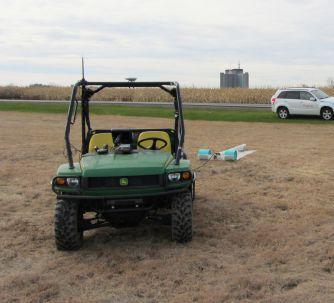
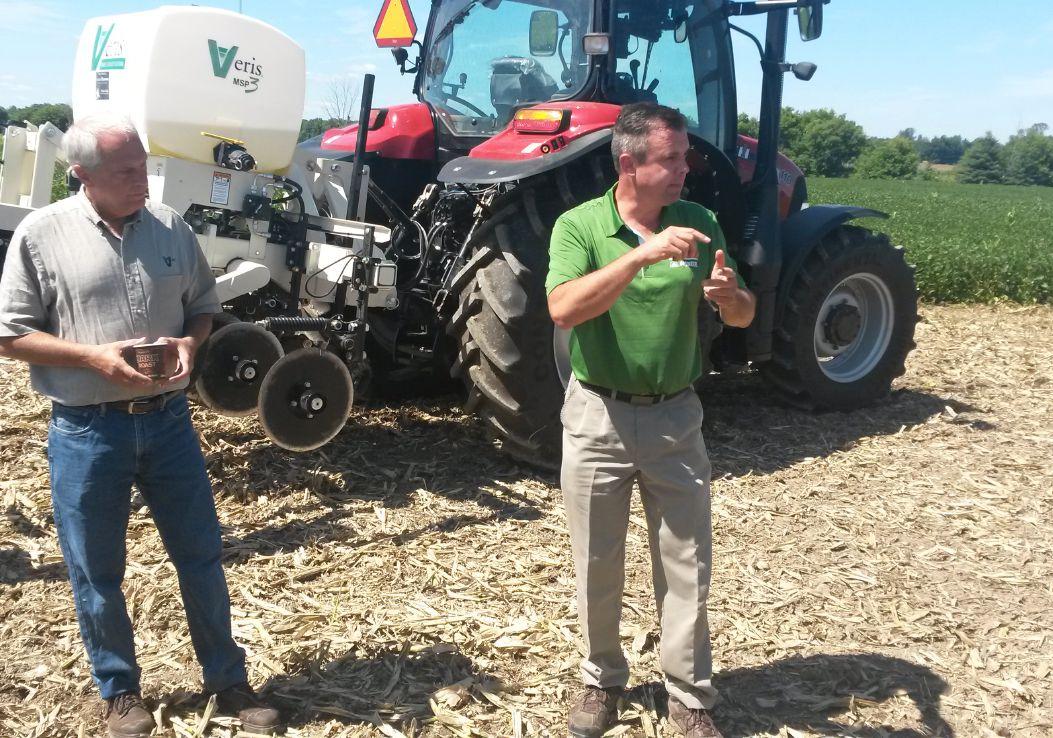
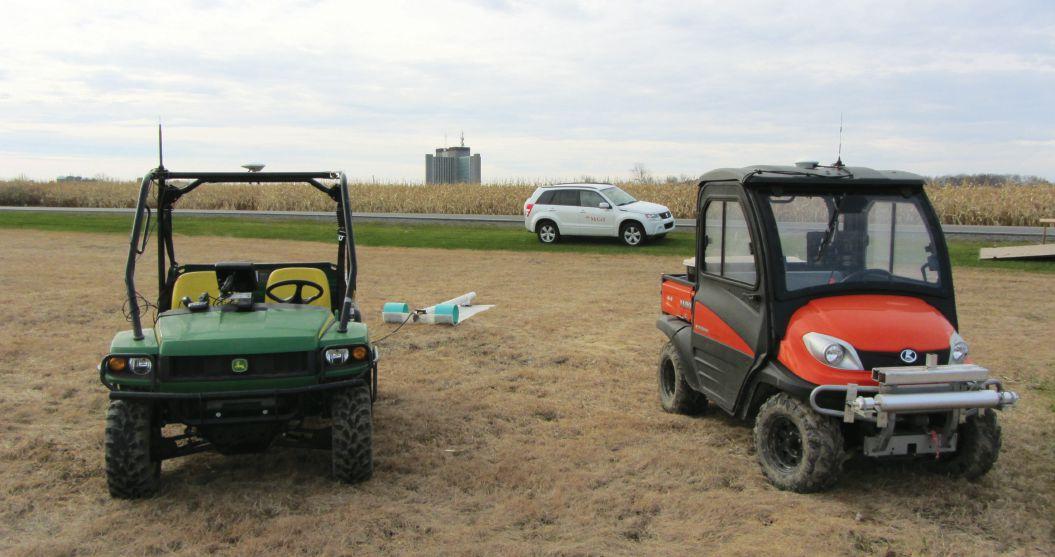
ABOVE: Viacheslav Adamchuk is comparing and optimizing the use of three soil sensor systems, including the Veris MSP3, shown here with Eric Lund (left) of Veris Technologies and Paul Hermans (right) of DuPont Pioneer, who uses this system in Ontario.
information is used in calibrating the sensor readings for the field’s specific conditions, to allow modelling of in-field variations of different soil characteristics.
The three soil sensors being compared in Adamchuk’s project are Dualem-21S, the Veris MSP3 and SoilOptix. “They represent the most common sensing methods, covering over 90 per cent of publicly available proximal soil sensing services,” explains Adamchuk.
“The Dualem-21S is an electromagnetic induction instrument that measures apparent soil electrical conductivity. In Ontario in most cases, this reveals differences in soil texture. It has an effective measurement depth down to three metres. It is a Canadian-based instrument and is very similar to that used by Soil Information System [from Trimble], which is another sensor service available to farmers.” The Dualem-21S is pulled over the soil surface using a specially developed sled; the researchers are using a John Deere Gator to pull the sled.
The Veris MSP3 is a mobile sensor platform with three different sensors and is pulled by a tractor. One sensor measures apparent soil electrical conductivity using a galvanic contact approach, and is a type of instrument that has been used for a long time in soil sensing work. A second sensor measures subsoil optical reflectance (simply put, the soil’s colour), which is then related to soil organic matter content. The third sensor directly measures soil pH. When Adamchuk was at Purdue University, he and his research group developed this pH sensor and licensed it to Veris Technologies. He notes, “It is the only commercially available chemical sensor for on-the-go measurement at this time.”
SoilOptix, which is from the Netherlands, measures naturally occurring radiation from the soil, determining the levels of certain common isotopes of gamma ray radiation. Adamchuk says, “By its ability to differentiate those very low levels of radiation, we can characterize differences in soil texture and soil mineralogy close to the surface.” SoilOptix is carried above the soil surface on a Kubota ATV. Raymer notes that Practical Precision calibrates the SoilOptix data to provide 17 different maps showing predicted variations in the levels of such soil properties as texture, calcium, magnesium, phosphorus, potassium, pH and organic matter.
All three systems produce high-resolution elevation maps. “Each system uses RTK-GPS, so we always get field topography with elevation resolution of plus or minus three centimetres,” Adamchuk explains.
He is collaborating on the project with people from OMAFRA, Practical Precision and DuPont Pioneer. The project runs from 2015 to 2018 and is funded by OMAFRA’s New Directions program.
Along with comparing and validating the performance of the three sensors at different field sites, the project is exploring whether using several sensors to map a field might allow better differentiation of the field’s variability.
Adamchuk explains, “The different sensors are looking at the soil from different perspectives, measuring different physical quantities. Various factors, like soil texture, organic matter and moisture, affect every sensor but to a different degree. So our hypothesis is that when we use sensors with different measurement principles, we can remove some of those effects and really see what is happening with soil texture, soil water-holding capacity, soil nutrient-holding capacity, potential productivity, potential soil organic matter available for mineralization, and things like that, which affect productivity.”
Another component of the project seeks to optimize the soil sampling procedures by fine-tuning factors like how many samples are needed and where to take them. “We know that, by using sensor data, we can better place our samples and in many cases significantly reduce the number of samples needed,” he says.
Adamchuk’s research group at McGill has already developed several prototype software programs for optimizing soil sampling and sensor use. In this project, they are collecting data from a diversity of Ontario fields, including some with very unusual features, so they can test the software and ensure it is robust enough to handle data from a wide range of conditions.
In 2015, the researchers started collecting data from about two dozen sites in southern and eastern Ontario involved in a Grain Farmers of Ontario study, as possible sites for Adamchuk’s project. Out of those sites, they will choose the six that would be the most challenging for their software and that would provide the most information on the differences between the sensors.
Each of the three systems, which also include Dualem (left) and SoilOptix (right), has its own particular approach to sensing soil variation.
MAKE
YOUR ONE PASS, YOUR BEST PASS.
Introducing DuPont™ Destra™ – A powerful new post-emergent, one pass herbicide for glyphosate tolerant corn.
DuPont™ Destra™ o ers residual and broad spectrum control, allowing you to spray earlier and realize clean elds through the critical weed free period. With two modes-of-action, added to your choice of glyphosate, Destra™ delivers excellent weed resistance management from the 3rd to 6th leaf stage. Plus, it’s conveniently packaged in an easy-to-handle 40-acre case. is spring, make your one pass count with Destra.™
Questions? Contact your retailer, DuPont Rep, or the FarmCare® Support Centre at 1-800- 667-3925, or visit destra.dupont.ca.
In addition to the three commercial sensor systems, the project is also testing several prototype systems that Adamchuk and his group at McGill are developing. Also, at one or two sites, the project team hopes to try some additional sensors, like an on-the-go soil moisture sensor. “We have found that for Quebec and Ontario soil moisture is a quite useful layer of information because a lot of variability here is due to differences in water. Topography helps a lot with that, but not always,” Adamchuk explains.
The researchers will also be relating the soil sensor maps to yield maps and field imagery captured by satellites or drones. Also, OMAFRA’s soil science personnel are digging some soil pits to provide detailed soil profile information.
positions are usually more eroded, with a more disturbed A horizon, less organic matter and less mineralizable nitrogen [so the crop usually doesn’t perform as well].”
“What’s really interesting is when you see anomalies that don’t follow that story. Then you need to investigate those areas further to understand what is going on,” she adds.
Rabe is particularly intrigued by the potential benefits from combining soil sensor and crop sensor information. “When you marry those pieces of information, it tells a more powerful story over time.”
Information from soil sensors can be used in combination with other information sources, like yield maps, topographic maps and the farmer’s own experience.
One challenge in mapping Canadian fields with these sensors is that the mapping season is short. “For instance, you need to do the mapping when the crop is not present and when the soil is not prone to compaction and things like that,” Adamchuk says. “However, there are some ways of using those sensors together with other operations.”
Fortunately, most of the data collected by the soil sensors remains about the same from year to year, unless major impacts occur, like land levelling, very heavy manure applications or severe erosion events. For the researchers, this means that any sensor data they weren’t able to collect in 2015 can be collected in 2016. For a farmer, it means a field’s soil sensor data will be good for many years.
Using soil sensor information
Information from soil sensors can be used in combination with other information sources, like yield maps, topographic maps, agronomic research results and the farmer’s own experience, to help in making decisions on variable rate management.
“If you have all those various pieces of information, it helps you make stronger and better decisions,” Raymer says. He explains that every information source has its strengths and weaknesses. “For example, not every grower has a yield monitor on their combine. And if they do have a monitor, then they may not have set it up correctly or maybe they haven’t taken the time to get it properly calibrated. And if they are just starting to use a yield monitor, it is a little risky to base management zones on one or two or even three years of yield data. Three is a nice start, but I’ve heard a rule of thumb that you should have at least seven to 10 years of good yield data to be able to filter out the effects of things like weather patterns.”
Rabe points out that combining information from elevation maps, soil sensors and crop sensors often reveals similar patterns, with better crop growth and yields in the lower parts of the field. “We need the topographic information because soil moves downhill over the years with tillage practices,” she says. So soil tends to be eroded from the upper slopes and deposited in the low spots. “In your soil mapping, you should see those low spots with a thicker A horizon, higher organic matter and likely more mineralizable nitrogen. The crop almost always performs well in those low areas, unless the growing season is very wet and there is some water standing. The top-of-knoll
“It has always been in the back of my mind to do interfacing of soil sensor information with, let’s say, a GreenSeeker from a nitrogen perspective,” Raymer notes. “Let’s say we know some properties of the soil, like organic matter and the watertextural relationship, that influence nitrogen, and the field has a sandy area where we know the vegetation level is going to be low. The GreenSeeker might say there is an opportunity to put more nitrogen there. But nitrogen may have a tendency to leach out of those sandy soils, and it could be a poor performing part of the field. So it wouldn’t make economic or environmental sense to apply extra nitrogen there. We could create a prescription to override the GreenSeeker in that part of the field, and tell it to just apply 10 gallons, or whatever rate. So we could get the strengths of both systems by bringing them together.”
Adamchuk suggests a couple of possible approaches to using soil sensor maps. For instance, you could use regional research information on managing low productivity areas and high productivity areas, and then use the map to target the appropriate practices. He gives an example: “In Ontario, we know that a low elevation, high electrical conductivity soil might benefit from a higher seeding density. And on a low electrical conductivity or high elevation area, if the area has historically had lower yields, then a lower seeding rate will not affect the yield data but the farmer will save the cost of a few extra bags of seed.”
Another possibility would be to set up a small trial to see if variable management of an input on a particular management zone would make a difference. “You could manage the entire field the way you usually do, but then in those specific areas, you could apply a little less or a little more. If you have variable rate control equipment, then setting up research plots is relatively simple. It’s just a few minutes to draw a polygon on the screen, and then you would say for this area I want to lower the seeding rate, for example,” he explains. “Then, with your yield map at the end of the season, you could see whether or not you have a yield reduction on that area. And the rule of thumb is that, if you don’t see any difference, then for the next season you do what is cheaper. If you do see a difference, then you can calculate the costs and benefits and see what makes the most sense.”
Adamchuk adds, “With pH maps, using the information is very straightforward: you just don’t lime areas with neutral and alkaline soils.” That’s a real advantage compared to applying lime at uniform rate across a field, with some of the lime going on areas where it is not needed and either provides no benefit or is harmful. “If lime is applied on soil that is already slightly alkaline, you may end up with phosphorus and micronutrient deficiencies, which may create some additional problems in the long run.”
Rabe concludes, “It’s an exciting time for soils, and Ontario is pretty lucky to have a number of soil sensor options to look at and review, and to have the expertise of people like Viacheslav Adamchuk.”
SEEKING GENETIC RESISTANCE
New methods to find genetic controls for Gibberella resistance in maize.
by Julienne Isaacs
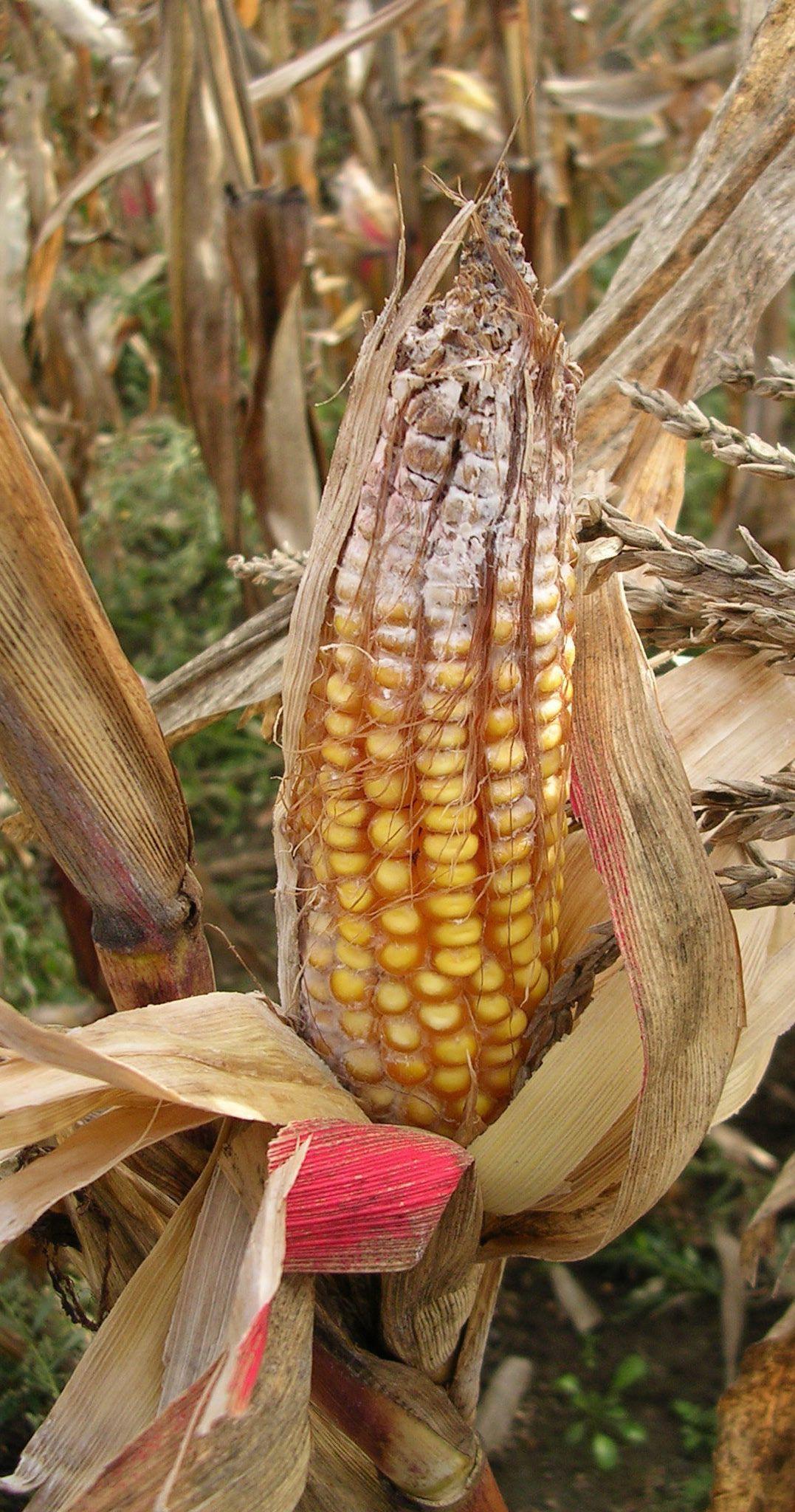
What if corn breeders had access to molecular markers for qualities like Gibberella ear rot resistance and kernel dry down rate? Researchers at Agriculture and Agri-Food Canada’s Ottawa Research and Development Centre (ORDC) have begun to understand the molecular mechanisms influencing these traits, which means corn breeding is about to get smarter – and faster.
“We’re always trying to develop new inbreds of corn with resistance to Gibberella ear rot, so we have several lines developing in our pipeline over the next few years,” says Lana Reid, a research scientist with expertise in corn breeding and genetics.
“We’re the only public breeding program in Canada that releases public inbreds, and the demand has been increasing.”
ORDC’s previous releases include CO441 and CO449, which have the highest Gibberella resistance of any publically released maize lines in the world. This year, the centre is releasing the first lines they’ve ever developed with common rust resistance. Within the next several years, Reid says the ORDC will release between 10 and 20 lines with resistance to common maize diseases.
Reid has collaborated with French, Spanish and Chinese researchers in analyzing the biochemical mechanisms for resistance. “Why is something resistant? Why is it so resistant? These are people coming forward saying this is why,” Reid says.
But important discoveries are being made right at ORDC. Linda Harris, a research scientist in cereal/fungal genomics, is working with Reid on an industry-driven improved corn genetics project. Harris uses next-generation sequencing technology to map Gibberella ear rot resistance in maize.
“A number of different sources of resistance have been identified in cereals, maize and wheat, but we don’t know the exact mechanism of resistance at the molecular level,” she says.
A few years ago, Harris crossed CO441, which has good silk and kernel resistance to ear rot, with B73, the susceptible United States inbred that is the source of the public maize genome sequence. Using a large hybrid ear resulting from that cross, Harris developed 410 separate lines from the seeds of the ear, where each line was descended from a single seed and has a different homozygous mosaic background – or a different mix of the parents’ genetics.
“We screened those 410 lines for silk and kernel resistance over several seasons, used the low-cost genotyping by sequencing method to obtain over 1000 molecular markers across the genomes, and then we looked to see which regions of the genome were responsible for resistance,” Harris says.
The project, which is funded by Growing Forward 2 and the Canadian Field Crop Research Alliance, which includes the Manitoba Corn Growers Association, began in April 2013 and will continue to March 2018.
So far, their findings have been promising.
Mapping resistance
Aida Kebede, a post-doctoral fellow at ORDC, is looking for regions of the genome responsible for resistance. She identified 10
PHOTO COURTESY OF LINDA HARRIS, AAFC.
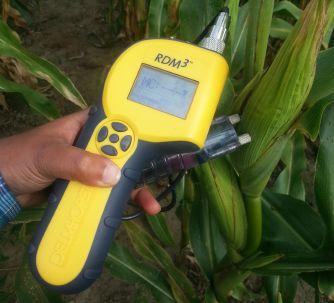
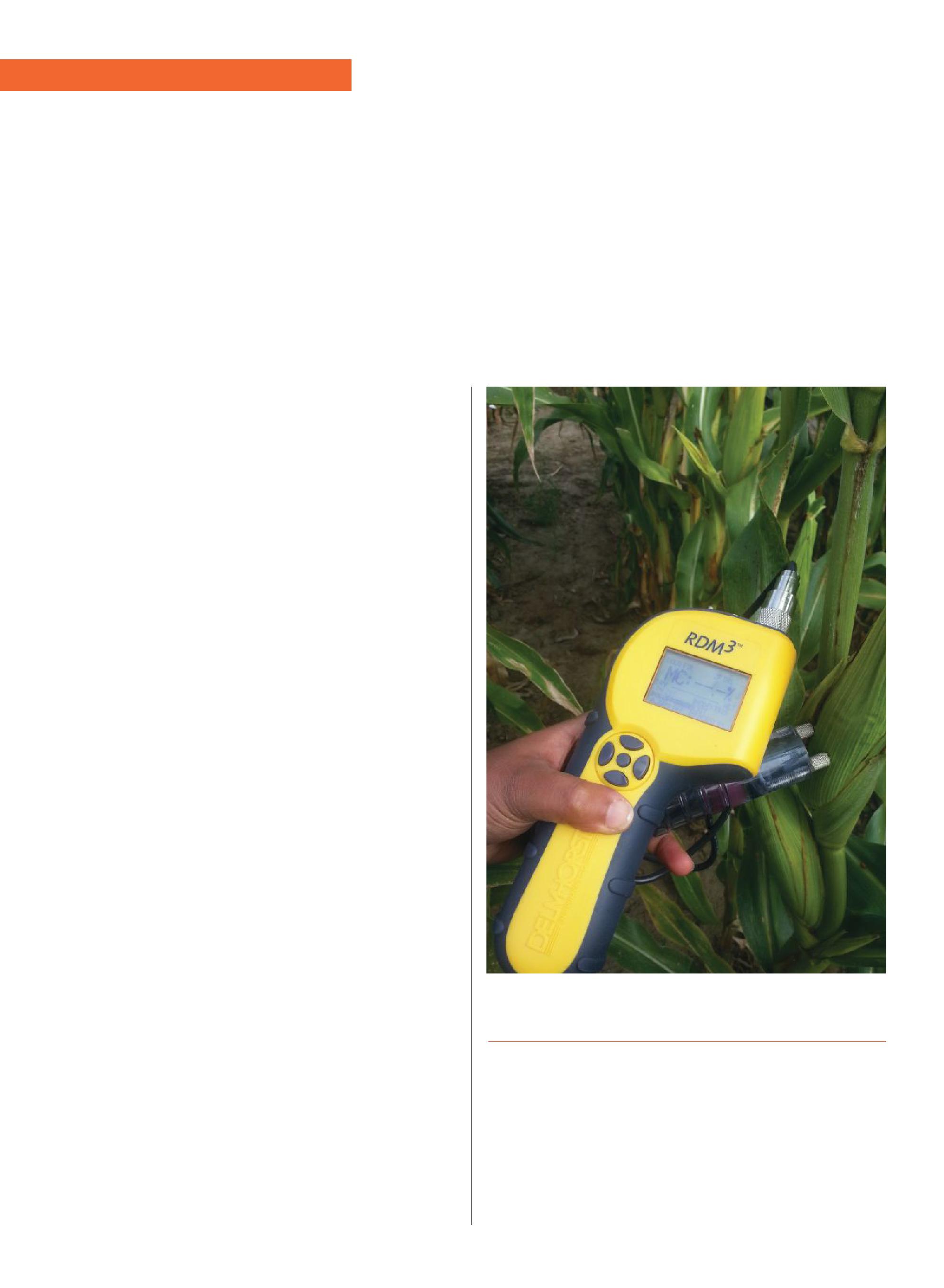
Aida Kebede, a post-doctoral fellow at the Ottawa Research and Development Centre, measures an ear of corn with a moisture metre.
Higher yield potential with Optimize®
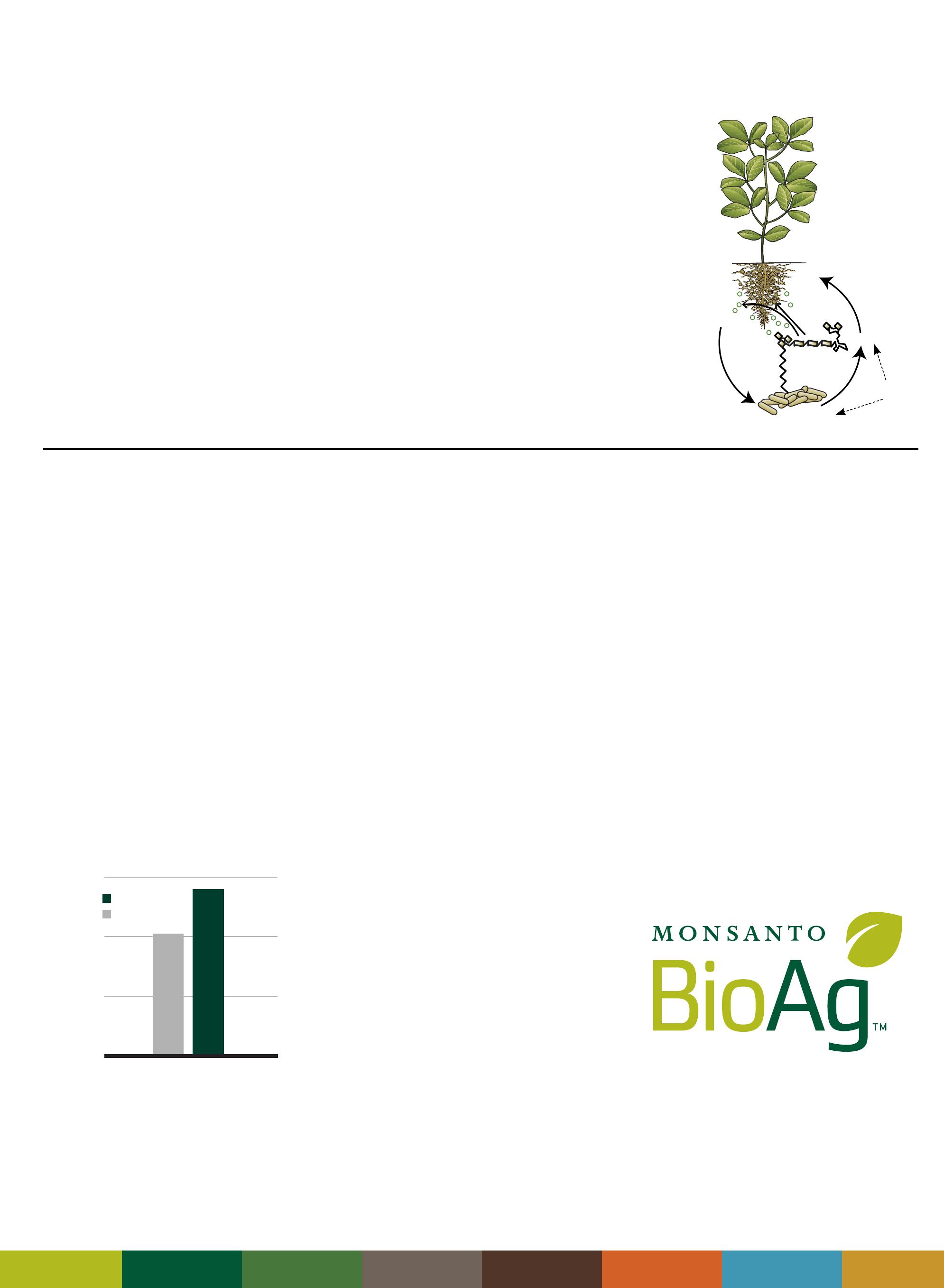
Plants and bacteria talking to each other? Sounds like science fiction, but that is exactly what happens. Like a wink, soybean roots say hello to a specific nitrogen-fixing Bradyrhizobium japonicum (B. japonicum) bacteria. With a nod back, the bacteria lets the soybean plant root know it is in the area and ready to go to work. This communication is necessary for the soybean plant and the B. japonicum bacteria to safely establish a symbiotic relationship.
The soybean roots initiate the conversation by sending naturally occurring plant signal molecules called flavonoids out to the root zone, essentially asking if any
Forward thinking with Optimize
Optimize and Optimize ST are seed-applied inoculants for soybeans, and include a specially selected B. japonicum inoculant strain, along with LCO technology. Having LCO technology packaged with the rhizobia in Optimize and Optimize ST helps the communication between the soybean plant and B. japonicum happen sooner, regardless of growing conditions.
The benefits include improved nodule formation, increased nitrogen fixation, and enhanced nutrient availability to support root and shoot growth.
In trials conducted in Ontario and Quebec, Optimize increased yields by an average of 3% compared to single-action (nitrogen only) competitors.
B. japonicum bacteria are in the area. When the B. japonicum receive the message, they communicate back using an lipochiooligosaccharide (LCO) molecule saying, “yes, let’s get together.” It is the LCO molecule that drives this critical communication between B. japonicum bacteria and soybean plants. There are many bacteria in the soil and not all are beneficial. This LCO signal lets the plant root know that it is safe to allow the B. japonicum bacteria into the root. Barriers to this natural process include temperature and moisture stress.
Flexible inoculation with two formulation choices
Optimize and Optimize ST are applied to soybean seed by seed companies or retailers to eliminate the need for farm-applied inoculation, and to ensure optimum seed coverage and inoculant performance.
Optimize is a great choice for seed companies and retailers who want the convenience of treating seed during the winter months, starting as early as November. Optimize has a 220-day planting window, with specific seed treatment chemistries, allowing seed companies and retailers to spread out the inoculation window:
• Long, 220-day window on the following key seed treatment chemistries: Acceleron® seed treatment technology for soybeans (fungicides only and fungicides and insecticide)* and Cruiser Maxx® Vibrance® Beans
• Convenient sequential, simultaneous, or tank mix seed treatment applications
• Spreads out the workload
With all the benefits of the original Optimize, Optimize ST has a more concentrated formulation with a 120 day planting window. As a seed retailer, the 120 days leading
up to planting is a hectic time. That’s why Monsanto BioAg is pleased to offer the new Optimize ST formulation. Its more concentrated formula provides:
• Less volume of product on the seed with a reduced application rate – 2.8 fl oz per unit compared to the original formulation of 4.25 fl oz
• Treat twice the number of beans – 400 units instead of 200
• Half the amount of product to store
• More convenient and easier to use than the original formula
To learn more about the benefits of Optimize and Optimize ST, call 1-800-667-4944 or go to optimizeLCO.ca
Source: Summary of 29 large-plot independent research trials in Ontario and Quebec from 2010–2011.
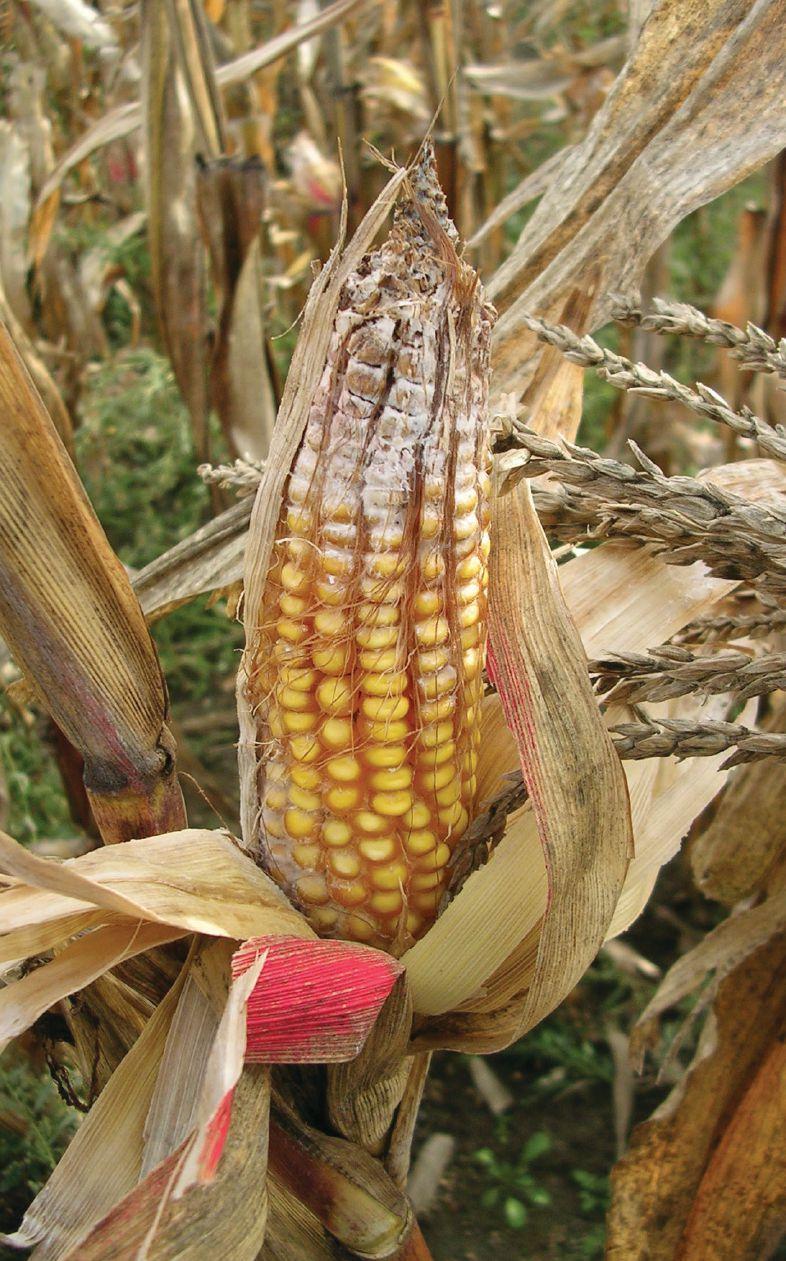
Researchers at the Ottawa Research and Development Centre are developing new inbreds of corn with resistance to Gibberella ear rot, shown here in corn that has been inoculated with fungal spores.
genomic locations providing Gibberella resistance, of which four were common between silk and kernel modes of entry. And she also found some genotypic correlations between disease severity and agronomic traits – meaning that agronomic traits have a role to play in disease resistance.
In other words, Gibberella ear rot resistance and agronomic traits like kernel dry down are interlinked.
To analyze the expression of these traits in maize, Kebede conducted a field experiment for two years before extracting RNA samples. Now, Kebede is using RNA sequencing to try to get to the heart of the relationship between disease resistance and agronomic traits.
“At the moment I’m working on gene expression data analysis for identifying candidate genes for Gibberella resistance using RNA sequencing,” says Kebede.
“Because we have already seen there is a relationship between Gibberella resistance and kernel dry down rate, we want to use one trait as an indirect selection criteria for the other trait,” she says. “Kernel dry down rate is much easier to measure, so we try to indirectly select for Gibberella resistance by selecting for maize lines with fast kernel drydown rate.”
Kebede says breeding for Gibberella ear rot resistance is intense, requiring a great deal of resources and human labour. If kernel dry down rate can be used as an indirect selection for Gibberella resistance, the breeding process will be streamlined by reducing the cost for independent disease screening experiments.
Harris says the project is still at the validation stage, but the team hopes their work will soon result in molecular markers that Reid can incorporate into her breeding program. “It’s very labour intensive to screen for resistance. If we can pre-screen for certain markers that would be much easier,” Harris says.
Kebede is hopeful that the program will result in a more efficient breeding process. “Finding the chromosomal regions and the candidate genes will speed up the breeding process, so that transferring resistance genes to hybrid corn will be much easier. That is the achievement. And farmers will get resistant hybrids much faster than before,” she says.
PHOTO COURTESY OF LINDA HARRIS, AAFC.
ENGARDE TM DELIVERS THE OL’ ONE, TWO.
Twice the protection in one powerful herbicide. DuPontTM EngardeTM corn herbicide delivers twice the performance with two modes of action; twice the control with knockdown and residual activity; twice the coverage with broadleaf and grassy weeds; and twice the exibility with a window of application from pre-emergence to the two-leaf stage.
Find out more about EngardeTM today and how you can receive an instant discount of $2 per acre with the DuPontTM Head Start Program.
Ask your retailer about EngardeTM today. For more information, call the DuPontTM FarmCare® Support Centre at 1-800- 667-3925 or visit engarde.dupont.ca
NEW OAT VARIETY IN TOWN
The latest oat variety released by AAFC’s oat breeding program shows promising yield.
by Trudy Kelly Forsythe
Producers are always looking for improved varieties of crops. In the case of oats, that means traits such as increased yield, good groat percentage, disease resistance and good standability.
Thanks to work by researchers at the Ottawa Research and Development Centre (ORDC) – which has the only public oat-breeding program in Eastern Canada – producers in Ontario, Quebec and Atlantic Canada now have just that.
Developed by Agriculture and Agri-Food Canada (AAFC) research scientist and plant breeder Weikei Yan and his colleagues at ORDC, the new variety, AAC Nicolas, is being marketed by SeCan, a not-for-profit association of independent seed business members. It has high yield, good groat percentage, good lodging resistance and is resistant to crown rust and septoria.
“Nicolas has achieved 20 per cent higher yield than check cultivars in Quebec in the last three years,” Yan says. “Its groat percentage is the highest among high yielding cultivars and is equal to Dieter, which is currently the most favoured cultivar of the milling industry.”
Its straw strength, another important factor for growers, is also good, showing stronger straw than AC Dieter throughout research trials in Quebec and Ontario. It has a beta-glucan that is higher than the control cultivars Dieter and Rigodon. AAC Nicolas also has white, intact, and uniform groats – a new aspect oat breeders are starting to look at.
“In addition, it has good resistance to lodging and crown rust and performed well in Ontario, the Maritimes and Western Canada,” Yan says.
Developing a new variety
The process of breeding a new variety of oat is no short-term task. It can take about 10 years, or 12 generations, from the time breeders make a cross to the time they release a new variety.
“In the earlier generation, when we cannot select for yield directly,
we select for the more easily selected traits that contribute to high yield,” Yan explains.
These traits include: disease resistance, particularly crown rust; height, which is related to lodging resistance; growth vigour, which may be related to high yield; kernel size, because growers and millers like large kernelled varieties and it may be related to high yield; and hull colour, because growers like white hulls.
“Later, when we have enough seed for yield test, we select for grain yield, groat percentage and beta-glucan, oil and protein contents,” Yan says. “A superior variety has to be good or at least acceptable for all of these traits we look at.”
ORDC’s program
Yan says ORDC’s oat breeding program is as old as AAFC, originally focusing on better oat cultivars for use as horse feed.
“Originally oats were mainly used as horse feed as there were many horses used as a source of power for transportation or farm activities. Horses have been dramatically reduced in the modern times; so have the oat acreage and production in Canada and worldwide.”
In the past two decades, oat has been increasingly used as human food as it became known that oat contains a large amount of dietary fibre, particularly beta-glucan, that can reduce bad cholesterol and risk of heart disease and diabetes if a sufficient amount of oat-based food is included in the daily diet. Research shows 70 grams of oat meal or three grams of beta-glucan can have a positive effect.
“Our current oat program is supported by the oat milling industry to breed oat cultivars that are high yielding, so growers like to grow them;
CONTINUED ON PAGE 19
ABOVE: Scientists at the Ottawa Research and Development Centre have developed AAC Nicolas, a new variety of oat with high yield and resistance to crown rust and septoria.
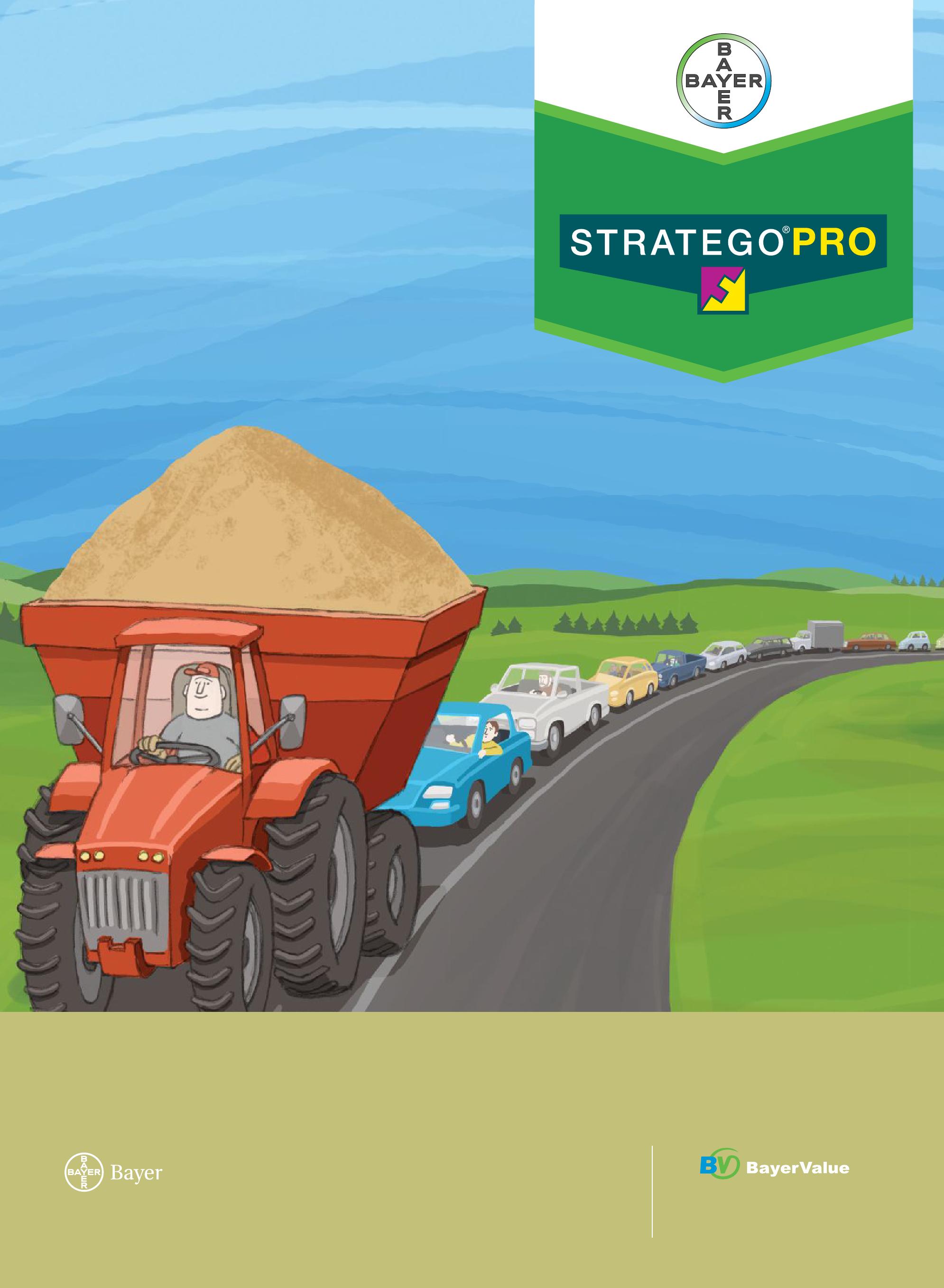
Holding up traffic is out of sight. Holding up traffic is out of sight.
Looking to drive up the quality and yield of your soybeans and winter wheat? Go with Stratego ® PRO fungicide – and get ready to cause some serious gridlock. While you may not end up too popular out there on the road, you can count on protecting your crop from devastating diseases including white mould… and harvest healthier, higher-yielding soybeans and winter wheat. Ask your retailer for Stratego PRO, today. More than the best products. Great rewards. Ask your retail about our program.
MARCH 2, 2016
WHY ATTEND THE 2016 weed summit?
To gain a better understanding of herbicide resistance issues across Canada and around the world.
Our goal is to ensure participants walk away with a clear understanding on specific actions they can take to help minimize the devastating impact of herbicide resistance on agricultural productivity in Canada.
Some topics that will be discussed are:
• A global overview of herbicide resistance
• State of weed resistance in Western Canada and future outlook
• Managing herbicide resistant wild oat on the Prairies
• Distribution and control of glyphosate-resistant weeds in Ontario
• The role of pre-emergent herbicides, and tank-mixes and integrated weed management
• Implementing harvest weed seed control (HWSC) methods in Canada THIS EVENT IS APPROVED FOR 4 CEU CREDITS
SPEAKERS
HUGH J. BECKIE
Weed Scientist, Agriculture and Agri-Food Canada Research Centre & Adjunct Professor in the Department of Agricultural, Food and Nutritional Science, University of Alberta
TOPIC
State of weed resistance in Western Canada and future outlook
K. NEIL HARKER
Weed Scientist, Agriculture and Agri-Food Canada & Adjunct Professor at the University of Alberta
TOPIC
Diversified Cropping Systems
LINDA M. HALL
Agricultural Food and Nutritional Science, University of Alberta
TOPIC
Learn about why the type of resistance is critical to the herbicide options
PETER SIKKEMA
Professor, Department of Plant Agriculture of the University of Guelph
TOPIC
Hear results from field trials evaluating control options in corn, soybean and wheat
IAN HEAP
Director of the “International Survey of Herbicide-Resistant Weeds.”
TOPIC
Herbicide Resistance: A Global Overview
JASON NORSWORTHY
Professor, Crop, Soil, and Environmental Sciences Department & Chair of Weed Science, University of Arkansas
TOPIC
How a diversity of tactics can combat glyphosateresistant weeds
MICHAEL WALSH
Senior Research Fellow, Australian Herbicide Resistance Initiative (AHRI) in the School of Plant Biology, UWA
TOPIC
The evolution of harvest weed seed control (HWSC) methods and potential use in global agriculture
BR EANNE
TIDEMANN
P.h.D student, University of Alberta
TOPIC
Harvest Weed Seed Control Methods
WHAT’S NEW IN FORAGES
Double crop forages and growing sainfoin among the current forage trends of major interest.
by Treena Hein
More and more producers are starting to recognize the benefits forages provide in terms of improved soil quality and reduced erosion, notes Jack Kyle, the pasture and forage specialist at the Ontario Ministry of Agriculture, Food and Rural Affairs.
But, Kyle notes, “there are still many who don’t manage their forages to the optimum.”
The main – and significant – benefits of forages to the crops that follow is in added organic matter and improved soil tilth. However, Kyle warns that perennial forages must be managed correctly for benefits to be fully realized. “A well-fertilized relatively young stand of forage can be very productive,” he says. “But if there is limited fertility or the stand is old, you will not see optimal results.”
New offerings
Kyle suggests new varieties of annual and perennial ryegrass may be of particular interest to growers because these species are higher in energy than the other cool season grasses and therefore make excellent forage and pasture.
While the challenge in the past has been winter survival, he says, newer cultivars and blends of cultivars are showing not only better persistence, but also higher growing season productivity.
“Rye grasses prefer a cool moist climate,” Kyle notes, “but through breeding and selection, there are now blends that are doing well in Ontario.”
Another species that is relatively new is festulolium, a hybrid forage grass developed by crossing Meadow Fescue or Tall Fescue with perennial ryegrass or Italian ryegrass, which Kyle says can be used where ryegrass might also be considered.
Matt Anderson, manager of product development at DLF Pickseed Canada, says festulolium combines the best properties of the two types of grass. “The fescues contribute qualities such as high dry matter yield, resistance to cold, drought tolerance and persistence, while ryegrass is
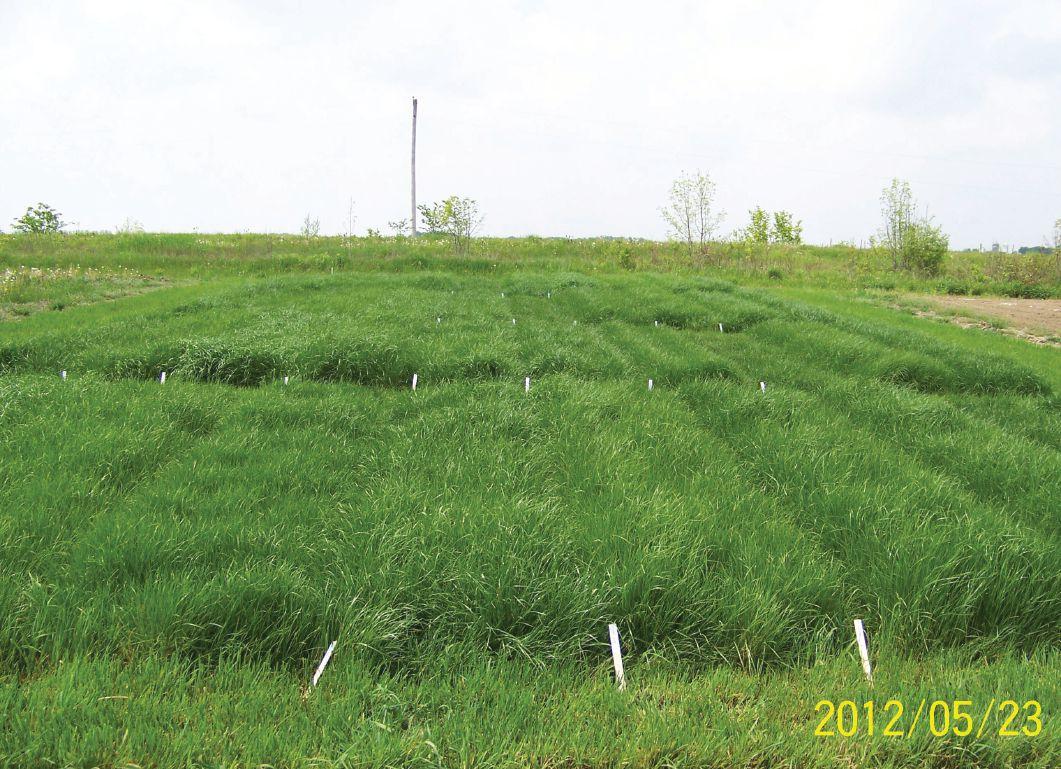
TOP: Rye grass, shown here at the Elora research station, typically thrive in a cool, moist climate, but new varieties are doing well in Ontario.
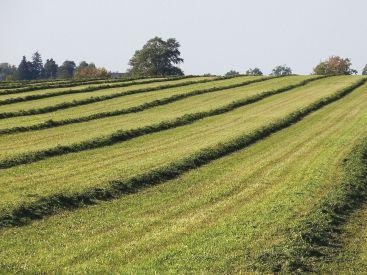
INSET: Grass hay fields and grass pastures need adequate nitrogen for good plant growth and productivity, says Jack Kyle.
PHOTOS COURTESY OF JACK KYLE, OMAFRA.
characterized by rapid establishment, good spring growth, good digestibility, sugar content and palatability,” he notes. “The individual festulolium varieties contain various combinations of these qualities, but all are substantially higher-yielding than their parent lines.” DLF Pickseed has developed a substantial breeding program in festulolium that has produced a unique range of varieties.
On the legume side, Kyle says there is currently quite a bit of interest in sainfoin, in Western Canada anyway, because a new higher-yielding variety called AC Mountainview was recently developed in Lethbridge, Alta., by Agriculture and Agri-Food Canada (AAFC) scientist Surya Acharya. “There is a renewed interest in grazing and wanting to maximize the productivity of the pastures,” Kyle says. “Alfalfa is excellent from a forage productivity standpoint but the risk of bloat in grazing livestock discourages its use. However, sainfoin is non-bloating, and if you include it in a mix, its non-bloat characteristics would counteract the bloat-inducing qualities of the alfalfa.”
Sainfoin (from French words “sain” and “foin” meaning “healthy hay”) is a centuries-old forage from Europe and western Asia. The plant contains a fair amount of condensed tannins, which help a cow’s digestive tract more efficiently process plant protein, preventing build-up of gas in the rumen (bloating). AAFC trials are ongoing in western provinces and may take place in Ontario in future.
Forage cultivation – fertilize and think short-term
“I think one of the biggest mistakes with forage management is the lack of fertility applied to fields,” Kyle notes. “There is a significant amount of phosphorus and potassium leaving a hay field with each harvest. Often this is not replaced with commercial fertilizer or manure. Over a few years, the fertility in the soil is reduced, resulting in reduced plant vigour and shortened stand life.” Grass hay fields and grass pastures specifically, he says, need adequate nitrogen for good plant growth and productivity.
Kyle says most forage fields reach their peak production in the third year and then productivity starts to make a significant decline, yet producers often look for five to 10 years from a forage stand. Shortening the life of the stand to two or three years instead, he advises, will result in increased productivity and the positive impact on the succeeding crops
will be maximized. Anderson completely agrees.
“In pastures, the biggest opportunity to increase productivity is to rotationally graze the pastures so that the forage plants get grazed over a short time period (a few days) and then give them sufficient time to recover and regrow,” Kyle notes. “Pasture fields should be managed in the same way as hay fields – harvest at the opportune time as quickly as possible and stay out of the field until there is sufficient growth to harvest again.”
Double crop forages
Double crop forages are forages that follow a cereal crop and are allowed to grow from mid-late summer through to a killing frost in the fall. With this scenario there is going to be ground cover during much of that time, Kyle explains. “This is what forages are all about – adding organic material to the soil through ground cover and also through root growth,” he says. “It reduces soil erosion and provides improved yields in succeeding crops. And the combination of ground cover and added soil organic matter provided by double crop forages is similar to what perennial forages provide, but on an annual basis.”
When planning double cropping with forages, Kyle advises a close look at the growth characteristics of the species that you are considering in the forage mix. “Find out whether or not the species will set seed in the fall, and if so, ask yourself if you can you manage it as a volunteer next year,” he says. “The same goes for any species that might over-winter –how are you going to control it next spring?”
Kyle also urges growers to ask themselves if there is a sufficient growing season for the species to gain reasonable root and top growth, and whether or not they wish to harvest some of this crop as forage. “If yes, what considerations will be necessary given that harvest is going to occur at a time when drying conditions are poor and frequent rains may well be occurring?” he asks.
Also ask if it makes sense to pasture the cover crop. “I think this is a real opportunity for cover crop utilization,” Kyle says. “By grazing, the nutrients stay in the field, you don’t have to deal with harvest issues and you have a very low-cost livestock feed, with added benefits to the soil. It’s a win all around.”
NEW OAT VARIETY IN TOWN
CONTINUED FROM PAGE 14
high groat content, so millers can make money; and high beta-glucan, so oat product can be sold as healthy food,” Yan says. “These three things do not go together, and it is our goal to put them together.”
Yan and his colleagues continue to pursue lines that have improvement over ACC Nicolas in some aspects. “The goal will remain the same as above, though people may work from different angles, such as molecular and genomics perspective,” he adds.
SeCan and ACC Nicolas
Phil Bailey, SeCan’s eastern business manager, says the association had Yan and AAC Nicolas on its radar for several years because of the variety’s tremendous yield potential versus other varieties in the same class. SeCan has a research agreement with the oat breeding program at ORDC through the Growing Forward 2 Program.
“One of our goals is to acquire rights to varieties through long-term research agreements,” Bailey says. “We fund the oat breeding program, get access to varieties and make them available to SeCan members who then multiply the seed and make it available to all farmers in
Eastern Canada. We do the promotion for it, create the seed guide and help sellers sell it.”
Bailey says SeCan is very excited about this new variety and preliminary analysis by Quaker Oats Company (Quaker), to evaluate ACC Nicolas’ quality is showing promise as well.
“There are different end uses for oat milling markets such as Quaker oats and horse feed markets,” Bailey says, adding Quaker has done initial testing on AAC Nicolas to evaluate its quality and it is showing great promise.
“Everything so far looks positive. Quaker and Weikei work closely as well and Quaker will analyze small amounts of seed, then evaluate on a bigger scale.”
SeCan distributed high pedigree seed to its members in the spring of 2015 so they could multiply it. “Several produced it and were very happy with its performance,” Bailey says.
This season, SeCan members will once again bulk up the seed hoping to make it commercially available on a large scale to all growers in 2017.
THE BEST OF THE BUNCH
The winners of the 2016 Canadian Truck King Challenge.
by Howard J. Elmer
For the past nine years, veteran automotive journalists have donated their time to act as judges in the only annual North American truck competition that tests pickup and van models head to head – while hauling payload and also towing.
The Canadian Truck King Challenge started in 2006, and each year these writers return because they believe in this straightforward approach to testing and they know their readers want the results it creates.
I started it (and continue to do it) for the same reason – that, and my belief that after 40 years of putting trucks to work I know what’s important to Canadians. Now, that’s a long list of qualifications, but in a nutshell it’s the concept that a truck can be pretty, but that alone is just not enough. It had also better do its job – and do it well.
This year, nine judges travelled from Quebec, Saskatchewan and across Ontario to the Kawartha Lakes Region where we test the trucks each year. All the entries are delivered to my 70-acre IronWood test site days before the judges arrive so we can prepare them for hauling and towing. In the meantime they are all outfitted with digital data collectors. These gadgets plug into the USB readers on each vehicle and transmit fuel consumption data to a company in Kitchener, Ont. (MyCarma) that records, compiles and translates those readings into fuel economy results that span the almost 4,000
test kilometers we accumulate over two long days.
These results are as real world as it gets. The numbers are broken into empty runs, loaded results and even consumption while towing. Each segment is measured during test loops with the trucks being driven by five judges – one after the other. That’s five different driving styles, acceleration, braking and idling (we don’t shut the engines down during seat changes).
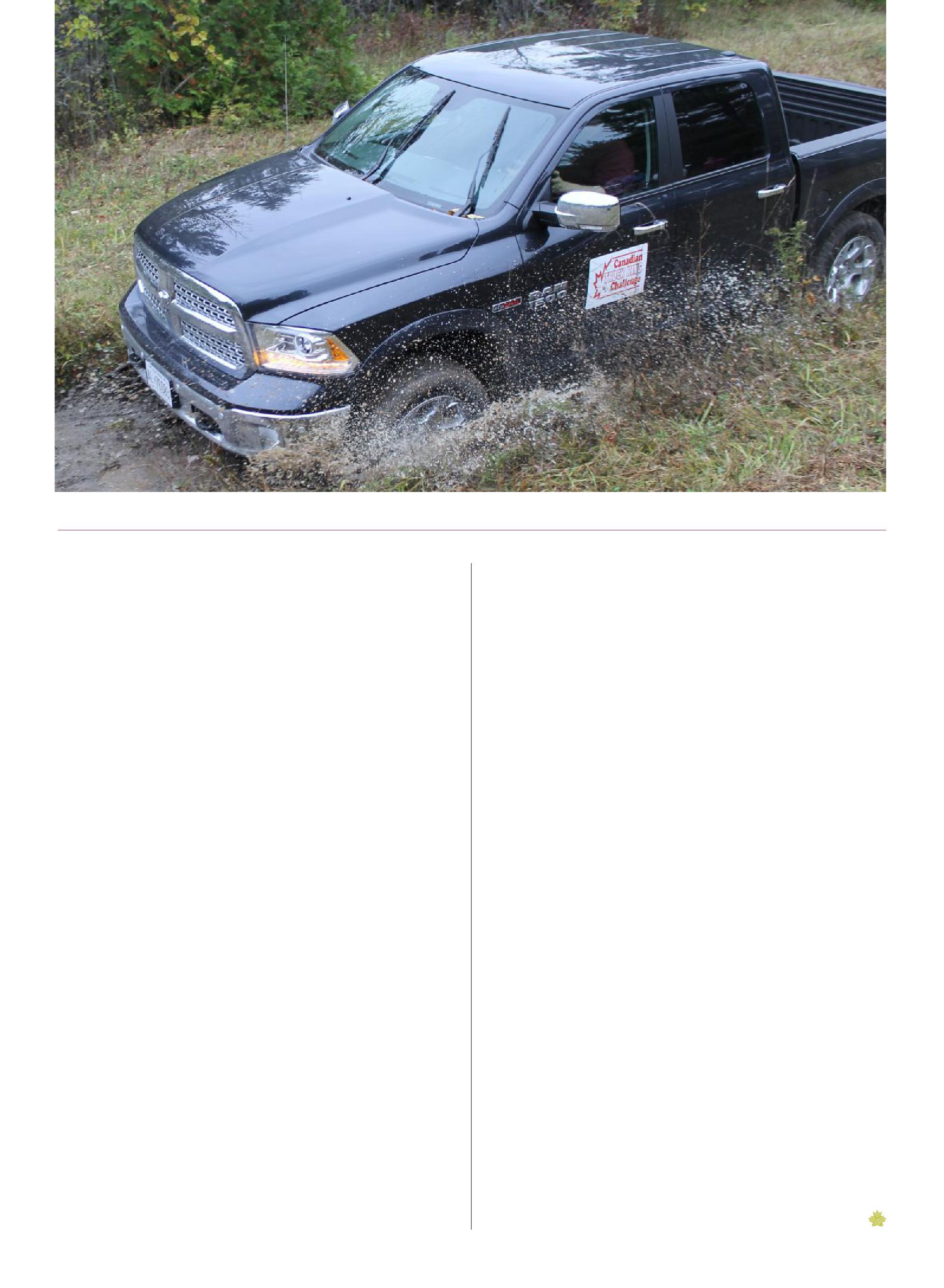
The Head River test loop itself is also a combination of road surfaces and speed limits. At 17-kilometres long it runs on gravel, secondary paved road and highway. Speed limits vary from 50 to 80 km/h and the road climbs and drops off an escarpment-like ridgeline several times; plus it crosses the Head River twice at its lowest elevation. The off-road part of our testing is done on my own course at IronWood. Vans are not tested on the off-road course, though it’s noteworthy that the Mercedes Sprinter was equipped with a four-wheel drive system this year.
This is the third year that we have used the data collection system and released the final fuel consumption report that MyCarma prepares for the Truck King Challenge. It’s become one of our most anticipated results.
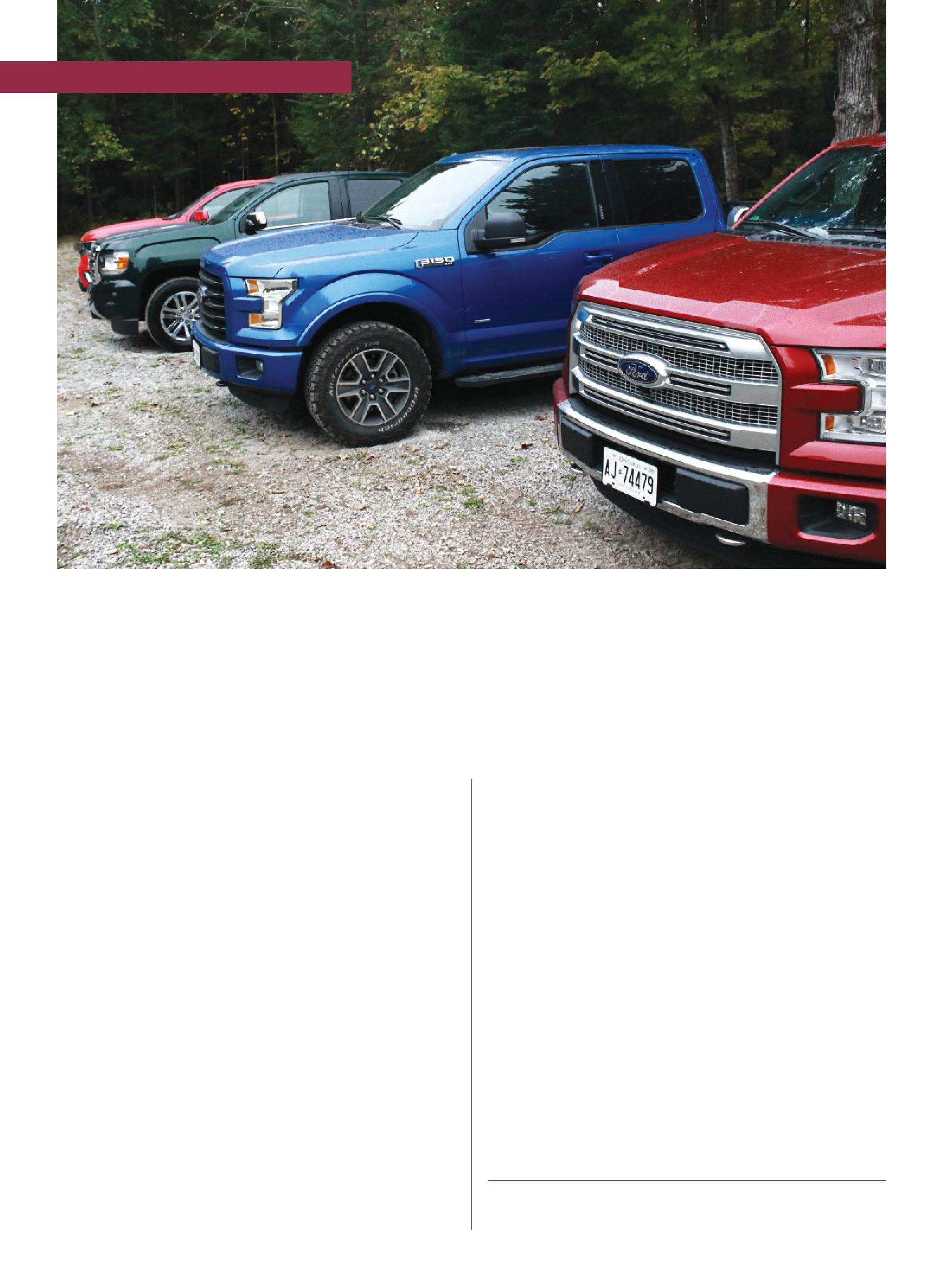
ABOVE: The 2016 Canadian Truck King Challenge compared four trucks in the full-size half-ton pickup truck category.
Get the right zinc for the job.
Reach for Wolf Trax Zinc DDP ®, the nutrient tool that is field-proven by corn growers like you.
With our patented EvenCoat™ Technology, Wolf Trax Zinc DDP coats onto your N-P-K fertilizer blend, delivering blanket-like distribution across the field. Plus our innovative PlantActiv™ Formulation ensures the zinc is available early, when corn needs it most.
Have your dealer customize your fertilizer blend with Wolf Trax Zinc DDP, and see how the right zinc can boost your corn crop and the bottom line.
Product depicted is Wolf Trax Iron DDP coated onto urea fertilizer. Other DDP Nutrients may not appear exactly as shown.
46833-2 TCME
But how do we decide what to test? Well as anyone who’s bought a truck knows, the manufacturers never sleep, bringing something different to market every year. As the challenge looks to follow market trends, what and how we test must change each year too and the 2016 model year proved no different. We had a field of 14 contenders at IronWood this year covering four categories. They were as follows:
Full-size half-ton pickup truck
• Ford F-150, Platinum, 3.5L, V6 EcoBoost, gas, 6-speed Auto
• Ford F-150, XLT, 2.7L, V6 EcoBoost, gas, 6-speed Auto
• Chevrolet Silverado, High Country, 6.2L, V8, gas, 8-speed Auto
• Ram 1500, Laramie, 3L EcoDiesel, V6, diesel, 8-speed Auto
Mid-size pickup truck
• Toyota Tacoma, TRD Off-Road, 3.5L V6, gas, 6-speed Auto
• GMC Canyon, SLT, 2.8L Duramax, I-4 diesel, 6-speed Auto
• Chevrolet Colorado, Z71, 3.6L V6, gas, 6-speed Auto
Full-size commercial vans
• Ford Transit 250, 3.2L Power Stroke I-5 diesel, 6-speed Auto
• Ram ProMaster City, SLT, 2.4L Tigershark I-4 gas, 9-speed Auto
• Nissan NV200, 2.0L I-4, gas, Xtronic CVT Auto
• Mercedes Metris, 2.0L I-4, gas, 7-speed Auto
These vehicles are each all-new – or have had significant changes made to them. However, this year, the Truck King Challenge decided to try something else new by offering a returning champion category.
This idea had been growing for a while and had everything to do with the engineering cycles that each manufacturer follows. Simply put, trucks are not significantly updated each year and to date we have only included “new” iron in each year’s competition. However, we started to think that just because a truck is in the second or third year of its current generational life shouldn’t make it noncompetitive. Certainly if you watch the builders’ ads it doesn’t!
So, this spring we decided that for the first time the immediate previous year’s winner (in each category) would be offered the chance to send its current truck back to IronWood to compete against what’s new on the market.
This year the invitation was sent to the Ram 1500 EcoDiesel, Ford Transit 250 and Nissan NV200 – all previous winners that accepted the offer to return and fight for their crowns.
They, along with the new vehicles, took the tests over two days with the judges evaluating everything from towing feel to interior features.
The judges score each vehicle in 20 different categories; these scores are then averaged across the field of judges and converted to a score out of 100. Finally the “as tested” price of each vehicle is also weighted against the average (adding or subtracting points) for the final outcome.
• Full-Size Commercial Van – Ford Transit 250 – 73.90 per cent
• Mid-Size Commercial Van – Mercedes Metris – 75.69 per cent
The overall top scoring 2016 Canadian Truck King Challenge winner is the Ram 1500, Laramie, 3L EcoDiesel, V6 diesel, 8-speed Auto.
Congratulations to all the winners and to the two repeating champions – the Ram 1500 EcoDiesel and the Ford Transit 250.
The overall top scoring winner is the Dodge Ram 1500, Laramie, 3L EcoDiesel, V6 diesel, 8-speed Auto.
Keep it in the family
Let’s tell
the story of family farms
Feeding the world is not just a big responsibility, it’s big business – with a world population over 7.3 billion, it has to be. However, many consumers don’t associate large-scale business with family business, even though 98% of
Canadian farms are family-owned and operated. As a result, many consumers don’t trust their food supply. We need to make sure the story of the family farm is being told, and that “big” doesn’t mean “bad.”
Here are some talking points to get you started:
98% of Canadian farms are family farms
Almost all of the farms in Canada are family-owned and operated, and producing healthy, sustainable food is their first priority. Remember, farmers feed their own families the food they produce.
Family farms have evolved
They look different today than they did 50 years ago. But that doesn’t mean our food supply isn’t safe and healthy anymore. New technology has allowed farmers to do more with less, making agriculture more sustainable today. Farmers protect the environment because they want to pass their business on to the next generation.
Farming is a complex business
Families must manage food safety and traceability, detailed budgets and accounting, marketing, employees, everchanging technology, and more. Modern farms must be run as a business, and it makes good business sense for many family farms to incorporate. As a company, farms can minimize taxes. Plus, family members can own shares in the company, making it easier to pass the farm from generation to generation. But their business structure doesn’t change the fact that family members work side by side every day, bringing to life their shared passion and dedication for producing safe, healthy food.
We all have stories we can share, whether you grew up on a family farm, or you work in an industry that serves farm families. Look for opportunities to tell the real story of Canadian agriculture, whether it be online, in the grocery store or at the dinner table.
We’re in this together
Everyone in the industry needs to work together to help improve perceptions. By being open and proactively communicating with the public about how we grow food and why we operate in the ways we do, we can maintain consumer trust and continue to produce high-quality, nutritious food in ways that are efficient and sustainable.
Social starters
The importance of family is something everyone can understand and relate to, whether you’re in ag or not. It’s common ground that can start a conversation.
Visit AgMoreThanEver.ca/resources to find a collection of photos that you can easily share on social media to start or support conversations about family farming.
The land is my lifestyle and my livelihood, but it’s also my legacy.
Providing safe, healthy food for my family is important to
me too.
That’s
why I farm.
I love ag for the life it gives my kids now…and the opportunities it gives in the future
Or, even better, share your own pictures and make your story personal.
Photo credit: CR Photography (Chantal Rasmuson) Pictured: Nate and Colin Rosengren
Photo credit: Aimée Ferré Stang
(photo by Jerri Judd)
What are others saying?
“Agriculture is a fast-growing business, and it has to be run as a business. It involves family, of course, but we’re always looking at the latest research, we’re looking at what practices are evolving in other countries, and we’re adapting those practices so we can become more efficient to get our product into the marketplace.”
– John Thwaites, Ontario fruit and vegetable grower
“My farm is a family farm. It is 100% owned by myself, my husband and his two parents. We love everything about agriculture with a fierce passion. We have never, ever, sold a product that we wouldn’t happily serve to our children. Every decision on the farm takes more than just finances into consideration. Our number one goal is to leave a farm to our children that is both environmentally and economically viable.”
– Adrienne Ivey, Saskatchewan rancher
Looking for more?
Watch The power of shared values webinar featuring Charlie Arnot, CEO of the Center for Food Integrity, who shares three simple steps to gain consumers’ trust by tapping into the power of shared values. Charlie helps bridge the divide between science and consumer perception and offers great insight into creating messages that are proven to resonate with consumers.
Visit AgMoreThanEver.ca/tag/webinar
AGvocate Challenge
There are 2.1 million Canadians working in agriculture and agri-food. Imagine the impact we could make if we all made a commitment to improve perceptions of agriculture. There are simple ways you can start being an agvocate today. Just choose to do one of the following:
1. Search the hashtags #FutureFarmer, #AgMoreThanEver, or #Farm365 and find a positive post to retweet.
2. When you overhear a misleading or inaccurate conversation about farming, find an appropriate time to share your story.
3. Dedicate one day to volunteer at an event that promotes agriculture such as Open Farm Days or Ag Literacy Week
4. Tell a friend or co-worker about the need to speak up, and ask them to take the agvocate challenge.
The power of shared values
We a ll sha re t he
me
Pul l up a c hai r.
“ We take pride in knowing we would feel safe consuming any of the crops we sell. If we would not use it ourselves , it does not go to market.”
–
Katelyn Duncan, Saskatchewan
“ The natural environment is critical to farmers – we depend on soil and water for the production of food. But we also live on our farms, so it’s essential that we act as responsible stewards.”
– Doug Chorney, Manitoba
“ The welfare of my animals is one of my highest priorities. If I don’t give my cows a high quality of life, they won’t grow up to be great cows.”
Andrew Campbell, Ontario
–
Safe food; animal welfare; sustainability; people care deeply about these things when they make food choices. And all of us in the agriculture industry care deeply about them too. But sometimes the general public doesn’t see it that way. Why? Because, for the most part, we’re not telling them our story and, too often, someone outside the industry is.
The journey from farm to table is a conversation we need to make sure we’re a part of. So let’s talk about it, together.
Visit AgMoreThanEver.ca to discover how you can help improve and create realistic perceptions of Canadian ag.
FOLIAR FUNGICIDE TIMING FOR SOYBEANS
The latest tips from recent research trials.
by Carolyn King
With foliar fungicide applications, timing is a key factor in soybean yield response. A soybean specialist gives his take on the best timing options. Based on his research results so far, “the long and the short of it is that fungicide timing is highly dependent on the year and what disease you are going after,” says Horst Bohner, provincial soybean specialist with the Ontario Ministry of Agriculture, Food and Rural Affairs (OMAFRA).
Bohner’s research interest in fungicide applications began about 10 years ago. “In 2004, soybean rust was found in Ontario for the first time. It was just on one leaf so it wasn’t an economic issue. But it did stir the industry to register fungicides to help control that disease if an outbreak occurred,” he explains. “Prior to that we really only used foliar fungicides in soybeans very sparingly and mostly for white mould. Unfortunately fungicides didn’t really work well for white mould control because soybeans flower for such a long time.” (For white mould, the aim of a fungicide application is to protect the flowers because infected petals are the main way the disease starts in the plant.)
“So in 2005, we started a number of trials – as did many people – to assess the different foliar fungicides available at that time. We found that there was a real yield benefit even in the absence of soybean rust; often there are other minor diseases present or, in some cases, there are no visible disease symptoms at all.”
Once they knew there was a definite yield benefit from a foliar fungicide, the next question to answer was timing-related: which soybean growth stage would be the best time for spraying? Given that soybeans flower for a long time, what timing would be the most effective for white mould? And what timing would be best for controlling other foliar soybean diseases?
Fungicide companies had been recommending that foliar fungicides be applied between the R3 (beginning pod) stage and the R4 (full pod) stage, based on research conducted mainly in the United States. However, results in some initial Ontario trials by BASF and by David Hooker from the University of Guelph’s Ridgetown campus indicated that an earlier timing, between the R2 (full flower) stage and the R3 stage, provided a greater yield benefit. So Hooker conducted trials in 2013 and found that an R2 to R3 timing increased soybean yields by about one to 1.5 bushels per acre compared to the R3 to R4 timing.
Generally in Ontario soybean trials, the yield response to a single foliar fungicide application averages about two bushels per acre, so the possibility of an extra bushel per acre is exciting. As a
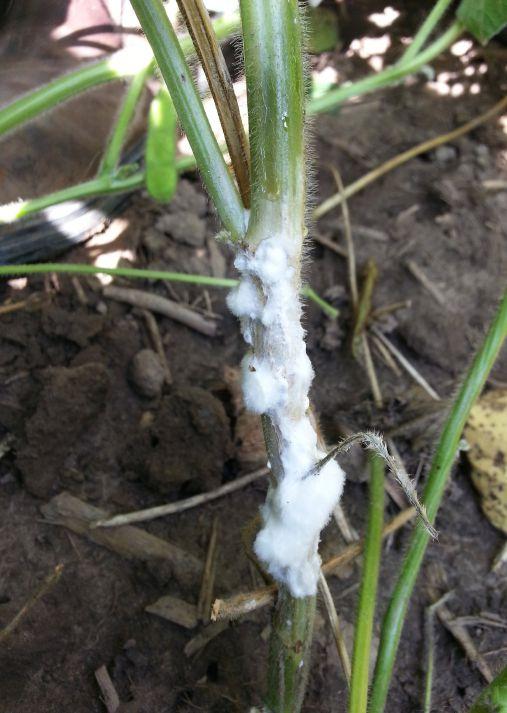
If you wait to see significant white mould in the crop, then it’s too late to spray for this disease.
result, Hooker continued his fungicide timing trials in 2014 and 2015.
Hooker’s 2013 results sparked Bohner’s interest in fungicide timing. So Bohner has been conducting field-scale, replicated trials to compare various application timings for the past two years, with funding assistance through the Grain Farmers of Ontario.
Bohner’s 2014 trials involved Priaxor and Acapela, and took place at Bornholm, Lucan and St. Thomas, with two soybean varieties at each site. The fungicide timings were: untreated control; in-furrow; V6; R2; R4; in-furrow + R2; and in-furrow + R2 + R4.
The 2015 trials involved Priaxor, Stratego Pro, Allegro and Acapela, and were conducted at Bornholm and Lucan, with two soybean varieties at each site. The timings were: untreated control; in-furrow; V6; R2; R4; and R2 + R3.
The in-furrow treatment was included in the trials because interest in liquid in-furrow applications in soybeans has been increasing in Ontario. “The idea of applying a foliar fungicide in-furrow is to help protect the roots and early seedlings, similar to putting a fungicide on the seed, which is what we often do now; most certified soybean seed has a fungicide on it,” Bohner explains. He notes that in-furrow foliar fungicide applications are being tried in the United States with mixed results.
The tables on the right show the yield results of the different treatments in 2014 and 2015. So far in the trials, the in-furrow and V6 fungicide timings have not resulted in statistically significant yield gains.
In 2014, the wet, cool weather conditions favoured white mould at two of the sites. The results showed that if white mould is present at moderate levels, then using a foliar fungicide can produce large yield gains. The greatest yield benefit occurred with the most intensive treatment (in-furrow + R2 + R4); the in-furrow portion of this intensive treatment likely did not affect the yield.
In 2015, there was no statistically significant difference between any of the yields, likely because there was no disease pressure present.
Timing tips
Bohner’s results show that the choice between R1, R2, R3 and R4 timing depends on which disease is the major concern and on the weather conditions.
“If you are trying to suppress white mould – white mould is a really hard disease to control so we talk about suppression – you need to think about spraying two times in the growing season. Because you are trying to protect the flowers, consider spraying at R1 [first flower] and then following up with another application 10 to 14 days later, which is around R3. The timing of the first application is not the early part of R1, because R1 can happen quite early in the season. Often R2 is fine for the first spray; if you do that, then you would follow with another application at R4,” Bohner says.
“[The choice between a late R1 timing and an R2 timing] depends on the growing season, how big the plants are, how much moisture there is and how much it looks like there is going to be a disease problem. One of the main considerations is coverage. If the plants are quite small and good coverage can be achieved at R2, then this timing is likely all right.
“For the other foliar diseases, when most growers will only need to spray once, the earliest you should spray is at R2,” he adds. “In 2015, we showed that you could spray right up to the R4 stage and get the same [yield] response as at the R2 stage. So the window for the correct timing is wider than we thought it was. It probably ranges from mid-R2 to R4 in most years, depending on the growing conditions that season.”
With these other foliar diseases, you have some time to scout and decide whether the disease problem is serious enough to warrant a fungicide application. For white mould, however, you cannot wait until the disease shows up in the crop. “Typically at that late R1, R2 or R3 stage, when you’ll be spraying the first time for white
* Yields with the same letters are not statistically different. Courtesy of Horst Bohner, OMAFRA.
* Yields with the same letters are not statistically different; none of the yields in 2015 were statistically different. Courtesy of Horst Bohner, OMAFRA.
mould, almost no disease would be present. So you have to base your spray decision on the field’s disease history and the weather. If it is cool and wet, and you have had a lot of disease in that field, in my estimate you should apply that first spray at the late R1 to early R2 stage. And then you see what the weather does. If it is wet and cool and you are starting to see some white mould, then you spray again 14 days later. If it turns hot and dry, you don’t spray again,” Bohner explains.
He emphasizes, “If you wait to see significant white mould in the crop, then it’s too late to spray. The research shows that. If you wait to spray at R5, for instance, there is no response at all to a fungicide. The disease is set in.
“Overall, if you are going to chase control of disease and higher yields with these fungicides, then so far in my work, two applications provide much more consistent results. Of course the problem with that is the cost. And the cost is a pretty big barrier.”
MANAGING OVERWINTERING CORN
Strategies for reducing yield loss associated with spring-harvested corn in Ontario.
by Helen Lammers-Helps
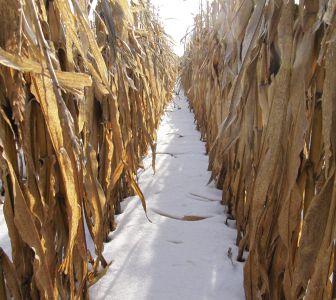
There are years when it can be extremely difficult for farmers to harvest some of their corn acres. Excessive rainfall during the harvest period may result in fields that are too wet to be combined. In other years, coolerthan-normal weather during the growing season can result in high grain corn moisture levels and prohibitively high drying costs. In this case, farmers may opt to harvest the corn in spring, leaving it to dry down naturally to reduce drying costs.
However, leaving the corn unharvested over winter comes with another set of challenges. There is an increased risk of lodging over winter, impacting crop harvestability and grain yield, explains David Hooker from the University of Guelph’s Ridgetown campus. Hooker and his associates set out to identify potential management strategies that farmers could use to improve crop yield and quality in spring-harvested corn.
There has been limited research into how to manage corn with the explicit intent of overwintering for a spring harvest, Hooker says. One trial in Wisconsin during 2000 and 2001 comparing fall- and spring-harvested corn plots showed yield losses could vary considerably. For example, with heavy snow cover, losses were 38 to 65 per cent, compared to a winter with little snow when yield losses were only seven to 10 per cent. However, newer hybrids with the Bt trait and genetics for improved stalk strength may have the potential to improve standability over the winter, Hooker says.
In southern Ontario, the standard management practices for corn production consist of planting at a relatively high plant population (80,000 plants per hectare), applying a foliar fungicide only if there is justifiable disease potential, harvesting in the autumn when grain moisture is approximately 25 per cent or less, and drying grain down to 15.5 per cent using on-farm grain dryers or through commercial elevators.
A review of the literature revealed some possible strategies for reducing yield losses associated with overwintering corn. These included selecting a hybrid with superior stalk strength, selecting later maturing hybrids, planting at a reduced population (i.e. 60,000 plants per hectare or 24,000 plants per acre). Another possible management strategy is to apply a foliar fungicide around tasseling time, which has been shown to delay leaf senescence and improve stalk strength, which can contribute to improved standability.
Field experiments were initiated to compare the effects of hybrid maturity, plant population, foliar fungicide application and harvest timing on grain yield and standability. Field experiments
were initiated in 2009 and 2010 at five separate locations in southern Ontario near Belmont, Ridgetown and Lucan. Of the three locations, Lucan usually receives more snow because it is in the snowbelt region of southwestern Ontario, leeward of Lake Huron. Researchers compared spring versus fall harvest, plant populations (60,000 or 80,000 plants per hectare), with and without an application of Quilt foliar fungicide, and three corn hybrids with differing maturities. The parameters observed were stay-green in the autumn, lodging in spring, and grain yield, moisture and test weight of corn harvested in autumn and spring.
The results point to an overwintering management strategy for corn, which consists of planting at a reduced plant population (24,000 plants per acre) and spraying the crop with a foliar fungicide around tasseling. This strategy minimized yield losses across all hybrids by between 3.5 per cent and 13.2 per cent at four out of five field locations through improvements in corn standability, compared to when the crop overwintered using a standard population and no fungicide application.
While lower plant populations resulted in better standability, it was usually at the expense of some grain yield, Hooker says. An economic analysis of the yield data in this study would be of value to growers, he adds.
Unfortunately, while the overwintering management strategy was an improvement over previous reports of yield losses, lodging was still at unacceptable levels at most locations. High winds, heavy snowfall and other adverse weather conditions can overwhelm any management strategy geared to help mitigate the risks associated with overwintering corn, Hooker says. “At the Lucan location, 100 per cent of the corn was lodged in the spring.”
The study did not look at the effect of overwintering corn on grain vomitoxin levels. Hooker would like to see this addressed in future research.
“Overwintering corn should be considered on a year- and fieldspecific basis,” he concludes. For example, overwintering may be considered if grain moisture is extremely high (greater than 34 per cent) in November, if drying costs are high, the corn is of inferior quality (the grade of corn can improve with a spring harvest) and if root and stalk strength are excellent.
“The practice of harvesting corn in the spring carries significant risk, mainly due to root and stalk lodging and reduced harvestability,” Hooker says. In areas where the winters are typically harsh, overwintering corn is a risky practice regardless of the management strategy deployed, he cautions.
MAKING THE RIGHT CHOICE
Ontario corn growers get their own replant decision tool.
by Helen Lammers-Helps
Unfavourable weather after early corn planting can result in poor plant stands. Every year, corn growers must make decisions on whether it’s more economical to leave the existing stand or replant.
Until recently, replanting recommendations for Ontario corn growers were based on data from Illinois. David Hooker, a researcher at the University of Guelph’s Ridgetown campus, along with Greg Stewart, agronomist with Maizex Seeds, and Ken Janovicek, University of Guelph, set out to create a Corn Replant Decision Tool for Ontario corn growers based on provincial data.
Hooker and his associates planted six full-season hybrids in 2010 and 2011 at sites in Ridgetown and Elora, with final plant populations that simulated 50, 75 and 100 per cent of the target population. The artificially created but realistic variable plant stands were created by planting a mix of glyphosate-tolerant and conventional corn seed, followed by spraying with glyphosate seven days later.
An economic analysis that considered the cost of replanting, differences in predicted yields, and different drying costs was completed. The analysis also included a comparison of the economics of replanting with the original hybrids used in the earlier planting, versus replanting with comparable hybrids rated 150 to 200 fewer Ontario Corn Heat Units (CHU).
The results of this trial showed that the breakeven population, after all costs are considered, varied between 55 and 65 per cent of the target population, depending on location.
“Stand loss needs to be significant (fewer than 18,000 plants per acre) before replanting approaches an economic threshold,” Hooker says. This was much lower than the previous recommendations that were based on American data. “Fewer replants will be triggered using recommendations based on the Ontario dataset compared to the former recommendations based on the American dataset,” Hooker says.
However, late planting at Elora resulted in lower yields than expected, so replanting may be less feasible in short maturity zones even at very low populations. “In shorter season areas (less than 2,700 CHU), corn replants tended not to be as economical,” Hooker says.
In this particular trial, replanting with full-season hybrids resulted in higher yields compared to replanting with shorter season hybrids. Averaged across all hybrids, a full-season hybrid replanted in the first week of June yielded 81 to 84 per cent of the early planted full-season hybrid in 2010, and 88 to 93 per cent in 2011 in Elora. Shorter-season hybrids planted in the first week of June yielded lower than the fullseason hybrids.
However, the researchers concede more data is needed to see if this pattern would hold true in other years. During both years of the trial, autumn weather was warmer than normal with later than average first frosts. This allowed the late-planted corn to mature; although full-season corn hybrids planted in early June did have grain mois-
ture levels that were four to six per cent higher than when a shorter season hybrid was planted. Hooker cautions: “Other work has shown that hybrid maturities need to be adjusted.”
The results of this two-year trial at Ridgetown and Elora concur with an earlier four-year trial that took place at Ridgetown, Exeter and Elora (2006-2009). The earlier trials received some criticism because they were uniformly thinned to simulate a stand with a low population. The results of the 2010-2011 trial, based on a more realistically created plant stand, verify the earlier trial results from 2006-2009, Hooker says. However, there was some deviation at populations less than 45,000 plants per hectare, indicating yield losses were underpredicted at lower populations, he adds.
Given the differences in the length of the Ontario growing season compared to Illinois, Hooker was not surprised his results differed from the Illinois recommendations. “The environment in the United States Midwest is much different from the main corn producing areas in Ontario, especially considering differences in the length of the growing season in Essex County compared to North Wellington County.”
The Ontario research is also based on a bigger pool of hybrids, Hooker continues. “The Ontario research used more than 20 popular Ontario-adapted hybrids compared to only a few United Statesadapted hybrids in the United States dataset,” he says.
The 2010-2011 trial at Ridgetown and Elora also tested the theory that flex-ear corn hybrids could maintain high yields in thin stands compared to fixed-ear hybrids. “This research busted the myth that a thin stand of flex-ear hybrid wouldn’t justify a replant compared to a thin stand of a fixed-ear hybrid,” Hooker says.
Hooker used the research results to create the Corn Replant Decision Tool. The Microsoft Excel program calculator is available online at www.gocorn.net and takes into account the likelihood of producing a lower yield on the replant date, the higher production costs associated with reseeding and higher grain corn moisture levels at harvest. The calculator allows input to reflect current market prices for corn, seed, insurance payouts, and drying charges.
When a late frost or cool wet weather follows early planting, as much as five per cent of Ontario corn acres are replanted, Hooker estimates. Now Ontario corn growers have a better tool to help them make decisions on whether or not it makes economic sense to replant.
Hooker is currently further analyzing the results to look for relationships between corn grain yield and weather during the growing season. Most of the hybrids in the Corn Replant Decision Tool research trials yielded best when planted early at high plant populations, but some of them maintained high yields when planted late or when planted early but in low plant populations. “We are investigating the effect of weather at time of silking and grain fill to help understand these hybrid interactions,” Hooker says.
Meet Justin
Nu-Trax P+™ with CropStart™ Technology puts you in charge of delivering the nutrition crops need for a strong start. And a strong start can lead to a better harvest.
It features an ideal blend of phosphorus, zinc and other nutrients essential for early season growth. With patented EvenCoat ™ Technology, Nu-Trax P+ is coated onto your dry fertilizer blends. And with blanket-like distribution across the field, it’s placed close to young plant roots where they can access the nutrients earlier, especially in cold and wet soils.
This spring, take control of your crop’s early season nutrition. Ask your retailer for Nu-Trax P+.