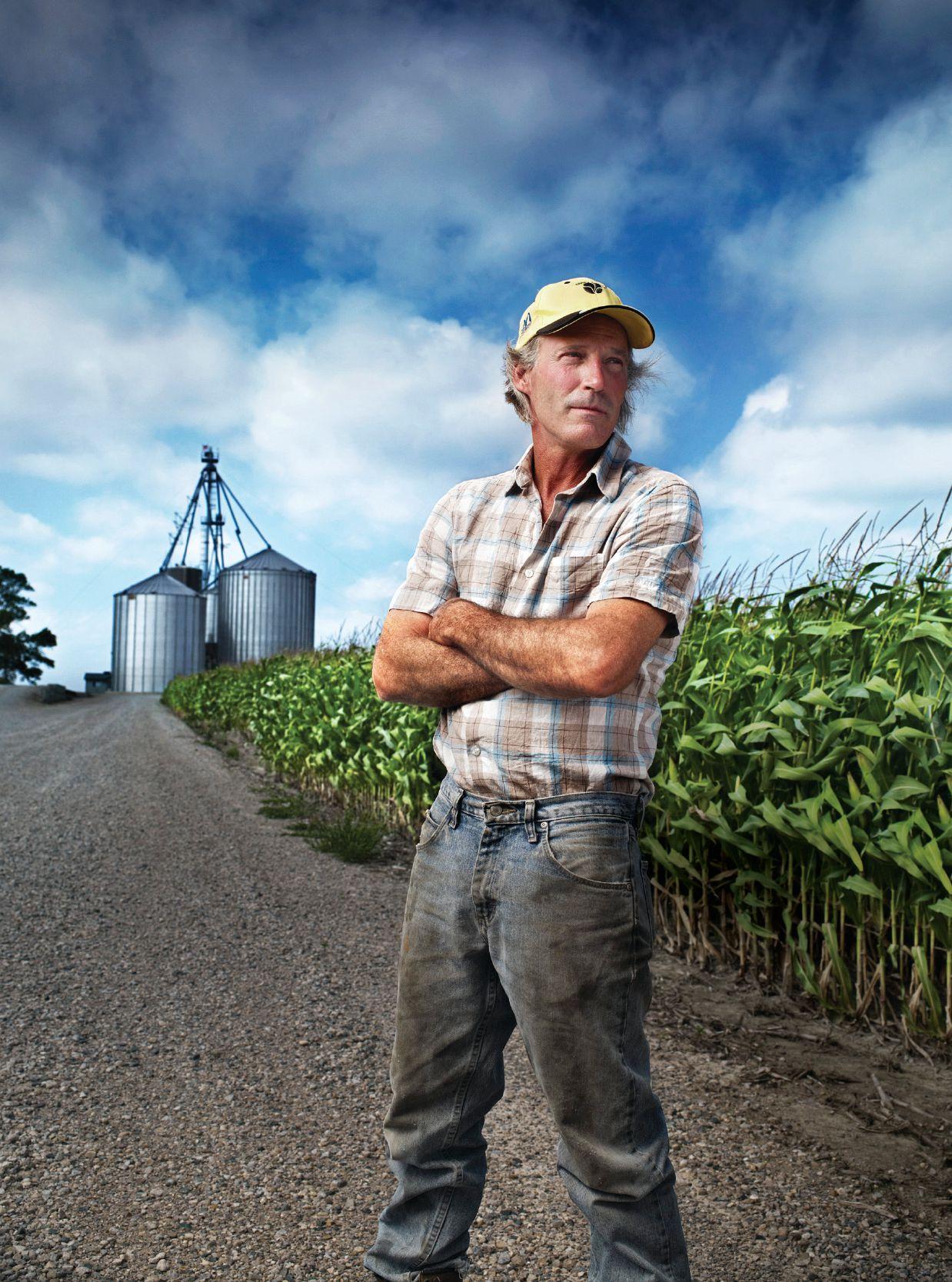
The best way to keep your field looking good –and performing great.
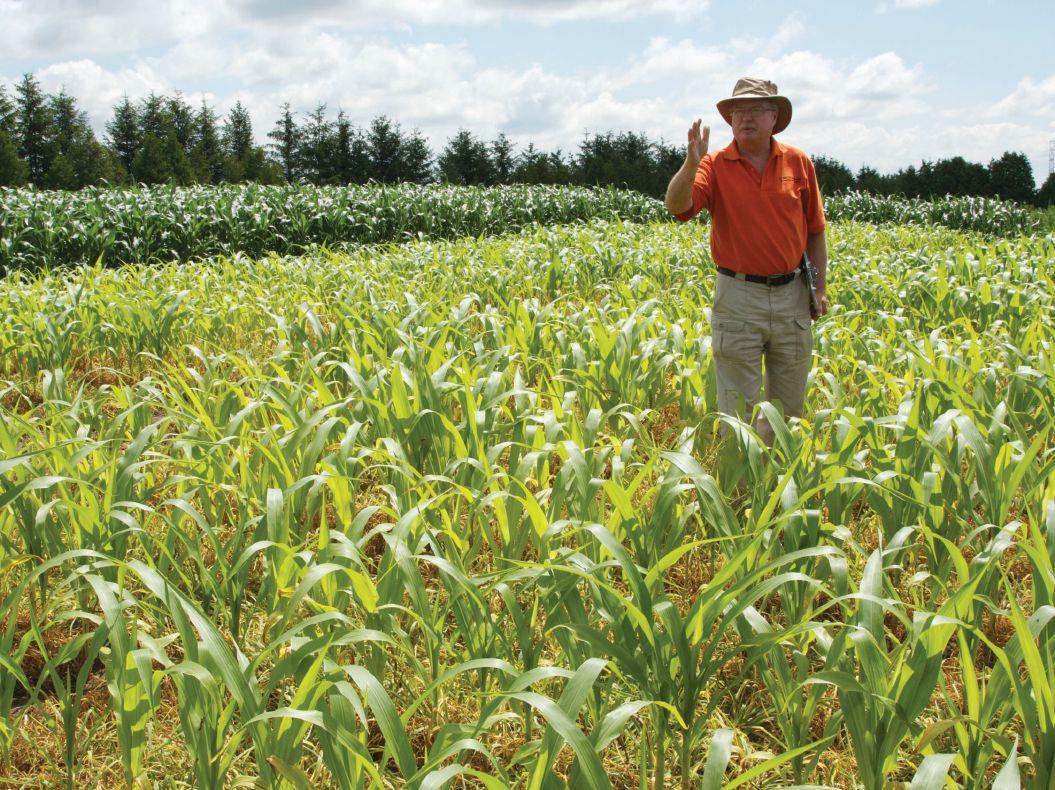
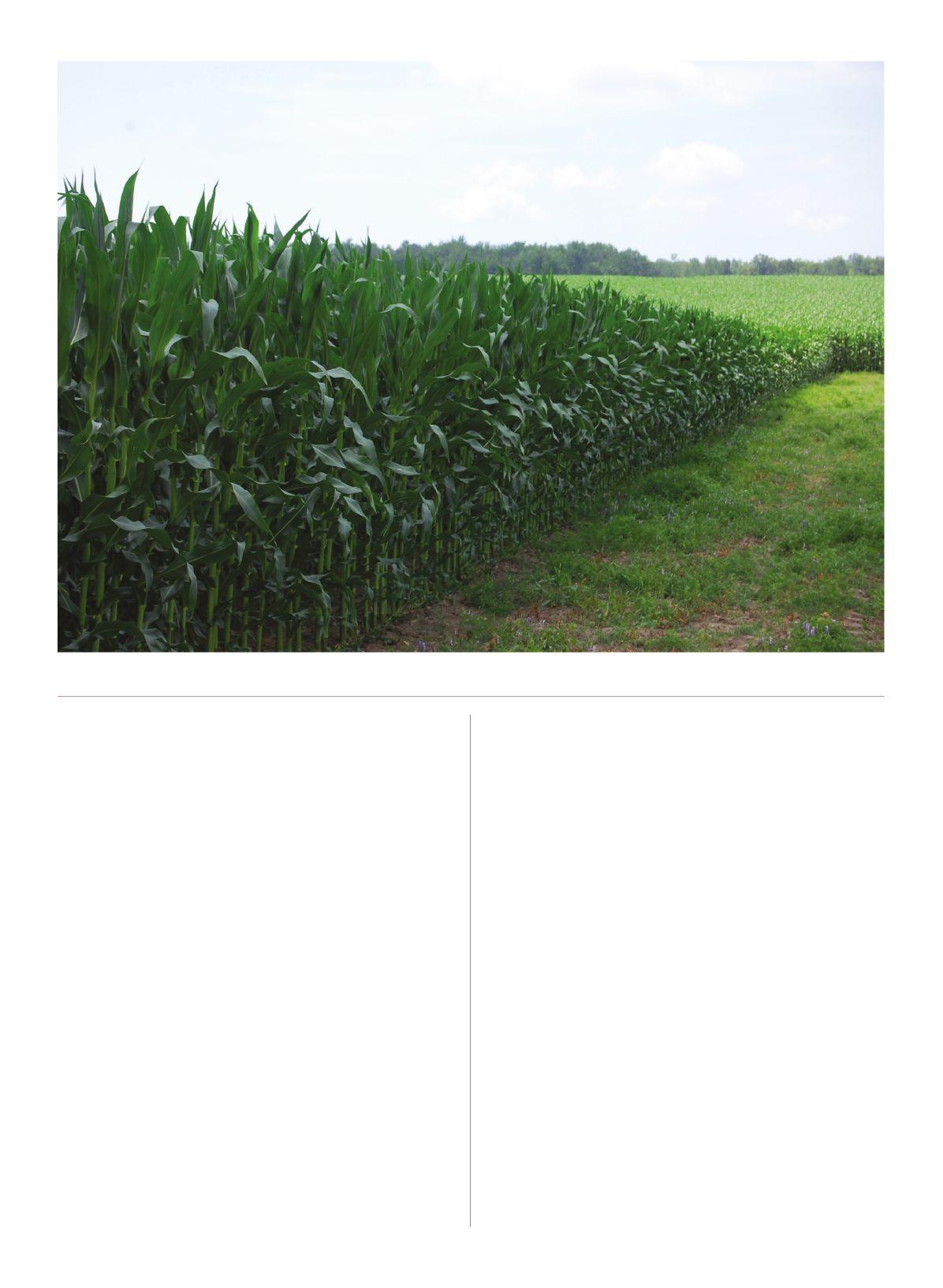
Maximize your yield by keeping your corn crop free of weeds and looking its best. Simply tank-mix Vios™ G3 with glyphosate or Liberty ®. Just one 1.78L jug of Vios G3 treats over 40 acres of corn, and provides the broadest spectrum residual weed control available from an in-crop application. It’s the easiest way to keep your field looking its best – and your crop performing its best.
Learn more at BayerCropScience.ca/ViosG3
MIX IT UP
Weed out herbicide resistance. Vios G3 uses 3 different modes of action to help you control resistant weeds. Visit MixItUp.ca to learn more.
TOP CROP
MANAGER
Treena Hein
Howard J Elmer
Photo
Melanie
Photo courtesy o F Peter Johnson.
Stefanie Croley | aSSoCiate eDitor
CoNNECTiNg STRATEgiES
It’s February, which means conference season is in full swing. The fresh start of a new year is the perfect time to search out new information, ideas and contacts. Industry events provide a great platform from which to explore, but which is better: the new or the tried and true?
I recently returned from my inaugural visit to the Southwest agricultural Conference in ridgetown, ont., where I expected to see some familiar names and faces and meet many new ones. I sat down for lunch on the first day of the conference across from Martin Harry, the eastern Marketing Manager for SeCan. Martin and I had connected via e-mail before, but we hadn’t yet met in person. as we were chatting, the small town of Trenton, ont., came up in our conversation. I shared with Martin that both of my parents were born and raised in Trenton, and you can imagine my surprise when he told me that’s where he was born and raised. after a few minutes, we determined that my aunts babysat him, my grandfather sold his family insurance, and my grandmother and his mother are still good friends and visit often at the monthly church suppers. expectations exceeded, to say the least.
Beyond interesting lunchtime conversations (and despite the frigidly cold temperatures), there were myriad other learning opportunities for attendees during educational sessions and on the trade show floor. The conference was, of course, highly focused on new technology and strategies, which is exactly what I (and most of the delegates, I’m sure) were there for. But at the beginning of his engaging talk on making wheat profitable, oMaF cereal specialist peter Johnson reminded the audience that while innovation is great, fundamentals are fundamentals for a reason. Sometimes the tried-and-true methods are the way to go.
This thought stayed with me throughout the two-day event, which buzzed with conversations about new technology and social media. The conference had its own hashtag, which I used to tweet about the seminars I attended, garnering several retweets and responses from our Twitter followers. and, since “selfie” (a photo one has taken of oneself, typically with a smartphone) was named Word of the Year by oxford english Dictionary at the end of 2013, farmers across the world have jumped on the bandwagon with their own version: the “felfie.” oMaF weed specialist Mike Cowbrough mentioned the craze during his presentation, and ontario premier Kathleen Wynne has tweeted her own. after the conference, I asked our followers on Twitter to share their felfies with me, resulting in some fun photos and more new connections.
There’s an interesting contrast between learning lots about one person during a halfhour lunch and connecting with hundreds of Twitter followers in a few seconds. Had Martin Harry sat at a different table, we likely wouldn’t ever have discovered the connections we share. But, without Twitter, I wouldn’t have been able to update more than 2,500 people at once on what was happening at the conference. So here’s the question: When it comes to making connections, is the conventional face-to-face method better than a widespread message? and in the grand scheme of things, like peter Johnson argued, are fundamental practices better than new strategies?
In my eyes, there can and should be a happy medium between the two. We all know that advances in technology and agronomy are essential to move the industry forward. But as 2014 progresses and you find yourself testing out new technology, strategies and solutions, don’t overlook what – or who – is right in front of you.
DeSIGNer brooke Shaw
Michael Fredericks mfredericks@annexweb.com PUBLICATION MAIL AGREEMENT #40065710 reTurN uNDeLIVerabLe CaNaDIaN aDDreSSeS TO CIrCuLaTION DePT. P.O. Box 530, Simcoe, ON N3Y 4N5 e-mail: subscribe@topcropmanager.com
Top Crop Manager West - 8 issuesFebruary, March, Mid-March, april, June, October, November and December - 1 Year - $45.00 CDN plus tax
Top Crop Manager East - 7 issuesFebruary, March, april, august, October, November and December - 1 year - $45.00 CDN plus tax
Potatoes in Canada - 4 issues - Spring, Summer, Fall and Winter 1 Year - $16 CDN plus tax
All of the above - $80 CDN plus tax
Occasionally, Top Crop Manager will mail information on behalf of industryrelated groups whose products and
www.topcropmanager.com
Timi N g i S E v ERYT hi N g
Timing two nitrogen applications to maximize winter wheat yields.
by Treena Hein
Current yield trends in ontario dictate a continued move away from wheat into more and more acres of corn.
“While winter wheat yields are increasing by 1 bu/ac each year, corn is increasing at double that rate,” says peter Johnson, the provincial cereal specialist with the ontario Ministry of agriculture and Food (oMaF). “If wheat yields cannot gain on corn in relative terms, wheat will disappear from the rotation in ontario.”
Johnson’s colleague Dr. Dave Hooker, a field crop agronomist and assistant professor at the University of guelph ridgetown Campus, says this development would have huge impacts on longterm yield stability, as wheat in the rotation in ontario can increase corn yields by 30 bu/ac, and soybean yields the second year after wheat by 6 bu/ac. It is therefore imperative to find ways to maintain wheat profitability.
The first step in this quest required a close look at ontario’s climate. “When we compare the world’s highest winter wheat yield environments to those in ontario, it’s clear that yields are limited here because of high temperatures during grain fill,” John-
son explains. “This often causes the canopy to senesce prematurely, which results in grain fill relying on reserves stored within the canopy.”
The good news is that researchers have found these limitations can be partially overcome through a variety of practices, including management of crop canopy during early development; early planting dates; seed-placed fertilizer at planting and additional nitrogen fertilizer during rapid growth; application of fungicides to protect green leaf area; and choice of wheat variety.
Johnson notes there has been little investigation in ontario on split nitrogen applications, high plant populations and starter fertilizer effects, coupled with high n rates and fungicide inputs. “In managing their crop, growers need to consider both additive and synergistic effects of these practices on yield and profitability, understanding that the current recommendations are based largely
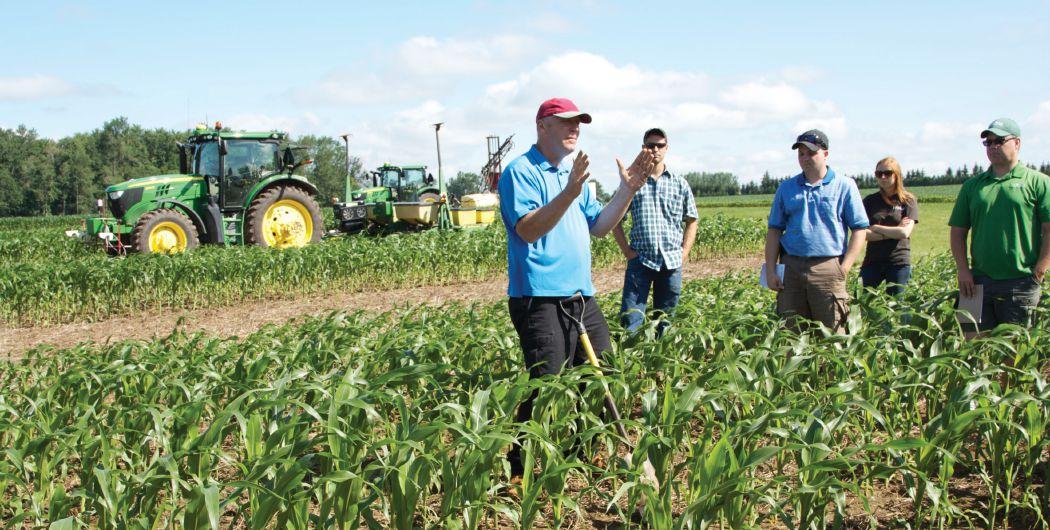
aBOVE: Peter Johnson, provincial cereal specialist at the Ontario Ministry of agriculture and Food, fears wheat will disappear from rotation in Ontario if yields don’t rise – something that dr. dave Hooker says will impact long-term yield stability.
on simple effects alone (each input looked at separately),” he says.
Johnson and his colleagues, in a project known as SMarT 1, observed yield increases of up to 20 per cent with strategic use of nitrogen and fungicide. SMarT 2, which ran from 2011 to 2013, focused on investigating additional management options: split nitrogen applications, plant populations, and starter fertilizer, and their interactions. “SMarT 1 identified split n applications with intriguing yield increases that required further investigation,” Johnson explains. “plant populations were evaluated at normal yield levels, but higher yield levels may change the optimum. Starter fertilizer benefits may be of increased importance as well, as yields move higher.”
Johnson says the results of the project will be used for calibrating and validating existing crop models, updating the recommendations currently in oMaF’s agronomy guide for Field Crops, and developing web-based calculators to assist decisions by growers and industry on SMarT management decisions. Funding was provided by grain Farmers of ontario and the Farm Innovation program.
study details
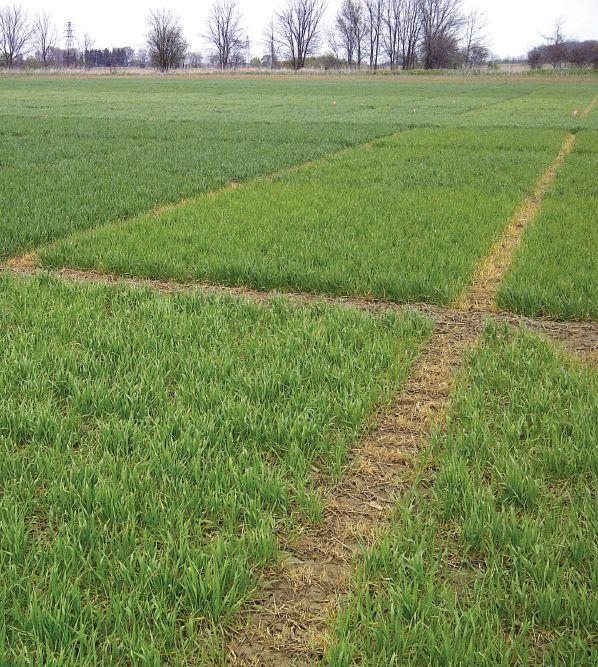
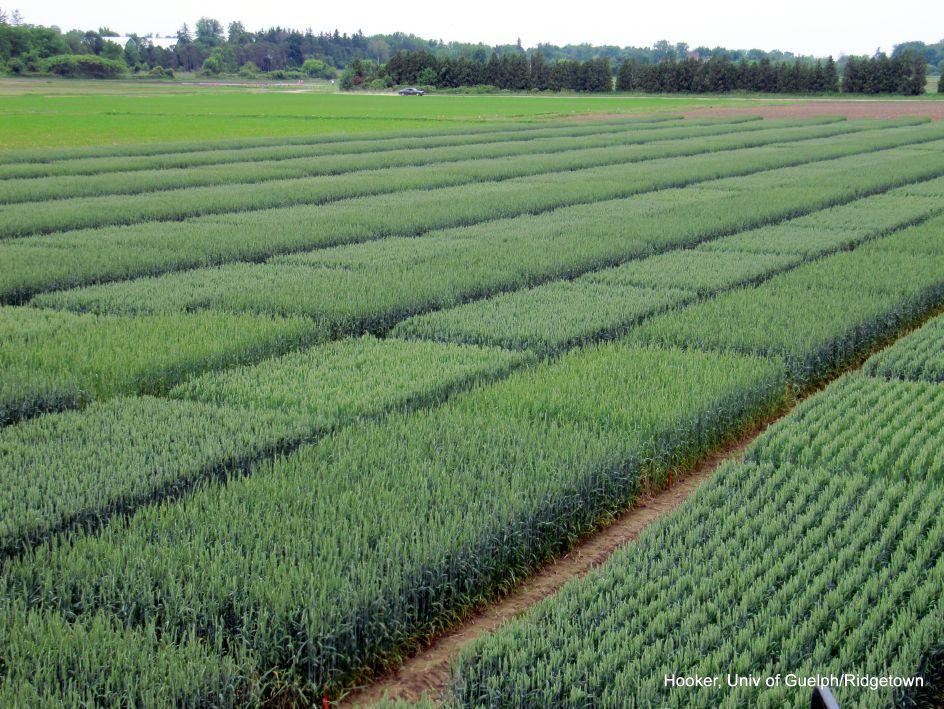
In the SMarT 2 study, the treatments were replicated four times at three locations over three years, with three nitrogen rates (90, 135, 150 kg/ha). “We tried for three nitrogen timings: a single application in late april, an early-normal split (one application in midto-late March and one in late april), and an early-late split (one application in mid-to-late March and one targeted at growth Stage 32, or second node),” says Johnson. “There were two populations (normal, normal plus 33 per cent), either with or without starter fertilizer.”
In 2011, weather made the late application of the early-late split far too late, causing reduced yields. “We had an application in mid-
March, and a ‘normal’ split on april 20, and we found a one- to two-bushel increase from that, because the second application was put on earlier than ideal,” Johnson explains. “In 2012, we were able to ‘nail’ the timing, and the early-late split added 7 bu/ac on average compared to one application or early-normal split at both the 90 and 150 kg of n per hectare rates.” There was a boost of about 0.7 per cent in protein as well.
In 2013, it was wet in april, and therefore growers didn’t get any n applied until May. “as in 2011, weather again made our splits in some trials later than preferred, and results were back to little yield advantage,” Johnson observes.
“My standard recommendation is going to be split n applications: 50 pounds any time after March 15 to 20 to kickstart the crop – to save or promote tillers – and to then apply the balance at growth Stage 31-32 (first to second node).” He says high populations in these trials have added little to final yield, while starter fertilizer benefits continue to be extremely beneficial.
In SMarT 2, Johnson and his colleagues also evaluated the “n stamp” concept, a relatively new infield method developed at oklahoma State University to assess nitrogen response and predict nitrogen needs. a strip is fertilized with incrementally increasing rates of n before or shortly following spring greenup and visually inspected in mid-season to identify the n rate required for maximum biomass production. The lowest n rate yielding the maximum mid-season forage production or level of “greenness” provides an assessment of the rate of n required to achieve optimum grain yield. Johnson reports that the n stamp concept continues to be investigated.
Johnson and his colleagues have conducted projects called sMaRT 1 and sMaRT 2 to determine the effectiveness of nitrogen splitting in wheat.
a yield increase of up to 20 per cent with strategic use of nitrogen and fungicide was seen during Johnson’s sMaRT 1 trials.
At the end of the day, your farm is a business. And making that business profitable depends on getting the most out of your land. That’s why all of our Case IH equipment, like the new Ecolo-Tiger ® 875 Disk Ripper, is agronomically designed to help you maximize your returns. The Ecolo-Tiger 875 is engineered to size tough harvest residues, fracture root-limiting compaction and leave fields level. With better rooting and seedbed environments, plant stands can utilize more nutrients, water and sunlight. All of which provide a better environment for your profit potential. The world of farming is changing. Will you be ready? Learn more at caseih.com
gENET iCS oF N i TRog EN USE EFF iC i ENCY
Enhancing nitrogen utilization in corn for better yields and lower inputs.
by Carolyn King
Developing corn hybrids with improved nitrogen use efficiency – whether they have higher yields under normal nitrogen levels or maintain their yields despite low nitrogen levels – is a significant challenge. Such hybrids are likely a decade or more from the marketplace, but progress is being made.
“So much of crop biotechnology has been based on success with insect and herbicide traits where efficacy is very easy to demonstrate – you kill a bug or you don’t kill it. It’s not dependent on the environment, on rain or cold weather, or soil type. So all of the notions of success, all of the testing, everything has been based on that model. But improving nitrogen use efficiency is a lot harder,” explains nic Bate, group leader, agronomic traits with Syngenta Biotechnology.
“people envision plants as being simple things that are easy to manipulate. But in terms of genetic complexity, environmental dependency, all these things together, [this research] is trying to do something that no one has ever done before – increase the productivity of a crop plant in a targeted way. That’s why it takes a long time.”
nitrogen use efficiency (nUe) can be defined as the grain yield per unit of nitrogen available in the soil, including nitrogen fertilizer. Better nUe offers a lot of potential benefits. It could increase crop yield potential, reduce fertilizer inputs, decrease nitrogen losses into the environment and reduce energy inputs into agriculture (because nitrogen fertilizer production is energyintensive).
Boosting nUe requires basic research to identify genes that play a role in nUe as well as lengthy testing in growth chambers, greenhouses and field situations to find out if those candidate genes will noticeably enhance nUe in farmers’ fields.
genetic underpinnings of NuE
one of the researchers involved in fundamental research on the genes involved in nitrogen use in plants is Dr. Steven rothstein in the department of molecular and cellular biology at the University of guelph.
“our role is to try to understand the effects of growing plants under different conditions, in this case under limiting nutrient conditions, and to see what effect that has on phenotype, depending on the plant’s genetics. By understanding that information, we hope to generate knowledge that can be used by our commer-
along with research to enhance nitrogen use efficiency in corn, dow agrosciences also offers nitrogen stabilization products to improve nitrogen use.
cial collaborators to develop lines that utilize the nutrients more efficiently,” says rothstein.
“What is challenging – and this is the case for any complex trait, whether it’s yield, or yield under drought conditions, or yield under limiting nutrient conditions – is to understand how different types of changes in different genetics can have an effect
It’s the biggest news in fungicides since the development of fungicides.
We couldn’t have created a fungicide this advanced without attracting the attention of the industry’s top scienti c minds—growers like you. Priaxor® is a new multiple mode of action product that combines the proven bene ts of Headline® fungicide with Xemium®. This new active ingredient contains unique mobility characteristics, resulting in more consistent and continuous disease control. And since it’s built on the foundation of Headline, you can expect to prosper from the bene ts* of AgCelence®—greener leaves, stronger stalks and stems—all leading to higher yield potential**. Learn more by visiting agsolutions.ca/priaxor or call AgSolutions® Customer Care at 1-877-371-BASF (2273).
*AgCelence bene ts refer to products that contain the active ingredient pyraclostrobin. **All comparisons are to untreated, unless otherwise stated. Always read and follow label directions. AgSolutions, and HEADLINE are registered trade-marks of BASF Corporation; and AgCelence, XEMIUM and
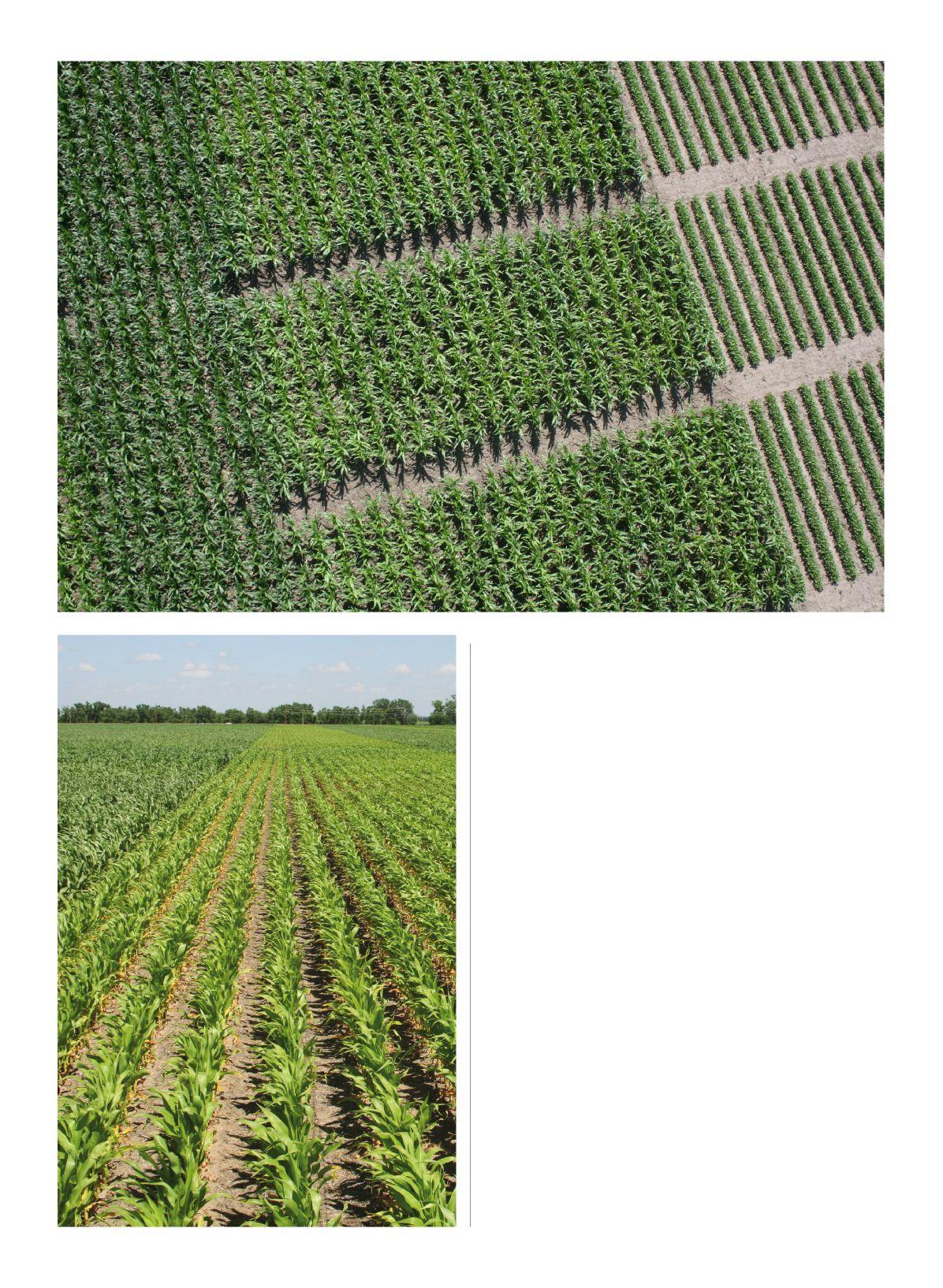
aBOVE: duPont Pioneer has established special fields with uniform soil conditions for comparing different corn genetics in nitrogen use efficiency trials.
lEFT: These duPont Pioneer trials in iowa are comparing various hybrids under nitrogen treatments ranging from 0 to about 250 pounds per acre of nitrogen.
on how efficiently the plant deals with those conditions.”
rothstein’s lab studies commercially important plants like corn and rice as well as model plants like Arabidopsis. What researchers learn from model plants can often be applied to other plant species. Arabidopsis is used in such research because it has a relatively small genome – in fact, it was the first plant to have its entire genome sequenced. also, the plant is small, has a short life cycle and produces lots of seeds, so it’s easy to use in lab and greenhouse studies.
rothstein’s lab uses two general approaches to address questions of interest: studying very defined genetic differences between plants and using a whole genome approach.
In the first approach, the researchers compare plant populations with some significant difference that has been created either by traditional breeding or biotechnology. rothstein explains, “For example, we identified a set of genes in Arabidopsis that were important in modulating the amount of green in a plant – the amount of chlorophyll and the number of chloroplasts – particularly under lower nitrogen conditions. Then we identified similar types of genes in crop species like rice and corn, and we found that these analogous genes in those species also had that effect.” Lines with those types of genes are in the process of being tested to see whether they increase chlorophyll production under low
Photo
nitrogen levels in a field situation.
The whole genome approach is a useful information-gathering tool, according to rothstein. “We try to understand in a broad sense what happens, for example, under different nitrogen conditions or using different genetic lines under different nitrogen conditions. So we’ll grow the plants under varying conditions in which nitrogen limits or doesn’t limit growth, or it’s added at different times.” Then the researchers will examine the plants to see how the different nitrogen conditions have affected things like the expression of all the genes in the plants. and then, based on what they learn, they could decide to further investigate a particular set of genes that responded to the low nitrogen conditions or certain genetic lines that needed less nitrogen.
The research at rothstein’s lab has led to some intriguing new insights into nutrient use, such as a possible way to improve phosphorus uptake in plants, and has generated several patented discoveries.
“We’ve studied a number of gene systems, and we’ve filed patents along with our collaborators on several, and we’re hopeful that some of them will prove to be fruitful,” says rothstein. “However, although we understand how a particular set of genes might affect the physiology of the plant, it takes a number of years of testing to see whether it actually proves to be commercially useful.”
rothstein has been collaborating with Syngenta on this research for more than 10 years. along with providing some of the funding for rothstein’s research, Syngenta conducts detailed testing to assess the commercial value of candidate genes identified by his lab.
Evaluating commercial value
“We use Dr. rothstein as a source for gene leads for improving the nitrogen use efficiency trait. Throughout the course of our collaboration, he has generated leads that are currently in our testing pipeline,” says Bate.
“We go through a series of steps to prove that the genetic modification has an effect, that it has some research value, and that this research value translates into some business value – so perhaps three, four or five steps to get to a place where we’re demonstrating business value.”
The focus of Syngenta’s nUe efforts is to improve crop yield under normal nitrogen conditions, rather than maintaining yield with lower nitrogen levels, notes Bate. “So if a lead comes into our system for evaluation, it has to increase overall plant yield to have true business value.”
The initial steps in the company’s testing process involve growth chamber and greenhouse studies. Then the most promising lines go into field testing. The most advanced leads from rothstein’s lab will be entering Syngenta’s field testing process in the near future.
“our main challenge is demonstrating efficacy in a field situation because nitrogen use efficiency is a complex trait and has many interactions with the environment,” explains Bate. “Different soil types, weather patterns, water availability – all those things influence how well this trait might work in a particular hybrid. So providing the right testing environment in a field situation is likely the biggest challenge.”
other seed corn companies are also working toward hybrids
Why risk reduced yield?
• The AI3070 utilizes a unique, patent-pending design optimized specifically for fungicide application
• The 30° forward tilted spray penetrates dense crop canopies, while 70° backward tilted spray maximizes coverage of the seed head for excellent disease control
• Air induction technology produces larger droplets to reduce drift
“ The AI3070 increased overall deposit amounts and uniformity compared to the industry standard single and twin fan nozzles.”
– TOM WOLF, RESEARCH SCIENTIST AT AGRICULTURE AND AGRI-FOOD CANADA
with enhanced nUe. They use candidate genes from various sources and put them through extensive testing processes.
Dupont pioneer’s work on nUe involves both maximizing corn yields under normal nitrogen applications and improving yields in low nitrogen input situations. “nitrogen can be an expensive input cost to growers, and if we can generate more bushels of corn per unit of nitrogen applied, then it can benefit the growers. and certainly in geographies or environments where input costs or environmental stewardship concerns are sensitive, improved nitrogen use efficiency can have a benefit,” notes Steve King, corn research director for Dupont pioneer in Canada.
The company’s approach to nUe improvement is similar to its approach to other agronomic traits. King says, “We’re looking at solutions that could either be transgenic or through conventional breeding. We have a certain amount of genetic variation for nitrogen use efficiency in the normal corn germplasm and then we can also extend that level of variation by using a transgenic approach.”
according to King, field testing is one of the main challenges in developing corn hybrids with greater nUe. “When we are field testing in a low nitrogen environment, it is very difficult to get a uniform response from the front to the back of a test location. When you apply a stress, whether it’s drought or low nitrogen, the corn responds differently based on minor differences in soil, from the front to the back of the field,” he explains.
“So we’ve had to establish special fields in the U.S. where we draw down the nitrogen over a period of years and then assess the uniformity. once we have uniformity, then we can test lots of different genetics in those fields and be confident that we have response just to nitrogen rather than a response to soil variation.”
Monsanto and BaSF are collaborating to enhance nUe in corn under both normal and low nitrogen conditions. “In some cases, growers will be able to maintain nitrogen levels and see an increase in yield due to more efficient use of applied nitrogen,” says Derek Freitag, technology development lead in eastern Canada for Monsanto. “In other cases (similar to what we have seen in some areas in 2013), growers may see a reduction in applied nitrogen due to excessive rain or drought
conditions. In this case, corn hybrids with traits geared for improving nitrogen use will better maintain their yield potential by using the available nitrogen in a more efficient manner.”
Monsanto and BaSF are testing a large number of nUe candidate genes. Freitag says, “Some challenges [in this work] will be to understand how growers use nitrogen today, including rates and timings; for instance, do certain combinations produce different results. also the impacts of soil type and nitrogen availability make testing over larger acreages very challenging. our testing program requires large trials to look at multiple products and practices, so understanding all of the interactions going on in any one particular trial is very important.”
Dow agroSciences’ work on nUe is an integral part of its overall corn breeding work. Larry robertson, global project leader for corn at Dow agroSciences, says they’ve had to deal with the difficulties of sorting out the effects of environmental factors like moisture conditions when evaluating candidate genes. “as well, it becomes a real balancing act between nitrogen availability and storage and timing, because the availability of nitrogen at critical growing points has a much bigger impact on corn yield than at other times of the year.”
Dow is also involved in improving nitrogen use through its nitrogen stabilization products. “our stabilizer controls a bacterium in the soil that has a key part in the process of moving nitrogen from its applied form into a nitrate. So it holds that nitrogen longer in the soil and available for the plant,” robertson explains, adding the company is looking to introduce a nitrogen stabilizer to the Canadian market in the near future.
Increasing nitrogen use efficiency in corn is a complicated task. There are challenges through the whole research and development process, from the search for the genes involved in nitrogen use all the way to the complex field-testing process. a key driver to overcome these challenges is the potential for significant benefits in corn yields, nitrogen inputs and agricultural sustainability.
A RE C oRN NE m ATodES AFFECT i Ng YoUR Y i E ld S ?
Assessing impacts and control options under Ontario conditions.
by Carolyn King
If your corn crop isn’t performing as well as expected, you can add corn nematodes to your checklist of possible causes. We still have a lot to learn about managing these tiny plant parasites, but research is underway to get a better handle on the issue in ontario. researchers are surveying corn nematode populations, testing some new and upcoming nematicides, and figuring out how to integrate these products into a full disease management system for corn crops.
nematodes are microscopic, worm-shaped organisms. There are thousands of species and some are plant parasites. More than 60 species of corn nematodes are found in north america. In ontario, the most common type in corn is the root-lesion nematode (Pratylenchus species). Corn nematodes can be grouped into two categories: endoparasites, which live most of their lives inside plant roots; and ectoparasites, which live in the soil and feed on the outer parts of the roots. root-lesion nematodes are endoparasites.
Corn nematodes feed on corn roots, reducing the plant’s ability to take up water and nutrients. as well, wounds from nematode feeding provide places where pathogenic fungi and bacteria can enter the roots, causing disease.
often more than one species of corn nematodes are found coexisting in a field. preferences for things like soil conditions and host crops vary depending on the species. For example, dagger nematodes are relatively large so they tend to prefer coarser soil textures because it’s easer for them to move through the larger pore spaces. In contrast, root-lesion nematodes are relatively small and are not restricted to certain soil textures.
It is difficult to diagnose corn nematode problems without a lab test. not only are nematodes invisible to the naked eye, but the plant symptoms are easily confused with other problems. above-ground symptoms typically include stunting, yellowing and uneven stands, which may look like such problems as poor nutrient levels, herbicide injury or damage by other pests. root symptoms may include lesions, discoloration, lack of root hairs and/or stunted root growth, which might be confused with problems such as rootworms, root disease or fertilizer burn. The exact plant symptoms depend on the nematode species; some species have much greater potential for corn yield impacts than others.
“Some of the symptoms to watch for are yields that are declining in certain areas or have not been keeping up with what would be expected and that can’t be explained by other factors. also watch for areas that are stunted, have yellow leaves or have a susceptibility to
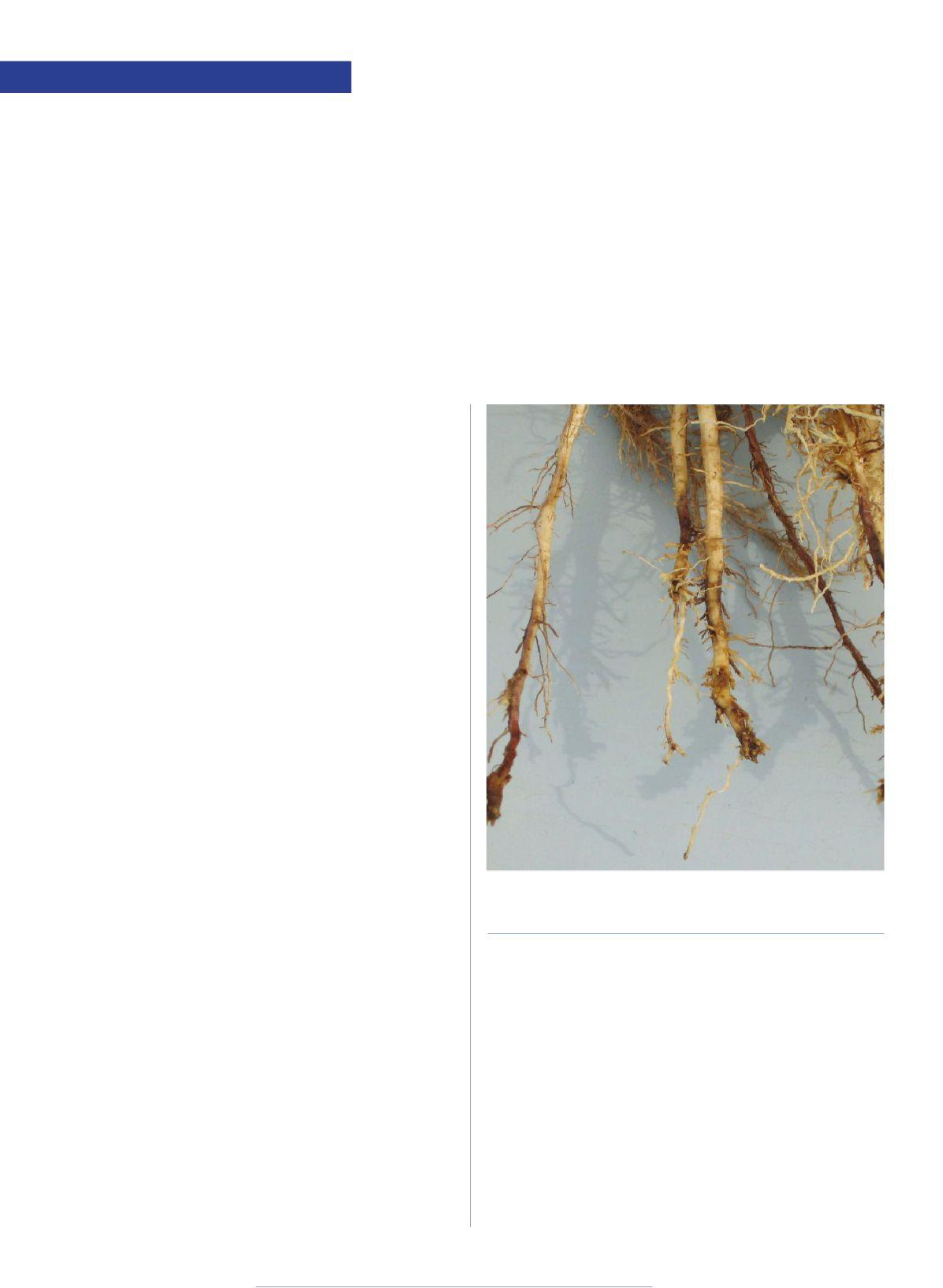
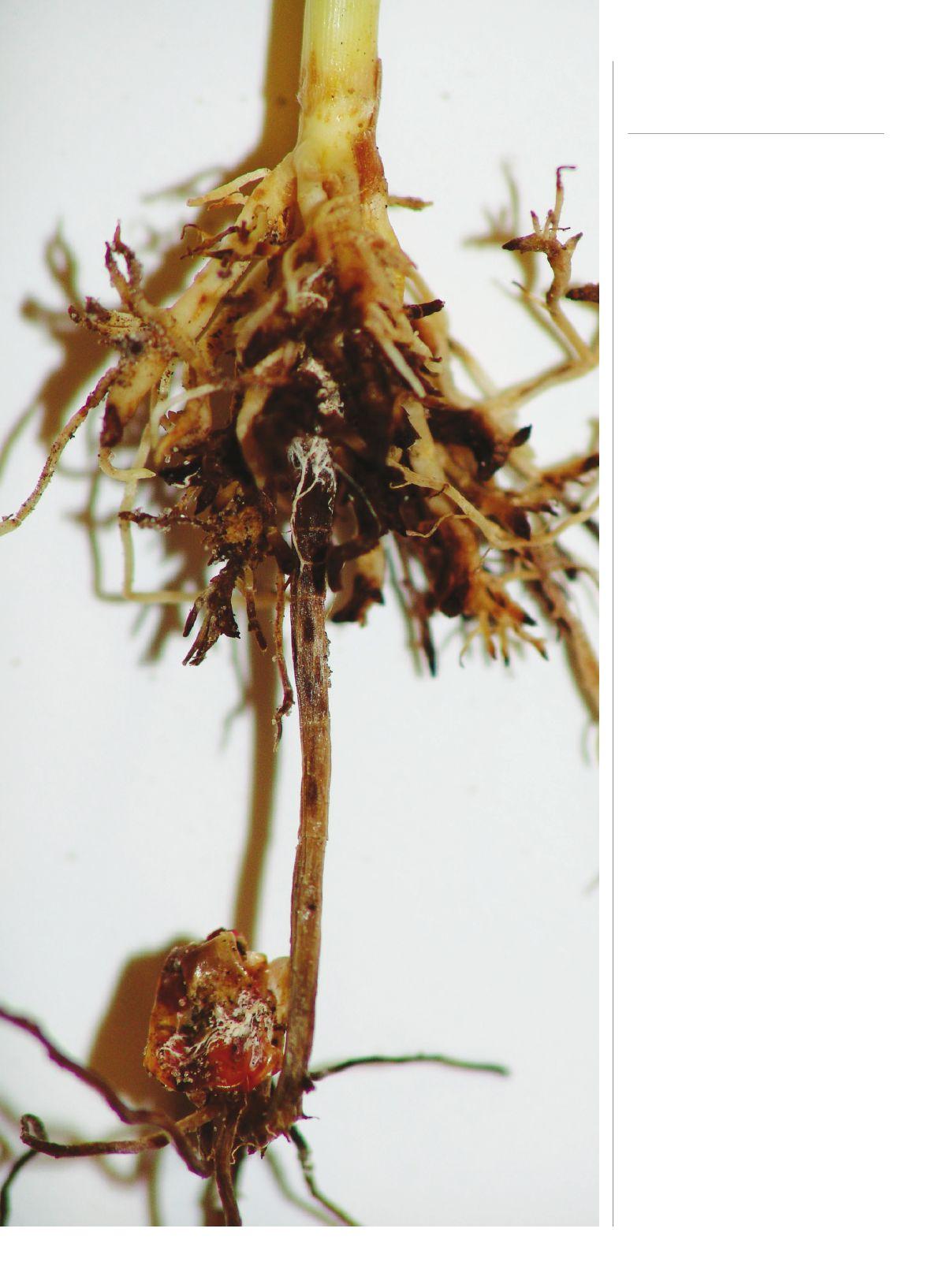
Corn nematodes feed on corn roots, reducing the plant’s ability to take up water and nutrients, and creating wounds where diseases can enter the roots.
stresses such as leaf diseases, stalk rots, dry weather and things like that,” says albert Tenuta, field crop plant pathologist with ontario’s Ministry of agriculture and Food (oMaF) and Ministry of rural affairs (Mra). He is involved in corn nematode studies in ontario as well as regional studies with U.S. researchers.
Tenuta has been leading surveys since 2009 to try to determine the overall impact of nematodes in ontario corn crops. “In our surveys over the past few years, with oMaF and Mra and our industry partners, we’ve seen much higher corn nematode numbers than we expected in terms of percentages across most of the province, particularly for types like the root-lesion nematode,” he says.
“roughly 25 to 30 per cent of the fields are at or above thresholds for root-lesion nematodes. That is quite surprising, but it’s also in line with what other areas are seeing – the great Lakes corn states
Vibrant plants collect more sunshine.
Crops thrive with Cruiser Maxx® Vibrance®. When the Vigor Trigger ® effect meets Rooting Power ™, you get enhanced crop establishment from stronger, faster-growing plants, above and below the ground. It also protects your soybeans against a broad range of insects and diseases and delivers best-in-class Rhizoctonia control.
damage to this plant was caused by sting nematode – a worst-case scenario that is not representative of more highpressure nematode fields.
and the Mid-West Corn Belt are seeing very similar numbers. It’s also surprising that the numbers are pretty uniform across a wide geographical region.”
He adds, “That’s not to say they are at high levels everywhere, but root-lesion nematode numbers are fairly constant throughout the province. With that, there is always concern with their potential impact on overall plant health and yield.”
The widespread presence of corn nematodes found in the surveys suggests these pests have been present at some level in ontario cornfields for quite a while. However, they seem to have become a growing problem in recent years.
“Changes in agricultural practices and management tools may have resulted in higher nematode populations or increases in their ability to become more problematic,” Tenuta says.
“Conservation tillage could be part of it. But it is also more than likely affected by a shift in our insect management strategies from more soil-applied insecticides to more seed-delivered strategies in terms of genetics (transgenic resistance) as well as seedtreatment insecticides. Those soil-applied insecticides likely caused some suppression of the nematode populations.”
Yield impacts in a particular cornfield will depend on the nematode species and populations in the field as well as such factors as soil type, moisture and temperature conditions, cropping history, tillage and pesticide practices.
“The yield impact of corn nematodes can range from less than a bushel per acre up to 20 or 30 bushels per acre, and in some severe cases it could be substantially higher, particularly in sandy knoll areas of fields that have other issues as well,” notes Tenuta.
He adds, “one of the primary attributes of many of these nematodes – and plant pathogens in general – is that they are very opportunistic. If there are any other stresses or conditions that are unfavourable for the plant, they are able to utilize that. So areas of a field with stress conditions are the areas where you’ll see the biggest nematode impacts.”
Nematode management study nematodes are an emerging issue in corn
crops, so management practices aren’t as well established as they are for soybean cyst nematode. Tenuta and his colleagues are in the early stages of putting together all the pieces needed for integrated management of corn nematodes, such as evaluating the effectiveness of new nematicides, determining genetic resistance among corn hybrids and fine-tuning economic thresholds for damage in corn crops.
From what Tenuta has learned so far, crop rotation alone is probably not going to be an effective control option in ontario.
“Unlike soybean cyst nematode, which is specific to soybeans and edible beans, many of the nematodes that are affecting corn also affect other field crops, horticultural crops and many native plant species, including weeds. root-lesion nematode, for instance, can affect soybeans, corn and wheat, so by rotating those three crops you have a susceptible host each year,” he explains.
Tenuta is currently leading a project to evaluate several tools for nematode management in corn and soybean, with field trials at two ontario locations. He is collabo-
rating with extension researchers from the U.S. and Tom Welacky of agriculture and agri-Food Canada in Harrow, with support through the grain Farmers of ontario, who obtained partial funding through the federal government’s Canadian agricultural adaptation program (Caap) delivered by the agricultural adaptation Council in guelph.
The corn trials in this project are testing various nematicides. These include Votivo, which is a recently registered seedtreatment from Bayer CropScience, and other seed treatment or in-furrow products that could be registered for use in Canadian corn crops in the near future. In addition, the trials are assessing how these nematicides function in combination with insecticide and fungicide seed treatments and other tools that contribute to healthy corn crops.
Tenuta hopes to determine how best to integrate all these tools into a complete disease management system for corn nematodes and other corn pathogens.
Corn nematode management tools, such as the seed-treatment nematicides, are a rel-
atively new area that is gaining increasing attention from agricultural input companies. Tenuta says, “It’s a much-needed area that hasn’t had a lot of attention in the past. I think it’s a great opportunity to help ontario agriculture and minimize the potential losses due to nematodes, and tie that in with genetic resistance, integrated pest management, best management practices, and all of those other tools that we have available.”
not surprisingly, the project’s preliminary results indicate that benefits from the seed-treatment nematicides depend in part on the nematode types and populations in the field. For instance, yield response to Votivo has ranged from no benefit to about 15 bu/ac, with the greatest benefits in areas with high populations of the more damaging nematode types. average response is about four to five bushels per acre. another important result is that yield responses to some of the nematicides are influenced by the corn hybrid. “We’ve seen a response in certain hybrids consistently over two or three years that may indicate some type of genetic tolerance to corn
in this field, chlorotic spots were noticed and yield and plant health were greatly affected by corn nematodes.
nematodes in some of the genetics,” notes Tenuta. These results could be a starting point for seed corn companies to develop nematode-resistant hybrids.
The project is also helping to increase awareness of corn nematode issues. Tenuta says, “probably the most important aspect of the project so far is that we’re getting a lot more calls from producers, crop consultants, ag retailers and seed companies about situations where growers who, for one reason or another, have seen a decline in their corn yields in certain fields.”
Tips for growers
“growers should evaluate their fields every year to assess the existing problems, risks and potential problems. nematodes are one of the things you need on your checklist. If you see declining yields in areas of a field where you’ve already considered and eliminated problems with factors like fertility, soil structure, and so on, then those areas may have a nematode issue. Those are the fields to target and potentially sample for nematodes,” explains Tenuta.
To diagnose a corn nematode problem, you need to sample both the soil and corn roots. Samples should be sent to a nematode lab. In ontario, nematode labs include the University of guelph pest Diagnostic Clinic, SgS agri-Food Laboratories and a&L Canada Labs Inc. Information on sampling and handling procedures is available on the oMaF website and from your nematode lab.
Thresholds for economic damage by some common nematodes are listed on the oMaF website. If your samples exceed these thresholds, you could consider taking steps to reduce stresses on the corn crop, such as ensuring proper fertility, maintaining good weed control, and controlling other pathogens.
as well, you could consider a strip trial with a seed-treatment nematicide. Tenuta says, “one of the most critical places for field validation of new products is a grower’s own fields. every field is unique and has specific conditions. You always want to evaluate these products or management tools under your own specific conditions.” sit
“On this farm, we’re the experts.”
Sean Gorrill –FCC Customer
Together, we’ll create the financing plan that works for you. We get to know you, your farm and how you want to grow. If you’re ready to get down to business, talk to one of our farm business experts.
2014 C ANA diAN T RUC k k i Ng ChA ll ENg E
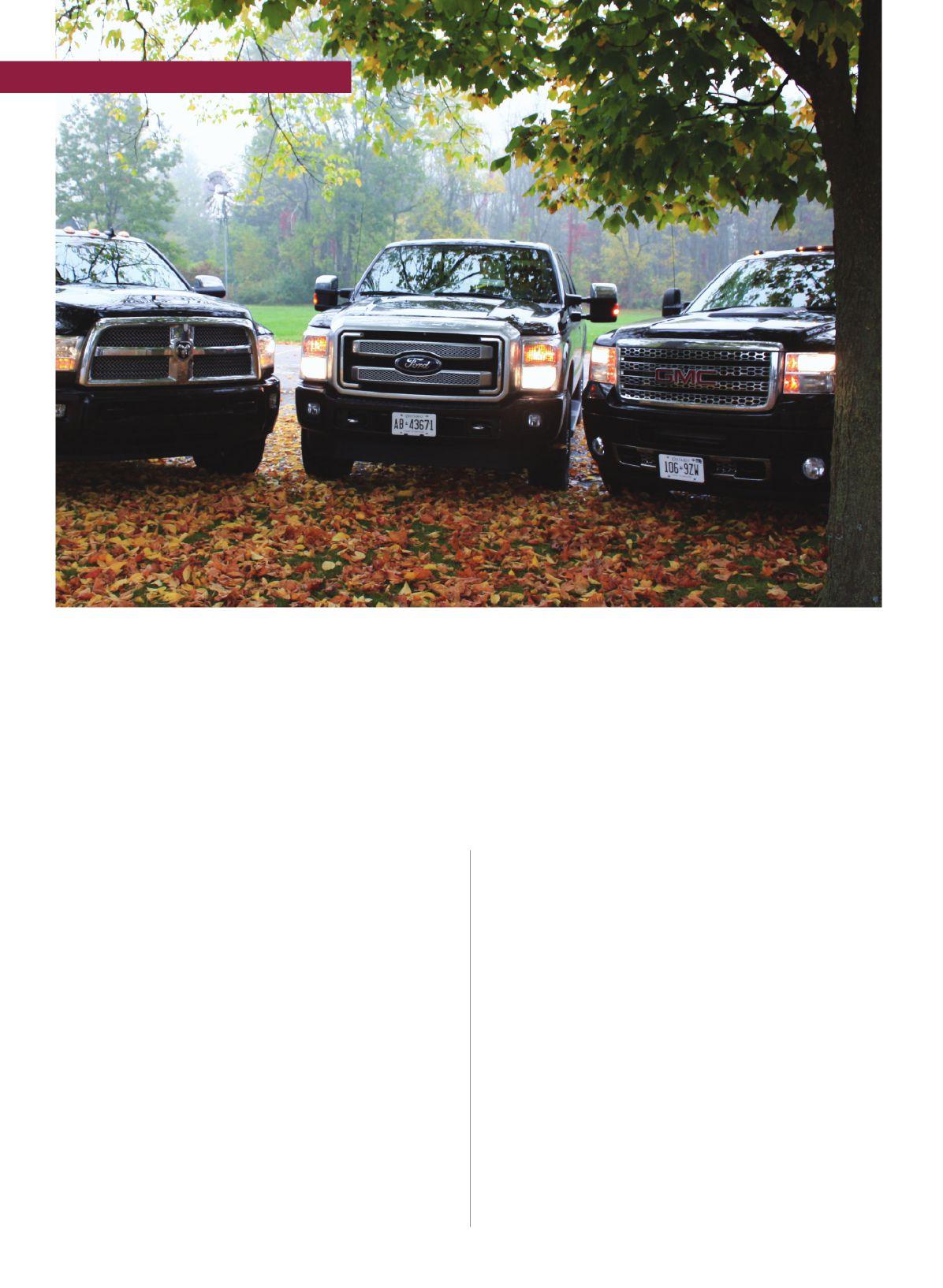
The Ram wins a hat trick in the 2014 Truck King Challenge.
by Howard J elmer
This is the seventh year that the Canadian Truck King Challenge has pitted the most popular pickups in the country against one another. However, how we do it each September is no different from what you do every day of the year – and that’s the point. So, the rain, mud and cold are a vital part of testing; my judges and I have to feel what you feel, contend with what you contend with and ultimately appreciate what you appreciate, and judge each feature along the way. as in years past, we tested at my IronWood site in the Kawartha Lakes region of ontario. We use a public 19-kilometre test loop that consists of a hilly gravel road, broken twisting asphalt and a smooth highway section. We take trucks out in groups of five and drive them round and round – switching drivers on each circuit until all five judges have driven all five vehicles. The trucks are always used in the same condition; as in all empty, all towing or all with payload. Back-to-back testing is the best way to compare vehicles.
It took us about 2.5 hours to do a complete back-to-back test; then we’d head to the yard for the next five. We do this over and
over, 10 hours a day for two days, making notes and scoring along the way. and while 19 kilometres doesn’t sound like much, by the time we were finished, collectively, we had driven over 4,000 kilometres.
So, what happened? Well, 2014 is going to be a big year for ram; the work they have been doing for at least the past five years is all coming together now and it showed up in the scoring. The company’s technology, design work and the will to take chances crystallized in one unique pickup truck.
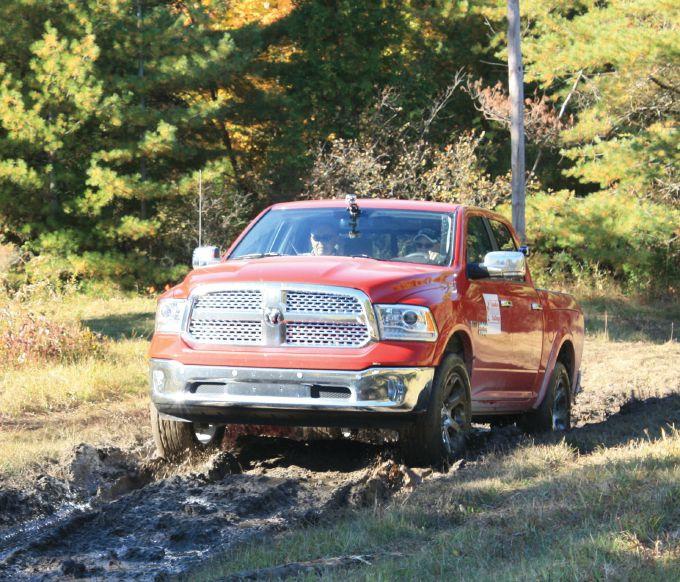
The overall points winner of the Canadian Truck King Challenge is the 2014 ram 1500 powered by the 3.0L ecoDiesel with eight-speed transmission. This is a revolutionary setup – one that we feel is going to be copied very quickly – but it deserves credit right now. It takes guts to be the first and this small diesel from ram works very, very well. price-wise, the diesel will be a $4,500 option; however, it will be available on every trim level except the absolute base.
at a lower price point (in our under-45K category), ram did it again with the 2014 ram 1500 powered by the 3.6L pentastar
Boundary herbicide’s reputation has always been solid. Now it’s liquid. You run a pristine operation and produce the highest-quality soybeans. You know residual annual grass and nightshade control is key to a great yield. And you know that time is money. So get the control and efficiency you want with easy-to-use emulsifiable concentrate Boundary ® LQD herbicide. It’s liquid at last.
V6 with the eight-speed transmission. This powertrain speaks to the other holy grail of truck ownership – power, capability with decent fuel economy. There was a time when this was simply impossible, remember? not anymore. In large part this is due to the eight-speed gearbox – again a revolutionary step forward. For that matter, all the rams – the 3L diesel, the 3.6L V6 and the 5.7L Hemi – came to IronWood with eight-speed transmissions. This gearbox worked well in all configurations during every test.
The three Detroit-sourced HD trucks were tested outside London, ont. Because HD owners tow a lot, that’s what we do too. The manufacturers outfitted each truck with a fifth-wheel hitch, and we partnered with Can-aM rV centre towing 14,000-pound fifth-wheel rV trailers over a 300-kilometre route. The next day, we stripped the fifth wheels out, loaded up 3,000 pounds of IKo shingles and set off on a 200-kilometre route. once again, the
judges switched up back to back during the driving.
In this HD category, it was the 2500-series ram, equipped with the 6.7L Cummins diesel that won out – though just. Last year saw the Silverado HD in first place; however for 2014, it still suffers from the dated interior, poor video screens and older software of last year. Mind you, we have already seen the 2015 Chevrolet and that’s all been fixed – but for now, we can only grade what we get. ram was in a similar boat last year, but for 2014 ram’s chassis was upgraded and strengthened, The engine was also tuned up and converted to use the DeF fluid for cleaner combustion and better mileage (though still not the best).
Three categories, three wins
one high-tech addition this year was the installation of data readers in each truck. We contracted a third-party company
With untreated UAN, you can lose valuable nitrogen as ammonia gas. That’s why you need AGROTAIN® PLUS EZ FLO nitrogen stabilizer. It’s scientifically proven to protect ureabased nitrogen above and below ground from the risks of volatilization, denitrification and leaching.
(recommended by natural resources Canada) called MyCarma to have a technician on site both days to record and interpret the fuel economy data from readers they installed in each truck. We made a point of recording each truck in each condition: empty, loaded, and towing. The resulting figures are as real-world as they get. During each stage of testing, trucks were hot-swapped by the judges (never shut off) as they traded vehicles. They idled between loops and
CORRECTION NOTICE
recorded the fuel used by the judges as they tested acceleration, braking and handling. no Dyno testing here – these numbers are real and dirty, just like those that everyday owners might achieve.
Testing notes and overall summary
payload this year was 1,000 pounds of patio stones on pallets. Trailers were twin-axle dumps and car carriers. Most trailers
The Versatile RT490 listing in the December Machinery Manager featured the wrong chart. The correct chart is displayed below.. We apologize for any inconvenience this may have caused.
VERSATILE RT490 COMBINE
The RT490 is a new 490 hp Class VIII combine from Versatile. True to the heritage of Versatile, the RT490 was designed to be rugged, reliable and simple to maintain and service.
A Cummins 11.9L powers the RT490. The 490 hp unit provides ample power to harvest in any crop conditions. The QSX 11.9L engine incorporates the Cummins-patented Variable Geometry Turbocharger (VGT) to improve fuel economy and help control emissions.
At the core of the Versatile RT490 is the revolutionary Rotating Concave Rotary System. A 360 degree concave wraps around a large rotor and counter-rotates. The counter rotation of the concave in relation to the rotor creates an unsurpassed threshing and separating area. Three separate “pinch points” are created during each rotor revolution allowing the grain to be threshed three times in each rotation.
The moving concave eliminates the traditional “dead zone” found in typical rotary systems. The rotor system allows the RT490 to be more productive in high-yield fields and in difficult crop conditions than competitive units with a stationary concave.
The Versatile RT490 cab was designed for long operating days. A large glass area and panoramic windows create an excellent view of the header during harvesting. A standard training seat, cooler, air-conditioner and sun visor further the operator’s comfort on long working days.
The simplicity and accessibility of the combine allows operators to quickly perform daily maintenance tasks and adjustments. Large access areas to the RT490’s critical components and daily maintenance areas help reduce downtime. Belts and other wear components are changed in less time than it takes to service competitive units.
Go to www.machinerymanager.ca for further specifications and links to combine
weighed in at 6,000 pounds, with one at 6,100 pounds and one at 6,900 pounds. The weights varied because the trucks sent to us all had different limits, so we tried to give heavier trailers to trucks that claimed higher towing limits. also, the smallest truck, the Toyota Tacoma, hauled 3,500 pounds. all the judges agreed that generally all trucks hauled well, but the torque of the ram 3.0L diesel with eight-speed automatic stood out. Its air suspension also held the load level, felt firm on the road and made its attitude with a trailer on always level. The Tundras, while powerful and new this year, still suffered from a lack of chassis rigidity, though special mention is deserved for the new 1794 trim package. This has to be one of the most upscale, sumptuous interiors in a pickup.
The Fords generally felt good during all the testing (and at the moment they are the oldest models we tested), but the surprise for most judges was how well the base 3.7L V6 handled the weight in the bed and while towing. Its overall cost and fuel economy was impressive. However, strangely, three of the four Fords we were given for testing had electrical gremlins in their trailer lighting hookups.
The new 2014 gMs are strong and the transmissions are smooth, but the ride is slightly twitchy under load and several judges had steering complaints. The new interiors were nice with excellent materials and layout. They also had several new innovative features in the truck beds, like integrated steps in the bumper and lighting under the box lips. on the fuel side, note how close the results are between the gM 5.3L V8 and the newer 6.2L V8 –way more power and very little extra fuel consumption.
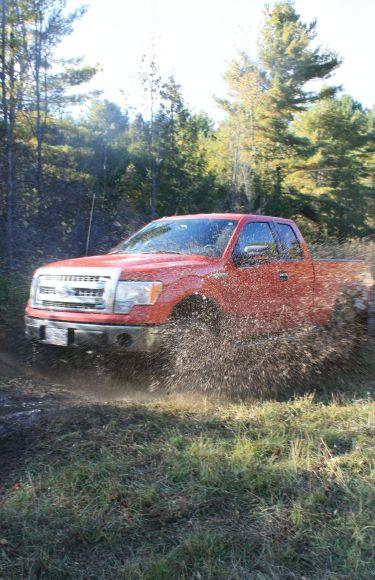
The off-road is the shortest test. It’s done on a half-mile long course I built myself. It consists of muddy hills, rockstrewn fields, a water-filled trench and an off-camber test, which gets the wheels in the air. Three things showed up out in the field this year.
First, with builders looking for more aerodynamic advantages, they keep adding length to the front air dams; because of this, we had several trucks scraping repeatedly through the course. Second, the mechanical rear differential locker on the gMs works well and is still unique – otherwise the trucks all handled the course, except in the off-camber where the gM
trucks’ rear differentials nicely locked up when power went to the lifted wheel. Third – and this is a gripe that’s several years old – the Fords still have the electrical hookups below the bumper where they collect mud, dirt and grime. as with many tests, much of what you are reading is opinion. However, it is educated opinion offered up by five Canadian automotive journalists with well over 150 years of combined trucking experience. Beyond this, though, numbers do tell a tale
and it’s worth looking at the overall scores as averaged among the five judges. The first thing that stands out is how close they all are. This means that there really isn’t a bad truck in the bunch. each has strengths and weaknesses, but, as in any competition, there must be a winner and a loser, and we feel confident in our choices.
Someone who fights for higher yields, giving crops the nutrients they need when they’re needed most. Someone who trusts field-proven technologies to more effectively feed crops, save time and boost the bottom line. Be a superhero. Ask your retailer for Wolf Trax Innovative Nutrients. Better nutrition. Better crops. Better farming.
di SA ppEAR i Ng
C oRN Y i E ld S
How stress causes corn to lose yield – permanently.
by Melanie epp
Can corn seedlings detect their environment? Do they adjust to environmental changes and stresses? and can they communicate with weeds? These are just a few of the questions that Clarence Swanton, a professor at the University of guelph’s department of plant agriculture, has been working on. Swanton and his team believe that plants can detect stresses in their environment. each time stress happens, the plant’s focus shifts from development to damage control, and that shift results in irrecoverable yield loss.
Stress is caused by plant density, particularly in short-season varieties, and competition for resources such as light, water and nutrients, as well as non-direct sources of competition. So what kinds of stress cause yield loss in corn? Swanton has researched each type extensively and presented his findings in the summer of 2013.
High-density corn
In a particularly wet year, Swanton was forced to make a decision come planting time. He could either stick with the hybrid he knew
or switch to a new, shorter-season variety. He chose to switch, but the switch produced differences: in particular, he noticed lower leaf development and lower yields. It was then that he realized that little work had been done on planting density in shorter-season varieties.
The first trials were conducted in 2012 using products from Dupont pioneer, Maizex, pride Seeds, Syngenta, and Dekalb. Using a 2350 HU variety, Swanton planted at densities of 30,000, 36,000 and 42,000 seeds per acre. The trials did show an increase in yields. at the 30,000 seeds per acre rate, 155 bushels were produced. at the 42,000-rate, 168.7 bushels were produced.
“now keep in mind the price per unit of corn,” says Swanton. “always keep that in mind when you hear this density story.
“number-wise, it says there’s a difference, but statistically, there isn’t,” he continues. “I put 12,000 more plants in the ground, planted
aBOVE: Even when weeds are controlled at very early stages, the growth and yield potential are affected, according to Clarence swanton, professor at the univeristy of guelph.
Photo B y Melanie ePP
You’ll never find a Pioneer sales rep with their feet up in an office somewhere. More often than not they’re the person standing right next to you discussing the weather, your soil conditions and your challenges – because, after all, they’re
living with them too. This dedication and unique level of expertise helps our reps recommend the right product for each of your acres every year. Talk to your local Pioneer sales rep or visit pioneer.com for more information.
Our experts are grown locally sales of
on the first of June, and it made zero difference. Think of the price of a unit of corn.”
So the big question is this: Where did the yield go? Why is it not possible to put more plants in the ground and consistently get higher yields?
Swanton says there’s clearly a hybrid effect, and some hybrids “flatline” at certain densities. He’s the first to admit that he doesn’t have all the answers but says looking at it from another perspective has provided some interesting conclusions.
“We are looking at that question from a molecular standpoint, from a physiological standpoint and from a whole-plant and agronomic standpoint,” says Swanton.
The effects of plant competition plant competition for resources such as water, light and nutrients plays a major part in yield loss. But more non-direct sources of competition affect plants as well, says Swanton.
“one of the things that amazed me was that even if you control the weeds really early in the cycle of a plant, the yield potential of that crop is changed,” he says. “It’s on a totally different trajectory. even though you’ve done it very early and you still have 90 per cent of the growth ahead of the plant, you have – within a few days or a few leaf stages – affected the actual growth and yield potential of that plant.” That is to say, that yield loss is permanent and never comes back.
In a series of experiments using perennial rye grass, Swanton
discovered that shade avoidance, for instance, affects plants on a physiological level.
While we tend to think of plants as stationary, they do have the ability to detect their environment, Swanton says. “They are moving and sensing and changing their environment in an incredible way.
“The far red reflecting off of the weed surface is picked up by phytochrome in the actual corn plant, and that triggers a whole cascade of biological and physiological changes that occur in the plant,” he says.
When a corn plant detects a weed in its vicinity, two things happen: anthocyanin production decreases and lignin production increases. The importance of these two cannot be understated. anthocyanin acts as a sunscreen for the plant, protecting it from sun damage, and as a powerful antioxidant that helps with disease resistance.
“In the presence of weeds, up until about the fourth leaf stage, we get this change in anthocyanin content,” says Swanton. “You actually change the pigmentation of the plant. and you break down the ability of the plant to handle ultraviolet radiation – you break down the resistance of the plant to some of the diseases.”
In the presence of weeds, a corn plant will also increase its production of ethylene, which causes it to age and hinders plant recovery. on top of that, Swanton noticed an explosion in free radicals, particularly in hydrogen peroxides.
swanton has found that when corn plants divert energy to repairing damage, yield is permanently lost.
R ETURN i Ng To dUA l-p UR po SE C oRN
Grain hybrids may double as silage once again.
by amy petherick
If farmers in eastern Canada continue to increase their soybean acreage next year, the number of buffer acres that mixed operations allow for corn silage could be tighter than before.
In the event of a poor season, there may be value in knowing which grain corn hybrids effectively double as silage.
at one time, all corn hybrids were suited to being harvested for grain and for silage purposes. It wasn’t until silage-specific hybrids were commercialized that the term dual-purpose came into existence, largely for marketing purposes, and the role these multiuse products should play has been hotly contested ever since. In exchange for flexibility, these products typically sacrifice grain yield, silage quality, or both, diminishing their popularity. as greg Stewart, corn specialist for the ontario Ministry of agriculture and Food (oMaF), recalls, silage-specific hybrids were created specifically to respond to the problems posed by dual-purpose options.
“one of the big problems with a dual-purpose hybrid is that the grain characteristics make them harden up and dry down quickly,” he says. “The silage-specific hybrids were designed not to have as rapid starch fill, as high a test weight, or move to black layer as quickly, offering a larger window to get good quality silage that’s not too dry.”
But Stewart says that with today’s analysis methods, there might be evidence to suggest some silage-specific hybrids don’t produce any more milk per tonne or milk per acre than a dualpurpose hybrid with a reasonably good starch digestibility score. and there’s really nothing special, agronomically, to do to achieve that. Dual-purpose hybrids respond just as well as any corn plant does to phosphorus applied in a 2 x 2 inch band (two inches below and two inches to the side of the seed), a starter fertilizer which supplements fertility needs identified by regular soil testing, and excellent weed control between the 4th and 10th leaf stage. But when it comes to harvesting, he can’t offer a magic bullet recipe for
good quality silage.
“If we’ve moved away from anything, it’s the idea that all hybrids can be treated the same,” said Stewart. “You’ve got to be more in tune with what silage quality really means and how you assess it.”
If Joel Bagg, oMaF’s forage specialist, had to choose a model of assessment when it comes to analyzing hybrids for forage quality, his first preference is the MILK2006 model from the University of Wisconsin. Bagg doesn’t think it’s fair to make blanket claims about which types of hybrids are better than others because he thinks farmers need to look at each individual hybrid based on the data available. He refers to well-run silage hybrid trials conducted in the United States.
“other than brown mid rib, there’s not a lot of difference in fibre digestibility across hybrids but there’s a big difference in starch.” says Bagg, “and we have a lot better ability to measure starch digestibility than we did even 15 years ago.”
Dan Undersander is one of the research and extension agronomists at the University of Wisconsin who is working with these trial and forage analysis results daily. The trials don’t indicate when a hybrid is marketed as dual-purpose, but products that perform well as a silage and grain corn are a safe bet even if they aren’t labelled for both uses. Based on these experiences, Undersander now recommends farmers with forage needs grow grain, silage and dual-purpose hybrids every year.
“Dual-purpose is bred for both grain and forage yield so you obviously have to make some sacrifices on both to stay at a moderately high level, but that’s not to say there isn’t a place for it,” he says. “My approach is to recommend a farmer calculate how many tonnes of silage he wants, then how many acres that takes
aBOVE: silage-specific hybrids were created in response to problems posed by dual-purpose varieties, but new trials may indicate dual-purpose hybrides perform just as well.
Fond
du Lac= FON, Galesville= GAL, Hancock= HAN
South Central Zone (95-105 Relative Maturity)
† Traits: CB = Corn Borer, LL = Liberty Link, RR = Roundup Ready, RW = Corn Rootworm, bmr = Brown Mid Rib, lfy = Leafy, ND = Nutri-Dense, wo = Water Optimize. * Hybrids that performed statistically similar to the highest hybrid in the trial. Shaded results provide the best estimate of relative hybrid performance.
in a good year, plant that acreage to corn-silage hybrids, then plant a buffer of 15 or 20 per cent dual-purpose, and all the rest goes to grain corn.”
From an agronomic standpoint, he agrees with Stewart that dual-purpose hybrids generally need the same treatment as any other corn hybrid. But since the usual recommendation for silage-specific hybrids is to increase the seeding rate by five to 10 per cent over the rate for grain corn, a dual-purpose rate might be best somewhere in between these rates. The only other challenge Undersander finds in growing dual-purpose is selecting the right hybrid maturity.
“a large portion of the difference between silage and grain crops is simply the maturity,” he says. “For dual-purpose, we’re probably going to want to plant a hybrid that will mature within our growing season, limiting our total tonnage yield, but that still gives us grain at the end of the season if we need to go that way.”
In Canada, Bagg warns that it’s buyer beware when it comes to purchasing silage hybrids for dual-purpose, since most companies breed their hybrids in the United States and may not even have regional performance data. But he also reminds producers that hybrid selection is only one of many things that need to be done
right with corn silage. Harvesting at the right moisture, using an inoculant and processing kernels remain key. He also says packing is typically the weakest link in bunker silo management.
“packing is usually not enough and you might lose 12 to 15 per cent of the silage you put in there to fermentation because the bacteria are actually using some of the dry matter for fermentation,” Bagg says.
Whether farmers are harvesting silage-specific or dual-purpose varieties, Bagg says, there are always lots of invisible losses, which is why forages are so much more difficult than grain crops to gauge yield. He says it’s a loss for eastern Canada that there aren’t silage corn trials here, but he doesn’t expect to see anything change for the better anytime soon.
“It wouldn’t take much to do corn-silage trials if farmers wanted; the infrastructure is there, but there isn’t the stakeholder willingness to pay for it,” he says. “We’re struggling even to maintain our forage trials.”
diSAppEARiNg CoRN YiEldS
CONTiNuEd FROM PagE 28
“These free radicals are found normally in plants. They’re a byproduct of metabolism and they play an important role in cell signalling and maintenance of physiological stability in the plant,” Swanton says. “Under stress, there’s a threshold, and suddenly rather than being a facilitator of physiology, it turns into a damaging component.”
at this time, the exact threshold is unknown, but the damage it causes is obvious. “It damages Dna, proteins, and lipids, inactivates enzymes, alters plant metabolism, and you actually close the stomatal, and then as a result you get photosynthesis down. You get a whole series of things happening all because of that explosion of free radicals.”
a new look at seed treatments
Swanton believes that each time a corn plant diverts its energy to repairing damage or addressing stress, yield is lost – permanently. Interestingly, though, in the presence of seed treatments, plants reacted differently. Seeds treated with thiamethoxam, he says, did not see this shade avoidance effect at all.
“everything that we know about how plants react physiologically under stress and pressure is negated when seeds treated with thiamethoxam are used.”
In fact, Swanton thinks this could lead to some interesting possibilities in terms of triggering genes, taking the role of crop protection to new levels.
“What that means to me is that there’s all kinds of untapped potential for the role of seed treatments in the future,” he says. “Traditionally, we think of seed treatments in terms of insects and diseases, and so that’s why we’ve used the seed treatment. But now, because of our work on seed treatments and how seed treatments can help a plant overcome stress, all of a sudden that opens up this whole concept of rethinking the role of a seed treatment. Maybe we could also use seed treatments to trigger genes. now how cool is that?”
pREC i SE lY
pl ANT i Ng C oRN
Reviewing planting techniques and a new technology preview.
by Melanie epp
Corn planting technology has come a long way in addressing such issues as depth, spacing and seedbed environment – three corn planting factors that greg Stewart, corn specialist at the ontario Ministry of agriculture and Food (oMaF), says are crucial in order to provide crops with the best environment for optimal growth and development. But major improvements are still being made, with new products being launched in early 2014.
Corn 101
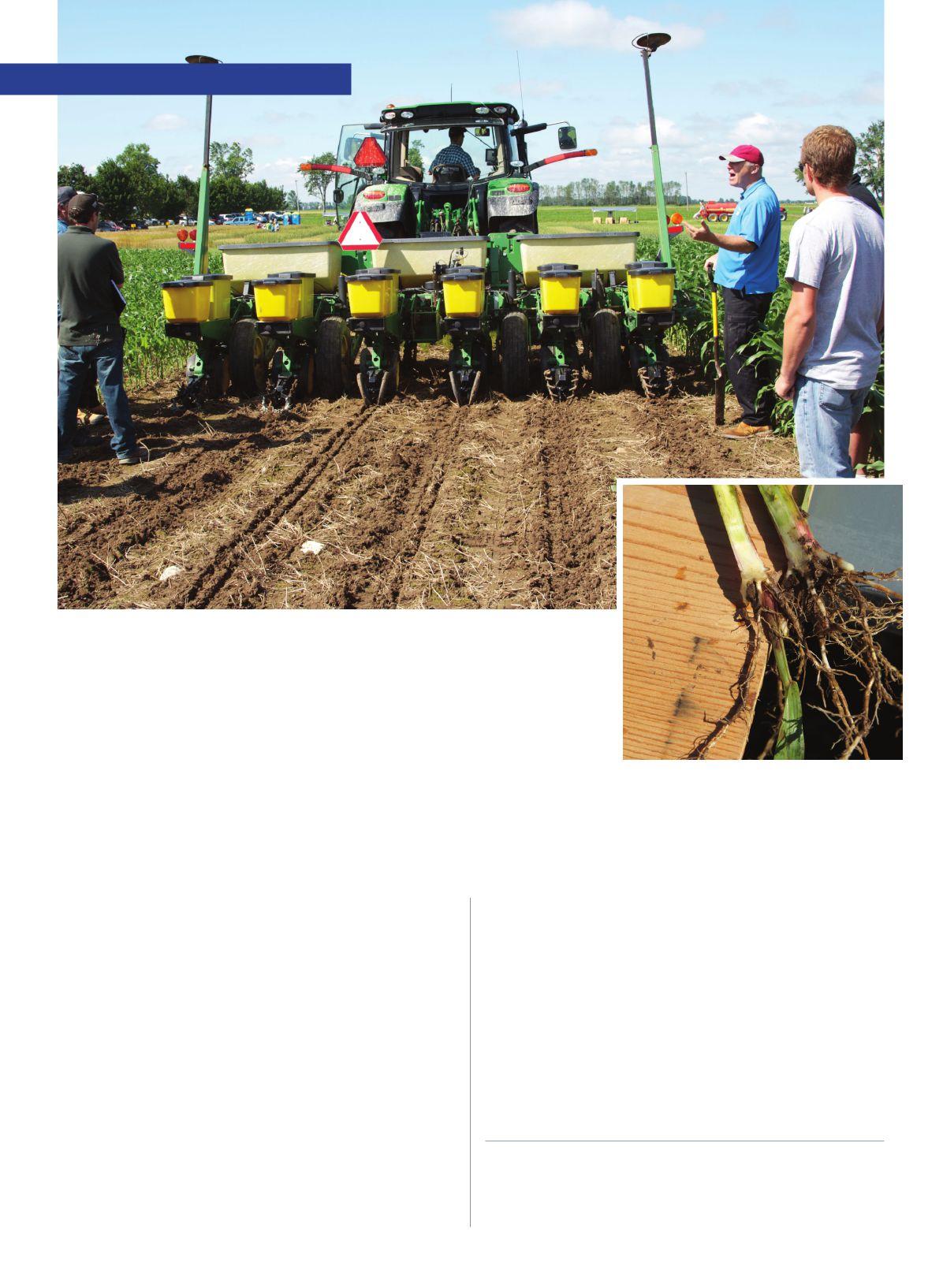
Stewart demonstrated the importance of achieving adequate depth, sufficient spacing and creating a favourable seedbed environment at last summer’s Farm Smart expo at the elora research Station in ontario. While showing producers what can happen when things go wrong, he reviewed how to calculate plant depth, why it is important to understand plant uniformity, and how to improve spacing and performance in the physical environment around the root zone.
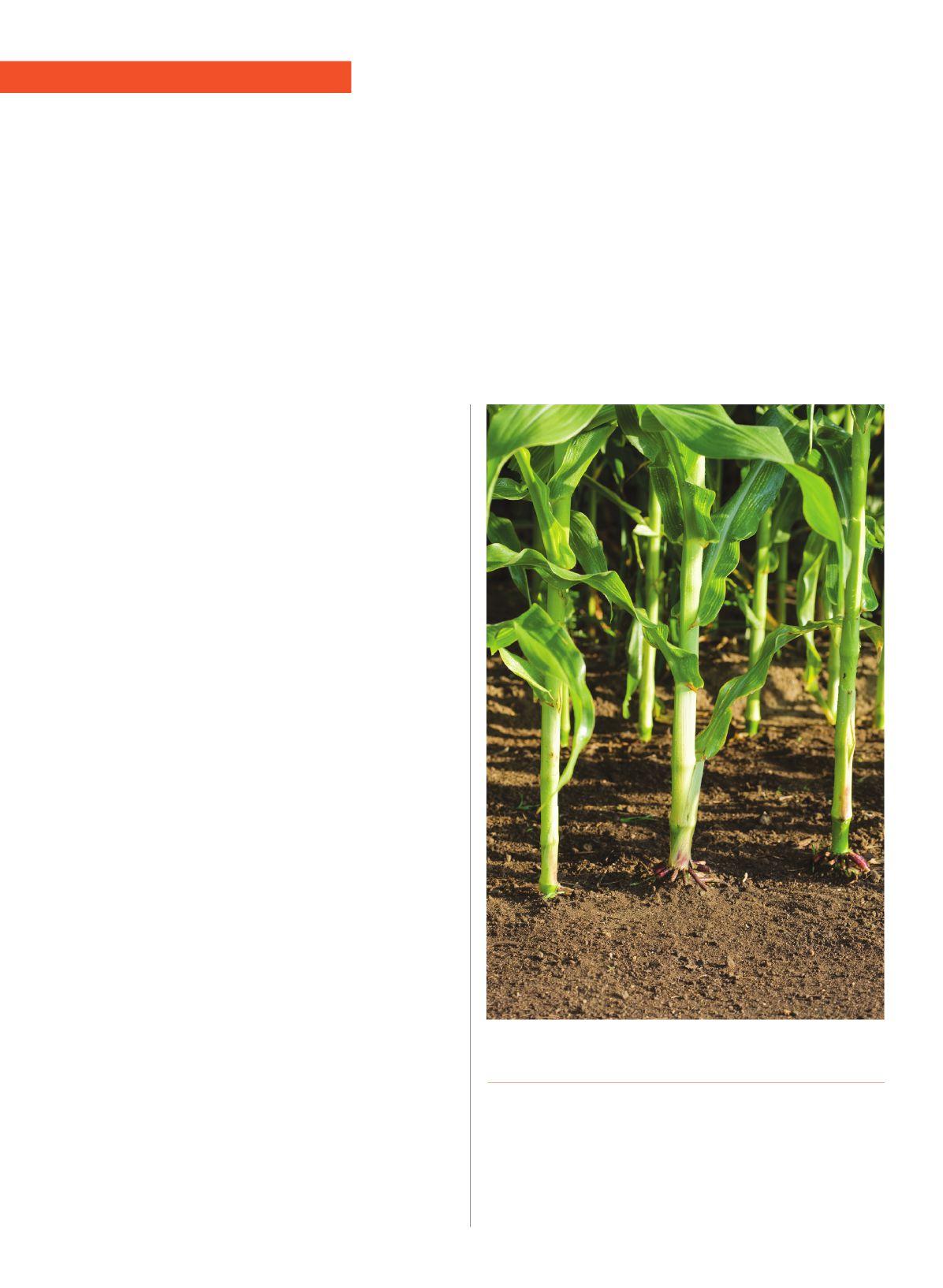
For optimal nodal root development, corn plants should be planted to a depth of 1.5 to two inches. Corn should never be planted shallower than 1.5 inches, as shallow-planted corn will have difficulties taking up water and nutrients. also, plants with underdeveloped root systems are prone to falling over as they further develop. Symptoms of irregular planting depth include varying plant height and uneven emergence.
To identify the planting depth of an individual corn plant, Stewart advises looking at the plant’s root mesocotyl.
“It’s usually right in the centre of the root system,” he says. “It’s whiter than all of the other roots on the plant and quite often has no other branches or roots coming from it.” To find your planting depth, simply add three-quarters of an inch to the mesocotyl.”
TOP: OMaF’s greg stewart says a good seedbed environment is necessary to provide plants with the best chance for optimal performance.
iNsET: The plant’s root mesocotyl indicates the planting depth of the individual plant.
YOUR CROPS. YOUR CHOICE. Because
MANA Canada Herbicides Same active as Phantom™ (Imazethapyr)
Arrow® (Clethodim) Select® and Centurion®
Bison® (Tralkoxydim) Liquid Achieve®
Badge®II (Bromoxynil & mCPA Ester)
Thrasher®II (Bromoxynil & 2,4-D Ester)
Choice Matters.
m
Bromotril®II (Bromoxynil) Pardner®
Bengal® WB (Fenoxaprop-p-ethyl) Puma® Super
Diurex® (Diuron) Karmex®
MANA Canada Insecticides Same active as Silencer® (Lambda-cyhalothrin) matador®
Pyrinex® (Chlorpyrifos) Lorsban®
Alias® (Imidacloprid) Admire® and Stress Shield®
Apollo® (Clofentezine) Exclusive to mANA Canada
MANA Canada Fungicides Same active as Bumper® (Propiconazole) Tilt®
Blanket AP™ (Azoxystrobin & Propiconazole)
Mission® (Propiconazole)
Folpan® (Folpet) Exclusive to mANA Canada Overall™ (Iprodione) Rovral®
At MANA Canada we believe that growers and retailers deserve choice in crop protection products. Our growing portfolio of strategic active ingredients is used in over 20 MANA Canada branded herbicides, fungicides and insecticides manufactured to the highest standards.
For the best return on investment, choose the MANA Canada advantage.
Alias,
When looking over the stand, says Stewart, check for things like uniformity and spacing. “It’s generally more important for us to have uniform staging,” he says. “That is, every plant beside its neighbour at the same stage, the same height, and about the same size.
“The intriguing thing we find about plants that get behind by this stage is that the neighbours beside them don’t compensate very well. If it’s a double or a spacing problem, those plants that are uniform but have some gaps or misses, they will compensate pretty well,” he continues. “But those plants beside a poor performer, a late-emerger, they don’t compensate worth a darn.”
picket fence spacing and perfect depth aren’t the only important factors, though. growers should strive to create a seedbed that gives the greatest chance for uniform emergence and uniform root growth. “What we really care about is that cobs are uniform and a good weight all of the way down the row,” says Stewart.
Stewart says it’s tough to mess up in elora, but he did find instances of hatchet root – roots that were growing down into the trench.
“We planted this field with very high down pressure on the row
HPrecision Planting
A new seed delivery system is now in development at Precision Planting. Sean Arians, product marketing manager, says the SpeedTube will allow growers to plant corn and soybeans much faster than is possible with seed tubes.
Because high speeds lead to poor spacing, planting speed is limited by the constraints of the seed tube. By controlling the seed all the way from the meter to the furrow, this problem is addressed. Look for more details after the spring planting season.
case Ih
Bill Hoeg of Case IH says producers can look forward to three new products coming out of the company this year. The AccuDrive seed meter cable drive system has been designed to make Case IH’s Advanced Seed Meter more reliable, Hoeg says. He adds the new bulk delivery system has been designed to better manage treated
unit and tried to do as poor a job as we could in closing the trench,” says Stewart. “If you’d gone into a soil with a little more clay and you’d done what we did, you could create a slot that the roots would hardly push their way out of.”
There are two key things producers need to watch for to improve early growth of the root system. The first is how much down pressure is applied to the row unit itself. The second is to make sure that the trench is closed properly. This means not leaving a seed trench open and susceptible to drying out, but also not smearing it shut in such a way that early root and shoot growth are restricted.
“With higher residue or no-till situations, we are looking at different options to crumble that trench closed,” Stewart says.
“In good conditions, I’m not overly convinced that my down pressure and my closing wheels are really changing the game much for us,” he continues. “I like to have the options of adjusting down pressure and crumbling the seed trench closed, particularly if I’m on a notill piece of ground. But they’re not game changers if everything else seedbed-wise is in good shape.”
seed without interfering with the meter.
“This new bulk fill system provides seed delivery from the tank to the mini hopper, no matter the seed population or seed coating,” Hoeg says.
Finally, the AccuStat advanced seed sensing system is meant to allow farmers to monitor and map highly detailed seed spacing information on the planter’s AFS Pro 700 display.
john Deere
This year, John Deere is releasing the ExactEmerge planter. For traditional planting they will also offer a new MaxEmerge five-row unit. The ExactEmerge row unit incorporates new technology that gives corn and soybean producers the ability to plant at speeds of up to 16 kilometres per hour while maintaining superior seed placement, according to Barry Nelson, a John Deere spokesperson. The ExactEmerge row units are meant to help producers plant more efficiently, adds Kelby Krueger, product specialist with John Deere Seeding Group.
stewart has found that neighbouring plants don’t compensate well, so uniform staging is key.
Build your future with the Young Farmer Loan
Under 40? Love agriculture? Take the next step with up to $500,000 to purchase farm-related assets. With variable rates at prime plus 0.5% and no processing fees, you can make your move. fcc ca/YoungFarmerLoan
Senior exeCutive finanCial ConSultant inveStorS Group finanCial ServiCeS
inC.
| paul r. vaillanCourt, Cfp, Clu, CHS and CpCa
ShoU ld i C oNTR i BUTE To AN RRSp, A TFSA oR B oT h?
The introduction of the Tax-Free Savings a ccount (TFS a ) in 2009 represented the most important change to the way Canadians save money since rr S p s were launched in the 1950s. But the big question on many people’s minds is whether they should contribute to a TFS a , the tried-and-tested rr S p or possibly even both?
Before shedding some light on this question, let’s first understand some of the key differences and similarities between the two investment vehicles. First and foremost, both rrSps and TFSas provide investors with the opportunity for tax-sheltered investment growth. But unlike an rrSp, contributions to a TFSa are not tax-deductible, amounts can be withdrawn tax-free at any time, and withdrawn amounts are added back into your TFSa contribution room the following year.
Which is best?
on a very basic level, looking at your pre-retirement and expected post-retirement marginal tax rates can help you determine how to best allocate your investments. If you expect to be in a lower tax bracket during retirement, contributing to an rrSp is generally more beneficial. However if you expect your retirement tax bracket to be equal or higher than your pre-retirement tax rate, the TFSa may be more tax-efficient.
Hold on; not so fast
although it’s tempting to settle on a simple rule of thumb, the decision to use a TFSa or rrSp is not that simple. even if you anticipate having a lower marginal tax rate in retirement, maximizing your rrSp contributions may not always be the most tax efficient longterm strategy. Since rrSp withdrawals (directly or through your registered retirement Income Fund (rrIF) or an annuity) increase your taxable income, those withdrawals may affect certain government income-tested benefits and credits such as the old age Security benefit and the age Credit. on the other hand, if your expected marginal tax rate in retirement is equal to or higher than it was during your accumulation years, contributing to your TFSa is not always the best approach. For example, rrSps that are converted to a rrIF or an annuity after age 65 can produce income that is eligible for the pension income tax credit and thus qualifies for pension income-splitting with your spouse. other income-splitting strategies such as spousal rrSps could distribute a portion of your taxable income to a spouse with a lower marginal tax rate in retirement, further reducing your tax bill and reducing the claw-back effect on your income-tested benefits and credits.
Comparing the TFSA to the RRSP
Contributions are fully tax-deductible
Contributions can be made until the end of the year in which you turn 71 years of age
Withdrawals are taxed at your marginal tax rate
1% monthly penalty for over-contributions
Withdrawals could affect eligibility for federal income-tested government benefits and credits
Unused contribution room is carried forward indefinitely
Withdrawals cannot be returned to the RRSP without using contribution room*
Contributions are not tax-deductible
Contributions can be made at any time with no age limit (for those 18 years of age and over)
Withdrawals are 100% tax-free
1% monthly penalty for over-contributions
Withdrawals will not affect eligibility for federal income-tested government benefits and credits
Unused contribution room is carried forward indefinitely
Withdrawals will be added to contribution room in the following year
*except for repayments of withdrawals under the home buyers’ plan or lifelong learning plan
so where does this leave us?
generally speaking, a TFSa may be better suited for shorter-term goals, such as an emergency fund or saving for a major purchase, since there is no tax on withdrawals and withdrawn amounts are added back into your TFSa contribution room the following year. an rrSp is a long-term investment vehicle. The taxes and lost contribution room associated with early withdrawals are strong incentives to keep your money invested until retirement. The TFSa can also be a powerful retirement savings tool. However, due to the ease with which TFSa savings can be accessed (no taxes on withdrawals or loss of contribution room), only a disciplined investor who can resist the temptation to dip into their savings prior to retirement will fully benefit from its potential as a source of retirement income. remember, there is no one-size-fits-all solution. Your personal savings strategy needs to take into account your unique circumstances as well as your short- and long-term objectives. Talk with your financial planner to discover what approach is best for you.
This is a general source of information only. It is not intended to provide personalized tax, legal or investment advice, and is not intended as a solicitation to purchase securities. Paul Vaillancourt is solely responsible for its content. For more information on this topic or any other financial matter, please contact an Investors Group Consultant.
The playing field has changed. So should your herbicide.
As weeds become tougher to control, the product you’ve relied on for years just doesn’t cut it anymore. That’s why you should switch to the next generation of chemistry for corn. Integrity® herbicide is a new leader in the pre-emergent market. Its unique and multiple modes of action deliver stronger control of velvetleaf, pigweed and yellow nutsedge plus better follow-crop exibility. Because when your corn isn’t competing with weeds, it gets the best possible start—setting you up for a bigger yield. To learn more visit agsolutions.ca/integrity or call AgSolutions® Customer Care at 1-877-371-BASF (2273).
Always read and follow label directions. AgSolutions is a registered trade-mark of BASF Corporation; and INTEGRITY and KIXOR are registered trade-marks of BASF