TOP CROP MANAGER
GIBBERELLA EAR ROT:
The latest on hybrid offerings PG. 6
REMOVING LAST MOISTURE POINTS
Right technology that works properly over time
PG. 16
2012 SEED TREATMENT AND INO c ULANT GUIDE
Special Section
The latest on hybrid offerings PG. 6
REMOVING LAST MOISTURE POINTS
Right technology that works properly over time
PG. 16
2012 SEED TREATMENT AND INO c ULANT GUIDE
Special Section
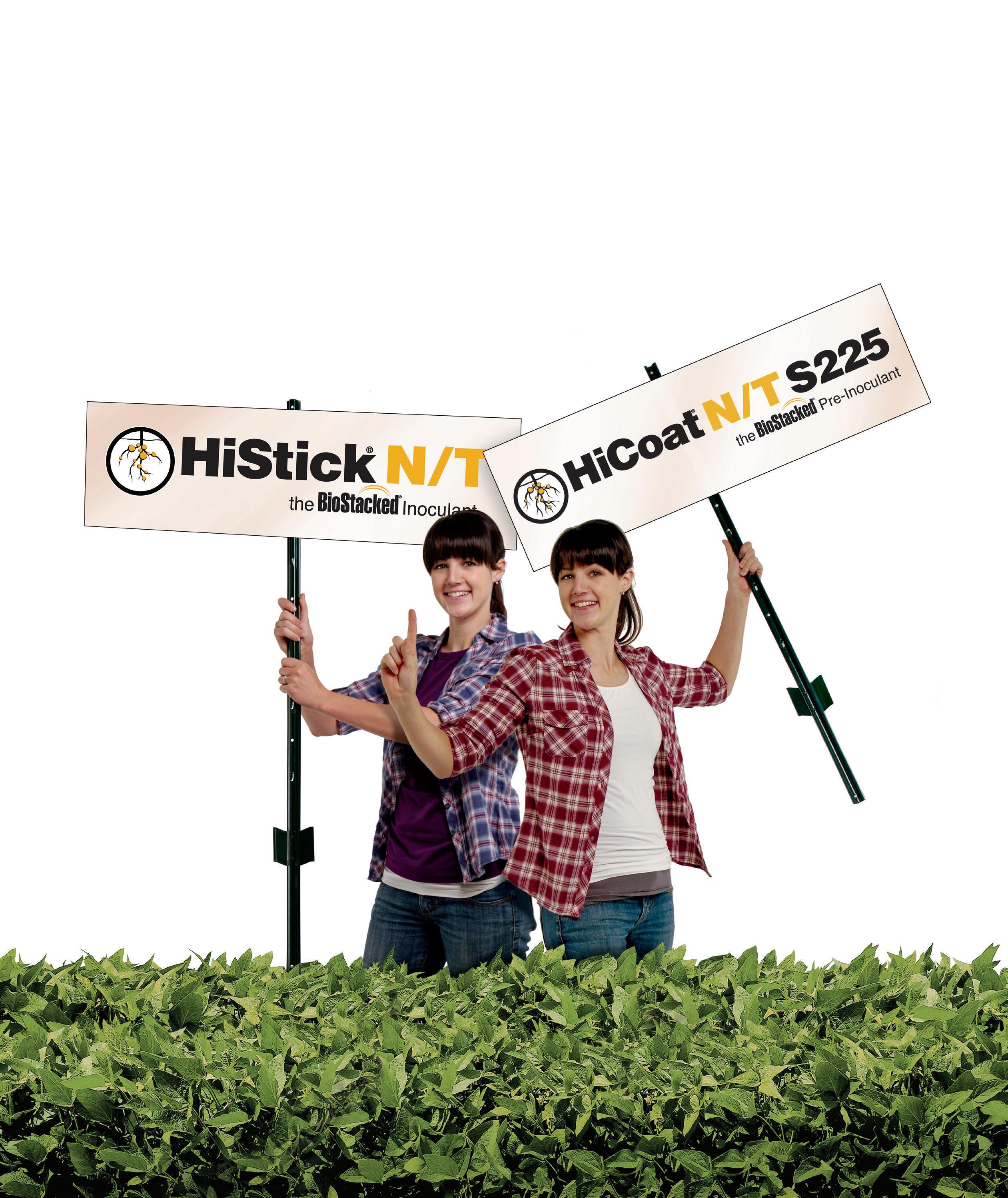
BioStacked® means greater plant vigour, root biomass and more nitrogen-fixing nodules on every plant. Only HiStick® N/T and HiCoat® N/T S225 are BioStacked® –which in turn means increased performance, superior Return-on-Investment and most importantly, added yield potential.
In the planter or in the bag – ask your retailer about BioStacked® HiStick® N/T inoculant and HiCoat® N/T S225 pre-inoculant system – Canada’s #1 soybean inoculants.

6 | Gibberella ear rot: The latest on hybrid offerings an independent evaluation and rating system for hybrid decision-making is needed by growers. by Treena Hein
8 | Corn planting dates and yields Helping to put late planting of corn into perspective. by Carolyn King
12 | Western bean cutworm: What to expect in 2012 as the western bean cutworm expands its range across both ontario and Quebec, what can farmers do? by Blair Andrews PESTS AND DISEASES
16 removing those last moisture points by Treena Hein
PLANT BREEDING
18 What’s new in corn hybrids? by Melanie Epp
22 and the winner is … by Howard J. Elmer
SOIL AND WATER
30 How healthy are ontario soils? by Rosalie I. Tennison
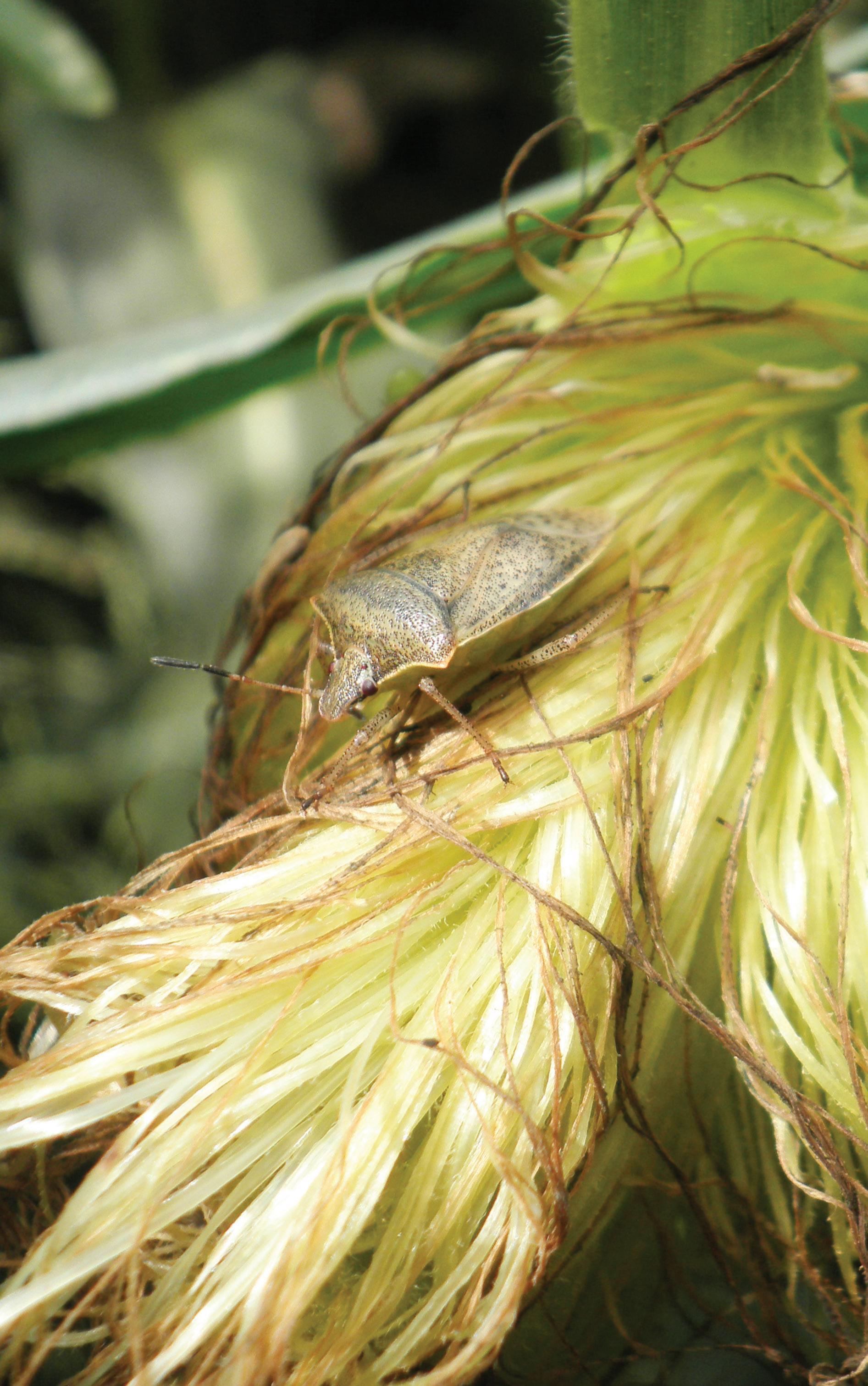
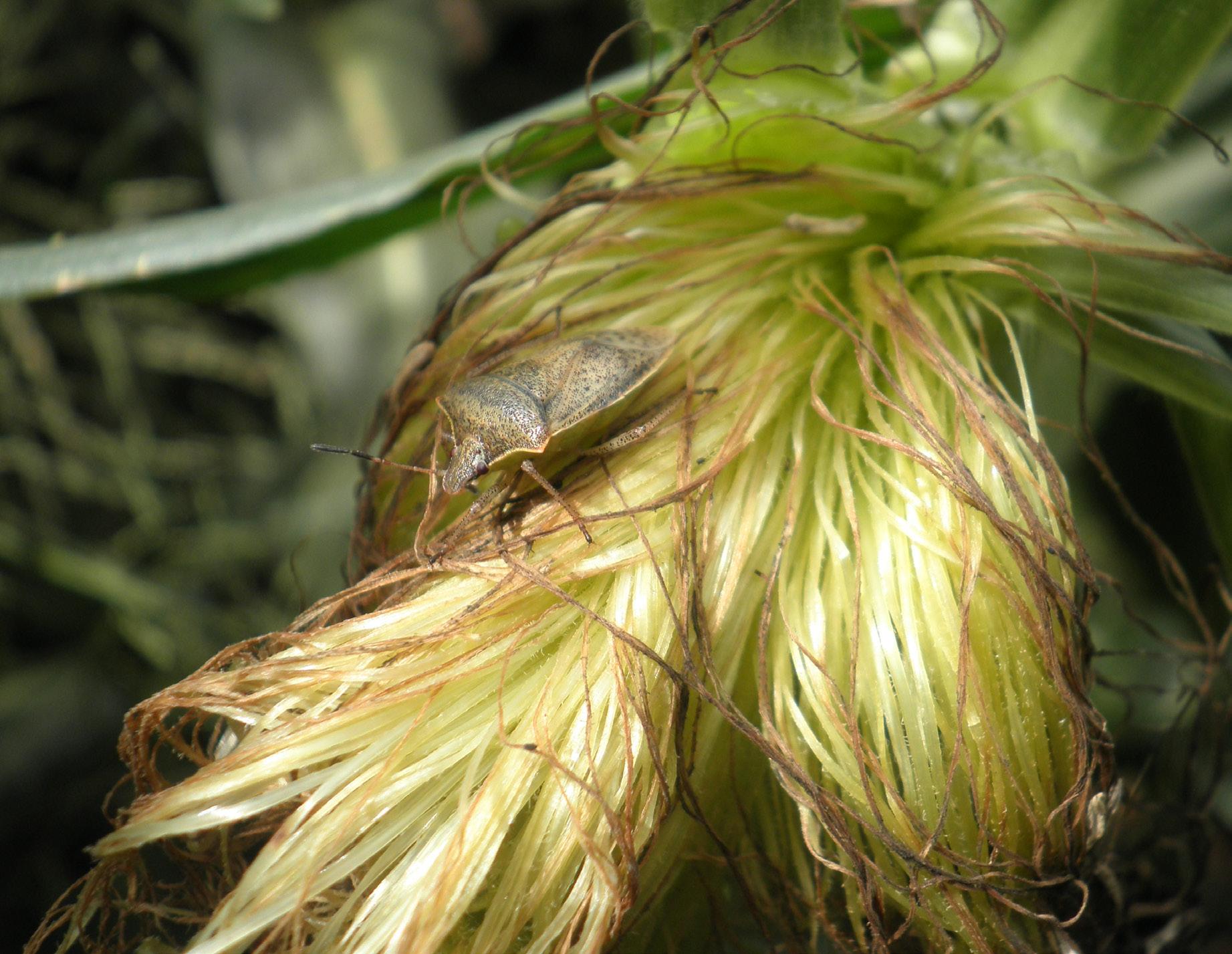
Top Crop Manager’s CAA photo contest winning photo During a field scout, Jennifer Thompson captured a stink bug nestled into the silk of the cob.
4 The corn conundrum by David Manly
Seed Treatment and Inoculant guide 2012
Readers will find numerous references to pesticide and fertility applications, methods, timing and rates in the pages of Top Crop Manager. We encourage growers to check product registration status and consult with provincial recommendations and product labels for complete instructions.

DaviD Manly | associate eDitor
The 2011 corn growing season was like a seasonal grab bag in the sense that you got a little bit of everything, but not necessarily in the right order. We experienced a wet spring, which delayed planting, and an unseasonably dry summer that caused a bit of stress for producers and consumers alike. But, overall corn yields were surprisingly good.
according to the ontario Ministry of agriculture, Food and rural affairs (oMaFra), the corn yield will easily surpass the five-year average of 149.1 bu/acre. In fact, some farmers almost doubled that, with yields surpassing 300 bu/acre in parts of ontario. Yet even with yields and overall production up, the industry still saw its share of challenges.
It is imperative that producers be aware of all the difficulties facing corn production this coming season, which is why this issue of Top Crop Manager east has a focus on corn, from planting through disease management and crop protection.
In “Corn planting dates and yields,” Carolyn King questions the rigidity of planting dates for corn. She interviews an expert from oMaFra about the 2011 season, and says that while earlier is still best, it does not mean yields cannot be good if you plant later than usual.
also in this issue, we have two articles that delve into diseases that can cause major headaches for corn producers: gibberella ear rot and the Western bean cutworm.
Treena Hein tackles “giberella ear rot: the latest on hybrid offerings” on page 6 and discovers that, while chemical and biological control options are limited, hybrid corn varieties can help protect your crop. Crossbreeding different varieties of corn that have shown resilience against the mould can allow farmers to nip the infection in the bud and give them a fighting chance.
Meanwhile, on page 12 Blair andrews paints a picture of what farmers can do to fight a growing threat in “Western Bean Cutworm: What to expect in 2012.” With the pest slowly increasing its range across ontario and Quebec, there are only a few options for growers to stop its spread: Insecticides, natural predators and careful monitoring of crops. all the options have costs and different levels of effectiveness, but the choice of which to use falls to the farmer.
Corn growers have much to celebrate. Corn yields have steadily increased in the past few decades thanks to new breeds, pest control and practices. The average corn yield in ontario 50 years ago was only 64 bu/acre, not even half of today’s 144 bu/acre average, and prices are solid. and yes, farmers managed to pull the proverbial rabbit out of the hat with 2011’s impressive yields.
Still, none of this is reason to rest on our collective laurels.
Innovation and the willingness to experiment have driven the corn sector forward for the past few decades, and they will continue to do so in the next few decades. anyone for an over 400 bu/acre average by 2062?
FEBRUARY 2012, vol. 38, no. 3
GRoUP PUBlISHER Diane Kleer dkleer@annexweb.com
EASTERn SAlES MAnAGER Steve McCabe • 519.400.0332 smccabe@annexweb.com
WESTERn SAlES MAnAGER Kevin Yaworsky • 403.304.9822 kyaworsky@annexweb.com
SAlES ASSISTAnT Mary Burnie • 519.429.5175 888-599-2228 ext. 234 mburnie@annexweb.com
PRoDUCTIon ARTIST Gerry Wiebe
PRESIDEnT Michael Fredericks mfredericks@annexweb.com
PUBLICATION MAIL AGREEMENT #40065710 RETURn UnDElIvERABlE CAnADIAn ADDRESSES To CIRCUlATIon DEPT. P.O. Box 530, Simcoe, ON N3Y 4N5 e-mail:subscribe@topcropmanager.com
Printed in Canada ISSN 1717-452X
CIRCUlATIon e-mail: subscribe@topcropmanager.com Tel.: 866.790.6070 ext. 211 Fax: 877.624.1940 Mail: P.O. Box 530, Simcoe, ON N3Y 4N5
SUBSCRIPTIon RATES
Top Crop Manager West - 8 issuesFebruary, March, Mid-March, April, June, october, November and December - 1 Year - $44.25 Cdn. plus tax
Top Crop Manager East - 7 issuesFebruary, March, April, August, october, november and December - 1 Year - $44.25 Cdn. plus tax
Potatoes in Canada - February 1 Year - $8.57 Cdn. plus tax All of the above - $76.19 Cdn. plus tax
www.topcropmanager.com


While susceptibility breeding improvements continue, an independent evaluation and rating system for hybrid decision-making is needed by growers.
by Treena Hein
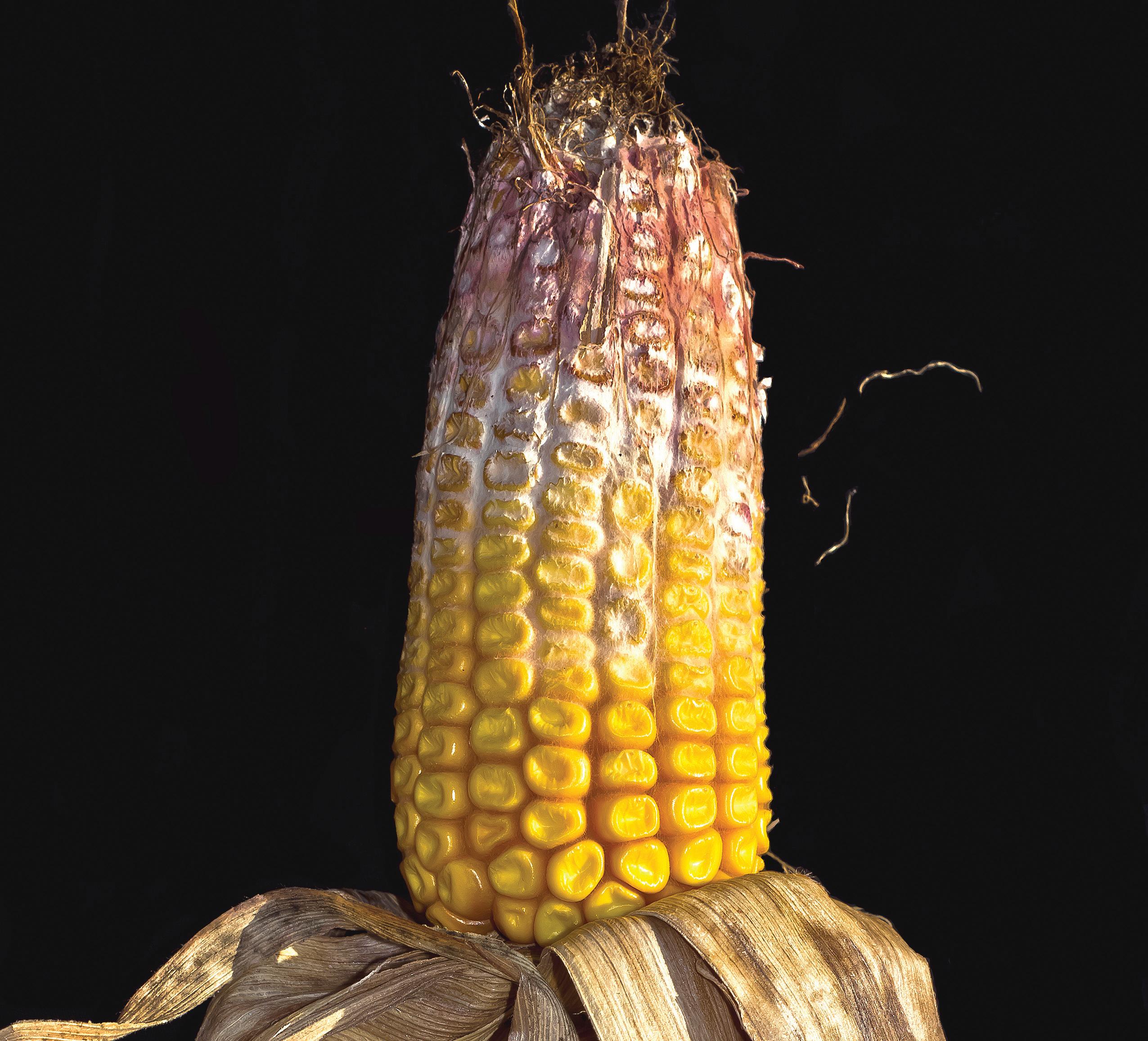
The most common and important ear mould in ontario is Gibberella zeae, which is the sexual reproductive stage of Fusarium graminearium. Infection often begins at the ear tip, and although the fungus can produce a whitecoloured mould that makes it difficult to tell apart from Fusarium Kernel rot, the two can be distinguished easily when gibberella produces its characteristic red or pink colour mould. Toxins produced by gibberella include deoxynivalenol (Don), zearalenone (Zen) and T-2 toxin. “Hybrid differences, previous crops, localized weather patterns, insect or bird damage and planting date effects can all impact the level of mould in a given field – and can explain why fields in close proximity have different mould development,” says albert Tenuta, a field crop plant pathologist with the ontario Ministry of agriculture, Food and rural affairs.
as more farmers are choosing to use earlier planting and later harvests, it’s important to ask whether these practices increase the threat of gibberella infections. pioneer Hi-Bred’s Dr. Steven King doesn’t think so. “I think the biggest risk factor in any season is humid weather around flowering time,” he says. King notes that the environments where later-maturing hybrids can be grown (Middlesex, Lambton, Kent, essex) carry a higher probability of having conditions conducive to infection and proliferation during silking and early grain filling; high-risk environments are nestled between bodies of water (Lake Huron, Lake St. Clair, Lake erie). Dr. Victor Limay-rios agrees that silking time is an important stage for fungal infection. “We have also found that Don levels tend to be higher in varieties planted later in the season,” says the research associate in the department of plant agriculture at the University of guelph, ridgetown Campus.
Limay-rios has also found a relationship between corn damaged by Western bean cutworm (WBC) and Don levels in Bt corn (by feeding on corn ears, WBC allows mould entry). “There are some indications that increasing infestations of WBC may be increasing gibberella infection prevalence,” he says. Limay-rios is working with Dr. art Schaafsma and entomologist Jocelyn Smith to investigate the control of WBC by different Bt corn products on the market as well as grain quality and mycotoxin incidence from ear moulds in the presence of this insect pest. as chemical and biological control of the pathogen is limited, the main focus in fighting gibberella is on breeding hybrids with low susceptibility. “It’s a key trait for our company,” says King. “We’ve decreased susceptibility in our hybrids a great deal. With the big outbreak in 2006, we learned a lot and validated a lot of breeding information.”
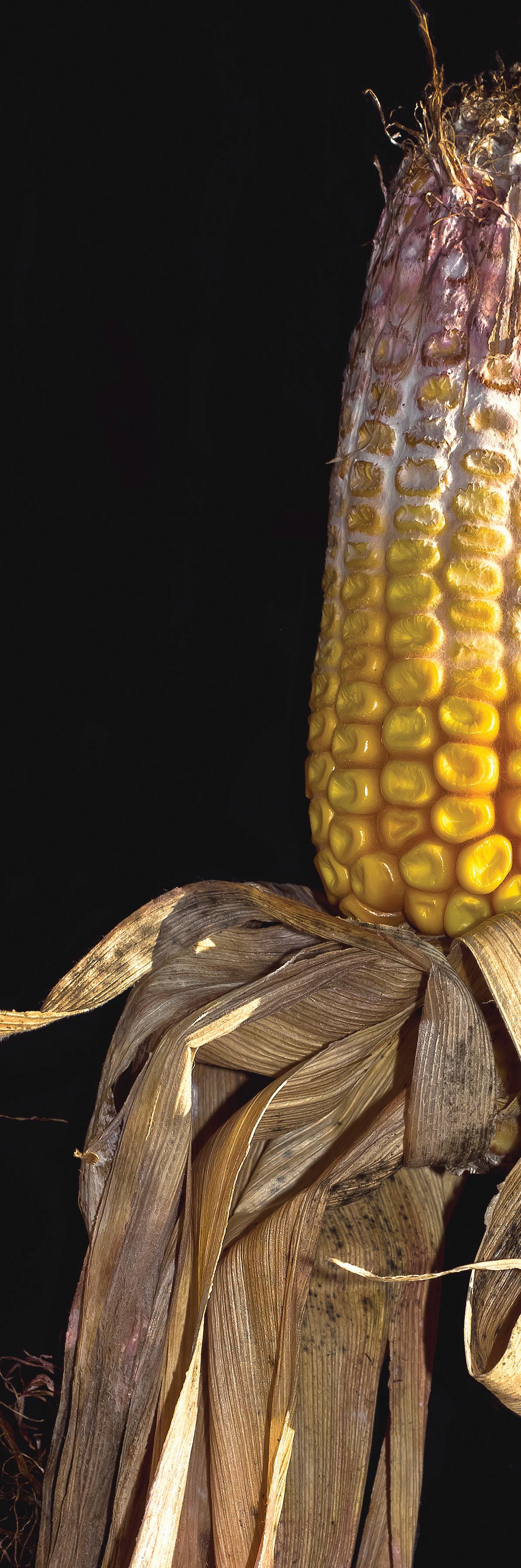
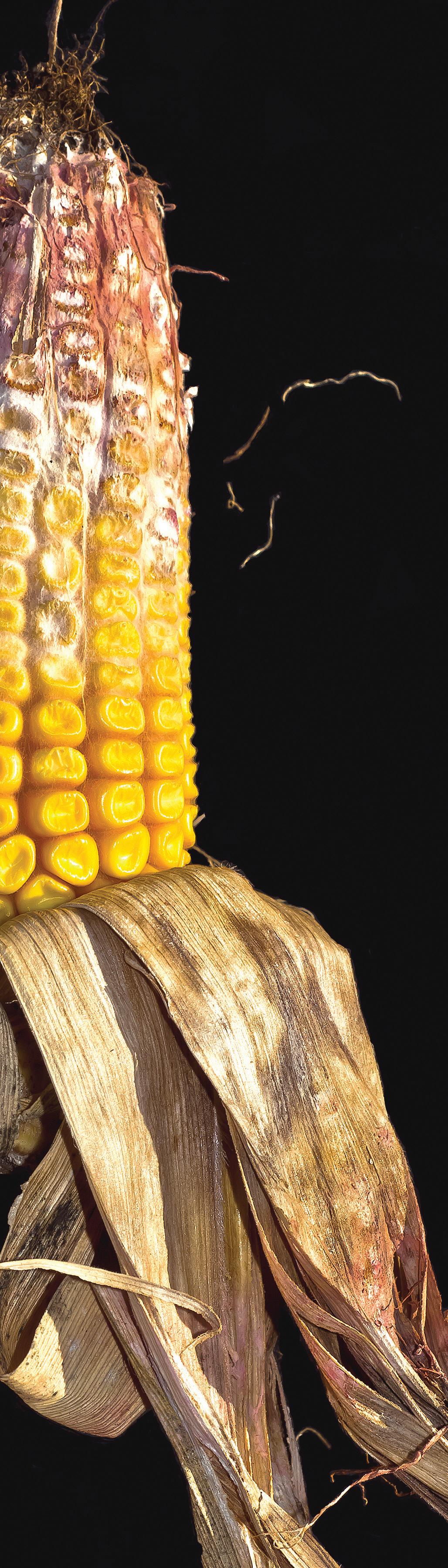
<LEFT: Gibberella zeae, can be difficult to tell apart from Fusarium Kernel Rot, but the two can be distinguished easily when Gibberella produces its characteristic red or pink colour mould.
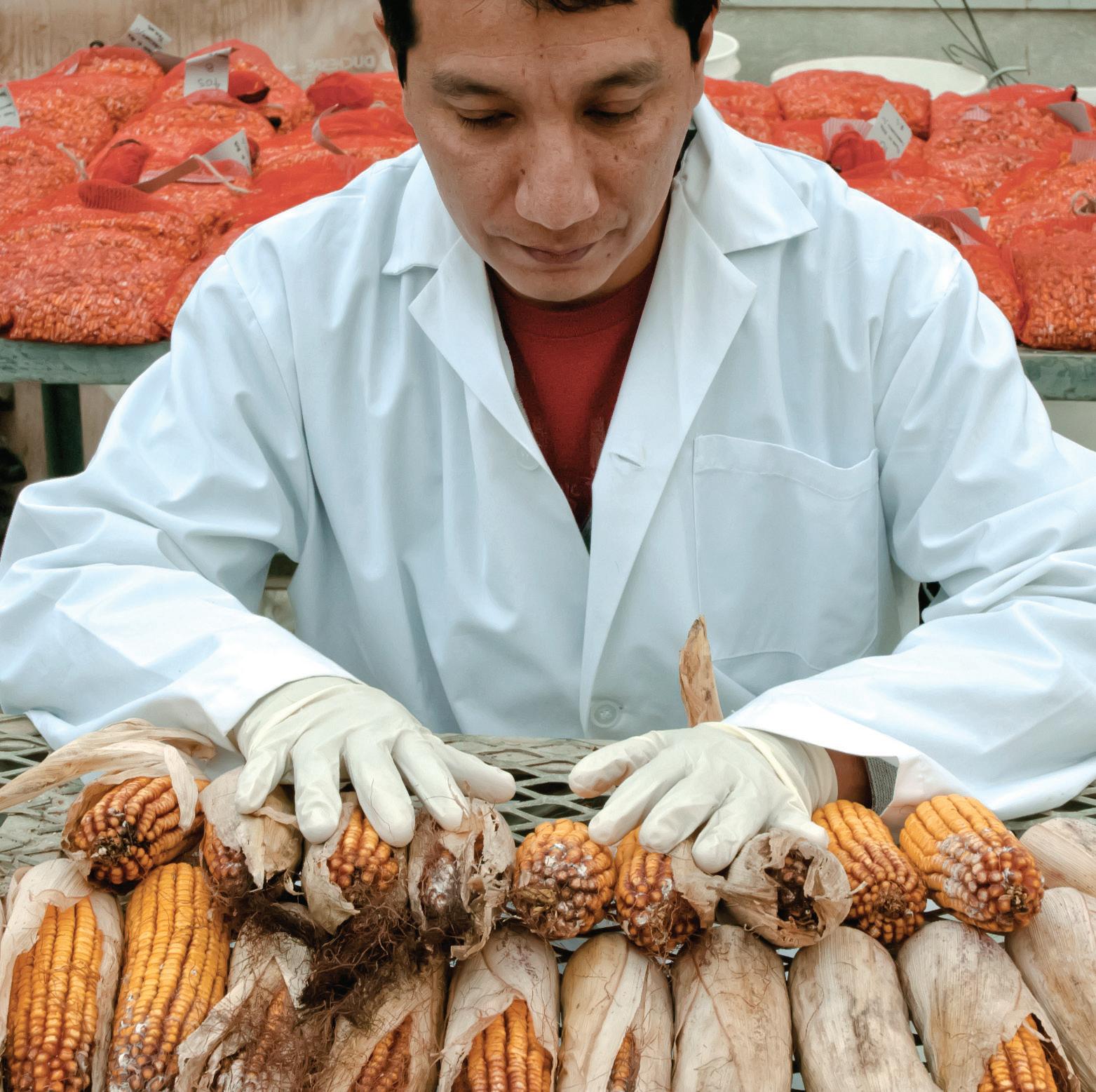
<LEFT: Comparing hybrids from different companies is important to fight resistance says Dr. Victor Limay-Rios, a research associate in the department of plant agriculture at the University of Guelph, Ridgetown Campus.
BOTTOM: Pioneer Hi-Bred’s Dr. Steven King says that susceptibility to mould is a huge problem, and recommends thorough visual and chemicals testing.
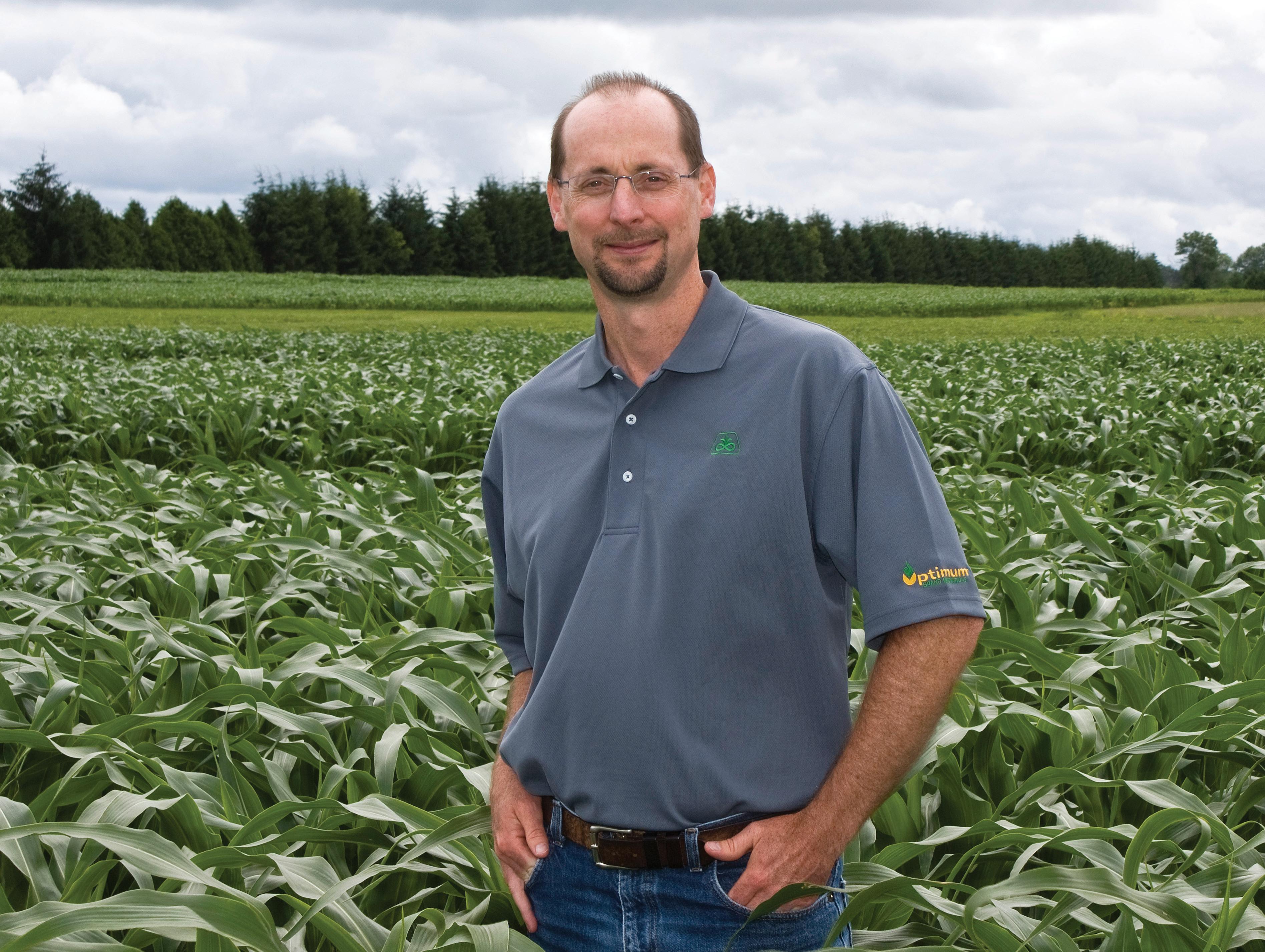
King points out that with this mould, “you can have a little that you can see on the ear, but a lot of mycotoxin could be present in the kernels, so it’s important to go beyond visual tests and include screening for toxin levels.” He says there is a good range of tolerance in pioneer’s lineup, particularly for hybrids suitable for areas greater than 2800 heat units that feature the cool nights and misty mornings preferable to the mould.
Syngenta Canada agronomic sales manager Shawn Brenneman says his company uses a twopronged breeding approach – genetics related to low susceptibility, as well as introduced traits that help control pests such as the WBC. “Insect damage is definitely a significant infection factor,” he says. “our broad-spectrum insect control trait, agrisure Viptera, offers almost 100 percent WBC control, with good control of other ear-feeding insects such as Corn earworm.” The trait is found in about 25 percent of all Syngenta hybrid offerings, and in at least one hybrid in each maturity group. “our extensive field research shows that agrisure Viptera can provide over 80 percent reduction of mycotoxins where insect infestations are prevalent,” Brenneman notes.
Dr. Lana reid at agriculture and agri-Food Canada (aaFC) in ottawa has been doing breeding work on lowering gibberella susceptibility for 20 years. “We’ve been collecting inbreds from around the world in the hopes of getting some that show different sources of resistance, and we’ve found a few,” she says. “There are different genes that provide plants with defence against each mode of infection – either through silk or through kernel wounds – and it’s important to look at both. There are debates about whether one mode of infection is more of a threat than the other, so we want to cover both bases.”
In 2009, reid and her team released Co441, which of all the eight inbreds aaFC has released in the past two decades with improved gibberella resistance, performs best. “Co441 shows resistance to both infection modes and it’s a challenge to produce an inbred with both,” she notes. “Because of this, Co441 is used to create new resistance corn inbreds and hybrids around the world.” reid adds, “We’ll most likely release a ninth inbred this year (2012) and we hope it will demonstrate the resistance of Co441, but with better yield when in hybrid form.” In collaboration with many other researchers around the globe, reid is attempting to understand how Co441 is able to fend off infection. reid is part of a large team of aaFC scientists working on gibberella ear rot in corn and head blight in wheat, barley and oats (also caused by gibberella). In corn,
Helping to put late planting of corn into perspective.
by Carolyn King
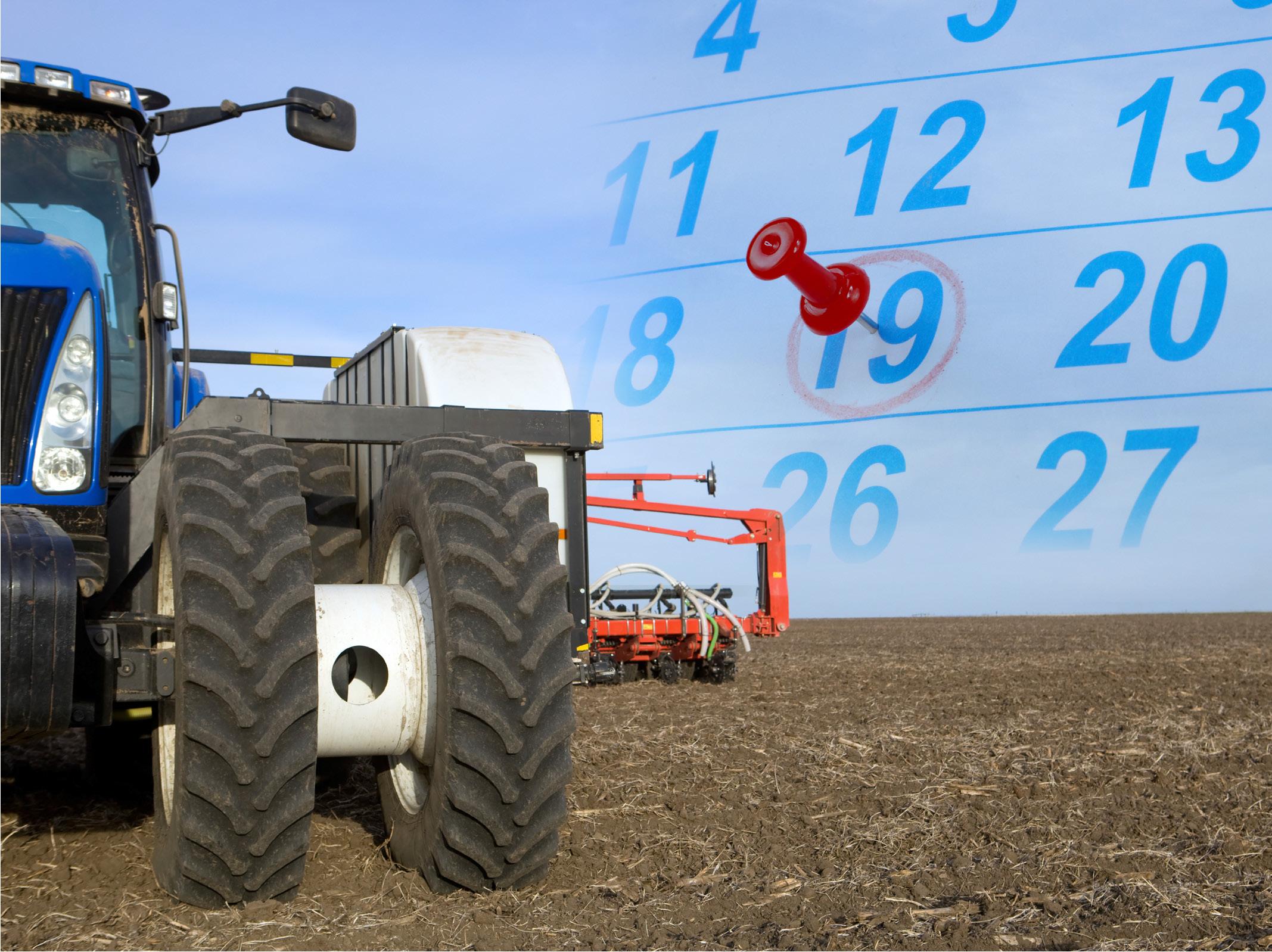
The spring of 2011 was a tough, tough spring to get seeds in the ground,” says Mike Cowbrough, weed management program lead with the o ntario Ministry of a griculture, Food and rural affairs ( o M a F ra ). “a s the days progressed, growers started to get anxious. To get a bit of perspective, we wanted to look at how important planting date has been to final corn yields over the past decade.”
So Cowbrough and g reg Stewart, o M a F ra’s corn industry program lead, put together the table shown below of corn planting dates and average yields in o ntario from 2001 to 2010. This table and the better-than-expected yields in 2011 are good reminders that planting date is just one factor in the success of a corn crop.
“It’s well established that, if the soil conditions are fit, the earlier you plant the better. What I take away from the table is that planting date, although very important, doesn’t trump everything,” says Cowbrough. “If you get good heat and adequate moisture in July and into august, and you don’t get a frost in
September and the good weather lags into o ctober, yields can be pretty good. and I think a lot of people saw that in 2011.”
Stewart agrees
“There is pretty solid, scientifically validated data that planting date does impact yield, but crop performance hinges on the rest of the season. The table shows there’s no sense in panicking too much about late planting. If we use 2011 as the classic example, moving planting dates into June wasn’t nearly as negative as you might have expected because of the growing conditions in the rest of the season.”
However, he notes, “It was an interesting situation in 2011. By the first of June, a number of growers were asking themselves whether to plant corn. Looking at that table, you could say there is certainly a precedent that end yields in our province are not
ABOVE: Planting date, although very important, is just one factor in the success of a corn crop.

PHANTOM™ puts an affordable end to broadleaf weeds.
Control weeds on contact and in soil residual with the takeout power of imazethapyr, the same active ingredient found in Pursuit®. Support fair pricing and protect your soybean, dry bean and other broadleaf crops with Phantom herbicide. Available at leading retailers. Ask for Phantom by name.
absolutely controlled by planting dates. another consideration in spring 2011 was that environment Canada – which has been uncannily correct with its forecast in the last little while – was predicting a warm summer and an open fall. as well, corn prices were as high as they’ve been in a long time. and of course we have hybrids that are much better at handling stresses, including later planting.”
Dr. Mark Lawton, technology development lead for eastern Canada with Monsanto Canada Inc., says that while planting early is always better, what occurred in 2011 could change views on the impact of late planting.
“What is different now, from a DeKaLB perspective, is that when you have to change the maturity, you’re not giving up the yield potential that you would have 5, 10 or 15 years ago,” says Lawton. “In 2011, a lot of our customers changed their hybrid because they had to plant in June instead of april. often they were moving to hybrids that are three to six days earlier. We had a lot of feedback through harvest where growers were shocked at how well their corn crops were yielding despite the late planting.”
The table also shows the overall upward trend in corn yields over the past decade. a big part of the reason for the upward trend is improved genetics for both earlier maturity and full-season hybrids. The improvements are significant enough that they tend to muffle the relationship between planting dates and yield.
along with much better genetics, other factors contributing to the overall upward yield trend include environmental effects and better agronomics.
This table shows the differences between corn planting dates and overall yields in Ontario from 2001 to 2010.
Therefore, Stewart decided to tell growers at the beginning of June, that if they wanted to plant early, now was the time. If not, he added, “then it ain’t ever going to happen because the stars probably aren’t going to align for you as well as they did this year.” as it turned out, he was right and the conditions were perfect for late-planted corn in 2011.
“July and august had pretty darn good growing conditions, even though we got a little scared about the lack of rainfall in July. Then it was essentially frost free in many parts of the province right through to the end of october. We also ended up with good prices. and we have hybrids that seem to be able to perform under a whole range of conditions,” says Stewart.
Dr. Linda Harris is mapping gibberella ear rot resistance genes, and Dr. Jas Singh is working on inserting new genes for resistance into corn inbreds. Several other scientists are researching the fungus itself and the toxins it produces.
reid and her colleagues have developed a standardized field screening technique as well, that can be used in research and breeding. “It involves standardized timing and amount of inoculation that should be used in the field, and has been used in routine screening of large sets of inbreds and commercial hybrids,” she says. reid and Dr. art Schaafsma used to do large hybrid screenings in the mid1990s, but most of the hybrids were found to be highly susceptible.
“When you look over even the last half-decade, we have had some particularly warm growing seasons that have given us an advantage,” explains Stewart. “In terms of agronomics, one change is that our producers are doing an increasingly better job at planting. Many producers are taking advantage of planter improvements, tillage improvements, and so on, to do a more uniform job of planting, compared to 10 or 20 years ago. Beyond that, it’s hard to pick other agronomic factors. our oCC [ontario Corn Committee] trials have been pretty much the same in terms of the agronomics behind them, other than perhaps seed treatments.”
Cowbrough hasn’t seen any major changes in weed management practices. “generally speaking, in the last 20 years, ontario producers have understood the importance of early season weed control, and I think for the most part they execute that better than most in north america.”
Looking back at 2011, Lawton summarizes the reasons for good yields despite late planting: “We have Mother nature to thank for that, and also the genetics and the seed treatments, the equipment that gives good seed-soil contact, precision planting and all the tools that farmers use on a daily basis to get the most from their land in any year.”
CONTINUED FROM PAGE 7
Limay-rios notes that such a procedure is imperative for meaningful hybrid evaluation. “Without doing a large standardized trial, comparing different hybrids from different companies is almost impossible,” he says. “We need funding and the willingness of companies to participate for this to move forward. Information on hybrid resistance also helps us with Don-cast, our pre-harvest forecasting model for this disease.” reid wholeheartedly agrees. “It is imperative that a screening of today’s commercial hybrids be conducted,” she says. only pioneer and Maizex have offered hybrids for Limayrios’ small-scale misting trials. For its part, Brenneman says Syngenta Canada “would definitely participate” in a large-scale trial.

As western bean cutworm expands its range in Ontario and Quebec, what can farmers do?
by Blair andrews
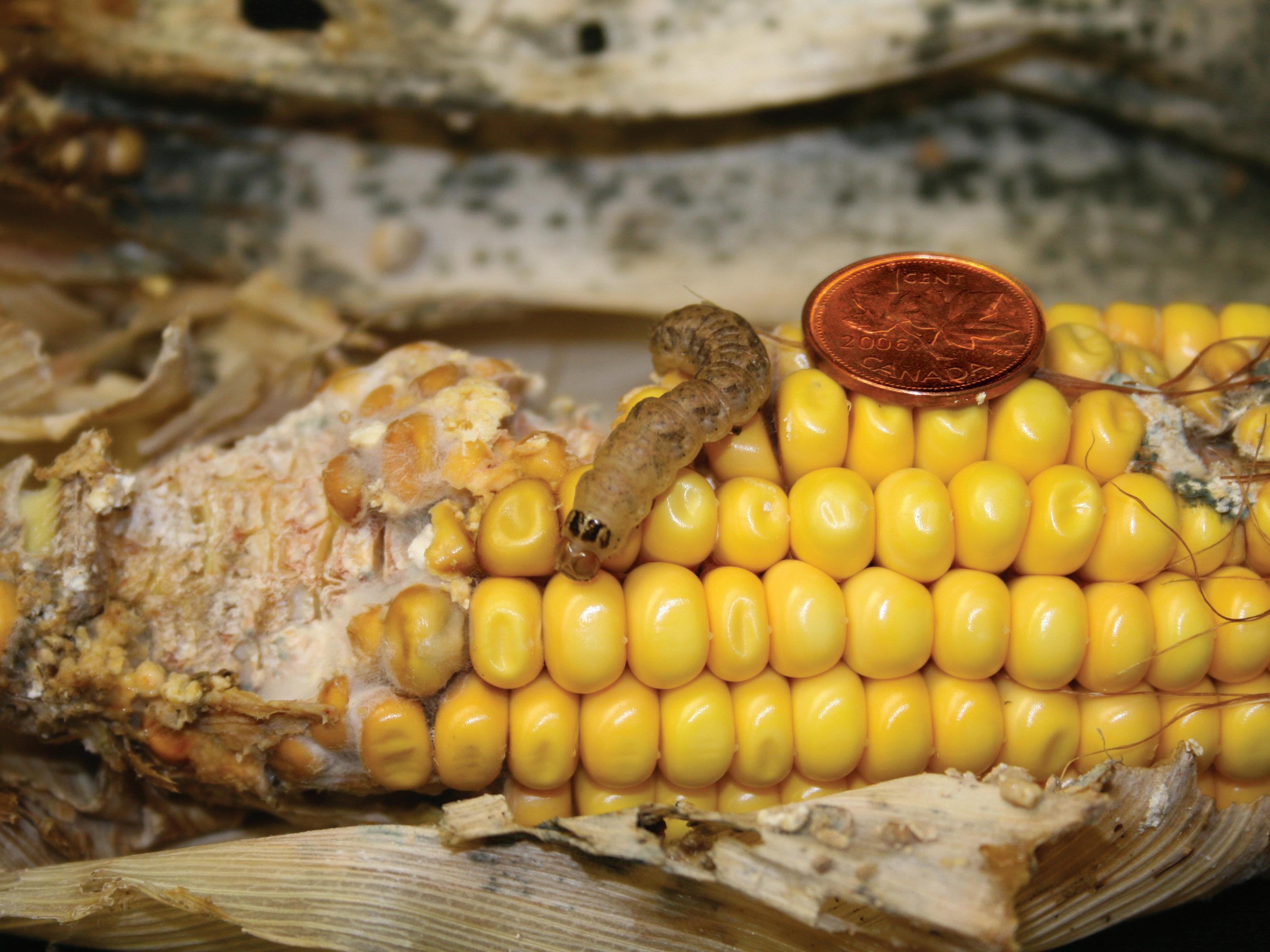
The western bean cutworm (WBC) is expanding its range across ontario and Quebec, as well as becoming a pest in some areas for corn producers. Since the first western bean cutworm moths were captured in a cornfield in Lambton County and a bean field near Blyth in 2008, the insect has pushed further east and north.
Cara McCreary, acting field crops entomologist for the ontario Ministry of agriculture, Food and rural affairs (oMaFra), says the WBC has now been reported as far north as Temiskaming, ontario, and as far east as Kamouraska, Quebec. In addition to appearing in new areas, the number of average moth captures in ontario has nearly tripled from those in 2010.
In some cases, the numbers were high enough to call for control measures. “There were some isolated areas in Chatham-Kent, Lambton, elgin, Middlesex and norfolk where threshold was reached and we needed control,” says McCreary. The threshold for WBC is considered to be the point at which five percent of the scouted corn plants have egg masses on them. according to the recommendations, 20 plants should be scouted in five different
areas of the field. “If five of the 100 hundred plants have eggs, that’s considered threshold,” says McCreary.
Tim Wellbanks, lead agronomist for Maizex Seeds, based in Tilbury, ontario, says WBC is moving relatively slowly and is becoming an issue in hot spots that have emerged, particularly in areas from Bothwell to Strathroy and near Tillsonburg. “We learned that where you’ve got it, it can feed significantly and cause quite a bit of damage, leaving the kernels more susceptible to various ear moulds,” says Wellbanks.
noting that crop specialists are striving to learn about the behaviour of the WBC, Wellbanks says he suspects the insects seem to favour the sandier soils, an attribute which may help explain the locations of the hot spots. echoing that, McCreary says that higher populations of the pest are overwintering effectively in the sandier soils. “They overwinter in the ground as pre-pupae and they seem to do that more successfully in sandier regions,” she says. “It may
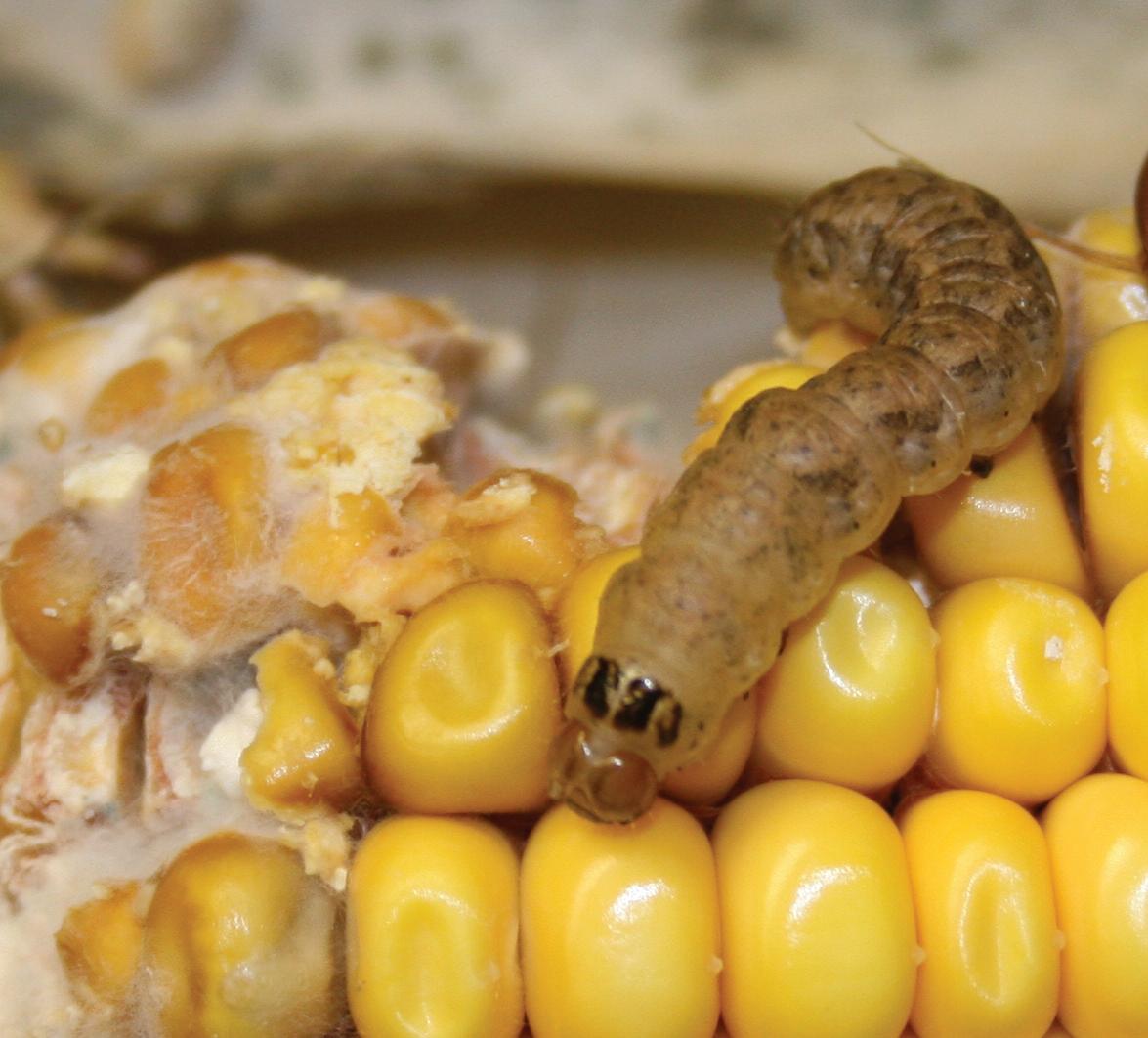
ABOVE: Western bean cutworm caterpillars can ravage a maturing ear, leaving it open to a variety of ear moulds.
Yield begins beneath the soil surface, which means seed and soil-borne disease can strike before your crop even emerges from the ground. Help your crop achieve the highest yield possible by using Rancona® Apex, the broadest-spectrum seed-applied fungicide available. Offering a higher level of disease control on wheat, durum, barley, oats, rye and triticale. Rancona Apex provides faster emergence, increased stands and healthier, more vigorous plants—all of which adds up to higher yields1 and greater profits.
Rancona Apex. Isn’t it time your yield lived up to its greatest potential?
have something to do with soil structure, possibly making it easier for them to emerge from a sandier soil.”
McCreary estimates the average yield losses at about seven bushels per acre – or a 3.4 percent yield loss – in areas where eggs and larvae were present and feeding damage was observed.
Scott Fife, pioneer Hi-Bred agronomist for eastern ontario, has participated in the WBC trapping network for 2010 and 2011. He says several moths were captured in 2010 and minimal feeding damage was observed in a farmer’s test plot near perth, ontario. He also notes that oMaFra reported feeding damage in the Chesterville area in 2010.
as for 2011, Fife is not aware of reports about feeding damage, but moth captures were higher, doubling the amount from 2010 in some areas. “In some cases in prince edward County, there were around 100 captures in a week,” says Fife. “Definitely the moth catches have gone way up. But I think the levels are still low enough that it’s pretty hard to find (WBC) feeding.”
The WBC’s expansion into ontario and Quebec follows a trend that has developed for the past 10 years.
Known more as a pest for several decades in western Corn Belt states such as Colorado and nebraska, the WBC started chewing its way through Iowa, Illinois and Michigan before landing in southwestern ontario.
not only does McCreary expect to see migration continue in 2012, but she also says that the potential exists for the moth numbers to climb in the susceptible locations.
“I think, especially in areas where there’s sandy soil or silty loam soil, if they’ve experienced heavy infestations this past year, then there are likely to be overwintering populations.”
Fife concurs, adding that it will be just a matter of time before the WBC gains a stronger foothold in the eastern part of the province. “We basically had the same number of traps in 2011 as 2010 in my area, and we saw big increases in the numbers. So there is reason to expect that will continue next year,” says Fife. “again, it is far down the list of priorities at the moment for growers in my area, but that will certainly change in the next couple of years and they’ll have to start thinking about it.”
When it comes to combating the pest, growers have some options.
Jocelyn Smith, a research associate at the University of guelph, ridgetown Campus, is part of a team that is studying genetic traits and insecticides under ontario conditions. Herculex I, utilizing the Cry1F gene, on its own or as part of the SmartStax configuration, has shown good control of WBC. “We agree with data from the U.S. that shows that with SmartStax and the Herculex, I basically have the same control at about 70 to 90 percent,” says Smith.
The group also tested the agrisure Viptera trait, which approached 100 percent control. at the other end of the scale, the original Mon 810 Yieldgard gene (for corn borer only) offered no
control of WBC. although the test results are still being analyzed, Smith says insecticides such as Matador and Coragen showed good control.
While conducting the research, Smith says they also found that an increase in ear mould was more harmful to the plants that had heavy WBC feeding. Therefore, she says, they are currently analyzing all of their trial samples for mycotoxin.
on a more positive note, the researchers are encouraged by the impact of natural populations of predators and parasites on WBC in ontario. “There were some natural enemies that were found either feeding on or parasitizing the western bean cutworm eggs,” says Cara McCreary. “We saw some of that in Bothwell, where some of the heaviest infestations were.”
as the western bean cutworm continues to make its way into more and more areas, scouting for the pest will be crucial. “Keep an open mind to the possibility of infestation because there can always be hot spots in small areas that you wouldn’t necessarily expect,” says Fife, noting that prince edward County is a relatively small corngrowing area that trapped a relatively large number of moths. “even though numbers in eastern ontario are still low, you might be in a hot spot.”
The WBC lays its eggs on the upper side of the leaf of corn plants, usually close to the top of the plant. “You have to walk through the field and look up,” explains McCreary. “They’re difficult to see. When the sun is out, you can see the shadows of the egg masses through the leaf. That’s helpful because they are hard to find.”
She suggests people choose five areas of the field and scout 20 plants in each section, looking for egg masses in the top part of the corn plant. For dry beans, McCreary says people should check for feeding damage. The larvae will start feeding on the leaves and move on to the pods when they get larger.
“In a dry bean field there is no established threshold, so it’s basically…if you find WBC feeding damage, spray.”
If the threshold is met in corn, McCreary says the next thing people should pay attention to should be the eggs’ colour. The freshly laid eggs will be a pearly white. McCreary says the eggs will turn to a deep purple when they’re about one or two days away from hatching.
“When they turn purple, wait one or two more days and then you spray because as soon as they hatch the really small larvae are the ones most susceptible . . . and that’s where you’ll get the most control,” she says.
as the researchers prepare for another year of scouting and tracking the progress of the WBC, they encourage people to learn more about the pest and to keep tabs on the moth catches during the season.
McCreary says that concerned farmers can receive information by sending an e-mail to wbctrapnetwork@gmail.com or by visiting the Canadian Corn pest Coalition website at www.cornpest.ca.


How
to choose proper moisture information-gathering technology and make sure it’s working.
by Treena Hein
Knowing how to manage moisture in your grain bins is very important, especially now that more and more growers are building on-farm grain storage systems. “Having the capacity to store grain gives producers marketing options and flexibility,” notes eric richter, an agronomic sales representative with Syngenta Canada. “However, there is a lot of risk involved. There is the potential to lose hundreds of thousands of dollars if the grain is not cared for correctly.”
The key is to purchase the right technology and ensure it’s working properly over time. “The first step is finding out the moisture content of your newly stored grain using a good-quality moisture tester,” says Helmut Spieser, a field crop conditioning and environment engineer with the ontario Ministry of agriculture, Food and rural affairs. “It’s worth it to purchase a good new one.” However, he stresses that proper care of the unit is also very important.
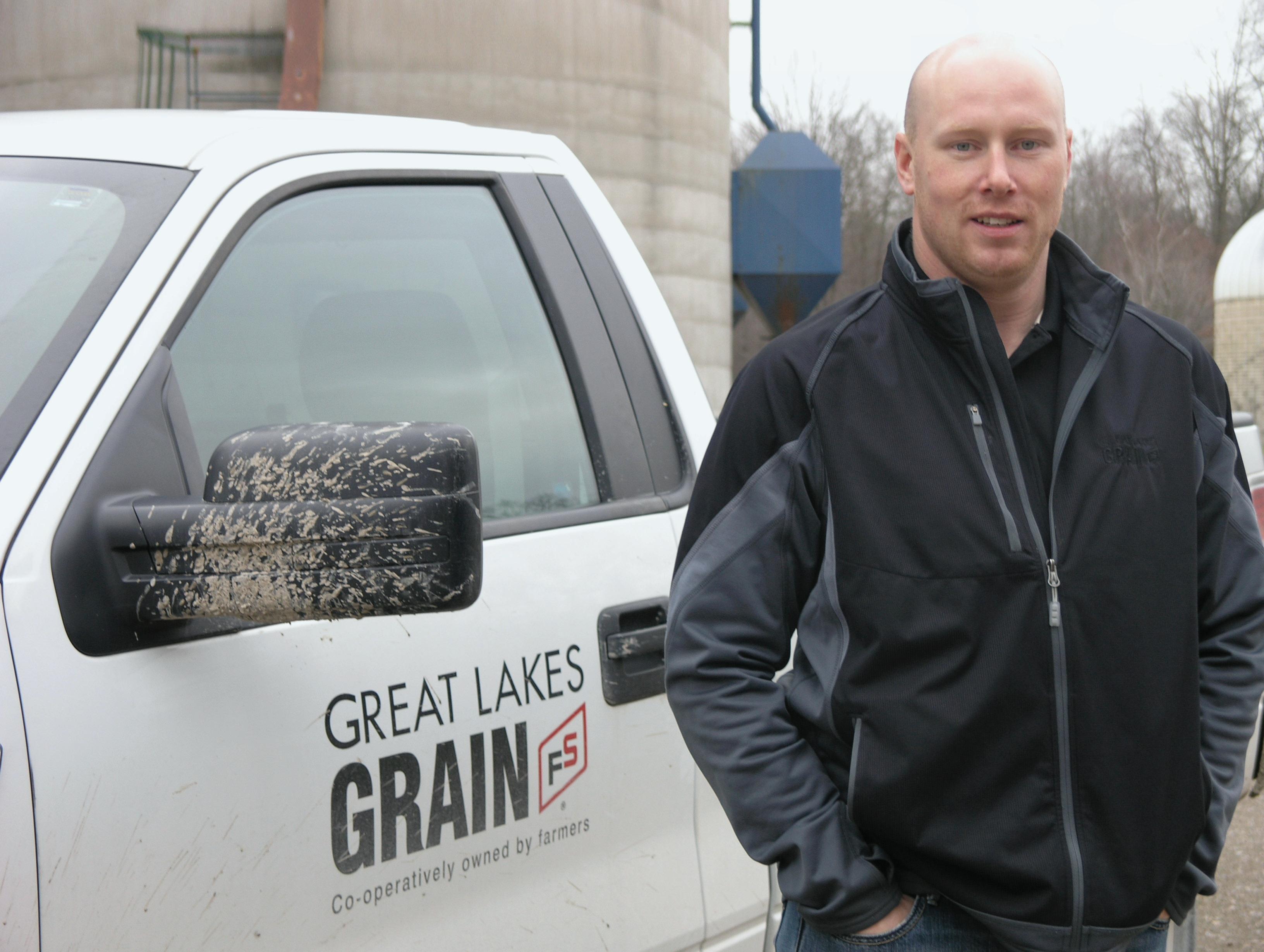
Devin Homick, a grain originator with great Lakes grain in Delhi, ontario, agrees. “Hand-held moisture meters on a farm tend to get thrown around, which can cause dysfunction,” he says. “Farmers don’t
get them checked often enough, and they assume they’re getting correct readings, but that’s often not the case.” He also notes that many growers have stationary moisture meters, but that these are also very delicate, and can easily become inaccurate with being bumped.
The answer is to check your moisture tester regularly for accuracy.
“an easy way to do this is to moisture test a sample with your unit, and then have the elevator test it to see if the readings are the same,” says Spieser. “If it’s not working, contact the company and a technician will calibrate it for you. However, keep in mind that it isn’t possible to calibrate some older units.” Homick also encourages farmers to check their moisture meter readings with those taken at their local elevator. “We have two at every facility and they’re calibrated professionally on an ongoing basis,” he says. “We change the setting for soybeans, corn, etc. and the newer portable ones for farms have settings as well.” He notes that while the readings of two meters will never be exactly the
ABOVE: Devin Homick, a grain originator with Great Lakes Grain in Delhi, Ontario, says that moisture is a huge problem with farmers, but that it can be prevented by checking and maintaining the moisture meters properly.
same, anything within 0.1 is acceptable. “If the difference is in that range or beyond that range, you definitely need to calibrate your tester,” he says. “The newer testers also have a scale incorporated, so that you don’t have to weigh the sample beforehand. The tester lets you know when you’ve added enough grain or beans.”
There were high incidences of ear moulds this year in southern ontario, and richter hopes growers over-dried their corn slightly to stop mould growth. “If you don’t over-dry it a bit, and you try to store slightly damp corn with just fans to dry it, you can easily see accelerated mould growth,” he says. “The storage temperature matters, and a warm temperature can also contribute to mould growth in storage, so make sure you have a temperature sensor inside your bins.”
richter notes that there are three major factors in corn drying costs. “It’s a variable expense on an annual basis, anywhere from $40 to $100 an acre, depending on fuel costs (natural gas or propane), growing season conditions and hybrid portfolio,” he explains. “’Hybrid portfolio’ means the practice of choosing hybrids so you can spread out your maturity dates to maximize yields and minimize drying costs.” Full season hybrids will have higher yields, but will be more expensive to dry. richter says having different maturity dates also means that you won’t have large volumes of wet corn that need drying at the same time. richter also advises adjusting the combine before switching to harvesting a different hybrid. “This will produce clean grain for storage, with a low percentage of fines, stalks and cobs, and also save you drying costs,” he says. “I also recommend a pre-clean before storage to remove fines. When you have a lot of debris, it’s harder to dry the corn, and it’s also more difficult to run air through your grain during storage.”
once the grain is stored, farmers have the option of opening bins over the winter season to try to decrease the moisture content of their grain or soybeans. Homick says it’s not easy in southern ontario to get lowhumidity days. “The amount of moisture coming off the great Lakes makes it a challenge to find a day where you won’t be putting high-humidity air in your bin,” he says. “That’s why investing in a high-quality relative humidity tester is important.”
Spieser agrees. “Do numerous moisture tests in different parts of the bin at various depths to get an accurate picture of your
grain, but also test the relative humidity of the outside air,” he says. “Invest in a good-quality tester. You can buy hand-held units that measure wind speed, temperature and relative humidity with a digital readout. By knowing the air temperature and relative humidity you can determine the equilibrium moisture content (eMC) of the grain. If you move air with these properties through the grain for a long enough period, the grain will approach its eMC.” He notes that cereal grains and soybeans give up and absorb moisture very easily,
but high-temperature dried corn does not. after you’ve decided to open your bin, you must also keep an eye out for frost formation. “as the moisture leaves the grain, you can get rime frost depositing on the cold wire of the bird screen,” notes Spieser. “This frost can build up and completely block the exhaust vents. The fan is still running and enough pressure can build up that you can damage the bin roof. So keep an eye on your vent screens, and shut the fan off if it’s getting covered in frost.

by Melanie epp
Here are the newest corn hybrids that are being introduced for commercial quantities in 2012. Compiled based on voluntary participation, the list includes seed companies from across ontario and Quebec. Most of the entries have also provided crop heat units (CHU) and a basic description of the varieties and their traits. This article lists some of the 2012 hybrids. View a complete list at www.2012cornhybrids. com. To learn more about how specific seeds performed in your area, and in field trials, please contact your local seed supplier.
3299VT3P is rated at 92-day relative maturity (2800 CHU), and is well adapted for minimum tillage with good early vigor in cool soils. Capable of handling seasonal weather stresses, it provides late season plant intactness with quality grain and drydown. This hybrid performs best at medium to high populations. refuge required.
3424VT3P is rated at 94-day relative maturity (2875 CHU), and flowers early for its maturity. When combined with strong emergence, it provides quality grain at harvest. Look for good plant stability under seasonal growing stresses. 3424 shows positive response to increased population and n rates in Croplan raTe Trials.
3699RR /3699VT3P is rated at 95-day relative maturity (2875 CHU), and exhibits strong early spring performance that develops into a plant capable of managing moisture stress during the growing season. Strong root development allows 3699 to work well in cornon-corn rotation.
4136VT3P is rated at 100-day relative maturity (2975 CHU) and demonstrates positive response to increased n rates and increased population rates in Croplan raTe plot trials. Strong, late season intactness allows the plant to provide ease of harvest with a good quality grain.

2125 - DKC26-25 refuge option roundup ready® Corn 2. excellent top-end yield potential. excellent staygreen and plant health.
2150 - DKC26-28RIB rIB genuity® VT Double pro™ rIB Complete™. excellent top-end yield potential. excellent staygreen and plant health.
2175 - DKC27-54 refuge option roundup ready® Corn 2. excellent test weight with very good drydown. excellent yield potential. Very good plant health and harvest appearance.
2200 - DKC27-55RIB rIB genuity® VT Double pro™ rIB Complete™. excellent test weight with very good drydown. excellent yield potential. Very good plant health and harvest appearance.
2200 - DKC28-76 refuge option roundup ready® Corn 2. Very good top-end yield potential. excellent dry down and intactness. Dual purpose grain and silage product.
2575 - DKC33-97RIB rIB genuity® SmartStax® rIB Complete™. “excellent stalk and root strength. good emergence and drought tolerance.
2550 - DKC34-46 refuge option roundup ready® Corn 2. early flowering for maturity. excellent early season vigour. Very good staygreen and excellent stalk strength. excellent top-end yield potential.
2600 - DKC36-65RIB rIB genuity® VT Double pro™ rIB Complete™. excellent top-end yield potential. Dual pupose grain and silage product. excellent staygreen and harvest appearance.
Hyland Seeds
HL R219 is a roundup ready® grain corn. It is a very early hybrid with excellent grain quality and test weight. With its medium to tall plant stature and good general health, this variety is a very good

Since 1973, Alpine has been manufacturing the highest quality starter fertilizers available in North America. Our quality and experience have made ALPINE the #1 choice for liquid starter fertilizer in Ontario. To learn more about the most researched and proven liquid starter program available, contact your local ALPINE dealer today.
dual purpose grain and silage hybrid. It has a Canadian Heat Unit of 2375 and a relative Maturity of 82.
HL 3085 is a herbicide resistant, late season grain corn with excellent eye appeal. This variety has a Canadian Heat Unit of 2400 and a relative Maturity of 79. It has nice standability and stalk quality, excellent ear consistency, as well as a good grain test weight and finish.
8098 is a late season SmartStax® grain corn with the broadest spectrum of weed control. This variety has a Canadian Heat Unit of 2450 and a relative Maturity of 80. 8098 only requires five percent refuge with multiple modes of action for above- and belowground insect protection. It has excellent ear consistency and nice grain quality.
8105 is a consistant SmartStax grain corn with strong roots and stalks. This variety has a Canadian Heat Unit of 2450 and a relative Maturity of 81. It carries the broadest spectrum of weed control with multiple modes of action for above- and below- ground insect protection and requires only five percent refuge. Consistent ear development with very good grain quality, 8105 has good ear length and dry down which supports northern adaptation. It also boasts very good fall health and late season plant integrity.
HL 4122 is roundup ready grain corn tolerant to Liberty® herbicides with HerCULeX® protection against corn borer and corn rootworm. This variety has excellent grain quality and tip fill, medium plant height, very good plant structure and proven leading genetics for maturity. It has a Canadian Heat Unit of 2500 and relative Maturity of 80.
8166 is a SmartStax® grain corn with good stress tolerance and
root strength. It has a Canadian Heat Unit of 2550 and a relative Maturity of 84. With only five percent refuge required, this hybrid has the broadest spectrum of weed control and multiple moods of action for above- and belowground insect protection. It boasts good ear flex, which supports variable plant densities and yield performance, long with excellent grain dry down. optimal performance can be achieved at a moderate to high plant population.
HL 3295 is a very adaptable roundup ready® grain corn with excellent yield potential, consistent ear size and good standability. This variety is a nice refuge option for maturity. It has a Canadian Heat Unit of 2750 and a relative Maturity of 88.
MZ 1244R is an ultra early dent hybrid (2250CHU) roundup ready Corn 2. It has aggressive spring vigour and unmatched early flowering. The hybrid has excellent yield potential and stalk strength.
MZ 266X is a conventional hybrid at 2650CHU. It has strong stalks and roots combined with a short plant stature. This hybrid’s superior yield potential and grain drydown allow it to be positioned north of its maturity zone.
MZ 2988DBR - rIB is a genuity VT2 pro hybrid at 2650CHU available as refuge In Bag. This hybrid has unmatched seedling vigour, outstanding yield potential and excellent stalk strength for ease of harvest. a reduced plant stature aids residue management. Husks flare open enhancing grain drydown.
MZ 3066DBR - rIB is a genuity VT2 pro hybrid at 2750CHU available as refuge In Bag. attractive plant with agressive seedling
vigour, stalk strength and exceptional yield potential. open husks combined with early flowering contribute to rapid grain drydown.
MZ 3344R is a roundup ready hybrid at 2800CHU. This hybrid is broadly adapted with top end yield potential across environments. It has unmatched standability and reduced plant stature to aid crop residue management.
MZ 3124BR is an agrisure gTCBLL at 2800CHU. early flowering combined with leading yield potential. optimum performance in and north of its maturity zone. Very good stalks hold large girthy ears which drydown quickly.
MZ 3490SMX - rIB is a genuity Smartstax hybrid at 2825CHU available as refuge In Bag. This hybrid has very good seedling vigour combined with excellent stalks and rapid grain drydown.
MZ 3490SMX is broadly adapted across environments.
2304RR is a new grain corn hybrid with roundup ready Corn 2 technology and rated at 2325CHU. It has a good disease package and is resistant to northern Corn Leaf Blight. It has excellent emergence, seedling vigour and root strength. It has very good grain quality, extremely fast drydown and high yield potential for its maturity. It is a tall plant height.
2411GT/CB/LL is a new grain corn hybrid with agrisure gT/CB/ LL technology and rated at 2425CHU. It is an early maturing hybrid that exhibits fast drydown and adapts well from east to west. It has excellent stalk strength and grain quality. It is a medium to tall plant height.
2750RR is the roundup ready Corn 2 technology version of
pICKSeeD 2751gSX rIB and rated at 2675CHU. This hybrid is very stable across all geographies and has top end yield potential. It has very good stalk strength and excellent root strength. It has excellent seedling vigour, excellent grain quality and very good stay green. It is a medium to tall plant height.
2751gSX rIB is the genuity SmartStax rIB Complete technology version of 2750rr and rated at 2700CHU. This hybrid is very stable across all geographies and has top end yield potential. It has very good stalk strength and excellent root strength. It has excellent seedling vigour, excellent grain quality and very good stay green. It is a medium to tall plant height.
2825GSX rIB is a new grain corn hybrid with genuity SmartStax rIB Complete technology and rated at 2800CHU. This hybrid has very good plant health, stalk strength and bushel weight. It is early flowering for its maturity with high yields. It is a medium plant height.
2968GSX rIB is a new grain corn hybrid with genuity SmartStax rIB Complete technology and rated at 2900CHU. This hybrid has excellent stalk strength, root strength and late season appearance. It performs very well in high yielding environments. It has excellent grain quality and is medium to tall plant height.
Pioneer Hi-Bred
P8622HR (HX1, LL, rr2) is a hybrid rated at 2600 heat units. It contains the Herculex 1, LibertyLink and roundup ready Corn 2 traits. This hybrid has solid agronomics with above average root
CONTINUED ON PAGE 28
New Vios™ G3 herbicide is a one-pass, full season solution for Roundup Ready® and LibertyLink® corn hybrids. Vios G3 must be tank mixed with glyphosate or Liberty®. Why? To put three different modes of action to work for you, including two powerful new actives (thiencarbazone-methyl, Group 2 and tembotrione, Group 27).
Just one 1.78L jug treats 40 acres, providing effective resistance management and comprehensive broad-spectrum weed control.
Convenient. Concentrated. Complete.

It was close, but the votes are in and Canada’s new Truck King has been crowned.
by Howard J. elmer
The reason pickup trucks are so popular in Canada can be traced directly to the nature of business we do in this wide, vast country. primary industries such as forestry, mining, farming and construction, along with the businesses affiliated with these sectors, are widespread and demand the use of trucks – but we all know it goes deeper than that. For so many people over the decades, the pickup has been both a work vehicle and a means of personal transportation and Canadians have grown to love it for the flexibility it offers.
This duality of purpose is the key reason the Canadian Truck King Challenge evaluates trucks under loaded, harsh conditions –because that’s the way you use them.
The 2012 ram 1500 was selected as the winner of the fifth annual Canadian Truck King Challenge, and let me tell you why.
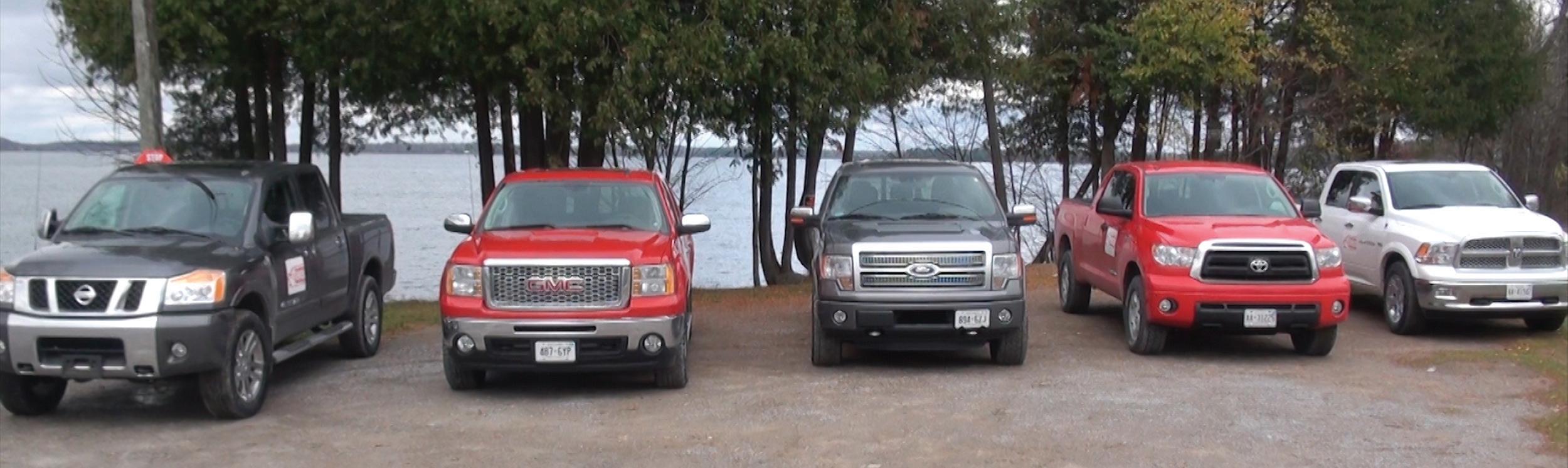
What we concentrated on first for 2012 was evaluating those half-ton pickups that fill the bulk of the market. We had pickups from the veteran three – Ford, gM and Chrysler, as well as the Toyota Tundra and nissan Titan, which are two trucks that very much want to be thought of as north american. We set up a full tow test to work the trucks. But this year, thanks to partnering with Campkins rV Centre, we were able to secure five travel trailers, each with a net weight of around 8,000 pounds, and do all our towing back to back at the same time. To be fair to all of the truck competitors, we also borrowed five brand-new equalizing hitches from equal-i-zer. These spread the load across the chassis of each truck and achieved a level attitude for each entire rig regardless of the various wheelbase lengths.
This aspect of a pickup’s ability has become more and more important in recent years as (according to manufacturer stats) the number of owners who tow regularly has increased right across
the country – most consumers will have noted that manufacturers regularly advertise the weight-bearing abilities of their vehicles, which continue to increase every year. eight thousand pounds was chosen because I knew each truck could handle it (according to its published specifications), yet this weight approached the upper limits set by the truck companies. Four tonnes is a very heavy load, and how a truck tows reveals a lot about its overall chassis and powertrain performance.
The challengers our five competitors this year were:
• 2011 Ford F-150, Crew Cab, 4WD, platinum, 3.5L ecoBoost V6, six-speed automatic – MSrp $64,449
• 2012 Toyota Tundra, Double Cab, 4WD, TrD off-road package, 5.7L i-Force V8, six-speed automatic – MSrp $43,975
• 2012 nissan Titan, 4-door Cab, 4WD, SL CC, 5.6L V8, fivespeed automatic – MSrp $52,228
• 2012 ram 1500, Crew Cab, 4WD, Laramie, 5.7L Hemi V8, six-speed automatic – MSrp $54,825
• 2012 gMC Sierra 1500, Crew Cab, 4WD, SLe, Vortec 5.3L V8 (with active fuel management), six-speed automatic –MSrp $52,915
These trucks were picked by the manufacturers. They chose the engines, transmissions, trim packages and the drivetrain, as well as how they were equipped and what price range they fell into. They know what tests we run and spec the trucks for that (however they choose).
ABOVE: The






The 2012 Ram1500 was selected as the winner of the 2012 Truck King competition.
KILOMETRES AND FUEL FIGURES
1564 2161 597
F-150 15,345 15,946 601 TOYOTA TUNDRA 1312 1912 600
GMC SIERRA 1500 665 1252 587
NISSAN TITAN 811 1399 588
N/A N/A *12.8L/100km
TITAN N/A N/A *14.3L/100km
*these figures are taKen froM the on-boarD reset During each Different Phase of testing vehicLe coMPuters
all of our test trucks were 2012 models, except the Ford, which was a 2011. However, a 2012 would have had no substantial changes from the truck we did test.
The judges for this year’s competition were average Canadian truck owners. ed C is a serving royal Canadian air Force warrant officer with years of pickup and towing experience, ed D is a 30-year veteran Toronto Transit Commission driver with his own rV towing history, and Matt e is a 20-something driver for waste management who has driven trucks and towed since he was first licensed.
Finally, there was me (as it is my event) and Jil Macintosh, an automotive journalist for the Toronto Star newspaper. Jil has been helping me judge trucks since the first Challenge back in ’06.
each of the judges cycled through the five trucks and trailers over a 300-kilometre route that included a long portion of hilly terrain up through ontario’s Haliburton Highlands, in torrential rain (we call this the “Truck King Curse” as we have never had dry weather for the Challenge), with grades of up to nine percent.
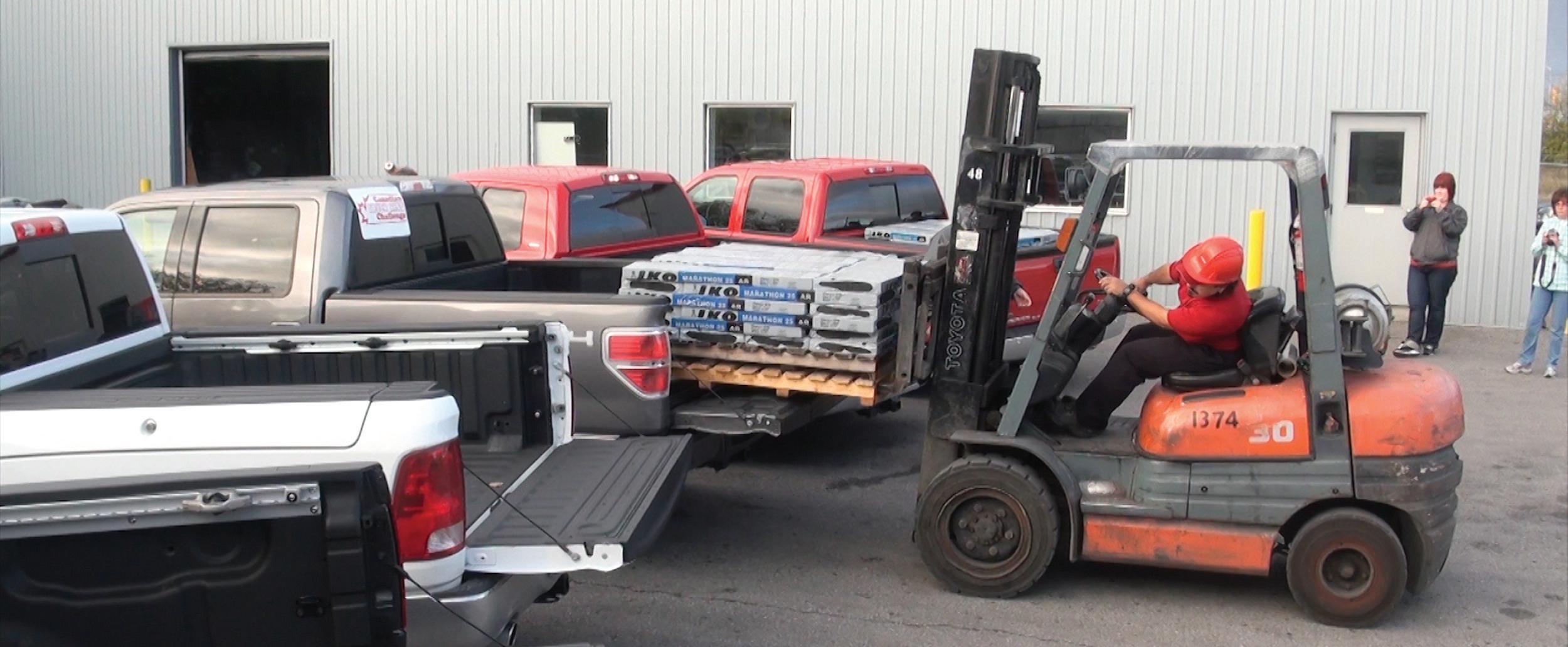
a full day was spent towing the trailers on main and secondary roads – with a final section of highway where speeds of at least 100 kilometres/hour were maintained. after returning the trailers, we refuelled and calculated real-world towing fuel consumption.
Something else new this year was the spreading of the pain during testing, where wives, girlfriends and one husband accompanied the judges, and they were more than vocal in adding their opinions and observations to those of the drivers – plus they got stuck with taking all of the notes.
The second morning, the rain stopped and we headed to roofMart in oshawa, ontario, where we picked up pallets of roof shingles, supplied by IKo, and drove a 200-kilometre route with this 1,800-pound payload. We also
kept track of the fuel used during this test.
Lastly, we drove the trucks empty for 150 kilometres and finished with an off-road section near Head Lake, ontario, that was unfortunately blocked by downed trees. This was too bad, as it is a very nasty, muddy bit of offroad terrain.
So, at the end of the second day of testing, the judges agreed that because we weren’t able to cycle everyone through the pickups in the equal time allotments needed, the off-road criteria would not be scored and we dropped the category from this year’s winning calculation.
Howard Elmer is a truck and ATV writer living in rural Ontario. He produced this report for Eastern Top Crop Manager.


FROM PAGE 21
and stalk lodging resistance. It also has above average drought tolerance.
38N94AM-R (aM-r, rr2) is anoptimum™ acreMax™ aboveground insect protection with integrated refuge product. It is rated at 2700 heat units and contains the roundup ready Corn 2 trait. This hybrid is a yield leader with above average root and stalk lodging resistance. It has very good drought tolerance.
P9519HR (HX1, LL, rr2) is a double-stack hybrid with excellent yield potential and very good agronomics. It is rated at 2800 heat units and contains the Herculex 1, LibertyLink and roundup ready Corn 2 traits.
P9675XR (HXX, LL, rr2) is a new triple-stack hybrid with very good agronomics. It is rated at 2850 heat units and contains the Herculex Xtra, LibertyLink and roundup ready Corn 2 traits. This hybrid flowers early for its maturity and is shorter in stature with above average drought tolerance.
P9760HR (HX1, LL, rr2) is a hybrid rated at 2900 heat units and contains the Herculex 1, LibertyLink and roundup ready Corn 2 traits. It is an excellent combination of outstanding yield potential and very fast drydown.
P9917XR (HXX, LL, rr2) is a new triple-stack hybrid with excellent yield potential, very good agronomics and above average drought tolerance. It is rated at 2950 heat units and contains the Herculex Xtra, LibertyLink and roundup ready Corn 2 traits.
Pride Seeds
A4022RR is a very early roundup ready grain corn hybrid rated at 2225 CHU. Hybrid offers excellent spring emergence and vigor. outstanding stalk strength and late season intactness for the earliest corn growing areas. This variety offers an excellent yield potential, consistent ear size and full dent grain.
A4023BTRR is a very early grain corn rated at 2250 CHU. It offers strong agronomics, including excellent spring emergence and vigor with superior stalk strength and late season intactness. It’s appropriate for all soil types for the very early corn growing areas. This variety offers a benchmark yield potential, a very consistent ear size and full dent grain.
AS1046 EDF is a first choice silage hybrid for the 2350 CHU to 2550 CHU range. This variety is a very tall, high-tonnage conventional (do not spray with glyphosate) silage product with outstanding silage quality characteristics.
A5004G2 rIB Complete is a 2525 CHU, visually attractive, high-yielding hybrid that features excellent test weight, fast drydown, and superior fall intactness and plant health. excellent spring vigour and plant health; perfect for no-till farming operations.


A5111RR at 2550 CHU is a roundup ready hybrid with excellent maturity, and leading yield potential for its maturity. Flared husks enhance fall drydown. roundup ready crop safety yield advantage.
A5624G3 is an excellent choice at 2675 CHU. Visually impressive, easy to harvest hybrids with fast grain drydown. It has a high-end yield potential with outstanding uniformity in ear size and height. Features very nice plant health and disease tolerance package.
Syngenta
new refuge options refuge hybrids with gT designation are glyphosate tolerant.
N04F-GT - 76 day, 2250 CHU - Strong roots and stalks, broadly adapted across soil types, good test weight and fast dry down, early adapted so don’t move into later maturity zones.
New Agrisure 3000GT Series - Hybrids with 3000gT designation include herbicide traits for glyphosate and Liberty Tolerance, and insect traits for Corn Borer and rootworm.
N04F-3000GT - 76 day, 2250 CHU - Strong roots and stalks, broadly adapted across soil types, good test weight and fast dry down, early adapted so don’t move into later maturity zones.
New Agrisure Viptera 3111 Series - Hybrids with 3111 designation include the industry leading agrisure Viptera trait, which provides ultimate control of the Multi-pest Complex including Western Bean Cutworm, Black Cutworm, Corn earworm and Fall armyworm, plus all the same protection and herbicide tolerance as a 3000gT Series.
N09T-3111 - 79 day, 2400 CHU - High yielding, high test weight, medium height, fixed ear.
New Agrisure Viptera 3220 EZ Refuge Series - Hybrids with 3220 eZ refuge designation have 2 traits for Multi-pest Complex (WBC, BC,Ce,Fa) and 2 traits for Corn Borer meaning reduced refuge to five percent.
N29T-3220 - 92 day, 2825 CHU - Top yielder (#1 in oCC trials for maturity), average root and stalk strength means harvest first and good option for early hybrid in later maturity zones, consistently responds to Quilt fungicide application.
Agrisure Artesian 4000 Series - Hybrids with a 4000 series designation include the agrisure artesian trait for water optimization, outperforming isoline hybrids under drought conditions. The 4000 series may be stacked with agrisure 3000gT or agrisure Viptera for the complete package of herbicide, insect and environmental protection.
N45P-4011 - 101 day, 3050 CHU - Top yielding and excellent stress tolerance, taller plant height with dependable stalks. a must-try on your farm.



The Trimble® EZ-Pilot™ steering system features a sleek design integrated into the steering column, providing clear access to instrument panels and controls. It turns the steering wheel—your vehicle’s original wheel or an optional wheel—using GNSS guidance from the CFX-750™ or the FmX® display.
Vehicle steering is immediately adjusted to compensate for rough terrain or slopes and hillsides with the new Trimble T3 ™ Enhanced Terrain Compensation Technology. And higher torque delivers better steering of vehicles with more rigid steering systems, such as floaters. Let the EZ-Pilot system keep you on line so you can focus on other important tasks. For more information, visit www.trimble.com/agriculture, or see your dealer.
Gaining a benchmark of their soil’s health will tell growers if their soil management plan is working.
by rosalie I. Tennison
Managing soils is an ongoing process and most growers are very aware of what they need to do to maintain soil health. o r, do they? It is possible to make all the right moves, but it may not be enough to maintain soil health. a s well, an operation that seems like the right thing to do may not be. now, two soil specialists at o ntario Ministry of a griculture, Food and rural a ffairs ( o M a F ra ) are developing a soil test, based on a similar assessment developed at Cornell University, that will give growers the answers they need.
There have been methods to assess soil health introduced over the years, but the process has been complicated by the requirements on how to take the samples and relating the results to individual farm management. “We’ve been working with soil health for a long time,” says a nne Verhallen, who, along with adam Hayes, is assessing the Cornell material and adapting it to o ntario. “The challenge is how to quantify soil health, but the Cornell test is much like fertility sampling, which is a system familiar to most growers. o ur goal is to give growers a tool that allows them to assess their own soil.”
The research undertaken by Verhallen and Hayes will take three years and, after two years of the work, the soil specialists believe they may be able to identify a simpler system that can be put in place for o ntario growers. “ o ur hope is to have a recommendation of what an o ntario soil health assessment could look like using some or all of the 12 Cornell indicators,” continues Hayes.
“In our first year of the project, we sampled long term rotation and tillage trials in e lora and r idgetown,” Verhallen says of how they began gathering the data they needed. “In the subsequent years, we have included growers’ fields and the long term tillage/cropping studies in o ttawa, Delhi and Woodslee.” They are assisted in this endeavour by Drs. Dave Hooker and Bill Deen of the University of g uelph.
o nce they have compiled their data they will have a benchmark of the health of o ntario soils. The Cornell system scores soil health on a green/amber/red scale with green being good, amber meaning caution and red standing for critical. The goal is to have the soil health test available to growers who request it for a reasonable addition to the usual soil test fee. Ideally, the test should be taken in the spring and the report will indicate if there are problems. Working with a crop advisor or extension personnel, growers could then determine what they need to do
to build better soil health, if they have received a grade in the amber or red range.
“ g rowers can use the results of their assessment to make management decisions that will improve their soil health,” Verhallen explains. “ g rowers will only need to do this test every five or 10 years.” Doing a soil assessment every few years will allow growers to stay on track with their soil management plans.
“Soil health assessments could also be valuable when growers are planning to buy or rent land,” continues Hayes. “If a grower knows the soil health of the land they are considering is good, it may make the purchase or rental more attractive.” Conversely, he adds, a grower wanting to sell or rent land may want to highlight the health of the soil, if it is good. With premium land harder to come by, property with proven healthy soils may also have a higher value placed on it.
“The assessment is a means of quantifying some of the soil health issues beyond fertility,” Verhallen explains. The Cornell assessment evaluates four categories under physical, biological and chemical properties of the soil. Under physical, the soil is rated for available water capacity, aggregate stability, surface hardness and subsurface hardness. Chemical properties fall under pH, extractable phosphorus and potassium and minor elements. The biological properties examined include organic matter, active carbon, potentially mineralizable nitrogen and root health. Verhallen says that part of the o M a F ra research is assessing whether all these tests are necessary to assess the health of o ntario soils.
“ g rowers are concerned about soil health and often wonder if they are doing the right thing,” Hayes says. “They wonder if they are making progress with what they are doing. What we are trying to do is develop the benchmark and go from there to help growers understand the level of their soil health.”
Verhallen says they are likely a year or two away from having a test that can be ordered from a lab and the cost has yet to be determined. Their goal is to refine the Cornell test series to allow growers to benchmark their fields for all cropping situations in all areas of the province from no-till to conventional tillage and all compass points. The result will give growers answers to the soil health questions they have and assist them in improving their soil management. Then there will be a definite answer to the question: “How healthy is my soil?”