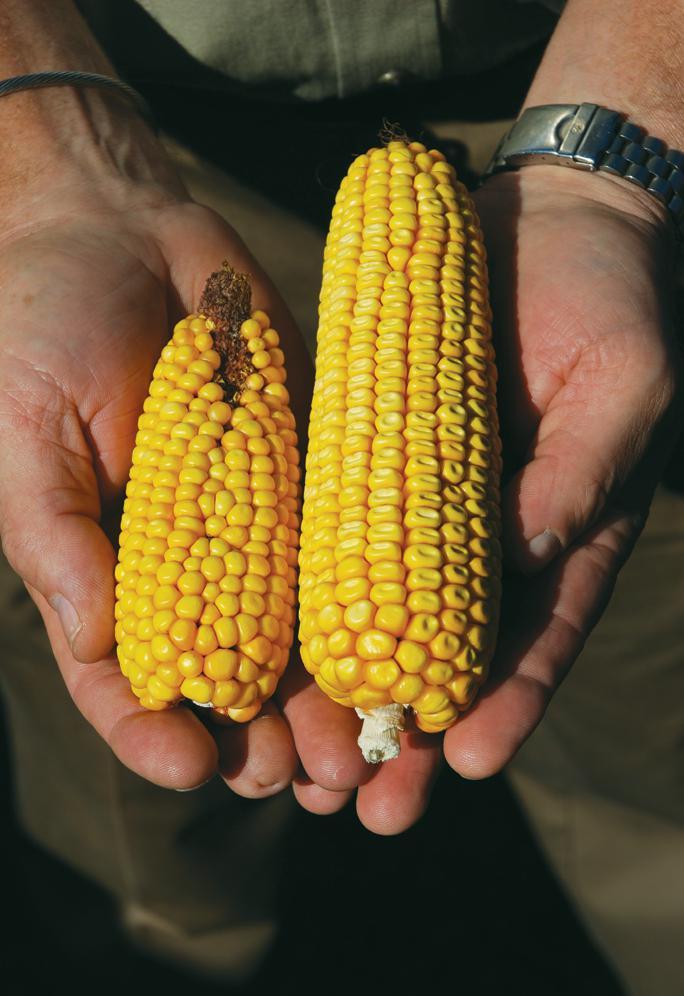
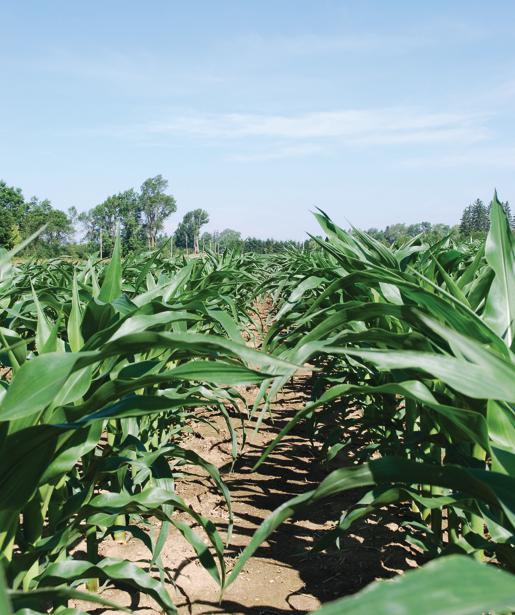
Stay up to code and don’t fall behind So many factors play a role in the health and performance of your corn crop: from fertility and nutrients to the latest in traits to new machinery that helps wring every last little bit of value out of the field, it is here in this issue.
Truck King Challenge
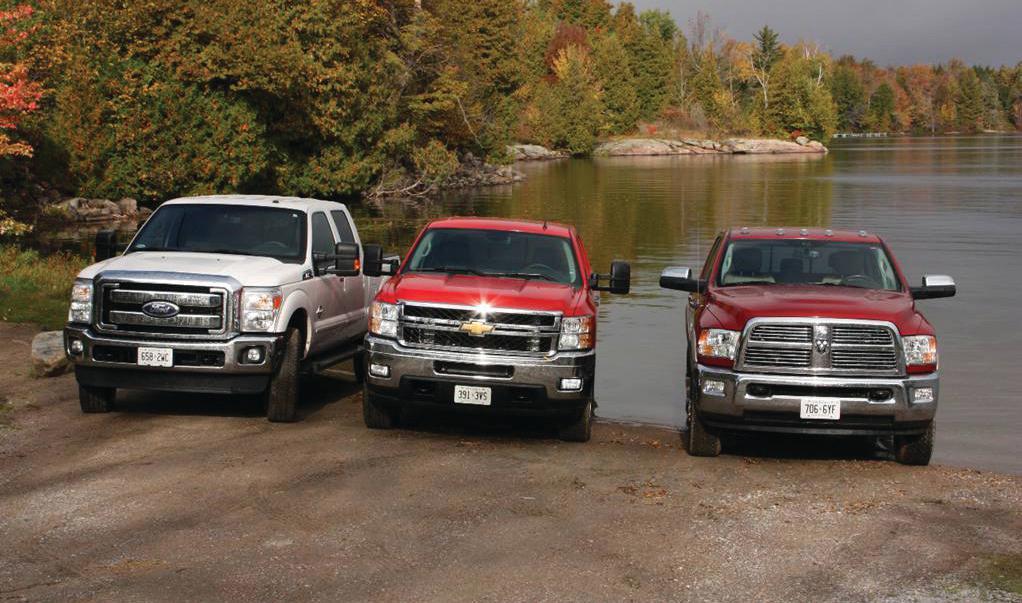
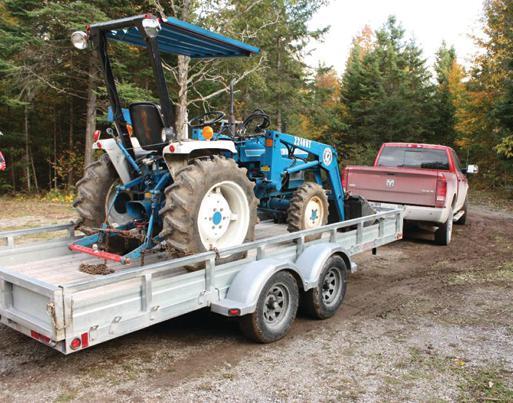
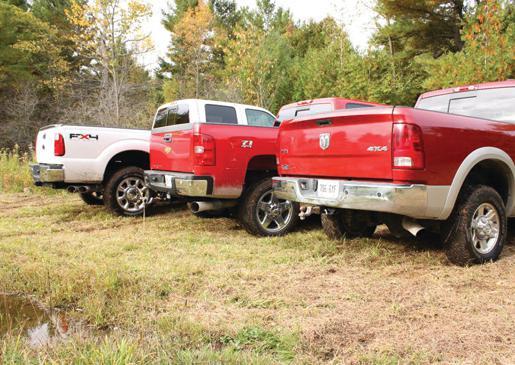
It’s back and it pulls no punches. The 2011 edition of the Truck King Challenge powers its way back with Howard Elmer’s straightforward, honest review and ratings of the latest lines from the “Big Three.”
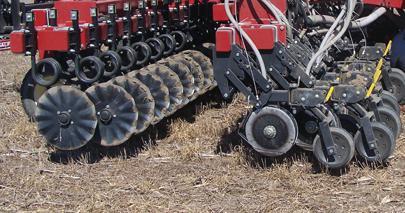
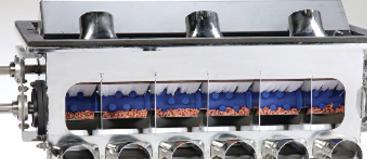
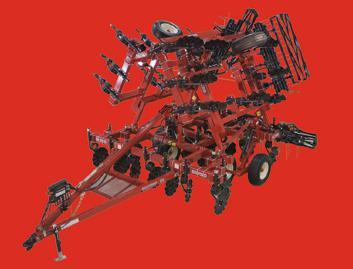
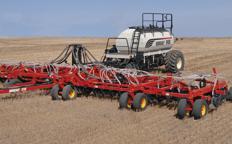
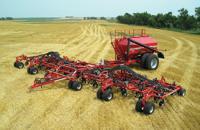
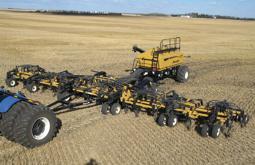
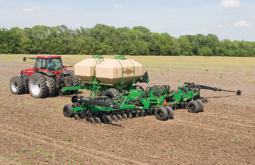
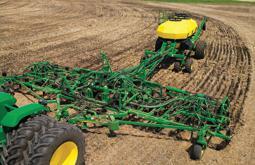
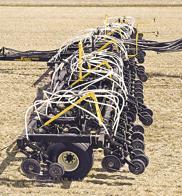
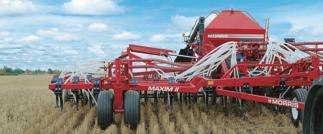
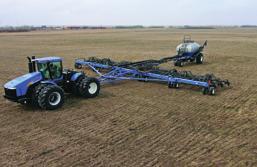
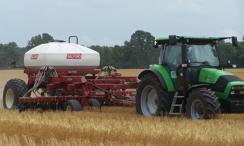
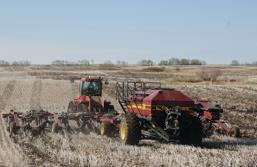
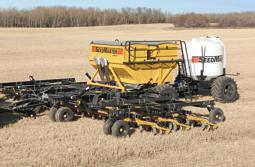
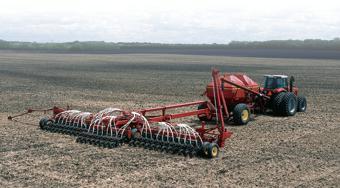
Machinery Manager: Air Seeders and Drills
The planting season is almost here and we have the early look at air seeders and drills, in advance of your spring tune-up.
Reference information of this calibre is hard to find, so many growers choose to keep Potatoes in Canada issues on file. If you have not kept issues for your library, you can find our stories, and more, on our interactive website.
Kevin Yaworsky • 403.304.9822 kyaworsky@annexweb.com
SALES ASSISTANT
Mary Burnie • 519.429.5175 888-599-2228 ext. 234 mburnie@annexweb.com
PRODUCTION ARTIST
Kelli Kramer
GROUP PUBLISHER
Diane Kleer dkleer@annexweb.com
PRESIDENT Michael Fredericks mfredericks@annexweb.com
PUBLICATION MAIL AGREEMENT #40065710
RETURN UNDELIVERABLE CANADIAN
ADDREssEs TO CIRCULATION DEPT.
P.O. BOx 530, sIMCOE, ON N3Y 4N5
e-mail: mweiler@annexweb.com
Printed in Canada IssN 1717-452x
CIRCULATION
e-mail: mweiler@annexweb.com
Tel.: 866.790.6070 ext. 211 Fax: 877.624.1940
Mail: P.O. Box 530, simcoe, ON N3Y 4N5
SUBSCRIPTION RATES
Top Crop Manager West - 8 issuesFebruary, March, Mid-March, April, June, October, November and December - 1 Year - $44.25 Cdn. plus tax
Top Crop Manager East - 7 issuesFebruary, March, April, August, October , November and December - 1 Year - $44.25 Cdn. plus tax
specialty Edition - Potatoes in CanadaFebruary - 1 Year - $8.57 Cdn. plus tax
All of the above - $76.19 Cdn. plus tax
Dealing with loss
Since I first heard about “farm succession” about 11 years ago, I have watched industry stakeholders, concerned more with the loss of personal wealth, warn of the dangers of failing to plan. “Start today,” they caution (and rightly so) “because the bigger the family, the larger the farm, the greater the challenge of peaceable succession.”
But I have always wondered about losing expertise and knowledge more than the wealth. In an ideal world, Mom and Dad would stay on the farm, but still be available to help Junior or daughter Susan and their spouse.
More profound sense of loss Still, what happens when that loss is permanent? When the opportunity to pick up the phone or drive up the laneway is gone?
That was my question after learning that western agriculture had lost a great friend with last month’s passing of crop advisor John Harapiak. Although I never had the pleasure of meeting John, I came to know his relaxed manner through his articles in our western editions of Top Crop Manager and his dealings on the phone or in e-mail exchanges. His ability to simplify complex issues seemed effortless, and always as though he was sitting across the kitchen table or leaning against the wheel of the tractor, his expertise and his smile equally helpful and reassuring.
I felt the same sense of loss at the passing last spring of Dr. Gary Ablett, a soybean breeder at the University of Guelph. As with John, Gary’s knowledge and his willingness to help were as steady as they were reliable.
Their memories live on, but not without feeling that “something’s missing.” I can see a picture of them or read their name in a story, and it gives me pause to think of them –and others who are gone now. And it makes me wonder: If only. . .?
What would be different?
If only I had known it was the last time I would see him or her, how would I have behaved?
Would I have smiled and said simply, “It’s good to see you?”
Might I have asked, “How are you doing?” – hoping he’d tell me everything , and that this time, I’d want to hear it all? Would I have said, “Take care.” – and meant it more than usual?
I picture John and Gary, and two others I lost around Christmas, and it is hard to fathom the notion that I’ll never see them again. I see their pictures, I talk to others who have been blessed with their friendship or their wisdom and experience, and there’s still hope, however slight, that somehow, Gary or John –or Bruce or Lesley – will come strolling back into the middle of a conversation, assuring me that it was all a misunderstanding, or a small joke that we can laugh at.
If only I had known that last lunch we shared, or that quick and passing handshake at the farm show was the last time I’d see them, would I have had the courage to tell them what they’d meant to me? How much I’d valued their insights? Or how often I’d told others about those times? Would I have reminded them of those few, well-chosen words they had added to a chat, weeks or months or years ago, and the effect they had had in my relationship with someone else, or that they had helped me in my career?
If only I had known, I might have held on to that handshake for a moment longer, or held that embrace a little tighter. If only I had known then, their absence now might not be so difficult; I’d know there was nothing left to say or show that I hadn’t shared already.
“If only I had known...,” it might not be so hard to let them go now.
I guess it isn’t only the knowledge we miss out on.
Thank you, John and Gary.
Ralph
If you’re not using BioStacked® HiStick® N/T...
what are you leaving on the table?
HiStick® N/T is BioStacked®. And BioStacked® means greater plant vigour, root biomass and more nitrogen-fixing nodules on every plant. Which in turn means increased performance, superior Return-OnInvestment and most importantly, added yield potential. As the #1 and only BioStacked ® soybean inoculant, HiStick® N/T is trusted and proven
under Ontario growing conditions. Available in liquid and sterile peat formulations, it’s quite simply the best investment you can put into your beans. Ask your retailer about BioStacked ® HiStick ® N/T –for value and performance that really stacks up.™
Crop Management
Getting back to the basics
Good agronomic practices remain fundamental to good farming and the optimal use of technology.
Technology is a wonderful thing, but it can distract from some of the essential principles and practices; in a metaphor, seeing the forest, but not the trees. Is there a need for growers to get back to fundamentals and brush up on good agronomics?
To explore this issue, Top Crop Manager approached three independent Ontario Certified Crop Advisors (CCAs) with a series of questions on technology and agronomic practices: Chad Anderson (Lambton County, southwestern Ontario), Alan McCallum (Elgin County, south-central Ontario), and Paul Sullivan (Carleton County, Ottawa, eastern Ontario). Here’s a distillation of what they had to say.
As we continue to see advances in plant breeding and equipment designs, are we seeing the same advances in sound agronomic fundamentals (e.g., good agronomics, chemistry and trait rotation) among a large percentage of growers?
There is general consensus that these CCAs are seeing a good blending of technology and agronomic practices. Even with all of the technological advances, it takes time and trial and error to determine the advantages and disadvantages of the technology and refine its use on-farm, two of them note. However, says Sullivan, “We still need to stick to the basics of growing a crop, and this will take advantage of the gains offered by new technology. The basics for me include timely planting, uniform emergence and planting depth, early weed control, and crop monitoring in-season to make sure there aren’t any missed management opportunities that can be made this year or next.”
Anderson says that he mainly works with producers who grow conventional soybeans rotated with glyphosate-tolerant corn for weed management, as well as some producers who grow back-toback genetically modified soybeans and corn. In both cases, he sees good use of conventional chemistry in tandem with glyphosate. “This mix of rotation and chemistry works very well in the long term at reducing overall weed pressure,” he observes.
He also notes that GPS technology has helped many growers to make more informed agronomic decisions by better tar-
by Heather Hager, PhD
Getting back to the basics includes timely planting, uniform emergence and planting depth, along with early weed control and crop monitoring.
geting soil sampling and fertilizer application. “The whole next step to GPS and guidance has been a huge step forward in lowering fuel and labour costs, creating a large leap in a farm unit’s efficiency. What is needed to achieve better rotations, not just of crops, but of tillage practices, chemical formulations, and/ or traits, as well as growing a diversity of hybrids/varieties in any single growing season?
Two of the CCAs responded to this question. McCallum thinks that a more equivalent level of performance among genetics and pricing of pest control options would encourage better rotation. “Small economic differences can be overcome by sound agronomics and stewardship, but not large ones,” he says.
Sullivan thinks that it is the tendency to simplify crop management that leads to a lack of diversity in management practices such as crop rotation, herbicide rotation, and variable-rate fertilization. However, he points out that diversification does not necessarily mean more cropping management, but rather “more planning and organization of the operation.” That would include co-ordinating custom work and “relying on what others can do better or more efficiently,” for example.
In your professional opinion, is there one component that is the most underrated
Photo by RalPh PeaRce
in agricultural management practices?
Two CCAs identify diverse crop rotation as the most underrated agricultural management practice. “It drives so many sound practices,” says McCallum. “Rotating chemistries, tillage, fertility management is almost enforced by rotating crops.”
Using at least three crop types on soils that respond to a mix of crops “forces change to many things, including breaking insect, disease and weed cycles,” says Sullivan. “But it also improves the chances of keeping better soil structure. And the soil health improvement from a crop like wheat definitely shows up in corn and soybean performance.”
They also list improved drainage and soil structure, and more resilience to weather extremes as benefits they’ve noticed from crop rotation.
“I think the most underrated component is the use of conventional chemistry in glyphosate-tolerant crops,” says Anderson. He suggests that the ease of glyphosate use, its low cost and not having to clean the sprayer between crops may have contributed to growers getting out of the habit of using conventional chemistry. But he notes that there are added benefits to using conventional chemistry. “Weeds like nutsedge, wild carrot, spreading atriplex, velvetleaf and
lambsquarters are becoming the norm as we naturally select to build higher weed density with continued use of glyphosate. Tank mixing allows for improved control while reducing the dependency on glyphosate to manage your weed pressure. The residual activity opens up the window for herbicide timing taking the pressure off later in-crop sprays of glyphosate, which really helps with late emerging weeds such as cocklebur, or will allow perennial weeds like thistles to be closer to the bud stage, giving better control from the glyphosate application.”
Finally, Sullivan mentions residue management as another underrated practice. “Residue has an impact on the following crop,” he explains. “Handling residue is why a lot of tillage is done, but some of this tillage could be avoided or reduced if residue were managed better by harvest and planting equipment.”
By contrast, is there one component that is the most overrated in agricultural management practices?
Two of the CCAs suggest that aggressive tillage is overrated. “In the hands of a skilled farmer, a wide variety of tillage or planting tools will do the job,” says McCallum. “Proper timing is so much more important: knowing when to go, when to hold off, go deeper, shallower, faster, slower.”
In addition, Anderson cites the “hype around multiple stacking in corn” as overrated. “Some people are drawn to the ‘stack’ before they consider the hybrid’s potential first,” he remarks. “Corn seed has become such a high-cost input in the last few years, and growers need pick their corn seed on performance first.”
Anderson also thinks the use of fungicides in corn and soybeans is overrated, noting that average responses indicate
improvements in yield, but variability in the response means that many growers are just getting their money back or are losing money on the application. He is also concerned about the effects of fungicide on beneficial fungi and the risk of resistance development with the use of similar products across multiple crops. “I would like to see manufacturers move to a predictive modelling system like we have in wheat for Fusarium control,” he says.
Is there a growing need for good agronomic advice (from a human source) or is the technology (GPS, smartphones) making it easier to become a good onfarm manager?
All three respondents note that while technology has helped with access to information, it has also added complexity to on-farm management. For example, McCallum observes, “Technology advances (yield maps, remote imaging) have helped to identify production problems, but ground truthing (first-hand observation) is almost always required to really confirm what is going on in the field.” And Sullivan says, “Many sources of information from abroad require some level of interpretation and application before they can be applied confidently.”
And increases in farm size and business complexity are making it more difficult and inefficient for one grower to be an expert in all areas of management, reinforcing the need to rely on trusted,
ABOVE: The technology available to growers has expanded, but so too has the need for reliable professional advisory services.
LEFT: Aggressive tillage has been identified as one of the more overrated components in management practices.
Photo by RalPh PeaRce
Photo by bRuce baRkeR
Crop Management
specialized experts. This means that one-on-one consultation, with professional advisors as well as other producers, will remain important for growers “to give themselves a different perspective and understand how others approach situations,” says Anderson.
“There is usually no better source of information or sorting out of data than discussing it with someone that you trust and have an established relationship with,” adds Sullivan.
Another example in which one-on-one consultation is valuable is in using technology to diagnose crop issues. When making a diagnosis from a picture of the crop, it is not always clear if all the relevant factors have been communicated, such as management and other events prior to the problem’s development. “A picture of a leaf disease or nutrient deficiency can occasionally lead you to the wrong conclusion; sometimes everything looks like Barley Yellow Dwarf Virus,” says McCallum.
Are we “mining the soil” beyond its capacity? Or are the industry players (e.g., seed trade, chemical industry, equipment dealers) becoming more informed and better at communicating and advising growers to keep from mining the soil?
All three respondents agree that there is some mining of the soil occurring, as indicated by “falling soil-test values,” and each points out different contributing factors. McCallum thinks that newer technologies have increased both yields and crop removal of fertilizer, and growers may have been a bit slow to respond with appropriate fertilizer application. On the other hand, Anderson does not believe that the recent increased yields are the culprit because “it takes a long time to make up a deficit.” He thinks the decline could be related to past, long-term, poor returns for grains and oilseeds that forced growers to use less fertilizer to stay afloat.
Sullivan suggests that some excessive soil mining may be occurring in situations in which short-term use agreements make longterm soil planning a low priority. Some practices that can contribute to soil mining, e.g., excessive tillage, inadequate fertilizer and lime applications, and limited crop rotations, could be improved. However, if problems such as a lack of soil drainage are not corrected, there are limited options for soil improvement, he says.
With all due respect to seed breeders, chemical companies, and equipment manufacturers, and all they have brought to fields in the past 15 years, do you think that a significant portion of growers have become over-reliant on the technology or is there a balance?
The CCAs agree that growers have adapted quickly to maximize the benefits of technologies, but that does not mean they have become over-reliant on it. “The technology that has worked, like improved genetics, corn borer resistance, Roundup Ready weed control systems, for example, has become entrenched in production practices,” says Sullivan. “I don’t deem this overreliant, just keeping current with what has been made available by the industry.”
However, they note that some of the technology may not have been managed appropriately, for example, the use of refuge corn. And that will have to improve.
“I think the basic level of agronomic understanding among growers is as high now as it has been in years,” McCallum concludes. “The production and economic challenges of a few years ago have helped growers focus on making sound decisions and developing cost-control discipline.” He says that growers should continue with that mind-set when profitability becomes easier. “It is much easier to focus on long-term sustainability if you are not worried about just surviving the year.” n
Traceability: a growing consideration for crop farmers
by Carolyn King
Two of many questions are: Who will require it? Who will pay for it?
In Ontario’s crop sector, some farmers have embraced traceability as a valuable business tool. Others see it as a non-issue for their own operation or have concerns about things like cost and liability. But the ability to trace a product through all stages of production and distribution is becoming increasingly important in agriculture.
One of the main factors driving traceability is food safety. “You just have to look at the paper and see, for instance, how almost half a billion eggs were recalled because of Salmonella and you know there are some really good food safety drivers showing that we need to be able to say this is where our product has been and it’s part of the contaminated batch or it’s not part of the contaminated batch,” says Dr. David Sparling, who holds the Chair of Agri-Food Innovation and Regulation at the Richard Ivey School of Business at the University of Western Ontario in London.
He adds, “That’s primarily why governments are interested in traceability, to ensure the public is as safe as possible and that our industry is protected. If a problem occurs, then we can say it’s small and very contained, and we know exactly where that product is so we can recall the right product. Then you don’t have a massive public backlash, which is the response: ‘I’m not going to eat spinach or processed meat or whatever because I’m not really sure what’s safe.’”
That consideration also ties into traceability as a tool for market access. “Often your ability to sell products into global markets depends on your reputation. Governments and industry want to protect Canada’s reputation as a high-quality producer of safe food,” says Sparling.
Markets and marketing
Another traceability driver is the benefit to a business’s internal operations and its relations with buyers and suppliers. “There’s a greater realization amongst businesses, whether they be a producer or a processor, that the more they know about what happens to their product and about the product itself, the more they can manage their businesses to make sure their processes are effective and efficient,” says Martin Gooch, director of the Value Chain Management Centre at the George Morris Centre in Guelph, Ontario.
David Hendrick of Hendrick Agrifoods says, “Traceability for us as a company establishes rigour and protocol and process in our own operations and allows us to measure performance and identify problems. But what is most important is understanding the meaning of traceability in the eyes and mind of the customer and responding to that.”
Hendrick Agrifoods, based in Inkerman, Ontario, specializes in the production, processing and export of edible beans, including identity-preserved (IP), non-genetically modified (non-GM) soybeans.
In effect, traceability is a tool for meeting the expectations of buyers and end users and for assuring them that a grower is indeed meeting their requirements. Gooch says, “Consumers expect people to know what happens to food products at every step of the way. They are becoming more concerned about food safety, and certain segments of the population are becoming more concerned, for instance, about how food is produced, whether it is organic, or minimal chemical use.”
So traceability is also linked to market advantage. Sparling notes, “Are there ways your product has special value to some segments of the market? It could be organic, fair trade, environmentally friendly, omega-3, or many different things. You can catch that value if your traceability system can prove your product has those additional elements.”
Challenges to adoption of traceability
Despite these drivers, agriculture is “decades behind other sectors” in adopting traceability, according to Gooch.
What is preventing the move to traceability? “I think it boils down to a question of trust,” says Brian Sterling, chief executive officer of OnTrace, an industry-led, not-for-profit
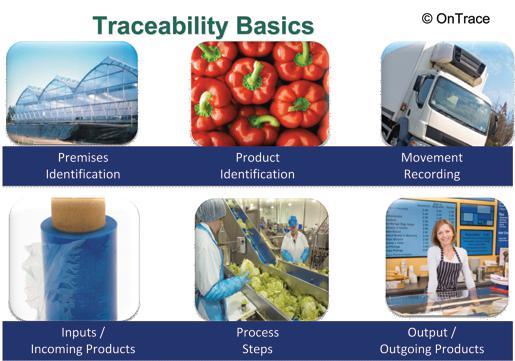
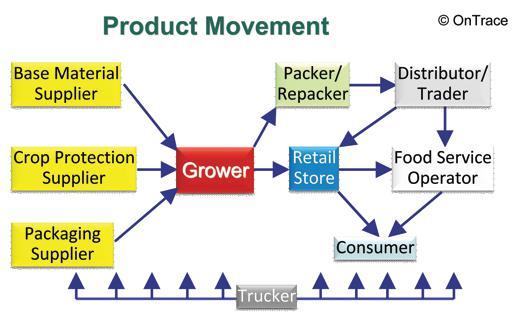
Tracking product movement is a key part of a traceability system.
agency that oversees traceability initiatives in Ontario’s agrifood industry. “Maybe it’s because the agri-food sector is quite siloed. For instance, typically the producer deals just with the next person downstream buying the product; you have these artificial barriers all along the supply chain, and that leads to lack of trust.”
He believes that the lack of trust influences three common concerns in the agri-food industry about traceability: cost, liability and privacy of business information. “For instance, the farmer will claim, ‘The meat processor isn’t going to give me a fair price if I give him too much information,’ and the processor says, ‘The retailer is not going to give me a fair price if I give him too much information’, and so on. They don’t trust the government and they don’t trust their value chain partners to be careful with their information. And they don’t trust that the public won’t get hold of the information and sue them if they have a problem.’’
However, trust and mutual respect can be built into a value chain. “The players in the value chain need to be respected and to be clearly told what is expected of them, but also what they can expect from us,” explains Hendrick.
“We have a grower manual that we encourage our identitypreserved soybean growers to follow. In our IP protocol, we
Traceability and food safety risk for grains
When you talk about traceability, it brings me back to the HACCP control of the risks we have for our particular commodity,” says David Hendrick, of Hendrick Agrifoods, based near Inkerman, Ontario. “Hendrick Agrifoods is certified HACCP and CIPRS. Actually I was involved in the establishment of that system because I believe very strongly in this.”
The Canadian Grain Commission offers HACCP (Hazard Analysis Critical Control Point system) and CIPRS (Canadian Identity Preserved Recognition System) programs for certifying if a grain company’s food safety and identity preservation procedures meet national standards to ensure products are safe and have the specific attributes buyers require.
Hendrick explains that the depth of a traceability system needs to reflect the potential health risks of the product involved. “I’m not selling eggs or milk or meat. I’m selling dry grain, and the health risks are much lower in our case.
“In grain we have three risks: physical, chemical and biological. Consequently our HACCP system is built around those three risks. Physical is, for example, we don’t want to have stones or sticks or mud balls in our food-grade soybeans. Chemical is, we don’t want any residues left on the soybeans after they are harvested and we don’t want to contaminate them in the combine or the bin with any kind of oil or gas residue or whatever. The biological risk is probably the highest risk of the three; the risk is, if your grain is not dried properly before it is stored then you have a chance of a mould growing.”
To mitigate these risks, Hendrick Agrifoods has a grower’s manual that explains what practices the growers need to follow. He says, “We say ‘traceability,’ but really it is: What are the risks of your product? How do you mitigate those risks? And how do you provide evidence that you have indeed done what you said you were going to do?”
At a time when other high-horsepower emission solutions reduce engine performance, the new Magnum tractors with Selective Catalytic Reduction (SCR) technology actually improve engine power. What’s more, you’ll find DEF (Diesel Exhaust Fluid) more than pays for itself in fewer oil changes and improved fuel effi ciency. This is the right technology for high-horsepower tractors for the future, and Case IH is bringing it to you today. To learn more, visit your Case IH dealer or caseih.com/beready to see how Case IH people, technology and equipment are preparing you for the future.
Markets and marketing
make it clear that we do not want to have, for example, GM soybeans in our non-GM fields; we don’t want dirt tagging on the soybeans. All of those types of things involve special time and attention by the grower. The grower is critical to the success of our program, and we expect a lot from the grower. But it works two ways: we have to reward the growers duly to reflect the effort they are making.”
“Traceability systems do have a cost,” Sparling says. “If you capture more value from a market, then you may not mind absorbing that cost. However, if the product is just going into commodity markets, then it’s less clear to farmers why traceability will benefit them. So they are not that interested in spending the money, and other members of the supply chain may not be that interested either.”
Where there is not a strong financial incentive to adopt traceability, Sparling thinks everyone involved needs to look at whether traceability is important for the entire industry.
“That’s when governments need to say: ‘Traceability is important to us and you need to do it for these reasons, whether it’s food safety, protecting our non-GMO market, or whatever reasons, and so we will help fund the cost.’”
Gooch views the cost issue from another perspective. “Agriculture is the only sector I’m aware of that has taken traceability out of the overall information system, put it by itself, and then said, ‘How do we make money from this?’”
Instead, he believes traceability needs to be seen as a strategic tool to improve competitiveness. He gives an example: “I know of a group of about 300 wheat producers who have enabled themselves to capture extra revenue by enabling the miller and the retailer (with numerous in-store bakeries), to reduce their costs and differentiate themselves by offering a product with more consistent quality. That has come about by developing a traceability system where producers are able to measure what is important to the entire chain’s operation.”
The producers have used the resulting information to determine how things like the seed they grow, the fertilizers they use and a host of other factors, are connected to the quality of their final product. That has allowed them to tailor their product to the needs of their processor and retailer and to save costs themselves. And that has enabled everyone in the value chain to benefit.
With respect to the issue of liability, Sparling says, “There is a perception that if you have a traceability system and there’s a problem, then it could be traced back to you. But if the problem started from you, it probably should be traced back to you. Then you can fix the problem so that it doesn’t affect the entire industry.”
In fact, traceability can help prevent liability problems.
Getting started with traceability
Brian Sterling of OnTrace in Guelph, Ontario, says traceability may seem complicated, but a grower can begin with some easy steps. “OnTrace offers traceability workshops every fall and spring to show how simple it is to get started and to give some practical tips on getting started.” For more information, visit www.ontraceagrifood.com or call 1-888-388-7223.
He says, “If you are collecting data and analyzing what’s happening in your system and along your supply chain, then you usually find ways to do things better and avoid problems. Furthermore, if you are doing things really well, you would just as soon your product wasn’t downgraded by mixing with somebody else’s.”
Sterling agrees, “It’s been proven time and again that traceability can really make the difference in containing an industry disaster. A classic example is the “tomato and Salmonella” outbreak in 2008 in the United States. Most people don’t realize that the outbreak was not actually caused by tomatoes. The poor tomato industry got absolutely hammered and had nothing to do with the problem. With a traceability system, you can quickly prove if you’re not part of the problem.”
In the long run
What is the outlook for traceability in the crop sector? “I don’t think adopting traceability is a choice. It’s a question of how do we do this in the best way possible, and how do we take advantage of the opportunities that are emerging,” Gooch emphasizes.
“I think traceability is ultimately just really good business. We want to be at the leading edge of markets and we want to explore all the ways we can capture additional value,” notes Sparling. “While it is harder to justify in commodity markets, more people are getting into differentiated markets even in the crop sector.”
Hendrick says, “I believe more IP, more selective targeting of markets, is to come in the future, and in order for us to support that properly, we are going to have to maintain and improve on an ongoing basis our traceability systems.” n
Traceability systems, like the identity preserved system for soybeans, can be a tool for meeting the expectations of buyers and end users.
Photo by RalPh PeaRce
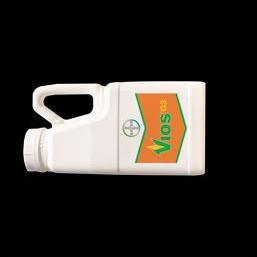
NEW Vios™ G3 herbicide is a one-pass, full season solution for Roundup ® Ready and LibertyLink ® corn hybrids. When mixed with your choice of glyphosate or Liberty ® , Vios G3 puts three modes of action to work including two powerful new actives (thiencarbazone-methyl, Group 2 and tembotrione, Group 27). Season-long grassy and broadleaf weed control in one convenient and concentrated jug. A little Vios G3 goes a long way.
Go small for the long haul.
Fertility and Nutrients
Understanding lime
How to interpret results from soil tests.
Although regular application of lime is needed on only about 10 to 12 percent of Ontario soils, it is important for those farming the other portion to know when and how best to apply lime occasionally. “Less-than-optimum soil pH can result in substantial potential yield drops in corn, for example,” says Dale Cowan, a senior agronomist at Agris Co-op, at its Southern Co-operative Services division in Chatham. “Keeping an eye on it is wise.”
Understanding whether soils require lime is a matter of thoroughly understanding soil pH. “Many farmers are confused about the difference between soil pH and buffer pH,” says Keith Reid, soil specialist with the Ontario Ministry of Agriculture, Food and Rural Affairs. “Soil pH is the amount of acidity in the soil solution, which is what plant roots respond to. This test tells you whether the soil needs liming or not.”
If lime is needed, a buffer pH test then indicates how much. “Soil pH test results below 6.2 should be followed by a buffer pH test,” notes Cowan.
Calcium and magnesium levels must be tested also. Where magnesium levels in the soil are low (less than 100), dolomitic lime should be used. If levels are adequate, Reid says either dolomitic or calcitic lime may be used, whichever is most economical. Magnesium deficiency is more common in sandy soils. “Most
by Treena Hein
clay soils have adequate magnesium, but this is not necessarily a given,” Reid explains. “Also remember that clay soils have more ‘reserve acidity’ stuck to the clay minerals and organic matter than sandy soils do, so at the same soil pH, a clay soil will generally need more lime to correct the acidity than will a sandy soil.”
This is why a buffer pH test is so important: it will tell a grower how much more. Reid adds, “Also keep in mind that there are some clay soils that started out acidic from the parent materials that went into forming those soils (e.g., parts of the Niagara peninsula).”
Soil acidity takes time to correct, so lime application should be conducted at least as far back as the fall before a pH-sensitive crop is grown, and preferably before that.
In terms of what lime products to apply, farmers need to be aware of the Agindex rating for lime, which describes the fineness of grind and the neutralizing value. “Not all limes are equal,” Cowan says. “The finer the lime, the faster it will work.”
FIGURE 1: Soil pH
2:
Although any commercial lime will obviously contain particles of various sizes, lime particles less than 0.25 millimetres in diameter are completely effective in changing soil pH, particles from 0.25 to 2 millimetres in size are only 40 percent effective, and those larger than 2 millimetres are so large they are almost completely ineffective. When a lab recommends the use of lime, Cowan says the lab is referring to a lime product with an Agindex of 75, so growers will need to adjust their application rates up or down for the Agindex of the lime they are applying: more for an Agindex below 75, and less for an Agindex above 75.
Reid adds, “Finely ground lime is dusty, so watch out for applications on windy days. Also, ensure that lime is mixed evenly through the soil.” n
Less-than-optimum soil pH can result in substantial yield drops in corn.
Photo by RalPh PeaRce
Figure 1
Figure 2
• harvestAug 15 , 2010 Grownwithpride
• herbicideJune20 , 2010
• liquidfertilizerJune29 , 2010
• seedandfertilizerMay27 , 2010
Seehoweasy traceabilitycanbe
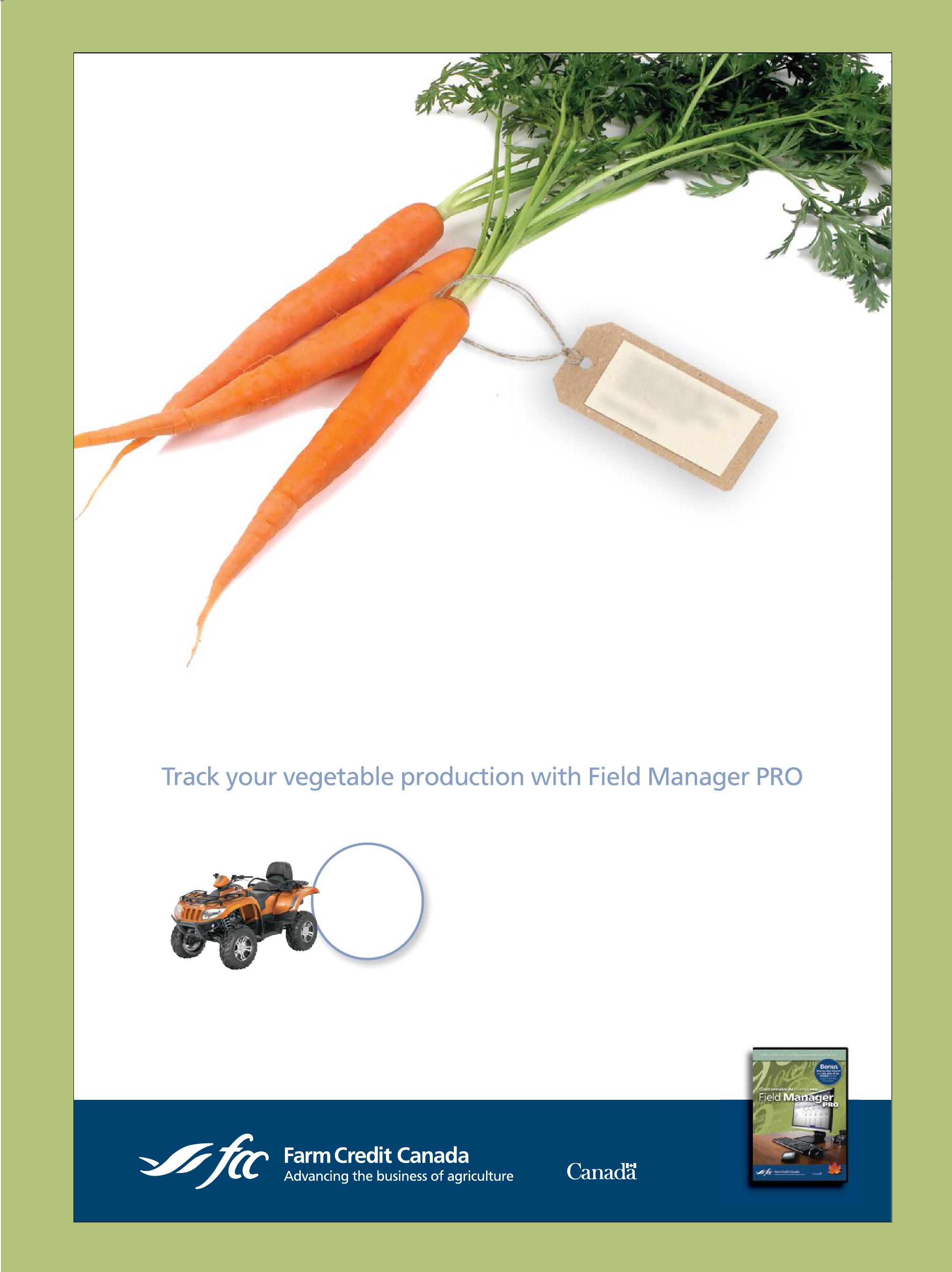
Track your vegetable production with Field Manager PRO
Order now and you could winan Arctic Cat ATV*
*Contest details at www fccsoftware ca/dyff
Your customers want products that are traceable With Field Manager PRO, you can track your inputs, costs and activities. Increase the marketability of your vegetable crop and get a complete picture of your production and field records Field Manager PRO includes desktop and mobile software.
New technology’s performance earns more acres for 2011
Insect protection and more trait-protected acres strike a chord in year one.
Corn grower Jason Veenstra likes to push his yields. “It’s no fun growing something that doesn’t produce high yields,” says the 27-year-old, who farms 300 acres near Clinton, Ontario.
After reviewing his corn yields, there is no doubt that 2010 was a very fun year. “We ended up averaging 200-plus bushels to the acre on the full farm,” says Veenstra, who explains that the key to passing the 200-bushel threshold in 2010 was planting some Dekalb-brand Genuity SmartStax hybrids for the first time.
For Veenstra and many other corn growers, 2010 marked their first opportunity to plant the new corn hybrids. The technology delivers a combination of insect control, both above and below ground, plus Roundup Ready 2 Technology and LibertyLink herbicide tolerance for broad-spectrum weed and grass control.
These hybrids also provide the industry’s first reduced refuge system, requiring only a five percent refuge compared to the traditional 20 percent. The Dekalb brand was first to market with the new technology in 2010 and will offer 10 hybrids for 2011.
Reduced refuge also makes planting simpler
One of the key advantages that Genuity SmartStax corn technology brings to the field is the ability to reduce the requirement for refuge corn acres from 20 to five percent. This means growers have the potential to realize more yield on a larger portion of the farm. It also allows growers to take a simpler approach when planting fields to meet refuge requirements. Dekalb agronomist Marvin Talsma uses the example of planting a 50-acre field to show how the new hybrids can make planting easier for growers who use planters with individual planter units. “Imagine going into a 50-acre field. With the new technology, you need just one bag of refuge corn in that field for the five percent refuge compliance. On top of that, you only need two rows if you are planting the refuge in strips,” explains Talsma.
“In this situation, you can put one bag of refuge corn in the end row unit of your planter and just plant up and down the rows. This will give you two rows every time until that refuge seed runs out. Then you just fill up with Genuity SmartStax and go,” says Talsma. “It’s the ultimate in simplicity.”
Talsma also notes that the five percent refuge only requires two rows together when planting strips, as opposed to four rows when planting a 20 percent refuge. “It works out really nicely at five percent. You can go up the field with corn in the end unit and come back, you then have two refuge rows side by side.”
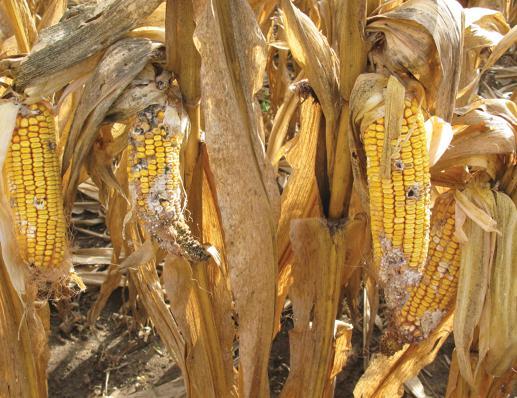
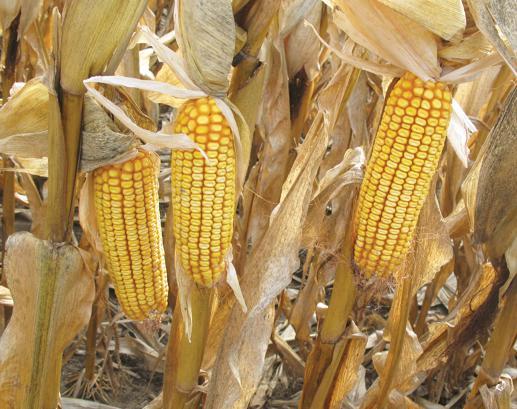
Two hybrids from the same field show the effects of a hybrid with no Western Bean Cutworm protection (top) versus the above- and below ground protection of a Genuity SmartStax hybrid (bottom).
Photos couRtesy of Dekalb
When Veenstra made the commitment to plant the new seed technology, he was counting on the combination of insect protection, strong weed control and good genetics to put more bushels in the bin. He was not disappointed. “They looked phenomenal,” he says. “We did some test strips and they topped the field. Veenstra planted 20 acres each of DKC50-45 (3075 heat units), which averaged 220 bushels per acre, and DKC46-07 (2875 heat units), which averaged 210 bushels per acre.
Veenstra says the top yields for his hybrids were even more impressive considering there was no visible evidence of insect pressure on his farm. “We never ran into the Western Bean Cutworm (WBC) that everyone was talking about. It was definitely all around our area, in this geography, but
you couldn’t see it in my field,” something that he attributes to the protection provided by the technology.
The crop’s performance has convinced Veenstra to plant the new seed technology on his entire farm for 2011. That will also give him an opportunity to move to a five percent refuge. In 2010, because he planted only limited acres of Genuity SmartStax, Veenstra stuck to a 20 percent refuge, but that will change in 2011. “The refuge is your worst corn in the field. There’s a tremendous difference between growing a 20 percent refuge and a five percent refuge; with the latter you’re getting 15 percent more of your field into better hybrids.”
At press time, final totals on yield were unavailable across Ontario, but Dekalb agronomist Bob Thirlwall reports that many growers share Veenstra’s thoughts regarding the benefits of being able to reduce refuge requirements. “Based on reports we got from growers in 2009, they told us they were taking an average 12-bushel hit on refuge acres,” says Thirlwall. “By reducing refuge requirements, you now have the potential to get that 12 bushels per acre or more back on another 15 percent of your farm. That’s significant, no matter how you look at it.”
Thirlwall says growers are also aware of the broad-spectrum insect protection the new hybrids provide, including defence against the growing WBC threat, which is now gaining a foothold in Ontario. “We’ve heard so much from our Michigan neighbours about the pressure and damage we could have. I think corn quality could be an issue; once you get feeding, you have an entry point for mycotoxins and ear moulds of different sorts,” says Thirlwall. “That’s a concern from a quality standpoint because crops can be downgraded because of ear mould.”
Genuity SmartStax hybrids provide defence against yield-robbing insects by including three modes of activity to control European corn borer, southwestern corn borer and fall armyworm. There are also two modes of activity to control northern corn rootworm, western corn rootworm and corn earworm and one mode of activity to control Western Bean Cutworm and black cutworm.
Thirlwall notes that there was localized WBC damage in southern Ontario in 2010, in areas such as Bothwell in Chatham-Kent and Wardsville and West Lorne in Elgin County. “It’s in-
teresting to see the amount of damage that can occur. The first thing you notice is the amount of grain feeding on the cob and the next concern is the secondary fungal diseases that have an entry point to develop,” Thirlwall says, noting that early harvest reports indicate incidences of gibberella and aspergillus ear moulds. Depending on the degree of pressure, he estimates the yield impact of WBC to range from five to 10 bushels on unprotected acres.
Another thing Thirlwall noticed in 2010 was tremendous European corn borer pressure. “In some of the earlyharvested plots, refuge hybrids have been hit with up to 15-bushel yield losses. In one particular field walk in Chatham-Kent, I saw 47 percent of stalks infected with corn borer,” he says.
Growers will also benefit from fewer broken stalks from corn borer and the ease of harvest on those acres, adds Thirlwall. n
3-in-1Seed-Handling Versatility
The Unverferth Seed Runner not only delivers seed to your planter or drill, its patented design allows for the conveyor to rotate 180° for filling itself!
You can even position the conveyor parallel to the tender and transfer seed from one container to another. That’s 3-way versatility — loading, unloading and transferring — for 3 times the value.
• 18’ steel-tube conveyor with 2-stage, 5’ telescoping downspout for filling the furthest corners of any planter or drill — up to 30’ away
• Dual-compartments for multiple varieties
See your nearest Unverferth dealer today for complete details on the Unverferth Seed Runner seed tender, visit our Web site at www.unverferth.com or call 1-800-322-6301.
Testing ESN fertilizer in Eastern Ontario
Research is assessing the value of the product in corn and spring wheat.
ESN controlled release fertilizer is a relatively new product to Eastern Ontario. It has really just become available to the growers in the last two years (since 2009). So we’re doing a trial to see if there’s a benefit to grain corn and spring wheat growers,” says Scott Banks, emerging crop specialist with the Ontario Ministry of Agriculture, Food and Rural Affairs. ESN, or environmentally smart nitrogen, consists of urea granules with a very thin polymer coating. Soil moisture can move through the coating into the granule and dissolve
by Carolyn King
the urea. As the soil warms, the urea solution moves faster through the coating out into the soil. The increasing soil temperature also prompts the crop plants to increase their growth rate, which increases their need for nitrogen. “So the idea is to have the nitrogen available more closely to the time when the crop needs it. That should either increase crop yield because of improved nitrogen usage, or decrease the rate of nitrogen that you need to apply,” explains Banks. From an environmental perspective, the concept is that the coating keeps the nitrogen under wraps until the crop is ready to use it, reducing the risk of nitrogen loss into the environment due to leaching, volatilization and denitrification.
Real problem.
ESN costs more than regular urea, so Banks’ project is assessing the economics of using ESN, including the effects of different rates on the yields of corn and wheat and on the protein content of wheat. He has completed two years of the project and hopes to do a third year in 2011. Funding support is being provided by the Ottawa Valley Seed Growers Association and the Ottawa-Rideau Regional Soil and Crop Improvement Association.
Trial breakdown
Client: Syngenta
Project: Viptera Ad
Date: October, 2010 issue
Designer: BM
The project involves replicated field trials with co-operators: two wheat sites and two corn sites in 2009; and two wheat sites and five corn sites in 2010. As well, Banks’ research team is conducting small plot trials at the Kemptville Campus of the University of Guelph. All sites have medium to high soil organic matter levels.
For the on-farm trials, the researchers are applying nitrogen at the grower’s usual rate of actual N and at half that rate. The half-rate treatments are aimed at determining whether it is possible to reduce nitrogen rates when using ESN. The small plot studies are more intensive, evaluating nitrogen rates of 0, 50, 100 and 150 pounds per acre for corn, and 0, 90 and 135 pounds per acre for wheat.
Field trials are ongoing to determine the value of environmentally smart nitrogen (ESN) applied to corn and spring wheat.
Photos by RalPh PeaRce
Agrisure Viptera , NK®, NK & Design®, Multi-Pest Complex , and the Syngenta logo are trademarks of a Syngenta Group Company.
Fertility and Nutrients
*No statistical differences among the four treatments. Courtesy of Scott Banks/OMAFRA.
In 2009, the researchers compared straight urea with straight ESN. In 2010, they compared straight urea with a blend of urea and ESN, using 50 percent ESN and 50 percent urea for wheat, and 40 percent urea and 60 percent ESN for corn. Banks says, “Agrium, the developer of ESN, suggests mixing a blend of straight urea with this polymer-coated urea so you have some nitrogen available to the crop early on when the soil is still cool, and then the rest available later on as the growing season progresses.”
Some producers in other regions are using ESN as a way
Real solution.
to apply higher rates of seed-placed nitrogen. However, most Eastern Ontario cereal growers use broadcast nitrogen, so the researchers are broadcasting the nitrogen for these trials.
Agency: ON Communication Inc
Agency Contact: Reallen Seaman
Telephone: 519-434-1365 Ext228
Email: raellen@on-communication.biz
For the two wheat sites and three of the corn sites, the nitrogen was broadcast and then worked into the soil before the crop was planted. For the other two corn sites, the corn was planted first and then nitrogen was broadcast and not worked in; within two or three days, rain carried most of this broadcast nitrogen into the soil at these two sites.
The researchers also conducted some post-harvest soil sampling in 2010 to determine residual nitrogen levels and evaluate whether ESN reduces nitrogen loss.
Results so far
Some of the farm sites had a fair amount of field variability; for example, at one site, there was more than a 10-bushel difference in wheat yields between the replicates of the same treatment. That kind of variability can make it difficult to get statistically significant results. Still, the overall results from the on-farm field trials showed similar trends as the small plot trials.
“The bottom line is we didn’t really see any increase in yield with the ESN treatments for either the half rate or the full rate of nitrogen,” says Banks.
He notes, “We did see an increase of about 0.5 percent in protein in spring wheat. However there was no economical gain to adding that extra 0.5 percent because all the samples were over 14 percent protein in the standard check, with spring wheat, the
grower gets paid a premium for protein up to 12.5 percent. Now some millers have said they might like higher protein wheat, so there is a potential that someday they may pay a premium for additional protein levels.”
In terms of residual nitrogen levels, the results for the soil samples analyzed so far indicate there is no difference between the straight urea and the ESN/urea blend treatments.
Banks expects to complete his analysis of the 2010 data fairly soon and plans to submit a report to Crop Advances 2010 with
NK® Agrisure Viptera™ corn is bred speci cally to help you manage the yield robbing threat of the Multi-Pest Complex which includes the Western Bean Cutworm. More insects. More control. More yield.
That’s Real Innovation that helps you grow.
particularly in wheat fields.
more detailed information.
He concludes, “To the grower, the bottom line is, does ESN pay? From the numbers that I have, the best-case scenario is maybe in a year you might break even on the difference, based on the yield and the price. For example, on corn at one site in 2010, we gained about 2.9 bushels with the ESN/urea blend. With the 2010 price of corn, that meant about an extra $5 per acre. But from a statistical standpoint, there was no difference in the treatments,” says Banks. “So it’s not one of those situations where we can say we’ve got something great that you can do. But we need to test these things to see if they work or not, especially when it involves an extra cost, you want to make sure you have a payback.” n
Research on ESN has been conducted in Eastern Ontario, as well as southwestern Ontario,
Fertility and Nutrients
Manure offers cheap, sometimes free, fertility
Growers can cut fertilizer costs while custom spreading provides new opportunities.
Like tax increases, one other thing farmers can count on is rising fertilizer costs. To minimize fertilizer wastage, growers do things like regular soil testing, grouping fields together for different treatments if test results warrant, and using the corn N calculator on GoCorn.net. More growers are also investigating two cost-effective alternatives to chemical fertilizer: manure from nearby livestock farms and free municipal sewage bio-solids.
Some farmers are of the opinion that their peers with manure should be giving it to them for free. However, in the view of Sonke Claussen and others, “Manure is definitely a commodity with a dollar value attached to it, if you can apply the manure right, timely and technically.”
Most farmers find it tough to put a value to manure, notes Claussen, who is co-owner of Claussen Farms Custom Farming in Brucefield, Ontario. “We’re buying manure ourselves and paying for it according to commercial fertilizer nutrient values, less application or transport costs,” he says. “We think all poultry manures and composts are worth buying, but with solid dairy and beef manure, it’s often a tough call.”
Whether a grower uses his own livestock’s manure, purchases it or gets it free, increasing numbers of farmers are finding it more economical and convenient to hire a custom operator such as Claussens than to buy and maintain adequate spreading equipment. It is quicker, which keeps neighbours happier, and while the operator is on-farm, the owner can get other things done. As well, the grower can have a paper record of what was spread and when, with many companies also offering records in a digital format.
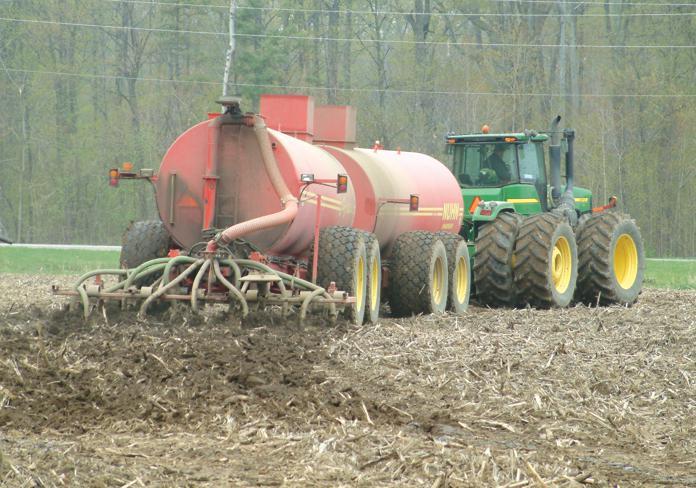
Farmers with acreage that is located some distance from their barns are also among those finding it cost-effective to hire companies to haul and spread manure. “We have tractor-trailer delivery for those fields that take too much time for the farmer to drive to with a tractor and tank,” says Henry Van Iperen, an application technician and consultant
by Treena Hein
with Bartels Environmental Services in Ancaster, Ontario. Like others, Bartels offers a variety of manure and digester management services, as well as soil sampling and nutrient management planning. For application, they employ a dragline system or Nuhn quad train, which has flotation tires.
Besides tight timing in the spring, many growers shy away from the added impact of heavier equipment on their land. “Many of my customers own manure tanks but will not use them in the spring for compaction reasons,” observes Frank Boere, president of Boere Custom Irrigation of Kerwood, Ontario.
Boere says dragline systems are advantageous that way, and also provide accurate liquid manure spread patterns. With his six-inch, lay-flat hose, he can spread manure up to 3.5 kilometres (a little more than two miles) away from a pit (a transport truck is used for greater distances).
“The drag hose is laid out in such a manner that it will cover up to a 60-acre piece of land in one set-up,” Boere explains. “The drag hose is connected to a tool-bar applicator with three nozzles that spread 48 feet wide and only 24 inches from the ground with a very accurate triangular
spread pattern.”
The flow meter displays total gallons spread and gallons per minute, and the targeted gallons per acre is achieved using a speed chart.
Heed these tips
To ensure all goes smoothly with custom manure application, remember the importance of good communication. Because most custom jobs must be done in a timely manner, Claussen says “I always tell my customers to call me as soon as their land is ready or they want some services. We’ll then talk back and forth often, and nail down a date. We may have to look at the field, as well.”
Services can be delayed by weather. Also note that companies sometimes attempt to group farmers in one area together to maximize efficiency.
Instead of beginning the communication process in the spring, however, Claussen strongly recommends having discussions far ahead of that point in time. “We prefer to meet at least twice with the farmer during the winter to do long-term planning, so that we can move forward quickly in the spring and everyone is on the same page,” he says.
Many growers prefer injectors for their manure applications, which reduce odour complaints and the potential for nitrogen volatilization.
Photo by maRgaRet lanD
WHERE CROP FA RMERS MEET ™
CANADA’S OUTDOOR FARM SHOW 2011
FORAGE HARVESTING DEMOS
TILLAGE FOR CORN STALKS DEMO
LELY & DELAVAL ROBOTIC MILKING DEMOS
NEW LOCATION FOR SPRAYER DEMOS
BIOMASS DEMONSTRATION PLOTS
BIOGAS EXHIBITS AND DEMOS
GROBER YOUNG ANIMAL DEVELOPMENT CENTRE
• Featuring Daily Calf Technology Demos
NEW PASTURE/GRAZING DEMOS LOCATION
WOODLOT EXPO
CANADIAN ENERGY EXPO • Presented by AgEnergy Co-operative
“Canada’s Outdoor Farm Show offers a wide variety of agricultural products and that diversity makes it worthwhile to revisit time and time again!”
Ken and Jim Hanes Hanes Farms, Copetown ON
39,200 ATTENDEES 715 EXHIBITORS
Fertility and Nutrients
Having winter meetings with written plans also allows for time to analyze factors such as a nutrient management plan, choice of crop varieties and type of tillage, and relate them to how much manure can be spread and how.
At the time of service, farmers should be provided with a detailed written report from their provider. “We summarize what has been spread, how much, what location, conditions that day, and might also list things we think the farmer should follow up on,” Claussen says.
Another factor that may come up is the value for services provided in relation to cost. “Most of our customers understand from the start that we take pride in the quality of our work and we try to do the job right and on time, and so we are not the cheapest on the market,” notes Claussen. “However, sometimes there must be some discussion of this.”
Claussen stresses that farmers should view the decision to hire custom services as the first step in building a longterm working relationship. “It takes about two years to fully establish a
Free fertilizer
partnership, so to speak, for farmers to fully understand the process,” he notes, “and for trust to be built on both sides.”
Pricing the job
The choice of spreading system, the type of spreading (on-field or injected) and the location of fields are the main factors affecting total service cost. The industry standard cost is 1 cent per gallon top spread and 1.1 cents for inground injection.
Bartels’ Nuhn quad train tankers hold 12,000 gallons and have a 14-foot injector. He charges an hourly fee instead of a per-gallon rate. If the manure has to be trucked to the field, there is an hourly fee per truck, and Bartels’ trucks each hold 9000 imperial gallons.
Van Iperen offers the scenario of a farmer with 100 acres, five kilometres from the main farm, who wants a dragline used and 500,000 gallons of manure in his pit to be injected into the field. Using industry standards, the estimated costs are as follows: For dragline application, the spreading cost is 1.1 cents per gallon X 500,000 gallons = $5500. Two trucks are
Farmers can also get sewage bio-solids distributed on their fields free of charge by companies like Brantford-based Wessuc Inc. The company operates over a large area, from Barrie to the Haldimand-Norfolk region.
Previously, Ontario Ministry of the Environment regulations stipulated that farmers could receive only one application during a five-year period, notes Matt Jolley, Wessuc’s land application co-ordinator. However, as of January 2010, biosolids are now applied on a nutrient-specific basis and regulated under the Ontario Ministry of Agriculture, Food and Rural Affairs. Within a five-year period, there is a maximum amount of nutrients that can be applied, explains Jolley. So, soil testing for macronutrients and micronutrients, which has always been legally required to receive bio-solids, is now more important than ever.
The quantity of nutrients contained in sewage bio-solids depends on whether they are in liquid or solid form and can also differ among loads. Based on an application rate of 135 kg per hectare (120 lbs per acre) of anaerobic liquid sewage bio-solids, Jolley says that each acre of a field will generally receive 120 pounds of nitrogen and 50 pounds of plant-available phosphorus, in addition to micronutrients. However, potassium levels are generally quite low.
Neal Miller, who farms corn, soybeans and wheat at Miller Farms in Jerseyville, Ontario, has been receiving bio-solids from Wessuc once every five years since the mid-1990s. “I have the soil sampled every other year,” he says. “It’s a lot of free nutrients, which is pretty valuable.”
The application is more controlled and consistent now, he says. “There are flow meters now, and I am provided with an application map, and so we spread fertilizer accordingly.”
Miller has many neighbours and “no one really likes it,” he says, referring to his application practices. “The liquid doesn’t smell so bad, but the semi-solids are too smelly and would upset the neighbours, so I don’t use that.”
OMAFRA’s list of brokered manure and sewage spreading firms is located at: www.omafra.gov.on.ca/english/nm/nman/brokerlist.htm
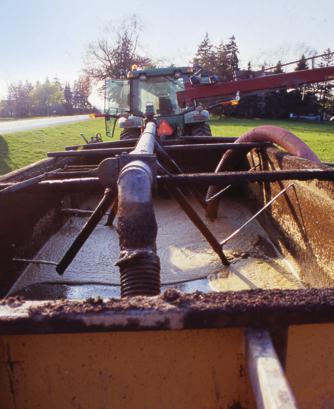
As the availability of manure and bio-solids increases and growers look for cost savings on fertilizing their crops, application companies are becoming more sophisticated and diversifying their operations.
Photo by RalPh PeaRce
required to keep the dragline supplied at approximately $125 per truck per hour. If each truck holds 9000 gallons, 56 truckloads will be needed in total. At 2.5 truckloads per hour, this equals 23 hours of trucking time, for a total trucking cost of $5750. The total cost would therefore be $11,250 plus HST. If the farmer would like the quad train system, the cost would be approximately $250 per hour for the tractor and quad train. Two trucks are again required to keep the spreader supplied. At two loads per hour, it will take 28 hours to truck the 56 loads. Thus the spreading cost would be $250 X 28 hours = $7000, and the trucking cost would also be $7000, for a total cost of $14,000 plus HST.
Boere notes that cost is one of two important advantages top-spreading holds compared to injection. “The cost to inject manure with the drag hose system would be approximately 40 per cent more, and a lot of farmers are not willing to pay for that,” he says. “Also, it is hard to inject manure at the low rate per acre required by most nutrient management plans.”
However, using a dragline to have liquid manure spread means farmers should till soon afterwards to save nutrients, particularly nitrogen, from volatilization. The cost of Boere’s services is $10.50 per 1000 gallons up to 1.5 kilometres from a manure pit. Greater distances of up to 3.5 km cost up to $15.00 per 1000 gallons. n
Young farmers are important to the future of agriculture – so is having the right financing. The Transition Loan lets you start with as low as zero down. Interest is charged only on the disbursed amount so you can build equity quickly or manage your cash flow –the choice is yours.
To find out more about the Transition Loan, call your nearest FCC office at 1-800-387-3232. www.fcc.ca
Rising fertilizer costs raising interest in newer technology for Canada
by Blair Andrews
GreenSeeker technology is moving east from the Prairies, where it has been in use since 2008.
The need to manage rising fertilizer costs is sparking renewed interest in technologies and methods aimed at maximizing farmers’ investments in nitrogen. Those bills are climbing again, thanks to the lure of higher crop prices and farmers’ willingness to pay the higher fertilizer prices to increase crop yields.
One innovation that may attract more inquiries from farmers in Eastern Canada is the GreenSeeker system from Trimble Agriculture. The variable rate application and mapping system has been around for about 20 years in the United States and has been in use on farms in Western Canada since 2008.
Billed as a piece of technology that can boost yields while using less fertilizer, GreenSeeker uses optical sensors with an integrated application system to measure crop status and variably apply the crop’s nitrogen requirements. Whereas current precision agricultural methods rely on historical information or mapping to make the nitrogen (N) recommendation, the technology operates in real time, allowing the operators to make variable rate applications on the go.
The sensor uses light-emitting diodes to generate red and near-infrared (NIR) light. The top-end system includes six sensors placed across a 90-foot boom. The light generated is reflected off of the crop and measured by a photodiode located at the front of the sensor head. Red light is absorbed by plant chlorophyll and healthy plants absorb more red light and reflect larger amounts of NIR than those that are unhealthy. The reflectance values are used to calculate the Normalized Difference Vegetation Index (NDVI), which is an indirect measurement of the crop’s aboveground growth. By comparing the NDVI of the crop being evaluated to that of an N-rich strip in the field, the technology can be used to respond to field variability. “If we can predict yield when the wheat is three or four inches high, then we can do a lot with that value in terms of working backwards to determine what the optimum fertilizer rate is going to be,” says agronomist Bill Raun, a regents professor at Oklahoma State University, where the GreenSeeker technology was developed. “Because producers, whether in Canada, the US or Mexico, are applying way too much N fertilizer for the most part, we just need to say, ‘Okay, here’s the yield we think you can produce if you don’t fertilize and here’s the yield we think you can produce if you do fertilize.’ That’s what our method does using the GreenSeeker sensor,” says Raun.
As the applicator moves across the field, a built-in microprocessor analyzes the NDVI readings and determines the N requirements that are needed to meet full yield potential. Predetermined algorithms calculate the amount of N required. The information is relayed to the rate controller to provide variable rate N application in real time as the applicator moves across the field.
Raun says the key to determining the right amount of fertilizer in a given year is to apply an N-rich strip in the field. The concept is to plant one strip of a field with a very high
N rate to simulate an N-rich environment where the crop’s N requirements are being satisfied. The farmer would then drive the GreenSeeker sprayer over the N-rich strip to set the upper NDVI limit. If the crop is capable of using additional N, the sensor will determine the magnitude and generate an N recommendation based on the predicted yield.
Using the N-rich strip and sensor calculations increases the chance of using the correct rate each year, and only applying N when it is needed. “If I can predict yield, and I can put out an N-rich strip and determine what the end responsiveness is going to be, then I can get a really good N rate that will optimize yield and minimize inputs,” says Raun, noting that nitrogen demand varies significantly each year because of soil and weather conditions. “Five years ago, we put out 2000 N-rich strips with farmers all over Oklahoma to get them accustomed to the fact that there’s a radical difference in the N demand from one year to the next, and they’re not going to know what the demand is until they put out the N-rich strip,” says Raun.
Ontario results
Paul Raymer, a precision agriculture specialist at The Farm Office in Tavistock, Ontario, which is also a Trimble dealer, has seen the GreenSeeker technology at work in Ontario. The RT200 application system was put to the test on a 126-acre parcel near Arthur, Ontario. “It’s really amazing when you are going through the field and you can see the low vigour areas and you see the (N) target
The GreenSeeker technology is new to Ontario, but has been in use in the US for nearly 20 years, and in Western Canada since 2008.
Photo by RalPh PeaRce
Machinery
rate go up. You can hear the pump wind up and send out a higher rate. Then, it gets to a spot where it doesn’t need (an application) and shuts right off,” says Raymer.
Besides its role in variable rate nitrogen applications, Raymer says the technology offers other advantages. For one, there is the environmental benefit of using nitrogen more efficiently.
In addition, he says the system can map crop vigour during fungicide or herbicide applications. “The grower is actually seeing an overview of the health of his crop,” notes Raymer. “He can see that variability and see the opportunity to address that crop and vary the proportions. Or, he can go take a look at a specific area of the field and see that there is a certain emerging issue to diagnose such as spider mite infestations.”
As for the payback of the GreenSeeker, Raymer conservatively estimates the savings at $15 per acre for corn and $20 for wheat, depending on the price of fertilizer. Late in 2010, Raymer states that the technology “would have paid for itself” after being used on 1500 acres, “with 2000 acres at most.”
The top-end system with six sensors costs approximately $22,000.
As N prices rise, farmers are showing more interest in splitting the N applications to boost their profits. Tim Danberry, an agronomist with the Crystal Valley Coop in Janesville, Minnesota, says farmers can earn an extra $20 per acre by using the GreenSeeker systems for variable-rate sidedress N applications on corn. “The growers we’ve got currently using the program will put on a reduced amount of N in the fall, knowing that we’re coming back with the GreenSeeker program,” says Danberry. “We’ll put down 130 pounds and follow up with a GreenSeeker application of anywhere between from two gallons to 15 gallons at 28-0-0 per acre.”
Danberry adds that yield response was particularly good this past year. It was another wet year in parts of Minnesota, where Danberry says some areas received 11 inches of rain in August. “So, N loss was pretty drastic. But on a few trials we had this year, we saw a 15 to 20 bu/ ac advantage (on corn) with the GreenSeeker program.”
And the technology appears to be catching on with members of the Crystal Valley Co-op. After starting with just one system in 2008, Danberry says 10 systems will be available in 2011 to meet a growing demand by farmers to get the most from their N applications n
The Truck King Challenge: the crowning event
by Howard J Elmer*
A good hard look at Canada’s top work trucks and how we put them through their paces.
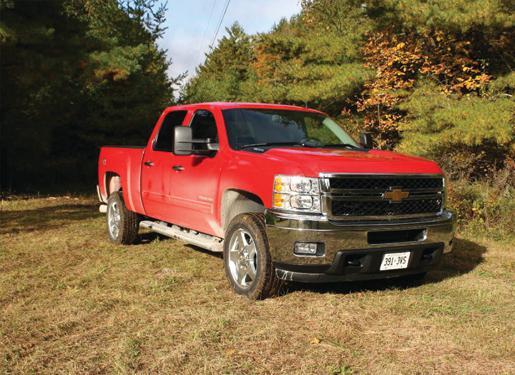
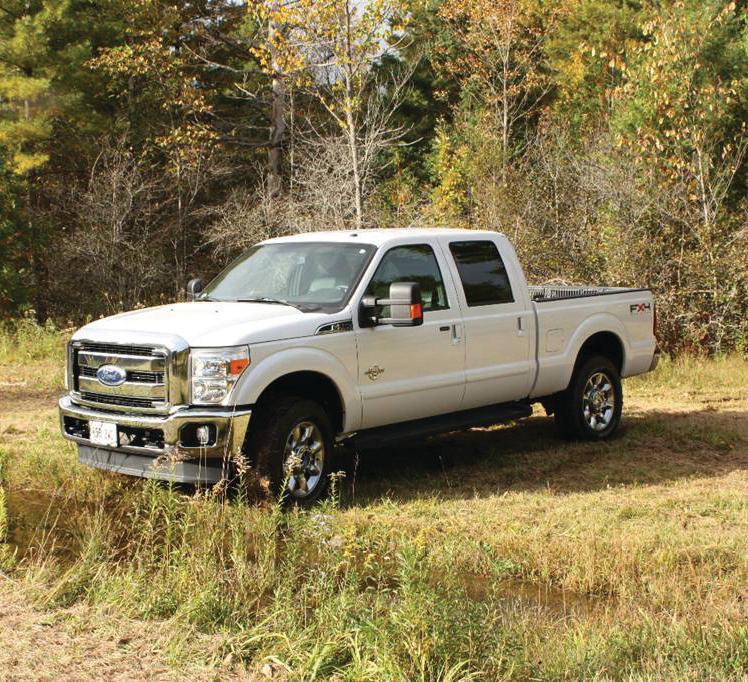
For 2011, the Canadian Truck King Challenge was a heavy duty event, taking advantage of the fact that three Detroit builders each unveiled a new Heavy Duty pickup truck in the past year; a rare occurrence. These trucks – the Chevy Silverado HD, Ford Super Duty and Ram HD – were each delivered as crew cab diesel-powered versions. The three were similar in most respects and the tests were conducted back-to-back and all on the same day. As always we tested at our private IronWood test facility near Head Lake, Ontario.
This is the fourth Canadian Truck King Challenge and, just like in other years, it rained. That seems to be the Challenge curse; each test has been rained on. So, we towed in the rain, drove off-road in the rain, and loaded and unloaded the trucks with rain running down our necks. But then this is why Truck King is as authentic as it is; we run the tests in real-life conditions.
2011 Chevy Silverado 2500
What’s new:
• All new frame is fully boxed and is five times stiffer than its predecessor.
• The brake rotors are larger, and the leaf springs are now three-inches wide.
• The front end is now adequate for all snowplowing duties (6000 lbs).
• The upgraded 6.6L Duramax V8 diesel makes 397 horsepower and 765 foot-pounds of torque.
• New limits are 17,000 lbs for conventional towing and 21,700 lbs fifth wheel towing.
• GM claims an 11 percent improvement in fuel economy.
• Payload is 4192 lbs.
• A new “smart” exhaust brake (on the diesel) is tied into the transmission downshifts via electronic sensors and the brake pedal.
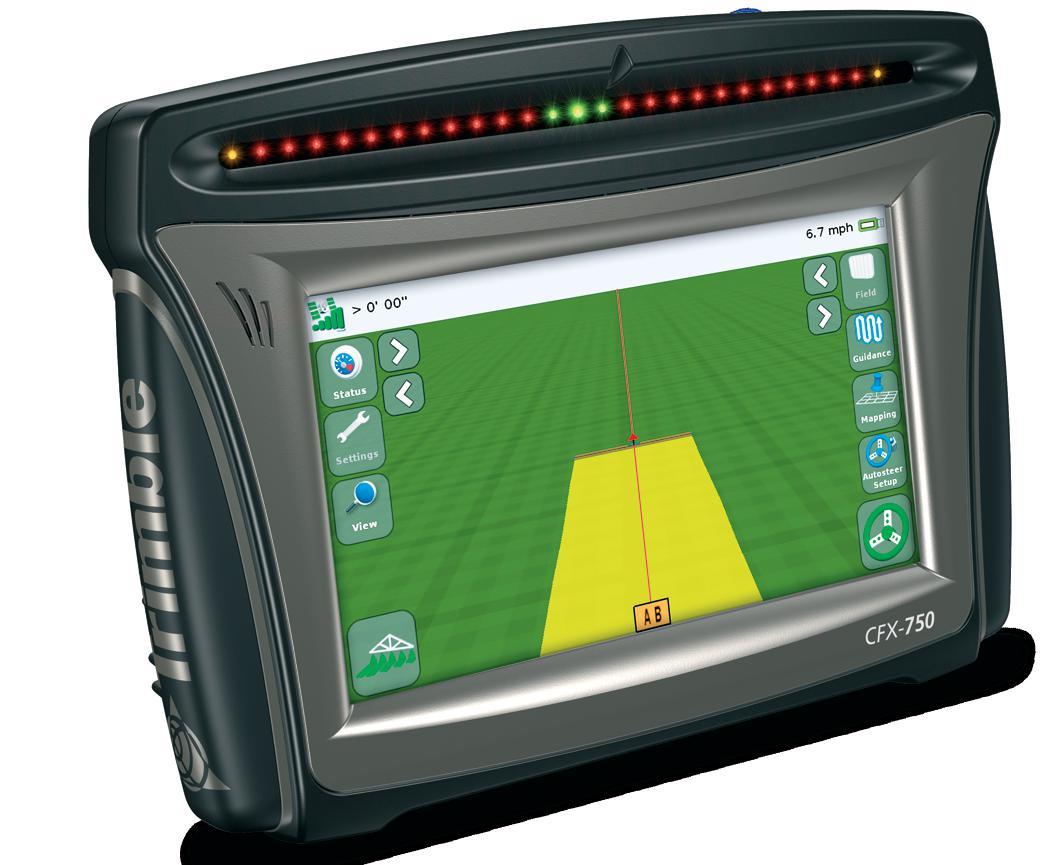
Easy GuidancE REdEfinEd
The CFX-750™ display is the newest touchscreen display from Trimble offering affordable guidance, steering and precision agriculture capabilities. Building on past successes, the CFX-750 display elevates guidance to the next level with its easy-to-use 8" color touchscreen.
Upgrade the CFX-750 display to receive GLONASS satellites and increase your satellite availability. Add the Trimble® Field-IQ™ crop input control system to provide section and rate control when planting, spraying, spreading and strip tilling. You’ll farm more precisely, more productively and more profitably.
For more information, visit www.trimble.com/agriculture or see your dealer.
• The integrated brake controller now has a trailer sway control feature.
• Hill Start Assist.
• Unaided starting (on diesel) down to -29 degrees C.
Empty test loop notes: GM has put all its R&D dollars into a great leap forward in chassis and powertrain development for the new 2011 Silverado HD. Although this is great, it also means the changes to the body and interior design are negligible. Body style-wise this means little, the outside design is still fresh, but the interior design is now the oldest and could be considered “tired.” The ride is firm and the road manners steady; steering, however, feels “heavy.” Seating is comfortable with a decent centre armrest (plus storage). I noted that the interior soundproofing has been improved. The dash is functional and remains the same as last year. The rear seats flip up for storage, but the floor is not flat (as Ford’s is).
Towing/loaded: The Duramax is a proven diesel (1.2 million built to date) that even before this upgrade had enough jam to pull up to its limit easily. Now with the stiffer chassis, towing feels more confident. The Allison transmission is smooth regardless of the amount of weight towed; frankly, it’s an excellent gearbox. It also has a manual “tap up/ tap down” shift feature along with a tow-haul setting. The smart engine brake works with the transmission to downshift and hold the load on grades, no matter how severe.
GM has deleted the four-pin electrical trailer connector from its standard hook-up – Ford and Ram have both kept them; however, it is well placed in the bumper. GM has an optional back-up camera for the lone driver hooking up a trailer. The mirrors are adequate, but could be improved.
Off-road: What GM offers for off-road traction is a neat mechanical differential locker built by Eaton. This locker has an internal spring-loaded pendulum that reacts to centrifugal force; flying out when there is wheel slippage and locking the gear set. It’s completely automatic and when engaged gives the 4WD system a goose as the back end slips. Excellent.
Conclusions: This GM Silverado HD is the best ever, but this market is highly competitive. With this effort, GM is back in the game with Ford. That was the consensus among the judges, too. We could all at least agree that both are now neck and neck in this race.
2011 Ford F350
(Note: An F250 was not available; however, with the exception of the increased load limits on the F350, this truck is identical to the threequarter-ton version.)
What’s new:
• The 6.7L Power Stroke diesel engine is designed by Ford and built by Ford; a first in all respects. Our test engine made 390 horsepower and 735 foot-pounds of torque (Note Ford upgraded its PowerStroke in August to 400 horsepower and 800 foot-pounds of torque).
• Maximum payload 6524 lbs.
• Conventional towing is 16,000 lbs and fifth-wheel towing is 24,400 lbs.
• New six-speed transmission has a manual “SelectShift” feature as well as towhaul mode.
• This powertrain combination now offers a PTO option
• Ford’s Trailer Sway Control (TSC) is added to the Super Duty lineup. TSC is integrated with AdvanceTrac with Roll Stability Control; now standard on all single rear wheel trucks.
• Hill Start Assist.
• Hill Descent Control.
• A new steering gear setup feels much more precise than its predecessor.
• Interior has been tweaked and is fresh.
Empty test loop notes: The new dash has clear large gauges and a larger centre information screen (4.2-inches) that displays info from the radio settings to the trailer connections. It’s easy to see, bright and can be used with steering wheel mounted five-way buttons.
This Ford (granted it was the one-ton) is the stiffest ever and so I found it had a tendency to skitter on the washboard during my test drive. On the other hand, the new steering is confident with good on-centre feel.
Large catch-all rubber floor mats are nice. The seating is very good, but four cupholders up front? A bit of overkill? The new engine is a torque monster, yet vibration is low, and noise is well controlled. Ford claims as much as a 20 percent improvement in fuel economy over the outgoing 6.4L. The signal stalk has been changed; it no longer “sticks” when activated, which can be slightly annoying. Several extra inches of floor space have been added to the new Super Duty Crew, most of which finds its way into the rear seat area. This makes the rear bench comfortable and with the seats folded, the large flat floor lends itself to easy loading and unloading of equipment, tools or groceries.
Towing/loaded: The Ford has powered mirrors that extend for trailer towing; these are excellent, however Ram found a simpler solution (see Ram review below). I noted that Ford’s backup camera also doubles as a convenient way to hook up a trailer alone. They also offer four- and seven-pin connectors, but they are still located below the bumper. Why? This location gathers more dirt and grime than a through-bumper installation. Ford’s tailgate step-and-handle is a nice feature that has yet to be copied by the others.
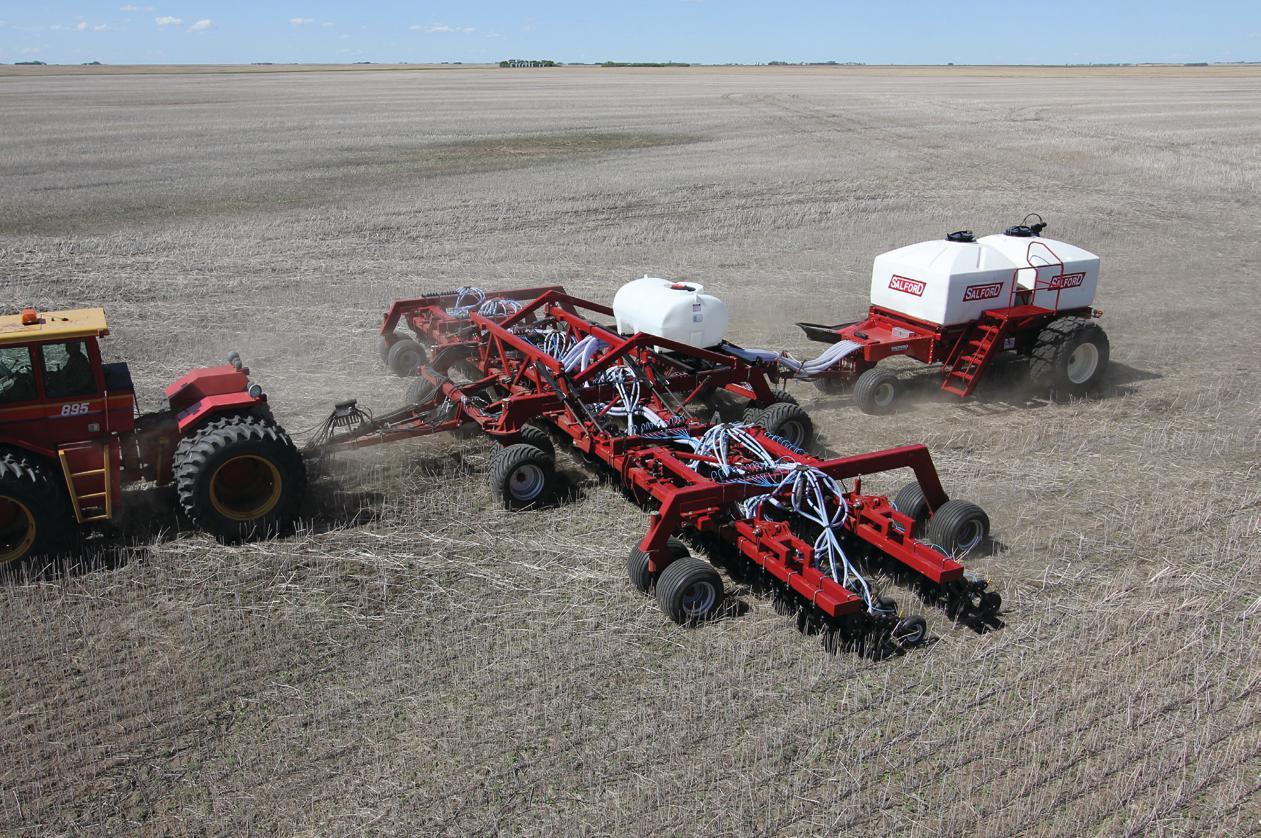
High Speed Precision Drill with Double Disc Openers
Toolbar Mounted Tanks Tr y Salford’s RTS for Seedbed Preparation and
Salford 520 seeding systems begin with precise metering and accurate placement to start your crops off right. Salford’s independent double disc openers accurately place seed from 0”-3” with tool less adjustment, and allow you to plant faster and use less seed and fuel compared with hoe drills. The 520 can be equipped with one or two twin toolbars, with each pair spaced 11” apart for maximum residue flow and less plugging in damp conditions. Single toolbars are excellent for no-till, dryland farming, or choose a variety of residue management and fertilizing options for the model 522’s second toolbar. Salford offers a seed drill to match nearly any operation; including tow-behind and tow-between air carts or mounted storage, with easy to clean poly tanks. Experience the Salford Difference.
Machinery
The new TorqShift six-speed transmission that Ford has coupled to its 6.7L Power Stroke gives me pause. Under load I had some rough up-shifts; while it didn’t happen regularly, it was noticeable. On-road, or towing, the truck oozed confidence.
Off-road: Shift on the fly controls for 4WD on the Ford work well, and they also offer a button operated electronic rear differential locker (as opposed to the automatic mechanical GM system). Ford was the only one to have manually locking front hubs. This makes it the only truck with true 4WD among our test units. Clearance was good, which contributed to the very rugged off-road performance of this truck.
Conclusions: The hood on this 2011 Super Duty, gets “power dome” and with the large Super Duty logo stamped into the upper grill the brand’s claim to being the most powerful HD out there is never in doubt. This look is polarizing; buyers love it or hate it. You decide. As for under the hood, Ford has made a huge investment in the new engine and associated systems. At first blush, this effort looks very good.
2010 Ram 2500
(Note: Although we tested the 2010 model, there are no significant changes planned for 2011.)
What’s new:
• Ram offers a Crew cab for the first time in its HD truck (the Mega Cab is also still available).
• Integrated brake controller now standard.
• The exterior and interior of this truck is completely upgraded.
• Heated steering wheel along with heated and cooled leather seating.
• Two-tone colour schemes inside and out are attractive.
• Offers HD Snow Plow Prep package (5500 lbs).
• Power adjustable pedals.
• Second row in-floor storage lockers.
• Maximum fifth wheel tow limit 18,500 lbs, conventional towing is estimated at 12,000 lbs (not listed by Ram).
• Maximum payload is 5110 lbs.
• HD Ram shifter moves to the steering column creating more useable centre console space.
• Only HD manufacturer still offering a six-speed manual transmission.
Empty test loop notes: The engine and transmission in the Ram is the veteran combination of the 6.7L Cummins turbodiesel (350 horsepower and 650 foot-pounds of torque) and six-speed automatic. This is now the lowest power output among the three: however, how much power is enough?
My test truck came with carpeted floor mats; these hold the dirt and are hard to clean. Otherwise the interior is excellent in both soft-touch materials, accents and the interior design. The drive was confident and comfortable – in fact, maybe a little “soft.”
Towing/loaded: Has the best mirrors in the bunch, they easily flip-up to resemble “west coast mirrors” of old. No power means no failures. Dodge also provides four- and seven-pin connectors in the bumper – a good protected location. My tester didn’t have a backup camera included – however one is available. Ram was first to offer a button-activated engine exhaust brake – this is still there
and works very well while towing. This feature holds the load on grades, saving the brakes. Its operation is tied in with the selectable gearing feature on the shifter handle.
Off-road: The truck has a two-speed transfer case (as do the others) for 4WD HI and 4WD LO that’s an electronic shift-on-the-fly setup. Where the Ram falls short is it lacks a rear differential locker. In effect, without one, it really is just half of a 4WD truck. Of the three it’s the most likely to get stuck. The other noticeable omission is a traction control system. This truck may spin its wheels off-road, as well as on, if over-torqued.
Conclusions: Of the three trucks, design-wise, inside and out, I liked the Ram best. However, it appears that is where the development dollars ran out. While the powertrain is decent (and proven), it is also the oldest of the three and the capacities offered are the lowest. There are also obvious omissions in the areas of traction control and electronic stability systems that both GM and Ford have.
Wrap-up
These are all excellent vehicles and the best piece of advice for anyone in the market for one of these trucks is to visit your local dealers for a test-drive and put all three through their paces. It really comes down to personal preferences. n
Howard J. Elmer is the editor of Truck King Media Group.
Since 1973, Alpine has been manufacturing the highest quality starter fertilizers available in North America. Our quality and experience have made ALPINE the #1 choice for liquid starter fertilizer in Ontario. To learn more about the most researched and proven liquid starter program available, contact your local ALPINE dealer today.
air seeders and drills – MaCHinerY ManaGer
Amity technology
Amity Technology, based in Fargo, North Dakota, manufactures air seeding equipment, including air drills and air carts, sugar beet equipment, soil samplers and crop management products.
The Single Disc Drill is the first totally new seeding concept in generations. It is extremely effective in no-till and conventional cropping systems. Its patented opposing single discs are extremely effective in high-residue field conditions, and it has mid-row fertilizer placement capability with no change to the seeding configuration. The seeding depth and down pressure can be adjusted on the go, from the tractor seat. This allows for precision depth control and seed placement.
The Air Double Disc Drill is an extremely effective minimum tillage drill with excellent seed placement at higher field speeds, and an efficient and reliable drill for a variety of crops. This proven seeding technology has been re-engineered for less maintenance and greater precision. The Air Double Disc Drill is available in 40- and 45-foot widths, with 6- or 6.75-inch row spacing.
The Air Till Drill, a single pass “direct seed” drill, is unmatched in shank seeding technology. The exclusive 5.5-inch-wide, fully pneumatic packer wheels mounted on walking beams, provide maximum seedbed utilization and more uniform packing. Nitrogen banding options allow growers to apply 100 percent of required fertilizer during seeding. The Air Till Drill is available in 40-, 50- and 60-foot widths.
Shank type Not applicable Not applicable 50 C-shank; 85 edge on
Opener type 18-in. dia. single disc 14-in. dia. double disc
Fertilizer option Mid-row option
Depth control 0- to 4-in.
Single shoot
Ribbon seed band up to 6-in.
Mid-row option
Individual row depth; ¼-in. increments 0- to 4-in.
Row spacing options 6-in./9-in. paired row 6- or 6.75-in. 10-in. or 15-in.
Packing type On-row On-row Walking tandem on-row
Packer wheel type Pneumatic Semi-pneumatic Pneumatic
Packer wheel size 26/6.50-15 3-in. wide by 14-in. dia.
Go to www.machinerymanager.ca for further specifications and links to Amity Technology.
cAse ih Air seeding equipment
Case IH Flex Hoe Series air hoe drills offer the size, configuration and precision growers need to match their operations. Choose from eight widths, a wide variety of seed and fertilizer placement options, openers, row packing, trips and shanks to match crop management preferences and specific field conditions.
The Case IH Precision Hoe 800 air hoe drill is ideal for farmers growing canola, wheat and other high-value, small-seed crops on large acreages. It delivers accurate seed and fertilizer placement and good residue flow in uneven conditions, thanks to the patented parallel link row unit and unique single-shank design. The rear-folding frame design allows working widths up to 70 feet (21.3 metres) while providing industry-leading narrow transport width and height.
26/6.50-15
For no-till operations, the Case IH Precision Disk Series single disc no-till air drills offer excellent low disturbance seeding in high residue conditions while delivering accurate depth control, consistent seed placement and low furrow sidewall compaction. They also reduce soil disturbance to minimize weeds and improve residue clearance, allowing tough corn stalks and other residue to flow through easily. Choose 30- or 40-foot (9.1- or 12.2-metre) widths and 7.5- or 10-inch (19- or 25-centimetre) row spacing.
Parallel link row units with hydraulic trip force and down pressure adj.
Double shoot sideband; ultralow disturbance, carbide tip
Fertilizer options Dry, liquid or AA
Depth control
Individual row unit adjustment, adj. 0 to 2 in.
1 x 2-in. 50 degree C-shank; 1 x 2-in. 84 degree edge-on (700 model) N/A
Wide range available, single or double shoot
Dry, liquid or AA
Each section independently hydraulic control. Single point adj.
22.5-in. diameter disc with 5-degree angle
Single shoot
0.25- to 3.5-in. in 0.25-in. increments
Row spacing options 10- or 12-in. 7.2-, 10-, 12-in., depending on model 7.5- or 10-in., plus 15-in. on Disk 40
Packing type
Packer wheel type
On-row
In-line gang or walking V
On-row and adjustable up to 2 in. to side
Pneumatic with sealant Steel V; semi-pneumatic; pneumatic Rubber/poly
Packer wheel size 4.8 x 8-in. dia.
Steel: 3.5- or 4.5-in. Rubber: 3-, 4- or 5.5-in. Pneumatic: 6.5-in. (depends on model) 1-in. x 12-in. dia.
Go to www.machinerymanager.ca for further specifications and links to Case IH
air seeders and drills – MaCHinerY ManaGer
BourgAult Air seeders And Air drills
The Bourgault lineup includes a selection of seeding systems to fit the needs of different farming systems in Western Canada. The Bourgault 3310 PHD openers feature independent depth and packing control for excellent seed depth consistency.
Bourgault has recently released the new 5810 Air Hoe Drill. The 5810 builds on the proven performance of the popular 5710 Air Hoe Drill by incorporating advancements and updates to make it the new standard for hoe drill technology. The new 5810 AHD features an innovative three-row frame layout for optimal residue flow and an optional 450 HD spring trip, and incorporates the newly designed hydraulically actuated MRB III.
The 3710 ICD is new to the Bourgault lineup. The two-row Bourgault 3710 Independent Coulter Drill is offered at 7.5-, 10-, and 12-inch spacing on 40-, 50-, and 60-foot working widths. The one-to-one Parallel Walking Coulter Arm Assembly maintains an even seeding depth in rolling land, yet minimizes the sensitivity to debris and existing furrows that other independent seeding systems experience.
Bourgault is also releasing the 8910 Series Cultivator. This tillage unit incorporates a five-row design with an optimal trip layout to maximize the clearance around the wheels for good residue flow. This versatile machine is perfect for farms that require a cultivator and a drill for seeding activities.
Bourgault Mid-Row Banders are available for each model of Bourgault’s seeding system. The MRB minimize risk to producers by achieving both seedbed integrity and fertilizer placement for the best seedling emergence possible.
Classification Independent parallel link shanks Hoe shank drill
Shank type Edge–on parallel linkage, independent shanks 1 x 2-in. C-shank or tapered 1.25 x 2-in. C-shank
Opener type Wide range of single and double shoot options
Independent parallel link coulters
Compound angle coulter, parallel linkage, independent 1 x 2-in. C-shank or tapered 1.25 x 2-in. C-shank
Wide range of single and double shoot options 20.5-in. coulter with low disturbance scraper Wide range of single and double shoot options
Fertilizer options Depends on opener. Mid-row banding available Depends on opener. Mid-row banding available Single shoot or mid-row band option Depends on opener. Mid-row banding available
Depth control
Individual 1/6-in. increments with 0- to 2.5-in. range
Row spacing options 10- or 12-in.
Single point depth control with 0- to 4.25-in. range
Individual 0.25-in. increments with 0- to 4.25-in. range
Single point depth control with 0- to 4.25-in. range
9.8- or 12.6-in. 7.5-, 10- or 12-in. 10- or 12-in.
Packing type Independent, on-row Rear mount Independent, on-row Rear mount exchangeable with harrows
Packer wheel type Pneumatic or semi- pneumatic Steel, rubber or pneumatic Pneumatic or semi- pneumatic Steel, rubber, pneumatic or plastic
Go to www.machinerymanager.ca for further specifications and links to Bourgault Industries Seeding Equipment.
horsch Anderson
Horsch Anderson, based in Andover, South Dakota, currently offers two ranges of planting systems. For more than 10 years, the proven Horsch Anderson Planting System has proven itself in cropping conditions around the globe.
Setting itself apart from other shank type drills, the Horsch Anderson Planting System uses 750-pound trip shanks, which are the heaviest in the industry, along with Anderson PPF Twin Row Openers and the Disc Leveling System for seed and fertilizer placement. The Anderson PPF Twin Row Opener pioneered seed/fertilizer placement nearly 30 years ago. It is the only opener on the market with defined and visible separation between seed and fertilizer. Fertilizer is placed two inches below the twin rows of seed and firmed with a consolidation plate.
Cart options include the i-Cart (500-bushel and 350-bushel), SW 8000 (Hillside Cart, 120 dry/900 liquid) and are ISOBUS compatible.
The new Cougar Series Planting System was introduced in 2009. Two-rank frame technology allows for excellent trash flow along with a narrow contour depth. All seed/fertilizer placement technologies on the Horsch Anderson Planting System are featured on the Cougar. Model
Classification
options
Shank type 750-lb. trip
Opener type Anderson Twin Row PPF
Fertilizer options
NH3/Dry/Liquid/or Combo
Depth control Cylinder stop
Row spacing options 15-in.; with Twin Row openers 7.5-in. to 5.5-in.
Packing type Walking tandem
Press wheel type Pneumatic
Press wheel size 7.75- x 15-in.
Go to www.machinerymanager.ca for further specifications and links to Horsch Anderson Seeding Equipment.
Model 3310 Paralink Hoe Drill 5810 Air Hoe Drill 3710 Independent Coulter Drill
Cultivator
air seeders and drills – MaCHinerY ManaGer
ezee-on seeding system
Ezee-On produces the Model 7550 in a three-section version, that utilizes single cylinder depth control to raise or lower the entire drill width. Positive mechanical depth stop segments control depth cylinder in 1/8-inch increments. The Model 7560 five-section version utilizes dual 4-inch x12-inch cylinders with hydraulic depth control.
The air drills use a 47-degree C-shank with either 350 or 500 pounds dual spring trips. Eight, 10 or 12-inch row spacing is available, and a wide variety of ground openers are available to configure the air drills for single or double shoot seeding. A choice of semi-pneumatic or rubber gang packers accommodate a variety of openers and soil types.
On the five-section drill, two 4-inch x 12-inch cylinders are used with a 5.5-inch double walled mainframe rockshaft with single-point hydraulic depth control to maintain structural integrity and ensure precise seeding depth is achieved. Flex-wing hinges are designed into all five frame sections to provide excellent ground-following ability, even in the most challenging field conditions.
The 7550 three-section air drill is suitable to small and mid-sized operation with widths from 28 to 40 feet. The five-section drill is available in widths from 48 to 60 feet.
Model
7550 3-Section
Classification Hoe
Width options
28-, 33-, 37-, and 40-ft.
Shank type 47 degree C-shank with 350- or 500-lb. dual spring trip
Opener type
Fertilizer options
Depth control
Single or double shoot options
Depends on ground opener
Single cylinder with mechanical depth stops in 1/8-in. increments
7560 5-Section
48-, 56-, or 60-ft.
Dual cylinder with hydraulic depth control
Row spacing options 8-, 10-, 12-, and 12.25-in. 10- and 12.25-in.
Packing type
Press wheel type
Press wheel size
Rear mount walking gang
Rubber or steel
Steel: 3.5- or 5-in.
Rubber: 3- or 5-in.
Packing pressure N/A
Go to www.machinerymanager.ca for further specifications and links to Ezee-On Seeding Equipment.
greAt plAins Air drills
Great Plains bolsters its lineup of high-capacity air drills with the introduction of its HD series machines. The CTA4000HD models have Heavy Duty “00” series openers that have larger diameter disc blades (15-inch instead of 13-inch), a heavier opener body, a planter style seed tube and more powerful down pressure springs. The HD models are designed to perform better and last longer in min-till to no-till environments.
For the harshest of no-till fields, the NTA models perform best. These models feature field-proven leading coulters that cut residue and fluff the ground, creating a clean, warm, mini-seedbed for the crop. The design centres on a direct link to the cart. This integral design features a semi-mounted link between the cart and implement, allowing it to rise and lower independent of the cart as it crosses undulations in the field, and also allows the machine to reverse into tight spaces more easily. Its hydraulic weight transfer system further enhances flexibility and ensures equal weight is available to all rows.
The 3N4010HDA is a versatile machine with double or triple disc technology. The 3N4010HDA provides an innovative forward-folding design that tucks behind the tractor. This implement utilizes a floating tongue and 12 degrees of wing flex up and down to follow contours and negotiate uneven terrain.
Dimpled towers on all models randomize the seed in the airflow and the transition cone at the top of the tower gently changes the seeds’ direction, sending an even proportion to every row.
disc diameter
Opener type
Fertilizer options
Depth control
Row spacing options
point ‘T’ handle, 0- to 3.5-in.
or 10-in.
Opener travel 11-in.
Press wheel type
Press wheel size
7.5-in. or 10-in.
Single or double rubber wheel(s)
Single (13-in.) or double (12-in.)
air seeders and drills – MaCHinerY ManaGer
John deere 1870 Air hoe drill
The John Deere 1870 Air Hoe Drill with the Conserva Pak hydraulic shank opener provides accurate placement of fertilizer, reduced seed, fertilizer and input costs, and consistent, uniform emergence throughout the field for higher yields.
The new Conserva Pak shanks use simple and adjustable hydraulic accumulator force for accurate fertilizer placement down to six inches deep, even in variable field conditions. There is low soil and residue disturbance with a very positive closing system by the seed opener to ensure good seed to soil contact.
Seed depth consistency is also improved on the 1870 Air Hoe Drills because the hydraulic accumulators permit separate control of down force of the fertilizer shank and the press wheel/seed opener. The Conserva Pak opener achieves consistent depth with an even amount of soil placed over the seed in a single- or paired-row setting, even in variable seeding conditions.
Another feature is that the easily adjustable openers, with independent down force can be set between 100 and 800 pounds with a trip clearance to meet seeding conditions. The adjustable breakout force is ideal for rocky conditions.
The 1870 Air Hoe Drill is available in two widths, the three-section 40-foot model, and the five-section 56-foot model. Transport width for both models is 20 feet. A rigid, three-rank frame provides strength and support for even and consistent depth and yet allows the openers to follow contours and flex with field conditions deliver the seed at the prescribed depth.
Model
Classification Independent hydraulic hoe drill
Width options 40- or 56-ft.
Shank type
Opener type
Fertilizer options
Conserva Pak independent, but linked fertilizer shank and seed opener
Single- or paired-row seed
Independent shank bands dry, liquid or anhydrous ammonia
Depth control Adjustable 0- to 3-in. seed depth
Row spacing options 12-in.
Packing type
Packer wheel type
Packer wheel size
Independent on-row
Semi-pneumatic rubber
3.5 x 16-in. dia.
Go to www.machinerymanager.ca for further specifications and links to John Deere’s 1870 Air Hoe Drill, and other seeding equipment.
K-hArt douBle disK Air drills
K-Hart Direct Seeding Double Disk Drills are one of the simplest designs in today’s market, and one of the main reasons farmers/ operators choose to purchase these drills. K-Hart disc openers work well in both loose and firm soil and can outperform other disc openers when seeding conditions are extremely wet.
Another appealing feature of the K-Hart Disk Air Drill is that it works exceptionally well in fields where combine stripper headers have been used. The frame design can be outfitted with either Model 3612 which has one articulating pivot point and two different packer design options, or Model 4612, which has a parallel link design with the deluxe packer option as standard equipment.
The flexible K-Hart disk openers can seed canola to peas and grass seed to cereals. New for 2012 are Generation II frames along with two new sizes; 74-foot and 80-foot drills, making K-Hart drills the largest disk drill on the market. Optional mid-row fertilizer coulters can be easily installed on the K-Hart frame.
Model
Model 3612
Model 4612
Classification Independent double disc Independent parallel link double disc
Width options
34-, 42-, 52-, 66-, 74-, 80-ft.
Shank type N/A
34-, 42-, 52-, 66-, 74-, 80-ft.
N/A
Opener type 16-in. double disc with 0.75-in. offset
Fertilizer options
Depth control
Single shoot, or optional mid-row band
Adjustable with 80 to 500 lbs. blade pressure
Adjustable with 75 to 600 lbs. blade pressure
Row spacing options 9-, 10- or 12-in.
Packing type
Independent, on-row
Press wheel type Rubber
Press wheel size 2 x 13 dia. in. flat; 2 x 14 dia. in. V; 23 x 13 dia in. V; 3 x 13 dia. in. centre rib.
Go to www.machinerymanager.ca for further specifications and links to K-Hart Seeding Equipment.
1870 Air Hoe Drill
air seeders and drills – MaCHinerY ManaGer
morris industries
The Morris Contour Drill has redefined the Independent Opener Drill market. It all starts with the independent contour opener that features parallel linkage for ultra-precise seed and fertilizer placement. This true one-to-one parallel linkage maintains a constant opener angle relative to the soil and constant opener depth in relation to the packer wheel throughout its 17-inch range of travel. Each opener moves independently of the frame and of others to closely follow the contours of the land. The Contour Drill delivers unsurpassed seed placement for quick, even germination and its simple, rugged design provides ease of operation and years of durability. A unique passive hydraulic accumulator system acts as a hydraulic cushion for the trips, and greatly reduces the demand on the tractor hydraulics. The single shank design has lower draft requirements than most double shoot air hoe drills and disc drills.
The Maxim II Air Hoe Drill uses a flexible frame to deliver accurate seed placement, followed by on-row packing for fast, even germination. Rear stabilizers ensure proper tracking for fully flexible front to back and side-to-side land following. A unique trip pattern on a four-row configuration provides optimum residue flow. A simple, adjustable collar depth stop on the hydraulic depth cylinders ensures exact, repeatable seed depth. Dual gauge wheels offer optimum flotation. A wide selection of trips, openers and press wheels let growers match the Maxim II to the individual’s seeding style and desired field finish.
Depends on opener. Optional angle disc fertilizer coulter for mid-row banding.
Adjustable collar depth on hydraulic cylinders
7.5-, 10- or 12-in.
Rear mount gang, on-row
Steel or rubber
3.5- or 4.5-in.
Go to www.machinerymanager.ca for further specifications and links to Morris Industries air drills.
new hollAnd seeding systems
The New Holland lineup includes the hoe shank drills Models P2050 and P2060, along with the new independent, parallel linkage hoe drill, the P2070. With durability and innovation reflective of its Flexi-Coil heritage, New Holland’s P2070 precision air hoe drill provides precision seed placement with adjustable individual opener depth control.
Each opener on the P2070 follows terrain independently of the frame, closely following the contours of the ground. Patented individual opener depth control provides zero- to two-inch seeding depth in 1/8-inch increments. A single bolt on each opener has an indexed slotted design that makes it easy to adjust depth.
Even in the toughest conditions, the true parallel link design maintains consistent seed depth through the complete operating range of each individual opener. Fully adjustable trip force (adjustable from 275 to 550 pounds) and packing force (adjustable from 135 to 215 pounds) provide operators with exceptional control. The single shank, double shoot minimum disturbance opener provides 1-7/8-inch lateral separation and 7/8-inch vertical separation between seed and fertilizer.
The P2070 air hoe drill’s innovative fold-back design allows it to be folded into a 18-foot, four-inch wide x 16-foot, six-inch high envelope equal to or smaller than the 4WD tractor pulling it, for safe and easy transport. A unique tow-behind hitch design allows the air cart to follow the same tracks created by a 4WD tractor in the field and during transport. This smaller turning radius makes tight-implement turns at headland corners easier. Model
Classification Hoe shank drill
Hoe shank drill
Independent parallel linkage
Width options 27-, 28-, 33-, 34-, 39-, 46-, 52-, and 58-ft. 60- and 70-ft. 50-, 60-, and 70-ft.
Shank type
Opener type
Fertilizer options
Depth control
C-shank; 350 or 550 lbs. trip pressure
Wide range of single, double shoot and paired-row
Inter-row band optional
Single point depth control
Row spacing options 7.2-, 10- and 12-in.
Conventional C or edge-on; 350 or 550 lbs. trip pressure
Wide range of single, double shoot and paired-row
Depends on opener
Single point depth control
Independent opener depth control with dual pivot arm
Double shoot, side band (1 7/8-in. lateral and 7/8-in. vertical)
Single or double shoot
Individual opener adjustable 0- to 2-in. depth in 1/8-in. increments
7.5-, 10- or 12-in. 10-in. or 12-in.
Packing type Rear mount gang on-row Rear mount on-row in-line gang, or walking beam On-row
Packer wheel type
Packer wheel size
Steel or rubber Steel, rubber or pneumatic Rubber
Steel: 3.5- or 4.5-in. x 22-in. dia.; Rubber: 3-, 4- or 5-in. x 22-in. dia.
Steel: 3.5- or 4.5-in. x 22-in. dia.; Rubber: 3-, 4- or 5-in. x 22-in. dia.; Pneumatic: 5.9- or 6.5-in. wide
Go to www.machinerymanager.ca for further specifications and links to New Holland air drills.
Smooth profile 4.8 x 8-in.
air seeders and drills – MaCHinerY ManaGer
sAlford Air seeder And disc drill
Salford Farm Machineries’ air seeders, drills and air carts offer growers the versatility and durability to perform well in no-till, conservation tillage or fully conventional seeding operations.
The Salford disc drill’s “twin toolbar” design sets it apart from other brands providing 11-inch spacing, front to back between row units, for maximum residue flow. The row unit features an offset double disc with up to 500 pounds of down pressure. Depth control settings are in 0.25-in. increments.
A second twin toolbar can be added to mount coulters or shanks. Coulters on the secondary bar provide additional residue management, and can also function as fertilizer incorporation units. The second toolbar can also be fitted with shanks to apply high rates of fertilizer between seed rows, saving time with a one-pass seeding and fertilizing operation. Toolbars are hydraulically raised to quickly adapt to a wide variety of applications.
The peg roller meter accurately delivers both seed and fertilizer without requiring that the meter cartridge be changed. The Zero Max transmission provides exceptional control, and hydraulic variable rate drive is optional.
Salford offers commodity tanks mounted on the seeder frame, or tow-behind, tow-between and three-point hitch options. Single, twin or triple tank air carts are available with capacities between 110 and 505 bushels. These high-capacity, easy-to-clean, commodity tanks minimize fill-up stops and product change times, allowing growers to cover more acres with less support.
Model Air Seeder Double Disc Drill
Classification Air seeder hoe drill
Width options 31.5-, 40-, 52-, and 62-ft.
Frame type
Shank type
Opener type
Fertilizer options
Depth control
3-section floating hitch
Double disc drill
15-, 20-, 22-, 25-, 30-, 35-, 40-, and 55-ft.
Double toolbar
Heavy duty C-shank 47-degree N/A
Variety of choices
Double shoot; banding with shanks
Single point in 0.25-in. increments.
Row spacing options 9.5-in.
Packing type
Pivoting on row
Double disc, optional front coulter
Single shoot; banding with optional coulter or shanks
Independent with 25 to 125lbs. down pressure or optional 90 to 500 lbs. HD opener
6-, 7.5-, 10-, 15-, or 20-in.
Pivoting on row
Packer wheel type Rubber Rubber
Packer wheel size
3- or 6- in.
3-, 4- or 6-in.
Go to www.machinerymanager.ca for further specifications and links to Salford air seeders and air drills.
seed hAwK seeding system
Seed Hawk’s precision seed and fertilizer placement uses a dual knife side-banding system to overcome problems found with other single knife side-band and inter-row banding systems: fertilizer too close or too far away from the seed.
Seed Hawk toolbars are built strong enough to be 85 feet wide and still tough enough to pull an 800-bushel tank. Built to last, Seed Hawk toolbars are backed by an industry-leading five-year warranty.
The Twin Wing seed knife allows higher seedbed utilization on wider row spacing, improved trash clearance and more primary heads in cereals. It follows behind the fertilizer knife, and cuts a shelf, placing seed on undisturbed ground in two rows 3/4-inch above and 1.5 inches to each side of the fertilizer band.
The original Seed Hawk single sideband seed knife delivers precise, accurate seed and fertilizer placement. The dual knife system cuts a separate trench for the seed as well as the fertilizer, protecting and ensuring the seed is placed on undisturbed soil, accurately placing fertilizer 3/4-inch deeper and 1.5 inches to the side of the single seed row.
Seed Hawk’s Seed Between the Row (SBR) technology senses last year’s stubble and keeps the openers between the rows and it is available on all sizes and spacings of drills.
Seed Hawk’s Sectional Control technology (SCT) is an innovative way to eliminate overlaps and save on input costs. It works in conjunction with GPS and auto-steer to lift openers when seeded ground is encountered, and shuts down metering of seed and fertilizer, reducing ground disturbance and input doubling. Classification
Width options 20-, 30-, 40-, 45-, 50-, 55-, 60-, 65-, 72-, 80-, and 85-ft. depending on row spacing. 30-, 40- and 50-ft. width toolbars are available in the 45 series. The 45 series folds up to 15-ft. high by 15-ft. wide
Shank type
Opener type
Fertilizer options
Depth control
Independent hydraulic with separate seed and fertilizer placement
Twin wing paired row, or single sideband seed knife
Narrow, carbide-tipped banding knife
Independent fertilizer and seed placement on each opener
Row spacing options 10-, 12- or 15-in.
Packing type
Press wheel type
Press wheel size
Independent on-row
Pneumatic 4-ply with tube or semi-pneumatic
N/A
Go to www.machinerymanager.ca for further specifications and links to Seed Hawk Seeding Equipment.
air seeders and drills – MaCHinerY ManaGer
seedmAster
SeedMaster drills provide ultra-precise seed placement with their patented two-knife opener system. SeedMaster manufactures a range of frame sizes to suit any farm, large or small.
The heart of the SeedMaster drill is the patented terrain-following opener, providing industry leading seed and fertilizer placement. Hydraulic cylinders place down pressure on the packer tires, ensuring both seed and fertilizer are placed at a uniform, pre-set depth for the entire field. Adding to the precision is the short distance between the seed knife and packer tire. The opener design results in increased cost efficiency on crop inputs, fuel and operator time.
Farmers now demand excellence from their seeding systems, not only in precise seed and fertilizer placement, but also in precise and efficient product metering. SeedMaster provides many options for seed and fertilizer metering, unrivalled in the industry for both capacity and precision. SafeSeed Individual Row Metering and UltraPro Metering provide farmers with peace of mind and unparallelled metering precision. Models ranging from 200 bushels to 920 bushels match up with any farm size.
Farmers can also achieve significant savings by purchasing an unassembled drill to assemble on the farm. Sales of unassembled drills in Canada have increased from under five percent to more than 30 percent.
SeedMaster widths range from eight-foot wide plot seeders to 90-foot-wide drills, with a wide range of seed and fertilizer options. They also make a Compact-in-Transport (CT) line, which is available in widths up to 80 feet, and folds to 18 feet wide in transport. The CT models have quickly become the company’s most popular.
Width options
8-ft. through 90-ft.
Shank type Independent hydraulic with separate seed and fertilizer placement
Opener type
Independent but linked narrow carbide shank seed and fertilizer openers
Fertilizer options Fertilizer banded 1.5 in. to the side and 0.75 in. below the seed – any combination of granular, liquid or NH3
Depth control Independent depth control on each opener
Row spacing options
Packing type
Packer wheel type
Packer wheel size
10-, 12- and 14-in.
Independent, on-row
Tire-in-Tire (optional) and pneumatic (standard)
N/A
Go to www.machinerymanager.ca for further specifications and links to SeedMaster Seeding Equipment.
sunflower 9230 series
The 9230 Series air drills are part of the larger Sunflower 9000 Series that offers 10 models to fit growers needs from seven to 40 feet to fit growers’ needs. All models feature the all-purpose planter style row units and low-maintenance drive systems. The Sunflower 9000 Series drills are also known for their exclusive soil control devices and easy changes from no-till to conventional in minutes. Narrow transport folding models are available in the series.
The all-purpose double disc openers are staggered a full eight inches to provide plenty of clearance of stover and crop residues to pass through easily and not gather within the openers and cause clogging. With more than nine inches of vertical travel and up to 400 pounds of down pressure, the openers stay in contact with the soil in even the most severe undulating conditions.
The Sunflower 9000 Series air drill line combines large tank capacity with the industry’s most proven all-purpose Heads Up opener. Built to high Sunflower standards, the 9000 series seeding unit is designed to handle conventional, minimum-till, and the toughest no-till situations with a minimum of machine changes.
Model
Classification
Width options
Shank type
Opener type
Fertilizer options
Depth control
9230-30
Parallel link double disc
9230-40
Heads Up parallel link 15-in. diameter double disc
Single shoot
0.25-inch depth adjustments with up to 410 lbs. pressure at opener blade
Row Spacing 7.5- or 10-in.
Packer type
Packer wheel type
Packer wheel size
Independent, on-row
Swivel type; rubber
2 x 13-in. dia smooth or V; 3 x 13-in. dia. centre rib; 3 x 13-in. dia. double rib; 4 x 12-in. dia. double rib.
Go to www.machinerymanager.ca for further specifications and links to Sunflower Manufacturing.
THE CLEAR CHOICE FOR TOUGH WEEDS.
INCLUDING EASTERN BLACK NIGHTSHADE.
Fight tough soybean weeds with Valtera™ Herbicide. Valtera provides excellent residual control against tough weeds such as Eastern black nightshade and even weeds resistant to Group 2 and Group 5 herbicides. And with great rotational flexibility, there are no rotational restrictions or carryover into next year’s crop.
Battle-readYbeans
Whether it’s the weather or the latest pest or disease threat, Ontario fields can be a challenging environment for growing soybeans. But Pioneer® brand Y Series soybeans have proven they’re battle-ready.
Undoubtedly, that’s why our competitors set their sights on Pioneer varieties. And why Pioneer Y Series soybeans continue to gain new growers every year.
Talk to your Pioneer sales representative about a soybean variety recommendation for your fields.