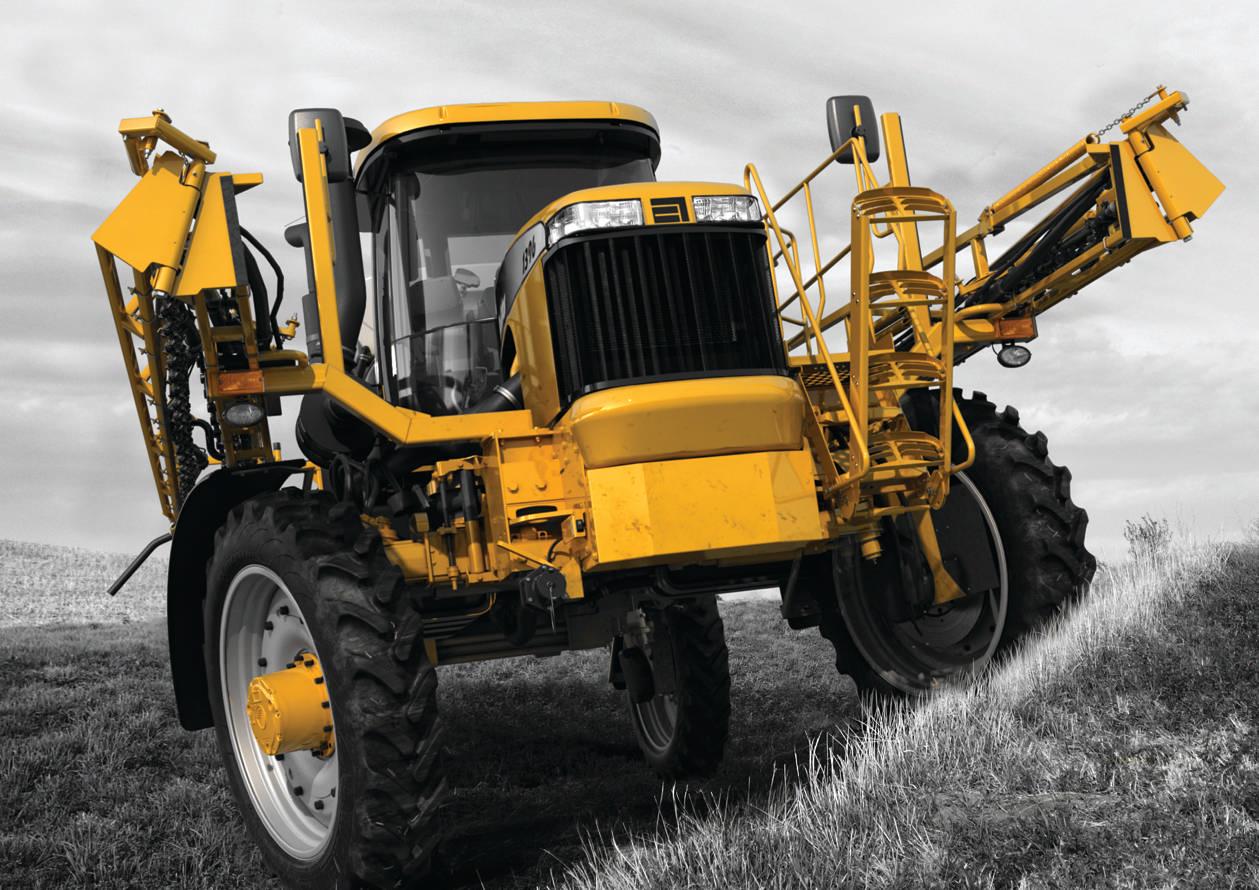
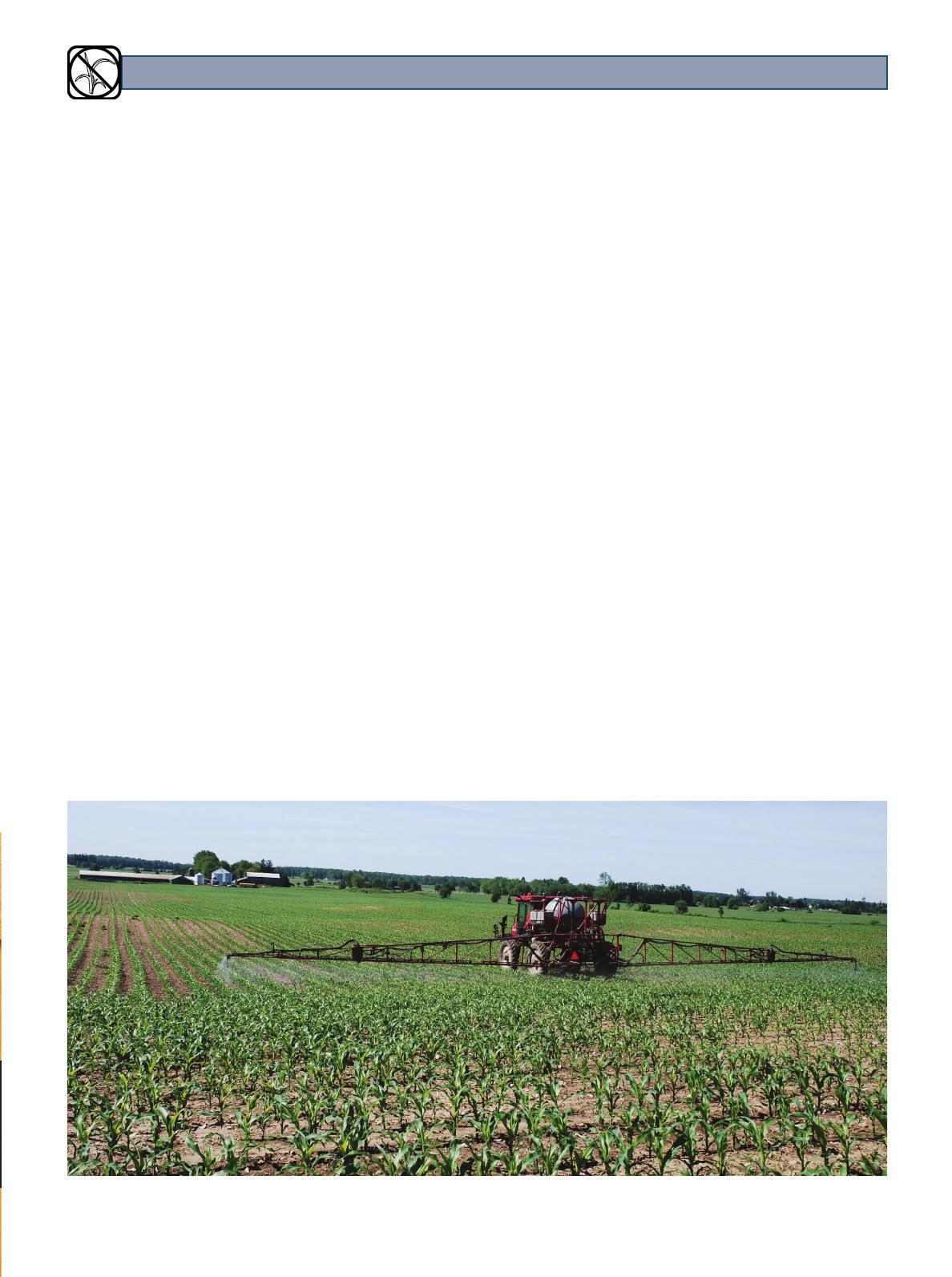
The beast was already the best. But we gave the RoGator huge upgrades to make it even better. Its new wheel motor package gives you even greater reliability with the same legendary performance. A 4-wheel steering option spins you around with an unprecedented 13.5-foot turning radius. Regardless of product inconsistencies, the exclusive AirMAX system gives you precise application. The beast has gotten so much better...it’s getting kinda scary. Find out more at www.rogator.com
Soybean Focus
The month on the cover is different, but the lineup in our Soybean Focus is as solid as ever, including a management update on soybean cyst nematode from Eastern Field Editor, Dr. Heather Hager.
Soybean Inoculant Supplement
A welcome addition to this new December issue is a special supplement from Becker Underwood, featuring a selection of stories geared to fertility and nutrients, as well as plant breeding and crop management.
Machinery Manager: High-Clearance Sprayers
Another year and another edition of our Machinery Manager, offering more information and more value, with more designs of high-clearance sprayers.
Reference information of this calibre is hard to find, so many growers choose to keep Top Crop Manager issues on file. If you have not kept issues for your library, you can find our stories, and more, on our interactive website.
Kevin Yaworsky • 403.304.9822 kyaworsky@annexweb.com
EASTERN SALES MANAGER
steve McCabe • 519.400.0332 smccabe@annexweb.com
SALES ASSISTANT
Mary burnie • 519.429.5175
888-599-2228 ext. 234 mburnie@annexweb.com
PRODUCTION ARTIST
Gerry Wiebe
GROUP PUBLISHER
Diane Kleer dkleer@annexweb.com
PRESIDENT
Michael Fredericks mfredericks@annexweb.com
PUbLICATION MAIL AGREEMENT #40065710
RETURN UNDELIVERAbLE CANADIAN
ADDREssEs TO CIRCULATION DEPT.
P.O. bOx 530, sIMCOE, ON N3Y 4N5
e-mail: mweiler@annexweb.com
Printed in Canada IssN 1717-452x
CIRCULATION
e-mail: mweiler@annexweb.com
Tel.: 866.790.6070 ext. 211 Fax: 877.624.1940
Mail: P.O. box 530, simcoe, ON N3Y 4N5
SUBSCRIPTION RATES
Top Crop Manager West - 8 issuesFebruary, March, Mid-March, April, June, October, November and December - 1 Year - $50.00 Cdn.
Top Crop Manager East - 8 issues -January, February, March, April, August, October , November and December - 1 Year - $50.00 Cdn.
specialty Edition - Potatoes in CanadaFebruary - 1 Year - $9.00 Cdn.
All of the above - $80.00 Cdn. Occasionally, Top Crop Manager will mail information on behalf of industry-related groups whose products and
Peace on Earth, good trading for all?
Another month, another spin on world events. Oh yes, and another Christmas season upon us!
In last month’s edition of Top Crop Manager, I wrote about doing business with countries such as China and India, and because they are in the market for products that our growers can readily supply, why it wouldn’t be the worst idea to be doing business with them.
Recently, a local talk show host suggested the US government simply opt out of paying its interest to China on its current holdings of US treasuries. China might react by threatening to take over Taiwan, but the US might just say, “Go ahead.”
The point was that the US has much to gain and little to lose by simply withdrawing from the world financial stage. Ultimately, the US, despite a debt load forecast to top $10 trillion within nine years, is still one of the world’s leading economies. Yet the question remains: “What if the US decided to trade more within the confines of the Americas?” Could the US manage? The talk show host certainly believed it could, drawing on the raw materials still to be mined from within its borders (including drilling oil from nature reserves in Alaska).
How would that sit with the European Union, Russia, India and, yes, China, too?
I don’t know, but it got me thinking about our role in this “New World Order.” I have said often that Canadian agriculture is on the brink of a new era, in which growers see better returns for their labours and expertise. But I do not see how our growers would benefit from the creation of a USdominated “Market of the Americas.” Japan favours our IP soybeans while India wants our pulses, plus a variety of customers in Europe. Do we turn down business around the world just because the US Treasury is holding a fire sale?
Besides, there will be a day of reckoning for China that will slow its expansion from monopolizing global
trade. In the 1990s, the country’s population pyramid, already influenced by its “one child policy,” fell under the level of replacement (where one person retires, another person steps in to replace them). One Chinese economist has said that the government is unprepared, culturally, for what must happen within the next 20 years, when it will have to “play nice” in global trade while making people one of its most vital imports.
And let’s not forget the prospect and implications of a trade agreement between Canada and the European Union.
Where is all this leading? To a world where everybody has to “get along” and stop believing in the myth of solitary sustainability. We’ve done this in Canada, although our farmers have had to go it alone more because of government policy and public apathy. Yet along the way, we’ve managed to cope, compete and in many cases, dominate a sector.
In the end, we’ve shown how “getting along” in the global village is not only possible, but preferable.
A wintertime glance ahead
It is odd that with winter’s onset, we are looking to spring, already. Yet this month’s Machinery Manager offers up a glimpse of the latest in high-clearance sprayers, plus a wealth of informative stories on crop management and business management.
All the best, this holiday season: a Merry Christmas and a Happy New Year.
Ralph Pearce Editor
Getupandrunning
Young farmers are important to the future of agriculture – so is having the right financing The Transition Loan lets you start with as low as zero down Interest is charged only on the disbursed amount so you can build equity quickly or manage your cash flow –the choice is yours.
To find out more about the Transition Loan, call your nearest FCC office at 1-800-387-3232.
www.fcc.ca
Pests and dIseases
Soybean cyst nematode: colonizing new frontiers
Manitoba and Quebec means that more growers should be sampling their soil.
It could be lurking in a nearby field, producing no obvious visible symptoms but decreasing soybean yield by 30 percent or more. Soybean cyst nematode (SCN) management is practically cost-free and can yield bushels in rewards. However, growers continue to be caught off guard as this soildwelling plant parasite spreads to new fields, both within and outside southern Ontario. “It’s just a matter of time until it’s detected both in Quebec and Manitoba,” says Albert Tenuta, plant pathologist with the Ontario Ministry of Agriculture, Food and Rural Affairs (OMAFRA).
In fact, the Canadian Food Inspection Agency (CFIA) found a viable cyst in soil sampled from the central agricultural region of Manitoba in fall 2009,
confirms Lois McLean, plant protection specialist with the CFIA. However, SCN was not detected in spring 2010 followup samples from that field.
By the time SCN gets to the point that it produces visible damage, its population numbers can be so high that it takes years of careful management to bring them back down to reasonable levels, says Tenuta. By then, the grower has already experienced “many years of yield losses due to it,” he says. “We want to avoid, in these new areas, some of the problems that we encountered in southwestern Ontario,” he explains. “The important thing is for growers to manage it now and detect it while the levels are very low, because at that stage, the nematode populations are much easier to manage than if we had to go through those very high levels that we had seen in southwestern Ontario, which took many, many years to manage.”
That is why Tenuta is participating
in a large-scale, international outreach program to improve SCN awareness and management. Begun in 2008, the project involves research and extension personnel and soybean growers from Ontario and 12 north-central US states and is supported by OMAFRA, Agriculture and Agri-Food Canada (AAFC), Grain Farmers of Ontario and the Agricultural Adaptation Council through Canada’s Growing Forward initiative, the US North Central Soybean Research Program, and 12 US land-grant universities. Extension personnel are working with growers at two or three locations known to have SCN in Ontario and each of the 12 states each year. They are using strip trials to compare yield from susceptible and resistant commercial soybean varieties, count SCN population numbers, and look at how well the SCN populations can develop on the resistance sources.
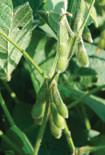
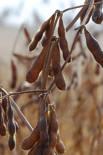
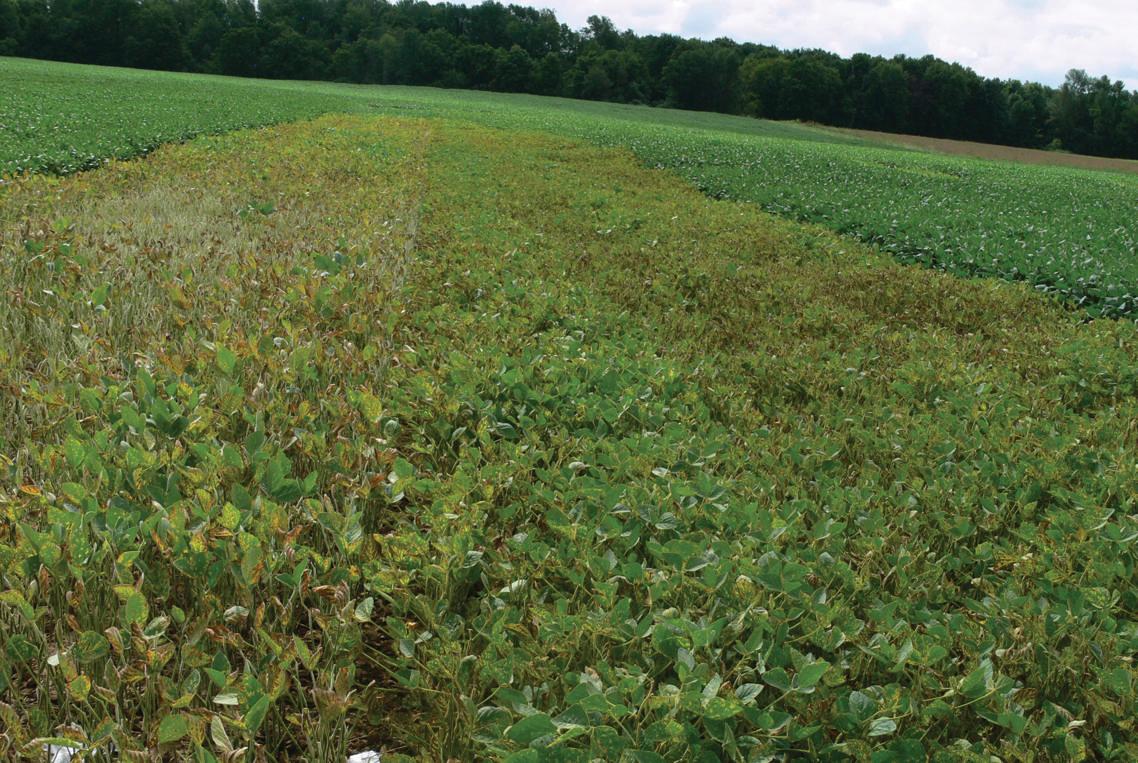
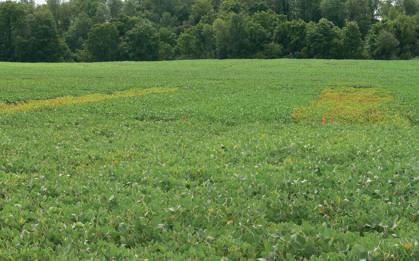
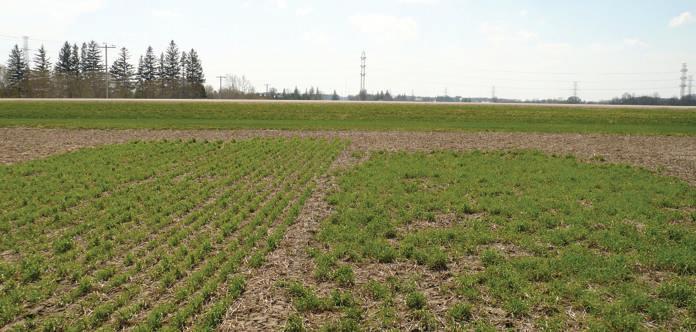
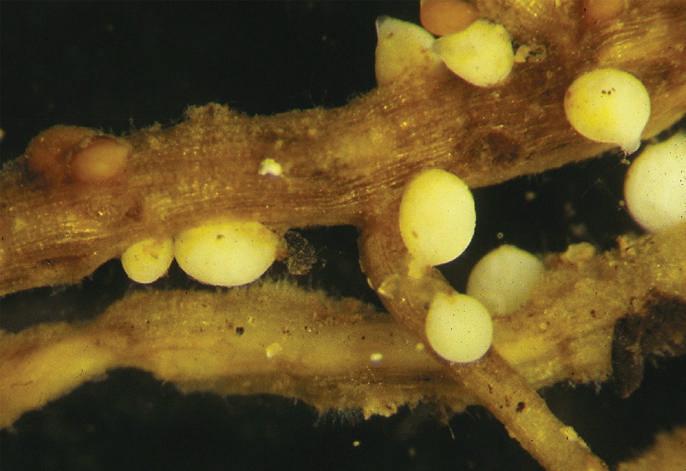
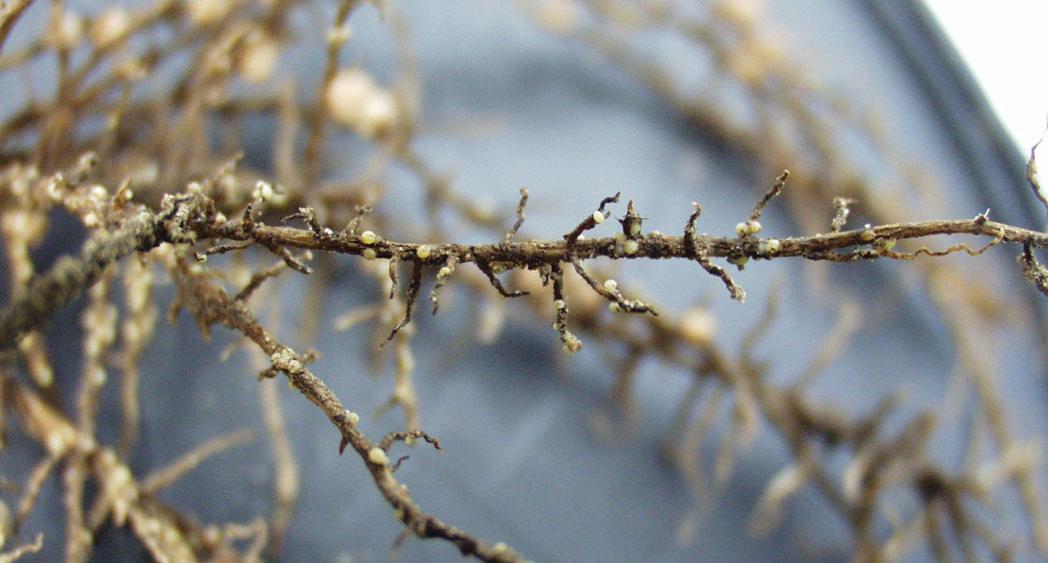
SCN-susceptible soybean varieties often do not show symptoms of infection until the plants are stressed or SCN populations are very high. All photos courtesy of Albert tenutA, oMAfrA
Pests and dIseases
Substantial yield losses
In preliminary results from the Ontario strip trials, the resistant varieties outyielded the susceptible varieties by 53, 49, 45 and 20 percent at two locations near Highgate (Municipality of Chatham-Kent) and two near Leamington (Essex County) in 2008 and 2009. Soil tests indicated that the locations used in 2008 had more than 3000 SCN eggs per 100 cubic centimetres of soil, which was considered a high SCN density. In absolute numbers, yield loss from using a susceptible variety in these four fields ranged from about 9.8 to 33.9 bushels per acre.
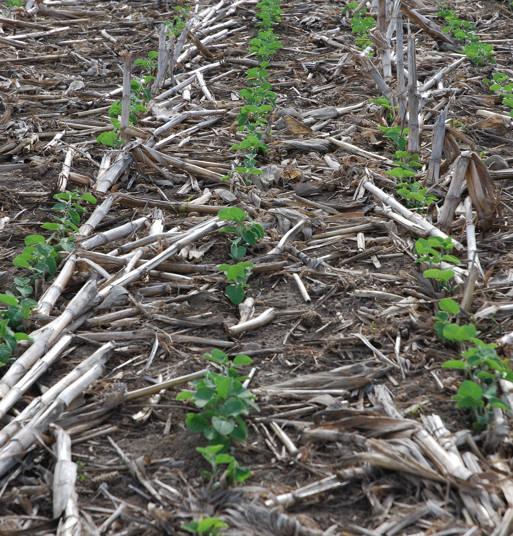
Notable differences between SCN-susceptible and SCN-resistant soybean varieties appear in these Ontario strip trials. The susceptible varieties appear yellow and unhealthy.
Even at locations with lower SCN egg densities, susceptible soybean varieties are at risk of significant yield loss, particularly in years when the plants are stressed, for example, by drought, says Dr. Loren Giesler, plant pathologist at the University of Nebraska-Lincoln and one of the project’s co-leaders. “Also, in the years when they don’t have any moisture stress, and this applies across the whole region and Ontario as well, you get really wet years and great bean growing conditions, and people would say: ‘I put a resistant bean out but there’s no difference in yield’. But if they look at the SCN population, it’s just growing exponentially during those really good production years,” he says.
That increase in SCN numbers means that a field could go from having a low risk of yield loss to having a high risk of substantial yield loss. Tenuta says, “Where we had the susceptible variety in one rotation, we’ve increased SCN populations three-, four-, five-fold, or more; 20-fold in some cases. You can go from 1000 eggs up to 20,000 eggs pretty easily.”
What is an HG type?
Soybean cyst nematode (SCN) populations used to be classified into races. Each race number indicated a combination of four resistant soybean lines on which a given SCN population could reproduce well. However, because of biological and practical problems with the race scheme, SCN populations are now classified into HG types (HG simply stands for Heterodera glycines, the Latin name for SCN).
To determine the HG type, an SCN population from a soil sample is grown on a susceptible “check” variety and seven resistant plant introduction (PI) lines. These seven PI lines represent the possible sources of resistance that can be used in commercial soybean varieties. If the SCN population reproduces well on a resistant PI line, determined by comparing its reproduction to that on the check variety, it is assigned that corresponding HG type. For example, HG type 1 develops well on the Peking source of resistance (PI 548402), HG type 2 on PI 88788, HG type 4 on Hartwig (PI 437654), and so on. Thus, an SCN population that is HG type 1.2 develops well on both Peking and PI 88788 sources of resistance. HG type 0 does not develop well on any of the resistance sources.
HG-type testing is very time intensive, so some laboratories will just test the PIs that are used as resistance sources in commercially available soybean varieties, explains Tom Welacky, who does HG-type testing at Agriculture and Agri-Food Canada (AAFC)’s Harrow, Ontario, location. HG-type tests show that some SCN populations are overcoming specific resistance sources, and Welacky hopes that information will encourage soybean breeders to keep working on introducing new sources of resistance into commercial varieties to give growers more planting options.
Evidence that SCN is overcoming some resistance sources also reinforces the need for growers to rotate among soybean varieties with different sources of resistance, says Dr. Loren Giesler, plant pathologist at the University of Nebraska-Lincoln. However, he cautions growers not to plant a resistant variety unless they know SCN is present. “That’s what happened elsewhere in the United States. Some growers
did that and just forgot about checking populations, and now a very high percentage of those populations can reproduce on the common resistance sources. It’s much more difficult to manage that situation.”
An HG type test is not necessary to determine if SCN is present; a relatively quick and inexpensive numbers test can be done at one of several public and private diagnostics labs in Ontario. “From a practical, applied point of view, the first thing you need to know is what the population is. Is it 100, 1000, or 10,000 eggs per 100 grams of soil? Is it a low, moderate, or high population?” says Welacky. “They need to know right away for management purposes, and then start using the two basic tools for management, which are resistant varieties and rotation. That’s key to being able to suppress the population and make sure it doesn’t get out of control.”
Once growers have been rotating resistant varieties for several years, they may want to start monitoring HG types, he adds.
Ontario currently does not have the capacity to process HG-type tests for all growers in a timely manner, however. So the SCN research program targets a few specific elements to get some good, general background information “so that we have a benchmark from year to year,” explains Albert Tenuta, field plant pathologist with the Ontario Ministry of Agriculture, Food and Rural Affairs. The sampling includes a representative selection of fields, as well as samples from growers who are interested in monitoring their HG types, new locations at the periphery of the current SCN range, and fields that are “suspect,” i.e., where resistant varieties have been planted for several years but are not performing as well as they should or are showing symptoms of SCN infection.
“We’re fortunate to have Tom’s lab there that can help us track changes in SCN populations,” says Tenuta. “In the United States, they have private labs that do HG testing, as well as the state diagnostic labs. But in Ontario, we’re limited right now with only the AAFC research station at Harrow doing HG testing.”
Pests and dIseases
“So it’s a long-term commitment and a never-ending battle against SCN,” he emphasizes.
SCN can overcome resistance
Like any pest-control technology, SCNresistant soybean varieties can lose their effectiveness after repeated exposure of the pathogen to the same source of resistance. Because it is difficult to get SCN resistance into soybeans without losing agronomic performance, current soybean varieties generally have resistance from only one of three sources, or plant introductions (PIs): Peking (PI 548402), PI 88788, or Hartwig (PI 437654). Currently, only varieties with Peking and PI 88788 sources of resistance are adapted for Ontario growing regions. So, a major component of the outreach program, as well as Tom Welacky’s SCN research program at AAFC in Harrow, Ontario, is to see how much SCN populations can change over a single growing season in terms of their ability to reproduce on resistant varieties.
One intention is to determine how fast shifts can occur in SCN populations. “Everybody is financially driven,” says Giesler, “So if you get a variety that looks really great and has yielded well, you tend to not think about the SCN population, and that, long term, leads to problems.”
For example, SCN populations are already able to reproduce well on the PI 88788 resistance source in many fields across the north-central US region.
Rotation is key to keeping SCN numbers down and prolonging the efficacy of resistance. In addition to rotating soybeans with non-host crops for SCN, growers should be sure to rotate the resistant soybean varieties that they plant to minimize repeated use of the same resistance. Even rotating among varieties that have the PI 88788 source of resistance, for example, can be helpful because multiple genes contribute to resistance, and each variety could have a different complement of those genes, says Welacky, who has been mapping SCN populations in southwestern Ontario for several years.
Another reason for looking at SCN population changes is for future industry planning. All three experts say that it will give an idea of how durable the current resistance is and will provide data to encourage the soybean industry to develop varieties that have new sources of resistance. A number of PIs
The results of strip trials near Highgate, Ontario, show substantial yield loss from SCN-susceptible soybean varieties in a field known to have the nematode.
with SCN resistance have been recognized, although not all have been incorporated into commercial varieties.
How often to test soil
To determine whether management is needed, all soybean growers in regions that have the potential for SCN should be having their soil tested for SCN. Giesler stresses that it is not necessary to test every year; he encourages the growers he works with in Nebraska to test once every five or six years to see if SCN has arrived and get an estimate of the population size.
Tenuta suggests testing once every three to six years, particularly to follow changes in known SCN populations. “If you’re on a two-crop rotation, just corn and soybeans, then you’d be looking at maybe every four years. If you’re on a corn, soybeans and wheat rotation, then you probably would do that every six years. One of the keys is, the more frequently you sample, the more likely you are to catch the changes as they’re developing.”
However, the fact that there are still growers who have no idea whether they have SCN or not continues to astound extension personnel. “Most of the growers in southwestern Ontario have dealt with SCN,” says Tenuta. “But there’s still surprise that every year, we get some growers that aren’t quite aware of the full extent of the injury that can occur with SCN. When we’re on a farm and show them, they are surprised that they did have cysts because they thought they shouldn’t. But the nematode knows no boundaries and doesn’t respect their opinion.”
Rather than digging and examining soybean roots for cysts, Giesler recommends having the soil tested because he thinks this method is more reliable.
Even in fields with known SCN, Giesler says it can be difficult to find SCN on roots. For growers who have never sampled for SCN before, he says, “Target some sampling around the entryways, low spots and areas where it floods, or places where soil moves into the field. And then go from there. If they get a negative, they don’t worry about it; come back five or six years later and check it again.”
Tenuta says that looking at soybean roots for cysts can be informative as long as growers examine multiple plants from a number of areas in the field, particularly if aboveground symptoms are evident. He says it can be a helpful diagnostic tool, but growers should not rely on that method alone for determining the field’s SCN status. Welacky and Tenuta recommend having the soil tested every three years or so in regions of Ontario with known SCN problems. For help with soil sampling and information about where to send samples, growers can consult their local extension personnel (e.g., OMAFRA), company agronomy representative or the comprehensive Soybean Cyst Nematode Management Guide, Fifth Edition, available from the Plant Health Initiative of the North Central Soybean Research Program (see below for further resources).
“I really think there’s such a need for awareness,” says Giesler. “Just that growers are paying attention and are checking for SCN. If we could somehow get that message out and producers would do that, I just think it would make them so much money and save them so much over the long run that it would be so worthwhile.” n
• SCN Management Guide, Fifth Edition: www.planthealth.info/ pdf_docs/SCNGuide_5thEd. pdf
• Plant Health Initiative website: www.planthealth.info
• OMAFRA Publication 811: Agronomy Guide for Field Crops, Chapter 14 – Diseases of field crops, soybean diseases: www. omafra.gov.on.ca/english/ crops/pub811/14soybean.htm
Hiring business management advisors on the farm
by Carolyn King
The need is rising, as are the parameters for selecting an advisor.
As an agricultural banking specialist at Scotiabank, Jay Cunningham talks to farm people on a daily basis about their business plans for their farm. One of the trends he is seeing is a small but growing proportion of farmers who are hiring business management advisors. “I find there is increased interest in medium- and larger-sized operations in having somebody with a background in different management skills coming in and either helping them to get through a project, like writing a human resources handbook, for example, or having another set of eyes to look at the books, or if they want to do some succession planning, do an expansion, or do some sort of new enterprise where they’re going to have to leverage the success of the existing operation,” says Cunningham.
Interest in hiring business management advisors is growing “because the dollars are getting bigger,” he explains. “Agriculture has always been a highly capital-intensive industry, and it’s getting more and more so. The price of land is going up, machinery is not getting any cheaper, and some of the specialty ventures like greenhouses and some of the quota industries are very highly capitalized. So farms are going from being small- or medium-sized enterprises that are generally family-based ventures, entering into something that is more commercial. In doing so, farmers require some additional inputs and they have to consider some additional things; they’re getting into staff, into a lot higher finance, and the financial institutions want to make sure they get good, relevant information and practical business solutions,” he says.
Cunningham encourages farmers to learn as much as they can about business management, but he also believes that bringing in some specialized business expertise could be helpful. “It just stands to reason that you can’t be good
at everything, and especially for an operation where there are only one or two people working it, it’s a lot to ask.”
Of course, getting business advice is not completely new for farmers. He says, “They always did, and generally with their accountants. And now we’re seeing a growing number of the more rural-based accounting and financial management services providing the necessary service so that the farm operations have a source available to them to provide them with that type of extended service and advice.”
He adds, “I would say that if you are going that route, then just make sure the accountant you’re talking with has the interest and background in the subject that you want to discuss. For instance, if you want help with farm succession, then make sure he knows about farm succession and all the intricacies involved.”
More organizations and individuals providing help Growers can also seek farm business advisors in other ways. For instance, the Canadian Association of Farm Advisors (CAFA) offers a Farm Advisor Listing by region on its website (www.cafanet. com). CAFA is a non-profit professional organization dedicated to assisting farm businesses by increasing the skills and knowledge of farm advisors.
CAFA executive director Liz Robertson says, “The Farm Advisor Listing is a list of anyone qualified to become a CAFA member who has a professional advisory or consultative relationship with farmers, farm businesses and agribusinesses. They range from accountants, bankers, financial planners, lawyers, and human resource consultants, to interested farmers and input suppliers; about a third of our members are agrologists, as well.”
She adds, “About 90 percent of the people listed not only have a business relationship with farming, they have a personal relationship with farming; they come from a farm, their spouse farms, or they farm themselves.”
CAFA uses two measures to ensure that the people in the listing are qualified to provide advice. ”First of all, for someone to become a CAFA member, we ask quite a few questions. One of the things we look for is membership in a self-regulatory organization or licensing body; the majority of our members belong to that type of organization or licensing body, such as a chartered accountant association, the Law Society of Upper Canada, or a professional agrologists association, as their primary organization. We also expect our members to have had a professional relationship with farm families or businesses for at least two years. And we want to
Bringing in some specialized business management expertise can help farm operations to improve their business success. photos by rAlph peArce
BusIness ManageMent
The price of land and equipment and the value of crops and livestock are all on the rise. So too is the need for a trusted advisor to provide timely, professional business expertise.
make sure there have been no professional sanctions against them, that they haven’t declared bankruptcy, and that they don’t have a criminal record. And we want them to have referrals from two CAFA members,” explains Robertson.
The other measure is CAFA’s own certification process. The organization issues a Certified Agricultural Farm Advisor certification for members who meet CAFA’s continuing professional development requirements.
Robertson sees a growing interest among farmers in obtaining business management advice. “Even in just the last five years, there has been a big shift. I think a couple of factors are coming into play. Of course, there are the demographics about farmers retiring, but the other side of that is the people coming in to replace them, whether it’s their children or other younger people buying them out, or people buying smaller farms for a retirement place.
The chances are really good that these people coming in have had some business education at university or they come from a business background. As well, people who have been in agriculture for many years are realizing that agriculture is a business, it’s not just a right anymore. So I see farms becoming wholly business oriented as an inevitable change. It’s an evolution that is going to come from the sector itself, which I think is very positive.”
Resources and guidance available
Another online, searchable resource is the National Farm Business Advisor Database on the Canadian Farm Business Management Council (CFBMC) website (www.farmcentre.com). Heather Watson, CFBMC’s general manager, explains, “Through conversations with industry stakeholders, including farmers,
advisors and associations, in addition to feedback from our members and specifically provincial/territorial agricultural representatives, we identified a need for farmers to source expertise in farm business management from across Canada. Given our mandate: national co-ordination of farm business management and providing greater access to resources (one of which is farm advisors), it made sense for the Council to lead such an initiative.”
She says the advisor database is easy to navigate and is user-friendly. “Farmers can search the database by keyword, location, language, commodity or sector, and farm business management specialization. Results can be sorted according to years of experience, education and location.”
As well, the CFBMC website provides descriptions and links to resources such as How to Choose a Farm Advisor, definitions for advisor associations, and common terms and acronyms used in the advisory world.
CFBMC’s approach to listing advisors differs from CAFA’s method. Watson says, “While other associations and organizations have advisor listings, these are restricted to their members. The CFBMC database is truly all inclusive. Any advisor, whether affiliated with a designating organization or not, is welcome to become part of the database.”
To ensure that the people listed in the database are qualified, CFBMC requires that advisors register to the database and complete a personal profile. “This process adds accountability to the advisors, who are solely responsible for the information they have entered. It is the responsibility of database users to verify the accuracy of qualifications and experience, which is why we provide literature and resources as such. Also, advi-
sors list their professional designations, and it is therefore the responsibility of the designating bodies to ensure appropriate use of these designations. Should CFBMC become aware of any false representation of information, we do, however reserve the right to remove the profile from the listing,” notes Watson.
CFBMC is finding that farmers are increasingly interested in obtaining business management advice. Watson says, “Farmers cannot be all things at all times. We are seeing successful managers coming to this realization and recognizing the value in sourcing expertise to ensure their ‘management toolbox,’ as it were, is complete. Farmers then, need to have the right information available to make informed decisions about using farm business advisors, what to expect and how these services play into the grander scheme of farm business management. More and more, we’re seeing farmers must look outside of the advisory services immediately available to them (by geographical default), to obtain the expertise they seek or require.”
From Cunningham’s perspective, business management skills are key to a successful farm operation. “I was asked a question recently by a new prospect who said, ‘What are you looking for in a new client?’ We are looking for very capably managed operations with a high probability of success and profitability. And in that is the management component because we’re putting out a good deal of capital in a lot of cases, but we can’t be there every day, so we have to trust that their day-to-day management skills are going to carry them through making the tough decisions.”
He emphasizes, “My own opinion is the more information, the more analysis, the more experience that we can get into the agriculture industry, the better farm managers will be.”
But he notes, “There has to be the desire to manage better. When prices are high, and things are good, maybe that desire isn’t quite as strong. When everything is going badly, there seems to be a lot more interest in improving business management. I’d like to see that level out. The really good producers are the ones who are constantly moving forward at a steady pace with planning and forethought, and they’re using the resources and they are on top of it; they know their cost of production, they know what’s going on in the market, and they are well rounded.” n
Soybeans: to till or not to till – revisited
by Treena Hein
The debate continues, with advice from experts on how to make no-till work.
There are many debates going on in agriculture and perhaps one of the less controversial but nevertheless important is whether no-till soybeans are working well in Eastern Canada. There could be as many farmers who disdain no-till as those who swear by it.
Of course, the soil on a grower’s farm can influence that individual’s thinking about whether trying no-till has merit. But others say it is that very mindset, when growers start to use the practice with a hopeful attitude rather than educated determination, that can make success unlikely. Horst Bohner, provincial soybean specialist with the Ontario Ministry of Agriculture, Food and Rural Affairs, says no-till is working very well for many soybean growers. “This year is a perfect example,” he observes. “No-till fields yielded over 60 bushels per acre, in many cases. We conducted 10 tillage trials this year (2010) and only found a one bushel per acre advantage to spring tillage on average.”
However, Bohner and others stress that no-till has to be done right. “There are problems to be handled with no-till just like there are problems with conventional tillage,” he says. “Sometimes no-till has been oversold as ‘easy,’ and it should be made clear that a well-managed no-till system is not easy to achieve. However, it’s the most profitable way to grow soybeans for most growers.”
Many no-till growers emphasize the need to allow for more than a few years of no-till management before seeing its full benefits, with some citing five years as the minimum, and others longer.
photos by rAlph peArce
SOYBEAN iNOculANt SuPPlEMENt
Dave Townsend agrees wholeheartedly. “Farmers are using no-till in soybeans for other reasons than yield, but if you’re managing the soil properly, you shouldn’t be losing much yield at all,” says Townsend, crop manager at Syngenta Seeds Canada. “And even if you’re losing a couple of bushels per acre, you still may be making money with no-till because of fuel and tillage operation savings.”
However, Dr. Bill Deen, an associate professor in the department of plant agriculture at University of Guelph, cautions that the yield lag average for no-till could be larger than this in the cooler regions of the province, especially during colder, wetter years.
Good soil management, in turn, is dependent on what happens during the rest of the rotation, says Townsend. “If no-till is not being used for other crops, decreased soil friability or ‘tight’ soil can occur. We have seen the longer the fields are in no-till, the better the soil tilth becomes,” he notes. “The soil type, structure and poorly managed planting conditions can lead to a soil that has poor aeration. It gets too tight, and that affects the soybean roots, and stress lowers yield.”
Townsend also observes that many farmers are planting no-till soybeans earlier than they should. “That’s the biggest change I’ve noticed in the last 10 years. It used to be that people were waiting two or three days after farmers who till their soybeans had planted to plant no-till, but now they’re planting two to three days earlier.” They should wait, he stresses, for the soil to be fit. He adds, “Any problems with no-till are alleviated by some reduced tillage.”
Bohner echoes the sentiment. “The most reasonable approach to retaining the environmental and soil health benefits of no-till and gaining the yield benefits of tillage is through minimal tillage,” he asserts. “The plow is not necessary in most cases.”
Deen agrees. “If you’re concerned about yield lag, you don’t have to return to heavy tillage,” he says. “Even two passes with a light disc have shown in our studies to eliminate most yield lag.”
According to Bohner, no-till is also thought to add organic matter to the soil while plowing will reduce it over time.
To the question of whether slugs are more prevalent in no-till soybeans
OMAFRA’s Horst Bohner maintains that no-till soybeans is a workable management practice, but he adds that it must be done right.
because of the presence of residue, Townsend and Bohner answer with a definitive yes. “Tillage does reduce slugs, but you don’t need the plow to reduce populations,” says Bohner. “Again, a relatively low amount of tillage can solve most problems.”
Better overall benefits in no-till than in tillage
There are uncertainties about whether nodulation, seed treatment, inoculants and the potential for fertilizing soybeans are any more necessary in a plowed field compared to a residuecovered one where no-till beans are planted. Bohner is not buying in. “There are no real problems with nodulation, fertilizer, or seed treatments with regard to a well-managed no-till field,” he says. “That’s why we only find a two bushel per acre advantage to tillage over no-till in soybeans.”
However, because no-till can be a more stressful environment for a seedling, Bohner says sometimes seed treatments and inoculants can be even more beneficial in a no-till field. Deen agrees; “This is especially true in colder areas of the province,” he says. “No-till exacerbates the stresses of early season cold and wet, no matter how well-managed the field. Some amount of tillage helps to allow the soil to warm up.”
Eric Kaiser has grown no-till soybeans for nine years near Napanee,
Ontario, and would never do anything else. With his son Max, Eric runs Kaiser Lake Farms, a layer-pullet chicken and 900-acre cash crop operation, with a market vegetable patch and pickyour-own strawberries as well. “Notill works just fine,” he says. “The best thing to do on Napanee clay is nothing. Everything we do on the fields reduces yield, so no-till is the only way to go.”
Nine years ago, the Kaisers used some no-till and found no yield differences between tilled fields and no-till fields. Eric stresses, however, that good drainage is a must, as is daily planter maintenance, to ensure correct planting depth and row spacing.
Some additional agronomic
tips
The Kaisers also use a shallow till elsewhere in the rotation to incorporate liquid chicken manure as they spread it, but this is done more to keep odor levels down for the neighbours and avoid run-off than in any hope of aerating the heavy clay soil. “Nitrogen is expensive, and we’ll lose the N in the manure if we don’t incorporate a little bit,” he says.
Eric and Max also plant a multi-species cover crop (oats or barley, winter wheat, oilseed radish, sorghum-Sudan grass, field peas, buckwheat, sunflowers) in every field every three years that adds nitrogen to the soil. “Some research says that corn, soybean and wheat is not an adequate rotation, that you need more,” Kaiser notes. “We do a glyphosate burndown after the cover crop in the fall, and there’s a brown mat covering the field in winter that helps prevent erosion.”
The Kaisers plant their soybeans into corn stubble, and they have had only one year when slugs caused significant damage; they have watched for that a little more closely since then. In addition, Kaiser says that by using no-till and a row unit planter, they plant a seed count much below OMAFRA recommendations, which saves money. “I advise other farmers to keep your mind open and keep learning,” he says. “Go to meetings and conferences.”
Deen concludes that in most cases for most Ontario soils, there is only a slight disadvantage with no-till. Therefore, it is not worth “chasing the average one to two bushels per acre” with tillage. However, he highly recommends that growers do their own strip tests to check yield drag. n
Match the soybean inoculant formulation to the planting setup
Three options are available to growers.
To maximize yield, many soybean growers are choosing to protect their investment in soybean seed with seedapplied insecticides and fungicides. Now, they are adding an inoculant, as they see the evidence that it can provide profitable returns. “This year, the yield response from inoculants seems to be similar to other years, maybe even a little more,” says Horst Bohner, provincial soybean specialist with the Ontario Ministry of Agriculture, Food and Rural Affairs (OMAFRA). That means growers who used an inoculant saw an extra 1.25 bushels on ground that had previously grown soybeans. The benefit is even greater on acres that have not grown soybeans for a number of years. The extra 1.25 bushels per acre easily delivers a significant return on investment for the relatively inexpensive inoculant. “Yields are higher, which means the plants would have needed more nitrogen and could have benefited from more nodules too,” says Bohner.
It pays to give soybeans the best chance to yield, especially the way today’s newest varieties are performing. “More producers want insect and fungicide seed treatments and find it convenient to add an inoculant as well when they buy their seed,” says Bohner.
Soybean producers have three main inoculant options: sterile peat, liquid or they can use pre-inoculated seed. But they often use the same formulation, year after year. Research shows that many growers do not know much about inoculants and want to know more. In a 2009 Ipsos Forward survey of 155 soybean growers in southwestern Ontario, 55 percent of nonusers of inoculants knew very little or nothing about soybean inoculants with 71 percent in total interested in learning more.
The use of pre-inoculants, where the inoculant is added directly to the seed by the seed company, is increasing. Mark Kerry, Dekalb area sales manager for Monsanto, says they saw a tremendous increase in sales of BioStacked HiCoat N/T S225 pre-inoculant in Ontario in 2009. “Farmers are realizing they can get inoculant and both their insecticide and fungicide seed treatments in the bag with the best opportunity to produce the highest yield,” says Kerry. “It’s the convenience factor. And with the higher value seed, producers are recognizing the value of treating that seed with a pre-inoculant, in addition to an insecticide and fungicide.”
Each formulation of soybean inoculant has different benefits, depending mainly upon the number of acres farmed and the grower’s planting setup.
The HiCoat N/T S225 pre-inoculant option from Becker Underwood can have up to 225 days’ viability on the seed. It was launched in 2009 and is a BioStacked inoculant, meaning that it uses additional beneficial micro-organisms that work together with the soybean root system to enhance yield. It is an “in-the-bag” solution, which for many growers will mean a more convenient way to use this new generation of inoculants. “I’m thinking next year, producers who got their seed preinoculated will be saying, ‘This worked well for me last year,
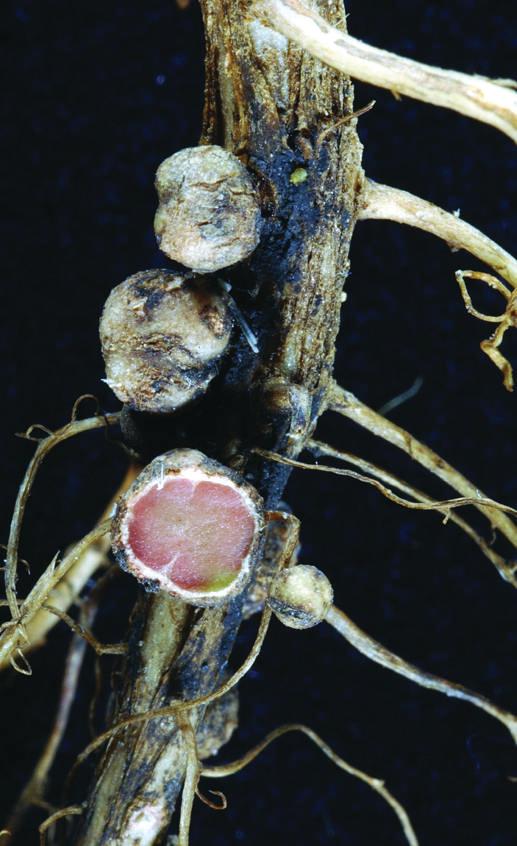
Soybeans fix nitrogen through nodules on their roots. Inoculants encourage more nodules which equals more potential N-fixation and greater yield.
why change the program this year?’” says Kerry. “We’re also seeing soybeans getting planted earlier. Years ago we’d see corn planted first and then in mid-May the soybeans would go in. Now we’re seeing soybeans being planted at the same time as corn. Pre-inoculated seed is all about speed and timing and working with a more convenient package. Our customers are telling us that it makes planting go much more quickly.” Other inoculant formulations, such as peat and liquid formulations are farmer-applied inoculants. Generally, these formulations are viable on-seed for a far shorter period of time than a pre-inoculant. “The choice of inoculant
photo courtesy of becker underwood
formulation is heavily dictatedby the requirements of the operation,” says Piran Cargeeg, technical team leader for Becker Underwood in Canada. “If it’s a larger operations and they have a short planting window, they generally want to get rid of any possible slowdowns while loading seed. With HiCoat N/T S225, growers can get their seed treated well before planting.”
A new line of thinking
Growers are probably most familiar with peat formulations, some of which have evolved significantly and are now produced in a sterile-peat formulation. By sterilizing the peat, any organisms that would otherwise kill the rhizobia are removed. This means there are more viable rhizobia in sterile peat than were previously carried. Still, rhizobia do not survive for long in peat. Once mixed with the seed, a grower should plant it within 24 hours.
Liquid has a longer life on-seed. Growers generally apply liquid inoculant to seed by hanging a bladder over the auger and letting a calibrator dribble it on the seed as the seed moves into the seed drill. It can also be applied professionally by a seed treater.
Another option to consider when choosing an inoculant is Becker Underwood’s next generation of inoculants, called BioStacked, that includes a second biological. This means it contains a second organism, Bacillus subtilis , which acts as a nodulating trigger, as well as Bradyrhizobium japonicum, the active ingredient in all soybean inoculant products that is responsible for fixing nitrogen.
This second biological promotes greater root and nodule biomass, faster canopy closure, and ultimately, higher yields. The increased root system allows for increased total nutrient uptake. Better aboveground vigour also speeds crop-to-canopy closure by three to five days.
Bohner says that the second biological may also help yield through disease suppression. “At the end of the day, the only thing I really care about is yield response because that’s what pays the bills,” he says. “But my sense is that it does bring something to the table.”
Pre-inoculants, like HiCoat N/T S225, are applied by the seed company. If growers do not order seed pre-inoculated from the seed company, they can still get it treated by a professional seed treater or suitably equipped retailer.
It is in the seed company’s best interest to make sure the seed treaters are compliant with best practices. For instance, Becker Underwood certifies all seed treaters that apply its product to ensure that they are treating the seed in a manner that maintains the Canadian Food Inspection Agency (CFIA) label guarantee. The CFIA tests all inoculants to ensure that they have the minimum number of rhizobia as guaranteed on the label.
The Ipsos Forward study indicates that the majority of soybean inoculant users prefer to have the inoculant applied on-farm. However, a significant number of users (34 percent) prefer a commercial seed treater to apply it, particularly for larger operations (41 percent of 200-plus acre growers versus 19 percent of growers with fewer than 200 acres). The two key reasons for using commercially treated seed were convenience and better coverage of the seed.
As growers push to become more efficient around soybean planting, expect to see increased use of pre-inoculants or seed-treater-applied liquid inoculants. n
Fertilizing soybeans: is it needed now?
by Treena Hein
Why some farms might have lower potassium levels than growers might think.
Several factors during the past few years may have left some farms with soil that is more nutrient deficient than the growers who own them would generally have believed. That could soon lead to problems with soybean health and yield. “Fertilizer prices have been very high over the last few years, which has meant lean application levels,” says Ken Currah, Pride Seeds market development agronomist. “At the same time, growers have tried to maximize income with high-nutrient-removal, high-yield corn, sometimes growing it back to back.”
Compounding the problem is the fact that “for years, producers have fertilized ahead of corn and believed that’s enough for the next crops in the rotation,” says John Waters, a crop advisor with Lakeside Grain in Forest, Ontario. Even though soybean yields have been very good the last while, Currah is quite certain that all these factors have resulted in some soil degradation, and that may well start affecting soybean yields very soon. He is particularly concerned about potassium.
Soybeans differ from corn in that they, as legumes, generally can supply their own nitrogen, but they require optimum levels of phosphorus, potassium and other nutrients to do so, says Dr. Tom Bruulsema, northeastern region director (North America program) at the Georgia, USA-based International Plant Nutrition Institute and an adjunct professor at the University of Guelph. “In
Newer soybean varieties that produce larger yields may be removing more nutrients than are being added by growers.
photos by rAlph peArce
FertIlIty and nutrIents
addition, if plants don’t have adequate potassium nutrition,” he says, “they may suffer from higher incidences of mouldy seed arising from pod blight ( Phomopsis ) and purple seed stain caused by Cercospora .” He notes that potassium also helps the crop mature uniformly and can improve market grade by reducing the percentage of shrivelled seed.
Currah also thinks growers need to consider the role of potassium in the plant as it relates to various plant health issues, such as drought tolerance. If the previous year’s highyielding crops have mined down soil potassium levels, then the necessary reserves are no longer in place to ward off the effects of environmental stresses during the next growing season.
Crops also to blame?
Some also question whether corn crops are mining more potassium from the soil than is generally supposed. That is possible, in Bruulsema’s view. While removal can vary depending on the potassium fertility status of the soil, he says silage corn removes by far the largest amounts. “A 24-tonper-acre silage corn cut removes 130 to 240 pounds of K 2O per acre,” he notes. “A harvest of 50 bushels per acre of soybeans removes around 70 pounds, while a hefty 200-bushel per acre yield of grain corn removes about 55 pounds.”
To investigate whether the potash that corn crops are mining out of the soil might be more than believed, and thus how much it could be affecting soybeans adversely, Waters conducted some small trials in 2010 that involved the application of high amounts of potash during the spring, just before no-till soybean planting in fields where corn was grown in 2009. “This season, we saw no difference with potash levels of 100, 200 and 300 pounds per acre,” he says. “However, we’re going to see what happens next year (2011) with some of those plots after the winter moisture
The conventional idea is that adding fertilizer ahead of corn will provide enough nutrients for the following crop; however, that may not be the case.
has broken down the potash to some extent.” Redistribution through the soil profile, and release or fixation by clays in response to freeze-thaw and wet-dry cycles can influence potassium availability. “We’re also doing similar plots, but with the potash having been applied this fall (2010).”
However, Dr. Palle Pedersen, technical manager with Syngenta Crop Protection (US), thinks it is the soybean crop that is removing more nutrients than are generally believed, not the corn. “The newer soybean varieties are providing bigger yields than years ago, bigger than anything we’ve seen, and we are taking more nutrients out than are being added in,” he says. “You can easily fertilize with phosphorus and potassium every other year, but it is important that you apply what you are removing. You simply cannot use the same rates as you did 20 years ago. You may be able to mine the soil for a few years, but this is not sustainable.”
Soybeans, like any crop, are best fertilized on the basis of a soil test, say Pedersen and Bruulsema. “If I were a grain farmer with no manure to add to my soil, I would do soil testing every year,” adds Pedersen, “and most likely fertilize every year. Take your samples and get your soil nutrients up to recommended levels. Commodities are worth so much these days, and to get the best yields, you must fertilize adequately.”
The fact that growers are planting soybeans earlier to maximize yield means that agriculture has moved the bar from where it was 20 years ago. Getting the seedlings the nutrition they need is more important than ever to get a high yield, in Pedersen’s view. “Fertilizer is not,” he stresses, “a place to cut corners.” n
Whichever – it’s BioStacked
BioStacked® means greater plant vigour, root biomass and more nitrogen-fixing nodules on every plant. Only HiStick® N/T and HiCoat® N/T S225 are BioStacked® –which in turn means increased performance, superior Return-on-Investment and most importantly, added yield potential.
In the planter or in the bag – ask your retailer about BioStacked® HiStick® N/T inoculant and HiCoat® N/T S225 pre-inoculant system – Canada’s #1 soybean inoculants.
HiStick • ® L N/T liquid can be conveniently applied on-farm or by your bulk seed retailer
The only BioStacked • ® inoculant – with two beneficial microorganisms that work together with the soybean root system to enhance yield potential
HiStick • ® N/T sterile peat can be easily applied on-farm
Becker Underwood logo is a trademark of Becker Underwood, Inc. and is licensed to Becker Underwood Canada Ltd.
way you go
BioStacked® !
The first and only BioStacked
• ® pre-inoculant system
With HiCoat
• ® N/T S225, you get soybean seed ready to plant with fresh BioStacked® inoculant, professionally applied by leading seed companies. Now that’s convenient! Maintains its inoculating power up to
• 225 days*, and is compatible with all commercial seed treatments
www.histicknt.com
Cover crops in second-year soybeans
by Carolyn King
A remedy for problems in soybean-intensive rotations?
Cover crops can provide a lot of benefits. They protect and improve the soil; increase yields of the main crop; and reduce weed, disease and insect problems. So they could help decrease many of the problems that plague cropping systems with continuous or frequent soybeans. But would they help enough to be a practical option for Ontario growers?
Two projects are working on the answer to that question. One is a recently completed three-year study led by Adam Hayes from the Ontario Ministry of Agriculture, Food and Rural Affairs (OMAFRA). The other is a project that is underway, led by Dr. Bill Deen and Dr. Dave Hooker, both from the University of Guelph. “In Ontario, we have a significant number of acres with either continuous soybeans or frequent soybeans in the rotation,” explains Deen. “There are issues with these soybean-intensive rotations related to a lack of surface protection, making the soil susceptible to wind and water erosion, and this leads to issues related to offsite movement of sediment and nutrients. Soybean-intensive rotations are also associated with reductions in soybean yield, poorer soil structure, lower soil organic matter, lower water-holding capacities and higher incidence of soybean cyst nematode (SCN).”
He adds, “The other issue is that soybean-soybean-soybean may undermine the success of no-till production systems. No-till doesn’t work as well if it is combined with a poor or no rotation. If you add the compounding effects of poorer soil structure, lower organic matter and other problems of soybean-intensive rotations, the chances of no-till working well are reduced even further.”
These sorts of issues prompted Hayes to set up his study in 2006 to assess the value of cover crops in second-year soybeans. Funded by the St. Clair Region Soil and Crop Improvement Association, the study had sites in Essex, Kent and Lambton counties. Hayes says, “In this area, with a lot of poorly drained clay soils, many growers don’t want to grow corn, mainly
Spring regrowth of rye (left) and wheat (right) cover crops in mid-May 2009 at one of the OMAFRA sites.
because they don’t believe it will yield well enough to cover input costs. That leaves them with soybeans and wheat. Often they feel they can make more money on soybeans than wheat, or they plant wheat but it may not make it through the winter, so they end up growing quite a few years of soybeans in a row. That is not good from several perspectives, including disease, soybean cyst nematode, soybean yield and soil health. So a number of the farmers in the area were interested to see if something could be done to try to help improve yields of soybeans after soybeans and reduce some of the other problems.”
Hayes chose rye and winter wheat as the cover crops. “Rye and winter wheat will continue to grow until winter sets in, and then in spring they grow again until they are terminated.” That means they are able to protect the soil and outcompete weeds. “Also they have fibrous root systems, so they provide some benefit to the soil structure and soil organic matter. And some research has shown that rye could help reduce soybean cyst nematode populations,” he explains.
The three-year study
Cover crops were seeded in the fall after soybean harvest. Because the sites were located in southwestern Ontario, the growing season was long enough for the
cover crops to become well established before winter, despite some difficult fall weather. The cover crops were terminated with glyphosate in the spring. Then, the co-operators followed their normal soybean seeding practices, either using a notill drill to seed into the cover crop residue or, in a few cases, tilling and then seeding. Some of the trials included a corn residue strip to compare a corn-soybean rotation with continuous soybeans.
Hayes summarizes some of the key results: “The study showed cover crops could be grown at minimal added expense to the grower. But they didn’t provide as much of a yield benefit for the second-year soybean as I would have liked on the clay soils. Although the cover crop provided quite a significant advantage at the sandy loam site, unfortunately we didn’t have enough other sites like that to verify that.”
The study’s results also reinforced that soybean yields are higher in soybeans after corn than in soybean after soybean. He says, “A good rotation, which can include corn, provides more benefits. You get that break in diseases and a 10 to 15 percent yield boost.”
Although most of the sites had either no SCN or only moderate infestations, the project did provide some verification
One of the co-operators in the OMAFRA study plants a cover crop after soybeans. photo courtesy of AdAM hAyes, oMAfrA.
photo courtesy of AdAM hAyes, oMAfrA.
CroP ManageMent
of a rye cover crop’s ability to control SCN. “In one of our fields, the soybean cyst nematode population was very high, and where we had the rye cover crop, we saw a reduction in the SCN populations,” notes Hayes.
He also found that a rye cover crop in combination with an SCN-resistant soybean variety further reduced SCN populations.
Overall, rye tended to provide greater cover crop benefits than winter wheat. He says, “When we did see a yield advantage, it tended to be with the rye, and we certainly got a lot more growth and better weed suppression with the rye.”
The effects on the soil were difficult to assess because the cover crop was only in place for a short time each year and because the project lasted for only three years. Hayes adds, “But I think if the grower got more comfortable with using a cover crop, he could potentially look at letting the crop grow a bit longer and having more organic material on the surface and more root growth providing more organic matter to the soil, Over time there might be more soil benefits.”
Current study
Deen and Hooker’s project could provide an opportunity to assess such longerterm effects. Their project, which started in 2008, is comparing three main systems to determine their effects on factors such as soybean yield, soil characteristics and SCN: continuous soybeans with no cover crop, continuous soybeans with a cover crop, and a corn-soybean rotation.
The cover crops in the study are annual ryegrass and cereal rye. The researchers chose cereal rye because it is a common cover crop in Ontario, it tends to be very hardy and establishes well, and it may reduce SCN. They chose annual ryegrass in part because it is a cover crop of interest in many parts of North America. “We want to test some of the claims being made about annual ryegrass in the US. Proponents of annual ryegrass claim a long list of benefits including improved soil structure and reduced nitrogen losses, and improved success of no-till,” says Deen.
Fall-seeded annual ryegrass tends to have fairly good winter tolerance. In the spring, it has to be terminated before it elongates; after elongation, it becomes very difficult to control. It does not produce a great deal of biomass; proponents in the US believe its benefits are due mainly to the plant’s extensive, fibrous root system.
The researchers are also evaluating two approaches to seeding the cover crop: drilling it in after soybean harvest and broadcasting it into the soybean crop at the pre-leaf-drop stage. They are terminating the cover crops with a glyphosate burndown.
All treatments are split into a no-till versus conventional till comparison.
The plots are located at the University’s Elora Research Station and its Huron Research Station at Centralia, north of London, Ontario. Deen notes, “You get the biggest problems with continuous soybean and the biggest benefit from cover crops on more marginal land with poorly drained, heavier textured soils. However, at Elora we have a pretty good soil type, and so the effects of continuous soybean and the mitigating benefit of cover crops may be lessened. But if we see benefits there, we would expect to see greater benefits on some of our heavier textured, more poorly drained ground.”
In the project’s first two years, both locations had a very cold fall, resulting in a late soybean harvest and a limited growing opportunity for the cover crop. In 2009, there was no yield benefit for soybeans with a cover crop compared to soybeans without a cover crop. The results for 2010 are not available yet.
Given the cold fall conditions, it is not surprising that results were better when the cover crop was seeded into the soybean crop at pre-leaf drop. Deen adds, “In a lot of our soybean production region in Ontario, I think we are looking at pre-leaf drop seeding for the cover crop to extend the growing season.”
The researchers are monitoring for
SCN, but have not detected this pest in any of the plots so far.
More study needed
The first two years of Deen and Hooker’s project were funded by OMAFRA’s Great Lakes Program. The researchers hope to obtain more funding for the study by 2013 when they expect to be ready to do some additional measurements, such as testing of soil properties. Deen notes, “I think we’ll find within just a few years that continuous soybean is starting to degrade the soil relative to corn-soybean. But the question is, to what extent will the introduction of the cover crop reduce or eliminate that effect?”
It is too early to say whether cover crops make economic sense in a soybean-intensive rotation. Deen says, “We may find there is a substantial yield improvement that justifies all this effort, but we may find the yield benefit alone does not justify using cover crops.” Also, it is also not clear yet whether the effect of cover crops in reducing insect, disease and weed problems would sufficiently reduce chemical pest control input costs to affect the overall economics of the system.
If the direct economic benefits to the producer do not support using cover crops, then Deen suggests, “Perhaps some sort of cost-shared initiative would need to be put in place to encourage farmers to use cover crops. That cost-share is justified on the basis that there may be a yield benefit for the farmer and there are benefits for society. For instance, cover crops sequester carbon, keep soil in place and out of our waterways, and perhaps keep nutrients from moving off site.” n
Spring regrowth in late April on two University of Guelph plots where a cereal rye cover crop was planted into continuous soybeans show minimal biomass achieved by the cover crop. One plot (left) was planted using a drill after soybean harvest; the other (right) was broadcast into soybeans prior to leaf drop.
photo courtesy of henk wichers, university of Guelph
Plant BreedIng
SCN management update
by Blair Andrews
Different levels of resistance are being researched by different interests.
Providing soybean cyst nematode (SCN) resistance in a broader range of varieties and using more sources of resistance are the main goals of the latest soybean breeding efforts to help farmers manage this destructive and expensive pest. Touted as the most yield-limiting disease of soybeans in North America, SCN continues to expand its reach into Ontario’s growing regions.
Albert Tenuta, field crops pathologist with the Ontario Ministry of Agriculture, Food and Rural Affairs (OMAFRA), says the small, parasitic roundworm that attacks the roots of soybeans is no longer limited to just southwestern Ontario. “In the past, we talked about SCN being in the lower six to eight counties from Woodstock down to Windsor. Now, we’re starting to see it move up into Huron and Bruce counties as well as shifting into the Niagara Region,” he explains.
SCN has also moved into the Greater Toronto Area, and near Trenton and in Northumberland County. Most recently, Tenuta says detections have been made in the Ottawa Valley. “The moral of the story is, down the road, Ontario will be like any soybean area that has SCN: it will eventually find its way through most of the regions.”
As SCN has spread through the province, soybean breeders have been working to develop varieties across a broader range of heat unit zones to keep pace with the pest. “SCN is a key disease target for us in our soybean breeding program, and the trend I’ve seen with our lineup is we’re getting the SCN protection in the germplasm with earlier and earlier maturities,” says Mark Lawton, Monsanto technology lead for Eastern Canada.
“The survey work of Albert Tenuta and Tom Welacky of Agriculture and AgriFood Canada (AAFC)’s research station at Harrow, Ontario, has shown that the distribution has changed over time and we’ve made adjustments to ensure we have SCN-resistant genetics included in much earlier maturities than we would
have had five or 10 years ago.”
Growing SCN-resistant varieties has been the chief tool to help farmers manage the economic risks of the pest.
When SCN emerged as a major threat in the early 1990s, Tenuta says it took a heavy toll, slashing yields by about half. He notes that growers, who were accustomed to yields of 50 or 60 bushels per acre, were calling in with reports of only 20 to 25.
Since the introduction of SCN-resistant varieties, Tenuta says that farmers have been able to realize the higher yield levels again. The higher yields are also demonstrated by research conducted by OMAFRA and AAFC in Harrow.
According to data from 2009, SCNresistant varieties outyielded susceptible varieties by about 53 percent at Highgate and 20 percent at Leamington.
Tenuta says the results underscore the
crop protection industry is working to develop alternative sources of resistance to soybean cyst nematode (SCN), including those applied in seed treatments.
Although it is well established in southern and eastern Ontario, OMAFRA’s Albert Tenuta says soybean cyst nematode (SCN) is now being found as far east as the Ottawa Valley.
importance and effectiveness of SCN varieties when used even under low SCN pressure. He says that the greatest increase in SCN population densities occurred when a susceptible variety was used. In contrast, a general reduction in SCN populations was observed for both the PI88788 and Peking sources of resistance.
In addition to offering SCN resistance in more maturity zones, another effort is focused on adding more sources of resistance to the germplasm.
According to Monsanto, nearly all of the SCN varieties derive resistance from a single source. This makes the germplasm vulnerable to shifts in SCN populations.
Results of collaboration
Monsanto is collaborating with BASF to research transgenic approaches that would allow the company to deploy
The
photo courtesy of Albert tenutA, oMAfrA.
photo by rAlph peArce
Plant BreedIng
additional SCN resistance mechanisms. “The transgenic approaches being investigated are focused on controlling current SCN populations as well as minor and emerging races of the pathogen,” says John Pitkin, Monsanto SCN project discovery lead. “Both greenhouse and field SCN screens are being deployed to evaluate genes identified in several independent gene discovery screens.”
Pitkin adds that Monsanto would determine when and where to deploy the new and improved sources of SCN resistance through an annual SCN population survey throughout the US.
The companies are also collaborating on an effort involving conventional germplasm, but at a reduced rate compared with the transgenic work. More of the conventional, or non-GMO, research is being left up to smaller companies or public breeding programs.
A prime example is the program of Dr. Vaino Poysa, a soybean breeder with AAFC, based at Harrow. “I think we are making significant progress. We’re getting an increasing number of breeding lines and varieties that have yield levels equivalent to non-SCN resistant material moved into commodity beans as well as the beans that are dual purpose, or foodgrade beans,” says Poysa.
The challenge for the conventional breeders is to strike the balance of boosting yields while maintaining the quality traits desired by the non-GMO, foodgrade markets.
In addition to using traditional Asian sources, Poysa is also working with some materials developed in the US Midwest that have been used for commodity soybeans. “So we are developing lines that have improved yield. But it’s a struggle to get it back into the overall quality package that is required for the Identity Preserved end users.”
Poysa adds that the AAFC program is also trying to incorporate several alternate sources of SCN resistance into its breeding lines. He is optimistic that the work will result in the introduction of commercial varieties in the near future. “We are looking at releasing, this next winter, an alternative source of SCN resistance. And during the next five years, I think we can see a number of alternative sources coming out,” says Poysa.
For now, the current sources of resistance seem to be standing up well to SCN. However, Tenuta is starting to see shifts in the nematode populations in southwestern Ontario. “We’re seeing some of these new races, or HG (Heterodera glycines) types starting to develop in Essex, Kent, Elgin, Middlesex and Lambton that bypass the 88788 PI resistance,” says Tenuta. “That’s where Peking and some of these other resistance sources down the road will come in.”
Besides alternative sources of resistance, the crop protection industry is also working on seed treatments that incorporate nematicides to help protect the soybean roots. Although these treatments
Soybean cyst nematode has now spread east of Toronto, with reports of it being detected in the Ottawa area, as well.
have not been registered for use in Canada yet, Tenuta is hopeful that the products will be available within a few years.
As the industry works on new efforts to help farmers control SCN in the future, Tenuta reminds producers of the key steps to follow. Noting that the emergence of new HG types of SCN is in its infancy in Ontario, Tenuta says the development of new populations can be delayed by rotating the use of SCN-resistant varieties. “Because there is no resistant variety that is immune to SCN, they all will have some degree of cyst reproduction on them. When you plant that same variety over time, you increase that percentage of the population that can feed on it and reproduce on it,” he says. “The trick here is not to use the same variety, because the cysts will adapt to it, and by the time the cysts adapt, we’re in trouble.”
In other words, Tenuta says, the idea is to keep the populations of SCN in the field “off balance” by rotating different soybean varieties as well as different SCN resistance sources. “You don’t want to shift those populations to some of these other races or types that we don’t have resistant genes for. The evil you know is better than the one you don’t know,” he adds. n
photo courtesy of Albert tenutA oMAfrA.
If you’re not using BioStacked® HiStick® N/T...
what are you leaving on the table?
HiStick® N/T is BioStacked®. And BioStacked® means greater plant vigour, root biomass and more nitrogen-fixing nodules on every plant. Which in turn means increased performance, superior Return-OnInvestment and most importantly, added yield potential. As the #1 and only BioStacked ® soybean inoculant, HiStick® N/T is trusted and proven
under Ontario growing conditions. Available in liquid and sterile peat formulations, it’s quite simply the best investment you can put into your beans. Ask your retailer about BioStacked ® HiStick ® N/T –for value and performance that really stacks up.™
Reaction to new PMRA guidelines for unlabelled tank mixes
by Blair Andrews
Overall caution of early 2010 replaced with positive outlooks
The move by the Pest Management Regulatory Agency (PMRA) to allow the use of unlabelled tank mixes of pest control products for crop production or vegetation has been met with mostly favourable reviews. Crop protection industry insiders say the new guidelines should give farmers greater flexibility and quicker access to the mixes supported by the manufacturers.
In October 2009, the PMRA clarified its position on the use of unlabelled tank mixes under certain conditions. A key condition limits the tank mixes that fall within the registered use pattern for each tank- mix partner. This limitation means that products have to be registered on the crop, and must be used in accordance with the label recommendations.
Wayne Barton, BASF market manager of fungicides, says the PMRA’s decision is a positive step for the manufacturers and farmers. “It doesn’t mean that you recommend anything and that there are no more rules,” explains Barton.
“It means the manufacturers can now recommend tank mixes that they can support in the marketplace and they don’t have to wait for a PMRA review of those mixtures.”
He says the companies put a great deal of effort into evaluating the performance and safety of their products before submitting them for review. But he notes that the waiting period for a decision can be lengthy, with reviews taking as long as six to 14 months. With the PMRA’s move, Barton says the manufacturers can publish their recommendations of tank mixes as soon the information is available. “Again, these are all products that are registered in those crops and for those uses. We’re just putting them together in combinations of value and needs in the market.”
Mike Cowbrough, field crops weed specialist with the Ontario Ministry of Agriculture, Food and Rural Affairs (OMAFRA), agrees that reducing the regulatory waiting period is a positive step. He says the result should give farmers more options for management decisions, particularly in trying to control difficult weeds. “I think now it pro-
vides a lot of flexibility for people to use a tank mix when it makes sense to address a weakness, without having to worry about whether it’s registered or not,” says Cowbrough.
Dave Latter, a regulatory consultant based in Toronto, says the PMRA decision should also clear up a lot of the “grey area” for farmers who have been mixing registered tank-mix partners already, even though the combination was not labelled. “And when new generic products come on the market, it makes it a lot easier for farmers to tank mix them, without having to wait for the label to catch up with all the tank mixes that might be on the original product,” says Latter.
Less government involvement, yet the potential for more liability Besides making things easier for farmers, Latter says the new guidelines should reduce some of the regulatory burden of the PMRA, allowing the agency to focus more of its attention on other types of product approvals.
His view is shared by Barton, who hopes the PMRA can shift its resources
from reviewing tank mixes to other areas such as new crops and technologies. He cautions that such a development remains to be seen. “We’re hopeful that they will achieve some efficiency at their end that will see a streamlined regulatory process and growers will get access to new technology quicker. That’s a big question, but I think if you can make the regulatory process focus on what’s most important, then I think that is a good thing,” says Barton.
Although the new guidelines bring some significant advantages for farmers, they are also causing some significant concerns, especially in the area of liability. According to the PMRA’s memo, anyone who recommends or applies an unlabelled tank mix does so at their own risk and liability because it has not been reviewed by the agency.
John Waterer, Canadian agronomy manager for Cargill AgHorizons, says liability has been shifted from the manufacturers to retailers, agronomists and/ or farmers. “If the tank mix was registered, the manufacturers clearly had the liability. Now they don’t, so long as the two products are registered. If an agronomist recommends an unlabelled tank mix, the agronomist is essentially liable now,” says Waterer.
Given the potential for expensive liability claims, Waterer says Cargill spent a significant amount of time making a list of not only tank mixes the manufacturers would support, but also the ones the company would not be comfortable recommending. “If the manufacturer is not willing to support it, we will not recommend it because it’s simply not in the farmer’s best interest to take on that much risk,” says Waterer.
Need for open communications increasing
In this landscape of shifting liability, the best advice for farmers about using unlabelled tank mixes is to make sure the manufacturers support them. Brian Wintonyk, cereal crop specialist for Dow AgroSciences, says his company has developed a list of products that can be safely tank-mixed together as unlabelled mixes. “We are trying to be as transparent as possible with retail and grower customers and let them know what a good combination is, and also the situation where they may be looking at a tank-mix combination that we feel is not the best mixture or concept,” says Wintonyk. “We do have a published list of
Some may be leery of government getting out of the tank-mix debate but the new guidelines are being welcomed as a means of providing growers greater flexibility.
unregistered mixes that we will support based on tests conducted, but there are other mixtures that we do not support with no basis of tests, and if we do not support a mixture, we will alert growers and advise them of potential risks to ensure they make an informed decision.”
Barton concurs, saying BASF has taken careful steps to ensure its recommendations are science-based and are easily understood. “The last thing we want is somebody to use our product and not have a great experience with it.”
Waterer agrees that the major manufacturers have come forward with the information.
Although he says the quality of the information has been good, farmers and others will still have to perform some due diligence. “From an overall perspective, the information growers need to know is not easily available. They really need to check with their agronomist to make sure that the mix is safe and supported by the manufacturer. Otherwise, in today’s farm economy, I don’t think a farmer can afford to take that risk on himself,” says Waterer.
With a premium placed on information, communication with growers is going to take on increased importance in the years to come. Waterer says now that the PMRA has taken a step back on unlabelled tank mixes, manufacturers may be less inclined to spend the same amount of resources on future tank mixes.
“The fact that the manufacturer doesn’t really have to stand behind it any longer is going to limit the tank mixes that they are going to research or register. So that information that is going to be available, long term, might actually decrease because they are not going
to be forced to do the tank-mix research any longer,” says Waterer.
Latter does not see any great concerns going forward. He expects the good interaction between the manufacturers, the dealers and the farmers will continue. “I think everybody has done their homework. We have lots of experiences with these things and it’s working well.”
As a means to ensure that growers will have access to information, Cowbrough says the Ontario Weed Committee is forming a sub-committee to study the issue to ensure that best practices for tank mixing will be communicated. “It’s basically to examine what type of information is critical to minimize any risk,” says Cowbrough. “I think what we need to do is get everyone on the page and explain why it is a good idea to mix some products and why it is not a good idea to mix others.”
Cowbrough will chair the committee, which will include various industry stakeholders.
While the new group prepares to give farmers and agronomists the key information about unlabelled tank mixes in the future, growers should be aware of the PMRA’s six conditions:
1) Each tank-mix partner is registered for use in Canada on the crop of interest, including genetically modified crops.
2) The tank mix only includes an adjuvant when specifically required by one of the tank-mix partner labels. If an adjuvant is not required on the label of any tank-mix partner, then no adjuvant may be added to the tank mix.
3) The application timings of all tankmix partners are compatible with regards to crop and pest staging.
4) Each tank-mix partner is applied in accordance with its registered product label (for example, Directions for Use, Precautions, Buffer Zones, etc.). In cases where information on the tank-mix partner labels differs between them, the most restrictive directions must be followed.
5) The tank mix is not specifically excluded or contraindicated on either tank-mix partner label.
6) The use of the tank mix provides additional value to the user (for example, increased scope of pests controlled, contributes to resistance management or integrated pest management, cost or time savings). n
Identifying genes to improve soybeans
by Heather Hager, PhD
Gene research aims to pinpoint the location of useful agronomic traits in the soybean genome.
Soybean geneticists are creating a toolbox of plant materials that they hope will facilitate soybean breeding for specific characteristics down the road. “It’s a pretty exciting project because soybean only became a major crop in North America within the past 50 years, and it’s really come a long way in that time,” says Dr. Wayne Parrott, University of Georgia professor and crop geneticist. “It’s a crop that is showing that it’s lending itself to an ever wider range of uses.” He is referring to the ability to make soybean varieties that produce specific oils or proteins, for example, for various applications. Parrott is the project’s lead investigator.
The goal of the project is to identify which genes control which soybean traits. The soybean genome has been sequenced, meaning that the order of the individual DNA components is known. However, the function of most of the genes remains a mystery, says Parrott. To find out what roles various genes have in the soybean plant’s functions, the researchers create a random mutation in the plant’s DNA and then grow the plant to see how it has changed, for example, in stature or seed protein content. They then analyze the plant’s DNA to find where in the genome the change occurred. Finding the altered gene allows them to identify it as having a function in that particular plant trait. Geneticists and soybean breeders then know which genes to work with when developing new soybean varieties that have specific traits.
find the location of the jumping gene. The soybean gene that contains the jumping gene is interpreted as being linked to that specific plant trait.
Similarly, Vance and Stacey are using irradiation to alter gene function. They irradiate soybean seeds at certain doses that cause mutations by damaging the DNA. They then plant the seeds and examine the resulting plants for altered appearance or performance. Plant tissue samples are taken for DNA analysis in which the altered DNA is compared with the unaltered soybean genome to identify the affected genes. The seed is saved for future use. “A tremendous asset is that the soybean genome has been sequenced, so we will be able to lay our DNA sequence right on top for comparison,” says Vance. This allows them to locate the altered genes.
The DNA analysis might sound fairly quick and simple, but in reality, it is very expensive and time consuming, Vance explains. Even though the technology has advanced to a point “that was hardly imaginable when I was in graduate school,” he says, with an estimated 45,000 genes in the soybean genome and only a small portion of genes already identified, it would take decades to identify the function of every gene. So the researchers can analyze only some of the plants they produce.
Some of the remaining irradiated soybean lines will be available for use by others who want to search for mutations. “We’re going to have a publicly accessible website that will have photographs of all the mutants, and hopefully we’ll have an idea of where some of the mutations lie in the genome,” says Vance.
The project is a massive undertaking by an extensive list of collaborators, including four principal investigators: Parrott, Dr. Gary Stacey from the University of Missouri, Dr. Tom Clemente from the University of Nebraska at Lincoln, and Dr. Carroll Vance from the University of Minnesota and United States Department of Agriculture Agricultural Research Service. It began in 2009 and is funded by a three-year, $2.5-million grant from the US National Science Foundation.
Linking traits with their genes
The group is using two methods to generate mutations in soybean DNA: jumping genes and irradiation. Parrott, Stacey, and Clemente work with jumping genes. The process begins by inserting a jumping gene from maize, tobacco, or rice into a single, isolated soybean cell in the lab, and then growing the cell into a soybean plant using special culture methods. As the plant grows, the jumping gene randomly inserts itself into one of the soybean genes, disrupting the function of that gene. This can affect the appearance or performance of the plant and its subsequent offspring. The researchers examine the plant for changes and then
In summer 2009, Vance and post-doctoral researcher YungTsi Bolon had about 15,000 soybean plants growing in the field, each one examined, catalogued and harvested individually. They have found differences in height, leafiness, plant shape, leaf shape, flower colour, seed coat colour, hairiness of the stems and leaves, seed carbohydrate content, and seed oil content. And as yet, they have not even begun to look at root characteristics or responses to stresses such as drought. With the help of several other collaborators, they will identify the genes for some of the traits. They had another 15,000 or so plants in the field again in 2010. In addition, Parrott and post-doctoral researcher Nathan Hancock had the first plants derived from jumping genes in the field in 2010.
The potential applications of this work are numerous and varied. “In addition to understanding which genes control which traits, we’ll hopefully come up with some traits that are good for soybean growers such as oil, yield, protein or some other aspect of quality,” says Vance.
The DNA analyses will also allow the development of genetic markers, which soybean breeders can use to locate the specific genes in varieties that are appropriate for specific growing regions. n
Single soybean cells are mutated and grown into soybean plants in the laboratory to look for useful agronomic traits.
photo courtesy of wAyne pArrott, university of GeorGiA
HiGH-clEARANcE SPRAYERS – MAcHiNERY MANAGER
RoGatoR HiGH-CleaRanCe appliCatoR
For 2011, AGCO Application Equipment offers five new models of the RoGator high-clearance applicator with a proven drive train that AGCO has engineered to deliver even higher levels of performance and reliability in the field.
The drive train system features two-piece construction, a hydraulic motor and a separate gear reduction hub, that delivers more power to the ground, and allows the RoGator to run at lower speeds during transport for better fuel economy. All five RoGator models come with seven speed ranges, which allow operators to better match field conditions.
The new models carry over the popular recent creature comfort and design enhancements such as front-entry with a fold-down ladder, easy first step, gentle angle of ascent, wide-set hand rails and a wide cab-side walkway to allow the widest cab door opening in the class. The six-post Advanced Application Cab provides a clean, comfortable operator environment, plus an air-ride seat and conveniently located controls help increase operator comfort during long days in the field. In addition, the exclusive and industry-preferred “C” channel frame delivers greater durability and flexibility to keep all four wheels securely on the ground for better traction, fuel economy and field performance.
Lowered boom mounts, a lowered tank saddle, and off-cab rear-view mirror mountings mean the panoramic view of the six-post cab is now even better in the field and on the road. Changes to the plumbing and hose-routing mean the RoGator’s clean underside and simple plumbing and wiring systems are even more streamlined, enhancing machine life and minimizing costly downtime.
Drive
Wheel track adjustment
Hydrostatic Sauer Danfoss Series 9.0 with 6.1 cu. in. displacement
to 152 in.
Boom length 80-, 90-, or 100- ft. poly with optional stainless steel
Hydrostatic Bosch Rexroth AA4VG. 7.6 cu. in. displacement
90-, 100- or 120-ft. poly with optional stainless steel
Ground clearance 50 in.
Suspension
Go to www.machinerymanager.ca for further specifications and links to AGcO RoGator sprayers.
SpRaCoupe 4000 and 7000 SeRieS SpRayeRS
There are good reasons SpraCoupe is on more farms across North America than any other sprayer in its class. Experience. Reliability. Dependability.
Backed by 45 years of expertise in the application business, SpraCoupe is the leading self-propelled sprayer on the market, offering unequalled reliability and superior application accuracy to reduce product waste and avoid crop damage. Equipped with SpraCoupe mechanical drive systems, these light, nimble and powerful sprayers get you into the field days before other self-propelled machines. The largest machine runs on a Perkins 174-horsepower diesel engine and features a 725-gallon poly tank and 60/80-foot or 60/90-foot adjustable boom.
The quieter engine, combined with sound-proofing improvements to the cab, means a quieter ride. Plus, innovative machine and boom suspension smoothes the ride and allows for more accurate spraying in the field. Bolted, flex-frame design keeps all four tires in contact with the ground, even in rough conditions, for a smoother ride, less stress on the machine and maximum fuel efficiency and pulling power.
An industry exclusive six-post Advanced Application Cab provides a clean, comfortable environment for the operator, and an air-ride seat plus conveniently located controls help reduce operator stress during a long day. Tough, reliable construction and extensive service, repair and parts support keeps you in the field until the job is done.
PG 115 PowerShift, six forward and two reverse speeds
Suspension Independent strut and spring suspension with oscillating front axle; independent “knee action” suspension with coil spring rear axle
Independent strut with linear rate suspension springs front axle; independent “knee action” suspension with hydraulic suspension rear axle Fuel capacity
gal. (167 L)
gal. (246 L)
Caterpillar
HiGH-clEARANcE SPRAYERS – MAcHiNERY MANAGER
CaSe iH patRiot SpRayeRS
Put yourself in total control with the Patriot Series sprayers from Case IH. The cab-forward, rear-engine design provides balanced weight distribution and a light footprint. During critical application windows that impact yields, Patriot sprayers can get into wet fields sooner with minimal field disturbance, rutting and crop damage.
Featuring the AIM Command spray system, Patriot sprayers let you manage spray flow and droplet size according to field and weather conditions without changing tips, speed or rate. Other features offer precision control of boom height, GPS-guided boom-section control, automated boom folding functions and even fully automated steering, for the ultimate in product application control and convenience.
All Patriot sprayers are also equipped with the Case IH Surveyor cab, offering unmatched visibility, plenty of legroom and a MultiControl Armrest that puts all key controls at your fingertips.
Three models are available to fit every operation, with engines ranging from 220 to 290 horsepower, boom widths up to 120 feet and tank capacities from 800 to 1200 gallon.
Drive
Wheel track adjustment
Infinitely variable speed hydrostatic with full-time 4-wheel drive
120 to157 in.
Tank size 800-gal. (3028-L) stainless steel or poly construction
(3785-L) stainless steel
(4542-L) stainless steel
Suspension 4-wheel independent trailing-link with spring and shock standard; active suspension optional
equipment teCHnoloGieS apaCHe SpRayeRS
By pushing the concept of the mechanical drive even farther, Equipment Technologies has delivered the most efficient Apaches yet. The 2011 Apaches deliver more power to the ground than ever before and are engineered to optimize that power to ever-changing ground conditions; wet, muddy or hilly, no matter.
The result is an overall operator experience unmatched by any sprayer on the market.
Moving a little closer to ground, you will find a patented hydraulic suspension. When combined with the focused power of a mechanical drive, the Apache’s suspension allows an operator to take off from any gear position and do so without tearing up their field. They can do this because the Apache is geared to multiply engine torque up to two times when needed for hilly terrain and muddy conditions. Then a limited slip differential kicks in and the operator gets traction where needed. This unique suspension system also features anti-sway and auto-levelling technology designed to keep the booms out of the dirt on sharp turns regardless of whether the tank is full or close to empty.
Wheel track adjustment 120 in. fixed; 120- to 160-in. adjustable axle width with optional hydraulic adjustment
Tank
Ground
Suspension
or 50 in.
or 50 in.
Patented independent hydraulic Fuel capacity
in.
Model Patriot 3230
Patriot 3330
HiGH-clEARANcE SPRAYERS – MAcHiNERY MANAGER
GVm induStRieS e350 pRowleR SpRayeR
The GVM E350 Prowler is the newest and most innovative self-propelled machine from GVM. The E350 Prowler is one of the most technologically advanced machines on the market. It features a new electronic monitoring system that provides machine diagnostics and gauges on a simple touchscreen along with AgriWave by GVM AgJunction. AgriWave allows the owner of the E350 Prowler to view machine position, engine and transmission data and flow control remotely, while also allowing GVM service to remotely dial into the machine for troubleshooting. The new Air Ride Cab provides a large windshield to give the operator full vision of the front tires. The E350 Prowler is the only applicator on the market that offers a variable coil spring suspension, to absorb shock and provide a comfortable ride.
The E350 Prowler boasts a 350-horsepower, 8.9-litre Cummins Tier III QSL engine paired with a Funk DF250 11-speed electric bump-shift transmission to provide 1120 lbs of torque at 1500 rpm. The E350 Prowler offers 32 inches of crop clearance, various boom configurations, 1800-liquid and 11-ton dry capacity. Larger capacities mean greater efficiencies, allowing you to cover more acres and minimizing down time, and the ability to switch from dry to liquid application in less than one hour allows for year round productivity.
Drive
Cummins Tier III QSL
Funk DF250 11-speed electric bump-shift
Wheel track adjustment 108 to 120 in.
Tank size 1800-gal. stainless steel
Boom length 60/80 ft.; 70/90 ft.; 65/120 ft
Ground clearance 32 in.
Suspension
Variable coil spring suspension
Fuel capacity 115 gal. (435.5 L)
Go to www.machinerymanager.ca for further specifications and links to GVM industries sprayers.
GVm induStRieS pRedatoR SpRayeR
Two GVM models deliver proven performance for liquid and dry applications. GVM Predator models feature an Air Ride Cab to complement GVM’s patented Air Walk self-levelling single airbag suspension. The Predator comes standard with 115-gallon fuel tank, differential lockup, power brakes, variable displacement hydraulic pump, hydraulic quick couplers, a 75-gallon hydraulic tank with cooler, and front and rear halogen floodlights. GVM offers a deluxe cab for operator comfort and precision farming tools like boom height control, boom section control, mapping, and assisted steering.
A Cummins QSB-6.7-litre diesel engine coupled to an Allison transmission and JCB differential provides great fuel efficiency and 40 mph road speeds to save time and fuel. In addition the Predator has 50-inch clearance and hydraulic adjusted axles. The 8275 model comes standard with hydraulic front-wheel assist to conquer a variety of field conditions. The Predator has various boom configurations in 1000- and 1200-gallon liquid systems plus GVM’s innovative Combo System that allows for a dry applicator that can spread up to 105-foot swaths. The Combo System can be switched from dry to liquid in less than one hour on the 8275 Predator model.
Suspension
GVM Air Walk self-levelling airbag
HiGH-clEARANcE SPRAYERS – MAcHiNERY MANAGER
JoHn deeRe SpRayeRS
For the ultimate in capacity and performance, the 4930 Sprayer offers a 325-horsepower John Deere PowerTech Plus engine and 1200-gallon capacity spray boom up to 120 feet wide. For three-season performance, the 4930 is available with the 300-cubic-foot drybox.
The newest member of the 30-Series Family, the 4830 Sprayer, offers a dependable 275-horsepower John Deere PowerTech Plus engine to answer the call for a machine with 100 feet of boom width and 1000 gallons of tank capacity.
With 800 gallons of capacity and boom widths to 100 feet, the 4730 Sprayer is a high-capacity, manoeuvrable addition to any fleet with an additional 20 horsepower over its predecessor.
With 600 gallons of solution capacity and 80 feet of boom width, the 165-horsepower 4630 Sprayer lets you cover 60 to 100 acres per hour, all packaged in a comfortable, manoeuvrable machine.
Every 30 Series model is available with John Deere options like AutoTrac Assisted Steering, BoomTrac Pro Automatic Boom Leveling, and Swath Control Pro, which automatically turns individual boom sections on and off at turnrows or other non-spray areas.
milleR CondoR G SeRieS
The new Condor G-Series Sprayers are all about delivering tough, rugged reliability. With an efficient and simple heavy-duty mechanical drive train, you will see simplicity is the defining characteristic of the new G Series Condor sprayers. The new Condor G Series boasts more features, a wider range of options and greater value.
Choose between the 240-horsepower Condor G40 and the 275-horsepower Condor G75, powered by Cummins. The G40 is available with an angled rear final drive with 42 inches of clearance, while the 48-inch clearance, cast iron drop box final drive is optional on the G40 and standard equipment on the G75. For challenging field conditions, mud and soft soil, the G75 is also now available with the brand new SmartDrive Front Wheel Assist hydrostatic drive system for extra traction effort.
With your choice of 1000- or 1200-gallon tanks in poly or stainless steel, booms from 90 to 120-feet wide, also available with the patented Spray-Air air boom technology, road speeds up to 46 mph and a full range of precision products all for a lower price than the mainline competition, you will be more productive and more cost efficient than ever before with a Condor G-Series sprayer.
Engine
Hp
Drive
Wheel track adjustment
Tank size
Cummins QSB 6.7 L Tier III
240 hp; 250 hp power bulge 275 hp
Allison 5-speed with locking torque converter
1000-gal. poly or stainless steel; 1200-gal. poly
Allison 6-speed with locking torque converter; Optional SmartDrive Front Wheel Assist
120 to 150 in. adj; Fixed 120 in. opt.
1000-gal. poly or stainless steel; 1200-gal. poly or stainless steel
With a true high-clearance machine and a front-mount boom, you will be able to spray late into the season in tall crops, such as pre-harvest canola, using a Miller Nitro 4000 Series sprayer without ever looking back. Choose from one of six models ranging from 215 horsepower all the way up to 365 horsepower. New for 2010 is the Nitro 4215HT and 4240HT, our new High Torque series sprayers. Boasting tank size options of 1000, 1200, 1400, and a massive 1600 gallons, you will not find a more productive sprayer available. And with a choice of booms from 60 to 120-feet wide, you will find a Miller Nitro 4000 Series sprayer specifically suited to any operation’s needs.
The Miller Nitro 4000 Series sprayers feature the industry-leading and award-winning HydraLink all-wheel suspension, ensuring four-wheel traction and the smoothest ride for reduced operator fatigue and minimal machine stress, resulting in more acres covered per day. Combine the superior ride with a deluxe air-ride cab suspension, air-ride operator seat, and fingertip controls, and you will be able to stay comfortable, and stay in control all day long.
new Holland GuaRdian SpRayeRS
With the addition of the new Guardian sprayers, producers can now take their crops from establishment to harvest with a full line of New Holland equipment. New Holland’s new Guardian sprayers quickly protect more acres per hour with the industry’s highest horsepower, largest tank size, smoothest suspension, highest ground clearance and tightest turning radius.
When you step into the productivity of a new Guardian front-boom sprayer, you can quickly protect your acres with less fatigue and less downtime. With the boom in front, you get the best of all views and never need to turn in your seat to monitor spraying action. With this excellent visibility, you can run the boom closer to the ground to control drift.
The Guardian rear-boom sprayers offer a proven design and easy maintenance. Heavy-duty frame and axle construction and the clean, rugged, mechanical-drive system ensures better performance, higher productivity, improved fuel efficiency and lower operating costs. Wide coverage and high clearance allow producers to spray huge areas in a hurry, even late into the growing season.
HiGH-clEARANcE SPRAYERS – MAcHiNERY MANAGER
VeRSatile SX275 SpRayeR
The Versatile SX275 sprayer is the best investment on the sprayer market today due to its economical operation, rugged component reliability and application accuracy.
It starts with the flexible C-Channel framed chassis to accommodate rolling terrain and to keep the wheels on the ground. The SX275 is equipped with a fuel-efficient Cummins 6.7-L, 275-horsepower engine, and a reliable Allison five-speed automatic transmission delivering power to the MaxTorque mechanical gear drive line for ideal power to the ground capability. With 60 to 65 percent of the weight distribution on the rear, the SX275 rides high on the front, avoiding the plowing conditions associated with other machines. The Versatile SX275 powers through with 90 percent of the horsepower driven to the ground. The mechanical drive operating at lower revolutions per minute greatly reduces fuel consumption, and results in quieter operation and reduced engine wear.
Hydraulic track width is independent, ranging from 120 to 152 inches, with 380(14.9)/90R46 tires and fenders. Automatic airbag suspension provides a smooth ride.
The sprayer is equipped with a 1200-gallon stainless steel product tank and integrated stainless steel 120-gallon rinse. Application control is via Raven 4400 or optional Envizio Pro and GPS. AutoBoom, AccuBoom and SmarTrax Auto Steering are optional. ProAction Flex boom is available in 80-, 90-, 100- and 120-foot sizes, with patented Henschen full-boom suspension, and three-stage progressive yaw dampening to control extreme to/fro movements of the boom for precise application, and reliable boom life.
In the quiet roomy cab, controls are within easy reach. Foot throttle and cruise control easily maintain the best speeds for stress-free operations. Operational visibility is near 360 degrees.
Model
Engine
SX275
Cummins QSB 6.7 L Tier IIIA
Hp 275 hp
Drive Allison 3000RDS, 5-speed automatic
Wheel track adjustment
120 to 152 in. hydraulic adjustment
Tank size 1200 gal (4540 L)
Boom length 80, 90, 100 and 120 ft.
Ground clearance 48 in.
Suspension
Fuel capacity
Air bag with auto height adjustment and sway control
130 gal.
Go to www.machinerymanager.ca for further specifications and links to Versatile sprayers.
walkeR aG 8800 SeRieS
Walker Ag Equipment’s new 8800 Series high-clearance sprayer has been in production for three years, offering a front-mounted boom for high visibility, foam marker or GPS system and six-foot (or optional eightfoot) crop clearance. This model includes an air-ride cab, Walker’s proven walking beam suspension, up to 100-foot booms and a 1200-gallon stainless steel tank. Walker has redesigned the hydraulic functions for simplified service and improved reliability. The superior cooling package for engine, hydraulic and A/C systems offers improved cooling and ease of routine maintenance.
The 8800 series also features a John Deere 6.8-litre, 275-horsepower, Tier 3 engine, powering two-100cubic-centimetre Sauer Danfoss hydrostats. Poclain MS18 wheel motors are standard for proven field performance, or Fairfield torque hubs are available optionally. The 90 Series John Deere cab offers operator comfort and visibility for night and day operation. Walker’s full truss boom and frame design exceeds industry standards in strength and durability. The 8800 Series Walker reflects the new ownership vision of building a reliable machine for farmers, based on farmer input.
Model
8800 Series
Engine John Deere 6.8 L Tier III
Hp 275 hp
Drive
Sunstrand hydrostatic 3-speed
Wheel track adjustment 108 to 156 in.
Tank size 1000 or 1200-gal. stainless steel
Boom length 60/80 ft.; 60/90 ft.; 60/100 ft.
Ground clearance 72 in.
Suspension Airbag suspension with shock stabilizers
Fuel capacity 116 gal. (439 L)
Go to www.machinerymanager.ca
At Case IH, we know that successful farming is about being ready, with the right equipment, the right technology, the right support. And we’re helping you be ready for next season in a big way.
At the Case IH Big Red Event going on now, pre-order new 2011 Steiger ® and Magnum™ tractors, Axial-Flow ® combines and Patriot® sprayers at some of the biggest savings of the year. And every remaining 2010 model is priced right and ready to go from the lot to your farm. Like we said–it’s big.
Battle-readYbeans
Whether it’s the weather or the latest pest or disease threat, Ontario fields can be a challenging environment for growing soybeans. But Pioneer® brand Y Series soybeans have proven they’re battle-ready.
Undoubtedly, that’s why our competitors set their sights on Pioneer varieties. And why Pioneer Y Series soybeans continue to gain new growers every year.
Talk to your Pioneer sales representative about a soybean variety recommendation for your fields.