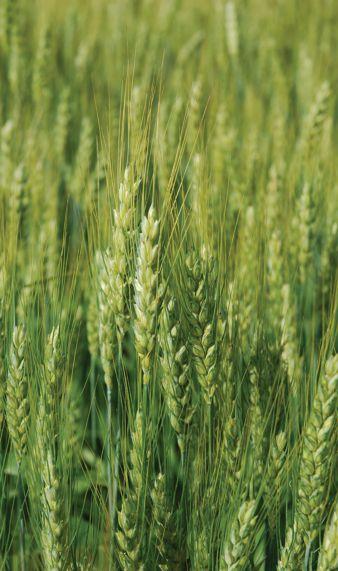
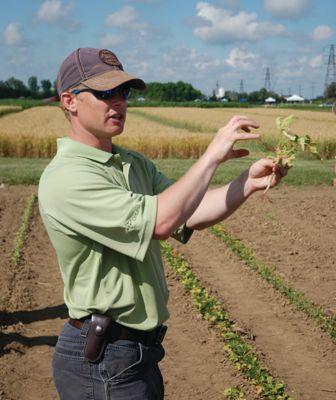
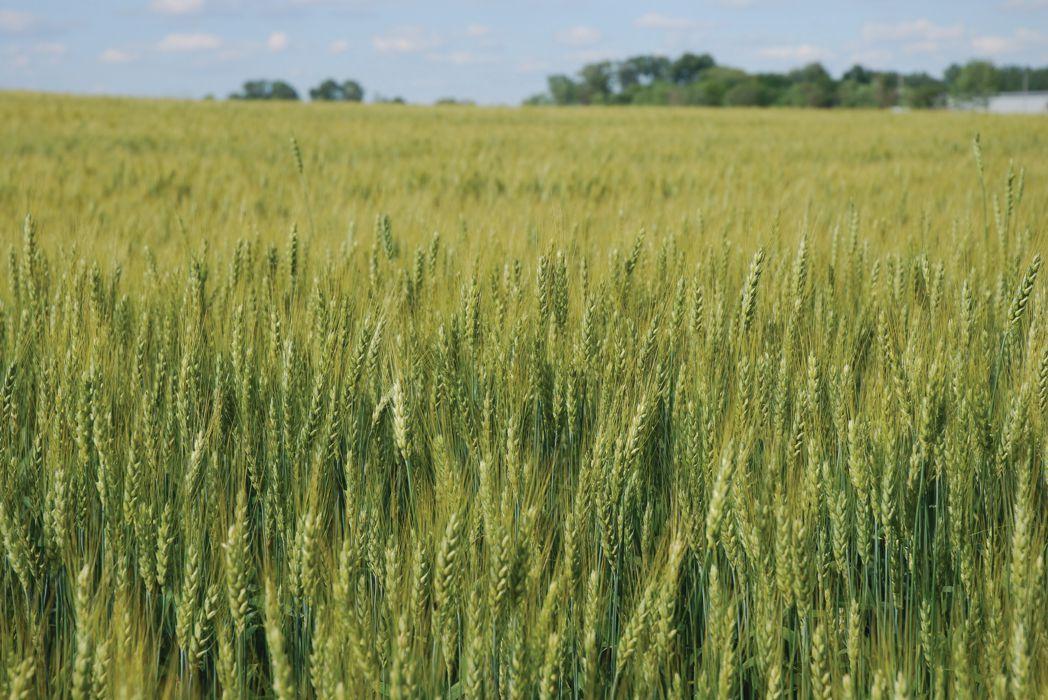
Applying fungicides, higher nitrogen rates and determining nutrient deficiencies are all part of a trend that looks at cereals, and wheat in particular, as more than “just” a rotation crop.
Weed Management
More signs of the times in row crop management are weed resistance and the role of generic formulations and their increasing availability. We cover both of these topics in this issue of Top Crop Manager.
Machinery Manager: Four-Wheel Drive Tractors
In this August issue, we provide an annual summary of the latest lines of four-wheel drive tractors, including updated specs and information on the machine that “drives” performance, production and profitability on the farm.
Reference information of this calibre is hard to find, so many growers choose to keep Top Crop Manager issues on file. If you have not kept issues for your library, you can find our stories, and more, on our interactive website.
All advertising is subject to the publisher’s approval. such approval does not imply any endorsement of the products or services advertised. Publisher reserves the right to refuse advertising that does not meet the standards of the publication. www.topcropmanager.com
IntroduCtion
Repetition seems the only way to get the message across
When I write about ignorance and media laziness, I realize that I sound like a broken record. But that is because many in the media, including The Globe and Mail, Maclean’s and countless radio and television reports, have become a chorus of broken records. It seems that the “issue of the year” is how North American farmers grow such substantial amounts of corn, only to turn so much of it (I have read citations as high as 40 percent) into ethanol. Then comes the rub, essentially a cry, “Think of how many poor and starving people could be fed with all of that corn! ”
Think of what these journalists, activists and spin doctors could accomplish if they knew a little bit more about agriculture.
The leap in logic in the “all that corn” camp is that farmers should ignore supply-and-demand economics, turn their grain corn fields into sweet corn or food-grade corn, regardless of climatic challenges, market oversupply, or any other economic fallout, for that matter.
From a farm media perspective, the subject of agriculture in Canada is well covered in a variety of publications, from east to west. Yet in the eyes of too many people in our society, a field of grain corn is really just sweet corn, “if it’s harvested early enough.” Well, folks, the two are not the same. Grain corn is just that; it can be used to feed cattle, processed into ethanol or refined into corn syrup, cornstarch or corn oil. And contrary to the recent meanderings of one doctor from Barrie, Ontario, “all that corn,” on its own, will not feed hungry stomachs (unless it comes in the form of beef, chicken or even pork). Chew a handful of grain
corn and you wind up with little more than a mouthful of grits and wax.
Too complicated?
Or too intellectually lazy? We continue to struggle with such overwhelming ignorance where farming is concerned. It is as though society has suffered an enormous concussion, to the extent where philanthropy is valued ahead of economy. “Stop increasing the size of farms; cherish the Family Farm! Go back to the days of hand-feeding chickens and plowing fields behind a team of oxen!”
Well, we can go back to those days, provided the average consumer is willing to pay $20+ per pound for chicken or $15 for a four-quart basket of tomatoes. We cannot, and should not, try to go smaller, any more than we can demand our media outlets return to profitless daily and weekly newspapers; if there is no financial reward for such a business, then it cannot exist. Ontario growers plant grain corn because it is a commodity that yields a reasonable return (finally) for the knowledge, effort and quality of the harvested crop. Perhaps the doctor in Barrie volunteers his time in a distant war-torn nation or the columnist in Toronto organizes charitable gatherings for the homeless. But most doctors have a six-figure net income, and few professional columnists are willing to return to writing with a quill.
Why should farmers be expected to spurn technology and work without fair remuneration for the jobs they do, oh so well?
Ralph Pearce Editor
and diseases
Cereal variety trials show fungicide benefits Pests
by Heather Hager, PhD
Yields increased for barley, spring wheat, and oats in the first year of trials.
How do cereal variety yields compare when fungal disease is reduced by foliar fungicide application? Do disease-tolerant varieties that yield well under disease pressure maintain their high ranking when the playing field is levelled by fungicide application? Or do disease-intolerant varieties reap the advantage when disease pressure is removed? For the first time, the Ontario cereals variety performance trials are looking to answer these questions. Preliminary results are in from the 2010 growing season, and the trials are continuing in 2011.
The trials, called managed performance trials, are a new addition to the Ontario Cereal Crops Committee’s standard yearly variety performance trials. The experiment was spurred by some recent changes in disease development and crop management practices, explains Peter Johnson, cereals specialist with the Ontario Ministry of Agriculture, Food and Rural Affairs, who is one of the project’s lead researchers along with Dr. David Hooker from the University of Guelph’s Ridgetown campus. First, oat resistance to crown rust has broken down during the past few years, with some areas seeing high yield loss if no control measures are taken. “It basically became part of my standard recommendation that, if you grow an oat crop, then you must spray with a fungicide,” says Johnson. “Second, it’s also part of my standard recommendation that if you grow spring wheat and there’s risk of Fusarium at any significant level, you must spray a Fusarium fungicide.”
“We started to question if growing the variety trials without using fungicides was actually giving data to the growers that were reflective of what they would see in the field,” he concludes.
The researchers hypothesized that there would be a large difference in variety rankings between the managed and standard trials. “Particularly in the case of oat, (variety) Prescott, which used to have 129 yield index, suddenly became an 85 yield index once crown rust hit,” explains Johnson. “So then the question becomes, can
we take that 85 yield index and move it back up to a 129 yield index if we control the disease with a fungicide?”
The managed performance trials were set up at five of the standard cereal trials locations, i.e., St. Marys, Harriston, Winchester, Ottawa and New Liskeard, and included all the varieties examined in the standard trials. Spring wheat and barley both received two fungicide applications: Quilt was applied at weed control timing; and Prosaro was applied at Fusarium timing, or early head emergence. Oat received one application of Stratego at flag leaf stage. Other current fungicide options are Caramba at Fusarium timing, and Bumper, Tilt, Headline and Folicur at weed control or flag leaf timing, notes Johnson.
Averaged across all varieties for each site, yield increases with fungicide application ranged from zero to 15 percent for spring wheat, zero to 19 percent for barley, and five to 50 percent for oat. Site differences were likely related to variability in disease levels among the locations, with, for example, New Liskeard having its usual fairly low levels, and Harriston having high levels in 2010, says Johnson. For the
individual varieties, yield increases with fungicide application were up to 68 percent for spring wheat, up to 41 percent for barley, and up to more than 300 percent for oat. “So you can see that where we did get the crown rust problem (on oat), there was a huge impact of the fungicide,” Johnson emphasizes.
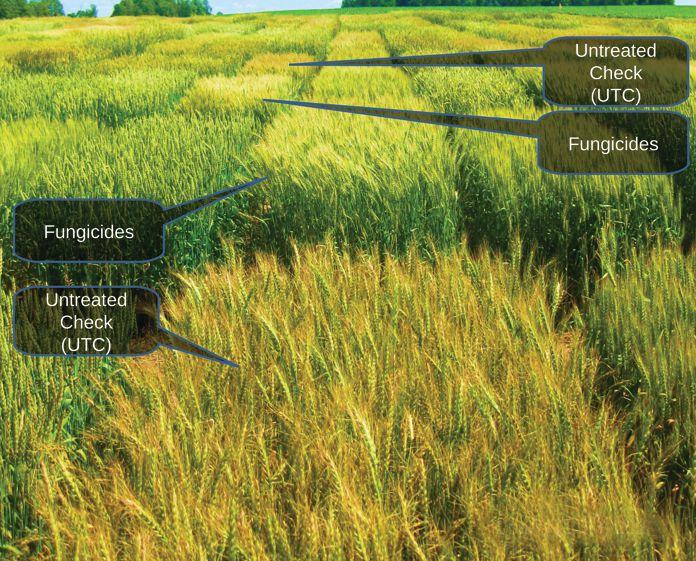
Ellen Sparry, genetics manager for C & M Seeds, manages the Harriston site. She notes obvious visual differences between the standard and managed plots for all three crops at Harriston. “Where we were applying fungicides, certainly they appeared much cleaner and healthier, nicer looking straw, cleaner looking heads. The oats as well, the foliage stayed much cleaner with the fungicide,” she remarks. Despite the overall yield increases, there were fewer changes in ranking than expected. “When you do the statistical analysis, while some varieties did change ranks fairly significantly, overall, the rankings didn’t change a whole lot,” says Johnson. Trials during the 2011 growing season will provide additional data, and further analyses might help to pinpoint and suggest reasons for specific changes in rank.
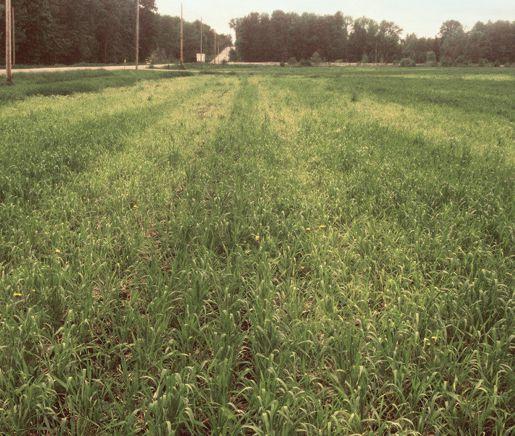
There were obvious visual differences between test plots that did and did not receive fungicide at Harriston.
Photo courtesy of ellen sParry, c & M seeds
Pests and diseases
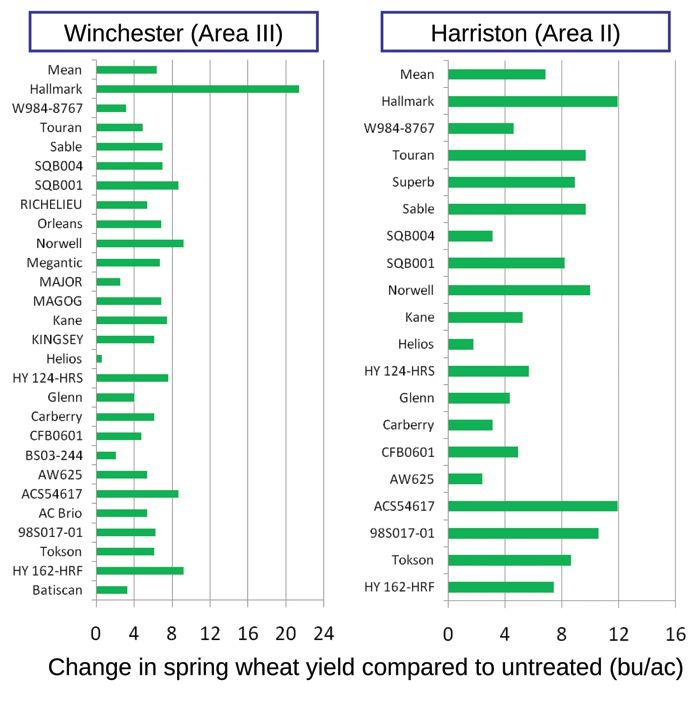
RIGHT: Spring wheat responses to foliar fungicide at Winchester and Harriston in the Ontario Cereal Crops Committee’s 2010 standard and managed variety performance trials.
GraPhs courtesy of Peter Johnson, oMafra
BOTTOM RIGHT: Yield index rank of oat in untreated and foliar fungicide-treated trials at Harriston in 2010. Varieties closest to the red line showed the least change in rank. Varieties furthest from the red line showed the greatest change, with those above the line increasing in rank and those below decreasing in rank with fungicide treatment.
One grower who is very much in favour of these managed variety trials is Quentin Martin, co-owner of Cribit Seeds and Wintermar Grains. “We’re invested in oats and barley from a growing standpoint, from a seed standpoint, and from a further processing for food purposes standpoint,” he says. “Our feeling is that there are better ways to manage oats and barley with the tools that are available today.”
Growers are becoming savvier about the benefits of intensive wheat management, including well-timed weed control, fertilization and fungicide applications. Martin thinks that the results of the managed variety trials will encourage growers of the benefits in yield and quality they can realize with more intensive management of the barley and oat crops as well.
Although there are no new recommendations yet for selecting spring cereal varieties, the lack of significant overall changes in variety rankings means that growers can continue to use the standard trials results as an aid for choosing varieties. But Johnson draws one definitive conclusion from the oat trials. “This absolutely reinforces that it is essential to spray an oat crop with a fungicide if you are anywhere basically other than in the New Liskeard or northern Ontario district,” he says. “If you’re in the Ottawa Valley or anywhere in southwestern Ontario or central Ontario, if you grow oats, you spray a fungicide at flag leaf stage.” The potential yield responses are just too big to ignore.
The complete report of interim results for winter and spring wheat, spring barley, and spring oats is posted at www.gocereals.ca under Variety Trials, Performance Reports, Interim Managed Cereal Performance Trial Research Report 2010. n
Bradley Bailey
OAC Markdale
CFA0607
Sherwood
AC Gwen Prescott
Alcyon
Manotick
Lachute Robust
Fertility and Nutrients
Higher N rates + fungicide boost wheat
by Blair Andrews
British research spreading to Ontario fields.
Ontario crop researchers are thrilled with the results of a new study into the interaction of fungicides and increased nitrogen rate applications on winter wheat. The synergy of the two practices showed dramatic and consistent yield gains on test sites throughout southwestern Ontario. Buoyed by the success of the trials, researchers and others in the wheat industry say the study might change how most of the crop will be grown in the future.
The relationship between nitrogen rates and fungicides was studied over three years in a project known as the SMART (Strategic Management Adding Revenue Today) wheat trials. Inspired by work in the United Kingdom and elsewhere that demonstrates a strong interaction between nitrogen and fungicide inputs, the SMART research was aimed at assessing the effects of the combination under Ontario’s conditions.
Dr. David Hooker and graduate student Jonathan Brinkman of the University of Guelph’s Ridgetown Campus, and Peter Johnson, Ontario Ministry of Agriculture, Food and Rural Affairs cereal crop specialist, led the research project.
Using a number of small-plot and fieldscale trials, the researchers compared various treatments to a check of applying 90 lbs of N per acre and no fungicide to the winter wheat crop. Johnson says the check produced an average yield of 93 bushels per acre in the small plot trials. Increasing the nitrogen to 120 lbs per acre and applying a fungicide at heading for Fusarium control resulted in an average yield of 105 bu/ac, an extra 12 bushels per acre.
Adding a second fungicide at weed control time and applying 150 lb of N produced an average yield of 111 bu/ac, or 18 bu/ac more than the check.
Results from the field
The field-scale trials repeated the smallplot results. Johnson says the combination of 150 lbs of N and two fungicides produced average yield increases of 21, 21 and 18 bu/ac in the three years of the study from 2008 to 2010. “I was astounded
A three-year study testing higher nitrogen rates and two fungicide applications boosted yields by as much as 21 bu/ac.
at how it worked,” says Johnson of the results. “2008 was a high yield year and my immediate reaction was that the only reason it worked was we had tremendous yield potential. But 2009 was a low-yield year and it worked again.”
In addition to the yield results, the researchers also wanted to assess the potential economic benefits of a more intensive wheat management system. According to Johnson, the math demonstrates an advantage, particularly when applying 120 lbs of N per acre and one fungicide for Fusarium control. With a cost of $40 per acre and current wheat prices between $6.00 and $7.00 per bushel, he says the yield boost of 12 bushels per acre more than doubles the value of the investment. “A lot of wheat in Ontario, 60 percent of the wheat crop, was probably grown at 90 lbs of N and no fungicides,” notes Johnson. “This research clearly shows that there is more profit potential to move to 120 lbs of N and at least one fungicide.”
Results confirm benefits of fungicides
Although he was not surprised by the showing of the trials, Dr. Trevor Kraus, supervisor of research and commercial development in Eastern Canada for BASF, says the results were outstanding. “We know many growers are trying to push yields using fertility and fungicides and
they are having success in the fields,” says Kraus. “It’s nice to see confirmation in replicated trial work as well.”
Kraus suspects that at least two factors appear to be at work in the interaction of the nitrogen and fungicide applications. First, the increased nitrogen rates produce a thicker canopy and more tillers, which he says creates an environment that is more conducive to disease development. Second, Kraus says if disease can reduce yield in plots with lower nitrogen applications by around 10 percent, then the potential for lost bushels rises with the increasing yields under higher nitrogen.
Kraus says the SMART trials could encourage more growers in Ontario to improve their management practices to maximize yield. He notes that more farmers have been taking a different approach to growing their wheat in recent years and have helped push the provincial trend line to more than 82 bu/ac. “If you went back 10 or 15 years ago, there were very few producers using fungicides in wheat and they would use a very basic fertility program,” says Kraus. “Wheat was looked at as more of a rotational crop. Now it’s looked at as a crop of value and something that growers are managing to a higher level.”
Barry Gordon, sales and marketing manager at C & M Seeds, near Palmerston, Ontario, says the increase in yields
Photos by ralPh Pearce
Fertility and Nutrients
has made wheat a more competitive crop with corn and soybeans. “I think this is exciting to be able to see 10- to 20-bushel yield advantages by just changing the management system,” says Gordon of the recent study.
Gordon was also pleased to see the good results in southwestern Ontario, where a smaller percentage of farmers have been using fungicides on their wheat acres. “It’s a proven yield enhancer and, with good techniques, it will bring wheat to a new level of profitability for Ontario growers,” he says.
Lodging a concern in boosting N rates
While Johnson believes the research is positive enough to encourage farmers to consider changing the way they grow wheat, he is careful to put the implications of the study into perspective. He says growers who have moved to Ontario from Europe are already practising the system. Meanwhile, he is cautious about recommending increased nitrogen applications to farmers who have experienced problems with lodging in the last three years with their current rates of nitrogen.
Johnson is particularly concerned about the 2011 crop. Most of the winter wheat was planted early, making it more susceptible to lodging. Otherwise, he says it is well worthwhile for most farmers to apply 120 lbs of N to a few strips in their field as well as one fungicide for Fusarium control. “If they don’t see lodging problems, this data would suggest increased yield and more money in their pocket,” he says.
For Johnson, the key conclusion for any study is whether farmers will adopt the program. “If farmers try it and don’t keep doing it, then despite what my data says, I’m wrong.”
So far, Johnson is encouraged by the comments of farmers who participated as cooperators for the study. Convinced by the results of the first two years, he says they adopted the program for all their wheat acres. Johnson says other farmers tried the program in 2010 after hearing him talk about the trials in 2009. “They’ve come back to me and said ‘it absolutely works and that’s the way we’re going to grow wheat now.’ So my sense is farmers are picking this up and are running with it,” says Johnson. “That tells me that it’s real.” n
Crop Management
What is the difference between a yield manager and a weed manager?
Either approach requires some basic management decisions.
In a perfect world corn growers would all be yield managers, controlling weeds early, before corn emergence, to maximize the crop’s yield potential. However, as most farms cover a large acreage, it takes more than skilful time management to get crops in the ground and sprayed within a seemingly ever-shrinking window. And, then there is always the unpredictable weather.
Realistically, corn growers will find they are a blend of yield manager and weed manager, particularly controlling weeds in-crop. The production choice is on which fields should growers drive for yield, and which are best suited for a weed management strategy.
The yield management approach Simply put, a yield management approach eliminates the impact of weeds on yield potential by ensuring a weedfree environment for corn from the time of emergence. “The principle with yield management is earliness, or early weed control,” states Dr. Clarence Swanton, professor of crop science at the University of Guelph. “Weed control before corn
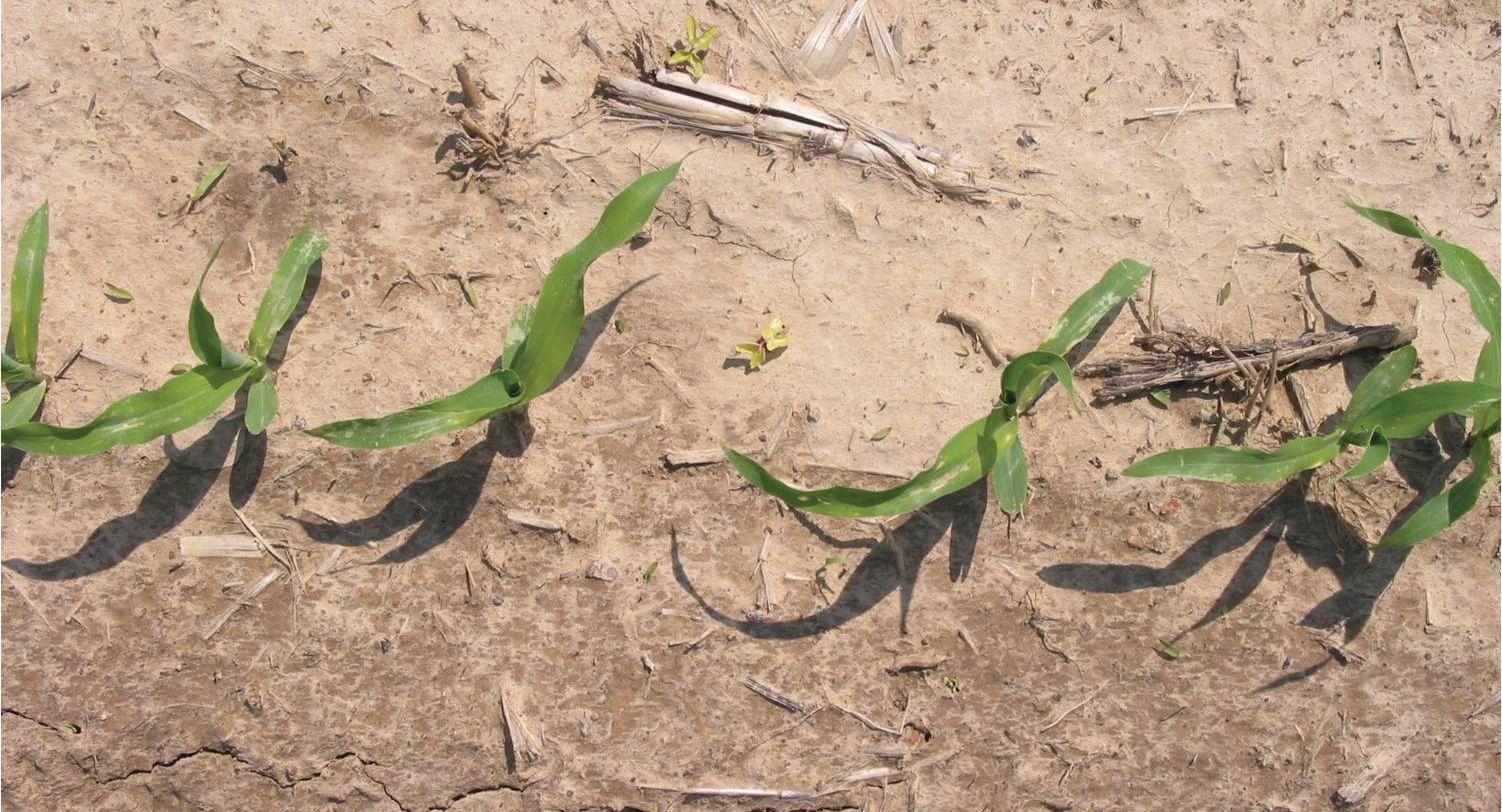
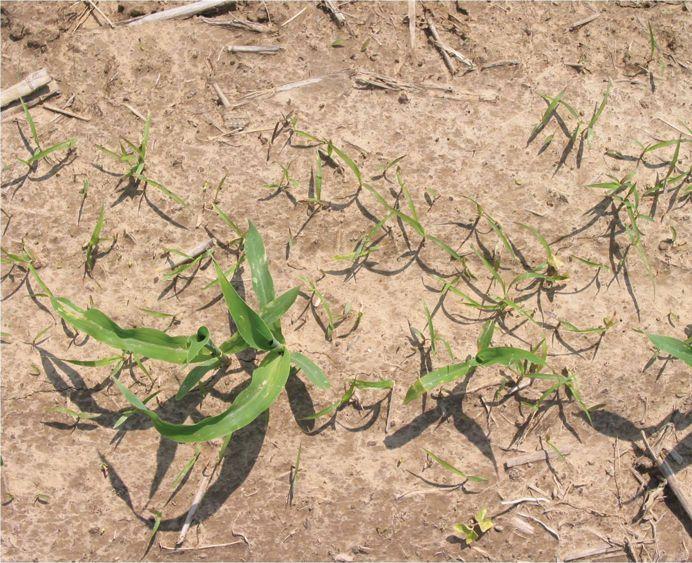
A yield management approach maximizes yield potential by controlling weeds before they can affect a corn plant’s growth pattern, particularly during the critical weed-free period.
emerges is crucial to the crop reaching its genetic yield potential.”
Swanton has accumulated more than 10 years of research that shows corn plants can detect the presence of weeds from the moment of emergence and change their growth pattern as a result, impacting root growth, kernel number and ultimately yield.
Dr. Gilles Leroux, professor of weed science at Laval University in Quebec City, suggests that “the shift between yield management and weed management should occur no later than the three- to four-leaf stage of corn because past this staging, weeds will compete with the crop and irreversibly reduce grain yield.”
Swanton’s Ontario-wide trials have provided data to back this claim, indicating that if weeds are not controlled by the three-leaf stage of corn, the crop is capable of loosing yield at a rate of onehalf to three bushels per acre per day. This could be the difference between spraying on a Monday or a Wednesday. A two-day delay, therefore, could make
a difference of one to six bushels per acre, which on a 100-acre field could be up to 600 bushels lost.
However, Swanton stresses that yield management is not about final yield at harvest, but about protecting yield potential. And yield potential is ultimately driven by kernel number. Swanton’s 2009 trials were able to quantify the specific effect of weed presence on kernel number based on spray timing. Results showed that kernel number declined by 13 percent if spraying was delayed until the eight-leaf tip stage (five to six fully expanded leaves), compared to the weed-free check.
Tara McCaughey, technical crop manager with Syngenta Crop Protection Canada, adds, “If growers are managing their crop to drive yield, they need to start thinking differently when it comes to their herbicide strategy. Rather than first selecting a herbicide to manage specific weeds in their field, growers should begin by selecting the practice and tools that give their corn crop the best possible start so that it can grow the way it was
Photos courtesy of dr clarence swanton, university of GuelPh
designed to grow, to maximize its yield potential in a weed-free environment.”
When selecting a herbicide strategy, a grower’s number one consideration should be, “do I want to maximize my corn yield?” If the answer is yes, they should follow a yield management approach.
The weed management approach
Given spring timing constraints, executing a pre-emergent yield management approach can be a challenge. Comparatively, a post-emergent weed management strategy allows growers to spread the timing of their herbicide application into the post-emergent window. Leroux adds, “A weed management approach might also be less risky on land where the weed pressure is unknown (for example, newly rented land) as it will allow growers to assess their weed challenges prior to making a herbicide application.”
Field selection is also important when selecting a weed management strategy. “A good understanding of your fields is crucial to making this decision,” says McCaughey. “Consider a weed management approach on fields where the weed pressure is typically low, to reduce the early impact of weeds prior to herbicide application.”
The corn system being grown (conventional, glyphosate-tolerant, seed or
sweet), its end use (grain corn, which is heavily dependent on yield; silage corn, which is equally dependent on plant biomass and cob fill) and herbicide options available for it also should be considered. “Growers might select weed over yield management if growing glyphosate- or glufosinate-tolerant corn because they’re likely to use the herbicide associated
with the system that they’ve paid for,” explains Leroux. Glyphosate resistance management then becomes an important consideration. “For long-term glyphosate-tolerant corn growers, I strongly suggest managing against glyphosate resistance by regularly switching to a yield management approach: spraying a preemerge herbicide followed by glyphosate at the seven- to eight-leaf stage of corn. Or they can stick with weed management, but tank-mix the glyphosate with a residual herbicide for application at the three- to four-leaf stage.”
“Glyphosate-tolerant corn systems now have more options for in-crop weed management that also offer residual control,” explains McCaughey. “If a grower opts for a post-emergent weed management strategy, I’d recommend a one-pass, postemerge residual herbicide like Halex GT that combines glyphosate with two other actives that provide residual protection.”
Swanton, Leroux and McCaughey all agree that regardless of the approach, selected residual control is the key. A residual herbicide, applied early, will keep the crop weed free throughout the critical weed-free period. It will provide better control on fields where weed pressure is high, and will help spread out management risks for growers covering a large acreage over an extended period of time.
Regardless of which system growers select, their decision should be based on their definition of “success” at the end of the growing season. n
When to be a yield or weed manager
Here are some circumstances in which growers should consider selecting either a yield or weed management approach.
Use Yield Management when:
• The goal is to reach the maximum yield potential of the crop
• In a glyphosate- or glufosinate-tolerant or conventional corn system
• Growing a corn hybrid with high yield potential
• The weed pressure and species in the field are understood
• Soil conditions will not impede early entry and early spraying
• The plan is to be in the field early to apply UAN
• Managing the development of glyphosate weed resistance
Use Weed Management when:
• In a glyphosate- or glufosinate-tolerant corn system
• Weed species and pressure are unknown
• Weed pressure is typically low
• Growing silage corn
• Spring weather does not allow for a pre-emergent yield management application
The presence of weeds changes the leaf orientation, from pointing into the row for optimum light capture, to growing away from weed pressure.
Fertility and Nutrients
Sorting through manganese deficiency in wheat
by Carolyn King
Could preventive applications be worthwhile?
Brian Hoven’s curiosity about manganese deficiency in wheat was sparked during a soybean workshop in the winter of 2009-10. “A guest speaker happened to mention that if you have a field where soybeans respond to manganese, then the response to manganese could be even bigger in the wheat crop following it. He said manganese deficiency is one of the symptoms you tend to miss in wheat. So I thought, I’m going to try applying manganese to wheat and see what happens,” says Hoven, a certified crop advisor with Lakeside Grain and Feed in Petrolia, Ontario.
So in the spring of 2010, he set up a simple trial on his farm in Lambton County, applying manganese to half of a winter wheat crop in a field where he always applies manganese whenever the field is in soybeans. He notes, “It’s pretty common to apply manganese on soybeans in our area; it’s just the way our soils are.”
Soil characteristics have a large and complicated effect on manganese availability. “In most soils, manganese deficiency is not caused by an outright lack of the nutrient in the soil; manganese is there, but the plant can’t get at it,” explains Keith Reid, soil fertility specialist with Agriculture and Agri-Food Canada in Guelph. “The biggest factor affecting manganese availability is pH: the more alkaline the soil, the more likely manganese is to get tied up. The other big factor is organic matter, and it’s the extremes, either very little or very high organic matter, where manganese is likely to be tied up.”
Other factors influencing manganese availability include soil aeration, weather conditions like drought or cool temperatures, soil micro-organism types, and the total amount of manganese in the soil.
Both soybeans and wheat have relatively high requirements for manganese, so if a field has a history of manganese deficiency for soybeans, then there is a good chance of a deficiency for wheat. Hoven’s field has a pH of 6.8, an organic matter content of 4.3 percent, and manganese concentration of 10 ppm, which is low.
Underrated and often misunderstood Manganese is a micronutrient that plays a fundamental role in chlorophyll production and photosynthesis, so a deficiency can have serious effects. “In an extremely severe deficiency, wheat yield can go to zero. The plants can actually die. Most often that’s a case of poor winter survival. There are some fields down in Elgin County and west Kent with really sandy soils where, if the growers don’t put manganese on in the fall, the wheat just doesn’t survive the winter. In a less severe deficiency, it could take 20 or 30 percent off the yield,” says Reid.
In the spring, rather than waiting for deficiency symptoms to appear in the wheat, Hoven applied a preventive foliar manganese application. He used MangaMax, a chelated form of manganese, in a tank mix with his first spring application of 2,4-D. “All I did was just spray half the field with 2,4-D and the other half with 2,4-D and manganese at a litre to the acre.”
Foliar applications are recommended to correct a manganese deficiency because they get the manganese directly into the plant. Reid says, “We haven’t found soil-applied manganese to be effective because in most fields it’s a matter of the soil chemistry tying up the manganese. So if you put more manganese in the soil, you just have more tied up.”
MangaMax, a NutriAg product, is 5.5 percent manganese and 0.45 percent boron. At a rate of one litre, Hoven was applying 0.1467 lbs of Mn per acre. Hoven worked with Mike Pastir of NutriAg on the project. Pastir says, “Applying manganese in a mix with the first post-emergent herbicide saves on application costs, and it’s usually the optimal timing because the plant has sufficient leaf canopy to absorb the nutrient.”
He adds, “Most of NutriAg’s products go on in a tank mix. Our manganese products, like our MangaMax or our ManMax, are completely soluble, safe and extremely compatible with most of the pesticides that are on the market.”
Reid adds a note of consideration. “Our experience with the chelated forms is that they are not providing very much manganese. They tend to be expensive per pound of nutrient, which means the rates that people use are quite low. If you haven’t got a serious deficiency, they appear to work. But what we’ve found out this past year is that if the fields are really deficient, that treatment doesn’t provide enough manganese to correct the deficiency.”
He advises, “The most economical source is manganese sulphate, and we recommend applying 2 lbs of actual Mn per acre, which is about 8 lbs of product per acre (or about 9 kg of Mn per hectare). This should be applied in 40 gallons of water, which nobody wants to spray because that’s an awful lot of water per acre. However, it takes a fair bit to get this dissolved.”
One pattern that is diagnostic of manganese deficiency in wheat is if the wheat growing in tire tracks from a spray application is green whereas plants in the areas between the tracks are yellow.
Photo courtesy of Keith reid aafc
Fertility and Nutrients
Time management versus efficiency?
Hoven agrees that manganese sulphate applied at 9 kg per hectare in 40 gallons of water as a separate pass may be a sound agronomic recommendation, but for most growers, this is not overly practical. “Manganese sulphate can take a long time to dissolve in the tank, and most wheat growers cannot justify the extra time and cost of a separate pass for manganese, and manganese sulphate is not very compatible with most pesticides. On the other hand, most chelated forms will do the job effectively in one pass over the field. Most contain built-in adjuvants and have higher water solubility than manganese sulphate, which is why they often have lower use rates. This also allows growers to use lower water volumes. It ensures more nutrient is available to the plant for uptake. And it gives the grower tank mix options.”
Conditions were very dry in Hoven’s area for much of the summer of 2010. Although drought increases the risk of manganese deficiency, he did not see any symptoms of the deficiency in the field.
Be careful and be exact
Manganese deficiency in wheat can be hard to diagnose. “Manganese deficiency in wheat plants doesn’t have really distinctive symptoms. It’s not like manganese deficiency in soybeans, which is easy to see; you’ve got the yellow leaf and the dark green veins, so it’s very diagnostic. In wheat, it’s more of a yellowing and a stunting of the plant, but it’s pretty nonspecific,” notes Reid.
And sometimes the deficiency is confused with other problems. “For example, in a field with hollows that have very high organic matter soils, you’ll get manganese deficiency in the hollows because the manganese gets tied up with all the organic matter,” he says. “So you might think the yellowing in the hollows is due to wet feet, but it might actually be a manganese deficiency.”
Reid adds, “Often the pattern of yellowing in a field is more diagnostic than the symptoms on the individual plants.” Patterns suggesting a deficiency include yellowing in depressions and yellowing on eroded knolls where the organic matter is very low and pH is high. He notes, “The one pattern that is really diagnostic of manganese deficiency is if the wheat in tire tracks from something like a herbicide application is green while the areas between the tracks are yellow. What’s happening there is that manganese is actually more available to plants where the oxygen in the soil is limited. Often there is just enough compaction in the tire tracks to reduce the amount of air in the soil, so more manganese can get to the plant.”
Even though Hoven did not see deficiency symptoms, he did get a response to the manganese application. “We got about a 3.0 bushel per acre response, which pretty much just covered the cost of the application and the product.”
So, when the likelihood of a manganese deficiency is high but there are no visible symptoms in wheat, might a preventive application of manganese make sense?
Hoven says it is much too early to say. “This was our first shot at it, just to see what would happen. We got a little response, so we’re going to try it again for the next two or three years, in a more detailed study. We’ll be doing soil sampling and tissue testing and possibly comparing some other manganese products, and we’ll see how things pan out. With $6 wheat, you can spend a little extra to get a better yield.”
Some evidence for proactive applications
According to Pastir, there could be merit in a preventive application. “Normally when you see a deficiency in a field, you already have a yield loss. So if you know that field has a history of manganese deficiency or the weather conditions will likely induce a deficiency, such as a drought or cool weather where the roots aren’t actively growing, I think it’s better to go in before you see the signs to prevent that yield loss.”
Reid has a different view. “The nice thing with a manganese deficiency is that you can see the deficiency and supply the manganese to the plant, and the plant will come right back up to normal photosynthesis, and you’ll have lost essentially no yield.”
Based on current knowledge, he recommends starting with a soil test to check manganese levels, and scouting for deficiency symptoms, especially in fields with low manganese levels or a history of deficiencies. If there is a deficiency, a foliar spray will correct it.
Hoven agrees with Pastir about visible signs of deficiency. “In my opinion, it is important not to let the crop show signs of deficiency. When the crop is changing colour, it is not growing to its maximum potential, which leads to reduced yield.”
Hoven also points out that the best way to judge what is happening in the plant is to take plant tissue samples both before and after application. “Ultimately, the only way to tell what your plants are taking up from the soil or a foliar application is to tissue test.” n
Weed ManageMent
New waterhemp resistance discovery in Illinois
by Blair Andrews
The weed is not a major problem in Ontario, yet its developing resistance is troubling.
Weed scientists in Illinois are studying a new population of waterhemp that has developed resistance to another herbicide family. Believed to be the first such case in the world, the University of Illinois has confirmed the broadleaf weed species’ resistance to HPPD-inhibiting herbicides. This family of herbicides is often foliar-applied and, until now, has successfully managed waterhemp populations that are common in Illinois and across much of the US Midwest. Although waterhemp is not high on the list of weed threats in Ontario, the discovery of this new resistance in Illinois is sounding another wake-up call for managing pesticide resistance.
Several active ingredients in HPPD-inhibiting herbicides (those that inhibit 4-hyrdoxphenyl pyruvate dioxygenase) are commercially available, including isoxaflutole, mesotrione, topramezone and tembotrione. These ingredients are available either as individual products (such as Impact and Callisto) or as components of pre-mixtures or co-packs (Converge and Vios G3). “As families of herbicides go, it’s relatively new in the marketplace,” says Dr. Aaron Hager, associate professor of weed science at the University of Illinois. “In US corn production areas, it was 2001 when mesotrione was first commercialized.”
Approximately eight years later, Hager says concerns were raised about poor performance in a seed corn field in the north-central part of the state, where waterhemp was not controlled adequately following herbicide application. The weed scientists were notified in late 2009, when Hager says the situation became more serious. “The records show that this field had been in seed corn production for at least the last seven years,” recalls Hager. “And in each of those seven years, the field was treated with one or more applications of HPPD-inhibitors to control the weeds after the corn crop had emerged.”
Seeds were collected from the field and were taken to the university for testing. In greenhouse experiments, plants grown from the seed and treated with HPPD-inhibitor herbicides survived, whereas plants from two known sensitive populations, for comparison, were controlled completely.
Field research in 2010 confirmed the greenhouse results. HPPD-inhibitors applied alone or tank-mixed with atrazine provided poor control of the waterhemp population. Crossing experiments confirmed that the reduced sensitivity to HPPD-inhibitors can be transferred to progeny, providing additional evidence of resistance.
This novel case of resistance to HPPD-inhibitors (Group 27) is the latest in a series of instances of waterhemp’s ability to thwart herbicide controls in Illinois. The first announcement of herbicide resistance in Illinois waterhemp occurred in 1997 with ALS-inhibiting (Group 2) herbicides. Since then, the triazines (Group 5), PPO-inhibitors (Group 14) and glyphosate (Group 9) have been added to the list.
The Canadian perspective
Dr. Peter Sikkema, professor of field crop weed management at University of Guelph’s Ridgetown Campus, says waterhemp has been confined to just three counties in Ontario. A population in Lambton County is resistant to both the ALS and triazine herbicides (Groups 2 and 5), while a population found in Essex County is resistant only to the ALS herbicides (Group 2). “Waterhemp is a relatively minor weed in Ontario, and it’s surprising to me that it has not moved more rapidly,” says Sikkema. “We first documented it in Ontario in the early 2000s. I thought it would move across the province similar to its movement in the US. It seems to be largely confined to the areas where we first identified it.”
Sikkema notes that waterhemp has been found in a few additional fields but it is not moving as rapidly as he first anticipated.
The broadleaf weed was not considered a problem for farmers in the US Midwest until it began to spread across states such as Illinois in the late 1980s and early 1990s. “We have a weed species here that has gone from obscurity 15 to
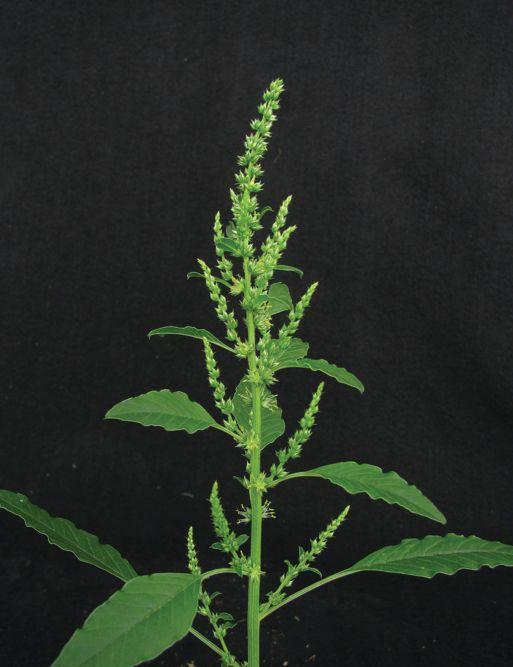
Although waterhemp is not considered a problem weed in Ontario, growers need to remain vigilant of its advance, given its adaptability to different herbicide modes of action.
Photo courtesy of MiKe cowbrouGh, oMafra
Weed ManageMent
20 years ago to being the most problematic broadleaf species in the state,” says Hager. “It’s problematic for a lot of different reasons, not the least of which is the fact that we continue to select for herbicide resistance in it.”
And Hager says the recent finding provides another example of how weeds can quickly adapt to practices that are repeated “over and over.” “We hope to preserve the effectiveness of this herbicide family. If we can continue to integrate different types of management strategies, we may not get to a point where we see widespread resistance to HPPD-inhibitors, for example,” explains Hager. “But that is something that will be dictated by how proactive farmers decide to be in terms of integrating their weed management systems.”
More than one problem to be solved
While resistance to one herbicide family is problematic, Hager says a more challenging issue is the emergence of biotypes that are resistant to more than one group of herbicides. “We’re very concerned about multiple resistances in a single plant or multiple resistances in a given field, and those are instances that we think are going to become more common and very troublesome in the future.”
Hager says the next steps of the research include identifying other characteristics of the HPPD-inhibitor resistant biotype and understanding the resistance mechanism. “We are still in the process of investigating the mechanism of resistance,” notes Hager. “Ultimately, once we learn how this plant survives these very effective herbicides, we can begin
to formulate better recommendations that we can take back to the farmers in systems that are relying heavily on these herbicides.”
As the weed scientists in Illinois work to get a better handle on this waterhemp biotype, Sikkema reminds Ontario growers of the simple steps to help prevent resistance: a diverse crop rotation and using multiple modes of herbicide action over time. “If you use your HPPD-inhibiting herbicides, let’s say in your corn crop, and then you use alternate chemistries in your soybean or wheat (or other crops) in the rotation –but not HPPD-inhibitors – then I think the longevity of the herbicide will be quite good,” says Sikkema. “In contrast to that, if you re-use a herbicide repeatedly, it will increase the selection intensity for herbicide resistant weeds.” n
Editor’s note: In June 2011, the University of Illinois issued a bulletin stating that waterhemp found throughout the state survived applications of post-emergent herbicides, with most reports citing glyphosate as the herbicide. Dr. Aaron Hager noted that some of the plants may have survived because of low application rates relative to the size of the plants, precipitation that came too soon after application or poor coverage. But the best explanation, he stated, was the development of a glyphosate-resistant population. This corresponds with studies published in 2010, which found that 33 percent of glyphosate-resistant waterhemp demonstrated resistance to PPO inhibitors, and virtually all populations were resistant to ALS inhibitors. Hager’s recommendation for controlling surviving plants included inter-row cultivation and hand rogueing.
MORE BUSHELS PER ACRE
Generic formulations have changed the landscape
by Blair Andrews
Saving money, streamlining registrations and focusing on future innovation.
Legislation to pave the way for more generic pesticide products to enter the Canadian marketplace has passed the one-year mark. The benefits for farmers will include a wider selection of crop protection options and an opportunity to cut a few dollars from the input bills over the next few years. The new regulations, under the Protection of Proprietary Interests in Pesticide Data (PPIP), were passed in June 2010.
According to the Pest Management Regulatory Agency (PMRA), the PPIP policy is aimed at encouraging the introduction of new and reduced-risk pest control products while providing a predictable and timely process for the introduction of competing generic products to the market. Another objective of the regulations is to make the process quicker, enabling growers to have access to the generic pesticides sooner than under the
previous policy.
Warren Libby, a former president of Syngenta Crop Protection Canada and Novartis, agrees that the old process for registering pesticides was expensive and time-consuming. Since the PMRA made the changes, Libby says the number of generic and off-patent products has grown to more than 250 from a just a handful in 2007. “I suspect that there will be lots more coming in the months ahead,” says Libby. “As long as there are products out there coming off patent, and there’s still an attractive margin on those products, I think you can pretty much assume that there will be generic companies that are going to bring products into Canada.”
The changing shape of Canada’s pesticide industry is one of the driving forces behind Libby’s new venture, The Savvy Farmer Inc. The Guelph, Ontario company has developed an online database
featuring listings of more than three million registered treatments for more than 1000 weeds, insects and diseases in more than 700 crops. The site, which requires a subscription fee, is designed to help farmers search for the most cost-effective products for their crop management decisions. Libby says the site is updated almost daily with new information, including the latest registrations.
Dale Kushner, commercial business manager for Makhteshim Agan of North America, Canada, Ltd. (MANA Canada), also believes the new process is better than the previous system. MANA is a leading manufacturer of branded off-patent pesticides. “The new process has measurable timelines and is somewhat more predictable about when you’ll be in the market,” says Kushner, referring to the benefits for companies seeking to register generic products.
Whether growers rely on brand names or generics, the focus is always on maximizing the output of every acre.
Photo by ralPh Pearce
Lower prices and more choice
As for the benefit of lower prices to farmers, Kushner notes that the pesticide market in Western Canada was particularly volatile in the spring of 2010, with a few companies “aggressively” marketing their products and offering lower prices. He estimates that $70 million worth of savings were passed on to the farmer in the cereal germicide market last year. “It’s just a competitive nature that occurred, where new entrants came in at different price points and people reacted and decided to compete,” says Kushner. “The more choice in the market and more competition tend to lead to lower purchase prices for the farmer. On the flip side, which is equally as important, it leads to more choice and farmers and retailers are not tied to one product or one company or one manufacturer.”
For Michael Schaad, business manager for Eastern Canada Crop Protection with BASF, the new regulatory climate is part of an evolution to bring Canada’s system into line with other countries. “The market is going to continue to evolve, and we will evolve with it as we have in other parts of the world, so we don’t look at it as something that has fundamentally changed,” says Schaad, noting that BASF is a global company and competes with generics in other markets such as the United States.
Focus on performance remains While prices have decreased, Schaad thinks there are other changes in the market that are just as significant. “What tends to happen is a lot of the products impacted by generics are near the end of their life cycle; so they’ve already been impacted by resistance or newer technology,” notes Schaad.
With lower priced products competing in the marketplace, some believe that companies may be reluctant to develop new or more expensive technologies. But Schaad does not think the changes will discourage innovation. “Our focus is to help growers to get the most out of every acre. Growers have a high part of their investment in their land and it’s in their best interest to keep that land value as high as they can, so trying to save a few dollars may not be as important as choosing the best product,” says Schaad.
Citing the potential to avoid weed resistance problems, he says the better choice for some farmers would be to invest in the newer technology as it comes along.
Libby is also not convinced that the lower price environment will hamper innovation, saying the scenario could encourage more innovative efforts. “The flip side of that is when you know that a company is going to ‘genericize’ your product and drop the price on it, that could be a stimulus to innovate and replace it before it comes off patent,” says Libby. He adds that significant future innovation will come from biotechnology as the practice becomes more acceptable. “We’re going to find ways to solve a lot of these pesticide problems through genetic engineering and, of course, we’re already doing a lot of that. We’re at the tip of the iceberg,” says Libby. “That’s another piece of the puzzle that’s probably impacting the pest control business.”
A lot of innovation to come Echoing Libby’s comments, Kushner says the seed industry is focusing on other traits to complement the standard agronomic features. “It’s becoming incredibly expensive to develop these new molecules with all the health, safety and environmental guidelines,” says Kushner. “Many of these research-based companies have put a huge focus on seed technology for nutraceuticals, food quality enhancements and different oils in canola. There is just more value in that for them, and it’s easier for them to differentiate in the market place by really
focusing on that seed technology.”
While sharing the view about a shift in research toward seed technology, Schaad says there will continue to be a need for chemicals to maximize the effectiveness of the seed traits. He says BASF will be pragmatic and look for opportunities to meet the needs of farmers. “If there are unmet needs for the grower, we’ll continue to bring in innovation to fill those needs,” says Schaad.
While it remains to be seen how the changing landscape in the Canadian pesticide industry influences the introduction of new products, the opportunity to save money appears to be a certainty in the short term. For growers considering any products, Kushner encourages them to get familiar with the names of the active ingredients as opposed to using brand names when discussing products with the retailer.
Libby says there are savings to be had for those who are willing to do some homework on the range of choices that are now available. “And it’s not just cost; a farmer can decide cost on one hand but there’s also the reputation of the company on the other hand, or after-sales service,” says Libby. “One farmer may really value a high level of after-sales service and is willing to pay extra for that, whereas another farmer might not really need to pay extra for after-sales service. So it gives the farmer options.” n
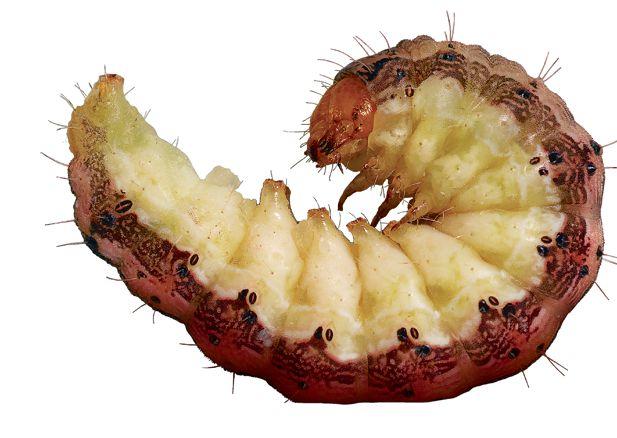
Any large investments required by the chemical industry will be offset in the coming years by the continuing development of biotech traits, such as dealing with western bean cutworm.
Photo by chris difonzo, MichiGan state university
Tillage And Seeding
Is vertical tillage a fit for IP?
Dealing with corn residues is becoming more of a challenge.
Vertical tillage is a hot topic and the practice may offer some specific benefits for identity preserved (IP) soybean producers. Solid weed control, however, remains the most important step in protecting IP premium opportunities.
Thinking back to the corn harvest of 2009, many Ontario growers had big yields, but the crop barely made it to the finish line, which meant that the corn stalks in many fields were wet, ropey, and in some cases, still green at harvest. By the following spring, many growers found that the abundant corn residue had not broken down during the winter. No-till planters and drills had difficulty performing optimally in fields with tangled corn residue that had not fully matured prior to harvest nor deteriorated as normal during the winter.
The problem was significant enough that many no-till producers are now considering a vertical tillage pass in the fall or spring to try to keep corn residue from having a negative effect on the subsequent soybean crop. But what are
the implications of vertical tillage for IP soybean producers who previously notilled into corn stalks?
Several considerations
According to Mike Cowbrough, weed specialist with the Ontario Ministry of Agriculture, Food and Rural Affairs (OMAFRA), IP growers should not
consider vertical tillage a weed control practice. “We’re not really doing the vertical tillage for weed control. In fact, many of the vertical tillage tools in use will not provide much help in controlling weeds like dandelions or other perennials, broadleaf or grass seedlings, or established winter annuals. It’s a residue management pass, not a weed control treatment,” he says.
Some IP growers are hypersensitive to weed control performance and have limited post-emergence options to control problem weeds like dandelions, yellow nutsedge, eastern black nightshade and sow-thistle. Cowbrough says it makes sense for them to do the vertical tillage either in the fall or as early in the spring as possible to allow stimulated weed seeds to germinate and be controlled with a preplant weed control treatment.
Having at least seven to 10 days between vertical tillage and planting provides a significant benefit from a combined burndown/residual soil-applied herbicide program applied pre-plant. “Even if you do a vertical tillage treatment in the spring, following up with a treatment like Guardian, Guardian Plus, or glyphosate and Boundary will clean up perennial weeds,
Target problem weeds with pre-plant residual program
For no-till IP or non-genetically modified soybean growers, there are some problem weeds that are extremely difficult to control post-emergence. Selecting the right soilapplied residual herbicide can prevent these weeds from posing a problem late in the season.
Dandelions, eastern black nightshade, nutsedge, sow-thistle and resistant broadleaf weeds can pose a challenge for IP soybean producers. With limited post-emergence control options, early residual products offer the best protection. According to Mike Cowbrough, weed specialist with the Ontario Ministry of Agriculture, Food and Rural Affairs, if a grower knows which weeds pose the biggest threat, it is easier to select the appropriate residual herbicide product to counter that threat.
For instance, 2009 was a cool, wet year that favoured dandelions. “These weeds were big and robust in no-till fields this past spring,” says Cowbrough. “Many growers have told us that using Guardian pre-plant early in the spring provides excellent control of dandelions through the season. With support from the Grain Farmers of Ontario, we looked at this and found that in the right setting, you can see solid dandelion control through the growing season and even into the following spring with Guardian.”
That extended control can be extremely valuable for growers who plant wheat immediately after IP soybean harvest
and underseed with red clover. It is almost impossible to control dandelions in wheat without killing the clover seedlings. “We’ve had numerous reports from growers who have side-by-side treatments of Guardian and glyphosate alone, and the dandelion pressure in the fall or the following spring shows exactly where the Guardian treatment started and ended,” says Cowbrough.
IP growers on no-till or vertical tilled acres have another option called Guardian Plus, which includes the herbicide Valtera. “The flumioxazin provides residual control of eastern black nightshade and other broadleaf weeds, plus some grasses,” says Andrew Stone, soybean product manager for DuPont. “The CE component delivers knock-down and residual control of annual and perennial broadleaf weeds and suppression of annual grasses and volunteer corn. And the third active ingredient is glyphosate.”
“If dandelion is the primary threat, use Guardian. If the concern is Eastern black nightshade, Group 2- resistant pigweed, lamb’s quarters or even ragweed, you’ll do better with Guardian Plus,” advises Cowbrough. “The Valtera adds a little heat to the mix, and you’ll see faster, more visual kill on emerged weeds. It really helps take down emerged, tough to kill broadleaf weeds.”
Growers should not use vertical tillage as a form of weed control, says OMAFRA’s Mike Cowbrough.
Tillage And Seeding
part of the growing season when weed control is most critical. Some fields may require a second pass with a post-emerge contact herbicide like Pinnacle or Reflex to address a late weed flush. Some fields may be okay with just the initial treatment.”
Other benefits to the practice?
So if it is assumed that vertical tillage is not a huge benefit on the weed control side, are there other benefits to this practice for IP producers who previously favoured a notill approach?
Photos by ralPh Pearce
tough winter annuals, and annual broadleaf seedlings and grasses that survive the shallow tillage pass,” says Cowbrough. “The residual component helps keep highvalue IP soybeans clean through the early
Horst Bohner, OMAFRA’s soybean specialist, has been studying vertical tillage in numerous trials across Ontario for the past few years. “On average, there appears to be about a two-bushel per acre benefit to vertical tillage compared to no-tilling into corn stalks,” says Bohner. “For no-till IP growers, the most significant benefit from vertical tillage may be a more level planting and harvesting surface. Planters and drills work well when fields are level, and more importantly, flex-heads take in less dirt at harvest time, which helps keep those IP soybeans clean and shiny.”
Brad Walker of Belmont Farm Supply,
southeast of London, Ontario, manages the IP contracts in that area for the Agromart Processing Company. He sees a lot of IP soybean samples and agrees that vertical tillage offers some benefits beyond yield for growers who want to ensure their soybeans are not rejected due to staining or mud tagging. “We had a number of IP growers who used vertical tillage to deal with the tough corn stalks from last year. For the most part, we saw better samples from those growers compared to no-till growers who were putting all that residue through the combine,” says Walker. Excess corn residue creates a very dusty environment in the combine; if there is any moisture present from a heavy dew or wet soil, it can be very difficult to get an IP sample that is not slightly stained or dirty. “Some growers who used vertical tillage noticed that they had pulled a lot of corn root balls to the surface. Using a roller to tamp down the root balls either before or right after planting turned out to be a smart idea, as it prevented this dirt-laden material from feeding into the flex-head at harvest and ruining the sample,” adds Walker. n
Stronger stalks and dense mats of corn residues can be an issue, particularly for growers with identity preserved soybeans.
Finding ways to better financial returns Business ManageMent
by Carolyn King
Agriculture is well on its way to expanding into new opportunities.
What could open the way to greater financial success for Canadian producers? Two experts consider some of the business trends and issues in agriculture, especially crop production, and look at ways to help producers seize new business opportunities.
Perhaps the most exciting trend is that agriculture has a vital role in many new business areas. In 2009, the University of Western Ontario’s Ivey School of Business created a new faculty position: Chair of Agri-Food Innovation and Regulation. Before that, agriculture had no major presence at Ivey. But in recent years, the people at Ivey kept “bumping into” the fact that agriculture is a key player in many emerging business areas with far-reaching importance, explains Dr. David Sparling, who moved from the University of Guelph to join Ivey as the new Chair.
“There is a whole lot happening in this sector,” says Sparling. “Agriculture is no longer just about producing food and exporting it around the world, which we do a ton of. Our exports are worth billions of dollars. There’s a very close link between agriculture and some of the new areas that business is moving into, like sustainability, bioenergy and other bioopportunities like biochemicals and ‘biocars.’ Agriculture also feeds into food processing, which is the number two manufacturing industry in Canada behind auto manufacturing, both in
terms of value and employment. Agriculture can contribute to the solution to climate change. And it is the solution to feeding the world, and that will be a bigger issue in the future. Then there’s the whole issue of food and health. We had a workshop at Ivey in the spring about how we integrate food policy with health policy to help people be healthier, help the industry build a stronger economic base and hopefully reduce healthcare budgets.”
Even though agriculture is at the forefront of these burgeoning opportunities, many Canadian farms continue to struggle financially.
From his analysis of Canadian farm financial survey data, Sparling observes, “Farm income is definitely related to scale, and farms need to be larger to have a realistic shot at making money. But we have about 72 percent of our farms selling less than $250,000 a year, and that was about the level where incomes moved from being more off-farm to being more on-farm.”
He adds, “I think larger family farms are a reality and I think they will make us more competitive rather than less competitive. One of the things agriculture has suffered from is that the farmer has had to be the producer, the janitor, the marketer, the financial person, the strategic planner. Essentially, you have to do everything well, and most people don’t do everything well. So we’re starting to see large family operations where one
ABOVE: Commodity associations can help identify and develop new markets for their members. Photos by ralPh Pearce
person is the more strategic, market-oriented person, another is managing production, while others are managing distribution, dealing with inputs. That allows a family to operate like a larger business where each person can specialize in certain things.”
However, the data also show that smaller operations can sometimes be financially successful. Sparling says, “In every income category, we identified farmers who really understood their markets well enough to get a high enough margin to do well.”
Maximizing financial returns
Taking a more market-oriented, strategic approach is becoming increasingly essential for financial success in agriculture. Improving productivity is not enough. “Agriculture has been the most productive industry in the whole economy,” says Dr. Vincent Amanor-Boadu. “Our relative input use has been flat since the 1950s, and our relative output has been growing exponentially. There is no other industry with that kind of relationship between output and inputs. And yet we haven’t been able to maximize the financial return to our producers. I think that’s primarily because we haven’t been very strategic.”
Amanor-Boadu is an associate professor of agri-business economics and management at Kansas State University and a former director of research at the George Morris Centre in Ontario.
Sparling says, “I would like to see the sector think more from a business perspective, think more about the markets they are selling into. That’s what we’re going to need to compete in the world because there are some really big, efficient players out there.”
Sparling believes there is a value that Canadian farming brings to domestic and international consumers, be it as a commodity or as a value-added product. In the case of the former,
growers must focus on efficiency and scale to help minimize costs. With the latter, the keys for growers include maximizing the valuable trait that consumers are willing to pay for, as well as deriving more value from a particular crop, be it through research, management practices or processing.
Power to the producer
Amanor-Boadu offers two broad recommendations for farmers who want to become more financially successful. “The first thing they should focus on is getting their costs under control. For every activity they’re doing, they should think about what value that activity is contributing to the final value of their product. And if it’s not adding any value, then they should consider eliminating it. It could just be a few pennies, but if you shave off a few pennies from here and add a few pennies there, and you multiply that by a few hundred pounds, it begins to make a difference.”
His other recommendation is that growers know who their customers are and focus on what they want. As simple as that may sound, it can be a challenge for individual producers, especially commodity growers. He explains, “Traditionally they have produced their crop and taken it to the elevator and that was it. So, their major barrier often is, ‘I’ve never done it this way, and I don’t know how to do it (this way).’ That is a real barrier. If we don’t know where to start, it doesn’t matter if the opportunity is staring at us in the face, we just can’t do it.”
Yet that barrier can be overcome. Amanor-Boadu says, “We need facilitators to help in identifying and developing market opportunities. The commodity associations, value chain partners, universities, and organizations like the George Morris Centre, which has a value chain specialist, can all help.”
Sparling says, “The industry associations and boards need to recognize that they hold the future of their industries in their hands. They need to understand strategy and think about
It is possible, and beneficial, for growers to rely on their partners in the downstream chain as intelligence gatherers.
Business ManageMent
how they can help their industry get to wherever they think it should be in the future, including what kinds of research strategies are important, who they should be working with to develop new products and markets, what the impediments are to capitalizing on their industry.”
Amanor-Boadu notes, “The associations can facilitate awareness and education, and most importantly, facilitate horizontal strategic alliances across farmers that allow them to have the critical mass to capture new markets. Let’s say a miller in the Middle East is looking for a particular grain. A farmer in Lucknow, Ontario, can produce that grain, but he can only produce ‘X’ tonnes of it, and this miller wants tens or hundreds of times that amount. The commodity associations can negotiate those agreements and then organize their members into growing groups (organized groups of farmers).”
He adds, “But whenever we brought this up with the commodity associations, they said ‘How do we select who participates if everybody is interested in growing it, if we have a contract in place, the money looks good, and people can grow it?’ You could have them bid for it, or use a first-come, first-served basis, or find some other way. That should not be an excuse not to do it. It’s a real service the associations can bring to their members to make a difference.”
Tapping into the knowledge of value chain partners is also very valuable. Amanor-Boadu says, “Often our commodity groups are engaged with processors in an antagonistic manner: they sit down with a processor and start negotiating
Trait Stewardship Responsibilities Notice to Farmers
Monsanto Company is a member of Excellence Through StewardshipSM (ETS). Monsanto products are commercialized in accordance with ETS Product Launch Stewardship Guidance, and in compliance with Monsanto’s Policy for Commercialization of Biotechnology-Derived Plant Products in Commodity Crops. This product has been approved for import into key export markets with functioning regulatory systems. Any crop or material produced from this product can only be exported to, or used, processed or sold in countries where all necessary regulatory approvals have been granted. It is a violation of national and international law to move material containing biotech traits across boundaries into nations where import is not permitted. Growers should talk to their grain handler or product purchaser to confirm their buying position for this product. Excellence Through StewardshipSM is a service mark of Excellence Through Stewardship. ALWAYS READ AND FOLLOW PESTICIDE LABEL DIRECTIONS. Roundup Ready® crops contain genes that confer tolerance to glyphosate, the active ingredient in Roundup® agricultural herbicides. Roundup® agricultural herbicides will kill crops that are not tolerant to glyphosate. Acceleron™ seed treatment technology for corn is a combination of four separate individually-registered products, which together contain the active ingredients metalaxyl, trifloxystrobin, ipconazole, and clothianidin. Acceleron™, Acceleron and Design™, DEKALB®, DEKALB and Design®, Genuity®, Genuity and Design®, Genuity Icons, Roundup®, Roundup Ready®, Roundup Ready 2 Technology and Design®, Roundup Ready 2 Yield®, RIB Complete and Design™, RIB Complete™, SmartStax®, SmartStax and Design®, VT Double PRO™, VT Triple PRO™ and YieldGard VT Triple® are trademarks of Monsanto Technology LLC, Monsanto Canada, Inc. licensee. LibertyLink® and the Water Droplet Design are trademarks of Bayer. Used under license. Herculex® is a registered trademark of Dow AgroSciences LLC. Used under license. Respect the Refuge and Design is a trademark of the Canadian Seed Trade Association. Used under license. (TR2054-E-06/11)
prices. But you could engage them positively by saying, ‘Where do you think we can both make money together?’ Processors are travelling the world, engaging with buyers, they’re getting calls every day from people seeking to buy, they know what the buyers want: the variety, quality, quantity and price. If you remove the antagonistic engagement, then that information can start to flow, and you can use your partners in the downstream chain as intelligence gatherers.” Furthermore, that information on a buyer’s specific needs becomes the basis for developing production contracts, which can reduce financial risks for farmers. “There’s a farmer in Corvallis, Oregon, who doesn’t put one single seed in the soil before it’s sold. For the whole fall and spring prior to cropping, they are travelling and talking to their customers, and finding out what they need. They get all those contracts secured and then they do a material requirement plan and work out how many acres and how much seed and fertilizer, and all that they need. When you do that, you eliminate a major risk confronting our farmers. It becomes a different attitude to the market,” explains Amanor-Boadu.
Public sector out, private sector in?
What about the role of government assistance? Sparling says, “About 80 to 90 percent of government program funding for agriculture in Canada is for business risk management programs, which are really income support programs. Does that prepare us for a successful future? If you think about biofuels, health, market development, that doesn’t really help any of those. I think some income support is appropriate, but putting almost all of the money into that may leave agriculture behind on every other dimension compared to other countries.”
“On a long-term basis, you need to invest in opportunities for the future, developing markets and products, especially products with a Canadian advantage. I farmed for quite a while and, as a farmer, I would want the government and my boards to be focused on identifying and developing the things that will make us successful in each of the industries in the next 10 years or so.”
Sparling also sees the possibility of a growing role for private investors. “Recently I made a presentation to a group in Toronto that is considering farm land as an asset class for investing. That thinking has come about to some extent as a response to the need for certain levels of scale for agriculture to be competitive. For most farmers, coming up with the millions of dollars to invest in thousands of acres of land isn’t easy. This group was looking at different models where investor groups could buy parts of thousands of acres and then lease them back to a farmer on a longterm basis, and create a partnership where the farmer can farm all the land but doesn’t have to own the entire package.”
“I think we’ll see more of that in the future. We probably will need outside investors, just like other industries do. In Canada, a lot of the farmland is already leased, but creating a long-term relationship gives you some certainty that you’re going to keep farming the same land.”
Sparling concludes, “Agriculture is a fascinating sector, and it’s full of really good people. And I think it’s a sector that can use, in many cases, a more business-like approach. We’ve never had opportunities like we have now in the agriculture sector and we really want to take advantage of them.”
Amanor-Boadu adds, “I think the chance is here for us to start seizing these opportunities and make our farmers better off than they have been.” n
Machinery Manager
FOU r -WH ee L D r IV e T ra CTO r S
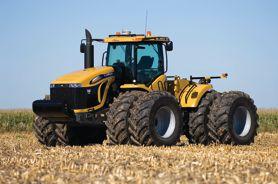
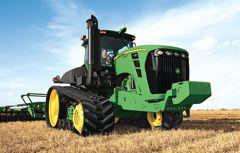
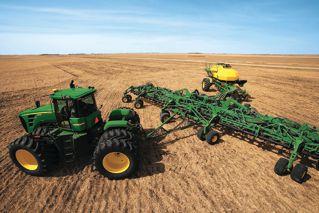
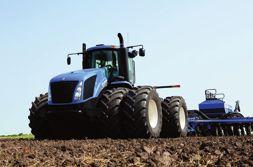
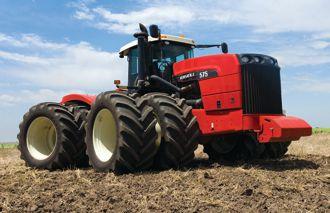
They mark the start of any growing season, and they keep getting bigger and more powerful. Four-wheel drive tractors are the staple of many farms, and since the value of the farm continues to rise, so too can the value of the tractor, which is one of its primary “drivers.”
In this issue of Top Crop Manager , we offer our annual Machinery Manager feature on four-wheel drive tractors, complete with spec tables, informative write-ups and
complete manufacturers’ brochures on our website. Keep in mind, though, that it is wise to talk to the equipment manufacturers, the dealers and your agronomy professionals for more information and advice. n
Ralph Pearce, Editor Top Crop Manager
FOUR-WHEEL DRIVE TRACTORS – MACHINERY MANAGER
Case IH steIger and QuadtraC serIes
Six models of Case IH Steiger and exclusive Quadtrac Series 4WD tractors deliver proven performance in challenging conditions. Case IH 4WD tractors feature two frame sizes and an industry-leading long wheelbase and drawbar design for superior conversion of horsepower to pulling power, while delivering superior comfort, convenience and reliability.
The 350, 400 and 450 are offered as a narrower, row-crop frame, while the 450, 500, 550 and 600 models come as either a heavy-duty wheel or in the Quadtrac design. With these models, there are 16 different versions, which have 390 up to 670 peak engine horsepower.
In addition, the AFS AccuGuide automated guidance ready system is standard equipment on Steiger and Quadtrac tractors for hands-free operation and improved farming efficiency. For maximum fuel efficiency, all Steigers utilize Selective Catalytic Reduction (SCR), where engine exhaust is treated with Diesel Exhaust Fluid (DEF), resulting in a 10 percent overall fuel reduction. For improved flotation and traction with less compaction, the Steiger 350, 400 and 450 are exclusively available with the biggest tires on the market. Another Case IH exclusive is the 40-degree, right-hand swivel seat, which provides operators with a more ergonomic field of vision while also monitoring the implement behind.
Not available *Preliminary non-official Nebraska Tractor Test results.
to www.machinerymanager.ca for more specifications and links to
FOUR-WHEEL DRIVE TRACTORS – MACHINERY MANAGER
CHallenger Mt700C and Mt800C serIes traCk traCtors
The Challenger MT700C and MT800C series track tractors come equipped with the legendary Cat ACERT Tier III diesel engines. These series of powerful tractors offer 301 to 585 gross engine horsepower and 245 to 425 PTO horsepower.
Transmission: Industry-leading horsepower is transferred to the ground by the robust Cat 16F/4R PowerShift transmission.
Power Management: Power Management allows the engine to communicate with the transmission to increase efficiency and maximize fuel economy.
Suspension: All MT700C and MT800C series tractors come standard with the Challenger-exclusive Mobil-Trac undercarriage system and Opti-Ride suspension. Challenger’s Mobil-Trac system maximizes traction and flotation while minimizing compaction. Infinitely variable gauge settings plus multiple belt options adapt the tractor to fit a wide range of row widths and crop applications.
Hydraulics: Standard hydraulic pump flow rate is 43.5 GPM; an optional high-flow pump offers 59 GPM. The hydraulic system is equipped with interchangeable one-half-inch and three-quarter-inch remote valve couplers, up to six in-line fingertip hydraulic valve controls, and electronic adjustable rate flow control from the cab, allowing for precise flow rates to meet your different demands.
Tractor Management Center (TMC): The MT700C and MT800C series is ISOBUS compatible, allowing for communication between an ISOBUS compliant implement and the tractor utilizing the all-in-one Tractor Management Center display.
Go to www.machinerymanager.ca for more specifications and links to 4WD tractors.
CHallenger Mt900C serIes 4Wd traCtors
The Challenger MT900C series are the highest horsepower tractors commercially available in the industry and offer four models with gross engine horsepower ranging from 440 to 585 hp. The MT965C and MT975C are powered by a Cat C18 ACERT Tier III diesel engine and the MT945C and MT955C are powered by a Cat C15 ACERT Tier III diesel engine.
Transmission: This industry-leading horsepower is transferred to the ground by the robust Cat 16F/4R PowerShift transmission.
Power Management: Power Management allows the engine to communicate with the transmission to increase efficiency and maximize fuel economy.
Hydraulics: Standard hydraulic pump flow rate is 43.5 GPM, while an optional high flow pump offers 59 GPM.
Axles: The MT900C series sets the bar with the industry’s largest standard axles at 5.7 inches (145 millimetres) as well as the largest diameter driveline (rated at 13,720 foot-pounds of torque) to ensure that the horsepower is delivered to the ground.
Tractor Management Center (TMC): The MT900C series features full ISOBUS compliance, which gives the operator complete control of any ISOBUS-compatible implements and major tractor functions through the easy-to-use Tractor Management Center (TMC) display. Operators also will appreciate having up to six in-line fingertip hydraulic valve controls and the One-Touch headland management system.
Engine
Rated
Transmission
Cat C15 ACERT Tier III
Cat Powershift 16F/4R
FOUR-WHEEL DRIVE TRACTORS – MACHINERY MANAGER
JoHn deere 9030 serIes traCked traCtors
Choose from three tracked models in the John Deere 9030T Series Track Tractors for greater traction and flotation, and faster operating speeds, in models ranging from 425 to 530 rated horsepower. The 9030T Series Track Tractors use the same John Deere PowerTech Plus 13.5L engine found on the wheeled series.
John Deere’s new Air-Cushion Suspension system is standard and isolates the track undercarriage from the tractor frame. Growers get 13.4 inches of total suspension travel at the front idler wheels. This provides a supersmooth ride and allows for fast field and transport speeds.
Other enhancements include a rugged single-piece frame, a new track-alignment system, and a new drivewheel pattern that helps reduce slippage and increase track tension. Plus, the wheelbase is also five percent longer than previous models. All of these enhancements help improve ease of operation, durability, and productivity.
A new toolbox is built into the platform for easy access and for storage of tools, chains or other equipment. A new track-alignment mechanism makes adjustments easier and improves belt tracking. Two track-width options are available for 9030T Series Track Tractors. Choose from a 30- or 36-inch-wide belt. Severe-duty versions are also available.
Engine
John Deere PowerTech Plus
Rated speed 2100 RPM
Transmission 18/6 Automatic PowerShift
NA*: PTO not available.
Go to www.machinerymanager.ca for more specifications and links to 4WD tractors.
JoHn deere 9030 serIes WHeeled traCtors
Since their launch in 1996, John Deere 9000 Series Tractors continue to be among the best-selling tractors in their class, and the all-new 9030 Series takes this legendary performance to greater heights. Choose from four dual tire models ranging from 325 to 530 horsepower.
The 9030 Series tractors are powered by the John Deere PowerTech Plus engines that meet Tier 3 EPA emissions regulations. The 13.5L engine used in the 9330 through 9630 tractors and the 9.0L engine used in the 9230 feature improved torque curves. By moving peak torque from 1400 rpm to 1600 rpm, torque rises quicker for improved engine response to changing loads. Both engines feature a four-valve overhead cam designed for low-speed torque and throttle response and tremendous lugging power.
Choose between two field-proven transmissions: an 18-speed PowerShift or a 24-speed manualshift transmission. The PowerShift transmission provides outstanding lugging power in the lower gears where it is needed the most. And the new double-reduction axle for the 9530 and 9630 puts more power to the ground.
The updated CommandView cab is now quieter and more user-friendly than ever. The integrated Ag Management Solutions technology makes connecting John Deere AMS components simple. The 9430, 9530 and 9630 are also available in heavy-duty Scraper Special models.
Engine
John Deere PowerTech Plus
FOUR-WHEEL DRIVE TRACTORS – MACHINERY MANAGER
neW Holland t9 serIes
New Holland’s T9 Series 4WD tractors meet the power and productivity needs of both row-crop and broad-acre producers with a choice of a standard or wide-frame, industry-leading hydraulics, the largest cab in the industry and the industry’s first cab suspension system.
The new T9 Series is available in two frame sizes. The standard frame models are well suited for broad acres and rowcrop work. They pack 350 to 500 rated horsepower in a 36-inch-wide frame. The wide-frame models, with rated power of 535 and 600 horsepower, feature a new, well-balanced chassis that delivers more power to the ground for improved productivity in broad-acre applications. The new T9.670 delivers up to 669 maximum engine horsepower.
All T9 Series tractors are powered by Tier 4A Cursor engines with ECOBlue SCR technology. All models feature the efficiency of New Holland Ground Speed Management, which intuitively manages both engine load and transmission speeds to optimize performance and fuel economy.
The Comfort Ride cab suspension, an industry first, is an optional feature on all T9 Series tractors. All four corners of the cab are suspended on spring and damper units with a sophisticated anti-sway system for a smooth, stable, more comfortable ride, irrespective of the terrain.
T9 Series tractors feature the multiple award-winning SideWinder II armrest console. This patented armrest electronically glides forward or back to adjust to the perfect position for every operator.
Drawbar fuel use (hp.hr/gal
Transmission 16 x 2 PowerShift with transport mode
* Official Nebraska Tractor Test results Q4, 2011. ** With Selective Catalytic Reduction (SCR) technology. Go to www.machinerymanager.ca for more specifications and links to 4WD tractors.
VersatIle
The Versatile 305- to 400-hp 4WD Series continues the Versatile tradition of power, reliability and serviceability. The Cummins QSM 11-litre engine used on these models incorporates a high-pressure injection system with electronic controls to continuously monitor data from strategically placed sensors within the engine, optimizing the fuel-to-air mixture for maximum combustion. A swing-out assembly on the front grille and radiator expose the hydraulic and transmission oil coolers, air conditioning condenser, fuel cooler and charge air cooler for fast cleaning.
The High Horsepower Tractor (HHT) Series 4WD was created to respond to growing agricultural operations that have more acres and require more power and hydraulic flow. Engineered from the ground up using heavy-duty components, the HHT Series 4WD is available in 435, 485, 535 and 575 hp. The frame is manufactured from thick steel plate to ensure structural integrity, even under extreme conditions. Outboard planetary axles with a new 24-bolt pattern and standard drum duals ensure power is efficiently transferred to the ground. The main bearing at the articulation point is now 60 percent larger to reduce stress and extend life.
All models have a total hydraulic flow of 50 GPM (208 L/min) or 80 G�PM (303 L/min) with the optional high-flow hydraulic system. Four remote valves are standard and the optional high-flow hydraulic system is available with six remote valves.
Max unballasted drawbar power @ engine RPM
75% load @ reduced RPM (unballasted)
Engine
Information not available at time of publication.
Information not available at time of publication.
Cummins QSM11 Tier 3
Rated speed 2100 RPM
Transmission
Quadshift, 12 x 4;
12 x 2
tractors.
Cummins QSX15 Tier 3
Since 1973, Alpine has been manufacturing the highest quality starter fertilizers available in North America. Our quality and experience have made ALPINE the #1 choice for liquid starter fertilizer in Ontario. To learn more about the most researched and proven liquid starter program available, contact your local ALPINE dealer today.
While other manufacturers scramble for long-term solutions, ours are already out there in the fields. And now, the same industry-leading Selective Catalytic Reduction (SCR) technology you’ll find in our high-horsepower tractors is available in our all new Axial-Flow ® combines and Patriot® sprayers. More power. More fuel efficiency. Lower emissions. Roll into your local Case IH dealer or visit caseih.com/efficientpower.