TOP CROP MANAGER
Eastern Canada’s magazine of crop production and technology



Eastern Canada’s magazine of crop production and technology
Success in farming, as it is in most businesses, is based rather simplistically, on dollars and cents.
Its true value, however, is derived from a curious blend of product knowledge and delivery, an overriding passion and commitment to excellence, attention to detail and a keen business sense. Diversity and an innate sense of timing are two other components that often provide an added boost to that definition of success.
Interestingly enough, Bramhill Seeds embodies all of these facets, and through the vision and hard work of its current president, Carl Coleman, the Palmerston, Ontario-based company continues to grow and prosper.
For Carl, the road to this level of success actually began in 1984, when he originally left farming and stepped into trucking. Through a series of twists and turns during the next seven years, he discovered he had a knack for fine-tuning computer software for farming operations. That became a full-time job, during which time he also trained to be a certified netware engineer and then a certified netware instructor, a position that had him training businesses on networking and troubleshooting from Halifax, Nova Scotia to San Jose, California.
By 2000, Carl realized his passion for agriculture had never really diminished, and within two years, his opportunity to “get back to the fields” returned with Bramhill Seeds.
Bramhill Seeds has had four different owners, starting in 1958 with Clendon Bramhill, who is Carl’s wife’s grandfather. From there, it passed through the hands of the next two generations, Laverne and Leonard, until 2003 when Leonard stated his intent to exit the family business. At that point, Carl’s background in computers and experience with the outside business world became valuable tools in managing the company, ushering Bramhill Seeds into a new era.
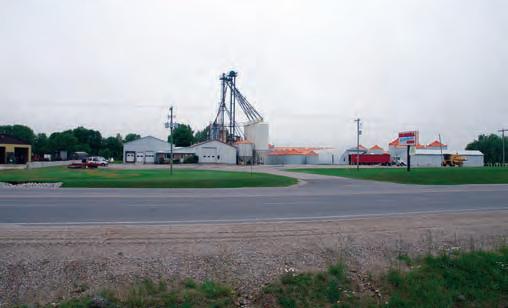
better. He did that by introducing four basic business fundamentals: Increase sales through improved customer relations, increase volumes, sound financial management of the company and improved efficiency. According to Carl, the first and second components go hand-in-hand, while the third is a reflection of what he learned while building computer networks. The fourth component comes from having excellent staff and investing in key pieces of equipment. Since 2003, the company has more than doubled its sales, investing the majority of its profits back into the business’s infrastructure, including hiring more skilled workers to improve efficiency, and adding more storage bins to enhance their sales, service and product lines.
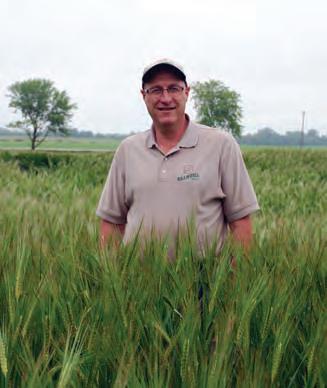
The primary focus was not on change for the sake of change: Carl’s vision was to take a proud family business and make it even
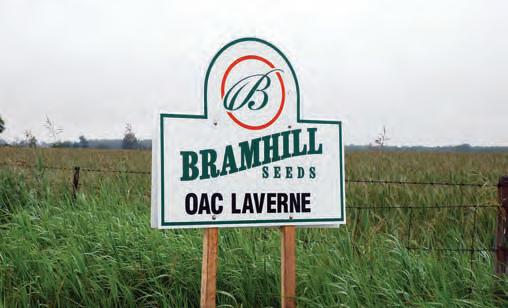
Carl’s influence is obvious in other ways, as well. Prior to his taking over, fall sales in 2002 were a very small part of the yearly total, yet by 2008, that percentage had jumped to nearly 30 percent. The seed cleanout percentages are typically three to five percent higher than industry standards, and that is the case across all of their product lines, from oats to wheat to barley. Bramhill Seeds also supplies soybean seed, as well as a forage oat variety from the U.S., a forage triticale which they mix with forage peas, and a cereal pea variety. Customers can choose from SeCan or Advantage Seeds varieties, as well as those varieties licensed exclusively by Bramhill Seeds.
Such diversity of product is reflected in the diversity of their coverage area: they sell across most of the prime farming region of Ontario. In winter wheat, they have customers from Windsor to Ottawa; in spring grains, they cover the region from west of Highway 400, and north of London and Highway 402. And in soybeans, Bramhill Seeds services the 2500-2850 heat unit regions.
The bottom line on what Carl and Bramhilll Seeds offer is the focus on quality; they provide quality service and a quality product at a fair price. To quote Carl, “I get great satisfaction out of providing a quality product with an extra high level of service.”
For Carl Coleman and everyone at Bramhill Seeds, that is the true measure of success, and it is worth more than just dollars and cents.

8,13,16
10,35 22 - 35
From having to deal with wheat leaf rust to the use of ESN fertilizer to oat crown rust., Dr. Heather Hager, our field editor, covers many of the fronts in the cereal scene in this issue.
In this edition, we push the limits on convention and explore some of the options that are becoming available to growers.
Machinery Manager (Four-Wheel Drive Tractors)
In this introductory feature of our Machinery Manager series, we look at the specifications of one of the ‘drivers’ of any farm operation: the tractor.
Check out Top Crop Manager website and enter the online contest for a chance to win significant prizes. Register to receive online editions. Reference information of this calibre is hard to find, so many growers choose to keep Top Crop Manager issues on file. If you have not kept issues for your library, you can find our stories on our website archive.
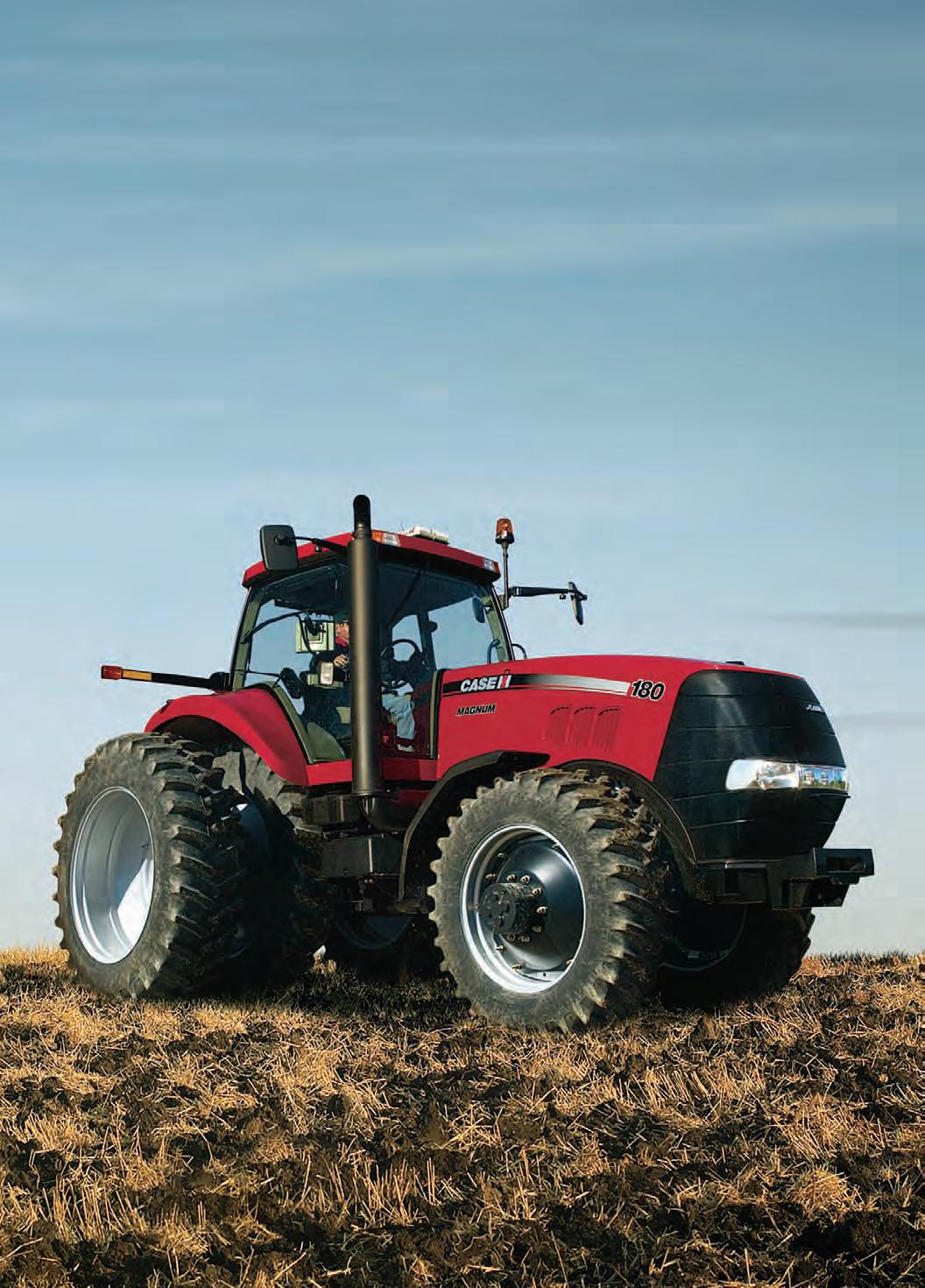
Cover:
Although corn and soybeans
to grab news
and other cereals continue to play a major role in farmers’ plans for the future. Photo by Ralph Pearce
August 2009, Vol. 35, No. 11
EDITOR
Ralph Pearce • 519.280.0086 rpearce@annexweb.com
FIELD EDITOR
Heather Hager • 888-599-2228 ext. 261 hhager@annexweb.com
CONTRIBUTORS
Blair Andrews
Treena Hein
Bruce Barker
WESTERN SALES MANAGER
Kevin Yaworsky • 403.304.9822 kyaworsky@annexweb.com
SALES ASSISTANT
Mary Burnie • 519.429.5175 888-599-2228 ext. 234 mburnie@annexweb.com
PRODUCTION ARTIST
Brooke shaw
GROUP PUBLISHER
Diane Kleer dkleer@annexweb.com
PRESIDENT Michael Fredericks mfredericks@annexweb.com
PuBLICATION MAIL AGREEMENT #40065710
RETuRN uNDELIVERABLE CANADIAN ADDREssEs TO CIRCuLATION DEPT.
P.O. BOx 530, sIMCOE, ON N3Y 4N5
e-mail: mweiler@annexweb.com
Printed in Canada
IssN 1717-452x
CIRCULATION
e-mail: mweiler@annexweb.com
Tel.: 866.790.6070 ext. 211
Fax: 877.624.1940
Mail: P.O. Box 530, simcoe, ON N3Y 4N5
SUBSCRIPTION RATES
Top Crop Manager West - 8 issuesFebruary, March, Early-April, Mid-April, July, October, November and December - 1 Year - $50.00 Cdn.
Top Crop Manager East - 7 issues - January, February, March, April, August, October and November - 1 Year - $50.00 Cdn.
specialty Edition - Potatoes in CanadaFebruary - 1 Year - $9.00 Cdn.
All of the above - 15 issues - $80.00 Cdn.
From time to time, we at Top Crop Manager make our subscription list available to reputable companies and organizations whose products and services we believe may be of interest to you. If you do not want your name to be made available, contact our circulation department in any of the four ways listed above.
No part of the editorial content of this publication may be reprinted without the publisher’s written permission © 2009 Annex Publishing & Printing Inc. All rights reserved. Opinions expressed in this magazine are not necessarily those of the editor or the publisher. No liability is assumed for errors or omissions.
All advertising is subject to the publisher’s approval. such approval does not imply any endorsement of the products or services advertised. Publisher reserves the right to refuse advertising that does not meet the standards of the publication. www.topcropmanager.com
The past six months have yielded a fair share of news stories that have talked in glowing terms of the tremendous value in agriculture. Not as a statement of the cost of our food, which is shamefully low, but for the economic stability created by the biofuels sector or investment funds buying up farmland, not to mention agriculture’s profile as one of the sectors that has been relatively unscathed by the recession.
Yet despite the agri-food industry’s sense of optimism, reality tends to bring everyone back to earth rather unceremoniously, and the killjoy in this case has been the weather during this Summer of 2009. For all that a grower can do to ensure timely planting as well as optimize fertilizer and weed control applications, the skies above hold the final say.
What the farmer “doeth,” the weather can “taketh” away.
What makes it all the more frustrating is not a lack of moisture or a surplus; in a time when the term “global warming” is reaching a saturation point in so many circles, it is the lack of warmth that is the greatest cause for concern. And yet it is not for lack of sunshine, just heat.
Still, the only response for growers is, has and always will be, a shrug of the shoulders, maybe a cross word at the weather forecast from The Weather Network, Environment Canada or from points south of the border, and the sense of resignation that says, “But there’s nothing we can do about it.”
The future’s so bright...
In spite of the frustrations of the growing season, there is still cause for considerable optimism in agriculture, beyond talk of its place in the “next economy.” Enrolment at University of Guelph’s Ridgetown College campus is on the rise, indicating greater interest and opportunity. London’s
Fanshawe College recently turned out its first graduates from its biotechnology applied degree program. And there are new technologies now available that will help growers increase their efficiency on the farm, and manage information and data in ways only a handful of visionaries could have dreamed possible.
It is these new aspects of agriculture that often keep our interest. The reality of the job can often drag growers back to the daily routine, forcing them to keep at least one eye on what is happening in the fields in front of them. Yet it is the novelty within the industry, the new technologies, the changing opportunities, that invite all of us to gaze a little longingly beyond the fence row for a glimpse of what is new.
At Top Crop Manager, we try to do the same thing: we keep an eye on the here and now, focusing on our strengths, and from time to time, we look ahead, and introduce something that complements the overall value of our magazine. In this Cereal Focus issue, we are introducing the first of six Machinery Manager features, something we have successfully integrated into our Western Canada editions. By adding these features, we hope to enhance the value, not just for our readers, but for advertisers and other industry stakeholders. And to Bruce Barker, our Western Canada field editor, I would like to say “Thanks” for taking on the added responsibility of compiling these specs and other editorial material from the equipment manufacturers. His dedication and hard work, as well as that of our other contributors, helps provide added value, and hopefully even a little consistency; in a growing season where the weather is anything but consistent, it’s nice to have. n
Ralph Pearce Editor

Through agriculture, we’re all connected in some way. And from the farm to the city, it’s advanced agricultural innovation that gives us even better ways to provide for one another.
Introducing the Genuity TM brand, Monsanto’s new family of traits across corn, soybean, canola and specialty crops. It’s the proven trait performance of today and the trait opportunities of tomorrow – so farmers can do what they do best, even better.
by Heather Hager, PhD
Monitoring race development is important in protecting yield.
Wheat leaf rust (Puccinia triticina) is an ever-changing disease that requires continual attention. That is why Dr. Brent McCallum, pathologist at the Agriculture and Agri-Food Canada Cereal Research Centre in Winnipeg, Manitoba, performs an annual cross-Canada survey of the disease. The aim is to keep on top of which races of the fungus are increasing in prevalence so that breeders might incorporate resistance genes that are effective against the predominant races, allowing growers to plant tolerant cultivars if they so choose.
Because the fungus is an obligate parasite that requires living plant tissue to survive, the level of risk in Canada each year is highly dependent on environmental and agronomic conditions in the southeastern United States. “We have control over the cultivars that we put in the field and the resistance genes that are incorporated into those cultivars,” says McCallum. “But the rust comes from the US and blows in on the wind, so the races that are developing depend on which cultivars they’re growing in the southern and Midwestern US states and which resistance genes they’re using.”
The races tend to show some geographic and crop-related differences, explains McCallum. Races that end up in Manitoba and Saskatchewan, where the main wheat crop is spring wheat, tend to blow up from Kansas through Minnesota, South Dakota and North Dakota. In Ontario and Quebec, where winter wheat is predominant, the races are more similar to those found in eastern states like Illinois and Ohio.
Wheat leaf rust races are identified by purifying the samples and then growing them on a specific set of 16 host differential lines, each of which contains a different resistance gene. As the races change and certain races become more prevalent, varieties that once showed good resistance or tolerance to leaf rust may lose that tolerance. “That durable resistance in some varieties starts to decline over time as we see increases in races that can bypass that resistance,” says Albert Tenuta, plant pathologist with the Ontario Ministry of Agriculture, Food, and Rural Affairs (OMAFRA).
“The survey for races is very important for the development of new varieties. Particularly, when you’re anticipating variety development four to five years down the road, breeders are starting to incorporate some of the newer genes that can handle some of these newer races that are starting to develop.”
One resistance gene that has recently lost some of its effectiveness is Lr24. “Lr24 is a race-specific gene, so it’s effective against some races -- it controls them completely -- but it’s ineffective against other races,” says McCallum. “We’ve seen an increase in virulence on Lr24 in the last two or three years, and that may help to explain why the leaf rust incidence increased in southern Ontario.” He notes, for example, that the winter wheat cultivar ‘Vienna,’ which is grown in Ontario, contains the Lr24 resistance gene.
In breeding for resistance, “a good strategy is to use genes that are not being used in the US, even if those genes are race specific. Races that are virulent on those genes don’t tend to be selected because they won’t be exposed to those genes in the US,” says McCallum. Another good strategy is to use a broadly effective resistance gene such as Lr34 to give broad-spectrum protection.
It can be a bit confusing to translate the race codes to determine
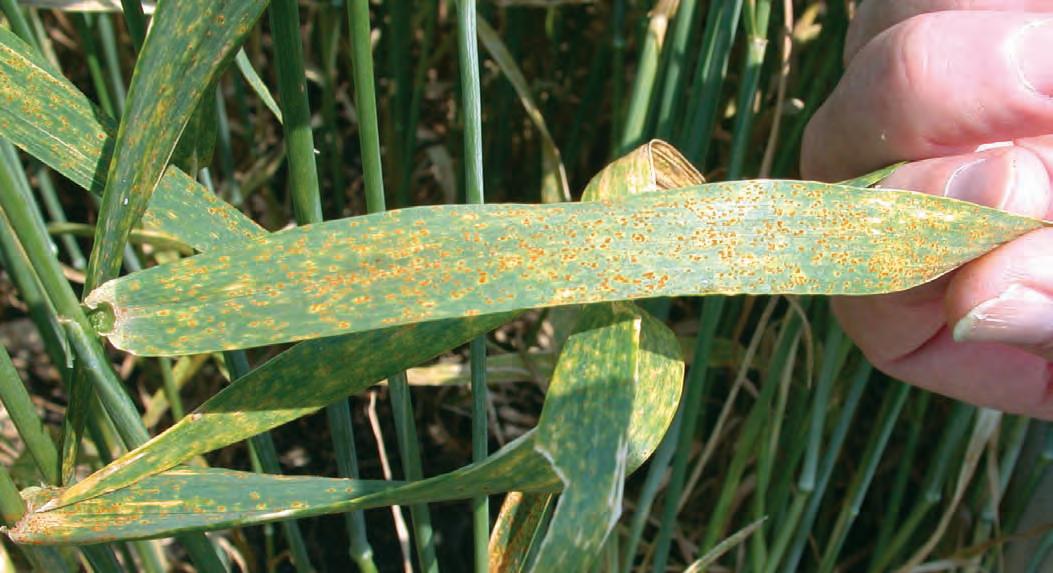
Although wheat leaf rust is a potential concern at any stage of development, it has the greatest potential to cause yield loss early in the season.
which resistance genes may be effective and then which wheat cultivars carry those genes. So McCallum recommends that growers in Western Canada consult the provincial seed guides when deciding which varieties to plant. “The seed guide doesn’t actually tell you about the pathogen surveys. It tells you how the cultivars are performing to various diseases,” he explains. The guides are updated annually according to how the varieties have been performing in the field, both agronomically and against specific diseases. In Eastern Canada, similar information is available from the Ontario Cereal Crops Committee variety trials at www.gocereals.ca and from Quebec Agri-Réseau, résultats et recommandations des Réseau Grandes Cultures du Québec, at www.agrireseau.qc.ca.
Control strategies
“Wheat leaf rust is a potential concern every year,” states Tenuta. It can affect the crop at any stage of development, but has the greatest potential to cause yield loss when infections begin early in the season. Tenuta recommends that growers start scouting their wheat soon after it begins to green up, in late April and early May. “In terms of the top two leaves, we’re generally looking at less than two to five percent pustules as the treatment threshold. Anything that challenges that flag leaf or the top two leaves is a concern.” Growers are advised to consult OMAFRA’s Agronomy Guide for Field Crops for further information. The guide is being updated for 2009 and is accessible online at www.omafra.gov. on.ca/english/crops/pub811/p811toc.html.
During the growing season, growers can access US survey information online to get an idea of how the rust epidemic is progressing. “There’s an informal rust e-mail list that sends out reports on the levels of rust, where it is, and how heavy it is, so you can get an idea, as the rust moves from Southern US to the Northern US and into Canada, just what to expect in terms of severity,” says McCallum. This information, as well as regularly updated cereal rust bulletins, can be accessed through the United States Department of Agriculture Agricultural Research Service’s Cereal Disease Laboratory at www.ars.usda.gov/mwa/cdl (click on Cereal Rust Bulletins).
McCallum suggests three control strategies for wheat leaf rust: seeding spring wheat early, planting resistant or tolerant cultivars and spraying fungicides. “In spring wheat areas like Manitoba and Saskatchewan, we advise the farmers to seed as early as possible because the epidemic only starts in mid-June.” Early planting may allow for some grain filling before infection levels get high. The Agronomy Guide for Field Crops also recommends planting spring grains early.
“We always recommend planting resistant cultivars, whether you’re planning to use a fungicide or not, because it always will give you better protection than having a susceptible cultivar,” says McCallum. He says that cultivars that have an intermediate level of tolerance may do well if the epidemic is light. However, they may show some yield loss if the epidemic is severe. Therefore, growers may need to use a fungicide, depending on the cultivar, the level of infection, and cost/benefit factors.
Fungicide considerations
A grower’s fungicide control strategy should consider the
Minimizing the development of fungal resistance to fungicides is always something to keep in mind. “It has been reported from other parts of the world that rust races can develop some tolerance to the chemicals that are used to control them, but we haven’t seen that yet in Canada. As far as we know, the chemicals have been quite effective at controlling rusts to this point,” says Dr. Brent McCallum, pathologist at the Agriculture and Agri-Food Canada Cereal Research Centre in Winnipeg, Manitoba. But he notes, “It’s always a concern that resistance or tolerance in rusts will develop over time, especially if growers are using more fungicide applications on a regular basis.”
“We have to be aware of it and should try to manage for it, but we don’t anticipate seeing it develop nearly as quickly in Ontario as it did in Europe,” says Peter Johnson, cereals specialist for the Ontario Ministry of Agriculture, Food, and Rural Affairs. He cites the longer growing season and repetitive fungicide application up to five times per growing season in Europe as factors that place more selection pressure for resistance on rusts. “When the organism can develop on volunteer wheat in the fall or on its alternate host in fall and winter, when there’s no selection pressure for resistance, then we think it will take longer for resistance to develop.”
wheat variety planted and the timing of treatment. “In winter wheat in Ontario, it would be rare to see enough leaf rust that you would need to apply fungicide at the flag leaf stage or earlier,” says Peter Johnson, OMAFRA cereals specialist. “With spring wheat, on the other hand, it develops later, so rust is more likely to be an issue. Fortunately, there are no really susceptible varieties of spring wheat at this time, but we do have some extreme susceptibility in some of the winter wheat varieties.”
For varieties that are fairly tolerant of wheat leaf rust, the strategy is to wait until heading and apply a fungicide for Fusarium head blight control. The triazole fungicides Folicur and Proline are the only two that are currently registered for this purpose in Canada. However, two products are in the pipeline.
“We anticipate having a new product registered prior to next season,” says Dr. Trevor Kraus, supervisor of BASF’s research and development group for Eastern Canada. He is referring to Caramba (with the active ingredient metconazole), which he says performed well against both Fusarium head blight and leaf diseases in federal research permit trials. Also under application for registration is Prosaro, which is basically a jug mix of Folicur and Proline.
For susceptible wheat varieties, it is imperative to monitor them closely during flag leaf development, which is generally in late May, says Johnson. “At this earlier timing, you could use a triazole or strobilurin, but we generally save the triazoles for the Fusarium timing.” Research indicates that strobilurins should not be used after the full flag leaf stage because they can increase levels of deoxynivalenol (DON) toxin in the grain. Fungicides that are available for use at the earlier timing are Headline (strobilurin), Stratego or Quilt (both contain strobilurin plus triazole), or Tilt, which is a triazole that is not registered for use against Fusarium When selecting which product to use at the earlier timing, Johnson suggests that growers consider the cost of the product and the amount of active ingredient in the jug. “You tend to look at those products that have two modes of action in the jug, plus they also tend to have more active ingredient per dollar spent. They are probably the product that you would lean towards.” He also recommends, “To get good efficacy, it is good practice not to cut application rates.” n
by Blair Andrews
Shifts in species may be more of an issue.
Editor’s note: Since the time this article was submitted, extension personnel with the Ontario Ministry of Agriculture, Food and Rural Affairs and researchers with the University of Guelph confirmed the existence of a glyphosate-resistant giant ragweed plant on a farm in Ontario. Top Crop Manager will be examining this issue in greater depth in coming editions. RP
The appearance of glyphosate-resistant weeds in the United States has put more focus on the need to manage the use of the popular herbicide. With the wide adoption of technology like Roundup Ready soybeans and corn, it was only a matter of time before some weed species developed resistance. In particular, there are populations of Canada fleabane and common ragweed in the US that are resistant to glyphosate. Meanwhile, there are other species that are either suspected of being resistant or have increased their tolerance to common rates. So far Ontario has yet to confirm a resistant species. While that may be good news, farmers are still being urged to keep an eye on glyphosate management.
For Pat Lynch, agronomist for Cargill
AgHorizons, the larger issue is “weed shifts” as opposed to resistance. To illustrate his point, he relates the story of atrazine, a herbicide that was used widely in corn production in the 1960s. “When I was growing up on the farm, I can remember how excited we were to go from 2, 4-D, when you had a bunch of weeds left, to atrazine. The corn fields were clean with atrazine and corn oil. A gallon of corn oil and a pound of atrazine, and it was just like walking through the living room – not a weed left.”
At first, one pound per acre of atrazine was effective. This rate controlled many broadleaf weeds. But Lynch says continued use of this practice led to a shift in the weed populations from broadleaf weeds to foxtail. This weed was then controlled by higher rates of atrazine. “As growers continued to use atrazine on many acres something else occurred. There were populations of lamb’s quarters that were mainly susceptible to atrazine but there were also small numbers that were resistant to atrazine. With continued use of atrazine that controlled the other weeds, the populations of triazine-resistant lamb’s quarters grew,” says Lynch. “Eventually these weeds grew to the point that they significantly reduced yield. This shift to a resistant population of lamb’s quarters on many fields meant that growers had to switch to other herbicides to control lamb’s quarters.”
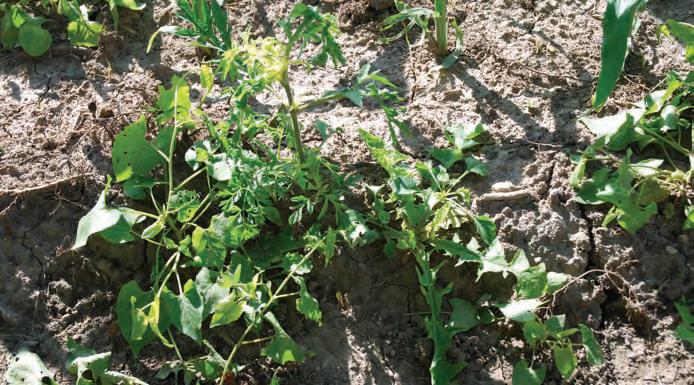
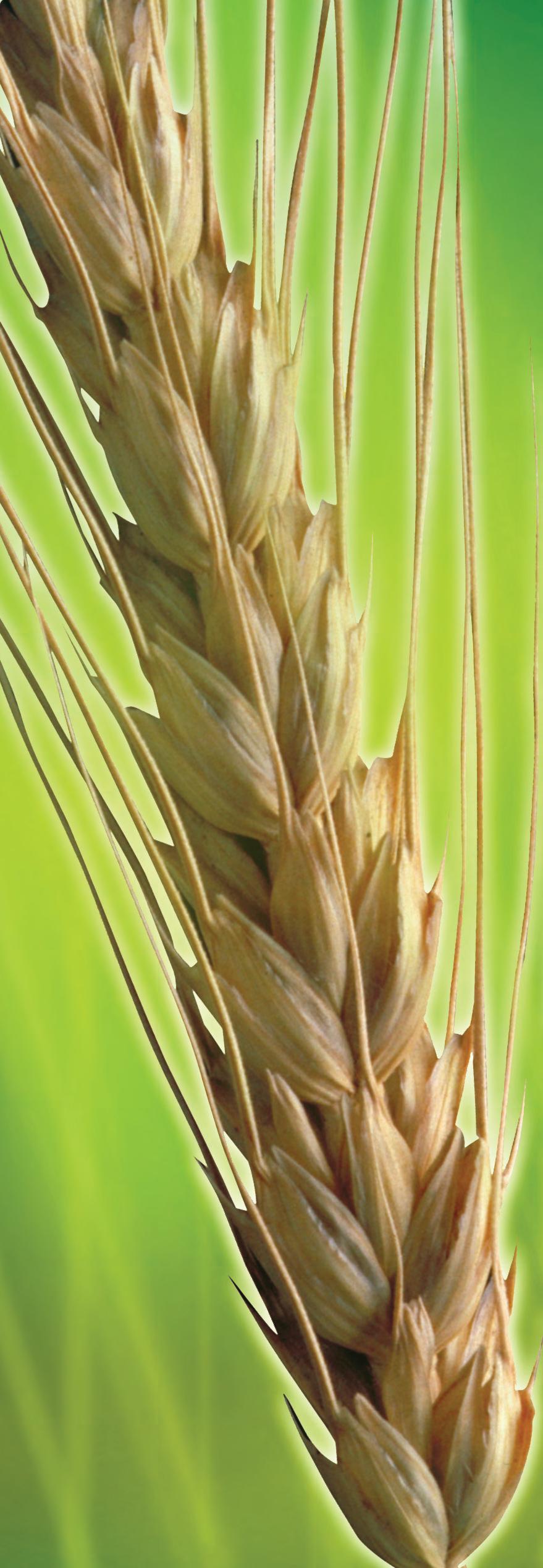

Leader variety with outstanding yield. Very good drought tolerance. Average yield advantage over all competitors of 8.6* bushels/acre. (85% wins; 330 comparisons)
Beardless variety with exceptional yields and very good winterhardiness. Average yield advantage over all competitors of 4.7* bushels/acre. (77% wins; 43 comparisons)
Strong yield in a variety that is highly resistant to Fusarium head blight. Average yield advantage over FT Wonder of 7.4* bushels/acre. (85% wins; 46 comparisons)
25R51 25W36 25W43
New variety with impressive yield potential. Excellent winterhardiness.
New variety with exceptional yield potential. Above average drought tolerance and strong winterhardiness.
Other weeds, other shifts
Lynch adds that another weed shift is underway as a result of continuous glyphosate usage and the decrease of other herbicides. Weeds like bindweed and perennial sow thistle are becoming a bigger problem. He explains that these species have not yet emerged or have not advanced enough to be controlled when glyphosate is applied in a Roundup Ready crop. However, they grow and produce seeds after the application. “If people believe that we can use glyphosate in corn and have clean fields, and use nothing else, they are absolutely deluding themselves,” warns Lynch. “It’s not that weeds are vengeful, but weeds are opportunistic. If there is no herbicide there, they will multiply.”
In addition to the weed shifts, Lynch says other weeds like lamb’s quarters and its “cousin”, spreading atriplex, are becoming more tolerant to glyphosate, and therefore, are becoming harder to kill. “To me, in the next one to five years, weed shifts that escape glyphosate represent a much bigger issue than resistant weeds,” notes Lynch. He is not as concerned about the glyphosate-resistant species in the US such as Canada fleabane and common ragweed because other herbicides can be used to control them. “Weed shifts like bindweed and perennial sow thistle are taking yield away right now,” adds Lynch.
As glyphosate has become the weed control method of choice for the lion’s share of the soybean crop and is gaining in popularity for corn, growers have been advised to manage their use of the herbicide to minimize the risk of resistant weeds. Some of the options have included rotating herbicides with different modes of action and tank-mixing glyphosate with residual herbicides where appropriate. These methods are not only being monitored in North America, they are also being scrutinized in other major growing regions. Dr. François Tardif, associate professor, Department of Plant Agriculture at the University of Guelph, says Australian researchers have developed computer models to gauge the effectiveness of these practices.
“The main conclusions were that mixtures are much better than rotation. If you go the rotation route, you’re just delaying resistance. You’re not keeping resistance in check, as opposed to going with mixtures if they’re done properly.”
In other words, Tardif says rotating different modes of action is putting off the inevitable. Instead of experiencing weed resistance in five years, Tardif says it may occur in 10 years. That said, Tardif says
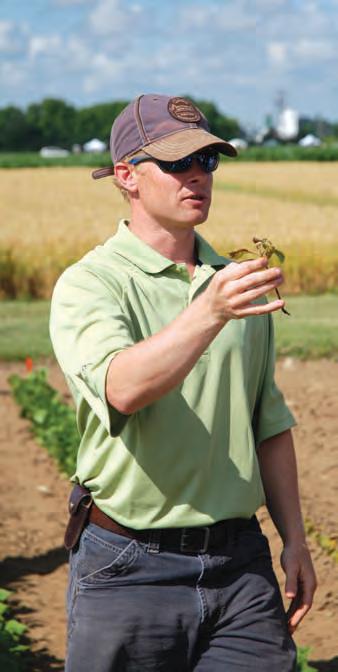
According to Mike Cowbrough, tank-mixing is more a matter of lengthening the control window and less about preventing resistance.
tank-mixing is not an easy solution either. “Let’s say you’re worried about pigweed. You put two or three herbicides on the weed, but you also want to control the other areas of the field. It can get a bit messy because you risk compromising the efficacy of the herbicide in the tank,” says Tardif. He concedes that the situation is rare, but adds that it can happen.
Tank-mixing a tricky option
Mike Cowbrough, weed management specialist with the Ontario Ministry of Agriculture, Food and Rural Affairs, also questions the soundness of the tank-mixing route. His reasoning is that the targeted weeds are the ones that have already emerged. “The second mode of action may or may not have the same spectrum of weeds as glyphosate. And most, inevitably, won’t,” explains Cowbrough. “Tank-mixing with glyphosate for resistance management purposes would be effective only if the tankmix partner had the exact same spectrum of weeds that glyphosate has, and it had residual activity. And part of the challenge is
that if you look at a lot of the tank mix partners, they’re not going to control as many species as glyphosate.” Cowbrough notes that tank-mixing is better than just applying glyphosate. But he adds that people are not likely to use tank-mixes to prevent resistance. “You do it because you want to lengthen the window of control or deal with difficult-to-control species.”
Another concept that is receiving more attention is to adopt a pre-emerge program with a soil-applied herbicide. The next step is to come back, post-emerge, with glyphosate. Cowbrough says this method has two positive aspects. “It eliminates the urgency of coming in with that first application of glyphosate because you have something down. But then secondly, after using a broad spectrum herbicide, you’re then putting one or two different modes of action down. You’re controlling weeds at a different time.”
He says the concept is one of a few factors that have helped Ontario manage the risk of developing glyphosate-resistant weeds.
The “pre/post-emergence” strategy has received a higher level of acceptance in corn production. This, in turn, has opened the door for IP soybeans, explains Cowbrough. “So in some cases you see growers using glyphosate-tolerant corn and then going back to IP soybeans. I think any time you eliminate in-crop application of glyphosate every year, that’s good.” Furthermore, he says that putting wheat into the rotation has also gone a long way toward breaking the cycle of using glyphosate every year.
Lynch agrees with Cowbrough’s assessment of using a pre-emerge, soil residual herbicide. But he also notes that it is not being widely used for growing glyphosatetolerant soybeans. “A lot of corn growers are doing that in corn, but they’re not using a residual product in Roundup Ready soybeans. Growers are using a reduced rate of something like Primextra, Frontier or Prowl in their Roundup Ready corn, and then coming back post-emerge with glyphosate before the crop closes in.”
Lynch suspects the reason the soil residual herbicide program has not taken off in soybeans is that weed shifts appear to be less of an issue when compared with corn. He also points out that scouting and records should also be part of the solution. “Scout the fields, not with the combine, but in-season, and record where the perennial sow thistle is, where the bindweed is and then address those two perennial weeds in your crop rotation.” n
The jury is still out on the cost: benefit ratio for this product.
Getting nitrogen (N) to the plant exactly when the plant needs it can be a challenge. It has led to the development of controlled-release products that allow N to become available as the plant grows, both to better match the timing of the plant’s N needs and to prevent N loss to the environment. Now that Agrium’s environmentally smart nitrogen (ESN) has shown some benefits compared to other types of N for fall application on winter wheat in Western Canada’s climate, researchers are testing its use in Eastern Canada.
ESN is a fairly new product that was registered in Canada for food-crop use in mid-2006. It consists of urea granules with a polymer coating. The polymer allows water to enter and dissolve the urea, and allows the resultant solution to diffuse out; the rate of diffusion is higher in warm, moist soil than in cool, dry soil. However, because of its higher cost compared to conventional N fertilizers like urea and urea ammonium nitrate (UAN), growers would require some benefit from ESN such as better yield, higher protein content or reduced application rate to cover the increased cost.
So far, various field trials to evaluate crop performance with ESN versus other N fertilizers in northeastern North America have produced mixed results. Some experiments with wheat indicate that these outcomes may have a lot to do with the weather and the timing of ESN application. Further experiments should provide a better idea of how ESN will work over the long term.
Peter Johnson, cereals specialist with the Ontario Ministry of Agriculture, Food, and Rural Affairs, is involved with spring and fall ESN application trials on soft red winter wheat in Ontario growers’ fields through Lambton Soil and Crop Improvement Association’s major grant project. “Out west, they talk a lot about fall applications,” he says. “They were a bust for us, I think in particular because in the fall of 2007, we
by Heather Hager, PhD
had very warm conditions in October.” He suspects that the warm, moist conditions that year promoted the release of N from ESN too early, causing N losses to the environment before spring green-up. “We lost
on average 11 bu/ac yield by applying fall ESN,” he says, compared to a spring application of urea or 28 percent UAN.
Johnson also found no yield advantage with spring-applied ESN, with yields

Salford’s best-selling residue management solution If there were a finish line you’d be the first one there
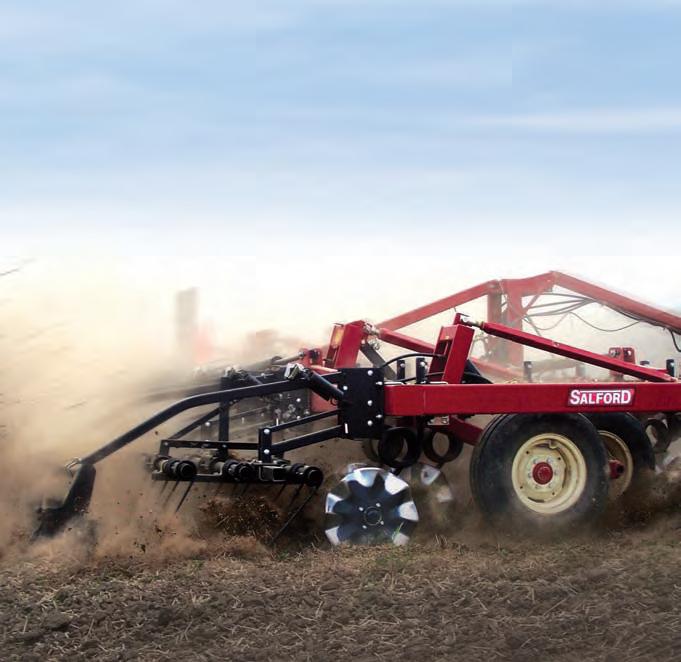
Salford’s RTS handles any and all residue. A top performer, this machine gives you all the speed, performance and strength you look for while delivering the lowest operating costs on the market. Vertical soil movement prepares the soil with no chance of creating a secondary density layer or leaving an uneven soil surface. The result is a rich, textured soil that enables improved planter performance. Featuring the widest range of uses, over the most extreme range of soil and weather conditions combined with the best in fuel efficiency.
Aggressive, durable, versatile and efficient: winning residue management from Salford. Call your Salford dealer today, or visit www.salfordmachine.com
that were similar to those with urea or 28 percent UAN. “That May (2008) was particularly cool, so some of the later-applied product may not have released in time for the needs of the wheat crop,” explains Johnson. He suggests that the best time to apply ESN would be in late March or early April. Johnson continues to evaluate ESN to obtain additional years of data.
Despite the lack of a yield advantage, Johnson did find an increase in the grain protein content with spring-applied ESN that was “in the half to two-thirds of a percent range.” He says that this may be a significant find if similar protein increases can be achieved in hard red winter wheat. “There are buyers out there that if you make 11 percent protein, you start at a $5 per tonne premium, and for every one tenth of a percent increase in protein, you gain another $1 per tonne to a maximum of $15 per tonne at 12 percent protein. Assuming that you can add $10 per tonne on to the value of the product, that is going to help cover the additional cost of the ESN quite nicely.” Tests with ESN and hard red winter wheat are now underway.
Dr. Darryl Warncke, soil fertility specialist with Michigan State University, tested spring and fall applications of ESN on soft red winter wheat in smallplot trials in Michigan. He found no yield advantage with fall ESN applications or 50/50 blends with other N fertilizers. However, his spring ESN applications were quite successful.
“In each of the three years where we had similar rates of ESN, urea and 28 percent UAN, the spring-applied ESN consistently produced the highest yields,” states Warncke. This yield advantage amounted to 5 to 8 bu/ac for harvests in 2005, 2006 and 2007. Warncke also noted reduced lodging with ESN in one year that had a wet spring.
In contrast, in the dry spring of 2004, the spring application of ESN produced yields that were slightly lower than with urea or 28 percent UAN. “The concern is that if you do get a dry spring, it doesn’t seem to do as well,” says Warncke. In all cases, the ESN was applied in late March, just prior to spring green-up.
Based on a rough cost/benefit analysis pencilled out on the spot and using US numbers for 2008, Warncke estimates that the additional yield from springapplied ESN would well cover the extra cost of the ESN. “You’re getting an additional $30 return for an investment of $5 or $6 per acre, assuming you get a yield
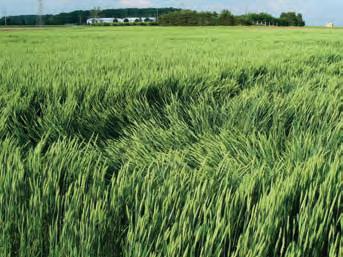
A
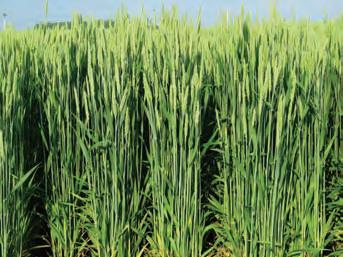
Increased
advantage of about 5 bu/ac and a grain price of $6 per bushel,” he muses.
In other ongoing small-plot experiments, Dr. Tarlok Sahota, research and business director of the Thunder Bay Agricultural Research Station in Ontario, compared ESN and urea on soft red winter wheat and hard red spring wheat in 2007 and 2008. Winter wheat received ESN in the fall, and spring wheat received ESN in the spring. The differences in yield and protein between plots that received ESN and urea were statistically non-significant, although ESN produced slightly higher yield for spring wheat in 2008 and slightly higher protein in both varieties in 2007.
Sahota also compared ESN, urea and ESN/urea blends on timothy. In this case, he found that a blend of 25 percent ESN and 75 percent urea tended to produce the best yield and protein content. “I made a rough calculation, and it’s economical too,” says Sahota. “It will more than compensate for the higher cost of ESN compared to urea.”
In some experiments, Sahota found that the residual nitrate N left in the soil was
higher with urea than with ESN, whereas the residual ammoniacal N was higher with ESN than with urea. “Nitrate N can be leached into the soil, whereas ammoniacal N can be retained in the soil for a longer period. It can be lodged on the clay complex or the organic matter complex in the soil,” he says. This means that the N supply in the soil may be more stable with ESN than with urea. Sahota plans to examine the longer-term effects of residual N by seeing how oats respond when planted after wheat that has received the different forms of fertilizer.
In New Brunswick, Dr. Bernie Zebarth, research scientist at Agriculture and AgriFood Canada’s Potato Research Centre, and colleagues are looking at the use of ESN in rain-fed, tile-drained potato production. The focus is as much environmental as production oriented, with the aim of reducing nitrate leaching and greenhouse gas emissions of nitrous oxide. The researchers are comparing the conventional practice of banding all of the N at planting with split N applications and with banding ESN at planting. “Even though there may be some environmental advantage to split application, our growers really are not interested in it because it does not improve their bottom line,” explains Zebarth. “So can we use ESN as a way to get the benefit of a split application without having to do a split?”
The experiment is currently in progress. The first potato rotation was in 2007, with barley in 2008, and potato again in 2009. The environmental data have not been analyzed yet, but the production data indicate comparable yield and tuber size with ESN and conventional N application. “In terms of crop yield, it is a tough sell,” says Zebarth. “You have to show a significant increase in yield year in, year out.” But, he says, they are thinking ahead to a time when there might be credits associated with reduced greenhouse gas emissions. “We might be able to say that on average we can reduce emissions so much by using this product instead of that product, and that might pay off.”
Early times yet
It is still early to reach a verdict on when and where ESN might provide the best results in Eastern Canada. Several experiments are in progress, and more are planned to test ESN in other crops, as well as blends of ESN with other sources of N. Once the data are in, growers will be able to make informed decisions about new N management options. n

by Heather Hager, PhD
Our resistance has broken down for crown rust in oat across Ontario,” says Peter Johnson, cereals specialist for the Ontario Ministry of Agriculture, Food and Rural Affairs. “There are currently only two varieties in the oat variety performance trials that still have resistance, and that has huge ramifications.” One of these ramifications is that, because the variety performance trials are not sprayed with fungicide, the yield results may be difficult to interpret for growers who think they will need to use a fungicide.
For example, Johnson compares recent oat yield index results with those from several years ago, before resistance to crown rust (Puccinia coronata var. avenae) was overcome. He refers to Performance Trials for Spring Cereal Crops, available from the Ontario Cereal Crop Committee (OCCC) at www.gocereals.ca; oat yield and characteristics are found in Tables 7 and 8 prior to 2008 and Tables 5 and 6 for 2008 and 2009. He points out that two varieties that once had a yield index in the range of 120 to 140 percent now yield between 85 and 100 percent of the average site yield. But some varieties that had below-average yield indexes in the past can now produce above-average yield indexes if they still have some resistance to crown rust.
“What you have is a shift in variety performance just based on one disease,” says Johnson. “The difficulty is that we don’t spray these trials, so a grower who is going to spray oats with a fungicide at flag leaf timing to control the rust doesn’t really know what to do. Does the rust take yield away from the good varieties, so
now these lower yielding varieties look good? If he sprays, will the yield index of the previously good variety come back up while that of the previously poorer variety drops back? We don’t know the answers.”
“I agree with Peter’s comment that the crown rust resistance that we have in the crop at this point in time seems to have broken down across the province,” says Dr. Duane Falk, wheat and barley breeder and former oat breeder at the Department of Plant Agriculture, University of Guelph. He explains that about 10 years ago, a new crown rust resistance gene called Pc68 was introduced into oats. Because it was highly effective against crown rust, it was incorporated into a great number of varieties. “Now, the rust population has changed to where virulence on Pc68 in oats is widespread, and therefore, very few oats now have resistance.”
Falk notes that in the 2008 performance trials (Table 6a,b), some varieties suffered from three or four times as much crown rust as others. “The degree of rust susceptibility definitely has an impact on yield, and if you were to spray so that there was no crown rust, then the one that originally had more rust could, in fact, outyield the one that had less.” To understand how the relative yields might differ in the presence and absence of crown rust, the OCCC is implementing a pilot project in the 2009 growing season to compare oat performance with and without fungicide at three locations.
Although Falk is the performance testing co-ordinator for the OCCC trials, he says, “I personally don’t agree with putting fungicide on performance trials, simply because it’s an extra input.” The trials were originally set up with the object of obtaining average or above average yields for a region without adding excessive
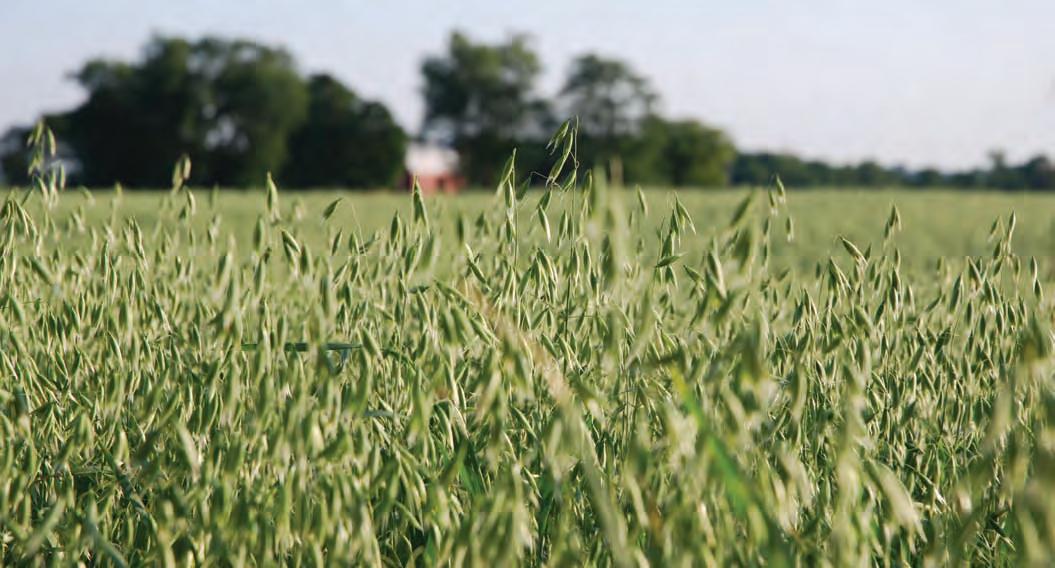
inputs. This allows growers to choose a variety that requires minimal input, but still performs well.
Also, other factors in addition to crown rust could be affecting oat yields. Falk cites data from Europe, where fungicide use is common, which show that although the total yield may increase with fungicide application, it does not usually change the relative yield rankings of the varieties. He gives two potential reasons for this. First, general fungicides may eliminate other minor fungal diseases that negatively affect yield, benefitting both resistant and susceptible varieties. Second, better disease tolerance may be related to a general good vigour that remains even when the disease is eliminated. “We don’t know what happens in Ontario with these particular varieties,” says Falk. “We do know that fungicide is expensive, however.”
Location, location, location
Luckily for growers in northern Ontario, Quebec and the Maritimes, crown rust is not high on the list of disease concerns. It is most successful in regions where humidity is high and the introduced shrub European buckthorn (Rhamnus cathartica) is abundant. European buckthorn is crown rust’s alternate host; it provides habitat for rust overwintering and sexual reproduction, and facilitates the quick development and maintenance of mutations in the rust that allow it to overcome resistance. The humidity and European buckthorn abundance are favourable for crown rust in southwestern and eastern Ontario, putting the disease at or near the top of concerns for oat growers in these regions.
Breeding resistance
Where crown rust is common, the breakdown of resistance to it has tended to occur fairly quickly, usually within 5 to 10 years of resistance gene introduction, with some exceptions. “Oat breeders spend a lot of effort in trying to breed for more durable resistance,” says Dr. Weikai Yan, research scientist and oat breeder with Agriculture and Agri-Food Canada (AAFC) in Ottawa. However, there are several obstacles.
Most of the currently known crown rust resistance genes are single genes with simple inheritance. They tend not to be very
Our one oat variety that you might not have to spray is ‘Robust.’ It looks like it still has crown rust tolerance and it has decent yield potential,” says Peter Johnson, cereals specialist for the Ontario Ministry of Agriculture, Food, and Rural Affairs. However, until additional Ontario-adapted oat varieties are released that have resistance to oat crown rust, many oat growers might need to consider spraying a fungicide. The fungicide products that are registered for oat do not translocate well in the plant, says Johnson. This means that good spray coverage is necessary, and the flag leaf should be fully emerged before spraying. “Ninety percent of the yield comes from the flag leaf and the penultimate leaf (second leaf down), so we need to keep them free of disease,” says Johnson. Because most of the available fungicides work better as protectants than as eradicants, it is critical to monitor flag leaf development and spray as soon as the flag leaf is fully emerged.
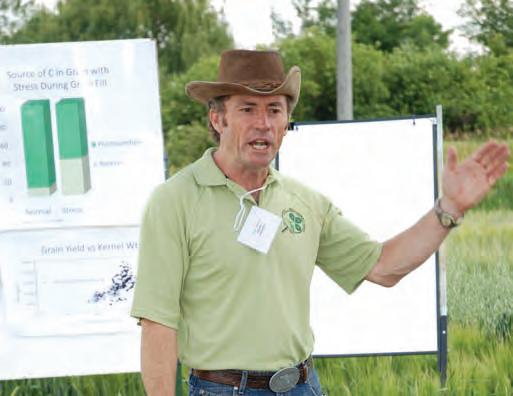
Whether the better oat varieties are losing yield to oat crown rust or lower-yield varieties merely look good by comparison, further study is needed as resistance continues to break down, says OMAFRA’s Peter Johnson.
durable because the disease organism can usually overcome the resistance by a single genetic mutation. Thus, oat breeders aim to insert, or “stack,” multiple resistance genes into high-yielding germplasm. However, because most of these resistance genes are dominant genes, it is difficult to confirm whether a resistant variety has more than one without using genetic markers, which are generally not yet available for oat.
Another type of resistance, called quantitative resistance, can provide differing levels of disease tolerance. It is generally more durable because it involves numerous genes, but it is also more difficult to identify and manipulate in the germplasm. The development of genetic markers would also facilitate the inclusion of quantitative resistance into oat varieties.
Another limitation to speedy oat variety development is that very few researchers and breeders in North America work with oats, and some of those that do are approaching retirement. “In the United States, they have fewer and fewer people working on oats because they grow less and less of them,” says Yan. “Canada is the biggest grower of oats after the Russian Federation, yet we only have two oat breeders within AAFC.” This might seem disadvantageous for a country that produces two to three times the oats grown by the United States and is a major supplier of oats to the United States.
Yan is working with several resistance genes that are still effective in Ontario, including Pc61, Pc91, Pc94, and some newer, unnamed genes. “We are trying very hard to put all the effective resistance genes that we can find in the same germplasm,” he says. “Our lines that are currently in registration trials all have an older crown rust gene, Pc61, which is still very effective in Ontario.” AAFC is hoping to release one or two lines that contain one or more of these effective genes by the end of 2009.
Because of the current crown rust susceptibility of most Ontario oat varieties, though, one thing is clear for oat growers in southwestern Ontario and the Ottawa Valley, notes Johnson. Those who are growing high-quality oats for premium markets such as horse feed or milling for human consumption will have to spray a fungicide at the flag leaf stage to control the rust and obtain good oat quality. n

You can click on “Current Issue” for the most up-todate version of the printed magazine.
w eb e x C lus I ve
News, features, and short articles have been specially selected by the editor for the web.
n ews Ar C h I ves
Visit our news archives to look for a specific story or browse for past news items you might have missed.
Job b o A rd
Our job board lists all of the latest employment opportunities across the country and overseas.
b logs
Voice your opinion on topics that are important to you. Read what others are saying.
s ubs C r I pt I on
If you need to subscribe or renew your current subscription, all of the details are available here.
It is the objective of Top Crop Manager to provide field crop producers with the most up-to-date crop input advice. Our stories gather ideas and information from researchers as well as government and independent sources, providing practical advice to assist in improving crop yields and saving costs. Producers have a wealth of knowledge available to them from other sources as well, and this is as easily gathered as contacting one of their local Certified Crop Advisers (CCAs), a group whose goals are complementary to Top Crop Manager’s: increasing farm profitability.We welcome the assistance of Syngenta Crop Protection and NK Brand Syngenta Seeds in underwriting this listing of Ontario CCAs: they are ready and able to assist in your crop management decisions.
The mandate at Top Crop Manager is quite simple: provide field crop producers with timely and useful information. Our stories are based on ideas and input from researchers and government personnel, as well as independent sources, offering practical advice to improve yields and reduce costs. Producers benefit from a wealth of knowledge made available to them from other sources, including their local Certified Crop Advisers (CCAs), a group of professionals whose goals complement Top Crop Manager, particularly in increasing profitability. We welcome the assistance of Syngenta Crop Protection and NK Brand Syngenta Seeds in underwriting this listing of Ontario CCAs: they are ready and able to assist in your crop management decisions.
There are more than 450 Certified Crop Advisers in Ontario. Each CCAhas demonstrated their knowledge about Ontario crop production by passing the required exams. In addition, they have the crop advisory experience, the education, the commitment to continuing education and have signed a comprehensive code of ethics, which places the grower’s interest first. This industry driven program helps ensure that Ontario crop producers are well served by those providing their crop production advice.

Syngenta Crop Protection and NK® Brand Syngenta Seeds are proud supporters of Certified Crop Advisers (CCAs). In today’s world of diverse cropping practices, they can be counted on for valuable agronomic insight.
We salute CCAs for their commitment to the continuous learning required to maintain this certification. This commitment allows CCAs to play a vital role in providing the new technology, research and management advice required for success in today’s agricultural production.
Jack John Aarts
Darryl Dwayne Acres
Clark William Aitken
Douglas Robert Alderman
Robert C. Alton
Robert Chad Anderson
James Murray Anderson
Frederick Joseph Anthony
Christopher James Armstrong
David Edwin Bach
Scott C. Banks
Jeffrey Donald Bannerman
James Bradley Barclay
Russell Lloyd Barker
Dave A.R. Barkley
Andrew Dale Barrie
Murray M. Bauman
Larry Bauman
Michael Wilfred Bechard
Tammy Michelle Beirnes
John Allen Bell
Harry N. Bennett
Adam Thomas Bent
Steven John Bent
Martin Rock Besner
Thomas Wade Bickell
Shannon Heather Bieman
Susan Marie Bird
Leonard John Blydorp
Horst Gerhard Bohner
Robert T. Booth
Vincent Bernard Bourassa
Roger Bourassa
Paul Bourgeois
William Lawson Bowman
Jamie Lawrence Box
Aaron Jan Breimer
Shawn James Brenneman
Keith Eugene Brimner
Stephen Broad
Donald Alan Broad
Mark Darryl Brock
Bryan Robert Brodie
Edward Andrew Brooks
Ryan Michael T. Brophy
William Wilford Brown
Christine Mary Brown
Jennifer Heather Ela Bryson
Donald Edwin Burgess
Chad Burley
J. Alex Burnett
Darryl John Arthur Burnett
Gord John Button
Deborah Lee Campbell
Michael Brian John Campbell
Steven William Carruthers
Merv Allan Carter
Jason Dean Casselman
Scott Anthony Caughill
William Craig Chapple
Tanja Silvia Checkley
Randy Ryan Chevalier *
Daniel James Clarke
Sean Joseph Cochrane
Scott Anderson Cochrane
James E. Coffey
Matthew Jerome Coffey
Scott Raymond Collins
Brian A. Colville
David William Consitt
Bryan H. Cook
Barry Matthew Cooper
Paul Neil Cornwell
Achille Correggia
William Bruce Court
Brian James Coutts
Kevin Arthur Couture
John Carl Couwenberg
Dale G. Cowan
Nicholas John Cowan
Allan Todd Cowan *
Michael John Robert (J.R.) Cox
Rodney J. Craig
Jason Daniel Crandall
A. Grant Craven
Randy George Phillip Cronmiller
Bruce Crichton Cruickshank
Ralph Gordon Currie
James Laird Currie
Andrew Michael Dales
Benjamin Joel Dalgleish
Don I. Dalton
James Edward D’Aoust
Marshall Whineray Davis
Jacco de Lange
Aart Marinus De Vos
Andy de Vries
Tony J. DeCorte
David Alan Den Boer
Stefan D. Dewaele
Gregory David Dewar
Bruce Archie Dewar
Michael John Dick
Jennifer Kathryn Dick
James A. Dippel
Leslie James Douglas
George Kenneth Drummelsmith
William Glenn Dunbar
Christopher H. Dundas
Sean Richard Dunnett
Charles James Dunsmore
Norman E. Eagleson
Michael Gordon Eckert
David I. Elliott
Danny L. Ellis
Mervyn J. Erb
Gabrielle Mary Ferguson

Ronald Alan Ferguson
Joseph Albert Ferket
Patrick Gerald Feryn
David James Fink
Francis J. Flanagan
Andrew Ray Fletcher
James Michael Folkard
William Gerard Foran
William Mark Foster
Dan Craig Foster
Derek Mark Wayne Freitag
Leanne Maria Freitag
Reiny Peter Freiter
Dennis P. Frey
Greg Scott Fritz
Susan Gagne
Jerome Andrew Gagnier *
John Alexander Gal
Walter Lyle Gallagher
William B. Gallaher
William Harvey Gardhouse
Cheryl Lynn Garniss
Adam Michael Garniss
Chad Geoffrey Garrod *
Evert Bernard Geelen
Shawn Ashley Gillis
Anita J. Gilmer
Graham M. Glasgow
Terence Douglas Good
Lori Ann Goodwin-Burm
Barry Ross Gordon
Alan B. Govier
Susan Faye Gowan *
Brian Lee Gowan *
John Stuart Graham
Alain G. Gratton
William Herbert Gray
Tina Maria Green *
Gerard John Grubb
Lawrence Edward Hale
Brian E. Hall
Jamie Davis Hall
Andrew Everett Harper
Ron Hathaway
Kevin Anthony Havekes
Adam Ormey Hayes
James Eric Hazlewood
Robert Joseph Helm
Steven Douglas Henry
Paul H. Hermans
James David Hill
James Hubert Hodgins
Murray Lynn Hodgins
Peter E. Hodgins
Steven Rick Hodgins
Greg Edward Hodgins *
Merle L. Hoegy
Ryan Lloyd Hoegy
Eric M. Hogervorst *
Chad S. Homick
William J. Honey
Robert Stanley Hopkins
Ronald Earl Horst
Brian Matthew Hoven
Bruce Robert Howson
Carl Andrew Huff
Steven Richard Hughes
Perry William Hunter
Russel Jeffrey Hurst
John Lewis Hussack
Larry Hayden Hutchinson
Gordon Stephen Hyndman
Murray William Insley
Robert Bruce Irons
Ken C. Irwin
Tom Isotamm
Ammar Issa
Joseph John Jackson
Jeffrey Thomas Jacques
Mark L. Janiec
Janice Marie Ann Janiec
James Robert Jardine
John Ted Jarecsni
Gary S. Jeffery
Dwain A. Jeffrey
Steven W. Johns
Jeremy Peter Johnson
Dale Alan Jones
Dean William Jones
Dan L. Kaufman
Shashi Kant Kaushik
Dan L. Kerr
Alan R. Kerslake
Martin C Kiefer
Jennifer Lee Kilbourne
Bradley D. King
Donald King
Nicolaas C. Kinkel
Clare L. Kinlin
Stephen James Kinlin
Keith Norman Kirk
Nathan Harold Klages
Jonathan Henry Klapwyk
Henry John Klassen
David John John Kloppenburg
Douglas Ross Koch
John Henry Konert
Sebastian Dario Korob
Trevor Edward Kraus *
Klaus Thomas Kristiansen
Alan M. Kruszel
Susan Elizabeth Kucera
John Andrew Kyle
Thomas Gerald Landon
Victor Lapadat Jr.
Paul Kevin Larocque
Trevor Gerald Latta
As a young person in agriculture, Ann is proud to say that the CCA accreditation demonstrates a level of dedication, knowledge, and integrity that gives her true credibility in the minds of growers. Says Ann, “the CCA accreditation enables me to deliver the best possible agronomic advice, which is rooted in solid training and relevant, up-to-date information and research. My CCA qualification means the growers I work with know that they’re getting honest, practical advice they can trust.”
Ann McCordick, CCA Syngenta Crop Protection Canada, Territory Sales Agronomist
Simcoe,
Ontario
Kevin Douglas Leeder
Paul Denis Legault
Jack A. Legg
Doug Legge
Raymond Lemoine
Mike Lenders
William S. Lester
John Kenneth Lightle
Donald Stuart Little
Stephane Loiselle
David Michael Louwagie
George Lubberts
Allan P. Lucier
James Cesar Luckhardt
Donald A. Lunn
Patrick Joseph Lynch
Hugh Jason MacCuaig
Jennifer F. G. Macdonald
James William MacEvoy
Jack B. R. MacLaren
Heather Suzanne MacLeod
Donald B. MacMillan
Judy Elaine Macuda
Chad Edward Mangan
Randy Norman Marshall
Randy John Martin
Birgit Martin
Hugh D. Martin
Brad R McAlpine
Alan Keith McCallum
Dale Marvin McComb
Ann A. McCordick
Laura Marie McCormack *
Glen Ivan McDonald
Robert Andrew McFadden
Barry Nelson McFadden
J.D. McFarlane *
Mark Brian McFaul
Marc Edward McKeown
Mark Ritchie McKerrall
Donald Alexander McLachlan
Donald Paul McLean
C. Keith McMillan
Robert Craig McNeil
John Everett McNiven
John Barry McRoberts
Andrew Henricus Megens
Christopher Markus Meier
Kevin F. Melady
Paul Menard
Francois R. Mercier
Jeff W. Meredith
Eric Baron Metcalf
Clifford A. Metcalfe
Alexander Matthew Michinski
Greg Raymond Millard
Neil Wilfred Millson
Michael G. Minielly
Tim C. Moher
Robert D. Moloney
Timothy Michael Montague
Jean-Marc Montpetit
James Ray Morlock
Gregory Douglas Murphy *
Sheila Elizabeth Murphy
Ronald Gordon Murrell
Norman T. Nelson
Laura Grace Neubrand
M Leslie L. Nichols
Bradley William Nicholson
Thomas F. Nicol
Kevin Sterling Nixon
Jeremy Richard Nixon
Conrad Leigh Noble
Dennis John O’Connor
Jason Robert Oud
Ian Grandy Page
Julien Victor Papineau
Mike Frank Parker
Robert Charles Parsons
Kirk Jon Patterson
Michael F. Payne
Terry Michael Peacock
Andrew Corbin Pearson *
Michael James Pedlar
Dale A. Peters
Paul Gerhard Petker
Terry Robert Phillips
Grant K. Piggott
Lindsay Irene Pink
Pierre L. Pinsonneault
Dean Cecil Porter
Walter Lawrence Quilty
Dave Charles Racz
Stephen Gregory Redmond
Terry Reesor
Lorraine Regnier
D. Keith Reid
John Frederick Reinink
Richard Wendell Rell
Grant Marshall Richardson
Stephen E. Richter
Rodney Marshall Ricker
Francois Rivard
David P. Robertson
Paul Ernest Robinson
Chris James Robson *
James Bernard Roefs
Charlie Roland
James Alexander Ross
Steven Ross
William Graham Roy
Morris Eugene Sagriff
Tarlok Singh Sahota
Marc Philippe Saumure
Martin Savoie
Kenneth Ronald Schiestel

Christina Lynn Schneider *
Brian J. Schoonjans
Hugh James Scott
Blair Kenneth Scott *
Roy J. Searson
Jonathan Ross Sebok
Jeremy G. Segeren
Pete George Sereda
Dean M. Shantz
Bradley S. Shantz
Bryan Todd Shantz
Michael J. Sharpe
Jeff Shea
Barton John Simpson
Fred Kenneth Sinclair
Anthony P. Siroen
Colin H. Smith
Jennifer Jane Smith
Iwan F. Smolders
Christopher William Snip
John Allan Snowe
Donna Gwendolyn Speranzini
Ian Andrew Sponagle
Burns Arthur Stephen
Reg Scott Stirling
Ross Stephen Stone
Glenn David Storey
Bryan Stover
David Lorne Strickler
Fiete Suhr
Paul T. Sullivan
Brad Murray Swance
Roger Willis Swance
Brian Raymond Switzer
Ronny Sys
Marvin John Talsma
Brian Edward Taylor
Mark Lloyd Taylor
Robert Ernest Templeman
Cain Stewart Templeman
Bob J. Thirlwall
Andrew George Thompson
Edward Joseph Tomecek
Joseph Charles William Tomecek *
David Alexander Townsend
Tim R. Trinier
Georges Erick Tsague
Stanley Andrew Tufford
J. William Ungar
Patrick Joseph Unger
Robert David Uppington
Joseph Robert Uyenaka
Paul D Van De Wiele
Kevin Lawrence Van Eerd
Herman Cordell Van Genderen
Jason Douglas Van Maanen
Kevin Andrew Van Netten
Adrian Cornelis Van Niekerk
Kirk Theodore Van Will
Murray Edward Van Zeggelaar
Scott Francis Vandehogen
John P. Vander Burgt
Rosa M. Vander Kuylen
Jasper Vanderbas
Rick Michael Vandewalle
E. Anne Verhallen
Martin A. Vermey
Paul John Vincent
Sharon L. Vogels
Robert John Vos *
Carolyn Marie Vsetula
John Nicholas Walby
Gordon D. Walker
Joanna Maria Wallace *
Ethan Daniel Wallace
Lynne P Warriner
Robert Glen Allan Warwick *
John Alexander Waters
William Albert Waters
Donald Irwin Weaver
Fred Otto Wedde
Timothy C. Welbanks
Steve John Wellein
Allan Timothy Weller
Robert Allan Wellington
John Alexander Welsh
Douglas John West
Henry J. Westerhof
Charlene Anne Marie Whattam-Dick
Wayne W. Wheeler
George M. Whittal
Darryl James Whittington *
Gordon Paul Wight
Archie Robert Wilson
Jeffery Lloyd Wilson
Garth B.D. Wilson
Michael George Wilson
Gerald John Winnicki
Shawn Michael James Winter
R. Duane Winter
Gregory Alan Wise *
Kent Hugh Wolfe
Andrew Gerald Thomas Woodbridge
Steven Gregory Wright
Rodney Gordon Wright
Andrew Richard Wright
W. Timothy Wright *
Adrian Huburtus Wydeven
Matthew John Zeibari
Jonathan Daniel Zettler *
John A. Zink
Charles Karoly Zubovits
Viliam Zvalo
Nicholas Christopher Zwambag
* Denotes CCAs who were certified within the last year
For Deb Campbell, being a CCA is all about helping producers get results. “Successful producers are already strong from an agronomic and business management perspective,” explains Deb. “They want to fine tune their operations so they can achieve a higher level of results. As a CCA, I am able to tap into global research and resources and share my expertise with Ontario producers, so they can apply these learnings to their farms. This way, I help them remain competitive and meet their goals.”
Deb Campbell, CCA NK Syngenta Seeds, Field Agronomist Dundalk, Ontario
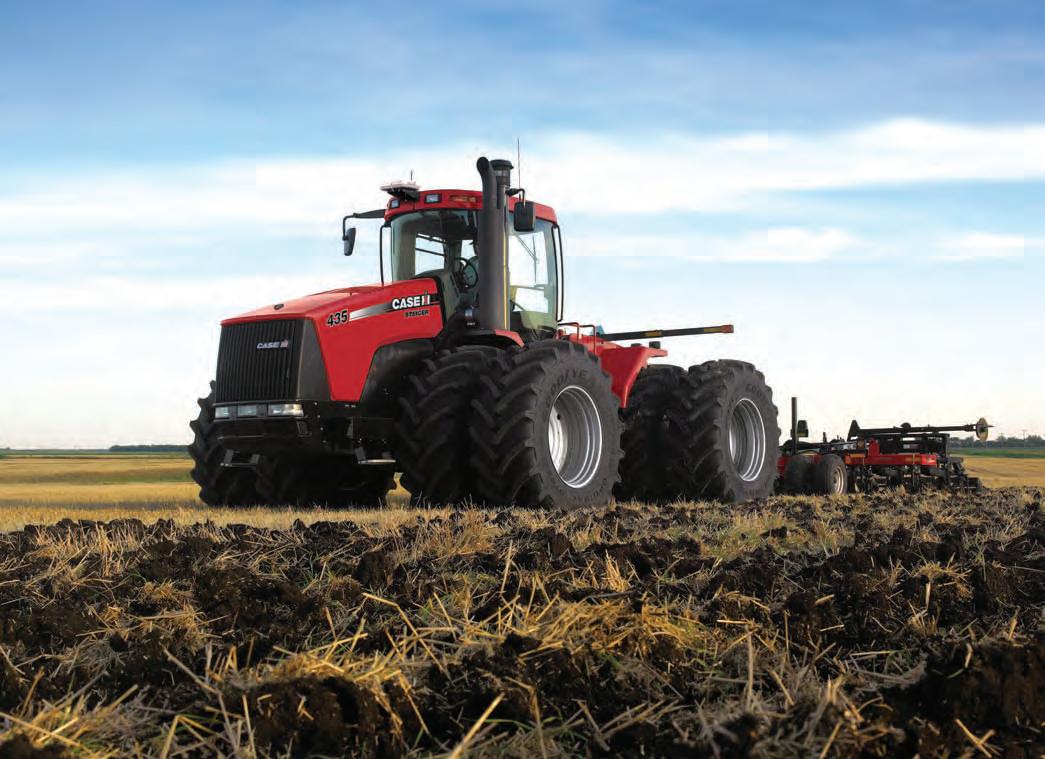
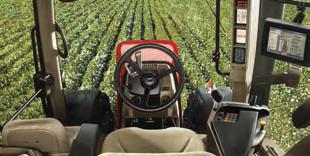
The Tractor. i t is what drives - and defines - producers during much of the growing season. From tillage to seeding to its myriad other uses around the farm, a tractor as indispensable as it is commonplace across eastern canada.
although the principles of engineering inside a tractor have remained relatively unchanged for decades, the modifications and enhancements in recent years certainly have added value to their day-to-day operations. adding value is central to the introduction of our Machinery Manager features; successfully introduced to four of our Western canada editions in the past year, we have expanded its complement in our eastern canada issues to six features during the next year. and we are starting things off with four-wheel drive
tractors to acknowledge the need for more information and specifications on one of the most valuable tools on your farm.
Whether you are considering upgrades and adjustments to existing models, are interested in improving on-farm efficiencies, or are thinking about a complete change-over to something new, having the latest information is the first step in any such process.
as you know, we at Top crop Manager maintain that you always check with the equipment manufacturers, dealers and other agronomy professionals, for the most up-to-date resources and helpful advice that pertains to your farming operation.
ralph Pearce, editor, Top crop Manager
Five Models of Case IH Steiger and Quadtrac series 4WD tractors deliver proven wheeled or track performance in challenging conditions. Case IH 4WD tractors feature three frame sizes and an industry-leading long wheelbase and drawbar design for superior conversion of horsepower to pulling power – while delivering comfort, convenience and reliability. The 335 is offered as a standard wheel model, while the larger 385, 435, 485
and 535 models come as either a standard wheel or in the Quadtrac design. In addition, the AFS AccuGuide automated guidance system is standard equipment on Steiger and Quadtrac tractors for provide hands free operation for improved farming efficiency. With these models, there are 22 various configurations, and the 535 also comes as a 535 Pro, with hyrdraulic power boost and up to 610 hp rating. n
by Bruce Barker
The Nebraska Tractor Tests are the best source of unbiased performance testing.
With a cash outlay in the six figures, a tractor purchase is a serious decision that warrants much analysis beyond the colour of the paint. Sure, dealer and brand are important, but the bottom line is that a tractor has to deliver the type of performance and dependability required for multiple tasks on the farm.
While Western Canada used to test tractors at the Prairie Agricultural Machinery Institute, those tests are no longer conducted on the Prairies, leaving farmers to depend on the Nebraska Tractor Tests as their most reliable and unbiased testing
facility. “The Nebraska Tractor Tests conform to OECD standards, and our laboratory is the officially designated tractor testing station for the United States”, says Dave Morgan, assistant director at the Nebraska Tractor Test Laboratory in Lincoln, Nebraska.
OECD stands for the Organization for Economic Cooperation and Development, and its 29 member countries adhere to the tractor test codes with active tractor test stations in approximately 25 countries. The OECD codes require that the tractors be tested in the country of manufacture.
The OECD Tractor Test has compulsory tests that are performed. This includes verifying manufacturers’ specifications, performance of the tractor at the main power takeoff, the power lift and hydrau-
lic pump and the drawbar. Included in the drawbar tests and PTO tests are fuel consumption measurements.
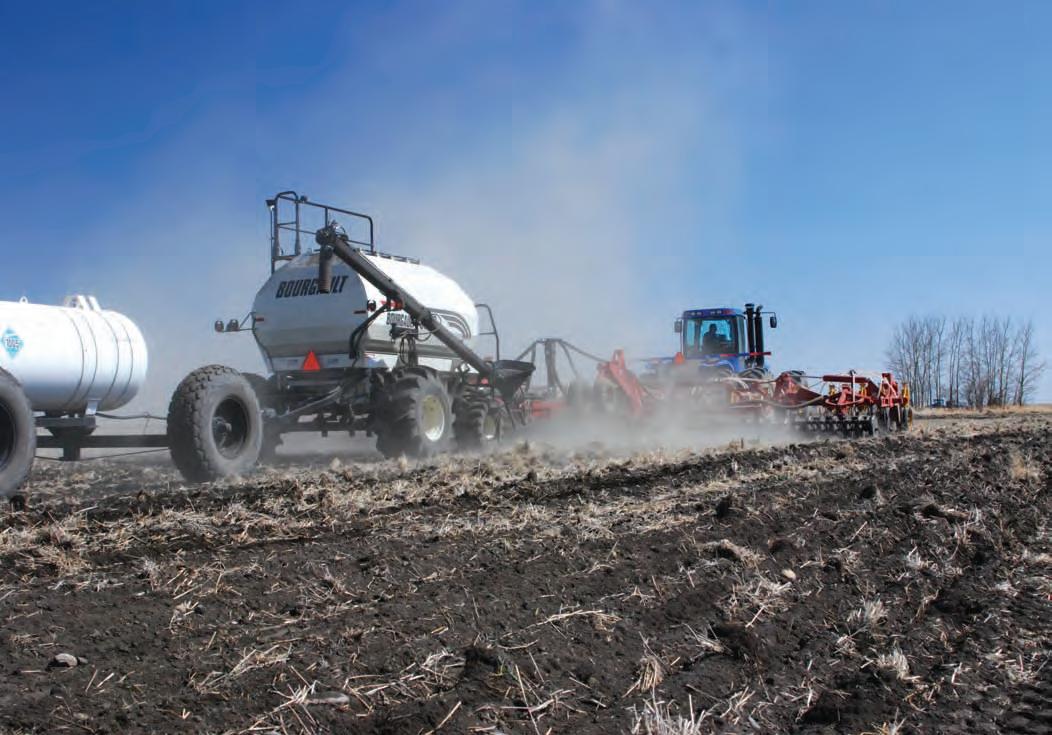
The basics of tractor performance, including PTO performance, fuel consumption, hydraulic pump performance and drawbar power, are what most farmers are interested in, especially with high horsepower 4WD tractors. These tractors must be big enough to pull air drills and have a hydraulic pump capacity to drive air cart mechanics.
Drawbar tests are conducted on concrete at Nebraska so that the conditions are equal across tractors and so that comparisons can be made between different testing facilities. As a result, the test
reports are not directly transferable to field conditions, but they give an approximate comparison. “The concrete test track gives the best tractive conditions, and is the same surface for everyone. If the tests were conducted on soil, the results would be useless as the conditions would be different for each test,” explains Morgan.
carry around,“ says Morgan.
When diesel fuel prices spiked in 2008, many farmers turned a critical eye to fuel efficiency. The Nebraska Tractor Tests measure fuel consumption as a measure of power for a given amount of fuel, and the result is reported in horsepower-hours per gallon of fuel or Hp•hr/gal (Imperial), or in kilowatt hours per litre expressed as kW•h/L (metric). Higher numbers mean more work is being done for a given amount of fuel, but like automotive fuel efficiency ratings, the fuel consumption reported in the test will likely be better than achieved in the field because of varying soil and working conditions.
tronic chip controls the horsepower of the engine. A 190 horsepower engine and 250 horsepower engine are exactly the same, except for the electronic control,” says Morgan.
The standard test of drawbar performance is measured with unballasted tractors at rated engine speed and the maximum power engine speed in all gears between 15 percent slip and 13 km/hr plus partial loads of 75 percent and 50 percent of pull at maximum power in two separate gears. The measurement most relevant to farmers is measured at 75 per cent of pull at maximum power, which reasonably reflects typical field work over a year of drawbar use. “Unballasted runs are the best to compare different tractors because they represent the basic tractor performance. Adding ballast increases pull and can increase drawbar power in some cases, but may cause increased fuel consumption from the added weight you
CanGrow_7x4.875 7/18/07 1:44 PM Page 1
The most useful PTO measurement is maximum power at rated engine speed, which is the highest power level that a tractor can sustain, measured in horsepower. Tractors with a power bulge can produce more power at a slower engine speed, but there is no power reserve. “It is interesting to note that in some of the new engines, the only thing different between the tractor models is how the elec-

The Nebraska Tractor Test Laboratory has reports for tractors from 1999 onward and they can be found online at www. tractor-testlab.unl.edu/testreports.htm in a pdf format at no charge. Individual reports are generally available within a few months of testing. A summary booklet can be ordered at a cost of $8 (US), and contains data on all tested models that are still on the market. An annual subscription of $35 per year will ensure delivery of all reports issued during the year, plus the summary booklet.
Owner’s, parts and shop manuals can also be ordered online, as well as other materials such as advertising literature, blueprints and assembly drawings. Test reports going back as far as 1920 are also available, so if a grower is looking for a report on a 1920 Rumley Oil Pull K12 model, it is available. n

Superior performance is born in the soil, where root development is the key to plant performance,especially at the early vegetative stage.
With a PowerfulStart,your wheat will finish with better yields,better quality and a better bottom line for your operation.
PowerStart is a fluid fertilizer that maintains plant vigour early on,elevating critical levels of nutrients in the seedling.
That ramps-up plant metabolism, boosting root development,root activity and retention.
Formulated into a fully-loaded mixture with sulphur,zinc,manganese and copper,
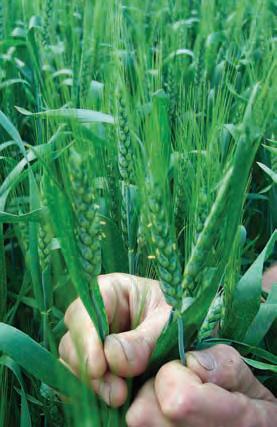
PowerStart also helps fight a wide range of fall diseases.
PowerStart reduces application rates through better placement and more efficient conversion of phosphates.

Meeting customer demand for more muscle to pull increasingly larger implements, the New Holland’s T9000 series 4WD tractors are more powerful than ever, with five models from 335 through to 535 horsepower available on the largest T9060 model. The 485-hp, T9050 model features a 12.9L New Holland engine that utilizes exclusive compound turbo technology to boost performance and fuel efficiency. New Holland T9000 series features two main frame sizes with engines sized to provide maximum performance with minimum fuel consumption. The T9020 houses a 36 inch wide frame with a 139 inch wheelbase, while other T9000 se-
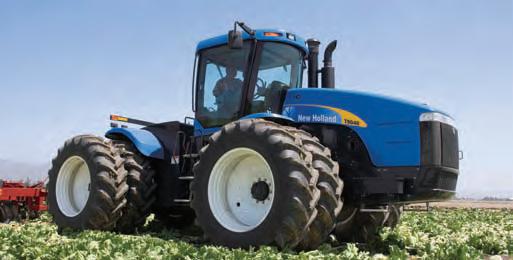
ries models have a 44 inch frame with a 154 inch wheelbase. New Holland offers standard ag, heavy-duty ag and scraper configurations to meet a wide range of market needs. Only five daily service items are required, giving T9000 models a class-leading SAE rating for ease of service. n
The all-new MT800C series boasts outstanding perfor mance from Tier III Caterpillar C15 and C18 ACERT technology six-cylinder diesel engines that are both turbocharged and after-cooled. In fact, the 18.1 litre (1,105 cu. in.) C18 model, used in the MT865C and MT875C, is the larg est displacement engine in the agricultural tractor market.
All five models in the lineup feature advanced technology that comes with a new ISOBUS system and an impressive ar ray of features designed to make you even more productive and efficient. Among them are a new digital dash display that’s easier to read; a redesigned tractor management centre that provides simpler and more intuitive operation and a new hydraulic system with a higher degree of control, higher flow and greater adaptability. n
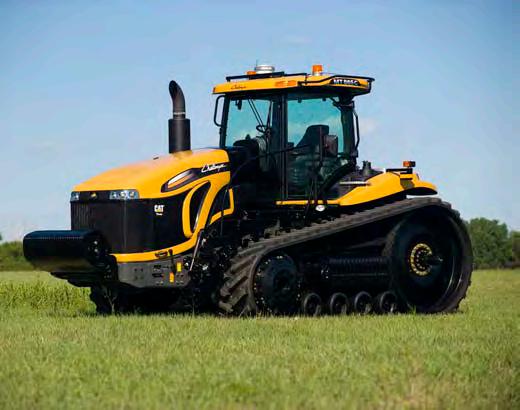
Although they share a number of features and components with the comparably sized MT800C series track tractors, the MT900C series is much more than a Challenger track tractor on tires. All four models in the MT900C series feature state-of-the-art ISOBUS technology as well as setting standards in the industry for the widest and heaviest frame, paired with the largest diameter driveline to ensure that the weight and horsepower are delivered to the ground, along with the largest standard diameter axles in the industry to provide maximum durability and strength.
The Challenger MT900C continues to be the highest-horsepower commercially available four-wheel drive tractor in the world with gross engine horsepower ratings up to 585 hp (436 kW) on the MT975C. n
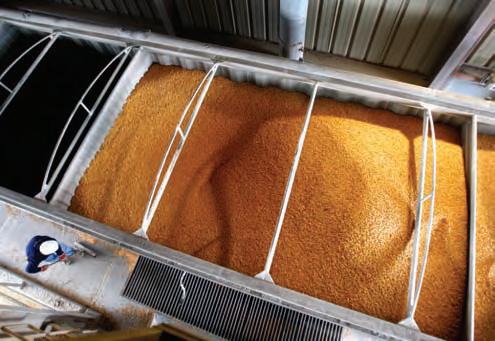


As Canada’s leading ethanol producer, GreenField Ethanol has worked closely with Ontario farmers for the past 20 years. We look forward to continuing this valued relationship as our business grows.
Our Buy Direct Program, available exclusively to Ontario farmers, offers local producers the opportunity to sell their corn directly to GreenField plants in Johnstown, Chatham and Tiverton. Seasoned professionals are available to discuss our competitive prices and unique marketing options.
Dried Distillers Grains with Solubles are a valuable co-product of ethanol production. We proudly produce this high protein animal feed at all our ethanol plants.
To sell your corn and purchase DDGS please call 1-888-471-3661 for Chatham and Tiverton or 1-866-972-6866 for Johnstown
While diesel fuel cost does not rank “up there“, taking a fuel miser attitude can add up to significant savings.
Whether a tractor is 20 years old or rolling off the dealership lot for the first time, a number of fuel-saving measures can be implemented to reduce fuel consumption and prolong tractor life. Lawrence Papworth, a project engineer with the AgTech Centre at Lethbridge, Alberta says that tires, ballast and farming systems are the big three when it comes to saving on fuel. He offers tips on reducing fuel consumption.
The transfer of pulling power from the tractor engine through the drawbar to the ground depends on both correct ballast
for proper slippage and tires (or tracks) to grip the ground. Tires should be inflated to the lowest pressure allowed by the manufacture for the load the tires are carrying.
Over-inflated tires will rut soft soils more easily, decrease traction, wear the tread unevenly and strain the tire material itself. Under-inflated tires increase sidewall wear and raise the risk of side buckling and rim slip. With the correct tire pressure, there is a little more tire on the ground and a bit more efficiency in power delivery.
Papworth recommends using radial tires over bias-ply tires. A North Dakota State University study found that properly inflated radials improve fuel efficiency by six percent over bias-ply tires. Similar results were found in an AgTech Centre study.
by Bruce Barker
Shiny, new black tires are actually less fuel efficient than older, broken-in tires. New tires have longer lugs, which are good for mud, but bad for firm soil conditions. Every time a lug bends, the tractor is using energy that does not add to the efficient transfer of power to the soil.
Other tire factors that influence fuel efficiency include overloading, type of tire and number of tires used. Overloading causes premature tire wear, excessive soil compaction and increased fuel consumption due to the increased rolling resistance.
Dual tires can also decrease a tractor’s fuel efficiency. Duals are worse than singles and triples are worse than duals. While duals increase flotation and may be unnecessary in good traction conditions, on dry, firm soils, more tires means increased rolling resistance. Where more
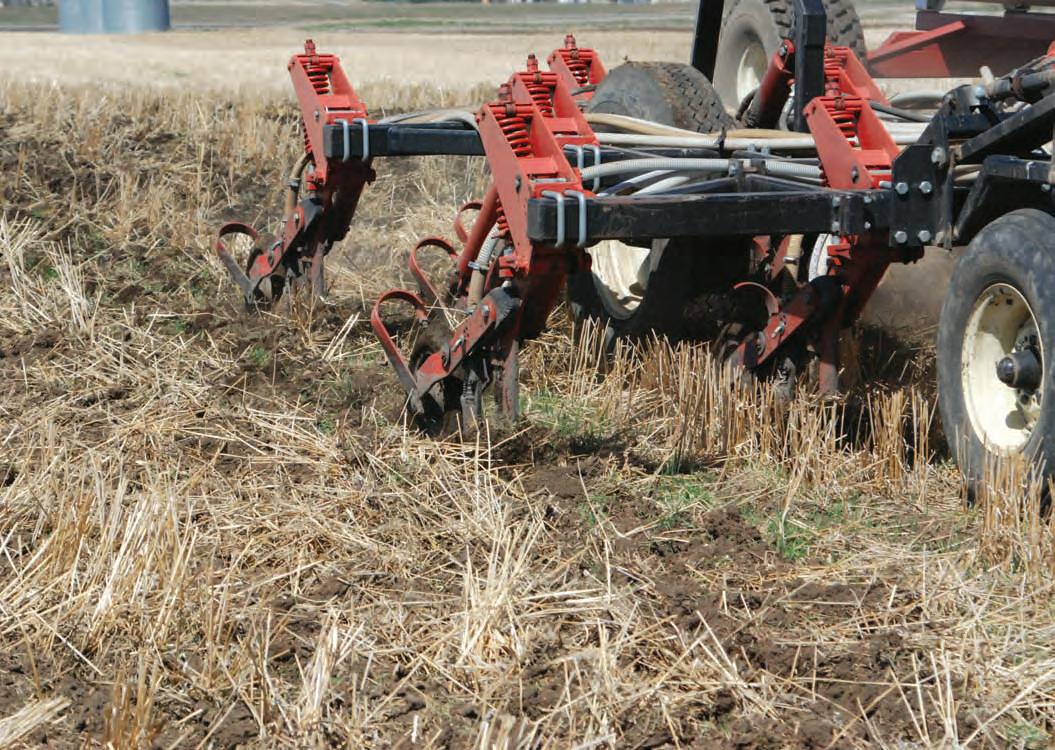
floatation is necessary, larger dual radials are more efficient than smaller ones as triples. “More tires are less efficient, and we’ve seen that wide single tires are five to seven percent more fuel efficient than narrow duals, although many tractors require duals to support the tractor weight,“ explains Papworth. “Some farmers still like triples, because if they damage a tire, it is cheaper to replace a smaller triple tire than a larger dual.“
Burn less with proper ballasting
Ballasting adds weight to the tractor to help reduce tire or track slippage. Too much ballast means the tractor is carrying too much weight, which cuts into fuel efficiency. It can also cause excessive torque to be transmitted to the tires and ground, causing overload, wear and drivetrain failure.
Papworth says that many tractors are ballasted for the worst-case scenario: a tractor operating at maximum power. However, maximum power is usually only reached 15 to 20 percent of the time, so operating with less ballast could improve fuel efficiency. “The key to ballasting is to decide the speed necessary for an operation and the amount of the load. Then set the tractor weight just heavy enough to pull that load at that speed and at an acceptable slip level,“ explains Papworth. The total tractor weight should wind up being two and a half to three times the load being pulled.
An over-ballasted tractor has a sluggish feel, but an under-ballasted tractor wears tire tread at a faster pace because of excessive slip while never delivering full horsepower to the drawbar, so getting ballast correct is important.
Park the tractor
The best way to cut fuel consumption is to keep the tractor in the shed more often. The move to direct seeding and one-pass seeding has drastically cut diesel fuel costs for many farmers on the Prairies.
Recent refinements in GPS and autosteer systems are also shaving fuel costs by reducing or eliminating field overlaps. Auto-steer can produce upwards of five percent in fuel savings, and it also saves on fertilizer and seed inputs.
Keeping the air filter clean also helps to reduce fuel consumption. In dusty conditions, clean or replace the air filter frequently, as recommended by the manufacturer. n
Since their launch in 1996, John Deere 9000 series tractors continue to be among the best selling tractors in their class, and the all-new 9030 series takes this legendary performance to greater heights. A new 13.5L John Deere PowerTech Plus engine provides high horsepower and outstanding fuel economy. Plus, these fuel-injected engines are Tier III emissions certified and provide a 40 percent reduction in nitrogen oxide emissions compared to its predecessor. A 9.0 L engine – featured on the 9230 – provides 325 hp. The new 13.5L powers all other 9030 series tractors. It delivers from 375 engine horsepower on the 9330 and up to 530 engine horsepower (up to 583 peak hp factory observed ) on the 9630. A new AirCushion tracks suspension system lets you operate at faster speeds, with unmatched comfort. Choose between two field-proven transmissions – an 18-speed PowerShift or a 24-speed manual shift transmission. Choose from four dual tire models ranging from 325 to 530 hp. Or choose from three tracked models for greater traction and flotation, and faster operating speeds with the 9030T series track tractors, in models ranging from 425 to 530 rated horsepower. The updated CommandView cab is now quieter and more user friendly than ever. n

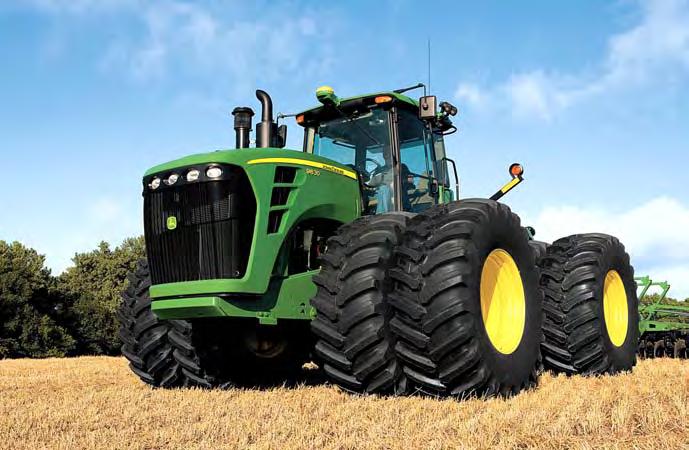
Agri Studies, in partnership with Top Crop Manager, is pleased to announce the 2009/2010 Commercial Producer Study. This comprehensive study has been designed to provide insight into large producer’s decision making practices, paying particular attention to:
Demographics of the commercial producer
How decisions are made for capital and expendable items
Usefulness of information sources
Relationship with the local dealer
Key management challenges faced by the commercial producer
This study was originated by Dr. Tom Funk of the University of Guelph and conducted in Canada and the United States in 1993/94. It has since been conducted in the United States every five years with the most recent study being completed in 2008. The 2009/2010 Canadian Study will allow for benchmarking from the original Canadian study and allow for comparisons with the most recent US study conducted by Purdue University in 2008.
Dr. Tom Funk will again be coordinating this study along with partners Agri Studies, and Top Crop Manager magazine. Large Producers can be expected to be contacted by university agriculture students to participate in this study.
For more information, visit www.AgriStudies.com or phone project manager, Justin Funk at 519-827-5507.


The Versatile 305-400 hp 4WD series continues the Versatile tradition of power, reliability and serviceability. The QSM 11-litre high-pressure injection system and electronic controls continuously monitor data from strategically placed sensors within the engine, optimizing the fuel-to-air mixture for maximum combustion. A swing-out assembly on the front grille and radiator expose the hydraulic and transmission oil coolers, air conditioning condenser, fuel cooler and charge air cooler for fast cleaning.The wider cab offers excellent 360-degree visibility for fieldwork and manoeuvring large modern implements, and there is a clear sightline to the drawbar when attaching equipment. The high-resolution electronic display is easy to read and provides operating data at a glance, and the side console features a convenient fingertip-control throttle.
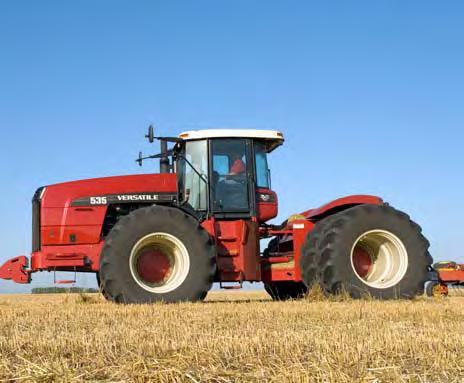
The High Horsepower Tractor (HHT) series 4WD was created to respond to growing agricultural operations that have more acres and require more power and hydraulic flow. Engineered from the ground up using heavy-duty components, the HHT series 4WD is available in 435, 485 and 535 hp. The frame is manufactured from thick steel plate to ensure structural integrity, even under extreme conditions. Outboard planetary axles with a new 24 bolt pattern and standard drum duals ensure power is efficiently transferred to the ground. The main bearing at the articulation point is now 60 percent larger to reduce stress and extend life. All models have a total hydraulic flow of 55 GPM (208 L/min), or 80 GPM (303 L/min) with the optional high flow hydraulic system. Four remote valves are standard and the optional high flow hydraulic system is available with six remote valves, and eight remote valves are available. n
Iby Treena Hein
Various viable alternative weed control methods are being explored.
nterest in biological-based weed management strategies has never been stronger. Certainly the booming North American organic farming sector has much to do with this interest, but it is also due to concerns in conventional farming circles about herbicide resistance and its environmental impact.
Instead of focusing on the use of herbicides to wipe out weeds “in one blow,” crop scientists are exploring the use of several ways of controlling weeds without the use of chemicals. “It’s a strategy of using a multitude of small hammers instead of one big one,” says Dr. Adam Davis, a weed ecologist with the United States Department of Agriculture’s Agricultural Research Service in Urbana, Illinois.
Biological control
Several of these “small hammers” involve enhancing the activity of soil microbes and invertebrates. Dr. Clarence Swanton of the Plant Agriculture Department at University of Guelph, says “Predation of seeds by soil microbes and invertebrates is the most significant method of biological control of weeds.” Populations of invertebrates that feed on seeds can be ef-
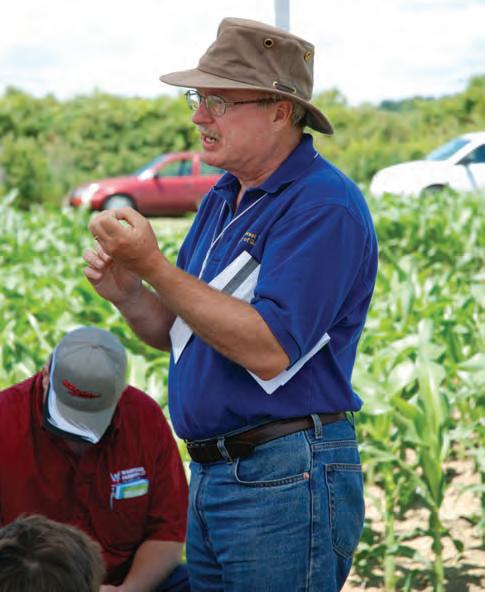
fectively augmented with management strategies, says Swanton. “This is something a farmer can manipulate. It’s a matter of healthy soils. Leaving residue and using a good crop rotation are very important.”
While Swanton acknowledges that there is value in the argument that leaving residue on fields might boost incidence of some fungal diseases, he says “The benefits of leaving residue on the soil to support invertebrate and microbe populations outweigh the disadvantages.”
In addition, Swanton champions the idea that weed seeds serve an important ecological role. “Some of my current research aims to support the idea that weed seeds are an important source of energy for the food web,” he says.
Predation of weed seed can also be enhanced through choice of tillage method, says Swanton. “Shallow till or no-till leaves seed on or near the soil surface,” he says. “In this scenario, predation is much higher from microbes and invertebrates. In addition, the weed seeds are exposed to increased environmental stress compared to seeds that are deeper in the soil. They are left to face changes in temperature and moisture.”
Swanton says some studies have pointed to night tillage as having value in reducing weed seed germination, “But it didn’t demonstrate a large enough impact to move forward in terms of supporting it as standard practice.”
Davis and his colleagues have been studying soil microbes that initiate seed decay. “It’s the ones that initiate decay that are most important,” he says. “Once decay has started, there are many species of microbes breaking down the seed. We are making good progress in determining which ones initiate decay, and then we can work on recommending actions which maximize their activity. This might involve applying them to the soil and/or figuring out which types of soil best support their growth.”
The other main biological strategy to control weed seed production is to reduce weed growth by making competition with crops much more difficult. This method is all about the crop canopy, which Swanton says is the second most important biological weed seed control factor after predation. “It depends on the soil type and crop you’re working with,” notes Swanton, “but anything you can do to increase the rate and degree of canopy devel-
opment will decrease weed seed production. This might include increasing seeding density and decreasing row width.
“The more uniform your cop stand,” adds Swanton, “the less reliance you’ll have on chemistry.”
Davis’ colleague Marty Williams, also of USDA-ARS, has demonstrated in field tests that sweet corn cultivars that grow tight canopies, that is, those that produce wide thick leaves and have other attributes that block sunlight to weeds, resulted in significantly reduced weed seed production.
Davis says “There is a lot of interest among commercial sweet corn companies in which of their hybrids are most weed-suppressive. This will help them make recommendations to low-externalinput or organic farmers.”
Another “small hammer” being studied as a way to control weeds without herbicides involves the use of machinery that removes or destroys weed seed.
“Early combine harvesters gave farmers the option of collecting and destroying weed seed, but the modern ones just spit them out along with the chaff,” notes Davis. “The combine is the most efficient weed seed dispersal device that’s ever been invented, and so what we need is a harvesting device that can destroy rather than disperse weed seed.” He adds that some organic growers in the US have already created modified combines that collect weed seeds.
Among others, Davis’s team has established that physical injury is an effective way to destroy persistent weed seeds. “They are vulnerable to physical injury (abrasion, cutting),” Davis says. “We have discovered this is because their chemical defences aren’t very strong, not strong enough to protect them from opportunistic pathogens like fungi and bacteria that enter the damaged seed coat.”
Davis is doing preliminary work with colleagues in the University of Illinois’ mechanical engineering department to eventually create a combine unit that would cause damage to weed seed in soybeans and corn. “Right now, we are in the pre-design stage,” Davis says. “We are looking at what types of damage we can inflict on weed seeds, how much energy such a unit would require, how much it would weigh, etc.” n
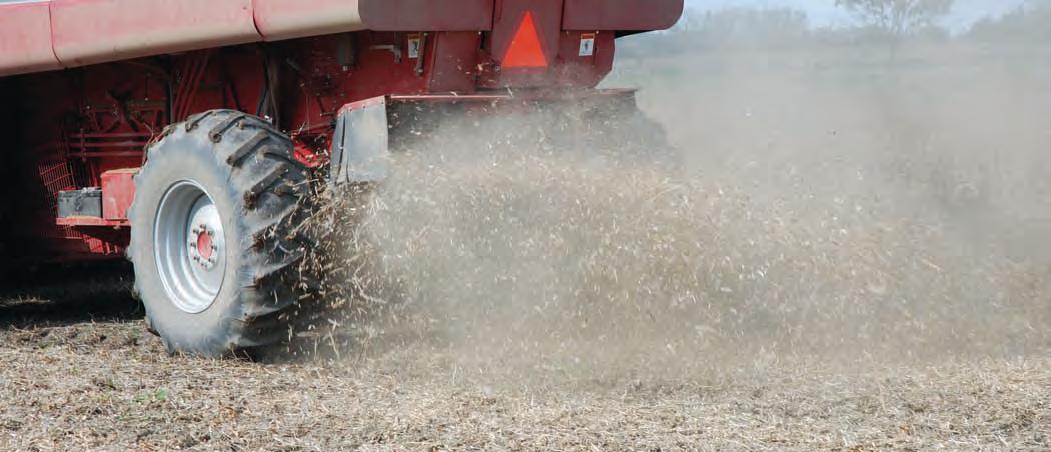
by Blair Andrews
In the face of rising costs and increased opportunities for marketing, more farmers are weighing the option of building or increasing the size of on-farm grain storage facilities. Although economic uncertainty and a drop in grain prices cooled the interest somewhat early in 2009, Bill McIntyre, sales and service with Melbourne Farm Automation Ltd., says sales were strong in the previous two years. He says reducing the rising costs of grain drying and handling was a key motivator. “Drying charges are typically half of what they are at a commercial elevator. But to make a fair comparison, you have to take into consideration the cost of investment, plus the time and management that is involved to dry or handle your own grain. However, keep in mind those savings are going back into your pocket.” Depending on the moisture of the grain, McIntyre notes that, based on customer feedback, the fuel costs of drying grain at the farm will range between 10 to 18 cents per bushel (not counting the cost of your investment), whereas commercial elevator costs run in the range of 40 to 60 cents.
McIntyre says on-farm storage also gives farmers more choices for selling their grain. “On-farm drying and storage also gives farmers more flexibility in marketing the crop. It gives you more avenues if you’ve got it at home, including the feed trade and commercial buyers. And you usually get a premium.”
McIntyre adds that a move by commercial elevator companies to close locations in some areas has also caused farmers to think about building their own facilities. As for whether to go ahead with building or expanding on-farm storage, McIntyre recommends that farmers weigh several factors, including the costs of their current expenditures versus the cost of the project. Cost considerations include capital, depreciation, insurance, maintenance, elevation of the grain in, elevation out, labour, profit margin, fuel and electricity. “Do you have the time to handle the grain yourself? What are you going to put through for capacity? Weigh that cost against other services in your area. Weigh your opportunities for marketing. You’ve got the grain sitting at home and you’re not paying monthly storage fees, hoping that the price will go up.” As a general rule of thumb, McIntyre says a bin or dryer will pay for itself in three to five years.



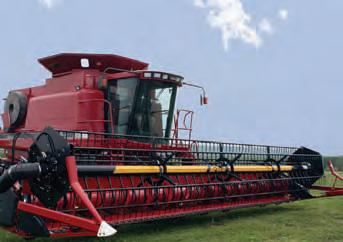
Replaces factory reel
Whatever standing small grain or bean crop you’re harvesting, the addition of a Crary Air Reel will add bushels to the hopper.
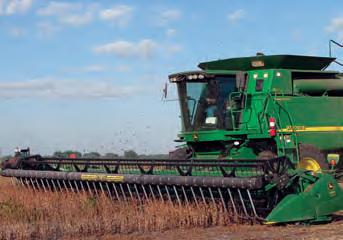
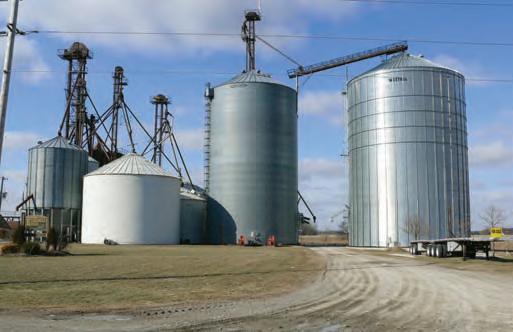
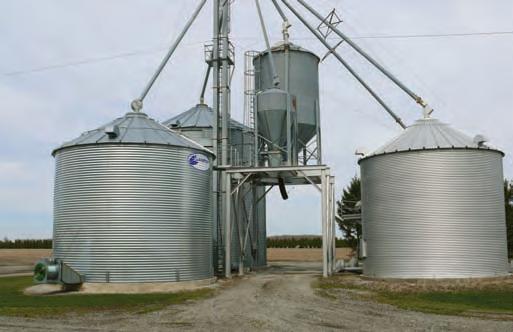

Location is important but ease of flow means less handling of grain, thereby maintaining its quality.
Whether improved grain prices or the need to manage energy costs renews farmers’ interest in on-farm storage in the future, there are some design features that could be considered now to ensure an effective and efficient system. Of utmost importance is the layout. McIntyre says the configuration should allow for easy expansion in the future without hampering the other activities of the farm operation. “If you’re buying a dryer, don’t size the dryer for what your operation is right now. Size your dryer for what you think the potential size of your operation will be in five years.”
Agricultural engineer Ralph Winfield agrees. It is a point that the Belmont, Ontario, farmer stressed in the 2009 Grain Dryer and Storage Workshops that were organized by Ontario Ministry of Agriculture, Food and Rural Affairs engineer Helmut Spieser. Winfield says farmers should ask themselves if the location will give the grain-handling system room to grow in the future. “Location is very important: once you place the first bin, you are committed to that location.”
McIntyre cautions against planning for too much, reminding people to make their forecasts as realistic as possible. Simplicity is also preferable. “As far as how grain gets into and out of the system, make it flow easily. The less that you can handle that grain, the better you can maintain the quality of it,” adds McIntyre.
Winfield says the plan should also provide for an elevator leg. He concedes that this provision may not be included in the first draft of the design, but Winfield suggests that an elevator leg will become an important consideration. “I know when you start out, you use a portable auger. But most people get tired of using portable augers after three or four years. Then the question is “where do I put the leg?”
Other key questions include:
• site?
Is there adequate electrical and natural gas service at the
Is drainage adequate for the receiving pit?
• Is there potential for neighbours to complain about the noise
• from fans and moving grain?
Winfield says the last point could influence the choice of the dryer fan for the operation, adding that an axial fan will be noisier than the centrifugal type.
Perhaps the second most important consideration for onfarm storage is accessibility. Transport trucks should be able to manoeuvre around the facility with ease, and they should have
On-farm storage also gives farmers more choices for selling their grain.
all-season access on the site. “When the buyer comes to get (the grain), they’re going to come at their convenience, and they will want to bring that truck in off the road,” says Winfield.
While Winfield discussed guidelines for layout at the session, Helmut Spieser added that truckers appreciate designs that make their job easier. “They’re in the business of trucking; not manoeuvring things. So we want a road that will support them.”
Spieser offers the following guidelines to help improve traffic flow around the on-farm grain storage facilities:
Driveway entrances:
• low easy access into the site and to get the truck and trailer(s) off the road quickly and safely.
Should be a minimum of 50 to 60 feet wide at the road to al-

• tiple driveways.
Should be marked as a “truck entrance,” if the farm has mul-
• fic in both directions.
Should be free of any visual obstructions to approaching traf-
Driveways:
• bottom of ditches.
All weather construction, elevated two to three feet above
Properly constructed with excavation of virgin material, geo-
• textile fabric, two-inch coarse stone topped with “A”gravel, graded and compacted.
Surface graded to shed water.
• A minimum of 20 to 25 feet wide.
• Manoeuvring aprons should be at least 150 feet long to allow
• the lining up of tractor trailers to dump pits, load-out bins or platform scales.
• metres) to allow for easy turning.
Turns should have a minimum turning radius of 46 feet (14
• do not cause a snagging hazard to wagons and trucks.
Site driveways so that guy wires and guy wire support posts
Overhead load-out bins:
Minimum 14-foot clearance between support legs.
• At least 14-foot clearance below the overhead bin support
• structure.
Locate roads so truck’s load is facing the road.
• Position slide gate controls on the driver’s side of the truck to
• allow easy signalling of truck driver.
• damaged by dumping trailers. n
Avoid any spouts hanging above the driveway that could get