IPM needs to be the way of agriculture’s future PG. 28
LOOKING BACK, LOOKING AHEAD
An update on some key foliar disease issues in Ontario PG. 10
DIRT POOR, OR SOIL RICH?
Management practices can help soil structure PG. 24
Without Vios, even a full tank is half empty.
Ever wonder if your weed control program has a hole in it? Now you can erase all doubt by tank mixing Vios™ G3 herbicide with glyphosate or Liberty® herbicide. Tough grass and broadleaf weeds won’t know what hit them, but you will: three modes of action. Plus, you can count on the broadest spectrum residual weed control available from an in-crop herbicide.*
Learn more at BayerCropScience.ca/ViosG3
or 1 888-283-6847 or contact your
MIX IT UP
Weed out herbicide resistance. Vios G3 uses 3 different modes of action to help you control resistant weeds. Visit MixItUp.ca to learn more.
TOP CROP
5 | Yield-boosting microbes researchers examine the role of microbial communities in higher corn yields. By Carolyn King
10 | Looking back, looking ahead an update on some key foliar disease issues in ontario.
By Carolyn King
Trudy Kelly Forsythe
24 | Dirt poor or soil rich? Some key management practices can help producers keep their soil full of life and well structured.
By Trudy Kelly Forsythe
PEsTs aNd disEasEs 28 offsetting pesticide reliance By Madeleine Baerg fERTiliTy aNd NuTRiENTs 8 Using the right rate By Dr. Tom Jensen
fERTiliTy aNd NuTRiENTs 16 Banding dry p and K fertilizer isn’t outdated By Madeleine Baerg
ON THE WEB
Hannam fROM THE EdiTOR 4 Scouting a new ‘crop’ By Lianne Appleby, Associate Editor
LIANNE APPLEBY | ASSOCIATE EDITOR
ScouTiNg A NEw ‘crop’
April is a time of anticipation as we await milder weather and look to the time when we can get back on the fields. But no matter how much you’re chomping at the bit, one fact remains certain – no one is going anywhere until Mother nature says so.
Thus, producers patiently wait for the weather to break. and while they do, there’s another kind of anticipation in the air. at Canada’s universities, april means a lot of freshfaced scholars are gearing up to enter the work force.
It’s the time when employers are on high alert, ready to scoop up any rising talents as they prepare to graduate from their alma mater. not only are the seasons changing, but life is changing too, as thousands of young adults prepare to leave their student days behind.
Just how employers come to connect with potential job candidates isn’t an exact science. Some may meet for the first time during a job interview the student was lucky enough to procure as he or she neared graduation. other times, life presents events which foster the networking of potential employer with potential employee.
In the December issue of Top Crop Manager, I briefly touched on a contest at the University of guelph (U of g), called project SoY (Soybean opportunities for Youth), that I had covered as a budding farm journalist in the early ‘90s. reporting about it gave me an opportunity to practice what I’d been taught. It connected me with people who, to this day, are mentors, and it was the first time I found myself doing an unexpected interview on-the-fly. Thus, it was an invaluable experience.
Last month, project SoY, now in its 19th year, held its annual judging finale and open house in guelph, ont. after submitting a written report, students presented their project and had a chance to showcase their ideas to judges, industry members and the public. Judges then challenged participants to consider the real world tangibility, sustainability and marketability of their products.
This year, those products included soy-based shampoo, soy-based microspheres, a soy fire log, soy-based hydrogels and a soy-based conductive adhesive. a total of 22 students from the main U of g campus in guelph, and the alfred and ridgetown colleges entered, either individually or as groups.
“The student products of project SoY are always interesting and exciting,” says owen roberts, director of research communications for the U of g and program supervisor for project SoY. “So too is the learning that goes on ¬ about soybeans, about ontario agriculture, about intellectual property development and protection, and about the research process itself. research doesn’t always yield the kind of results you’re expecting, which in itself is an extremely valuable lesson.”
and that’s the beauty of it.
The inherent design of project SoY is such that it gives students a chance to gain practical skills while establishing (as it did for me) invaluable links with industry. Cleverly, at the same time, the competition increases awareness of ontario’s largest crop – soybeans – and helps maintain momentum for the industry.
I’d encourage any agricultural employers looking to recruit some bright talent to keep their eye on the innovative students who enter project SoY. From cookies to coffee, drinking cups to cutlery, antiperspirant to cosmetics, ideas and ingenuity abound. any enterprise can make use of minds like that.
TOP CROP
Soul/COO PUBLICATION MAIL AGREEMENT #40065710 rETurN uNDEliVErABlE CANADiAN ADDrESSES TO CirCulATiON DEpT. P.O. Box 530, Simcoe, ON N3Y 4N5 email: subscribe@topcropmanager.com
Top Crop Manager West - 9 issues - February, March, Mid-March, April, June, September, October, November and December - 1 Year - $45.00 Cdn. plus tax
Top Crop Manager East - 7 issuesFebruary, March, April, September, October, November and December - 1 Year - $45.00 Cdn. plus tax
Potatoes in Canada - 2 issues - Spring and Summer 1 Year - $16.00 CDN plus tax
All of the above - $80.00 Cdn. plus tax
Occasionally, Top Crop Manager will mail information on behalf of industryrelated groups whose products and services we believe may be of interest to you. if you prefer not to receive this information, please contact our circulation department in any of the four ways listed above.
All advertising is subject to the publisher’s approval. Such approval does not imply any endorsement of the products or services advertised. publisher reserves the right to refuse advertising that does not meet the standards of the publication. topcropmanager.com
Yi E ld-boo ST i Ng
M icrob ES
Researchers examine the role of microbial communities in higher corn yields.
by Carolyn King
Farmers often ask the question, “Why is my neighbour getting double my yields, even though we both use the same cultivar and the same fertility package?”
according to george Lazarovits, research director at a&L Biologicals, the answer could lie in the types of microbes in their fields. So the company, a research facility with a focus on healthy agricultural ecosystems, is working on a project with some ontario growers to investigate this possibility.
Understanding microbial communities in soil and plants is no simple task. These communities can have a wide diversity of species and huge numbers of organisms. The recent and remarkable advances in Dna sequencing technology, and the rapid drop in sequencing costs, are allowing researchers to sequence the genetic material from these microbial communities, generating enormous amounts of data. Then the researchers have to sort through all of that data to try to figure out which components are most important for high yielding crops.
“a very large percentage of organisms in the soil and on roots have never been identified or sequenced,” Lazarovits notes. “[So if we do very detailed Dna sequencing of the samples, we can’t relate most of the genetic data to specific organisms.] and – more importantly – we don’t know what the unknown organisms do. are they fixing nitrogen? are they producing antibiotics that act as plant protectants? are they giving plants hormone stimulants that make
them grow faster? are they involved directly in the plant’s ability to synthesize chemicals?”
So how can the researchers go about identifying which microbes are key to healthy, productive crops? “First you have to identify where and when to look – you have to find the haystack that has the needle in it. once you find the right haystack, then you can start searching for the needle,” Lazarovits explains.
He thinks Dean glenney’s farm in the Dunnville area of southwestern ontario is one of those “haystacks.” earlier this year, the ontario Soil and Crop Improvement association (oSCIa) named glenney as its 2015 Soil Champion.
Lazarovits met glenney at a conference in Montreal where Lazarovits was speaking about microbes in crop production and glenney was speaking about his novel farming system that produces corn yields of around 300 bushels per acre in a region where the average is about half that.
glenney asked Lazarovits why his farming system produces such high corn yields. “I said, ‘I haven’t a clue, but it would sure be a great model system to study,’” Lazarovits says. “So, through this project, we’ve been trying to unravel what is going on.”
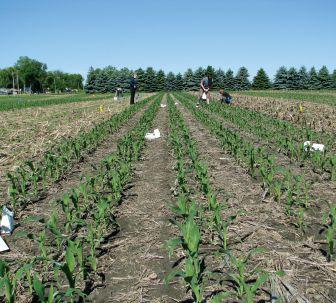
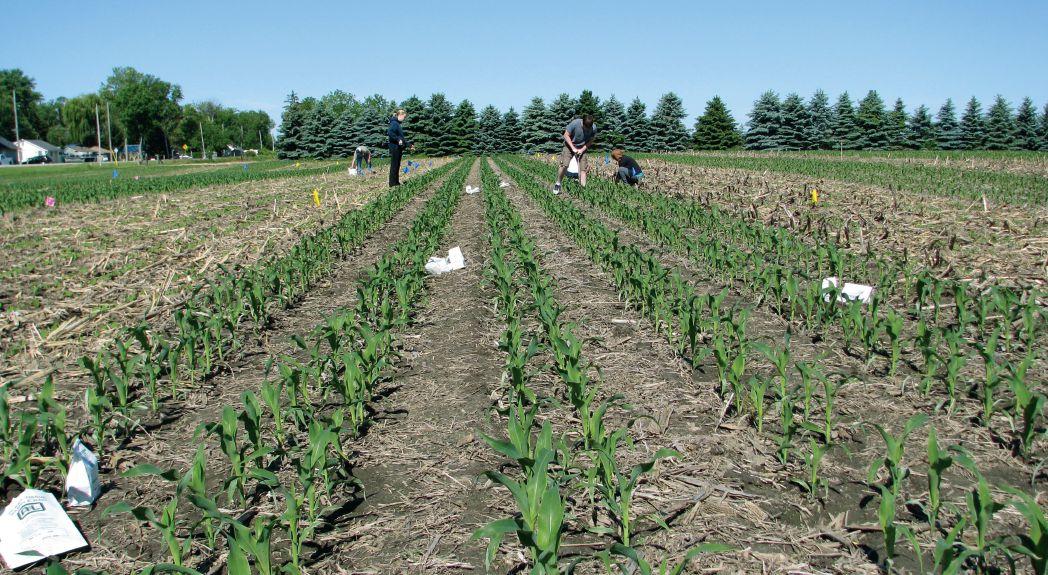
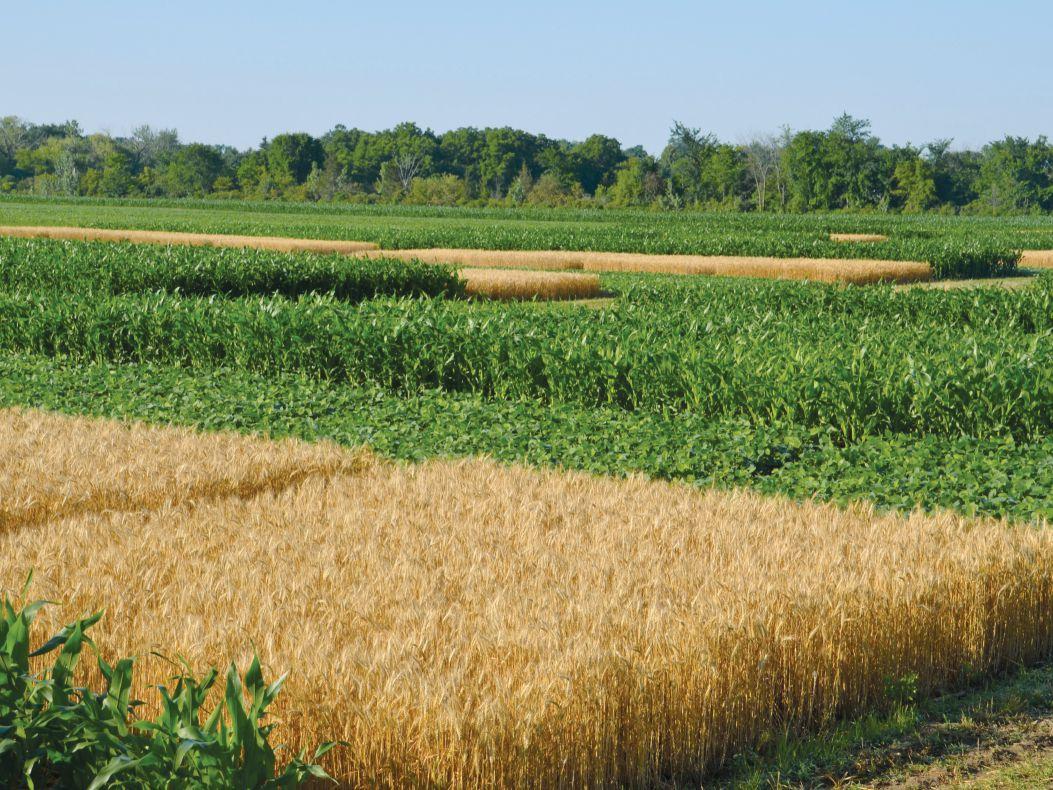
aBOVE: Researchers are studying dean Glenney’s fencerow farming system (shown here at 30 days after planting), which involves strip cropping, no-till and controlled traffic practices.
Photo
glenney developed his unique system because he noticed corn planted near fencerows was higher yielding than elsewhere in the field. So he gradually changed from a conventional production system to a system that tries to recreate the yield-boosting conditions along his fencerows.
His system, which he calls “fencerow farming,” includes such practices as no-till, controlled traffic and strip cropping. He has a corn-soybean rotation and grows the two crops in alternating strips; each strip is four metres wide and 80 metres long. He seeds into exactly the same rows every year.
glenney has been using this system for about 15 years. “according to Dean, for the first five years he didn’t get any yield increases with this system,” Lazarovits says. “But in the sixth year, he started to see some increases, and he continued to see yield increases for a 10-year period after that.”
The project is led by rafiq Islam, a research scientist at a&L Biologicals. one of the project’s main objectives is to determine if the microbial ecosystem in glenney’s fields is enhancing the performance of his corn crops. as part of that, the researchers hope to figure out how best to assess a crop field’s microbial ecosystem. They would also like to identify practices that would help glenney’s farm and other farms to become more productive.
Glenney developed his unique system because he noticed corn planted near fencerows was higher yielding
initial study
The project started in 2012 with a two-year study to identify key biological and non-biological factors contributing to glenney’s higher corn yields. The study compared conditions at glenney’s farm and a neighbour’s farm, with one site on each farm in each year of the study, and four randomly selected replicate plots at each site.
The neighbour’s production system differs from glenney’s in a number of ways. For example, the neighbour has a corn-cornsoybean rotation, he tills the soil before planting, and he doesn’t use strip cropping or controlled traffic practices.
For the study, both glenney and his neighbour planted the same corn hybrid and used their normal production practices.
The researchers measured a wide range of factors, including soil characteristics, plant populations, nutrient levels in the soil and the plants, plant height and biomass, leaf chlorophyll content, and root and ear disease levels. They also examined the microbial communities on and in the roots, and inside the stems and leaves. as well, they determined grain yields, grain nutritional values, production costs and net returns.
To assess the microbial communities, the researchers used a molecular biology technique that identifies a small percentage of the most common microbes. This allows them to compare how similar or different the communities are.
Highlights of findings
The corn crops on glenney’s sites had 75 per cent higher yields and were four times more profitable than the corn crops on the neighbour’s sites.
The researchers determined that 21 per cent of the higher yields was due to glenney’s somewhat earlier seeding dates and higher
seeding rates, and to the lower incidence and severity of ear disease. The researchers think the lower ear disease levels may be due to beneficial effects from the distinctive microbial community at the glenney sites.
although both farms had high levels of microbial activity, the microbiological communities were “different as day and night between the two farms,” Lazarovits notes. “The largest group of organisms present in Dean’s field are a group of bacteria called the fluorescent Pseudomonas. (They glow white under ultraviolet light, which is why they are called fluorescent.) These bacteria are known to be suppressive to diseases; they produce a whole slew of antibiotics. So it is quite possible these bacteria are acting as internal fungicides that protect the plants from diseases.”
The other 54 per cent of glenney’s higher yields resulted from more productive ears. The ears were longer and wider and had more kernels per cob, the kernel weights were higher, and the grain weights per plant were much higher. The researchers think the beneficial effects of the microbial community might be contributing this higher productivity.
The sites on both farms had sandy soils; the neighbour’s soil had more organic matter. although the researchers found various differences in soil nutrient levels between the sites, plant tissue analyses indicated the plants likely didn’t have prolonged nutrient deficiencies. So the researchers think soil fertility was probably not a major cause of the yield differences.
The researchers found the corn root systems at the glenney sites became larger, longer, thicker and more branched. This implies the roots could move more easily through glenney’s soil, likely because it was less compacted than the neighbour’s soil. Better root systems enhance nutrient and water uptake, which could have contributed to the higher yields.
root disease levels varied considerably, but overall they were slightly higher at the glenney sites, suggesting those sites had higher levels of soil-borne pathogens.
Next phase
In the current phase of the project, the researchers are conducting several studies to better understand how to work with microbial systems to enhance crop yields.
“according to the literature, the theoretical yield for corn in southwestern ontario should be around 425 bushels. Can we push Dean’s yields from 300 to 400 bushels by changing some things in his system?” Lazarovits asks. “We also want to see if we can speed up the technology on other farm sites. If [the yield boost] is microbiological, could you transfer those microbes to other sites by some other technology, rather than by repeating what Dean has done, so instead of taking six years, it might take three years?”
In a study that started in 2014, the researchers are examining the effects of two changes to glenney’s system on crop yields and the microbial community.
one change is tillage. each year before planting, glenney is tilling one side of each of the two strips that he has allocated to the project.
“one possibility is if you don’t disturb an ecosystem for a very long time, you build up a community in the soil that becomes associated with corn. So the bacteria are there to colonize the plants very rapidly,” Lazarovits says. “However, if you plow the
When it’s time to plant or harvest, you can’t wait for ideal conditions. At Case IH, we know that timing is everything. That’s why the new Magnum™ Rowtrac™ series tractor gives you optimum power, traction, and control to tackle the most adverse conditions. The combination of wheels and tracks provides four points of ground contact, reducing compaction and berming while increasing flotation and tractive power. Tire options that fit your row width and soil type and an oscillating five-axle, rear-track design keep power on the ground, even through the tightest turns. Plus, the unique four-range CVT maximizes available power and increases mechanical efficiency. Experience a machine that handles like a wheeled tractor but floats like a track. To learn more, visit your Case IH dealer or go to caseih.com/magnum-rowtrac.
BE READY.
uSi Ng T h E
by Dr. Tom Jensen
The 4r nutrient Stewardship principles are defined as using the right source of fertilizer at the right rate, time and place. all four of the rs are combined, and important, when nutrients are applied as fertilizer on a farm field. However, right rate, is especially critical for the full benefit of a fertilizer application. rate is a threshold requirement, where if the threshold rate is not reached, other 4r factors of source, time and place will not be able to compensate.
Most crops have a concentration range for each required nutrient, and if a specific nutrient concentration within the plant is within that range there shouldn’t be any growth or yield limitation observed.
However if the nutrient concentration is too low in the crop plant tissues, nutrient deficiency symptoms and decreased yields can result. For example, Table 1 shows the nutrient sufficiency range (% or per cent) for seedling corn.
Too low a rate is often the cause of a specific fertilizer application combination being less effective. a useful example is a field research project I was involved in on a ranch near Invermere, B.C. The ranch owner mentioned to his local fertilizer retail dealer that he thought from visual observation the annual fertilizer applied on a mixed alfalfa-grass hay field (25 per cent alfalfa and 75 per cent forage grass) wasn’t very effective. The regular early spring broadcast application was a 40 lb n, 30 lb p2o5, 40 lb K2o, and 15 lb S/a
Table 1: Nutrient sufficiency range for seedling corn
after conducting a small plot research experiment, it was determined the rate of nitrogen (n) was too low to maximize forage growth and yield, and effectively utilize the other nutrients being added. It was recommended to increase n applications up to 70 lb n/a and keep the other nutrient application rates the same. Too low a n rate was limiting crop response, even though the forms, timing and placement of fertilizer was appropriate. The effect of using too low a rate on crop yields can be delayed, and by the time it is observed, there may have already been considerable economic loss.
This is especially true for phosphorus (p) and potassium (K) fertilization, as both of these nutrients are best managed in the longer-term by maintaining plant available levels where crop yield is optimized. In contrast, reducing n rates excessively on a cereal crop will usually result in severe yield loss within one year. Suboptimal rates of p and K, less than crop removal, result in a gradual draw down of plant available soil levels. reducing nutrient application rates below crop needs will eventually cause crop yields to decline.
Determining the right rate of various nutrients to be applied is vitally important to the success of a nutrient management program. I’m not suggesting that you can forget about applying an effective form of fertilizer, or not applying the fertilizer at the appropriate time or placement to get the needed nutrients to a crop. But too low a rate can result in a low yielding crop, even if all other crop fertilizer and agronomic practices are properly conducted.
Dr. Thomas L. Jensen is director, Northern Great Plains, International Plant Nutrition Institute (IPNI). He can be reached at 306-652-3535 or by email at tjensen@ipni.net. Reprinted with permission from IPNI plant nutrition Today, Winter 2014/15, No. 1
Yi E ld-boo ST i Ng M icrobES
Continued from page 6
soil, then you spread the bacteria all over the place. So you get a lot more bacteria of different types colonizing the plant, but they never reach a critical mass to benefit the plant.”
The other change is to add a green manure crop into the rotation. Last year, the research team grew plots of mustard, winter pea, and a plant that is related to corn, and plowed those crops into the soil as green manures. In 2015, those plots will be planted back to soybeans and corn.
Lazarovits explains that, with just a two-crop rotation, certain detrimental organisms might build up, which could be why glenney’s corn yields have levelled off. The researchers want to see if green manuring might hamper some of the detrimental organisms, while maintaining the beneficial ones.
In another study, which will start this year, the researchers will be looking at microbial communities in other farmers’ fields. “every farmer has zones in their fields with very high yields and
zones with very poor yields. We want to see if the microbiology is correlated with the yields,” Lazarovits says.
another aspect the researchers are planning to explore is why glenney’s agro-ecosystem doesn’t provide the same sort of yield benefits to his soybean crops. “While Dean gets reasonably good soybean yields, he has not had the increasing yields that he has seen with corn,” Lazarovits notes.
In addition, the researchers are now collaborating with greg gloor, a medical microbiologist at the University of Western ontario, who is using advanced techniques to sequence microbes for the project.
Lazarovits is excited about what could be learned by understanding the links between microbial communities and crop yields. “We think this is really going to be the next phase of agriculture. We are going to be able to understand how to grow crops in ways that take advantage of nature.”
When you need equipment for your crop, livestock or dairy operation, time is always a factor. Now you can purchase on your terms, so you get what’s right for your operation, right when you need it.
looki Ng bAck, looki Ng A h EA d
An update on some key foliar disease issues in Ontario.
by Carolyn King
The cool, wet conditions in many parts of ontario in 2014 favoured certain leaf diseases in corn and soybeans. Here, plant pathologist albert Tenuta, with the ontario Ministry of agriculture, Food and rural affairs (oMaFra), discusses several of the key foliar diseases in 2014. He also highlights some of the recent research findings on these diseases, and looks at management options for 2015.
“Why are we seeing more leaf diseases in general? one factor is more corn-on-corn and soybean-on-soybean acres. We’re also seeing more no-till and reduced tillage, which means more crop residues are being left in the field, and many of these foliar pathogens can survive and overwinter on residues. as well, weather conditions in recent years have been favourable for many of the leaf diseases,” Tenuta explains.
“In addition, the pathogen populations for diseases like northern corn leaf blight and soybean cyst nematode are evolving, with new strains or races that are able to bypass the resistance genes in our cultivars.”
Northern corn leaf blight
northern corn leaf blight (nCLB) continued to be an important corn disease in 2014. “We’ve seen a steady, linear increase in northern corn leaf blight over the past 15 years or longer that oMaFra and agriculture and agri-Food Canada (aaFC) have been doing corn disease surveys,” Tenuta notes.
“northern corn leaf blight was found in over 90 per cent of the fields in the 2014 survey. In southwestern and central ontario, almost every field had some degree of the disease. In eastern ontario, the disease occurred in about 70 per cent of the fields.”
nCLB is caused by the fungal pathogen Exserohilum turcicum (also called Setosphaeria turcica). “Typical symptoms are long, elliptical, greyish green to tan lesions on the leaves,” he explains. “When the lesions first start, they may be about two centimetres in diameter. They grow to about 15 centimetres or longer. The
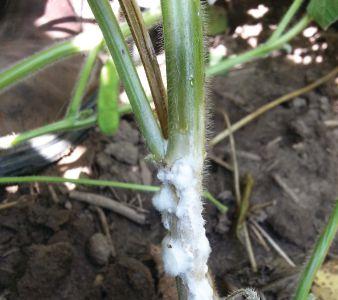
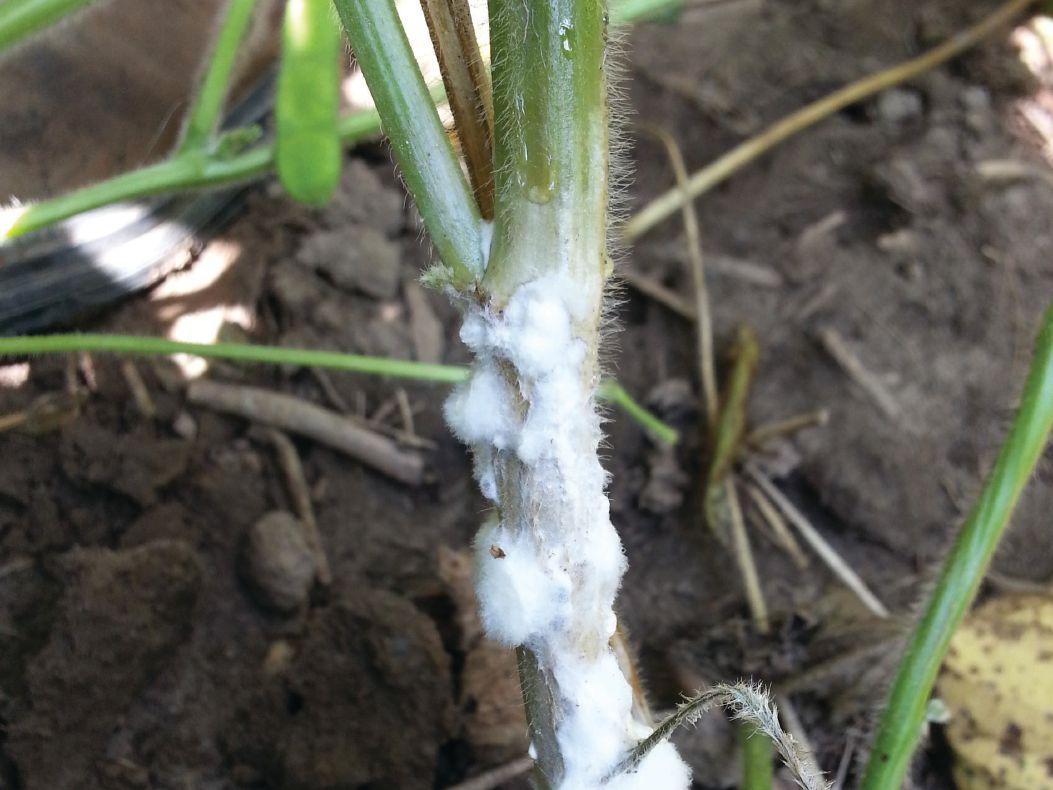
aBOVE: Cool, wet conditions in 2014 caused white mould problems in much of Ontario’s soybean growing area.
Stubborn weeds can threaten your corn crop. Fortunately, DuPont™ Engarde™ pre-emergence corn herbicide delivers both knockdown and residual control of broadleaf weeds and grasses. Best of all, crop application timing is fexible. Which means you can apply it all the way up to the two-leaf stage, ensuring those troublesome weeds stay at the no-leaf stage. Speak to your DuPont rep or retailer about Engarde™ today. Questions? For more information, please contact your retailer, call your local DuPont rep or the DuPont™ FarmCare® Support Centre at 1- 800 - 667-3925 or visit engarde.dupont.ca
MAKE YOUR ONE PASS, YOUR BEST PASS.
Introducing DuPont™ Destra™ – A powerful new post-emergent, one pass herbicide for glyphosate tolerant corn.
New DuPont™ Destra™ ofers residual and broad spectrum control, allowing you to spray earlier and realize clean felds through the critical weed free period. With two modes-of-action, added to your choice of glyphosate, Destra™ delivers excellent weed resistance management from the 3rd to 6th leaf stage. Plus, it’s conveniently packaged in an easy-to-handle 40-acre case.
Tis spring, make your one pass count with Destra.™
Questions? Contact your retailer, DuPont Rep, or the FarmCare® Support Centre at 1-800- 667-3925, or visit destra.dupont.ca.
DuPont™
Destra™
lesions get a blighting, almost a burn-like look to them.” according to Tenuta, the disease often results in about a 10 to 15 per cent yield reduction. However, if the infection starts at an early growth stage in a susceptible hybrid, then losses can approach 50 per cent. The disease can also reduce the crop’s feed value.
Tenuta recommends an integrated pest management (IpM) strategy to manage crop diseases, including nCLB. a cornerstone of any IpM strategy is hybrid selection. However, some new strains of the nCLB pathogen are able to overcome a resistance gene that has been used in many hybrids.
“In the past, about 90 per cent of the nCLB isolates in ontario and in the U.S. Corn Belt were controlled by the Ht1 gene. But in this past year’s work done in Lana reid’s lab at aaFC in ottawa, we found 11 different races of the pathogen in ontario, and 10 of those were able to bypass the Ht1 gene,” Tenuta explains. “So if the resistance package in your corn hybrid relies on that single gene, it won’t be as effective as it used to be.”
Fortunately, other effective resistance genes have been identified. “The main ones are Ht2, Ht3, Htn and HtM. We found Ht2 was very effective, controlling 96 per cent of the isolates we found in ontario in 2014. With Ht3, 87 per cent of the isolates were controlled by it. Htn controlled about 60 per cent, and HtM controlled about a quarter of the isolates,” he says.
“So Ht2, Ht3 and Htn, either alone or in combination, can be very effective at conferring resistance to northern corn leaf blight. We just need to incorporate them into our hybrids and make sure ontario growers use hybrids with resistance to the isolates found here.”
Delayed planting tends to favour nCLB, so earlier planting is a useful IpM tool. He notes, “In 2014, the weather delayed planting across much of the province, which meant the main growth stages of the corn crop were later in the season when a lot of foliar diseases increase.”
Crop rotation and residue management are also helpful. “northern corn leaf blight and a lot of other leaf diseases are residue-borne. If you can reduce the amount of residue in a field to about 30 per cent, then you reduce the disease risk while retaining the residue cover’s benefits for erosion prevention and soil management.”
Fungicides are valuable tools for managing nCLB. “We’re seeing an increase in the number of fungicides available and in their efficacy. There are some subtle differences between the fungicides, but overall, they are all pretty good at managing corn leaf disease, whether it is northern corn leaf blight, grey leaf spot or rust. So a big part of a fungicide decision will rest on the cost of application and the price of corn. When corn is at $3 or $4 per bushel versus $8, you need to get a bigger yield increase from the fungicide application to reach your return on investment,” Tenuta says.
“So, more and more growers should be and are targeting their fungicide applications to fields with the highest disease risk – corn-on-corn, high residue levels, a history of the disease, a susceptible hybrid, disease infection at an earlier crop stage –all those IpM factors.” He recommends scouting just prior to tassel emergence to assess each field’s disease status, considering all those risk factors as well as whether the weather conditions favour disease development, to help decide whether a fungicide application is warranted.
Tenuta and his colleagues have evaluated fungicide timing options for nCLB. “We’ve seen in ontario and in the regional trials with our U.S. colleagues that traditional application timing from tassel to silking time is best. That timing gives about a sevento eight-bushel yield increase, regardless of the disease pressure. earlier applications, like a three-leaf or six-leaf timing, give less than a three bushel increase.”
He adds, “Where a fungicide application really shines is when you have more disease. even with five to 10 per cent leaf disease, you start seeing a greater response to those fungicides and better return on an investment.” For example, in 2014 ontario trials with two different hybrids, the researchers inoculated the hybrids with the nCLB pathogen to ensure high disease levels. They found a 14-bushel difference between the plots that received a fungicide application and those that didn’t.
White mould in soybeans
Tenuta notes the cool, wet conditions in 2014 caused white mould problems in much of the province’s soybean growing area, with higher levels in eastern ontario. Fields with very serious infestations had greater than 50 per cent yield losses, but most fields had only low disease levels. “If white mould infection levels reach about 20 to 25 per cent, the disease will definitely have an impact on soybean yields.”
also known as Sclerotinia stem rot, this fungal disease is caused by Sclerotinia sclerotiorum. The pathogen overwinters as resting bodies called sclerotia. In the spring, the sclerotia produce little mushrooms that release millions of tiny spores. The spores use soybean flower petals as an energy source to begin infecting the plant’s stem.
“Infected petals of soybean flowers are the primary method by which the disease starts in the plant. The big difference between 2014 and other years was that weather in 2014 across much of the region during post-flowering really favoured the disease, allowing the initial infections to continue,” Tenuta says.
He notes white mould is a disease of high yield potential fields. “The agronomic practices to reach high crop yields also create favourable conditions for many diseases, including white mould. narrower rows, higher plant populations, earlier planting – those practices create a thicker canopy that closes faster. Those same
Researchers are evaluating options for controlling soybean sudden death syndrome.
factors result in a microclimate within the canopy that is ideal for white mould.”
For fields with a history of white mould, IpM strategies could include wider row widths or lower plant populations.
Sclerotinia sclerotiorum can infect over 400 plant species, including crops such as canola and dry beans. Wheat and corn are not hosts of the pathogen, so a corn-soybean-wheat rotation can help reduce white mould risk.
Tillage practices have implications for white mould inoculum levels. “If the sclerotia are buried in the soil, they’ll survive for five to seven years, and so tilled fields with a history of white mould have a higher risk,” notes Tenuta. “In no-till systems, the sclerotia are left on the surface and that reduces their viability to less than two years. although no-till or minimum till can reduce sclerotia viability, your risk of white mould can increase substantially under favourable conditions if soybeans are grown back to back, which may be the case for many producers in 2015.”
according to Tenuta, the pathogen’s wide host range includes many weed species, so good weed control is another IpM tool.
In the U.S., herbicides that burn the foliage, thus opening the canopy, have been used to reduce white mould, although with mixed results.
although no soybean varieties are totally resistant to white mould, varieties that are shorter, less bushy and straighter and that tolerate lodging produce canopies that are less favourable to white mould. “To choose a variety, growers can look to company literature and to ontario soybean variety trials,” notes Tenuta. White mould performance trials are conducted by Tom Welacky,
at aaFC’s greenhouse and processing Crops research Centre at Harrow, ont. In 2014, the susceptible checks in those trials had 25 per cent or greater white mould levels, so the trials generated good comparative data for the varieties.
Fungicide advances are providing biological and chemical options for managing white mould. “Some new biological fungicides are available, like Contans and Serenade. Contans is applied to the soil so the sclerotia can be parasitized. Serenade is foliar product. Both are good options for organic producers,” Tenuta says.
“new chemical foliar fungicides include acapela, allegro, priaxor and Stratego pro. Just like the biological fungicides, none of these provide total control for white mould. They are all registered as suppression only. Under low to moderate disease conditions, the level of control will be very good. But in epidemic years, don’t be surprised to see the disease which, although slowed down, may require a second follow-up application.”
Timing of fungicide applications is a little different for white mould. “For many other diseases, growers think of r3 timing (beginning of pod development) for fungicides. With white mould, because the petals are driving the early stages of infection, growers should consider r1 (first flower) to early r2 (full flower) timing,” Tenuta says.
He adds, “In research trials this past year, under high disease pressure, the best results tended to be with an r1 application followed by an r3 application.” So he suggests applying a
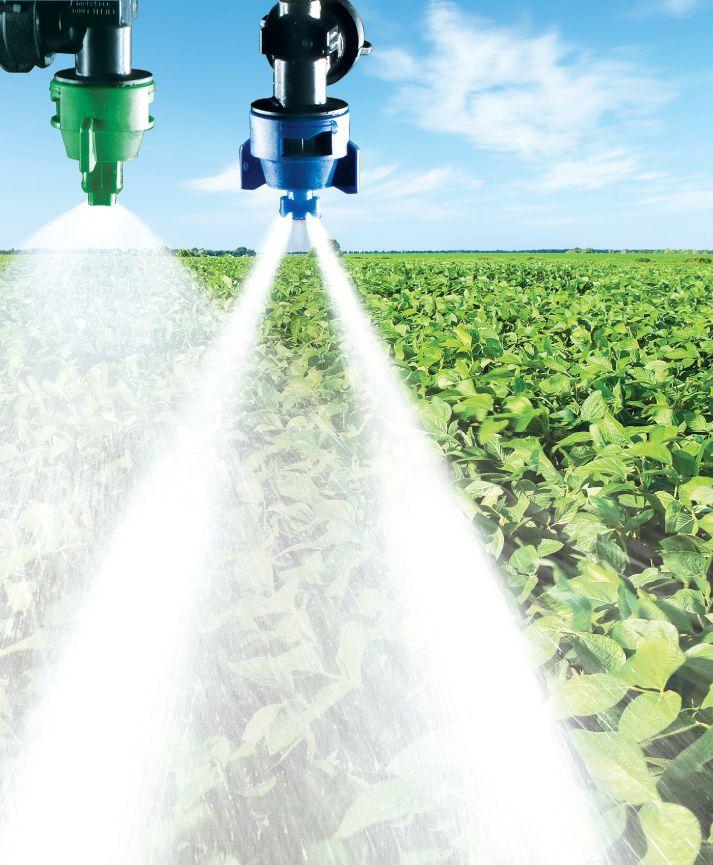
TeeJet tips: precise herbicide application to wipe out weeds & boost yields.
SIX WAYS TO WIN THE WEED ESCAPES BATTLE
bAN di Ng drY p AN d k
f E rT iliz E r i SN’ T ou T dATE d
Ongoing research by OMAFRA shows application of dry phosphorus and potassium fertilizer at or before seeding can offer economic benefit.
by Madeleine Baerg
If you are like most ontario corn producers, you probably think applying a band of dry fertilizer at seeding is a completely outdated concept. and, unless your opinion strays far from that of your neighbours, you likely also believe reduced tillage is, if not an outright impossibility for your farm, at least an unnecessary inconvenience with downsides that outweigh the benefits.
But recent studies by the ontario Ministry of agriculture, Food and rural affairs (oMaFra) suggest you may want to change your mind on both fronts.
“We’ve spent several years looking at a number of agronomic possibilities to improve corn efficiency,” greg Stewart, oMaFra corn industry program lead says. “on the fertilizing side, there are people who would say what we are proposing is a step backwards. But it doesn’t take a whole lot to convince them that applying dry fertilizer at planting could be a reasonable thing to do. and in terms of reduced tillage, we’re suggesting an intermediate step that works in harmony with the dry fertilizer concept.”
The majority of corn farmers today opt exclusively for injectable, liquid forms of phosphorus (p) and potassium (K). This choice can make sense, so long as the cropping land’s soil starts off with fairly strong levels of nutrients and only requires a minimal top-up. on land testing in the moderate to low range for p and K, however, a product like a liquid 6-24-6 fertilizer applied at a typical five gallon per acre rate will only contribute about 3.5 pounds of K per acre: not enough to bump up a deficient soil’s capacity to meet a corn crop’s nutritional requirements. a much more cost-effective way to easily apply larger amounts of p and K is to band dry fertilizer.
“If you are deficient in K, you can put on 10 times as much potash, and at a price that is much more competitive per pound, if you use dry fertilizer over liquid,” Stewart says.
Stewart suggests a four-point checklist when evaluating the impact dry fertilizer might have on your operation. Those four points are: soil test levels, soil structure, intensity of tillage and land tenure.
“If a grower has high soil test levels for p and K, has excellent soil structure, does fairly intensive tillage and owns all his land, then it is most likely that dry fertilizer won’t pay,” Stewart says. “But at the other end of the spectrum is the grower with lower testing soils and soil structure that still needs some improvement, who would like to do less tillage and who rents much of his land. In that case, dry p and K could be a very important factor in boosting corn yields.”
Most producers will fall somewhere in-between the two
extremes, and will need to evaluate how much potential dry fertilizer might offer.
To minimize extra passes, Stewart suggests one of two dry fertilizer application methods, both of which may raise your neighbour’s eyebrows.
The first is to carry dry fertilizer on your planter. “people are spending huge amounts of money on corn planters that seem to be able to do anything: minutely control seed placement, adjust pressure, plant at 15 kilometers per hour, carry and switch back and forth between two seed varieties. and here some government guy gets up and says they should carry dry fertilizer on their planter. It’s kind of a 1970s concept: not very new, not very exciting ,” Stewart says. “But, based on the results from the studies we’ve done, in the realm of return on investment, it would be a mistake to completely ignore the concept of banding dry fertilizer beside the seedrow.”
admittedly, there may be logistical hurdles to the concept, especially since today’s big planters often don’t have the capacity to carry dry fertilizer on board. In some cases, retrofitting a machine may only be a moderate investment, such as installing tubs across the front of the machine that each deliver dry fertilizer to just a couple rows. alternatively, a planter without onboard capacity might require a separate pull-behind cart that blows fertilizer through tubes alongside seedrows.
“For some people, it’s just not going to be logistically possible to set up a workable system, even to tender the dry fertilizer to the planter. But, there are a large number of producers who shouldn’t dismiss this idea completely,” Stewart says.
a second option for applying dry fertilizer is to apply it prior to seeding (either in fall or spring) in an eight-inch tilled strip.
Conservation tillage for corn has had a difficult time gaining ground in ontario. However, strip tillage solves the issue of residue and slow spring warming and drying, while still offering the soil health and environmental benefits of reduced tillage. and, when laid out on the contour (the strips cut horizontally across slope rather than vertically up slope), strip tillage can work as multiple mini dams to very effectively reduce erosion.
“precision steering makes creating these eight-inch strips and then getting the corn rows on top of them suddenly quite possible,” Stewart says. “If you put your dry fertilizer on your strip tiller, when you come along with your planter the land can be exactly how you like it – absolutely naked. You just plant and go. There’s real harmony between the ideas.”
Forward THINKING
For higher yield potential and better returns, order your seed pre-treated with Optimize® inoculant today.
The LCO technology in Optimize helps your soybean crop by enhancing nutritional capabilities. Benefit from improved nodule formation, increased nitrogen fixation and enhanced root and shoot growth for better plant performance.
Get the most from your soybean crop with Optimize.
See your local retailer or visit www.OptimizeLCO.ca.
N Ew irrig AT ioN TE ch Nolog Y proM i Si Ng
Subsurface drip irrigation is increasing yields and conserving water in the Norfolk sand plain.
by Trudy Kelly Forsythe
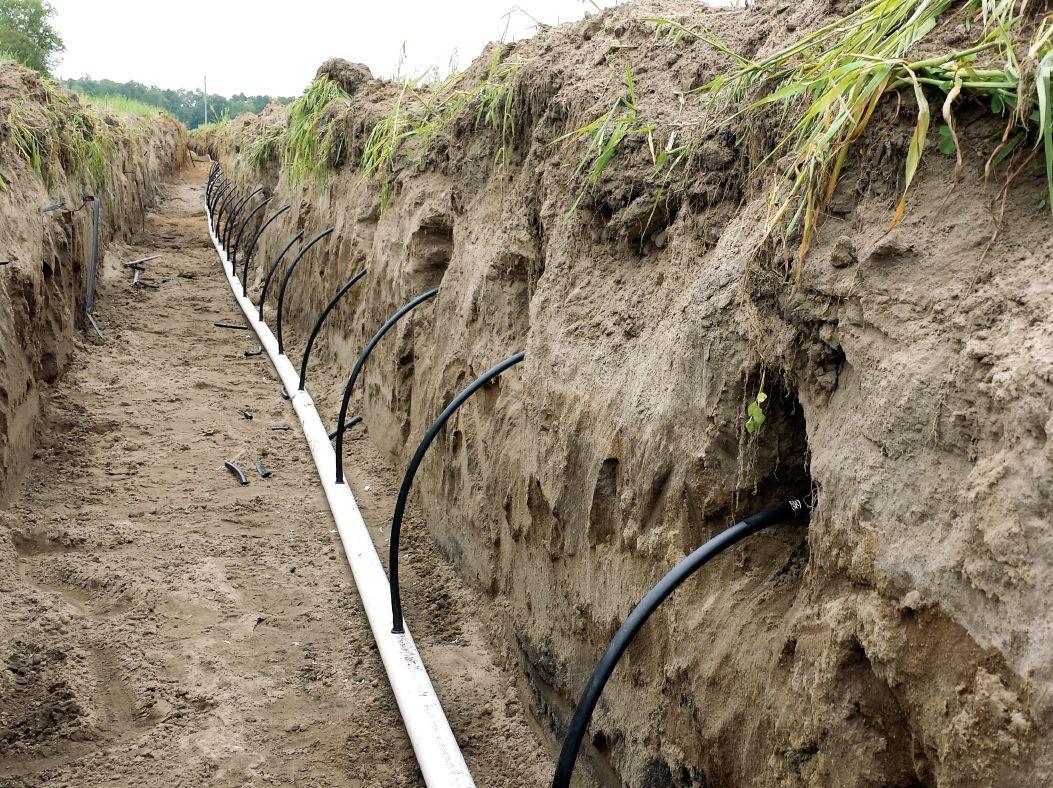
Farmers in the norfolk sand plain region of ontario are seeing improved crop yields, thanks to technology that is new to the area. Subsurface drip irrigation irrigates crops via polyethylene drip tubes installed a foot or more underground. This low-pressure, high-efficiency system eliminates surface water evaporation, and reduces the incidence of weeds and disease. and it can increase crop yields.
That’s what was discovered in 2012 when Blake Farms, located south of Simcoe, ont., completed a small trial comparing nonirrigated, overhead irrigation and subsurface drip irrigation on corn at their farm.
“The non-irrigated corn yielded 35 bushels per acre, overhead irrigated was 163 bushels per acre and the subsurface drip yielded 258 bushels per acre,” peter White, an irrigation technician from the University of guelph’s (U of g) Simcoe research Station says.
It made sense, then, when a nearby broiler and hog operation, Judge Farms, experienced a complete corn crop failure on one of their farms in La Salette the same year and decided they needed an irrigation system, that they would consider a subsurface drip irrigation
system. With the knowledge of the trial on Blake Farms, Jim and robert Judge, owners of Judge Farms, and their farm manager, Todd Boughner, compared the cost of setting up an overhead system – in their case a hard hose traveller – to a subsurface drip irrigation system.
“They felt the cost was going to be comparable for a complete new system of either [an overhead system or a subsurface drip irrigation system]. But the advantages of lower labour and energy costs once installed; the ability to irrigate anytime, day or night, windy or calm; the ability to fertigate throughout the season; and claims of a minimum of 25 per cent better water use efficiency swayed them to install the subsurface drip system in late 2012 and early 2013,” White says.
It was perfect timing for White’s Simcoe research Station colleagues, John o’Sullivan, a professor in the department of plant agriculture, and research technician robert grohs. In early 2013, they received funding from Farm & Food Care ontario for a Water resource adaptation and Management Initiative project. The idea
aBOVE: subsurface drip irrigation irrigates crops via polyethylene drip tubes that are installed a foot or more underground.
Photo
was to establish 10 plots with an individually controlled, subsurface drip irrigation system, and to monitor the crop at Judge Farms. others involved in the research included rene Van acker, from the U of g, and ray MacKenzie and Marc Vanden Bussche from Vanden Bussche Irrigation in Delhi, ont.
all plots, including the subsurface drip irrigated corn fields at Judge Farms, were monitored in 2013 and 2014 for soil moisture, nitrogen (n) use efficiency and yields. The researchers also looked at corn quality on the 10 plots that were set up at the Simcoe research Station. To do this, soil moisture stations were monitored to assess water depletion by the crop.
“once soil moistures dropped below 75 per cent of available soil moisture, irrigation was triggered,” White says. “The amount applied was calculated based on evapotranspiration and crop growth stage. Fertility was applied preplant, at planting, sidedressed and through the drip lines, and monitored through tissue sampling.”
It was a very wet year in 2013 compared to 2012 at Judge Farms, which resulted in a yield of 260 bushels per acre of corn on the subsurface drip irrigated field. an adjacent field also harvested by Judge Farms had a yield of 165 bushels per acre.
over at the Simcoe research Station, irrigated plots yielded 248 bushels per acre – a 10 per cent increase over the non-irrigated, White says.
“The yields for 2014 were, of course, affected by the amount of rainfall in the area and for sure the lower heat units,” he notes. “The majority of our [2014] rainfall came in July which is the most critical time for moisture stress, so the crop really wasn’t under stress much. We had 6.3 inches of rainfall in July.”
Corn yields at Judge Farms in 2014 were 253 bushels per acre, while their soybean crops hit 70 bushels per acre. There was little difference between plots at the Simcoe research Station although, White says, numerically the best were irrigated with corn yielding – on average –183 bushels per acre. The highest yield was 196 bushels per acre at 22 per cent moisture and a bushel weight of 57.3 pounds.
implications
The researchers believe this technology will allow farmers to grow very successful field crops on soils that have, up until now, only been marginally successful year in year out.
“With the ability to fertigate later into the season, we feel we can obtain much higher yields while not endangering leaching of nutrients,” White says. “The water use efficiency of these systems is so much better than the overhead systems in use right now that we will be able to maintain high yields with less water, resulting in less [negative] effects on the environment.”
What’s next?
Future research plans will narrow the technology gap by focusing on the precise delivery of both water and nutrients. “We need to apply the right amount of both at the right time and not over apply either,” White explains.
preliminary n fertigation work in 2014 indicates the potential to apply less n while still maintaining high yields. That work will be continued in 2015. “We will get more data on dripper line spacings and that will give us a chance to evaluate the returns we get for the costs involved,” White says. “all subsurface drip irrigation users will need time to gain the knowledge needed to use the system to the best of its ability and gain confidence in this technology.”
FOR CROPS A-Z
No matter the crop, no matter the equipment color, Ag Leader will guide you towards straight rows, no overlap and more money in your pocket.
Study.
iM provi Ng l ATE
N
i T rog EN A pplic AT ioN
Crop vigour sensing technology is a promising way to diagnose N requirements.
by Treena Hein
Technology that senses crop vigour through colour analysis (commercially known as greenseeker) is considered a very promising approach to optimize nitrogen (n) application, University of Missouri professor, peter Scharf says.
“The benefit of using greenseeker to control nitrogen application rates is that rates will match actual crop needs,” he says. “This will save producers money in areas where less n is needed, protect yield in areas where normal n rates are needed, and make producers money in areas where actual need is above their normal rate.”
Scharf believes although the technology’s ability to calculate optimal n rates is not perfect, it is closer to being correct than producer-chosen rates, leading to input savings and better yields. In one study, he and his colleagues found that sensor use saved an average of 14 lb of n per acre and increased yield by two bushels per acre in corn in over 55 onfarm trials. “The amount of nitrogen your soil contributes to your crop varies widely across most fields and depends on the weather,” he says. “I haven’t found any better way to manage this variability.”
The obstacles that remain in perfecting the greenseeker (gS)
are numerous, but Scharf says great progress is being made. “For example, there is not yet wide agreement on the best approach or best equation for translating sensor measurements to n rates,” he notes. “In addition, sensor values can drift during the day, and skips in plant stands interfere with the technology’s ability to produce an accurate n rate.”
also, some systems that apply n in a liquid form (Uan and anhydrous ammonia) have a limited range of n rates, unless specially equipped. The use of gS also requires the added task of applying high-n reference areas to a farm.
nicole rabe, a land resource specialist with the ontario Ministry of agriculture, Food and rural affairs (oMaFra), believes there is merit in a technology with the potential to apply the right rate of n at the right time during the growing season, offering both economic benefits (potential input savings or yield gain) and environmental
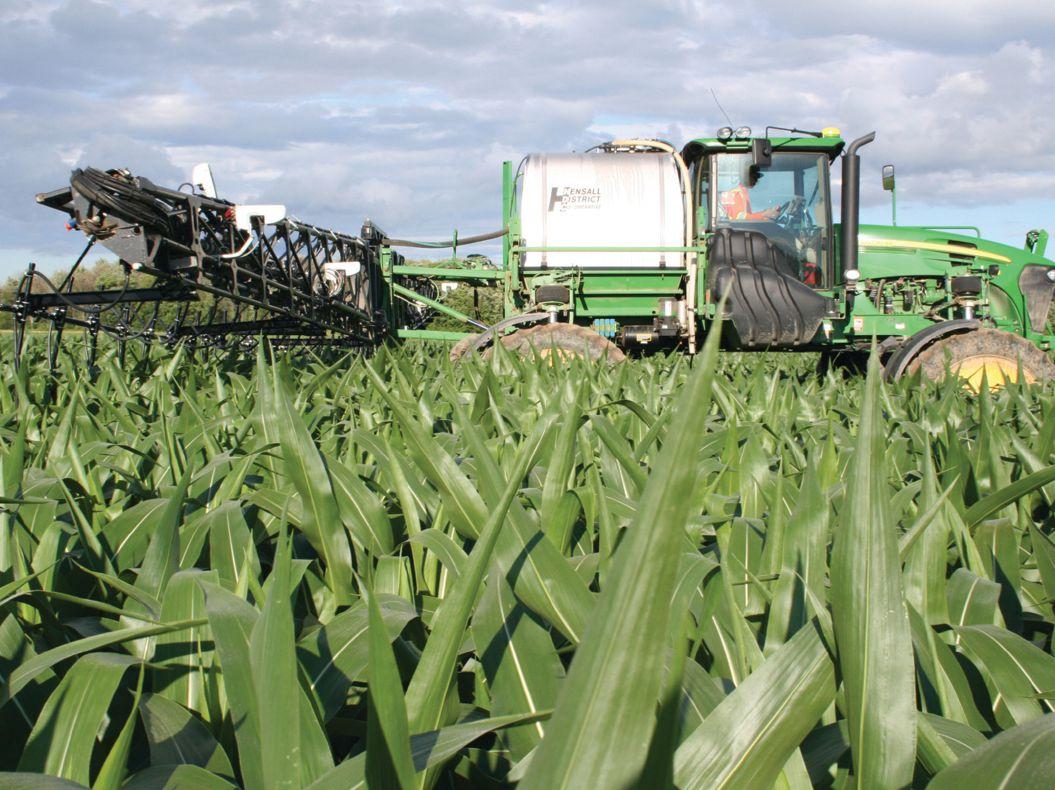
aBOVE: a Greenseeker unit, one of two currently owned by Hensall district Co-operative, in use during research trials.
benefits (n being fully utilized by the crop when required). “However, each field has its own management history and the opportunities to manage n successfully on one field do not necessarily translate to the same opportunities on the next field,” she explains. “It is important growers test any new technology up against their normal practices in a given year, and with gS, to ask the correct questions about the algorithms being presented.” rabe says each one has been designed for a specific U.S. state and climate, with some built for specific types of soils. Careful attention should therefore be paid to the input requirements for each one.
More Greenseeker insight
Hensall District Co-operative (HDC) owns two gS units and is buying a third in order to continue studies of the technology in 2015. In 2014, staff looked at its use with variable rate n application in 65 fields of corn. “We view greenseeker as a late-season n applicator that minimizes n loss,” Steve redmond, HDC precision agriculture specialist says. “The technology is 20 years old and well-proven in terms of supporting the 4r concept of n management: right source, right rate, right time, right place.”
With the acknowledgement that each year is different, HDC’s 2014 gS studies showed a range of yield advantage in corn, from 20 bu/ac at the HDC plots in Hensall to no response in other fields compared to the farmer’s normal n practice. Factors at work in 2014 include high incidence of northern corn leaf blight and other leaf diseases, late planting and subsequent late preplant n applications, slow release of n from organic matter due to cool, wet soils, and leaching and denitrification of n due to excessive rainfall. For 2015, HDC has planned its gS studies to include additional co-operative members who have manured fields and/or those who apply n preplant or pre-emergence. redmond says they expect sales of greenseeker to increase over last year.
practical precision in Tavistock, ont. also expects gS sales to increase this year compared to 2014. They have so far sold 20 units across ontario, Quebec and the Maritimes, used for tasks ranging from field mapping to variable rate n application. “We describe the gS as a way to identify pockets of potential nitrogen sufficiency and deficiency across a field, and only advocate its use in later stages of corn where there is a solid canopy in place,” paul raymer, president of practical
FEED THE WORLD
Westeel Grain Storage
precision and a precision agriculture specialist says. “This gives a fairer chance for more accuracy and is complementary with the theoretical nitrogen needs of the corn at that biological stage and beyond.”
raymer says the “split” algorithm they use is solid, adding his gS customers are generally saving on n and increasing their corn yield. “The gS is an economic and environmental success story,” he notes. “Can it be better? absolutely. If we had a wish list for improving the algorithms, it would be to increase the strength of the ontario Corn Calculator, adding in the price of n and corn.”
raymer believes it would not be worthwhile to create a “confident” ontario gS algorithm if it takes three or four years. “Technology in general is changing too fast,” he says. “going forward, outside of algorithms, we are working to take the technology accuracy to the next level, interfacing soil properties, variable rate seeding and hybrid characteristics, all of which can influence nitrogen requirements.”
In terms of oMaFra testing of gS algorithms for ontario growers, it has really just begun.
“We have done some small-scale tests and we can’t do this work without industry partners like Steve and paul in terms of helping us get the fieldwork done and the validation plots put in,” rabe says.
When storing and managing grain, look to a name you trust. Westeel supplies a full line of farm management products and accessories, all manufactured to the same industry leading standards our bins are famous for. Talk to your Westeel dealer today.
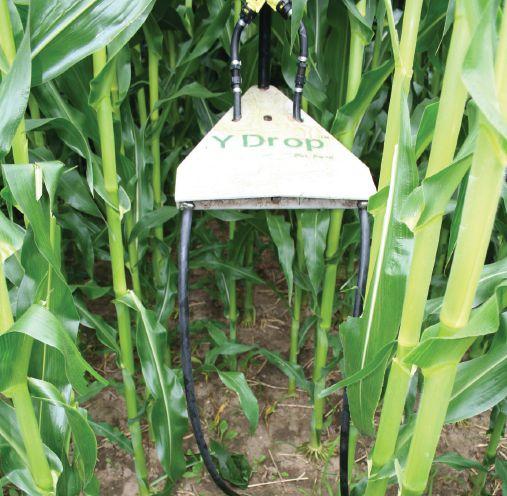
The y-drop applicator that allows the Greenseeker to apply late-season nitrogen. The pictured corn was 7-8 feet tall.
Spr AYE r Tool S
Which new technologies are right for you?
by rebecca Hannam
Equipment technologies are continually advancing to provide more opportunities to improve efficiency and effectiveness. But according to Jason Deveau, an application technology specialist with the ontario Ministry of agriculture, Food and rural affairs (oMaFra), farmers do not have to buy a new sprayer to take advantage of the newest tools.
Deveau works with technology companies worldwide to learn about and test their latest sprayer advancements, and he says a multitude of aftermarket products can be purchased to improve operation and application.
improving management oil- and water-sensitive papers are yellow cards that turn blue when sprayed. Deveau says the papers provide a cost-effective way to show coverage, spray drift and sprayer contamination.
“By taking your time and using a clothespin and flag in the field, you can get a very good, immediate picture of how well you are doing,” he says, adding the tool can help farmers put recommended practices to the test by using the papers before and after changing methods, and analyzing the difference.
TeeJet Technologies offers two monitor products that Deveau sees
as opportunities to improve operator management – the Sentry 6140 Flow Tip Monitor and the Sentry 6120 Droplet Size Monitor. The flow tip tool detects plugged tips as well as high and low flow errors or partial blockages. Deveau says using a minimum of three tips, sensors are mounted at each spray tip location without impacting flow. The sensors are linked to a touchscreen monitor, and errors are indicated by audible alarm and display notification. “This type of tool could replace hard-to-read floats, and could be used when planting, spraying and applying fertilizer.”
Deveau notes droplet size affects coverage and drift, and operators should be using catalogues to determine the average droplet size given their pressure and nozzle choice. He describes TeeJet’s droplet monitor as a catalogue tool, as it provides real-time droplet size display and highlights size changes with auto-rate controllers.
The accu-Volume System, manufactured by Custom Concepts Mfg. Inc., claims to increase operator efficiency and Deveau agrees it answers the question of what exactly is in the tank. He says some gauges can be inaccurate by approximately 25 gallons, and sprayer
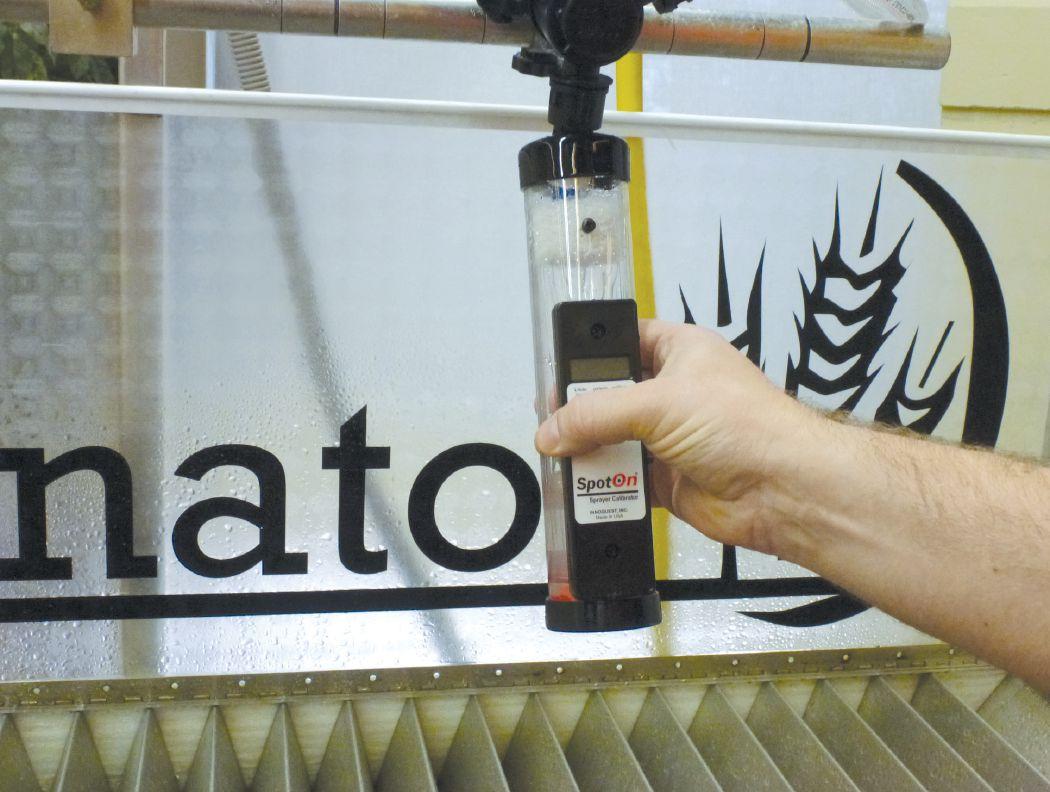
aBOVE: The spotOn digital spray tip tester. it reads litres, ounces or gallons emitted per minute, within about 10 seconds.
Photo
grade can create a difference of up to 80 gallons during filling. The monitor, which includes a digital display in the cab and at the loading station, reduces the chances of running short or over-batching, and helps operators to avoid diluting existing solutions.
Deveau says Johnson’s Innovations manufactures peek-a-boom, a remote controlled system for performing timed output tests safely and easily. peek-a-boom allows operators to turn individual or all boom sections on and off from the cab or other nearby locations. aTI agritronics Inc. has a similar smartphone application product called appliMax Spray Boom remote Control.
Nozzle technology
new in 2014, pentair Ltd. announced the Hypro Duo react Twin Valve nozzle Body. The product features a single nozzle holder and a rotatable four-way turret in one unit which Deveau says allows the operator to select either or both tips from the cab. He notes this tool could be convenient for operators aiming to switch from fertilizer to fungicide, from conventional flat fan to air induced or to dual fans.
Deveau says the pentair Hypro express nozzle Body end Caps product could be applicable to more operators. “The caps are also air aspirators which could mean an 85 per cent faster shut-off valve operation.”
In terms of nozzle calibration tools, Deveau points to the Spoton Sprayer Calibrator made by Innoquest Inc. He says this digital spray tip tester can be described as a vessel with two inside sensors. once the meter is held under the nozzle at a slight angle, the tool displays how many litres, ounces or gallons per minute it is emitting within approximately 10 seconds.
Research and development
Deveau also reviews products currently in development or not yet available in Canada such as K-B agri-Tech LLC’s pattern Master, Harrie Hoeben’s Wingssprayer and Coraltec Inc.’s D30.
The creators of pattern Master (patent pending) are claiming this product will change the way the industry looks at drift control. “It is a brush that is mounted in front of the nozzle, which means more coverage and less drift,” Deveau says, noting the brush has bottom bristles to diffuse but not block air flow. The product is currently being tested in the U.S. Deveau says initial trial results comparing brush to no brush show significant coverage improvement.
Wingssprayer has been available in europe for four years and the manufacturer is considering expanding into Canada this year. Deveau says the product is a floating shield that blocks oncoming wind and flexes to lightly drag the crop surface which opens the crop canopy. Because the shield decreases the distance between the nozzle and crop, the creators claim Wingssprayer reduces dosage by up to 30 per cent.
Deveau says Coraltec Inc.’s D30 spray droplet size measurement system research is currently focused on industry applications,
Top Crop Manager Column: AMI #7—Succession planning
but the technology will be modified for agriculture.
“Spray mix viscosity can change nozzle output by as much as 30 per cent and also changes the volume median diameter (VMD),” Deveau says. “D30 could provide a way to check this quickly to ensure effective material deposition.”
as product technologies advance and new educational courses become available, information and free downloads can be found at sprayers101.ca, or by following Deveau on Twitter @Spray_guy.
Wealth preservation
Want to choose when you retire from farming? Think ahead! A succession plan brings control over the future and an exit on your own terms.
Everyone leaves the farm at some point, and the key is to make it a positive event that helps preserve wealth and family unity, says Daphne McGuffin, Program Director of the BDO Canada SuccessCare Program™. It’s about avoiding an involuntarily sale due to family discord, debt, taxes, or worse, she says.
Creating a succession plan can also help the bottom line because proactively planning for the future means planning for growth. This is particularly important if the farm will support more than one child and their family. And, for succession outside of the family, it can help bring the greatest return on a sale.
To help give farm owners a head start in planning their own exit strategy, the Agri-food Management Institute (AMI) and BDO have developed an online tool called Choose Your Own Farm Succession. The intuitive program offers a step-by-step guide through eight of the most common succession scenarios, including external sale or internal transfer to family members or business partners, while pinpointing pitfalls and helping build confidence.
Take a new approach to your future by using the Choose Your Own Farm Succession tool (available at takeanewapproach.ca) and by following these quick succession tips from Daphne McGuffin:
Engage the next generation: Young people are the future of farming. It’s extremely important to communicate and engage with them in all aspects of succession planning.
Learn together: Attend workshops with family members so they can learn and practice new ideas and techniques before implementing them on the farm.
Think ‘authority, responsibility, accountability’: This helps gradually transition the farm from one owner to the next. First, authority to make decisions is transferred, followed by responsibility for people and projects, and finally accountability for outcomes.
Succession is the ultimate destination for every farm owner yet less than half have a formal plan. So take the reins, move beyond inertia, and kick-start your way into the lifestyle you choose.
dirT poor or S oil rich?
Some key management practices can help producers keep their soil full of life and well structured.
by Trudy Kelly Forsythe
It’s no secret agricultural practices have changed over the years. producers have moved away from livestock-based operations with perennial crops. They’ve put fewer crops into rotation and have adopted intensive tillage practices. and all this has taken its toll on soil health.
adam Hayes, a soil management specialist with the o ntario Ministry of a griculture, Food and rural affairs ( o M a F ra ) in ridgetown, o nt. says the change in cropping has greatly reduced organic matter levels in soil, impacting the physical and biological aspects of soil health, and even the chemical aspect, to some extent.
“The intensive tillage and lack of organic materials returned to the soil limits the amount of food available for soil life,” he says. “an active biological component of the soil breaks down residues and other organic materials contributing to the nutrient and carbon cycles.
“Healthy soil life can help to better utilize nutrients in the soil,
potentially reducing fertilizer requirements.”
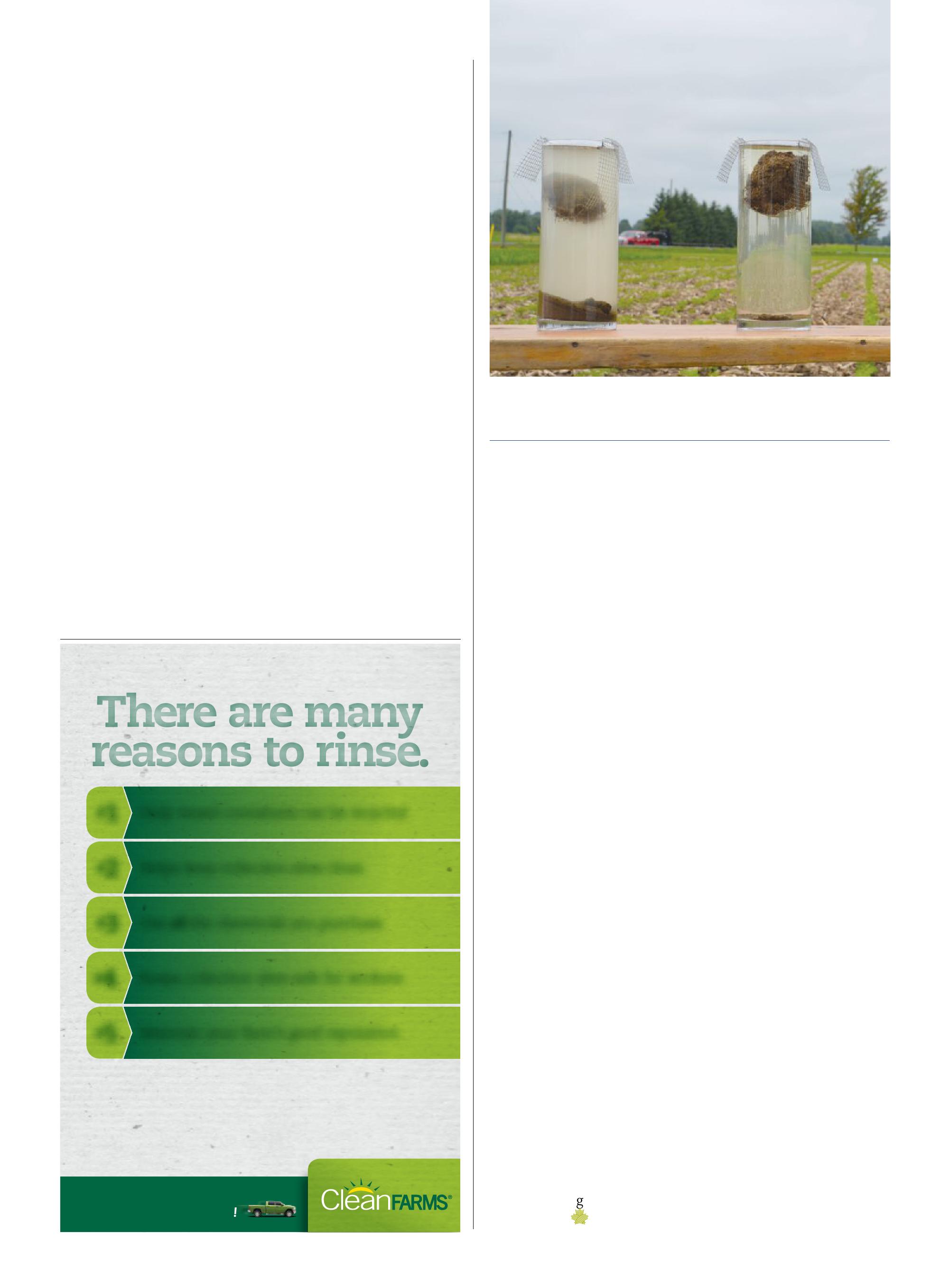
When Hayes and his colleague anne Verhallen, soil management specialist with oMaFra, gave a presentation on soil health at this year’s Southwest agricultural Conference, they demonstrated the impact of modern agricultural practices with a show, rather than tell, demonstration.
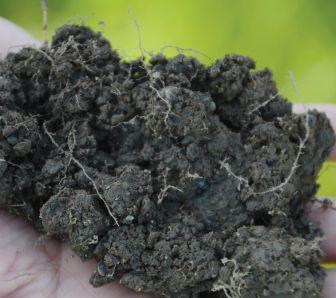
Using soil samples from two fields – one long-term, no-till, well-managed field, and one conventionally tilled with a poor crop rotation – they placed the soil on mesh, then poured water on the samples to emulate rain.
“The conventional soil blew apart, while the other held together better,” Hayes says, explaining that loss of organic matter and tillage have a big impact on the physical characteristics of soil.
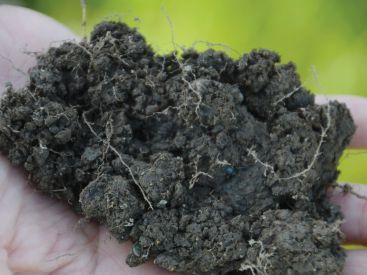
TOP: long-term tillage and rotation plots at Ridgetown, Ont. iNsET: a soil sample from a fencerow gives producers a reference of healthy soil to strive for.
DuPontTM Acapela® is a high-performing broad-spectrum fungicide that puts you in control, delivering reliable and powerful protection under a variety of conditions.
Multiplediseasethreats? Acapela® works on many important diseases, including Sclerotinia white mould,* Septoria brown spot, frogeye leaf spot (Cercospera) and Northern corn leaf blight, for healthier crops and higher yield potential.
Inconsistentstaging? Acapela® features best-in-class movement properties for superior coverage. It travels across, into and around the leaf with strong preventative and residual activity.
Weatherthreatening? Spray away and count on Acapela® for excellent rainfastness if you need it.
DuPontTM Acapela® fungicide. It fits the way you farm.
Questions? Ask your retailer, call 1- 800-667-3925 or visit acapela.dupont.ca
“The result is soil which has poor aggregate stability and poor soil structure.”
Soil with poor aggregate stability breaks down into individual soil particles that are more prone to wind and water erosion. They are also prone to forming a crust on the soil, which impedes water movement into the soil and can cause crop emergence problems.
“poor soil structure impedes water and air movement into the soil, and makes it difficult for roots to move down through the soil,” Hayes adds.
producers can keep their soil full of life and well-structured with some key management practices, namely crop rotation, utilizing cover crops, reducing tillage and adding organic materials to the soil. The use of soil testing and good nutrient management complete the package.
Crop rotation
Long-term tillage and rotation research conducted over 20 years at the University of guelph using data from 2009 to 2013 concluded adding winter wheat to the rotation increases corn and soybean yields by at least 10 per cent, going from 15 to 20 bushels per acre for corn and four to eight bushels per acre for soybeans. putting red clover in the winter wheat resulted in another eight bushels per acre to corn yields.
“a corn-soybean crop rotation has the same or poorer soil health, and sometimes yields, as does a continuous corn or soybean cropping system,” Hayes says. “adding a perennial to the rotation further improves crop yields.”
a crop rotation of three or more crops will increase soil organic matter. The greatest increase happens when perennials are included.
Cover crops
Cover crops, either seeded or volunteer, offer a number of benefits including providing nitrogen (n) for the following crop, efficient capture and recycling of nutrients, and better soil structure for a larger root system.
Cover crops also provide protection from erosion losses. For example, in the case of wind erosion, it is estimated soil blown from a field may contain 10 to 12 times more organic matter and phosphates than the heavier particles left behind.
Tillage
reducing tillage to no-till is the best practice for soil health because it can increase soil organic matter in some cases. “no-till provides a favourable environment for mycorrhizal fungi which aid the root in the uptake of phosphorus,” Hayes explains. “The maximum economic rate of n for no-till in long-term rotation plots at ridgetown are much less than for conventional-tilled soil.”
Hayes adds that minimum tillage is a big improvement over conventional tillage as long as the number of passes and depth of tillage is kept to a minimum. “Tillage oxidizes organic matter so less disturbance reduces the loss,” he explains. “reduced tillage will not break down aggregates and soil structure as much.”
Organic material
adding organic material to the soil is the fastest way to increase soil organic matter. It can be in the form of manure, compost, biosolids, digestate and other sources.
research shows that adding 75 tonnes per hectare of compost to a Brookston clay soil increased soil organic carbon from two to three per cent. “Soil organic matter is made up of about 40 per cent organic carbon,” Hayes explains. “That level of carbon was still there after five years.”
In other research and working with an ontario farmer, Hayes added 25 tonnes per hectare of cattle manure to a field site every other year over an eight-year period in a corn-soybean rotation. results show corn yields from four harvests increased, on average, by 10 bushels per acre.
Implementing just one of these management practices will make a difference to the soil. Using two of them will provide a greater benefit. But putting them all into play will make soil the most productive and
a demonstration compares soil from a field that was conventionally tilled with a poor crop rotation (left) to soil from a long-term, no-till, well-managed field (right).
looki Ng bAck, looki
Ng
A h EA d
Continued from page 15
fungicide at r1 and then, if conditions continue to favour white mould, making an r3 application. research from ontario and the University of Wisconsin shows that applications after r3 didn’t have much effect on soybean yields.
Because the flowering period in soybeans can last several weeks, fungicide timing can be a challenge. If you spray too early, you could still get a lot of petal infection. If you wait too long, the canopy will get thicker and it will be more difficult to get the product into the canopy where it needs to be. Tenuta emphasizes, “Spray penetration into the canopy and uniformity of spray coverage are critically important to suppress white mould.”
sCN plus sds
Tenuta reminds growers to watch for soybean sudden death syndrome (SDS), which goes hand in hand with soybean cyst nematode (SCn), a major soybean disease in ontario.
“Soybean cyst nematode is present in most of the soybean-growing areas across the province, with higher populations in the southwest than in regions like eastern ontario, and it is now into Quebec. all ontario soybean growers should know about SCn and be scouting for it,” he says.
“However growers may not be as aware of sudden death syndrome. Its distribution is closely related to the distribution of soybean cyst nematode. SDS is highest in the areas where we’ve had soybean cyst
nematode for the longest time, which are the southernmost six or seven counties.”
SDS is caused by Fusarium virguliforme. This fungal pathogen overwinters on crop residue and in the soil as survival structures called chlamydospores. The chlamydospores germinate in spring and infect soybean roots. root damage caused by SCn makes it easier for the SDS pathogen to enter the roots. as well, research indicates the SDS pathogen moves around in the cyst of SCn
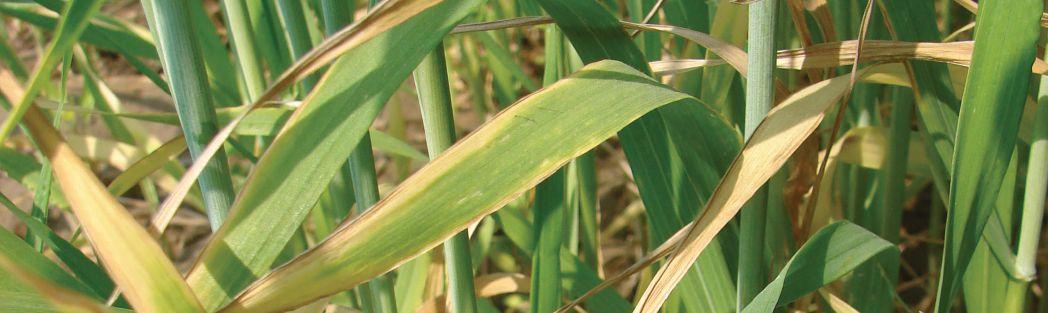
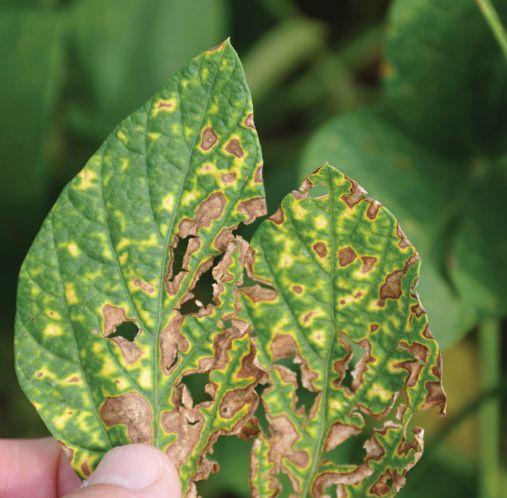
The SDS pathogen causes root rot, but it also produces a toxin that results in SDS’s foliar symptoms. “The typical symptoms of SDS are interveinal chlorosis –yellowing between the veins. The affected tissue turns brown and then disintegrates, leaving just the veins. eventually, the leaves fall off, but the petioles, the stalks that attach the leaf to the stem, remain attached to the stem,” Tenuta says.
SDS infection usually occurs within the first few weeks after planting. The disease is favoured by prolonged cool, wet conditions early in the growing season, poorly drained soil, compacted soil, and the presence of SCn. early planting tends to increase the disease risk.
Tenuta is working with his U.S. colleagues on a major SDS project. one component of the project involves studying isolates of the pathogen so researchers can get a better handle on the strains involved. Tenuta notes, “We’re seeing some diversity in the isolates, and
it may be possible to group the isolates by region. So we’re investigating how our isolates relate to those found in other parts of north america.”
another component in the project is evaluating practices for managing SDS. “We’ve found choosing varieties that have both good SCn resistance – pI88788 and peking sources of resistance – and good SDS tolerance can provide a substantial yield increase and a reduction in both SDS and SCn symptoms,” he says.
The researchers have been assessing various new seed treatment products, with some good results. “one of the products, ILeVo from Bayer CropScience, has just been registered in the U.S., and has been submitted for registration in Canada. other companies are developing SDS products, too,” Tenuta says. “In our research, we’ve found, even when planting early, the seed treatments can provide good SDS protection, with about a two- to four-bushel yield benefit.”
He adds, “new SCn seed treatments are also coming, so I think we’ll be able to put together a nice IpM disease management program, with crop rotation, good resistant varieties for both SDS and SCn, and the new SDS and SCn seed treatments.”
bAN di Ng drY p AN d k f E rT iliz E r... CONTiNuEd fROM PaGE 16
Initial trials last season, led by Stewart and the Innovative Farmers association of ontario (IFao), showed some cost benefit from applying dry fertilizer during strip tillage. In the first year of trials, the results were not entirely consistent. The project will be continued in 2015 and updated results posted to the IFao website.
“If we were careful, we could put all of our fertilizer into the strip zone in advance, which offered some cost savings. But, putting all of the n, p and K into that eight inch strip can make it too hot for seedlings, and softening the blow by switching to a polycoated urea added costs over and above conventional urea, which took away some of the cost benefit.”
for more on pests and diseases, visit topcropmanager.com
Still, the environmental benefits, convenient timing of fertilizer application, and elimination of later season fertilizer broadcasting and knifing mean the system offers benefits beyond input dollars and cents.
“If we could get people to move to strip tillage, that would be a really good step forward, even if they are never going to switch all the way to zero tillage. It’s not necessary to move completely to no-till in order to see the benefits of reduced tillage. This is a new way of looking at field management,” Stewart says.
for more on fertility and nutrients, visit topcropmanager.com
off SETT i Ng pEST icidE r E liANc E
New ‘toxic slug’ research from Penn State University is another example that integrated pest management (IPM) needs to be the way of agriculture’s future.
by Madeleine Baerg
When chemical pest management options first became available, they seemed a silver bullet, an easy-fix solution to even the toughest weed, disease and insect pests. They worked so well, in fact, that farmers almost entirely turned their backs on the cultural, physical and biological pest controls they had depended on prior to the advent of chemical solutions.
But, as the entire agricultural industry is coming to realize, nothing comes without a cost. Weed and disease resistance issues, increasing populations of hard-to-manage insect pests, and the alleged effect of neonicotinoids on pollinators and insect predators are harsh examples of the unintended consequences of chemical over-reliance. Integrated pest management (IpM) may be the oldest “new” trend in agriculture, but scientists are slowly bringing producers back around to this systems-based approach.
“What I see as a big problem in field crops is the indiscriminate use of pesticides. I’m not anti-insecticide. I’m pro IpM. In my opinion, a more diverse system is more resilient in the face of any disturbance, whether that disturbance is a drought or heat or pressure from an insect pest,” John Tooker, a research scientist in penn State University’s department of entomology says.
“Consider this: most organic growers don’t seem to have nearly as big insect problems as a user of insecticides would think they should have. The point is the organic growers have more integrated, locally diverse farms. anything a grower can do to increase diversity, in time and space, on their operation will move them in the direction of a more integrated system that depends less heavily on pesticides.”
For the past seven years, Tooker and a team of collaborators have been conducting lab- and field-based research on soybean and corn pests. Six years ago, a group of no-till farmers approached Tooker complaining they were at wits end due to a worsening slug problem. While slugs are a pest specific to no-till operations and, therefore, a significant problem for only some ontario farmers, Tooker’s surprising findings should give pause to all monoculture-focused, chemical-dependent producers.
Being mollusks rather than insects, slugs are unaffected by most insecticides even at high concentration. However, when they consume plants grown from seeds coated with a neonicotinoid seed treatment, they ingest the insecticide, at least temporarily, and can pass it on to any predator that eats them. The slugs Tooker tested from his quarter-acre soybean research plots
in pennsylvania averaged about 200 parts per billion (ppb) of neonicotinoid but ranged as high as 400 ppb. as comparison, Tooker says, consider that approximately five ppb of neonicotinoid is enough to kill a bee (which, using simple math, means the amount of neonicotinoid in the most highly toxic slugs found would be enough to kill that bee 80 times over). Though researchers do not yet know the susceptibility of various soil-dwelling insect predators to neonicotinoids, it is more than likely that a “toxic slug” carrying even a fraction of the 200 ppb average would poison – and possibly kill ¬ most insect predators that attack it, according to Tooker.
Photo
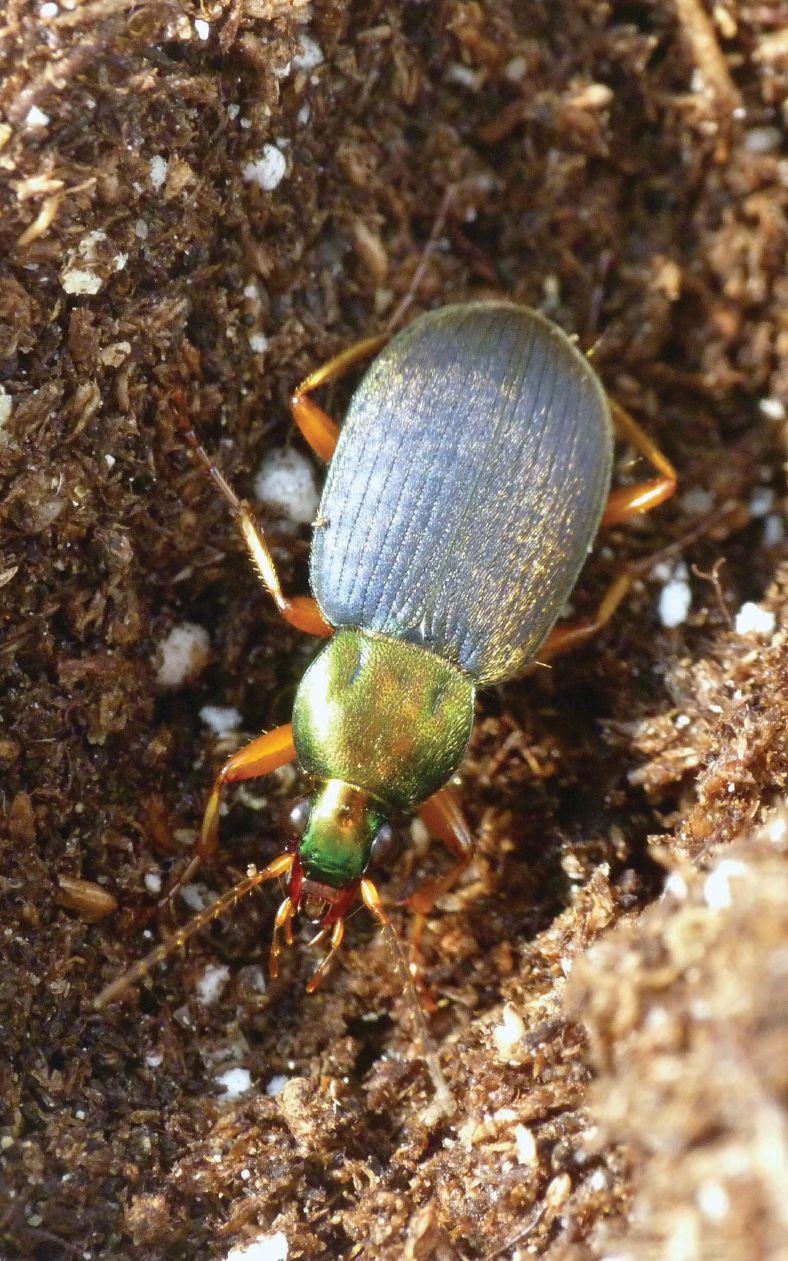
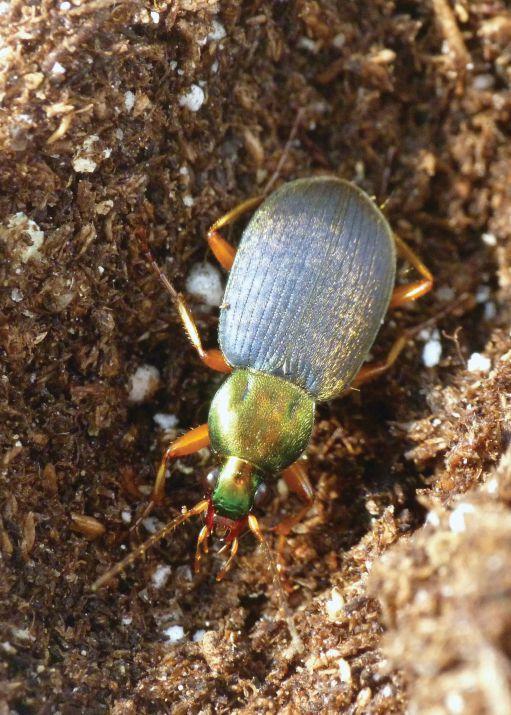
Chlaenius tricolor, the slug-eating ground beetle the study focused on.
“our evidence shows that neonicotinoids exacerbate slug populations. What we found is that, where you use a neonicotinoid seed treatment, you have 19 per cent fewer soybean plants and five per cent less yield when slugs are the primary pest than if you didn’t use a seed treatment at all,” Tooker says. “It’s a perfect example of how pest management tactics can backfire if you don’t understand well enough the complexity of the system you’re working within.”
So, the obvious question a farmer
might ask is: if not seed treatment, then what? given that research on complex forest and grassland ecosystems shows the population of plant-eating insects decreases as the diversity of plant species in that ecosystem increases, the answer is hardly surprising. Diversity, rotation and integration, Tooker says.
“o ne of the first questions we asked was: could having something else in the field help us manage pests? In a clean soybean or corn field, the only plants in that field are the monocultured crop. But
Timing is everything
with AgExpert Analyst
if you planted something else that slugs liked to eat, could that decrease losses?” Tooker says.
after various comparisons, the researchers determined slugs prefer cereal rye over any other plant species they tested. p lanted between the rows of corn or soybeans, the rye acted as a surprisingly effective “distraction” crop, keeping the slugs satisfied, but away from the cash crops.
even more interestingly, Tooker and pennsylvania grower, Lucas Criswell, are seeing evidence that planting corn or soybeans without seed treatments into a standing green rye cover crop provides much better protection from slugs than if corn or soybeans are planted into a glyphosate-treated, brown and dead cover crop.
“What your average reader will say is, ‘ p lanting into green cover is the stupidest thing I’ve heard. I’ll get black cutworm and true armyworm because of the green bridge.’ Conventional wisdom is you need two weeks between cover crop termination and planting to avoid carrying insect pests to your cash crop. But, our initial findings after one year of research actually show that certain insect populations, big problem insects like black cutworm, were actually lower in green cover than brown, which could be explained by the cover crop distracting cutworms and/or fostering better predator populations,” Tooker says.
That said, he cautions, this approach is not for the faint of heart. a grower has to be committed to scouting regularly, reacting quickly if a pest population suddenly blows up, and relying on multiple, integrated means of pest management.
When IpM is done correctly, Tooker says, the dollars will follow. Though integrating crop diversity and rotation may not seem, at first, to compete with the economics of a high yielding, high return cash crop, decreased pest problems and decreased time spent managing pest problems can add up.
at the very least, producers are now considering more integrated management.
“IpM may not always jive with the economics of, say, continuous corn. But with lower commodity prices, we’re seeing more openness to high levels of rotation and diversity,” Tooker says.
In the long run, that may prove a very good thing for agriculture as a whole.