Campaign against highly invasive, tough weed PG. 24
BEAN LEAF BEETLE IN SOYBEAN
Improving thresholds for managing the beetle PG. 6
MANAGEMENT
TIPS ON CROPRELATED ISSUES
CornSmart with Ken Ferrie PG. 12
It’s an easy weed-control decision in corn and soybeans. Because only Broadstrike™ RC offers a wide range of broadleaf-weed control, tank mixes and application options, at such a low cost. Call our Solutions Center at 1.800.667.3852 or visit dowagro.ca today. Strike it all. With control you trust.
TOP CROP MANAGER
6 | Preparing for action
Improving action thresholds for managing bean leaf beetle in soybean. By Carolyn King
Jeanine Moyer
By Rosalie I. Tennison
issues. By Melanie Epp
John Dietz
20 | Ontario soybeans gain ground on GR giant ragweed
Soybean growers in ontario can stay ahead of the glyphosate-resistant giant ragweed nemesis.
By John Dietz
Photo
Janet Kanters | Western editor
WhAT ’S buggINg you?
In this issue of Top Crop Manager, we present our annual insect forecast for 2013. entomologists are working hard to develop predictable insect forecasting, and have a wealth of knowledge that they can relay to agronomists and farmers, as they have done with the insect articles in this issue.
The entomologists we spoke with have a good grasp of what we may see, based on what we saw last year and also based on predictions of what’s being planted this year, and where, and how winds have an effect as well as possible moisture/drought conditions, etc. It may sound convoluted and difficult, but these entomologists haven’t retained their positions as long as they have without knowing what they’re talking about.
Dealing with insect pests isn’t a one-shot deal either. an early influx of flea beetles doesn’t necessarily mean they won’t be present mid-season or even at harvest. So there is no one-size-fits-all solution to these pests, nor to most of the pests seen each year. a thorough evaluation of the problem and a comprehensive attack plan to deal with these pests are usually called for.
But how do you know for certain you have a problem? every crop will have pests in it – just walk through it at any growth stage, at any time of the year, and flying insects and other creepy, crawly critters can be seen. How to know the good from the bad (if you don’t already know)? Capture one of the little buggers and try to identify it from one of myriad photos available on any of the three provincial government websites. or, take the bug to your favourite agronomist or entomologist for identification. even after identification, it may not be necessary to eradicate the pest – each crop has “pest thresholds” developed by crop specialists – that is, a certain number of pests need to be evident in a crop before it’s deemed economically viable to spray. To determine pest numbers, walk your fields, and if possible, use a sweep net to gather up any insects in the crop. not all bugs collected will be “bad” pests either. Indeed, no matter your squeamishness towards bugs, there are good ones out there. Some of them do no harm at all to your crops; others – the ones we like the most – are classified as parasitoids, which live on or in host bugs, feeding on them. When the parasitoid matures, it leaves the host dead. parasitoids, too, can usually be identified by your agronomist and/or entomologist. So it’s evident that while we may revile most bugs, there are some that can be our friends. The trick is telling them apart, and ensuring the good ones stay while the bad ones die.
Here at Top Crop Manager, we’re always looking for good insect photos – I mean, who doesn’t like pictures of bugs? So while scouting your fields this year, take your camera along and snap a few close-up shots of bugs (use a high resolution setting on your camera), and send them along to us. Who knows? one of your photos might make it into a future issue of Top Crop Manager! For your trouble, we’ll send you a fancy Top Crop Manager cap, and you’ll get a photo credit to boot!
TOP CROP
MANAGER
APRIL 2013, voL. 39, no. 7
GRoUP PUBLISHER Diane Kleer • 519-429-5177 dkleer@annexweb.com
EASTERn SALES MAnAGER Steve McCabe • 519.400.0332 smccabe@annexweb.com
WESTERn SALES MAnAGER Kevin Yaworsky • 250-317-1992 kyaworsky@annexweb.com
AccoUnT cooRdInAToR Alice Chen • 905-713-4369 achen@annexweb.com
MEdIA dESIGnER Katerina Maevska
PRESIdEnT Michael Fredericks mfredericks@annexweb.com
PUBLICATION MAIL AGREEMENT #40065710 RETURn UndELIvERABLE cAnAdIAn AddRESSES To cIRcULATIon dEPT. P.O. Box 530, Simcoe, ON N3Y 4N5 e-mail: subscribe@topcropmanager.com
Top Crop Manager West - 8 issuesFebruary, March, Mid-March, April, June, October, November and December - 1 Year - $45.00 cdn plus tax
Top Crop Manager East - 7 issuesFebruary, March, April, August, October, November and December - 1 Year - $45.00 CDN plus tax Specialty Edition - Potatoes in Canada - February1 Year - $16 CDN plus tax
All of the above - $80 CDN plus tax
Occasionally, Top Crop Manager will mail information on behalf of industryrelated groups whose products and services we believe may be of interest to you. If you prefer not to receive this information, please contact our circulation department in any of the four ways listed above.
All advertising is subject to the publisher’s approval. Such approval does not imply any endorsement of the products or services advertised. Publisher reserves the right to refuse advertising that does not meet the standards of the publication. www.topcropmanager.com
You spoke. We listened. You want maximum yield potential from every seed: our parallel-link row unit provides accurate seed placement in a range of soil conditions, improved depth control and seed-to-soil contact for even emergence. You need to get more seeding done in a day: quick adjustments, less daily maintenance and higher operating speeds help you cover more ground. You demand versatility: our system takes you from full till to no-till in just a few easy adjustments. Precision Disk 500T Single Disk Air Drills from Case IH. Count on us to make every seed count for you. Visit your local dealer or www.caseih.com/500ttcme413 to learn more.
PREPARINg
foR Ac TIoN
Improving action thresholds for managing bean leaf beetle in soybean.
by Carolyn King
Bean leaf beetle has emerged as an important concern in ontario soybean fields. To help in the battle against this beetle, University of guelph researchers are investigating some key factors affecting the beetle’s development and impacts on seed yield and quality. Using that information, they are creating improved thresholds for pesticide application and assessing future risks from the beetle.
Bean leaf beetle has been a significant soybean pest in parts of the United States for many years, but it’s fairly new to o ntario. It was first discovered to be overwintering in southern o ntario in the early 2000s. Surveys in 2009 and 2010 found the beetle’s range in the province extended north to southern Bruce County and east to York County.
The adult is the most damaging stage of this pest. It chews round holes in soybean leaves, it may cut off cotyledons and seedlings, and it feeds on flowers and pods, sometimes clipping off the pods. Damage from pod feeding increases the risk of various pod
diseases. In particular, the beetle is a vector of bean pod mottle virus, which causes the seed to become mottled and wrinkled, affecting quality and yield. The beetle prefers soybeans, but it may also damage dry edible beans.
The adult is about one-fifth of an inch long. It is usually tan, yellow-green or red, and may have up to four black spots. If the adult has spots, it might be mistaken for an insect such as a lady beetle or spotted cucumber beetle, but it has a distinctive black triangle behind its head.
Dr. rebecca Hallett, an entomologist in the School of environmental Sciences at the University of guelph, is leading this research project, which started in 2010. Her main collaborators
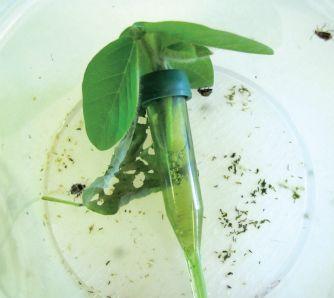
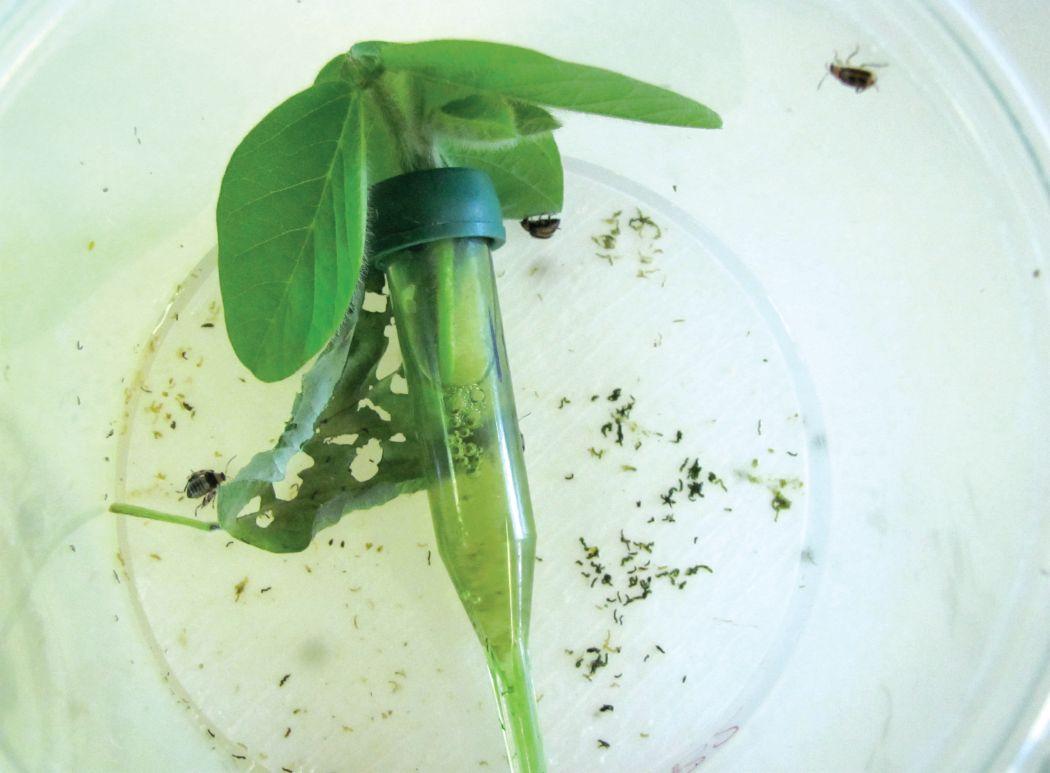
ABOVE: In a growth chamber study, mating pairs of adult beetles were kept in containers where the eggs could be collected daily. Then McCreary observed their development at several different constant temperatures.
Photos by c ara m c c reary.
are Dr. art Schaafsma, University of guelph, ridgetown Campus, and Dr. Jonathan newman, director of the School of environmental Sciences. Two graduate students are working on the project: Cara McCreary and emily Berzitis. The researchers have also been working with Tracey Baute, field crops entomologist with the ontario Ministry of agriculture, Food and rural affairs (oMaFra).
The project has three main objectives, involving field studies in Bruce, Wellington and Chatham-Kent counties and growth chamber experiments.
“o ur first objective was to determine the life cycle of bean leaf beetle in o ntario because it has different numbers of generations across its range,” says Hallett. “The number of generations is important because it affects the type of soybean damage experienced and therefore whether or not we need to be concerned about feeding on vegetative stages of plants versus only the pod-feeding stages, and whether disease incidence in pods is an issue or not.”
For this objective, the researchers used field experiments with soybean plants caged with beetles, growth chamber experiments and field sampling of natural beetle populations to examine how quickly the beetles go through the different stages in their life cycle at different temperatures.
The second objective is to assess the impact of environmental factors on the beetle’s development and success. “We’re looking at factors like the effect of temperature on overwintering survival and the effect of carbon dioxide level on development and fecundity [number of offspring], and then predicting the impact of climate change on the future distribution and abun -
dance of the beetle,” explains Hallett.
She adds, “Bean leaf beetle has been steadily expanding its range through north america, coming north and eastward over the last 150 years. From accounts of bean leaf beetle in the 1970s, it probably didn’t overwinter in o ntario at that time. Then in the ’90s or possibly early ’00s, there was evidence that it was beginning to overwinter in o ntario. So we think some climate change effects may already be occurring that have helped it to establish in o ntario.”
The overwintering survival study included various experiments in which bean leaf beetles were placed into pots of soil and buried in the field, similar to their natural overwintering conditions. Some pots were allowed to experience the natural conditions at the three field sites, and some were subjected to snow removal and/or warming to simulate winters under warmer conditions.
The carbon dioxide work is conducted in specially constructed chambers in a greenhouse. Carbon dioxide levels could be important because they affect plant growth, insect development, and insect feeding on plants. Hallett notes, “We already have much higher levels of carbon dioxide in the air than we did 20 or 50 years ago, and those levels are projected to continue increasing.”
The project’s third objective is to examine the impact of pod feeding by bean leaf beetle on seed quality and yield, and then to establish a late-season action threshold.
For this objective, the researchers conducted field trials in
Make e very Drop Count
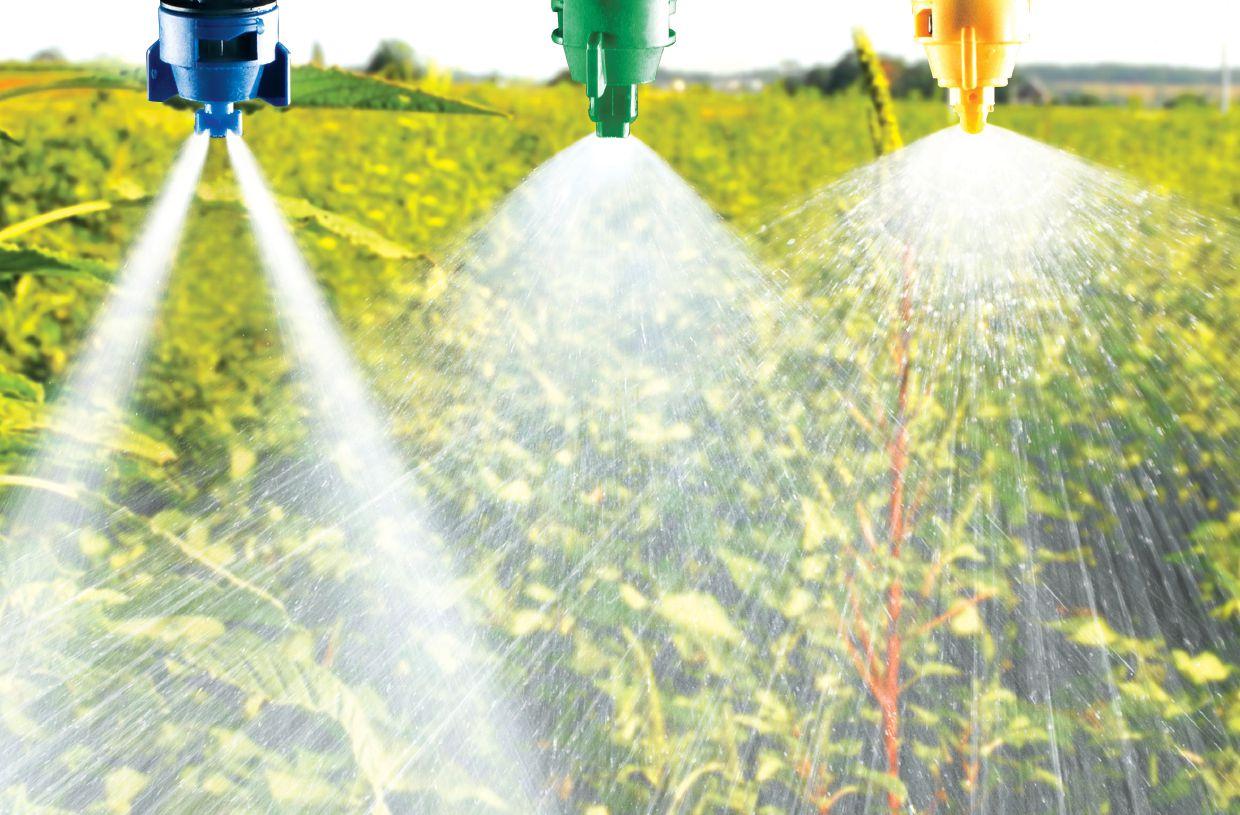
Thorough spray coverage is critical when trying to control herbicide resistant weeds like pigweed or waterhemp and TeeJet spray tips provide the superior coverage and drift control you need. After you’ve chosen your herbicide, consider these options:
• Turbo TeeJet® (TT) and Turbo TwinJet® (TTJ60) tips produce medium to coarse droplets for thorough coverage when spraying contact herbicides like glufosinate
• AIXR, Turbo TeeJet Induction (TTI) and Air Induction Turbo TwinJet (AITTJ60) tips produce larger droplets for improved drift control and are ideal for systemic herbicides like glyphosate, 2, 4-D and dicamba
Download the SpraySelect tip Selection Mobile app for apple and android today!
which the soybean plants were caged at different reproductive stages with different numbers of beetles to determine when the most damage occurs to seed quality and yield.
Some of the project’s experiments are still in progress, but the researchers have already achieved valuable results.
“We have determined there is one generation of the beetle in ontario,” says Hallett. The adult beetles overwinter in the soil, emerge in the spring, feed, mate and beginning in June lay their eggs in the soil near the base of soybean stems. after hatching, the larvae feed on soybean roots and then pupate in the soil. The new adults emerge from the pupae in late august and September.
The results so far also indicate that the beetle is poised to take advantage of warmer conditions. “We have found that under warmer winter temperatures, the bean leaf beetles emerge several weeks earlier in the springtime. However there don’t seem to be any differences in survival in the different winter conditions that we have looked at,” she notes. “We’re repeating this experiment, so the results are still preliminary, but if the bean leaf beetles are emerging earlier when temperatures are warmer, then possibly they could have two generations in o ntario in the future.”
another interesting finding is that some egg laying is occurring quite late. Hallett explains, “They seem to be laying eggs that have no chance of developing before the winter hits. But with a shift in climate and earlier emergence, there could possibly be enough time for two generations to develop. and that would mean stronger impacts on the vegetative stages of soybeans, as well as the impacts of later pod-stage feeding.”
The researchers have also created a predictive tool. “We have developed a degree day model that can be used in the field to predict when bean leaf beetles will be emerging. That tool could be used by growers or crop scouts to give them a heads-up as to when bean leaf beetle adults are going to be around,” says Hallett. The researchers are exploring options for making the tool available to growers and scouts.
not surprisingly, the pod-feeding studies have found increasing pod damage and yield impacts with higher numbers of beetles. Currently, the researchers are conducting a detailed analysis of the data to develop a threshold recommendation for controlling late-season impacts.
Hallett says, “The recommendation could be based simply on the number of beetles per plant. But we also would like to base it on the reproductive stage when the beetle causes the most damage. For instance, it may be that it’s most damaging at an earlier reproductive stage, and so it might not be worth spraying if the damage occurs at a late stage, even if there are a lot of beetles.” She hopes to have the threshold recommendation analysis completed in the spring of 2013.
The project is funded by the University of g uelph- o M a F ra partnership program and g rain Farmers of o ntario.
New Active Ingredients in Corn
WhAT mov ES b ENEAT h you R f IEL d?
The importance of earthworms in soil structures.
by Jeanine Moyer
How many earthworms are in your field? Likely only a few farmers can answer that question. Maybe the better question is – how many farmers should care about the number of earthworms in their fields?
according to o dette Ménard of the Quebec Ministry of a griculture, Fisheries and Food, the answer is, all farmers, because earthworms are vital to maintaining and establishing healthy soils. “We need to feed the soil if we are to feed men,” she says, explaining earthworms can offer simple solutions to combat issues with compaction, improve soil structure and reduce the vulnerability of the soil itself.
“Soil health isn’t just about the chemical make-up,” says Ménard. “The challenge is to talk about the soil with respect to its physical and biological properties.” and that’s where earthworms become important. These creatures help to aerate the soil, build and maintain soil structure, increase hydrology, improve nitrogen efficiency and reduce pests and diseases. Ménard says farmers often worry earthworm tunnels will
increase the chance of nutrient leaching within their soils, but that’s not the case. In fact, since earthworms stay close to living plant roots – often within one inch – their tunnels support overall root development. “More holes in the soil means the soil is actually in better shape,” she says. “and the better the soil, the more root development, counterbalancing leaching.”
Minerals, water and air account for approximately 95 percent of the soil’s components, with organic matter (including plant roots) making up the remaining five percent. e arthworms feed on the bacteria and fungi found in the soil’s organic matter and turn it into additional soil nutrients in the form of their excrement through decomposition. Ménard says that, “for every earthworm I see in the soil, there is four times its
CONTINuED ON PAGE 16
ABOVE: Odette Ménard of the Quebec Ministry of Agriculture, Fisheries and Food, says earthworms are vital to establishing and maintaining healthy soils.
Photo courtesy of Jeanine m oyer.
how do you know if you have enough earthworms in your field? According to Odette Ménard of the Quebec Ministry of Agriculture, Fisheries and Food, it’s simple – dig for them to see for yourself. She’s often surprised by the number of farmers who have never dug a hole in their field to examine the soil or check for earthworms.
To find earthworms in a field, first look for their middens, also known as the worm’s home, and often surrounded by field debris and the worm’s excrement. An earthworm’s tunnel creates pores through which oxygen and water can enter and carbon dioxide can exit the soil. While the lifespan of an earthworm can vary, Ménard says, their tunnels can last up to 30 years if undisturbed. Worms work only at night, building their middens or feeding off crop residue such as corn stalks and wheat stubble. They are deaf and blind, selecting debris at random, and using their tails to suck the residue, and pull it to build their middens.
Farmers are likely to find three types of earthworms in their fields – epigeic, endogeic and anecic. Epigeic earthworms live on the surface of the soil in crop residue and live only 90 to 150 days. These species tend not to make tunnels, but live in and feed on crop debris. Epigeic earthworms are often bright red or reddy-brown. Endogeic earthworms live
in and feed on the soil and have a life span of 150 to 210 days. They make horizontal tunnels through the soil to move around and to feed and will sometimes reuse their tunnels. Some endogeic earthworms can tunnel very deeply into the soil and are often pale colours such as grey, pale pink, green or blue. Anecic earthworms make permanent vertical tunnels in soil and live the longest, 400 to 500 days. They feed on crop residue found on the soil surface that they drag into their tunnels. They also make middens (piles of excrement) around the entrance to their tunnels. Anecic earthworms are darkly coloured at the head end (red or brown) and have paler tails.
Sensitive to pressure, earthworms use pressure as their sensor and prefer humidity, which is why they often come to the surface in the damp weather after a rain. Earthworms also come out of their holes to mate. Although they possess both sexual reproductive organs, they do have to seek out a mate to reproduce. Most importantly for farmers, worms come out of their middens to “poop,” leaving excrement filled with valuable nutrients on top of the soil. In fact, an earthworm can produce its own weight in excrement in a day.
This excrement provides additional soil nutrients, also beneficial to plant growth and development.
choose any of the spray tips in our extensive line to replace your non-teeJet nozzles.
Only TeeJet offers:
• The broadest selection in the industry – more types, sizes and materials than any other supplier
• Spray tips designed, manufactured and tested by us in the USA
Why risk your big investment in
Make sure you’re using
Specialization in spray tips. Our focus is on spraying – and has been for more than 75 years
c oRN Sm ART
WIT h K EN fERRIE
Management tips on a variety of crop-related issues.
by Melanie epp
Illinois State University graduate Ken Ferrie owns Crop Tech Consulting, an independent company that consults on a variety of crop-related issues. “We consult on just about every aspect of farming, except for the marketing,” says Ferrie. This includes providing management tips on disease and pest control, soil density issues, herbicide plans, and tillage.
“If I’m going to make a recommendation for something as complicated as a herbicide plan or how to set a planter out or what type of tillage to do, I’ve got to have what I call “boots-on-the-ground experience,” says Ferrie. “I want to see something work and evaluate it.”
Ferrie’s boots-on-the-ground experience comes from operating some 150 field trials on corn, wheat and soybeans each year. His recommendations are based on firsthand observations in the field, and his solutions are tailored specifically to the individual farmer’s needs.
What does a good stand of corn look like?
When visiting a corn producer’s farm, Ferrie will first ask what that
farmer’s stand looks like. “There will be certain things that I look for when I ask that, seeing how attentive he is to his actual corn stand.” First of all, they should be keeping thorough records of any and all information pertaining to their crops, he says. To do that, you’ve got to get out into the fields.
“It’s something that you can’t see from the pick-up at 60 miles an hour,” says Ferrie. of the plants you put in the ground, what emerged? What is your final ear count? These things matter. What you’re looking for is a uniform stand, says Ferrie, including what he calls ‘the photocopy’ and the ‘picket fence stand.’
“ p hotocopy means that every plant looks like its neighbour, and every ear looks like its neighbour,” says Ferrie. “and the picket fence part means seed distribution. We’re talking about planter performance in the picket fence stand, and we’re talking
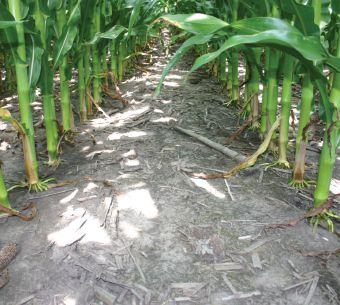
ABOVE: unevenly pollinated corn field in Illinois.
Quilt® puts added yield within reach. Applied with a conventional sprayer at the 5 to 8 leaf stage of corn, Quilt boosts yield without the need to wait for tassel. Field scale trials in 2012 show a six bushel per acre yield benefit when Quilt is applied on corn early versus untreated. Two modes of action provide better resistance management and you can tank-mix with your in-crop herbicide application. With Quilt, the only thing that takes off is your corn.
about growth and development when we’re talking about photocopies in the field itself. They’re going to have an effect on ear count, and ear count is where it’s at.”
He’s right; at the end of the day, it’s high ear counts, not high populations, that make yield. If you have 32,000 plants in the field, but only 27,000 put ears on, you’re wasting valuable resources that could be available for other plants.
The picket fence stand
a s far as a picket fence stand goes, you’re looking for uniform spacing. proper spacing ensures that each plant gets the maximum amount of sunlight and resources, and minimizes competition between plants. To do this, you have to actually go out in the field and do an evaluation. What do you see? Do you see doubles, triples, or skips?
“ no disease or insect causes this,” says Ferrie. “It’s something you did in your management cycle that we have to go back to.” The problem is with the planter itself, he adds. It could be a metering problem, or it could be the seed size you’re working with. It could also be your planter speed.
“o ne thing you realize is that as you increase your population you’re going to tighten up your spacing between plants, but you’re also going to speed up your meter,” says Ferrie. “So if your meter was having trouble at 28,000 and you decide to go to variable rate and push some parts of the field at 36,000, your meter has to turn a lot faster. In that process you can destroy your stand using variable rate because you jacked your population, but didn’t slow your forward speed of the planter down.”
If it’s not a metering problem, then a problem exists with the delivery system itself. “It could be an improper seed tube. It could be an eye that’s not set up correctly in the tube, causing ricochet. probably the number 1 problem we run into with seed tube ricochet is planter levelling.” If every row in the planter has a misplaced seed, then it’s probably a planter levelling issue. If the problem occurs only in certain rows, it’s likely a seed tube or metering issue.
Skips are an issue too. “I’ve done a lot of studying, and I’ve never seen a skip produce an ear yet,” he says. “So we need to eliminate them.” a gain, the problem could be a malfunction of the meter. If it’s a common occurrence in your field, you’ll want to identify the problem as soon as possible. By eliminating just
one hiccup, says Ferrie, you could have as much as a six to seven bushel per acre increase.
although seed distribution is important, growth and development – or the photocopy part – is more important. “of these two, the one that makes the biggest difference in yield is going to be uniform growth and development,” says Ferrie. “You could have perfect picket fence drop, but if you don’t have uniform growth and development, you’re still going to have a train wreck.
“I can find sometimes as high as 4,000 to 8,000 barren plants in a 1,000th of an acre and the grower doesn’t understand it,” he says. every one of those barren plants is taking in water and nitrogen, nitrogen that you have to apply so it doesn’t steal it from your healthy plants and productive plants.
“If you had 8,000 giant ragweed sticking three feet above your corn at the end of the year, what would you do? There’d be a drive-by shooting at the co-op,” he laughs. “Someone would have to answer for it. But you could have 3,000 to 8,000 weeds out there in the form of a corn plant, and it’s o K?”
Identifying the problem
although there’s nothing you can do to improve your crop’s potential – its potential is contained within the seed itself – you can work to maintain that potential. “You just have to salvage it, because it’s going to start to adjust to the environment around it and dial its yield potential down to fit its environment,” says Ferrie.
In order to determine and address issues in your crop, you need to know the growth stages of your plants. “The first five leaves are in the kernel. It’s a situation where when we get to V5 or V6 we’re starting to put on new leaves, says Ferrie. “But already at the fourth collar, this plant is starting to negotiate its overall potential. remember, the potential is here. now it’s trying to decide am I going to stay there or do I need to adjust this down to produce at least one viable seed?”
Between the fourth and fifth collar, it’s starting to make some decisions on which ear will be the dominant one. If the plant gets under a considerable amount of stress, for example, it will compensate by selecting a lower ear. Corn’s a funny plant, says Ferrie. It can manage stress on its own, when it comes in a naturally occurring way, but catch it unaware and the consequences can be dire. For instance, says Ferrie, some farmers think that cultivating their corn produces higher yields. In his
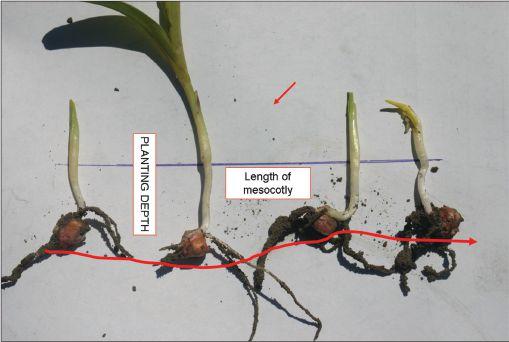
The number 1 cause of uneven germination is uneven planting depth. While planting deeper might boost populations, it can also cause ear loss.
A skip, which can be the result of a metering malfunction, can cause as much as a 6-7 bu/ac yield decrease.
Improperly spaced seeds will create situations where plants are competing for sunlight and other resources.
experience, it does not.
“You have a corn plant that’s rocking and a-rolling, heavy transpiration, and it’s just growing like crazy, and somebody comes through and just rips out its plumbing, and it’s a sudden shock to roll it up, that system is too hard on it. Same thing can happen with a herbicide application.”
That’s the problem with corn: once it shuts down, it doesn’t come back. “So if it goes from 50 long to 20 long, it goes from 18 round to 12 around – once those decisions are made, no matter how good the growing season is for the rest of the year, it’s not coming back,” he says.
uneven germination
not all of your corn plants are going to emerge on the same day, but they do need to germinate within 48 hours of each other. Seeds that germinate outside of that 48-hour window are probably not going to produce a harvestable ear because delayed plants can’t compete with the older plants.
When corn roots are the same age and the root systems meet underground, there’s some compatibility. “But if the corn
plant next to it germinates outside of that 48-hour window, the growth, and the hormones and enzymes within the root system, are not recognized. When it crosses the older plant, they don’t recognize each other as a corn plant. They sense each other as competition. So it’s kind of like a giant ragweed,” says Ferrie.
The number 1 cause of uneven germination is uneven planting depth. Moisture and temperature variability are also problems. “While I’ve gained in population by planting deeper, I’ve lost more ear count from deep planting than I have from shallow planting. When you plant too shallow, you know it and so do all your neighbours.”
o ther problems include poor seed to soil contact; uneven crop residue; poorly adjusted planters; soil crusting, which can be a function of your soil health; and insects and disease. Seed quality becomes part of this issue too, says Ferrie.
“If you’re going to plant in cold conditions, make sure you’re doing so with good seeds.”
So what’s the bottom line? “The maximum grain you can produce is in the bag when you buy it,” says Ferrie. “already, by V6 or V7 you have reached your maximum kernel set. It can only go down from there or get worse, depending on the situation.” While weather conditions are certainly out of your control, many of these other issues are within your control. It’s all in how you manage your crops.
WhAT movES bENEATh youR fIELd?
CONTINuED FROM PAGE 10
weight in bacteria and fungi that I don’t see.”
Ménard believes every soil has its own potential and all soils can be improved by increasing earthworm populations. It’s simple: increasing earthworm populations in fields will increase the overall soil health. and Ménard says the first step is to dig to see what your soil looks like and check for existing earthworm populations. To increase populations, farmers can start by leaving 30 per cent crop cover on their fields, but “you can’t just leave residue and expect the population to grow,” she says. e arthworm populations are dependent on the soil type, crop rotation, residue and tillage methods.
Crop rotation, reducing soil compaction and no-till or rich-tillage systems are conducive to earthworm habitats. These creatures prefer perennial crops and deep roots, so
Ménard suggests farmers looking to increase their earthworm populations start with an alfalfa type crop, rotating with soybeans since the creatures appear to like soybean residue. e arthworms also have soil and pH level preferences, so try to keep pH levels higher than 5.5. and not all soils are healthy for earthworms, she adds. Because they breathe through their skin, sandy soils are more aggressive and harder for the worms to survive in.
Sometimes referred to as “ecosystem engineers,” earthworms are an integral part of developing and maintaining good, uniform soil structure. Soil health and the role earthworms can play in crop productivity shouldn’t be overlooked. So go ahead and dig, just as Ménard suggests, see for yourself the impact earthworms can have in, and on, your fields.
The PursuiT is over
PHANTOM™ puts an affordable end to broadleaf weeds.
Control weeds on contact and in soil residual with the takeout power of imazethapyr, the same active ingredient found in Pursuit®. Support fair pricing and protect your soybean, dry bean and other broadleaf crops with Phantom herbicide. Available at leading retailers. Ask for Phantom by name.
c oRN v ERSu S LATE -
E m ERg INg WEE d S
Is it necessary to control weeds once the corn is beyond the eight-leaf stage?
by rosalie I. Tennison
Weeds can affect a crop in many ways. Weeds compete for light, nutrients and water, they can make harvest difficult, they can cause problems in following crops and they can reduce crop quality. However, when it comes to controlling weeds, when is enough enough?
a University of guelph, ridgetown campus, weed scientist is often asked about the impact of late-emerging weeds on corn and soybean crops, but until now he didn’t have a definitive answer. So, peter Sikkema, in collaboration with rob nurse of agriculture and agri-Food Canada at Harrow, ontario, and Wesley everman and Christy Sprague of Michigan State University in Lansing, undertook a research project that would answer the question of when lateemerging weeds are no longer a threat. They completed several projects on the effect weeds have on a corn crop that emerged after the two-, four-, six-, eight- and 10-leaf stages to determine when weed control to preserve yield is no longer necessary.
“If corn remains weed-free up to the two-leaf stage, there is no yield loss 45 percent of the time if no weed control is done after that stage,” Sikkema says. “If the corn is weed-free up to the four-leaf stage, there is no yield loss 82 percent of the time if no further weed control is done. When the crop was weed-free up to the six-leaf stage, there was no yield loss 100 percent of the time and the same was true for the eight- and 10-leaf stages.”
PSikkema’s belief is that growers who ensure a weed-free field during the early stages of corn crop development will not sacrifice yield if there is another flush of weeds late in the season. “We saw that weeds that came up in the corn after the six-leaf stage were very small and did not compete with the corn and, often, did not return a lot of weed seed to the soil.”
pointing out that this research was only to determine the effects of late-emerging weeds on corn yields, Sikkema reminds growers there may be other reasons for controlling late emerging weeds. He suggests certain weeds could affect crop quality, plus there may be reasons to reduce weed seed return, improve harvest efficiency and ensure the grower’s peace of mind.
“growers may want to control late-emerging weeds as part of a harvest management strategy,” he explains.“There are reasons besides yield that growers may want to control late-emerging weeds.”
The results of Sikkema’s research do suggest a key management strategy for growers. growers are advised to keep their corn weed-free up to at least the six-leaf stage because weeds emerging after that will not negatively affect yield.
now, that he has definitively answered the question about the effect of late-emerging weeds on yield, Sikkema says growers can focus on other crop management issues and not worry about yield loss due to weeds that appear after the six-leaf stage of their corn crop.
eter Sikkema’s research proves that weeds emerging in corn after the six-leaf stage will not hurt yield, which is good news for growers who have wondered if leaving those late-emerging weeds unchecked could be a problem. It could be an issue, but not for yield reduction.
“If I get the corn rows closed clean, then I’m not too worried about late-emerging weeds,” says Rick Willemse, a corn producer in Parkhill, Ontario. “I want my crop clean up until ‘switch point’ because I don’t like to see weeds of any kind [because they mean] loss of yield. It’s all about the yield.” He says he will still have some concerns about late-emerging weeds in his 600 acres of corn, but not about how they might affect his yield.
“I don’t like to see weeds in corn,” Willemse continues. “Late weeds can still rob the crop of moisture. There are also seeds added to the seed bank, but if you start with a decent weed control program, then this problem should be lessened.” Willemse says the weed on his “most wanted” list is chickweed and he hates to see it in his fields. “Once you have it, you have it forever,” he says. “I really don’t want it in my corn crops at all. In a late spring it can harbour insects, which can eat off an entire field of corn, forcing a late replant.”
Using a combination of no-till, minimum-till and conventional tillage on his farm, Willemse does what needs to be done to preserve yield using weed control early in the season. He then accepts the appearance of a few late-emerging weeds unless he believes they need to be controlled for another reason.
oNTARIo S oyb EANS g AIN g Rou N d oN g R g IANT
RAg WEE d
Soybean growers in Ontario can stay ahead of the glyphosate-resistant giant ragweed nemesis, with better rotation of crops and herbicides.
by John Dietz
Bad news, dreaded for a decade, began accumulating over ontario’s soybean industry like a heavy cloud in 2008, when the first glyphosate-resistant giant ragweed was discovered in the southwest, in essex County.
The situation deteriorated slowly. In 2012, new infestations were detected 400 kilometres east.
However, there’s good news and sunlight ahead for 2013, says peter Sikkema, University of guelph, ridgetown Campus, weeds scientist. a User-requested Minor Use Label expansion (UrMULe) was approved in September 2012 for the pre-plant application of 2,4-D ester.
In combination with glyphosate, the tank mix will effectively control glyphosate-resistant giant ragweed Ambrosia trifida, Sikkema says. The 2,4-D ester should be used at a rate of 0.32 L/acre. recommended application timing for the burn-off tank mix is after giant ragweed emerges and a minimum of seven days before planting soybeans.
Gathering storm
glyphosate-resistant soybeans helped support a boom in ontario agriculture after their 1997 registration. Soybean acres popped over the two million acre threshold in 1997. growers had increased confidence that this crop could be maintained weed-free until harvest.
For soybean growers with giant ragweed and its cousin common ragweed, these species are among the most difficult to control in Ip (Identity preserved) soybean. With the introduction of roundup ready soybeans, these weeds were much easier to control.
Warnings from agronomists and weed scientists that “even” roundup could be compromised came home to roost in 2008 when one field was identified as having glyphosate-resistant giant ragweed.
“In 2009, we did an expanded survey and found 18 additional fields with glyphosate-resistant giant ragweed,” says peter Sikkema. “In 2010, we had 46 fields in essex County, one in Kent and one in Lambton county. In 2011, we found 23 additional fields, including a number in Middlesex County and in Lennox and addington counties.”
Finding resistant giant ragweed in Lennox and addington counties was a surprise because that county is about 400 kilometres east of the other counties with resistant ragweed populations.
even though giant ragweed is a native broadleaf scattered in noncropped areas throughout southern ontario, it is mainly a problem
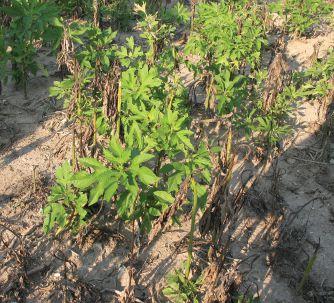
Glyphosate-resistant giant ragweed near Windsor, Ontario.
in cropped areas in the southwestern part of the province. Basically, Sikkema says, it has adapted to the crop production system of southwestern ontario.
as a native weed, giant ragweed has always been in ontario. It was limited to margins around fields and to wet, low-lying areas. It became an issue for farming in the 1980s, when certain biotypes adapted to modern crop management systems, he says.
If it has adequate moisture, adequate nutrients and little competition, the fast-growing annual giant ragweed plant can reach a height
Photo s courtesy of Peter h s ikkema.
Regrowth of glyphosate-resistant giant ragweed after application of glyphosate at 12 times the label rate.
of 13 feet. It is many-branched, with large-lobed leaves. Seedlings can emerge late into the growing season depending on biotype and soil type. It flowers from august to october and is a notorious source of pollen for hay-fever sufferers.
giant ragweed in soybean crops became a serious issue. It reduced yields by up to 90 percent and reduced cropping options, until growers could use glyphosate for weed control in soybeans after crop emergence.
ragweed still can be found in corn and wheat but growers have alternative herbicides that provide effective control.
“For years, glyphosate provided effective control of giant ragweed in roundup ready crops,” Sikkema says.
While roundup ready soybean growers were enjoying year after year of weed-free fields, there were other growers producing conventional and identity-preserved soybean. They were relying heavily on group 2 products for post-emerge weed control, after a glyphosate burndown.
among the best of the group 2 herbicides is Firstrate, a Dow agroSciences broadleaf product that was registered for eastern Canada about a decade ago.
“In Ip or conventional soybeans, historically the best treatment was Firstrate. It did a very good job. We had about 90 percent control with it,” he says.
However, as of 2012, weed surveys identified four fields in ontario that had multiple resistance issues. In these fields, giant ragweed was confirmed to have resistance to both glyphosate and Firstrate.
“Those farmers have a real challenge on their hands,” Sikkema says.
Tank-mix research
resourceful soybean growers, and research scientists, can be trusted
to look for the next best option. That happened in 2010 as Sikkema engaged two graduate students to test various tank mix options that might control the glyphosate-resistant giant ragweed populations.
Joe Vink and Joanna Follings took on the task. They tested more than 30 different tank mixes, with glyphosate, looking for something to control glyphosate-resistant giant ragweed in roundup ready soybeans. They conducted numerous trials at several locations in 2010, 2011 and 2012.
experiments indicated that two of the tank mixes achieved more than 90-percent control when the resistant weeds were treated.
The research team, although pleased with the results, were disappointed with the poor control offered by most of the tank-mix options available to ontario soybean producers.
roundup plus 2,4-D ester was the most effective. In 13 trials, it provided an average of 97-percent control of glyphosate-resistant giant ragweed. To achieve acceptable control of glyphosate-resistant giant ragweed, a minimum of rate of 0.30 L/acre of 2,4-D ester 700 should be applied.
roundup plus amitrol was the second best treatment. It achieved an average 93-percent control rating.
With good management, the pre-plant burndown tank-mix combinations should enable roundup ready 2 soybean producers to effectively control this competitive weed.
Future plans
“We will be working in different areas in 2013,” Sikkema says. “We will look at how to manage multiple-resistant giant ragweed, and we’re going to look at how to manage resistant giant ragweed in a field that also has glyphosate-resistant Canada fleabane.”
Canada fleabane with glyphosate resistance was confirmed in 2010 in e ssex County. It is o ntario’s second weed species with glyphosate resistance. Canada fleabane, also known as horseweed or marestail, was north america’s second weed confirmed with glyphosate resistance. Since 2000, it has been confirmed in 18 states.
“In addition we also conduct studies on glyphosate-resistant common ragweed,” he says.
Diversification continues to be the message. Weeds overcome effective herbicides through biological diversity. growers need to overcome resistant weeds with diversity in rotations of crops and herbicides.
Sikkema says, “growers who have a diversified crop rotation with multiple herbicide modes of action over time, and who don’t rely exclusively on glyphosate for weed management, can reduce the probability of weed resistance appearing. I’m not saying it definitely won’t show up, but your chances will be better.”
*A water volume of 200 L/ha (20 US gal/ac) was used. Source: Adapted from Vink et al., 2012. Can J. Plant Sci. 92:913-922.
Table 1. Percent visual control of giant ragweed at four weeks after application with three pre-plant herbicide treatments, and corresponding soybean yield (bu/ac), published Oct. 4, 2012, in Field Crop News.
Tune your disease conTrol To The way you farm.
New DuPont™ Acapela™ fungicide has a one-of-a-kind action that puts you in control, delivering reliable protection under a variety of conditions.
Multiple disease threats? Acapela™ works on many important diseases, including white mould and Northern corn leaf blight, for healthier crops and higher yield potential.
Inconsistent staging? Acapela™ features best-in-class movement properties for superior coverage. It travels into, across and around the leaf with strong preventative, residual and post-infection action.
Weather threatening? Spray away and count on Acapela™ for excellent rainfastness if you need it.
New DuPont™ Acapela™ fungicide. Like music to your crop.
For more information about Acapela™, please visit acapela.dupont.ca
SIghTS SET oN JAPANESE KNoTWEEd
Canadian ag scientists have found chinks in the armour of an aggressive Asian weed. They hope to control it in Nova Scotia using biocontrol, physical and chemical options.
by John Dietz
Scientists in eastern Canada and on the West Coast are starting to launch a campaign against a highly invasive, tough weed in 2013 with the aid of wire mesh, sap-sucking insects and a certain herbicide combination.
“Knotweed is very serious in the Maritimes, British Columbia, ontario, Quebec and Manitoba,” says rob Bourchier, an insect ecology scientist with agriculture and agri-Food Canada, Lethbridge, alberta.
“Most invasive weeds introduced to north america have no natural enemies here.”
north america now has three species of knotweed that are creating problems. They include Japanese knotweed Fallopia japonica, giant knotweed Fallopia sachalinense and a hybrid knotweed Fallopia bohemica
“Knotweed is listed in the top 100 worst invasive species in the world,” says Todd Larsen, master’s-degree candidate at Dalhousie University faculty of agriculture, Truro, nova Scotia.
“once it gets established, it really takes over, altering the biodiver-
sity. It spreads easily and grows rapidly, to about three metres tall, in clumps and single stalks similar to bamboo. Its tops die off with every frost, but it stores energy in the roots.”
Specimens were brought to europe in the late 1800s as ornamental plants, and then to north america. The plants could form a privacy screen, or hedge.
an established patch is virtually impenetrable after it emerges in spring. When it dies off in late fall, the collapsed vegetation is infamous for blocking waterways and pipes.
“In areas that are cultivated or mowed every year, it doesn’t get a chance to establish,” Larsen says.
However, it is a serious problem in the biggest park in Halifax, point pleasant park. a province-wide herbicide ban makes the situation
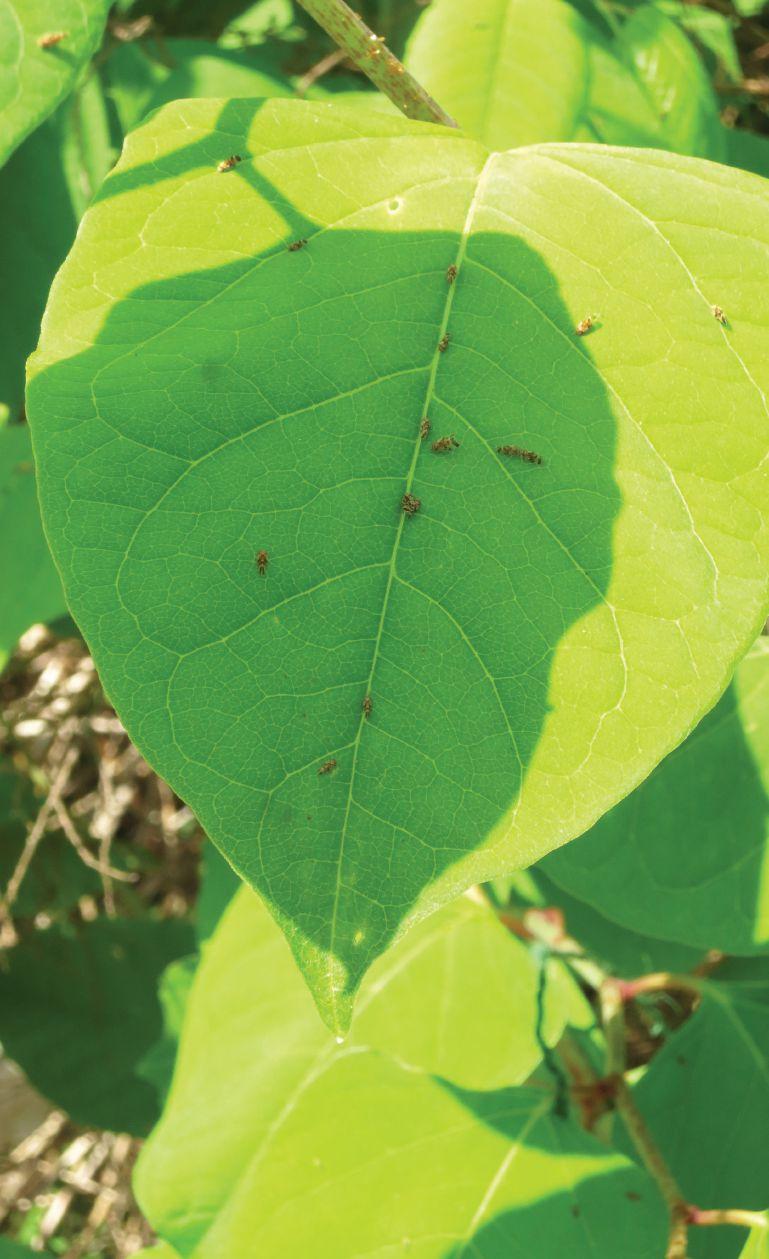
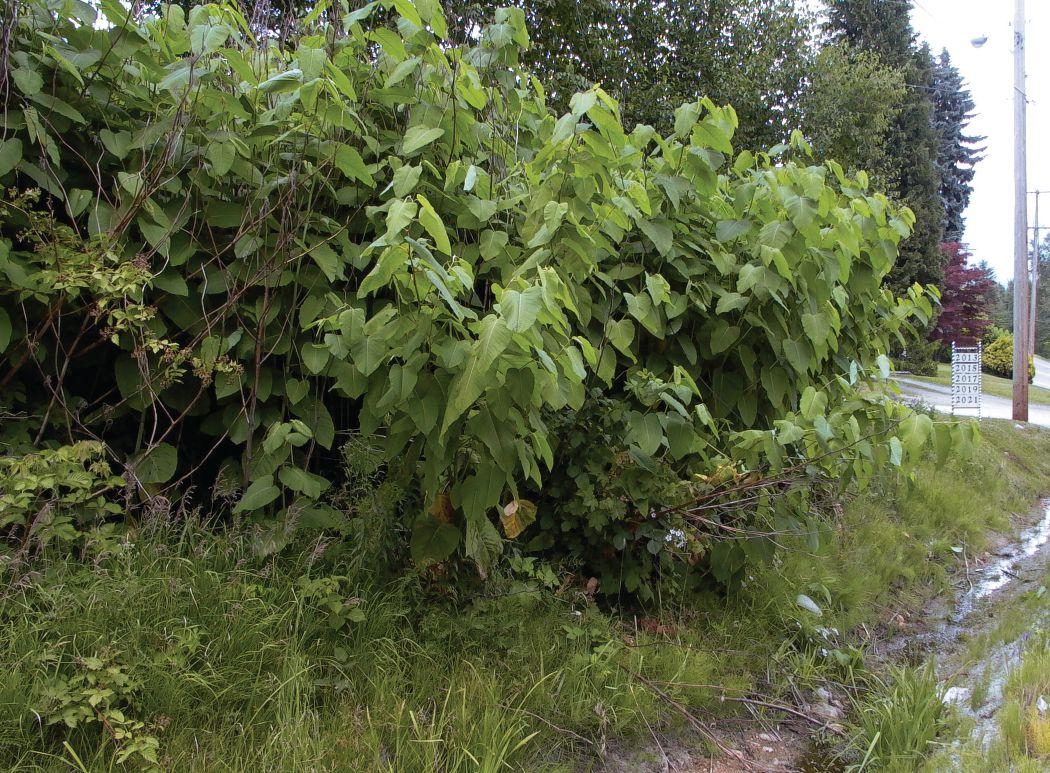
TOP: Along a roadway, this giant knotweed patch has escaped garden cultivation.
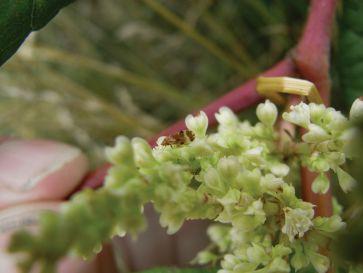
INSET: Single knotweed psyllid Aphalara itadori sitting on knotweed flowers.
Photos
even more difficult for public officials.
“They have been looking at different ways to control it,” Larsen says. “They cut it down, put tarps over it and a fence around it. The tarps need to be left there for about five years, so it’s quite an eyesore. It is unlikely that this method will effectively control the plant.”
Impact
Larsen and colleagues have tried to determine the actual ecological impact of knotweed in dense, established stands.
“You can’t walk through it because there are so many stems. There are no other plant species growing in that area, just bare soil. Where it dies in winter, you have a lot of erosion and sedimentation into streams. You also lose plant habitat for other animals,” he says.
Compared to grassland-type habitats with many more plant species, knotweed was the only plant species where it was established.
Despite this paucity in plant diversity, Larsen found that knotweed patches provided nesting habitat for cedar waxwing and white-throated sparrow. Insects were abundant, and it provided cover for a thriving population of insect-eating shrews.
It is interesting that certain organisms possibly benefit from this altered, alien micro-habitat, he says. However, if left unchecked, a knotweed patch may spread to cover an entire ecosystem.
a two-hectare knotweed patch in northern nova Scotia, was estimated to be at least 50 years old. plants would start emerging in midapril and be fully grown by mid-June. The huge volume of biomass, however, has very little fibre. a square metre of the wet, fresh aboveground material, with 15 to 20 stems, weighs 10 to 15 kilograms.
Control methods
Tarping and cutting are the primary physical controls that are effective. Burning and digging out the knotweed are ineffective. It is too wet to burn, until it dies off.
rhizomes (roots) can extend 10 metres away from a single plant and can be two to three metres deep. a centimetre of living rhizome can produce a fresh shoot.
For confined areas, Larsen hopes a wire mesh will bring the knotweed under control.
“My supervisor, nathan Boyd, and I are working on this idea of using a wire grid, a mesh with half-inch spacing,” he says. “The idea is to cut the knotweed down and put the grid over it. new stems will grow through the grid, be girdled by the wire as they expand, and will die. grass can still grow through and be fine. our lab started this
project in September 2010; we hope to have specific recommendations later this year.”
no herbicides are registered in Canada specifically for knotweed.
Using two alternative herbicide options to glyphosate (roundup), Larsen launched a three-year research program in 2011.
Imazapyr is a non-selective herbicide used for the control of a broad range of weeds including terrestrial annual and perennial grasses and broadleaf herbs. Larsen tried applications in June, at flowering (September) and just prior to fall frost (october).
aminopyralid is a selective hormone-based herbicide manufactured by Dow agroSciences for control of broadleaf weeds on grassland. He applied it in spring as the plant was beginning to sprout.
“aminopyralid originally appeared the most effective because the plants got knocked out right away. Within a day you could see that the plant leaves were starting to shrivel. For imazapyr it took several weeks to observe any herbicide damage,” he says.
However, in 2012, the sites treated with aminopyralid had grown back, somewhat stunted. nothing returned at the imazapyr site.
“For imazapyr, the best times to apply seemed to be when it (knotweed) was fully grown and when it was flowering. We found that imazapyr is the herbicide that seems to be working well. We need to apply it again next year (2013) and see if it is still having the same effect,” Larsen says.
Full recommendations from the research may be released for 2014.
Biological control
Insect ecologist rob Bourchier began a search in 2007 in Japan for a biological control agent to control the knotweed problem in British Columbia. He applied in october 2012 for permission to release trial populations in 2013.
“The insect is called Aphalara itadori,” Bourchier says. Informally, it’s known as the knotweed psyllid.” The sap-sucking flying insect is native to Japan, where it feeds on knotweed. a high population can kill knotweed.
“Aphalara itadori was released in the UK in 2010. It is the first biocontrol agent released for an invasive plant in europe. In Canada, the biocontrol program has been running since the 1950s. over 75 agents have been released, targeting 20 different invasive plants,” he says.
Knotweed psyllid does not occur naturally in north america. It has been in screening trials to ensure that it won’t become a pest here, if it is released.
“as nymphs and as adults, these psyllid suck the sap of the knotweed plant. If you get enough of them on the plant, they will kill it. We demonstrated that in laboratory studies, but we don’t know for sure how well it will work when released in Canada. on the east Coast, an ideal time to release it would be around May 15.”
The proposal is to do between two and six releases. Those populations would be monitored for several years. Since 2010, it has wintered successfully in the UK trials, and those populations are increasing, Bourchier says.
Knotweed psyllid does not appear to have any other host plants available. In a natural cycle, the populations of psyllid and knotweed would stay in balance at a modest, non-intrusive level. “non-target species that are closely related, like rhubarb, have been tested to make sure the psyllid do not feed on them,” Bourchier says.
The ecologist’s hope is that the psyllid, if it is released in a chosen area with knotweed, will complete a life cycle twice each growing season, and that it will at least seriously weaken the knotweed stands so that other plants can compete. In the best scenario, it would kill the knotweed.
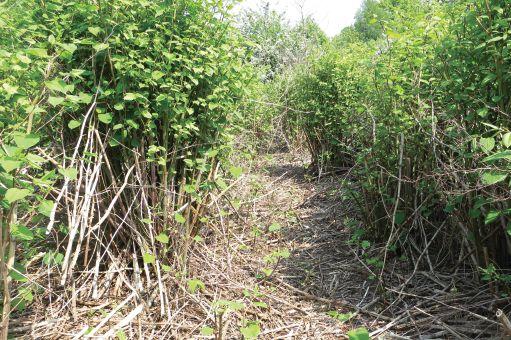
Broken canes from a previous year mark a pathway in this thick stand of Japanese knotweed.
Vibrant plants collect more sunshine.
Crops thrive with Cruiser Maxx® Vibrance™. When the Vigor Trigger ® effect meets Rooting Power ™, you get enhanced crop establishment from stronger, faster-growing plants, above and below the ground. It also protects your soybeans against a broad range of insects and diseases and delivers best-in-class Rhizoctonia control.