Converge® XT contains a patented safener so you can apply it from pre-plant surface right up to the three-leaf stage of corn.
Converge XT provides the same excellent season-long control of both grassy and broadleaf weeds that you’ve trusted with Converge and Converge PRO. With a new wider window of application, you can keep on spraying and spraying and spraying.
Leaf disease focus
Whether related to climate or an increasing incidence, disease issues continue to press growers and researchers with greater urgency.
Crop management
Learning from the past to improve on the future and a new method for applying some inexpensive insurance for the spring.
Plant breeding
Aphid-resistant soybeans are set to arrive in Ontario, and Top Crop Manager Field Editor Dr. Heather Hager tracks the road from research to reality.
Reference information of this calibre is hard to find, so many growers choose to keep Top Crop Manager issues on file. If you have not kept issues for your library, you can find our stories, and more, on our interactive website.
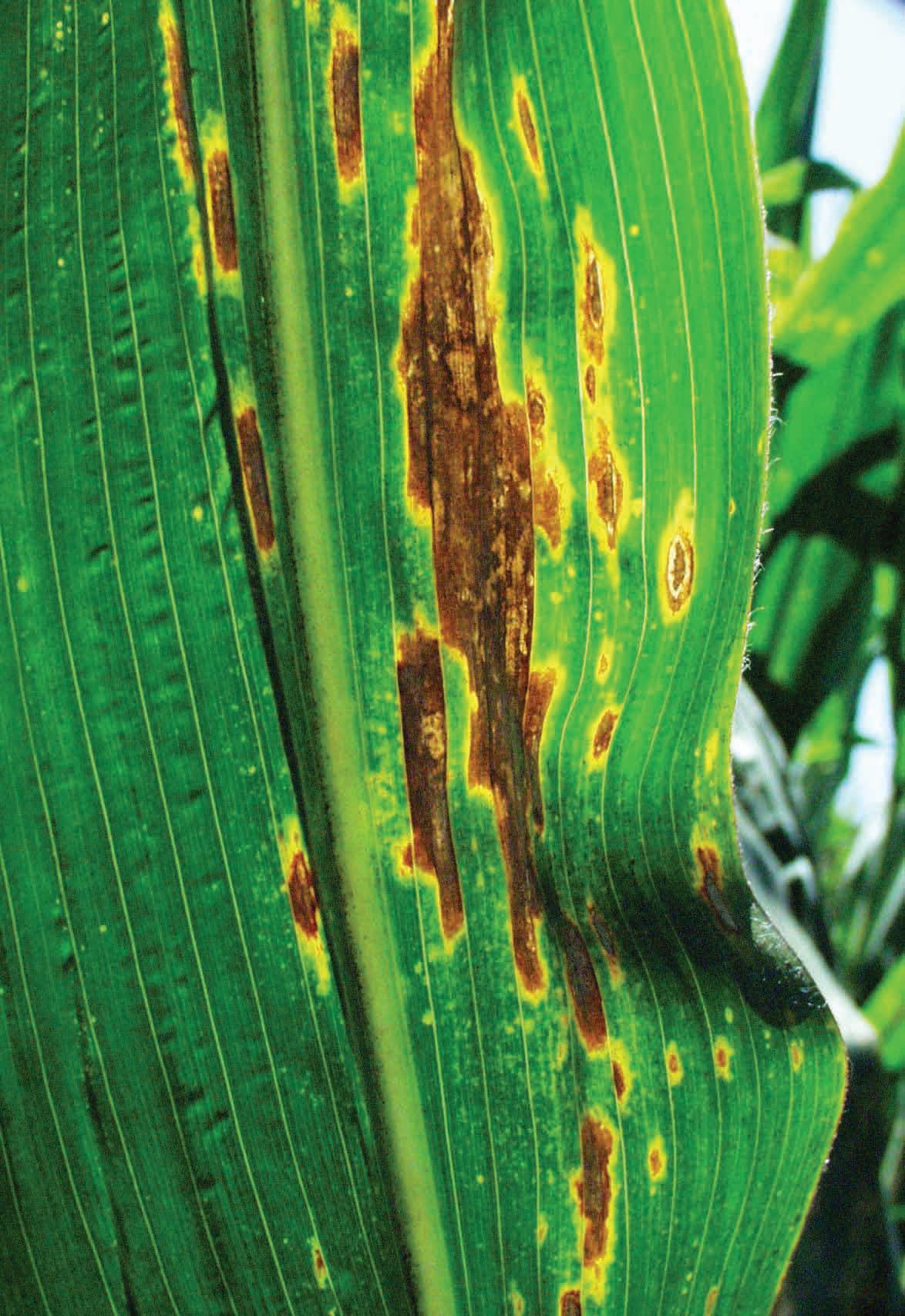
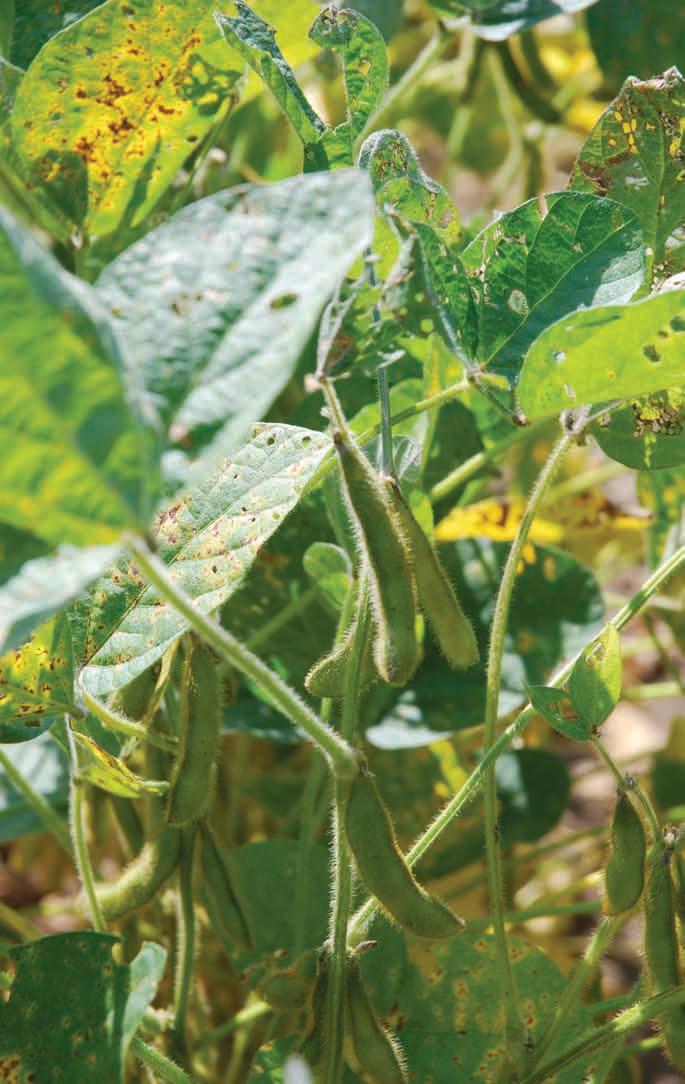
Cover: Leaf diseases are becoming more of a challenge to managing for profitable crop yields.
Kevin Yaworsky • 403.304.9822 kyaworsky@annexweb.com
ASSOCIATE PUBLISHER
Kelly Dundas • 519.280.5534 kdundas@annexweb.com
SALES ASSISTANT
Mary Burnie • 519.429.5175 888-599-2228 ext. 234 mburnie@annexweb.com
PRODUCTION ARTIST
Brooke shaw
GROUP PUBLISHER
Diane Kleer dkleer@annexweb.com
PRESIDENT
Michael Fredericks mfredericks@annexweb.com
PUBLICATION MAIL AGREEMENT #40065710
RETURN UNDELIVERABLE CANADIAN
ADDREssEs TO CIRCULATION DEPT.
P.O. Box 530, simcoe, ON N3Y 4N5
email: mweiler@annexweb.com
Printed in Canada
IssN 1717-452X
CIRCULATION
e-mail: mweiler@annexweb.com
Tel.: 866.790.6070 ext. 211 Fax: 877.624.1940
Mail: P.O. Box 530, simcoe, ON N3Y 4N5
SUBSCRIPTION RATES
Top Crop Manager West - 7 issuesFebruary, March, Early April, Mid-April, July, November and December - 1 Year - $50.00 Cdn.
Top Crop Manager East - 7 issues - January, February, March, April, August, October and November - 1 Year - $50.00 Cdn.
specialty Edition - Potatoe in CanadaFebruary - 1 Year - $9.00 Cdn.
All of the above - 15 issues - $80.00 Cdn.
From time to time, we at Top Crop Manager make our subscription list available to reputable companies and organizations whose products and services we believe may be of interest to you. If you do not want your name to be made available, contact our circulation department in any of the four ways listed above.
All advertising is subject to the publisher’s approval. such approval does not imply any endorsement of the products or services advertised. Publisher reserves the right to refuse advertising that does not meet the standards of the publication.
www.topcropmanager.com
A new year beckons with open fields, open minds!
With winter now a fading memory, April brings a sense of urgency and expectation; the time has come for preparations in advance of that longawaited “planting window”.
This “new year” comes with several significant changes from a year ago. For one, there is little sign of the food versus fuel debate that was a singular focus of the media for many weeks at the start of 2008. Unfortunately, that soured what had been a previously unseen optimism entering that year. In 2009, that all has been replaced by the continuous coverage of the global economic crisis. Odd that economists are now insisting that agriculture is one of the few sectors in the national economy that is relatively recessionproof. Just as surprising is that the media are falling in line to report these statements loud and proud to readers, listeners and viewers.
In spite of all of these factors, what I find most striking in 2009 is the constant swirl of new thoughts and ideas being offered by growers, and for growers. “Farming is as old as the hills,” is a saying that is almost as old. Yet reading through material for this magazine, the willingness of growers to re-examine current practices or to challenge the conventional never ceases to amaze me. It is not always a case of merely trying to shave a few cents off the price of an acre of inputs or save on fuel. Often times, it is a case of tweaking an existing principle or examining the issue from a different perspective. There is a type of fearlessness in many growers that is encouraging, especially in exploring emerging technologies and new market ideas. It may take a visionary engineer to develop the process and then create the technology. But it is an
open mind on the part of the grower that accepts new ideas as a glimpse of the possibilities, seeing opportunity where others see only complications. And the agri-food sector across the country is seeing this trend with greater frequency, and hopefully with fewer barriers.
The stories in this inaugural April edition of Top Crop Manager mirror that same inquisitive characteristic. It is more than a matter of asking “Why not?” instead of “Why?” It is also a case of asking “How”, and being willing and committed enough to see it through to its productive end, whether that end is an improved yield, a new contract with a buyer or a place in the value chain of a new product.
Emerging trends indicate growers have more opportunity, be it in the control of diseases like anthracnose or pests like aphids, increased contracts for food grade soybeans or participation in alternative land-use programs. These and other story topics show that these are indeed, exciting times for agriculture, and that the future beckons here in the present.
So begins what many consider to be the “new year” for growers, not with a fond look back necessarily, but out across the open fields, with an open mind. It is often an open mind that is accepting of new ideas, challenged conventions, and the drive to improve the bottom line.
Know that Top Crop Manager is with you all the way. n
Ralph Pearce Editor Top Crop Manager
Payment for ecological goods and services
by Heather Hager, PhD
The alternative land use services concept receives increasing support.
What would happen if farmers could receive payments for providing ecological goods and services for the benefit of society? Three projects in Manitoba, Ontario, and Prince Edward Island are testing this idea. Under these alternative land use services (ALUS) projects, farmers receive annual land rentaltype payments to provide native habitats and wetlands, native pollinator habitat, shelterbelts, drainage buffer zones, and other services above and beyond the legislated minimum environmental protection. So far, the response to this idea has been overwhelmingly positive.
Three key principles underlie the ALUS concept, explains Bryan Gilvesy, owner of Y U Ranch and chair of the Norfolk County ALUS pilot project in Ontario. “It’s farmer led and farmer driven. It’s voluntary, and most importantly, incentive payments are provided to farmers for providing ecological goods and services.”
Also key to ALUS’s success is that although all three current projects are based on the ALUS concept, each is tailored to address local needs and concerns, local environmental conditions, and local values. The Manitoba project aims to prevent the disappearance of prairie pothole wetlands and riparian areas, which provide essential duck breeding habitat and flood control, and deals with nutrient leaching, salinity problems, and soil erosion. The Ontario project is providing wildlife habitat and addressing water quality, soil erosion, and climate change concerns. And the PEI project is tackling concerns with water quality, soil erosion, and fish and wildlife habitat.
Pilot projects in progress
The ALUS concept was introduced in the late 1990s by Manitoba farmer Ian Wishart and the farm lobby organization Keystone Agricultural Producers. The first pilot project began in November 2005 in the rural
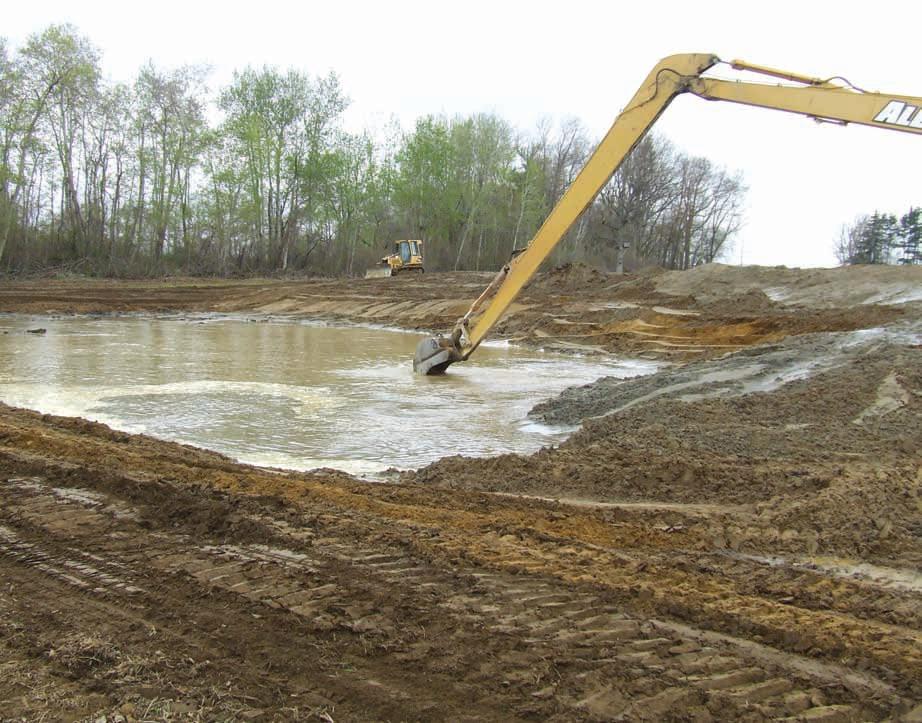
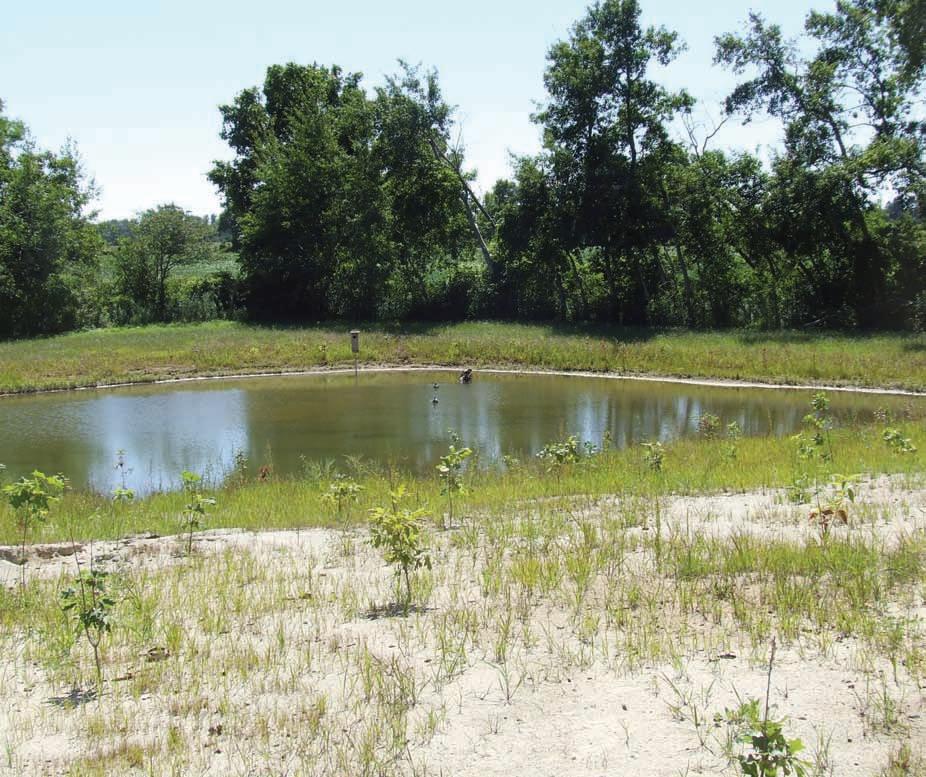
Work began in the spring on creating a wetland area on a farm in Norfolk County.
Native warm season grasses, flowers, trees, and shrubs survived well three months after the creation of this wetland on the same farm. Photos courtesy of eric cleland
Issues and envIronment
municipality of Blanshard, located northwest of Brandon, Manitoba. “The purpose of this ALUS pilot project was to test the ALUS method of conservation delivery, asking will farmers accept it, how much land will they enrol, and what percentage of producers will be interested,” says Robert Sopuck, vice-president of policy for Western Canada for the Delta Waterfowl Foundation, who was involved in the project’s management.
In the first sign-up period, more than 70 percent of eligible landowners enrolled and placed more than 20,000 acres into some form of habitat restoration. Participating farmers received annual payments of $5 per acre for managed grazing areas, up to $15 per acre for natural areas, riparian areas and wetlands removed from row cropping, and up to $25 per acre for specific ecologically sensitive lands removed from row cropping. Farmers had the option of leaving the areas alone or using them for controlled grazing or limited haying, with reduced payments for areas that continued to receive some use.
The three-year project was administered by the Manitoba Agricultural Services Corporation, Manitoba’s crop insurance corporation. The pilot ended in December 2008. The results are being analyzed to evaluate the program’s effectiveness and can be used to fine-tune further projects.
ALUS in Ontario
In 2002, the ALUS concept was introduced from Manitoba to Ontario by the Norfolk Land Stewardship Council, which partnered with the Norfolk Federation of Agriculture to pursue a pilot project, explains Dave Reid, Norfolk Land Stewardship Council co-ordinator. Between 2002 and 2007, the ALUS committee developed proposals, raised funds, hosted a workshop on evaluating predicted benefits, surveyed public opinion, and established four demonstration farms to exhibit the concept to farmers, the public, politicians, and potential funding sources. The pilot was opened to Norfolk farmers in the fall of 2007, and Reid says that it is targeting a variety of environmental improvements on farms over three years beginning in 2008.
Thus far, the main difficulty has been in raising enough funds to support a countywide program to satisfy all farmer demand, says Gilvesy. “Getting the farmers involved has not been difficult at all. In the first
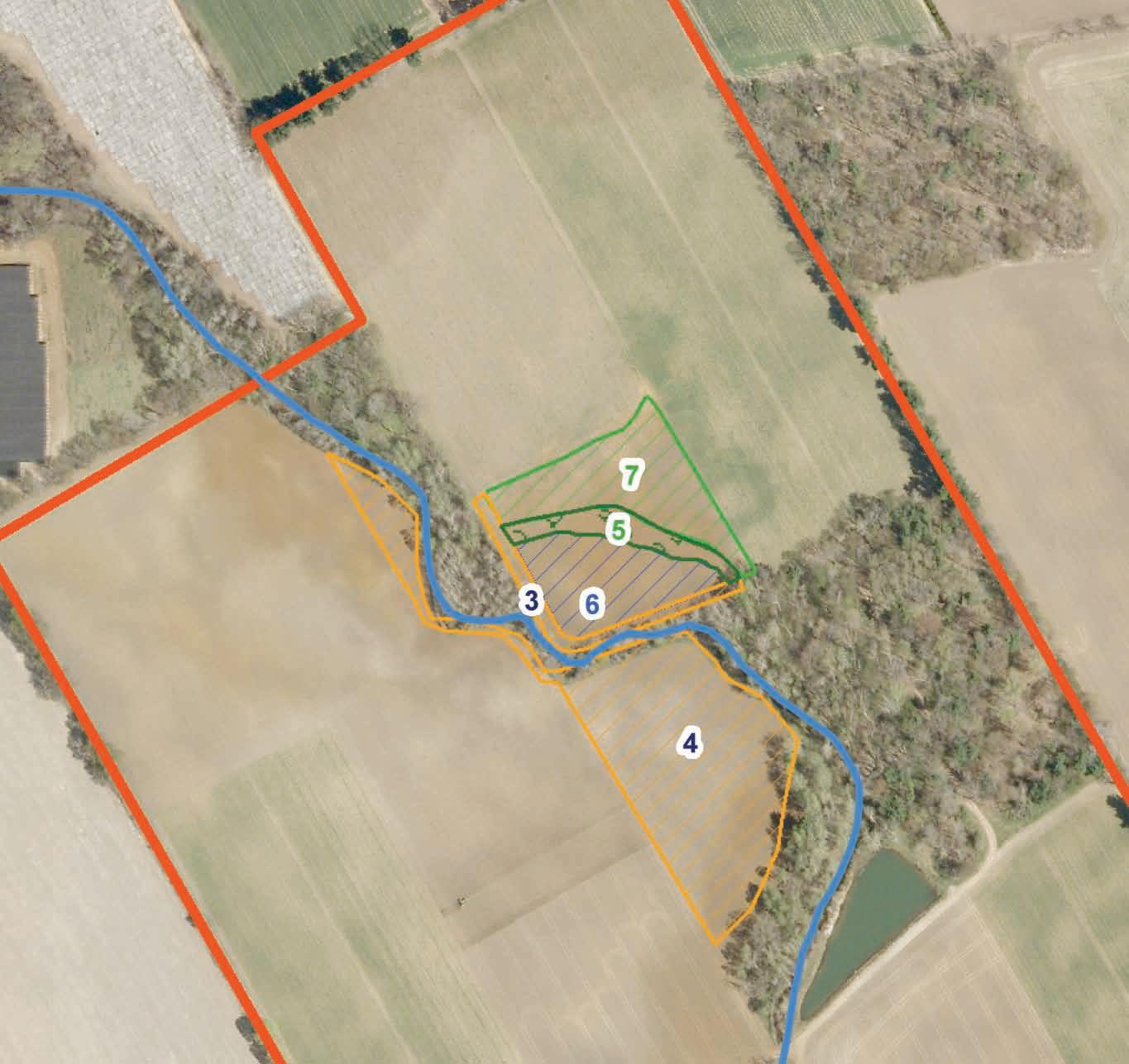
Additional zones of mixed tallgrass prairie (areas 3 and 4), a created wetland (area 6), and savannah (5) and tree plantings (7) act as a complex buffer zone for the waterway.
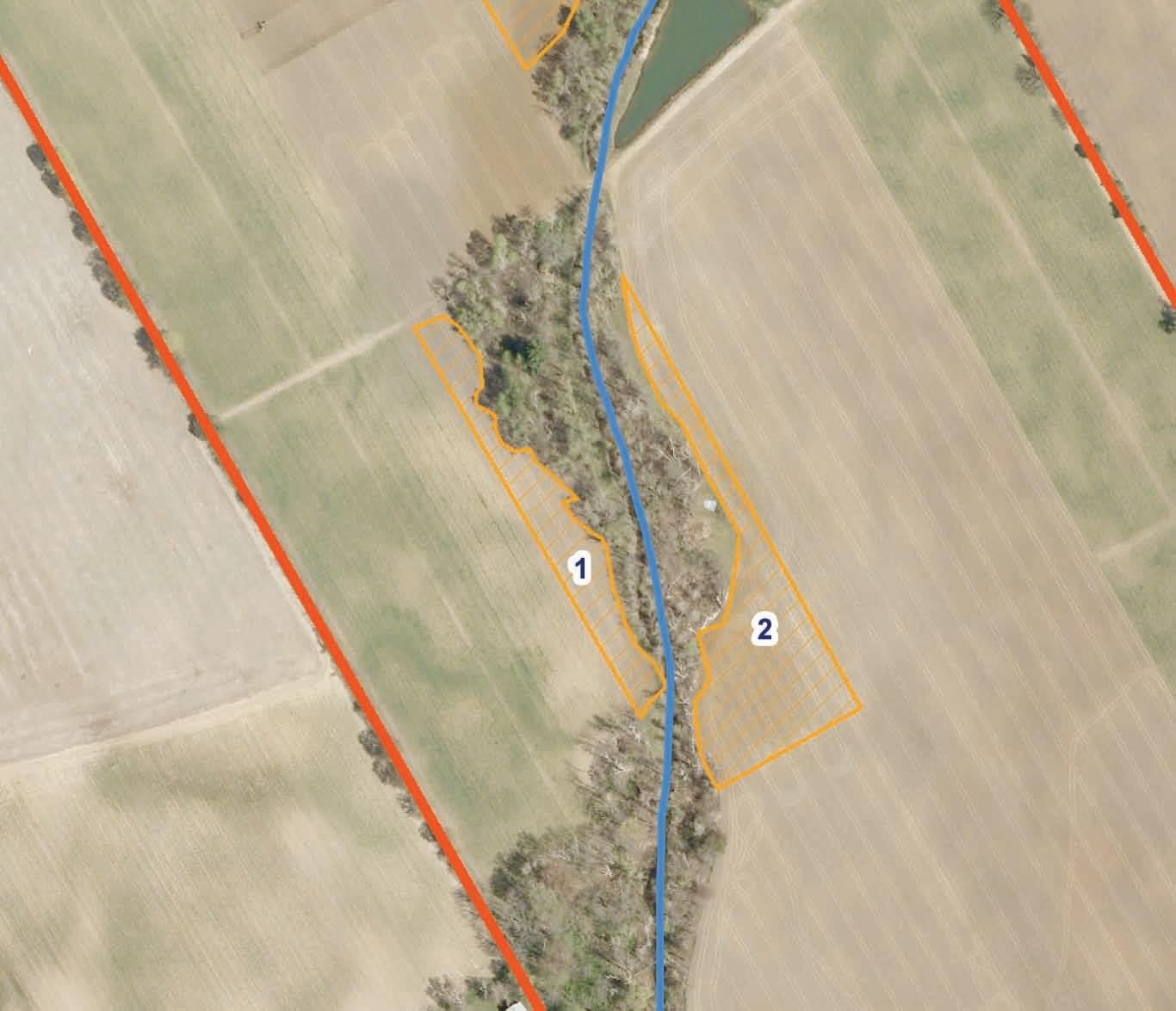
Aerial photographs show one demonstration farm where mixed tallgrass prairie species (areas 1 and 2) were planted to enhance the riparian zone of a waterway that runs through the farm.
Issues and envIronment
planting season, 28 farmers came forward and 216 acres of new projects went into the ground. So it’s a fairly significant contribution of land.”
ALUS is not only tailored to different regions, the individual projects are tailored to each specific farming operation. The landowner decides what sort of projects will fit into his or her operation in consultation with ALUS technical advisors during site visits. Some of the projects that have been installed so far include native tallgrass prairie and oak savannah, windbreak hedgerows, stream and wetland buffers, created wetlands, reforestations, waterfowl and
bluebird nesting boxes, and habitat for native pollinators like solitary bees.
In Norfolk County, each farmer is responsible for performing basic site preparation and maintaining the installations such as by providing weed control while the native vegetation establishes. “We have a Norfolk Environmental Stewardship Team that comes in and plants the cover that’s agreed upon, whether it’s trees or grasses or pollinator habitat, or whether we’re constructing a wetland,” says Gilvesy. The ALUS program also pays the up-front costs of the establishment. In return, the farmer receives an annual payment, which, for the pilot, is
Developments in federal farm policy
Recent policy discussions and recommendations should be influencing the adoption of alternative land use services (ALUS) programs as national policy for Canada, suggests Robert Sopuck, vice-president of policy for Western Canada for the Delta Waterfowl Foundation. The June 2007 report of the Standing Committee on Agriculture and Agri-Food, which reviewed Agriculture and AgriFood Canada’s (AAFC) Agricultural Policy Framework for 2003 to 2008, made two specific recommendations on environmental programs. First, that farmers be compensated for generating environmental benefits, that their stewardship role be recognized in the new agricultural policy and that federal-provincial cost-shared compensation be provided when the market does not support best management practices. Second, the committee recognized that other countries have such environmental programs and recommended “…that Canada’s agricultural policy include a voluntary program under which private agricultural land could be used as a tool for conserving and developing environmental resources,” with government-provided financial support for this land stewardship.
As well, in December 2008, the Office of the Auditor General released a performance audit by the Commissioner of the Environment and Sustainable Development. The audit evaluated the management of the Environmental Chapter of the Agricultural Policy Framework. It stated that AAFC’s own evaluation of its Environmental Chapter noted both “slow uptake of the programs” and that “the number of projects funded and completed as of 31 March 2006 fell far short of targets,” although that improved to 75 to 95 percent of targets for most programs by 2008.
In contrast, the uptake and implementation of the ALUS projects as they have become available has been swift, with much interest from farmers outside the project areas. And an ALUS-type program would appear to fulfill the recommendations of the Standing Committee.
Further reading
Report on the Fact-Finding Mission on Canada’s New Agriculture and Agri-Food Policy, Report of the Standing Committee on Agriculture and Agri-Food (June 2007). http://www2.parl.gc.ca/HousePublications/Publication.aspx?DocId=3066010&Lan guage=E&Mode=1&Parl=39&Ses=1
Commissioner of the Environment and Sustainable Development report (December 2008), Chapter 3—Managing Environmental Programming—Agriculture and Agri-Food Canada. http://www.oag-bvg.gc.ca/internet/English/parl_ cesd_200812_03_e_31820.html
based on the average local land rental rate of $150 per acre per year.
“The farmer is in the program completely voluntarily and can get out as well,” says Gilvesy. “We have the farmer sign a simple conservation agreement that outlines the landowner’s and ALUS’s responsibilities, and that’s it.” If the farmer chooses to opt out of the three-year contract before it ends, a pro-rated portion of the up-front costs must be refunded.
Even though the land is no longer in row crops, it can still help the farmer’s business of farming. “Ultimately, we are not getting the very best piece of farmland, but maybe the more marginal pieces, which for conservation are probably the most desirable,” says Gilvesy. “Each farmer has made his own decision that it’s better economically for him or her to put that parcel into environmental service, rather than to continue to crop it. I think that’s just a decision based on dollars and cents and the productivity of the site.” Other benefits to the business might include: increased numbers of native bees for pollination; late-season grazing of cattle or harvesting of biomass in tallgrass prairie, for which annual payments would be reduced because of the continued use; and “an image boost in your consumers’ eye that you’re doing something that’s beneficial for the wildlife,” says Gilvesy.
PEI ALUS program
Prince Edward Island is the first jurisdiction in Canada to have an official ALUS program across the entire province. And again, the program is somewhat different from the pilot projects in Manitoba and Ontario. “We’ve taken a concept that was developed in Manitoba and Norfolk and made it work for our situation,” says Shawn Hill, ALUS program co-ordinator for PEI. “We have seen the results from the pilot, an ecological goods and services pilot project that focused on two watersheds in PEI, and we are aware of the costs and environmental outcomes. Accordingly, we have moved beyond the pilot stage and have adopted ALUS as a fully funded provincial program across our entire jurisdiction.” The program is administered through the PEI Department of Environment, Energy, and Forestry, and was developed in consultation with community stakeholders, including public, agriculture, tourism, watershed and environmental
Issues and envIronment
groups, construction, and commercial fishing representatives.
Because of intensive agriculture and serious environmental issues such as soil erosion and nitrate leaching into the groundwater, the PEI Department of Environment, Energy, and Forestry has traditionally been involved in a very regulated approach to the environment. “We have minimum standards and laws that people have to abide by, but I don’t think it was really getting us where we wanted to go as a province,” says Hill. “We still have a number of issues with relation to our environment, and some things were not improving the way we hoped. We looked at the ALUS concept and saw a lot of value in empowering farmers directly in conservation through an annual payment.”
Hill says that in the past, farmers may have known about additional environmental services that they could provide, but they could not participate without economic loss. “By having the program here and having the government behind it as policy, it’s a market signal towards the industry that we want to reward them for the good things they’re doing and get more of it.” Hill thinks that the benefits of such a program will be extensive. “We have an annual budget of $750,000, which is not really that much money relative to the outcomes that we can get from such a program.”
The PEI ALUS program is funding several specific activities: reforesting buffer zones
next to waterways, expanding buffer zones, establishing grassed headlands outside of buffer zones, retiring high-sloped land, and installing structures such as diversion terraces and berms to reduce soil losses. “Most of our rates are at $185 per hectare ($75 per acre) per year,” says Hill. “The high-sloped land is $100 per hectare ($40 per acre) to reflect the lower production value of highsloped land. For land that’s used by soil conservation structures, we’re paying $250 per hectare ($100 per acre), and that number is a bit higher to reflect the decreased efficiency of the farming operation.” To arrive at these rates, an environmental economist surveyed producers in two watersheds to get a range of values for each activity, and the median rates were chosen.
The first projects will go into the ground in 2009. The program started taking applications in mid-January 2009 and by the end of February had already received 80 applications covering 600 agricultural fields. “In terms of the producers in the province, there seems to be a lot of support for the concept,” says Hill. “I think this is something that a lot of farmers have wanted for a long time, probably across the country, not just here.”
Other considerations
Although the program details differ among the locations, there are general consistencies to ALUS. For example, it does not target prime agricultural lands. Instead, it targets
riparian and wetland areas and ecologically sensitive lands. The latter are defined as Class 4 to 7 lands that are at risk of severe water erosion, wind erosion, flooding, salinity, runoff, or leaching. And there is a cap on the proportion of land that each participant can enrol.
In international trade agreements under the World Trade Organization, environmental programs such as ALUS fit into the green box category for agricultural subsidies and thus are unrestricted. However, Canada has been slow to take advantage. “Canada is the only industrialized country that does not have this kind of incentive program for landscape conservation,” states Sopuck. The United States, the European Union, Australia and New Zealand all have incentive-based environmental conservation programs for agriculture.
“We’re working very hard to advocate for the alternative land use services concept at the provincial and federal levels right now,” says Sopuck of the efforts of Delta Waterfowl and its various farm group partners. He says that despite the fact that the concept has been well received by the public, agricultural producers, and elected officials, “it has been an uphill struggle because what we’re asking for is not in the mainstream of current Canadian agricultural policy. We’ve been after this for about 10 years now, so we’re making some progress, but when you’re asking for a revolution in policy, well, revolutions take time.” n
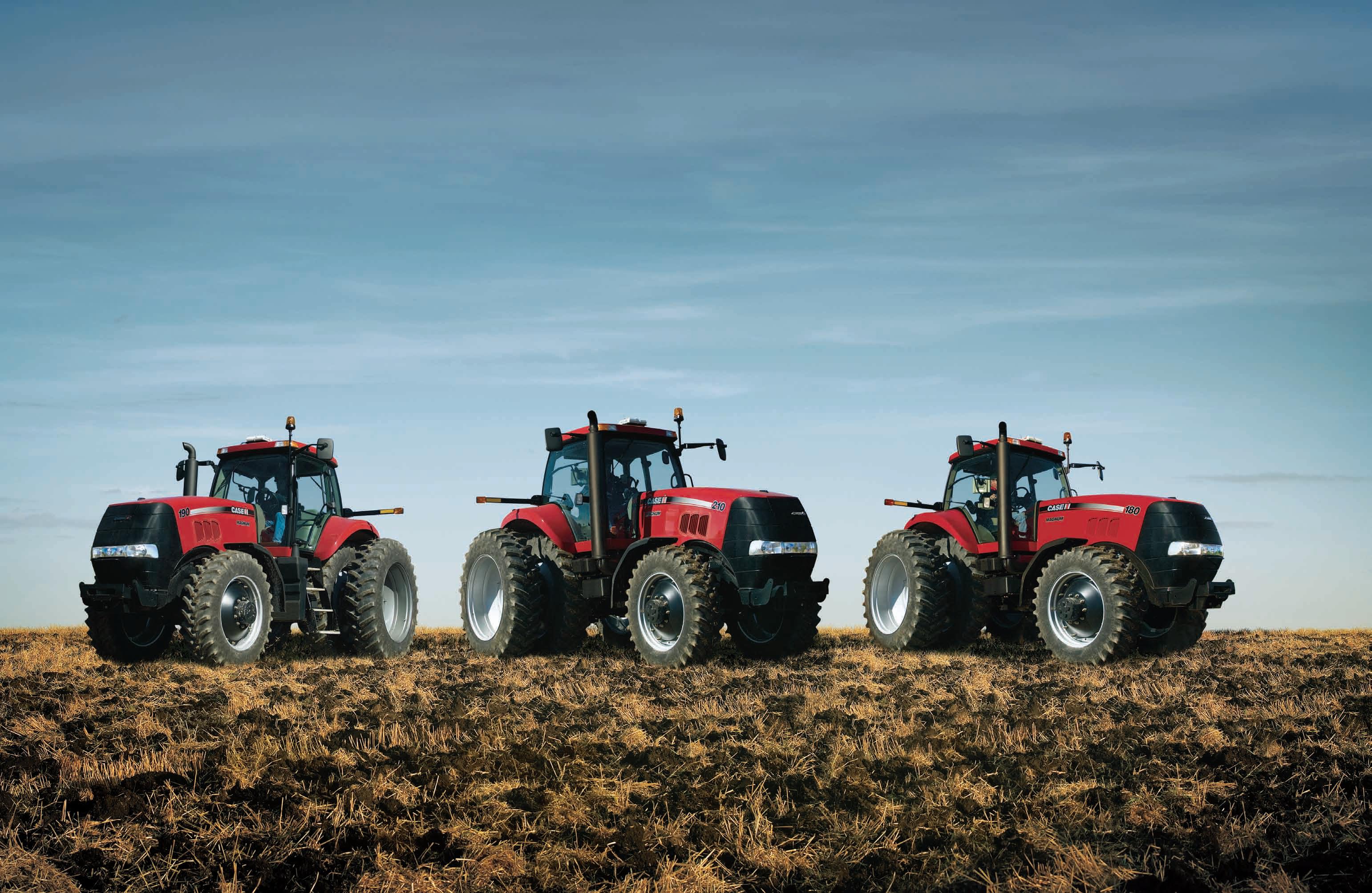
INTRODUCING THE 180, 190 AND 210. THE MAGNUM FAMILY JUST GOT BIGGER. OR SHOULD WE SAY SMALLER?
The new class of Magnum™ tractors from Case IH® are true row crop tractors in every sense of the word. With industry leading cab size, intuitive controls and an unmatched turning radius, they give you the power and confidence to farm the way you want to farm. To experience the new Magnum 180, 190, and 210 HP tractors, built right here in the US, visit www.caseih.com.
Pests and
Anthracnose in corn: the eastern Canadian snapshot
While incidence continues to increase, new resistant hybrids are being developed.
Incidence of anthracnose in corn in Ontario and Quebec is growing, and that growth is expected to expand during the foreseeable future.
Albert Tenuta, extension plant pathologist for field crops with Ontario Ministry of Agriculture, Food and Rural Affairs, says the disease is a significant concern in the province, noticeably impacting on overall corn yield. However, anthracnose incidence is variable, and depends on location, rotational schedule, weather and hybrid choice. “We’ve seen an increase in anthracnose leaf blight and dieback over time,” says Tenuta, “surprising not just in Southwestern Ontario but Eastern Ontario as well.
Dr. Steven King, senior research manager with Pioneer HiBred in Tavistock, Ontario, says the increased incidence in Eastern Ontario is largely a result of farming practice choices. “There are more corn-corn rotations seen in Eastern Ontario and Quebec, and that’s mostly due to economics,” he says. “The incidence in those areas was very high in 2007, with large differences in disease severity seen in hybrids that are more susceptible.”
“Any agricultural practice that leaves residue on the soil surface increases your risk of these types of diseases,” adds Tenuta. “The worst thing farmers can do is leave residue on the land and grow the same crop year after year.” The anthracnose fungus primarily survives from year to year (overwinters) in corn residue, and does very well in warm, wet weather.
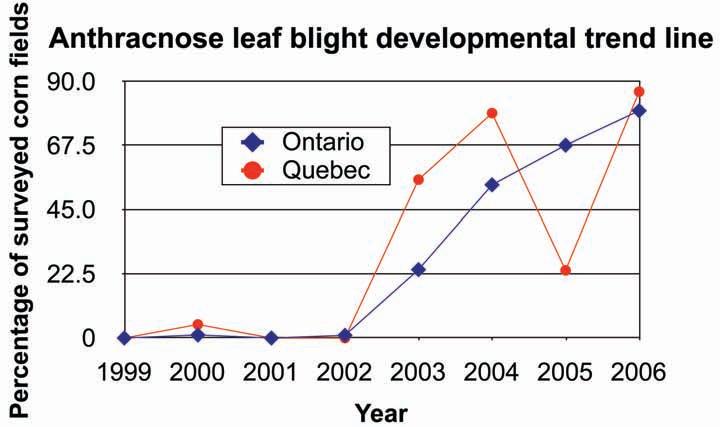
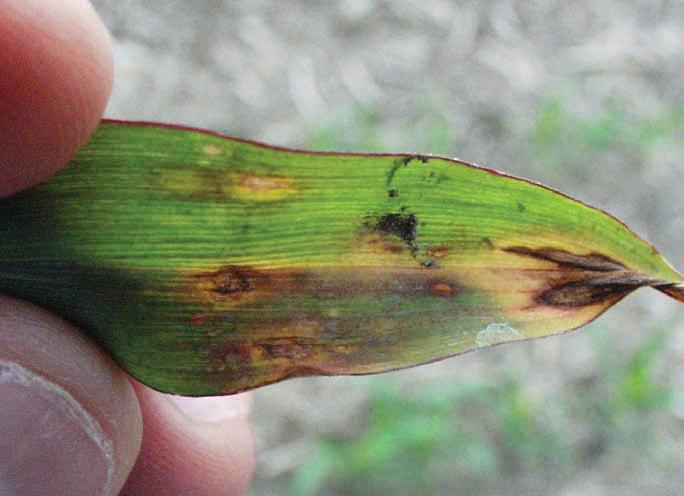
Tracking the incidence of anthracnose in corn in Ontario and Quebec shows a marked increase in less than 10 years.
GraPh and Photo courtesy of albert tenuta, oMafra
During the last six years, a team that includes Tenuta and Ottawa-based Agriculture and Agri-Food Canada scientists Dr. Xiaoyang Zhu, Dr. Lana Reid and Tsegaye Woldemariam, has conducted surveys of anthracnose leaf blight in corn fields in
by Treena Hein
is
both Ontario and Quebec. Among examined fields in Ontario in 2002, virtually no disease was observed. In 2003, that rose to 25 percent, followed by 55 percent in 2004, 68 percent in 2005 and 80 percent in 2006.
In surveyed Quebec fields, incidence rose from very little in 2003 to about 79 percent in 2004, dipping to roughly 24 percent in 2005, and then reaching 86 per cent in 2006.
Resistant hybrids
Pioneer Hi-Bred scientists have been working for several years to boost the anthracnose resistance of several North Americanadapted hybrids in their lineup. This has been accomplished through incorporation of genes from South American varieties.
King says “You always have to look at sources for new genes. At Pioneer, as with other large companies, you have operations around the world where you have access to local gene pools.” Resistance to anthracnose was observed in some South American plants and through the use of genetic markers, these genes are bred into hybrids adapted to Ontario and Quebec climate and growing conditions. “By using molecular markers, we are able to determine if the resistance genes of interest have been successfully transferred to new hybrids. This allows us to much more efficiently track these genes in the breeding population, rather than relying on growing the phenotype and observing its degree of resistance. The markers tell us if the gene is there or it’s not.”
King adds, “We then ‘characterize’ the resistance of our experimental hybrids by introducing the disease and assessing their reaction to disease. This particular set of genes from South America has increased the resistance score of hybrids in question by two points, which is very significant.” These new hybrids will be introduced in the US in 2009 and in Canada most likely in 2010. n
Anthracnose incidence
variable, and depends on location, rotation schedule, weather and hybrid selection.
Quality worth protecting.
Folicur® provides an unmatched level of complete disease protection in wheat. Protect your investment from disease pressures, including rust, tan spot and Fusarium head blight, which can diminish the yield and grade of your wheat crop. Folicur provides a level of security that you can’t afford to pass up.
Heeding the lessons of 2008
Act quickly to control disease, rotate crops and have faith that diseased crops can recover.
Crop producers looking to get the most out of the 2009 growing season need look no further. Top Crop Manager consulted several experts on the practices they saw in 2008 that should, and should not, be used in 2009. “What I learned is more of a reinforcement of what we already know rather than anything new,” says Chad Anderson, a certified crop advisor based in Brigden, Ontario. “Rotation is very important. In terms of the spindle streak virus we saw in wheat in 2008, quite a bit was in fields where the rotation was wheatsoybean-wheat. I found myself being able to predict that this was the rotation in the field from the extent of disease I saw.”
Anderson says one grower he worked with saw a 10 percent yield improvement across his bean and corn yields when there was a three-crop rotation over a two crop, probably due to lower disease pressure.
In another situation, in fall 2007, a grower planted a field with half corn and half soybeans, where the year before the entire field had been wheat. In 2008, he planted the whole field with the same variety of soybeans. In comparing the two soybean harvests, Anderson says the first-year soybeans outyielded the second year beans by 12 bu/ac. “It’s simply a huge response,” he says. “The lesson learned here is rotation pays. In a year like 2009, where everyone is scrambling to determine what to grow this spring, it goes to show that keeping it simple and staying to a solid rotation is a more dependable way to improve bottom lines versus trying to out-guess the market.”
Another factor to consider besides rotation in terms of keeping yields high in winter wheat is when to plant, says Peter Johnson, cereals specialist with the Ontario Ministry of Agriculture, Food and Rural Affairs. “I saw some growers in Exeter planting winter wheat at the end of August in 2007. That is too early,” he cautions. “Fields planted the second week of September gave much better yields.”
Have faith
The one observation of 2008 that strikes Johnson over all others is the resilience he saw in winter wheat. “I’ve been astounded by wheat’s ability to recover from disease and environmental stress,” he says. “Growers should consider the fact that even if there’s been damage done, the yield may turn out to be much more than they might have imagined.”
For example, high temperatures in fall 2007 resulted in far more top growth in winter wheat than normal, and powdery mildew ran amok. However, Johnson says that farmers need not have worried. “Fall disease control most years is not going to make a difference,” he notes. “Just let it go. The crop will be okay.”
Similarly, in early 2008, the dearth of snow and top growth
by Treena Hein
resulted in significant snow mould infestations. Again, not to worry, says Johnson. “Wheat can definitely recover from this, but if you’re going to plant early in the snow belt of Ontario where snow mould is expected, you should keep your seeding rate low. Reducing seeding rates by 25 per cent significantly reduces snow mould development.”
In the spring of 2008, Johnson also observed the use of herbicides such as bromoxynil during some low temperature periods resulted in a lot of leaf injury. “It looked really terrible, but it turned out to be no big deal. The plants bounced back,” he says. “Conversely, with the hormone herbicides, I saw a lot less visual symptoms, but a greater yield loss resulted. Don’t jump to conclusions.”
Likewise in 2008, it seemed that the spindle streak virus would impact yield significantly, but it did not. “In the case of the army worm outbreak, the worst I’ve ever seen, lots of spraying helped,” says Johnson, “Still, yield loss in unsprayed
One lesson worth learning from 2008 is to maintain rotations.
fields ended up being less than anticipated, from 5 to 15 bu/ac.”
“But growers have to do their spraying right away,” he says. “There’s no use in doing it after the damage is done. All you’re going to do is waste your time and money.”
More options, better control Anderson also believes that more growers should act early, in this case with weed control. “Early season weed control and the value pre-emerge or early season herbicides give good advantages in protecting yield,” he says. “With the increased use in Roundup Ready corn last year, it was easy to see fields where growers had delayed applications due to the wet weather.”
In some cases, Anderson says the early season weed pressure caused the corn to exhibit nitrogen deficiency. “These fields never caught up and yield loss was the result,” he notes.
Jonathan Klapwyck, Pride Seeds product development and agronomy manager, agrees. “Many late applications of glyphosate were made to Roundup Ready corn in 2008. Ontario corn yields could single-handedly be increased if RR corn growers ensure weed control during the critical weedfree period, generally from two to eight leaf corn.”
Anderson adds, however, that even in situations where glyphosate spraying was late during 2008, “Where we used some pre-emerge chemistry, we had excellent weed control, especially since we had lots of moisture to activate. These fields had light weed pressure which we addressed with Roundup, but never enough to cause a yield threat.”
Anderson says using some residual herbicide in Roundup Ready soybeans is becoming popular in Michigan. “This is something that I am interested in trying in 2009 to see if we can protect some yield here as well because it certainly pays big dividends in corn,” he says.
In terms of other advice for corn, Klapwyck says, “Plant early, when conditions are fit. Some of the best corn planting conditions were the week of April 20 in 2008.” n
Weed management
Pesticide market update
by Blair Andrews
Concerns about pesticides cannot stop the increasing world demand for food.
As other business sectors struggle in the wake of the economic downturn of late 2008, the pesticide market is booming. A report from market research publisher Specialists in Business Information (SBI) shows just how strong the crop protection market has been through much of 2008. SBI estimates the global pesticide market surged 29 percent over the 2007 level of $40.7 billion (all figures in US dollars) to $52.4 billion, a record increase that came at a time when a global financial crisis was in full swing. Despite the economic instability and increased pressure from environmentalists and the media, forecasts for the pesticide industry are calling for double-digit growth for several years after 2009.
In his assessment of the pesticide market, Peter MacLeod, vice-president of the chemistry division of CropLife Canada, (the industry trade association) says the crop input industries are being driven by the success of agriculture. “Agriculture is facing the huge challenge of feeding a growing world population, compounded by the fact the new middle class in developing countries like China and India has been creating a higher demand for meat products,” explains MacLeod. “They want to go from a starch-based diet to adding more meats into their diet. This compounds the demand effect for feed grains in livestock production. There’s certainly an increase in demand for food and feed globally.”
Food and feed demand is only part of the story. MacLeod says there is also the bio-products industry that uses crops like corn and soybeans to make a host of renewable products. “So there’s demand coming from all sides as well as the traditional food market to meet the world’s growing population. We’re talking 9.5 to 10 billion people by 2050. That’s a real challenge,” says MacLeod, referring to
High weed pressure is the primary concern for growers using herbicide, but drought, and other environmental factors in other parts of the world, will drive demand as well.
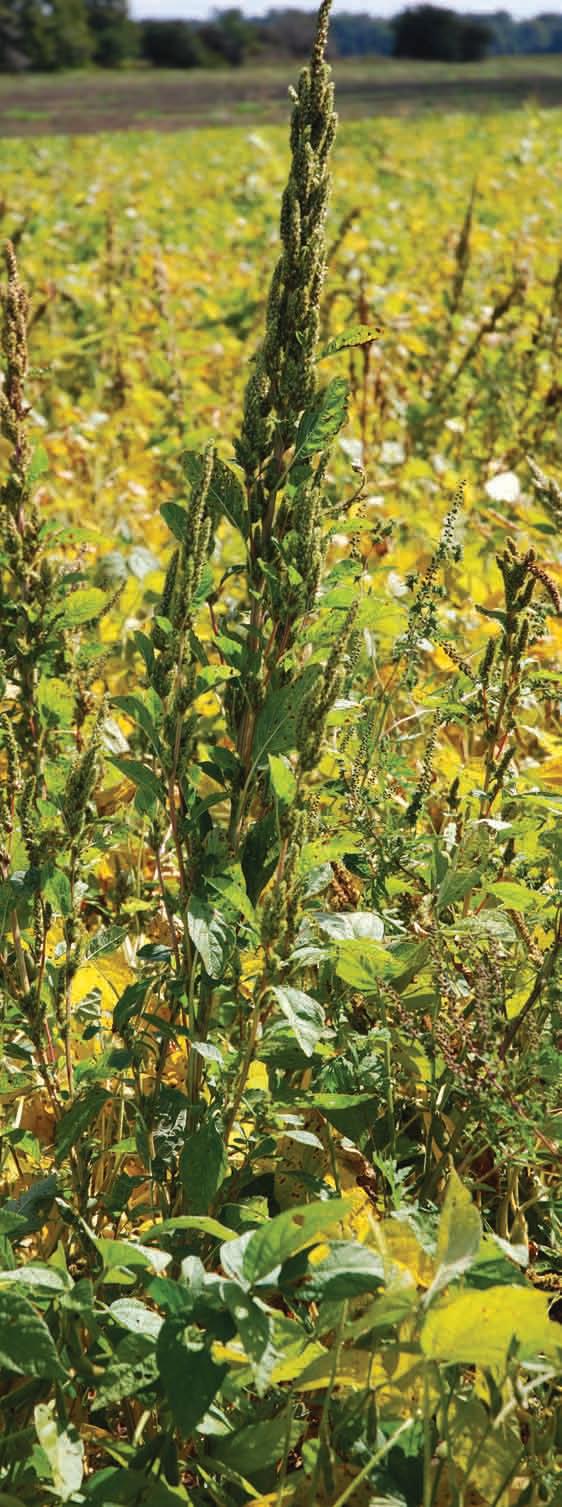
The new soybean herbicide that offers protection against tough weeds including Eastern black nightshade.
Get the herbicide that gets you unparalleled weed control with unmatched residual against tough weeds like Eastern black nightshade and even weeds resistant to Group 2 and Group 5 herbicides. Not to mention great rotational flexibility with no rotational restrictions or carryover into next year’s crop.
Weed management
population estimates from the Food and Agriculture Organization of the United Nations.
Weather playing role in demand
The need to feed to this population that is growing in both size and affluence presents agriculture and related industries with some solid market fundamentals. Despite increasing concern regarding pesticide use, Dr. Gord Surgeoner, president of Ontario Agri-Food Technologies (OAFT), agrees with the strong outlooks for the pesticide market. In addition to the need to provide food, Dr. Surgeoner says weather conditions will also play a role in the demand for pesticide products. “I do see a fair bit of drought impact in the southern hemisphere in places like China, Australia and Argentina. We will need pesticides because of the large acreages we will handle. The use pattern depends to some degree on weather, but we absolutely need these products.”
OAFT is a non-profit organization comprised of members from grower associations, universities, industry and governments. It focuses on ensuring Ontario producers have access to the latest technologies.
MacLeod expects that the growth in the North American market will be lower than in other parts of the world. Echoing Surgeoner’s comments, he notes that the pesticide industry responds to demand, especially if there is a pest outbreak. In general terms, he is of the opinion that the market will be steady in the European Union, there will be growth in North America in the range of three to five percent and the growth in parts of Asia and South America could likely double the North American figures in the coming years. “It depends on the areas that are increasing production right now in Asia and South America,” says MacLeod, adding that a lot will depend on how well agriculture will perform. He notes commodity prices will impact on the crop protection industry. “When things are in low ebb, farmers are still going to use these pest management tools, but perhaps using different types such as lower cost weed control and accepting a higher level of insect or disease damage when crop prices are low.”
Food products are being shipped farther abroad and in greater volumes, meaning the need for herbicides, pesticides and fungicides will go up, not down.
Chemical industry complements biotech innovations
As for the conventional industry moving forward under more pressure from the “eco-movement” and the media, MacLeod says the continued emphasis on innovation and sustainability will continue to be key parts of the strategy. “There’s a real crunch in meeting that challenge in feeding the growing population without converting more land into farming. So we need to be more productive per hectare. We don’t want forests, wetlands or natural protected areas converted into farmland.”
MacLeod says the drive for productivity boosts the demand for pest control technology as well as biotechnology. He cites the work on developing more drought-tolerant crops and more salinetolerant crops as examples of increasing the productivity of the current land base as well as turning marginal land into productive farmland.
Surgeoner adds that innovation and the drive for better productivity also have led to a significant reduction in the volumes of pesticides used by Canadian farmers. This reduction, he says, should not be overlooked in the debate concerning pesticide use. “The management of pesticides is far better today than it was even 10 years ago,” notes Surgeoner. “The idea that we all need to have a license in order to apply these is very critical for the good will for society at large.”
Lack of science hurts pesticide ban Debate concerning pesticides is heating up in Ontario, fueled by a ban of cosmetic pesticides that goes into effect on April 22, 2009. The agriculture and forestry industries are exempt but this has not eased concerns that they could be next on the list. The ban prohibits the sale and use of pesticides for cosmetic purposes on lawns, gardens, parks and school yards, and includes many herbicides, fungicides and insecticides. More than 250 products will be banned for sale and more than 80 pesticide ingredients will be banned for cosmetic uses. While the pesticide industry continues to speak out against the ban, Surgeoner adds that innovation will drive the development of alternative products. “I think you’re going to see people respond to the lack of control. I have all kinds of neighbours asking where they can get glyphosate because weeds are all over the place in their stone driveway. So I think you are going to see some innovative products come down the pipeline that will be used in urban environments.”
As the debate evolves Surgeoner would like to see some evidence that cosmetic pesticide bans have the desired effect of reducing cancer rates and other health problems, particularly in children, by limiting the exposure to the chemicals. “If we are going to go to this giant experiment of banning these things in urban in environments, let’s start the epidemiology studies now,” says Surgeoner. “If we look at cancer rates of children before and after, is there any difference? I don’t see anybody setting up the programs to evaluate if this had any impact on human health. I think that should be done given the amount of change that it is causing.”
Surgeoner also says consumers have to be reassured that pesticides are rigorously tested and evaluated by Health Canada, and that products are also used to ensure a safe food supply. “They have been shown not to represent unacceptable risks to human health and the environment. And many higher risk compounds like molds will develop if we do not have these kinds of chemistry.” And while farmers are exempt from the legislation, Surgeoner encourages them, for their own interests, to get involved in the discussion. “Farmers use these products every day. They know the value of them and they understand that they cannot compete globally if they don’t have these products.” n
“Am I applying the right amount of fertilizer to achieve my yield goal?”
That question was posed to us by a corn grower in Ontario and we promised him an answer he could depend on. Equipped with the collective knowledge of hundreds of Cargill agronomists worldwide, our team set out to measure, analyze and compile data from the grower’s farm each week for an entire season.
Their conclusion? Not only could he apply his fertilizer more efficiently without impairing yield, but he could also save money through a better understanding of his soil conditions, an improved seeding rate and the proper herbicide application.
As a result of Cargill’s expertise, there’s now a grower out in Ontario with a better corn crop, bigger wallet and greater confidence.
IP soybeans looking stronger in 2009
by Blair Andrews
Demand for soy food products could drive premiums for growers.
Backed by attractive premiums, growers of Identity Preserved (IP) soybeans in Canada have good reason to look forward to a stronger market in 2009. In general, premiums are up by approximately $1.00 per bushel from 2008. The combination of lower prices in Chicago and premiums in the range of $2.50 to $3.00, or more, is definitely getting the growers’ attention. “There’s certainly interest in the countryside when there’s the possibility of better returns. Whether it’s through pricing at the Chicago Board of Trade or premiums associated with IP contracts, growers are seeking out those opportunities,” says Jim Gowland, chair of the Canadian Soybean Council. Gowland, who farms near Holyrood, Ontario, says the increased interest is all about “returns to management,” referring to the need for producers to receive payments for the extra effort and the risks involved with growing the food-grade soybeans.
In addition to tighter supplies, several factors are driving the stronger market. While the costs and inconvenience of growing IP, as compared with genetically modified (GM), may have been detrimental in the past, the expense of growing GM soybeans is rising too. “The price of Roundup Ready seeds increased dramatically, up about 20 percent, and the price of Roundup is up 15 percent from last year,” says Frank Backx, grain merchandiser at Hensall District Co-operative. Backx is expecting an increase in IP soybean acres, noting that for the first time in many years, several large acreage producers in parts of Southwestern Ontario are planning to plant IP varieties this spring
As for demand, Japan’s appetite for IP soybeans remains solid despite the economic turmoil and rising food prices. Marc Ham is director of export for Quebec-based Semences Prograin Inc., the largest private developer and producer of value-added soybeans in Canada. Ham says his Japanese distributors are following the lead of Japanese consumers. “The consumer is still set on eating tofu and other soybean derivatives from nonGM production. The demand is definitely there,” says Ham. The non-GM demand also remains strong in Malaysia, Singapore and parts of Indonesia, and Ham notes that increased interest is being shown in the Middle East and India.
Marty Huzevka, food grade soybean marketing manager at Hensall District Cooperative concurs. “They (Japan) have been willing to accept that fact that they have to pay more for their beans. When you get some of the top-yielding varieties paying $2.50 or better; that’s pretty significant,” he says. Huzevka adds that he believes the high prices in Chicago inflicted greater economic damage last summer because many customers had to pay values for soybeans that were not within their operating budgets.
Advances in biotech in other crops, specifically stacked traits in corn, are making it easier to continue growing corn, and may be taking some of the focus off IP soybeans.
Protein from soybean in a class by itself
While higher priced protein markets like the meat sectors nervously try to weather the economic storm, demand could actually increase for soybean foods. Brad Chandler, food grade soybean manager at Thompsons Limited, recently paid a visit to Japan. Similar to Canada’s story, Chandler says Japan’s automotive sector is hurting and other export business is being affected by the high value of the yen. “What we find is that when we’re over there, as people lose jobs or are not as confident about their economy, they go back to eating in more. And when they eat in more, they usually prepare more traditional food,” explains Chandler. “When they eat out, they eat western-style foods. But at home miso, tofu and natto are their comfort foods.”
And the stage is set for Canada to supply more of those foods. Food scares in China and the huge shift in the US to
markets
GM crops give Canada a leg up on their major export competitors. With some estimates of GM acreage in the US at 96 to 97 percent, Canada is viewed in Japan as a high-quality supplier of non-GM soybeans. “As a Canadian industry, we have such a good image to the customers,” says Dwight Gerling, managing director of DG Global Inc. The Toronto-based company exports food-grade soybeans to 25 countries around the world. “We always send good quality non-GM beans. We can segregate it, and export customers have the perception that if it’s Canadian, it has to be better.”
While optimistic for 2009, those in the Canadian IP soybean industry are tempering their enthusiasm with caution because several factors are challenging the sustainability of the market in the future. There is always the potential for the buyers to push back and reduce their demand when the values reach a certain price point. In fact, Gerling says some countries in Southeast Asia are not showing the same willingness as Japan to pay the higher premiums. He notes that some were switching to GM beans before the market meltdown in the fall. “I’ll ship to cost conscious countries like the Philippines and Vietnam. So when non-GM premiums were getting pretty high, they don’t want to, or can’t pay them, so they’re reluctantly using GMOs.”
More players entering the game
Increased competition is another factor to watch as the high premiums are attracting interest in other countries. Chandler says the American Soybean Association is using government support to heavily promote IP soybean production to US growers. He also predicts South America and Eastern Europe will be bigger players too. “I can see investment coming in to develop IP non-GM varieties in Ukraine and Russia. Everything is fitting. That’s probably a threat. As premiums stay higher, other origins are coming on,” notes Chandler.
In addition to facing rivals from other countries, Chandler says IP production in Canada will have to compete with new crop choices at home. “Biotechnology in other crops is probably one of our biggest threats right now. Stacked traits in corn are making it easier to manage the crop. The corn stands better and dries down better. It’s allowing other crops to be a bigger competitor.”
As for the future of IP soybean production, Chandler and others say that maintaining Canada’s image and advantage will be key. “We need our growers to grow these beans and make money. That’s what we stress to these markets. They have to see our quality and our food traceability because the biggest thing in the Japanese market is their comfort with Canadian food. Part of the Asian market is more price-driven, but the Japanese market is more about food safety.”
Echoing Chandler’s comments, Gerling warns that it will be difficult for Canada to regain its position if too many growers lose interest in the IP market. “As soon as growers become unwilling to sign these contracted acres or try to maintain this market, it is going to be lost. Once customers begin searching for alternative sources, they may find some that aren’t that bad by comparison and start switching,” adds Gerling.
Thus, to keep those at home and abroad interested, promoting the Canadian advantage takes on increased importance for Jim Gowland and the Canadian Soybean Council. He points out the industry constantly has to “prove itself.” As an example, he explains the Japanese compare everything to their domestic production. Fortunately, Gowland says, it is a comparison that bodes well for the Canadian soybean producing areas of Ontario, Quebec and Manitoba. “The domestic production in the Hokkaido province is very similar to that in Canada. The varieties that we are able to grow match the same specifics that they have become accustomed to,” says Gowland, who credits teamwork across the industry for helping to build Canada’s strong position. “It’s the whole aspect of the industry approach, the growers, the researchers, the processors and the food science people, to go over there with an industry commitment that we have all the players on the same team that assure the customers they get what they want.” n
In spite of the economic downturn, demand among Japanese consumers is likely to keep IP soybean premiums relatively high.
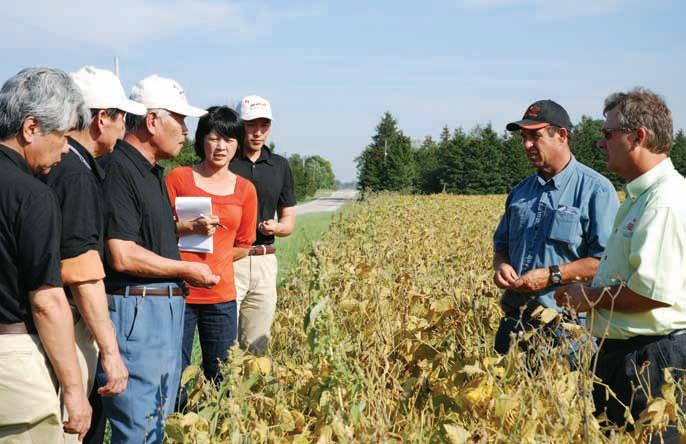
Promoting the Canadian advantage in IP soybeans has an increased importance to for Jim Gowland, pictured here (left) with prospective buyers from Vietnam.
Crop pests and climate change: the real story
by Treena Hein
Will forecasted changes in climate mean more disease and insect attacks?
Climate modelling,” “drought tolerance” and “range expansion” are some of the buzz words that dot recent articles predicting the impact of climate change on agriculture. Such articles have been showing up in the media on a regular basis. While some studies predict Canada’s growers will benefit from future climatic conditions, most offer dire warnings.
How are producers to make sense of it all?
Start with the basics, says Dr. Jonathan Newman, chair of the department of environmental biology at University of Guelph. Newman studies how climate change predictions could affect cereal aphids, swede midge in canola, blossom beetle, Colorado potato beetle and other insect pests. “Crop growers should first and foremost realize there is a good deal of unknown about climate change predictions,” he says. “The impact of climate change is a reasonable concern, but we need to keep in mind it’s a complicated story.”
Newman says that while the common broad generalizations about warmer future conditions being good for crop pests do hold merit, “Climate change is not just about warmer temperatures. It’s about humidity, and precipitation and changes in weather patterns. These all have direct impacts on pest life cycles in themselves, and also through their interactions with each other.”
Increased carbon dioxide levels, for example, interacting with temperature and precipitation, can cause changes to plant growth and quality. This, says Newman, could mean that the part of a crop that a particular pest is interested in eating may become less nutritious, so that the pest stops eating it. Conversely, it could result in the pest having to increase its intake to get the same nutritional benefit.
In terms of the pests themselves, Newman stresses that some are more sensitive to temperature, and some to moisture. Some are found only in certain regions and some are widespread. “It’s therefore the case that giving a continental-scale answer is very difficult for all pests of corn, for example,” he says. “Some will probably increase in number and range due to predicted climate change and some will probably decrease.”
Making predictions
Part of what makes climate change impact prediction so complex and difficult, says Newman, is the assumptions and resulting models on which the predictions are based. Assumptions about future greenhouse gas levels and other factors are used to create “scenario” models. These are then used to make climate models, which are spatial representations of all aspects of the atmosphere.
Newman says the United Nations Intergovernmental Panel on Climate Change (IPCC) accepts seven commonly used scenarios and 23 climate models. “They don’t all agree with each other,” he says. “They feature different assumptions and simplifications. The
projected temperature increase tends to be similar among models, but precipitation, for example, is quite different among them.”
Recent analysis by entomologist Christian Krupke and his colleagues at Purdue University in Indiana used an IPCC emissions scenario called A2, which assumes greenhouse gas emissions continue to increase exponentially. In all of the study’s projections, chosen insect corn pest species (corn earworm, European corn borer, northern corn rootworm, and western corn rootworm) were predicted to spread into agricultural areas where they are not currently endemic, with the greatest potential range expansion predicted to be in corn earworm.
The analysis was based on the predicted number of days warm enough for pests to grow and the number of days cold enough to kill them. More warm days provides them with additional time to feed, mate and reproduce. “However, the model cannot take the dynamic nature of any ecological system into account,” Krupke says. “Additional important factors could come into play such as pest interaction with the environment, where corn is grown and advances in pest management.”
Newman agrees that warmer growing seasons and milder winters predicted to occur with climate change are generally expected to benefit crop pests. It is generally predicted that more generations of an insect will occur during a growing season than has been the norm, and that the northern part of a pest’s range might expand. “However,” he says, “southern populations may be negatively affected. It may be too hot or too dry for them to survive in these areas.”
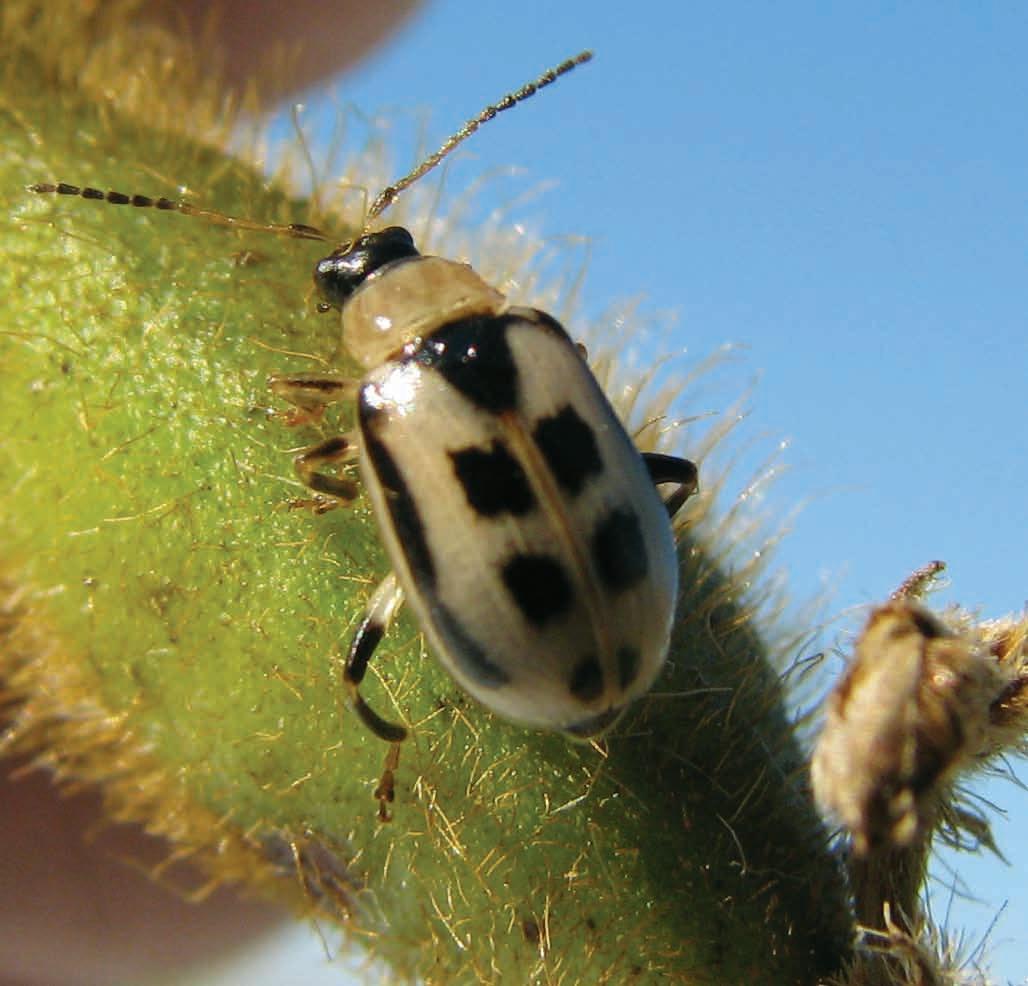
Climate change could affect the spread of certain pests, and bean leaf beetles are one species that has spread, possibly as a result of warmer temperatures. Photo courtesy of horst bohner, oMafra
Issues and envIronment
However, Newman stresses that these are broad generalizations that do not say much that is concrete about a specific pest. “An increase in annual average global temperatures of three degrees that some climate models predict is not going to affect all pests or all regions of the world similarly,” he says.
Preparing for the future
While it is difficult to make definitive predictions about which pests will do well due to projected climate change and how well they’ll do, Newman does think it is important to think about preparation. “If, for example, your breeding programs focus on pest resistance,” he says, “you have to know what you’re breeding for. You need a systematic approach for each crop.”
Newman observes that if any breeding to mitigate the impact of predicted climate change is being conducted right now, it is for drought tolerance. “Again, however, not everywhere will suffer drought. Some areas will get more precipitation,” he says. “And if you’re predicting temperature increases of 10 degrees C on summer days, drought is the least of your worries. Some crops won’t survive that, even if they get good rain.”
The way to best manage risk mitigation, says Newman, is to study a given region and crop in some detail. “Future scenarios are only that, scenarios. Farmers need secure predictions, not opinions on what might happen.”
Tracey Baute, field crop entomologist program lead for the Ontario Ministry of Agriculture, Food and Rural Affairs (OMAFRA),
says there are specific pests the Ministry would like to work on to try and predict how successful they will be at overwintering here or spreading to Eastern Canada from other regions in terms of predicted climate change conditions. “Examples would be bean leaf beetle and western bean cutworm,” she says.
Crop pathogens and climate change
Most plant pathogens are fungi, says Tom Fetch, a crop pathologist with Agriculture and Agri-Food Canada in Winnipeg and Canada’s leading stem rust expert. “Fungi usually do best under humid conditions and not so well if it is very dry.”
How climate change impacts fungal disease prevalence depends mainly on two factors, says Fetch. If warmer and longer growing seasons occur, fungal diseases could do well, but only if there is enough moisture to support them. “That is, usually when the weather is good for growing a crop, you see the crop’s diseases flourishing as well. We could even see some new fungal disease here, especially if crops that currently are marginally grown (such as corn or soybeans) increase in acreage because of the increased heat units that would occur if warmer and longer seasons occur.” He adds “But if that warmth is accompanied by dry conditions, it is unlikely to see increased fungal disease.”
There are no data at this point on how Ug99 stem rust would be affected in Canada by climate change. Fetch can, however, report that “in recent months, there has been no appreciable spread of this disease in Africa, where it originates.” n
Nature is our laboratory.
The best way to learn about natureʼs power is by going straight to the source. Thatʼs whatinspiredustocreateCallisto.Bystudyinghowthe Callistemoncitrinus bush naturallysuppressesthegrowthofotherplantsaroundit,wedesignedaunique
Plant BreedIng Resistance management, maximizing yield, glyphosate-tolerance, all in one
Multiple active ingredients offer wide timing, weed spectrum activity and resistance management.
Atrue two-pronged attack on weeds is just around the corner for corn and soybean growers. Soon the same program could become an even more robust threemode-of-action menace to weeds.
Optimum GAT is a new herbicide tolerance trait for corn and soybean growers. It was developed by DuPont and is in the final stages of testing. It features tolerance to both glyphosate and to the ALS (Acetolactase Synthase) class of Group 2 herbicides. The first corn seed with the new trait could be on the market as early as 2010. Soybeans are expected by 2011.
Optimum GAT is based on tolerance to both glyphosate and ALS chemistries. By combining Group 9 and Group 2 chemistries, Optimum GAT will give growers the capability of combining the contact weed-killing potency of glyphosate with the ALS family’s residual weed control. It will give soybean and corn producers a better way to control weeds such as wild buckwheat, lamb’s quarters, yellow nutsedge, sow thistle, ragweed and marestail, weeds that are hard to kill with glyphosate alone.
Growers are asking for herbicides that deliver residual control to reduce the need for follow-up sprays. Producers are also craving products that deliver multiple modes of action within glyphosate-tolerant systems to combat shifting weed patterns and resistance. “In the future we intend to go further and add a third mode of action to the mix” says Larry Dumaine, sales and marketing manager for corn and soybean herbicides at DuPont. “We feel the combination of glyphosate and ALS tolerance addresses current resistance problems to both classes of chemistry. And other chemistries that allow you to combine three herbicide groups will give you outstanding weed control plus be a very effective tool to prevent resistance from developing.”
The ALS family of herbicides is a broad category of products that includes the sulfonylureas (SU) herbicides. The SU group itself includes a wide range of products designed for use on crops as diverse as cereals, canola, soybeans and corn. Not all, though, can be used on every crop. For example, producers have not been able to use a soybean product on corn. “Optimum GAT technology broadens the evolved tolerance that corn and soybeans already have to products in this family,” says Dumaine.
This technology will let producers spray chlorimuron ethyl, the active ingredient in Classic, or other ALS herbicides not previously used on corn. “They will be able to use new products specifically designed for use on corn and soybeans that they otherwise wouldn’t be able to use,” says Dumaine.
Scientists did not just tweak current glyphosate resistance technology; they started from scratch. In the old technology, a
new target protein that is not inhibited by glyphosate is introduced to function when the native plant is inhibited, making the plant tolerant to applied herbicide. The DuPont trait was developed from a new enzyme produced by a different bacterial gene. It helps plants convert glyphosate into a non-toxic form. The original enzyme was not strong enough to provide true herbicide tolerance so researchers used a new process, called gene shuffling, to improve it.
In basic plant breeding, breeders select two parents with desirable traits and then check the offspring for improvements. Gene shuffling does the same thing but it happens in a test tube rather than in the greenhouse. Traditional breeding allows breeders to screen a few variations at a time. Shuffling technology allows more than two parents to be used and millions of variations to be screened concurrently. Work that would normally take hundreds of plant generations can be condensed into a very short timeframe. “Historically, chemistries were discovered that had more or less tolerance to the crop,” says Dumaine. “In this case we’re developing products specifically for hybrids and varieties containing the Optimum GAT trait. The degree of crop safety is unparalleled.”
Optimum GAT is the first product DuPont and Pioneer HiBred have had with their gene shuffling technology. Dumaine says it will not be the last. Now that the technology has been successfully integrated into their crop development program it will rapidly bring new hybrids and varieties to market. It is currently being used to improve insect and disease resistance, herbicide resistance, nutritional properties and, of course, yield. n
With Optimum GAT technology, growers will have more options with their herbicide programs, including the ability to use a soybean product on corn.
Circle 12 on reader reply card
Plant BreedIng
Aphid-resistant soybeans are a new option
Research aims to help predict the effectiveness of resistant lines.
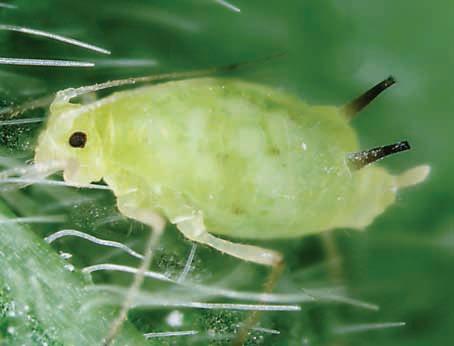
The risk of abundant populations of soybean aphid Aphis glycines should be high if the insect pest continues to follow its previously established cycle of high numbers every other year. Although soybean aphid numbers followed the pattern and were low in places like Ontario and Ohio in 2008, the numbers did not follow the pattern in all areas of the Midwest. Large populations occurred in areas of the Dakotas, Nebraska, Minnesota, Iowa, southern Wisconsin and northern Illinois. So researchers are uncertain as to what 2009 holds in terms of soybean aphids.
Entomologists like Tracey Baute of the Ontario Ministry of Agriculture, Food and Rural Affairs, and researchers from Ohio, have not yet noted large numbers of overwintering aphid eggs in their areas in fall 2008 and winter 2009, perhaps pointing to low springtime infestations. However, Baute states that areas such as Michigan, Ohio, Ontario and Quebec are always at risk later in the growing season. “We’re at the end of all the weather systems, so not only do we deal with the soybean aphids we have here that overwinter, but more can blow in on wind currents from states that are west and south of us.”
In addition to the introduction of natural enemies and spraying of insecticide to kill soybean aphids once they surpass established scouting thresholds, plant breeders have been working to develop soybean varieties with some resistance to the insect. To this end, Syngenta Seeds Canada is releasing a 3100 heat unit, aphid-resistant soybean variety for the 2009 growing season, says Don McClure, soybean breeder with Syngenta. This variety contains a gene called Rag1, which occurs naturally in soybean and provides some resistance to the soybean aphid. The Rag1 gene does not affect other insects.
McClure says that this Rag1-containing
by Heather Hager, PhD
soybean variety was planted in Ontario field trials in 2008. Although soybean aphid pressure was low in Ontario that year, it was an opportunity to evaluate the variety’s agronomic performance. “It still has to yield well and perform well in a grower’s field whether there are aphids or not, and it did that, so we feel pretty comfortable that the variety is a good variety whether we have aphids or not,” says McClure. “Also, we multiplied seedstock seed in 2008. According to the grower, our seed field was more than 60 bushels per acre.”
McClure says that the Rag1 soybean variety will be combined with an insecticide seed treatment, giving two modes of defence against early aphid infestations. In years of high aphid abundance, however, it may still be necessary to spray late in the growing season. “This soybean variety gives growers an opportunity to control a major pest in soybeans, or at least reduces the possibility that they’re going to have to spray large acreages in the summertime with a commercial insecticide. If a grower can control aphids without having to spray the crop, there’s a huge benefit because they’re not affecting the ben-
eficial insects and nontarget insects,” for example, bees and other pollinators and natural enemies of the soybean aphid.
Soybean aphid biotypes
Soon after Rag1 soybean varieties were developed, researchers discovered a soybean aphid biotype that could develop on them. This has caused some people to question whether the soybean aphid is already breaking down the Rag1 resistance. “It is highly unlikely that the soybean aphid is already adapting to Rag1 resistance,” says Dr. Matthew O’Neal, assistant professor and entomologist at Iowa State University. “The plants just have not been present in any extent to provide selection pressure for that to occur.” He says that it is more likely that there were multiple introductions of the aphid or that the aphids that were introduced carried a wider range of genetic variability than would be expected with one introduction, so some individuals already had the traits that allow them to develop on Rag1
The new soybean aphid biotype was identified in 2006 by researchers from Ohio State University and the University of Illinois. The geographic extent and
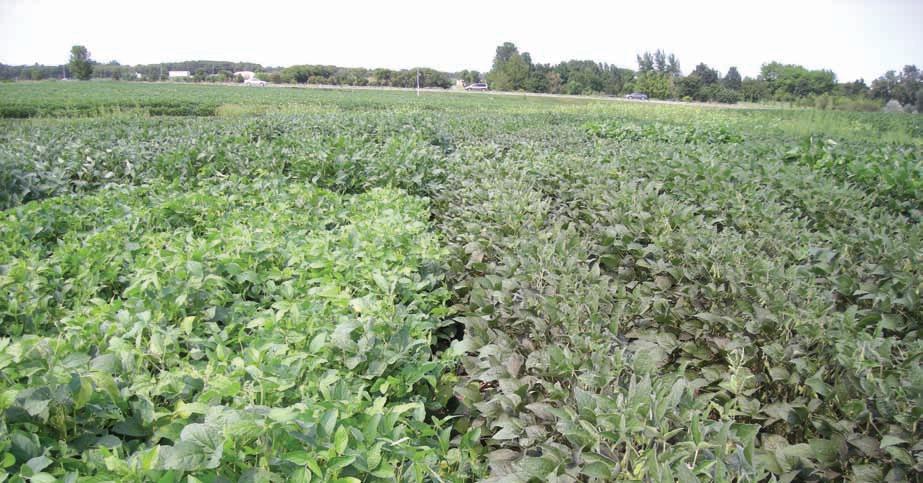
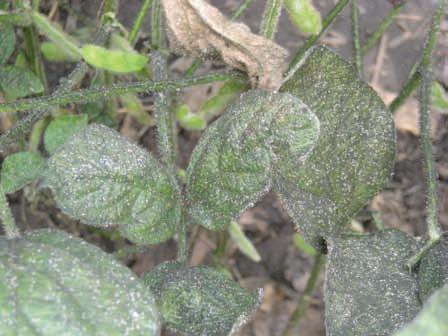
In July 2007, an aphid-resistant Rag1 soybean variety had about 200 aphids per plant (left), whereas a similar susceptible variety had about 1500 aphids per plant (right) in US Midwest field trials. The darker colour of the susceptible variety is caused by sooty mould that grew on the honeydew shed by the aphids.
Photo courtesy of Matthew o’neal, iowa state university
Rotation is smart Mix it up for sustainability
Weeds thrive on routine. Planting the same crop in the same field and repeatedly using the same herbicide group may return more than you bargained for…resistant weed populations.
Continuous use of herbicides with similar modes of action means some weeds can develop herbicide resistance – a weed’s ability to survive an application of a herbicide that would normally be effective. Mixing up your herbicide management practices takes a little extra planning, but the payoff – effective technology to control yield-robbing weeds – is definitely worth the effort.
Herbicide resistance is a global concern. Resistance has now been confirmed in more than 300 weed species and biotypes (subspecies of weeds) around the world in areas with well-developed agricultural industries including Australia, Canada, Europe and the United States.
“We know how to keep herbicide resistance at bay,” says Luc Bourgeois, research and development manager for Bayer CropScience. “Weeds are quick learners and unless producers change how they manage crops, weeds will adapt and ultimately affect crop yield and quality.”
Bourgeois recommends three simple strategies to help prevent the development of herbicide-resistant weeds. “If growers mix up crop rotation, herbicide
factor
Crop rotation
Corn, soybeans and wheat draw different nutrients from the soil, and rotating crops gives the soil a chance to replenish. Take a long-term view, several years out, when planning crop rotation, and be sure you are also mixing up the herbicide mode of action for each crop year.
Mode of action
“Mixing up your herbicide mode of action is the cornerstone of a resistance management program,” says Bourgeois. “For example, if you grew Roundup Ready soybeans last year, rotate to a new crop and new mode of action for weed control – like LibertyLink® corn treated with Liberty herbicide –to help break the potential for resistant weeds.”
Production practices
Change is never easy, but it’s necessary to keep weeds off guard and herbicide resistance at bay. Seed higher rates of competitive hybrids to boost the crop’s ability to compete with weeds. Plan fertility programs to meet the crop’s requirement, then apply fertilizer to feed the crop and not weeds. And if you know or suspect a weed resistance problem, clean machinery and equipment before moving between fields to minimize the spread of resistant seeds on equipment.
“Managing to minimize herbicide-resistant weeds is everyone’s responsibility,” says Bourgeois. “It requires some planning and new approaches to managing crops to help ensure weed control options remain effective and available for the entire industry.”
Visit www.mixitup.ca for more information about how you can help keep production practices sustainable and avoid potential problems with herbicide resistance.
Soybean aphid populations that surpass the economic threshold of 250 per plant can also affect soybean yields indirectly by facilitating disease such as sooty mold.
In addition, Dr. Andrew Michel, assistant professor at Ohio State University, is attempting to isolate genetic markers that can be used to identify soybean aphid biotypes. He is looking for specific sections of DNA that are linked to the aphid’s ability to survive on Rag1 and other soybeanaphid resistance genes. “I’m analyzing the DNA to look for any sort of diagnostic marker that we could use to differentiate the biotypes. With that information, growers could decide which resistant soybean plant to use on their farms,” says Michel.
out if it’s biotype one, two or three,” says Michel. He is planning to sample more aphid populations in 2009, including ones that colonize specific resistant varieties, to look for markers and migration patterns.
Field experiments with Rag 1 resistance
abundance of this biotype and the possibility of other biotypes are unknown. However, the biotype could cause difficulties for determining areas where Rag1 soybean varieties would be effective.
To address this problem, researchers are trying to determine how many biotypes there are in North America, says Dr. Dechun Wang, associate professor in the Department of Crop and Soil Science at Michigan State University. “We are planting a set of standard resistant lines in different states to see how many different responses we can see from aphids.”
The idea is to group aphids into different biotypes based on their responses to the resistance sources.
Aphid wars
TMichel’s ultimate goal is to determine the number and distribution of biotypes and whether there are consistent patterns of large-scale migration. “What we need to do first is to get a baseline of what’s going on in one year,” he explains. “Then, we’re going to need to do that again the following year to see how the aphids move. It’s difficult to figure out how the aphid biotypes move without knowing what they are. We need a really good diagnostic tool to track their migration.”
The first soybean aphids for Michel’s research were collected from nine states and Ontario in summer 2008. The aphids are squished and then their DNA is analyzed. “It’s a bit like a blood type; you can take blood and find out if you’re A, AB, B, or O. We want to be able to take an aphid, squish it, get the DNA, and figure
he only good aphid is not necessarily a dead aphid. “When I talk to growers, before they ask me if they should use resistant varieties, I ask them if they believe the recommendations that we’ve developed about scouting and the 250 per plant threshold,” says Dr. Matthew O’Neal, assistant professor and entomologist at Iowa State University. “I know from five years of research in the field that you don’t need to keep soybeans aphid free. You do need to treat them when an outbreak occurs, but it’s not necessary to keep it free of aphids because you’re going to use inputs that are not going to return anything and, in the long run, you will develop resistance in the aphid to insecticides so that the tools you have now that work really well won’t in the future.”
“Some growers are using insecticide in a preventative approach by applying it before the aphid arrives,” says O’Neal. This is not a good idea. “As a consequence, we’re killing off beneficial insects that eat aphids, making an enemyfree space for the aphid.” Clearly, this can compound the aphid problem.
“It’s always better to have more tools in your toolbox. The more you can throw at this pest in terms of host plant resistance, insecticides, and biological control, the better off you’ll be.”
The good news is that even though aphids can colonize aphid-resistant varieties, there are consistently fewer aphids on the resistant varieties in field experiments with multiple resistant and susceptible soybean varieties. “Often, there are orders of magnitude in difference,” says O’Neal. “There may be 1000 on the susceptible, but only 100 or 200 on the resistant line.”
To measure aphid development, aphid-induced yield loss, and the potential for yield drag associated with Rag1, O’Neal and Iowa State University graduate student Mariana Chiozza compared a Rag1 variety with a susceptible variety in field plots with and without insecticide. They found some unusual results. “Not only did the aphids exceed the economic threshold (250 individuals per plant and increasing), but at times, they exceeded the economic injury level,” says O’Neal. He explains that the economic injury level is the point at which the cost of management equals the loss in yield from the pest. The economic threshold is set lower than the economic injury level so that management can be done before yield loss occurs. “We exceeded the economic injury level on these resistant plants, but the cool thing was, they did not lose as much yield as susceptible plants.”
He also notes that the Rag1 gene does not appear to cause yield drag. “Although the gene might give resistance to aphids, you could imagine that now the plant’s producing something that makes it resistant to aphids and takes away from the yield. But that doesn’t seem to happen.”
Growers who want to plant the new Rag1 varieties this summer will want to know if they should still be scouting and spraying for soybean aphids. The short answer is “yes” to scouting and “possibly” to spraying. “What I’ve been telling our growers is, the Rag1 varieties won’t be aphid free,” says O’Neal. “However, you will be able to be more conservative about the aphid thresholds you use. We’ve
Photo courtesy of Matthew o’neal, iowa state university
Plant BreedIng
Despite the development of aphid-resistant soybeans, growers still need to scout their soybean fields.
Growers were forced to cope with plant infestations of this level in 2001 and 2003.
developed thresholds for susceptible plants. Now, we have to develop thresholds for resistant plants to give growers a better estimate of when, or even if, they should use an insecticide.” O’Neal will begin work in the summer of 2009 to determine aphid thresholds for resistant soybean varieties.
The great thing about these resistant
varieties is that the aphid’s growth is slowed, says O’Neal. “Anything that can slow this down from, for example, an outbreak that occurs over the course of seven days to an outbreak that then might occur over 14 days allows you to get a more timely insecticide application if you need it.” And spraying less insecticide is not only good for the grower, it is good for natural enemies of the aphids, giving them more of a chance to prevent a soybean aphid outbreak by allowing their populations to persist.
O’Neal stresses the fact that a great deal of the funding for soybean aphid research comes from soybean growers through the US soybean checkoff program’s North Central Soybean Research Program. “The growers, through their association, have been incredibly forward-thinking and proactive in dealing with soybean aphid. The association has put up nearly a quarter of a million dollars a year to fund research so that their growers know the best way to manage pests and how well tools like insecticides and host plant resistance will work.” He says that the association also funds extension work by land-grant universities to turn research results into real-world uses. “The growers are very sensitive to the need to be good stewards of these tools. They’re thinking about the long term.”
Other sources of resistance
Several research groups have been testing large collections of genetic resources in soybean germplasm to find other plant introductions that show resistance to the soybean aphid. In addition to Rag1, a Rag2 gene has been identified. Other sources of resistance also have been identified, but the specific genes involved still need to be determined.
For example, Wang has been testing
Soybean aphid resources for growers
Maps of soybean aphid numbers in scouted fields in Canada and the US are available at http://sba.ipmpipe.org/cgi-bin/sbr/public.cgi.
Click on a calendar date to view recent soybean aphid observations; click on a province or state for specific commentary.
Soybean scouting cards and a map of soybean aphid numbers for Ontario locations are available at http://www.soybean.on.ca/aphids.php
early maturing soybean germplasm and has identified four plant introductions that show resistance. “Two of them are the type of resistance that interferes with the biology of aphids. We call that type of resistance antibiosis,” he says. The resistance that Wang has identified differs from Rag1 in that it seems to be controlled by two recessive genes, whereas Rag1 resistance involves one dominant gene.
O’Neal was involved in small-plot field screening of soybean varieties contributed by various breeders to evaluate their performance in resisting aphids. He says that the lines developed by Michigan State University using the resistance sources identified by Wang had the lowest aphid populations across all of the study sites. “We had three levels of performance,” says O’Neal. “We had the susceptible, with the worst performance. Next were all the varieties that had some Rag1 or maybe Rag2. And then there was this Michigan State resistance, which had the best performance. Those differences held up throughout the two years that we did the small-plot screen across six to eight regions.”
Once the various resistance genes have been identified and markers are developed for those genes, soybean breeders can begin to breed them into commercial cultivars. There is also the possibility of combining resistance genes within a soybean variety so that it is harder for aphids to adapt to the resistance. Whether this is possible without yield drag, is necessary for aphid control, and works against all soybean aphid biotypes are some of the questions that will need to be answered, says O’Neal.
It will be very interesting to see how all the pieces of research fit together to tell the story of soybean aphid ecology and to produce new technology and management recommendations. For now, despite the potential advantages of aphid-resistant soybean varieties, O’Neal is unsure how quickly growers will adopt the technology because he says it is still possible to get good yields with susceptible varieties that are scouted and sprayed when necessary. “It comes down to two questions,” he suggests. “Is there enough seed available, and how will it be priced?” n
Photo courtesy of GreG Zolnerowich, Kansas state university
Pre-seeding nitrate nitrogen test can save dollars
by Dr. Tarlok Singh Sahota*
DTest on various cereal crops shows varying financial benefits.
o all fields have similar nitrate nitrogen (NO3-N)? Do all fields need similar amounts of N application for a particular crop?
One might think the answer is yes, but that would be a mistake. After all, why apply fertilizers? To supplement soil nutrients to a level that is conducive to an economic optimum yield without impacting environment. It is therefore essential to know what the nutrient content of a field is before deciding upon the rates of nutrient application.
Most farmers go for a basic soil test package that gives them an estimate of phosphorus (P) and potassium (K) content in the soil. There is a need to test nitrate N as well because by and large it is the form in which crop plants take N from the soil. N content in different fields could vary with the previous crops (legumes/non-legumes), fertilizers/manures applied to previous crops, crop yields and residual N after crops’ harvest.
At the Thunder Bay Agricultural Research station (TBARS), Thunder Bay, we have observed that a field with previous crop (oats) applied with recommended rate of N (no manure application) had 8.2 ppm nitrate N (32.8 kg N/ha; ppm x 4 = kg/ha), in zero to 30 centimetres (12 inches) soil the next spring, whereas a field with silage corn as a previous crop, applied with liquid manure and recommended amount of N had 26 ppm residual nitrate N (104 kg of N per hectare or 93 lbs of N per acre) in zero to 30 centimetres of soil. Cereals (mean over barley, wheat and oats) response to recommended rate of N (70 kg/ha or 62 lbs/ac) in the first field (8.2 ppm nitrate N) was 1,117 kg/ha (= 16 kg grains/kg N), whereas there was no response to applied N in the second field (26 ppm nitrate N). Both the fields were in the adjoining (similar) plot ranges. Is it possible that in the latter case, at current prices of ($1.30/kg) for urea N, we could have saved $91 per hectare (= 70 kg
More growers are wanting to learn about the various means of boosting yields and monitoring inputs, as evidenced by this gathering at TBARS in 2007 (above).
Dr. Tarlok Sahota offers helpful advice to growers during a demonstration day at the Thunder Bay Agricultural Research Station (right).
x $1.30/kg)($224 per acre)? This, compared to the direct cost of nitrate N test ($1.5/ha; assuming 25 acres unit for soil sampling), is a significant amount. If someone grows 100 acres of cereals, there is a potential of saving more than $3600. Traditionally, pre-seeding nitrate N test was not recommended, because nitrate N is generally believed not to stay in the soil, because of denitrification/or leaching losses. However, in welldrained soils, especially in tiled drained fields, with no excessive moisture, where will the nitrate N go? Nowhere; it will be taken up by crop plants or stay in the soil. In a summer/spring fallow (tile drained) plot range at TBARS, pre-seeding nitrate N was unbelievably high (70 ppm = 280 kg/ ha). No wonder in this field application of N fertilizers tended to reduce the wheat grain yield.
Translated to spring wheat
In spring wheat, in a plot range with pre-
seeding nitrate N test of 12 ppm (48 kg of N per hectare or 42.8 lbs of N per acre), response to 40 kg of N per hectare (or 36 lbs of N per acre) was 506 kg grain/ha (= 12.65 kg grain/kg N), and to 80 kg of N per hectare (or 71 lbs of N per acre) was 418.2 kg grain/ha, which equals 5.2 kg grain/kg N. This is a breakeven point for N application to spring wheat at $1.30/kg N and $260/ tonne grain. Under the fluctuating/uncertain grain prices, it would be safer to apply 40 kg N/ha to spring wheat than to apply 80 kg N/ha.
Apart from nutrient content in soil, it is also important to know how many nutrients are removed by crop plants so that the nutrients are replenished adequately to maintain soil fertility. Table 1 shows N removal by cereals per tonne of grain (kg/ha) at TBARS, Thunder Bay.
While planning for N application rates, it will be reasonable to assume at least five tonnes grain yield per hectare (or 139 bu/ac)
Photos courtesy of dr tarloK sahota, tbars
FertIlIty and nutrIents
for barley. N removal by barley at this yield will be 116.5 kg/ha (104 lbs/ac), whereas only 70 kg of N per hectare (62 lbs of N per acre) is recommended for barley (in northwestern Ontario). Where does the rest of the N come from? It could come from the soil or the air. N from the soil could include N left over from previous crops, plant residues, dead earthworms/microorganisms, wildlife excreta, fertilizers and manures; N held by clay and organic matter; and N in lower soil layers from 30 to 60 centimetres (12 to 24 inches) deep and 60 to 90 centimetres (24 to 36 inches) deep, for which no nitrate test is done. N from the air could include N that is fixed by legumes or leguminous weeds such as clover, trefoil or even volunteer alfalfa; free living soil bacteria such as azotobacter; and N dissolved in rain. How much N could there be in deeper soil layers (30 to 60 and 60 to 90 centimetres)? In our research plots (four to five experiments over two years), nitrate N content in 30 to 60 centimetres (12 to 24 inches) of soil varied from 26 to 43 percent (average of about 35 percent; it may be safe to assume 30 percent) in the top zero to 30 centimetres (zero to 12 inches) of soil. Nitrate N in 60 to 90 centimetres was either 50 percent of or the same as that in 30 to 60 centimetres of soil. As the crops grow, they can draw nutrients from deeper soil layers. Based on these assumptions, let us see how much nitrate N could be in the soil in a spring barley field with a pre-seeding nitrate N test of 8.2 ppm:
Soil – zero to 30 centimetres: 32.8 kg of N per hectare (8.2 ppm x 4)
Soil – 30 to 60 centimetres: 9.8 kg of N per hectare (30 percent of N in zero to 30 centimetres)
Soil – 60 to 90 centimetres: 4.9 kg of N per hectare (50 percent of N in 30 to 60 centimetres)
Fertilizer N: 70.0 kg of N per hectare (62 lbs of N per acre)
Total (Soil + Fertilizer): 117.5 kg/ha (or 105 lbs of N per acre). This more or less equals N removal by barley (116.5 kg/ha;
see paragraph 4). It may therefore be logical to assume that fields having more than 8 ppm pre-seeding nitrate N would require less than 70 kg of fertilizer N per hectare. Our experience also shows that if the preseeding nitrate N is 25 ppm or more, spring cereals would not respond to N application. In fact going by these calculations, N application to spring barley may not be required even if pre-seeding nitrate N test is 20 ppm. Why waste N and dollars on N then? It is quite probable that silage corn applied with manure and fertilizers and crops such as alfalfa and soybean could have residual nitrate N equal to 25 ppm or more (or about two to three times more than the residual N after cereals, especially those which didn’t get a manure application).
Additional points to consider Limited time for field operations and seeding in spring is a constraint in taking preseeding soil samples. Though ideally, soil samples should be taken before seeding,
other options could be explored to overcome time constrains. These could be seeding without application of N or using MAP (11-52-0 at recommended rates of P application) at seeding and taking soil samples after seeding. Cereals take three to four weeks after seeding to initiate crown roots (which are close to soil surface and can absorb top dressed N) and tillering during which time nitrate soil test results could be available to decide if N needs to be applied to spring cereals or not and if needed, how much? The principle/practice can be extended to other crops (and areas based on location-specific research) as well, and certified crop advisors or researchers/specialists in your area could be of help.
The bottom line is that pre-seeding nitrate N tests could not only save a lot of dollars, but also minimize potential impact of agricultural practices on the environment. n
*Dr. Tarlok Sahota, CCA, is the director of research and business for the Thunder Bay Agricultural Research Station (TBARS) in Ontario. He has more than 20 years of experience in research and extension worldwide and has worked extensively in nutrient management and integrated pest management. He has been with TBARS since 2004.
Seed treater program provides standards for growing industry
During the past few years the seed treatment industry has grown locally and internationally.
There has been a considerable increase in the type and volume of seed treatment products that are available and subsequently the number of producers using seed treatments. This is inspiring more people to become commercial seed treaters, as a supplement to their existing businesses or farming operations.
In part, the increased interest in innovations such as Syngenta Seed Care products is due to new information indicating that seed care can do more than ward off pests. “Traditionally, growers would only use seed treatment if their crops were threatened by pests,” explains Syngenta Seed Care crop manager Scott Ewert. “But today, growers are seeing the increased crop quality and yield that seed treatments offer and are using seed treatments even when there is no immediate threat from diseases and insects. This is what’s becoming known as the ‘Vigor Trigger’.”
It is not uncommon for growers to report these results in their field. Jim McFadden, who has been a commercial seed treater at Setterington’s Fertilizer Service in Essex, Ontario for more than six years, recently became a certified seed care professional under Syngenta’s program. He recalls that “when growers in my area opted to plant half their field with treated seed and half with untreated seed, the benefits of seed treatment were unmistakable. The field with the untreated seeds had to be replanted due to damage caused by damping off and other disease and insect infestations. Meanwhile, the neighbouring field did not experience insect infestations or damages caused by disease, and produced healthier, more resilient crops. The growers reported substantial yield increases from the crops produced from treated seeds.”
Says McFadden, “There is no doubt that the seed care industry, particularly the commercial application of seed treatments, will continue to grow and as treatments, equipment and applications methods evolve it’s important to stay up-to-date and receive ongoing education.”
The most recent evolution in the seed care industry has been the shift from on-farm to commercial seed treatment. Many dealers and even growers are seeing this as a new opportunity to provide commercial seed treatment services to their customers.
Although all commercial seed treaters must receive provincial designation, there is no other accreditation to provide treaters with the knowledge and equipment necessary to employ best practices. How, then, to ensure quality and adherence to best practices among commercial seed treaters?
on crop quality and vigour.
Syngenta Crop Protection Canada has offered one solution. In November 2008 Syngenta launched its commercial seed treater certification program, an industry first. The purpose of the program is to help provide commercial treaters with the knowledge and tools necessary to employ best practices and add value to their businesses, while also providing growers with an additional standard by which to evaluate service providers.
Ewert explains that stewardship was an important motivating factor in creating the new program. “We hope this program will raise the standards of commercial seed treatment application across Canada,” says Ewert. “The certification is only available to commercial treaters who have the knowledge, skills and equipment necessary for high-quality application. There is emphasis on using products responsibly, minimizing the impact on the seed, soil and the environment.”
Recent studies have determined the Vigor Trigger is caused by thiamethoxam, a compound that induces the biosynthesis of specific plant proteins that defend the plant against stress. Explains Ewert, “Ten years of research has shown that seed treatments such Cruiser Maxx, which include the active ingredient thiamethoxam, acts as what we call the ‘Vigor Trigger’, encouraging faster emergence, greater plant stand, earlier canopy and increased root mass. This increased vigour often results in high yield, making the vigour effect desirable to soybean, pulse, wheat, barley and corn producers.”
Given the continued research, it is likely we will see an increased number of thiamethoxam products on the market. And as seed treatments become more and more popular, the opportunities for commercial seed treatment operations continue to grow.
Commercial seed treaters who have taken the course believe it infuses the industry with some much-needed credibility. Says Jason Creighton from St. Lawrence Grain & Farm Supply Seed Treatment Facility in Stouffville, Ontario, “We offer growers a valuable service and they appreciate the safety and convenience of having their seeds commercially treated. This kind of program will ensure that commercial treaters across Canada adhere to high quality standards, which will be increasingly important as the seed care industry continues to grow.”
Many participants of the online program note that the course is surprisingly challenging. “We developed the course so that it would be inclusive yet deliberately challenging,” notes Scott. “Providing commercial seed treating services is a good business opportunity for many, but not one that should be taken lightly. The curriculum is designed to ensure that all Syngenta seed treaters are well versed in the art and science of seed treatment.”
Seed treatments have obvious effects on pests like bean leaf beetles, but growers are seeing additional effects
Photo courtesy of horst bohner, oMafra.
IMPORTANT NOTICE
FNA Scores Huge Price Drop for Members
Members can now access top quality, fully-loaded ClearOUT 41 PLUS glyphosate for $7.25/litre Clearly still the industry value leader.
FNA Negotiates Incredible Deal on UAN
Further proof of FNA’s commitment to creating competition in the Ontario marketplace is here:
28% Liquid Fertilizer delivered to the farm for $395/mt PLUS: FREE On-Farm Storage! Changing the way Members buy fertilizer.
Ontario Members are Improving their Farm Profitability everyday. If you aren’t already a Member, you should be.
FNA is a Member-based business alliance created by farmers for farmers, committed to lowering input costs while capturing a larger share of your production’s worth up the value chain.
When you join FNA you get a team working on your behalf as an extension of your farm operation, negotiating the best possible value for your bottom line. FNA has introduced needed competition to the inputs sector, and together Members gain greater market power, promoting change in the industry from the ground up.
In 10 years, FNA has grown to represent over 8,000 farm families and well over 12 million acres across Canada, saving an estimated $2.5 billion!
—Mark Delanghe,
“FNA has created more of an environment of competition, so that prices can come down to where we think they should be. We joined FNA to source our inputs as reasonably priced as possible. The trick is to buy them soon, to capture today’s pricing. With FNA, we try to always be ahead of the pricing curve.”
Wallaceburg, ON, Farmer & FNA Member
Leader products for your operation still available.
Contact your local Pioneer Hi-Bred sales representative to discuss the best products to meet your local conditions. They have excellent supply of high yielding Pioneer® brand products to meet your in-season needs.
Competitive program offerings
Also ask about our lucrative program offerings including bulk discounts, cash payment incentive and Deferred Payment – our industry-leading financing program.