All rights reserved. Editorial material is copyrighted. Permission to reprint may be granted on request.
Send cheque or money order to Annex Publishing & Printing, Attn: Circulation.
Claims for missing issues must be made in writing within three months of publication and will be subject to the availability of back issues.
Associated Publications:
• Canadian Rental Service
• Drainage Contractor
• Glass Canada
• Ground Water Canada
• Manure Manager
Publications Mail Agreement #40065543
Return undeliverable Canadian addresses to Annex Publishing & Printing Inc., 145 Thames Rd. W., Exeter, ON N0M 1S3 Canada.
Printed in Canada.
March 2008, Vol. 34, No. 11
ISSN 1717-452X
Readers will find numerous references to pesticide applications, timing and rates in the pages of Potatoes in Canada issue of Top Crop Manager. We advise growers to consult with provincial recommendations and product labels for complete instructions. Top Crop Manager is published by Annex Publishing & Printing Inc., an independent publisher of specialty crop production and special interest publications. The magazine continues its tradition of keeping growers up-to-date in areas of plant breeding, agronomic advances, pest control, field techniques and management.
CONTENTS
Insect management
Potatoes in Canada takes a look at 4,8 insect management strategies.
Research and development
Work continues across Canada to improve 20,22 production methods and markets for potatoes.
POTATO PEST CONTROL GUIDE
INTRODUCTION
nce again we are publishing an additional early spring Potatoes In Canada issue of Top Crop Manager, sponsored by DuPont Canada. This issue extends the potato production features already published in the regular annual edition a month ago. Importantly, this edition also includes an up-to-date ‘Guide to Potato Pest Control’: the industry’s only quick reference for products used to manage diseases, insects and weeds, as well as seed piece treatments. It
notes of products and the various diseases, insects and weeds they control. Be sure to crosscheck provincial guidelines and product labels before making final decisions! Other features in this issue cover a number of topics on production aspects of potatoes. Some decisions on protecting the crop’s yield potential must be left until the season is underway. Keep this issue on-hand for reference! ■
Peter Darbishire publisher and editor
New options for pest control
by Donna Fleury
Plan ahead and use rotation to minimize resistance development.
As new chemistries and modes of action become available, it is critical that the industry use good management strategies to reduce the risk of resistance. Some of the currently available products have resistance problems, so the industry must use best practices to keep as many tools available as they can.
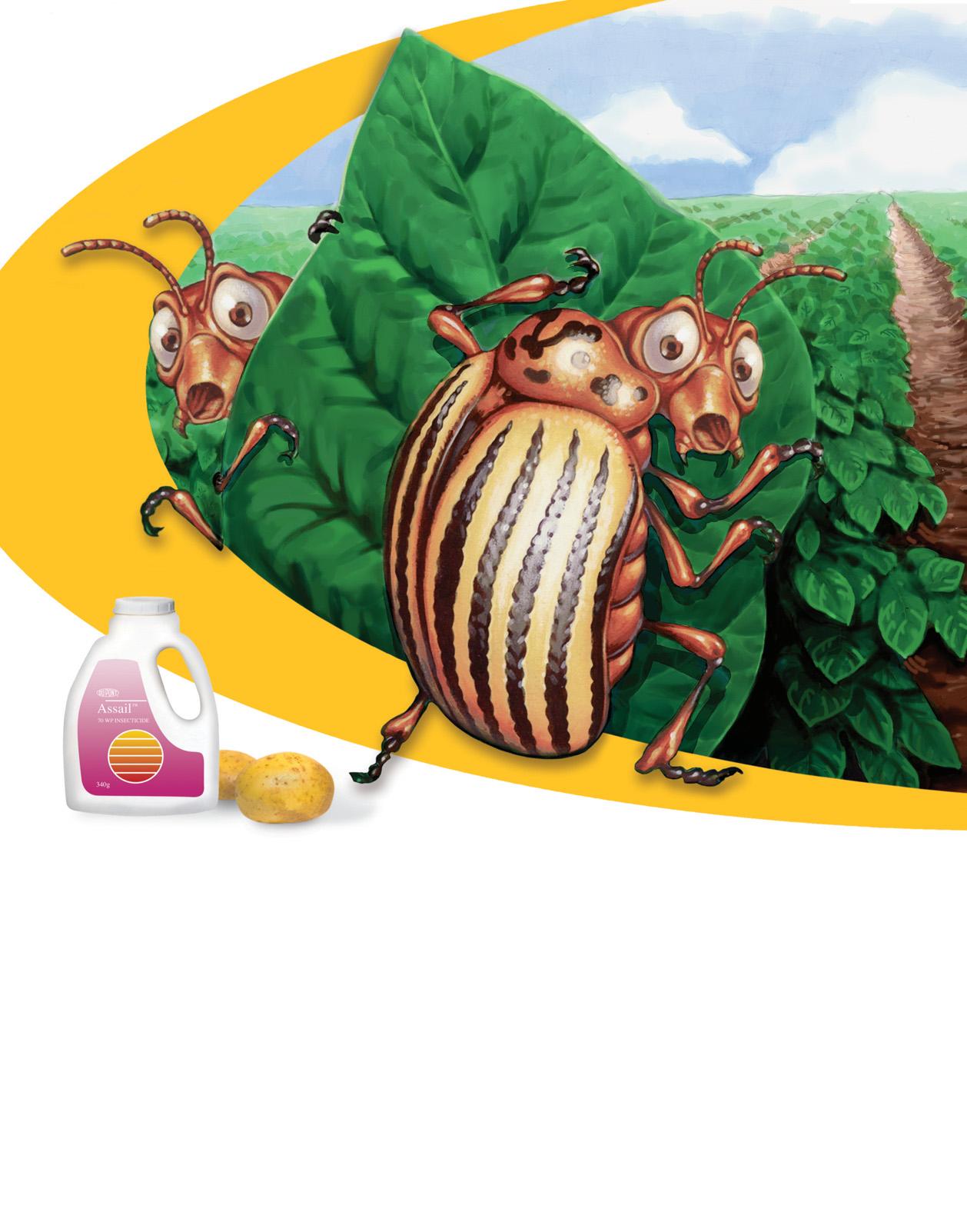
Dr. Galen Dively, Professor Emeritus at the University of Maryland, explains there are currently two main classes of insecticides available for potatoes. The neonicotinoids class, which includes products such as Admire, Assail and Actara (Platinum is registered in the US), are available as systemic products or foliar formulations. “Admire was registered in the US in 1995 and we’re already starting to see resistance to that class of chemistry in both the US and Canada,” explains Dively. The active ingredient is imidacloprid.
In Maine, Delaware and several states, the level of resistance is quite high. “I completed bioassays of about six populations in Canada this year and two are definitely showing tolerance,” says Dively. Another product, Success (called Spintor in the US), with the active ingredient spinosad, offers an alternate mode of action.
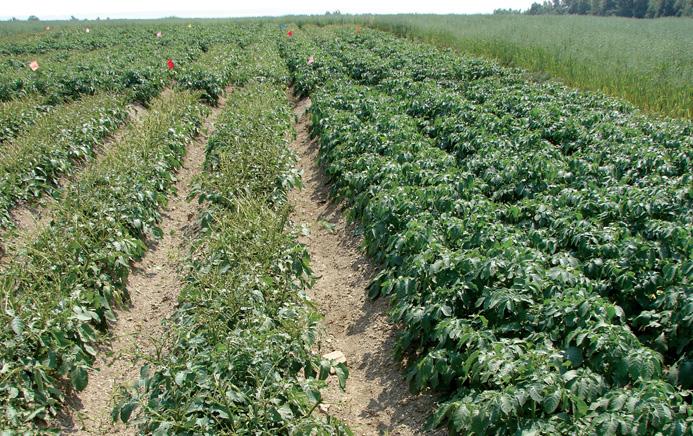
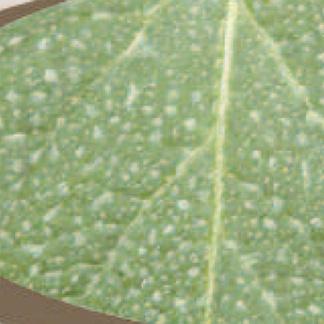
Left side of the picture shows untreated potatoes with significant defoliation from Colorado potato beetle feeding. Right side of the picture shows protection provided by 75 grams active ingredient per hectare rate of Rynaxypyr.
DuPont Canada is working with the PMRAto have a new insecticide registered in 2008. “Rynaxypyr, which is to be marketed under the name Coragen in potatoes, is from a completely new family of chemistry,” explains Adam Vaughan, product registration manager, DuPont Canada. “It is the first active ingredient from the anthranilic diamide class of insecticides and offers a novel mode of action.” Research is showing this unique molecule is effective at providing long-lasting control of a
broad spectrum of chewing insects and several other important insect species at low application rates in a wide variety of crops. Coragen is a foliar application product.
Rotating pesticide groups and modes of action is very important. “When the new Rynaxypyr chemistry becomes available, growers will have at least three modes of action to use in rotation, plus some older chemistries that may work,” explains Dively. Growers are reminded that new products or new formulations are not necessarily new modes of action. For example, a new generic imidacloprid, the same active ingredient and mode of action as Admire, was registered recently as Alias 240 EC. Therefore, it is important to understand all of the details about a new product or formulation so proper resistance strategies can be followed.
Since Rynaxypyr is from a completely new family of chemistry, it has no cross-resistance with existing products. “Managing new and existing chemistry involves rotating the use of products with different modes of action,” says Vaughan. “Agood resistance management strategy is based on rotation of different modes of action and not rotation of different
PHOTOS COURTESY OF DUPONT CANADA
Curzate® lets you bridge the gap between protectant sprays
Curzate® reaches back to control sporulation and infection that occurred before application
Begin use early from emergence to row closure topreventinfection
Emergence Row Closure Full CanopyTop Kill
Best application timing
products with the same or similar mode of action.” History tells us that cross-resistance can quickly develop between products with the same mode of action. “Large scale research permit field trials conducted in 2007 from Manitoba to Prince Edward Island have shown Rynaxypyr to be a useful tool in resistance management,” he adds.
One of the other key tactics for delaying resistance is to follow good crop rotations. “Where possible, moving potato fields at least a half kilometre away from last year’s crop is a good idea,” explains Dively. Adult beetles do not move very far, so any beetles that survived a pesticide regime and have possibly selected for resistance will likely overwinter just outside the field.
“By moving the new crop farther away, it reduces the chances that any resistance can be passed on to the new population in the new location. In popular potato growing areas and for some growers, this can be a challenge.
Growers are encouraged to monitor populations and follow economic thresholds. Wait, scout and monitor before making a decision to use a pesticide. “Potatoes can actually tolerate a lot more damage than what most growers think they can,” says Dively. “There has been quite a bit of research, particularly on early adult feeding damage, and we’re realizing it’s not as bad as we always thought.” So do not use pesticides if it is not necessary. The more the crop is treated, the more selection pressure and the greater the chance of driving that insect to resistance.
“Consider whether or not you need to use a pre-plant systemic insecticide at planting,” explains Dively. In many situations, a pre-plant application may not be necessary. “One of the strategies some of the potato growers in the US mid Atlantic areas are doing for planting treatments is to just treat the outer perimeter of the field, leaving about 70 percent of the acreage in the middle untreated.” When the beetles come out from overwintering, they are usually quite weak and tend to walk into a field rather than fly. Therefore, if the outside perimeter of even 100 feet is treated, this treated barrier will kill the adults before they get into the rest of the field. That means a savings of 70 percent of the costs and provides a central refuge for the few that do survive. Leaving a refuge for some bugs to survive helps delay resistance.
If a pre-plant systemic product was used at planting, then use a different mode of action for any in-crop applications. For in-crop control, monitor and wait for the first generation of larvae to hatch and exceed economic thresholds, and then use a product like Success. Dively says, “If you need to use another foliar application, there will be two modes of action once Coragen becomes available.” Never repeat a treatment because adequate control was not obtained. This is the first sign that resistance is high. Always change
chemical groups if repeated treatments are necessary.
Planning ahead and keeping new chemistries away from the risk of resistance as long as possible is important. “Follow good crop rotations, use good agronomics and IPM strategies to keep the crop as healthy and competitive as possible and always follow good chemistry and mode of action rotations,” says Dively. “Rynaxypyr is going to have a good fit for potato growers with its new chemistry and new mode of action, helping to address pest control resistance issues.” ■
Another product for CPB
Rynaxypyr is the first product to be simultaneously reviewed by Canada, the US, Europe and Australia under an Organization for Economic Co-operation and Development (OECD) work-sharing project, according to DuPont. The project is aimed at an accelerated review and approval timeline and regulatory harmonization. This process ensures that Canadian growers have access to the same products, for the same crops as growers in the US and other countries. It also ensures that Maximum Residue Levels (MRL) are established at the same time in as many countries as possible. The application for international CODEX MRLhas also been accepted for review.
“We take our hats off to DuPont for taking a real global leadership role with this registration approach,” says Craig Hunter, technical advisor, pesticides and minor use, Ontario Fruit and Vegetable Growers’ Association (OFVGA). “They are really a ‘poster child’ of how growers would like to see companies approach new registrations. We hope other companies follow their lead.” Having the product registered
Q Craig Hunter, technical advisor, pesticide and minor use issues, OFVGA.
globally at the same time ensures growers are facing the same residue tolerances in all countries, and trade is therefore not an issue in terms of pesticide use.
With an entirely new chemistry and novel mode of action, Rynaxypyr will expand the range of tools growers have to address pest problems and the potential of resistance. “We’ve already lost some products over the past few years because of resistance, or voluntary elimination in the face of the US FQPAreview program, and other standbys such as Guthion are slated to be taken off the market in 2012,” says Hunter. “Therefore, it is exciting to see some new chemistries being brought in that will have spectrums of activity that will eliminate or greatly reduce the impact of losing these old standbys we’ve relied on for years.”
Rynaxypyr was accepted for review under the reduced risk category. It is applied at low use rates and has a unique mode of action. The many regulatory studies conducted over the past few years demonstrate the effectiveness and extraordinarily low toxicity of Rynaxypyr to mammals, birds and fish. The product also achieves the goal of delivering safe and environmentally sustainable options for growers. ■
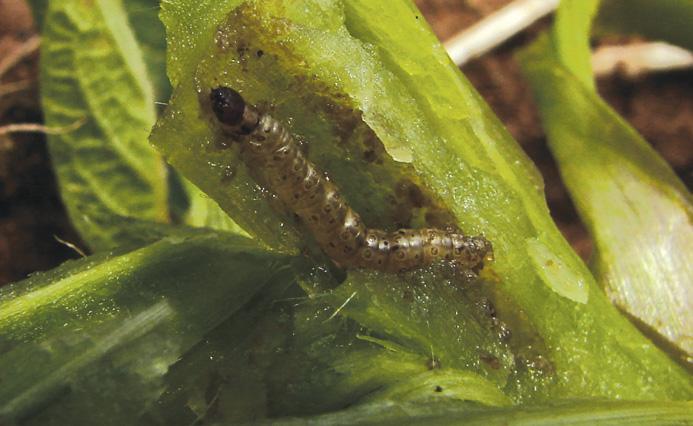
Long the scourge of corn producers, European corn borer is showing up in some potato fields.
Potato producers and researchers have seen increased evidence of the European corn borer in New Brunswick, Prince Edward Island and Quebec, but only in small pockets throughout the three provinces and there are signs that the pest problem may be weakening.
Gilles Boiteau is an entomologist with Agriculture and Agri-Food Canada’s Fredericton, New Brunswick research centre. He says the European corn borer has always been a pest in eastern Canada, but until the last six or seven years, it has never been an increasingly predominant problem for potato producers. Sightings have increased and problems in the potato field associated with the European corn borer are also on the rise.
even after farmers have relocated their corn crops. “This suggests they can do well on potatoes,” Boiteau states. The increase, however, has been ‘very localized’ and varying between provinces, regions and even fields. “There tend to be hot spots,” Boiteau says. “In Prince Edward Island it seems to be a little more consistent, but it’s not as major a pest as the Colorado potato beetle for example.”
The same holds true in Quebec, says Serge Bouchard, a potato specialist with Quebec’s Department of Agriculture, Fisheries and Food. Even with the hot spots, Boiteau says the incidents of reported damage in Atlantic Canada have decreased in the last two to three years. Boiteau says even if there are some incidents of corn borer infestation, potato plants are able to withstand a fair amount of pressure before yields are reduced.
The European corn borer is a challenging pest to control, Boiteau says, but it is important that producers keep it in check or the population could
Previous to more focussed attention on the corn borer, Boiteau says it was common to blame the appearance of the corn borer in potato fields on the proximity of corn fields. Producers were advised to plant their potato crops far from corn fields to prevent the adult (moth) European corn borer from migrating into potato fields. Regardless, the corn borer has continued to appear in potato fields
expand and get out of control. Still, management of the corn borer can be like chasing a shadow.
He explains that indistinct, brownish adult moths are usually found in the vegetation surrounding potato fields. It has been determined they move into the field at various times in the growing season to lay small whitish egg masses on the leaves of the potato plant. The small, almost invisible larvae hatch and
by Allison Finnamore
spend one day or so on the plant before entering the plant stem where they are hidden from view as they feed on the inside.
Nearly invisible, yes, but the destruction can eventually be quite obvious. By the entry holes and the inside of the stem being eaten away, the plant stalk is weakened and could break over time.
Three reduced risk insecticides have recently been approved to help fight the corn borer. The new chemistry, Boiteau explains, impacts the pest’s reproduction. Applied to the plant, it is absorbed and ingested by the corn borer.
The European corn borer overwinters in the stems of potato plants left in the field. Although common practice has been for producers to leave plant debris over the winter to provide added ground protection, leaving them could increase the chance of European corn borer infection in spring’s new potato crop. Boiteau says producers have a balancing act and some have turned to technology for help. He notes a stem crusher implement, developed by Dr. Christine Noronha at the Charlottetown Research Centre of AAFC, that attaches to harvesters has been shown to be effective at destroying corn borers and leaving winter ground protection in the fields at the same time.
Along with the near invisibility of the pest, the problem in the fight against the European corn borer is still one of timing, Boiteau states. Finding the right time to apply protection is tricky because eggs are laid during a period of weeks. Some producers and research facilities use traps to try to gauge the arrival of female moths, while others scout fields for numbers of egg masses or numbers of entry holes on stems. Additional challenges arise when summer temperatures cool, causing egg laying to slow down.
“It remains a very difficult task,” Boiteau explains. “You want to spray at the ideal time and this is quite a challenge with the corn borer.” Scouting fields, watching for any evidence of the European corn borer and being mindful of control methods are a farmer’s best defense against the pest. ■
Leaving plant debris in the field may increase chances of corn borer overwintering to the next season.
Pest management is the most essential factor in ensuring quality and yield at harvest. Each year the task of choosing products becomes more complex, as producers adjust to conditions as well as market demands, avoiding or delaying pests becoming resistant to products, as well as new products being introduced and some standbys being removed from the market.
This year, Top Crop Manager has updated the ‘Potato Pest Control’ tables with some new products. As be alert about rotating between funcgicide chemical classes: check the notations ‘resistance grouping’.
Remember, the tables are a guide adapted from crop protection guides published annually by each province, not a definitive text. Growers should always double check provincial guides and product labels to avoid errors.
Growers should be aware that the actual control obtained can vary greatly, depending on soil type, moisture conditions, weed pressure, weed size and environmental conditions. ■
Peter Darbishire Editor
We are grateful to the numerous government and industry pest management specialist for reviewing the Top Crop Manager ‘Potato Pest Control Guide’ and making numerous helpful suggestions.
Disease management products
Common name
Chemical group (Rotate groups to manage resistance. Check label for details.)
The Top Crop Manager Potato Pest Control tables are a guide only. It is highly recommended that growers refer to provincial guides and labels as well as the recommendations of packers and processors.
DISEASESNOTES
IMPORTANT: The Top Crop Manager Potato Pest Control tables are a guide only. It is highly recommended that growers refer to provincial guides and labels as well as the recommendations of packers and processors.
* Tank-mixes not registered in all provinces DualIIMagnum15•••SuperiorLinuron(7),Patoran(7), Sencor(5),Afesin(7) ExcelSuper(notinMB)1• Glyphosate9•• Gramoxone22•RussettBurbank, Cherokee Linuron(7),Sencor(5)
The Top Crop Manager Potato Pest Control tables are a guide only. It is highly recommended that growers refer to provincial guides and labels as well as the recommendations of packers and processors.
POTATO PEST CONTROL
IMPORTANT: The Top Crop Manager Potato Pest Control tables are a guide only. It is highly recommended that growers refer to provincial guides and labels as well as the recommendations of packers and processors.
IMPORTANT: The Top Crop Manager Potato Pest Control tables are a guide only. It is highly recommended that growers refer to provincial guides and labels as well as the recommendations of packers and processors.
The Top Crop Manager Potato Pest Control tables are a guide only. It is highly recommended that growers refer to provincial guides and labels as well as the recommendations of packers and processors.
Can biofuel and potato production co-exist?
The
biofuel industry may offer some interesting challenges for potato growers.
As biodiesel and ethanol plants spring up across the US like dandelions on lawns, the opportunities for field crop producers have increased. Stories of wheat production declining because corn for the biofuel industry pays a better return followed by concern of food shortages if not enough wheat is grown fill the air waves and newspapers. In some instances, there may be reason for concern, but how does all this hype affect potato growers?
The impact on potato growers in the US appears to be greater than it is in Canada. In fact, there has been little impact in the Canadian potato growing regions, but that could change. While some of the concern is the reduction of acres planted to potatoes, the reality is that all growers need viable rotation crops and the biofuel industry may give them some.
“Another high value crop that could be rotated with potatoes would be good for growers,” says Gary Sloik, manager of the Keystone Potato Producers in Portage La Prairie, Manitoba. “Traditionally, our rotation crops have not been giving good returns, so the ethanol and biodiesel industry may give growers a good alternative.” He says areas that can successfully produce corn in Manitoba would now have an alternative high value crop that could replace potatoes, which would reduce any issues surrounding over production.
For an example of how potato production is being affected, growers can look south of the border to Washington State’s Columbia Basin, famous for its crop diversity and the acres of potatoes that are grown for processing. “So far, we are not seeing an impact in the Columbia Basin, but we expect to,” says Dale Lathim, the executive director of the Potato Growers of Washington. “We are starting to see competition for land to supply fuel production and that will affect potato growers.” He says rental rates for land have increased by 50 percent in
recent months and they may continue to increase. Traditionally, the potato was the king of crops and land used for potato production commanded the highest rent. But, Lathim says rent being paid now for land that will be used to grow fuel crops equals the rent being paid for potato production, so there is no premium to be achieved by a landowner renting to a potato grower, and the potato industry has to compete for land.
Lathim uses sweet corn as an example of what has happened as a result of the biofuel furor. In 2007, sweet corn processors offered to pay US$68 per ton, but they got few contracts and the price was raised to US$80 per ton. When they did not get the acres needed, they had to buy sweet corn from other areas of the US. Contract prices for 2008 increased to $US100 per ton and the processors supplied the seed. All the increases in land rent and higher costs will get passed on to consumers.
“If we want ethanol plants, we are going to have to pay more for food,” is Lathim’s assessment, which could be positive for potato growers. However, he sees a reduction in potato acres coming, which is a concern for processors. “Potatoes were the number one crop in the Columbia Basin for two decades,” he says. “There are now eight other crops that will return as high or better profit margins than potatoes.” This is partly helped by the desire for biofuels.
But, will Canadian producers feel the same squeeze? It is possible, however,
they may also find new market opportunities south of the border because Canada is slower to get on the biofuel bandwagon. Several biofuel plants were scheduled for Ontario, but a government directive to put them near municipal water supplies and not in agricultural areas sparked a public outcry and the plants were never built.
According to David McKenzie, chairman of the Ontario Potato Board, the impact of biofuel on the potato industry in that province has been minimal so far. He says that corn acreage in Ontario increased in anticipation of the biofuel plants opening and now jaded corn growers have switched to wheat because the price is the best it has been in years. Again, as a result of biofuel.
“High value potato crops are not a viable fuel source,” explains McKenzie. “Potatoes would make an excellent source for ethanol but it would be too expensive to produce them for this use. However, we did see an opportunity to remove our culled potatoes to the ethanol plants.” He points out that Ontario potato production costs the most in North America and biofuel plants will not be able to cover that cost, whereas it can afford to pay a premium for corn. He also does not see potato acres being reduced in the near future because Ontario growers have contract commitments to processors and customers, which means only discretionary acres would be removed from production.
If McKenzie sees any negative impact on potato production in Ontario as a result of biofuel, production it will be the increase in fuel costs to growers. The province has legislated that by 2010, all fuel sold in the province must have 10 percent ethanol content. If enough ethanol plants do not materialize in the province, the supply will have to be purchased from elsewhere, leading to an increase in fuel costs. Those fuel costs will have to be paid by growers if they wish to continue production. “If biofuels were manufactured here, we could reap the benefits,” he says. “Instead, because we have too few plants, we will pay the price.”
Back in Washington, Lathim says growers are not yet using biodiesel in their equipment, but it will eventually happen. “There is a growing demand for these fuels and no doubt every gallon produced will be sold.”
Meanwhile in Manitoba, which boasts one of the first ethanol plants in Canada, the affect on production of high value crops has never been felt. “We’ve had the plant in Minnedosa for years and it has not affected potato production,” Sloik says. However, if additional plants get built and the prices for the alternative crops increase, that may change, but it may only mean that potato growers will now get better returns for their rotation crops.
In the end, the biofuel industry is so new that the full impact has not been felt and is difficult to predict. McKenzie says that potato growing areas that have long needed more viable alternate crops to work into their rotation may finally have them. “Gains could happen in eastern provinces that have been looking for viable rotation crops for years,” he predicts. As well, he adds, if major production areas in the US can make good returns on alternate crops, Canadian growers may need to step up production to fill any voids created.
“Farmers will plant what they can make the most money on,” Lathim states. “Somehow markets will correct themselves. Perhaps the price of food will go up to balance the increased costs of production.” Without a doubt the biofuel industry will have an impact on potato production and, depending on the growing area, it could be negative or positive, but it is too early to predict which it will be. In Canada, the true impact may not be known for several more years. ■
Fifty years of research and extension
by Yves Leclerc*
From the beginning, agronomy played a major role in McCain Foods’ worldwide success.
McCain Foods founders, Harrison and Wallace McCain, understood that the success of their company would be linked to the development of a strong agronomy program dedicated to the study of the potato crop and the transfer of knowledge to contract growers. While New Brunswick had a long history of potato growing, the varieties grown were not suitable for the production of frozen French fries. As recalled by Wallace in an interview for the book From the Ground Up, “Our first products were greasy and black fries. If there was such a thing as grade F, that’s what we were producing.”
Today, the McCain Foods (Canada) agronomy team is composed of 10 agronomists located at every potato processing factory in Canada. The role of the agronomist is to provide expert advice on all aspects of potato production and storage. Much of the knowledge shared with the grower community has been developed at the McCain research farm in New Brunswick.
The research farm was established in 1975 in Florenceville, New Brunswick, consisting of about 35 acres of land. Every year, about 10 acres of potato trials are conducted at the site. In addition to the work done on the research farm, field scale trials are conducted with co-operating growers. In the other provinces, potato research is conducted in collaboration with private and public research entities or on-farm by McCain agronomists.
Asignificant portion of McCain research activities is dedicated to variety development. In collaboration with McCain’s global variety development program, the Canadian agronomy program is evaluating dozens of prospective breeding lines from around the world to find a new processing variety. The company’s past success in this field has been significant.
In addition to introducing and adapting the long-season variety Russet Burbank in short-season New Brunswick, McCain agronomists have been instrumental in introducing the variety Shepody. Bred by Agriculture and Agri-Food Canada in Fredericton, and released in 1980, Shepody is the most widely grown Canadian variety around the world. McCain agronomists are currently evaluating
Research plots at the McCain research farm are harvested. PHOTOS COURTESY OF MCCAIN FOODS
several new breeding lines commercially across Canada.
Post-harvest physiology has been a success story for the McCain Foods agronomy research program, as well. As a result of work conducted in the 1980s by McCain Foods on the chemical maturity of Russet Burbank, the company now has the knowledge and understanding of the mechanisms regulating French fry colour and can now provide growers with recommendations that will ensure near perfect colour.
Fertility research has been an important research topic since the beginning. An extensive study was recently completed on the nitrogen management of the two major processing varieties (Russet Burbank and Shepody). This collaborative work, undertaken with Dr. Bernie Zebarth of Agriculture and Agri-Food Canada and McCain Foods (Canada), was designed to understand the nitrogen cycle in the potato production system in eastern Canada, develop the agronomy tools required to better manage this nutrient and optimize the nitrogen fertility of Russet Burbank and Shepody.
From this study, a nitrogen management strategy for eastern Canada was developed to optimize yield and quality of these varieties, while minimizing the environmental losses of nitrogen, including nitrate leaching in groundwater and nitrous oxide emission. Results of this study have been published in peer-reviewed scientific journals, and Best Management Practices (BMPs)
guidelines have been prepared for use by growers. McCain Foods agronomists in eastern Canada are now using these BMPs to provide growers with state-ofthe-art fertility recommendations and to track grower nitrogen use. Similar work is currently underway in Manitoba.
McCain agronomists on Prince Edward Island have been working very closely with a number of contract growers, who are also large hog producers, to validate nutrient management guidelines and recommendations for hog manure applications in potato production systems. After several years of trials, the guidelines and recommendations have been validated and BMPs for manure use in potato production have been established. The implementation of these BMPs has improved the raw potato quality for a local factory, allowed growers to significantly reduce their inputs of inorganic fertilizer, and has reduced the nutrient load on the soil and water environment.
Pest and disease management is also a constant topic of research. For the past four years, McCain Foods (Canada) has conducted several research trials to evaluate the efficacy of a number of reduced risk pesticides for the control of Colorado potato beetle and European corn borer. After demonstrating the efficacy of these products in research plots, McCain Foods (Canada) agronomists are now recommending the use of these products whenever applicable. The use of reduced risk pesticides directly benefits the environment by reducing the impact of
pest and disease control measures. Similar work has been conducted on fungicides. McCain Foods is also evaluating a decision support system for late blight disease management.
While McCain agronomists are involved in research and development, their primary function is to provide extension support to contract growers to help them grow and store their potato crop. This support is provided through the CropMET and StorMET programs. Based on the concept ‘If you can’t measure it you can’t manage it’, these programs are designed to help growers measure their agricultural practices to better manage them. The short-term objective of these programs is to measure key production and storage practices as they are performed. These programs have allowed McCain agronomists to improve yields and quality.
The CropMET program is also an effective conduit to introduce the Integrated Pest Management (IPM) concept on the farm. Agronomists use the IPM strategy to provide growers with information and recommendations on field specific pests and diseases.
The efforts of the McCain agronomists are now extending to the internet, with the development of web based tools for growers such as the Pesticide Information Database. McCain agronomists have recently created a database of crop protection products registered for use on potatoes in Canada. The database provides growers with detailed information on pesticides and their use. Information includes, for example, pesticide efficacy data, the environmental profile (toxicology) of each active ingredient, and the necessary precautions growers need to take when handling and applying these products. The database is available to all contract growers via the internet at: www.mccainagportal.com
After a half century, McCain Foods continues to expand its focus to include new technology and ways of sharing that technology with growers while not losing sight of its main ingredient: potatoes. ■
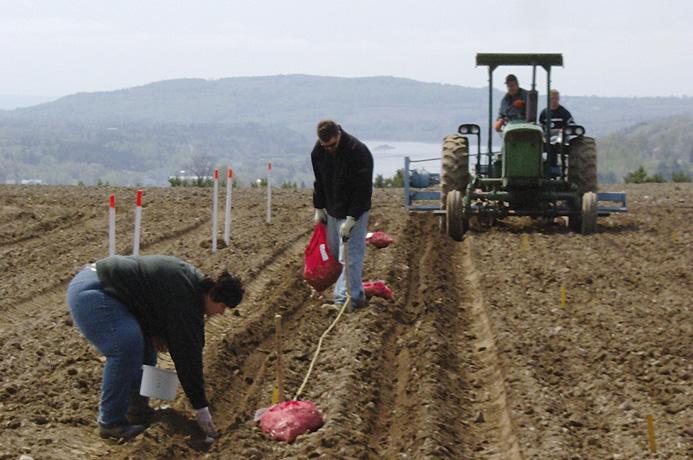
Plot planting at the McCain research farm.
*Yves Leclerc is director of agronomy for McCain Foods, based at Florenceville, New Brunswick.
Growers Supply Limited, an independent agricultural retailer, has been supporting the Alberta potato and row crop industry for 43 years. Today they have two locations in southern Alberta at Taber and Vauxhall. “Along with a full-line of potato production and storage equipment, a dedicated parts and service department, we also have Certified Crop Advisers on staff with extensive knowledge on potatoes,” explains Peter Mitchell, manager. “We provide a full-line of agricultural crop protection products for the potato industry and other crops grown in southern Alberta, including beans, corn, peas and sugar beets.”
As a partner in the potato industry, Mitchell and his staff stay on top of the research, products and trends impacting the growers and other stakeholders. “The Alberta industry along with others across Canada, are feeling the constant pressure of the rising Canadian dollar and the challenges that brings with it,” says Mitchell. “Agood portion of Alberta processed potato products are exported outside of Canada, which brings challenges for the growers who supply that market.”
According to the Potato Growers of Alberta, about 75 percent of the potatoes
grown are for the processing market. All potatoes grown for processing whether French fries, chips, or other processed products, are grown under contract to the processor. It is the end-user of the product that dictates the processed potato specifications. Seed potatoes represent about 20 percent and table potatoes the remaining five percent. Alberta’s certified seed potatoes are in high demand because of the colder climate, which results in fewer disease and pest problems. Alberta growers are currently the biggest exporter of seed potatoes in Canada.
One of the benefits Growers Supply brings is an understanding of the crop input products they sell to growers, and
the registration details in all countries their produce is being sold to. “Different countries have different requirements and accepted maximum residue limits, so we work with growers to make sure we have the most up-to-date information,” says Mitchell. “Our growers always have to be aware that the Alberta marketplace is competing with other areas of North America and around the world. They need to ensure they are supplying the best quality product to meet those needs and demands.”
The company has two full-time agronomists, who are also Certified Crop Advisers, working with growers on a regular basis. The agronomists work with growers on various issues including fertility, scouting fields for diseases, insects, weed control, along with the testing of new chemistry introductions to make sure it fits into the Alberta market and the registration requirements in other export countries. “Although we do limited research, we work closely with growers to produce quality potatoes, project their needs in the future, and to determine how we can help them meet those needs.”
Mitchell emphasizes that, “Growers Supply, working in conjunction with the potato growers of Alberta, is very committed to meeting and exceeding the challenges in today’s competitive marketplace by providing quality and value to the consumer in the North American and Asian marketplaces.”
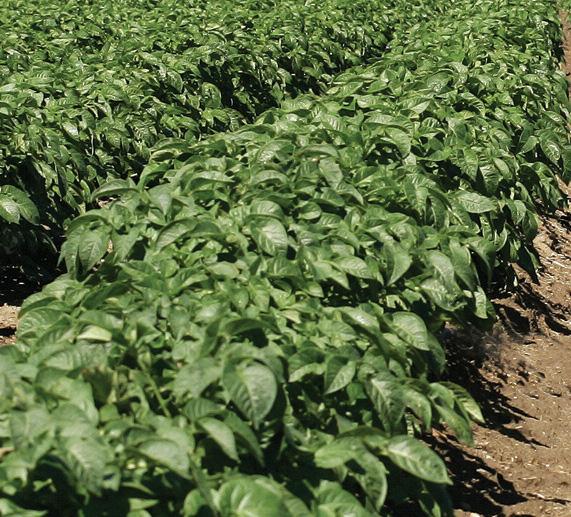
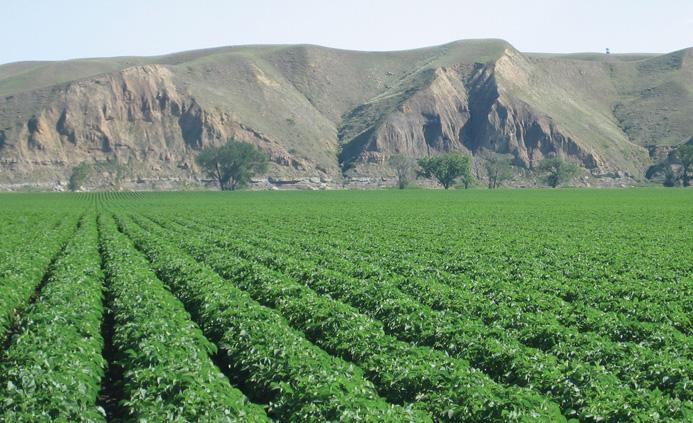
Healthy potato crop growing in June weather. PHOTO COURTESY OF SCOTT GILLESPIE, GROWERS SUPPLY LIMITED
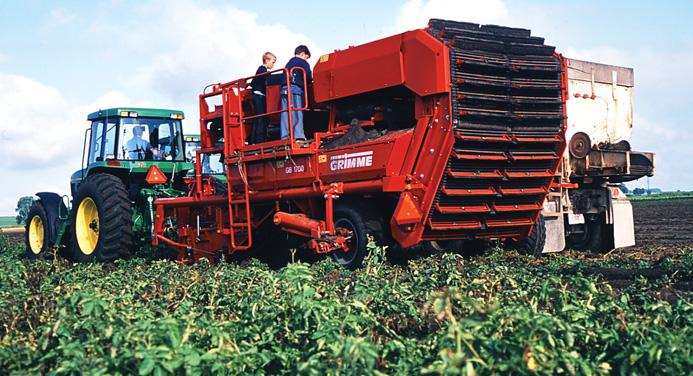
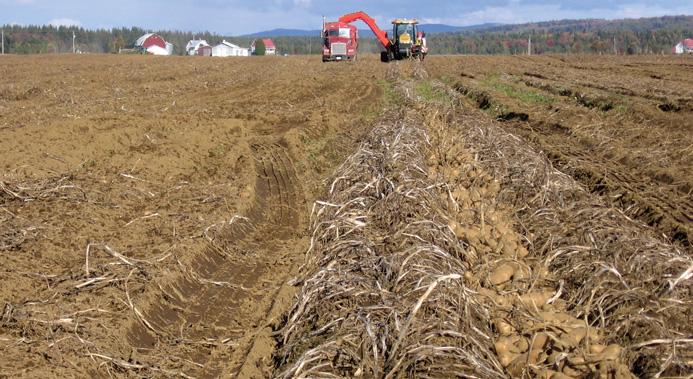
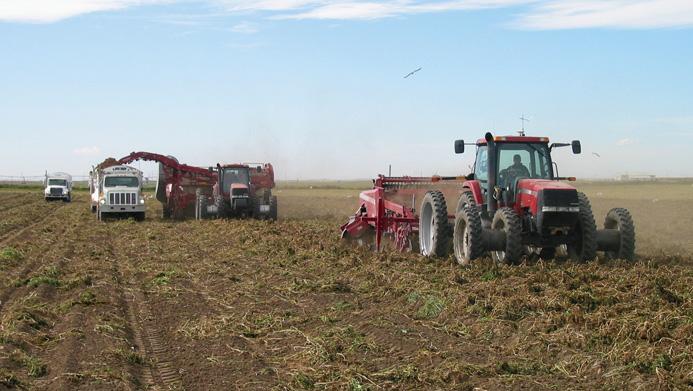
Potato harvest in full swing.
PHOTO COURTESY OF BILL BROWNING, GROWERS SUPPLY LIMITED