THE BROADLEAF PREDATOR
It’s time to get territorial. Strike early, hard and fast against your toughest broadleaf weeds.
Lethal to cleavers and other broadleafs, Infinity ® FX is changing the landscape of cereal weed control.


TOP CROP
MANAGER
5 | A closer look at fertigation
Evaluating the effects on canola and wheat.
By Carolyn King
8 | Sugar beet replanting decisions
Updated recommendations for southern Alberta.
By Carolyn King
12 | Preparing for invasive mussels
Combating a nearing threat to Alberta’s irrigation system.
By Carolyn King
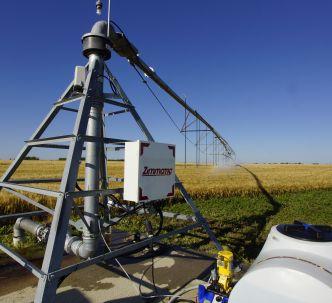
By Carolyn King
By Brandi Cowen
RUNOFF WITH ENGINEERED SPRAY DROPLETS
When farmers spray their fields with pesticides or other treatments, only two per cent of the spray sticks to the plants. A significant portion of it typically bounces right off the plants, lands on the ground, and becomes part of the runoff that flows to streams and rivers, often causing serious pollution. But a team of MIT researchers aims to fix that.

PHOTO BY MELANIE GONICK.

BRANDI COWEN | EDITOR
WATER WOES AHEAD?
It’s official: 2016 was the warmest year on record. The United States National Oceanic and Atmospheric Administration (NOAA) reports the average global surface temperature reached 14.83 C – the warmest it’s been since modern temperature records began in 1880.
A separate analysis from NASA considered average surface temperature readings from 6,300 weather stations, as well as ship- and buoy-based sea surface temperature readings and temperatures collected from Antarctic research stations. The agency reports the planet’s global average surface temperature has risen about 1.1 C since 1880; 0.99 C of that increase has been recorded since the middle of the 20 th century. Sixteen of the 17 warmest years on file have been recorded since 2001.
“2016 is remarkably the third record year in a row in this series,” said Gavin Schmidt, director of NASA’s Goddard Institute for Space Studies, in a press release. “We don’t expect record years every year, but the ongoing long-term warming trend is clear.”
Changes in the climate may offer some benefits to some producers (longer growing seasons, anyone?). However, they also threaten to change the conditions under which producers have learned to grow their crops profitably. According to Natural Resource Canada’s 2014 report “Canada in a Changing Climate: Sector Perspectives on Impacts and Adaptation,” longer growing seasons will lead to less snow cover during the winter and less rain through the summer. The result? Less water will be available for thirsty crops.
For producers who have already purchased irrigation equipment (and for those who are considering such an investment in the future), the quantity and quality of water available are serious concerns with very real implications for their operations.
Our mandate here at Irrigation in Canada is to bring you the information you need to make the best decisions for your farm, now and in the future.
In our cover story (see page 5), we report on Doon Pauly’s fertigation study, which used an irrigation system to apply fertilizer to wheat and canola crops. Pauly, an agronomy research scientist with Alberta Agriculture and Forestry, compared the results when different timings and rates of urea ammonium nitrate were applied by irrigation. The results, especially in canola, may surprise you.
If lodging is a problem in your irrigated fields, be sure to flip to page 10, where Sheri Strydhorst shares finding from her research using plant growth regulators (PGRs) to improve standability in wheat and barley. The Alberta Agriculture and Forestry research scientist conducted four small-plot studies from 2014 to 2016, producing 12 site-years worth of data that suggest PGRs applied to the right variety can reduce lodging in irrigated wheat and barley crops.
We hope this issue provides you with the information you need to enjoy a successful and prosperous season.
TOP CROP

CANADIAN
ADDRESSES TO CIRCULATION DEPT. P.O. Box 530, Simcoe, ON N3Y 4N5 e-mail: subscribe@topcropmanager.com Printed in Canada ISSN 1717-452X CIRCULATION e-mail: subscribe@topcropmanager.com Tel.: 866.790.6070 ext. 202 Fax: 877.624.1940
Mail: P.O. Box 530, Simcoe, ON N3Y 4N5
SUBSCRIPTION RATES Top Crop Manager West - 9 issues
“
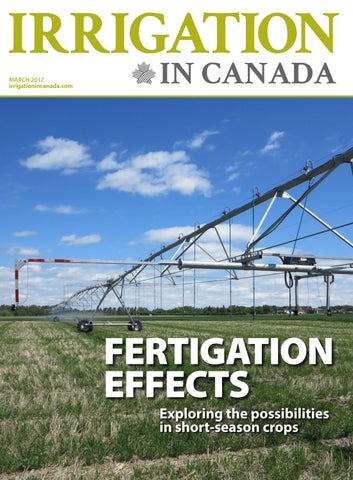
A CLOSER LOOK AT FERTIGATION
Evaluating the effects on canola and wheat.
by Carolyn King
Fertigation is quite common in southern Alberta, but very, very little research has been done on it in replicated plots,” says Doon Pauly, an agronomy research scientist with Alberta Agriculture and Forestry. His recently completed study took up the challenge of assessing the effectiveness of fertigation in wheat and canola.
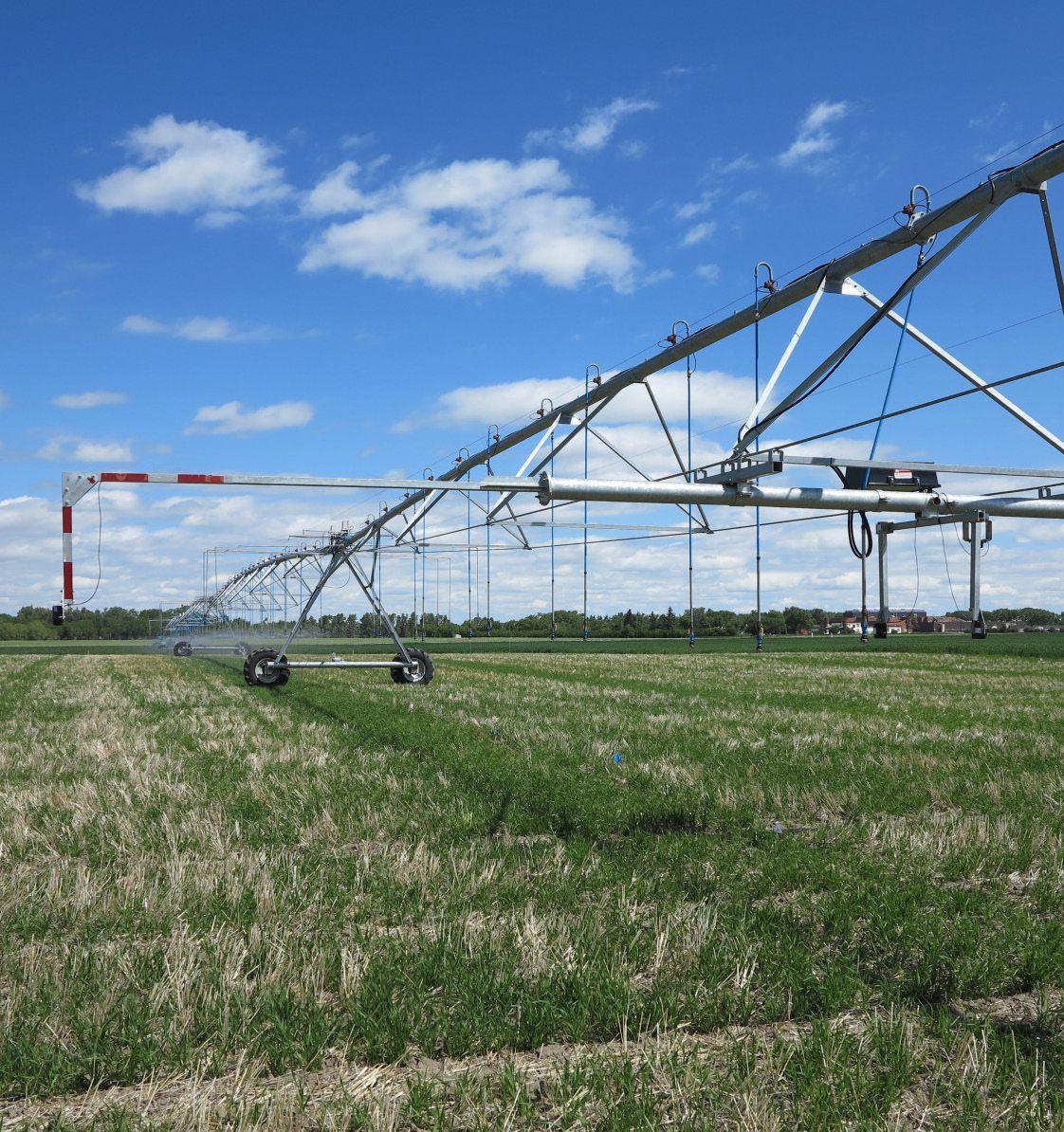
Fertigation – applying fertilizer through an irrigation system – can potentially offer some advantages. “In short-season crops, like wheat and canola, the vast majority of nitrogen uptake happens about four to six or seven weeks after our time of planting. Fertigation allows you to deliver nitrogen to the crop as it is needed,” Pauly explains.
“If you apply a lot of nitrogen at the time of seeding, it is potentially at risk for some kind of nitrogen loss event before the crop has taken up a lot of it. You can reduce that risk by an in-crop application.”
“And fertigation has advantages over an in-crop application of a dry product. When you apply broadcast urea in-crop, often it is surface-applied with no incorporation, so you could get volatilization losses. Also, the fertilizer is applied onto that high organic matter mulch [in no-till systems] and could be immobilized. But with fertigation you’re putting it on with water, which washes the nitrogen right into the soil. In our study, we fertigated with half an inch of water, which moves the nitrogen down to about the depth where banded fertilizer would be placed at the time of seeding. So, fertigation reduces the potential for volatile losses, it’s possibly less prone to immobilization and it’s placed where the roots can access it.”
Fertigation can also provide logistical benefits. Pauly says, “Some growers don’t want to haul all of their fertilizer at seeding and have to be stopping all the time to fill up their drill. They want to get their seeding done and fertigation is a way to do it.”
One of the challenges with fertigation is that, in a soggy growing season, the crop may need a nitrogen application even though the saturated soil doesn’t need to be irrigated and the soil may be so wet that the irrigation equipment could get stuck. Very wet conditions can be an especially serious problem if growers choose not to apply any nitrogen at seeding.
“If you get a high rainfall event that might be limiting the nitrogen [because of leaching or denitrification], then a crop that hasn’t had nitrogen from the start is probably going to be suffering even more. And there is no way you can get onto the field to correct the problem [until the soil finally dries],” Pauly says.
About the study
Pauly’s study was initiated by Ross McKenzie, who was the previous
agronomy research scientist in Lethbridge, Alta. “Ross had been trying for years to get funding in place for this research, and eventually the Alberta Crop Industry Development Fund and Agrium made it happen,” Pauly says.
He sees two key reasons why so little replicated fertigation research has been conducted in Prairie field crops: “Very few people are set up to do this type of research and it is really hard to do. There was one study about 30 years ago, then this one that Ross started, and now Dale Tomasiewicz with Agriculture and Agri-Food Canada at Outlook, Sask., has a project that is going into the field in 2017.”
From 2013 to 2016, Pauly and his team conducted two experiments in Lethbridge: one with wheat and one with canola. Each experiment included 120 plots.
The fertigation treatments compared timing and rate options for applying nitrogen (N) as urea ammonium nitrate with 12 millimetres of water. For wheat, the treatments were: no fertigation; 30 kilograms of N per hectare (kg N/ha) at about the five-leaf stage; 30 kg N/ha at the flag-leaf stage; 30 kg N/ha at flowering (anthesis); and 30
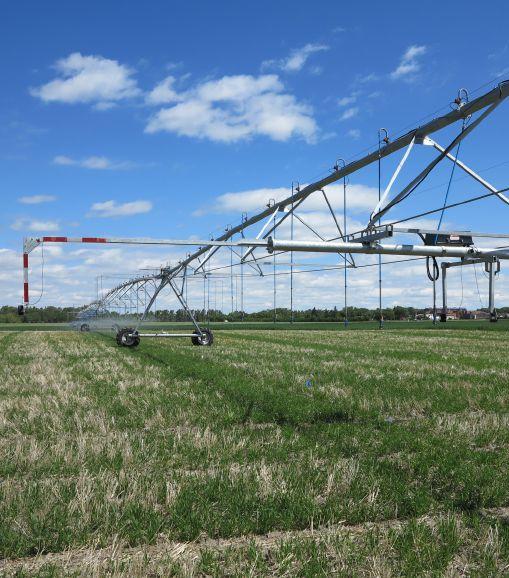
This Alberta research is one of the few replicated plot studies on fertigation in wheat or canola on the Prairies.
kg N/ha at each of those three timings. For canola, the treatments were: no fertigation; 30 kg N/ha at the four- to six-leaf stage; 30 kg N/ha at the bolting stage; 30 kg N/ha at flowering; and 30 kg N/ha at each of those three timings.
Each of the fertigation treatments was applied onto plots where nitrogen was mid-row banded at the time of seeding at zero, 30, 60, 90 or 120 kg N/ha. A linear move irrigation system applied the fertigation treatments.
Each fertigation required a time-consuming effort, first to set up the nozzles to fertigate only those plots that were to receive nitrogen at that timing, then to flush the equipment to remove all the fertilizer, and finally to provide water to the remaining plots that weren’t being fertigated at that time.
As well, the plot design had to allow a considerable space between the individual plots to ensure uniform fertigation application within each plot and to prevent accidentally contaminating adjacent plots that weren’t supposed to have a fertigation application. With all that non-plot space, each experiment occupied an area of 150 metres by 100 metres. Because each experiment occupied such a large area, it encompassed a lot of soil variability across the plots. Pauly notes, “In some cases, we had to have very large differences between our treatments in order to say with confidence that those differences were due to treatment [and not to soil variability].”
yields. “The yield response curves were almost identical whether all the nitrogen was applied at the time of seeding or whether some of it was applied at the time of seeding and then topped up with 30 kilograms later,” he says.
However, the fertigation applications did increase the protein levels in wheat. Pauly explains, “Especially with the anthesis timing, we got comparable yields plus one to 1.5 per cent higher protein. This protein boost is really good news in a crop like hard red spring wheat where there is the potential for a protein premium.”
He notes that other researchers have assessed the benefits of split nitrogen applications in wheat with mixed results – probably at least in part because of complexities around how much of the in-crop nitrogen application was lost through volatilization. In Pauly’s study, the results strongly indicate fertigation was getting the nitrogen into the soil and into the crop.
Irrigation around heading time in cereals is not recommended because of the risk of Fusarium head blight, so Pauly’s team tested samples in the lab for the presence of the pathogen. “Most of the time it was below detection levels. And when we did have Fusarium, it was not related to treatment. It was probably more related to how much inoculum was present.” He notes that in this study, wheat was always seeded into canola stubble, so inoculum levels tended to be low. However, if wheat is seeded into wheat stubble and more Fusarium inoculum is present, then the disease could be an issue with fertigation at anthesis.
“Because we were applying nitrogen when the crop is needing it, we were expecting or hoping to get a bigger bang for our buck ... especially since canola is plastic and responds to changing conditions. The fact that we didn’t see a yield benefit surprised us.”
Surprising results for canola
Pauly highlights some key findings for the direct comparisons of an N rate banded at seeding time and the same nitrogen rate split between banding at seeding time and an in-crop fertigation of 30 kg N/ha.
In canola, yields were very similar for a given nitrogen rate no matter whether all the nitrogen was applied at seeding or the nitrogen was split between seeding and in-crop applications.
“Because we were applying nitrogen when the crop is needing it, we were expecting or hoping to get a bigger bang for our buck with fertigation and see a yield benefit, especially since canola is plastic and responds to changing conditions. The fact that we didn’t see a yield benefit surprised us,” Pauly says.
In almost every case, splitting the fertilizer application didn’t help or hurt canola yields. However, in one instance the split application with fertigation at flowering produced a lower yield, which makes Pauly view this timing with some caution.
“Our site had a fair bit of nitrogen at depth and the plots were under very high-yield conditions, so I don’t think this lower yield was because nitrogen was applied too late to improve yield. To me it almost looks like we might have injured the crop under high-yield conditions with that fertigation going onto the flowers, but I can’t prove that.”
In wheat, splitting the nitrogen applications didn’t help or hurt



More to learn about in-crop N
The results in both wheat and canola tend to indicate that applying all the nitrogen in-crop is always a poorer option. Another surprise in this study relates to growing season nitrogen losses. “In 2013, we had 130 millimetres of rainfall and in 2014, we had 170 millimetres of rainfall during that third week in June. With those conditions, I would have predicted substantial denitrification. And if substantial denitrification did occur, then our fertigation treatments that came after the rainfall event should have given us a nice replacement of nitrogen that was lost. But I see nothing in our data that indicates that happened,” Pauly says.
“We were pumping water off our plot area in 2014 to try to keep the plots dry – that is how much water was there. If the soils weren’t at saturation then they were probably between field capacity and saturation. And we were dealing with warm soils; there should have been lots of nitrate. Under those conditions, I would have expected lots of denitrification and that our fertigation treatments after that would give a really nice boost. So how much do we not know about denitrification?”
For future fertigation research in southern Alberta, Pauly thinks looking at a longer-season crop like corn could be useful. “From other research, we know about 75 per cent of the nitrogen is taken up by the time these [short-season] crops go into flowering. But a longer-season crop like corn is reaching its peak nitrogen uptake about three weeks later. So if you apply all your nitrogen fertilizer at seeding time on corn, then there is a really big window where a nitrogen loss event could occur,” he says. “And if a loss event occurs during that window, it could really affect corn yields because in southern Alberta the corn grows so slowly early in the season it is not taking up much nitrogen.”





The built-for-Canada-all-in-oneso-your-cereals-can-thrive treatment. We know you love to see your cereal crops grow to their fullest potential. And in true Canadian fashion, we’d like to give you a hand with that. Meet our Cruiser ® Vibrance® Quattro seed treatment. With four fungicides, an insecticide and the added benefits of Vigor Trigger ® and Rooting Power™, this all-in-one liquid formulation offers superior protection plus enhanced crop establishment for early-season growth. Just the helping hand you can use, eh?
SPECIAL CROPS SUGAR BEET REPLANTING DECISIONS
Updated
recommendations for southern Alberta.
by Carolyn King
To replant, or not to replant is often the question when a sugar beet stand has been severely damaged. Ultimately, a grower has to do one or the other, and making the right choice will increase net returns from the crop. A sixyear study has evaluated replanting recommendations for southern Alberta in light of the switch from conventional to Roundup Ready sugar beets. As a result, growers now have updated recommendations backed by solid data.
The three main reasons why growers in southern Alberta might need to replant sugar beet crops are soil crusting, which can inhibit plants from emerging, and then frost and wind damage, which can reduce stands once a crop has emerged.
Frost is the main concern in the early spring, soon after emergence. “Sugar beet growers like to start planting as soon as the field is dry and ready; in southern Alberta that is usually sometime in April. If we have an early to mid-May frost once the beets emerge, then replanting may have to occur,” says Peter Regitnig, the research agronomist with Lantic Inc. who led the study.
In late May and early June, beet plants can be lost due to wind damage. When the beets are at the cotyledon stage, they are susceptible to sand blasting. And when they have two to four true leaves, they are susceptible to having the leaves whipped around and twisted off by the wind.
The critical factor in replanting decisions is the number of plants per acre because a good stand maximizes both yield and quality, which in turn maximize returns. Quality refers to the beet’s sugar content and the levels of certain impurities that hamper sugar extraction. “Growers want to maximize extractable sugar per acre and both yield and quality are part of that figure,” Regitnig explains.
“We consider 35,000 plants per acre optimum for maximizing yield and quality. That equates to about 150 plants in 100 feet of row. At some point, beet yield and quality will begin to suffer if the plant stand gets too low. Quality begins to suffer before yield does – the yield will be compensated because the beets will grow bigger if there are fewer plants.”
The general recommendation is not to replant a damaged stand if it has 60 or more beets per 100 feet because that plant population can give pretty good levels of extractable sugar per acre.
Replanting differences in a Roundup Ready system?
“In 2009, Roundup Ready beets were introduced commercially in Alberta, and they had close to 95 per cent adoption in that first year. Also in 2009, a number of Alberta sugar beet growers
experienced reduced emergence stands due to wind, frost and soil crusting,” Regitnig explains. “So we conducted a couple of small trials to evaluate potential gains or losses from replanting poor stands of beets. Based on that work we decided to do a larger multiyear study.”
One objective of the study was to determine if replant recommendations developed through various previous studies on conventional sugar beets would be different in a Roundup Ready (RR) system. Regitnig explains, “The herbicides that we had in conventional sugar beets injured the crop quite a bit, setting it back. But with Roundup in Roundup Ready sugar beets there is no spring setback from the herbicide. Since the surviving plants may be more vigorous than in a conventional system, we felt that you might get by with fewer Roundup Ready sugar beets than conventional beets before you decide to replant.”
The study’s other objective was to assess the effect of the surviving first-plant sugar beets on final crop yield and quality. The effect
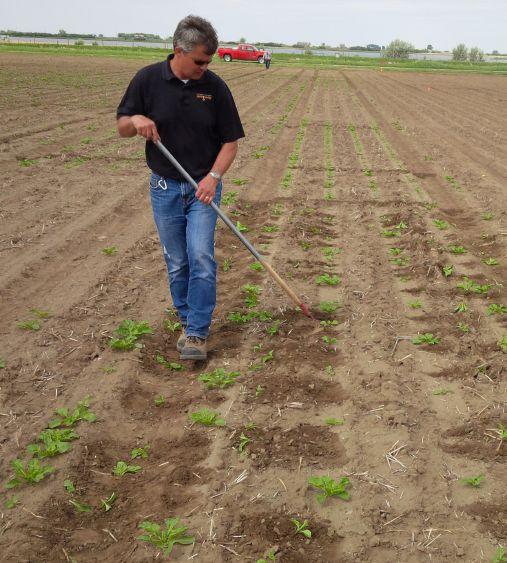
A stand of about 150 plants in 100 feet is optimum for maximizing sugar beet yield and quality.
of first-plant survivors was unknown because, to the best of Regitnig’s knowledge, all previous replanting research had been done on fields that were tilled and then replanted. That past research approach was likely because fields of conventional sugar beets were often tilled before replanting.
“Weed control was a lot bigger issue prior to a Roundup Ready system,” he explains. “The herbicides we had at that time didn’t work as well as Roundup. Sometimes, if you had a field with a poor sugar beet stand that wasn’t competing with the weeds, the weeds would get ahead of the crop. So growers would work the whole field to get rid of the weed problems and start from scratch. Now with Roundup in the Roundup Ready system, it is much easier to just replant into the existing crop rows.”
With funding assistance from the Alberta Crop Industry Development Fund, Regitnig and his team conducted nine trials between 2010 and 2015. “The trials in the first three years collected data on late May or June replant dates, which are more reflective of replant situations that may occur as a result of wind events. In the next three years, the trials obtained data for mid-May replant dates, when growers would typically experience plant losses from frost events.”
All the trials included nine treatments, and some had a tenth treatment. All treatments were planted in late April or early May. Once the plants emerged, four treatments were hand-thinned to plant populations of 30, 40, 50 and 60 sugar beets per 100 feet of row (beets/100 ft) and were not replanted. Another four treatments were thinned to 30, 40, 50 and 60 beets/100 ft and then replanted. The ninth treatment was a full stand with no thinning and no replanting. In the tenth treatment, all the first-planted beets were removed and then a replant operation was conducted.
Key findings
The replanted treatments performed differently depending on whether they were replanted in mid-May, early June, or mid-June.
Replanting populations greater than 40 beets/100 ft would likely result in net extractable sugar per acre loss,” Regitnig says.
For conventional sugar beets in early June, the recommendation was to replant if populations fell below 40 to 45 beets/100 ft. He notes, “The lower number in that recommendation is more fully supported by the early June data collected in these trials, so it looks like we can go with a few less beets in early June in the Roundup Ready system.”
Although growers don’t usually choose to replant by mid-June, the research team conducted a couple of trials in that period. “For midJune replants, the extractable sugar per acre gain was only 48 kg/ ha when a population of 30 beets/100 feet was replanted. And if we replanted 40, 50 or 60 beets/100 feet in mid-June, it resulted in extractable sugar losses of 199, 406 and 490 kg/ac, respectively. Based on those results, mid-June replanting would only be recommended for populations of less than 30 beets per 100 feet,” Regitnig says.
For conventional sugar beets, the recommendation was to replant if populations fell below 35 to 40 beets per 100 feet. The study’s results show that, for RR sugar beets, that population would be too high to replant in mid-June.
At this mid-June timing, for a stand of 30 beets/100 ft that wasn’t replanted, the average extractable sugar per acre was 65 per cent of a full stand of first-plant sugar beets; for 60 beets/100 ft, it was 86 per cent of a full stand. Growers could use this information to get an idea of the potential returns from a reduced stand to help in deciding whether to keep the thin stand or to plant the field to an alternate crop.
“There were a few outliers, but in most of the trials between 40 and 74 per cent of the first-plant beets survived the replanting operation. So replanting into existing stands of sugar beets will provide some level of production increase compared to removing all the first-plant beets before replanting.”
For mid-May replants, there were substantial gains of 1,265, 720 and 376 kilograms per acre (kg/ac) of extractable sugar, when populations of 30, 40, and 50 beets/100 ft were replanted, respectively. However, the gain in extractable sugar from replanting 60 beets/100 ft was small – only 95 kg/ac. “Replanting commercial populations of 60 beets per 100 feet would likely result in minimal gains in extractable sugar per acre,” Regitnig says.
For conventional sugar beets in mid-May, the recommendation was to replant if populations fell below 50 to 55 beets/100 ft. “Basically, that recommendation was supported by the data collected in these trials,” he notes. “Possibly that’s because not that much herbicide is applied prior to mid-May, so in a conventional system there would be minimal herbicide setback by early May. The two systems performed quite similarly, but now we have some hard numbers that we never had before to back up that recommendation.”
For early June replants, the extractable sugar gains were 482 and 137 kg/ac when sugar beet populations of 30 and 40 beets/100 ft were replanted, respectively. There were extractable sugar losses of 210 and 386 kg/ac when 50 and 60 beets/100 ft were replanted, respectively. “Based on those results, early June replanting would be recommended for populations of 40 beets per 100 feet or less.
Regitnig adds, “One quality note was that there was a bigger impact on quality the earlier the replanting took place. Mid-May replanting had a bigger effect on increasing sugar content than midJune replanting did.”
Regarding the study’s second objective, it turned out quite a few of the first-plant sugar beets survived. Regitnig says, “On average, we had 55 per cent survival of first-plant beets. There were a few outliers, but in most of the trials between 40 and 74 per cent of the first-plant beets survived the replanting operation. So replanting into existing stands of sugar beets will provide some level of production increase compared to removing all the first-plant beets before replanting.”
The value of replanting into existing stands varied depending on when the replanting occurred. “The surviving beets increased extractable sugar per acre in May by just a small amount, about 1.7 per cent, in early June by 7.3 per cent, and in mid-June by 43 per cent. So the later we replanted, the more impact those surviving beets had.”
The up-to-date data and recommendations from this study can give Lantic’s agricultural field staff and growers an added degree of confidence in replanting decisions.
CEREALS
PGRS FOR IRRIGATED WHEAT AND BARLEY
Differing effects of plant growth regulators on height, lodging and yields.
by Carolyn King
Lodging can be a serious problem, especially in irrigated crops. Of course, variety selection and nutrient management are important tools for managing lodging. But producers may want to grow a crop variety with not-so-good standability because it has other important traits, and they may want to use higher nitrogen rates to capture a crop’s full yield potential, so four Alberta studies have investigated plant growth regulators (PGRs) as another tool for reducing the risk of lodging.
“Plant growth regulators are synthetic compounds that impact the hormonal activity of the plant. The PGRs we are looking at work by affecting the plant’s gibberellin biosynthesis,” explains Sheri Strydhorst, a research scientist with Alberta Agriculture and Forestry (AAF). “You don’t have as much active gibberellin in the plant when these plant growth regulators are applied, so you tend to get shorter plants and possibly thicker stems. That height reduction lowers the centre of gravity and if stem thickening occurs, that may help address lodging as well.”
Strydhorst and her team conducted four small-plot studies in wheat and barley. The studies ran from 2014 to 2016 at five locations
across Alberta, including irrigated trials at Lethbridge, run by AAF’s Doon Pauly and his technical crew. The four studies each had three site-years for the irrigated trials. In addition, the wet weather and good growing conditions in 2016 meant the other study sites had the equivalent of irrigated conditions, so Strydhorst’s assessment of the value of PGRs under irrigated conditions includes some of the 2016 data from the other sites.
One of the four studies involved comparisons of two PGRs on AC Foremost, a Canada Prairie Spring Red (CPSR) wheat. The PGRs were: Manipulator (chlormequat chloride, from Engage Agro); and trinexapac-ethyl (from Syngenta), which is not yet registered. The PGRs were applied at growth stage 30 to 32, at the rate recommended by the respective companies.
Another of the four studies tested Manipulator on Amisk, a semidwarf feed barley. No PGRs are currently registered for barley in Canada, and at the start of Strydhorst’s study, very little Canadian
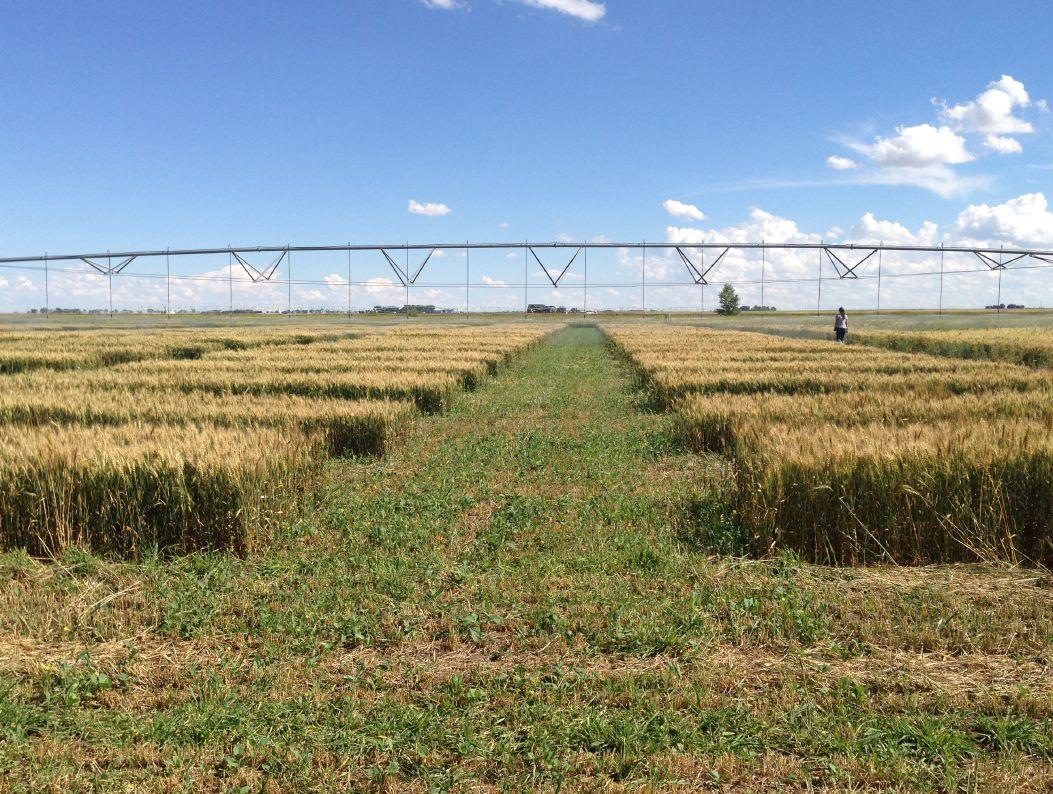
ABOVE: In recently completed studies in Alberta, PGRs improved the standability of some wheat cultivars but not all.
PHOTO COURTESY OF SHERI STRYDHORST.
research had been done on PGR timing and rates in barley. As a first crack at the issue, Strydhorst’s team applied Manipulator at the growth stage used for wheat. They applied the PGR at a 25 per cent higher rate than the wheat rate because research from other countries has shown barley tends to be less responsive to PGRs than wheat.
The other two studies looked at effects on different cultivars under a set of standard management versus advanced management practices. One study tested 12 wheat varieties in four classes and the other tested 10 feed barley varieties. The advanced practices included an application of Manipulator, an extra 30 pounds of nitrogen per acre and a dual fungicide application.
Funding agencies contributing to the four studies included the Alberta Crop Industry Development Fund, Western Grains Research Foundation, Alberta Innovates Bio Solutions, Alberta Wheat Commission, Alberta Barley Commission and Alberta Pulse Growers Commission. The studies received in-kind support from many sources, including Engage Agro, Syngenta, the Alberta government and SeCan, among others.
Key findings
“In the AC Foremost wheat study, we tended to see height reductions with Manipulator ranging from about four to 11 centimetres. With trinexapac, we saw a two- to six-centimetre height reduction,” Strydhorst says. However, the plots in this study didn’t have good lodging in most cases, so it was difficult to evaluate whether the PGRs improved standability.
In the study with 12 wheat cultivars, the response to a PGR depended on the cultivar. Strydhorst compares responses in two Canada Western Red Spring (CWRS) wheats: “Stettler is the largest-acre CWRS wheat grown in Alberta. Its height decreased from 88 to 80 centimetres with a PGR, about a 10 per cent decrease. But in only one of our 14 site-years did Stettler stand better with a PGR. However, in CDC Go, which is another fairly popular CWRS in the province, the height decreased from 83 to 77 centimetres, plus it had standability improvements.”
There could be several reasons why height reductions don’t translate into better standability in some cultivars. For example, a cultivar might be prone to root lodging (where the root system’s anchoring ability fails) rather than stem lodging (where the stem buckles). Although shortening the
plant would help by lowering the plant’s centre of gravity, a PGR wouldn’t strengthen the plant’s root system.
Strydhorst suspects the PGR treatment used in these barley studies is not optimum, based on preliminary results from a different project. Strydhorst is collaborating with Linda Hall from the University of Alberta on this new project, comparing different PGR actives, tank mixes, rates and timings in barley and wheat cultivars. The results from the project’s first year showed better responses in barley with different treatments.
What this means for growers
“Our research shows PGRs are improving standability of some wheat cultivars but not all, so my advice to growers would be that if you are planning to use a PGR, make sure to use it on a cultivar that responds to the PGR. And be aware that just because you have a cultivar that lodges, adding a PGR may not necessarily solve that problem,” Strydhorst says.
“Although the height reductions with PGRs don’t always translate into improved standability, they do translate into less residue produced by the crop and less
residue to manage. Roughly speaking, a 10 per cent decrease in plant height would mean about 10 per cent less residue to manage. That is a big advantage for growers in terms of the residue they manage in zero-till systems.”
Strydhorst is pleased to see recent steps forward on registrations for the two PGRs. In January, Syngenta sent its application to register trinexapac in cereals to Health Canada’s Pest Management Regulatory Agency. And, as of October 2016, durum is now on the label of Manipulator, which was already registered for spring wheat and winter wheat. Note that the U.S. hasn’t yet established a maximum residue limit (MRL) for chlormequat chloride, so crops treated with this product cannot be exported to the U.S. at present. Engage Agro hopes the MRLs will be in place for 2018.
Strydhorst concludes: “We still need to work out the kinks and figure out what will work best on barley for PGR rates, timing and actives, as well as this whole piece on which cultivars are responding to PGRs, particularly with wheat. So we don’t have it all figured out yet, but I’m glad to see continuing research.”
PESTS AND DISEASES
PREPARING FOR INVASIVE MUSSELS
Combating a nearing threat to Alberta’s irrigation system.
by Carolyn King
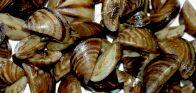
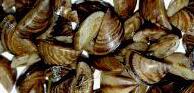
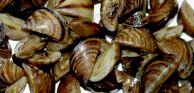
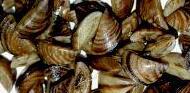
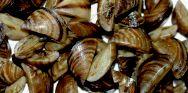
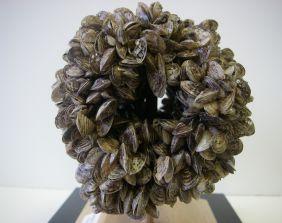
So far, Alberta remains free of invasive mussels. Originally from Europe, zebra mussels and quagga mussels arrived in the Great Lakes in the 1980s. Since then, these two species have been spreading through North America’s waterways, clogging water-related infrastructure, damaging aquatic ecosystems and degrading recreational areas. In 2013, the mussels were found in Lake Winnipeg. In November 2016, they were discovered in a Montana reservoir.
As the threat draws nearer, stakeholders in Alberta’s irrigated areas are working on prevention, monitoring and research to fight these devastating pests.
“Alberta does have native mussel species, but the invasive mussels are able to attach onto things like the inside of irrigation pipelines and canals, water measuring devices and control structures,” explains Ron McMullin, executive director of the Alberta Irrigation Projects Association (AIPA). “An individual mussel is no problem, but these mussels can form layers upon layers, so they can reduce water flows in pipes and even plug pipes. They can foul structures used to control
water flows manually or remotely. The mussels could reduce flow in pipes used on the farm and in the pivots.”
Alberta Agriculture and Forestry (AAF) research scientist Barry Olson says, “Southern Alberta has an extensive irrigation system with over 50 reservoirs and about 8,000 kilometres of conveyance, canals and pipelines within the 13 irrigation districts, so it’s a very important feature in agriculture in southern Alberta. Those 8,000 kilometres are being converted from open canals to pipelines and about half have already been converted. We are particularly concerned about the pipelines because the mussels could settle and proliferate in them and clog them. Also, shell debris could move through the system and plug things like nozzles, [pumps and screens].” Mussel infestations could potentially mean replacing pipelines and other components
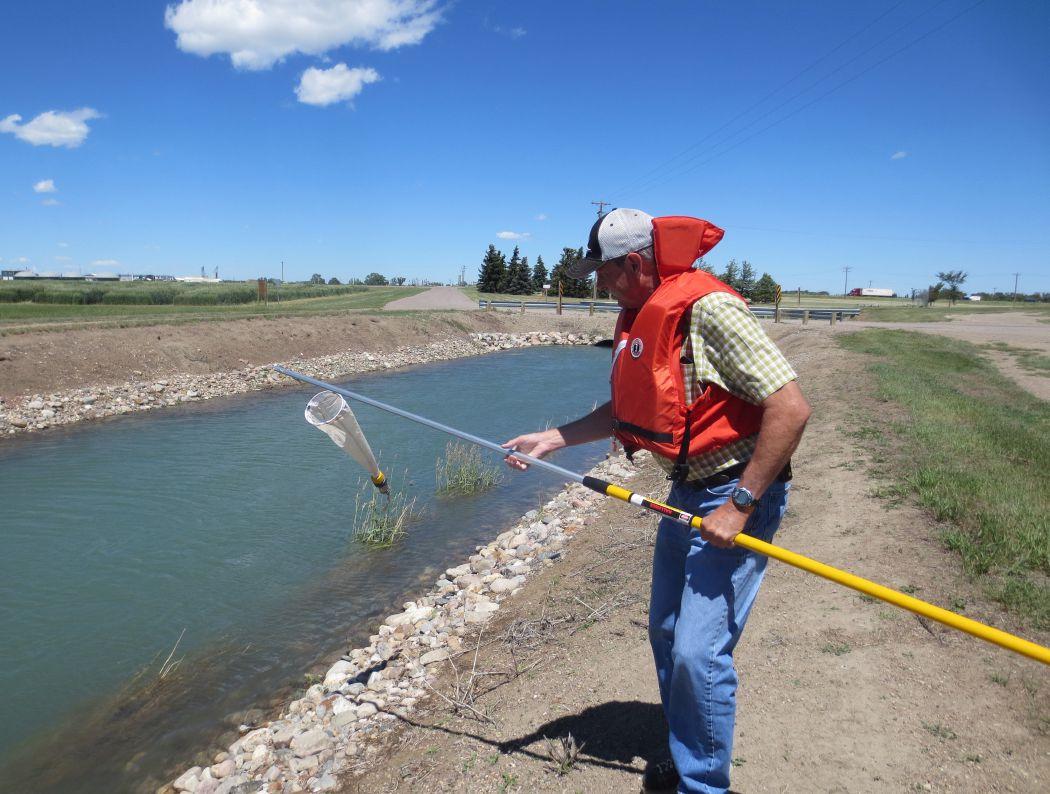
TOP: Sampling for mussel larvae in irrigation infrastructure.
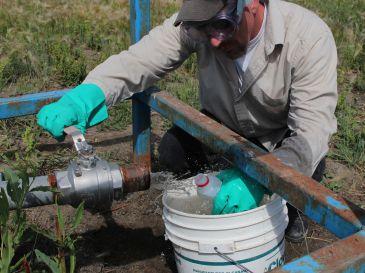
INSET: Alberta Agriculture and Forestry is evaluating the use of potash-fortified water for preventing the mussels from clogging irrigation equipment.
PHOTO COURTESY OF BARRY OLSON.
PHOTO COURTESY OF ALBERTA AGRICULTURE AND FORESTRY.
of irrigation infrastructure.
Olson also notes, “Alberta’s irrigation infrastructure is also used to provide water to a variety of communities, and the reservoirs are used for recreational activities, so those could also be affected.”
The most likely way for the mussels to come into Alberta is on watercraft. The mussels are only about one to three centimetres long and the juvenile stages are even smaller. They can attach to boats and other equipment used in the water and can survive out of water for extended periods. The microscopic, freeswimming larvae, called veligers, can survive in standing water in boats and other equipment.
When the mussels were found in Manitoba, the issue became a priority for the Alberta government, the AIPA and the irrigation districts. The detection of the mussels in Montana is even more worrisome. “Now, instead of being a 12-hour drive away, the mussels are a two- to 2.5-hour drive away,” McMullin says. “Most of the mussel-infested boats coming into Alberta have been from the east, not the south – but this makes us more leery of boats coming in from the south.”
Olson points to a further risk factor: “Montana and Alberta are also hydrologically connected; we have river systems that come up from Montana into Alberta.”
In addition, Alberta’s bodies of water tend to have conditions that are very suitable for these mussels; if the mussels do arrive, they’ll likely thrive. The mussels are very difficult to eradicate, and given that an adult female quagga or zebra mussel can produce up to about a million eggs per year, an infestation could create serious problems very quickly.
Prevention efforts
Alberta Environment and Parks (AEP) is the lead provincial agency on invasive mussels. AEP estimates a mussel infestation would cost Alberta over $75 million annually for damage to irrigation infrastructure and other impacts. AAF, the AIPA and the irrigation districts are collaborating with AEP and others to help prevent the spread of the mussels.
“Prevention is much cheaper than dealing with the mussels, so as long as we can keep them out, we will save a lot of time, effort and money,” McMullin says.
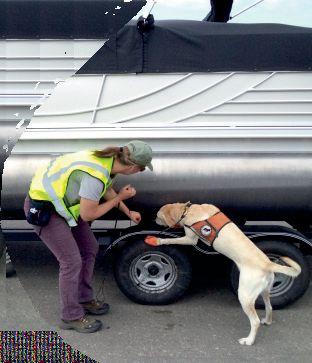
The AIPA and the irrigation districts have invested over $200,000 into mussel prevention. Some of these funds have helped pay to have sniffer dogs and their handlers trained to check for mussels at AEP’s watercraft inspection stations. McMullin says, “These dogs
can smell the mussels, not just see them. For instance, it is difficult for a person to do an inspection on a boat when it’s getting dark, whereas the dogs have an easier time. The larvae are microscopic so we can’t see them with our eyes, but the dogs can smell them.”
The funds have also been used to purchase promotional items for people who are having their boats inspected, including things like chamois cloths and floating keychains that display the “Clean, Drain, Dry” slogan or the mussel hotline number (1-855-336-BOAT (2628)) you can call if you have questions or suspect an infestation.
“And, with a small group of organizations, we have helped pay for signs to go up at most boat launches throughout the province,” McMullin says. “The signs talk about ‘Clean, Drain, Dry’ for boats and give some information about the mussels. Some of those boat launches are official ones, and some are just a slope down into a lake. The signs help educate everybody with a boat who goes past.”
Some funds have also helped pay for permanent signs along highways to inform the public of mandatory boat inspections and for educational advertisements in magazines and the Alberta Guide to Sportfishing Regulations.
Mussel monitoring
AAF and the irrigation districts are also helping AEP and its partners monitor water bodies for the mussels.
“We have identified 21 of the irrigation reservoirs as being at high risk of mussel infestations because of boating activity,” Olson says. “AEP and its partners have a lake and reservoir monitoring program, but they are only able to monitor a few of those 21 reservoirs in any given year, because their monitoring program is on a rotational basis. We and the irrigation districts felt it was important to monitor all those high-risk reservoirs on an annual basis, so we have filled that gap.” Twice a year for the past four years, AAF staff have gone to each of the high-risk reservoirs that are not monitored by AEP – usually about 15 to 18 reservoirs per year – to do veliger monitoring.
As well, irrigation district staff are doing monthly substrate monitoring in the highrisk reservoirs. “Substrates are small pieces of PVC pipe weighted down with cement inside them. They are placed in the reservoirs and then inspected to see whether or not mussels have settled onto the substrates,” Olson says. In addition, irrigation district staff are encouraged to inspect infrastructure for the presence of attached mussels, particularly in the fall after water drawdown.
Always clean, drain, dry
Zebra and quagga mussels can be spread by boats and other equipment used in water (hip waders, life jackets, kayaks, construction equipment and so on). Between uses, be sure to:
CLEAN
• Clean and inspect your watercraft, trailer and gear.
• Remove all plants, animals and mud at the access area or dock.
• At home, mix 20 millilitres of bleach with one litre of water and soak your gear for at least one minute.
• Rinse, scrub or pressure wash your boat away from storm drains, ditches or waterways. Use hot water if possible (60 C or hotter).
DRAIN
• On land before leaving the waterbody, drain all water from bait buckets, ballasts, bilges, coolers, internal compartments, livewells, etc.
• For paddle boats, drain by inverting or tilting the watercraft, opening compartments and removing seats if necessary.
DRY
• Dry the watercraft and gear completely between trips and allow the wet areas of your boat to air dry.
• Leave compartments open and sponge out standing water.
Information adapted from the Alberta Environment and Parks website. For more information, visit http://aep.alberta.ca/fish-wildlife/ invasive-species/aquatic-invasivespecies/documents/FS-AquaticInvasive-2016.pdf.
If the mussels do invade
In case the mussels do arrive in Alberta, AAF is investigating the use of potash to prevent them from building up in irrigation equipment. “Right now, there is no registered product that can be used to control mussels in Canada, but we know the potassium in potash is lethal to mussels if the concentration is high enough; that has been demonstrated in other jurisdictions in the United States and in Lake Winnipeg,” Olson says.
“Our research is trying to develop a method to treat the irrigation infrastructure, particularly pipelines, with potash. It is more of an engineering type of research about how can we prepare potash, inject it into an irrigation pipeline and manage the treatment, which has never really been done before.” The project has received some funding assistance from Alberta Innovates and Growing Forward 2.
As part of the project, AAF is working with the Eastern Irrigation District on a two-year pipeline trial. In 2016, the trial’s first year, the project team successfully tested a possible treatment protocol in a small pipeline in the district. The protocol involves injecting potash into a pipeline at a concentration of 100 parts per million of potassium, holding the potash-fortified water in the pipeline for 48 hours, and then releasing the fortified water onto a field. In 2017, they plan to test the protocol in some larger and more complicated pipelines.
Down the road, the project team may need to fine-tune the protocol to ensure a good balance between what is effective for controlling the mussels and what is practical for farmers’ needs. Also, the team is just starting to explore what might be done in situations where the mussels have already built up in a pipeline by the time the problem is detected.
Another part of the project is a two-year, small-plot study at the
Alberta Irrigation Technology Centre in Lethbridge. This study, which started in 2016, is evaluating the effects of the potash-fortified water on soil quality and crop quality. Potash is used as a fertilizer in Alberta and a single application of the fortified water is not expected to have a negative effect on soils and crops. However, since the mussels probably would not be eradicated, the potash treatments would probably need to be done repeatedly as part of a long-term maintenance program. The project team wants to assess the effects of multiple potash applications.
The project will also include an assessment of the potential economic costs, logistics and other factors that must be considered if this method is implemented.
This is part of a larger project with AEP to register potash as a mussel control agent with the federal government, which could also be a benefit to other jurisdictions in North America.
Alberta’s irrigation districts are also preparing for a possible mussel invasion. For example, they are working with AAF and AEP to develop rapid response plans. This spring, some representatives from the AIPA and the irrigation districts are going on an irrigation tour in the U.S. and hope to learn how people there are dealing with the mussels.
With action on mussel prevention, monitoring and research underway in Alberta, is there something that irrigation farmers can do to help? Since Alberta is still mussel-free, Olson says the most important thing that farmers – and everyone else – can do is to follow the “Clean, Drain, Dry” steps when using watercraft and other equipment. And McMullin suggests people keep an eye out for the mussels: “If we do get these mussels, we will need to know where they are as soon as possible.”
Somebody should speak up.
Somebody should set the record straight. Somebody should do something
Well I’m somebody.
You’re somebody.
Everyone in ag is somebody
So be somebody who does something
Somebody who speaks from a place of experience, with passion and conviction
Somebody who proudly takes part in food conversations big or small, so our voice is heard.
Somebody who tells our story, before someone else does.

Be somebody who does something. Be an agvocate.
AgMoreThanEver.ca
Somebody who builds consumer trust so our industry can meet the demands of a growing, and very hungry, world.
Somebody who shapes people’s relationship with agriculture
It can be done.
But it’s a big job that takes co-operation, patience and respect for every voice in the conversation. We need to build lines of communication, not draw lines in the sand.
Be somebody who helps everybody see Canadian agriculture as the vital, modern industry it is. Somebody who helps everybody see people in ag for what they are – neighbours, friends, and family who share the same concern everyone does: providing safe, healthy food to the people we love
Our point of view is important
Our story is important
And people want to hear what we have to say
So be somebody who takes, and makes, every opportunity to share it.
I’m somebody
You’re somebody.
Together, we can tell everybody

panels
Valley®, the irrigation technology leader, brings you the smartest control available with the new ICON series of smart panels. The ICON family has a solution for every need. Whether you’re buying a new pivot, upgrading your existing panel or changing over from another brand of pivot, you have the advantage of operating an intuitive, full-color touchscreen interface with ease and simplicity. With ICON, life just got easier.