TOP CROP MANAGER

Welcome to Top Crop Manager Focus On: Herbicide Resistance , the first edition of our new digital series. While you won’t find printed editions of Top Crop Manager in your mailboxes, this summer, this new digital series will be delivered to your email inboxes over the next few months in an effort to highlight specific topics related to crop production and technology.
Our first issue – Focus On: Herbicide Resistance – follows the resounding success of our second Herbicide Resistance Summit. Held this past February in Saskatoon, we gathered producers, researchers, agronomists and industry members together to discuss the ongoing issue of herbicide-resistant weeds and share ideas, strategies and solutions.
In this issue, you’ll read about herbicide resistance from the perspective of four different researchers. We’ve also included exclusive charts and photos from their presentations.
ON THE COVER
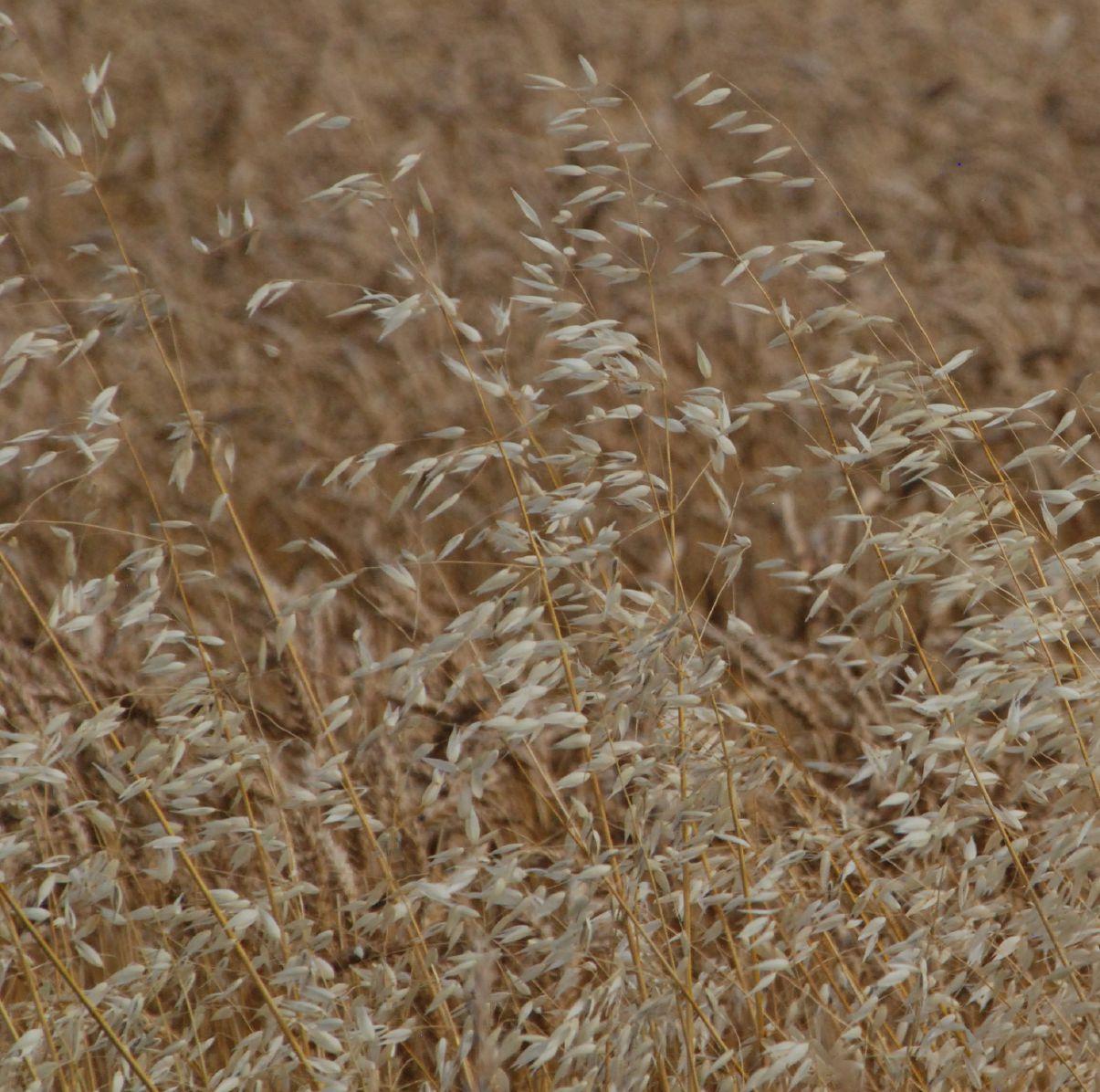
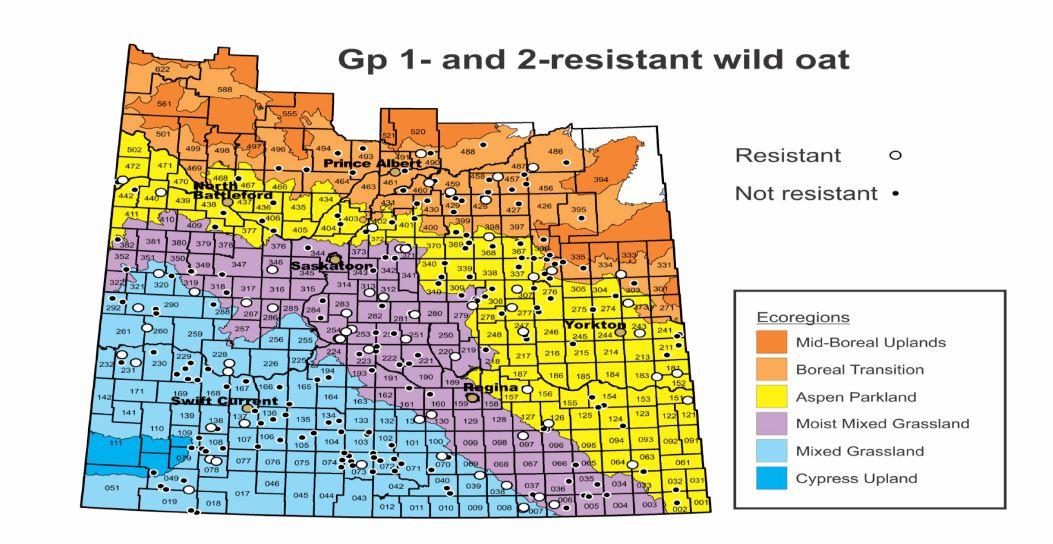
Group 1 and Group 2 resistant wild oats were found in 25 per cent of sampled Saskatchewan fields.
PHOTO
BY
BRUCE BARKER.
As you’ll read from our esteemed presenters, the evolution of herbicide resistance demands constant vigilance. We hope this issue provides insight and takeaways for you as you work through this growing season.
Stay tuned for our next edition , Focus On: Canola , which will share nitrogen management practices, rotation studies, weather impacts on canola and much more.

Editor:
Associate Editor: Stephanie Gordon
Western Field Editor: Bruce Barker
Associate Publisher: Michelle Allison
National Advertising Manager: Danielle Labrie
Group Publisher: Diane Kleer
Media Designer: Jaime Ratcliffe
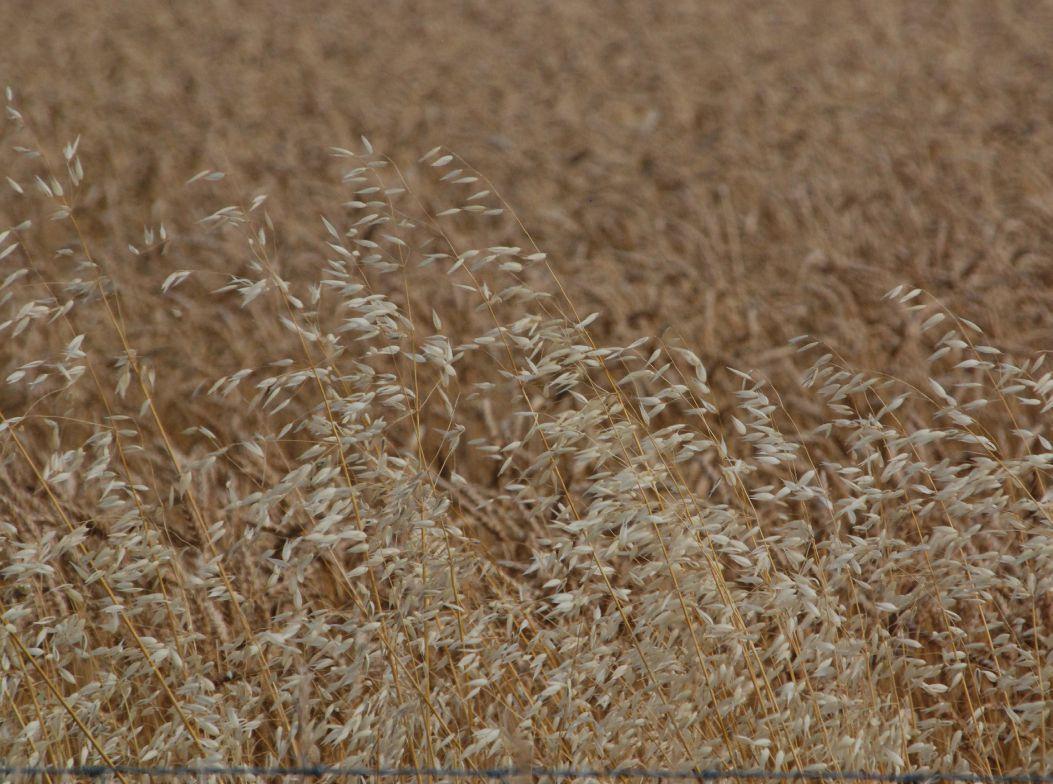
Group 1 and Group 2 resistant wild oats were found in 25 per cent of sampled Saskatchewan fields.
Presented by Hugh Beckie, Agriculture and Agri-Food Canada, Saskatoon, at the Herbicide Resistance Summit, Saskatoon, Feb. 27-28, 2018.
The big story in 2017 was that canola surpassed wheat as the number one crop, and the most common rotation in Western Canada is canola-wheat, which certainly has implications for resistance management.
In terms of unique resistant weed cases for Canada, 76 have been identified. Manitoba has seen a big jump and now has 30 cases. Saskatchewan has 22 and Alberta 23 cases.
I’ve been doing surveys since the first one in Saskatchewan in 1995 and since 2001 they’ve been random surveys. It takes three years to do a round because we do Alberta then Saskatchewan, and Manitoba. We’ve gone from 10.9 million acres with herbicide resistance in the first survey to 24.4 million acres in the second round from 2007 through 2009 and I would estimate we will clearly reach 38 to 40 million acres in the last survey completed in 2017. With 70 million cultivated acres in western Canada, over half the acres have herbicide resistant weeds.
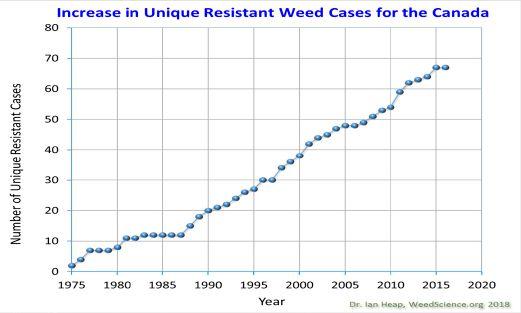
The increase in unique resistant weed cases for Canada. Courtesy of Ian Heap, WeedScience.org, 2018.
The Saskatchewan situation
In the 2014-15 Saskatchewan Weed Survey 227 of 400 fields, or 57 per cent, had resistant weeds. This compares with 31 per cent in 2009 and 10 per cent in 2003. The screening is for just Group 1 and Group 2 resistance. We do plan to do the other herbicide groups but these two groups account for most of the cases. Overall, wild oat resistant populations were found in 65 per cent of the fields that were sampled. Group 1 resistance wild oat was found at 59 per cent incidence. Group 2-resistant wild oats in Saskatchewan took quite a jump and were found in 32 per cent of fields sampled. That compares with only seven per cent in 2009 and four per cent in 2003. Obviously, growers are trying to manage Group 1 resistance by switching to Group 2 wild oat herbicides.
Multiple resistance, though, is where it gets challenging. Group 1 and 2-resistant wild oat was found in 25 per cent of fields versus only five per cent in 2009 and one per cent in 2003. We are seeing blanket resistance across all the Group 1 classes – the FOPs, the DIMs, and pinoxaden – and all the classes of Group 2 very commonly across the Prairies. We’re now at a stage where growers are asking which Group 1 or which Group 2 herbicide still works, if it does? For the wheat and barley growers in Western Canada, when you have wild oat resistant to all the Group 1, all the Group 2 – you cross out a lot of options. You cross out all of the post-emergence options.
We’ve been dealing with this multiple resistance for a very long time. In 1994, we documented four-way resistance – Group 1; Group 2; Group 8 (triallate) and Group 25 (Mataven or Flamprop-methyl, which is no longer on the market), and it was due to metabolic resistance. Recently, University of Alberta graduate student Amy Mangin, who’s now at the University of Manitoba, documented fiveway resistance in wild oat. We had known previously it was Group 1 and Group 2-resistant, but we found it was also resistant to triallate, Group 8; and then, unexpectedly, to sulfentrazone, Group 14; and pyroxasulfone, Group 15. Even though this population clearly hadn’t been exposed to Group 14 or 15 herbicides, again, it was due to metabolic resistance.
Looking at green foxtail, 31 per cent of the fields sampled had herbicide resistance. Seventeen per cent of the fields had Group 1 resistance, versus 14 per cent in 2009 and none in the 2003 survey. The most recent survey is the first to document Group 2 resistance, so it’s paralleling the wild oat’s story, although at a slower pace. We also had two fields with multiple resistant green foxtail to Group 1 and Group 2 – again, the first time.
Cleavers, I was a bit surprised that it really hadn’t changed in incidence over the last survey at around 20 per cent of fields sampled. Certainly, northeast of Saskatoon, there’s an epicentre of Group 2 resistant cleavers. Group 2 cleavers is problematic especially our pulse growers. If look at options in field pea, whether it’s Group 1 or Group 2 wild oat or Group 2 cleavers, the options become quite limited.
Group 2-resistant wild mustard hasn’t changed in incidence at 25 per cent. It was first recorded in the 2009 survey. Central Saskatchewan is where most of it is. For lentil growers in Central Saskatchewan, if you drive from Rosetown down to Swift Current, it’s all Group 2-resistant wild mustard.
Group 2-resistant stinkweed was first documented in the recent Saskatchewan survey on 14 per cent of fields surveyed. It was also the first survey to document shepherd’s purse resistant to Group 2 herbicides on three fields or 23 per cent incidence, mostly northwest of Saskatoon.
Finally, in the Saskatchewan survey, we are starting to see some redroot pigweed resistance to Group 2, although, certainly, the amaranthus resistance is certainly not like it is with the waterhemp or Palmer amaranth in the Midwest United States.
In the 2016 Manitoba survey, we had 102 out of the 151 with herbicide resistance, or 68 per cent. The majority of growers are dealing with resistance. If you look at herbicide-resistant wild oats, 79 per cent of fields had herbicide resistant wild oats, with 78 per cent of them resistant to Group 1 compared to 55 per cent incidence 2008, and 40
per cent in 2002. Group 2-resistant wild oat took a big jump, similar to what it did in Saskatchewan, with 43 per cent incidence versus 18 per cent in 2008 and 12 per cent in 2002. Multiple resistant Group 1 and Group 2-resistant wild oat were found on 42 per cent of fields, versus 13 per cent in 2008 and eight per cent in 2002. Manitoba continues to lead the pack in terms of incidents of multiple resistance.
Almost half of the fields had green foxtail resistance. Forty-four per cent were Group 1 resistant. That’s pretty stable since 2008. Group 2 resistance was at six per cent, and 2016 was the first survey to pick up Group 2 resistance. Multiple resistance to Group 1 and 2 was found on only one field near Brandon. Yellow foxtail was the surprise of the 2016 Manitoba survey. We found 42 per cent of the fields with resistance in yellow foxtail – 32 per cent of that was Group 1. This was the first case in Canada to document resistance in this cousin to green foxtail. Group 2 resistance was found on 17 per cent of fields surveyed, and Group 1 plus Group 2 resistance on four fields. This resistance came out of nowhere since it wasn’t documented in the 2008 survey. We found Group 2 resistant barnyard grass on three fields -- the first documented cases of resistance in the 2016 Manitoba survey.
There was just a sprinkling of broadleaf weed resistance with a few cases of cleavers, wild mustard, redroot pigweed and shepherd’s purse resistant to Group 2 herbicides.
Alberta’s status
We started to screen the 2017 Alberta survey of 250 fields – the last survey was in 2007. The results will be coming out in 2018. We also did a 2017 post-harvest glyphosate-resistant kochia and Russian thistle survey at 330 sites. We had 305 sites of viable kochia, 31 sites of Russian thistle. We compared these results to the recently completed Saskatchewan and Manitoba surveys. In the 2013 Saskatchewan survey, five per cent of the sites had glyphosate-resistant kochia, mainly associated with chemfallow in West/Central Saskatchewan. In Manitoba in 2013, we only had two sites in corn and soybean in the Red River Valley, although the University of Manitoba has identified a few more sites. We’ll be surveying Manitoba again 2018 using the similar methodology, including a few other suspected glyphosate-resistant weeds. We’ll be doing Saskatchewan in 2019. By comparison, in Alberta in 2012, we had 13 of 309 sites with glyphosate-resistant kochia, or five per cent – in the three counties of Warner, Taber, and Vulcan. From the 2017 post-harvest survey in Alberta, we’ve screened about 77 per cent of the kochia samples and found 54 per cent of the sites with glyphosate-resistant kochia. We’ve jumped from five per cent to 54 per cent in five years. Most of these fields were not chemfallow. We found it in all kinds of fields.
For these Alberta kochia samples, the next step is to screen with Group 4 resistance, and so time will tell what the level of Group 4 resistance is. And, of course, all of these kochia samples are Group 2 ALS-resistant. We’ve lost Group 2 and we’re losing glyphosate. If we lose Group 4 for kochia, southern Alberta is not going to look the same as it is today.
When we wrote up the paper for these surveys, I stated: “The ease of mobility of resistant alleles from field to field demands a collective regional response in proactively or reactively managing this multipleresistant weed biotype.” Clearly, we’ve collectively failed to slow down the spread of glyphosate-resistant kochia.
There is a need for a Group 4 kochia action committee, but we can’t just include researchers because we are all the same people talking to each other. We have to include all levels of government, the administrators of the municipal districts or counties or municipalities. We have to include provincial government, federal government. We
need to include all the stakeholders if we want to make an impact against Group 4 resistance.
On a positive note, a retired AAFC colleague, Neil Harker, and I wrote a paper with “Top 10 Herbicide-Resistant Management Practices.”
10. Maintaining a database: invaluable reference.
9. Strategic tillage: If, where, or when needed.
8. Field and site-specific weed management – one size may not fit all.
7. Weed sanitation: border control and slowing herbicide resistance dispersal.
6. In-crop wheat-selective herbicide rotation – combating non-target-site-resistance.
5. Herbicide Group rotation – avoid back-to-back in-crop Group 1 or Group 2.
4. Herbicide mixtures/sequences – better than rotations.
3. Pre- and post-herbicide scouting – know your enemy.
2. Competitive crops and practices that promote competitiveness – natural biological control.
1. Crop diversity.
What are missing from these top 10 practices are incentives for growers to implementation. Stuart Smyth, myself, and others are co-authoring a paper that will be coming out shortly arguing that crop insurance is the best vehicle to incentivize and facilitate best pest management practices. We need government public policy to incentivize growers, and, really, governments have been missing in action for the last 30 years, in terms of sitting on their hands and doing nothing.
In our management surveys with growers, we are starting to see some of the weed management messages get out. I think the message is that growers . . . whether themselves or with crop consultants or with agronomists, are starting to scout their fields; know what their enemy is before they implement treatments. If you don’t know what’s out there, how can you effectively manage that, whether it’s resistant or not?
I was very encouraged to see quite a change from our previous grower management questionnaire results. We have seen a big shift over the last 10 to 15 years in terms of what growers . . . at least what they perceive as being effective to manage resistance. What we did find interesting though was that growers specifically dealing with resistance, these were the four practices that they do preferentially, more so than growers without resistance: crop rotation, herbicide site of action rotation, tank mixing, and a burndown. Of course, when you lose the effectiveness of your post-emergence, you have to rely more on a burndown, which will delay the selection pressure when you do have to come in with a post-emergence.
When we looked at the Manitoba results, the only thing that was really different was that in Manitoba, growers are reverting to much more tillage to manage resistance.
When we asked growers the cost of weed resistance – a combination of yield loss and increased herbicide cost – it averaged $12/acre in Saskatchewan, and $11/acre in Manitoba.
Overall, growers are implementing some of the best management practices if they fit in to their operations, but we need new tools, too. We also need all levels of government to incentivize – not regulate but incentivize – these best management practices because the status quo right now is not moving the ball fast enough in the right direction.
Presented by Josef Soukup, Czech University of Life Sciences Prague, at the Herbicide Resistance Summit, Saskatoon, Feb. 27-28, 2018.
The first resistant population identified in Europe was a pigweed resistant to atrazine in Austria in 1973. Later on through the 1980s and 1990s, many weed species developed resistant to PSII inhibitors (Group 5), mostly to atrazine. More recently, there has been a dramatic increase in resistance to ACCase (Group 1) and ALS (Group 2) inhibitors in grasses since 1990. Resistance to ALS herbicides has been confirmed since 2000 in broadleaved weeds like mayweed and wild poppy. Resistance to glyphosate (Group 9) has also developed in permanent crops like orchards and vineyards in the Mediterranean since 2000. Glyphosate resistance is the major problem in the Mediterranean.
The most important crops affected by resistance are cereals. For Europe, the weedy grasses – blackgrass, silky bent grass, wild oats, Italian ryegrass, and brome species – are the problems. The area affected is about 10 million hectares. Compared to Canada, with roughly 15 million hectares affected by resistance, the area is very comparable, but we have twice the area of arable land.
Some smaller areas are affected by resistance in broadleaved crops, such as sugar beets and vegetables. The area is less than one million hectares. In other summer crops, there are different weed problems, again, grasses – barnyardgrass and Johnson’s grass – in corn and also in sugar beet.
Resistance in grain cerealsThe most important weed in cereals for Europe is blackgrass (Alopecurus myosuroides), especially in the United Kingdom, France, and Germany. It affects the crop once established in the fall, and is very competitive at tillering, overwinter, and in the spring. High infestation can result in 80 per cent yield loss. In United Kingdom and France, about 80 per cent of populations are resistant. In Germany, about 50 per cent of populations are resistant, usually to ACCase inhibitors but also ALS inhibitors. There is also resistance against the newer products like mesosulfuron (Group 2) and pyroxsulam (Group 2). Farmers must now once again include soil active herbicides, such as prosulfocarb (Group 8) and flufenacet (Group 15) that are applied in the fall.
Silky bent grass is in Central and Northwestern Europe. Resistance to ALS is the most frequent with some ACCase resistance occurring. Fortunately, our soil herbicides like flufenacet, prosulfocarb, and chlorotoluron (Group 7) are effective on these resistant populations.
Corn, sugar beets, vegetables (<1 Mio ha affected)
Mediterranean vineyards and orchards (~ 0,1 Mio ha affected)
Rice (including Turkey) (~ 0,1 Mio ha affected)
Silky bent grass (Apera spica venti)
Wild oats (Avena fatua, A. sterilis) Italian ryegrass (Lolium multiflorum)
Brome spp. (Bromus sterilis, B. diandrus)
Wild poppy (Papaver rhoeas)
Mayweed (Tripleurospermum perforatum) Chickweed (Stellaria media)
Cornflower (Centarea cyanus)
Barnyardgrass (Echinochloa crus-galli) Johnson´s grass (Sorghum halapense) Redroot pigweed, lamb‘s-quarters, black nightshade, … (Amaranthus retroflexus, Chenopodium album, Solanum nigrum)
Fleabane spp. (Conyza canadensis, C. bonariensis, C. sumatrensis)
Ryegrass (Lolium rigidum, L. perenne)
Barnyardgrass (Echinochloa crus-galli) Red rice (Oryza sativa var. sylvatica) Rice sedge (Cyperus difformis)
(SU, IMI)
RESISTANT SPECIES IN EUROPE AND CANADA – A COMPARISON
Weed Canada Europe
Wild oat No. 1 in Canada often multiple resistance
Green foxtail Very frequent multiple resistance
Kochia Very important multiple resistance
Canada fleabane
Very important multiple resistance
Wild buckwheat Troublesome, resistant
Cleavers Increasing, resistance
Blackgrass
Common weed but manageable Rarely resistant
Locally, hard to control
Rare weed, not on agricultural land
Only in permanent crops, non-agricultural land
Frequent, but no major problem
Frequent, but no major problem
Very rare No. 1 in Europe, frequent resistance
Silky bent grass Exotic, very rare
Barren brome Very rare on arable land
Wild poppy Very rare
Increasing range and resistance
Spreading, evolving resistance
Evolving resistance
One population in Czech Republic in 2017 was confirmed to be resistant to three modes of action, ALS, ACCase and PSII herbicides.
Ryegrass is a typical problem of the ocean climate – United Kingdom, France, and Germany. Usually, it is the Lolium multiflorum – Italian ryegrass. L. perenne occurs in the southern part of Europe. It is competitive and very prone to mutations and metabolic resistance, resulting in quick selection for ALS and ACCase resistance.
Wild oat is not as frequent in Europe because we usually grow winter crops. It is usually found in southern part of Europe, not Avena fatua but Avena sterilis and Avena ludoviciana. It quite frequently has resistance to ALS and ACC inhibitors. The problem is that triallate is not allowed in Europe, and alternative modes of action that can be used against these resistant biotypes are not available.
Brome species is a quite new issue in Europe, but it is spreading very quickly. A few resistant populations to ALS have been found in United Kingdom and in Spain. Brome species are also exhibiting a decreasing sensitivity to glyphosate because farmers use glyphosate in burndown control. It is not considered resistant, but the sensitivity is lower and lower.
In some Western European countries, ALS resistant mayweed (Tripleurospermum perforatum) has been found. It is a very difficult weed in cereals and oilseed rape.
Wild poppy is already resistant to ALS inhibitors, but some populations were also found to be resistant to synthetic auxins (Group 4). This resistance to synthetic auxins is a problem because many products used in spraying are a combination of ALS inhibitors –usually florasulam with 2,4-D or other auxins.
Less important resistant species in cereals are chickweed and cornflower. Few populations of chickweed have resistance to ALS inhibitors and rarely PSII and auxins. Cornflower is a very competitive weed on sandy soils in Poland and Germany and is tolerant to ALS inhibitors in some areas.
There are several factors driving resistance in small grain cereals. Winter cropping is a big problem because the period between crops when weeds can be controlled is very short. A typical crop rotation is winter wheat followed by winter barley and then winter oilseed rape. Oilseed rape stays on the field for 11 to 12 months. There is only one week or two weeks for weed control between the crops. This is a challenge for perennial weed control and control of different resistant weeds that survive in-crop treatments. Usually, resistant
winter annual grasses survive an herbicide application, shed seeds and immediately emerge in the subsequent crop.
The reliance on ALS and ACCase inhibitors is also a problem. We have too many ALS inhibitors used in weed control, and are about half of the all compounds used.
Our farms are also growing larger, and we are using more reduced tillage. Minimum tillage favours almost all the grasses. The combination of a narrow crop rotation and minimum soil tillage is now regarded as a multiplicator of the risk, especially from the point of view of the occurrence of winter grasses.
Corn is grown for grain and silage production. Overall, resistant weeds in corn are not an issue in Europe. Barnyard grass resistant to ALS herbicides occurs mainly in Italy, Spain and Hungary. Johnson’s grass, which is a perennial, has also developed resistance to ALS inhibitors. Farmers successfully use cycloxydimtolerant (Group 1) corn varieties to control ALS-resistant grasses, since resistance against ACCase inhibitors has not yet developed.
In Czech Republic, some PS II inhibitors, such as terbuthylazine, are used in corn, although atrazine was banned few years ago. Terbuthylazine is a very cheap solution, but a recent survey found many PSII resistant populations of redroot pigweed. Interestingly, after many years of use of ALS inhibitors and other mode of actions, these PSII resistant populations still occur.
Europe doesn’t grow glyphosate-tolerant crops, so it is used on arable land as between crop applications and as a pre-harvest application. In Czech Republic, glyphosate accounts for about 17 per cent of the total consumption of pesticides, which is not as high as in America. There is no glyphosate-resistance on arable land.
However, some resistance has been identified in permanent crops in Mediterranean, where citrus, olive, and grapevine are grown. Farmers rely only on glyphosate. The most important species are fleabanes – Canadian and Sumatran fleabane.
Factors regarded as glyphosate resistance drivers in permanent crops are very dense populations of a single species prone to resistance development; limited number of registered herbicides and a reliance on glyphosate; too late applications; unfavourable conditions for applications; and ignorance of non-chemical methods. Some alternative solutions must be
implemented in orchards and in permanent crops to be able to control the weeds in the future.
Many glyphosate-resistant populations also occur on non-agricultural land, which can be an issue. These populations can spread on agriculture land. One weed, Asiatic dayflower (Commelina communis), which is very naturally tolerant to glyphosate and can survive 32 litres per hectare, was also found on railways.
On the other hand, glyphosate is very important because it diversifies the choice of mode of action to control ALS- and ACCaseresistant weeds on arable land.
Introduction of glyphosate-tolerant crops is not expected in the near future. Glyphosate is recently under big political pressure by NGOs and different political streams. It is an issue from the regulatory point of view. Glyphosate received a renewal for the next five years, but we do not know what will happen after that five years. We expect very strong limitations on glyphosate use in coming years.
In Europe we have very similar networks for resistance monitoring, scouting, and mapping. Within the European Weed Research Society, the Weed Mapping working group and Herbicide Resistance working group operate. They communicate the resistance problem amongst scientists, industry, and governmental bodies. There is also a European Herbicide Resistance Action Committee (EHRAC; www.ehrac.org).
Legislation is used for the authorization and sustainable use of the pesticides. There are many regulations and directives. Some directives focus on placing of the plant protection products on the market, and other on the sustainable use of these products by farmers.
The European and Mediterranean Plant Protection Organization develop standards for testing of plant protection products and evaluating resistance risk. The standard describes how the risk of the resistance to plant protection products can be assessed and how they can be managed after the regulation of the product and placing of the market.
There are two types of the risk: inherent risks and agronomic risks. Both are considered in the registration process. The applicant and registration body first evaluate the inherent risk of the product. This is the risk assessment stage, and if there is no risk or the risk is small, the registrant establishes the baseline sensitivity, registers their product, and then follows the monitoring risk after the registration. If
there is an inherent risk, there must be some resistance risk management proposed, and it is placed on the label.
There are very important directives for the sustainable use of the pesticides, and individual countries have to create national action plans for reduction of the risk and impacts of the pesticides on human health and on the environment. These should ensure appropriate training of farmers, testing of the application equipment, and implement the methods of integrated pest management. Some general principles of integrated managements are well known, such as prevention and suppression of harmful organisms and monitoring. Some rules are for decision-making, such as which measures are more appropriate. The pesticides should be applied as specific as possible so that it doesn’t affect the non-target organisms. Where the risk of the resistance against the plant protection measure is known and where the level of harmful organisms requires repeated applications, available anti-resistance strategies should be applied.
All countries develop national action plans. For example, rules for application of pesticides, measures to protect aquatic environments, reduction of the risk, and integrated pest management.
Some countries developed additional measures, like a pesticide tax, which is sometimes a problem for the farmers because this is a disadvantage to have a tax at the national level. The second problem is that it can be controversial and counter-productive because a mode of action, which is prone to resistance, such as ALS inhibitors, has lower taxes than other products that are not so prone to resistance.
European farmers get many supports and many payments, but they must fulfill
basic standards concerning the impact on the environment. They should maintain good agriculture and environmental conditions. They receive direct payments. They receive, additionally, green payments that promote practices that are beneficial for the environment and for climate. There are also some agri-environment measures where payments are made to farmers who subscribe to measures related to the preservation of the environment and maintaining the countryside.
Very important for farmers now are the payments for “greening,” which is quite high, with 30 per cent of direct payments since 2015. Greening means farms have to diversify crop rotations. Farms up to 30 hectares have to grow at least two crops. Bigger farms must have at least three crops. To get the subsidy, all farms must keep five per cent of the farm with an ecological focus that uses some direct measure like fallow land, field margins, hedges and trees or buffer trips. Or they can grow catch crops or legumes. A problem starting in 2018 is that pesticides may not be applied to the ecological focus area. Also, permanent grassland cannot be ploughed or converted anymore.
The patterns leading to the development of herbicide resistance are the same everywhere. Factors leading to the resistance:
• Simplification of crop rotations.
• Prevalence of one crop type – in our case, winter crops.
• Increase of population densities of weed species associated with crops creates higher probability of the development of the resistance.
• Species with high fecundity, long
distance dispersion, and dense offspring are more prone to the development of the resistance.
• Overuse of the same mode of action like ALS inhibitors and ACCase inhibitors.
• Non-chemical methods are hardly applicable or not reliable fully. It is difficult to combine chemical and non-chemical methods.
• Environmental regulations can be sometimes counterproductive
• What is good for environment and for human health is not necessarily good from the point of view of the development of the resistance.
For the outlook on further management of herbicide resistance, everybody recommends more diverse management strategies. They are necessary and may prolong the effectiveness of herbicides, but crop diversity is decreasing everywhere, at the global level, at the local level, and according to market demands. Thus it is very hard to include new crops in crop rotations. Prices are set at the global level, and farmers may not create a sufficient margin for prevention of the herbicide resistance. They have to prefer cheaper short practices or tactics before the long-term strategies.
Resistance is also an environmental and social issue. I think public attention should contribute to the problem and support research institution networks, and transfer of knowledge. Acceptable regulations can help, but over-regulations can be often counterproductive. Farm management shouldn’t be a subject of regulation because it’s burdening, embarrassing, and sometimes costly, and the effect is not clear. Science can contribute to solving the problem. Farmers must look for latest knowledge in professional journals, fact sheets, and advisors and make scientifically based decisions. However, “thousands of small hammers” of traditional farming practices can help. We must learn from nature and field history and prepare efficient local recommendations.
Technological advance can help deliver new solutions to overcome the problems in the longer term because we will have new strains, new formulations, more precise application technique, equipment for strategic tillage, and harvest weed management. New tools will also support the remote detection of resistance and provide a decision support system. I am optimistic for the future, and think resistance won’t necessarily have to impact yields and production.
Presented by Franck Dayan, professor, department of bioagricultural sciences and pest management, Colorado State University, at the Herbicide Resistance Summit, Saskatoon, Feb 27-28, 2018.
Group 14 herbicides are part of a group of chemistries that require light to be effective as an herbicide. In Canada, one of these compounds is called Heat (saflufenacil), and is a protoporphyrinogen oxidase (PPO-inhibiting) herbicide. There are other light-dependent herbicides, as well. Photosystem II (PS II) is a chemistry that interferes with photosynthesis and disrupts plant growth. An example would be AAtrex (atrazine) (Group 5). There’s also inhibitors of PS I, another part of photosynthesis, including compounds like Gramoxone (paraquat) (Group 22). These two chemistries are related and affect the transfer of electrons within photosynthesis.
Plants also need chlorophyll and carotenoids for photosynthesis to occur, and there are compounds that are inhibitors of PDS like Solicam (norfluzaron) (Group 12). Another compound inhibits one of the precursors to the carotenoid pathway such as Command (clomazone) (Group 13). Some of the new chemistries, the HPPD inhibitors like Callisto (mesotrione) (Group 27), are also part of this class of chemistries. All of these are called light-dependent herbicides because they affect one aspect or another of photosynthesis, either through the transfer of electrons or the synthesis of the pigments, and require light to be active.
I’ll be talking about PPO inhibitors, an enzyme that is involved in porphyrin and chlorophyll synthesis. Why do we care about these compounds? When they work they work really, really well. PPOinhibiting herbicides were first commercialized in the 1960s and their market share in the U.S. reached about 10 per cent in the late 1990s. A lot of herbicides have been synthesized that target this enzyme or pathway. About 100,000 compounds may have been synthesized that can inhibit this enzyme. Of course not all of them make it to be an herbicide.
These PPO-inhibiting herbicides were initially used mostly as postemergent, broad-spectrum weed control in soybean fields. That’s how they were primarily used for the longest time. Some like carfentrazone (Aim in Canada) were developed for cereal crops. Some were so active that they were used as non-selective herbicides.
When the herbicide is applied, it lands on the leaf surface and then goes through the top layer, called the cuticle. It goes through the epidermis, and then has to get to the target site. There it inhibits an enzyme that produces a compound called Proto IX. Proto IX is supposed to be in the chloroplast, but when you apply the herbicide, Proto IX accumulates






outside of the chloroplast. When the sun comes out, Proto IX reacts with sunlight, what’s called reactive oxygen degradation, and basically destroys the cell structure of the plant. Within a few hours the plant dries up. It becomes paper-thin and completely dehydrates. Injuries like leaf cupping, crinkling, and bronzing appear on some plants, and then typically necrosis and completely dead tissue within a few hours. It’s a pretty fast-acting herbicide, and it works really well under the right circumstances.
Some plants are very sensitive because they can’t metabolize the herbicide. Some plants are very tolerant because they metabolize the herbicide very quickly. Since some plants can metabolize it very quickly, a plant can become resistant by developing the ability to metabolize this chemistry, which would be non-target site resistance.
Most PPO inhibitors degrade very quickly in the environment. Most compounds have a very short half-life and have very poor pre-emergence activity. However, a compound like sulfentrazone (Authority; Authority Charge) can have a very long half-life, 280 days. In the south US that may actually affect rotation of your crops because of the long residual activity of some of that chemistry.
[Ed. Note: In Canada, carfentrazone has a short half-life and when used as a pre-seed treatment, there are no cropping restrictions. Sulfentrazone’s longer half-life means it can be used as a pre-seed surface application that provides residual weed control, but also means there are re-cropping restrictions.]
The PPO inhibitors are very rapidly metabolized and don’t stick around in water. They’re considered to be a pretty safe chemistry.
CHEMICAL FAMILY ACTIVE INGREDIENT HERBICIDE TRADENAME PREMIX OR CO-PACK TRADENAMES*
Diphenyletherimine aciflurofen
fomesafen
Nphenylphthalimide flumioxazin
Phenylpyrazole pyraflufen
Pyrimidinedione saflufenacil
Ultra Blaze
Reflex Flexstar GT
Chateau, Valtera
Heat (WG and LQ)
BlackHawk (with pyraflufen), Goldwing
Triazolinone carfentrazone Aim Authority Charge, Blackhawk (with pyraflufen), Cleanstart, Conquer, Focus, Focus SE
sulfentrazone Authority
Authority Charge, Authority Supreme
NOTE: A herbicide may appear in more than one group if it contains more than one active ingredient.
Source: 2018 Guide to Crop Protection, Government of Saskatchewan.
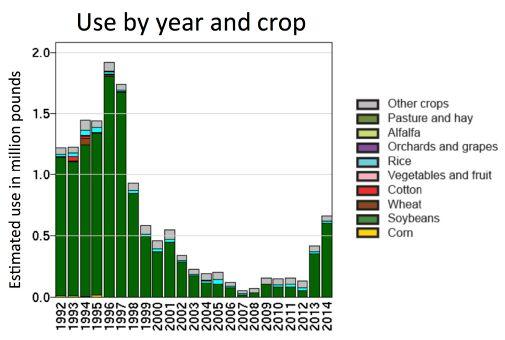
There used to be a lot of use of the PPO chemistries in the 1990s. In 1996, the first Roundup Ready crops were introduced and their use dramatically decreased. Where PPOs were used extensively for weed control in soybean, it was replaced by glyphosate. But the use has picked up again because of glyphosate resistant weeds. It is a great tool to manage glyphosate resistant weeds in the south and the Midwest as well. In Canada it might be a good tool in the future as you see more and more glyphosate resistant weeds.
Some plants have become resistant to PPO chemistry. For most of them we don’t know the mechanism. But for waterhemp, Palmer amaranth, and ragweed, we know there have been mutations on the target site gene. That’s similar to what happens with ALS inhibitors and ACCase inhibitors. That’s what happens with some glyphosate resistance in some cases.
At the target site, there are two genes that make two proteins. One goes to the chloroplast; one goes to the mitochondria. When the plant became resistant, many scientists sequenced the gene for the protein that goes to the chloroplast because that’s where the herbicide works by preventing chlorophyll synthesis. However, no mutation was found at that location. Dr. Tranel at the University of Illinois sequenced the other gene that goes to the mitochondria. He found that there was a mutation where a whole amino acid was removed, and that was kind of unusual. But there was also something added to the gene, and that was the first time this was reported to happen in plants.
We looked at many genetic sequences to look for all the potential plants that have the same gene structure that could have a deletion. One of the plants is kochia. Kochia is a big weed in Colorado and in Canada. We now know that kochia is already predisposed to that mutation. If we keep using PPO chemistry the way we’ve been doing it and try to control kochia, most likely kochia will become resistant to that chemistry in exactly the same way that Palmer amaranth has become resistant. If you know a weed is predisposed to the mutation, then you should be scouting for weed escapes when you use that herbicide.
Now because you have resistance doesn’t mean you have resistance. What? Some interesting research was conducted by Peter Sikkema in Canada where fleabane escaped control by PPO chemistry. He demonstrated in the greenhouse that those seeds he collected in the field were resistant. What’s interesting is he went back the next year to the same field, applied the same herbicide and had 100 per cent control. An escape does not mean that your field is infested with the resistant weeds. In this case, it could be that the resistant weeds did not over-winter very well. So be on the lookout, but don’t freak out. If you have an escape it could be just something that’s a freak accident. But always be on the lookout for those escapes because we know that it can happen.
This was very unusual. The herbicide is supposed to inhibit the chloroplast enzyme, but that little bit of DNA that was added to the sequence made the mitochondrial gene also go the chloroplast. So now you have a plant cell where a resistant trait is in both locations – the mitochondria and the chloroplast.
That’s important because these resistant plants now have the capacity to do the deletion and develop resistance, and have the capacity to move it to both locations. This has proven to be true in Palmer amaranth, water hemp, and ragweed. There’s no other herbicide so far that we know where plants have become resistant by this mechanism.
I’m not very familiar with the Canadian system, so suggested management strategies come from Arkansas where they deal with PPO resistance all the time in soybean. These may not necessarily be applicable to Canada. Use two active ingredients at planting, typically metribuzin (Group 5) and a Group 15 such as acetolachlor. Both are needed for successful residual activity. Then 21 days later use a postapplication of glufosinate (Group 10), dicamba or 2,4-D (Group 4s) tank mixed with Dual (s-metolachlor; Group 15) for additional residual activity. In Arkansas, glyphosate is not useful because most major weeds including PPO resistant biotypes are already resistant to glyphosate. ALS herbicides are not useful in Arkansas either, as about 50 per cent of weeds have resistance to this group.
Harvest weed seed control is a new paradigm of weed control that’s really been developed and refined in Australia. The goal is to manage the weed seeds that are still in the fields at harvest – often those that have escaped control by an herbicide application – and to try and prevent their dispersal.
In order for harvest weed seed control to be effective, weed seeds still have to be retained on the plant at the time of harvest. If they’ve already dropped to the soil, they’re already in the seed bank. The weed seeds also need to be at a height where they can be collected by the combine. For example, chickweed is very low growing and its seeds are very low to the ground. Most producers don’t cut that low to the ground because of risk of damaging their equipment, so chickweed would not be a good candidate for harvest weed seed control.
Harvest weed seed control also means being able to get the weed into the combine. An example is a big tumbleweed, such as kochia. If the tumbleweed won’t feed into the combine and goes over top of the header, then you won’t be able to get the seeds into the combine for harvest weed seed control.
There are different methods of harvest weed seed control. Some of them have been scientifically evaluated in Australia. One of the most common methods is narrow windrow burning. The straw and chaff are dropped into windrows using metal chutes that are attached to the back of the combine. It’s cheap and easy to implement. But there are environmental
impacts because it does involve burning. From a practical point of view, it may not work in western Canada, but it is used a lot in Australia.
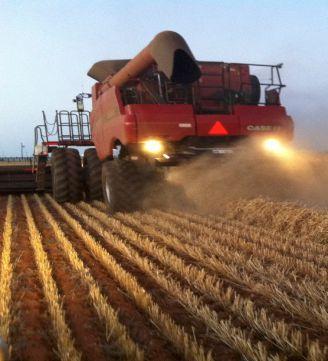
Chaff carts were originally developed in Canada. The Australians have modified Canadian chaff carts and use a conveyer system instead of a blower system to move the chaff to the cart. They’ve also adopted new technologies to make burning or collection easier and more efficient. Some of the chaff carts are programmed with GPS to dump the chaff in a certain area of the field to be grazed or burnt.
There was one Australian producer that commented he’s been using a chaff cart for 15 years, and about 10 years in he started seeing annual ryegrass that was much shorter, much lower to the ground and was dropping its seeds much earlier. So this is still a selection pressure. You will select for resistance to these methods if it’s what you’re relying on to control your populations.
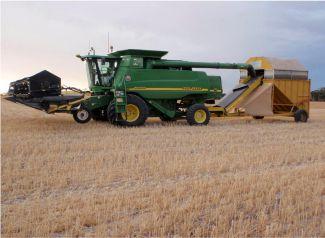
The bale direct system bales chaff and straw directly behind the combine into a square bale. The square bales are removed from the field, taking the weed seeds with them. The loss of the residue from the field can be detrimental in terms of nutrients loss. And there is potential for transport of weed seeds in the bale from one region to another, potentially moving herbicide resistant weeds with the bale. The other issue in Australia is one producer started doing this and he saturated the entire market. The bales can also be pelletized to produce pelletized sheep feed, but again it’s a relatively small market. So market can be an issue with this methodology.
The Harrington Seed Destructor uses a cage mill to grind the chaff and weed seeds. The cage mill has two counterrotating plates that spin very fast in the opposite directions. The weed seeds go in to the middle of the mill and have to move from the inside out to continue to move through the system. The straw moves along a conveyor belt and goes through a spreader at the back. Only the chaff is processed through the cage mill. The disadvantage is that the first model was towed behind the combine and required a lot of horsepower.
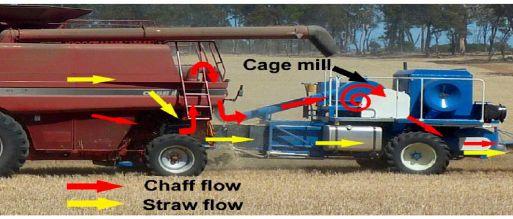
The tow-behind model was always intended as step one. The Integrated Harrington Seed Destructor (iHSD) is mounted on the combine and uses the same cage mill system. The integrated model had several improvements. Instead of having the two counterrotating plates there’s only one rotating plate and one stationary plate, but that rotating one turns twice as fast. It is a hydraulically driven machine and takes about 80 horsepowers from the combine to run this machine.
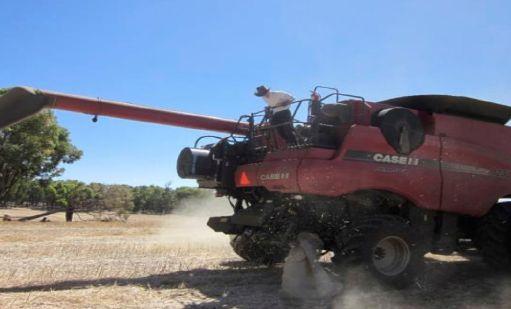
A new combine mounted seed impact implement was first announced January 2017. The Seed Terminator is competition to the Harrington Seed Destructor. It uses a slightly different type of mill called a multi-stage hammer mill, but it works on essentially the same idea of crushing or grinding those seeds so that they’re dead and can’t grow the next year. This is mechanically driven rather than hydraulically driven. In terms of price differences, the original tow behind Harrington Seed Destructor was about $200,000. The integrated Harrington Seed Destructor is somewhere around $150,000. The Seed Terminator is about $100,000. So what you’re seeing is as these competitors come to the market that price point is dropping, and we do expect that to continue.
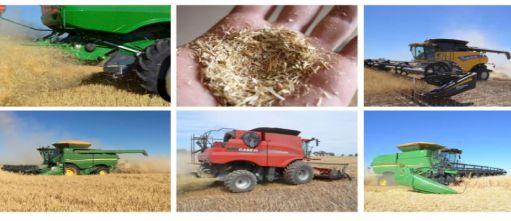
Chaff deck or chaff tramlining works in a controlled traffic system. The idea is to put chaff on the permanent tramlines so if weeds grow there isn’t much impact on overall yield. The chaff in the tramline is also driven over multiple times, which can impair weed growth, and there is potential for seed decomposition in those tramlines. What farmers have seen is that there are fewer weeds growing in the tramlines, but it hasn’t been scientifically evaluated at this point.
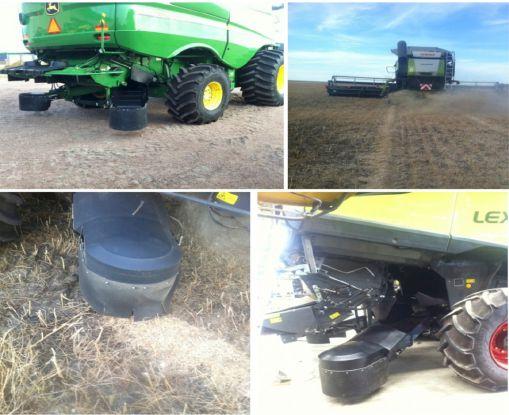
Chaff lining can still be used outside of a controlled traffic system. The chaff is placed in a narrow row to decompose instead of spreading the seeds across the entire field. However, there is potential for some seeding or emergence issues if you’re seeding through this concentrated chaff row. It hasn’t been researched, but a lot of producers are adopting this in Australia as their first step in harvest weed seed control because it’s inexpensive and easy to implement.
In Australia, a 2016 survey of 602 growers were asked about their adoption of narrow windrow burning, chaff carts, chaff tramlining, the bale direct, and the HSD. The Seed Terminator and integrated Harrington Seed Destructor were not released at the time so they don’t show up in the survey.
Across Australia, 43 per cent of producers were using some method of harvest weed seed control. Narrow windrow burning was the most common. In Western Australia that number goes up to about 63 per cent. Western Australia is essentially where all of these methods were developed. Western Australia is really the epicentre because of herbicide resistance, and harvest weed seed control is spreading out from there.
The adoption of chaff tramlining this past harvest has skyrocketed. There is a lot more discussion about different systems on social media, and a lot more discussion about what works and what doesn’t work than we’ve see in past years. If that survey was to be redone I think we would see some of the tramlining and chaff lining skyrocketing.
Results from the same survey show that 82 per cent of producers said they expected to adopt some form of harvest weed seed control in the next five years with 46 per cent expecting to use narrow windrow burning. More producers would like to be using the iHSD, but they had concerns about the cost and the perception that it was unproven in terms of weed kill. The perception of unproven control of weed seeds is interesting because weed kill is where there is the most research.
Research has been done in Australia to show how effective harvest weed seed control was on controlling annual ryegrass populations in “focus paddocks” or “focus fields.” The research compared crop rotations where harvest weed seed control was used in 38 per cent of crops compared to rotations where it was only
used in 11 per cent of crops. The ryegrass population was managed far more effectively where harvest weed seed control was used, and it has stayed very low.
In Western Canada we’ve believed that the physical impact implements that destroy seeds are most likely to have the best fit. They don’t require the burning, and it has some scientific testing behind it that shows it’s effective. So that’s where researchers have focused efforts in terms of testing a method for Western Canada.
We looked at the top 10 weeds in Saskatchewan and gave them a seed retention rating -- how well does the weed holds onto those seeds until harvest. A number of weeds are in the good or fair to good retention rating, and that’s promising. Green foxtail gets a good retention rating while buckwheat gets a fair to good. Volunteer canola is rated good. The unfortunate ones are the poors: wild oat, spiny annual sow thistle, narrow-leaved hawk’s-beard. Those have poor retention and are unlikely to be primary targets for harvest weed seed control because a lot of their seeds are already gone by harvest.
Looking at some small plot experiments, seed retention of wild oat, cleavers, and volunteer canola was looked at. Volunteer canola retained most of its seed by the end of September, cleavers was intermediate and wild oat retained about 20 per cent of the seed by the end of September.
Kochia has good seed retention. Their seeds only mature after harvest, so most of the seed is still there at harvest, but the concern is that below the cutting height, typically six inches, there can still be over 5,000 seeds below that cutting height. So even though a lot of seed is collected by the combine, there could still be a lot missed and left in the field. At this point we aren’t sure what impact harvest weed seed control would have on kochia.
As part of my PhD research, we looked at running samples through the Harrington Seed Destructor in a stationary format set up in the shop. We mixed buckets of chaff with weed seeds and ran them through to determine how many are destroyed. We looked at five weed seed species: kochia, green foxtail, cleavers, volunteer canola, and wild oat. We put 10,000 seeds of each of those species into a five-gallon pail of chaff, put it into the Seed Destructor and assessed how many lived when they came out the other side.
A second study looked at weed seed size. Weed seed species are all different shapes, sizes and seed coat types. We took canola seeds and we hand sieved them to get thousand kernel weights between 2.2 grams per 1,000 and 5.8 grams per thousand.
We also looked at weed seed number by comparing 10 canola seeds up to a million canola seeds in the same volume of chaff. We also looked at chaff volume, so 10,000 canola seeds going through with no chaff or up to eight five-gallon pails of chaff in the same timeframe. And we also looked at chaff type, so barley, canola, and peas.
When we looked at weed seed species we did find significant differences in terms of control but our lowest level of control was still over 97 per cent killed. It worked really well on all the species that we tested.
In terms of canola seed size, we expected to see an increase in control as the size of the canola seed went up, and we did. But
again, we’re within a percentage point of 98.5 per cent control so weed seed size isn’t a big factor in control.
Looking at weed seed number, once you have over 100 seeds going through, we were back up at that 98 per cent control.
As we increased the amount of chaff going in, initially our control increased, which may be that there’s more deflection within that mill. Those seeds get hit an extra time or two, and then it started to taper off. But again, we are in the 98 to 99 per cent control so it’s not going to have a huge impact in the field.
There was a similar story with chaff type. We did have less control in our canola chaff but we were running volunteer canola seeds through the seed destructor so there was likely a background presence of volunteer canola in our canola chaff that we did not account for. But again it’s by one-half per cent and we are still getting 98 to 98.5 per cent control.
In summary, what we found with the seed destructor was if you can get the weed seeds into the seed destructor you’re going to kill most of them – greater than 95 per cent.
The big question now is how does it work in the field? The answer is we don’t know yet. We have an ongoing study with the seed destructor in 20 producer fields where the seed destructor is in the field at harvest time. We harvest with the seed destructor and compare it to a pass with the seed destructor not milling the chaff. We learned a lot of lessons in 2017.
The first is that air velocity is really key. Chaff needs to be moved from the sieves, up and into the input of the tow behind Harrington. In order to get the chaff from the sieves, it has to go up into an input tube, and takes a fair bit of air velocity. If your air velocity is too low, your machine will plug. And if you don’t catch the plug fast enough, you end up with burning belts.
Greener, wet material also doesn’t work. We know it takes a lot more effort for the combine to thresh green or wet material. It’s a similar story with the mills. You need higher air velocity, and without it the green, wet material can plug where it forms a nice solid block of really hot, wet chaff in the blower. Green, wet material doesn’t grind well, either. So if you have green material in the field desiccation or swathing is going to be needed to dry the material down.
The other complication the tow behind HSD is a big machine that has problems with hills. The integrated seed destructor or the Seed Terminator makes a lot more sense for Western Canada. The research that’s been done in Australia shows that the tow behind unit and the integrated unit are very similar in terms of their control, so it’s still a valid test for those integrated units in Western Canada.
An example from a single field in 2017 shows some interesting results, although very preliminary. We compared photos from an untreated and treated Seed Destructor pass. There was substantially less volunteer canola in the treated pass after harvest. There is still some volunteer canola, but there’s substantially less.
We hope to start seeing benefits in the spring of 2018, but it is a three-year study. We’ll be back on the same locations for the next two harvests so that we can take into account the seed bank buffering that we’ll see in terms of our treatments.
These are new strategies. There’s always going to be bugs to work out, but they can be very effective in helping us manage the herbicide resistance that we’re currently facing.