Security Products and Technology


Serving Installers, Dealers and Integrators Across Canada






Telus has big plans for ADT Canada
Security exec explains where the company is going, including home health options p. 6
Pelco’s new CEO outlines the year ahead
Under new leadership and ownership, the surveillance firm plans a comeback p. 7
Cameras in public and the privacy debate
Accountability has ramped up in this era of new legislation and awareness p. 16
Daniel Demers, Elliott Goldstein and Frank Hayes have helped to shape alarm monitoring, surveillance and access control in Canada









The Latest IP Technology Dealers Corner Thousands of Independent Dealers Personalized Customer Service
24/7 Monitoring 365 Days a Year
• Wholesale Monitoring
• Interactive Services
• Video Monitoring
• Managed/Hosted Card Access
• Advanced Web Services
• Acqusition and Funding Program

Our hall of famers for this year, Elliott Goldstein, Daniel Demers and Frank Hayes, have helped shape the security industry with their talent and expertise. By
Neil Sutton and Will Mazgay
By Will Mazgay
• Telus ready to expand security business with ADT acquisition • Pelco’s new CEO on the company’s revitalization plan
• Integrator Delco showcases partner technology
• Toronto Pearson to test weapons detection tool • Top stories of 2019
By Neil Huntingdon


e have a new employee in our office and her name is Moxie.
SP&T News’ parent company, Annex Business Media, operates approximately 65 other magazines, so there are new employees on-boarded every month. Moxie, however, could likely be described as our first digital co-worker.
A few months ago, Annex introduced a new visitor management system to our Toronto office and called it, cheerfully enough, “Moxie.”
Annex employees all received an email when the system was first installed: “Moxie is our new ‘receptionist’ who will be taking over the reception role at the Annex North office. Moxie will be responsible for checking guests in, alerting individuals that their guest has arrived and checking out guests when they leave.”
Prior to Moxie, we relied on a paper-based system to check guests in and out, and the reception desk was staffed on a rotating basis by Annex employees who sat in for short shifts of a few hours.
We’re not a public-facing business, so the foot traffic to our Toronto office isn’t heavy, but we do receive daily guests, couriers, interview candidates for job openings, as well as staff from our office in Simcoe, Ont., who all use the system to check in (and out).
As someone who writes about the industry on daily basis, I immediately recognized Moxie for what it is: a piece of security technology. So naturally, I had to try it out. There is signage next to the tablet where Moxie
resides indicating you need to sign in, and the interface itself is very simple: provide your name and the name of the person you are visiting and the system will automatically generate a text and email, notifying that person that you have arrived. You are also invited to take a seat in our visitor area. If you don’t check out when you leave, Moxie will prompt your host to do it for you.
Anyone familiar with security procedure will know why check-out is just as important as check-in. Companies need an accurate count of personnel in their office at any given time in the event of an emergency situation or an evacuation.
I’ve used systems similar to Moxie in other facilities and businesses. In some cases, companies may also employ a receptionist or greeter who will direct the guest to use the visitor management tool. The more intuitive the interface, the less they need to intervene or explain. And these systems are becoming more and more common. A researchandmarkets.com report from August of this year forecasts that the global visitor management market will grow more than 15 per cent CAGR over the period 20192025, driven by the increasing need to “inspect and detect intruders” and also to “enhance the customer experience.”
“We look forward to working with Moxie,” concludes the introductory staff email. So far, so good, Moxie.

@SecurityEd


Your Partner in Securing Canada Security Products & Technology News is published 8 times in 2019 by Annex Business Media. Its primary purpose is to serve as an information resource to installers, resellers and integrators working within the security and/or related industries. Editorial information is reported in a concise, accurate and unbiased manner on security products, systems and services, as well as on product areas related to the security industry.
Group Publisher, Paul Grossinger 416-510-5240 pgrossinger@annexbusinessmedia.com
Associate Publisher, Jason Hill 416-510-5117 jhill@annexbusinessmedia.com
Editor, Neil Sutton 416-510-6788 nsutton@annexbusinessmedia.com
Associate Editor, Will Mazgay wmazgay@annexbusinessmedia.com
Media Designer, Graham Jeffrey gjeffrey@annexbusinessmedia.com
Account Coordinator, Kim Rossiter 416-510-6794 krossiter@annexbusinessmedia.com
Circulation Manager, Shawn Arul sarul@annexbusinessmedia.com Tel: 416-442-5600 ext. 3626
COO, Scott Jamieson sjamieson@annexbusinessmedia.com
EDITORIAL ADVISORY BOARD
Anna de Jager, Lanvac Victor Harding, Harding Security Services Carl Jorgensen, Titan Products Group Antoinette Modica, Tech Systems of Canada Bob Moore, Axis Communications Roger Miller, Northeastern Protection Service Sam Shalaby, Feenics Inc.

111 Gordon Baker Rd, Suite 400, Toronto, ON M2H 3R1 T: 416-442-5600 F: 416-442-2230
PUBLICATION MAIL AGREEMENT #40065710 Printed in Canada ISSN 1482-3217


No
Annex Publishing & Printing Inc. disclaims any warranty as to the accuracy, completeness or currency of the contents of this publication and disclaims all liability in respect of the results of any action taken or not taken in reliance upon information in this publication.


125 years of experience in putting the security of others first.

We understand you need to protect more than brick-and-mortar, which is why ADT does more than monitor. ADT has a wide range of alarm and security options for organizations of any size to help protect people, goods, and data. With 24/7 surveillance, solutions against intrusion and fire, remote monitoring, interactive services and more, ADT has a security solution for your organization. Join those who trust ADT with their livelihoods and protect your business.
Why choose ADT canada?
We are an integrator, meaning we can take over nearly any of the existing security equipment you have on-site.
We are customer-service oriented, innovative and technology savy. With over 125 years of experience and 13 offices in Canada alone, including three monitoring stations, you can trust the experts.
Telus announced the closing of its $700-million acquisition of ADT Canada on Nov. 6. The executive responsible for Telus’s security business said the company is poised to take advantage of its new assets and offered a glimpse of what the future might look like under a combined organization.
Telus kicked its security division into gear last year with the acquisition of AlarmForce’s western assets (BCE currently owns the remaining AlarmForce assets). The company subsequently launched a consumer security division called Telus SmartHome Security and Telus Secure Business for its small business customers.
Jason Macdonnell, president of security and automation at Telus, said that the addition of ADT will enable the company to broaden its reach across Canada. It will also bring to bear ADT’s longstanding assets in Canada including three central stations and a dealer network, along with its heritage in the market and brand awareness. Telus had more than 100,000 security customers at the time of closing, according to Macdonnell, and added about another half a million via the ADT deal.
ly going to leverage the brand, especially as we look at central and eastern Canada, wrap our arms around the organization in terms of our marketing and pricing prowess and value in the marketplace.”
The company plans to go to market under the brand “ADT by Telus” in the immediate future but that could vary region by region or business unit by business unit, said Macdonnell. “We’ll keep our options open as we go forward.” Telus will also be contacting ADT Canada customers in the coming weeks with “an extensive outreach program… it will involve heightened levels of value opportunities to the broader ADT customer base.”

Macdonnell stressed that the scope of the company’s security business is about to get much bigger. It will offer a broad portfolio of security services that includes ADT as well as Telus’s hosting, cybersecurity and emergency management businesses, and communications infrastructure.
“We look forward to being able to leverage that dealer organization for our broader breadth of services like cybersecurity and IoT and our health services,” he explained. “When you look at the long-standing relationships between ADT and their dealer network, I think that’s a fantastic asset for us to be able to leverage — not only for security as we broaden our positioning in national and commercial accounts, but also as we give them the opportunity to sell other products of value to the marketplace.”
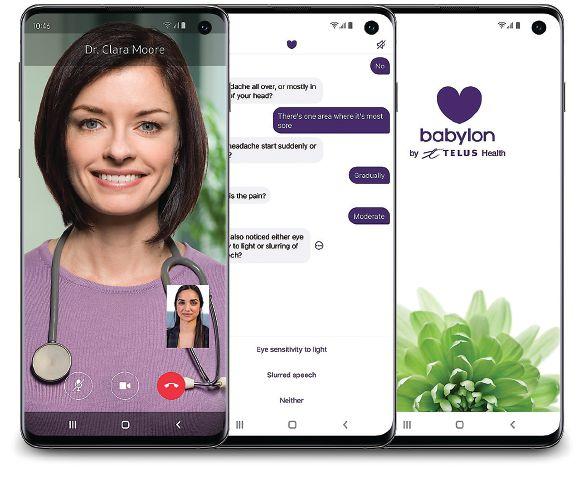
acquisition. It also offers a remote video service called Babylon by Telus that connects patients with doctors via their smartphones.
“For us, there’s an opportunity to take the structure, the experience and the professionalism of the ADT organization and really build around it,” he explained. “At a high level, in terms of integrating the two organizations, there’s a lot more that’s complementary than redundant. For us, we’re real-
“There’s a number of complementary capabilities that we can bring,” he said. “Think about the importance of video verification riding on a world-class reliable network and the importance of both fibre and wireless in that regard.”
In addition to the dealer channel that has expanded via the ADT acquisition, Telus will utilize other avenues available to grow its security business including online and retail. Likewise, ADT dealers could become a channel for Telus’s other product offerings.
Telus offers a mix of home security options, including professional monitoring and self-monitoring packages for customers and will continue to assess its product roadmap, said Macdonnell, with ADT now in the mix. (Telus currently utilizes a Qolsys panel and Alarm.com.)
A major driver for Telus is its home health business — a point that was stressed in the initial announcement regarding the ADT acquisition and again upon closing. The company launched its LivingWell Companion product — a wearable device with GPS and cellular enabled and with features like two-way voice and fall detection — following the AlarmForce
“There are a multitude of ways we can pair the technology we have at Telus and the technology at ADT and the services there and bring those to bear to solve some very challenging problems that we’re facing as Canadians,” said Macdonnell. “One of them certainly is being able to extend people’s time at home to improve their quality of life. Being able to make sure they can be in a home or in a residence that is safe and keeps them connected with family and loved ones.”
He said the company has also piloted biometric monitoring options for home health users. “You’ll see that come to the forefront more.”
Macdonnell also noted that ADT Canada customers will now be served by a Canada-based business in Telus. “For me, it’s as much a cultural and Canadian event, if you will, as it is one that’s both strategic and tactical,” he said of the acquisition. “It’s not very often where we get the opportunity to repatriate Canadian businesses.”
— Neil Sutton
In his first month on the job, Kurt Takahashi, Pelco’s new CEO, has set the agenda for his company, principally to get it back on track.
Takahashi was announced as CEO in October and officially took over Nov. 1. He was previously president of AMAG Technology and before that vice-president of global sales and marketing for Quantum Secure.
Takahashi assumes the CEO mantle at a pivotal time. Pelco was acquired by private equity group Transom Capital in May of this year after several months of negotiations with former owner Schneider Electric. Terms of the deal were not disclosed. When Schneider Electric announced it had entered negotiations with Transom in March, the company
stated that Pelco generated €169M (approximately CDN$247M) in revenue in 2018 and employed 478 people. Schneider Electric originally acquired Pelco in 2007 for US$1.22B.

Takahashi said his main priority right now is taking stock of the situation and addressing the elements that are core to the business. “If you look at the next 12 months, our pure focus is trying to get back to doing the fundamental things great,” he said, stressing that customer attention and channel outreach are both top of mind.
Kurt Takahashi, Pelco
perspective, we want to be much more active. We have lots of great case studies, we have lots of great customers, lots of great things to talk about and deliver, but we haven’t been very present.”
In addition, Takahashi said the company will be taking a close look at its sales organization to ensure “that we have the right people in the right role doing the right work with the right message…”
address specific pain points customers may experience, now or in the near future.
He sees this as a three-step process: examine the current roadmap, adjust for the near-term through development or acquisition, and embrace future innovation. The latter could mean anything from more analytics tools to mobile options, said Takahashi, but he anticipates it will probably be at least 18 months before the market sees an appreciable difference in the company’s product offerings.
As much as it is a challenge to thrust Pelco back into the limelight, Takahashi also sees it as an opportunity to revive a surveillance giant.
“In the next 12 months, what you’re going to see from Pelco is a very aggressive approach,” he added. “From a market presence
Scrutinization of the operation will also focus on the product pipeline, including the development process and release cycle. Takahashi said the company will look for opportunities in adjacent technology markets, either to fill any gaps in its current product line-up or to
On Nov. 5, Saskatoonbased integrator Delco Automation Inc. hosted an event in Toronto for its vendor partners to showcase their latest offerings.
Stephen Montgomery, sustainable construction advisor with PCL Construction, kicked off the event with a presentation on his firm’s efforts using Internet of Things (IoT) sensors to measure systems and environments in their buildings. To this end, PCL has created a software application called Job Site Insights, built with Microsoft Azure cloud computing technology.
said PCL’s monitoring can also serve security purposes, using the example of art installations equipped with sensors so clients can check on their valuables at any time.

Erik Schluntz, co-founder and CTO, Cobalt Robotics, provided details on his firm’s indoor security patrol robots, equipped with 360-degree cameras and video touch screens. Schluntz said that as robots patrol through buildings autonomously, navigating around obstacles, they build maps of their surroundings.
without any human support.”
Schluntz continued, “Imagine your best guard but with perfect recall, perfect reporting, you know exactly what happened, every second.”
Derek Horne, head of business development, Europe and North America, iCetana, spoke about an AI-powered video surveillance software program that focuses the attention of monitors on anomalous footage.
“It’s a very rich heritage brand. People want to see it come back,” he said. “The feedback I’ve got from a lot of the industry is they’re super-excited to see the change that can happen and they want to see Pelco come back into a leading position in the market.”
— Neil Sutton
goes into a live mode where anything outside of the usual routine is flagged.
Mark Hansen, executive director of sales for Delco’s Technology division, presented the integrator’s own product, IPFusion: a building automation platform that combines multiple systems into a single program that can be accessed from a single screen.
Hansen said, “When an incident occurs it marries things together and activates other systems.”
Montgomery said, “We can monitoring anything onsite... Our mobile systems guys can monitor 300 locations per minute.”
In addition to measuring environmental factors like air quality or heating, Montgomery
“It can detect people, it can detect audio anomalies, and in order to resolve those anomalies in real-time, we can video-call a human guard in to handle it in person,” Schluntz said. “The robots also recharge themselves on a charging dock between patrols. So they can operate indefinitely
Horne explained that iCetana shows a grid of blanked out screens, and if the program detects anything out of the ordinary on any of the feeds, that incident is revealed. He said, “You have a black live wall and any image that’s thought to be unusual will flash up, automatically drawing the attention of the CCTV user.”
Horne said the program needs two weeks to learn the basic patterns of the areas and individuals it is monitoring, and after that, it
He used the example of how IPFusion can help secure healthcare facilities, explaining what would occur if a health-care worker is assaulted and activates a duress call: IPFusion can trigger access control, denying access to the area of the incident or only allowing certain people access; video management can pan and zoom in on the situation and instruct archiving to take place; and security is dispatched.
— Will Mazgay
NYC’s traffic grid mapped

Transition Networks says it is working with New York City’s Department of Transportation to manage traffic data via its Power over Ethernet (PoE+) switches.
The company says its PoE solution will connect and power sensors and cameras at more than 10,000 traffic intersections. The data that is gathered from traffic and pedestrian flow will be used to monitor trends and improve services. Transition Networks’ Auto Power Reset (APR) can be used to remotely manage or reboot equipment, reducing the need to deploy technicians on site and incur traffic delays.
“Transition Networks’ products are essential technology investments towards our transformation to a smart city where data collection and analytics will be used to improve safety, traffic management and transportation citywide,” said an agency spokesperson in a statement.

Luxury hotel opts for smart locks
Luxury hotel Watermark Baton Rouge in Louisiana has selected ASSA ABLOY’s VingCard Essence door locks to optimize guest and staff safety.
VingCard Essence solutions utilize encryption technology to eliminate the risk of unauthorized access or cloning, according to ASSA ABLOY. Essence utilizes RFID technology to maximize card reading distances. It also allows hotel staff to extend visitor stays or reassign rooms without requiring the guest to visit the lobby.
“With Essence, we are not only able to ensure that guests find the peaceof-mind that they seek but can also readily adapt to upcoming needs thanks to the solution’s future-proof design and Mobile Access compatibility,” said Adam Gautreaux, general manager of the Watermark Baton Rouge hotel, in a company statement.


• Royal Boon Edam appointed Valerie Anderson as the new president and managing director of Boon Edam Inc., the subsidiary responsible for sales in the Americas.
• Huronia Alarm & Fire Security Inc. has announced the appointment of David P. Clark to the role of president.

The 33 Congress Street Building in Boston’s financial district, consists of three structures built in 1904, 1906 and 1922 that were subsequently combined into one space. The main lobby was upgraded to improve access and increase security while still preserving key historical aspects.
“We needed a way to get people into the new, main elevator lobby quickly due to the high volume of traffic that we were anticipating would take place after the redesign,” said Jason King, senior associate with architectural firm Arrowstreet, in a statement.
King installed a Boon Edam Crystal TQ manual revolving door, as well as four lanes of Boon Edam Lifeline Speedlane Swing optical turnstiles and two Winglock Swing model access gates.


• Montreal-based VuWall has announced new engineering and sales hires in the United States. Francisco Provencio has been appointed application engineer while Christian Cooper joins as account manager for the East Coast.
• Camden Door Controls, a provider of door activation,
January 7-10, 2020 International CES Las Vegas, Nev. www.ces.tech
February 9-13, 2020 BICSI Winter Conference Tampa, Fla. www.bicsi.org
February 12, 2020
Security Summit Canada Toronto, Ont. www.securitysummitcanada.com
March 3, 2020 Security • Police • Fire Career Expo Toronto, Ont. www.emergencyservicesexpo.com
March 18-20, 2020 ISC West Las Vegas, Nev. www.iscwest.com
April 22, 2020
Security Canada East Laval, Que. www.securitycanada.com
May 6, 2020
Security Canada Alberta Edmonton, Alta. www.securitycanada.com
May 27, 2020 Security Canada Ottawa Ottawa, Ont. www.securitycanada.com
June 9-12, 2020 Electronic Security Expo Nashville, Tenn. www.esxweb.com
June 17, 2020
Security Canada West Richmond, B.C. www.securitycanada.com
September 16, 2020
Security Canada Atlantic Moncton, N.B. www.securitycanada.com
control and locking products, has announced the promotion of David Price to vicepresident, communications and corporate development.
• Ottawa-based Feenics Inc., an access control as a service (ACaaS) provider, has named Hanna Farah its new chief technology officer.
September 21-23, 2020 Global Security Exchange Atlanta, Ga. www.gsx.org
October 21-22, 2020
Security Canada Central Toronto, Ont. www.securitycanada.com


( 8 3 3 ) 9 7 7 - 1 0 6 9
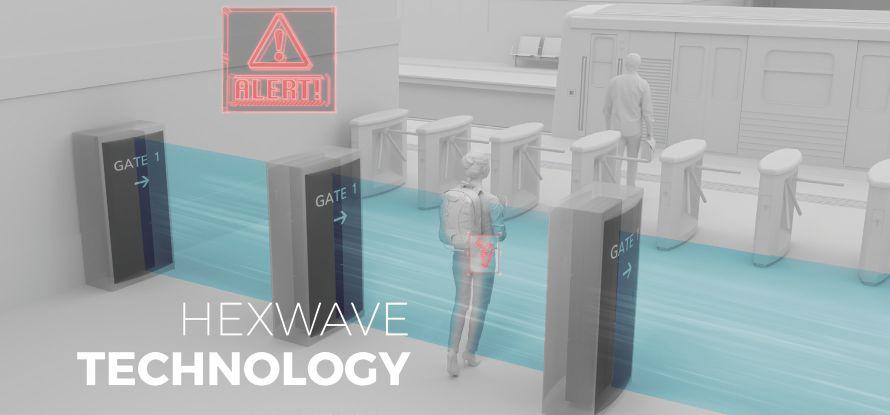
Toronto Pearson International will be the first airport to test Hexwave, a radar-powered weapons detection system.
“We want to make sure that we’re considering all of the necessary aspects to ensure security.”
— Dwayne MacIntosh, GTAA
The Greater Toronto Airports Authority (GTAA), which operates Canada’s largest airport, signed a collaboration agreement in October with Liberty Defense, a Vancouver-based firm working to bring Hexwave to market.
The firm licensed the technology from the Massachusetts Institute of Technology.
Dwayne MacIntosh, director, Corporate Safety and Security for GTAA, said, “At Pearson, we think we have very advanced approaches to security today, but again, I think you can’t continue to do the same thing.”
He added, “We’re looking at doubling passengers across the global community. And we want to make sure that we’re considering all of the necessary aspects to ensure security is there, to ensure it’s at its highest level while maintaining the
idea of having a seamless passenger journey.”
Hexwave uses three-dimensional radar imaging to create images of objects on individuals’ bodies, and those are analyzed by artificial intelligence to determine if they are benign or deadly. The firm’s CEO Bill Riker told SP&T News it works for both metallic and non-metallic items; it can be deployed overtly or covertly, inside and outside; and can integrate with video management, access control or a security operations centre.
MacIntosh said Riker approached the GTAA about the technology to see if there was interest in adapting it to an airport environment. “We had a number of conversations, Bill, myself and his entire team.”
Liberty Defense says it will test Hexwave at FC Bayern Munich’s Allianz Arena in Germany, Rogers Arena in Vancouver and Camden Yards in Baltimore to measure its capacity to secure stadiums. It is also testing with the state of Utah, the Virginia Division of the Capitol Police, a shopping centre chain, a Hindu religious and social organization, and in the Metro
Toronto Convention Centre (MTCC).
MTCC, which over the past 35 years has hosted over 21,000 events, will be the first convention centre to partner with Liberty to test Hexwave.
“MTCC has a strong reputation for being on the cutting-edge of services and facility operations, which includes a proactive security philosophy that stays ahead of emerging threats. We are
MacIntosh said this technology is going to augment Pearson’s current security program, not overhaul it. “We have our current screening points, which are driven under the Canadian Air Transport Security Authority (CATSA) and the federal government. That’s not where I see this technology being used.”
Instead, the director wants to experiment with Hexwave sensors at the doors of terminals. “We have to figure out what that looks like. It’s Canada — how do we control these things in weather conditions?”
MacIntosh explained that deploying sensors at the doors or curbs of terminal entrances poses another challenge; people don’t walk in one at a time. “I might be hand-in-hand with my wife or
pleased to participate in testing for Hexwave along with other world-class venues. As we explore ideas for continuous operational improvements, we consistently look at technologies that can both enhance efficiency and security while delivering a positive customer experience,” said Vince Quattrociocchi, vice-president of operations at the MTCC, in a prepared statement.
—
Will Mazgay
hand-in-hand with my child,” he said. “We don’t know how we’re going to operationalize this, but we are certainly interested in testing it and developing the technology.”
MacIntosh also wants to deploy the technology in Pearson’s corporate facilities, parking garages and possibly access points to the airfield. He said testing will take place over short intervals, for periods of several days or possibly a week or two, hopefully starting next spring.
Riker explained that this testing is an important part of Hexwave’s development process. “This will be a chance to get out there and see how it (Hexwave) performs under certain structures, see if there’s interference issues.” He continued. “We’ll also have targeted threat items that we’ll be looking for, based on the training that we’ve done for the AI by that time.” Hexwave’s AI can be updated to recognize new threats, according to Riker.
Riker said user feedback from partners like GTAA will help shape updates before the firm goes into its final design for production in Q4 2020. As far as how Hexwave factors into Pearson’s long term plans, MacIntosh said any firm purchases are dependent on how testing goes. He also notes that the airport would need to work collaboratively with CATSA and Transport Canada to implement the technology permanently.
— Will Mazgay
The following articles are among the most-read of the year on SP&T News’ website.
The list of articles is current as of Nov. 25; they are presented in chronological order. For more on these stories, as well as daily updates from across the industry, visit www.sptnews.ca.

Article posted: February 22, 2019
The 4th annual Mission 500 Hockey Classic, held on Feb. 21 in Toronto, raised funds and awareness for Toronto Crime Stoppers’ youth initiatives. The event hosted 10 teams in tournament play. Teams from Graybar Canada and Mircom competed in the final with Graybar emerging victorious. The 2020 tournament will be played Feb. 27 in support of Peel Crime Stoppers.
Article posted: March 14, 2019
Armstrong’s National Alarm Monitoring announced its acquisition of the monitoring assets of Consolidated Monitoring Ltd. (CML Security), based in Edmonton, Alta. “This has been a great acquisition for us,” Gary Armstrong, president, Armstrong’s, told SP&T News, “[including] tens of thousands of accounts.”
CML’s security services and installation division was not part of the deal with Armstrong’s and will continue as an independent operation under the leadership of CML president Ed Pringle.
Article posted: May 3, 2019
Graybar Canada celebrated the grand opening of its Vaughan, Ont., branch on May 2. The event involved a ribbon cutting ceremony, a barbecue and a showcase by the wholesale distributor’s vendor partners.
Graybar Canada said the 90,000 sq.-ft. facility is its largest branch and a consolidation of its Markham and Mississauga locations.

Article posted: May 14, 2019
Montreal-based wholesale monitoring company Lanvac revealed plans to expand its operations in the city. According to company president John Georgoudes, the newest facility is approximately 10,000 sq.-ft. and located 7 km from the original building. Georgoudes told SP&T News that he planned to move his office into the new building and make it the company’s headquarters upon completion of renovations. An additional facility in Toronto is also in the works, according to Georgoudes, which would make it the eighth for Lanvac across Canada.
Article posted: June 26, 2019
Gordon Hebb, a longstanding member of the Canadian Security Association, was voted national president of the organization during its annual general meeting held in Laval, Que., in April. In an interview with SP&T News, Hebb discussed his 20-plus year career in security (he is currently
vice-president of sales at Wilsons Security in Nova Scotia), his volunteer roles at CANASA, and his plans for the association during his two-year term as president.
Article posted: Sept. 20, 2019 Interlogix said in September that it would “wind down” its Canadian and U.S. operations this year. According to the statement: “This decision will allow us to focus on the significant growth opportunities for our other fire and security businesses, including LenelS2. Our products will be manufactured and orders fulfilled through 2019, and will be available for purchase from our distributors and dealers during a wellcoordinated transition period.”

Article posted: Oct. 1, 2019
In a landmark deal that would see the Canadian monitoring landscape shift dramatically, communications giant Telus announced its intent to acquire ADT Canada for $700-million. According to a company statement, ADT employs 1,000 people and provides services to approximately half a million Canadian customers. Telus had already made significant inroads into professional monitoring ahead of this deal, which closed Nov. 6, when it acquired the Western assets of AlarmForce from BCE in 2018.
(For more information, see story on p.6.)
Article posted: Oct. 9, 2019
Toronto-based Fitch Security Integration Inc. announced it has acquired all of OBN Technology Services Inc., a division of OBN Security & Investigative Consultants Inc. The stock purchase included the company’s CCTV, access control, intrusion alarm and monitoring business,
as well as OBN Technology’s client base. “Our acquisition of OBN Technology Services Inc. represents an important part of our long term plan to strengthen our position in key industry sectors,” said Fitch founder and president Ed Fitchett in a statement.
Article posted: October 16, 2019
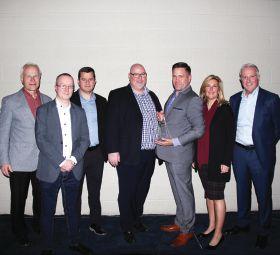
The Calgary office of global security integrator Convergint Technologies was named as Integrator of the Year by SP&T News’ editorial advisory board. The firm won the award based on its relationship with client the City of Calgary and its longstanding support of the municipality’s smart city vision. Convergint “put their best foot forward — listening to our needs and our wants and putting their ear to the ground and bringing us reliable solutions,” said Alex Lee, security advisor, corporate security, City of Calgary, in the SP&T News October cover story on the project. Convergint Calgary received the award at sponsor Anixter Canada’s gala event in Toronto on Oct. 23.
Article posted: Oct. 31, 2019
Anixter International, a distributor of security, network, electrical and electronic solutions, announced that it has entered into an agreement with an affiliate of Clayton, Dubilier & Rice to be acquired in an all cash transaction. The deal, which at press time was expected to close by the end of the first quarter of 2020, would result in Anixter becoming a private company.
According to the Canadian Security Association (CANASA), the Security Canada Central expo, held Oct. 23-24, drew almost 2,800 people — a new attendance record for the event. Prior to the conference, CANASA held a two-day monitoring event: an open house and station tour hosted by Lanvac Surveillance and a monitoring symposium comprised of seminars and panels on topics ranging from AHJs (Authorities Having Jurisdiction) to changes coming to standards at ULC (Underwriters Laboratories of Canada).



By Patrick Straw
Recent statistics from several police services have shown that the collaborative efforts between our industry and emergency services are beginning to have a measurable effect on our collective goal of reducing false alarms.
Our goal is to constantly work with the Authorities Having Jurisdiction (AHJ) community on sharing of information, promoting best practices and ensuring that CANASA members have access to current information and training that will provide them with the knowledge to conduct themselves to the highest standards.
cedures for setting up and updating customer account information so that address and phone information is accurate to minimize wasted time. Visit www.canasa.org for the information.
CANASA recently held a Monitoring Symposium in conjunction with our Security Canada Central show in Toronto and we were pleased to have active participation on our discussion panels from members of the Ontario police and fire services.

We support the initiatives that have been implemented over the last couple of years requiring verified alarm protocols and we are well aware of the need to reduce the false alarm numbers and minimize resources that can be better used in other situations.
CANASA regularly publishes white papers for our members which detail the proper pro-
PERS and mPERS (Personal Emergency Response Systems and Mobile Personal Emergency Response Systems) are another important area of discussion. With the aging population there is going to be a significant increase in the use of personal alarm products. Some are localized to an address and some have GPS capabilities designed to locate a person in distress.
Recognizing that this could be another burden on monitoring and dispatch resources, CANASA has established a committee which is
looking into all aspects of the use of these devices. We will be consulting with AHJs as well as both legal and industry experts to ensure that our members have the latest information.
The public’s need for quality security protection is growing at a very fast pace. CANASA is committed to making sure that we are partners with the emergency services working together for the highest possible quality of service to the public who we serve and protect. We encourage all of the AHJ community to contact us at any time to assist with issues that we are mutually involved in. As CANASA’s executive director, I am an active member of the CACP, Private Sector Liaison Committee, and the OACP.
I would be happy to answer any questions you may have regarding these important issues. You can reach me at pstraw@canasa.org.
Patrick Straw is the executive director of CANASA (www.canasa.org).





By Colin Bodbyl
Infrared light in outdoor cameras is on the rise, but its use-case may be limited
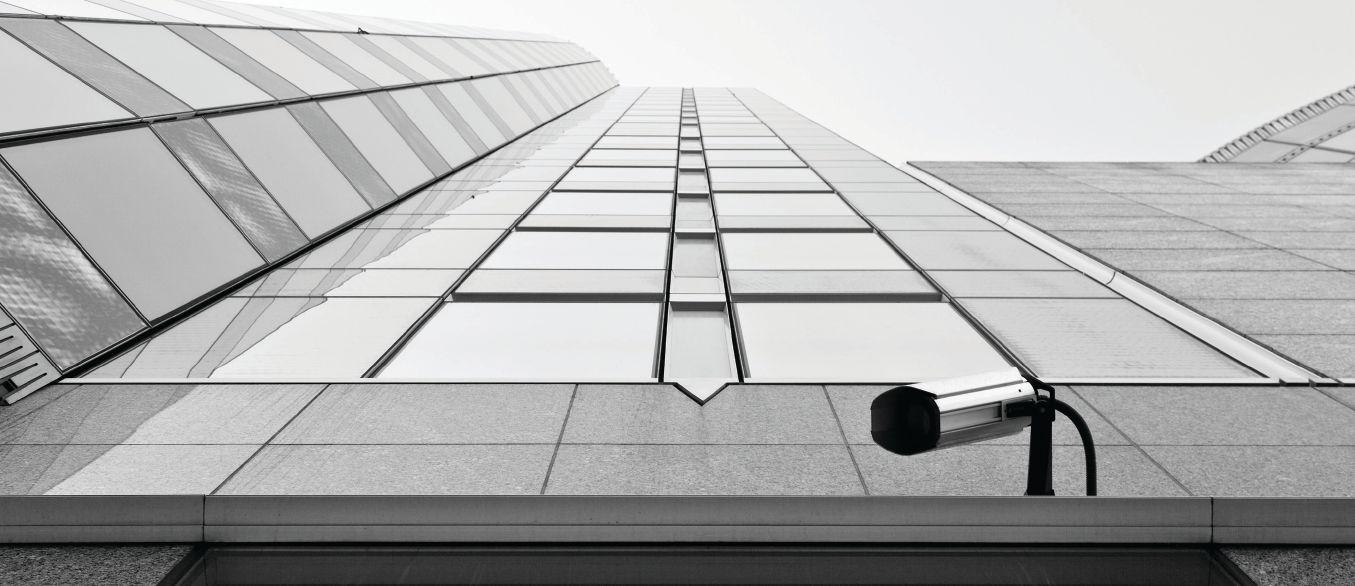
Over recent years we have seen infrared light (or IR) become almost standard in all outdoor cameras.
Even manufacturers who shunned the idea initially and marketed against it ultimately adopted the technology. While it is effective in many applications, the percentage of cameras with built-in IR far exceeds the number of installations that really require it.
IR is a wavelength of light that is not visible to the human eye but can be captured by a camera’s image sensor. It is an inexpensive and effective way to improve image quality where no other lighting exists, but it has several trade-offs.
The most obvious shortcoming of IR is that it can only be captured in monochrome (or black and white) images. This results in the loss of sometimes critical information, like the colour of a suspect’s vehicle or the details of a person’s outfit. This can make it difficult to use the footage as evidence, given key identifying features are lost.
From an intruder’s perspective, IR is invisible. There is no question that IR lighting has no value as a deterrent when compared to traditional white lights and while humans cannot see IR, many insects can. Even insects that cannot see IR are attracted to the lights due to the warmth created by them. This can result in spider webs and flying insects blocking the camera
and crippling its effectiveness.
Not all IR is the same either. Depending on the camera, built-in IR could be effective hundreds of feet away while in another camera it could be limited to 30 feet. This is an important consideration for integrators using IR cameras. After the camera has been installed, integrators need to monitor the nighttime images and ensure the IR is adjusted appropriately to suit the scene, which sometime means turning the IR off.
“While it is effective ... the percentage of cameras with built-in IR far exceeds the number of installations that really require it.”
There have also been significant improvements in image sensor technology over recent years, allowing cameras to stay in colour mode even when available white light is minimal. Rather than defaulting to use IR after sunset, integrators must test the various settings on the camera to determine if it is necessary. In many cases they will find the camera’s colour mode is perfectly adequate throughout the night.
Image analysis technology like video ana-
lytics can also be affected by the contrast or colours in an image. In some cases, video analytics or AI may work better on a monochrome image where contrast is high. In other cases, the technology may be critically dependent on identifying features like colour in order to properly categorize or differentiate between objects.
IR is not all bad of course. In cases where there is no visible light at all, built-in IR can mean the difference between a usable image at night and a completely black screen. Using a camera in colour mode during the night can also cause a lot of noise in the image. This can increase file sizes and ultimately impact recording times. In this example, using IR and monochrome mode could improve storage times and reduce bandwidth consumption.
Before IR lighting was included in most cameras, there was a saying: “criminals bring their own light.” This is often true, but not an effective strategy. Lighting in general is still the most critical external factor affecting camera performance. Integrators and end users who understand how to manage it effectively will ultimately maximize the performance of their surveillance systems. IR is always better than nothing, but just because a camera has IR does not mean you always have to use it.
Colin Bodbyl is the chief technology officer of Stealth Monitoring (www.stealthmonitoring.com).

IBy Victor Harding
Brokers may be a valued ally in the M&A market, but also consider their skillsets
n the past, some owners have sold their security companies without using a broker or intermediary.
Partly this is because, up until recently, there were no brokers in the market to help. Secondly, if their company was small and made up of monitored accounts, it simply did not pay to use a broker. But as the size of your company grows, there are good reasons why you should get professional help.
“Most owners don’t have a good idea of what their company is worth.”
Most owners don’t have a good idea of what their company is worth, even if monitored accounts make up most of the value. Nor do most owners know much about the process of selling or who the good buyers might be. To add to this, it is tough to run your company and sell it at the same time and equally tough to keep the fact you are selling confidential if you are conducting the sales process yourself. Finally, as the size and the complexity of your company grow, the stats show that a good broker can make a significant difference in the price you will get. They can also improve your chances of getting a deal closed more quickly.
I have owned and run a brokerage firm catering to security businesses for 10 years. A broker or intermediary is the term used to sell smaller companies. That would include businesses up to $15 million in annual revenue. Most brokers get the majority of their fees from the success fee (approximately five per cent) when the business is sold. Companies with revenues above $25 million generally hire investment bankers to help them sell. Investment bankers usually charge retainers along with a success fee.
What skill or experience should this owner be looking for in a broker? First and foremost, how much experience and success has the broker had in selling companies? What is their success ratio in getting deals closed? What references can they give you? Does the broker have any experience in selling companies in your industry? This is preferable but not mandatory.
Knowing what I know now about being a broker, I would also make sure that the broker

does not have such a narrow focus on his or her business that he or she is always going back to the same old industry buyers. To get the best price for a business requires a wide search of the market with several different types of buyers: industry players (strategic buyers), non-industry players (industries aligned with the particular industry the owner’s business is in) and financial buyers such as private equity firms.
As professionally trained as your lawyer and your accountant might be, they are not the people to help you sell your business. You will probably need both of them at some time to complete a deal but they do not usually have the skill sets to actually do a valuation or sell your business. A typical accountant has skills close to what you are looking for but still there is a difference. Creating an enticing selling package for your company which identifies strengths and weaknesses and opportunities for the future is about more than just the numbers.
Also selling small companies (less than $2 million in revenue) and dealing with their owners can be quite different than owners of five to 10 million dollar companies. Ironically, larger companies are often easier to sell. The multiples of earnings are higher, and the business tends to have more systems in place and is less dependent on the owner. If I had a company earning $2 million or less I would look for a broker that had experience selling that sized company.
It is also wise to be wary of general business
brokers. They don’t tend to have much in depth industry experience. Some of these general brokers have large marketing reach, which certainly can be useful. Still, it pays to test these brokers out on basic issues such as what they think your business is worth and the buyers they plan to approach. The answers to these questions can tell you a lot. For example, it is not unusual for those unfamiliar with the unique value of monitoring recurring monthly revenue to undervalue it significantly. Also, general business brokers can have fee schedules that are higher than those focused on the security industry.
Finally, owners need to be careful with any broker they hire of what we call the broker’s “tail.” This is the period after the brokerage agreement has been terminated that the broker gets protection on their fees if the business should be sold to a candidate approached while the agreement was in place. The tail should never be any longer than two years (less is better) and it should only apply to buyers where there has been serious conversations had about buying the business that go beyond just signing an NDA and getting the selling package.
Hiring a broker to help you sell your business can help get you a better price and get the deal done more efficiently, but you need to do your due diligence first.
Victor Harding is the principal of Harding Security Services (victor@hardingsecurity.ca).

With the technology becoming more and more sophisticated, the debate continues about how information should be collected, and for how long
By Will Mazgay
As the surveillance industry is increasingly powered by artificial intelligence, lightning-fast processing and ever more powerful cameras, concerns for personal privacy are sometimes overshadowed.
With that in mind, according to advocates, privacy should be top of mind for every business that collects or views surveillance data. Leaving personal information vulnerable to attack from malicious actors, as well as taking part in unnecessarily intrusive surveillance practices, can have reputational and financial consequences.
The Office of the Privacy Commissioner of Canada, Canada’s federal privacy regulator, says in its guidance — as it pertains to the Personal Information Protection and Electronic Documents Act (PIPEDA), Canada’s federal private sector privacy law — that businesses “are required to inform individuals about what personal information they will collect, how they plan to use or disclose that information, and for what purposes, to enable individuals to decide whether or not to provide consent.” Consent can be express or implied.
David Fraser, privacy lawyer with the law firm McInnes Cooper, says for the purposes of surveillance operations, implied consent is acceptable, which can be achieved through signage that lets individuals know not only that they are being surveilled, but the purposes of the surveillance. “Just putting up a sign saying that video surveillance is taking place, which is the common practice, is not sufficient,” Fraser says. “If you enter premises where you understand that collection





is taking place and you understand the purposes, by going into those premises you’re implicitly consenting to the collection, use and disclosure as described in the signage.”
Lack of transparency in surveillance is a major problem, according to David Shipley, CEO of Fredericton, N.B.-based cybersecurity firm Beauceron Security and a digital privacy advocate. He says, “There’s far too many systems deployed that are not properly documented, articulated or consented to.”
Caitlin Lemiski is the director of policy at the Office of the Information and Privacy Commissioner for B.C., which has a private sector privacy law that supersedes PIPEDA in many cases. She agrees with Shipley. “People often don’t understand that they’re being subject to audio or video surveillance, or the purposes for what that’s being used. You need to tell people that up front.”
Beyond maintaining transparency in surveillance operations, those collecting this kind of data need to be conscious of regularly deleting old footage.
PIPEDA and other privacy laws dictate that unused video footage should be deleted when it is no longer needed; this is up to the discretion of individual organizations.
Roger Miller, president of Northeastern Protection Service, a Halifax, N.S.-based integrator and security services firm, says, “Our advice is usually try to target 30 days. If there’s an incident that you need to go back and retrieve that video, for the most part, you’ll know within 30 days.”
David Weinkauf is the senior policy and technology advisor at the Office of the Information and Privacy Commissioner of Ontario (IPC), which is responsible for the province’s public sector. He says, “For us, the retention schedule is driven by the amount of time reasonably required to discover or report an incident that occurred in the space under surveillance.” He continues, “Look at past incidents — problem X occurred X number of times and each time
“People often don’t understand they’re being subject to surveillance or the purposes for what that’s being used.”
— Caitlin Lemiski, Office of the Information and Privacy Commissioner, B.C.
it took however long before someone reported it or you discovered it; you would use that as probably your baseline.”
In most jurisdictions, individuals have a right to ask for access to personal information that is being held by an organization. Fraser says that often these requests will come if someone is looking for evidence for a lawsuit, for a slip and fall for example.
So how does one square up regularly erasing unused data with the potential for information requests? On that matter, Fraser says, “They only have to provide access to information they actually have. There is no obligation to retain information just because someone may ask for it in the future. But if someone does ask for it, it has to be preserved until it’s either provided to them or they have an opportunity to complain to the Privacy Commissioner if it is refused.” He continues, “The shorter you keep information, including recordings, the less information you have around and the less likely that you’ll have to go looking through it to respond to an individual’s request for their own personal information.”
Weinkauf also says firms shouldn’t hold on to data for very long. “There’s additional risks that arise, cyber attacks being one. Also, there could be some internal risks, risks of misuse, or snooping, on the part of employees or who knows.”
Another important consideration when trying to avoid privacy overreach is practicing data minimization — collecting only information that is
necessary for what PIPEDA describes as a “legitimate identified purpose.”
Weinkauf says clear objectives are key to avoiding overreach. “If you’re setting up a video surveillance program, you should have a problem you’re trying to address, and you should have evidence of that problem; it should be continuous and a real problem. And there should be boundaries around that problem or space in which that problem is occurring.” He continues, “The idea is you should only be collecting personal information that is relevant and necessary to achieving that purpose.”
Fraser says collection should also be limited to a firm’s property, “If they have a store on a busy street and they have a camera that’s pointing out onto the sidewalk they’re not getting consent from anybody on the sidewalk.”
He also notes that audio surveillance that could intercept a private conversation should be avoided, as it is a crime in Canada to do so unless you are a party to the conversation.
As important as data minimization is to maintaining privacy, manufacturers are taking this concept a step further by baking it into the equipment they sell.
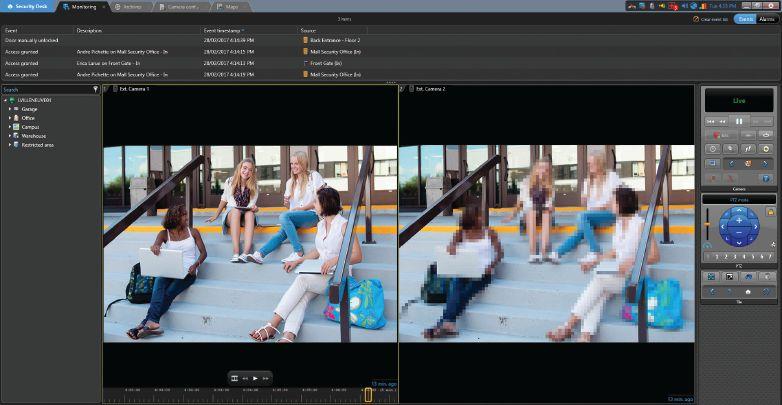
Montreal-based Genetec, through a partnership with KiwiSecurity, provides a technology called Privacy Protector that automatically pixelates people in live and recorded video.
Francis Lachance, director of video and appliances for Genetec, explains that the technology captures two streams of video, one where personal information is blurred, and a stream where footage is unobscured. He says, “It can be con-
“There’s far too many systems deployed that are not properly documented, articulated or consented to.”
— David Shipley, Beauceron Security


sumed by a curator who still has the ability to do their job… If there’s something happening, they can still monitor and do their work. But then a second stream will be non-blurred, so the clear video will be stored directly and encrypted on the server for potential use of that video.”
The clear footage is only required if there’s an incident that needs to be examined more carefully or shown to law enforcement.
Lachance says that this technology gives property owners the freedom to surveil their assets without fear of compromising privacy or getting into trouble with regulators. He says that right now Privacy Protector is an additional functionality available in its software packages, but Genetec’s goal is to make the technology a standard offer.
Deleting unused data and reducing the amount of data captured can reduce the risk of breaches, but other steps need to be taken to protect personal information — another responsibility
“If you’re setting up a video surveillance program, you should have a problem you’re trying to address.”
— DavidWeinkauf, Office of the Information and Privacy Commissioner, Ont.
under PIPEDA and most other privacy laws.
Northeastern Protection Service’s Miller says the consequences of leaving surveillance footage and cameras vulnerable to malicious actors are severe: “There was an incident in Nova Scotia about a year and a half ago, where a school video camera had been hacked by one of these video hacking websites and there was live video being streamed on a website of the school.”
Genetec’s Lachance says a robust video management system will have multiple layers of protection: strong authentication so only authorized people can access the system; controls to determine once users are in the system which cameras or video feeds they have access to; and lastly, strong encryption, both for data that is stored and in transit, which ensures that if data falls into the wrong hands, it is unreadable.
Miller says something as simple as setting difficult passwords can go a long way to preventing breaches. He adds, “And not giving people access to the surveillance system who don’t need it. We’ve seen a fair bit of that… We encourage our clients who have an IT department or an IT agency that they work with to let them manage the access to the surveillance system.”
B.C Privacy’s Lemiski says those purchasing surveillance equipment also need to be very careful who they buy from. “It would be in their best interest to ask a lot of questions from the vendor, not only about the hardware but about the backend.”
Beauceron’s Shipley expands on this, advising that firms opt for manufacturers that are clear about the expected lifespan of technology. He also says to pay careful attention to available software updates and be prepared to replace technology when updates or support are no
longer available. Lastly, “Many of these devices don’t automatically update by default — prefer devices that do.”
Fraser says if firms aren’t in compliance with PIPEDA, this can result in a complaint to the Privacy Commissioner. The Commissioner can then issue what’s called a “report of findings,” which can direct remedies to fix non-compliance, but it can also be used by a complainant in a lawsuit.
He explains, “There’s a range of damages that the Ontario Court of Appeal has set related to recognizing people being upset by having their privacy invaded. That ranges from nominal damages to $20,000.” But, he continues, “It is usually not worthwhile for an individual to pursue that claim, other than perhaps in small claims court.”
PIPEDA can, as of Nov. 1, 2018, expose firms to fines of up to $100,000, but Fraser says these circumstances are very limited.
Fraser says for his clients, one of the biggest concerns is reputational damage. “They pride themselves on being diligent in how they manage their affairs and the last they want is the publicity to be associated with the Privacy Commissioner finding they’re offside.
“It’s only under the criminal code stuff that one can expect to get into any kind of significant financial harm,” the lawyer notes, referencing audio eavesdropping and video voyeurism.
While there may not be significant financial consequences for non-compliance of Canada’s privacy laws right now, that could change, and quickly.
Fraser says, “For the last couple of years, privacy advocates in Canada have been calling for changes to our law to align more closely with the state of the law in Europe.”
Under the EU’s General Data Protection Regulation (GDPR), companies that manage data of Europeans can potentially face fines of up to 20 million Euro or up to four per cent of annual global revenue, whichever is higher.
Fraser continues, “Just before the election, the federal government tabled something called the Digital Charter, calling for a move toward the GDPR, and likely the most important thing, to give our Privacy Commissioner greater enforcement power. That was before the election, they used it as part of their election campaign… So I would not be surprised if, over the horizon, we were to see amendments to our privacy laws that gave the Privacy Commissioner the ability to levy fines and penalties.”
Shipley adds to this, “Eventually when we do get caught up to Europe’s laws, those fines will not be inconsequential.”


















SP&T News’ fifth annual Hall of Fame features security leaders who have distinguished themselves in different ways.
Daniel Demers is a well-known and well-respected figure in the Canadian monitoring industry. He led Reliance Protectron for almost 20 years and is now writing a new chapter as the president of GardaWorld’s electronic security business.
Frank Hayes has 40 years of security industry experience to his name and has become closely associated with some of the biggest names in access control. He too is starting a new phase in life, promising that he plans to play a vital role in security for many more years to come.
Elliott Goldstein is known as a go-to person for anyone who wants to know more about video surveillance and the law. A lawyer and deputy judge, Goldstein has devoted years to writing about video, contributing columns and authoring books on the subject, as well as teaching through seminars, lectures and presentations.
The 2019 line-up of Hall of Famers are all experts in different aspects of security and have enriched the profession with their own unique styles. SP&T News is pleased to honour their contributions and share their stories.
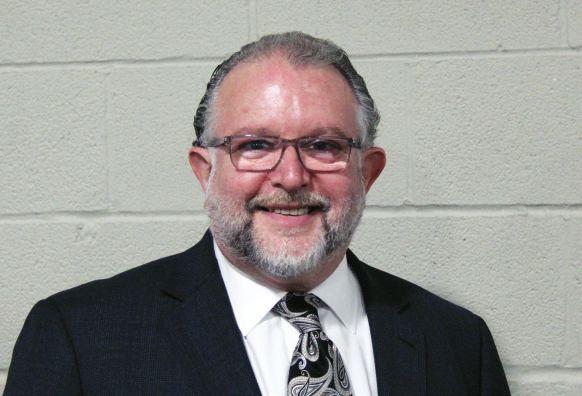
Elliott Goldstein literally wrote the book on surveillance and the law.
It’s called “Visual Evidence: A Practitioner’s Manual.” It has been in print continuously since 1991, updated multiple times every year and now spans three volumes.
Goldstein is a familiar face to many in the Canadian security industry. He is a frequent presenter for the Canadian Security Association (CANASA), ASIS International and other associations, as well as a long-standing lecturer for the Ontario Police College. He has also contributed to this magazine and is often seen in the pages of sister publication Canadian Security with his longstanding regular column, “CCTV and the Law.”
A lawyer by trade, Goldstein found his niche in security, combining his knowledge of surveillance with his vocation. He has also reviewed numerous alarm and monitoring contracts over the years, helping to Canadianize them.
This didn’t all happen overnight. It took a few attempts for Goldstein to find that niche and for the security industry to find him.
Goldstein was born in Winnipeg and raised in Saskatoon. He attended law school in Saskatchewan, then moved to B.C. and was called to the bar there in 1984.
His first published book was a video and photography case law manual. A “giant database,” Goldstein says, of the legal cases in the Commonwealth world dealing with photos, motion pictures and a few security videos.
When he moved to Ontario in 1986, “everybody said, that’s great, it’s a nice reference manual, but people want a practitioner’s manual — they want a manual that is going to teach them how to use video and what they can use it for. Forget about the photography, forget about the motion pictures, the big thing now is video.”
So he wrote “Visual Evidence.” His publisher thought it could be a resource for lawyers. There wasn’t much initial interest, “but a strange thing happened,” says Goldstein.
A person connected to the Retail Council of Canada (an association of retailers and affiliated professionals) discovered a copy of the book
“The
and instantly saw it’s usefulness in the fight against shoplifting. “They suggested the alarm and security business might be more interested,” explains Goldstein.
Security camera vendors like Panasonic and Sony hosted seminars with Goldstein as featured speaker, selling copies of his book to attendees.
“All of a sudden, the book took off. We were selling hundreds of copies a year. What started off as a
book aimed at lawyers very quickly became the hottest thing for anybody in the alarm and security business.”
Despite his close association with surveillance and the law, he still regards it largely as a hobby, “but a very serious hobby.” His legal “day job” is as a litigation lawyer. He was also appointed as a deputy judge 10 years ago.
What keeps him coming back to the book is his love of teaching. Ed-
ucating an industry that thirsts for legal knowledge is a huge motivator, says Goldstein, and he enjoys making a difference.
“People ask me, why did you write a book about this topic? Because it wasn’t there. It was needed,” says Goldstein. “The only way you can change people’s minds is by teaching them.”
The book has grown over the decades to include technology evolution in security cameras, as well as other aspects of surveillance such as privacy legislation, smartphones and potentially even artificial intelligence (though Goldstein believes the term is often misapplied).
Next for Goldstein is something that might seem counterintuitive — cutting back. With its three volumes, the book has become seriously heavy. Goldstein hopes to create a slimmer edition in the future to make it more accessible and reinvigorate it as a teaching tool.
“If you train people, they become better at what they’re doing and then they can use their skills to help other people. I feel very strongly about education. But you can’t teach them if there’s no book to teach them from,” he says.
— Neil Sutton



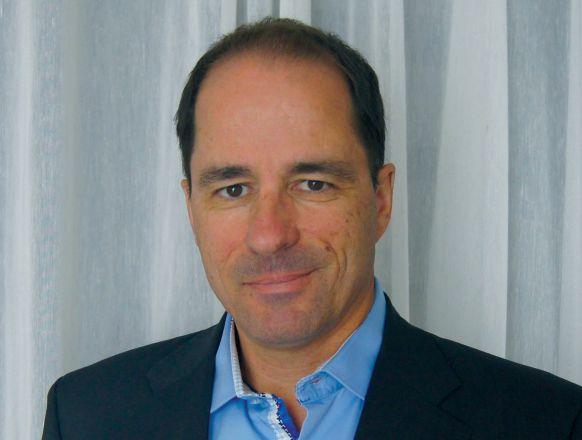
Daniel Demers is, by any measure, one of the central figures in Canada’s alarm industry.
He has been a leader in the business for more than 30 years and has participated in major acquisitions and consolidations that have profoundly shaped the way the alarm landscape looks today.
Demers came into the business in the early 90s via Quebec-based Videotron when he was hired as director of finance.
He moved over to Protectron, Videotron’s monitoring business, in 1993, as its controller. At the time, Protectron had about 13,000 customers. In 1997, at the age of 34, he took over as Protectron’s president.
He would remain in that role until 2014 when the company was acquired by ADT. At that point, Protectron had grown its base to 400,000 customers and effectively doubled the size of ADT in Canada when the two companies came together. (ADT Canada was acquired by Telus this year.)
“As director of finance, I was involved in acquisitions and I really saw that there were a lot of opportunities to grow the business and build a true Canadian player…. When I became president, obviously we pursued that track,” says Demers.
During the intervening years, Protectron went through several ownership changes. Communications company Quebecor Media acquired Protectron’s parent Videotron in 2000 and sold Protectron the following year to New York-based private equity firm
“I really saw that there were a lot of opportunities to grow the business and build a true Canadian player.”
Wellspring Capital Management. Demers says he continued to build Protectron, first with the acquisition of the Canadian division of Protection 1 in 2001, which gave Protectron its first major expansion outside Quebec.
In 2005, Wellspring sold Protectron to Union Energy (which became Reliance Home Comfort), creating Reliance Protectron. In 2007, monitoring company Voxcom was added to the Protectron family, providing the company an even larger national presence.
As the company grew, it continued to evolve, says Demers. Protectron inherited a variety of alarm dealer programs and an expanding dealer network, so some blending was necessary to create a hybrid program.
sales as well as a mix of residential, commercial and wholesale opportunities.
Demers says growth comes not only from acquiring accounts and companies but from valuing and keeping them — both the customers you inherit and the staff who bring their own set of skills.
Demers stepped away from the industry for a few years after the acquisition of Reliance Protectron by ADT, but he would return when he joined Montreal-based GardaWorld to help build the company’s electronic security division. (He told SP&T News in 2018 that he was glad to be back in security full-time. “I’m not done with what I started,” he said.)
be toxic. Achieving that balance is important, says Demers. “In order to have a very strong organization, you need to have different people with different mindsets,” he says. “It’s the combination that achieves so much… It’s a question of having the right people in the right spots with the right support. These three are really important.”
Above all, he values optimism and positivity in his co-workers. He’s also a big believer in being open and sharing information freely. For those who do, “it’s going to be given back to them tenfold.”
Demers says he’s looked to several mentors over the years for guidance. Through his involvement with the Central Station Alarm Association (now known as The Monitoring Association), Demers connected with Mel Mahler and valued his advice. Mahler, who passed away earlier this year, was co-founder of Nashville, Tenn.-based ADS Security and president of the CSAA from 2001 to 2003.
Demers is also a fan Stephen Covey’s book “The Seven Habits of Highly Effective People,” particularly his notion of “putting first things first.”
“We often overlook that,” notes Demers. “We end up paying attention to a bunch of unimportant things. If you’re not happy, you’ve got to pay attention, you’ve got to take a step back.”




“Whoever owned us, they were expecting substantial growth. For us to achieve that growth, it was up to us to go multi-channel,” says Demers. That meant a variety of approaches to the market, including dealer programs, direct
For all his boldness as a leader, Demers says he’s not accustomed to the spotlight. He credits much of his success, and that of the companies he has worked for, to teamwork. Creative people are important to have in any team of business leaders, but too must dissent can
With GardaWorld for two years and now president of its electronic security business, Demers says he has found his footing in a new organization. In that time, the division has made several acquisitions and grown from two employees to almost 100. “If it were up to me, we’d already be much bigger than that,” he says. “It’s starting to be really fun.”
— Neil Sutton




Frank Hayes’ career in security technology sales and management began in Ireland in 1986.
He started in consulting engineering working as a draftsperson. It was here that he was exposed to electrical switch gears, lighting, elevators, and other facets of building technology, but of all the areas he experienced, security interested him the most.
His journey then took him to Canada. He says he emigrated here without ever visiting first. “I got a one-way ticket and said, ‘I’m out of here,’” Hayes remembers.
It took Hayes a few months to get his bearings, but he eventually landed at a company called Aritech Sensors, which made passive infrared motion detectors, and he took on a regional sales manager role. Hayes says of his first Canadian venture, “People took to me, and they liked what I had to say and how I delivered it and they bought from me.”
After several years at Aritech, Hayes moved into C & K systems, then over to DSC (Digital Security Controls) around 1997. “The jump to DSC was what really put me on the national platform because at the time DSC was probably a 70 per cent market share player. It was always a warm call. It was bigger scale. It was just more and more exposure. I got my name out there, became established,” Hayes says.
Hayes then transitioned to access control with a firm called Verex Technology, managing an international team for a $25 million business. Then, after some time with Chubb Security and a short-lived stint at an independent business, Hayes jumped into an international sales role with RBH Access Technologies, selling into the Middle East, Africa and Europe.
He says, “It was fabulous. I didn’t have a team to run, all I had to do was go around, build business and from a desk in Brampton, (Ont.) make appointments and get over to these places, and meet people.”
Hayes eventually found himself in the ASSA ABLOY world, first under the brand Mul-T-

“People liked what I had to say and how I delivered it.”
Lock, introducing electronic access control to locksmiths, and after five years transitioned into Door Security Solutions (DSS).
After two years on the DSS side of the business, Hayes decided to
take a break from the industry to recharge.
“People have advised me to slow it down, take a deep breath and make the most of the time off at the moment and get fully
recharged, but I don’t doubt that within the coming months I’ll be picking or looking at doing something,” he says.
While there have been constants in Hayes’ career, close relationships with people in the industry, unwavering support from his colleagues, a lot has changed since the mid-1980s.
“The whole movement to IP and IT,” he says. “They were not letters or words used when I started working in the industry.”
Hayes says that adjusting to shifting technology and trends has been made easier over the years by staying on top of industry news, especially through SP&T News .
As for the secret to his decades of success, Hayes says, “If you show up on time, if you follow through with what you say you’re going to do, and if your product is reasonable, you will probably be successful based upon that alone.”
Ultimately, Hayes’ 40 years in the security industry has been “a good ride,” but he says he’s not done yet. “I’m not sailing into the sunset.”
— Will Mazgay
John Vickers Vice-President of Business Development Beeyond Smart Security


By Neil Huntingdon
Businesses today require more robust surveillance than the CCTV cameras, radar and microwave sensing technologies of the past few decades.
New types of technologies have emerged to help address the drawbacks of traditional security solutions, but some of these new systems have stirred up a lot of controversy.
Facial recognition technology in particular has been met with criticism from privacy advocates who claim it infringes on people’s inherent right to privacy.
Lidar technology offers an answer. Lidar enables advanced 3D perception to detect, track and classify objects and behaviours to allow for the determination of whether something is a threat.
Lidar’s high resolution point cloud data provides valuable information such as the location, size and velocity of a person or object, without showing facial features and other biometric information.
This preserves the anonymity of people not involved in security incidents, unlike traditional security solutions.
So what types of applications will lidar be used for? Lidar is suited for a wide variety of industries and use cases including:
• Crowd analytics: Stadiums, theme parks and other types of popular attractions can use lidar to track crowd flow and monitor room occupancy to prevent accidents.
• Behaviour detection: Parking lots and retail stores can use lidar to track for specific behaviours such as loitering, running or crawling to help prevent theft and other types of criminal activity. Airports, train stations and government institutions can also monitor whether someone drops a package and leaves it unattended.
• Intrusion protection: Critical infrastructure and other public and private facilities can rely on lidar for perimeter protection, triggering an alarm when intrusion occurs.
• Access control: Manufacturing plants, companies, hospitals and schools can rely on lidar to flag unauthorized entry and even monitor for activities like tail-
gating where someone follows an authorized individual into a secure area.
• On-site safety: Construction sites and mines can help prevent accidents and vehicle collisions by using lidar to monitor for collisions and people or objects entering into dangerous zones.
With perception software, a smart lidar product can be customized for a company’s specific security needs. Operators can define specific intrusion zones, for example, and configure their systems to follow specific protocols if a security incident is flagged. This enables companies to monitor their environment in real time and immediately be alerted if there’s a potential threat.
Designed with simple integration in mind, smart lidar sensors can add an additional layer to existing security systems. This works to solve many of the key pain points of traditional security solutions.
Lidar can help reduce false positives thanks to its high resolution. Radar sensors, while useful for some types of detection, may not deliver high enough resolution
to accurately identify potential threats.
Lidar can provide data with resolution high enough to tell the difference between humans, big animals and small animals, and identify behaviours such as running and crouching, helping to reduce alert fatigue so companies focus on security incidents that actually require attention.
Another challenge with traditional security systems is their constrained operating environments. Cameras can only provide high resolution imaging in good lighting conditions. While companies can install some artificial lighting, that’s not as feasible for monitoring large areas.
Thermal cameras are an alternative to monitor an area in the dark, however, they can be fooled — for example, if a thermal signature of an object matches its surroundings.
Microwave sensing technology is another type of sensor that only works well in certain conditions, given its sensitivity to humidity and movement caused by wind, etc. By contrast, lidar can see regardless of lighting conditions.
Lidar provides 3D perception, unlike traditional security technol-

ogies which provide 2D imaging information.
Even cameras can struggle with providing true 3D images, and often overlay images from different CCTV cameras to create the appearance of a 3D image. This difference in perception can make a considerable difference when it comes to accurately detecting and identifying threats based on the object’s dimensions, location and moving speed to keep people safe and protect businesses’ assets.
Interference is also a concern for traditional security systems. Radar and microwave sensors are impacted by electromagnetic interference, which limits their accuracy in locations like a power station that has a lot of steelwork.
Lidar, however, is tolerant to electromagnetic interference and works well in a wide variety of environments. It is also tolerant to interference from other types of sensors, making it a good complement to existing devices.
Data storage and transmission is another issue to consider. Camera-based systems require more data capacity to transmit video footage, and the costs to store, transmit and process this data can add up. Lidar-based systems, if combined with edge processing, enable low-bandwidth data output and will keep data transmission to a minimum.
Finally, one of the most important factors for surveillance is having real-time monitoring. Traditional camera setups only work in real time if someone is watching the cameras full time, or if detection systems are implemented. Lidar can flag incidents immediately without alert fatigue.
Existing lidar systems use various technologies and deliver different performance levels, so it’s important that companies carefully evaluate different systems to determine
what’s right for them.
Some of the key factors to consider are the basic specs of a lidar sensor (resolution, range, field of view, etc.) and its cost. However, there are several other considerations that are equally important.
Intelligence is a critical feature for lidar sensors, given the increasing need for a smart IoT network.
One way to add intelligence to lidar is combining it with edge computing. When data is processed locally, it reduces the burden of data storage costs, reduces network bandwidth and better protects the data from hacking attempts. Plus, edge processing opens up the door to mobile installations — lidar systems don’t have to be tethered to a building to operate. Having built-in perception software can further boost the intelligence of lidar. It can increase the connectivity between lidar sensors for comprehensive cover-
age and device-to-device seamless tracking.
Another consideration for lidar systems is ease of integration and use. While some lidar sensors can be complicated to use, other systems are designed to be used right out of the box.
Since no one type of technology is infallible, the next generation of security systems will integrate lidar in combination with cameras, radar and other sensors.
In fact, these technologies work well together to help eliminate blind spots and provide maximum coverage of an area requiring surveillance.
Radar technology works well as the first layer of security with its long range detection capabilities. If radar detects an intrusion, it can trigger an initial alarm or response.
Lidar fills in the gap in the security industry for medium range detection. Lidar can detect and classify people and objects with extreme accuracy, so security systems can immediately escalate a threat when warranted. Cameras serve as an ideal vehicle for close-up detection to further verify a threat. And to give security operators the best of both worlds, lidar data can be overlaid on a camera view so the information is even easier to understand and analyze.
As privacy concerns continue to dominate headlines, lidar offers businesses a solution for anonymized surveillance.
The good news is that lidar is quickly becoming more accessible for security implementations. Over the next few years, we’ll see autonomous cars drive the production of lidar at scale, pushing down the cost of lidar even further.
Security manufacturers will also start to integrate lidar into their standard offerings. Lidar will play a pivotal role in ushering in a new anonymized security era that preserves privacy and protects businesses.
Neil Huntingdon is the vice-president of business development at Cepton Technologies Inc., a 3D lidar solutions provider (www.cepton.com).
Len Sudermann Founder Securex Financial

Hanwha Techwin America
Allowing both analogue and IP cameras to connect to the same unit, Pentabrid recorders support a future-proof migration from analogue to IP camera technologies when an organization is ready. Available in 16, 8, and 4 channel configurations in resolutions up to 4K UHD, Hanwha Pentabrid recorders can convert any channel at any time between analogue and IP with a simple software switch so there’s no additional investment needed. The Pentabrid line offers a familiar interface while accepting multiple camera brands and technologies—AHD/TVI/ CVI(4K)/CVBS/IP(4K). www.hanwha-security.com
Johnson Controls
Johnson Controls has added two new appliances: Tyco Analytics Appliance and Tyco Transcoder. When added to existing IP recorders, the hardware offloads video processing from network video recorders, increasing system capabilities without overhauling the infrastructure. The Tyco Transcoder increases transcoding by 14 channels to meet live streaming requirements with constrained network bandwidths. The Tyco Analytics Appliance adds up to 16 useable analytic channels beyond what is available on the network video recorder. www.americandynamics.net
Available in bundles that support 20, 50, or 100 deployed cameras, the FulcrumAI Appliance is an all-in-one solution that includes a server running FulcrumAI — configurable for real-time facial recognition and general detection streams. Tech support is also included to help customers install the system and integrate it with their VMS, such as Genetec. The FulcrumAI Appliance bundle provides customers with an all-in-one solution they can deploy on-premises with their existing tech stack and cameras.
vintra.io

BriefCam announced the availability of the BriefCam Starter Kit Program. According to the company, the appliance-based solutions enable lowtouch deployments in less than five minutes as a result of a pre-configured and a certified hardware appliance, integration with the deployed VMS software, an intuitive user interface and administration tools, and full access to BriefCam’s cloud-based Learning Management System for user and administration training. The BriefCam RapidReview Starter Kit is based on the BriefCam’s RapidReview product, with support for Video Synopsis, multi-camera search capabilities including 27 classes and attributes, as well as colour, size, speed, path, direction, and dwell time, face recognition and appearance similarity. Collaborative case management organizes all video assets of an investigation to further accelerate and optimize the video review process. Visual layers support activity level, dwell time, common paths and background changes, round out an ever increasing set of hundreds of search combinations for accelerating video investigations. The BriefCam Starter Kit Program is available to the BriefCam’s VMS partner ecosystem with an initial offering available for Milestone XProtect. www.BriefCam.com
Ionodes announces the launch of a hybrid cloud video recording appliance verified under the Milestone System Builder Program. The device offers local and cloud recording capabilities and numerous cloud functions available through the Ionodes Video Cloud mobile application. The HVR8 provides a simple way to deploy a Milestone XProtect video solution locally with the benefits of the cloud platform and the free iOS and Android mobile apps. Users can now record video from cameras locally using Milestone’s video management software, while experiencing secure access to live video from anywhere. www.ionodes.com
Fusus announced the official launch of its unified video platform for smart cities and communities. Fusus removes barriers created by disparate camera systems by fusing all private and public video sources into a single platform known as FususONE. Fusus can be dropped onto any network in any building, anywhere in a city. Within seconds Fusus detects, analyzes and connects to every camera on the building’s network and sends a unified video feed to a single web-based interface. Field-based users of the Fusus platform, such as police, fire, and EMS personnel, can access a mobile version of the system via an iOS or Android compatible mobile app to stream video from incident sites, transmit their location, send panic alerts, receive image and text alerts, and communicate directly with their command centre.
www.fusus.com
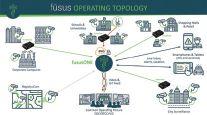
The 2U Blackjack X-Rack server offers a high-end, high-capacity solution for enterprise scale applications. The Blackjack X-Rack comes with DW Spectrum IPVMS server installed for setup and configuration, and is recommended as a complete solution with one or more Blackjack NAS devices for recording and Blackjack Client for monitoring. Blackjack X-Rack servers can manage single- and multi- sensor IP cameras of any resolution, with an equivalent capacity of up to 200 2.1MP cameras at 30fps and a maximum of 1200Mbps throughput. Standard features include an Intel Xeon Processor, Windows Server 2016 OS, 2 x 10Gb NIC cards and removable hot swappable SSD. Blackjack X-Rack servers are designed to connect up to four Blackjack NAS devices, providing up to 560TB for recording and backup.
www.digital-watchdog.com





Intimus
Gladiator Hard Drive Shredders are high torque, low-speed shredders designed specifically for the physical destruction of digital storage media. The shredder is equipped with two separate cutting chambers, each with its own clearly labeled feed chute. This dual chamber design allows the Gladiator to be used for both HDD and SSD media. Large cutters on the HDD side destroy conventional hard drives. Smaller cutters on the SSD side destroy solid state drives, optical media and tape media. www.intimus.com

Aiphone
Aiphone system enhancements enable the addition of a second door station and a new multi app-compatible master station for its JO Series video intercom aimed at homeowners and small businesses. The JOW-2D adaptor enables the connection of a second door station to any existing JO Series system. After answering a call, users can see and speak with visitors then unlock the door with the touchscreen monitor or using a button on the app. The adaptor has inputs for two JO Series video door stations and outputs to control door release for each station. www.aiphone.com
Genetec
Genetec ClearID is a self-service physical identity and access management (PIAM) system that standardizes and enforces security policies. By automating access rights management, ClearID reduces bottlenecks. A self-service physical identity and access management system, ClearID enables employees to login to an online portal and make access requests directly to the supervisor. Employees control their own access requests which ClearID automatically approves, denies, or routes to an operator to review.
STI
www.genetec.com/clearid

EnviroArmour Enclosures are available with internal or external heaters and several ventilation options. The wireless friendly, non-metallic lockable enclosures are durable and reliable, helping to guard sensitive devices against weather, vandalism, tampering and theft. They are suited for devices requiring protection against rain, sleet, snow, splashing water, hose directed water and impact. They are designed for use with control panels, medical equipment, alarm panels, wireless equipment, DVRs and more. www.sti-usa.com
The Flir Brickstream 3D Gen 2 people counting sensor includes an employee filtering feature which uses a combination of Bluetooth Low Energy (BLE) technology and employee-worn tags to automatically identify and remove staff from customer counts. Retail people counting devices are primarily located above store entrances, making the Brickstream 3D Gen 2 suited for environments where staff, such as greeters and security guards, are located near doorways or where they frequently enter and exit. The sensor automatically identifies staff when entering or leaving the store without manual action required. Flir.com/EmployeeFiltering
Centry, Code Blue’s IP video Help Point, has advanced its security capabilities with the addition of peer-to-peer audio communication. Available on all new orders or via an EmerComm firmware upgrade, this new feature is another option for adding Code Blue’s newest SIP-compatible device to virtually any indoor or outdoor location. Centry is Code Blue’s first Help Point to include a camera integrated right into a faceplate, a highly visible embedded Station Beacon Light and its EmerComm device operating system.
www.codeblue.com/centry
Johnson Controls
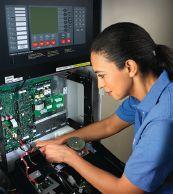
The Simplex ES Net Life Safety Network harnesses IP technology with data rates up to 100MB per second and network connection choices including Ethernet, DSL and fibre. By allowing up to 82,000 feet (25 km) between nodes, ES Net gives users more options. The network’s increased memory capacity and broad bandwidth helps maximize uptime and supports future expansion and enhancements. With the system’s TrueSite Workstation Mobile Client, network monitoring and management can be completed on a mobile device or single console. www.johnsoncontrols.com

Version 5.8 of Ocularis includes an Ocularis Client MSI Installer, which enables customers to push out Ocularis Client updates using the System Center Configuration Manager (SSCM) from Microsoft. Ocularis 5.8 allows customers to create a comprehensive security environment made up of multiple security-relevant systems and applications communicating with each other. Using a flexible, driver-based approach, the new Event Interface (SEI) connects third-party security products to Ocularis. All events from third-party applications such as access control and intruder alarm systems can now be received and visualized within Ocularis.
www.qognify.com
and
The security alarm industry is highly fragmented with several thousand independent dealers operating in Canada. The larger dealer is often motivated to acquire the smaller competitor for the aforementioned reasons.
The purchase price for a portfolio of accounts may vary based on a number of factors, including: 1) Signed monitoring agreements; 2) Term of agreement; 3) Auto renewal of agreement; 4) Pre-authorized payment provision; 5) Credit scores; 6) Accounts receivables aging; and 7) Type of equipment installed (age, ability to service, system functionality).

Many of the smaller companies in the industry are motivated to sell their accounts or companies to not only ease the financial strain they may be under but also, in the case of a share sale, to avail themselves of the favourable enhanced capital gains tax under the capital gains
A share sale would typically result in a lower purchase price because the shares cannot be written off (amortized) against income by the purchaser, as is the case with the sale of accounts. However, the after-tax net purchase price to the seller may be greater. The purchaser may also be reluctant to purchase shares because of the heightened due diligence required to determine the veracity of the company’s assets and liabilities.

When compared to the complications and expense of luring a customer out of an existing monitoring agreement and trust relationship with the installing dealer, dealers opt to solicit the many

The seller of shares, being a “Canadian Controlled Private Corporation,” may be in a position to take advantage of the enhanced capital gain tax rate resulting in only 50% of the gain being taxable and when combined with each owners “lifetime capital gain exemption” of $866,912 may
























































































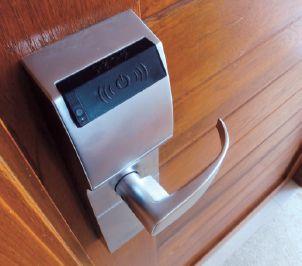







By Neil Sutton
Security veteran Joe Grillo founded ACRE in 2012 as means to consolidate acquisitions in the electronic security industry.
He started with the software and controllers portfolio from Ingersoll Rand, creating Vanderbilt Industries, and more recent acquisitions include Open Options and RS2 Technologies. The company has focused on access control but not exclusively. SP&T News spoke to Grillo at the recent GSX conference in Chicago to learn more about ACRE and Grillo’s take on the market.
SP&T News: What led to the creation of ACRE?
Joe Grillo: We don’t use the full name [for ACRE] anymore — we haven’t in a while — but the concept was “access control and related enterprises.” That was what it originally stood for.
The highly fragmented access control landscape was what got us interested in the beginning to formulate ACRE as an entity. [We felt] like there might be an opportunity to do some consolidation of a lot of relatively small but really good properties in the industry.
In Europe, we acquired the Siemens security products business. That was a very large, restructuring and repair job. I moved there to do that myself. That’s done now and the business is doing quite well. It also has quite a significant intrusion and burglar alarm business as well.
About a year ago, we really started to focus on the U.S. market and did the two acquisitions of Open Options last December and RS2 in May of this year. It made us a much more balanced organization. Roughly half of our revenue comes from North America and the other half coming from Europe and the rest of the world —
Middle East, Asia-Pacific. So that brings us up to the current time and we’re continuing to look at other acquisitions.
But at the same time, we’re now endeavouring to do some integration of the businesses.
SP&T: Is there any overlap between product sets as a result of the acquisitions?
JG: There is some overlap in the products, but that’s OK. Over time, we will take a look at consolidating on the technology side. Having multiple brands that may compete from time to time, we’re quite OK with. There are regional strengths to the companies because of where they originated from. There are vertical market strengths because of the history of where they’ve had success. There are different channel partners who may be loyal to those brands. If sometimes there’s competition, we’re OK with that.
SP&T: How much has the cloud changed your business?
JG: It’s still a fairly small part of our business, but it’s growing. Again, that’s a situation where you have to find the right channel partners. Some of the traditional integrators — where you go in, you sell the system, you install the system, you get a maintenance contract and then you go away — they’re not set up necessarily to think through how to sell a cloud-based system, which is a different type of a sale. But that’s certainly a growing part of our business.
It’s a growing part of the industry, though still, I think, a fairly small part of it. But we view that it will accelerate.
We have sold hundreds of ACT365 cloud-based systems in the U.S., up till now under the Vanderbilt brand and going forward under a couple of our other brands. The system originated in
Europe where we began.
We also have a cloud-based intrusion installer tool in Europe for our intrusion business whereby the installers — and some of them are very large companies like Stanley or Securitas, and some smaller companies — can access their clients’ intrusion alarm systems to do system changes, management changes, without having to go on site. [The cloud-based tool is SPC Connect], which is a growing part of our business.
SP&T: As someone who’s worked in Europe and North America, how do those markets compare?
JG: There’s a lot of similarities in terms of the technology… the same types of channel partners, although the access control market can be very different in a country like Germany, where there’s a lot more direct selling to the end user. And there’s not a very developed wholesale distribution market. Whereas other parts of Europe, like the Nordic region or the U.K., have very well established wholesale distribution channels.
At a higher level, I think the macro economic environment is much tougher in Europe than it is in the U.S. right now, for all the reasons you read about in the press, whether it’s Brexit, slow growth or low growth. We hear that our competitors probably have less robust growth of the business in Europe than in North America at the moment, but I think that’s more of a macro economic influence than anything else.
SP&T: What about mobile access?
JG: We certainly hear a lot about mobile credentials. That being said, the actual demand from end users, at least in most of our verticals that we serve, is still relatively small. We are looking at various partnerships. Different ones on

“The channel, to me, is so important.”
perhaps both sides of the Atlantic because you have some very good companies and technologies that are out there that we’ll maybe try to partner with rather than try to build it ourselves. As long as we have good working relationships with the folks that are offering that technology, we’ll be able to react to our end users’ demands and reseller demands from our partners.
SP&T: What have you learned in the seven years since you founded ACRE?
JG: Some parts of the industry are the same. There’s consolidation, but there’s always new players. The channel, to me, is so important. And channel partners change. While you have the Convergints of the world, who get bigger and bigger, you always have very good, local, small, loyal resellers that you do business with. Certainly there are movements in the technology and in some of the verticals where we’re focusing a lot of our time.
Higher education and K-12 are probably the two biggest verticals where we see a lot of growth. [Also] growth in the medical industry. The impact of wireless locks and the lock companies [are] becoming so much better at the electronic side of the business. Even though they’re still relatively small, biometrics, mobile access and cloud. Those are the things we need to pay attention to. Those are the trends. That being said, this is still a fairly traditional business with a very sticky end-user customer base. People tend to keep with their suppliers and their systems for a long time. That works with you and for you, and it works against you when you’re trying to win new business.
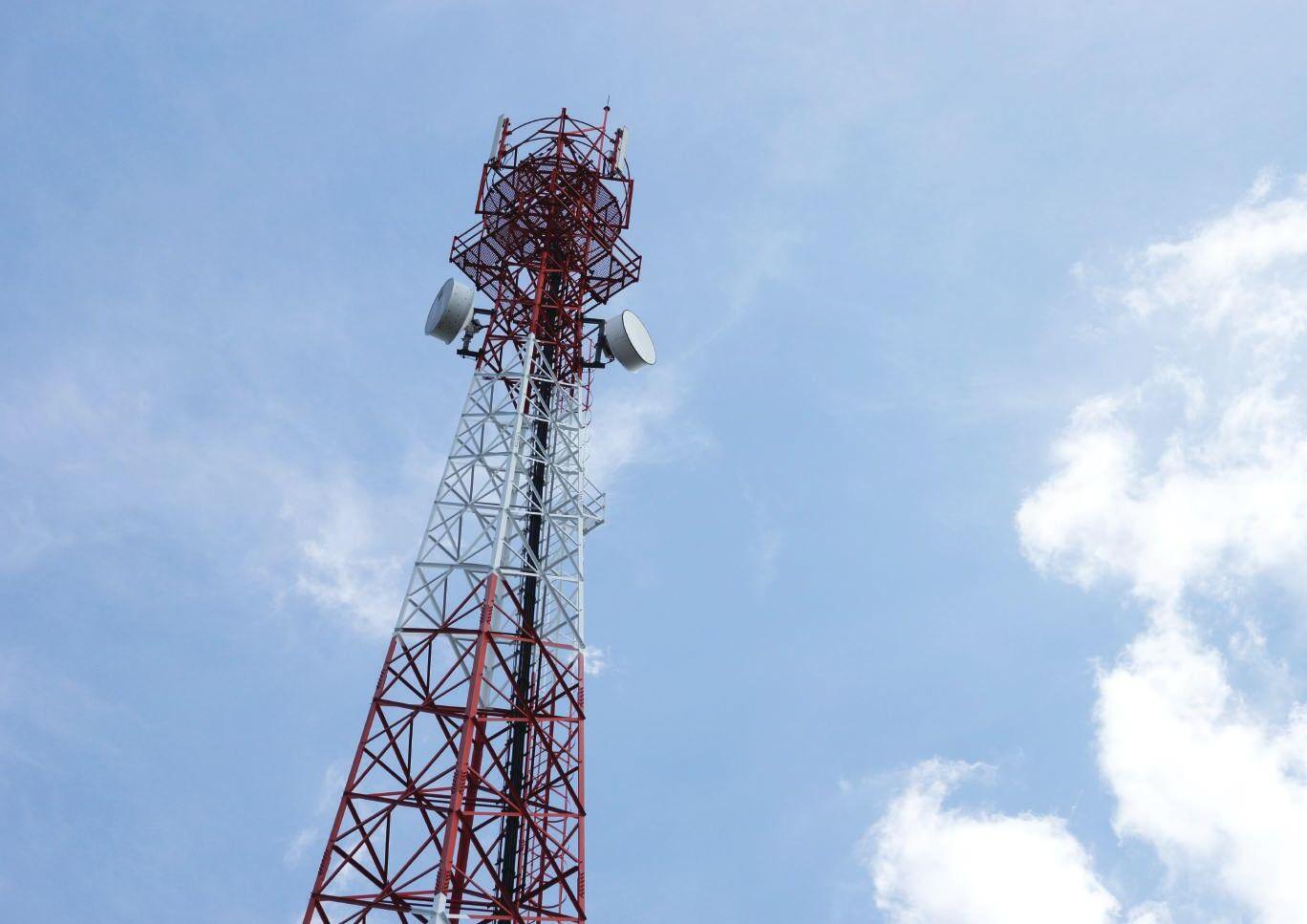




















































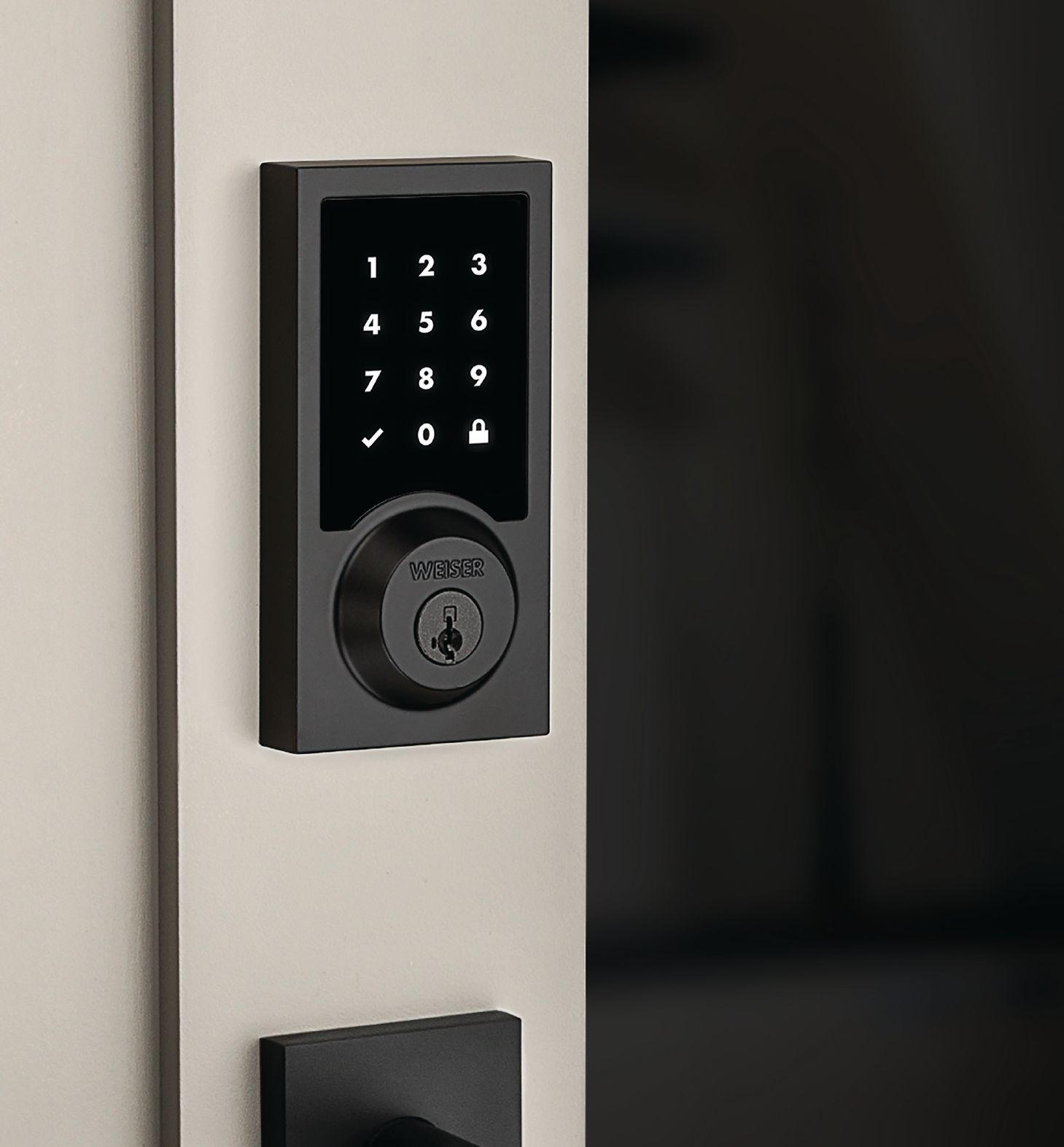
Weiser makes it easy to increase customer loyalty and position yourself as the core provider. If you already install security or home automation systems that are Zigbee or Z-Wave compatible, you’ll appreciate the easy installation and integration of Weiser Home Connect Locks.
Gain momentum in remote access and home automation as homeowners demand more from their primary solution providers.
Grow your business by building upon your existing services with Weiser.