Distributor confirms it is moving ahead as a united division under a single banner p.6
FMC acquires Ontario integrator Bulldog Former Integrator of the Year winner now part of Fire Monitoring of Canada p.6
A preview of the alarm education available at the June 6 Toronto event p. 20
www.sptnews.ca
By Ellen Cools
Home automation, DIY, business building, and attrition are just some of the topics our speakers are preparing for June 6 in Toronto.
Natural disasters aren’t always predictable and are rarely preventable, but investing in appropriate technology can help mitigate their effects
By Bill Maginas
EDITOR’S LETTER
ABy Neil Sutton
Replicating the real
rtificial intelligence (as opposed to the “real” kind) was probably the most dominant theme at ISC West this year, particularly if you scanned the show floor and took note of all the marketing banners and slogans.
Last year, after the 2017 show, I wrote about the potential uses for AI and how security vendors were positioning themselves (and their customers) to take advantage of it. This year, it seems, it’s here.
AI is memorable as a marketing term. It’s simple and it conveys a lot of meaning. It’s replete with science-fiction references — only it’s not so fictional any more.
Sergey Brin, president of Alphabet, Google’s parent company, remarked in an open letter to investors published on the Alphabet website how AI has led to progress at Google and YouTube, including language translation and the ability to “understand images” in Google Photos.
Brin also noted that AI should be treated with respect and caution, raising questions about its impact on crucial human factors like employment. “There is serious thought and research going into all of these issues,” he said.
In the security world, these questions should be posed as well. I bristle slightly when I hear about “guard replacement technology,” although some vendors are taking a different approach, describing new tools as “guard augmentation,” enabling them to do their jobs more efficiently.
At the moment, I tend to think of AI as a convenient catch-all term to describe tasks that relate to automated object or pattern recognition, such as using cameras to count cars or look for individuals wearing baseball caps and carrying duffel bags. The intelligence is in the software, but I don’t believe it’s thinking for itself yet.
Whether the term AI is truly applicable or not, there is serious buzz around the industry. According to the Security Industry Association, traffic on the ISC West show floor increased by six per cent this year over the previous. Judging by the crowds I jostled through, it was at least that much.
I think AI as a marketing message will probably quieten down in a year or two as the security industry gets a better handle on what’s possible and what’s not. There’s sometimes a tendency to over-promise on performance (think back to the initial boom in analytics) followed by a correction over time as the technology catches up to expectations.
At the moment, AI is often conflated with other buzzworthy phrases like Internet of Things, big data and machine learning, it’s real meaning sometimes lost. But what it does represent is a step forward in technical development and a desire to take the industry in new directions.
Whatever the terminology, that’s real.
Your Partner in Securing Canada Security Products & Technology News is published 8 times in 2018 by Annex Business Media. Its primary purpose is to serve as an information resource to installers, resellers and integrators working within the security and/or related industries. Editorial information is reported in a concise, accurate and unbiased manner on security products, systems and services, as well as on product areas related to the security industry.
Group Publisher, Paul Grossinger pgrossinger@annexbusinessmedia.com
Publisher, Peter Young pyoung@annexbusinessmedia.com
Editor, Neil Sutton nsutton@annexbusinessmedia.com
Assistant Editor, Ellen Cools ecools@annexbusinessmedia.com
Art Director, Graham Jeffrey gjeffrey@annexbusinessmedia.com
Account Coordinator, Kim Rossiter krossiter@annexbusinessmedia.com
Colin Doe, Veridin Systems Canada Anna Duplicki, Lanvac
Victor Harding, Harding Security Services
Carl Jorgensen, Titan Products Group Antoinette Modica, Tech Systems of Canada Bob Moore, Axis Communications Roger Miller, Northeastern Protection Service Sam Shalaby, Feenics Inc.
111 Gordon Baker Rd, Suite 400, Toronto, ON M2H 3R1 T: 416-442-5600 F: 416-442-2230
PUBLICATION MAIL AGREEMENT #40065710 Printed in Canada ISSN 1482-3217
CIRCULATION e-mail: asingh@annexbusinessmedia.com Tel: 416-510-5189 • Fax: 416-510-6875 or 416-442-2191 Mail: 111 Gordon Baker Rd, Suite 400, Toronto, ON M2H 3R1
SUBSCRIPTION RATES: Canada: $42.00 + HST/yr, USA: $74.00/yr and International: $84.50/yr Published 8 times a year
Occasionally, SP&T News will mail information on behalf of industry-related groups whose products and services we believe may be of interest to you. If you prefer not to receive this information, please contact our circulation department in any of the four ways listed above.
Annex Publishing & Printing Inc. disclaims any warranty as to the accuracy, completeness or currency of the contents of this publication and disclaims all liability in respect of the results of any action taken or not taken in reliance upon information in this publication.
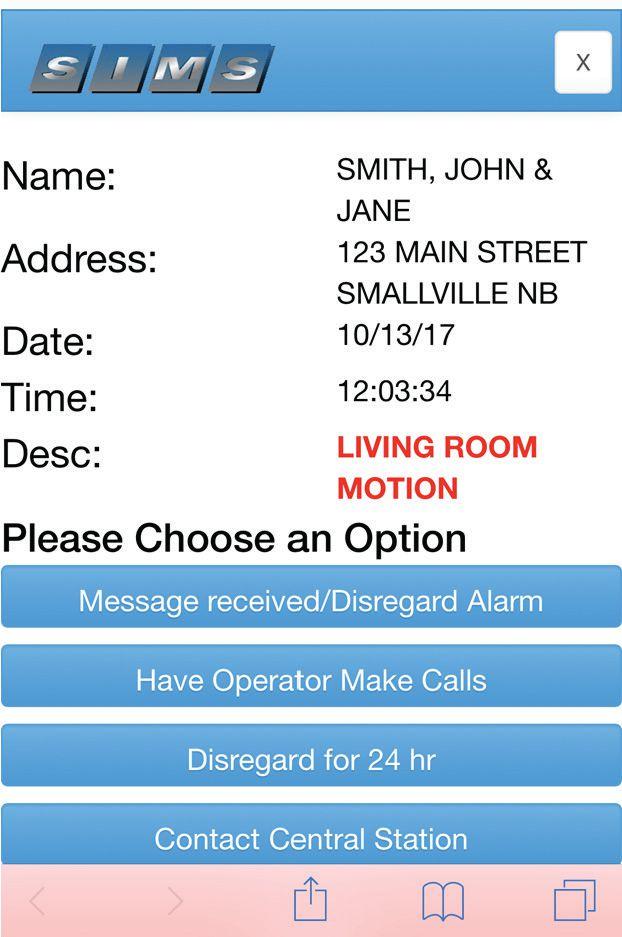
System Text Alarm Notification (STAN)
• No App required.
• Armstrong’s virtual operator (STAN) sends detailed text notification direct to customer.
• Customers can respond to the station immediately with no phone call required.
• Alarm resolution notification to all keyholders simultaneously.
• Convenient, easy to use on a smart phone.
• Fully backed up with central station operator response.
• Customizable by alarm type and/or zone.
LINE CARD
FMC acquires Ontario integrator Bulldog Fire & Security
Fire Monitoring of Canada Inc (FMC)., based in St. Catherines, Ont., recently announced it has acquired systems integrator Bulldog Fire & Security in order to ramp up its existing security business and pursue new opportunities. Financial terms of the deal were not disclosed.
Chad Asselstine, FMC’s vice-president of business development, said that while FMC is primarily a fire mon itoring alarm com pany, it has added more and more security based services over the past 10 years. He estimated that its business was split 60/40 between fire and security prior to
the Bulldog acquisition.
“As our clientele grew and as we grew as a company, we acquired the knowledge base to be able to offer a full solution. We’ve always wanted to expand upon that,” said Asselstine.
Bulldog represented an opportunity to achieve some of that growth.
“As we worked our way through the process (of acquisition) we saw a lot of synergies ... in terms of the work that they do, their business ethics and their values as an organization,” added Kevin Allison, general manager at FMC.
Anixter unifies branding
Anixter recently confirmed that it is retiring the Tri-Ed Distribution and Clark brands and moving forward with Anixter as the leading name.
The news was announced by James Rothstein, senior vice-president, global security solutions, during an ISC West press conference (ISC West was held in Las Vegas, April 11-13). Customers and partners were notified of the change earlier this year.
The transition began in January and is well underway. All Tri-Ed and Clark branches are now on the Anixter platform. Collectively, the company operates approximately 80 branches across the U.S. and Canada.
In a presentation to media, Rothstein described Anixter as a “true global partner with a local touch,” noting that the company has access to 600,000 products.
Anixter acquired Tri-Ed Distribution, then
According to Ron Landry, Bulldog’s chief operations officer, Bulldog had “encountered our ‘ceiling of complexity,’” reaching the limits of its growth under its current structure. By merging with FMC, that growth potential has expanded, he said.
“We’ve grown to a point that we don’t have the expertise to grow it any further. With this merger/acquisition, FMC has the tools in place that allow Bulldog to continue to grow into different fields, different areas,” said Landry.
Bulldog, based in KitchenerWaterloo, Ont., offers a full suite of security services including monitoring via third-party providers. Now part of FMC, Landry said Bulldog’s customers will be able to take advantage of FMC’s ULC-listed monitoring facilities.
an independent company, in 2014, and Clark Security Products in 2010.
Pat Comunale, president, global security solutions, said last year that those acquisitions had opened Anixter up to a more holistic view of the security market — particularly since Anixter traditionally catered to the enterprise market and Tri-Ed to the mid-tier.
Comunale has since retired from that
Bulldog also recently expanded its offerings to include networking services such as structured cabling, fibre and wireless access, which present clear synergies with IP-based security hardware.
FMC offers monitoring coast-to-coast and has offices in Toronto, Napanee, London and other locations across Ontario. Bulldog’s customer base stretches across south-western Ontario. The acquisition will provide a base for further expansion, said Asselstine, who expects to see growth outside the province as well.
Asselstine added that FMC will maintain Bulldog as a division within the company and intends to keep its existing name and branding. Bulldog was recognized as Integrator of the Year by SP&T News in 2009 for a customer project with Sleeman Breweries.
Harding Security Services acted as advisor to the owners of Bulldog on the acquisition deal. Principal Victor Harding is a regular columnist in SP&T News
— Neil Sutton
role, with Rothstein stepping in to lead Anixter’s security division.
Additional changes to senior management include the retirement of CEO Bob Eck in June. Bill Galvin, currently president and chief operating officer, will assume the role of CEO.
In a company statement announcing his retirement, Eck said, “During my 28 years at Anixter the company has gone through an incredible amount of change and I am proud of what our people have accomplished during that time. The company is well positioned for the future...”
Eck will continue to serve on the company’s board of directors after his retirement. Another recent appointment includes Bill Geary, who is now serving in the role of executive vice-president, network and security solutions.
— Neil Sutton
James Rothstein, Anixter Bob Eck, Anixter
Kevin Allison, FMC
Ont. legislation may impact “on-call” security wages
By Ellen Cools
While Bill 148, or the Fair Workplace, Better Jobs Act, has been the centre of attention because of the minimum wage increase that recently took effect, the “Scheduling” provision of the Act, which will take effect Jan. 1, 2019, is also generating some concern.
“Somehow that $100,000 … has to be paid by somebody.”
— Ed Fitchett, Fitch Security Integration
Under the “Scheduling” provision of the Act, employers will be required to pay wages to an employee for three hours of work if:
The employee regularly works more than three hours a day, but arrives for work and works less than three hours or not at all;
The shift is cancelled within 48 hours of his or her scheduled start time;
Or the employee is scheduled to be on-call but, despite being available to work, is either not called in to work or works less than three hours. This will be required for each 24-hour period the employee is called.
In an email to the Ontario Ministry of Labour (MOL), Ed Fitchett, president, Fitch Security Integration, outlined how costly the provision may be for security companies like his that have on-call staff.
Fitch Security Integration has two rotating emergency on-call staff members — who also work full-time — ready to look after client emergencies.
“In your proposed scenario,” he wrote, “we would need to pay 365 days times two staff members, three hours each at $45 per hour (what our staff are paid with benefits), which would cost us just under $100,000.00 per year, and there is zero way for us to recoup this.”
Sophie Dennis, Deputy Minister of Labour, responded that the Act “was amended before receiving Royal Assent to exempt employers from having to provide on-call pay to an employee who was on-call, and not required to work, if the reason for the on-call shift is to ensure the continued delivery of essential public services, such as fire, utility, and snow removal services.”
Dennis did not clarify if security is considered an essential public service.
In an interview with SP&T News, Fitchett elaborated on his concerns.
Fitchett believes the Ontario government’s goal is to help those “at the lowest end of the employment scale, the people that are at minimum wage…that are probably kept sitting at home waiting to know if they have a shift to work.”
“I do get that part of it because if you’re going to hold somebody at home waiting to be called…they should absolutely be paid,” he says.
However, in the security industry, most on-call staff are paid over the minimum wage and work full-time, he explains.
If this Act comes into effect as it is now, Fitchett says companies will have to offset the cost by raising their rates.
“Somehow that $100,000, at least in our case, or $130 or $140,000 when we add all the benefits in, it has to be paid by somebody,” he elaborates. “And it’s going to be the consumer … that pays for it.”
Beyond security
But Fitchett’s concern extends beyond the security industry to other trades, who he says will be impacted because they are required to have on-call staff.
“The way that [the provision] is written is so wide in scope that it captures everyone who has somebody waiting on call, whether it’s an electrician, a plumber, a heating/air conditioner [professional], IT guy, a roofer, a security guy, a security guard,” he explains.
An electrical guild, for example, probably has 30 employees on-call, he says, while a small electrical contractor probably has one or two.
Stephen Sell, president of the Ontario Electrical League, says that since the bill has already passed, the association is focused on educating its members about its nuances.
Despite this, electrical contractors are also concerned about the bill’s impact.
In a letter to the editor published in Electrical Business magazine (which, like SP&T News, is an Annex Business Media publication), Jon R., a licensed electrical contractor, wrote, “One big concern is the change in the requirement for 3-hours of pay for being-on call. Any contracting company offering 24/7 emergency trade services (electrical, fire, sprinkler, HVAC, locks, security, plumbing, etc.) will face massive costs for having technicians on-call to handle emergency service.”
“Bill 148’s changes provide for the same 3-hour payment to be made to an on-call
Ed Fitchett, Fitch Security Integration
employee who was not sent out as the employee who was called out and actually completed work,” he continued. “Why would any employee do any after-hour work when they are being paid the same for having done no work?”
Like Fitchett, he believes rates will have to increase to offset the cost. “The implications of this specific item are scary for contracting company owners,” he concluded.
MOL response
When asked for a response regarding the potential increased costs, a spokesperson for MOL said in an email, “Any increases in the costs associated with doing business do not fall under the purview of the MOL or the legislation administered by the ministry.
“The ministry is currently working on updating program procedures and our policy and interpretation materials, including the development of definitions for terms, such as ‘essential services,’ as they relate to the enforcement of these new rules,” the spokesperson added.
Fitchett has not received any further response from the MOL and has shared his concerns through the Canadian Security Association (CANASA).
Patrick Straw, executive director of CANASA, says that although some members are worried about the cost, he has not had much correspondence about the issue. “We were expecting to get a lot more blowback,” he says, adding he is unsure why members have not brought up the issue with more fervour.
“It sort of surprised me because it seemed to me something that could be costly to certain sized businesses.”
— With files from Anthony Capkun, editor, Electrical Business Magazine.
LINE CARD
Applications
Columbus airport installs wireless platform
John Glenn Columbus International Airport in Columbus, Ohio, is using mmWave radios from Siklu for wireless connectivity.
The airport, which offers 150 flights daily, required wireless for a detached facility — a shipping and receiving building almost 1km away. The network had to be able to cope with interference due to weather conditions and aircraft, as well as airport vehicles, travelling across the runway.
Convergint Technologies, the systems integrator on the project, proposed Siklu equipment and installed two point to point EH-1200FX 70/80GHz Gigabit radios. According to Siklu, the radios provide interferencefree connectivity with 99.999% availability. They leverage narrow beams which are immune to heavy Wi-Fi signals within the airport.
Appointments
• Milestone Systems has announced its new vicepresident for EMEA, Malou Mousten Dyhr Toft. She will be responsible for the whole EMEA region, including sales operation, custom development and support.
• IC Realtime has appointed Jorge Perez as president of global business development for
Soccer stadiums ID hooligans
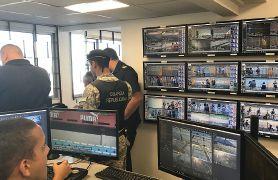
Three football stadiums in Montevideo, Uruguay, are using Wavestore technology to help detect the presence of hooliganism.
The three facilities, Centenario, Penarol and Nacional, have installed Wavestore’s video management solutions in their control rooms — the technology is also being used by mobile police units.
The project was won following an evaluation process involving Wavestore and technology partner Herta, a provider of facial recognition software. The testing required the companies to identify 40 people entered into a database amongst a crowd of an estimated 50,000 football fans. According to the companies, the solution correctly identified 39 out of 40 (the undetected person had completely covered their face).
The solution was installed by systems integrator DDBA.
its lla Intelligent Video Search business unit.
• Joe Holland, former vicepresident of engineering for LifeSafety Power, has taken a position on the company’s board of directors.
• Nobuaki Kurumatani took office as the first Chairman and CEO of Toshiba Corp. to be appointed from outside the
Sea-ready cameras in Turkey
City Lines ferry transportation service, which offers sea-faring transit to tourists and residents in Istanbul, has added video surveillance cameras from Hanwha Techwin.
The cameras were required to be able to cope with sea conditions as well as record high-resolution video day and night. Istanbul-based security systems integrator InfoMET Technologies deployed Hanwha Techwin’s Wisenet cameras.
“We were confident they would be able to provide cameras that would be able to withstand demanding conditions such as salt water and high levels of vibration,” said Oguzhan Kahraman, Project Engineer, InfoMET.
Of the 250 cameras installed, the majority are Wisenet QNO-7080Rs, part of the Wisenet Q series.
“They do not have any problems in the environments we operate,” said Cuneyt Danaci, IT Specialist for City Lines.
company in over 50 years.
• Lucas Boselli succeeded Thanasis Molokotos as president of the Americas division and executive vicepresident, head of Americas, for ASSA ABLOY.
• Allegion has appointed Charles L. Szews, former CEO of Oshkosh Corp., to the company’s board of directors.
May 30, 2018
Security Canada Alberta Edmonton, Alta. www.securitycanadaexpo.com
May 31, 2018
Southern & Northern Alberta Regional Golf Tournament Red Deer, Alta. www.canasa.org
Security Canada Central Toronto, Ont. www.securitycanadaexpo.com
December 4, 2018 Focus On Health Care Security Mississauga, Ont. www.focusonseries.ca
Malou Mousten Dyhr Toft
Joe Holland Nobuaki Kurumatani Jorge Perez
Charles L. Szews Lucas Boselli
LINE CARD
market watch New tech for schools
According to a recent report authored by IHS Markit analyst Jim Dearing, the U.S. education sector’s spend on security equipment and services was US$2.7 billion (in revenue).
Due to the fact that most schools have already adopted surveillance and access control technology, the market is projected to grow at just one per cent annually to $2.8 billion by 2021. Despite limited growth projections, security vendors are looking to newer technologies to improve adoption rates.
Facial recognition technology: adoption of this would allow for more proactive use of surveillance technology, particularly to recognize unfamiliar individuals in the building. The downside is affordable facial recognition systems may be unable to cope with the number
of faces in any given school. Logical/physical security integration: integrating access control with, for example, the student directory would make it easier to remove access rights for former staff and students (left or graduated). Access to sensitive data may make this type of integration difficult.
High security classroom doors: Better doors would create a more effective barrier between students and potential attackers. Costs may be prohibitive, however, and fire regulations may dictate that some entrances and exits remain accessible in the event of an emergency.
Metal detectors or x-ray machines: Weapons detection would be greatly improved, but managing such machines (and staffing them) would be difficult given the number of typical entrances in schools.
2018 SIA NEW PRODUCT SHOWCASE WINNERS
IPConfigure, Orchid Core VMS
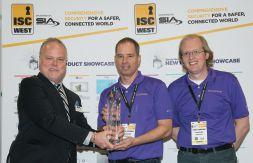
IPConfigure’s Orchid Core VMS for AXIS
Camera Application Platform (ACAP) “provides local and remote access to live and recorded video through an intuitive web browser interface, with the same user experience on both workstations and mobile devices. In addition, each Axis Communications network camera and video encoder equipped with an ARTPEC-6 processor can now host Orchid Core VMS’ recording engine, database, video storage and an encrypted web browser interface for live viewing, search and video playback functions.”
u Judges’ Choice Award
Allegion, Von Duprin Remote Undogging and Monitoring Kit
u Access Control Devices & Peripherals
RBH Access Technologies, Blueline
HonourableMention:
FEIG Electronics, Weigand Switch
u Access Control Devices & Peripherals
Wireless
ASSA ABLOY
Yale nexTouch Sectional Mortise Lock
u Access Control Software & Controllers
Brivo, Brivo ACS300 Wireless Access Controller
u Cloud Solutions
Honeywell, MAXPRO Cloud
u Commercial Monitoring Solutions
NETGEAR, FlexPower Camera & FlexPower Base Station
HonourableMention: Louroe Electronics, Digifact A
u Convergence and Integrated Software and Solutions
ASSA ABLOY, ASSA ABLOY Openings Studio Electrical Elevations
u Cybersecurity Razberi Technologies, Razberi CameraDefense
u Drones/Robotics
Cobalt Robotics, Cobalt
u Emergency Communication/Mass Notification Systems
HonourableMention: Gallagher, Gallagher Class 5 Intruder Alarm System
u Intrusion Detection & Prevention Solutions Wireless Johnson Controls, iotega
u Law Enforcement/Guarding Systems Robotic Assistance Devices, Security Control Observation Tower (SCOT)
u Lock Systems and Secure Storage Containers
BQT Solutions, Electronic Roller Door Lock
u Loss Prevention and Article Surveillance Solutions
Dri Mark Products Inc. , FlashTest Counterfeit Detector
u Mobile Apps
Iris ID Systems Inc. , iCAM M4300 Biometric Multimode Android Phone
u Network Support Solutions Microsemi, SyncServer S80
u Outdoor Perimeter Protection NETGEAR, Arlo Security Light
u Personal Protective Equipment Ontech Security S.L., Wardiam Safety
u Residential and Monitoring Solutions Reliance Worldwide Corporation Streamlabs Smart Home Water Monitor
u Tools and Hardware Axis Communications, AXIS Device Manager
u User Authentication, Identification, Credentialing & Management IDEMIA, MorphoWave Compact by IDEMIA
u Video Analytics IC Realtime, Ella
HonourableMention: Verint, Verint FaceDetect
u Video Surveillance Advanced Imaging Technologies Vumii Imaging Inc., Sii FG
HonourableMention:
Axis Communications AXIS P1280-E Thermal Network Camera
u Video Surviellance Cameras HD Hanwha Techwin, XNV-6085
u Video Surveillance Cameras IP MOBOTIX AG, M16 Thermal
u Video Surveillance Data Storage Micron Technology Inc., Micron Industrial microSD Card
u Video Surveillance Hardware and Accessories
Paige Datacom Solutions, GameChanger Cable
u Video Surveillance Management Systems March Networks, March Networks 8724 V Tribrid NVR
Rand Price, Chief Operating Officer, Security Industry Association, congratulates Chris Uiterwyk, CEO, and Cort Tompkins, VP of Engineering, IPConfigure.
CANASA UPDATE
By Patrick Straw
Association partnerships building
Ijust returned from ISC West, held in Las Vegas, where Canada was well represented.
The CANASA national president Ellery Demedash and I met with the educational team from the Security Industry Association (SIA) to explore the opportunity to offer their highly respected Project Management Course to CANASA members.
Ellery and I also met with the BICSI team and will be looking at ways that we can provide access to our members via their CANASA membership. I’ll be reporting on this as we progress.
the opportunity to post Stephen’s work on our website, www.canasa.org, on a regular basis.
Patrick Straw
On April 18, our Atlantic Regional council held a members’ meeting with one of the best turnouts in years. The guest speaker was Stephen Sayle from Sayle Group of Halifax, who is a nationally recognized expert on cannabis in the work place. Feedback from this event was very positive and we are looking to engage Stephen’s expertise in other regions. In addition, we are developing
Security Canada shows are quickly taking shape with registration and vendor support experiencing strong interest. CANASA encourages everyone to check out our website www.securitycanada.com for detailed information. We encourage you to make every effort to visit the show that is in your area. Here is the lineup for 2018: Our first Security Canada event was in Laval on April 25. May shows include Ottawa on May 9 and Edmonton on May 30. Security Canada West is on June 13 in Richmond, B.C. The fall events are happening September 12 in Moncton and we close the year with the largest security show in the country: Security Canada Central, held Oct. 24 and 25 in Toronto.
Our relationship with ASIS is continuing to provide us with some excellent opportunities to work together on networking and events. In June, ASIS and CANASA will jointly host a golf tour-
nament immediately after the Security Canada West show in B.C. Based on early registration, this will be an outstanding event with a few openings available. It’s selling out fast so visit www.canasa.org to register. Congratulations to our B.C. Regional Council and our ASIS partners for the outstanding work they have put in on this project.
At the CANASA offices in Markham, Ont., we welcome our new Member Services Specialist, Erich Repper, who has very quickly embraced his new role and is doing a terrific job serving our members. As CANASA continues to grow, we are working on many new upgrades to our systems and processes.
CANASA continues to work closely with the AHJ community, Police, Fire, Ambulance and Governments, to ensure that we are truly representing all of the security industry in Canada.
2018 is shaping up to be another strong year for CANASA and I want to personally thank my senior managers Steve Basnett, Danielle Paquette and the rest of the CANASA team for their efforts.
CAMERA CORNER
By Colin Bodbyl
DDown but not out
Why unmanned ground vehicles might take off faster than aerial drones
rones or unmanned aerial vehicles (UAVs) have become an icon of the future. The possibilities of what drones could do are endless.
Entire industries could be turned on their heads by UAVs that are capable of completing tasks cheaper and better than humans. Technology fans the world over are praising drones and working tirelessly for the opportunity to incorporate them into their businesses. Yet while drones receive nothing but positive attention from the technology and security industry alike, unmanned ground vehicles (UGVs) are receiving the opposite reviews.
UGVs have one distinct benefit over their flying cousins: they have little or no legal regulations, particularly on private property.
UGVs are only different from drones in that they drive on the ground rather than fly through the air. Both products use similar technology to automatically detect obstacles and navigate complex scenarios. Both operate on batteries, are relatively quiet, and require frequent charging. Technically, they are not that different, but for some reason UGVs have been shunned by the drone community. In reality those who are too quick to judge these devices could be missing out on opportunity only because they have misjudged the technology.
UGVs have one distinct benefit over their flying cousins: they have little or no legal regulations, particularly on private property. Aerial drones on the other hand are severely restricted by legal regulation. Licensing, line of sight requirements, restricted air spaces, etc. all create barriers to adoption that could delay the widespread commercial deployment of drones for years to come. UGVs, on the other hand, can operate autonomously on private properties without any special licensing requirements.
UGVs have an unfair advantage in the autonomous vehicle race, so why are we not seeing more of them? One reason is because some manufacturers have not managed expectations well. Rather than focusing on simple tasks such as delivering packages, robot manufacturers
are attempting to entirely replace humans with their first prototypes. These lofty goals have set expectations so high that they will be nearly impossible to achieve.
The traditional mall security guard has a complex job, navigating pedestrians, recognizing suspicious behaviour, and chasing off would-be criminals. Yet this is the first job some robot manufacturers believe their robots can complete. Unfortunately, time has proven this is difficult to achieve. Would-be thieves do not run away from slow moving robots. Robots are not intimidating and don’t offer the sense of security that a human guard does.
Since the value of a guard replacement robot is not obvious, it becomes difficult to generate positive media around the success of such devices. Instead, the press focus on the odd failures of them crashing or running into pedestrians because those are the only noteworthy events occurring around the product.
While the sentiment about UGVs may be negative, the reality is that they have a bright future that will prove many wrong. Those who have deployed UGVs correctly have experienced incredible success. Amazon warehouses use UGVs to move millions of pieces of inven-
tory. UGVs are being used in the safety and security space to tour parking lots, looking for flagged licence plates through the use of licence plate recognition. In other cases, UGVs tour dangerous areas where a lone security guard could be at risk. These are all valid applications of UGVs and while they might not garner the same attention as a robot roaming the mall, at least they succeed at achieving their objectives.
UGVs have the benefit of being first to market and could take advantage of the opportunity to get a head start on UAVs. To be successful, though, they must focus on achieving realistic goals. For those adopting the technology, it will become increasingly important to be open-minded to the possibilities of success rather than focusing on the less common failures.
The security industry will undoubtedly be changed by both UGVs and UAVs; those who recognize the early benefits of UGV products will ultimately win in the end.
[Editor’s Note: For more on UGVs and their applications in the security industry, see SP&T News’ March 2018 cover story.]
Colin Bodbyl is the chief technology officer for UCIT Online (www.ucitonline.com).
LESSONS LEARNED
TBy Victor Harding
What about the balance sheet?
Despite what an owner might think, the balance sheet does not always hold additional value
he most common method of valuing small businesses is to use a multiple of earnings or EBITDA.
In short, it is the income statement showing earnings that is key to arriving at such a valuation. Naturally owners then look at their balance sheet and ask what about the value contained there? While it is true that the balance sheet does sometimes hold extra value, the point of this article is to illustrate that there is not as much extra value as some owners think.
Many owners don’t realize that buyers expect there to be a “normal” amount of working capital in the business when they buy it.
The truth is in most cases and with most buyers, the balance sheet will not hold as much extra value as the owner might initially think. Let’s break the balance sheet down and look at each section — short and long term assets and liabilities — to see why.
Many owners don’t realize that buyers expect there to be a “normal” amount of working capital in the business when they buy it. Working capital deals with current assets and liabilities and is generally defined as cash + accounts receivable + inventory - accounts payable and accrued liabilities. In most successful businesses, this is very much a positive number. At the very least the ratio of current assets to current liabilities should be 2 to 1. Anybody who has tried to run a business with lower or negative working capital knows how important this item is. Having adequate working capital in the business at the time of sale is particularly true of “share” deals where the buyer is usually buying everything on the balance sheet. The last thing a buyer wants to have to do is pay for a business and then, on the first day he owns it, inject another sum of money into the business for working capital to keep it afloat. If there is inadequate working capital in the business at the time of sale, the purchase price will often be reduced.
If a buyer is doing an asset deal, the buyer can, to some degree, pick and chose what assets and liabilities they want to buy. Generally in deals for alarm companies the buyer will buy the alarm accounts, the good will attached to the business (including the telephone number and company name) and maybe the inventory and a couple of vans. So here, working capital does not come into play so much. But in an asset deal where the buyer is keeping the target business in place and operating it as a separate business, they will want working capital in the business when they buy. It is wrong to think that requiring working capital only goes with share deals.
“Normal” working capital required to run a business can vary enormously. Alarm companies that don’t get involved in big installation jobs and don’t need to carry large inventories usually require small amounts of working capital. However, for integration companies that install large jobs and therefore carry a lot of work in process inventory and also have receivables that can easily stretch into 60 days or more, the working capital requirements are a lot more. With one integration company I sold, the buyer reasoned that they needed $1.5 million of working capital and it was hard to argue with them.
So the moral here is, don’t go into the sale of your business thinking that your working capital is going to land you a huge extra bonus of
purchase price. It is true that some companies do have “excess” working capital (more than “normal”) at the time of sale which should be fed back to the seller. Books have been written on what a “normal” amount of working capital should be.
Let’s move to the longer term or fixed assets and liabilities on your balance sheet. Most deal practitioners assume that when you value a business using a multiple of earnings, the fixed assets used to produce those earnings are included in the purchase price they offer. This seems inherently sensible to me. So the bottom line here for security dealers whose major fixed asset other than buildings are vans, you are not likely to get extra money for your vans when you sell.
Regarding longer term debt — debt below the current liabilities section on your balance sheet — generally any balance here is required to be paid off by the seller at time of sale or reduces the purchase price.
What I have laid out here are general guidelines as to what to expect in terms of value from your balance sheet at the time of sale. There are exceptions to these guidelines, but generally, if you are dealing with an informed buyer, there will be less extra value on your balance sheet than you first might think.
Victor Harding is the principal of Harding Security Services (victor@hardingsecurity.ca).
Presented by
Jeffrey Zwirn, President, IDS Research and Development
Jeffrey D. Zwirn is a nationally recognized alarm and security expert who specializes in the forensic study of alarm systems. He has forensically investigated thousands of cases and claims for Plaintiffs and Defendants, both nationally and internationally. With over 40 years of specialized education and experience Jeff has been involved in sales, design, installation, programming, inspection, testing, maintenance and central station monitoring of more than 3,000 security and life safety systems.
John M. Brady, President, TRG Associates
Since its inception, TRG has assisted a wide range of companies, entrepreneurs, lenders, and investors in evaluating and assimilating acquisitions, assisting with the placement of debt and equity, providing expert witness in court and arbitration hearings. John also has extensive experience with some of the larger PERS providers in the US serving in management and advisory roles.
Mike Jagger, Founder and President, Provident Security Corp.
Mike Jagger started his company in 1996 with a $500 limit Mastercard. Now, with offices in Vancouver and Whistler, B.C., Provident has since grown to more than 200 employees and provides installation, service, monitoring and guaranteed five-minute response to clients’ alarm systems.
Saliq Khan, Vice President, Imperial Capital, LLC
Saliq’s role goes beyond the typical investment and financial valuation and reporting. He regularly visits the management teams of privately held and publicly traded companies and speaks with them about how they are improving their operations, their growth profile, and creating a competitive and strategic moat around themselves. He actively seeks out new investment ideas and industry trends at CES, RSA, IoT World, ISC West, CEDIA, among other well-known technology and security trade shows. Prior to Imperial Capital, Saliq held various roles at Morgan Stanley Capital, Merrill Lynch and Citigroup.
MILLENNIALS MARKETING TO
Monitored systems and DIY are starting to merge as providers look to cater to a generation investing in home security
By Ellen Cools
For years, residential penetration rates for home security have been stuck around 20-25 per cent.
But this is potentially changing as more millennials are looking for home security — not necessarily through professionally installed systems, but through do it yourself (DIY) and monitor it yourself (MIY). And some key players in the industry have started to notice this trend.
In February, reports surfaced that Amazon had acquired smart door-
bell company Ring for just over US$1 billion. Google also announced that it was rolling Nest into its hardware team.
More recently, Leviton announced a partnership with the Works with Nest program, and MONI Smart Security — now rebranded as Brink’s Home Security — announced it is providing professional monitoring services for Nest Secure.
Evidently, the connected home market is taking off, and millennials are a factor in this tranformation.
According to Dina Abdelrazik, a research analyst at Parks Associates, 34 per cent of millennials (defined as those born between 1982 and 1998) have a security system.
Fourteen per cent have a self-installed security system, and three per cent have a self-monitored system. In comparison, only six per cent of all U.S. broadband households have a DIY system and two per cent have a MIY system.
“Security adoption is highest among young, affluent and educated consumers with children at home,” she adds. “Security providers looking to penetrate this key demographic may turn to DIY solutions as a method of expanding their customer pool.”
The challenge, then, is how to market to millennials and other population segments that have never had a home security system before, while also capitalizing on the push for DIY and MIY.
Comfort and control
The first step to successfully doing that is to understand why millennials are proponents of DIY and connected home security.
“The millennials of today approach things very differently,” says Ivan Spector, president of The Monitoring Association. “In many cases, they have nice things that others want that need protection. Obviously, they are app adopters, and want technology to make life work.”
“They’re not just following suit and saying, ‘Well, my parents had a traditional security system; it protected us while I was growing up and it worked great for me,’” adds Greg Rhoades, director of marketing for Leviton’s Energy Management Controls & Automation (EMC&A) division. “They’re taking a look and saying…‘If my house is all lit up at night, if my doors are all locked, if my garage door shuts behind me, that’s a pretty secure property right there.’”
Generally, millennials want comfort and control over their safety and security, adds Rhoades, and they have several avenues through which they can feel safe and comfortable, whether via a hub solution or connected smart devices.
With connected home security systems, “the homeowner is gaining control over it,” he adds, which he believes is a priority for millennials.
“[Millennials are] certainly very security conscious and they want to make sure that what they’ve secured for themselves and what they continue to grow stays theirs and stays protected,” he concludes.
A definite disruption
With the influx of DIY and MIY products in the market, and the increasing demand for these solutions, “there’s a definite disruption right now,” says Tom Leonard, vice-president of marketing and product management for Leviton’s EMC&A division.
Leonard believes that new security customers, such as millennials, are redefining what security means to them.
“Folks in the millennial demographic are far more apt to take a stab at [installation] themselves, or to take action due to their higher technical
“Folks in the millennial demographic are far more apt to take a stab at [installation] themselves.”
— Tom Leonard, Leviton
propensity than many other generations,” Leonard adds.
Consequently, Leviton’s smart Wi-Fi products “have really seemed to resonate well with millennials because now [they have] the ability to use their smart device at that point to turn on the various lights in their home and interact with their home remotely.”
This has been “an entry point” to pursue a deeper understanding of what automation in safety and security means to them, he adds.
As such, Leviton highlights the customers’ needs: their desire for comfort and control over the traditional understanding of security.
The company anticipates DIY will be “a point of market growth because it’s going to open up monitored systems and expand the reach of what was traditionally available, and ultimately build a larger base of customers,” he explains.
Google and Amazon’s entry into the space suggests their prediction is correct.
Spector believes this “is a barometer of technology adoption and the new economy. They will disrupt the sales chain that many have grown comfortable with and used to. But they are not looking at the ‘traditional’ market…They are looking long and hard at the 75 per cent that have remained very infertile to security systems.
“Companies that offer low or no cost systems with a monitoring component had better sit up and notice,” he adds.
Their entry also presents an opportunity, says Leonard.
“Our belief is that it’s an overall benefit to have Google and Amazon joining the security realm because it brings a heightened awareness and brings attention to the whole spectrum of products,” he explains.
Jeff Gardner, CEO of MONI Security Systems, agrees, noting that Google’s Nest product has “really taken DIY to the next level,” because it is easy to install, easy to use, and Google already has 2.5 million embedded customers who are using their products, he says.
“It’s not just about security, it’s about really engaging the customer in a way that makes their life easier; it still affords them the protection for their family and the property they’re looking for, but there’s so much more,” he elaborates. “And I think Google really brought it into play.”
Moreover, Amazon has brought an additional opportunity with voice command.
“I think voice is going to really play a big role in the future in terms of simplifying the user interface,” says Gardner. “A lot of customers are still perplexed by the complexity of the Internet of Things, and the more you can use voice technology to simplify that, I think the better off we’re going to be.”
Rhoades believes the industry is beginning to capitalize on this trend. ADT, for example, recently began leveraging some of the partners of Samsung SmartThings, “to make their system more approachable, more affordable and more in line with what consumers are really looking for these days, and that’s ultimate connectivity, not just security and safety,” he says.
Connecting the dots
However, Gardner argues not everyone is reacting fast enough to these changes.
“I’d like to think that we’re being a lot more open minded at MONI. We want to be a part of the disruption than be the disrupted,” he says. “That’s why we’ve been involved in DIY for a couple of years, but there are many traditional players in our space that don’t do either [DIY or MIY].”
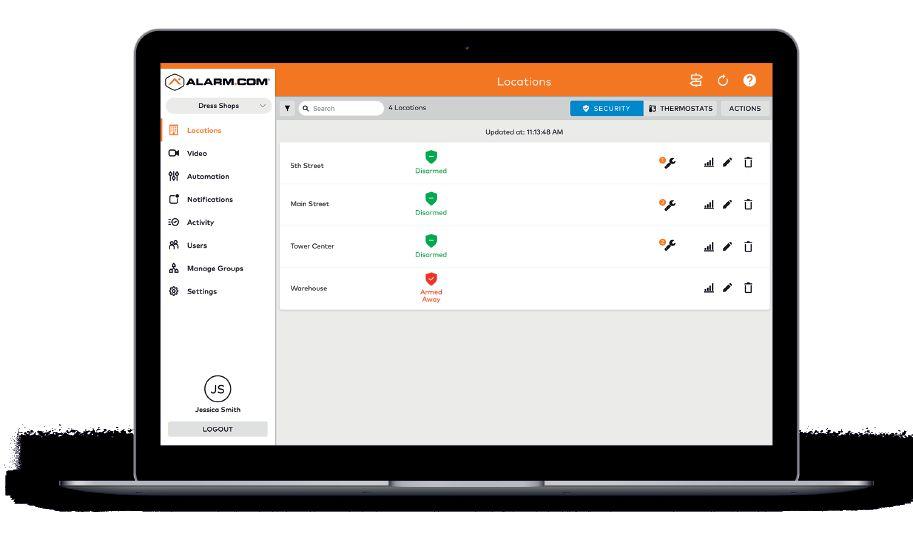
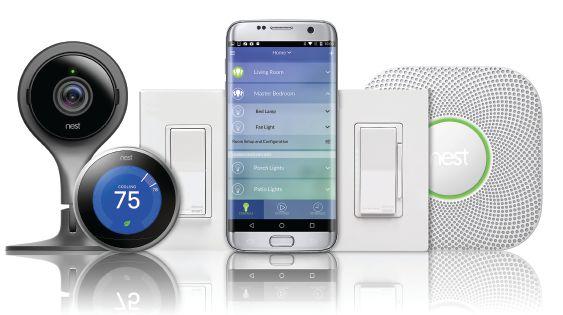
Leviton offers integration with Nest’s product line-up as part of its home automation suite.
So what have MONI and Leviton done to adjust their marketing strategy?
Both companies recently partnered with Nest, and say this is a move to attract millennials and other groups that have never had a home security system before.
Gardner says the company has built an interface with Nest “so customers that are buying the Nest product at Best Buy or Home Depot or Lowes can really activate professional monitoring and install their system without any human intervention.”
While Nest products can be MIY, MONI believes there are shortcomings since the system is not connected to a monitoring station that can alert first responders.
“We’ve been really trying to work with Nest to make that more apparent in a different way, not just in digital marketing or television advertising, but at the point of sell in Best Buy,” he explains.
The product itself describes the benefits of professional monitoring, which Gardner says benefits both MONI and Nest.
Meanwhile, Leviton’s partnership with Nest highlights the ease of connectivity.
A homeowner can install Nest devices via the Nest app and install Leviton devices via their app, Rhoades explains. Then within the Leviton app, they can “connect the dots,” integrating Leviton devices with motion detectors,
cameras, etc.
“It’s a mechanism to go after the safety and security concerns that we all [have], and to connect these pieces and parts and ultimately make it more seamless for the end user,” he says.
Strategic marketing
Additionally, MONI recently rebranded to Brink’s Home Security, principally to improve their marketing efficiency and brand awareness.
“I think the Brink’s brand is going to allow us to be a more credible alternative, especially if we can modernize [it] by offering DIY with that,” Gardner explains.
The company has also adopted a marketing strategy specific to millennials, focusing on simplifying their offering on the DIY side, particularly with digital and mobile ecommerce.
According to Gardner, millennials prefer to shop online with little human interaction. Consequently, mobile ecommerce presents a largely untapped opportunity for MONI, as 60-70 per cent of people prefer to do business on their phone, says Gardner.
In contrast, Leviton’s marketing strategy toward millennials has focused more on raising awareness through education.
Leviton has taken a dedicated approach to understanding how the DIY and MIY customers’ needs differ from the professional customers’, explains Leonard.
“The future is now, and if the traditional companies do not step up they will be left far behind.”
— Ivan Spector,TMA
“If we see a knowledge gap appearing in comments, reviews, in our interactions, we daily assess it and determine how we can best meet them,” he says.
For example, the company provides direct one-to-one outreach to customers who have questions, updates product pages with more detail and delivers instructional video content on their YouTube page when they see demand from customers.
An insatiable appetite
The rise of DIY solutions in the past year, as evidenced by MONI and Leviton’s partnerships with Nest, signifies the push towards this mar ket and end users’ desire for this “seamless” ex perience.
In fact, says Spector, “there is an insatiable appetite for lifestyle enhancing systems.”
“If I would have said 10 years ago that we would be the gateway into homes for wireless locks, audio/video doorbells, controllable ther mostats … that you have all of these technolog ical marvels — not only at the tip of your smart phone but voice controlled — you would have thought I had watched one too many episodes of the Jetsons,” he adds.
“But the future is now, and if the traditional companies do not step up they will be left far behind.”
Consequently, “your supplier relationships are important, your alarm association is import ant, and the information bearers can keep you in the game,” he says.
Additionally, Gardner and Rhoads believe it is key that the industry continues to evolve its thinking about the customer and assist the end user, whether by simplifying product offerings or education.
“The biggest opportunity is to open up our thinking about the broader opportunity of safe ty and security,” adds Leonard.
The needs and definitions of these custom ers are a little different, [but] their ability to in corporate the value of safety and security is still there, and likely going to increase the opportu nity for our products and services,” he says. “It’s a very exciting time.”
Intelligent Solutions for: Education
Providing a secure educational environment for students now, more than ever, requires fully integrated, widely positioned, security solutions that equip staff and authorities with real-time monitoring information.
#IntelligentSolutionsForYou
Meet the speakers
A preview of the personalities and insights coming to
Security Summit Canada
SP&T News recently spoke with the four session leaders who will present at Security Summit Canada and asked them to share some insights. If there’s a common denominator here, it’s understanding your business. Rigorous knowledge of business practices and industry forces will only help to serve the customer better, which is ultimately the winning formula for success and longevity. Read more below — and for the full story, attend Security Summit Canada on June 6 in Toronto. For registration details, visit www.securitysummitcanada.com.
Jeffrey Zwirn, President, IDS Research and Development, Inc.
Jeffrey Zwirn scientifically, technically and forensically examines every facet of what works, what does not work, and what, if anything, alarm contractors, system integrators, equipment manufacturers, central stations and other entities need to do to proactively provide the most advanced and effective security systems to their subscribers, and help minimize their liability as well.
To the extent that there is a loss, Zwirn is called in to either represent the Plaintiff or the Defendant, and then ultimately testify and teach the jury what he found in his forensic investigation: why the alarm system worked, did not work, and/or identify indicators of fraudulent activity and conduct.
Zwirn, who has taught in the industry since 1980, is the brains and alarm scientist behind Extreme Alarm Science Bootcamp — which is as rigorous as it sounds. “Extreme Alarm Science Bootcamp is basically taking every aspect of the alarm industry and putting it under a magnifying glass,” he says. “We’re talking about everything from CEO down to technician level. This training curriculum provides a heightened sense of awareness as to the day-to-day operation, duties and requirements that the contractor or central station or equipment manufacturer is subject to.”
Zwirn’s methodology looks at the alarm business as an ecosystem, with every aspect contributing to its overall health and wellbeing (or not). The Boot Camp approach looks at the roles and duties of alarm contractors, security contractors, integrators, mass marketers, central stations and equipment manufacturers. It also considers codes, standards, best practices, equipment manufacturer’s specifications and ULC and NFPA standards for all types of electronic security systems, including alarm systems, fire
alarm and life safety systems, medical alarm systems, access control, home automation and video surveillance systems. Forensic case studies are also analyzed as part of this unique program.
The goal is two-fold: protect the families and businesses who rely upon your equipment and services for protection, and also protect the provider to help minimize their loss potential from liability, when providing each of the mission critical services which your company provides.
The first 50 registrants at Security Summit Canada will receive a free autographed copy of Zwirn’s peer-reviewed book, “The Alarm Science Manual.”
Mike Jagger, President, Provident Security
Mike Jagger isn’t interested in following the trends. Certainly, he understands them, then he goes his own way and builds his business on his terms.
Jagger started Vancouver-based Provident Security Corp. in 1996 with a $500-limit credit card. In the intervening 22 years, he has maintained his founding principles throughout and seems unlikely to waver. “We created a base and built the business without any money, without any outside investment. We have remained completely independent,” he says.
Jagger is the first to admit there have been bumps along the way — he describes his first business acquisition as “a very expensive education … everything that could go wrong in a transaction went wrong.“
Through making mistakes he has learned what works for his business and how to build on those lessons. His says his biggest business inspirations come from companies that operate outside of the security industry and sometimes he takes an unorthodox approach with his own company. Not all business is good business, for example. “A big part of our success has been knowing when to say no and when to turn down business,” he says.
Having the courage of your convictions is important, but so is humility. You can’t foresee all the challenges, he says, and you can only plan ahead so far. The recent disruptions in the traditional security industry, through the appearance of players like Google and Amazon and the growth of DIY, have piqued his interest, however, and he sees opportunity ahead. “This is
the most exciting time, certainly as long as I’ve been in the industry,” says Jagger.
With the amount of new marketing money pouring into the home security business, talking to customers has never been easier. Home security services have entered the mainstream.
“You don’t have to explain to people what’s possible anymore, or what they could do or why they would want to have a smart home… That’s a much easier discussion to have,” says Jagger. “Consumers are much better educated and that’s really exciting for all of us in the industry…. It becomes a matter of being deliberate and thoughtful as to which customers you’re going to serve and how you’re going to be able to tell your story.”
John Brady, President, TRG Associates
John Brady, president, TRG Associates, specializes in evaluating alarm security providers and improving their operations through better business practices. One of the best ways to grow any company is, first of all, hold on to your existing customers — and if they leave, know why they leave.
“What we’ve learned over the years ... is that every company that really tracks and monitors the customers that they lose — that tells them an awful lot about their operation,” says Brady. “Those that really monitor it and track it and report on it do a far better job of managing it. As I always say, it’s a lot easier to hang onto the customers that you have than create new customers.”
Understanding attrition is one of the cornerstones of any successful security business. Even alarm companies that think they have a handle on it can always do better by increasing that understanding. “You go into a mid-sized or smaller company and the entrepreneur will say, ‘I know exactly what our attrition rate is and I know what customers I lose and I know why.’ But when you really lift up the hood and look underneath, we often surprise entrepreneurs with the numbers that we put together,” explains Brady.
The reasons for attrition will shift over time, driven by wider economic forces, he adds. The depression of 2008, for example, may have taken a bite out of some of the alarm business as a percentage of subscribers decide they’re no longer willing to pay that monthly fee. On the other hand, a depressed economy means people are less likely to move and are therefore less likely to disrupt the home services they have in place.
Today, the business is evolving in different directions, with DIY systems beginning to shift the way consumers experience and purchase home alarms. Measuring these new trends and understanding their potential impact on traditional monitored alarm systems will help alarm providers meet these new challenges (and opportunities) and prepare for the next.
Saliq Khan, Vice-President, Imperial Capital
What is the role of DIY in the home security industry? Ask Saliq Khan and he’ll tell you it’s making it bigger. Khan, vice-president at New York-based Imperial Capital, says that DIY home security systems have “dramatically increased the overall market opportunity and increased the overall growth of the market.”
The fires have been stoked by Apple; Google, through its Nest acquisition; and Amazon, which recently purchased Ring, and the market has edged up to 23 per cent market penetration with 25 per cent definitely in sight. “We’re on the pathway that, by 2020, we could actually see this penetration be much closer to 30 per cent, if not at 30,” opines Khan.
Fears of the traditional security industry being displaced by these relative newcomers have been grossly exaggerated, adds Khan. He says that most senior executives he speaks to who operate in the alarm industry don’t perceive Google or Amazon as a threat — the overall market is actually swelling to accommodate them. However, there is a caveat. It’s never going to be a matter of sitting back and waiting for new business to roll in. Clearly, the market is changing and smart alarm companies will change with it.
“How does that influence the way that the dealers, the integrators, the installers and the manufacturers come to this and try to figure out what is the platform moving forward? They’re no longer just providing an alarm security solution, but they’re providing some sort of a service that allows the end consumer to be able to control the entire premises,” says Khan.
“You have to find a way to better understand the technology, enable the technology in your organization and change the way you sell and integrate the solutions out there. That is, in my opinion, the only clear way for the traditional dealers and integrators to continue to survive and thrive in the new generation that we live in.”
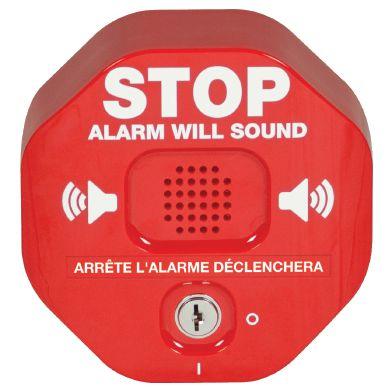
reengineered our easy to install door alarm to make it even better! Now, it alerts to theft and vandalism in 2 ways when activated, along with these other upgrades:
Beeps and flashes
Warning in 2 languages
Updated graphic face
Low battery warning
RESILIENCY BUILDING
Natural disasters aren’t always predictable and are rarely preventable, but investing in appropriate technology can help mitigate their effects
By Bill Maginas
In recent years, an unprecedented number of natural disasters threatened cities and communities throughout the world. The impact of severe weather patterns — from hurricanes to tornados to wild fires — have heightened the importance of proactively planning for expected and unexpected threats. Since it is difficult, if not impossible, to prevent major loss events, the focus should be on mitigating vulnerabilities and ensuring damages are as minimal as possible. This concept, known as “resiliency,” has become an increasing priority for infrastructures and municipalities.
Resiliency enables an infrastructure to anticipate, survive and recover
from external disruptions. Upon the sudden impact of a crisis or disaster, resiliency allows systems and processes to restore as quickly as possible without deterring their ability to function or their capacity to act. Ultimately, the goal is to maintain “normalcy.” Resilient systems must meet a range of different requirements that address both preparation and trying to limit damage, and illicit the appropriate response following an event. The systems should be designed to combat extreme events through improved security and building upgrades that help prevent loss. If loss does occur and operative systems and occupants are at risk, a second layer of protective measures should be in place to help minimize the conse-
quences. This second layer of defence should be designed to detect threats and respond accordingly to prompt backup systems, offer emergency aid and enable warning systems.
A strong first step towards achieving greater resiliency is to conduct an assessment that pinpoints unique challenges and goals that your organization faces. Resilience is not a “one-sizefits-all” approach; the best methods used for one facility may not be the same for the next. Consider how the building is used, common points of stress due to high-trafficked areas, as well as the natural disasters that are mostly likely to occur in the area. For example, buildings located in regions that face severe hurricanes need to implement different solutions than cities susceptible to droughts and fires. Similarly, critical infrastructures, such as hospitals or power plants, should invest in especially robust systems to help safeguard their technologies that are vital to operations. Through technology and infrastructure upgrades, buildings can take a proactive approach to improving the safety and comfort of its occupants in the wake of an emergency.
Multi-Purpose Lighting Beyond Traditional Uses
Lighting can play an integral role in resiliency during emergency situations because systems are already implemented throughout a building and the surrounding area. This existing infrastructure allows for smart improvements, such as networked LED lights, to be easily added in a cost-effective manner. Cameras, sensors and even gunshot detection devices can be installed on top of connected lights, expanding traditional lighting capabilities. During a hurricane or forest fire for example, using traffic sensors and climate detection, lighting systems can provide an evacuation route for occupants by lighting a path that is less congested and safer from hazards such as flooding, fire or poor air quality. While they may initially seem rudimentary, the intelligent lighting systems available today are a key asset to help improve the speed and safety of evacuations during an emergency.
Benefits of Voice-Enabled Fire Alarm Systems
Mass notification systems (MNS) can provide a multitude of benefits and can change the way information is communicated during an emergency. Beyond traditional MNS use cases, such as text messages or alerts, a recent, yet important, feature of an integrated MNS is a voice-enabled fire alarm system. In the case of an emergency, addressable notification technology — where every device has a specific address on the system and can communicate with the fire alarm panel — can be crucial in providing direction, mini-
“Through technology and infrastructure upgrades, facilities must look beyond traditional emergency preparedness plans.”
mizing chaos and helping ensure the safety of occupants. Voice fire alarm systems can instantly broadcast information throughout a building and can be programmed to select exactly which speakers are used — and what message is played on them — during an emergency. This helps to guide occupants to safety, depending on where they are located.
In the case of a small isolated event, an individual speaker can be activated to deliver a message in that specific area. In broader emergency situations, groups of speakers can be used to deliver critical evacuation instructions for specific parts of the building based on the nature of the emergency. For example, during a fire, certain areas can be alerted to evacuate using a specific exit, while another floor is advised to safely evacuate the building using a different route to exit.
Mitigating Security Vulnerabilities
When a natural disaster strikes, a building and its operations can be susceptible to threats such as theft or intrusion. Having integrated security systems in place, including surveillance, access control and intruder detection, helps to ensure that infrastructures are not taken advantage of in their most vulnerable state. For example, access control restricts the public from accessing
sensitive information or assets and can provide an audit trail, which can be valuable to track a malicious insider’s movements inside the facility. If a building closes as a precautionary measure during a natural disaster, security can oversee who enters the building and access remote video surveillance cameras in the area to help ensure there is no suspicious behaviour.
Strengthening Alternative Power Systems
Resiliency is critical for infrastructures and communities planning to sustain uninterrupted power during an emergency. Investing in components such as generators, energy storage and renewable resources is key for buildings to remain operational during power supply or equipment reliability issues. For instance, distributed energy storage technology can help a municipality stay up and running, regardless of a power outage as it releases stored energy. This allows buildings to continue operations despite a larger community power outage.
HVAC Systems for Operational Stability
Every facility depends on a reliable HVAC system and when a heating or cooling unit fails, it greatly affects the controlled pressurization and temperature of a building and puts operations and occupants at risk. Preparing and planning for an emergency that can cause building wide disruptions is a crucial step in protecting the employees and the assets of the company. Ahead of an emergency, building managers must identify any critical equipment that, if failed, would have the greatest disruptive impact on operations overall. While some areas of the building may still be able to function without HVAC services, equipment failure can also significantly disrupt operations. Having a plan in place can help minimize the HVAC systems downtime and get operation back up and running as quickly as possible.
Resiliency in Practice
The expectation of more frequent and destructive disasters can lead organizations to prioritize resiliency over recovery at facilities. This is fueled by the reality that safety and security is not a guarantee given the diversity, complexity and unpredictability of modern risks. Through technology and infrastructure upgrades, facilities must look beyond traditional emergency preparedness plans to safeguard operations and occupants and stabilize as quickly as possible following an unexpected threat.
Bill Maginas is area VP and GM, Canada, Johnson Controls (www.johnsoncontrols.com).
Product Previews Locks and doors
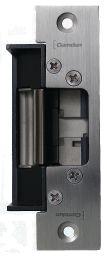
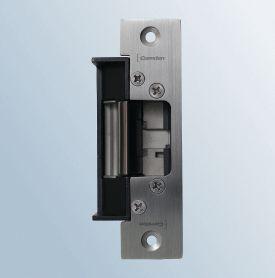
Electric door strike
Camden Door Controls
The CX-ED1410 is a Grade 1 ANSI fire strike for UL fire rated doors/frames with cylindrical locksets. It offers selectable 12/24V, AC/DC voltage, fail safe/fail secure operation and includes an ANSI square faceplate and trim plate. The CX-ED1410 is designed to deliver application flexibility over several years. Rated UL 90 minutes for fire and UL 1034 burglary listed, the strike features a 3/4 in. latch projection.
www.camdencontrols.com
Door controllers
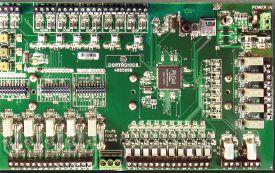
Dortronics
The 4800 Series Intelligent Interlock Controllers is a single-board solution for mantrap applications that accommodates up to five doors. Featuring 12 field assignable inputs and 17 configurable relay outputs, the controllers feature a unique watchdog circuit that constantly monitors operations, LED indicators for input-output connection stats, voltage spike and surge protection on all outputs, and adjustable propped door, panic release and door unlock timers. The new auxiliary relay lock output accessory adds up to five factory-installable accessory terminal blocks.
www.dortronics.com
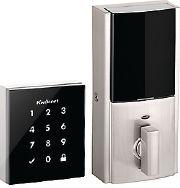
Touchscreen smart lock Kwikset
Obsidian is a low-profile touchscreen electronic deadbolt featuring an all-metal interior and advanced mechanical and electronic security features. Eliminating the keyway removes the threat of lock picking and lock bumping attacks using special keys to defeat conventional pin and tumbler locks. It also features Kwikset’s SecureScreen, which helps mask “smudge” attacks, in which passcodes can potentially be jeopardized.
www.kwikset.com
Access controllers
LTS
Mantrap portal solution
Boon
Edam Inc.
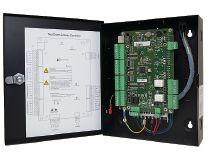
The LTK2800 series access controllers use logical architecture design. Its TCP/IP self-adaptive network interface design processes communication data with special encryptions to ensure information security. Permission data is synced on the controller to allow functionality offline. The LTK2802 and LTK2804 is encased in a sturdy, keyed metal enclosure and features a 32-bit high-speed processor. Both door controllers feature anti-passing back to prevent misuse of the access control system. Systems, such as intrusion and fire alarms, integrate to the LTK2800 series.
www.ltsecurityinc.com
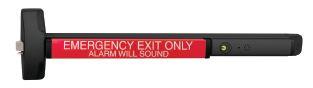
Emergency exit Yale
The A-ALR Emergency Exit Option for 6000 Series Exit Devices from Yale Commercial has all the features of an alarmed exit device and is suitable for commercial applications concerned with loss prevention. The product features a durable aluminum rail design with ANSI/BHMA Grade 1 certification. The built-in alarm is powered by a 9V battery and sounds at 90 dB at 10 ft. from the device. Other features include several alarm modes, low battery warning, tamper resistance and a red LED indicator to display that the device is armed. www.yalelocks.com
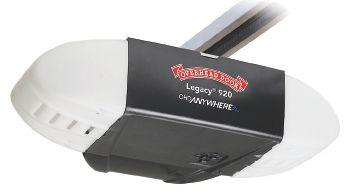
Garage door openers
Overhead Door
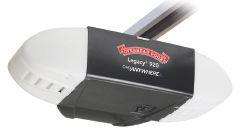
OHD Anywhere has been fully integrated into Overhead Door Legacy 920 garage door openers, allowing homeowners to monitor and control their garage door remotely via an Apple iPhone or Android phone or device. With OHD Anywhere, users can check if their garage door is open, closed or if there are any changes to the door position. They can also open the door for delivery, maintenance professionals or friends without an access password. It also keeps a log of all uses of the garage door. Legacy 920 openers gives users the option to choose between a chain unit or a belt operated unit.
www.overheaddoor.com
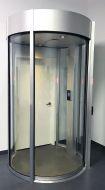
The Circelock Combi is a “half portal” solution that helps prevent unauthorized entry into high security areas currently using fire-rated swinging doors. The Combi was designed as a retrofit option to address the risk that exists with swinging doors — once an authorized user opens a swinging door, other people may also gain access. The Circlelock Combi attaches to an existing fire-rated door, converting it into a mantrap solution that prevents piggybacking and eliminates the need for manned supervision. The cylindrical solution that has a single sliding door on one end and an opening on the other end. www.boonedam.us
Exit trim
ASSA ABLOY
The new EcoFlex exit trim can be used as an electrified exit device in stand-alone applications, in conjunction with a wall reader, or as part of an integrated access control lock The EcoFlex exit trims use a motor-driven actuator that reduces energy consumption by up to 95 per cent, improves reliability, offers quieter operation, and eliminates the overheating solenoid trims are prone to. The solution operates between 12-24 VDC, making it less sensitive to power changes and able to support longer cable runs. The trims are field configurable. www.assaabloy.com
Product Previews The latest in security technology
LED beacons
E2S Warning Signals
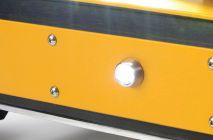
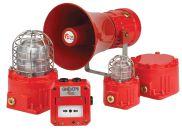
With multiple operating modes, the LED beacons offer an extended operating life of over 6,000 hours, lower current requirements and higher output levels. The LED beacons have five flash rates for warning beacon applications: 1.0, 1.5, 2.0 Hz and double and triple flashes. They also offer high and low steady outputs for status indicator use. DC voltage versions feature three remotely selectable stages, enabling multiple warnings to be signalled from one device. The same light engines and control electronics are common across all product families: the STEx 316L stainless steel, the GNEx and E2x GRP and BEx and D2x marine grade LM6 aluminum enclosures. www.e2s.com
Traffic operations platform
Genetec
LCD monitor
TRU-Vu Monitors Inc.
The SRMW-24 Series monitors feature 1920 x 1080 full HD resolution and 1,000 nits of brightness, producing clear images even in direct sunlight or other high ambient light conditions.
The NEMA 4X fully waterproof stainless steel enclosure ensures the monitor will withstand rain, snow, etc. Cabable of operating between -4°F to +158°F, the series also features anti-reflective glass to improve image quality. An ambient light sensor also automatically adjusts screen brightness, depending on lighting conditions, and the Auto Re-Start after power loss function ensures the monitor automatically resumes operation after power is restored.
www.tru-vumonitors.com
Genetec Traffic Sense is an open platform that delivers a unified view of real-time conditions and vehicle flow to cities, bridge and tunnel operators, state transportation departments and border crossing agencies so they can identify and respond to incidents more efficiently. Traffic Sense unifies traffic data, dynamic message sign control, video monitoring, video analytics and incident management. By accessing data sources, including roadside sensors and third-party probe data for travel-time analytics, Traffic Sense automatically identifies congestion and abnormal traffic conditions. www.genetec.com
Speaker enclosure
Legrand
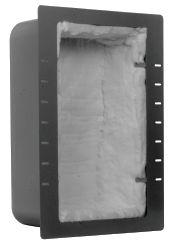
Fire-rated speaker enclosure Nuvo NVBRKIC-BC meets ASTM E119 requirements and integrates with Nuvo speakers and roughin brackets, as well as most in-ceiling speakers. The enclosures also help in complying with building codes regarding energy efficiency and air leakage. The NV-BRKIC-BC enclosure is 17.0 in. x 18.35 in. x 5 in., and are suited for use with many Legrand Nuvo speakers, including Nuvo Series Four 6.5 in. in-wall, Nuvo Series Six 6.5 in. in-ceiling and Nuvo Series Four 8 in. angled in-ceiling models. www.legrand.us
Table mount adapter
Video Mounts Products
The TMA-1 Tablet Mount Adaptor is designed to hold most tablets seven to 11 inches in size, allows for hands-free tablet use and works with VMP’s LCD-1B, LCD-1CB, LCD-2B, FP-SFTB and FP-SFB mounts, as well as other manufacturers’ 100 x 100 mm mounts. With a load capacity of six pounds, the TMA-1 has an adjustable height and width: ranging from 5.3 in. to 7.9 in. wide and 7.7 in. to 10.6 in. high. www.videomount.com
Product Previews The latest in security technology
Push button
STI
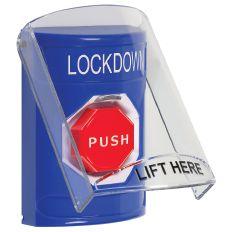
STI’s Stopper Station push button, available in red, green, yellow, white or blue, features a unique design that helps stop accidental activation while allowing legitimate activations. Offered with lockdown or customized labelling, switch options include: momentary, key-to-reset, turn-to-reset, and key-to-activate. Optional illumination can be used as a status light (always on) or users can select a colour change when activated. Optional 12-24V LED insert illuminates a red, green or white. www.sti-usa.com
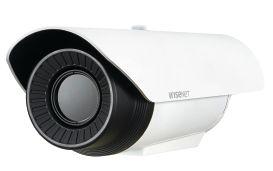
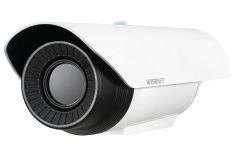
Thermal camera
Hanwha Techwin America
The new IP-based Wisenet thermal cameras (TNO-4051T, TNO-4050T, TNO-4041T, TNO-4040T and TNO-4030T) require no ambient light and provide high quality images in darkness or challenging environments. Capable of long range detection, the cameras feature selectable 13/19/35mm lenses and are available in bullet and PT mounts. With a VGA resolution of 640 x 480 at 30fps, the new thermal cameras use the Wisenet 5 chip to provide analytics including tampering and shock detection, loitering, directional detection, plus audio detection and classification for gunshots, glass breaks and screams. www.HanwhaSecurity.com
Security management platform
Lenel
OnGuard version 7.4 security-management platform can be deployed in the cloud and accessed through a web browser on a mobile device or computer. OnGuard Monitor provides alarm-management capabilities and OnGuard Access Manager provides access-rights management to area managers. Improvements expand the range of OnGuard tasks that can be completed through a web browser.
www.lenel.com
Access control solution
Qognify
Qognify ACI, an Access Control Insights solution, uses smart pattern recognition to transform data from access control systems into information that can be used to improve security and operations. Access control systems hold a wealth of data with significant operational impact; Qognify ACI reveals the information within this data to answer and address daily security challenges. Through ACI, card holders’ activity information is monitored and analysed continuously, yielding individual behaviour patterns. Out-of-the-ordinary behaviours are reported via alerts.
www.Qognify.com
External motion detectors GJD
LTE solutions
Johnson Controls
The DSC LTE Universal and PowerSeries Neo LTE Alarm Communicators offer flexible communication options that work with LTE and existing 3G networks. The communicators ensure current and future compatibility with more modern cellular networks as mobile providers start to phase out 2G/3G communication networks. The DSC family of LTE Universal Alarm Communicators is compatible with most security panels. The Alarm Communicator provides cellular and/or IP connectivity, in addition to encrypted PowerG wireless technology. www.johnsoncontrols.com
D-TECT IP external motion detectors provide flexible volumetric field of view sensing, making the range suitable for intruder monitoring, CCTV surveillance and other alarm requirements. D-TECT is designed to reduce false alarms while monitoring areas for intruders, and can be integrated with most major VMS and home automation systems. GJD’s IP technology enables real-time remote monitoring via a secure web-based interface. Detector settings can be changed remotely via the interface. www.gjdusa.com
Surveillance cameras
Arecont Vision
The new MegaDome and MegaVideo UltraHD series cameras offer users the choice of 12MP at 20fps for maximum resolution and image clarity, 4K at 30fps with BMP high definition image quality for high speed requirements, or 1080p at 60fps for maximum frame rate. The MegaDome UltraHD dome camera includes a motorized remote focus/zoom 4.4-10 mm P-Iris lens mounted in a 3-axis gimbal. Wide dynamic range, NightView low-light technology, SNAPstream technology, and dual encoder H.264/MJPEG capabilities are built in.
www.arecontvision.com
Managed switches TRENDnet
TRENDnet has launched two 2.5G managed switches with 10G SFP support, designed as a solution to expand network bandwidth without requiring new cabling. The pair include a standard version with the 10-Port 2.5GBASE-T Web Smart Switch, model TEG-30102WS, and a PoE version with the 10-Port 2.5GBASE-T Web Smart PoE+ Switch, model TPE-30102WS. They feature a web-based GUI management interface for advanced traffic management controls, IP routing, VLAN, QoS, access controls, link aggregation, troubleshooting, SNMP monitoring and more. Each switch includes eight 2.5GBASE-T RJ-45 ports, and two 10G SFP+ ports. www.trendnet.com
DIGITAL
Smart phones for credentials and access control: The under-30 crowd is ready to replace smart cards with smart phones
A family affair: Many security businesses in Canada are passed through generations from parents to children. Passing along the knowledge and business acumen is a vital part of that process, whether it’s industry savvy or a customer focused attitude
Millennials are probably the most scrutinized age cohort since Generation X — arguably much more so, given their close association with the rise of the Internet and reputation for being mobile savvy.
This issue’s cover story, Marketing to Millennials, references a definition of the age group as those born between 1982 and 1998 — a significantly broad time span that roughly equates to the rise of the personal computer and the early days of the Internet.
This is not the first time SP&T News has taken a look at how this generation is transforming security through its technology preferences and habits. In 2011, an article by Ingersoll Rand’s Raj Venkat, while
Generation next
not expressly about millennials, explored the impending use of mobile devices as identification and access control devices. “The under 30 crowd is tech savvy,” he wrote. “This younger generation has only one question when it comes to using smart cards and biometrics in the commercial world: why aren’t smart cards and biometrics used beyond campus?”
Just two years ago, SP&T ran an article on hybrid security systems that take advantage of DIY and self-monitoring, but bring the dealer into the equation. The premise is the dealer would sell this equipment to the end user who would install it and monitor it themselves — with an option in some cases for third-party monitoring on-demand.
Keith Jentoff spoke of a hybrid alarm product/service called DragonFly, which was offered by Honeywell. “DragonFly is chasing the millennials, the 20-somethings, who are going to Amazon.com and Best Buy to purchase cameras,” he said. “They’re not looking at a professionally installed alarm system. So we’re trying to bring them into the RMR ecosystem where they normally wouldn’t be.”
Another important aspect of security and millennials is the industry itself — specifically the people it employs. As the cohort ages and enters the work force, there are of course new additions to the security industry as well. SP&T News has featured several articles and roundtables over the
Americans don’t feel totally safe in their homes, says survey: People, particularly millennials, no longer live life on a rigid schedule, and the lack of consistency can leave consumers wondering about their homes when on the road. (from www.sptnews.ca).
Putting the pieces together: “Our security solutions will continue to evolve and adapt to meet the needs of our clients. I am confident that future generations of security professionals will look back with pride at our time in this vital industry.” (Richard McMullen, FCi)
years that ask questions (and offer some answers) about what it takes to entice new graduates to join security and the types of skillsets they bring with them.
Back in 2010, Steve Bocking, then of Genetec, wrote that a new generation of control room operators had adapted to the complexity presented by alarm systems that integrate intrusion, video and access control, shedding the image of control rooms as static environments.
Just last issue (April 2018), industry veteran Brian St.Onge noted that new ideas and are being explored in security as young people enter the profession. Moreover, he noted, they will have answers to problems “that we don’t even know exist yet.”
INDUSTRY LEADERS SECURING INDUSTRY LEADERS
125 years of experience in putting the security of others first.
We understand you need to protect more than brick-andmortar, which is why ADT does more than monitor. ADT has a wide range of alarm and security options for organizations of any size to help protect people, goods, and data. With 24/7 surveillance, solutions against intrusion and fire, remote monitoring, interactive services and more, ADT has a security solution for your organization. Join those who trust ADT with their livelihoods and protect your business.
SECURITY AND AUTOMATION SOLUTIONS
WHY CHOOSE ADT CANADA?
We are an integrator, meaning we can take over nearly any of the existing security equipment you have on-site.
We are customer-service oriented, innovative and technology savy.
With over 125 years of experience and 15 branches in Canada alone, including four monitoring stations, you can trust the experts.
Weiser makes it easy to increase customer loyalty and position yourself as the core provider. If you already install security or home automation systems that are Zigbee or Z-Wave compatible, you’ll appreciate the easy installation and integration of Weiser Home Connect Locks.
Gain momentum in remote access and home automation as homeowners demand more from their primary solution providers.
Grow your business by building upon your existing services with Weiser.